
Abbeville County Unincorporated
City Zoning Code
City Zoning Code
CHAPTER 3
- GENERAL PROVISIONS
3.1. - Vested rights.
3.1.1 Vested rights [definitions].
The following provisions shall apply throughout the jurisdiction of this Ordinance, regardless of the underlying regulating district.
(a)
County shall mean the unincorporated areas of Abbeville County.
(b)
Approved means a final review and approval in accordance with its established procedures by Abbeville County of a site specific development plan. Phased development plans remain subject to review of all phases prior to being vested.
(c)
Landowner means an owner of a legal or equitable interest in real property including heirs, devisees, successors and assigns, and personal representatives of the owner. It may include a person holding a valid option to purchase real property pursuant to a contract with the owner to act as his agent or representative for purposes of submitting a proposed development plan.
(d)
Land Development Ordinances are those ordinances which address the development of land and may include but are not limited to zoning, subdivision, road construction and dedication, mobile home, advertising, and agricultural siting ordinances.
(e)
Phased development plan means a development plan submitted to a county government by a landowner that shows the types and density or intensity of uses for a specific property or properties to be developed in stages.
(f)
Site development plan means a plan submitted by a landowner which describes with reasonable certainty the types and density or intensity of uses for specific property.
(g)
Vested rights means the right to undertake and complete the development of property under the terms and conditions of a site specific development plan, in conjunction with this ordinance and in conformity with county land development ordinances and upon final approval by the county.
[3.1.2.] Vested rights [conditions].
(a)
A vested right is established for two years upon the final approval of a site specific development plan. Such vested right shall receive five one-year extensions upon proper application by the landowner in each year that an extension is desired.
(b)
A vested right in a site specific development plan shall not attach until all plans have been received, approved and all fees paid in accordance with the procedure outlined in Article 4, Section 3 of the Land Development Regulations, wherein the developer is authorized to proceed with grading, installation of utilities, streets and other infrastructure and to undertake other significant expenditures necessary to prepare for application for a building permit.
(c)
Should a request for a variance be required, vested rights will not be conferred until such variance is granted.
(d)
A change in the zoning district designation or land use regulations made subsequent to vesting that affect real property does not operate to affect, prevent or delay development of the real property under a vested site specific development plan or vested phased development plan without the consent of the landowner.
3.2. - Compliance to ordinance, substandard lots of record, nonconforming buildings or uses.
3.2.1:
All general and district requirements shall apply to an existing nonconforming use increasing in parking area and/or building area by at least 10%.
3.2.2:
No land or structure shall be hereafter used or occupied, and no structure or parts shall hereafter be constructed, erected, altered, or moved, unless in conformity with all of the regulations herein specified for the district in which it is located.
3.2.3:
Where the owner of a lot existing at the time of adoption of this Ordinance does not own sufficient land to enable him to conform to the dimensional requirements of this Ordinance, such a lot may nonetheless be used as a building site and the Zoning Administrator, or their designee, is authorized to issue a permit for the use of the property which conforms to the requirements for the District in which the lot is located as set forth in this Ordinance. If, however, the owner of two or more adjoining lots, with insufficient land dimensions, decides to build on or sell off these lots, he must first combine said lots to comply with the dimensional requirements of the Ordinance. Any substandard lot of record requiring waivers on yard requirements applying to the district within which said lot is located shall first be approved by the Zoning Board of Appeals provided that further decreased dimensional requirements shall conform as closely as possible to the required dimensions.
3.2.4:
Nonconforming buildings or land uses are declared by this ordinance to be incompatible with permitted uses in the Districts involved. However, to avoid undue hardship, the lawful use of any building or land as of the date of adoption of this Ordinance may be continued even though such use does not conform to the provisions of this Ordinance, except that the nonconforming building or land use or portions thereof, shall not be:
1.
Changed to another nonconforming use;
2.
Re-used or reoccupied after discontinuance of use or occupancy for a period of thirty days or more, unless the owner can demonstrate there was not intent to abandon the use;
3.
Re-used, reoccupied or replaced with the same or similar building or land use after physical removal or relocation from its specific site location for a period of 30 days or more;
Nonconforming buildings shall be allowed to:
1.
Be repaired, rebuilt, or altered if damaged, provided repairs begin within six months of damage;
2.
Be enlarged or altered up to fifty (50%) percent of the existing square footage provided all district standards can be met;
3.
Be replaced with another structure (stick-built or manufactured if permitted in the zoning district and per building codes), provided said structure is no more than fifty (50%) percent greater than the existing structure and all the district standards are met.
Nothing in this section shall be deemed to prevent the strengthening or restoring to a safe condition of any building or part thereof declared to be unsafe by any official charged with protecting the public safety, upon order of or approval by such official.
3.2.5:
Nonconforming Building or Use Discontinuance: Notwithstanding other provisions of this Ordinance, certain nonconforming buildings or land uses, after this Ordinance is enacted into law, shall be discontinued, and/or shall be torn down, altered or otherwise made to conform with this Ordinance within the periods of time set forth below. The casual, intermittent, temporary or illegal use of land or buildings shall not be sufficient to establish the existence of a nonconforming use, and the existence of a nonconforming use on a part of a lot or tract shall not be construed to establish a nonconforming use on the entire lot or tract.
Upon application to the Board of Zoning Appeals, the Board, either according to general rule or upon findings in the specific case, may permit not more than one extension for not more than the time indicated below.
Notice shall be sent by the Zoning Administrator to all nonconforming users stating wherein they do not conform to said Ordinance and stating the date by which they must either comply or cease to exist. The date that a conforming use must either comply or cease to exist shall be measured form the date of enactment of this Ordinance and shall be observed regardless of whether notice of nonconformity is sent by the Zoning Administrator or received by the affected
3.2.6:
Permitted, prohibited, and conditional uses:
3.2.6.A:
Permitted and Prohibited Uses.
Permitted uses are listed in the regulations of the various zoning districts. Unless the contrary is clear from the context of lists and other regulations, uses not specifically listed as permitted are prohibited.
3.2.6.B:
Conditional Uses:
Conditional uses are those uses that are allowed in the regulations of various districts if specified conditions are first met. In approving such a conditional use, the Zoning Administrator may require the applicant's compliance with specified conditions regarding duration of use; hours of operation; signage; lighting; noise; fire and explosive hazards; smoke, dust, and dirt; fumes, vapors, and gases; negative effects on the adjoining properties; and endangerment of the public health, safety and general welfare. Specified conditions will derive from existing county, state, and federal regulations, and are available in the office of the County Zoning Administrator. Conditional uses are permitted by the County Zoning Administrator for an initial period of one year. After one year, upon review, an application for a conditional use permit will be extended for two years, provided required conditions have been followed with no violations during the first year. Thereafter, conditional use permits will be reviewed biennially, and will be given a two-year permit, provided no violations in the required conditions have occurred. Constant and unresolved violations may lead to the cancellation of a conditional use permit, including special event permits, during either the initial first year or the subsequent two-year permit period, especially if such conditions are not immediately resolved. This provision does not alter or amend other conditions applying to "Special Events."
(Ord. No. 09-11, 9-14-2009)
3.3. - Fence and wall standards.
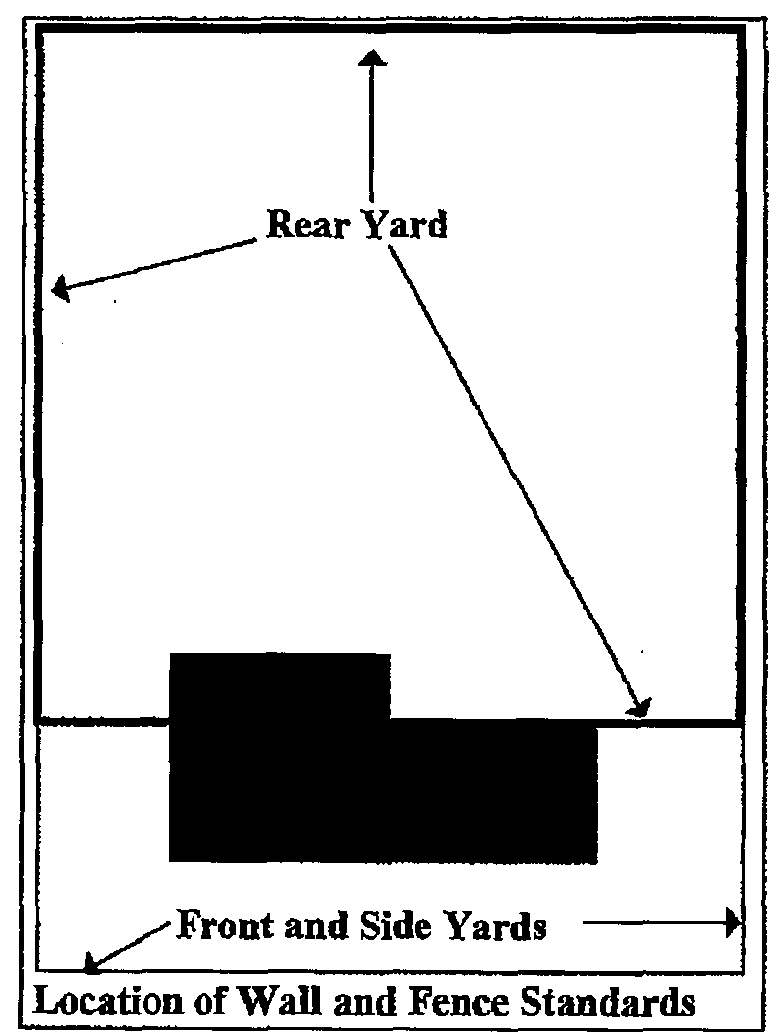
Except as otherwise noted in this Ordinance, fences or walls are permitted in the various districts subject to the following regulations:
3.3.1.
All Uses:
A.
Rear yard fences and walls.
1.
Max. Height: 8 feet.
B.
Side and front yard fences and walls.
1.
Max. Height: 8 feet.
3.3.2.
Materials:
A.
Materials: Brick, stucco, chain link (protective wire is permitted for rear yard fences not visible from a street), wrought iron, stone, wood, concrete, or combinations of the above. When combination of 2 or more materials is used, the heavier material shall be below.
3.4. - Temporary structures and uses.
3.4.1:
Temporary structures and uses, when in compliance with all applicable provisions of the Ordinance and all other ordinances of Abbeville County, shall be allowed. The following temporary structures and uses shall be permitted:
3.4.2:
Construction Trailers: Trailers used in conjunction with construction projects provided that the following conditions are met:
A.
Such construction trailers may be located at a building site where there is a valid building permit for the construction project, or, in the case of a residential subdivision, a valid building permit for at least one of the residential units being constructed.
B.
All construction trailers shall be located at least ten (10) feet off any street right-of-way and not located in any required rear or side yard setbacks.
C.
All construction trailers shall be removed within one (1) month of the completion of the project or issuance of the Certificate of Occupancy.
D.
Temporary, on-site sanitary facilities are to be provided, maintained, and removed by the project manager.
3.4.3:
Special Events: Uses not to exceed fourteen (14) days in duration and held no more than five (5) times per year at any particular location, depending on category, which would not otherwise be permitted in a particular zoning district, and not to exceed a total of forty-two (42) days per calendar year, may be permitted as a conditional use in accordance with Section 3.2.6:B. Conditional Uses and as herein provided. A Special Event is defined as a special function not commonly held on the property in question. Special Events include but are not limited to: revivals, rallies, carnivals, circuses, and hunting/fishing tournaments. If necessary, temporary on-site sanitary facilities will be provided and maintained by the event organizer. The temporary zoning permit shall be valid for a specified period only, not to exceed five (5) to fourteen (14) days in duration and a maximum number of three (3) to five (5) special events per location, depending on category.
Special Event Categories:
A.
Carnivals, Fairs and Other Major Public Gatherings - provided zoning permits for temporary public assembly use and events of public interest, such as carnivals, fairs, and other major public gatherings and parking for such events, are issued for periods not to exceed five consecutive days. No more than five such permits may be issued, per location, per calendar year. Temporary permits shall be issued only if adequate parking, sanitary facilities, food preparation, and other conditions pertinent to both Section 3.2.6. Conditional Uses and the public safety of the County (which protects the health, safety, and general welfare of the public) are provided to serve the proposed use or activity.
B.
Concerts and Stage Shows - provided zoning permits for temporary public assembly use and events of public interest, such as outdoor concerts and stage shows and parking for such events, are issued for periods not to exceed five consecutive days. No more than five such permits may be issued per location, per calendar year. Temporary permits shall be issued only if adequate parking, sanitary facilities, food preparation, and other conditions pertinent to both Section 3.2.6. Conditional Uses and the public safety of the County are provided to serve the proposed use or activity.
C.
Outdoor Religious Events - provided temporary zoning permits for outdoor religious events, such as church revivals or outdoor concerts, and parking for such events may be issued for periods not to exceed fourteen (14) consecutive days, and no more than three (3) such permits may be issued per location, per calendar year. Temporary permits shall be issued only if adequate parking, sanitary facilities, and other conditions pertinent to both Section 3.2.6. Conditional Uses and the public safety of the County are provided to serve the proposed use or activity.
Section 3.4.3.A.: The definition of "per location": the maximum number of special events allowed "per location" is defined to mean that a property cannot be subdivided so as to circumvent the maximum number of special events allowed per location, which is either three (for Outdoor Religious Events), or five (for Carnivals, Fairs, and Other Major Public Gatherings; and for Concerts and Stage Shows).
Section 3.4.3.B.: The definition of "maximum number of special events": An applicant is allowed a maximum of three or five special events per calendar year, depending on the category of special events. The maximum number of special events permits per property per calendar year can be combined among the three categories, but the maximum number allowed cannot exceed five (5) special events permits per location per calendar year by any combination.
Section 3.4.3.C.: Approval of a Special Event Permit is contingent upon previous compliance with the conditions of a similar permit. If the applicant and/or his special event location violates or refuses to fully comply with the specified conditions of a prior special event permit, the application for a new permit shall be denied. In addition, the acceptance or denial of a special events permit application that either: a) requires an approved law enforcement plan, or b) does not appear to meet the conditions and categories of "special events" as defined by the text of Sections 3.2.6 or 3.4.3 of this Ordinance, will require the approval of both the County Planner and a liaison designated by the County Council.
(Ord. No. 08-14, 10-13-2008; Ord. No. 09-11, 9-14-2009)
3.4.4.
Temporary manufactured homes: Manufactured homes (including self-contained recreational vehicles) may be allowed on a temporary basis in a zoning district in which such use is not listed as a permitted use, if a disaster occurs which results in an occupied single-family dwelling being destroyed (i.e., it receives damage greater than 60% of its tax value or is deemed uninhabitable). The purpose of allowing such manufactured home on said lot is to give the occupants of the destroyed dwelling unit a place to live while a new dwelling unit is being constructed or repaired. If a manufactured home is used for such an occurrence, it is subject to the following conditions.
A.
Such manufactured home shall not be placed in the front yard, unless the lot is otherwise obstructed, and shall be located no closer than 15 feet to another structure and no closer than 10 feet to any lot line.
B.
The Zoning Administrator shall be given the authority to issue a zoning permit for such temporary use on a one-time basis only for a period of up to one year. Such permit may be renewed on a one-time only basis if it is determined that:
1.
Construction of a new dwelling unit is proceeding in a diligent manner; and
2.
The granting of such permit will not materially endanger the public health, welfare, or safety; and
3.
The location of the manufactured home on the site does not have a negative effect on abutting properties.
3.4.5.
Campers or Recreational Vehicles.
A.
Campers or recreational vehicles are permitted for occupancy in the FA zoning district provided that:
1.
Only one (1) camper or recreational vehicle shall be located on a property, except when the property is used for a special event, and a certificate of zoning compliance has been obtained from the Zoning Administrator.
2.
Campers or recreational vehicles used upon such property shall meet the standards specified in subsection C.
3.
Occupancy of campers or recreational vehicles within the FA zoning district is restricted to the period of use needed: occupancy for hunting purposes is limited to those periods in which a hunting season has been established by the South Carolina Department of Natural Resources; occupancy for use during the construction of a house or other dwelling unit is limited to the period of construction only; etc.
B.
Campers or recreational vehicles are permitted for occupancy in the GC, LI, BI and MHP zoning districts, provided that:
1.
The property upon which the camper or recreational vehicle is located is the site of a special event that has been issued a certificate of zoning compliance by the zoning administrator.
2.
The maximum duration of stay within the camper or recreational vehicle shall be equal to that of the special event.
3.
The property owner provides a receipt for sanitary service or proof that existing facilities are available on-site that may be used during the special event.
4.
Campers or recreational vehicles used upon the property meet the standards specified in subsection C.
C.
Other Conditions:
1.
Campers or recreational vehicles on the property shall be road-ready for immediate removal.
2.
Campers or recreational vehicles on the property shall have a current license plate and registration.
3.
Campers or recreational vehicles on the property are serviced by sanitary/waste disposal systems approved by the applicable utility provider or the South Carolina Department of Health and Environmental Control (SCDHEC).
4.
Any electrical service to campers or recreation vehicles on the property shall have been permitted, inspected, and approved by the Abbeville County Building Department.
5.
Campers or recreational vehicles occupied on the property shall be located so that all setbacks, dimensions, and other pertinent zoning requirements are met.
(Ord. No. 2014-02, 4-14-2014)
3.4.6.
Temporary Accessory Residential Uses.
A.
A mobile home, as defined by this Ordinance, may be permitted in the FA and GR zoning districts (those residential districts allowing mobile homes) as a temporary accessory residential use, which shall be clearly subordinate to a principal single-family detached dwelling or manufactured home, whether or not such principal use is conforming to the Ordinance, subject to all of the requirements listed below. In authorizing the temporary accessory residential use, the Board of Zoning Appeals may impose such reasonable and additional stipulations, conditions, or safeguards that in the Board's judgment will better fulfill the intent of this Ordinance.
B.
The Board of Zoning Appeals may authorize issuance of a permit for a temporary accessory residential use for a period not to exceed one (1) year following submission of an application and $125 filing fee by applicant. At the end of that year and each subsequent year thereafter, the Board may, after a complete review of the request, grant an extension of the permit for a period not to exceed one year. The review procedure shall be the same as the original application procedure; provided, however, there will be no additional filing fee charged for the review process. It shall be the responsibility of the Zoning Administrator to present to the Board after each one-year period a status report of the condition regarding applicant and to notify the applicant of the review.
C.
The Board of Zoning Appeals may at any time terminate the authorization at the request of the initiating applicant or upon the finding that the extenuating conditions no longer exist. The temporary accessory residential use and any associated services shall be removed from the premises within 30 days after notice of termination.
D.
The Board shall determine that the following requirements have been satisfied:
1.
The use shall be necessitated by the incapacity, infirmity, or extended illness of an individual who requires continuous nursing care. The physical and/or mental condition of the person in question shall be certified by the attending physician.
2.
The use is intended only to meet a temporary need or hardship, is not detrimental to the public health or general welfare, and the use will not violate neighborhood character nor adversely affect surrounding land uses.
3.
If the principal residential use is nonconforming, the provisions of Section 6.1.9, setback requirements shall be satisfied for the temporary dwelling.
4.
The temporary accessory residential use shall meet all of the requirements contained in this Ordinance for accessory uses.
5.
No minimum lot area or lot width requirements shall be required for the temporary accessory residential use.
6.
The temporary accessory residential use shall conform to the front, side, and rear yard requirements established for the district in which the use is located.
7.
Off-street parking shall be provided in accordance with the provisions set forth in Section 6.1.10 for the principal residential dwelling only.
8.
A manufactured home which is being utilized as a temporary accessory residential use may not be physically attached to or be a part of the principal structure located on the lot.
9.
No permit to allow a temporary accessory residential use shall be issued until all applicable regulations of the Abbeville County Building Department and other public agencies have been satisfied in regard to the adequate provision of water, sewer, access, electrical service, and fire protection. In seeking approval of the temporary accessory residential use, the applicant must demonstrate to the Board of Zoning Appeals that these facilities and services are adequately situated with respect to the lot in question.
10.
The principal party for whom the accessory use is requested must be a relative by blood or marriage, or in a relationship created through adoption or through foster parent care.
11.
To provide for adequate notification of the permit application to surrounding property owners, the Zoning Administrator shall, by one of certified and one first class mail, notify the following individuals:
a.
All property owners who own property abutting the subject property.
b.
All property owners of property located directly across a street from the subject property.
Such notification shall be post marked a minimum of fifteen (15) days prior to the public hearing.
(Ord. No. 2014-02, 4-14-2014)
3.4.7.
Other Temporary Uses: The Zoning Administrator is authorized to issue a Temporary Certificate of Zoning Compliance for other temporary uses, as follows.
A.
Real estate sales office, in any district, for a period not to exceed one (1) year, provided no cooking or sleeping accommodations are maintained in the structure.
B.
Contractor's office and equipment sheds, in any district, for one (1) year, provided that such office be placed on the property in which it is an appurtenant.
All Temporary Certificates of Zoning Compliance may be renewed, provided that it is determined that said use:
a)
Is clearly of a temporary nature, will cause no traffic congestion, and will not create a nuisance to surrounding areas;
b)
Shall not materially endanger the public health, welfare, and safety;
c)
Shall not have a substantial negative effect on adjoining properties;
d)
Secures a permit at least ten (10) days in advance of the event or function;
e)
Secures a separate permit for each event;
f)
Is not in a flood hazard area as defined by the National Flood Insurance Program or FEMA.
In approving such a zoning permit, the Zoning Administrator may authorize conditions regarding duration of use, hours of operation, signage, lighting, etc., and such conditions shall be made part of the permit issued. Violations of such conditions shall be considered a violation of this Ordinance.
3.5. - Reserved.
Editor's note— Ord. No. 2022-13, adopted December 12, 2022, repealed § 3.5, which pertained to vibration, light, and noise, and derived from Ord. No. 2014-02, adopted April 14, 2014; and Ord. No. 2018-03, adopted May 14, 2018.
3.6. - Yard and garage sales.
Yard, garage, tag, patio, and apartment sales are permitted without a permit and with permission of the property owner or leaser of the lot, as an accessory use on any residentially or institutionally developed lot in any district.
3.7. - Home occupations.
A home occupation shall be permitted in any residential district or structure provided that such occupation:
A.
Is conducted by members of the family residing in the dwelling and are permitted to be engaged in such occupation;
B.
Employs a maximum of two (2) full time employees other than members of the immediate family residing in the dwelling. (Home occupations within a Forest Agricultural (FA) or Rural Development (RDD) district may employ up to five (5) full-time non-family members; full-time employment is understood to be on-premises employment.);
C.
Is conducted within the principal building;
D.
Utilizes not more than 25% of the total floor area of principal building;
E.
Produces no alteration or change in the character or exterior appearance of the principal building from that of a dwelling;
F.
Conducts no retail sales, other than items hand-crafted on the premises, in connection with such home occupation;
G.
Does not display products visible from the street;
H.
Is not visibly evident from outside the dwelling, except for the permitted sign (See Section 3.11: Signs);
I.
Does not generate traffic in greater volumes than would normally be expected in a residential neighborhood. Any need for parking shall be met by off-street parking and other than in a required front yard;
J.
In FA and RDD zones, light manufacturing, wholesaling, and service-related businesses are allowed in an enclosed building not exceeding 5000 square feet in floor area. The use of accessory buildings to the principal building are allowed in these zones provided the appearance of the subject property remains agricultural/residential as viewed from the public way and business activities do not produce sound levels that are uncharacteristic of the area.
(Ord. No. 2018-03, 5-14-2018)
3.8. - Pets, kennels, animals.
3.8.1:
Private Stables shall mean the keeping of one or more horses, ponies, mules, donkeys, and other animals used for riding.
A.
Minimum lot area: 2 acres.
B.
Stables, corrals, and piles of manure, feed, and bedding shall be located 100 feet from any street or property line in order to minimize odor and nuisance problems.
C.
Any potential run-off contamination will be controlled by accepted practices.
D.
Private Stables are allowed only in the Forest/Agricultural and in the Rural Development Districts.
3.8.2:
Private Kennel shall mean any place in or at which household pets are kept, except for the primary purpose of grooming, in numbers greater than the following:
A.
Four (4) household pets over the age of six (6) months upon any lot less than one (1) acre.
B.
Eight (8) household pets over the age of six (6) months subject to the following provisions:
1.
Minimum lot size of one acre.
2.
Such household pets shall be kept not less than twenty-five (25) feet from all property lines.
C.
This section shall not apply to any veterinary hospital, animal hospital or any other establishment or premises wherein or whereon the practice of veterinary medicine, surgery, or dentistry, or any part thereof, is conducted.
D.
An accepted method of waste collection and disposal shall be used.
E.
The Forest/Agricultural and Rural Development Districts are exempt from these requirements.
Section 3.8.3
Beekeeping shall mean the owning, possession, or breeding of bees for the purpose of honey.
A.
Four (4) hives, each with only one swarm, are allowed on lots of less than one (1) acre.
B.
Six (6) hives, each with only one swarm, are allowed on lots equal to or greater than one (1) acre.
C.
Hives shall not be located within twenty-five feet of any lot line, unless they are placed behind a six (6) feet high fence parallel to any lot line within twenty-five (25) feet of a hive and extending a minimum of twenty (20) feet beyond the hive in both directions.
D.
The Forest/Agricultural District is exempt from these requirements.
(Ord. No. 2014-02, 4-14-2014)
3.9. - Private swimming pools and game courts.
3.9.1:
Swimming pools and game courts, including but not limited to aprons, walls, and equipment rooms, shall not protrude into any setbacks.
3.10. - Private camps.
3.10.1:
Private camps are non-public facilities conducted and supported primarily by individuals or groups not affiliated with governmental agencies or corporations.
A.
Minimum lot area: 15 acres.
B.
All structures shall be located 1,000 feet from any street or property line in order to minimize nuisance problems.
C.
Campers are limited to stays of thirty (30) consecutive nights.
D.
Any and all kitchen facilities are subject to regular inspection by the County Fire Marshal and SCDHEC.
E.
The Planning Commission shall call for and conduct a public hearing on any application to establish such use in Abbeville County. At least fifteen (15) days' notice of time and place in a newspaper of general circulation in Abbeville County shall be provided. At the conclusion of its review, the Planning Commission may approve the proposal as presented, approve it with specified modifications, or disapprove it.
F.
Private Camps are only allowed in the Forest Agricultural and Rural Development Districts.
3.11. - Signs.
3.11.1:
Signs are considered to be structures and the regulations herein shall apply and govern in all zoning districts. No sign shall be erected or maintained unless it is in compliance with this section and the additional requirements located in Chapter 4 for the specific zoning district
3.11.2:
A permit shall be required for the construction, alteration, relocation, or reconstruction of permitted signs unless otherwise noted, and shall be issued by the Zoning Administrator in accordance with Chapter 5 of this ordinance.
3.11.3:
Signs must be constructed of durable materials, maintained in good condition, and not permitted to become dilapidated.
3.11.4:
Non-conforming signs damaged more than fifty percent (50%) of their reasonable replacement cost shall not be repaired or replaced except in accordance with the provisions of this ordinance.
3.11.5:
All signs and outdoor displays shall conform to the requirements of the most recent edition of the International Building Code regarding signs.
3.11.6:
Prohibited Signs.
A.
Sign imitating warning signals. No sign or structure shall display flashing or intermittent lights of any type, nor shall any colored lights be utilized for sign or building outline purposes that resemble lights utilized on emergency vehicles, including police, fire, EMS, towing, and rescue vehicles; nor shall any sign use the words "Stop", "Danger", or any other that may confuse an automobile or other vehicle driver. However, blinking or flashing lights will be allowed only in commercial and industrial zoning districts, provided they adhere to all other sign and other zoning regulations as stated in the Abbeville County Zoning Ordinance.
B.
Signs within street or highway rights-of-way. Except traffic signs and signals, information signs erected by or authorized by a governmental or other public agency, or political signs.
C.
Certain attached and painted signs. Signs painted on or attached to trees, fence posts, and telephone poles or other utility poles or signs painted on or attached to rocks or other natural features.
D.
Signs which advertise activity, business, product or service no longer offered on the premises upon which the sign is located. Upon the closing, moving, or loss of the use of the property due to a disaster, any signs on the premises must be removed and any new signage must be approved under the most current Ordinance conditions.
E.
Obstructive and confusing signage. Signs which are of a size, location, movement, content, coloring, or manner of illumination which may be confused with or construed as a traffic control device or which hide from view any traffic or street sign or signal or which obstruct the view in any direction at a street or road intersection.
F.
Signs which are painted directly on the wall or any other structural part of a building, excluding murals and acceptable street art.
G.
Signs which swing or move as a result of wind pressure because of the manner of suspension or attachment.
H.
Any sign that obstructs ingress or egress to any window, door, fire escape, stairway, ladder, or opening intended to provide light or air for any room or building.
I.
Signs that violate the corner visibility restrictions of this Ordinance.
K.
Roof signs. Any sign erected, constructed, or maintained upon the roof of any building.
L.
Signs exceeding thirty (30) feet in height.
M.
Strobe lights and signs containing strobe lights or flashing lights which are visible beyond the property line.
N.
Any sign or outdoor advertising display which contains statements, words, or pictures of an obscene, indecent, or immoral character that may offend public morals or decency.
(Ord. No. 2011-06, 9-12-2011)
3.11.7:
Off Premises Signs—Billboards.
Off premises signs are subject to the following conditions:
A.
Off-premise signs (billboards) shall be a minimum of one thousand (1,000) linear feet apart when placed on the same side of the road.
B.
Shall not exceed three hundred (300) square feet in area.
C.
Shall not exceed twenty five (25) feet in height, measured above the grade of the road.
D.
Shall be set back at least ten (10) feet from all property line and rights-of-way.
E.
Shall be located within six hundred (600) feet of a commercial activity within a commercial structure, or within a district zoned for commercial or industrial uses.
F.
No off-premises sign (billboard) shall be located within one thousand (1,000) feet of a cemetery or house of worship. Measurements shall be from the property line of the house of worship or cemetery to the closest part of the off-premises sign.
G.
All billboard signs shall be lighted in such a way as not to project light and glare onto adjacent properties or road rights-of-way. Such lighting shall not exceed strength of one foot candle.
H.
Billboard signs shall not include mechanically moving parts or intermittent lights. Lights shall not flash, move, scroll, etc. Reader boards are specifically prohibited on off-premises signs.
I.
Shall not be located in Residential (GR, R-8 and MH), Forest Agricultural (FA), and Rural Development Districts (RDDs).
(Ord. No. 2011-06, 9-12-2011; Ord. No. 2020-02, 4-13-2020)
3.11.8:
Signs for which a permit is not required.
A.
Traffic, directions, warning, or information signs authorized by any public agency.
B.
Official notices issued by any court, public agency, or officer.
C.
Non-illuminated "for sale," "for rent," or "for lease" signs not exceeding 12 square feet.
D.
One permitted home occupation sign, provided it is non-illuminating, no larger than six (6) square feet, and mounted against a wall of the principal building, or ground-mounted on the premises.
E.
Non-illuminated signs not exceeding 12 square feet on work under construction, such as non-illuminated signs displaying the contractors, subcontractors, architects, engineers, owners, financial, selling, and development agencies.
F.
Temporary, non-illuminated signs announcing any public, charitable, educational, or religious event or function are allowed provided they are located entirely within the premises of the institution, set back no less than ten (10) feet from the property line, do not exceed a sign area of forty (40) square feet and do not constitute a safety hazard in the opinion of the building official. Such signs shall be allowed no more than thirty (30) days prior to the event and must be removed within forty-eight (48) hours after the event or function. If building-mounted, these signs shall be flat wall signs and shall not project above the roof line. If ground-mounted, the top shall be no more than eight (8) feet above ground level.
G.
Political signs. These signs shall not be placed more than ninety (90) days before an election and must be removed ten (10) days after the election.
1.
Notice of Violation: Ten (10) days after the election, the Zoning Administrator shall send notice of the sign violation by certified mail, return receipt requested, to the political candidate or party who is responsible for the sign. Within five (5) days of receipt or refusal of the order, the violator must remove the sign.
2.
Fines: Failure to comply with the Zoning Administrator's order shall constitute a civil violation. Admission of liability or finding of liability shall be punishable by a fine of one hundred dollars ($100.00) for each individual charge. Each day during which the violation is found to have existed shall constitute a separate offense.
3.
Such signs shall not be placed in the public right-of-way.
4.
Such signs shall not be attached to trees, fences, and utility poles.
5.
Such signs shall not be larger than thirty-two (32) square feet in area.
3.11.9:
Removal of Signs. Whenever a sign becomes structurally unsafe or endangers the safety of a structure or premises or the public, or is erected or maintained in violation of this ordinance, the Zoning Administrator shall order such sign to be made safe, comply with ordinance, or be removed. Such order shall be sent to the owner of the land on which the sign is located by certified mail, and shall be complied with within twelve (12) days from the date of mailing or such time as the Zoning Administrator may deem appropriate. Failure to comply shall constitute grounds for the Zoning Administrator to have the sign removed, and the cost thereof shall be added to any fine imposed for violation under this ordinance.
3.11.10:
Measurement of Sign Areas. The area of a sign including the entire area within a regular geometric shape or combination of regular geometric shapes enclosing all of the elements of informational or representational matter displayed, including blank masking or any surface shape intended to convey ideas, information or meaning. Frame or structural members not bearing information or representation matter shall not be included in computation of display surface area. Only one side of a double-faced sign shall be included in calculating the display surface area.
3.11.11:
Measurement of Heights of Signs. The height of any on-premises sign shall be measured from ground level. No sign shall exceed thirty (30) feet in height.
3.11.12
Front and Side Yard for Ground Signs. All ground signs shall maintain a minimum side yard of ten (10) feet from any interior side lot line. Any ground sign located on a corner shall meet the front yard requirement for signs on both street frontages. All ground signs shall maintain a minimum front setback of ten (10) feet from any public right-of-way.
3.11.13:
Projection Signs and Marquee Signs. Projection and marquee signs shall have a minimum clearance of ten feet above any sidewalk.
3.11.14:
Signs Permitted in Forest Agriculture. The following types of signs are permitted in FA Districts:
A.
Signs for which permits are not required, as specified in Section 3.11.8.
B.
One (1) non-illuminated professional or business name plate not exceeding four (4) square feet in area mounted flat against the wall of a building containing a permitted home occupation, or ground mounted on the principal lot.
C.
For uses other than dwellings, a single illuminated or non-illuminated business identification sign or bulletin board not exceeding forty (40) square feet in area. Such sign shall be set back not less than fifteen (15) feet from the street right-of-way line unless attached to the front wall of a building.
D.
Temporary subdivision signs and private directional signs.
(Ord. No. 2011-06, 9-12-2011)
3.11.15:
Permitted Signs in Residential Districts (General Residential and Restricted Residential R-8).
The following types of signs are permitted in MH, GR and R-8 Districts:
A.
Signs for which permits are not required, as specified in Section 3.11.8.
B.
One (1) non-illuminated professional or business name plate not exceeding four (4) square feet in area mounted flat against the wall of a building in which there is conducted a permitted home occupation.
C.
For multiple-family dwellings, hotels, group dwellings, and for buildings other than dwellings when permitted in Residential Districts, a single non-illuminated business identification sign or bulletin board not exceeding ten (10) square feet in area. Such sign or bulletin board shall be set back not less than ten (10) feet from any street right-of-way line, unless attached to the front wall of a building.
D.
Signs on work under construction; temporary subdivision signs and private directional signs.
3.11.16:
Permitted Signs in Commercial and Industrial Districts. The following types of signs are permitted in General Commercial, Light Industrial, and Basic Industrial Districts:
A
All signs permitted in residential districts are permitted in commercial and industrial districts.
B.
Automatic changeable copy boards, also known as reader boards, electronic reader boards, and electronic billboards, are allowed in commercial and industrial districts, including RDD District, as on-premises signs only. The message board may not exceed 50 square feet in surface area. No flashing, scrolling, or animated letters or graphics shall be allowed, and the copy shall not change more than once every 15 seconds.
C.
A permit shall not be required for all non-illuminated signs posted on the interior portions of a building, including those designed for exterior display purposes, as well as all other non-illuminated signs containing ten (10) square feet or less of total area.
D.
Commercial or industrial uses located on major streets in commercial or industrial districts may include as part of their total permitted area one (1) business identification pylon sign which shall be erected so that no portion of the sign shall be less than ten (10) feet back from the street right-of-way line.
E.
See Sections 4.6.6, 4.7.6, and 4.8.6 for further details regarding signage for commercial and industrial uses.
(Ord. No. 2011-06, 9-12-2011)
3.12. - Landscaping.
3.12.1:
Intent. These regulations are established to protect and enhance the natural landscape of Abbeville County and to relieve nuisances between adjacent land uses by promoting compatibility through bufferyards and other uses. It is the intent of these regulations to preserve natural tree cover and establish new tree planting with development in order to:
A.
Reduce visual blight and noise;
B.
Increase building and property values;
C.
Prevent soil erosion;
D.
Reduce storm water runoff;
E.
Reduce ground-water pollution;
F.
Mitigate loss of natural vegetation;
G.
Enhance air quality.
3.12.2: Landscaping is required as described in Chapter 4 for the specific zoning district to provide for buffering of adjacent zones, sound and light abatement, and screening of commercial and industrial uses and parking. All required landscaping shall be installed and maintained in compliance to the following general requirements:
A.
All plant material installed shall be healthy and of the best quality.
B.
Maintenance and replacement, per the original approved plan, of damaged, destroyed, or dead plant materials is the responsibility of the property owner.
C.
Landscaping shall be provided in accordance with these regulations whenever a building or use is changed or experiences a 50% enlargement in floor area.
D.
Landscaping shall not conflict with the visibility at street intersections.
E.
Existing vegetation may be used to satisfy portions of the landscaping requirements.
3.12.3: Bufferyards. A bufferyard is a unit of yard, together with plantings, fences, berms, and other screening devices required thereon.
3.12.4: Location. Bufferyards shall be located on the outer perimeter of a lot or parcel, extending to the lot or parcel boundary line. Bufferyards shall not be located on any portion of an existing or proposed street or right-of-way; however, they may occupy part or all of any required front, side, or rear yard setback. Where required, bufferyard structures shall be developed as an integral part of the proposed use.
3.12.5: Determining Required Bufferyard. To determine the bufferyard required between two adjacent parcels, the following procedure shall be followed:
(1)
Identify the proposed land use.
(2)
Identify the use of land and the zoning district adjacent to the proposed use.
(3)
Determine the bufferyard required on each boundary (or segment thereof) of the proposed land use by contacting the Zoning Administrator.
Where an existing use includes undeveloped land, the bufferyard required on the same lot or parcel shall apply only to that segment of the property line separating the two uses to a distance of one hundred (100) feet from the existing use.
3.12.6: Maintenance. The maintenance of required bufferyards shall be the responsibility of the property owner. All such yards shall be properly maintained so as to ensure continued buffering. Failure to do so may be remedied in the manner prescribed for other violations.
3.12.7: Appeal. Where owing to existing land use, lot sizes, or configurations, topography, or circumstances peculiar to a given piece of property, the bufferyard requirements of this section cannot reasonably be met, the developer(s) may request from the Zoning Administrator a variance, and the County Board of Zoning Appeals may approve the substitution of appropriate screening or other bufferyard requirements.
3.13. - Parking.
3.13.1.
General Design Standards:
A.
Unless no other practicable alternative is available, any off-street parking area shall be designed so that vehicles may utilize such areas without backing onto a public street.
B.
Off-street parking areas of all developments shall be designed so that sanitation, emergency, and other public service vehicles can serve such developments.
C.
Circulation areas shall be designed so that vehicles can proceed safely without posing a danger to pedestrians and without interfering with parking areas.
D.
No off-street parking area shall be located over an active or auxiliary septic tank field.
E.
Retaining walls, screening, landscaping, and building walls shall be protected from vehicle contact.
F.
A permanent turn-around shall be required when the dead-end aisle exceeds 500 feet, measured along the centerline of the dead-end aisle, from the last aisle or public roadway.
G.
Parking areas and driveways shall have a minimum covering of two inches (2") crushed stone, or other suitable materials such as asphalt or concrete for adequate off-street parking.
3.13.2.
Parking Space Dimensions:
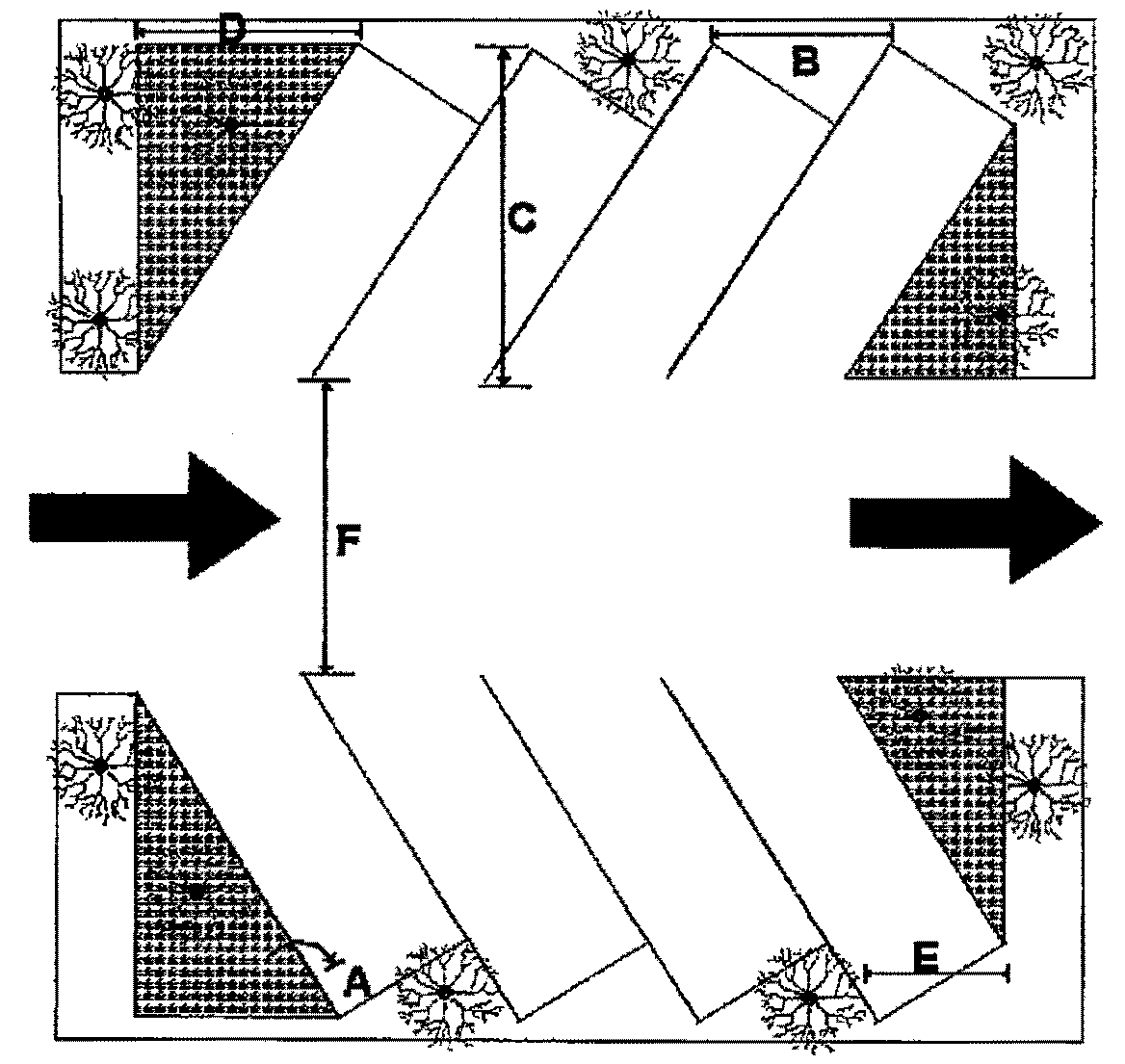
A.
Each parking space shall contain a rectangular area of at least 180 square feet.
B.
Parallel parking shall provide a space of 20 feet by 9 feet.
C.
Parking areas and widths shall conform to the following table:
3.13.3:
Disabled Parking:
A.
Except for a lot containing a single-family or duplex dwelling, all uses shall be required to provide and designate the following number of spaces designed for disabled persons.
B.
Off-street parking spaces for the disabled shall be designed as follows:
1.
All spaces for the disabled shall have access to a curb-ramp or curb-cut when necessary to allow access to the building served, shall be located so that users will not be compelled to wheel behind parked vehicles, and shall be located the shortest possible distance between the parking area and the entrance to the principal building it serves.
2.
Parallel parking spaces for the disabled shall be located either at the beginning or end of a block or adjacent to alley entrances. Curbs adjacent to such spaces shall be of a height which will not interfere with the opening and closing of motor vehicle doors.
3.
Each parking space for the disabled shall be paved and prominently outlined with paint, and with a permanent sign bearing the internationally accepted wheelchair symbol, posted at the head of the parking space.
4.
The size of the parking space shall be per building code specifications, normally 12' x 20' (240 square feet) or greater.
3.13.4:
Cooperative Parking:
A.
Refer to required parking in Chapter 4 for the specific zoning district. These requirements may be met with cooperative parking.
B.
Cooperative provisions for off-street parking may be made by contract between two or more adjacent property owners. The parking area provided on any one lot may be reduced to not more than one-half (½) of the number of required parking spaces for the use occupying such lot. These lots shall be interconnected in the general commercial (GC) district.
3.13.5:
Application of Parking Requirements:
A.
Mixed Uses: When more than one (1) principal or accessory use occupies the same building or parcel; the parking spaces required shall equal the sum of the requirements of the various uses computed separately.
B.
Change In Use, Alteration Of Use, Or Extension Of Use: Off-street parking spaces shall be provided in accordance with these regulations whenever a building or use is changed, altered or enlarged by at least 50% in floor area, number of employees, number of dwelling units, seating capacity, or otherwise.
C.
A scale drawing or layout of all required parking areas showing the location, size, and arrangement of the individual parking spaces, loading spaces, and landscaped areas shall be submitted to the Zoning Administrator for approval.
3.13.6:
Lighting Standards:
A.
All parking space area lighting shall be energy-efficient and designed so that any glare is directed away from adjacent properties and does not create any hazardous traffic conditions.
B.
Lighting shall be provided to illuminate any off-street parking or loading spaces within establishments providing customer service to the public after sunset.
3.14. - Sight triangle.
3.4.1:
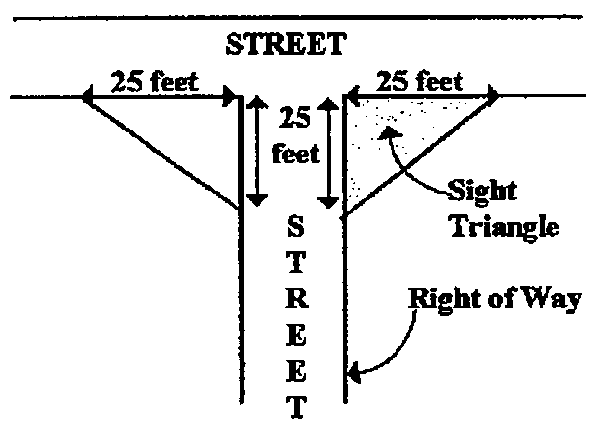
Intent: For protection against traffic hazards, no impediment to visibility shall be placed, allowed to grow, erected or maintained within visibility triangles described as follows:
3.4.2:
Size of Sight Triangle: A triangular-shaped portion of land 25 feet wide and 25 feet deep at the intersection.
3.4.3:
No structure, sign, or landscaping material shall exceed 3½ feet in height within the sight triangle as measured from adjacent street level.
3.4.4:
No parking is allowed within the sight triangle.
3.15. - Other uses affected by this article.
3.15.1:
The additional requirements of this article shall apply to the following uses:
Hazardous or solid waste and nuclear waste disposal sites (including storage and production).
Automotive race and testing tracks.
Mining and extraction operations.
Gun clubs or skeet ranges.
Stockyards, slaughter houses, and animal auction houses.
Camps and RV parks.
3.15.2:
Due to the nature and potential impact of these uses listed by this article, the Abbeville County Planning Commission shall call for and conduct a public hearing on any application to establish such use in Abbeville County, having given at least 15 days' notice of time and place in a newspaper of general circulation in Abbeville County. The Planning Commission shall review and evaluate each application with respect to all applicable development standards contained herein and elsewhere in this Ordinance. At the conclusion of its review, the Planning Commission may approve the proposal as presented, approve it with specified modifications, or disapprove it. This recommendation will then be forwarded to County Council for consideration and action.
If approved by County Council, the Staff shall be instructed to issue the appropriate permit(s), or if conditionally approved, to issue such permit(s) contingent on the specified modifications imposed. If disapproved, the applicant shall be notified in writing with the reasons therefor.
3.15.3:
Hazardous or Solid Waste and Nuclear Waste Disposal Sites (Including Storage and Production):
Due to consideration for the public health and safety and potential pollution to the environment resulting from hazardous waste and nuclear waste disposal sites, any such uses proposed for Abbeville County shall comply with the following supplemental development standards:
(1)
No such use shall be located within one-half (½) mile of any existing residential use.
(2)
A geotechnical engineering firm shall certify in writing that the rock formations being used to contain the waste are impermeable, and that the surrounding ground water sources will not be contaminated.
(3)
A drainage plan shall accompany the request showing all on-site and off-site drainage.
(4)
Proposed facilities shall have direct access to a collector or arterial street or road.
(5)
Bufferyards specified between heavy industrial uses and residential uses on local streets shall be provided along all property lines.
(6)
The South Carolina Department of Health and Environmental Control (SCDHEC) and the Department of Natural Resources shall certify in writing that the site will meet all necessary requirements.
(7)
Plans for closing and maintaining the facility after closure shall be required.
3.15.4:
Reserved.
3.15.5:
Mining and Extraction Operations.
Due to the land- disturbing nature of these operations, pollution to air and water, and use of explosives to break up earth materials, such uses shall be permitted in Abbeville County only under the following conditions:
(1)
A mining permit must be obtained from the South Carolina Department of Natural Resources and the Department of Health and Environmental Control prior to securing a county permit. The mining permit shall have been issued within six (6) months of the date of the request for the county permit.
(2)
A drainage plan, sedimentation plan, and restoration plan shall accompany the application.
(3)
No such use shall be located less than 3,000 feet from any residential use or residentially zoned property.
(4)
A vegetated strip may be required along the margins of the excavation site to reduce sedimentation and air borne debris.
(5)
The site must have direct access to a collector or arterial street or road.
3.15.6:
Gun Club or Skeet Range.
The unique nature of this use is such that the following criteria shall be observed in locating such use in Abbeville County:
(1)
No outdoor rifle or skeet range shall be operated in Abbeville County unless said range is in compliance with state regulations.
(2)
Gun ranges should have materials that contain and hold any bullets or shrapnel that are fired from weapons to avoid injury to surrounding spectators or residents.
(3)
No such use shall be located less than 3,000 feet from any residential use (measured in a straight line).
(4)
A complete development plan shall be submitted to the Planning Commission for their review and approval prior to construction.
3.15.7:
Stockyards, Slaughter Houses, Feed Lot and Livestock Auction Houses.
The above referenced uses shall not be located closer than 1,500 feet from any residential use. No incineration of animals or animal refuse shall be permitted. This section applies to all stockyards, slaughter or auction houses, and feed lots dealing with pigs, hogs, chickens, cattle, and other livestock. Such uses shall meet the buffer yard requirements for separating light industry from industrial uses on all sides. No such use shall be operated in Abbeville County unless it is in compliance with DHEC and other state regulations.
3.15.8:
Reserved.
(Ord. No. 2018-03, 5-14-2018)
3.16. - Communications towers.
Application Requirements. The applicant for a conditional use zoning permit for construction of a communications tower, or placement of a commercial telecommunication antenna on an existing structure other than a tower previously permitted, must file with the County Planner an application accompanied by a fee of $500 and the following documents, if applicable:
A.
Specifications - one copy of typical specifications for proposed structures and antennae, including description of design characteristics and material.
B.
Site Plan - a site plan drawn to scale showing property boundaries, tower location, tower height, guy wires and anchors, existing structures, photographs or topographic drawings depicting typical design of proposed structures, parking, fences, landscape plan, and existing land uses on adjacent property ( a site plan is not required if the antenna is to be mounted on an approved existing structure).
C.
Tower Location Map - a current map, or update for an existing map on file, showing locations of applicant's antennae, facilities, existing towers, and proposed towers which are reflected in public records, serving any property within the county.
D.
Antenna Capacity and Wind Load - a report from a structural engineer registered in South Carolina showing the tower antenna capacity by type and number, and a certification that the tower is designed to withstand winds in accordance with ANSI/EIA/TIA-222 (latest revision) standards.
E.
Antenna Owners - identification of the owners of all antennae and equipment to be located on the site.
F.
Owner Authorization - written authorization from the site owner for the application.
G.
FCC License - evidence that a valid FCC license for the proposed activity has been issued.
H.
Visual Impact Analysis - a line of sight analysis showing the potential visual and aesthetic impacts on adjacent residential districts.
I.
Removal Agreement - a written agreement to remove the tower and/or antenna within 90 days after cessation of use. In the event of bankruptcy, it will remain the sole responsibility of the tower's owner to remove the tower along with all appendages.
J.
Additional Information - additional information required by the Zoning Administrator for determination that all applicable zoning regulations are met.
The Applicant must show that all applicable conditions are met as follows:
A.
Location and Visual Impact - The proposed communications tower, antenna, or accessory structure will be placed in a reasonably available location which will minimize the visual impact on the surrounding area and allow the facility to function in accordance with minimum standards imposed by applicable communications regulations and applicant's technical design requirements.
B.
Inability to Locate on Existing Structure - Applicant must show that a proposed antenna and equipment cannot be accommodated and function as required by applicable regulations and applicant's technical design requirements without unreasonable modifications on any existing structure or tower under the control of applicant.
C.
Necessity for Location in Residential District - Applicant for a permit in a residential district must show that the area cannot be adequately served by a facility placed in a non-residential district for valid technical reasons.
D.
Public property or other private property not suitable - Prior to consideration of a permit for location on private property which must be acquired, applicant must show that available publicly owned sites, and available privately owned sites occupied by a compatible use, are unsuitable for operation of the facility under applicable communications regulations and applicant's technical design requirements.
E.
Design for Multiple Use - Applicant must show that the new tower is designed to accommodate additional antennae equal in number to applicant's present and future requirements.
F.
Applicant must show that a new tower 100 feet in height is designed to accommodate two (2) additional antennae; and a tower greater than 100' in height is designed to accommodate three (3) additional antennae.
G.
Safety Codes Met - Applicant must show that all applicable health, nuisance, noise, fire, building and safety code requirements are met.
H.
Paint and Illumination - A communications tower must not be painted or illuminated contrary to the requirements of this ordinance unless otherwise provided by state and federal regulations.
I.
Distance from Existing Tower - A permit for a proposed tower site within one half (½) mile of an existing tower (regardless of ownership) shall not be issued unless the applicant certified that the existing tower does not meet applicant's structural specifications and applicant's technical design requirements, or that a co-location agreement could not be obtained.
J.
Indemnity and Claim Resolution - Applicant must show by certificate from a registered engineer that the proposed facility will contain only equipment meeting FCC rules, and must file with the Zoning Administrator a written indemnification of the county and proof of liability insurance or financial ability to respond to claims up to $1,000,000 in the aggregate which may arise from operation of the facility during its life, at no cost to the county, in form approved by the county attorney.
K.
Application of Zoning Regulations - Land development regulations, visibility, fencing, screening, landscaping, parking, access, lot size exterior illumination, sign, storage, and all other general zoning district regulations except setback and height, shall apply to the use. Setback and height conditions in this section apply.
L.
Minimum Setbacks - A tower must be set back a minimum distance equal to the height of the tower from all lot lines. In addition, a tower must be set back a minimum distance equal to the height of the tower from all publicly dedicated, publicly owned, or publicly maintained roadways.
(Ord. No. 2011-06, 9-12-2011)
M.
Landscaping shall be required as follows:
a.
Around the base of the communication tower, outside of the security fence, at least one row of evergreen shrubs capable of forming a continuous hedge at least 5 feet in height shall be provided, with individual plantings spaced not more than 5 feet apart. In addition, at least 1 row of evergreen trees planted and spaced not more than 25 feet apart shall be provided within 50 feet of the perimeter security fence.
b.
The landscaping requirements may be waived in whole or in part by the Zoning Administrator if it is determined that existing natural vegetation provides adequate screening or if the Zoning Administrator determines that the landscaping requirements are not feasible due to physical constraints or characteristics of the site on which the communication tower is to be located.
c.
All required landscaping shall be installed according to established planting procedures using good quality plant materials.
d.
A Certificate of Occupancy shall not be issued until the required landscaping is completed in accordance with the approved Landscape Plan and verified by an on-site inspection by the Zoning Administrator or the Zoning Administrator's designee, unless such landscaping has been waived in accordance with (B), above. Replacement materials shall conform to the original intent of the Landscape Plan.
e.
A chain link fence six feet in height together with 3 strands of barbed wire (for an approximate height of 7.5 feet) shall be provided around the communication tower and any associated building.
N.
Repair, Alteration, or Reconstruction: Any telecommunications tower which is damaged or structurally altered (at an appraised replacement value greater than 50%) or destroyed must comply with the minimum setbacks listed in Section 3.16: L., before it is repaired or reconstructed. Such repair, alteration, or reconstruction must begin within 90 days of occurrence. However, if a damaged, structurally altered, or destroyed tower is rebuilt to its original height, using equivalent or greater construction methods than used previously, then no new setbacks or variances will be required of the applicant.
(Ord. No. 2011-06, 9-12-2011)
The applicant may appeal to the Board of Zoning Appeals as follows:
A.
Time limit for Zoning Administrator Action - Failure of the Zoning Administrator to act on an application which is determined to be complete under this Article within 45 days, unless extended by mutual agreement, may be considered by applicant to be a denial of a permit which is subject to appeal to the Board of Zoning Appeals.
B.
Variance - The applicant may appeal to the Board of Zoning Appeals for a variance from general zoning district regulations and setback requirements in this section, but not from any other conditions in this section.
Abandoned towers must be removed within ninety (90) days of written notice of abandonment from the County to the tower owner. After ninety (90) days, a fine will be assessed in the amount of $100 per day to the tower owner until the tower is completely removed. "Abandoned" is hereby defined as a tower without antenna, not providing any transmission signals or lacking a power source.
Special Exceptions. A tower, pole, or antenna may be permitted by special exception granted by the Board of Zoning Appeals after public hearing and findings of fact, based on the following criteria:
(1)
All application requirements and conditions imposed by this ordinance for conditional uses are met except height limitations and setbacks.
(2)
If additional tower height is requested, total tower height will not exceed 150% of the maximum height permitted in the district as a conditional use.
(3)
Applicant has demonstrated that additional height above that permitted by conditional use regulations is necessary for service to occupants of an area within the County.
(4)
The Telecommunications Act of 1996 requires that a denial of a permit be supported by substantial evidence.
(5)
The Board may not grant a variance from the standards imposed for a communications tower or antenna in connection with granting a special exception as permitted by appeal to the Board.
Signage of Communications Towers:
Signage: A single sign for the purposes of emergency identification shall be permitted. The permitted sign shall not exceed two square feet in area, and shall be attached to the fence surrounding the tower. Under no circumstances shall any signs for purposes of commercial advertisement be permitted.
Access to Site: Each parcel on which a communications tower is located must have direct access to a public road having a right-of-way width of fifty (50) feet.
3.17. - Manufactured home sales lots.
When allowed, Manufactured Home Sales facilities shall be subject to the following additional requirements:
1)
The boundary of the property shall be a minimum of 500 feet from any residential zone or use.
2)
Manufactured home sales facilities shall not be allowed within any designated flood zone.
3)
The site plan shall define all display and sales areas and designate the proposed use for each defined area. Other accessory uses, for example rental vehicle displays, may not be located on the site unless they have been designated on the site plan. All travel lanes and parking areas shall be clearly marked and maintained. Display areas for the homes may be natural grass areas and shall be regularly maintained. The planning commission may add additional conditions to the site to protect the health, safety, and welfare of the public.
4)
Parking spaces shall be provided at the ratio of 1 space per 350 square feet of office space and 1 space for each 5,000 square feet of display area.
5)
The maximum lot coverage allowed is 80%.
6)
The display area shall be set back a minimum of 75 feet from the street right-of-way and 10 feet from all other property lines.
7)
Storage and repair of damaged homes is prohibited.
8)
Signs are prohibited on manufactured homes, with the exception of 1 sign per home, not to exceed 3 square feet in size, stating the price of the home.
9)
Manufactured home sales lots are only allowed in the General Commercial District.
3.18. - Vehicle and heavy equipment sales and rentals.
1)
Customer and employee parking and vehicles or equipment on display, shall not be parked on Federal, State, or local public rights-of-ways, including streets and sidewalks.
2)
Junked or inoperable vehicles or equipment shall not be allowed to accumulate on the premises unless such vehicle is within a completely enclosed building. A vehicle wrapped in a car cover does not constitute an enclosure.
3)
Nothing in this subsection shall be construed as allowing properties designated as Vehicle and Heavy Equipment sales and rental establishments to be involved in disassembling, tearing down, or scrapping a vehicle, or to permit one vehicle to be salvaged or stripped for parts for use on another vehicle.
4)
Vehicle and Heavy Equipment Sales and Rentals are only allowed in the General Commercial District.
3.19. - Junkyards or salvage operations or yards.
When allowed, junkyards or salvage operations shall be subject to the following additional requirements:
1)
The operation shall be enclosed by a fence and shall be completely screened from view. The fence shall be eight (8) feet high, measured from the lowest point of the grade. The fence shall be maintained in good condition. No stored materials shall be visible from ground level immediately outside the fence.
2)
A plan shall be submitted to show that the stored materials will not pose a danger to surrounding properties, or residents, due to noise, runoff, animal or insect populations, or other factors.
3)
The site may not be located adjacent to residentially zoned property.
4)
A landscape screen shall be provided, based on consultation with the Zoning Administrator.
5)
The approving authority may add additional conditions in order to protect the general welfare of citizens.
6).
A minimum of five (5) acres of land is required.
7)
Stacking of vehicle bodies over one (1) tier in height is not allowed, and no junked or salvage material may be stacked over six (6) feet high.
8)
Such businesses shall have a front setback of at least one hundred feet (100) from any road or street.
9)
Junkyards or salvage operations or yards are only allowed in the Basic Industrial District.
3.20. - Flea markets.
1)
Applications for flea markets shall submit a sketch of the layout of buildings, stalls, driveways, walkways, parking spaces and material storage and sales.
2)
All structures shall conform to building codes.
3)
Adequate site drainage shall be approved by SCDHEC.
4)
No business sales or activities shall be allowed within the minimum required building setback area.
5)
No campers, mobile homes, or living quarters are allowed.
6)
No parking shall be allowed on the street or highway right-of-way.
3.21. - Sexually-oriented businesses.
1)
Applications for sexually-oriented businesses are allowed as a conditional use in the Light Industrial (LI) District only.
2)
No such use shall be located within 3,000 feet of a church, school, residential use, hospital, or public library.
3)
No such use shall be located within 1,500 feet of other sexually-oriented businesses.
4)
Additional requirements for sexually-oriented businesses are listed within Section 4.7.3, Uses, Light Industrial District.
3.22. - Day care and child care facilities.
Section 1:
General Provisions:
1)
Day Care and Child Care Centers as well as child care homes must meet the minimum standards set forth by the Department of Social Services and other licensing agencies, unless higher standards are required in this chapter. Day Care Centers may also include the care of adults. A letter of approval from the SC Department of Social Services (SCDSS) will be required prior to zoning approval.
2)
No other business shall be allowed on the same lot with a day care center unless the center is operated for the primary use of the employees of that business.
3)
Entrances, exits and parking areas shall be located off collector and residential streets rather than arterial streets unless such access is not available.
4)
In commercial areas, passenger loading and unloading areas shall not abut primary commercial streets or highways and shall provide one-way drive through service areas where traffic congregation may occur. All centers shall provide parking lots with one space for each employee and one parking space per six children or adults cared for in the facility.
5)
The minimum lot area for a day care or child care center shall be 20,000 square feet. At least 75 square feet of outdoor play area shall be available for each child based on the maximum enrollment. Play area is defined as a usable area not covered by buildings or required parking.
6)
Outdoor areas must be enclosed with a four foot high fence. The zoning administrator shall require a privacy fence or screen fence to reduce noise and/or block objectionable views when the site is adjacent to a more intense land use that has the potential to produce smoke, dust, fumes, noise or other potentially hazardous emissions.
7)
The building shall contain a minimum of 35 square feet of floor area for each child based on the maximum enrollment. Square footage required for adults will be per SCDSS regulations.
8)
All outdoor lighting shall be directed away from residential properties.
9)
A detailed site plan shall be submitted for review and approved by the zoning administrator.
10)
Any day care center with 13 or more children or adults adjacent to a residentially zoned area must be separated with a buffer strip, privacy fence or screen wall adequate to reduce noise which may constitute a problem for residents of the area.
11)
All facilities must be operated and housed in a permanent structure. All such structures shall meet requisite fire and building codes and the required sire plan shall be approved by the fire marshal prior to receiving permission to operate the facility.
12)
All proposed child care centers must be physically inspected for compliance with all of the requirements of this section prior to granting permission to operate.
13)
In the Basic and Light Industrial District, child care or day care centers may be located within the industrial district provided it is contained within the industry or operated primarily for those employees working at the industrial site.
Section 2:
Zoning District Uses Allowed:
Day Care Centers (Child or Adult) will be allowed in the General Commercial District.
Child Care Centers will be allowed in the Forest Agricultural, Planned Development (PDD), Rural Development (RDD), and General Commercial Districts.
Child Care Homes will be allowed in single-family residential (General Residential, Restricted Residential (R-8), Mobile Home) and Forest Agricultural districts only.
3.23. - Solar farms.
(1)
A solar farm is defined by this ordinance as a series of at least three (3) ground-mounted solar collectors placed on a parcel for the purpose of generating photovoltaic power ("PV") for resale purposes.
(2)
Such use shall be setback a minimum of 50 feet from roadways, 50 feet from side and rear property lines, and 100 feet from adjacent residential property.
(3)
Where property adjoins residential property, solar collectors must be screened so as not to be seen from the adjacent property line. The method of screening shall be approved by the Zoning Administrator.
(4)
Each parcel on which a solar farm is located must have direct access to a public road having a right-of-way width of at least fifty (50) feet.
(5)
A chain link fence six feet in height together with three strands of barbed wire (for an approximate height of 7.5 feet) shall be provided around the solar panels and any associated buildings or equipment. A vegetative landscape buffer must be provided between the fence and the property line.
(6)
Panels are to be located and situated such that glare is not offensive and does not present a safety hazard to traffic or residences.
(7)
Maximum structure height is 20 feet.
(8)
A complete development plan shall be submitted to the Zoning Administrator for review and approval prior to construction in RDD, LI, and BI districts. The same must be submitted to the Planning Commission for approval in FA districts.
(9)
For construction in all zoning districts, the applicant must submit to the Zoning Administrator a decommissioning plan detailing the anticipated life of the solar farm, the estimated decommissioning cost in current dollars, the method for ensuring that funds will be available for decommissioning and restoration, and the anticipated manner in which the solar farm project will be decommissioned and the site restored. Following a continuous six month period in which no electricity is generated, the permit holder will have six months to complete decommissioning of the solar farm. Decommissioning includes removal of solar panels, buildings, cabling, electrical components, and other associated facilities above and below grade as described in the decommissioning plan. Prior to issuance of Zoning Compliance, the applicant must provide the Zoning Administrator with a performance guarantee in the form of a surety or performance bond, certified check, or irrevocable letter of credit in the amount of 125% of the estimated decommissioning cost minus the salvage value of equipment on the site. Appropriate documentation supporting salvage value estimates must be provided for approval by the Zoning Administrator. Performance guarantees shall be updated yearly or as required by the issuer to ensure validity throughout the life of the project. Solar farms operating without a valid performance guarantee shall be considered in violation of this ordinance and subject to remedial action as outlined in section 5.2.6.
(10)
Construction of a solar farm in the FA district shall require approval by the Planning Commission. RDD, GC, LI, and BI districts may be approved by the Zoning Administrator. In FA districts, the Planning Commission may approve a proposal as presented, approve with specified modifications, or disapprove. When disapproved, the applicant must be notified in writing of the reason for disapproval.
(11)
Construction of PV solar farms by public utilities are subject to all requirements of this ordinance.
(Ord. No. 2016-12, 11-14-2016; Ord. No. 2020-02, 4-13-2020)
3.24. - Commercial campgrounds and recreational vehicle parks.
Commercial Campgrounds and Recreational Vehicle (RV) parks, where permitted, shall comply with the following site and design standards.:
(1)
The site shall be at least five (5) acres.
(2)
The site shall be developed in a manner that preserves natural features and landscape.
(3)
Minimum setbacks for all structures and RV's shall be one hundred (100) feet from the street right-of-way and fifty (50) feet from all other property lines.
(4)
Maximum density shall be twelve (12) vehicles or cabins per acre.
(5)
Buffer yard requirements shall be specified by the Zoning Administrator based on adjoining land uses.
(6)
Areas designated for parking and loading or for trafficways shall be physically separated from public streets by suitable barriers against un- channeled motor vehicle ingress and egress. All drives (encroachments) shall be approved by the authority having jurisdiction over the affected street (i.e., SCDOT or Abbeville County).
(7)
All streets within RV parks shall be private and not public.
(8)
Each park site shall be serviced by public water and sewer or other SCDHEC approved systems.
(9)
A complete development plan shall be submitted to the Planning Commission for review and approval prior to construction along with application for a special zoning permit and filing fee of $125. The Planning Commission shall hold a public hearing within 30 days of receiving written application for approval and give public notice at least 15 days prior to the hearing by placing notice in a general circulation newspaper in the community. Staff shall be responsible for posting conspicuous notices on or next to the affected property. At least one notice shall be visible from each street that borders the property. The Planning Commission may approve a proposal as presented, approve with specified modifications, or disapprove. When disapproved, the applicant must be notified in writing of the reason for disapproval.
(10)
If approved by the Planning Commission, staff shall issue the appropriate permit(s), or if conditionally approved, issue such permits(s) contingent on the specific modifications imposed.
(Ord. No. 2018-03, 5-14-2018)
Editor's note— Ord. No. 2018-03, adopted May 14, 2018, set out provisions intended for use as § 3.23. At the editor's discretion, these provisions have been included as § 3.24, since there were already provisions present in § 3.23.
3.25. - Automotive, motorcycle, ATV, or go-kart racing, testing, or practice tracks.
Automotive, motorcycle, ATV, or go-kart racing, testing, or practice tracks, where permitted, shall comply with the following site and design standards.
(1)
Buffer yards specified for use between Basic Industrial zoned properties and residential uses shall be provided along all property lines.
(2)
A complete development and operational plan, including drainage and dust control plans where applicable, along with application for a special zoning permit and filing fee of $125 shall be submitted to the Planning Commission for review and approval prior to construction. The plan shall include details with regard to parking, traffic control, restroom facilities, sound mitigation measures, and hours of operation. The Planning Commission shall hold a public hearing within 30 days of receiving written application for approval and give public notice at least 15 days prior to the hearing by placing notice in a general circulation newspaper in the community. Staff shall be responsible for posting conspicuous notices on or next to the affected property. At least one notice shall be visible from each street that borders the property. The Planning Commission shall give special consideration to factors such as: Character of the area surrounding the proposed site, proximity of neighboring residential properties, and concerns of citizens residing nearby. Where development includes camping or RV sites, all standards specified in section 3.24 of this ordinance shall apply. The Planning Commission may approve a proposal as presented, approve with specified modifications, or disapprove. When disapproved, the applicant must be notified in writing of the reason for disapproval.
(3)
If approved by the Planning Commission, staff shall be instructed to issue the appropriate permit(s), or if conditionally approved, to issue such permit(s) contingent on the specified modifications imposed. However, no county permits shall be issued before required SCDHEC permits have been granted to the developer.
(4)
Approved tracks shall be located only in the FA, BI, LI, or RDD districts.
(Ord. No. 2018-03, 5-14-2018)
Editor's note— Ord. No. 2018-03, adopted May 14, 2018, set out provisions intended for use as § 3.24. At the editor's discretion, these provisions have been included as § 3.25, since there were already provision present in § 3.24.

