
Adairsville City Zoning Code
ARTICLE III
GENERAL REGULATIONS FOR LOTS
Sec. 47-58.- Use; applicable ordinances.
(a)
No building, structure, land, lot or portion of a lot shall hereafter be used or occupied, and no building or structure or part thereof shall hereafter be erected, constructed, reconstructed, moved or structurally altered, unless the use or occupancy is in conformity with the codes and ordinances in effect in the city at the time a permit is issued, or an application is made for a permit, and all of the regulations herein specified for the district in which it is located. Nonconforming uses are discussed in section 47-102.
(b)
There shall be only one principal use per lot. Only accessory structures that are accessory to that principal use shall be permitted. See also section 47-60.
(c)
This chapter regulates zoning. The city building code ordinance and the city building inspector should be consulted for applicable state standard minimum codes applying to construction, repair and renovation. The county board of health and the county health department should be consulted for applicable health regulations relating to on-site sewage management systems (i.e., septic systems) and regulation for swimming pools, food service, tourist courts and other potentially applicable regulations.
(d)
Each owner and occupant of a lot having an occupied structure shall post the street address of the property in a manner that is readily visible from the public right-of-way.
(Min. of 11-10-2016, § 5.1)
Sec. 47-59. - Yards.
(a)
Yards must remain open space, unobstructed by buildings or structures, except as otherwise permitted, such as accessory buildings in the rear or side yard.
(b)
No part of a yard, or other open space, or off-street parking or loading space required about, or in connection with, any building for the purpose of complying with this chapter shall be included as part of a yard, open space, or off-street parking or loading space similarly required for any other building.
(Min. of 11-10-2016, § 5.2)
Sec. 47-60. - Principal use; accessory buildings.
(a)
Only one principal use is permitted per lot or tract.
(b)
Every building or structure hereafter erected shall be located on a lot or tract as defined herein, and there shall not be more than one principal building on one lot, plus its accessory buildings.
(c)
Accessory buildings and structures in residential zoning districts or ancillary to residential use are permitted only in the side or rear yard and shall not be less than ten feet from the side and rear property lines, and shall also meet all buffer requirements, if applicable. No part of an accessory structure may be built closer to the street than the existing front building line of the principal structure. On lots of less than two acres, there shall be no more than two accessory buildings, including any detached garages.
(d)
Temporary accessory structures (for example, mobile storage containers) may be located in any yard (including front yards) for no longer than 14 days. After that time period, any such structure must be removed.
(Min. of 11-10-2016, § 5.3; Ord. No. 2018-0001, § 3, 4-12-2018; Ord. No. 2020-0001, § 3, 3-12-2020)
Sec. 47-61. - Setbacks and rights-of-way.
(a)
No building or other structure may be erected in a front, side or rear setback, except for driveways, walkways, structural retaining walls, and patios (but not elevated decks or cantilevered overhangs). Eaves and stairs may protrude no more than three feet into a setback.
(b)
On lots having frontage on more than one street in any district, the front setback figure shall apply to each street.
(c)
The community development director shall be empowered to grant an administrative variance (under section 47-327) to the development setbacks for lots abutting new or existing streets in new developments.
(Min. of 11-10-2016, § 5.4; Ord. No. 2019-0002, § 3, 3-14-2019)
Sec. 47-62. - Lots; creation of illegal lots.
(a)
Lot reduction. It is not permitted to reduce an existing lot below minimum standards. Specifically, no lot shall be reduced in size so that the mandatory lot frontage or depth; front, side or rear yard; width at building line; or lot area are not maintained. Lots of record that do not meet existing standards may not be reduced. This section shall not apply when a portion of a lot is acquired for public purposes.
(b)
Illegal lots. It is not permitted to split or subdivide any lot if any of the resultant lots are under the minimum size lot allowed in the zoning district. Creation of a new lot under the minimum size requirement of the relevant zoning district is not permitted, nor is leaving a remnant under the minimum size requirement. It is not permitted to reduce an existing lot's size under the minimum size requirement. Any subdivision or creation of a substandard lot is illegal and shall not create any vested right nor permit any nonconforming use.
(c)
Substandard single lots. Where the owner of a lot of record or his successor in title thereto does not own sufficient land to enable him to conform to the dimensional requirements of this chapter, such lot may be used as a building site for a single-family residence in a district where residences are permitted.
(d)
Substandard adjoining lots. If two or more adjoining lots with continuous frontage are in a single ownership at any time after the adoption of the ordinance from which this article is derived or amendment thereto and such lots individually are too small to meet the yard, width, and area requirements of the district in which they are located, such groups of lots shall be considered as a single lot or several lots of minimum permitted size, and the lot or lots in one ownership shall be subject to the requirements of this chapter.
(e)
The following illustrations shall exemplify how the various terms used in regards to lots and setbacks in this zoning ordinance should be interpreted:
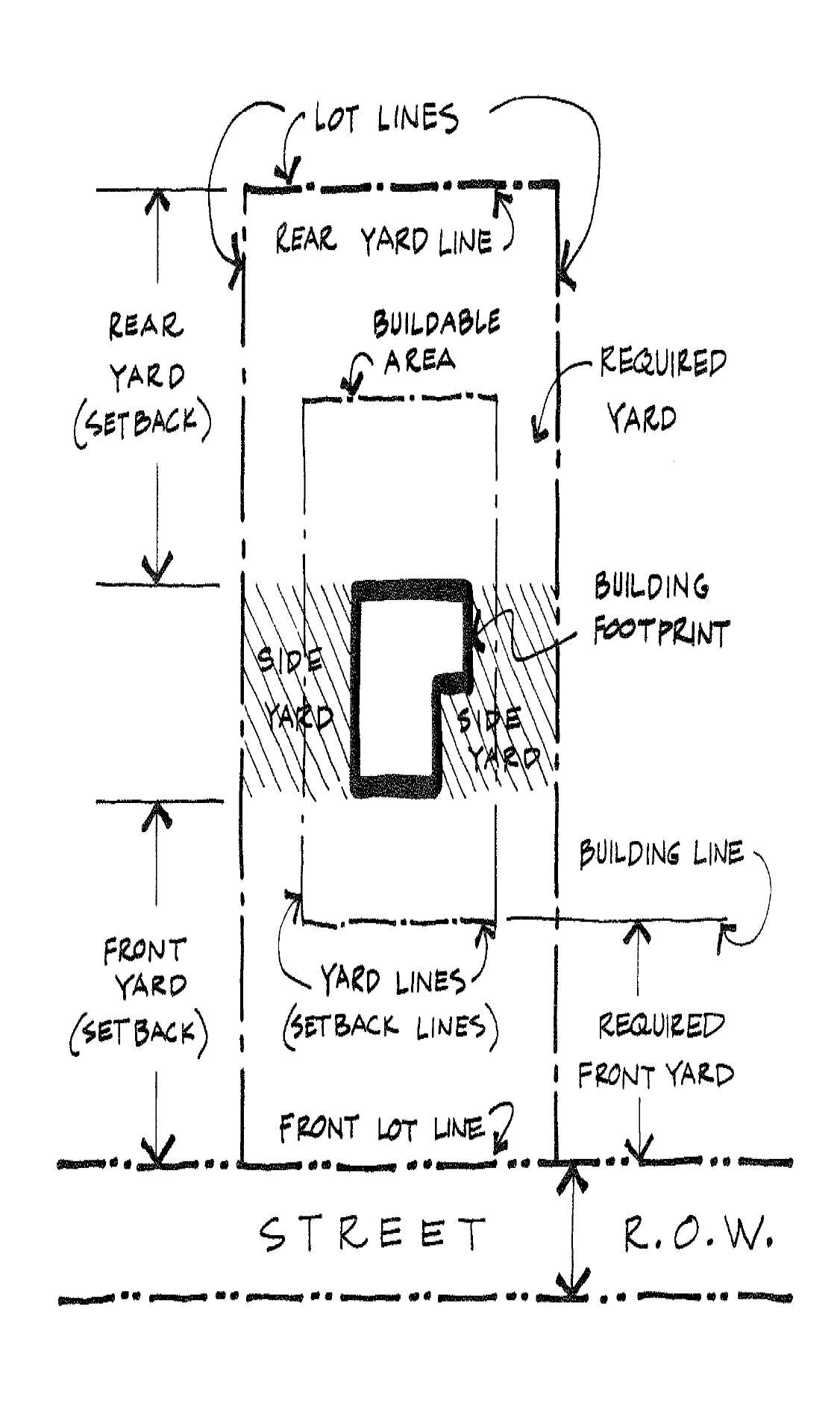
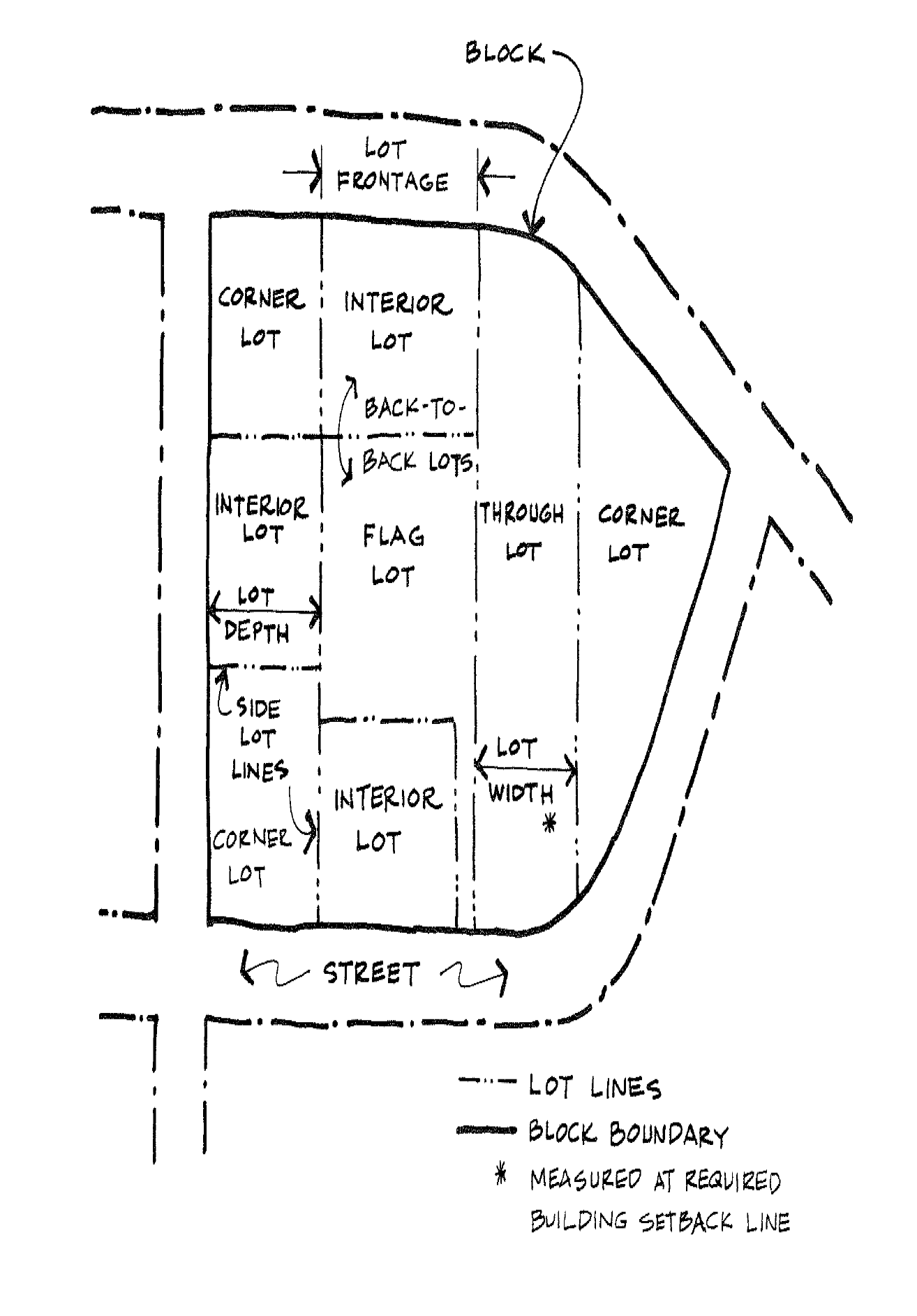
(Min. of 11-10-2016, § 5.5; Ord. No. 2019-0002, § 3, 3-14-2019)
Sec. 47-63. - Road frontage restrictions; private driveways and easements.
No new lot shall be created, nor shall any principal building be erected, on any lot which does not have immediate access and frontage, of a minimum amount as specified in article V of this chapter, on at least one existing public road or on a newly created internal street in a development. The minimum road frontage requirements are defined in article V of this chapter based on the underlying zoning district.
(Min. of 11-10-2016, § 5.6)
Sec. 47-64. - Street facade requirements.
The following street facade requirements apply to all new developments and structures in the O/I, C-1 and C-2 zoning districts facing on U.S. 41 or Ga. State Route 140.
(1)
Installation of sidewalks shall be required. Sidewalk level uses shall have at least one primary pedestrian entrance which faces, is visible from, and directly adjacent to the required sidewalk. Where a property fronts on more than one street, only one such entrance shall be required.
(2)
The first two stories of building facades shall be brick, cast stone, concrete siding such as Hardiplank, natural wood or stone, with the exception of pedestrian entrances and windows.
(3)
Awnings shall be of fabric, canvas, fixed metal, or similar material. Internally lit awnings and canopies that emit light through the awning or canopy material are prohibited.
(4)
Blank, windowless walls are prohibited. All building stories with the exception of storefront treatments shall have windows and doors that equal a minimum of 30 percent and maximum of 60 percent of the total facade area with each story being calculated independently.
(5)
All windows shall be vertically shaped with a height greater than width, including display windows but not transoms.
(6)
Glass panels in windows and storefronts shall be clear and unpainted, and shall not be tinted such that views into the building are obstructed.
(7)
Entry facade window trim shall not be flush with the exterior wall and shall have a minimum relief of one-quarter inch from the exterior wall.
(8)
Window frames shall be recessed a minimum of two inches from the exterior facade.
(9)
Porches and stoops shall not be enclosed with screen wire or glass.
(10)
Porch and arcade columns shall be a minimum width of eight inches.
(11)
Exterior entry steps shall have enclosed risers.
(12)
Building foundations shall be brick, stone, stucco, or concrete with similar appearance.
(13)
Parking structures shall conceal automobiles from visibility; shall have the appearance of a horizontal storied building on all levels; shall be faced in brick, stone, cast stone, poured-in-place rubbed concrete, or pre-cast concrete faced in or having the appearance of brick or stone.
(Min. of 11-10-2016, § 5.7)
Sec. 47-65. - Building walls facing public right-of-way.
In all zoning categories, principal and accessory structures must have at least 75 percent of the front of the building constructed of wood, hardiplank siding, brick, stucco, etched-faced block, rock, stone, or similar material. At least 25 percent of any side facing a public right-of-way shall be composed of these same materials. If a different material is proposed, the community development director shall review a written request to use a proposed similar material and determine, within seven days of receipt of written request, whether the proposed material is substantially similar to and consistent with the above-listed materials and meets the purpose and intent of this chapter.
(Min. of 11-10-2016, § 5.8; Ord. No. 2019-0009, § 4, 11-14-2019)
Sec. 47-66. - Fence requirements.
(a)
It is the purpose of the mayor and city council in enacting these regulations to provide standards to safeguard life, public health, property, and welfare by regulating the location, size, height, and quality of materials of fences in residential and commercial zoning districts. This section does not apply to fences in industrial districts. This section does not apply to fencing for detention ponds.
(b)
No fence shall constitute an obstruction to the vision for or create a hazard to vehicular traffic. No fence shall constitute an obstruction or hazard to utilities. No fence shall be installed within city right-of-way. The city may remove a fence in violation of this article, without giving notice to any party, if said fence is upon the city right-of-way or upon other city property, or if said fence poses an immediate safety threat to public safety.
(c)
In all residential and commercial zoning districts, fences shall not exceed five feet in height in a front yard, as defined in this chapter, and shall not exceed eight feet in height in a side or rear yard. Any fence which extends into the front yard shall not be opaque. Any such front yard fence may be constructed of brick, stone, wood, wrought iron, split rail, chain link, or other material as approved by the community development director. No fence shall be constructed of razor wire (ribbon), chicken wire, exposed concrete block, tires, junk, or discarded building materials.
(d)
The community development director shall have the authority to administratively vary requirements in this section if one or more of the following exist:
(1)
The application of any particular requirement of this section causes undue hardship on the applicant.
(2)
There are unusual topographic issues on the property that are not common to the surrounding area.
(3)
The property has an unusual shape not common to the surrounding area.
(4)
The property has multiple road frontages.
The community development director shall consider various factors that may apply to any proposed administrative variance, such as public health, public safety, and site visibility.
(Ord. No. 2019-0002, § 2, 3-14-2019)

