
Alachua City Zoning Code
CHAPTER 38
UTILITIES
Sec. 38-1. - Private and public utility franchises, excluding electric.
(a)
No entity or person may sell or provide water, sewer, natural gas, or other utility services within the corporate limits of the City, as the same may be extended from time to time, without first obtaining a franchise agreement from the City. If granted, the franchise agreement shall contain, at a minimum, the term of the agreement, paid to the City, the specific utility services to be provided and the geographical areas to be served, and appropriate terms and conditions of service including provisions for the utilization of the City's rights-of-way and streets, and appropriate health and safety regulations.
(b)
Existing utility facilities and infrastructure situated within the corporate limits of the City may not be extended or modified without the approval of the City and not until such time as the owner or operator of any such utility facilities or infrastructure enters into a franchise agreement with the City.
(c)
Occupation of the City's streets and rights-of-way may be subject to the payment of rent. Occupation of the City's streets and rights-of-way by providers of utility services will be subject to the payment of rent in addition to any payments required pursuant to a franchise agreement. The rental fee for occupying the City's streets and rights-of-way will be determined by the City Commission on a case-by-case basis.
(Ord. No. O-93-9, §§ 1, 2, 8-16-1993; Ord. No. O-93-10, §§ 1—3, 10-4-1993)
Sec. 38-2. - Public and private electric utility franchises.
(a)
No entity or person may sell or provide electric utility services to any customer within the corporate limits of the City, as those corporate limits may be extended from time-to-time, without first obtaining a franchise from the City. Such franchise will permit the person or entity to sell or provide said electric utility services within designated geographical areas of the City's corporate limits and to designated service locations. If granted, the franchise agreement shall contain, at a minimum and at the discretion of the City, the term of the agreement, the franchise fee or other valuable consideration that is to be paid to the City, the specific electric utility services to be provided within the City limits, the geographical areas and service locations to be served, appropriate terms and conditions of service including provisions and conditions for the utilization of the City's streets and rights-of-way, and appropriate health and safety regulations. However, the terms of the franchise agreement shall not be construed to limit the City's ability to require permits for the construction or maintenance of said electric utility facilities. Any fees required by the City for such permits will be in addition to the franchise fee.
(b)
Existing electric utilities facilities and infrastructure situated within the corporate limits of the City may not be extended or modified without the approval of the City and not until such time as the owner or operator of any such electric utility facilities or infrastructure enters into a franchise agreement with the City.
(c)
Occupation of the City's streets and rights-of-way by providers of electric utilities services may be subject to the payment of rent in addition to any payments required pursuant to a franchise agreement. The rental fee for occupying the City's streets and rights-of-way will be determined by the City Commission on a case-by-case basis.
(Ord. No. O-97-27, §§ 1—3, 10-6-1997)
Sec. 38-3. - Mosquito control fee.
(a)
Fee. A fee of $1.10 per month, (the "fee") shall be charged and collected for mosquito control from each consumer within the corporate limits of the City that receives:
(1)
Residential, general service nondemand, general service demand, or large demand electric service from the City;
(2)
General water service, but not electric service, from the City;
(3)
Residential, commercial or special garbage and refuse disposal service, but not electric, water or wastewater service, from the City.
A consumer who receives general service demand or large demand electric service from the City through a master meter shall be charged the fee for each residential unit serviced by the master meter. Such fee shall not be charged on new billing until a certificate of occupancy has been issued.
(b)
Exemptions. No fee or no additional fee shall be charged those consumers who maintain a separate electric meter for structures not designed for habitation such as, but not limited to, telephone booths, railroad crossing signals, signs or billboards, cable television poles, pumps or wells, or parking lot lights. The City Manager or his designee may also approve an exemption for similar nonhabitable structures.
(Ord. No. O-80-17, § 1(16-16), 9-5-1989; Ord. No. O-99-31, § 1, 10-4-1999; Ord. No. 12-26, § 1, 9-10-2012)
Sec. 38-95. - Definitions.
The following words, terms and phrases, when used in this article, shall have the meanings ascribed to them in this section, except where the context clearly indicates a different meaning:
Additional facilities or structures means any additional construction of buildings or real property appurtenances at a specific location that would create or tend to create additional demand for water service.
Apartment means one or more buildings constructed on a single parcel of land and being under common ownership or management where each building contains at least two living units. Laundry, recreational, cooking and other similar commonly used facilities that may be present are also included within the scope of this definition.
Applicant means the person, organization or corporation who signs an application form requesting water service be made available at a specific location and thereby agrees to pay for all such service used at that location. See Customer.
Approved mobile home park means a parcel of property properly zoned under the provisions of applicable City or County zoning regulations whose allowed and recognized use is the business of renting spaces or lots upon which mobile homes are placed and occupied as single-family dwellings and shall include any associated and allowed laundry, recreational and common facilities incidental thereto.
Consumer means the person who actually receives and utilizes water service at a specific location.
Customer means the person, organization or corporation responsible for payment for all water service used at a specific location, and further defined as that person, organization or corporation who signed the application requesting that water service be made available at the specific location and thereby agreeing to pay for all usage of such service occurring at said location.
Dwelling.
(1)
The term "dwelling" means a house, apartment or building used primarily for human habitation.
(2)
The term "dwelling" does not include hotels, motels, tourist courts or other accommodations for transients, nor does it include dormitories, fraternities, sororities or roominghouses.
General water service includes all water service except service to multifamily residential dwellings, hotels, motels, roominghouses, restaurants and campgrounds.
Hotel means a building designed to provide accommodations for transients or persons for short-time residence, with or without meals, providing for ten or more sleeping rooms, and including customary accessory uses in connection with the principal use.
Identifiable internal water service line means a water line, owned and installed by the customer on the customer's side of the City water meter, whose purpose is to provide water service to any additional facilities or structures.
Living unit means rooms comprising the essential elements of a single housekeeping unit. Facilities for the preparation or storage and keeping of food within the premises shall be construed as a living unit. Both facilities may not be private for the living unit, but shall be conveniently accessible to the living unit.
Mobile home means a movable living unit or similar portable structure having no foundation other than wheels, jacks, or blocks, sometimes referred to as trailers or trailer homes.
Motel includes the term motor hotel, tourist courts, and transient accommodations, primarily for those persons traveling by automotive vehicles and consisting of two or more units or buildings designed to provide sleeping accommodations, and with customary accessory uses.
Multifamily dwelling means a building in which two or more living units exist. Multifamily dwelling units shall be considered identically with apartments for the purposes of this article.
Residential means single-family or multifamily dwelling unit usage.
Rooming unit means rooms used as a place where sleeping or housekeeping accommodations are provided for pay to transient or permanent guests.
Roominghouse means a residential building used or intended to be used, as a place where sleeping or housekeeping accommodations are furnished or provided for pay to transient or permanent guests or tenants in which less than ten and more than three rooms are used for the accommodation of such guests or tenants, but which does not maintain a public dining room or cafe in the same building, nor in any building in connection therewith.
Single-family dwelling means a building containing a single living unit.
Special service categories includes multifamily residential dwellings, hotels, motels, roominghouses, restaurants and campgrounds.
Water capital facilities charge means a single charge, applied when the building permit is issued, designed to recover a portion of the difference between the new connection's pro rata share of capital facilities improvement and expansion and the anticipated periodic contributions to capital by the connection through the water rate schedule.
(Code 1976, § 26-17; Ord. No. O-76-3, § 2, 11-18-1975; Ord. No. O-81-14, § 2, 6-15-1981)
Sec. 38-96. - Legislative findings.
(a)
The revenues now derived from the water system of the City are not now adequate to meet existing expenses of the water system and the requirements of the consolidated electric, water and wastewater system.
(b)
It is the responsibility of the City to adopt an ordinance pertaining to rates and charges for water services which will provide adequate funds to maintain and perpetuate the water system and the consolidated electric, water and wastewater system, and to provide for an equitable distribution of costs among the users of such systems.
(c)
The monthly rates for such service should be equitably established to recover the expense to the water system in providing water service or for making such service available.
(d)
A capital facilities charge should be fixed for the water system so as to distribute the cost burden of additional service as nearly as possible among those responsible for the additional burdens on the system. While all citizens of the community should share equally in the cost of maintaining a water distribution system which benefits the entire community, existing users of the water service should not bear the full burden of improvements and expansions of such systems necessitated by additional users of such water service. The capital facilities charge is designed to facilitate growth of the water system by providing for a portion of the cost of improvements and expansions to be distributed among the users who benefit especially from the expansions to the system necessitated by their additional use.
(e)
The imposition of a capital facilities charge is not a tax, but rather is a user charge or fee provided for in this article under the express power given the City under article VIII, section 2(b) of the 1968 Florida Constitution, as implemented F.S. ch. 166, and also under the authority of the City Charter. Likewise, the adoption of this entire article is pursuant to the authority given to the City under the general and special laws of the State and the grant of power from the people contained in the 1968 Florida Constitution.
(f)
The water system of the City has been operating at a deficit for several years. The rates and charges for water service must be raised to reflect the rapid inflation of operating expenses experienced in recent years and to reflect the debt service needs of the consolidated electric, water and wastewater system.
(g)
The water service charges adopted in this article are based on operating and maintenance expenses, capital facilities expansion costs and cost of debt service. Periodic review of the water service charges is necessary to ensure revenue adequacy.
(h)
The minimum monthly charges are designed to ensure that each user contributes his fair share of the operating, maintenance, and capital expense allowable to the water system's readiness-to-serve capability and his fair share of the debt service expense of the consolidated electric, water and wastewater system.
(Code 1976, § 26-16; Ord. No. O-76-3, § 1, 11-18-1975; Ord. No. O-81-14, § 1, 6-15-1981)
Sec. 38-97. - City employees to make connections on supply side of meters.
It shall be unlawful for any person to tap the City's water mains or make any other connection to pipes on the supply side of any meter except those persons duly employed or authorized by the City for such purposes.
(Code 1976, § 26-20; Ord. No. O-76-3, § 5, 11-18-1975; Ord. No. O-81-14, § 5, 6-15-1981)
Sec. 38-98. - Meters; City to furnish; customer responsibilities.
(a)
All necessary meters will be furnished by the City and shall remain the property of the City. A consumer desiring a meter larger than the size of the meter then in service will be required to pay the difference between the price of the meter then in service and the price of the larger meter.
(b)
An isolation valve when used herein means any fitting or valve used to allow or stop the flow of water from the City water main to the customer's service pipe.
(c)
It shall be the customer's responsibility to properly protect the City's property on the customer's premises or easement. The customer shall prohibit access to such City property except access by utilities personnel or other persons authorized by law. When service lines, meters or other equipment are damaged by contractors, construction companies, governmental agencies or others, such damage will be repaired by the utility and the cost of repair shall be charged to the party causing such damage. In the event of any loss or damage to property of the City caused by or arising out of carelessness, neglect or misuse by the customer, the cost of replacing such property or repairing such damage shall be paid by the customer.
(d)
Except in emergencies, it shall be unlawful for any customer, or any person at customer's direction, to manipulate or tamper with an isolation valve without first notifying an employee from the City's Utility Department. The existence of any alteration or condition other than normal wear and tear to an isolation valve shall be prima facie proof of intent to violate this section and shall be punishable by the provisions of section 1-8.
(Code 1976, § 26-21; Ord. No. O-76-3, § 6, 11-18-1975; Ord. No. O-81-14, § 6, 6-15-1981; Ord. No. O-84-6, §§ 1(26-41), 2, 3, 4-16-1984)
Sec. 38-99. - Water meter installation charges.
(a)
Upon written application and payment to the City of the charges required herein, the City shall furnish all labor, material and equipment necessary, in accordance with the standard construction specifications of the City, to provide water service to the consumer's property line. Each applicant shall pay to the City, prior to the issuance of a building permit, a water meter installation charge based on the schedule in this subsection. The following schedule of rates will apply to all property within the corporate City limits:
WATER METER INSTALLATION CHARGES
(DOMESTIC AND IRRIGATION)
(b)
The water meter installation charges to be billed and collected from consumers outside of the City's corporate limits shall be the same as set forth in subsection (a) of this section.
(Code 1976, § 26-22; Ord. No. O-76-3, § 7, 11-18-1975; Ord. No. O-81-14, § 7, 6-15-1981; Ord. No. O-94-4, § 1, 2-22-1994; Ord. No. O-98-07, § 1, 12-1-1997; Ord. No. O-02-11, § 1, 2-19-2002; Ord. No. O-05-08, § 1, 1-24-2005; Ord. No. 22-22, § 1, 8-22-2022; Ord. No. 23-05, § 1, 8-28-2023; Ord. No. 24-10, § 1, 8-26-2024; Ord. No. 25-11, § 1, 8-25-2025)
Sec. 38-100. - Extension of water lines.
Where existing water lines must be extended in order to provide water service to an applicant, such applicant for water service is responsible for the design, permitting and construction cost for the water line extension. The City reserves the right to approve the design. The City reserves the right to require oversized water lines for extensions. The City may pay the difference of the oversized water line material cost. Extended water lines will be turned over to the City for approval and acceptance. Water line extensions shall be installed in rights-of-way or the applicant shall provide the City with an easement across the private property in the form approved by the City.
(Code 1976, § 26-23; Ord. No. O-76-3, § 8, 11-18-1975; Ord. No. O-78-5, § 1, 5-1-1978; Ord. No. O-81-14, § 8, 6-15-1981; Ord. No. 15-12, § 3.A., 10-26-2015)
Sec. 38-101. - Water capital facilities charge.
(Domestic and Irrigation)
(a)
Each applicant for water service shall pay to the City a water capital facilities charge, where no water capital facilities charge has been previously paid, prior to conducting the final inspection. This charge is prescribed for various categories of consumers as follows: For residential and commercial consumers, the water capital facilities charge shall be based on the sizes and type of the water meters installed according to the schedule in this subsection. The following schedule of charges shall apply to all property within the corporate limits:
Notes:
(1)
Water meter size and type shall be approved by the Public Services Director or designee.
(2)
Maximum continuous flow rate is determined by American Water Works Association (AWWA) procedures for continuous testing of water meters.
(3)
Consumers shall install a fire line meter or a double detector check meter device approved by the Public Services Director or designee for new fire service connections. Consumers shall install a fire line meter in applications where fire pumps are present and periodic testing is required. The customer shall bear the full cost of the fire line meter or the detector check meter. Fire line meters shall be testable and equipped with a bypass. Fire line meters and detector check meters are not subject to water capital facilities charges. Fire line meters and detector check meters are subject to monthly consumption charges (dollars per gallon of water consumed) at the prevailing rate for potable water. Fire line meters and detector check meters are subject to monthly consumer charges. Fire line meters and detector check meters shall not be charged wastewater consumption charges unless the fire line ultimately discharges to the wastewater system. When unauthorized water is used through a detector check meter in three or more billing periods in one calendar year, it shall be replaced with a fire line meter. The consumer shall bear the full cost of the meter replacement. Unauthorized use of water is defined as non-fire fighting water or water use without prior notification and approval of the City.
(4)
Consumers shall install residential fire sprinkler connections on the customer side of the water meter where fire sprinkler systems are required. Fire sprinkler connections shall be installed in accordance with the Florida Building Code.
(b)
Consumers applying for five-eighths-inch by three-fourths-inch irrigation meters and who have paid a water capital facilities charge for a domestic water meter are not required to pay the water capital facilities charge.
(c)
Consumers applying for irrigation meters larger than five-eighths inches by three-fourths-inches and who have paid a water capital facilities charge for a domestic water meter are required to pay the water capital facilities charge multiplied by 0.50.
(d)
Consumers applying for water service at property located outside the City's corporate limits shall pay the applicable charge set forth in subsection (a) of this section multiplied times 1.25.
(e)
Consumers that wish to increase the size of their water meter must pay the difference in water capital facilities charges between the meter size they currently use and the meter size they wish to upgrade to at the charge rates in existence at the time the consumer requests the water meter size increase.
(f)
Consumers that wish to decrease the size of their water meter or discontinue use of their water meter are not entitled to a refund for the water capital facilities charge.
(Code 1976, § 26-24; Ord. No. O-76-3, § 9, 11-18-1975; Ord. No. O-81-14, § 9, 6-15-1981; Ord. No. O-84-11, § 1, 6-18-1984; Ord. No. O-90-25, § 1, 7-2-1990; Ord. No. O-94-3, § 1, 2-22-1994; Ord. No. O-98-06, § 1, 12-1-1997; Ord. No. O-02-12, § 1, 2-19-2002; Ord. No. O-05-08, § 2, 1-24-2005; Ord. No. 06-27, § 1, 8-7-2006; Ord. No. 12-09, § 2, 11-28-2011; Ord. No. 15-12, § 3.B., 10-26-2015; Ord. No. 22-22, § 1, 8-22-2022; Ord. No. 23-05, § 1, 8-28-2023; Ord. No. 24-10, § 1, 8-26-2024; Ord. No. 25-11, § 1, 8-25-2025)
Sec. 38-102. - Rates for consumption of water.
(a)
Rates. The rates to be assessed and collected from customers of water furnished as set forth below.
Water system consumption charges.
(1)
Customer charge. Each customer must pay a customer charge for each metered point of connection to the City's water system.
(2)
Water availability charge. Each customer must pay a water availability charge for each metered point of connection to the City's water system based upon water meter size associated with each connection point.
(3)
Water consumption charge(s). Each customer must pay for water consumed through each connection point based upon water service type.
(b)
Charges outside corporate limits. The rates and the monthly charge to be assessed and collected by the City for water furnished by the City to consumers outside of its corporate limits shall be the same as the rates set in subsection (a) of this section, plus a surcharge equal to the amount of the City utility tax charged to consumers inside the City limits.
(c)
Exemptions. The following entities shall be exempt from paying the surcharge in subsection (b) of this section:
(1)
The United States of America, the State of Florida and all political subdivisions, agencies, boards, commissions, and instrumentalities thereof are exempt from payment of the surcharge imposed and levied; and
(2)
All properties of recognized churches in the State of Florida which lie outside the corporate limits of the City and are used exclusively for religious purposes are exempt from payment of any surcharge that may be made by the City on the sale of water to such properties.
(d)
Price index adjustment. All rates for water service charged under subsection (a) of this section may be adjusted administratively by the City Manager on an annual basis in accordance with the Florida Public Service Commission's Annual Commission Approved Index order issued and published on an annual basis for water and wastewater utility service providers. Any price index adjustment in water rates must comply with the notice requirements of F.S. § 180.136. Any price index adjustment in water rates authorized by the City Manager shall supersede the rates set forth in subsection (a) of this section. The rate adjustment shall be applied as follows:
(1)
Effective date of change. The adjusted rates will be applied to all billings dated on or after October 1 of each year.
(2)
Rate calculation. The percentage change in the Annual Approved Index rate will be applied to the rates as follows:
a.
Multiply the Florida Public Service Commission's published Annual Commission Approved Index for the year times the existing rate;
b.
Add the product to the existing rate; and
c.
Round the result to the nearest cent.
(Code 1976, §§ 26-28, 26-90; Ord. No. O-76-3, § 13, 11-18-1975; Ord. No. O-80-13, § 1, 2-18-1980; Ord. No. O-81-9, § 1(15), 3-26-1981; Ord. No. O-81-14, § 13, 6-15-1981; Ord. No. 83-5, § 1(4), 12-20-1982; Ord. No. O-84-22, § 1, 10-1-1984; Ord. No. O-90-23, § 1, 7-2-1990; Ord. No. O-94-12, § 1, 8-1-1994; Ord. No. O-05-08, § 3, 1-24-2005; Ord. No. 10-21, § 2, 8-23-2010; Ord. No. 12-28, § 1, 9-24-2012; Ord. No. 13-13, § 1, 9-23-2013; Ord. No. 14-10, § 1, 9-8-14; Ord. No. 15-09, § 1, 8-10-2015; Ord. No. 16-15, § 1, 8-8-2016; Ord. No. 17-12, § 1, 8-28-2017; Ord. No. 18-22, § 1, 8-27-2018; Ord. No. 19-33, § 1, 8-26-2019; Ord. No. 20-11, § 1, 8-24-2020; Ord. No. 21-11, § 1, 8-23-2021; Ord. No. 22-22, § 1, 8-22-2022; Ord. No. 23-05, § 1, 8-28-2023; Ord. No. 24-10, § 1, 8-26-2024; Ord. No. 25-11, § 1, 8-25-2025)
Sec. 38-103. - Water service bills; adjustments.
No allowance or adjustment of any water bill shall be made for leaks of any nature occurring on the consumer's side of the meter.
(Code 1976, § 26-34; Ord. No. O-76-3, § 19, 11-18-1975; Ord. No. O-81-14, § 19, 6-15-1981)
Sec. 38-135. - Definitions.
The following words, terms and phrases, when used in this article, shall have the meanings ascribed to them in this section, except where the context clearly indicates a different meaning:
Additional facilities or structures means any additional construction of buildings or real property appurtenances at a specific location that would create additional demand for water service and a concomitant increased demand for wastewater services.
Apartment means one or more buildings constructed on a single parcel of land and being under common ownership or management where each building contains at least two living units. Laundry, recreational, cooking and other similar commonly used facilities that may be present are also included within the scope of this definition.
Applicant means the person, organization or corporation who signs an application form requesting wastewater service be made available at a specific location and thereby agrees to pay for all such service used at that location. See Customer.
Approved mobile home park means a parcel of property properly zoned under the provisions of applicable City or County zoning regulations whose allowed and recognized use is the business of renting spaces or lots upon which mobile homes are placed and occupied as single-family dwellings and shall include any associated and allowed laundry, recreational and common facilities incidental thereto.
Building means any structure, either temporary or permanent, having a roof, and used or built for the shelter or enclosure of persons, animals, vehicles, goods, merchandise, equipment, materials or property of any kind. The term "building" includes tents, lunch wagons, dining cars, trailers, mobile homes, sheds, garages, carports, animal kennels, storerooms or vehicles serving in any way the function of a building as described herein.
Consumer means the persons who actually receive and utilize wastewater service at a specific location.
Customer means the person, organization or corporation responsible for payment for all wastewater service used at a specific location, and further defined as that person, organization or corporation who signed the application requesting that wastewater service be made available at the specific location and thereby agreeing to pay for all usage of such service occurring at said location.
Domestic effluent means ordinary, normal and usual sanitary sewage of the type discharged by domestic users and consisting of a strength which does not exceed domestic maxima as established in section 38-140(b)(6).
Dwelling.
(1)
The term "dwelling" means a house, apartment or building used primarily for human habitation.
(2)
The term "dwelling" does not include hotels, motels, tourist courts or other accommodations for transients, nor does it include dormitories, fraternities, sororities or roominghouses.
Excess strength wastes means liquid waste from manufacturing processes, trades, businesses, or practices which exceeds the strength designated as domestic maxima in section 38-140(b)(6).
Frontage means distance measured along an abutting public street right-of-way. In the event a parcel of property abuts a public street right-of-way on more than one side (corner lot) for the purposes of this article, the frontage is to be calculated by the following method: measuring the number of feet which abut public street rights-of-way and dividing such number of feet by two.
Hotel means a building designed to provide accommodations for transients or persons for short-time residence, with or without meals, providing for ten or more sleeping rooms, and including customary accessory uses in connection with the principal use.
Identifiable internal water service line means a water line, owned and installed by the customer on the customer's side of the City water meter, whose purpose is to provide water service to any additional facilities or structures.
Living unit means rooms comprising the essential elements of a single housekeeping unit. Facilities for the preparation or storage and keeping of food within the premises shall be construed as a living unit. Both facilities may not be private for the living unit but shall be conveniently accessible to the living unit.
Mobile home means a movable living unit or similar portable structure having no foundation other than wheels, jacks, or block, sometimes referred to as trailers or trailer homes.
Motel includes the terms "motor hotel," "tourist courts" and "transient accommodations," primarily for those persons traveling by automotive vehicles and consisting of two or more units or buildings designed to provide sleeping accommodations, and with customary accessory uses.
Multifamily dwellings means a building in which two or more living units exist. Multifamily dwelling units shall be considered identically with apartments for the purposes of this article.
Reclaimed water means domestic or municipal wastewater which has been treated to a quality suitable for beneficial use.
Residential means a general term referring to single-family or multifamily dwelling unit usage.
Rooming unit means a room used as a place where sleeping or housekeeping accommodations are provided for pay to transient or permanent guests.
Roominghouse means a residential building used or intended to be used, as a place where sleeping or housekeeping accommodations are furnished or provided for pay to transient or permanent guests or tenants in which less than ten and more than three rooms are used for the accommodation of such guests or tenants, but which does not maintain a public dining room or cafe in the same building, nor in any building in connection therewith.
Single-family dwelling means a building containing a single living unit.
Wastewater capital facilities charge means a single charge, applied when the building permit is issued, designed to recover a portion of the difference between the new connection's pro rata cost of capital facilities and the discounted value of future capital contributions through monthly charges for wastewater service. Where no wastewater capital facilities charge has previously been paid, such charge shall become due and payable at time of initial connection to the wastewater system.
(Code 1976, § 26-47; Ord. No. O-76-6, § 2, 1-8-1976; Ord. No. O-81-15, § 2, 6-15-1981; Ord. No. O-83-4, § 2, 12-20-1982; Ord. No. 13-10, § 1, 6-10-2013)
Sec. 38-136. - Legislative findings.
(a)
It is the responsibility of the City to adopt procedures and regulations relating to wastewater service in the interest of the public health, welfare and safety of the community.
(b)
It is the responsibility of the City to adopt an ordinance pertaining to the rates and charges for wastewater service which will provide adequate funds to maintain and perpetuate the wastewater system and the consolidated electric, water and wastewater system, and to provide for an equitable distribution of costs among the users of such systems.
(c)
The monthly rates for such service should be equitably established to recover the expense to the wastewater system in providing wastewater service or for making such service available.
(d)
Wastewater capital facilities charges are designed to partially recover each customer's share of the capital cost of the wastewater collection system and to contribute toward the financing of the wastewater system.
(e)
A capital facilities charge should be fixed for the wastewater system so as to recover to the system a portion of the difference between the new connection's pro rata cost of capital facilities, and the discounted value of future capital contributions through monthly charges for wastewater service.
(f)
The imposition of a capital facilities charge is not a tax, but rather is a user charge or fee provided for in this article under the express power given the City under article VIII, section 2(b) of the 1968 Florida Constitution, as implemented under F.S. ch. 166 and also under the authority of the City Charter. Likewise, the adoption of the ordinance from which this article is derived is pursuant to the authority given to the City under the general and special laws of the State and the grant of power from the people contained in the 1968 Florida Constitution.
(g)
The wastewater charges adopted in this article are based on operating and maintenance expenses, capital facilities expansion costs and cost of debt service. Periodic review of the wastewater service charges is necessary to ensure revenue adequacy.
(h)
The minimum monthly charges are designed to ensure that each user contributes his fair share of the operating, maintenance, and capital expense allowable to the wastewater system's readiness-to-serve capability and his fair share of the debt service expense of the consolidated electric, water and wastewater system.
(Code 1976, § 26-46; Ord. No. O-76-6, § 1, 1-8-1976; Ord. No. O-81-15, § 1, 6-15-1981; Ord. No. O-83-4, § 1, 12-20-1982)
Sec. 38-137. - Sewer connection mandatory when building adjacent to sewer line.
No building permit for the construction of any building or structure located on property abutting any street, alley or right-of-way in which there is located a public sanitary sewer shall be issued unless all waste disposal from the sanitary facilities in said buildings or structures shall be directly connected with a public sanitary sewer; provided, however, that if a sanitary sewer is not available, then connection with public sanitary sewer shall occur at points and locations specified in the Comprehensive Plan, as amended.
(Code 1976, § 26-68; Ord. No. O-76-6, § 23, 1-8-1976; Ord. No. O-81-15, § 23, 6-15-1981; Ord. No. O-83-4, § 23, 12-20-1982)
Sec. 38-138. - Permits issued to licensed contractors only.
Permits for opening the City's wastewater lines or for making connection to any wastewater line will be issued to licensed contractors only.
(Code 1976, § 26-51; Ord. No. O-76-6, § 6, 1-8-1976; Ord. No. O-81-15, § 6, 6-15-1981; Ord. No. O-83-4, § 6, 12-20-1982)
Sec. 38-139. - Wastewater capital facilities charge.
(a)
Each applicant for wastewater service shall pay to the City a wastewater capital facilities charge, where no wastewater capital facilities charge has been previously paid, prior to conducting the final inspection. This charge is prescribed for various categories of consumers as follows: For residential and commercial consumers, the wastewater capital facilities charge shall be based on the sizes and type of the water meters installed according to the schedule in this subsection. The following schedule of charges shall apply to all property within the corporate limits:
Notes:
(1)
Water meter size and type to be determined by City Public Services staff.
(2)
Consumers applying for wastewater service at property located outside the City's corporate limits shall pay the applicable charge set forth in subsection (a) of this section multiplied times 1.25.
(3)
Consumers that wish to increase the size of their water meter must pay the difference in wastewater capital facilities charges between the meter size they currently use and the meter size they wish to upgrade to at the charge rates in existence at the time the consumer requests the water meter size increase.
(4)
Consumers that wish to decrease the size of their water meter or discontinue use of their water meter are not entitled to a refund for the wastewater capital facilities charge.
(Code 1976, § 26-54; Ord. No. O-76-6, § 9, 1-8-1976; Ord. No. O-81-15, § 9, 6-15-1981; Ord. No. O-83-4, § 9, 12-20-1982; Ord. No. O-84-12, 6-18-1984; Ord. No. O-90-26, § 1, 7-2-1990; Ord. No. O-94-5, § 1, 2-22-1994; Ord. No. O-98-05, § 1, 12-1-1997; Ord. No. O-5-09, § 1, 1-24-2005; Ord. No. 06-28, § 1, 8-7-2006; Ord. No. 12-10, § 2, 11-28-2011; Ord. No. 22-22, § 1, 8-22-2022; Ord. No. 23-05, § 1, 8-28-2023; Ord. No. 24-10, § 1, 8-26-2024; Ord. No. 25-11, § 1, 8-25-2025)
Sec. 38-140. - Wastewater rates and charges.
(a)
Rates. There is hereby established a schedule of monthly rates and charges for the use of or availability for the use of wastewater collection, treatment and disposal service which in part is based on the amount of water used from the City water system as measured by the customer water meter. Wastewater service charges shall be billed to and be the responsibility of the customer responsible for paying the water bill at any specific location. These rates will apply to all locations within the corporate city limits.
Wastewater system usage charges.
(1)
Wastewater customer charge. Each customer must pay a wastewater customer charge for each metered (water meter) point of connection to the City's water system.
(2)
Wastewater usage charge(s). Each customer must pay for wastewater discharged into the City's wastewater collection system based upon customer class:
(b)
Charges outside the corporate limits. The rates and monthly charges to be assessed and collected by the City for wastewater collection, treatment, and disposal services furnished by the City to consumers outside its corporate limits shall be the same as the rates set forth in subsection (a) of this section, plus a surcharge equal to the amount of the City utility tax charged to consumers inside the City limits. The following entities shall be exempt from paying the surcharge provided for in subsection (b) of this section:
(1)
The United States of America, the State and all political subdivisions, agencies, boards, commissions and instrumentalities thereof are exempt from the payment of the surcharge imposed and levied; and
(2)
All properties of recognized churches in the State of Florida which lie outside the corporate limits of the City and are used exclusively for religious purposes are exempt from payment of any surcharge that may be made by the City on the sale of wastewater service to such properties.
(c)
Price index adjustment. All rates for wastewater service charged under subsection (a) of this section may be adjusted administratively by the City Manager on an annual basis in accordance with the Florida Public Service Commission's Annual Commission Approved Index order issued and published on an annual basis for water and wastewater utility service providers. Any price index adjustment in water rates must comply with the notice requirements of F.S. § 180.136. Any price index adjustment in wastewater rates authorized by the City Manager shall supersede the rates set forth in subsection (a) of this section. The rate adjustment shall be applied as follows:
(1)
Effective date of change. The adjusted rates will be applied to all billings dated on or after October 1 of each year.
(2)
Rate calculation. The percentage change in the Annual Approved Index rate will be applied to the rates as follows:
a.
Multiply the Florida Public Service Commission's published Annual Commission Approved Index for the year times the existing rate;
b.
Add the product to the existing rate; and
c.
Round the result to the nearest cent.
(d)
Exemption. Wastewater usage charges are not applied to consumers with water services for irrigation meters, fire line meters, or domestic water meters with water consumption which will not be discharged into the City's wastewater system.
(e)
Standby monthly charges. Water service customers not connected to the wastewater line within 90 days after the wastewater service availability date shall pay a standby charge equal to the wastewater charge which would be due if the customer were connected to the wastewater system.
(f)
Separate meters authorized. Where charges are based upon the amount of water purchased monthly from the City, the City Manager may approve separate meters to be installed at the expense of the customer to measure water not entering the City's wastewater system or to measure wastewater entering the wastewater system.
(g)
Domestic effluent. The charges in subsection (a) of this section apply to wastewater flows made up entirely of domestic effluent not exceeding the following listed characteristics under the heading of domestic maxima:
DOMESTIC MAXIMA
(h)
Excess strength wastes. Where liquid waste is discharged from manufacturing processes, trades, businesses, or other practices, and the strength of such waste exceeds the characteristics of domestic effluent, a surcharge shall be levied reflecting the additional cost to the wastewater system of treating such excess strength wastes. The cost of such waste treatment shall be determined by the collection and analysis of samples and subsequent determination of the strength of the waste. The laboratory cost of collection and analysis of samples shall be borne by the customer.
(i)
Septic tank and portable toilet waste. Septic tank and portable toilet waste shall not be introduced into the City's wastewater system except when specifically authorized at the time, place and manner prescribed by the City. This sewage shall be metered and the charge therefor shall be $12.00 per 100 gallons, due and payable immediately upon the acceptance of said waste by the City.
(j)
General provisions.
(1)
No stormwater drains, air conditioning waters, condenser waters, swimming pool waters, or other similar type shall be discharged into the wastewater system.
(2)
Wastes containing oils and gasoline from service stations, garages and similar industries shall not be discharged into the wastewater system.
(3)
Wastewater lines from restaurants or places where a large amount of cooking is done, or where the waste contains large amounts of grease, shall not be connected into the wastewater system without providing and maintaining an efficient grease trap as approved by the City Manager.
(4)
It shall be unlawful to connect, alter, adjust, or operate on City's wastewater system without receiving prior authorization from City Manager or designee.
(5)
It shall be unlawful to discharge any wastes directly into City's wastewater system via a manhole or any other entry point.
(6)
The City Manager shall have the final decision as to whether any waste may be discharged into the wastewater system, however, this decision may be appealed before the City Commission.
(Code 1976, § 26-55; Ord. No. O-76-6, § 10, 1-8-1976; Ord. No. O-81-15, § 10, 6-15-1981; Ord. No. O-83-4, § 10, 12-20-1982; Ord. No. O-86-18, §§ 1, 2, 6-16-1986; Ord. No. O-90-24, § 1, 7-2-1990; Ord. No. O-90-27, § 1, 7-16-1990; Ord. No. O-94-13, § 1, 8-1-1994; Ord. No. O-94-14, § 1, 8-1-1994; Ord. No. O-00-04, § 1, 12-6-1999; Ord. No. O-05-09, § 2, 1-24-2005; Ord. No. O-05-10, § 1, 1-24-2005; Ord. No. 10-22, § 2, 8-23-2010; Ord. No. 12-29, § 1, 9-24-2012; Ord. No. 13-14, § 1, 9-23-2013; Ord. No. 14-10, § 1, 9-8-14; Ord. No. 15-09, § 1, 8-10-2015; Ord. No. 16-15, § 1, 8-8-2016; Ord. No. 17-12, § 1, 8-28-2017; Ord. No. 18-22, § 1, 8-27-2018; Ord. No. 19-33, § 1, 8-26-2019; Ord. No. 20-11, § 1, 8-24-2020; Ord. No. 21-11, § 1, 8-23-2021; Ord. No. 22-22, § 1, 8-22-2022; Ord. No. 23-05, § 1, 8-28-2023; Ord. No. 24-10, § 1, 8-26-2024; Ord. No. 25-11, § 1, 8-25-2025)
Sec. 38-141. - Reclaimed water rates and charges.
(a)
Rates. There is hereby established a schedule of monthly rates and charges for the use of or availability for the use of reclaimed water. These rates will apply to all locations within the corporate city limits.
Reclaimed water system usage charges.
(1)
Reclaimed water customer charge. Each customer must pay a reclaimed water customer charge for each metered point of connection to the City's reclaimed water system.
(2)
Reclaimed water usage charge(s). Each customer must pay for reclaimed water withdrawn from the City reclaimed water system.
(b)
Charges outside the corporate limits. The rates and monthly charges to be assessed and collected by the City for reclaimed water services furnished by the City to consumers outside its corporate limits shall be the same as the rates set forth in subsection (a) of this section, plus a surcharge equal to the amount of the City utility tax charged to consumers inside the City limits. The following entities shall be exempt from paying the surcharge:
(1)
The United States of America, the State and all political subdivisions, agencies, boards, commissions and instrumentalities thereof are exempt from the payment of the surcharge imposed and levied; and
(2)
All properties of recognized churches in the State of Florida which lie outside the corporate limits of the City and are used exclusively for religious purposes are exempt from payment of any surcharge that may be made by the City on the sale of reclaimed water service to such properties.
(c)
Price index adjustment. All rates for reclaimed water service charged under subsection (a) of this section may be adjusted administratively by the City Manager on an annual basis in accordance with the Florida Public Service Commission's Annual Commission Approved Index order issued and published on an annual basis for water and wastewater utility service providers. Any price index adjustment in reclaimed water rates must comply with the notice requirements of F.S. § 180.136. Any price index adjustment in reclaimed water rates authorized by the City Manager shall supersede the rates set forth in subsection (a) of this section. The rate adjustment shall be applied as follows:
(1)
Effective date of change. The adjusted rates will be applied to all billings dated on or after October 1 of each year.
(2)
Rate calculation. The percentage change in the Annual Approved Index rate will be applied to the rates as follows:
a.
Multiply the Florida Public Service Commission's published Annual Commission Approved Index for the year times the existing rate;
b.
Add the product to the existing rate; and
c.
Round the result to the nearest cent.
(Ord. No. 13-10, § 1, 6-10-2013; Ord. No. 14-10, § 1, 9-8-14; Ord. No. 15-09, § 1, 8-10-2015; Ord. No. 16-15, § 1, 8-8-2016; Ord. No. 17-12, § 1, 8-28-2017; Ord. No. 18-22, § 1, 8-27-2018; Ord. No. 19-33, § 1, 8-26-2019; Ord. No. 20-11, § 1, 8-24-2020; Ord. No. 21-11, § 1, 8-23-2021; Ord. No. 22-22, § 1, 8-22-2022; Ord. No. 23-05, § 1, 8-28-2023; Ord. No. 24-10, § 1, 8-26-2024; Ord. No. 25-11, § 1, 8-25-2025)
Sec. 38-164. - Definitions.
The following words, terms and phrases, when used in this article, shall have the meanings ascribed to them in this section, except where the context clearly indicates a different meaning:
AC power means electrical power of the type distributed by the electric utility distribution system and delivered for consumption to the customer's meter. AC power is created by systems that utilize time-varying electrical current ("alternating current").
Billing demand means the maximum 15-minute integrated demand.
Bulk power cost (BPC) means those costs incurred in providing electric energy for the retail customers of the City. Bulk power cost shall include the following:
(1)
Cost of power purchased for use in the City's electric system.
(2)
Cost of transmission services to deliver power to the City's electric system.
(3)
Cost of any equipment owned or leased by the City to generate power for the City's electric system.
(4)
Operation and maintenance costs including fuel of City owned or leased equipment used to generate power for the City's electric system.
(5)
Allocated cost of any capital projects that are projected to reduce the cost of bulk power to the City's electric system.
Bulk power cost shall be determined monthly.
Bulk power cost adjustment (BPCA) means the difference between the bulk power cost and the bulk power cost base, stated in cost per kilowatt-hour, as determined monthly.
Bulk power cost base (BPCB) means those power-related costs that are embedded within the base rate, stated in cost per kilowatt-hour.
Bulk power cost true-up (BPCT) means the difference between the bulk power cost actually incurred and the bulk power cost recovered through the bulk power cost base and the bulk power cost adjustment, as determined monthly.
Consumer means any person or entity that receives and utilizes electric service at a specific location.
Customer means the person or entity responsible for payment for all electric services used at a specific location, and further defined as that person who has applied for and requested that services be made available at the specific location and has agreed to pay for all usage of such services occurring at the location. The customer and the consumer may be one and the same.
Customer-owned renewable generation means an electric generating system located on a customer's premises that is primarily intended to offset part or all of the electricity requirements for the customer with renewable energy. The term "customer-owned renewable generation" does not preclude the customer of record from contracting for the purchase, lease, operation, or maintenance of an on-site renewable generation system with a third-party under terms and conditions that do not include the retail purchase of electricity from the third party.
DC power means electrical power of the type stored in batteries. DC power is generated by systems that utilize electrical current that does not vary over time ("direct current"). One important example of such a system is a photovoltaic solar array which converts sunlight into DC power. DC power must be converted to AC power before it can be distributed by the utility electrical distribution system.
Distributed generation means small, modular, decentralized, grid-connected or off-grid energy systems located in or near the place where energy is used. For purposes of net metering, the generation is connected to the customer's electric system on the customer's side of the electric revenue meter.
Excess customer-owned renewable generation means electric energy produced by the customer-owned renewable generation system that is not consumed by the customer's own load and is delivered to the City's electric distribution system.
General service demand means nonresidential consumers accepting electric service from the City directly from a distribution line and having an established demand of 20 kilowatts or more and 999 kilowatts or less for any nine consecutive months. All energy supplied shall be delivered through a single meter at a single point of delivery.
General service large demand means nonresidential consumers accepting electric service from the City directly from a distribution line and having an established demand of 1,000 kilowatts or more for any nine consecutive months. All energy supplied shall be delivered through a single meter at a single point of delivery.
General service nondemand means all electric service connections not included in the definitions of the terms "residential electric service," "general service demand" and "general service large demand."
Metering point (as distinguished from point of delivery) means the point at which the instrument is installed to meter the flow of electric energy from the City to the consumer. The City shall have the option to meter any service on either the primary or secondary side of the transformer.
Month means an interval between successive meter reading dates, which interval may be 30 days, more or less.
Net metering means a retail customer has installed a customer-owned renewable generation on the customer's side of the electric revenue meter and payment for the excess energy delivered to the City's electric distribution system shall be credited against the billing account of the customer.
Point of delivery means the point where the City's point wires or apparatus are connected with those of the consumer.
Residential electric service means a residential electric service installation in a single-family house, a single suite in a multiple-family house, a single suite in a multiple apartment or group of multiple apartments, and all bona fide farm uses. All energy supplied shall be through a single meter at a single point of delivery.
Service includes, in addition to all electric energy required by the consumer, the readiness and ability on the part of the City to furnish electric energy to the consumer; thus, the maintenance by the City at the point of delivery of approximately the agreed voltage and frequency shall constitute the rendering of service irrespective of whether the consumer makes any use thereof.
Wholesale avoided cost rate means the energy portion of the bulk power cost as determined monthly by the City divided by the total amount of energy supplied by the City during each month. Units for wholesale avoided cost rate are expressed as $ per kW-hr.
(Code 1976, § 26-77; Ord. No. O-81-9, § 1(2), 3-26-1981; Ord. No. 83-5, § 1(2), 12-20-1982; Ord. No. O-90-22, § 1, 7-2-1990; Ord. No. 09-16, § 2, 9-28-2009; Ord. No. 12-02, § 2, 10-24-2011; Ord. No. 16-12, § 1, 7-25-2016)
Sec. 38-165. - Legislative findings.
(a)
It is the responsibility of the City to adopt an ordinance pertaining to rates and charges for electric services which will provide adequate funds to maintain and perpetuate the electric system and the consolidated electric, water and wastewater system, and to provide for an equitable distribution of costs among the users of such systems.
(b)
The electricity service charges adopted in this article are based on the cost of bulk power, on operating and maintenance expenses, and cost of debt service. Periodic review of the electric service charges is necessary to ensure revenue adequacy.
(c)
The monthly charges are designed to ensure that each user contributes the user's fair share of the operating, maintenance and purchasing expenses of the electric system and the user's fair share of the debt service expense of the consolidated electric, water and wastewater system.
(Code 1976, § 26-76; Ord. No. O-81-9, § 1(1), 3-26-1981; Ord. No. 83-5, § 1(1), 12-20-1982; Ord. No. 16-12, § 1, 7-25-2016)
Sec. 38-166. - The City Electric Service Policy Manual.
(a)
The Electric Service Policy Manual (attached as exhibit A to the ordinance from which this article is derived) is hereby adopted and is on file with the Office of the City Clerk and the Public Services Department. The Electric Service Policy Manual may be amended from time-to-time to account for changes in technology. Amendments that do not follow the intent of this section shall be presented for approval to the City Commission.
(b)
Compliance with the manual is hereby required.
(c)
Customers shall install all wiring and electrical equipment according to Florida Building Code, National Electrical Safety Code (NESC), and all other guidelines associated with the City Building Department or other applicable local inspection authority.
(d)
If any installation, addition, or alteration requiring wiring permits is made by the customer, the City will not connect or alter service until approval of the installation is made by all local inspection authorities. The City's electric personnel have no obligation to determine whether a customer's wiring, equipment or general electrical installation is safe for use; however, the City will make a field visit to check the customer's service entrance facilities for compliance with the manual. If the electrical system is deemed unsafe or not in compliance, the City will refuse to connect service.
(e)
The Electric Service Policy Manual does not supersede the electric code of the City, the Florida Building Code, or State Statute, ordinance, rule or regulation applicable to electric systems but is supplementary to them. When conflicts exist between the manual and such other codes and rules, the more restrictive provisions shall apply.
(Ord. No. O-04-08, § 1(17-3), 12-1-2003)
Sec. 38-167. - Electric infrastructure facilities.
(a)
The developer or property owner shall be responsible for the full cost (engineering and construction) of any required installation, relocation, extension, improvement or modification of the City's electric facilities. In addition, if changes in the development, such as a replat, require changes in electric infrastructure, which is already in place, the developer or property owner shall be responsible for the costs associated with reconfiguring such facilities. Upon project completion, the developer or property owner shall convey said facilities to the City for acceptance.
(b)
The City may, upon direction by the City Commission, in its sole discretion, where a public purpose has been declared, offer an option through a developer agreement for the City to install electric infrastructure facilities, in the corporate limits, upon payment by the developer to the City. Said payment shall be an estimate of costs anticipated and shall be adjusted upon project completion. Acceptance of the infrastructure by the City will occur once all actual costs have been paid to the City. The developer agreement shall contain all pertinent terms and conditions of this option, which may include reimbursement to the developer for actual installation costs over a specified period of time.
Sec. 38-168. - Meters; City to install and maintain; installation charge, protection by consumer; damage through carelessness, neglect or misuse.
(a)
The City will install and properly maintain such meters and metering equipment as may be necessary to measure the electric service used by the consumer. Each applicant for electric service shall pay to the City, prior to the connection of such service, a meter installation charge of $150.00. All meters, wires and other appliances furnished by the City remain the property of the City, and the consumer shall properly protect the City's property on the consumer's premises. In the event of any loss or damage to property of the City caused by, or arising out of, carelessness, neglect or misuse by the consumer, or other unauthorized parties, the cost of making good such loss or repairing such damage shall be paid by the consumer.
(b)
The electric meter installation charges to be billed and collected from consumers outside of the City's corporate limits shall be the same as set forth in subsection (a) of this section.
(Code 1976, § 26-94; Ord. No. O-81-9, § 1(19), 3-26-1981; Ord. No. 83-5, § 1(19), 12-20-1982; Ord. No. O-94-6, § 2, 2-22-1994)
Sec. 38-169. - Meter testing.
Upon written notice, a meter will be tested by the City; and, in the event the meter, when tested, is found to be not more than two percent fast or two percent slow, the expense of the test shall be paid by the consumer at a cost of $35.00, and the meter shall be considered accurate. If the meter is found to be more than two percent fast or two percent slow, the expense of the test will be borne by the City, and the bill will be corrected for a period not to exceed three months.
(Code 1976, § 26-97; Ord. No. O-81-9, § 1(22), 3-26-1981; Ord. No. 83-5, § 1(22), 12-20-1982)
Sec. 38-170. - Residential electric service.
(a)
Base rate. The rate to be charged and collected for electric energy furnished by the City to consumers for residential service shall be a customer service charge.
Plus a kilowatt hour per month consumption charge for the first 1,000 kilowatt hours of energy consumed.
Plus a kilowatt hour per month consumption charge in excess of 1,000 kilowatt hours of energy consumed.
(b)
Taxes. An amount equal to all applicable taxes imposed against the sale or consumption of electric energy shall be added to the rates hereinabove set forth. The United States of America, the State and all political subdivisions, agencies, boards, commissions and instrumentalities thereof and all recognized churches are exempt from the City's utility tax.
(c)
Availability. This service is available to consumers both within and outside the corporate limits of the city.
(Code 1976, § 26-85; Ord. No. O-81-9, § 1(10), 3-26-1981; Ord. No. 83-5, § 1(10), 12-20-1983; Ord. No. O-84-21, § 1, 10-1-1984; Ord. No. O-88-19, § 1, 4-18-1988; Ord. No. O-90-22, § 2, 7-2-1990; Ord. No. O-94-11, § 1, 8-1-1994; Ord. No. 09-16, § 1, 9-28-2009; Ord. No. 12-27, § 1, 9-24-2012; Ord. No. 15-10, § 1, 8-10-2015)
Sec. 38-171. - Nonresidential demand service.
(a)
Base rate for general service demand. The rate to be charged and collected for electric energy furnished by the City for nonresidential demand service shall be a customer service charge.
Plus a kilowatt demand charge per month consumption for energy consumed.
Plus a kilowatt hour per month consumption charge for energy consumed.
(b)
Base rate for general service large demand. The rate to be charged and collected for electric energy furnished by the City for nonresidential large demand service shall be a customer service charge.
Plus a kilowatt hour per month consumption charge for energy consumed.
Plus a kilowatt hour per month consumption charge for energy consumed.
(c)
Taxes. An amount equal to all applicable taxes imposed against the sale on consumption of electric energy shall be added to the rates hereinabove set forth. The United States of America, the State and all political subdivisions, agencies, boards, commissions and instrumentalities thereof an all recognized churches are exempt from the City's utility tax.
(d)
Availability. This service is available to consumers both within and outside the corporate limits of the city.
(Code 1976, § 26-86; Ord. No. O-81-9, § 1(11), 3-26-1981; Ord. No. 83-5, § 1(11), 12-20-1982; Ord. No. O-84-21, § 2, 10-1-1984; Ord. No. O-88-19, § 2, 4-18-1988; Ord. No. O-90-22, § 3, 7-2-1990; Ord. No. O-92-22, § 1, 3-16-1992; Ord. No. O-94-11, § 2, 8-1-1994; Ord. No. 09-16, § 1, 9-28-2009; Ord. No. 12-27, § 2, 9-24-2012; Ord. No. 15-10, § 1, 8-10-2015)
Sec. 38-172. - Nonresidential non-demand service.
(a)
Base Rate. The rate to be charged and collect for electric energy furnished by the City to consumers for general service non-demand service shall be a customer service charge.
Plus a kilowatt hour per month consumption charge for energy consumed.
(b)
Taxes. An amount equal to all applicable taxes imposed against the sale of consumption of electric energy shall be added to the rates hereinabove set forth. The United States of America, the State and all political subdivisions, agencies, boards, commissions and instrumentalities thereof and all recognized churches are exempt from the City's utility tax.
(c)
Availability. This service is available to consumers both within and outside the corporate limits of the city.
(Code 1976, § 26-87; Ord. No. O-81-9, § 1(12), 3-26-1981; Ord. No. 83-5, § 1(12), 12-20-1982; Ord. No. O-84-21, § 3, 10-1-1984; Ord. No. O-88-19, § 3, 4-18-1988; Ord. No. O-94-11, § 3, 8-1-1994; Ord. No. 09-16, § 1, 9-28-2009; Ord. No. 12-27, § 3, 9-24-2012; Ord. No. 15-10, § 1, 8-10-2015)
Sec. 38-173. - Bulk power cost adjustment.
The energy charges provided for in Sections 38-170 through 38-172 shall be increased or decreased $0.00001 per kilowatt-hour for each $0.00001 per kilowatt-hour, or major fraction thereof of increase or decrease bulk power cost above or below a base cost of $0.0535 per kilowatt-hour. In order to limit the variations in the bulk power cost adjustment, the City Manager may elect to phase in such increases or decreases over a period of time in accordance with the provisions of the Power Purchase Risk Management Policy.
(Code 1976, § 26-88; Ord. No. O-81-9, § 1(13), 3-26-1981; Ord. No. 83-5, § 1(13), 12-20-1982; Ord. No. 09-16, § 1, 9-28-2009; Ord. No. 16-12, § 1, 7-25-2016)
Sec. 38-174. - Surcharge; consumers outside the City limits.
(a)
The rates and minimum monthly charges to be assessed and collected by the City for electric energy furnished by the City to consumers outside of its corporate limits to consumers of electric service shall be the same as the rates set forth in this article, plus a surcharge equal to the amount of the City utility tax charged consumers inside the City limits; provided, however, that the United States of America, the State and all political subdivisions, agencies, boards, commissions and instrumentalities thereof are now hereby exempt from the payment of the surcharge imposed and levied hereby.
(b)
All recognized churches of the State which lie outside the corporate limits of the City and which properties are used exclusively for religious purposes are exempt from payment of any surcharge that may be made by the City on the sale of electricity to such properties.
(Code 1976, § 26-89; Ord. No. O-81-9, § 1(14), 3-26-1981; Ord. No. 83-5, § 1(14), 12-20-1982)
Sec. 38-175. - Security light.
The City will install and maintain security lights to augment street lighting as requested by electric service customers. The customer shall pay $60.00 where there is an existing pole, and $120.00 where a pole must be installed. The monthly charge for use and maintenance of such security lights and poles installed by the City shall be as follows:
(Code 1976, § 26-92; Ord. No. O-81-9, § 1(17), 3-26-1981; Ord. No. 83-5, § 1(17), 12-20-1982; Ord. No. 89-18, § 1, 10-2-1989; Ord. No. 12-25, § 1, 8-27-2012)
Sec. 38-176. - Temporary electric service.
Temporary electric service, such as electric service for construction work, shall be rendered upon written application. The charge for temporary residential electric service shall be $50.00 to cover the up and down cost of the service which is to be paid at the time of application. The monthly charge will be the applicable user charge for electricity consumed as recorded upon a temporary meter installed by the City. The charge for temporary general service demand and general service nondemand shall be the cost of installing the temporary service and removing the temporary service less salvage, with a minimum charge of $50.00 to be paid at the time of application. The monthly charge will be the applicable charge for electricity consumed as recorded upon a temporary meter installed by the City.
(Code 1976, § 26-93; Ord. No. O-81-9, § 1(18), 3-26-1981; Ord. No. 83-5, § 1(18), 12-20-1982; Ord. No. O-94-6, § 1, 2-22-1994)
Sec. 38-177. - Fee for the joint use of city utility poles.
(a)
Amendment. If a utility desires joint use of the City's utility poles, they shall submit to the City all pertinent information concerning its use of the joint-use facility and must receive the City's approval to initiate the proposed joint use. The information shall include a drawing showing:
(1)
Points of entry and exit on a particular structures.
(2)
Technical information on conductor, support fixtures, support strand, cable, and any fixture to be attached to the structure in order to calculate structure loading and capacity requirements.
(3)
Numbers of and distances to nearest structures.
(4)
Name of line involved.
(b)
Fee. The rental per utility pole shall be $16.50 per annum.
(c)
Existing attachments. The rental shall be paid in arrears for attachments existing in the prior calendar year. The City shall bill on or about January 1 of each year for the amount owed. The sum set forth in subsection (b) of this section shall be paid for each pole upon which an attachment existed for six months or more in any calendar year, whether it existed for all 12 months or less. One-half of the aforesaid sum shall be paid for each pole upon which an attachment existed for less than six months in any calendar year. The amount billed shall be payable within 30 days of receipt of the invoice.
(Ord. No. O-00-07, §§ 1—3, 12-20-1999)
Sec. 38-178. - Interconnection and net metering of customer-owned renewable generation systems.
(a)
The City Manager shall establish a written policy designating procedures for the interconnection and net metering of customer-owned renewable generation systems in order to promote the development and use of small, customer-owned renewable generation, particularly solar and wind energy systems; lessen the dependence on fossil fuels for energy production; minimize the volatility of fuel costs; improve the environment; and minimize the costs of energy supply to customers.
(b)
The interconnection of customer-owned renewable generation systems to the City's electric distribution system is on a first-offered, first-accepted basis. Application for interconnection and net metering shall be made for new services and any proposed modifications as described in Section 38-178(d). Interconnection is subject to diminution and/or rejection in the event the total amount of customer-owned renewable generation systems exceeds ten percent of the City's system energy requirements.
(c)
The interconnection of customer-owned renewable generation systems to the City's electric distribution system is limited to systems with the following maximum output:
(d)
Customer-owned renewable generation systems is primarily intended to offset all or part of the customer's electric consumption requirements. As such, the gross power rating of a customer-owned renewable generation system shall be limited in size to 90 percent of the utility distribution service rating. The term "gross power rating" (GPR) means the total manufacturer's AC nameplate generating capacity of an on-site customer-owned renewable generation system that will be interconnected to and operate in parallel with the City distribution facilities. For inverter-based systems, the GPR shall be calculated by multiplying the total installed direct current (DC) nameplate generating capacity by 0.85 in order to account for losses during the conversion from DC to alternating current (AC). Customers desiring to increase the GPR of their customer-owned renewable generation system must notify the City in writing of the proposed modifications to the system and submit a new application for interconnection specifying the proposed modifications.
(e)
Customers desiring to interconnect a customer-owned renewable generation system to the City's electric distribution system must enter into a written agreement with the City providing the terms and conditions thereof.
(f)
Metering.
(1)
Energy metering from the interconnection of customer-owned renewable generation system shall be accomplished by separately registering the flow of energy both (1) from the City's electric distribution system; and (2) excess energy (kW-hr) generated by customer-owned renewable generation system and delivered to the City's electric system. The metering equipment for interconnection of customer-owned renewable generation systems shall be installed at the point of delivery at the expense of the City.
(2)
Meter readings shall be taken monthly on the same cycle as required under the otherwise applicable rate schedule.
(3)
Any meter or meters installed to measure total renewable electricity generated by the customer for the purposes of receiving Renewable Energy Certificates (or similarly titled credits for renewable energy electricity generated) shall be installed at the expense of the customer, unless determined otherwise during negotiations for the sale of the customer's credits to the City.
(g)
Charges. All rates charged for customer-owned renewable generation shall be in accordance with the customer's otherwise applicable rate schedule (i.e., residential, general service demand, general service, nondemand, etc.). Customers with customer-owned renewable generations systems are responsible for all charges from their otherwise applicable rate schedule including monthly minimum charges, customer charges, meter charges, facilities charges, demand charges and surcharges. Charges for energy (kW-hr) supplied by the City will be based on the net metered consumption of energy in accordance with the following:
(1)
Electric energy from the customer-owned renewable generation system shall first be used to serve the load and offset the demand for energy from the City's electric distribution system by the customer.
(2)
Customer shall be billed for the total amount of electric energy delivered to customer by the City during the billing period in accordance with the otherwise applicable rate schedule.
(3)
Excess customer-owned renewable generation shall be purchased by the City in the form of a credit to the customer on their monthly energy bill. Each billing cycle, the customer will be credited for the total amount of excess energy generated by the customer-owned renewable generation that is delivered to the City's electric system during the previous billing cycle. Any credit to the customer will be determined in accordance with the applicable energy and bulk power cost adjustment charges (expressed in $ per kW-hr).
(4)
In the event that a credit for excess customer-owned renewable generation exceeds the total billed amount for customer's consumption in any corresponding billing period, the excess credit shall be applied to the customer's subsequent bill. Excess energy credits produced shall accumulate and offset customer's energy consumption bill for a period not to exceed 12 months. In the last billing cycle of each fiscal year, any unused excess energy credits shall be paid by the City to the customer, at the wholesale avoided cost rate as defined by the City Code.
(5)
In the event that a customer closes an account, unused excess energy credits shall be paid to the customer at the wholesale avoided cost rate. The payment will first be applied towards outstanding charges associated with the customer's account. Any balance will be sent to the last address or forwarding address by check within 180 days.
(6)
On a monthly basis, the customer shall pay applicable customer and demand charges, regardless of whether excess energy is delivered to the City's electric system in that billing period.
(7)
A service charge of $10.00 shall be billed monthly for each interconnected meter service.
(h)
Application and inspection fees. Customer shall pay the following fees for the review and processing of applications for interconnection of customer-owned renewable generation systems:
(i)
Customer insurance.
(1)
Customers installing and operating an interconnected renewable generation system with a gross power rating of 10 kW or less shall not be required to provide proof of liability insurance. However, it is highly recommended that such customers carry an appropriate level of such insurance.
(2)
Customers installing and operating an interconnected renewable generation system with a gross power rating of more than 10 kW shall provide proof of continuous general liability insurance covering personal injury and property damage with coverage limits no less than $1,000,000.00/$1,000,000.00. Proof of such insurance naming the City as the Certificate Holder shall be provided to the City prior to interconnection and on at least an annual basis thereafter.
(Ord. No. 12-02, § 3, 10-24-2011; Ord. No. 15-04, § 2, 3-23-2015; Ord. No. 16-16, § 1, 9-12-2016)
Sec. 38-200. - Definitions.
The following words, terms, and phrases, when used in this article, shall have the meanings ascribed to them in this section except when the context clearly indicates different:
Infrastructure improvement area means the geographic boundaries for each area within the City that is designated by the City and delineated by the map(s) depicted in figure(s) within this article.
Infrastructure improvement area fees means the user fees charged pursuant to this article to support the funding of public infrastructure improvements to the water distribution and wastewater collection systems within an infrastructure improvement area.
Non-residential establishment means all uses other than residential as defined below.
Residential establishment means single-family or multi-family dwelling unit.
(Ord. No. 18-23, § 4(Exh. A), 9-24-2018)
Sec. 38-201. - Legislative findings.
It is the intent of this article that the City may, subject to the availability of funds and resources, designate infrastructure improvement areas for wastewater collection systems and water distribution systems in locations within the City where it is feasible and beneficial for economic development. Infrastructure improvement area fees will be imposed as repayment of any funds expended by the City for the construction of the improvements.
(Ord. No. 18-23, § 4(Exh. A), 9-24-2018)
Sec. 38-202. - Criteria for infrastructure improvement areas.
In determining if a location is feasible and beneficial for economic development and suitable for an infrastructure improvement area, the City may consider, among other things, whether it is in the public interest to Master Plan the infrastructure in the area in order to provide efficient and cost-effective public utility services throughout the City, and whether multiple developments are anticipated in the area, which will contribute to the funding of the infrastructure improvements.
(Ord. No. 18-23, § 4(Exh. A), 9-24-2018)
Sec. 38-203. - Funding for infrastructure improvement areas.
The funding to pay for the construction of Infrastructure Improvement Areas will be paid for by development(s), or they may be initially funded by the City and reimbursed by developments and users as provided for by each specific infrastructure improvement Area. Infrastructure improvement area fees shall be in addition to, and not in lieu of, any and all other fees and charges assessed by the City, including, but not limited to, capital facilities charges and meter installation charges.
(Ord. No. 18-23, § 4(Exh. A), 9-24-2018)
Sec. 38-204. - Designated infrastructure improvement areas.
The following areas are designated as infrastructure improvement areas:
(1)
Alachua East Wastewater Collection Infrastructure Improvement Area ("Area 1").
a.
Area 1 is depicted in Figure 1 below:
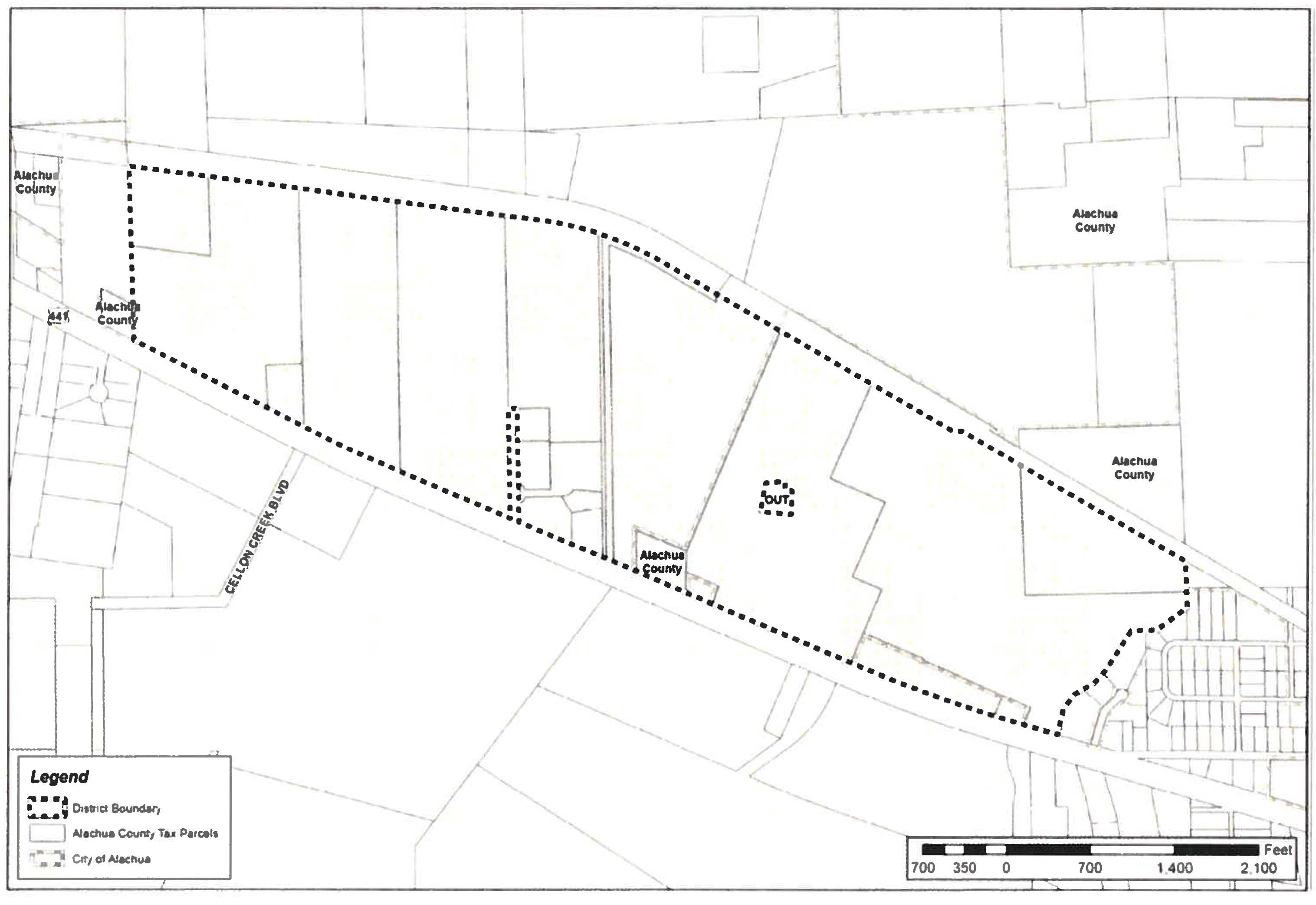
b.
Construction by Master Plan. The construction of the infrastructure improvements for wastewater collection in Area 1 ("Improvements") will be accomplished by Master Planning. The fees for the Improvements set forth below are based upon the Master Plan for Area 1 of the future wastewater collection system infrastructure improvements for Area 1 that includes the estimated capital construction costs for such improvements and the anticipated future non-residential establishments in Area 1 that will receive the benefit of these improvements. The user fees set forth below collected by the City in Area 1 shall be used by the City to fund the improvements in Area 1.
c.
Area 1 Funding. Subject to availability of funds, the City is authorized to fund the improvements and be reimbursed by infrastructure improvement area fees ("fees"). The fees have been calculated based upon the Master Plan for Area 1, which may be amended from time to time, and anticipated development activity in Area 1. The fees will be reviewed periodically and adjusted according to revisions in the Master Plan for Area 1 or to account for changing inflationary or economic conditions. The initial fees are as follows:
1.
Each new or existing non-residential establishment that connects to the improvements shall pay the City $0.50 per square foot of the gross building square footage at the time it connects to the improvements. No final inspection will be conducted or wastewater services provided until the fees have been paid to the City.
Fees shall not apply if a structure is destroyed by fire or other unforeseen casualty and the new structure is reconstructed in substantially the same square footage as the structure that was destroyed. The fees shall be paid upon application for final inspection.
(2)
Alachua West Wastewater Collection Infrastructure Improvement Area ("Area 2").
a.
Area 2 is depicted in Figure 2 below.
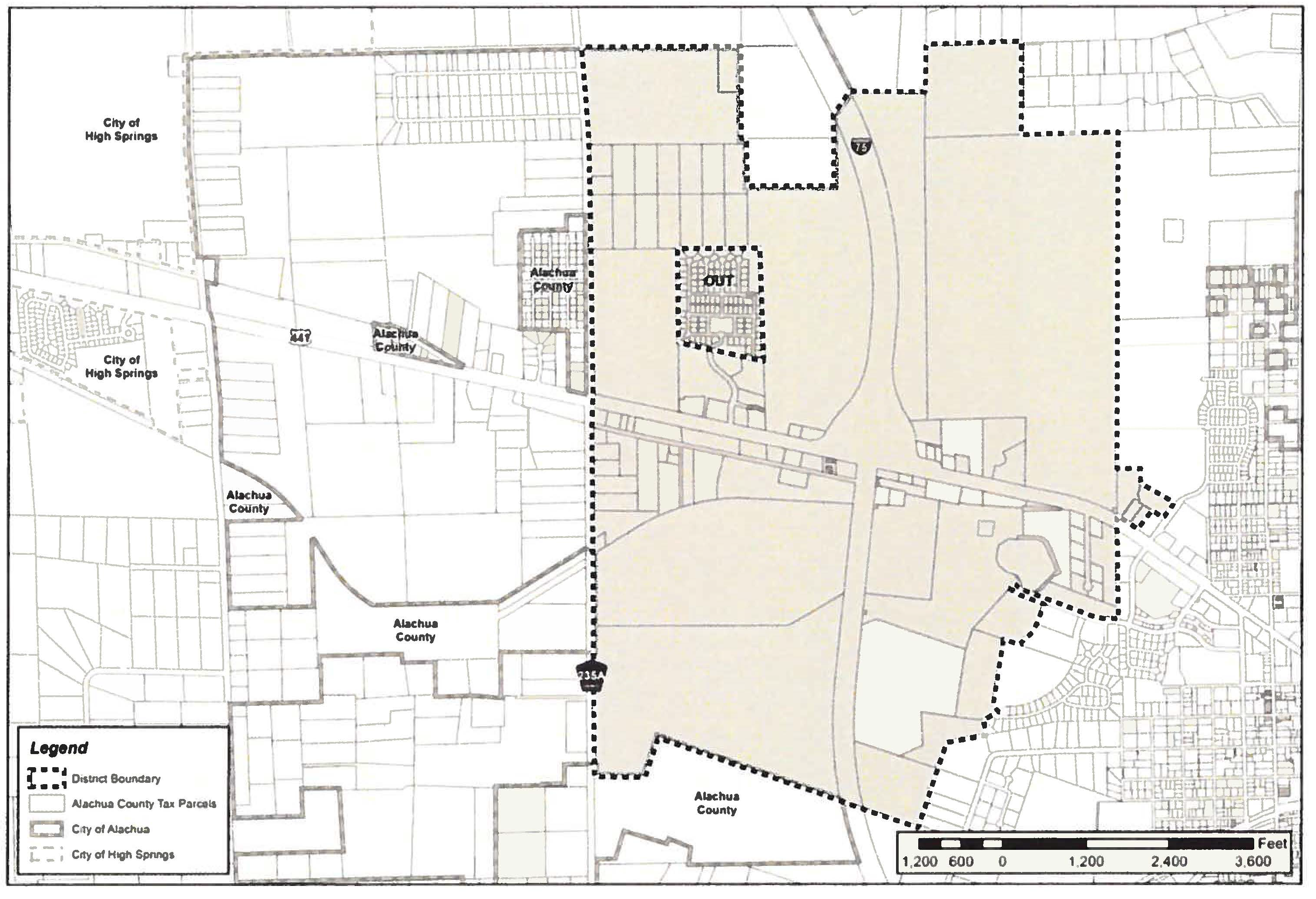
b.
Construction by Master Plan. The construction of the infrastructure improvements for wastewater collection in Area 2 ("Improvements") will be accomplished by Master Planning. The fees for the Improvements set forth below are based upon the Master Plan for Area 2 of the future wastewater collection system infrastructure improvements for Area 2 that includes the estimated capital construction costs for such improvements and the anticipated future non-residential establishments and residential establishments in Area 2 that will receive the benefit of these improvements. The user fees set forth below collected by the City in Area 2 shall be used by the City to fund the improvements in Area 2.
c.
Area 2 funding. Subject to availability of funds, the City is authorized to fund the improvements and be reimbursed by infrastructure improvement area fees ("fees"). The fees have been calculated based upon the Master Plan for Area 2, which may be amended from time to time, and anticipated development activity in Area 2. The fees will be reviewed periodically and adjusted according to revisions in the Master Plan for Area 2 or to account for changing inflationary or economic conditions. The initial fees are as follows:
1.
Each new or existing non-residential establishment that connects to the Improvements shall pay the City $0.75 per square foot of the gross building square footage at the time it connects to the improvements. No final inspection will be conducted or wastewater services provided until the fees have been paid to the City.
2.
Each new or existing residential establishment that connects to the improvements shall pay the City $275.00 at the time it connects to the improvements. No final inspection will be conducted or wastewater services provided until the fees have been paid to the City.
Fees shall not apply if a structure is destroyed by fire or other unforeseen casualty and the new structure is reconstructed in substantially the same square footage as the structure that was destroyed. The fees shall be paid upon application for final inspection.
(3)
Alachua West Water Distribution Infrastructure Improvement Area ("Area 3").
a.
Area 3 is depicted in Figure 3 below.
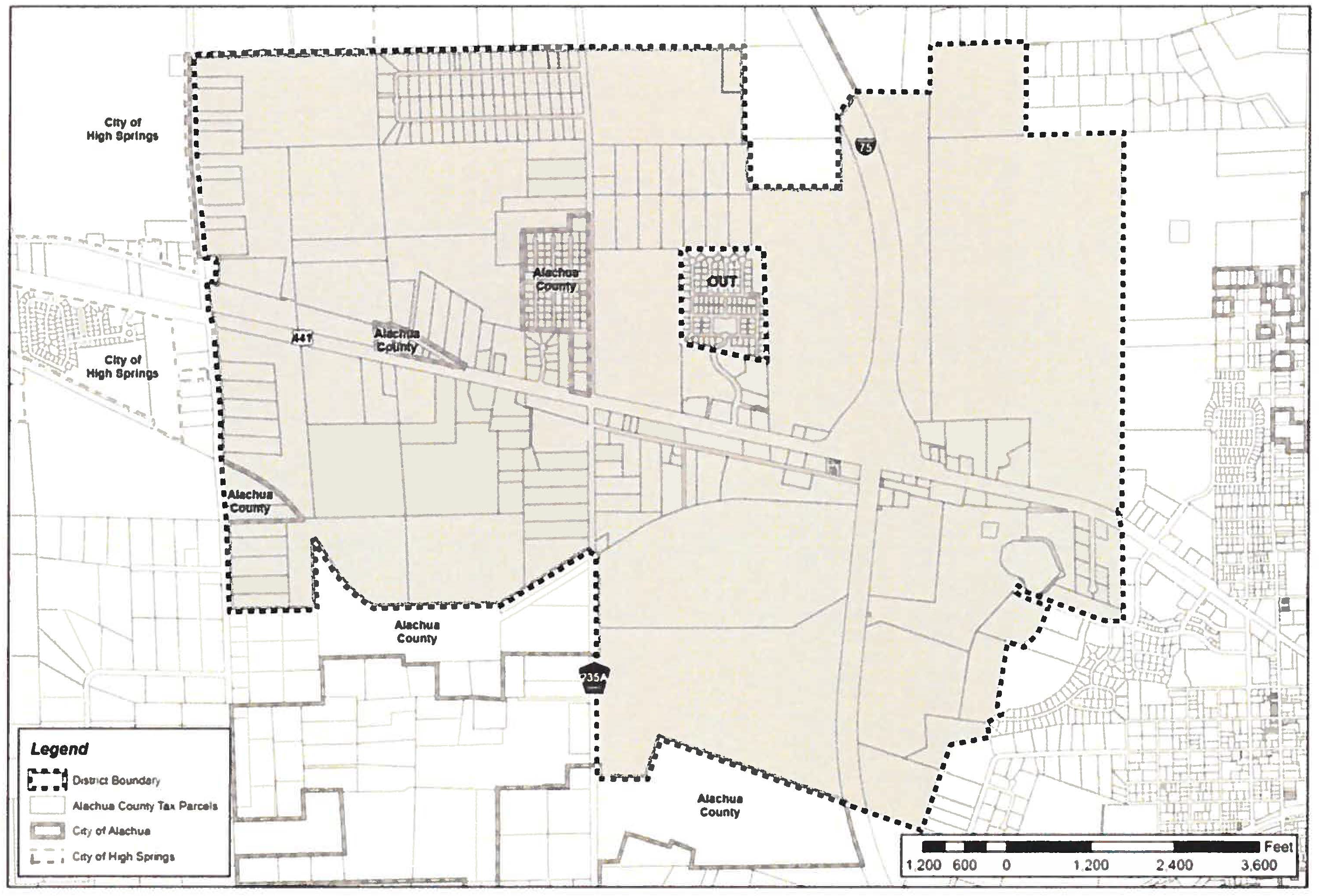
b.
Construction by Master Plan. The construction of the infrastructure improvements for water distribution in Area 3 ("improvements") will be accomplished by Master Planning. The fees for the improvements set forth below are based upon the Master Plan for Area 3 of the future water distribution system infrastructure improvements for Area 3 that includes the estimated capital construction costs for such improvements and the anticipated future non-residential establishments and residential establishments in Area 3 that will receive the benefit of these improvements. The user fees set forth below collected by the City in Area 3 shall be used by the City to fund the improvements in Area 3.
c.
Area 3 funding. Subject to availability of funds, the City is authorized to fund the improvements and be reimbursed by infrastructure improvement area fees ("fees"). The fees have been calculated based upon the Master Plan for Area 3, which may be amended from time to time, and anticipated development activity in Area 3. The fees will be reviewed periodically and adjusted according to revisions in the Master Plan for Area 3 or to account for changing inflationary or economic conditions. The initial fees are as follows:
1.
Each new or existing non-residential establishment that connects to the improvements shall pay the City $0.50 per square foot of the gross building square footage at the time it connects to the improvements. No final inspection will be conducted or water services provided until the fees have been paid to the City.
2.
Each new or existing residential establishment that connects to the improvements shall pay the City $250.00 at the time it connects to the improvements. No final inspection will be conducted or water services provided until the fees have been paid to the City.
Fees shall not apply if a structure is destroyed by fire or other unforeseen casualty and the new structure is reconstructed in substantially the same square footage as the structure that was destroyed. The fees shall be paid upon application for final inspection.
(4)
Alachua East Water Distribution Infrastructure Improvement Area ("Area 4").
a.
Area 4 is depicted in Figure 4 below:
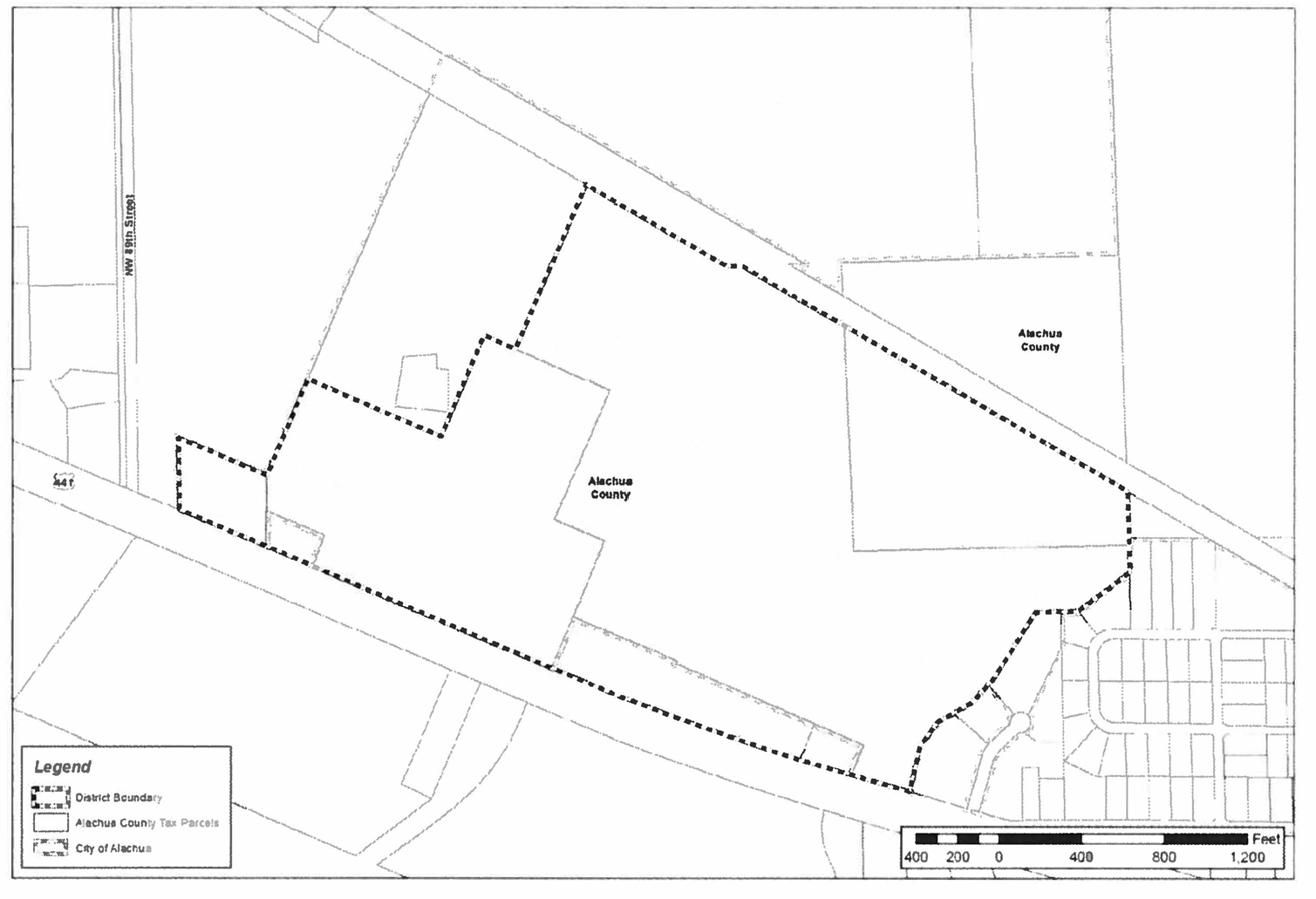
b.
Construction by Master Plan. The construction of the infrastructure improvements for water distribution in Area 4 ("Improvements") will be accomplished by master planning. The fees for the Improvements set forth below are based upon the Master Plan for Area 4 of the future water distribution system infrastructure improvements for Area 4 that includes the estimated capital construction costs for such Improvements and the anticipated future non-residential establishments and residential establishments in Area 4 that will receive the benefit of these Improvements. The user fees set forth below collected by the City in Area 4 shall be used by the City to fund the Improvements in Area 4.
c.
Area 4 Funding. Subject to availability of funds, the City is authorized to fund the Improvements and be reimbursed by infrastructure improvement area fees ("Fees"). The fees have been calculated based upon the Master Plan for Area 4, which may be amended from time to time, and anticipated development activity in Area 4. The fees will be reviewed periodically and adjusted according to revisions in the Master Plan for Area 4 or to account for changing inflationary or economic conditions. The initial Fees are as follows:
1.
Each new or existing non-residential establishment that connects to the Improvements shall pay the City $0.25 per square foot of the gross building square footage at the time it connects to the improvements. No final inspection will be conducted or water services provided until the fees have been paid to the City.
2.
Each new or existing residential establishment that connects to the improvements shall pay the City $250.00 at the time it connects to the improvements. No final inspection will be conducted or water services provided until the Fees have been paid to the City.
Fees shall not apply if a structure is destroyed by fire or other unforeseen casualty and the new structure is reconstructed in substantially the same square footage as the structure that was destroyed. The Fees shall be paid upon application for final inspection.
(Ord. No. 18-23, § 4(Exh. A), 9-24-2018; Ord. No. 19-24, § 4(Exh. A), 5-6-2019)
Sec. 38-25. - Conditions for service in unincorporated areas.
It is recognized that the issuance of building permits within the unincorporated areas of the County are within the jurisdiction of the County. The City Manager, in cooperation with the County, will follow such ordinances or procedures that are adopted and effective within the unincorporated areas of the County, consistent with the intent of this article, to make sure that proper fees and charges are made and collected prior to the rendering of water, wastewater, refuse, and electric services.
(Code 1976, §§ 26-35, 26-62; Ord. No. O-76-3, § 20, 11-18-1975; Ord. No. O-76-6, § 17, 1-8-1976; Ord. No. O-81-14, § 20, 6-15-1981; Ord. No. O-81-15, § 17, 6-15-1981; Ord. No. O-83-4, § 17, 12-20-1982)
Sec. 38-26. - Application for service.
It shall be unlawful for any person to use City water, wastewater and electric services without first making written application to the City for such service not less than one business day before the service is desired and paying all charges incident to such applications. Such applications shall be made on forms furnished by the City and shall constitute an agreement by the consumer with the City to abide by the rules of the City in regard to its water, wastewater, and electric services. Applications for service requested by firms, partnerships, associations and corporations shall be tendered only by their duly authorized agents and the official title of such parties shall be signed to the application.
(Code 1976, §§ 26-18, 26-48, 26-78; Ord. No. O-76-3, § 3, 11-18-1975; Ord. No. O-76-6, § 3, 1-8-1976; Ord. No. O-81-9, § 1(3), 3-26-1981; Ord. No. O-81-14, § 3, 6-15-1981; Ord. No. O-81-15, § 3, 6-15-1981; Ord. No. O-83-4, § 3, 12-20-1982; Ord. No. 83-5, § 1(3), 12-20-1982)
Sec. 38-27. - Determination of type of service to be rendered.
(a)
The City Manager or designee, shall have the authority to determine what type of service shall be rendered by the City to each consumer.
(b)
Semipermanent service shall be defined as an interim type of service between temporary construction service and permanent service. Semipermanent service shall be granted to new construction or renovation sites upon approval of such service by the Building Official. Such service shall be granted for a period not to exceed 45 days allowing the contractor time to complete construction and prepare for final inspection. Semipermanent service shall automatically terminate at the end of the 45-day period, unless an extension has been applied for by the contractor. Such extension may be granted by the City Manager or designee for an additional period of time mutually agreeable to both parties. The City Manager or designee shall withhold semipermanent service under any application, at any construction site, until such time as all prior indebtedness incurred either by the applicant or by the construction site is paid in full. Occupancy in any premises with semipermanent service is not permitted. Should this condition be determined to exist, all utility services shall be terminated immediately and will not be restored until such time as a final inspection is performed and a certificate of occupancy is issued by the Building Official.
(Code 1976, §§ 26-30, 26-81; Ord. No. O-76-3, § 15, 11-18-1975; Ord. No. O-81-9, § 1(6), 3-26-1981; Ord. No. O-81-14, § 15, 6-15-1981; Ord. No. 83-5, § 1(6), 12-20-1982)
Sec. 38-28. - Withholding service for prior indebtedness.
The City Manager or designee may withhold or discontinue water, wastewater, and electric services rendered under any application, as required by the immediately preceding section, made by any member, principal or agent of a family, household, organization or business unless all prior indebtedness due by such family, household, organization or business is paid in full.
(Code 1976, §§ 26-19, 26-49, 26-82; Ord. No. O-76-3, § 4, 11-18-1975; Ord. No. O-76-6, § 4, 1-8-1976; Ord. No. O-81-9, § 1(7), 3-26-1981; Ord. No. O-81-14, § 4, 6-15-1981; Ord. No. O-81-15, § 4, 6-15-1981; Ord. No. O-83-4, § 4, 12-20-1982; Ord. No. 83-5, § 1(7), 12-20-1982)
Sec. 38-29. - Inspection of premises; discontinuance of service.
(a)
No service shall be rendered by the City to any consumer at any premises until such time as the City's Building Official has approved such premises for services.
(b)
As a condition of receiving or continuing to receive water, wastewater and electric services from the City, the duly authorized representatives of the City shall be permitted at reasonable times to make necessary inspections of utilities facilities on private premises where such inspections are reasonably necessary to ensure the compliance with the ordinances of the City relating to such service. If after written notice delivered to the premises or mailed to the premises and to the owner, if not owner occupied, stating a reasonable time in which such inspection is needed to be made, the reasons therefor, and the effect of failure to allow such inspection, if the City's duly authorized representative is then denied access to the premises for such inspection, the City may then discontinue all utilities services to such premises until such inspection is permitted.
(Code 1976, §§ 26-39, 26-66, 26-83; Ord. No. O-76-3, § 24, 11-18-1975; Ord. No. O-76-6, § 21, 1-8-1976; Ord. No. O-81-9, § 1(8), 3-26-1981; Ord. No. O-81-14, § 24, 6-15-1981; Ord. No. O-81-15, § 21, 6-15-1981; Ord. No. O-83-4, § 1, 12-20-1982; Ord. No. 83-5, § 1(8), 12-20-1982)
Sec. 38-30. - Initial service charge.
(a)
Per meter charge. A service charge of $25.00 per meter shall be paid to the City before any water, wastewater, and electric services are installed or transferred.
(b)
Reconnection charge. In the event service is scheduled to be cut for nonpayment (whether or not the service was actually interrupted), a fee of $25.00 per meter shall be paid to the City before any water, wastewater, and electric services are continued or reconnected if service was interrupted, provided, however, such reconnection is requested and made during other than normal working hours, such reconnection fee shall be $50.00 per meter.
(Code 1976, §§ 26-25, 26-56, 26-80; Ord. No. O-76-3, § 10, 11-18-1975; Ord. No. O-76-6, § 11, 1-8-1976; Ord. No. O-81-9, § 1(5), 3-26-1981; Ord. No. O-81-14, § 10, 6-15-1981; Ord. No. O-81-15, § 11, 6-15-1981; Ord. No. O-83-4, § 11, 12-20-1982; Ord. No. 83-5, § 1(5), 12-20-1982; Ord. No. O-94-16, § II, 9-19-1994; Ord. No. O-94-17, § I, 9-19-1994; Ord. No. O-98-08, § 1, 12-1-1997; Ord. No. O-98-09, § 1, 12-1-1997; Ord. No. O-98-16, § 1, 2-17-1998)
Sec. 38-31. - Transfer of service.
Applications for transfer of service shall be made by the consumer to the City not less than one business day before such transfer is desired, and failure on the part of the consumer to make such application and to pay the service charge shall render the consumer liable for not less than the minimum monthly charge for such service.
(Code 1976, §§ 26-26, 26-57, 26-99; Ord. No. O-76-3, § 11, 11-18-1975; Ord. No. O-76-6, § 12, 1-8-1976; Ord. No. O-81-9, § 1(24), 3-26-1981; Ord. No. O-81-14, § 11, 6-15-1981; Ord. No. O-81-15, § 12, 6-15-1981; Ord. No. O-83-4, § 12, 12-20-1982; Ord. No. 83-5, § 1(24), 12-20-1982)
Sec. 38-32. - Consumers to grant easements, etc.; access to premises by City employees.
(a)
The consumer shall grant or cause to be granted to the City, without cost, all rights, easements, permits and privileges which are necessary for the rendering of service. The duly authorized employees of the City shall have access, at all reasonable hours, to the premises of the consumer for the purpose of reading meters, installing or removing any of its properties, or for any purpose incidental to the rendering of the service.
(b)
The City Manager shall have the right to discontinue service if the consumer fails to provide a reasonable and safe entrance to a metering point for the purpose of reading, inspection, maintenance and removal of meters. Before service is terminated a City representative shall deliver a written notice to the premises. The notice shall state the turnoff date which shall not be sooner than 30 days from the date of notice. A duplicate copy of the notice shall be sent by certified mail to the consumer the following day.
(Code 1976, § 26-100; Ord. No. O-81-9, § 1(25), 3-26-1981; Ord. No. 83-5, § 1(25), 12-20-1982; Ord. No. O-86-4, § 1, 11-18-1985)
Sec. 38-33. - Meters, pipes, and wiring, altering prohibited; discontinuation of service; billing estimated consumption.
(a)
Per F.S. § 812.14, it is unlawful for any person to meddle, modify, tamper with, alter or change the pipes and wires on any premises or to interfere in any way with a meter or meter connection. Should it appear that water and/or electricity has been stolen by altering the pipes and wires, reversing the meter or otherwise, the City Manager or designee shall have the right to discontinue the service until the defect is corrected and the service approved by the City Building Official. The consumer shall be charged with and billed for the stolen water and/or electricity on an estimated billing calculated by the City based on previous meter consumption. In addition a fee of $50.00 per water meter and $75.00 per electric meter shall be paid to the City plus the deposit shall be increased to three times the average bill for water and five times the average bill for electric or twice the normal deposit, whichever is larger, before any water and electric service is reconnected.
(b)
The existence of any altered connection, pipes, and wiring or meter alteration or any device whatsoever, which effects the diversion of water and/or electricity without the same being measured or registered by or on a meter installed for that purpose by the City shall be prima facie evidence of intent to violate, and of the violation of this section by the person using or receiving the direct benefits from the use of such water and/or electricity passing through such connection, pipe, wire, and device or altered meter, or being used without being measured or registered on a meter as aforesaid.
(Code 1976, §§ 26-37, 26-64, 26-95; Ord. No. O-76-3, § 22, 11-18-1975; Ord. No. O-76-6, § 19, 1-8-1976; Ord. No. O-81-9, § 1(20), 3-26-1981; Ord. No. O-81-14, § 22, 6-15-1981; Ord. No. O-81-15, § 19, 6-15-1981; Ord. No. 83-5, § 1(20), 12-20-1982; Ord. No. O-94-16, § III, 9-19-1994; Ord. No. O-94-17, § IV, 9-19-1994)
Sec. 38-34. - Liability of City; restricting use of water or electric.
(a)
The City shall not be liable for any damage resulting from the bursting of any main, service pipe or cock, from the shutting off of water or electric for repairs, extensions or connections or from the accidental failure of the water and wastewater supply from any cause whatsoever. In case of emergency, the City shall have the right to restrict the use of water in any reasonable manner for the protection of the City and its water supply.
(b)
The City shall not be liable for any damage resulting from the malfunction or failure to function of any part of the wastewater system from any cause whatsoever.
(c)
The City will, at all times, use reasonable diligence to provide continuous service and, having used due diligence, shall not be liable to the consumer for failure or interruption of service.
(d)
The consumer shall indemnify, hold harmless and defend the City from, and against, any and all liability or loss, in any manner, directly or indirectly growing out of the transmission and use of electrical energy by the consumer at, or on, the consumer's side of the point of delivery.
(Code 1976, §§ 26-38, 26-65, 26-102, 26-103; Ord. No. O-76-3, § 23, 11-18-1975; Ord. No. O-76-6, § 20, 1-8-1976; Ord. No. O-81-9, § 1(27, 28), 3-26-1981; Ord. No. O-81-14, § 23, 6-15-1981; Ord. No. O-81-15, § 20, 6-15-1981; Ord. No. O-83-4, § 201, 12-20-1982; Ord. No. 83-5, § 1(28), 12-20-1982)
Sec. 38-35. - Resale and redistribution of water and electricity prohibited.
Water service and electric energy received under general water service, residential electric service, general service demand, general service large demand, or general service nondemand electric services shall be used for the consumer's direct use only. No resale or redistribution of such water service and electric energy shall be permitted unless authorized by the City Manager or designee at the time of project inception and development in a site plan.
(Code 1976, § 26-84; Ord. No. O-81-9, § 1(9), 3-26-1981; Ord. No. 83-5, § 1(9), 12-20-1982)
Sec. 38-61. - Liability for service.
The liability of the consumer for service shall begin on the day the consumer is connected to the City's water main, wastewater line and electric service wires and shall continue thereafter unless disconnected for nonpayment or other cause until written notice is given the City by the consumer of his desire to terminate the service.
(Code 1976, §§ 26-27, 26-58, 26-98; Ord. No. O-76-3, § 12, 11-18-1975; Ord. No. O-76-6, § 13, 1-8-1976; Ord. No. O-81-9, § 1(23), 3-26-1981; Ord. No. O-81-14, § 12, 6-15-1981; Ord. No. O-81-15, § 13, 6-15-1981; Ord. No. O-83-4, § 13, 12-20-1982; Ord. No. 83-5, § 1(23), 12-20-1982)
Sec. 38-62. - Deposit required; amount; receipt; refund; disposition of unclaimed deposits.
(a)
No deposit will be accepted for permanent service on new construction until a building permit has been issued and a final inspection made of the premises by the Building Official resulting in the issuance of a certificate of occupancy.
(b)
Before rendering any residential water, wastewater, and electric services, the City shall require an adequate security deposit in the amount of $40.00 for water, $50.00 for wastewater and $150.00 for electric service customers to secure the payment of bills. The City shall require a deposit for nonresidential customers based on an estimated combined utility bill for two and one-half times the average bill to secure the payment of bills. The City reserves the right to review existing deposits and payment status on any customer at any given time to ensure that an adequate security deposit is maintained with the City.
Any returning customer, who has an outstanding indebtedness with the City, will be required to provide a deposit that is twice the amount of deposit requirements in effect at the time of application for service.
Such deposits shall be held by the City until final settlement of the consumer's account, and upon final settlement of consumer's account which shall include payment of the final bill, any unused balance of the deposit will be refunded when such account is settled and closed. All deposits shall be evidenced by nontransferable receipts issued by the City in the name of the prospective consumer applying for service, and refund shall be contingent upon adequate identification and surrender of the deposit receipt. In the event any deposit is unclaimed for a period of 12 months after the service is discontinued such unclaimed deposit shall be considered abandoned property and shall be surrendered to the State.
The City will waive deposit requirements if the residential customer furnishes a letter of credit status from another electric utility company indicating a satisfactory credit rating and payment status for two consecutive years. A satisfactory credit rating shall be defined as no non-payment disconnects, no non-sufficient funds (nsf), no returned automated clearing house (ach) payments, and not more than one late notice within the two-year period. Such letter of credit status must be for the time period immediately preceding the request for connection with the City of Alachua. In the event an account no longer maintains a satisfactory credit rating, the residential customer will be required to pay the minimum deposit required for a residential account.
Upon submittal of the Good Credit Deposit Refund Request, the City will credit the deposit held for any residential customer who has for two consecutive years maintained a timely payment record. A timely payment record shall be defined to mean the payment of an outstanding utility bill on or before the due date, no non-payment disconnects, no non-sufficient funds, no returned automated clearing house (ach) payments, and not more than one late notice during the two-year period.
If the residential customer subsequent to receipt of the Good Credit Deposit Refund, fails to maintain a satisfactory credit rating, the residential customer will be required to provide a deposit based upon the City's deposit requirements at such time.
(Code 1976, §§ 26-31, 26-59, 26-79; Ord. No. O-76-3, § 16, 11-18-1975; Ord. No. O-76-6, § 14, 1-8-1976; Ord. No. O-81-9, § 1(4), 3-26-1981; Ord. No. O-81-14, § 16, 6-15-1981; Ord. No. O-81-15, § 14, 6-15-1981; Ord. No. 83-4 § 1(4), 12-20-1982; Ord. No. O-85-23, § 1, 9-5-1985; Ord. No. O-87-12, § 4, 8-3-1987; Ord. No. O-94-16, § I, 9-19-1994; Ord. No. O-94-17, § II, 9-19-1994; Ord. No. 94-18, § 1, 9-7-1994; Ord. No. 10-25, § 1, 10-11-2010)
Sec. 38-63. - Water, wastewater and electric service bills; rendering; date payable; delinquencies; combined monthly statements; discontinuation of service.
(a)
Bills for solid waste, mosquito control, water, wastewater, and electric service will be rendered monthly. The rendering of bills is not an obligation on the part of the City. A customer may elect to receive a monthly bill by e-mail, in lieu of the United States Postal Service. Failure of the consumer to receive such bills shall not release or diminish the obligation of the consumer for the payment thereof, or release the consumer from any obligation under this article. Such bills for service are due and payable when rendered following the last regular meter reading date, and shall become delinquent at the close of business seven days after the due date.
(b)
If the consolidated utility bill is not paid by the close of business on the due date after such bill is rendered, or the first business day after the due date if the City Hall is closed on the due date, there shall be imposed a ten percent late charge on such delinquent account. The late charge shall be assessed by computing ten percent of the delinquent user's consolidated utility systems service bill and adding the ten percent to the delinquent user's account. The City will mail a second notice to all utility customers after the late charge has been applied to the utility bill. The notice will state the amount due and the time and date of the disconnection.
The City may extend the date upon which a utility bill is due and payable. The terms for the extension shall be approved by the City Manager or designee. If the payment for which an extension has been granted is not received when due, then services will be disconnected and fees assessed in accordance with section 38-63.
(c)
Combined monthly statements for all utilities services including electricity, water and wastewater plus applicable taxes shall be rendered to each user of such services. Water, wastewater and electric services are subject to disconnection on the day the account becomes delinquent, which is the close of business seven days after the due date after the utility bill has been rendered. Service shall remain disconnected until such delinquent account, plus the service charge is paid.
(d)
In the event that a customer's service is scheduled for disconnection more than one time, such service will remain disconnected until the deposit on such customer's account equals twice the amount of original deposit or the amount of the customer's highest bill during the prior six months, whichever is greater.
(Code 1976, §§ 26-32, 26-60, 26-104; Ord. No. O-76-3, § 17, 11-18-1975; Ord. No. O-76-6, § 15, 1-8-1976; Ord. No. O-81-9, § 1(29), 3-26-1981; Ord. No. O-81-14, § 17, 6-15-1981; Ord. No. O-81-15, § 15, 6-15-1981; Ord. No. O-83-4, § 15, 12-20-1982; Ord. No. 83-5, § 1(29), 12-20-1982; Ord. No. O-83-10, §§ 2—4, 10-3-1983; Ord. No. O-87-12, §§ 1, 2, 4, 8-3-1987; Ord. No. O-94-17, § III, 9-19-1994; Ord. No. O-98-08, § 2, 12-1-1997; Ord. No. O-99-14, §§ 1—3, 3-15-1999; Ord. No. 10-25, § 1, 10-11-2010)
Sec. 38-64. - Estimate of bills when meter destroyed and fails to register.
In the event any meter on the consumer's premises is destroyed by fire or other cause or fails to register, the consumer will be billed for the period involved on the basis of previous consumption.
(Code 1976, §§ 26-29, 26-101; Ord. No. O-76-3, § 14, 11-18-1975; Ord. No. O-81-9, § 1(26), 3-26-1981; Ord. No. O-81-14, § 14, 6-15-1981; Ord. No. 83-5, § 1(27), 12-20-1982)
Sec. 38-65. - Returned check service charge.
A service charge in the maximum amount authorized by F.S. § 166.251 shall be made for each check to the City which is returned by a bank because of insufficient funds in the customer's account to cover the amount of such check.
If any check, draft or other order for payment is returned to the City as being dishonored, whether for insufficient funds in the account, or if the account is closed, or for other reason, the customer shall receive a 24-hour notice to compensate for said check, draft or other order for payment. If customer does not compensate for said check, draft or other order for payment, service shall immediately be discontinued until payment is made by cash, money order or cashier's check.
(Code 1976, §§ 26-33, 26-61; Ord. No. O-76-3, § 18, 11-18-1975; Ord. No. O-76-6, § 16, 1-8-1976; Ord. No. O-81-14, § 18, 6-15-1981; Ord. No. O-81-15, § 16, 6-15-1981; Ord. No. O-83-4, § 16, 12-20-1982; Ord. No. 10-25, § 1, 10-11-2010)
Sec. 38-66. - Excess returned checks.
(a)
This section shall apply to all billings for utility services rendered by the City.
(b)
The maximum allowable number of personal checks returned for insufficient funds is three checks. A record of all such dishonored checks shall be maintained by the City.
(c)
Any customer accruing three dishonored personal checks for insufficient funds shall be required to pay subsequent utility bills by cash, money order or cashier's check. Any attempt to effect payment by personal check via night drop method of payment or U.S. Postal Service shall have utility services disconnected and charged a turnoff fee if made after cutoff date printed on utility bill. Service shall remain disconnected until payment is made as outlined in this subsection. When the utility bill has been paid, a cut-on fee shall also be charged.
(d)
Any utility customer who has been required to pay utility bills by cash, money order, or cashier's check, due to excess returned checks, will be permitted to pay by check once he has maintained a satisfactory credit rating as defined in section 38-62.
(Ord. No. O-92-24, §§ 1—3, 5-4-1992; Ord. No. 10-25, § 1, 10-11-2010)
Sec. 38-67. - Return of payments prohibited.
Except for deposits required for initial utilities service, no monies properly paid to the City under this article shall be refundable.
(Code 1976, §§ 26-36, 26-63, 26-105; Ord. No. O-76-3, § 21, 11-18-1975; Ord. No. O-76-6, § 18, 1-8-1976; Ord. No. O-81-9, § 1(30), 3-26-1981; Ord. No. O-81-14, § 21, 6-15-1981; Ord. No. O-81-15, § 18, 6-15-1981; Ord. No. 83-5, § 1(30), 12-20-1982)
Sec. 38-68. - Wastewater charge reductions.
The City may reduce the wastewater charges incurred by utility customers when it can be demonstrated that the facilities had leaks which have been resolved.
The City may reduce the wastewater charges incurred by utility customers as a result of filling a swimming pool.
(Ord. No. 10-25, § 2, 10-11-2010)
Sec. 38-69. - Alachua Cares program.
The City will implement a program entitled "Alachua Cares" by December 1, 2010, under guidelines approved by the City Commission which will allow utility customers to provide emergency financial assistance to residential utility customers. A social service agency will be selected by the City Commission to administer the program.
(Ord. No. 10-25, § 2, 10-11-2010)

