04 - ZONING REGULATIONS1
Editor's note— Chapter 17.04 contains the text of the zoning regulations for the city which derive from Ord. No. 868 adopted September 7, 1999, and which were published in the prior code. Amendments are indicated by parenthetical history notes following amended provisions. The absence of a history note indicates that the provision remains unchanged from the original ordinance. Obvious misspellings and punctuation errors have been corrected without notation. For stylistic purposes, a uniform system of headings, catchlines, capitalization, citation to state statutes, and expression of numbers in text has been used to conform to the Code of Ordinances.
The purpose of this chapter is to provide adequate light and air, to prevent the overcrowding of land, to avoid undue concentration of population, to regulate the use of land, and to promote the health, safety, and general welfare in the City of Algona, Iowa.
The regulations set by this chapter within each district shall be minimum regulations and shall apply uniformly to each class or kind of structure or land, and particularly, except as hereinafter provided:
1.
No building, structure, or land shall hereafter be used or occupied, no building or structure or part thereof shall hereafter be erected, constructed, reconstructed, moved, or structurally altered except in conformity with all the regulations herein specified for the district in which it is located.
2.
No part of a yard, or other open space, or off-street parking or loading space required about or in connection with any building for the purpose of complying with this chapter, shall be included as part of a yard, open space, or off-street parking or loading space similarly required for any other building.
3.
No yard or lot existing at the time of passage of the ordinance from which this chapter is derived shall be reduced in dimension or area below the minimum requirements set forth herein. Yards or lots created after the effective date of the ordinance from which this chapter is derived shall meet at least the minimum requirements established by this chapter.
4.
Whenever the requirements of this chapter are at variance with the requirements of any other lawfully adopted rules, regulations, ordinances, deed restrictions, or covenants, the most restrictive or that imposing the higher standards shall govern.
5.
All structures existing, as of the effective date of the ordinance from which this chapter is derived and which comply with the terms and conditions of this chapter shall be considered lawful and be allowed to continue and exist or be constructed on the current perimeters of the existing structure.
1.
Official Zoning Map. The city shall be divided into districts, as shown on the official zoning map which, together with all explanatory matter thereon, shall be adopted by ordinance.
The official zoning map shall be identified by the signature of the mayor, attested by the city clerk, under the following words: "This is to certify that this is the Official Zoning Map referred to in Section 17.04.030 of Ordinance No. 868 of the City of Algona, Iowa," together with the date of adoption.
If, in accordance with the provisions of this chapter and Chapter 414, Code of Iowa, changes are made in district boundaries or other matter portrayed on the official zoning map, such changes shall be entered on the official zoning map promptly after the amendment has been approved by the city council, with an entry on the official zoning map as follows: "By official action of the City Council, the following changes were made to the Official Zoning Map." (Indicating the changes by ordinance numbers and date of publication.)
No amendment which involves matter portrayed on the official zoning map shall become effective until after such change and entry has been made on said map.
2.
Annexation of New Land. Any land annexed to the city after the effective date of the ordinance from which this chapter is derived shall be zoned [AG] Agricultural until the planning and zoning commission and city council shall have studied the area and adopted a final zoning plan for the area in accordance with this chapter.
3.
Replacement of the Official Zoning Map. In the event that the official zoning map becomes damaged, destroyed, lost or difficult to interpret because of the nature or number of changes and additions, the city council may by ordinance adopt a new official zoning map which shall supersede the prior official zoning map. The new official zoning map may correct drafting or other errors or omissions in the prior official zoning map, but no such correction shall have the effect of amending the original official zoning map or any subsequent amendment thereof.
The new official zoning map shall be identified by the signature of the mayor, attested by the city clerk, and bearing the seal of the city under the following words: "This is to certify that this Official Zoning Map supersedes and replaces the Official Zoning Map adopted as part of Ordinance No. 869 of the City of Algona, Iowa."
Unless the prior official zoning map has been lost, or has been totally destroyed, the prior map or any significant parts thereof remaining, shall be preserved, together with all available records pertaining to its adoption or amendment.
Where uncertainty exists as to the boundaries of districts as shown on the official zoning map, the following rules shall apply:
1.
Boundaries indicated as approximately following the center lines of streets, highways, or alleys shall be construed to follow such center lines;
2.
Boundaries indicated as approximately following platted lot lines shall be construed as following such lot lines;
3.
Boundaries indicated as approximately following city limits shall be construed as following such city limits;
4.
Boundaries indicated as following railroad lines shall be construed to be midway between the main tracks;
5.
Boundaries indicated as following shorelines shall be construed to follow such shorelines, and in the event of change in the shoreline shall be construed as moving with the actual shoreline; boundaries indicated as approximately following the center lines of streams, rivers, or other bodies of water shall be construed to follow such center lines;
6.
Boundaries indicated as parallel to or extensions of features indicated in subsections 1 through 5 above shall be so construed. Distances not specifically indicated on the official zoning map shall be determined by the scale of the map;
7.
Where physical or cultural features existing on the ground are at variance with those shown on the official zoning map, or in other circumstances not covered by subsections 1 through 6 above, the board of adjustment shall interpret the district boundaries;
8.
Whenever the council vacates and disposes of a street or alley, adjacent districts shall extend to the center line of the vacation;
9.
Whenever a variance exists between the official zoning map and the legal description on an amendment to the ordinance from which this chapter is derived, the legal description applies.
For purposes of this chapter, certain terms or words used herein shall be interpreted as follows:
The word "person" includes a firm, association, organization, partnership, trust, company, or corporation as well as an individual.
The present tense includes the future tense, the singular number includes the plural, and the plural number includes the singular.
The word "shall" is mandatory; the word "may" is permissive.
The words "used" or "occupied" include the words "intended," "designed," or "arranged to be used or occupied."
The word "lot" includes the words "plot" or "parcel."
1.
"Abutting" means having property or district lines in common.
2.
"Access" means a way of approaching or entering a property from a public street.
3.
"Accessory buildings" means a subordinate building located on the same lot with the main building, occupied by or devoted to, an accessory use. Where an accessory building is attached to the main building in the subordinate manner, as by a wall or roof, such accessory building shall be considered part of the main building.
4.
"Accessory dwelling unit" means a residential dwelling unit located on the same lot as a single-family home that is the same size or smaller than the principal dwelling, where one unit is required to be owner occupied.
5.
"Accessory structure" means a structure detached from a principal building located on the same lot and customarily incidental and subordinate to the principal building or use.
6.
"Accessory use" means a use of land or of a building or portion thereof customarily incidental and subordinate to the principal use of the land or building and located on the same lot with the principal use.
7.
"Agriculture" means the production, keeping or maintenance, for sale, lease, or personal use, of plants useful to humans, including, but not limited to: forages and sod crops; grains and seed crops; excluding beef cattle, sheep, swine, horses, mules, goats, poultry or other dairy products, or any mutations or hybrids thereof including the breeding and grazing of any or all such animals, including bees and apiary products or fur animals. Trees and forest products, fruits of all kinds; vegetables; or land devoted to a soil conservation or forestry management program are permitted.
8.
"Agricultural sales and services" means establishments or places of business engaged in sale from the premises of feed, grain, fertilizers, pesticides and similar goods or in the provision of agriculturally-related services with incidental storage on lots other than where the service is rendered. Typical uses include nurseries, hay, feed and grain stores, and tree service firms.
9.
"Alley" means a public way, other than a street, twenty feet or less in width, affording secondary means of access to abutting property.
10.
"Animal feeding operation" means a lot, yard, corral, building, or other area in which animals are confined and fed and maintained for forty-five days or more in any twelve-month period, and all structures used for the storage of manure from animals in the operation. Two or more animal feeding operations under common ownership or management are deemed to be a single animal feeding operation if they are adjacent or utilize a common system for manure storage. An animal feeding operation does not include a livestock market.
11.
"Auction house" means a place where objects of art, furniture, or other goods are offered for sale to persons who bid on the objects in competition with each other.
12.
"Basement" means a story having part but not more than one-half its height above grade. A basement shall be counted as a story if the vertical distance from the average adjoining grade to its ceiling is over five feet.
13.
"Bed and breakfast houses" means a house or portion thereof where short-term lodging, rooms, and meals are provided. The operator shall live on the premises.
14.
"Board" means the board of adjustment.
15.
"Boarding houses" means a building other than a hotel where, for compensation, meals and lodging are provided for four or more persons.
16.
"Building" means any structure designed or intended for the support, enclosure, shelter, or protection of persons, animals, or property, but not including signs or billboards and not including structures or vehicles originally designed for transportation purposes.
17.
"Building, height of" means the vertical distance from the average natural grade at the building line to the highest point of the coping of a flat roof, or to the deck line of a mansard roof, or the mean height level between eaves and ridge for gable, hip, and gambrel roofs.
18.
"Conditional use permit" means a zoning exception which allows the property owner use of his land in an way not otherwise permitted within the particular zoning district, but complies with all the conditions and standards for the location or operations of the condition as specified in the zoning ordinance and authorized by the board of adjustment. This permit is recorded and stays with the property.
19.
"Convenience storage" means storage services primarily for personal effects and household goods within enclosed storage areas having individual access, but excluding use as workshops, hobbyshops, manufacturing, or commercial activity. Typical uses include mini-warehousing.
20.
"District" means a section or sections of the city within which the regulations governing the use of buildings and premises or the height and area of buildings and premises are uniform.
21.
"Duplex" means a multi-family home that has two dwelling units in the same building.
22.
"Dwelling" means any building, or portion thereof designed or used exclusively for residential purposes, but not including a tent, cabin, trailer, or mobile home.
23.
"Dwelling, multiple" means a building or portion thereof designed for or occupied exclusively for residence purposes by two or more families.
24.
"Dwelling, single-family" means a building designed for or occupied exclusively for residence purposes by one family.
25.
"Family" means one or more persons related by blood, marriage or adoption occupying a single dwelling unit. A family may include four, but not more than four, persons not related by blood, marriage or adoption but further provide that domestic employees employed on the premises may be housed on the premises without being counted as a family or families. When facilities for dwelling purposes are rented to other occupants of a building, those occupants shall not be considered part of the same family under this chapter.
26.
"Family home" means a community-based residential home which is licensed as a residential care facility under Chapter 135C or as a child foster care facility under Chapter 237 to provide room and board, personal care, habilitation services, and supervision in a family environment exclusively for not more than eight developmentally disabled persons and any necessary support personnel. However, family home does not mean an individual foster care family home licensed under Chapter 237.
27.
"Frost-free foundation" means a foundation supporting a structure which is required to be at least forty-two inches below grade.
28.
"Garage" means a building or portion thereof in which a motor vehicle containing gasoline, distillate or other volatile, flammable liquid in its tank is stored, repaired, or kept.
29.
"Garage, private" means a building or part thereof accessory to a main building and providing for the storage of automobiles and in which no occupation or business for profit is carried on.
30.
"Garage, public or storage" means a building or part thereof other than a private garage for the storage of motor vehicles and in which service station activities may be carried on.
31.
"Grade" means the average elevation of the finished ground at the exterior walls of the main building.
32.
"Health care facility" means any residential care facility, intermediate care facility, or skilled nursing facility.
A.
"Residential care facility" means any institution, place, building, or agency providing for a period exceeding twenty-four consecutive hours accommodation, board, personal assistance and other essential daily living activities to three or more individuals, not related to the administrator or owner thereof within the third degree of consanguinity, who by reason of illness, disease, or physical or mental infirmity are unable to sufficiently or properly care for themselves but who do not require the services of a registered or licensed practical nurse except on an emergency basis.
B.
"Intermediate care facility" means any institution, place, building or agency providing for a period exceeding twenty-four consecutive hours accommodation, board, and nursing services, the need for which is certified by a physician, to three or more individuals, not related to the administrator or owner thereof within the third degree of consanguinity, who by reason of illness, disease, or physical or mental infirmity require nursing services which can be provided only under the direction of a registered nurse or a licensed practical nurse.
C.
"Skilled nursing facility" means any institution, place, building, or agency providing for a period exceeding twenty-four consecutive hours accommodation, board, and nursing services, the need for which is certified by a physician, to three or more individuals not related to the administrator or owner thereof within the third degree of consanguinity who by reason of illness, disease, or physical or mental infirmity require continuous nursing care services and related medical services, but do not require hospital care. The nursing care services provided must be under the direction of a registered nurse on a twenty-four hour per day basis.
33.
"Home occupation" means an incidental occupation conducted in a dwelling unit, provided that:
A.
No persons other than members of the family residing on the premises shall be engaged on the premises in such occupation, except by special exception by the board of adjustment, but in no case shall more than one person be employed other than members of the family residing on the premises.
B.
The use of the dwelling unit for the home occupation shall be clearly incidental and subordinate to its use for residential purposes by its occupants, and not more than thirty percent of the gross floor area of the dwelling unit, calculated from the outside perimeter, shall be used in the conduct of the home occupation. This area restriction shall not apply to the care of children if the property otherwise qualifies as a home occupation.
C.
There shall be no change in the outside appearance of the building or premises, or other visible evidence of the conduct of such home occupation, except that one sign, identifying the name of the business, is allowed. The sign shall not be larger than three square feet in size, shall not be illuminated, and must be mounted flat against the building. Advertising displays, devices, or signs visible through a window of the building shall not be allowed.
D.
No home occupation may be conducted in any accessory building, except by special exception of the board of adjustment.
E.
No traffic shall be generated by such home occupation in greater volumes than would normally be expected in a residential neighborhood, and any need for parking generated by the conduct of such home occupation shall be met by providing off-street parking and shall not be in a required front yard.
F.
No equipment or process shall be used in such home occupation which creates noise, vibration, glare, fumes, odors, or electrical interference detectable to the normal senses off the lot, if the occupation is conducted in a single-family residence, or outside the dwelling unit if conducted in other than a single-family residence. No equipment or process shall be used which creates visual or audible interference in any radio or television receivers off the premises or cause fluctuations in line voltage off the premises.
G.
There shall be no signs, radio, television, newspaper, handbill or similar types of advertising linking the address of the premises with the home occupation. However, temporary signs up to three square feet in size may be placed on private property advertising one-day events at the home occupation. Said temporary signs may be in place for no longer than two days at a time and no home occupation may have signs placed more than two times in one calendar year.
H.
The following uses shall not be allowed as a home occupation:
(1)
Vehicle repair shops.
(2)
Auction houses.
(3)
Appliance repair shops.
(4)
Small engine repair.
(5)
Furniture stripping and refinishing.
(6)
Health salons, gyms, dance studios, aerobic exercise studios.
(7)
Medical or dental offices.
(8)
Upholstery shops.
(9)
Television repair shops.
(10)
Welding shops.
(11)
Kennels.
34.
"Horticulture" means the growing of horticultural and floracultural specialties, such as flowers, shrubs, or trees intended for ornamental or landscaping purposes, but excluding retail sales. Typical uses include wholesale plant nurseries and greenhouses.
35.
"Hospital" means an institution which is devoted primarily to the maintenance and operation of facilities for the diagnosis, treatment or care over a period exceeding twenty-four hours of two or more nonrelated individuals suffering from illness, injury, or deformity, or a place which is devoted primarily to the rendering over a period exceeding twenty-four hours of obstetrical or other medical or nursing care for two or more nonrelated individuals, or any institution, place, building or agency in which any accommodation is primarily maintained, furnished or offered for the care over a period exceeding twenty-four hours of two or more nonrelated aged or infirm persons requiring or receiving chronic or convalescent care; and shall include sanitariums or other related institutions. Provided, however, this shall not apply to hotels or other similar places that furnish only food and lodging, or either, to their guests. "Hospital" shall include, in any event, any facilities wholly or partially constructed or to be constructed with federal financial assistance, pursuant to Public Law 725, 79th Congress, approved August 13, 1946.
36.
"Hotel" means a building occupied as the more or less temporary residence of individuals who are lodged for compensation with or without meals, in which there are sleeping rooms or suites of rooms with no provision made for cooking in any individual room or suite of rooms, and entrance is through a common lobby or office.
37.
"Infill development" means the construction of a building or structure on a vacant parcel located in a predominantly built-up area.
38.
"Infill site" means any vacant lot, parcel or tract of land within developed areas of the city and where water, sewer, streets, schools, and fire protection have already been constructed or are provided in a predominately built-up area.
39.
"Junk yard" means any area where waste, discarded or salvaged materials are bought, sold, exchanged, baled or packed, disassembled or handled, including places or yards for storage of salvaged house wrecking and structural steel materials and equipment; but not including areas where such uses are conducted entirely within a completely enclosed building and not including the processing of used, discarded or salvaged materials as part of manufacturing operations. A junk yard shall also include auto wrecking and salvage operations.
40.
"Kennel (commercial)" means an establishment in which dogs or domestic animals more than six months old are housed, groomed, bred, boarded, trained, or sold.
41.
"Landscaped" means an area devoted to or developed predominately with plant material or natural landscape features, including lawn, ground cover, gardens, trees, shrubs, and other plant materials; and also including accessory decorative outdoor landscape elements such as pools, fountains, water features, paved or decorated surfaces or rock, stone, brick, block, or similar material (excluding driveways, parking, loading, or storage areas), and sculptural elements, provided that the use of brick, stone, aggregate, or other inorganic materials shall not predominate over the use of plant material.
42.
"Lodging house" means a building originally designed for or used as single-family, two-family, or multiple-family dwelling, all or a portion of which contains lodging rooms or rooming units which accommodate persons who are not members of the keeper's family. Lodging or meals, or both, are provided for compensation. The term "lodging house" shall be construed to include: boarding house, rooming house, fraternity house, sorority house and dormitories.
43.
"Lot" means, for purposes of this chapter, a parcel of land of at least sufficient size to meet minimum zoning requirements for use, coverage, and area, and to provide such yards and other open spaces as are herein required. Such lot shall have frontage on an approved public street, or on an approved private street, and may consist of:
A.
A single lot of record;
B.
A portion of a lot of record;
C.
A combination of complete lots of record, or complete lots of record and portions of lots of record, or of portions of lots of record;
D.
A parcel of land described by metes and bounds, provided that in no case of division or combination shall any residual lot or parcel be created which does not meet the requirements of this chapter.
44.
"Lot frontage" means the portion of a lot nearest the street. For the purposes of determining yard requirements on corner lots and through lots, all sides of a lot adjacent to streets shall be considered frontage, and yards shall be provided as indicated under "yards" in this section. The principal building on a lot shall front on a street or a public place except in the case of lots abutting lake shore where the lots shall front on the lake and the rear yard shall be opposite the front yard.
45.
"Lot measurements" means:
A.
Width of a lot shall be the distance between straight lines connecting front and rear lot lines at each side of the lot, measured across the building line; provided, however, that width between side lot lines at their foremost points (where they intersect with the street line or front property line) shall not be less than eighty percent of the required lot width except in the case of lots on the turning circle of a cul-de-sac where eighty percent requirement shall not apply.
B.
Depth of a lot shall be the distance between the mid-points of straight lines connecting the foremost points of the side lot lines in front and the rearmost points of the side lot lines in the rear.
46.
"Lot of record" means a lot which is part of a subdivision recorded in the office of the county recorder, or a lot or parcel described by metes and bounds, the description of which has been so recorded.
47.
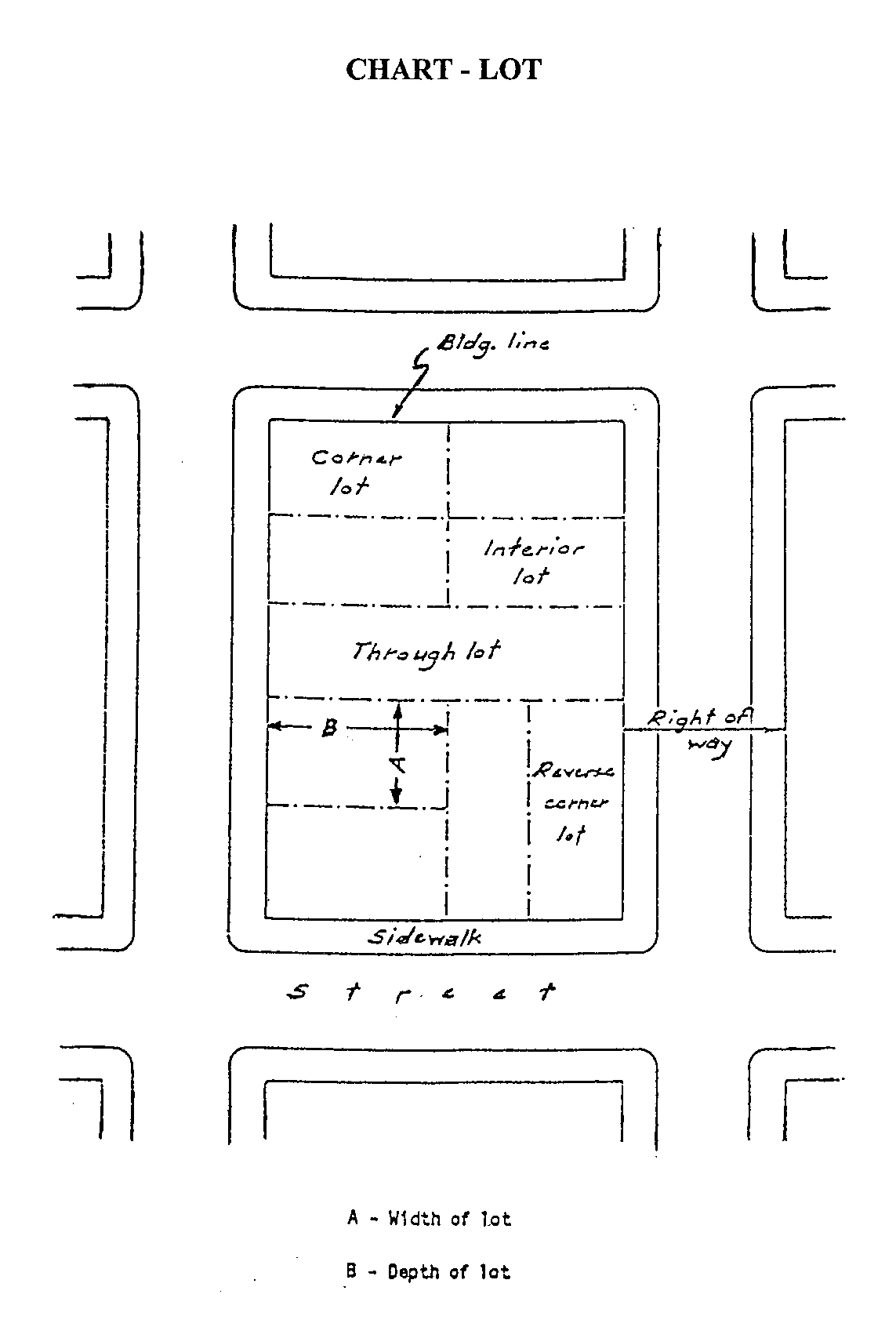
"Lot types." The chart on the following page illustrates terminology used in this chapter with reference to "corner" lots, "interior" lots, "through" lots, and "reversed corner" lots as follows:
A.
"Corner" lot—A lot located at the intersection of two or more streets.
B.
"Interior" lot—A lot other than a corner lot with only one frontage on a street other than an alley.
C.
"Through" lot—A lot other than a corner lot with frontage on more than one street other than an alley. Lots with frontage on two non-intersecting streets may be referred to as "through" lots. On through lots the required front yard shall be provided on both streets.
D.
"Reversed corner" lot—A corner lot, the side street line of which is substantially a continuation of the front lot line of the first lot to its rear.
48.
"Manufactured home" means a manufactured home which shall be located and installed according to the same standards, including, but not limited to, a foundation system, setback, and minimum square footage which would apply to a site-built, single-family dwelling on the same lot. A manufactured home is a factory-built structure, which is manufactured or constructed under the authority of 42 U.S.C. Section 5403 and is to be used as a place for human habitation, but which is not constructed or equipped with a permanent hitch or other device allowing it to be moved other than for the purpose of moving to a permanent site and which does not have permanently attached to its body or frame any wheels or axles. A mobile home as defined in Section 435.1 of the Code of Iowa is not a manufactured home, unless it has been converted to real property as provided in Section 435.26 of the Code of Iowa, and shall be taxed as a site-built dwelling. This section shall not be construed as abrogating a recorded restrictive covenant.
49.
"Mobile home" means any structure used for living, sleeping, business or storage purposes, having no foundation other than wheels, blocks, skids, jacks, horses, or skirtings, and which is, has been, or reasonably may be, equipped with wheels or other devices for transporting the structure from place to place, whether by motive power or other means. The term "mobile home" shall include camp car and house car.
50.
"Motel" (also "motor hotel," "motor court," "motor lodge," or "tourist court") means a building or group of buildings designed to provide sleeping accommodations to transient guests for compensation, and provides near each guest room a parking space for the guest's vehicle. A swimming pool, restaurant, meeting rooms, management offices and other such accessory facilities may be included.
51.
"Nonconformities" means lots, structures, uses of land and structures, or characteristics of uses, which are prohibited under the terms of the zoning ordinance but were lawful at the date of enactment of the ordinance.
52.
"Nursery school" means a private establishment enrolling children where tuition, fees, or other forms of compensation for the care of the children is charged, and which is licensed or approved to operate as a child care center and which requires more than one attendant.
53.
"Parking space" means an area of not less than one hundred eighty square feet either within a structure or in the open, exclusive of driveway or access drives, for the parking of a motor vehicle.
54.
"Permitted use" means a use by right which is specifically authorized in a particular zoning district.
55.
"Planning and Zoning Commission" means a commission referred to as the commission or planning and zoning commission appointed by the council to recommend the boundaries of the various districts and appropriate regulations and restrictions to be enforced through this chapter and as granted powers under Chapter 414 of the Code of Iowa.
56.
"Principal use" means the main use of land or structures as distinguished from an accessory use.
57.
"Projections (into yards)" means parts of buildings such as architectural features that extend beyond the building's exterior wall.
58.
"Public space" means an open or unoccupied public place which is permanently reserved for the purpose of access to abutting property.
59.
"Quorum" means a majority of the full authorized membership.
60.
"Recreational vehicle" means a vehicular type portable structure without permanent foundation, which can be towed, hauled or driven and primarily designed as temporary living accommodation for recreational, camping, and travel use and including, but not limited to, travel trailers, truck campers, camping trailers, and self-propelled motor homes. This definition shall also include boats and appurtenant trailers.
61.
"Remodel" means to construct an addition or alter the design or layout of a building or make substantial repairs or alterations.
62.
"Restaurant" means a use engaged in the preparation and retail sale of food and beverages, including sale of alcoholic beverages when conducted as an accessory or secondary feature and producing less than fifty percent of the gross income. A general restaurant may include live entertainment. Typical uses include restaurants, coffee shops, dinner houses, and similar establishments with incidental alcoholic beverages service.
63.
"Retail sales" means sale or rental of commonly used goods and merchandise for personal or household use, but excludes those classified more specifically in this section inclusive. Typical uses include department stores, apparel stores, furniture stores, or establishments providing the following products or services: household cleaning and maintenance products; drugs, cards, and stationery, notions, books, tobacco products, cosmetics, and specialty items; flowers, plants, hobby materials, toys, and hand-crafted items; apparel, jewelry, fabrics, and like items; cameras, photography services, household electronic equipment, records, sporting equipment, kitchen utensils, home furnishing and appliances, art supplies and framing, arts and antiques, paint and wallpaper, carpeting and floor covering, interior decorating services, office supplies; bicycles; and automotive parts and accessories (excluding service and installation).
64.
"Service station (gas station)" means a building or premises used for dispensing or offering for sale at retail any automobile fuels, oils, or having pumps and storage tanks therefor, or where battery, tire or any similar services are rendered, and where vehicles are not parked for purposes of inspection or sale.
65.
"Setback" means the required distance between every structure and lot line on the lot in which it is located.
66.
"Signs" means any object, device, display, or structure, or part thereof, situated outdoors or indoors, which is used to advertise, identify, display, direct, or attract attention to an object, person, institution, organization, business, product, service, event, or location by any means, including words, letters, figures, design, symbols, fixtures, colors, illumination, or projected images.
67.
"Signs, on-premises" means an advertising device concerning the sale or lease of the property upon which they are located and advertising devices concerning activities conducted or products sold on the property upon which they are located.
68.
"Signs, off-premises" means an advertising device including the supporting structure which directs the attention of the general public to a business, service, or activity not usually conducted or a product not usually sold upon the premises where such a sign is located. Such a sign shall not include: On-premises signs, directional or other official sign or signs which have a significant portion of their face devoted to giving public service information (date, time, temperature, weather, information, etc.)
69.
"Signs, portable" means any sign that is not permanently affixed to a building, structure, or the ground.
70.
"Signs, real estate" means a sign pertaining to the sale or lease of the premises, or a portion of the premises, on which the sign is located.
71.
"Special exception" means a use permitted in a particular zoning district upon showing that such use in a specified location will comply with all the conditions and standards for the location or operation of the use as specified in the zoning ordinance and authorized by the board of adjustment. The special exception is granted to the property owner, not the property.
72.
"Statement of intent" means a statement preceding regulations for individual districts, intended to characterize the districts and their legislative purpose.
73.
"Story" means that portion of a building included between the surface of any floor and the surface of the floor next above it, or if there is no floor above it, then the space between the floor and the ceiling or roof next above it.
74.
"Story, half" means a space under a sloping roof which has the line of intersection of roof decking and wall face not more than four feet above the top floor level. A half-story containing independent apartments or living quarters shall be counted as a full story.
75.
"Street" means all property dedicated or intended for public or private use for access to abutting lands or subject to public easements therefor, and whether designated as a street, highway, thoroughfare, parkway, throughway, expressway, road, avenue, boulevard, lane, place, circle, or however otherwise designated.
76.
"Street line" means the right-of-way line of a street.
77.
"Structural alteration" means any change in the supporting members of a building, such as bearing walls or partitions, columns, beams or girders, or any complete rebuilding of the roof or the exterior walls.
78.
"Structure" means anything constructed or erected which requires location on the ground or attached to something having location on the ground, including signs and billboards, but not including fences or walls used as fences.
79.
"Temporary portable storage containers" means a container, including, but not limited to, truck trailers, shipping containers, storage moving units or "pods," shed-like structures, or any other similar storage unit or receptacle that is capable of being moved, whether with or without wheels, and whether with or without a chassis, and which can be used for the storage of property of any kind.
80.
"Terrace" means a level, landscaped, and/or surfaced area, also referred to as a deck or patio, directly adjacent to a principal building at or within three feet of the finished grade and not covered by a permanent roof.
81.
"Townhouse" means a dwelling unit having a common wall with or abutting one or more adjoining dwelling units.
82.
"Townhouse lot" means that portion of the total development site of a townhouse residential use intended for separate ownership as the location of a single townhouse and associated private yard area.
83.
"Townhouse residential" means the use of a site for four or more townhouse dwelling units, constructed with common or adjacent walls and each located on a separate ground parcel within the total development site, together with common area serving all dwelling units.
84.
"Use" means the purpose or activity for which a piece of land or its buildings is designed, arranged, or intended, or for which it is occupied or maintained.
85.
"Variance" means a device used by the board of adjustment which grants a property owner relief from certain provisions of a zoning ordinance when the result would be an opportunity for improved zoning and planning which would benefit the community.
86.
"Vehicle repair shop" means a business for the repair of automobiles, non-commercial trucks, motorcycles, motor homes, recreational vehicles, or boats including the sale, installation, and servicing of equipment and parts. Typical uses include new and used car dealerships, motorcycle dealerships, and boat, trailer, and recreational vehicle dealerships.
87.
"Warehousing" means establishments or places of business primarily engaged in wholesaling, storage, distribution and handling of materials and equipment other than live animals and plants.
88.
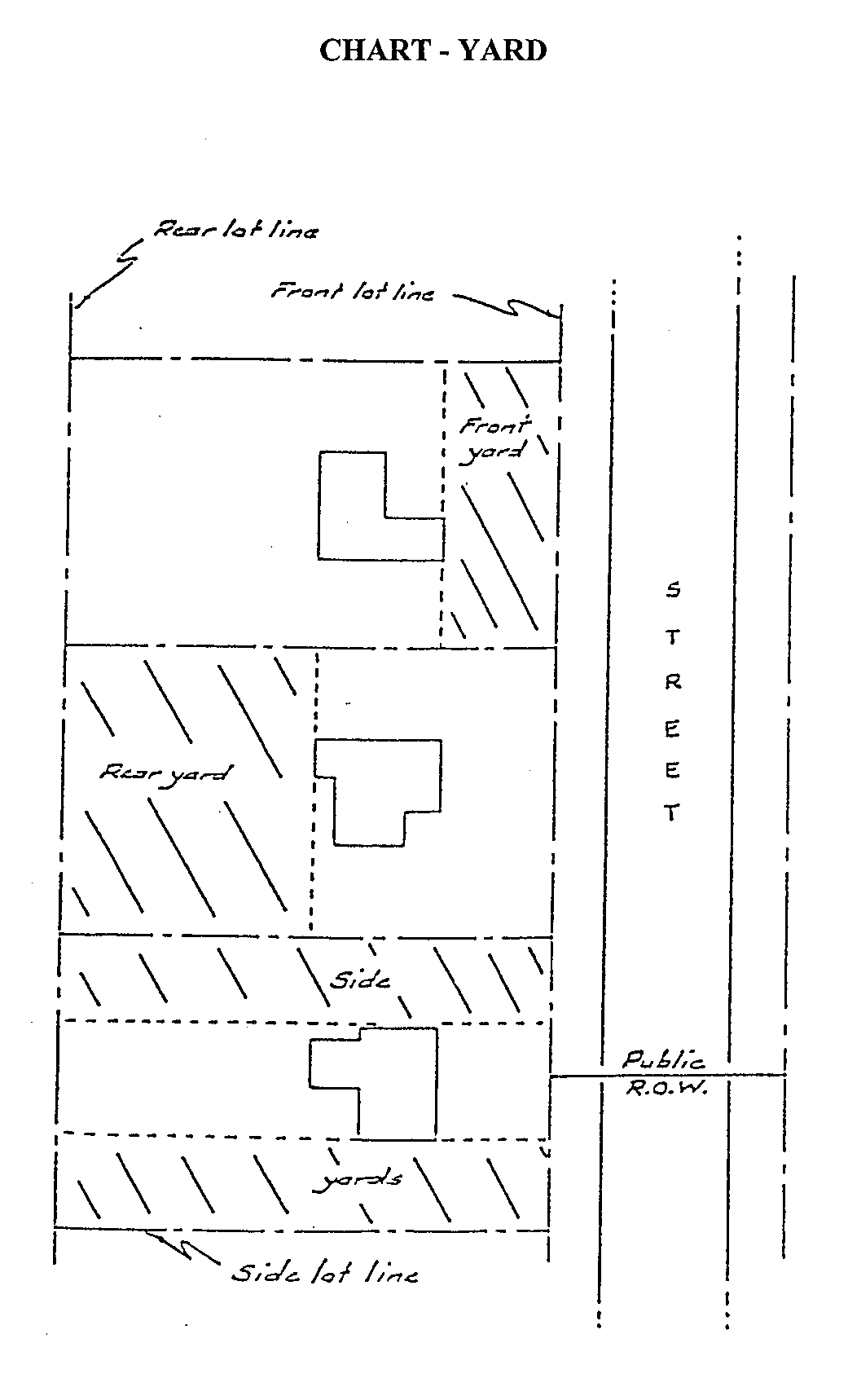
"Yard" means an open space on the same lot with a building, unoccupied and unobstructed by any portion of a structure from the ground upward, excepting as otherwise provided herein. In measuring a yard for the purpose of determining the depth of a front yard or the depth of a rear yard, the least distance between the lot line and the main building shall be used. Fences and walls are permitted in any yard, subject to height limitations as indicated herein. (See chart on following page.)
89.
"Yard, front" means a yard extending across the width of the lot and measured between the front lot line and the building or any projection thereof, other than the projection of the usual steps or unenclosed porches. Corner lots shall have two front yards and two side yards. (See chart on following page.)
90.
"Yard, rear" means a yard extending across the width of the lot and measured between the rear lot line and the building or any projections other than steps, unenclosed balconies or unenclosed porches. On interior lots the rear yard shall be the opposite end of the lot from the front yard. (See chart on following page.)
91.
"Yard, side" means a yard extending from the front yard to the rear yard and measured between the side lot lines and the building. (See chart on following page.)
92.
"Zoning administrator" means the local official responsible for reviewing certificates of zoning compliance and following a determination by the board of adjustment for special exceptions and variances. Decisions of the official may be appealed to the board of adjustment. Certificates of zoning compliance are issued by the zoning administrator.
93.
"Zoning district" means a section the city designated in the text of the zoning ordinance and delineated on the zoning map in which requirements for the use of land, the building and development standards are prescribed. Within each district, all requirements are uniform.
94.
"Zoning map" means the map delineating the boundaries of districts which, along with the zoning text, comprises the zoning ordinance.
(Ord. No. 1054, § 1, 7-6-2020; Ord. No. 1039, § 1, 11-5-2018; Ord. No. 1093, §§ 8—19, 1-15-2024)
Within the districts established by this chapter there exist:
1.
Lots;
2.
Structures;
3.
Uses of land and structures; and
4.
Characteristics of use;
which were lawful before this chapter was passed or amended, but which are prohibited, regulated, or restricted under the terms of this chapter or future amendment. It is the intent of this chapter to permit these nonconformities to continue until they are removed, but not to encourage their survival. Further nonconformities shall not be enlarged upon, expanded or extended, nor be used as grounds for adding other structures or uses prohibited elsewhere in the same district; however, it is the intent of this chapter to allow structures which were nonconforming under the previous ordinance, but which are conforming under this chapter to be considered legal as of the date of adoption of the ordinance from which this chapter is derived and shall be allowed to be rebuilt, added to, or modified within the terms and requirements of this chapter.
To avoid undue hardship, nothing in this chapter shall be deemed to require a change in the plans, construction or designated use of any building on which actual construction was lawfully begun prior to the effective date of adoption or amendment of the ordinance from which this chapter is derived and upon which actual building construction has been carried on diligently. Actual construction is hereby defined to include the placing of construction materials in permanent position and fastened in a permanent manner. Where excavation or demolition or removal of an existing building has been substantially begun preparatory to rebuilding, such excavation or demolition or removal shall be deemed to be actual construction, provided that work shall be carried on diligently.
In any district in which single-family dwellings are permitted, a single-family dwelling and customary accessory buildings may be erected on any single lot of record at the effective date of adoption or amendment of the ordinance from which this chapter is derived, notwithstanding limitations imposed by other provisions of the ordinance. This provision shall apply even though such lot fails to meet the requirements for area or width, or both, if the lot shall conform to the regulations for the district in which such lot is located.
(Ord. No. 1093, § 2, 1-15-2024)
Where at the time of passage of the ordinance from which this chapter is derived lawful use of land exists which would not be permitted by the regulations imposed by this chapter, and where such use involves no individual structure with a replacement cost exceeding one thousand dollars, the use may be continued so long as it remains otherwise lawful, provided:
1.
No such nonconforming use shall be enlarged or increased, nor extended to occupy a greater area of land than was occupied at the effective date of adoption or amendment of the ordinance from which this chapter is derived.
2.
No such nonconforming use shall be moved in whole or in part to any other portion of the lot or parcel occupied by such use at the effective date of adoption or amendment of the ordinance from which this chapter is derived.
3.
If any such nonconforming use of land ceases for any reason for a period of six months, then any subsequent use of such land shall conform to the regulations specified by this chapter for the district in which such land is located.
4.
No additional structure not conforming to the requirements of this chapter shall be erected in connection with such nonconforming use of land.
Where a lawful structure exists at the effective date of adoption or amendment of the ordinance from which this chapter is derived that could not be built under the terms of this chapter by reason of restrictions on area, lot coverage, height, yards, its location on the lot, or other requirements concerning the structure, such structure may be continued so long as it remains otherwise lawful, subject to the following provisions:
1.
No such nonconforming structure may be enlarged or altered in such a way which increases its nonconformity, but any structure or portion thereof may be altered to decrease its nonconformity.
2.
Should such nonconforming structure or nonconforming portion of structure be destroyed by any means to an extent of more than sixty percent of its market value at time of destruction, it shall not be reconstructed unless granted a special exception by the board of adjustment, and then such reconstruction shall only be allowed on the same perimeter location.
3.
Should such structure be moved for any reason for any distance whatever, it shall thereafter conform to the regulations for the district in which it is located after it is moved.
If lawful use involving individual structures with a replacement cost of one thousand dollars or more, or of structure and premises in combination, exists at the effective date of adoption or amendment of the ordinance from which this chapter is derived, that would not be allowed in the district under the terms of this chapter, the lawful use may be continued so long as it remains otherwise lawful, subject to the following provisions.
1.
No existing structure devoted to a use not permitted by this chapter in the district in which it is located shall be enlarged, extended, constructed, reconstructed, or structurally altered except in changing the use of the structure to a use permitted in the district in which it is located.
2.
Any nonconforming use may be extended throughout any parts of a building which were manifestly arranged or designed for such use at the time of adoption or amendment of the ordinance form which this chapter is derived, but no such use shall be extended to occupy any land outside such building.
3.
If no structural alterations are made, any nonconforming use of a structure, or structure and premises, may be changed to another nonconforming use provided that the proposed use is equally appropriate or more appropriate to the district than the existing nonconforming use.
4.
Any structure, or structure and land in combination, in or on which a nonconforming use is superseded by a permitted use, shall thereafter conform to the regulations for the district, and the nonconforming use may not thereafter be resumed.
5.
When a nonconforming use of a structure, or structure and premises in combination, is discontinued or abandoned for twelve consecutive months or for eighteen months during any three year period (except when government action impedes access to the premises) the structure, or structure and premises in combination, shall not thereafter be used except in conformity with the regulations of the district in which it is located.
6.
When nonconforming use status applies to a structure and premises in combination, removal or destruction of the structure shall eliminate the nonconforming status of the land. Destruction for the purpose of this subsection is defined as damage to an extent of more than sixty percent of the market value at time of destruction.
On any building devoted in whole or in part to any nonconforming use, work may be done on ordinary repairs, provided that the cubic content of the building as it existed at the time of passage or amendment of the ordinance from which this chapter is derived shall not be increased.
Any use which is permitted as a special exception in a district under the terms of this chapter (other than a change through board of adjustment action from a nonconforming use to another use not generally permitted in the district) shall not be deemed a nonconforming use in such district, but shall without further action be considered a conforming use.
The city is herewith divided into the following districts:
AG—Agricultural District
CN—Conservation District
RS—Residential Single-Family District (RS-60), (RS-80), (RS-100)
RM—Residential Multi-Family District (RM-1), (RM-2), (RM-3), (RM-4)
MH—Mobile Home District
BN—Neighborhood Business District
HSB—Highway Service Business District
BGC—Central General Business District
LM—Light Manufacturing District
HM—Heavy Manufacturing District
These districts are established as identified on the official zoning map which, together with all explanatory matters thereon, is adopted by separate ordinance.
Note— Ord. No. 869, §§ 1—4, adopted Sept. 7, 1999, adopted the official zoning map and established districts as shown on the official zoning map of the city.
1.
Intent. This district is intended to provide for areas in which agriculture and related uses are encouraged as the principal use of land. However, uses which may be offensive to the surrounding area or to the community as a whole by reasons of noise, dust, smoke, odor, traffic or physical appearance or other similar factors are not permitted. The district prohibits urban density residential use until these areas may be served by utilities and services of the city. This district is also intended to preserve land suited for eventual development into other uses, pending proper timing for economical and practical provisions of streets, utilities, schools and other facilities so that reasonably compact development will occur and the fiscal integrity of the city is preserved. All newly annexed areas to the city will automatically be placed into this district classification unless otherwise suitably classified.
2.
Permitted Uses. The following uses are permitted in the AG district:
A.
Agriculture, including farm dwellings and other usual agricultural buildings and structures.
B.
Home occupations.
C.
Agricultural services.
3.
Excluded Uses. The following uses are prohibited within the AG district:
A.
Animal feeding operations.
4.
Accessory Uses. Uses of land or structure customarily incidental and subordinate to a permitted use in the AG district.
A.
Living quarters of persons employed on the premises and not rented or otherwise used as a separate dwelling.
B.
Private garages, barns and other farm buildings.
C.
Roadside stands not exceeding four hundred square feet of floor area offering for sale only agricultural products or other products produced on the premises.
D.
Temporary buildings for the uses incidental to construction work. Such buildings shall be removed upon the completion or abandonment of the construction work.
E.
Any telecommunication receiving structure so designed to prevent direct attachment, mounting, or installation to the principal building or structure in any residential district shall be considered an accessory structure or use. Such telecommunication receiver shall be installed within the rear yard, on a concrete pad and permanently affixed mounting structure. No mobile or portable structures will be allowed.
F.
Solar collectors.
G.
Radio and television receiving antennas.
5.
Special Exceptions. Certain uses may be permitted in the AG district subject to specific conditions and requirements intended to make them compatible with and acceptable to adjacent uses.
A.
Cemeteries, crematories or mausoleums.
B.
Commercial kennels.
C.
Greenhouses and nurseries.
D.
Publicly operated sanitary landfills.
E.
Private recreational camps, golf courses and recreational facilities.
F.
Public or private utility substations, relay stations, etc.
G.
Churches or accessory facilities.
H.
Publicly owned and operated buildings and facilities.
I.
Railroad tracks but no other facility.
J.
Parking lots.
6.
Performance Standards. The following performance standards shall apply to the uses indicated. They shall be supplemental to and in addition to other provisions applying to the property.
A.
Feed lots or corrals in which animals are kept at a density of over ten head per acre or where feed bunkers or water are placed so that animals naturally tend to bunch up, shall not be closer than three hundred feet from any lot line adjoining properties which are used for residential, commercial or light manufacturing purposes.
B.
Such feed lots or corrals shall maintain drainage so as to avoid excessive concentration of contaminated water and such drainage shall be so arranged that contaminated water does not drain into water courses in such a manner that it reaches neighboring properties at a concentration noticeable to normal senses.
C.
Manure in such feed lots or corrals shall not be allowed to accumulate to objectionable proportions and each feeding pen shall be scraped at least once a month, weather permitting.
D.
All dead animals shall be removed within twenty-four hours.
7.
Bulk Regulations. The following requirements shall provide for light and air around permitted uses and buildings in the AG district:
8.
Off-Street Parking. The following off-street parking requirements shall apply in the AG district:
A.
Dwellings: Two parking spaces on the lot for each living unit in the building.
B.
Churches: One parking space on the lot for each five seats in the main auditorium.
C.
Public buildings and facilities: One parking space for each three hundred square feet of gross floor area or one parking space for each five seats in the main assembly area.
D.
Roadside stands: One parking space for each fifty square feet of enclosed floor area.
E.
Greenhouses and nurseries: One parking space per one thousand square feet of enclosed floor area.
9.
Off-Street Loading. The following off-street loading requirements shall apply in the AG district:
A.
All activities or uses allowed in the AG district shall be provided with adequate receiving facilities accessible by motor vehicle off any adjacent service drive or open space on the same zoning lot.
B.
Loading shall not be permitted to block public right-of-way unless otherwise provided for in this code.
10.
Signs. The following sign regulations shall apply to the AG district:
A.
Off-premises signs, except political signs, are not permitted.
B.
On-premises signs are permitted. Real estate lease or sales signs, relating to the property on which the sign is located, are permitted but shall not exceed six square feet in area.
C.
Political signs on private property are permitted but shall not exceed thirty-two square feet in size.
D.
All construction-type signs are permitted.
E.
Signs for residential use identifying the premises and occupant, but not including advertising matter, are permitted but shall not exceed six square feet in area. Public, parochial, private schools and colleges, children's homes, and public and quasipublic buildings for cultural use, may have identification signs not to exceed thirty-two square feet in area. Churches, synagogues, and chapels shall be allowed one sign not exceeding twenty-four square feet in size.
F.
Non-electrical, temporary signs shall be allowed, however, they may be used no more than thirty consecutive days or sixty days per year.
1.
Intent. This district is intended to prevent, in those areas which are subject to periodic or potential flooding, such development as would result in a hazard to health or safety or be otherwise incompatible with the public welfare. This district is also intended to provide for water conservation, erosion control, protection of wildlife habitat, protect natural erosion control, protect natural drainage ways and to generally provide for ecologically sound land use of environmentally sensitive areas.
2.
Permitted Uses. The following uses are permitted in the CN district:
A.
Undeveloped and unused land in its natural condition.
B.
Public parks and recreation open space.
3.
Accessory Uses. Uses of land or structure customarily incidental and subordinate to a permitted use in the CN district.
A.
Agriculture, exclusive of dwelling units.
B.
Agricultural or recreational buildings or structures whose use or value would not be impaired by being flooded.
C.
Flood control structures.
D.
Roadside stands offering for sale only agricultural products or other products produced on the premises.
E.
Temporary buildings for the uses incidental to construction work which buildings shall be removed upon the completion or abandonment or the construction work.
4.
Special Exceptions. Certain uses may be permitted in the CN district subject to specific conditions and requirements intended to make them compatible with and acceptable to adjacent uses.
A.
Cemeteries, crematories or mausoleums.
B.
Stables, private or public.
C.
Greenhouses and nurseries.
D.
Private recreational uses.
E.
Public or private utility substations, relay stations, etc.
F.
Publicly owned buildings and facilities.
G.
Railroad tracks but no other facility.
H.
Parking lots.
5.
Performance Standards.
A.
Floodway and Floodway Fringe Districts. All areas within the flood plain are subject to the city's floodway and floodway fringe district regulations as adopted and which are included as an appendix to this chapter.
6.
Bulk Regulations. The following requirements shall provide for light and air around permitted uses and buildings in the CN district:
7.
Off-Street Parking. The following off-street parking requirements shall apply in the CN district:
A.
Roadside stands: One parking space for each fifty square feet of floor area.
B.
Greenhouses and nurseries: One parking space per one thousand square feet of enclosed floor area.
8.
Off-Street Loading. The following off-street loading requirements shall apply in the CN district:
A.
All activities or uses allowed in the CN district shall be provided with adequate receiving facilities accessible by motor vehicle off any adjacent service drive or open space on the same zoning lot.
B.
Loading shall not be permitted to block public right-of-way unless otherwise provided for in this code.
9.
Signs. The following sign regulations shall apply to the CN district:
A.
Off-premises signs, except political signs, are not permitted.
B.
On-premises signs are permitted. Real estate lease or sales signs, relating to the property on which the sign is located, are permitted but shall not exceed six square feet in area.
C.
Political signs on private property are permitted but shall not exceed thirty-two square feet in size.
D.
All construction-type signs are permitted.
E.
Signs for residential use identifying the premises and occupant, but not including advertising matter, are permitted but shall not exceed six square feet in area. Public, parochial, private schools and colleges, children's homes, and public and quasipublic buildings for cultural use, may have identification signs not to exceed thirty-two square feet in area. Churches, synagogues, and chapels shall be allowed one sign not exceeding twenty-four square feet in size.
F.
Non-electrical, temporary signs shall be allowed, however, they may be used no more than thirty consecutive days or sixty days per year.
1.
Intent. This district is intended to provide for a variety of single-family residential areas where public utilities and services are available and to encourage a suitable living environment through the promotion of public health, safety and welfare. Low and medium population density neighborhoods are recognized and provided for by varying the minimum bulk regulations. Criteria such as topography, soil types, access, traffic load on streets, schools, utilities, recreation and other public facilities shall be taken into consideration when the lot area requirement is established for the various single-family residential areas of the city.
2.
Permitted Uses. The following uses are permitted in the RS district:
A.
Single-family detached dwellings.
B.
Family homes.
C.
Home occupations.
D.
Horticultural or crop production.
E.
Duplexes are allowed only in the RS-60 classification.
F.
Three dwelling units in RS-60 that are able to meet the following requirements:
1.
Meets the minimum parking requirements.
2.
Meets the minimum habitable spaces as required by this code.
3.
Accessory Uses. Uses of land or structure customarily incidental and subordinate to a permitted use in the RS district:
A.
Private garages.
B.
Private recreational facilities.
C.
Temporary buildings for uses incidental to construction work. Such buildings shall be removed upon the completion or abandonment of the construction work.
D.
Any telecommunication receiving structure so designed to prevent direct attachment, mounting, or installation to the principal building or structure in any residential district shall be considered an accessory structure or use. Such telecommunication receiver shall be installed within the rear yard, on a concrete pad and permanently affixed mounting structure. No mobile or portable structures will be allowed.
E.
Solar collectors.
F.
Radio and television receiving antennas.
4.
Conditional Use Permits. Certain uses may be permitted in the RS district subject to the following conditions and requirements intended to make them compatible with and acceptable to adjacent uses.
A.
Accessory Dwelling Units (ADU)—A dwelling unit, but not a mobile home.
1.
An ADU may be erected as attached to the principal structure or as a detached structure.
2.
A detached ADU shall be located in a rear yard and shall meet a minimum ten-foot setback on all sides and must be no higher than the principal dwelling (ground to peak of roof height).
3.
a.
No accessory dwelling may be erected in any required front yard or side yard and must be located behind the principal building.
b.
No accessory dwelling shall be located in front of the mid-point of the lot and in all cases no accessory dwelling shall be located within ten feet of a lot line.
c.
Accessory dwellings located in the rear yard may not occupy more than fifty percent of the rear yard.
d.
If a garage is entered directly from an alley in a perpendicular or nearly perpendicular manner, the garage setback shall be fifteen feet.
e.
Satellite dishes are subject to the accessory building rules.
f.
Accessory dwellings shall not exceed the lessor of the principal dwelling footprint excluding the garages, carports, and space used for mechanical equipment, such as heating, utilities and water heater or pumps (livable footage of home); or one thousand two hundred square feet including an attached garage.
4.
No more than two bedrooms are allowed in the ADU. Bedroom shall mean any room or space used or intended to be used for sleeping purposes.
5.
The owner of the lot is required to live on the property in either the principal dwelling or the ADU. The owner of the lot shall file with the Kossuth County Recorder, a deed restriction agreement on the property stating the accessory dwelling cannot be sold separately form the principal dwelling. The deed restriction agreement must be to the satisfaction of the city attorney. The deed restriction agreement shall be filed prior to any conditional use permit for the ADU.
6.
The ADU shall have the same access point to the public or private street as the principal dwelling. Separate alley access will be allowed pursuant to this code.
7.
The ADU shall have connections to all public utilities. ADUs may be permitted to connect to the utility service lines of the principal dwelling.
8.
The ADU shall be provided with one designated parking space for that required by residential dwellings.
9.
Home occupations shall not be conducted in ADUs by the occupant of the principal dwelling.
10.
The ADU shall be residential in character with similar architectural features as the principal building.
11.
One ADU per residential lot shall be allowed under this conditional use permit.
5.
Special Exceptions. Certain uses may be permitted in the RS district subject to specific conditions and requirements intended to make them compatible with and acceptable to adjacent uses.
A.
Nursery schools.
B.
Public or private utility substations, relay stations, etc.
C.
Churches.
D.
Publicly owned and operated buildings and facilities.
E.
Private schools that are accredited by the State of Iowa with a curriculum similar to public schools.
F.
Golf courses but not miniature courses or separate driving tees.
G.
Railroad tracks but no other facility.
H.
Parking lots serving commercial or industrial districts.
I.
Landscape shed which is a portable structure one hundred twenty square feet or less which has no utilities connected.
6.
Performance Standards. The following performance standards shall apply to the RS district:
A.
Recreational Vehicles. Recreational vehicles and all boats and appurtenant trailers shall not be parked or stored within the front yard of a lot in this district. No more than one such recreational vehicle may be parked or stored within the side yard or rear yard of a residential lot or within an enclosed garage. Recreational vehicles shall not be used for human occupancy in this district for more than seventy-two hours within any thirty-day period. Recreational vehicles or trailers of any kind or type without current license plates shall not be parked or stored on any lot other than in completely enclosed buildings.
B.
Special Sales Uses. Special sales, including garage sales, porch sales, basement sales, moving sales, estate sales, or similar activities, shall be operated not more than three days in the same month or more than six days in the same year.
7.
Bulk Regulations. The following requirements shall provide for light and air around permitted residential uses and buildings in the RS district:
8.
Limited Setback Waiver. The purpose of the limited setback waiver for one- and two-family residential structures that meet the following criteria established by the city council is to encourage reinvestment and infill development, and to maintain property values in the city's residential neighborhoods. The building official shall issue a waiver only for such setback adjustments that meet the following criteria. No public hearing or board of adjustment review shall be required if the following criteria can be met. If these criteria are not met, then the applicant has the opportunity to apply for a variance from the board of adjustment, in which case the criteria for the variance would apply.
A.
Conforming Lots. The zoning administrator may permit a variation in front yard setbacks to allow new or relocated structures to conform to the average existing setback for the development of infill sites provided that:
1.
More than forty percent of the frontage on one side of a street between intersecting streets is occupied by structures on the effective date of the ordinance from which this section is derived; and
2.
A minority of such structures have observed or conformed to an average setback line.
B.
Nonconforming Lots of Record. If in any district in which single-family dwellings are permitted, where a lot has less area or width than required by the district and was a lot of record at the effective date of adoption or amendment of the ordinance from which this section is derived, a single-family dwelling and customary accessory buildings may be constructed on the lot, provided all other requirements of Chapter 17.04 are met.
Adjustment for Front Yard Setbacks:
1.
Infill Site. Where dwellings exist on both abutting lots and both have setbacks less than required by the underlying zoning district, the setback for the infill site need not exceed the average of the setbacks of the two abutting dwellings. Where dwellings exist on both abutting lots, and only one has a setback less than required by the underlying zoning district, the setback for the infill site need not exceed the average of the required setback and the smaller setback.
2.
Corner Lots. Where a dwelling exists on an abutting lot and has a setback less than required by the underlying zoning district, the setback for the corner lot need not exceed the setback of the abutting lot on the same street frontage, provided the required visibility is maintained.
3.
Building Extending Beyond Front Property Line. In no event shall any structure extend beyond the front property line of a lot.
9.
Off-Street Parking. The following off-street parking requirements shall apply in the RS district:
A.
Dwellings: Two parking spaces on the lot for each living unit in the building. For dwellings not consisting of living units: Two parking spaces on the lot for each one thousand square feet of floor area.
B.
Churches: One parking space on the lot for each five seats in the main auditorium.
C.
Public buildings and facilities: One parking space for each three hundred square feet of gross floor area or one parking space for each five seats in the main assembly area.
D.
Elementary, junior high and equivalent private or parochial schools: One parking space for each classroom and office plus one parking space for each three hundred square feet of gross floor area in the auditorium or gymnasium.
E.
Senior high schools and equivalent private or parochial schools: One parking space for each employee and one parking space for each ten students.
F.
Colleges, universities, institutions of higher learning, and equivalent private or parochial schools: One parking space for each employee and one parking space for each five students.
G.
Public buildings and facilities: One parking space for each three hundred square feet of gross floor area.
H.
Nursery schools: One parking space per employee.
10.
Off-Street Loading. The following off-street loading requirements shall apply in the RS district:
A.
All activities or uses allowed in the RS district shall be provided with adequate receiving facilities accessible by motor vehicle off any adjacent service drive or open space on the same zoning lot.
B.
Loading shall not be permitted to block public right-of-way unless otherwise provided for in this code.
11.
Signs. The following sign regulations shall apply to the RS district:
A.
Off-premises signs, except political signs, are not permitted.
B.
On-premises signs, except real estate and home occupation signs, are not permitted. Real estate lease or sales signs, relating to the property on which the sign is located, are permitted but shall not exceed six square feet in area.
C.
Political signs on private property are permitted but shall not exceed thirty-two square feet in size.
D.
All construction-type signs are permitted.
E.
Signs for residential use identifying the premises and occupant, but not including advertising matter, are permitted but shall not exceed six square feet in area. Public, parochial, private schools and colleges, children's homes, and public and quasipublic buildings for cultural use, may have identification signs not to exceed thirty-two square feet in area. Churches, synagogues, and chapels shall be allowed one sign not exceeding twenty-four square feet in size.
F.
One subdivision identification sign not exceeding twenty-four square feet in size shall be allowed.
G.
Subdivision signs, in subdivisions recorded after passage of this ordinance from which this chapter is derived, which are non-illuminated and which contain information pertaining only to the subdivision, are permitted for a period of four years following the filing date or until seventy-five percent of the lots have been sold, whichever occurs first, at which time the sign shall be removed. Subdivision signs shall be subject to the space limits of the zone in which located. Signs shall not be closer than seventy-five feet to adjoining property not owned by the developer. The size of the sign shall be not greater than the following:
(Ord. No. 1054, § 2, 7-6-2020; Ord. No. 1082, § 1, 6-20-2022; Ord. No. 1093, §§ 3—7, 1-15-2024)
1.
Intent. This district is intended to provide for a variety of multi-family residential areas where public utilities and services are available and to encourage a suitable living environment through the promotion of public health, safety and welfare. Medium and high population density neighborhoods are recognized and provided for by varying the minimum bulk regulations. Criteria such as topography, soil types, access, traffic load on streets, schools, utilities, recreation and other public facilities shall be taken into consideration when the lot area requirement is established for the various multi-family residential areas of the city.
2.
Permitted Uses. The following uses are permitted in the RM district:
A.
Single-family detached dwellings.
B.
Multi-family dwellings (as per bulk regulations).
C.
Home occupations.
D.
Family homes.
3.
Accessory Uses. Uses of land or structure customarily incidental and subordinate to a permitted use in the RM district:
A.
Private garages.
B.
Parking lots.
C.
Private recreational facilities.
D.
Temporary buildings for uses incidental to construction work. Such buildings shall be removed upon the completion or abandonment of the construction work.
E.
Any telecommunication receiving structure so designed to prevent direct attachment, mounting, or installation to the principal building or structure in any residential district shall be considered an accessory structure or use. Such telecommunication receiver shall be installed within the rear yard, on a concrete pad and permanently affixed mounting structure. No mobile or portable structures will be allowed.
F.
Solar collectors.
G.
Radio and television receiving antennas.
4.
Special Exceptions. Certain uses may be permitted in the RM district subject to specific conditions and requirements intended to make them compatible with and acceptable to adjacent uses.
A.
Nursery schools.
B.
Public or private utility substations, relay stations, etc.
C.
Churches and publicly owned and operated buildings and facilities.
D.
Private schools that are accredited by the State of Iowa with curriculum similar to public schools.
E.
Lodging houses, dormitories, fraternities and sororities.
F.
Bed and breakfast houses.
G.
Health care facilities.
H.
Hospitals.
I.
Golf courses but not miniature courses or separate driving ranges or driving tees.
J.
Railroad tracks but no other facility.
K.
Parking lots serving commercial or industrial districts.
L.
Landscape shed which is a portable structure one hundred twenty square feet or less which has no utilities connected.
5.
Performance Standards. The following performance standards shall apply to the RM district:
A.
Recreational Vehicles. Recreational vehicles and all boats and appurtenant trailers shall not be parked or stored within the front yard of a lot in this district. No more than one such recreational vehicle may be parked or stored within the side yard or rear yard of a residential lot or within an enclosed garage. Recreational vehicles shall not be used for human occupancy in this district for more than seventy-two hours within any thirty-day period. Recreational vehicles or trailers of any kind or type without current license plates shall not be parked or stored on any lot other than in completely enclosed buildings.
B.
Special Sales Uses. Special sales, including garage sales, porch sales, basement sales, moving sales, estate sales, or similar activities, shall be operated not more than three days in the same month or more than six days in the same year.
6.
Bulk Regulations. The following requirements shall provide for light and air around permitted residential uses and buildings in the RM district:
7.
Off-Street Parking. The following off-street parking requirements shall apply in the RM district:
A.
Single-family dwellings: Two parking spaces on the lot.
B.
Multi-family dwellings: One parking space on the lot for each dwelling unit.
C.
Churches: One parking space on the lot for each five seats in the main auditorium.
D.
Elementary, junior high and equivalent private or parochial schools: One parking space for each classroom and office plus one parking space per each three hundred square feet of gross floor area in auditorium or gymnasium.
E.
Senior high schools and equivalent private or parochial schools: One parking space for each employee and one parking space for each ten students.
F.
Colleges, universities, institutions of higher learning, and equivalent private or parochial schools: One parking space for each employee and one parking space for each five students.
G.
Public buildings and facilities: One parking space for each three hundred square feet of gross floor area or one parking space for each five seats in the main assembly area.
H.
Nursery schools: One parking space per employee.
8.
Off-Street Loading. The following off-street loading requirements shall apply in the RM district:
A.
All activities or uses allowed in the RM district shall be provided with adequate receiving facilities accessible by motor vehicle off any adjacent service drive or open space on the same zoning lot.
B.
Loading shall not be permitted to block public right-of-way unless otherwise provided for in this code.
9.
Signs. The following sign regulations shall apply to the RM district:
A.
Off-premises signs, except political signs, are not permitted.
B.
On-premises signs, except real estate and home occupation signs, are not permitted. Real estate lease or sales signs, relating to the property on which the sign is located, are permitted but shall not exceed six square feet in area.
C.
Political signs on private property are permitted but shall not exceed thirty-two square feet in size.
D.
All construction-type signs are permitted.
E.
Signs for residential use identifying the premises and occupant, but not including advertising matter, are permitted but shall not exceed six square feet in area. Public, parochial, private schools and colleges, children's homes, and public and quasipublic buildings for cultural use, may have identification signs not to exceed thirty-two square feet in area. Churches, synagogues, and chapels shall be allowed one sign not exceeding twenty-four square feet in size.
F.
One subdivision identification sign not exceeding twenty-four square feet in size shall be allowed.
G.
Subdivision signs, in subdivisions recorded after passage of the ordinance from which this chapter is derived, which are non-illuminated and which contain information pertaining only to the subdivision, are permitted for a period of four years following the filing date or until seventy-five percent of the lots have been sold, whichever occurs first, at which time the sign shall be removed. Subdivision signs shall be subject to the space limits of the zone in which located. Signs shall not be closer than seventy-five feet to adjoining property not owned by the developer. The size of the sign shall be not greater than the following:
(Ord. No. 1054, § 3, 7-6-2020; Ord. No. 1082, § 2, 6-20-2022)
1.
Intent. This district is intended to provide for certain medium density residential areas in the city now developed as mobile home parks which by reason of their design and location are compatible with surrounding residential areas and areas of the city where similar development seems likely to occur. This district has useful application as a transition zone between shopping areas and residential areas and is normally located along thoroughfares where direct access to the site is available.
2.
Permitted Uses. The following uses are permitted in the MH district:
A.
Mobile homes.
B.
Home occupations.
C.
Buildings or structures under park management supervision shall be used only as office space, storage, laundry facilities, recreation facilities, garage storage or other necessary service for park residents use only. No accessory building or structure shall exceed twenty-five feet in height, nor two stories; and shall meet the requirements of other applicable codes and ordinances.
3.
Accessory Uses.
A.
Private recreational facilities.
B.
Temporary buildings for uses incidental to construction work. Such buildings shall be removed upon completion or abandonment of the construction work.
C.
Storage shed.
4.
Special Exceptions. Certain uses may be permitted in the MH district subject to specific conditions and requirements intended to make them compatible with and acceptable to adjacent uses.
A.
Public or private utility substation, relay stations, etc.
B.
Nursery schools.
C.
Churches or accessory facilities.
D.
Railroad tracks but no other facility.
E.
Recreational uses which are temporary in nature.
5.
Signs. The following sign regulations shall apply in the MH district:
A.
Off-premises signs are not permitted.
B.
On-premises signs are permitted. Political signs on private property are permitted but shall not exceed thirty-two square feet in size. Real estate lease or sales signs, relating to the property on which the sign is located, are permitted but shall not exceed six square feet in area.
C.
All construction-type signs are permitted.
D.
Signs for residential use identifying the premises and occupant, but not including advertising matter, are permitted but shall not exceed six square feet in area. Public, parochial, private schools and colleges, children's homes, and public and quasipublic buildings for cultural use, may have identification signs not to exceed thirty-two square feet in area. Churches, synagogues, and chapels shall be allowed one sign not exceeding twenty-four square feet in size.
E.
One subdivision identification sign not exceeding twenty-four square feet in size shall be allowed.
F.
Subdivision signs, in subdivisions recorded after passage of the ordinance from which this chapter is derived, which are non-illuminated and which contain information pertaining only to the subdivision, are permitted for a period of four years following the filing date or until seventy-five percent of the lots have been sold, whichever occurs first, at which time the sign shall be removed. Subdivision signs shall be subject to the space limits of the zone in which located. Signs shall not be closer than seventy-five feet to adjoining property not owned by the developer. The size of the sign shall be not greater than the following:
6.
Application Procedures. The following information shall be shown on the development plan or submitted in writing with it. All applications shall be approved, denied or amended and approved by the city council after recommendation by the planning and zoning commission.
A.
The name of the proposed mobile home park.
B.
Names, addresses and telephone numbers of the developer or his representative.
C.
Location of the mobile home park, giving the subdivision and lot numbers.
D.
A map of the entire area scheduled for development, if the proposed development is a portion of a larger holding intended for subsequent development.
E.
Allocation map showing the relationship of the proposed development and the adjacent tracts.
F.
The present land use and existing zoning of the proposed development and the adjacent tracts. Interior streets, street, street names, right-of-way and roadway widths.
G.
All lot lines and open spaces with dimensions shown.
H.
Topographic contours shall be shown on the plan at five-foot intervals where slope is greater than ten percent and two-foot intervals where slope is ten percent or less.
I.
Delineation of all improvements required in this section.
7.
Staging of Development.
A.
Any MH district plan proposed to be constructed in stages shall include full details relating thereto and the city council may approve or modify any proposals when necessary.
B.
The staging shall include the time for beginning and completion of each stage.
C.
The landowner or developer shall make such easements, covenants, or other arrangements and shall furnish such performance bond for other security as may be determined by the city council to be reasonably required to assume performance in accordance with the plan and to protect the public interest in the event of abandonment of the plan before completion.
8.
Administrative Procedure. The following administrative procedures shall apply to the MH district:
A.
The general procedure for application review and action on an MH district shall be according to the following outline:
(1)
A concept plan at the option of the applicant may be submitted to the planning and zoning commission for their review which indicates the general concept of the developer.
(2)
An application, filing fee, and two copies of the full plan shall be submitted to the zoning administrator.
(3)
The city staff, including the zoning administrator and/or public works director, fire chief, or any others necessary, shall review and provide recommendations at the planning and zoning commission public hearing.
(4)
The planning and zoning commission shall conduct a public hearing in which notice is provided to adjacent property owners within one hundred fifty feet, by ordinary mail, at least seven days before said hearing and shall provide public notice in a paper of general circulation at least four but not more than twenty days prior to said hearing.
(5)
The planning and zoning commission shall forward their recommendation to the city council.
(6)
The city council shall hold a hearing as required and take action.
1.
Intent. This district is intended to provide areas for the development of offices and clinics, as well as convenience services for persons living in neighboring residential areas. Some residential type structures are also permitted. This district is characterized by large homes suitable for use as offices, or parcels of land economically desirable for the construction of new office facilities. The uses permitted are intended to require a low volume of traffic. This district is normally small in size and is often located as a transition between residential and commercial areas.
2.
Permitted Uses. The following uses are permitted in the BN district:
A.
Offices and clinics.
B.
Sale and service of goods and products conducted entirely within the building, excluding any manufacturing or processing of goods or petroleum products, and excluding consumption of prepared foods except by employees of the premises, as well as excluding taverns, bars and entertainment establishments dispensing alcoholic beverages.
C.
Single-family or multi-family dwellings.
D.
Churches and public owned and operated buildings and facilities.
E.
Nursery schools/day care facilities.
F.
Schools, public or private.
G.
Gasoline service stations that do not conduct major automotive repairs.
H.
Drycleaning and laundry establishments.
3.
Accessory Uses. Uses of land or structures customarily incidental and subordinate to a permitted use in the BN district.
A.
Private garages.
B.
Parking lots.
C.
Temporary buildings for the uses incidental to construction work which buildings shall be removed upon the completion or abandonment of the construction work.
4.
Special Exceptions. Certain uses may be permitted in the BN district subject to specific conditions and requirements intended to make them compatible with and acceptable to adjacent uses.
A.
Public or private utility substations, relay stations, etc.
B.
Par three golf courses.
C.
Railroad tracks but no other facility.
D.
Churches.
E.
Publicly owned and operated buildings and facilities.
5.
Performance Standards. The following performance standards shall apply in the BN district:
A.
All required yards, including those which may be used for off-street parking, shall be landscaped. They shall be landscaped attractively with natural lawn, living trees and/or shrubs, etc. Any areas left in a natural state shall be properly maintained in a sightly and well-kept condition.
B.
All right-of-way shall be landscaped attractively with lawn, etc. Any areas left in a natural state shall be properly maintained in a sightly and well-kept condition.
C.
All business shall be conducted within an enclosed yard or building, except by special exceptions.
6.
Bulk Regulations. The following requirements shall provide for light and air around permitted uses and buildings in the BN district:
7.
Off-Street Parking. The following parking requirements shall apply in the BN district:
A.
Single-family dwellings: Two parking spaces on the lot.
B.
Multi-family dwellings: One parking space on the lot for each dwelling unit.
C.
Offices: One parking space per three hundred square feet of gross floor area.
D.
Clinics: One parking space per three hundred square feet of gross floor area.
E.
Sales and service buildings: One parking space per three hundred square feet of gross floor area.
F.
Churches: One parking space on the lot for each five seats in the main auditorium.
G.
Public buildings and facilities: One parking space per three hundred square feet of gross floor area.
H.
Undertaking establishments: One parking space for each five seats plus one parking space for each vehicle maintained on the premises.
8.
Off-Street Loading. The following off-street loading requirements shall apply in the BN district:
A.
All activities or uses allowed in the BN district shall be provided with adequate receiving facilities accessible by motor vehicle off any adjacent service drive or open space on the same zoning lot.
B.
Loading shall not be permitted to block public right-of-way unless otherwise provided for in this code.
9.
Signs. The following sign regulations shall apply in the BN district.
A.
Off-premises signs are not permitted.
B.
On-premises signs are permitted. Political signs on private property are permitted but shall not exceed thirty-two square feet in size. Real estate lease or sales signs, relating to the property on which the sign is located, are permitted but shall not exceed six square feet in area.
C.
All signs shall be flat against the wall of the building with all parts of the sign within eighteen inches of the face of the building or on the roof within the height limit and shall not be illuminated so as to shine on nearby residential properties. Illumination shall be non-flashing and shall not contain a rotating, oscillating or revolving beam or beacon of light.
D.
Signs for residential use identifying the premises and occupant, but not including advertising matter, are permitted but shall not exceed six square feet in area. Public, parochial, private schools and colleges, children's homes, and public and quasipublic buildings for cultural use, may have identification signs not to exceed thirty-two square feet in area. Churches, synagogues, and chapels shall be allowed one sign not exceeding twenty-four square feet in size.
E.
One subdivision identification sign not exceeding twenty-four square feet in size.
F.
Subdivision signs, in subdivisions recorded after passage of the ordinance from which this chapter is derived, which are non-illuminated and which contain information pertaining only to the subdivision, are permitted for a period of four years following the filing date or until seventy-five percent of the lots have been sold, whichever occurs first, at which time the sign shall be removed. Subdivision signs shall be subject to the space limits of the zone in which located. Signs shall not be closer than seventy-five feet to adjoining property not owned by the developer. The size of the sign shall be not greater than the following:
1.
Intent. This district is intended to provide for certain areas of the city for the development of service, retail, and other non-residential uses which because of certain locational requirements and operational characteristics are appropriately located in close proximity to arterial and other main thoroughfares. The district is further characterized by a typical need for larger lot sizes, off-street parking, adequate setbacks, clear vision, safe ingress and egress, and access to other adjacent thoroughfares.
2.
Permitted Uses.
A.
Sales and display rooms and lots, including yards for the storage or display of new or used building materials but not for any scrap or salvage operation storage or sales.
B.
Offices and clinics.
C.
Churches and publicly owned and operated buildings and facilities.
D.
Hotels and motels.
E.
Any other retail or service sales business, including food preparation for sale off-premises.
F.
Educational institutions accredited by the State of Iowa.
3.
Accessory Uses. Uses of land or structures customarily incidental and subordinate to a permitted use in the HSB district:
A.
Private recreational facilities.
B.
Living quarters of persons employed on the premises and not rented or otherwise used as a separate dwelling.
C.
Private garages.
D.
Parking lots.
E.
Temporary buildings for the uses incidental to construction work. Such buildings shall be removed upon the completion or abandonment of the construction work.
4.
Special Exceptions. Certain uses may be permitted in the HSB district subject to specific conditions and requirements intended to make them compatible with and acceptable to adjacent uses.
A.
Public or private utility substations, relay stations, etc.
B.
Warehousing.
C.
Railroad tracks but no other facility.
5.
Performance Standards. The following performance standards shall apply in the HSB district:
A.
In no case shall a tavern, cocktail lounge, or club operated as a tavern or cocktail lounge be conducted within one hundred sixty-five (165) feet of any church building or school building.
6.
Bulk Regulations. The following requirements shall provide for light and air around permitted uses and buildings in the HSB district.
7.
Off-Street Parking. The following off-street parking requirements shall apply in the HSB district:
A.
Sales and service buildings: One parking space per three hundred square feet of gross floor area.
B.
Offices/clinics: One parking space per three hundred square feet of gross floor area.
C.
Churches: One parking space on the lot for each five seats in the main auditorium.
D.
Public buildings and facilities: One parking space per three hundred square feet of gross floor area or one parking space for each five seats in the main assembly area.
E.
Hotels and motels: One parking space per room plus one parking space for each employee.
8.
Off-Street Loading. The following off-street loading requirements shall apply in the HSB district:
A.
All activities or uses allowed in the HSB district shall be provided with adequate receiving facilities accessible by motor vehicle off any adjacent service drive or open space on the same zoning lot.
B.
Loading shall not be permitted to block public right-of-way unless otherwise provided for in this code.
9.
Signs. The following sign regulations shall apply to the HSB district:
A.
Off-premises and on-premises signs are permitted. Political signs on private property are permitted but shall not exceed thirty-two square feet in size. Real estate lease or sales signs, relating to the property on which the sign is located, are permitted but shall not exceed six square feet in area.
B.
Signs for residential use identifying the premises and occupant, but not including advertising matter, are permitted but shall not exceed six square feet in area. Public, parochial, private schools and colleges, children's homes, and public and quasipublic buildings for cultural use, may have identification signs not to exceed thirty-two square feet in area. Churches, synagogues, and chapels shall be allowed one sign not exceeding twenty-four square feet in size.
C.
One subdivision identification sign not exceeding twenty-four square feet in size shall be allowed.
D.
Subdivision signs, in subdivisions recorded after passage of the ordinance from which this chapter is derived, which are non-illuminated and which contain information pertaining only to the subdivision, are permitted for a period of four years following the filing date or until seventy-five percent of the lots have been sold, whichever occurs first, at which time the sign shall be removed. Subdivision signs shall be subject to the space limits of the zone in which located. Signs shall not be closer than seventy-five feet to adjoining property not owned by the developer. The size of the sign shall be not greater than the following:
1.
Intent. This district is intended to accommodate the major business and office concentration in Algona. It is characterized further by a variety of stores and related activities which occupy the central commercial area of Algona. This district is intended to be the single central business district of Algona and is also characterized by certain mixed use structures and limited single-family residential. Bulk regulations further reflect a more in time use and development pattern.
2.
Permitted Uses. The following uses are permitted in the BGC district:
A.
Business sales and services conducted entirely within the building, including those with incidental manufacturing or processing of goods or products.
B.
Offices/clinics.
C.
Hotels and motels.
D.
Publicly owned and operated buildings and facilities including municipal or county jails, but excluding state and federal prisons, as well as excluding solid waste transfer stations.
E.
Multi-family dwellings (second floor and above only).
3.
Accessory Uses. Uses of land or structure customarily incidental and subordinate to a permitted use in the BGC district:
A.
Outdoor sales and service.
B.
Private garages.
C.
Parking lots.
D.
Temporary buildings for uses incidental to construction work. Such buildings shall be removed upon the completion or abandonment of the construction work.
E.
Accessory uses customarily incidental to any permitted principal use.
4.
Special Exceptions. Certain uses may be permitted in the BGC district subject to specific conditions and requirements intended to make them compatible with and acceptable to adjacent uses.
A.
Service stations and the sales of petroleum products.
B.
Warehousing.
C.
Nursery schools or day care services.
D.
Churches or accessory facilities.
E.
Outdoor sales or storage of building materials.
F.
Railroad tracks but no other facility.
G.
Single-family dwellings. *See Bulk Regulations.
H.
Multi-family dwellings (first floor and above). **See Bulk Regulations.
5.
Performance Standards. The following performance standards shall apply in the BGC district:
A.
In no case shall a tavern, cocktail lounge, or club operated as a tavern or cocktail lounge be conducted within one hundred sixty-five feet of any church building or school building.
6.
Bulk Regulations. The following requirements shall provide for light and air around permitted uses and buildings in the BGC district:
*RS-60 bulk regulations shall apply to special exception single-family dwelling uses.
**RM-2 bulk regulations shall apply to special exception multi-family dwelling uses.
7.
Off-Street Parking. None required.
8.
Off-Street Loading. The following off-street loading requirements shall apply in the BGC district:
A.
All activities or uses allowed in the BGC district shall be provided with adequate receiving facilities accessible by motor vehicle off any adjacent service drive or open space on the same zoning lot.
B.
Loading shall not be permitted to block public right-of-way unless otherwise provided for in this code.
9.
Signs. The following sign regulations shall apply to the BGC district:
A.
Off-premises signs are not permitted.
B.
On-premises signs are permitted. Political signs on private property are permitted but shall not exceed thirty-two square feet in size. Real estate lease or sales signs, relating to the property on which the sign is located, are permitted but shall not exceed six square feet in area.
C.
Signs for residential use identifying the premises and occupant, but not including advertising matter, are permitted but shall not exceed six square feet in area. Public, parochial, private schools and colleges, children's homes, and public and quasipublic buildings for cultural use, may have identification signs not to exceed thirty-two square feet in area. Churches, synagogues, and chapels shall be allowed one sign not exceeding twenty-four square feet in size.
D.
One subdivision identification sign not exceeding twenty-four square feet in size shall be allowed.
E.
Subdivision signs, in subdivisions recorded after passage of the ordinance from which this chapter is derived, which are non-illuminated and which contain information pertaining only to the subdivision, are permitted for a period of four years following the filing date or until seventy-five percent of the lots have been sold, whichever occurs first, at which time the sign shall be removed. Subdivision signs shall be subject to the space limits of the zone in which located. Signs shall not be closer than seventy-five feet to adjoining property not owned by the developer. The size of the sign shall be not greater than the following:
F.
Sidewalk canopies or marquees may be installed over public right-of-way and be supported by posts set on public right-of-way in the central general business district, provided the following regulations are met:
(1)
No sidewalk canopy as authorized to be erected in the downtown business district as above defined shall be constructed unless and until a permit for the erection of same has been issued by the superintendent of public works.
(2)
Each owner may erect one sign beneath the canopy in front of the owner's property, said sign to be a minimum of eight feet above the sidewalk and said sign's overall dimensions being not greater than five feet in length and one foot in height.
(3)
Maintenance and repair of all canopies and marquees erected under the provisions of this chapter shall be the sole responsibility of the owners of the adjacent buildings. Any and all accidents, injuries or other damages created or caused by said canopies or marquees to passing pedestrians or motorists shall be the sole liability of the adjacent building owner and the city is absolved of all liability therefrom except for any negligent acts on the city's part in maintaining the adjacent street which results in unknown hazards to the building owner.
(4)
Nothing contained in this chapter shall be construed to prohibit construction of self-supporting marquees or awnings as provided in the Uniform Building Code.
(5)
All marquee plans shall have an Iowa registered licensed architect or engineer's certificate stating that the marquee has been designed in accordance with the specifications and said plans shall be submitted to the superintendent of public works before issuing a permit.
1.
Intent. This district is intended to provide for areas of development by industrial firms that have high standards of performance and that can locate in close proximity to residential and business uses. The district regulations are designed to permit the development of any manufacturing or industrial operations which on the basis of actual physical and operational characteristics, would not be detrimental to the surrounding area or to the community as a whole by reasons of noise, dust, smoke, odor, traffic, physical appearance or other similar factors. All industrial operations must be in an enclosed building. No residential uses, hotels or motels, schools, colleges, hospitals, or clinics are permitted in this district.
2.
Permitted Uses. The following uses are permitted in the LM district.
A.
Agriculture, including the usual agricultural buildings and structures; however, not including any residential farm dwellings.
B.
Any nonresidential building or use which would not be hazardous, obnoxious, offensive or unsightly by reason of odor, sound, vibrations, radioactivity, electrical interference, glares, liquid or solid waste, smoke, or other air pollutants.
C.
Storage, manufacture, compounding, processing, packing and/or treatment of products, exclusive of the rendering or refining of fats and/or oils.
D.
Manufacture, compounding, assembly and/or treatment of articles or merchandise derived from previously prepared materials.
E.
Assembly of appliances and equipment, including manufacture of small parts.
F.
Wholesale distribution of all standard types of prepared or packaged merchandise.
G.
Sale and storage of building materials.
H.
Contractors' offices and storage of equipment.
I.
Public or private utility substations, relay stations, etc.
3.
Excluded Uses. The following uses are prohibited within the LM district:
A.
State or federal prisons.
4.
Accessory Uses. Uses of land or structure customarily incidental and subordinate to a permitted use in the LM district.
A.
Accessory buildings and uses customarily incidental to a permitted use.
B.
Living quarters for watchmen or custodians of industrial properties.
5.
Special Exceptions. Certain uses may be permitted in the LM district subject to specific conditions and requirements intended to make them compatible with and acceptable to adjacent uses.
A.
Recreational uses which are temporary in nature.
6.
Performance Standards. The following performance standards shall apply in the LM district:
A.
Physical Appearance. All operations shall be carried on within an enclosed building except that new materials or equipment in operable condition may be stored in the open. Normal daily wastes of an inorganic nature may be stored in containers not in a building when such containers are not readily visible from a street. The provisions of this paragraph shall not be construed to prohibit the display of merchandise or vehicles for sale or the storage of vehicles, boats, farm machinery, trailers, mobile homes or similar equipment when in operable condition.
B.
Fire Hazard. No operation shall involve the use of highly flammable gasses, acids, alkalines, lacquers, grinding processes or other inherent fire hazards. This provision shall not be construed to prohibit the use of normal heating fuels, motor fuels and welding gasses when handled in accordance with other ordinances of the city.
C.
Sewage and Liquid Wastes. No operation shall be carried on which involves the discharge into a sewer, water course or the ground, of liquid wastes of any radioactive nature, or liquid wastes of a chemical nature which are detrimental to normal sewage plant operation or corrosive and damaging to sewer pipes and installations.
7.
Bulk Regulations. The following requirements shall provide for light and air around permitted uses and buildings in the LM district.
8.
Off-Street Parking. The following off-street parking requirements shall apply in the LM district:
A.
All commercial uses shall provide one parking space on the lot for each three hundred square feet of floor area.
B.
All industrial uses shall provide one parking space on the lot for each two employees of maximum number employed at any one time.
9.
Off-Street Loading. The following off-street loading requirements shall apply in the LM district:
A.
All activities or uses allowed in the LM district shall be provided with adequate receiving facilities accessible by motor vehicle off any adjacent service drive or open space on the same zoning lot.
B.
Loading shall not be permitted to block public right-of-way unless otherwise provided for in this code.
10.
Signs. The following sign regulations shall apply to the LM district:
A.
Off-premises signs are not permitted.
B.
On-premises signs shall comply with the setbacks of the districts they are located in. Other bulk regulations do not apply. Political signs on private property are permitted but shall not exceed thirty-two square feet in size. Real estate lease or sales signs, relating to the property on which the sign is located, are permitted but shall not exceed six square feet in area.
C.
All construction-type signs are permitted.
D.
Signs for residential use identifying the premises and occupant, but not including advertising matter, are permitted but shall not exceed six square feet in area. Public, parochial, private schools and colleges, children's homes, and public and quasipublic buildings for cultural use, may have identification signs not to exceed thirty-two square feet in area. Churches, synagogues, and chapels shall be allowed one sign not exceeding twenty-four square feet in size.
E.
One subdivision identification sign not exceeding twenty-four square feet in size shall be allowed.
F.
Subdivision signs, in subdivisions recorded after passage of the ordinance from which this chapter is derived, which are non-illuminated and which contain information pertaining only to the subdivision, are permitted for a period of four years following the filing date or until seventy-five percent of the lots have been sold, whichever occurs first, at which time the sign shall be removed. Subdivision signs shall be subject to the space limits of the zone in which located. Signs shall not be closer than seventy-five feet to adjoining property not owned by the developer. The size of the sign shall be not greater than the following:
(Ord. No. 1071, § 1, 2-21-2022)
1.
Intent. This district is intended to provide areas for activities and uses of a heavy industrial character and is the least restrictive of any district. In the best interest of the city, certain uses in the HM district shall be subject to final city council approval, conditional approval, or denial to insure that proper safeguards are taken. No residential uses, schools, colleges, hospitals, or clinics are permitted.
2.
Permitted and Conditional Uses. There may be any use, excluding residential uses and mobile homes. The following uses must be given separate city council approval before approval is issued.
A.
Acid and bases manufacture.
B.
Cement, lime, gypsum, or plaster of paris manufacture.
C.
Distillation of bones.
D.
Explosive manufacture or storage.
E.
Fat rendering.
F.
Fertilizer manufacture.
G.
Gas manufacture.
H.
Glue manufacture.
I.
Petroleum, or its products, refining of.
J.
Smelting of tin, copper, zinc, or iron ores.
K.
Junk yards. Must be surrounded by a solid fence at least six feet high located within building lines and the junk piled not higher than the fence.
L.
State or federal prisons.
3.
Excluded Uses. The following uses are prohibited within the HM district:
A.
Reduction or dumping of garbage, offal, or dead animals.
B.
Stockyards or the slaughter or evisceration of animals.
C.
Poultry dressing operations when such operations are of such size as to employ in excess of three persons.
D.
Animal feeding operations.
4.
Accessory Uses. Uses of land or structure customarily incidental and subordinate to a permitted use in the HM district.
A.
Accessory buildings and uses customarily incidental to a permitted use.
B.
Living quarters for watchmen or custodians of industrial properties.
5.
Special Exceptions. Certain uses may be permitted in the HM district subject to specific conditions and requirements intended to make them compatible with and acceptable to adjacent uses.
A.
Recreational uses which are temporary in nature.
6.
Performance Standards. The following performance standards shall apply to the HM district:
7.
Bulk Regulations. The following requirements shall provide for light and air around permitted uses and buildings in the HM district.
8.
Off-Street Parking. The following off-street parking requirements shall apply in the HM district.
A.
All commercial uses shall provide one parking space on the lot for each three hundred square feet of floor area.
B.
All industrial uses shall provide one parking space on the lot for each two employees of maximum number employed at any one time.
9.
Off-Street Loading. The following off-street loading requirements shall apply in the HM district:
A.
All activities or uses allowed in the HM district shall be provided with adequate receiving facilities accessible by motor vehicle off any adjacent service drive or open space on the same zoning lot.
B.
Loading shall not be permitted to block public right-of-way unless otherwise provided for in this code.
10.
Signs. The following sign regulations shall apply to the HM district:
A.
Off-premises signs are not permitted.
B.
On-premises signs shall comply with the setbacks of the districts they are located in. Other bulk regulations do not apply. Political signs on private property are permitted but shall not exceed thirty-two square feet in size. Real estate lease or sales signs, relating to the property on which the sign is located, are permitted but shall not exceed six square feet in area.
C.
All construction-type signs are permitted.
D.
Signs for residential use identifying the premises and occupant, but not including advertising matter, are permitted but shall not exceed six square feet in area. Public, parochial, private schools and colleges, children's homes, and public and quasipublic buildings for cultural use, may have identification signs not to exceed thirty-two square feet in area. Churches, synagogues, and chapels shall be allowed one sign not exceeding twenty-four square feet in size.
E.
One subdivision identification sign not exceeding twenty-four square feet in size shall be allowed.
F.
Subdivision signs, in subdivisions recorded after passage of the ordinance from which this chapter is derived, which are non-illuminated and which contain information pertaining only to the subdivision, are permitted for a period of four years following the filing date or until seventy-five percent of the lots have been sold, whichever occurs first, at which time the sign shall be removed. Subdivision signs shall be subject to the space limits of the zone in which located. Signs shall not be closer than seventy-five feet to adjoining property not owned by the developer. The size of the sign shall be not greater than the following:
(Ord. No. 1071, § 2, 2-21-2022)
1.
Building Lines on Approved Plats. Whenever the plat of a land subdivision approved by the planning and zoning commission and on record in the office of the county recorder shows a building line along any frontage for the purpose of creating a front yard or side street yard line, the building line thus shown shall apply along such frontage in place of any other yard line required in this chapter unless specific yard requirements in this chapter require a greater setback.
2.
Structures to Have Access. Every building hereafter erected or moved shall be on a lot adjacent to a public or approved private street, or public open space, and all structures shall be so located on lots as to provide safe and convenient access for servicing, fire protection, and required off-street parking. At the time of adoption of the ordinance from which this chapter is derived, lots with permanent access to a public street by an easement shall be allowed; however, no future building permits will be allowed on these existing lots unless said easement is paved in accordance with the city's design and construction standards and specifications.
3.
Erection of More Than One Principal Structure on a Lot. In any district, except for RS-residential single-family districts and RM-residential multi-family districts, more than one structure housing a permitted or permissible principal use may be erected on a single lot, provided that yard and other requirements of this section shall be met for each structure as though it were on an individual lot.
4.
Accessory Buildings. The following regulations apply to accessory buildings:
A.
No accessory building may be erected in any required front yard or side yard and must be located behind the principal building.
B.
No accessory building shall be located in front of the mid-point of the lot and in all cases no accessory buildings shall be located within three feet of a lot line.
C.
On corner lots, an accessory building may be erected within three feet of a lot line in the quadrant consisting of the back one-half of each side yard.
D.
Accessory buildings located in the rear yard may not occupy more than fifty percent of the rear yard.
E.
No accessory building shall be used without occupancy of the principal building.
F.
If a garage is entered directly from an alley in a perpendicular or nearly perpendicular manner, the garage setback shall be fifteen feet.
G.
Satellite dishes are subject to the accessory building rules above.
H.
A private garage shall be allowable as follows: As an attached accessory building for the storage of private passenger vehicles or recreational equipment with a maximum area of one thousand two hundred square feet and where no repair facilities are maintained. Also, a detached accessory building for the storage of private passenger vehicles or recreational equipment with a maximum area of one thousand square feet and where no repair facilities are maintained.
5.
Fences. No fence or hedge more than thirty percent solid or more than three feet high, measured at the curb line at the intersection of the streets abutting the corner lot, may be located within twenty feet of a street intersection. Fences or hedges up to six feet high above grade may be erected in the rear yard and that portion of the side yard that is not located in the front yard. Fences or hedges up to four feet high above grade may be located on any remaining part of a lot.
6.
Height Limits. Chimneys, church steeples, cooling towers, elevator bulkheads, fire towers, monuments, stacks, stage towers or scenery lofts, tank, water towers, ornamental towers, spires, wireless tower, grain elevators, or necessary mechanical appurtenances are exempt from the district height regulations.
7.
Projections. Sills, belt courses, cornices, over hangs, and ornamental features may project only thirty inches into a required yard.
8.
Fire Exits and Chimneys. Open fire escapes, fireproof outside stairways and balconies opening upon fire towers, and the ordinary projections of chimneys and flues into a rear yard for a distance of not more than three and one-half feet when so placed as not to obstruct light and ventilation, may be permitted by the zoning administrator.
9.
Porches. Open, unenclosed porches may extend ten feet into a front yard.
10.
Terraces. Terraces which do not extend above the level of the ground (first) floor may project into a required yard, provided these projections are distant at least two feet from the adjacent side lot line.
11.
Service Lines. Nothing in this chapter shall have the effect of prohibiting utility service lines.
12.
Parking Spaces. All vehicular parking spaces located in required front yards shall be a minimum of ten feet in width and be surfaced with gravel, concrete, or asphalt.
13.
Swimming Pools. Private swimming pools shall be allowed only in rear yards and shall not be closer than five feet to side or rear lot lines.
14.
Yards and Visibility. On a corner lot in any district, nothing shall be erected, placed, planted or allowed to grow in such a manner as materially to impede vision between a height of three and ten feet above the centerline grades of the intersecting streets in the area bounded by the street lines of such corner lots and a line joining points along said street lines twenty feet from the point of the intersection (see diagram on following page).
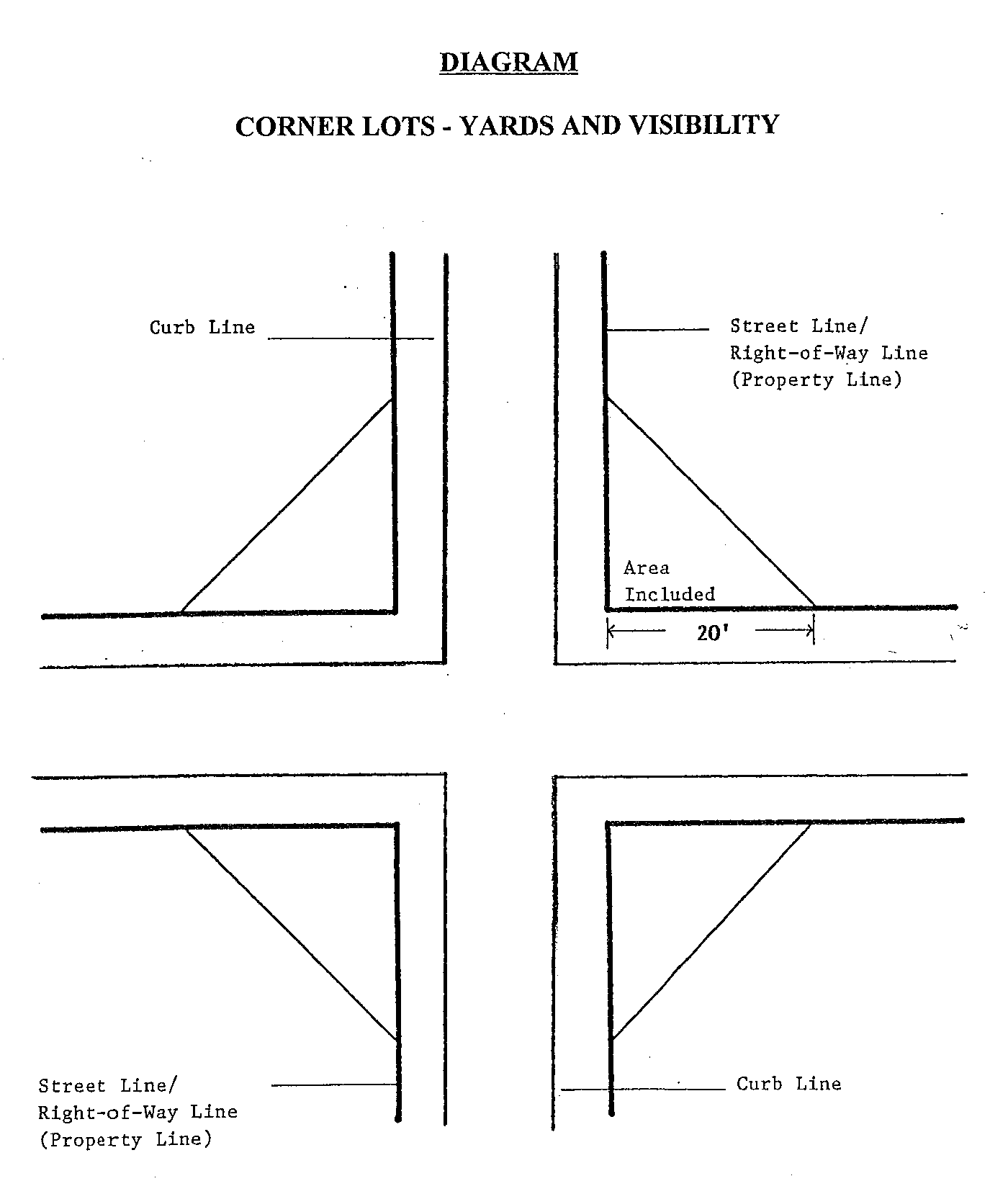
15.
General Sign Regulations. The following provisions shall be observed in all zoning districts.
A.
No advertisement, advertising structure, billboard or other object shall be erected, used or maintained which in any way simulates official, directional or warning signs erected or maintained by the city or by the State of Iowa.
B.
No sign or advertising device shall be erected or maintained at the intersection of streets in such a manner as to obstruct free and clear vision of the intersection.
C.
No neon sign or other illuminated advertisement shall be of such color or located in such a fashion as to diminish or detract in any way from the effectiveness of any traffic signal or similar safety or warning device.
D.
Flood lights at ground level or located within twelve feet of ground level shall be so located and shielded as to prevent any glare or blinding effect upon any lane of moving traffic.
16.
Residential Dwelling Standards. All single-family dwelling units shall meet the following minimum standards:
A.
The minimum width of a dwelling structure or principal building shall be twenty feet at the exterior dimension of three or more exterior walls, exclusive of attached garages, porches or other accessory structures.
B.
All dwelling units including attached garages shall be placed on a permanent frost-free perimeter foundation.
17.
Temporary Portable Storage Containers. The following regulations apply to temporary portable storage containers:
A.
A temporary portable storage container may be placed upon a property for a period not to exceed sixty days in any consecutive twelve-month period. No more than one such temporary portable storage container may be placed on a property at any given time.
B.
A temporary portable storage container must be maintained in a state of good repair that is capable of being moved intact and is free from rust, peeling paint, holes, and other visible deterioration.
C.
A temporary portable storage container may not be used as a dwelling or living quarters, nor for camping, cooking or recreation purpose at any time, and shall be secured against unauthorized entry.
D.
The placement of a temporary portable storage container shall comply the setback requirements of accessary buildings and yards and visibility standards of this section or a placed in a location approved by the public works director or their designee.
E.
The owner or tenant in possession of the property must first obtain temporary building permit from the public works director or designee prior to placement of any such temporary portable storage container on the property. The public works director or designee shall have the discretion to permit the placement of more than one temporary portable storage container on a property and placement for a period longer than sixty days in any consecutive twelve-month period if the placement of such temporary portable storage container on the property is reasonably required in order to facilitate a construction project. The owner of the property and the owner's contractor, if any, shall apply for the building permit for the temporary portable storage container as part of the application for a building permit for the construction or reconstruction project. The building permit for the temporary portable storage container shall only be allowed for such period as is reasonably necessary for, and only with demonstrated progress towards, completion of such construction or reconstruction project, all as determined in the discretion of the public works director or designee and, in any event, shall expire no later than the time the building permit for the construction or reconstruction project expires.
F.
This section shall not apply to pre-fabricated garden sheds or similar structures specifically designed and intended for use on properties for storage purposes and which comply with all city ordinances applicable to detached accessory buildings.
G.
The owner or tenant in possession of property located in the highway service business district, light manufacturing district, or heavy manufacturing district zoning districts with a primary use as a trucking business or warehousing business, may place temporary portable storage containers for periods of longer than sixty days and without obtaining a building permit as otherwise provided for in this section.
H.
Any temporary portable storage container existing on property within the city upon the enaction of the ordinance from which this section is derived, shall either be removed from such property or brought into compliance with the provisions of this section within sixty days.
(Ord. No. 932, §§ 1, 2, 12-5-2005; Ord. No. 1037, § 1, 9-18-2018; Ord. No. 1039, § 2, 11-5-2018; Ord. No. 1050, § 2, 1-16-2020)
1.
Intent. This district is intended to provide for innovative and comprehensively planned projects in the development of residential land by permitting flexibility in design, placement of buildings, and the use of open spaces, while at the same time retaining substantially the same density and area coverage permitted in the underlying district in which the project is being developed and where public utilities and services are available and to encourage a suitable living environment through the promotion of public health, safety, and welfare.
The planned residential unit development overlay district (PRUD) shall only be used when a land holding is planned and developed as a unit in accordance with an approved overall conceptual development plan and subsequent final development plan.
2.
General. A PRUD may only be permitted to be superimposed over any residential single-family district or residential multi-family district, provided that all conditions or provisions of this section of the city code and any additional requirements, as may be determined necessary to provide for the most efficient layout of a PRUD and its proper integration with the surrounding development, are met.
3.
Densities Permitted. All types of residential housing units may be permitted within a PRUD, including, but not limited to, single-family (attached or detached) and multi-family residential units. The number of dwelling units in a PRUD shall be determined by the minimum amount of square feet per dwelling unit as set forth below for each residential or multi-residential district superimposed by the PRUD. This density shall be applied to the total project area excluding that land devoted to streets (public and private) and also excluding private detached garages and private recreational facilities:
4.
Permitted Uses. The uses permitted in a PRUD shall be consistent to those permitted in the underlying zoning district of which a PRUD is superimposed.
5.
Accessory Uses. The use of land or structures customarily incidental and subordinate to a permitted use in a PRUD shall be consistent to those allowed in the underlying zoning district.
6.
Special Exceptions. Certain uses that may be permitted in a PRUD shall be consistent to those permitted in the underlying zoning district of which a PRUD is superimposed.
7.
Performance Standards. The performance standards of a PRUD shall be consistent to those allowed in the underlying zoning district of which a PRUD is superimposed.
8.
Setback Requirements. The minimum front yard, minimum side yard, and minimum rear yard distance requirements of the underlying zoning district as found in the bulk regulations subsection shall only apply to those front, side or rear yards that are on the exterior boundary lines of a PRUD site or immediately adjacent to public or private streets.
9.
Off-street Parking. The off-street parking requirements of a PRUD shall be consistent to those required in the underlying zoning district of which a PRUD is superimposed.
10.
Off-street Loading. The off-street loading requirements of a PRUD shall be consistent to those required in the underlying zoning district of which a PRUD is superimposed.
11.
Signs. Sign regulations shall be consistent to those required in the underlying zoning district of which a PRUD is superimposed.
12.
Ownership. In order that the purpose of these regulations may be realized, private land, private streets, private sidewalks, private utility services, and private common open space shall be under ownership by a legally established homeowners association(s) or other legal entity determined to be acceptable by the zoning administrator and identified in the conceptual development plan and final development plan. The homeowners association or otherwise approved entity shall not be dissolved, nor shall it dispose of any private land, private streets, private sidewalks, private utility services, and private common open space, except upon the approval of the city council.
13.
Application and Processing of Zoning Change Request and Conceptual Development Plan.
A.
Preapplication Conference. Prior to any application requesting the establishment of a PRUD, the applicant and/or their representative shall meet with the zoning administrator to determine the applicability of the development, timing of procedure, and any other information pertinent to the proposal.
B.
Application and Submission of Conceptual Development Plan. After the preapplication conference, an application requesting the establishment of a PRUD overlay district shall be filed with the zoning administrator with a filing fee for a rezoning request. The application shall be submitted with a conceptual development plan, which shall include the following:
1.
Legal description and address of property.
2.
Name, address and phone number(s) of the property owner(s).
3.
Anticipated number, type, and general location of residential units and nonresidential uses.
4.
List of principal uses, special exceptions, accessory uses, and temporary uses.
5.
General location and type of recreational (passive and active) and open space areas.
6.
Location of existing and proposed infrastructure and utilities, including: streets with appropriate grades; curb and gutter; sidewalks; access drives; water, sanitary sewer, storm water management and storm sewer drainage systems, where appropriate.
7.
Proposed access to public right-of-way, including approximate grades, traffic projections and general indication of traffic control measures.
8.
Sketches to indicate the general design of building types and the overall character of development.
9.
Existing contours of the property taken at regular contour intervals.
10.
Proposed parking facilities.
11.
Location and nature of common open space and natural features such as trees, waterways, and grasslands.
12.
Conceptual landscape plan showing plantings, fences, and signage.
13.
A location map or other framing at appropriate scale showing the general location and relation of the property to surrounding areas, including the zoning and land use patterns of adjacent properties, the existing street system in the area, and the location of nearby public facilities.
14.
Organizational documents for any entity that will govern the ownership, control and use of the property.
15.
Other information as required by the zoning administrator as necessary.
C.
Commission Review and Approval. A meeting shall be held by the planning and zoning commission on a PRUD zoning overlay application in the same manner and with the same public notice and procedures as required for a zoning amendment.
The planning and zoning commission shall make a recommendation to the city council whether to approve or disapprove the conceptual development plan, with any restrictions or conditions requested by the commission to be imposed, within sixty days of receipt unless a longer time is agreed upon with the developer. The conceptual development plan and the commission's recommendation, including any conditions or restrictions, shall be transmitted to the council within seven calendar days.
The conditions or restrictions may include, but are not limited to:
1.
Time limitations for submission of final development plans and commencement of construction.
2.
Uses permitted in the district.
3.
Requirement that any transfer of ownership or lease of property in the district include in transfer or lease agreement a provision that the purchaser or lessee acknowledges awareness of the condition or restrictions authorizing the establishment of the district.
D.
Council Approval. After receiving the recommendation of the planning and zoning commission, the city council shall act in the manner provided by law to approve or disapprove the requested PRUD zoning district reclassification of the property and the conceptual development plan. The council shall approve or disapprove the zoning request and conceptual development plan no later than the fourth regular meeting following the receipt of the report from the planning and zoning commission. The council shall give notice and hold a public hearing prior to approval of the application for a PRUD overlay district and approval of the conceptual development plan.
The ordinance authorizing the establishment, expansion, or amendment of a PRUD shall be recorded in the office of the county recorder at the applicant's expense.
A PRUD shall not be approved unless and until the city council determines that the conceptual development plan conforms to each of the following standards:
1.
The conceptual development plan is in substantial conformance with the comprehensive plan to guide the future growth and development of the city.
2.
The proposed development is designed so as to be functionally integrated with existing city streets, sanitary and storm sewer, storm water management, and water service.
3.
The proposed development shall not interfere with the appropriate use and enjoyment of property of abutting properties.
4.
The conceptual development plan will not violate any provision or requirement of this code.
5.
Natural drainage areas are retained as appropriate and improved if necessary.
6.
Due consideration is given to preserving natural site amenities and minimizing the disturbance to the natural environment.
7.
Existing trees are preserved wherever possible, and the location of trees will be considered in designing building locations, underground services, and paved areas.
8.
If the development includes floodplain areas, any development within the floodplain shall conform to the floodplain regulations in accordance with Chapter 15.32 of this code.
E.
Effect of Approval of Conceptual Development Plan. Approval of the conceptual development plan shall constitute authority to proceed with construction and preparation of the final development plan subject to approval of detailed plans and specifications for improvements set forth herein. The site shall be constructed and the final development plan prepared in conformity with the approved conceptual development plan. Material deviation from such approved conceptual development plan shall require resubmission and approval.
Approval of the conceptual development plan shall not constitute authority to sell lots, or authority to construct permanent buildings in reliance upon the conceptual development plan layout.
14.
Application and Processing of Final Development Plan.
A.
Submission of Final Development Plan. After approval of the conceptual development plan and adoption of the ordinance amendment establishing a PRUD by the city council, the applicant shall submit a final development plan to the zoning administrator. The final development plan shall be in substantial conformance with approved conceptual development plan. Prior to delivering the final development plan, the developer shall pay to the city clerk a nonrefundable processing fee equal to the established fee to file a final plat.
B.
Final Development Plan Review. No new building permits shall be issued for the site until the final development plan has been approved by the zoning administrator. If the zoning administrator determines the final development plan is not materially consistent with the previously approved conceptual development plan, the final development plan shall require approval of the city council.
C.
Construction of Improvements and Posting of Bond. No buildings may be erected and no uses may occupy any portion of a PRUD until any required related off-site improvements are constructed or appropriately secured as determined by the city administrator is provided to ensure construction. If a PRUD is to be developed in phases, all improvements necessary for the proper operation and functioning of each phase, must be constructed and installed or appropriately secured, as determined by the city administrator, to ensure their construction.
D.
Amendments. After recording of a final development plan, amendments to the approved plan may be allowed under the following conditions:
1.
Nonmaterial deviations in number, location, placement, heights of buildings, and landscaping that are consistent with the previously approved final development plan may be authorized by the zoning administrator.
2.
Material deviations from such approved final development plan shall require resubmission and approval.
15.
Common Open Space. Common open space shall be maintained in reasonable condition, subject to the nuisance abatement standards and procedures of the city's Code of Ordinances. In cases of nuisance abatement, costs shall be assessed against the entity responsible for the common open space area or proportionally against all properties within a PRUD that have the right of use of the common open space.
16.
Streets.
A.
Standards of design and construction of public streets within a PRUD shall be equivalent to those standards for streets provided in the subdivision ordinance. The planned specifications for street construction shall be included in the conceptual development plan and final development plan.
B.
Private streets shall be constructed equivalent to those standards for streets provided in the subdivision ordinance or to standards otherwise approved in the conceptual development plan and final development plan. In no case shall standards be less than those necessary to ensure the public safety and welfare as determined by the city. The entity which owns the property shall be responsible for maintenance, snow removal, repair, and replacement of private streets. No private streets may be dedicated to the city for public use at a later date unless and until said streets have been improved by the private owner thereof to then existing design standards for public streets.
17.
Other Development Controls.
A.
All utilities must be underground when transmission lines are extended or altered.
B.
The zoning administrator and the planning and zoning commission shall have the authority to recommend, and the city council shall have the authority to impose such other conditions as are necessary to accomplish the purposes of this section and the comprehensive plan.
(Ord. No. 1050, § 1, 1-16-2020)
ADMINISTRATION AND AMENDMENTS
A zoning administrator designated by the city council shall administer and enforce this chapter. The administrator may be provided with the assistance of such other persons as the city council may direct.
No building or other structure shall be erected, moved, or added to, without a building permit/certificate of zoning compliance therefor issued by the zoning administrator. However, reconstruction of exterior walls shall be allowed without said permit. No permit shall be issued except in conformity with the provisions of this chapter, except after written order from the board of adjustment. Fees for building permits/certificates of zoning compliance shall be as provided by city resolution. Permits shall be applied for with the director of public works and shall expire two years after the date of issuance if work is begun within one hundred eighty days of issuance or after one hundred eighty days if no substantial beginning of construction has occurred. Extensions of time may be granted in writing by the zoning administrator for good cause.
It shall be the responsibility of the zoning administrator to update the zoning district map.
1.
Board Created. A board of adjustment is hereby established and shall hereinafter at times be referred to as the "board," which board shall consist of five members serving without compensation appointed by the city council. Vacancies shall be filled for the unexpired term of any member whose term becomes vacant.
A majority of the members of the board of adjustment shall be persons representing the public at large and shall not be involved in the business of purchasing or selling of real estate. Members shall be appointed for overlapping terms of five years.
2.
Proceedings of the Board of Adjustment. The board of adjustment shall adopt rules necessary to the conduct of its affairs and in keeping with the provisions of this chapter. Meetings shall be held at the call of the chairperson and at such other time as the board may determine. The chairperson, or the city attorney, may administer oaths and compel the attendance of witnesses. All meetings shall be open to the public.
The board of adjustment shall, through its secretary, keep minutes of its proceedings, showing the vote of each member upon each question or if absent or failing to vote indicating such fact, and shall keep records of its examinations and other official actions, all of which shall be immediately filed in the office of the board and shall be a public record. Said action shall take effect upon the board receiving sufficient confirmation of the recording in the office of the county recorder. A copy of said action shall also be filed in the office of the zoning administrator.
The board of adjustment shall have the following powers and duties:
1.
Administrative Review. To hear and decide appeals where it is alleged there is an error in any order, requirement, decision, or determination made by the zoning administrator in the enforcement of this these regulations.
A.
Appeals to the board may be taken by any person aggrieved, or by any officer, department, board or bureau of the city affected by any decision of the administrative officer. Such appeal shall be taken within ten days by filing with the zoning administrator, and with the board a notice of appeal specifying the grounds thereof. The zoning administrator shall forthwith transmit to the board all papers constituting the record upon which the action appealed from is taken.
B.
The board shall fix a reasonable time for the hearing of the appeal, and give not less than four days nor more than twenty days public notice in a paper of general circulation in the city thereof, and decide the same within thirty days of the hearing. At said hearing, any party may appear in person, by agent or by attorney. The property owners within one hundred fifty feet shall be notified by regular mail not less than seven days prior to the hearing.
C.
Stay of Proceedings. An appeal stays all proceedings in furtherance of the action appealed from, unless the zoning administrator from whom the appeal is taken certifies to the board of adjustment after the notice of appeal is filed with the administrator, that by reason of facts stated in the certificate, a stay would, in the administrator's opinion, cause imminent peril to life or property. In such case proceedings shall not be stayed other than by a restraining order which may be granted by the board of adjustment or by a court of record on application, on notice to the zoning administrator from whom the appeal is taken and on due cause shown.
2.
Special Exceptions: Conditions Governing Applications; Procedures. To hear and decide only such special exceptions as the board of adjustment is specifically authorized to pass on by the terms of these regulations; to decide such questions as are involved in determining whether special exceptions should be granted; and to grant special exceptions with such conditions and safeguards as are appropriate under this chapter, or to deny special exceptions when not in harmony with the purpose and intent of this chapter. A special exception shall not be granted by the board of adjustment unless and until:
A.
A written application for a special exception is submitted indicating the section of this chapter under which the special exception is sought and stating the grounds on which it is requested.
B.
The board shall fix a reasonable time for the hearing of the special exception, and give not less than four days nor more than twenty days public notice in a paper of general circulation in the city thereof, and decide the same within thirty days of the hearing. The property owners within one hundred fifty feet shall be notified by regular mail not less than seven days prior to the hearing.
C.
The public hearing shall be held. Any party may appear in person, or by agent or attorney.
D.
The board of adjustment shall make a finding that it is empowered under the section of this chapter described in the application to grant the special exception, and that the granting of the special exception will not adversely affect the public interest. The granting of a special exception shall run with the owner and not with the land.
E.
Lapse of Special Exception. A special exception approval shall lapse and become void two years following the date of approval unless prior to expiration a building permit/certificate of zoning compliance is issued and construction is commenced and diligently pursued or the site is occupied if no building permit/certificate of zoning compliance is required.
F.
Signs. In all districts, for uses permitted as special exceptions, signs will be allowed only through board of adjustment approval.
3.
Variance; Conditions Governing Application; Procedures. To authorize upon appeal in specific cases such variance from the terms of this chapter as will not be contrary to the public interest, where, owing to special conditions, a literal enforcement of the provisions of this chapter would result in unnecessary hardship. A variance from the terms of this chapter shall not be granted by the board of adjustment unless and until:
A.
A written application for a variance is submitted demonstrating:
(1)
The granting of the variance would not have the effect of allowing a use not permitted in the zoning district.
(2)
The granting of the variance will not be contrary to the public interest.
(3)
Where owing to special conditions, the literal enforcement of the provisions of the chapter will result in unnecessary hardship.
(4)
The difficulty complained of is not the result of a willful act of the petitioner or other person maintaining an interest in the property or their immediate predecessors-in-interest.
B.
The board shall fix a reasonable time for the hearing of the variance, and give not less than four days nor more than twenty days public notice in a paper of general circulation in the city thereof, and decide the same within thirty days of the hearing. The property owners within one hundred fifty feet shall be notified by regular mail not less than seven days prior to the hearing.
C.
The public hearing shall be held. Any party may appear in person, or by agent or by attorney.
D.
The board of adjustment shall make findings that requirements of this subsection have been met by the applicant for a variance.
E.
The board of adjustment shall further make a finding that the reasons set forth in the application justify the granting of the variance, and that the variance is the minimum variance that will make possible the reasonable use of the land, building, or structure.
F.
The board of adjustment shall further make a finding that the granting of the variance will be in harmony with the general purpose and intent of this chapter, and will not be injurious to the neighborhood, or otherwise detrimental to the public welfare.
In granting any variance, the board of adjustment may prescribe appropriate conditions and safeguards in conformity with this chapter. Violation of such conditions and safeguards, when made a part of the terms under which the variance is granted, shall be deemed a violation of this chapter and punishable under this chapter.
Under no circumstances shall the board of adjustment grant a variance to allow a use not permissible under the terms of this chapter in the district involved or any use expressly or by implication prohibited by the terms of this chapter in said district.
G.
The city council may provide for its review of variances granted by the board of adjustment before their effective date. The city council may remand a decision to grant a variance to the board of adjustment for further study. The effective date of the variance is delayed for thirty days from the date of the remand. Such remand shall occur within thirty days of the board of adjustment decision.
4.
Conditional Use Permit; Conditions Governing Application; Procedures. To authorize upon appeal in specific cases such conditional use from the terms of this chapter as will not be contrary to the public interest. A conditional use from the terms of this chapter shall not be granted by the board of adjustment unless and until:
A.
A written application for a conditional use permit is submitted indicating the section of this chapter under which the conditional use permit is sought and stating the grounds on which it is requested.
B.
The board shall fix a reasonable time for the hearing of the conditional use application, and give not less than four days nor more than twenty days public notice in a paper of general circulation in the city thereof, and decide the same within thirty days of the hearing. The property owners within one hundred fifty feet shall be notified by regular mail not less than seven days prior to the hearing.
C.
The public hearing shall be held. Any party may appear in person, or by agent or by attorney.
D.
The board of adjustment shall make findings that requirements of this subsection have been met by the applicant for a conditional use permit.
E.
The board of adjustment shall further make a finding that the reasons set forth in the application justify the granting of the conditional use permit, and that the conditional use permit will make possible the reasonable use of the land, building, or structure.
F.
The board of adjustment shall further make a finding that the granting of the conditional use permit will be in harmony with the general purpose and intent of this chapter, and will not be injurious to the neighborhood, or otherwise detrimental to the public welfare.
5.
The concurring vote of three members of the board shall be necessary to reverse any order, requirement, decision, or determination of the zoning administrator, or to decide in favor of the applicant on any matter upon which it is required to pass under this chapter, or to effect any variation in the application of this chapter.
6.
Any variance/conditional use permit/special exception granted is subject to any existing easements.
(Ord. No. 1093, § 1, 1-15-2024)
Any person or persons, or any board, taxpayer, department, board or bureau of the city, or other areas subject to this chapter aggrieved by any decision of the board of adjustment may seek review by a court of record of such decision, in the manner provided by the laws of the state and particularly by Chapter 414, Code of Iowa.
All questions of interpretation and enforcement shall be first presented to the zoning administrator, or that person's assistant. Such questions shall be presented to the board of adjustment only on appeal from the decision of the zoning administrator, and recourse from the decisions of the board of adjustment shall be to the courts as provided by law and particularly by Chapter 414, Code of Iowa.
The regulations, restrictions, and boundaries may, from time to time, be amended, supplemented, changed, modified, or repealed, provided that at least seven days' notice of the time and place of such hearing shall be published in a paper of general circulation in the city. In no case shall the notice be published more than twenty days prior to the hearing. All property owners of property located within two hundred feet of a proposed rezoning district change shall be notified by ordinary mail at least seven days prior to the date of the planning and zoning commission meeting held to consider said change and shall receive, as part of the notification, a copy of the application for district change. Notice shall be considered given on the date it is mailed to the owner of record at their last known mailing address. Amendment requests shall be filed with the zoning administrator and forwarded to the planning and zoning commission which shall recommend on the request.
The regulations, restrictions, and boundaries may, from time to time, be amended, supplemented, changed, modified, or repealed. Notwithstanding Section 414.2, as a part of an ordinance changing land from one zoning district to another zoning district or an ordinance approving a site development plan, the council may impose conditions on a property owner which are in addition to existing regulations if the additional conditions have been agreed to in writing by the property owner before the public hearing required under this section or any adjournment of the hearing. The conditions must be reasonable and imposed to satisfy public needs which are directly caused by the requested change. In case, however, of a written protest against a change or repeal which is filed with the city clerk and signed by the owners of twenty percent or more of the area of the lots included in the proposed change or repeal, or by the owners of twenty percent or more of the property which is located within two hundred feet of the exterior boundaries of the property for which the change or repeal is proposed, the change or repeal shall not become effective except by the favorable vote of at least three-fourths of all the members of the council. The protest, if filed, must be filed before or at the public hearing. Any amendment to this ordinance shall be recorded in the office of the county recorder.
A violation of any provision of this chapter, including violations of conditions and safeguards established in connection with grants or variances or special exceptions, shall be punishable as provided in Chapter 1.12 of this code. Each day a violation continues shall be considered a separate offense. Nothing herein contained shall prevent the city from taking such other legal action as is necessary to prevent any violation.
The city council shall establish a schedule of fees, charges, and expenses and a collection procedure for zoning district changes, certificates of zoning compliance, appeals, and other matters pertaining to this chapter. The schedule of fees shall be posted in the office of the zoning administrator, and the city clerk, and may be altered or amended only by the city council. Until all applicable fees, charges, and expenses have been paid in full, no action shall be taken on any application or appeal.
Whenever a violation of this chapter occurs, or is alleged to have occurred, any person may file a written complaint. Such complaint, stating fully the causes and basis thereof, shall be filed with the zoning administrator. The administrator shall record properly such complaint, immediately investigate, and take action thereon as provided by this chapter, this code, or state law.
All ordinances or parts of ordinances in conflict with this chapter are hereby repealed to the extent necessary to give this chapter full force and effect. This chapter shall become effective upon publication.
If any section, clause, or portion of this chapter is adjudged unconstitutional or invalid by a court of competent jurisdiction, the remainder of this chapter shall not be affected thereby.

04 - ZONING REGULATIONS1
Editor's note— Chapter 17.04 contains the text of the zoning regulations for the city which derive from Ord. No. 868 adopted September 7, 1999, and which were published in the prior code. Amendments are indicated by parenthetical history notes following amended provisions. The absence of a history note indicates that the provision remains unchanged from the original ordinance. Obvious misspellings and punctuation errors have been corrected without notation. For stylistic purposes, a uniform system of headings, catchlines, capitalization, citation to state statutes, and expression of numbers in text has been used to conform to the Code of Ordinances.
The purpose of this chapter is to provide adequate light and air, to prevent the overcrowding of land, to avoid undue concentration of population, to regulate the use of land, and to promote the health, safety, and general welfare in the City of Algona, Iowa.
The regulations set by this chapter within each district shall be minimum regulations and shall apply uniformly to each class or kind of structure or land, and particularly, except as hereinafter provided:
1.
No building, structure, or land shall hereafter be used or occupied, no building or structure or part thereof shall hereafter be erected, constructed, reconstructed, moved, or structurally altered except in conformity with all the regulations herein specified for the district in which it is located.
2.
No part of a yard, or other open space, or off-street parking or loading space required about or in connection with any building for the purpose of complying with this chapter, shall be included as part of a yard, open space, or off-street parking or loading space similarly required for any other building.
3.
No yard or lot existing at the time of passage of the ordinance from which this chapter is derived shall be reduced in dimension or area below the minimum requirements set forth herein. Yards or lots created after the effective date of the ordinance from which this chapter is derived shall meet at least the minimum requirements established by this chapter.
4.
Whenever the requirements of this chapter are at variance with the requirements of any other lawfully adopted rules, regulations, ordinances, deed restrictions, or covenants, the most restrictive or that imposing the higher standards shall govern.
5.
All structures existing, as of the effective date of the ordinance from which this chapter is derived and which comply with the terms and conditions of this chapter shall be considered lawful and be allowed to continue and exist or be constructed on the current perimeters of the existing structure.
1.
Official Zoning Map. The city shall be divided into districts, as shown on the official zoning map which, together with all explanatory matter thereon, shall be adopted by ordinance.
The official zoning map shall be identified by the signature of the mayor, attested by the city clerk, under the following words: "This is to certify that this is the Official Zoning Map referred to in Section 17.04.030 of Ordinance No. 868 of the City of Algona, Iowa," together with the date of adoption.
If, in accordance with the provisions of this chapter and Chapter 414, Code of Iowa, changes are made in district boundaries or other matter portrayed on the official zoning map, such changes shall be entered on the official zoning map promptly after the amendment has been approved by the city council, with an entry on the official zoning map as follows: "By official action of the City Council, the following changes were made to the Official Zoning Map." (Indicating the changes by ordinance numbers and date of publication.)
No amendment which involves matter portrayed on the official zoning map shall become effective until after such change and entry has been made on said map.
2.
Annexation of New Land. Any land annexed to the city after the effective date of the ordinance from which this chapter is derived shall be zoned [AG] Agricultural until the planning and zoning commission and city council shall have studied the area and adopted a final zoning plan for the area in accordance with this chapter.
3.
Replacement of the Official Zoning Map. In the event that the official zoning map becomes damaged, destroyed, lost or difficult to interpret because of the nature or number of changes and additions, the city council may by ordinance adopt a new official zoning map which shall supersede the prior official zoning map. The new official zoning map may correct drafting or other errors or omissions in the prior official zoning map, but no such correction shall have the effect of amending the original official zoning map or any subsequent amendment thereof.
The new official zoning map shall be identified by the signature of the mayor, attested by the city clerk, and bearing the seal of the city under the following words: "This is to certify that this Official Zoning Map supersedes and replaces the Official Zoning Map adopted as part of Ordinance No. 869 of the City of Algona, Iowa."
Unless the prior official zoning map has been lost, or has been totally destroyed, the prior map or any significant parts thereof remaining, shall be preserved, together with all available records pertaining to its adoption or amendment.
Where uncertainty exists as to the boundaries of districts as shown on the official zoning map, the following rules shall apply:
1.
Boundaries indicated as approximately following the center lines of streets, highways, or alleys shall be construed to follow such center lines;
2.
Boundaries indicated as approximately following platted lot lines shall be construed as following such lot lines;
3.
Boundaries indicated as approximately following city limits shall be construed as following such city limits;
4.
Boundaries indicated as following railroad lines shall be construed to be midway between the main tracks;
5.
Boundaries indicated as following shorelines shall be construed to follow such shorelines, and in the event of change in the shoreline shall be construed as moving with the actual shoreline; boundaries indicated as approximately following the center lines of streams, rivers, or other bodies of water shall be construed to follow such center lines;
6.
Boundaries indicated as parallel to or extensions of features indicated in subsections 1 through 5 above shall be so construed. Distances not specifically indicated on the official zoning map shall be determined by the scale of the map;
7.
Where physical or cultural features existing on the ground are at variance with those shown on the official zoning map, or in other circumstances not covered by subsections 1 through 6 above, the board of adjustment shall interpret the district boundaries;
8.
Whenever the council vacates and disposes of a street or alley, adjacent districts shall extend to the center line of the vacation;
9.
Whenever a variance exists between the official zoning map and the legal description on an amendment to the ordinance from which this chapter is derived, the legal description applies.
For purposes of this chapter, certain terms or words used herein shall be interpreted as follows:
The word "person" includes a firm, association, organization, partnership, trust, company, or corporation as well as an individual.
The present tense includes the future tense, the singular number includes the plural, and the plural number includes the singular.
The word "shall" is mandatory; the word "may" is permissive.
The words "used" or "occupied" include the words "intended," "designed," or "arranged to be used or occupied."
The word "lot" includes the words "plot" or "parcel."
1.
"Abutting" means having property or district lines in common.
2.
"Access" means a way of approaching or entering a property from a public street.
3.
"Accessory buildings" means a subordinate building located on the same lot with the main building, occupied by or devoted to, an accessory use. Where an accessory building is attached to the main building in the subordinate manner, as by a wall or roof, such accessory building shall be considered part of the main building.
4.
"Accessory dwelling unit" means a residential dwelling unit located on the same lot as a single-family home that is the same size or smaller than the principal dwelling, where one unit is required to be owner occupied.
5.
"Accessory structure" means a structure detached from a principal building located on the same lot and customarily incidental and subordinate to the principal building or use.
6.
"Accessory use" means a use of land or of a building or portion thereof customarily incidental and subordinate to the principal use of the land or building and located on the same lot with the principal use.
7.
"Agriculture" means the production, keeping or maintenance, for sale, lease, or personal use, of plants useful to humans, including, but not limited to: forages and sod crops; grains and seed crops; excluding beef cattle, sheep, swine, horses, mules, goats, poultry or other dairy products, or any mutations or hybrids thereof including the breeding and grazing of any or all such animals, including bees and apiary products or fur animals. Trees and forest products, fruits of all kinds; vegetables; or land devoted to a soil conservation or forestry management program are permitted.
8.
"Agricultural sales and services" means establishments or places of business engaged in sale from the premises of feed, grain, fertilizers, pesticides and similar goods or in the provision of agriculturally-related services with incidental storage on lots other than where the service is rendered. Typical uses include nurseries, hay, feed and grain stores, and tree service firms.
9.
"Alley" means a public way, other than a street, twenty feet or less in width, affording secondary means of access to abutting property.
10.
"Animal feeding operation" means a lot, yard, corral, building, or other area in which animals are confined and fed and maintained for forty-five days or more in any twelve-month period, and all structures used for the storage of manure from animals in the operation. Two or more animal feeding operations under common ownership or management are deemed to be a single animal feeding operation if they are adjacent or utilize a common system for manure storage. An animal feeding operation does not include a livestock market.
11.
"Auction house" means a place where objects of art, furniture, or other goods are offered for sale to persons who bid on the objects in competition with each other.
12.
"Basement" means a story having part but not more than one-half its height above grade. A basement shall be counted as a story if the vertical distance from the average adjoining grade to its ceiling is over five feet.
13.
"Bed and breakfast houses" means a house or portion thereof where short-term lodging, rooms, and meals are provided. The operator shall live on the premises.
14.
"Board" means the board of adjustment.
15.
"Boarding houses" means a building other than a hotel where, for compensation, meals and lodging are provided for four or more persons.
16.
"Building" means any structure designed or intended for the support, enclosure, shelter, or protection of persons, animals, or property, but not including signs or billboards and not including structures or vehicles originally designed for transportation purposes.
17.
"Building, height of" means the vertical distance from the average natural grade at the building line to the highest point of the coping of a flat roof, or to the deck line of a mansard roof, or the mean height level between eaves and ridge for gable, hip, and gambrel roofs.
18.
"Conditional use permit" means a zoning exception which allows the property owner use of his land in an way not otherwise permitted within the particular zoning district, but complies with all the conditions and standards for the location or operations of the condition as specified in the zoning ordinance and authorized by the board of adjustment. This permit is recorded and stays with the property.
19.
"Convenience storage" means storage services primarily for personal effects and household goods within enclosed storage areas having individual access, but excluding use as workshops, hobbyshops, manufacturing, or commercial activity. Typical uses include mini-warehousing.
20.
"District" means a section or sections of the city within which the regulations governing the use of buildings and premises or the height and area of buildings and premises are uniform.
21.
"Duplex" means a multi-family home that has two dwelling units in the same building.
22.
"Dwelling" means any building, or portion thereof designed or used exclusively for residential purposes, but not including a tent, cabin, trailer, or mobile home.
23.
"Dwelling, multiple" means a building or portion thereof designed for or occupied exclusively for residence purposes by two or more families.
24.
"Dwelling, single-family" means a building designed for or occupied exclusively for residence purposes by one family.
25.
"Family" means one or more persons related by blood, marriage or adoption occupying a single dwelling unit. A family may include four, but not more than four, persons not related by blood, marriage or adoption but further provide that domestic employees employed on the premises may be housed on the premises without being counted as a family or families. When facilities for dwelling purposes are rented to other occupants of a building, those occupants shall not be considered part of the same family under this chapter.
26.
"Family home" means a community-based residential home which is licensed as a residential care facility under Chapter 135C or as a child foster care facility under Chapter 237 to provide room and board, personal care, habilitation services, and supervision in a family environment exclusively for not more than eight developmentally disabled persons and any necessary support personnel. However, family home does not mean an individual foster care family home licensed under Chapter 237.
27.
"Frost-free foundation" means a foundation supporting a structure which is required to be at least forty-two inches below grade.
28.
"Garage" means a building or portion thereof in which a motor vehicle containing gasoline, distillate or other volatile, flammable liquid in its tank is stored, repaired, or kept.
29.
"Garage, private" means a building or part thereof accessory to a main building and providing for the storage of automobiles and in which no occupation or business for profit is carried on.
30.
"Garage, public or storage" means a building or part thereof other than a private garage for the storage of motor vehicles and in which service station activities may be carried on.
31.
"Grade" means the average elevation of the finished ground at the exterior walls of the main building.
32.
"Health care facility" means any residential care facility, intermediate care facility, or skilled nursing facility.
A.
"Residential care facility" means any institution, place, building, or agency providing for a period exceeding twenty-four consecutive hours accommodation, board, personal assistance and other essential daily living activities to three or more individuals, not related to the administrator or owner thereof within the third degree of consanguinity, who by reason of illness, disease, or physical or mental infirmity are unable to sufficiently or properly care for themselves but who do not require the services of a registered or licensed practical nurse except on an emergency basis.
B.
"Intermediate care facility" means any institution, place, building or agency providing for a period exceeding twenty-four consecutive hours accommodation, board, and nursing services, the need for which is certified by a physician, to three or more individuals, not related to the administrator or owner thereof within the third degree of consanguinity, who by reason of illness, disease, or physical or mental infirmity require nursing services which can be provided only under the direction of a registered nurse or a licensed practical nurse.
C.
"Skilled nursing facility" means any institution, place, building, or agency providing for a period exceeding twenty-four consecutive hours accommodation, board, and nursing services, the need for which is certified by a physician, to three or more individuals not related to the administrator or owner thereof within the third degree of consanguinity who by reason of illness, disease, or physical or mental infirmity require continuous nursing care services and related medical services, but do not require hospital care. The nursing care services provided must be under the direction of a registered nurse on a twenty-four hour per day basis.
33.
"Home occupation" means an incidental occupation conducted in a dwelling unit, provided that:
A.
No persons other than members of the family residing on the premises shall be engaged on the premises in such occupation, except by special exception by the board of adjustment, but in no case shall more than one person be employed other than members of the family residing on the premises.
B.
The use of the dwelling unit for the home occupation shall be clearly incidental and subordinate to its use for residential purposes by its occupants, and not more than thirty percent of the gross floor area of the dwelling unit, calculated from the outside perimeter, shall be used in the conduct of the home occupation. This area restriction shall not apply to the care of children if the property otherwise qualifies as a home occupation.
C.
There shall be no change in the outside appearance of the building or premises, or other visible evidence of the conduct of such home occupation, except that one sign, identifying the name of the business, is allowed. The sign shall not be larger than three square feet in size, shall not be illuminated, and must be mounted flat against the building. Advertising displays, devices, or signs visible through a window of the building shall not be allowed.
D.
No home occupation may be conducted in any accessory building, except by special exception of the board of adjustment.
E.
No traffic shall be generated by such home occupation in greater volumes than would normally be expected in a residential neighborhood, and any need for parking generated by the conduct of such home occupation shall be met by providing off-street parking and shall not be in a required front yard.
F.
No equipment or process shall be used in such home occupation which creates noise, vibration, glare, fumes, odors, or electrical interference detectable to the normal senses off the lot, if the occupation is conducted in a single-family residence, or outside the dwelling unit if conducted in other than a single-family residence. No equipment or process shall be used which creates visual or audible interference in any radio or television receivers off the premises or cause fluctuations in line voltage off the premises.
G.
There shall be no signs, radio, television, newspaper, handbill or similar types of advertising linking the address of the premises with the home occupation. However, temporary signs up to three square feet in size may be placed on private property advertising one-day events at the home occupation. Said temporary signs may be in place for no longer than two days at a time and no home occupation may have signs placed more than two times in one calendar year.
H.
The following uses shall not be allowed as a home occupation:
(1)
Vehicle repair shops.
(2)
Auction houses.
(3)
Appliance repair shops.
(4)
Small engine repair.
(5)
Furniture stripping and refinishing.
(6)
Health salons, gyms, dance studios, aerobic exercise studios.
(7)
Medical or dental offices.
(8)
Upholstery shops.
(9)
Television repair shops.
(10)
Welding shops.
(11)
Kennels.
34.
"Horticulture" means the growing of horticultural and floracultural specialties, such as flowers, shrubs, or trees intended for ornamental or landscaping purposes, but excluding retail sales. Typical uses include wholesale plant nurseries and greenhouses.
35.
"Hospital" means an institution which is devoted primarily to the maintenance and operation of facilities for the diagnosis, treatment or care over a period exceeding twenty-four hours of two or more nonrelated individuals suffering from illness, injury, or deformity, or a place which is devoted primarily to the rendering over a period exceeding twenty-four hours of obstetrical or other medical or nursing care for two or more nonrelated individuals, or any institution, place, building or agency in which any accommodation is primarily maintained, furnished or offered for the care over a period exceeding twenty-four hours of two or more nonrelated aged or infirm persons requiring or receiving chronic or convalescent care; and shall include sanitariums or other related institutions. Provided, however, this shall not apply to hotels or other similar places that furnish only food and lodging, or either, to their guests. "Hospital" shall include, in any event, any facilities wholly or partially constructed or to be constructed with federal financial assistance, pursuant to Public Law 725, 79th Congress, approved August 13, 1946.
36.
"Hotel" means a building occupied as the more or less temporary residence of individuals who are lodged for compensation with or without meals, in which there are sleeping rooms or suites of rooms with no provision made for cooking in any individual room or suite of rooms, and entrance is through a common lobby or office.
37.
"Infill development" means the construction of a building or structure on a vacant parcel located in a predominantly built-up area.
38.
"Infill site" means any vacant lot, parcel or tract of land within developed areas of the city and where water, sewer, streets, schools, and fire protection have already been constructed or are provided in a predominately built-up area.
39.
"Junk yard" means any area where waste, discarded or salvaged materials are bought, sold, exchanged, baled or packed, disassembled or handled, including places or yards for storage of salvaged house wrecking and structural steel materials and equipment; but not including areas where such uses are conducted entirely within a completely enclosed building and not including the processing of used, discarded or salvaged materials as part of manufacturing operations. A junk yard shall also include auto wrecking and salvage operations.
40.
"Kennel (commercial)" means an establishment in which dogs or domestic animals more than six months old are housed, groomed, bred, boarded, trained, or sold.
41.
"Landscaped" means an area devoted to or developed predominately with plant material or natural landscape features, including lawn, ground cover, gardens, trees, shrubs, and other plant materials; and also including accessory decorative outdoor landscape elements such as pools, fountains, water features, paved or decorated surfaces or rock, stone, brick, block, or similar material (excluding driveways, parking, loading, or storage areas), and sculptural elements, provided that the use of brick, stone, aggregate, or other inorganic materials shall not predominate over the use of plant material.
42.
"Lodging house" means a building originally designed for or used as single-family, two-family, or multiple-family dwelling, all or a portion of which contains lodging rooms or rooming units which accommodate persons who are not members of the keeper's family. Lodging or meals, or both, are provided for compensation. The term "lodging house" shall be construed to include: boarding house, rooming house, fraternity house, sorority house and dormitories.
43.
"Lot" means, for purposes of this chapter, a parcel of land of at least sufficient size to meet minimum zoning requirements for use, coverage, and area, and to provide such yards and other open spaces as are herein required. Such lot shall have frontage on an approved public street, or on an approved private street, and may consist of:
A.
A single lot of record;
B.
A portion of a lot of record;
C.
A combination of complete lots of record, or complete lots of record and portions of lots of record, or of portions of lots of record;
D.
A parcel of land described by metes and bounds, provided that in no case of division or combination shall any residual lot or parcel be created which does not meet the requirements of this chapter.
44.
"Lot frontage" means the portion of a lot nearest the street. For the purposes of determining yard requirements on corner lots and through lots, all sides of a lot adjacent to streets shall be considered frontage, and yards shall be provided as indicated under "yards" in this section. The principal building on a lot shall front on a street or a public place except in the case of lots abutting lake shore where the lots shall front on the lake and the rear yard shall be opposite the front yard.
45.
"Lot measurements" means:
A.
Width of a lot shall be the distance between straight lines connecting front and rear lot lines at each side of the lot, measured across the building line; provided, however, that width between side lot lines at their foremost points (where they intersect with the street line or front property line) shall not be less than eighty percent of the required lot width except in the case of lots on the turning circle of a cul-de-sac where eighty percent requirement shall not apply.
B.
Depth of a lot shall be the distance between the mid-points of straight lines connecting the foremost points of the side lot lines in front and the rearmost points of the side lot lines in the rear.
46.
"Lot of record" means a lot which is part of a subdivision recorded in the office of the county recorder, or a lot or parcel described by metes and bounds, the description of which has been so recorded.
47.
"Lot types." The chart on the following page illustrates terminology used in this chapter with reference to "corner" lots, "interior" lots, "through" lots, and "reversed corner" lots as follows:
A.
"Corner" lot—A lot located at the intersection of two or more streets.
B.
"Interior" lot—A lot other than a corner lot with only one frontage on a street other than an alley.
C.
"Through" lot—A lot other than a corner lot with frontage on more than one street other than an alley. Lots with frontage on two non-intersecting streets may be referred to as "through" lots. On through lots the required front yard shall be provided on both streets.
D.
"Reversed corner" lot—A corner lot, the side street line of which is substantially a continuation of the front lot line of the first lot to its rear.
48.
"Manufactured home" means a manufactured home which shall be located and installed according to the same standards, including, but not limited to, a foundation system, setback, and minimum square footage which would apply to a site-built, single-family dwelling on the same lot. A manufactured home is a factory-built structure, which is manufactured or constructed under the authority of 42 U.S.C. Section 5403 and is to be used as a place for human habitation, but which is not constructed or equipped with a permanent hitch or other device allowing it to be moved other than for the purpose of moving to a permanent site and which does not have permanently attached to its body or frame any wheels or axles. A mobile home as defined in Section 435.1 of the Code of Iowa is not a manufactured home, unless it has been converted to real property as provided in Section 435.26 of the Code of Iowa, and shall be taxed as a site-built dwelling. This section shall not be construed as abrogating a recorded restrictive covenant.
49.
"Mobile home" means any structure used for living, sleeping, business or storage purposes, having no foundation other than wheels, blocks, skids, jacks, horses, or skirtings, and which is, has been, or reasonably may be, equipped with wheels or other devices for transporting the structure from place to place, whether by motive power or other means. The term "mobile home" shall include camp car and house car.
50.
"Motel" (also "motor hotel," "motor court," "motor lodge," or "tourist court") means a building or group of buildings designed to provide sleeping accommodations to transient guests for compensation, and provides near each guest room a parking space for the guest's vehicle. A swimming pool, restaurant, meeting rooms, management offices and other such accessory facilities may be included.
51.
"Nonconformities" means lots, structures, uses of land and structures, or characteristics of uses, which are prohibited under the terms of the zoning ordinance but were lawful at the date of enactment of the ordinance.
52.
"Nursery school" means a private establishment enrolling children where tuition, fees, or other forms of compensation for the care of the children is charged, and which is licensed or approved to operate as a child care center and which requires more than one attendant.
53.
"Parking space" means an area of not less than one hundred eighty square feet either within a structure or in the open, exclusive of driveway or access drives, for the parking of a motor vehicle.
54.
"Permitted use" means a use by right which is specifically authorized in a particular zoning district.
55.
"Planning and Zoning Commission" means a commission referred to as the commission or planning and zoning commission appointed by the council to recommend the boundaries of the various districts and appropriate regulations and restrictions to be enforced through this chapter and as granted powers under Chapter 414 of the Code of Iowa.
56.
"Principal use" means the main use of land or structures as distinguished from an accessory use.
57.
"Projections (into yards)" means parts of buildings such as architectural features that extend beyond the building's exterior wall.
58.
"Public space" means an open or unoccupied public place which is permanently reserved for the purpose of access to abutting property.
59.
"Quorum" means a majority of the full authorized membership.
60.
"Recreational vehicle" means a vehicular type portable structure without permanent foundation, which can be towed, hauled or driven and primarily designed as temporary living accommodation for recreational, camping, and travel use and including, but not limited to, travel trailers, truck campers, camping trailers, and self-propelled motor homes. This definition shall also include boats and appurtenant trailers.
61.
"Remodel" means to construct an addition or alter the design or layout of a building or make substantial repairs or alterations.
62.
"Restaurant" means a use engaged in the preparation and retail sale of food and beverages, including sale of alcoholic beverages when conducted as an accessory or secondary feature and producing less than fifty percent of the gross income. A general restaurant may include live entertainment. Typical uses include restaurants, coffee shops, dinner houses, and similar establishments with incidental alcoholic beverages service.
63.
"Retail sales" means sale or rental of commonly used goods and merchandise for personal or household use, but excludes those classified more specifically in this section inclusive. Typical uses include department stores, apparel stores, furniture stores, or establishments providing the following products or services: household cleaning and maintenance products; drugs, cards, and stationery, notions, books, tobacco products, cosmetics, and specialty items; flowers, plants, hobby materials, toys, and hand-crafted items; apparel, jewelry, fabrics, and like items; cameras, photography services, household electronic equipment, records, sporting equipment, kitchen utensils, home furnishing and appliances, art supplies and framing, arts and antiques, paint and wallpaper, carpeting and floor covering, interior decorating services, office supplies; bicycles; and automotive parts and accessories (excluding service and installation).
64.
"Service station (gas station)" means a building or premises used for dispensing or offering for sale at retail any automobile fuels, oils, or having pumps and storage tanks therefor, or where battery, tire or any similar services are rendered, and where vehicles are not parked for purposes of inspection or sale.
65.
"Setback" means the required distance between every structure and lot line on the lot in which it is located.
66.
"Signs" means any object, device, display, or structure, or part thereof, situated outdoors or indoors, which is used to advertise, identify, display, direct, or attract attention to an object, person, institution, organization, business, product, service, event, or location by any means, including words, letters, figures, design, symbols, fixtures, colors, illumination, or projected images.
67.
"Signs, on-premises" means an advertising device concerning the sale or lease of the property upon which they are located and advertising devices concerning activities conducted or products sold on the property upon which they are located.
68.
"Signs, off-premises" means an advertising device including the supporting structure which directs the attention of the general public to a business, service, or activity not usually conducted or a product not usually sold upon the premises where such a sign is located. Such a sign shall not include: On-premises signs, directional or other official sign or signs which have a significant portion of their face devoted to giving public service information (date, time, temperature, weather, information, etc.)
69.
"Signs, portable" means any sign that is not permanently affixed to a building, structure, or the ground.
70.
"Signs, real estate" means a sign pertaining to the sale or lease of the premises, or a portion of the premises, on which the sign is located.
71.
"Special exception" means a use permitted in a particular zoning district upon showing that such use in a specified location will comply with all the conditions and standards for the location or operation of the use as specified in the zoning ordinance and authorized by the board of adjustment. The special exception is granted to the property owner, not the property.
72.
"Statement of intent" means a statement preceding regulations for individual districts, intended to characterize the districts and their legislative purpose.
73.
"Story" means that portion of a building included between the surface of any floor and the surface of the floor next above it, or if there is no floor above it, then the space between the floor and the ceiling or roof next above it.
74.
"Story, half" means a space under a sloping roof which has the line of intersection of roof decking and wall face not more than four feet above the top floor level. A half-story containing independent apartments or living quarters shall be counted as a full story.
75.
"Street" means all property dedicated or intended for public or private use for access to abutting lands or subject to public easements therefor, and whether designated as a street, highway, thoroughfare, parkway, throughway, expressway, road, avenue, boulevard, lane, place, circle, or however otherwise designated.
76.
"Street line" means the right-of-way line of a street.
77.
"Structural alteration" means any change in the supporting members of a building, such as bearing walls or partitions, columns, beams or girders, or any complete rebuilding of the roof or the exterior walls.
78.
"Structure" means anything constructed or erected which requires location on the ground or attached to something having location on the ground, including signs and billboards, but not including fences or walls used as fences.
79.
"Temporary portable storage containers" means a container, including, but not limited to, truck trailers, shipping containers, storage moving units or "pods," shed-like structures, or any other similar storage unit or receptacle that is capable of being moved, whether with or without wheels, and whether with or without a chassis, and which can be used for the storage of property of any kind.
80.
"Terrace" means a level, landscaped, and/or surfaced area, also referred to as a deck or patio, directly adjacent to a principal building at or within three feet of the finished grade and not covered by a permanent roof.
81.
"Townhouse" means a dwelling unit having a common wall with or abutting one or more adjoining dwelling units.
82.
"Townhouse lot" means that portion of the total development site of a townhouse residential use intended for separate ownership as the location of a single townhouse and associated private yard area.
83.
"Townhouse residential" means the use of a site for four or more townhouse dwelling units, constructed with common or adjacent walls and each located on a separate ground parcel within the total development site, together with common area serving all dwelling units.
84.
"Use" means the purpose or activity for which a piece of land or its buildings is designed, arranged, or intended, or for which it is occupied or maintained.
85.
"Variance" means a device used by the board of adjustment which grants a property owner relief from certain provisions of a zoning ordinance when the result would be an opportunity for improved zoning and planning which would benefit the community.
86.
"Vehicle repair shop" means a business for the repair of automobiles, non-commercial trucks, motorcycles, motor homes, recreational vehicles, or boats including the sale, installation, and servicing of equipment and parts. Typical uses include new and used car dealerships, motorcycle dealerships, and boat, trailer, and recreational vehicle dealerships.
87.
"Warehousing" means establishments or places of business primarily engaged in wholesaling, storage, distribution and handling of materials and equipment other than live animals and plants.
88.
"Yard" means an open space on the same lot with a building, unoccupied and unobstructed by any portion of a structure from the ground upward, excepting as otherwise provided herein. In measuring a yard for the purpose of determining the depth of a front yard or the depth of a rear yard, the least distance between the lot line and the main building shall be used. Fences and walls are permitted in any yard, subject to height limitations as indicated herein. (See chart on following page.)
89.
"Yard, front" means a yard extending across the width of the lot and measured between the front lot line and the building or any projection thereof, other than the projection of the usual steps or unenclosed porches. Corner lots shall have two front yards and two side yards. (See chart on following page.)
90.
"Yard, rear" means a yard extending across the width of the lot and measured between the rear lot line and the building or any projections other than steps, unenclosed balconies or unenclosed porches. On interior lots the rear yard shall be the opposite end of the lot from the front yard. (See chart on following page.)
91.
"Yard, side" means a yard extending from the front yard to the rear yard and measured between the side lot lines and the building. (See chart on following page.)
92.
"Zoning administrator" means the local official responsible for reviewing certificates of zoning compliance and following a determination by the board of adjustment for special exceptions and variances. Decisions of the official may be appealed to the board of adjustment. Certificates of zoning compliance are issued by the zoning administrator.
93.
"Zoning district" means a section the city designated in the text of the zoning ordinance and delineated on the zoning map in which requirements for the use of land, the building and development standards are prescribed. Within each district, all requirements are uniform.
94.
"Zoning map" means the map delineating the boundaries of districts which, along with the zoning text, comprises the zoning ordinance.
(Ord. No. 1054, § 1, 7-6-2020; Ord. No. 1039, § 1, 11-5-2018; Ord. No. 1093, §§ 8—19, 1-15-2024)
Within the districts established by this chapter there exist:
1.
Lots;
2.
Structures;
3.
Uses of land and structures; and
4.
Characteristics of use;
which were lawful before this chapter was passed or amended, but which are prohibited, regulated, or restricted under the terms of this chapter or future amendment. It is the intent of this chapter to permit these nonconformities to continue until they are removed, but not to encourage their survival. Further nonconformities shall not be enlarged upon, expanded or extended, nor be used as grounds for adding other structures or uses prohibited elsewhere in the same district; however, it is the intent of this chapter to allow structures which were nonconforming under the previous ordinance, but which are conforming under this chapter to be considered legal as of the date of adoption of the ordinance from which this chapter is derived and shall be allowed to be rebuilt, added to, or modified within the terms and requirements of this chapter.
To avoid undue hardship, nothing in this chapter shall be deemed to require a change in the plans, construction or designated use of any building on which actual construction was lawfully begun prior to the effective date of adoption or amendment of the ordinance from which this chapter is derived and upon which actual building construction has been carried on diligently. Actual construction is hereby defined to include the placing of construction materials in permanent position and fastened in a permanent manner. Where excavation or demolition or removal of an existing building has been substantially begun preparatory to rebuilding, such excavation or demolition or removal shall be deemed to be actual construction, provided that work shall be carried on diligently.
In any district in which single-family dwellings are permitted, a single-family dwelling and customary accessory buildings may be erected on any single lot of record at the effective date of adoption or amendment of the ordinance from which this chapter is derived, notwithstanding limitations imposed by other provisions of the ordinance. This provision shall apply even though such lot fails to meet the requirements for area or width, or both, if the lot shall conform to the regulations for the district in which such lot is located.
(Ord. No. 1093, § 2, 1-15-2024)
Where at the time of passage of the ordinance from which this chapter is derived lawful use of land exists which would not be permitted by the regulations imposed by this chapter, and where such use involves no individual structure with a replacement cost exceeding one thousand dollars, the use may be continued so long as it remains otherwise lawful, provided:
1.
No such nonconforming use shall be enlarged or increased, nor extended to occupy a greater area of land than was occupied at the effective date of adoption or amendment of the ordinance from which this chapter is derived.
2.
No such nonconforming use shall be moved in whole or in part to any other portion of the lot or parcel occupied by such use at the effective date of adoption or amendment of the ordinance from which this chapter is derived.
3.
If any such nonconforming use of land ceases for any reason for a period of six months, then any subsequent use of such land shall conform to the regulations specified by this chapter for the district in which such land is located.
4.
No additional structure not conforming to the requirements of this chapter shall be erected in connection with such nonconforming use of land.
Where a lawful structure exists at the effective date of adoption or amendment of the ordinance from which this chapter is derived that could not be built under the terms of this chapter by reason of restrictions on area, lot coverage, height, yards, its location on the lot, or other requirements concerning the structure, such structure may be continued so long as it remains otherwise lawful, subject to the following provisions:
1.
No such nonconforming structure may be enlarged or altered in such a way which increases its nonconformity, but any structure or portion thereof may be altered to decrease its nonconformity.
2.
Should such nonconforming structure or nonconforming portion of structure be destroyed by any means to an extent of more than sixty percent of its market value at time of destruction, it shall not be reconstructed unless granted a special exception by the board of adjustment, and then such reconstruction shall only be allowed on the same perimeter location.
3.
Should such structure be moved for any reason for any distance whatever, it shall thereafter conform to the regulations for the district in which it is located after it is moved.
If lawful use involving individual structures with a replacement cost of one thousand dollars or more, or of structure and premises in combination, exists at the effective date of adoption or amendment of the ordinance from which this chapter is derived, that would not be allowed in the district under the terms of this chapter, the lawful use may be continued so long as it remains otherwise lawful, subject to the following provisions.
1.
No existing structure devoted to a use not permitted by this chapter in the district in which it is located shall be enlarged, extended, constructed, reconstructed, or structurally altered except in changing the use of the structure to a use permitted in the district in which it is located.
2.
Any nonconforming use may be extended throughout any parts of a building which were manifestly arranged or designed for such use at the time of adoption or amendment of the ordinance form which this chapter is derived, but no such use shall be extended to occupy any land outside such building.
3.
If no structural alterations are made, any nonconforming use of a structure, or structure and premises, may be changed to another nonconforming use provided that the proposed use is equally appropriate or more appropriate to the district than the existing nonconforming use.
4.
Any structure, or structure and land in combination, in or on which a nonconforming use is superseded by a permitted use, shall thereafter conform to the regulations for the district, and the nonconforming use may not thereafter be resumed.
5.
When a nonconforming use of a structure, or structure and premises in combination, is discontinued or abandoned for twelve consecutive months or for eighteen months during any three year period (except when government action impedes access to the premises) the structure, or structure and premises in combination, shall not thereafter be used except in conformity with the regulations of the district in which it is located.
6.
When nonconforming use status applies to a structure and premises in combination, removal or destruction of the structure shall eliminate the nonconforming status of the land. Destruction for the purpose of this subsection is defined as damage to an extent of more than sixty percent of the market value at time of destruction.
On any building devoted in whole or in part to any nonconforming use, work may be done on ordinary repairs, provided that the cubic content of the building as it existed at the time of passage or amendment of the ordinance from which this chapter is derived shall not be increased.
Any use which is permitted as a special exception in a district under the terms of this chapter (other than a change through board of adjustment action from a nonconforming use to another use not generally permitted in the district) shall not be deemed a nonconforming use in such district, but shall without further action be considered a conforming use.
The city is herewith divided into the following districts:
AG—Agricultural District
CN—Conservation District
RS—Residential Single-Family District (RS-60), (RS-80), (RS-100)
RM—Residential Multi-Family District (RM-1), (RM-2), (RM-3), (RM-4)
MH—Mobile Home District
BN—Neighborhood Business District
HSB—Highway Service Business District
BGC—Central General Business District
LM—Light Manufacturing District
HM—Heavy Manufacturing District
These districts are established as identified on the official zoning map which, together with all explanatory matters thereon, is adopted by separate ordinance.
Note— Ord. No. 869, §§ 1—4, adopted Sept. 7, 1999, adopted the official zoning map and established districts as shown on the official zoning map of the city.
1.
Intent. This district is intended to provide for areas in which agriculture and related uses are encouraged as the principal use of land. However, uses which may be offensive to the surrounding area or to the community as a whole by reasons of noise, dust, smoke, odor, traffic or physical appearance or other similar factors are not permitted. The district prohibits urban density residential use until these areas may be served by utilities and services of the city. This district is also intended to preserve land suited for eventual development into other uses, pending proper timing for economical and practical provisions of streets, utilities, schools and other facilities so that reasonably compact development will occur and the fiscal integrity of the city is preserved. All newly annexed areas to the city will automatically be placed into this district classification unless otherwise suitably classified.
2.
Permitted Uses. The following uses are permitted in the AG district:
A.
Agriculture, including farm dwellings and other usual agricultural buildings and structures.
B.
Home occupations.
C.
Agricultural services.
3.
Excluded Uses. The following uses are prohibited within the AG district:
A.
Animal feeding operations.
4.
Accessory Uses. Uses of land or structure customarily incidental and subordinate to a permitted use in the AG district.
A.
Living quarters of persons employed on the premises and not rented or otherwise used as a separate dwelling.
B.
Private garages, barns and other farm buildings.
C.
Roadside stands not exceeding four hundred square feet of floor area offering for sale only agricultural products or other products produced on the premises.
D.
Temporary buildings for the uses incidental to construction work. Such buildings shall be removed upon the completion or abandonment of the construction work.
E.
Any telecommunication receiving structure so designed to prevent direct attachment, mounting, or installation to the principal building or structure in any residential district shall be considered an accessory structure or use. Such telecommunication receiver shall be installed within the rear yard, on a concrete pad and permanently affixed mounting structure. No mobile or portable structures will be allowed.
F.
Solar collectors.
G.
Radio and television receiving antennas.
5.
Special Exceptions. Certain uses may be permitted in the AG district subject to specific conditions and requirements intended to make them compatible with and acceptable to adjacent uses.
A.
Cemeteries, crematories or mausoleums.
B.
Commercial kennels.
C.
Greenhouses and nurseries.
D.
Publicly operated sanitary landfills.
E.
Private recreational camps, golf courses and recreational facilities.
F.
Public or private utility substations, relay stations, etc.
G.
Churches or accessory facilities.
H.
Publicly owned and operated buildings and facilities.
I.
Railroad tracks but no other facility.
J.
Parking lots.
6.
Performance Standards. The following performance standards shall apply to the uses indicated. They shall be supplemental to and in addition to other provisions applying to the property.
A.
Feed lots or corrals in which animals are kept at a density of over ten head per acre or where feed bunkers or water are placed so that animals naturally tend to bunch up, shall not be closer than three hundred feet from any lot line adjoining properties which are used for residential, commercial or light manufacturing purposes.
B.
Such feed lots or corrals shall maintain drainage so as to avoid excessive concentration of contaminated water and such drainage shall be so arranged that contaminated water does not drain into water courses in such a manner that it reaches neighboring properties at a concentration noticeable to normal senses.
C.
Manure in such feed lots or corrals shall not be allowed to accumulate to objectionable proportions and each feeding pen shall be scraped at least once a month, weather permitting.
D.
All dead animals shall be removed within twenty-four hours.
7.
Bulk Regulations. The following requirements shall provide for light and air around permitted uses and buildings in the AG district:
8.
Off-Street Parking. The following off-street parking requirements shall apply in the AG district:
A.
Dwellings: Two parking spaces on the lot for each living unit in the building.
B.
Churches: One parking space on the lot for each five seats in the main auditorium.
C.
Public buildings and facilities: One parking space for each three hundred square feet of gross floor area or one parking space for each five seats in the main assembly area.
D.
Roadside stands: One parking space for each fifty square feet of enclosed floor area.
E.
Greenhouses and nurseries: One parking space per one thousand square feet of enclosed floor area.
9.
Off-Street Loading. The following off-street loading requirements shall apply in the AG district:
A.
All activities or uses allowed in the AG district shall be provided with adequate receiving facilities accessible by motor vehicle off any adjacent service drive or open space on the same zoning lot.
B.
Loading shall not be permitted to block public right-of-way unless otherwise provided for in this code.
10.
Signs. The following sign regulations shall apply to the AG district:
A.
Off-premises signs, except political signs, are not permitted.
B.
On-premises signs are permitted. Real estate lease or sales signs, relating to the property on which the sign is located, are permitted but shall not exceed six square feet in area.
C.
Political signs on private property are permitted but shall not exceed thirty-two square feet in size.
D.
All construction-type signs are permitted.
E.
Signs for residential use identifying the premises and occupant, but not including advertising matter, are permitted but shall not exceed six square feet in area. Public, parochial, private schools and colleges, children's homes, and public and quasipublic buildings for cultural use, may have identification signs not to exceed thirty-two square feet in area. Churches, synagogues, and chapels shall be allowed one sign not exceeding twenty-four square feet in size.
F.
Non-electrical, temporary signs shall be allowed, however, they may be used no more than thirty consecutive days or sixty days per year.
1.
Intent. This district is intended to prevent, in those areas which are subject to periodic or potential flooding, such development as would result in a hazard to health or safety or be otherwise incompatible with the public welfare. This district is also intended to provide for water conservation, erosion control, protection of wildlife habitat, protect natural erosion control, protect natural drainage ways and to generally provide for ecologically sound land use of environmentally sensitive areas.
2.
Permitted Uses. The following uses are permitted in the CN district:
A.
Undeveloped and unused land in its natural condition.
B.
Public parks and recreation open space.
3.
Accessory Uses. Uses of land or structure customarily incidental and subordinate to a permitted use in the CN district.
A.
Agriculture, exclusive of dwelling units.
B.
Agricultural or recreational buildings or structures whose use or value would not be impaired by being flooded.
C.
Flood control structures.
D.
Roadside stands offering for sale only agricultural products or other products produced on the premises.
E.
Temporary buildings for the uses incidental to construction work which buildings shall be removed upon the completion or abandonment or the construction work.
4.
Special Exceptions. Certain uses may be permitted in the CN district subject to specific conditions and requirements intended to make them compatible with and acceptable to adjacent uses.
A.
Cemeteries, crematories or mausoleums.
B.
Stables, private or public.
C.
Greenhouses and nurseries.
D.
Private recreational uses.
E.
Public or private utility substations, relay stations, etc.
F.
Publicly owned buildings and facilities.
G.
Railroad tracks but no other facility.
H.
Parking lots.
5.
Performance Standards.
A.
Floodway and Floodway Fringe Districts. All areas within the flood plain are subject to the city's floodway and floodway fringe district regulations as adopted and which are included as an appendix to this chapter.
6.
Bulk Regulations. The following requirements shall provide for light and air around permitted uses and buildings in the CN district:
7.
Off-Street Parking. The following off-street parking requirements shall apply in the CN district:
A.
Roadside stands: One parking space for each fifty square feet of floor area.
B.
Greenhouses and nurseries: One parking space per one thousand square feet of enclosed floor area.
8.
Off-Street Loading. The following off-street loading requirements shall apply in the CN district:
A.
All activities or uses allowed in the CN district shall be provided with adequate receiving facilities accessible by motor vehicle off any adjacent service drive or open space on the same zoning lot.
B.
Loading shall not be permitted to block public right-of-way unless otherwise provided for in this code.
9.
Signs. The following sign regulations shall apply to the CN district:
A.
Off-premises signs, except political signs, are not permitted.
B.
On-premises signs are permitted. Real estate lease or sales signs, relating to the property on which the sign is located, are permitted but shall not exceed six square feet in area.
C.
Political signs on private property are permitted but shall not exceed thirty-two square feet in size.
D.
All construction-type signs are permitted.
E.
Signs for residential use identifying the premises and occupant, but not including advertising matter, are permitted but shall not exceed six square feet in area. Public, parochial, private schools and colleges, children's homes, and public and quasipublic buildings for cultural use, may have identification signs not to exceed thirty-two square feet in area. Churches, synagogues, and chapels shall be allowed one sign not exceeding twenty-four square feet in size.
F.
Non-electrical, temporary signs shall be allowed, however, they may be used no more than thirty consecutive days or sixty days per year.
1.
Intent. This district is intended to provide for a variety of single-family residential areas where public utilities and services are available and to encourage a suitable living environment through the promotion of public health, safety and welfare. Low and medium population density neighborhoods are recognized and provided for by varying the minimum bulk regulations. Criteria such as topography, soil types, access, traffic load on streets, schools, utilities, recreation and other public facilities shall be taken into consideration when the lot area requirement is established for the various single-family residential areas of the city.
2.
Permitted Uses. The following uses are permitted in the RS district:
A.
Single-family detached dwellings.
B.
Family homes.
C.
Home occupations.
D.
Horticultural or crop production.
E.
Duplexes are allowed only in the RS-60 classification.
F.
Three dwelling units in RS-60 that are able to meet the following requirements:
1.
Meets the minimum parking requirements.
2.
Meets the minimum habitable spaces as required by this code.
3.
Accessory Uses. Uses of land or structure customarily incidental and subordinate to a permitted use in the RS district:
A.
Private garages.
B.
Private recreational facilities.
C.
Temporary buildings for uses incidental to construction work. Such buildings shall be removed upon the completion or abandonment of the construction work.
D.
Any telecommunication receiving structure so designed to prevent direct attachment, mounting, or installation to the principal building or structure in any residential district shall be considered an accessory structure or use. Such telecommunication receiver shall be installed within the rear yard, on a concrete pad and permanently affixed mounting structure. No mobile or portable structures will be allowed.
E.
Solar collectors.
F.
Radio and television receiving antennas.
4.
Conditional Use Permits. Certain uses may be permitted in the RS district subject to the following conditions and requirements intended to make them compatible with and acceptable to adjacent uses.
A.
Accessory Dwelling Units (ADU)—A dwelling unit, but not a mobile home.
1.
An ADU may be erected as attached to the principal structure or as a detached structure.
2.
A detached ADU shall be located in a rear yard and shall meet a minimum ten-foot setback on all sides and must be no higher than the principal dwelling (ground to peak of roof height).
3.
a.
No accessory dwelling may be erected in any required front yard or side yard and must be located behind the principal building.
b.
No accessory dwelling shall be located in front of the mid-point of the lot and in all cases no accessory dwelling shall be located within ten feet of a lot line.
c.
Accessory dwellings located in the rear yard may not occupy more than fifty percent of the rear yard.
d.
If a garage is entered directly from an alley in a perpendicular or nearly perpendicular manner, the garage setback shall be fifteen feet.
e.
Satellite dishes are subject to the accessory building rules.
f.
Accessory dwellings shall not exceed the lessor of the principal dwelling footprint excluding the garages, carports, and space used for mechanical equipment, such as heating, utilities and water heater or pumps (livable footage of home); or one thousand two hundred square feet including an attached garage.
4.
No more than two bedrooms are allowed in the ADU. Bedroom shall mean any room or space used or intended to be used for sleeping purposes.
5.
The owner of the lot is required to live on the property in either the principal dwelling or the ADU. The owner of the lot shall file with the Kossuth County Recorder, a deed restriction agreement on the property stating the accessory dwelling cannot be sold separately form the principal dwelling. The deed restriction agreement must be to the satisfaction of the city attorney. The deed restriction agreement shall be filed prior to any conditional use permit for the ADU.
6.
The ADU shall have the same access point to the public or private street as the principal dwelling. Separate alley access will be allowed pursuant to this code.
7.
The ADU shall have connections to all public utilities. ADUs may be permitted to connect to the utility service lines of the principal dwelling.
8.
The ADU shall be provided with one designated parking space for that required by residential dwellings.
9.
Home occupations shall not be conducted in ADUs by the occupant of the principal dwelling.
10.
The ADU shall be residential in character with similar architectural features as the principal building.
11.
One ADU per residential lot shall be allowed under this conditional use permit.
5.
Special Exceptions. Certain uses may be permitted in the RS district subject to specific conditions and requirements intended to make them compatible with and acceptable to adjacent uses.
A.
Nursery schools.
B.
Public or private utility substations, relay stations, etc.
C.
Churches.
D.
Publicly owned and operated buildings and facilities.
E.
Private schools that are accredited by the State of Iowa with a curriculum similar to public schools.
F.
Golf courses but not miniature courses or separate driving tees.
G.
Railroad tracks but no other facility.
H.
Parking lots serving commercial or industrial districts.
I.
Landscape shed which is a portable structure one hundred twenty square feet or less which has no utilities connected.
6.
Performance Standards. The following performance standards shall apply to the RS district:
A.
Recreational Vehicles. Recreational vehicles and all boats and appurtenant trailers shall not be parked or stored within the front yard of a lot in this district. No more than one such recreational vehicle may be parked or stored within the side yard or rear yard of a residential lot or within an enclosed garage. Recreational vehicles shall not be used for human occupancy in this district for more than seventy-two hours within any thirty-day period. Recreational vehicles or trailers of any kind or type without current license plates shall not be parked or stored on any lot other than in completely enclosed buildings.
B.
Special Sales Uses. Special sales, including garage sales, porch sales, basement sales, moving sales, estate sales, or similar activities, shall be operated not more than three days in the same month or more than six days in the same year.
7.
Bulk Regulations. The following requirements shall provide for light and air around permitted residential uses and buildings in the RS district:
8.
Limited Setback Waiver. The purpose of the limited setback waiver for one- and two-family residential structures that meet the following criteria established by the city council is to encourage reinvestment and infill development, and to maintain property values in the city's residential neighborhoods. The building official shall issue a waiver only for such setback adjustments that meet the following criteria. No public hearing or board of adjustment review shall be required if the following criteria can be met. If these criteria are not met, then the applicant has the opportunity to apply for a variance from the board of adjustment, in which case the criteria for the variance would apply.
A.
Conforming Lots. The zoning administrator may permit a variation in front yard setbacks to allow new or relocated structures to conform to the average existing setback for the development of infill sites provided that:
1.
More than forty percent of the frontage on one side of a street between intersecting streets is occupied by structures on the effective date of the ordinance from which this section is derived; and
2.
A minority of such structures have observed or conformed to an average setback line.
B.
Nonconforming Lots of Record. If in any district in which single-family dwellings are permitted, where a lot has less area or width than required by the district and was a lot of record at the effective date of adoption or amendment of the ordinance from which this section is derived, a single-family dwelling and customary accessory buildings may be constructed on the lot, provided all other requirements of Chapter 17.04 are met.
Adjustment for Front Yard Setbacks:
1.
Infill Site. Where dwellings exist on both abutting lots and both have setbacks less than required by the underlying zoning district, the setback for the infill site need not exceed the average of the setbacks of the two abutting dwellings. Where dwellings exist on both abutting lots, and only one has a setback less than required by the underlying zoning district, the setback for the infill site need not exceed the average of the required setback and the smaller setback.
2.
Corner Lots. Where a dwelling exists on an abutting lot and has a setback less than required by the underlying zoning district, the setback for the corner lot need not exceed the setback of the abutting lot on the same street frontage, provided the required visibility is maintained.
3.
Building Extending Beyond Front Property Line. In no event shall any structure extend beyond the front property line of a lot.
9.
Off-Street Parking. The following off-street parking requirements shall apply in the RS district:
A.
Dwellings: Two parking spaces on the lot for each living unit in the building. For dwellings not consisting of living units: Two parking spaces on the lot for each one thousand square feet of floor area.
B.
Churches: One parking space on the lot for each five seats in the main auditorium.
C.
Public buildings and facilities: One parking space for each three hundred square feet of gross floor area or one parking space for each five seats in the main assembly area.
D.
Elementary, junior high and equivalent private or parochial schools: One parking space for each classroom and office plus one parking space for each three hundred square feet of gross floor area in the auditorium or gymnasium.
E.
Senior high schools and equivalent private or parochial schools: One parking space for each employee and one parking space for each ten students.
F.
Colleges, universities, institutions of higher learning, and equivalent private or parochial schools: One parking space for each employee and one parking space for each five students.
G.
Public buildings and facilities: One parking space for each three hundred square feet of gross floor area.
H.
Nursery schools: One parking space per employee.
10.
Off-Street Loading. The following off-street loading requirements shall apply in the RS district:
A.
All activities or uses allowed in the RS district shall be provided with adequate receiving facilities accessible by motor vehicle off any adjacent service drive or open space on the same zoning lot.
B.
Loading shall not be permitted to block public right-of-way unless otherwise provided for in this code.
11.
Signs. The following sign regulations shall apply to the RS district:
A.
Off-premises signs, except political signs, are not permitted.
B.
On-premises signs, except real estate and home occupation signs, are not permitted. Real estate lease or sales signs, relating to the property on which the sign is located, are permitted but shall not exceed six square feet in area.
C.
Political signs on private property are permitted but shall not exceed thirty-two square feet in size.
D.
All construction-type signs are permitted.
E.
Signs for residential use identifying the premises and occupant, but not including advertising matter, are permitted but shall not exceed six square feet in area. Public, parochial, private schools and colleges, children's homes, and public and quasipublic buildings for cultural use, may have identification signs not to exceed thirty-two square feet in area. Churches, synagogues, and chapels shall be allowed one sign not exceeding twenty-four square feet in size.
F.
One subdivision identification sign not exceeding twenty-four square feet in size shall be allowed.
G.
Subdivision signs, in subdivisions recorded after passage of this ordinance from which this chapter is derived, which are non-illuminated and which contain information pertaining only to the subdivision, are permitted for a period of four years following the filing date or until seventy-five percent of the lots have been sold, whichever occurs first, at which time the sign shall be removed. Subdivision signs shall be subject to the space limits of the zone in which located. Signs shall not be closer than seventy-five feet to adjoining property not owned by the developer. The size of the sign shall be not greater than the following:
(Ord. No. 1054, § 2, 7-6-2020; Ord. No. 1082, § 1, 6-20-2022; Ord. No. 1093, §§ 3—7, 1-15-2024)
1.
Intent. This district is intended to provide for a variety of multi-family residential areas where public utilities and services are available and to encourage a suitable living environment through the promotion of public health, safety and welfare. Medium and high population density neighborhoods are recognized and provided for by varying the minimum bulk regulations. Criteria such as topography, soil types, access, traffic load on streets, schools, utilities, recreation and other public facilities shall be taken into consideration when the lot area requirement is established for the various multi-family residential areas of the city.
2.
Permitted Uses. The following uses are permitted in the RM district:
A.
Single-family detached dwellings.
B.
Multi-family dwellings (as per bulk regulations).
C.
Home occupations.
D.
Family homes.
3.
Accessory Uses. Uses of land or structure customarily incidental and subordinate to a permitted use in the RM district:
A.
Private garages.
B.
Parking lots.
C.
Private recreational facilities.
D.
Temporary buildings for uses incidental to construction work. Such buildings shall be removed upon the completion or abandonment of the construction work.
E.
Any telecommunication receiving structure so designed to prevent direct attachment, mounting, or installation to the principal building or structure in any residential district shall be considered an accessory structure or use. Such telecommunication receiver shall be installed within the rear yard, on a concrete pad and permanently affixed mounting structure. No mobile or portable structures will be allowed.
F.
Solar collectors.
G.
Radio and television receiving antennas.
4.
Special Exceptions. Certain uses may be permitted in the RM district subject to specific conditions and requirements intended to make them compatible with and acceptable to adjacent uses.
A.
Nursery schools.
B.
Public or private utility substations, relay stations, etc.
C.
Churches and publicly owned and operated buildings and facilities.
D.
Private schools that are accredited by the State of Iowa with curriculum similar to public schools.
E.
Lodging houses, dormitories, fraternities and sororities.
F.
Bed and breakfast houses.
G.
Health care facilities.
H.
Hospitals.
I.
Golf courses but not miniature courses or separate driving ranges or driving tees.
J.
Railroad tracks but no other facility.
K.
Parking lots serving commercial or industrial districts.
L.
Landscape shed which is a portable structure one hundred twenty square feet or less which has no utilities connected.
5.
Performance Standards. The following performance standards shall apply to the RM district:
A.
Recreational Vehicles. Recreational vehicles and all boats and appurtenant trailers shall not be parked or stored within the front yard of a lot in this district. No more than one such recreational vehicle may be parked or stored within the side yard or rear yard of a residential lot or within an enclosed garage. Recreational vehicles shall not be used for human occupancy in this district for more than seventy-two hours within any thirty-day period. Recreational vehicles or trailers of any kind or type without current license plates shall not be parked or stored on any lot other than in completely enclosed buildings.
B.
Special Sales Uses. Special sales, including garage sales, porch sales, basement sales, moving sales, estate sales, or similar activities, shall be operated not more than three days in the same month or more than six days in the same year.
6.
Bulk Regulations. The following requirements shall provide for light and air around permitted residential uses and buildings in the RM district:
7.
Off-Street Parking. The following off-street parking requirements shall apply in the RM district:
A.
Single-family dwellings: Two parking spaces on the lot.
B.
Multi-family dwellings: One parking space on the lot for each dwelling unit.
C.
Churches: One parking space on the lot for each five seats in the main auditorium.
D.
Elementary, junior high and equivalent private or parochial schools: One parking space for each classroom and office plus one parking space per each three hundred square feet of gross floor area in auditorium or gymnasium.
E.
Senior high schools and equivalent private or parochial schools: One parking space for each employee and one parking space for each ten students.
F.
Colleges, universities, institutions of higher learning, and equivalent private or parochial schools: One parking space for each employee and one parking space for each five students.
G.
Public buildings and facilities: One parking space for each three hundred square feet of gross floor area or one parking space for each five seats in the main assembly area.
H.
Nursery schools: One parking space per employee.
8.
Off-Street Loading. The following off-street loading requirements shall apply in the RM district:
A.
All activities or uses allowed in the RM district shall be provided with adequate receiving facilities accessible by motor vehicle off any adjacent service drive or open space on the same zoning lot.
B.
Loading shall not be permitted to block public right-of-way unless otherwise provided for in this code.
9.
Signs. The following sign regulations shall apply to the RM district:
A.
Off-premises signs, except political signs, are not permitted.
B.
On-premises signs, except real estate and home occupation signs, are not permitted. Real estate lease or sales signs, relating to the property on which the sign is located, are permitted but shall not exceed six square feet in area.
C.
Political signs on private property are permitted but shall not exceed thirty-two square feet in size.
D.
All construction-type signs are permitted.
E.
Signs for residential use identifying the premises and occupant, but not including advertising matter, are permitted but shall not exceed six square feet in area. Public, parochial, private schools and colleges, children's homes, and public and quasipublic buildings for cultural use, may have identification signs not to exceed thirty-two square feet in area. Churches, synagogues, and chapels shall be allowed one sign not exceeding twenty-four square feet in size.
F.
One subdivision identification sign not exceeding twenty-four square feet in size shall be allowed.
G.
Subdivision signs, in subdivisions recorded after passage of the ordinance from which this chapter is derived, which are non-illuminated and which contain information pertaining only to the subdivision, are permitted for a period of four years following the filing date or until seventy-five percent of the lots have been sold, whichever occurs first, at which time the sign shall be removed. Subdivision signs shall be subject to the space limits of the zone in which located. Signs shall not be closer than seventy-five feet to adjoining property not owned by the developer. The size of the sign shall be not greater than the following:
(Ord. No. 1054, § 3, 7-6-2020; Ord. No. 1082, § 2, 6-20-2022)
1.
Intent. This district is intended to provide for certain medium density residential areas in the city now developed as mobile home parks which by reason of their design and location are compatible with surrounding residential areas and areas of the city where similar development seems likely to occur. This district has useful application as a transition zone between shopping areas and residential areas and is normally located along thoroughfares where direct access to the site is available.
2.
Permitted Uses. The following uses are permitted in the MH district:
A.
Mobile homes.
B.
Home occupations.
C.
Buildings or structures under park management supervision shall be used only as office space, storage, laundry facilities, recreation facilities, garage storage or other necessary service for park residents use only. No accessory building or structure shall exceed twenty-five feet in height, nor two stories; and shall meet the requirements of other applicable codes and ordinances.
3.
Accessory Uses.
A.
Private recreational facilities.
B.
Temporary buildings for uses incidental to construction work. Such buildings shall be removed upon completion or abandonment of the construction work.
C.
Storage shed.
4.
Special Exceptions. Certain uses may be permitted in the MH district subject to specific conditions and requirements intended to make them compatible with and acceptable to adjacent uses.
A.
Public or private utility substation, relay stations, etc.
B.
Nursery schools.
C.
Churches or accessory facilities.
D.
Railroad tracks but no other facility.
E.
Recreational uses which are temporary in nature.
5.
Signs. The following sign regulations shall apply in the MH district:
A.
Off-premises signs are not permitted.
B.
On-premises signs are permitted. Political signs on private property are permitted but shall not exceed thirty-two square feet in size. Real estate lease or sales signs, relating to the property on which the sign is located, are permitted but shall not exceed six square feet in area.
C.
All construction-type signs are permitted.
D.
Signs for residential use identifying the premises and occupant, but not including advertising matter, are permitted but shall not exceed six square feet in area. Public, parochial, private schools and colleges, children's homes, and public and quasipublic buildings for cultural use, may have identification signs not to exceed thirty-two square feet in area. Churches, synagogues, and chapels shall be allowed one sign not exceeding twenty-four square feet in size.
E.
One subdivision identification sign not exceeding twenty-four square feet in size shall be allowed.
F.
Subdivision signs, in subdivisions recorded after passage of the ordinance from which this chapter is derived, which are non-illuminated and which contain information pertaining only to the subdivision, are permitted for a period of four years following the filing date or until seventy-five percent of the lots have been sold, whichever occurs first, at which time the sign shall be removed. Subdivision signs shall be subject to the space limits of the zone in which located. Signs shall not be closer than seventy-five feet to adjoining property not owned by the developer. The size of the sign shall be not greater than the following:
6.
Application Procedures. The following information shall be shown on the development plan or submitted in writing with it. All applications shall be approved, denied or amended and approved by the city council after recommendation by the planning and zoning commission.
A.
The name of the proposed mobile home park.
B.
Names, addresses and telephone numbers of the developer or his representative.
C.
Location of the mobile home park, giving the subdivision and lot numbers.
D.
A map of the entire area scheduled for development, if the proposed development is a portion of a larger holding intended for subsequent development.
E.
Allocation map showing the relationship of the proposed development and the adjacent tracts.
F.
The present land use and existing zoning of the proposed development and the adjacent tracts. Interior streets, street, street names, right-of-way and roadway widths.
G.
All lot lines and open spaces with dimensions shown.
H.
Topographic contours shall be shown on the plan at five-foot intervals where slope is greater than ten percent and two-foot intervals where slope is ten percent or less.
I.
Delineation of all improvements required in this section.
7.
Staging of Development.
A.
Any MH district plan proposed to be constructed in stages shall include full details relating thereto and the city council may approve or modify any proposals when necessary.
B.
The staging shall include the time for beginning and completion of each stage.
C.
The landowner or developer shall make such easements, covenants, or other arrangements and shall furnish such performance bond for other security as may be determined by the city council to be reasonably required to assume performance in accordance with the plan and to protect the public interest in the event of abandonment of the plan before completion.
8.
Administrative Procedure. The following administrative procedures shall apply to the MH district:
A.
The general procedure for application review and action on an MH district shall be according to the following outline:
(1)
A concept plan at the option of the applicant may be submitted to the planning and zoning commission for their review which indicates the general concept of the developer.
(2)
An application, filing fee, and two copies of the full plan shall be submitted to the zoning administrator.
(3)
The city staff, including the zoning administrator and/or public works director, fire chief, or any others necessary, shall review and provide recommendations at the planning and zoning commission public hearing.
(4)
The planning and zoning commission shall conduct a public hearing in which notice is provided to adjacent property owners within one hundred fifty feet, by ordinary mail, at least seven days before said hearing and shall provide public notice in a paper of general circulation at least four but not more than twenty days prior to said hearing.
(5)
The planning and zoning commission shall forward their recommendation to the city council.
(6)
The city council shall hold a hearing as required and take action.
1.
Intent. This district is intended to provide areas for the development of offices and clinics, as well as convenience services for persons living in neighboring residential areas. Some residential type structures are also permitted. This district is characterized by large homes suitable for use as offices, or parcels of land economically desirable for the construction of new office facilities. The uses permitted are intended to require a low volume of traffic. This district is normally small in size and is often located as a transition between residential and commercial areas.
2.
Permitted Uses. The following uses are permitted in the BN district:
A.
Offices and clinics.
B.
Sale and service of goods and products conducted entirely within the building, excluding any manufacturing or processing of goods or petroleum products, and excluding consumption of prepared foods except by employees of the premises, as well as excluding taverns, bars and entertainment establishments dispensing alcoholic beverages.
C.
Single-family or multi-family dwellings.
D.
Churches and public owned and operated buildings and facilities.
E.
Nursery schools/day care facilities.
F.
Schools, public or private.
G.
Gasoline service stations that do not conduct major automotive repairs.
H.
Drycleaning and laundry establishments.
3.
Accessory Uses. Uses of land or structures customarily incidental and subordinate to a permitted use in the BN district.
A.
Private garages.
B.
Parking lots.
C.
Temporary buildings for the uses incidental to construction work which buildings shall be removed upon the completion or abandonment of the construction work.
4.
Special Exceptions. Certain uses may be permitted in the BN district subject to specific conditions and requirements intended to make them compatible with and acceptable to adjacent uses.
A.
Public or private utility substations, relay stations, etc.
B.
Par three golf courses.
C.
Railroad tracks but no other facility.
D.
Churches.
E.
Publicly owned and operated buildings and facilities.
5.
Performance Standards. The following performance standards shall apply in the BN district:
A.
All required yards, including those which may be used for off-street parking, shall be landscaped. They shall be landscaped attractively with natural lawn, living trees and/or shrubs, etc. Any areas left in a natural state shall be properly maintained in a sightly and well-kept condition.
B.
All right-of-way shall be landscaped attractively with lawn, etc. Any areas left in a natural state shall be properly maintained in a sightly and well-kept condition.
C.
All business shall be conducted within an enclosed yard or building, except by special exceptions.
6.
Bulk Regulations. The following requirements shall provide for light and air around permitted uses and buildings in the BN district:
7.
Off-Street Parking. The following parking requirements shall apply in the BN district:
A.
Single-family dwellings: Two parking spaces on the lot.
B.
Multi-family dwellings: One parking space on the lot for each dwelling unit.
C.
Offices: One parking space per three hundred square feet of gross floor area.
D.
Clinics: One parking space per three hundred square feet of gross floor area.
E.
Sales and service buildings: One parking space per three hundred square feet of gross floor area.
F.
Churches: One parking space on the lot for each five seats in the main auditorium.
G.
Public buildings and facilities: One parking space per three hundred square feet of gross floor area.
H.
Undertaking establishments: One parking space for each five seats plus one parking space for each vehicle maintained on the premises.
8.
Off-Street Loading. The following off-street loading requirements shall apply in the BN district:
A.
All activities or uses allowed in the BN district shall be provided with adequate receiving facilities accessible by motor vehicle off any adjacent service drive or open space on the same zoning lot.
B.
Loading shall not be permitted to block public right-of-way unless otherwise provided for in this code.
9.
Signs. The following sign regulations shall apply in the BN district.
A.
Off-premises signs are not permitted.
B.
On-premises signs are permitted. Political signs on private property are permitted but shall not exceed thirty-two square feet in size. Real estate lease or sales signs, relating to the property on which the sign is located, are permitted but shall not exceed six square feet in area.
C.
All signs shall be flat against the wall of the building with all parts of the sign within eighteen inches of the face of the building or on the roof within the height limit and shall not be illuminated so as to shine on nearby residential properties. Illumination shall be non-flashing and shall not contain a rotating, oscillating or revolving beam or beacon of light.
D.
Signs for residential use identifying the premises and occupant, but not including advertising matter, are permitted but shall not exceed six square feet in area. Public, parochial, private schools and colleges, children's homes, and public and quasipublic buildings for cultural use, may have identification signs not to exceed thirty-two square feet in area. Churches, synagogues, and chapels shall be allowed one sign not exceeding twenty-four square feet in size.
E.
One subdivision identification sign not exceeding twenty-four square feet in size.
F.
Subdivision signs, in subdivisions recorded after passage of the ordinance from which this chapter is derived, which are non-illuminated and which contain information pertaining only to the subdivision, are permitted for a period of four years following the filing date or until seventy-five percent of the lots have been sold, whichever occurs first, at which time the sign shall be removed. Subdivision signs shall be subject to the space limits of the zone in which located. Signs shall not be closer than seventy-five feet to adjoining property not owned by the developer. The size of the sign shall be not greater than the following:
1.
Intent. This district is intended to provide for certain areas of the city for the development of service, retail, and other non-residential uses which because of certain locational requirements and operational characteristics are appropriately located in close proximity to arterial and other main thoroughfares. The district is further characterized by a typical need for larger lot sizes, off-street parking, adequate setbacks, clear vision, safe ingress and egress, and access to other adjacent thoroughfares.
2.
Permitted Uses.
A.
Sales and display rooms and lots, including yards for the storage or display of new or used building materials but not for any scrap or salvage operation storage or sales.
B.
Offices and clinics.
C.
Churches and publicly owned and operated buildings and facilities.
D.
Hotels and motels.
E.
Any other retail or service sales business, including food preparation for sale off-premises.
F.
Educational institutions accredited by the State of Iowa.
3.
Accessory Uses. Uses of land or structures customarily incidental and subordinate to a permitted use in the HSB district:
A.
Private recreational facilities.
B.
Living quarters of persons employed on the premises and not rented or otherwise used as a separate dwelling.
C.
Private garages.
D.
Parking lots.
E.
Temporary buildings for the uses incidental to construction work. Such buildings shall be removed upon the completion or abandonment of the construction work.
4.
Special Exceptions. Certain uses may be permitted in the HSB district subject to specific conditions and requirements intended to make them compatible with and acceptable to adjacent uses.
A.
Public or private utility substations, relay stations, etc.
B.
Warehousing.
C.
Railroad tracks but no other facility.
5.
Performance Standards. The following performance standards shall apply in the HSB district:
A.
In no case shall a tavern, cocktail lounge, or club operated as a tavern or cocktail lounge be conducted within one hundred sixty-five (165) feet of any church building or school building.
6.
Bulk Regulations. The following requirements shall provide for light and air around permitted uses and buildings in the HSB district.
7.
Off-Street Parking. The following off-street parking requirements shall apply in the HSB district:
A.
Sales and service buildings: One parking space per three hundred square feet of gross floor area.
B.
Offices/clinics: One parking space per three hundred square feet of gross floor area.
C.
Churches: One parking space on the lot for each five seats in the main auditorium.
D.
Public buildings and facilities: One parking space per three hundred square feet of gross floor area or one parking space for each five seats in the main assembly area.
E.
Hotels and motels: One parking space per room plus one parking space for each employee.
8.
Off-Street Loading. The following off-street loading requirements shall apply in the HSB district:
A.
All activities or uses allowed in the HSB district shall be provided with adequate receiving facilities accessible by motor vehicle off any adjacent service drive or open space on the same zoning lot.
B.
Loading shall not be permitted to block public right-of-way unless otherwise provided for in this code.
9.
Signs. The following sign regulations shall apply to the HSB district:
A.
Off-premises and on-premises signs are permitted. Political signs on private property are permitted but shall not exceed thirty-two square feet in size. Real estate lease or sales signs, relating to the property on which the sign is located, are permitted but shall not exceed six square feet in area.
B.
Signs for residential use identifying the premises and occupant, but not including advertising matter, are permitted but shall not exceed six square feet in area. Public, parochial, private schools and colleges, children's homes, and public and quasipublic buildings for cultural use, may have identification signs not to exceed thirty-two square feet in area. Churches, synagogues, and chapels shall be allowed one sign not exceeding twenty-four square feet in size.
C.
One subdivision identification sign not exceeding twenty-four square feet in size shall be allowed.
D.
Subdivision signs, in subdivisions recorded after passage of the ordinance from which this chapter is derived, which are non-illuminated and which contain information pertaining only to the subdivision, are permitted for a period of four years following the filing date or until seventy-five percent of the lots have been sold, whichever occurs first, at which time the sign shall be removed. Subdivision signs shall be subject to the space limits of the zone in which located. Signs shall not be closer than seventy-five feet to adjoining property not owned by the developer. The size of the sign shall be not greater than the following:
1.
Intent. This district is intended to accommodate the major business and office concentration in Algona. It is characterized further by a variety of stores and related activities which occupy the central commercial area of Algona. This district is intended to be the single central business district of Algona and is also characterized by certain mixed use structures and limited single-family residential. Bulk regulations further reflect a more in time use and development pattern.
2.
Permitted Uses. The following uses are permitted in the BGC district:
A.
Business sales and services conducted entirely within the building, including those with incidental manufacturing or processing of goods or products.
B.
Offices/clinics.
C.
Hotels and motels.
D.
Publicly owned and operated buildings and facilities including municipal or county jails, but excluding state and federal prisons, as well as excluding solid waste transfer stations.
E.
Multi-family dwellings (second floor and above only).
3.
Accessory Uses. Uses of land or structure customarily incidental and subordinate to a permitted use in the BGC district:
A.
Outdoor sales and service.
B.
Private garages.
C.
Parking lots.
D.
Temporary buildings for uses incidental to construction work. Such buildings shall be removed upon the completion or abandonment of the construction work.
E.
Accessory uses customarily incidental to any permitted principal use.
4.
Special Exceptions. Certain uses may be permitted in the BGC district subject to specific conditions and requirements intended to make them compatible with and acceptable to adjacent uses.
A.
Service stations and the sales of petroleum products.
B.
Warehousing.
C.
Nursery schools or day care services.
D.
Churches or accessory facilities.
E.
Outdoor sales or storage of building materials.
F.
Railroad tracks but no other facility.
G.
Single-family dwellings. *See Bulk Regulations.
H.
Multi-family dwellings (first floor and above). **See Bulk Regulations.
5.
Performance Standards. The following performance standards shall apply in the BGC district:
A.
In no case shall a tavern, cocktail lounge, or club operated as a tavern or cocktail lounge be conducted within one hundred sixty-five feet of any church building or school building.
6.
Bulk Regulations. The following requirements shall provide for light and air around permitted uses and buildings in the BGC district:
*RS-60 bulk regulations shall apply to special exception single-family dwelling uses.
**RM-2 bulk regulations shall apply to special exception multi-family dwelling uses.
7.
Off-Street Parking. None required.
8.
Off-Street Loading. The following off-street loading requirements shall apply in the BGC district:
A.
All activities or uses allowed in the BGC district shall be provided with adequate receiving facilities accessible by motor vehicle off any adjacent service drive or open space on the same zoning lot.
B.
Loading shall not be permitted to block public right-of-way unless otherwise provided for in this code.
9.
Signs. The following sign regulations shall apply to the BGC district:
A.
Off-premises signs are not permitted.
B.
On-premises signs are permitted. Political signs on private property are permitted but shall not exceed thirty-two square feet in size. Real estate lease or sales signs, relating to the property on which the sign is located, are permitted but shall not exceed six square feet in area.
C.
Signs for residential use identifying the premises and occupant, but not including advertising matter, are permitted but shall not exceed six square feet in area. Public, parochial, private schools and colleges, children's homes, and public and quasipublic buildings for cultural use, may have identification signs not to exceed thirty-two square feet in area. Churches, synagogues, and chapels shall be allowed one sign not exceeding twenty-four square feet in size.
D.
One subdivision identification sign not exceeding twenty-four square feet in size shall be allowed.
E.
Subdivision signs, in subdivisions recorded after passage of the ordinance from which this chapter is derived, which are non-illuminated and which contain information pertaining only to the subdivision, are permitted for a period of four years following the filing date or until seventy-five percent of the lots have been sold, whichever occurs first, at which time the sign shall be removed. Subdivision signs shall be subject to the space limits of the zone in which located. Signs shall not be closer than seventy-five feet to adjoining property not owned by the developer. The size of the sign shall be not greater than the following:
F.
Sidewalk canopies or marquees may be installed over public right-of-way and be supported by posts set on public right-of-way in the central general business district, provided the following regulations are met:
(1)
No sidewalk canopy as authorized to be erected in the downtown business district as above defined shall be constructed unless and until a permit for the erection of same has been issued by the superintendent of public works.
(2)
Each owner may erect one sign beneath the canopy in front of the owner's property, said sign to be a minimum of eight feet above the sidewalk and said sign's overall dimensions being not greater than five feet in length and one foot in height.
(3)
Maintenance and repair of all canopies and marquees erected under the provisions of this chapter shall be the sole responsibility of the owners of the adjacent buildings. Any and all accidents, injuries or other damages created or caused by said canopies or marquees to passing pedestrians or motorists shall be the sole liability of the adjacent building owner and the city is absolved of all liability therefrom except for any negligent acts on the city's part in maintaining the adjacent street which results in unknown hazards to the building owner.
(4)
Nothing contained in this chapter shall be construed to prohibit construction of self-supporting marquees or awnings as provided in the Uniform Building Code.
(5)
All marquee plans shall have an Iowa registered licensed architect or engineer's certificate stating that the marquee has been designed in accordance with the specifications and said plans shall be submitted to the superintendent of public works before issuing a permit.
1.
Intent. This district is intended to provide for areas of development by industrial firms that have high standards of performance and that can locate in close proximity to residential and business uses. The district regulations are designed to permit the development of any manufacturing or industrial operations which on the basis of actual physical and operational characteristics, would not be detrimental to the surrounding area or to the community as a whole by reasons of noise, dust, smoke, odor, traffic, physical appearance or other similar factors. All industrial operations must be in an enclosed building. No residential uses, hotels or motels, schools, colleges, hospitals, or clinics are permitted in this district.
2.
Permitted Uses. The following uses are permitted in the LM district.
A.
Agriculture, including the usual agricultural buildings and structures; however, not including any residential farm dwellings.
B.
Any nonresidential building or use which would not be hazardous, obnoxious, offensive or unsightly by reason of odor, sound, vibrations, radioactivity, electrical interference, glares, liquid or solid waste, smoke, or other air pollutants.
C.
Storage, manufacture, compounding, processing, packing and/or treatment of products, exclusive of the rendering or refining of fats and/or oils.
D.
Manufacture, compounding, assembly and/or treatment of articles or merchandise derived from previously prepared materials.
E.
Assembly of appliances and equipment, including manufacture of small parts.
F.
Wholesale distribution of all standard types of prepared or packaged merchandise.
G.
Sale and storage of building materials.
H.
Contractors' offices and storage of equipment.
I.
Public or private utility substations, relay stations, etc.
3.
Excluded Uses. The following uses are prohibited within the LM district:
A.
State or federal prisons.
4.
Accessory Uses. Uses of land or structure customarily incidental and subordinate to a permitted use in the LM district.
A.
Accessory buildings and uses customarily incidental to a permitted use.
B.
Living quarters for watchmen or custodians of industrial properties.
5.
Special Exceptions. Certain uses may be permitted in the LM district subject to specific conditions and requirements intended to make them compatible with and acceptable to adjacent uses.
A.
Recreational uses which are temporary in nature.
6.
Performance Standards. The following performance standards shall apply in the LM district:
A.
Physical Appearance. All operations shall be carried on within an enclosed building except that new materials or equipment in operable condition may be stored in the open. Normal daily wastes of an inorganic nature may be stored in containers not in a building when such containers are not readily visible from a street. The provisions of this paragraph shall not be construed to prohibit the display of merchandise or vehicles for sale or the storage of vehicles, boats, farm machinery, trailers, mobile homes or similar equipment when in operable condition.
B.
Fire Hazard. No operation shall involve the use of highly flammable gasses, acids, alkalines, lacquers, grinding processes or other inherent fire hazards. This provision shall not be construed to prohibit the use of normal heating fuels, motor fuels and welding gasses when handled in accordance with other ordinances of the city.
C.
Sewage and Liquid Wastes. No operation shall be carried on which involves the discharge into a sewer, water course or the ground, of liquid wastes of any radioactive nature, or liquid wastes of a chemical nature which are detrimental to normal sewage plant operation or corrosive and damaging to sewer pipes and installations.
7.
Bulk Regulations. The following requirements shall provide for light and air around permitted uses and buildings in the LM district.
8.
Off-Street Parking. The following off-street parking requirements shall apply in the LM district:
A.
All commercial uses shall provide one parking space on the lot for each three hundred square feet of floor area.
B.
All industrial uses shall provide one parking space on the lot for each two employees of maximum number employed at any one time.
9.
Off-Street Loading. The following off-street loading requirements shall apply in the LM district:
A.
All activities or uses allowed in the LM district shall be provided with adequate receiving facilities accessible by motor vehicle off any adjacent service drive or open space on the same zoning lot.
B.
Loading shall not be permitted to block public right-of-way unless otherwise provided for in this code.
10.
Signs. The following sign regulations shall apply to the LM district:
A.
Off-premises signs are not permitted.
B.
On-premises signs shall comply with the setbacks of the districts they are located in. Other bulk regulations do not apply. Political signs on private property are permitted but shall not exceed thirty-two square feet in size. Real estate lease or sales signs, relating to the property on which the sign is located, are permitted but shall not exceed six square feet in area.
C.
All construction-type signs are permitted.
D.
Signs for residential use identifying the premises and occupant, but not including advertising matter, are permitted but shall not exceed six square feet in area. Public, parochial, private schools and colleges, children's homes, and public and quasipublic buildings for cultural use, may have identification signs not to exceed thirty-two square feet in area. Churches, synagogues, and chapels shall be allowed one sign not exceeding twenty-four square feet in size.
E.
One subdivision identification sign not exceeding twenty-four square feet in size shall be allowed.
F.
Subdivision signs, in subdivisions recorded after passage of the ordinance from which this chapter is derived, which are non-illuminated and which contain information pertaining only to the subdivision, are permitted for a period of four years following the filing date or until seventy-five percent of the lots have been sold, whichever occurs first, at which time the sign shall be removed. Subdivision signs shall be subject to the space limits of the zone in which located. Signs shall not be closer than seventy-five feet to adjoining property not owned by the developer. The size of the sign shall be not greater than the following:
(Ord. No. 1071, § 1, 2-21-2022)
1.
Intent. This district is intended to provide areas for activities and uses of a heavy industrial character and is the least restrictive of any district. In the best interest of the city, certain uses in the HM district shall be subject to final city council approval, conditional approval, or denial to insure that proper safeguards are taken. No residential uses, schools, colleges, hospitals, or clinics are permitted.
2.
Permitted and Conditional Uses. There may be any use, excluding residential uses and mobile homes. The following uses must be given separate city council approval before approval is issued.
A.
Acid and bases manufacture.
B.
Cement, lime, gypsum, or plaster of paris manufacture.
C.
Distillation of bones.
D.
Explosive manufacture or storage.
E.
Fat rendering.
F.
Fertilizer manufacture.
G.
Gas manufacture.
H.
Glue manufacture.
I.
Petroleum, or its products, refining of.
J.
Smelting of tin, copper, zinc, or iron ores.
K.
Junk yards. Must be surrounded by a solid fence at least six feet high located within building lines and the junk piled not higher than the fence.
L.
State or federal prisons.
3.
Excluded Uses. The following uses are prohibited within the HM district:
A.
Reduction or dumping of garbage, offal, or dead animals.
B.
Stockyards or the slaughter or evisceration of animals.
C.
Poultry dressing operations when such operations are of such size as to employ in excess of three persons.
D.
Animal feeding operations.
4.
Accessory Uses. Uses of land or structure customarily incidental and subordinate to a permitted use in the HM district.
A.
Accessory buildings and uses customarily incidental to a permitted use.
B.
Living quarters for watchmen or custodians of industrial properties.
5.
Special Exceptions. Certain uses may be permitted in the HM district subject to specific conditions and requirements intended to make them compatible with and acceptable to adjacent uses.
A.
Recreational uses which are temporary in nature.
6.
Performance Standards. The following performance standards shall apply to the HM district:
7.
Bulk Regulations. The following requirements shall provide for light and air around permitted uses and buildings in the HM district.
8.
Off-Street Parking. The following off-street parking requirements shall apply in the HM district.
A.
All commercial uses shall provide one parking space on the lot for each three hundred square feet of floor area.
B.
All industrial uses shall provide one parking space on the lot for each two employees of maximum number employed at any one time.
9.
Off-Street Loading. The following off-street loading requirements shall apply in the HM district:
A.
All activities or uses allowed in the HM district shall be provided with adequate receiving facilities accessible by motor vehicle off any adjacent service drive or open space on the same zoning lot.
B.
Loading shall not be permitted to block public right-of-way unless otherwise provided for in this code.
10.
Signs. The following sign regulations shall apply to the HM district:
A.
Off-premises signs are not permitted.
B.
On-premises signs shall comply with the setbacks of the districts they are located in. Other bulk regulations do not apply. Political signs on private property are permitted but shall not exceed thirty-two square feet in size. Real estate lease or sales signs, relating to the property on which the sign is located, are permitted but shall not exceed six square feet in area.
C.
All construction-type signs are permitted.
D.
Signs for residential use identifying the premises and occupant, but not including advertising matter, are permitted but shall not exceed six square feet in area. Public, parochial, private schools and colleges, children's homes, and public and quasipublic buildings for cultural use, may have identification signs not to exceed thirty-two square feet in area. Churches, synagogues, and chapels shall be allowed one sign not exceeding twenty-four square feet in size.
E.
One subdivision identification sign not exceeding twenty-four square feet in size shall be allowed.
F.
Subdivision signs, in subdivisions recorded after passage of the ordinance from which this chapter is derived, which are non-illuminated and which contain information pertaining only to the subdivision, are permitted for a period of four years following the filing date or until seventy-five percent of the lots have been sold, whichever occurs first, at which time the sign shall be removed. Subdivision signs shall be subject to the space limits of the zone in which located. Signs shall not be closer than seventy-five feet to adjoining property not owned by the developer. The size of the sign shall be not greater than the following:
(Ord. No. 1071, § 2, 2-21-2022)
1.
Building Lines on Approved Plats. Whenever the plat of a land subdivision approved by the planning and zoning commission and on record in the office of the county recorder shows a building line along any frontage for the purpose of creating a front yard or side street yard line, the building line thus shown shall apply along such frontage in place of any other yard line required in this chapter unless specific yard requirements in this chapter require a greater setback.
2.
Structures to Have Access. Every building hereafter erected or moved shall be on a lot adjacent to a public or approved private street, or public open space, and all structures shall be so located on lots as to provide safe and convenient access for servicing, fire protection, and required off-street parking. At the time of adoption of the ordinance from which this chapter is derived, lots with permanent access to a public street by an easement shall be allowed; however, no future building permits will be allowed on these existing lots unless said easement is paved in accordance with the city's design and construction standards and specifications.
3.
Erection of More Than One Principal Structure on a Lot. In any district, except for RS-residential single-family districts and RM-residential multi-family districts, more than one structure housing a permitted or permissible principal use may be erected on a single lot, provided that yard and other requirements of this section shall be met for each structure as though it were on an individual lot.
4.
Accessory Buildings. The following regulations apply to accessory buildings:
A.
No accessory building may be erected in any required front yard or side yard and must be located behind the principal building.
B.
No accessory building shall be located in front of the mid-point of the lot and in all cases no accessory buildings shall be located within three feet of a lot line.
C.
On corner lots, an accessory building may be erected within three feet of a lot line in the quadrant consisting of the back one-half of each side yard.
D.
Accessory buildings located in the rear yard may not occupy more than fifty percent of the rear yard.
E.
No accessory building shall be used without occupancy of the principal building.
F.
If a garage is entered directly from an alley in a perpendicular or nearly perpendicular manner, the garage setback shall be fifteen feet.
G.
Satellite dishes are subject to the accessory building rules above.
H.
A private garage shall be allowable as follows: As an attached accessory building for the storage of private passenger vehicles or recreational equipment with a maximum area of one thousand two hundred square feet and where no repair facilities are maintained. Also, a detached accessory building for the storage of private passenger vehicles or recreational equipment with a maximum area of one thousand square feet and where no repair facilities are maintained.
5.
Fences. No fence or hedge more than thirty percent solid or more than three feet high, measured at the curb line at the intersection of the streets abutting the corner lot, may be located within twenty feet of a street intersection. Fences or hedges up to six feet high above grade may be erected in the rear yard and that portion of the side yard that is not located in the front yard. Fences or hedges up to four feet high above grade may be located on any remaining part of a lot.
6.
Height Limits. Chimneys, church steeples, cooling towers, elevator bulkheads, fire towers, monuments, stacks, stage towers or scenery lofts, tank, water towers, ornamental towers, spires, wireless tower, grain elevators, or necessary mechanical appurtenances are exempt from the district height regulations.
7.
Projections. Sills, belt courses, cornices, over hangs, and ornamental features may project only thirty inches into a required yard.
8.
Fire Exits and Chimneys. Open fire escapes, fireproof outside stairways and balconies opening upon fire towers, and the ordinary projections of chimneys and flues into a rear yard for a distance of not more than three and one-half feet when so placed as not to obstruct light and ventilation, may be permitted by the zoning administrator.
9.
Porches. Open, unenclosed porches may extend ten feet into a front yard.
10.
Terraces. Terraces which do not extend above the level of the ground (first) floor may project into a required yard, provided these projections are distant at least two feet from the adjacent side lot line.
11.
Service Lines. Nothing in this chapter shall have the effect of prohibiting utility service lines.
12.
Parking Spaces. All vehicular parking spaces located in required front yards shall be a minimum of ten feet in width and be surfaced with gravel, concrete, or asphalt.
13.
Swimming Pools. Private swimming pools shall be allowed only in rear yards and shall not be closer than five feet to side or rear lot lines.
14.
Yards and Visibility. On a corner lot in any district, nothing shall be erected, placed, planted or allowed to grow in such a manner as materially to impede vision between a height of three and ten feet above the centerline grades of the intersecting streets in the area bounded by the street lines of such corner lots and a line joining points along said street lines twenty feet from the point of the intersection (see diagram on following page).
15.
General Sign Regulations. The following provisions shall be observed in all zoning districts.
A.
No advertisement, advertising structure, billboard or other object shall be erected, used or maintained which in any way simulates official, directional or warning signs erected or maintained by the city or by the State of Iowa.
B.
No sign or advertising device shall be erected or maintained at the intersection of streets in such a manner as to obstruct free and clear vision of the intersection.
C.
No neon sign or other illuminated advertisement shall be of such color or located in such a fashion as to diminish or detract in any way from the effectiveness of any traffic signal or similar safety or warning device.
D.
Flood lights at ground level or located within twelve feet of ground level shall be so located and shielded as to prevent any glare or blinding effect upon any lane of moving traffic.
16.
Residential Dwelling Standards. All single-family dwelling units shall meet the following minimum standards:
A.
The minimum width of a dwelling structure or principal building shall be twenty feet at the exterior dimension of three or more exterior walls, exclusive of attached garages, porches or other accessory structures.
B.
All dwelling units including attached garages shall be placed on a permanent frost-free perimeter foundation.
17.
Temporary Portable Storage Containers. The following regulations apply to temporary portable storage containers:
A.
A temporary portable storage container may be placed upon a property for a period not to exceed sixty days in any consecutive twelve-month period. No more than one such temporary portable storage container may be placed on a property at any given time.
B.
A temporary portable storage container must be maintained in a state of good repair that is capable of being moved intact and is free from rust, peeling paint, holes, and other visible deterioration.
C.
A temporary portable storage container may not be used as a dwelling or living quarters, nor for camping, cooking or recreation purpose at any time, and shall be secured against unauthorized entry.
D.
The placement of a temporary portable storage container shall comply the setback requirements of accessary buildings and yards and visibility standards of this section or a placed in a location approved by the public works director or their designee.
E.
The owner or tenant in possession of the property must first obtain temporary building permit from the public works director or designee prior to placement of any such temporary portable storage container on the property. The public works director or designee shall have the discretion to permit the placement of more than one temporary portable storage container on a property and placement for a period longer than sixty days in any consecutive twelve-month period if the placement of such temporary portable storage container on the property is reasonably required in order to facilitate a construction project. The owner of the property and the owner's contractor, if any, shall apply for the building permit for the temporary portable storage container as part of the application for a building permit for the construction or reconstruction project. The building permit for the temporary portable storage container shall only be allowed for such period as is reasonably necessary for, and only with demonstrated progress towards, completion of such construction or reconstruction project, all as determined in the discretion of the public works director or designee and, in any event, shall expire no later than the time the building permit for the construction or reconstruction project expires.
F.
This section shall not apply to pre-fabricated garden sheds or similar structures specifically designed and intended for use on properties for storage purposes and which comply with all city ordinances applicable to detached accessory buildings.
G.
The owner or tenant in possession of property located in the highway service business district, light manufacturing district, or heavy manufacturing district zoning districts with a primary use as a trucking business or warehousing business, may place temporary portable storage containers for periods of longer than sixty days and without obtaining a building permit as otherwise provided for in this section.
H.
Any temporary portable storage container existing on property within the city upon the enaction of the ordinance from which this section is derived, shall either be removed from such property or brought into compliance with the provisions of this section within sixty days.
(Ord. No. 932, §§ 1, 2, 12-5-2005; Ord. No. 1037, § 1, 9-18-2018; Ord. No. 1039, § 2, 11-5-2018; Ord. No. 1050, § 2, 1-16-2020)
1.
Intent. This district is intended to provide for innovative and comprehensively planned projects in the development of residential land by permitting flexibility in design, placement of buildings, and the use of open spaces, while at the same time retaining substantially the same density and area coverage permitted in the underlying district in which the project is being developed and where public utilities and services are available and to encourage a suitable living environment through the promotion of public health, safety, and welfare.
The planned residential unit development overlay district (PRUD) shall only be used when a land holding is planned and developed as a unit in accordance with an approved overall conceptual development plan and subsequent final development plan.
2.
General. A PRUD may only be permitted to be superimposed over any residential single-family district or residential multi-family district, provided that all conditions or provisions of this section of the city code and any additional requirements, as may be determined necessary to provide for the most efficient layout of a PRUD and its proper integration with the surrounding development, are met.
3.
Densities Permitted. All types of residential housing units may be permitted within a PRUD, including, but not limited to, single-family (attached or detached) and multi-family residential units. The number of dwelling units in a PRUD shall be determined by the minimum amount of square feet per dwelling unit as set forth below for each residential or multi-residential district superimposed by the PRUD. This density shall be applied to the total project area excluding that land devoted to streets (public and private) and also excluding private detached garages and private recreational facilities:
4.
Permitted Uses. The uses permitted in a PRUD shall be consistent to those permitted in the underlying zoning district of which a PRUD is superimposed.
5.
Accessory Uses. The use of land or structures customarily incidental and subordinate to a permitted use in a PRUD shall be consistent to those allowed in the underlying zoning district.
6.
Special Exceptions. Certain uses that may be permitted in a PRUD shall be consistent to those permitted in the underlying zoning district of which a PRUD is superimposed.
7.
Performance Standards. The performance standards of a PRUD shall be consistent to those allowed in the underlying zoning district of which a PRUD is superimposed.
8.
Setback Requirements. The minimum front yard, minimum side yard, and minimum rear yard distance requirements of the underlying zoning district as found in the bulk regulations subsection shall only apply to those front, side or rear yards that are on the exterior boundary lines of a PRUD site or immediately adjacent to public or private streets.
9.
Off-street Parking. The off-street parking requirements of a PRUD shall be consistent to those required in the underlying zoning district of which a PRUD is superimposed.
10.
Off-street Loading. The off-street loading requirements of a PRUD shall be consistent to those required in the underlying zoning district of which a PRUD is superimposed.
11.
Signs. Sign regulations shall be consistent to those required in the underlying zoning district of which a PRUD is superimposed.
12.
Ownership. In order that the purpose of these regulations may be realized, private land, private streets, private sidewalks, private utility services, and private common open space shall be under ownership by a legally established homeowners association(s) or other legal entity determined to be acceptable by the zoning administrator and identified in the conceptual development plan and final development plan. The homeowners association or otherwise approved entity shall not be dissolved, nor shall it dispose of any private land, private streets, private sidewalks, private utility services, and private common open space, except upon the approval of the city council.
13.
Application and Processing of Zoning Change Request and Conceptual Development Plan.
A.
Preapplication Conference. Prior to any application requesting the establishment of a PRUD, the applicant and/or their representative shall meet with the zoning administrator to determine the applicability of the development, timing of procedure, and any other information pertinent to the proposal.
B.
Application and Submission of Conceptual Development Plan. After the preapplication conference, an application requesting the establishment of a PRUD overlay district shall be filed with the zoning administrator with a filing fee for a rezoning request. The application shall be submitted with a conceptual development plan, which shall include the following:
1.
Legal description and address of property.
2.
Name, address and phone number(s) of the property owner(s).
3.
Anticipated number, type, and general location of residential units and nonresidential uses.
4.
List of principal uses, special exceptions, accessory uses, and temporary uses.
5.
General location and type of recreational (passive and active) and open space areas.
6.
Location of existing and proposed infrastructure and utilities, including: streets with appropriate grades; curb and gutter; sidewalks; access drives; water, sanitary sewer, storm water management and storm sewer drainage systems, where appropriate.
7.
Proposed access to public right-of-way, including approximate grades, traffic projections and general indication of traffic control measures.
8.
Sketches to indicate the general design of building types and the overall character of development.
9.
Existing contours of the property taken at regular contour intervals.
10.
Proposed parking facilities.
11.
Location and nature of common open space and natural features such as trees, waterways, and grasslands.
12.
Conceptual landscape plan showing plantings, fences, and signage.
13.
A location map or other framing at appropriate scale showing the general location and relation of the property to surrounding areas, including the zoning and land use patterns of adjacent properties, the existing street system in the area, and the location of nearby public facilities.
14.
Organizational documents for any entity that will govern the ownership, control and use of the property.
15.
Other information as required by the zoning administrator as necessary.
C.
Commission Review and Approval. A meeting shall be held by the planning and zoning commission on a PRUD zoning overlay application in the same manner and with the same public notice and procedures as required for a zoning amendment.
The planning and zoning commission shall make a recommendation to the city council whether to approve or disapprove the conceptual development plan, with any restrictions or conditions requested by the commission to be imposed, within sixty days of receipt unless a longer time is agreed upon with the developer. The conceptual development plan and the commission's recommendation, including any conditions or restrictions, shall be transmitted to the council within seven calendar days.
The conditions or restrictions may include, but are not limited to:
1.
Time limitations for submission of final development plans and commencement of construction.
2.
Uses permitted in the district.
3.
Requirement that any transfer of ownership or lease of property in the district include in transfer or lease agreement a provision that the purchaser or lessee acknowledges awareness of the condition or restrictions authorizing the establishment of the district.
D.
Council Approval. After receiving the recommendation of the planning and zoning commission, the city council shall act in the manner provided by law to approve or disapprove the requested PRUD zoning district reclassification of the property and the conceptual development plan. The council shall approve or disapprove the zoning request and conceptual development plan no later than the fourth regular meeting following the receipt of the report from the planning and zoning commission. The council shall give notice and hold a public hearing prior to approval of the application for a PRUD overlay district and approval of the conceptual development plan.
The ordinance authorizing the establishment, expansion, or amendment of a PRUD shall be recorded in the office of the county recorder at the applicant's expense.
A PRUD shall not be approved unless and until the city council determines that the conceptual development plan conforms to each of the following standards:
1.
The conceptual development plan is in substantial conformance with the comprehensive plan to guide the future growth and development of the city.
2.
The proposed development is designed so as to be functionally integrated with existing city streets, sanitary and storm sewer, storm water management, and water service.
3.
The proposed development shall not interfere with the appropriate use and enjoyment of property of abutting properties.
4.
The conceptual development plan will not violate any provision or requirement of this code.
5.
Natural drainage areas are retained as appropriate and improved if necessary.
6.
Due consideration is given to preserving natural site amenities and minimizing the disturbance to the natural environment.
7.
Existing trees are preserved wherever possible, and the location of trees will be considered in designing building locations, underground services, and paved areas.
8.
If the development includes floodplain areas, any development within the floodplain shall conform to the floodplain regulations in accordance with Chapter 15.32 of this code.
E.
Effect of Approval of Conceptual Development Plan. Approval of the conceptual development plan shall constitute authority to proceed with construction and preparation of the final development plan subject to approval of detailed plans and specifications for improvements set forth herein. The site shall be constructed and the final development plan prepared in conformity with the approved conceptual development plan. Material deviation from such approved conceptual development plan shall require resubmission and approval.
Approval of the conceptual development plan shall not constitute authority to sell lots, or authority to construct permanent buildings in reliance upon the conceptual development plan layout.
14.
Application and Processing of Final Development Plan.
A.
Submission of Final Development Plan. After approval of the conceptual development plan and adoption of the ordinance amendment establishing a PRUD by the city council, the applicant shall submit a final development plan to the zoning administrator. The final development plan shall be in substantial conformance with approved conceptual development plan. Prior to delivering the final development plan, the developer shall pay to the city clerk a nonrefundable processing fee equal to the established fee to file a final plat.
B.
Final Development Plan Review. No new building permits shall be issued for the site until the final development plan has been approved by the zoning administrator. If the zoning administrator determines the final development plan is not materially consistent with the previously approved conceptual development plan, the final development plan shall require approval of the city council.
C.
Construction of Improvements and Posting of Bond. No buildings may be erected and no uses may occupy any portion of a PRUD until any required related off-site improvements are constructed or appropriately secured as determined by the city administrator is provided to ensure construction. If a PRUD is to be developed in phases, all improvements necessary for the proper operation and functioning of each phase, must be constructed and installed or appropriately secured, as determined by the city administrator, to ensure their construction.
D.
Amendments. After recording of a final development plan, amendments to the approved plan may be allowed under the following conditions:
1.
Nonmaterial deviations in number, location, placement, heights of buildings, and landscaping that are consistent with the previously approved final development plan may be authorized by the zoning administrator.
2.
Material deviations from such approved final development plan shall require resubmission and approval.
15.
Common Open Space. Common open space shall be maintained in reasonable condition, subject to the nuisance abatement standards and procedures of the city's Code of Ordinances. In cases of nuisance abatement, costs shall be assessed against the entity responsible for the common open space area or proportionally against all properties within a PRUD that have the right of use of the common open space.
16.
Streets.
A.
Standards of design and construction of public streets within a PRUD shall be equivalent to those standards for streets provided in the subdivision ordinance. The planned specifications for street construction shall be included in the conceptual development plan and final development plan.
B.
Private streets shall be constructed equivalent to those standards for streets provided in the subdivision ordinance or to standards otherwise approved in the conceptual development plan and final development plan. In no case shall standards be less than those necessary to ensure the public safety and welfare as determined by the city. The entity which owns the property shall be responsible for maintenance, snow removal, repair, and replacement of private streets. No private streets may be dedicated to the city for public use at a later date unless and until said streets have been improved by the private owner thereof to then existing design standards for public streets.
17.
Other Development Controls.
A.
All utilities must be underground when transmission lines are extended or altered.
B.
The zoning administrator and the planning and zoning commission shall have the authority to recommend, and the city council shall have the authority to impose such other conditions as are necessary to accomplish the purposes of this section and the comprehensive plan.
(Ord. No. 1050, § 1, 1-16-2020)
ADMINISTRATION AND AMENDMENTS
A zoning administrator designated by the city council shall administer and enforce this chapter. The administrator may be provided with the assistance of such other persons as the city council may direct.
No building or other structure shall be erected, moved, or added to, without a building permit/certificate of zoning compliance therefor issued by the zoning administrator. However, reconstruction of exterior walls shall be allowed without said permit. No permit shall be issued except in conformity with the provisions of this chapter, except after written order from the board of adjustment. Fees for building permits/certificates of zoning compliance shall be as provided by city resolution. Permits shall be applied for with the director of public works and shall expire two years after the date of issuance if work is begun within one hundred eighty days of issuance or after one hundred eighty days if no substantial beginning of construction has occurred. Extensions of time may be granted in writing by the zoning administrator for good cause.
It shall be the responsibility of the zoning administrator to update the zoning district map.
1.
Board Created. A board of adjustment is hereby established and shall hereinafter at times be referred to as the "board," which board shall consist of five members serving without compensation appointed by the city council. Vacancies shall be filled for the unexpired term of any member whose term becomes vacant.
A majority of the members of the board of adjustment shall be persons representing the public at large and shall not be involved in the business of purchasing or selling of real estate. Members shall be appointed for overlapping terms of five years.
2.
Proceedings of the Board of Adjustment. The board of adjustment shall adopt rules necessary to the conduct of its affairs and in keeping with the provisions of this chapter. Meetings shall be held at the call of the chairperson and at such other time as the board may determine. The chairperson, or the city attorney, may administer oaths and compel the attendance of witnesses. All meetings shall be open to the public.
The board of adjustment shall, through its secretary, keep minutes of its proceedings, showing the vote of each member upon each question or if absent or failing to vote indicating such fact, and shall keep records of its examinations and other official actions, all of which shall be immediately filed in the office of the board and shall be a public record. Said action shall take effect upon the board receiving sufficient confirmation of the recording in the office of the county recorder. A copy of said action shall also be filed in the office of the zoning administrator.
The board of adjustment shall have the following powers and duties:
1.
Administrative Review. To hear and decide appeals where it is alleged there is an error in any order, requirement, decision, or determination made by the zoning administrator in the enforcement of this these regulations.
A.
Appeals to the board may be taken by any person aggrieved, or by any officer, department, board or bureau of the city affected by any decision of the administrative officer. Such appeal shall be taken within ten days by filing with the zoning administrator, and with the board a notice of appeal specifying the grounds thereof. The zoning administrator shall forthwith transmit to the board all papers constituting the record upon which the action appealed from is taken.
B.
The board shall fix a reasonable time for the hearing of the appeal, and give not less than four days nor more than twenty days public notice in a paper of general circulation in the city thereof, and decide the same within thirty days of the hearing. At said hearing, any party may appear in person, by agent or by attorney. The property owners within one hundred fifty feet shall be notified by regular mail not less than seven days prior to the hearing.
C.
Stay of Proceedings. An appeal stays all proceedings in furtherance of the action appealed from, unless the zoning administrator from whom the appeal is taken certifies to the board of adjustment after the notice of appeal is filed with the administrator, that by reason of facts stated in the certificate, a stay would, in the administrator's opinion, cause imminent peril to life or property. In such case proceedings shall not be stayed other than by a restraining order which may be granted by the board of adjustment or by a court of record on application, on notice to the zoning administrator from whom the appeal is taken and on due cause shown.
2.
Special Exceptions: Conditions Governing Applications; Procedures. To hear and decide only such special exceptions as the board of adjustment is specifically authorized to pass on by the terms of these regulations; to decide such questions as are involved in determining whether special exceptions should be granted; and to grant special exceptions with such conditions and safeguards as are appropriate under this chapter, or to deny special exceptions when not in harmony with the purpose and intent of this chapter. A special exception shall not be granted by the board of adjustment unless and until:
A.
A written application for a special exception is submitted indicating the section of this chapter under which the special exception is sought and stating the grounds on which it is requested.
B.
The board shall fix a reasonable time for the hearing of the special exception, and give not less than four days nor more than twenty days public notice in a paper of general circulation in the city thereof, and decide the same within thirty days of the hearing. The property owners within one hundred fifty feet shall be notified by regular mail not less than seven days prior to the hearing.
C.
The public hearing shall be held. Any party may appear in person, or by agent or attorney.
D.
The board of adjustment shall make a finding that it is empowered under the section of this chapter described in the application to grant the special exception, and that the granting of the special exception will not adversely affect the public interest. The granting of a special exception shall run with the owner and not with the land.
E.
Lapse of Special Exception. A special exception approval shall lapse and become void two years following the date of approval unless prior to expiration a building permit/certificate of zoning compliance is issued and construction is commenced and diligently pursued or the site is occupied if no building permit/certificate of zoning compliance is required.
F.
Signs. In all districts, for uses permitted as special exceptions, signs will be allowed only through board of adjustment approval.
3.
Variance; Conditions Governing Application; Procedures. To authorize upon appeal in specific cases such variance from the terms of this chapter as will not be contrary to the public interest, where, owing to special conditions, a literal enforcement of the provisions of this chapter would result in unnecessary hardship. A variance from the terms of this chapter shall not be granted by the board of adjustment unless and until:
A.
A written application for a variance is submitted demonstrating:
(1)
The granting of the variance would not have the effect of allowing a use not permitted in the zoning district.
(2)
The granting of the variance will not be contrary to the public interest.
(3)
Where owing to special conditions, the literal enforcement of the provisions of the chapter will result in unnecessary hardship.
(4)
The difficulty complained of is not the result of a willful act of the petitioner or other person maintaining an interest in the property or their immediate predecessors-in-interest.
B.
The board shall fix a reasonable time for the hearing of the variance, and give not less than four days nor more than twenty days public notice in a paper of general circulation in the city thereof, and decide the same within thirty days of the hearing. The property owners within one hundred fifty feet shall be notified by regular mail not less than seven days prior to the hearing.
C.
The public hearing shall be held. Any party may appear in person, or by agent or by attorney.
D.
The board of adjustment shall make findings that requirements of this subsection have been met by the applicant for a variance.
E.
The board of adjustment shall further make a finding that the reasons set forth in the application justify the granting of the variance, and that the variance is the minimum variance that will make possible the reasonable use of the land, building, or structure.
F.
The board of adjustment shall further make a finding that the granting of the variance will be in harmony with the general purpose and intent of this chapter, and will not be injurious to the neighborhood, or otherwise detrimental to the public welfare.
In granting any variance, the board of adjustment may prescribe appropriate conditions and safeguards in conformity with this chapter. Violation of such conditions and safeguards, when made a part of the terms under which the variance is granted, shall be deemed a violation of this chapter and punishable under this chapter.
Under no circumstances shall the board of adjustment grant a variance to allow a use not permissible under the terms of this chapter in the district involved or any use expressly or by implication prohibited by the terms of this chapter in said district.
G.
The city council may provide for its review of variances granted by the board of adjustment before their effective date. The city council may remand a decision to grant a variance to the board of adjustment for further study. The effective date of the variance is delayed for thirty days from the date of the remand. Such remand shall occur within thirty days of the board of adjustment decision.
4.
Conditional Use Permit; Conditions Governing Application; Procedures. To authorize upon appeal in specific cases such conditional use from the terms of this chapter as will not be contrary to the public interest. A conditional use from the terms of this chapter shall not be granted by the board of adjustment unless and until:
A.
A written application for a conditional use permit is submitted indicating the section of this chapter under which the conditional use permit is sought and stating the grounds on which it is requested.
B.
The board shall fix a reasonable time for the hearing of the conditional use application, and give not less than four days nor more than twenty days public notice in a paper of general circulation in the city thereof, and decide the same within thirty days of the hearing. The property owners within one hundred fifty feet shall be notified by regular mail not less than seven days prior to the hearing.
C.
The public hearing shall be held. Any party may appear in person, or by agent or by attorney.
D.
The board of adjustment shall make findings that requirements of this subsection have been met by the applicant for a conditional use permit.
E.
The board of adjustment shall further make a finding that the reasons set forth in the application justify the granting of the conditional use permit, and that the conditional use permit will make possible the reasonable use of the land, building, or structure.
F.
The board of adjustment shall further make a finding that the granting of the conditional use permit will be in harmony with the general purpose and intent of this chapter, and will not be injurious to the neighborhood, or otherwise detrimental to the public welfare.
5.
The concurring vote of three members of the board shall be necessary to reverse any order, requirement, decision, or determination of the zoning administrator, or to decide in favor of the applicant on any matter upon which it is required to pass under this chapter, or to effect any variation in the application of this chapter.
6.
Any variance/conditional use permit/special exception granted is subject to any existing easements.
(Ord. No. 1093, § 1, 1-15-2024)
Any person or persons, or any board, taxpayer, department, board or bureau of the city, or other areas subject to this chapter aggrieved by any decision of the board of adjustment may seek review by a court of record of such decision, in the manner provided by the laws of the state and particularly by Chapter 414, Code of Iowa.
All questions of interpretation and enforcement shall be first presented to the zoning administrator, or that person's assistant. Such questions shall be presented to the board of adjustment only on appeal from the decision of the zoning administrator, and recourse from the decisions of the board of adjustment shall be to the courts as provided by law and particularly by Chapter 414, Code of Iowa.
The regulations, restrictions, and boundaries may, from time to time, be amended, supplemented, changed, modified, or repealed, provided that at least seven days' notice of the time and place of such hearing shall be published in a paper of general circulation in the city. In no case shall the notice be published more than twenty days prior to the hearing. All property owners of property located within two hundred feet of a proposed rezoning district change shall be notified by ordinary mail at least seven days prior to the date of the planning and zoning commission meeting held to consider said change and shall receive, as part of the notification, a copy of the application for district change. Notice shall be considered given on the date it is mailed to the owner of record at their last known mailing address. Amendment requests shall be filed with the zoning administrator and forwarded to the planning and zoning commission which shall recommend on the request.
The regulations, restrictions, and boundaries may, from time to time, be amended, supplemented, changed, modified, or repealed. Notwithstanding Section 414.2, as a part of an ordinance changing land from one zoning district to another zoning district or an ordinance approving a site development plan, the council may impose conditions on a property owner which are in addition to existing regulations if the additional conditions have been agreed to in writing by the property owner before the public hearing required under this section or any adjournment of the hearing. The conditions must be reasonable and imposed to satisfy public needs which are directly caused by the requested change. In case, however, of a written protest against a change or repeal which is filed with the city clerk and signed by the owners of twenty percent or more of the area of the lots included in the proposed change or repeal, or by the owners of twenty percent or more of the property which is located within two hundred feet of the exterior boundaries of the property for which the change or repeal is proposed, the change or repeal shall not become effective except by the favorable vote of at least three-fourths of all the members of the council. The protest, if filed, must be filed before or at the public hearing. Any amendment to this ordinance shall be recorded in the office of the county recorder.
A violation of any provision of this chapter, including violations of conditions and safeguards established in connection with grants or variances or special exceptions, shall be punishable as provided in Chapter 1.12 of this code. Each day a violation continues shall be considered a separate offense. Nothing herein contained shall prevent the city from taking such other legal action as is necessary to prevent any violation.
The city council shall establish a schedule of fees, charges, and expenses and a collection procedure for zoning district changes, certificates of zoning compliance, appeals, and other matters pertaining to this chapter. The schedule of fees shall be posted in the office of the zoning administrator, and the city clerk, and may be altered or amended only by the city council. Until all applicable fees, charges, and expenses have been paid in full, no action shall be taken on any application or appeal.
Whenever a violation of this chapter occurs, or is alleged to have occurred, any person may file a written complaint. Such complaint, stating fully the causes and basis thereof, shall be filed with the zoning administrator. The administrator shall record properly such complaint, immediately investigate, and take action thereon as provided by this chapter, this code, or state law.
All ordinances or parts of ordinances in conflict with this chapter are hereby repealed to the extent necessary to give this chapter full force and effect. This chapter shall become effective upon publication.
If any section, clause, or portion of this chapter is adjudged unconstitutional or invalid by a court of competent jurisdiction, the remainder of this chapter shall not be affected thereby.
