
Allen Park City Zoning Code
ARTICLE IX
PARKING, LOADING AND WAITING AREA REQUIREMENTS
Sec. 52-996.- Definitions.
The following words, terms and phrases, when used in this article, shall have the meanings ascribed to them in this section, except where the context clearly indicates a different meaning:
Auto wash means:
(1)
Automatic means when the vehicle is serviced by employees of facility.
(2)
Self-service means when the vehicle is serviced by occupant of vehicle.
Bed means each area occupied by the patients or guests. The term "bed" does not include bassinets and incubators.
Driveway means an access roadway between a public street and a parking space.
Established line of setback means a line, drawn parallel to the street, extending from the closest point of the principal building that is closest to the street at the front lot line.
Financial institutions includes banks, credit unions, mortgage company offices and other such establishments.
Front open spaces means the area enclosed by the side lot lines, the front street right-of-way line and the established line of setback.
Greenbelt means area of landscaping or nonimproved area.
Gross square footage means the area enclosed by the outside walls of the building or structure, as measured from the outside of the building or structure.
Hall includes dancehalls, convention halls, assembly halls, meeting halls or other such place of assembly, but does not include banquet halls or rooms.
Laundromat includes dry cleaning establishments, but not dry cleaning processing plants.
Malls includes commercial buildings connected together, under separate or common roof, with enclosed common public areas for pedestrian traffic and pedestrian amenities.
Motel includes hotels, motels, lodging homes, tourist homes or other commercial lodging establishment.
Moveable walls means walls that are not permanently fastened to either the floor or ceiling and do not extend any more than two-thirds of the distance between the floor and finished ceiling.
Parking facility or lot means a total surface area on one parcel containing 1,200 or more square feet or five parking spaces used for parking and maneuvering of motor vehicles. Parking structures shall be included in this definition.
Pool vehicles means any vehicle kept, parked or used on site or off site that is stored or parked on-site during nonbusiness hours.
Public park means any green space, playground or recreation area open to the use of the general public and owned by or operated by the city.
Strip center includes commercial buildings sharing common walls or built with zero or near zero clearance between the buildings without enclosed common public areas.
Test vehicles means any vehicle kept, parked or used at a site for purposes of evaluating durability or performance and that is not registered in the name of an individual.
Ord. No. 92-4, § 1(6.01), 9-28-1993)
Sec. 52-997. - Buildings and uses affected.
In all zoning districts, off-street parking facilities for motor vehicles shall be provided and maintained as follows:
(1)
No new building shall be erected unless the parking required by this article is provided.
(2)
No building shall be altered so the usable floor area is increased unless the minimum required parking for the entire building is provided.
(3)
The minimum parking required by this article shall be provided for the entire building if the use classification or number of units in use in the building is changed and the parking space required for the new use exceeds that required for the previous use.
(4)
The parking facility required by this article shall be accessible from a public street or alley and shall be kept available for the use by occupants, employees or other users of the building for which the space was provided.
(Ord. No. 92-4, § 1(6.02), 9-28-1993)
Sec. 52-998. - Deferred parking requirements.
(a)
If the structure is not completely occupied or the entire planned structure is not completely built, the owner may defer construction of up to 25 percent of the required parking spaces shown on the approved site plan if:
(1)
The building inspector approves; and
(2)
The total required parking pursuant to this chapter is in the excess of the immediate required parking based upon occupancy, use or completion.
(b)
All or any part of the deferred parking spaces shall be provided when the building inspector determines a need for such spaces, based upon the increased usage, occupancy or construction of the structure.
(Ord. No. 92-4, § 1(6.03), 9-28-1993)
Sec. 52-999. - Collective parking.
(a)
If two or more buildings or land are under common ownership, or if ownership is not common and the respective owners thereof have executed a covenant as indicated in section 52-1008, the buildings or uses may collectively provide the required off-street parking, provided the required number of parking spaces shall not be less than the sum of the requirement for the several individual uses computed separately.
(b)
If the owners of two buildings or uses, whose operating hours do not overlap, desire to utilize common off-street parking facilities, the planning commission may permit collective utilization if all of the following conditions are met:
(1)
The normal business hours of the two buildings or uses in no way overlap, except for custodial personnel;
(2)
The facility meets the off-street parking requirements of the larger building or more intensive use plus 15 percent;
(3)
The location of the facility meets all of the locational requirements of this article;
(4)
The site plan reserves an area that is capable of accommodating the required number of parking spaces necessary for both buildings or uses. Such space shall be kept as additional green belt until required for parking; and
(5)
The developer and owners sign a reservation of parking space agreement obligating the owners to immediately install the additional required parking at the request of the building inspector if any of these conditions are violated.
(Ord. No. 92-4, § 1(6.04), 9-28-1993)
Sec. 52-1000. - Off-street parking facilities; location.
(a)
The off-street parking facilities shall be located on the same lot as the structure for which it serves, except as allowed in subsection (c) of this section.
(b)
Except as provided in subsection (c) of this section, off-street parking A as set forth in section 52-1005, or special parking districts as set forth in section 52-1006, off-street parking or off-street parking lots shall not be permitted as a primary principal use in any zoning district.
(c)
The planning commission may allow off-site parking for only commercial, office or industrial uses if the off-site parking is compatible with the use of the total site and all of the following conditions are met:
(1)
The off-site parking is located within 300 feet of the use requiring the parking. This distance being measured from the center point of the parking facility to the nearest point of pedestrian entrance to the structure;
(2)
The off-site parking facility is not separated from the structure by any major or secondary thoroughfare as designated by the city, or separated by any physical barrier or public improvement;
(3)
A protected and defined means of pedestrian access is provided; and
(4)
A covenant as indicated in section 52-1008 is executed which legally and irrevocably binds the off-site parking facility to the property upon which the structure is located.
(Ord. No. 92-4, § 1(6.05), 9-28-1993)
Sec. 52-1001. - General conditions.
(a)
When units or measurements determining the number of required parking spaces result in the requirement of a fractional space, any fraction up to and including one-half shall be disregarded and fractions over one-half shall require one parking space.
(b)
Minimum required off-street parking spaces shall not be replaced by any other use unless and until equal parking facilities are provided elsewhere.
(c)
Off-street parking, existing on the effective date of the ordinance from which this chapter is derived in connection with the operation of an existing building or use, shall not be reduced to an amount less than required pursuant to this chapter for a similar new building or use.
(d)
For those uses not specifically mentioned, the requirements for off-street parking facilities shall be in accord with a use which the building inspector and city attorney consider to be a similar use. This decision may be appealed to the planning commission.
(e)
For the purpose of computing the number of parking spaces required, the gross square footage of the floor area of the building or structure shall be used.
(f)
The minimum number of off-street parking spaces, by type or use, shall be determined in accordance with the following schedule:
(Ord. No. 92-4, § 1(6.07), 9-28-1993)
_____
Sec. 52-1002. - Mixed property uses.
For mixed uses or where there is a combination of uses, the total requirements for off-street parking shall be the sum of the requirements as indicated from the minimum schedule of parking spaces referenced in section 52-1007(f) for each separate use within the structure.
(Ord. No. 92-4, § 1(6.08), 9-28-1993)
Sec. 52-1003. - Design of off-street parking facilities.
No person shall construct or establish a driveway or off-street parking structure, lot or space, except pursuant to a building permit issued upon the submission of plans showing compliance with all of the following standards:
(1)
In residential zones, parking spaces or lots shall not be located in the front open space. Churches, child care centers and schools with more than 100 feet of street frontage and more than 20,000 square feet of land area may be permitted to have parking located in the front open space if it is behind the required front setback line and if approved by the planning commission as part of a site plan review.
(2)
In nonresidential zones, parking spaces and lots shall be located behind the front setback line unless the planning commission approves, as part of the site plan, one of the following setback standards:
a.
Zone A; parking between the property line, and four feet of the property line. Parking in this area may be allowed if all of the following conditions are met:
1.
A 42-inch high masonry screen wall shall be constructed along the exterior edge of the parking surface. The height of the wall shall be measured from the finished grade of the parking surface at the wall.
2.
Where the parking stall is perpendicular to the property line, the internal vehicle curb or bumper block shall be installed no closer than two feet to the property line, as measured from the parking lot side of the curb or block.
b.
Zone B; parking between four feet and eight feet of the property line. Parking in this area may be allowed if all of the following conditions are met:
1.
A row of deciduous or evergreen shrubs, of 30-inch minimum height at planting and spaced no farther than three feet on center, shall be installed along the edge of the parking lot. The mature plantings shall be maintained at a height of 42 inches above the parking surface as measured from the parking surface nearest the planting area.
2.
A bed area of hardwood mulch or other approved material shall be installed around the plantings.
3.
Where the parking stall is perpendicular to the property line the internal vehicle curb or bumper block shall be installed no closer to the property line than four feet, as measured from the parking lot side of the curb or block.
c.
Zone C; parking between eight feet and required setback line. Parking in this area may be allowed if the area between the property line and the parking lot is landscaped pursuant to the requirements of the approved site plan.
(3)
Driveways leading to parking spaces and lots shall meet all of the following standards:
a.
A driveway leading to an enclosed space may be widened to the width of the parking space if the driveway does not exceed 30 percent of the front open space; and
b.
The width of a driveway serving a single or two-family dwelling shall be between eight and 24 feet. For uses other than single or two-family, the width of one-way driveways shall be between ten and 15 feet, and the width of two-way driveways shall be between 18 and 24 feet; and
c.
Driveways providing access to property in nonresidential zones may not be located in residential zones.
(4)
No parking lot shall be located closer than ten feet to any building wherein a dwelling is located on the first floor.
(5)
Parking spaces required by this article shall be a minimum of 9.5 feet wide and 18 feet long. The length may be 16 feet if there is provided two feet of overhang and there is a minimum remaining width of four feet for the public or required sidewalks when parking against a curb. Spaces directly adjacent to a fence, wall or enclosure shall be increased by one foot in width. Spaces designated for disabled persons shall be provided as required in the state construction code.
(6)
Parking lots shall have adequate maneuvering area and access to permit use of all parking spaces without moving other vehicles. Parking spaces shall be clearly marked and the lots shall conform to the following stall and aisle standards:
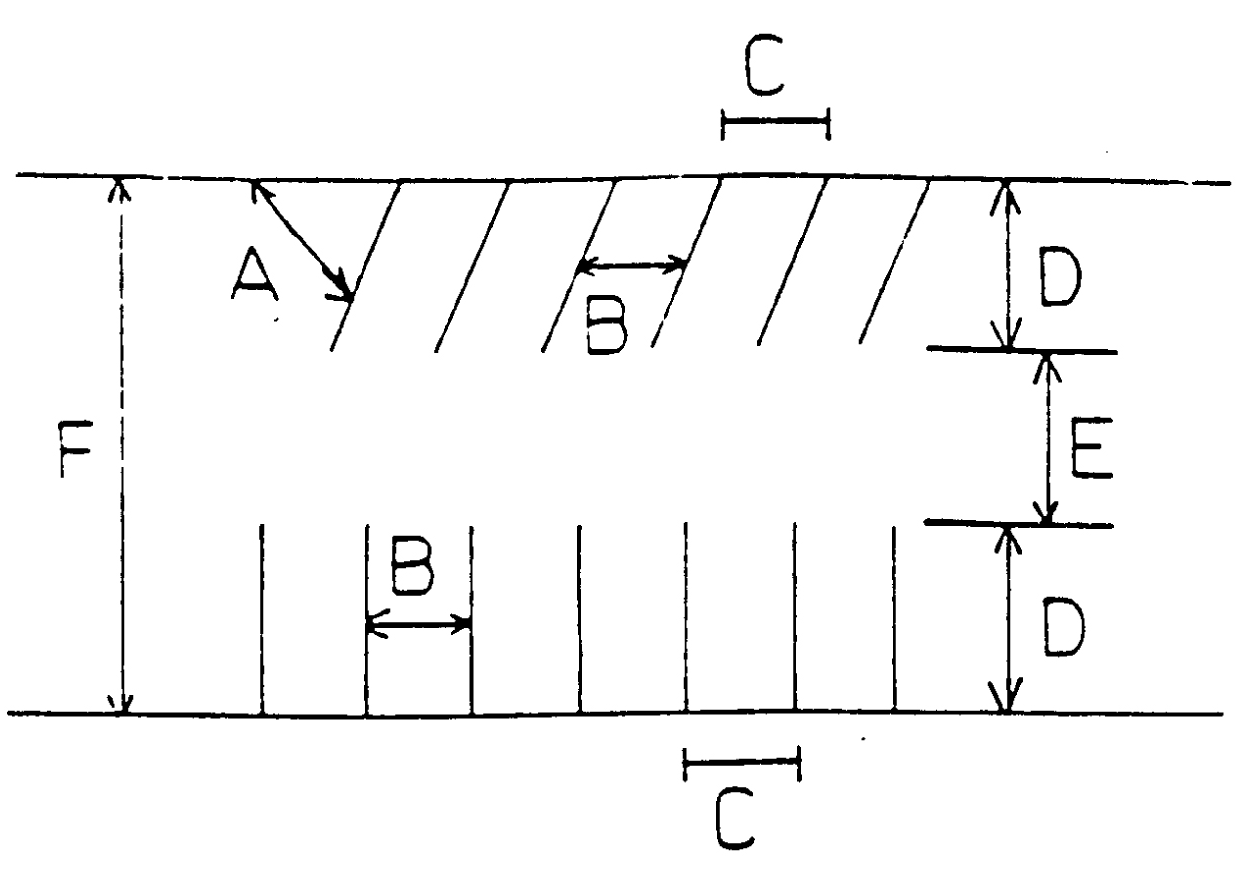
1 Stall width shall be increased by one foot for those spaces which are adjacent to a fence, wall or enclosure. Handicapped spaces shall be 12 feet wide.
2 Stalls which allow for vehicle overhang (next to curb) can be reduced in depth by two feet.
3 One-way aisle operation only.
_____
(7)
Direct access from any parking space in a off-street parking facility:
a.
To any street without the use of a maneuvering lane shall be prohibited.
b.
To an alley without the use of a maneuvering lane may be granted by special permission from the planning commission if all of the following conditions are met:
1.
The spaces are designated for longterm or employee parking only and are so posted;
2.
The alley is designated a one-way alley; and
3.
The entire alley, from street to street, is paved with a hard surface.
(8)
Adequate ingress and egress to the parking lot by means of clearly limited and defined drives shall be provided for all vehicles.
(9)
All maneuvering lane widths shall permit one-way traffic movements, except that the 90-degree pattern may permit two-way movement.
(10)
Each entrance and exit to and from any off-street parking lot located in an area zoned for other than single-family residential use shall be at least 25 feet distant from adjacent property and any single-family residential district.
(11)
Parking lots constructed or site planned after September 28, 1993, shall be illuminated from one-half hour after sunset to one-half hour before sunrise. The lighting of parking lots shall be designed to provide proper illumination levels at all unobstructed points of the parking lots. Separate pedestrian lighting may be installed. This section shall not apply to parking lots for public parks.
(12)
Lighting for parking lots and spaces must be designed and maintained to prevent illumination, glares or reflections into any premises used for residential purposes, and so that it does not adversely affect the vision of motorists on public streets.
(13)
Parking lots shall be equipped with curbs or other barriers to confine vehicles to the parking lot. Driveways, parking lots and structures shall be constructed and maintained in a manner to prevent the formation of potholes and must be kept reasonably free of snow and ice.
(14)
The entire area designated for the parking of vehicles, including parking spaces and maneuvering lanes, shall be provided with asphaltic or concrete surfacing. Upon special approval of the planning commission, an alternative hard surfacing material may be utilized. No certificate of occupancy shall be issued for the business or businesses until the parking facility is properly surfaced. This section shall not apply to public parks.
(15)
The entire parking facility surface shall be drained so that surface water does not accumulate on the surfaced area and does not drain onto adjacent property, roadways or structures.
(16)
Dead-end maneuvering lanes for off-street parking facilities are prohibited, except upon special permission from the planning commission if:
a.
It is no greater than eight spaces deep, or not greater than ten spaces deep if a means to turn vehicles around is provided if all spaces are occupied; and
b.
There is no reasonable alternative as determined by the planning commission for the design of the parking facility.
(17)
Parking facilities shall be landscaped according to the requirements of the approved site plan.
(Ord. No. 92-4, § 1(6.09), 9-28-1993)
Sec. 52-1004. - Storage of test or pool vehicles.
(a)
Storage of test or pool vehicles shall be allowed by special permit only.
(b)
Upon application, the special permit shall be issued and approved by the building inspector if all of the following conditions are met:
(1)
The requested spaces are in the excess of the minimum spaces required for the property use as indicated in section 52-1001(f);
(2)
The vehicles for which the storage is requested belong to the business occupying the property;
(3)
The storage location does not abut any residential zoned district; and
(4)
The vehicle storage area is not visible from the front street of the building.
(c)
The application shall contain:
(1)
Name and address (including e-mail address) of the applicant;
(2)
Location of the requested storage area;
(3)
Number of spaces requested;
(4)
Information showing the requested spaces are in excess of the required minimum spaces required pursuant to section 52-1001(f);
(5)
Length of time requested.
(d)
The permit shall be for a period of time not greater than one year and may be renewed annually.
(e)
A permit fee, as established by council resolution, shall be paid prior to the issuance of the permit. The renewal fee shall be the same as the permit fee in effect at the time of the renewal.
(f)
The permit issued pursuant to this section shall not be transferable.
(g)
Any permit issued may be cancelled by the building inspector upon seven days' notice to the applicant if any of the terms of the permit are violated or if the parking spaces so used become necessary for the normal use of the property.
(Ord. No. 92-4, § 1(6.10), 9-28-1993)
Sec. 52-1005. - Off-street parking A.
Off-street parking A will be permitted in all residential districts including multiple residential districts upon approval of the planning commission. The planning commission shall, prior to granting approval, do the following:
(1)
Determine that commercial or industrial property in adjacent or adjoining area is unavailable or impractical for the development of an off-street parking facility; and
(2)
Determine that the off-street parking A shall be considered a conditional accessory use to adjoining business property and as such is to be used for customer vehicle parking of such adjoining business only; and
(3)
Determine that the penetration into the residential zone shall not exceed 125 feet measured at right angles from the residential property line adjoining such business district; and
(4)
That the planning commission shall hold a public hearing and shall give notice to all owners of record of property and residence within 300 feet of the premises in question.
(Ord. No. 92-4, § 1(6.11), 9-28-1993)
Sec. 52-1006. - Special parking district.
(a)
Properties abutting Park Avenue, between Southfield Road and Regina Avenue, having a building or property address of Park Avenue and all properties abutting and fronting Allen Road between Ecorse/Roosevelt Roads and Southfield Road, shall be considered a special parking district.
(b)
Each property located within this district shall be allocated a percentage of the public parking, both off-street and on-street, in the area. This percentage shall be determined by dividing the total public parking available by the gross square footage of the property.
The building department shall maintain a list of the available number of parking spaces within the district.
(c)
Properties within the special parking districts may provide only 25 percent of the required off-street parking required by section 52-1001(f) if all of the following conditions are met:
(1)
The allocable share of public parking provides 50 percent of the required parking pursuant to section 52-1001(f); and
(2)
The owner or developer pays into the parking bank a fee, per parking space the site is deficient in meeting the parking requirement of section 52-1001(f). This fee shall be established by council resolution; and
(3)
The maximum number of deficient parking spaces which may be purchased shall be 15 spaces.
(d)
On-street public parking spaces within the district shall be allowed to be configured to include an overhang onto the public sidewalk provided there remains four feet of usable public sidewalk when the parking space is occupied.
(Ord. No. 92-4, § 1(6.12), 9-28-1993)
Sec. 52-1007. - Special parking permits.
(a)
Any business or use may seek a special parking permit to allow any requirement of this article to be modified or waived.
(b)
The planning commission shall issue a recommendation to the zoning board of appeals concerning each separate special parking permit requested by an applicant.
(c)
A special parking permit may be granted by the zoning board of appeals only if all of the following conditions exist:
(1)
The requested variance does not eliminate more than 75 percent of the parking spaces required by section 52-1001(f);
(2)
The requested variance will not cause an undue amount of parking on residential streets;
(3)
The requested variance does not alter the size of parking stalls or maneuvering lanes by more than the following percentage of the size required by this article:
a.
Parking stall size only by ten percent;
b.
Maneuvering lane size only by ten percent; or
c.
Parking stall and maneuvering lane size by no more than five percent each.
(d)
In granting a request pursuant to this section, the planning commission, in its recommendation, and the zoning board of appeals, may impose additional conditions not contained in this article to integrate the proposed altered parking facility into the community.
(e)
Unless a shorter time limit is imposed, all special parking permits issued pursuant to this article shall expire upon the termination of the use or business requesting the special parking permit.
(f)
A fee, as currently established or as hereafter adopted by resolution of the city council from time to time, shall be charged for all special parking permits.
(Ord. No. 92-4, § 1(6.13), 9-28-1993)
Sec. 52-1008. - Covenants.
(a)
Whenever an applicant is requested to submit or obtain an agreement or covenant for parking, the applicant shall furnish to the building inspector an agreement or covenant, approved by the city attorney and in a recordable form that:
(1)
Obligates the applicant to keep and maintain the required parking facility as long as the structure or improvement exists for which it was required;
(2)
Provides that no structure can be erected, built or located upon the property dedicated for the parking facility until the covenant or agreement is released by the city council;
(3)
Is executed by all property owners of record, the applicant and lessee;
(4)
Runs to the benefit of the city;
(5)
Recites that the title and right to use the property upon which the parking facility is located will be subservient to the title to the property upon which the structure or improvements is to be erected;
(6)
Shall warrant that the property shall not and is not subject to any other covenant or contract, unless prior written approval is received from the planning commission and the city council.
(b)
The applicant shall, at its expense, provide any title insurance or title commitment as the planning commission or city attorney shall require to ensure compliance with the provisions for which the covenant was required.
(c)
No certificate of occupancy shall be issued until such time that the required covenant has been recorded, as approved. It shall be the applicant's obligation to provide the completed document to the satisfaction of the city attorney, to the city for the recording of the covenant.
(d)
The applicant shall pay, in advance, all costs associated with the recording of the covenant.
(e)
The city council may release the covenant if the applicant, owners or lessee has obtained the required parking elsewhere and has entered into a similar covenant if required, or has removed the structure or use for which the covenant was required.
(Ord. No. 92-4, § 1(6.14), 9-28-1993)
Sec. 52-1009. - Prohibited uses in parking facilities.
The following uses or activities shall be prohibited in all parking facilities:
(1)
Overnight parking of vehicles, trailers, boats or equipment;
(2)
Storing of objects, debris, merchandise or construction material; except debris and/or construction material may be stored while the structure requiring the parking facility is under construction, but shall not be stored during construction for more than six months;
(3)
The advertisement for sale or lease of any vehicle, camper, boat, trailer or similar item, unless conducted in conjunction with a lawful business established for such purpose; and
(4)
The repair of any vehicle or trailer, except necessary emergency repairs to remove the vehicle or trailer.
(Ord. No. 92-4, § 1(6.15), 9-28-1993)
Sec. 52-1010. - Off-street loading requirements.
(a)
On the same premises as every building, structure or part thereof, erected, used or occupied in whole or part for manufacturing, storage, warehousing, hospitals, truck terminal, appliance/furniture stores, strip centers, malls, wholesale businesses, grocery stores, mortuaries or other uses similarly involving the receipt or distribution of vehicles, materials, products or merchandise, there shall be provided and maintained on the same site, in a manner so as not to unduly interfere with the public's use of streets and alleys, space for standing, loading or unloading according to the following schedule:
(b)
All loading or unloading spaces shall be no less than an area 12 feet by 50 feet, with a 15-foot height clearance.
(Ord. No. 92-4, § 1(6.16), 9-28-1993)
Sec. 52-1011. - Off-street waiting requirements.
(a)
On the same premises as every building structure or part thereof, erected, used or occupied in whole or part for the purpose of servicing customers in their vehicles by means of a service window, drive-through bay or similar arrangement, shall be provided off-street waiting spaces as follows:
(b)
An off-street vehicle waiting space shall be a space 9.5 feet wide by 18 feet in length.
(c)
All auto wash facilities shall also provide a drying lane of 50 feet in length at the exit of each washing stall to prevent undue amounts of water from collecting on the public streets and creating traffic hazards.
(Ord. No. 92-4, § 1(6.17), 9-28-1993)
Sec. 52-1012. - Variance and exceptions.
The zoning board of appeals shall have authority to interpret this article and may in specific cases and after public notice and hearings in accordance with their powers grant variances and exceptions to these requirements, providing such variance, special parking permits or exception is in harmony with the general purpose and intent of the requirements of this article.
(Ord. No. 92-4, § 1(6.18), 9-28-1993)
Sec. 52-1013. - Nonconforming uses.
Nonconforming paved parking facilities and driveways lawfully constructed prior to September 1, 1993, may be maintained and continued as nonconforming uses. All new parking facilities or additions to existing parking facilities constructed after September 1, 1993, must meet the requirements of this article. Additions to existing parking facilities shall require the existing parking facility to meet the requirements of this article.
(Ord. No. 92-4, § 1(6.19), 9-28-1993)

