
Alpine City Zoning Code
ARTICLE I
- BASIC ORDINANCE2
ORDINANCE NO. 445
AN ORDINANCE AMENDING, REPLACING AND REPEALING ORDINANCE NO. 434 OF THE CITY OF ALPINE, BREWSTER COUNTY, TEXAS SPECIFICALLY AMENDING PARAGRAPH NO. 7, SECTION 5: PARKING, STORAGE OR USE OF MAJOR RECREATION EQUIPMENT.
WHEREAS V.T.C.A., Local Government Code ch. 211 and all amendments thereto and amendments which may hereafter be made thereto, empowers the city to enact a zoning ordinance and to provide for its administration, enforcement, and amendment, and
WHEREAS the city council deems it necessary, for the purpose of promoting health, safety, morals or general welfare of the city, to enact such an ordinance, and
WHEREAS the city council, pursuant to the provisions of the above stated V.T.C.A., Local Government Code ch. 211, has appointed a zoning commission to recommend the boundaries of the various original districts and appropriate regulations to be enforced therein, and
WHEREAS the zoning commission has divided the city into districts and has prepared regulations pertaining to such districts in accordance with a comprehensive plan and designed to lessen congestion in the streets; to secure safety from fire, panic, and other dangers; to promote health and the general welfare; to provide adequate light and air; to prevent the overcrowding of land; to avoid undue concentration of population; to facilitate the adequate provision of transportation, water, sewerage, schools, parks and other public requirements, and
WHEREAS the zoning commission has given reasonable consideration, among other things, to the character of the districts and their peculiar suitability for particular uses, with a view to conserving the value of buildings and encouraging the most appropriate use of land throughout the municipality, and
WHEREAS the zoning commission has made a preliminary report and held public hearings thereon, and submitted its final report to the city council, and
WHEREAS the city council has given due public notice of hearings relating to zoning districts, regulations and restrictions, and has held such public hearings, and
WHEREAS all requirements of the above stated V.T.C.A., Local Government Code ch. 211, with regard to the preparation of the report of the zoning commission and subsequent action of the city council have been met;
NOW, THEREFORE, BE IT ORDAINED BY THE PEOPLE OF THE CITY OF ALPINE, TEXAS:
Editor's note— Ord. No. 2015-06-02, adopted Nov. 17, 2015, restated and amended former Art. I in its entirety to read as herein set out. Former Art. I pertained to similar subject matter and derived from Ord. No. 445, adopted June 3, 1969, as amended. See the Code Comparative Table for a listing or ordinances that have amended this article. Ordinances which have amended this article as re-enacted by Ord. No. 2015-06-02 are denoted by a legislative history note in parentheses following the amended section.
Section 1. - Establishment of districts: provisions for official zoning map.
1.
Official zoning map—The city is hereby divided into zones, or districts, as shown on the official zoning map which, together with all explanatory matter thereon, is hereby adopted by reference and declared to be a part of this ordinance.
The official zoning map shall be identified by the signature of the mayor attested by the city secretary, and bearing the seal of the city under the following words: "This is to certify that this is the official zoning map referred to in Section 1 of Ordinance Number 445 of the City of Alpine, Texas," together with the date of the adoption of this ordinance.
If, in accordance with the provisions of this ordinance and the above stated V.T.C.A, Local Government Code Ch. 211, changes are made in district boundaries or other matter portrayed on the official zoning map, such changes shall be entered on the official zoning map promptly after the amendment has been approved by the city council, with an entry on the official zoning map as follows: "On (date), by official action of the city council, the following (change) changes were made in the official zoning map: (brief description of nature of change)," which entry shall be signed by the Mayor and attested by the City Secretary. No amendment to this ordinance which involves matter portrayed on the official zoning map shall become effective until after such change and entry has been made on said map.
No changes of any nature shall be made in the official zoning map or matter shown thereon except in conformity with the procedures set forth in this ordinance. Any unauthorized change of whatever kind by any person or persons shall be considered a violation of this ordinance and punishable as provided under Section 16. Any change shall be made by the planning and zoning commission and approved by the city council pursuant to the recommendation of the planning and zoning commission following the requirements of Chapter 211 of the Texas Local Government Code.
Regardless of the existence of purported copies of the official zoning map which may from time to time be made or published, the official zoning map, which shall be located in the office of the city secretary, shall be the final authority as to the current zoning status of land and water areas, buildings and other structures in the city.
2.
Replacement of official zoning map—In the event that the official zoning map becomes damaged, destroyed, lost, or difficult to interpret because of the nature or number of changes and additions, the city council may by resolution adopt a new official zoning map which shall supersede the prior official zoning map. The new official zoning map may correct drafting or other errors or omissions in the prior official zoning map, but no such correction shall have the effect of amending the original official zoning map or any subsequent amendment thereof. The new official zoning map shall be identified by the signature of the mayor attested by the city secretary, and bearing the seal of the city under the following words: "This is to certify that this official zoning map supersedes and replaces the official zoning map adopted (date of adoption of map being replaced) as part of Ordinance No. 445 of the City of Alpine, Texas." Unless the prior official zoning map has been lost, or has been totally destroyed, the prior map or any significant parts thereof remaining, shall be preserved, together with all available records pertaining to its adoption or amendment.
Cross reference— For ordinances amending the zoning map, see article II of this appendix.
Section 2. - Rules for interpretation of district boundaries.
Where uncertainty exists as to the boundaries of districts as shown on the official zoning map, the following rules shall apply:
1.
Boundaries indicated as approximately following the center lines of streets, highways, or alleys shall be construed to follow such center lines;
2.
Boundaries indicated as approximately following platted lot lines shall be construed as following such lot lines;
3.
Boundaries indicated as approximately following city limits shall be construed as following such city limits;
4.
Boundaries indicated as following railroad lines shall be construed to be midway between the main tracks;
5.
Boundaries indicated as parallel to or extensions of features indicated in subsections 1 through 4, above shall be so construed. Distances not specifically indicated on the official zoning map shall be determined by the scale of the map;
6.
Where physical or cultural features existing on the ground are at variance with those shown on the official zoning map, or in other circumstances not covered by subsections 1 through 5, above, the administrative official shall interpret the district boundaries;
7.
Where a district boundary line divides a lot which was in single ownership at the time of passage of this ordinance, the city may permit, as a special exception, the extension of the regulations for either portion of the lot not to exceed 50 feet beyond the district line into the remaining portion of the lot.
Section 3. - Application of district regulations.
The regulations set by this ordinance within each district shall be minimum regulations and shall apply uniformly to each class or kind of structure or land, and particularly, except as hereinafter provided.
1.
No building, structure or land shall hereafter be used or occupied, and no building or structure or part thereof shall hereafter be erected, constructed, reconstructed, moved or structurally altered except in conformity with all of the regulations herein specified for the district in which it is located.
2.
No building or other structure shall hereafter be erected or altered.
(a)
To exceed the height or bulk;
(b)
To accommodate or house a greater number of families;
(c)
To occupy a greater percentage of lot area;
(d)
To have narrower or smaller rear yards, front yards, side yards or other open spaces than herein required; or in any other manner contrary to the provisions of this ordinance.
3.
No part of a yard, or other open space, or off-street parking or loading space required (for the purpose of complying with this ordinance) shall be included as part of a yard, open space, or off-street parking or loading space, required for any other building.
4.
No yard or lot existing at the time of passage of this ordinance shall be reduced in dimension or area below the minimum requirements set forth herein. Yards or lots created after the effective date of this ordinance shall meet at least the minimum requirements established by this ordinance.
5.
All territory which may hereafter be annexed to the city shall be classified by the city council upon annexation. Existing legal uses on the annexed property may be registered as non-conforming uses in accordance with the provisions of this ordinance.
(Ord. No. 2024-05-04, § I(Exh. A), 6-18-24)
Section 4. - Nonconforming lots, nonconforming uses of land, nonconforming structures, nonconforming uses of structures and premises, and nonconforming characteristics of use.
1.
Intent—Within the districts established by this ordinance or amendments that may later be adopted there exist:
(a)
Lots;
(b)
Structures;
(c)
Uses of land and structures; and
(d)
Characteristics of use
Which were lawful before this ordinance was passed or amended, but which would be prohibited, regulated or restricted under the terms of this ordinance or future amendment. It is the intent of this ordinance to permit these nonconformities to continue until they are removed, but not to encourage their survival. It is further the intent of this ordinance that nonconformities shall not be changed or be enlarged upon, expended, or extended, nor be used as grounds for adding other structures or uses prohibited elsewhere in the same district.
Continuance: Except as otherwise required by law, a structure or use legally established prior to the adoption date of this code be maintained unchanged. In other than criminal proceedings, the owner, occupant, or user shall have the burden to show that the structure, lot, or use was lawfully established.
Discontinuance:
a)
Vacancy: Any lot or structure, or portion hereof, occupied by a nonconforming use, that is or hereafter becomes vacant and remains unoccupied by a nonconforming use for a period of 6 months shall not thereafter be occupied, except by a use that conforms to this code.
b)
Damage: If any nonconforming structure or use is, by any cause, damaged to the extent of 50 percent of its value as determined by the code official, it shall not thereafter be reconstructed as such.
Nonconforming uses are declared by this ordinance to be incompatible with permitted uses in the districts involved. A nonconforming use of a structure, a nonconforming use of land, or a nonconforming use of structure and land in combination shall not be extended or enlarged after passage of this ordinance by attachment on a building or premises of additional signs intended to be seen from off the premises, or by the addition of other uses, of a nature which would be prohibited generally in the district involved.
To avoid undue hardship, nothing in this ordinance shall be deemed to require a change in the plans. Construction or designated use of any building on which actual construction was lawfully begun prior to the effective date of adoption or amendment of this ordinance, and upon which actual building construction has been carried on diligently. Actual construction is hereby defined to include the placing of construction materials in permanent position and fastened in a permanent manner. Where excavation or demolition or removal of an existing building has been substantially begun preparatory to rebuilding, such excavation or demolition or removal shall be deemed to be actual construction, provided that work be carried on diligently.
2.
Nonconforming lots of record—No portion of a parcel shall be used or sold in a manner which diminishes compliance with lot width and area requirements established by the ordinance, nor shall any division or any parcel be made which creates a lot with width or area below the requirements stated in this ordinance.
3.
Nonconforming structures—Where a lawful structure exists at the effective date of adoption or amendment of this ordinance that could not be built under the terms of this ordinance by reason of restrictions on area, lot coverage, height, yards, its location on the lot or other requirements concerning the structure, such structure may be continued so long as it remains otherwise lawful, subject to the following provisions:
(a)
No such nonconforming structure may be enlarged or altered in a way which increases its nonconformity, but any structure or portion thereof may be altered to decrease its nonconformity.
(b)
Should such nonconforming structure or nonconforming portion of structure be destroyed by any means to an extent of more than 50 percent of its replacement cost at time of destruction, it shall not be reconstructed except in conformity with the provisions of this ordinance.
(c)
Should such structure be moved for any reason for any distance whatever, it shall thereafter conform to the regulations for the district in which it is located after it is moved.
4.
Nonconforming uses of structures and premises in combination—The lawful use may be continued so long as it remains otherwise lawful, subject to the following provisions:
(a)
No existing structure devoted to a use not permitted by this ordinance in the district in which it is located shall be enlarged, extended, constructed, reconstructed, moved or structurally altered, except in changing the use of the structure to a use permitted in the district in which it is located;
(b)
Any nonconforming use may be extended throughout any parts of a building which were manifestly arranged or designed for such use at the time of adoption or amendment of this ordinance, but no such use shall be extended to occupy any land outside such building.
(c)
Any structure, or structure and land in combination, in or on which a nonconforming use is superseded by a permitted use, shall thereafter conform to the regulations for the district, and the nonconforming use may not thereafter be resumed;
(d)
When a nonconforming use of a structure, or structure and premises in combination, is discontinued or abandoned for six consecutive months or for 18 months during any three-year period (except when government action impedes access to the premises), the structure, or structure and premises in combination, shall not thereafter be used except in conformity with the current regulations of the district in which it is located.
(e)
Where nonconforming use status applies to a structure and premises in combination, removal or destruction of the structure shall eliminate the nonconforming use status of the land. Destruction for the purpose of this subsection is defined as damage to an extent of more than 50 percent of the replacement cost at time of destruction.
5.
Repairs and maintenance—On any nonconforming structure or portion of a structure containing a nonconforming use, work may be done in any period of 12 consecutive months on ordinary repairs, or on repair or replacement of nonbearing walls, fixtures, wiring or plumbing to an extent not exceeding ten percent of the current replacement cost of the nonconforming structure or nonconforming portion of the structure, as the case may be, provided that the cubic content existing when it became nonconforming shall not be increased.
If a nonconforming structure or portion of a structure containing a nonconforming use becomes physically unsafe or unlawful due to lack of repairs and maintenance, and is declared to be unsafe or unlawful by reason of physical condition, and such condition is verified by the administrative official, it shall not thereafter be restored, repaired, or rebuilt except in conformity with the regulations of the district in which it is located.
Nothing in this ordinance shall be deemed to prevent the strengthening or restoring to a safe condition of any building or part thereof declared to be unsafe by any official charged with protecting the public safety, upon order of such official.
6.
Uses under special exception provision not conforming uses—Any use which is permitted as a special exception in a district under the terms of this ordinance (other than a change through city action from a nonconforming use to another use not generally permitted in the district) shall not be deemed a nonconforming use in such district, but shall without further action be considered a conforming use.
(Ord. No. 2025-07-01, Exh. A, 7-15-25)
Section 5. - Schedule of district regulations adopted.
District regulations shall be as set forth in the Schedule of District Regulations, hereby adopted by reference and declared to be a part of this ordinance, and in Section 6 of this ordinance, entitled "Supplementary District Regulations."
Section 6. - Supplementary district regulations.
1.
Visibility of intersections in residential districts—On a corner lot in any residential district, nothing shall be erected, placed, planted or allowed to grow in such manner as materially to impede vision between a height of 2½ and ten feet above the centerline grades of the intersecting streets in the 15-foot × 15-foot sight triangle beginning from the point of intersection along the owner's property lines.
2.
Fences, walls and hedges—Notwithstanding other provisions of this ordinance, fences, walls and hedges may be permitted in any permissible yard, provided that no fence, wall or hedge along the sides or front edge of any front yard, up to the front of the house or structure, shall not be over four feet in height. Fences, walls and hedges may be permitted in any permissible yard, provided that no fence shall be over eight feet in height in the designated side yard (behind the front door of the primary structure) and designated back yard.
3.
Accessory buildings—No accessory building shall be erected in any prohibited yard as described by the regulations below for each specific zoned district or otherwise stated by the adopted building code. No accessory building shall be erected within five feet of interior property lines. Accessory buildings are not to be used as habitable units. Accessory buildings are to be considered temporary not permanently affixed (For structures to be used as living, dwelling, permanently affixed as a secondary living space see Accessory Living Quarters).
4.
One principal structure on a lot—One structure or principal use may be erected on a single lot, provided that yard and other requirements of this ordinance shall be met.
5.
Exceptions to height regulations—The height limitations contained in the Schedule of District Regulations, do not apply to spires, belfries, cupolas, antennas, water tanks, ventilators, chimneys or other appurtenances usually required to be placed above the roof level and not intended for human occupancy.
6.
Structures to have access—Every building hereafter erected or moved shall be on a lot adjacent to a public street, or with access to an approved private street, and all structures shall be so located on lots as to provide safe and convenient access for servicing, fire prevention and required off-street parking.
7.
Parking, storage or use of major recreational and commercial equipment—
(a)
Major recreational equipment is defined as including boats and boat trailers, travel trailers, tiny-homes, pick-up campers (designed to be mounted on automotive vehicles), coaches, motorized dwellings, tent trailers, other equipment for which the primary purpose or use is recreational and the like, and cases or boxes to be used for transporting such recreational equipment.
(b)
Commercial equipment is defined as vehicles, and trailers, and other equipment used in enterprises of retail trade, wholesale trade, the food service industry, and in warehouses and supply depots.
No major recreational or commercial equipment shall be parked or stored on any street or alley in a residential use district or other district not approved for such use. Exception will be loading and unloading, during daylight hours only. No such equipment shall be used for living, sleeping, retail, home occupation, or housekeeping purposes, when parked or stored on a residential lot or in any location not approved for such use. Parking and storage on a residential lot means: No water, sewer connections are to be attached, all slides and bump outs must be closed. Any major recreational equipment as defined in this section must be stored travel ready, not in poor repair or unable to be easily moved.
8.
Carports—A shelter for a car consisting of a roof supported on posts, built beside a house. Not to be covered on more than two sides. Not to exceed the height or bulk of primary structure. The carport can never be converted into a dwelling space. No carport shall be erected within three feet of interior property lines, unless constructed on non-combustible material and may not have any covered sides. Sight triangle regulations apply with corner lots.
9.
Conex containers as accessory buildings.
A.
Accessory buildings as defined in section 6. Supplementary district regulations of this title, may be used as storage buildings, only in accordance with the following:
1.
Permitted: Storage containers fabricated for the purpose of transporting freight or goods on a truck, railroad or ship (Conex) shall be allowed to be set up as a residential storage structure or accessory building.
2.
Building Permit Required: Purchasers, owners or users of storage containers shall obtain a building permit from the City for each container prior to placing or moving the container onto their property.
3.
Setback Requirements: Placement of the storage container shall meet all setback and hold down requirements for the zone in which it will be located.
4.
Exterior Appearance: The exterior of the storage container shall be painted or altered to cover any advertising, lettering or numbers.
5.
Stacking Prohibited: No stacking of storage containers shall be allowed.
6.
Ground Level Location; Permanent Foundation: All storage containers shall be located at ground level for safety. Any storage container located on a permanent foundation must meet all Building Code requirements.
7.
Dwelling Use Prohibited: Storage containers shall not be used as a dwelling unit.
8.
Ventilation: Storage containers shall provide adequate ventilation for personal safety.
B.
Penalty: Any violation of this section shall be punishable as set forth in this title or under the applicable State Building Code.
(Ord. No. 2025-07-01, Exh. A, 7-15-25)
Section 7. - Administration and enforcement; building permits and certificates of zoning compliance.
1.
Administration and enforcement—An administrative official designated by the city manager shall administer and enforce this ordinance, and may be provided with the assistance of such other persons as the city manager may direct.
2.
Building permits required—Any owner or owner's authorized agent who intends to construct, enlarge, alter, repair, move, demolish or change the occupancy of the building or structure, or to erect, install, enlarge, alter, repair, remove, convert or replace any electrical, gas, mechanical or plumbing system, the installation of which is regulated by the adopted code(s) and this ordinance, or to cause any such work to be performed, shall first make application to the building official and obtain the required permit.
No building permit shall be issued by the administrative official, except in conformity with the provisions of this ordinance.
3.
Application for building permit—All applications for building permits shall be accompanied by plans drawn to scale, showing the surveyed dimensions and shape of the lot to be built upon (not required for remodeling to existing structures); the exact sizes and locations on the lot of buildings already existing, if any; and the location and dimensions of the proposed building or alteration. The application shall include such other information as lawfully may be required by the administrative official, including existing or proposed building or alteration; existing or proposed use of the building and land; the number of families, housekeeping units, or rental units the building is designed to accommodate; conditions existing on the lot; and such other matters as may be necessary to determine conformance with, and provide for the enforcement of, this ordinance.
The original copy shall be retained by the administrative official.
4.
Certificates of occupancy for new, altered or nonconforming uses—It shall be unlawful to use or occupy or permit the use or occupancy of any building or premises, or both, or part thereof hereafter created, erected, changed, converted or wholly or partly altered or enlarged in its use or structure until a certificate of occupancy shall have been issued therefor by the administrative official stating that the proposed use of the building or land conforms to the requirements of this ordinance.
No nonconforming structure or use shall be renewed, changed or extended until a certificate of occupancy compliance shall have been issued by the administrative official.
HUD Code Manufactured Home Compliance: Certificate of Occupancy shall not be issued until compliance with the Texas Department of Housing and Community Affairs/Manufactured Housing Division: Administrative Rules of the Texas Department of Housing and Community Affairs 10 Texas Administrative Code, Chapter 80.
Temporary certificates of occupancy may be issued by the administrative official for a period not exceeding six months during alterations or partial occupancy of a building pending its completion, provided that such temporary certificate may include such conditions and safeguards as will protect the safety of the occupants and the public.
The administrative official shall maintain a record of all certificates of occupancy, and a copy shall be furnished upon request to any person, for review.
Failure to obtain a certificate of occupancy shall be a violation of this ordinance and punishable under Section 16 of this ordinance.
5.
Expiration of building permit—If the work described in any building permit has not begun within 180 days from the date of issuance thereof, said permit shall expire; if the work described in any building permit is not completed within a reasonable time of that designated for completion in the permit, the permit shall expire by limitation and be void. The administrative official shall cancel the permit, and written notice thereof shall be given to the persons affected, together with notice that further work as described in the canceled permit, shall not proceed unless and until a new building permit has been obtained.
(Ord. No. 2025-07-01, Exh. A, 7-15-25)
Section 8. - Home occupations.
1.
Home occupation (Home-based Business)—A business that is operated from a residential property; by the owner or tenant of the property; and for the purpose of manufacturing, providing, or selling a lawful good; or providing a lawful service, provided that all home occupation uses are subject to conditional use permits as provided in Section 20. Required that all home-based businesses including no-impact businesses are to comply with federal, state, and local laws, to be compatible with residential use, and remain secondary to residential purposes. Prohibited home-based businesses involving alcohol sales, illegal drugs, sober living homes, or sexually oriented businesses.
(a)
Other than members of the family residing on the premises, not more than one person shall be employed by the home occupation.
(b)
The home occupation shall not exceed 15 percent of the floor area of the primary structure.
(c)
Inventory and supplies shall not occupy more than 50 percent of the area permitted to be used as a home occupation.
(d)
There shall be no change in the outside appearance of the building or premises, or other visible evidence of the conduct of such home occupation other than one sign, not exceeding one square foot in the area, non-illuminated, and mounted flat against the wall of the principal building.
(e)
Home occupations require a conditional use permit.
(f)
There shall be no on-site store front retail or wholesale sales of goods in connection with such home occupation.
(g)
No traffic shall be generated by such home occupation in greater volumes than would normally be expected in a residential neighborhood, and two additional parking spaces shall be provided on the premises, except only one need be provided if the home occupation does not have an employee. Said parking shall comply with the parking requirements in Chapter 8 of the International Zoning Code.
(h)
Sales and services to patrons shall be arranged by appointment and scheduled so that not more than one patron vehicle is on the premises at the same time.
(i)
No equipment or process shall be used in such home occupation which creates noise, vibration, glare, fumes, odors or electrical interference detectable to the normal senses off the lot, if the occupation is conducted in a single family residence. In the case of electrical interference, no equipment or process shall be used which creates visual or audible interference in any radio or television receivers off the premises.
(j)
Occupant must reside and must be the primary business occupant of the residence, occupant must maintain the property as the main residence and not allow that the home occupation become the primary use of the property.
(k)
The character of the home must remain intact and the neighborhood must not change in character, the preservation of a residential neighborhood must be a priority.
(l)
Home occupations can be used if the business or occupation falls within the listed occupations such as a professional office, technology office, or telecommunicating business, or professional doctor or pharmacist, beauty shops or barber shops, Bed and breakfast, VRBO, Day care services, Educational facilities, Libraries, museums, Municipal buildings, other city installations, Parks, Religious assembly, tattoo parlor, massage studios, auto repair or detailing, pet grooming.
2.
No-impact Home Occupation "No-impact home-based business" one operated from residential property by the owner or tenant, focused on lawful goods or services. A "no-impact home-based business" is further defined as one that does not exceed municipal occupancy limits, generate on-street parking, significantly increase traffic, or have activities visible from the street. No-impact home occupations (No-impact home businesses) are exempt from permitting,
A home-based business that:
(a)
has at any time on the property where the business is operated a total number of employees and clients or patrons of the business that does not exceed the municipal occupancy limit for the property;
(b)
does not generate on-street parking or a substantial increase in traffic through the area;
(c)
operates in a manner in which none of its activities are visible from a street; No signage or visible business activity.
(d)
does not substantially increase noise, odors or vibrations in the area or violate a municipal noise ordinance, regulation, or rule.
(e)
operated by the resident; The business must be run by someone who lives on the property.
(f)
no Customer or client traffic; No regular visits from clients, customers, or delivery services beyond normal residential levels.
(g)
no Hazardous Materials or excessive waste beyond what's typical for a household.
(h)
Compliant with local codes.
(i)
No-impact Home occupations can be used if the business or occupation falls within the listed occupations such as a freelance writing or editing, Graphic design or illustration, Web development or coding, virtual assistant services, online tutoring or coaching, translation or transcript work, Handmade jewelry or craft sold online, print-on-demand design (e.g. T-shirts, mugs), homemade candles or soaps (small batch, no strong odors), Service-based work (done off site or virtually): consulting, bookkeeping, voiceover or podcast, remote tech support, photography. Skilled trades (with off-site work): Landscaper or gardener, electrician or plumber, handyman or contractor, personal chef or housekeeper.
(Ord. No. 2025-07-01, Exh. A, 7-15-25)
Section 9. - Reserved.
Editor's note— Ord. No. 2022-10-03, § I(Exh. A), adopted November 1, 2022, repealed art. I, § 9 which pertained to the building and standards commission and derived from Ord. No. 2015-03-01, adopted May 19, 2015; and Ord. No. 2016-10-02, adopted November 1, 2016. Similar provisions may now be found in art. IX of ch. 16.
Section 11. - Duties of administrative official, city council and courts on matters of appeal.
It is the intent of this ordinance that all questions of interpretation and enforcement shall be first presented to the administrative official, and that recourse from the decisions of the administrative official shall be to the courts as provided by the laws of the State of Texas.
It is further the intent of this ordinance that the duties of the city council in connection with the ordinance shall not include hearing and deciding questions of interpretation and enforcement that may arise. The procedure for deciding such questions shall be as stated in this section and this ordinance. Under this ordinance the city council shall have only the duties:
(1)
Of considering and adopting or rejecting proposed amendments or the repeal of this ordinance, as provided by law; and
(2)
Of establishing a schedule of fees and charges as stated in Section 12, below.
Section 12. - Schedule of fees, charges and expenses.
The city council shall establish a schedule of fees, charges and expenses and a collection procedure for building permits, certificates of occupancy or zoning compliance, appeals and other matters pertaining to this ordinance. The schedule of fees shall be posted in the office of the administrative official, and may be altered or amended only by the city council. Until all applicable fees, charges and expenses have been paid in full, no action shall be taken on any application or appeal.
(Ord. No. 2025-07-01, Exh. A, 7-15-25)
Section 13. - Amendments.
The city adopts the procedures of Section 211.007 of the Local Government Code in order to make amendments and zoning changes by following the code by having a public hearing before the planning and zoning commission and notifying the residents within 200 feet of the proposed change 11 days before the hearing; by submitting recommendations to the city council and allowing city council to conduct a second hearing; and by publishing in the local newspaper 16 days before the hearing. The regulations, restrictions and boundaries set forth in this ordinance may, from time to time, be amended, supplemented, changed or repealed; provided, however, that no such action may be taken until after a public hearing in relation thereto, at which parties in interest and citizens shall have an opportunity to be heard. Such amendments shall not become effective except by the affirmative vote of at least three-fourths of all members of the city council.
Section 14. - Provisions of ordinance declared to be minimum requirements.
In their interpretation and application, the provisions of this ordinance shall be held to be minimum requirements, adopted for the promotion of the public health, safety, morals or general welfare. Wherever the requirements of this ordinance are at variance with the requirements of any other lawfully adopted rules, regulations, ordinance, deed restrictions or covenants, the most restrictive, specific, or that imposing the higher standards, shall govern.
(Ord. No. 2025-07-01, Exh. A, 7-15-25)
Section 15. - Complaints regarding violations.
Whenever a violation of this ordinance occurs, or is alleged to have occurred, any person may file a written complaint. Such complaint stating fully the causes and basis thereof shall be filed with the administrative official. He/she shall record properly such complaint, immediately investigate, and take action thereon as provided by this ordinance.
Section 16. - Penalties for violation.
Violation of the provisions of this ordinance or failure to comply with any of its requirements (including violations of conditions and safeguards established in connection with grants of variances or special exceptions) shall constitute a misdemeanor. Any person who violates this ordinance or fails to comply with any of its requirements shall, upon conviction thereof, be fined not more than $2,000.00, and in addition, shall pay all costs and expenses involved in the case. Each day such violation continues shall be considered a separate offense.
The owner or tenant of any building, structure, premises or part thereof, and any architect, builder, contractor, agent or other person who commits, participates in, assists in or maintains such violation may each be found guilty of a separate offense and suffer the penalties herein provided.
Nothing herein contained shall prevent the city from taking such other lawful action as is necessary to prevent or remedy any violation.
Section 17. - Separability clause.
Should any section or provision of this ordinance be declared by the courts to be unconstitutional, or invalid, such decision shall not affect the validity of the ordinance as a whole, or any part thereof, other than the part so declared to be unconstitutional or invalid.
Section 18. - Definitions.
For the purposes of this ordinance, certain terms or words used herein shall be interpreted as follows:
The word person includes a firm, association, organization, partnership, trust, company or corporation, as well as an individual.
The present tense includes the future tense, the singular number includes the plural, and the plural number includes the singular.
The word shall is mandatory, the word may is permissive.
The words used or occupied include the words intended, designed or arranged to be used or occupied.
The word lot includes the words plot or parcel.
Abutting—Having lot lines or district boundaries in common.
Access—A way or means of approach to provide physical entrance and exit to a property.
Accessory Building—An incidental subordinate building customarily incidental to and located on the same lot occupied by the main use or building, such as a detached garage. Not to be used as a habitable space.
Accessory Living Quarters—An accessory building used solely as the temporary dwelling of guest of the occupants of the premises.
Accessory Use—A use conducted on the same lot as the primary use of the structure to which it is related; a use that is clearly incidental to, and customarily found in connection with, such primary use.
Addition—Any construction which increases the size of a building or structure in terms of site coverage, height, length, width or gross floor area.
Administrative official—Duly appointed agent of the city manager responsible for interpretation and enforcement of the zoning code, and building code.
Agent of Owner—Any person showing written verification that he or she is acting for, and with the knowledge and consent of, a property owner.
Alley—Any public way or thoroughfare more than 10 feet (3048mm), but less than 16 feet (4877 mm), in width, which has been dedicated to the public for public use.
Alteration—Any change, addition or modification in construction, occupancy or use.
Apartment House—A residential building designed or used for three or more dwelling units.
Attached—Having one or more walls in common with principal building or joined to a principal building by a covered porch, loggia or passageway, the roof of which is a part or extension of the principal building.
Bed and Breakfast—A lodging establishment that offers overnight accommodation and provides breakfast.
Boarding House—A dwelling containing a single dwelling unit and not more than 10 sleeping units, where lodging is provided with or without meals, for compensation for more than one week.
Buildable area—The portion of a lot remaining after required yards have been provided.
Building—Any structure used or intended for supporting or sheltering any use or occupancy.
Building, Main—A building in which the principal use of the site is conducted.
Building, Temporary—A building used temporarily for the storage of construction materials and equipment incidental and necessary to on-site permitted construction of utilities, or other community facilities, or used temporarily in conjunction with the sale of property within a subdivision under construction.
Building Code—The International Building Code promulgated by the International Code Council, as adopted by the jurisdiction.
Campground—Campground facilities providing camping and/or parking areas and incidental services for travelers in recreational vehicles or tents. Typical uses include recreational vehicle parks.
Canopy—A roofed structure constructed of fabric or other material supported by the building or by the support extending to the ground directly under the canopy placed so as to extend outward from the building providing a protective shield for doors, windows and other opening.
Carport—A roofed space, open on two sides (unless with in fire separation of lot line), one story in height, covered with a flat or hipped roof and ordinarily sed as a shelter under which vehicles are driven or temporarily parked.
Casita—A single family home with a smaller footprint. That is built on a permanent foundation (not moveable). The modular home specifications requirements found in the R-1 section (D) applies to this type of housing.
Conex boxes (shipping container)—A steel reinforced reusable container primarily used for shipping cargo, not to be used as a dwelling except as provided herein.
Commercial, Heavy—An establishment or business that generally uses open yards, outside equipment storage or outside activities that generate noise or other impacts considered incompatible with less-intense uses. Typical businesses in this definition are lumber yards, construction specialty services, heavy equipment suppliers or building contractors.
Commercial, Light—An establishment or business that generally has retail or wholesales, office uses, or services, which do not generate noise or other impacts considered incompatible with less-intense uses. Typical businesses in this definition are retail stores, offices, catering services or restaurants.
Commercial Center, Community—A completely planned and designed commercial development providing for the sale of general merchandise and/or convenience goods and services. A community commercial center shall provide for the sale of general merchandise, and may include a variety store, discount store, supermarket.
Commercial Center, Convenience—A completely planned and designed commercial development providing for the sale of general merchandise and/or convenience goods and services. A convenience commercial center shall provide a small cluster of convenience shops or services.
Commercial Center, Neighborhood—A completely planned and designed commercial development providing for the sale of general merchandise and/or convenience goods and services. A neighborhood commercial center shall provide for the sales of convenience goods and services, with a supermarket as the principal tenant.
Commercial Center, Regional—A completely planned and designed commercial development providing for the sale of general merchandise and/or convenience goods and services. A regional center shall provide for the sale of general merchandise, apparel, furniture, home furnishings, and other retail sales and services, in full depth and variety.
Commercial Retail Sales and Services—Establishments that engage in the sale of general retail goods and accessory services. Businesses within this definition include those that conduct sales and storage entirely within this definition include those that conduct sales and storage entirely within an enclosed structure (with the exception of occasional outdoor "sidewalk" promotions); businesses specializing in the sale of either general merchandise or convenience goods.
Comprehensive Plan—The declaration of purposes, policies and programs for the development of the jurisdiction.
Conditional Use—A use that would become harmonious or compatible with neighboring uses through the application and maintenance of qualifying conditions.
Condominium—A single-dwelling unit in a multiunit dwelling or structure, that is separately owned and may be combined with an undivided interest in the common areas and facilities of the property.
Congregate Residence—Any building or portion thereof that contains facilities for living, sleeping and sanitation as required by this code, and may include facilities for eating and cooking for occupancy by other than a family. A congregate residence shall be permitted to be a shelter, convent, monastery, dormitory, fraternity or sorority, but does not include jails, hospitals, nursing homes, hotels or lodging houses.
Cottage Court housing—A residential development method where a group of two or more smaller (500 square foot minimum) detached or attached single family homes are built together on one lot, often with shared open space. (see "Casita). Must be accompanied by site plan and design for more than one dwelling for development.
Court—A space, open and unobstructed to the sky, located at or above grade level on a lot and bound on three or more sides by walls of a building.
Day Care, Family—The keeping for part-time care and/or instruction, whether or not for compensation, of six or less children at any one time within a dwelling, not including members of the family residing on the premises.
Day Care, Group—An establishment for the care and/or instruction, whether or not for compensation, of seven or more persons at any one time. Child nurseries, preschools and adult care facilities are included in this definition.
Density—The number of dwelling units that are allowed on an area of land, which area of land shall be permitted to include dedicated streets contained within the development.
Detached—Fully separated from any other building or joined to another building by structural members not constituting an enclosed or covered spaced.
District, Apartment—A type of zoning classification that allows for multi-unit residential developments, dictated by the R-3 designation of this ordinance.
District, Business—A type of zoning classification that allows for commercial activities, dictated by C-2 designation of this ordinance.
District, Historic—A geographically defined area which posses significant concentration, linkage or continuity of buildings, structures, sites, areas or land, which in turn are united by architectural, historical, archaeological or cultural importance or significance and which the City Council determines shall be protected, enhanced and preserved.
District, Industrial—A type of zoning classification that allows production and industry activities, dictated by the M-1 designation of this ordinance.
District, Mixed Residential—A type of zoning classification that allows for a mix of residential dwellings in the same zoning district, dictated by the R-4 designation of this ordinance.
District, Multi-Family—A type of zoning classification that allows for multi-unit residential developments, dictated by the R-2 designation of this ordinance.
District, Neighborhood Commercial—A type of zoning classification that allows areas suitable for transitional uses between more intensive commercial activities and residential uses, dictated by the C-1 and C-1a designations of this ordinance.
District, Office Services—A type of zoning classification that allows for a mix of office and residential uses, with a focus in accommodating small-scale offices in or adjacent to residential neighborhoods, dictated by the C-0 designation of this ordinance.
District, One-Family—A type of zoning classification that allows only single-family dwellings, dictated by the R-1 designation of this ordinance.
Drive-in restaurant or refreshment stand—Any place or premises used for sale, dispensing or serving of food and refreshments, including those establishments where customers may serve themselves and may eat or drink the food, refreshments or beverages on the premises.
Driveway—A private access road, the use of that is limited to persons residing, employed, or otherwise using or visiting the parcel in which it is located.
Duplex—The use of a site for two dwelling units, within a single building, other than a manufactured home.
Dwelling, Multiple Unit—A building or portion thereof designed for occupancy by three or more families living independently in which they may or may not share common entrances and/or other spaces. Individual dwelling units may be owned as condominiums or offered for rent.
Dwelling, Single Family—A detached dwelling unit withkitchen and sleeping facilities, designed for occupancy by one family.
Dwelling, Two Family—A building designed or arranged to be occupied by two families living independently, with the structure having two dwelling units.
Dwelling Unit—A single unit providing complete, independent living facilities for one or more persons, including permanent provisions for living, sleeping, eating, cooking and sanitation.
Easement—That portion of land or property reserved for present or future use by a person or agency other than the legal fee owner(s) of the property. The easement shall be permitted to be for use under, on or above said lot or lots.
Enclosed—A roof or covered space fully surrounded by walls, including windows, doors, and similar openings or architectural features, or an open space of less than 100 square feet fully surrounded by a building or walls exceeding eight-feet in height.
Family—One or more persons occupying a single dwelling unit, provided that unless all members are related by blood or marriage, no such family shall contain over five persons, but further provided, that domestic servants employed on the premises may be housed on the premises without being counted as a family or families.
Filling station—Buildings and premises where gasoline, oil, grease, batteries, tires and automobile accessories may be supplied and dispensed at retail, and where, in addition, the following services may be rendered and sales made, and no other:
(a)
Sale and servicing of spark plugs, batteries and distributors and distributor parts.
(b)
Tire servicing and repair, but not recapping or re-grooving.
(c)
Replacement of mufflers, and tail pipes, water hose, fan belts, brake fluid, light bulbs, fuses, floor mats, seat covers, windshield wipers and wiper blades, grease retainers, wheel bearings, mirrors and the like.
(d)
Radiator cleaning and flushing.
(e)
Washing and polishing, and sale of automotive washing and polishing materials.
(f)
Greasing and lubrication.
(g)
Providing and repairing fuel pumps, oil pumps and lines.
(h)
Minor servicing and repair of carburetors.
(i)
Emergency wiring repairs.
(j)
Adjusting and repairing brakes.
(k)
Minor motor adjustments not involving removal of the head or crankcase or racing the motor.
(l)
Sales of cold drinks, packaged foods, tobacco and similar convenience goods for filling station's customers, as accessory and incidental to principal operation.
(m)
Provision of road maps and other informational material to customers; provisions of rest room facilities. Uses permissible at a filling station do not include major mechanical and body work, straightening of body parts, painting, welding, storage of automobiles not in operating condition, or other work involving noise, glare, fumes, smoke or other characteristics to an extent greater than normally found in filling stations. A filling station is not a repair garage, nor a body shop.
Frontage—The width of a lot or parcel abutting a public right-of-way measured at the front property line.
Garage, Private—A building or a portion of a building not more than 1,000 square feet (92.9m 2 ) in area, in which only private or pleasure-type motor vehicles used by the tenants of the building or buildings on the premises are stored or kept.
Group Care Facility—A facility, required to be licensed by the state, which provides training, care, supervision, treatment and/or rehabilitation to the aged, disabled, those convicted of crimes, or those suffering the effects of drug or alcohol; this does not include day care centers, family day care homes, foster homes, schools, hospitals, jails, or prisons.
Habitable Space (Room)—Space in a structure for living, sleeping, eating, or cooking. Bathrooms, toilet, compartments, closets, halls, storage or utility space, and similar areas are not considered habitable space.
Home occupation—The partial use of a home for commercial or nonresidential uses by a resident thereof, which is subordinate and incidental to the use of the dwelling for residential purposes.
Hospital—An institution designed for the diagnosis, treatment and care of human illness or infirmity and providing health services, primarily for inpatients, and including as related facilities, laboratories, outpatient departments, training facilities and staff offices.
HUD code manufactured home—A structure constructed on or after June 15, 1976, according to the rules of the United States Department of Housing and Urban Development, transportable in one or more sections, which, in the traveling mode, is eight body feet or more in width or 40 body feet or more in length, or, when erected on site, is 320 or more square feet, and which is built on a permanent chassis and designed to be used as a dwelling with or without a permanent foundation when connected to the required utilities, and includes the plumbing, heating, air conditioning and electrical systems. The term does not include a recreational vehicle as that term is defined by 24 CFR 3282.8(g).
Industrialized Housing/Modular—
A residential structure that is:
(a)
Designed for the occupancy of one or more families;
(b)
Constructed in one or more modules or constructed using one or more modular components built at a location other than the permanent site; and
(c)
Designed to be used as a permanent residential structure when the module or the modular component is transported to the permanent site and erected or installed on a permanent foundation system.
Impervious Cover—Any type of surface that prevents the infiltration of water into the ground. Surfaces such as stone, rooftops, patios, driveways, sidewalks, road ways, parking lots, and decomposed or crushed granite gravel (when utilized for parking areas and paths from ADA parking spaces to the entrance of buildings or structures) shall be considered as impervious cover.
Internal Street—A private way which affords the principal means of access to individual manufactured home space, a private right-of-way or other non-public street within a Planned Unit Development (PUD) or other similar development.
Jurisdiction—The governmental unit that has adopted this code.
Kennels—Boarding and care services for dogs, cats and similar animals. Typical uses include boarding kennels, pet motels or dog training center.
Kiosk—A small light structure with one or more open sides for general retail sales use only.
Landscaping—The finishing and adornment of unpaved yard areas. Materials and treatment generally include naturally growing elements such as grass, trees, shrubs, and flowers. This treatment shall be permitted to include the use of logs, rocks, fountains, water features and contouring of the earth.
Laundry Services—Establishments primarily engaged in the provisions of laundering, dry cleaning or dyeing services other than those classified as Personal Services. Typical uses include bulk laundry and cleaning plants, diaper services or linen supply services.
Legislative Body—The political entity of the adopting jurisdiction.
Loading space, off-street—Space logically and conveniently located for bulk pick-ups and deliveries, scaled to delivery vehicles expected to be used, and accessible to such vehicles when required off-street parking spaces are filled. Required off-street loading space is not to be included as off-street parking space in computation of required off street parking space.
Lot—A portion or parcel of land considered as a unit. Such lot shall have frontage on an improved public street, or on an approved private street, and may consist of:
(a)
A single lot of record;
(b)
A portion of a lot of record;
(c)
A combination of complete lots of record, of complete lots of record and portions of lots of record, or of portions of lots of record;
(d)
A parcel of land described by metes and bounds, provided that in no case of division or combination shall any residual lotor parcel be created which does not meet the requirements of this ordinance.
Lot frontage—The front of a lot shall be construed to be the portion nearest the street. For the purposes of determining yard requirements on corner lots and through lots, all sides of a lot adjacent to streets shall be considered frontage, and yards shall be provided as indicated under Yards in this section.
Lot Line—A lot line is a boundary of a zoning lot.
Lot measurements:
(a)
Depth of a lot shall be considered to be the distance between the midpoints of straight lines connecting the foremost points of the side lot lines in front and the rearmost points of the side lot lines in the rear.
(b)
Width of a lot shall be considered to be the distance between straight lines connecting front and rear lot lines at each side of the lot, measured across the rear of the required front yard; provided, however, that width between side lot lines at their foremost points (where they intersect with the street line) shall not be less than 80 percent of the required lot width except in the case of lots on the turning circle of cul-de-sacs, where the 80 percent requirement shall not apply.
Lot of record—A lot which is part of a subdivision recorded in the office of the county clerk, or a lot or parcel described by metes and bounds, the description of which has been so recorded.
Lot types—The diagram (Figure 1) which follows, illustrates terminology used in this ordinance with reference to corner lots, interior lots, reversed frontage lots and through lots:
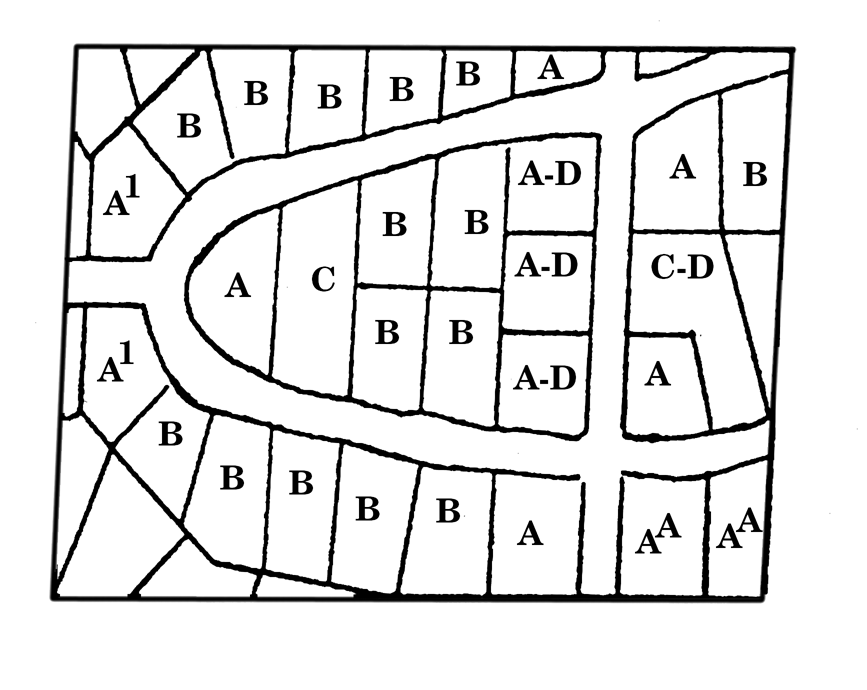
In the diagram, A = corner lot, defined as a lot located at the intersection of two or more streets. A lot abutting on a curved street or streets shall be considered a corner lot if straight lines drawn from the foremost points of the side lot lines to the foremost point of the lot meet at an interior angle of less than 135 degrees. See lots marked A1 in the diagram.
B = interior lot, defined as a lot other than a corner lot with only one frontage on a street.
C = through lot, defined as a lot other than a corner lot with frontage on more than one street. Through lots abutting two streets may be referred to as double frontage lots.
D = reversed frontage lot, defined as a lot on which the frontage is at right angles or approximately right angles (interior angle less than 135 degrees) to the general pattern in the area. A reversed frontage lot may also be a corner lot (A-D in the diagram), an interior lot (B-D) or a through (C-D).
Manufactured housing—Refers to an HUD code manufactured home. A structure, transportable in one or more sections, that in the traveling mode is 8 body feet or more in width or 40 body feet or more in length, or, were erected on site is 320 square feet or more and is built on a permanent chassis and designed to be used as a dwelling with or without a permanent foundation where connected to required utilities, and includes the plumbing, heating, air conditioning and electrical systems contained therein.
Modular—Refers to a single-family house. A modular is a portable home or commercial building that is built at an off-site facility and transported to a more permanent plot for assembly. Assembled on a permanent foundation. Must meet the requirements set forth herein.
Mobile home—A structure that was constructed before June 15, 1976, transportable in one or more sections, which, in the traveling mode is eight body feet or more in width or 40 body feet or more in length, or when erected on site is 320 or more square feet, and which is built on a permanent chassis designed to be used as a dwelling with or without a permanent foundation when connected to the required utilities, and includes the plumbing, heating, air conditioning and electrical systems.
Mortuary, Funeral Home—An establishment in which the dead are prepared for burial or cremation. The facility shall be permitted to include a chapel for the conduct of funeral services and spaces for funeral services and informal gathering, and/or display of funeral equipment.
Motel, Hotel—Any building containing six or more sleeping units intended or designed to be used, or that are used, rented or hired out to be occupied, or that are occupied for sleeping purposes by guest.
Nonconforming Lot—A lot where the width, area or other dimension did not conform to the regulations when this ordinance became effective.
Nonconforming Sign—A sign or sign structure or portion thereof lawfully existing at the time of this ordinance became effective, which does not now conform.
Nonconforming Structure—A building or structure or portion thereof lawfully existing at the time this ordinance became effective, which was designed, erected or structurally altered for a use hat does not conform to the zoning regulations of the zone in which it is located.
Occupant—One who occupies a particular place.
Open space—Land areas that are not occupied by buildings, structures, parking areas, streets, alleys or required yards. Open space shall be permitted to be devoted to landscaping, preservation of natural features, patios, and recreational areas and facilities.
Outdoor advertising business—Provision of outdoor displays or display space on a lease or rental basis only.
Owner—The person or entity that holds legal or equitable title to a property.
Park—A public or private area of land, with or without buildings, intended for outdoor active or passive recreational uses.
Parking Lot—An open area, other than a street, used for the parking of automobiles.
Parking Space, Automobile—A space within a building or private or public parking lot, exclusive of driveways, ramps, columns, office and work areas, for the parking of an automobile.
Parking space, off-street—For the purposes of this ordinance, an off-street parking space shall consist of a space adequate for parking an automobile with room for opening doors on both sides, together with properly related access to a public street or alley and maneuvering room.
Required off-street parking areas for three or more automobiles shall have individual spaces marked, and shall be so designed, maintained and regulated that no parking or maneuvering incidental to parking shall be on any public street, walk or alley, and so that any automobile may be parked and unparked without moving another.
For purposes of rough computation, an off-street parking space and necessary access and maneuvering room may be estimated at 300 square feet, but off-street parking requirements will be considered to be met only when actual spaces meeting the requirements above are provided and maintained, improved in a manner appropriate to the circumstances of the case, and in accordance with all ordinances and regulations of the city.
Person—An individual, heirs, executors, administrators or assigns, and includes a firm partnership or corporation, its or their successors or assigns, or the agent of any of the aforesaid.
Planned Unit Development (PUD)—A residential of commercial development guided by a total design plan in which one or more of the zoning or subdivision regulations, other than use regulations, shall be permitted to be waived or varied to allow flexibility and creativity in site and building design and location, in accordance with general guidelines.
Planning and Zoning Commission—The Planning and Zoning Commission created and appointed by the City Council.
Plot Plan—A plot of a lot, drawn to scale, showing the actual measurements, the size and location of any existing buildings or buildings to be erected. The location of the lot in relation to abutting streets, and other such information.
Public Improvement—Any drainage ditch, storm sewer or drainage facility, sanitary sewer, water main, roadway, parkway, sidewalk, pedestrian way, tree, lawn, off-street parking area, lot improvement, or other facility for which the local government may ultimately assume the responsibility for maintenance and operation, or for which the local government responsibility is established.
Public Utility Station—A structure or facility used by a public or quasi-public utility agency to store, distribute, generate electricity, gas, telecommunications, and related equipment, or to pump or chemically treat water. This does not include storage or treatment of sewage, solid waste, or hazardous waste.
Public Way—Any street, alley or other parcel of land open to the outside air, that has been deeded, dedicated or otherwise permanently appropriated to the public for public use and has a clear width and height of not less than 10 feet (3048 mm).
Quadplex (fourflex)—A type of multifamily property with four separate units, each with its own entrance and utility setup. Quadplex means four units or parts. Each section of the apartment building and housing structure must be a complete unit and have a separate, lockable front door. Each unit of a quadplex has its own kitchen, bathroom(s), living room, separate doors to the outside, and its own address or unit number.
Quasi-Public—Essentially a public use, although under private ownership or control.
Recreation, Indoor—An establishment providing completely enclosed recreation activities. Accessory uses shall be permitted to include the preparation and serving of food and/or the sale of equipment related to the enclosed uses. Included in this definition shall be bowling, roller skating, or ice skating, billiards, pool, motion picture theaters, and related amusements.
Recreation, Outdoor—An area free of buildings except for restrooms, dressing rooms, equipment storage, maintenance buildings, open-air pavilions and similar structures used primarily for recreational activities.
Recreational vehicle (R.V.)—A type of mobile living unit that is a vehicle built on a chassis 400 square feet or less when measured at the largest horizontal projection; self-propelled or permanently towable by a car or light duty truck; and designed primarily for recreational, camping, travel or seasonal use. A vehicle which is self-propelled or designed to be towed by a motor vehicle but is not designed to be used as a permanent dwelling and containing plumbing, heating and electrical systems that can be operated without connection to outside utilities.
Recycling Facility—Any location whose primary use is where waste or scrap materials are store, bought, sold, accumulated, exchanged, packaged, disassembled, or handled, including, but not limited to, scrap metals, paper, rags, tires and bottles, and other such materials.
Registered Design Professional—An individual who is registered or licensed to practice their respective design profession as defined by the statutory requirements of the professional registration laws of the state or jurisdiction in which the project is to be constructed.
Rehabilitation Center (Halfway House) —An establishment where the primary purpose is the rehabilitation of persons. Such services include drug and alcohol rehabilitation, assistance to emotionally and mentally disturbed persons, and halfway houses for prison parolees and juveniles.
Religious, Cultural and Fraternal Activity—A use or building owned or maintained by organized religious organizations or nonprofit associations for social, civic or philanthropic purposes, or the purpose for which persons regularly assemble for worship.
Restaurant—An establishment that sells prepared food for consumption. Restaurants shall be classified as follows:
(a)
Restaurant, fast food: An establishment that sells food already prepared for consumption, packaged in paper, Styrofoam, or similar materials, and may include drive-in or drive-up facilities for ordering.
(b)
Restaurant, general: An establishment that sells food for consumption on or off the premises.
(c)
Restaurant, take-out: An establishment that sells food only for consumption off the premises.
School, Commercial—A school establishment to provide for the teaching of Industrial, clerical, managerial or artistic skills. This definition applies to schools that are owned and operated privately for profit and that do not offer a complete educational curriculum (for example, beauty school or modeling school).
Setback—The minimum required distance between the property line and the building line.
Site Plan—A plan that outlines the use and development of any tract of land.
Sleeping Unit—A room or space in which people sleep, which can also include permanent provisions for living, eating and either sanitation or kitchen facilities, but not both. Such rooms and spaces that are also part of a dwelling unit are not sleeping units.
Special exception—A special exception is a use that would not be appropriate generally or without restriction throughout the zoning division or district, but which, if controlled as to number, area, location or relation to the neighborhood, would promote the health, safety, welfare, morals, order, comfort, convenience, appearance, prosperity or general welfare. Such uses may be permitted in such zoning division or district as special exceptions, if specific provision for such special exceptions is made in this zoning ordinance.
Story—That portion of a building included between the upper surface of any floor and the upper surface of the floor next above, except that the topmost story shall be that portion of a building included between the upper surface of the topmost floor and the ceiling or roof above. If the finished floor level directly above a usable grade as defined herein for more than 50 percent of the total perimeter or is more than 12 feet (3658mm) above grade as defined herein at any point, such usable or unused under-floor space shall be considered a story.
Street—Any thoroughfare or public way not less than 16 feet (4877 mm) in width that has been dedicated.
Street line—The right-of-way line of a street.
Street, Private—A right-of-way or easement in private ownership, not dedicated or maintained as a public street, that affords the principal means of access to two or more sites.
Structure—That which is built or constructed.
Subdivision—The division of a tract, lot or parcel of land into two or more lots, plats, sites or other divisions of land.
Theater—A building used primarily for the presentation of live stage productions, performances, or motion pictures.
Tiny House—See Travel Trailer/Recreational Vehicle. A dwelling that is 400 square feet or less in floor area excluding lofts. A portable structure built on a chassis, designed to be used as a temporary dwelling for travel and recreational purposes, having a body width not exceeding eight feet. A vehicle which is self-propelled or designed to be towed by a motor vehicle but is not designed to be used as a permanent dwelling and containing plumbing, heating and electrical systems that can be operated without connection to outside utilities.
Travel trailer—A vehicular, recreational vehicle, tiny house, portable structure built on a chassis, designed to be used as a temporary dwelling for travel and recreational purposes, having a body width not exceeding eight feet. A vehicle which is self-propelled or designed to be towed by a motor vehicle but is not designed to be used as a permanent dwelling and containing plumbing, heating and electrical systems that can be operated without connection to outside utilities.
Triplex—A triplex consists of three individual dwelling units combined into one building, with the individual units sharing one or two common walls. Each unit with its own entrance and utility setup. Each unit of a triplex has its own kitchen, bathroom(s), living room, separate doors to the outside, and its own address or unit number.
Use—The activity occurring on a lot or parcel for which land or a building is arranged, designed, or intended, or for which land or a building is or may be occupied, including all accessory uses.
Use, Change Of—The change within the classified use of a structure or premises.
Use, Nonconforming—A use lawfully occupied a building or land at the time this ordinance became effective, which has been lawfully continued and which does not now conform to the use regulations.
Use, Principal—A use that fulfills a primary function of a household, establishment, institution, or other entity.
Use, Temporary—A use that is authorized by this code to be conducted for a fixed period of time. Temporary uses are characterized by such activities as the sale of agricultural products, contractors' offices and equipment sheds, fireworks, carnivals, flea markets, and garage sales.
Variance—A deviation from the height, bulk, setback, parking or other dimensional requirements established by this code.
Yard—An open, unoccupied space on a lot, other than a court, that is unobstructed from the ground upward by buildings or structures, except as otherwise provided in this code.
Yard, Front—A yard extending across the full width of the lot, the depth of which is the minimum horizontal distance between the frontlot line and a line parallel thereto.
In the case of corner lots which do not have reversed frontage, a front yard of the required depth shall be provided in accordance with the prevailing yard pattern and a second front yard of half the depth required generally for front yards in the district shall be provided on the other frontage.
In the case of reversed frontage corner lots, a front yard of the required depth shall be provided on either frontage, and a second front yard of half the depth required generally for front yards in the district shall be provided on the other frontage for the primary structure only.
In the case of corner lots with more than two frontages, the administrative official shall determine the front yard requirements, subject to the following limitations:
In the case of corner lots with more than two frontages, the administrative official shall determine the front yard requirements, subject to the following limitations:
(1)
At least one front yard shall be provided having the full depth required generally in the district;
(2)
No other front yard on such lot shall have less than half the full depth required generally for the primary structure.
Depth of required front yards shall be measured at right angles to a straight line joining the foremost points of the side lot lines. The foremost point of the side lot line, in the case of rounded property corners at street intersections, shall be assumed to be the point at which the side and front lot lines would have met without such rounding. Front and rear front yard lines shall be parallel.
Width of a required side yard shall be measured in such a manner that the yard established is a strip of the minimum width required by district regulations with its inner edge parallel with the side lot line for the determination of placement or construction of principal structures only.
Yard, Rear—A yard extending across the full width of the lot, the depth of which is the minimum horizontal distance between the rear lot line or ordinary high water line and a line parallel thereto.
Depth of a required rear yard shall be measured in such a manner that the yard established is a strip of the minimum width required by district regulations with its inner edge parallel with the rear lot line.
Yard, Side—An open, unoccupied space on the same lot with the building and between the building line and the side lot line, or to the ordinary high water line.
Yard, special—A yard behind any required yard adjacent to a public street, required to perform the same functions as a side or rear yard, but adjacent to a lot line so placed or oriented that neither the term "side yard" nor the term "rear yard" clearly applies. In such cases, the administrative official shall require a yard with minimum dimensions as generally required for a side yard or a rear yard in the district, determining which shall apply by the relation of the portion of the lot on which the yard is to be located to the adjoining lot or lots, with due regard to the orientation and location of structures and buildable areas thereon.
(Ord. No. 2025-07-01, Exh. A, 7-15-25)
Section 19. - Reserved.
Editor's note— Ord. No. 2025-07-01, Exh. A, adopted July 15, 2025, repealed § 19 which pertained to the repeal of conflicting ordinances and the effective date and derived from the original codification.
Section 20. - Conditional use permit.
The purpose of this procedure is to provide for review and discretionary approval of uses typically having unusual site development features or unique operating characteristics requiring special consideration so that they may be located, designed, and operated compatibly with uses on surrounding properties and within the city at large. The conditional use permit process is intended to encourage broad public review and evaluation of site development features and operating characteristics and to ensure adequate mitigation of potentially unfavorable impacts. A conditional use would become harmonious or compatible with neighboring uses through the application and maintenance of qualifying conditions.
Conditional use permit applications shall be submitted to the administrative official as provided in this ordinance. It shall be the duty of first the planning and zoning commission to review conditional-use permit applications with a vote of recommendation, denial or adjustments needed before being considered by the City Council Commission. The planning and zoning commission have the authority to recommend conditions and safeguards as deemed necessary to protect and enhance the health, safety, and welfare of the surrounding area. The application shall be accompanied by maps, drawings, or other documentation in support of the request. The granting of a conditional-use permit shall not exempt the applicant from compliance with other relevant provisions of related ordinances.
1.
That such use will not, under the specific circumstances of the particular case, be detrimental to the health, safety, or general welfare of the surrounding area and that the proposed use is necessary or desirable and provides a service or facility that contributes to the general wellbeing of the surrounding area.
2.
That such use will comply with the regulations and conditions specified in this ordinance and adopted codes for such use.
3.
The planning commission or designated person shall itemize, describe or justify, then have recorded and filled in writing, the conditions imposed on the use.
(Ord. No. 2016-08-02, 9-20-16, Ord. No. 2016-10-03, 11-1-16; Ord. No. 2025-07-01, Exh. A, 7-15-25)
Section 20.01 - Additional requirements for bed and breakfast uses.
All bed and breakfast use facilities shall be subject to the following additional requirements to those set forth otherwise in the City of Alpine's Ordinances:
A.
Only overnight guests may be served meals except in zones permitting restaurant use. Such meals shall be limited to continental-type breakfast consisting of pastries prepared by a licensed provider, milk, cereal, fruit, fruit juice and coffee unless the facility meets the State of Texas and Brewster County Health Division requirements for commercial food service.
B.
All signs must comply with the city's sign ordinance (Currently Chapter 78 of the Code of Ordinances.)
C.
All bed and breakfast facilities must comply with all State of Texas and City of Alpine building codes for existing or new construction, as applicable, including ADA standards.
D.
Bed and breakfast facilities shall comply with the regulations for fire protection set forth in the appropriate International Construction Codes, the latest version adopted by the city at the time of construction or conversion to bed and breakfast use using the "Lodging and Rooming Houses" regulations.
E.
External lighting must meet requirements of the outdoor lighting ordinance.
F.
All functions such as weddings, parties or other gatherings shall be limited to commercial zoning districts.
(Ord. No. 2016-08-02, 9-20-16, Ord. No. 2016-10-03, 11-1-16; Ord. No. 2025-07-01, Exh. A, 7-15-25)
Section 20.02. - Bed and breakfast compliance use permit.
A.
All bed and breakfast uses must acquire and maintain a bed and breakfast compliance use permit commencing on mm/dd/yyyy for new uses prior to the issuance of a certificate of occupancy and for existing uses on mm/dd/yyyy. The permit is valid for a two-year period and shall be renewed by the owner for each two-year period.
B.
The permit will be issued pursuant to an application containing the name of the applicant and owner of the property if not the same, the address of the property, a diagram showing the proposed layout of the property use and any other details required such as food service, signs, type of lighting and parking, and any other information required by the city's administrative official to implement the provisions hereof.
C.
For all renewing permits, proof that the City of Alpine Hotel-Motel Tax has been continuously paid as required for the previous period. This requirement may be waived if all reports are on file with the city.
D.
Any evidence required by the city's administrative official that the property complies with all zoning district regulations applicable to the property, and additional requirements for a bed and breakfast as set forth in sections 20.01 and 20.02.
E.
Payment of the fee set forth by the city council in section 20.04.
F.
The permit, or any renewal will be denied or revoked if the above conditions are not complied with and maintained for the permit period. Any person or entity denied a permit or renewal or from whom or from which a permit was revoked may appeal such denial to the district court) following the notice and rules of procedure set forth for the (district court) in this Code of Ordinances.
G.
The ability of the city to deny or revoke the permit shall not prohibit the city from exercising other remedies, such as prosecution for ordinance violation, seeking an injunction or any other remedy available to it.
(Ord. No. 2016-08-02, 9-20-16, Ord. No. 2016-10-03, 11-1-16)
Section. 20.03. - Jurisdiction.
The city council shall have jurisdiction with respect to all conditional use permits. The planning and zoning commission shall review and submit a recommendation for approval, amending or denial to the city council on all applications for a conditional use permit. A request for conditional use permit.
(Ord. No. 2016-08-02, 9-20-16, Ord. No. 2016-10-03, 11-1-16; Ord. No. 2025-07-01, Exh. A, 7-15-25)
Section 20.04. - Application and fee.
A.
Application for a conditional use permit shall be filed with the Administrative Official. The application shall include the following:
1.
Name and address of the owner and applicant.
2.
Address and legal description of the property.
3.
If the applicant is not the legal owner of the property, a signed statement by the owner that the applicant is the authorized agent of the owner of the property.
4.
A statement describing the nature and operating characteristics of the proposed use, including any data pertinent to the finding required for approval of the application. For uses involving public assembly or industrial processing, or uses generating potentially high volumes of vehicular traffic, the administrative official may require specific information relative to the anticipated peak loads and peak use periods, relative to industrial standard or substantiating the adequacy of proposed parking, loading and circulation facilities.
5.
Site plans, preliminary building elevations, preliminary improvement plans, and such additional maps and drawings, all sufficiently dimensional as required to illustrate the following:
a.
The date, scale, north point, title, name of owner and name of person preparing the site plan.
b.
The location and dimensions of boundary lines, with distances and bearings, easements, and required yards and setbacks, water courses, drainage features and location and size of existing and proposed streets and alleys and the 100-year flood plain.
c.
The location, height, bulk, general appearance, and intended use of existing and proposed buildings on the site, and the approximate location of existing buildings on abutting sites within 50 feet.
d.
The location of existing and proposed site improvements including parking and loading areas, pedestrian and vehicular access, landscaped areas, utility or service areas, fencing and screening, signs and lighting.
e.
The location of water courses and drainage features.
f.
The number of existing and proposed off-street parking and loading spaces, and a calculation of applicable minimum requirements.
g.
For sites with an average slope greater than ten percent, a plan showing existing and proposed topography and grading and proposed erosion control measures.
h.
The relationship of the site and the proposed use to surrounding uses, including pedestrian and vehicular circulation, current use of nearby parcels, and any proposed off-site improvements to be made.
B.
An application for a conditional use permit shall be accompanied by a fee set forth by the city council. Appendix B: Building Services Fee, set by annual city council resolution. A copy of the Building Services Fees appendix may be obtained at city hall during normal business hours or by visiting www.cityofalpine.com.
(Ord. No. 2016-08-02, 9-20-16, Ord. No. 2016-10-03, 11-1-16; Ord. No. 2025-07-01, Exh. A, 7-15-25)
Section 20.05. - Concurrent applications.
Application for a conditional use permit and for rezoning for the same property may be made concurrently, subject to the fee applicable for a rezoning and conditional use permit.
(Ord. No. 2016-08-02, 9-20-16, Ord. No. 2016-10-03, 11-1-16)
Section 20.06. - Public hearing.
Within 60 days after filing of a completed application, the planning and zoning commission shall hold a public hearing on such application for a conditional use permit. Notice shall be given as prescribed in section 20.17. At the public hearing, the planning and zoning commission shall review the application and shall receive pertinent evidence concerning the proposed use and the proposed conditions under which it would be operated or maintained, particularly with respect to the findings prescribed in section 20.07.
(Ord. No. 2016-08-02, 9-20-16, Ord. No. 2016-10-03, 11-1-16)
Section 20.07. - Recommendation of the administrative official.
The administrative official shall review each application and shall prepare a recommendation thereon which shall be filed with the planning and zoning commission and made available to the applicant at least five days prior to the public hearing.
(Ord. No. 2016-08-02, 9-20-16, Ord. No. 2016-10-03, 11-1-16)
Section 20.08. - Action by the planning and zoning commission.
The planning and zoning commission shall act on the application within 20 days following the closing of the public hearing. The planning and zoning commission shall determine whether, in its opinion, the request is consistent with the objectives of these regulations and with the comprehensive plan, and shall recommend to the city council that the conditional use permit be enacted, enacted in modified form or be denied.
(Ord. No. 2016-08-02, 9-20-16, Ord. No. 2016-10-03, 11-1-16)
Section 20.09. - Review and evaluation criteria.
The planning and zoning commission and city council shall review and evaluate conditional use permit applications using the following criteria:
1.
Conformance with applicable regulations and standards established by the zoning regulations.
2.
Compatibility with existing or permitted uses on abutting sites, in terms of building height, bulk and scale, setbacks and open spaces, landscaping and site development, access and circulation features.
3.
Potentially unfavorable affects or impacts on other existing or permitted uses on abutting sites, to the extent such impacts exceed those which reasonably may result from use of the site for a permitted use.
4.
Modifications to the site plan which would result in increased compatibility, would mitigate potentially unfavorable impacts, would be necessary to conform to applicable regulations and standards and would protect the public health, safety, and general welfare.
5.
Safety and convenience of vehicular and pedestrian circulation in the vicinity, including traffic reasonably expected to be generated by the proposed use and other uses reasonable and anticipated in the area; existing zoning and land uses in the area.
6.
Protection of persons and property from erosion, flood or water damage, fire, noise, glare and similar hazards and impacts.
7.
Location, lighting, and type of signs; the relation of signs to traffic control and adverse effect of signs on adjacent properties.
8.
Adequacy and convenience of off-street parking and loading facilities.
9.
Determination that the proposed use is in accordance with the objectives of these zoning regulations and the purposes of the zone in which the site is located.
10.
The request is consistent with all applicable provisions of the comprehensive zoning plan.
11.
Determination that the proposed use and site development, together with any modifications applicable thereto, will be compatible with existing or permitted uses in the vicinity.
12.
Determination that any conditions applicable to approval are the minimum necessary to minimize potentially unfavorable impacts on nearby uses and to ensure compatibility of the proposed use with existing or permitted uses in the same district and the surrounding area.
13.
Determination that the proposed use, together with the conditions applicable thereto, will not be detrimental to the public health, safety, or welfare or materially injurious to properties or improvements in the vicinity.
(Ord. No. 2016-08-02, 9-20-16, Ord. No. 2016-10-03, 11-1-16; Ord. No. 2025-07-01, Exh. A, 7-15-25)
Section 20.10. - Actions by the city council.
Within 40 days following receipt of the recommendation of the planning and zoning commission, the city council shall hold at least one public hearing on the conditional use permit. Notice shall be given as prescribed section 20.17. Within 20 days following the closing of a public hearing, the city council may grant a conditional use permit as the permit was applied for in a modified form or subject to conditions, or may deny the application. The city council shall notify the applicant of its decision.
(Ord. No. 2016-08-02, 9-20-16, Ord. No. 2016-10-03, 11-1-16)
Section. 20.11. - Conditions.
The planning and zoning commission, in considering and determining its recommendation, and the city council, on any request for a conditional use permit, may require from the applicant plans, information, operation data and expert evaluation concerning the location, function and characteristics of any building or use proposed. The city council may, in the interest of the public welfare and to ensure compliance with these regulations, establish conditions of operation, location, arrangement and construction of any use for which a permit is authorized or may allow a variance from property development standards. In authorizing the location of any of these uses listed as conditional use permits, the city council may impose such development standards and safeguards as the conditions and location indicate important to welfare and protection of adjacent property from excessive noise, vibration, dust, smoke, fumes, gas, odor, explosion, glare, offensive view or other undesirable or hazardous conditions. The city council, in approving or conditionally approving a conditional use permit, may set forth in its decision reasonable conditions which will ensure the intent and purposes of the zoning regulations and avoid the creation or detrimental effect upon abutting properties which may include, but not limited to the following:
1.
Duration of use;
2.
Fences, hedges and walls;
3.
Regulation of noise, vibration, odors, etc. Regulation of time for certain activities;
4.
Regulation of use or uses;
5.
Requiring street, service road or alley dedications and improvements or appropriate bonds;
6.
Time period in which the proposed use shall be developed or constructed;
7.
Surfacing of parking areas;
8.
Special yards, spaces and buffers;
9.
Regulation of locations of vehicular ingress and egress; and
10.
Including such other conditions that will make possible the development occurs in an orderly and efficient manner, and in conformity with the intent and purposes of applicable ordinances.
(Ord. No. 2016-08-02, 9-20-16; Ord. No. 2016-10-03, 11-1-16)
Section 20.12. - Protest provisions.
If the planning and zoning commission has not recommended approval of the conditional use permit request, or if there is a protest against the request signed by the owners of 20 percent of the property immediately adjoining the same and extending 200 feet there from, such request shall not become effective except by the favorable vote of three-fourths of the members of the city council.
(Ord. No. 2016-08-02, 9-20-16; Ord. No. 2016-10-03, 11-1-16)
Section 20.13. - Suspension and revocation.
Upon violation of any applicable provision of these regulations or, if granted subject to conditions, upon failure to comply with conditions, a conditional use permit shall be suspended after 30 days written notification to the owner of a use or property subject to a conditional use permit.
A conditional use permit shall be revoked where the applicant fails to comply with conditions imposed by the hearing examiner.
(Ord. No. 2016-08-02, 9-20-16; Ord. No. 2016-10-03, 11-1-16; Ord. No. 2025-07-01, Exh. A, 7-15-25)
Section 20.14. - Discontinuance.
A conditional use permit is automatically terminated upon a change in use, upon discontinuance, being defined as non-operation or non-use for 365 successive days. Discontinuance may be, but not required to be, evidenced by termination of utility service, the failure to maintain regular hours of operation, the utilization of the premises for other purposes, abandonment or by other reasonable means.
Upon failure to start construction or establish a use within one year of approval of a conditional use permit.
(Ord. No. 2016-08-02, 9-20-16; Ord. No. 2016-10-03, 11-1-16)
Section 20.15. - Prior special permits and covenants.
A use legally established pursuant to a specific use permit prior to the date of adoption of these zoning regulations shall be deemed a pre-existing conditional use and shall be permitted to continue, provided that it is operated and maintained in accord with any conditions prescribed at the time of its establishment.
Alteration or expansion of a pre-existing specific use shall be permitted only upon the granting of a conditional use permit as prescribed in these regulations, provided that alterations not exceeding $2,500.00 in value as determined by the administrative official, shall be without the granting of a conditional use permit.
A conditional use permit shall be required for the construction of a structure housing a pre-existing use if the structure is destroyed by fire or other calamity, by specific act of God or by the public enemy to an extent greater than 50 percent. The extent of damage or partial destruction shall be based upon the ratio of the estimated cost of restoring the structure to its condition prior to such damage or partial destruction to the estimated cost of duplicating the entire structure as it existed prior thereto. Estimates for this purpose shall be made by or shall be reviewed and approved by the administrative official and shall be based on the minimum cost of construction in compliance with the building code.
(Ord. No. 2016-08-02, 9-20-16; Ord. No. 2016-10-03, 11-1-16)
Section. 20.16. - Public notice procedure and fees.
Notice of a public hearing for consideration of a conditional use permit shall be as follows in section 20.17.
Section 20.17. - Procedure.
1.
Notice of the initial hearing before the planning and zoning commission shall be given by publication of a legal notice in a newspaper of general circulation in Alpine, Texas at least 15 days prior to the date of the hearing.
2.
Notice shall be given by mail to the applicant at least ten days prior to the date of the hearing.
3.
Notice shall be given by mail to the owner of each site within 200 feet of the subject property at least ten days prior to the date of the hearing.
4.
At the option of the administrative official, notice may be given by mail to the owner of any site more than 200 feet from the subject property at least ten days prior to the date of the hearing.
5.
At the option of the administrative official, notice may be given by mail to any neighborhood organization having a potential interest in the application.
6.
At the option of the administrative official, notice may be given by posting a notice on or adjacent to the subject property at least ten) days prior to the date of the hearing.
(Ord. No. 2016-08-02, 9-20-16; Ord. No. 2016-10-03, 11-1-16)
Section 20.18. - Fees.
Fees referenced in this Chapter shall be included in Appendix B: Building Services Fees, and shall be set by annual city council resolution. A copy of the Building Services Fees appendix may be obtained at city hall during normal business hours or by visiting www.cityofalpine.com.
(Ord. No. 2016-08-02, 9-20-16; Ord. No. 2016-10-03, 11-1-16; Ord. No. 2025-07-01, Exh. A, 7-15-25)
Section 20.19. - Time of payment.
The fees are due and payable at the time of the initial request or the application and entitle the applicant to consideration only and not affirmative disposition.
(Ord. No. 2016-08-02, 9-20-16; Ord. No. 2016-10-03, 11-1-16)
Section 20.20. - Waivers.
The intent of this section is further to ensure that no citizen or group is denied access to due process of law through an inability to pay for such services. When an individual or group requests an action under these regulations for which a fee is required, the city manager is hereby authorized to inquire into hardships which may be caused by this payment of such fees and may instruct that all or part of such fee is to be waived.
(Ord. No. 2016-08-02, 9-20-16; Ord. No. 2016-10-03, 11-1-16)
Section 20.22. - Refunds.
The fees established shall be non-refundable to the applicant, unless the request is completelywithdrawn before the procedure of notices as set forth in section 20.16 have begun.
(Ord. No. 2016-08-02, 9-20-16; Ord. No. 2016-10-03, 11-1-16)
Section 21. - Zoning and rezoning procedures.
(Ord. No. 2016-08-02, 9-20-16; Ord. No. 2016-10-03, 11-1-16)
Section 21.00. - Distinction between zoning and rezoning.
Zoning is the initial classification of property as a particular zoning base district. Zoning amends the zoning map to include property that was not previously in the zoning jurisdiction or that was not previously included in the boundaries of a base district.
Rezoning amends the zoning map to change the base district classification of property that was previously zoned.
(Ord. No. 2016-08-02, 9-20-16; Ord. No. 2016-10-03, 11-1-16)
Section 21.01. - Initiation of zoning or rezoning.
Zoning or rezoning of property may be initiated by the:
1.
Council;
2.
Planning and zoning commission;
3.
Record owner;
4.
Petition of:
a.
The owners of at least 51 percent of the land, by land area, in the proposed district; or
b.
At least 51 percent of the owners of individual properties in the proposed district.
i.
Property owned by the City Of Alpine or other governmental entities shall be fully excluded from the area subject to petition of the owners, except such property may be included in support if it contains structures or features that contribute to the historic character of the district, as determined by the historic landmark commission. The amount of such property to be calculated as supporting shall not exceed one-third of the 51 percent of the land in the proposed district.
(Ord. No. 2016-08-02, 9-20-16; Ord. No. 2016-10-03, 11-1-16)
Section 21.02. - Proposed district boundaries must be contiguous.
The boundaries of the districts proposed in a zoning or rezoning application must be contiguous.
The boundaries of the districts proposed in a zoning application may be noncontiguous if the zoning is:
A.
C0 as a buffer zone only between residential and commercial used as its intended purpose.
B.
In alignment with the Texas Supreme Court established guidelines.
C.
as outlined in the City's Comprehensive Plan.
(Ord. No. 2016-08-02, 9-20-16; Ord. No. 2016-10-03, 11-1-16; Ord. No. 2024-08-01, § I(Exh. A), 8-20-24; Ord. No. 2025-07-01, Exh. A, 7-15-25)
Section 21.03. - Jurisdiction.
The city council shall have jurisdiction with respect to all rezone requests. The planning and zoning commission shall review and submit a recommendation to the city council on all applications for rezoning.
(Ord. No. 2016-08-02, 9-20-16; Ord. No. 2016-10-03, 11-1-16)
Section 21.04. - Application and fee.
1.
Application for a rezone request shall be filed with the administrative official. The application shall include the following:
a.
Name and address of the owner and applicant.
b.
Address and legal description of the property.
2.
If the applicant is not the legal owner of the property, a signed statement by the owner that the applicant is the authorized agent of the owner of the property.
3.
An application for a rezone shall be accompanied by a fee set forth by the city council. Appendix B: Building Services Fee, set by annual city council resolution. A copy of the Building Services Fees appendix may be obtained at city hall during normal business hours or by visiting www.cityofalpine.com.
(Ord. No. 2016-08-02, 9-20-16; Ord. No. 2016-10-03, 11-1-16; Ord. No. 2024-08-01, § I(Exh. A), 8-20-24; Ord. No. 2025-07-01, Exh. A, 7-15-25)
Section 21.05. - Concurrent applications.
Application for rezoning an a conditional use permit for the same property may be made concurrently, subject to the fee applicable for a rezoning and conditional use permit.
(Ord. No. 2016-08-02, 9-20-16; Ord. No. 2016-10-03, 11-1-16)
Section 21.06. - Public hearing.
Within 60 days after filing of a completed application, the planning and zoning commission shall hold a public hearing on such application for a rezone request. Notice shall be given as prescribed in section 21.13. At the public hearing, the planning and zoning commission shall review the application and shall receive pertinent evidence concerning the proposed rezone and proposed conditions, particularly with respect to the findings prescribed in section 21.07.
(Ord. No. 2016-08-02, 9-20-16; Ord. No. 2016-10-03, 11-1-16)
Section 21.07. - Recommendation of the administrative official.
The administrative official shall review each application and shall prepare a recommendation thereon which shall be filed with the planning and zoning commission and made available to the applicant at least five days prior to the public hearing.
(Ord. No. 2016-08-02, 9-20-16; Ord. No. 2016-10-03, 11-1-16)
Section 21.08. - Action by the planning and zoning commission.
The planning and zoning commission shall act on the application within 20 days following the closing of the public hearing. The planning and zoning commission shall determine whether, in its opinion, the request is consistent with the objectives of these regulations and with the comprehensive plan, and shall recommend to the city council that the rezone request be enacted, or be denied.
(Ord. No. 2016-08-02, 9-20-16; Ord. No. 2016-10-03, 11-1-16)
Section 21.09. - Review and evaluation criteria.
The planning and zoning commission and city council shall review and evaluate rezoning request applications using the following criteria:
1.
Conformance with applicable regulations and standards established by the zoning regulations.
2.
Compatibility with existing or permitted uses on abutting sites, in terms of building height, bulk and scale, setbacks and open spaces, landscaping and site development, access and circulation features.
3.
Potentially unfavorable affects or impacts on other existing or permitted uses on abutting sites, to the extent such impacts exceed those which reasonably may result from use of the site for a permitted use.
4.
Modifications to the zoning map which would result in increased compatibility, would mitigate potentially unfavorable impacts, would be necessary to conform to applicable regulations and standards and would protect the public health, safety, and general welfare.
5.
Safety and convenience of vehicular and pedestrian circulation in the vicinity, including traffic reasonably expected to generated by the proposed rezone request and other uses reasonable and anticipated in the area; as well as existing zoning and land uses in the area.
(Ord. No. 2016-08-02, 9-20-16; Ord. No. 2016-10-03, 11-1-16)
Section 21.10. - Actions by the city council.
1.
Within 40 days following receipt of the recommendation of the planning and zoning commission, the city council shall hold at least one public hearing on the rezone request. Notice shall be given as prescribed in section 21.13.
2.
Unless the council votes to deny a postponement request, a postponement of the public hearing on a zoning or rezoning application is automatically granted on the first request made by each of the following: staff, the applicant, or one interested party in opposition to the application.
3.
A postponement request must be written and submitted to the city secretary not later than the seventh day before the scheduled public hearing. The request must specify the reasons for the postponement. The administrative official shall provide a recommendation on the validity of the postponement request.
a.
The city secretary shall enter an automatic postponement in the minutes with a notation of the identity of the party requesting the postponement.
b.
Unless otherwise approved by council, an interested party is limited to one postponement for a period of not more than 60 days from the date of the scheduled public hearing.
c.
The council shall set the time and date of the new hearing at the time a postponement is granted.
5.
Within 20 days following the closing of a public hearing, the city council may grant a Rezone as the application was applied for, or may deny the application. The city secretary shall notify the applicant of its decision.
(Ord. No. 2016-08-02, 9-20-16; Ord. No. 2016-10-03, 11-1-16)
Section 21.11. - Protest provisions.
If the planning and zoning commission has not recommended approval of the rezoning request, or if there is a protest against the request signed by the owners of 20 percent of the property immediately adjoining the same and extending 200 feet there from, such request shall not become effective except by the favorable vote of three-fourths of the members of the city council.
(Ord. No. 2016-08-02, 9-20-16; Ord. No. 2016-10-03, 11-1-16)
Section 21.12. - Public notice procedure and fees.
Notice of a public hearing for consideration of a Rezone Application or Conditional Use Permit shall be as follows below.
(Ord. No. 2016-08-02, 9-20-16; Ord. No. 2016-10-03, 11-1-16; Ord. No. 2025-07-01, Exh. A, 7-15-25)
Section 21.13. - Procedure.
1.
Notice of the initial hearing before the planning and zoning commission shall be given by publication of a legal notice in a newspaper of general circulation in Alpine, Texas at least 15 days prior to the date of the hearing.
2.
Notice shall be given by mail to the applicant at least ten days prior to the date of the hearing.
3.
Notice shall be given by mail to the owner of each site within 200 feet of the subject property at least ten days prior to the date of the hearing.
4.
At the option of the building official, notice may be given by mail to the owner of any site more than 200 feet from the subject property at least ten days prior to the date of the hearing.
5.
At the option of the building official, notice may be given by mail to any neighborhood organization having a potential interest in the application.
6.
At the option of the building official, notice may be given by posting a notice on or adjacent to the subject property at least ten days prior to the date of the hearing.
(Ord. No. 2016-08-02, 9-20-16; Ord. No. 2016-10-03, 11-1-16)
Section 21.14. - Waivers.
The intent of this section is further to ensure that no citizen or group is denied access to due process of law through an inability to pay for such services. When an individual or group requests an action under these regulations for which a fee is required, the City Manager is hereby authorized to inquire into hardships which may be caused by this payment of such fees and may instruct that all or part of such fee is to be waived.
(Ord. No. 2016-08-02, 9-20-16; Ord. No. 2016-10-03, 11-1-16)
Section 21.15. - Refunds.
The fees established shall be non-refundable to the applicant, unless the request is completely withdrawn before the procedure of notices as set forth in section 20.13 have begun.
(Ord. No. 2016-08-02, 9-20-16; Ord. No. 2016-10-03, 11-1-16)
_____
Section I. - Establishment of districts.
In order to regulate and restrict the locations of trades and industries and the location of buildings erected or altered for specified uses, and to regulate and limit the height and bulk of the buildings hereafter erected or altered, to regulate and determine the area of yards and other open spaces, and to regulate and limit the density of population, the City of Alpine is hereby divided into districts, of which there shall be nine known as:
"R-1"—One-Family District
"R-2"—Multi-Family District
"R-3"—Apartment District
"R-4"—Mixed Residential District
"C-1"—Neighborhood Commercial District
"C-1A"—Neighborhood Commercial District
"C-2"—Business District
"C-0"—Office Services District
"M-1"—Industrial District
The districts aforesaid and the boundaries of such districts are shown upon the map accompanying and a part of this ordinance, being designated as "Official Zoning Map," and said map and all the notations, references and other information shown thereon shall be as much a part of this ordinance as if the matters and information set forth by said map were all fully described herein.
(Ord. No. 2025-07-01, Exh. A, 7-15-25)
Section II. - "R-1"—One-family district.
A.
This zone is intended to provide for low density living. In the R-1 district, no building or land shall be used and no building shall hereafter be erected or structurally altered, unless otherwise provided in this ordinance, except as described by the following:
Single-family residential (detached)
Local utility service
B.
Uses permitted subject to conditional use permit. The following uses may be permitted, all subject to a conditional use permit as provided in Section 20:
Bed and breakfast, VRBO
Day care services
Educational facilities*
Home occupations subject to approval of home occupation application provisions***
Libraries, museums
Municipal buildings, other city installations
Park**
Religious assembly
_______
*School, public or private, having a curriculum equal to a public elementary, high school or institution of higher learning.
**Public parks, playgrounds, golf courses (except miniature), public and community buildings.
***Excluding retail sales and retail sale or service of food in any form.
C.
Each site in the R-1 district shall be subject to the following site development regulations:
*No window sills, belt courses, cornices, and other architectural features will project within the setbacks stated above.
D.
Modular home specifications:
(1)
Modular homes must have a certified seal is set by the manufacturing housing standards classifying homes as "modular homes".
(2)
All modular homes shall have the appearances and foundation structure of a site built home.
a.
Masonite, hardy board, wood, brick or stucco types of siding shall be permissible. No type of crib walls for underpinning are allowed.
b.
Under floor venting shall be installed as required in the adopted International Residential Code.
c.
Foundation footings shall comply with minimum of 12-inch width and 12-inch depth unless certain soil types require more footing depth or width.
d.
All exterior wall shall be supported on a continuous solid concrete footing placed on undisturbed soil with a stem wall of concrete or grouted masonry block (8x8x16) containing vertical #3 or #4 rebar, every four feet on center.
e.
There shall be an exterior masonry (block) stem wall filled with concrete at every vertical rebar riser with the appropriate concrete anchor system installed. All exterior stem wall blocking on the last coarse shall be filled with concrete to form a bond beam. Column footings, pier pads must be 24-inch width, 24- inch length and 12- inch depth with #4 rebar with a 12-inch center grid. Blocking for pier pads shall be at least an 8x8x16 inch concrete block mortared or grouted into place with vertical rebar extending from the pier pad into the block courses.
f.
All modular homes after completion shall have backfill material placed around the perimeter to facilitate drainage of water away from the building with a minimum fall of six inches within ten feet.
(Ord. No. 2023-12-02, § I(Exh. A), 1-2-24; Ord. No. 2025-07-01, Exh. A, 7-15-25)
Section III. - "R-2"—Multi-family district.
A.
This zone is intended to provide for medium density living. Additional uses necessary and incidental to multiple family residential dwellings are also permitted.
B.
Principal permitted uses:
Cottage Court housing
Duplex
Local utility service
R-1 single-family residential
Townhouses
Triplex
Quadplex
_______
*Two separate single-family structures on one lot.
The following uses may be permitted, all subject to a conditional use permit as provided in Section 20.
Bed and breakfast, VRBO
Day care services
Educational facilities*
Home occupations subject to approval of home occupation application provisions***
Libraries, museums
Municipal buildings, other city installations
Park**
Religious assembly
_______
*, **, *** same as stated in R-1.
C.
Each site in the R-2 district shall be subject to the following site development regulations for duplex or townhouses, Triplex & Quadplex:
*No window sills, belt courses, cornices, and other architectural features will project within the setbacks stated above.
(Ord. No. 2025-07-01, Exh. A, 7-15-25)
Section IV. - "R-3"—Apartment district.
A.
This zone is intended to provide for higher density living. Additional uses necessary and incidental to multiple family residential dwellings are also permitted. It is a zone well suited as a buffer between single family uses and other more intense uses. This zone is typically associated with the medium density residential land use category, but is not allowed within other land use categories.
Principal permitted uses. Buildings, structures and lands shall be used, and buildings and structures shall hereinafter be erected, altered or enlarged only for the following uses:
Apartment houses
Cottage housing
Local utility service
Multiple family dwellings
R-1 Single-family residential
R-2 Duplex
R-2 Townhouses
R-2 Triplex
R-2 Quadplex
_______
B.
Uses permitted subject to conditional use permit. The following uses may be permitted subject to a conditional use permit as provided in Section 20.
Bed and breakfast, VRBO
Day care services
Educational facilities*
Home occupations subject to approval of home occupation application provisions***
Libraries, museums
Municipal buildings, other city installations
Religious assembly
_______
*, *** Same as stated in R-1.
C.
Each site in the R-3 district shall be subject to the following site development regulations for Apartment houses & Multiple family dwellings:
*No window sills, belt courses, cornices, and other architectural features will project within the setbacks stated above.
(Ord. No. 2025-07-01, Exh. A, 7-15-25)
Section IV-A. - "R-4"—Mixed Residential district.
A.
This zone is intended to provide homes with a smaller footprint and offer more affordable housing including manufactured units in one or more modules at a site other than the home site. Additional uses necessary and incidental to the operation of a residential dwelling are also permitted. This zone is typically associated with the low and medium density residential land use category and is not permitted in other land use categories.
Principal permitted uses. Buildings, structures and lands shall be used and structures shall hereinafter be erected, altered, or enlarged only for the following uses:
Casita Style Housing
Cottage housing
HUD Code manufactured homes**
Local utility service
R-1 Single-family residential
R-2 Duplex
R-2 Townhouses
R-2 Triplex
R-2 Quadplex
_______
*Same as stated in R-2.
**Two separate single-family structures on one lot.
**HUD Code manufactured home compliance: Certificate of occupancy shall not be issued until compliance with the Texas Department of Housing and Community Affairs/Manufactured housing Division: Administrative Rules of the Texas Department of Housing and Community Affairs 10 Texas Administrative Code, Chapter 80.
B.
Uses permitted subject to conditional use permit. The following uses may be permitted subject to a conditional use permit as provided in Section 20.
Bed and Breakfast, VRBO
Day care services
Home occupations subject to approval of home occupation application provisions***
New concept housing****
Religious assembly
_______
***Same as stated in R-1.
****housing built with non-standard building practices such as: connex containers, rammed earth, papercrete, hay bail, and those not specifically addressed in the building code.
Each lot in the R-4 district shall be subject to the following site development regulations for HUD Code manufactured homes:
*No window sills, belt courses, cornices, and other architectural features will project within the setbacks stated above.
**All mobile homes and prefabricated units shall be skirted on all four sides with a material that is compatible in strength and decor with the main structure.
Each lot in the R-4 district shall be subject to the following site development regulations for Casita style housing:
C.
Casitas must be built to the adopted Code requirements. Casitas are considered single family homes with a smaller footprint. They must be built on a permanent foundation (not moveable). The Modular home specifications requirements found in the R-1 section (D) applies to this type of housing.
(Ord. No. 2025-07-01, Exh. A, 7-15-25)
Section V. - "C-1"—Neighborhood commercial district.
A.
This zone is intended to provide for the establishment of restricted commercial facilities, to serve the conveniences and needs of the immediate neighborhood and must be compatible with the residential character and environment of the neighborhood. These uses generally result in limited traffic generation.
Principal permitted uses. Building, structures and lands shall be used, and buildings and structures shall hereinafter be erected, altered or enlarged only for the following:
Automatic laundry
Automobile parking lots
Auto repair garage
Automobile, truck and bus service and repairs
Bakery
Bank
Barber and beauty shops
Billiard or pool hall
Cafeteria
Cleaning and pressing shops
Clinic
Drug Store
Filling station
Florist shops
Galleries
Grocery
Ice retail distributing
Mortuaries
Motel and tourist courts
Moving picture theater, not drive-in
Office
R-1 single family residential
R-2 multi-family residential
R-3 Apartment District
Radio repair and sales
Radio studio
Real estate office
Restaurant, bars and taverns
Shoe repair
Stores and shops for custom work of the making of articles to be sold at retail on the premises only.
Stores and shops for retail only
Studio (art, music, photography)
Taxidermy
Used car lot (car dealership)
Washateria
Any other retail use provided such use in not noxious or offensive by reason of the emission of odors, soot, dust, noise, gas, fumes of vibration, but excluding such uses as are enumerated in the business and industrial districts.
_______
* Prohibited: None of the uses shall be open for business from 12:00 a.m. (Midnight) on any given day until 7:00 a.m. the following day on any business or use adjacent to a residentially zoned property, except by special permit of the city council
B.
Each site in the C-1 district shall be subject to the following site development regulations:
*No window sills, belt courses, cornices, and other architectural features will project within the setbacks stated above
(Ord. No. 2025-07-01, Exh. A, 7-15-25)
Section Va. - "C-1A"—Neighborhood commercial district.
A.
Principal permitted uses. Building, structures and lands shall be used, and buildings and structures shall hereinafter be erected, altered or enlarged only for the following:
C-1—Neighborhood commercial district
Cabinetmaker
Carpenter Shop
Campground
Motorcycle repairing
Paint shop
Recreational vehicle park
Any other retail use provided such use in not noxious or offensive by reason of the emission of odors, soot, dust, noise, gas, fumes of vibration, but excluding such uses as are enumerated in the business and industrial districts.
B.
Each site not used for recreational vehicle park in the C-1A district shall be subject to the following site development regulations:
C.
Each recreational vehicle park in the C-1A district shall be subject to the following site development regulations:
D.
Water supply. An adequate supply of pure water for drinking and domestic purposes shall be supplied to meet the requirements of the park including backflow protection.
E.
Sewage; waste disposal. Each R.V. space shall be provided with a trapped sewer and individual clean-out at least three inches in diameter, which shall be connected to receive the R.V. facilities.
F.
Sanitation facilities in parks allowing temporary overnight parking. Each park that allows temporary overnight parking shall be provided with toilets, baths or showers, shop sinks, and other sanitation facilities which shall conform to the following requirements:
1.
Service buildings housing the toilet facilities shall be permanent structures complying with all applicable laws and statutes regulating buildings, electrical installations and plumbing and sanitation systems.
2.
Service buildings housing the toilet facilities shall be located not closer than ten feet nor farther than 300 feet from any R.V.s.
3.
The service buildings shall be illuminated at all times of the day and night, shall be well ventilated with screened openings, shall be constructed of such moisture proof material and shall be maintained at a temperature of at least 68 degrees Fahrenheit. The floors of the service buildings shall be of water impervious material.
4.
All services buildings and the grounds of the park shall be maintained in a clean, sightly condition and kept free of any condition that will menace the health of any occupant or the public or constitute a nuisance.
G.
Register of occupants. It shall be the duty of each licensee under the provisions of the article to keep a register containing a record of all R.V. owners and occupants located within the R.V.'s park. The register shall contain the following information:
1.
The name and address of each R.V. owner or occupant.
2.
The license number and owner of each R.V.
The park shall keep the registration available for inspection at all times by law enforcement officials, public health officials and other officials whose duties necessitate acquisition of the information contained in the register. The register records shall not be destroyed for a period of three years following the date of registration.
H.
Supervision. A responsible attendant or care taker, owner or operator shall be in charge of a park at all times to keep the R.V. park, its facilities and equipment in a clean, orderly and sanitary condition. The attendant shall be answerable, with the licenses, for any violation of the provisions of this article.
I.
Required. It shall be unlawful for any person to maintain or operate a R.V. park within the limits of the city unless such person shall obtain a license.
J.
Certificate of Occupancy. Recreational Vehicle parks shall obtain a Certificate of Occupancy issued by the Building Services Department filed with the City of Alpine.
K.
Application of nonconforming space. Upon a written application of the owner, a legal nonconforming R.V. park as defined herein may be registered as such. Such application shall contain a site plan. If the city official is satisfied with the correctness of the information contained therein, the building official shall register such R.V. park as legal nonconforming and a record of such registration shall be maintained in the Building Services department.
L.
Certificate of Occupancy period, applicable provisions. Any person owning an R.V. park having an R.V. park space(s) in existence, as evidence by utility hookups, on the effective date of this chapter shall have a period of six months from such date to obtain a Certificate of Occupancy. The failure to timely file a completed application for such designation will result in the loss of any nonconforming rights.
M.
Newly annexed territory, applicable provisions. With regard to any newly annexed territory, the owners of any R.V. park contained therein shall have a period of six months from the date annexation is completed to apply for Certificate of Occupancy as a legal nonconforming.
N.
Violation; penalty; additional remedy. A person who violates this article is guilty of a separate offense for each day or portion of a day on which the violation is committed, and each offense is punishable at $100.00 a day. A person violating any provision of this chapter may be enjoined by a suit filed by the city in a court of competent jurisdiction, and this remedy is in addition to any other penalty provision.
(Ord. No. 2025-07-01, Exh. A, 7-15-25)
Section VI. - "C-2"—Business district.
A.
Principal permitted uses. Building, structures and lands shall be used, and buildings and structures shall hereinafter be erected, altered or enlarged only for the following uses:
Any use permitted in C-1
Baggage, transfer, storage, and warehouse
Carpet cleaning
Ice manufacture
Lumber yard
R-1 single-family residential
R-2 multi-family residential
R-3 Apartment District
Sheet metal shop
Stone monument works, retail only
Storage warehouse
Taxicab storage and repair
Any other retail or wholesale use provided such use in not noxious or offensive by reason of emission of odors, soot, dust, noise or vibrations, nut excluding such uses are enumerated in the industrial district
B.
Each site in the C-2 District shall be subject to the following site development regulations:
(Ord. No. 2025-07-01, Exh. A, 7-15-25)
Section VI-A. - "C-0"—Office services district.
A.
Purposes of district. The office services district is designed to permit those business and professional services that serve primarily the nearby residential areas or adjacent retail and commercial establishments. Activity is characterized by a relatively low daily volume of direct customer contact. The regulations of the district are designed to permit the allowed uses while providing protections to adjacent residential development. The district may be located appropriately either as a buffer between residential and more intensive commercial or industrial uses, or as freestanding zone placed for maximum efficiency of service to surrounding residential uses.
Principal permitted uses. Building, structures and lands shall be used, and buildings and structures shall hereinafter be erected, altered or enlarged only for the following uses:
Beauty shop
Dental, medical and optical laboratories.
Health service facilities: Clinics, offices for dentists, doctors and other practitioners of the healing arts licensed or similarly recognized under the laws of the State of Texas
Office, business: Any office in which goods, wares or merchandise are not commercially sold or exchanged
Office, professional: Accountant, architect, engineer, lawyer, surveyor, or realtor.
Offices for specialists in supportive health fields such as physical, audio and speech therapy, physiotherapy, podiatry, and psychological testing and counseling.
R-1 Single family district
R-2 Two family district
R-3 Apartment district
Studio: for professional work or teaching of any form of commercial or fine arts, photography, music, and drama dance.
Each site in the C-0 district shall be subject to the following site development regulations:
(Ord. No. 2025-07-01, Exh. A, 7-15-25)
Section VII. - "M-1"—Industrial district.
A.
Purposes of district. M-1 is a manufacturing zone intended for limited manufacturing and limited industrial uses.
B.
Principal permitted uses. Building, structures and lands shall be used, and buildings and structures shall hereinafter be erected, altered or enlarged only for the following uses:
C-1 neighborhood commercial district*
C-2 business district*
Assembly plants
Automobile painting and reconditioning, body and fender work, and truck or tractor repairing or overhauling when enclosed within solid masonry walls not less than six feet in height.
Bakeries, wholesale
Bottling plants
Breweries and distilleries
Cabinet shops and furniture manufacture
Canning and packing
Canvas product manufacture
Cereal factories
Cleaning and dyeing plants
Cosmetic manufacture
Creameries
Electroplating
Feed and fuel yards when enclosed with solid masonry walls not less than six feet in height
Food products manufacture
Fruit and vegetable packing plants
Garment manufacture
Ice and cold storage and manufacture
Laboratories, experimental and the like
Laundries
Machine, welding, and blacksmith shops, excluding the use of equipment producing undue noise or vibration
Public utility service yards and electric receiving and transforming stations
Radio manufacture and assembly and electric receiving and transforming stations
Rug and carpet cleaning
Storage of goods, materials, liquids and equipment (except the bulk storage of matter or materials such as gasses, or chemical substances which are flammable or explosive, pose a danger to residents, may create dust, toxic, odor or fumes)
Wholesale buildings
C.
Site development regulations. Each site in the M-1 district shall be subject to the following site development regulations:
The following uses shall be permitted in the M-1 zone provided site plans are approved by the building official or an approved authority:
Open storage. Not more than 20 percent of the lot or tract may be used for open storage of products, materials or equipment, all of which shall be screened (not visible) from adjoining properties or streets.
D.
Conditional uses. The following uses may be permitted, provided they meet the provisions of, and a conditional use permit is issued:
Distilleries
Breweries
Central mixing plants for asphalt, concrete, or other paving materials
Animal kennels with outdoor runs
Automotive rental
Building trades contractor within a completely enclosed building, with storage yard for materials and equipment
E.
Limitations of uses. The following uses shall not be permitted within this district:
"High risk or hazardous industrial use" means any industrial use whose operation, involves a much higher than average risk to public health and safety. These uses include but are not limited to facilities where significant amounts of radiation, radioactive materials, highly toxic chemicals, or substances, or highly combustible or explosive materials are present, used, produced, stored, or disposed of. All uses shall not disseminate dust, gases, noxious odors, obnoxious by reason of sound, fumes, smoke, glare, harmful to humans or animals, pose a danger, obnoxious odors, combustible materials, or anything considered high hazard by the adopted code.
F.
Buffer area regulations. Whenever the industrial district (M-1) abuts a residentially zoned district, a landscape buffer zone of not less than 25 feet in depth shall be provided from the lot line. No buildings or structures, parking, loading or storage shall occur in the buffer area and such shall be landscaped to provide visual acoustical privacy to adjacent property.
* Excluding residential uses
(Ord. No. 2024-02-02, § I(Exh. A), 2-20-24)
Section VIII. - Additional use, height and area regulations and exceptions.
A.
Use regulations.** On all existing rights-of-way of railroad companies, regardless of the zoning district in which such rights-of-way are located, railroad tracks and accessories to railroad movement may be constructed or maintained.
B.
Height and area regulations. Radio or television towers or necessary mechanical appurtenances, may be erected to a height exceeding in height in accordance with ordinances which may be hereafter adopted by the city only accompanied with a variance approved from the city council.
C.
Area regulations. A side yard of not less than 25 feet on the side of the lot adjoining any residential zone (R-1, R-2, R-3 and R-4), shall be provided for all schools, libraries, churches, community houses, clubs and other public or semi-public buildings hereafter erected or structurally altered.
* Excluding residential uses
(Ord. No. 2024-02-02, § I(Exh. A), 2-20-24; Ord. No. 2025-07-01, Exh. A, 7-15-25)
Cross reference— Businesses, Ch. 22.
_____

