
Anderson County Unincorporated
City Zoning Code
City Zoning Code
ARTICLE 6
- GENERAL PROVISIONS
Section 6:1.- Application.
The regulations set forth in this chapter affect all land, every building, and every use of land and/or buildings and shall apply as follows:
6:1.1.
New uses or construction. After the effective date of this chapter [July 20, 1999], all construction and uses of land shall conform to the use and dimensional requirements for the district in which it is to be located, except that construction or uses of land which are substantially complete or developed on the effective date of this chapter shall be allowed to be completed provided that in no case shall construction or development of a use extend beyond 90 calendar days from the effective date of this chapter.
6:1.2.
Open space requirements. After the effective date of this chapter [July 20, 1999], no part of a yard, court, or other open space, or off-street parking or loading space required for the purpose of complying with the provisions of this chapter shall be included as part of a yard, open space, or parking and loading space required for any other building.
6:1.3.
Reduction of lot and yard area prohibited. No yard or lot existing at the time of passage of this chapter shall be reduced in size or area below the minimum requirements set forth herein. Yards or lots created after the effective date of this chapter [July 20, 1999] shall meet at least the minimum requirements established herein.
6:1.4.
Conforming uses. After the effective date of this chapter [July 20, 1999], structures or the uses of land or structures which then conform to the regulations for the district in which such structures or uses are located may be continued, provided that any structural alteration or change in use shall conform with the regulations herein specified.
6:1.5.
Nonconforming uses. After the effective date of this chapter [July 20, 1999], structures or uses of land or structures which would be prohibited under the regulations for the district in which such structures or uses are located shall be considered as nonconforming. Nonconforming structures or uses may be continued provided they conform to the provisions contained in section 6:2. Nonconforming, single-family residential structures may be extended or expanded provided they conform to the provisions contained in section 6:2.1.
6:1.6.
Nonconforming lots. In any district in which single-family dwellings are permitted, if a lot of record at the effective date of adoption of this chapter [July 20, 1999] does not contain sufficient land area to permit a building to conform to the dimensional requirements of the chapter, such lot may be used as a building site for a single-family residence provided that there is conformance to the minimum front and side yard requirements set forth in this chapter for the district in which the residence is located, and further, that any permitted use serviced by a private septic tank system shall meet minimum county health department regulations.
(Ord. No. 99-004, §§ 6:1—6:1.6, 7-20-1999; Ord. No. 2016-006, § 6.1, 4-19-2016)
Section 6:2. - Continuance of nonconforming uses of land and structures.
Nonconforming uses of land or structures existing at the time of initial adoption of the precinct zoning map shall not hereafter be enlarged or extended in any way except as outlined below:
Nonconforming single-family residential structures may be enlarged or extended in any zoning district provided that the new additions conform to the setback requirements provided in the zoning district in which such structures or uses are located. In addition to the right to enlarge or extend in any way, legally nonconforming farms shall be permitted to diversify or change the scope of their agricultural activities.
Other nonconforming buildings, structures, land, or portions thereof, may be maintained or rebuilt as they existed at the time they became nonconforming, and may, by special exception of the board of zoning appeals, be expanded by a maximum of 500 square feet or 25 percent of the portion of the land, building or structure dedicated to the nonconforming use at the time of the adoption of this amendment, whichever is greater, subject only to the following exception: Legally nonconforming structures containing less than 2,400 square feet of floor area and occupying more than two acres may expand by a maximum of 25 percent of the portion of the structure dedicated to the nonconforming use at the time of the adoption of this amendment, or to a total of 3,000 square feet, whichever is greater.
All permitted expansions of nonconforming uses shall be cumulative from the time the use becomes nonconforming. Furthermore, nonconforming signs may not be expanded.
(Ord. No. 99-004, § 6:2—6:2.7, 7-20-1999; Ord. No. 00-055, § 1, 11-14-2000; Ord. No. 2016-006, § 6.2, 4-19-2016)
Section 6:3. - Relationship of buildings to lots.
There shall be not more than one principal building and its accessory buildings on one lot except as allowed in group, large scale, and apartment developments as provided in article 6:12 of this chapter.
(Ord. No. 99-004, § 6:3, 7-20-1999; Ord. No. 2016-006, § 6.3; 4-19-2016)
Section 6:4. - Public access to property.
Every building hereafter erected or moved shall be located on a lot adjacent to and have access to a public street, highway, road, or other public way.
(Ord. No. 99-004, § 6:4, 7-20-1999; Ord. No. 2016-006, § 6.4, 4-19-2016)
Section 6:5. - Projections into public streets and street rights-of-way.
No commercial signs or other structures shall project beyond any right-of-way line of any street except in the case of a properly executed air rights agreement that meets the provisions of all applicable legislation regarding the use of air rights. No shrubbery shall project into any public street right-of-way.
(Ord. No. 99-004, § 6:5, 7-20-1999; Ord. No. 2016-006, § 6.5, 4-19-2016)
Section 6:6. - Parking and storage of certain vehicles.
6:6.1.
Reserved.
6:6.2.
Travel or camping trailers. Not more than one travel or camping trailer per family living on the premises shall be permitted on a lot in any residential district. The trailer shall not be occupied temporarily or permanently while it is parked or stored except in an authorized manufactured home park.
6:6.3.
Commercial vehicles. In all "R" districts, except R-A, not more than one commercial vehicle per family living on the premises shall be permitted in a residential district. No commercial vehicle used for hauling explosives, gasoline, or liquefied petroleum products shall be permitted. Tractor-trailers may be parked in an R-A district. However, the tractor portion only of a tractor-trailer rig may be parked in any other residential district.
6:6.4.
Commercial equipment and materials. In all "R" districts except R-A and R-A2, no commercial equipment or materials associated with an off-site business may be stored on a property, unless such equipment and materials are located on a tract of property where the equipment and materials are not visible from any property line. Such equipment and materials may include, but are not limited to, tractors, backhoes, front-end loaders, skidsteers, ditchwitches, grinders, chippers, shredders, large commercial equipment, or other machinery; logs, stumps, mulch, or debris; paper, plastic, and cardboard debris or containers; auto parts and tires; appliances and furniture; rock, gravel, railroad ties, building materials, or other supplies or materials. Removal of such equipment or materials from the property must occur within ten days of initial contact by the development standards department or be subject to enforcement as provided in section 1-7.
(Ord. No. 99-004, §§ 6:6—6:6.3, 7-20-1999; Ord. No. 2016-006, § 6:6, 4-19-2016; Ord. No. 2019-014, exh. A, 10-15-2019)
Section 6:7. - Height.
The following provisions qualify and supplement the specific height regulations set forth in article 5:
6:7.1.
Provisions.
All buildings may exceed the height limitations of the district if the minimum depth of rear yards and the minimum width of side yards required in the district regulations are increased one foot for each three feet by which the height of such building exceeds the prescribed height limit.
No building may exceed the height limitations of the district unless the building meets all applicable county fire code requirements for buildings of the height requested.
6:7.1.
Other structures. Chimneys, elevators, poles, spires, tanks, towers, and other projections not used for human occupancy may exceed the district height limit.
6:7.1.
Federal Aviation Administration requirements. Federal Aviation Administration height regulations in the vicinity of an airport or the area governed by the Federal Aviation Administration regarding approach zones and protected areas shall take precedence over all other types of regulations. Further detail is provided in chapter 6, article III of the Anderson County Code of Ordinances.
(Ord. No. 99-004, §§ 6:7—6:7.3, 7-20-1999; Ord. No. 2016-006, § 6.7, 4-19-2016)
Section 6:8. - Visibility at intersections.
On any corner lot on which a front and side yard is required, nothing shall be erected, placed, planted, or allowed to grow which obstructs vision between a height of 2½ feet above the crown of the adjacent roadway and ten feet in a triangular area formed by measuring from the point of intersection of the front and exterior side lot lines a distance of 25 feet along the front and side lot lines and connecting the points so established to form a triangle on the area of the lot adjacent to the street intersection.
(Ord. No. 99-004, §§ 6:8, 7-20-1999; Ord. No. 2016-006, § 6.8, 4-19-2016)
Section 6:9. - Off-street parking requirements.
There shall be provided at the time of the erection of any building, or at the time any principal building is enlarged or increased in capacity by adding dwelling units, guest rooms, seats, or floor area; or before conversion from one type of use of occupancy to another, permanent off-street parking space in the amount specified by this section. Such parking space may be provided in a parking garage or properly graded and improved open space. All portions of the required space that are paved shall be marked in accordance with the standards contained herein. Lines shall be marked with an approved paint.
6:9.1.
Certification of minimum parking requirements. Each application for a building permit or certificate of occupancy submitted to the zoning administrator, as provided for in section 8:2, shall include a plan showing the required space reserved for off-street parking and loading space and the means of ingress and egress to such space. This information shall be sufficient to enable the zoning administrator to determine whether or not the requirements of this section are met.
6:9.2.
Combination of required parking space. The required parking space for any number of separate uses may be combined in one lot, but the required space assigned to one use may not be assigned to another use, except that one-half of the parking space required for churches, theatres, or other uses whose peak attendance will be at night or on Sundays may be assigned to a use which will be closed at night or on Sundays.
6:9.3.
Remote parking space. If the off-street parking space required by this chapter cannot be reasonably provided on the same lot on which the principal use is located, such space may be provided on any land similarly zoned and within 400 feet of the principal use. Such space shall be deemed required space associated with the permitted use and shall not hereafter be reduced or encroached upon in any manner. It is further provided that the zoning administrator may require a plat, deed, or other documentation necessary to show that remote parking space is controlled by and available to the applicant prior to the granting of a zoning certificate.
6:9.4.
Design of parking area. All off-street parking, except off-street parking for single-family detached dwelling units, single-family attached dwelling units on adjoining individual lots, or two-family dwellings located on a residential service street, shall be designed so that vehicles can turn around within the area and enter the street, road, or highway in such a manner as to completely eliminate the necessity of backing into the street, road, or highway. Off-street parking for single-family detached dwelling units, single-family attached dwelling units on adjoining lots, or two-family dwelling units, which requires backing into a residential service street shall be permitted provided that such movement can be made with reasonable safety and without interfering with other traffic.
6:9.5.
Off-street parking space design standard* (see diagram).
Parking Standards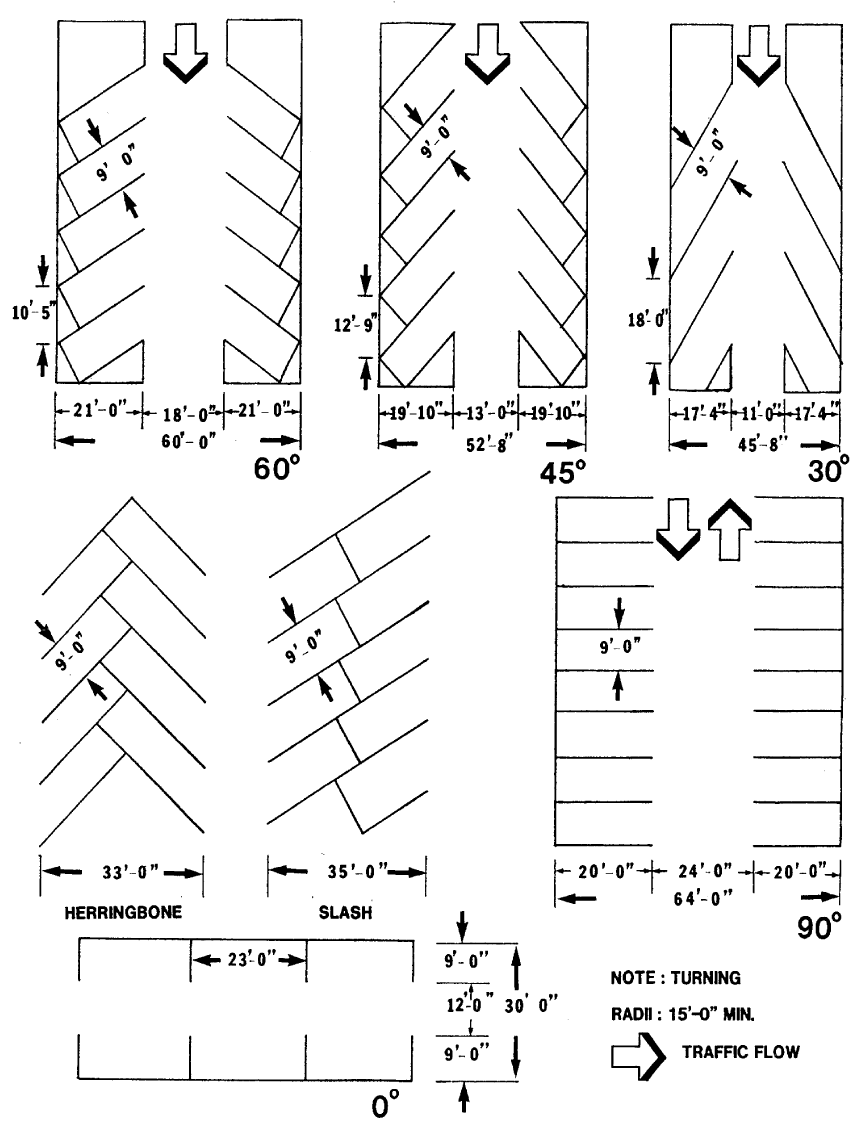
6:9.6.
Minimum parking requirements. Wherever off-street parking is required in district regulations the following minimum spaces shall be provided on the same lot with the principal use, except as provided in section 6:9.3. A developer should evaluate his own needs and, if they are greater than the minimum, provide the necessary space. Parking lots existing at the effective date of this ordinance [chapter] shall be grandfathered. In case of expansion of or additions to uses existing at the time this chapter becomes effective [July 20, 1999], these requirements shall apply only to the additional or expanded areas.
6:9.7.
Minimum accessible parking requirements. When off-street parking is required per section 6:9.6, accessible parking for persons with disabilities shall also be required. The number of accessible spaces shall be in accordance with ADA Standards for Accessible Design, section 208. The design of such spaces shall be in accordance with section 502 of the ADA Standards for Accessible Design. These spaces should be located so that persons are not compelled to wheel or walk behind parked cars to reach entrances, ramps and walkways. Accessible parking spaces may be included when calculating the overall parking requirements for a building or use.
(Ord. No. 99-004, §§ 6:9—6:9.7, 7-20-1999; Ord. No. 01-013, § 5, 6-19-2001; Ord. No. 2016-006, § 6.9, 4-19-2016)
Section 6:10. - Off-street loading requirements.
6:10.1.
Requirements for industrial and wholesale buildings. Every industrial and wholesale building hereafter erected shall provide space as indicated herein for loading and unloading of vehicles. The number of off-street loading berths required by this section shall be considered as the absolute minimum, and the developer shall evaluate his own needs to determine if they are greater than the minimum specified by this section. For purposes of this section, an off-street loading berth shall have minimum plan dimensions of 12 feet by 60 feet and 14 feet overhead clearance with adequate means for ingress and egress.
6:10.2.
Design of loading spaces. Off-street loading spaces shall be designed so those vehicles can maneuver for loading and unloading entirely within the property lines of the premises.
6:10.3.
Requirements for commercial uses. All retail uses and office buildings with a total floor area of 20,000 square feet shall have one off-street loading berth for each 20,000 square feet.
(Ord. No. 99-004, §§ 6:10—6:10.3, 7-20-1999; Ord. No. 2016-006, § 6.10, 4-19-2016)
Section 6:11. - Home occupation.
A home occupation, permitted in any residential district, shall be in conformance with the following requirements.
A.
Not more than two persons other than those residing in the home shall be engaged in the occupation.
B.
The occupation shall not involve the retail sale of merchandise manufactured off the premises except for products related directly to the service performed such as beauty products.
C.
No display of merchandise shall be visible from the street.
D.
The occupation shall not be a nuisance or cause any undue disturbance in the neighborhood.
E.
No sign shall be permitted except one non-illuminated nameplate not more than two square feet in area mounted flat against the wall of the principal building in which the occupation is conducted.
F.
Off-street parking shall be provided in accordance with the provisions set forth in section 6:9 of this article.
G.
The following home occupations shall be permitted. Other home occupations may be permitted by the board of zoning appeals in accordance with the provisions of article 7 and the aforementioned requirements.
Accountant and bookkeeping.
Attorney.
Barber.
Beautician.
Child care home.
Dance instructor.
Dress making.
Insurance agent.
Ironing.
Manufacturer's representative.
Music teacher.
Notary public.
Photographer.
Professional consultants.
Secretarial service.
Sewing.
Tailoring.
Tax consultant.
Tutoring.
Typing.
In R-A zone only, light manufacturing, wholesaling, and service-related businesses are allowed in a completely enclosed building which shall not exceed 2,000 sq. ft. in floor area nor exceed 15 ft. in height from the finished grade.
(Ord. No. 99-004, §§ 6:11, 7-20-1999; Ord. No. 00-055, § 2, 11-14-2000; Ord. No. 2016-006, § 6:11, 4-19-2016)
Section 6:12. - General provisions for group developments.
6:12.1.
Site plan review. In any group development, no building permit shall be issued until a site plan meeting the requirements of this section has been reviewed and approved by the zoning administrator. Except for group developments that require approval of the board of zoning appeals or the Anderson County planning commission, the zoning administrator shall approve or disapprove requests for group developments based upon his review. For those group developments which are permitted only as a special exception by the board of zoning appeals, not only must the requirements of this section be met, but also the requirements of the zoning district and the requirements of article 7, provisions for uses permitted by special exception. All site review approvals are valid for one year, where upon if no building permit has been issued, a new site review will be required.
6:12.2.
Site plan requirements. A minimum of three copies of the site plan meeting the requirements of this section must be submitted to the office of the zoning administrator. In order to ensure proper and expeditious review, the site plan must meet the following criteria:
A.
The site plan must be drawn to a scale of not less than 100 feet to one inch by a registered engineer/surveyor of the State of South Carolina;
B.
A vicinity map, title block, scale, north arrow, site size, and property line survey;
C.
The location of any utility easements;
D.
The land use for every part of the site and the number of acres devoted to each use;
E.
The site's traffic circulation plan, including the location of curb cuts and points of ingress/egress, and also including the location and width of all streets, drives, medians, service areas, dumpster pads, entrances to parking areas, etc.;
F.
The site's parking plan, including all off-street parking, loading/unloading areas, and structures, and also including all parking spaces and their dimensions;
G.
Stormwater management and sedimentation and erosion control plans, which must be submitted to the Anderson County stormwater management department;
H.
The site's sign plan, which includes all exterior signage of the development;
I.
The site's lighting plan, including the location, height, and type of all exterior light fixtures;
J.
If applicable, the location of all proposed nonresidential buildings or structures, their general exterior dimensions, and gross square footage;
K.
If applicable, the location of all proposed residential structures, their general exterior dimensions, the number of residential dwelling units by type, and the number of the bedrooms in each unit;
L.
If applicable, the site's pedestrian circulation plan, including the location of all sidewalks, paths, trails, etc. and the dimensions thereof;
M.
If required elsewhere in the chapter, the landscape plan for the site;
N.
If required elsewhere in the chapter, the screening/landscaping plan for the site;
O.
If required elsewhere in the chapter, specifications indicating the proposed treatment or improvements to all open space areas and the delineation of those areas proposed for specific types of developed recreational activities;
P.
If required elsewhere in the chapter, sketches and/or elevations of typical buildings/structures and their design standards.
6:12.3.
General standards.
A.
Area, height, and setback requirements. The minimum area and setback requirements for group developments are set forth in the use specific group development provisions. Additionally, building height is set forth by the respective zoning district in which the group development is sited.
B.
Access. An encroachment permit for all curb cuts and ingress/egress points must be approved by the respective regulating authority, i.e., federal and state roads—state department of highways and public transportation; county roads—county road and bridge department.
C.
Roads. All roads or drives within the group development shall meet the county subdivision regulations requirements for private roads. If the roads are to be conveyed to Anderson County, they shall be built in compliance with the county subdivision regulations.
D.
Traffic circulation. Traffic circulation within the group development shall be reviewed and approved by the zoning administrator or the board of zoning appeals, whichever is applicable.
E.
Off-street parking. All off-street parking shall be provided in accordance with the provisions set forth in section 6:9.
F.
Off-street loading. All off-street loading shall be provided in accordance with the provisions set forth in section 6:10.
G.
Exterior lighting. Adequate exterior lighting shall be provided in all group developments. All direct light emitted from the exterior light fixtures shall be confined to the site.
H.
Signage. All signage in a group development shall be in accordance with the provisions set forth in the county sign ordinance.
I.
Drainage. Stormwater management and sedimentation and erosion control plans shall be submitted to the Anderson County stormwater management department and approved prior to building permits being issued.
SPECIFIC PROVISIONS FOR GROUP DEVELOPMENT
RESIDENTIAL
6:12.4.
Group residential development. A residential group development is permitted in the R-D, R-M1, R-M2, R-M7, R-M, and R-MA multifamily residential districts subject to the group development general provisions (section 6:12) and subject to the following requirements:
6:12.4-1.
Minimum area requirement. The minimum lot area for a residential group development is two acres, except in the R-D and R-MA districts. Lot area requirements for R-D and R-MA are contained in sections 5:4 and 5:9. In determining minimum area requirements for single-family attached and multifamily development, an interior public right-of-way shall not constitute an exterior property line.
6:12.4-2.
Setback requirements. No structure shall be located closer than 25 feet to an exterior property line, and no structure shall be located closer than 35 feet to a public right-of-way. Interior setback requirements are not otherwise regulated by this chapter.
6:12.4-3.
Height. No building in the R-M2, R-M7, R-M, and R-MA districts shall exceed 45 feet in height except as provided in section 6:7. No building in the R-D and R-M1 districts shall exceed 35 feet in height except as provided in section 6:7.
6:12.4-4.
Recreation. All multifamily developments shall provide a recreational area. Each multifamily dwelling unit will be provided with 200 square feet of usable recreational area in addition to yard and common areas. A minimum of 50 percent of this area shall be for outdoor recreation. If the recreational area contains a swimming pool, it shall meet all state and county health department regulations and be surrounded by a fence not less than six feet in height. For other types of residential development, a recreational area is not required. However, if one is provided, it must meet the requirements of section 7:1, general provision, and 7:6, private recreation area, and must be approved as a use permitted by special exception by the board of zoning appeals.
6:12.4-5.
Privacy area. Where any property line of a zero lot line dwelling, garden court dwelling, or patio home abuts other property within the same overall development zoned or used for residential purposes, there shall be provided and properly maintained along the property line a continuous visual screen not less than six feet in height. The requirement does not apply to townhouse development. The screen shall be a windowless wall, fence, or other type of impenetrable and opaque material that is aesthetically compatible with existing development or a combination thereof. However, the requirement for a privacy wall along any property line may be omitted or modified where the board of zoning appeals has determined that one or more of the following conditions exist:
A.
Due to special conditions and circumstances of a physical or dimensional nature that are peculiar to the property involved, a privacy wall would serve no valid purpose.
B.
The provision of a privacy wall along any side and/or rear property line would deny the property involved advantages of amenities specifically associated with the overall development.
In no instance shall the privacy wall requirement be omitted or modified which would infringe upon the privacy rights of adjacent property owners.
OFFICE
6:12.5.
Group office development.
An office group development is permitted in the O-D, POD, R-M1, C-1, C-2, S-1, and I-1 districts.
Office group development in the C-1 and C-2 districts is subject to the group development general provisions (section 6:12) and the specific requirements of section 6:12.6 (group commercial development).
Office group development in the S-1 and I-1 districts is subject to the group development general provisions (section 6:12) and the specific requirements of section 6:12.7 (group industrial/service development).
Office group development in the R-M1 district is subject to the group development general provisions (section 6:12) and the specific requirements of section 5:5.7 (R-M1, group office development).
Office group development in the O-D district is subject to the group development general provisions (section 6:12) and subject to the following requirements:
6:12.5-1.
Height limitation. No structure shall exceed a height of 45 feet except as provided in section 6:7.
6:12.5-2.
Dimensional requirements.
6:12.5-3.
Front setback. All buildings and structures shall be set back from all street right-of-way lines not less than 25 feet.
6:12.5-4.
Side setback. None is required, except on corner lots and lots adjacent to any residential district in which case all commercial buildings and structures shall be set back not less than 15 feet from property lines. When a side yard is provided, it shall be not less than five feet in width.
6:12.5-5.
Rear setback. No building shall be located closer than 20 feet to a rear lot line.
6:12.5-6.
Off-street parking. Off-street parking shall be provided in accordance with the provisions set forth in section 6:9.
COMMERCIAL
6:12.6.
Group commercial development (shopping center). A commercial group development (shopping center, business park) is permitted in the C-1R, C-1, C-2, and C-1N commercial districts, subject to the group development general provisions (section 6:12) and subject to the following requirements:
6:12.6-1.
Minimum area requirement. No minimum area is required.
6:12.6-2.
Setback requirements. Setbacks for all buildings and structures shall be in accordance with the setback provisions of the zoning district in which they are located.
6:12.6-3.
Height. No building shall exceed 45 feet except as provided in section 6:7.
6:12.6-4.
Screening. A combination of a wall or fence and dense evergreen hedge or other type of evergreen foliage at least six feet in height shall be provided along side and rear exterior lot lines where any commercial use is adjacent to a residential district for the purpose of screening commercial activities from view. Additionally, a 15-foot landscaped buffer along the exterior property lines adjacent to residential uses and districts shall be maintained. No commercial activity is permitted in this buffer.
INDUSTRIAL/SERVICE
6:12.7.
Group industrial/service development. Industrial group developments are permitted in the S-1, Service District and the I-1, Industrial District subject to the group development general provisions (section 6:12) and subject to the following requirements:
6:12.7-1.
Minimum area requirements. No minimum area is required.
6:12.7-2.
Setback requirements. Setbacks from exterior property lines and public rights-of-way shall be in accordance with the setbacks of the zoning district in which the development is located. Interior setback requirements are not otherwise regulated by this chapter.
6:12.7-3.
Height. No building or structure shall exceed 45 feet in the S-1, Service District and 90 feet in the I-1, Industrial District except as provided in section 6:7. All buildings and structures shall demonstrate that adequate fire protection is afforded. No building or structure on a lot in an S-1 or I-1 district which is adjacent to a residential district shall exceed the maximum building height unless there is one additional foot of setback on the sides adjacent to the residential district for each additional foot of height.
6:12.7-4.
Screening. A combination of a wall or fence and dense evergreen hedge or other type of evergreen foliage at least six feet in height shall be provided along side and rear exterior lot lines where any industrial use is adjacent to a residential district for the purpose of screening industrial activities from view. Additionally, a 15-foot landscaped buffer along the exterior property lines adjacent to residential uses and districts shall be maintained. No industrial activity is permitted in this buffer.
(Ord. No. 99-004, §§ 6:12—6:12.7.4, 7-20-1999; Ord. No. 2016-006, § 6.12, 4-19-2016)
Section 6:13. - Game courts and swimming pools.
Game courts and swimming pools are allowed as accessory uses in residential districts in conjunction with one-family, one-family manufactured home, and two-family dwellings subject to the provisions of this article.
6:13.1.
Game court requirements.
A.
Game courts shall be located in the rear yard.
B.
Game courts shall be set back not less than five feet from any lot line.
C.
Setback requirements for game courts on corner lots shall be the same as those for accessory buildings.
D.
Game courts shall not occupy more than 65 percent of the rear yard.
F.
Lighting for game courts shall have proper shielding from glare.
6:13.2.
Swimming pool requirements.
A.
Swimming pools shall be set back not less than five feet.
B.
Setback requirements for swimming pools shall be the same as those for accessory buildings.
C.
Swimming pools shall not occupy more than 50 percent of the rear yard.
D.
Lighting for swimming pools shall have proper shielding from glare.
(Ord. No. 99-004, §§ 6:13—6:13.2, 7-20-1999; Ord. No. 2016-006, § 6.13, 4-19-2016)
Section 6:14. - Residential Continuing Care Retirement Center, CCRC.
A residential CCRC is permitted in all multifamily residential districts subject to the group development general provisions (section 6:12) and subject to the following requirements:
6:14.1.
Minimum area requirement. The minimum lot area requirement for a residential CCRC is 30,000 square feet. In determining minimum area requirements for a residential CCRC, an interior road system shall not constitute an exterior property line.
6:14.2.
Setback requirements. No structure shall be located closer than 25 feet to an exterior property line, and no structure shall be located closer than 35 feet to a public right-of-way. Interior setback requirements are otherwise not regulated.
6:14.3.
Height. No building shall exceed 45 feet in height except as provided in section 6:7.
6:14.4.
Appearance. The structure(s) shall have a residential appearance.
6:14.5.
Density. The maximum allowable number of dwelling units shall be the zoning district's maximum allowable density multiplied by a factor of 1 1/2. For properties fronting on and accessing major four-lane arterials, the multiplying factor shall be 1 8/10. The total number of nursing beds and dwelling units combined shall not exceed the multiplied factor for the residential district.
6:14.6.
Screening. A combination of a wall or fence and dense evergreen hedge or other type of evergreen foliage at least six feet in height shall be provided along the side and rear lot lines where any commercial use is adjacent to a residential district for the purpose of screening commercial activities from view. In addition, a minimum of a 15-foot wide landscaped buffer along the exterior property lines adjacent to residential uses and districts shall be maintained.
(Ord. No. 99-004, §§ 6:14—6:14.6, 7-20-1999; Ord. No. 2016-006, § 6:14, 4-19-2016)
Section 6:15. - Manufactured multi-section home.
A manufactured multi-section home comprised of two or more sections may be permitted on any lot zoned R-8, R-10, R-12, R-15, and R-20, single-family residential, if the following requirements are met:
6:15.1.
Certification. The home must bear a label certifying or documents certifying that it is constructed in compliance with the National Manufactured Housing Construction and Safety Standards Act.
6:15.2.
Dimensions. The home must have a length not to exceed four times its width, measured at the narrowest point, excluding alcoves, and must have a minimum floor area of 900 square feet.
6:15.3.
Roofing. The pitch of the roof must have a minimum vertical rise of 2½ feet for every 12 feet of horizontal run, and the roof must be finished with a type of shingle that is commonly used in conventional residential site-built dwellings.
6:15.4.
Siding. The exterior siding consists of wood, hardboard, or vinyl comparable in composition, appearance and durability to the exterior siding commonly used in conventional residential site-built construction.
6:15.5.
Installation. All new homes must be installed per the manufacturer's installation instructions. Older homes, where the manufacturer's installation instructions are not available, must be set up per the SC Manufactured Housing Board.
6:15.6.
Orientation. When locating a unit in a developed single-family residential area, the unit shall be located so that the front of the unit is oriented to the street.
6:15.7.
Skirting. Skirting or a curtain wall, unpierced except for required ventilation and access door, must be installed and maintained so that it encloses the area under manufactured multi-section homes and modular homes and any porches, decks, or other additions to ground level. The foundation skirting or curtain wall may be of brick or masonry. Material used for skirting should be erected so as not to create a fire hazard and maintained in a good state of repair.
A.
Crawl space shall be provided as per section 10-81 of the Anderson County Code of Ordinances.
B.
Access to the crawl space shall be as per section 10-81 of the Anderson County Code of Ordinances.
6:15.8.
Reserved.
6:15.9.
Removal of transport equipment. The tongue, axles, transporting lights, and towing apparatus must be removed from the manufactured home after placement of a manufactured multi-section home on the lot and before occupancy.
6:15.10.
Steps/landings. Permanent landing and steps with handrails are required to each exterior doorway. The structure must include steps that lead to the ground level. The landing handrails, guardrails, and steps must comply with section 10-81 of the Anderson County Code of Ordinances.
(Ord. No. 99-004, §§ 6:15—6:15.13, 7-20-1999; Ord. No. 2016-006, § 6:15, 4-19-2016)
Section 6:16. - Community recreational area.
A community recreational area is permitted in the R-A, R-40, R-20, R-15, R-12, R-10, R-8, R-D, R-M1, R-M2, R-M7, R-M, and R-MA zoning districts provided it appears on an approved preliminary subdivision plat and meets the following requirements:
6:16.1.
Lot area. The minimum lot area for a community recreational area shall be equal to the district's minimum lot size.
6:16.2.
Setback requirements.
Front—District requirements.
Side—25 feet.
Rear—25 feet.
6:16.3.
Food and entertainment. The provision of food and entertainment for members and guests may be permitted provided that such provision shall not cause a nuisance in the residential district.
6:16.4.
Screening. A combination of a wall or fence and dense evergreen hedge or other type of evergreen foliage at least six feet in height shall be provided along the side and rear lot lines where any community recreational use is adjacent to a residential district for the purpose of screening from view the community recreational area.
6:16.5.
Off-street parking. Off-street parking shall be provided in accordance with the provisions set forth in section 6:9.
(Ord. No. 99-004, §§ 6:16—6:16.5, 7-20-1999; Ord. No. 2016-006, § 6:16, 4-19-2016)

