
Ashland City Zoning Code
PART 1
General Provisions
1.1 Title, Authority, And Effective Date
- Title. This Ordinance is hereby officially known and cited as the Unified Development Ordinance of the City of Ashland, Wisconsin. References to “this Ordinance” or “this UDO” shall be interpreted as references to this Unified Development Ordinance.
- Authority. The provisions of this Ordinance are adopted under the authority granted by the following sections of the Wisconsin Statutes and amendments thereto:
- Section 62.23(7) relating to general land use zoning;
- Section 62.231 relating to the zoning of wetlands;
- Section 62.234 relating to construction site erosion control and storm water management zoning;
- Section 66.1027 relating to traditional neighborhood designs and conservation subdivisions;
- Section 87.30 relating to floodplain zoning;
- Section 114.135 and Section 114.136 relating to airport approach protection;
- Section 236.45 relating to subdivisions of land;
- Section 281.3 relating to water quality and quantity; and
- Other Wisconsin Statutes that may be referenced in other parts of this Ordinance.
- Effective Date. This Ordinance shall take effect and be in force from and after its passage and publication.
1.2 Purpose And Intent
- Purpose. The provisions of this Ordinance shall be held to be minimum requirements adopted for the purpose of the following:
- Implementing the goals, objectives, policies, and plans of the City of Ashland’s Comprehensive Plan;
- Promoting the health, safety, morals, and general welfare;
- Securing adequate light, pure air, and safety from fire and other dangers;
- Conserving the taxable value of land and buildings;
- Preserving and enhancing the aesthetic values, generally, throughout the City of Ashland; and
- Regulating and controlling the division of land to promote the health, safety, morals, and general welfare.
- Intent. This Ordinance is intended to establish and accomplish certain standards and objectives by doing the following:
- Integrating principles of sustainability into the development and use of land in the City of Ashland;
- Dividing the City of Ashland into districts and regulating therein the location, construction, reconstruction, alteration, and use of buildings, structures, and land for residence, business, manufacturing, or other specified uses;
- Avoiding or lessening congestion in the public streets by adequate requirements for off-street parking and loading facilities;
- Preventing the overcrowding of land by regulating and limiting the height and bulk of buildings hereafter erected;
- Establishing, regulating, and limiting the building or setback lines on or along streets, alleys, or parcel lines;
- Regulating and limiting the intensity of the use of parcel areas, and regulating and determining the area of open spaces within and surrounding such buildings;
- Permitting in each of the zoning districts only those uses, buildings, and structures that are compatible with the character of each district;
- Providing controls over additions to and alterations and remodeling of existing buildings and structures;
- Providing controls governing the continuation of those uses, buildings, and structures that are incompatible with the character of the districts in which they are located;
- Providing controls governing the size and location of signs and other forms of outdoor advertising;
- Defining the powers and duties of the administrative officers and bodies of the administration and enforcement of this Ordinance; and
- Prescribing penalties for the violation of the provisions of this Ordinance or of any amendment thereto.
1.3 Organization And Use Of This Ordinances
- Intent. This Section is intended to guide the reader in the use of this Ordinance. This Section is not intended to be a substitute for the standards, criteria, and procedures specified in this Ordinance.
- General Organization. This Ordinance includes twelve (12) parts as well as several appendices. Each part is further subdivided into sections, subsections, paragraphs, subparagraphs, and clauses. A consistent numbering and formatting convention is used throughout this Ordinance to identify these divisions and to help orient the reader to the organization of information. The following illustrates the formatting and numbering convention:
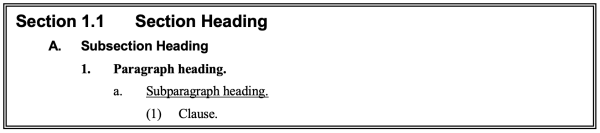
- Commentary. Commentary is provided throughout this Ordinance in the form of “helpful notes” and “sustainability tips”. The helpful notes are intended to help explain complex provisions or to direct the reader to related areas in this Ordinance or elsewhere. The sustainability tips are intended to provide general information on how certain provisions relate to the City’s sustainability goals. If the commentary is in conflict with the provisions of this Ordinance, the text associated with the actual provisions shall prevail.
- Graphics. Graphics are provided throughout this Ordinance to help the reader visualize and understand complex provisions that have physical or dimensional qualities associated with them. If the graphics are in conflict with the provisions of this Ordinance, the text associated with the actual provisions shall prevail.
- Hyperlinks. Hyperlinks are provided throughout this Ordinance for those readers who are viewing this Ordinance on a computer. Hyperlinks are identified with italicized text. Placing the cursor over the hyperlink and clicking on the hyperlink will open another electronic document that can help the reader further understand the provisions of this Ordinance. For example, all of the Wisconsin Statutes referenced in this Ordinance are hyperlinked. Clicking on the hyperlink opens a window that displays the linked Wisconsin Statute. Broken, misdirected, or conflicting hyperlinks shall not invalidate the meaning of the provision.
1.4 Integration Of Principles Of Sustainability
- Intent. Pursuant to the goals, objectives, policies, and plans of the City of Ashland’s Comprehensive Plan and pursuant to the City of Ashland’s Adopted Eco-Municipality Designation Resolution (see Appendix A: Ashland Eco-municipality Resolution), it is the intent of the City of Ashland to promote and apply principles of sustainability to the development and use of land in the City of Ashland.
- Principles of Sustainability. To the extent possible, property owners and their designated agents, as well as review and approval authorities, should consider the following principles of sustainability in the development and use of land in the City of Ashland:
- Reduce dependence upon fossil fuels and extracted underground metals and minerals. In the development and use of land, opportunities to reduce dependence upon fossil fuels and extracted underground metals and minerals may include, but shall not be limited to, the following:
- Promote a sensitive mixture of uses and compact development in appropriate areas that reduce the need to drive fossil fuel vehicles;
- Promote energy efficient building and site design;
- Promote the use of wind, solar, and other forms of renewable or regenerative energy where feasible;
- Allow appropriate opportunities for home occupations that reduce commuting needs; and
- Allow opportunities to produce and sell foods locally and reduce, reuse, and recycle materials locally thereby reducing transportation.
- Reduce dependence on chemicals and other manufactured substances that can accumulate in nature. In the development and use of land, opportunities to reduce dependence on chemicals and other manufactured substances that can accumulate in nature may include, but shall not be limited to, the following:
- Encourage the use of building materials that are chemical and toxic-free;
- Encourage the use of landscaping materials and practices that reduce the need for pesticides and herbicides; and
- Promote areas and standards to reduce, reuse, and recycle materials.
- Reduce dependence on activities that harm life-sustaining eco-systems. In the development and use of land, opportunities to reduce dependence on activities that harm life-sustaining eco-systems may include, but shall not be limited to, the following:
- Encourage infill development and redevelopment at appropriate densities and locations to help reduce sprawl and encroachment on nature;
- Promote responsible storm water management and erosion control measures;
- Protect trees, wetlands, floodplains, the waterfront, and other significant natural resources from adverse development; and
- Promote development patterns that respect natural systems.
- Meet the hierarchy of present and future human needs fairly and effectively. In the development and use of land, opportunities to meet the hierarchy of present and future human needs fairly and effectively may include, but shall not be limited to, the following:
- Provide ample opportunities for public participation in significant development and land use decisions;
- Promote the local economy and community needs without adversely affecting the natural environment;
- Promote financial and social equity in the local economy;
- Integrate opportunities for public and private community services throughout the community, such as parks, emergency residential facilities, religious institutions, and senior center; and
- Provide a range of affordable housing that meets the diverse needs of the community.
- Reduce dependence upon fossil fuels and extracted underground metals and minerals. In the development and use of land, opportunities to reduce dependence upon fossil fuels and extracted underground metals and minerals may include, but shall not be limited to, the following:
1.5 Interpretation And Separability
- Interpretation
- Minimum requirements. In their interpretation and application, the provisions of this Ordinance shall be held to be the minimum requirements for the promotion and protection of the public health, safety, morals, and general welfare.
- Supremacy of conflicting provisions. Where the conditions imposed by any provisions of this Ordinance are either more or less restrictive than comparable standards imposed by any other provisions of this Ordinance or of any other applicable law, ordinance, resolution, rule, or regulation of any kind, the regulation that is more restrictive or that imposes higher standards or requirements shall govern.
- Abrogation of existing regulations or agreement. This Ordinance is not intended to abrogate any easement, covenant, or other private agreement, provided that, where regulations of this Ordinance are more restrictive or impose higher standards or requirements than such easements, covenants, or other private agreements, the requirements of this Ordinance shall govern.
- Unlawful structures and uses on the effective date of this Ordinance. No building, structure, or use not lawfully existing at the time of the adoption of this Ordinance shall become or shall be made lawful solely by reason of adoption of this Ordinance. To the extent that said unlawful building, structure, or use is in conflict with the requirements of this Ordinance, said building, structure, or use remains unlawful hereunder.
- Ordinance language. The language of this Ordinance shall be interpreted in accordance with the following rules of construction. Words in the present tense shall include the future, the singular number shall include the plural, and the plural the singular; the word “building” shall include the word “structure,” the word “used” shall include “arranged, designed, constructed, altered, converted, rented, leased” or “intended to be used.” The word “may” is permissive, but not mandatory. The word “should” is encouraged and discretionary, but not mandatory. The word “shall” is mandatory, but not discretionary.
- Distances. All distances shall be measured horizontally except height, which shall be measured vertically.
- Undefined land uses. With respect to the classification of land uses that are not defined or specifically listed within this Ordinance, the Zoning Administrator or Designated Authorized Agent shall make interpretations based on the most recent edition of the “North American Industry Classification System” (NAICS) published by the United States Office of Management and Budget.
- Separability. It is hereby declared to be the intention of the Common Council of the City of Ashland that the several provisions of this Ordinance are separable, in accordance with the following:
- If any court of competent jurisdiction shall adjudge any provision of this Ordinance to be invalid, such judgment shall not affect any other provision of this Ordinance not specifically included in said judgment.
- If any court of competent jurisdiction shall adjudge invalid the application of any provision of this Ordinance to a particular parcel, building, or structure, such judgment shall not affect the application of said provision to any other parcel, building, or structure not specifically included in said judgment.
1.6 Transitional Provisions
- Approvals Prior to the Effective Date of this Ordinance
- General applicability. All work, structures, and uses authorized by permits issued prior to the effective date of this Ordinance or any amendment thereto shall not be affected by this Ordinance. Except as provided in the following Paragraphs below, no development permit or building permit shall be issued following the effective date of this Ordinance or any amendment thereto, unless the work, structure, or use for which the development permit or building permit is sought is made to fully comply with the applicable provisions of this Ordinance or any such amendment thereto.
- Right to complete approved development in progress. Nothing in this Ordinance, or any amendment thereto, shall be deemed to require any change in the plans, construction, or designated use of a structure if a development permit, building permit, and/or certificate of occupancy for such structure was lawfully and properly issued prior to the effective date of this Ordinance, or any such amendment thereto, and such development permit, building permit, and/or certificate of occupancy has not by its own term expired prior to the effective date of this Ordinance, and construction pursuant to such permit is commenced prior to the expiration date of such permit.
- Development permits and building permits. Where a development permit and building permit for a building or structure have been issued in accordance with law prior to the effective date of this Ordinance, and provided that construction is begun within six (6) months of such effective date and the exterior of building or structure is completed within one (1) year of such effective date, said building or structure may be completed in accordance with the approved plans on the basis of which the development permit and building permit were issued; and further, may, upon completion, be occupied under a certificate of occupancy by the use for which originally designated, subject thereafter to the nonconforming provisions of this Ordinance.
- Right to occupy as a nonconformity. Upon completion of the work described in Paragraphs 2 and 3 of this Subsection, such building or structure may be occupied by, and a certificate of occupancy shall be issued for, by the use designated on the certificate of occupancy, subject thereafter, to the extent applicable, to the nonconforming provisions of this Ordinance.
- Preliminary plats. Any preliminary plat filed prior to the effective date of this Ordinance shall vest such approval rights as are afforded any subsequent final plat as authorized under Section 236.11(1)(b) of the Wisconsin Statutes, and the provisions of this Ordinance.
- Pending Applications Submitted Prior to the Effective Date of this Ordinance
- General applicability. Any complete application submitted to the City shall be processed pursuant to the ordinances in effect on the date of the application submittal.
- Withdrawal of original application and submittal of new application. If a complete application submitted to the City has not received final action by the approval authority before the effective date of this Ordinance, or amendments thereto, then the applicant shall have the option, if so desired, to officially withdraw the original application and submit a new application (within sixty (60) days of the submittal of the original application) without payment of additional fees.
1.7 Applicable Codes Pertaining To Development
- General Applicability. The City of Ashland has adopted various codes pertaining to development in the City.
- Wisconsin Uniform Dwelling, Commercial, Plumbing and Electrical Codes. Refer to City of Ashland Ordinance 748.
- Historic Building Code. A certain document, a copy of which is on file in the office of the Building Inspector, marked and designated as the “Buildings constructed prior to 1914, SPS Chapters 375 – 379, Wisconsin Administrative Code” is hereby adopted as the Historic Building Code for the City of Ashland.

