
Atlanta City Zoning Code
CHAPTER 16
18A.- SPI-1 DOWNTOWN SPECIAL PUBLIC INTEREST DISTRICT REGULATIONS2
Editor's note— Ord. No. 2007-71(07-O-2221), § 1(Att. A), approved Nov. 27, 2007, amended chapter 16-18A in its entirety to read as herein set out. Formerly, said chapter pertained to SPI-1 Central Core District Regulations as enacted by Code 1977, §§ 16-18A.001—16-18A.013; as subsequently amended.
Sec. 16-18A.001.- Scope of provisions.
The regulations set forth in this chapter, or set forth elsewhere in this part when referred to in this chapter, are the Regulations in the SPI-1 Downtown Special Public Interest District. These regulations shall supplant existing districts or portions of existing districts as shown on the attached map referenced in section 16-18A.003, except that all existing categories of historic protection designated pursuant to Chapter 20 of Part 16 shall continue in full force and effect and said existing historic protection regulations shall be overlaid upon, and shall be imposed in addition to, the regulations set forth in this chapter. Whenever the following regulations are at variance with said existing historic protection regulations, the historic protection regulations shall apply.
The regulations set forth in sections 16-18A.001 through and including section 16-18A.019 shall apply to all properties located within the SPI-1 Downtown District, including all subareas within the district. The remaining regulations set forth in section 16-18A.020 shall apply only to Subareas 6 and 7 as specified.
(Ord. No. 2007-71(07-O-2221), § 1(Att. A), 11-27-07)
Sec. 16-18A.002. - Statement of intent.
The intent of the council in establishing SPI-1 as a zoning district is as follows:
1.
Preserve, protect and enhance downtown's role as the civic and economic center of the Atlanta region;
2.
Create a 24-hour urban environment where people can live, work, meet and play;
3.
Encourage the development of major commercial uses and high intensity housing that provides a range of housing opportunities for citizens within the district;
4.
Encourage a compatible mixture of residential, commercial, entertainment, cultural and recreational uses;
5.
Improve the aesthetics of street and built environments;
6.
Promote pedestrian safety by ensuring and revitalizing pedestrian-oriented buildings which create a sense of activity and liveliness along their sidewalk-level façades;
7.
Facilitate safe, pleasant, and convenient sidewalk-level pedestrian circulation that minimizes impediments by vehicles;
8.
Encourage the use of MARTA and other public transit facilities;
9.
Enhance the efficient utilization of accessible and sufficient parking facilities in an unobtrusive manner including encouraging shared parking and alternative modes of transportation;
10.
Provide safe and accessible parks and plazas for active and passive use including protecting Centennial Olympic Park as an Olympic legacy and a local and regional civic resource;
11.
Preserve and protect downtown's historic buildings and sites;
12.
Recognize the special character of Fairlie-Poplar and Terminus through the administration of specific standards and criteria consistent with the historic built environment as recognized by the inclusion of several blocks and buildings on the National Register of Historic Places.
(Ord. No. 2007-71(07-O-2221), § 1(Att. A), 11-27-07)
Sec. 16-18A.003. - Boundaries of district established.
The boundaries of the SPI-1 Downtown District are shown on map Attachment B which by this reference is incorporated into and made a part of this chapter and this part. The SPI-1 Downtown District is divided into seven subareas as shown on said map Attachment B and are subscribed as follows:
Subarea 1—Downtown Core
Subarea 2—SoNo Commercial West
Subarea 3—SoNo Commercial East
Subarea 4—SoNo Residential
Subarea 5—Centennial Olympic Park
Subarea 6—Terminus
Subarea 7—Fairlie-Poplar
(Ord. No. 2007-71(07-O-2221), § 1(Att. A), 11-27-07)
Sec. 16-18A.004. - Application procedures.
A special administrative permit (SAP) application and a specified number of copies each of a site plan, landscape plan, and elevation drawings of each exterior façade shall be submitted, as applicable, and approved by the director of the bureau of planning prior to an applicant filing for a building permit. All exterior demolition, new construction (including additions to existing buildings), modifications of outdoor dining, or any construction which results in increased lot coverage, modification of the building footprint, or modification of building façades that alters the configuration of openings, shall be subject to said SAP approval. Before making an application for a special administrative permit, a pre-application conference between the applicant and the director of the bureau of planning or the director's designee is required to discuss the application and relevant requirements of these regulations. Said pre-application conference shall be held within 14 days of the request date by the applicant, unless a longer period is mutually agreed upon. All applications for a SAP shall be processed in accordance with the standards and procedures applicable to said SAP applications contained in Chapter 25 of Part 16 except as otherwise modified by this Chapter 18.
Where regulations require the approval of a SAP for other purposes so specified, processing by the director of the bureau of planning shall, without additional application, include consideration of other special administrative permits. Where such regulations require special exception or special use permit action, the special administrative permit for building permit purposes shall not be issued until the necessary approval has been obtained for such special exception or special use permit.
The director of the bureau of planning may exempt certain classes of applications for special administrative permits from detailed review requirements as set forth upon written findings that generally within these districts, the actions proposed are of such a character or scale as to make detailed reviews and approval by the planning director unnecessary. Where applications for special administrative permits are determined by reference to such findings to be thus exempted, the permit shall be issued if otherwise lawful.
(Ord. No. 2007-71(07-O-2221), § 1(Att. A), 11-27-07; Ord. No. 2018-11(18-O-1023), § 9.D, 5-16-18)
Sec. 16-18A.005. - Definitions.
[The following words, terms and phrases, when used in this chapter, shall have the meanings ascribed to them in this article, except where the context clearly indicates a different meaning:]
1.
Arcade: a covered pedestrian walkway supported by columns, piers, pillars, or walls to a minimum unobstructed height of 20 feet.
2.
Mixed-use developments: For purposes of this article, and notwithstanding the provisions of section 16-29.001(24), mixed-use development is defined as any development which contains as principal uses both residential and non-residential uses on the same development site, and in which each such use is at least 20 percent of the total floor area, excluding accessory uses.
3.
Sidewalk-level: Any building floor within five vertical feet of the adjacent required sidewalk or provided supplemental zone. See section 16-18A.020 Diagram 1.
4.
Storefront street: A street or portion of a street indicated in the pedestrian space plan in which street-fronting buildings (including parking decks) shall meet detailed requirements at sidewalk-level (See section 16-18A.012) to a minimum height of ten feet above the adjacent required sidewalk.
5.
Street furniture and tree planting zone: The portion of a sidewalk located between the sidewalk clear zone and the curb that is reserved for the placement of streets trees and street furniture including utility and light poles, waste receptacles, fire hydrants, traffic signs, traffic control boxes, newspaper boxes, transit shelters, bicycle racks, seating and similar elements in a manner that does not obstruct pedestrian access or motorist visibility. Such elements, where installed, shall be a type specified by the director of the bureau of planning in accordance with uniform design standards utilized by the director for placement of such objects in the public right-of-way. See section 16-18A.020 Diagram 2.
6.
Street trees: All newly planted street trees shall be single-stemmed with a minimum caliper of three inches measured 36 inches above ground, shall be a minimum of 12 feet in height, shall have a minimum mature height of 40 feet, and shall be limbed up to a minimum height of seven feet. Trees shall have a minimum planting area of 40 square feet planted with evergreen ground cover such as mondo grass or liriope spicata or covered with hardwood mulch. Flowers and seasonal plantings may be planted in tree planting areas but shall be supplemented by hardwood mulch when not planted. Tree grates shall be prohibited.
7.
Sidewalk clear zone: The portion of a sidewalk that is unobstructed by any permanent objects to a height of eight feet and is reserved for pedestrian circulation and passage. No fixed elements, including traffic control boxes or other utility structures, shall be placed above ground in the clear zone. The clear zone shall have a consistent cross-slope not exceeding two percent. See section 16-18A.020 Diagram 2.
8.
Supplemental zone: The area between any building (including parking lot or deck) and the back of the required sidewalk when no intervening building exists. See section 16-18A.010 for additional requirements and section 16-18A.020 Diagram 2.
(Ord. No. 2007-71(07-O-2221), § 1(Att. A), 11-27-07)
Sec. 16-18A.006. - Use regulations.
1.
Permitted principal uses and special permits. See SPI-1 Downtown Use Table for permitted principal uses and special permits.
2.
Permitted principal uses:
a.
A building or premises shall be used only for the principal purposes as indicated with a "P" in SPI-1 Downtown Use Table.
b.
For the purposes of this chapter, uses at sidewalk-level in what would otherwise be classified as an independent primary parking structure shall not constitute principal uses.
(3)
Permitted accessory uses and structures: Accessory uses and structures permitted within this district shall include those customarily accessory and clearly incidental to permitted principal uses and structures and specifically includes parking to serve authorized residential and non-residential uses within the district, as well as the electric vehicle charging stations equipped with Level 1 Level 2 and/or DC Fast Charge EVSE associated with such parking, all subject to the restrictions contained in this chapter.
4.
Special permits: The following uses are permissible only by special permits of the type indicated subject to limitations and requirements set herein or elsewhere in this part, and subject to the applicable procedures and requirements set forth in section 16-25.001, et seq.
a.
Special use permits shall be required as indicated with "SUP" in the SPI-1 Downtown Use Table.
b.
Special administrative permits shall be required as indicated with "SAP" in the SPI-1 Downtown Use Table.
c.
Special exceptions: None.
SPI-1 Downtown: Use Table
* In Subarea 7 the sales and leasing agency shall be located in a building containing a minimum of ten stories and any accessory parking for cars and motorcycles shall be located in an existing parking deck with an allowable maximum of 50 parking spaces devoted to the sales and leasing agency use. Parking spaces devoted to the sales and leasing agency use shall be clearly marked or signed.
(Ord. No. 2007-71(07-O-2221), § 1(Att. A), 11-27-07; Ord. No. 2009-24(08-O-1251), § 2J, 6-9-09; Ord. No. 2011-39(10-O-1773), § 3U, 9-15-11; Ord. No. 2014-53(14-O-1278), § 2(Attach. B), 12-10-14; Ord. No. 2014-22(14-O-1092), § 2-U, 6-11-14; Ord. No. 2019-09(18-O-1581), § 2.A, 1-31-19; Ord. No. 2019-20(18-O-1679), § 8, 3-13-19; Ord. No. 2019-66(19-O-1504), § 9, 12-11-19; Ord. No. 2020-58(19-O-1393), § 25, 10-28-20; Ord. No. 2021-60(21-O-0682), § 23, 12-15-21; Ord. No. 2024-36(24-O-1222), § 3, 9-4-24; Ord. No. 2025-05(24-O-1619), §§ 1, 2, 2-17-25)
Sec. 16-18A.007. - Demolition of existing structures and redevelopment requirements.
No existing structure shall be demolished for the purpose of creating open space. All requests for demolition shall include concept plans for the redevelopment of the property that are sufficient to obtain an SAP for the development of the new structure.
Any property wherein 60 percent or greater of the principal building is removed or destroyed by any means shall be redeveloped in accordance with the requirements of this chapter notwithstanding any other provisions in Part 16 to the contrary, specifically including the installation of sidewalks and street trees.
(Ord. No. 2007-71(07-O-2221), § 1(Att. A), 11-27-07)
Sec. 16-18A.008. - Development controls.
See SPI-1 Downtown Development Controls Table for Bulk Limitations, Building Coverage, Yard Requirements, Open Space Requirements, and Height Requirements subject to subsections 1 through 4 below.
1.
Residential uses, including portions of mixed-use developments, may utilize net area of a regular lot (NLA) or gross area of a regular lot (GLA) when calculating maximum permitted residential floor area, provided that the usable open space requirement (USOR) is calculated utilizing the corresponding lot area.
2.
Useable open space requirements (UOSR):
a.
All buildings built before 1950 shall have no minimum usable open space requirement, provided that additions that increase the building footprint by more than ten percent of the pre-1950 footprint shall be subject to said requirements and that the entire development lot and floor area be used in determining these requirements.
b.
The entire area of residential balconies may be counted towards UOSR.
c.
The uncovered horizontal area of rooftop stormwater treatment landscaping may be counted towards UOSR.
d.
That portion of the pedestrian circulation requirement which lies within the Net Area of a Regular Lot shall constitute a corresponding portion of the UOSR.
e.
The total area of new on-street parking may be counted towards UOSR provided said new on-street parking is located within Subareas 1, 2, 3, 4, 5 and 6 and the following criteria are met:
i.
No on-street parking currently exists in the public right-of-way adjacent to the project area for which credit is sought;
ii.
The new on-street parking is located where there is no existing street travel lane;
iii.
The on-street parking shall be accessible to the general public;
iv.
Curb extensions are provided at street intersections, as applicable;
v.
All other sidewalk requirements of this article are met.
3.
Pedestrian circulation requirements: All sidewalk widths, pedestrian circulation requirements, and embayments shall be in conformance with the standards and requirements of the pedestrian space plan and sections 16-18A.009 and 16-18A.010.
4.
Street-facing building façade: The street-facing building façade shall rise vertically at the back of the required sidewalk or provided supplemental zone for a minimum of height 36 feet as indicated on the SPI-1 Downtown Development Controls Table before stepping back from said required sidewalk or provided supplemental zone except for permitted driveways, sidewalk-level recessed building entrances or residential balconies. See section 16-18A.020 Diagram 3.
5.
Parks and plazas: Sidewalk-level privately owned parks or plazas, if provided, shall be accessible to the public during normal City of Atlanta park hours.
6.
Workforce housing bonus:Reserved.
SPI-1 Downtown: Development Controls Table
1. Non-residential FAR shall be multiplied by net lot area (NLA) to determine maximum permitted floor area.
2. Residential FAR may be multiplied by net lot area (NLA) or gross area of a regular lot (GLA) to determine maximum permitted floor. See section 16-18A.008(1).
3. Sidewalk and supplemental zone requirements shall be the minimum setback requirements for yards adjacent to streets.
4. Subject to Building Code requirements.
5. Usable open space requirement (USOR) is calculated utilizing the corresponding lot area used to obtain floor area. See section 16-18A.008(1).
(Ord. No. 2007-71(07-O-2221), § 1(Att. A), 11-27-07; Ord. No. 2018-63(18-O-1610), § 1, 12-12-18)
Sec. 16-18A.009. - Sidewalks.
Sidewalks shall be located along all streets and shall have the components and widths identified in the SPI-1 Downtown Sidewalk Table and the Pedestrian Space Plan map.
1.
Street trees are required as indicated in SPI-1 Downtown Sidewalk Table. Where required, street trees shall be planted a maximum of 30 feet on-center within the street furniture and tree planting zone spaced equal distance between street lights.
2.
In Subarea 5 (Centennial Olympic Park): The street furniture and tree planting zone may have a continuous planted area of evergreen ground cover and required trees, except along Centennial Olympic Park Drive, Baker Street, or where on-street parking is provided.
3.
Special paver requirements in the street furniture and tree planting zone shall be as shown in the SPI-1 Downtown Sidewalk Table. Any existing decorative hardscape treatment of sidewalks, including street furniture and tree planting zone and sidewalk clear zone areas, shall be retained as part of any new development or replaced with materials that match in size, shape and color.
4.
Decorative pedestrian lights, where installed, shall be placed a maximum of 60 feet on center and spaced equidistant between required trees. Where installed, said lights shall be located within the street furniture and tree planting zone. Said lights shall be Atlanta Type "C" or other as approved by the director of the bureau of planning. New developments shall match the light and tree spacing on blocks where existing Atlanta Type "C" lights are installed.
5.
Outdoor dining and potted plants within the required sidewalk: May encroach a maximum of two feet into the sidewalk clear zone subject to the following:
a.
In Subarea #7 (Fairlie-Poplar), a minimum of four feet of unobstructed sidewalk is provided;
b.
In all other subareas, where no supplemental zone is required or provided a minimum of seven feet of unobstructed sidewalk is provided;
c.
No permanent structure or ornamentation shall be located within the encroachment area and no element shall be attached to the required sidewalk in any way;
d.
Outdoor dining may be separated from the sidewalk only with movable planters, fencing or similar non-fixed barriers provided they do not exceed a height of 36 inches including any plant material;
e.
At such time as the outdoor dining use is discontinued, sidewalks shall comply with all requirements of this chapter.
6.
Any new street or streets created shall have the components and widths as identified in the SPI-1 Downtown Sidewalk Table as specified for the width of "ten feet".
7.
Visibility at intersections: Nothing shall be erected, placed, planted or allowed to grow in such a manner as to impede visibility within visibility triangles at street intersections, as measured from the curb, between the heights of two and one-half feet and eight feet above grade. See section 16-28.008(9) Visibility at Intersections.
8.
Overhead utilities: Upon redevelopment of a parcel reasonable efforts shall be made to place utilities underground or to the rear of structures to allow for unobstructed use of sidewalks.
SPI-1 Downtown Sidewalk Table
1.
Street trees: planted a maximum of 30' on-center, a minimum three-inch caliper, minimum 12 inch height (minimum 40' mature height), limbed to a minimum seven feet height within a minimum planting area of 40 sq. ft. with evergreen ground cover or hardwood mulch.
2.
Special paver requirements: See section 16-18A.009(2).
(Ord. No. 2007-71(07-O-2221), § 1(Att. A), 11-27-07)
Sec. 16-18A.010. - Supplemental zone.
Supplemental zone components, requirements, and prohibitions are identified in the SPI-1 Downtown Supplemental Zone Table.
1.
The supplemental zone shall have a maximum elevation of 30 inches above finished sidewalk grade unless existing topographical considerations render this requirement unreasonable. Porches and stoops for residential uses may have either:
a.
In Subarea #7 (Fairlie-Poplar): a maximum height of five feet above finished sidewalk grade; or
b.
In all other subareas, if a supplemental zone is not provided: a maximum height of 30 inches above finished sidewalk grade, or
c.
If a supplemental zone is provided: a maximum height of 30 inches above the provided supplemental zone elevation.
2.
Storefront display windows may project into the required supplemental zone but shall not cover more than two-thirds of its horizontal area and shall have a minimum depth of three feet and shall be internally illuminated, serviced by electricity, and accessible from the interior of a building.
3.
Requirements for supplemental zones:
a.
Adjacent to all uses: shall provide a pedestrian walkway with a minimum width of four feet through said supplemental zone to connect to the adjacent required sidewalk. Said walkway shall be perpendicular to the street unless topography prohibits.
b.
Adjacent to sidewalk-level non-residential uses: shall be hardscape for pedestrians to access a minimum of 80 percent of its area excluding fountains, pools, pedestrian furniture, public art and similar elements.
c.
Adjacent to sidewalk-level residential uses:
i.
Said zone shall be a minimum of 25 percent landscaped except as prohibited in section 16-18A.012(2) for Storefront Streets.
ii.
For all such buildings with more than four residential units: Shall be permitted to share said required pedestrian walkway with one adjacent unit.
4.
Fences and walls: Shall only be allowed within the supplemental zone and shall meet the following regulations:
a.
For all sidewalk-level residential and outdoor dining uses:
i.
Fences shall not exceed 36 inches in height.
ii.
Any railings, balustrades, or enclosures around stoops, stairs, or porches shall be 60 percent open.
iii.
Walls shall not exceed 24 inches in height unless existing topography requires a retaining wall of greater height.
b.
For all other non-residential sidewalk-level uses: Fences and walls are prohibited.
5.
Gasoline fuel dispenser structures and associated vehicular services such as air pumps and car washes shall not be located between a building and the required sidewalk.
6.
Cantilevered portions of buildings: A building may cantilever over the supplemental zone, provided there is a minimum vertical clearance of 24 feet above the sidewalk or supplemental zone grade, and there are no vertical columns, piers, pillars or walls.
_____
SPI-1 Downtown: Supplemental Zone Table
(Ord. No. 2007-71(07-O-2221), § 1(Att. A), 11-27-07)
_____
Sec. 16-18A.011. - Relationship of building to street.
Regulations contained in this section apply to all buildings and structures, including parking structures, except structures for parking lot attendants less than 50 square feet. See section 16-18A.012 for additional requirements on storefront streets.
1.
Active uses at sidewalk-level:
a.
All buildings shall have a defined sidewalk-level for purposes of the active-use requirement. Active uses shall be required within buildings and parking structures at sidewalk-level for the entire length of said building façade except at ingress and egress points into parking structures or loading areas. When two or more floors meeting the definition of sidewalk-level exist within the same structure, this requirement shall only apply to the frontage of the sidewalk-level adjacent to the required sidewalk or provided supplemental zone.
b.
For the purposes of this chapter active uses shall be serviced by plumbing, heating, and electricity and are limited to the following use categories in the SPI-1 Downtown: Use Table: Commercial/Retail, Education/Child Care, Institutional, Medical/Health, Office, Recreation/Entertainment, Residential Dwellings/Lodgings, and shall not include parking, non-residential storage areas, driveways, or queuing lanes parallel to the adjacent street.
c.
Minimum active use depths shall be provided as follows:
i.
Single-family or multi-family residential buildings with no residential units located above or below a unit: Minimum depth of ten feet.
ii.
All other uses on non-storefront streets (as specified above): Minimum depth of 20 feet. See Section 16-18A.020 Diagrams 3 and 6.
iii.
All other uses on Storefront Streets (as specified above): See section 16-18A.012.
2.
Minimum sidewalk-level floor to ceiling height shall be 14 feet. See section 16-18A.020 Diagram 3.
3.
Building floors shall be delineated to the third story above the sidewalk-level and shall be executed through windows, belt courses, cornice lines or similar architectural detailing.
4.
Arcades: Arcades parallel and adjacent to the sidewalk or supplemental zone shall be prohibited. Arcades are only permitted through a building to connect one street to another street, or to a plaza or park adjacent to a street.
5.
The primary pedestrian entrance to all sidewalk-level uses identified above:
a.
Shall be architecturally articulated, face, be visible from, and be directly accessible from said required sidewalk along such street. The use of fire-escape, entrance-only and exit-only doors as primary entrances is explicitly prohibited. Said entrances may be recessed from the building façade as follows:
i.
Lobby doors and similar entrances may be recessed a maximum depth of ten feet and may have a maximum width of 20 feet.
ii.
Other doors may be recessed a maximum depth of five feet.
iii.
Shall have a visible and accessible push button activator seen from the clear zone sidewalk connected with a minimum five foot wide pedestrian walkway, except for those entrances that are used solely for access to an individual dwelling unit. This provision shall not apply to single-family and two-family residential structures.
b.
For residential uses:
i.
All such buildings, except assisted living, with more than four residential units shall have individual entrances to such units directly accessible from the sidewalk and shall open directly onto the adjacent sidewalk, supplemental zone, terrace, porch, plaza, or park adjacent to the sidewalk.
ii.
Said buildings shall have porches, stoops or wheelchair access at each sidewalk-level entrance.
c.
For non-residential uses:
i.
Shall remain unlocked during business hours.
ii.
Shall be at-grade with the closest portion of the adjacent required sidewalk.
6.
All residential uses not located at sidewalk-level shall have pedestrian access to the required public sidewalk via a lobby fronting and accessible from said sidewalk.
7.
Fenestration requirements (See section 16-18A.020 Diagram 4): Buildings shall provide either a storefront façade treatment or a residential façade treatment along all street-fronting sidewalk-level façades which shall apply to all uses including parking decks, except churches, fire stations and as otherwise stated in Subareas 6 and 7; and shall have the following requirements:
a.
Windows and door glass shall utilize clear glass or tinted glass. Tinted glass shall have a transmittance factor of 50 percent or greater and shall have a visible light reflectance factor of ten or less. Painted glass, reflective glass or other similarly treated or opaque windows are not permitted.
b.
Fenestration, including entryways, shall be provided for a minimum horizontal linear percentage for each façade specified herein and in the SPI-1 Fenestration Table.
c.
The length of façade without intervening fenestration or entryways shall not exceed 20 feet.
d.
Residential façade treatment:
i.
Fenestration shall be provided for sidewalk-level residential uses for a minimum of 25 percent of the horizontal length of each sidewalk-level façade; and
ii.
Windows on each street-fronting façade shall be a minimum of four feet in height and substantially similar in size on all sidewalk-level façades.
e.
Storefront façade treatment: Fenestration and entrances shall be provided for a minimum of 65 percent of the horizontal length of each street-fronting sidewalk-level façade along storefront streets and 50 percent of the sidewalk-level street-facing façade for non-residential uses along all other streets as measured:
i.
Beginning at a point not more than 18 inches above the required sidewalk to a height at least ten feet above said sidewalk unless:
ii.
When the finished floor elevation is 18 or more inches above the sidewalk: Beginning at the finished floor elevation to a height at least ten feet above the finished floor elevation or;
iii.
When the finished floor elevation is below said sidewalk: Beginning at a point not higher than the adjacent sidewalk to a height at least ten feet above the finished floor elevation.
f.
Fenestration, including display windows or cases, shall allow visibility into the building for a minimum depth of ten feet along Storefront Streets and five feet along all other streets, measured from the interior windowpane and shall be internally illuminated and serviced by electricity.
g.
Interior retail establishments and eating and drinking establishments, not directly accessible from a required sidewalk are permitted outside the minimum active-use depth requirement only when more than 50 percent of the total length of the sidewalk-level façade is used for retail or eating and drinking establishments at sidewalk-level. See section 16-18A.020 Diagram 5.
h.
A street address number shall be located directly above or beside the primary building and business establishment entrances, shall be clearly visible from the sidewalk, and shall have a minimum height of six inches.
i.
All up-lighting shall be located a minimum height of eight feet above the required sidewalk, driveway or supplemental zone.
j.
External storefront security grilles, gates and security doors: Shall be fully retractable during business hours and shall permit visibility into the interior of protected space when in use; opaque systems are prohibited. External housing and shields for such systems shall be painted the same color as the frames of the storefront system they protect. Vehicular gates and doors may be recessed a maximum depth of 20 feet.
SPI-1 Downtown: Fenestration Table (Minimum Requirements)
(Ord. No. 2007-71(07-O-2221), § 1(Att. A), 11-27-07; Ord. No. 2026-05(26-O-1001), § 2, 2-25-26)
Sec. 16-18A.012. - Specific regulations for storefront streets.
1.
Storefront streets shall be as indicated on the Pedestrian Space Plan map and meet the fenestration requirements for storefront streets: See section 16-18A.011.
2.
Supplemental zones along storefront streets shall be hardscape and shall match the finished grade, slope, and cross-slope of the adjacent required sidewalk with the exception of cutouts for trees. Said trees shall be limbed up to a minimum height of seven feet.
3.
Building façades shall be built to the back of and predominantly parallel to the required sidewalk or provided supplemental zone for the entire length of storefront street frontage except at ingress and egress points into parking structures or loading areas. Doors, storefront windows, columns, or similar architectural features are allowed relief for articulation purposes. Where circular drives or embayments are authorized, they shall be recessed into the building façade and shall include occupied floor area immediately above. See section 16-18A.020 Diagram 6.
4.
Active uses, as defined in section 16-18A.011(1), at all floors above the sidewalk-level shall be a minimum of 90 percent of the length of said building façade for a depth of 45 feet to a minimum height of 36 feet above the sidewalk-level. See section 16-18A.020 Diagrams 3 and 6.
5.
Driveway curb cuts shall not be permitted on any storefront street when access may be provided from a side or rear street located immediately adjacent to a contiguous property.
(Ord. No. 2007-71(07-O-2221), § 1(Att. A), 11-27-07)
Sec. 16-18A.013. - Dumpsters, loading areas and entrances, mechanical and accessory features, and fences and walls.
1.
Dumpsters, loading areas and loading dock entrances shall be screened so as not to be visible from any public park, plaza, public right-of-way, private street, required sidewalk, or sidewalk-level outdoor dining area. In addition, all external dumpsters shall be enclosed with opaque walls a minimum of eight feet in height.
2.
Building mechanical and accessory features (including satellite dishes):
a.
Shall be located to the side, rear, or roof of the principal structure and shall be at the location of least visibility from any public park, plaza, public right-of-way, private street, required sidewalk, or sidewalk-level outdoor dining area and are prohibited between the building and any public street. When not located in an area of least visibility, said mechanical and accessory features shall be screened.
b.
When located on rooftops shall be incorporated in the design of the building and screened with materials similar to the building.
c.
Loading docks entrances shall be screened with automatic doors so that said docks and related activities are not visible from the adjacent required sidewalk. See also section 16-18A.011(10).
3.
Fences and walls:
a.
No barbed wire, razor wire, chain link or similar elements shall be visible from any public park, plaza, public right-of-way, private street, required sidewalk or sidewalk-level outdoor dining area.
b.
For all locations not located between the building and the required sidewalk: the maximum height of all fences and walls shall be eight feet.
(Ord. No. 2007-71(07-O-2221), § 1(Att. A), 11-27-07)
Sec. 16-18A.014. - Driveway curb cuts, driveways, parking facilities and drive-through facilities.
1.
[Sidewalks.] All sidewalk paving materials and widths shall be continued across any intervening driveway curb cut at the prevailing grade and cross slope as the adjacent sidewalk clear zone. Bands of textured concrete shall also be installed which are.
a.
Adjacent to the street and of equal width and alignment to the street furniture zone; and
b.
Adjacent to the back of the required clear zone and in-line with the supplemental zone at a minimum width of five feet.
2.
Driveway curb cuts:
a.
Shall be a maximum of 24 feet for two-way entrances and 12 feet for one-way entrances, unless otherwise permitted by the commissioner of transportation.
b.
Maximum permitted number of driveway curb cuts for each development, subject to the provisions of section 16-25.002(3) (For the purposes of this section, two curb cuts serving two one-way driveways shall only be counted as one curb cut):
i.
Developments with only one street frontage, which is less than 300 feet in length: One;
ii.
Developments with only one street frontage, which is greater than or equal to 300 feet in length: Two;
iii
Developments with more than one street frontage: One per street frontage, provided that curb cuts shall not be permitted on arterial, collector or storefront streets when access may be provided on other street(s).
3.
Driveways:
a.
Shall be perpendicular to any adjacent street and are not permitted between the required sidewalk and the adjacent building except to reach the side yard, rear yard or an on-site parking facility.
b.
Shared driveways: Notwithstanding the provisions of section 16-28.006(10), independent driveways are not required when access is provided by a common or joint driveway for adjacent lots that have direct vehicular access to a street, or a driveway from a private street which functions as a public street. Said shared arrangement may be authorized by the director of the bureau of planning, based on traffic considerations, when a perpetual easement agreement is agreed upon by all affected property owners and a copy of such agreement is filed with the bureau of planning.
4.
Parking structures: In addition to section 16-28.028 the following regulations shall apply:
a.
Shall have the appearance of a horizontal storied building on all levels and shall conceal automobiles from visibility from any adjacent residential dwellings or lodgings; and
b.
Shall have façades, not including windows or other openings, adjacent to the required sidewalk or provided supplemental zone which are faced in brick, glass, stone, cast stone, poured-in-place rubbed concrete, hard coat stucco or pre-cast concrete having the appearance of brick or stone; and
c.
Shall meet the active-use and fenestration requirements as applicable in section 16-18A.011 and 16-18A.012.
5.
Drive-through and drive-in facilities:
a.
In Subarea 6 (Terminus) and Subarea 7 (Fairlie-Poplar): Are prohibited.
b.
All other locations: Drive-through service windows, drive-in facilities and associated queuing areas are permitted only when completely enclosed within a building or parking structure and subject to the active-use requirement of section 16-18A.011(3) except at ingress and egress points. Such facilities shall also be limited to one drive-through or drive-in facility and one queuing lane.
6.
Valet facilities: All valet facilities and uses shall not be located in the existing right-of-way drive lanes and any on-street parking spaces, unless authorized by the commissioner of transportation with review comments from the director of the bureau of planning.
(Ord. No. 2007-71(07-O-2221), § 1(Att. A), 11-27-07; Ord. No. 2008-67(08-O-0196), § 2, 7-21-08; Ord. No. 2020-33(20-O-1381), § 16, 6-23-20)
Sec. 16-18A.015. - Off-street parking and loading requirements.
1.
Parking requirements: The minimum number of parking spaces required and maximum number allowed shall be in accordance with the following SPI-1 Downtown Parking Table. An increase in the maximum number allowed may be granted by administrative variation to provide shared parking for adjacent and nearby properties. Any administrative variation to increase the maximum allowable parking provided shall be based upon criteria including, but not limited to the following:
a.
Confirmation that the total number of spaces provided does not exceed the total number of spaces allowed for both the on-site and off-site uses combined that are the subject of the shared parking arrangement; and
b.
A to-scale map indicating location of proposed parking spaces; and
c.
A written agreement between all property owners demonstrating consent to a shared parking agreement. Renewed agreements shall be filed with the office of zoning and development. Failure to file or lapse of such required agreement shall terminate said shared parking arrangement.
Parking spaces provided in excess of the parking requirements of this section 16-18P.020 that do not qualify for an administrative variation to increase the maximum allowable parking requirement shall be considered a principal use and shall first require a special use permit.
2.
Off-street surface parking lots. Off-street surface parking lots, including those for the authorized sale or lease of vehicles shall not be located between a building and adjacent street without an intervening building.
3.
All parking areas and structures. All parking areas and structures shall have delineated walkways at a minimum width of four feet connecting parking to the required sidewalks and building entrances.
4.
Office uses, additional requirements:
a.
All office developments over 100,000 square feet shall reserve and designate at least five percent of the parking spaces "Carpool Only." Such spaces shall be located near the building's entrance or other preferable locations within the employee parking areas as approved by the commissioner of transportation; and
b.
All new parking structures shall be built to accommodate vanpool access at entry level. The minimum ceiling height for vanpools is eight feet two inches.
SPI-1 Downtown: Parking Table
Note: All developments subject to an approved masterplan or unified development plan shall have parking assessed during review and calculated over the entire masterplan or unified development plan area and not on a parcel-by-parcel basis. If uses change parking shall not be reassessed.
Note: All car share or carpool/vanpool (or similar mode) parking spaces shall not count toward meeting required parking.
5.
Parking structures. Parking spaces provided in excess of the parking requirements of this section 16-18P.020 shall only be allowed as park-for-hire spaces located within a parking structure. Said excess spaces shall be considered a principal use and shall first require a special use permit as authorized in section 6-18P.005. Otherwise, when the number of parking spaces does not exceed the requirements of this section, said spaces shall be permitted to be used as park-for-hire parking decks without a special use permit.
6.
[Off-street loading:] The off-street loading requirements for this district are as shown in table of loading requirements, Chapter 28, Section 16-28.015.
(Ord. No. 2007-71(07-O-2221), § 1(Att. A), 11-27-07; Ord. No. 2019-09(18-O-1581), § 4.B, 1-31-19; Ord. No. 2020-33(20-O-1381), § 17, 6-23-20; Ord. No. 2022-44(22-O-1535), § 2, 12-14-22)
Sec. 16-18A.016. - Minimum landscaping, barrier and lighting requirements for surface parking lots.
The requirements of City of Atlanta Code of Ordinances, chapter 158 vegetation, article II tree protection, section 30 parking lot requirements shall apply to this district in addition to the street tree planting requirements, with additional requirements as follows:
1.
Said surface parking lot requirements shall apply to all lots regardless of size;
2.
All required landscaped areas shall be planted with evergreen groundcover or shrubs with a maximum mature height of 30 inches; and
3.
All required landscaped strips, regardless of length, shall have a minimum of one tree planted per 30 feet in length with a minimum caliper of two and one-half inches.
4.
All lighting shall reduce light spillage onto adjacent properties by providing cutoff luminaries that have a maximum 90 degree illumination.
(Ord. No. 2007-71(07-O-2221), § 1(Att. A), 11-27-07)
Sec. 16-18A.017. - Minimum off-street bicycle parking and showering requirements.
See section 16-28.014(6), Bicycle parking requirements.
(Ord. No. 2007-71(07-O-2221), § 1(Att. A), 11-27-07; Ord. No. 2019-09(18-O-1581), § 12, 1-31-19)
Sec. 16-18A.018. - Transportation management plans.
The office of buildings shall not issue any certificate of occupancy permits for any multi-family residential, office, or hotel development (including the sum of such uses in combination) having more than 25,000 square feet of gross floor area until such time the developer or their specified agent has submitted to the office of zoning and development a transportation management plan (TMP). This TMP shall contain strategies to reduce single occupancy vehicle trips generated by the project and shall be in accordance with the transportation management plan development guide, a document maintained by the Atlanta Department of Transportation.
Upon the face of the permit plans for improvement of real property subject to the TMP requirement, the applicant shall acknowledge by signature, for itself and successors and assigns on the permit plans, that it will satisfy the requirements of 16-18A.018 and certify which strategies will be used to reduce single occupancy vehicle trips.
A summary report of ongoing implementation of the TMP shall be submitted annually.
(Ord. No. 2007-71(07-O-2221), § 1(Att. A), 11-27-07; Ord. No. 2021-10(20-O-1723), § 1, 3-10-21)
Sec. 16-18A.019. - Bridges and tunnels.
1.
The term pedestrian bridge when used in this chapter shall be defined as a continuous, structure which spans across a public street, pedestrian way, access or service road or open space, making connection within a lot or between two adjacent lots and is intended for the passage of pedestrians only. A pedestrian bridge does not include the use of the structure for automobiles.
2.
The term transparent when used in this chapter shall be defined as the ability to transmit light so objects on the other side of the material are visible. Glass or similar materials shall be considered transparent where they have a transparency higher than 80 percent and external reflectance of less than 15 percent.
3.
Pedestrian tunnels, buildings, parking structures and privately owned vehicular bridges and tunnels are prohibited when located above or below public streets, with the exception of tunnels for service and loading purposes.
4.
Pedestrian bridges when located above a public street shall be permitted only when each of the following criteria are met:
a.
That said pedestrian bridge connects two buildings that are owned by the same owner and are operated by a common business enterprise;
b.
That the two buildings connected by said bridge have an aggregate floor area of more than 3,500,000 gross square feet;
c.
That the façades of the two buildings connected by said pedestrian bridge meet all of the requirements of section 16-18A.011 and if the façades are located along a storefront street, all of the requirements of section 16-18A.012;
d.
That the required sidewalks located adjacent to all sides of the two buildings connected by said pedestrian bridge meet all of the requirements of section 16-18A.009;
e.
That said pedestrian bridge is located at a height of 36 or more feet above the spanned public street, as measured vertically from the highest finished grade elevation of the paved surface to the lowest point of the bridge structure;
f.
That said pedestrian bridge shall have a maximum width of 15 feet for the entire length of the bridge connection between the two buildings;
g.
That at least 50 percent of the total side wall area of the pedestrian bridge for the entire length of the bridge shall consist of transparent materials allowing light to pass through from one side to another; and
h.
That all requirements of City of Atlanta Code of Ordinances section 138-25 are met.
5.
Notwithstanding subsections (3) and (4) above, the following additional structures shall be allowed:
a.
One underground tunnel spanning the width of Linden Avenue between Peachtree Street and West Peachtree Street; provided that all requirements of City of Atlanta Code of Ordinances section 138-25 are met.
b.
One two-level pedestrian bridge spanning across Linden Avenue between Peachtree Street and West Peachtree Street which bridge shall be no less than 17 feet six inches above Linden Avenue as measured vertically from the highest finished grade elevation of Linden Avenue to the lowest point of the bridge structure; provided that all requirements of City of Atlanta Code of Ordinances section 138-25 are met. However, notwithstanding section 138-25(6), the department of public works and the department of city planning shall have the authority to approve signage on the bridge subject to the approval of both departments and in accordance with City of Atlanta Code of Ordinances section 16-28A.001, et seq.
c.
Pedestrian bridges spanning across Luckie Street between Baker Street and Ivan Allen, Jr. Boulevard which shall be no less than 17 feet zero inches above Luckie Street as measured vertically from the finished grade elevation of Luckie Street to the point of the bridges structure directly above; provided that all requirements of City of Atlanta Code of Ordinances section 138-25 are met. However, notwithstanding section 138-25(6), the Department of Public Works and the Department of City Planning shall have the authority to approve signage subject to the approval of both departments and in accordance with City of Atlanta Code of Ordinances section 16-28A.001, et seq.
(Ord. No. 2007-71(07-O-2221), § 1(Att. A), 11-27-07; Ord. No. 2014-40(14-O-1385), § 1, 9-24-14; Ord. No. 2020-16(20-O-1004), § 1, 3-11-20; Ord. No. 2023-31(23-O-1191), § 1, 8-30-23)
Sec. 16-18A.020. - Specific regulations for Subarea 6 (Terminus) and Subarea 7 (Fairlie-Poplar).
The following regulations shall apply to Subarea 6 (Terminus) and Subarea 7 (Fairlie-Poplar) otherwise as specified:
1.
[Application.] An application for special administrative permits shall be submitted to the Atlanta Urban Design Commission (AUDC) staff for review and report prior to any final action on such application when any variations from this section are requested. AUDC staff review and report shall include, but not be limited to, the proposed improvement's visual impacts on the existing building and/or surrounding buildings or structures.
2.
Building façades: See section 16-18A.020 Diagram 7.
a.
Buildings equal or less than seven floors shall have façades divided into three distinct horizontal parts as follows:
i.
A base, which shall include the sidewalk-level.
ii.
A shaft, which shall include the second floor through the bottom one-half of the floor immediately below the top floor.
iii.
A cap, which shall include a belt course located at the line defining the top one-half of the top floor or a cornice located on a parapet wall above the top floor.
b.
Buildings with eight or more floors shall have façades divided into three distinct horizontal parts as follows:
i.
A base, which shall include the sidewalk-level and the second floor, but shall not extend above the third floor.
ii.
A shaft, which shall extend from above the base, but shall not extend into the top floor of the building.
iii.
A cap, which shall, at a minimum, include the top floor and may include up to the top three floors.
c.
Within the shaft, windows shall be subject to the following:
i.
Shall be equal in size.
ii.
Shall be greater in height than width.
iii.
Shall be arranged in a grid pattern.
iv.
The total surface area of the street-fronting façade treated as windows shall be between 45 percent and 85 percent.
3.
Balconies: See section 16-18A.020 Diagram 8.
1.
Street-facing balconies: In the Subarea 7, shall not extend greater than 18 inches beyond the building façade and shall not be inset greater than 18 inches into the façade.
2.
Non-street facing balconies sidewalk shall not have any requirements.
3.
The underside of balconies shall not have exposed wood framing.
4.
Awnings and canopies:
1.
Shall be cloth, canvas, metal or glass.
2.
Shall not be internally lit.
3.
Shall be directly above a window or storefront and shall reflect the shape of the window or storefront.
5.
Windows:
a.
Street facing windows shall be one of the following types: True divided, simulated divided, or one-over-one. Flat "snap-in" muntins and mullions and those between layers of glass are prohibited.
b.
Windows, including display windows, but not transoms, shall be greater in height than in width.
c.
When dropped ceilings are located below the head of a window, display window or transom at sidewalk-level: Shall be recessed a minimum of 18 inches from the window opening.
d.
Street facing windows not located at sidewalk-level shall be subject to the following:
i.
Shall include sills of masonry, stone, cast stone, or terra cotta.
ii.
Shall include windowpanes recessed a minimum of three inches from the adjacent façade.
6.
Façade treatment:
a.
Street-facing façades: Shall be brick, cast stone, unpolished or unpainted stone or unpainted terra cotta.
b.
Street-facing cornices, wall details and decorations: Shall be brick, stone, cast stone, terra cotta, or painted metal except that cornices, wall details and decorations located at a height greater than 45 feet above the required sidewalk may be fiberglass or composite materials. Cornice lines: Shall be predominantly horizontal in character.
c.
Non-street facing façades: Shall be brick, cast stone, unpainted stone, unpainted terra cotta, stucco, or concrete masonry units, with the exception of widows and openings in parking structures.
7.
Storefront streets. Storefront streets shall meet the following regulations in addition to section 16-18A.012:
a.
All sidewalk-level pedestrian doors shall be 70 percent clear glass, which shall not utilize painted glass, reflective glass or other similarly treated or opaque windows.
b.
All storefronts shall consist of components of equal length, vertically stacked, and as follows: (See section 16-18A.020 Diagram 7):
i.
A non-glass bulkhead or knee wall beginning at grade and extending to a point between 18 inches and 24 inches above the sidewalk.
ii.
A glass display window beginning at the top of the bulkhead or knee wall, to a height between ten feet and 11 feet above said sidewalk.
iii.
A glass transom located above the glass display window and sidewalk-level door and having a minimum height between 18 inches and 36 inches.
8.
Subarea 7 (Fairlie-Poplar) additional requirements. Subarea 7 (Fairlie-Poplar) additional requirements (see section 16-18A.020 Diagram 9: Façades, not including doors, may be recessed from the back of the required sidewalk a maximum depth of 18 inches to allow for articulation.
9.
Subarea 7 (Fairlie-Poplar) for additional illustrations and recommendations: See the Fairlie-Poplar: The Heart of Atlanta—Design Guidelines which can be obtained from the Atlanta Urban Design Commission (AUDC).
(Ord. No. 2007-71(07-O-2221), § 1(Att. A), 11-27-07)
Sec. 16-18A.021. - Illustrative diagrams.
The illustrations contained within this section are graphic depictions of several of the requirements of this chapter. Unless otherwise indicated, each diagram is intended to specifically illustrate the indicated section; all suggestions of architectural style, on-street parking and tree requirements do not constitute a requirement of this chapter. Additional principles shown in the illustration that do not illustrate specific section requirements are consistent with other requirements of the chapter.
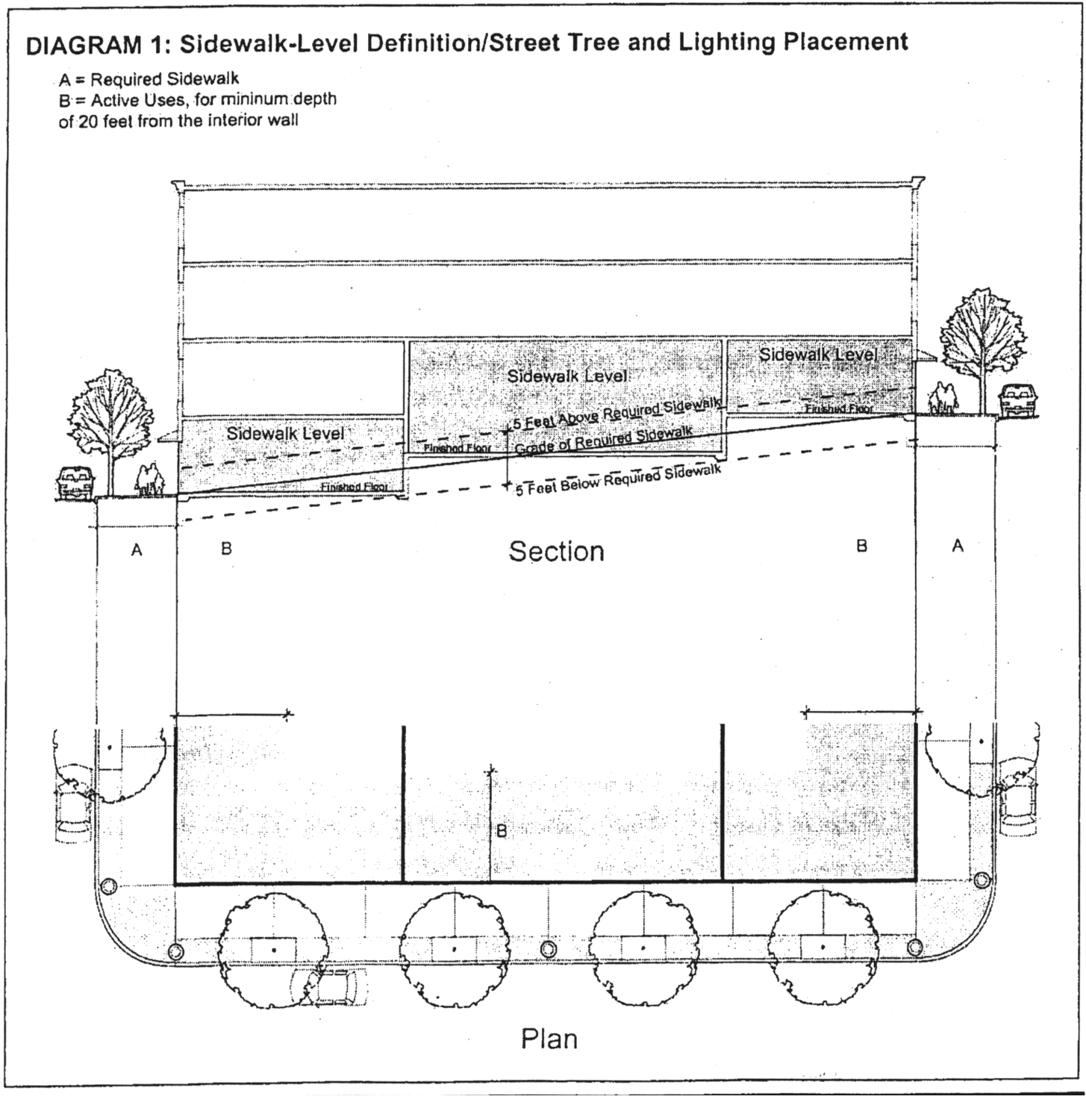
Diagram 1
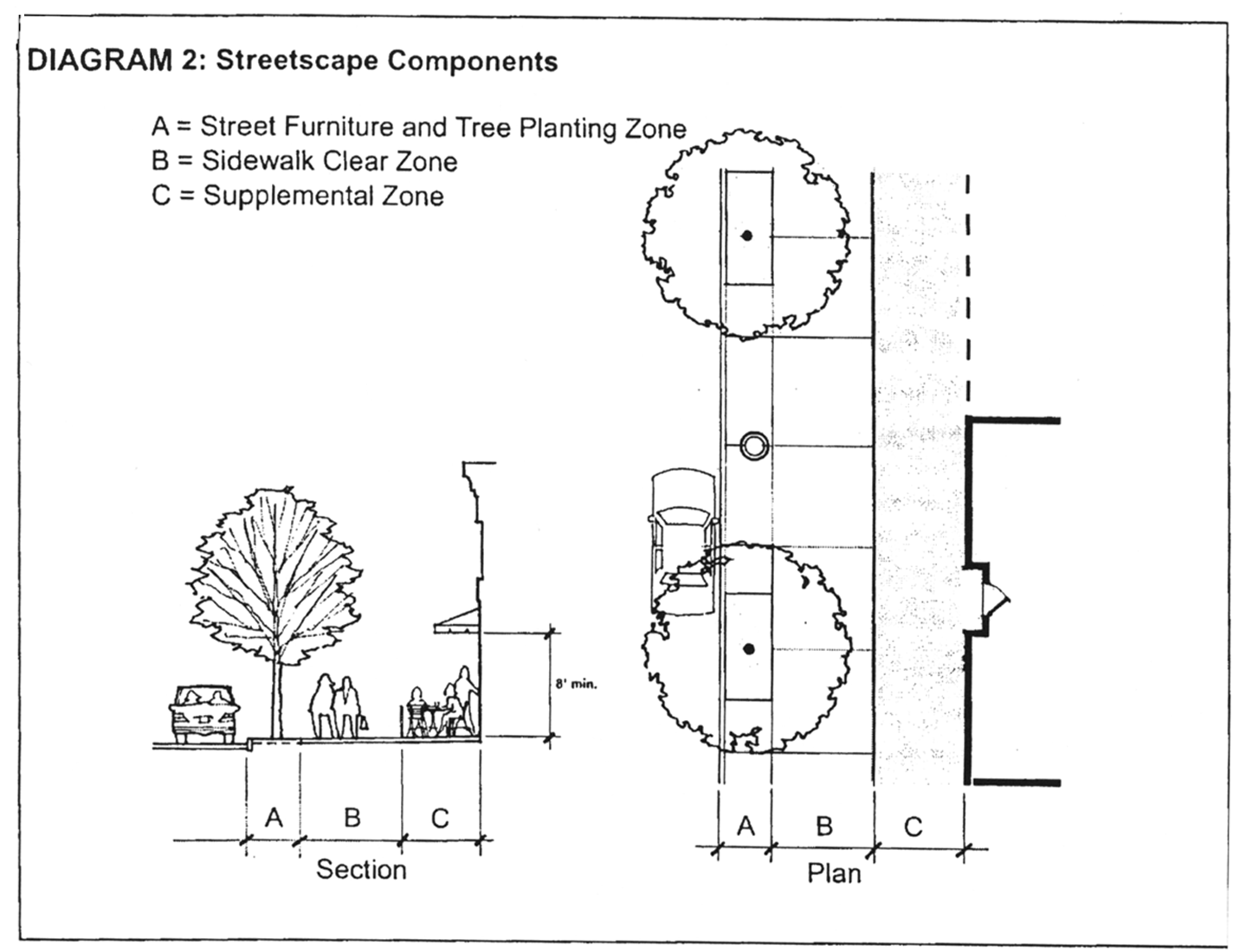
Diagram 2
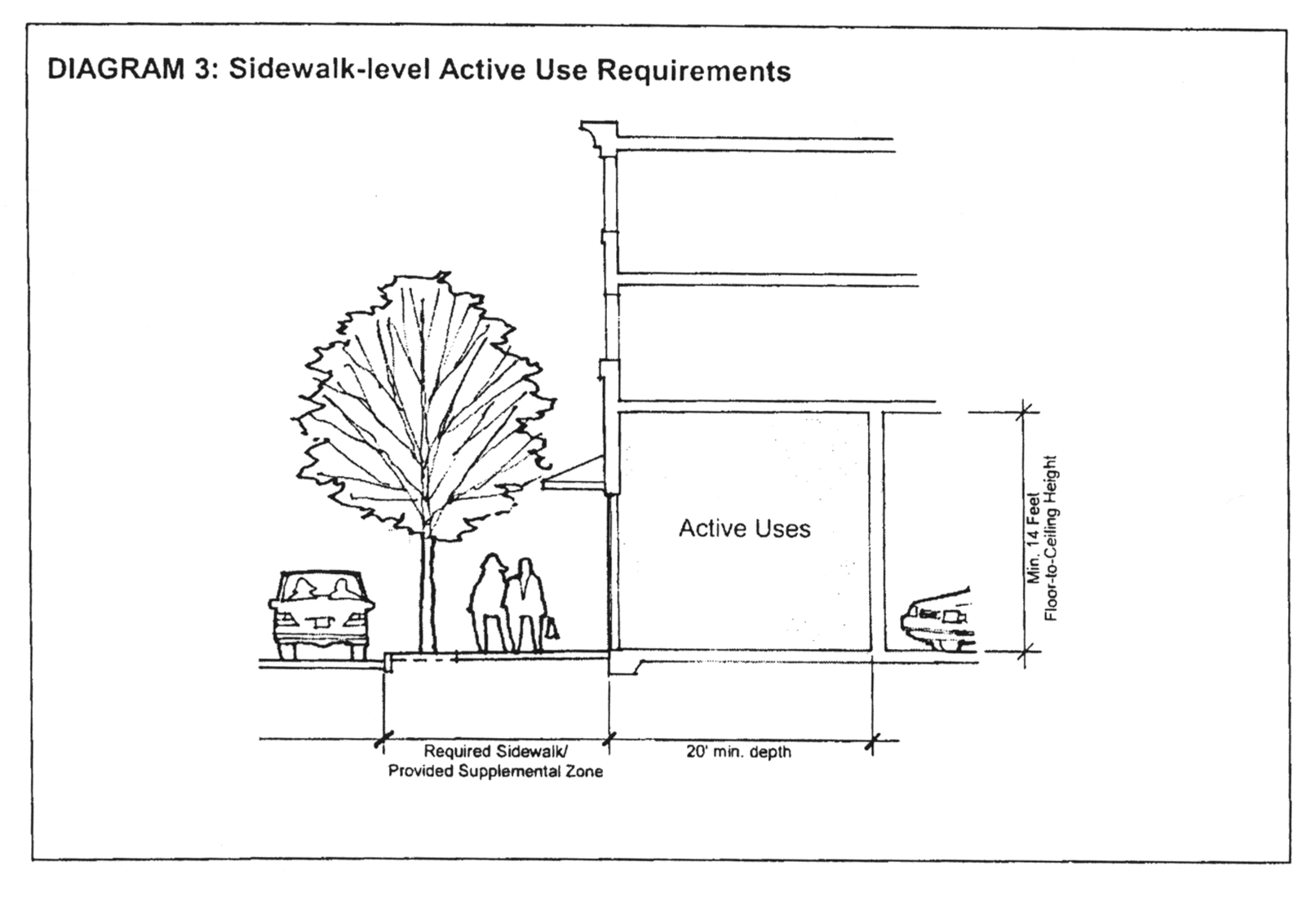
Diagram 3
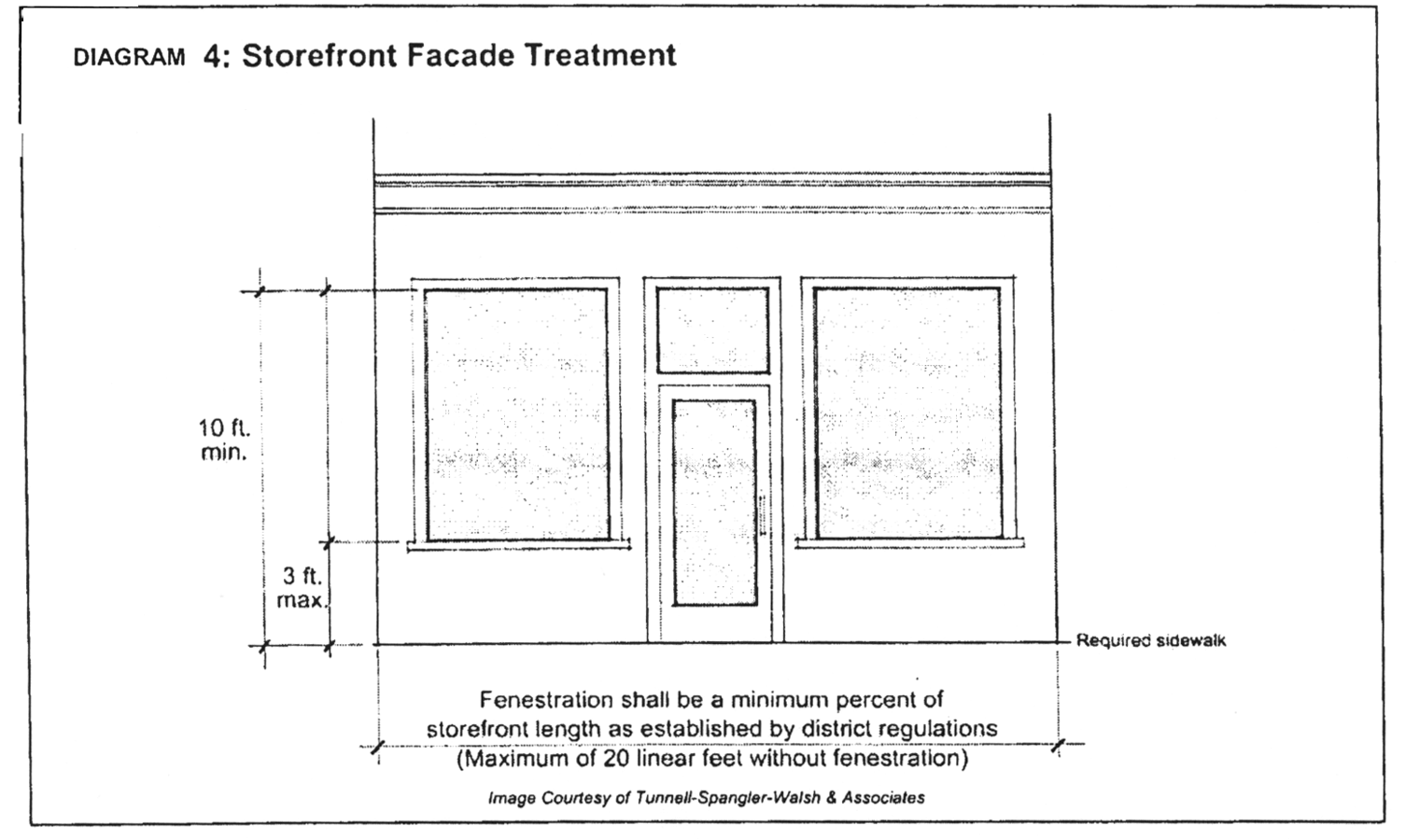
Diagram 4
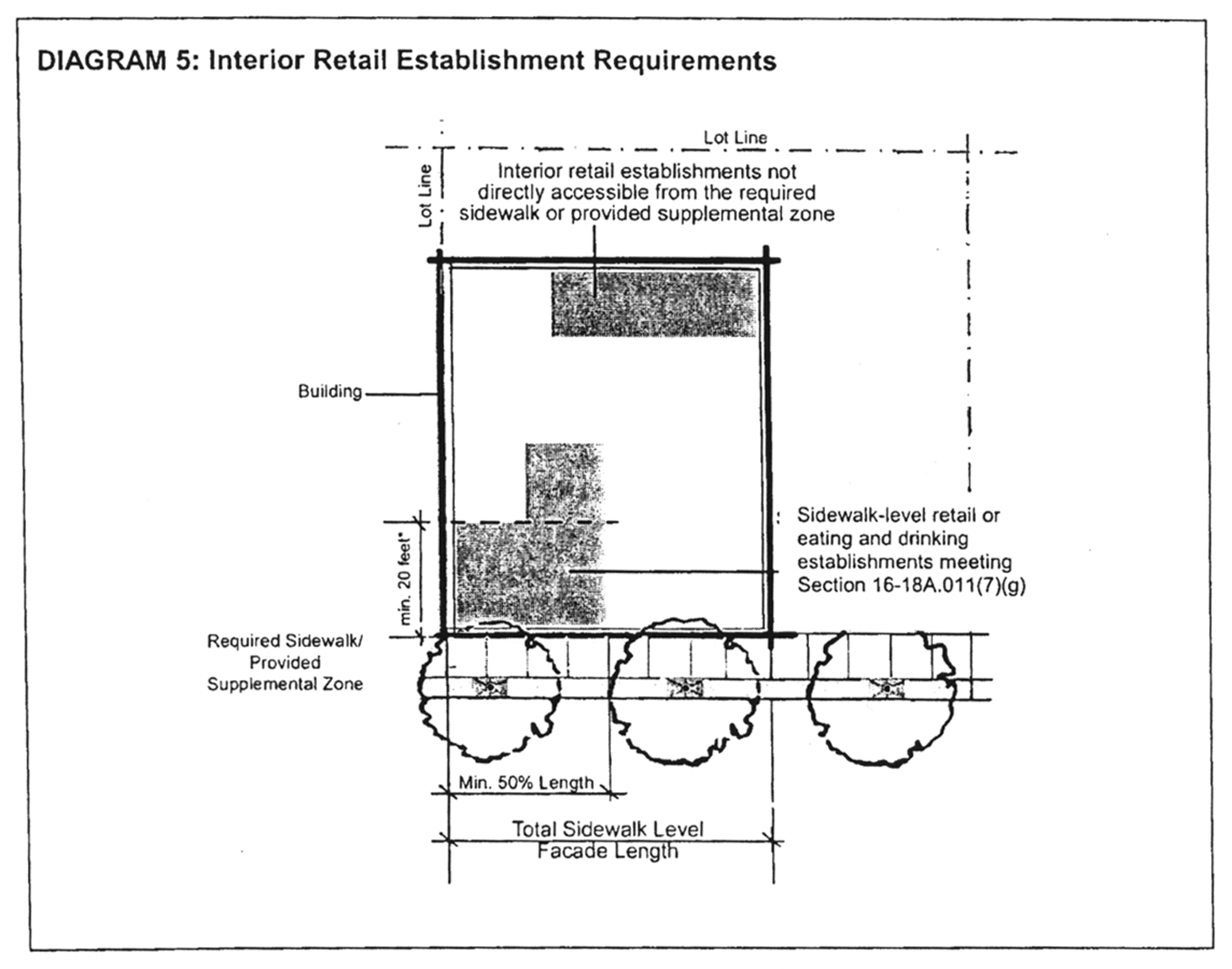
Diagram 5
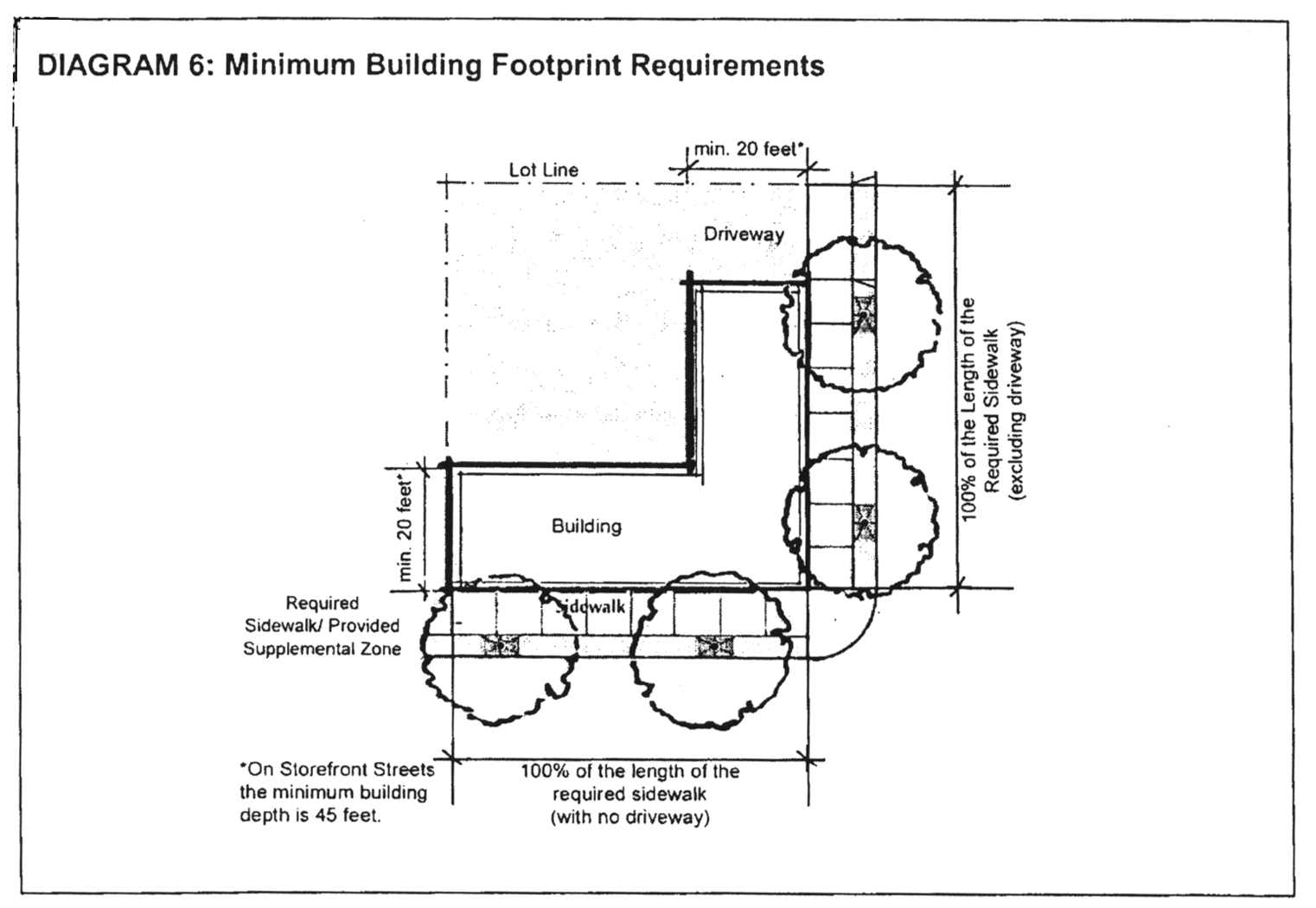
Diagram 6
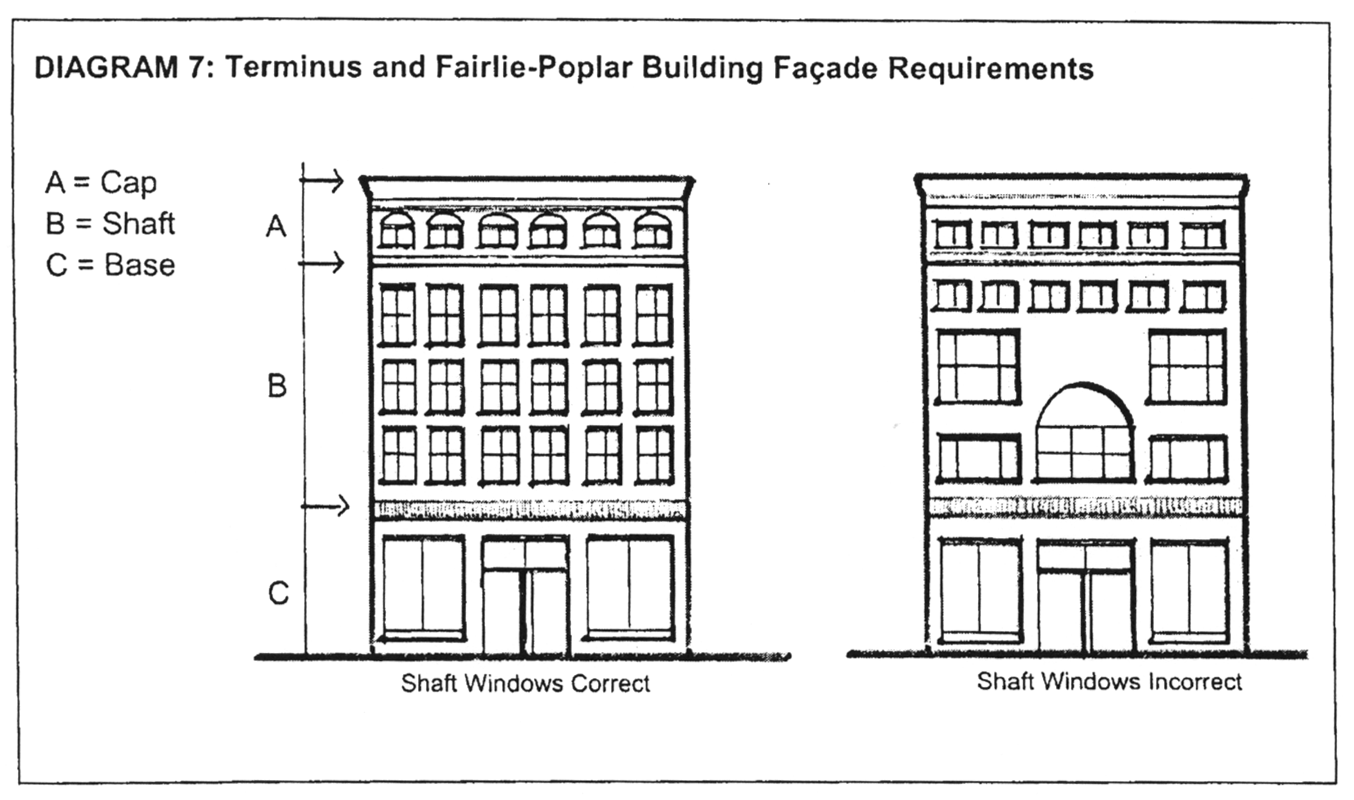
Diagram 7
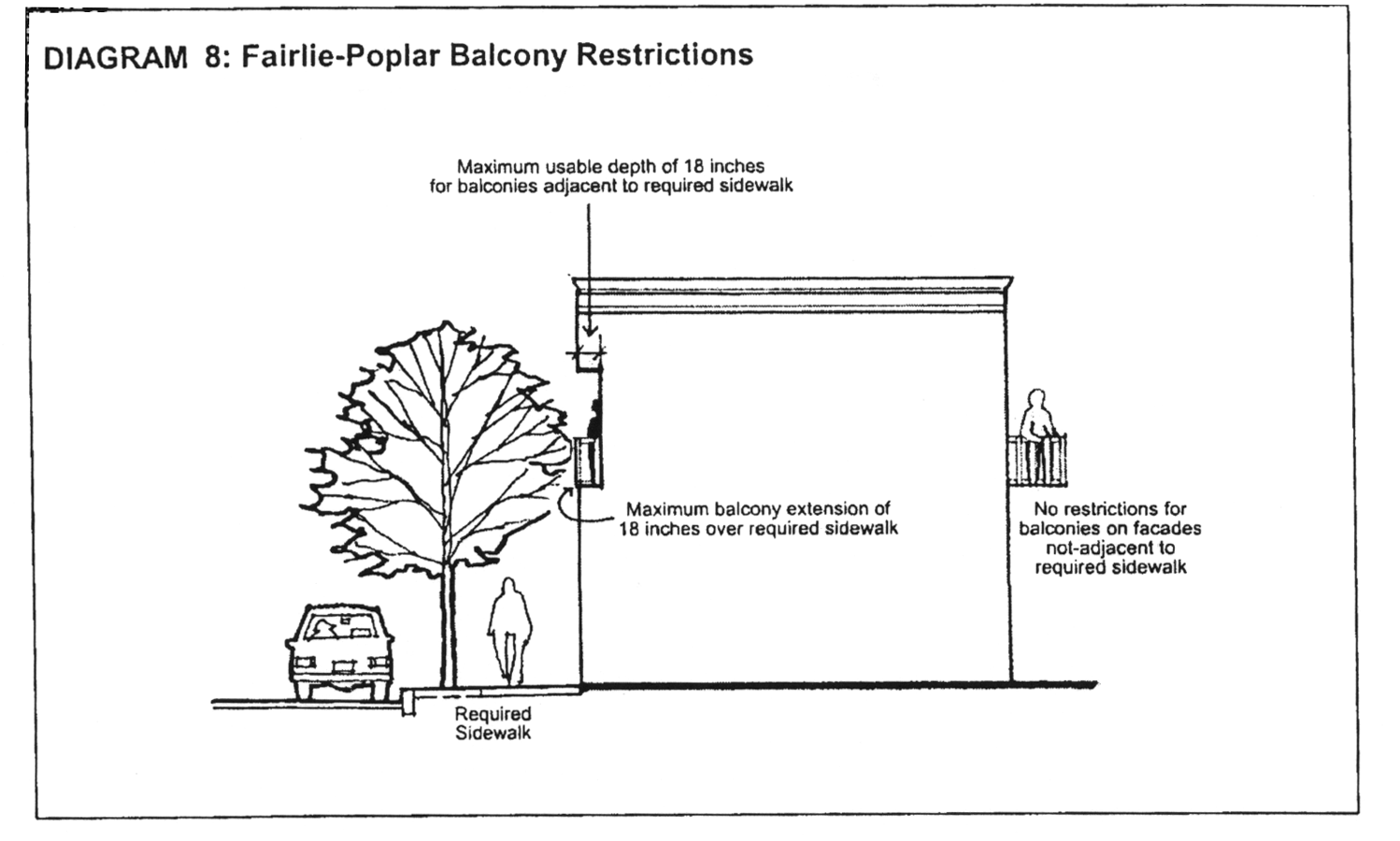
Diagram 8
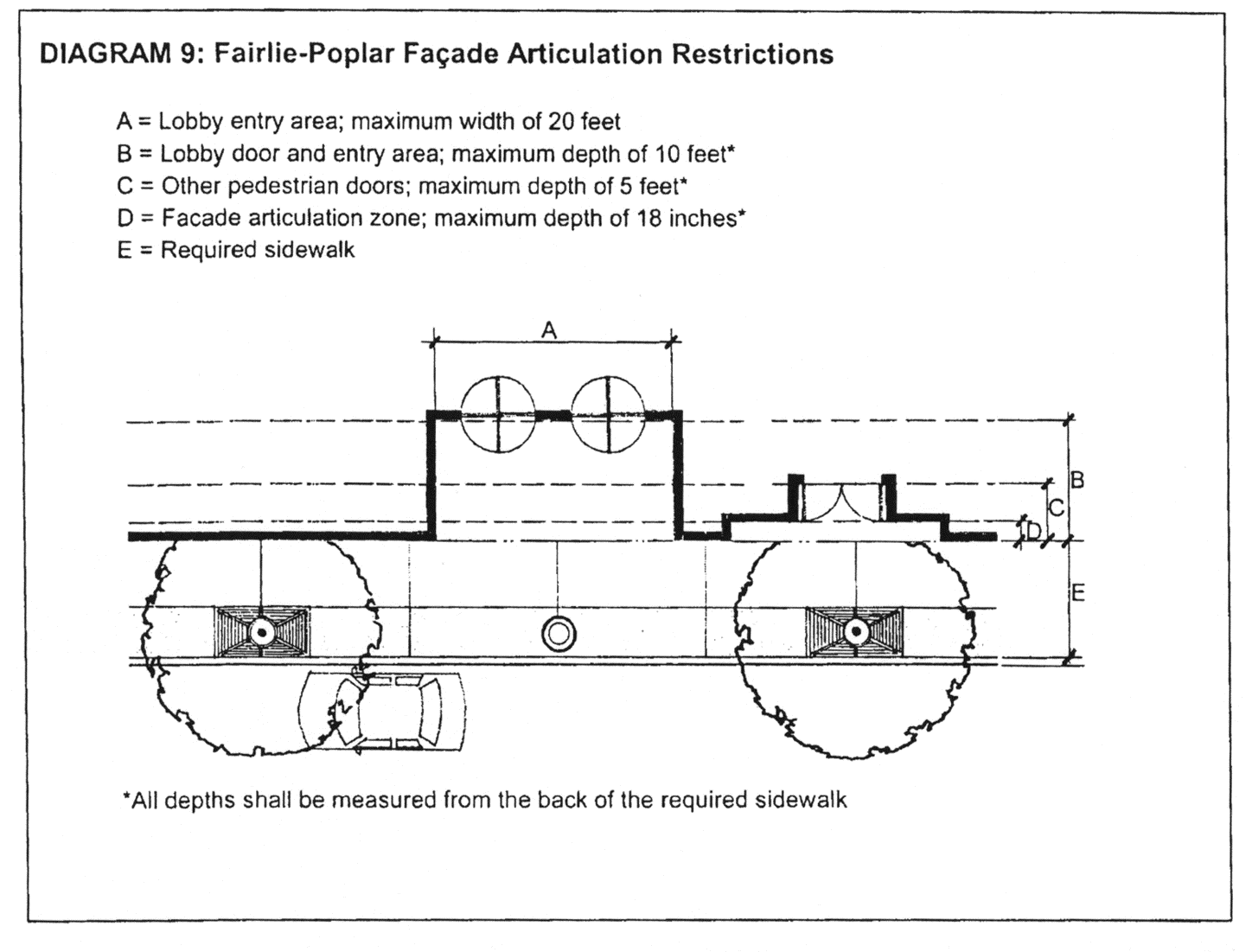
Diagram 9
(Ord. No. 2007-71(07-O-2221), § 1(Att. A), 11-27-07)

