
Austell City Zoning Code
ARTICLE IV
- DISTRICT REGULATIONS
Sec. 48-135. - Summary of bulk regulations.
Explanation of symbols:
* Distance required fronting cul-de-sac.
** Distance if interior portion of development (interior shall be considered the portion which does not abut an exterior property boundary).
† Distance if not interior portion of development.
‡ Attached units.
Notes:
1 Minimum front yard setback is measured from the future public right-of-way (see diagrams within each district for specific setback requirements).
2 Major side yard setback is measured from the future public right-of-way (see diagrams within each district for specific setback applications).
3 See diagrams within each district for specific setback applications.
4 See diagrams within each district for specific setback applications.
(Code 1985, § 22-121)
Sec. 48-136. - Summary of uses.
This chart is provided for the convenience of the users; however, please consult the permitted uses or special exception uses section of the specific zoning districts for possible use limitations for specific permitted uses or special exception uses.
Notes:
P = Permitted Use
SE = Special Exception Use
SLUP = Special Land Use Permit
(Code 1985, § 22-122)
Sec. 48-137. - R-80 Single-family residential district.
The regulations for the R-80 single-family residential district (80,000-square foot lot size) are as follows:
(1)
Purpose and intent. The R-80 district is established to provide locations for single-family residential uses or residentially compatible institutional and recreational uses which are within or on the edge of properties delineated for any residential category as defined and shown on the Austell Comprehensive Plan: Policy Guide, adopted July 2, 2007. When residentially compatible institutional and recreational uses are developed within the R-80 district, they should be designed and built to ensure intensity and density compatibility with adjacent single-family detached dwellings and otherwise to implement the stated purpose and intent of this chapter.
(2)
Permitted uses. Anything not permitted or allowed by special exception is prohibited. Permitted uses are as follows:
a.
Customary home occupations.
b.
Executive golf courses.
c.
Golf courses, 18-hole regulation, public and private.
d.
Golf courses, par 3.
e.
In-home day care.
f.
Land mobile, communication, microwave, and radio transmission antenna towers.
g.
Livestock, nondomestic and wild animals, and poultry.
h.
Nonprofit (seasonal use) fishing lakes.
i.
Private parks, SLUP required.
j.
Radio, television and other communication towers and antennas subject to section 48-199.
k.
Riding stables.
l.
Single-family dwelling units (detached).
m.
Temporary uses (as defined in this chapter).
(3)
Lot size and setback requirements. Lot size and setback requirements are as follows:
a.
Minimum lot size: 80,000 square feet.
b.
Minimum lot width at front setback line: 75 feet; cul-de-sac, 50 feet.
c.
Minimum public road frontage: 75 feet; cul-de-sac, 50 feet.
d.
Minimum building setbacks means as shown and applied in the following diagram:
Minimum Building Setback Requirements for R-80 District
Note: All setbacks shall be measured from future right-of-way.
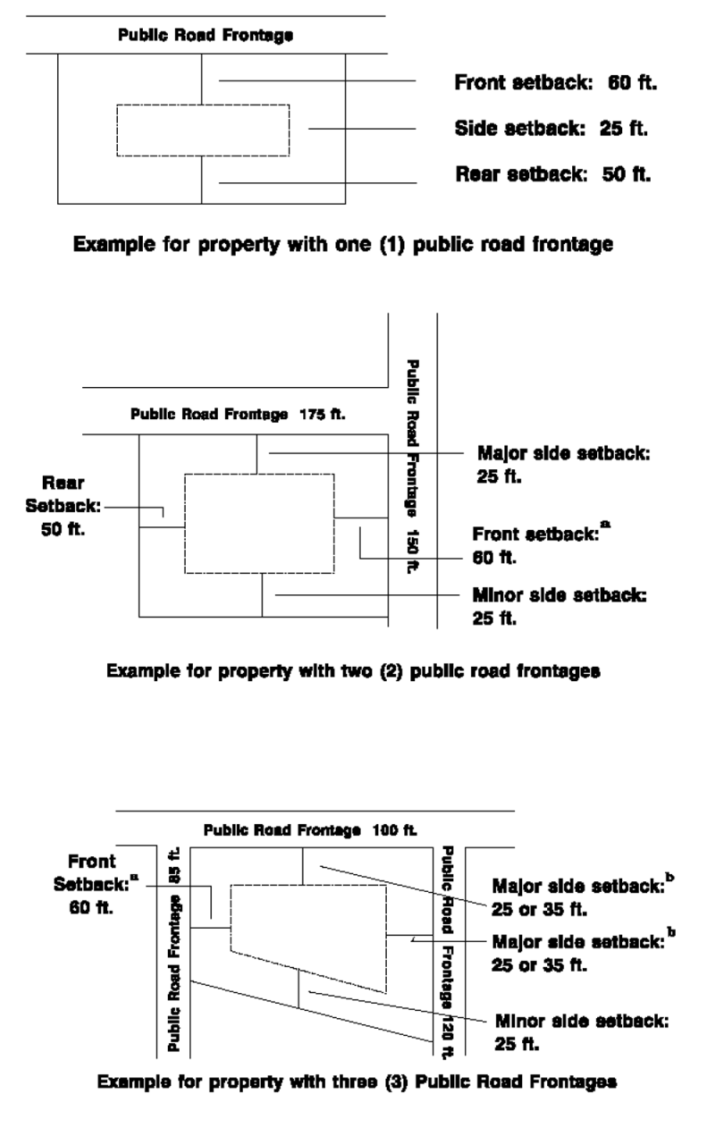
Notes:
1.
Property with shorter amount of road frontage will be the front setback for determining other setbacks (major side, side, rear).
2.
If structure fronts a major side setback, major side setback shall be 35 feet.
(4)
Landscape buffer and screening requirements. Landscape buffer and screening requirements are not applicable in this district.
(5)
Floodplain and wetlands preservation requirements. Subject to the conditions set forth in the city floodplain management and prevention ordinance.
(6)
Building and structure requirements. Maximum building height is 35 feet.
(7)
Parking requirements. See section 48-198 for paved parking specifications.
(8)
Lighting requirements. Any project permitted within the R-80 district which proposes a lighted facility must have approval from the building official or his designee.
(9)
Special exception uses. See section 48-197 for requirements for special exception uses. Special exception uses for the R-80 district are the uses listed as follows:
a.
Any other facility for the disposal of the dead.
b.
Cemeteries.
c.
Churches, chapels, temples, synagogues and other places of worship.
d.
Mausoleums.
e.
Club or lodge, private.
f.
Private schools of general and special education.
(10)
Use limitations.
a.
No sales of goods or products shall be permitted, except as accessory to a customary home occupation, land use permit, special land use permit or special exception use.
b.
No adult entertainment uses are permitted.
c.
All uses are subject to the subdivision regulations of the city as may be amended from time to time.
d.
No outside storage is permitted, excluding firewood and lawn furnishings.
e.
Maximum impervious surface shall not exceed 25 percent. Required buffers may be included within required setbacks; however, in such case that the required buffer is greater than the required setback, the required buffer shall be adhered to. Additionally, necessary private utilities or access drives may be allowed through, over or across a landscaped buffer. Any such uses which are proposed through, over or across a designated undisturbed buffer must be approved pursuant to an original site plan or site plan modification.
f.
No tractor trailers, or heavy equipment shall be allowed to be parked in a residential zoned neighborhood.
g.
RVs, trailers, boats, and the like shall not be allowed to be parked beyond the front building line or allowed in the front yards and must be on a hardened surface.
(11)
Accessory buildings, structures, uses and decks.
a.
Any accessory building or structure in excess of 1,000 square feet of gross space shall be located to the rear of the primary structure and at least 100 feet from any property line. Any accessory building or structure less than 1,000 square feet and greater than 144 square feet must be located to the rear of the primary structure within the building setbacks. Any accessory building or structure which exceeds 1,000 square feet of gross space must have the approval of the building official or his designee as to the location, architectural design and size prior to commencing construction. The building official or his designee shall consider the following criteria for determining the appropriateness of the architectural design and size of the accessory building or structure: compatibility with the surrounding neighborhood, style of exterior (the exterior is to be compatible in style with the primary structure), use of the proposed accessory structure, impact on adjacent properties, and requirements as deemed appropriate by plan review as set forth in this subsection. All accessory buildings, structures and uses in excess of 1,000 square feet shall be required to submit for plan review through the community affairs department or receive approval from the director of community affairs or his designee.
b.
Accessory buildings, structures, uses or decks shall be subject to the following conditions unless otherwise defined as in subsection (11)a of this section:
1.
Maximum height is two stories or 35 feet, when located within building setbacks or at least 100 feet from a property line, otherwise maximum height is one story.
2.
Accessory uses shall include garbage pads, heating and air conditioning units, Jacuzzis, tennis courts, swimming pools (private), playhouses and playgrounds.
3.
All accessory uses shall be located to the rear of the principal building, except for heating and air conditioning units or garbage pads, which may be located on the side or rear.
4.
The rear of the principal building shall be where the main portion of the building ends without consideration of the wings.
5.
Architectural style and design shall be approved by the building official or his designee.
6.
Such structures or buildings shall be located on the same lot as and to the rear of the principal building to which they are accessory. Decks may be located to the rear or side of the principal building subject to the limitations in this subsection.
7.
No accessory building, structure, use or deck shall be built until construction of the principal building has commenced.
8.
On a corner lot, no accessory building, structure, use or deck shall be located closer to the side street right-of-way line than the principal building.
9.
No garage or accessory building, structure, use or deck less than 144 gross square feet, shall be located closer than five feet to a side or rear lot line or within any required buffers, whichever is greater, regardless if the garage, accessory building, structure, use or deck is attached to the primary structure by a breezeway. If the garage, accessory building, structure, use or deck is attached to the primary structure by a breezeway, it shall be located up to a maximum of 25 feet from the primary structure to which it is attached.
c.
Antennas and satellite dishes shall meet the requirements set forth in section 48-200.
d.
Incidental storage is permitted, provided that the material stored is incidental to the permitted use, as determined by the building official or his designee, and stored completely within a portion of the enclosed principal structure permitted within the district, or within a permitted accessory structure.
e.
Neighborhood recreation centers, amenities and swimming pools are subject to the following:
1.
Site plans must be approved by the building official or his designee to ensure compliance with all applicable laws and provisions of this chapter. The facility should be designed to include a detailed landscape plan that provides adequate screening of the facility which creates a visual and sound buffer for adjacent properties. The landscape plan shall be drawn to scale and shall include plant identification by common name. The facility shall be designed to accommodate no more than those residing within two adjoining residential developments, except in those cases where a variance is obtained as in other cases.
2.
Buildings and structures established in connection with such use shall be set back not less than 100 feet from any property line.
(i)
Upon written consent of all owners of property within 100 feet of the building or structure, the setback may be reduced to 50 feet from any exterior property line of the subdivision within which the use is located. Additionally, a detailed landscape plan must be submitted to and approved by the building official or his designee.
(ii)
The setback may be reduced to 20 feet from an interior property line of the property on which the use is located if a ten-foot landscaped buffer is provided along the property line and a six-foot solid wood or masonry fence is erected and maintained along the line so as to provide a visual and noise screen for adjacent property; provided, however, the setback after reduction shall not be less than 100 feet from an exterior property line unless also reduced in accordance with subsection (11)e.2(i) of this section. Such landscaped buffer shall be shown on the landscaping plan specified in subsection (11)e.1 of this section and must be approved by the building official or his designee.
(iii)
When a property line is on a natural waterway, a property line setback may be waived provided a written waiver is obtained from the building official or his designee.
3.
Swimming pools must comply with all applicable ordinances and must have necessary approvals from the health department and the city.
4.
Outdoor activity shall cease by 11:00 p.m.
5.
Lighting shall be established in such a way that values or quiet use and enjoyment of adjacent properties are not adversely affected, and that roadways and safe use thereof are not adversely affected. No direct light shall be cast upon adjacent properties or roadways. If lighting is to be established, the use of environmental or cutoff type fixtures only is permissible. If lighting is to be established in a recreation area adjacent to an existing or proposed Cobb County or city public road, a lighting plan must be submitted and approved by the mayor and council to ensure that no light is cast upon the roadway and that no adverse impact will be created as a result of the lighting.
6.
No residence or structures shall be built upon any adjacent lot within the development within which the facility is located until construction of the recreation area has commenced to the extent that buyers of adjacent property will be aware of where the recreation area will be located.
7.
Parking requirements are as follows:
(i)
A minimum of 20 spaces shall be provided for amenities which include a swim facility or swim/tennis facility with up to four courts. Additional spaces at the minimum of four spaces per court shall be provided for each court over four in number. A minimum of ten spaces for every two courts shall be provided for amenities which include tennis courts only.
(ii)
In addition to the requirement of subsection (11)e.7(i) of this section, a minimum of five spaces for each 50 residents, or pro-rated share thereof, over 100 shall be provided.
(iii)
Parking spaces shall be paved and striped according to section 48-198, as it now exists or may hereafter be amended. No parking shall be allowed within a front yard setback.
8.
No park, playground, tennis court, basketball court, or the like shall be allowed to be constructed unless the following criteria are met, except those recreational improvements included in a site plan approved by the mayor and council:
(i)
The adjacent property owners shall be in favor of the proposed recreational improvement.
(ii)
Sixty percent of the subdivision, if located in a subdivision shall be in favor of the proposed park.
(iii)
Approval has been received by mayor and council.
(Code 1985, § 22-123)
Sec. 48-138. - RR Rural residential district.
The regulations for the RR rural residential district are as follows:
(1)
Purpose and intent. The RR district is established to provide locations for large useable areas for limited residential, agricultural, park and open space needs. This district also serves to correlate growth with utility, service and transportation needs until urbanization is warranted. RR uses or residentially compatible institutional and recreational uses should be located within or on the edge of properties delineated for any residential category as defined and shown on the Austell Comprehensive Plan: Policy Guide, adopted July 2, 2007. When residentially compatible institutional and recreational uses are developed within the RR district, they should be designed and built to ensure intensity and density compatibility with adjacent single-family detached dwellings and otherwise to implement the stated purpose and intent of this chapter.
(2)
Permitted uses. Anything not permitted or allowed by special exception is prohibited. Permitted uses are as follows:
a.
Agricultural produce stands with a minimum of four off-street parking spaces.
b.
Commercial greenhouses and plant nurseries so long as set back at least 100 feet from any residential property line.
c.
Customary home occupations.
d.
Dairies, so long as buildings used for livestock shall be set back not less than 200 feet from any property line and all animals are maintained at least 100 feet from any property line.
e.
Executive golf courses.
f.
Farm and garden supply stores.
g.
Field crops.
h.
Fruit trees, nuts and vegetables.
i.
Golf courses, 18-hole regulation, public and private.
j.
Golf courses, par 3.
k.
In-home day care.
l.
Livestock, nondomestic and wild animals, and poultry.
m.
Livestock sales pavilions.
n.
Nonprofit (seasonal use) fishing lakes.
o.
Outdoor golf driving ranges.
p.
Poultry hatcheries. All structures shall be located and activities conducted at least 100 feet from any residentially zoned property.
q.
Private parks, SLUP required.
r.
Radio, television and other communication towers and antennas, subject to section 48-199.
s.
Riding stables.
t.
Single-family dwelling units (detached).
u.
Temporary uses (as defined in this chapter).
(3)
Lot size and setback requirements. Lot size and setback requirements are as follows:
a.
Minimum lot size: 40,000 square feet.
b.
Minimum lot width at front setback line: 100 feet.
c.
Minimum public road frontage: 75 feet.
d.
Minimum building setbacks means as shown on and applied in the following diagram:
Minimum Building Setback Requirements for RR District
Note: All setbacks shall be measured from future right-of-way.
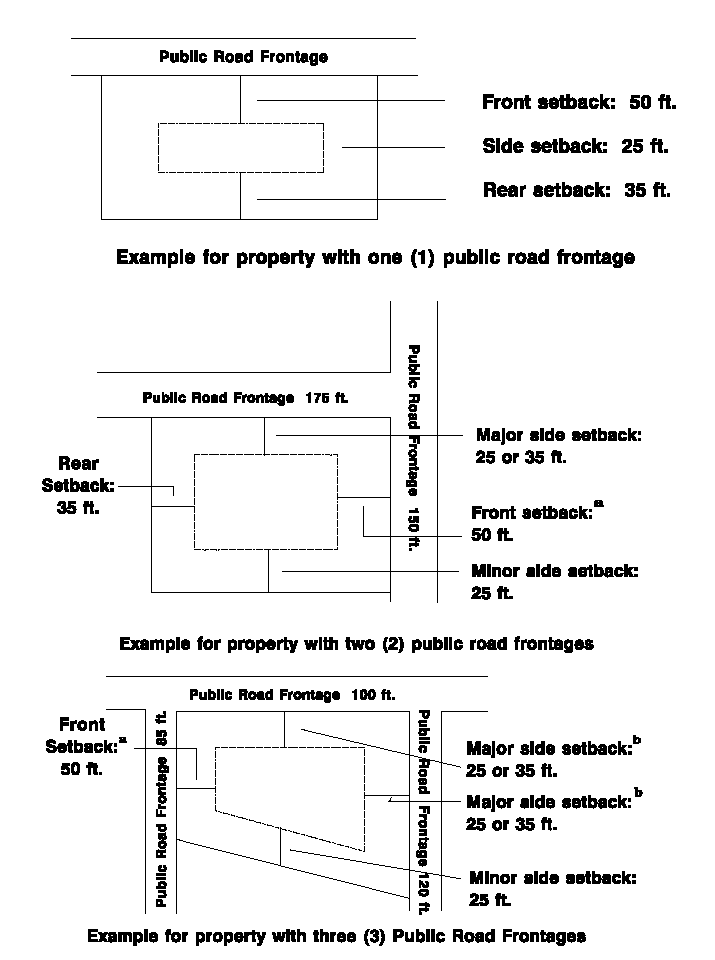
Notes:
1.
Property with shorter amount of road frontage will be the front setback for determining other setbacks (major side, side, rear).
2.
If structure fronts a major side setback, major side setback shall be 35 feet.
(4)
Landscape buffer and screening requirements. Landscape buffer and screening requirements are not applicable in this district.
(5)
Floodplain and wetlands preservation requirements. Subject to the conditions set forth in the city floodplain management and prevention ordinance.
(6)
Building and structure requirements. Maximum building height is 35 feet.
(7)
Parking requirements. See section 48-198 for paved parking specifications.
(8)
Lighting requirements. Any project permitted within the RR district which proposes any outdoor lighting must have approval from the building official or his designee.
(9)
Special exception uses. See section 48-197 for requirements for special exception uses. Special exception uses for the RR district are the uses listed as follows:
a.
Any other facility for the disposal of the dead.
b.
Cemeteries.
c.
Churches, chapels, temples, synagogues and other places of worship.
d.
Mausoleums.
e.
Club or lodge, private.
f.
Private schools of general and special education.
(10)
Use limitations.
a.
No outside storage is permitted, excluding firewood and lawn furnishings.
b.
Maximum impervious surface shall not exceed 25 percent. Required buffers may be included within required setbacks; however, in such case that the required buffer is greater than the required setback, the required buffer shall be adhered to. Additionally, necessary private utilities and access drives may be allowed through, over or across a landscaped buffer. Any such uses which are proposed through, over or across a designated undisturbed buffer must be approved pursuant to an original site plan or site plan modification.
(11)
Accessory buildings, structures, uses and decks.
a.
Any accessory building or structure in excess of 1,000 square feet of gross space shall be located to the rear of the primary structure and at least 100 feet from any property line. Any accessory building or structure less than 1,000 square feet and greater than 144 square feet must be located to the rear of the primary structure within the building setbacks. Any accessory building or structure which exceeds 1,000 square feet of gross space must have the approval of the building official or his designee as to the location, architectural design and size prior to commencing construction. The building official or his designee shall consider the following criteria for determining the appropriateness of the architectural design and size of the accessory building or structure: compatibility with the surrounding neighborhood, style of exterior (the exterior is to be compatible in style with the primary structure), use of the proposed accessory structure, impact on adjacent properties, and requirements as deemed appropriate by plan review as set forth in this subsection. All accessory buildings, structures and uses in excess of 1,000 gross square feet shall be required to submit for plan review through the community affairs department or receive approval from the director of community affairs or his designee.
b.
Accessory buildings, structures, uses and decks shall be subject to the following conditions unless otherwise defined as in subsection (11)a of this section:
1.
Maximum height is two stories or 35 feet, when located within building setbacks or at least 100 feet from a property line, otherwise maximum height is one story.
2.
Accessory uses shall include garbage pads, heating and air conditioning units, Jacuzzis, tennis courts, swimming pools (private), playhouses and playgrounds.
3.
All accessory uses shall be located to the rear of the principal building, except for heating and air conditioning units or garbage pads, which may be located on the side or rear.
4.
The rear of the principal building shall be where the main portion of the building ends without consideration of wings.
5.
Architectural style and design are to be approved by the building official or his designee.
6.
Such structures or buildings shall be located on the same lot as and to the rear of the principal building to which they are accessory. Decks may be located to the rear or side of the principal building subject to the limitations in this subsection.
7.
No accessory building, structure, use or deck shall be constructed upon a lot until construction of the principal building has commenced.
8.
On a corner lot, no accessory building, structure, use or deck shall be located closer to the side street right-of-way line than the principal building.
9.
No garage or accessory building, structure, use or deck less than 144 gross square feet, shall be located closer than five feet to a side or rear lot line or within any required buffers, whichever is greater, regardless if the garage, accessory building, structure, use or deck is attached to the primary structure by a breezeway. If the garage, accessory building, structure, use or deck is attached to the primary structure by a breezeway, it shall be located up to a maximum of 25 feet from the primary structure to which it is attached.
c.
Antennas and satellite dishes shall meet the requirements set forth in section 48-200.
d.
Incidental storage is permitted, provided that the material stored is incidental to the permitted use, as determined by the building official or his designee, and stored completely within a portion of the enclosed principal structure permitted within the district, or within permitted accessory structure.
e.
Neighborhood recreation centers, amenities and swimming pools are subject to the following:
1.
Site plans must be approved by the building official or his designee to ensure compliance with all applicable laws and provisions of this chapter. The facility should be designed to include a detailed landscape plan that provides adequate screening of the facility which creates a visual and sound buffer for adjacent properties. The landscape plan shall be drawn to scale and shall include plant identification by common name. The facility shall be designed to accommodate no more than those residing within two adjoining residential developments, except in those cases where a variance is obtained as in other cases.
2.
Buildings and structures established in connection with such use shall be set back not less than 100 feet from any property line.
(i)
Upon written consent of all owners of property within 100 feet of the building or structure, the setback may be reduced to 50 feet from any exterior property line of the subdivision within which the use is located. Additionally, a detailed landscape plan must be submitted to and approved by the building official or his designee.
(ii)
The setback may be reduced to 20 feet from an interior property line of the property on which the use is located if a ten-foot landscaped buffer is provided along the property line and a six-foot solid wood or masonry fence is erected and maintained along the line so as to provide a visual and noise screen for adjacent property; provided, however, the setback after reduction shall not be less than 100 feet from an exterior property line unless also reduced in accordance with subsection (11)e.2(i) of this section. Such landscaped buffer shall be shown on the landscaping plan specified in subsection (11)e.1 of this section and must be approved by the building official or his designee.
(iii)
When a property line is on a natural waterway, a property line setback may be waived provided written waiver is obtained from the building official or his designee.
3.
Swimming pools must comply with all applicable ordinances and must have necessary approvals from the health department and the city.
4.
Outdoor activity shall cease by 11:00 p.m.
5.
Lighting shall be established in such a way that values or quiet use and enjoyment of adjacent properties are not adversely affected, and that roadways and safe use thereof are not adversely affected. No direct light shall be cast upon adjacent properties or roadways. If lighting is to be established, the use of environmental or cutoff type fixtures only is permissible. If lighting is to be established in a recreation area adjacent to an existing or proposed Cobb County or city public road, a lighting plan must be submitted and approved by the mayor and council to ensure that no light is cast upon the roadway and that no adverse impact will be created as a result of the lighting.
6.
No residence or structures shall be built upon any adjacent lot within the development within which the facility is located until construction of the recreation area has commenced to the extent that buyers of adjacent property will be aware of where the recreation area will be located.
7.
Parking requirements are as follows:
(i)
A minimum of 20 spaces shall be provided for amenities which include a swim facility or swim/tennis facility with up to four courts. Additional spaces at the minimum of four spaces per court shall be provided for each court over four in number. A minimum of ten spaces for every two courts shall be provided for amenities which include tennis courts only.
(ii)
In addition to the requirement of subsection (11)e.7(i) of this section, a minimum of five spaces for each 50 residents, or pro-rated share thereof, over 100 shall be provided.
(iii)
Parking spaces shall be paved and striped according to section 48-198, as it now exists or may hereafter be amended. No parking shall be allowed within a front yard setback.
8.
No park, playground, tennis court, basketball court, or the like shall be allowed to be constructed unless the following criteria are met, except those recreational improvements included in a site plan approved by the mayor and council:
(i)
The adjacent property owners shall be in favor of the proposed recreational improvement.
(ii)
Sixty percent of the subdivision, if located in a subdivision shall be in favor of the chapter proposed park.
(iii)
Approval has been received by mayor and council.
(Code 1985, § 22-124)
Sec. 48-139. - R-40 Single-family residential district.
The regulations for the R-40 single-family residential district (40,000-square foot lot size) are as follows:
(1)
Purpose and intent. The R-40 district is established to provide locations for single-family residential uses or residentially compatible institutional and recreational uses which are within or on the edge of properties delineated for any residential category as defined and shown on the Austell Comprehensive Plan: Policy Guide, adopted July 2, 2007. When residentially compatible institutional and recreational uses are developed within the R-40 district, they should be designed and built to ensure intensity and density compatibility with adjacent single-family detached dwellings and otherwise to implement the stated purpose and intent of this chapter.
(2)
Permitted uses. Anything not permitted or allowed by special exception is prohibited. Permitted uses are as follows:
a.
Customary home occupations.
b.
Executive golf courses.
c.
Golf courses, 18-hole regulation, public and private.
d.
Golf courses, par 3.
e.
In-home day care.
f.
Livestock, nondomestic and wild animals, and poultry.
g.
Nonprofit (seasonal use) fishing lakes.
h.
Private parks, SLUP required.
i.
Radio, television and other communication towers and antennas, subject to section 48-199.
j.
Riding stable.
k.
Single-family dwelling units (detached).
l.
Temporary uses (as defined by this chapter).
(3)
Lot size and setback requirements. Lot size and setback requirements are as follows:
a.
Minimum lot size: 40,000 square feet.
b.
Minimum lot width at front setback line: 75 feet; cul-de-sac, 50 feet.
c.
Minimum public road frontage: 75 feet; cul-de-sac, 50 feet.
d.
Minimum building setbacks means as shown and applied in the following diagram:
Minimum Building Setback Requirements for R-40 District
Note: All setbacks shall be measured from future right-of-way.
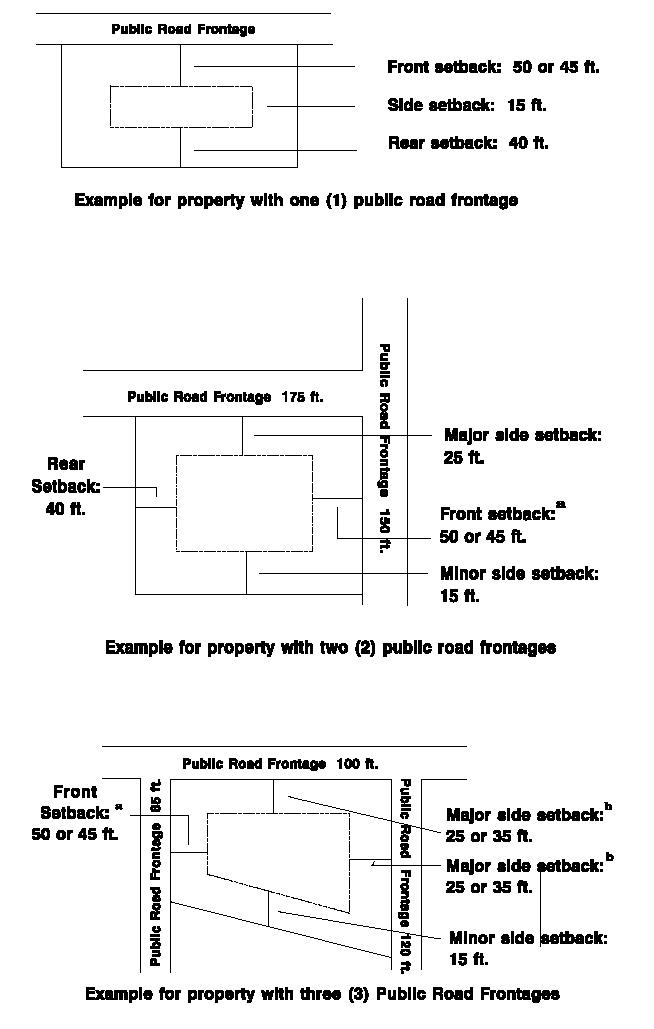
Notes:
1.
Property with shorter amount of road frontage will be the front setback for determining other setbacks (major side, side, rear).
2.
If structure fronts a major side setback, major side setback shall be 35 feet.
(4)
Landscape buffer and screening requirements. Landscape buffer and screening requirements are not applicable in this district.
(5)
Floodplain and wetlands preservation requirements. Subject to the conditions set forth in the city floodplain management and prevention ordinance.
(6)
Building and structure requirements. Maximum building height is 35 feet.
(7)
Parking requirements. See section 48-198 for paved parking specifications.
(8)
Lighting requirements. Any project permitted within the R-40 district which proposes any outdoor lighting must have approval from the building official or his designee.
(9)
Special exception uses. See section 48-197 for requirements for special exception uses. Special exception uses for the R-40 district are the uses listed as follows:
a.
Any other facility for the disposal of the dead.
b.
Cemeteries.
c.
Churches, chapels, temples, synagogues and other places of worship.
d.
Mausoleums.
e.
Club or lodge, private.
f.
Private schools of general and special education.
(10)
Use limitations.
a.
No sale of goods or products shall be permitted, except if accessory to a customary home occupation, land use permit, special land use permit or special exception use.
b.
No adult entertainment uses are permitted.
c.
No materials, equipment or business vehicles may be stored or parked on the premises, except that one business vehicle (the carrying or towing capacity of which shall not exceed 1½ tons), used exclusively by the resident may be parked in a carport, garage, or rear or side yard. The off-site employees of the resident shall not congregate on the premises for any purpose concerning the business of the home occupation.
d.
All uses are subject to the subdivision regulations of the city or as may be amended from time to time.
e.
No outside storage is permitted, excluding firewood and lawn furnishings.
f.
Maximum impervious surface shall not exceed 30 percent. An undisturbed buffer equal to the required rear yard setback for this zoning district shall be established along the perimeter boundaries during construction until certificates of occupancy for affected lots are obtained. In the event that this undisturbed perimeter buffer conflicts with any required building setbacks, the required building setbacks may be altered by the building official or his designee, so as to accommodate the 40-foot undisturbed perimeter buffer. The following uses shall be allowed within the undisturbed perimeter buffer (after certificates of occupancy are issued): Public and private utilities, detention facilities, access drives, pools, decks, gazebos and fences. These uses shall not be allowed if an undisturbed buffer is stipulated by the mayor and council. Required buffers may be included within required setbacks; however, in such case that the required buffer is greater than the required setback, the required buffer shall be adhered to. Additionally, necessary private utilities and access drives may be allowed through, over or across a landscaped buffer. Any such uses which are proposed through, over or across a designated undisturbed buffer must be approved pursuant to an original site plan or site plan modification.
(11)
Accessory buildings, structures, uses and decks.
a.
Any accessory building or structure in excess of 650 square feet of gross space shall be located to the rear of the primary structure and at least 100 feet from any property line. Any accessory building or structure less than 650 square feet and greater than 144 square feet must be located to the rear of the primary structure within the building setbacks. Any accessory building or structure which exceeds 650 square feet of gross space must have the approval of the building official or his designee as to the location, architectural design and size prior to commencing construction. The building official or his designee shall consider the following criteria for determining the appropriateness of the architectural design and size of the accessory building or structure: compatibility with the surrounding neighborhood, style of exterior (the exterior is to be compatible in style with the primary structure), use of the proposed accessory structure, impact on adjacent properties, and requirements as deemed appropriate by plan review as set forth in this subsection. All accessory buildings, structures and uses in excess of 650 gross square feet shall be required to submit for plan review through the community affairs department or receive approval from the director of community affairs or his designee.
b.
Accessory buildings, structures, uses and decks shall be subject to the following conditions unless otherwise defined as in subsection (11)a of this section:
1.
Maximum height is two stories or 35 feet, when located within building setbacks or at least 100 feet from a property line, otherwise maximum height is one story.
2.
Accessory uses shall include garbage pads, heating and air conditioning units, Jacuzzis, tennis courts, swimming pools (private), playhouses and playgrounds.
3.
All accessory uses shall be located to the rear of the principal building, except for heating and air conditioning units or garbage pads, which may be located on the side or rear.
4.
The rear of the principal building shall be where the main portion of the building ends without consideration of wings.
5.
Architectural style and design are to be approved by the building official or his designee.
6.
Such structures or buildings shall be located on the same lot as and to the rear of the principal building to which they are accessory. Decks may be located to the rear or side of the principal building subject to the limitations in this subsection.
7.
No accessory building, structure, use or deck shall be constructed upon a lot until construction of the principal building has commenced.
8.
On a corner lot, no accessory building, structure, use or deck shall be located closer to the side street right-of-way line than the principal building.
9.
No garage or accessory building, structure, use or deck less than 144 gross square feet, shall be located closer than five feet to a side or rear lot line or within any required buffers, whichever is greater, regardless if the garage, accessory building, structure, use or deck is attached to the primary structure by a breezeway. If the garage, accessory building, structure, use or deck is attached to the primary structure by a breezeway, it shall be located up to a maximum of 25 feet from the primary structure to which it is attached.
c.
Antennas and satellite dishes shall meet the requirements set forth in section 48-200.
d.
Incidental storage is permitted, provided that the material stored is incidental to the permitted use, as determined by the building official or his designee, and is stored completely within a portion of the enclosed principal structure permitted within the district, or within a permitted accessory structure.
e.
Neighborhood recreation centers, amenities and swimming pools are subject to the following:
1.
Site plans must be approved by the building official or his designee to ensure compliance with all applicable laws and provisions of this chapter. The facility should be designed to include a detailed landscape plan that provides adequate screening of the facility which creates a visual and sound buffer for adjacent properties. The landscape plan shall be drawn to scale and shall include plant identification by common name. The facility shall be designed to accommodate no more than those residing within two adjoining residential developments, except in those cases where a variance is obtained as in other cases.
2.
Buildings and structures established in connection with such use shall be set back not less than 100 feet from any property line.
(i)
Upon written consent of all owners of property within 100 feet of the building or structure, the setback may be reduced to 50 feet from any exterior property line of the subdivision within which the use is located. Additionally, a detailed landscape plan must be submitted to and approved by the building official or his designee.
(ii)
The setback may be reduced to 20 feet from an interior property line of the property on which the use is located if a ten-foot landscaped buffer is provided along the property line and a six-foot solid wood or masonry fence is erected and maintained along the line so as to provide a visual and noise screen for adjacent property; provided, however, the setback after reduction shall not be less than 100 feet from an exterior property line unless also reduced in accordance with subsection (11)e.2(i) of this section. Such landscaped buffer shall be shown on the landscaping plan specified in subsection (11)e.1 of this section, and must be approved by the building official or his designee.
(iii)
When a property line is on a natural waterway, a property line setback may be waived, provided written waiver is obtained from the building official or his designee.
3.
Swimming pools must comply with all applicable ordinances and must have necessary approvals from the health department and city.
4.
Outdoor activity shall cease by 11:00 p.m.
5.
Lighting shall be established in such a way that values or quiet use and enjoyment of adjacent properties are not adversely affected, and that roadways and safe use thereof are not adversely affected. No direct light shall be cast upon adjacent properties or roadways. If lighting is to be established, the use of environmental or cutoff type fixtures only is permissible. If lighting is to be established in a recreation area adjacent to an existing or proposed Cobb County or city public road, a lighting plan must be submitted and approved by the mayor and to ensure that no light is cast upon the roadway and that no adverse impact will be created as a result of the lighting.
6.
No residence or structures shall be built upon any adjacent lot within the development within which the facility is located until construction of the recreation area has commenced to the extent that buyers of adjacent property will be aware of where the recreation area will be located.
7.
Parking requirements are as follows:
(i)
A minimum of 20 spaces shall be provided for amenities which include a swim facility or swim/tennis facility with up to four courts. Additional spaces at the minimum of four spaces per court shall be provided for each court over four in number. A minimum of ten spaces for every two courts shall be provided for amenities which include tennis courts only.
(ii)
In addition to the requirement of subsection (11)e.7(i) of this section, a minimum of five spaces for each 50 residents, or pro-rated share thereof, over 100 shall be provided.
(iii)
Parking spaces shall be paved and striped according to section 48-198, as it now exists or may hereafter be amended. No parking shall be allowed within a front yard setback.
8.
No park, playground, tennis court, basketball court, or the like shall be allowed to be constructed unless the following criteria are met, except those recreational improvements included in a site plan approved by the mayor and council:
(i)
The adjacent property owners shall be in favor of the proposed recreational improvement.
(ii)
Sixty percent of the subdivision, if located in a subdivision shall be in favor of the proposed park.
(iii)
Approval has been received by mayor and council.
(Code 1985, § 22-125)
Sec. 48-140. - R-30 Single-family residential district.
The regulations for the R-30 single-family residential district (30,000-square foot lot size) are as follows:
(1)
Purpose and intent. The R-30 district is established to provide locations for single-family residential uses or residentially compatible institutional and recreational uses which are within or on the edge of properties delineated for any residential category as defined and shown on the Austell Comprehensive Plan: Policy Guide, adopted July 2, 2007. When residentially compatible institutional and recreational uses are developed within the R-30 district, they should be designed and built to ensure intensity and density compatibility with adjacent single-family detached dwellings and otherwise to implement the stated purpose and intent of this chapter.
(2)
Permitted uses. Anything not permitted or allowed by special exception is prohibited. Permitted uses are as follows:
a.
Customary home occupations.
b.
Executive golf courses.
c.
Golf courses, 18-hole regulation, public and private.
d.
Golf courses, par 3.
e.
In-home day care.
f.
Livestock, nondomestic and wild animals, and poultry.
g.
Nonprofit (seasonal use) fishing lakes.
h.
Private parks, SLUP required.
i.
Radio, television and other communication towers and antennas, subject to section 48-199.
j.
Riding stables.
k.
Single-family dwelling units (detached).
l.
Temporary uses (as defined in this chapter).
(3)
Lot size and setback requirements. Lot size and setback requirements are as follows:
a.
Minimum lot size: 30,000 square feet.
b.
Minimum lot width at front setback line: 75 feet; cul-de-sac, 50 feet.
c.
Minimum public road frontage: 75 feet; cul-de-sac, 50 feet.
d.
Minimum building setbacks means as shown and applied in the following diagram:
Minimum Building Setback Requirements for R-30 District
Note: All setbacks shall be measured from future right-of-way.
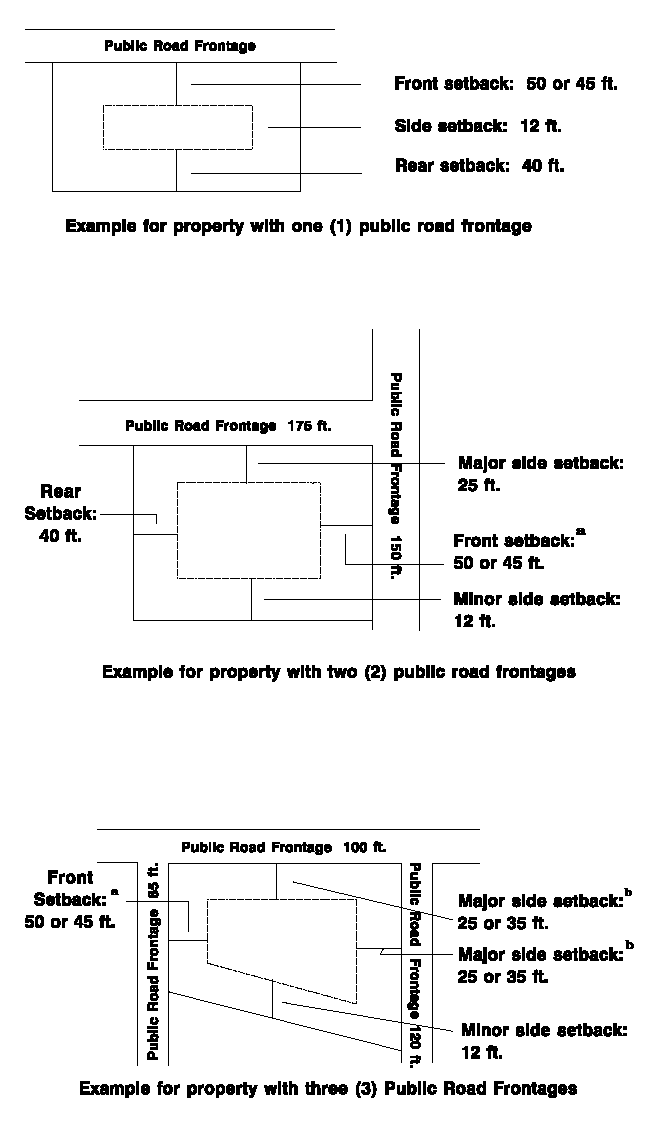
Notes:
1.
Property with shorter amount of road frontage will be the front setback for determining other setbacks (major side, side, rear).
2.
If structure fronts a major side setback, major side setback shall be 35 feet.
(4)
Landscape buffer and screening requirements. Landscape buffer and screening requirements are not applicable in this district.
(5)
Floodplain and wetlands preservation requirements. Subject to the conditions set forth in the city floodplain management and prevention ordinance.
(6)
Building and structure requirements. Maximum building height is 35 feet.
(7)
Parking requirements. See section 48-198 for paved parking specifications.
(8)
Lighting requirements. Any project permitted within the R-30 district which proposes any outdoor lighting must have approval from the building official or his designee.
(9)
Special exception uses. See section 48-197 for requirements for special exception uses. Special exception uses for the R-30 district are the uses listed as follows:
a.
Any other facility for the disposal of the dead.
b.
Cemeteries.
c.
Churches, chapels, temples, synagogues and other places of worship.
d.
Mausoleums.
e.
Club or lodge, private.
f.
Private schools of general and special education.
(10)
Use limitations.
a.
No sale of goods or products shall be permitted, except if accessory to a customary home occupation, land use permit, special land use permit or special exception use.
b.
No adult entertainment uses are permitted.
c.
No materials, equipment or business vehicles may be stored or parked on the premises, except that one business vehicle (the carrying or towing capacity of which shall not exceed one and on-half tons), used exclusively by the resident may be parked in a carport, garage, or rear or side yard. The off-site employees of the resident shall not congregate on the premises for any purpose concerning the business of the home occupation.
d.
All uses are subject to the subdivision regulations of the city as amended from time to time.
e.
No outside storage is permitted, excluding firewood and lawn furnishings.
f.
Maximum impervious surface shall not exceed 35 percent. An undisturbed buffer equal to the required rear yard setback for this zoning district shall be established along the perimeter boundaries during construction until certificates of occupancy for affected lots are obtained. In the event that this undisturbed perimeter buffer conflicts with any required building setbacks, the required building setbacks may be altered by the building official or his designee, so as to accommodate the 40-foot undisturbed perimeter buffer. The following uses shall be allowed within the undisturbed perimeter buffer (after certificates of occupancy are issued): public and private utilities, detention facilities, access drives, pools, decks, gazebos and fences. These uses shall not be allowed if an undisturbed buffer is stipulated by the mayor and council. Required buffers may be included within required setbacks; however, in such case that the required buffer is greater than the required setback, the required buffer shall be adhered to. Additionally, necessary private utilities and access drives may be allowed through, over or across a landscaped buffer. Any such uses which are proposed through, over or across a designated undisturbed buffer must be approved pursuant to an original site plan or site plan modification.
(11)
Accessory buildings, structures, uses and decks.
a.
Any accessory building or structure in excess of 650 square feet of gross space shall be located to the rear of the primary structure and at least 100 feet from any property line. Any accessory building or structure less than 650 square feet and greater than 144 square feet must be located to the rear of the primary structure within the building setbacks. Any accessory building or structure which exceeds 650 square feet of gross space must have the approval of the building official or his designee as to the location, architectural design and size prior to commencing construction. The building official or his designee shall consider the following criteria for determining the appropriateness of the architectural design and size of the accessory building or structure: compatibility with the surrounding neighborhood, style of exterior (the exterior is to be compatible in style with the primary structure), use of the proposed accessory structure, impact on adjacent properties, and requirements as deemed appropriate by plan review as set forth in this subsection. All accessory buildings, structures and uses in excess of 144 gross square feet shall be required to submit for plan review through the community affairs department or receive approval from the director of community affairs or his designee. Accessory structure plans must be accompanied by a signed affidavit from the property owner stating that such structure will not be used for a dwelling or commercial gain.
b.
Accessory buildings, structures, uses and decks shall be subject to the following conditions unless otherwise defined as in subsection (11)a of this section:
1.
Maximum height is two stories or 35 feet, when located within building setbacks or at least 100 feet from a property line, otherwise maximum height is one story.
2.
Accessory uses shall include garbage pads, heating and air conditioning units, Jacuzzis, tennis courts, swimming pools (private), playhouses and playgrounds.
3.
All accessory uses shall be located to the rear of the principal building, except for heating and air conditioning units or garbage pads, which may be located on the side or rear.
4.
The rear of the principal building shall be where the main portion of the building ends without consideration of wings.
5.
Architectural style and design are to be approved by the building official or his designee.
6.
Such structures or buildings shall be located on the same lot as and to the rear of the principal building to which they are accessory. Decks may be located to the rear or side of the principal building subject to the limitations in this subsection.
7.
No accessory building, structure, use or deck shall be constructed upon a lot until construction of the principal building has commenced.
8.
On a corner lot, no accessory building, structure, use or deck shall be located closer to the side street right-of-way line than the principal building.
9.
No garage or accessory building, structure, use or deck less than 144 gross square feet, shall be located closer than five feet to a side or rear lot line or within any required buffers, whichever is greater, regardless if the garage, accessory building, structure, use or deck is attached to the primary structure by a breezeway. If the garage, accessory building, structure, use or deck is attached to the primary structure by a breezeway, it shall be located up to a maximum of 25 feet from the primary structure to which it is attached.
c.
Antennas and satellite dishes shall meet the requirements set forth in section 48-200.
d.
Incidental storage is permitted, provided that the material stored is incidental to the permitted use, as determined by the building official or his designee, and stored completely within a portion of the enclosed principal structure permitted within the district, or within a permitted accessory structure.
e.
Neighborhood recreation centers, amenities and swimming pools are subject to the following:
1.
The plans must be approved by the building official or his designee to ensure compliance with applicable laws and provisions of this chapter. The facility should be designed to include a detailed landscape plan that provides adequate screening of the facility which creates a visual and sound buffer for adjacent properties. The landscape plan shall be drawn to scale and shall include plant identification by common name. The facility shall be designed to accommodate no more than those residing within two adjoining residential developments, except in those cases where a variance is obtained as in other cases.
2.
Buildings and structures established in connection with such use shall be set back not less than 100 feet from any property line.
(i)
Upon written consent of all owners of property within 100 feet of the building or structure, the setback may be reduced to 50 feet from any exterior property line of the subdivision within which the use is located. Additionally, a detailed landscape plan must be submitted to and approved by the building official or his designee.
(ii)
The setback may be reduced to 20 feet from an interior property line of the property on which the use is located if a ten-foot landscaped buffer is provided along the property line and a six-foot solid wood or masonry fence is erected and maintained along the line so as to provide a visual and noise screen for adjacent property; provided, however, the setback after reduction shall not be less than 100 feet from an exterior property line unless also reduced in accordance with subsection (11)e.2(i) of this section. Such landscaped buffer shall be shown on the landscaping plan specified in subsection (11)e.1 of this section and must be approved by the building official or his designee.
(iii)
When a property line is on a natural waterway, a property line setback may be waived provided a written waiver is obtained from the building official or his designee.
3.
Swimming pools must comply with all applicable ordinances and must have necessary approvals from the health department and city.
4.
Outdoor activity shall cease by 11:00 p.m.
5.
Lighting shall be established in such a way that values or quiet use and enjoyment of adjacent properties are not adversely affected, and that roadways and safe use thereof are not adversely affected. No direct light shall be cast upon adjacent properties or roadways. If lighting is to be established, the use of environmental or cutoff type fixtures only is permissible. If lighting is to be established in a recreation area adjacent to an existing or proposed Cobb County or city public road, a lighting plan must be submitted and approved by the mayor and council to ensure that no light is cast upon the roadway and that no adverse impact will be created as a result of the lighting.
6.
No residence or structures shall be built upon any adjacent lot within the development within which the facility is located until construction of the recreation area has commenced to the extent that buyers of adjacent property will be aware of where the recreation area will be located.
7.
Parking requirements are as follows:
(i)
A minimum of 20 spaces shall be provided for amenities which include a swim facility or swim/tennis facility with up to four courts. Additional spaces at the minimum of four spaces per court shall be provided for each court over four in number. A minimum of ten spaces for every two courts shall be provided for amenities which include tennis courts only.
(ii)
In addition to the requirement of subsection (11)d.7(i) of this section, a minimum of five spaces for each 50 residents, or pro-rated share thereof, over 100 shall be provided.
(iii)
Parking spaces shall be paved and striped according to section 48-198, as it now exists or may hereafter be amended. No parking shall be allowed within a front yard setback.
8.
No park, playground, tennis court, basketball court, or the like shall be allowed to be constructed unless the following criteria are met, except those recreational improvements included in a site plan approved by the mayor and council:
(i)
The adjacent property owners shall be in favor of the proposed recreational improvement.
(ii)
Sixty percent of the subdivision, if located in a subdivision shall be in favor of the proposed park.
(iii)
Approval has been received by mayor and council.
(Code 1985, § 22-126)
Sec. 48-141. - R-20 Single-family residential district.
The regulations for the R-20 single-family residential district (20,000-square foot lot size) are as follows:
(1)
Purpose and intent. The R-20 district is established to provide locations for single-family residential uses or residentially compatible institutional and recreational uses which are within or on the edge of properties delineated for any residential category as defined and shown on the Austell Comprehensive Plan: Policy Guide, adopted July 2, 2007. When residentially compatible institutional and recreational uses are developed within the R-20 district, they should be designed and built to ensure intensity and density compatibility with adjacent single-family detached dwellings and otherwise to implement the stated purpose and intent of this chapter.
(2)
Permitted uses. Anything not permitted or allowed by special exception is prohibited. Permitted uses are as follows:
a. Customary home occupations.
b.
Executive golf courses.
c.
Golf courses, 18-hole regulation, public and private.
d.
Golf courses, par 3.
e.
In-home day care.
f.
Nonprofit (seasonal use) fishing lakes.
g.
Private parks, SLUP required.
h.
Radio, television and other communication towers and antennas, subject to section 48-199.
i.
Riding stables.
j.
Single-family dwelling units (detached).
k.
Temporary uses (as defined in this chapter).
(3)
Lot size and setback requirements. Lot size and setback requirements are as follows:
a.
Minimum lot size: 20,000 square feet.
b.
Minimum lot width at front setback line: 75 feet; cul-de-sac, 50 feet.
c.
Minimum public road frontage: 75 feet; cul-de-sac, 50 feet.
d.
Minimum building setbacks means as shown and applied in the following diagram:
Minimum Building Setback Requirements for R-20 District
Note: All setbacks shall be measured from future right-of-way.
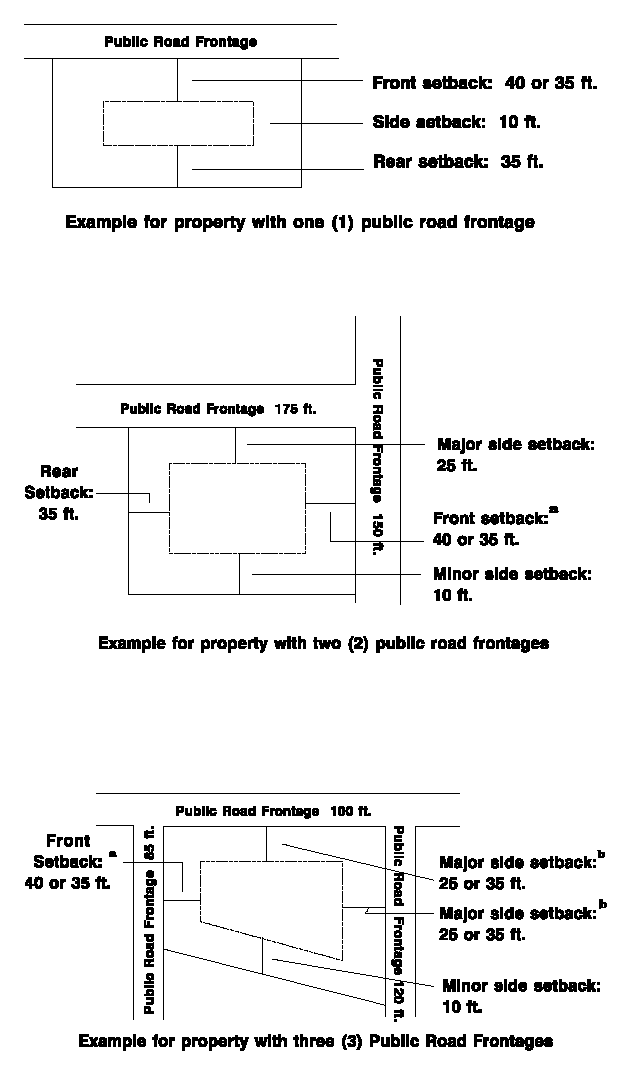
Notes:
1.
Property with shorter amount of road frontage will be the front setback for determining other setbacks (major side, side, rear).
2.
If structure fronts a major side setback, major side setback shall be 35 feet.
(4)
Landscape buffer and screening requirements. Landscape buffer and screening requirements are not applicable in this district
(5)
Floodplain and wetlands preservation requirements. Subject to the conditions set forth in the city floodplain management and prevention ordinance.
(6)
Building and structure requirements. Maximum building height is 35 feet.
(7)
Parking requirements. See section 48-198 for paved parking specifications.
(8)
Lighting requirements. Any project permitted within the R-20 district which proposes any outdoor lighting must have approval from the building official or his designee.
(9)
Special exception uses. See section 48-197 for requirements for special exception uses. Special exception uses for the R-20 district are the uses listed as follows:
a.
Any other facility for the disposal of the dead.
b.
Cemeteries.
c.
Churches, chapels, temples, synagogues and other places of worship.
d.
Mausoleums.
e.
Club or lodge, private.
f.
Private schools of general and special education.
(10)
Use limitations.
a.
No sale of goods or products shall be permitted, except if accessory to a customary home occupation, land use permit, special land use permit or special exception use.
b.
No adult entertainment uses are permitted.
c.
No materials, equipment or business vehicles may be stored or parked on the premises, except that one business vehicle (the carrying and/towing capacity of which shall not exceed 1½ tons), used exclusively by the resident may be parked in a carport, garage or rear or side yard. The off-site employees of the resident shall not congregate on the premises for any purpose concerning the business of the home occupation.
d.
All uses are subject to the subdivision regulations of the city or as may be amended from time to time.
e.
No outside storage is permitted, excluding firewood and lawn furnishings.
f.
Maximum impervious surface shall not exceed 35 percent. An undisturbed buffer equal to the required rear yard setback for this zoning district shall be established along the perimeter boundaries during construction until certificates of occupancy for affected lots are obtained. In the event that this undisturbed perimeter buffer conflicts with any required building setbacks, the required building setbacks may be altered by the building official or his designee, so as to accommodate the 40-foot undisturbed perimeter buffer. The following uses shall be allowed within the undisturbed perimeter buffer (after certificates of occupancy are issued): public and private utilities, detention facilities, access drives, pools, decks, gazebos and fences. These uses shall not be allowed if an undisturbed buffer is stipulated by the mayor and council. Required buffers may be included within required setbacks; however, in such case that the required buffer is greater than the required setback, the required buffer shall be adhered to. Additionally, necessary private utilities and access drives may be allowed through, over or across a landscaped buffer. Any such uses which are proposed through, over or across a designated undisturbed buffer must be approved pursuant to an original site plan or site plan modification.
(11)
Accessory buildings, structures, uses and decks.
a.
Any accessory building or structure in excess of 400 square feet of gross space shall be located to the rear of the primary structure and at least 50 feet from any property line. Any accessory building or structure less than 400 square feet and greater than 144 square feet must be located to the rear of the primary structure within the building setbacks. Any accessory building or structure which exceeds 400 square feet of gross space must have the approval of the building official or his designee as to the location, architectural design and size prior to commencing construction. The building official or his designee shall consider the following criteria for determining the appropriateness of the architectural design and size of the accessory building or structure: compatibility with the surrounding neighborhood, style of exterior (the exterior is to be compatible in style with the primary structure), use of the proposed accessory structure, impact on adjacent properties, and requirements as deemed appropriate by plan review as set forth in this subsection. All accessory buildings, structures and uses in excess of 144 gross square feet shall be required to submit for plan review through the community affairs department or receive approval from the director of community affairs or his designee. Accessory structure plans must be accompanied by a signed affidavit from the property owner stating that such structure will not be used for a dwelling or commercial gain.
b.
Accessory buildings, structures, uses and decks shall be subject to the following conditions unless otherwise defined as in subsection (11)a of this section:
1.
Maximum height is two stories or 35 feet, when located within building setbacks or at least 100 feet from a property line, otherwise maximum height is one story.
2.
Accessory uses shall include garbage pads, heating and air conditioning units, Jacuzzis, tennis courts, swimming pools (private), playhouses and playgrounds.
3.
All accessory uses shall be located to the rear of the principal building, except for heating and air conditioning units or garbage pads, which may be located on the side or rear.
4.
The rear of the principal building shall be where the main portion of the building ends without consideration of wings.
5.
Architectural style and design are to be approved by the building official or his designee.
6.
Such structures or buildings shall be located on the same lot as and to the rear of the principal building to which they are accessory. Decks may be located to the rear or side of the principal building subject to the limitations in this subsection.
7.
No accessory building, structure, use or deck shall be constructed upon a lot until construction of the principal building has commenced.
8.
On a corner lot, no accessory building, structure, use or deck shall be located closer to the side street right-of-way line than the principal building.
9.
No garage or accessory building, structure, use or deck less than 144 gross square feet, shall be located closer than five feet to a side or rear lot line or within any required buffers, whichever is greater, regardless if the garage, accessory building, structure, use or deck is attached to the primary structure by a breezeway. If the garage, accessory building, structure, use or deck is attached to the primary structure by a breezeway, it shall be located up to a maximum of 25 feet from the primary structure to which it is attached.
c.
Antennas and satellite dishes shall meet the requirements set forth in section 48-200.
d.
Incidental storage is permitted, provided that the material stored is incidental to the permitted use, as determined by the building official or his designee, and stored completely within a portion of the enclosed principal structure permitted within the district, or within a permitted accessory structure.
e.
Neighborhood recreation centers, amenities and swimming pools are subject to the following:
1.
Site plans must be approved by the building official or his designee to ensure compliance with all applicable laws and provisions of this chapter. The facility should be designed to include a detailed landscape plan that provides adequate screening of the facility which creates a visual and sound buffer for adjacent properties. The landscape plan shall be drawn to scale and shall include plant identification by common name. The facility shall be designed to accommodate no more than those residing within two adjoining residential developments, except in those cases where a variance is obtained as in other cases.
2.
Buildings and structures established in connection with such use shall be set back not less than 100 feet from any property line.
(i)
Upon written consent of all owners of property within 100 feet of the building or structure, the setback may be reduced to 50 feet from any exterior property line of the subdivision within which the use is located. Additionally, a detailed landscape plan must be submitted to and approved by the building official or his designee.
(ii)
The setback may be reduced to 20 feet from an interior property line of the property on which the use is located if a ten-foot landscaped buffer is provided along the property line and a six-foot solid wood or masonry fence is erected and maintained along the line so as to provide a visual and noise screen for adjacent property; provided, however, the setback after reduction shall not be less than 100 feet from an exterior property line unless also reduced in accordance with subsection (11)e.2(i) of this section. Such landscaped buffer shall be shown on the landscaping plan specified in subsection (11)e.1 of this section and must be approved by the building official or his designee.
(iii)
When a property line is on a natural waterway, a property line setback may be waived provided a written waiver is obtained from the building official or his designee.
3.
Swimming pools must comply with all applicable ordinances and must have necessary approvals from the health department and city.
4.
Outdoor activity shall cease by 11:00 p.m.
5.
Lighting shall be established in such a way that values or quiet use and enjoyment of adjacent properties are not adversely affected, and that roadways and safe use thereof are not adversely affected. No direct light shall be cast upon adjacent properties or roadways. If lighting is to be established, the use of environmental or cutoff type fixtures only is permissible. If lighting is to be established in a recreation area adjacent to an existing or proposed Cobb County or city public road, a lighting plan must be submitted and approved by the mayor and council to ensure that no light is cast upon the roadway and that no adverse impact will be created as a result of the lighting.
6.
No residence or structures shall be built upon any adjacent lot within the development within which the facility is located until construction of the recreation area has commenced to the extent that buyers of adjacent property will be aware of where the recreation area will be located.
7.
Parking requirements are as follows:
(i)
A minimum of 20 spaces shall be provided for amenities which include a swim facility or swim/tennis facility with up to four courts. Additional spaces at the minimum of four spaces per court shall be provided for each court over four in number. A minimum of ten spaces for every two courts shall be provided for amenities which include tennis courts only.
(ii)
In addition to the requirement of subsection (11)e.7(i) of this section, a minimum of five spaces for each 50 residents, or pro-rated share thereof, over 100 shall be provided.
(iii)
Parking spaces shall be paved and striped according to section 48-198, as it now exists or may hereafter be amended. No parking shall be allowed within a front yard setback.
8.
No park, playground, tennis court, basketball court, or the like shall be allowed to be constructed unless the following criteria are met, except those recreational improvements included in a site plan approved by the mayor and council:
(i)
The adjacent property owners shall be in favor of the proposed recreational improvement.
(ii)
Sixty percent of the subdivision, if located in a subdivision shall be in favor of the proposed park.
(iii)
Approval has been received by mayor and council.
(Code 1985, § 22-127)
Sec. 48-142. - R-15 Single-family residential district.
The regulations for the R-15 single-family residential district (15,000-square foot lot size) are as follows:
(1)
Purpose and intent. The R-15 district is established to provide locations for single-family residential uses or residentially compatible institutional and recreational uses which are within or on the edge of properties delineated for any residential category as defined and shown on the Austell Comprehensive Plan: Policy Guide, adopted July 2, 2007. When residentially compatible institutional and recreational uses are developed within the R-15 district, they should be designed and built to ensure intensity and density compatibility with adjacent single-family detached dwellings and otherwise to implement the stated purpose and intent of this chapter.
(2)
Permitted uses. Anything not permitted or allowed by special exception is prohibited. Permitted uses are as follows:
a.
Customary home occupations.
b.
Executive golf courses.
c.
Golf courses, 18-hole regulation, public and private.
d.
Golf courses, par 3.
e.
In-home care.
f.
Private parks, SLUP required.
g.
Radio, television and other communication towers and antennas, subject to section 48-199.
h.
Riding stables.
i.
Single-family dwelling units (detached).
j.
Temporary uses (as defined in this chapter).
(3)
Lot size and setback requirements. Lot size and setback requirements are as follows:
a.
Minimum lot size: 15,000 square feet.
b.
Minimum lot width at front setback line: 75 feet; cul-de-sac, 50 feet.
c.
Minimum public road frontage: 75 feet; cul-de-sac, 50 feet.
d.
Minimum building setbacks means as shown and applied in the following diagram:
Minimum Building Setback Requirements for R-15 District
Note: All setbacks shall be measured from future right-of-way.
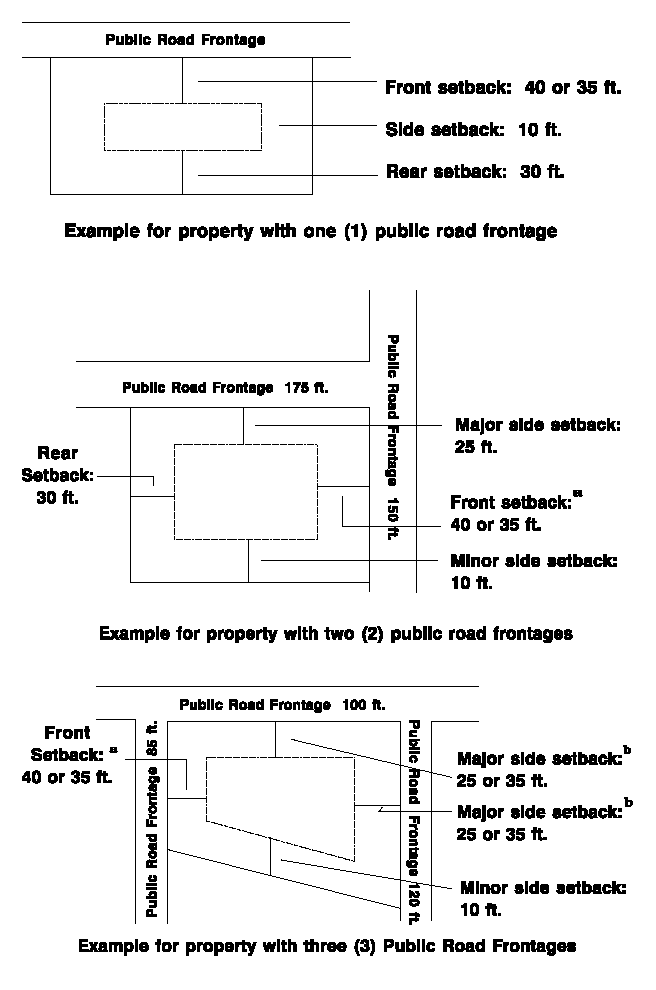
Notes:
1.
Property with shorter amount of road frontage will be the front setback for determining other setbacks (major side, side, rear).
2.
If structure fronts a major side setback, major side setback shall be 35 feet.
(4)
Landscape buffer and screening requirements. Landscape buffer and screening requirements are not applicable in this district.
(5)
Floodplain and wetlands preservation requirements. Subject to the conditions set forth in the city floodplain management and prevention ordinance.
(6)
Building and structure requirements. Maximum building height is 35 feet.
(7)
Parking requirements. See section 48-198 for paved parking specifications.
(8)
Lighting requirements. Any project permitted within the R-15 district which proposes any outdoor lighting must have approval from the building official or his designee.
(9)
Special exception uses. See section 48-197 for requirements for special exception uses. Special exception uses for the R-15 district are the uses listed as follows:
a.
Any other facility for the disposal of the dead.
b.
Cemeteries.
c.
Churches, chapels, temples, synagogues and other places of worship.
d.
Mausoleums.
e.
Club or lodge, private.
f.
Private schools of general and special education.
(10)
Use limitations.
a.
No sale of goods or products shall be permitted, except if accessory to a customary home occupation, land use permit, special land use permit or special exception use.
b.
No adult entertainment uses are permitted.
c.
No materials, equipment or business vehicles (the carrying or towing capacity shall not exceed 1½ tons) may be stored or parked on the premises, except that one business vehicle used exclusively by the resident may be parked in a carport, garage, or rear or side yard. The off-site employees of the resident shall not congregate on the premises for any purpose concerning the business of the home occupation.
d.
All uses are subject to the subdivision regulations of the city or as may be amended from time to time.
e.
No outside storage is permitted, excluding firewood and lawn furnishings.
f.
Maximum impervious surface shall not exceed 35 percent. An undisturbed buffer equal to the required rear yard setback for this zoning district shall be established along the perimeter boundaries during construction until certificates of occupancy for affected lots are obtained. In the event that this undisturbed perimeter buffer conflicts with any required building setbacks, the required building setbacks may be altered by the building official or his designee, so as to accommodate the 40-foot undisturbed perimeter buffer. The following uses shall be allowed within the undisturbed perimeter buffer (after certificates of occupancy are issued): public and private utilities, detention facilities, access drives, pools, decks, gazebos and fences. These uses shall not be allowed if an undisturbed buffer is stipulated by the mayor and council. Required buffers may be included within required setbacks; however, in such case that the required buffer is greater than the required setback, the required buffer shall be adhered to. Additionally, necessary private utilities and access drives may be allowed through, over or across a landscaped buffer. Any such uses which are proposed through, over or across a designated undisturbed buffer must be approved pursuant to an original site plan or site plan modification.
(11)
Accessory buildings, structures, uses and decks.
a.
Any accessory building or structure in excess of 400 square feet of gross space shall be located to the rear of the primary structure and at least 50 feet from any property line. Any accessory building or structure less than 400 square feet and greater than 144 square feet must be located to the rear of the primary structure within the building setbacks. Any accessory building or structure which exceeds 400 square feet of gross space must have the approval of the building official or his designee as to the location, architectural design and size prior to commencing construction. The building official or his designee shall consider the following criteria for determining the appropriateness of the architectural design and size of the accessory building or structure: compatibility with the surrounding neighborhood, style of exterior (the exterior is to be compatible in style with the primary structure), use of the proposed accessory structure, impact on adjacent properties, and requirements as deemed appropriate by plan review as set forth in this subsection. All accessory buildings, structures and uses in excess of 144 gross square feet shall be required to submit for plan review through the community affairs department or receive approval from the director of community affairs or his designee. Accessory structure plans must be accompanied by a signed affidavit from the property owner stating that such structure will not be used for a dwelling or commercial gain.
b.
Accessory buildings, structures, uses and decks shall be subject to the following conditions unless otherwise defined as in subsection (11)a of this section:
1.
Maximum height is two stories or 35 feet, when located within building setbacks or at least 100 feet from a property line, otherwise maximum height is one story.
2.
Accessory uses shall include garbage pads, heating and air conditioning units, Jacuzzis, tennis courts, swimming pools (private), playhouses and playgrounds.
3.
All accessory uses shall be located to the rear of the principal building, except for heating and air conditioning units or garbage pads, which may be located on the side or rear.
4.
The rear of the principal building shall be where the main portion of the building ends without consideration of wings.
5.
Architectural style and design are to be approved by the building official or his designee.
6.
Such structures or buildings shall be located on the same lot as and to the rear of the principal building to which they are accessory. Decks may be located to the rear or side of the principal building subject to the limitations in this subsection.
7.
No accessory building, structure, use or deck shall be constructed upon a lot until construction of the principal building has commenced.
8.
On a corner lot, no accessory building, structure, use or deck shall be located closer to the side street right-of-way line than the principal building.
9.
No garage or accessory building, structure, use or deck less than 144 gross square feet, shall be located closer than five feet to a side or rear lot line or within any required buffers, whichever is greater, regardless if the garage, accessory building, structure, use or deck is attached to the primary structure by a breezeway. If the garage, accessory building, structure, use or deck is attached to the primary structure by a breezeway, it shall be located up to a maximum of 25 feet from the primary structure to which it is attached.
c.
Antennas and satellite dishes shall meet the requirements set forth in section 48-200.
d.
Incidental storage is permitted, provided that the material stored is incidental to the permitted use, as determined by the building official or his designee, and stored completely within a portion of the enclosed principal structure permitted within the district, or within a permitted accessory structure.
e.
Neighborhood recreation centers, amenities and swimming pools are subject to the following:
1.
Site plans must be approved by the building official or his designee to ensure compliance with all applicable laws and provisions of this chapter. The facility should be designed to include a detailed landscape plan that provides adequate screening of the facility which creates a visual and sound buffer for adjacent properties. The landscape plan shall be drawn to scale and shall include plant identification by common name. The facility shall be designed to accommodate no more than those residing within two adjoining residential developments, except in those cases where a variance is obtained as in other cases.
2.
Buildings and structures established in connection with such use shall be set back not less than 100 feet from any property line.
(i)
Upon written consent of all owners of property within 100 feet of the building or structure, the setback may be reduced to 50 feet from any exterior property line of the subdivision within which the use is located. Additionally, a detailed landscape plan must be submitted to and approved by the building official or his designee.
(ii)
The setback may be reduced to 20 feet from an interior line of the property on which the use is located if a ten-foot landscaped buffer is provided along the property line and a six-foot solid wood or masonry fence is erected and maintained along the line so as to provide a visual and noise screen for adjacent property; provided, however, the setback after reduction shall not be less than 100 feet from an exterior property line unless also reduced in accordance with subsection (11)e.2(i) of this section. Such landscaped buffer shall be shown on the landscaping plan specified in subsection (11)e.1 of this section and must be approved by the building official or his designee.
(iii)
When a property line is on a natural waterway, a property line setback may be waived provided a written waiver is obtained from the building official.
3.
Swimming pools must comply with all applicable ordinances and must have necessary approvals from the health department and city.
4.
Outdoor activity shall cease by 11:00 p.m.
5.
Lighting shall be established in such a way that values or quiet use and enjoyment of adjacent properties are not adversely affected, and that roadways and safe use thereof are not adversely affected. No direct light shall be cast upon adjacent properties or roadways. If lighting is to be established, the use of environmental or cutoff type fixtures only is permissible. If lighting is to be established in a recreation area adjacent to an existing or proposed Cobb County or city public road, a lighting plan must be submitted and approved by the mayor and council to ensure that no light is cast upon the roadway and that no adverse impact will be created as a result of the lighting.
6.
No residence or structures shall be built upon any adjacent lot within the development within which the facility is located until construction of the recreation area has commenced to the extent that buyers of adjacent property will be aware of where the recreation area will be located.
7.
Parking requirements are as follows:
(i)
A minimum of 20 spaces shall be provided for amenities which include a swim facility or swim/tennis facility with up to four courts. Additional spaces at the minimum of four spaces per court shall be provided for each court over four in number. A minimum of ten spaces for every two courts shall be provided for amenities which include tennis courts only.
(ii)
In addition to the requirement of subsection (11)e.7(i) of this section, a minimum of five spaces for each 50 residents, or pro-rated share thereof, over 100 shall be provided.
(iii)
Parking spaces shall be paved and striped according to section 48-198, as it now exists or may hereafter be amended. No parking shall be allowed within a front yard setback.
8.
No park, playground, tennis court, basketball court, or the like shall be allowed to be constructed unless the following criteria are met, except those recreational improvements included in a site plan approved by the mayor and council:
(i)
The adjacent property owners shall be in favor of the proposed recreational improvement.
(ii)
Sixty percent of the subdivision, if located in a subdivision shall be in favor of the proposed park.
(iii)
Approval has been received by mayor and council.
(Code 1985, § 22-128)
Sec. 48-143. - R-10 Single-family residential district.
The regulations for the R-10 single-family attached/detached residential district are as follows:
(1)
Purpose and intent. The R-10 district is established to provide locations for affordable single-family detached residential uses or residentially compatible institutional and recreational uses which are within or on the edge of properties delineated for any residential categories as defined and shown on the Austell Comprehensive Plan: Policy Guide, adopted July 2, 2007. When residentially compatible institutional and recreational uses are developed within the R-10 district, they should be designed and built to ensure intensity and density compatibility with adjacent single-family detached dwellings and otherwise to implement the stated purpose and intent of this chapter. No new application for R-10 park zoning will be accepted by the mayor and council effective January 1, 2011.
(2)
Permitted uses. Anything not permitted or allowed by special exception is prohibited. Permitted uses are as follows:
a.
Customary home occupations.
b.
Executive golf courses.
c.
Golf courses, 18-hole regulation, public and private.
d.
Golf courses, par 3.
e.
In-home day care.
f.
Private parks, SLUP required.
g.
Radio, television and other communication towers and antennas subject to section 48-199.
h.
Single-family dwelling units (detached).
i.
Temporary uses (as defined in this chapter).
(3)
Lot size and setback requirements. Lot size and setback requirements are as follows:
a.
Minimum lot size: 10,000 square feet.
b.
Minimum lot width at front setback line: 75 feet; cul-de-sac or interior lot, 50 feet.
c.
Minimum public road frontage: 75 feet; cul-de-sac, 35 feet; 35 feet minimum public road frontage if interior to development.
d.
Minimum width between dwellings: 15 feet.
e.
Minimum building setbacks means as shown and applied in the following diagram:
Minimum Building Setback Requirements for R-10 District
Note: All setbacks shall be measured from future right-of-way.
Notes:
1.
Distance if interior portion of development.
2.
Property with shorter amount of road frontage will be the front setback for determining other setbacks (major side, side, rear).
3.
If structure fronts a major side setback, major side setback shall be 35 feet.
(4)
Landscape buffer and screening requirements. Landscape buffer and screening requirements are not applicable in this district.
(5)
Floodplain and wetlands preservation requirements. Subject to the conditions set forth in the city floodplain management and prevention ordinance.
(6)
Building and structure requirements. Maximum building height is 35 feet.
(7)
Parking requirements. See section 48-198 for paved parking specifications.
(8)
Lighting requirements. Any project permitted within the R-10 district which proposes a lighted facility must have approval from the building official or his designee.
(9)
Special exception uses. See section 48-197 for requirements for special exception uses. Special exception uses for the R-10 district are the uses listed as follows:
a.
Any other facility for the disposal of the dead.
b.
Cemeteries.
c.
Churches, chapels, temples, synagogues and other places of worship.
d.
Mausoleums.
e.
Club or lodge, private.
f.
Private schools of general and special education.
(10)
Use limitations.
a.
A site plan shall be submitted to city staff for each lot showing the following:
1.
Setbacks and dwelling space distances;
2.
Lot size;
3.
Delineation of floodplain and wetlands; and
4.
Accessory structures, including decks, porches, swimming pools, tennis courts and basketball courts.
b.
A foundation survey shall be required to be submitted and approved prior to continuing with framing.
c.
Maximum acreage is 20 acres.
d.
No structure or dwelling shall be closer than five feet to any property line.
e.
No sale of goods or products shall be permitted, except if accessory to a customary home occupation, land use permit, special land use permit or special exception use.
f.
No adult entertainment uses are permitted.
g.
No materials, equipment or business vehicles may be stored or parked on the premises, except that one business vehicle (the carrying or towing capacity shall not exceed 1½ tons) used exclusively by the resident may be parked in a carport, garage, or rear or side yard. The off-site employees of the resident shall not congregate on the premises for any purpose concerning the business of the home occupation.
h.
All uses are subject to the subdivision regulations of the city or as may be amended from time to time.
i.
No outside storage is permitted, excluding firewood and lawn furnishings.
j.
Maximum impervious surface shall not exceed 30 percent.
Required buffers may be included within required setbacks; however, in such case that the required buffer is greater than the required setback, the required buffer shall be adhered to. Additionally, necessary private utilities and access drives may be allowed through, over or across a landscaped buffer. Any such uses which are proposed through, over or across a designated undisturbed buffer must be approved pursuant to an original site plan or site plan modification.
(11)
Accessory buildings, structures, uses and decks.
a.
Any accessory building or structure in excess of 400 square feet of gross space shall be located to the rear of the primary structure and at least 25 feet from any property line. Any accessory building or structure less than 400 square feet and greater than 144 square feet must be located to the rear of the primary structure within the building setbacks. Any accessory building or structure which exceeds 400 square feet of gross space must have the approval of the building official or his designee as to the location, architectural design and size prior to commencing construction. The building official or his designee shall consider the following criteria for determining the appropriateness of the architectural design and size of the accessory building or structure: compatibility with the surrounding neighborhood, style of exterior (the exterior is to be compatible in style with the primary structure), use of the proposed accessory structure, impact on adjacent properties, and requirements as deemed appropriate by plan review as set forth in this subsection. All accessory buildings, structures and uses in excess of 144 gross square feet shall be required to submit for plan review through the community affairs department or receive approval from the director of community affairs or his designee. Accessory structure plans must be accompanied by a signed affidavit from the property owner stating that such structure will not be used for a dwelling or commercial gain.
b.
Accessory buildings, structures, uses and decks shall be subject to the following conditions unless otherwise defined as in subsection (11)a of this section:
1.
Maximum height is two stories or 35 feet, when located within building setbacks or at least 100 feet from a property line, otherwise maximum height is one story.
2.
Accessory uses shall include garbage pads, heating and air conditioning units, Jacuzzis, tennis courts, swimming pools (private), playhouses and playgrounds.
3.
All accessory uses shall be located to the rear of the principal building, except for heating and air conditioning units or garbage pads, which may be located on the side or rear.
4.
The rear of the principal building shall be where the main portion of the building ends without consideration of wings.
5.
Architectural style and design are to be approved by the building official or his designee.
6.
Such structures or buildings shall be located on the same lot as and to the rear of the principal building to which they are accessory. Decks may be located to the rear or side of the principal building subject to the limitations in this subsection.
7.
No accessory building, structure, use or deck shall be constructed upon a lot until construction of the principal building has commenced.
8.
On a corner lot, no accessory building, structure, use or deck shall be located closer to the side street right-of-way line than the principal building.
9.
No garage or accessory building, structure, use or deck less than 144 gross square feet, shall be located closer than five feet to a side or rear lot line or within any required buffers, whichever is greater, regardless if the garage, accessory building, structure, use or deck is attached to the primary structure by a breezeway. If the garage, accessory building, structure, use or deck is attached to the primary structure by a breezeway, it shall be located up to a maximum of 25 feet from the primary structure to which it is attached.
c.
Antennas and satellite dishes shall meet the requirements set forth in section 48-200.
d.
Incidental storage is permitted, provided that the material stored is incidental to the permitted use, as determined by the building official or his designee, and stored completely within a portion of the enclosed principal structure permitted within the district, or within a permitted accessory structure.
e.
Neighborhood recreation centers, amenities and swimming pools are subject to the following:
1.
Site plans must be approved by the building official or his designee to ensure compliance with all applicable laws and provisions of this chapter. The facility should be designed to include a detailed landscape plan that provides adequate screening of the facility which creates a visual and sound buffer for adjacent properties. The landscape plan shall be drawn to scale and shall include plant identification by common name. The facility shall be designed to accommodate no more than those residing within two adjoining residential developments, except in those cases where a variance is obtained as in other cases.
2.
Buildings and structures established in connection with such use shall be set back not less than 100 feet from any property line.
(i)
Upon written consent of all owners of property within 100 feet of the building or structure, the setback may be reduced to 50 feet from any exterior property line of the subdivision within which the use is located. Additionally, a detailed landscape plan must be submitted to and approved by the building official or his designee.
(ii)
The setback may be reduced to 20 feet from an interior property line of the property on which the use is located if a ten-foot landscaped buffer is provided along the property line and a six-foot solid wood or masonry fence is erected and maintained along the line so as to provide a visual and noise screen for adjacent property; provided, however, the setback after reduction shall not be less than 100 feet from an exterior property line unless also reduced in accordance with subsection (11)e.2(i) of this section. Such landscaped buffer shall be shown on the landscaping plan specified in subsection (11)e.1 of this section and must be approved by the building official or his designee.
(iii)
When a property line is on a natural waterway, a property line setback may be waived provided a written waiver is obtained from the building official.
3.
Swimming pools must comply with all applicable ordinances and must have necessary approvals from the health department and the city.
4.
Outdoor activity shall cease by 11:00 p.m.
5.
Lighting shall be established in such a way that values or quiet use and enjoyment of adjacent properties are not adversely affected, and that roadways and safe use thereof are not adversely affected. No direct light shall be cast upon adjacent properties or roadways. If lighting is to be established, the use of environmental or cutoff type fixtures only is permissible. If lighting is to be established in a recreation area adjacent to an existing or proposed Cobb County or city public road, a lighting plan must be submitted and approved by the mayor and council to ensure that no light is cast upon the roadway and that no adverse impact will be created as a result of the lighting.
6.
No residence or structures shall be built upon any adjacent lot within the development within which the facility is located until construction of the recreation area has commenced to the extent that buyers of adjacent property will be aware of where the recreation area will be located.
7.
Parking requirements are as follows:
(i)
A minimum of 20 spaces shall be provided for amenities which include a swim facility or swim/tennis facility with up to four courts. Additional spaces at the minimum of four spaces per court shall be provided for each court over four in number. A minimum of ten spaces for every two courts shall be provided for amenities which include tennis courts only.
(ii)
In addition to the requirement of subsection (11)e.7(i) of this section, a minimum of five spaces for each 50 residents, or pro-rated share thereof, over 100 shall be provided.
(iii)
Parking spaces shall be paved and striped according to section 48-198, as it now exists or may hereafter be amended. No parking shall be allowed within a front yard setback.
8.
No park, playground, tennis court, basketball court, or the like shall be allowed to be constructed unless the following criteria are met, except those recreational improvements included in a site plan approved by the mayor and council:
(i)
The adjacent property owners shall be in favor of the proposed recreational improvement.
(ii)
Sixty percent of the subdivision, if located in a subdivision shall be in favor of the proposed park.
(iii)
Approval has been received by mayor and council.
(Code 1985, § 22-129)
Sec. 48-144. - RSL Nonsupportive residential senior living.
(a)
Purpose and intent. The RSL nonsupportive residential units is established to provide locations for the development of attached and detached dwelling units limited to those persons age 55 and older as defined by the Fair Housing Act as may be amended from time to time and shall not be established as a precedent for any other residential or nonresidential district. This residential use is designed to be located within any land use category other than industrial, industrial compatible, rural residential and very low density residential as defined by the city comprehensive plan, as may be amended from time to time, provided that it must be located along an arterial roadway (as defined by the city major thoroughfare plan, as may be amended from time to time).
(b)
Definitions. The following words, terms and phrases, when used in this section, shall have the meanings ascribed to them in this subsection, except where the context clearly indicates a different meaning:
Nonsupportive means individual housing units designed for senior adults that do not include or provide any type of supportive services such as transportation, medical care, food preparation and the like.
(c)
Permitted uses. Anything not permitted or allowed by special exception is prohibited. Permitted uses are as follows:
(1)
Attached residential units.
(2)
Detached residential units.
(d)
Lot size and setback requirements. (See use limitations.)
(e)
Landscape buffer and screening requirements. Unless otherwise noted within this district's requirements, any RSL nonsupportive residential units which abut more restrictive residentially zoned property shall have a minimum 20-foot landscaped screening or maintained natural buffer adjacent to all residential property. When abutting nonresidentially zoned property, a ten-foot landscaped screening buffer is required. Minimum buffers may be increased by the mayor and council based on existing conditions such as tract size, topographic conditions, etc., in order to provide compatibility with adjacent residential uses. The buffer shall be subject to approval by city staff. Required buffers may be included within required setbacks; however, in such case necessary private utilities or access drives may be allowed through, over or across a landscaped buffer. Any such uses which are proposed through, over or across a designated, undisturbed buffer must be approved pursuant to an original site plan or site plan modification.
(1)
Objectives. Undisturbed, planted landscape buffers and berms shall be implemented in connection with a permitted project and shall address the following objectives:
a.
Screening to enhance aesthetic appeal;
b.
Control or direction of vehicular and pedestrian movement;
c.
Reduction of glare;
d.
Buffering of noise; and
e.
Establishment of privacy.
(2)
Standards. Buffers or berms shall be required when a PUD district is located adjacent to a more restrictive residential district; a minimum ten-foot buffer is required.
a.
Buffers. Landscape buffers are subject to review and approval by city staff in accordance with the following standards.
1.
Plantings are to be a mix of evergreen trees and shrubs.
2.
Species are to be ecologically compatible to the site and appropriate for the design situation.
3.
Unless public safety concerns dictate otherwise, a buffer should maximize a visual barrier to a height of six feet within two years of planting.
4.
Minimum height of plant materials at installation is five feet for trees and two feet for shrubs.
5.
Fencing or walls are to be a minimum of six feet in height (fence to be located on exterior of buffer) as approved by city staff.
6.
Trees included in buffer plantings may be counted toward site density calculations as required by the city subject to review and approval of city staff.
7.
Buffers shall be regularly maintained by the property owner to ensure that the objectives and standards set out in this subsection are met.
8.
When topography and existing conditions allow, the required ten-foot buffer should be an undisturbed buffer.
9.
Any appeals from a determination by city staff shall be to the board of variance and zoning appeals.
b.
Berms. Berms are subject to review and approval by city staff. Berms shall be utilized when consistent with surrounding property features. They shall be stabilized, constructed to be consistent with natural or proposed drainage patterns, and regularly maintained by the property owner.
(f)
Floodplain/wetlands preservation requirements. Subject to the conditions set forth in the city floodplain management and prevention ordinance.
(g)
Building and structure requirements. (See use limitations.)
(h)
Parking requirements. (See use limitations.)
(i)
Lighting requirements.
(1)
All utilities must be underground unless otherwise approved by mayor and council.
(2)
All subdivisions including RSL developments must have street lights. The street lighting plan must be approved by the public works director or his designee.
(j)
Special exception uses. None.
(k)
Location criteria, design criteria and use limitations.
(1)
Any RSL nonsupportive residential units shall be subject to the site plan submitted and approved by the building official or his designee. Overall residential development shall be compatible with neighboring residential uses.
(2)
Minimum tract size of three acres.
(3)
Maximum density of five units per acre; however, the overall density of a development may be reduced due to topography, drainage, deforestation or sediment and erosion concerns.
(4)
All dwelling units must be limited to those persons age 55 and older as defined by the Fair Housing Act as may be amended from time to time.
(5)
No sale of goods or products shall be permitted, except if accessory to a customary home occupation, land use permit, special land use permit or special exception use.
(6)
No adult entertainment uses are permitted.
(7)
All uses are subject to the subdivision regulations of the city, as amended from time to time.
(8)
Any food or beverage served within an accessory clubhouse shall be limited to residents and their guests.
(9)
No outside storage is permitted, excluding firewood and lawn furnishings, or as otherwise prohibited in the association declaration and bylaws.
(10)
A mandatory owners association must be formed and incorporated which provides for building and grounds maintenance and repair, insurance and working capital. The association must also include declaration and bylaws, including rules and regulations, subject to staff review and approval. Staff review and approval will be based on a model on file with the community affairs department. The declaration and bylaws shall not be enforced by the city. The declaration and bylaws shall, at a minimum, regulate and control the following:
a.
Animals.
b.
Signs.
c.
Exterior items such as fences, lawn ornaments and restrictions on removal of landscape areas and buffers.
d.
Building improvements.
e.
Outside storage.
f.
Overnight parking of vehicles.
g.
Decorations.
h.
Trash collection.
i.
Restrictions on single-family residential use only, and leasing of units. No more than ten percent of the total units may be leased by individual owners at any time.
j.
Restrictions on all units being occupied by persons age 55 and older as defined by the Fair Housing Act as may be amended from time to time.
k.
Accessory buildings and structures.
(11)
All units must have an attached garage, which must be used for vehicle parking only.
(12)
No more than four units may be attached side by side.
(13)
Maximum of four attached units (quadruplex).
(14)
Any RSL nonsupportive residential units project must be located along an arterial roadway (as defined by the city major thoroughfare plan, as may be amended from time to time).
(15)
All RSL nonsupportive residential unit projects must be designed to provide pedestrian access to all adjacent properties and roadways. Connectivity to public transit will be required when available.
(16)
Any RSL nonsupportive residential units project which proposes an amenity area will be required to design such feature for those residents age 55 and older.
(17)
At least 50 percent of each individual dwelling unit must be constructed with brick, stucco, stone or other hardened surface.
(18)
No RSL nonsupportive residential unit development may be located within an existing subdivision, unless being proposed as an assemblage.
(19)
Maximum building height of two stories.
(20)
A 30-foot perimeter building setback must be provided to all adjacent residentially zoned properties. This perimeter setback may include required buffers. A 20-foot setback shall be required adjacent to any public roadway. There shall be a minimum setback of 15 feet between buildings. Minimum setbacks may be increased by the mayor and council based on existing conditions such as tract size, topographic conditions, etc., in order to provide compatibility with adjacent residential uses.
(21)
An overall landscape plan is to be approved by the building official or his designee with emphasis on size of tract, buffers, surrounding uses, and passive recreational areas.
(22)
Projects must incorporate applicable accessibility and easy living standards (as administered and copyrighted by a coalition of state citizens including AARP of Georgia, Atlanta Regional Commission, Concrete Change, state department of community affairs, Governor's Council on Developmental Disabilities, Home Builders' Association of Georgia, Shepherd Center and the Statewide Independent Living Council of Georgia) to include at least one full bath on the main floor, with ample maneuvering space; a bedroom on the main floor; ample interior door widths; and one stepless entrance at either the front, side or back of the home, or through the garage.
(23)
Projects must incorporate an area designated as common space or recreational space for the enjoyment of the residents.
(24)
Impervious surface shall not exceed 55 percent of the total site area.
(25)
Projects proposing public infrastructure to be accepted by the city for maintenance must be designed in accordance with all applicable standards and specifications, including, but not limited to, building setbacks.
Required buffers may be included within required setbacks; however, in such case that the required buffer is greater than the required setback, the required buffer shall be adhered to. Additionally, necessary private utilities and access drives may be allowed through, over or across a landscaped buffer. Any such uses which are proposed through, over or across a designated undisturbed buffer must be approved pursuant to an original site plan or site plan modification.
(l)
Accessory buildings, structures, uses and decks. Any accessory building or structure which exceeds 144 square feet of gross space must have the approval of the building official or his designee as to the location, architectural design and size prior to commencing construction. The building official or his designee shall consider the following criteria for determining the appropriateness of the architectural design and the size of the accessory building or structure: Compatibility with the surrounding neighborhood, style of exterior (the exterior is to be compatible in style with the primary structure), use of the proposed accessory structure; which cannot include dwelling or commercial space for profit, impact on adjacent properties, and requirements as deemed appropriate by plan review as set forth in this subsection. All accessory buildings, structures and uses in excess of 144 gross square feet shall be required to submit for plan review through the community affairs department or receive approval from the director of community affairs department or his designee. Accessory structure plans must be accompanied by a signed affidavit from the property owner stating that such structure will not be used for a dwelling or commercial gain.
(1)
Accessory buildings, structures, uses and decks shall be subject to the following conditions:
a.
Maximum height is one story or 15 feet.
b.
Accessory uses shall include garbage dumpsters, designated recycling locations, clubhouse and recreation centers, amenities, swimming pools, and tennis courts, antennas and satellite dishes, heating and air conditioning units, and Jacuzzis, subject to the following conditions:
1.
Uses must be located within building setbacks.
2.
No ground based antenna or satellite dish shall exceed 35 feet in height without compliance with standards in section 48-200.
3.
No accessory building, structure, use or deck shall be built until construction of the principal building has commenced.
4.
Outdoor activities shall cease by 11:00 p.m. within clubhouse and recreation centers and swimming pools and tennis courts.
c.
Such buildings, structures, uses or decks shall be located on the same lot as the principal uses to which the building, structure use or deck is accessory.
(2)
Antennas and satellite dishes shall meet the requirements set forth in section 48-199.
(3)
Incidental storage is permitted, provided that the material stored is incidental to the permitted use, as determined by the building official or his designee and stored completely within a portion of the enclosed principal structure permitted within the district, or within a permitted accessory structure.
(Code 1985, § 22-130)
Sec. 48-145. - PUD Planned unit development.
The regulations for the PUD planned unit development district are as follows:
(1)
Purpose and intent. The PUD district is established to encourage and provide flexible site plan and building arrangements under a unified plan of development rather than lot-by-lot regulation. The developer benefits from better land utilization and design flexibility. Review of and approval of the development plan by the mayor and council provides an opportunity to ensure that the development will be in harmony with the character of the neighborhood in which the development is located. The PUD district may be located within any residential category as defined by the Austell Comprehensive Plan: Policy Guide, adopted July 2, 2007. The PUD district is not intended to encourage greater density of development, but rather to encourage ingenuity and resourcefulness in land planning to ensure the provision of park and recreation land and facilities for the use of the occupants of the development in order to obtain a more desirable environment. PUD development shall be compatible with surrounding development.
(2)
Permitted uses. Anything not permitted or allowed by special exception is prohibited. Permitted uses are as follows:
a.
Condominiums.
b.
Customary home occupations.
c.
Executive golf courses.
d.
Golf courses, 18-hole regulation, public and private.
e.
Golf courses, par 3.
f.
In-home day care.
g.
Livestock, nondomestic and wild animals, and poultry.
h.
Multifamily dwelling units.
i.
Private parks, SLUP required.
j.
Riding stables.
k.
Single-family dwelling units (detached).
l.
Temporary uses (as defined by this chapter).
m.
Townhouse dwelling units (attached).
n.
Two-family dwelling units.
o.
Combinations of the uses listed in this subsection.
(3)
Lot size and setback requirements. Lot size and setback requirements are as follows:
a.
Minimum lot size (single-family dwelling): 8,500 square feet.
b.
Minimum side yard: Ten feet.
c.
Minimum back yard: 30 feet.
d.
Minimum front yard: 40 feet measured from right-of-way line.
(4)
Landscape buffer and screening requirements. Unless otherwise noted within this district's requirements, any property within a PUD district which abuts a more restrictive residentially zoned property shall have a minimum ten-foot landscaped screening buffer. Additionally, during the construction phase, a 40-foot undisturbed buffer shall be maintained, except for access points, required detention/retention facilities or utilities. Required buffers may be included within required setbacks; however, in such case that the required buffer is greater than the required setback, the required buffer shall be adhered to. Additionally, necessary private utilities and access drives may be allowed through, over or across a landscaped buffer. Any such uses which are proposed through, over or across a designated undisturbed buffer must be approved pursuant to an original site plan or site plan modification.
a.
Objectives. Undisturbed, planted landscape buffers and berms shall be implemented in connection with a permitted project and shall address the following objectives:
1.
Screening to enhance aesthetic appeal;
2.
Control or direction of vehicular and pedestrian movement;
3.
Reduction of glare;
4.
Buffering of noise; and
5.
Establishment of privacy.
b.
Standards. Buffers or berms shall be required when a PUD district is located adjacent to a more restrictive residential district; a minimum ten-foot buffer is required.
1.
Buffers. Landscape buffers are subject to review and approval by city staff in accordance with the following standards.
(i)
Plantings are to be a mix of evergreen trees and shrubs.
(ii)
Species are to be ecologically compatible to the site and appropriate for the design situation.
(iii)
Unless public safety concerns dictate otherwise, a buffer should maximize a visual barrier to a height of six feet within two years of planting.
(iv)
Minimum height of plant materials at installation is five feet for trees and two feet for shrubs.
(v)
Fencing or walls are to be a minimum of six feet in height (fence to be located on exterior of buffer) as approved by city staff.
(vi)
Trees included in buffer plantings may be counted toward site density calculations as required by the city subject to review and approval of city staff.
(vii)
Buffers shall be regularly maintained by the property owner to ensure that the objectives and standards set out in this subsection are met.
(viii)
When topography and existing conditions allow, the required ten-foot buffer should be an undisturbed buffer.
(ix)
Any appeals from a determination by city staff shall be to the board of variance and zoning appeals.
2.
Berms. Berms are subject to review and approval by city staff in accordance with the following standards:
(i)
Berms shall be utilized when consistent with surrounding property features.
(ii)
Berms shall be stabilized.
(iii)
Berms shall be constructed to be consistent with natural or proposed drainage patterns.
(iv)
Berms shall be regularly maintained by the property owner.
(5)
Floodplain and wetlands preservation requirements. Subject to the conditions set forth in the city floodplain management and prevention ordinance.
(6)
Building and structure requirements.
a.
Maximum building height is 35 feet.
b.
No more than 30 percent of total number of homes in a PUD development to have a minimum of 1,200 square feet of heated floor space.
c.
No less than 50 percent of homes to have a minimum of 1,600 square feet of heated floor space.
d.
Mayor and council may allow that 400 square feet of this space may be studded and plumbed for future completion, i.e., bonus room, basement room, etc.
e.
All homes to have two car garages.
(7)
Parking requirements.
a.
See section 48-198 for paved parking specifications.
b.
All homes shall have a minimum of 20 feet wide driveways from street to garage.
c.
All subdivision roads must be a minimum of 24 feet wide (two 12-foot lanes).
d.
All roads must cul-de-sac. No dead-ends will be allowed. Cul-de-sacs containing landscaped islands or infiltration islands are encouraged.
e.
Sidewalks must be installed on at least one side of the road opposite the side that has the water line installed and must be a minimum of four feet wide.
(8)
Lighting requirements.
a.
All utilities must be underground unless otherwise approved by mayor and council.
b.
All subdivisions including PUD developments must have street lights. The street lighting plan must be approved by the public works director or his designee.
(9)
Use limitations.
a.
A PUD district shall be located within any residential category as defined by the Austell Comprehensive Land Use Plan: Policy Guide, so long as it meets the standards set forth in this section and is compatible with surrounding uses and zoning districts and does exceed the density set forth in the comprehensive plan.
b.
Maximum density shall not exceed 3.5 units per acre. Floodplain or wetlands acreage may not be used in calculating the overall density.
c.
A PUD shall require ten contiguous acres unless the acreage is being added to an existing PUD as an extension of or additional phase to an already approved PUD which originally met the minimum ten-acre requirement.
d.
A minimum of 550 square feet per dwelling unit in a PUD shall be reserved for open space, parks, other recreational uses or other public uses, subject to the following:
1.
No more than 50 percent of the land so reserved may lie in a floodplain or wetland.
2.
While such open space shall not be required to be contiguous, the open space must be useable and functional for open space, parks, other recreational or other public uses.
3.
The required yards, parking and right-of-way areas shall not be credited toward the minimum open space requirements.
4.
The amount of required common open space will be automatically reduced as the density of development is reduced and will be automatically increased as the density of development is increased.
5.
The required open space shall be developed and landscaped by the developer in accordance with an approved landscaping plan.
e.
All PUD developments shall be zoned and subject to a specific site plan.
f.
The entire PUD shall be included within private deed covenants running with the land to ensure the continuance of the PUD in accordance with approved plans and developments.
g.
The overall residential development should be compatible with surrounding uses and zoning.
h.
Relation to residentially developed property lying outside the PUD. The sides, rear, or front of a lot developed for multifamily dwellings shall neither abut nor lie across the street from property lying outside the PUD that is developed with single-family dwellings.
i.
No outside storage is permitted, excluding firewood and lawn furnishings.
j.
During the construction phase only, a 40-foot undisturbed buffer shall be maintained, except for access points, required detention/retention facilities or utilities.
Required buffers may be included within required setbacks; however, in such case that the required buffer is greater than the required setback, the required buffer shall be adhered to. Additionally, necessary private utilities and access drives may be allowed through, over or across a landscaped buffer. Any such uses which are proposed through, over or across a designated undisturbed buffer must be approved pursuant to an original site plan or site plan modification.
(10)
Special exception uses. See section 48-197 for requirements for special exception uses. Special exception uses for the PUD district are the uses listed as follows:
a.
Any other facility for the disposal of the dead.
b.
Cemeteries.
c.
Churches, chapels, temples, synagogues and other places of worship.
d.
Mausoleums.
e.
Club or lodge, private.
f.
Private schools of general and special education.
(11)
Accessory buildings, structures, uses and decks. Any accessory building or structure in excess of 650 square feet of gross space shall be located to the rear of the primary structure and at least 100 feet from any property line. Any accessory building or structure which exceeds 650 square feet of gross space must have the approval of the building official or his designee as to the location, architectural design and size prior to commencing construction. The building official or his designee shall consider the following criteria for determining the appropriateness of the architectural design and size of the accessory building or structure: compatibility with the surrounding neighborhood, style of exterior (the exterior is to be compatible in style with the primary structure), use of the proposed accessory structure, impact on adjacent properties, and requirements as deemed appropriate by plan review as set forth in this subsection. All accessory buildings, structures and uses in excess of 144 gross square feet shall be required to submit for plan review through the community affairs department or receive approval from the director of community affairs or his designee. Accessory structure plans must be accompanied by a signed affidavit from the property owner stating that such structure will not be used for a dwelling or commercial gain.
a.
Accessory buildings, structures, uses and decks shall be subject to the following conditions:
1.
Maximum height is two stories or 35 feet.
2.
Accessory uses shall include garbage pads, heating and air conditioning units, Jacuzzis, tennis courts, swimming pools (private), playhouses and playgrounds.
3.
All accessory uses shall be located to the rear of the principal building, except for heating and air conditioning units or garbage pads, which may be located on the side or rear.
4.
The rear of the principal building shall be where the main portion of the building ends without consideration of wings.
5.
Architectural style and design shall be approved by the building official or his designee.
6.
Such structures or buildings shall be located on the same lot as and to the rear of the principal building to which they are accessory. Decks may be located to the rear or side of the principal building subject to the limitations in this subsection.
7.
No accessory building, structure, use or deck shall be constructed upon a lot until construction of the principal building has commenced.
8.
On a corner lot, no accessory building, structure, use or deck shall be located closer to the side street right-of-way line than the principal building.
9.
No garage or other accessory building, structure, use or deck shall be located closer than five feet to a side or rear lot line or within any required buffer, whichever is greater.
10.
When an accessory building is attached to the principal building by breezeway, passageway or similar means, it shall comply with the yard requirements of the principal building to which it is accessory. The accessory building, structure or use shall be located up to a maximum of 25 feet from the primary structure to which it is attached. This shall not apply to decks.
b.
Antennas and satellite dishes shall meet the requirements set forth in section 48-200.
c.
Incidental storage is permitted, provided that the material stored is incidental to the permitted use, as determined by the building official or his designee, and stored completely within a portion of the enclosed principal structure permitted within the district, or within a permitted accessory structure.
d.
Neighborhood recreation centers, amenities and swimming pools are subject to the following:
1.
Site plans must be approved by the building official or his designee to ensure compliance with all applicable laws and provisions of this chapter. The facility should be designed to include a detailed landscape plan that provides adequate screening of the facility which creates a visual and sound buffer for adjacent properties. The landscape plan shall be drawn to scale and shall include plant identification by common name. The landscape plan must be submitted to and approved by the building official or his designee. The facility shall be designed to accommodate no more than those residing within two adjoining residential developments, except in those cases where a variance is obtained as in other cases.
2.
Buildings and structures established in connection with such use shall be set back not less than 100 feet from any property line.
(i)
Upon written consent of all owners of property within 100 feet of the property line, setback may be reduced to 50 feet from any exterior property line of the subdivision within which the use is located.
(ii)
The setback may be reduced to 20 feet from an interior property line of the property on which the use is located if a ten-foot landscaped buffer is provided along the property line and a six-foot solid wood or masonry fence is erected and maintained along the line so as to provide a visual and noise screen for adjacent property. Such landscaped buffer shall be shown on the landscaping plan specified in subsection (11)d.1 of this section and must be approved by the building official or his designee.
(iii)
When a property line is on a natural waterway, a property line setback may be waived provided a written waiver is obtained from the building official or his designee.
3.
Swimming pools must comply with all applicable ordinances and must have necessary approvals from the health department and the city.
4.
Outdoor activity shall cease by 11:00 p.m.
5.
Lighting shall be established in such a way that values or quiet use and enjoyment of adjacent properties are not adversely affected, and that roadways and safe use thereof are not adversely affected. No direct light shall be cast upon adjacent properties or roadways. If lighting is to be established, the use of environmental or cutoff type fixtures only is permissible. If lighting is to be established in a recreation area adjacent to an existing or proposed Cobb County or city public road, a lighting plan must be submitted and approved by the mayor and council to ensure no light is cast upon the roadway and that no adverse impact will be created as a result of the lighting.
6.
No residence or structures shall be built upon any adjacent lot within the development within which the facility is located until construction of the recreation area has commenced to the extent that buyers of adjacent property will be aware of where the recreation area will be located.
7.
Parking requirements are as follows:
(i)
A minimum of 20 spaces shall be provided for amenities which include a swim facility or swim/tennis facility with up to four courts. Additional spaces at the minimum of four spaces per court shall be provided for each court over four in number. A minimum of ten spaces for every two courts shall be provided for amenities which include tennis courts only.
(ii)
In addition to the requirement of subsection (11)d.7(i) of this section, a minimum of five spaces for each 50 residents, or pro-rated share thereof, over 100 shall be provided.
(iii)
Parking spaces shall be paved and striped according to section 48-198, as it now exists or may hereafter be amended. No parking shall be allowed within a front yard setback.
8.
No park, playground, tennis court, basketball court, or the like shall be allowed to be constructed unless the following criteria are met, except those recreational improvements included in a site plan approved by the mayor and council:
(i)
The adjacent property owners shall be in favor of the proposed recreational improvement.
(ii)
Sixty percent of the subdivision, if located in a subdivision shall be in favor of the proposed park.
(iii)
Approval has been received by mayor and council.
(Code 1985, § 22-131)
Sec. 48-146. - RD Residential duplex district.
The regulations for the RD residential duplex district are as follows:
(1)
Purpose and intent. The RD district is established to provide locations for the development of affordable single-family detached or attached owner-occupied residential dwelling units, including duplexes. The dwelling units are to be designed so as to be placed on an individual lot attached to another dwelling unit or on an adjoining lot where the units will be attached by a common party wall. This residential use is designed to be located within or on the edge of properties delineated for medium density residential categories as defined and shown on the Austell Comprehensive Plan: Policy Guide, adopted July 2, 2007. When residentially compatible institutional and recreational uses are developed within the RD district, they should be designed and built to ensure intensity and density compatibility with adjacent single-family detached dwellings and otherwise to implement the stated purpose and intent of this chapter.
(2)
Permitted uses. Anything not permitted or allowed by special exception is prohibited. Permitted uses are as follows:
a.
Customary home occupations.
b.
Executive golf courses.
c.
Golf courses, 18-hole regulation, public and private.
d.
Golf courses, par 3.
e.
In-home day care.
f.
Private parks, SLUP required.
g.
Single-family dwelling units (attached).
h.
Single-family dwelling units (detached).
i.
Temporary uses (as defined in this chapter).
j.
Two-family dwelling units.
(3)
Lot size and setback requirements. Lot size and setback requirements are as follows:
a.
Minimum lot size: 20,000 square feet.
b.
Minimum lot width at front setback line: 75 feet; cul-de-sac, 50 feet.
c.
Minimum public road frontage: 75 feet; cul-de-sac, 50 feet.
d.
Minimum building setbacks means as shown and applied in the following diagram:
Minimum Building Setback Requirements for RD District
Note: all setbacks shall be measured from future right-of-way.
Notes:
1.
Distance if interior portion of development.
2.
Property with shorter amount of road frontage will be the front setback for determining other setbacks (major side, side, rear).
3.
If structure fronts a major side setback, major side setback shall be 35 feet.
(4)
Landscape buffer and screening requirements. Unless otherwise noted within this district's requirements, any property within an RD district which abuts a more restrictive residentially zoned property shall have a minimum ten-foot landscaped screening buffer adjacent to all residential property. The buffer shall be subject to approval by city staff. Required buffers may be included within required setbacks; however, in such case that the required buffer is greater than the required setback, the required buffer shall be adhered to. Additionally, necessary private utilities and access drives may be allowed through, over or across a landscaped buffer. Any such uses which are proposed through, over or across a designated undisturbed buffer must be approved pursuant to an original site plan or site plan modification.
a.
Objectives. Undisturbed, planted landscape buffers and berms shall be implemented in connection with a permitted project and shall address the following objectives:
1.
Screening to enhance aesthetic appeal;
2.
Control or direction of vehicular and pedestrian movement;
3.
Reduction of glare;
4.
Buffering of noise; and
5.
Establishment of privacy.
b.
Standards. Buffers or berms shall be required when an RD district is located adjacent to a more restrictive residential district. A minimum ten-foot buffer is required.
1.
Buffers. Landscape buffers are subject to review and approval by city staff in accordance with the following standards:
(i)
Plantings are to be a mix of evergreen trees and shrubs.
(ii)
Species are to be ecologically compatible to the site and appropriate for the design situation.
(iii)
Unless public safety concerns dictate otherwise, a buffer should maximize a visual barrier to a height of six feet within two years of planting.
(iv)
Minimum height of plant materials at installation is five feet for trees and two feet for shrubs.
(v)
Fencing or walls shall be a minimum of six feet in height (fence to be located on exterior of buffer) as approved by city staff.
(vi)
Trees included in buffer plantings may be counted toward site density calculations as required by city subject to review and approval of city staff.
(vii)
Buffers shall be regularly maintained by the property owner to ensure that the objectives and standards set out in this subsection are met.
(viii)
When topography and existing conditions allow, the required ten-foot buffer should be an undisturbed buffer.
(ix)
Any appeals from a determination by city staff shall be to the board of variance and zoning appeals.
2.
Berms. Berms are subject to review and approval by city staff in accordance with the following standards:
(i)
Berms shall be utilized when consistent with surrounding property features.
(ii)
Berms shall be stabilized.
(iii)
Berms shall be constructed to be consistent with natural or proposed drainage patterns.
(iv)
Berms shall be regularly maintained by the property owner.
(5)
Floodplain and wetlands preservation requirements. Subject to the conditions set forth in the city floodplain management and prevention ordinance.
(6)
Building and structure requirements. Maximum building height is 35 feet.
(7)
Parking requirements. See section 48-198 for paved parking specifications.
(8)
Lighting requirements. Any project permitted within the RD district which proposes any outdoor lighting must have approval from the building official or his designee.
(9)
Special exception uses. See section 48-197 for requirements for special exception uses. Special exception uses for the RD district are the uses listed as follows:
a.
Any other facility for the disposal of the dead.
b.
Cemeteries.
c.
Churches, chapels, temples, synagogues and other places of worship.
d.
Mausoleums.
e.
Club or lodge, private.
f.
Private schools of general and special education.
(10)
Use limitations.
a.
There shall be a maximum of four units per acre.
b.
Where single-family dwelling units are proposed to be constructed in area zoned RD, the minimum house size shall be 1,000 square feet, and the minimum lot size for an individual attached unit shall be 12,500 square feet.
c.
Architectural style and design shall be compatible with or upgrade the existing neighborhood.
d.
No outside storage is permitted, excluding firewood and lawn furnishings.
e.
1.
Maximum impervious surface shall not exceed 35 percent. An undisturbed buffer equal to the required rear yard setback for this zoning district shall be established along the perimeter boundaries during construction until certificates of occupancy for affected lots are obtained. In the event that this undisturbed perimeter buffer conflicts with any required building setbacks, the required building setbacks may be altered by the building official or his designee, so as to accommodate the 40-foot undisturbed perimeter buffer. The following uses shall be allowed within the undisturbed perimeter buffer: public and private utilities, detention facilities, access drives, pools, decks, gazebos and fences.
2.
Required buffers may be included within required setbacks; however, in such case that the required buffer is greater than the required setback, the required buffer shall be adhered to. Additionally, necessary private utilities and access drives may be allowed through, over or across a landscaped buffer. Any such uses which are proposed through, over or across a designated undisturbed buffer must be approved pursuant to an original site plan or site plan modification.
(11)
Accessory buildings, structures, uses and decks.
a.
Any accessory building or structure in excess of 400 square feet of gross space shall be located to the rear of the primary structure and at least 50 feet from any property line. Any accessory building or structure less than 400 square feet and greater than 144 square feet must be located to the rear of the primary structure within the building setbacks. Any accessory building or structure which exceeds 400 square feet of gross space must have the approval of the building official or his designee as to the location, architectural design and size prior to commencing construction. The building official or his designee shall consider the following criteria for determining the appropriateness of the architectural design and size of the accessory building or structure: compatibility with the surrounding neighborhood, style of exterior (the exterior is to be compatible in style with the primary structure), use of the proposed accessory structure, impact on adjacent properties, and requirements as deemed appropriate by plan review as set forth in this subsection. All accessory buildings, structures and uses in excess of 144 gross square feet shall be required to submit for plan review through the community affairs department or receive approval from the director of community affairs or his designee. Accessory structure plans must be accompanied by a signed affidavit from the property owner stating that such structure will not be used for a dwelling or commercial gain.
b.
Accessory buildings, structures, uses and decks shall be subject to the following conditions unless otherwise defined as in subsection (11)a of this section:
1.
Maximum height is two stories or 35 feet, when located within building setbacks or at least 100 feet from a property line, otherwise maximum height is one story.
2.
Accessory uses shall include garbage pads, heating and air conditioning units, Jacuzzis, tennis courts, swimming pools (private), playhouses and playgrounds.
3.
All accessory uses shall be located to the rear of the principal building, except for heating and air conditioning units or garbage pads, which may be located on the side or rear.
4.
The rear of the principal building shall be where the main portion of the building ends without consideration of wings.
5.
Architectural style and design are to be approved by the building official or his designee.
6.
Such structures or buildings shall be located on the same lot as and to the rear of the principal building to which they are accessory. Decks may be located to the rear or side of the principal building subject to the limitations in this subsection.
7.
No accessory building, structure, use or deck shall be constructed upon a lot until construction of the principal building has commenced.
8.
On a corner lot, no accessory building, structure, use or deck shall be located closer to the side street right-of-way line than the principal building.
9.
No garage or accessory building, structure, use or deck less than 144 gross square feet, shall be located closer than five feet to a side or rear lot line or within any required buffers, whichever is greater, regardless if the garage, accessory building, structure, use or deck is attached to the primary structure by a breezeway. If the garage, accessory building, structure, use or deck is attached to the primary structure by a breezeway, it shall be located up to a maximum of 25 feet from the primary structure to which it is attached.
c.
Antennas and satellite dishes shall meet the requirements set forth in section 48-200.
d.
Incidental storage is permitted, provided that the material stored is incidental to the permitted use, as determined by the building official or his designee, and stored completely within a portion of the enclosed principal structure permitted within the district, or within a permitted accessory structure.
e.
Neighborhood recreation centers, amenities and swimming pools are subject to the following:
1.
Site plans must be approved by the building official or his designee to ensure compliance with all applicable laws and provisions of this chapter. The facility should be designed to include a detailed landscape plan that provides adequate screening of the facility which creates a visual and sound buffer for adjacent properties. The landscape plan shall be drawn to scale and shall include plant identification by common name. The facility shall be designed to accommodate no more than those residing within two adjoining residential developments, except in those cases where a variance is obtained as in other cases.
2.
Buildings and structures established in connection with such use shall be set back not less than 100 feet from any property line.
(i)
Upon written consent of all owners of property within 100 feet of the building or structure, the setback may be reduced to 50 feet from any exterior property line of the subdivision within which the use is located. Additionally, a detailed landscape plan must be submitted to and approved by the building official or his designee.
(ii)
The setback may be reduced to 20 feet from an interior property line of the property on which the use is located if a ten-foot landscaped buffer is provided along the property line and a six-foot solid wood or masonry fence is erected and maintained along the line so as to provide a visual and noise screen for adjacent property; provided, however, the setback after reduction shall not be less than 100 feet from an exterior property line unless also reduced in accordance with subsection (11)d.2(i) of this section. Such landscaped buffer shall be shown on the landscaping plan specified in subsection (11)d.1 of this section and must be approved by the building official or his designee.
(iii)
When a property line is on a natural waterway, a property line setback may be waived provided a written waiver is obtained from the building official or his designee.
3.
Swimming pools must comply with all applicable ordinances and must have necessary approvals from the health department and the city.
4.
Outdoor activity shall cease by 11:00 p.m.
5.
Lighting shall be established in such a way that values or quiet use and enjoyment of adjacent properties are not adversely affected, and that roadways and safe use thereof are not adversely affected. No direct light shall be cast upon adjacent properties or roadways. If lighting is to be established, the use of environmental or cutoff type fixtures only is permissible. If lighting is to be established in a recreation area adjacent to an existing or proposed Cobb County or city public road, a lighting plan must be submitted and approved by the mayor and council to ensure that no light is cast upon the roadway and that no adverse impact will be created as a result of the lighting.
6.
No residence or structures shall be built upon any adjacent lot within the development within which the facility is located until construction of the recreation area has commenced to the extent that buyers of adjacent property will be aware of where the recreation area will be located.
7.
Parking requirements are as follows:
(i)
A minimum of 20 spaces shall be provided for amenities which include a swim facility or swim/tennis facility with up to four courts. Additional spaces at the minimum of four spaces per court shall be provided for each court over four in number. A minimum of ten spaces for every two courts shall be provided for amenities which include tennis courts only.
(ii)
In addition to the requirement of subsection (11)e.7(i) of this section, a minimum of five spaces for each 50 residents, or pro-rated share thereof, over 100 shall be provided.
(iii)
Parking spaces shall be paved and striped according to section 48-198, as it now exists or may hereafter be amended. No parking shall be allowed within a front yard setback.
8.
No park, playground, tennis court, basketball court, or the like shall be allowed to be constructed unless the following criteria are met, except those recreational improvements included in a site plan approved by the mayor and council:
(i)
The adjacent property owners shall be in favor of the proposed recreational improvement.
(ii)
Sixty percent of the subdivision, if located in a subdivision shall be in favor of the proposed park.
(iii)
Approval has been received by mayor and council.
(Code 1985, § 22-132)
Sec. 48-147. - RA-6 Single-family attached/detached residential district.
The regulations for the RA-6 single-family attached/detached residential district are as follows:
(1)
Purpose and intent. The RA-6 district is established to provide locations for the development of affordable single-family detached or attached residential dwelling units, including the combination of duplexes, triplexes and quadraplexes. The dwelling units are to be designed so as to be placed on an individual lot attached to another dwelling unit or on an adjoining lot where the units will be attached by a common party wall. This residential use is designed to be located within or on the edge of properties delineated for any residential categories as defined and shown on the Austell Comprehensive Plan: Policy Guide, adopted July 2, 2007. When residentially compatible institutional and recreational uses are developed within the RA-6 district, they should be designed and built to ensure intensity and density compatibility with adjacent single-family detached dwellings and otherwise to implement the stated purpose and intent of this chapter.
(2)
Permitted uses. Anything not permitted or allowed by special exception is prohibited. Permitted uses are as follows:
a.
Customary home occupations.
b.
Executive golf courses.
c.
Golf courses, 18-hole regulation, public and private.
d.
Golf courses, par 3.
e.
In-home day care.
f.
Livestock, nondomestic and wild animals and poultry.
g.
Private parks, SLUP required.
h.
Radio, television and other communication towers and antennas subject to section 48-199.
i.
Riding stables.
j.
Single-family dwelling units (detached).
k.
Temporary uses (as defined in this chapter).
(3)
Lot size and setback requirements. Lot size and setback requirements are as follows:
a.
Minimum lot size: 5,500 square feet.
b.
Minimum lot width at front setback line: 70 feet; cul-de-sac or interior lot, 50 feet.
c.
Minimum width between dwellings: 15 feet.
d.
Minimum public road frontage: 75 feet; cul-de-sac, 35 feet; 50 feet minimum public road frontage if interior to development.
e.
Minimum building setbacks: as shown and applied in the following diagram:
Minimum Building Setback Requirements for RA-6 District
Note: All setbacks shall be measured from future right-of-way.
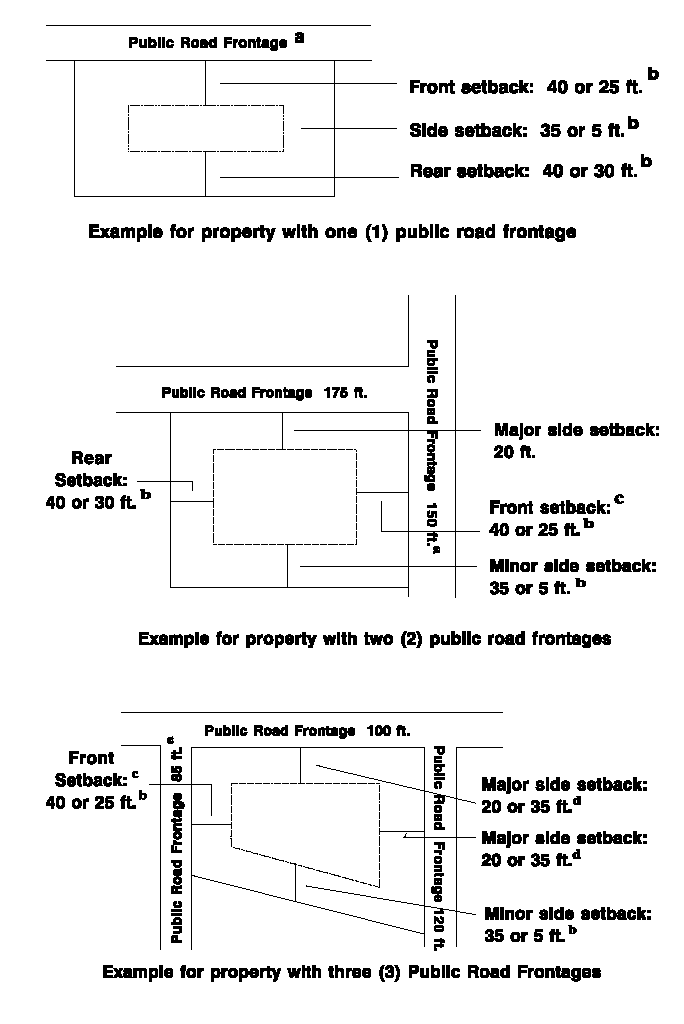
Notes:
1.
If public road frontage is along an arterial or collector roadway, a 50-foot front setback shall be required.
2.
Distance if interior portion of development.
3.
Property with shorter amount of road frontage will be the front setback for determining other setbacks (major side, side, rear).
4.
If the structure fronts a major side setback, the major side setback shall be 35 feet.
(4)
Landscape buffer and screening requirements. Unless otherwise noted within this district's requirements, any property within an RA-6 district which abuts a more restrictive, residentially zoned property shall have a minimum ten-foot landscaped screening buffer adjacent to all residential property, such buffer subject to approval by city staff. Required buffers may be included within required setbacks; however, in such case that the required buffer is greater than the required setback, the required buffer shall be adhered to. Additionally, necessary private utilities or access drives may be allowed through, over or across a landscaped buffer. Any such uses which are proposed through, over or across a designated, undisturbed buffer must be approved pursuant to an original site plan or site plan modification.
a.
Objectives. Undisturbed, planted landscape buffers and berms shall be implemented in connection with a permitted project and shall address the following objectives:
1.
Screening to enhance aesthetic appeal;
2.
Control or direction of vehicular and pedestrian movement;
3.
Reduction of glare;
4.
Buffering of noise; and
5.
Establishment of privacy.
b.
Landscape buffers. Landscape buffers are subject to review and approval by city staff in accordance with the following standards:
1.
Plantings are to be a mix of evergreen trees and shrubs;
2.
Species are to be ecologically compatible to the site and appropriate for design situation;
3.
Unless public safety concerns dictate otherwise, buffer should maximize visual barrier to height of six feet within two years of planting;
4.
Minimum height of plant materials at installation is to be five feet for trees and two feet for shrubs;
5.
Fencing or walls are to be minimum six feet in height (fence to be located on exterior of buffer) as approved by city staff;
6.
Trees included in buffer plantings may be counted toward site density calculations as required by the city subject to review and approval of city staff;
7.
Buffers shall be regularly maintained by the property owners to ensure that the objectives and standards set out in this section are met;
8.
When topography and existing conditions allow, the required ten-foot buffer should be an undisturbed buffer; and
9.
Any appeals from a determination by city staff shall be to the board of variance and zoning appeals.
c.
Berms. Berms are subject to review and approval by city staff in accordance with the following standards:
1.
Berms shall be utilized when consistent with surrounding property features;
2.
Berms shall be stabilized;
3.
Berms shall be constructed to be consistent with natural or proposed drainage patterns; and
4.
Berms shall be regularly maintained by the property owner.
(5)
Floodplain/wetlands preservation requirements. Subject to the conditions set forth in the city floodplain management and prevention ordinance.
(6)
Building and structure requirements. Maximum building height is 35 feet.
(7)
Parking requirements. See section 48-198 for paved parking specifications.
(8)
Lighting requirements. Any project permitted within the RA-6 district which proposes any outdoor lighting must have approval from the building official or his designee.
(9)
Special exception uses. See section 48-197 for requirements for special exception uses. Special exception uses for the RA-6 district are the uses listed as follows:
a.
Any other facility for the disposal of the dead.
b.
Cemeteries.
c.
Churches, chapels, temples, synagogues and other places of worship.
d.
Mausoleums.
e.
Club or lodge, private.
f.
Private schools of general and special education.
(10)
Use limitations.
a.
There shall be a maximum of six units per acre; however, the overall density of a development may be reduced due to topography, drainage, deforestation or sediment and erosion concerns.
b.
Where single-family dwelling units are proposed to be constructed in areas zoned RA-6, the minimum house size shall be 950 square feet and the minimum lot size for an individual lot shall be 5,500 square feet. All setbacks shall be as set forth in this section.
c.
Architectural style and design shall be compatible with or upgrade the existing neighborhood.
d.
Maximum acreage is 20 acres.
e.
No sale of goods or products shall be permitted, except if accessory to customary home occupation, land use permit, special land use permit or special exception use.
f.
No adult entertainment uses are permitted.
g.
No materials, equipment or business vehicles may be stored or parked on the premises, except that one business vehicle (the carrying or towing capacity of which shall not exceed 1½ tons) used exclusively by the resident may be parked in a carport, garage or rear or side yard. The off-site employees of the resident shall not congregate on the premises for any purpose concerning the business of home occupation.
h.
All uses are subject to subdivision regulations of the city as may be amended from time to time.
i.
No outside storage is permitted, excluding firewood and lawn furnishings.
j.
Maximum impervious surface shall not exceed 30 percent.
k.
Pools and outbuildings permitted as accessory structures within the RA-6 zoning district must have a site plan approved by the BOC.
Required buffers may be included within required setbacks; however, in such case that the required buffer is greater than the required setback, the required buffer shall be adhered to. Additionally, necessary private utilities or access drives may be allowed through, over or across a landscaped buffer. Any such buffer must be approved pursuant to an original site plan or site plan modification.
(11)
Accessory buildings, structures, uses and decks.
a.
Any accessory building or structure in excess of 400 square feet of gross space shall be located to the rear of the primary structure and at least 50 feet from any property line. Any accessory building or structure less than 400 square feet and greater than 144 square feet must be located to the rear of the primary structure within the building setbacks. Any accessory building or structure which exceeds 400 square feet of gross space must have the approval of the building official or his designee as to the location, architectural design and size prior to commencing construction. The building official or his designee shall consider the following criteria for determining the appropriateness of the architectural design and size of the accessory building or structure: compatibility with the surrounding neighborhood, style of exterior (the exterior is to be compatible in style with the primary structure), use of the proposed accessory structure, impact on adjacent properties, and requirements as deemed appropriate by plan review as set forth in this subsection. All accessory buildings, structures and uses in excess of 144 gross square feet shall be required to submit for plan review through the community affairs department or receive approval from the director of community affairs or his designee. Accessory structure plans must be accompanied by a signed affidavit from the property owner stating that such structure will not be used for a dwelling or commercial gain.
b.
Accessory buildings, structures, uses and decks shall be subject to the following conditions unless otherwise defined as in subsection (11)a of this section:
1.
Maximum height is two stories or 35 feet, when located within building setbacks or at least 100 feet from a property line, otherwise maximum height is one story.
2.
Accessory uses shall include garbage pads, heating and air conditioning units, Jacuzzis, tennis courts, swimming pools (private), playhouses and playgrounds.
3.
All accessory uses shall be located to the rear of the principal building, except for heating and air conditioning units or garbage pads, which may be located on the side or rear.
4.
The rear of the principal building shall be where the main portion of the building ends without consideration of wings.
5.
Architectural style and design are to be approved by the building official or his designee.
6.
Such structures or buildings shall be located on the same lot as and to the rear of the principal building to which they are accessory. Decks may be located to the rear or side of the principal building subject to the limitations in this subsection.
7.
No accessory building, structure, use or deck shall be constructed upon a lot until construction of the principal building has commenced.
8.
On a corner lot, no accessory building, structure, use or deck shall be located closer to the side street right-of-way line than the principal building.
9.
No garage or accessory building, structure, use or deck less than 144 gross square feet, shall be located closer than five feet to a side or rear lot line or within any required buffers, whichever is greater, regardless if the garage, accessory building, structure, use or deck is attached to the primary structure by a breezeway. If the garage, accessory building, structure, use or deck is attached to the primary structure by a breezeway, it shall be located up to a maximum of 25 feet from the primary structure to which it is attached.
c.
Antennas and satellite dishes shall meet the requirements set forth in section 48-200, pertaining to standards for antennas, satellite television antennas and dishes.
d.
Incidental storage, provided that the material stored is incidental to the permitted use, as determined by the building official or his designee, and stored completely within a portion of the enclosed, principal structure permitted within the district or within a permitted accessory structure.
e.
Neighborhood recreation centers, amenities and swimming pools, subject to the following:
1.
Site plans must be approved by the building official or his designee to ensure compliance with all applicable laws and provisions of this chapter. The facility should be designed to include a detailed landscape plan that provides adequate screening of the facility which creates a visual and sound buffer for adjacent properties. The landscape plan shall be drawn to scale and shall include plant identification by common name. The facility shall be designed to accommodate no more than those residing within two adjoining residential developments, except in those cases where a variance is obtained as in other cases.
2.
Buildings and structures established in connection with such use shall be set back not less than 100 feet from any property line.
(i)
Upon written consent of all owners of property within 100 feet of the building or structure, the setback may be reduced to 50 feet from any exterior property line of the subdivision within which the use is located. Additionally, a detailed landscape plan must be submitted to and approved by the building official or his designee.
(ii)
The setback may be reduced to 20 feet from an interior property line of the property on which the use is located if a ten-foot landscaped buffer is provided along such property line and a six-foot solid wood or masonry fence is erected and maintained along such line so as to provide a visual and noise screen for adjacent property; provided, however, the setback after reduction shall not be less than 100 feet from an exterior property line unless also reduced in accordance with subsection (11)d.2(i) of this section. Such landscaped buffer shall be shown on the landscaping plan specified in subsection (11)d.1 of this section and must be approved by the building official or his designee.
(iii)
When a property line is on a natural waterway, a property line setback may be waived provided written waiver is obtained from the building official or his designee.
3.
Swimming pools must comply with all applicable ordinances and must have necessary approvals from the health department and the city.
4.
Outdoor activity shall cease by 11:00 p.m.
5.
Lighting shall be established in such a way that values or quiet use and enjoyment of adjacent properties are not adversely affected, and that roadways and safe use thereof are not adversely affected. No direct light shall be cast upon adjacent properties or roadways. If lighting is to be established, the use of environmental or cut-off type fixtures only are permissible. If lighting is to be established in a recreation area adjacent to an existing or proposed Cobb County or city public road, a lighting plan must be submitted and approved by the mayor and council to ensure no light is cast upon the roadway, and no adverse impact will be created as a result of the lighting.
6.
No residence or structures shall be built upon any adjacent lot within the development within which the facility is located until construction of the recreation area has commenced to the extent that buyers of adjacent property will be aware of where the recreation area will be located.
7.
Parking requirements are as follows:
(i)
A minimum of 20 spaces shall be provided for amenities which include a swim facility or swim/tennis facility with up to four courts. Additional spaces at the minimum of four spaces per court shall be provided for each court over four in number. A minimum of ten spaces for every two courts shall be provided for amenities which include tennis courts only.
(ii)
In addition to the requirement of subsection (11)e.7(i) of this section, a minimum of five spaces for each 50 residents, or pro-rated share thereof, over 100 shall be provided.
(iii)
Parking spaces shall be paved and striped according to section 48-198, as it now exists or may hereafter be amended. No parking shall be allowed within a front yard setback.
8.
No park, playground, tennis court, basketball court, or the like shall be allowed to be constructed unless the following criteria are met, except those recreational improvements included in a site plan approved by the mayor and council:
(i)
The adjacent property owners shall be in favor of the proposed recreational improvement.
(ii)
Sixty percent of the subdivision, if located in a subdivision shall be in favor of the proposed park.
(iii)
Approval has been received by mayor and council.
(Code 1985, § 22-133)
Sec. 48-148. - RM-8 Residential multifamily district.
The regulations for RM-8 residential multifamily district are as follows:
(1)
Purpose and intent. The RM-8 district is established to provide locations for multifamily residential uses or residentially compatible institutional and recreational uses which are within properties delineated for medium and high density residential categories as defined and shown on the Austell Comprehensive Plan: Policy Guide, adopted July 2, 2007. When residentially compatible institutional and recreational uses are developed within the RM-8 district, they should be designed and built to ensure intensity and density compatibility with adjacent multifamily detached dwellings and otherwise to implement the stated purpose and intent of this chapter.
(2)
Permitted uses. Anything not permitted or allowed by special exception is prohibited. Permitted uses are as follows:
a.
Condominiums.
b.
Customary home occupations.
c.
Executive golf courses.
d.
Fraternity and sorority houses and residence halls.
e.
Fruit trees, nuts and vegetables.
f.
Golf courses, 18-hole regulation, public and private.
g.
Golf courses, par 3.
h.
In-home day care.
i.
Livestock, nondomestic and wild animals, and poultry.
j.
Multifamily dwelling units.
k.
Nonprofit (seasonal use) fishing lakes.
l.
Private parks, SLUP required.
m.
Radio, television and other communication towers and antennas subject to section 48-199.
n.
Riding stables.
o.
Single-family dwelling units (attached), not to exceed six units to the acre.
p.
Single-family dwelling units (detached), not to exceed six units to the acre.
q.
Temporary uses (as defined in this chapter).
(3)
Lot size and setback requirements. Lot size and setback requirements are as follows:
a.
Minimum tract size: 80,000 square feet.
b.
Minimum lot width at front setback line: 75 feet.
c.
Minimum public road frontage: 75 feet.
d.
Minimum building setbacks means as shown and applied in the following diagram:
Minimum Building Setback Requirements for RM-8 District
Note: All setbacks shall be measured from future right-of-way.
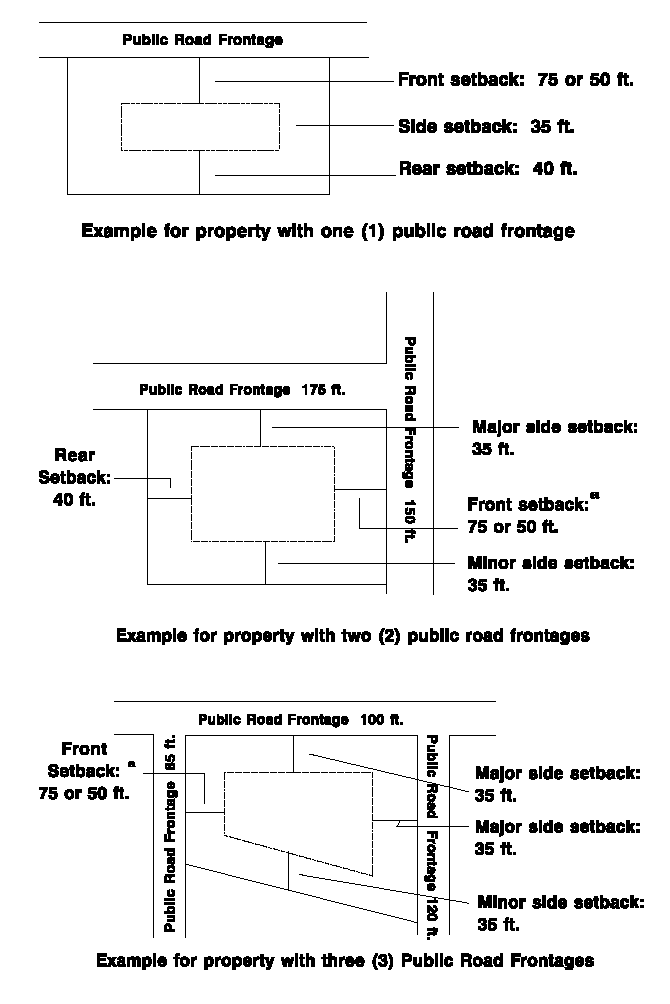
Notes: Property with shorter amount of road frontage will be the front setback for determining other setbacks (major side, side, rear).
(4)
Landscape buffer and screening requirements. Unless otherwise noted within this district's requirements, any property within an RM-8 district which abuts a more restrictive residentially zoned property shall have a minimum 25-foot landscaped screening buffer adjacent to all residential property. The buffer shall be subject to approval by city staff. Required buffers may be included within required setbacks; however, in such case that the required buffer is greater than the required setback, the required buffer shall be adhered to. Additionally, necessary private utilities and access drives may be allowed through, over or across a landscaped buffer. Any such uses which are proposed through, over or across a designated undisturbed buffer must be approved pursuant to an original site plan or site plan modification.
a.
Objectives. Undisturbed, planted landscape buffers and berms shall be implemented in connection with a permitted project and shall address the following objectives:
1.
Screening to enhance aesthetic appeal;
2.
Control or direction of vehicular and pedestrian movement;
3.
Reduction of glare;
4.
Buffering of noise; and
5.
Establishment of privacy.
b.
Buffers. Landscape buffers are subject to review and approval by city staff in accordance with the following standards:
1.
Plantings are to be a mix of evergreen trees and shrubs.
2.
Species are to be ecologically compatible to the site and appropriate for the design situation.
3.
Unless public safety concerns dictate otherwise, a buffer should maximize a visual barrier to a height of six feet within two years of planting.
4.
Minimum height of plant materials at installation is five feet for trees and two feet for shrubs.
5.
Fencing or walls are to be a minimum of six feet in height (fence to be located on exterior of buffer) as approved by city staff.
6.
Trees included in buffer plantings may be counted toward site density calculations as required by the city subject to review and approval of city staff.
7.
Buffers shall be regularly maintained by the property owner to ensure that the objectives and standards set out in this subsection are met.
8.
When topography and existing conditions allow, the required 25-foot buffer should be an undisturbed buffer.
9.
Any appeals from a determination by city staff shall be to the board of variance and zoning appeals.
c.
Berms. Berms are subject to review and approval by city staff in accordance with the following standards:
1.
Berms shall be utilized when consistent with surrounding property features.
2.
Berms shall be stabilized.
3.
Berms shall be constructed to be consistent with natural or proposed drainage patterns.
4.
Berms shall be regularly maintained by the property owner.
(5)
Floodplain and wetlands preservation requirements. Subject to the conditions set forth in the city floodplain management and prevention ordinance.
(6)
Building and structure requirements. Maximum building height is 35 feet. Buildings within the RM-8 district may be split level, three and four stories in height.
(7)
Parking requirements. See section 48-198 for paved parking specifications.
(8)
Lighting requirements. Any project permitted within the RM-8 district which proposes any outdoor lighting must have a city department of transportation approval from the building official or his designee.
(9)
Special exception uses. See section 48-197 for requirements for special exception uses. Special exception uses for the RM-8 district are the uses listed as follows:
a.
Any other facility for the disposal of the dead.
b.
Cemeteries.
c.
Churches, chapels, temples, synagogues and other places of worship.
d.
Mausoleums.
e.
Club or lodge, private.
f.
Private schools of general and special education.
(10)
Use limitations.
a.
There shall be a maximum of eight units per acre; however, the overall density of a development may be reduced due to topography, drainage, deforestation or sediment and erosion concerns.
b.
Where single-family dwelling units are proposed to be constructed in areas zoned RM-8, the minimum house size shall be 950 square feet and the minimum lot size for individual lots shall be 5,500 square feet. Setbacks applicable to the R-10 zoning district (for detached residences) set forth in this chapter shall apply.
c.
Maximum acreage is 40 acres.
d.
Density calculations for projects developed within the RM-8 district shall not include in excess of 50 percent of floodplain area present on the property. Floodplain area included in such density calculations shall not be counted toward any other project unless the original project was not developed. In such instance, only such amounts of floodplain area not utilized in the previously approved project shall be eligible for inclusion in another project.
e.
No sale of goods or products shall be permitted, except if accessory to a customary home occupation, land use permit, special land use permit or special exception use.
f.
No adult entertainment uses are permitted.
g.
No materials, equipment or business vehicles may be stored or parked on the premises, except that one business vehicle, the carrying or towing capacity of which shall not exceed 1½ tons, used exclusively by the resident may be parked in a carport, garage, or rear or side yard. The off-site employees of the resident shall not congregate on the premises for any purpose concerning the business of the home occupation.
h.
All uses are subject to the subdivision regulations of the city or as may be amended from time to time.
i.
Any food or beverage served within an accessory clubhouse shall be limited to residents and their guests.
j.
No outside storage is permitted, excluding firewood and lawn furnishings.
k.
Maximum impervious surface shall not exceed 25 percent. An undisturbed buffer equal to the required rear yard setback for this zoning district shall be established along the perimeter boundaries during construction until certificates of occupancy for affected lots are obtained. In the event that this undisturbed perimeter buffer conflicts with any required building setbacks, the required building setbacks may be altered by the building official or his designee, so as to accommodate the 40-foot undisturbed perimeter buffer. The following uses shall be allowed within the undisturbed perimeter buffer: public and private utilities, detention facilities, access drives, pools, decks, gazebos and fences.
Required buffers may be included within required setbacks; however, in such case that the required buffer is greater than the required setback, the required buffer shall be adhered to. Additionally, necessary private utilities and access drives may be allowed through, over or across a landscaped buffer. Any such uses which are proposed through, over or across a designated undisturbed buffer must be approved pursuant to an original site plan or site plan modification.
(11)
Accessory buildings, structures, uses and decks. Any accessory building or structure which exceeds 400 square feet of gross space must have the approval of the building official or his designee as to the location, architectural design and size prior to commencing construction. The building official or his designee shall consider the following criteria for determining the appropriateness of the architectural design and size of the accessory building or structure: compatibility with the surrounding neighborhood, style of exterior (the exterior is to be compatible in style with the primary structure), use of the proposed accessory structure, impact on adjacent properties, and requirements as deemed appropriate by plan review as set forth in this subsection. All accessory buildings, structures and uses in excess of 144 gross square feet shall be required to submit for plan review through the community affairs department or receive approval from the director of community affairs or his designee. Accessory structure plans must be accompanied by a signed affidavit from the property owner stating that such structure will not be used for a dwelling or commercial gain. When single-family detached dwellings are developed in areas zoned RM-8, any accessory building or structure in excess of 400 square feet of gross space shall be located to the rear of the primary structure and at least 50 feet from any property line. Any accessory building or structure less than 400 square feet and greater than 144 square feet must be located to the rear of the primary structure within the building setbacks. No garage or accessory building, structure, use or deck less than 144 gross square feet, shall be located closer than five feet to a side or rear lot line or within any required buffers, whichever is greater, regardless if the garage, accessory building, structure, use or deck is attached to the primary structure by a breezeway. If the garage, accessory building, structure, use or deck is attached to the primary structure by a breezeway, it shall be located up to a maximum of 25 feet from the primary structure to which it is attached.
a.
Accessory buildings, structures, uses or decks shall be subject to the following conditions:
1.
Maximum height is two stories or 35 feet.
2.
Accessory uses shall include garbage dumpsters, designated recycling collection locations, clubhouses and recreation centers, amenities, swimming pools and tennis courts, antennas and satellite dishes, heating and air conditioning units, Jacuzzis, playhouses and playgrounds subject to the following conditions:
(i)
Such uses must be located within building setbacks.
(ii)
No ground-based antenna or satellite dish shall exceed 35 feet in height without compliance with the standards in section 48-199.
(iii)
No accessory building, structure, use or deck shall be built until construction of the principal building has commenced.
(iv)
Outdoor activities shall cease by 11:00 p.m. within clubhouse and recreation centers and swimming pools and tennis courts.
3.
Such buildings, structures, uses or decks shall be located on the same lot as the principal use to which the building, structure, use or deck is accessory.
b.
Antennas and satellite dishes shall meet the requirements set forth in section 48-200.
c.
Incidental storage is permitted, provided that the material stored is incidental to the permitted use, as determined by the building official or his designee, and stored completely within a portion of the enclosed principal structure permitted within the district, or within a permitted accessory structure.
d.
Where single-family dwelling units are proposed to be constructed in areas zoned RM-8, neighborhood recreation centers, amenities, swimming pools and tennis courts are subject to the following:
1.
Site plans must be approved by the building official or his designee to ensure compliance with all applicable laws and provisions of this chapter. The facility should be designed to include a detailed landscape plan that provides adequate screening of the facility which creates a visual and sound buffer for adjacent properties. The landscape plan shall be drawn to scale and shall include plant identification by common name. The facility shall be designed to accommodate no more than those residing within two adjoining residential developments, except in those cases where a variance is obtained as in other cases.
2.
Buildings and structures established in connection with such use shall be set back not less than 100 feet from any property line.
(i)
Upon written consent of all owners of property within 100 feet of the building or structure, the setback may be reduced to 50 feet from any exterior property line of the subdivision within which the use is located. Additionally, a detailed landscape plan must be submitted to and approved by the building official or his designee.
(ii)
The setback may be reduced to 20 feet from an interior property line of the property on which the use is located if a ten-foot landscaped buffer is provided along such property line and a six-foot solid wood or masonry fence is erected and maintained along such line so as to provide a visual and noise screen for adjacent property; provided, however, the setback after reduction shall not be less than 100 feet from an exterior property line unless also reduced in accordance with subsection (11)d.2(i) of this section. Such landscaped buffer shall be shown on the landscaping plan specified in subsection (11)d.1 of this section and must be approved by the building official or his designee.
(iii)
When a property line is on a natural waterway, a property line setback may be waived provided written waiver is obtained from the building official or his designee.
3.
Swimming pools must comply with all applicable ordinances and must have necessary approvals from the health department and the city.
4.
Outdoor activity shall cease by 11:00 p.m.
5.
Lighting shall be established in such a way that values or quiet use and enjoyment of adjacent properties are not adversely affected, and that roadways and safe use thereof are not adversely affected. No direct light shall be cast upon adjacent properties or roadways. If lighting is to be established, the use of environmental or cut-off type fixtures only are permissible. If lighting is to be established in a recreation area adjacent to an existing or proposed Cobb County or city public road, a lighting plan must be submitted and approved by the mayor and council to ensure no light is cast upon the roadway, and no adverse impact will be created as a result of the lighting.
6.
No residence or structures shall be built upon any adjacent lot within the development within which the facility is located until construction of the recreation area has commenced to the extent that buyers of adjacent property will be aware of where the recreation area will be located.
7.
Parking requirements are as follows:
(i)
A minimum of 20 spaces shall be provided for amenities which include a swim facility or swim/tennis facility with up to four courts. Additional spaces at the minimum of four spaces per court shall be provided for each court over four in number. A minimum of ten spaces for every two courts shall be provided for amenities which include tennis courts only.
(ii)
In addition to the requirement of subsection (11)d.7(i) of this section, a minimum of five spaces for each 50 residents, or pro-rated share thereof, over 100 shall be provided.
(iii)
Parking spaces shall be paved and striped according to section 48-198, as it now exists or may hereafter be amended. No parking shall be allowed within a front yard setback.
8.
No park, playground, tennis court, basketball court, or the like shall be allowed to be constructed unless the following criteria are met, except those recreational improvements included in a site plan approved by the mayor and council:
(i)
The adjacent property owners shall be in favor of the proposed recreational improvement.
(ii)
Sixty percent of the subdivision, if located in a subdivision shall be in favor of the proposed park.
(iii)
Approval has been received by mayor and council.
(Code 1985, § 22-134)
Sec. 48-149. - FST Fee simple townhouse residential district.
The regulations for the FST fee simple townhouse residential district are as follows:
(1)
Purpose and intent. The FST district is established to provide locations for affordable attached residential dwelling units (six or eight units per acre) or residentially compatible institutional and recreational uses which are within or on the edge of properties delineated for medium and high density residential categories as defined and shown on the Austell Comprehensive Plan: Policy Guide, adopted July 2, 2007. When residentially compatible institutional and recreational uses are developed within the FST district, they should be designed and built to ensure intensity and density compatibility with adjacent single-family detached dwellings, and shall have the meanings ascribed to them in this subsection, except where the context clearly indicates a different meaning.
(2)
Permitted uses. Anything not permitted or allowed by special exception is prohibited. Permitted uses are as follows:
a.
Customary home occupations.
b.
Executive golf courses.
c.
Golf courses, 18-hole regulation, public and private.
d.
Golf courses, par 3.
e.
In-home day care.
f.
Livestock, nondomestic and wild animals, and poultry.
g.
Nonprofit (seasonal use) fishing lakes.
h.
Private parks, SLUP required.
i.
Radio, television, other communication towers and antennas, subject to section 48-199.
j.
Riding stables.
k.
Temporary uses (as defined in this chapter).
l.
Townhouse dwelling units (attached).
(3)
Lot size and setback requirements. Lot size and setback requirements are as follows:
a.
Minimum tract size: 80,000 square feet.
b.
Minimum lot width at front setback line: 20 feet; 30 feet for lot with end unit.
c.
Minimum public road frontage: 20 feet.
d.
Minimum building setbacks means as shown and applied in the following diagram:
Minimum Building Setback Requirements for FST District
Note: All setbacks shall be measured from future right-of-way.
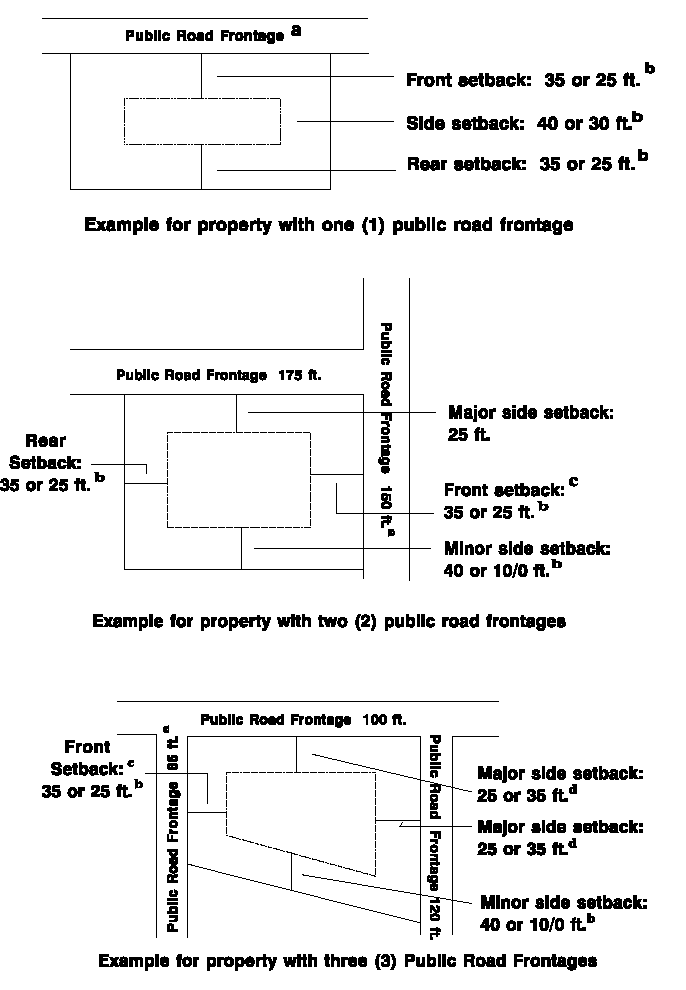
Notes:
1.
If public road frontage is along an arterial or collector roadway, a 50-foot front setback shall be required.
2.
Distance of interior portion of development If attached units, minor side setback can be zero feet. Maximum of six units attached. Ten feet required between unattached units.
3.
Property with shorter amount of road frontage will be the front setback for determining other setbacks (major side, side, rear).
4.
If structure fronts a major side setback, major side setback shall be 35 feet.
(4)
Landscape buffer and screening requirements. Unless otherwise noted within this district's requirements, any property within an FST district which abuts a more restrictive residentially zoned property shall have a minimum ten-foot landscaped screening buffer adjacent to all residential property. The buffer shall be subject to approval by city staff. Required buffers may be included within required setbacks; however, in such case that the required buffer is greater than the required setback, the required buffer shall be adhered to. Additionally, necessary private utilities and access drives may be allowed through, over or across a landscaped buffer. Any such uses which are proposed through, over or across a designated undisturbed buffer must be approved pursuant to an original site plan or site plan modification.
a.
Objectives. Undisturbed, planted landscape buffers and berms shall be implemented in connection with a permitted project and shall address the following objectives:
1.
Screening to enhance aesthetic appeal;
2.
Control or direction of vehicular and pedestrian movement;
3.
Reduction of glare;
4.
Buffering of noise; and
5.
Establishment of privacy.
b.
Standards. Buffers and berms shall be required when an FST district is located adjacent to a residential district; a minimum ten-foot buffer is required.
1.
Buffers. Landscape buffers are subject to review and approval by city staff in accordance with the following standards:
(i)
Plantings are to be a mix of evergreen trees and shrubs.
(ii)
Species are to be ecologically compatible to the site and appropriate for the design situation.
(iii)
Unless public safety concerns dictate otherwise, a buffer should maximize a visual barrier to a height of six feet within two years of planting.
(iv)
Minimum height of plant materials at installation is five feet for trees and two feet for shrubs.
(v)
Fencing or walls are to be a minimum of six feet in height (fence to be located on exterior of buffer) as approved by city staff.
(vi)
Trees included in buffer plantings may be counted toward site density calculations as required by the city subject to review and approval of city staff.
(vii)
Buffers shall be regularly maintained by the property owner to ensure that the objectives and standards set out in this subsection are met.
(viii)
When topography and existing conditions allow, the required ten-foot buffer should be an undisturbed buffer.
(ix)
Any appeals from a determination by city staff shall be to the board of variance and zoning appeals.
2.
Berms. Berms are subject to review and approval by city staff in accordance with the following standards:
(i)
Berms shall be utilized when consistent with surrounding property features.
(ii)
Berms shall be stabilized.
(iii)
Berms shall be constructed to be consistent with natural or proposed drainage patterns.
(iv)
Berms shall be regularly maintained by the property owner.
(5)
Floodplain and wetlands preservation requirements. Subject to the conditions set forth in the city floodplain management and prevention ordinance.
(6)
Building and structure requirements. Maximum building height is 35 feet.
(7)
Parking requirements. See section 48-198 for paved parking specifications.
(8)
Lighting requirements. Any project permitted within the FST district which proposes any outdoor lighting must have approval from the building official or his designee.
(9)
Special exception uses. See section 48-197 for requirements for special exception uses. Special exception uses for the FST district are the uses listed as follows:
a.
Any other facility for the disposal of the dead.
b.
Cemeteries.
c.
Churches, chapels, temples, synagogues and other places of worship.
d.
Mausoleums.
e.
Club or lodge, private.
f.
Private schools of general and special education.
(10)
Use limitations.
a.
There shall be a maximum of eight units per acre.
b.
Architectural style and design are to be compatible with or upgrade the existing neighborhood.
c.
Maximum acreage is 20 acres.
d.
No sale of goods or products shall be permitted, except if accessory to a customary home occupation, land use permit, special land use permit or special exception use.
e.
No adult entertainment uses are permitted.
f.
No materials, equipment or business vehicles may be stored or parked on the premises, except that one business vehicle (the carrying or towing capacity shall not exceed 1½ tons), used exclusively by the resident may be parked in a carport, garage, or rear or side yard. The off-site employees of the resident shall not congregate on the premises for any purpose concerning the business of the home occupation.
g.
All uses are subject to the subdivision regulations of the city or as may be amended from time to time.
h.
No outside storage is permitted, excluding firewood and lawn furnishings.
i.
Maximum impervious surface shall not exceed 30 percent. An undisturbed buffer equal to the required rear yard setback for this zoning district shall be established along the perimeter boundaries during construction until certificates of occupancy for affected lots are obtained. In the event that this undisturbed perimeter buffer conflicts with any required building setbacks, the required building setbacks may be altered by the building official or his designee, so as to accommodate the 40-foot undisturbed perimeter buffer. The following uses shall be allowed within the undisturbed perimeter buffer: public and private utilities, detention facilities, access drives, pools, decks, gazebos and fences.
Required buffers may be included within required setbacks; however, in such case that the required buffer is greater than the required setback, the required buffer shall be adhered to. Additionally, necessary private utilities and access drives may be allowed through, over or across a landscaped buffer. Any such uses which are proposed through, over or across a designated undisturbed buffer must be approved pursuant to an original site plan or site plan modification.
(11)
Accessory buildings, structures, uses and decks. Any accessory building or structure in excess of 400 square feet of gross space shall be located to the rear of the primary structure and at least 50 feet from any property line. Any accessory building or structure which exceeds 400 square feet of gross space must have the approval of the building official or his designee as to the location, architectural design and size prior to commencing construction. The building official or his designee shall consider the following criteria for determining the appropriateness of the architectural design and size of the accessory building or structure: compatibility with the surrounding neighborhood, style of exterior (the exterior is to be compatible in style with the primary structure), use of the proposed accessory structure, impact on adjacent properties, and requirements as deemed appropriate by plan review as set forth in this subsection. All accessory buildings, structures and uses in excess of 144 gross square feet shall be required to submit for plan review through the community affairs department or receive approval from the director of community affairs or his designee. Accessory structure plans must be accompanied by a signed affidavit from the property owner stating that such structure will not be used for a dwelling or commercial gain.
a.
Accessory buildings, structures, uses and decks shall be subject to the following conditions:
1.
Maximum height is two stories or 35 feet.
2.
Accessory uses shall include garbage pads, heating and air conditioning units, Jacuzzis, tennis courts, swimming pools (private), playhouses and playgrounds.
3.
All accessory uses shall be located to the rear of the principal building, except for heating and air conditioning units or garbage pads, which may be located on the side or rear.
4.
The rear of the principal building shall be where the main portion of the building ends without consideration of wings.
5.
Architectural style and design shall be approved by the building official or his designee.
6.
Such structures or buildings shall be located on the same lot as and to the rear of the principal building to which they are accessory. Decks may be located to the rear or side of the principal building subject to the limitations in this subsection.
7.
No accessory building, structure, use or deck shall be built until construction of the principal building has commenced.
8.
On a corner lot, no accessory building, structure, use or deck shall be located closer to the side street right-of-way line than the principal building.
9.
Any accessory building or structure less than 650 square feet and greater than 144 square feet must be located to the rear of the primary structure within the building setbacks. No garage or accessory building, structure, use or deck less than 144 gross square feet, shall be located closer than five feet to a side or rear lot line or within any required buffers, whichever is greater, regardless if the garage, accessory building, structure, use or deck is attached to the primary structure by a breezeway. If the garage, accessory building, structure, use or deck is attached to the primary structure by a breezeway, it shall be located up to a maximum of 25 feet from the primary structure to which it is attached.
b.
Antennas and satellite dishes shall meet the requirements set forth in section 48-200.
c.
Incidental storage is permitted, provided that the material stored is incidental to the permitted use, as determined by the building official or his designee, and stored completely within a portion of the enclosed principal structure permitted within the district, or within a permitted accessory structure.
d.
Neighborhood recreation centers, amenities and swimming pools are subject to the following:
1.
Site plans must be approved by the building official or his designee to ensure compliance with all applicable laws and provisions of this chapter. The facility should be designed to include a detailed landscape plan that provides adequate screening of the facility which creates a visual and sound buffer for adjacent properties. The landscape plan shall be drawn to scale and shall include plant identification by common name. The facility shall be designed to accommodate no more than those residing within two adjoining residential developments, except in those cases where a variance is obtained as in other cases.
2.
Buildings and structures established in connection with such use shall be set back not less than 100 feet from any property line.
(i)
Upon written consent of all owners of property within 100 feet of the building or structure, the setback may be reduced to 50 feet from any exterior property line of the subdivision within which the use is located. Additionally, a detailed landscape plan must be submitted to and approved by the building official or his designee.
(ii)
The setback may be reduced to 20 feet from an interior property line of the property on which the use is located if a ten-foot landscaped buffer is provided along the property line and a six-foot solid wood or masonry fence is erected and maintained along the line so as to provide a visual and noise screen for adjacent property; provided, however, the setback after reduction shall not be less than 100 feet from an exterior property line unless also reduced in accordance with subsection (11)d.2(i) of this section. Such landscaped buffer shall be shown on the landscaping plan specified in subsection (11)d.1 of this section and must be approved by the building official or his designee.
(iii)
When a property line is on a natural waterway, a property line setback may be waived provided a written waiver is obtained from the building official or his designee.
3.
Swimming pools must comply with all applicable ordinances and must have necessary approvals from the health department and city.
4.
Outdoor activity shall cease by 11:00 p.m.
5.
Lighting shall be established in such a way that values or quiet use and enjoyment of adjacent properties are not adversely affected, and that roadways and safe use thereof are not adversely affected. No direct light shall be cast upon adjacent properties or roadways. If lighting is to be established, the use of environmental or cutoff type fixtures only is permissible. If lighting is to be established in a recreation area adjacent to an existing or proposed Cobb County or city public road, a lighting plan must be submitted and approved by the mayor and council to ensure no that light is cast upon the roadway and that no adverse impact will be created as a result of the lighting.
6.
No residence or structures shall be built upon any adjacent lot within the development within which the facility is located until construction of the recreation area has commenced to the extent that buyers of adjacent property will be aware of where the recreation area will be located.
7.
Parking requirements are as follows:
(i)
A minimum of 20 spaces shall be provided for amenities which include a swim facility or swim/tennis facility with up to four courts. Additional spaces at the minimum of four spaces per court shall be provided for each court over four in number. A minimum of ten spaces for every two courts shall be provided for amenities which include tennis courts only.
(ii)
In addition to the requirement of subsection (11)d.7(i) of this section, a minimum of five spaces for each 50 residents, or pro-rated share thereof, over 100 shall be provided.
(iii)
Parking spaces shall be paved and striped according to section 48-198, as it now exists or may hereafter be amended. No parking shall be allowed within a front yard setback.
8.
No park, playground, tennis court, basketball court, or the like shall be allowed to be constructed unless the following criteria are met, except those recreational improvements included in a site plan approved by the mayor and council:
(i)
The adjacent property owners shall be in favor of the proposed recreational improvement.
(ii)
Sixty percent of the subdivision, if located in a subdivision shall be in favor of the proposed park.
(iii)
Approval has been received by mayor and council.
(Code 1985, § 22-135)
Sec. 48-150. - RM-12 Residential multifamily district.
The regulations for the RM-12 residential multifamily district are as follows:
(1)
Purpose and intent. The RM-12 district is established to provide locations for multifamily residential uses or residentially compatible institutional and recreational uses which are within properties delineated for high density residential and regional activity center categories as defined and shown on the Austell Comprehensive Plan: Policy Guide, adopted July 2, 2007. When residentially compatible institutional and recreational uses are developed within the RM-12 district, they should be designed and built to ensure intensity and density compatibility with adjacent multifamily detached dwellings and otherwise to implement the stated purpose and intent of this chapter.
(2)
Permitted uses. Anything not permitted or allowed by special exception is prohibited. Permitted uses are as follows:
a.
Condominiums.
b.
Customary home occupations.
c.
Executive golf courses.
d.
Fraternity and sorority houses and residence halls.
e.
Golf courses, 18-hole regulation, public and private.
f.
Golf courses, par 3.
g.
In-home day care.
h.
Multifamily dwelling units.
i.
Private parks, SLUP required.
j.
Riding stables.
k.
Single-family dwelling units (attached), not to exceed six units to the acre.
l.
Single-family dwelling units (detached), not to exceed six units to the acre.
m.
Temporary uses (as defined in this chapter).
(3)
Lot size and setback requirements. Lot size and setback requirements are as follows:
a.
Minimum tract size: 80,000 square feet.
b.
Minimum lot width at front setback line: 75 feet.
c.
Minimum public road frontage: 75 feet.
d.
Minimum building setbacks means as shown and applied in the following diagram:
Minimum Building Setback Requirements for RM-12 District
Note: All setbacks shall be measured from future right-of-way.
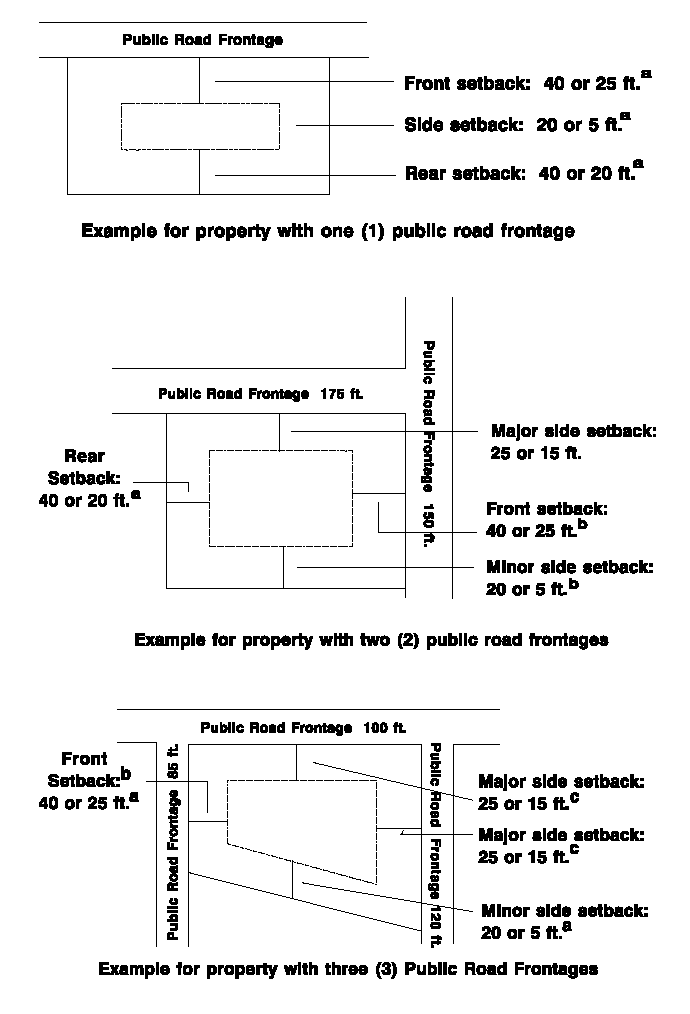
Notes:
1.
Property with shorter amount of road frontage will be the front setback for determining other setbacks (major side, side, rear).
2.
If structure fronts a major side setback, major side setback shall be 35 feet.
(4)
Landscape buffer and screening requirements. Unless otherwise noted within this district's requirements, any property within an RM-12 district which abuts a more restrictive residentially zoned property shall have a minimum 25-foot landscaped screening buffer adjacent to all residential property. The buffer shall be subject to approval by city staff. Required buffers may be included within required setbacks; however, in such case that the required buffer is greater than the required setback, the required buffer shall be adhered to. Additionally, necessary private utilities and access drives may be allowed through, over or across a landscaped buffer. Any such uses which are proposed through, over or across a designated undisturbed buffer must be approved pursuant to an original site plan or site plan modification.
a.
Objectives. Undisturbed, planted landscape buffers and berms shall be implemented in connection with a permitted project and shall address the following objectives:
1.
Screening to enhance aesthetic appeal;
2.
Control or direction of vehicular and pedestrian movement;
3.
Reduction of glare; and
4.
Buffering of noise.
b.
Standards. Buffers or berms shall be required when an RM-12 district is located adjacent to a more restrictive residential district; a minimum 25-foot buffer is required.
1.
Buffers. Landscape buffers are subject to review and approval by city staff in accordance with the following standards:
(i)
Plantings are to be a mix of evergreen trees and shrubs.
(ii)
Species are to be ecologically compatible to the site and appropriate for the design situation.
(iii)
Unless public safety concerns dictate otherwise, a buffer should maximize a visual barrier to a height of six feet within two years of planting.
(iv)
Minimum height of plant materials at installation is five feet for trees and two feet for shrubs.
(v)
Fencing or walls are to be a minimum of six feet in height (fence to be located on exterior of buffer) as approved by city staff.
(vi)
Trees included in buffer plantings may be counted toward site density calculations as required by the city subject to review and approval of city staff.
(vii)
Buffers shall be regularly maintained by the property owner to ensure that the objectives and standards set out in this subsection are met.
(viii)
When topography and existing conditions allow, the required 25-foot buffer should be an undisturbed buffer.
(ix)
Any appeals from a determination by city staff shall be to the board of variance and zoning appeals.
2.
Berms. Berms are subject to review and approval by city staff in accordance with the following standards:
(i)
Berms shall be utilized when consistent with surrounding property features.
(ii)
Berms shall be stabilized.
(iii)
Berms shall be constructed to be consistent with natural or proposed drainage patterns.
(iv)
Berms shall be regularly maintained by the property owner.
(5)
Floodplain and wetlands preservation requirements. Subject to the conditions set forth in the city floodplain management and prevention ordinance.
(6)
Building and structure requirements. Maximum building height is 35 feet. Buildings within the RM-12 district may be split level, three and four stories in height.
(7)
Parking requirements. See section 48-198 for paved parking specifications.
(8)
Lighting requirements. Any project permitted within the RM-12 district which proposes any outdoor lighting must have approval from the building official or his designee.
(9)
Special exception uses. See section 48-197 for requirements for special exception uses. Special exception uses for the RM-12 district are the uses listed as follows:
a.
Any other facility for the disposal of the dead.
b.
Cemeteries.
c.
Churches, chapels, temples, synagogues and other places of worship.
d.
Mausoleums.
e.
Club or lodge, private.
f.
Private schools of general and special education.
(10)
Use limitations.
a.
There shall be a maximum of 12 units per acre; however, the overall density of a development may be reduced due to topography, drainage, deforestation or sediment and erosion concerns.
b.
Where single-family dwelling units are proposed to be constructed in areas zoned RM-12, the minimum house size shall be 950 square feet and the minimum lot size for individual lots shall be 6,500 square feet. Setbacks applicable to the RA-6 zoning district (for detached residences) set forth in this chapter shall apply.
c.
Maximum acreage is 40 acres.
d.
Density calculations for projects developed within the RM-12 district shall not include in excess of 50 percent of any floodplain area present on the property. Floodplain area included in such density calculation shall not be counted toward any other project unless the original project was not developed (which included the floodplain calculation).
e.
No sale of goods or products shall be permitted, except if accessory to a customary home occupation, land use permit, special land use permit or special exception use.
f.
No adult entertainment uses are permitted.
g.
No materials, equipment or business vehicles may be stored or parked on the premises, except that one business vehicle (the carrying or towing capacity of which shall not exceed 1½ tons) used exclusively by the resident may be parked in a carport, garage, or rear or side yard. The off-site employees of the resident shall not congregate on the premises for any purpose concerning the business of the home occupation.
h.
All uses are subject to the subdivision regulations of the city or as may be amended from time to time.
i.
Any food or beverage served within an accessory clubhouse shall be limited to residents and their guests.
j.
No outside storage is permitted, excluding firewood and lawn furnishings.
k.
Maximum impervious surface shall not exceed 35 percent. An undisturbed buffer equal to the required rear yard setback for this zoning district shall be established along the perimeter boundaries during construction until certificates of occupancy for affected lots are obtained. In the event that this undisturbed perimeter buffer conflicts with any required building setbacks, the required building setbacks may be altered by the building official or his designee, so as to accommodate the 40-foot undisturbed perimeter buffer. The following uses shall be allowed within the undisturbed perimeter buffer: public and private utilities, detention facilities, access drives, pools, decks, gazebos and fences.
Required buffers may be included within required setbacks; however, in such case that the required buffer is greater than the required setback, the required buffer shall be adhered to, Additionally, necessary private utilities and access drives may be allowed through, over or across a landscaped buffer. Any such uses which are proposed through, over or across a designated undisturbed buffer must be approved pursuant to an original site plan or site plan modification.
(11)
Accessory buildings, structures, uses and decks. Any accessory building or structure which exceeds 400 square feet of gross space must have the approval of the building official or his designee as to the location, architectural design and size prior to commencing construction. The building official or his designee shall consider the following criteria for determining the appropriateness of the architectural design and size of the accessory building or structure: compatibility with the surrounding neighborhood, style of exterior (the exterior is to be compatible in style with the primary structure), use of the proposed accessory structure, impact on adjacent properties, and requirements as deemed appropriate by plan review as set forth in this subsection. All accessory buildings, structures and uses in excess of 144 gross square feet shall be required to submit for plan review through the community affairs department or receive approval from the director of community affairs or his designee. Accessory structure plans must be accompanied by a signed affidavit from the property owner stating that such structure will not be used for a dwelling or commercial gain. When single-family detached dwellings are developed in areas zoned RM-12, any accessory building or structure in excess of 400 square feet of gross space shall be located to the rear of the primary structure and at least 50 feet from any property line. Any accessory building or structure less than 400 square feet and greater than 144 square feet must be located to the rear of the primary structure within the building setbacks. No garage or accessory building, structure, use or deck less than 144 gross square feet, shall be located closer than five feet to a side or rear lot line or within any required buffers, whichever is greater, regardless if the garage, accessory building, structure, use or deck is attached to the primary structure by a breezeway. If the garage, accessory building, structure, use or deck is attached to the primary structure by a breezeway, it shall be located up to a maximum of 25 feet from the primary structure to which it is attached.
a.
Accessory buildings, structures, uses or decks shall be subject to the following conditions:
1.
Maximum height is two stories or 35 feet.
2.
Accessory uses shall include garbage dumpsters, clubhouse and recreation centers, amenities, swimming pools and tennis courts, antennas and satellite dishes, heating and air conditioning units, Jacuzzis, playhouses and playgrounds subject to the following conditions:
(i)
Uses must be located within building setbacks.
(ii)
No ground-based antenna or satellite dish shall exceed 35 feet in height without compliance with standards in section 48-199.
(iii)
No accessory building, structure, use or deck shall be built until construction of the principal building has commenced.
(iv)
Outdoor activities shall cease by 11:00 p.m. within clubhouse and recreation centers and swimming pools and tennis courts.
3.
Such buildings, structures, uses or decks shall be located on the same lot as the principal use to which the building, structure, use or deck is accessory.
b.
Antennas and satellite dishes shall meet the requirements set forth in section 48-200.
c.
Incidental storage is permitted, provided that the material stored is incidental to the permitted use, as determined by the building official or his designee, and stored completely within a portion of the enclosed principal structure permitted within the district, or within a permitted accessory structure.
d.
Multifamily or apartment projects, neighborhood recreation centers, amenities, swimming pools and tennis courts must be located with applicable building setbacks. Where single-family dwelling units are proposed to be constructed in areas zoned RM-12, neighborhood recreation centers, amenities, swimming pools and tennis courts are subject to the following:
1.
Site plans must be approved by the building official or his designee to ensure compliance with all applicable laws and provisions of this chapter. The facility should be designed to include a detailed landscape plan that provides adequate screening of the facility which creates a visual and sound buffer for adjacent properties. The landscape plan shall be drawn to scale and shall include plant identification by common name. The facility shall be designed to accommodate no more than those residing within two adjoining residential developments, except in those cases where a variance is obtained as in other cases.
2.
Buildings and structures established in connection with such use shall be set back not less than 100 feet from any property line.
(i)
Upon written consent of all owners of property within 100 feet of the building or structure, the setback may be reduced to 50 feet from any exterior property line of the subdivision within which the use is located. Additionally, a detailed landscape plan must be submitted to and approved by the building official or his designee.
(ii)
The setback may be reduced to 20 feet from an interior property line of the property on which the use is located if a ten-foot landscaped buffer is provided along the property line and a six-foot solid wood or masonry fence is erected and maintained along the line so as to provide a visual and noise screen for adjacent property; provided, however, the setback after reduction shall not be less than 100 feet from an exterior property line unless also reduced in accordance with subsection (11)d.2(i) of this section. Such landscaped buffer shall be shown on the landscaping plan specified in subsection (11)d.1 of this section and must be approved by the building official or his designee.
(iii)
When a property line is on a natural waterway, a property line setback may be waived provided a written waiver is obtained from the building official or his designee.
3.
Swimming pools must comply with all applicable ordinances and must have necessary approvals from the health department and city.
4.
Outdoor activity shall cease by 11:00 p.m.
5.
Lighting shall be established in such a way that values or quiet use and enjoyment of adjacent properties are not adversely affected, and that roadways and safe use thereof are not adversely affected. No direct light shall be cast upon adjacent properties or roadways. If lighting is to be established, the use of environmental or cutoff type fixtures only is permissible. If lighting is to be established in a recreation area adjacent to an existing or proposed Cobb County or city public road, a lighting plan must be submitted and approved by the mayor and council to ensure no that light is cast upon the roadway and that no adverse impact will be created as a result of the lighting.
6.
No residence or structures shall be built upon any adjacent lot within the development within which the facility is located until construction of the recreation area has commenced to the extent that buyers of adjacent property will be aware of where the recreation area will be located.
7.
Parking requirements are as follows:
(i)
A minimum of 20 spaces shall be provided for amenities which include a swim facility or swim/tennis facility with up to four courts. Additional spaces at the minimum of four spaces per court shall be provided for each court over four in number. A minimum of ten spaces for every two courts shall be provided for amenities which include tennis courts only.
(ii)
In addition to the requirement of subsection (11)d.7(i) of this section, a minimum of five spaces for each 50 residents, or pro-rated share thereof, over 100 shall be provided.
(iii)
Parking spaces shall be paved and striped according to section 48-198, as it now exists or may hereafter be amended. No parking shall be allowed within a front yard setback.
8.
No park, playground, tennis court, basketball court, or the like shall be allowed to be constructed unless the following criteria are met, except those recreational improvements included in a site plan approved by the mayor and council:
(i)
The adjacent property owners shall be in favor of the proposed recreational improvement.
(ii)
Sixty percent of the subdivision, if located in a subdivision shall be in favor of the proposed park.
(iii)
Approval has been received by mayor and council.
(Code 1985, § 22-136)
Sec. 48-151. - MHP Mobile home park district.
(a)
Purpose and intent. The MHP district is established to provide locations for mobile home parks which eliminate or minimize certain conditions associated with mobile homes. The mayor and council finds that it is necessary to restrict the location of mobile homes in order to: preserve land for low density, single-family dwellings; protect property values; guard against increased crime; guard against traffic congestion; maintain aesthetics; regulate population density; prevent waste and sewage problems; regulate housing stock; and attempt to address concerns regarding wind vulnerability. No new application for MHP mobile home park zoning will be accepted by the mayor and council effective January 1, 2011.
(b)
Standards. The regulations for the MHP mobile home park district are as follows:
(1)
Conditions of operation. Each mobile home park shall provide the following minimum facilities on the site for the common use of all trailer occupants:
a.
Drives. Paved drives at least 20 feet wide shall be provided to each trailer space and to laundry or other service buildings and recreation areas.
b.
Refuse collection facilities. One refuse collection station shall be provided for each 20 families or fraction thereof, not more than 200 feet from any trailer served, and shall be conveniently located for collection. If individual refuse containers are used on the trailer site, these containers must be submerged in the ground with only the top portion extending above the ground level. In lieu of a submerged unit, stands may be provided to hold the cans and screen the cans from conspicuous view.
c.
Underground utility lines. Utility lines shall be underground unless the plans approved by the mayor and council indicate certain specific lines above the ground.
d.
Landscaping. Each mobile home park shall be landscaped with shade trees and exterior screen planting.
e.
Recreation area. At least ten percent of the gross land area shall be set aside for recreational use. No such area shall be less than one-half acre.
(2)
Improvements to trailers; patios.
a.
No permanent additions of any kind shall be built onto or become a part of any trailer unit.
b.
The owner of the mobile home park shall install a concrete patio at least four inches thick, with minimum dimensions of 20 feet by eight feet, within each trailer space.
(3)
Required lot area.
a.
No mobile home park shall be constructed or maintained on a lot or tract which has an average width of less than 400 feet or a total area of less than ten acres.
b.
Each trailer space shall be at least 50 feet in width and shall be a minimum of 4,000 square feet in area. In cul-de-sac or curved street design, the width of the trailer space shall be at least 50 feet at the location of the mobile home unit.
c.
Each trailer space shall be defined by a marker at each corner.
(4)
Yard requirements. No trailer shall be located within:
a.
Ten feet of its individual lot line.
b.
Forty feet from any exterior boundary of the mobile home park.
(5)
Buffer strip requirements. A buffer strip at least 25 feet wide shall be located adjacent to each exterior property line of the mobile home park and not be included within any individual trailer lot. This buffer strip shall be increased to a width of 50 feet when located adjacent to property zoned for single-family dwellings or duplexes. This strip shall be densely planted with evergreen shrubs and trees.
(6)
Off-street parking. A paved driveway, connecting to the interior drive, shall be provided on each trailer site, sufficient in length and width to serve as two off-street parking spaces.
(7)
Sewerage and water supply. Central sewage disposal facilities must be used and there shall be no individual septic tanks in areas zoned for the uses provided in this section, and public water supply shall be used and there shall be no private wells allowed under the uses in this zone.
(8)
Use limitations.
a.
No outside storage is permitted, excluding firewood and lawn furnishings.
b.
Maximum density of six units to the acre.
c.
Required buffers may be included within required setbacks; however, in such case that the required buffer is greater than the required setback, the required buffer shall be adhered to. Additionally, necessary private utilities and access drives may be allowed through, over or across a landscaped buffer. Any such uses which are proposed through, over or across a designated undisturbed buffer must be approved pursuant to an original site plan or site plan modification.
(9)
Floodplain and wetlands preservation requirements. Subject to the conditions set forth in the city floodplain management and prevention ordinance.
(10)
Mobile home requirements. Each mobile home must consist of one or more rooms which are arranged, designed or used as living quarters for one family (as defined in section 48-1) and two or fewer persons who are not family members.
a.
A mobile home may be occupied only by a family and up to two persons who are not family members.
b.
A mobile home shall have an interior bathroom and complete kitchen facilities, permanently installed.
c.
A mobile home shall have at least 250 square feet of total square footage (as determined in the records maintained by the Cobb County tax assessor) per each adult occupant.
d.
A travel trailer, recreational vehicle or the like does not constitute a mobile home for the purposes of this section.
e.
No more than one vehicle per 250 square feet of total square footage may be parked regularly overnight at or within the paved parking area as required in subsection (b)(6) of this section. The term "regularly" means a majority of nights in any seven-day period.
(Code 1985, § 22-137)
Sec. 48-152. - O&I Office and institutional district.
The regulations for the O&I office and institutional district are as follows:
(1)
Purpose and intent. The O&I district is established to provide locations for nonretail commercial uses such as offices and financial institutions, which are on properties delineated within or on the edge of a neighborhood activity center and or a community activity center as defined and shown on the Austell Comprehensive Plan: Policy Guide, adopted July 2, 2007. The office and institutional district is designed primarily to provide for four-story and smaller office developments, office uses, motels, hotels, banking and professional offices that complement and provide step-down nodal zoning away from more intensive commercial uses and otherwise to implement the stated purpose of this chapter.
(2)
Permitted uses. Permitted uses are as follows:
a.
Accessory retail sales and services.
b.
Ambulance services, if accessory to hospitals or funeral homes.
c.
Animal hospitals.
d.
Athletic and health clubs.
e.
Automotive parking lots or garages.
f.
Banks and financial institutions with drive-in establishments or automated transfer machines.
g.
Clinics.
h.
Clubs or lodges (noncommercial).
i.
Colleges and universities, including, but not limited to, research and training facilities (private).
j.
Community fairs.
k.
Designated recycling collection locations.
l.
Executive golf courses.
m.
Fraternity and sorority houses and residence halls, if within 1,000 feet of a college or university.
n.
Funeral homes.
o.
Golf courses, par 3.
p.
Golf courses, 18-hole regulation, public and private.
q.
Hospitals.
r.
In-home day care.
s.
Medical and dental laboratories, provided that no chemicals are manufactured on-site.
t.
Nonprofit (seasonal use) fishing lakes.
u.
Nursery schools and child care centers.
v.
Pain clinic and pain management clinic.
1.
No on-site dispensing of any prescription medications or controlled substances.
2.
One parking space per 200 gross square-feet of building.
3.
Hours of operation to be established by mayor and council, considering the operational hours of surrounding businesses.
4.
Signage and lighting plan to be approved by city staff.
5.
Special land use permit as provided by section 48-36.
6.
The maximum length of approval for this use is 12 months.
(i)
Offices not elsewhere classified.
(ii)
Parking for vehicles.
(iii)
Private parks.
(iv)
Professional offices.
(v)
Radio and television stations.
(vi)
Radio, television and other commercial towers and antennas subject to section 48-199.
(vii)
Rest homes, personal care homes and convalescent homes.
(viii)
Temporary uses (as defined in this chapter).
(ix)
Tutoring and learning centers (See section 48-1).
(3)
Lot size and setback requirements. Lot size and setback requirements are as follows:
a.
Minimum lot size: 20,000 square feet.
b.
Minimum lot width at front setback line: 60 feet.
c.
Minimum public road frontage: 50 feet.
d.
Minimum building setbacks means as shown and applied in the following diagram:
Minimum Building Setback Requirements for O&I District
Note: All setbacks shall be measured from future right-of-way.
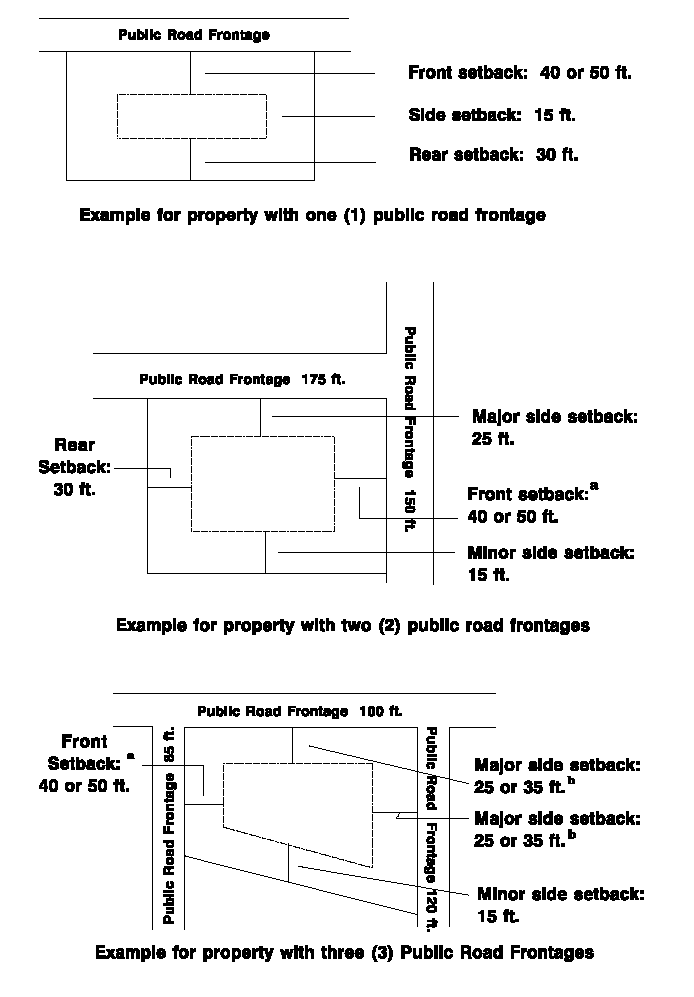
Notes:
1.
Property with shorter amount of road frontage will be the front setback for determining other setbacks (major side, side, rear).
2.
If structure fronts a major side setback, major side setback shall be 35 feet.
(4)
Landscape buffer and screening requirements. Unless otherwise noted within this district's requirements, any property within an O&I district which abuts a residentially zoned property shall have a minimum 20-foot landscaped screening buffer. Required buffers may be included within required setbacks; however, in such case that the required buffer is greater than the required setback, the required buffer shall be adhered to. Additionally, necessary private utilities and access drives may be allowed through, over or across a landscaped buffer. Any such uses which are proposed through, over or across a designated undisturbed buffer must be approved pursuant to an original site plan or site plan modification.
a.
Objectives. Undisturbed, planted landscape buffers and berms shall be implemented in connection with a permitted project and shall address the following objectives:
1.
Screening to enhance aesthetic appeal;
2.
Control or direction of vehicular and pedestrian movement;
3.
Reduction of glare;
4.
Buffering of noise; and
5.
Establishment of privacy.
b.
Standards. Buffers and berms shall be required when an O&I district is located within or adjacent to a residential district; a minimum 20-foot buffer is required.
1.
Buffers. Landscape buffers are subject to review and approval by the city staff in accordance with the following standards:
(i)
Plantings are to be a mix of evergreen trees and shrubs.
(ii)
Species are to be ecologically compatible to the site and appropriate for the design situation.
(iii)
Unless public safety concerns dictate otherwise, buffer should provide a 100 percent visual barrier to a height of six feet within two years of planting.
(iv)
Minimum height of plant materials at installation is five feet for trees and two feet for shrubs.
(v)
Fencing or walls are to be a minimum of six feet in height (fence to be located on exterior of buffer) as approved by city staff.
(vi)
Trees included in buffer plantings may be counted toward site density calculations as required by the city subject to review and approval of city staff.
(vii)
Buffers shall be regularly maintained by the property owner to ensure that the objectives and standards set out in this subsection are met.
(viii)
When topography and existing conditions allow, the required 20-foot buffer should be an undisturbed buffer.
(ix)
Any appeals from a determination by the city staff shall be to the board of variance and zoning appeals.
2.
Berms. Berms are subject to review and approval by the city staff in accordance with the following standards:
(i)
Berms shall be utilized when consistent with surrounding property features.
(ii)
Berms shall be stabilized.
(iii)
Berms shall be constructed to be consistent with natural or proposed drainage patterns.
(iv)
Berms shall be regularly maintained by the property owner.
(5)
Floodplain and wetlands preservation requirements. Subject to the conditions set forth in the city floodplain management and prevention ordinance.
(6)
Building and structure requirements. Maximum building height is 50 feet, with no more than four stories.
(7)
Parking requirements. See section 48-198 for paved parking specifications.
(8)
Lighting requirements. Any project permitted within the O&I district which proposes a lighted facility must have approval from the building official or his designee.
(9)
Special exception uses. See section 48-197 for requirements for special exception uses. Special exception uses for the O&I district are the uses listed as follows:
a.
Any other facility for the disposal of the dead.
b.
Cemeteries.
c.
Churches, chapels, temples, synagogues and other places of worship.
d.
Mausoleums.
e.
Club or lodge, private.
f.
Private schools of general and special education.
(10)
Use limitations.
a.
Maximum floor area ratio is 0.75 for office uses and 0.25 for retail uses (accessory).
b.
All structures located within an O&I district shall be appropriately scaled in relation to the transitional nature of the immediate area.
c.
All refuse and designated recycling collection location facilities must be contained within completely enclosed facilities.
d.
No outside storage is permitted. Within the O&I district, outside storage shall not include commercial vehicles.
e.
No adult entertainment uses are permitted.
f.
No drive-in eating or drinking establishments are permitted.
g.
No uses that emit noxious odors, fumes or sounds are permitted.
h.
No outside runs are permitted with any veterinary office use permitted within this district.
i.
Maximum impervious surfaces: 70 percent.
j.
No loading docks or facilities may be located in the front of any primary structure.
Required buffers may be included within required setbacks; however, in such case that the required buffer is greater than the required setback, the required buffer shall be adhered to. Additionally, necessary private utilities and access drives may be allowed through, over or across a landscaped buffer. Any such uses which are proposed through, over or across a designated undisturbed buffer must be approved pursuant to an original site plan or site plan modification.
(11)
Accessory buildings, structures, uses and decks. Any accessory building or structure in excess of 400 square feet of gross space shall be located to the rear of the primary structure and at least 40 feet from any residential property line. Any accessory building or structure which exceeds 144 square feet of gross space must have the approval of the building official or his designee as to the location, architectural design and size prior to commencing construction. The building official or his designee shall consider the following criteria for determining the appropriateness of the architectural design and size of the accessory building or structure: compatibility with the surrounding neighborhood, style of exterior (the exterior is to be compatible in style with the primary structure), use of the proposed accessory structure, impact on adjacent properties, and requirements as deemed appropriate by plan review as set forth in this subsection. All accessory buildings, structures and uses in excess of 144 gross square feet shall be required to submit for plan review through the community affairs department or receive approval from the director of community affairs or his designee. Accessory structure plans must be accompanied by a signed affidavit from the property owner stating that such structure will not be used for a dwelling or commercial gain. Permitted accessory structures and uses are as follows:
a.
Accessory retail sales and service.
b.
Accessory storage buildings, to include parking garages, subject to the following conditions:
1.
Maximum height is two stories, not to exceed 35 feet.
2.
Such structures shall be located on the same lot as and to the rear of the principal building to which they are accessory.
3.
No accessory building shall be constructed upon a lot until construction of the principal building has commenced.
4.
On a corner lot, no accessory building shall be located closer to the side street right-of-way line than the principal building.
5.
When abutting any other nonresidential district, no garage or other accessory building shall be located closer than five feet to a side or rear lot line.
6.
When an accessory building is attached to the principal building by a breezeway, passageway or similar means, it shall comply with the yard requirements of the principal building to which it is accessory.
7.
Where any nonresidential lot adjoins the side or rear of a residential lot, an accessory building shall not be located within any required buffers.
c.
Antennas and satellite dishes, which shall meet the requirements set forth in section 48-200.
d.
Freestanding parking garages, subject to the following conditions:
1.
Maximum height: 50 feet.
2.
When abutting any residential property line, freestanding parking garages shall not be located within any required buffers.
3.
When abutting any other nonresidential district, no freestanding garage shall be located closer than five feet to a side or rear lot line.
e.
Heating and air conditioning units, subject to the following conditions:
1.
When abutting any residential property line, heating and air conditioning units shall not be located within any required buffers.
2.
When abutting any other nonresidential district, no heating and air conditioning units shall be located closer than five feet to a side or rear lot line.
3.
Heating and air conditioning units may be installed on the roof of any structure zoned commercially so long as the heating and air conditioning unit does not exceed the height restrictions stated in this section and the units are placed so as to be hidden from a front or side view.
4.
No ground-based heating and air conditioning unit shall exceed 35 feet in height.
f.
Incidental storage, provided that the material stored is incidental to the permitted use, as determined by the building official or his designee, and stored completely within a portion of the enclosed principal structure permitted within the district, or within a permitted accessory structure.
(Code 1985, § 22-138)
Sec. 48-153. - OS Office/service district.
The regulations for the OS office/service district are as follows:
(1)
Purpose and intent. The OS district is established to provide locations for office and business distribution/service facilities, and assembly processes which do not emit noise, vibration, smoke, gas, fumes, odors or radiation and are located entirely within an enclosed building which do not involve manufacturing or fabrication of any product. No principal retail sales are allowed unless specified in this section. These uses are allowed on properties delineated within a RAC category, ICA category or an industrial category as defined and shown on the Austell Comprehensive Plan: Policy Guide, adopted July 2, 2007.
(2)
Permitted uses. Permitted uses are as follows:
a.
Athletic and health clubs.
b.
Automotive parking lots or garages.
c.
Bus stations.
d.
Clinics.
e.
Clubs or lodges (noncommercial).
f.
Colleges and universities (private), including, but not limited to, research and training facilities.
g.
Community fairs.
h.
Corporate or administrative offices for any permitted uses within this district.
i.
Designated recycling collection locations.
j.
Executive golf course.
k.
Golf course, par 3.
l.
Golf course, 18-hole regulation, public and private.
m.
Helicopter landing areas, provided that the area is fenced.
n.
In-home day care.
o.
Medical and dental laboratories, provided that no chemicals are manufactured on-site.
p.
Nonprofit (seasonal use) fishing lakes.
q.
Office service and supply establishments.
r.
Outdoor golf driving ranges.
s.
Parking for vehicles.
t.
Photography studios.
u.
Printing, publishing and lithography establishments.
v.
Private parks.
w.
Pro shops (accessory to driving ranges/golf courses).
x.
Radio and television stations.
y.
Radio, television and other communication towers and antennas, subject to section 48-199.
z.
Recreation grounds other than tennis courts and golf courses.
aa.
Rest homes, personal care homes and convalescent homes.
bb.
Studios and supplies.
cc.
Temporary uses.
dd.
Vocational schools (commercial).
ee.
Wholesale trade and distribution facilities.
ff.
Wholesale trade offices in conjunction with office showrooms, display and other facilities generally accessible to the public, provided that no more than 50 percent of the total gross floor area will be used for storage.
(3)
Lot size and setback requirements. Lot size and setback requirements are as follows:
a.
Minimum lot size: 40,000 square feet.
b.
Minimum lot width at front setback line: 75 feet.
c.
Minimum public road frontage: 50 feet.
d.
Minimum building setbacks means as shown and applied in the following diagram:
Minimum Building Setback Requirements for OS District
Note: All setbacks shall be measured from future right-of-way.
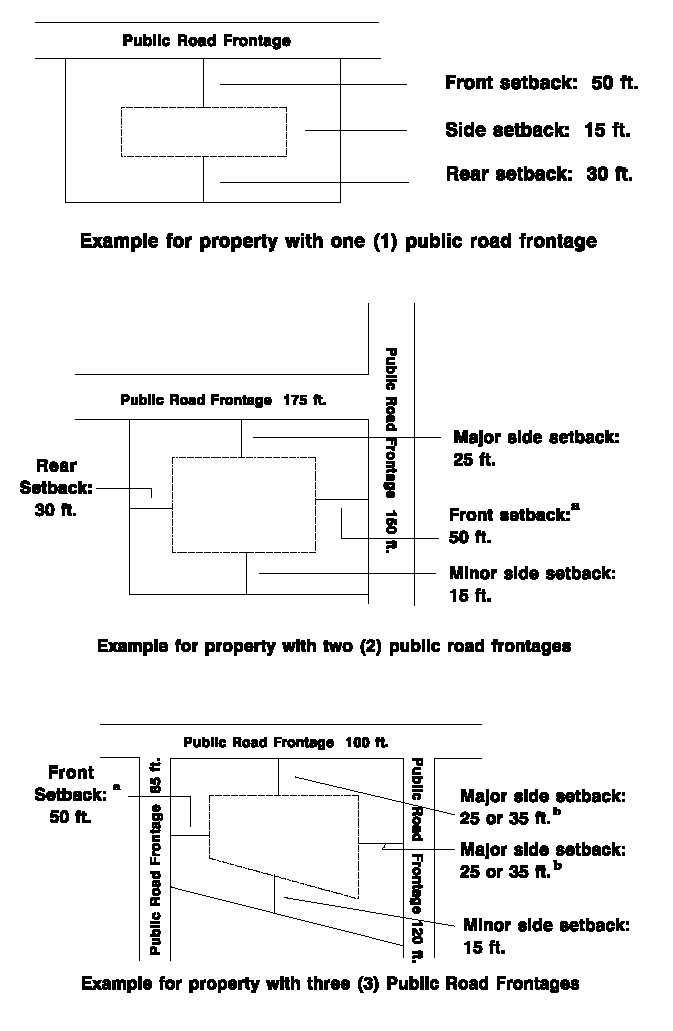
Notes:
1.
Property with shorter amount of road frontage will be the front setback for determining other setbacks (major side, side, rear).
2.
If structure fronts a major side setback, major side setback shall be 35 feet.
(4)
Landscape buffer and screening requirements. Unless otherwise noted within this district's requirements, any property within an OS district which abuts a residentially zoned property shall have a minimum 30-foot landscaped screening buffer adjacent to all residentially zoned property. The buffer shall be subject to approval by city staff. Required buffers may be included within required setbacks; however, in such case that the required buffer is greater than the required setback, the required buffer shall be adhered to. Additionally, necessary private utilities and access drives may be allowed through, over or across a landscaped buffer. Any such uses which are proposed through, over or across a designated undisturbed buffer must be approved pursuant to an original site plan or site plan modification.
a.
Objectives. Undisturbed, planted landscape buffers and berms shall be implemented in connection with a permitted project and shall address the following objectives:
1.
Screening to enhance aesthetic appeal;
2.
Control or direction of vehicular and pedestrian movement;
3.
Reduction of glare;
4.
Buffering of noise; and
5.
Establishment of privacy.
b.
Buffers. Landscape buffers are subject to review and approval by city staff in accordance with the following standards:
1.
Plantings are to be a mix of evergreen trees and shrubs.
2.
Species are to be ecologically compatible to the site and appropriate for the design situation.
3.
Unless public safety concerns dictate otherwise, a buffer should maximize a visual barrier to a height of six feet within two years of planting.
4.
Minimum height of plant materials at installation is five feet for trees and two feet for shrubs.
5.
Fencing or walls are to be a minimum of six feet in height as approved by city staff.
6.
Trees included in buffer plantings may be counted toward site density calculations as required by the city subject to review and approval of city staff.
7.
Buffers shall be regularly maintained by the property owner to ensure that the objectives and standards set out in this subsection are met.
8.
When topography and existing conditions allow, the required 30-foot buffer should be an undisturbed buffer.
9.
Any appeals from a determination by city staff shall be to the board of variance and zoning appeals.
c.
Berms. Berms are subject to review and approval by city staff in accordance with the following standards:
1.
Berms shall be utilized when consistent with surrounding property features.
2.
Berms shall be stabilized.
3.
Where possible, berms shall be constructed to be consistent with natural or proposed drainage patterns.
4.
Berms shall be regularly maintained by the property owner.
(5)
Floodplain and wetlands preservation requirements. Subject to the conditions set forth in the city floodplain management and prevention ordinance.
(6)
Building and structure requirements. Maximum building height is 50 feet, with no more than four stories.
(7)
Parking requirements. See section 48-198 for paved parking specifications.
(8)
Lighting requirements. Any project permitted within the OS district which proposes a lighted facility must have approval by the building official or his designee.
(9)
Special exception uses. See section 48-197 for requirements for special exception uses. Special exception uses for the OS district are the uses listed as follows:
a.
Any other facility for the disposal of the dead.
b.
Cemeteries.
c.
Churches, chapels, temples, synagogues and other places of worship.
d.
Mausoleums.
e.
Club or lodge, private.
f.
Private schools of general and special education.
(10)
Use limitations.
a.
Maximum floor area ratio of 0.75 for office use and 0.25 for retail use (accessory).
b.
All refuse and designated recycling collection location facilities must be contained within completely enclosed facilities.
c.
No adult entertainment uses are permitted.
d.
No drive-in establishments are permitted.
e.
No uses that emit noxious odors, fumes or sounds are permitted.
f.
No outside storage.
g.
No bulk warehousing.
h.
Maximum impervious surfaces: 70 percent.
Required buffers may be included within required setbacks; however, in such case that the required buffer is greater than the required setback, the required buffer shall be adhered to. Additionally, necessary private utilities and access drives may be allowed through, over or across a landscaped buffer. Any such uses which are proposed through, over or across a designated undisturbed buffer must be approved pursuant to an original site plan or site plan modification.
(11)
Accessory buildings, structures, uses and decks. Any accessory building or structure in excess of 400 square feet of gross space shall be located to the rear of the primary structure and at least 40 feet from any residential property line. Any accessory building or structure which exceeds 144 square feet of gross space must have the approval of the building official or his designee as to the location, architectural design and size prior to commencing construction. The building official or his designee shall consider the following criteria for determining the appropriateness of the architectural design and size of the accessory building or structure: compatibility with the surrounding neighborhood, style of exterior (the exterior is to be compatible in style with the primary structure), use of the proposed accessory structure, impact on adjacent properties, and requirements as deemed appropriate by plan review as set forth in this section. All accessory buildings, structures and uses in excess of 144 gross square feet shall be required to submit for plan review through the community affairs department or receive approval from the director of the community affairs department or his designee. Accessory structure plans must be accompanied by a signed affidavit from the property owner stating that such structure will not be used for a dwelling or commercial gain. Permitted accessory structures and uses are as follows:
a.
Accessory storage buildings, subject to the following conditions:
1.
Maximum height is two stories, not to exceed 35 feet.
2.
Such structures shall be located on the same lot as and to the rear of the principal building to which they are accessory.
3.
No accessory building shall be constructed upon a lot until construction of the principal building has commenced.
4.
On a corner lot, no accessory building shall be located closer to the side street right-of-way line than the principal building.
5.
When abutting any other nonresidential district, no garage or other accessory building shall be located closer than five feet to a side or rear lot line.
6.
When an accessory building is attached to the principal building by a breezeway, passageway or similar means, it shall comply with the yard requirements of the principal building to which it is accessory.
7.
Where any nonresidential lot adjoins the side or rear of a residential lot, an accessory building shall not be located within any required buffers.
b.
Antennas and satellite dishes, which shall meet the requirements set forth in section 48-200.
c.
Freestanding parking garages, subject to the following conditions:
1.
Maximum height: 50 feet.
2.
When abutting any residential property line, freestanding parking garages shall not be located within any required buffers.
3.
When abutting any other nonresidential district, no freestanding garage shall be located closer than five feet to a side or rear lot line.
d.
Heating and air conditioning units, subject to the following conditions:
1.
When abutting any residential property line, heating and air conditioning units shall not be located within any required buffers.
2.
When abutting any other nonresidential district, no heating and air conditioning units shall be located closer than five feet to a side or rear lot line.
3.
Heating and air conditioning units may be installed on the roof of any structure zoned commercially so long as the heating and air conditioning unit does not exceed the height restrictions stated in this section and the units are placed so as to be hidden from a front or side view.
4.
No ground-based heating and air conditioning unit shall exceed 35 feet in height.
e.
Incidental storage, provided that the material stored is incidental to the permitted use, as determined by the building official or his designee, and stored completely within a portion of the enclosed principal structure permitted within the district, or within a permitted accessory structure.
(Code 1985, § 22-139)
Sec. 48-154. - NS Neighborhood shopping district.
The regulations for the NS neighborhood shopping district are as follows:
(1)
Purpose and intent. The NS district is established to provide locations for retail commercial and services uses which are designed and oriented to serve two to four neighborhoods and are located in areas delineated within a neighborhood activity center or community activity center as defined and shown on the Austell Comprehensive Plan: Policy Guide, adopted July 2, 2007.
(2)
Permitted uses. Permitted uses are as follows:
a.
Ambulance services, if accessory to hospitals or funeral homes.
b.
Animal hospitals.
c.
Athletic and health clubs.
d.
Automotive parking lots or garages.
e.
Banks and financial institutions with drive-in establishment or automated transfer machines.
f.
Billiards and pool halls, subject to this Code.
g.
Bus stations.
h.
Carwashes.
i.
Clinics.
j.
Clubs or lodges (noncommercial).
k.
Colleges and universities (private), including, but not limited to, research and training facilities.
l.
Commercial greenhouses and plant nurseries, provided that all goods stored outside shall be stored in a designated area.
m.
Commercial recreation restaurants.
n.
Community fairs.
o.
Designated recycling collection locations.
p.
Eating and drinking establishments, including drive-in fast food restaurants.
q.
Emissions and inspection stations. (No temporary buildings/tents to be utilized after July 1, 2009.)
r.
Executive golf courses.
s.
Farm and garden supply stores.
t.
Fraternity and sorority houses and residence halls.
u.
Funeral homes.
v.
Golf courses, 18-hole regulation, public and private.
w.
Golf courses, par 3.
x.
Helicopter landing areas, provided that the area is fenced.
y.
Hospitals.
z.
In-home day care.
aa.
Laundry and dry cleaning pickup establishments.
bb.
Medical and dental laboratories, provided that no chemicals are manufactured on-site.
cc.
Neighborhood retail uses.
dd.
Nonautomotive repair service establishments.
ee.
Nonprofit (seasonal use) fishing lakes.
ff.
Nursery schools and child day care centers.
gg.
Office service and supply establishments.
hh.
Offices not elsewhere classified.
ii.
Parking for vehicles.
jj.
Photography studios.
kk.
Printing, publishing and lithography establishments, provided that no more than 50 percent of the total gross floor area will be used for storage.
ll.
Private parks.
mm.
Pro shops, if accessory to driving ranges or golf courses.
nn.
Professional offices.
oo.
Radio and television stations.
pp.
Radio, television and other communication towers and antennas, subject to section 48-199.
qq.
Recreation grounds other than tennis courts and golf courses.
rr.
Rest homes, personal care homes and convalescent homes.
ss.
Temporary uses.
tt.
Theaters.
uu.
Tutoring and learning centers (See section 48-1).
(3)
Lot size and setback requirements. Lot size and setback requirements are as follows:
a.
Minimum lot size: 20,000 square feet.
b.
Minimum lot width at front setback line: 60 feet.
c.
Minimum public road frontage: 50 feet.
d.
Minimum building setbacks means as shown and applied in the following diagram:
Minimum Building Setback Requirements for NS District
Note: All setbacks shall be measured from future right-of-way.
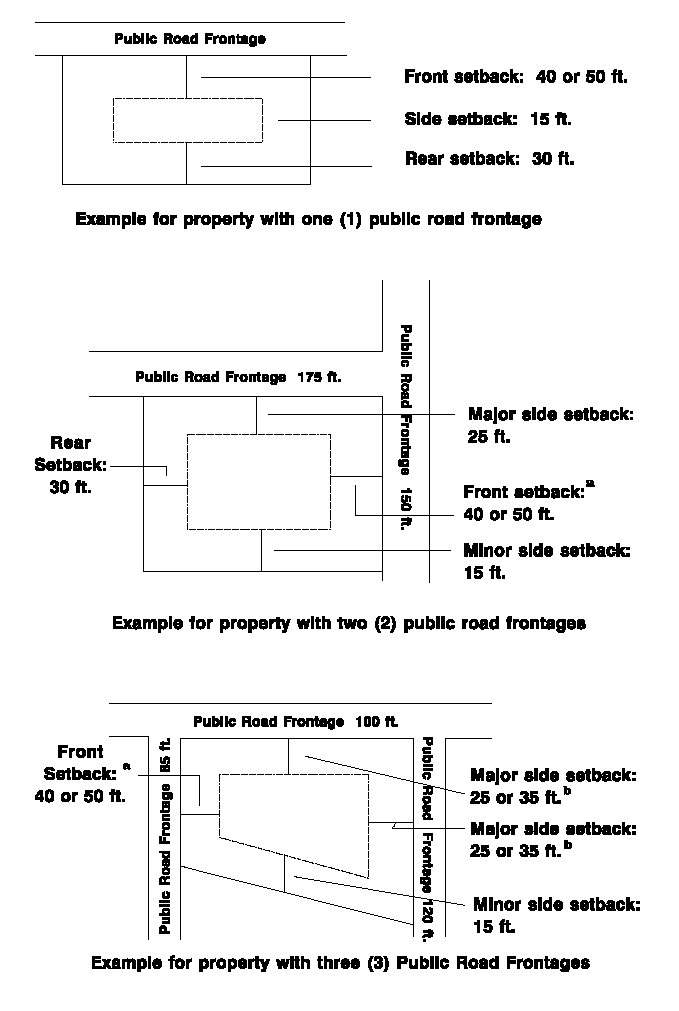
Notes:
1.
Property with shorter amount of road frontage will be the front setback for determining other setbacks (major side, side, rear).
2.
If structure fronts a major side setback, major side setback shall be 35 feet.
(4)
Landscape buffer and screening requirements. Unless otherwise noted within this district's requirements, any property within an NS district which abuts a residentially zoned property shall have a 35-foot landscaped screening buffer adjacent to all residentially zoned property. The buffer shall be subject to approval by city staff. Required buffers may be included within required setbacks; however, in such case that the required buffer is greater than the required setback, the required buffer shall be adhered to. Additionally, necessary private utilities and access drives may be allowed through, over or across a landscaped buffer. Any such uses which are proposed through, over or across a designated undisturbed buffer must be approved pursuant to an original site plan or site plan modification.
a.
Objectives. Undisturbed, planted landscape buffers and berms shall be implemented in connection with a permitted project and shall address the following objectives:
1.
Screening to enhance aesthetic appeal;
2.
Control or direction of vehicular and pedestrian movement;
3.
Reduction of glare;
4.
Buffering of noise; and
5.
Establishment of privacy.
b.
Buffers. Landscape buffers are subject to review and approval by city staff in accordance with the following standards:
1.
Plantings are to be a mix of evergreen trees and shrubs.
2.
Species are to be ecologically compatible to the site and appropriate for the design situation.
3.
Unless public safety concerns dictate otherwise, a buffer should provide a 100 percent visual barrier to a height of six feet within two years of planting.
4.
Minimum height of plant materials at installation is five feet for trees and two feet for shrubs.
5.
Fencing or walls are to be a minimum of six feet in height as approved by city staff.
6.
Trees included in buffer plantings may be counted toward site density calculations as required by the city subject to review and approval of city staff.
7.
Buffers shall be regularly maintained by the property owner to ensure that the objectives and standards set out in this subsection are met.
8.
When topography and existing conditions allow, the required 35-foot buffer should be an undisturbed buffer.
9.
Any appeals from a determination by city staff shall be to the board of variance and zoning appeals.
c.
Berms. Berms are subject to review and approval by city staff in accordance with the following standards:
1.
Berms shall be utilized when consistent with surrounding property features.
2.
Berms shall be stabilized.
3.
Where possible, berms shall be constructed to be consistent with natural or proposed drainage patterns.
4.
Berms shall be regularly maintained by the property owner.
(5)
Floodplain and wetlands preservation requirements. Subject to the conditions set forth in the city floodplain management and prevention ordinance.
(6)
Building and structure requirements. Maximum building height is 50 feet, with no more than four stories.
(7)
Parking requirements. See section 48-198 for paved parking specifications.
(8)
Lighting requirements. Any project permitted within the NS district which proposes a lighted facility must have approval by the building official or his designee.
(9)
Special exception uses. See section 48-197 for requirements for special exception uses. Special exception uses for the NS district are the uses listed as follows:
a.
Any other facility for the disposal of the dead.
b.
Cemeteries.
c.
Churches, chapels, temples, synagogues and other places of worship.
d.
Mausoleums.
e.
Club or lodge, private.
f.
Private schools of general and special education.
g.
Hotel.
(10)
Use limitations.
a.
Maximum floor area ratio is 0.5 for office uses and 0.25 for retail uses.
b.
All refuse and designated recycling collection location facilities must be contained within completely enclosed facilities.
c.
No outside storage is permitted. Within the NS district outside storage shall not include commercial vehicles or plants and shrubs.
d.
Any emission or automotive inspection station shall be located within a permanent facility. (No temporary buildings/tents are to be utilized after July 1, 2009.)
e.
No uses that emit noxious odors, fumes or sounds are permitted.
f.
No adult entertainment uses are permitted.
g.
Outdoor displays of merchandise: Where permitted those displays such as garden centers, home building supplies, hardware stores, general merchandise and the like, not including landscape nurseries, automotive sales and rentals or heavy equipment sales and rentals, shall be subject to the following additional requirements:
1.
The area displaying the merchandise shall be ancillary to the primary retail business on-site.
2.
The location of outdoor displays must be shown on a site/construction plan approved by the building official or his designee.
3.
Outdoor displays located in areas between the buildings and a public street or roadway shall not be located outside the required building setbacks.
4.
The areas displaying the merchandise must be screened from any adjoining residential use or district compliant to an approved landscape plan.
5.
Areas for outdoor display may not be located within any required buffers.
6.
Outdoor displays may be allowed in front of the buildings but must not block sidewalks or parking areas. Outdoor displays may not impede vehicular or pedestrian traffic, compliant with the Americans with Disabilities Act (ADA). At a minimum, a five-foot pedestrian access shall be provided.
7.
Any temporary or seasonal sales conducted within parking spaces can be done so only within parking spaces above and beyond the required minimum for the entire retail center.
8.
Due to safety concerns, no permanent or temporary display of merchandise shall be allowed on or adjacent to any gasoline pump island or under a canopy covering any gasoline pump island.
h.
Maximum impervious surfaces: 70 percent.
i.
No loading docks or facilities may be located in the front of any primary structure. Required buffers may be included within required setbacks; however, in such case that the required buffer is greater than the required setback, the required buffer shall be adhered to. Additionally, necessary private utilities and access drives may be allowed through, over or across a landscaped buffer. Any such uses which are proposed through, over or across a designated undisturbed buffer must be approved pursuant to an original site plan or site plan modification.
(11)
Accessory buildings, structures, uses and decks. Any accessory building or structure in excess of 400 square feet of gross space shall be located to the rear of the primary structure and at least 40 feet from any residential property line. Any accessory building or structure which exceeds 144 square feet of gross space must have the approval of the building official or his designee as to the location, architectural design and size prior to commencing construction. The building official or his designee shall consider the following criteria for determining the appropriateness of the architectural design and size of the accessory building or structure: compatibility with the surrounding neighborhood, style of exterior (the exterior is to be compatible in style with the primary structure), use of the proposed accessory structure, impact on adjacent properties, and requirements as deemed appropriate by plan review as set forth in this subsection. All accessory buildings, structures and uses in excess of 144 gross square feet shall be required to submit for plan review through the community affairs department or receive approval from the director of the community affairs department or his designee. Accessory structure plans must be accompanied by a signed affidavit from the property owner stating that such structure will not be used for a dwelling or commercial gain. Permitted accessory structures and uses are as follows:
a.
Accessory storage buildings, to include parking garages, subject to the following conditions:
1.
Maximum height is two stories, not to exceed 35 feet.
2.
Such structures shall be located on the same lot as and to the rear of the principal building to which they are accessory.
3.
No accessory building shall be constructed upon a lot until construction of the principal building has commenced.
4.
On a corner lot, no accessory building shall be located closer to the side street right-of-way line than the principal building.
5.
When abutting any other nonresidential district, no garage or other accessory building shall be located closer than five feet to a side or rear lot line.
6.
When an accessory building is attached to the principal building by a breezeway, passageway or similar means, it shall comply with the yard requirements of the principal building to which it is accessory.
7.
Where any nonresidential lot adjoins the side or rear of a residential lot, an accessory building shall not be located within any required buffers.
b.
Antennas and satellite dishes, which shall meet the requirements set forth in section 48-200.
c.
Carwashes are accessory to convenience food stores with self-service fuel.
d.
Heating and air conditioning units, subject to the following conditions:
1.
When abutting any residential property line, heating and air conditioning units shall not be located within any required buffers.
2.
When abutting any other nonresidential district, no heating and air conditioning units shall be located closer than five feet to a side or rear lot line.
3.
Heating and air conditioning units may be installed on the roof of any structure zoned commercially so long as the heating and air conditioning unit does not exceed the height restrictions stated in this section and the units are placed so as to be hidden from a front or side view.
4.
No ground-based heating and air conditioning unit shall exceed 35 feet in height.
e.
Incidental storage, provided that the material stored is incidental to the permitted use, as determined by the building official or his designee, and stored completely within a portion of the enclosed principal structure permitted within the district, or within a permitted accessory structure.
(Code 1985, § 22-140)
Sec. 48-155. - PSC Planned shopping center district.
(a)
Purpose and intent. The PSC district is established to provide locations for retail commercial and service uses which are designed and oriented to serve several neighborhoods making up a community. Projects developed within the PSC zoning district should be done as compact, unified centers. Projects developed within the PSC zoning district should occupy a quadrant of an intersection, with ingress and egress only from a major collector street or state highway, within an area delineated within a community activity center as defined and shown on the Austell Comprehensive Plan: Policy Guide, adopted July 2, 2007.
(b)
Permitted uses. Permitted uses are as follows:
(1)
Ambulance services, if accessory to hospitals or funeral homes.
(2)
Animal hospitals.
(3)
Arcades.
(4)
Athletic and health clubs.
(5)
Automotive parking lots or garages.
(6)
Banks or financial institutions with drive-in establishment or automated transfer machines.
(7)
Billiards and pool halls, subject to this Code.
(8)
Building materials stores.
(9)
Bus stations.
(10)
Carwashes.
(11)
Clinics.
(12)
Clubs or lodges (noncommercial).
(13)
Colleges and universities (private), including, but not limited to, research and training facilities.
(14)
Commercial greenhouses and plant nurseries, provided that all goods stored outside shall be stored in a designated area.
(15)
Commercial indoor recreation uses.
(16)
Commercial outdoor recreation uses.
(17)
Community fairs.
(18)
Community retail uses.
(19)
Convenience food stores with self-service fuel sales, provided that the building shall not exceed 3,000 square feet in gross floor area and that no automotive repairs shall be done on-site.
(20)
Cultural facilities.
(21)
Designated recycling collection locations.
(22)
Eating and drinking establishments, including drive-in fast food restaurants.
(23)
Emissions or inspections stations. (No temporary buildings/tents to be utilized after July 1, 2009.)
(24)
Executive golf course.
(25)
Exterminating facilities (insect or rodent).
(26)
Farm and garden supply stores.
(27)
Film developing and printing facilities.
(28)
Fraternity and sorority houses/residence halls.
(29)
Full service gasoline stations.
(30)
Funeral homes.
(31)
Golf course, par 3.
(32)
Golf course, 18-hole regulation, public or private.
(33)
Helicopter landing areas, provided that the area is fenced.
(34)
Hospitals.
(35)
In-home day care.
(36)
Laundry and dry cleaning pickup establishments.
(37)
Light automotive repair establishments.
(38)
Medical and dental laboratories, provided that no chemicals are manufactured on-site.
(39)
Neighborhood retail uses.
(40)
Nonautomotive repair service establishments.
(41)
Non-profit (seasonal use) fishing lakes.
(42)
Nursery schools and child day care centers.
(43)
Office service and supply establishments.
(44)
Offices not elsewhere classified.
(45)
Other consumer goods and services.
(46)
Other service establishments.
(47)
Parking for vehicles.
(48)
Photography studios.
(49)
Printing, publishing and lithography establishments, provided that no more than 50 percent of the total gross floor area will be used for storage.
(50)
Private parks.
(51)
Pro shops, if accessory to driving ranges or golf courses.
(52)
Professional offices.
(53)
Radio and television stations.
(54)
Radio, television and other communication towers and antennas, subject to section 48-199.
(55)
Recreation grounds other than tennis courts and golf courses.
(56)
Rest homes, personal care homes and convalescent homes.
(57)
Reupholstery and furniture repair establishments.
(58)
Self-service laundry facilities.
(59)
Studios and supplies, provided that no more than 50 percent of the total gross floor area will be used for storage.
(60)
Temporary uses.
(61)
Theaters.
(62)
Tutoring and learning centers (See section 48-1).
(c)
Lot size and setback requirements. Lot size and setback requirements are as follows:
(1)
Minimum lot size: 200,000 square feet.
(2)
Minimum lot width at front setback line: 200 feet.
(3)
Minimum public road frontage: 100 feet.
(4)
Minimum building setbacks means as shown and applied in the following diagram:
Minimum Building Setback Requirements for PSC District
Note: All setbacks shall be measured from future right-of-way.
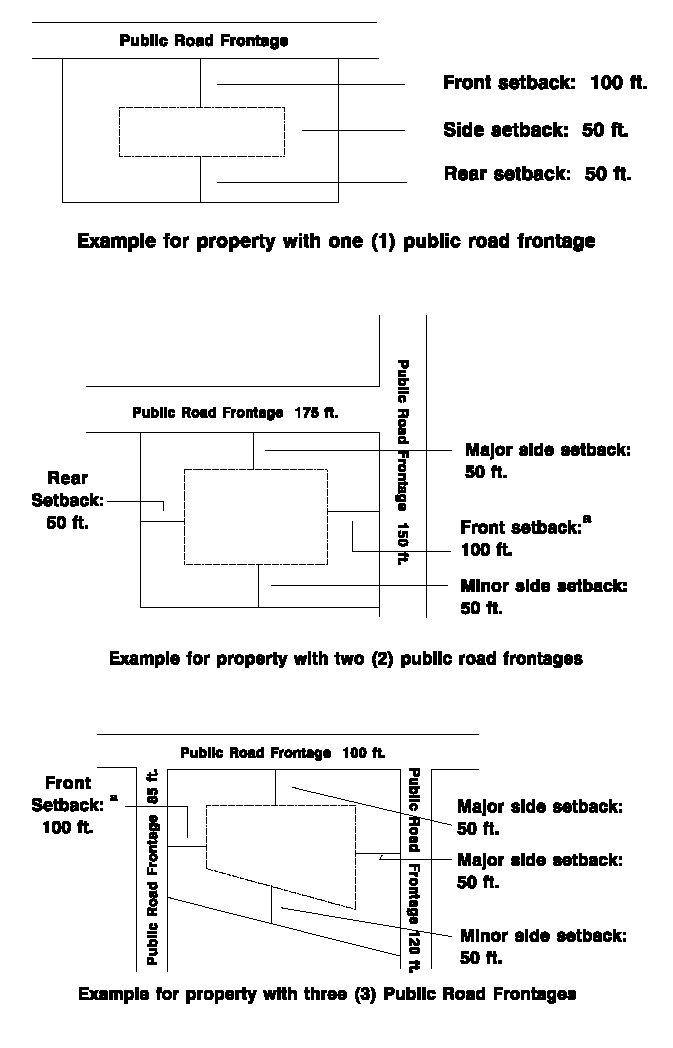
Notes:
1.
Property with shorter amount of road frontage will be the front setback for determining other setbacks (major side, side, rear).
2.
If structure fronts a major side setback, major side setback shall be 35 feet.
(d)
Landscape buffer and screening requirements. Unless otherwise noted within this district's requirements, any property within a PSC district which abuts residentially zoned property shall have a 40-foot landscaped screening buffer adjacent to all residentially zoned property. The buffer shall be subject to approval by city staff. Required buffers may be included within required setbacks; however, in such case that the required buffer is greater than the required setback, the required buffer shall be adhered to. Additionally, necessary private utilities and access drives may be allowed through, over or across a landscaped buffer. Any such uses which are proposed through, over or across a designated undisturbed buffer must be approved pursuant to an original site plan or site plan modification.
(1)
Objectives. Undisturbed, planted landscape buffers and berms shall be implemented in connection with a permitted project and shall address the following objectives:
a.
Screening to enhance aesthetic appeal;
b.
Control or direction of vehicular and pedestrian movement;
c.
Reduction of glare;
d.
Buffering of noise; and
e.
Establishment of privacy.
(2)
Buffers. Landscape buffers are subject to review and approval by city staff in accordance with the following standards:
a.
Plantings are to be a mix of evergreen trees and shrubs.
b.
Species are to be ecologically compatible to the site and appropriate for the design situation.
c.
Unless public safety concerns dictate otherwise, a buffer should maximize a visual barrier to a height of six feet within two years of planting.
d.
Minimum height of plant materials at installation is five feet for trees and two feet for shrubs.
e.
Fencing or walls are to be a minimum of six feet in height as approved by city staff.
f.
Trees included in buffer plantings may be counted toward site density calculations as required by the city subject to review and approval of city staff.
g.
Buffers shall be regularly maintained by the property owner to ensure that the objectives and standards set out in this subsection are met.
h.
When topography and existing conditions allow, the required 40-foot buffer should be an undisturbed buffer.
i.
Any appeals from a determination by city staff shall be to the board of variance and zoning appeals.
(3)
Berms. Berms are subject to review and approval by city staff in accordance with the following standards:
a.
Berms shall be utilized when consistent with surrounding property features.
b.
Berms shall be stabilized.
c.
Where possible, berms shall be constructed to be consistent with natural or proposed drainage patterns.
d.
Berms shall be regularly maintained by the property owner.
(e)
Floodplain and wetlands preservation requirements. Subject to the conditions set forth in the city floodplain management and prevention ordinance.
(f)
Building and structure requirements. Maximum building height is 50 feet, with no more than four stories.
(g)
Parking requirements. See section 48-198 for paved parking specifications.
(h)
Lighting requirements. Any project permitted within the PSC district which proposes a lighted facility must have approval by the building official or his designee.
(i)
Special exception uses. See section 48-197 for requirements for special exception uses. Special exception uses for the PSC district are the uses listed as follows:
(1)
Any other facility for the disposal of the dead.
(2)
Cemeteries.
(3)
Churches, chapels, temples, synagogues and other places of worship.
(4)
Mausoleums.
(5)
Club or lodge, private.
(6)
Private schools of general and special education.
(7)
Hotel.
(j)
Use limitations. The PSC development shall meet at the minimum the following:
(1)
The development shall be compatible with the topography of the land and shall preserve any unusual topographic or natural features.
(2)
The development shall not adversely affect developed or undeveloped neighboring properties.
(3)
Water, sewerage, highway and school facilities shall be adequate for the proposed development, or there shall be a definite proposal for making them so.
(4)
Maximum floor area ratio is 0.5 for office uses and 0.25 for retail uses.
(5)
Minimum acreage is five acres.
(6)
All refuse and designated recycling collection location facilities must be contained within completely enclosed facilities.
(7)
All of the land in a PSC development shall be owned initially by an individual, corporation, partnership or some other legal entity. Individual properties in a PSC development may be sold after a final plat has been duly recorded with the properties subject to private deed covenants that ensure the continuance of the PSC development as originally approved.
(8)
Any emission or automotive inspection station shall be located within a permanent facility. (No temporary buildings/tents are to be utilized after July 1, 2009.)
(9)
No uses that emit noxious odors, fumes or sounds are permitted.
(10)
The side yard setbacks may be waived, except along the exterior boundaries of the development.
(11)
No adult entertainment uses are permitted.
(12)
A PSC development shall have ingress and egress only on a major or collector street or state highway.
(13)
Outdoor displays of merchandise: Where permitted those displays such as garden centers, home building supplies, hardware stores, general merchandise and the like, not including landscape nurseries, automotive sales and rentals or heavy equipment sales and rentals, shall be subject to the following additional requirements:
a.
The area displaying the merchandise shall be ancillary to the primary retail business on-site.
b.
The location of outdoor displays must be shown on a site/construction plan approved by the building official or his designee.
c.
Outdoor displays located in areas between the buildings and a public street or roadway shall not be located outside the required building setbacks.
d.
The areas displaying the merchandise must be screened from any adjoining residential use or district compliant to an approved landscape plan.
e.
Areas for outdoor display may not be located within any required buffers.
f.
Outdoor displays may be allowed in front of the buildings but must not block sidewalks or parking areas. Outdoor displays may not impede vehicular or pedestrian traffic, compliant with the ADA. At a minimum, a five-foot pedestrian access shall be provided.
g.
Any temporary or seasonal sales conducted within parking spaces can be done so only within parking spaces above and beyond the required minimum for the entire retail center.
h.
Due to safety concerns, no permanent or temporary display of merchandise shall be allowed on or adjacent to any gasoline pump island or under a canopy covering any gasoline pump island.
(14)
Maximum impervious surfaces: 70 percent.
(15)
No loading docks or facilities may be located in the front of any primary structure.
(16)
All PSC zoning districts shall be site plan specific. Any vacant properties zoned PSC must have a site plan approved by the mayor and council.
Required buffers may be included within required setbacks; however, in such case that the required buffer is greater than the required setback, the required buffer shall be adhered to. Additionally, necessary private utilities and access drives may be allowed through, over or across a landscaped buffer. Any such uses which are proposed through, over or across a designated undisturbed buffer must be approved pursuant to an original site plan or site plan modification.
(k)
Accessory buildings, structures, uses and decks. Any accessory building or structure in excess of 400 square feet of gross space shall be located to the rear of the primary structure and at least 40 feet from any residential property line. Any accessory building or structure which exceeds 144 square feet of gross space must have the approval of the building official or his designee as to the location, architectural design and size prior to commencing construction. The building official or his designee shall consider the following criteria for determining the appropriateness of the architectural design and size of the accessory building or structure: compatibility with the surrounding neighborhood, style of exterior (the exterior is to be compatible in style with the primary structure), use of the proposed accessory structure, impact on adjacent properties, and requirements as deemed appropriate by plan review as set forth in this subsection. All accessory buildings, structures and uses in excess of 144 gross square feet shall be required to submit for plan review through the community affairs department or receive approval from the director of the community affairs department or his designee. Accessory structure plans must be accompanied by a signed affidavit from the property owner stating that such structure will not be used for a dwelling or commercial gain. Permitted accessory structures and uses are as follows:
(1)
Accessory storage buildings, to include parking garages, subject to the following conditions:
a.
Maximum height is two stories, not to exceed 35 feet.
b.
Such structures shall be located on the same lot as and to the rear of the principal building to which they are accessory.
c.
No accessory building shall be constructed upon a lot until construction of the principal building has commenced.
d.
On a corner lot, no accessory building shall be located closer to the side street right-of-way line than the principal building.
e.
When abutting any other nonresidential district, no garage or other accessory building shall be located closer than five feet to a side or rear lot line.
f.
When an accessory building is attached to the principal building by a breezeway, passageway or similar means, it shall comply with the yard requirements of the principal building to which it is accessory.
g.
Where any nonresidential lot adjoins the side or rear of a residential lot, an accessory building shall not be located within any required buffers.
(2)
Antennas and satellite dishes, which shall meet the requirements set forth in section 48-200.
(3)
Carwashes as accessory to convenience food stores with self-service fuel.
(4)
Freestanding parking garages, subject to the following conditions:
a.
Maximum height is 50 feet, with no more than four stories.
b.
When abutting any residential property line, freestanding parking garages shall not be located within any required buffers.
c.
When abutting any other nonresidential district, no freestanding garage shall be located closer than five feet to a side or rear lot line.
(5)
Heating and air conditioning units, subject to the following conditions:
a.
When abutting any residential property line, heating and air conditioning units shall not be located within any required buffers.
b.
When abutting any other nonresidential district, no heating and air conditioning units shall be located closer than five feet to a side or rear lot line.
c.
Heating and air conditioning units may be installed on the roof of any structure zoned commercially so long as the heating and air conditioning unit does not exceed the height restrictions stated in this section and the units are placed so as to be hidden from a front or side view.
d.
No ground-based heating and air conditioning unit shall exceed 35 feet in height.
(6)
Incidental storage, provided that the material stored is incidental to the permitted use, as determined by the building official or his designee, and stored completely within a portion of the enclosed principal structure permitted within the district, or within a permitted accessory structure.
(Code 1985, § 22-141)
Sec. 48-156. - CBD Central business district.
The regulations for the CBD central business district are as follows:
(1)
Purpose and intent. The CBD is established to provide locations for limited vehicular and pedestrian oriented businesses which are characteristic of the city's central businesses as defined and shown on the Austell Comprehensive Plan: Policy Guide, adopted July 2, 2007.
(2)
Permitted uses. Permitted uses are as follows:
a.
Animal hospitals.
b.
Athletic and health clubs.
c.
Automotive parking lots or garages.
d.
Banks or financial institutions with drive-in establishment or automated transfer machines.
e.
Clinics.
f.
Clubs or lodges (noncommercial).
g.
Commercial greenhouses and plant nurseries, provided that all goods stored outside shall be stored in a designated area.
h.
Community fairs.
i.
Community retail uses.
j.
Cultural facilities.
k.
Designated recycling collection locations.
l.
Eating and drinking establishments, including drive-in fast food restaurants.
m.
Exterminating facilities (insect or rodent).
n.
Film developing and printing facilities.
o.
Full service gasoline stations.
p.
Funeral homes.
q.
Laundry and dry cleaning pickup establishments.
r.
Medical and dental laboratories, provided that no chemicals are manufactured on-site.
s.
Nonautomotive repair service establishments.
t.
Nursery schools and child day care centers.
u.
Office service and supply establishments.
v.
Offices not elsewhere classified.
w.
Other consumer goods and services.
x.
Other service establishments.
y.
Photography studios.
z.
Printing, publishing and lithography establishments, provided that no more than 50 percent of the total gross floor area will be used for storage.
aa.
Private parks.
bb.
Professional offices.
cc.
Recreation grounds other than tennis courts and golf courses.
dd.
Self-service laundry facilities.
ee.
Studios and supplies, provided that no more than 50 percent of the total gross floor area will be used for storage.
ff.
Temporary uses.
gg.
Theaters.
hh..
Tutoring and learning centers (see section 48-1).
(3)
Lot size and setback requirements. Lot size and setback requirements are as follows:
a.
Minimum lot size: 2,500 square feet.
b.
Minimum lot width at front setback line: 25 feet.
c.
Minimum public road frontage: 25 feet.
(4)
Landscape buffer and screening requirements. Unless otherwise noted within this district's requirements, any property within a CBD district which abuts residentially zoned property shall have a 15-foot landscaped screening buffer adjacent to all residentially zoned property. The buffer shall be subject to approval by city staff. Required buffers may be included within required setbacks; however, in such case that the required buffer is greater than the required setback, the required buffer shall be adhered to. Additionally, necessary private utilities and access drives may be allowed through, over or across a landscaped buffer. Any such uses which are proposed through, over or across a designated undisturbed buffer must be approved pursuant to an original site plan or site plan modification.
a.
Objectives. Undisturbed, planted landscape buffers and berms shall be implemented in connection with a permitted project and shall address the following objectives:
1.
Screening to enhance aesthetic appeal;
2.
Control or direction of vehicular and pedestrian movement;
3.
Reduction of glare;
4.
Buffering of noise; and
5.
Establishment of privacy.
b.
Buffers. Landscape buffers are subject to review and approval by city staff in accordance with the following standards:
1.
Plantings are to be a mix of evergreen trees and shrubs.
2.
Species are to be ecologically compatible to the site and appropriate for the design situation.
3.
Unless public safety concerns dictate otherwise, a buffer should maximize a visual barrier to a height of six feet within two years of planting.
4.
Minimum height of plant materials at installation is five feet for trees and two feet for shrubs.
5.
Fencing or walls are to be a minimum of six feet in height as approved by city staff.
6.
Trees included in buffer plantings may be counted toward site density calculations as required by the city subject to review and approval of city staff.
7.
Buffers shall be regularly maintained by the property owner to ensure that the objectives and standards set out in this subsection are met.
8.
When topography and existing conditions allow, the required 15-foot buffer should be an undisturbed buffer.
9.
Any appeals from a determination by city staff shall be to the board of variance and zoning appeals.
c.
Berms. Berms are subject to review and approval by city staff in accordance with the following standards:
1.
Berms shall be utilized when consistent with surrounding property features.
2.
Berms shall be stabilized.
3.
Where possible, berms shall be constructed to be consistent with natural or proposed drainage patterns.
4.
Berms shall be regularly maintained by the property owner.
(5)
Floodplain and wetlands preservation requirements. Subject to the conditions set forth in the city floodplain management and prevention ordinance.
(6)
Building and structure requirements. Maximum building height is 50 feet, with no more than four stories.
(7)
Parking requirements. See section 48-198 for paved parking specifications. It should be noted that there are no parking spaces within the CBD, except for the following: On new construction, development or redevelopment which exceeds 10,000 square feet the number of parking spaces will be calculated on the square footage of the building. Exempt are those properties directly facing Broad Street.
(8)
Lighting requirements. Any project permitted within the CBD district which proposes a lighted facility must have approval by the building official or his designee.
(9)
Special exception uses. There are no special exception uses for the CBD district.
(10)
Use limitations. The CBD development shall meet at the minimum the following:
a.
All refuse and designated recycling collection location facilities must be contained within completely enclosed facilities.
b.
No uses that emit noxious odors, fumes or sounds are permitted.
c.
No adult entertainment uses are permitted.
d.
Outdoor displays of merchandise. Where permitted those displays such as garden centers, home building supplies, hardware stores, general merchandise and the like, not including landscape nurseries, automotive sales and rentals or heavy equipment sales and rentals, shall be subject to the following additional requirements:
1.
The area displaying the merchandise shall be ancillary to the primary retail business on-site.
2.
The location of outdoor displays must be shown on a site/construction plan approved by the building official or his designee.
3.
Outdoor displays shall not be located in areas between the buildings and a public street or roadway.
4.
The areas displaying the merchandise must be screened from any adjoining residential use or district compliant to an approved landscape plan.
5.
Areas for outdoor display may not be located within any required buffers.
6.
Temporary/seasonal outdoor displays/sales may be allowed in front of the buildings but must not block sidewalks or parking areas.
(i)
Outdoor displays may not impede vehicular or pedestrian traffic, compliant with the ADA.
(ii)
At a minimum, a five-foot pedestrian access shall be provided.
(iii)
Temporary or seasonal outdoor displays/sales events not to exceed seven days.
(iv)
Sales events may be conducted the last week of the month during the months of March, June, September and December.
7.
No more than five percent of the total store inventory may be displayed outside.
8.
Those businesses located in the CBD may conduct a sidewalk or liquidation sale during the last week of the month during the months of March, June, September and December not to last more than seven days.
9.
Due to safety concerns, no permanent or temporary display of merchandise shall be allowed on or adjacent to any gasoline pump island or under a canopy covering any gasoline pump island.
Required buffers may be included within required setbacks; however, in such case that the required buffer is greater than the required setback, the required buffer shall be adhered to. Additionally, necessary private utilities and access drives may be allowed through, over or across a landscaped buffer. Any such uses which are proposed through, over or across a designated undisturbed buffer must be approved pursuant to an original site plan or site plan modification.
(11)
Accessory buildings, structures, uses and decks. Any accessory building or structure in excess of 144 square feet of gross space shall be located to the rear of the primary structure and at least 40 feet from any residential property line. Any accessory building or structure which exceeds 144 square feet of gross space must have the approval of the building official or his designee as to the location, architectural design and size prior to commencing construction. The building official or his designee shall consider the following criteria for determining the appropriateness of the architectural design and size of the accessory building or structure: compatibility with the surrounding neighborhood, style of exterior (the exterior is to be compatible in style with the primary structure), use of the proposed accessory structure, impact on adjacent properties, and requirements as deemed appropriate by plan review as set forth in this subsection. All accessory buildings, structures and uses in excess of 144 gross square feet shall be required to submit for plan review through the community affairs department or receive approval from the director of the community affairs department or his designee. Accessory structure plans must be accompanied by a signed affidavit from the property owner stating that such structure will not be used for a dwelling or commercial gain. Permitted accessory structures and uses are as follows:
a.
Accessory storage buildings, to include parking garages, subject to the following conditions:
1.
Maximum height is two stories, not to exceed 35 feet.
2.
Such structures shall be located on the same lot as and to the rear of the principal building to which they are accessory.
3.
No accessory building shall be constructed upon a lot until construction of the principal building has commenced.
4.
On a corner lot, no accessory building shall be located closer to the side street right-of-way line than the principal building.
5.
When abutting any other nonresidential district, no garage or other accessory building shall be located closer than five feet to a side or rear lot line.
6.
When an accessory building is attached to the principal building by a breezeway, passageway or similar means, it shall comply with the yard requirements of the principal building to which it is accessory.
7.
Where any nonresidential lot adjoins the side or rear of a residential lot, an accessory building shall not be located within any required buffers.
b.
Antennas and satellite dishes, which shall meet the requirements set forth in section 48-200.
c.
Freestanding parking garages, subject to the following conditions:
1.
Maximum height is 50 feet, with no more than four stories.
2.
When abutting any residential property line, freestanding parking garages shall not be located within any required buffers.
3.
When abutting any other nonresidential district, no freestanding garage shall be located closer than five feet to a side or rear lot line.
d.
Heating and air conditioning units, subject to the following conditions:
1.
When abutting any residential property line, heating and air conditioning units shall not be located within any required buffers.
2.
When abutting any other nonresidential district, no heating and air conditioning units shall be located closer than five feet to a side or rear lot line.
3.
Heating and air conditioning units may be installed on the roof of any structure zoned commercially so long as the heating and air conditioning unit does not exceed the height restrictions stated in this section and the units are placed so as to be hidden from a front or side view.
4.
No ground-based heating and air conditioning unit shall exceed 35 feet in height.
e.
Incidental storage, provided that the material stored is incidental to the permitted use, as determined by the building official or his designee, and stored completely within a portion of the enclosed principal structure permitted within the district, or within a permitted accessory structure.
(Code 1985, § 22-142)
Sec. 48-157. - GC General commercial district.
The regulations for the GC general commercial district are as follows:
(1)
Purpose and intent. The GC district is established to provide locations for retail commercial and service uses which are oriented toward automotive businesses, are land intensive with a need for major road access and visibility, and are located in areas delineated within a community activity center as defined and shown on the Austell Comprehensive Plan: Policy Guide, adopted July 2, 2007.
(2)
Permitted uses. Permitted uses are as follows:
a.
Ambulance services, if accessory to a hospital or funeral home.
b.
Amphitheaters.
c.
Animal hospitals.
d.
Arcades.
e.
Assembly halls.
f.
Athletic and health clubs.
g.
Automobile, truck and trailer lease and rental facilities (principal or accessory).
h.
Automotive paint and body repair shops.
i.
Automotive parking lots or garages.
j.
Automotive upholstery shops.
k.
Banks and financial institutions with drive-in establishment or automated transfer machines.
l.
Billiards and pool halls, subject to this Code.
m.
Boat sales and service establishments.
n.
Building materials stores.
o.
Bus stations.
p.
Carwashes.
q.
Clinics.
r.
Clubs or lodges (noncommercial).
s.
Colleges and universities (private), including, but not limited to, research and training facilities.
t.
Commercial greenhouses and plant nurseries, provided that all goods stored outside shall be stored in a designated area.
u.
Commercial indoor recreation uses.
v.
Commercial outdoor recreation uses.
w.
Commercial recreation restaurants.
x.
Community fairs.
y.
Community retail uses.
z.
Convenience food stores with self-service fuel sales, provided that the building shall not exceed 3,000 square feet in gross floor area and that no automotive repairs shall be done on-site.
aa.
Corporate or administrative offices for any permitted uses.
bb.
Cultural facilities.
cc.
Designated recycling collection locations.
dd.
Eating and drinking establishments, including drive-in fast food restaurants.
ee.
Emissions or inspection stations. (No temporary buildings/tents to be utilized after July 1, 2009.)
ff.
Executive golf courses.
gg.
Exterminating facilities (insect or rodent).
hh.
Farm and garden supply stores.
ii.
Farm equipment stores and repair establishments.
jj.
Farmers' markets (fully enclosed).
kk.
Film developing and printing facilities.
ll.
Fraternity and sorority residence halls.
mm.
Full service gasoline stations provided that the facility shall not be located adjacent to a residential zoning district.
nn.
Funeral homes.
oo.
Golf courses, 18-hole regulation, public and private.
pp.
Golf courses, par 3.
qq.
Helicopter landing areas, provided that the area is fenced.
rr.
Hospitals.
ss.
In-home day care.
tt.
Laundry and dry cleaning pickup establishments.
uu.
Light automotive repair establishments.
vv.
Medical and dental laboratories, provided that no chemicals are manufactured on-site.
ww.
Motorcycle, all-terrain vehicle (ATV) and three-wheel vehicle sales and service facilities.
xx.
Neighborhood retail uses.
yy.
Nightclubs.
zz.
Nonautomotive repair service establishments.
aaa.
Nursery schools and child day care centers.
bbb.
Office service and supply establishments.
ccc.
Offices not elsewhere classified.
ddd.
Other consumer goods and services.
eee.
Other service establishments.
fff.
Outdoor golf driving ranges.
ggg.
Pain clinic and pain management clinic.
1.
No on-site dispensing of any prescription medications or controlled substances.
2.
One parking space per 200 gross square-feet of building.
3.
Hours of operation to be established by mayor and council, considering the operational hours of surrounding businesses.
4.
Signage and lighting plan to be approved by city staff.
5.
Special land use permit as provided by section 48-36.
6.
The maximum length of approval for this use is 12 months.
(i)
Parking for vehicles.
(ii)
Photography studios.
(iii)
Printing, publishing and lithography establishments, provided that no more than 50 percent of the total gross floor area will be used for storage.
(iv)
Private parks.
(v)
Pro shops, if accessory to driving ranges or golf courses.
(vi)
Professional offices.
(vii)
Radio and television stations.
(viii)
Radio, television and other communication towers and antennas subject to section 48-199.
(ix)
Recreation grounds other than tennis courts and golf courses.
(x)
Rest homes, personal care homes and convalescent homes.
(xi)
Reupholstery and furniture repair establishments.
(xii)
Self-service laundry facilities.
(xiii)
Shelters (homeless).
(xiv)
Studios and supplies, provided that no more than 50 percent of the total gross floor area will be used for storage.
(xv)
Taxi stands and taxi dispatching agencies.
(xvi)
Temporary uses.
(xvii)
Theaters.
(xviii)
Tutoring and learning centers (see section 48-1).
(xix)
Tire retreading and recapping facilities for small equipment.
(xx)
Vending machine sales, service, rental or repair establishments.
(xxi)
Zoos.
(3)
Lot size and setback requirements. Lot size and setback requirements are as follows:
a.
Minimum lot size: 20,000 square feet.
b.
Minimum lot width at front setback line: 60 feet.
c.
Minimum public road frontage: 50 feet.
d.
Minimum building setbacks means as shown and applied in the following diagram:
Minimum Building Setback Requirements for GC District
Note: All setbacks shall be measured from future right-of-way.
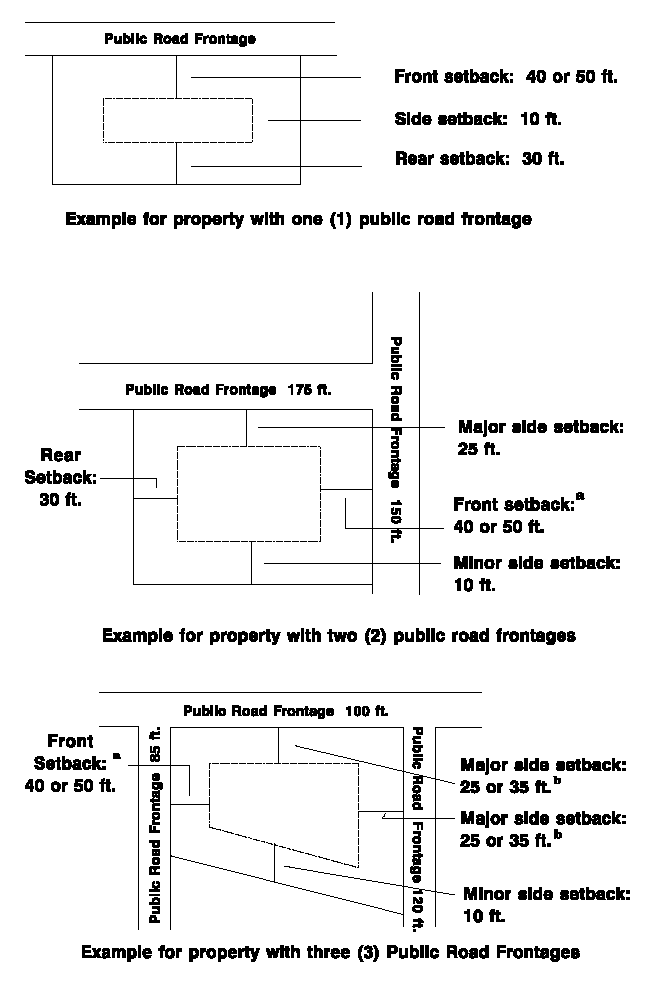
Notes:
1.
Property with shorter amount of road frontage will be the front setback for determining other setbacks (major side, side, rear).
2.
If structure fronts a major side setback, major side setback shall be 35 feet.
(4)
Landscape buffer and screening requirements. Unless otherwise noted within this district's requirements, any property within a GC district which abuts residentially zoned property shall have a 40-foot landscaped screening buffer adjacent to all residentially zoned property, which will be subject to the city landscape architect's approval. Required buffers may be included within required setbacks; however, in such case that the required buffer is greater than the required setback, the required buffer shall be adhered to. Additionally, necessary private utilities and access drives may be allowed through, over or across a landscaped buffer. Any such uses which are proposed through, over or across a designated undisturbed buffer must be approved pursuant to an original site plan or site plan modification.
a.
Objectives. Undisturbed, planted landscape buffers and berms shall be implemented in connection with a permitted project and shall address the following objectives:
1.
Screening to enhance aesthetic appeal;
2.
Control or direction of vehicular and pedestrian movement;
3.
Reduction of glare;
4.
Buffering of noise; and
5.
Establishment of privacy.
b.
Standards. Buffers or berms shall be required when a GC district is located adjacent to a residential district; a minimum 40-foot buffer is required.
1.
Buffers. Landscape buffers are subject to review and approval by city staff in accordance with the following standards:
(i)
Plantings are to be a mix of evergreen trees and shrubs.
(ii)
Species are to be ecologically compatible to the site and appropriate for the design situation.
(iii)
Unless public safety concerns dictate otherwise, a buffer should provide a 100 percent visual barrier to a height of six feet within two years of planting.
(iv)
Minimum height of plant materials at installation is five feet for trees and two feet for shrubs.
(v)
Fencing or walls are to be a minimum of six feet in height as approved by city staff.
(vi)
Trees included in buffer plantings may be counted toward site density calculations as required by the city subject to review and approval of city staff.
(vii)
Buffers shall be regularly maintained by the property owner to ensure that the objectives and standards set out in this subsection are met.
(viii)
When topography and existing conditions allow, the required 40-foot buffer should be an undisturbed buffer.
(ix)
Any appeals from a determination by city staff shall be to the board of variance and zoning appeals.
2.
Berms. Berms are subject to review and approval by city staff in accordance with the following standards:
(i)
Berms shall be utilized when consistent with surrounding property features.
(ii)
Berms shall be stabilized.
(iii)
Where possible, berms shall be constructed to be consistent with natural drainage patterns.
(iv)
Berms shall be regularly maintained by the property owner.
(5)
Floodplain and wetlands preservation requirements. Subject to the conditions set forth in the city floodplain management and prevention ordinance.
(6)
Building and structure requirements. Maximum building height is 50 feet, with no more than four stories.
(7)
Parking requirements. See section 48-198 for paved parking specifications.
(8)
Lighting requirements. Any project permitted within the GC district which proposes a lighted facility must have approval by the building official or his designee.
(9)
Special exception uses. See section 48-197 for requirements for special exception uses. Special exception uses for the GC district are the uses listed as follows:
a.
Any other facility for the disposal of the dead.
b.
Cemeteries.
c.
Churches, chapels, temples, synagogues and other places of worship.
d.
Mausoleums.
e.
Club or lodge, private.
f.
Private schools of general and special education.
g.
Flea markets, provided that the applicant meets the requirements of this Code.
h.
Automobile and truck sales and service facilities.
i.
Adult entertainment establishments.
j.
Amusement centers.
k.
Coliseums, stadiums and convention centers (privately-owned).
l.
Crematories, human and animal.
m.
Drive-in theatres.
n.
Hotel.
(10)
Use limitations.
a.
Maximum floor area ratio is 0.5 for office uses and 0.25 for retail uses.
b.
All refuse and designated recycling collection location facilities must be contained within completely enclosed facilities.
c.
Any emission or automotive inspection station shall be located within a permanent facility. (No temporary buildings/tents are to be utilized after July 1, 2009.)
d.
No uses that emit noxious odors, fumes or sounds are permitted.
e.
Outdoor displays of merchandise: Where permitted those displays such as garden centers, home building supplies, hardware stores, general merchandise and the like, not including landscape nurseries, automotive sales and rentals or heavy equipment sales and rentals, shall be subject to the following additional requirements:
1.
The area displaying the merchandise shall be ancillary to the primary retail business on-site.
2.
The location of outdoor displays must be shown on a site/construction plan approved by the building official or his designee.
3.
Outdoor displays located in areas between the buildings and a public street or roadway shall not be located outside the required building setbacks.
4.
The areas displaying the merchandise must be screened from any adjoining residential use or district compliant to an approved landscape plan.
5.
Areas for outdoor display may not be located within any required buffers.
6.
Outdoor displays may be allowed in front of the buildings but must not block sidewalks or parking areas. Outdoor displays may not impede vehicular or pedestrian traffic, compliant with the ADA. At a minimum, a five-foot pedestrian access shall be provided.
7.
Any temporary or seasonal sales conducted within parking spaces can be done so only within parking spaces above and beyond the required minimum for the entire retail center.
8.
Due to safety concerns, no permanent or temporary display of merchandise shall be allowed on or adjacent to any gasoline pump island or under a canopy covering any gasoline pump island.
f.
Maximum impervious surfaces: 70 percent.
g.
No loading docks or facilities may be located in the front of any primary structure.
Required buffers may be included within required setbacks; however, in such case that the required buffer is greater than the required setback, the required buffer shall be adhered to. Additionally, necessary private utilities and access drives may be allowed through, over or across a landscaped buffer. Any such uses which are proposed through, over or across a designated undisturbed buffer must be approved pursuant to an original site plan or site plan modification.
(11)
Accessory buildings, structures, uses and decks. Any accessory building or structure in excess of 400 square feet of gross space shall be located to the rear of the primary structure and at least 40 feet from any residential property line. Any accessory building or structure which exceeds 144 square feet of gross space must have the approval of the building official or his designee as to the location, architectural design and size prior to commencing construction. The building official or his designee shall consider the following criteria for determining the appropriateness of the architectural design and size of the accessory building or structure: compatibility with the surrounding neighborhood, style of exterior (the exterior is to be compatible in style with the primary structure), use of the proposed accessory structure, impact on adjacent properties, and requirements as deemed appropriate by plan review as set forth in this subsection. All accessory buildings, structures and uses in excess of 144 gross square feet shall be required to submit for plan review through the community affairs department or receive approval from the director of the community affairs department or his designee. Accessory structure plans must be accompanied by a signed affidavit from the property owner stating that such structure will not be used for a dwelling or commercial gain. Permitted accessory structures and uses are as follows:
a.
Accessory storage buildings, to include parking garages, subject to the following conditions:
1.
Maximum height is two stories, not to exceed 35 feet.
2.
Such structures shall be located on the same lot as and to the rear of the principal building to which they are accessory.
3.
No accessory building shall be constructed upon a lot until construction of the principal building has commenced.
4.
On a corner lot, no accessory building shall be located closer to the side street right-of-way line than the principal building.
5.
When abutting any other nonresidential district, no garage or other accessory building shall be located closer than five feet to a side or rear lot line.
6.
When an accessory building is attached to the principal building by a breezeway, passageway or similar means, it shall comply with the yard requirements of the principal building to which it is accessory.
7.
Where any nonresidential lot adjoins the side or rear of a residential lot, an accessory building shall not be located within any required buffers.
b.
Antennas and satellite dishes, which shall meet the requirements set forth in section 48-200.
c.
Carwashes are accessory to convenience food stores with self-service fuel.
d.
Freestanding parking garages, subject to the following conditions:
1.
Maximum height is 50 feet, with no more than four stories.
2.
When abutting any residential property line, freestanding parking garages shall not be located within any required buffers.
3.
When abutting any other nonresidential district, no freestanding garage shall be located closer than five feet to a side or rear lot line.
e.
Heating and air conditioning units, subject to the following conditions:
1.
When abutting any residential property line, heating and air conditioning units shall not be located within any required buffers.
2.
When abutting any other nonresidential district, no heating and air conditioning units shall be located closer than five feet to a side or rear lot line.
3.
Heating and air conditioning units may be installed on the roof of any structure zoned commercially so long as the heating and air conditioning unit does not exceed the height restrictions stated in this section and the units are placed so as to be hidden from a front or side view.
4.
No ground-based heating and air conditioning unit shall exceed 35 feet in height.
f.
Incidental storage, provided that the material stored is incidental to the permitted use, as determined by the building official or his designee, and stored completely within a portion of the enclosed principal structure permitted within the district, or within a permitted accessory structure.
(12)
Architectural requirements. It is the intent of the city to promote sustainable economic development within our commercial districts. The city community affairs department has set architectural guidelines utilizing a smart-growth based strategy plan. Architectural harmony is a significant factor in an economic revitalization plan.
a.
Application and review process.
1.
These architectural requirements shall apply to all developments within the city general commercial zoning district as well as any accessory structures related to those developments. Compliance with the architectural requirements is required in addition to the underlying zoning regulations found within the city zoning regulations.
2.
Redevelopment, refacing, exterior remodels and additions to existing buildings and development sites shall also comply with the provisions of these requirements.
3.
The community affairs department director will review all development applications within the general commercial zoning district for compliance with these requirements.
b.
Building materials.
1.
Primary building material (required). The primary building material (excluding: windows; display windows; doors; roofing; fascia or soffit materials) constituting a minimum of 60 percent of the facade shall be either:
(i)
Brick;
(ii)
Stone (e.g., natural/cultured, limestone, marble, or granite);
(iii)
Split-face block; or
(iv)
Architectural concrete, if the surface is designed to simulate brick or stone.
2.
Prohibited exterior building materials. The following building materials shall be prohibited:
(i)
Vinyl siding;
(ii)
Smooth-faced gray concrete block;
(iii)
Painted or stained concrete (including concrete block);
(iv)
Metal siding; or
(v)
Plastic.
c.
Building shape and facade treatment.
1.
Base, body, and cap.
(i)
The composition of the building shall include a clearly recognizable base, body, and cap along the entire length of the facade.
(ii)
A recognizable base shall consist of a minimum of nine percent of the vertical height of the building wall and shall be constructed of a masonry material.
(iii)
A recognizable cap shall consist of a minimum of seven percent of the vertical height of the building wall and shall be designed with multiple three-dimensional decorative layers.
2.
Variation in shape. Building walls shall consist of a building bay or structural building system that is a maximum of 30 feet in width. Bays shall be visually established by architectural features such as columns, ribs, pilasters or piers, changes in plane, no less than 12 inches in width and four inches in depth or an equivalent element that subdivides the wall into human scale proportions.
d.
Animating features.
1.
Building walls shall be subdivided and proportioned using a variety of features such as windows, entrances, arcades, arbors, awnings, trellises, friezes or alternate architectural detail that defines human scale, along no less than 60 percent of the linear length of the facade.
2.
Windows and glass doors shall be provided on a minimum of two building facades based on the highest levels of pedestrian traffic and vehicular visibility as follows:
(i)
Ground level (first ten feet measured vertically at street level) of commercial uses under 25,000 square feet of gross main floor area: 40 percent minimum surface area.
(ii)
Ground level (first ten feet measured vertically at street level) of commercial uses over 25,000 square feet of gross main floor area: 20 percent minimum surface area.
(iii)
Ground level (first ten feet measured vertically at street level) of office and institutional uses: 20 percent minimum surface area.
(iv)
Upper levels of all uses: 15 percent minimum surface area.
(v)
Ground floor windows shall be traditional storefront style (e.g., floor/base to ceiling) and generally vertical in orientation.
e.
Human scale design elements. Facades shall incorporate a minimum of two continuous or repeating details refined to the scale of 12 inches or less within the first 15 feet of the building facade, measured vertically from grade (e.g., quoins, change in brick pattern/belt course, decorative light fixtures, trim or molding, medallions, or sign frieze).
f.
Colors. The number of colors used to create interest in the building architecture shall be limited to no more than three discernable colors or ranges of complementary hues. The primary color shall constitute a minimum of 60 percent of the facade (excluding: windows; display windows; doors; roofing; fascia or soffit materials).
g.
Texture. Interest shall be added to a building facade though the use of a combination of rough, smooth, striated, or other surface textures on the primary building material or through the use of secondary building materials which vary in texture from the primary building material.
h.
Roof treatment.
1.
Rooflines shall vary in height, material, treatment, direction, etc., and shall not extend in a continuous plane for more than 50 feet.
2.
All sides of parapet walls visible from public view shall be finished to match the primary facade and shall extend an appropriate depth that is proportionate with the building size.
i.
Facade modulation. For buildings greater than 25,000 square feet of gross main floor area, any wall exceeding 100 feet in length shall include at least one change in wall plane, such as projections or recesses, having a depth of at least three percent of the entire length of the facade and extending at least 20 percent of the entire length of the facade.
j.
Shopping centers. All buildings located in a shopping center shall utilize and repeat selected architectural design requirements which are in harmony with area developments and other recent developments within the city. A master architecture plan shall be required for all shopping centers to promote consistency among buildings within a development and enhance compatibility of design and appearance requirements. A master architecture plan shall be filed and approved prior to the erection, location, or placement of any building for such shopping center.
k.
Single use sites. All buildings located on a single use site shall utilize selected design and appearance elements which are in harmony with area developments and other recent developments within the city.
l.
Building orientation.
1.
Shopping centers. All buildings shall be designed and oriented with a front facade toward any customer parking area, courtyard, or to the public street frontage of the shopping center. In the case of two or more public street frontages, a similar finished facade treatment shall be applied to each facade oriented toward a public street frontage. All buildings shall be oriented to each other in a similar pattern to create a unified site design and layout.
2.
Single use sites. All buildings shall be oriented with the front facade toward the public street frontage of the site. In the case of two or more public street frontages, a similar finished facade treatment shall be applied to each facade oriented toward a public street frontage.
m.
Fencing. All fencing located between a front lot line and the front line of the primary building shall be ornamental fencing. All fencing located along a side or rear lot line shall be black vinyl coated chain link or ornamental fencing.
n.
Variance from architectural and site design requirements. In order to avoid undue hardship and to expedite the development approval process for commercial developments within the city, alternate compliance with any of the architectural and site design requirements contained in this article, may be heard and determined in connection with a site plan review by the director of community affairs; however, variances may only be granted upon making the following findings:
1.
Alternate compliance with the architectural and site design requirements contained in the proposed development represents the use of (building materials, building shape and facade treatment, building orientation, signs, landscaping, lighting or open space) which will result in a development pattern which is equivalent to or superior to that achievable under the applicable regulations;
2.
The proposed development will be compatible with and will enhance the use or value of area properties;
3.
The proposed development is consistent with the intent of the comprehensive plan; and
4.
The proposed development is consistent with the intent and purpose of the zoning regulations.
All findings specified above for the granting of variance from the architectural and site design requirements shall be reduced to writing and signed by the director and retained as a part of the permanent record of the determination.
(Code 1985, § 22-143)
Sec. 48-158. - LI light industrial district.
The regulations for the LI light industrial district are as follows:
(1)
Purpose and intent. The LI district is established to provide locations for light industrial uses such as low intensity automobile repair and service, animal care facilities, commercial greenhouses, livestock, poultry, business distribution centers, warehousing and storage, and transportation terminals, which are on properties delineated within or on the perimeter of an industrial compatible and industrial category as defined and shown on the Austell Comprehensive Plan: Policy Guide, adopted July 2, 2007. When located on the perimeter of an industrial node, the LI district should provide for uses that are low in intensity and scale such as to ensure compatibility with surrounding properties.
(2)
Permitted uses. Permitted uses are as follows:
a.
Accessory retail sales and services.
b.
Ambulance services.
c.
Animal hospitals.
d.
Appliance repair (major).
e.
Assembly halls.
f.
Automobile, truck and trailer lease or rental facilities (principal or accessory use).
g.
Automotive paint shops and body repair shops. Such uses shall not be established on lots which are either adjacent to or directly across the street from any residential districts.
h.
Automotive parking lots and garages.
i.
Automotive repair and maintenance facilities.
j.
Automotive upholstery shops.
k.
Aviation airports (private).
l.
Boat sales and service facilities.
m.
Breeding and boarding kennels.
n.
Building materials stores.
o.
Bus stations.
p.
Bus stations for freight.
q.
Carwashes.
r.
Clinics.
s.
Clubs or lodges (noncommercial).
t.
Colleges and universities (private), including research and training facilities.
u.
Commercial greenhouses and plant nurseries.
v.
Community fairs.
w.
Contractors (general, heavy or special).
x.
Corporate or administrative offices for any permitted uses within this district.
y.
Dairies.
z.
Designated recycling collection locations.
aa.
Dry cleaning plants.
bb.
Electrical supply stores.
cc.
Emissions and inspection stations. (No temporary buildings/tents to be utilized after July 1, 2009.)
dd.
Executive golf courses.
ee.
Farm and garden supply stores.
ff.
Farm equipment stores and repair facilities.
gg.
Farmers' markets (fully enclosed).
hh.
Fuel and ice dealers.
ii.
Full service gasoline stations.
jj.
Funeral homes.
kk.
Golf courses, 18-hole regulation, public and private.
ll.
Golf courses, par 3.
mm.
Heavy automotive repair services and trade shops.
nn.
Helicopter landing areas, provided that the area is fenced.
oo.
In-home day care.
pp.
Laundry and dry cleaning pickup stations.
qq.
Light automotive repair facilities.
rr.
Light manufacturing establishments.
ss.
Linen and diaper services.
tt.
Livestock, nondomestic and wild animals, and poultry.
uu.
Livestock sales pavilions.
vv.
Medical and dental laboratories (with no limitations, except that such uses must have required federal and state permits).
ww.
Motorcycle, all-terrain vehicle (ATV) and three-wheel vehicle sales and service facilities.
xx.
Newspaper publishing facilities.
yy.
Nonautomotive repair service establishments.
zz.
Office service and supply establishments.
aaa.
Other service establishments.
bbb.
Outdoor golf driving ranges.
ccc.
Parking for vehicles.
ddd.
Plumbing and heating equipment dealers.
eee.
Poultry hatcheries.
fff.
Printing, publishing and lithography establishments.
ggg.
Pro shops, if accessory to driving ranges or golf courses.
hhh.
Radio and television stations.
iii.
Radio, television and other communication towers and antennas subject to section 48-199.
jjj.
Recreation grounds other than tennis courts and golf courses.
kkk.
Research and development centers.
lll.
Research testing laboratories.
mmm.
Reupholstery and furniture repair establishments.
nnn.
Self-service storage facilities (subject to section 48-202).
ooo.
Shelters (homeless).
ppp.
Signs and outdoor advertising facilities.
qqq.
Taxi stands and taxi dispatching agencies.
rrr.
Telephone business offices.
sss.
Temporary uses.
ttt.
Trailer salesrooms and sales lots.
uuu.
Transportation equipment storage and maintenance facilities.
vvv.
Utility facilities (private).
www.
Vending machine sales, service, rental or repair establishments.
xxx.
Vocational schools (commercial).
yyy.
Warehouse and storage facilities.
zzz.
Wholesale sales offices.
aaaa.
Wholesale trade and distribution facilities.
bbbb.
Wholesale trade offices in conjunction with office showrooms.
(3)
Lot size and setback requirements. Lot size and setback requirements are as follows:
a.
Minimum lot area: 40,000 square feet.
b.
Minimum lot width at front setback line: 100 feet.
c.
Minimum public road frontage: 50 feet.
d.
Minimum building setbacks means as shown and applied in the following diagram:
Minimum Building Setback Requirements for LI District
Note: All setbacks shall be measured from future right-of-way.
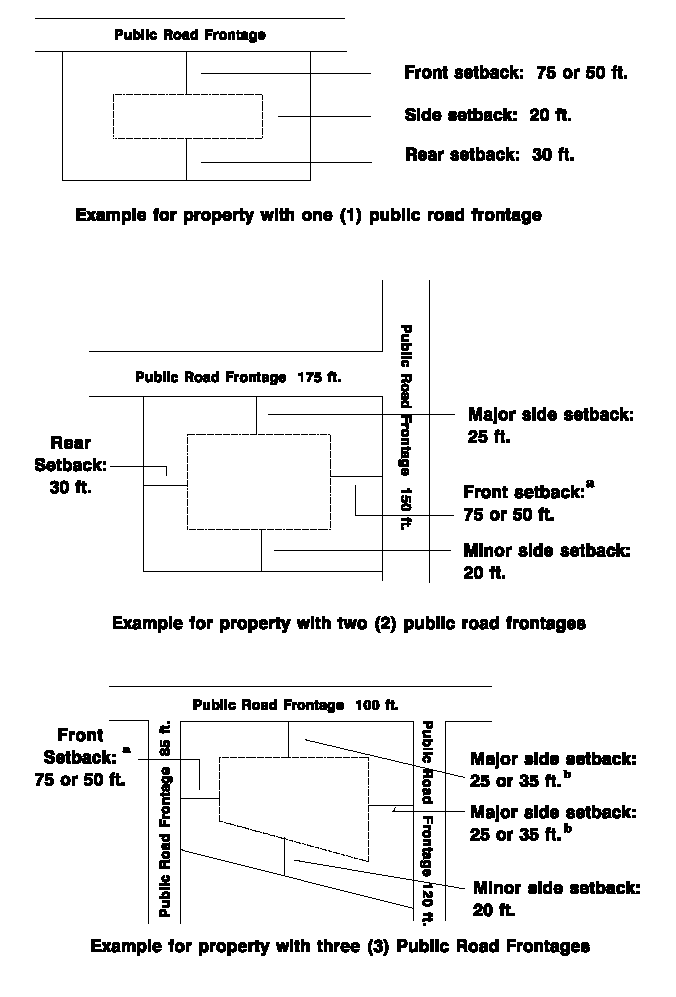
Notes:
1.
Property with shorter amount of road frontage will be the front setback for determining other setbacks (major side, side, rear).
2.
If structure fronts a major side setback, major side setback shall be 35 feet.
(4)
Landscape buffer and screening requirements. Unless otherwise noted within this district's requirements, any property within an LI district which abuts residentially zoned property shall have a minimum 50-foot landscaped screening buffer. Required buffers may be included within required setbacks; however, in such case that the required buffer is greater than the required setback, the required buffer shall be adhered to Additionally, necessary private utilities and access drives may be allowed through, over or across a landscaped buffer. Any such uses which are proposed through, over or across a designated undisturbed buffer must be approved pursuant to an original site plan or site plan modification.
a.
Objectives. Undisturbed, planted landscape buffers and berms shall be implemented in connection with a permitted project and shall address the following objectives:
1.
Screening to enhance aesthetic appeal;
2.
Control or direction of vehicular and pedestrian movement;
3.
Reduction of glare;
4.
Buffering of noise; and
5.
Establishment of privacy.
b.
Standards. Buffers and berms shall be required when an LI district is located within or adjacent to a residential district. The minimum buffer shall be 50 feet and the maximum buffer shall be 75 feet.
1.
Buffers. Landscape buffers are subject to review and approval by the city arborist or city landscape architect in accordance with the following standards:
(i)
Plantings are to be a mix of evergreen trees and shrubs.
(ii)
Species are to be ecologically compatible to the site and appropriate for the design situation.
(iii)
Unless public safety concerns dictate otherwise, a buffer should provide a 100 percent visual barrier to a height of six feet within two years of planting.
(iv)
Minimum height of plant materials at installation is five feet for trees and two feet for shrubs.
(v)
Fencing or walls are to be a minimum of six feet in height as approved by the city landscape architect or city arborist.
(vi)
Trees included in buffer plantings may be counted toward site density calculations as required by the city subject to review and approval of city staff.
(vii)
Buffers shall be regularly maintained by the property owner to ensure that the objectives and standards set out in this subsection are met.
(viii)
When topography and existing conditions allow, the required 50-foot buffer should be an undisturbed buffer.
(ix)
Any appeals from a determination by the city landscape architect or city arborist shall be to the board of variance and zoning appeals.
2.
Berms. Berms are subject to review and approval by the city landscape architect or city arborist in accordance with the following standards:
(i)
Berms shall be utilized when consistent with surrounding property features.
(ii)
Berms shall be stabilized.
(iii)
Berms shall be constructed to be consistent with natural or proposed drainage patterns.
(iv)
Berms shall be regularly maintained by the property owner.
(5)
Floodplain and wetlands preservation requirements. Subject to the conditions set forth in the city floodplain management and prevention ordinance.
(6)
Building and structure requirements. Maximum building height is four stories or 50 feet.
(7)
Parking requirements. See section 48-198 for paved parking specifications.
(8)
Lighting requirements. Any project permitted within the LI district which proposes a lighted facility must have approval by the building official or his designee.
(9)
Special exception uses. See section 48-197 for requirements for special exception uses. Special exception uses for the LI district are the uses listed as follows:
a.
Any other facility for the disposal of the dead.
b.
Cemeteries.
c.
Churches, chapels, temples, synagogues and other places of worship.
d.
Mausoleums.
e.
Club or lodge, private.
f.
Private schools of general and special education.
g.
Automobile and truck sales and service facilities.
h.
Sawmills; tree service (temporary fire wood sales and wood service).
(10)
Special exception uses for industrial areas only. The following uses, with the proper scrutiny and conditions, may or may not be considered as special exception uses within the LI district, only if they are within properties delineated as industrial or industrial-compatible as defined and shown on the Austell Comprehensive Plan: Policy Guide, adopted July 2, 2007. Any special exception use for industrial areas only shall adhere to the landscape buffer and screening requirements in subsection (4) of this section and the lighting requirements in subsection (8) of this section.
a.
Amusement centers.
b.
Crematories, human or animal.
c.
Drive-in theaters.
(11)
Use limitations.
a.
Maximum floor area ratio is 0.75 for office uses.
b.
All refuse collection and designated recycling collection location facilities must be contained within completely enclosed facilities.
c.
Any outside storage shall be set back a minimum of 35 feet from any public right-of-way. In other cases, the setbacks as required for accessory buildings, structures, uses and decks shall apply.
d.
No drive-in establishments are permitted.
e.
No uses that emit noxious odors, fumes or sounds are permitted.
f.
No outside runs are permitted with any veterinary office use permitted within this district.
g.
Maximum impervious surfaces: 70 percent.
Required buffers may be included within required setbacks; however, in such case that the required buffer is greater than the required setback, the required buffer shall be adhered to. Additionally, necessary private utilities and access drives may be allowed through, over or across a landscaped buffer. Any such uses which are proposed through, over or across a designated undisturbed buffer must be approved pursuant to an original site plan or site plan modification.
(12)
Accessory buildings, structures, uses and decks. Any accessory building or structure in excess of 400 square feet of gross space shall be located to the rear of the primary structure and at least 100 feet from any residential property line. Any accessory building or structure which exceeds 144 square feet of gross space must have the approval of the building official or his designee as to the location, architectural design and size prior to commencing construction. The building official or his designee shall consider the following criteria for determining the appropriateness of the architectural design and size of the accessory building or structure: compatibility with the surrounding neighborhood, style of exterior (the exterior is to be compatible in style with the primary structure), use of the proposed accessory structure, impact on adjacent properties, and requirements as deemed appropriate by plan review as set forth in this subsection. All accessory buildings, structures and uses in excess of 144 gross square feet shall be required to submit for plan review through the community affairs department or receive approval from the director of the community affairs department or his designee. Accessory structure plans must be accompanied by a signed affidavit from the property owner stating that such structure will not be used for a dwelling or commercial gain. Permitted accessory structures and uses are as follows:
a.
Accessory storage buildings, to include parking garages, subject to the following conditions:
1.
Maximum height is two stories.
2.
Such structures shall be located on the same lot as and to the rear of the principal building to which they are accessory.
3.
No accessory building shall be constructed upon a lot until construction of the principal building has commenced.
4.
On a corner lot, no accessory building shall be located closer to the side street right-of-way line than the principal building.
5.
When abutting any other nonresidential district, no garage or other accessory building shall be located closer than five feet to a side or rear lot line.
6.
When an accessory building is attached to the principal building by a breezeway, passageway or similar means, it shall comply with the yard requirements of the principal building to which it is accessory.
7.
Where any nonresidential lot adjoins the side or rear of a residential lot, an accessory building shall not be located within any required buffers.
b.
Antennas and satellite dishes, which shall meet the requirements set forth in section 48-200.
c.
Heating and air conditioning units, subject to the following conditions:
1.
When abutting any residential property line, heating and air conditioning units shall not be located within any required buffers.
2.
When abutting any other nonresidential district, no heating and air conditioning units shall be located closer than five feet to a side or rear lot line.
3.
Heating and air conditioning units may be installed on the roof of any structure zoned commercially so long as the heating and air conditioning unit does not exceed the height restrictions stated in this section and the units are placed so as to be hidden from a front or side view.
d.
Incidental storage, provided that the material stored is incidental to the permitted use, as determined by the building official or his designee, and stored completely within a portion of the enclosed principal structure permitted within the district, or within a permitted accessory structure.
e.
Outdoor displays of merchandise shall not be seen from any public right-of-way, residential zoned area, or any open space area accessible to the public. All displayed items shall be screened by solid fences, walls, buildings, landscaping, or by any combination of screening elements, which comply with the requirements of this article.
(Code 1985, § 22-144)
Sec. 48-159. - HI Heavy industrial district.
The regulations for the HI heavy industrial district are as follows:
(1)
Purpose and intent. The HI district is established to provide locations for heavy industrial uses such as intensive automobile repair and service, heavy manufacturing, chemical manufacturing and storage, petroleum or petrochemical storage, and warehousing and storage, which are on properties delineated within an industrial category as defined and shown on the Austell Comprehensive Plan: Policy Guide, adopted July 2, 2007. When located on the perimeter of an industrial node, the HI district should provide for uses that are lower in intensity and scale such as to ensure compatibility with surrounding properties.
(2)
Permitted uses. Permitted uses are as follows:
a.
Ambulance services.
b.
Ambulance services, if accessory to hospitals or funeral homes.
c.
Animal hospitals.
d.
Assembly halls.
e.
Automobile, truck and trailer lease and rental facilities (principal and accessory uses).
f.
Automotive paint and body repair shops. Such uses shall not be established upon a lot which is either adjacent to or directly across the street from any residential district.
g.
Automotive parking lots or garages.
h.
Automotive repair and maintenance facilities.
i.
Automotive upholstery shops.
j.
Aviation airports (private).
k.
Boat sales and service.
l.
Breeding and boarding kennels.
m.
Building materials stores.
n.
Bus stations.
o.
Bus stations for freight.
p.
Carwashes.
q.
Clinics.
r.
Clubs or lodges (noncommercial).
s.
Colleges and universities (private), including, but not limited to, research and training facilities.
t.
Commercial greenhouses and plant nurseries, provided that all goods stored outside shall be stored in a designated area.
u.
Community fairs.
v.
Contractors (general, heavy or special).
w.
Corporate or administrative offices for any permitted uses within this district.
x.
Dairies.
y.
Designated recycling collection locations.
z.
Dry cleaning plants.
aa.
Electrical supply stores.
bb.
Emissions and inspections stations. (No temporary buildings/tents to be utilized after June 30, 1998.)
cc.
Executive golf courses.
dd.
Farm equipment stores and repair establishments.
ee.
Fuel and ice dealers.
ff.
Full service gasoline stations.
gg.
Golf courses, 18-hole regulation, public and private.
hh.
Golf courses, par 3.
ii.
Heavy automotive repair establishments.
jj.
Heavy repair service and trade shops.
kk.
Helicopter landing areas.
ll.
In-home day care.
mm.
Laundry and dry cleaning pickup establishments.
nn.
Laundry and dry cleaning establishments (work done on-site).
oo.
Light automotive repair establishments.
pp.
Light manufacturing establishments.
qq.
Linen and diaper services.
rr.
Livestock, nondomestic and wild animals, and poultry.
ss.
Machine shops.
tt.
Medical and dental laboratories (with no limitations other than state and federal regulations).
uu.
Newspaper publishing facilities.
vv.
Nonautomotive repair service establishments.
ww.
Office service and supply establishments.
xx.
Outdoor golf driving ranges.
yy.
Parking for vehicles.
zz.
Plumbing or heating equipment dealers.
aaa.
Printing, publishing and lithography establishments.
bbb.
Private parks.
ccc.
Pro shops, if accessory to driving ranges or golf courses.
ddd.
Radio and television stations.
eee.
Radio, television and other communication towers and antennas, subject to section 48-199.
fff.
Recreation grounds other than tennis courts and golf courses.
ggg.
Research and development centers.
hhh.
Research testing laboratories.
iii.
Reupholstery and furniture repair establishments.
jjj.
Self-service storage facilities (subject to section 48-202).
kkk.
Shelters (homeless).
lll.
Signs and outdoor advertising facilities.
kkk.
Taxi stands and taxi dispatching agencies.
lll.
Temporary uses.
mmm.
Trailer salesrooms and sales lots.
nnn.
Transportation equipment storage and maintenance facilities.
ooo.
Utility facilities (private).
ppp.
Vocational schools (commercial).
qqq.
Warehouse and storage facilities.
rrr.
Wholesale sales offices.
sss.
Wholesale trade and distribution facilities, including packing of wholesale commodities for distribution, subject to the following:
1.
Unless in a district in which manufacturing is permitted, no fabricating of goods to be sold shall be permitted.
2.
Unless in a district in which heavy manufacturing is permitted, no wholesaling activity shall be permitted which processes the goods handled in a manner that produces liquid or solid waste or noise, odor, fumes or dust which can be detected beyond the walls of the building in which such wholesaling activity is housed.
ttt.
Wholesale trade offices in conjunction with office showrooms.
(3)
Lot size and setback requirements. Lot size and setback requirements are as follows:
a.
Minimum lot size: 40,000 square feet.
b.
Minimum lot width at front setback line: 150 feet.
c.
Minimum public road frontage: 50 feet.
d.
Minimum building setbacks: As shown and applied in the following diagram:
Minimum Building Setback Requirements for HI District
Note: All setbacks shall be measured from future right-of-way.
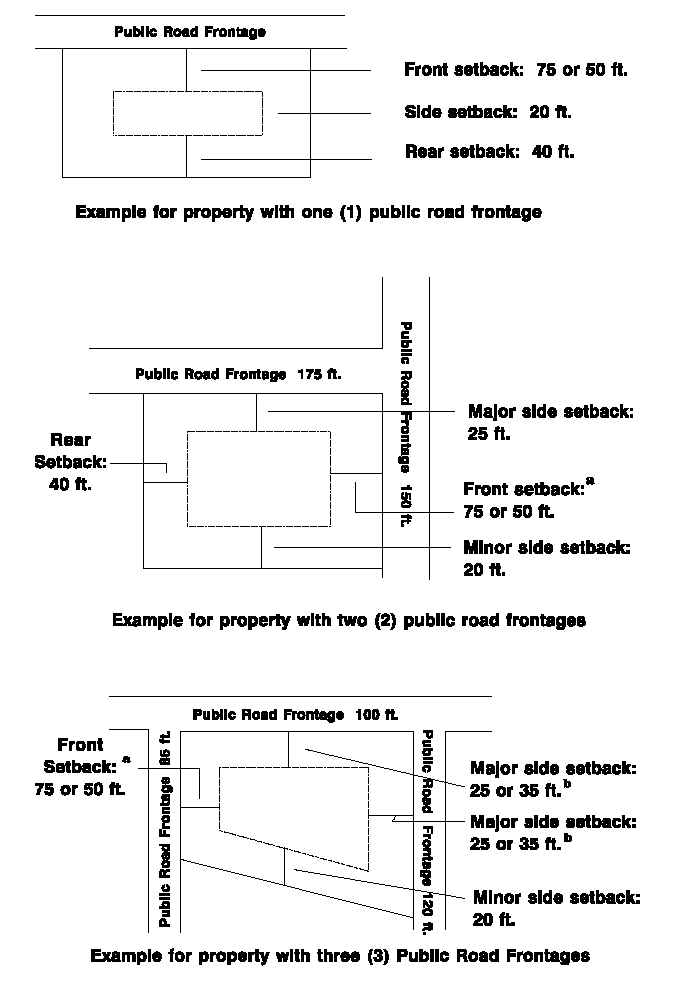
Notes:
1.
Property with shorter amount of road frontage will be the front setback for determining other setbacks (major side, side, rear).
2.
If structure fronts a major side setback, major side setback shall be 35 feet.
(4)
Landscape buffer and screening requirements. Unless otherwise noted within this district's requirements, any property within an HI district which abuts a residentially zoned property shall have a 50-foot landscaped screening buffer adjacent to all residentially zoned property, which will be subject to city staff's approval. Required buffers may be included within required setbacks; however, in such case that the required buffer is greater than the required setback, the required buffer shall be adhered to. Additionally, necessary private utilities and access drives may be allowed through, over or across a landscape buffer. Any such uses which are proposed through, over or across a designated undisturbed buffer must be approved pursuant to an original site plan or site plan modification.
a.
Objectives. Undisturbed, planted landscape buffers and berms shall be implemented in connection with a permitted project and shall address the following objectives:
1.
Screening to enhance aesthetic appeal;
2.
Control or direction of vehicular and pedestrian movement;
3.
Reduction of glare;
4.
Buffering of noise; and
5.
Establishment of privacy.
b.
Buffers. Landscape buffers are subject to review and approval by city staff in accordance with the following standards:
1.
Plantings are to be a mix of evergreen trees and shrubs.
2.
Species are to be ecologically compatible to the site and appropriate for the design situation.
3.
Unless public safety concerns dictate otherwise, a buffer should maximize a visual barrier to a height of six feet within two years of planting.
4.
Minimum height of plant materials at installation is five feet for trees and two feet for shrubs.
5.
Fencing or walls are to be a minimum of six feet in height as approved by city staff.
6.
Trees included in buffer plantings may be counted toward site density calculations as required by the city subject to review and approval of city staff.
7.
Buffers shall be regularly maintained by the property owner to ensure that the objectives and standards set out in this subsection are met.
8.
When topography and existing conditions allow, the required 50-foot buffer should be an undisturbed buffer.
9.
Any appeals from a determination by the city staff shall be to the board of variance and zoning appeals.
c.
Berms. Berms are subject to review and approval by city staff in accordance with the following standards:
1.
Berms shall be utilized when consistent with surrounding property features.
2.
Berms shall be stabilized.
3.
Where possible, berms shall be constructed to be consistent with natural drainage patterns.
4.
Berms shall be regularly maintained by the property owner.
(5)
Floodplain and wetlands preservation requirements. Subject to the conditions set forth in the city floodplain management and prevention ordinance.
(6)
Building and structure requirements. Maximum building height is 50 feet, with no more than four stories.
(7)
Parking requirements. See section 48-198 for paved parking specifications.
(8)
Lighting requirements. Any project permitted within the HI district which proposes a lighted facility must have approval by the building official or his designee.
(9)
Special exception uses. See section 48-197 for requirements for special exception uses. Special exception uses for the HI district are the uses listed as follows:
a.
Any other facility for the disposal of the dead.
b.
Cemeteries.
c.
Churches, chapels, temples, synagogues and other places of worship.
d.
Mausoleums.
e.
Club or lodge, private.
f.
Private schools of general and special education.
g.
Sawmills; tree service (temporary fire wood sales and wood service).
(10)
Special exception uses for industrial areas only. The following uses, with the proper scrutiny and conditions, may be considered as special exception uses within the HI district, only if they are within properties delineated as industrial as defined and shown on the Austell Comprehensive Plan: Policy Guide, adopted July 2, 2007. Any special exception use for industrial areas only shall adhere to the landscape buffer and screening requirements in subsection (5) of this section and the lighting requirements in subsection (9) of this section.
a.
Amusement centers.
b.
Asphalt plants or concrete plants.
c.
Automobile salvage and wrecking yards.
d.
Automobile storage yards and wrecker services for damaged or confiscated vehicles.
e.
Coliseums, stadiums. and convention centers (privately-owned).
f.
Crematories, human or animal.
g.
Drive-in theaters.
h.
Heavy manufacturing establishments.
i.
Mining.
j.
Petroleum or bulk storage facilities or chemical plants or storage facilities.
k.
Private landfills, composting centers or recycling centers.
l.
Outdoor commercial racing (motorcycle, automobile, truck, tractor and motorized vehicles).
(11)
Use limitations.
a.
Maximum floor area ratio is 0.5 for office uses and 0.75 for industrial uses.
b.
All refuse and designated recycling collection location facilities must be contained within completely enclosed facilities.
c.
No uses that exceed state and federal guidelines for allowable emissions and discharge of effluents into the air, water and soil are permitted.
d.
No uses that create unabated noise creating a nuisance as defined under state law are permitted.
e.
If potentially hazardous materials or chemicals are used on the premises or pollutants result from the operation under this section, a spill containment plan shall be approved by city staff.
f.
Maximum impervious surfaces: 70 percent.
Required buffers may be included within required setbacks; however, in such case that the required buffer is greater than the required setback, the required buffer shall be adhered to. Additionally, necessary private utilities and access drives may be allowed through, over or across a landscaped buffer. Any such uses which are proposed through, over or across a designated undisturbed buffer must be approved pursuant to an original site plan or site plan modification.
(12)
Accessory buildings, structures, uses and decks. Any accessory building or structure in excess of 400 square feet of gross space shall be located to the rear of the primary structure and at least 100 feet from any residential property line. Any accessory building or structure which exceeds 144 square feet of gross space must have the approval of the building official or his designee as to the location, architectural design and size prior to commencing construction. The building official or his designee shall consider the following criteria for determining the appropriateness of the architectural design and size of the accessory building or structure: compatibility with the surrounding neighborhood, style of exterior (the exterior is to be compatible in style with the primary structure), use of the proposed accessory structure, impact on adjacent properties, and requirements as deemed appropriate by plan review as set forth in this subsection. All accessory buildings, structures and uses in excess of 144 gross square feet shall be required to submit for plan review through the community affairs department or receive approval from the director of community affairs or his designee. Accessory structure plans must be accompanied by a signed affidavit from the property owner stating that such structure will not be used for a dwelling or commercial gain. Permitted accessory structures and uses are as follows:
a.
Accessory storage buildings, to include parking garages, subject to the following conditions:
1.
Maximum height is two stories, not to exceed 35 feet.
2.
Such structures shall be located on the same lot as and to the rear of the principal building to which they are accessory.
3.
No accessory building shall be constructed upon a lot until construction of the principal building has commenced.
4.
On a corner lot, no accessory building shall be located closer to the side street right-of-way line than the principal building.
5.
When abutting any other nonresidential district, no garage or other accessory building shall be located closer than five feet to a side or rear lot line.
6.
When an accessory building is attached to the principal building by a breezeway, passageway or similar means, it shall comply with the yard requirements of the principal building to which it is accessory.
7.
Where any nonresidential lot adjoins the side or rear of a residential lot, an accessory building shall not be located within any required buffers.
b.
Antennas and satellite dishes, which shall meet the requirements set forth in section 48-200.
c.
Heating and air conditioning units, subject to the following conditions:
1.
When abutting any residential property line, heating and air conditioning units shall not be located within any required buffers.
2.
When abutting any other nonresidential district, no heating and air conditioning units shall be located closer than five feet to a side or rear lot line.
3.
Heating and air conditioning units may be installed on the roof of any structure zoned commercially so long as the heating and air conditioning unit does not exceed the height restrictions stated in this section and the units are placed so as to be hidden from a front or side view.
4.
No ground-based heating and air conditioning unit shall exceed 35 feet in height.
d.
Incidental storage, provided that the material stored is incidental to the permitted use, as determined by the building official or his designee, and stored completely within a portion of the enclosed principal structure permitted within the district, or within a permitted accessory structure.
e.
Outdoor displays of merchandise shall not be seen from any public right-of-way, residential zoned area, or any open space area accessible to the public. All displayed items shall be screened by solid fences, walls, buildings, landscaping, or by any combination of screening elements, which comply with the requirements of this article.
(Code 1985, § 22-145)
Sec. 48-160. - MUOD Mixed use overlay district.
The regulations for the MUOD mixed use overlay district are as follows:
(1)
Purpose and intent. The MUOD is established to encourage, protect and enhance the pedestrian environment; encourage additional street level activity; reduce automobile trips; create a sense of community; provide for the efficient use of land and services; reduce urban sprawl; promote a smart growth based approach to development; and allow for mix of land uses which strengthens opportunities for economic growth.
(2)
Applicability.
a.
The MUOD may only be implemented within specific geographic areas or developed corridors within the city as designated by the mayor and council.
b.
Existing conditions of zoning which apply to MUOD properties shall remain in effect. Where such conditions conflict with any requirement of this section, the more restrictive requirement shall take precedence. Notwithstanding the above, the mayor and council may modify or dissolve pre-existing conditions of zoning upon official designation of the overlay district.
c.
The MUOD encourages the mixing of uses both horizontally and vertically. Uses subject to approval of a special land use permit in the underlying district shall continue to require approval of the permit.
(3)
Mixed use overlay district review. Site plan with architectural rendering required with application for MUOD designation. All MUOD projects shall be governed by an approved site plan. The site plan shall be submitted, reviewed and approved by the building official or his designee. Upon approval of the MUOD application by the building official, two public hearings will be held in accordance with the requirements as set forth for a rezoning application.
(4)
Permitted uses. Permitted uses are as follows:
a.
Animal hospitals.
b.
Athletic and health clubs.
c.
Automotive parking lots or garages.
d.
Banks or financial institutions without drive-in establishment.
e.
Clinics.
f.
Clubs or lodges (noncommercial).
g.
Community fairs.
h.
Community retail uses.
i.
Cultural facilities.
j.
Designated recycling collection locations.
k.
Eating and drinking establishments, excluding drive-in fast food restaurants.
l.
Exterminating facilities (insect or rodent).
m.
Film developing and printing facilities.
n.
Full service gasoline stations.
o.
Laundry and dry cleaning pickup only establishments.
p.
Medical and dental laboratories, provided that no chemicals are manufactured on-site.
q.
Multifamily dwelling units.
r.
Nonautomotive repair service establishments.
s.
Nursery schools and child day care centers.
t.
Office service and supply establishments.
u.
Offices not elsewhere classified.
v.
Other consumer goods and services.
w.
Other service establishments.
x.
Photography studios.
y.
Printing, publishing and lithography establishments, provided that no more than 50 percent of the total gross floor area will be used for storage.
z.
Private parks.
aa.
Professional offices.
bb.
Recreation grounds other than tennis courts and golf courses.
cc.
Self-service laundry facilities.
dd.
Single-family dwelling units.
ee.
Studios and supplies, provided that no more than 50 percent of the total gross floor area will be used for storage.
ff.
Temporary uses.
gg.
Theaters.
hh.
Townhouses.
ii.
Tutoring and learning centers (see section 48-1).
(5)
Density, building height, and minimum project size.
a.
Residential density shall be based upon gross project acreage, and may be developed up to a maximum of 32 units per acre. Maximum building height shall be governed by the underlying zoning district. The mayor and council may reduce maximum project density or establish increased building heights on a case-by-case basis at the time an overlay district is established.
b.
MUOD projects shall contain a minimum of five contiguous acres of land area; except those areas of redevelopment as approved by the building official or his designee, or within the CBD. A single use may occupy no more than 70 percent of the gross site acreage (exclusive of required common area).
(6)
Development requirements.
a.
Single-family detached on individual lots.
1.
Minimum lot area: No minimum, except that each building envelope shall contain at least 1,000 square feet outside the 100-year floodplain elevation.
2.
Minimum lot width means the minimum lot width of all building lots shall be at least 40 feet.
3.
Minimum road frontage per lot: 40 feet. Exception: Road frontage may be reduced to 20 feet for lots with frontage upon cul-de-sac turnarounds.
4.
Minimum front yard (from streets interior to the development): Five feet.
5.
Minimum side yard: Five feet per side (single-family detached); or ten feet one side/zero feet opposite side (zero lot-line). Note: Zero lot-line will require eight foot access/maintenance easement on the adjoining lot.
6.
Minimum rear yard: Five feet.
7.
Where the adjacent to a required buffer, the minimum required side or rear yard setback shall increase an additional five feet for every ten-foot incremental increase in building height above 35 feet.
8.
Sodded yards means all grassed areas shall be sodded.
9.
Minimum garage required: Two-car garage.
10.
The required garage and off-street parking must be located to the rear of at least 50 percent of all dwelling units. Where garages are front entry, the garage facade shall be recessed a minimum of four additional feet from the building line.
11.
All new or relocated utilities shall be placed underground.
b.
Single-family attached on individual lots.
1.
Minimum lot area: None.
2.
Minimum lot width: 18 feet.
3.
Minimum road frontage per lot: Zero feet.
4.
Minimum front yard (from streets interior to the development): Zero feet.
5.
Minimum side yard: Five feet on non-attached side.
6.
Minimum rear yard: Five feet.
7.
Where adjacent to a required buffer, the minimum required side or rear yard setback shall increase an additional five feet for every ten-foot incremental increase in building height above 35 feet.
8.
Sodded yards means all grassed areas shall be sodded.
9.
Minimum garage required: One-car garage.
10.
The required garage and off-street parking must be located to the rear of at least 50 percent of all dwelling units.
11.
Firewalls means a minimum of a two-hour rated firewall shall be required between each attached dwelling unit. A four-hour rated firewall shall be required between every fourth attached dwelling unit. Firewalls shall be constructed in accordance with the applicable building codes of the city.
12.
All new or relocated utilities shall be placed underground.
c.
Residential/business dwellings.
1.
Minimum lot area: None.
2.
Minimum unit width: 18 feet.
3.
Minimum road frontage per lot: Zero feet.
4.
Minimum front yard (from street interior to the development): Zero feet.
5.
Minimum side yard: Zero feet on non-attached side.
6.
Minimum rear yard: Zero feet.
7.
Where adjacent to a required buffer, the minimum required side or rear yard setback shall increase an additional five feet for every ten-foot incremental increase in building height above 35 feet.
8.
Sodded yards means all grassed areas shall be sodded.
9.
Minimum garage required: One-car garage.
10.
The required garage and off-street parking must be located to the rear of at least 50 percent of all dwelling units.
11.
The businesses shall have direct entry from the street frontage sidewalk.
12.
All new or relocated utilities shall be placed underground.
13.
Dumpsters must be screened on all sides by a minimum six-foot-high brick or masonry wall with access via an opaque metal gate.
d.
Multifamily residences.
1.
Minimum lot area: None.
2.
Minimum lot width: None.
3.
Minimum road frontage: 40 feet.
4.
Minimum front yard: Zero feet.
5.
Maximum front yard: 15 feet, except when common area is provided between the street and building.
6.
Minimum side yard: Zero feet.
7.
Minimum rear yard: Zero feet.
8.
Where adjacent to a required buffer, the minimum required side or rear yard setback shall increase an additional five feet for every ten-foot incremental increase in building height above 35 feet.
9.
Minimum building height: Two floors/stories.
10.
Sodded yards means all grassed areas shall be sodded.
11.
Parking shall be provided in designated lots/decks subject to review and approval of city staff.
12.
All new or relocated utilities shall be placed underground.
13.
Dumpsters must be screened on all sides by a minimum six-foot-high brick or masonry wall with access via an opaque metal gate.
e.
Commercial/office/residences.
1.
Minimum lot area: None.
2.
Minimum lot width: None.
3.
Minimum road frontage: 40 feet.
4.
Minimum front yard: Zero feet.
5.
Maximum front yard: 15 feet, except when common area is provided between the street and building.
6.
Minimum side yard: Zero feet.
7.
Minimum rear yard: Zero feet.
8.
Where adjacent to a required buffer, the minimum required side or rear yard setback shall increase an additional five feet for every ten-foot incremental increase in building height above 35 feet.
9.
Sodded yards means all grassed areas shall be sodded.
10.
Dwellings may be constructed on floors/stories above first floor nonresidential uses.
11.
All new or relocated utilities shall be placed underground.
12.
Dumpsters must be screened on all sides by a minimum six-foot-high brick or masonry wall with access via an opaque metal gate.
(7)
Common area. Common area shall be provided according to the following standards:
a.
At least 20 percent of the gross project acreage (excluding 100-year floodplain and wetland areas) shall be designated on a recorded plat as permanent common area for the use of the residents and visitors to the development.
b.
Sidewalks and associated amenities may be credited toward common area calculations, if the sidewalk is constructed at a width of eight feet or greater and the streetscape is enhanced with decorative, commercial quality street furniture, fountains, planters, public seating or similar improvements (subject to review of streetscape design by the building official or his designee).
c.
Landscaped strips along internal or external streets may be credited toward common area calculations, if the landscaped strip is constructed at a continuous width of 25-feet or greater.
d.
Wetland and floodplain areas shall be preserved in their natural state, except for the installation of required detention facilities and stormwater BMPs.
e.
Stormwater facilities may be located within common area, if designed and improved as an amenity, subject to review and approval of city staff.
f.
Common areas shall be distributed throughout the project to proved linkages, amenities and visual appeal for the development. Final common area design shall include provisions of at least one centrally located public gathering area (with related amenities and improvements) in the form of a town green, amphitheater, landscaped plaza, or similar approved element.
g.
Common area ownership. Common areas, stormwater facilities, floodplain and wetland areas shall be owned in fee-simple by a mandatory property owner's association or approved entity which administers a reciprocal access and maintenance agreement for the project; or other entity approved in advance by the mayor and council during their normal course of business. The developer shall record the deed to the common area prior to, or concurrent with, the recording of the first final subdivision plat or certificate of occupancy. An access easement following the alignment of future public streets is acceptable. However, pocket parks or greens may be deeded concurrent with the unit or phase of the final subdivision plat of which it is a part.
h.
Property owner's association. The property owner's association bylaws or covenants, at a minimum, shall contain the following provisions:
1.
Governance of the association by the Georgia Property Owner's Association Act (O.C.G.A. § 44-3-220 et seq.) or a successor to that Act that grants lien rights to the association for maintenance expenses and tax obligations.
2.
Responsibility for maintenance of common areas.
3.
Responsibility for insurance and taxes.
4.
Automatic compulsory membership of all property owners and subsequent lot purchasers and their successors; and compulsory assessments.
5.
Conditions and timing of transferring control of the association from the developer to the property owners.
6.
Guarantee that the association will not be dissolved without the advance approval the mayor and council.
7.
Restrict the time of deliveries to commercial businesses and dumpster pickup to between 7:00 a.m. and 9:00 p.m.
i.
Maintenance. The property owner's association, or other entity approved in advance by the mayor and council shall be responsible for the continuous maintenance of buffers, common areas and recreation areas.
(8)
Landscape buffer and screening requirements.
a.
A naturally vegetated, undisturbed buffer, replanted where sparsely vegetated and supplemented by an eight-foot-high solid opaque wall or fence along the interior of the buffer, shall be provided adjacent to external residential properties. Where adjacent properties are zoned or developed for single-family residential uses, a buffer of 75 feet in width shall be provided, and where adjacent properties are zoned or developed for fee-simple townhouse/condominium uses a buffer of 50 feet in width shall be provided. These minimum buffer widths may be adjusted by mayor and council at the time an overlay district is established. Buffers shall not be required adjacent to adjoining property zoned for or developed as office, institutional, commercial, industrial or multifamily uses.
b.
The development shall comply with the requirements of the buffer requirements, landscape requirements and the city tree ordinance with the following exceptions:
1.
Buffers shall not be required between nonresidential uses and residential uses internal to the mixed-use development.
2.
The ten-foot-wide landscape strip shall only be required on the external roadways, and planted with approved understory trees.
3.
All required parking lot trees shall be native straight-trunked hardwood shade trees.
4.
Projects with the mixed-use development project shall provide, at a minimum, 20 tree density units per acre for the entire development.
5.
Street trees shall be required along both sides of all internal and external streets spaced every 50 feet on center. Each tree shall be a minimum four inch caliper at time of planting and shall be a native straight-trunked hardwood shade tree species or similar tree suitable to this region.
c.
Above ground planters may not be used to fulfill tree planting or tree density requirements.
(9)
Parking. Parking for single-family detached or attached uses shall be on a per lot basis. Parking for both multifamily and nonresidential uses may be provided through a combination of on-street parking and off-street parking in surface parking lots and above or below ground parking structures.
a.
Parking spaces shall be as required by section 48-198.
b.
Parking for nonresidential or multifamily uses may be granted a 20 percent reduction in required parking when parking is shared between adjacent uses within the project. An additional ten percent reduction may be administratively approved by the building official or his designee. Final parking design plans shall be subject to review and approval of city staff.
c.
Up to 50 percent of multifamily and nonresidential parking may be provided by on-street parking spaces internal to the development. Designated on-street parking spaces shall not be allowed on external streets.
d.
Parking structures must be designed so that the only opening at street level are those to accommodate vehicle entrances and pedestrian access to the structure, as follows:
1.
Any openings for ventilations, service or emergency access located on the first floor level in the building facade must be decorative and must be an integral part of the overall building design.
2.
The balance of the street frontage of a parking structure must be either occupied retail/office space or designed to screen the parking areas utilizing decorative elements such as grill-work, brick, louvers, or a vegetative screen.
3.
Deck floors located above the first floor level of a parking structure must be screened from view from the street utilizing decorative elements such as grill-work, brick or louvers (minimum 42 inches in height). In no instance will cabling alone be sufficient to meet this screening requirement.
e.
Off-street parking areas shall be screened from adjacent roadways and sidewalks by an opaque decorative fence or wall, berm or vegetative screen at least 30 inches in height. Fence or wall shall be of similar design and materials to the surrounding buildings. Screening shall be installed between the parking area and the sidewalks. Perpendicular driveway crossings and pedestrian paths are allowed through the screening.
f.
When the overlay district falls within the district designated as CBD the parking requirements of that district will be enacted.
(10)
Signage. A unified signage plan, submitted for approval by the building official or his designee, shall govern all signage within the development. Signs and the amount of signage shall be subject to the requirements of the city sign ordinance with the following exceptions:
a.
Oversized signs shall be prohibited.
b.
Ground signs shall be limited to monument-type signs. Base and sign structures shall be constructed of materials such as brick, stone, stucco, wood or metal consistent with the architecture and exterior treatment of the building.
c.
Blinking, exposed neon, portable, inflatable and temporary signage shall be prohibited.
d.
Internally illuminated wall signs may not be located within 150 feet of adjacent property developed for single-family residential uses.
(11)
Street/pedestrian lighting and street furniture.
a.
Streetlights utilizing decorative fixtures and poles shall be provided along all internal streets and along all public rights-of-way. Streetlights shall be staggered, 150 feet on center, along both sides of the street. Pedestrian scale lighting shall be provided every 50 feet along both sides of the street. The lamps of streetlights shall be directed down and capped. Pedestrian lighting shall utilize fixtures designed to accommodate a shielding plate.
b.
Decorative, commercial-quality bike racks, benches, and trash receptacles shall be provided throughout the development in accordance with the approved pedestrian access plan.
(12)
Architectural design. Architectural design of all buildings shall comply with the following:
a.
For single-family detached residences: Front facades shall have architectural treatments of brick, stone, stucco or wood shake. The balance of each elevation may be wood, wood shake or fiber-cement siding.
b.
For attached townhouses and residential/business dwellings: Front facades shall have architectural treatments of brick, stone or stucco. The balance of each elevation may be wood, wood shake or fiber-cement siding.
c.
For multifamily residential buildings: Architectural treatments of each building elevation shall be a minimum 50 percent brick, stone or stucco. The balance of each elevation may be wood, wood shake, or fiber-cement siding.
d.
For nonresidential and mixed use buildings: Architectural treatments shall be of glass or brick, stone or stucco. Tilt-up or pre-cast concrete, wood, wood shake, fiber-cement siding or architectural metal may be used subject to review and approval of the building official or his designee. Additionally:
1.
In order to encourage and complement street level pedestrian activity, the street level facade of nonresidential buildings facing public or private streets shall incorporate varying edifice details such as trellises, windows or recessed panels suggestive of windows, door or colonnade openings, or storefronts every 20-30 linear feet.
2.
Contrasting accent colors of any wall, awning or other feature (other than a neutral color) shall be limited to no more than 15 percent of the total area for any single facade.
3.
Metal or portable buildings shall be prohibited.
4.
Buildings shall incorporate live plant material growing immediately in front of or on the buildings.
5.
Nonresidential buildings of less than 5,000 square feet of gross floor area shall be designed with pitched roofs, minimum pitch of 4:12. Portions of the roof structure may be flat to accommodate vents, mechanical systems or similar appurtenances, if adequately screened subject to review and approval of the building official or his designee.
6.
Roofing materials for pitched or mansard roofs shall be limited to the following:
(i)
Metal standing seam of red, green or silver in color.
(ii)
Tile, slate or stone.
(iii)
Wood shake.
(iv)
Architectural shingles with slate, tile or metal appearance.
7.
Parapets of flat roofed buildings shall be articulated to provide visual diversity. Parapets shall include articulations or architectural features at least every 100 linear feet. The minimum height of articulations or features shall be one foot, and may be provided in height offset or facade projections such as porticoes or towers. The rear of parapet articulations visible from the street level view (within 300 feet) shall be finished to match the exterior architectural treatment.
8.
Design of flat-roofed buildings shall include minimum one-foot deep cornices, extending along the entire front of the building and the sides of the building for a depth of at least ten feet.
9.
Building design shall include a minimum one-foot-high contrasting base, extending along the entire front of buildings and the sides of buildings for a depth of at least ten feet.
10.
All mechanical, HVAC and like systems shall be screened from street level view (within 300 feet) on all sides by an opaque wall or fence of brick, stucco, split faced block or wood.
11.
Accessories provided such as railings, benches, trash receptacles or bicycle racks shall be of commercial quality, and complement the building design and style.
(13)
Building plans. Building plans shall be subject to review and approval of the building official or his designee. Designs which are inconsistent with these minimum performance guidelines may be denied. The approved plan must be on file with the office of the building official before building permits will be issued.
(Code 1985, § 22-145)

