Ball Ground City Zoning Code
DIVISION 106
SUPPLEMENTARY USE REGULATIONS
Sec. 106.1.- Special land use permits.
A.
Purpose.
1)
The purpose of a special use permit is to provide a process for review of a use that is generally compatible with the use characteristics of a zoning district, but requires individual review of its location, design, height, intensity, configuration and public facility impact to determine the appropriateness of the use for any particular site and its compatibility with adjacent uses.
B.
Authority.
1)
The City Council shall take final action on applications for special use permits in accordance with the procedures, standards and limitations of the zoning ordinance. To accommodate these special uses, the special use permit allows the City Council to approve a special use on a particular parcel without changing the general zoning district. Such approval shall be subject to the requirements set forth in this zoning ordinance and any additional conditions deemed necessary to ensure the compatibility of the special use with the surrounding properties. All special use permit applications shall be for a specific proposed use only. The special use permit shall not be used for securing early approval for conceptual proposals that may not be undertaken for some time. The City retains its right to subject certain uses to greater scrutiny to determine if they are appropriate or if additional safeguards may mitigate potentially harmful effects on neighboring properties.
C.
Special use permit procedure.
1)
The application and review process for a special use permit shall be the same as those for other zoning decision such variances, rezonings and similar.
a)
Special use permits are not required to be heard by the Planning Commission. The City Council may request a recommendation from the Planning Commission as needed.
2)
A complete application must be made on forms provided by the City and submitted to the Administrator or designee with all required documents and all fees paid prior to advertising and scheduling of public hearings.
a)
The Administrator or designee has discretion to determine whether an application meets all requirements and can be deemed as "complete."
3)
In addition to the information and/or site plans that are required to be submitted for the proposed special use, additional information deemed necessary by the Administrator or designee to evaluate a proposed special use and its relationship to the surrounding area shall be submitted as requested.
4)
In the review process, particular emphasis shall be given to the evaluation of the characteristics of the proposed special use in relationship to neighboring properties and the compatibility of the proposed special use with its surroundings.
5)
Prior to any decision by the City Council, public hearings are required for all special use permit applications and shall follow the same City and State requirements as those for other zoning decisions such as variances, rezonings and similar.
D.
Additional special use permit review criteria.
1)
The City Council may grant a special use permit only for those uses designated with an "S" in the Permitted Land Uses and Conditions Table of this zoning ordinance. The granting of a special use permit is based upon the site plan presented to the City Council.
2)
The City Council may grant special use permits for limited periods of time with identified expiration dates and may also restrict the special use permit to a particular owner, provided the criteria for the grant of a special use permit is met.
3)
In addition to compliance with the existing zoning classification requirements contained in the zoning ordinance, the City Council shall consider, at a minimum, the following in its determination of whether to grant a special use permit, whether to limit the time such special use is allowed and whether to restrict the special use to a particular owner or party:
a)
Whether or not there will be a significant adverse effect on the surrounding area in which the proposed use will be located.
b)
Whether or not the use is otherwise compatible with the surrounding area.
c)
Whether or not the use proposed will result in a nuisance as defined under state law.
d)
Whether or not quiet enjoyment of surrounding property will be adversely affected.
e)
Whether or not property values of surrounding property will be adversely affected.
f)
Whether or not adequate provisions are made for parking and traffic considerations.
g)
Whether or not the site or intensity of the use is appropriate.
h)
Whether or not special or unique conditions created by the use are consistent with the purpose, intent and goals of the comprehensive plan.
i)
Whether or not adequate provisions are made regarding hours of operation.
j)
Whether or not adequate controls and limits are placed on commercial and business deliveries.
k)
Whether or not adequate landscape plans are incorporated to ensure appropriate transition between adjacent or nearby properties.
l)
Whether or not the public health, safety, welfare or moral concerns of the surrounding neighborhood will be adversely affected.
m)
Whether the application complies with any applicable specific requirements set forth in the zoning ordinance for particular types of uses.
n)
Whether the applicant has provided sufficient information to allow a full consideration of all relevant factors.
o)
Whether the special use requested emits or creates unusual odors which would warrant use of an odor elimination/attenuation system as recommended by industry standards.
4)
In all applications for a special use permit the burden shall be on the applicant both to produce sufficient information to allow the City Council to fully consider all relevant factors and to demonstrate that the proposal complies with all applicable requirements and is otherwise consistent with the policies reflected in the factors enumerated in this article for consideration by the City Council.
E.
Voluntary termination of a special use permit.
1)
The owner of the property approved for a special use permit may voluntarily request termination of the special use permit by notifying the Administrator, or designee, in writing.
a)
The Administrator, or designee. shall notify the City Council of voluntary terminations as they occur.
2)
The approval of a special use permit for a specific use that may be operated by a lessee under a private agreement with a lessor in any zoning district shall not obligate the City Council to be responsible for or be required to resolve any disputes that may arise out of the voluntary termination of the special use permit by the property owner.
F.
Change in conditions or modification of a special use permit.
1)
Changes to the conditions or modification of an approved special use permit shall be subject to the same application, review and approval process as a new application, including the payment of current relevant fees.
G.
Development of an approved special use.
1)
The issuance of a special use permit shall only constitute approval of the proposed use, and development of the use shall not be carried out until the applicant has secured all other permits and approvals required.
a)
The department shall not issue a certificate of occupancy for the specific use until and unless all requirements and conditions of the special use permit have been fulfilled by the owner of the property.
2)
If an application is approved and a special use permit is granted, all conditions which may have been attached to the approval are binding on the property.
a)
All subsequent development and use of the property shall be in accordance with the approved plan and conditions.
3)
Once established, the special use shall be in continuous operation.
a)
Upon discovery that the operation of the special use has or had ceased for a period of 90 days or more and the owner of the property has not requested voluntary termination of the special use permit, the Administrator, or designee, may forward a report to the City Council to recommend that action be taken to remove the special use permit from the property.
H.
Compliance with special use permit requirements.
1)
The City shall have the right to enter upon the property to periodically examine the operation of the specific use to determine compliance with the requirements and any conditions.
2)
If the Administrator, or designee, determines that the requirements and conditions are being violated, a written notice shall be issued to the owner of the property outlining the nature of the violation and giving the owner of the property a maximum of ten days to come into compliance.
3)
If after ten days the violations continue to exist, the Administrator, or designee, shall forward a report to the City Council for consideration of pursuing action to remove the special use permit from the property and may pursue any other available remedies for the violation.
I.
Actions to be taken if plans of property owner are not implemented within specified time limits.
1)
The use for which a special use permit is granted shall commence operations or construction within 12 months of the date of approval by the City Council.
a)
The terms "commencement of operations" shall include: regular open hours to the public, regular on site business activities by employees and similar business operation activities.
b)
The term "construction" shall include clearing, grading, site work, vertical building construction and similar construction type activities.
2)
If, at the end of this 12-month period, the Administrator, or designee, determines that active efforts are not proceeding toward operation or construction, a report shall be forwarded to the City Council for consideration of pursuing action to remove the special use permit from the property.
J.
Appeal of a special use permit decision.
1)
Subject to the laws concerning legal standing to bring a claim, any person, persons or entities jointly or severally aggrieved by any decision of the City Council regarding a special use permit, with or without a concurrent variance, may seek review of the City Council's decision to the extent provided by law.
(Ord. of 8-8-2024(1), Exh. A, pt. 1)
Sec. 106.2. - Community residences.
A.
Intent and purpose. The Fair Housing Amendment Act (1988) states that local zoning regulations may not prohibit community residences and requires that municipalities provide "reasonable accommodation" of such uses. The City of Ball Ground regulates community residences using criteria based upon the actual use of the facility and the number of individuals utilizing its services. This provides individuals with opportunities for normalization instead of institutionalization thereby reducing social costs and fostering personal growth and responsibility while also allowing the City to maintain viable neighborhoods based primarily upon similar single-family or planned multi family dwellings.
B.
Group homes. Group homes are defined throughout the entirety of this ordinance as dwellings shared by non-related individuals who live together as a single housekeeping unit and in a long-term family-like environment in which staff persons provide care, education and participation in community activities for the residents with the primary goal of enabling the residents to live as independently as possible in order to reach their maximum potential. This use shall also apply to homes for the handicapped; however, the term "handicapped" shall not include current illegal use of or addiction to a controlled substance or alcohol, nor shall it include any person whose residency in the home would constitute a direct threat to the health and safety of other individuals. The term "group home for the handicapped" shall not include alcohol or drug treatment centers, work release facilities for convicts or ex-convicts, or other housing serving as an alternative to incarceration.
1)
Group homes with six or fewer residents, inclusive of resident staff, are permitted uses within the RE, R-15, R-30, R-40, and TND, zoning districts, provided:
a)
The structure meets all aspects of the Standard Housing Code including minimum dwelling space requirements.
b)
The operator of the group home obtains certification from the appropriate state licensing body.
c)
No other such facility or halfway house is located within 1,000 feet as measured from property line to property line.
2)
Group homes with more than six residents, inclusive of resident staff, may be permitted within the RE, R-15, R-30, R-40, and TND zoning districts only if granted a Special Land Use Permit (SLUP) after a public hearing before the Board of Zoning Appeals.
3)
Group homes are considered permitted uses by right in OIT zoning districts, subject to those standards set forth therein.
Sec. 106.3. - Home occupations.
A.
Intent and purpose. Certain occupational uses termed "home occupations" are allowed in dwelling units on the basis that such uses are incidental to the use of the premises as a residence. They have special regulations that apply to ensure that home occupations will not be a detriment to the character and livability of the surrounding neighborhood. The regulations ensure that the accessory home occupation remains subordinate to the residential use and the residential viability of the dwelling is maintained. The regulations recognize that many types of jobs can be done in a home with little or no effect on the surrounding neighborhood and, as such, may be permitted provided such uses:
1)
Are incidental to the use of the premises as a residence;
2)
Are conducted within the bona fide residence of the principal practitioner;
3)
Are compatible with residential uses;
4)
Are limited in extent and do not detract from the residential character of the neighborhood.
B.
Definition of accessory home occupations. Home occupations residents use their home as a place of work, home office or business mailing address. Employees or customers are prohibited from coming to the site. Examples include artists, crafts people, writers and consultants.
C.
General provisions and prohibited uses. All home occupations shall meet the following:
1)
A home occupation shall be incidental and accessory to the use of a dwelling as a residence. No more than 25% of the floor space of the dwelling unit (including attached garages) may be used for the occupation.
2)
There shall be no exterior evidence of the home occupation or alteration of the residence and/or accessory buildings to accommodate the home occupation. Internal or external changes which will make the dwelling appear less residential in nature or function are prohibited. Examples of such prohibited alterations include construction of parking lots, paving of required setbacks, or adding commercial-like exterior lighting. Any alteration or addition which expands the floor area of the principal structure dedicated to the home occupation use shall void the existing business license and require a new business license be obtained, subject to property compliance verification by the Administrator. There shall be no outside operations or exterior storage of inventory or materials to be used in conjunction with a home occupation.
3)
Off-site employees of the resident shall not congregate on the premises for any purpose concerning the home occupation nor park their personal vehicles at the location.
4)
No article, product or service used or sold in connection with such activity shall be other than those normally found on the premises.
5)
No more than one vehicle associated with the home occupation may be parked at the site. Such vehicle is limited to 1½-ton carrying capacity and must be used exclusively by the resident and parked on a valid improved surface.
6)
No use or activity may create noise, dust, glare, vibration, smoke, smell, electrical interference or any fire hazard.
7)
All home occupations shall be subject to periodic inspections by the Administrator.
8)
Any type of repair or assembly of vehicles or equipment with internal combustion engines (such as autos, motorcycles, marine engines, lawn mowers, chain saws and other small engines) or of large appliances (such as washing machines, dryers, and refrigerators) or any other work related to automobiles and their parts is prohibited.
9)
Group instruction, assembly or activity shall be limited to five persons at one time (day care excluded).
10)
Accessory home occupations may not serve as headquarters or dispatch centers where employees come to the site and are dispatched to other locations.
11)
The Administrator must approve all business licenses which shall be recertified annually.
12)
No clients, non-resident employees or customers are allowed on the premises.
13)
Pickups from and deliveries to the site in regard to the business shall be restricted to vehicles which have no more than two axles and shall be restricted to no more than two pickups or deliveries per day between the hours of 8 a.m. and 6 p.m.
14)
No advertisement shall be placed in any media (including flyers soliciting business) containing the address of the property.
15)
Family day care facilities must be certified by Georgia Department of Human Resources prior to the issuance of a business license and must accompany all applications for a Special Land Use Permit. The number of children allowed by this ordinance shall be calculated at one child per 250 gross square feet of the residence with a maximum of eight (excluding those of the proprietor).
16)
Each home occupation is permitted signage according to the following criteria:
a)
Sign shall be an attached wall sign limited to 6 square feet;
b)
Signs may not be illuminated in any fashion;
c)
All signs shall be permitted.
Sec. 106.4. - Telecommunication towers and infrastructure.
Towers may be permitted in any NC, CBD, HO and LI zoning districts pursuant to those additional restrictions listed herein.
A.
General requirements.
1)
A Special Land Use Permit granted by Board of Zoning Appeals shall be required for the construction of all new communications towers within the City limits after the following factors are considered:
a)
The proposed height of the tower;
b)
Proximity to residential structures and residential district boundaries;
c)
Nature of uses on adjacent and nearby properties;
d)
Surrounding topography, tree coverage and foliage;
e)
Design of the tower, with particular reference to design characteristics which have the effect of reducing or eliminating visual obtrusiveness.
2)
All permit applications submitted to the Administrator shall include a complete inventory of the applicant's existing towers and receivers/transmitters located within Cherokee County including each asset's location, height and co-location usage or capabilities so that the City may promote co-location alternatives for other applicants.
3)
All applicants must demonstrate that no existing tower or structure can accommodate the proposed antenna(s). Evidence of an engineering nature shall be documented by the submission of a certification by a qualified engineer. Such evidence may consist of the following:
a)
No existing towers or structures are located within the geographic area required to meet applicant's engineering requirements.
b)
No existing structure has sufficient height to meet the applicant's engineering requirements.
c)
No existing tower or structure has sufficient structural strength to support applicant's proposed antenna(s) and related equipment.
d)
Applicant's proposed antenna(s) would cause electromagnetic interference with the antenna(s) on the existing tower or structure.
e)
The fees or costs required to share the existing tower or structure or to adapt the existing tower or structure for shared use are unreasonable. Costs exceeding new tower development are presumed unreasonable.
f)
Such other limiting factor(s) as may be demonstrated by the applicant.
4)
At the time of filing the application for a tower, the applicant shall provide a site plan and information regarding tower location, accessory structures, neighboring uses and proposed landscaping. Documentation must be submitted and certified by a qualified engineer delineating coverage and propagation zones, tower design and co-location capabilities.
5)
In granting a Special Land Use Permit, the Board may impose additional conditions to the extent determined necessary to minimize adverse effects on adjoining properties.
B.
Standards.
1)
All towers must be set back a distance of twice (x2) the full height of the tower from any residentially zoned property or structure used for residential purposes.
2)
All towers shall be separated from each other by a distance of at least 1000 feet.
3)
All new self-supporting towers which do not incorporate approved alternative design features must be designed and built in a manner that allows at least two other entities to co-locate on the structure.
4)
All towers and their related structures shall maximize the use of building materials, colors, textures, screening and landscaping that effectively blend the tower facilities within the surrounding natural setting and built environment. Towers shall be painted so as to reduce their visual obtrusiveness, subject to any applicable standards of the Federal Aviation Administration (FAA).
5)
Any tower which directly abuts a residentially zoned property shall have a minimum 50' landscaped buffer with a solid fence or wall no less than 8 feet in height.
6)
All landscaping plans shall be prepared by a registered landscape architect. For each 30 linear feet of perimeter fencing, no less than 2 trees and 2 shrubs shall be installed. The remainder of the property shall be landscaped in accordance with City standards (see standards set forth in Section 106.5).
7)
Towers shall be enclosed by security fencing not less than 8 feet in height and shall be equipped with an appropriate anti-climbing device; provided, however, that such requirements may be waived for alternative design mounting structures.
8)
All towers shall be monopole designed except those located in LI districts that are greater than 150 feet in height.
9)
All towers must meet or exceed current standards and regulations of the Federal Communications Commission (FCC) and FAA.
10)
Subsequent to ZBA approval but prior to the issuance of any building permits, compliance with Section 106 of the Natural Historic Preservation Act, shall be demonstrated.
11)
Tower heights shall be measured from the existing ground base level to the highest point on the tower or other structure, even if said highest point is an antenna, in accordance with Table 106-2.
TABLE 106-2 - MAXIMUM TELECOMMUNICATION
TOWER HEIGHTS
C.
Administrative approval.
1)
The addition of transmitting and/or receiving whip antennas and panels may be approved administratively by the Administrator, so long as any such addition does not add more than 10 feet in height to an existing structure greater than 50 feet in height or more than 5 feet in height to an existing structure less than 50 feet in height but greater than 20 feet in height and all necessary building permits are obtained. Such acceptable structures include buildings, signs, light poles, water towers, and other free standing nonresidential structures. Antennas attached to existing structures, along with supporting electrical and mechanical equipment, shall be of a color identical to, or closely compatible with, that of the supporting structure. Notification shall be given to City Council at least 10 days prior to the granting of said request, and if no objection is lodged, considered valid.
2)
The Administrator may administratively approve alternative mounting structures such as fake trees, clock towers, bell steeples, light standards, and similar alternative mounting structures, provided such alternative structure is determined by the Administrator to satisfy such factors set forth in subsection A[ of this section]. These structures shall also be exempt from the additional separation and setback requirements pertaining to towers. Notification shall be given to City Council at least 10 days prior to the granting of said request, and if no objection is lodged, considered valid.
3)
The Administrator may administratively approve the shared use of an existing tower or structure by another provider, including the placement of additional accessory buildings or other supporting equipment. The Administrator may waive district setback requirements by up to 50% to accommodate the placement of such additional buildings or other supporting equipment in order to encourage the shared use of existing infrastructure.
4)
The addition of antennas to an existing structure are exempted from all setback requirements which pertain to residentially zoned or used properties.
D.
Removal of antennas and/or towers. All towers shall be maintained in compliance with standards contained in applicable building and technical codes so as to ensure the structural integrity of such towers. If upon inspection such tower is determined not to comply with the code standards and to constitute a danger to persons or property, then upon written notice by certified mail, return receipt requested, or by personal service being provided to the owner of the tower, the owner shall have 30 days to bring such tower into compliance. The owner of the tower may appeal the determination by filing a written appeal to the Mayor and Council within 10 days of the receipt of the notice of non-compliance by the owner. The Mayor and Council shall hold a hearing within 5 days of receiving said written appeal. In the event such tower is not brought into compliance within 30 days, the City may petition the municipal court for an order removing such antenna and/or tower and may petition the court for a lien upon the property for the costs of removal.
E.
Exceptions.
1)
Antennas or towers located on publicly owned property or owned by governmental bodies shall be exempt from the requirements of this ordinance, provided a license or lease authorizing such antenna or tower has been approved by the appropriate governing body.
2)
A tower under seventy (70) feet in height owned and operated by a federally-licensed amateur radio station operator shall be exempted from these requirements. However, the owner or operator of such tower shall be required to comply with all applicable local, state and federal codes.
3)
Any existing or previously approved tower or antenna shall be considered "grandfathered" and will not be required to meet any additional requirements of this ordinance other than those in place prior.
Sec. 106.5. - Tree protection and landscaping.
A.
Intent and purpose. The purpose of these standards is to facilitate the preservation and/or replacement of trees as part of the land development process within the municipal boundaries of the City of Ball Ground. Benefits derived from tree protection and replanting include: improved control of soil erosion, moderation of storm water runoff and improved water quality, interception of airborne particulate matter and the reduction of some air pollutants, enhanced habitat for desirable wildlife, reduction of noise and glare, climate moderation, increased property values and aesthetic/scenic amenities.
B.
Applicability. These regulations shall apply to all property utilized for commercial uses, industrial uses and/or parking lots in the City now and in the future and to all property on which renovations to an existing building are greater than 51 percent of the building's appraised value as shown on the current tax records. In accordance with City of Ball Ground Development Regulations, all plats (preliminary and final) and subdivision improvement plans must contain a tree protection plan which meets the standards set forth in this section. Exempt from these standards are:
1)
Any singular residential lot occupied by not more than one dwelling structure containing (in aggregate) not more than two dwelling units.
2)
The plantings of public and private plant nurseries, tree farms or botanical gardens which are for sale to the general public.
3)
Any property undergoing renovation or for which an application for a building permit for renovation has been submitted to the City prior to the adoption of this ordinance.
4)
Any property zoned Central Business District.
C.
Definitions.
Buildable area: The portion of a lot which is not located within any minimum required yard, landscape strip/area, or buffer; that portion of a lot wherein a building may be located.
Buffer: A natural undisturbed portion of a lot which is set aside to achieve a visual and noise barrier between land uses. A buffer is achieved with natural vegetation, except for approved access and utility crossings, and must be replanted when sparsely vegetated subject to the approval of the Administrator.
Caliper: American Association of Nurseryman standard for trunk measurement of nursery stock. Caliper of the trunk shall be taken 6 inches above the ground for up to and including 4 inch caliper size, and 12 inches above the ground for larger sizes.
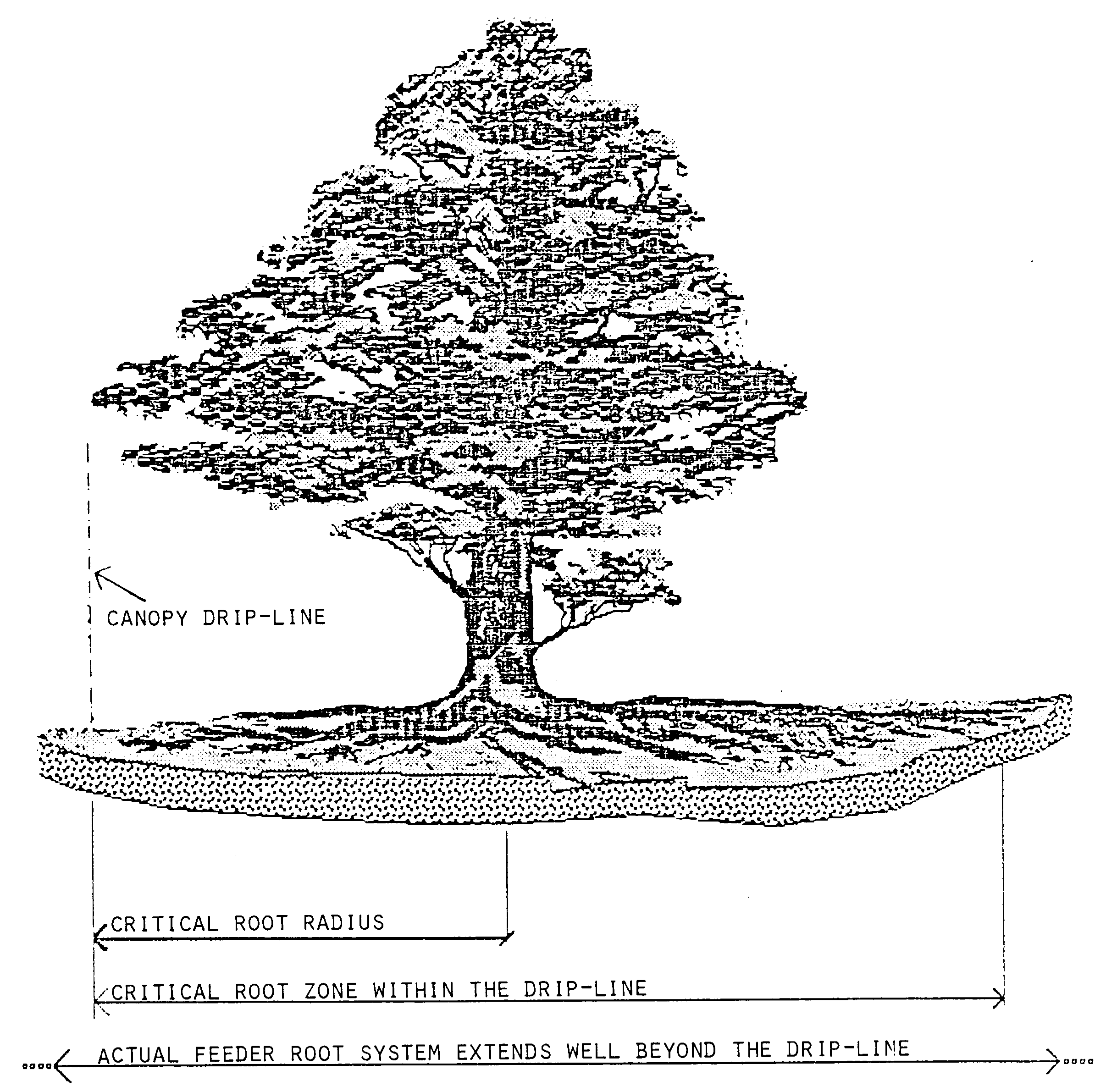
Crown dripline: The vertical line extending from the outer surface of a tree's branch tips down to the ground containing the tree's critical root zone (see Figure A).
DBH: Diameter-at-breast-height is a standard measure of tree size and is a tree trunk diameter measured 4 ½ feet above the ground. If a tree splits into multiple trunks below 4 ½ feet, then the trunk is measured at the point directly beneath the split.
EDF: Existing Density Factor (EDF) is the density of existing trees to be preserved on a site. The EDF is calculated by converting the diameter of individual trees to density factor units.
Land disturbance permit: An official authorization issued by the Department of Public Works, allowing defoliation or alteration of the site, or the commencement of any land disturbing activities.
Protected zone: All lands that fall outside the buildable area of a parcel, all areas of a parcel required to remain in open space, and/or all areas required as landscaping strips and/or buffers according to provisions of the City of Ball Ground Tree Protection Ordinance.
RDF: Replacement Density Factor (RDF) is the density of new trees necessary to meet the minimum Site Density Factor.
Revegetation: The replacement of trees or landscape plant materials into the minimum required landscape areas.
SDF: Site Density Factor (SDF) is the minimum tree density required to be maintained on a developed site.
Specimen tree: Any tree which has a diameter breast height of forty-two (42) inches or larger [see Subsection (D)(4)(d) of this section].
Tree: Any self-supporting woody plant, usually having a single woody trunk and a potential DBH of at least two inches.
Tree density factor: A unit of measurement used to prescribe and calculate required tree coverage on a site. Unit measurements are based upon tree size and are not equal to individual tree counts.
D.
Tree preservation and replacement. A tree protection and landscaping plan shall be submitted with all other permit drawings as part of the building permit process on any non-exempt parcel of land. Land disturbing activity includes any activity which may result in soil erosion from water or wind and the movement of sediments into state waters or onto lands within the state, including, but not limited to clearing, dredging, grading, excavating, transporting, and filling of land, excluding agricultural practices. The intent of these standards is to provide the necessary information to facilitate development project design, plan review, and enforcement processes in order that the provisions of the ordinance are administered in the most effective manner.
1)
No land disturbance permit shall be issued for projects/lots until the landscaping plan has been reviewed and approved by the Administrator. All tree protection measures shall be installed prior to land disturbance and no land disturbance permit shall be issued for full site development without it being determined that the proposed development is in compliance with the provisions of these regulations. This tree preservation plan may either be a separate drawing or part of the overall landscape plan and shall include the following information:
a)
The name of the project.
b)
The name of the owner and/or developer, including 24 hour contact.
c)
The location of proposed building(s) and corresponding dimensions.
d)
Spatial limits of land disturbance, clearing, grading and trenching.
e)
All required undisturbed buffers, landscape strips and parking islands.
f)
The location of all specimen trees or stands of specimen trees.
g)
The location of all hardwood trees with a DBH > 8" and softwoods with a DBH > 12".
h)
Areas of tree protection and revegetation and all relevant tree density calculations.
i)
The specific name and location of all materials to be planted or maintained on the site.
j)
Procedures and schedules for the implementation, installation and maintenance of tree protection measures including, but not limited to, detail drawings of protective tree fencing (both active and passive) including signage and erosion control measures.
k)
Planting and staking specifications.
2)
Grading for future site development shall be considered and regulated as timbering and mining unless site development plans are submitted and approved as per City platting regulations. Applications for tree cutting, clearing or clearing and grubbing shall be in accordance with current land disturbance permit plan review procedures and shall meet the following standards:
a)
The exterior boundary of the site shall have an undisturbed 50 foot buffer area. This buffer area shall remain undisturbed except for improved perpendicular access points, which may be no wider than 24 feet. Sites over 2 acres in size must retain a minimum of 50% of those trees with a DBH greater than 6 inches (inclusive of the required buffer).
b)
Submitted plans shall include the following information:
1)
Owner's name and address.
2)
Closed property boundary showing bearing and distances of all property lines.
3)
Limits of land disturbance activity.
4)
24 hour emergency contact name and phone number.
5)
Location of and detail for the truck exit (crushed stone pad).
6)
Delineation and labeling of all required buffer zones.
7)
Documentation of all existing trees with a DBH > 6".
c)
All timber harvesting activities shall be in accordance with the U.S. Clean Water Act, Section 404 and Recommended Best Management Practices for Forestry in Georgia.
3)
In the event that any tree on any nonexempt parcel of land shall be determined to be in a hazardous or dangerous condition so as to endanger the public health, safety or welfare, the tree may be removed upon the written authorization of the Administrator.
4)
The Site Density Factor (SDF) is the minimum tree density required to be maintained on a developed site based upon the total site area (see Table 106-3). This density requirement must be achieved whether or not a site had trees prior to development. The required unit density may be achieved by counting existing trees to be preserved, planting new trees, or some combination of the two.
TABLE 106-3 - MINIMUM TREE DENSITY CALCULATIONS
a)
Existing Density Factor (EDF) is the density of existing trees to be preserved on a site. The EDF is calculated by converting the diameter of individual trees to density factor units using Table 106-4.
TABLE 106-4 - DENSITY CREDIT FOR EXISTING TREES
b)
Replacement Density Factor (RDF) is the density of new trees to be planted on a site. Calculate the RDF by subtracting the EDF from the SDF. The density factor credit for each caliper size of replacement (new) trees is shown in Table 106-5. Any number or combination of transplantable size trees can be used so long as their total density factor units will equal or exceed the RDF.
TABLE 106-5 - DENSITY CREDIT FOR PLANTED TREES
c)
For additions to existing projects, the tree density requirements are calculated as noted above for only those areas in which new land disturbance is taking place.
Ex: Sample tree density calculation:
(1)
A 2.2 acre site has a Site Density Factor (SDF) of 2.2 x 20 = 44.
(2)
The Existing Density Factor (EDF) of trees to be preserved is calculated by converting the diameter of individual trees slated for preservation to density factor units as follows (all existing trees are assumed to be hardwoods):
(3)
Replacement Density Factor (RDF) calculates the minimum density of new trees to be planted by subtracting the EDF from the SDF:
(4)
Table B is used to determine the RDF as follows:
d)
Specimen trees warrant special consideration and encouragement for preservation. Specimen trees shall be protected from all construction activities by the placement of a tree save barrier fence (minimum 48 inch height orange mesh fence). The tree save barrier fence shall be located a minimum of five (5) feet outside the drip line of said specimen tree.
E.
Methods of tree protection.
1)
The protective zone for designated tree save areas shall include no less than the total area beneath the tree(s) canopy, as defined by the farthest canopy dripline of the tree(s).
2)
Construction site activities such as material storage, concrete washout, burnhole placement, etc., may not encroach into designated tree protective zones.
3)
No disturbance shall occur within the protective zone of specimen trees or stands of trees without prior approval by the Administrator.
4)
The use of tree save islands and stands is encouraged over the protection of individual (non-specimen) trees scattered throughout a site. This will facilitate ease in overall site organization, increase the effectiveness of protection measures and prevent pathology.
F.
Protective barriers.
1)
Prior to any land disturbance, active protective fencing shall be installed so that it surrounds the critical root zones of all protected tree zones.
2)
Active protective tree fences must be at least 4 feet high and may be either a wood and post construction or orange polyethylene laminar safety fencing.
3)
Passive forms of tree protection may be utilized to delineate tree save areas which are remote from areas of land disturbance. These area must be completely surrounded with continuous rope or flagging (heavy mill. minimum 4 inches wide).
4)
All tree protection zones (both active and passive) should be designated as such with "tree save area" signs posted visibly on all sides of the fenced area. These signs are intended to inform subcontractors of the tree protection process. Signs requesting subcontractor cooperation and compliance with tree protection standards are recommended for site entrances although the developer shall be held responsible for any violations found.
5)
All specimen trees or stands of trees, or otherwise designated tree protective zones must be protected from the sedimentation of erosion control. Silt screening must be placed along the outer uphill edge of tree protective zones at the land disturbance interface and shall be backed by twelve (12) gauge two (2) inch x four (4) inch wire mesh fencing in areas of steep slope.
6)
All tree fencing and erosion control barriers must be installed prior to and maintained throughout the land disturbance process and building construction and may not be removed until landscaping is installed.
G.
Vehicle use areas.
1)
Interior landscaping: Interior landscaping of parking lots shall contain planter islands located so as to relieve the expanse of parking, provide shading and channel water runoff. A maximum of 12 parking spaces in a row shall be permitted without a planter island. Planter islands shall have a minimum of 125 square feet in area and shall contain at least one non-pine species tree having at installation a minimum DBH of 2 inches and 10 feet in height. This requirement may be waived in those instances in which facing parking rows are separated by a continuous island at least five feet in width containing at least one tree every fifteen feet. The remaining area shall be landscaped with appropriate materials.
2)
Each area of the site which abuts public right-of-way (or improved accessways providing access to the interior of a development) must provide a planted border not less than 10 feet in width parallel to right-of-way lines (5 feet minimum for accessways). These planted border areas must have at least one tree having a minimum DBH of 2 inches for each 20 lineal feet of border area with a minimum of 2 trees if the strip is greater than 25 feet in length. Pine species are excluded from parking islands and along right-of-ways/accessways. The remainder of the planted area shall be landscaped with appropriate materials.
3)
Accessways. Landscaped border areas may be interrupted to provide perpendicular vehicular and/or pedestrian ingress and egress, maximum 24 feet wide.
4)
Encroachment. Landscaped areas shall require protection from vehicular encroachment. Car stops shall be located so as to prevent damage to any trees, fences, shrubs or landscaping by automobiles.
J[H].
Revegetation.
1)
The replacement of trees must occur if the EDF does not meet the calculated SDF. The quantity of replacement trees must be sufficient so as to produce a total site-tree density factor which meets the requirements established in subsection (D)(4)[ of this section]. (Note: the terms 'unit' and 'tree' are NOT interchangeable).
2)
Species selected for replacement must be quality specimens and ecologically compatible with the site. Table G lists those species of trees generally acceptable for credit in density calculations based upon use or need. The Administrator has information on trees and may accept alternatives to those listed in Table G. Pine species may only be planted in buffer or screening areas to the rear of the principal use and are specifically excluded from parking islands and along right-of-ways. No more than 50% of all new trees may be pine species, regardless of their planting location.
3)
Any portion of the subject property which is within a utility power easement is required to meet the height standards of the controlling entity. These areas may be required by the City to have additional vegetation installed to compensate for these restrictions, subject to approval from the Mayor and/or his/her designee.
4)
All trees and landscaping shall be installed in a sound workmanlike manner and according to accepted planting procedures with quality materials as provided in literature from the Georgia Forestry Commission or the Georgia Extension Service. All landscaping shall be completed within 6 months after the date of the issuance of the certificate of occupancy, however any required fencing shall be installed prior to issuance of the certificate of occupancy. Should the landscaping not be completed in this period, it shall be deemed a violation of this section.
5)
The owner, occupant, tenant or agent, shall be jointly responsible for the maintenance of all landscaping. Landscaping shall be maintained in a good condition so as to present a healthy, neat and orderly appearance at least equal to the original installation. Any dead vegetation and landscaping material or any damaged nonliving landscaping materials shall be promptly replaced.
K[I].
General landscaping requirements. Beyond tree protection and revegetation, the extent of permissible impervious surfaces and required landscaping are regulated through the standards of the controlling zoning district. Landscaping may include grass, hedges and trees as well as natural features. All site plans submitted for new construction or renovations to an existing building in which the construction costs exceed 51 percent of the building's appraised value as shown on the current tax records (subject to those exemptions specified in Subsection B[ of this section]) must contain a separate landscape plan which includes the following information:
1)
The name of the project.
2)
The name of the owner and/or developer.
3)
The location of proposed building(s) and corresponding dimensions.
4)
Spatial limits of land disturbance, clearing, grading and trenching.
5)
All required undisturbed buffers, landscape strips and parking islands.
6)
The location and listing of all specimen trees or stands of specimen trees.
7)
Areas of tree protection and revegetation and all relevant tree density calculations.
8)
The specific name and location of all materials to be planted or maintained on the site.
9)
Procedures and schedules for the implementation, installation and maintenance of tree protection measures including, but not limited to, detail drawings of protective tree fencing (both active and passive) including signage and erosion control measures.
10)
Planting and staking specifications.
11)
The percentage of the total lot containing impervious surfaces.
12)
The percentage of the total lot which shall remain undisturbed.
13)
The percentage of the total lot devoted to landscaping.
L[J].
Residential development requirements. Residential developments except RE and R-40 developments shall provide tree cover based upon the following:
1)
Developments shall provide a total of 15 trees per acre as applied to individual lots based upon the proportional lot size. Example: ½-acre lot would provide 7.5 trees.
2)
Minimum tree size to be considered for existing trees shall be 5-inch caliper.
3)
Minimum tree size to be considered for newly planted trees shall be 2.5-inch caliper.
M[K].
Acceptable tree species. Table 106-6 denotes those species of trees which may be incorporated for full credit towards the tree replacement requirements of paragraph (D)[Subsection D of this section]. Other trees may be approved on a case by case basis provided they are large growing and ecologically compatible with the site. Revegetation plans containing at least ten new trees must incorporate at least three separate tree species with no single tree species accounting for more than 50% of all newly planted trees. Pine trees can be utilized for screening and buffer areas only. All planting and replanting plans are subject to approval through the Administrator.
TABLE 106-6 - TREE SPECIES SELECTION LIST
N[L].
Enforcement, violations and penalties. Enforcement of the provisions of this section shall be the responsibility of the Mayor and/or his/her designee. If, after inspection of a project by the Mayor or their[and/or his/her] designee, the plan materials installed on the site do not comply with the approved plan, such deficiencies shall be noted in writing. If the Administrator deems the deviations from the approved plan acceptable, they will so note, and the owner, occupant, tenant, and/or representative will be required to submit promptly a revised plan showing the actual plantings. This revised plan will be placed on file with the Mayor and/or his/her designee. If after inspection, the mayor or their designee determines the site does not comply with the approved plan and further determines it to be unacceptable, the owner developer, occupant, tenant and/or respective agent shall be notified in writing by the Mayor or their[and/or his/her] designee of said violations and given 30 days in which to correct all violations. Failure to make such corrections shall be a violation of this section.
O[M].
Appeal. The Board of Zoning Appeals shall have the authority and duty to consider and act upon any application submitted for adjustment of standards provided herein.
FIGURE 106-1. CRITICAL ROOT ZONE FOR TREE PROTECTION