
Bannock County Unincorporated
City Zoning Code
City Zoning Code
CHAPTER 17
52 - GENERAL REGULATIONS
17.52.010 - Applicability.
This chapter shall be known as the general regulations. These regulations apply to all districts and uses, except as specifically provided herein, in addition to other provisions of the zoning ordinance.
(Ord. 1998-1 § 400)
17.52.020 - Authorization.
Except as otherwise expressly provided or limited by this title, accessory structures and uses are permitted in any zoning district in connection with any principal use lawfully existing within such district. Any question of whether a particular use is permitted as an accessory use by the provisions of this article shall be determined by the planning director pursuant to his or her authority to interpret the provisions of this title.
(Ord. 1998-1 § 401 (part))
17.52.030 - Zoning certificate required.
No accessory use or structure shall be established or constructed unless a zoning permit evidencing the compliance of such use or structure with the provisions of this section and other applicable provisions of this title shall have first been issued in accordance with Section 17.56.050.
(Ord. 1998-1 § 401 (part))
17.52.040 - Use limitations.
In addition to complying with all other regulations, no accessory use shall be permitted unless it strictly complies with the following restrictions:
A.
In the case of all commercial and industrial uses: Accessory structures shall maintain the same minimum front, side and rear yard as is required for the principal structure.
B.
Setbacks. The minimum distance between a residential accessory structure and the principal structure shall be as set forth in the Building Code Ordinance of Bannock County.
C.
Accessory structures and uses shall comply with all applicable area, bulk, and yard regulations.
D.
Residential accessory uses and buildings shall be:
1.
Definition. A residential accessory building is an accessory building on a residential lot such as a shop, garage, or storage building.
2.
When Permitted. Residential accessory uses and buildings shall be permitted after or concurrent with the development of the primary use. One personal storage building may be permitted on a residential lot in the AG, RR, RS and REC zoning districts prior to the issuance of a permit for the primary residence.
3.
Design Requirements. Residential accessory uses and buildings must be compatible in design with the primary use.
4.
Size. The total area of structures on a lot, including the principal building, shall not exceed thirty-five (35) percent of the total lot area. The maximum height of a residential accessory building shall be as shown in the district bulk and placement tables.
5.
Application Procedure. Applications for a residential accessory building must include a detailed site plan of the proposal and demonstrate that the proposed layout meets all requirements of the zoning ordinance.
(Ord. 1998-1 § 401 (part))
(Ord. No. 2011-3, § 1, 10-19-11; Ord. No. 2013-2 , § 1, 3-20-13; Ord. No. 2013-3 , § 1, 3-20-13; Ord. No. 2014-1 , § 1, 5-28-14; Ord. No. 2019-08 , § 1, 10-22-19)
17.52.050 - Accessory use regulations for commercial stables.
The following minimum setbacks shall be provided:
A.
Stables, corrals, piles of manure, and bedding shall be located a minimum distance of seventy-five (75) feet from any street or nonresidential lot line and one hundred (100) feet from any residential lot line, in order to minimize odor and nuisance problems.
B.
Manure piles shall be stored, removed and/or applied in accordance with health department regulations; however, manure shall not be applied on land that is closer than one hundred (100) feet to a residential lot line.
(Ord. 1998-1 § 401 (part))
( Ord. No. 2013-2 , § 1, 3-20-13)
17.52.060 - Accessory use regulations for private swimming pools and tennis courts.
A.
Pools and courts, including but not limited to aprons, walls and equipment rooms, shall not protrude into any required setback.
B.
Pools shall be fenced or otherwise protected against intrusion.
C.
Pools shall not be operated as a business or a private club, unless they are part of a planned unit development or otherwise permitted by the zoning ordinance.
(Ord. 1998-1 § 401 (part))
17.52.070 - Detailed accessory use regulations—Residence for commercial caretaker or watchman.
A.
One single-family residence for a caretaker, owner, operator, manager, or watchman and his immediate family is permitted as an attached or detached dwelling for any commercial or industrial use such as kennel, stable, or veterinary clinic for purposes of security and protection of the principal use.
B.
The standards applicable to a commercial caretaker's residence shall not differ from those imposed by this title on any other housing unit of the same type, except the minimum lot size requirement.
(Ord. 1998-1 § 401 (part))
( Ord. No. 2013-3 , § 1, 3-20-13)
17.52.075 - Temporary dwelling for dependent persons.
Upon written request of the owner of the affected property and for which this is a request for their personal situation, the Board of Bannock County Commissioners may allow the placement of one temporary dwelling in excess of that permitted within the property's zoning designation contingent that other building and zoning requirements are met. The applicant's request must explain why the existing dwelling on the property is inadequate for the care of a dependent person, must establish that the dependency is the result of the physical or health needs of the dependent, and that other provisions of this title will not allow the placement of the additional dwelling on the affected property.
If the Board of Bannock County Commissioners finds that the request meets these standards and the dwelling is required to provide regular care for the dependent person, the Board of Bannock County Commissioners may grant the applicant's request upon the condition that the approval must be reconsidered annually. For annual renewal of the temporary dwelling, the Board of Bannock County Commissioners must find that the facts supporting original approval still exist.
Building or installation permits and compliance with setbacks are required for temporary dwellings. Dwellings approved under the provisions of this section shall be no further than one hundred (100) feet from the existing residence. If it is physically impractical to locate the home within one hundred (100) feet of the existing residence and the applicant can provide proof of this to the planning department, the distance to the new temporary home may exceed the one hundred (100) foot limit, but the new home must be located as close as is physically practical to the existing residence.
( Ord. No. 2013-3 , § 1(401.H), 3-20-13)
17.52.077 - Accessory cottage dwelling.
The intent of this section of the title is to enable the placement of one accessory housing unit, either attached or separate from an existing principal dwelling, on parcels that are not eligible for additional new dwelling permits, provided that such accessory housing is not rented or occupied for gain. Accessory cottage dwellings shall be limited to the residential rural, residential suburban, and recreation zoning districts and shall be permitted with staff review and approval of the site plan. In the event there is a conflict with any other adopted codes, such as the building code, the more restrictive shall apply. The following minimum requirements shall apply to accessory cottage dwellings:
A.
One accessory cottage dwelling is permitted on parcels within the residential rural, residential suburban, and recreational zoning district provided the building bulk and placement standards and all other provisions related to residential buildings are met.
B.
The accessory cottage dwelling shall not be rented or occupied for gain.
C.
The accessory cottage dwelling shall be installed as real property with a permanent foundation.
D.
Septic system and domestic water supply for an accessory cottage dwelling shall be inspected and approved by the appropriate agency.
E.
The maximum separation between the principal dwelling and the accessory cottage dwelling shall be one hundred (100) feet unless it is physically impractical to do so, in which case it must be located as close as is physically practical to the principal dwelling.
F.
The accessory cottage dwelling shall use the same driveway approach and address.
G.
A deed restriction shall be recorded prior to issuance of a building permit indicating that the accessory cottage dwelling shall forevermore be tied to the principal building and shall not be separated or put on its own parcel for sale or any other purpose.
( Ord. No. 2014-1 , § 1(401.H), 5-28-14)
17.52.080 - Authorization.
Temporary uses are permitted only as expressly provided in this article. Temporary uses not set forth herein may be considered on an individual basis by the planning director. Appeals of the planning director's decision may be made to the planning and development council.
(Ord. 1998-1 § 405 (part))
17.52.090 - Zoning permit required.
No temporary use shall be established unless a zoning permit evidencing the compliance of such use with the provisions of this article and other applicable provisions of this title shall have first been issued.
(Ord. 1998-1 § 405 (part))
17.52.100 - Particular temporary uses permitted.
The following are temporary uses which are subject to the following specific regulations and standards, in addition to the other requirements specified in this title:
A.
Carnival or circus, fireworks stands:
1.
Permitted in any commercial general, LIW, or industrial district,
2.
Maximum length of permit shall be fifteen (15) days,
3.
No structure or equipment within five hundred (500) feet of any residential property line;
B.
Christmas tree sales:
1.
Permitted in any district,
2.
Maximum length of permit for display and open-lot sales shall be forty-five (45) days;
C.
Contractor's office and construction equipment sheds:
1.
Permitted in any district where use is incidental construction project,
2.
Maximum length of permit shall be one year,
3.
Office or shed shall be removed upon completion of construction project;
D.
Events of public interest:
1.
Permitted in any district, except RS and RR,
2.
Events may include but are not limited to outdoor concerts, auctions, snowmobile events, and the like;
E.
Real estate sales office:
1.
Permitted in any district for any new subdivision approved in accordance with Bannock County subdivision regulations. A model home or mobile home may be used as a temporary sales office,
2.
Maximum length of permit shall be one year,
3.
The planning and development council may grant one-year extensions for cause,
4.
Office shall be removed upon expiration of the permit;
F.
Religious tent meeting:
1.
Permitted in any district,
2.
Maximum length of permit shall be thirty (30) days;
G.
Seasonal sale of farm produce:
1.
Permitted in A, RS, RR, MU and REC districts on parcels having a minimum area of one acre and a minimum road frontage of one hundred (100) feet,
2.
If the site is used for growing a minimum of fifty (50) percent of the farm produce sold, the owner or operator of the site may import a maximum of five farm produce products not grown on the site for seasonal sale.
If the site has a minimum area of four acres and a minimum road frontage of three hundred (300) feet, the owner or operator of the site may import a maximum of ten farm products not grown on the site for seasonal sale,
3.
Maximum length of permit shall be for six months of each calendar year,
4.
Sales area, including the produce stands, shall be set back a minimum of thirty (30) feet from the nearest right-of-way of any street or highway. Entrances and exits to the parking lot shall conform to restrictions set forth in Bannock County's design standards for public roads;
H.
Horse show or exhibition: Permitted for any commercial or private stable for special events, including but not limited to shows, exhibitions and contests;
I.
Tent theater:
1.
Permitted in any district, except RS,
2.
Maximum length of permit shall be one month per calendar year.
(Ord. 1998-1 § 405 (part))
17.52.110 - Other temporary uses.
Proposed temporary uses not specified in Section 17.52.100 shall only be permitted if they meet the following requirements:
A.
They cannot cause traffic congestion;
B.
There must be adequate off-street parking space provided for the use;
C.
They cannot disrupt the tranquility or character of a residential neighborhood;
D.
The maximum length of permit is six months in any one calendar year;
E.
They must meet all building bulk and placement standards required of permanent uses in each zone.
(Ord. 1998-1 § 405 (part))
17.52.120 - Additional regulations.
All temporary uses shall be subject to the following:
A.
Documentation must be provided from the health department that adequate arrangements for temporary sanitary facilities have been ensured, except where not deemed necessary by the planning and zoning director.
B.
No permanent or temporary lighting shall be installed without an electrical permit and inspection.
C.
All uses shall be confined to the dates specified in the permit.
D.
Hours of operation shall be confined to those specified in the permit.
E.
The site shall be cleared of all debris at the end of the special event and cleared of all temporary structures within thirty (30) days after the closing event. A performance bond for a minimum of twenty-five thousand dollars ($25,000.00) shall be posted or a signed contract with a disposal firm shall be required as a part of the application for a zoning certificate to insure that the premises will be cleared of all debris during and after the event.
F.
Public parking for the exclusive use of the facility shall be provided, and a stabilized drive to the parking area shall be maintained. It shall be the responsibility of the applicant to guide traffic to these areas and to prevent patrons from unlawful parking.
G.
Traffic control arrangements required by the Bannock County sheriff's department in the vicinity of major intersections shall be arranged by the applicant.
H.
Proof of insurance for the temporary use shall be provided to the planning director by the applicant for all uses except the following:
1.
Construction office;
2.
Real estate sales office;
3.
Seasonal sale of farm produce;
4.
Recreational vehicle permitted in Section 17.52.250(C).
(Ord. 1998-1 § 405 (part))
( Ord. No. 2013-2 , § 1, 3-20-13)
17.52.130 - Parking requirements—Applicability.
The standards set forth in this article shall apply to the construction and use of buildings and land respectively as outlined below:
* Proportionate compliance is a requirement that the marginal difference in the parking requirement must be met to the extent that the use or area is changed.
(Ord. 1998-1 § 411)
17.52.140 - Parking requirements generally.
Every building or portion of a building hereafter erected shall be provided with permanently maintained off-street parking spaces as provided in this article. The parking spaces shall remain available for the use of building occupants or customers for the duration of the building occupancy. The terms of parking utilization shall be disclosed by a land owner at the time of the building and zoning permit request and shall be made part of any permit issued in accord with the terms of this title.
(Ord. 1998-1 § 412)
17.52.150 - Parking lot design requirements.
Lots for parking six or more cars, in all but the residential zones, shall conform to the standards established by this section. The office of planning and development services may make minor modification in the standards contained in this section to avert unreasonable practical difficulties resulting from literal application of the requirements of this section. Variation from the stated standard by five percent or more shall require a variance as described in Article VIII of Chapter 17.56. The following requirements shall apply to all required parking lots for six or more cars in all zoning districts except residential.
A.
Lots shall be designed to facilitate convenient traffic circulation on-site and at junctions of public streets and parking lot circulation lanes.
B.
Entry and exit from parking spaces should be convenient and safe and should not disrupt traffic on public streets.
C.
Maneuvering space for the entry to and exit from parking spaces shall be provided within the parking lot area rather than within a public right-of-way.
D.
Parking spaces shall have a nine-foot effective width and an eighteen (18) foot length, and an eight-foot effective width and sixteen (16) foot effective length for compact car spaces.
E.
When the planning director deems it necessary, parking lots shall be equipped with appropriate drainage control measures to minimize the effects of stormwater on public drainage systems. Drainage plans shall be submitted to the planning director upon request.
F.
Parking lot areas shall be maintained in a dust-free condition.
G.
Parking lot landscaping areas shall be protected from damage by vehicles.
H.
Handicapped parking spaces shall be provided in all parking lots of twenty-five (25) spaces or more. Handicapped parking spaces shall be provided in locations which are most convenient to building entrances. Handicapped parking spaces shall be 1.5 times as wide as normal parking spaces. The ratio of handicapped to regular parking spaces shall be determined by the Americans with Disabilities Act as amended.
I.
Parking lot placement shall comply with standards set forth in each respective zone standards in Chapter 17.08.
J.
Size and location of directional signs shall be subject to approval of the office of planning and development services.
K.
Lighting of parking lots shall be accomplished in a manner which complies with Section 17.52.480 (zoning ordinance Section 475.10), lighting, and does not disturb adjacent land uses with unnecessary light. Lighting shall avoid conflict with traffic and shall not intrude upon adjacent land uses. Parking areas shall be designed to avoid conflict with nearby vehicle traffic.
L.
Parking space boundaries and directional traffic arrows shall be marked on the parking lot surface unless waived for cause by planning and development services.
M.
Parking areas shall be screened from adjacent residential uses by a solid fence or dense, sightproof hedge unless waived for cause by planning and development services.
N.
Signs which identify parking lot usage terms and conditions may be required by planning and development services.
(Ord. 1998-1 § 413)
( Ord. No. 2013-2 , § 1, 3-20-13)
17.52.160 - Joint use of parking facilities.
The shared use of parking facilities by occupancies which have complementary times of use may be permitted by the office of planning and development services. Planning and development services may require alternative plans prior to approving a joint-use agreement and a guarantee of performance should the joint-use agreement appear temporary in nature. A grant of permission for joint use of parking facilities may be conditional by planning and development services based upon circumstances surrounding the uses involved. Written agreements must be in place between the parties sharing parking before approval may be granted for a joint parking agreement. Appeals from the planning and development services decision may be made directly to the planning and development council.
(Ord. 1998-1 § 414)
17.52.170 - Parking standards for land uses.
A.
Parking spaces shall be provided for all land uses governed by this title. Exemption shall be permitted only for existing lawful nonconforming uses or for uses in zoning districts which have common parking arrangements. Parking space provision shall be worked out to the satisfaction of planning and development services prior to issuance of a zoning permit.
B.
In parking areas where up to thirty (30) spaces are required, all spaces shall be full-sized spaces. For uses requiring from thirty-one (31) to one hundred (100) spaces, fifteen (15) percent of the spaces may be sized for compact cars. For uses requiring over one hundred (100) spaces, thirty (30) percent of the spaces to be provided may be sized for compact cars. In all instances, compact car spaces shall be prominently identified as such by a clearly legible method of marking.
C.
The following table sets forth the parking space requirements for land uses within the jurisdiction of this title:
D.
Uses Not Listed in Code. When a land use is not listed in the table in subsection C of this section, the parking space requirements shall be determined by the office of planning and development services based upon comparison with similar uses and evaluation of possible parking demand associated with the use contemplated. The decision of planning and development services may be appealed to the planning and development council in matters of parking space requirements.
(Ord. 1998-1 §§ 415, 416)
17.52.180 - Parking lot landscaping.
A.
Parking lot landscaping shall be provided where required by this title. It shall be maintained in a growing and healthful condition from the date of building occupancy. A sprinkling system shall be provided for all lots for more than thirty (30) cars. All nursery stock shall be healthy. Deciduous trees shall be at least one inch in caliper. Evergreen trees shall be at least three feet in height. Shrubs shall be five gallons in size.
B.
In commercial general zones, and for commercial general uses in MU zones, interior parking lot landscaping shall cover at least five percent of the total parking lot area for lots with fifteen (15) or more parking spaces. One shade tree of at least one and one-half inch caliper shall be planted for every one hundred fifty (150) square feet of the interior lot landscaping. All land in the area designated for landscaping shall be covered by growing plants. Rocks and other nonliving materials may be used only for accent in landscaping areas. Plans showing location, size and type of plant materials for landscaping in parking areas shall be provided when application is made for a building permit.
(Ord. 1998-1 § 417)
17.52.190 - Applicability.
This article shall apply to the use and placement of all manufactured housing outside mobile home parks.
(Ord. 1998-1 § 420 (part))
17.52.200 - Definition.
Manufactured housing is housing mass-produced in a factory and designed and constructed for transportation to a site of installation and long-term use when connected to required utilities; constructed on a chassis; and must meet the following standards as originally manufactured:
A.
The manufactured housing unit must be certified as meeting the National Manufactured Home Construction and Safety Standards as administered by the U.S. Department of Housing and Urban Development, and built after June 15, 1976;
B.
Shall be anchored to a permanent perimeter foundation in a manner that conforms to the building code and is approved by the county building official;
C.
Shall have siding which is characteristic of site-built houses. Such siding includes wood siding, horizontal lapped (clapboard), masonite, T-111 plywood or wood shakes. Vertical lapped metal siding and other sidings not customarily used on site-built single-family houses is prohibited;
D.
Shall have a pitched roof constructed to withstand minimum snowloads for its placement area as determined by the building code. Pitch of the roof shall be a maximum of fifty-five (55) degrees inside angle. The roof shall be finished with materials which give the appearance of a roof on a site-built house.
(Ord. 1998-1 § 420 (part))
( Ord. No. 2013-2 , § 1, 3-20-13)
17.52.210 - Residential use.
After obtaining the proper permits, including, but not necessarily limited to, a building permit and zoning permit, a manufactured housing unit meeting the standards in Section 17.52.200 may be placed on a lot and used as a single-family residence permanently or temporarily in any zoning district in which single-family residential uses are permitted. When applying for a zoning permit, the applicant shall provide a photo of the manufactured home and evidence that the unit meets the other standards as may be requested by the planning or building official.
(Ord. 1998-1 § 420.1)
17.52.220 - Permitted nonresidential use.
Manufactured housing as defined in Section 17.52.200 and meeting the standards in Section 17.52.200 may be permitted in conjunction with permitted nonresidential uses in any zoning district, either as the principal building or as an accessory building.
(Ord. 1998-1 § 420.2)
17.52.230 - Other applicable regulations.
All other requirements and standards of this title, and those of the Idaho Division of Building Safety, shall apply. Where a conflict exists, the more restrictive requirement shall apply.
(Ord. 1998-1 § 420.3 (part))
( Ord. No. 2013-2 , § 1, 3-20-13)
17.52.240 - Agricultural zone.
Manufactured housing units not meeting standards in Sections 17.52.190 and 17.52.200 may seek a design deviation regarding siding and roof for placement in the agricultural zone only. The planning director may grant the design deviation at his or her discretion. Minimum requirements for a design deviation are:
A.
The manufactured home site shall be screened on four sides at the property line or at one hundred (100) feet from the manufactured home, whichever is shorter. The screening will comply with standards set forth in Section 17.52.320, and must be in place before an occupancy permit is issued. The land owner may elect to site the manufactured home to take advantage of existing screening. If trees are used as screening, fire suppression and prevention measures must be taken by the owner.
B.
If the manufactured home is placed in any city's area of impact, that city's planning official will be invited to make recommendations on the screening or buffering and other placement design details.
C.
Other requirements may be imposed which will promote aesthetics and protect neighboring land values.
D.
The manufactured home, if manufactured prior to 1977, shall be certified as rehabilitated according to Idaho Code Title 44 Chapter 25.
(Ord. 1998-1 § 420.3 (part))
17.52.250 - Temporary use.
A manufactured house or a recreational vehicle containing a kitchen and a bathroom may, at the discretion of the planning director, be used as a temporary residence while a permanent site-built residence is under construction, or during rehabilitation due to fire or other natural disaster, if the applicant is able to obtain a building permit for construction of a permanent residence.
A.
Separate building and zoning permits shall be required for the temporary unit. Such temporary placements shall not be placed prior to the permanent home having passed the building inspection for the foundation or basement walls.
B.
The building permit authorizing the construction of the permanent residence and the permit authorizing the use of the manufactured home as a temporary residence shall become null and void if work on the permanent residence is suspended or abandoned for a period of one hundred eighty (180) days.
C.
Within no more than twelve (12) months from the date the permit is issued for the temporary residence, the manufactured housing unit or recreational vehicle shall be vacated and removed from the premises and the premises shall be rehabilitated so as to remove all evidence of the prior presence of the manufactured home or recreational vehicle. If for reasons beyond the applicant's control, he or she is unable to complete the permanent residence within one year, the planning and development council may grant one, one-year extension of the temporary placement.
(Ord. 1998-1 § 420.4)
17.52.260 - Purpose.
Home occupations are commercial activities permitted in zones where the principal uses are not commercial. Permitting home occupations introduces flexibility into the zoning ordinance by allowing people to conduct a business from their home. In order to ensure that the business activity does not change the character of a residential neighborhood or interfere with the pursuit of the principal uses permitted in the zone, limitations are placed on the scope and intensity of the business activity. The following provisions are intended to further that purpose.
(Ord. 1998-1 § 424 (part))
17.52.270 - Conditions of use.
Home occupations shall be permitted in RR, RS and REC zoning districts subject to the conditions set forth as follows:
A.
Business activity must be secondary to primary use of a dwelling and must not consume over six hundred (600) square feet or twenty (20) percent of the gross floor area of the dwelling, whichever is less.
B.
The limited business activity shall not change the character of the dwelling.
C.
An accessory building may be used to house a home occupation, provided the home occupation does not subject abutting property to noticeable odors, sounds, dust or debris. The accessory building must comply with the definition of residential accessory buildings in Article I of this chapter.
D.
Any work operations connected with a home occupation shall be conducted inside the dwelling or within the accessory building.
E.
Where a home occupation serves as an office for a business using heavy equipment or substantial accessory business inventory, no such equipment or inventory materials shall remain or be stored upon the site in question for more than twelve (12) hours unless it is fully enclosed by a building or solid fence deemed satisfactory by the planning and zoning director. No hazardous materials shall be stored on the property.
F.
A home occupation shall not use mechanical or electrical equipment of a heavier nature than is typical for household use.
G.
A home occupation shall not place any display in a yard or window which would indicate a business is being conducted at the address.
H.
A sign for a home occupation shall not exceed four square feet in size, shall be flat-mounted on the dwelling, and shall not be directly illuminated. Signs on business vehicles, regardless of their storage location, shall not display the address of the home occupation.
I.
Only one home occupation business-related vehicle may be kept at the residence overnight. It shall be no larger than a one-ton nominal rating.
J.
Activities on-site shall be conducted no earlier than eight a.m. or later than nine p.m.
K.
Activities associated with a home occupation should not cause more than incidental on-street parking.
L.
No more than one nonresident of the household shall work on-site in a home occupation.
(Ord. 1998-1 § 424 (part))
17.52.280 - Applicability—Regulations generally.
The following regulations shall apply to fences constructed within all zones except agricultural zones.
A.
All electrical fences shall be UL [tm] approved.
B.
No solid fence greater than three feet in height may be constructed within the required front setback.
C.
The following additional regulations shall specifically apply to corner lots within the county:
1.
No solid fence or walled enclosure greater than three feet in height shall be constructed from the corner of an intersection (intersection of legal right-of-way lines) in each direction for a distance equal to the required setback, nor may any structure, hedge, shrub, tree or other growth be permitted which is over three feet in height within the triangular area so bounded.
2.
If the rear lot line of the corner lot abuts a side property line of a lot facing the side road, the side building setback for the corner lot shall apply to any solid fence greater than four feet in height.
3.
The diagrams set out in Section 17.52.300 demonstrating fence limitations on corner lots are adopted and made a part of this title.
(Ord. 1998-1 § 425)
17.52.290 - Exceptions.
Exceptions to these regulations may be considered by the planning and development council and may be approved upon a showing that the proposed fence will not create traffic problems for the general public or any neighboring property owner, and will not be incompatible with the neighborhood where erected.
(Ord. 1998-1 § 428)
17.52.300 - Diagrams of fence locations (sight triangles).
A.
The following depicts permitted fence locations (for a solid fence over three feet in height) on residential corner lots which are back-to-back with neither building fronting on the side roads, where both roads are local roads:
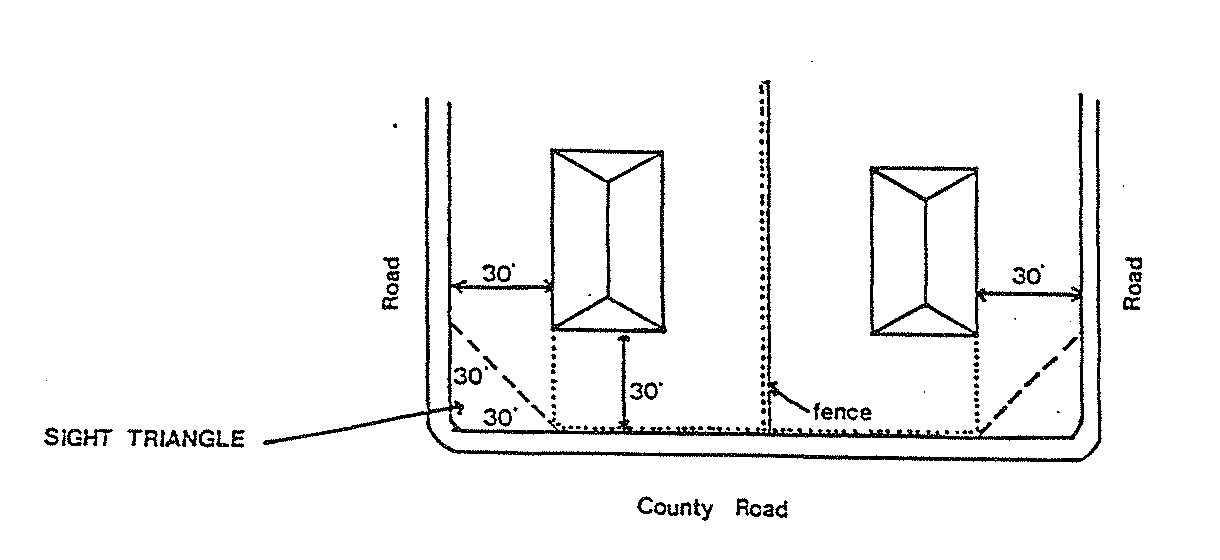
Arterial or collector roads: increase the thirty (30) feet to fifty (50) feet.
B.
The following depicts permitted fence locations (for a solid fence up to seven feet in height) on a corner lot where the rear lot line of the corner lot borders a lot on which a building faces the side street where both roads are local roads: Arterial or collector roads: increase the thirty (30) feet to fifty (50) feet.
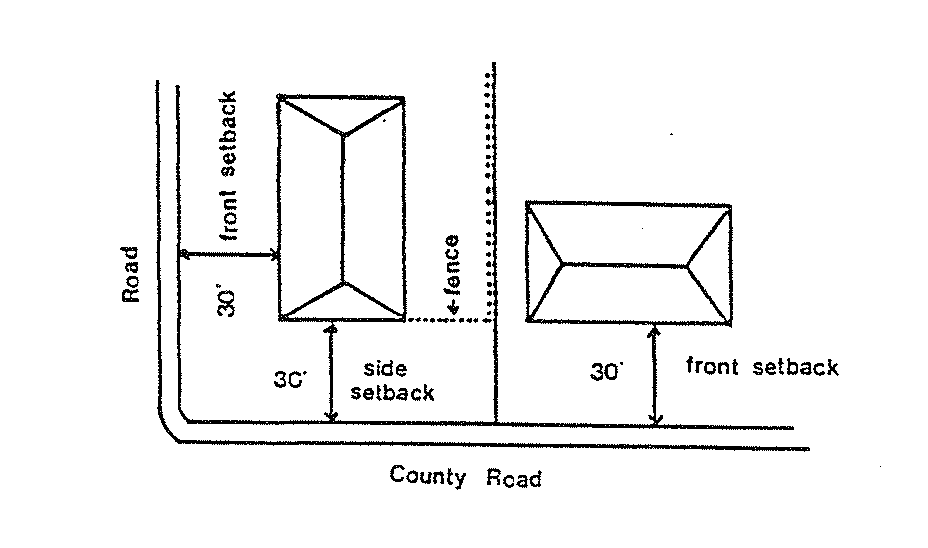
(Ord. 1998-1 § 429)
17.52.310 - Screening requirements.
Screening meeting the minimum standards of Section 17.52.320 shall be provided by the following uses when located on sites as identified below:
A.
Manufactured homes not meeting the standards in Section 17.52.200, mobilehome parks, multiple-family development, and institutional housing. Each use shall provide screening at the property line when abutting any residential district or existing single-family residential uses;
B.
Nonresidential uses except agriculture. Each use shall provide screening at the property line where abutting any residential district or existing residential uses.
(Ord. 1998-1 § 435)
17.52.320 - Screening standards.
A.
All fence and screening materials and design require a zoning permit.
B.
Screening shall be provided by installation and maintenance thereafter of a visual screen or buffer of one of the following types:
1.
A berm or solid wood or masonry fence or wall at least six feet in height;
2.
A hedge-like screen of trees or shrubs capable of attaining a minimum height of six feet within three years. Said plant materials shall be planted closely together enough to form a branch-to-branch site-obscuring buffer within five years. The planning director shall approve all plant material used for screening;
3.
All such trees or shrubs shall be watered and maintained in a healthy, growing condition and shall be replaced with living plant materials of similar size and type if they die.
(Ord. 1998-1 § 436)
17.52.330 - Agricultural operations generally.
A.
All farms and ranches in existence upon the effective date of the ordinance codified in this title shall be permitted uses. However, all regulations contained herein and other county ordinances in effect shall apply to all changes of the farming and ranching operation which will cause it to become more intensive. The person who effects any change in an agricultural operation, not located in an A district, that the planning director deems an intensification of use, shall be required to obtain a zoning permit for a minor change, or a conditional use permit for a major change. The planning director shall determine whether a change is minor or major. Setback and other regulations shall apply to farming operations just as they do to urban developments.
B.
Commercial farm operations may include necessary accessory uses for treating, storing or processing farm market products; provided, however, that the operation of any such accessory uses shall be secondary to that of the primary agricultural activity.
C.
The board of commissioners may require any farm operation not located in the agricultural district to secure a conditional use permit to continue said operations in the event of the following:
1.
A nuisance on a farm is adjacent to or within two hundred (200) feet of any property line and may be detrimental to living conditions by emitting noise, odor, vibrations, hazards to safety, and the like. Idaho Code Right to Farm Act shall apply to this section;
2.
The farm operations are so intensive as to constitute an industrial-type use consisting of the compounding, processing and packaging of products for wholesale or retail trade and further that such operations may tend to become a permanent industrial-type operation that cannot normally be terminated as can a typical farming operation. Excessive trucking operations shall be considered an intensive use.
(Ord. 1998-1 § 460)
17.52.335 - Voluntary transfer of development rights.
To protect the agricultural, natural, and scenic qualities of open lands, to enhance sites and areas of special character or special historical, cultural, aesthetic or economic interest or value, and to enable and encourage flexibility of design and careful management of land in recognition of land as a basic and valuable natural resource. The preservation and maintenance of these resources will be ensured by encouraging countywide land use planning through the transfer of development rights from parcels suitable for preservation to properties meeting the criteria for development as receiving parcels.
Before you can transfer a development right, the following requirements must be met:
A.
The transfer of development rights must be wholly voluntary.
B.
That the "sending" and "receiving" properties are within the agricultural zone.
C.
That the "receiving" property does not qualify for a development right.
D.
That the "receiving" property otherwise meets all of the requirements for development as outlined in Bannock County ordinance.
E.
That the "sending" property does qualify for a building permit.
F.
That the transfer of the right from the "sending" property would preserve prime farm ground, eliminate residential structures in undesirable locations including flood plains and steep slopes, would preserve open space, or preserve land that is critical to wildlife habitat.
G.
The applicant will be required to place a restriction on the deed for the "sending" parcel.
Application for a transfer of development rights will be made on forms provided by the county. The applicant shall provide the county with:
A.
The most current recorded deeds for the "sending" and "receiving" properties.
B.
A metes and bounds description of the "sending" and "receiving" properties if the "sending" property is part of a larger parcel, the legal description of just the "sending" area shall be provided. The "sending" property does not have to be subdivided from the larger parcel.
C.
Title search completed within thirty (30) days of application.
D.
Approval from lienholders, if applicable. In the event a development right is transferred without the consent of all lienholders, Idaho Code makes the transfer void ab initio.
The application must be complete before it can be accepted by the planning department. The planning department reserves the right to hold, but not officially accept the application until total review is accomplished and all required information is submitted. The planning department shall have the authority to require additional specific information relevant to the consideration of any application.
Once the planning department has received the required documents and information an agreement will be drafted. The applicant shall review the agreement, and if no issues are found, return a signed copy to the planning department. The planning department will present the signed agreement to the county commissioner for approval at a regularly scheduled public meeting.
( Ord. No. 2019-02 , § 3(465), 1-22-19)
17.52.340 - Purpose.
The purpose of these requirements is to keep to a minimum the negative impacts of nonconforming uses on surrounding permitted uses, and to eliminate those nonconforming uses which are most detrimental to the health, safety and welfare of persons living in residential zoning districts.
(Ord. 1998-1 § 470 (part))
17.52.350 - Requirements generally.
A.
Unless otherwise set forth in this title, legally established uses which were in existence prior to the adoption of the ordinance codified in this title shall be permitted to remain, substantially unchanged, as long as their operation is not discontinued for a period of time greater than twelve (12) months.
B.
Permits to expand existing and/or operating nonconforming uses by up to fifty (50) percent in land and/or building area may be sought through the conditional use permit process regardless of the underlying zone. Cumulative expansion of fifty (50) percent or greater shall not be permitted. Expansion of nonconforming uses by conditional use permit shall be allowed only when the use in existence can be made sufficiently compatible with its surroundings and if its expansion in its current location is consistent with the goals of the comprehensive plan. Interior remodeling which does not change the nature or extent of a nonconforming use is permitted. Any modification which will affect site development of a nonconforming use, e.g. parking spaces, traffic circulation, accesses, landscaping removal, etc., shall require a conditional use permit application.
C.
A nonconforming use may only be changed to a use permitted in the district in which it is located, except that if no structural alterations are made, a nonconforming use of a building may be changed to another nonconforming use of a more restrictive classification, and provided such change is approved by the planning director. Once changed to a conforming use, no building or land shall be permitted to be changed to a nonconforming use.
D.
The planning director may allow a change of one nonconforming use to another nonconforming use only upon determination that the proposed new use will be less detrimental to its neighborhood and surroundings than is the use it is to replace. In determining relative detriment, the planning director shall take into consideration, among other things: traffic generated; nuisance characteristics such as emission of noise, dust, smoke, fire hazards; and hours and manner of operation.
E.
The applicant or adjacent property owners may appeal the planning director's decision to the planning and development council.
(Ord. 1998-1 § 470 (part))
17.52.360 - Nonconforming buildings and structures.
A.
Buildings or structures lawfully existing on the effective date of the ordinance codified in this title or any amendment thereto, may be maintained although such buildings or structures do not conform to the dimensional standards of this title.
B.
No such building or structure shall be structurally altered or improved beyond normal maintenance and safety standards.
C.
Any expansion of a nonconforming use or building housing a nonconforming use shall only be permitted by a conditional use permit.
D.
Any building or structure which is nonconforming only because it cannot meet the setback requirements of the zoning district may be altered or improved provided such alteration or improvements do not increase any existing substandard dimension.
(Ord. 1998-1 § 471)
17.52.370 - Substandard lots.
Substandard lots are defined as those created without subdivision review or minor land division approval. Review or approval shall be determined by the Bannock County Subdivision Ordinance 1997-4 (Title 16). Substandard lots created before April 1, 2015, may be developed provided the lot owner receives a sewer permit from the district health department and meets at least one of the following criteria:
A.
That all other development standards in this title are met, and that the lot complies with current minimum area, width, and depth requirements; or
B.
That the lot maintained the same legal description since July 9, 1984.
(Ord. 1998-1 § 471.1)
( Ord. No. 2015-5 , § 1, 11-25-15; Ord. No. 2016-1 , § 1, 1-6-16; Ord. No. 2018-06 , § 1, 3-27-18)
17.52.380 - Performance standards applied to expansion and modification of conforming uses.
For land uses which are lawfully in existence at the time of adoption of the ordinance codified in this title and are considered to conform to its terms regulating use, any expansion and/or substantial modification of the use shall require compliance with the performance standards in this title in relation to the degree of expansion or modification which is undertaken. Alteration of existing conditions which are potentially hazardous to adjacent uses may be required by planning and development services in the course of considering plans for expansion or substantial modification of an existing conforming use.
(Ord. 1998-1 § 472)
17.52.390 - Storage of hazardous materials.
All uses associated with the bulk storage of over two thousand (2,000) gallons of oil, gasoline (other than in gasoline stations), liquid fertilizer, chemicals or similar materials shall require approval of the appropriate regulatory agency so that the county will have assurance that fire, explosion, or air, water or soil contamination hazards are not present that would be detrimental to the public health, safety and general welfare. The county shall require the construction of dyking around said tanks, suitably sealed, to hold a leakage capacity equal to one hundred fifteen (115) percent of the tank capacity. No nuclear materials or fuels shall be stored or used in Bannock County without Department of Energy and EPA approval, and a conditional use permit granted after the applicant proves beyond a reasonable doubt that such storage or use will never be hazardous to the health and safety of present and future residents of southeastern Idaho.
(Ord. 1998-1 § 475.1)
17.52.400 - Explosives.
A.
No activities involving the storage, use or manufacture of materials or products which could decompose by detonation shall be permitted except such as are specifically permitted by the board of county commissioners in designated industrial districts. Such materials shall include, but not be limited to, all primary explosives, such as lead azide and mercury fulminate, all high explosives and boosters such as TNT, tetryl and nitrates, propellants and components thereof such as nitrocellulose, black powder and nitro-glycerine, blasting explosives such as dynamite.
B.
Use of explosives in conjunction with development may be permitted by the board after applicant has consulted with county engineer, road and bridge supervisor and county risk management office. Such use must have the approval of the board or its designee prior to use.
(Ord. 1998-1 § 475.2)
17.52.410 - Junkyards.
The purpose of the requirements for junkyards is to minimize the negative impact of junkyards on the public health, safety and welfare by damaging the environment, or by reducing property values and the quality of life in the county.
A.
The site plan required pursuant to Section 17.56.090 shall show the location of all buildings and the location of storage areas designed or used for automobiles and other vehicles, parts, lubricants, fuel and other storage.
B.
Vehicles or other materials listed in the definition of junkyard may not be stored or parked outside the fence or within forty (40) feet of any road right-of-way.
C.
All lubricant and fuel oil substances which are to be stored on the site shall be stored with all necessary precautions taken to prevent their leakage and/or surface or subsurface drainage into streams or other bodies of water.
D.
All hazardous materials shall be stored in a safe manner and, where required, shall not be permitted until after the issuance of a permit for such storage.
E.
Screening. All materials shall be screened by a solid eight to twelve (12) foot fence or earthen berm. No material enclosed by the fence shall be permitted to exceed the height of the fence. Trees or shrubs may be used in place of, or in conjunction with, the fencing and berms, provided said trees or shrubs are of a type that is capable of forming a dense, hedge-like screen. Said plant materials may only be used if they are approved by the planning director. The approved trees or shrubs shall be large enough to attain a height of at least eight feet within three years after they are planted. Said trees or shrubs shall be spaced closely together enough to achieve branch-to-branch coverage within five years. Said plant materials shall be watered and maintained in a healthy, growing condition, and shall be replaced with living plant materials of similar size and type if they die.
F.
The owners of land that is lawfully used as a junkyard, either as a permitted use or as a legal nonconforming use, shall have erected fencing to constrict or limit the view by the general public. The fencing shall comply with the screening requirements of subsection E of this section. Comment: Ordinance 1990-1 provided a schedule for having fenced or screened; schedule was for one to four years according to size, the largest to have been completed in 1994.
(Ord. 1998-1 § 475.3)
17.52.420 - Storage of inoperative or unlicensed vehicles in RR, RS, MU and REC zones.
All inoperative or unlicensed vehicles that are kept outdoors shall be placed to the rear of the front wall of the principal building on a parcel of land. Said vehicles shall be concealed from view by neighboring property owners, to the greatest feasible extent. Said concealment shall be in the form of fencing or screening that is approved by the planning director.
(Ord. 1998-1 § 475.4)
17.52.430 - Traffic control and access management.
A.
All uses in all zones: Internal traffic shall be so regulated as to ensure its safe and orderly flow. Traffic into and out of business and industrial areas shall, in all cases, be forward moving with no backing into roads.
B.
Bannock planning organization's access management guidelines shall be considered when reviewing all site plans.
(Ord. 1998-1 § 475.5)
17.52.440 - Sight triangle.
On any corner lot, nothing shall be placed or allowed to grow over a height of three feet in such a manner as to materially impede vision within the setback dimensions of the roads. Setbacks shall be measured from the lot line. Where two collector and/or arterial roads intersect, the sight triangle becomes fifty (50) feet, where collector or arterial to local road, the triangle shall be thirty (30) feet on the local side and fifty (50) feet on the collector or arterial side. This restriction shall also apply to the planting of trees and shrubbery and to yard grades that result in elevations that impede vision within the sight triangle.
(Ord. 1998-1 § 475.6)
17.52.450 - Auto body and repair services.
Inoperative vehicles, or vehicles in various stages of repair, and vehicle parts shall be stored or parked in an area screened from view by the public and adjacent uses, by a wall or solid fence. All repairs shall be accomplished inside the structure. Said structure shall meet requirements of the building code.
(Ord. 1998-1 § 475.7)
17.52.460 - Gas stations.
A.
All services except fuel sales shall be performed within a completely enclosed building.
B.
Gas stations shall store all refuse and vehicle parts within a completely enclosed building or within an area which is completely visually screened from the view of the public and neighboring residences.
(Ord. 1998-1 § 475.8)
17.52.470 - Billboards.
A.
Staff and/or council will have the option of imposing other restrictions upon site review. All permits for billboards shall comply with State regulations at a minimum, without regard to location.
B.
Variation from the stated standards herein shall require a variance as described in Article VIII of Chapter 17.56.
C.
Billboards shall have a maximum height not to exceed thirty-five (35) feet above grade level of the roadway to the bottom of the sign face, as measured from the centerline of the roadway to which the sign is oriented.
D.
Billboards will have a setback of at least ten feet from any road's right-of-way. Setback measurements will be from any part of the billboard closest to the roadway.
E.
Any off-premise billboard lawfully erected and in existence on the effective date of the ordinance codified in this chapter, include that which does not meet the requirements of this chapter, may be maintained as a matter of right as a legal nonconforming sign and may be rebuilt or relocated on the same property and/or retrofitted with a changeable message sign face, provided that the billboards' face area is not increased and that the existing pole can be shown to support the changeable message billboard. Stamped structural engineering plans shall be required.
F.
No off-premise billboard shall be constructed which resembles any official marker erected by a governmental entity, or which by reason of position, shape, or color would conflict with the proper functioning of any official traffic control device.
G.
Off-premise billboards shall be constructed in accordance with local and state building and electrical codes. Stamped structural engineering plans shall accompany sign permit applications and shall be subject to wind speed requirements as set forth in the current edition of the Bannock County Building Code Ordinance.
H.
All off premises billboards constructed after the effective date hereof shall be of unipole (i.e., one support pole) construction.
I.
Off-premise billboards shall be regularly maintained in good and safe structural condition.
J.
No off-premise billboard shall be located on a property without the consent of the property's owner or legal representative.
K.
The general area in the vicinity of any freestanding billboard on undeveloped property shall be kept free and clear of billboard materials, debris, trash and refuse.
L.
Size of Signs.
1.
The maximum billboard area for any one face of an off-premise sign shall not exceed the value as shown in Table 1. The office of planning and development services may require a smaller sign on all other roads. This includes the border, trim, cutouts, and extensions, but does not include supports and decorative bases.
Table 1
2.
Temporary embellishments shall not exceed twenty (20) percent of the maximum billboard area allowed.
3.
The billboard area shall be measured by the smallest square, circle, rectangle, or combination thereof which will encompass the entire sign face.
4.
Billboards may be back-to-back, double-faced, V-type, and multiple-faced with not more than two faces to each facing and such structure shall be considered as one off-premise sign.
a.
No off-premise billboard may be established within five hundred (500) feet of any other off-premise billboard, measured along the same side of the street or highway to which the billboard is oriented.
b.
Non-digital billboards may be indirectly illuminated; neon, back lighting panels and the like are not permitted. Billboards which contain, include, or are illuminated by any flashing, intermittent, or moving light or lights are prohibited. Reflective surfaces or devices on sign faces, and multiple-faced signs, with illumination, are permitted.
M.
Changeable Message Billboards.
1.
Changeable message transition duration shall be two seconds or less.
2.
Changeable message duration shall be a minimum of eight seconds.
3.
Changeable message transition method shall either be instantaneous or fade. Flashing is prohibited.
4.
A changeable message billboard face that utilizes lighting technologies (such as light emitting diodes) to create changeable messages shall be equipped with a light sensor that automatically adjusts the illuminance of the changeable message billboard face as ambient lighting changes. In no event shall a changeable message billboard face increase nighttime ambient illumination by more than 0.3 footcandles when measured perpendicular to the changeable message billboard face at a distance based on the changeable message billboard face size in accordance with the following formula:
Option 1.
Option 2. Measurement distance from a residential district, in feet, is equal to the square root of the product of the changeable message billboard face area in square feet and one hundred (100).
Option 3.
1.
Two hundred fifty (250) feet from the nearest residence.
N.
Billboards shall be allowed in agricultural, recreational, industrial, and light industrial districts. Billboards must be a minimum of two hundred fifty (250) feet from a residential district, including non-digital billboards.
O.
Changeable message face billboards shall include availability to broadcast public information bulletins, such as amber alerts, at the discretion of the Bannock Board of County Commissioners.
P.
Neighbor Notification.
1.
Application and Administrative Requirements. A site plan and letter of intent shall be submitted to the office of planning and development services for review together with all appropriate fees as established by the adopted fee schedule. Once review has commenced, fees shall be non-refundable.
2.
Notifications. Upon acceptance of an application, staff shall provide notification of the sign application by mail to the owners of parcels within three hundred (300) feet of the external boundaries of the parcel on which the sign will be located and shall provide such individuals a period of fifteen (15) calendar days from the date of the mailing to submit comments concerning the proposed sign. Staff shall also provide notice to the appropriate highway district for comment.
3.
Comments. The director shall consider all comments that are received within the fifteen (15) day comment period prior to making a final decision concerning the sign request. In considering comments, the Director shall evaluate whether such comments adequately demonstrate that the sign would be reasonably compatible with the surrounding vicinity.
4.
Approval Shall be at the Discretion of the Director. The director shall consider all of the application materials as well as all comments received relating to the application and the uses of the surrounding properties in the determination of the compatibility of the proposed sign. The burden is on the applicant to show compatibility. The director may require conditions that are necessary to make the sign compatible with the surrounding vicinity.
5.
Notice of Decision. The director shall give notice of the decision granting or denying the application, to those previously notified of the pending application.
6.
Appeal by Affected Person. Any affected person who is aggrieved by the director's decision as to an application pursuant to this subsection, may file a written notice of appeal in accordance with Section 17.56.130, appeal of decision, of this title.
Q.
Planning and Development Services staff shall have the discretion of granting minor exceptions (up to ten percent) from size and placement standards outlined in this chapter. Exceptions of greater than ten percent should be the result of unique characteristics of the site in question and must be judged in accordance with the standards set forth in Article VIII of Chapter 17.56.
(Ord. 1998-1 § 475.9)
( Ord. No. 2019-02 , § 1, 1-22-19)
17.52.480 - Lighting.
A.
The purpose of lighting standards is to protect the health, safety, and general welfare of the public, improve travel conditions by reducing glare, and develop lighting practices to reduce light pollution and conserve energy without decreasing safety, utility, or security.
B.
Standards. The following standards shall apply to all private land uses in all zoning districts:
1.
All lights shall be shielded in such a way as to direct all light toward the earth's surface and away from reflective surfaces.
2.
All lights shall be shielded in such a way as to direct light away from all adjacent properties, especially those developed with residential uses.
3.
Any canopy structure used at a business location shall have recessed lights with diffusers that do not extend below the surface of the canopy.
4.
Lighting in residential, residential/commercial/professional, and mixed use zoning districts shall not exceed fifteen (15) feet in height, thirty (30) feet in height in commercial zoning districts, and forty-five (45) feet in height in industrial zoning districts. In commercial zoning districts, lights on poles shall be no taller than the building whose area they illuminate or as detailed above, measured from grade to top of the structure, whichever is shorter. Lighting heights in MPCs and PUDs shall be determined by surrounding uses in accordance with heights previously discussed (e.g., Lighting surrounded by residential uses shall be limited to fifteen (15) feet and lighting surrounded by commercial uses shall be limited to thirty (30) feet.
5.
Any luminaire on a pole, stand, or mounted on a building must have a shield, adjustable reflector, and non-protruding diffuser.
6.
All fixtures must meet building codes as adopted by the county.
7.
Any facilities that require floodlighting shall arrange the lights in such a way that they do not shine toward roadways, adjacent properties, or directly into the night sky.
8.
Following recommendation by the county office and planning and development services and approval by the reviewing board, installation of streetlights may be required and the cost of such shall be the developer's responsibility. Lighting of streets in urban developments with densities greater than two units per acre may be required.
9.
Plans to limit lighting hours and conserve energy are encouraged.
10.
The lighting of parking lots, pedestrian areas, and active open space is required.
C.
Plan Review. Plans for original installation or changes in lighting shall be submitted for all proposed developments, except single-family and two-family dwellings. The plans shall contain the following information for review and approval by planning staff:
1.
Location on the premises, height, and dimensions of proposed fixtures, lamps, supports, reflectors, and other related devices.
D.
Street lighting plans, whether for public or private roadways, if required shall be submitted with subdivision plats.
(Ord. 1998-1 § 475.10)
( Ord. No. 2016-3 , § 1, 5-4-16)
17.52.490 - Other.
A.
Outdoor structures (bleachers, movie screens, permanent rides) and outdoor seating area shall be at least twenty-five (25) feet from any lot line.
B.
Campsites and recreational vehicle campgrounds are subject to the building setback regulations of the district in which they are located.
C.
Any outdoor display of vehicles for sale or storage shall be at least ten feet from any road right-of-way line.
D.
Any pumps, underground fuel storage tanks, and islands, including any canopies, shall be at least twenty (20) feet from any road right-of-way.
E.
No more than one single-family house or duplex shall be permanently constructed on each building site except as set forth in Section 17.12.050(C) of this title (zoning ordinance Section 315.C).
(Ord. 1998-1 § 475.11)
( Ord. No. 2013-2 , § 1, 3-20-13)
17.52.500 - Exceptions to minimum setback requirements.
The following structures may be allowed to project into, or be constructed in any minimum required setback area as follows: awnings and canopies, not to exceed three feet; bay windows, not to exceed two feet; clotheslines, driveways, fences, walls and hedges may be constructed or placed in minimum setback areas, provided their installation does not violate any other provision of this title.
(Ord. 1998-1 § 475.12)
17.52.510 - Drainage ways.
A.
Where a lot is traversed by a watercourse, drainage way, wet weather line of surface drainage, channel or stream, there shall be provided a stormwater easement or drainage right-of-way conforming substantially with the lines of such watercourse. Such drainage ways shall be preserved as open space. Such areas shall be restricted from development of roads and structures, and the site plan shall so indicate.
B.
Alteration. Regrading, stripping of vegetation, or filling may be permitted in these areas, provided that the drainage is not a riparian area as defined in this title, and a plan is submitted to and approved by the county engineer. Such plans shall insure that storage capacity and flow is not degraded.
(Ord. 1998-1 § 480)
17.52.520 - Buffer yard area.
Residential and other types of development may conflict with existing or planned development. The following are minimum buffers and may be increased where deemed appropriate by the planning director:
(Ord. 1998-1 § 485)
17.52.530 - Resource and natural features protection development restrictions.
A.
The following natural features shall be restricted to development, including roads, as follows:
B.
All development shall require identification of any environmental or natural features described above, and shall meet the standards of environmental protection as set forth below: Site alterations, regrading, filling, and clearing or planting vegetation prior to approval of the development permit shall be a violation of this title.
1.
Wetlands and Riparian Areas.
a.
All such areas shall remain as permanent open space, except as noted in subsection (B)(1)(c) of this section.
b.
Wetlands shall not be filled nor dredged.
c.
Permitted Uses. The following buildings or structures may be permitted within wetlands. Permits are required from the Army Corps of Engineers and Idaho Department of Water Resources, in addition to a county zoning permit.
i.
Boat launching ramps, boat, piers, bridge and bridge approaches, marinas, picnic shelter, and stormwater detention facilities, provided that a licensed engineer has certified that such structures are designed to withstand the forces exerted by the 100-year storm event. Evidence of this certification shall be presented as precondition to issuance of a zoning certificate;
ii.
Boat houses, boat buildings, and accessory structures (except boat or motor repair buildings) associated with uses permitted in subsection (B)(1)(c)(i) of this section, provided that a licensed engineer certifies that such structures are designed to allow free entrance of floodwater and to withstand structurally the forces exerted by the 100-year flood event at that location, and conformance with the county flood damage control ordinance. Evidence of this certification shall be presented as a precondition to issuance of a zoning certificate.
2.
Steep Slopes. In areas of steep slopes, the following standards shall apply:
a.
Fifteen (15) percent to less than thirty (30) percent slope: No more than twenty (20) percent of such areas shall be developed and/or regraded or stripped of vegetation. All areas of disturbed soils shall be reseeded to National Resource Conservation Service (NRCS) standards.
b.
More than thirty (30) percent slope: No more than five percent of such areas shall be developed and/or regraded or stripped of vegetation. All areas of disturbed soils shall be reseeded to NRCS standards.
c.
Buildings are not permitted on slopes of twenty (20) percent or greater.
C.
Lakes and Ponds. All such areas shall be permanent open space. No development or diverting of these bodies of water shall be permitted. Filling shall not be permitted.
D.
Shorelines of Lakes, Ponds, Rivers. No structures, animal runs or enclosures, or septic drainfields are permitted within one hundred (100) feet of the riparian area surrounding a body of water.
E.
Important Agricultural Soils. In the agriculture zoning district at least ninety (90) to ninety-five (95) percent of all such areas shall remain as permanent open space. Accessory farm structures (i.e., barns, silos) shall be permitted in the open space. This is to preserve and protect the important agricultural soils, crop lands and grazing areas of the county. Also, see NRCS definition of "important agricultural soils."
(Ord. 1998-1 § 490)
( Ord. No. 2013-2 , § 1, 3-20-13)
17.52.540 - Stormwater runoff.
A.
On-Site Detention and Limitation of Stormwater Runoff. No development shall cause downstream property owners, watercourses, channels or conduits to receive stormwater runoff from proposed developments at a higher peak flow rate than would have resulted from the same storm event occurring over the site of the proposed development with the land in its natural, undeveloped condition.
B.
Inspection of Facilities. The county engineer and/or building official may inspect drainage facilities while under construction. If facilities are not constructed according to approved plans, the county has the explicit authority to compel compliance and require correction, including suspension of building permits, or by enforcement of this title (Section 17.56.030).
(Ord. 1998-1 § 495)
17.52.550 - Wind turbines.
A.
Applicable to all types of wind turbine facilities in all zones:
1.
Wind turbine tower facilities shall not be installed in any location where its proximity would produce electromagnetic interference with signal transmission or reception of the following:
a.
Existing microwave communications link,
b.
An existing fixed broadcast antenna used for radio, television, or wireless phone or other personal communication systems.
2.
Compliance with National Electric Code. Building permit applications for wind energy systems shall be accompanied by a line drawing of the electrical components in sufficient detail to allow for a determination that the manner of installation conforms to the National Electrical Code. This information is frequently supplied by the manufacturer.
3.
Utility Notification. No wind energy system shall be installed until evidence has been given that the utility company has been informed of the customer's intent to install an interconnected customer-owned turbine. Off grid systems shall be exempt from this requirement.
4.
Wind turbine tower facilities shall be located with relation to property lines so that the level of noise produced during any wind turbine operation shall not exceed forty-five (45) dba, measured at the boundaries of all adjacent parcels that are owned by non-site owner or at any point past the property line.
5.
A detailed site plan shall be submitted identifying all property lines, existing buildings, proposed buildings, parking areas, utilities, signs, neighboring properties, proposed transmission lines, any other information that may be required to determine if use is within the intent and requirements of this title.
6.
Setbacks. Each wind turbine shall comply with the following requirements.
a.
Communication and Electrical Lines. One times its total height from the nearest above-ground public electric power line or telephone line.
b.
Property Line. One times its total height from the nearest property line, unless mitigation has taken place and agreed to by owner/operator and affected property owners involved and recorded in the Bannock County Recorder's office which describes the benefited and burdened properties and which advises all subsequent owners of the burdened property.
c.
Public Roads. One times its total height from the nearest public road right-of-way.
d.
Railroads. One times its total height from all railroads right-of-way.
7.
Minimum ground Clearance. The tip of a blade shall at its lowest point, have a ground clearance of no less than fifteen (15) feet.
8.
A building permit is required and must comply with the currently adopted building code.
9.
The system shall comply with all applicable Federal Aviation Administration (FAA) standards. Towers shall not be artificially lighted, except to the extent required by the FAA or other applicable authority.
10.
Wind turbines shall be a non-reflective, non-obtrusive color.
11.
Shall not be used for displaying any advertising except for reasonable identification of the manufacturer or operator. Any such identification shall not appear on the blades or other moving parts or exceed six square feet.
12.
A timeline prior to the construction phase of the project shall be submitted to the planning and development department identifying the starting and completion date of all construction.
13.
All wiring between wind turbines and the substation shall be underground.
14.
Wind Turbines shall not be climbable up to fifteen (15) feet above ground level.
15.
All access doors to the wind turbine towers and electrical equipment shall be lockable and locked when unattended.
16.
Appropriate warning signage shall be place on all wind turbine towers, electrical equipment and facility entrances.
17
Abandonment. If a wind turbine is inoperable for six consecutive months the owner shall be notified that they must, within six months of receiving the notice, restore their system to operating condition. If the owner(s) fails to restore their system to operating condition within the six-month time frame, then the owner shall be required, at his expense, to remove the wind turbine from the tower for safety reasons. The tower then would be subject to the public nuisance provisions of the zoning code. See additional requirements for commercial wind turbines.
B.
Small Wind Turbine.
1.
Total height less than sixty-five (65) feet. Monopole tower only.
2.
Conditional use permit for any non-monopole tower type.
3.
There shall be no more than two wind turbines per lot.
C.
Medium Size Wind Turbine.
1.
Total height is between sixty-five (65) feet and one hundred fifty (150) feet and the nameplate capacity is less than 100 kilowatts.
2.
Limited to one wind turbine per lot.
D.
Commercial Wind Turbine.
1.
Total height exceeds one hundred fifty (150) feet or the nameplate capacity exceeds one hundred (100) kilowatts.
2.
Setbacks. Each commercial wind turbine shall comply with the following requirements.
a.
Communication and Electrical Lines. One times its total height from the nearest above-ground public electric power line or telephone line.
b.
Inhabited Structures. Three times total height, line of sight from the nearest existing residence, school, hospital, church, place of employment or public library, unless mitigation has taken place and agreed by owner/operator and affected property owners involved and recorded in the Bannock County Recorder's office which describes the benefited and burdened properties and which advises all subsequent owners of the burdened property.
c.
Property Line. One and one-half times total height from the nearest property line, unless mitigation has taken place and agreed by owner/operator and affected property owners involved and recorded in the Bannock County Recorder's office which describes the benefited and burdened properties and which advises all subsequent owners of the burdened property, but not closer than one full height.
d.
Public Roads. One times its total height from the nearest public road right-of-way.
e.
Railroads. One times its total height from all railroads right-of-way.
f.
Wind Turbine Spacing. Wind turbines shall have a minimum separation distance of one and two-tenths times the total height of the tallest wind turbine from other wind turbines.
3.
Minimum Ground Clearance. The tip of a blade shall at its lowest point, have a ground clearance of no less than seventy-five (75) feet.
4.
The design of the buildings and related structures shall, to the extent reasonable possible, use materials, colors, textures, screening and landscaping that will blend the facility to the natural setting and existing environment.
5.
Routes of public travel to be used during the construction phase shall be documented by the Bannock County Public Works Department. The public travel route will be re-inspected thirty (30) days after project completion; any and all repairs must be completed within ninety (90) days of end of construction project and paid by the developer.
6.
An appropriate continuous renewal bond amount will be set for each wind turbine for decommissioning should the owner/operator fail to comply with the title requirements or the wind turbine does not operate for a period of twelve (12) consecutive months.
7.
A signed statement by the landowner acknowledging that the landowner is financially responsible if the owner/operator fail to reclaim the site as required and that any removal and reclamation costs incurred by the county will become a lien on the property and may be collected from the landowner in the same manner as property taxes.
8.
Evidence of compliance with FAA, United States Fish and Wildlife services, Idaho Fish and Game, DEQ, and the appropriate Fire Department must be submitted by the applicant to the planning and development department prior to the issuance of a building permit. If an area is identified by Fish and Wildlife Services to house a significant bird population, a monopole tubular type tower shall be used instead of lattice type towers.
9.
If project will be developed in phases, the phase lines must be identified on the detailed site plan. Each phase must be completed within twelve (12) consecutive months or the project will become null and void and the owner/operator must reapply and comply with current regulations.
10.
Liability Insurance Commercial Towers Only. Prior to issuance of a building permit for a commercial wind turbine tower and continuing after construction until such facility is removed from the site, the applicant shall provide documentation satisfactory to the county and at such reasonable intervals as determined by the county of the existence of liability insurance coverage with minimum one million dollars ($1,000,000.00), for property damage, injury or death resulting from the construction, placement, use, maintenance, operation of a wind generation facility, by the owner of the site.
11.
Commercial generating facilities shall provide a digital elevation model-based project visibility map showing the impact of topography upon visibility of the project from other locations throughout the region, to a distance of five miles from the center of the project. The scale used shall depict a three-mile radius no smaller than 2.7 inches, and the base map shall be a published topographic map showing cultural features and other landmarks.
12.
Color photographs, at least three inches by five inches, taken from several locations within a three-mile radius of the boundaries of the commercial facility site, shall be provided. Said photographs shall be computer enhanced to simulate the appearance of the as-built aboveground site facilities as such would appear from said locations.
(Ord. No. 2009-1, § 1(451), 6-24-09; Ord. No. 2013-2 , § 1, 3-20-13)
17.52.560 - Driveways.
All driveways shall meet the following standards:
A.
Driveways shall be constructed of an all-weather surface.
B.
Where the driveway meets a public road, the driveway shall match the construction material of that road up to the right-of-way line.
1.
Where curb and gutter are used, concrete may be used within the right-of-way.
C.
Driveways over one hundred fifty (150) feet in length shall have a minimum width of twenty (20) feet at all points.
D.
Driveways over one hundred fifty (150) feet in length shall include a fire code-approved turnaround. Such driveways are considered fire apparatus access roads and require approval by the fire suppression district before a building permit may be issued.
E.
Driveways over one hundred fifty (150) feet in length shall not exceed ten percent grade.
F.
Driveways serving more than two residences, or other non-agricultural buildings, without regard to length, shall be built to standards of Section 16.28.020(A) of Title 16 (subdivision ordinance Section 402.A).
G.
No driveway shall be closer than fifty (50) feet from the intersection of the pavement of two public roads unless at least one of the roads is an arterial; if at least one is an arterial, driveways shall be setback at least one hundred fifty (150) feet from the intersection.
( Ord. No. 2016-3 , § 1(475.13), 5-4-16)
17.52.570 - Signs (except billboards).
A.
No signs are allowed in any zone, unless otherwise authorized by the zone, without an approved administrative decision with the following exceptions:
1.
Nonilluminated Signs. The following types of signs, when not illuminated, do not require an administrative decision:
a.
Signs related to home occupations in accordance with Section 17.52.270 of this title (zoning ordinance Section 424).
b.
Directional or information signs bearing no advertising message located within a parcel, and signs not exceeding four square feet in area erected for the convenience of the public, such as signs identifying restrooms, public telephones, walkways and similar features or facilities.
c.
Any sign which is visible only from the parcel on which it is located.
d.
Campaign signs, provided they are removed within seven days after the election.
e.
Property signs advertising the availability of property for sale, lease, or rent, but shall not be greater than thirty-two (32) square feet.
f.
Home Signs. An accessory sign or nameplate announcing the names of the owners or occupants of the premises.
g.
Memorial signs or tablets and names of buildings and dates of erection when cut into the surface or facade of the building.
h.
Signs placed by a public utility showing the location of underground facilities.
i.
Traffic or other county signs, signs required to be mentioned by law, railroad crossing signs, legal notices and such temporary emergency or non-advertising signs as may be authorized by the board.
2.
Agricultural and Recreational Zone. Signs for any allowed or approved use not exceeding thirty-two (32) square feet in area and not exceeding ten feet in height, unless approved by an administrative decision from the director. Signs may be lighted, electric, or have moving parts but may not be a distraction to the public so as to be a traffic hazard.
3.
General Commercial, Light Industrial Wholesale, Multiple Use, and Industrial Zones. For commercial and industrial uses, the area of the sign shall not exceed sixty-four (64) square feet and shall not exceed ten feet in height, unless approved by an administrative decision from the director. Signs may be lighted, electric, or have moving parts but may not be a distraction to the public so as to be a traffic hazard.
B.
No sign shall be placed on a highway district right-of-way unless authorized by the highway district having jurisdiction.
C.
All signs must be placed so as not to impair vision by oncoming traffic.
D.
All signs shall be maintained in good order and repair. If damaged, it shall be repaired or removed from the premises within thirty (30) days of notice from director.
E.
If lighted, sign lighting shall comply with Section 17.52.480 of this title (zoning ordinance Section 475.10).
F.
A building permit for a sign may be required upon review by the building official, or if the sign is over six feet in height and permanently affixed to the ground.
G.
Standards for signs that require an administrative decision:
1.
Application and Administrative Requirements. A site plan and letter of intent shall be submitted to the office of planning and development Services for review together with all appropriate fees as established by the adopted fee schedule. Once review has commenced, fees shall be non-refundable.
2.
Notifications. Upon acceptance of an application, staff shall provide notification of the sign application by mail to the owners of parcels within three hundred (300) feet of the external boundaries of the parcel on which the sign will be located and shall provide such individuals a period of fifteen (15) calendar days from the date of the mailing to submit comments concerning the proposed sign. Staff shall also provide notice to the appropriate highway district for comment.
3.
Comments. The director shall consider all comments that are received within the fifteen (15) day comment period prior to making a final decision concerning the sign request. In considering comments, the Director shall evaluate whether such comments adequately demonstrate that the sign would be reasonably compatible with the surrounding vicinity.
4.
Approval Shall be at the Discretion of the Director. The director shall consider all of the application materials as well as all comments received relating to the application and the uses of the surrounding properties in the determination of the compatibility of the proposed sign. The burden is on the applicant to show compatibility. The director may require conditions that are necessary to make the sign compatible with the surrounding vicinity.
5.
Notice of Decision. The director shall give notice of the decision granting or denying the application, to those previously notified of the pending application.
6.
Appeal by Affected Person. Any affected person who is aggrieved by the Director's decision as to an application pursuant to this subsection, may file a written notice of appeal in accordance with Section 17.56.130, appeal of decision, of this title (zoning ordinance Section 503.4).
( Ord. No. 2016-3 , § 1(475.14), 5-4-16)

