
Bayfield City Zoning Code
ARTICLE 4
- ZONING DISTRICTS
Sec. 4-1.- Establishment of districts.
In order to implement the Bayfield Comprehensive Plan, promote the purposes of this Land Use Code, the following zoning districts are established.
A.
Compliance with district standards. No building or structure shall be erected, converted, enlarged, reconstructed or altered for use nor shall any building, structure or land be used or changed in such a way that it does not comply with all of the district regulations established by this Code for the district in which the building or structure or land is located.
(Ord. No. 505, 9-17-24)
Sec. 4-2. - Base district purposes.
A.
Residential districts.
(1)
R-40, single-family residential. The R-40 district is intended to provide an area in which only single-family homes on very large lots of at least 40,000 square feet are permitted by right and other uses, subject to review, as set forth in the use table.
(2)
LDR, low density single-family residential. The LDR district is intended to provide an area in which a variety of residential uses on lots with a minimum lot size of 20,000 square feet are permitted by right and other uses, subject to review, as set forth in the use table. The LDR district implements the low density single-family residential future land use category as described in the Bayfield Comprehensive Plan.
(3)
R-20, single-family residential. The R-20 district is intended to provide an area in which only single-family homes on lots of at least 20,000 square feet are allowed by right and other uses, subject to review, as set forth in the use table.
(4)
MDR, medium density residential. The MDR district is intended to provide an area in which a variety of residential uses on lots with lot areas of 10,000 to 20,000 square feet and a target average area of 12,300 square feet, are allowed by right and other uses, subject to review, as set forth in the use table. The MDR district implements the medium density single-family residential future land use category as described in the Bayfield Comprehensive Plan.
(5)
R-10, single-family residential. The intent of this district is to provide an area in which only single-family homes on lots of at least 10,000 square feet are allowed by right and other uses, subject to review, as set forth in the use table.
(6)
HDR, high density residential. The HDR district is intended to provide an area in which a variety of residential uses on lots with lot areas of 7,500 to 12,500 square feet and a target average area of 10,000 square feet, allowed by right and other uses, subject to review, as set forth in the use table. The HDR district implements the high density single-family residential future land use category as described in the Bayfield Comprehensive Plan.
(7)
MF, multi-family residential. The MF district is intended to provide an area in which apartment homes, townhouses, and duplexes are permitted as well as single-family homes and other uses, subject to review, as set forth in the use table.
(8)
TC, town center. The TC district is intended to provide an area which maintains the unique characteristics of the old town center and permits mixed use with residential and low impact business uses intermingled and other uses, subject to review, as set forth in the use table.
(9)
MHP, manufactured home park. The MHP district is intended to provide an area in which manufactured home parks are permitted, which use would include the rental or lease of manufactured home spaces and other uses, subject to review, as set forth in the use table, but which would not include the creation of or conveyance of individual lots to third parties.
(10)
MHS, manufactured home subdivision. MHS district is intended to provide an area in which manufactured home subdivisions are permitted, which use would include the subdivision of and creation of lots for lease or conveyance to third parties and other uses, subject to review, as set forth in the use table.
B.
Nonresidential districts.
(1)
B, business. The B district is intended to provide an area which allows the location of retail, office, service establishments and certain light industrial uses where those uses are generally compatible with other allowed business uses, and which generate very low levels of noise, vibration, smoke, odor, dust, fumes or danger of explosion or environmental contamination and other uses, subject to review, as set forth in the use table.
(2)
MS, Mill Street. MS district is intended to provide area which maintains the unique characteristics of Mill Street and permits a mix of retail, service, residential and other uses, subject to review, as set forth in the use table.
(3)
I, industrial. The I district is intended to provide an area for light and medium industrial uses as defined herein, including warehousing and distribution uses. It is anticipated that the uses in this district will not generate excessive noise, vibration, smoke, odor, dust, fumes or danger of explosion or environmental contamination, but may have the potential to be incompatible with other commercial or business uses and other uses, subject to review, as set forth in the use table.
(4)
T, transitional. The T district is intended to provide an area where residential and commercial uses can occur side by side with a minimum amount of inconvenience to each other and other uses, subject to review, as set forth in the use table. The district is applied to parts of the community that are now business use or may in the future change to business use.
(5)
CS, community service. The CS district is intended to provide an area where public uses such as schools, parks and community centers are permitted. This district is to accommodate uses which have unique characteristics and, therefore, each use needs to be considered individually on specific application.
(6)
A, agriculture. The A district is intended to protect and encourage farmland and farming activities, and provide standards that facilitate farming and ranching activities while provide opportunities for multiple family dwellings, commercial, community, and personal food production uses on private property within the Bayfield Town limits.
(Ord. No. 505, 9-17-24)
Sec. 4-3. - Overlay district purposes.
Overlay districts do not modify the list of uses allowed in the underlying district, but affects the manner in which properties are developed.
A.
Overlay districts.
(1)
PUD, planned unit development. The PUD district is intended to preserve open space and to protect and enhance the unusual, important or unique environmental, cultural or scenic assets of Bayfield. Such assets include, but are not limited to, landforms, vegetation, drainage courses, neighborhood character, cultural resources and scenic views. The PUD district provides flexibility in the siting of structures and the development of sites to preserve these assets.
(2)
HPO, historic preservation overlay. The HPO district is intended to preserve the historic resources of various areas and locations in Bayfield that contribute to the unique character of Bayfield.
B.
Housing types.
(1)
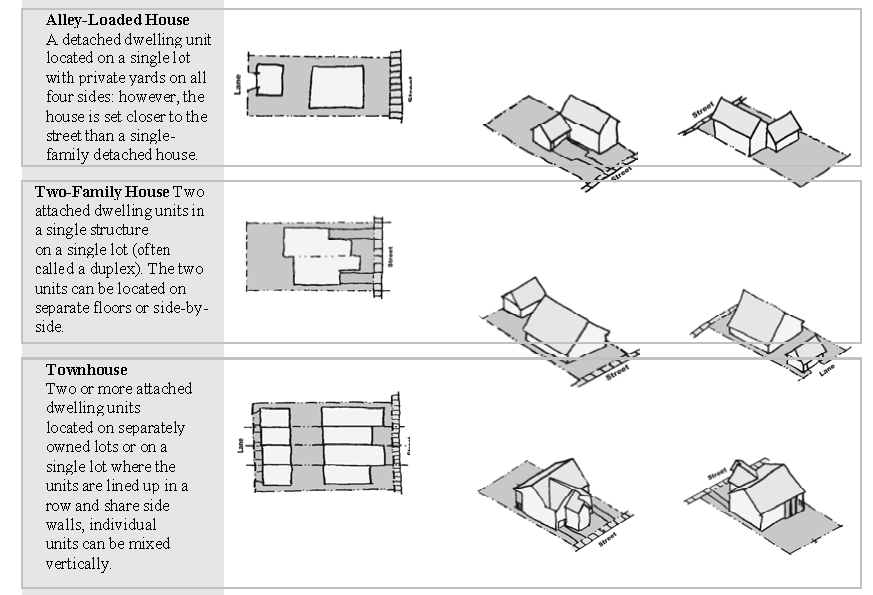
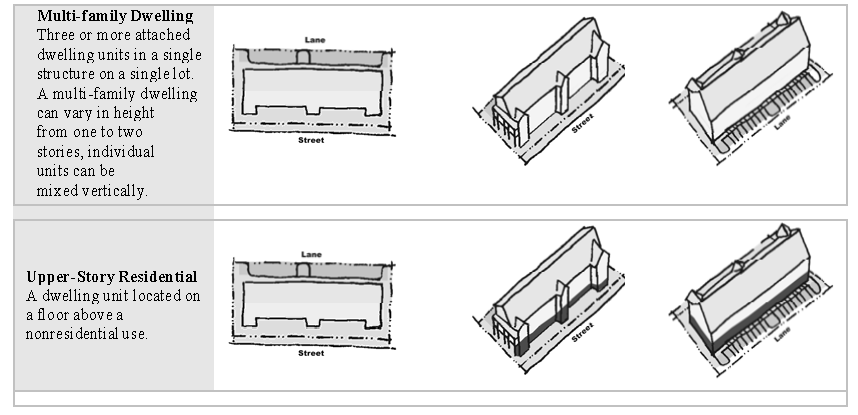
Definitions. The following housing types are established to provide a common terminology for housing in the Town of Bayfield. All drawings are for illustrative purposes only.

Sec. 4-4. - Permitted land uses.
A.
Permitted use table. All of the use categories listed in the following use table summary are defined and described in section 4-7. The following paragraphs serve as a key to the summary table and indicate how each specific use is treated.
(1)
Uses permitted by right. "P" indicates that a use is allowed by right. Such uses are subject to all other applicable regulations of this Land Use Code.
(2)
Review permit required. An "R" indicates that a use is allowed only if approved by a review permit by the planning commission in accordance with the procedures of section 3-11. Review permit uses are subject to all other applicable regulations of this Code.
(3)
Uses not allowed. A blank cell indicates that a use is not allowed.
(4)
Use-specific standards. The final column titled "Notes" contains a cross-reference to standards that apply to specific uses.
(5)
Uses not listed. The administrator shall use the criteria in section 4-7 to determine how an unlisted use should be treated.
Table 4-4(1) Permitted Uses by Zoning District
B.
Use-specific standards.
(1)
Alley-loaded house. An alley shall be provided to the rear of all alley-loaded houses. All vehicular access shall take place from the alley. No parking shall be permitted in the required street yard.
(2)
Townhouse. Side yards are not required for interior townhouses, but street and rear yards shall be provided for all townhouses, and building separation of at least ten feet shall be maintained for all townhouse structures.
(3)
Multi-family dwellings.
a.
No off-street parking space shall be located closer than ten feet to any residential building wall.
b.
Sidewalks shall be constructed within the interior of the development to link residential buildings with other destinations including, but not limited to: parking, adjoining streets, mailboxes, trash disposal, adjoining sidewalks or greenways and on-site amenities such as recreation areas.
(4)
Multi-family dwelling above permitted nonresidential use. Three or more upper-story residential units are allowed on the upper floors of permitted nonresidential uses as set forth in permitted land use table (see table 4-4(1)) and shall adhere to all dimensional standards of the permitted nonresidential use.
(5)
Upper-story residential. Up to two upper-story residential units are allowed on the upper floors of permitted civic or commercial uses as set forth in permitted land use table (see table 4-4(1)) and shall adhere to all dimensional standards of the permitted civic or commercial use.
(6)
Restrictions on the sale of animals in pet stores. No pet store shall sell, deliver, offer for sale, barter, auction, give away, or otherwise transfer or dispose of cats or dogs. Nothing in this section shall prohibit pet stores from collaborating with animal care facilities or animal rescue organizations to offer space for such entities to showcase adoptable dogs or cats provided the pet store shall not have any ownership interest in the animals offered for adoption and shall not receive a fee for providing space for the adoption of any of these animals.
(Ord. No. 412, §§ 1—3, 12-19-17; Ord. No. 414, § 2, 4-17-18; Ord. No. 415, § 2, 6-5-18; Ord. No. 496, 2-6-24; Ord. No. 505, 9-17-24)
Sec. 4-5. - Density and dimensional standards.
The standards listed in this section are allowed by right unless otherwise expressly stated. The project must comply with all of the applicable development standards of this section. The project must also comply with all other development standards of the base zoning district and any overlay district, if applicable, and any applicable specific use standards unless those standards are superseded by the standards in this section.
A.
Residential zoning district density and dimensional standards. The following table illustrates the density and dimensional standards that apply in the town's residential zoning districts. Measurements and exceptions applicable to the standards of this schedule are listed in section 4-5(C). A blank space indicates where a standard is not applicable.
Table 4-5(1) Residential Zoning District Density and Dimensional Standards
NOTES:
See section 4-4(B)(1) for setback reduction provisions applicable to townhouses.
(2)
;hg;See section 4-4(B)(2) for requirements relative to townhouses (attached single-family).
(3)
;hg;Multi-family, minimum square footage is cumulative total of all units (no principal
residential structure).
B.
Nonresidential density and dimensional standards. The following table illustrates the density and dimensional standards that apply in the town's nonresidential districts. These standards shall also apply to mixed-use buildings that combine nonresidential and residential uses. Measurements and exceptions applicable to the standards of this schedule are listed in subsection 4-5(C). A blank space indicates where a standard is not applicable.
Table 4-5(2) Nonresidential Lot and Dimensional Standards
NOTES:
(1)
;hg;See section 6-8 for off-street parking requirements applicable to nonresidential uses.
C.
Measurements and exemptions.
(1)
Lot area. Lot area refers to the area contained within the boundary lines of a lot, excluding any street, easement for street purposes, or street right-of-way.
a.
Exception. Parcels for individual duplex units, townhomes or condominiums may be created with individual parcels of less than 6,000 square feet so long as the original parcel from which the units are created was at least 6,000 square feet and there is at least 2,000 square feet per unit. The 2,000 square foot requirement need not be appurtenant or assigned to individual units (i.e., a parcel of 6,000 square feet may be subdivided into as many as three units. Each unit may occupy a parcel of less than 2,000 square feet so long as the entire original 6,000 square foot parcel is associated to the three units in some fashion). Condominiums may have no specific land attendant to a given unit where some or all of the land is held in common. Duplexes intended for subdivision into two dwelling units must start with an original lot of 6,000 square feet with a resulting density of 3,000 square feet per unit. Triplexes intended for subdivision consisting of three or more dwelling units are considered townhomes.
(2)
Average lot area. Average lot area refers to the average size of lots ± ten percent required for each development by subdivision or by filing within a subdivision. Average lot area is calculated by totaling the square footage of lots in a subdivision or filing within a subdivision, and dividing the resulting total by the total number of lots proposed in the subdivision or filing within the subdivision.
(3)
Required yards (setbacks).
a.
Setbacks. Setback refers to the unobstructed, unoccupied open space between a structure and the property line of the lot on which the structure is located. Setbacks shall be unobstructed, except as allowed in paragraph 4-5(C)(3)(c) below, from the ground to the sky and measured as the horizontal distance between a property line and the furthermost projection of the structure, except as provided otherwise in this Code.
b.
Side yard reduction. Development with no side yard setbacks on both sides is allowed only for townhouse (attached single-family) units and nonresidential uses.
c.
Projections/exceptions, general. The following features may be located within required setbacks.
See section 8-14 for dimensional requirements:
1.
Trees, shrubbery or other features of natural growth;
2.
Fences or walls;
3.
Driveways, off-street parking areas and sidewalks;
4.
Signs, if permitted by this LUC;
5.
Bay windows, architectural design embellishments and cantilevered floor areas of dwellings;
6.
Eaves;
7.
Open outside stairways, entrance hoods, terraces, canopies, carport and balconies;
8.
Chimneys, flues and ventilating ducts placed so as not to obstruct light and ventilation;
9.
Open, unenclosed porches;
10.
Utility lines, wires and associated structures, such as power poles; and
11.
Mechanical equipment, such as air conditioning units, pool filtering and heating equipment, water softeners and similar equipment, if the equipment does not restrict access through such setbacks and if it is totally screened from view from abutting property and rights-of-way by fences, walls or landscaping.
d.
Fire safety exception. Any yard or separation requirements may be increased to comply with minimum fire safety requirements as specified by the fire marshal. The fire marshal is responsible for notifying the applicant and the administrator if minimum fire safety requirements exceed the requirements of this Code.
(4)
Height. Height refers to the vertical distance between the average finished grade at the base of the building and (i) the highest point of the coping of a mansard or flat roof, or (ii) the midpoint between the eaves and ridgeline of a gable, hip or gambrel roof. For fences or walls, height shall be measured on the side with the least vertical exposure above the finished grade to the top of the fence or wall.

Measuring Height
a.
Average finished grade refers to the grade elevation determined by averaging the highest elevation and lowest elevation, each at a single point around the perimeter of the building base.
(5)
Exceptions. The following structures and features shall be exempt from the height requirements of this LUC:
a.
Chimneys, smokestacks or flues;
b.
Cooling towers and ventilators;
c.
Elevator bulkheads and stairway enclosures;
d.
Utility poles and support structures;
e.
Belfries, spires and church steeples;
f.
Tanks, water towers and silos; and
g.
Monuments and ornamental towers.
D.
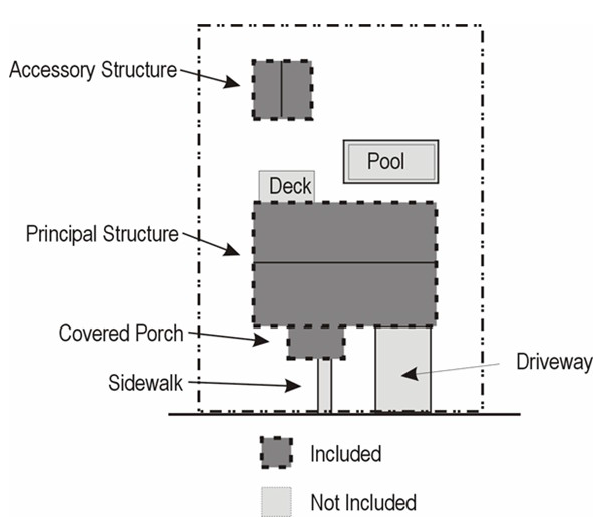
Building coverage. The maximum area of the lot that is permitted to be covered by buildings, including both principal structures and accessory buildings. Building coverage does not include paved areas such as driveways, uncovered porches or patios, decks, swimming pools or pool cages, or roof overhangs of less.
E.
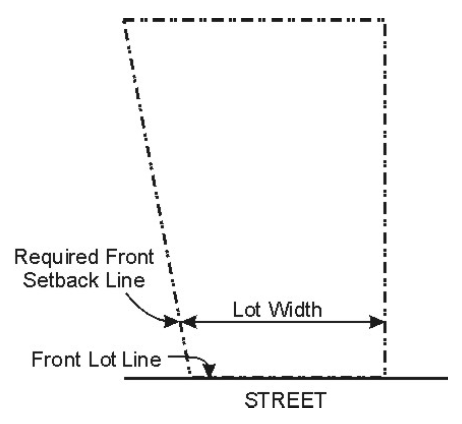
Lot width. Width of a lot shall be considered to be the distance connecting lot lines at each side of the lot, measured as a straight line between the foremost points of the side lot lines at the front setback line except in the case of lots on the turning circle of a cul-de-sac, where the width shall not be less than 60 percent of the required lot width or 40 feet, whichever is smaller.
(Ord. No. 505, 9-17-24)
Sec. 4-6. - Overlay districts.
A.
General.
(1)
Intent. Overlay districts are intended to provide an additional benefit for the community such as flood protection, historic preservation or improved design. Overlay districts are so named because they are land use districts that are superimposed upon base zoning districts. The overlay district adds to the requirements already imposed by the underlying base district. Some overlay districts such as the PUD district permit modifications of construction and design standards in order to obtain a unified design that will benefit the community and protect, preserve or enhance an important community feature.
(2)
Conditions. The town may prescribe any conditions it deems necessary upon issuing an improvement or use permit within an overlay district to result the intent and purpose of the overlay district (see section 4-3, overlay district purposes). Such conditions may also be imposed in order to mitigate any adverse impact upon the affected resource and may be enforced by requiring the applicant to post a bond, cash or acceptable letter of credit sufficient to assure that required mitigation will occur within a specified time period. Any changes in the approved final plan must be submitted for review and approval.
B.
PUD, planned unit development district.
(1)
Approval process. The PUD approval process is described in section 3-3.
(2)
Master plan required. A master plan shall be required for each PUD development. Permits for construction or development in the PUD district may be issued only on the basis of an approved master plan.
(3)
District standards. The standards set forth in section 5-8 will be observed in planning and design of a PUD development.
(4)
PUD guide. A PUD guide is required for each PUD development. The guide becomes the governing document for land use and dimensional limitations on the property. Current town land use regulations may be incorporated into the guide, and shall prevail in the event that a guide is silent to a particular standard.
C.
HPO, historic overlay district.
(1)
Approval process. The HPO district development approval process is described in section 3-10.
(2)
Master plan required. A master plan shall be required for each HPO district development. Permits for construction or development in the HPO district may be issued only on the basis of an approved master plan.
(3)
District standards. The standards set forth in section 5-9 will be observed in planning and design within the HPO, historic preservation overlay district.
(4)
HPO guide. An HPO guide is required for each HPO district. The guide becomes the governing document for architectural, land use and dimensional limitations on the property. Current town land use regulations may be incorporated into the guide, and shall prevail in the event that a guide is silent to a particular standard.
D.
FPD, flood plain overlay district.
(1)
Designation process. The FPD overlay district is applicable to all properties located within the most recently adopted FEMA flood insurance rate map (FIRM).
(2)
District standards. The standards set forth in article 9 of this Land Use Code apply.
Sec. 4-7. - Use categories.
A.
General.
(1)
Basis for classification. Use categories classify land uses and activities based on similar function, product, or physical characteristics. Characteristics include the type and amount of activity, the type of customers or residents, how goods or services are sold or delivered, likely impact on surrounding properties, and site conditions. The use categories provide a systematic basis for assigning land uses to appropriate zoning districts.
(2)
Principal use characteristics. A principal use, and its attendant infrastructure, is assigned to the use category that most closely corresponds to its nature as described in the "characteristics" subsection of each use category.
(3)
Considerations regarding principal uses.
a.
Determination of the appropriate category for a proposed principal use shall be made by the administrator in accordance with the provisions of section 4-7(A)(3)(a) below.
b.
The following will be used to determine: (1) the appropriate category for a use not specifically listed in the use table or the examples in the use category descriptions, and (2) whether a use is considered principal or accessory.
1.
The actual or projected characteristics of the activity in relationship to the stated characteristics of each use category.
2.
The relative amount of site area or floor space and equipment devoted to the activity.
3.
Relative amounts of sales from each activity.
4.
The customer type for each activity.
5.
The relative number of employees in each activity.
6.
Hours of operation.
7.
Building and site arrangement.
8.
Vehicles used and their parking requirements.
9.
The relative number of vehicle trips generated.
10.
Required signage.
11.
How the use is advertised.
12.
The likely impact on surrounding properties.
13.
Whether the activity is likely to be found independent of the other activities on the site.
c.
The administrator may use the North American Industrial Classification System to assist in the interpretation of similarity of uses.
d.
When considering appropriate districts for a use not listed in the use table, the district purpose statements of the respective districts shall be taken into consideration.
(4)
Developments with multiple principal uses. Developments with multiple principal uses shall conform to the following.
a.
When all principal uses of a development fall within one use category, the entire development is assigned to that use category.
b.
When the principal uses of a development fall within different use categories, each principal use is classified in the applicable use category and each use is subject to all applicable regulations for that use category.
c.
Developments with multiple principal uses (such as shopping centers) will incorporate only those uses allowed in the underlying district.
(5)
Use of examples. The "examples" subsection of each use category lists uses common to that use category.
a.
The examples provided are not all-inclusive, but describe the types of uses that are common to that category. Those uses listed are permitted, however other similar uses may also be permitted upon determination by the land use administrator that they are appropriate for that use category.
b.
The names of these sample uses are generic and are based on common meanings, not on what a specific use may call itself. For example, a use that calls itself "wholesale warehouse," but sells mostly to retail consumers, is included in the retail sales and service category rather than the wholesale trade category.
(6)
Uses not included. The "uses not included" subsection provides cross-references to uses that may appear to be part of a particular category, but which are explicitly handled in a different use category.
(7)
Use categories. The following series of tables describe the characteristics of categories of uses, examples from each category, common accessory uses, and uses that are not part of a given use category. These tables are descriptive, and the examples listed are not all-inclusive. Determination of the appropriate category for a proposed principal use not listed will be made by the administrator in accordance with section 4-7(A)(3) above, considerations regarding principal uses.
(8)
Residential use categories.
a.
Household living.
b.
Group living.
(9)
Public and civic use categories.
a.
Community service.
b.
Day care.
c.
Educational facilities.
d.
Government facilities.
e.
Medical facilities.
f.
Institutions.
g.
Parks and open areas.
h.
Passenger terminal.
i.
Places of worship.
j.
Utilities.
(10)
Commercial use categories.
a.
Eating establishments.
b.
Entertainment.
c.
Office.
d.
Overnight accommodations.
e.
Parking, commercial.
f.
Retail sales and service.
g.
Self-service storage.
h.
Vehicle sales and service.
(11)
Industrial use categories.
a.
Light industrial service.
b.
Warehouse and freight movement.
c.
Waste-related service.
d.
Wholesale trade.
e.
Heavy industrial.
(12)
Other use categories.
a.
Agriculture.
b.
Resource extraction.
(Ord. No. 415, § 3, 6-5-18; Ord. No. 505, 9-17-24)
Sec. 4-8. - Accessory uses and structures.
A.
Accessory uses are allowed by right in conjunction with a principal use unless otherwise stated elsewhere in this Code. Unless otherwise stated, accessory uses are subject to the same regulations as the principal use.
B.
Accessory uses and structures will be:
(1)
Subordinate to and serve a principal use or structure;
(2)
Located on the same lot as the principal use or structure;
(3)
Customarily associated with and incidental to the principal use or structure.
(4)
Any portion of a principal structure devoted or intended to be devoted or intended to be devoted to an accessory use is not an accessory structure.
C.
Detached accessory buildings in any residential district shall conform to the following regulations as to their location on the lot or building site:
(1)
Accessory structures shall not be closer than ten feet to the main building or any other accessory building, except that private garages and carports may be closer to the main building than ten feet if adjoined to the main building by an enclosed walkway or an open breezeway.
(2)
Accessory structures may be constructed in the required rear yard provided they occupy no more than 50 percent of the required rear yard.
D.
Accessory dwelling units (ADUs).
(1)
Process. ADUs shall be processed in accordance with section 3-9 of this Land Use Code. However, the application for administrative review shall include an 11-inch by 17-inch site plan, to scale, demonstrating compliance with the ADU standards including, but not limited to, setbacks, off street parking, ADU subordination to principal structure, location of ADU entrance, ADU dimensions, structure height, and lot dimensions and area.
(2)
Agreement. The property owner shall agree to sign an agreement stipulating the ADU shall remain compliant with the ADU requirements. Town shall record such document with La Plata County clerk and recorder, at property owner's expense.
(3)
Standards. An ADU will comply with the following standards:
a.
The property owner, which shall include title holders and contract purchasers, must occupy either the principal unit of the ADU as their permanent residence.
b.
An ADU will be limited to one ADU per lot.
c.
The design and location of the ADU will be clearly subordinate to the principal structure.
d.
ADU's will only be allowed on parcels that meet all requirements of this Code regarding lot size and setback standards. The ADU will not be included in the lot area per unit calculation as a separate dwelling unit.
e.
The ADU will meet all requirements of chapter 4 of the town municipal code.
f.
One additional off-street parking space per ADU is required.
g.
The ADU will be served by the same water tap as the main structure and the taps will be sized according to the total demand for both structures, unless the property owner desires separate water and sewer taps and pay appropriate fees including new plant investment fees.
h.
The ADU will not be less than 300 square feet and not more than, the lesser of, 700 square feet or 50 percent of the floor area of the primary residence.
i.
The ADU will be integrated into the site by appropriate site grading, earthwork and landscaping, and harmonious with the character of the building.
j.
The ADU entrance will be subordinate to the principal structure's entrance and preferably located on the side of rear of the residence.
k.
Detached ADUs will, in no case, be located no closer to the street than the principal structure. The detached ADU will be located on the rear half of the parcel or, in or above a garage.
l.
If attached to the main dwelling, the ADU may have a separate entry and kitchen facility. If a separate entry is proposed, the design of the structure will accommodate a fire wall between the main home and ADU.
m.
Separate addressing of the ADU is required.
n.
Home occupations shall be allowed, subject to existing regulation, in either the ADU or the main building, but not both.
o.
ADUs will comply with the town building and fire codes.
E.
Miscellaneous. Nothing contained in this section 4-8, is intended to affect existing subdivision covenants. Property owners should consult with homeowner or property owners associations.
(Ord. No. 441, 6-16-20)
Sec. 4-9. - Nonconforming uses and structures.
A.
Uses and structures. The lawful use of any building or structure or the lawful use of any land, as existing and lawful at the time of adoption of this Code, or in the case of an amendment to this Code, may be continued, subject to the limitations set forth in the following paragraphs. Dwellings existing at the time of the passage of this Code that are located in an area designated for future residential use shall be considered conforming uses. The following provisions shall apply to buildings structures, land and uses which are not nonconforming and those which hereafter become nonconforming due to any reclassification of land under this Code:
(1)
Expansion or enlargement.
a.
The expansion or enlargement of a nonconforming structure will be considered a structural alteration and will be required to conform to the provisions of this Code.
b.
A nonconforming use may be extended throughout any part of a structure which was arranged or designed for such activity at the time of enactment of this Code.
(2)
Repairs and maintenance. The following changes or alterations may be made to a nonconforming structure or to a conforming structure housing a nonconforming use:
a.
Maintenance repairs that are needed to maintain the good condition of a structure, except that if a structure has been officially condemned, it may not be restored under this provision;
b.
Any structural alteration that would reduce the degree of nonconformance or change the use to a conforming use; and/or
c.
The addition of a solar energy device to such structure.
(3)
Restoration or replacement.
a.
If a structure having a nonconforming use is destroyed or damaged in any manner, to the extent that the cost of restoration to its conditions before the occurrence exceeds 50 percent of the cost of reconstructing the entire structure, it may be restored only if any future use housed within the structure complies with the requirements of this Code.
b.
If a nonconforming structure is destroyed or damaged in any manner to the extent that the cost of restoration to its condition before the occurrence exceeds 75 percent of the cost of reconstructing the entire structure, the structure may be restored only in it complies with the requirements of this Code.
c.
Where a conforming structure devoted to a nonconforming use is damaged less than 50 percent of the cost of reconstructing the entire structure; or where a nonconforming structure is damaged less than 75 percent of the cost of reconstructing the entire structure, either may be repaired or restored, provided any such repair or restoration is started within 12 months and completed within 18 months from the date of partial destruction.
d.
The cost of land or any factors other than the cost of the structure are excluded in the determination of cost of restoration for any structure or activity devoted to nonconforming use.
e.
In the Mill Street or town center zoning districts, structures lost by natural, unintended causes will be allowed to be rebuilt to replace the previous structure, the structure must be built to accommodate the previous use or a use equal in intensity. Should this event occur, parking shall only be required to meet the provisions of the previous building. Should a structure in the Mill Street or town center districts be intentionally destroyed (greater than 50 percent), all current parking standards shall be met.
(4)
Discontinuance. Whenever a nonconforming use has been discontinued for a period of six months or more, it shall not thereafter be reestablished, and any future use shall be in conformance with the provisions of this Code.
(5)
Changes in nonconforming uses. A nonconforming use or a structure may not be changed to another nonconforming use. A nonconforming use or structure may be changed to a conforming use.
a.
Nonconforming lots of record at the time of passage of this Code may be built upon provided that all other relevant district requirements are met, or a variance is approved in accordance with this Code.
Sec. 4-10. - Vacation rentals.
A.
Purpose. The purpose of this section is to establish procedures and standards by which vacation rentals in residential dwellings or mixed use buildings are permitted within the town to promote a mix of lodging options that support tourism and the local economy; uphold health, safety and welfare of the public; and ensure that any impacts of vacation rentals do not adversely affect the residents and the character of a neighborhood.
B.
Density. Permits for vacations rentals will be granted as long as the total number of vacation rentals does not exceed 15 vacation rentals within the town limits and vacation rentals are located no closer than 500 feet apart measured from property lines.
C.
Process.
(1)
Initial application. Initial application for a vacation rental permit shall be processed in accordance with section 3-11 (permits for uses subject to review) of this Land Use Code.
(2)
Annual permit renewal. Vacation rental permits are valid for the calendar year in which the permit is approved. Application for a vacation rental permit shall be submitted each calendar year in accordance with the application requirements in subsection (D) below. The land use administrator, in his or her discretion, may administratively approve or deny renewal permits. Applicant may appeal administrative decision to the planning commission.
D.
Vacation rental application for permit.
(1)
Application. Application for a vacation rental permit shall be submitted to the land use administrator. The application for a vacation rental permit shall contain the following:
a.
A Town of Bayfield land use application.
b.
A Town of Bayfield issued business license or completed application for a pending business license.
c.
The name, address, phone number, and e-mail address for the owner or local owner representative.
d.
Narrative describing how the application meets the standards established in section 4-10(E).
e.
Site plan.
f.
Applicable fees.
E.
Vacation rental standards.
(1)
Appearance and visibility. Vacation rentals shall not change the residential character of the outside of a dwelling unit. The following are non-exhaustive illustrations of changes in residential character that are not allowed: the use of colors, materials, signage, lighting, etc.; the construction of accessory structures or garages that are visible off-site and not of the same architectural character as the residence; the emission of noise, glare, flashing lights, vibrations, or odors not commonly experienced in the underlying zoning district.
(2)
Occupancy.
a.
An approved vacation home rental may alternatively be used as a full-time residence for the owner or a lessee, when there are no short term rentals. However, during vacation rental tenancies the building shall not be used by owner or long term lessee for any other purpose (e.g., residency, home occupation or temporary event).
b.
The remainder of a dwelling of an approved vacation rental unit within a single-family dwelling or mixed use building may be used in accordance with the underlying zoning classification, including full time residency, if use is allowed. The maximum number of occupants allowed in a vacation rental shall not exceed two persons per bedroom, plus two additional persons.
(3)
Signage. Outdoor advertising signs related to the vacation rentals are only allowed in the town center (TC) and Mill Street (MS) land use classifications. Total signage in the town and Mill Street land use classifications shall be limited to 15 square feet per lot. All other sign requirements in this Land Use Code shall apply to vacation rentals in the town center and Mill Street land use classifications
(4)
Floor area. All bedrooms must have a floor area of at least 100 square feet.
(5)
Storage. Storage of recreational vehicles, motorcycles, snowmobiles, boats, jet skis, vehicles such as modified jeeps that may not be legally operated on public streets, and other similar vehicles, machines, or recreational devices, is allowed on off-street paved parking surfaces on the same lot as the vacation rental, in the same manner as allowed for other dwelling units in the same zoning district. These items may not be stored within the public right-of-way. If there is not enough legal on-site parking for the storage or parking of recreational vehicles/devices, the rental tenants or owner must provide alternative arrangements for storage or such storage shall not be allowed with a vacation rental. The determination of what constitutes a vehicle or device, as described above, shall be made by the land use administrator.
(6)
Solid waste collection. All vacation rentals must have town issued trash container on site in a convenient and discrete location.
(7)
Fire extinguishers.
a.
A fire extinguisher that is in good working order shall be maintained at all times on the premises of all vacation home rentals.
b.
The fire extinguisher shall be placed in an accessible location within each vacation rental unit.
c.
Fire extinguishers shall have a minimum 1A 2BC rating.
(8)
Smoke detector. Working smoke detectors shall be located in all bedroom units and in the hallway on each floor where there are sleeping units. Smoke detectors shall be interconnected, unless the structure existed before September 7, 2004; however, additions, alterations or repairs to existing structures shall require interconnected smoke detectors.
(9)
Emergency ingress/egress. Every bedroom shall have an emergency escape or rescue exit and a minimum ceiling height in accordance with the currently adopted international residential code at the time of rental establishment.
(10)
Required notices. The following notices shall be posted in a conspicuous location inside the vacation rental:
a.
A copy of the vacation rental permit;
b.
The name, address and telephone number(s) of the property manager or local representative within 60 miles of the vacation rental;
c.
Emergency information in case there is a local emergency or health advisory including:
1.
La Plata County's website and Twitter;
2.
Town of Bayfield's Facebook page; and
3.
San Juan Basin Public Health's website.
d.
The location of the fire extinguisher; and
e.
Information on the trash and curbside recycling programs including:
1.
Pickup schedules;
2.
A notice that trash and recycling containers must not be stored outside or placed at the curb (or in the alley), except between 6:00 a.m. and 6:00 p.m. on the day of the scheduled trash or recycling pickup.
(11)
Advertisement. The vacation rental permit number is required to be clearly displayed on all advertisements and listings of the rental including online advertisements.
(12)
Dimensions and density. The vacation rental dwelling shall meet all applicable requirements of the zone in which it is located, including but not limited to setbacks, maximum height, and lot coverage standards.
(13)
Building code compliance.
a.
Vacation home rentals must meet the standards of the town's adopted residential building codes, as amended from time to time.
b.
Vacation unit rentals must meet the standards of the town's adopted building codes, as amended from time to time. If the primary use of the building is commercial, the vacation unit rental shall comply with the international building code. If the primary use of the building is a one- or two-family residential dwelling, the vacation unit rental shall comply with the international residential code, as amended from time to time.
(14)
Safety and health inspections. Vacation rentals are subject to the same safety and health inspections that apply to other licensed places of accommodation.
(15)
Local owner representative. The owner of a vacation rental, shall reside in La Plata County or designate a representative residing in La Plata County to manage the vacation rental during any period within which the vacation rental is occupied. The name, phone number and address of the local owner or the local owner representative shall be provided to the land use administrator at time of application for a vacation rental permit. It is responsibility of the owner or owner representative to inform vacation rental occupants about all relevant town ordinances including but not limited to parking, trash and noise. It is the responsibility of the owner to notify the town if there is a change in local owner representative within a reasonable timeframe. The property manager shall be available 24 hours per day to ensure that the property is maintained and operated as required by the Land Use Code and Bayfield Municipal Code, including but not limited to:
a.
Ensuring that the number of tenants does not exceed the limitations of subsection (2), above.
b.
Ensuring that the number of vehicles parked by tenants does not exceed the number of parking spaces on the lot; and
c.
Ensuring that tenants do not violate noise restrictions.
F.
Prohibitions.
(1)
It shall be unlawful for any person, whether a principal or agent, to lease or operate a vacation rental without first obtaining a vacation rental permit.
(2)
Vacation rental permits shall be granted solely to the applicant and shall not be transferable to any other person or legal entity.
(3)
Vacation rental use shall not be permitted for any residential unit which is deed restricted for affordable housing, long term residential use, primary residential use, or full time residential use.
G.
Permits and licenses. The following permits and licenses shall be applicable to vacation rentals.
(1)
Vacation rental permit. Each vacation rental shall have a vacation rental permit issued by the land use administrator.
(2)
Business license. Any property owner, which shall include title holders and contract purchasers, who owns one or more vacation rental shall obtain an annual Town of Bayfield business license pursuant to chapter 5 of the Bayfield Municipal Code. If an individual or business entity acts as a designated representative of one or more vacation rentals, only one business license shall be required. However, each vacation rental shall have a vacation rental permit.
(3)
Sales tax license. Any property owner who leases or rents property for short term rental use shall obtain a Colorado sales tax license. (Colorado state sales tax is always due on taxable rentals, all state-collected local and county sales taxes are also due on the rental price.)
(4)
Lodger's tax. Lodger's tax must be collected by anyone who rents rooms or accommodations, including bed and breakfasts and short term or vacation rentals.
H.
Violation and penalty. The failure to obtain a vacation rental permit, business license, or sales tax license prior to using property for short term rental and the use of property not in conformance with a vacation rental permit shall be a violation and subject to penalties as described in section 1-5 of the Municipal Code.
(Ord. No. 480, 7-19-22; Ord. No. 503, 8-20-24)
Sec. 4-11. - Commercial mobile radio services facilities.
A.
Purpose. The purposes of this article are: to facilitate the provision of wireless telecommunications service within the town; to allow the location of commercial mobile radio services facilities ("CMRS facilities") in the town subject to certain standards; to act on applications for the location of CMRS facilities within a reasonable period of time; to encourage co-location of CMRS facilities; and to prevent unreasonable discrimination among providers of functionally equivalent services.
B.
Definitions. For purposes of this article, certain words or phrases are defined as follows:
"Accessory equipment for a CMRS facility" means equipment, including buildings and structures, used to protect and enable radio switching equipment, back-up power and other devices incidental to a CMRS facility, but not including antennae.
"Alternative tower CMRS facility" means an existing or proposed structure that is compatible with the natural setting and surrounding structures and that camouflages or conceals the presence of the antennae and can be used to house or mount a CMRS antenna. Examples include manmade trees, clock towers, bell steeples, light poles, silos, existing utility poles, existing utility transmission towers and other similar alternative designed structures.
"Base station" means a structure or equipment, other than a tower, at a fixed location that enables federal communications commission licensed or authorized wireless communications between user equipment and a communications network. The term includes any equipment associated with wireless communications services, including radio transceivers, antennas, coaxial or fiber-optic cable, regular and backup power supplies, and comparable equipment, regardless of technological configuration (including distributed antenna systems and small-cell networks). The term includes any structure, other than a tower, to which any of the equipment described hereof is attached.
"Building, roof-mounted CMRS facility" means a CMRS facility that is mounted and supported entirely on the roof of a legally existing building or structure. Building, wall-mounted CMRS facility means a CMRS facility that is mounted and supported entirely on the wall of a legally existing building or structure.
"Commercial mobile radio service facility" means an unmanned facility consisting of antennae and accessory equipment, and used for the reception, switching, transmission or receiving of wireless telecommunications operating at one thousand watts or less effective radiated power, and using frequencies authorized by the Federal Communications Commission ("FCC"), including, but not limited to, paging, enhanced specialized mobile radio, personal communication systems, cellular telephone, point-to-point microwave signals and similar technologies.
"Equipment storage shelter" means buildings, storage shelters and cabinets used to house CMRS facility equipment.
"Freestanding CMRS facility" means a CMRS facility that consists of a stand-alone support structure, such as a tower or monopole, and antennae and accessory equipment.
"Micro-cell facility" means a small wireless facility that is no larger in dimensions than twenty-four inches in length, fifteen inches in width, and twelve inches in height and that has an exterior antenna, if any, that is no more than eleven inches in length.
"Microwave antenna" means a disk-type antenna used to link communication sites together by wireless voice or data transmission.
"Public right-of-way" means all roads, streets and alleys and all other dedicated rights-of-way, access and utility easements of the town, the state, or any district, utility or railroad.
"Small cell CMRS facility" means either:
1.
A personal wireless service facility as defined by the federal telecommunications act of 1996, as amended as of August 6, 2014; or
2.
A wireless service facility that meets both of the following qualifications:
(a)
Each antenna is located inside an enclosure of no more than three cubic feet in volume or, in the case of an antenna that has exposed elements, the antenna and all of its exposed elements could fit within an imaginary enclosure of no more than three cubic feet; and
(b)
Primary equipment enclosures are not larger than 17 cubic feet in volume. The following associated equipment may be located outside of the primary equipment enclosure and, if so located, is not included in the calculation of equipment volume: electric meter, concealment, telecommunications demarcation box, ground-based enclosures, back-up power systems, grounding equipment, power transfer switch, and cut-off switch; or
3.
A micro-cell facility, as defined in this section.
"Small cell CMRS network" means a collection of interrelated small cell facilities designed to deliver wireless service.
"Substantial change " means a modification to an existing tower or base station under the following circumstances:
1.
A substantial change in the height of an existing tower or base station occurs as follows:
2.
For a tower outside of a public right-of-way, when the height of the tower is increased by more than ten percent, or by the height of one additional antenna array with separation from the nearest existing antenna not to exceed 20 feet, whichever is greater.
3.
For a tower located in a public right-of-way or for a base station, when the height of the structure increases by more than ten percent or by more than ten feet, whichever is greater.
(a)
Changes in height are measured as follows:
(i)
When deployments are separated horizontally, changes in height shall be measured from the original support structure, not from the height of any existing telecommunications equipment.
(ii)
When deployments are separated vertically, changes in height shall be measured from the height of the tower or base station, including any appurtenances, as the tower or base station existed on July 1, 2018.
(b)
A substantial change in the width of an existing tower or base station occurs as follows:
(i)
For a tower outside of public rights-of-way, when the addition of an appurtenance to the body of the tower protrudes from the edge of the tower more than 20 feet, or more than the width of the tower structure at the level of the appurtenance whichever is greater.
(ii)
For a tower in a public right-of-way or a base station, when the addition of an appurtenance to the body of the structure would protrude from the edge of the structure by more than six feet.
(c)
A substantial change also occurs for an existing tower in a public right-of-way or an existing base station as follows:
(i)
When the change involves the installation of any new equipment cabinets on the ground, if no ground cabinets presently exist; or
(ii)
When the change involves the installation of ground cabinets that are more than ten percent larger in height or overall volume than any existing ground cabinets.
(d)
A substantial change also occurs for any existing tower or base station when any of the following are found:
(i)
When the change involves installation of more than the standard number of new equipment cabinets for the technology involved, or more than four new cabinets whichever is less.
(ii)
When the change entails any excavation or deployment outside the current site.
(iii)
When the change would defeat the concealment elements of the eligible support structure.
(iv)
When the change does not comply with conditions associated with the original siting approval of the construction or modification of the tower, base station or base station equipment. This limitation does not apply if the non-compliance is due to an increase in height, increase in width, addition of cabinets, or new excavation that would not exceed the thresholds identified in subsections (1) through (5)b., hereof.
"Tower" means a structure built for the sole or primary purpose of supporting any federal communications commission licensed or authorized antennas and their associated facilities, including structures that are constructed for wireless communications services including, but not limited to, private, broadcast, and public safety services, as well as unlicensed wireless services and fixed wireless services such as microwave backhaul, and the associated site.
"Whip antenna" means an antenna array that is cylindrical in shape.
C.
Standards for all CMRS facilities.
1.
Applicability. The standards contained in this section (C) apply to all applications for location of a CMRS facility.
2.
Co-location. The town encourages co-location of CMRS facilities when feasible to minimize the number of CMRS facility sites. To further the goal of co-location:
(a)
No CMRS facility owner or operator shall unreasonably exclude a telecommunications competitor from using the same facility or location. Upon request by the town, the owner or operator shall provide evidence explaining why co-location is not possible at a particular facility or site; and
(b)
If a telecommunications competitor attempts to co-locate a CMRS facility on an existing or approved CMRS facility or location, and the parties cannot reach an agreement, the town may require a third-party technical study to be completed at the expense of either or both parties to determine the feasibility of co-location.
3.
Compliance with FCC standards. Upon a request by the town (on no more than one occasion per year), CMRS facility owners and operators shall certify that:
(a)
The CMRS facility complies with the current FCC regulations prohibiting localized interference with reception of television and radio broadcasts; and
(b)
The CMRS facility complies with the current FCC standards for cumulative field measurements of radio frequency power densities and electromagnetic fields.
(c)
By adopting this section, the town is not attempting to regulate radio frequency power densities or electromagnetic fields, which regulation is controlled by the FCC.
4.
Height limit. Notwithstanding any other provision of this article, no CMRS facility located on property owned by the town or in any public right-of-way shall exceed 40 feet in height.
5.
Indemnification. The operator of a CMRS facility, which is permitted to locate on a town right-of-way or easement or on a town-owned utility pole, traffic signal or other structure owned by the town, or within a town-owned right-of-way or easement, shall, as a condition of permit approval, indemnify the town from and against all liability and claims arising as a result of that location or attachment, including repair and replacement of damaged poles and equipment, in a form approved by the town attorney.
6.
Guarantee. All permits for location of CMRS facilities on real property not owned by the small cell CMRS permittee shall include as a condition of approval a letter of credit, in a form approved by the town attorney, to guarantee payment for any damages to the real property and removal of the facility upon its abandonment.
7.
Abandonment. If the CMRS facility ceases operation for any reason for 180 consecutive days:
(a)
The owner or operator shall remove the facility on or before the 211th day; and
(b)
Any administrative or use by review permit shall expire.
8.
Relocation and removal. All facilities in town right-of-way or easements shall be removed and/or relocated at the applicant's expense in the event the town's use of the right-of-way or easement precludes the continued presence of such CMRS facilities.
D.
Standards for small cell CMRS facilities and networks.
1.
Applicability. Small cell CMRS facilities and small cell CMRS networks, shall comply in all respects with the requirements of section 4-11 (C) and this subsection (D).
2.
Location. Small cell CMRS facilities are permitted in town rights-of-way, upon facilities in these rights-of-way and on public easements owned by the town under the following priority:
(a)
First, on a town-owned utility pole, if any, which shall be removed and replaced with a pole designed to contain all antennae and equipment within the pole to conceal any ground-based support equipment and ownership of which pole is conveyed to the town.
(b)
Second, a town-owned utility pole with attachment of the small cell CMRS facilities in a configuration approved by the town.
(c)
Third, on a third-party owned utility pole with attachment of the small cell CMRS facilities in a configuration approved by the town.
(d)
Fourth, on a traffic signal pole or mast arm in a configuration approved by the town, or in the case of a CDOT facility, by CDOT.
(e)
Fifth, on a freestanding or ground-mounted facility which meets the definition of and requirements for an alternative tower CMRS facility in a location and configuration approved by the town.
3.
Height. All small cell CMRS facilities shall not exceed two feet above the light pole, traffic signal or other facility or structure to which they are attached, or the maximum height in the relevant zone district, whichever is less. When new utility poles are proposed as an alternative tower CMRS facility, their height shall be similar to existing utility/light poles in the vicinity.
4.
Spacing. No small cell CMRS facility shall be located within 1,000 feet of any other small cell CMRS facility.
5.
Design. Small cell CMRS facilities shall be designed to blend with and be camouflaged in relation to the structure upon which they are located (e.g. painted to match the structure or same material and color as adjacent utility poles). To the greatest degree possible, support equipment shall be located underground.
6.
Permitting. All small cell CMRS facilities and networks shall be reviewed pursuant to the site plan procedures in section 3-9 of this code. Small cell CMRS facilities shall also make application for a permit for work in the right-of-way. The town may accept applications for a small cell CMRS network, provided each small cell CMRS facility shall be separately reviewed.
7.
Reserved.
8.
Reserved.
9.
Expiration. A permit for installation of a small cell CMRS facility shall expire nine months after approval, unless installation of the permitted structure has been initiated.
10.
Use. Small cell CMRS facilities, when in compliance with these standards, are permitted uses in all zone districts, subject to administrative review as described in section 3-9 of this Land Use Code.
E.
Freestanding CMRS facilities.
1.
Applicability. Freestanding CMRS facilities shall comply in all respects with the requirements of section 4-11 (C) and this section (E).
2.
Minimum setbacks for freestanding CMRS facilities.
(a)
A freestanding CMRS facility located within 250 feet of any property zoned for residential use shall be set back from each property line one foot of distance for every foot of facility height; and
(b)
A freestanding CMRS facility located more than 250 feet from property zoned for residential use shall meet the minimum setback requirements for buildings and structures of the underlying zoning district.
3.
Height. A freestanding CMRS facility, including antennae, shall not exceed the maximum structure height limit in the underlying zoning district.
4.
Design. A freestanding CMRS facility shall meet the following design standards to minimize impacts:
(a)
The facility shall be designed to be compatible with surrounding buildings and structures and existing or planned uses in the area, subject to any applicable federal aviation administration ("FAA") regulations.
(b)
Existing land forms, vegetation and structures shall be used to screen the facility from view and blend in the facility with the surrounding environment to the extent practicable.
(c)
Existing vegetation shall be preserved or enhanced where feasible.
(d)
The total area of any equipment storage shelters shall not exceed 400 square feet for each CMRS facility.
(e)
Equipment storage shelters shall be grouped as closely together as technically possible.
(f)
No equipment storage shelter shall exceed 15 feet in height.
(g)
All freestanding CMRS facilities shall accommodate co-location of facilities, unless co-location is technically unfeasible.
(h)
Any equipment that could be dangerous to person or wildlife shall be adequately covered or fenced.
(i)
The diameter of a microwave dish antenna shall not exceed four feet.
(j)
Facility antennae shall not be lighted unless required by the FAA.
5.
Use. Freestanding CMRS facilities shall be permitted as a use by review in the Industrial, Transitional, and Community Service zoning districts in accordance with section 3-11 of this Land Use Code.
F.
Building roof or wall-mounted CMRS facilities.
1.
Applicability. Building roof or wall mounted CMRS facilities shall comply in all respects with the requirements of section 4-11 (C) and this section (F).
2.
Design.
(a)
A building wall-mounted CMRS facility shall adhere to the following design standards to minimize impacts:
(i)
The CMRS facility shall be screened from view and/or colored to match the building or structure to which it is attached.
(ii)
The mounting of antennae shall be as flush to the building wall as possible, and in no case shall the antennae extend more than two feet out from the building wall.
(iii)
A CMRS facility mounted on the wall of a building with a pitched roof shall not extend above the roof line of the building.
(iv)
A CMRS facility mounted on the wall of a building with a flat roof shall not extend above the highest point of the building, including already existing facilities on the roof.
(b)
A building roof-mounted CMRS facility shall adhere to the following design standards to minimize impacts:
(i)
A building roof-mounted CMRS facility, including antennae, shall not extend more than 12 feet above the height of the building on which the facility is mounted.
(ii)
The facility shall be screened from view and/or colored to match the building or structure to which it is attached.
(iii)
Antennae, support structures, accessory equipment and all other roof-mounted appurtenances shall not exceed an aggregate total of 25 percent of the total surface area of the building roof.
(iv)
The diameter of a microwave dish antenna shall not exceed four feet.
3.
Accessory equipment for a building roof or wall-mounted CMRS facility shall be placed inside the building if feasible. All equipment storage shelters shall be grouped as closely as technically possible, and the total area of all accessory equipment, including storage shelters, shall not exceed 400 square feet per CMRS facility.
4.
Reserved.
5.
Use. Building roof or wall mounted CMRS facilities shall be permitted as a use by review in the Business, Mill Street, Industrial, Transitional, and Community Service zoning districts in accordance with section 3-11 of this Land Use Code.
G.
CMRS facilities application and approval procedures.
1.
Procedure for use by review permit shall be in accordance with section 3-11 of this code. However, in addition to the submittal requirements in section 3-11(C), applicant shall provide:
(1)
A vicinity map depicting the area in which the facility will be located.
(2)
Photographic simulations showing the proposed facility and the structure on which it will be mounted, if applicable.
(3)
A title commitment or other proof of ownership of the property, or a copy of a fully executed lease with the property owner.
(4)
A written, narrative statement describing in detail how the proposed CMRS facility will comply with each of the applicable design standards outlined in this section.
(5)
Preliminary structural design drawings and antenna specifications, including preliminary weight load calculations.
2.
Expiration. If construction of the CMRS facility is not commenced within 90 days of issuance of the use by review permit, the permit shall expire.
H.
Change in ownership.
1.
In the event there is a change in either the owner or operator of a CMRS facility, the issuance of a new permit shall not be required. The new owner or operator shall notify the town of the change in identity of the owner or operator within 15 days of the date the change becomes effective; shall provide the name and business address of the new owner or operator; shall verify in writing that the new owner or operator has fully reviewed the existing permit and is familiar with its terms; shall ensure that the letter of credit required by section 3-11(C)(6) is transferred, if applicable; and shall pay to the town an inspection fee, as established by resolution. Upon receipt of notification of a change in the owner or operator of a CMRS facility, the land use administrator may inspect the property to make certain that the new owner or operator is complying with all of the terms and conditions of the permit.
I.
Modifications to CMRS facilities.
1.
Any modification to a CMRS facility that differs from the original design that was approved by the town shall require new application and approval. notwithstanding the foregoing, the land use administrator may, in his or her discretion, waive or postpone the submittal of any application requirement detailed in this section when considering a modification request.
2.
Any request for modification that does not substantially change the dimensions of an existing CMRS facility shall be approved by the land use administrator.
3.
Requests for modification shall be required to submit only such documentation and information as is reasonably necessary to determine whether a proposed modification would substantially change the physical dimensions of an eligible tower or base station.
4.
Any application for modification to a CMRS facility shall be reviewed by the town within 60 days of the town's receipt of the completed modification application. If the town fails to approve or deny an eligible telecommunications facility request within the time frame for review (accounting for any tolling), the request shall be deemed granted; provided that this automatic approval shall become effective only upon the town's receipt of written notification from the applicant after the review period has expired (accounting for any tolling) indicating that the application has been deemed granted.
5.
Review.
(a)
The planning commission shall review the application to determine whether the application qualifies as a substantial change.
(b)
Approval.
i.
The planning commission may approve a substantial change to a CMRS facility if it complies with the remainder of this code.
iii.
The planning commission may condition the approval of a substantial change to a CMRS facility on compliance with generally applicable building, structural, electrical and safety codes or with other laws codifying objective standards reasonably related to health and safety.
(c)
Denial. A final decision by the planning commission to deny a modification to a CMRS facility under this section shall be in writing and shall include the reason(s) for denial.
(Ord. No. 415, § 1, 6-5-18)
Sec. 4-12. - RV parks and campgrounds.
A.
Purpose. The purpose of this section is to establish procedures and standards by which RV parks and campgrounds are permitted within the town to promote a mix of lodging options that support tourism and the local economy; uphold health, safety and welfare of the public; and ensure that any impacts of RV parks and campgrounds do not adversely affect the residents and the character of a neighborhood.
B.
Zone districts. Recreational vehicle parks and campgrounds are permitted as set out in table 4-4, Permitted Uses by Zoning District and compliance with all other applicable standards of this Code, together with the development and operation standards in this section and any other applicable code provisions.
C.
Standards. At a minimum, the following standards shall be complied with at all times:
1.
The maximum density of the recreational vehicle park shall not exceed 15 units per gross acre. The intent is to develop an attractive resort that is compatible with the neighborhood. Density may be lowered at the use permit stage of review if necessary to achieve compatibility.
2.
The entrance road and public access road shall be paved to prevent tracking onto the public right-of-way. Interior roads may be paved or graveled.
3.
There shall be an average distance of 15 feet provided between each recreational vehicle.
4.
Occupancy: No site shall be permanently (over 90 days) occupied by any type of recreational vehicle.
5.
No recreational vehicle shall remain in the campground unoccupied over 90 days, unless stored in an approved storage area.
6.
Utilities: Water, sewer and electricity shall be provided to the RV Park, but not necessarily every site.
7.
Land shall be provided for common open/recreational space in the amount of ten percent of the gross acreage of the recreational vehicle park, inclusive of common recreational areas, perimeter buffer yards and landscaped areas.
8.
The fire marshal shall specify the number and location of fire hydrants, fire lanes, access to RV pads, and emergency vehicle turn-around areas.
(Ord. No. 451, 2-2-21)

