
Beckley City Zoning Code
ARTICLE I
- IN GENERAL
Sec. 15-1. - Purpose.
This chapter is enacted for the general purpose of dividing the city into zones or districts, restricting and regulating therein the location, erection, construction, reconstruction, alteration, and use of buildings, structures, and land for trade, industry, residence, and other specified uses; to regulate the intensity of the use of lot areas and so regulate and determine the area of open spaces surrounding such buildings; to establish building lines and the location of buildings designed for specified manufacturing, business, residential and other uses within such areas; to fix standards to which buildings or structures shall conform therein; to prohibit uses, buildings, or structures incompatible with the character of such districts, respectively; to prevent additions to and alterations or remodeling of existing buildings or structures in such a way as to avoid the restrictions and limitations lawfully imposed hereunder; to limit congestion in the public streets by providing for the off-street parking and loading and unloading of vehicles; providing for the gradual elimination of nonconforming uses of land, buildings, and structures; and prescribing penalties for the violation of the chapter; to lessen congestion; to provide adequate light and air; to prevent the overcrowding of land; to conserve the taxable value of land and buildings throughout the city; and to promote the public health, safety, and general welfare.
(Ord. of 8-13-02)
Sec. 15-2. - Title and identification; duties, etc., of planning commission and board of zoning appeals.
(a)
This chapter and ordinances supplemental or amendatory thereto, shall be known, and may be cited hereafter as the "Zoning Ordinance of the City of Beckley, West Virginia - 1971." Whenever the word "city" appears in this chapter, it shall be deemed to refer to the City of Beckley, West Virginia; the word "council" refers to the common council of the City of Beckley; the word "commission" refers to the City of Beckley planning commission (as specified in West Virginia Code, section 8-24-51); the word "board" refers to the City of Beckley board of zoning appeals (as specified in West Virginia Code, section 8-24-51); the word "district" refers to a section of the city for which uniform regulations governing the use, right, area, size, and intensity of use of buildings and land and open spaces about buildings are herein established; the words "zoning map" refer to a map entitled, "City of Beckley, West Virginia, Zoning Map," updated 1966, and any amendments thereto; the words "comprehensive plan" refer to the complete plan or any of its parts, for the development of the city, adopted by the council of the city in accordance with the authority conferred by Article 24 of Chapter 8 of the Code of West Virginia.
(b)
The powers, duties, and limitations of the Planning Commission and the Board of Zoning Appeals shall be as prescribed in said Article 24 of Chapter 8, which statute is adopted by reference and incorporated as fully as if set out at length herein.
(Code 1971, App. A, § 2; Ord. of 8-13-02)
Sec. 15-3. - Definitions.
For the purposes of this chapter, the following words and phrases shall have the meanings respectively ascribed to them within this section. If not defined in this section, or within other sections of this chapter, terms used in this section shall have the meanings provided in any standard dictionary or American Planning Association publication as determined by the chief planning officer.
Words used in the present tense shall include the future; words used in the singular number shall include the plural number, and the plural the singular; the word "building" shall include the word "structure," the word "lot" shall include the word "plot"; and the word "shall" is mandatory and not directory.
Accessory building or use: A subordinate building or use which is located on the same lot on which the main building or use is situated and which is reasonably necessary and incidental to the conduct of the primary use of such building or main use. It shall be located in a side or rear yard only, not less than five (5) feet from a property line. It shall be ten (10) feet from the main building or use unless the exterior wall closest to the main structure is constructed of non-combustible material with not less than a two-hour fire rating, or may be attached to the main building, with a non-combustible, two-hour rated exterior connecting wall. Accessory buildings less than one hundred fifty (150) square feet shall not require a building permit, unless with electrical or plumbing elements. Accessory buildings one hundred fifty (150) square feet or more shall require a building permit, verification of a roof rafter or truss design on not less than thirty (30) pounds per square inch live load and an approved foundation plan. A ground mounted satellite receiver or dish in excess of twenty-four (24) inches in diameter shall be considered as an accessory building and shall be so regulated by this chapter.
Acreage: Any tract or parcel of land which has not been subdivided and platted.
Acute care facility: Hospital care given to patients who generally require a stay of up to seven (7) days, or more, and that focuses on a physical or mental condition requiring immediate intervention and constant medical attention, equipment and personnel.
Adult amusement or entertainment: Amusement or entertainment which is distinguished or characterized by an emphasis on acts or material depicting, describing, or relating to specific sexual activities or specified anatomical areas, including, but not limited to, topless or bottomless dancers, exotic dancers, strippers, male or female impersonators, or similar entertainment.
Adult bookstore/adult novelty store/adult video store: An establishment which utilizes ten (10) per cent or more of its gross public floor area for the purpose of retail sale, and/or rental, and/or display by image-producing devices, of sexually-oriented material for any consideration; or ten (10) per cent or more of the stock-in-trade consists of sexually-oriented materials.
Adult cabaret: A building or portion of a building regularly featuring dancing or other live entertainment if the dancing or entertainment that constitutes the primary live entertainment is distinguished or characterized by an emphasis on the exhibiting of specific sexual activities or specified anatomical areas for observation by patrons therein; or a nightclub, bar, restaurant, or similar commercial establishment that regularly features persons who appear in a state of nudity or semi-nudity; or which exhibit films, motion pictures, video cassettes, slides, or other photographic reproductions that are characterized by the depiction or description of specific sexual activities or specified anatomical areas.
Adult day care center: A day care facility that is maintained for the whole or part of a day for the care or supervision of adults, and providing day care services, including monitoring of clients, social and recreation services, food and nourishment, and health support services. The operation of the facility shall not include overnight occupancy by the clients. Adult day care may be operated within structures on church premises or publicly owned community centers, provided such uses are lawfully permitted and operating in the underlying zoning district.
Adult mini motion picture theater: An enclosed building with a capacity of less than fifty (50) persons used for presenting material distinguished or characterized by an emphasis on depicting or describing specific sexual activities or specified anatomical areas.
Adult motel: A hotel, motel, or similar establishment that:
(1)
Offers accommodations to the public for any form of consideration and provides patrons with closed circuit television transmissions, films, motion pictures, video cassettes, slides, or other photographic reproductions that are characterized by the depiction or description of specific sexual activities or specified anatomical areas; and has a sign visible from the public right-of-way that advertised the availability of this adult type of photographic reproductions; or
(2)
Offers a sleeping room for rent for a period of time that is less than ten (10) hours; or
(3)
Allows a tenant or occupant of a sleeping room to sub-rent the room for a period of time that is less than ten (10) hours.
Adult motion picture arcade: Any place to which the public is permitted or invited wherein coin or slug-operated or electronically, electrically, or mechanically controlled, still or motion picture machines, projectors, or other image-producing devices are maintained to show images to five (5) or fewer persons per machine at any one (1) time, and where the images so displayed are distinguished or characterized by an emphasis on depicting or describing specific sexual activities or specified anatomical areas.
Adult motion picture theater: An enclosed building with a capacity of fifty (50) or more persons used for presenting material distinguished or characterized by an emphasis on depicting or describing specific sexual activities or specified anatomical areas.
Adult novelty store: See "adult bookstore."
Adult theater: A theater, concert hall, auditorium, or similar commercial establishment that regularly features persons who expose specified anatomical areas, or live performances that are characterized by the exposure of specified anatomical areas or by specific sexual activities.
Adult video store: See "adult bookstore."
Agricultural implement sales and service: A use primarily engaged in the sale or rental of farm tools and implements, feed, grain, tack, animal care products, and farm supplies. This definition excludes the sale of large implements, such as tractors and combines, but includes food sales and farm machinery repair services that are accessory to the principal use.
Alley: A public or private thoroughfare having a minimum width of ten (10) feet and a maximum width of twenty (20) feet which affords only a secondary means of access to abutting property.
Alteration: As applied to a building or other structure, is a change or rearrangement in the structural parts of or in the exit facilities, or an enlargement, whether by extending on a side or by increasing in height, or the moving from one location or position to another.
Antique shop: A place offering primarily antiques for sale. An antique, for the purposes of this chapter, shall be a work of art, piece of furniture, decorative object, or similar item with collectible value that is at least thirty (30) years old.
Apartment: A room or suite of rooms in a multiple-family structure, which is arranged, designed, used, or intended to be used as a housekeeping unit for a single family.
Architectural review program and summary of guidelines: A document or documents prepared by the historic landmark commission outlining the general restoration theme of Courthouse Square and by which the design standards committee judges acceptability and appropriateness of plans and specifications submitted by a property owner, and which is available upon request at the office of the zoning officer for the city, or from any member of the historic landmark commission and which is incorporated herein by reference.
Auto convenience market: A place where gasoline, motor oil, lubricants, or other minor accessories are retailed directly to the public on the premises in combination with the retailing of items typically found in a convenience market or supermarket.
Automobile repair: General repair, engine rebuilding or reconditioning of motor vehicles; collision service, such as body, frame or fender straightening and repair; overall painting of motor vehicles.
Automobile, sales and service: The use of any building or portion thereof, or other premises or portion thereof, for the display, sale, rental or lease of new or used motor vehicles as an ancillary use of a zoning lot, and any warranty repair work and other repair service conducted as an accessory use.
Automobile service station: A place where gasoline stored only in underground tanks, kerosene, or motor oil and lubricants or grease for operation of automobiles, are retailed directly to the public on premises, and including minor accessories and services for automobiles, but not including automobile repairs and rebuilding. When the dispensing, sale, or offering for sale of motor fuels or oil is incidental to the conduct of a public garage, the premises shall be classified as a public garage.
Auto wrecking or junkyard: Any place where two (2) or more motor vehicles not in running condition, or parts thereof, are stored in the open and are not being restored to operation, or any land, building, or structure used for wrecking or storing of such motor vehicles or parts thereof; and including any farm vehicles or farm machinery, or parts thereof, stored in the open and not being restored to operating condition; and including the commercial salvaging and scavenging of any other goods, articles, or merchandise.
Basement: A story partly or wholly underground. Where more than one-half (½) of its height is above the average level of the adjoining ground, a basement shall be counted as a story for purpose of height measurement.
Bed and breakfast: A private, owner-occupied business, providing overnight accommodations, with six (6) or fewer rooms, where breakfast or light meals are served.
Bicycle trail: All thoroughfares that explicitly provide for bicycle travel including facilities existing within street and highway rights-of-way and facilities along separate and independent corridors.
Block: An area of land entirely bounded by streets or other barriers to the continuity of development.
Board of zoning appeals: A local body of five (5) members, appointed by the city council, whose responsibility is to hear appeals from decisions of the zoning officer, recommend specific conditions for conditional uses, and to consider requests for variances and conditional uses from the terms of the City of Beckley zoning ordinance.
Boarding house: A building other than a hotel or restaurant where means of lodging are provided for compensation for four (4) or more persons, but not exceeding ten (10) persons.
Brew pub: An establishment which contains a full-service standard restaurant and alcoholic beverages. This establishment also contains a microbrewery as an accessory use provided that sales of the microbrewery products are less than fifty (50) per cent of total sales. This microbrewery shall be for the brewing of handcrafted, natural beer intended for retail consumption on the premises and on any premises that has a license as a standard full-service restaurant owned and operated in its entirety by the same corporate ownership and management as the brew pub.
Brewery, micro: A facility for the production and packaging of malt beverages of low alcoholic content for distribution, retail or wholesale, on or off premises, with a capacity of not more than fifteen thousand (15,000) barrels per year. The development may include other uses such as a standard restaurant, bar, or live entertainment as otherwise permitted in the zoning district.
Building: Any structure having a roof supported by columns or walls, and designed or intended for the shelter, support, enclosure, or protection of persons, animals, or chattels.
Building area: The buildable area of a lot is the space remaining after the minimum open space requirements of this chapter have been complied with.
Building code: The various codes of the city adopted to safeguard life and property through ensuring the quality of construction of all structures erected or renovated throughout the city including all aspects of safe building construction and mechanical operations in accordance with standard safe practices embodied in widely recognized standards of good practice for building construction and all aspects related thereto. The building code regulates construction and requires building permits, electrical permits, mechanical permits, plumbing permits and other permits to do work. Whenever any municipal ordinance or regulation of any agency thereof is more stringent or imposes a higher standard than is required by the state building code, other state or county law, the provisions of the municipal ordinance or regulation of any agency thereof governs if they are not inconsistent with the laws of West Virginia and are not contrary to recognized standards and good engineering practices. In any question, the decision of the state fire commission determines the relative priority of any such state law, county or municipal ordinance or regulation of any agency thereof and determines compliance with state building code by officials of the state, counties, municipalities and political subdivisions of the state.
Building height: The vertical measurement from grade to the highest point of the roof beams in flat roofs; to the highest point on the deck of mansard roofs; to a level midway between the level of the eaves and highest point of pitched roofs of hip roofs; or to a level two-thirds (⅔) of the distance from the level of the eaves to the highest point of gambrel roofs. For this purpose, the level of the eaves shall be taken to mean the highest level where the plane of the roof intersects the plane of the outside wall on a side containing the eaves. Where the height is designated in terms of stories, it shall mean the designated number of stories including the first story.
Building line: For the purpose of this chapter, the building line is the same as a front yard setback line.
Building official: The city official or employee responsible for implementing and enforcing the applicable building codes and standards of the city.
Business: The engaging in the purchase, sale, barter or exchange of goods, wares, merchandise, or services, the maintenance or operation of offices, or recreational and amusement enterprises for profit.
Camper: A mobile living unit designed to be mounted upon and conveyed by another vehicle.
Camper (fold down): A vehicle consisting of a portable unit mounted on wheels and constructed with collapsible partial sidewall which fold for towing by another vehicle and unfold at the camp site to provide temporary living quarters for recreational, camping, or travel use.
Carport: A roofed structure permanently open on at least three (3) sides and attached to or made a part of the main building or free-standing, not closer than five (5) feet from a side or rear property line, or in a front yard only on a paved driveway, for the purpose of providing shelter for one (1) or more private, motor driven vehicles. A carport of one hundred fifty (150) square feet or more shall require a building permit with construction specifications indicating roof truss or rafter design of not less than thirty (30) pounds per square foot live load and an acceptable foundation and/or anchorage plan. A carport of combustible materials may not be located closer than ten (10) feet from the main structure or any other lawful accessory structure.
Car wash: The use of a site or building for washing and cleaning passenger vehicles, recreational vehicles or light duty vehicles or equipment, where the customer provides the labor and where no self-propelled wash racks are provided.
Car wash, industrial: Mechanical facilities for washing, waxing, cleaning of automobile, trucks, heavy trucks, buses and other equipment, with or without self-propelled wash racks.
Cattery: A place where four (4) or more adult cats are kept, by owners or by persons providing facilities and care, whether or not for compensation, but not including small animal hospitals, clinics. An adult cat is one that has reached the age of six (6) months. A cattery is not permitted in a residential zone.
Cemetery: Land uses for the burial of the dead and dedicated for cemetery purposes, including columbaria, crematories, mausoleums, and mortuaries when operated in conjunction with and within the boundary of such cemetery.
Certification of appropriateness: The certificate issued by the historic landmark commission indicating approval of appropriate plans as they pertain to the reconstruction, restoration, alteration, or creation of buildings or other structures within Courthouse Square.
Certificate of occupancy: A certificate signed by the zoning officer, building official, and fire chief stating that the occupancy and use of land or a building or structure referred to therein complies with the provisions of this chapter and the state building and fire codes.
Child: Any person under eighteen (18) years of age.
Child day care center/nursery school: A place or residence where child care is provided on a regular basis to the needs of thirteen (13) or more children for any number of hours a day in a place or residence other than the child's own home by persons other than their parents or guardians, custodians, or relatives by blood, marriage, or adoption. This also includes nursery schools, but does not include the care of older children enrolled in school during school hours. (See definition of "nursery" and additional requirements in section 15-24(k).)
Child day care facility: A place or residence where child care is provided on a regular basis to the needs of seven (7) to twelve (12) children for any number of hours a day in a place or residence other than the child's own home by persons other than their parents or guardians, custodians, or relatives by blood, marriage, or adoption.
Child day care home: A place or residence where child care is provided on a regular basis to the needs of up to six (6) children for any number of hours a day in a place or residence other than the child's own home by persons other than their parents or guardians, custodians, or relatives by blood, marriage, or adoption.
Clinic or medical health center: An outpatient establishment where patients are admitted for special study and treatment by two (2) or more licensed physicians or dentists and their professional associates not lodged overnight.
Club, private, indoor: Buildings or facilities, owned or operated by a corporation, association, person or persons, for a social, educational or recreational purpose to which membership is required for participation, profit or non-profit includes lodge or fraternal organization; a non-profit association or persons who are bona fide members paying annual dues, use of the premises restricted to members and their guests; a private, for profit restaurant, tavern or wine restaurant, licensed by and in compliance with rules and regulations of the West Virginia Alcohol Beverage Control Administration, where alcoholic beverages are served for consumption, only on the premises.
Coffee shop: An informal restaurant primarily offering coffee, tea and other beverages, where light refreshments and limited meals may be sold; a retail food business in a freestanding building that sells coffee or other beverages and pre-made bakery goods from a walk up or drive through window to customers for consumption and provides no indoor or outdoor seating; kiosk; an informal restaurant in a hotel, motel, office or similar building where light refreshments and beverages are served.
Community garden: A neighborhood-based development with the primary purpose of providing space for members of the community to grow plants for beautification, education, recreation, community distribution, or personal use. Sites managed by public or civic entities, nonprofit organizations or other community-base organizations are responsible for maintenance and operations. Processing and storage of plants or plant products are prohibited on site. Gardening tools and supplies may be stored within an accessory building that is in compliance with the zoning ordinance. Community garden shall not include or be construed to be a medical cannabis growing facility.
Community or recreation center: A building used as a place of meeting, recreation or social activity; a meeting place, public or private, where people living in the same community carry on cultural, recreational or social activities and possessing outdoor recreational facilities such as a golf course, swimming pool, tennis courts, polo grounds, basketball courts, baseball or softball fields or similar facilities; a convention or civic center.
Comprehensive development plan (also called comprehensive plan): A plan, or any portion thereof, adopted and amended from time to time by the planning commission of the City of Beckley, showing the general location and extent of present and proposed physical facilities including housing, industrial, and commercial uses, major thoroughfares, parks, schools, and other community facilities. This plan establishes the goals, objectives, and policies of the community.
Conditional use: A use or occupancy of a structure, or use of land, permitted only upon issuance of a conditional use permit and subject to the limitations and conditions imposed to make the use compatible with other uses permitted in the same zone.
Coop: A cage, small fenced and/or screened enclosure or small building in which poultry is housed.
Corral: An enclosure or pen for confining livestock.
Court: An open unoccupied space, other than a yard, on the same lot with a building and bounded on two (2) or more sides by such building.
Curb grade: The established elevation of the curb in front of the building measured at the center of such front. Where no curb grade has been established, the city shall establish such curb level or its equivalent for the purpose of this chapter.
Data processing facilities: Facilities where electronic data is processed by employees, including, without limitation, data entry, storage, conversion or analysis, subscription and credit card transaction processing, telephone sales and order collection, mail order and catalog sales, and mailing list preparation.
District: One (1) or more sections of the incorporated area of the city for which the regulations and provisions governing the use of building and land are uniform for each class of use permitted therein.
Dormitory: A building intended or used primarily for sleeping accommodations related to an educational institution, public or private, or a public or nonprofit institution, which may contain one (1) or more common kitchen or bath facilities and some common gathering rooms for social or other purposes.
Driveway: A path for vehicles, from a street or right-of-way, onto private or public property, that may also be used for parking, subject to other provisions which may limit the size and/or type of vehicle, and the size and/or type of surface.
Drug store: An establishment engaged in the retail sale of prescriptions drugs and patient medicines and which may carry a number of related product lines, such as cosmetics, toiletries, tobacco and novelty merchandise, and which may also operate a soda fountain or lunch counter. Drug store shall not include or be construed to be a medical cannabis dispensary.
Dry cleaning facility: A building, portion of a building, or premises used or intended to be used for cleaning fabrics, textiles, wearing apparel, or articles of any sort per day for customers by immersion and agitation, or by immersions only, using volatile solvents including, but not by way of limitation, solvents of the petroleum distillate type, and/or the chlorinated hydrocarbon type, and the processes incidental thereto.
Dwelling: Any building, structure or portion thereof which is occupied as, or designed or intended for occupancy as, a residence or sleeping place for more than six (6) consecutive months of the calendar year by one (1) or more persons or families and which includes permanently installed cooking and lawfully required sanitary facilities, and any vacant land which is offered for sale or lease for the construction or location thereon of any such building, structure or portion thereof. A dwelling shall not include a tree house, tent, recreational vehicle, house trailer, mobile home, or a room in a hotel, motel, boarding or lodging house. A dwelling shall include any manufactured home constructed to the following specifications:
(1)
The home is affixed to a permanent foundation and connected to appropriate utilities.
(2)
The home, excluding any addition, has a width of at least twenty-two (22) feet at one (1) point and a length of at least twenty-two (22) feet at one (1) point. The total living area of the home, excluding garages, porches or attachments, must be at least nine hundred (900) square feet or equal to or greater than any minimum dwelling size applicable within an applicable zoning district.
(3)
The home has a minimum 3:12 residential roof pitch, conventional residential siding, and a six-inch minimum eave overhang, including appropriate guttering.
(4)
The home was manufactured after June 1, 1976.
Dwelling, duplex: Two (2) attached one-family dwellings.
Dwelling, elderly high-rise: A multiple-family high-rise dwelling planned and designed primarily for residential occupancy of families whose heads or their spouses or whose sole members have attained the age of sixty (60) years or older, or are handicapped or disabled, or as may be defined by state or federal regulations; with the sole exception of a single-dwelling unit in any one (1) elderly high-rise which may be occupied by a resident employee and the employee's family.
Dwelling, group residential facility: A facility which is owned or leased by a behavioral health service provider and which:
(1)
Provides residential services and supervision for individuals who are developmentally disabled or behaviorally disabled;
(2)
Is occupied as a residence by not more than eight (8) individuals who are developmentally disabled and not more than three (3) supervisors, or is occupied as a residence by not more than twelve (12) individuals who are behaviorally disabled and not more than three (3) supervisors;
(3)
Is licensed by the department of health or the division of human services; and
(4)
Complies with the state fire commission for residential facilities.
Dwelling, group residential home: A building owned or leased by developmentally disabled or behaviorally disabled persons for purposes of establishing a personal residence.
Dwelling, multiple: A building or portion thereof designed for occupancy by three (3) or more families, living independently of each other.
Dwelling, one-family: A detached building designed exclusively for occupancy by one (1) family.
Dwelling, row: A row of three (3) to six (6) attached one-family dwellings, not more than two and one-half (2½) stories in height.
Dwelling, two family: A building designed exclusively for occupancy by two (2) families living independently of each other.
Dwelling unit: One (1) or more rooms in a dwelling or apartment hotel designed primarily for occupancy by one (1) family for living or sleeping purposes.
Elderly day care center: A facility operated for the purpose of providing care, protection and guidance for senior citizens for any part of but not a complete twenty-four-hour day and not for overnight stays. It shall be a permitted use in an R-5 or R-6 zoning district. It shall be a conditional use in any R-2, R-3, B-2 and B-3 zoning district, and in an R-1 or B-1 zoning district provided not more than six (6) adults are cared for, subject to the provisions of sections 15-5(d)(1) and(2) and any state or federal licensure requirements or regulations.
Elderly housing: A residential complex containing multifamily dwellings designed for and principally occupied by senior citizens. Such facilities may include a congregate meals program in a common dining area but excludes institutional care such as medical or nursing care. Elderly housing shall be a permitted use in R-3, R-5, B-2 and B-3 zoning districts. Elderly housing shall be a conditional use in a B-1 zoning district subject to the provisions of sections 15-5(d)(1) and (2), 15-23, 15-24(c)(1) and (2), and any state or federal licensure requirements or regulations.
Erected: Includes built, constructed, reconstructed, moved upon, or any physical operations on the land required for the building, or to build, construct, attach, hang, place, suspend, affix, or the painting of signs. Excavation, fill, drainage, and the like shall be considered part of the erection.
Escort: A person who, for consideration, agrees or offers to act as a companion, guide, or date for another person, or who agrees or offers to privately model lingerie or to privately perform a striptease for another person.
Escort agency: A person or business association who furnishes, offers to furnish, or advertises to furnish escorts as one (1) of its primary business purposes for a fee, tip, or other consideration.
Essential services: The erection, construction, alteration, or maintenance by public utilities or municipal departments or commissions of underground or overhead gas, electrical, telephone transmission, or distribution systems, including poles, wires, mains, drains, sewers, pipes, conduits, cables, towers, fire alarm boxes, traffic signals, hydrants, and similar equipment and accessories in connection therewith, but not including building, reasonably necessary for the furnishing of adequate service by such public utilities or municipal departments or commissions, or for the public health or safety or general welfare.
Establishment: Any business regulated by this article.
Extended care facility: A hospital or unit thereof, which provides nursing and related services for long-term patients who require medical, nursing and other professional healthcare services.
Factory-built home: Includes mobile homes, house trailers, and manufactured homes.
Family: An individual or two (2) or more persons related by blood or marriage, or group of not more than five (5) persons (excluding servants) who need not be related by blood or marriage, living together as a single housekeeping unit in a dwelling unit.
Foot candle: A unit of illumination equal to the amount of direct light thrown one (1) candle on one (1) square foot of surface one (1) foot away.
Frontage: All property on one (1) side of a street between two (2) intersecting streets or natural barriers.
Garage, private: An accessory building for the storage of motor-driven vehicles of which not more than one (1) shall be a commercial vehicle of not more than two-ton capacity.
Garage, public: A building or portion thereof, other than a private garage or automobile service station, designed or used for equipping, repairing, storing, or parking automobiles for remuneration, hire, or sale within the structure.
Grade: The lowest point of elevation of the finished surface of the ground between the exterior wall of a building and a point five (5) feet distant from said wall, or the lowest point of elevation of the finished surface of the ground between the exterior wall of a building and the property line if it is less than five (5) feet distant from said wall. In case walls are parallel to and within five (5) feet of a public sidewalk, alley or other public way, the grade shall be the elevation of the sidewalk, alley, or public way.
Greenbelt (buffer zone): Greenbelt or buffer zone shall be an area comprised of trees, shrubs or other plantings adjacent to the side or rear property line, where no structure, sign, tower or accessory building or parking of any vehicle, trailer or equipment is permitted.
Greenhouse, commercial: A building used for the growing of plants, all or part of which are sold at retail or wholesale. Commercial greenhouse shall not include or be construed to be a medical cannabis growing facility.
Gross public floor area: The total area of the building accessible or visible to the public, including showrooms, motion picture theaters, motion picture arcades, service areas, behind-counter areas, storage areas visible from such other areas, restrooms (whether or not labeled "public"), areas used for cabaret or similar shows (including stage areas), plus aisles, hallways, and entryways serving such areas.
Guesthouse: A structure for human habitation, containing one (1) or more rooms with bath and toilet facilities, but not including a kitchen or facilities which would provide a complete housekeeping unit.
Hard surfaced: Paved with asphalt, concrete, or similar material approved by the board of public works.
Historic landmark commission: The commission shall be comprised of five (5) members, nominated by the mayor and appointed by the common council, City of Beckley. They shall be: An architect or licensed professional engineer; demonstrate an interest in or expertise in historic preservation; demonstrate historic knowledge of the area; design professional; owner of significant or historical property within the corporate limits; member of the downtown Beckley business or professional community; or an owner or lessee of property constructed before 1930. The initial appointments shall be for terms of one (1) year, two (2) years, three (3) years, four (4) years, and five (5) years, and shall thereafter be for a term of five (5) years.
Home improvement center: A facility of more than thirty thousand (30,000) square feet of gross floor area, engaged in the retail sale of various basic hardware lines, such as tools, builders' hardware, paint and glass, housewares and household appliances, garden supplies, and cutlery.
Home occupation: A small-scale occupation, profession, or hobby, conducted entirely within a dwelling unit or accessory unit that is typically associated with a residential use, provided that all the following criteria are met:
(1)
The use is limited in extent and incidental and subordinate to the use of the dwelling unit for residential purposes and does not change the character thereof;
(2)
Only residents of the dwelling unit and members of their immediate family are employed in the occupation, profession or hobby use (no outside employees permitted);
(3)
The occupation, profession or hobby product or service is wholly produced or provided within the dwelling;
(4)
No customers visit the dwelling to transact business involved in the occupation, profession or hobby;
(5)
No signage of any kind is permitted.
A home occupation shall not be interpreted to include activities involving activities, meetings or transactions with customers, patients or clients at the premises or that provide significant adverse effect upon the surrounding neighborhood, including the following: professional offices; child day care facilities and centers; barbershops and beauty salons; physical fitness facilities; studios for musicians or artists where concerts, exhibitions or sales may take place; facilities for repair of heavy equipment, motor vehicles, lawn or garden or similar equipment; and, commercial breeding, raising or selling of animals. (See section 15-24(d).)
Hospital: Any institution, place, building or agency in which accommodation of five (5) or more beds is maintained, furnished or offered for the hospitalization or extended care of the sick or injured.
Hospital or sanitarium: An institution open to the public in which sick patients or injured persons are given medical or surgical care; or for the care of contagious diseases or incurable patients.
Hotel: Any building or part of a building two (2) or more stories in height in which six (6) or more rooms are designed or intended to be used, or are used, for the purpose of providing sleeping accommodations for hire for transient guests in contradistinction to a boarding or lodging house.
House trailer: All trailers designed and used for human occupancy on a continual nonrecreational basis, but may not include fold-down camping and travel trailers, mobile homes, or manufactured homes.
Hypermarket: A large-scale (minimum of one hundred thousand (100,000) square feet) self-service retail store selling food, drugs, household merchandise, clothing, and a variety of other retail goods. The store may, in some cases, include limited, ancillary commercial tenants within the main building, such as medical offices, postage stores, snack counter, coffee shops, shoe repair shops, eye care centers, hair salons, etc. Hypermarket shall not include or be construed to be a medical cannabis dispensary.
Improvement location permit: A permit signed by the zoning officer stating that a proposed improvement complies with the provisions of this chapter and such other ordinances as may be applicable. Such a permit may also be known as a building permit.
Incombustible material: Any material which will not ignite at or below a temperature of one thousand two hundred (1,200) degrees Fahrenheit and will not continue to burn or glow at that temperature.
Indoor self-storage facility: Storage building or warehouse service for individuals to store personal effects and for businesses to store materials for operation of an industrial or commercial enterprise elsewhere. Storage units inside a building which has a controlled interior environment, none of the units have doors or access directly on the exterior of the building.
Institution: A facility that provides a public service and is operated by a federal, state, or local government, public or private utility, public or private school or college, church, public agency, or tax-exempt organization (e.g., charitable organizations, hospitals, houses of worship, libraries, and nonprofit cultural centers).
Institution, eleemosynary: One (1) supported by charity or charitable contributions.
Junkyard: Any place at which personal property is or may be salvaged for reuse, resale, or reduction or similar disposition and is owned, possessed, collected, accumulated, dismantled, or assorted, including but not limited to used or salvaged base metal or metals, their compounds or combinations, used or salvaged rope, bags, paper, rags, glass, rubber, lumber, millwork, brick, and similar property except animal matter; and used motor vehicles, machinery, or equipment which is used, owned, or possessed for the purpose of wrecking or salvaging parts therefrom.
Kennel: Any lot or premises on which four (4) or more dogs over four (4) months of age are owned, kept, or harbored; or a business where two (2) or more dogs not owned by the owner or occupant of the premises are housed, boarded, groomed or otherwise provided care for any amount of remuneration or consideration. (See section 15-24(j).)
Laboratory: A place devoted to experimental study such as testing and analyzing. Manufacturing of product or products is not to be permitted within this definition.
Laundromat: An establishment or business that provides washing, drying, and/or ironing machines for hire to be operated by the customer on the premises.
Laundry: A building, portion of a building, or premises used or intended to be used for cleaning fabrics, textiles, wearing apparel, or articles of any sort per day for customers by immersion and agitation, or by immersions only, using water-based detergents.
Laundry, ironing, and/or dry cleaning pickup station: An establishment or business maintained for the pickup and delivery of laundry and/or ironing and/or dry cleaning without the maintenance or operation of any laundry, ironing, or dry-cleaning equipment or machinery on the premises.
Lingerie modeling studio: An establishment or business that provides the services of live models modeling lingerie to individuals, couples, or small groups in a room smaller than six hundred (600) square feet.
Loading space: An off-street space or berth on the same lot with a building, or contiguous to a group of buildings, for the temporary parking of a commercial vehicle while loading or unloading merchandise or materials, and which abuts upon a street, alley, or other appropriate means of access. (See section 15-23 (b).)
Lodging house: A building with not more than five (5) guest rooms where lodging is provided for compensation pursuant to previous arrangement, but not open to the public or transients.
Long-term care facility: Any nursing home, personal care home, or residential board and care home as defined in West Virginia Code, sections 16-5C-2(e), 16-5D-2(i), and 16-5H-2(j); nursing homes operated by the federal government or the state government; extended care facilities operated in connection with hospitals; and any similar institution, residence or place, or any part or unit thereof, however named, in this state which is advertised, offered, maintained or operated by the ownership or management for consideration, for the express and implied purpose of providing accommodations and care or personal assistance to one (1) or more persons who are ill or otherwise incapacitated or are dependent upon the services of others by reasons of physical or mental impairment and who are not related within the degree of consanguinity of second cousin to the owner or manager of the institution, residence or place.
Lot: A parcel of land occupied or suitable for occupancy by one (1) main building or use, with accessory buildings, including the open spaces required by this chapter, and having its principal frontage upon a public street or highway.
Lot, corner: A lot situated at the intersection of two (2) or more streets.
Lot depth: The horizontal distance between the front and rear lot lines measured in the mean direction on the side lot lines.
Lot frontage: The front of a lot shall be construed to be the side of a lot that abuts a public street. For corner lots, the frontage may be established by the orientation of the buildings, or of the location of the principal entrance if the building orientation does not clearly indicate lot frontage. Where no other method determines conclusively the front of a corner lot, the owner shall select the front of the lot. (It is recommended that the shortest side fronting upon a street be considered the front of the lot.) For interior lots which abut more than one (1) street, each street frontage shall be deemed a front lot line.
Lot, reversed frontage/reversed corner: A lot on which frontage is at right angles to the general pattern in the area. If the lot is located at the intersection of two (2) or more streets, it is also known as a reversed corner lot.
Lot interior: A lot other than a corner lot.
Lot, width: The horizontal distance between the side lot lines measured at right angles to the lot depth at a point midway between the front and rear lot lines.
Luminaire, cutoff type: A complete lighting unit consisting of a light source and all necessary mechanical, electrical and decorative parts, with elements such as shield, reflectors or refractor angles that direct and cutoff the light at cutoff angles less than ninety (90) degrees.
Manufactured home: A building unit or assembly of closed construction fabricated in an off-site facility, that conforms with the federal construction and safety standards established by the Secretary of Housing and Urban Development pursuant to the "Manufactured Housing Construction and Safety Standards Act of 1974," and that has a label or tag permanently affixed to it certifying compliance with all applicable federal construction and safety standards.
Massage parlor: Any establishment where, for any form of consideration or gratuity, massage, alcohol rub, administration of fomentations, electric or magnetic treatments, or any other treatment or manipulation of the human body occurs as part of, or in connection with, specific sexual activities or where any person providing such treatment, manipulation, or service related thereto exposes specific anatomical areas.
MAT (Medication-Assisted Treatment) facilities are state-approved medical clinics or offices treating thirty (30) or more patients for substance use disorders, the treatment consisting of the use of FOA-approved medications in combination with counseling and behavioral therapies to provide a "whole patient" approach.
Medical cannabis: Cannabis for certified medical use, as provided for in the Code of the State of West Virginia, Chapter 16A, as amended.
Medical cannabis dispensary: A place where processed medical cannabis products are permitted to be dispensed to qualifying consumers, as provided for in the Code of the State of West Virginia, Chapter 16A, as amended.
Medical cannabis growing facility: A place where medical cannabis is permitted to be grown, as provided for in the Code of the State of West Virginia, Chapter 16A, as amended.
Medical cannabis processing facility: A place where medical cannabis is permitted to be processed, refined, or otherwise converted into a legally permitted state as provided for in the Code of the State of West Virginia, Chapter 16A, as amended.
Mobile home: A transportable housing unit built prior to June 1, 1976, designed to be towed on its own chassis (comprised of frame and wheels), and designed to be connected to utilities for year-round occupancy and long-term residential use that was wholly, or in substantial part, made, fabricated, formed or assembled in manufacturing facilities for installation or assembly and installation on a building site. The term includes:
(1)
Units containing parts that may be folded, collapsed or telescoped when being towed and that may be expanded to provide additional cubic capacity, and
(2)
Units composed of two (2) or more separately towable components designed to be joined into one (1) integral unit capable of being separated again into the components for repeated towing.
These units were built prior to enactment of the Federal Manufactured Housing Construction and Safety Standards Act of 1974 (42 U.S.C. § 5401 et seq., effective on June 1, 1976), and were usually built to the voluntary industry standard of the American National Standards Institute (ANSI) - A119.1 Standards for Mobile Homes.
Motel: A building or a detached building, usually not more than one (1) story in height, used as dwelling units containing bedroom, bathroom, and closet space with each unit having convenient access to a parking space for the use of the unit's occupants. The units, with the exception of the apartment of the manager or caretaker, are devoted to the use of automobile transients.
Motel, extended-stay: Any building containing six (6) or more guest rooms intended or designed to be used, or which are used, or hired out to be occupied, or which are occupied for sleeping purposes for guests primarily for periods of one (1) week or more and contain kitchen facilities for food preparation, including but not limited to such facilities as refrigerators, stoves, and ovens.
Motor home: Every vehicle, designed to provide temporary living quarters, built into an integral part of or permanently attached to a self-propelled motor vehicle, chassis or van including:
(1)
Type A motor home built on an incomplete truck chassis with the truck cab constructed by the second stage manufacturer;
(2)
Type B motor home consisting of a van-type vehicle which has been altered to provide temporary living quarters; and
(3)
Type C motor home built on an incomplete van or truck chassis with a cab constructed by the chassis manufacturer.
Multiple-family high-rise: A multiple-family dwelling structure as permitted in the R-5, multiple-family high rise district, subject to the provisions of the state building and state fire codes.
Nude model studio: Any place where a person who displays specified anatomical areas and is provided to be observed, sketched, drawn, painted, sculptured, photographed, or similarly depicted by other persons who pay money or any form of consideration. A nude model studio shall not include a proprietary school licensed by the State of West Virginia or a college, junior college, or university supported entirely or in part by public taxation; a private college or university that maintains and operates educational programs in which credits are transferable to a college, junior college, or university supported entirely or partly by taxation; or in a structure:
(1)
That has no sign visible from the exterior of the structure and no other advertising that indicates a model who displays specified anatomical areas is available for viewing; and
(2)
Where in order to participate in a class a student must enroll at least three (3) days in advance of the class; and
(3)
Where no more than one (1) model displaying specified anatomical areas is on the premises at any one (1) time.
Nursery school: A school that is primarily educational in nature and meets the needs of a child of three (3) to five (5) years of age. (See definition of "child day care center" and additional requirements in section 15-24(k).)
Nursing home: Any institution, residence or place or any part or unit thereof, however named, in this state which is advertised, offered, maintained or operated by the ownership or management, whether for a consideration or not, for the express or implied purpose of providing accommodations and care for a period of more than twenty-four (24) hours, for four (4) or more persons who are ill or otherwise incapacitated and in need of extensive, ongoing nursing care due to physical or mental impairment or which provides services for the rehabilitation of persons who are convalescing from illness or incapacitation.
Other advertising structure: See definition of "sign".
Parking areas, lots, and parking garages: An open area other than street, or a structure or portion thereof, designed for the temporary parking of more than four (4) automobiles and available for public use whether free, for compensation, or as an accommodation for employees, clients or customers.
Parking space: An area enclosed in the main building, in an accessory building, or unenclosed and being not less than nine (9) feet wide and eighteen (18) feet long exclusive of passageways, which has adequate access to a public street or alley and permitting satisfactory ingress and egress of an automobile.
Pen: A small, fenced enclosure for small animals other than horses or cattle.
Permittee: A person receiving a building or other permit pursuant to the provisions of this article.
Person: Any person, firm, partnership, association, corporation, company, or organizations of any kind.
Planning commission: The seven-member body appointed by the common council, in compliance with West Virginia law, charged with making recommendations to the common council for the development and amendment of the comprehensive plan, zoning maps and zoning ordinance.
Plat: A map or chart indicating the subdivision or resubdivision of land, intended to be filed or recorded.
Porch: A roofed entrance to a building projecting out from the wall or walls of the main structure and commonly open to the weather in part.
Primary live entertainment: On-site entertainment by live entertainers that characterizes the establishment, as determined (if necessary) from a pattern of advertising as well as actual performances.
Professional office: The office of a person offering professional services including physicians, dentists, osteopaths, architects, engineers, lawyers, and similar professions.
Public administration building: Any building held used or controlled exclusively for public purposes by any department or branch of government, state, county or municipal, without reference to ownership of the building or of the realty on which it is situated. A building belonging to or used by the public for the transaction of public or quasi-public business, not including a garage, storage facility, amphitheater, convention or civic center, tower, transmitter or other non-office facility or site.
Public utility facility: A building or structure used or intended to be used by any public utility, including a filtration plant or pumping station, heat or power plant, transformer station, and other similar facilities.
Recreational vehicle: A motorboat, motorboat trailer, all-terrain vehicle, travel trailer, fold-down camping trailer, motor home, or snowmobile.
Restaurant, entertainment: An establishment where food and drink are prepared, served, and consumed within a structure that includes, as an integral component of the facility, electronic or mechanical games of skill, simulation, and virtual reality play areas, video arcades, or similar uses, billiards, and other forms of amusement.
Retail sales establishment: A business having as its primary function the supply of merchandise or wares to the end consumer. Such sales constitute the "primary function" of the business when such sales equal at least eighty (80) percent of the gross sales of the business. Retail sales establishment shall not include or be construed to be a medical cannabis dispensary.
Rooming house: A residential building with three (3) or more sleeping rooms for lodgers, and wherein no dining facilities are maintained for the lodger, as distinguished from a boarding house.
Sadomasochistic practices: Flagellation or torture by or upon a person clothed or naked, or the condition of being fettered, bound, or otherwise physically restrained on the part of one clothed or naked.
Secondhand merchandise, retail sales: Means retail sales of previously used merchandise, such as clothing, household furnishings or appliances, and sports/recreational equipment. This classification does not include secondhand motor vehicles, parts, or accessories.
Self-storage facility: Storage building or warehouse service for individuals to store personal effects and for businesses to store materials for operation of an industrial or commercial enterprise elsewhere. Self-storage facilities that are not environmentally controlled units and/or have access directly to the exterior of the units.
Sexual encounter center: Any building or structure which contains, or is used for, commercial entertainment where the patron, directly or indirectly, is charged a fee to engage in personal contact with, or to allow personal contact by employees, devices or equipment, or by personnel provided by the establishment which appeals to the prurient interest of the patron, to include, but not to be limited to, bath houses, massage parlors, and related or similar activities.
Sexual excitement: Means the condition of the human male or female genitals, when in a state of sexual stimulation or arousal.
Sexually-oriented business: An establishment which advertises or holds itself out in any forum as "XXX," "adult," "sex," or otherwise provides a service or product distinguished or characterized by an emphasis on sexually oriented material, specific sexual activities, or specified anatomical areas. Sexually oriented businesses include the following type of establishments: adult amusement or entertainment, adult bookstore, adult cabaret, adult mini-motion picture theater, adult motel, adult motion picture arcade, adult motion picture theater, adult novelty store, adult theater, adult video store, escort agency, lingerie modeling studio, massage parlor, nude model studio, or sexual encounter center.
Sexually-oriented material: Any media or novelty that is distinguished or characterized by emphasis on matter depicting, describing, or relating to specific sexual activities or specified anatomical areas. Media includes any book, magazine, newspaper, pamphlet, writing, poster, print, drawing, picture, undeveloped picture, pictorial representation, slide, transparency, motion picture film, video cassettes, videotape, videotape production, CD-ROM, DVD, laser disc, figure, image, description, phonograph recording, tape recording, magnetic media, sound recording, game, novelty, or any electrical or electronic reproduction of anything that is or may be used as a means of communication. A sexually oriented novelty includes any instruments, devices, or paraphernalia that are designed as representations of human genital organs or female breasts, or designed or marketed primarily for use to stimulate human genital organs, including leather goods marketed or presented in a context to suggest their use for sadomasochistic practices.
Shopping center, outlet center: Usually located in rural or occasionally tourist locations, and outlet centers consisting mostly of manufacturers' outlet stores selling their own brands at a discount. These centers are typically not anchored. A strip configuration is most common, although some are enclosed malls, and others can be arranged in a "village cluster."
Sign: Any writing (including letter, word, or numeral), pictorial presentation (including illustration or decoration), emblem (including device, symbol, or trademark), flag (including banner or pennant), or any other figure of similar character, that:
(1)
Is a structure or any part thereof, or is attached to, painted on, or in any other manner represented on a building or other structure (such as a card, cloth, paper, metal, painted glass, wood, plaster, stone, billboard, marquee, canopy, awning, tree, wall, bush, post, fence, building, etc.);
(2)
Is used to announce, direct attention to, or advertise; and
(3)
Is visible from outside a building.
A sign includes writing, representation, or other figures of similar character, within a building, only when illuminated and located in a window. (Refer to sign regulations in section 16-301 et seq.)
Sign, electrical: Any sign or other advertising structure that requires electricity for illumination, movement, or any other purpose.
Sign, facing: The surface of a sign or other advertising structure upon, against, or through which a message is displayed or illustrated on the sign.
Specified anatomical areas: Exhibition, display or depiction of:
(1)
The human male genitals in a discernibly turgid state, even if completely and opaquely covered; or
(2)
Less than completely and opaquely-covered human genitals, pubic region, buttocks, or a female breast below a point immediately above the top of the areola, but shall not include any portion of the cleavage of the human female breast, exhibited by a dress, blouse, skirt, leotard, bathing suit, or other wearing apparel provided the areola is not exposed in whole or in part.
Specific sexual activities: Activities which include:
(1)
The fondling or other erotic touching of human genitals, pubic region, buttocks, anus, or female breasts;
(2)
Sex acts, normal or perverted, actual or simulated, including sexual excitement, penetration with a finger or male organ into any orifice in another person, oral copulation, masturbation, intercourse, sodomy, or bestiality; or
(3)
Excretory functions, male ejaculation, or the aftermath of male ejaculation as part of or in connection with any of the activities set forth in (1) and (2) above.
Story: That portion of a building included between the surface of any floor and the surface of the floor next above it, or if there be no floor above it, then the space between the floor and the ceiling next above it.
Street, private: Every way or place in private ownership and used for vehicular travel by the owner and those having express or implied permission from the owner, but not by other persons.
Street, public: A thoroughfare (street, drive, avenue, boulevard) open to the use of the public for purposes of vehicular travel that has been or is intended to be dedicated for public use and has been accepted or is acceptable into the city street network. A public street is usually not less than one-fourth (¼) of a mile in length and has a minimum width between the boundary lines of fifty (50) feet.
Structural alterations: Any change which would prolong the life of the supporting members of a building or structure, such as bearing walls, columns, beams, or girders.
Structural trim: Any molding, battens, cappings, nailing strips, latticing, and platforms which are attached to the structure.
Structure: Anything constructed or erected in compliance with the zoning ordinance and the state building code, which includes, but is not limited to, everything built up or composed of parts joined together in some definite manner and attached or affixed to real property, or which adds utility to real property or any part thereof, or which adds utility to a particular parcel of property and is intended to remain there for an indefinite period of time. A structure shall include any dwelling, building or fixture permanently affixed to realty including basements, footings, foundations, sewage systems and underground pipes directly servicing the dwelling or building. A structure shall not include driveways, sidewalks, parking lots, land, trees, plants, crops or agricultural field drainage tile.
Terrace, open: A level and rather narrow plain, or platform, which, for purposes of this chapter, is located adjacent to one (1) or more faces of the main structure, and which is constructed not more than four (4) feet in height above the average level of the adjoining ground.
Tourist court: A group of attached or detached buildings containing individual sleeping or living units, designed for or used temporarily by automobile tourists or transients, with garage attached or parking space conveniently located to each unit including auto courts, motels, or motor lodges.
Tourist home: A dwelling in which overnight accommodations are provided or offered for transient guests.
Trailer, fold-down camping: Every vehicle consisting of a portable unit mounted on wheels and constructed with collapsible partial sidewalls which fold for towing by another vehicle and unfold at the camp site to provide temporary living quarters for recreational, camping or travel use.
Trailer, travel: Every vehicle, mounted on wheels, designed to provide temporary living quarters for recreational, camping or travel use of such size or weight as not to require special highway movement permits when towed by a motor vehicle and of gross trailer area less than four hundred (400) square feet.
University: A facility providing educational services for students by operation of an accredited institution of higher education providing course of instruction and awarding degrees at the university level, undergraduate and/or postgraduate and doctoral; an accredited institution of the highest level comprised of various accredited colleges, graduate and/or professional schools; including appropriate buildings, lands and related facilities that include but are not limited to: classrooms and non-traditional instruction, lecture hall; colleges; research and laboratory facilities; parking lots or structures; food service, cafeteria, catering, coffee shop, restaurant, snack bar, student union facilities; book store; offices; housing, student and faculty, dormitory, residence hall, apartment or other; athletic programs, stadiums, gymnasiums, fields, rinks, playgrounds, courts or other related structures or facilities; theatrical facility, movie theater and entertainment facility, meeting or convocation facility; religious worship structure or facility; medical, osteopathic or veterinary facility or clinic or related services for instruction, student, staff and faculty treatment or care, nursery; student, staff and faculty services including banking, barber and beauty facilities, fraternities and sororities; computer laboratories, structures, facilities and services; communications, broadcasting, telecasting, Internet or related services and facilities.
Urban farm: Growing, washing, packaging and storage of fruits, vegetables and other plant products for wholesale or retail sales. Urban farm shall not include or be construed to be a medical cannabis growing facility.
Use: The purpose for which land or a building thereon is designed, arranged, or intended, or for which it is occupied or maintained, let or leased.
Use, accessory: See definition of "accessory building or use."
Use, conditional: A use that, because of special requirements or characteristics, may be allowed in a particular zoning district only after review by the board of zoning appeals and granting of conditional use approval imposing such conditions as necessary to make the use compatible with other uses permitted in the same zone or vicinity. Conditional uses are issued for uses of land and are transferable to subsequent owners in accordance with all requirements and stipulations associated with the conditional use approval.
Use, nonconforming: Any building, structure, or land lawfully occupied by a use, or lawfully situated at the time of the passage of the ordinance from which this chapter is derived, or amendments thereto, which does not conform after the passage of such ordinance or amendments thereto with the regulations of this chapter.
Use, permitted: A use permitted in a district without the need for special administrative review and approval, upon satisfaction of the standards and requirements of this chapter.
Video rental store: Establishment primarily engaged in the retail rental or lease of video tapes, films, CD-ROMs, laser discs, electronic games, cassettes, or other electronic media. Sales of film, video tapes, laser discs, CD-ROMs, and electronic merchandise associated with VCRs, video cameras, and electronic games are permitted accessory uses.
Yard: An open space on the same lot with a main building, unoccupied and unobstructed from the ground upward, except as otherwise provided in this chapter.
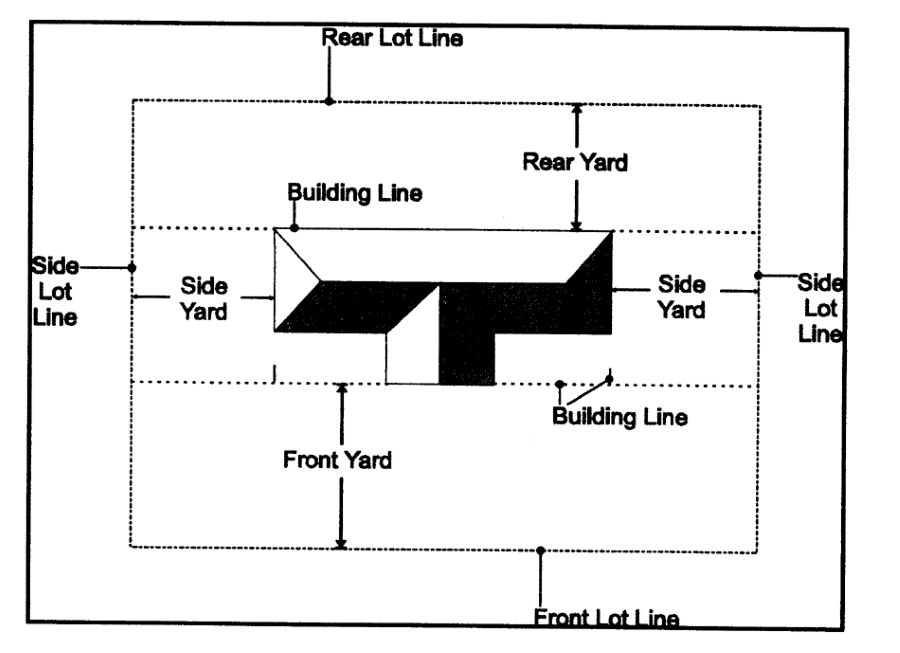
YARD AND LOT LINES
Yard, front: A yard extending across the full width of the lot and lying between the front line of the lot and the nearest line of the building.
Yard, rear: A yard extending across the full width of the lot and lying between the rear line of the lot and the nearest line of the principal building.
Yard, side: That part of the yard lying between the main building and a side lot line, and extending from the required front yard (or from the front lot line, if there is no required front yard) to the required rear yard.
Zero lot line: A single family unit distinguished by the location of one exterior wall on a side property line.
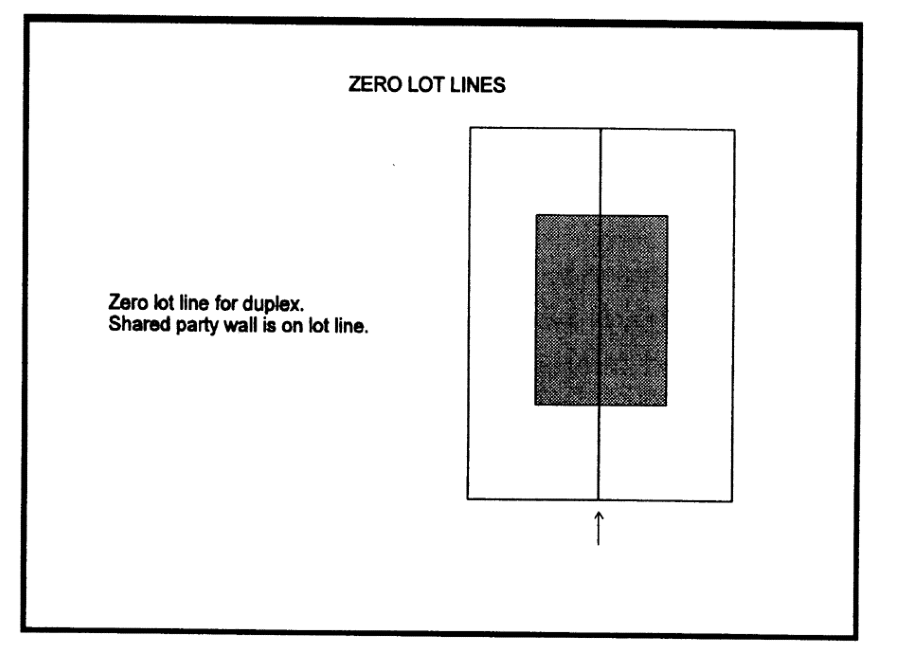
ZERO LOT LINES
Zoning officer: The agent or official designated by the council and charged by law with the administration and enforcement of the comprehensive plan and zoning ordinance. He serves as the secretary to the City of Beckley planning commission, board of zoning appeals and historic landmark commission and as such maintains all records, prepares recommendations, findings of facts and performs other duties to each as assigned or requested.
(Ord. of 8-13-02; Ord. of 8-12-03, § 2; Ord. of 12-9-03, § 1; Ord. of 4-9-19; Ord. of 7-14-20; Ord. of 11-9-21)
Sec. 15-4. - Use districts.
(a)
The city is hereby divided into ten (10) use districts:
(1)
R-1 one-family district
(2)
R-2 general residential district
(3)
R-3 multiple-family district
(4)
R-5 multiple-family high rise
(5)
R-6 elderly high rise
(6)
O/R office/residential transitional district
(7)
B-1 neighborhood business district
(8)
B-2 general commercial-business district
(9)
B-3 "Courthouse Square" central downtown multi-use district
(10)
M manufacturing district
(b)
The boundaries of designated districts are shown upon the map made a part of this chapter, which map is designated as the zone map of the city. The zone map made a part of this chapter and on file in the office of the city recorder-treasurer and all notations, references, and other information shown thereon are a part of this chapter and have the same force and effect as if the zone map and all such notations, references, and other information shown thereon were fully set forth or described herein.
(c)
Interpretation of district boundaries. The board of zoning appeals (BZA) has the authority to interpret the official zoning map and shall adhere to the following rules:
(1)
Where district boundaries are indicated as approximately following the center lines of streets or highways, street lines, or highway right-of-way lines, such centerlines, street lines, or highway right-of-way lines shall be construed to be such boundaries.
(2)
Where district boundaries are so indicated that they approximately follow the lot lines, such lot lines shall be construed to be said boundaries.
(3)
Where district boundaries appear to be approximately parallel to the center lines or street lines of streets, or of the center lines or right-of-way lines of highways, such district boundaries shall be construed as parallel thereto and at such distance therefore as indicated on the official zoning map. If no distance is given, such dimensions shall be determined by the use of the scale shown on the official zoning map.
(4)
Where the boundary of a district follows a railroad line, such boundary shall be deemed to be located midway between the main tracks of said railroad line.
(5)
Where the boundary of a district follows a stream, lake, or other body of water, said boundary line shall be deemed to be at the limit of the jurisdiction of the City of Beckley, unless otherwise indicated.
(6)
In unsubdivided property, the district boundary lines on the map accompanying and made a part of this zoning ordinance shall be determined by dimension notes on the map or by the use of the scale appearing on the map.
(7)
When a street, alley, public way, or railroad right-of-way is vacated, the vacated area shall assume the zoning classification of the abutting zoning district.
(Ord. of 8-13-02)
Sec. 15-5. - Administration.
(a)
The zoning officer.
(1)
The provisions of this chapter shall be administered and enforced by an agent to be appointed by the council of the city, who shall be known as the zoning officer.
(2)
An official record shall be kept of all business and activities of the office of the zoning officer specified by provisions of this chapter and all such records shall be open to public inspection at all appropriate times in accordance with Freedom of Information Act provisions.
(3)
The zoning officer shall receive applications for and issue building permits and certificates of occupancy in accordance with the provisions of this chapter.
(4)
The zoning officer shall make all the required inspections or such officer may, subject to the approval of council, engage such expert opinion as such officer may deem necessary to report upon unusual technical issues that may arise.
(5)
At least annually, the zoning officer shall submit to the council a written statement reporting all permits and certificates of occupancy issued and notices and orders issued.
(b)
The planning commission.
(1)
The planning commission of the City of Beckley, under provisions of West Virginia Code, section 8-24-5, is comprised of seven (7) members, all of whom are freeholders and residents and qualified by knowledge and experience in matters pertaining to the development of the city, and include representatives of business, industry and labor. All are nominated by the mayor and confirmed by the common council. At least three-fifths (⅗), or four (4), have been residents for ten (10) years prior to their nomination and confirmation. One (1) member is also a member of the common council and one (1) member is a member of the city administration, both terms coextensive with their term of elected or appointed office. Members are appointed or reappointed for three-year terms.
(2)
Under the provisions of West Virginia Code, Chapter 8, Art. 24, any petition or other action requiring a public hearing before the planning commission shall require a public notice in accordance with West Virginia Code, sections 59-3-2(b), as amended, and shall be by Class 1-0 legal advertisement, not less than fifteen (15) days prior to the date set by the commission for the public hearing. A special notice of such public hearing, not less than ten (10) days before the date set by the commission for the public hearing, shall also be provided. The special notice shall be by regular mail to all owners and/or residents within three hundred (300) feet of the property to be considered. All costs of the public and special notice shall be paid by the petitioner. At the hearing any party may appear in person, by agent or by attorney.
(c)
Permits.
(1)
Any person who shall make application for a building permit shall, at the time of making such application, furnish a site plan or development plan of real estate upon which said application for a building permit is made. Said site plan shall be drawn to scale showing the following items:
a.
Legal or site description of the real estate involved;
b.
Location and size of all buildings and structures;
c.
Width and length of all entrances and exits to and from said real estate;
d.
All adjacent and adjoining roads or highways.
(2)
Site plans so furnished shall be filed and shall become a permanent public record.
(3)
No land shall be occupied or used and no building, including basements, hereafter erected, reconstructed, or structurally altered shall be occupied or used, in whole or part, for any purpose whatsoever until a certificate of occupancy has been issued stating that the building and use comply with all of the provisions of this chapter applicable to the building or premises or the use in the district in which it is to be located, and the applicable regulations of the state building and/or fire codes.
(4)
No change shall be made in the use of land or in the use of any building or part thereof, now or hereafter erected, reconstructed, or structurally altered, without a certificate of occupancy having been issued, and no such certificate shall be issued to make such change unless it is in conformity with the provisions of this chapter.
(d)
Conditional uses.
(1)
General standards applicable to all conditional uses.
a.
In addition to the specific requirements for conditionally permitted uses as specified in this chapter, the board of zoning appeals shall review the particular facts and circumstances of each proposed use in terms of the following standards and shall find adequate evidence showing that such use is at the proper location in that it:
1.
Is in fact, a conditional use established under the provision of this chapter.
2.
Will be harmonious and in accordance with the general objectives, or with any specific objective of the city's comprehensive plan and/or this chapter.
3.
Will be designed, constructed, operated, and maintained so as to be harmonious and appropriate in appearance with the existing or intended character of the general vicinity and that such use will not change the essential character of the same area.
4.
Will not be hazardous or disturbing to existing or future neighboring uses.
5.
Will be served adequately by essential public facilities and services such as highways, streets, police and fire protection, drainage structures, refuse disposal, water and sewer, and schools; or that the persons or agencies responsible for the establishment of the proposed use shall be able to provide adequately any such services.
6.
Will not create excessive additional requirements at public cost for public facilities and services and will not be detrimental to the economic welfare of the community.
7.
Will not involve uses, activities, processes, materials, equipment, and conditions of operation that will be detrimental to any persons, property, or the general welfare by reason of excessive production of traffic, noise, vibration, smoke, fumes, glare, or odors.
8.
Will have vehicular approaches to the property which shall be designed so as not to create an interference with traffic on surrounding public thoroughfares.
9.
Will not result in the destruction, loss, or damage of a natural, scenic, or historic feature of major importance.
(2)
Specific criteria for conditional uses. In granting any conditional use, the board of zoning appeals may prescribe appropriate conditions and safeguards in conformity with this chapter in addition to determination of positive findings of fact. Violations of such conditions and safeguards, when made a part of the terms under which the conditional use is granted, shall be deemed a violation of this chapter.
(e)
Site plan review process.
(1)
Site plan review shall be required in any district where the construction, alteration, or expansion of any principal/accessory structure, or the enlargement of a parking area by five (5) or more spaces in areas designated for multifamily, assembly, business or manufacturing use in R-2, R-3, R-5, R-6, B-1, B-2, B-3, and M zones, nor shall any premises be used for or have its use changed to any of the above or related uses unless final development plans for such building, structure, or premises have been submitted to and approved by the planning commission.
(2)
This section shall not apply to the erection, construction, alteration, or use of any one-family dwelling.
a.
Procedures for site plan review. Formal submission and approval of a site plan is required before any building permit may be issued. Submission and approval of a site plan includes following the review procedures and submission requirements defined herein.
b.
An applicant seeking site plan approval shall follow the site plan review process as defined in this chapter. For developments also requiring conditional use approval, the procedure established in section 15-5(c) shall be followed. If a variance is required, the applicant shall be required to seek a variance in accordance with section 15-6(g) before submitting plans for formal site plan approval in accordance with this chapter.
c.
Optional informal concept review. At any time prior to the formal submission and review of a site plan, an applicant may engage the zoning officer in an optional concept review process. The purpose of this informal review is to provide the applicant with an opportunity to conceptually discuss a proposed development and to provide general guidance to assist in the preparation of a formal site plan. There are no applied standards to the site sketch plan, however, the applicant is encouraged to provide enough detail in order to be able to accurately represent the concept. All comments and suggestions shall be considered informal by the applicant and shall not be a binding agreement with the planning commission for approval. This concept review is a service provided to benefit the applicant, and formal site plan approval is dependent upon the outcome of the site plan review described herein.
d.
Formal submission of site plan. All applicants are required to comply with site plan review procedures before receiving final approval of site plans and approval for a building permit. Applicants shall be required to submit a completed application and a final site plan (ten (10) sets) to the zoning officer at least fifteen (15) days before the next regularly scheduled meeting in order to be placed on the planning commission agenda for review. An additional fee may be required to defray the expenses associated with the city review of the plans, including the need to retain a registered professional engineer, architect, landscape architect, or other professional consultant to advise the city on any or all aspects of the site plan. The cost of required legal advertisement and postage for special notice letters shall be the responsibility of the applicant.
d.
Site plan content. A site plan shall include the following data, details, and supporting plans. The number of pages submitted will depend on the proposal's size and complexity. A site plan shall be prepared at a scale of one (1) inch equals twenty (20) feet (developments more than five (5) acres may be drawn at a scale of one (1) inch equals fifty (50) feet) or as determined by the zoning officer, on standard twenty-four-inch by thirty-six-inch sheets, with narrative on eight and one-half-inch by eleven-inch sheets as necessary. Items required for submission include:
1.
Name of the project, boundaries, and location maps showing the site's location in the city, date, north arrow, and scale of the plan. Indicate the location of the proposed development in relation to existing community facilities, thoroughfares, and other transportation modes, shopping centers, manufacturing establishments, and residential development.
2.
Name, address, telephone number, and fax number of the owner of record, developer, engineer, architect, landscape architect, and seal of the engineer, architect, or landscape architect who prepared the site plan, if applicable.
3.
The legal description of the site that will be developed.
4.
Existing or proposed deed restrictions or covenants associated with the development.
5.
Names and addresses of all owners of record of abutting parcels and those within three hundred (300) feet of the property lines.
6.
All existing lot lines, easements, and rights-of-way. Include area in acres or square feet. Indicate abutting land uses. Indicate the width and names of public rights-of-way that are adjacent to the site and/or will be used for access. Indicate applicable zoning district/proposed zoning district.
7.
The location and use of all existing and proposed buildings and structures within the development including building footprints, overhangs, site coverage, building-ground contact, and area. A brief description of the use of the site shall be included with an estimate of the number of employees.
8.
All dimensions of height and floor area and showing all exterior entrances.
9.
Illustrations of traffic movement, ingress and egress, and the location of all present and proposed public and private drives, parking areas, driveways, sidewalks, ramps, curbs, fences, paths, landscaping, walls, and fences.
10.
Illustrations of the proposed changes in any public right-of-way, and typical pavement sections and plans showing other improvements, including new streets and infrastructure to be constructed for the development which shall be dedicated to public use.
11.
The location, height, intensity, lighting pattern, bulb type and values (foot-candles) (e.g., fluorescent, sodium, incandescent) of all external lighting fixtures.
12.
The location, height, size, materials, and design of all proposed signage.
13.
The location of all present and proposed utility systems including sewage system, water supply system, telephone, cable, electrical systems, and storm drainage system including existing and proposed drain lines, culverts, catch basins, headwalls, endwalls, hydrants, manholes, and drainage swales, detention areas, and storm system design calculations.
14.
General soil conditions at the site and neighboring area. Plans to prevent the pollution of surface or groundwater, erosion of soil both during and after construction, excessive runoff, excessive raising or lowering of the water table, and flooding of other properties, as applicable.
15.
Existing and proposed topography upon and within seventy-five (75) feet of the site at a one (1) foot contour interval. All elevations shall refer to the nearest United States Coastal and Geodetic Bench Mark. If any portion of the parcel is within the one hundred-year flood plain, the area will be shown, and base flood elevations given. If the area is not located within the one hundred-year flood plain, this fact shall be noted on the plan.
16.
A landscape plan showing all existing natural land features, trees, forest cover, water resources, and all proposed changes to these features including size and type of plant material. Water resources will include ponds, lakes, streams, wetlands, floodplains, and drainage retention areas.
17.
For new construction or alterations to any existing building, a table containing the following information must be included:
i.
Area of building to be used for a particular use such as retail operation, office, storage, etc.
ii.
Maximum number of employees.
iii.
Maximum seating capacity, where applicable.
iv.
Number of parking spaces existing and required for the intended use.
v.
A complete set of building drawings and plans as approved by the code enforcement department.
(f)
Review by the zoning officer. The zoning officer shall review the application for compliance to all applicable sections of this chapter within fifteen (15) days of receipt of the application. Such review shall be based on the information provided by the applicant. If the zoning officer finds that the site plan will not comply with this chapter, the zoning officer shall notify the applicant of the discrepancies of the site plan. If the applicant disagrees with the zoning officer's decision or chooses to seek relief, the applicant may appeal to the board of zoning appeals for such relief, as described in section 15-6(h) as a separate process. Submission of the site plan to the planning commission for review shall not be permitted unless the zoning officer determines that the plans are in compliance with this chapter or an appeal has been granted from the board of zoning appeals.
(1)
The zoning officer shall forward the application to the planning commission for review and discussion after determining that the application is complete and the applicant complies with this chapter.
(2)
Notification of adjoining property owners. Upon determination that the application is complete, notices of the meeting to be held by the planning commission on the proposed development shall be sent, by first class mail not less than ten (10) days before that meeting, to all adjoining property owners within three hundred (300) feet of the proposed development. Applicant is responsible for the cost of mailings.
(g)
Review by planning commission. Within sixty (60) days of receipt of an accurate and complete application and plan from the zoning officer, the planning commission shall meet and shall consider the proposed site plan according to the following criteria:
(1)
The adequacy of the information presented to determine the impacts of the proposed site.
(2)
The impacts of the proposed development compared with the following standards:
a.
Traffic: Convenience and safety of both vehicular and pedestrian movement within the site and in relationship to adjoining ways and properties.
b.
Parking: Provisions for the off-street loading and unloading of vehicles incidental to the normal operation of the establishment, adequate parking, adequate lighting, and internal traffic control.
c.
Services: Reasonable demands placed on city services and infrastructure.
d.
Pollution control: Adequacy of methods for sewage and refuse disposal and the protection from pollution of both surface water and groundwater. This includes controlling soil erosion both during and after construction.
e.
Nuisances: Protection of abutting properties from any undue disturbance caused by excessive or unreasonable noise, smoke, vapors, fumes, dust, odors, glare, storm water runoff, etc.
f.
Existing vegetation: Minimizing the area over which existing vegetation is to be removed. Where tree removal is required, special attention shall be given to planting of replacement trees.
g.
Amenities: The applicant's efforts to integrate the proposed development into the existing landscape through design features, such as vegetative buffers, roadside planting, and the retention of other green areas.
h.
Community character: The building setbacks, area, and location of parking, architectural compatibility, signage, and landscaping of the development and how these features harmonize with the surrounding landscape.
(3)
Access control requirements. The planning commission may, as part of the site plan review process, require that driveways be moved, combined, re-aligned, or eliminated to reduce the potential for accidents. Access shall be reviewed relative to the distance from other drive approaches and from roadway intersections. The preferred method of providing access to parcels is to minimize or eliminate driveways by using service roads, rear access roads, or shared driveways. General standards for parking areas, circulation, and access (found in section 15-23 of this chapter) shall be incorporated as part of the site plan.
a.
Conditional approval of driveways. As part of the site plan review process, the planning commission may approve a site plan with a specific driveway location with the condition that an agreement be first entered into between the property owner and the City of Beckley requiring that if a service road is constructed in the future, or if the opportunity for a shared driveway should present itself with development of adjacent property, one (1) or more approved driveways shall be closed and measures taken to utilize such service road or shared drive. Approval of driveways may also include restrictions on turning movements, locations, or other requirements to ensure safe and efficient traffic movement.
b.
Construction and use of service roads. When a service road is required, such improvement shall be constructed by the developer of the involved property before any zoning occupancy or zoning use permit is granted. When a service road is provided, all access to an adjacent property shall use that service road and no direct access to the main thoroughfare shall be provided.
(4)
Traffic impact study. A traffic impact study may be required by the planning commission for site plan review if the expected trip generation of the proposed use exceeds one hundred (100) or more cars per hour as identified in the Institute of Traffic Engineers (ITE) Manual. Site plans involving roadways falling within the jurisdiction of the West Virginia Department of Transportation must meet all the specific traffic study requirements of that department. A traffic impact study shall be prepared by a qualified professional engineer at the developer's expense. The traffic impact study shall investigate the feasibility and benefits of improvements such as signals, turn lanes, driveway movement limitations, and other relevant information to the site to protect the safety of the traveling public. The traffic impact study shall include the following elements:
a.
A description of the site and study area.
b.
Anticipated development of adjacent parcels.
c.
Trip generation and distribution, including a description of all assumptions used to generate findings of trip distribution.
d.
Modal split (if applicable).
e.
Traffic assignment resulting from the development.
f.
Projected future traffic volumes.
g.
An assessment of the impact that would result from driveway alternatives.
h.
Recommendations for site access and transportation improvements needed to maintain traffic flow within and past the site at an acceptable and safe level of service.
i.
An evaluation of the effects the proposed development will have on the level of service and roadway capacity.
(5)
Final action. The planning commission shall take a final action consisting of either:
a.
Approval of the site plan based upon a determination that the proposed plan will constitute a suitable development and the plan meets all standards set forth in this zoning ordinance.
b.
Approval of the site plan subject to any additional conditions, modifications, and restrictions as are required to ensure that the project meets the zoning requirements.
1.
The site plan review should not result in a denial of the site plan, but should clearly list the necessary elements the applicant must provide, or the conditions, modifications, and restrictions required under the chapter.
2.
If the site plan is approved subject to conditions, the zoning officer shall not issue a permit until the site plan has been redrawn and resubmitted and checked for compliance with the imposed conditions.
(6)
Enforcement. The City of Beckley may require the posting of a bond or other similar performance guarantee to ensure compliance with the plan and stated conditions of approval. It may suspend any building permit when work is not performed as required. Site plan approval shall lapse within one (1) year if a substantial use thereof has not commenced, except for good cause.
(Ord. of 8-13-02)
Sec. 15-6. - Board of zoning appeals.
(a)
A board of zoning appeals is hereby established with membership and appointment provided in accordance with the authority conferred by Article 24 of Chapter 8 of the Code of West Virginia, as amended. The members of the board of zoning appeals shall be individuals who are freeholders and residents of the City of Beckley, and at least three-fifths (⅗) of such members must have been residents of the City of Beckley for at least ten (10) years preceding the time of their appointment. No member of the board of zoning appeals shall be a member of the planning commission nor shall any member hold other elective or appointive office in the city government. Members of the board shall serve without compensation, but shall be reimbursed for all reasonable and necessary expenses actually incurred in the performance of their official duties. (See West Virginia Code, section 8-24-51 for membership requirements.)
(b)
At the first meeting of each year, the board shall elect a chairman and vice-chairman from its members. The vice-chairman shall have authority to act as chairman during the absence or disability of the chairman.
(c)
A majority of members of the board shall constitute a quorum. No action of the board is official, however, unless authorized by a majority of the board.
(d)
The board may appoint and fix the compensation of a secretary and such employees as are necessary for the discharge of its duties all in conformity to and compliance with salaries and compensations therefor fixed by the common council.
(e)
The board shall adopt such rules concerning the filing of appeals and applications for variances and conditional uses, giving of notice and conduct of hearings as shall be necessary to carry out their duties under the provisions of this chapter. The board of zoning appeals shall also impose requirements on specific conditions for conditional uses.
(f)
The board shall keep minutes of its proceedings, keep records of its examinations and other official actions, and shall record the vote on all actions taken. All minutes and records shall be filed in the office of the zoning officer and shall be a public record.
(g)
The board shall have the following powers and it shall be its duty to:
(1)
Hear and determine appeals from and review any order, requirement, decision, or determination made by an administrative official or board charged with the enforcement of this chapter.
(2)
Hear and decide applications for conditional uses as defined and required in this chapter.
(3)
Authorize upon appeal in specific cases such variance from the terms of this chapter as will not be contrary to the public interest, and so that the spirit of this chapter shall be observed and substantial justice done. Approval is contingent on findings of fact that there are:
a.
Exceptional or extraordinary circumstances or conditions applicable to the property or intended use that do not generally apply to other property or class of use in the same neighborhood and area;
b.
Such variance is necessary for the preservation and enjoyment of a substantial property right possessed by other property in the same neighborhood and area but denied to the property in question;
c.
The granting of the variance will not be materially detrimental to the public welfare or injurious to other property or improvements in the neighborhood and area; and
d.
The granting of the variance will not alter land use characteristics of the neighborhood and area, diminish marketable values of adjacent land and improvements or increase congestion on public streets.
(h)
The board of zoning appeals shall have the power to permit variations from the regulations as follows:
(1)
Authorize a building permit in any residential, business or manufacturing district for a temporary building or use incidental to the residential or business development, such permit to be issued for a period of not more than two (2) years;
(2)
Authorize a building permit in the manufacturing district for a building or use otherwise excluded from such district, provided such building or use is distinctly incidental and essential to a use of a building or plant with a series of buildings permitted in such district, subject to such conditions as will safeguard the public health, safety, convenience, and general welfare;
(3)
Apply the provisions of this section in such a way as to carry out the true intent and purpose where the street and alley layout on the ground differs from the layout shown on the zoning map;
(4)
Where, by reason of exceptional narrowness, shallowness, or shape of a specified piece of property at the time of the enactment of the zoning regulations, or by reason of exceptional topographical conditions or other extraordinary and exceptional situations or conditions of such piece of property, the strict application of these regulations would result in peculiar and exceptional practical difficulty to or exceptional or undue hardship upon the owner of such property, the board of zoning appeals shall have the power in a specific case to vary from such strict application so as to relieve such difficulties or hardships, provided such relief may be granted without substantial detriment to the public good and without substantially impairing the intent and purpose of the comprehensive plan and the zoning ordinance;
(5)
To hear and decide appeals where it is alleged by the appellant that there is error in any order, requirement, permit, decision, or refusal made by the zoning officer or any other administrative official in carrying out the enforcement of any provisions of this chapter;
(6)
To grant a conditional use permit for the erection of buildings and the use of buildings and lands within an appropriate residential district for clubs, lodges, social, and community center buildings, provided it is the finding of the board that such proposed use and/or buildings will not impair an adequate supply of light and air to adjacent property, or materially increase the congestion in public streets, or increase the public danger of fire and safety or materially diminish or impair established property values within the surrounding area, or in any other respect impair the public health, safety, comfort, morals, and welfare of the community; and, provided further, that the site plans are first approved by the city planning commission taking into account the foregoing considerations and the adequacy and safety of ingress and egress to and from the site, the adequacy of off-street loading and unloading space to be provided, and the appropriate landscaped screening from adjacent properties in the side and rear yard areas;
(7)
To grant a conditional use permit for the erection of buildings and the use of land within any district for private schools, elementary and high, including parochial schools, having a curriculum substantially similar to that ordinarily given in public elementary or public high schools, and hospitals and sanitariums, and not containing offices for doctors or other persons except those necessary to the operation of such hospital or sanitariums; provided it is the finding of the board that such proposed use and/or buildings will not impair an adequate supply of light and air to adjacent property, or materially diminish or impair established property values within the surrounding area, or in any other respect impair the public health, safety, comfort, morals, and welfare of the community; and, provided further, that the site plans are first approved by the city planning commission taking into account the foregoing considerations and the adequacy and safety of ingress and egress to and from the site, the adequacy of off-street loading and unloading space to be provided, and the appropriate landscaped screening from adjacent properties in the side and rear yard areas.
(8)
The board may impose reasonable conditions for landscaping and screening as necessary.
(i)
In exercising its powers, the board may reverse or affirm, wholly or partly, or may modify the order, requirement, decision, or determination appealed from as in its opinion ought to be done on the premises, and, to that end, shall have all the powers of the administrative official or board from whom the appeal is taken.
(j)
An appeal taken from the requirement, decision or the determination made by an administrative official or board charged with the enforcement of this chapter shall be filed with the board. The appeal shall specify the grounds thereof and shall be filed within thirty (30) days of the date the requirement, decision or determination was issued and in such form as may be prescribed by the board by general rule. The administrative official or board from whom the appeal is taken shall, upon request of the board, transmit to it all documents, plans, and papers constituting the record of the action from which an appeal was taken.
(k)
The board shall fix a time for the hearing of an appeal. Public notice shall be given in accordance with Chapter 59, Article 3, Section 2(b) of the West Virginia Code, 1931, as amended, and such notice shall be a Class 1-0 legal advertisement. Additionally, notice shall specifically be given to all property owners and/or occupants residents within a three hundred-foot radius of the property to be considered at the hearing. The public notice, shall be given not less than thirty (30) days prior to the date set by the board for the public hearing. The special notice shall be by regular mail and shall be not less than ten (10) days from the date set by the board for the public hearing. The petitioner shall bear the cost of all public notice and special notice. At the hearing, any party may appear in person, by agent, or by attorney.
(l)
When an appeal from the decision of any administrative official or board has been taken and filed, all proceedings and work on the premises concerning which the decision was made shall be stayed unless the administrative official or board from whom the appeal was taken shall certify to the board that, by reason of facts stated in the certificate, a stay would cause imminent peril to life or property. In such case, proceedings or work shall not be stayed except by a restraining order which may be granted by the circuit court of this county, an application, on notice to the administrative official or board from whom the appeal is taken, and the owner of the premises affected and on due cause shown.
(m)
Every decision or order of the board of zoning appeals shall be subject to review by certiorari. Any person or persons jointly or severally aggrieved by any decision or order of the board of zoning appeals may present to the county circuit court of Raleigh County a petition duly verified, setting forth that such decision or order is illegal in whole or in part, and specifying the grounds of the alleged illegality. The petition must be presented to the court within thirty (30) days after the date of the decision or the order of the board of zoning appeals complained of.
(Ord. of 8-13-02)
Sec. 15-7. - General provisions.
(a)
All streets, alleys, and railroad rights-of-way, if not otherwise specifically designated, shall be deemed to be in the same zone as the property immediately abutting upon such alleys, streets, or railroad right-of-way. Where the center line of a street or alley served as a district boundary and zoning of such street or such street or alley, unless otherwise specifically designated, shall be deemed to be the same as that of the abutting property up to such center line.
(b)
No building or structure shall be erected, converted, enlarged, reconstructed, or structurally altered, nor shall any building or land be used for any purpose other than is permitted in the district in which the building or land is located.
(c)
No building or structure shall be erected, converted, enlarged, reconstructed, or structurally altered to exceed the height limit herein established for the district in which the building is located except that penthouses or roof structures for the housing of elevators, stairways, tanks, ventilating fans, or similar equipment required to operate and maintain the building, and fire or parapet walls, skylights, flagpoles, chimneys, smokestacks, water tanks, or similar structures or towers, radio and television aerials or antennas, wireless masts or other wireless telecommunications towers and facilities, subject to the provisions of section 15-25 et seq. of this chapter may be erected above the height limits herein prescribed. No such structure may be erected to exceed by more than twenty-five (25) feet, the height limits of the district in which it is located, except that aerials or antennas designed to aid home television reception may be erected to a height not to exceed sixty (60) feet from the ground level, provided said aerial or antenna is attached to the building or erected in the rear yard area.
(d)
No building or structure other than a building for conditional use shall be erected, converted, enlarged, reconstructed, or structurally altered except in conformity with the area regulations of the district in which the building is located.
(e)
No space which for the purpose of a building or dwelling group has been counted or calculated as part of a side yard, rear yard, front yard, court, or other open space required by this chapter, may, by reason of change in ownership or otherwise, be counted or calculated to satisfy or comply with a yard, court, or other space requirement of, or for any other building:
(1)
An open terrace, but not including a roofed-over porch or terrace, may occupy a front yard provided the unoccupied portion of the front yard has a depth of not less than fifteen (15) feet. A one-story bay window may project into a front yard not more than three (3) feet. Overhanging eaves, including gutters, may project over the minimum required side yard not more than eighteen (18) inches.
(2)
The minimum yards or other open spaces, including lot areas per family, required by this chapter for any building hereafter erected, shall not be encroached upon or considered as yard or open space requirements for any other building.
(f)
Every building hereafter erected or structurally altered to provide dwelling units shall be located on a lot as herein defined, and in no case shall there be more than one (1) such building on one (1) lot unless otherwise provided in this chapter.
(g)
Any separate tract, the title of which was of record at the time of the adoption of this chapter, that does not meet the requirements of this chapter for yards, courts, or other area of open space may be utilized for single residence purpose provided the requirements for such yard or court (or lot) area, width, depth, or open space is within fifty (50) per cent of that required by the terms of this chapter. The purpose of this provision is to permit utilization of recorded lots which lack adequate width or depth as long as reasonable living standards can be provided.
(h)
No building shall be constructed or erected upon a lot, or parcel of land, which does not abut upon a public street or permanent easement of access to a public street, which street or easement shall have a minimum width of forty (40) feet, unless such street or easement of lesser width was of record prior to the adoption of this chapter. Additionally, no public street or permanent easement of access to a public street shall be constructed with a cul-de-sac (a street closed at one (1) end in a circular manner), which cul-de-sac is less than eighty (80) feet in diameter.
(i)
No wall, fence, or shrubbery shall be erected, maintained, or planted on any lot which unreasonably obstructs or interferes with traffic visibility on a curve or at any street intersection.
(j)
A dwelling shall not be erected in the M manufacturing district; however, the sleeping quarters of a watchman or caretaker are permitted.
(k)
No residential structure shall be erected upon the rear of a lot or upon a lot with another dwelling; except that in a two-story garage with living quarters upon the second floor; such quarters may be occupied by a servant (and the servant's family) of the family occupying the main structure. There may also be constructed a guest house (without kitchen) or rooms for guests within an accessory building, provided such facilities are used for the occasional housing of guests of the occupants of the main structure and not for permanent occupancy by others as a housekeeping unit.
(l)
Nothing in this chapter shall be deemed to require any change in the plans, construction, or designated use of any building upon which actual construction was lawfully begun prior to the adoption of this chapter and upon which building actual construction has been diligently carried on, and provided further, that such building shall be completed within two (2) years from the date of passage and publication of this chapter.
(m)
An area indicated on the official zone map as a public park or recreation area, public utility area, cemetery, public school site, or semipublic open space, shall not be used for any other purpose, and when the use of the area is discontinued, it shall automatically be zoned R-1 one-family district, until otherwise zoned.
(n)
Any area annexed to the city shall, upon such annexation, be automatically zoned R-1 one-family district, until otherwise zoned.
(Ord. of 8-13-02)
Sec. 15-8. - R-1 one-family district.
The following regulations shall apply:
(a)
Use regulations. Permitted uses are:
(1)
Accessory buildings including a private garage, accessory living quarters, guesthouse, recreation room, green house, and bathhouse, provided they shall be located as required in section 15-24(a);
(2)
Automobile parking space to be provided as required in section 15-23;
(3)
Bomb shelters and/or fallout shelters;
(4)
Group residential facility, or home not to be occupied by the behaviorally disabled or by more than six (6) developmentally disabled individuals;
(5)
Sign pertaining to the lease or sale of the building or premises on which the sign is located not exceeding six (6) square feet in area, except as otherwise provided in section 15-300;
(6)
Single-family dwellings;
(7)
Temporary buildings less than nine hundred (900) square feet and temporary uses incidental to construction, for a period not to exceed one (1) year, except that a six-month extension may be granted if construction is substantially underway;
(8)
Vegetable gardening and other horticultural uses, where no building is involved, and not operated for profit;
(b)
Conditionally permitted uses. The following uses are permitted as a conditional use, and require a conditional use permit in accordance with section 15-5(d).
(1)
Bed and breakfast;
(2)
Bicycle trails;
(3)
Cemeteries, crematories, or mausoleums;
(4)
Child day care center/nursery school, conducted entirely on church property, subject to section 15-24(k);
(5)
Churches and accessory buildings used for religious teaching, subject to RLUIPA;
(6)
Elderly day care center (six (6) or less);
(7)
Community or recreational centers;
(8)
Emergency services and service buildings/garages (e.g., ambulance, fire, police, rescue);
(9)
Golf courses;
(10)
Group residential facility or home, if to be occupied by the behaviorally disabled or by more than six (6) developmentally disabled individuals;
(11)
Home occupations subject to the provisions of section 15-24(d);
(12)
Parking areas, lots, and parking garages, subject to section 15-23;
(13)
Park/playground (public or private);
(14)
Public administration building or any other publicly-owned structure;
(15)
Schools, public or private.
(c)
Building height. No building or structure nor the enlargement of any building or structure shall be hereafter erected or maintained or exceed three (3) stories, nor shall it exceed thirty-five (35) feet in height.
(d)
Areas. No building or structure nor the enlargement of any building or structure shall be hereafter erected or maintained unless the following yards and lot areas are provided and maintained in connection with such building, structure, or enlargement:
(1)
Front yard. There shall be a front yard of not less than twenty-five (25) feet or the established building line if less than twenty-five (25) feet.
(2)
Side yard. On the interior lots, there shall be a side yard on each side of a main building of not less than ten (10) feet, and a combined total of side yards of not less than twenty-five (25) feet. Any lot platted prior to the enactment of this chapter which is less than seventy-five (75) feet wide may reduce the two (2) side yards by nine (9) inches for each foot of difference to a total width of not less than ten (10) feet. Under such circumstances, the width of the narrower of the two (2) side yards shall not be less than five (5) feet.
a.
On corner lots, the side yard requirements shall be the same as for interior lots, except that there shall be maintained a side yard of not less than fifteen (15) feet on the side adjacent to the street which intersects the street upon which the building or structure maintains frontage, and there shall be maintained a setback from the side street of not less than fifty (50) per cent of the front yard required on the lots in the rear of such corner lot, but such setback need not exceed fifteen (15) feet.
(3)
Rear yard. There shall be a rear yard having an average depth of not less than forty (40) feet.
(4)
Lot area. Every lot or other parcel of land shall have a minimum width at the front building line of seventy-five (75) feet, and a minimum area of ten thousand (10,000) square feet for all uses permitted in this section, except that the lot area for churches, public and private schools, or any permitted eleemosynary institution shall be not less than one (1) acre.
(5)
Lot coverage. Not more than thirty-five (35) per cent of the area of a lot may be covered by main buildings, structures, or accessory buildings.
(6)
Accessory buildings. Accessory buildings shall not encroach upon the front yard. They may encroach upon the side yards provided no buildings are closer to the lot lines than five (5) feet. Provided further that on a corner lot, accessory buildings shall not encroach upon the front or side yards adjacent to the abutting streets.
(Ord. of 8-13-02; Ord. of 12-9-03, § 1)
Sec. 15-9. - R-2 general residential district.
(a)
Permitted use regulations. Permitted uses are:
(1)
Accessory buildings including a private garage, accessory living quarters, guesthouse, recreation room, green house, and bathhouse, provided they shall be located as required in section 15-24(a);
(2)
Automobile parking space to be provided as required in section 15-23;
(3)
Group residential facility or home;
(4)
Temporary buildings less than nine hundred (900) square feet and temporary uses incidental to construction, for a period not to exceed one (1) year, except that a six-month extension may be granted if construction is substantially underway;
(5)
Two- to four-family dwelling units;
(6)
Vegetable gardening and other horticultural uses, where no building is involved, and not operated for profit.
(b)
Conditionally permitted uses. The following uses are permitted as a conditional use, and require a conditional use permit in accordance with sections 15-5(d).
(1)
Auditoriums;
(2)
Bed and breakfast;
(3)
Bicycle trails;
(4)
Cemeteries, crematories, or mausoleums;
(5)
Child day care center/nursery school, facility or home, subject to section 15-24(k);
(6)
Churches and accessory buildings used for religious teaching, subject to RLUIPA;
(7)
Community or recreational centers;
(8)
Emergency services and service buildings/garages (e.g., ambulance, fire, police, rescue);
(9)
Golf and miniature golf courses;
(10)
Gymnasiums;
(11)
Home occupations;
(12)
Hospitals or sanitariums, acute care, extended care or long-term care facilities, nursing homes;
(13)
Parking areas, lots, and parking garages, subject to section 15-23;
(14)
Park/playground (public or private);
(15)
Public administration building or any other publicly-owned structure;
(16)
Public utility facilities (i.e., filtration plant or pumping station, heat or power plant, transformer station and other similar facilities);
(17)
Schools, public or private;
(18)
Single-family dwellings;
(19)
Utility, broadcasting stations or towers subject to section 15-25.
(c)
Height. No building shall be erected or enlarged to exceed a height of three (3) stories, nor shall it exceed thirty-five (35) feet.
(d)
Areas. No building shall be erected or enlarged unless the following yards and lot areas are provided and maintained in connection with such building structures or enlargement:
(1)
Front yard. Each lot upon which a dwelling is constructed shall have a front yard of not less than twenty-five (25) feet. Where lots comprising forty (40) per cent or more of the frontage between two (2) intersecting streets are developed with buildings having front yards with a variation of not more than fifteen (15) feet in depth, the average of such front yards shall establish the minimum front yard depth for the entire frontage. In no case shall a front yard of more than fifty (50) feet be required.
(2)
Side yard. On the interior lots there shall be a side yard on each side of a main building of not less than eight (8) feet, and a combined total of side yards of not less than twenty (20) feet. Any lot platted prior to the enactment of this chapter which is less than sixty (60) feet wide may reduce the two (2) side yards by nine (9) inches for each foot of difference to a total width of not less than fifteen (15) feet. Under such circumstances the width of the narrower of the two (2) side yards shall not be less than six (6) feet.
a.
On corner lots the side yard shall be the same as for interior lots, except that there shall be maintained a side yard of not less than ten (10) feet on the side adjacent to the street which intersects the street upon which the building or structure maintains frontage, except in the case of a reversed corner lot, there shall be maintained a setback from the side street of not less than fifty (50) per cent of the front yard required, but such setback need not exceed twenty (20) feet.
(3)
Rear yard. There shall be a rear yard having an average depth of not less than thirty-five (35) feet.
(4)
Lot coverage. Not more than thirty-five (35) per cent of the area of a lot may be covered by main buildings, structures, or accessory buildings.
(5)
Lot area. Every dwelling hereafter erected or structurally altered to accommodate two- to four-family dwelling units shall be on a lot having a width at the established building line of not less than sixty (60) feet, and an area per dwelling unit of not less than three thousand seven hundred fifty (3,750) square feet.
(6)
Accessory buildings. Accessory buildings shall not encroach upon the front yard. They may encroach upon the side yards provided no buildings are closer to the lot lines than five (5) feet. Provided further that on a corner lot, accessory buildings shall not encroach upon the front or side yards adjacent to the abutting streets.
(Ord. of 8-13-02)
Sec. 15-10. - R-3 multiple-family district.
(a)
Permitted use regulations. Permitted uses are:
(1)
Accessory buildings including a private garage, accessory living quarters, guesthouse, recreation room, green house, and bathhouse, provided they shall be located as required in section 15-24(a);
(2)
Automobile parking space to be provided as required in section 15-23;
(3)
Boarding or lodging houses;
(4)
Elderly housing;
(5)
Group residential facility or home;
(6)
Long-term care facility;
(7)
Multiple family dwellings and apartments of five (5) or more family units;
(8)
Row dwellings containing five (5) or more family units;
(9)
Temporary buildings less than nine hundred (900) square feet and temporary uses incidental to construction, for a period not to exceed one (1) year, except that a six-month extension may be granted if construction is substantially underway;
(10)
Vegetable gardening and other horticultural uses, where no building is involved, and not operated for profit;
(11)
Zero lot line dwellings with one (1) or more zero lot line units, with six (6) units being the maximum number of units to be joined together.
(b)
Conditionally permitted uses. The following uses are permitted as a conditional use and require a conditional use permit in accordance with sections 15-5(c).
(1)
Auditoriums;
(2)
Bed and breakfast;
(3)
Bicycle trails;
(4)
Cemeteries, crematories, or mausoleums;
(5)
Child day care center/nursery school, facility or home, subject to section 15-24(k);
(6)
Churches and accessory buildings used for religious teaching, subject to RLUIPA;
(7)
Clubs, lodges, or fraternal organizations, when not operated for profit;
(8)
Community or recreational centers;
(9)
Elderly day care center;
(10)
Emergency services and service buildings/garages (e.g., ambulance, fire, police, rescue);
(11)
Golf and miniature golf courses;
(12)
Gymnasiums;
(13)
Home occupations;
(14)
Hospitals or sanitariums;
(15)
Parking areas, lots, and parking garages, subject to section 15-23;
(16)
Park/playground (public or private);
(17)
Public administration building or any other publicly-owned structure;
(18)
Public utility facilities (i.e., filtration plant or pumping station, heat or power plant, transformer station and other similar facilities);
(19)
Schools, public or private;
(20)
Public utilities, broadcasting stations or towers subject to section 15-25.
(c)
Height. No building shall hereafter be erected or structurally altered to exceed four (4) stories nor shall it exceed forty-five (45) feet in height.
(d)
Areas. No building or structure nor the enlargement of any building or structure shall be hereafter erected or maintained unless the following yards and lot areas are provided and maintained in connection with such structure or enlargement:
(1)
Front yard. There shall be a front yard of not less than twenty (20) feet.
(2)
Side yard. On interior lots there shall be a side yard on each side of a main building of not less than five (5) feet, and a combined total of side yards of not less than fifteen (15) feet. On corner lots the side yard on the intersecting street side shall not be less than ten (10) feet.
(3)
Rear yard. There shall be a rear yard of not less than twenty-five (25) feet for interior lots nor less than fifteen (15) feet for corner lots.
(4)
Lot coverage. Not more than thirty-five (35) per cent of the area of a lot may be covered by buildings or structures.
(5)
Lot area. Every building hereafter erected or structurally altered as a multiple dwelling, apartment, or row dwelling of more than four (4) dwelling units shall provide a lot area per dwelling unit of not less than fifteen hundred (1,500) square feet. No building hereafter erected or structurally altered in the R-3 multiple-family district shall have a total lot area of less than seven thousand (7,000) square feet, nor a lot width of less than eighty (80) feet.
(6)
Courts. No inner court or courts completely surrounded on all sides by a building shall be permitted. Outer courts are permitted, provided the depth of the court is no greater than the width of the court.
(7)
Accessory buildings. The same regulations shall apply as required in the R-2 one- to four-family district.
(Ord. of 8-13-02; Ord. of 12-9-03, § 1)
Sec. 15-11. - R-5 multiple-family high-rise.
(a)
Permitted use regulations. Permitted uses are:
(1)
Accessory buildings including a private garage, accessory living quarters, guesthouse, recreation room, green house, and bathhouse, provided they shall be located as required in section 15-24(a);
(2)
Assisted living facility;
(3)
Automobile parking space to be provided as required in section 15-23;
(4)
Boarding or lodging houses;
(5)
Elderly housing;
(6)
Group residential facility or home;
(7)
Long-term care facility;
(8)
Multiple family dwellings and apartments of five (5) or more family units;
(9)
Row dwellings containing five (5) or more family units;
(10)
Sign pertaining to the lease or sale of the building or premises on which the sign is located not exceeding eight (8) square feet in area, except as otherwise provided in section 15-300;
(11)
Temporary buildings less than nine hundred (900) square feet and temporary uses incidental to construction, for a period not to exceed one (1) year, except that a six-month extension may be granted if construction is substantially underway;
(12)
Vegetable gardening and other horticultural uses, where no building is involved, and not operated for profit;
(13)
Zero lot line dwellings with one (1) or more zero lot line units, with six (6) units being the maximum number of units to be joined together.
(b)
Conditionally permitted uses. The following uses are permitted as a conditional use, and require a conditional use permit in accordance with sections 15-5(c).
(1)
Auditoriums;
(2)
Bed and breakfast;
(3)
Bicycle trails;
(4)
Cemeteries, crematories, or mausoleums;
(5)
Child day care center/nursery school, facility or home, subject to section 15-24(k);
(6)
Churches and accessory buildings used for religious teaching, subject to RLUIPA;
(7)
Community or recreational centers;
(8)
Elderly day care center;
(9)
Emergency services and service buildings/garages (e.g., ambulance, fire, police, rescue);
(10)
Gymnasiums;
(11)
Home occupations;
(12)
Hospitals or sanitariums;
(13)
Parking areas, lots, and parking garages, subject to section 15-23;
(14)
Park/playground (public or private);
(15)
Public administration building or any other publicly-owned structure;
(16)
Public utility facilities (i.e., filtration plant or pumping station, heat or power plant, transformer station and other similar facilities);
(17)
Schools, public or private;
(18)
Telephone exchange;
(19)
Public utilities, broadcasting stations or towers subject to section 15-25.
(c)
Height. Height of all multiple-family high-rise dwellings shall be subject to approval by the city fire department, based on fire control considerations and potential hazards to life and property, but in no event shall height exceed ten (10) stories or one hundred twenty (120) feet, whichever is less.
(d)
Area and yard requirements. No building or structure or the enlargement of any building or structure shall be hereafter erected or maintained unless the following yards and lot areas are provided and maintained in connection with such structure or enlargement:
(1)
Front yard. There shall be a front yard of not less than twenty-five (25) feet. Such twenty-five-foot required yard shall be maintained in landscaping, aside from drive-ways and walkways, and shall not be used for off-street parking.
(2)
Side yard. On interior lots, there shall be a side yard on each side of a main building of not less than ten (10) feet, and a combined total of side yard of not less than twenty (20) feet. On corner lots the side yard on the intersection street shall be not less than twenty-five (25) feet.
(3)
Rear yard. There shall be a rear yard of not less than twenty (20) feet.
(4)
Additional rear and side yard requirements. In addition to the requirements set forth above, the rear and side yards shall be increased by one (1) foot for each two (2) feet of building height above forty-five (45) feet.
(5)
Lot coverage. Not more than forty (40) per cent of the area of a lot may be covered by buildings or structures.
(6)
Lot area. Every building hereafter erected or structurally altered as a multiple-family high-rise dwelling shall provide a lot area per dwelling unit of not less than one thousand five hundred (1,500) square feet. No building hereafter erected or structurally altered in the R-5 multiple-family high-rise district shall have a total lot area of less than twenty thousand (20,000) square feet, nor a lot width of less than one hundred twenty (120) feet.
(e)
Additional requirements:
(1)
The zoning officer shall issue no building permit for the erection of any multiple-family high-rise apartment, or for any alteration of any multiple-family high-rise apartment which:
a.
Increase its height, coverage of land, or number of units;
b.
Changes the general nature or extent of its use; or
c.
Alters parking requirements or reduces the number of off-street parking spaces available,
(2)
Nor shall any certificate of occupancy be issued for such multiple-family high-rise dwelling, nor shall any other city agency, department, official, or representative take action in connection with the erection or use of any multiple-family high-rise dwelling unless and until the planning commission shall have reviewed the application and documents required to be submitted therewith and reported concerning conformity with provisions, intent and purposes of this chapter, or has failed to report as hereinafter provided.
(3)
In connection with all applications for permits or certificates on multiple-family high-rise dwellings requiring planning commission action, the applicant shall submit architectural plans (including details as to use of areas within structures, number, location, and orientation of dwelling units, etc.); plot plans; landscaping plans; plans for off-street parking, service areas, and ingress and egress arrangements; plans for proposed signs; plans for lighting the premises outside buildings; elevations of all portions of proposed structures; topographic maps and photographs or perspective drawings showing the relationship between the proposed structures as it is to be located on the premises and all principal structures within five hundred (500) feet (or such other distance as the planning commission deems necessary in the particular case) of any portion exceeding fifty (50) feet in height of any building or buildings to be erected on the premises.
(4)
Applicants shall also provide such maps, plans, drawings, or reports as are necessary to indicate:
a.
That suitable major streets, fitting the probable patterns of origins and destinations of residents, are immediately available to the property or can be reached without creating concentrated traffic flow on minor streets through residential neighborhoods;
b.
That the property, if developed as proposed, will not be subject to hazards such as objectionable smoke, noxious odors, unusual noise, possibility of subsidence or probability of flood or erosion, and that conditions of soil, ground water level, drainage, rock formations, and topography will not create hazards to the property or to the health and safety of the occupants;
c.
That essential community services, such as employment centers, shopping centers, schools, if likely to be required, recreation areas, and police and fire protection will be readily accessible to the property in appropriate form and scale, or that provision will be made assuring these facilities; and
d.
That appropriate water supply, sewerage, telephone, electrical, gas, and other utility installations exist or will be made available. The zoning officer may require posting of appropriate and sufficient bond to insure such installations or availability.
(5)
In addition, the applicant shall supply such other plans, drawings, maps, or reports as the planning commission may require in the particular case to guide its findings as to matters on which it is generally or specifically required to make findings.
(6)
After the applicant has submitted all required documents, the planning commission shall complete its report in a timely manner.
(7)
All multiple-family high-rise existing and new, regardless of the type of construction, shall be provided with complete automatic sprinkler protection and complete electronic fire alarm systems incorporating such devices as smoke detectors and rate of rise censors, provided such equipment has been approved by the state fire and building code. All alarms shall be automatically transmitted by the fire alarm system to the emergency operations center. All multiple-family high-rise dwellings shall also fully comply with all other existing and applicable city code provisions.
(8)
There shall be no loading in connection with normal operations on the street in front of the premises, or in any required front yard; where practicable, all loading shall be provided for at the rear of the building or structure.
(Ord. of 8-13-02; Ord. of 12-9-03, § 1)
Sec. 15-12. - R-6 elderly high-rise.
(a)
Permitted use regulations. Permitted uses are:
(1)
Accessory buildings including a private garage, accessory living quarters, guesthouse, recreation room, green house, and bathhouse, provided they shall be located as required in section 15-24(a);
(2)
Assisted living facility;
(3)
Automobile parking space to be provided as required in section 15-23;
(4)
Bicycle trails;
(5)
Boarding or lodging houses;
(6)
Group residential facility or home;
(7)
Long-term care facility;
(8)
Multiple family dwellings and apartments containing five (5) or more units;
(9)
Temporary buildings less than nine hundred (900) square feet and temporary uses incidental to construction, for a period not to exceed one (1) year, except that a six-month extension may be granted if construction is substantially underway;
(10)
Vegetable gardening and other horticultural uses, where no building is involved, and not operated for profit.
(b)
Conditionally permitted uses. The following uses are permitted as a conditional use, and require a conditional use permit in accordance with sections 15-5(c).
(1)
Auditoriums;
(2)
Child day care center/nursery school or facility, subject to section 15-24(k);
(3)
Churches and accessory buildings used for religious teaching, subject to RLUIPA;
(4)
Community or recreational centers;
(5)
Elderly day care center;
(6)
Emergency services and service buildings/garages (e.g., ambulance, fire, police, rescue);
(7)
Gymnasiums;
(8)
Home occupations;
(9)
Hospitals or sanitariums, nursing homes, acute care, extended care or long-term care facilities;
(10)
Railroad right-of-way;
(11)
Parking areas, lots, and parking garages, subject to section 15-23;
(12)
Park/playground (public or private);
(13)
Public administration building or any other publicly-owned structure;
(14)
Public utility facilities (i.e., filtration plant or pumping station, heat or power plant, transformer station and other similar facilities);
(15)
Schools, public or private;
(16)
Telephone exchange;
(17)
Public utilities, broadcasting stations or towers.
(c)
Height. Height of all elderly high-rise dwellings shall be subject to approval by the city code enforcement department and fire departments, based on fire control considerations and potential hazards to life and property, but in no event shall height exceed ten (10) stories or one hundred twenty (120) feet, whichever is less.
(d)
Area and yard requirements. No building or structure or the enlargement of any building or structure shall be hereafter erected or maintained unless the following yards and lot areas are provided and maintained in connection with such structure or enlargement:
(1)
Front yard. There shall be a front yard of not less than twenty-five (25) feet. Such twenty-five foot required yard shall be maintained in landscaping, aside from driveways and walkways, and shall not be used for off-street parking.
(2)
Side yard. On interior lots there shall be a side yard on each side of a main building of not less than ten (10) feet. On corner lots the side yard on the intersection street side shall be not less than twenty-five (25) feet.
(3)
Rear yard. There shall be a rear yard of not less than twenty (20) feet.
(4)
Additional rear and side yard requirements. In addition to the requirements set forth above, the rear and side yards shall be increased by one (1) foot for each two (2) feet of building height above forty-five (45) feet.
(5)
Lot coverage. No more than forty-five (45) per cent of the area of a lot may be covered by buildings or structures.
(6)
Lot area. Every building hereafter erected or structurally altered as an elderly high-rise dwelling shall provide a lot area per dwelling unit of not less than six hundred (600) square feet. No building hereafter erected or structurally altered in the R-6 elderly high-rise district shall have a total lot area of less than twenty thousand (20,000) square feet, nor a lot width of less than one hundred twenty (120) square feet.
(7)
Dwelling standards. All elderly high-rise dwelling units hereafter erected, converted or reconstructed shall contain the following square feet of usable square feet of floor area, exclusive of basements, cellars, unfinished attics, open porches, access hallways and garages:
a.
One bedroom: Four hundred eighty (480) square feet;
b.
Two (2) bedrooms: Six hundred thirty (630) square feet;
c.
Three (3) bedrooms: Seven hundred eighty (780) square feet;
d.
Four (4) bedrooms or larger: Nine hundred thirty (930) square feet.
e.
All elderly high-rise dwellings existing and new, regardless of the type of construction, shall be provided with complete automatic sprinkler protection and complete electronic fire alarm systems incorporating such devices as smoke detectors and rate of rise censors provided such equipment has been approved by the state fire and building code. All alarms shall be automatically transmitted by the fire alarm system to the emergency operations center. All elderly high-rise dwellings shall also fully comply with all other existing and applicable city code provisions.
f.
There shall be no loading in connection with normal operations on the street in front of the premises, or in any required front yard; where practicable, all loading shall be provided for at the rear of the building or structure.
(Ord. of 8-13-02; Ord. of 12-9-03, § 1)
Sec. 15-13. - O/R office/residential transitional district.
(a)
Permitted use regulations. Permitted uses are:
(1)
Accessory buildings including a private garage, accessory living quarters, guesthouse, recreation room, green house, and bathhouse, provided they shall be located as required in section 15-24(a);
(2)
Single-family dwellings;
(3)
Offices for service, financial, or professional businesses, barber shops, beauty and hair salons;
(4)
Bed and breakfast inns not to exceed ten (10) units;
(5)
Group residential facility or home not to be occupied by more than six (6) developmentally disabled individuals or the behaviorally disabled.
(b)
Conditionally permitted uses. The following uses are permitted as a conditional use, and require a conditional use permit in accordance with section 15-5(d).
(1)
Child day care center/nursery school, facility or home, subject to section 15-24(k);
(2)
Adult day care center;
(3)
Churches and accessory buildings used for religious teaching, subject to RLUIPA;
(4)
Home occupations subject to the provisions of section 15-24(d).
(c)
Building height. No building or structure, nor the enlargement of any building or structure, shall be hereafter erected or maintained or exceed three (3) stories, nor shall it exceed thirty-five (35) feet in height.
(d)
Areas. No building or structure nor the enlargement of any building or structure shall be hereafter erected or maintained unless the following yards and lot areas are provided and maintained in connection with such building, structure, or enlargement:
(1)
Front yard. There shall be a front yard of not less than twenty-five (25) feet.
(2)
Side yard. There shall be side yards totaling not less than twenty-five (25) feet with the short side not less than ten (10) feet except on a corner lot the side yard abutting the street shall have a side yard of not less than fifteen (15) feet.
(3)
Rear yard. There shall be a rear yard of not less than twenty-five (25) feet and a green belt or buffer zone not less than fifteen (15) feet abutting the rear property line, with a privacy fence or screen planting separating O/R from any residential zone of not less than eight (8) feet in height.
(4)
Lot area. Every lot or other parcel of land shall have a minimum width at the front building line of seventy-five (75) feet, and a minimum area of ten thousand (10,000) square feet for all uses permitted in this section, except that the lot area for churches, public and private schools, or any permitted eleemosynary institution shall be not less than one (1) acre.
(5)
Lot coverage. Not more than fifty (50) per cent of the area of a lot may be covered by main buildings, structures, or accessory buildings.
(6)
Parking. No vehicle, including trailers, may be parked in a front yard except on a paved driveway. The parking of oversize vehicles shall also be subject to the restrictions of section 14-823.
(7)
Accessory buildings. Accessory buildings shall not encroach upon the front yard. They may encroach upon the side yards provided no buildings are closer to the lot lines than five (5) feet or no closer than five (5) feet to the greenbelt or buffer zone, if applicable. Provided further that on a corner lot, accessory buildings shall not encroach upon the front or side yards adjacent to the abutting streets.
(8)
Frontage. Any new lots platted in any O/R Zoning District may not exceed 200 feet in frontage.
(e)
Prohibitions. Registered MAT facilities may not be located within one thousand (1,000) feet of a residential zone, church or place of worship, school, park, community or recreational facility.
(Ord. of 8-13-02; Ord. of 8-12-03, § 2; Ord. of 5-26-15; Ord. of 4-9-19)
Sec. 15-14. - B-1 neighborhood-highway business district.
(a)
Permitted use regulations. Permitted uses are:
(1)
Accessory uses customarily incidental to permitted uses;
(2)
Antique shops;
(3)
Auto convenience mart;
(4)
Automobile sales for both new and used vehicles and service shops, where all service operations are conducted wholly within an enclosed building as one (1) integrated business operation;
(5)
Automobile service stations;
(6)
Bakeries, retail;
(7)
Banks or other financial institutions;
(8)
Barber shops and beauty parlors;
(9)
Bed and breakfast;
(10)
Bicycle trails;
(11)
Blueprint and photostat stores;
(12)
Book or stationery stores;
(13)
Brew pub;
(14)
Care wash;
(15)
Clubs, private indoor;
(16)
Coffee shops;
(17)
Drugstores;
(18)
Electrical appliance shops and repair;
(19)
Florist shops, for retail trade only;
(20)
Frozen food lockers;
(21)
Grocery, fruit, or vegetable stores;
(22)
Group residential facility or home;
(23)
Hardware stores;
(24)
Hotels and motels;
(25)
Laundromat;
(26)
Laundry and/or ironing and/or dry cleaning pickup station;
(27)
Long-term care facility;
(28)
Markets;
(29)
Meat market or poultry stores, if no slaughter or stripping is involved;
(30)
Medical cannabis dispensary, growing facility, and processing facility;
(31)
Mobile food vendors, subject to section 15-37;
(32)
Offices for service or professional businesses;
(33)
Pet shops or animal hospitals when conducted wholly within the enclosed building;
(34)
Photographers' or artists' studios;
(35)
Restaurant, standard or sit-down;
(36)
Restaurant, entertainment;
(37)
Retail stores;
(38)
Row dwellings and multiple dwellings containing five (5) or more units, subject to the height and yard requirements of section 15-10(c) and (d);
(39)
Schools/studios, commercial or trade (e.g., business, dance, music, martial arts);
(40)
Secondhand merchandise, retail sales;
(41)
Self-storage facility (indoor), subject to section 15-24(p);
(42)
Shoe repair shops;
(43)
Tailor and dressmaking shops;
(44)
Temporary buildings less than nine hundred (900) square feet and temporary uses incidental to construction, for a period not to exceed one (1) year, except that a six-month extension may be granted if construction is substantially underway;
(45)
Temporary retail sales outlets conditioned upon the issuance of a permit by the recorder-treasurer;
(46)
Tourist homes;
(47)
Travel agency;
(48)
Undertaking establishments.
(b)
Conditionally permitted uses. The following uses are permitted as a conditional use, and require a conditional use permit in accordance with sections 15-5(d).
(1)
Auction rooms;
(2)
Auditoriums;
(3)
Cemeteries, crematories of mausoleums;
(4)
Child day care center/nursery school, facility or home, subject to section 15-24(k);
(5)
Churches and accessory buildings used for religious teaching, subject to RLUIPA;
(6)
Community or recreational centers;
(7)
Elderly day care center;
(8)
Elderly housing;
(9)
Emergency services and service buildings/garages (e.g., ambulance, fire, police, rescue);
(10)
Golf and miniature golf courses;
(11)
Gymnasiums;
(12)
Hospitals or sanitariums;
(13)
Kennels, subject to section 15-24(j);
(14)
Parking areas, lots, and parking garages, subject to section 15-23;
(15)
Park/playground (public or private);
(16)
Public utility facilities (i.e., filtration plant or pumping station, heat or power plant, transformer station and other similar facilities);
(17)
Railroad right-of-way;
(18)
Schools, public or private;
(19)
Self-storage facility subject to section 15-24(p);
(20)
Telephone exchange;
(21)
Public utilities, broadcasting stations or towers, telecommunication towers subject to section 15-25.
(c)
Height. No building shall be erected or enlarged to exceed a height of three (3) stories nor shall it exceed thirty-five (35) feet in height.
(d)
Areas. No building or structure nor the enlargement of any building or structure shall be hereafter erected or maintained unless the following yards and lot areas are provided and maintained in connection with such building, structure, or enlargement:
(1)
Front setback. All new structures permitted in this district shall be set back from the front street line a distance of not less than twenty (20) feet.
(2)
Side yard. The required side yard is ten (10) feet. Where a lot adjoins a residential district the side yard setback shall not be less than fifteen (15) feet.
(3)
Rear yard. There shall be a rear yard having a depth of not less than fifteen (15) feet when abutting upon a public alley and not less than twenty (20) feet when no dedicated alley or public way exists at the rear of the lot, except that a rear yard adjoining a residential district shall have a depth of not less than forty (40) feet.
(4)
Lot area. The same regulations as apply in the R-3 multiple-family district shall apply to dwelling units erected or structurally altered in this district, a minimum of one thousand five hundred (1,500) square feet per dwelling, not less than seven thousand (7,000) square feet total.
(5)
Maximum building size. Buildings in the B-1 Neighborhood-Highway Business District shall be less than twenty thousand (20,000) square foot structures in order to bring about more appropriate development by encouraging smaller scale buildings within established neighborhood business areas. Proposed buildings in the B-1 district over twenty thousand (20,000) square feet will require conditional use approval if located adjacent to highways and major thoroughfares.
(e)
Prohibitions.
(1)
The following permitted uses may not be located closer than three hundred (300) feet from the boundary of any "R", residential district or "O/R", office/residential transitional district: Automobile service station; brew pub; carwash; club, private indoor; restaurant, entertainment; restaurant, with drive-thru service; retail or convenience store selling alcohol or beer in sealed containers; retail or convenience store operating after 9:00 p.m. or before 7:00 a.m. The three hundred (300) foot separation distance shall exclude the width of any abutting public right-of-way.
(2)
Registered MAT facilities may not be located within one thousand (1,000) feet of a residential zone, church or place of worship, school, park, community or recreational facility.
(Ord. of 8-13-02; Ord. of 12-9-03, § 1; Ord. of 4-24-07; Ord. of 4-9-19; Ord. of 8-22-23(1); Ord. of 8-22-23(2))
Sec. 15-15. - B-2 general business district.
(a)
Permitted use regulations. Permitted uses are:
(1)
Agricultural implement sales and service conducted wholly within a completely enclosed building;
(2)
Air conditioning and heating sales and service;
(3)
Antique shop;
(4)
Auction rooms;
(5)
Auditoriums;
(6)
Auditoriums, indoor;
(7)
Auto convenience mart;
(8)
Automobile or trailer sales (new or used), where the front portion of the lot is occupied by a structure containing automobile or trailer show rooms and the rear portion of the lot has open storage or where part of the open storage area is within fifty (50) feet of any street right-of-way;
(9)
Automobile sales for both new and used vehicles and service shops, where all service operations are conducted wholly within an enclosed building as one (1) integrated business operation;
(10)
Automobile service stations;
(11)
Bakeries, retail;
(12)
Banks or other financial institutions;
(13)
Battery and tire service stations;
(14)
Bed and breakfast;
(15)
Beverage distributors, but not including bottling plants;
(16)
Bicycle trails;
(17)
Billiard and pool rooms;
(18)
Blueprint and photostat stores;
(19)
Book binding;
(20)
Bowling alleys;
(21)
Brew pub;
(22)
Car wash;
(23)
Catering establishments;
(24)
Clubs, private indoor;
(25)
Coffee shops;
(26)
Dance halls;
(27)
Data processing facilities;
(28)
Department, furniture, and home appliance stores;
(29)
Elderly housing;
(30)
Electrical appliance shops and repair;
(31)
Employment agencies;
(32)
Expressing, baggage, and transfer delivery services;
(33)
Florist shops, for retail trade only;
(34)
Frozen food lockers;
(35)
Garages, public, for storage of private passenger automobiles, but not including repair service;
(36)
Garden supply, nursery, and/or greenhouses (provided all sales on premises are retail);
(37)
Grocery stores and supermarkets;
(38)
Grocery, fruit or vegetable stores);
(39)
Group residential facility or home;
(40)
Hardware stores;
(41)
Home improvement center;
(42)
Hotels and motels;
(43)
Laboratories;
(44)
Laundromat;
(45)
Laundry, receiving less than one thousand five hundred (1,500) pounds of dry goods per day;
(46)
Laundry and/or ironing and/or dry cleaning pickup station;
(47)
Long-term care facility;
(48)
Manufacturing or processing which is clearly incidental to retail use employing not more than ten (10) persons in actual manufacturing or processing;
(49)
Markets;
(50)
Meat market or poultry stores, if no slaughter or stripping is involved;
(51)
Medical cannabis dispensary, growing facility, or processing facility;
(52)
Medical offices, outpatient and surgical hospitals, medical centers, or clinics;
(53)
Micro brewery;
(54)
Mobile food vendors, subject to section 15-37;
(55)
Multiple family dwellings and apartments, five (5) units or more;
(56)
Offices for service or professional businesses;
(57)
Outlet shopping center;
(58)
Painting and decorating shops;
(59)
Parking areas, lots, and parking garages, subject to section 15-23;
(60)
Pet shops or animal hospitals when conducted wholly within the enclosed building;
(61)
Photographers' or artists' studios;
(62)
Plumbing, heating, and roofing supply and workshops;
(63)
Printing, publishing, and issuing of newspapers, periodicals, books, and other reading matter;
(64)
Printing shops;
(65)
Radio - television broadcasting places;
(66)
Radio and television sales and service;
(67)
Restaurant, standard or sit-down;
(68)
Restaurant, entertainment;
(69)
Retail stores;
(70)
Row dwellings, apartments or condominiums containing five (5) or more family units subject to section 15-10(c), (d);
(71)
Schools/studios, commercial or trade (e.g., business, dance, music, martial arts);
(72)
Secondhand merchandise, retail sales;
(73)
Self-storage facility (indoor), subject to section 15-24(p);
(74)
Shoe repair shops;
(75)
Tailor and dressmaking shops;
(76)
Taverns, subject to the regulations of the state and other adopted ordinances of the city;
(77)
Taxi service stations;
(78)
Telegraph service stations;
(79)
Temporary buildings less than nine hundred (900) square feet and temporary uses incidental to construction, for a period not to exceed one (1) year, except that a six-month extension maybe granted if construction is substantially underway;
(80)
Temporary retail sales outlets conditioned upon the issuance of a permit by the recorder-treasurer;
(81)
Theaters;
(82)
Tourist homes;
(83)
Trailer sales, when conducted within a building;
(84)
Travel agency;
(85)
Undertaking establishments;
(86)
Upholstery stores;
(87)
Video rental store;
(88)
Wholesale establishments, excluding a building the principal use of which is for a storage warehouse.
(b)
Conditionally permitted uses. The following uses are permitted as a conditional use and require a conditional use permit in accordance with sections 15-5(d).
(1)
Cemeteries, crematories, or mausoleums;
(2)
Child day care center/nursery school or facility, subject to section 15-24(k);
(3)
Churches and accessory buildings used for religious teaching, subject to RLUIPA;
(4)
Community or recreational centers;
(5)
Dry cleaning plant or facility;
(6)
Elderly day care;
(7)
Emergency services and service buildings/garages (e.g., ambulance, fire, police, rescue);
(8)
Golf and miniature golf courses;
(9)
Gymnasiums;
(10)
Hospitals or sanitariums;
(11)
Kennels, subject to section 15-24(j);
(12)
Park/playgrounds (public or private);
(13)
Public administration building or any other publicly-owned structure;
(14)
Public utility facilities (i.e., filtration plant or pumping station, heat or power plant, transformer station and other similar facilities);
(15)
Railroad right-of-way;
(16)
Schools, public or private;
(17)
Self-storage facility, subject to section 15-24(p);
(18)
Sexually-oriented businesses subject to section 15-24(b);
(19)
Telephone exchange;
(20)
Utility or broadcasting stations or towers;
(21)
Wireless telecommunication facilities subject to section 15-25.
(22)
Limited video lottery establishments, subject to section 15-24(n).
(23)
Vape/smoke shops, subject to section 15-38.
(c)
Height. No building or structure shall be erected or structurally altered to exceed a height of four (4) stories nor shall it exceed fifty-five (55) feet in height.
(d)
Areas.
(1)
Front yard. A front yard shall be required at the discretion of the zoning officer for emergency vehicle needs.
(2)
Side yard. A side yard shall be provided on the side of a lot which abuts a residential district, such yard having a width of not less than ten (10) feet, or at the discretion of the zoning officer a width of sufficient distance to provide for emergency vehicle access.
(3)
Rear yard. There shall be a rear yard with a depth of not less than twenty (20) feet when abutting upon a publicly dedicated alley or public way which exists at the rear of the lot. The rear yard may be used for off-street parking and loading as provided by section 15-23.
(4)
Parking and vehicle access shall be so arranged that there will be no need for motorists to back over sidewalks or into streets.
(e)
Prohibitions.
(1)
The following permitted uses may not be located closer than three hundred (300) feet from the boundary of any "R", residential district or "O/R", office/residential transitional district: Automobile service station; brew pub; carwash; club, private indoor; restaurant, entertainment; restaurant, with drive-thru service; retail or convenience store selling alcohol or beer in sealed containers; retail or convenience store operating after 9:00 p.m. or before 7:00 a.m. The three hundred (300) foot separation distance shall exclude the width of any abutting public right-of-way.
(2)
Registered MAT facilities may not be located within one thousand (1,000) feet of a residential zone, church or place of worship, school, park, community or recreational facility.
(Ord. of 8-13-02; Ord. of 12-9-03, § 1; Ord. of 11-9-04; Ord. of 4-24-07; Ord. of 4-9-19; Ord. of 8-22-23(1); Ord. of 8-22-23(2))
Sec. 15-16. - B-3 Courthouse Square.
(a)
Area of application.
(1)
The B-3 government/service/retail-cultural/entertainment-university zoning district shall encompass a portion of the existing central business district and includes the downtown Beckley historic district, of one hundred thirty-four (134) parcels which are subject to more stringent regulations administered by the City of Beckley historic landmark commission and its architectural review program and summary of design standards guidelines, adopted by ordinance October 25, 1994, as well as state and federal regulations enforced by the West Virginia state historic preservation office. The B-3 district is comprised of the downtown historic district and adjacent areas as referenced on the City of Beckley zoning maps.
Beginning at a point, said point being the intersection of the southern right-of-way line South Kanawha Street and the western right-of-way line of Beaver Avenue;
thence leaving said southern right-of-way line of South Kanawha Street and with said western right-of-way line of Beaver Avenue and the eastern boundary line of Parcel 28, Tax Map 36, District 1 to a point, said point being the common corner of Parcels 28 and 29 of Tax Map 36, District 1;
thence leaving said eastern right-of-way line of Beaver Avenue and with the southern boundary lines of Parcels 28, 27, 25, 24, 23, 22, 21, 18, 17, 14, 13, 12, 11, 19, and 17 to a point, said point being the southwest corner of Parcel 7, and a point in the eastern boundary line of Parcel 6, Tax Map 36, District 1;
thence with the western boundary line of Parcels 6, 7, 6.1, 8.1, 5, and 8 Tax Map 36, District 1, to a point, said point being the common corner to Parcels 5 and 8 and a point in the northern right-of-way line of Minnesota Avenue;
thence crossing said Minnesota Avenue to a point at the intersection of the southern right-of-way line of said Minnesota Avenue and the western right-of-way line of Riley Street, said point being the northeast corner of Parcel 115, Tax Map 36, District 1;
thence with said western right-of-way line of Riley Street and the eastern boundary lines of Parcels 115, 119, 120, and 114 to a point, said point being the common corner to Parcels 114 and 113, Tax Map 36, District 1;
thence leaving said western right-of-way line of Riley Street and with the common boundary line of 114, 113, 121, and 122 to a point, said point being the common corner of Parcels 121 and 122 and point in the eastern right-of-way line of Church Street;
thence crossing said Church Street to a point, said point being a point on the western right-of-way line of Church Street and the common corner of Parcels 78 and 80 of Tax Map 20, District 1;
thence with said right-of-way of Church Street, the eastern boundary lines of Parcels 80, 78, and 79 of Tax Map 20, District 1, in a northerly direction to a point, said point being at the intersection of the southern right-of-way line of Willow Lane and the western right-of-way line of said Church Street and also the northeast corner of Parcel 78, Tax Map 20, District 1;
thence leaving said Church Street and with said southern right-of-way line of Willow Lane and the northern boundary lines of Parcels 78, crossing South Fayette Street, 77, 76 crossing at the intersection of Rawlings Street, 67, 66, 65, 64, 37, 38 and 36 to a point, said point being the northwest corner of Parcel 36, District 1 and the intersection of said southern right-of-way line of Willow Lane and the eastern right-of-way line of South Heber Street;
thence crossing said Heber Street to a point, said point being in the western right-of-way lines of said Heber Street and the northeast corner of Parcel 1, Tax Map 20, District 1;
thence with the northern boundary line of said Parcel 1, Tax Map 20, District 1 to a point, said point being the northwest corner of Parcel 1, Tax Map 20, District 1 and a point in the eastern right-of-way line of Woodlawn Avenue;
thence crossing said Woodlawn Avenue to a point, said point being the northeast corner of Parcel 22, Tax Map 20, District 1 and the intersection of the southern right-of-way line of Bellevue Lane and the western right-of-way line of said Woodlawn Avenue;
thence leaving said Woodlawn Avenue and with said southern right-of-way line of Bellevue Lane and the northern boundary lines of Parcels 22, 21, 20, Tax Map 20, District 1, crossing the intersection with Freeman Street, continuing with the northern boundary lines of Parcels 9, 8, 7, 6, 1, and 3 to a point, said point being the northwest corner of Parcel 3, Tax Map 20, District 1 and the intersection of said southern right-of-way line of Bellevue Lane and the eastern right-of-way line of Second Street;
thence crossing said Second Street with the southern right-of-way line of said Second Street and the northern boundary lines of Parcels 27, through the intersection of First Avenue, 26, 22, 21, 20, 14, through the intersection of Second Avenue, continuing with the northern boundary lines of 13, 12, and 1, Tax Map 22, District 1, to a point, said point being a northeast corner of Parcel 1 and the intersection of said southern right-of- way line of Second Street and the centerline of Third Avenue;
thence with said centerline of Third Avenue in a southern direction parallel with the western boundary lines of Parcels 1, 2, 3, 4, and 5 through the intersection with Park Avenue to a point in the centerline of Third Avenue at its intersection with the extension of the southern right-of-way line of Park Avenue;
thence leaving said centerline of Third Avenue and with the common line of Parcels 11 and 13, Tax Map 29, District 1 to a point, said point being a common corner to said Parcels 11 and 13 and a point in the eastern right-of-way line of Robert C. Byrd Drive;
thence crossing Robert C. Byrd Drive to a point, said point being at the intersection of the western right-of-way lines of Robert C. Byrd Drive and the northern right-of-way line of Beckley Avenue and also the southeast corner of Parcel 7, Tax Map 29, District 1;
thence in a northern direction with said western right-of-way lines of Parcels 7, 52.1, 51, 50, crossing at the intersection of Ellison Avenue, continuing with Robert C. Byrd Drive's western right-of-way line, the eastern boundary lines of Parcels 28, 27.1, 26, 25, 24, crossing the intersection of Orchard Court, continuing with said western right-of-way line of Robert C. Byrd Drive and the western boundary of Parcel 19, crossing Neville Street to a point, said point being at the intersection of the southern right-of-way line of Prince Street and the western right-of-way line of said Robert C. Byrd Drive;
thence north crossing said Prince Street and with said western right-of-way line of Robert C. Byrd Drive, the eastern boundary lines of Parcels 221, 222, 223, 224, 225, 226, Tax Map 10, District 1 to a point, said point being the common corner to Parcels 226 and 227, Tax Map 10, District 1;
thence east crossing Robert C. Byrd Drive to a point, said point being at the intersection of the eastern right-of-way line of said Robert C. Byrd Drive and the northern right-of-way line of Sisson Street and the southeast corner of Parcel 15, Tax Map 26, District 1;
thence leaving Robert C. Byrd Drive and with said northern right-of-way line of Sisson Street and the southern boundary lines of Parcels 15 and 16, Tax Map 26, District 1 to a point, said point being a corner to Parcel 16 and a point at the intersection of said northern right-of-way line of Sisson Street and the western right-of-way line of Hemlock Street;
thence leaving said northern right-of-way line of Sisson Street and crossing said Sisson Street to a point, said point being a point in the southern right-of-way line of Sisson Street and a common corner to Parcels 50 and 49, Tax Map 26, District 1;
thence with said southern right-of-way line of Sisson Street and the northern boundary lines of Parcels 49, 46, 45, 44, 43, 42, 41, and 39, Tax Map 26, District 1, to a point, said point being a common corner to Parcels 39, 38, Tax Map 26, District 1;
thence with the common line of said Parcels 39 and 38, Tax Map 26, District 1, to a point, said point being a common corner to said Parcels 39 and 38 and point in the northern right-of-way line of the C & O Railway Railroad (now owned by the City of Beckley);
thence in a northeast direction with said northern railroad right-of-way line and the eastern boundary line of Parcels 38, 37, 36, 35 and 34, Tax Map 26, District 1, to a point, said point being the northeast corner of said Parcel 34 and the western right-of-way line of Piney Avenue;
thence crossing said Piney Avenue and with said right-of-way line of said railroad to a point, said point being the common corner of Parcels 182 and 183, Tax Map 11, District 1;
thence leaving and crossing said railroad right-of-way to a point, said point being at the intersection of the eastern right-of-way line of North Fayette Street and the southern right-of-way line of a 15 foot alley and a corner to Parcel 33, Tax Map 25, District 1;
thence with said southern right-of-way line of the 15 foot alley in a easterly direction, crossing part of said alley to the southeast corner of Parcel 46, Tax Map 25, District 1;
thence with the eastern right-of-way line of said 15 foot alley and the western boundary line of said Parcel 46, Tax Map 25, District 1, to a point, said point being the northwest corner of said Parcel 46 and the intersection of said 15 foot alley's western right-of-way line and the southern right-of-way line of Croft Street;
thence east a diagonal line crossing Croft Street to the south east corner of Parcel 24, Tax Map 12, District 1, and a point in the northern right-of-way line of said Croft Street;
thence east with said northern of said Croft Street to a point, said point being the southwest corner of Parcel 53, Tax Map 12, District 1, and the intersection of said northern right-of-way line of Croft Street and the eastern right-of-way line of a 12 foot alley;
thence leaving Croft Street and with said 12 foot alley in a northerly direction and with the western boundary line of Parcels 53, 52, 51, and 50 to a point, said point being the common corner to Parcels 49 and 50, Tax Map 12, District 1;
thence leaving said 12 foot alley and with the common line of said Parcels 49 and 50 to a point, said point also being a common corner to said Parcels 49 and 50 and a point in the western right-of-way line of North Kanawha Street;
thence crossing North Kanawha Street to a point, said point being the common corner to Parcels 74 and 75, Tax Map 12, District 1, and a point in the eastern right-of-way line of said North Kanawha Street;
thence with said eastern right-of-way line of North Kanawha Street and the western boundary lines of Parcels 74 and 73 to a point, said point being at the intersection of said eastern right-of-way line of North Kanawha Street and the northern boundary line of Wilson Street;
thence with said northern right-of-way line of Wilson Street and the southern boundary line of Parcels 73, 75, 117, 117.1, 119, 120, 121 and crossing Hull Street to a point in the eastern right-of-way line of Hull Street, said point also being the common corner to Parcel 152 and 154, Tax Map 12, District 1;
thence leaving said Hull Street and with the common line of said Parcels 152 and 154 to a point, said point being a common corner to Parcels 154 and 153, Tax Map 12, District 1 and a point in the western right-of-way line of Nebraska Avenue;
thence with said western right-of-way line of said Nebraska Avenue and the eastern boundary lines of Parcels 153, 150, 149, and 148 to a point, said point being the southeast corner of said Parcel 148, Tax Map 12, District 1;
thence crossing said Nebraska Avenue and East Prince Street to a point, said point being the corner to Parcel 1.1, Tax Map 17, District 1 and also the intersection of the southern right-of-way line of East Prince Street and the eastern right-of-way line of Williams Street;
thence leaving said East Prince Street and with said eastern right-of-way line of Williams Street and the western boundary line of Parcels 1.1, 76, 75, 74 crossing the intersection of Clyde Street, 77 and 78, Tax Map 17, District 1 to a point, said point being a corner to Parcel 78 and the intersection of the northern right-of-way line of Williams Street, the northern right-of-way line of a 12 foot alley and the northern right-of-way line of Hargrove Street;
thence leaving said corner of said Parcel 78 and crossing Williams Street to a point, said point being at the beginning of the northern right-of-way line of Garden Terrace and the western most corner of Parcel 165, Tax Map 17, District 1;
thence with said northern right-of-way line of Garden Terrace and the southern boundary lines of Parcels 165, 166, 167, and 258, Tax Map 17, District 1 to a point, said point being the southern most common corner of Parcels 268 and 267, Tax Map 17, District 1 and at the intersection of the northern right-of-way line of said Garden Terrace and the western right-of-way line of Bratton Street;
thence crossing said Bratton Street to a point, said point being a point in the northern right-of-way line of Crawford Street and the southwestern corner of Parcel 266, Tax Map 17, District 1;
thence with said northern right-of-way line of Crawford Street and the southern boundary lines of Parcels 266 through 248 inclusive to a point, said point being the southeast corner of Parcel 248 and a point at the intersection of said western right-of-way line of Johnstown Road;
thence leaving said Crawford Street and Parcel 248 and with said western right-of-way line of Johnstown Road and the eastern boundary line of Parcels 302, 302.1, and 303 to a point at the intersection of said western right-of-way line of Johnstown Road and the northern right-of-way line of South Kanawha Street;
thence crossing South Kanawha Street to the point and place of beginning.
(2)
Additionally, this section shall apply to all properties which front on any of the aforementioned streets, referenced on the zoning maps, but which are not within the generally described boundaries.
(b)
Permitted use regulations. Except as otherwise provided by law or in this section, no buildings, structures or land shall be used or occupied in the B-3 zone except for the following purposes:
(1)
Antique shops;
(2)
Aquariums;
(3)
Apartment units or other residential units;
(4)
Auditoriums (indoor);
(5)
Banks or other financial institutions;
(6)
Barber shops and beauty parlors;
(7)
Bicycle trails;
(8)
Blueprint and photostat shops;
(9)
Bowling alleys;
(10)
Brew pub;
(11)
Catering establishments;
(12)
Clubs, private indoor;
(13)
Coffee shop;
(14)
Community or recreation centers;
(15)
Convents or monasteries;
(16)
Data processing facilities;
(17)
Day or youth camps;
(18)
Duplicating, photography;
(19)
Elderly housing;
(20)
Funeral homes, mortuaries;
(21)
Garden supply, nursery, and/or greenhouses (provided all sales on the premises are retail);
(22)
Governmental offices, public administration buildings, publicly owned structures;
(23)
Grocery stores and supermarkets;
(24)
Group residential facility, home;
(25)
Gymnasiums;
(26)
Hospitals or sanitariums;
(27)
Hotels and motels, including extended stay;
(28)
Ice cream stores or stands;
(29)
Libraries or museums;
(30)
Laundry and/or ironing and/or dry cleaning pick up station or facility;
(31)
Lodges or fraternal orders or organizations;
(32)
Long-term care facility;
(33)
Markets;
(34)
Mechanical repair (watch, camera, bicycle, TV);
(35)
Medical offices; outpatient and surgical hospitals, medical centers or clinics;
(36)
Micro brewery;
(37)
Mobile food vendors, subject to section 15-37;
(38)
Multiple family dwellings and apartments, condominiums or other residential units;
(39)
Offices for service or professional businesses;
(40)
Parking areas, lots, parking garages, subject to section 15-23;
(41)
Recreational centers, indoor;
(42)
Restaurant, entertainment, with or without private club, private wine restaurant or tavern license;
(43)
Restaurants, standards or sit-down, with or without private club, private wine restaurant or tavern license;
(44)
Retail stores;
(45)
Retail stores selling liquor, beer soft drinks (in sealed containers not for consumption on premises);
(46)
Rooming houses;
(47)
Schools/studios, commercial or trade (e.g., business, dance, music, martial arts);
(48)
Secondhand merchandise, retail sales;
(49)
Shoe repair shops;
(50)
Shopping centers, malls;
(51)
Skating rinks (ice or roller), indoor or outdoor;
(52)
Swimming pools, indoor or outdoor;
(53)
Tailor and dressmaking shops;
(54)
Temporary retail sales outlets, subject to license and/or permit requirements;
(55)
Temporary street fairs;
(56)
Tennis, racquetball or handball courts;
(57)
Theaters, indoor or outdoor;
(58)
Travel agency;
(59)
University, college or other post-secondary education institutions;
(60)
Upholstery shops.
(c)
Conditionally permitted uses. The following uses are permitted as a conditional use, and require a conditional use permit in accordance with section 15-5(d):
(1)
Auction rooms;
(2)
Auditoriums;
(3)
Child care center, nursery school, day care center, subject to section 15-24(k);
(4)
Churches and accessory buildings used for religious teaching (subject to RLUIPA);
(5)
Elderly day care center;
(6)
Park/playground (public or private);
(7)
Schools, public or private, or for the physically or mentally handicapped;
(8)
Telephone exchange;
(9)
Utility, public; service yards or garages; broadcasting stations or towers;
(10)
Wireless telecommunications facilities, co-location only, subject to section 15-25.
(11)
Limited video lottery establishments, subject to section 15-24(n).
(d)
Height. No building or structure shall be erected or structurally altered to exceed four (4) stories nor shall it exceed fifty-five (55) feet in height.
(e)
Area.
(1)
Front yard. No front yard shall be required.
(2)
Side yard. No side yard shall be required except that when a building or group of buildings abuts upon a residential zone, a yard shall be provided on the side of the lot abutting the residential district, such side yard having a width of not less than ten (10) feet. In such circumstances where the delivery of emergency services could be jeopardized, the zoning officer may require a side yard not to exceed twelve (12) feet.
(3)
Rear yard. There shall be a rear yard with a depth of not less than fifteen (15) feet when abutting upon a publicly dedicated alley or when a public way exists at the rear of a lot, or when abutting upon a residential zone.
(f)
Parking and vehicle access.
(1)
A rear or side yard may be used for off-street parking and loading, subject to section 15-23.
(2)
Parking and vehicle access shall be so arranged that there will be no need for motorists to back over sidewalks or into streets.
(3)
Specific regulations for the B-3 Zone are found in section 15-23(m)(1)m.
(g)
Design standards. No building or structure shall be erected or structurally altered in any manner not in accordance with the architectural review program and design standard guidelines developed for the Downtown Beckley Historic District, by the City of Beckley Historic Landmark Commission.
(1)
Procedure for historic landmark commission review.
a.
Any person, firm or corporation, or other business entity desiring to alter the exterior of any existing structure within the B-3, Downtown Beckley Historic District, or to construct a new structure shall first contact the zoning officer to apply for the necessary permits, obtain the design standard guidelines of the historic landmark commission and apply for a certificate of appropriateness.
b.
After filing the application with the zoning officer, the zoning officer will contact the historic landmark commission to arrange for review of plans, compatibility, funding and other matters to be considered by the commission, to obtain a certificate of appropriateness. The applicant shall be notified as to the time, date and place when the commission will meet to review the application.
c.
Upon any determination by the historic landmark commission, if the applicant wishes to appeal the decision, such appeal shall be made to the City of Beckley board of zoning appeals in writing ten (10) working days following receipt by the applicant of the determination by the historic landmark commission. Upon notification of such appeal, the board of zoning appeals shall set a time and date for a hearing and the applicant, his agent or counsel shall present the appeal to the board at the designated time.
d.
If the applicant is displeased by the decision of the board of zoning appeals, the applicant must present an appeal to the circuit court of Raleigh County within thirty (30) days of the date of the decision by the board of zoning appeals.
e.
Upon receipt by an applicant of a certificate of appropriateness, the applicant must apply to the code enforcement department for a building permit prior to commencing any alteration or construction. No building permit shall be issued by the city until a certificate of appropriateness has been issued.
(2)
Noncompliant signs in B-3 District. In addition to the nonconforming uses specified in provisions of section 15-26 of this chapter, the provisions of this section shall apply. Any use of signs or awnings, building signs, logos or business names, pendant signs, window signs or any other type advertisement not in compliance and accepted by the historic landmark commission or the design standard guidelines issued by that commission after January 1, 1988 shall be deemed in noncompliance with this section and the property occupant shall be deemed in violation of the Beckley City Code and shall be subject to the provisions specified in section 15-30.
(3)
Exclusions. For any business or property owner who has any type of building, structure, or otherwise on property that is deemed as nonconforming under section 15-26 of this chapter at the time of passage of this chapter, and which building, structure or otherwise is a vital, integral part of an ongoing business enterprise and is necessary to maintain the business, such building, structure of otherwise is hereby excluded from the operations of this article until such time as the business or property owner disposes of or transfers the property; or the business is damaged beyond repair in excess of fifty (50) per cent of its assessed value as determined by the assessor of Raleigh County; or the property is abandoned or the business discontinued for a period of one (1) year, whichever event first occurs. Thereafter, the property owner shall comply with the requirements of this chapter and the zoning ordinance of the City of Beckley.
(h)
Prohibitions.
(1)
The following permitted uses may not be located closer than three hundred (300) feet from the boundary of any "R", residential district or "O/R", office/residential transitional district: Automobile service station; brew pub; carwash; club, private indoor; restaurant, entertainment; restaurant, with drive-thru service; retail or convenience store selling alcohol or beer in sealed containers; retail or convenience store operating after 9:00 p.m. or before 7:00 a.m. The three hundred (300) foot separation distance shall exclude the width of any abutting public right-of-way.
(2)
Registered MAT facilities may not be located within one thousand (1,000) feet of a residential zone, church or place of worship, school, park, community or recreational facility.
(Ord. of 8-13-02; Ord. of 12-9-03, § 1; Ord. of 11-9-04; Ord. of 4-24-07; Ord. of 4-9-19; Ord. of 8-22-23(2))
Sec. 15-22. - M manufacturing district.
(a)
Permitted use regulations. Permitted uses are:
(1)
Artificial limb manufacture;
(2)
Automobile painting, upholstering, repairing, reconditioning, and body and fender work when done within the confines of a structure;
(3)
Automobile sales for both new and used vehicles and service shops, where all service operations are conducted wholly within an enclosed building as one (1) integrated business operation;
(4)
Bakeries, wholesale;
(5)
Beverage bottling and distributing stations;
(6)
Bicycle trails;
(7)
Blacksmith shops;
(8)
Box manufacture;
(9)
Broom manufacture;
(10)
Building equipment, building materials, lumber, coal, sand and gravel yards, and yards for contracting equipment, maintenance, or operating equipment of public agencies, or public utilities, or materials or equipment of similar nature;
(11)
Business incubators;
(12)
Bus line shops and garages;
(13)
Canvas goods and fabrication;
(14)
Carpet and rug cleaners;
(15)
Carting, express hauling, or storage yards;
(16)
Cement block manufacture, when done wholly within a building;
(17)
Chick hatcheries;
(18)
Cleaning and dyeing establishments;
(19)
Clothing and dress manufacture;
(20)
Cosmetics and pharmaceuticals manufacture;
(21)
Creameries;
(22)
Dance studios;
(23)
Data processing facilities;
(24)
Drapery and bedding manufacture;
(25)
Dry cleaning plant or facility;
(26)
Electrical appliance and electronic instrument assembly;
(27)
Firearms sales and service;
(28)
Food processing and dehydrating for human consumption;
(29)
Furniture manufacture and upholstering;
(30)
Grain elevators;
(31)
Greenhouses, wholesale growers;
(32)
Heating and sheet metal fabrications;
(33)
Home improvement center;
(34)
Hotels and motels - extended stay;
(35)
Ice cream and ice manufacture;
(36)
Kennel;
(37)
Laundry, receiving less than one thousand five hundred (1,500) pounds of dry goods per day;
(38)
Laundry, receiving one thousand five hundred (1,500) pounds or more of dry goods per day;
(39)
Manufacture of pottery and figurines or any other similar ceramic products using only previously pulverized clay and kilns fired only by electricity or gas;
(40)
Manufacturing, compounding, assembling, or treatment of articles of merchandise from the following previously prepared materials; bone, cellophane, canvas, cloth, cork, feathers, felt, fiber, furs, glass, hair, horn, tanned leather, paper, plastics, precious or semiprecious metals or stones, shell, textiles, wood and yarns;
(41)
Manufacturing establishments that can be operated without creating objectionable noise, odor, dust, smoke, gas, fumes, or vapor, and that is a use compatible with the use and occupancy of adjoining properties;
(42)
Medical cannabis dispensary, growing facility, processing facility;
(43)
Mobile food vendors, subject to section 15-37;
(44)
Offices;
(45)
Recycling center;
(46)
Research and development facilities;
(47)
Self-storage facility (indoor), subject to section 15-24(p);
(48)
Self-storage facility, subject to section 15-24(p);
(49)
Stone, marble, and granite grinding and cutting;
(50)
Telephone exchange;
(51)
Tool and die shops;
(52)
Truck or bus storage yard, truck terminals;
(53)
Upholstering;
(54)
Wholesale establishments, excluding buildings where the principal use is a storage warehouse;
(55)
Window shade manufacture;
(56)
Wireless telecommunication facilities, subject to section 15-25.
(b)
Conditionally permitted uses. The following uses are permitted as a conditional use, and require a conditional use permit in accordance with sections 15-5(c).
(1)
Auditoriums;
(2)
Child day care center/nursery school or facility, subject to section 15-24(k);
(3)
Churches and accessory buildings used for religious teaching, subject to RLUIPA;
(4)
Community or recreational centers;
(5)
Emergency services and service buildings/garages (e.g., ambulance, fire, police, rescue);
(6)
Hospitals or sanitariums;
(7)
Kennels, subject to section 15-24(j);
(8)
Mineral or gravel extraction;
(9)
Parking areas, lots, and parking garages, subject to section 15-23;
(10)
Park/playground (public or private);
(11)
Public administration building or any other publicly-owned structure;
(12)
Public utility facilities, i.e., filtration plant or pumping station, heat or power plant, transformer station, and other similar facilities;
(13)
Railroad right-of-way;
(14)
Schools, public or private;
(15)
Stables, corrals, pens, coops, or kennels (structures);
(16)
Salvage yards, subject to section 15-24(l);
(17)
Public utilities or broadcasting stations or towers.
(c)
Height. No building or structure shall be erected or structurally altered to exceed a height of four (4) stories nor shall it exceed fifty-five (55) feet in height except as provided in section 15-5(e).
(d)
Areas. The maximum ground area occupied by all buildings shall be not more than sixty (60) per cent of the area of the lot or tract on which a building permit has been issued:
(1)
Front yard. There shall be a front yard having a depth of not less than fifty (50) feet wherein there shall be no structure of any kind, open storage of materials or equipment, or the parking of vehicles.
(2)
Side yard. There shall be a minimum side yard of not less than fifteen (15) feet on both sides of the building or buildings, but where the property is adjacent to an R district, there shall be a side yard of not less than twenty-five (25) feet on the side nearest to the residential lots. The parking of private automobiles may be permitted within the side yard areas, but not closer than five (5) feet to any lot zoned for residential use.
(3)
Rear yard. A rear yard is not required except where a lot abuts upon an R district, in which case there shall be a rear yard of not less than thirty (30) feet, and no storage of materials or equipment, or the parking of automobiles shall take place within the ten (10) feet of any residential lot or lots.
(Ord. of 8-13-02; Ord. of 4-24-07; Ord. of 1-10-17; Ord. of 11-10-20; Ord. of 8-22-23(2))
Sec. 15-23. - Off-street parking and loading.
(a)
General requirements.
(1)
Purpose: The purpose of this section is to ensure that safe and convenient parking areas are provided to serve the requirements of all land uses in the City of Beckley, to avoid traffic congestion, to avoid or minimize the adverse visual impact of large concentrations of exposed parking, to provide necessary access for service and emergency vehicles, and to provide for safe and convenient interaction between vehicles and pedestrians.
a.
For the purpose of this section, one hundred sixty-two (162) square feet (9' × 18') of lot or floor area, which have a means of ingress or egress from an alley or street, shall be deemed parking space for one (1) vehicle. Such space shall not occupy any part of any required front yard, except a driveway, but where open may be included as part of a required open space for side or rear yard. On corner or through lots, parking space may not be included as part of the required yards lying adjacent to either street. Such parking spaces and access driveways required in residential districts, when used in compliance with the provisions of this chapter, shall be paved or otherwise surfaced with an all-weather, dustproof material. That part of the driveway connecting from the curb line to the property line shall be paved with concrete or asphaltic materials.
b.
The provisions of this chapter, except where there is a change of use, or front yard parking is approved, shall not apply to any existing building or structure. Where the new use involves no additions or enlargements, there shall be provided as many of such spaces as may be required by this chapter.
c.
Whenever a building or structure constructed after the effective date of this zoning ordinance is changed or enlarged in floor area, number of employees, number of dwelling units, seating capacity, or otherwise to create a need for an increase in the number of existing parking spaces, additional parking spaces shall be provided on the basis of the enlargement or change.
d.
Whenever a building or structure existing prior to the effective date of this zoning ordinance is enlarged to the extent of fifty (50) per cent or more in floor area or in the area used, number of employees, number of housing units, seating capacity, or otherwise, said building or structure shall then and thereafter comply with the full parking requirements set forth herein.
(b)
Off-street loading space requirements and dimensions.
(1)
On the same lot with every building or part thereof, erected hereafter to be used for other than exclusive dwelling purposes, or as an accessory use for dwelling purposes, there shall be provided on the lot, adequate space for motor vehicles in order to avoid undue interference with the public use of streets or alleys. Such space, unless otherwise adequately provided for, shall include a ten-foot by forty-foot loading space, with fifteen (15) feet height clearance, and one (1) such space shall be provided for each ten thousand (10,000) square feet or fraction thereof of floor or lot area used for other than residence purposes.
(2)
Such loading space shall not be located in the required front yard of the lot on which it is located. However, the loading space shall have unrestricted ingress and egress to a public right-of-way.
(3)
No such space shall be closer than fifty (50) feet from any other lot located in any R District, unless wholly within a completely enclosed building or unless enclosed on all sides by a wall or uniformly painted solid board fence not less than six (6) feet in height.
(4)
The surface of the loading space and its access drive shall be maintained in a dust free condition at all times.
(c)
Dimensions.
(1)
Parking spaces shall have minimum rectangular dimensions and driveway aisles shall have a minimum width of not less than the following:
All dimensions for parking spaces shall be exclusive of driveways, aisles, and other circulation areas.
(d)
Access.
(1)
There shall be adequate provision for ingress and egress. Any parking area shall be designed in such a manner that any vehicle leaving or entering the parking area from or into a public or private street shall be traveling in a forward motion.
(2)
Access driveways for parking areas or loading spaces shall be located in such a way that any vehicle entering or leaving such area shall be clearly visible for a reasonable distance to any pedestrian or motorist approaching the access or driveway from a public or private street.
(3)
Where a lot does not abut on a public or private alley or easement of access, there shall be provided an access drive leading to the parking or storage areas or loading or unloading spaces required hereunder, in such a manner as to secure the most appropriate development of the property in question. Such access drive shall be not less than eight (8) feet in width in the case of a dwelling, and not less than eighteen (18) feet in width in all other cases; provided, however, that one-way aisles for either ingress or egress for uses other than dwellings may be reduced to not less than ten (10) feet in width. Such access drive or easement shall not be located in any R district except where provided in connection with a use permitted in an R district.
(e)
Width of access driveway.
(1)
The entrances and exits of the parking area shall be clearly marked. Interior vehicular circulation by way of access roads shall maintain the following minimum standards:
a.
For one-way traffic, the minimum width of fourteen (14) feet except for forty-five (45) degree parking, in which case the minimum width of the access road shall be eighteen (18) feet.
b.
Access roads for two-way traffic shall have a minimum width of twenty-four (24) feet.
c.
Parking areas having more than one (1) aisle or driveway shall have directional signs or markings in each aisle or driveway.
(f)
Location of parking spaces.
(1)
The following regulations shall govern the location of off-street parking spaces and areas:
a.
Parking spaces for all detached residential uses shall be located on the same lot as the use which they are intended to serve. Parking on nonpaved surfaces, on sidewalks or in the front yard shall be prohibited.
b.
Parking spaces for commercial, industrial, or institutional uses shall be located not more than seven hundred (700) feet from the principal use except as provided for in section 15-16.
c.
Parking spaces for apartments, dormitories, or similar residential uses shall be located not more than three hundred (300) feet from the principal use.
(g)
Mixed occupancies and uses not specified.
(1)
In the case of mixed uses, the total requirements for off-street parking facilities shall be the sum of the requirements of the various uses computed separately. In case a use is not specifically mentioned, the requirements for off-street parking facilities for a similar use shall apply.
(2)
Off-street parking facilities for one use shall not be considered as providing required parking facilities for any other use, except as specified for joint use in section 15-23(h).
(h)
Joint use.
(1)
Two (2) or more non-residential uses may jointly provide and use parking spaces when their hours of operation do not normally overlap, provided that a written agreement approved by the zoning officer or planning commission is filed with the application for a building permit. Permission for such joint use of parking spaces may be granted subject to such conditions as the zoning officer or planning commission finds necessary to carry out the purpose and intent of this section.
(2)
Common parking areas may be provided in areas designated to serve jointly two (2) or more buildings or uses provided that the total number of off-street parking spaces shall not be less than that required by this section for each use.
(i)
Handicapped parking. (It is the intent of this section to comply with all ADA, state and federal handicapped accessibility requirements.) All parking areas shall have provisions for the physically handicapped.
(1)
Handicap spaces shall be located as close as possible to a major entrance or a building or use.
(2)
A minimum of one (1) parking space for the handicapped shall be provided for each nonresidential use which requires a minimum of fifteen (15) parking spaces.
(3)
For such uses requiring more than fifteen (15) spaces, one (1) designated for the handicapped shall be provided for each additional twenty-five (25) spaces.
(4)
Handicap spaces shall be a minimum of twelve (12) feet in width unless located parallel to a sidewalk on the driver's side of the vehicle in which case they shall be a minimum of nine (9) feet in width. Parallel handicap spaces shall be a minimum of twenty-four (24) feet in length.
(5)
All handicap spaces shall be designated by means of a permanent, raised identification sign.
(j)
Grade of parking use areas.
(1)
Outdoor parking areas shall not exceed eight (8) per cent of grade and shall be not less than one (1) per cent of grade.
(2)
The cross slope of any parking or loading space shall not exceed five (5) per cent of grade.
(3)
The grade of access ways shall not exceed four (4) per cent within one hundred (100) feet of the intersection with a public right-of-way, or where topographic conditions preclude maintaining four (4) per cent or less, the grade of the access way shall not exceed one (1) per cent within twenty-five (25) feet of the public right-of-way.
(k)
Stacking spaces. For any drive-in or drive-through retail or service use, there shall be provided stacking space for vehicles waiting for service which space is sufficient to prevent any such vehicles from extending onto the public right-of-way at any time.
(1)
In no case shall fewer than four (4) such stacking spaces be provided for each such service bay, window, or counter on the entrance side, and one (1) such space on the exit side where an exit is provided.
(2)
Parking spaces required for such service bay uses may be counted among the required stacking spaces.
(3)
No bays designed to be entered from more than one (1) direction shall be permitted.
(l)
Striping. All parking areas with a capacity over twelve (12) vehicles shall be striped.
(m)
Parking space requirements.
(1)
In any district, except as noted below, every building built or structurally altered, enlarged or increased in capacity, and every land use initiated subsequent to the adoption of this section shall be provided with minimum off-street parking facilities as follows:
a.
One- and two-family dwellings, multiple-family dwellings and multiple-family high-rise: Two (2) parking spaces for each dwelling unit.
b.
Elderly high-rise: One (1) parking space for each two (2) dwelling units, also two hundred (200) square feet for each three (3) dwelling units shall be added to the open area requirement, this area to revert to improved parking area before discontinuance of use as elderly high rise. Any elderly high-rise converted to multiple-family high-rise must have two (2) parking spaces for each dwelling unit prior to the issuance of a certificate of occupancy as provided by the codes of the city.
c.
Hotels, motels, rooming houses, lodging houses: One (1) parking space for each guest sleeping room and one (1) parking space for each three (3) employees. If a restaurant or meeting facility is included, the requirements for such facilities shall be in addition to these requirements.
d.
Hospitals: One (1) parking space for each three (3) hospital beds; one (1) per doctor; one (1) for each two (2) employees.
e.
Tourist homes: One (1) parking space for each transient sleeping room offered for tourist accommodation in addition to parking spaces required for permanent residents of the building.
f.
Tourist courts and motels: One (1) parking space for each lodging unit.
g.
Churches, auditoriums, gymnasiums, stadiums, theaters, and other places of public or private assembly with fixed seats: One (1) parking space for each three (3) seats or bench seating spaces, based upon maximum seating capacity.
1.
For the purpose of this type of use, parking spaces already provided to meet off-street parking requirements for stores, office buildings and industrial establishments, or off-street parking facilities provided by the municipality, lying within three hundred (300) feet of the place of public assembly as measured along the lines of public access, and that are not normally in use between the hours of 6:00 p.m. and midnight, and are made available for other parking, may be used to meet up to seventy-five (75) per cent of the total requirements of parking space for places of public assembly.
h.
Dance halls, bowling alleys, and private clubs: One (1) parking space for each two hundred (200) square feet of floor area, to be provided on the premises or within three hundred (300) feet of the entrance;
i.
Funeral homes: Fifteen (15) parking spaces on the premises, plus one (1) space for each one hundred fifty (150) square feet of floor area which can be used as a parlor;
j.
Stores and other retail establishments and offices where such uses are permitted: One (1) parking space for each three hundred (300) square feet of store space, to be provided on the premises or within two hundred (200) feet of the entrance off of the street, except that restaurants or establishments whose primary use is to serve meals and refreshments to patrons shall provide one (1) parking space for each one hundred (100) square feet of floor space in the building;
k.
Wholesale and distributing establishments including telephone exchanges: One (1) parking space for each two (2) employees;
l.
Manufacturing establishments: One (1) parking space for each two (2) employees, based on the greatest number of employees at work at one time on the maximum working shift, to be provided on the premises or at other off-street locations within one thousand (1,000) feet of the main entrance.
m.
B-3 government/service/retail district, university district, cultural entertainment district: on site or by agreement (including municipal or private rental spaces), within one thousand (1,000) feet; retail/office/service: one (1) space for every three hundred (300) square feet of floor space; cultural/entertainment: one (1) space for every three (3) seats; restaurants: one (1) space for every one hundred (100) square feet of floor space; residential: one (1) space for each residential unit, on site or by agreement or contract within the B-3 zoning district.
(2)
Parking space required under this section may be reduced at a time when the capacity or use of a building is changed in such a manner that a new use or capacity would require less space than before the change. Such reduction may not be below the standards set forth in the section.
(3)
Loading and unloading areas shall not be considered as parking areas.
(4)
The joint use of parking facilities may be permitted in cases where major parking demands occur on different days of the week or during different hours, provided:
a.
That parking spaces will be available for each use in accordance with the above standards, and
b.
That the owners agree in writing that any subsequent sale or division of the property or change in use thereof will not interfere with the joint use of the parking facilities.
(5)
A plan of parking facilities shall accompany each application for a building permit or certificate of occupancy. The completion of the improvements for parking according to such plan shall be a requisite for the validity of the permit or certificate.
(6)
The common council may authorize a special permit to allow a parking lot in a residence zone for the purpose of meeting the requirements of this section, subject to the following limitations:
a.
Public notice and special notice must be given and a public hearing held by the planning commission on the request for a special permit in the same manner in which said notice is given and such hearing is held on a request for an amendment to this chapter or a site plan review.
b.
Special notice must be given by regular mail not less than ten (10) days before a hearing to all owners of property or residents lying within three hundred (300) feet of the land for which the special permit is sought.
c.
A special permit shall not be granted unless the application shows and warrants that in the proposed development of the parking area, front and side yards will be met and maintained.
(n)
Drainage. All parking and loading areas shall provide for proper drainage of surface water to prevent the drainage of such water onto adjacent properties or walkways. These areas shall be so graded and drained as to dispose of all surface water accumulated within the area. These areas shall be so arranged and marked as to provide for orderly and safe loading or unloading and parking and storage of self-propelled vehicles.
(o)
Lighting. Any parking area which is intended for use during non-daylight hours shall be properly illuminated to avoid accidents. Ground mounted lighting shall be permitted.
(1)
Lighting originating on a site shall not be permitted beyond the site to exceed the following values when measured at grade ten (10) feet beyond the property for the following adjacent properties:
a.
Residential—Three-tenths (0.3) foot-candle.
b.
Multi-family—Five-tenths (0.5) foot-candle.
c.
Office-commercial-assembly—One (1.0) foot-candle.
d.
Outdoor sports facilities—Lighting shall be reviewed for compliance with regard to the intent to minimize the impact of light trespass and glare on all surrounding properties and public rights-of-way.
(2)
A cutoff type luminaire shall be used to illuminate a parking lot and shall be so arranged as to reflect the light way from the adjoining property. When located adjacent to business uses, the light source shall not be visible at a height greater than five (5) feet above ground level. When located adjacent to residential uses, the light source shall not be visible at ground level or above.
(p)
Screening and landscape design standards.
(1)
Whenever a parking area is located in or adjacent to a residential district, it shall be effectively screened on all sides which adjoin or face any property used for residential purposes. A physical barrier created by earth berms, planter boxes, fences, walls or hedges not less than three and one-half (3½) feet nor more than (8) feet in height. The earth berms, planter boxes, and hedges shall be at least ten (10) feet wide, and shall be provided within the property boundaries. Tree species shall be selected that, at full maturity, will create a dense, visually obstructing buffer planting strip.
(2)
The space between such fence, wall, or planting screen and the lot line of the adjoining premises in any residential district shall be landscaped with grass, hardy shrubs, or evergreen ground cover and maintained in good condition.
(3)
In the event that terrain or other natural features are such that the erection of such fence, wall, or planting screen will not serve the intended purpose, then no such fence, wall, or planting screen and landscaping shall be required.
(4)
The following sections include specifications for plant materials. Alternatives to these materials that can be shown to meet both the intent and requirements of this chapter may be approved as part of a site plan:
a.
Shrubs: Shrubs shall be at least twenty-four (24) inches average height and spread at the time of planting, and, where required for screening, shall form a continuous, year-round, solid visual screen within five (5) years after planting.
b.
Ground cover and grass: Ground cover shall be planted a minimum of eight (8) inches on center and shall be planted in such a manner to present a finished appearance and seventy-five (75) per cent coverage after one (1) complete growing season. If approved as part of a site plan, ground cover may also consist of rocks, pebbles, wood chips, and other material. Grass shall be planted in species normally grown as permanent lawns.
c.
Prohibited tree species: Within any required landscaping, the following tree species may not be used:
1.
Box Elder
2.
Tree of Heaven
3.
Catalpa
4.
Black Walnut
5.
Poplar
6.
Willow
7.
Mountain Ash
8.
Siberian Elm
9.
Black Locust
10.
Hickory
11.
Mulberry
12.
Silver Maple
d.
In addition to the species listed above, trees which produce nuts, seeds, or fruit that can create a hazard to pedestrians or vehicles, shall not be planted in such a manner that the natural dripline of an average adult tree of the species planted will be any closer than three (3) feet of a pedestrian walkway or parking lot.
(5)
Walkways shall have a minimum effective (exclusive of vehicle overhang) width of four (4) feet.
(q)
Interior parking area landscaping. Landscaping within parking areas, whether ground cover or upright plant material, is necessary not only to reduce the generation of heat and water runoff, but to break up, visually, the expanse of paved areas. The use of parking islands or peninsulas strategically placed throughout the parking lot is required to landscape parking lot interiors. The use of shade trees in these landscape areas is encouraged. Any open parking area containing more than six thousand (6,000) square feet of area or fifteen (15) or more parking spaces shall provide the following interior landscaping in addition to the required perimeter screening:
(1)
An area equal to five (5) per cent of the total area devoted to parking space and parking lanes shall be landscaped and permeable.
(2)
Whenever possible, large parking areas of thirty thousand (30,000) square feet or larger shall be designed so as to break up their visual expanse and create the appearance of smaller parking lots. This distinction or separation can be achieved by interspersing yard space and buildings in strategic areas and by taking advantage of natural features such as slope, existing woodland or vegetation, drainage courses, and retention/detention areas that contain water throughout the year.
(3)
Landscaping in parking areas shall be dispersed throughout in peninsulas or islands. The minimum island or peninsula size shall be one hundred eighty (180) square feet with a two-foot minimum distance between all trees or shrubs and the edge of pavement where vehicles overhang and should have a minimum width of ten (10) feet. Islands shall typically be located every ten (10) to twelve (12) parking spaces and may be curbed.
(4)
The required plant materials for the interior of parking areas shall be one (1) deciduous tree for every three thousand (3,000) square feet. Where site distance or maneuvering conflicts exist, trees shall have a clear trunk of at least five (5) feet above the ground, and the remaining required landscape areas shall be planted with shrubs or ground cover not to exceed two (2) feet in height.
(5)
Areas located between any parking area and public right-of-way shall be landscaped with a minimum three-foot wide buffer strip including elements such as mounding, trees, ground cover, and shrubs.
(r)
Maintenance and replacement requirements. The owner shall be responsible for maintaining all landscaping in good condition to present a healthy, neat, and orderly appearance. This should be accomplished by the following standards:
(1)
All plant growth in landscaped areas shall be controlled by pruning, trimming, or other suitable methods so that plant materials do not interfere with public utilities, restrict pedestrian or vehicular access, or otherwise constitute a hazard.
(2)
All planted areas shall be maintained in a weed-free condition, clear of undesirable undergrowth; and free from refuse and debris.
(3)
Replacement plants shall conform to the standards that govern original installation. Dead or unhealthy plants shall be replaced within the next planting season.
(4)
Representatives of the City of Beckley shall have the authority to inspect landscaping and check it against the approved plan on file.
(s)
Parking in residential districts.
(1)
Within any residential district no person shall be permitted to park or store any vehicle in the front yard of any lot in a residential zone, or the side yard facing a street on a corner lot in a residential district, any airplane, boat, motor home, mobile home, trailer, bus, tractor recreational vehicles, or any other motor vehicle except as provided in subsections (2) and (3). (See also section 14-823, restricting parking of oversize vehicles on residential streets).
(2)
A person shall be permitted to park or store a passenger vehicle, pick-up truck, or sport utility vehicle in any front yard of any lot in a residential zone, or the side yard facing a street on a corner lot in a residential district provided the following conditions are met:
a.
Said vehicles shall be parked only on permanently constructed parking spaces which shall include driveways and parking pads.
b.
No parking space shall encroach upon the sidewalk or entrance walk to the dwelling nor be within five (5) feet of the side lot line. If there is no sidewalk, the parking space shall not encroach upon the street right-of-way. If the right-of-way line is within two (2) feet of the curb, an additional front line setback of two (2) feet of the curb, an additional front line setback of two (2) feet shall be required.
c.
A parking space and approach shall be properly drained, have an adequate subbase, be surfaced with a surface in compliance with the building code and meeting the approval of the city, and shall be maintained by the property owner.
d.
The approach to the parking space shall be by drop curb and heavy-duty concrete sidewalk as specified by the board of public works, and the applicable building code and zoning ordinance provisions.
e.
All curb cuts and sidewalk replacements shall require a permit and prior approval of the board of public works and shall be in compliance with the applicable building code and zoning ordinance provisions. All curb cuts and sidewalk replacements on state rights of way shall be governed by rules and regulations promulgated by the State of West Virginia.
f.
A building permit is required before construction of any parking space, parking pad, driveway or other parking areas.
(3)
Any temporarily disabled vehicle may be parked on the front yard of any lot in a residential zone, or the side yard facing a street on a corner lot in a residential district for a period not to exceed forty-eight (48) hours while so disabled.
(t)
Parking of commercial vehicles in residential districts.
(1)
The parking of commercial vehicles upon any lot, land, street, right-of-way, or shoulder thereof, for a period of time exceeding one (1) hour, except in emergency situations or for such length of time as may be necessary for the pick up, loading, unloading, or delivery of materials and/or passengers in a residential zoned area: R-1, R-2, R-3, R-5 and R-6 is prohibited. This prohibition shall be enforced by complaint of the zoning officer or his designated representative, by complaint from a civic or homeowners' association representing a subdivision in which such violation is alleged to have occurred, or by complaint by at least three (3) residents living within one thousand (1,000) feet of the alleged prohibited conduct. It is further provided that his prohibition shall not apply to lots larger than two (2) acres provided adequate screening of such alleged prohibited conduct is undertaken.
(2)
For the purposes of this chapter, commercial vehicle is defined as a vehicle whose Tara weight exceeds five (5) tons (ten thousand (10,000) pounds), or a vehicle having more than two (2) axles, or a vehicle greater than eight (8) feet in height. Construction equipment and farming equipment of any type are included in this definition.
(Ord. of 8-13-02)
Sec. 15-24. - Supplemental regulations.
(a)
Accessory buildings, except as otherwise permitted in this chapter, shall be subject to the following regulations:
(1)
Where an accessory building is structurally attached to a main building, it shall be subject to and must conform to all regulations of this chapter applicable to the main building.
(2)
An accessory building may not be located in a front yard or nearer than five (5) feet to any side line and not nearer than five (5) feet to the rear lot line.
(3)
No detached accessory building shall be located closer than ten (10) feet of any main building. A carport open on not less than three (3) sides may be closer than ten (10) feet, provided no construction materials are combustible.
(4)
An accessory building shall not be erected prior to the establishment or construction of the principal use of the building.
(b)
Sexually-oriented businesses.
(1)
Sexually-oriented businesses are allowed in a B-2 zoning district by conditional use permit from the board of zoning appeals and that sexually-oriented businesses should not be located within one thousand (1,000) feet of a residential zone, church, school, park or other sexually-oriented business.
(2)
Prohibition.
a.
No person shall exercise supervisory control, manager, operate, cause the establishment, or permit the establishment of any of the sexually-oriented businesses as defined in section 15-3. In addition, no personal shall exercise supervisory control, manage, operate, cause the establishment, or permit the establishment of any of the sexually-oriented businesses, as defined in section 15-24(b) within:
1.
One thousand (1,000) feet from any other sexually-oriented business. The one thousand (1,000) feet shall be measured in a straight line from the nearest point of the wall of the portion of the building in which a sexually-oriented business is conducted, to the nearest point of the wall of the portion of the building in which another sexually-oriented business is conducted;
2.
One thousand (1,000) [feet] from a church. Church as used herein shall mean all contiguous property owned or leased by a church upon which is located the principal church building or structure, irrespective of any interior lot lines; the one thousand (1,000) feet shall be measured in a straight line from the nearest point of the wall of the portion of the building in which a sexually-oriented business is conducted to the nearest point of the church; provided, however, for a church use located in a building principally used for commercial office purposes (as in a shopping center), the one thousand (1,000) feet shall be measured to the nearest building wall of the portion of the building used for church purposes;
3.
One thousand (1,000) feet from a school of the type which offers a compulsory education curriculum; school as used herein shall mean all contiguous property owned or leased by a school upon which is located the principal school building(s) irrespective of any interior lot lines; the one thousand (1,000) feet shall be measured in a straight line from the nearest point of the wall of the portion of the building in which a sexually-oriented business is conducted to the nearest point of the school;
4.
One thousand (1,000) feet from a public park or private park. The one thousand (1,000) feet shall be measured in a straight line from the nearest point of the wall of the portion of the building in which a sexually-oriented business is conducted to the nearest point on the property of the park; and
5.
One thousand (1,000) feet from areas zoned residential. The one thousand (1,000) feet shall be measured in a straight line from the nearest point of the wall of the portion of the building in which a sexually-oriented business is conducted, to the nearest point on a residential zoning district boundary line (not including residentially zoned expressway right-of-way).
b.
Provided further that the board of zoning appeals may permit, by conditional use permit, sexually-oriented businesses, as defined in section 15-3 in a B-1 area, subject to the distance limitations set forth under section 15-24(b)(1)a. 1., 2., 3., 4., and 5.
c.
The establishment of a sexually-oriented business shall include the opening of such business as a new business, the relocation of such business, the enlargement of such business in greater scope or area, or the conversion of an existing business location to any of the uses described in section 15-24(b).
(3)
Nonconforming sexually-oriented business uses.
a.
Any business lawfully existing as of the effective date of this chapter that is in violation hereof shall be deemed a nonconforming use. Such a nonconforming use will be permitted to continue for a period not to exceed two (2) years, unless sooner terminated for any reason whatsoever or voluntarily discontinued for a period of thirty (30) days or more. Such nonconforming uses shall not be increased, enlarged, extended, or altered except that the use may be changed to a conforming use. In the event that two (2) or more sexually-oriented businesses are within one thousand (1,000) feet of one another and otherwise in a permissible zone, the first such sexually-oriented business licensed and continually operating at a particular location shall be the conforming use and the later established business(es) shall be nonconforming.
b.
Any sexually-oriented business lawfully operating as a conforming use is not rendered a nonconforming use by the location of a church, school, park, or residential district within one thousand (1,000) feet of a sexually-oriented business.
(c)
Landscaping requirements.
(1)
Consistent with the objectives established in this section, landscaping shall be provided according to the following standards:
a.
Screening of service courts, storage areas, and loading docks. For all uses that include areas used for service, loading, and unloading activities, such areas shall be screened along the entire rear lot line and side lot lines from the rear lot line to the rear building line to the following minimum standards:
1.
The width of the screening area shall be a minimum of five (5) feet. Screening shall consist of walls, hedges, fences, vegetation, or an acceptable combination of these elements, provided that screening must be at least seven (7) feet in height.
2.
Vegetation used for screening shall have a minimum opaqueness of seventy-five (75) per cent at all times within two (2) years of planting.
b.
Screening of trash container receptacles. Trash containers shall be screened according to the following minimum standards:
1.
Trash containers designed to service more than one (1) residential unit or to service a nonresidential structure shall be screened on three (3) sides by walls, fences, natural vegetation, or an acceptable combination of these elements.
2.
The height of such screening shall be at least six (6) feet. The maximum height of walls and fences shall not exceed ten (10) feet. Vegetation shall have a minimum opaqueness of seventy-five (75) per cent at all times within two (2) years of planting. The use of evergreen vegetation is encouraged. Vegetation shall be a variety and size that will attain six (6) feet in height within two (2) years of planting.
c.
Screening of exterior mechanical equipment. Exterior components of plumbing, processing, heating, cooling, and ventilating systems (including, but not limited to piping, tanks, stacks, collectors, heating, cooling, and ventilating-equipment fans, blowers, ductwork, vents, louvers, meters, compressors, motors, incinerators, ovens, etc.,) shall not be directly visible at ground level. Any landscaping or structural means employed to screen exterior components of plumbing, processing, heating, cooling, and ventilating systems from direct view shall appear as integrated parts of the building; shall be constructed of complementary and durable materials; and finished in a texture and color scheme complementary to the overall architectural design. Any exterior components of plumbing, processing, heating, cooling, and ventilating systems, and their screening devices which will be visible from upper floors of adjacent building shall be kept to a visible minimum; shall be installed in a neat and compact fashion; and shall be painted such a color as to allow their blending with their visual backgrounds.
d.
Buffer strip required.
1.
In all side and rear yards in the B-1, B-2, B-3, M, O/R districts that adjoin a residential district, there shall be a buffer strip, that is not less than ten (10) feet in width and running the length of the side and/or rear yards adjacent to the residential district.
2.
Standards for buffer strips. The landscaping materials used in a buffer strip shall be a combination of shrubs, trees, grass and/or other ground cover. The primary landscaping materials used shall be of shrubbery and hedges. Shrubbery and hedges shall be a minimum of four (4) feet in height and spaced to prevent vehicle lights originating in parking areas from shining onto adjacent property. Trees and other planting materials shall be used to compliment the shrubbery and hedges. The maximum spacing between trees shall be forty (40) feet and shall be eight (8) to ten (10) feet in minimum overall height upon planting and which provided shade or are capable of providing shade at maturity. Other materials, earthen berms, topography, or fencing may be considered or required on the merits of the particular project. The minimum width required for such buffer strips shall be ten (10) feet except in the M district, where the minimum width shall be twenty-five (25) feet, and the O/R District where the minimum width shall be fifteen (15) feet.
(d)
Home occupations.
(1)
An accessory office, commercial, or manufacturing use conducted for financial gain or support entirely within a dwelling or an accessory building, which meets all of the following criteria:
a.
The use is conducted exclusively by residents or inhabitants on the subject property; and
b.
The use is clearly incidental to and secondary to the use of the property for residential purposes, does not change the residential character thereof, and does not create the appearance or impact of commercial activity to the surrounding neighborhood and no signage indicating the presence of a home occupation of any kind is permitted. No business is transacted requiring a customer to visit the residence; and
c.
The use does not involve exterior storage on the premises of material or equipment used as a part of the home occupation; and
d.
No equipment, process, materials, or chemicals shall be used which create offensive noise, vibration, smoke, dust, odor, heat, glare, x-rays, radiation, or electrical disturbances; and
e.
The use does not adversely affect traffic flow and parking in the neighborhood, does not create the need for additional parking spaces either on or off-site, and does not involve the parking of commercial vehicles on or about the property; and
f.
The use does not allow any article to be sold or offered for sale except such as is produced on the premises, only by members of the immediate family residing therein; and
g.
The use does not allow any employees, except members of the immediate family.
(e)
General yard requirements.
(1)
In addition to all yard requirements specified in other sections of this chapter, the provisions of this section, shall be used for interpretation and clarification. Except as herein provided, every required yard shall be required open space other than a court unoccupied and unobstructed by any structure or portion of a structure from three (3) feet above the general ground level of the graded lot upward, provided accessories, ornaments, and furniture may be permitted in any yard, subject to height limitations and requirements limited obstruction of visibility.
a.
Yard requirements for single buildings. No required yard or other open space around a building shall be considered as a yard to open space for any other building. No required yard or other required open space on an adjoining lot shall be considered as providing the yard or open space on the lot whereon a building is to be erected or established.
b.
Yard requirements for multiple-family dwellings. Multiple-family dwellings shall be considered as one (1) building for the purpose of determining front, side, and rear yard requirements. The entire group, as a unit, shall require one (1) front, one (1) rear, and two (2) side yards as specified for dwellings in the appropriate district, except when the dwelling unit is located on a corner lot. Each individual building shall meet all yard requirements for the appropriate district as though it were on an individual lot.
c.
Visibility at intersections. On a corner lot at the intersection of two (2) (existing or proposed) streets or at the intersection of an alley and a street within any district, nothing shall be installed, erected, placed, planted, or allowed to grow in such manner as to impede vision materially between a height of two and one-half (2½) feet and ten (10) feet above the centerline grades of the intersecting streets or of the intersecting alley and street in the area bounded by the right-of-way lines of such corner lots and a line joining points along said street lines, or alley and street lines sixty (60) feet from the point of intersection.
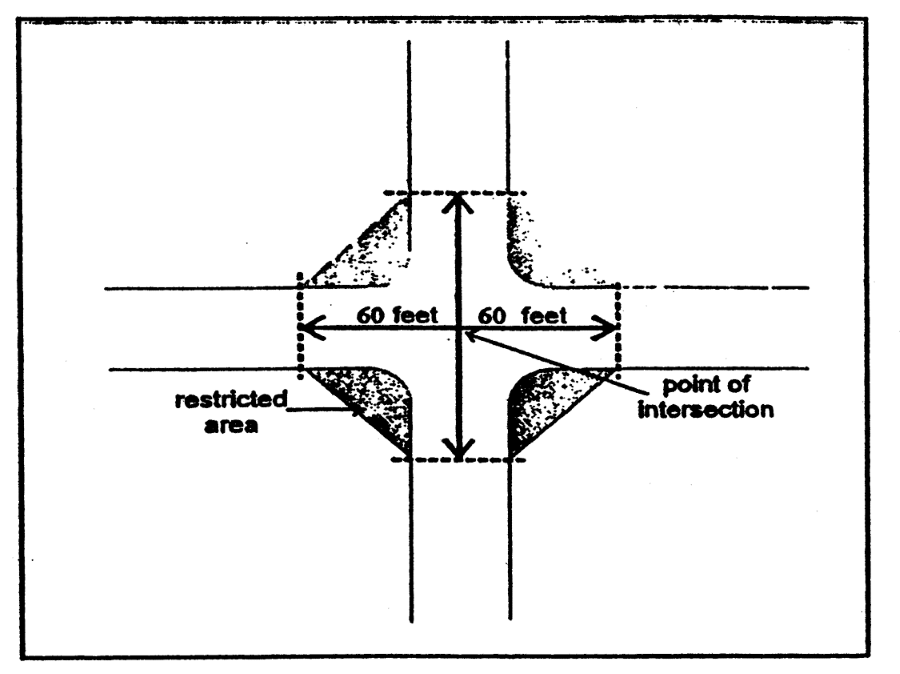
VISIBILITY AT INTERSECTIONS
(f)
Swimming pool requirements. For the purposes of this chapter, the terms "swimming pool" and "pool" shall include the following defined classes unless specifically exempted in a particular section hereunder:
(1)
Recessed outdoor swimming pool. "Recessed outdoor swimming pool" means any artificial water pool, permanent in nature, of steel, masonry, concrete, aluminum, or plastic construction, located out of doors, which has a water surface area of three hundred (300) square feet or more, a depth at any point of more than two (2) feet, or both.
(2)
Above ground semipermanent outdoor swimming pool. "Above ground semipermanent outdoor swimming pool" means any artificial water pool, semipermanent in nature, of redwood or other wood, metal, or plastic construction, which has a water surface of three hundred (300) square feet or more, a depth at any point of more than one and one-half (1½) feet, or both.
(3)
Portable plastic or vinyl outdoor swimming pool. "Portable plastic or vinyl outdoor swimming pool" means any artificial water pool, portable in nature, of plastic or vinyl construction, located out of doors, which has a water surface area of three hundred (300) square feet or less and a depth at any point of one and one-half (1½) feet or less.
(4)
Permit required; fee. No person shall construct or maintain an outdoor swimming pool without first making application to the zoning officer and obtaining a permit.
(5)
Plot plan. There shall be filed with the zoning officer a plot plan of the property showing the location of the swimming pool thereon and a detailed plan and specification for such swimming pool which contains full information as to the type, height, and location of the fence surrounding such swimming pool and the number of gates therein. Before any permit is issued, such plans and specifications shall be approved by the zoning officer.
(6)
Location. Outdoor swimming pools may be erected on a side or rear yard. Every pool hereafter built shall be located upon the lot or parcel to allow a safe distance between the pool and the property lines so that any person or persons may be readily observed when approaching or in the vicinity of the pool. The swimming pool, its walks, decks, or paved areas, or any accessory structure adjacent thereto, whichever is closer, shall be situated ten (10) or more feet from any property line.
(7)
Fencing. Every pool hereafter constructed, with the exception of semipermanent above-ground pools which have a built-in fence that is acceptable to the zoning officer, shall be completely enclosed by a fence not less than four (4) feet but not more than six (6) feet in height. A fence which encloses the yard may be considered as complying with these requirements. Fence gates shall be of the self-closing, self-latching type with the latch on the inside of the gate, not readily available for children to open. All gates must be locked when the residents are away from the house or when the pool is not in use.
(8)
Construction requirements. The following regulations shall apply to the construction of swimming pools:
a.
Swimming pool construction shall conform to the state building code and the state fire code.
b.
Nonportable fiberglass and plastic pools may be permitted, provided that they meet accepted safety and construction standards.
c.
Any accessory building which houses pumping and filtering equipment shall conform to the provisions of the zoning code and the building code.
d.
Illuminating lights may be erected with an intensity of no more than two (2) foot-candles, installed and shielded so as to eliminate direct rays and minimize reflected rays upon adjoining premises.
e.
All electrical wiring shall conform to the requirements of the National Electrical Code. Installation shall be underground wiring in an approved conduit.
f.
All plumbing necessary for the connection of the intake or the outlet of a swimming pool to the city water system or sewer system shall conform to the requirements of the state building code.
g.
There shall be no direct cross-connection with the municipal or home water supply and the water supply for the pool.
h.
The construction of the pool shall be made in such a manner that all scum, splash, and deck water shall not return to the pool except through the filter system.
i.
The pool shall be kept free at all times of floating material, sediment, and debris, either by an automatic surface skimmer, a scum gutter, or some other means approved by the zoning inspector.
j.
Every private swimming pool shall be equipped with an approved filtration system.
k.
A provision shall be made for positive germicidal or bacterial control by the use of chlorine, bromine, or other such disinfecting agents.
l.
All swimming pool installations must be completed and filled with water, and the filter system must be in operation, before final inspection.
m.
The pool sides and bottom shall be constructed of smooth, nonabsorbent materials, free from cracks, and be so constructed as to be properly drained through one (1) or more metal grate openings.
(9)
Operation. The following regulations shall apply to the operation of swimming pools:
a.
No person shall maintain a swimming pool on his or her premises without providing adequate supervision at all times when the pool is in use.
b.
No swimming pool shall be drained during periods of excessive rainfall so as to overload the city sewer system.
(10)
Inspection. The zoning officer shall have the right, at any reasonable hour, to inspect any swimming pool for the purpose of determining that all provisions of this chapter are fulfilled and complied with.
(11)
Violations as nuisances; abatement. Any outdoor swimming pool installed, operated, or maintained in violation of the provisions of this chapter shall constitute a nuisance, and the city may, in addition to the penalty provided in section 15-31, maintain any proper action for the abatement of such nuisance.
(g)
Pond requirements. For the purposes of this chapter, the terms "pond" shall include the following defined classes unless specifically exempted in a particular section hereunder:
(1)
Landscape or decorative pond. A pond which is primarily decorative, which has a water surface area of one hundred fifty (150) square feet or less and a depth at any point of one and one-half (1½) feet or less.
(2)
Pond. Ponds may be located on a parcel of at least one (1) acre. All excavated material must be removed unless used for landscaping within sixty (60) days of the initial excavation and all excavation shall be carried out in conformance with West Virginia Department of Natural Resources regulations. All ponds shall conform with applicable U.S. Soil Conservation Service specifications.
(3)
Permit required; fee. No person shall construct or maintain a pond without first making application to the zoning officer and obtaining a permit. Landscape or decorative ponds do not require a permit.
(4)
Plot plan. There shall be filed with the zoning officer a plot plan of the property showing the location of the pond thereon and a detailed plan and specification for such pond which contains full information as to the type, height, and location of the fence surrounding such pond the number of gates therein. Before any permit is issued, such plans and specifications shall be approved by the zoning officer. All applications for a permit shall be accompanied by the proper fee.
(5)
Location. Ponds may not be located within any required front yard or twenty (20) feet from any lot line. The twenty-foot setback is measured from the high water mark of the pond. If there are landscape mounds in excess of four (4) feet in height, the toe of the slope must be a minimum of ten (10) feet from the property line.
(h)
Vacant lots. The owner(s) of lots which are vacant as a result of building demolition shall plant grass seed and grade the surface to prevent soil erosion and standing water. The owner(s) shall comply with these requirements within thirty (30) days after building demolition has been completed. The zoning officer may grant an extension if inclement weather prohibits seeding and grading.
(i)
Distance between buildings on the same lot. No principal building shall be closer to any other principal building than the average of the heights of such buildings.
(j)
Kennels. Kennels, catteries or structures and enclosures of a similar nature used for domestic pets shall be subject to the following provisions:
(1)
Four (4) or more pet dogs or a kennel, four (4) or more pet cats or a cattery, are prohibited from the exterior yard areas or accessory buildings in any residential district, or O-R office-residential transitional district, but subject to the provisions of this section may qualify as a conditional use in a B-1, B-2, B-3 or M zoning district.
(2)
Kennels, catteries or structures and enclosures of a similar nature used for domestic pets which are fenced and screened, enclosed or soundproof may not be located within fifty (50) feet of a residential district, O-R office-residential zoning district, or overlay district.
(3)
Kennels, catteries or structures and enclosures of a similar nature used for domestic pets which are fenced and screened, enclosed or soundproof may not be located in the required front yard, side or rear yard as specified in the zoning district of use.
(4)
Every owner or operator of a kennel or cattery subject to W. Va. Code, §§ 19-20-3 and 19-20-9 shall display an unexpired and valid certificate of registration of such kennel or cattery. The owner of a kennel or cattery shall abide by the provisions of the City of Beckley Code regarding licensing, barking dogs, crying cats, cleanliness, sanitation, maintenance of the property and enclosure free of offal odor. Upon conviction of such violation, the conditional use permit shall be rescinded.
(5)
All kennels, catteries and structures and enclosures of a similar nature used for domestic pets shall be fenced and screened. Such fence shall be a solid fence of at least six (6) feet in height, maintained in sound condition, painted or otherwise protected from decay or signs of wear and presenting a neat and inconspicuous appearance. In addition, the use of tree and shrub or other screening shall be required to enhance the outward appearance outside of the enclosed area.
(6)
Domestic pets shall not include farm animals such as, but not limited to, horses, mules, cattle, swine, sheep, goats; fowl, such as, but not limited to, chickens, roosters, ducks, geese, turkeys, swans; reptiles or exotic animals. Farm animals, fowl, reptiles and exotic animals are prohibited in the exterior yard areas or accessory buildings in a residential zone and O-R office-residential transitional zone.
(7)
It shall be unlawful to own, possess or keep any cat or dog in the corporate limits that has not been spayed or neutered, except:
a.
The dog or cat is less than six (6) months old; or
b.
The owner has obtained an unaltered animal permit at a fee of ten dollars ($10.00) for the life of each animal; or
c.
A West Virginia licensed veterinarian states in writing the dog or cat is medically unable to undergo the spay or neuter procedure; or
d.
The dog or cat is kept in the corporate limits fewer than thirty (30) days in any one (1) year; or
e.
The dog or cat otherwise qualifies for an unaltered animal permit or a breeding permit or obtains a breeding permit.
(8)
To qualify for an unaltered animal permit or breeding permit, the owner must:
a.
Have the dog or cat examined not less than annually by a West Virginia licensed veterinarian;
b.
Have the dog or cat vaccinated in accordance with W. Va. Code, § 19-20A-2;
c.
Have the dog or cat licensed annually in accordance with City of Beckley Code, Chapter 3, section 3-200;
d.
Keep the dog or cat properly housed, fed and maintained.
(9)
It shall be unlawful to cause or allow any dog or cat owned or harbored in the city to breed without first obtaining a breeding permit, written authorization issued by the city, giving its lawful owner permission to breed the dog or cat.
a.
Each breeding permit shall be valid for a period of one (1) year and may be renewed prior to its expiration date of June 30th at an annual fee of ten dollars ($10.00) per dog and/or cat.
b.
No female dog or cat shall be permitted the breeding of more than one (1) litter in any one (1) permit year, except if that litter must be euthanized for medical reasons, in that event one (1) additional litter shall be authorized in that permit year.
(10)
Conviction of a violation of any of the provisions of this City of Beckley Code section shall be grounds to confiscate the animal, rescind all licenses and permits, and impound and/or dispose of the animals, as provided for in Chapter 3, Article IV, City of Beckley Code.
(11)
Every dog and cat, six (6) months or older, shall possess a valid City of Beckley license as provided for in the City of Beckley Code, Chapter 3, Article II.
(k)
Child care and nursery school land uses.
(1)
Child day care centers and facilities and nursery schools must have a minimum of one hundred (100) square feet of outdoor play area for each child to be cared for.
(2)
Child day care centers and facilities and nursery schools must have the play area fenced and screened from all adjoining lots in any R district as a noise buffer and to enhance the outward appearance of the enclosed area. Such fence shall be a solid fence at least six (6) feet in height, maintained in sound condition, painted and presenting a neat and inconspicuous appearance. The screening shall consist of walls, fences, natural vegetation, or an acceptable combination of these elements. Vegetation shall have a minimum opaqueness of seventy-five (75) per cent at all times within two (2) years of planting. The use of evergreen vegetation is encouraged. Vegetation shall be a variety and size that will attain six (6) feet in height within two (2) years of planting.
(l)
Salvage yard uses.
(1)
All outdoor storage areas in a salvage yard land use shall be screened or fenced with a solid fence at least eight (8) feet in height. Such fence shall be maintained in sound condition, painted and presenting a neat and inconspicuous appearance. In addition, the use of trees and shrubs shall be encouraged to enhance the outward appearance of the enclosed area. Storage between the street and such fence is strictly prohibited.
(2)
All outside salvage or stored material shall be located no closer than seventy-five (75) feet to the side and rear property lines when located adjacent to a nonresidential district and a two hundred-foot transition area measured from the fence to any residential district boundary shall be maintained. Such strip shall be planted with trees, grass, and shrubs.
(3)
Salvage yards shall be established and maintained according to all applicable state statutes. The stricter regulations, either state or local, shall prevail.
(4)
A minimum of two (2) acres shall be provided.
(5)
A front yard one hundred (100) feet from the right-of-way line shall be maintained. Such front yard shall be planted with trees, grass, and shrubs.
(6)
No material shall be stocked above the fence height, except the movable equipment used in the operation.
(7)
No open burning shall be permitted and all industrial processes involving the use of equipment for cutting, compressing or packing shall be conducted within a completely enclosed building.
(8)
A development plan shall be submitted at the time of application showing building location, accessory building(s), or structure(s) locations, fence location, fence type and specifications, planting plan, parking area, street access point or points, and drawn to scale.
(9)
A salvage yard operation shall be permitted to operate in an approved location provided that the operation of such use does not adversely affect the public health, safety, and general welfare.
(10)
A salvage yard shall be a conditional use in a M-Manufacturing Zone, provided it is located no closer than one thousand (1,000) feet from any residential B-1, B-2, or B-3 zoning district.
(m)
Lighting requirements.
(1)
All exterior light used to light vehicular use areas, pedestrian pathways or provide building security shall be by cutoff-type luminaires, and shall be so arranged as to reflect the light away from adjoining premises or streets.
(2)
All other exterior lighting, including but not limited to doorways, architectural, accent, landscape, signage, decorative, security, floodlighting or area lighting shall be cutoff-type luminaires, where no portion of the lamp, reflector, lens or refracting system may extend beyond the housing or shield so as to create or allow glare to be visible from offsite.
(3)
No open lights, twenty-five (25) watts or more, such as strings of light bulbs shall be permitted. This shall not apply to temporary, seasonal, holiday lighting, not more than sixty (60) days prior or ten (10) days after a holiday.
(n)
Limited video lottery establishments. Limited video lottery establishments (LVL) are any establishments within the City of Beckley in which limited video lottery machines are operated.
(1)
Prior to limited video lottery machines being operated in an establishment within the City of Beckley, an application shall be filed with the City of Beckley Tax and License Department and the applicant shall apply for and receive a conditional use permit from the City of Beckley Board of Zoning Appeals.
(2)
Limited video lottery establishments shall be permitted in City of Beckley B-2 and B-3 zoning districts by a conditional use permit approved by the City of Beckley Board of Zoning Appeals, which permit shall be approved subject to the following conditions:
a.
The limited video lottery establishment shall not be located within three hundred (300) feet of a residential zone, church or place of worship, school, park, community or recreation center or within one thousand (1,000) feet of another limited video lottery establishment.
b.
The three hundred (300) feet from a school, park, community or recreational facility or residential zone shall be measured entrance to entrance from the video lottery establishment to the entrance of a school, park, community or recreational facility or property line of a residential zone.
c.
The three hundred (300) feet from a church or place of worship shall be measured entrance to entrance from the video lottery establishment to the church or place of worship or related activities.
d.
The one thousand (1,000) feet from another video lottery establishment shall be measured entrance to entrance from a video lottery establishment to another video lottery establishment.
The provisions hereof shall not be deemed applicable to any limited video lottery establishment that was in operation as of August 18, 2004.
(o)
Private clubs, private wine restaurants, or taverns.
(1)
Prior to private clubs, private wine restaurants, or taverns (establishments) being operated within the City of Beckley, an application for a conditional use permit shall be filed with the City of Beckley Code Enforcement Office.
(2)
Prior to such establishments being permitted to operate in the City of Beckley, a public hearing and approval of the conditional use by the City of Beckley Board of Zoning Appeals is required.
(3)
Such establishment shall be located only in B-l, B-2, or B-3 zones.
(4)
Such establishments shall be located not less than three hundred (300) feet from a church or place of worship, school, park, community or recreation facility, or a residential zone.
(5)
The three hundred (300) feet shall be measured from the nearest point of a wall of the proposed establishment to the nearest property line of any church or place of worship, school, park, community or recreation facility, or a residential zone.
(6)
The provisions of this subsection (o) shall not be deemed applicable to any establishment that was licensed by the West Virginia Alcohol Beverage Control Administration and in operation as of October 11, 2005.
(p)
Indoor self-storage facilities and self-storage facilities, except as otherwise permitted in this chapter, shall be subject to the following regulations:
(1)
Any building directly abutting a R-1, R-2, R-3, R-5, R-6, O/R, B-3 district may not face any unit doors toward said district, unless the doors are one hundred (100) feet or greater from said district and screened with berms, landscaping, and/or fencing.
(2)
Any façade directly abutting a public right-of-way; or an R-1, R-2, R-3, R-5, R-6, or O/R district shall be comprised of at least fifty (50) percent brick, stone, or other comparable masonry materials on the ground level.
(3)
None of the site can be used for outdoor storage of any type.
(4)
The use of shiny metal roofing or unfinished metal roofing is not allowed. Metal roof shall be finished in a neutral, earth-tone color that does not unduly call attention to the buildings.
(5)
Self-storage facilities shall never be used to store any hazardous materials, explosives, flammable or combustible liquids or gases, or food products of any kind that will attract pest or vermin.
(6)
Incidental uses may include maintenance of stored materials by the tenant; but in no case may storage spaces function as an independent retail, wholesale, business, or service use. Spaces may not be used for workshops, hobby shops, manufacturing, or similar uses. Human occupancy is limited to that required to transport, arrange, and maintain stored materials.
(Ord. of 8-13-02; Ord. of 8-12-03, § 2; Ord. of 9-28-04; Ord. of 11-9-04; Ord. of 10-11-05; Ord. of 8-8-17; Ord. of 11-9-21)
Sec. 15-25. - Telecommunications facilities.
(a)
Findings. The Communications Act of 1954, as amended, by the Telecommunications Act of 1996 (The "Act") grants the Federal Communications Commission (FCC) exclusive jurisdiction over:
(1)
The regulation of the environmental effects of radio frequency (RF) emission from telecommunications facilities; and
(2)
The regulation of radio signal interference among user of the RF spectrum.
The city's regulation of towers and telecommunications facilities of the city will not have the effect of prohibiting any person from providing wireless telecommunications services in violation of the Act.
(b)
Purposes. The general purpose of this chapter is to regulate the placement, construction, and modification of towers and telecommunications facilities in order to protect the health, safety, and welfare of the public, while at the same time not unreasonably interfering with the development of the competitive wireless telecommunications marketplace in the city.
Specifically, the purposes of this chapter are:
(1)
To regulate the location of towers and telecommunications facilities in the city;
(2)
To protect residential areas and land uses from potential adverse impact of towers and telecommunications facilities;
(3)
To minimize adverse visual impact of towers and telecommunications facilities through careful design, siting, landscaping, and innovative camouflaging techniques;
(4)
To promote and encourage shared use/co-location of towers and antenna support structures as a primary option rather than construction of additional single-use towers;
(5)
To promote and encourage utilization of technological designs that will either eliminate or reduce the need for erection of new tower structures to support antennas and telecommunications facilities;
(6)
To avoid potential damage to property caused by towers and telecommunications facilities by ensuring such structures are soundly and carefully designed, constructed, modified, maintained, and removed when no longer used or are determined to be structurally unsound; and
(7)
To ensure that towers and telecommunications facilities are compatible with surrounding land uses.
(c)
Definitions. The following words, terms, and phrases, when used in this section, shall have the meanings ascribed to them in this section, except where the context clearly indicates a different meaning:
Antenna support structure: Any building or structure other than a tower which can be used for location of telecommunications facilities.
Applicant: Any person that applies for a tower development permit.
Application: The process by which a person or owner submits a request to develop, construct, build, modify, or erect a tower or telecommunications facility upon a parcel of land within the city. Application includes all written documentation, verbal statements, and representations in whatever form or forum made by an applicant to the city concerning such a request.
Engineer: Any professional engineer licensed by the State of West Virginia, and/or any broadcast/telecast, RF, or electronics engineer duly qualified or certified, but not registered by the State of West Virginia.
Monopole: Any tower consisting of a single pole, constructed without guyed wires and anchors.
Owner: Any person with fee title or a long-term (exceeding ten (10) years) leasehold to any parcel of land within the city who desires to develop or construct, build, modify, or erect a tower upon such parcel of land.
Person: Any natural person, firm, partnership, association, corporation, company, or other legal entity, private or public, whether for profit or not for profit.
Stealth: Any tower or telecommunications facility which is designed to enhance compatibility with adjacent land uses, including, but not limited to, architecturally screened, roof-mounted antennas, antennas integrated into architectural elements, and towers designed to look other than like a tower such as light poles, power poles, and trees. The term "stealth" does not necessarily exclude the use of uncamouflaged lattice, guyed, or monopole tower designs.
Telecommunication facility: Any system or facility including cables, wires, lines, wave guides, antennas, and any other equipment or facilities associated with the transmission or reception of communications which a person seeks to located or has installed upon or near a tower or antenna support structure. This shall include, but not be limited to, any device, system or facility that transmits and/or received electromagnetic signals for the purpose of transmitting analog or digital voice or data communications, microwave dishes, direction antennas such as panels, omni-directional antennas such as whip antennas, horns, and other types of equipment for the transmission or receipt of such signals, equipment buildings, shelters, or cabinets, or other accessory development associated with the transmission or reception of communications. This shall also include any device intended for receiving or transmitting television, radio, digital, microwave, cellular, personal communication service (PCS), paging, specialized mobile radio, enhanced specialized mobile radio, or similar forms of wireless electronic communication. However, telecommunications facilities shall not include:
(1)
Any satellite earth station antenna two (2) meters in diameter or less which is located in an area zoned industrial or commercial; or
(2)
Any satellite earth station antenna one (1) meter or less in diameter, regardless of zoning category.
Tower: Any pole, spire, structure, self-supporting lattice, guyed, or monopole structure constructed from grade, including lines, cables, wires, braces, and mast, which supports telecommunications facilities. A tower may include, but not be limited to, radio and television transmission towers, microwave towers, common carrier towers, cellular telephone towers, and personal communication service (PCS) towers. The term "tower", as applied in this section, shall not include amateur radio operators' equipment as licensed by the FCC.
(d)
Development of towers; permitted uses, restrictions, and application requirements for towers and telecommunications facilities.
(1)
A tower shall be a permitted use of land in zoning district M manufacturing. No person shall build, erect, or construct a tower upon any parcel of land within a zoning district designated M manufacturing unless a permit shall have been issued by the city. Applications shall be made to the code enforcement officer in the manner provided in this chapter.
a.
Towers in the M manufacturing district are exempt from the maximum height restrictions of that district. Towers shall be permitted to a height of one hundred (100) feet. Towers in excess of one hundred (100) feet are classified as a conditional use and must be approved by the board of zoning appeals as a conditional use in accordance with section 15-25(r), criteria for conditional use approval.
b.
Towers are not a permitted use in any other zoning district within the city.
(2)
A tower may be a conditional use of land in the zoning district b-2 mall-general commercial business district if approved by common council as a conditional use in accordance with section 15-25(r), criteria for conditional use approval. No person shall build, erect, or construct a tower upon any parcel of land within a B-2 mall-general commercial business district unless a permit shall have been issued by the city. Applications shall be made to the code enforcement officer in the manner provided in this chapter.
a.
Towers classified as a conditional use or requiring approval as conditional use may not exceed a maximum height of two hundred seventy five (275) feet in a B-2 mall-general commercial business district.
(3)
No new tower shall be built, constructed, or erected in the city unless the tower is capable of supporting another person's operation telecommunications facilities comparable in weight, size, and surface area to the telecommunications facilities installed by the applicant on the tower within six (6) months of the completion of the tower construction.
(4)
An application to develop a tower or telecommunication facility shall include:
a.
The name, address, and telephone number of the owner and lessee of the parcel of land upon which the tower is situated. If the applicant is not the owner of the parcel of land upon which the tower is situated, the written consent of the owner shall be evidenced in the application.
b.
The legal description, map/parcel number, and address of the parcel of land upon which the tower is situated.
c.
The names, addresses, and telephone numbers of all owners of either towers or usable antenna support structures within a one-half (½) mile radius of the proposed new tower site, including city-owned property.
d.
A description of the design plan proposed by the applicant in the city. Applicant must identify its utilization of the most recent technological design including microcell design as part of the design plan. The applicant must demonstrate the need for towers and why design alternatives, such as the use of microcell design, cannot be utilized to accomplish the provision of the applicant's telecommunications services.
e.
An affidavit attesting to the fact that the applicant made diligent, but unsuccessful, efforts to obtain permission to install or co-locate the applicant's telecommunications facilities on city-owned towers or usable antenna support structures located within a one-half (½) mile radius of the proposed tower site.
f.
An affidavit attesting to the fact that the applicant made diligent, but unsuccessful, efforts to install or co-locate the applicant's telecommunications facilities on towers or usable antenna support structures owned by other persons located within a one-half (½) mile radius of the proposed tower site.
g.
Written technical evidence from a duly qualified broadcast/telecast, RF, or electronics engineer that the proposed tower or telecommunications facilities cannot be installed or co-located on another person's tower or usable antenna support structures owned by other persons located within a one-half (½) mile radius of the proposed tower site.
h.
A written statement from a duly qualified broadcast/telecast, RF, or electronics engineer that the construction and placement of the tower will not interfere with public safety communications and the usual and customary transmission or reception of radio, television, or other communications services enjoyed by adjacent residential and non-residential properties.
i.
Written, technical evidence from an engineer that the proposed structure meets the standards set forth in section 15-25(f), structural requirements of this chapter.
j.
Written, technical evidence from a West Virginia registered professional engineer certifying compliance with the state fire code and building code of the City of Beckley that the proposed site of the tower or telecommunications facilities does not pose a risk of explosion, fire, or other dangers to life or property due to its proximity to volatile, flammable, explosive, or hazardous materials such as LP gas, propane, gasoline, natural gas, or corrosive or other dangerous chemicals.
k.
In order to assist city staff in evaluating visual impact, the applicant shall submit color photo simulations showing the proposed site of the tower with a photo realistic representation of the proposed tower as it would appear viewed from the closest residential property and from adjacent roadways.
l.
Elevation drawings of the proposed facility, and any other proposed structures, showing height above ground level. A landscaping plan indicating the proposed placement of the facility on the site; location of existing structures, trees, and other significant site features; the type and location of plants proposed to screen the facility; the method of fencing, the color of the structure, and the proposed lighting method.
m.
A narrative discussing the extent to which the proposed telecommunication facility and tower would be visible from, or within, a designated scenic resource; the tree line elevation of vegetation within one hundred (100) feet of the facility; and the distance to the proposed facility from the designated scenic resources noted viewpoints. A written description of how the proposed facility fits into the applicant's telecommunications network. This submission requirement does not require disclosure of confidential business information.
n.
Identification of districts, sites, building, structures, or objects, significant in American history, architecture, archaeology, engineering, or culture that are listed, or eligible for listing, in the National Register of Historic Places (see 16 U.S.C. 470w(5); 36 CFR 60 and 800).
o.
A signed statement stating that the owner of the wireless telecommunications tower and his or her successors and assigns agree to:
1.
Respond in a timely, comprehensive manner to a request for information from a potential co-location applicant, in exchange for a reasonable fee not in excess of the actual cost of preparing a response;
2.
Negotiate, in good faith, for shared use of the wireless telecommunications tower by third parties;
3.
Allowed shared use of the wireless telecommunications tower if an applicant agrees, in writing, to pay reasonable charges for co-location; and
4.
Require no more than a reasonable charge for shared use, based on community rates and generally accepted accounting principles. This charge may include, but is not limited to, a pro rata share of the cost of site selection, planning project administration, land costs, site design, construction, financing, return on equity, depreciation, and all of return on equity, depreciation, and all of the costs of adapting the tower or equipment to accommodate a shared user without causing electromagnetic interference. The amortization of the above costs by the facility owner shall be accomplished at a reasonable rate over the useful life span of the tower.
p.
A form or surety approved by the city to pay for the costs of removing the tower if it is abandoned in accordance with section 15-25(s).
q.
The Act gives the FCC sole jurisdiction of the field of regulation of RF emissions and does not allow the city to condition or deny on the basis of RF impacts the approval of any telecommunications facilities (whether mounted on towers or antenna support structures) which meet FCC standards. In order to provide information to its citizens, the city shall make available, upon request, copies of ongoing FCC information and RF emission standards for telecommunications facilities transmitting from towers or antenna support structures. Applicants shall be required to submit information on the proposed power density of the proposed telecommunications facilities and demonstrate how this meets FCC standards.
r.
A copy of the applicant's FCC license, or, if the applicant is not an FCC license holder, a copy of at least one (1) letter of commitment from an FCC license holder to locate at least one (1) telecommunication facility on the applicant's tower.
s.
A letter from the owner of the property attesting that the property used as a telecommunication facility will be maintained, and the site and structures will be in good condition and free from trash, outdoor storage, weds, and other debris.
t.
Payment of an application fee, non-refundable, in the amount of one thousand five hundred dollars ($1,500.00) payable to the City of Beckley.
u.
Payment of eight thousand five hundred dollars ($8,500.00) to the City of Beckley to be deposited in an escrow account by the recorder-treasurer for consulting costs in evaluating the application. Such consultants as the city may contract with, or employ, to evaluate an application will submit itemized invoices for specified services rendered and time spent, which will be paid from the escrow amount upon approval of the chief, code enforcement department, and the recorder-treasurer. Upon issuance of a permit, all monies remaining in the escrow account shall be returned to the applicant. In the event approved costs leave the escrow account with a balance of two thousand five hundred dollars ($2,500.00) or less, the applicant shall be so notified and required to remit to that escrow account, upon written request of the recorder-treasurer within seven (7) days, not less than three thousand dollars ($3,000.00) or more than six thousand dollars ($6,000.00) to complete the review process.
(5)
Upon receipt of an application, the code enforcement department shall provide the applicant with a dated receipt. Within ninety (90) working days of the receipt, the code enforcement department shall review the application and determine if the application meets the submission requirements. If complete, the department will notify the applicant. The department may deny an application on the basis that the applicant has not satisfactorily supplied the information required in this subsection. Complete applications shall be reviewed by the city in a prompt manner and all decisions shall be supported, in writing, setting forth the reasons for approval or denial.
(e)
Setbacks.
(1)
The setback requirements of the applicable zoning districts shall not apply to towers or telecommunications facilities. Instead, all self-supporting towers and telecommunications facilities shall be set back from all lot lines a distance equal to fifty (50) per cent of the height of the towers and telecommunications facilities. All guyed towers and telecommunications facilities shall be set back from all lot lines a distance equal to eighty (80) per cent of the height of the tower and telecommunications facilities.
(2)
Setback requirements for towers shall be measured from the base of the towers to the property line of the parcel of land on which it is located.
(3)
Setback requirements may be modified as provided in section 15-25(r), criteria for conditional use approval, when placement of a tower in a location which will reduce the visual impact can be accomplished and will be classified as a conditional use. For example, adjacent to trees may visually hide the tower.
(4)
No wires, cables, braces, or any part of any tower or telecommunications facility may, in anyway, interfere with pedestrian or vehicular traffic or be placed on or be located above any public right-of-way.
(f)
Structural requirements. All towers must be designed and certified by a West Virginia registered professional engineer to be structurally sound and, at minimum, in conformance with the building code and any other standards outlined in this chapter. All towers in operation shall be fixed to land.
(g)
Separation requirements. For the purpose of this section, the separation distances between towers shall be measured by drawing or following a straight line between the base of the existing or approved structure and the proposed base, pursuant to a site plan of the proposed tower. The minimum tower separation distances from other towers shall be calculated and applied irrespective of city jurisdictional boundaries.
(1)
Proposed towers must meet the following minimum separation requirements from existing towers or towers which have a permit but are not yet constructed at the time a permit is granted pursuant to this Code:
a.
Monopole tower structures shall be separated from all other towers, whether monopole, self-supporting lattice, or guyed by a minimum of seven hundred fifty (750) feet;
b.
Self-supporting lattice or guyed tower structures shall be separated from all other self-supporting or guyed towers by a minimum of fifteen hundred (1,500) feet;
c.
Self-supporting lattice or guyed tower structures shall be separated from all monopole towers by a minimum of seven hundred fifty (750) feet.
(h)
Method of determining tower height. Measurement of tower height for the purpose of determining compliance with all requirements of this section shall include the tower structure itself, the base pad, and any other telecommunications facilities attached thereto which extend more than twenty (20) feet over the top of the tower structure itself. Tower height shall be measured from grade.
(i)
Illumination. Towers shall not be artificially lighted except as required by the Federal Aviation Administration (FAA). Upon commencement of construction of a tower, in cases where there are residential uses located within a distance which is three hundred (300) per cent of the height of the tower from the tower and where required by federal law, dual mode lighting shall be requested from the FAA.
(j)
Exterior finish. Towers and/or telecommunications facilities allowed as a conditional use shall have an exterior finished which is of natural or subdued color to maximize compatibility with adjacent land uses as approved by common council, subject however to required FAA paintings or markings.
(k)
Landscaping, screening, fencing, and buffer requirements.
(1)
All landscaping on a parcel of land containing towers, antenna support structures, or telecommunications facilities shall be in accordance with the applicable landscaping requirements in the zoning district where the tower, antenna support structure, or telecommunications facilities are located. Landscaping shall be installed on the outside of any fencing.
(2)
All telecommunications facilities, towers, and antenna support structures shall be screened and landscaped. Such screening and landscaping shall include one row of evergreen shrubs or trees capable of forming a continuous hedge of at least six (6) feet in height within two (2) years of planting. A maintenance plan for the landscape materials shall also be submitted at the time of the application. Screening and landscaping requirements may be modified as provided in section 15-25(r), criteria for conditional use approval, when the substitution of other architectural screening plans such as a decorative fence or masonry wall in lieu of planted materials would reduce visual impact and will be classified as a conditional use.
(3)
All sites shall be reasonable protected against unauthorized climbing. The bottom of the tower, measured from ground level to twelve (12) feet above ground level, shall be designed in a manner to discourage unauthorized climbing. Sites shall have at least an eight-foot fence topped by a one-foot high, three-strand, barbed wire projection angled out surrounding the tower and telecommunications facilities. Landscaping must be installed on the outside of any fencing.
(4)
Advertising or identification of any kind on towers, antenna support structures, and telecommunications facilities shall be prohibited, except for applicable warning and equipment information signage required by the manufacturer or by federal, state, or local regulations.
(5)
There shall be a buffer between towers and all residentially-zoned lands. Towers shall be separated from all residentially-zoned lands by a minimum of two hundred (200) feet or two hundred (200) per cent of the height of the proposed tower, whichever is greater. Tower separation distances from residentially-zoned lands shall be measured from the base of a tower to the closest point of residentially-zoned property. The minimum tower separation distances from residentially-zoned land and from other towers shall be calculated and applied irrespective of city jurisdictional boundaries.
(l)
Access. A parcel of land upon which a tower is located must provide access to at least one (1) paved vehicular parking space on site.
(m)
Stealth design. All towers which must be approved as a conditional use shall be of stealth design.
(n)
Telecommunications facilities on antenna support structures. Any telecommunications facilities which are not attached to a tower may be approved as a permitted use, by administrative review of the code enforcement department, provided the application is in accordance with the provisions stated in section 15-25(1)b.1., 2., 3., and 4., criteria for conditional use approval, and the telecommunications facilities will be located on any antenna support structure that does not increase the height or base of the antenna support structure and any additional external equipment must be completely screened from view and shall be permitted in any zoning district. Any other telecommunications facilities not attached to a tower shall require the owner of such structure, or the applicant, in addition to documenting compliance with requirements of section 15-25(r), criteria for conditional use approval, to establish the following at the time plans are submitted for a permit:
(1)
That the height from grade of the telecommunications facilities shall not exceed the height from grade of the antenna support structure by more than twenty (20) feet, and shall not be permitted in any residential zone.
(2)
That any telecommunications facilities and their appurtenances located above the primary roof of an antenna support structure, shall not be permitted in any residential zone and shall be set back one (1) foot from the edge of the primary roof for each one (1) foot in height above the primary roof of the telecommunications facilities. This setback shall not apply to telecommunications facilities and their appurtenances located above the primary roof of an antenna support structure, if such facilities are appropriately screened from view through the use of panels, walls, fences, or other screening techniques approved as provided in section 15-25(r)(1)b, criteria for conditional use approval, and will be classified as a conditional use. Setback requirements shall not apply to stealth antennas which are mounted to the exterior of antenna support structures below the primary roof, but which do not protrude more than eighteen (18) inches from the side of such an antenna support structure.
(o)
Modification of towers.
(1)
A tower existing prior to the effective date of this chapter, which was in compliance with the city's zoning regulations immediately prior to the effective date of this chapter, may continue in existence as a nonconforming structure. Such nonconforming structures may be modified or demolished and rebuilt without complying with any of the additional requirements of this section, except for sections 15-25(g), separation requirements, 15-25(k), landscaping, screening, fencing, and buffer requirements, 15-25(p), certification and inspections, and 15-25(q), maintenance, provided:
a.
The tower is being modified or demolished and rebuilt for the sole purpose of accommodating, within six (6) months of the completion of the modification or rebuild, additional telecommunications facilities equal in weight, size, and surface area to the discrete operating telecommunications facilities of any person currently installed on the tower; and,
b.
An application for a permit is made to the code enforcement department which shall have the authority to issue a permit without further approval. The grant of a permit pursuant to this section allowing the modification or demolition and rebuild of an existing nonconforming tower shall not be considered a determination that the modified or demolished and rebuilt tower is conforming; and,
c.
The height of the modified or rebuilt tower and telecommunications facilities attached thereto do not exceed the maximum height allowed under the city zoning regulations or the height of the nonconforming structure, tower, or telecommunications facilities before the modification or rebuild, which is greater.
(2)
Except as provided in this section, a nonconforming structure or use may not be enlarged, increased in size, or discontinued in use for a period of more than one hundred eighty (180) days. This chapter shall not be interpreted to legalize any structure or use existing at the time this chapter is adopted which structure or use is in violation of the Code prior to enactment of this chapter.
(p)
Certifications and inspections.
(1)
All towers shall be certified by an engineer to be structurally sound and in conformance with the requirements of the building code and all other construction standards set forth by the city's code and federal and state law. For new monopole towers, such certification shall be submitted with an application pursuant to section 15-25(d) of this chapter and every five (5) years thereafter. For existing monopole towers, certification shall be submitted within sixty (60) days of the effective date of this chapter and then every five (5) years thereafter. For new lattice of guyed towers, such certification shall be submitted with an application pursuant to section 15-25(d) of this chapter and every two (2) years thereafter. For existing lattice or guyed towers, certification shall be submitted within sixty (60) days of the effective date of this chapter and then every two (2) years thereafter. The tower owner may be required by the city to submit more frequent certification should there be reason to believe that the structural and electrical integrity of the tower is jeopardized.
(2)
The city or its agents shall have authority to enter onto the property upon which a tower is located, between the inspection and certifications required above, to inspect the tower for the purpose of determining whether it complies with the building code and all other construction standards provided by the city code and federal and state law.
(3)
The city reserves the right to conduct such inspection at any time upon reasonable notice to the tower owner. All expenses related to such inspections by the city shall be borne by the tower owner.
(q)
Maintenance.
(1)
Tower owners shall, at all times, employ ordinary and reasonable care and shall install and maintain in use nothing less than commonly accepted methods and devices for preventing failures and accidents which are likely to cause damage, injuries, or nuisances to the public.
(2)
Tower owners shall install and maintain towers, telecommunications facilities, wires, cables, fixtures, and other equipment in substantial compliance with the requirements of the city/state building code and all FCC, state, and local regulations and in such manner that will not interfere with the use of other property.
(3)
All towers, telecommunications facilities, and antenna support structures shall, at all times, be kept and maintained in good condition, order, and repair so that the same shall not menace or endanger the life or property of any person.
(4)
All maintenance or construction of towers, telecommunications facilities, or antenna support structures shall be performed by licensed maintenance and construction personnel.
(5)
All towers shall maintain compliance with current RF emission standards of the FCC.
(6)
In the event that the use of a tower is discontinued, the tower owner shall provide written notice to the city of its intent to discontinue use and the date when the use shall be discontinued.
(r)
Criteria for conditional use approval.
(1)
Towers or telecommunications facilities classified as a conditional use or requiring approval as a conditional use according to this chapter must be approved as a conditional use in accordance with the following:
a.
In addition to the requirements for a tower application, the application shall include the following:
1.
A description of how the plan addresses any adverse impact that might occur.
2.
A description of offsite or onsite factors which mitigate any adverse impact which might occur.
3.
A technical study that documents and supports the criteria submitted by the applicant upon which the request for conditional use is based. The technical study shall be certified by an engineer and shall document the existence of the facts related to the proposed modifications and its relationship to surrounding rights-of-way and properties.
4.
For a modification of the setback requirement, the application shall identify all parcels of land where the proposed tower could be located, attempts by the applicant for co-location, and the result of such attempts.
5.
The applicant seeking a conditional use permit shall pay the cost of review by the city's engineer or engineer under contract to the city to determine whether the application and technical studies support the basis for the conditional use requested.
b.
The proposed conditional uses will be reviewed based on the following criteria:
1.
That the tower of telecommunications facility, as proposed, will be compatible with, and not adversely impact, the character and integrity of surrounding properties.
2.
Offsite or onsite conditions exist which mitigate the adverse impact, if any, created by the conditional use proposal.
3.
That proposed towers, antenna support structures, and telecommunications facilities utilize building materials, colors, and textures that effectively blend the tower facilities into the surrounding setting and environment to the greatest extent possible. Metal towers shall be constructed of, or treated with, corrosive resistant materials. Outside of the manufacturing districts, unpainted, galvanized metal, or similar towers shall be prohibited, unless a self-weathering tower is determined to be more compatible with the surrounding area.
4.
In addition, conditions may be imposed on the site where the tower or telecommunications facility is to be located if such conditions are reasonably necessary to preserve the character and integrity of the neighborhoods affected by the proposed tower and mitigate any adverse impacts which arise in connection with the approval of the conditional use.
(2)
In addition to the requirements of this section, in the following cases, the applicant must be demonstrate, with written evidence, the following:
a.
In the case of a requested modification to the setback requirements of section 15-25(e), that the setback requirements cannot be met on the parcel of land upon which the tower is proposed to be located and the alternative for the person is to located the tower at another site which is closer in proximity of a residentially-zoned land.
b.
In the case of a request for modification to the separation requirements from other towers of section 15-25(g), separation requirements, that the proposed site is zoned manufacturing and the proposed site is at least double the minimum standard for separation from residentially-zoned lands as provided for in section 15-25(g).
c.
In the case of a request for modification of the buffer requirements from residentially-zoned land of section 15-25(k), that the person provides written technical evidence from an engineer that the proposed tower and telecommunications facilities must be located at the proposed site in order to meet the coverage requirements of the applicant's wireless communications system, and that the person is willing to create approved landscaping and other buffers to screen the tower from being visible to residentially-zoned property.
d.
In the case of a request for modification of the height limits for towers and telecommunications facilities, the modification is necessary to:
1.
Facilitate co-location of telecommunications facilities in order to avoid construction of a new tower, or
2.
To meet the coverage requirements of the applicant's wireless communications system, which requirements must be documented with written, technical evidence from an engineer that demonstrates that the height of the proposed tower is the minimum height required to function satisfactorily, and no tower that is taller than such maintained height shall be approved. There must be evidence sufficient to support findings that the additional height is needed or that the surrounding topography, structures, or other facts make the height limitation impractical in order to justify a conditional use for the modification of the height limits for towers and telecommunications facilities. Further, there must be evidence sufficient to support findings that the increase in the height limitation does not adversely impact surrounding uses. An applicant or owner may not request a conditional use to modify the height limits for towers or telecommunications facilities located in an B-2 mall-general commercial business district if the proposed tower or telecommunications facility would exceed a maximum height of two hundred seventy five (275) feet.
(3)
Towers shall be of a monopole design. The substitution of alternative tower types in cases where structural, radio frequency, and design considerations, locations, or the number of co-locators suggests a tower other than a monopole may be considered.
(4)
In prominent locations, highly visible from adjacent residential areas or public spaces, and as a condition of approval, antenna support structures may be required to be located underground.
(5)
The board of zoning appeals shall make findings and recommendations addressing the criteria set forth in this section and approve, disapprove or amend the application. Its decision may be appealed to Raleigh County circuit court within thirty (30) days.
(s)
Abandonment.
(1)
If any tower shall cease to be used for a period of three hundred sixty-five (365) consecutive days, the city shall notify the owner, with a copy to the applicant, that the site will be subject to a determination by the city that such site has been abandoned. The owner shall have thirty (30) days from receipt of said notice to show, by a preponderance of the evidence, that the tower has been in use or under repair during the period. If the owner fails to show that the tower has been in use or under repair during the period, the city shall issue a final determination of abandonment for the site. Upon issuance of the final determination of abandonment, the owner shall, within seventy-five (75) days, dismantle and remove the tower.
(2)
To secure the obligation set forth in this section, the applicant (and/or owner) shall post a bond or other instrument in an amount equal to the anticipated cost of removal of the tower at the time an application is made. The anticipated cost of removal shall be based upon a certification from a professional engineer. The bond shall be in such form as to be acceptable to the recorder-treasurer.
(t)
Severability. That if any clause, section, or other part of this section shall be held invalid or unconstitutional by any court of competent jurisdiction, the remainder of this section shall not be affected thereby but shall remain in full force and effect.
(u)
Towers of private reception of TV and radio signals; emergency telecommunications facilities.
(1)
Notwithstanding any other provisions to the contrary, towers and antennas designed for private reception of television and radio signals, used for amateur or non-commercial purposes, shall be permitted in all district, provided such freestanding antennas and towers do not exceed thirty-five (35) feet in height. Rooftop mounted antennas shall not exceed fifteen (15) feet in height. This includes, but is not limited to, amateur (ham) radio stations licensed by the FCC, and parabolic antennas less than seven (7) feet in diameter that are an accessory use of the property for private or recreational reception of television or radio signals. Only one (1) freestanding tower or antenna shall be allowed per residential lot. No more than one (1) roof-mounted antenna or satellite receiver or dish will be allowed per residential lot.
(2)
Emergency telecommunications facilities and temporary wireless communication facilities for emergency communications by public officials are exempt from the provision of this chapter.
(v)
Appeal From code enforcement department decision. Any person aggrieved by a decision of the code enforcement department may appeal the decision to the board of zoning appeals, as provided by West Virginia Code, section 8-24-56. Written notice of an appeal must be filed with the board of zoning appeals within thirty (30) days of the decision. The notice of appeal shall clearly state the reasons for the appeal.
(w)
Administration. If the code enforcement department finds that any provision of this chapter has been violated, the code enforcement department shall notify, in writing, the person responsible for such violation, indicating the nature of the violation, and ordering the action necessary to correct it. The code enforcement department shall order correction of the violation and may take any other legal action to ensure compliance with this chapter.
(x)
Conflicts (repeal of ordinances). That all ordinances, or parts of ordinances in conflict herewith, are hereby repealed.
(Ord. of 8-13-02)
Sec. 15-26. - Nonconforming uses.
The lawful use of land or buildings existing at the time of the adoption of this chapter may continue, although such use does not conform to the regulations specified by this chapter for the district in which such land or building is located, subject to the following conditions and specifications:
(1)
Any nonconforming use of land or building which has ceased by discontinuance or abandonment for a period of six (6) months shall thereafter conform to the provisions of this chapter.
(2)
Any conforming building which has been destroyed or damaged by fire, explosion, act of God, or by a public enemy to the extent of sixty (60) per cent or more of its assessed valuation, shall thereafter conform to the provisions of this chapter. Where more than forty (40) per cent of the assessed value of the building remains after such damage, such structure may be restored to the same nonconforming use as existed before such damage.
(3)
No nonconforming use of a building may be moved to any part or parcel of land upon which same was conducted at the time of the adoption of such ordinance.
(4)
No nonconforming building shall be enlarged or structurally altered except to make it a conforming building. A nonconforming use of a building existing at the time of the adoption of such ordinance may be extended throughout the building provided no structural alterations, except those required by ordinance or law are made therein, and provided approval is granted by the council.
(5)
The use of a nonconforming building may be changed only to a use of like or similar character, or to a use conforming to the district in which the property is located.
(6)
The foregoing provisions shall also apply to nonconforming uses in districts hereafter changed by amendment to this chapter.
(Ord. of 8-13-02)
Sec. 15-27. - Interpretation.
In interpreting and applying the provisions of this chapter, they shall be held to be the minimum requirements for the promotion of the public safety, health, convenience, comfort, prosperity, and general welfare. It is not intended by this chapter to interfere with, abrogate, annul, or repeal any ordinance, rules, regulations previously adopted, and not in conflict with any of the provisions of this chapter which shall be adopted pursuant to law relating to the use of building or premises, nor is it intended by this chapter to interfere with or abrogate or annul any easements, covenants, or other agreements between parties, except that where this chapter imposes a greater restriction upon the use of buildings or premises or upon the height of buildings or requires larger open spaces than are imposed or required by such other ordinances or such easements, covenants, or other agreements, the provisions of this chapter shall control.
(Ord. of 8-13-02)
Sec. 15-28. - Validity.
If any section, subsection, sentence, clause or phrase of this chapter is, for any reason, held to be illegal, unconstitutional, or invalid, such decision shall not affect the remaining portion of this chapter. The council of the city hereby declares that it would have adopted this chapter and each section and subsection thereof, irrespective of the fact that any one or more of the sections, subsections, sentences, clauses or phrases, may be declared illegal, unconstitutional, or invalid.
(Ord. of 8-13-02)
Sec. 15-29. - Amendments.
Amendments, supplements, or changes of the regulations of this chapter shall be considered as amendments to the comprehensive plan. Any proposed ordinance for the amendment, supplement, change, or repeal of this chapter not originating from petition of the planning commission shall be referred to the planning commission for consideration and report before any final action is taken by the council. Prior to the submission to the council of a commission petition or a report on a proposed ordinance referred to it for an amendment supplement, change, or repeal of this chapter, the commission shall give notice and hold a public hearing in the manner prescribed for adoption of a comprehensive plan in section 8-5-18 of the Code of West Virginia, as amended.
(Ord. of 8-13-02)
Sec. 15-30. - Penalties, remedies, and violations.
(a)
Violation and penalty. Any person, firm, or corporation who shall violate any provision of this chapter or shall fail to comply with any of the requirements thereof, or who shall excavate for, erect, construct, enlarge, reconstruct, add to, alter, repair, move, maintain, use, and/or occupy any building, other structure, and/or land in violation of an approved plan or directive of the zoning officer, planning commission, board of zoning appeals or common council, or of a building permit or certificate of occupancy shall for each violation on conviction thereof, pay a fine or penalty of not less than ten dollars ($10.00), nor more than three hundred dollars ($300.00). Each and every day that such violation continues may constitute a separate offense. (Refer to City of Beckley Code Chapter 2, Part 2, section 1-8)
(b)
Violation as nuisance. Any building or structure erected, raised, or converted on land or premises used in violation of any of the provisions of this chapter or of any regulations in this chapter or of any regulations made under authority conferred hereby, is hereby declared to be a common nuisance, and the owner of the building, structure, land or premises shall be liable for maintaining a common nuisance.
(c)
The planning commission of the city, the board of zoning appeals, common council, or the zoning officer may institute a suit for injunction in the circuit court of this county, to restrain any person, firm, or corporation, or a governmental unit from violating the provisions of this chapter, or of any regulation in this chapter, or any regulation made under authority hereby conferred. The planning commission of the city, the board of zoning appeals, common council, or the zoning officer may institute a suit for a mandatory injunction directing a person, firm or corporation, or a governmental unit to remove a structure erected in violation of the terms of this chapter or of any regulation in this chapter or in violation of any regulation made under authority conferred hereby.
(Ord. of 8-13-02)
Sec. 15-31. - Effective date.
The ordinance from which this chapter is derived took effect after its passage and approval by the council of the city.
(Ord. of 8-13-02)
Sec. 15-35. - Medical cannabis; permitted land uses in certain zones.
"P" means Permitted.
(Ord. of 7-14-20)
Sec. 15-36. - Self-storage facilities; permitted or conditional land uses in certain zones.
"P" means Permitted.
"C" means Conditional.
(Ord. of 11-9-21)
Sec. 15-37. - Mobile food vendors.
(a)
Purpose. The City of Beckley (city) finds that allowing mobile food vendors to operate, subject to practical regulations and limitations, is beneficial to persons living and working within the city. This City Code section recognizes the unique physical and operational characteristics of mobile food vending, establishes standards for mobile food vending operations, and promotes practices that serve the health, safety and welfare of the public.
(b)
Definitions. The following words, terms and phrases, when used in this article, shall have the meanings ascribed to them in this section, except where the context clearly indicates a different meaning:
(1)
Commissary means a permitted establishment or facility in a fixed location that is used for the storage of supplies for a mobile food service vehicle, the preparation of food to be sold or served at a mobile food service vehicle, or the cleaning or servicing of a mobile food service vehicle or the equipment used in conjunction with a mobile food service vehicle.
(2)
Edible food products means those products that are ready for immediate consumption, including prepackaged food and food cooked, prepared or assembled on-site. The term "edible food products" does not include fresh produce unless the produce has been packaged, cooked chopped, sliced, mixed, brewed, frozen, squeezed or otherwise prepared for consumption.
(3)
Food truck means a vehicle from which edible food products are cooked, prepared or assembled with the intent to serve or sell such items to the general public, provided further that food trucks may also serve or sell other edible food products and beverages that have been prepared or assembled elsewhere. Food truck operators may market their products to the public via advertising, including social media.
(4)
Food truck rally means a gathering of more than five (5) food trucks that may or may not have been coordinated or advertised. A food truck rally requires a special event license.
(5)
Ice cream truck means a vehicle from which the operator sells only pre-packaged frozen dairy or water-based food products and pre-packaged beverages. For purpose of this section, a non-motorized cart from which such products are sold shall be considered an ice cream truck.
(6)
Location means any single property parcel, any combination of contiguous parcels that are owned or controlled by a single entity or affiliated entities, the abutting public ways of afore-described properties, or all public ways consisting of or greater than two (2) contiguous city blocks, regardless of abutting ownership or control.
(7)
Mobile food service vehicle means a food truck, canteen truck or ice cream truck and includes any portable unit that is attached to a motorized vehicle and intended for use in the operation of a food truck, canteen truck or ice cream truck.
(8)
Mobile food vendor permit means a permit issued by the city for the operation of a mobile food service vehicle.
(9)
Operate means to serve or sell food, beverages, and other permitted items from the mobile food service vehicle and includes all tenses of the word. Operator means any person operating or permitted to operate a mobile food service.
(10)
Permit administrator means the city's recorder-treasurer or the city code enforcement officer, or a person designated by the recorder-treasurer to oversee the issuance, suspension and revocation of mobile food vendor permits. City code enforcement officer and city fire marshall are interchangeable herein.
(11)
Vehicle means every device in, upon or by which any person or property may be transported or drawn upon a street, including devices moved by human power.
(c)
Generally.
(1)
It is a violation to operate a mobile food service vehicle at any location in the City of Beckley (city) except in compliance with the requirements of this code section.
(2)
Mobile food service vehicle operators must comply with all federal, state and local licensing and permitting regulations and all business tax, sales tax and other tax requirements.
(3)
All mobile food serv vehicle must comply with the zoning ordinance and all zoning requirements set forth in this Code. If a use to which a mobile food serv vehicle is to be put is disallowed by zoning law in a designated zone or district, it shall not otherwise be permitted under this section.
(4)
The permit administrator is hereby authorized to promulgate rules and regulations supplemental to the provisions herein for the purpose of carrying out the administration and enforcement of such provisions.
(5)
The sole activity that may be exempted from zoning ordinance compliance set forth in subsection (3) herein shall be for vendors whose business is itinerant in nature and where the vendor stops solely for the purpose of making a sale or sales and remains in one area, hereby designated as one city block, for less that ten (10) minutes. Further, door to door sales of food items not intended for immediate consumption, as well as the home delivery of prepared food, shall be exempted from subsection (3).
(d)
Locations and hours of operation.
(1)
Food trucks.
a.
Right-of-way/public property. Food trucks may not operate within the public right-of-way or on any city property except as may be a specifically allowed by the city. When allowed in the public right-of-way, a food truck must be positioned so as to comply with the requirements of section 15-37(e)(2) herein. Operation of food trucks within any park shall be subject to rules and regulations established by the parks and recreation department. Operation of food trucks on city streets adjacent to any park shall be governed by this section. Food trucks may not operate on property owned by a public entity other than the city unless specifically allowed by such public entity. No unattended food truck shall be left at any time in the right-of-way or parked on any other public property overnight. Notwithstanding any other provision contained in this section, no food truck may operate on the public right-of-way, on any other public property or on any private property directly fronting, partially fronting or abutting an existing restaurant, concession stand or any other entity serving prepared meals or food during business hours.
b.
Private property. A food truck with a current mobile food vendor permit may operate on private property if allowed as a permitted use under the zoning ordinances of this Code, subject to the following conditions:
1.
Permission. Food trucks selling to the public from private property shall have the written permission of the property owner, which shall be made available to the city immediately upon request.
2.
Maximum number of food trucks. No more than five (5) food trucks may operate at any location unless a special event license has been issued.
3.
Placement on lot. Food truck operations, including any canopies, signage, equipment, and seating areas, may not occupy more than three (3) parking spaces per food truck. Food trucks not parked within designated parking spaces shall not block fire lanes, designated traffic lanes or ingress or egress to or from a building or street.
c.
Hours of operation. Food trucks may operate beginning at 6:00 a.m. and ending at 10:00 p.m. in any zoning district in which food trucks are a permitted use and in any zoning district in which food trucks have been approved by the board of zoning appeals as a conditional permitted use. The city may place other restrictions on an operator's mobile food vendor permit, or the hours of operation may be more restrictive in accordance with a property owner's directive when private property is used. The city may permit extended hours of operation for a licensed special event.
(e)
Operating requirements.
(1)
Vehicle requirements.
a.
Design and construction. Mobile food service vehicles must be designed and constructed for the purpose of preparation and sale of the specific type of food being sold, or they must be so modified to comply with this section, and all applicable public health and safety laws.
b.
Licensing. Mobile food serv vehicles must be licensed and equipped in accordance with the rules and regulation of all local, state and federal agencies having jurisdiction over such vehicles. The preparation and sale of food from mobile food service vehicles must comply with all applicable local, state and federal laws and regulations.
(2)
Right-of-way.
a.
Mobile food service vehicles other than ice cream trucks may not operate, stop, stand or park in any area of the right-of-way that is intended for use by vehicular travel, except in the event of a street closure for a special event. Mobile food serv vehicles, including ice cream trucks, may not operate, stop, stand or park that in any way violates the provisions of the traffic control ordinances of this Code, impedes the flow of traffic, interferes with ingress or egress to or from any property or presents an unsafe condition for patrons, pedestrians or other vehicles.
b.
Mobile food serv vehicles shall park facing the same direction as traffic, at a distance of no more than twelve (12) inches between the curb face or edge of pavement and with the service window of the vehicle facing the curb or edge or pavement.
c.
When a mobile food service vehicle is allowed to operate in the public right-of-way, no seating area shall be provided, except as permitted in conjunction with a street closure for a special event or If there is an area provided on a paved sidewalk that permits compliance with subsection (4) of this section.
(3)
Business access. No mobile food serv vehicle may operate in a location that:
a.
Impedes the ingress to or egress from another business or otherwise causes undue interference with access to another business;
b.
Blocks the lawfully placed signage of another business; or
c.
Prevents access to another business by emergency vehicles.
(4)
Pedestrians. If on or adjacent to a sidewalk, the components of a mobile food service vehicle's operations, including signage, seating area and patron queue may not reduce the clear pedestrian path of travel on the sidewalk to less than four (4) feet. All awnings or canopies of the vehicle shall be at least six (6) feet, eight (8) inches above the sidewalk.
(5)
Safety and fire prevention. All mobile food service vehicles must be approved by the city fire marshal. No power cord, cable or equipment shall be extended across any public street, sidewalk or other public property.
(6)
Noise. No sounds that are otherwise prohibited by this Code may be produced by a mobile food service vehicle's operation. All generators used by food trucks must comply with all applicable noise ordinances. The permit administrator may request a demonstration of the generator at any time. If, in the opinion of the permitting authority the generator either violates any noise ordinance, or If it would cause undue annoyance or inconvenience to the public or to residences, the permit may be refused or revoked until a satisfactory alternative is provided.
(7)
Support methods. No mobile food service vehicle may use stakes, rods or any other method of support that must be drilled, driven, or otherwise fixed into or onto asphalt, pavement, curbs, sidewalks or buildings.
(8)
Spills. To prevent discharges into waterways, drainage systems or public sewer systems, each food truck shall comply with all stormwater regulations of the city and all regulations regarding prohibited discharges to public sewers. In addition, each vehicle shall have a spill response plan to contain and remediate any discharge from the vehicle which shall be provided in the vehicle for inspection when requested by the city fire marshal.
(9)
Waste collection. The area of a mobile food service vehicle operation must be kept neat and orderly at all times. Operation of a mobile food service vehicle in an area is deemed acceptance by the operator of the responsibility for cleanliness of the area surrounding the operations regardless of the occurrence or source of any waste in the area. During each period of operation at a location, the occurrence or source of any waste in the area. During each period of operation at a location, the operator must provide proper trash receptacles for public use that are sufficient and suitable to contain all trash generated by the mobile food service vehicle. All trash receptacles must be emptied when full, and all waste must be removed prior to departure of a mobile food service vehicle from a location.
(10)
Pedestrian service only. Mobile food service vehicle shall serve pedestrians only. Drive-through or drive-in serve is prohibited.
(11)
Signage. Signage for each mobile food service vehicle shall be limited to signs on the exterior or interior of the vehicle and one sandwich board sign. All signs on the exterior of the vehicles shall be secured and shall not project more than six (6) inches from the vehicle. One sandwich board sign may be placed outside the mobile food service vehicle, provided that the base of a sandwich board sign must be placed no further than two (2) feet beyond the mobile food service vehicle. Sandwich board signs shall not exceed eight (8) square feet per side or forty-eight (48) inches in height and shall not obstruct or impede pedestrian or vehicular traffic.
(12)
Alcohol sales. Food trucks may not sell alcoholic beverages, except as may be specifically allowed by applicable state law and city ordinance. Ice cream trucks are prohibited from selling alcoholic beverages.
(13)
Insurance.
a.
Mobile food service vehicles must maintain all motor vehicle insurance coverage required by applicable state and federal laws and regulations.
b.
Mobile food service vehicles operating on city property other than the right-of-way shall at all times maintain such further insurance coverage as may be required by the regulations promulgated by the mayor with respect to the protection of the municipality. In the event the required coverage is not properly maintained, permission to operate on city property will be immediately revoked.
(14)
Exterior cooking equipment. Any food preparation equipment outside of the mobile food service vehicle shall not obstruct vehicular or pedestrian traffic, and the use and operation of such equipment shall not create safety hazards for the public. Food shall not be served to customers directly from any outside food preparation equipment. Any smoker or other exterior equipment that generates heat shall be surrounded with at least three (3) traffic safety cones.
(15)
Commissary. A commissary, as defined in this section, shall not be located in any residential zoning district.
(f)
Mobile food vendor permits.
(1)
Required. The designated permit administrator shall oversee the issuance, suspension and revocation of mobile food vendor permits. No mobile food service vehicle may operate within the city without a mobile food vendor permit issued by the city. A mobile food vendor permit authorizes the holder only to engage in the vending of products from a mobile food service vehicle in compliance with this Code and as specified on the permit. The mobile food vendor permit must be prominently displayed when the mobile food service vehicle is in operation. A mobile food vendor permit must be renewed annually.
(2)
Exception. This section shall not apply to contractual arrangements between a mobile food service vehicle operator and any individual, group or entity for pre-arranged catering at a specific location for a period of not more than four (4) hours, provided that the mobile food service vehicle is not open to or serving the general public.
(3)
Application.
a.
In order to obtain a mobile food vendor permit, a mobile food service vehicle operator must complete an application form provided by the city. The application shall include the following information:
1.
Name and address of the owner of the vehicle.
2.
Name and address of the business owner and the vehicle identification number (VIN) of the vehicle used as a mobile food service vehicle.
3.
A certificate of insurance coverage, including required motor vehicle insurance coverage.
4.
A signed acknowledgement that the operator has read this section and will comply with all applicable requirements herein.
5.
Approval of the city fire marshal.
6.
A current health department permit.
7.
Any additional information required by the permit administrator.
b.
Submittal of an application for a mobile food vendor permit must be accompanied by payment of an application fee in the amount of fifty dollars ($50.00).
c.
Each mobile food vendor permit holder shall have an ongoing duty to provide the city with notice of any change to any of the information submitted with its permit application.
(4)
Issuance. A mobile food vendor permit shall be issued upon verification that an application has been completed in accordance with the requirements of this section, except that no such permit will be issued to an operator whose permit is currently suspended or has been revoked within the preceding twelve (12) months, or to any person who intends to operate the same mobile food service vehicle for which the operator's permit is currently suspended or has been revoked within the preceding twelve (12) months. If the permit administrator denies the application, such denial shall be in writing and provided to the applicant within fifteen (15) days of the receipts of the application.
(5)
Expiration and transferability. A mobile food vendor permit expires annually and at change of ownership, remodeling of the mobile food truck or substantial revision of the home occupation use. A mobile food vendor permit may not be transferred. The operator of the mobile food service vehicle shall notify the city within ten (10) days of any such sale, remodeling or substantial revision to the home occupation use and shall update any information that has been changed since the submittal of the application for the mobile food vendor permit.
(g)
Enforcement.
(1)
Citation. Each of the following circumstances constitute a violation of this section, for which a citation may be issued by a code enforcement officer, fire marshal, or police officer for the city:
a.
Operation of a mobile food service vehicle without a current, valid permit, provided further that each day and each separate location at which a mobile food service vehicle is operated without a current, valid permit shall be considered a separate violation;
b.
Holding a food truck rally without a special event license or failing to comply with the conditions of approval for a special event license;
c.
Failure to comply with any other provision of this section.
(2)
Suspension of permit. A mobile food vendor permit shall be suspended by the permit administrator if:
a.
The applicant for the permit knowingly provided false information on the application; or
b.
Two (2) violations of this section have occurred within six-month period in conjunction with the mobile food service vehicle for which the permit has been issued; or
c.
The operator of a mobile food service vehicle fails to maintain a current, valid vehicle registration, health department permit, business license or proof of required motor vehicle insurance coverage; or
d.
The permittee has failed to pay taxes or license as they become due.
(3)
Revocation of permit. A mobile food vendor permit shall be revoked by the permit administrator if:
a.
Four (4) violations of this article have occurred within a 12-month period; or
b.
A mobile foodservice vehicle is operated in an unlawful manner so as to constitute a breach of the peace or otherwise threaten the health, safety or general welfare of the public.
(4)
Reinstatement.
a.
Suspended permit. An operator may reinstate a suspended mobile food vendor permit by taking such actions as may be necessary to correct a mobile food service vehicle's noncompliance and paying a reinstatement fee of two hundred fifty dollars ($250.00) to offset the city's cost of enforcement measures, inspections and compliance verifications.
b.
Revoked permit. An operator whose mobile food vendor permit has been revoked may apply for a new permit after twelve (12) months from the date of revocation, provided the operator has taken such actions as may be necessary to correct a mobile food serv vehicle's noncompliance. The operator shall pay a permit reinstatement fee of two hundred fifty dollars ($250.00) to offset the city's cost of enforcement measures, inspections and compliance verifications.
c.
No permit will be issued to any person who intends to operate the same mobile food service vehicle for which the operator's permit is currently suspended or has been revoked within the preceding twelve (12) months.
(h)
Appeals.
(1)
Filing. The denial, suspension or revocation of a mobile food vendor permit by the permit administrator may be appealed by filing a written notice of appeal, establishing the grounds for the appeal, with the mayor or designee no later than ten (10) business days following receipt of the notice of denial, suspension or revocation.
(2)
Mayor's review. When an appeal is filed with the mayor as set forth herein, the mayor or his designee may request such additional information from the operator and the permit administrator as may be deemed necessary. At the mayor's or designee's discretion, the appeal may be decided based on the written information and documentation submitted, or a hearing may be scheduled with the operator and the permit administrator. The mayor's decision shall be issued in writing, based on a written summation of the pertinent facts, and shall be final. The mayor may reverse the denial, suspension or revocation of a permit, or may reduce the waiting period required for reinstatement of a revoked permit if it is determined that the operator has taken reasonable steps to mitigate the violations leading to the revocation and to prevent future violations.
(3)
Refunds. There shall be no refund of an application fee for a mobile food vendor permit that has been denied. There shall be no refund of a reinstatement fee for a suspended or revoked permit unless the mayor or his designee determines on appeal that the permit administrator acted in error in suspending or revoking the permit.
(i)
Miscellaneous.
(1)
In case of conflict between this section or any part hereof, and the whole or part of any existing ordinance of the city, the provision that establishes the higher standard shall prevail.
(2)
If any section, subsection, clause, provision or portion of this section is held to be invalid or unconstitutional by any court of competent jurisdiction, such holding shall not affect any other section, subsection, clause, provision or portion of this section.
(Ord. of 8-22-23(2), Exh. A)
Sec. 15-38. - Vape/smoke shop location and operating requirements.
(a)
Enactment and scope.
(1)
Title. This section shall be known as the City of Beckley Vape/Smoke Shop Location and Operating Requirements Ordinance.
(2)
Findings.
WHEREAS the City of Beckley (city) finds that it has a substantial governmental interest in protecting the public health, safety, and welfare of its citizens; and
WHEREAS the city finds that vape/smoke shops require special supervision from public safety agencies to protect and preserve the health, safety and welfare of the employees, patrons and neighbors of vape/smoke shops and the citizens of the city; and
WHEREAS much of the electronic cigarette marketing today uses bright colors, candy- and fruit-flavored liquids, cartoons, and characters, and mirrors the marketing used by tobacco companies which was determined to target youth and is now prohibited; and
WHEREAS a 2021 literature review published with the National Institute of Health's National Library of Medicine found an association between initial electronic cigarette use and subsequent tobacco cigarette smoking initiation and determined that state and local agencies needed to engage in regulatory actions to discourage youths' use of electronic cigarettes; and
WHEREAS both the U.S. Food and Drug Administration (FDA) and the U.S. Centers for Disease Control and Prevention (CDC) are investigating the cause of the severe respiratory illness and lung injuries associated with the use of vaping products, including e-cigarettes. The FDA and CDC have indicated they will take appropriate actions as the facts emerge, but the cause has not yet been identified; and
WHEREAS the Beckley City Council (city council) deems it to be in the best interests of the health, safety, and welfare of its youth to limit the access and exposure of under-age children to electronic cigarette items and marketing by imposing a distance restriction for such retail stores.
WHEREAS the city council is hereby authorized to enact ordinances, issue orders, and take other appropriate and necessary actions for the elimination of hazards to public health and safety and to abate or cause to be abated anything which the city council determines to be a public nuisance. The ordinances may provide for a misdemeanor penalty for its violation. The ordinances may further be applicable to the city in its entirety or to any portion of the city as considered appropriate by the city council; and
WHEREAS the city, through enactment of a land use ordinance, desires to minimize and control adverse secondary effects and thereby protect the health, safety, and welfare of the citizenry; preserve the quality of life; preserve the property values and character of adjacent areas; and
WHEREAS the city wishes to enact a content neutral ordinance that addresses only the secondary effects of vape/smoke shops within the city limits; and
WHEREAS, the City of Beckley's Planning Commission, at its regular meeting on August 5, 2025, following a duly noticed public hearing, voted to forward the ordinance to Beckley City Council with it's recommendation for adoption.
(3)
Grant of power. The authority to enact the ordinance is established under § 8-12-5(12) and § 8-12-5(23) of the Code of West Virginia of 1931, as amended, and the laws of the State of West Virginia.
(4)
Purpose. The purpose of the ordinance is to regulate the location of vape/smoke shops in the Beckley City limits on and after the effective date.
(5)
Effective date. The ordinance takes effect upon final adoption by the Beckley City Council.
(6)
Severability. If any clause, paragraph, subparagraph, section, or subsection of the ordinance shall be held to be invalid or unconstitutional by any court of competent jurisdiction, the remainder of the ordinance shall not be affected thereby but shall remain in full force and effect.
(b)
Definitions.
(1)
"Abandonment" and "abandoned" shall mean that the use with respect to a premises, regardless of the intent of the user, has ceased or has discontinued for a period of at least thirty (30) consecutive days, or an explicit declaration by the user of a premises that it has ceased a use with respect to the premises that is non-conforming with the ordinance.
(2)
"Adult" shall mean an individual person who is aged twenty-one (21) years or older.
(3)
"Alternative nicotine product" shall mean any non-combustible product containing nicotine that is intended for human consumption, whether chewed, absorbed, dissolved, or ingested by any other means.
(4)
"Applicant" shall mean a person who has any legal or beneficial interest in a premises who applies to the City of Beckley Code Enforcement Office to obtain or re-obtain a permit with respect to the premises.
(5)
"Application" shall mean the form or forms provided by the code enforcement office and completed by an applicant, together with all required documents and items that the ordinance requires, by which the applicant seeks to obtain a permit.
(6)
"Comprehensive plan" shall mean the document entitled "City of Beckley Comprehensive Plan," as amended, together with all maps, exhibits, schedules, and addenda attached thereto or incorporated by reference thereto.
(7)
"City" shall mean the City of Beckley, a West Virginia Municipal Corporation.
(8)
"Development" shall mean any man-made change to improved or unimproved real estate, including but not limited to buildings or other structures, mining, dredging, filling, grading, paving, excavation or drilling operations or storage of equipment or materials.
(9)
"Effective date" shall mean the date on which the ordinance is enacted by the Beckley City Council.
(10)
"Electronic cigarette" shall mean any product containing or delivering nicotine or any other substance intended for human consumption that can be used by a person to simulate smoking through inhalation of vapor or aerosol from the product. The term "electronic cigarette" includes any such device, whether manufactured, distributed, marketed, or sold as an e-cigarette, e-cigar, e-pipe, e-hookah. or vape pen. or under any other product name or descriptor.
(11)
"Existing use" shall mean the use or uses to which any part or all of a premises, or part or all of any improvement thereon, before the effective date are lawfully pursued as a matter of right under local, state and or federal law.
(12)
"Improvement" shall mean any building or structure, excluding fence, whether existing on the effective date located on a premises or, if there is a vested right to erect such structure or building, to be located within or upon a premises.
(13)
"Permit" shall mean a written document issued by the City of Beckley Code Enforcement Office to an applicant based upon the application, wherein the issuer certifies that the application complies with the provisions of the ordinance.
(14)
"Person" shall mean any individual, corporation, limited liability company, general partnership, limited partnership, joint venture, limited liability partnership, trust estate, or any other legal entity that is duly organized or existing and authorized to transact business in the State of West Virginia.
(15)
"Planning commission" shall mean the public body of persons established under § 8A-2-1 et seq. of the Code of West Virginia of 1931, as amended.
(16)
"Planning and zoning officer" shall mean the individual whom the city council or planning commission has designated to be responsible for the administration of the terms of the ordinance enacted pursuant to § 8A-1-1 and § 8A-2-1 et seq. and § 8A-5-1 of the Code of West Virginia of 1931, as amended. (The planning and zoning officer and chief code enforcement officer are interchangeable in this ordinance).
(17)
"Premises" shall mean a tract or tracts of land, whether containing existing or proposed improvements, within the territorial limits that are identified as a parcel or parcels on a tax district map or maps on file with the office of the county assessor.
(18)
"Remedy of violation" shall mean to bring a structure or other development into compliance with the requirements of this ordinance, or, if full compliance is not possible, to reduce the adverse impacts of the non-compliance to the greatest extent feasible.
(19)
"Residence" shall mean a detached or undetached dwelling for one or more persons and in which there is not predominating commercial or non-housing use, and shall not mean a motel, hotel, inn, or other lodging facility for transient persons.
(20)
"Responsible person" shall mean the individual person whom an applicant has designated to attest to the truthfulness and accuracy of the contents of an application.
(21)
"Territorial limits" shall mean the land or area within the boundaries of the City of Beckley.
(22)
"Tobacco-derived product" shall mean any product containing, made or derived from tobacco, or containing nicotine derived from tobacco, that is intended for human consumption, whether smoked, breathed, chewed, absorbed, dissolved, inhaled, vaporized, snorted, sniffed, or ingested by any other means, including but not limited to cigarettes, cigars, cigarillos, little cigars, pipe tobacco, snuff, snus, chewing tobacco or other common tobacco- containing products. A "tobacco-derived product" includes electronic cigarettes or similar devices, alternative nicotine products and vapor products.
(23)
"Vape/smoke shop" shall mean a retail or service establishment that devotes at least thirty-three percent (33%) of its floor to selling tobacco products and accessories, as well as tobacco-derived and alternative nicotine products or vapor products and accessories. These shops may cater to individuals who use electronic cigarettes (e-cigarettes) or other vaping products and/or devices. These shops may sometimes allow vaping on site.
(24)
"Vapor product" shall mean any non-combustible product containing nicotine that employs a heating element, power source, electronic circuit or other electronic, chemical, or mechanical means, regardless of shape and size, that can be used to produce vapor from nicotine in a solution or other form. A "vapor product" includes any electronic cigarette, electronic cigar, electronic cigarillo, electric pipe or similar product or device, and any vapor cartridge or other container of nicotine in a solution or other form that is intended to be used with or in an electronic cigarette, electronic cigar, electronic cigarillo, electronic pipe or similar product or device.
(25)
"Violation" shall mean the failure of any structure, development, and/or land use change to be fully compliant with all requirements of this ordinance.
(c)
Land use regulation.
(1)
Land use regulation. On and after the effective date, no person shall locate and/or operate a vape/smoke shop except in compliance or conformance with the ordinance.
(2)
Existing uses. The ordinance shall not prohibit the continuance of the existing use of any tract of land or improvement for the purpose for which such tract of land or improvement is used on the effective date. The ordinance shall not prohibit the alteration or replacement of any improvement for the purpose for which such improvement is used on the effective date, except that the use shall not be expanded or enlarged unless it shall conform to the ordinance.
(3)
Abandonment. Notwithstanding anything in the ordinance to the contrary, if an existing use is non-conforming with the ordinance and has been abandoned, any future use of such land, premises or improvement(s) shall conform with the ordinance. This provision shall include establishments which experience a change in ownership.
(d)
Location.
(1)
Location. In the territorial limits, no public entrance to a vape/smoke shop shall be located within one thousand five hundred (1,500) feet of any property on which is situated any of the following:
a.
A public or private child daycare facility, kindergarten, elementary, grade, middle, junior, senior, secondary, or vocational school.
b.
A public or private institution of higher education.
c.
A public or private business school or college.
d.
A public park or recreational facility: including but not limited to a park, a playground, nature trail, swimming pool, athletic field, basketball court, tennis court, wilderness area or other similar public land within the territorial limits.
e.
A public library.
f.
A church, mosque, temple or synagogue or other building used as a place of religious worship or instruction.
g.
A federal, state, county, or municipal office building.
h.
Another vape/smoke shop, or
i.
A residence.
j.
Subject to the regulations set forth in this section (subsection (d)(1) location), a vape/smoke shop may only be established/situated in a B-2 zone in the City of Beckley. The applicant is required to file an application for a conditional use with the Beckley Zoning Office, and the Beckley Board of Zoning Appeals, following a legally advertised public hearing, shall determine whether the application for a conditional use is approved.
(2)
Method of measurement. Each of the prescribed distances in subsection (d)(1) to a public entrance of a vape/smoke shop shall be measured along a straight line from the nearest property line of the tract from which the measurement is to be made.
(e)
Signs.
(1)
Statement of intent. It is the purpose of this section of the ordinance to protect property values by encouraging visually appealing, non-distracting signs; to permit such signs that will not, by reason of their size, location or manner of display, to detract from the economic viability of other persons and establishments in the vicinity; to prevent signs from causing an annoyance or disturbance to a substantial number of persons; and to promote a healthy and business-friendly environment in which signs relating to a vape/smoke shop contribute to and encourage rather than detract from the economic viability of other persons and establishments in the vicinity.
(2)
Erection, alteration or relocation. On and after the effective date, no person shall erect, structurally alter, or relocate any sign to advertise or promote any vape/smoke shop except in conformance with the ordinance. It shall be unlawful for any person to erect, structurally alter or relocate any sign or improvement supporting a sign on or off the premises of a vape/smoke shop without first obtaining a permit based on an application, therefore.
(3)
Form of application. The application for the approval of a sign shall be made upon forms that the planning and zoning officer shall prepare and provide and shall include, without limitation, an accurate scaled sketch or drawing of the proposed sign, its proposed location, and the content of the proposed sign. The planning and zoning officer may require that the location of a proposed sign be based on a survey by a registered land surveyor or engineer, at the expense of the applicant.
(4)
Certification. After a sign is constructed or installed based on the application, the applicant shall provide a letter to the planning and zoning officer certifying that the sign was designed (including content), fabricated, sized, constructed, and installed according to the application as approved.
(5)
Location. Any sign promoting a vape/smoke shop shall be flat and mounted to the wall of the improvement in which the vape/smoke shop is located and shall be mounted so that no part of the sign extends beyond the height of the improvement on which it is displayed.
(6)
Display. No merchandise or depictions of merchandise including images of marijuana, marijuana paraphernalia and/or intoxicating psychedelics shall be displayed on any sign, exterior improvement or fence advertising or promoting a vape/smoke shop or otherwise nor in any windows or any other area that may be viewed from a public street, alley, sidewalk, or public way.
(7)
Size. The size of any sign promoting a vape/smoke shop shall not exceed more than one (1) square foot per one (1) lineal foot of unit frontage of the property on which a vape/smoke shop is located; however, at no time shall the maximum aggregate area of the sign exceed thirty (30) square feet. The permitted maximum size of a sign shall apply to the entire area enclosing the extreme limits of writing, representation, emblem, or figure, together with any frame or other material or color forming an integral part of the display or used to differentiate a sign from the background against which it is placed. If a sign is painted on a wall, and includes background colors or graphics, and if the sign is an integral part of the overall graphic scheme, the entire wall shall be considered a sign and its measurement computed as such. If a sign is painted on a wall, and the sign can be logically separated and measured separately from the background graphics, the background graphic scheme shall not be computed in the sign size.
(8)
Prohibitions. No vape/smoke shop shall erect or display the following:
a.
Any portable or movable sign on the premises thereof.
b.
Any sign advertising or promoting a vape/smoke shop at an off-premises location.
c.
Any flashing sign or animated sign which incorporates in any manner flashing or moving lights or any other visible moving or revolving part, except for the time, temperature, or date sign.
d.
Any commercial banner, pennant, flag, spinner, or streamer.
e.
Any sign that obstructs or impairs the vision of drivers, or obstructs or detracts from the visibility of, or resembles any traffic sign or traffic control device on a public street or road, by reason of size, shape, location, color, or illumination.
f.
Any sign that makes use of such words as "STOP", "LOOK", "DANGER" or other similar words, phrases, symbols, or characters in such a manner as to imply the need or requirement of stopping or the existence of danger.
g.
Any sign that obstructs free ingress or egress from a door, window, fire escape or other exit way.
h.
Any sign that no longer advertises a bona fide business. Activity, campaign, service, or product: or
i.
Any sign advertising or promoting a business that has been abandoned.
(9)
Quantity. No vape/smoke shop shall erect or maintain more than one (1) sign advertising or promoting a vape/smoke shop on the premises thereof.
(10)
Lights; animation. No sign promoting a vape/smoke shop shall contain lights or animated parts that incorporate in any manner flashing or moving lights or any other visible moving or revolving part, except for a sign indicating time, temperature, or date.
(11)
Projection. No sign promoting a vape/smoke shop shall project more than eighteen (18) inches from the wall.
(12)
Issuance; denial. The planning and zoning officer shall inspect the sign after it is completed and, upon a demonstration that such a sign complies or conforms with the ordinance, may issue a permit to the applicant. If the planning and zoning officer determines that the sign does not comply or conform with the ordinance, the planning and zoning officer shall issue a written denial of the application therefore and shall include a written statement of the reason(s) for denial.
(13)
Removal; reparations. The planning and zoning officer may inspect signs to determine whether they are a nuisance and/or detrimental to public health, safety, and welfare. If so, deemed detrimental by the planning and zoning officer, the applicant/successor/assignee shall remove or repair the sign within five (5) days following the planning and zoning officer's determination. The planning and zoning officer may grant additional time for the removal or repair if a good faith effort is made of working toward compliance by said applicant/successor/assignee.
(14)
Abandonment. If any sign promoting a vape/smoke shop is abandoned for a period of thirty (30) consecutive days, such sign shall be deemed a nuisance misleading the public and affecting or endangering surrounding property values and shall be deemed detrimental to the public health, safety and general welfare of the community and shall be removed and/or abated immediately.
(15)
Conflict. This subsection (subsection 15-38(e)) shall supersede, take precedent and have priority over any other section of the Beckley City Code that may be interpreted to regulate and/or control in any way the signage of vape/smoke shops.
(f)
Application.
(1)
Responsible person. An applicant must be a responsible person who shall make an application in accordance with the ordinance to the planning and zoning officer.
(2)
Attestation. The planning and zoning officer (chief code enforcement officer) shall accept no application unless the responsible person attests that all the statements contained therein, and the documents attached thereto, are true and accurate in all material respects.
(3)
Content. It is the applicant's responsibility to obtain all applicable permits and plan approvals from all authorities having jurisdiction in the State of West Virginia (i.e. Department of Environmental Protection, West Virginia Department of Highways, Raleigh County Health Department, Beckley Planning Commission, Beckly Board of Zoning Appeals, Beckley Sanitary Board and Stormwater Authority, etc.) Each permit can be obtained in phases and does not require pre-approval or approval from stated entities for the planning commission or planning director to approve the development/construction and/or plans, regardless of development type. It is the responsibility of the stated West Virginia entities to enforce their own agency regulations and violations.
(g)
Administration and enforcement.
(1)
General. It shall be the duty of the planning and zoning officer (chief code enforcement officer) or his or her duly authorized agent to administer and enforce the provisions of the ordinance, except as otherwise expressly provided in the ordinance.
(2)
Duties. At minimum, the planning and zoning officer shall perform the following duties:
a.
Receive and process any application.
b.
Endeavor to grant or deny the issuance of a vape/smoke shop permit within ten (10) working days of receipt of a complete application.
c.
Conduct investigations as necessary to determine compliance or conformance with or violation of the ordinance.
d.
Abate any violation of the ordinance.
e.
Seek the assistance of the office of the Beckley Police Chief or the office of the city solicitor to abate or prosecute any violation of the ordinance.
f.
Assist law enforcement officers to abate or prosecute any violation of the ordinance.
g.
Provide information about the ordinance upon the request of citizens and public agencies.
h.
Pursue enforcement of the ordinance as the ordinance and other law provides: and
i.
Administer the ordinance in all respects.
(3)
Prohibition. No commission, board, agency, officer, or employee of the city shall issue, grant, or approve any permit, license, certificate or any other authorization for any construction, reconstruction, alteration, enlargement or relocation of any vape/smoke shop building or structure, or for any use of land or building, that does not comply with the provisions of the ordinance.
(4)
Fractions. In administering the ordinance, the standard rule of rounding numbers to the nearest whole shall apply. When the unit of measurement results in a fraction less than one-half or less than 0.5, the fraction shall be disregarded. When the unit of measurement results in a fraction of one-half or more, or 0.5 or over, the number shall be rounded up to the next nearest whole number.
(h)
Violations.
(1)
Inspections. The regulated aspects of a vape/smoke shop subject to the ordinance shall be subject to periodic inspections by the code enforcement office for the purpose of verifying compliance with the terms and conditions of the ordinance.
(2)
Complaint. Whenever a violation of the ordinance occurs, or is alleged to have occurred, any person may file a written complaint with the city code enforcement office. The complaint must state fully and clearly the causes and basis thereof. The planning and zoning officer (chief code enforcement officer) shall properly record such complaints, conduct an appropriate investigation, and act thereon as the ordinance provides.
(3)
Notice. If the planning and zoning officer finds that any of the provisions of ordinance are violated, whether reported by any person or by any commission, board, agency, officer, or employee of the city, or by his or her own observation, he shall notify in writing the person responsible for the vape/smoke shop. Service of the written notice shall be deemed complete upon sending the notice by certified mail to the last known address of the person or by personal service by the office of the Beckley Police Department. The notice shall include the following:
a.
The street address or legal description of the property involved.
b.
A statement indicating the nature of the violation and the specific section of the ordinance that has been violated.
c.
A description of the action required to correct the violation.
d.
A statement indicating the time within which compliance with the ordinance must be accomplished: and
e.
A statement advising that upon failure to comply with the requirements within said time, city shall take such enforcement procedures as may be required by the ordinance.
(4)
Remedies. The city code enforcement officer and/or Beckley Municipal Court are authorized to take any of the following actions:
a.
Order the discontinuance of illegal use of land or improvements.
b.
Order the removal of illegal improvements or structures of illegal additions, alterations, or structural changes.
c.
Order the discontinuance of any illegal work being done.
d.
Issue a written notice to the applicant who shall immediately cease and desist all use(s) which are not in compliance with this ordinance.
e.
Any other action authorized by the ordinance to ensure compliance with its provisions: and
f.
Any other remedies provided by law. Including, without limitation, injunction, or abatement by judicial proceeding in the Beckley Municipal Court or the Circuit Court of Raleigh County. Nothing contained in the ordinance shall be deemed to prevent the city code enforcement officer, or the City of Beckley, from pursuing other lawful actions to prevent or remedy violations of the ordinance.
(5)
Fines. The city municipal court may impose a monetary fine of not less than one hundred dollars ($100.00) nor more than one thousand dollars ($1,000.00) against any person or persons who violate the ordinance, or any order or notice issued thereunder. Each day during which any violation of the ordinance continues constitutes a separate offense.
(i)
Appeal.
(1)
General procedure. Any person who is aggrieved by any order, requirement, decision, or determination made by the code enforcement officer may appeal the decision to the city's board of zoning appeals (BZA). The appeal shall be filed on forms prescribed by the office of code enforcement. The appeal shall specify the reasons for the appeal and shall be filed within thirty (30) calendar days of the original action in question. The appeal form shall also include the names and addresses of all recorded landowners of real property located within three hundred (300) feet of any part of the Premises. If said real property includes a lot within a subdivision, the name and address of the president of that subdivision's homeowner's association shall also be included.
(2)
Notice. The code enforcement office shall give an opportunity to any interested persons to examine or comment upon the appeal request. Upon receipt of the appeal request, the code enforcement officer shall submit a notice for publication in one newspaper of general circulation to be published at least thirty (30) days prior to the meeting. At the same time as the notice is submitted for newspaper publication, a notice shall be sent to all recorded landowners whose real property is situated within three hundred (300) feet of any part of the premises. If said real property includes a lot within a subdivision, a notice shall also be sent to the president for that subdivision's homeowners association. Copies of the application, evidence of ordinance violation and any other relevant material shall be maintained and filed by the code enforcement office for public review prior to the meeting.
(3)
Hearing. The BZA shall hold a duly scheduled public hearing on appeal. If the BZA decides to uphold the administrative decision, the administrative decision stands and the appeal is denied. The office of code enforcement shall then formally notify, in writing, the Applicant of the decision and of the right to appeal to the Raleigh County Circuit Court within thirty (30) days of the decision by the BZA. If the BZA reverses or modifies the administrative decision, the appeal stands as approved by the BZA. The office of code enforcement shall then formally notify the applicant of the decision in writing.
(4)
Appeal. Appeals regarding any decision made by the BZA as set forth in the administration of this ordinance shall be by Writ of Certiorari Procedure as set forth in § 8A-5-10 and § 8A-9-1 et seq. of the Code of West Virginia of 1931, as amended, or as state law provides.
(Ord. of 8-12-25(1))

