
Bedford City Zoning Code
CHAPTER 5
- Supplemental District Regulations
5.1.A - Height and Area Schedule
(1)
The height and area regulations for residentially zoned districts shall be in accordance with the following table:
**Width at building line / width at property line / width at curved property line
***See Chapter 4 Zoning District Regulations for a complete description
(2)
The height and area regulations for non-residential zoned districts shall be in accordance with the following table:
*See Chapter 4 Zoning District Regulations for a complete description
(Ord. No. 19-3242, § 2(Exh. A), 2-12-19)
5.1.B - Additional Height and Area Regulations
(1)
The maximum height of buildings and structures shall be thirty five (35) feet or a height specifically stated as being allowed under the provisions of this Zoning Ordinance, whichever is greater.
(2)
Height restrictions contained in the Zoning Ordinance shall not apply to:
a.
Light poles, utility transmission towers or lines, or other utility structures or equipment. Provided, however, that any such utility structures or equipment shall only be exempt from height restrictions if such utility has a franchise agreement with the City.
b.
Signs or billboards which are regulated by the City of Bedford Code of Ordinances Chapter 19, "Signs and Billboards."
c.
Emergency Management sirens and equipment.
(3)
The maximum impervious coverage for any required front yard in the R-15,000, R-9,000, R-7,500, MD-1, MD-2, MD-3, and MD-4 districts shall be sixty percent (60%) of the total front area. The remaining pervious area shall consist of at least thirty percent (30%) live plant material.
(4)
The following special conditions shall be permitted in the one family districts.
a.
Increased Height: Dwellings in any One-family District may be increased in height not exceeding ten (10) feet in addition to the limitations of two and one-half (2-1/2) stories or thirty-five (35) feet, as prescribed in such districts, provided that two side yards of not less than fifteen (15) feet in width, each, are provided. In no case shall such dwellings, however, exceed three (3) stories in height.
b.
Parapet walls and false mansards shall not extend more than six (6) feet above the height limit as established by the Height and Area Regulations of the One-family District. Necessary mechanical appurtenances, such as chimneys, cooling towers, domes, or spires, may be erected as to height in accordance with existing or hereafter adopted ordinances of the City Council.
c.
Through Lots: On through lots one hundred twenty-five (125) feet or less in depth, the height of a building may be measured from the curb level of either street. On through lots of more than one hundred twenty-five (125) feet in depth, the height regulations for the street permitting the greater height shall apply to a depth of not more than one hundred twenty-five (125) feet from that street.
d.
Yard: In any One-family District where lots comprising forty (40) percent or more of the frontage, on the same side of a street between two intersecting streets (excluding reverse corner lots), are developed with buildings having front yards with a variation of not more than ten (10) feet in depth, the average of such front yards shall establish the minimum front yard depth for the entire frontage, except where a recorded plat has been filed showing a setback line which otherwise complies with the requirements of this ordinance, yet is less than the established setback for the block as provided above, such setback line shall apply.
e.
Measurement of Yard Requirements: Where an official line has been established for future widening or opening of a street upon which a lot abuts, then the depth or width of a yard shall be measured from such official line to the nearest line of the building.
f.
Projections into required Yards: Every part of a required yard or court shall be open from its lowest point to the sky unobstructed, except for the ordinary projection of sills, belt courses, cornices, chimneys, buttresses, ornamental features, and eaves; provided, however, that none of the above projections shall extend into a court more than twenty-five (25) feet nor into a minimum yard more than four (4) feet; provided further, that canopies or open porches having a roof area not exceeding eighty (80) square feet may project a maximum of eight (8) feet into the required front yard and a maximum of twenty (20) feet into the required rear yard; open paved terraces may project into a front yard not more than fifty (50) percent of the existing depth of the front yard and not more than fifty (50) percent of the width of the structure; open paved terraces may project into the rear yard not more than fifty (50) percent of the existing depth and width of the rear yard; under no circumstances shall the above mentioned paved terrace be used for parking and or vehicular turnaround.
g.
Porches: Open porches extending into the required front yard shall not be enclosed; open porches extending into the required rear yard shall not be enclosed for ordinary living purposes such as sleeping, cooking or bathing; they may be screened-in or glassed-in. Open porches extending into the required front or rear yard shall maintain a ten (10) foot setback from the rear property line.
h.
Fire escape: An open fire escape may project into a required side yard not more than half the width of such yard, but not more than four (4) feet from the building. Fire escapes, solid floored balconies, and enclosed outside stairways may project not more than four (4) feet into the rear yard.
5.1.C - Heights Exceeding Thirty Five Feet
The Planning and Zoning Commission may permit the construction of buildings in excess of thirty-five (35) feet in height upon obtaining Site Plan Approval. In Zoning Districts "S", "L", "H" (Commercial) & "I" (Industrial), the height of a building may be increased when the front, side and rear yard dimensions are each increased above the minimum requirements by one (1) foot for each foot when such building exceeds the height limit of thirty-five (35) feet up to a height of sixty-five (65') feet. Yard dimensions shall be increased two (2') feet for each foot such building exceeds sixty-five (65') feet. Any side or rear yard which is adjacent to "R" or "MF" Zoning districts should be increased two (2) times the above setback requirement. In no case shall the minimum side or rear yard adjacent to "R" or "MF" zoning districts be less than thirty five (35) feet.
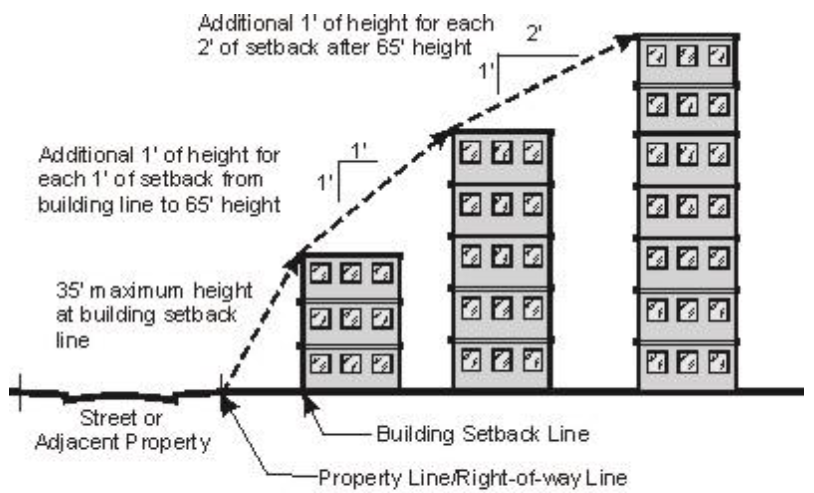
Height to Setback Illustration
5.1.D - Building On Corner Lots
Single-Family Residential Detached Districts: "R-15,000", "R-9,000", "R-7,500", "R-6,500" Where internal lots have been placed or sold fronting on the side street, buildings on corner lots may project not more than ten (10) feet in front of the line established for buildings by the front yard requirements for the interior lots on the side street, provided this regulation shall not be interpreted to reduce the building width of a corner lot in separate ownership at the time of the passage of this ordinance, to less than twenty-eight (28) feet, and provided that the side yard regulations above shall be observed.
5.2.A - General Provisions
The following general provisions shall apply to parking requirements for all districts located within the City of Bedford:
(1)
In all districts, for all uses, there shall be provided, at the time any building or structure is erected, enlarged or increased in capacity, or at any time any other use is established, off-street parking spaces for motor vehicles in accordance with the requirements specified in this section.
(2)
Where more than one building is located upon a lot, the parking requirements shall be based upon the total floor area of all such structures.
(3)
It is the intent of these regulations to preserve and retain existing off-street parking and loading spaces in at least the minimum amounts as would be required if the existing use of the structure had been established or erected in full compliance with these provisions.
(4)
Except for single-family or two-family dwelling units, parking and loading areas shall be arranged so that vehicles shall not be required to back out of the parking or loading spaces directly into a public way.
(5)
Where parking areas abut required public sidewalks, the use of wheel stops or other appropriate measures, shall be utilized so that at no time shall any portion of a vehicle, when parked, extend over the surface of the sidewalk.
(6)
For the enlargement of a structure or for the expansion of a use of structure or land, there shall be required only the number of off-street parking and loading spaces as would be required if such enlargement or expansion were a separate new structure or use; and
(7)
For a change in the use of a structure or land, the number of additional off-street parking and loading spaces required shall be equal to the number required for the new use, according to the schedule below, less the number of spaces which would have been required for the previous use if it had been established in conformance with this section. In no case shall the total number of spaces required to be furnished exceed the minimum number required for the new use.
(8)
Areas designated for off-street parking shall be used for passenger and commercial vehicles.
(9)
Areas designated for off-street loading shall be used only for the loading and unloading of passengers, equipment, supplies or merchandise.
(10)
Carports shall be permitted in the R-15,000, R-9,000, R-7,500, R-6,500 single family and MD-1, MD-2, MD-3, and MD-4 moderate density residential zoning districts, and in the MF and M districts in accordance with the following conditions:
a.
No carport may be located in the required front yard or required side yard adjacent to a street.
b.
Material and design of carports, other than portable canvas carports located behind a screening barrier, must be comparable to that material located on the main structure.
c.
Carports shall be permitted in the MF and M districts in accordance with the provisions indicated on an approved site plan or concept plan.
5.2.B - Schedule of Parking Requirements
The parking requirements shall be in accordance with the following table:
5.2.C - Minimum Dimensions For Off-Street Parking
The design and dimensions of off-street parking shall be in accordance with the following table of minimum dimensions:
* At right angles to building or parking line
** Aisle width perpendicular to building or parking line
*** If aisle is a designated Fire Lane, it must be a minimum of 24 feet, per Section
58.59, Bedford Fire Code
(1)
When off-street parking facilities are located adjacent to a public alley, the width of said alley may be assumed to be a portion of the maneuvering space requirement.
(2)
Where off-street parking facilities are provided in excess of the minimum amounts here in specified, or when off-street parking facilities are provided but not required by this Ordinance, said off-street parking facilities shall comply with the minimum requirements for parking and maneuvering space herein specified.
5.2.D - Off-Street Loading Space Requirements
(1)
Retail, Office, and Service buildings shall provide and maintain off-street facilities for the loading and unloading of merchandise and goods within the building or on the lot adjacent to a public alley or private service drive to facilitate the movement of traffic on the public streets.
(2)
Individual loading space dimensions shall be required as a minimum to be ten (10) feet by twenty-five (25) feet and shall be provided as follows:
(3)
No portion of a loading facility may extend into a public right-of-way or into an off-street parking facility elsewhere herein required.
(4)
The off-street loading spaces or truck berths shall provide maneuvering areas on site to prevent any blockage of public rights-of-way.
(5)
Any person desiring a building permit for the construction, alteration, or change of use of the land or any business building or structure shall submit a plot plan to the Building Official designating the number, dimensions, and locations of all loading areas and all proposed avenues of ingress and egress to the property from adjacent public thoroughfares. The Building Official shall not issue such permit if it is determined that the proposed loading and unloading facilities will present a direct or indirect hazard to vehicular or pedestrian traffic.
5.2.E - Stack Space Requirements
All business uses containing an automobile drive-in type ordering or service facility, whether manned or unmanned, shall provide automobile stack space in conjunction with the drive-in facility. Stack spaces shall be nine (9) feet wide by eighteen (18) feet long (9' x 18') and shall be located in a sequential arrangement oriented to the drive-in ordering or service area. The space occupied by an automobile placing an order or being served shall not be considered as a stack space. Required stack space(s) shall not be on any street rights-of-way or an alley, any necessary maneuvering area for parking spaces within the general traffic circulation pattern of a parking lot, or a designated fire lane. Stack spaces may be situated in a straight alignment or in a curbed pattern with functional radii. All stack space requirements shall be in addition to all parking space and loading requirements specified above. Such stack space(s) shall be provided as follows:
5.2.F - Handicapped Parking Spaces
(1)
In each parking facility in zones "MF", "S", "L", "H", and "I", a portion of the total parking shall be specifically designed, located, and reserved for vehicles licensed by the State for use by the handicapped. These spaces will be provided according to the following schedule:
(2)
Each parking space designated for use by the handicapped shall consist of a rectangular area not less than twelve and one half (12.5) feet wide by eighteen (18) feet long, with a vertical clearance of seven and one half feet (7.5).
(3)
Each designated handicapped parking space shall be located in an area not exceeding two (2) percent slope, and shall be located near and convenient to a level or ramped entrance accessible to handicapped persons.
(4)
Parking spaces for the handicapped shall be signed in accordance with State law and restricted for use by the Handicapped only.
(5)
Care in planning shall be exercised so that individuals in wheelchairs and individuals using braces and crutches are not compelled to wheel or walk behind parked cars.
(6)
All applicable ADA requirements for parking spaces must be met.
5.3.A - Purpose
Certain uses, because of the characteristics of the use, may be appropriate in some zoning districts under certain conditions in addition to the zoning districts wherein they are a permitted use. These uses have been identified by the City Council in Section 3.1, Schedule of Permitted Uses.
5.3.B - Procedure
The City Council, by an affirmative vote, may, after public hearing and proper notice to all parties affected, and after recommendations from the Planning and Zoning Commission, that the use is in general conformance with the Master Plan of the City and contains such requirements and safe guards as are necessary to protect adjoining property, to authorize the location of certain uses in a special district. All Specific Use Permit requests must be accompanied by a Site Plan. Such site plan shall meet the requirements for site plans, which are detailed in Section 5.4, Site Plan Requirements of this Ordinance. In addition to the site plan requirements in Section 5.4, Site Plan Requirement of this Ordinance, a site plan for a proposed Specific Use Permit shall show the relationship of the intended use to all existing properties and land uses in a direction to a minimum of two hundred (200) feet. In addition, all requirements listed in Section 3.2, Explanations of Uses and Specific Use Permit Requirements must be met.
5.3.C - Duration of Specific Use Permit
Every Specific Use Permit granted under these provisions shall be considered as an amendment to the zoning ordinance as applicable to such property under consideration. However, the City Council may, upon recommendation by the Planning and Zoning Commission, impose time limitations on a Specific Use Permit after which a new Specific Use Permit must be requested for continuation of the use.
A building permit shall be applied for and secured within one (1) year from the time of granting the Specific Use Permit provided, however, the City Council may authorize an extension of this time upon recommendation by the Planning and Zoning Commission.
5.3.D - Conditions
In granting a Specific Use Permit, the City Council may impose conditions which shall be complied with by the owner or grantee before a certificate of occupancy may be issued by the Building Inspector for use of the building on such property pursuant to such Specific Use Permit; such conditions shall not be construed as conditions precedent to the granting of the certificate of occupancy.
5.3.E - Compliance
No Specific Use Permit shall be granted unless the applicant, owner, and grantee of the Specific Use Permit shall be willing to accept and agree to be bound by, and comply with the written requirements of the Specific Use Permit, as attached to the site plan drawing (or drawings) and approved by the Planning and Zoning Commission and the City Council.
5.3.F - Revisions To A Specific Use Permit
No building, premise, or land used under a Specific Use Permit may be enlarged, modified, structurally altered, or otherwise significantly changed unless a separate Specific Use Permit is granted for such enlargement modification, structural alteration, or change. A change of ownership or a change in the business name does not in itself constitute a significant change requiring a new Specific Use Permit.
5.3.G - Board Of Adjustment
The Board of Adjustment shall not have jurisdiction to hear, review, reverse, or modify any decision, determination, or ruling with respect to the granting extension, revocation, modification, or any other action taken relating to such Specific Use Permit.
5.4.A - Generally
Whenever a site plan is required by this Ordinance, such site plan must conform to the requirements of this section. All site plans must be approved by action of the Planning and Zoning Commission, unless otherwise provided herein.
(1)
The approved site plan must accompany the request for the issuance of the building permit.
(2)
Changes in any site plan required by this Ordinance and approved by the Planning and Zoning Commission shall be processed the same as the original approval of the site plan, except that changes of detail, less than 20%, which do not alter the basic relationship of the proposed development to adjacent property, and which do not alter the uses permitted or increase the density, floor-area ratio, height ratio, or reduce the yards provided at the boundary of the site as indicated on the approved site plan may be authorized by the Community Development Director. An aggrieved party may appeal the decision of the Community Development Director to the Zoning Board of Adjustment in accordance with the provisions of this Ordinance.
5.4.B - Site Plan Required
When required by the Administrative Official, Applicable Advisory Board, Commission, or the City Council, any applicant for a zoning change shall submit a proposed site plan for approval. It is the established policy of the Planning and Zoning Commission and the City Council under this section of the City of Bedford Zoning Ordinance that a site plan will be required for any application for a zoning change to "S", "L", or "H" Commercial, and to "I" Industrial, on any tract of land which meets one or more of the following conditions:
(1)
Adjacent to any of the following Single Family Residential Zoning Districts: "R-l5,000"; "R-9,000"; "R-7,500"; "R-6,500"; "MD-1", "MD-2", "MD-3", and "MD-4".
(2)
Unique topographical conditions are present on the tract.
(3)
Greater than three (3) acres in area.
(4)
Any property located within the Central Business District Overlay, Cheek-Sparger Entrance District, or Master Highway Corridor Overlay District. (See Sections 4.16, 4.17 and 4.18 respectively)
5.4.C - Notice And Hearing
Notice and hearing requests for site plan approval shall be conducted as follows:
(1)
Owners of record of property within two hundred (200) feet of the property under consideration will be notified of site plan consideration by the Planning and Zoning Commission.
(2)
The City Manager or designee shall have at least one (1) sign erected on the property for which site plan consideration of the Planning and Zoning Commission has been requested. The sign shall have total area of at least four (4) square feet and shall be located adjacent to streets, if possible. Such sign shall be erected on or before the first date of the first notice to property owners and shall be removed immediately after final action by the City Council, or when the applicant withdraws the request, whichever comes first. The sign shall contain a notice of hearing on a site plan and the telephone number of the public official from whom dates of public hearing may obtained. The erection or continued maintenance of signs shall not be deemed a condition precedent to the granting of any site plan recommendation or approval or the holding of any public hearing.
(3)
Council approval of a site plan that accompanies a zoning change request shall become part of the amending ordinance and shall be referenced on the Zoning District Map. Hearings held by the Council for consideration of approval of such zoning changes and accompanying site plans shall be conducted in accordance with the provisions of Section 6.3, Procedure for Changes and Amendments of this Ordinance and state law.
(4)
Council approval of a site plan required for the issuance of a building permit, in which no zoning change has been requested, shall not constitute an Official Public Hearing as required by Section 6.3 Procedure for Changes and Amendments. Notice of the consideration of the site plan by the City Council in the posted agenda of the Council shall be sufficient notice for the purposes of approving a site plan by City Council action for the issuance of a building permit.
5.4.D - Form And Content
The Site Plan shall contain the information listed below. Any or all of the required features may be incorporated on a single drawing if such drawing is clear and capable of evaluation by the Planning and Zoning Commission, the City Council, and the officers required to enforce and interpret this Ordinance:
(1)
The boundary lines and dimensions of the property, existing subdivision lots, available utilities, easements, roadways, sidewalks, fire lanes, and public rights-of-way.
(2)
Topography of the property proposed for development in contours of not less than two feet, together with any proposed grade elevations, if different from existing elevations. (Note: If the natural contour of the land is to be altered or changed in any location on the property more than four (4) feet, the site plan must provide detailed information on the proposed grading plan. This information shall include the correlation of the proposed grading plan to the surrounding properties and the use of those surrounding properties and shall include information indicating the drainage and line of sight effect. The proposed grading plan will have on the surrounding properties.).
(3)
Flood plains, water courses, marshes, drainage areas, and other significant environmental features including, but not limited to, rock outcroppings and major tree groupings.
(4)
The location and use of all existing and proposed buildings or structures, including all refuse storage areas, and the minimum distance between buildings. Where building complexes are proposed, a site plan showing the location of each building and the minimum distance between buildings, and between buildings and the property line, street line, and/or alley shall be submitted. For buildings more than one (1) story in height, except "R-15000", Residential, through "MD-1", Duplex residences, elevations and/or perspective drawings shall be required in order that the relationship of the buildings to adjacent property, open spaces, and to other features of the development plan may be determined. Such drawings need only indicate the height, number of floors and exposures for access, light, and air. A designation of the maximum building coverage of the site shall be indicated upon the site plan.
(5)
Total number and location of off-street parking and loading spaces. A plan indicating the arrangement and provision of off-street parking and off-street loading where required. Such a plan may be presented as a ratio of off-street parking and off-street loading area to the building area when accompanied by a typical example indicating the feasibility of the arrangement proposed and when the areas where the example would be applied are dimensioned on the drawing of the entire site.
(6)
All points of vehicular ingress and egress and circulation within the property, including any special traffic regulations facilities proposed or required to assure the safe function of the circulation plan.
(7)
Setbacks, lot coverage, and when relevant, the relationships of the setbacks provided and the height of any existing or proposed building or structure.
(8)
The location, size, and arrangement of all outdoor signs, exterior auditory speakers, and lighting.
(9)
The type, location, and quantity of all plant material used for landscaping, and the type, location, and height of fences or screening and the plantings around them. When necessary to protect the public health, safety, or welfare, the City Council or the Planning and Zoning Commission may require landscaping and screening requirements to be in place prior to the start of construction pursuant to an approved site plan.
(10)
A land use plan that delineates where multiple types of land use are proposed, the specific areas to be devoted to various uses.
(11)
Vicinity map, north point, scale, name of development, name of owner, name of planner, total acreage of project, street address, or common description of the property.
(12)
Current land uses and zoning district of the property and current land uses and zoning districts of contiguous properties and buildings on the exterior of the site and within twenty-five (25) feet of all property lines.
(13)
The location and size of existing and proposed surface and subsurface drainage facilities, including culverts, drains, and detention ponds, showing size and dimensions of flow.
(14)
Land uses and Zoning District contiguous to the property.
(15)
Existing buildings on the exterior of the site and within twenty-five (25) feet of all property lines.
(16)
The number of square feet of the property after construction which will constitute impervious area or impervious surface and vegetated areas as those terms are defined in the Stormwater Utility Ordinance.
(17)
Roadway speeds and distances of adjacent driveways from all proposed driveways.
(18)
Requests for alcoholic beverages uses shall also show the distances from schools, churches, and daycare facilities.
5.4.E - Consideration
In considering, granting, or denying an application for a site plan as provided for in this Ordinance, the Planning and Zoning Commission and the City Council shall take into consideration the following factors:
(1)
Compliance with the Zoning Ordinance, the Subdivision Ordinance, and all other ordinances of the City.
(2)
Such other measures as will secure and protect public health, safety, morals, and general welfare.
5.5.A - Fences, Walls, and Hedges
Notwithstanding other provisions of this ordinance, fences, walls, and hedges may be permitted in any required side or rear yard, the maximum height of such permitted fences being eight (8) feet. Decorative fences will be permitted in any required front yard as long as vision is not impaired and height does not exceed two and one-half (2.5) feet.
5.5.B - Fences Abutting Incompatible Districts
(1)
In commercial and industrial zoning districts that abut a lot or tract currently zoned or being used for residential purposes, or abut a lot or tract zoned or for residential purposes, a solid masonry fence (a visual barrier) or masonry wall at least six (6) feet in height will be erected and shall be adequately maintained by the owner of such commercial or industrial lot or tract. Such fence shall be required to be located adjacent to the property lines requiring a landscape buffer area on the commercial or industrial zoned lot or tract. If there is an existing masonry fence or wall at least six (6) feet in height on the abutting residential lot or tract, no additional masonry screening is required. The residential lot or tract owner (or Home Owners Association) is responsible for the maintenance of the masonry screening located on the residential lot or tract. Fence locations other than adjacent to the property lines may be allowed under specific site plan approval by the City Council.
(2)
Where the commercial or industrial district abuts a lot zoned for residential purposes, but such lot is not currently being used for residential purposes, the City shall permit the owner to pay into escrow, for the construction of a six (6) feet high masonry wall, an amount of money equal to the cost of constructing such wall, as a condition precedent to the issuance of a Certificate of Occupancy. The amount to be placed into escrow will be based upon the cost of the construction of the masonry wall as determined by the City Manager or designee.
(3)
If the residentially- zoned property is developed for a residential use within seven (7) years after the money is placed into escrow, sums equal to the construction cost of the masonry wall will be withdrawn from the escrow account to fund such construction. If the residentially- zoned property is not developed within the seven (7) years after the money is place into escrow, then the escrowed amount shall be used by the City to construct such masonry wall. In the event the abutting residential property is rezoned to a nonresidential use within seven (7) years after the money is placed into escrow, the remaining amount in the escrow account as of the rezoning date shall be refunded to the owner. No refunds will be made by the City to any owner after the seven (7) year period has expired, nor shall the City ever be liable for payment of interest in any deposits or refunds provided for herein.
(4)
An exception to the screening requirement may be granted by the City Council after a recommendation from the Planning and Zoning Commission, when considering approval of the site plan. The exception may be granted if the City Council finds that the subject property's unique land-based conditions, such as site topography, the presence of floodplain, or other natural features of the property, will serve as an equivalent method of buffering the two adjacent incompatible land uses. Financial or economic hardship shall not justify the granting of an exception.
(Ord. No. 2024-3407, § 2, 4-23-24)
5.5.C - Screening of Auto Storage Areas
Auto repair businesses that provide temporary auto- storage areas shall screen those areas with a six (6) foot permanent fence.
5.5.D - Screening of Exposed Mechanical Units, Dumpsters & Permanent Recycling Containers
All exposed mechanical units located on grade shall be appropriately screened from view by either the use of live plant material of the evergreen variety, or fencing. All exposed roof- mounted mechanical units (including fans, vents, cooling towers, etc.), which extend above the roof or parapet line shall be screened from public view. Garbage/refuse facilities (dumpsters) and permanent paper recycling containers will be screened on at least three (3) sides with a masonry wall of at least six feet (6') in height. Permanent for the purposes of this subsection shall mean any placement that exceeds 90 days per calendar year."
5.5.E - Nonconforming Screening
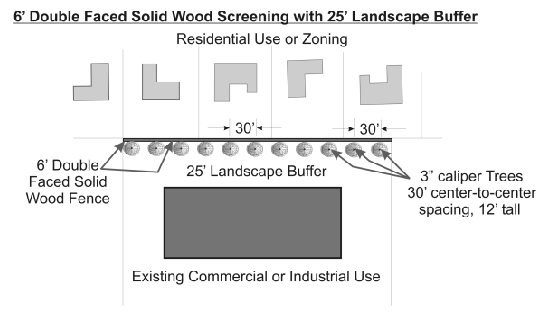
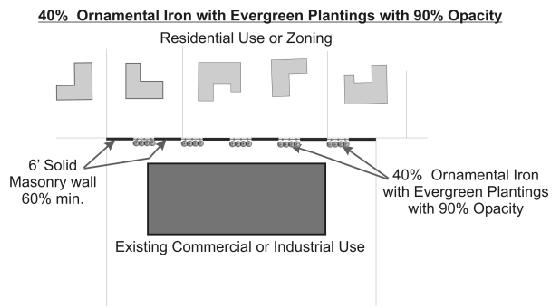
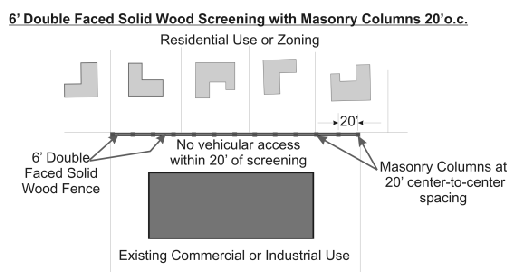
Existing commercial and industrial lots or tracts where the screening provided on August 1, 2003 is nonconforming, must construct a fence in conformance with one of the following alternative screening methods by November 14, 2004. The screening element(s) shall be adequately maintained by the owner. The property owner must apply for the building permit to construct the alternative screening method by May 14, 2004. For the purposes of this section, all wood screening fences must be constructed with 0.095 gauge steel posts at least 2 3/8" in diameter, in concrete footings, with spacing no greater than eight (8') feet on center.
(1)
A solid masonry fence or masonry wall at least six (6) feet in height.
(2)
A screening wall at least six (6) feet in height composed of a minimum of 60% solid masonry and up to 40% of the area of the (including columns) composed of ornamental iron with evergreen landscape plantings, six feet (6') in height at the time of planting, providing a visual screen with an opacity of at least 90%;
(3)
A double-faced solid wood screening fence six (6') feet in height with masonry columns constructed at twenty foot (20') spacing center-to-center with no vehicular access within twenty feet (20') of the screening fence;
(4)
A six (6') foot tall double-faced solid wood screening fence with a landscaping buffer at least twenty-five feet (25') in width with at least one three inch (3") caliper tree, twelve feet (12') in height, every thirty feet (30');
(5)
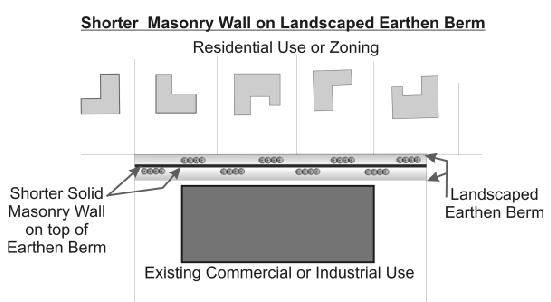
A shorter masonry wall constructed on top of a landscaped earthen berm such that the overall height of the screening is at least six feet (6') from the normal ground level of the adjacent properties;
(6)
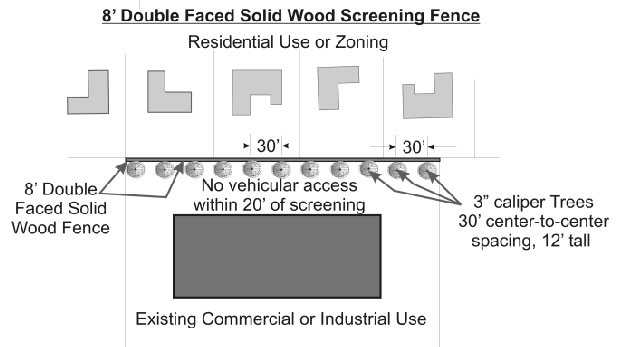
A double-faced solid wood screening fence with two feet of additional in height for at total height of eight feet (8') with no vehicular access within twenty feet (20') of the screening fence and with at least one three inch (3") caliper tree, twelve feet (12') in height, every thirty feet (30');
(7)
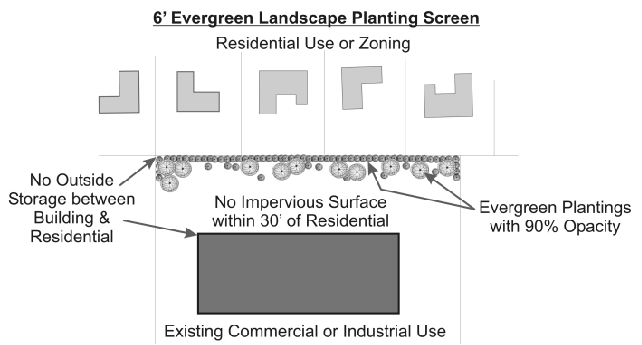
A continuous evergreen landscape planting screen, six feet (6') in height at the time of planting, providing a visual screen with an opacity of at least 90%, with the building setback a minimum of thirty feet (30') from the residential property with no impervious surface (parking area, maneuvering area, fire lane or vehicular access area) or outside storage between the building and the property line (only a pedestrian sidewalk is allowed in this area);
(8)
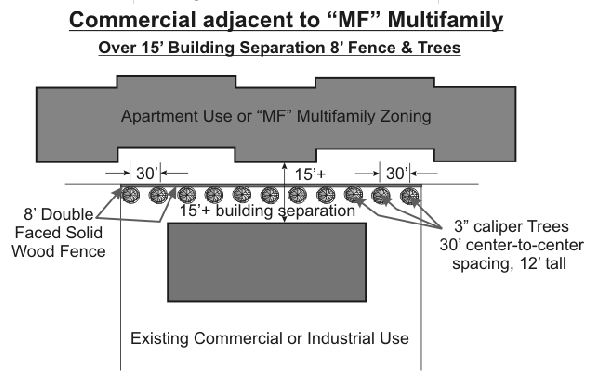
If the adjacent zoning or use is apartments or the zoning is "MF" Multifamily and the building separation from the commercial building and the apartment building is over fifteen (15') feet, a double-faced solid wood screening fence eight (8') feet in height with at least one three inch (3") caliper tree, twelve feet (12') in height, every thirty feet (30');
(9)
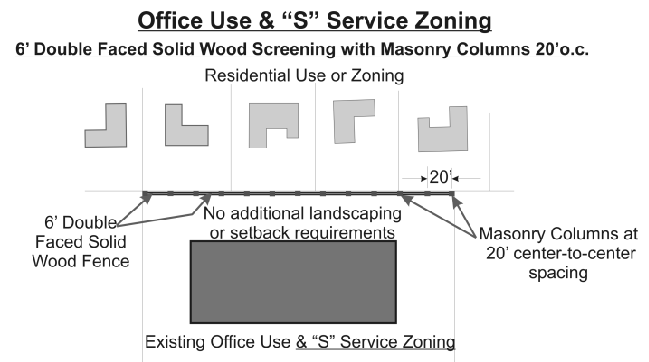
If the business use is professional offices and the zoning is "S" Service Commercial and not a Specific Use Permit, a double-faced solid wood screening fence six feet (6') in height with masonry columns constructed at twenty foot (20') spacing center-to-center. Professional offices as, used in this section, includes the Business and Professional Services uses allowed by right in the "S" Service Commercial zoning district, "Section 3.1 Schedule of Permitted Uses".
(10)
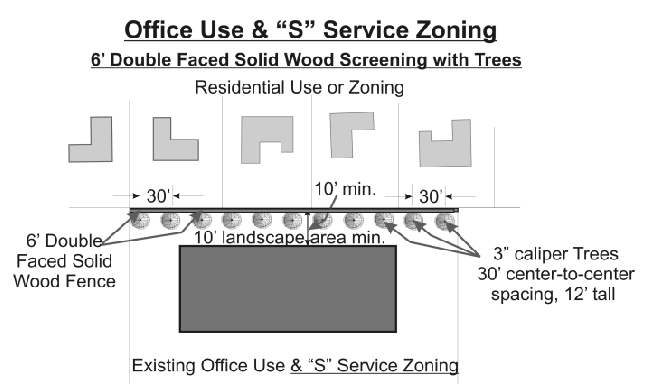
If the business use is professional offices and the zoning is "S" Service Commercial and not a Specific Use Permit, a double-faced solid wood screening fence six (6') feet in height with at least one three inch (3") caliper tree, twelve feet (12') in height, every thirty feet (30') within a landscape area a minimum of ten (10') feet in width;
(11)
An alternative screening method, from those listed above, may be requested as a Special Exception to be considered by the Zoning Board of Adjustment. The commercial property owner shall present evidence that an alternate screening element customized for that particular property's unique conditions is needed. The Zoning Board of Adjustment can consider any and all evidence and testimony presented including, but not limited to, financial or economic hardships or costs. Any special exception granted by the Zoning Board of Adjustment shall apply to the record owner of the property on the date the special exception is granted, and shall not run with the land. The special exception shall not be applicable to subsequent owners of the property.
5.5.F - Masonry Construction
Masonry construction shall include 4" x 8" bricks, decorative block, split face stone construction, natural stone, stucco, or other masonry material approved and constructed in accordance with the Bedford Building Code; but shall not include concrete masonry unit (CMU) blocks.
5.6.A - Purpose
The purpose of this section is to establish landscaping requirements in zoning districts "MF", "S", "L", "H", and "I" to enhance the community's ecological, environmental, aesthetic qualities, and beautification efforts. It is the intent of this section to reduce the negative effects of glare, noise, erosion, and sedimentation caused by expanses of impervious and un-vegetated surfaces within the urban environment. It is the intent of this section to preserve and improve the natural and urban environment by recognizing that the use of landscaping elements can contribute to the processes of air purification, oxygen, regeneration, groundwater recharge, noise abatement, glare and heat, provision of habitats for wildlife, and enhance the overall beauty of the City of Bedford.
5.6.B - Landscape Installation Required
Twenty (20) percent of the total land area in any proposed development or construction occurs for any use after the effective date of this Ordinance shall be landscaped. This twenty (20) percent requirement shall apply to each phase as it is developed. This twenty (20) percent requirement may be reduced through the application of credits granted in the manner described in Subsection 5.6 E, Credits Toward Landscaping Requirements.
5.6.C - Landscape Plan Required
A landscaping plan shall be submitted to the City for approval. The landscape plan may be submitted as a part of the site plan. The landscape plan shall contain the following information:
(1)
Location of all existing trees with indication as to those to be preserved.
(2)
Location of all plants and landscaping material to be used including paving, benches, screens, fountains, statues, or other landscaping features.
(3)
Species of all plant material to be used.
(4)
Size of all plant material to be used.
(5)
Spacing of plant material where appropriate.
(6)
Layout and description of irrigation, sprinkler, or water system, including placement of water sources.
(7)
Description of maintenance provisions of the landscaping plan.
(8)
Persons responsible for the preparation of the landscape plan.
5.6.D - Locational Criteria
The following locational criteria shall apply to the landscaping provided:
(1)
Not less than forty (40) percent of the total landscaping shall be located in the designated front yard.
(2)
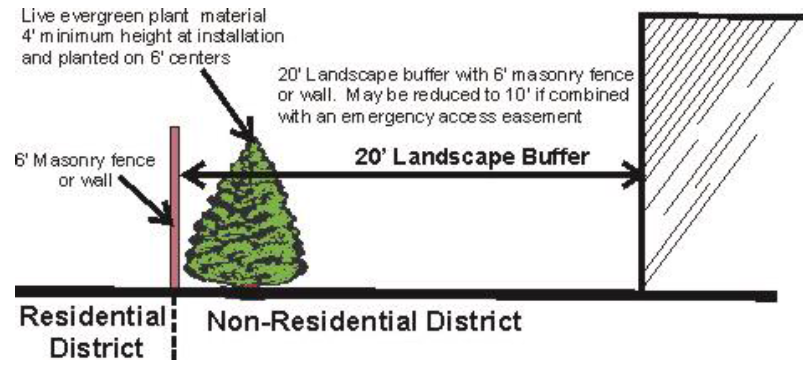
Developments in "S", "L", "H", AND "I" zoning districts which abut districts zoned residential or multi-family shall provide a minimum twenty (20) foot wide green belt of "live plant material of the evergreen variety", a minimum of four (4') feet in height at the time of installation, and planted on six (6) foot centers, for the entire distance along which the development abuts the residential or multi-family districts. A planting mix of larger trees of evergreen variety is permitted with a reduction in "on center" planting requirements. Equal coverage must be maintained. However, any variation of the planting mix and/or the "on center" distance must be included on a landscape plan prepared by a landscape architect and/or landscape professional and approved by the Building Official. Where an emergency access easement is required, the green belt may be reduced to ten (10) feet.
(3)
It is the intent of this Ordinance that all required landscaping shall be designed in such a manner as to encourage the landscaping to be in several groupings of landscape planting distributed on all sides fronting public highways.
(4)
Landscape planting shall not be erected or installed in such a manner to interfere with traffic view or impose a safety hazard.
(5)
Landscaping of City Rights-of-way on Abutting Streets - Street Trees: At the option of the owner-developer, and issuance of a permit by the City, the owner-developer may landscape the city rights-of-way easement on public streets adjoining the subject property with a combination of grass or ground cover and trees with the following limitations:
a.
The trees shall be located on twenty-five (25) foot centers, and shall be a minimum of two (2) inches in diameter at the time of installation. Trees planted in street rights-of-way must be maintained so that the lowest branches are no lower than nine (9) feet above the ground in order to allow adequate visibility.
b.
The trees shall not be arranged in a manner to interfere with traffic flow or traffic view. The decision of the traffic engineering office of the City of Bedford shall be final in questions regarding traffic view or traffic safety.
c.
Trees shall not be permitted in rights-of-way containing City's water and sanitary sewer mains.
d.
No trees or vertical plants shall be permitted within five (5) feet of any fire hydrant.
e.
The owner recognizes that the City or any franchised utility will not be responsible for damage to any landscaping while performing repairs or maintenance to its system.
f.
If the owner-developer elects to provide landscaping within the right-of way this landscaping will count toward the total landscaping required.
For each of exclusive of driveways, sidewalks, and paved areas, there shall be allowed a three (3) square foot credit against the overall landscaping requirement of twenty (20) percent of the total land area in the development up to a maximum and not to exceed three (3) percent.
5.6.E - Credits Toward Landscaping Requirements
Credits toward the landscaping requirements may be granted in the following manner; however credit shall not reduce the total required landscaped area to less than ten (10) percent: (These credits will be applied against the percentage requirements indicated in Subsection 5.6 B, Landscape Installation Required.)
Schedule of Possible Credits:
5.6.F - Installation and Maintenance
(1)
All landscaping shall be permanently maintained and adequate provisions shall be made at the time of installation for adequate inconspicuous watering sources. Failure to permanently maintain any such landscaping shall be deemed a violation of the zoning ordinance.
(2)
Should any of the plant material used in any landscaping required under this Ordinance die, the owner of the property shall have ninety (90) days after notification from the City to obtain and install suitable replacement plant material. Synthetic or artificial lawn or plant material shall not be used to satisfy the requirements of this Ordinance.
(3)
Landscaped area shall be kept free of trash, litter, weeds, and other material or plants not a part of the landscaping.
(4)
All plant material shall be maintained in a healthy and growing condition as is appropriate for the season of the year.
5.6.G - Landscaping of Parking Lots
It is the intent of this section to encourage design and construction of parking areas in a manner whereby areas within the parking lot are landscaped as well as areas considered unusable for parking or maneuvering space. The following minimum requirements shall be observed:
(1)
A minimum of ten (10) percent of the gross parking area shall be devoted to living plant material. Gross parking area shall be measured from the edge of the parking and/or driveway paving and sidewalks.
(2)
Interior areas of parking lots shall contain landscaped areas located so as to best relieve the expanse of paving.
(3)
Landscape material, which is located within the interior of a parking lot, shall be surrounded by a curb of four (4) inches in height.
(4)
Landscaping within a parking lot shall not create a visibility obstruction. A visibility obstruction within a parking lot is defined as landscaping between twenty four (24) inches in height and seven (7) feet in height. No shrubs shall exceed twenty four (24) inches in height. Tree canopies shall be at least seven (7) feet in height.
(5)
For large existing trees located in the parking area, which are being retained and incorporated into the landscape plan, an appropriate aeration system or an alternative method of protecting the tree must be provided and detailed in the landscape plan.
5.6.H - Certificate Of Occupancy
(1)
All landscaping shall be completed and installed in accordance with the approved landscape plan within six (6) months of a certificate of occupancy being granted. If the developer cannot install the landscaping required within the six (6) month period they must provide documentation stating the reason for the delay and a schedule indicating when installation will occur.
(2)
If these requirements have not been satisfied within the six (6) month period, from when the certificate of occupancy is issued, the property owner shall be considered in violation of the zoning ordinance of the City of Bedford and shall be subject to the penalties established herein.
5.6.I - Nonconforming Uses and/or Structures
All uses that are in existence at the time of the adoption of this landscape ordinance, which do not meet the requirements provided herein, will be considered as being legal nonconforming to these landscape requirements. These nonconforming uses/structures will be subject to Section 2.3, Nonconformities, unless otherwise provided for in this section.
5.6.J - Relief From Landscaping Requirements
Upon completion of the following, relief from landscaping requirements may be granted in situations where the individual circumstances of an existing facility limit the applicants' ability to comply with the requirements of this Ordinance:
(1)
The applicant shall provide the City with an alternative landscape plan for review and approval.
(2)
Said landscape plan will illustrate a plan to landscape the area as available, provide for irrigation, and provide a phasing schedule for completing the plan.
(3)
The installation of landscaping as indicated by the landscape plan is completed and approved by the City.
5.7.A - Visibility At Intersections
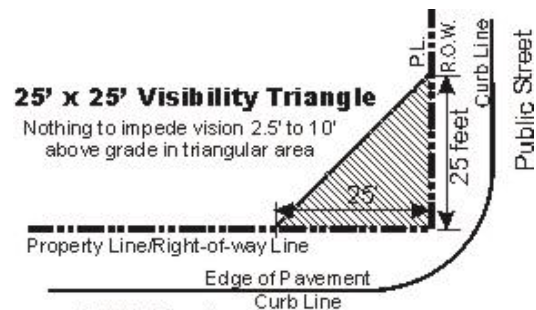
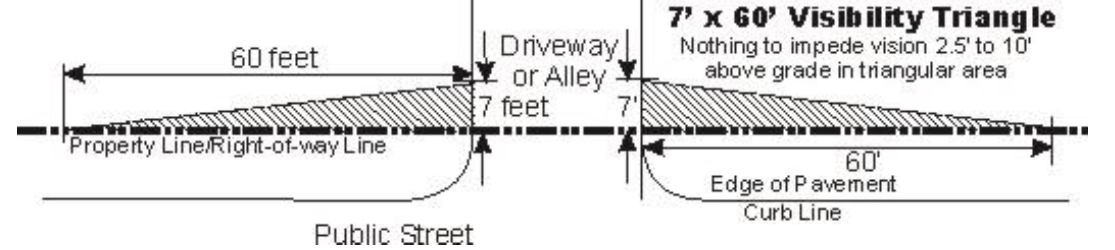
Nothing shall be erected, placed, planted, or allowed to grow in such a manner as materially to impede vision between a height of two and one-half (2.5) and ten (10) feet above the center line grades of the intersecting streets in the area bounded by the street lines of each corner lot and a line joining points along said street lines twenty-five (25) feet from the point of intersection.
A visibility triangle area measuring seven (7) feet by sixty (60) feet for all driveway to street intersections shall be maintained.
5.8.A - Standard Masonry Construction
Exterior walls for each of the main walls for the main building in all zoning districts except industrial are required to have a minimum of sixty-five (65) percent standard masonry construction, excluding windows and doors, below the first floor ceiling plate line. Detached garages and servant quarters shall have at least thirty-five (35) percent of each exterior wall below the first floor ceiling plate line constructed of standard masonry. All other accessory buildings are excluded from this requirement.
5.8.B - Standard Masonry Construction Defined
Standard masonry construction is defined as the veneer of exterior walls constructed of 4"x8" bricks, decorative block, split face stone construction, natural stone, stucco, or other masonry material approved and constructed in accordance with the Bedford Building Code; but shall not include concrete masonry unit (CMU) blocks.
5.9.A - Purpose
Certain outside sales and/or storage of merchandise may be essential to the full development and utilization of the land and deemed to promote the health, safety, and general welfare of the City. The outside and/or storage of merchandise hereinafter enumerated shall not be deemed violations of this ordinance when made under the conditions herein provided.
5.9.B - Permit Required
In "L" and "H", Commercial Zoning Districts, the outside sales and/or storage of merchandise for sale is prohibited in the City of Bedford unless a permit for such outdoor activities is obtained by the applicant.
5.9.C - Administrative Approval
A request for a permit for outside sales and/or storage may be approved by the City Manager or his/her designee if the following conditions exist:
(1)
There are no complaints on record for similar activities held by the applicant.
Appeal of the decision by the City Manager or his/her designee may be made to the Zoning Board of Adjustment. A governmental entity is exempted from the required fee for a permit.
5.9.D - ZBA Approval
A request for a permit for outside sales and/or storage may be approved by the Zoning Board of Adjustment if the following conditions exist:
(1)
The City Manager or his/her designee determines that approval by the Zoning Board of Adjustments is necessary.
(2)
There are complaints on record for similar activities held by the applicant.
5.9.E - Content of Application
An Application for a Permit to Conduct Outside Sales and/or Storage of Merchandise for Sale shall include the following:
(1)
A description (including a scale drawing) showing the exact location and limits of the area for the outside activities.
(2)
Exact dates of the commencement and termination of the outside sales/storage Activities.
(3)
Location and construction of any temporary signs to be used in connection with the outside sales/storage activity.
(4)
Signed certification by the responsible party and the record owner of the land that all information provided is true and correct, and all schedules will be strictly adhered to.
5.9.F - Exemptions
Certain commercial and/or retail uses commonly utilize outside sales and storage of merchandise for sale. Such activities are inherent in the nature of these uses and are essential to the conduct of these businesses. Therefore, the following primary business users are exempt from the requirements for "Permit" for these activities:
(1)
Landscape Services and Commercial Greenhouses.
(2)
Stone Monuments.
(3)
Building Materials/Lumber Yards.
(4)
Motorcycle and Motor- Scooter Sales.
(5)
Boats and Marine- Craft Sales.
(6)
Farm Machinery and Farm- Implements Sales.
(7)
New and Used Car and Truck Sales.
(8)
Motor Home, Camper, and Recreational- Vehicle Sales.
(9)
Heavy- Construction Equipment and Implements Sales.
5.9.G - Conditions
All outside sales and/or storage of merchandise for sale shall be subject to the following conditions:
(1)
No more than fifty (50) percent of the width of the pedestrian path abutting the building shall be used for storage, providing that the remaining pedestrian path shall contain no less than three feet.
(2)
No more than twenty-five (25) percent of the linear pedestrian path abutting the building of an individual business shall be used to sell or store materials and merchandise without a permit. (Includes grocery carts, newspaper dispensers, ice machines, and food and drink dispensers).
(3)
No storage of materials shall be allowed within three (3) feet of a required egress path.
(4)
No storage of materials shall be allowed within the required Emergency Access Easement.
5.10.A - Purpose
Certain temporary uses of land are essential to the full development and utilization of the land and are deemed to promote the health, safety, and general welfare of the City. The temporary uses, civic events, and special events hereinafter enumerated shall not be deemed violations of this Ordinance when made under the conditions herein provided.
5.10.B - Permitted Temporary Uses
The permissible temporary uses, the conditions of use and the zoning districts wherein the same shall be permitted and approvals required are:
Zoning Districts Allowed: In All Districts
(1)
Construction Office - Temporary field or construction offices and temporary building material storage areas to be used solely for on- premise construction purposes in connection with the property on which they are erected or within the same platted subdivision may be permitted when approved by the Building Official from the time of approval until the Certificate of Occupancy is issued or a period of two (2) years, whichever is less. An application must be submitted for a "Temporary Construction Office" on forms supplied by the Building Official's Office and shall include a scale drawing showing the location and size of the building(s), all outside storage areas, and proposed construction fencing.
(2)
Public School Districts and Churches, Temples, and Synagogues:
a.
Classroom, recreation, and administration needs for public school districts may be conducted in temporary buildings on public school district sites when approved by the City Manager or his/her appointed designee. However, the City Manager or his/her appointed designee may at his/her discretion require a recommendation of the Planning and Zoning Commission and approval by the City Council. An application for "Temporary Educational Building" must be submitted on forms supplied by the Building Official's office and shall include a scale drawing showing the location, size, and material of all building(s) proposed and a schedule indicating expected phasing of all temporary structures. Such permit shall be valid for five (5) years. Temporary structures should be located so that they are screened by the permanent buildings whenever possible.
b.
Classroom, recreation, and administration needs for churches, temples, or synagogues may be conducted in temporary buildings on church, temple, or synagogue sites when approved by a Specific Use Permit amendment by the Planning and Zoning Commission and the City Council. An application for "Temporary Church, Temple, or Synagogue Building" must be submitted in accordance with the provisions for a site plan amendment to a Specific Use Permit. Such approval shall be valid for two (2) years and may be extended for an additional one (1) year period with approval of the City Council. Temporary structures should be located so that they are screened by the permanent buildings whenever possible.
c.
Paper recycling containers may be placed on a temporary basis when approved by the City Manager or his/her appointed designee. However, the City Manager or his/her appointed designee may at his/her discretion require a recommendation of the Planning and Zoning Commission and approval by the City Council. An application for Temporary Newspaper Recycling Container must be submitted on forms supplied by the Building Official's office and shall include a scale drawing showing the location, size and surrounding site features. Containers shall observe all required building setback lines and shall be placed in a visually unobtrusive location. Temporary basis shall be defined as no more than ninety (90) days per calendar year, in increments of no less than ten (10) days and no more than thirty (30) days. There must be a thirty (30) day absence of the paper recycling containers between temporary increments.
Zoning Districts Allowed: In All Residential Districts
(1)
Real Estate Sales Office - Temporary field real estate offices may be permitted in residential subdivisions when approved by the Building Official from the time of approval until the related project is eighty (80) percent complete or a period of two (2) years, whichever is less. Such temporary uses may be located in a "Model Home" or a portable building within the subdivision. An application for a "Temporary Real Estate Sales Office" must be submitted on forms supplied by the Building Official's office and shall include a plat of the subdivision showing the exact location of the proposed Sales Office and the size of the building.
5.10.C - Civic Events and Special Events
Civic events and special events may be conducted within an existing use and ancillary to that use provided it meets the following criteria (Nothing within this section shall regulate or prevent an individual residential property owner from conducting activities normally associated with residential uses, including outdoor parties and gatherings. In addition, such outdoors activities shall be subject to the other regulations and ordinances of the City of Bedford which regulate the orderly conduct within the neighborhood and take into consideration the health, safety, and public welfare of the adjacent property owners):
(1)
The event is carried on for a period of time not exceeding fifteen (15) consecutive days;
(2)
No retail sales conducted except those incidental to the primary activity such as refreshment and souvenir sales. Charitable and Nonprofit Organizations may conduct retail sales for fund-raising purposes in any zoning district;
(3)
Assemblies are carried on out-of-doors, in temporary shelters, or tents;
(4)
A permit is obtained in accordance with the provisions provide herein.
5.10.D - Contents of Application
An Application for Approval of a Special Event shall include the following information:
(1)
Brief description of the event.
(2)
Designation of whether it is a Civic Event or Special Event.
(3)
Exact Location of where the event is to be held.
(4)
Expected Attendance.
(5)
Anticipated number of automobiles and proposed methods of providing parking for the same.
(6)
Location and construction of any temporary signs to be used in connection with the event.
(7)
Dates and times of commencement and termination of the event.
(8)
Signed certification by the Responsible Party and the record owner of the land that all information provided is true and correct and that all schedules will be strictly adhered to.
5.10.E - Administrative Approval
A request for an event may be approved by the City Manager or his/her designee if the following conditions exist, unless otherwise provided by this ordinance:
(1)
The event is located in either the "S', 'L', 'H', or 'I' zoning district; or in the case of civic event endorsed by a non-profit entity, Independent District, or religious institution, the event is located in any zoning district.
(2)
There is no property zoned for residential within 50 ft. of the proposed activity.
(3)
The event is limited to two (2) days.
(4)
The activities proposed will be limited between the hours of 7 a.m. and 12 p.m. (midnight).
(5)
There are no complaints on record for similar activities held by the applicant.
Appeal of the decision by the City Manager or his/her designee may be made to the Zoning Board of Adjustment. A governmental entity is exempted from the required fee for a permit.
5.10.F - ZBA Approval
Approval of a permit for outside sales and/or storage may be approved by the Zoning Board of Adjustment if the following conditions exist:
(1)
The City Manager or his/her designee determines that approval by the Zoning Board of Adjustments is necessary.
(2)
The event is proposed to last for more than two (2) days.
(3)
The activities proposed will extend beyond the hours of 7 a.m. and 12 p.m. (midnight.)
(4)
There are complaints on record for similar activities held by the applicant.
5.10.G - Parades
Parades shall be regulated in accordance with Chapter 114, Article 8 - Parades, City of Bedford Code of Ordinances.
5.11.A - Purpose
Certain radio equipment used in transmitting and receiving signal energy are essential and are deemed to promote the health, safety, and general welfare of the citizens of the City. The placement of such equipment shall be located so that the health, safety, welfare, and aesthetic quality of the community shall not be compromised. Therefore, the regulations governing the location of such equipment shall consider the aesthetic quality of the community equal to the health, safety, and general welfare of the community. The antennas, masts, and towers hereinafter enumerated shall not be deemed violations of this Ordinance when made under the conditions herein provided.
5.11.B - Definitions
The following definitions shall apply.
Antenna: A device used in communications, which transmits or receives radio signals.
Antenna, Building Attached: Antenna attached to existing structures in two general forms: (1) roof-mounted, in which antennas are placed on the roofs of buildings, or (2) building-mounted, in which antennas are mounted to the sides of buildings. These antennas can also be mounted on structures such as water tanks, billboards, church steeples, electrical transmission towers, etc.
Antenna Facility: A building or independent support structure and the antennas mounted thereon, along with an associated and necessary equipment building.
Antenna, Microwave: Also known as "dish" antenna. A dish-shaped antenna used to link communications sites together by wireless transmission of voice or data, utilizing electromagnetic radiation frequencies from 3 GHz to 300 GHz, and using relatively low transmitter power levels when compared to other forms of transmission.
Antenna, Panel: Also known as "directional" antenna. An antenna or array of antennas designed to concentrate a radio signal in a particular area. Panel antennas are typically flat, rectangular, or square devices approximately six square feet in size.
Antenna, Whip: Also known as "omni-directional" antenna. Shaped cylindrically, whip antennas have diameters between two (2) and (6) six inches, and measure between one (1) and eighteen (18) feet in height. They are used to emit signals in a three hundred sixty (360) degree horizontal plane and a compressed vertical plane.
Co-location: The act of locating wireless communications equipment from more than one provider on a single antenna facility.
Equipment Storage: A small, unmanned, single- story equipment building less than five hundred (500) square feet in size used to house radio transmitters and related equipment.
Monopole: An antenna facility composed of a single spire used to support communications equipment. No guy wires are used or permitted.
Lattice Towers: A tower having three or four support steel legs and holds a variety of antennas. These towers range from sixty (60) to two hundred (200) feet in height and can accommodate a variety of users.
Satellite Receive-Only Antenna: An antenna that enables the receipt of television signals transmitted directly from satellites to be viewed on a television monitor. Such antennas are commonly known as a satellite dish, television receive-only antenna, dish antenna, parabolic antenna, or satellite earth station antenna.
5.11.C - Amateur Antennas Residential Districts
Amateur radio equipment, (including ham radio and CB equipment) and personal use TV antennas shall be allowed in the "R-15,000", "R-9,000", "R-7,500", "R-6500", "MD-1", "MD-2", "MD-3", "MD-4", "MF", and "M" zoning districts if it complies with the following regulations:
(1)
Antenna facility may be building attached, monopoles, or lattice towers.
(2)
Only one antenna facility per lot of record.
(3)
An antenna facility, exclusive of the height of any antenna or mast, shall not exceed thirty-five (35) feet in height; provided, however, that an antenna facility shall be permitted additional height at the ratio of one added foot in height for each additional foot of setback beyond the minimum setback required of a accessory building in the Zoning District Regulations contained in Chapter 4, Zoning District Regulations, or Section 5.1, Height and Area Regulations of the Zoning Ordinance. Regardless of the above, the maximum height for a tower permitted without a Special Exception in any residential district shall be sixty-five (65) feet.
(4)
The height of an antenna, including the height of any antenna facility to which they may be fastened or attached shall not exceed sixty-five (65) feet in height without a Special Exception.
(5)
An antenna not fastened to an antenna facility shall not exceed fifty (50) feet without a Special Exception, except for an antenna, which does not extend more than eight (8) feet above a building on which it is mounted.
(6)
An antenna facility shall be limited to having the number and size of antennas attached that are allowed by the manufacturer's designs and specifications for maximum wind load requirements.
(7)
Setbacks:
a.
Antennas and antenna facilities shall not be permitted in front or side yards. Guy wires are not permitted in front yards.
b.
Guy wires are permitted in required side and rear yards.
c.
Setback for antenna facilities shall be the same as is required for accessory buildings in residential districts.
(8)
Separation: There shall be no minimum or maximum separation requirements for antenna facilities from other structures on the same lot of record.
(9)
Antenna facilities shall not be permitted in any easement.
(10)
Lights: No auxiliary or outdoor lighting shall be allowed on antenna facilities located on residentially zoned property except such lights or lighting as may be required by the Federal Aviation Authority or the Federal Communications Commission.
(11)
Construction standards: A building permit must be obtained prior to the construction and/or installation of an antenna facility. Antenna facilities must be installed as per the manufacturer's recommendations or under the seal of a registered professional engineer of the State of Texas. Regardless of the above, all such antenna facilities must meet the Electronic Industries Association Standard EIA-222-D, Structural Standards for Steel Antenna Towers and Antenna Supporting Structures, and the Building Code.
(12)
Maintenance: Antennas and/or antenna facilities obviously not in use or obviously in need of maintenance as determined by the Building Official, shall be removed or brought into compliance within thirty (30) days following notice given by the Building Official. This shall not preclude immediate action by the Building Official to safeguard life, limb, health, property, and public welfare.
(13)
No part of an antenna facility or any attachment thereto may extend beyond the property lines of the owner of such antenna or antenna facility.
(14)
Owners of any antenna facility must sign a notarized statement that they acknowledge and accept that a minimum amount of $300,000.00 liability insurance that covers the antenna or antenna facility must be maintained at all times and that proof of such insurance coverage can be demanded to be provided to the City upon three (3) working day's notice to the owner. Such notarized statement, and, if the antenna facility is capable of transmitting, a copy of their Federal Communications Commission license(s) must be provided prior to the issuance of a building permit.
(15)
No permit shall be issued for the installation of an antenna facility on a multi-family structure or property unless a notarized statement of permission from the owner is presented to the Building Department.
(16)
All antennas and/or antenna facilities shall be subject to a periodic inspection by a qualified expert, such inspection to be conducted and charged for by the City in accordance with provisions in the Building Code.
(17)
A Special Exception must be obtained from the Zoning Board of Adjustment for any antenna facility, which does not comply with the regulations specified herein above. See Section 5.11 J, Special Exceptions.
5.11.D - Commercial Antennas in Residential Districts
Only building-attached antennas shall be allowed in residentially- zoned districts under the following conditions:
(1)
Stand alone commercial antenna facilities, which are not co-located on existing structures, shall not be permitted. The proposed antenna must be attached to or enclosed in an existing structure currently or last occupied by a non- residential use as listed in Section 3.1, Schedule of Permitted Uses, or attached to a power or telephone pole, water- storage tower, or other utility structure.
(2)
A Special Exception for additional height for antennas which are attached to existing power poles, stadium lights, elevated water tanks, or transmission towers, may be approved administratively. The administrative officer may elect to defer approval to the Zoning Board of Adjustment upon his/her discretion.
(3)
The antenna must not exceed eight (8) feet above the structure to which it is attached.
(4)
If attached to the exterior of a structure or a power or telephone pole, water- storage tower, or other utility structure the antenna must be at least seventy-five (75) feet above grade and painted to match the structure to which it is attached.
(5)
The antenna may be placed lower than seventy-five feet (75') above grade if completely enclosed within existing architectural elements of a building so as not to be visible.
(6)
Any associated equipment storage building shall be screened from public view by a decorative masonry wall with landscaping for aesthetic purposes.
(7)
All driveways accessing any antenna- facility site or equipment- storage site shall be constructed of an all- weather hard surface as approved by the City Engineer.
(8)
Lights: No auxiliary or outdoor lighting shall be allowed on antennas located on residentially- zoned property except such lights or lighting as may be required by the Federal Aviation Authority or the Federal Communications Commission.
(9)
Construction standards: A building permit must be obtained prior to the construction and/or installation of a tower, antenna, or mast. Towers must be installed as per the manufacturers' recommendations or under the seal of a registered professional engineer of the State of Texas. Regardless of the above, all such towers, antennas, or masts must meet the Electronic Industries Association Standard EIA-222-D, Structural Standards for Steel Antenna Towers, Antenna Supporting Structures, and the Building Code;
(10)
Maintenance: Antennas obviously not in use or obviously in need of maintenance as determined by the Building Official shall be removed or brought into compliance within thirty (30) days following notice given by the Building Official. This shall not preclude immediate action by the Building Official to safeguard life, limb, health, property, and public welfare.
(11)
No part of an antenna or any attachment thereto, may extend beyond the property lines of the owner of such antenna.
(12)
Owners of any antenna must sign a notarized statement that they acknowledge and accept that a minimum amount of $300,000.00 liability insurance that covers the antenna must be maintained at all times and that proof of such insurance coverage can be demanded to be provided to the city upon three (3) working days notice to the owner. Such notarized statement and, if the antenna is capable of transmitting, a copy of their Federal Communications Commission license(s) must be provided prior to the issuance of a building permit.
(13)
No permit shall be issued for the installation of an antenna on a structure or property unless a notarized statement of permission from the owner is presented to the Building Department.
(14)
All antennas shall be subject to a periodic inspection by a qualified expert; such inspection to be conducted and charged for by the City in accordance with provisions in the Building Code.
5.11.E - Commercial Or Industrial Zoned Districts
Building co-location is encouraged and multiple antenna facilities are allowed on the same building. Radio, television, microwave- broadcast relay, receiving towers, transmission and re-transmission facilities, satellite receiving- only earth stations (home dish antenna) and any electronic emission equipment of a commercial nature shall be allowed in the "L", "H", and "I" zoning districts if it complies with the following regulations:
(1)
Antenna facilities shall be limited to building attached and monopoles only.
(2)
An antenna facility, exclusive of the height of any attached antenna, shall not exceed thirty-five (35) feet in height. Provided, however, that an antenna facility shall be permitted additional height at the ratio of one added foot in height for each additional foot of setback beyond the minimum setback required of a accessory building in the Zoning District Regulations contained in Article 4, Zoning District Regulations or Section 5.1, Height and Area Regulations of the Zoning Ordinance. Regardless of the above, the maximum height for an antenna facility permitted without a Special Exception in any "L", "H", or "I" district shall be sixty-five (65) feet.
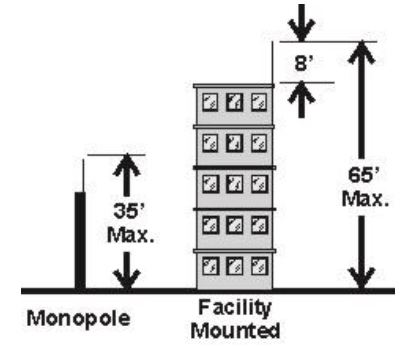
Antenna Height
(3)
The height of an antenna, including the height of any antenna facility to which they may be fastened or attached, shall not exceed sixty-five (65) feet in height without a Special Exception.
(4)
A Special Exception for additional height for antennas which are attached to existing power poles, stadium lights, elevated water tanks, or transmission towers, may be approved administratively. The administrative officer may elect to defer approval to the Zoning Board of Adjustment upon his/her discretion.
(5)
An antenna not fastened to an antenna facility shall not exceed fifty (50) feet except for an antenna, which does not extend more than eight (8) feet above a building on which it is attached.
(6)
An antenna facility shall be limited to having the number and size of antennas attached that are allowed by the antenna facility manufacturer's designs and specifications for maximum wind- load requirements.
(7)
Setbacks:
a.
Antennas and antenna facilities shall not be permitted in front or side yards.
b.
Antennas and antenna facilities shall be setback from residential districts a minimum distance equal to two (2) times the height of the tower, but in no instance shall the setback be less than two hundred (200) feet from any residentially- zoned district.
(8)
Separation: There shall be no minimum or maximum separation requirements for antenna facilities from other structures on the same lot of record.
(9)
Antenna facilities shall not be permitted in any easement.
(10)
Lights: No auxiliary or outdoor lighting shall be allowed on antennas located on residentially- zoned property except such lights or lighting as may be required by the Federal Aviation Authority or the Federal Communications Commission.
(11)
Construction standards: A building permit must be obtained prior to the construction and/or installation of a tower, antenna, or mast. Antenna facility must be installed as per the manufacturers' recommendations or under the seal of a registered professional engineer of the State of Texas. Regardless of the above, all such antenna facilities and antennas must meet the Electronic Industries Association Standard EIA-222-D, Structural Standards for Steel Antenna Towers, Antenna Supporting Structures, and the Building Code.
(12)
Maintenance: Antenna facilities and antennas obviously not in use or obviously in need of maintenance as determined by the Building Official, shall be removed or brought into compliance within thirty (30) days following notice given by the Building Official. This shall not preclude immediate action by the Building Official to safeguard life, limb, health, property, and public welfare.
(13)
No part of an antenna facility and antennas or any attachment thereto may extend beyond the property lines of the owner of such antenna or antenna facility.
(14)
Owners of any antenna or antenna facility must sign a notarized statement that they acknowledge and accept that a minimum amount of $300,000.00 liability insurance that covers the antenna or antenna facility must be maintained at all times and that proof of such insurance coverage can be demanded to be provided to the city upon three (3) working days' notice to the owner. Such notarized statement, and, if the antenna, or antenna facility is capable of transmitting, a copy of their Federal Communications Commission license(s) must be provided prior to the issuance of a building permit.
(15)
No permit shall be issued for the installation of an antenna, or antenna facility on a multi-family structure or property unless a notarized statement of permission from the owner is presented to the Building Department.
(16)
All antennas or antenna facilities shall be subject to a periodic inspection by a qualified expert, such inspections to be conducted and charged for by the City in accordance with provisions in the Building Code.
A Special Exception must be obtained from the Zoning Board of Adjustment for any antenna or tower, which does not comply with the regulations specified herein above, Section 5.11.E, sub-sections (1) through (15). See Section 5.11 J, Special Exceptions.
5.11.F - Written Report Upon Denial of Request
The City of Bedford shall document any denial of a request to place, construct, or modify personal wireless service facilities in writing. Such documentation shall be supported by substantial evidence within the written record.
5.11.G - Satellite Receive-Only Antennas Generally
Satellite receive-only antennas assist individuals in the receipt of satellite- transmitted television signals. Satellite receive-only antennas shall not be deemed violations of this ordinance when made under the conditions herein provided. Such conditions are hereby found to be reasonable and clearly defined health, safety, and aesthetic objectives.
5.11.H - Satellite Receive - Only Antennas
A satellite receive only antenna shall be allowed if it complies with the following:
(1)
The satellite receive- only antenna is two (2) meters or less in diameter and is located or proposed to be located in any area where commercial or industrial uses are generally permitted by non- federal land use regulations.
(2)
The satellite receive- only antenna is less than one (1) meter in diameter in any zoning district.
5.11.I - Satellite Receive-Only Antennas
(Greater than one (1) meter in diameter in residential districts and two (2) meters in diameter in commercial or industrial districts). Satellite receive-only antennas shall be allowed in any zoning district if it complies with the following regulations:
(1)
Only one satellite receive-only antenna per lot of record.
(2)
A satellite receive-only antenna shall not exceed ten feet in height.
(3)
Set backs:
a.
Front and side: Satellite receive-only antennas shall not be permitted in front or side yards.
b.
Side: Satellite receive-only antennas shall be permitted in yards provided they meet the minimum setback as is required for accessory buildings in residential districts and as for all buildings in nonresidential districts.
(4)
Separation: There shall be no minimum or maximum separation requirements for satellite receive-only antennas from other structures on the same lot of record.
(5)
Satellite receive-only antennas shall not be permitted in easements.
(6)
Lights: No auxiliary or outdoor lighting shall be allowed on satellite receive-only antennas except such lights or lighting as may be required by the Federal Aviation Authority or the Federal Communications Commission.
(7)
Construction standards: A building permit must be obtained prior to the construction and/or installation of a satellite receive-only antenna. Satellite receive-only antennas must be installed as per the manufacturers' recommendations or under the seal of a registered professional engineer of the State of Texas.
(8)
Maintenance: Satellite receive-only antennas obviously not in use or obviously in need of maintenance as determined by the Building Official shall be removed or brought into compliance within thirty (30) days following notice given by the Building Official. This shall not preclude immediate action by the Building Official to safeguard life, limb, health, property, and public welfare
(9)
No part of a satellite receive-only antenna or any attachment thereto may extend beyond the property lines of the owner of such satellite receive-only antenna.
(10)
No permit shall be issued for the installation of a satellite receive-only antenna on a multi-family structure or property unless a notarized statement of permission from the owner is presented to the Building Department.
(11)
All satellite receive-only antennas shall be screened from view from adjoining properties by fencing or evergreen plants. A satellite receive-only antenna located within a fence surrounding the yard in which the satellite receive-only antenna is located shall be considered to be screened.
5.11.J - Special Exception
Unless otherwise provided for in these regulations, a Special Exception must be obtained from the Zoning Board of Adjustment for any satellite receive-only antenna which does not comply with the regulations specified in Section 5.11.A through 5.11.H herein above. In considering whether to grant a Special Exception from the regulations specified above, the Zoning Board of Adjustment shall consider the following:
(1)
The effect on the value of the surrounding property.
(2)
The potential for interference with the enjoyment of the use of surrounding properties.
(3)
Aesthetics.
(4)
The necessity of the Special Exception for the public health, safety, and welfare of the citizens or for governmental purposes.
(5)
The Zoning District and the adjoining Zoning Districts of the property for which the Special Exception is sought.
(6)
The provisions of 47 C.F.R. § 25.104 which preempt local zoning or other regulations that differentiate between satellite receive-only antennas and other types of antenna facilities unless such regulations:
a.
Have a clearly defined health, safety, or aesthetic objective.
b.
Furthers the stated health, safety, or aesthetic objective without unnecessarily burdening the federal interest in ensuring access to satellite services and in promoting fair and effective competition among competing communications service providers.
(7)
The unique conditions that govern reasonable reception on any given lot.
(8)
To properly evaluate all applications to locate antennas or towers which do not comply with the regulations specified herein above the following information must be provided by the applicant:
a.
Describe the nature of the antenna site. Indicate whether the proposed structure is a monopole or mounted to a self-supporting structure. Indicate the proposed height.
b.
Provide photos or drawings of all equipment, structures, and antenna.
c.
Describe why the antenna or tower is necessary.
d.
State the name(s) of the telecommunications providers or other users of the antenna or tower and describe the use to be made by each user.
e.
Indicate if this antenna or tower site is to be connected to other sites and, if so, describe how it will be connected and the name of the back- haul provider;
f.
The applicant must address whether they have made an effort to co-locate the facilities proposed for this antenna or tower on existing towers or facilities in the same general area. Please identify the location of these existing sites. Describe in detail these efforts and explain in detail why these existing sites were not feasible. Attach all studies or tests performed which demonstrate why the existing sites will not provide sufficient signal coverage. Provide written documentation from existing sites' owners and/or operators, which confirm the statements, provided. Indicate whether the existing sites allow/promote co-location and, if not, describe why.
g.
Indicate whether co-location will be allowed to other telecommunications providers at the requested site. If they are not allowed, state every reason and the basis for each reason.
h.
If the requested location is in a residential district the applicant must address whether they have made an effort to locate the facility in a commercial or industrial district. Please identify the location of these commercial and or industrial district sites. Please describe in detail these efforts and explain why these commercial or industrial district sites were not feasible. Attach all studies or tests performed which demonstrate why the commercial or industrial sites will not provide sufficient signal coverage. Provide written documentation from commercial or industrial district sites' owners and/or operators, which confirm the statements, provided.
i.
Indicate the proposed provider's current coverage area for the City. Attach maps showing the coverage area the proposed provider's existing antenna, the areas the applicant's existing sites and other existing sites would cover, and the areas the applicant's existing sites and the requested site would cover.
j.
Describe the applicant's master antenna and tower plan for the City. Attach maps and other related documentation. Provide information indicating each phase of the plan.
k.
Describe the applicant's plan to minimize the number of telecommunications antenna and towers needed to cover the City.
The Zoning Board of Adjustment will approve a requested application subject to the finding that co-location of this facility with a nearby existing tower facility is technically not feasible and subject to the following conditions:
(1)
Applicant will permit co-location of others at the site.
(2)
Applicant will configure the antenna and other equipment to accommodate other providers.
(3)
Applicant will identify the backhaul provider connecting antenna sites.
(4)
Applicant will give notice to the City identifying any providers who co-locate to the site and identify their backhaul provider.
5.12.A - General
In connection with the operation of a dwelling, any use permitted as a home occupation may be operated subject to compliance with the following conditions:
(1)
The use is operated in its entirety within the dwelling unit and/or other accessory structures and only by the person or persons maintaining a dwelling therein.
(2)
The home occupation does not have a separate entrance from outside the building to an isolated area of the house that is exclusively used for the home occupation.
(3)
The use does not display or create outside the building any external evidence of the operation of the home occupation.
(4)
The home occupation does not have any employee or regular assistant not residing in the dwelling unit in which the home occupation is operated or maintained, unless said employee does not perform services on the property.
(5)
No traffic or parking shall be generated by such home occupation that would unreasonably impact a residential neighborhood, and any need for parking generated by the conduct of such home occupation shall be met off the street and other than in a required front yard.
(6)
Commercial delivery service required by the Home Occupation shall not deliver goods or products to the home more than four (4) times per month. Commercial delivery service shall be limited to vehicles with two axles.
(7)
No home occupation shall constitute a nuisance.
(8)
No outdoor storage of any type shall be permitted with any home occupation.
5.13.A - Clothing Donation Containers
(1)
Definition - Clothing Donation Container means any structure contained which has four walls, a roof and a floor, not exceed the dimensions of six feet (6') in width or depth, nor shall exceed seven feet (7') in height, which is used for the donation of clothing. Said structure or container shall be of adequate weight to withstand typical weather conditions as to not be moved within a parking lot by wind. The structure or container must be built substantially enough, as to not pose any public threat, and be painted or finished of earth tones and in a way that is visually coherent and conducive to its environment. For the purpose of this Section, earth tones shall be understood to consist of darker and pastel shades of the color spectrum, which may generally be found in the natural environment. These colors shall not generally consist of the vibrants or fluorescents of the color spectrum.
(2)
Permit Required - It shall be unlawful for any person, organization or entity to place and/or operate a Clothing Donation Container within the City of Bedford without having first obtained a permit pursuant to this Section.
a.
Any person, organization or entity seeking a permit under this Section shall file an application on a form to be furnished by the City containing the following information:
1.
Applicant's name, business/organization name, and business/organization address, phone number, website (if applicable), name of responsible party, and email address for responsible party;
2.
Proof that applicant is a registered 501(c)(3) non-profit corporation or has been granted tax exempt status by the Texas Comptroller of Public Accounts or registration as a non-profit organization with the Texas Secretary of State;
3.
Proof of current general liability insurance with coverage limits equal to or greater than ONE MILLION DOLLARS ($1,000,000), which also adds the City of Bedford as an additional insured and agrees to indemnify and hold harmless the City of Bedford;
4.
Description of the Clothing Donation Container, including drawing(s), size, design, and construction material, to be covered by the permit;
5.
Copy of a site plan showing the proposed location of the Clothing Donation Container on the lot, including any screening or landscaping proposed;
6.
If the applicant is not the owner of the property upon which the Clothing Donation Container is to be placed, a notarized affidavit from the property owner indicating written consent for placement and operation of the Clothing Donation Container on the property, and acknowledgement that the property owner and Clothing Donation Container operator shall be joint and severally liable for any violations of this Section; and
7.
Annual permit fee of ONE HUNDRED DOLLARS ($100.00).
b.
The City shall either approve or deny the permit application within thirty (30) days of receipt of the completed application and payment of the annual permit fee. The City shall deny a permit application for one or more of the following reasons:
1.
Failure to provide all information required in subsection 2(a) above;
2.
City determination that applicant has submitted inaccurate, erroneous or incomplete information;
3.
False statement(s) related to material matter(s) made in application for a permit;
4.
Refusal or failure to pay the annual permit fee; or
5.
Revocation of a permit issued pursuant to this Section within two (2) years preceding the filing of the application.
c.
Any permit issued pursuant to this Section shall be valid for one (1) calendar year from issuance, unless it is suspended or cancelled earlier. Applicants must re-apply for any renewal(s) of previously issued permits.
d.
Any permit issued pursuant to this Section shall be valid only for the specific Clothing Donation Container described in the permit application. A permit is required for each individual Clothing Donation Container.
e.
Any permit issued pursuant to this Section shall automatically expire if the permit holder removes the Clothing Donation Container from its permitted location, or the property owner(s) request that the Clothing Donation Container be removed from the property.
f.
Any permit issued pursuant to this Section is not assignable or transferrable under any circumstances.
(3)
Minimum Lot Requirements - Clothing Donation Containers shall only be allowed as an ancillary use in any non-residential zoning district ("S", "L", "H", and "I") on lots greater than five hundred (500) square feet in size.
(4)
Physical Container Requirements - A Clothing Donation Container shall have four walls, a roof and a floor, and not exceed seven feet (7') in height, six feet (6') in width or depth, or exceed thirty-six (36) square feet in total area. Its content must be secured and not accessible to anyone other than those responsible for retrieval of its contents. It must be constructed of a weatherproof or weather resistant material, be of adequate weight to not be moved by wind, and built substantially enough as to not pose any public threat. It must be painted or finished of earth tones and in a manner that it visually coherent and conducive to its surrounding environment. For the purpose of this section, earth tones shall be understood to consist of darker and pastel shades of the color spectrum, which may generally be found in the natural environment. These colors shall not generally consist of the vibrants or fluorescents of the color spectrum.
(5)
Posting Operator Contact Information - A Clothing Donation Container shall contain upon the front side, in at least two inch (2") type, the name, address, phone number, email address and website (if applicable) of the Clothing Donation Container permit holder and/or operator.
(6)
On-Site Placement Requirements - Clothing Donation Containers shall only be placed on a property subject to the following conditions:
a.
Only one (1) Clothing Donation Container shall be placed on a single parcel of property.
b.
A Clothing Donation Container shall be placed on a platted lot.
c.
A Clothing Donation Container shall be placed behind all applicable setbacks as required by the Bedford Zoning Ordinance.
d.
A Clothing Donation Container shall be placed on an improved surface.
e.
A Clothing Donation Container shall be located in a manner that it does not impede vehicular or pedestrian traffic, nor visually impair any motor vehicle drivers from a public street.
f.
A Clothing Donation Container shall be located in a manner that it does not interfere with vehicle entrances or exits, on-street parking, or off-street parking maneuvering area, such that the Clothing Donation Container may cause safety hazards and/or unnecessarily inconvenience vehicular or pedestrian traffic.
g.
A Clothing Donation Container shall not be located in any parking space required to meet the minimum parking requirements for a site and may not be located in any platted or dedicated access easements or fire lanes.
h.
A Clothing Donation Container shall not be located in any required landscaped area or buffer yard area, and shall not be located within fifty feet (50') of a property being used for residential purposes.
i.
A Clothing Donation Container shall be placed at least two hundred feet (200') away from another Clothing Donation Container located on adjacent lots.
j.
A Clothing Donation Container shall be located in a manner that it does not pose a safety hazard with regards to a designated fire lane or building exit.
k.
Clothing Donation Containers must comply with any other requirements imposed as part of the site plan approved for the property.
l.
No specific landscaping, screening fences or walls are required around Clothing Donation Containers, but aesthetically pleasing site design considerations are encouraged.
(7)
Service and Maintenance Requirements - Clothing Donation Containers shall only be placed on a property subject to the following conditions:
a.
A Clothing Donation Container shall be maintained in good condition and appearance, and be free of any structural damage or defects, holes, visible rust, or graffiti.
b.
A Clothing Donation Container shall be serviced and emptied as necessary, but in no event, shall the Clothing Donation Container be serviced and emptied less than once every seven (7) days. A Clothing Donation Container operator and/or property owner shall have twenty-four (24) hours from receiving notice from the City to service and empty the Clothing Donation Container. Failure to service and empty the Clothing Donation Container within twenty-four (24) hours of receipt of notice from the City shall constitute a violation of this Section.
c.
A Clothing Donation Container shall maintain, or cause to be maintained a ten (10) foot radius area surrounding the Clothing Donation Container free from any trash, debris or other material. A Clothing Donation Container operator and/or property owner shall have twenty-four (24) hours from receiving notice from the City to remove any trash, debris or other material from and around the Clothing Donation Container. If the Clothing Donation Container operator and/or property owner fail to do so, the City may remove or cause to be removed any such trash, debris or material at the Clothing Donation Container operator's and/or property owner's expense.
(8)
Violations - Any person who violates any provision of this Section shall be deemed guilty of a misdemeanor, and upon conviction shall be fined in accordance with Section 1-7 of the City of Bedford Code of Ordinances. Each day of violation shall constitute a separate offense. Both the Clothing Donation Container operator and property owner shall be jointly and severally liable for any violations under this Section.
(Ord. No. 18-3224, § 1(Exh. A), 4-24-18; Ord. No. 19-3267, § 2(Exh. A), 9-24-19)
5.13.B - Paper Recycling Containers
(1)
Definition- any container which is placed by a qualified paper recycling company for the collection of newspapers, magazines, and other recyclable paper products that fully contains the paper products to be recycled.
(2)
Conditions
a.
Paper Recycling Containers shall be allowed as an ancillary use in any non-residential zoning district ("S", "L", "H", and "I") by right. Paper Recycling Containers may be allowed as a permanent ancillary use on a residentially zoned lot being used for a non-residential use by being included in the required Specific Use Permit (SUP) for development.
b.
The placement of a Paper Recycling Container shall be behind the required building line setbacks and shall not impede traffic nor visually impair any motor vehicle drivers from a public street.
c.
A Paper Recycling Container shall not be located in any required landscaped area or bufferyard area, and shall not be located within fifty feet (50') of a property being used for residential purposes.
d.
A Paper Recycling Container shall not be located in any parking space required to meet the minimum parking requirements for a site and may not be located in any platted or dedicated access easements or fire lanes.
e.
Paper Recycling Containers shall be screened on at least three (3) sides with a masonry screening wall of at least six feet (6') in height.
f.
The organization must have the written authorization from the business owner, on whose property the Paper Recycling Container will be placed.
g.
The Paper Recycling Container must have its contents removed, minimally one time per week, 52 weeks per year.
h.
The visual aesthetics and structural integrity of the container must be maintained continuously.
i.
All existing permanent paper recycling containers must be registered with the City of Bedford by December 31, 2003; and all existing permanent paper recycling containers that are registered by the deadline have until December 31, 2007 to comply with all of the provisions of this ordinance.
5.14.A - Purpose
The purpose of this section is to regulate the placement of storage containers in order to promote vibrant, attractive, pedestrian, mixed-use areas while protecting non-residential and residential neighborhoods by allowing the temporary use of storage containers by City of Bedford businesses, contractors, community-related users, and residents.
5.14.B - General Regulations
(1)
A permit issued by the City of Bedford shall be required to place each storage container for use on a property.
(2)
A permit for a storage container may be issued by the City of Bedford, provided the Building Official or designee has determined that the site contains no undesirable conditions to affect public safety or drainage and further provided that the site conditions conform to these regulations.
(3)
Storage containers shall not be stacked.
(4)
Storage containers shall not be allowed on properties that do not have a primary use. Storage containers are considered an accessory use and may be allowed in any zoning district in conformance with these regulations.
(5)
Storage containers shall be placed upon a paved surface as approved by the Building Official.
(6)
No storage container shall encroach into or across a sidewalk, firelane, access easement or street right-of-way.
(7)
Storage containers shall be painted and in good condition and appearance, with no structural damage, no holes in the container that would allow leaks, no visible rust, and free of graffiti or advertising (other than the name of the storage container provider company).
5.14.C - Commercial Storage Container Regulations
This subsection (5.14.C) shall apply to properties zoned "H" Heavy Commercial, "L" Light Commercial, "S" Service Commercial, "I" Industrial, and "MF" Multifamily, and properties being used as churches temples, synagogues, and schools.
(1)
Storage containers shall be placed behind the building, when possible. A storage container being used in conjunction with a current building permit may be placed in front of or to the side of a building.
(2)
Storage containers shall not occupy any required off-street parking spaces, vehicular access, pedestrian facilities or required landscape areas for the site.
(3)
Storage containers shall not exceed a size of 10 feet x 10 feet x 45 feet, unless approved as a Special Exception by the Zoning Board of Adjustment.
(4)
Storage containers shall not encroach into the twenty (20') foot buffer-yard area required on commercial property adjacent to residential properties.
(5)
The quantity of storage containers permitted shall be determined by the total aggregate square footage of principal buildings, with a maximum of one storage container allowed for each 5,000 square feet of principal building area or fraction thereof.
(6)
In nonresidential districts and for nonresidential uses legally located in residential districts, a temporary period that each storage container may be located on any premises, less than ten-acres, shall be sixty (60) days, with an interval of thirty (30) days between periods for each individual storage container.
(7)
The Building Official, or his designee, may administratively approve temporary exemptions to the above storage container regulations for a maximum period of four (4) months.
5.14.D - Residential Storage Container Regulations
This subsection (5.14.D) shall apply to properties zoned "R-15,000", "R-9,000", "R-7,500", "R-6,500", "MD-1", "MD-2", MD-3" and "MD-4" residential, except for properties being used as churches, synagogues, or schools, which comply with the Commercial Storage Container regulations, stated above.
(1)
Temporary storage containers shall be allowed for a period of sixty (60) days; with an additional sixty (60) days allowed by administrative approval by the Building Official or his designee, or when being used in connection with a current building permit. The Zoning Board of Adjustment may grant Special Exception approval for the placement of a temporary storage container in a residential zoning district for a period exceeding one hundred and twenty (120) days.
(2)
No more than one storage container shall be allowed on residential lots.
(3)
Storage containers on residentially zoned property shall not exceed a size of 10 feet x 10 feet x 20 feet, unless approved by the Director of Development or his designee.
(4)
Storage containers in residential areas shall not be required to be placed on a paved surface in the rear yard in conformance with the accessory building setbacks stated in subsection 4.1.B(4). However, a storage container may be placed on the driveway in the front yard, and may encroach into the front yard or side yard setbacks, as long as the placement does not obstruct visibility and/or cause a traffic hazard.
(5)
Storage containers must maintain a minimum separation of five (5') feet from any building or structure.
(6)
As noted in subsection 5.14.C, storage containers on property zoned "MF" Multifamily or being used as a church, temple, synagogue or school shall be regulated according to the "Commercial Storage Container Regulations", stated above
5.15.A - Purpose and Intent
The purpose of this section is to promote site planning that furthers the preservation of mature trees and natural areas, to protect trees during construction, to facilitate site design and construction that contribute to the long-term viability of existing trees; and to control the removal of trees when necessary. It is further the purpose of this Section to achieve the following broader objectives:
(1)
Prohibit the indiscriminate clearing of property.
(2)
Achieve the City's Comprehensive Plan goals and objectives as set by citizens through the appointed boards and the City Council.
(3)
Maintain and enhance a positive image for the attraction of new residents and business enterprises to the City.
(4)
Protect the healthy quality of trees and promote the natural ecological environmental and aesthetic qualities of the City.
(5)
Promote site planning that is sensitive to the location of existing trees in an effort to save quality trees.
(6)
Provide for a permitting and enforcement procedure.
(Ord. No. 2023-3376, § 2, 7-11-23)
5.15.B - Definitions
"Administrative official": Appointed by the City Manager to administer this section, or the department director's designee.
"Alter; alters; alterations": Any act which causes or may reasonably be expected to cause a tree to die, including but not limited to, any of the following: uprooting any portion of the tree's root system; severing the main trunk of the tree; inflicting damage upon the tree's root system by machinery, storage of materials, or the compaction of soil above the root system of a tree; changing the natural grade of the critical root zone of a tree or uphill from the critical root zone of the tree so as to divert the flow of water to or away from the critical root zone; applying herbicidal or other lethal chemicals to the tree or any portion of the critical root zone of the tree; placement of impermeable material over any portion of the critical root system of a tree; and trenching within the critical root zone. A protected tree shall be considered to be altered if one (1) or more of the following occurs: More than twenty-five percent (25%) of the critical root zone is adversely affected, more than twenty-five percent (25%) of its canopy is removed, or the tree is disfigured to the extent a reasonable person would conclude the tree will not survive.
"Building pad": The actual foundation area of a building and a reasonable area not to exceed six (6) feet around the foundation necessary for construction and grade transitions.
"Building permit": The official authorization by the City to allow any construction on any property in the City that increases the impervious cover on the lot, tract, or portion of land.
"Certificate of Occupancy": An official City acknowledgement that indicates conformance with all applicable City Regulations and authorizes the legal use and occupancy of the premises for which it is issued.
"Critical root zone": The area of undisturbed natural soil around a tree defined by the horizontal circle drawn at grade with the center being the center of the trunk of the tree and a radius equal to the distance from the trunk to the outermost portion of the drip line. See Illustration in Section 5.15(P).
"Cut/fill": Areas where the natural ground level has been modified either through excavation (cut) or fill.
"DBH (Diameter at Breast Height)": The diameter of a tree trunk, or, in the case of a multi-trunk tree, the total of the diameter of the largest trunk and one half (½) of the diameter of each additional trunk, measured at a height of four and one half (4 ½) feet above ground.
"Development": Any construction activity for which a building permit or earth disturbance permit is required under the ordinances of the City.
"Drip line": Whichever of the following encompasses the greatest area: (1) the irregular shape formed around a tree by a series of vertical lines that run through the outermost portion of the canopy of the tree and extend to the ground, or (2) a circular area with a radius of one-half (1/2) the height of the tree extending outward from the center point of the tree. See Illustration in Section 5.15(P).
"Earth disturbance permit": An official authorization by the City to allow any person to re-grade, excavate, disturb, or store spoils on any property in the City as required by the City.
"Easement": The authorization by a property owner for the use by another, and for specified purpose, of any designated part of such property. Easements may be temporary or permanent.
"Existing tree cover": The sum total of the area that is located beneath the canopies of all protected trees on the lot or tract on the date of development application, as measured by accepted forestry practices.
"Footprint": An area not to exceed six (6) feet in all directions around impervious surfaces as designated on an approved Site Plan.
"Heavily wooded area": An area of continuous wooded vegetation where trees are at a density of at least one protected tree per three hundred and twenty-five (325) square feet of land, where the branches and leaves form a continuous canopy, and which consists of at least two (2) acres.
"Municipal/public domain property": Property owned by a governmental entity such as the City, county, state, federal government, school district, or other such entity as City Hall, public works, public rights-of-way (R.O.W.), libraries, fire stations, and water tower, water treatment and other public works facilities.
"Protected tree": A tree of any species that is not classified as unprotected in this Section that is at least six (6) inches in caliper measured four and one-half (4½) feet above the natural grade or a tree that was planted as a replacement tree.
"Protective fencing": A physical and visual barrier installed around the critical root zone of a protected tree as required by this section in order to prevent damage to the tree and its root system.
"Right-of-way (R.O.W.)": A strip of land, other than a drainage or utility easement, occupied or intended to be occupied by a street, crosswalk, railroad, road electric transmission line, oil or gas pipeline, water main, sanitary or storm sewer, or for other special use.
"Selective thinning": The process by which non-contiguous protected trees are identified and removed within a heavily wooded area to provide the maximum benefit to the remaining protected trees.
"Tree": Any self-supporting woody perennial plant which will normally attain a trunk in diameter of two (2) inches or more when measured at a point four and one-half (4½) feet above ground level and an overall height of at least fifteen (15) feet at maturity.
"Tree, diseased, infected or damaged": A tree that is:
(1)
Infected with a disease or parasite making it reasonably likely that the tree will either die within three (3) years or pose a significant threat of infecting other trees of the same or similar species; or
(2)
Damaged, in whole or in part, to such an extent that either the tree is reasonably likely to die within three (3) years; or
(3)
Hazardous, in whole or in part, to such an extent that it presents a significant danger to the general public.
"Tree topping": The severe cutting back of branches to stubs larger than three (3) inches in diameter within the tree's canopy to such a degree so as to remove the normal canopy and disfigure the tree.
"Unprotected tree": Any tree of the following species regardless of size; or other trees approved by the Administrative Official:
"Utility": The service or product provided by a utility provider, including but not limited to the provisions of gas, electric, water, wastewater, drainage, storm water, telecommunications, cable, or telephone service for users within the City.
"Utility provider": A company or entity, or agent for a company or entity, including a municipality that provides a utility service within the City.
(Ord. No. 2023-3376, § 2, 7-11-23)
5.15.C - Tree Removal Mitigation Permit Required
(1)
A Tree Removal Mitigation Permit must be submitted to the City in accordance with the following:
a.
As a part of the subdivision platting process (if applicable) with the Preliminary Plat application; or
b.
Before Civil Plans are submitted for the review of public infrastructure extension; or
c.
Before an Earth Disturbance Permit is submitted for the purpose of grading and clearing land.
(2)
The Administrative Official will review the permit and have the ability to approve, approve with conditions, or deny in accordance with this section. The Administrative Official shall act on the application within thirty (30) calendar days of the date a complete application is submitted.
(3)
An appeal of the Administrative Official's decision to the City Council shall stay final action on the associated application. Denied applications may be appealed to the City Council within ten (10) calendar days from the date the permit was denied. The City Council shall hear the appeal within sixty (60) calendar days after the appeal is received. The action of the City Council shall be final.
(4)
Any Tree Removal Mitigation Permit granted by the Administrative Official shall expire one (1) year after the date it was approved. Any tree not removed within this one (1) year period will no longer be deemed approved for removal. All tree fragments must be removed immediately after tree removal or risk violation of the City's Zoning Ordinance. Any permit shall be void if its terms are violated.
(5)
The clear-cutting of land is prohibited, and all permits for tree removal mitigation shall be subject to this section.
(6)
No grading or tree removal shall take place on any property without obtaining a tree removal mitigation permit unless exempted by this section.
(7)
All trees not listed as a protected tree within this section may be removed without a tree removal mitigation permit.
(8)
The removal of selected trees from within a densely forested area when done in a professionally accepted manner shall be allowed as a single permit upon approval by the City. Approval will only be granted when it is determined that the selective thinning is being done in a manner that would enhance the environment and likelihood of survival for the remaining trees.
(9)
Where protected tree removal is allowed through exemption or by a tree removal mitigation permit and the root system is intertwined with protected trees which are intended to be saved, the tree shall be removed by flush cutting with the natural level of the surrounding ground. Where stump removal is also desired, stump griding shall be allowed, or upon approval of the City, a trench may be cut between the two (2) trees sufficient to cut the roots near the tree to be removed, thereby allowing removal of the remaining stump without destruction of the root system of the saved tree.
(Ord. No. 2023-3376, § 2, 7-11-23)
5.15.D - Tree Removal Mitigation Permit Requirements
A Tree Removal Mitigation Permit application must include the following:
(1)
Attend a pre-development meeting with City staff prior to submittal to review requirements.
(2)
Completed and signed application (including legal description and location map) and fee as identified in the adopted Fee Schedule.
(3)
Tree Survey: Must be prepared, by a certified arborist and drawn to an engineering scale consistent with that of the associated plat (if applicable), which includes the following:
a.
The boundaries of the entire parcel proposed for development illustrating the location of all existing or proposed lots and structures; and improvements such as streets, alleys, grade changes, and easements.
b.
Identification of each tree greater than six (6) caliper inches and tag number, with an "X" over those proposed to be removed.
i.
Trees are to be represented on the tree survey by identifying the furthest drip line of each tree.
ii.
Trees to be preserved will be represented by a solid circle.
iii.
Trees to be removed are to be represented by a dashed circle.
c.
Tree Inventory Table. A table will be included listing all surveyed trees by number provided on the tag of each tree, species, size, health condition, whether to be removed or preserved, and a brief narrative denoting why the tree is being removed (if applicable). This information must be compiled in a tabular format with each tree identified by a sequential number corresponding to a numbered tree on the survey.
(4)
A landscape plan identifying the location, species and size of the replacement trees.
(Ord. No. 2023-3376, § 2, 7-11-23)
5.15.E - Exemptions
A tree removal mitigation permit shall be issued, and tree protection and replacement requirements shall not be required under any of the following circumstances. The burden of proof as a qualified exemption is upon the remover of a tree.
(1)
Approved Plans: All construction activities for which final construction plans and building permit applications have been submitted prior to the effective date of this section shall be exempt.
(2)
Diseased Trees: The tree is diseased, damaged beyond the point of recovery, or in danger of falling as determined by the City prior to the removal of the tree. The removal of a diseased tree by the City or an individual is required to reduce the chance of spreading disease to adjacent healthy trees.
(3)
Public Safety: The tree endangers the public health, welfare or safety, and immediate removal or pruning is required.
(4)
Utility Service Interruption: The tree has disrupted a public utility service due to a natural disaster. Removal shall be limited to the portion of a tree reasonably necessary to reestablish and maintain reliable utility service.
(5)
The owner of a property of two (2) acres or less that is used for a homestead shall be exempt from the tree protection and replacement requirements specified herein.
(6)
The tree is:
a.
Is located on a property that is an existing one-family or two-family dwelling that is the person's residence; and
b.
Is less than ten (10) inches in diameter at the point on the trunk four and one-half (4 1/2) feet above the ground.
(Ord. No. 2023-3376, § 2, 7-11-23)
5.15.F - Deferral to the City Council
If a request for a Tree Mitigation Permit does not meet any standards for approval under this section, the Administrative Official may defer the approval of such tree mitigation permit to the City Council, following a recommendation from the Planning and Zoning Commission.
(Ord. No. 2023-3376, § 2, 7-11-23)
5.15.G - General Tree Removal/Maintenance Requirements
(1)
Generally. If required by this section, the following procedures shall apply to any person who alters a protected tree for which a permit is required. If a person alters a protected tree for which a permit is required, the person shall replace the protected tree with an equivalent tree as designated in the Landscape Ordinance and approved by the Administrative Official. This tree replacement requirement is not meant to supplant good site planning. Tree replacement will be considered after all design alternatives which could save more existing trees have been evaluated and reasonably rejected.
(2)
Location. Each replacement tree should be planted on the same lot or tract as the tree which was altered. However, if the replacement tree cannot be planted on the same lot or tract in accordance with universally accepted arboricultural standards, the agent charged with mitigating the alteration of a protected tree may choose any or a combination of the following:
a.
Replacement on other private property within the City of Bedford, with the approval of the owners of both the property on which the protected tree was altered and the property on which the replacement tree is to be planted. In such an instance, the owner of the property on which the replacement tree is to be planted shall agree, in writing, to maintain the replacement tree to the standards established in this section;
b.
Replacement on public property as approved by the Administrative Official;
c.
Payment to the Tree Reforestation Fund as established by this section.
(3)
Size and Number. A sufficient number of trees shall be planted to equal or exceed, measured in DBH, the diameter of each tree altered. Each replacement tree shall be at least three (3) inches in diameter at the point on the trunk, six (6) feet (DBH) above ground level when planted.
(4)
Responsibility for Replacing Protected Tree. The Administrative Official will determine the time of replacement, and the location of the replacement tree and approve the agent responsible for replacing a wrongfully altered protected tree. The requirement to replace trees shall be binding upon the person subject to such order even if such person sells, assigns, or transfers the property. In the event of such a sale, assignment or transfer of property, the person subject to such order may either obtain the consent of the person to whom the property was sold, assigned or transferred to permit the replacement on such property, or may make payment to the Tree Reforestation Fund as provided in the Ordinance.
(5)
Time of Replacement. Any replacement trees required to be planted must be planted not later than ninety (90) days after the order of the Administrative Official, or within thirty (30) days of the date any appeal from such order becomes final, provided however that the Administrative Official may require the deferral of the planting of replacement trees up to an additional one hundred eighty (180) days based on weather and other arboreal considerations, and further provided that the Administrative Official may, upon request of the person subject to the requirement, approve delaying the planting of replacement trees up to an additional one hundred eighty (180) days if the person subject to the order provides the City with a surety bond in an amount equal to the cost of purchasing and planting such trees or pay this amount into the Restoration Fund within the earlier of the following: (1) within one hundred eighty (180) days of the last date approved for such delayed planting; or (2) the date of issuance of the first certificate of occupancy on any portion of the subject property. The surety bond must be issued by a company licensed to do business within the State of Texas and shall be authorized and approved by the City Attorney.
(6)
Longevity and Duration. If a replacement tree dies within three years from the date it was planted, the person subject to the requirement to plant the replacement tree must replace the dead tree with another replacement tree within ninety (90) days of the order of the Administrative Official ordering such replanting. This requirement to replace trees shall be placed upon the person subject to such order even if such person sells, assigns, or transfers the property. In the event of such a sale, assignment or transfer of property, the person subject to such order may either obtain the consent of the person to whom the property was sold, assigned or transferred to permit the replacement on such property or may make payment to the Tree Reforestation Fund as provided by this section.
(Ord. No. 2023-3376, § 2, 7-11-23)
5.15.H - Mitigation for Trees Removed on Site
It is the desire of the City that as many trees as possible be preserved and protected onsite.
(1)
Protected Trees shall be replaced by planting trees on the property equal to the total caliper inches as calculated by using the following replacement rate:
(2)
Tree Credits. If any protected tree is preserved outside of the building pad, credit for preservation shall be given that will be counted toward the mitigation requirements for the removal of protected trees within the building pad.
a.
Any tree that is preserved and receives positive credit toward mitigation is exempt from being used to fulfil required landscaping.
b.
Following is a list of credit available for the preservation of protected trees on a site or project. Tree Credits will be awarded using the following table:
(3)
Tree Reforestation Fund. A person required to comply with Section 5.15(G) of this section may request to make payment to the Tree Reforestation Fund or other specifically dedicated fund approved by the City Council for such payments in accordance with the following requirements:
a.
The amount of the payment required in lieu of each replacement tree shall be the average cost of a quality tree of similar size and type to the replacement tree which would otherwise have been required by this section, plus the cost of planting such a tree, as determined by the City Council and provided in a fee schedule published by the City.
b.
The funds shall be used only for purchasing and planting trees on private property approved by the City Manager, on public property, for acquiring wooded property which shall remain in a naturalistic state in perpetuity, for establishing a landscape or wildlife preserve or similar nature area as approved by the City Council, or for educating the public on the aesthetic and health benefits of conservation and environmental preservation.
c.
Staff shall submit annual reports to the City Council of the deposits and disbursements from the Tree Reforestation Fund.
(4)
Requirements for Municipal/Public Domain Property, Rights-of-way, and Easements:
a.
All construction and maintenance activities within municipal/public domain property, rights-of-way or easements by the City, franchise utility companies, cable providers, telecommunication providers or other eligible entities shall be in accordance with this section and may be subject to the requirements for tree protection and replacement specified herein if extensive quality trees are removed for the project.
b.
A tree removal permit shall not be required, and trees may be removed within the public rights-of-way and utility easements. However, no construction or maintenance activity shall begin until construction plans showing protected trees to be removed and the limit of construction activity have been approved by the Director of Public Works.
c.
The City shall have the right to plant, prune, and maintain street trees and park trees within the municipal/public domain property as may be necessary to ensure public safety or to preserve or enhance the symmetry and beauty of such public properties. The City may remove or cause or order to be removed any tree or part thereof that is in an unsafe condition, or that by reason of its nature is injurious to sewers, electric power lines, gas lines, water lines, or other public improvements, or which is affected with any injurious fungus, insect, or other pest.
(Ord. No. 2023-3376, § 2, 7-11-23)
5.15.I - Tree Protection Requirements
(1)
Unless otherwise exempted by this section, the following procedures shall apply to protect any protected tree for which a permit is required.
(2)
All persons submitting construction plans shall insure that such plans comply with the requirements of this section.
(3)
The following activities are prohibited within the limits of the critical root zone of any protected tree subject the provisions of this section:
a.
Material Storage: No storage or placement of any materials intended for use in construction or waste materials accumulated due to excavation or demolition shall be placed within the limits of the critical root zone of any protected tree.
b.
Equipment Cleaning/Disposal: No equipment shall be cleaned or other liquids, including, without limitation, paint, oil, solvents, asphalt, concrete, mortar or similar materials deposited or allowed to flow into the critical root zone of a protected tree.
c.
Tree Attachments: No signs, wires, or other attachments other than those of a protective nature, shall be attached to any protected tree.
d.
Vehicular Traffic: No vehicular and/or construction equipment traffic or parking shall take place within the critical root zone of any protected tree other than on existing pavement. This restriction does not apply to single incident access within the critical root zone for purposes of establishing the building pad and associated lot grading, vehicular traffic necessary for routine utility maintenance, emergency restoration of utility service, or routine mowing operations.
e.
Grade Changes: No grade changes shall be allowed within the limits of the critical root zone of any protected tree unless adequate protective construction methods are approved in advance by the Administrative Official.
f.
Impervious Paving: No paving with asphalt, concrete or other impervious materials shall be placed within the limits of the critical root zone of a protected tree except as otherwise allowed by this section.
(4)
No heavy equipment, including but not limited to trucks, tractors, trailers, bulldozers, bobcat tractors, trenchers, compressors, and hoists, shall be allowed inside the dripline of any protected tree on any construction site without prior written approval of the Administrative Official.
(5)
The following procedures shall be followed on all types of construction projects (including residential, commercial, and municipal/public domain projects).
a.
Protective Fencing: Prior to the issuance of any building or earth disturbance permit, or commencing construction, the owner, contractor or subcontractor shall construct and maintain, for each protected tree on a construction site, a protective fencing which encircles the outer limits of the critical root zone of the tree to protect it from the construction activity or in cases of heavily wooded sites, as approved by the Administrative Official.
b.
All protective fencing shall be in place prior to commencement of any site work and remain in place until all exterior construction activity at the site has been completed.
c.
Protective fencing shall be at least four (4) feet high, clearly visible, and shall have a tree protection sign affixed to the fence every twenty (20) feet in such a manner to be clearly visible to workers on site.
d.
The use of orange vinyl construction fencing, or other similar fencing is generally permitted only if there is no construction or vehicular activity within ten (10) feet of the fence. If construction activity or vehicular traffic is expected within ten (10) feet of the fence, the fence shall be constructed of chain link or other similar metal, wooden materials or semi-rigid vinyl tape fencing supported with a top support wire or equivalent support material affixed to metal or wooden posts, all of which shall be six (6) feet in height.
e.
All protective fencing shall be supported at a maximum of ten (10) foot intervals by approved methods sufficient to keep the fence upright and in place for the duration of the construction.
f.
The owner shall cause the required fencing to be installed and maintained for the duration of the construction.
g.
For permits involving trenching, such as sewer services, irrigation systems or underground electrical work, the applicant shall provide sufficient plans to provide protection of the trees in the vicinity of the work.
h.
The "tree protection sign" tree preservation instruction details sheet and approved tree removal permit shall be posted at each entrance to the subject property upon which one (1) or more trees subject to the permit is situated, and at any other location designated by the Administrative Official.
i.
All the above conditions must be adhered to and inspected by a City inspector prior to the issuance of any permits.
(6)
In situations where a protected tree remains in the immediate area of intended construction and the Administrative Official determines the tree bark to be in danger of damage by construction equipment or other activity, the contractor or subcontractor shall protect the tree by enclosing the entire circumference of the tree trunk with two (2) inches x four (4) inches lumber encircled with wire or other means that do not damage the tree. The intent is to protect the bark of the tree against incidental contact by large construction equipment. The contractors shall comply with the requirements of this section regarding bark protection.
(7)
Construction Methods:
a.
Boring: Boring of utilities under the critical root zone of a protected tree shall be required in those circumstances where it is not possible to trench around the critical root zone of the protected tree. When required, the bore shall be a minimum depth of forty-eight (48) inches.
b.
Grade Change: If the Administrative Official approves the grade change within the critical root zone of a protected tree, the procedures noted in the City's standard detail sheet shall be followed.
c.
Trenching: No trenching shall cross the critical root zone of any protected tree, unless approved in writing by the Administrative Official or exempted from the application of this section. Trenching within the critical root zone shall require the issuance of a tree removal permit. The placement of underground utility lines is encouraged to be located outside of the critical root zone of protected trees. Irrigation system lines shall be placed outside of the critical root zone, except the minimum number of single head supply lines required to irrigate within the critical root zone which is allowed within the critical root zone. Any such irrigation line shall be installed along the horizontal line that bisects the tree trunk, in the manner that has the least possible encroachment into the critical root zone, and that extends no further into the critical root zone as is necessary to provide proper irrigation.
d.
Root Pruning: All roots two (2) inches or larger in diameter which are exposed as a result of trenching or other excavation shall be cut off square with a sharp medium tooth saw and covered with pruning compound within two (2) hours of exposure.
(Ord. No. 2023-3376, § 2, 7-11-23)
5.15.J - Public Trees
(1)
The City shall be responsible for the administration and maintenance of all trees and associated vegetation located on all municipal/public domain property, including public street rights-of-way, City owned parks and City owned properties.
(2)
It shall be the responsibility of the City to develop, and administer a written plan for care, preservation, pruning, removal or disposition of trees and associated vegetation on all municipal/public domain property.
(Ord. No. 2023-3376, § 2, 7-11-23)
5.15.K - Tree Transplantation
The City may request to enter a property following the approval of a tree removal permit or development plans, for a property to inspect the site for any trees marked for removal that may be transplanted. The City will pay all costs associated with the removal and transplantation of designated trees to public parks, public facilities, or public rights-of-way.
(Ord. No. 2023-3376, § 2, 7-11-23)
5.15.L - Tree Pruning Restrictions
No protected tree shall be pruned in a manner that significantly disfigures the tree or in a manner that would reasonably lead to the death of the tree.
(1)
Allowed Pruning. Protected trees may be strategically pruned to allow construction or demolition of a structure. All pruning shall take place in accordance with approved Arboricultural techniques. Reasonable pruning of trees also may be performed or contracted to be performed by the owner of the tree when unrelated to construction activity.
(2)
Tree Topping: It shall be unlawful as a normal practice for any person, firm, or City department to top any street tree, park tree or other tree on public property. Trees severely damaged by storms or other causes, or certain trees under utility wires or other obstructions where other pruning practices are impractical may be exempted from this section at the determination of the City.
(Ord. No. 2023-3376, § 2, 7-11-23)
5.15.M - Tree Planting Restrictions
(1)
Overhead Lines: Any required replacement trees shall not be planted within an area such that the mature canopy of the tree will be within ten (10) feet of overhead utility lines.
(2)
Underground Utilities: Any required replacement trees or street trees shall not be planted within five (5) feet of underground public utility lines, including water lines, sewer lines, transmission lines or other utilities. No trees may be planted within five (5) feet of a fire hydrant.
(3)
Street Corners: No street tree shall be planted closer than twenty-five (25) feet of any street corner, measured from the point of nearest intersecting curbs or curb lines.
(Ord. No. 2023-3376, § 2, 7-11-23)
5.15.N - Enforcement
(1)
Permit Required: No development or earth disturbance activity shall commence until all applicable requirements of this section are met and a notice to proceed or a tree removal mitigation permit has been issued for the site.
(2)
Acceptance of Improvements: No acceptance of public improvements shall be authorized until it is determined that all requirements of this section are met and all fines for violations of this section have been paid to the City or otherwise disposed of through the Municipal Court. No acceptance of public improvements shall be authorized until all replacement trees have been planted or appropriate payments have been made to the Tree Reforestation Fund.
(3)
Certificate of Occupancy: No Certificate of Occupancy for non-residential construction or final building inspection for residential construction shall be issued until it is determined that all requirements of this section are met and all fines for violations of this section have been paid to the City or otherwise disposed of through the Municipal Court. No Certificate of Occupancy shall be issued until all replacement trees have been planted or appropriate payments have been made to the Tree Reforestation Fund.
(4)
Notwithstanding the above provisions, public improvements may be accepted, and Certificate of Occupancy may be issued before all trees have been replaced if an escrow account is established by the City in the amount equal to the prevailing rate for installed trees with a two (2) year guarantee, plus fifteen (15) percent to cover administrative costs.
(Ord. No. 2023-3376, § 2, 7-11-23)
5.15.O - Penalty
A person, firm, corporation, agent, or employee thereof who violates any other provisions of this section shall be guilty of a misdemeanor and upon conviction hereof shall be fined in an amount not to exceed two thousand dollars ($2000.00) for each incident. The unlawful injury, destruction or removal of each protected tree shall be considered a separate incident and each incident subjects the violator to the maximum penalty set forth herein per tree.
(Ord. No. 2023-3376, § 2, 7-11-23)
5.15.P - Illustrations
Illustration of Critical Root Zone and Drip Line: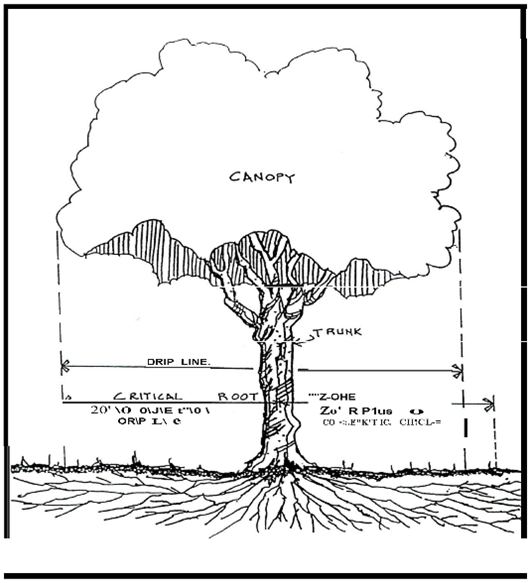
Illustration of Diameter Measurement Methods;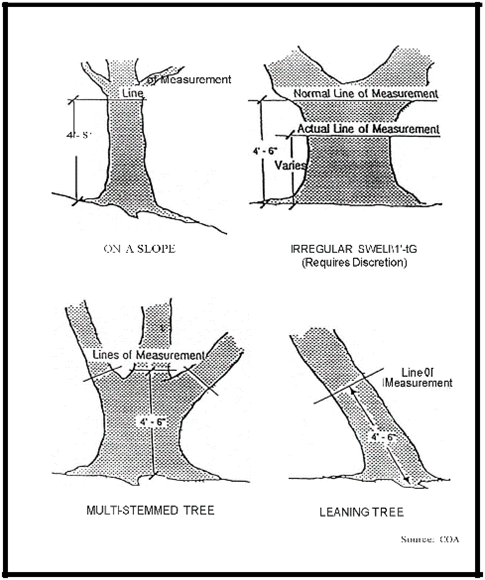
Illustration of Tree Pruning: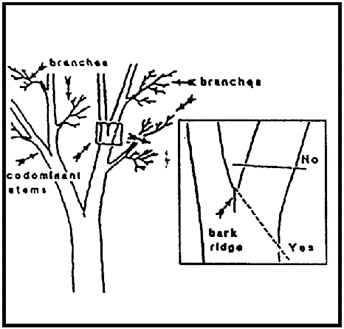
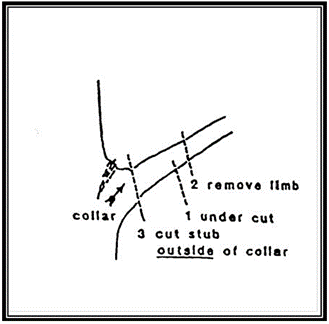
(Ord. No. 2023-3376, § 2, 7-11-23)
5.16.A - Generally
A property in a residential zoning district may be operated in whole or in part as a short-term rental as defined in section 1.2.B, subject to the standards and requirements of article V of chapter 26 of the city code. A property in a "PUD" planned unit development zoning district may be operated as a short-term rental only if such district explicitly permits the operation of short-term rentals.
(Ord. No. 2025-3443, § 5, 6-24-25)
5.16.B - Density Limitations for Short-Term Rental Properties
(1)
Limitation. No short-term rental property shall be located within 1,000 feet of another short-term rental property, measured in a straight line from property line to property line.
(2)
Special exception available. In order to obtain a permit for a short-term rental that would exceed the density limitation of this section, a property owner may apply to the board of adjustment for a special exception in accordance with chapter 6 of this ordinance. The board may consider factors such as the following:
a.
Whether operation as a short-term rental in excess of the density limitation will not adversely impact the residential quality of the neighborhood in which the property is located;
b.
Whether such operation is likely to disrupt adjacent owners' right to the quiet enjoyment of their property (for example, by considering whether lot sizes are small enough that noise is likely to affect neighboring property owners);
c.
Whether such operation will substantially impact nearby streets, including whether the property provides only limited off-street parking;
d.
Whether the applicant seeks to operate an entire residence as a short-term rental or whether the short-term rental use is limited to a portion of the residence; and
e.
Whether other short-term rentals in excess of the density limitation are already operating on that block.
(3)
Nonconforming uses. A short-term rental that was lawfully in existence on the effective date of this article shall be considered a nonconforming use and shall not be subject to the density limitations set forth in this subsection. A short-term rental shall be considered lawfully in existence on the effective date of this article if the owner provides written confirmation from relevant city departments indicating that, prior to the effective date of this article, the property was (a) a lawfully permitted short-term rental operating in accordance with chapter 26, article V of the city code and (b) registered for payment of hotel occupancy tax as required by chapter 110, article II of the city code and the tax account was not in arrears.
(Ord. No. 2025-3443, § 5, 6-24-25)

