
Beeville City Zoning Code
ARTICLE III
- DISTRICT REGULATIONS
Sec. 56-59. - Established.
(a)
For the purpose of regulating and restricting the height, number of stories, and size of buildings and other structures, the percentage of lot that may be occupied, the size of yards, and other open spaces, the density of population, and the location and use of buildings, structures, and land for trade, industry, residence, or other purpose, the city, is hereby divided into districts, of which there shall be ten classes in number, and which shall be known as:
(1)
"R-1" First One-Family Dwelling District.
(2)
"R-2" Second One-Family Dwelling District.
(3)
"R-3" Duplex and Apartment District.
(4)
"R-4" Townhouse District.
(5)
"R-5" Patio/Garden One-Family Dwelling District.
(6)
"B-1" Neighborhood Business District.
(7)
"B-2" Secondary and Highway Business District.
(8)
"B-3" Central Business District.
(9)
"CF" Community Facilities District.
(10)
"I-1" Light Industrial District.
(11)
"I-2" Industrial District.
(12)
"M/H" Mobile Home Parks/Mobile Home Subdivision District.
(b)
The boundaries of the districts, described above, are shown on the map dated April 24, 1973, attached hereto, which map is designated as the "zoning district map," the district map and all notations, references and other information shown thereon are made a part of this article and shall have the same force and effect as if the map and data thereon were fully set forth or described herein.
(Code 1973, app. A, § 4; Ord. No. 359, 6-14-1955; Ord. No. 437, 5-27-1958; Ord. No. 482, 3-24-1959; Ord. No. 644, 5-14-1963; Ord. No. 660, 7-23-1963; Ord. No. 749, 4-13-1965; Ord. No. 750, 4-27-1965; Ord. No. 751, 4-27-1965; Ord. No. 752, 4-27-1965; Ord. No. 818, 10-25-1966; Ord. No. 826, 12-13-1966; Ord. No. 971, 7-8-1969; Ord. No. 1114, § 4, 4-24-1973; Ord. No. 1114-B, 11-27-2012)
Sec. 56-60. - Extended districts into vacated areas.
Whenever any city street, alley or other public way is lawfully vacated by the council of the city, the zoning district adjoining each side of such street, alley or public way shall be automatically extended to the center of such vacated area and thereafter all land included in the vacated area shall be subject to applicable regulations of the extended districts.
(Code 1973, app. A, § 4; Ord. No. 359, 6-14-1955; Ord. No. 437, 5-27-1958; Ord. No. 482, 3-24-1959; Ord. No. 644, 5-14-1963; Ord. No. 660, 7-23-1963; Ord. No. 749, 4-13-1965; Ord. No. 750, 4-27-1965; Ord. No. 751, 4-27-1965; Ord. No. 752, 4-27-1965; Ord. No. 818, 10-25-1966; Ord. No. 826, 12-13-1966; Ord. No. 971, 7-8-1969; Ord. No. 1114, § 4, 4-24-1973; Ord. No. 1114-B, 11-27-2012)
Sec. 56-61. - Annexed territory.
All territory which may hereafter come within the city limits by virtue of annexations to the city, shall be immediately placed and continued in the "R-1" First One-Family Dwelling District until otherwise changed by ordinance.
(Code 1973, app. A, § 4; Ord. No. 359, 6-14-1955; Ord. No. 437, 5-27-1958; Ord. No. 482, 3-24-1959; Ord. No. 644, 5-14-1963; Ord. No. 660, 7-23-1963; Ord. No. 749, 4-13-1965; Ord. No. 750, 4-27-1965; Ord. No. 751, 4-27-1965; Ord. No. 752, 4-27-1965; Ord. No. 818, 10-25-1966; Ord. No. 826, 12-13-1966; Ord. No. 971, 7-8-1969; Ord. No. 1114, § 4, 4-24-1973; Ord. No. 1114-B, 11-27-2012)
Sec. 56-62. - Building and yard restrictions.
Except as hereinafter provided:
(1)
No building shall be erected, converted, enlarged, reconstructed, or structurally altered, and no building or land shall be used for any purpose that is not permitted in the district in which the building or land is situated.
(2)
No building shall be erected, converted, enlarged, reconstructed, or structurally altered to exceed the height limit herein established for the district in which the building is situated.
(3)
No building shall be erected, converted, enlarged, reconstructed, or structurally altered except in conformity with the area and parking regulations of the district in which the building is situated.
(4)
The minimum yards and other open spaces, including lot area per family, required by this article for each and every building existing at the time of the passage of the ordinance, or for any building hereafter erected, shall not be encroached upon or considered as yard or open space requirements for any other buildings, nor shall any lot area be reduced to an area less than the district requirements of this article.
(5)
Every building hereafter erected or structurally altered shall be on a lot as herein defined, and in no case shall there be more than one main building on one lot except as otherwise provided in this article.
(Code 1973, app. A, § 4; Ord. No. 359, 6-14-1955; Ord. No. 437, 5-27-1958; Ord. No. 482, 3-24-1959; Ord. No. 644, 5-14-1963; Ord. No. 660, 7-23-1963; Ord. No. 749, 4-13-1965; Ord. No. 750, 4-27-1965; Ord. No. 751, 4-27-1965; Ord. No. 752, 4-27-1965; Ord. No. 818, 10-25-1966; Ord. No. 826, 12-13-1966; Ord. No. 971, 7-8-1969; Ord. No. 1114, § 4, 4-24-1973; Ord. No. 1114-B, 11-27-2012)
Sec. 56-63. - Determining district boundaries.
Where uncertainty exists with respect to the boundaries of the various districts as shown on the map accompanying and made a part of this article, the following rules apply:
(1)
The district boundaries are either streets or alleys unless otherwise shown, and where the districts designated on the map accompanying and made a part of this article are bounded approximately by a street or alley lines, the street or alley shall be construed to be the boundary of the district.
(2)
Where the district boundaries are not otherwise indicated, and where the property has been or may hereafter be divided into blocks and lots, the district boundaries shall be construed to be the lot lines, and where the districts designated on the map accompanying and made a part of this article are bounded approximately by lot lines, the lot lines shall be construed to be the boundary of the district unless the boundaries are otherwise indicated on the map.
(3)
In unsubdivided property, the district boundary lines on the map accompanying and made a part of this article shall be determined by use of the scale appearing on the map.
(Code 1973, app. A, § 20; Ord. No. 359, 6-14-1955; Ord. No. 437, 5-27-1958; Ord. No. 482, 3-24-1959; Ord. No. 644, 5-14-1963; Ord. No. 660, 7-23-1963; Ord. No. 749, 4-13-1965; Ord. No. 750, 4-27-1965; Ord. No. 751, 4-27-1965; Ord. No. 752, 4-27-1965; Ord. No. 818, 10-25-1966; Ord. No. 826, 12-13-1966; Ord. No. 971, 7-8-1969; Ord. No. 1114, § 20, 4-24-1973; Ord. No. 1114-B, 11-27-2012)
Sec. 56-64. - Use, height, area and other regulations applicable to all districts.
(a)
Accessory use and building regulations.
(1)
Accessory buildings shall be regulated as follows:
a.
No accessory building shall be constructed on a lot until the construction of the principal building has been commenced. No accessory building shall be used unless the principal building on the lot has been occupied and used.
b.
An accessory building may be erected as an integral part of a principal building, or it may be detached from the principal building. When attached to the principal building, it shall meet all the setback requirements. No detached accessory building shall be located in any required front yard nor in front of the principal building.
c.
A detached accessory building shall be at least five feet from any structure situated on the same lot.
d.
The detached accessory building shall be placed no closer than five feet from the side and rear lot line.
e.
In the case of a corner lot, no accessary building shall be erected or altered to project beyond the required front yard on any adjacent lot, nor shall it be located closer to either street line than the principal building on the lot.
f.
In residential districts, no more than two accessory buildings are located on the property. The total square footage of all accessory buildings on the property shall not exceed 50 percent of the footprint of the principal building. Nor shall the accessory building be taller than the principal building.
g.
Prohibited structures. Intermodal containers, semi-trailer containers, railroad cars, motor vehicles, truck or bus bodies and other similar containers shall not be used as accessory building in any districts.
(2)
Home occupation shall be regulated as follows:
a.
Home occupation shall be considered an activity which is clearly incidental and secondary to the use of a dwelling for residential purposes.
b.
A home occupation shall not change the character of either the dwelling or the surrounding neighborhood.
c.
A home occupation shall be conducted entirely within the dwelling and shall not be permitted in any accessory structure or within any required yard space.
d.
A home occupation shall be operated only by a resident of the dwelling in which such home occupation occurs and, there shall be no employees.
e.
A home occupation shall not have a separate entrance from outside of the dwelling.
f.
A home occupation shall not involve the use of more than one room or 25 percent of the ground floor area of the dwelling unit, whichever is greater.
g.
No equipment shall be used in such a manner as to cause offensive noise, vibration, smoke or other particulate matter, odorous matter, heat, humidity, glare, electronic interference or otherwise constitute nuisance or safety hazard in the neighborhood.
h.
No outdoor storage of material used to conduct a home occupation shall be permitted.
i.
An individual conducting a home occupation shall be permitted to display one non-illuminated sign not exceeding two square feet per sign face in area.
j.
Prohibited home occupations:
1.
Vehicle repair;
2.
Outdoor repair;
3.
Greenhouse, commercial nursery, landscaping services
4.
Restaurant;
5.
Retail sales; and
6.
Other uses that creates fume, noise, excessive outdoor storage, or involves heavy equipment use and storage yard.
(3)
Recreational, commercial, construction and agricultural vehicles shall be regulated as follows:
a.
Recreation vehicles shall include all travel trailers, pickup trucks with slide in campers, motorized homes, fold-tent trailers, boats, and boat trailers.
b.
Such vehicles shall not be permitted to be permanently parked within any required front yard of any zoning district.
c.
Such vehicles may be pared in a required front yard of a residential district for the purpose of loading or unloading not to exceed 48 hours within any seven days period.
d.
Such vehicle may be parked for storage purposes in any side yard or rear yard provided a permanent hard, impermeable, dustless surfaced area not less than the overall dimension of the vehicle is constructed and a permanent, dustless, hard surfaced driveway to the vehicle is provided and maintained, stored vehicles shall be screened from view from adjacent properties with a fence or landscaping material sufficient in height.
e.
Parked or stored recreational vehicles shall not be connected to electricity, water, or sanitary sewer facilities; and at no time shall such vehicle be used for living or housekeeping purposes while on the premises in any zoning districts. Furthermore, all parked or stored recreational vehicles shall be solely for the personal use of the occupants of the residence on which the vehicles are located.
f.
Travel trailers, pickup trucks with slide-in campers and motorized homes shall not be used for onsite construction offices and 24 hours security offices on construction sites.
g.
No person shall permanently remove the wheels or similar transporting devices, or any habitable vehicle parked in a residential zoning district, nor shall such vehicle be otherwise fixed to the ground by any person in any manner that would prevent the ready removal of such habitable vehicle.
h.
All vehicles shall be required to have current state license plates or tags.
(4)
Outdoor storage and waste shall be regulated as follows:
a.
With the exception of single- and two-family residences, all outdoor storage facilities for fuel, raw materials and/or waste products shall be enclosed by a four-sided screened fence of wall, or combination of to completely conceal such facility from adjoining properties.
b.
All waste products temporarily stored outdoors shall be placed within closed containers capable of being transferred either outside the required closure area, or off the lot.
c.
In no case, shall such facilities be placed within a required front yard.
d.
All construction sites shall include a dumpster to contain construction trash and debris and portable toilet units for construction personnel.
(5)
Solar panels. Solar panels may be allowed in all zoning districts either attached to a permitted principal use or accessory building or as an accessory structure subject to the following regulations:
a.
Freestanding solar panels are prohibited in the front yard.
b.
Panels that are freestanding or attached shall satisfy the rear and side yard setback requirements of the zoning district in which they are located.
c.
Solar panels are permitted on the roof of the principal structure or accessory structure, provided that the addition of the panels does not cause the structure to exceed the height requirement for the zoning district in which it is located.
d.
Solar panels shall be placed and arranged such that reflected solar radiation or glare shall not be directed onto adjacent buildings, properties, or roadways.
e.
Panel systems are subject to the Property Maintenance Code and shall be removed within six months of being nonfunctional.
f.
No panel shall be used for advertising of any kind.
g.
A permit is required.
(b)
Temporary uses/structure. All temporary uses are required to obtain a temporary use permit from the building inspector/zoning administrator. The application shall include the general layout of the temporary uses on site and the owner's consent. Specific temporary use regulations are as follows:
(1)
Temporary outdoor sales and promotional event of items such as lawn and garden supplies, seasonal items and similar items shall be permitted on the premises of retail outlets located in any business district when incident to the principal business conducted thereon and sale are made only by the employees of the principal business, subject to the following conditions:
a.
No portion of the display shall be on or over publicly owned property or right-of-way.
b.
No required off-street parking space or loading area shall be utilized for display, storage of dispensing.
c.
Merchandise and/or products shall be related to retails operation on premises.
d.
The promotional event shall take place on a paved area covered with solid material.
e.
The number of promotional events shall be limited to four per year, and each promotional event shall not exceed 14 days.
f.
Any freestanding structures or tent shall require a building permit from the building inspector to show the anchoring mechanism and fire-retardant rate.
(2)
Farmer markets offering outdoor sales of farm produce, homemade foodstuffs, such as bread, cakes, pastries and similar items, flowers, and other items handmade and not store brought and are subject to the following conditions:
a.
Farmer markets may be in any non-residential districts.
b.
Farmer markets may operate no more than two days a week.
c.
Farmer markets may take place in city owned parking lot, provided they have been sponsored by a downtown organization and supported by the city council.
(3)
Portable storage units may be placed in residential districts for a period not to exceed 30 days per year, unless otherwise approved, subject to the following conditions:
a.
Portable storage unit may be located only on the driveway of the property where the unit is beings used for temporary storage.
b.
Temporary use permit shall be obtained from the city prior to locating the unit on the property.
c.
In instances where the property owner can demonstrate that unusual circumstances create a need to place the unit on property longer than 30 days, the building inspector/zoning administrator may issue a temporary use permit longer than 30 days, but in no instance longer than 180 days.
(4)
Intermodal container shall be regulated as follows:
a.
No intermodal containers shall be allowed to be placed in any residential and downtown districts.
b.
Temporary intermodal containers may be allowed under the following conditions:
1.
It is for temporary storage purposes for the commercial/industrial entities to unload merchandise.
2.
No signage including business signs, logos, or other marking shall be permitted on or attached to the containers.
3.
Containers shall be located to the rear of side, but not street side, of the principal building on the site.
c.
Construction related storage
1.
The temporary placement of intermodal containers, as well as trailers and semi-trailers, shall be allowed on the same tract of land, or on a tract directly adjacent to or across the street from the tract, where related permitted constriction is occurring.
2.
Such placement shall not require a building permit or other approval by the city, provided that the use of such container is limited to storage of material and equipment used in conjunction with permitted construction.
3.
Such trailer or container shall be removed within 30 days following the completion of the project.
(5)
Carnival, circuses, and other exhibitions.
a.
An application for a carnival/circus permit shall include the name of person, or entity applying for the carnival permit. Each application shall include the name of the carnival's sponsor, organizer, and promoter, if applicable. The application shall also include State of Texas license/certificate to operate the carnival, circus.
1.
A permit must be submitted at least 30 calendar days prior to the commencement of the carnival. Permit shall be valid for no more than seven calendar days.
2.
Application for carnival permits shall be filed with the development services. the application will be forwarded to the building official, fire department, police department for review.
3.
The applicant shall submit a statement signed by the sponsor of the carnival, if any, that such sponsor has engaged or permitted the applicant to conduct the event.
4.
Permit fee. The applicant shall include all necessary fees, as adopted by the Beeville City Council, for each permit request. The permit fee shall apply regardless of whether the applicant is a profit or non-profit organization.
5.
Details of operation. Explicit details of the operation of the carnival are required to be stated in the permit application. Requests for dates or times that conflict with previously scheduled events will not be considered; however, the applicant may revise the request to apply for a different date or time.
6.
Deposit and insurance.
i.
All costs for clean-up during and after the event are the responsibility of, the applicant. Every applicant, upon approval of the application shall post a case deposit or surety with the city secretary or his or her designee in an amount set by the city council. However, in no event, shall such amount be less than $1,000.00. The deposit requirement shall apply regardless of whether the applicant or the event is a profit or non-profit organization. The deposit shall apply to cover any cost to the city to clean up and police personnel for the safety of the carnival. The city will return the bond to the applicant, along with the accounting of any costs to which the deposit, in whole or in part, was applied.
ii.
The applicant must obtain and maintain at applicant's own expense, an insurance policy covering the event. The city reserves the right to increase the amount of coverage with combined single limits of $1,000,000.00. The city reserves the right to increase the amount of coverage or require additional types of coverage depending on the size of the carnival and any additional risk concerns. Such policy must name the city as an additional insured.
iii.
The applicant must specifically agree to indemnify, defend and hold the city, and its officers, directors, agents, representatives and employees harmless from and against any and all claims, expenses, damages or other liabilities, including reasonable attorney's fees and court costs, arising out of bodily injury or property damages arising out of or in connection with the event.
7.
Applicants shall comply with all federal, state, county and local laws, including any ordinances, mechanical/electrical/fire and related codes as well as zoning regulations.
8.
Public safety. All applicants/operators must meet with the police chief and fire chief prior to the commencement of the events to go over the safety plan. Cost of standby fire personnel, security, and EMS, shall be the responsibility of the applicant and shall be contracted separately.
9.
Vendors. Applicants must coordinate all vendor and concession activities with the city. All vendors and concessionaires shall at their expenses, obtain any required city concessionaire permits and pay any associated fees.
10.
Sales tax. An applicant that will sell food or beverage or novelty items must obtain all proper permits and indicate the city as the origin of sales. If an applicant allows third parties to sell the food or beverages or novelty items, the applicant shall show proof that applicant has required said third parties to comply with this requirement.
11.
Any use of the city right-of-way will require a city-approved traffic control plan. Any costs involved in the development of this plan are the responsibility of the applicant.
12.
Mobile amusement rides. Applicants of carnivals having mobile amusement rides shall post signs at the entrance to the carnival and at each ride telling patrons where to report any ride that appears to be unsafe or ride operator who appears to be violating the law.
13.
Parking. Adequate parking shall be provided for by the applicant. The applicant shall show parking availability in the details of the operation of the carnival submitted to the city.
14.
Beeville Animal Control Officer must receive all vaccination information of all the animals prior to the commence of the circus.
15.
The permit and insurance documents shall be conspicuously posted on site.
b.
A mobile home park shall be permitted only in a mobile home park district under this article and shall comply in every detail with the city mobile home ordinance as adopted by the city council on June 30, 1980 (chapter 28) and such amendments as may be affected at a later date. It shall be unlawful for any person to locate or maintain for residential purposes any such mobile home in any place in the city other than a lawful mobile home park or mobile home subdivision.
c.
Modular home, as certified by the Texas Department of License and Regulations, is permitted to be located in any residential districts, subject to the following conditions:
1.
The modular home must be placed on a permanent foundation that is certified by a licensed Texas Engineer.
2.
The modular homes must have a value equal to or greater than 75 percent of the median taxable value for each single-family dwelling located within 500 feet of where the modular home is proposed.
3.
The modular home must have exterior siding, roofing, roof pitch, foundation facia and fenestration that is compatible with those single-family homes located within 500 feet where the modular home is proposed.
(c)
Height regulations:
(1)
Public, semi-public or public service buildings, hospitals, institutions, or schools when permitted in a district may be erected to a height not exceed 60 feet and churches and temples may be erected to a height not exceeding 75 feet if the building is set back from each yard line at least one foot for each two feet additional height above the height limit otherwise provided in the district in which the building is located.
(2)
Chimneys, cooling tower, elevator bulk heads, fire towers, grain elevators, flour mills, monuments, stacks or scenery lofts, tanks, water towers, ornamental towers and sired church steeples, radio or television towers, or necessary mechanical appurtenances, may be erected to a height in accordance with existing or hereafter adopted ordinances of the city, provided that in the absence of any such ordinance there shall be no height limitation of these structures.
(d)
Area and density regulations.
(1)
No compliance yard to be used for another building. No yard or open space provided about any building for the purposes of complying with the provisions of these regulations shall again be used as a yard or an open space for another building. Every part of a required yard shall be open to the sky and unobstructed by buildings except for accessory buildings in the rear yard and except the ordinary projections of skylights, sills, belt courses, cronies, and other ornamental features which may project into such yards a distance of not more than two feet.
(2)
Unroofed platforms and landings, open unclosed porches, platforms, or landing places not covered by a roof or canopy may extend or project into the front yard for a distance not to exceed five feet.
(3)
Terraces, uncovered porches, platforms, and ornamental features. Terraces, uncovered porches, platforms, and ornamental features which do not extend more than three feet above the floor level of the ground (first) story may project into a required side yard, provided these projections be distant at least four feet from the adjacent side lot line.
(e)
Front yard.
(1)
When 60 percent or more of the frontage on one side of a street between two intersecting streets is developed with buildings that have observed a front yard greater in depth than herein required, new buildings may be erected consistent with the average front yard
(2)
When 60 percent of more of the frontage on one side of a street between two intersecting streets is development with buildings that have not observed and is less than the minimum front yards required herein front yard shall be maintained with the average front yard setback of those buildings or to provide the minimum front yard as required herein as described above, then:
a.
Where a building is to be erected on a parcel of land that is within 100 feet of existing buildings on both sides, the minimum front yard shall be a line drawn between the two closed front corners of the adjacent buildings on the two sides.
b.
Where a building is to be erected on a parcel of land that is within 100 feet of an existing building on one side only, such building may be erected as close to the street as the existing adjacent building.
c.
In determining such front yard depth, buildings located entirely on the rear one-half of a lot shall not be counted.
(3)
Vision clearance. On any corner lot on which a front or side yard is required, no wall, fence, sign or other structure, or any plant growth shall be permitted or maintained higher than two feet above the curb level within 15 feet of the intersection of the property lines.
(4)
A corner lot is a lot is a lot that has two street frontages. A corner lot has two front yards, two side yards and no rear yards
(f)
Side yards.
(1)
A side yard of not less than 25 feet on the side of the lot adjoining to a residential lot shall be provided for all schools, libraries, churches, community houses and other public or semi-public buildings hereafter erected or structurally altered.
(2)
A side yard of not less than 25 feet on the side of the lot adjoining an "R-1", "R-2" or "R-3" district shall be provided for all commercial, retail establishments. Additionally, a row of hedges or similar material shall be installed in this side yard setback to shield the residential dwellings from the business activities.
(3)
Garages or carports, detached or attached to the main building entering on the side street of a corner lot, shall maintain minimum front yard setback as required for the residential dwelling facing the side street in the front of the garage/carport.
(g)
Alleys and easements. When any property shall come before the city council for a zone change to any of the business districts designated in this article, alleys or utility easements may be required at the direction of the city council.
(h)
Parking regulations. When any property shall come before the city council for a change in zone classification, parking regulations shall be compiled with as required in the district to which the property to be classified. Where no required parking spaces have previously been provided whenever an existing structure is converted or structurally altered the parking spaces as required in the zone for such use normally allowed shall be provided and maintained.
(Code 1973, app. A, § 15; Ord. No. 359, 6-14-1955; Ord. No. 437, 5-27-1958; Ord. No. 482, 3-24-1959; Ord. No. 644, 5-14-1963; Ord. No. 660, 7-23-1963; Ord. No. 749, 4-13-1965; Ord. No. 750, 4-27-1965; Ord. No. 751, 4-27-1965; Ord. No. 752, 4-27-1965; Ord. No. 818, 10-25-1966; Ord. No. 826, 12-13-1966; Ord. No. 971, 7-8-1969; Ord. No. 1114, § 15, 4-24-1973; Ord. No. 1114-B, 11-27-2012; Ord. No. 2394, 10-26-2021; Ord. No. 2424, § 1, 7-11-2023)
Sec. 56-65. - Technical review committee.
(a)
It is the directive of the Beeville City Council to facility the development project by directing city staff to develop a clear and consistent process to assist development projects to moving forward.
(b)
A complete and consistent review process can provide a clear expectation of the city and providing all the technical information to aide the project team will eliminate any potential uncertainty and remove any ambiguity to streamline the design process to move the project forward.
(Ord. No. 2407, §§ 1, 2, 7-26-2022)
Sec. 56-67. - Off-street parking, loading, and stacking regulations.
(a)
Purposes.
(1)
Ensure that each development within the city will provide adequate and reasonable parking, stacking, and loading spaces necessary to serve the development.
(2)
Allow for flexibility in the design of parking area; and
(3)
Protect adjacent areas and the general public from the
a.
Noise, glare of headlights, dust, and fumes resulting from the operation of motor vehicles;
b.
Glare and heat from parking areas; and
c.
Lack of visual relief from expanses of paving and accelerated run-off of surface water from land covered by impervious surfaces.
(b)
Off-street parking calculation.
(1)
Developments containing more than one use shall provide parking and loading spaces in an amount to the total of the requirements for all uses, unless otherwise required differently herein.
(2)
All square-footage of a building-based parking and loading standards shall be computed based on gross floor area (GFA). The gross floor area shall be measured from the exterior faces of the walls and the centerline of the walls separating the two buildings and shall include the following areas:
a.
The area of each floor of the structure including but not limited to stairwells, restrooms, and elevator shafts.
b.
Attic space used for active commercial building space (public display of merchandise, sales, services, office space); and
c.
Outside retail sales areas.
(3)
When fractional spaces result, the parking spaces required shall be constructed to be the next highest whole number.
(4)
The parking space requirements for a use not addressed in the table below shall be established by the development services director according to professionally acceptable standards and practices.
(5)
Off-street parking for a use shall be located on the same site as the use. Off-street parking located on a separate lot may be approved subject to the review by the board of adjustment, subject to the following conditions:
a.
The demand for the required off-street parking spaces is not needed at the same time of the day or different operating hours.
b.
An agreement between the applicable property owners has been executed prior to being considered by the board of adjustment. Upon approval by the board of adjustment, such agreement shall be recorded with the county clerk's office and a copy of the recorded agreement shall be filed with the development services department.
c.
Parking spaces shall not be more than 300 feet from the proposed use.
d.
Off-site parking serving the uses located in a non-residential zoning district shall be located in non-residential zoning districts. Off-street parking serving uses located in a residential zoning district shall be located in residential districts.
(6)
The parking requirements do not apply to any uses to be located in B-3 District (Central Business District).
(c)
Required parking ratio. The following minimum off-street parking requirements shall apply to all zoning districts.
(d)
Off-street parking design standards.
(1)
All surfaces of any vehicular use area for all off-street parking spaces shall be paved with all-weather materials, such as asphalt, concrete, or brick.
(2)
All parking spaces shall be legibly marked on the pavement in accordance with the requirements and standards.
(3)
Each required parking space and parking area shall be:
a.
Arranged for convenient access and safety of pedestrians and vehicles.
b.
Arranged so that no vehicle shall be required to back from a parking area directly onto property lines or public streets or enter the street to reach another aisle within the same parking area; and
c.
Designed to physically prevent any portion of a vehicle from encroaching into overhanging any public or private property line by means of a permanently installed curb, wall, or other physical barrier.
d.
Dead-end aisles shall not be permitted for angle parking unless an adequate turn-around is provided.
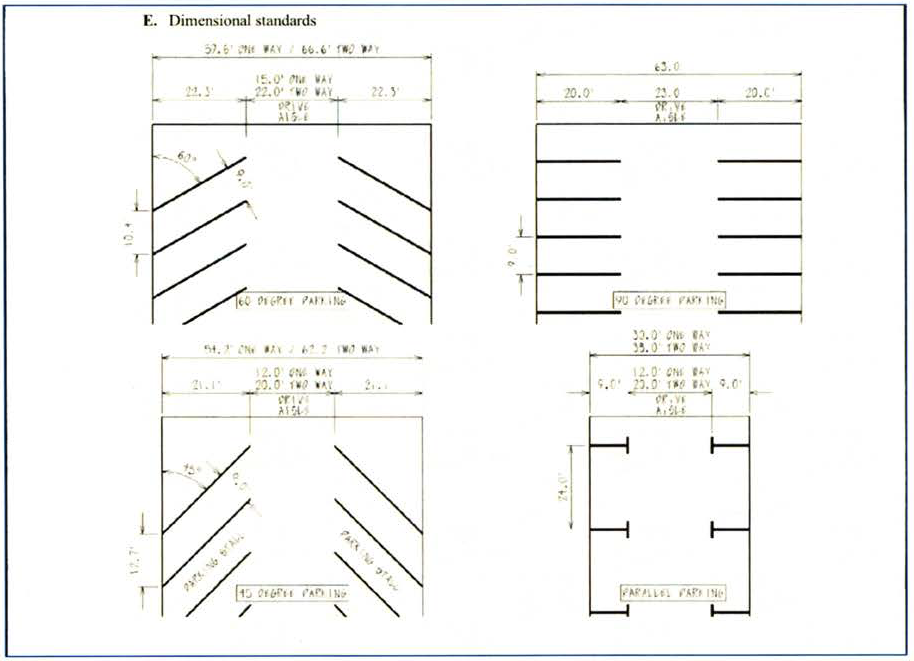
(e)
Dimensional standards.
(f)
Vehicle stacking areas.
(1)
A minimum number of spaces. The vehicle stacking standards of this section shall apply unless otherwise expressly approved by the Technical Review Committee (TRC). The TRC may require additional stacking spaces where trip generation rates suggest that additional spaces are warranted. Off-street stacking spaces shall be provided as follows:
(2)
Design and layout.
(3)
Required stacking is subject to the following design and layout standards.
a.
Dimensions: Stacking space shall be a minimum of 10 feet by 20 feet in size.
b.
Stacking spaces shall not impede on- or off-site traffic movements or movements into or out of off-street parking.
c.
Stacking spaces shall be separated from other internal driveways by raised medians if deemed necessary by the TRC for traffic movements and safety.
d.
Gatehouse entries shall be designed so that vehicles may turn around without entering the gated area.
e.
Drive-through windows: Drive-through windows and lanes shall be designed to adhere to the following standards:
1)
Drive-through windows placed between the right-of-way of a roadway and the associated building shall require a landscaping buffer, installed, and maintained along the entire length of the drive-through lane and the adjacent right-of-way.
2)
No drive-through window shall be permitted on the side of a building adjacent to any residential zoning district.
(g)
Off-street loading. Service drives and other areas shall be provided for off-street loading, in such a way that in the process of loading or unloading, no vehicle shall block the passage of other vehicles on the service drive or extend into any other public or private drive or street used for traffic circulation.
(1)
Design and layout: The location and layout of all loading spaces shall be indicated on the required site plan.
(2)
A loading space shall be a minimum of 12 feet by 35 feet and shall have a minimum vertical clearance of 14 feet.
(3)
All uses requiring delivery trucks shall demonstrate adequate on-site area exists for the loading and unloading of such trucks. Such loading and unloading activity shall not be permitted in any public right-of-way.
(4)
One loading space is required for every 10,000 square feet of gross floor area of the building.
(h)
Landscaping requirement.
(1)
Purpose.
a.
To improve the appearance and quality of landscaping on development properties.
b.
Ensure new development, certain modifications to existing structures and site improvements that require building permits conform to this subsection.
c.
Ensure consistency with and implement the goals found in the comprehensive plan, particularly those that suggest improvements in the quality of life, enhance natural and man-made amenities, and encourage a high level of design in the development of the city.
d.
Promote water conservation and other environmentally friendly practices by incorporating the following principles of Xeriscape, which are:
1)
Soil improvements
2)
Use of mulch or other landscaping material
3)
Use of low water use drought tolerant plantings
e.
The landscaping requirements apply to building permits for the following:
1)
New development with more than ten off-street parking spaces.
2)
New construction on property in all zoning districts.
3)
Landscaping plans submitted as part of the site plan application shall be signed and sealed by a Texas registered landscape architect or certified nurseryman.
4)
Redevelopment resulting in an increase of floor area of 25 percent or more.
f.
Landscaping requirements
1)
A minimum of five-foot wide landscaping area, along the street frontage, separating the off-street parking lot from the public right-of-way.
2)
Landscaping islands shall be provided in a ratio of ten sq. ft. for each five spaces.
3)
Street landscaping area shall have a minimum ground cover material with native brushes arranged in a reasonable way, along with native trees to provide necessary shade to the parking lot.
4)
Landscaping islands shall have a minimum ground cover with native trees to provide shade to the parking lot.
5)
Reduction of required off-street parking may be offset by additional landscaping island or additional width of street side landscaping area.
(Ord. No. 2442, § 1, 5-28-2024)
Sec. 56-68 - Wireless telecommunication facilities.
(a)
Purposes.
(1)
The purpose of this section is to establish guidelines regulating the location of telecommunication towers and antennas to provide convenience and modern technology available to residences and to encourage co-location and minimize the number. Meeting these objectives will protect and promote public safety, mitigate any adverse visual or aesthetic impacts on the community; and promote orderly development of telecommunication facilities within the city. It will also: avoid the creation of visual distractions: and prevent obstruction to the view of pedestrians and motorists on public thoroughfares.
(2)
The regulations contained in this section were developed under the general guidelines as provided in the Federal Communication Act of 1996:
a.
Cities have local authority over the "placement construction and modification" of cellular telephone facilities and other personal wireless telecommunication service facilities.
b.
Regulations "shall not unreasonably discriminate among providers of functionally equivalent services."
c.
Regulations "shall not prohibit or have the effect of prohibiting the provision of personal wireless services."
d.
Denial shall be in writing and supported by substantial evidence.
e.
Cities may not regulate the placement, construction, and modification of personal wireless service facilities on the basis of environmental or radio frequency emission to the extent that such facilities comply with the Federal Communication Commission regulations concerning such emissions."
(3)
Notwithstanding any other provisions of this section, installation, construction, alteration, modification, or replacement of telecommunication towers, antennae, when permitted by federal and state laws, shall be regulated, and governed by the following use regulations and requirements.
(4)
This section does not cover dish antenna for satellite connection for personal enjoyment purposes, or the ham radio tower for non-commercial exchange of message.
(b)
General provisions.
1.
Application.
a.
All applications: All applications for building permits or special use exceptions, under Chapter 10 of the Beeville Codified Ordinance and Section 56-68 for telecommunication towers, antennae, or other facilities to provide a telecommunications service, shall include a completed supplemental information form provided by the city. An application shall include the following:
1)
Site and landscaping plans drawn to scale.
2)
A report, including a description of the tower, with technical reasons for its design and the reason the location was selected. The report should disclose the technical performance goals (i.e., desired strength signal) for the provider; whether additional towers will need to be located within the city, the conditions necessary to provide adequate coverage, radio frequency coverage prediction maps showing the area to be served before the addition of a new cell, and radio frequency coverage prediction map that shows coverage after the new cell is operational.
3)
Documentation establishing the structural integrity of the tower its proposed uses.
4)
The general capacity of the tower, and information necessary to assure the ANSI/TIA/EIA standards are met.
5)
A statement of intent on whether space will be leased to other telecommunication providers.
6)
Proof of ownership of the proposed site or authorization to use the site.
7)
Copies of any necessary easement to provide utility to the facility.
8)
An analysis of the area containing topographic contours.
9)
The proposed location of the interconnection, if any, between the wireless telecommunication provider that the franchised wired, cable, or fiber-optic telecommunication provider. If the interconnection is not located in the equipment enclosure at the base of the tower, then a detailed description of any and all assessments that are being used to carry the signal by wire, cable, or fiber-optic cable.
10)
Identification of any alternative sites that were available for co-location and the reason for co-location on an existing site was not a practical alternative.
2.
Application for special use exceptions.
a.
All applications for a special use exception, under this section, for a telecommunication tower, antenna, or other facility to provide a telecommunication service, shall include a completed supplemental information form provided by the city. An application shall include a report with the following information:
1)
Description of the tower, with technical reasons for its design and the reason the location was selected.
2)
Any alternative sites that were available for co-location, and the reason co-location on an existing site was not a practical alternative. The technical performance goals (i.e., strength signal) for the provider.
3)
Whether additional towers will need to be located within the city, and under what conditions, to provide adequate coverage. A map showing the general location of future towers may be provided. If the general location of any future towers whether by description within the report or on the map) is not provided, the fact that the telecommunication provider has antennas located on the tower being applied for may not be used to justify the location of any future towers within the city.
4)
Information relating to the number of calls being dropped within the current tower coverage area, the number of failed hand-offs between existing cell sites, and the number of people denied access to the system because there is not enough capacity to handle the calls.
5)
Any maps and information provided under this subsection will be treated by the city as privileged commercial information under 552.10 of Texas Public Information Act, Chapter 552, Texas Government Code, if each page and sheet is clearly marked and identified as proprietary information that should not be made available to the public. If such a request for information is received, it will be forwarded to the Attorney General for a determination under 552.301 of the Act. The city will withhold the information from the requester under 552.305 of the Act, until after a decision from the Texas Attorney General is received. The city will only release the information if directed to do so by the Attorney General.
(3)
Platted lots: Telecommunications facilities, including towers and related equipment buildings, shall be located on platted lot(s).
(4)
Technical assistance. When a special use exception is required to comply with the provisions of this subsection and when the technical information provided by the applicant is beyond he technical capacity of city staff to review, the applicant, in additional to the usual application fee, shall reimburse the city for the actual cost to the city for the services of a technical expert to review the application and/or information supplement, up to a maximum of $5,000.00.
(5)
Pre-application meetings. Prior to leasing, purchasing, or constructing telecommunication facilities, the telecommunication provider or licensee is required to meet with the director of development services and/or the building official, or their designees, to determine if the location will require a special use exception or other approvals, and to review the merits of potential locations.
(6)
Master antenna map. To facilitate co-location and coordination of telecommunication sites, the city shall notify the providers of telecommunication services, listed in the telephone directory or otherwise known to the city, of the enactment of this subsection, within 30 days of its effective date. Within 90 days of the date of such notice, telecommunication providers shall provide the city with their respective master antenna maps. Each master antenna map shall show the locations, heights and co-location capabilities of all telecommunication towers with antennas serving any portion of the city and indicate coverage area for current telecommunication towers. Within 90 days of the installation of an antenna on any new or existing towers not previously identified, providers shall also provide the city with any updates to the above documents and notice of any change in ownership of any telecommunication tower.
(7)
Telecommunication tower standards.
a.
Applicable federal and state standards. All telecommunication towers and antennas shall be erected and operated in compliance with current Federal Communication Commission (FCC) and Federal Aviation Administration (FAA) rules and regulations, and other applicable federal, state, and local standards.
b.
Structural standards. Telecommunication tower structures must be designed and constructed to conform to the most current revision of TIA/EIA 222 standards. However, any telecommunications tower structures must be designed and constructed to the wind load speed established in the building code, rather than the basis-wide speeds published in TIA/EIS 222.
c.
Co-location. If over 75 feet in height, towers shall be designed and built to accommodate a minimum of two telecommunication providers. The owner of the tower must certify to the city that the tower is available for use by other telecommunication service providers on a reasonable and nondiscriminatory basis.
d.
Fencing and support structures.
1.
Security fencing shall be installed and must be constructed of wrought-iron, steel, or chain-link fence or a masonry wall, which is not less than six feet in height.
2.
The exterior of equipment buildings, within, adjacent to or visible from a residential district, shall be constructed of material (i.e. siding, brick, masonry, or stucco) and in style and character (i.e. roofing, color, and trim) similar to adjoining structures. It must blend with adjacent landscaping and other surroundings. Metal equipment cabinets are not permitted.
3.
The exterior of other equipment buildings and/ or equipment cabinets which are located within a nonresidential district and visible from public right-of-way must have a neutral finish or be painted to reflect the color and character of adjoining structures or to blend with adjacent landscaping and other surroundings.
4.
The owner or operator of a telecommunication tower facility may request from the board of adjustment a waiver of the requirement for a security fence.
(e)
Setbacks.
(1)
All telecommunication towers, as well as guy wire anchors, shall be located within the buildable area of the lot and not within the front, rear, and side-yard building setbacks.
(2)
Telecommunication towers shall be set back a minimum of one-and-a-half times the height of the tower from the right-of-way of all federal and state highways and any arterial street.
(3)
Except as otherwise provided in this section, telecommunication towers adjacent to residential dwellings must be a minimum of a one-to-one distance-to-height ratio from a single-family, two-family or multi-family dwelling.
(4)
The minimum setbacks from roadways may be reduced to the minimum required. Except as otherwise permitted in this section, no signage lettering, symbols, images, or trademarks, other than one identifying sign that is not in excess of 200 square inches, shall be placed on or affixed to any part of a telecommunication tower, antenna, or antenna array, other than as required by FCC regulations or other applicable laws.
(5)
An identifying sign shall be posted on the gate of the security fence or on the door of the equipment enclosure. The identifying sign shall contain the following information to enable public safety personnel to contact the telecommunication tower operator.
(6)
The name yard setback distance if the tower will withstand a sustained wind speed of 105 mph, or such wind speeds designated for wind-load design by the Texas Department of Insurance for structures located within the city.
(7)
The setbacks from the nearest residential structure may be reduced to the minimum required yard setbacks if the tower will withstand a sustained wind speed of 105 mph, or such wind speeds designated for wind-load design by the Texas Department of Insurance for structures located in the city.
(f)
Signage.
(1)
Except as otherwise permitted in this section, no signage lettering, symbols, images, or trademarks, other than one identifying sign that is not excess of 200 square inches, shall be placed on or affixed to any part of a telecommunication tower, antenna, or antenna array, other than as required by FCC regulations or other applicable laws.
(2)
An identifying sign shall be posted on the gate of the security fence or on the door of the equipment enclosure. The identifying sign shall contain the following information to enable public safety personnel to contact the telecommunication tower operator.
a.
The name of the operator of the telecommunication tower, and
b.
A telephone number that is monitored 24 hours a day, 365 days a year.
(g)
Lighting.
(1)
Except as otherwise permitted in this section, no signals, lights, or illumination of any kind shall be permitted on or directed toward any tower, unless required by the FCC, the FAA or other appropriate public authority with jurisdiction over lighting of towers.
(2)
Security lighting may be installed to illuminate the area surrounding the tower and the equipment building or equipment enclosures. Any lighting must be shielded and directed away from any nearby streets or residences as long as FCC or FAA guidelines, standards, and regulations are satisfied.
(h)
Landscaping.
(1)
Within a residential district, any side of the security fencing surrounding a telecommunication tower antenna facility, within a residential district that is visible from a public road or residence must be screened from view by landscaping.
(2)
Within a nonresidential district, any side of the security fencing surrounding a telecommunication tower antenna facility that is located in a front of side yard along a street, or visible from a residence must be screened from view by landscaping.
(3)
Landscaping shall be designed to block within 12 months of installation, the view of the public, from a road or residence, of: the base of the tower, equipment structure and parking areas within the fenced area.
(4)
The owner of the operator of the antenna facility shall maintain the required landscaping.
(i)
Abandonment.
(1)
Within 30 days of its filing with the FCC, the owner of any telecommunication facility shall provide the building official with a copy of any notice of its intent to cease operation. Unless an extension is obtained from the building official, the telecommunication tower and accessory structure shall be removed within 90 days of the date operation cease.
(2)
In the event the use of any wireless communication facility, which would include any telecommunication tower or other antenna support structure, has been discontinued for a period of 360 days, the antenna support structure shall be deemed to be abandoned. Determination of the date of abandonment shall be made by the building official, who shall have the right to request documentation from owner/operator regarding the usage.
(3)
Upon the determination of abandonment, the owner/ operator of the tower or antenna support structure shall remove the tower or structure, within 90 days of receipt of notice from the building Official notifying the owner/operator of such abandonment. It is not removed within 90 days; the building official shall cause it to be removed at the owner's expense.
(j)
Tower location standards.
(1)
Tower permitted by right.
a.
Freestanding, monopole, guyed and self-supporting lattice-work towers of no higher than 180 feet are permitted in a I-1 District, and city-owned properties more than ten acres.
(2)
Towers required a special use exception (SUE).
a.
Except as otherwise provided in this section, freestanding, monopole, guyed and self-supporting lattice-work towers of any height in other districts and tall than 180 feet will require a special use permit.
(3)
Tower spacing. Any new telecommunication tower more than 75 feet must be located a minimum of/ mile from an existing tower. Any new telecommunication tower higher than 75 feet, but not exceed 180 feet in height must be located a minimum of ½ mile from any existing tower. Any new tower higher than 180 feet must be located a minimum of one mile from any existing tower more than 150 feet in height, unless the telecommunication tower is located in I-1 District.
(k)
Appeal. Any entity that desires to erect or utilize telecommunication facilities that wishes to present evidence that it would be limited by current city ordinances or regulations dealing with zoning and land use, may apply for such use under this section. Upon a showing that strict application of the regulations would prohibit or have the effect of prohibiting personal wireless service as defined by federal law, the zoning board of adjustment shall grant a variance consistent with the spirit and intent of this section, to the extent necessary to prevent the prohibition.
(l)
Violation is deemed nuisance. In addition to the penalties provided in this Code, any violation of this section is hereby declared to be a nuisance. In addition to any other relief provided by this chapter, the city may apply to a court of competent jurisdiction for an injunction to prohibit the continuation of any violation of this section and other available relief.
(Ord. No. 2441, § 1, 5-28-2024)
Sec. 56-116. - "R-1" First One-Family Dwelling District.
The following regulations shall apply to the "R-1" First One-Family Dwelling District.
(1)
Use regulations. A building or premises shall be used only for the following purposes:
a.
Single-family dwellings.
b.
Travel trailer, camper and self-propelled motor homes; provided it is placed on an improved surface (i.e., asphalt, concrete, and caliche) and is not used for living or business purposes.
c.
Church (except temporary revival).
d.
School, public or private, having a curriculum equal to a public elementary, high school, or institution of higher learning.
e.
Public parks, playgrounds, golf courses, public recreation and community buildings.
f.
Municipal buildings, nonprofit libraries or museums, police and fire stations.
g.
Farms, nurseries, truck gardens and greenhouses provided no sales office is maintained.
h.
Customary home occupations.
i.
Accessory buildings and accessory uses, customarily incidental to the above uses (not involving the conduct of a business) when located on the same lot, including a private garage for one or more cars, bona fide servants' quarters not for rent or used for commercial purposes;
j.
Signs.
1.
One unlighted sign, which shall not exceed one square foot in area, indicating the name of the occupant or occupation of a customary home occupation, provided the sign is attached flat-wise to the building.
2.
One sign, which shall not exceed 18 square feet, for church or school.
3.
One sign, which shall not exceed four square feet in area for temporary unlighted sign pertaining to the lease, hire, or sale of building or premises, provided the sign is immediately removed upon the lease, hire or sale of such building or premises.
(2)
Height regulations. No building shall exceed 2½ stories or 35 feet in height except as provided in section 56-64.
(3)
Area regulations.
a.
Front yard. There shall be a front yard along the front line of the lot. The minimum depth of such front yard shall be 30 feet.
b.
Side yard. There shall be a side yard on each side of a building of not less than ten percent of the width of the lot, but such side yard need not exceed six feet and shall not be less than five feet.
c.
Rear yard. The depth of the rear yard shall be at least 30 percent of the depth of the lot, but such depth need not be more than 40 feet.
(4)
Intensity of use. Every lot or tract of land shall have an area of not less than 7,000 square feet and an average width of not less than 60 feet, except that if a lot or tract on the effective date of the ordinance from which this article is derived had an average width of not less than 50 feet and an area of not less than 6,000 square feet, and shall not have changed ownership since the date, such parcel of land may be used for a single-family dwelling.
(5)
Additional use, height and area regulations. Additional use, height and area regulations and exceptions are found in section 56-64.
(6)
Parking regulations.
a.
For single-family dwelling, a minimum of two off-street parking spaces shall be provided and maintained on the lot.
b.
Whenever a home occupation is established in a residence, a minimum of two off-street parking spaces shall be provided and maintained on the lot.
c.
Whenever a public building, that is schools, churches, hospitals, etc., is erected, one off-street parking area shall be provided and maintained for each 200 square feet of floor space contained in such building. All parking spaces so provided shall be arranged so as to permit satisfactory egress and ingress of an automobile.
(Code 1973, app. A, § 5; Ord. No. 359, 6-14-1955; Ord. No. 437, 5-27-1958; Ord. No. 482, 3-24-1959; Ord. No. 644, 5-14-1963; Ord. No. 660, 7-23-1963; Ord. No. 749, 4-13-1965; Ord. No. 750, 4-27-1965; Ord. No. 751, 4-27-1965; Ord. No. 752, 4-27-1965; Ord. No. 818, 10-25-1966; Ord. No. 826, 12-13-1966; Ord. No. 971, 7-8-1969; Ord. No. 1114, § 5, 4-24-1973; Ord. No. 1114-B, 11-27-2012)
Sec. 56-117. - "R-2" Second One-Family Dwelling District.
The following regulations shall apply to the "R-2" Second One-Family Dwelling District:
(1)
Use regulations. A building or premises shall be used only for the following purposes. Any use permitted in the "R-1" First One-Family Dwelling District.
(2)
Height regulations. No building shall exceed 2½ stories or 35 feet in height except as provided in section 56-64.
(3)
Yard regulations.
a.
Front yard. There shall be a front yard along the front line of the lot. The minimum depth of such front yard shall be 25 feet.
b.
Side yard. There shall be a side yard on each side of a building of not less than ten percent of the width of the lot, but such side yard need not exceed five feet and shall not be less than four feet.
c.
Rear yard. The depth of the rear yard shall be at least 25 percent of the depth of the lot, but such depth need not be more than 25 feet.
(4)
Intensity of use. Every lot or tract of land shall have an area of not less than 6,000 square feet, and an average width of not less than 50 feet, except that if a lot or tract should have less area or width than is herein required and its boundary lines along their entire length should touch lands under other ownership on the effective date of the ordinance from which this article is derived and shall not have been changed since the date, such parcel of land may be used for a single-family dwelling.
(5)
Additional use, height, and area regulations. Additional use, height and area regulations and exceptions are found in section 56-64.
(6)
Parking regulations. Off-street parking requirements are the same as those required for an "R-1" District.
(Code 1973, app. A, § 6; Ord. No. 359, 6-14-1955; Ord. No. 437, 5-27-1958; Ord. No. 482, 3-24-1959; Ord. No. 644, 5-14-1963; Ord. No. 660, 7-23-1963; Ord. No. 749, 4-13-1965; Ord. No. 750, 4-27-1965; Ord. No. 751, 4-27-1965; Ord. No. 752, 4-27-1965; Ord. No. 818, 10-25-1966; Ord. No. 826, 12-13-1966; Ord. No. 971, 7-8-1969; Ord. No. 1114, § 6, 4-24-1973; Ord. No. 1114-B, 11-27-2012)
Sec. 56-118. - "R-3" Duplex And Apartment District.
The following regulations shall apply to the "R-3" Two-Family Dwelling and Apartment House District:
(1)
Use regulations. A building or premises shall be used only for the following purposes:
a.
Any use permitted in the "R-2" Second One-Family Dwelling District.
b.
Apartment house or multiple family dwellings.
c.
Boardinghouse, lodginghouse and roominghouse.
d.
Hospitals, excepting tubercular, liquor, narcotic, insane and feeble-minded or animal hospitals.
e.
Institutions of a religious, educational or philanthropic nature.
f.
Private clubs, fraternities, sororities and lodges, excepting those of the chief activity of which is a service customarily carried on as a business.
(2)
Height regulations. No building shall exceed 2½ stories or 35 feet in height.
(3)
Yard regulations.
a.
Front yard. There shall be a front yard along the front line of the lot. The minimum depth of such front yard shall be 25 feet.
b.
Side yard. There shall be a side yard on each side of a building of not less than ten percent of the width of the lot, but such side yard need not exceed five feet and shall not be less than four feet.
c.
Rear yard. The depth of the rear yard shall be at least 25 percent of the depth of the lot, but such depth need not be more than 25 feet.
(4)
Intensity of use. Except as hereinafter provided, all dwellings hereafter erected, enlarged, relocated, or reconstructed, shall be located on lots containing the following areas:
a.
A lot on which there is erected a single-family dwelling shall contain an area of not less than 6,000 square feet.
b.
A lot on which there is erected a two-family dwelling shall contain an area of not less than 6,000 square feet.
c.
A lot on which there is erected an apartment house or multiple family dwelling shall contain:
1.
Not less than 2,000 square feet per dwelling unit if such unit be one story in height.
2.
Not less than 1,500 square feet per dwelling unit if such unit is two stories in height.
d.
Where a lot or tract has less area than herein required and its boundary lines along their entire length touched lands under other ownership on the effective date of the ordinance from which this article is derived and have not since been changed, such parcel of land may be used for a single-family dwelling.
e.
On the property along the west side of St. Mary's Street and facing on St. Mary's Street from Poesta Creek south to and including Lot 38 of Victoria Land and Improvement Company Subdivision, detached dwelling units may be constructed provided that a front yard of 25 feet is maintained and that the rear building is not closer to the rear property line than five feet, and that the dwellings are not closer to each other than 12 feet, and that there be not less than 2,500 square feet of lot area for each family to be accommodated on the lot.
(5)
Parking regulations.
a.
Parking regulations for uses permitted in the "R-1" and "R-2" Districts shall be the same as required in such "R-1" and "R-2" Districts.
b.
Multiple family dwelling, two off-street parking spaces for each dwelling unit shall be provided and maintained on the lot.
c.
For a boardinghouse, lodginghouse or roominghouse one off-street parking space for each unit plus the next highest number equating to ten percent of the number of units shall be provided and maintained on the lot.
d.
For any other use allowed in this district one off-street parking space for each 200 square feet of floor space in the building shall be provided and maintained on the lot. All parking spaces so provided shall be so arranged so as to permit satisfactory egress and ingress of an automobile.
(Code 1973, app. A, §7; Ord. No. 359, 6-14-1955; Ord. No. 437, 5-27-1958; Ord. No. 482, 3-24-1959; Ord. No. 644, 5-14-1963; Ord. No. 660, 7-23-1963; Ord. No. 749, 4-13-1965; Ord. No. 750, 4-27-1965; Ord. No. 751, 4-27-1965; Ord. No. 752, 4-27-1965; Ord. No. 818, 10-25-1966; Ord. No. 826, 12-13-1966; Ord. No. 971, 7-8-1969; Ord. No. 1114, § 7, 4-24-1973; Ord. No. 1114-B, 11-27-2012)
Sec. 56-119. - "M/H" Mobile Home Parks or Mobile Home Subdivision District.
The following regulations shall apply to the "M/H District."
(1)
Use regulations. A premises shall be used only for the location of mobile home parks or mobile home subdivisions. Manufactured/mobile homes are permitted only in M/H districts.
(2)
Height regulations. City mobile home park regulations shall apply.
(3)
Yard regulations. Regulations for front, side and rear yards set out in the city, mobile home parks regulations shall apply and for subdivisions, regulations from an "R-2" Second One-Family Dwelling District shall apply.
(4)
Intensity of use. Minimum lot area and width set out in the city, mobile home parks regulations shall apply for mobile home parks. Regulations set out in the "R-2" Second One-Family Dwelling District shall apply for mobile home subdivisions.
(5)
Parking regulations. Regulations for parking as set out in the city, mobile home parks regulations shall apply.
(Code 1973, app. A, § 8; Ord. No. 359, 6-14-1955; Ord. No. 437, 5-27-1958; Ord. No. 482, 3-24-1959; Ord. No. 644, 5-14-1963; Ord. No. 660, 7-23-1963; Ord. No. 749, 4-13-1965; Ord. No. 750, 4-27-1965; Ord. No. 751, 4-27-1965; Ord. No. 752, 4-27-1965; Ord. No. 818, 10-25-1966; Ord. No. 826, 12-13-1966; Ord. No. 971, 7-8-1969; Ord. No. 1114, § 8, 4-24-1973; Ord. No. 1114-B, 11-27-2012; Ord. No. 2257, § 1, 4-14-2015)
Sec. 56-120. - "R-4" Townhouse District.
The following standards shall apply to the construction of townhouses and a townhouse shall not be constructed unless the following requirements are met:
(1)
Use regulations. All townhouses shall be located within a townhouse subdivision as defined in section 48-2; in no case shall a building permit be issued for the construction of a townhouse on a lot located in a subdivision filed for record prior to the effective date of the ordinance from which this article is derived unless the land, or a part of it is resubdivided for townhouse development.
(2)
Yard regulations.
a.
Front yard. No front yard is required except a building setback of 25 feet shall be required for all structures not fronting on an interior street as defined in the subdivision ordinance (chapter 48).
b.
Rear yard. No rear yard is required except a building setback of 20 feet shall be required for all structures located on lots which abut the boundary of a townhouse subdivision.
c.
Side yard. No side yards are permitted except a building setback of ten feet is required for all structures siding on other than an interior street or the boundary of a townhouse subdivision plat.
(3)
Intensity of use. The minimum lot area is 2,500 square feet.
(4)
Lot width. The minimum lot width is 25 feet.
(5)
Parking regulations. A minimum of two parking spaces shall be provided on the lot in the rear of each townhouse. All such parking spaces provided hereunder should be so arranged so as to permit satisfactory egress and ingress of an automobile.
(6)
Screening walls. Where townhouses are backing up on any public street other than interior street, a two-foot wide private easement shall be provided abutting the street and a masonry wall not less than six feet in height shall be constructed and maintained upon the easement to provide a visual screen.
(7)
Side lots. Townhouse dwelling units shall be constructed up to the side lot lines without side yards. Windows shall not face a side lot line unless a side wall of a townhouse dwelling unit is at least ten feet from the side lot line.
(8)
Additional use, height, and area regulations. Additional use, height and area regulations and exceptions are found in section 56-64.
(Code 1973, app. A, § 9; Ord. No. 359, 6-14-1955; Ord. No. 437, 5-27-1958; Ord. No. 482, 3-24-1959; Ord. No. 644, 5-14-1963; Ord. No. 660, 7-23-1963; Ord. No. 749, 4-13-1965; Ord. No. 750, 4-27-1965; Ord. No. 751, 4-27-1965; Ord. No. 752, 4-27-1965; Ord. No. 818, 10-25-1966; Ord. No. 826, 12-13-1966; Ord. No. 971, 7-8-1969; Ord. No. 1114, § 9, 4-24-1973; Ord. No. 1114-B, 11-27-2012)
Sec. 56-121. - "R-5" Patio/Garden One-Family Dwelling District.
The following regulations shall apply to the "R-5" Patio/Garden One-Family Dwelling District.
(1)
Use regulation. A building or premises shall be used only for the following purposes:
a.
Single-family dwellings.
b.
Subdivision parks.
c.
Signs and billboards.
No signs (except not more than one nine square foot "For Rent" or "For Sale" sign per Lot), billboards, posters or advertising devices of any character shall be erected, permitted or maintained on any Lot or any portion of the properties unless specifically addressed on applied deed restrictions or through a covenant between the buyer and seller and approved by the building inspector as to compliance with the city sign ordinance.
(2)
Height regulations. No building shall exceed two stories or 36 feet in height.
(3)
Area regulations.
a.
Bulk regulations.
1.
Lot size, 3,450 square-foot minimum.
2.
Home, 800 square-foot minimum of livable space.
3.
Lot coverage, 50 percent maximum.
4.
Lot width, 30-foot minimum.
5.
Minimum number of lots. There shall be at least one-half block of patio home lots in each project and in no case shall there be less than eight lots.
b.
Setbacks.
1.
Front. Home, 25 feet from right-of-way of public street. Garage, 25 feet from right-of-way of public street.
2.
Rear. 16 feet minimum.
3.
Side yard. Five feet, minimum, with exception of corner lots which shall allow a ten feet minimum from the building to the side street right-of-way.
c.
Additional regulations. In no case shall one dwelling be built closer than ten feet from the next nearest dwelling or authorized land use improvement.
d.
Zero lot line wall. No openings for access, light, or air. Must be constructed of brick, masonry, or wood veneer. No portion including appendages and overhands, shall project over the property line. Slab must be coincident with a side lot line; zero lot line wall may setback no more than seven inches on the slab.
e.
Fencing. Solid wall or fence of wood, masonry or other suitable material. Must extend the full length of the rear lot line, side lot lines to the front building line, and the front building line. Chair link fences using opaque slats are prohibited. Minimum height, six feet. Corner lots, privacy shall be required adjacent to the side street.
f.
Patio. One thousand square feet minimum. Oriented toward side and may include rear area. Must be entirely enclosed by the dwelling wall, lot line wall of the neighboring dwelling, or other fences and walls.
g.
Garages and driveways.
1.
Garage or carport optional (see minimum setback requirements). If garaged, must be screened from street view by garage-type door.
2.
Driveways. Provide two off-street parking spaces on each lot exclusive of garage, 20 foot maximum width.
h.
Drainage.
1.
Surface. Must be diverted away from all adjacent properties. Site plan indicating drainage system for each lot must be reviewed and approved in writing by city building inspector. Drainage shall not cross a lot line.
2.
Roof. Shall not be discharged onto a neighboring property or yard. Where roofs slope toward a lot line or neighboring property, gutter system shall provide drainage directly to street
i.
Utilities. Must be underground.
(Ord. No. 1787, 9-13-1994)
Sec. 56-122. - "B-1" Neighborhood Business District.
This district is established to meet the day-to-day convenience shopping and service needs of persons residing in the nearby residential areas. The locations are typically at the intersections of a collector with a local collector street to allow easy access and tends to be pedestrian-oriented character of shopping of small scale.
(1)
Uses—Permitted uses.
a.
Retail stores and shops, provided the building area of each establishment does not exceed 4,000 square feet.
b.
Offices, provided the building area does not exceed 4,000 square feet.
c.
Personal care type of business.
d.
Studios (art, photo, dance, computer...).
e.
Restaurants (sit-down type, and no fast-food restaurant).
f.
Municipal buildings, nonprofit organizations, library, museums.
g.
Place of worship, including associated administrative offices.
h.
Primary and secondary educational buildings and uses (public and/or private).
i.
Funeral home.
j.
Professional office (dentists, doctors, investment office...).
(2)
Development standards:
a.
Lot size and minimum lot width: Minimum lot size shall be 7,000 square feet, with minimum street frontage is 70 feet.
b.
Front yard setback: A minimum front yard setback is 25 feet.
c.
Side yard setback: A minimum total side yard setback shall be 15 feet and no side yard shall be less than five feet.
d.
Rear yard setback: A minimum rear yard setback shall be 25 feet.
e.
Maximum height: No building shall be more than 2½ stories or 35 feet in height.
(3)
Parking regulations. The off-street parking regulations shall govern the minimum off-street parking requirements. No backing vehicles onto public streets will be permitted.
(4)
When a commercial use property abutting residentially zoned properties, there shall be a six-foot privacy fence to be no more than one-eighth inch apart, with the exception of the frontage as defined in this article.
(Code 1973, app. A, § 10; Ord. No. 359, 6-14-1955; Ord. No. 437, 5-27-1958; Ord. No. 482, 3-24-1959; Ord. No. 644, 5-14-1963; Ord. No. 660, 7-23-1963; Ord. No. 749, 4-13-1965; Ord. No. 750, 4-27-1965; Ord. No. 751, 4-27-1965; Ord. No. 752, 4-27-1965; Ord. No. 818, 10-25-1966; Ord. No. 826, 12-13-1966; Ord. No. 971, 7-8-1969; Ord. No. 1114, § 10, 4-24-1973; Ord. No. 1796, §§ 2, 3, 11-22-1994; Ord. No. 1114-B, 11-27-2012; Ord. No. 2262, 5-26-2015; Ord. No. 2307, § II, 9-13-2016; Ord. No. 2403, 6-14-2022)
Sec. 56-123. - "B-2" Secondary and Highway Business District.
This district is established to serve auto-oriented shopping and entertainment purposes. This district typically is located along major thoroughfares and is serve by public water and sanitary system.
(1)
Uses—Permitted uses.
a.
Uses permitted and conditional uses in B-1 Neighborhood Business District, without size limitation.
b.
Automotive sales, dealership, and others.
c.
Automobile gas-station with associated convenience store.
d.
Auto parts store, with installation.
e.
Banking institutions, with drive-thru.
f.
Hotels and motels.
g.
Library, museums, nonprofit organizations.
h.
Movie theaters.
i.
Restaurants sit-down type serving alcohols.
j.
Restaurants with drive-thru.
k.
Retail sales, including drive thru.
l.
Dance hall, assembly hall.
m.
Game hall. Including bowling alleys, laser tag, miniature golf, and other forms of gaming entertainment venue.
(2)
Development standards:
a.
Minimum lot area and width: 15,000 square feet.
b.
Front yard. A minimum of ten feet is required.
c.
Side yard. No side yard is required when abutting non-residential district. A minimum ten feet landscaping buffer, including an eight foot high privacy fence, is required when abutting residentially zoned properties.
d.
Rear yard. No rear yard is required when abutting non-residential zoned properties. A minimum ten feet landscaping buffer, including an eight foot high privacy fence, is required when abutting residentially zoned properties.
e.
Maximum height: No building shall be more than four stories or 40 feet in height.
f.
Parking regulations. Required off-street parking is governed under parking regulations. No vehicles backing onto public street shall be permitted.
g.
For uses that may have environmental concerns, such as glare from vehicles, noises from patrons or other similar issues, a screening will be required along the property lines to safeguard the adjoining properties from any negative impact.
(3)
Additional use, height, and area regulations. Additional use, height, and area regulations and exceptions are found in section 56-64.
(Code 1973, app. A, § 11; Ord. No. 359, 6-14-1955; Ord. No. 437, 5-27-1958; Ord. No. 482, 3-24-1959; Ord. No. 644, 5-14-1963; Ord. No. 660, 7-23-1963; Ord. No. 749, 4-13-1965; Ord. No. 750, 4-27-1965; Ord. No. 751, 4-27-1965; Ord. No. 752, 4-27-1965; Ord. No. 818, 10-25-1966; Ord. No. 826, 12-13-1966; Ord. No. 971, 7-8-1969; Ord. No. 1114, § 11, 4-24-1973; Ord. No. 1114-B, 11-27-2012; Ord. No. 2262, 5-26-2015; Ord. No. 2307, § III, 9-13-2016; Ord. No. 2403, 6-14-2022)
Sec. 56-124. - "B-3" Central Business District.
This district is established to reflect the historic Beeville Downtown that has historic properties. This district is mainly along US 59 and US 181 Business route.
(1)
Use regulations. A building or premises shall be used only for the following purposes:
Permitted uses
a.
Franchise auto dealership, with associated repair and leasing.
b.
Uses are permitted in B-2 District.
c.
Event center.
d.
Mixed use (retail/office on lower level, and residential on upper levels).
(2)
Development standards.
a.
Lot size: None
b.
Front yard: No setback is required
c.
Side yard: No side yard is required.
d.
Rear yard: No rear yard is required.
(3)
Building height: No building shall be higher than 75 feet.
(4)
No parking is required. If off-street parking is provided, the design of the parking lot shall prevent vehicle from backing into public street.
(5)
Additional use, height, and area regulations. Additional use, height, and area regulations and exceptions are found in section 56-64.
(Code 1973, app. A, § 12; Ord. No. 359, 6-14-1955; Ord. No. 437, 5-27-1958; Ord. No. 482, 3-24-1959; Ord. No. 644, 5-14-1963; Ord. No. 660, 7-23-1963; Ord. No. 749, 4-13-1965; Ord. No. 750, 4-27-1965; Ord. No. 751, 4-27-1965; Ord. No. 752, 4-27-1965; Ord. No. 818, 10-25-1966; Ord. No. 826, 12-13-1966; Ord. No. 971, 7-8-1969; Ord. No. 1114, § 12, 4-24-1973; Ord. No. 1114-B, 11-27-2012; Ord. No. 2262, 5-26-2015; Ord. No. 2403, 6-14-2022)
Sec. 56-125. - "P" Public Use District.
The district is developed to accommodate a variety of public facilities. The locations of these public facilities shall be near the major roadways to provide easy access for the community.
(1)
Use regulations. The primary use of the land, building, or premises shall be used only for the following:
a.
Parks, playgrounds.
b.
Designated water ways, wetlands, open spaces, etc.
c.
Athletics and recreational facilities open for public use and/or public viewing.
d.
Community centers, exhibition facilities.
e.
City, county, state or federal governmental buildings and related facilities.
f.
Public or private educational institutions, including elementary, middle school, senior high school, colleges, and technical schools. Accessory facilities incidental to operations shall include athletic fields, training arenas, playgrounds, maintenance, etc.
g.
Non-profit libraries, museums, cultural centers.
h.
Golf courses.
(2)
Development standards.
a.
Lot size: Minimum lot size shall be at least one acre.
b.
Lot width: Minimum lot width shall be a least 200 feet.
c.
Front yard setback: The minimum front yard setback shall be 25 feet.
d.
Side yard setback: The minimum side yard setback shall be ten feet.
e.
Rear yard setback: The minimum rear yard setback shall be 15 feet.
(3)
Height regulations. No building shall exceed 2½ stories or 35 feet in height except as provided in section 56-64.
(Ord. No. 2249, 2-24-2015; Ord. No. 2403, 6-14-2022)
Sec. 56-126. - "I-1" Light Industrial District.
This district is established to provide manufacturing facilities with minimum adverse environmental issues. This district should be located to near interchange to the US highway for easy access for transportation purposes.
(1)
Use regulations. Any building or premise shall be used only for the following purposes.
a.
Manufacturing and assembly plants which are not noxious or offensive by reason of vibrations, smoke, odor, dust, gas or noise.
b.
Warehousing.
c.
Amusement redemption machine facilities, provided that no such facility shall be located within 500 feet of a school, church, or residence, measured from property line to property line.
d.
Research and testing laboratory.
e.
Auto repair shop.
f.
Self-storage units (mini warehouse).
(2)
Development standards.
a.
Lot size: The minimum lot size shall be two acres, with minimum lot width to be 200 feet.
b.
Front yard setback: Minimum front yard setback is 25 feet.
c.
Side yard setback: Side yard. A total side yard shall be 35 feet, with one side shall be 20 feet.
d.
Rear yard: Minimum rear yard setback is 30 feet.
e.
Transitional yard: When the side yard and/or rear yard abut residential zoned properties, there shall be a minimum 30 feet setback to the property line. Additionally, a minimum 8-foot privacy fence at the property to protect the residences from trucking operation.
f.
Trucking loading area: No truck loading operation shall utility front or side yard space adjacent to a street.
(3)
Height regulations. No building shall exceed a height of four stories or 45 feet.
(4)
Yard requirements.
(5)
Parking regulations. Off-street parking requirements shall follow the parking regulations.
(Code 1973, app. A, § 13; Ord. No. 359, 6-14-1955; Ord. No. 437, 5-27-1958; Ord. No. 482, 3-24-1959; Ord. No. 644, 5-14-1963; Ord. No. 660, 7-23-1963; Ord. No. 749, 4-13-1965; Ord. No. 750, 4-27-1965; Ord. No. 751, 4-27-1965; Ord. No. 752, 4-27-1965; Ord. No. 818, 10-25-1966; Ord. No. 826, 12-13-1966; Ord. No. 971, 7-8-1969; Ord. No. 1114, § 13, 4-24-1973; Ord. No. 1114-B, 11-27-2012; Ord. No. 2267, 9-8-2015; Ord. No. 2403, 6-14-2022)
Sec. 56-127. - Reserved.
Editor's note— Ord. No. 2403, adopted June 14, 2022, repealed § 56-127, which pertained to "I-2" Industrial District and derived from Code 1973, app. A, § 14; Ord. No. 359, June 14, 1955; Ord. No. 437, May 27, 1958; Ord. No. 482, Mar. 24, 1959; Ord. No. 644, May 14, 1963; Ord. No. 660, July 23, 1963; Ord. No. 749, Apr. 13, 1965; Ord. No. 750, Apr. 27, 1965; Ord. No. 751, Apr. 27, 1965; Ord. No. 752, Apr. 27, 1965; Ord. No. 818, Oct. 25, 1966; Ord. No. 826, Dec. 13, 1966; Ord. No. 971, July 8, 1969; Ord. No. 1114, § 14, Apr. 24, 1973; Ord. No. 1114-B, Nov. 27, 2012.
Sec. 56-153. - Established.
In order to carry out the provisions of this article, there are hereby created and established certain zones which include all of the land lying beneath the approach surfaces, transition surfaces, horizontal surface and conical surface. Such areas are shown on the city municipal airport zoning map consisting of one sheet, prepared by the state aeronautics commission, Austin, Texas and dated January 23, 1978, which is attached to this article and made a part hereof. The various zones are hereby established and defined as follows:
(1)
Approach zone. Approach zone is established beneath the approach surface at each end of all runways on the municipal airport for non-precision instrument landings and take-offs. The approach zone shall have a width of 500 feet at a distance of 200 feet beyond each end of the runway, widening thereafter uniformly to a width of 3,500 feet at a horizontal distance of 10,200 feet beyond each end of the runway, its centerline being the continuation of the centerline of the runway.
(2)
Transition zones. Transition zones are hereby established beneath the transition surface adjacent to each runway and approach surface as indicated on the zoning map. Transition surfaces, symmetrically located on either side of runways, have variable widths as shown on the zoning map. Transition surfaces extend outward from a line 250 feet on either side of the centerline of the runway, for the length of such runway plus 200 feet on each end. The line is parallel to and level with the runway centerlines. The transition surfaces along such runways slope upward and outward one foot vertically for each seven feet horizontally to the point where they intersect the horizontal surface. Further, transition surfaces are established adjacent to approach surfaces for the entire length of the approach surfaces. These transition surfaces have variable widths, as shown on the zoning map. Such transition surfaces flare symmetrically with either side of the runway approach surfaces from the base of such surfaces and slope upward and outward at the rate of one foot vertically for each seven feet horizontal and conical surfaces.
(3)
Horizontal zones. The area beneath a horizontal plane 150 feet above the established airport elevation, the perimeter of which is constructed by swinging arcs of 10,000 feet radii from the center of each end of the primary surface of each runway and connecting the adjacent arcs by lines tangent to those arcs.
(4)
Conical zone. The area beneath the conical surface extending outward and upward from the periphery of the horizontal surface at a slope of 20:1 for a horizontal distance of 4,000 feet.
(Ord. No. 1304, § 3, 1-4-1979)
Sec. 56-154. - Height limitations.
(a)
Except as otherwise provided in this article, no structure or tree shall be erected, altered, allowed to grow, or maintained in any zone created by this article to a height in excess of the height limit herein established for such zone. Such height limitations are hereby established for each of the zones in questions as follows:
(1)
Approach zones. One foot in height for each 34 feet in horizontal distance beginning at a point 200 feet from and at the elevation of the end of the runway and extending to a point 10,200 feet from the end of the runway.
(2)
Transition zones. One foot in height for each seven feet in horizontal distance beginning at any point 250 feet normal to and at the elevation of the centerline of runways extending 200 feet beyond each end thereof, extending to a height of 150 feet above the airport elevation or a height of 419 feet above mean sea level. In addition to the foregoing, there are established height limits of one foot vertical height for each seven feet horizontal distance measured from the edges of all approach zones for the entire length of the approach zones and extending upward and outward to the points where they intersect the horizontal or conical surfaces.
(3)
Horizontal zone. That area beneath the horizontal surface which is located 150 feet above the airport elevation, or a height of 419 feet above mean sea level.
(4)
Conical zone. That area beneath the conical surface which is one foot in height fore each 20 feet of horizontal distance beginning at the periphery of the horizontal surface extending to a height of 350 feet above the airport elevation.
(5)
Excepted height limitations. Nothing in this division shall be construed as prohibiting the growth, construction or maintenance of any tree or structure to a height up to 20 feet above the surface of the land.
(b)
Where an area is covered by more than one height limitation, the more restrictive limitations shall prevail.
(c)
For the purpose of determining the height limits as provided in this section, the datum shall be mean sea level elevation unless otherwise specified.
(Ord. No. 1304, §§ 2, 4, 1-4-1979)
Sec. 56-155. - Use restrictions.
Not withstanding any other provisions of this division, no use may be made of land within any zone established by this article in such a manner as to create electrical interference with radio communication between the airport and aircraft, make it difficult for flyers to distinguish between airport lights and others, result in glare in the eyes of flyers using the airport, impair visibility in the vicinity of the airport or otherwise endanger the landing, taking off, or maneuvering of aircraft.
(Ord. No. 1304, § 5, 1-4-1979)
Sec. 56-156. - Nonconforming uses.
(a)
Regulations not retroactive. The regulations prescribed by this division shall not be construed to require the removal, lowering, or other changes or alteration of any structure or tree not conforming to the regulations as of the effective date of the ordinance from which this division is derived, or otherwise interfere with the continuance of any nonconforming use. Nothing herein contained shall require any change in the construction, alteration, or intended use of any structure, the construction or alteration of which was begun prior to the effective date of this article, and is diligently prosecuted.
(b)
Marking and lighting. Notwithstanding subsection (a) of this section, the owner of any nonconforming structure or tree is hereby required to permit the installation, operation, and maintenance thereon of such markers and lights as shall be deemed necessary by the Beeville Bee County joint airport zoning board to indicate to the operators of aircraft in the vicinity of the airport, the presence of such airport hazards. Such markers and lights shall be installed, operated, and maintained at the expense of city.
(Ord. No. 1304, § 6, 1-4-1979)
Sec. 56-157. - Permits.
(a)
Future uses. Except as specifically provided in subsections (1), (2), and (3) of this section, no material change shall be made in the use of land and no structure or tree shall be erected, altered, planted or otherwise established in any zone hereby created unless a permit therefore shall have been applied for and granted. Each application for a permit shall indicate the purpose for which the permit is desired, with sufficient particularity to permit it to be determined whether the resulting use, structure or tree would conform to the regulations herein prescribed. If such determination is in the affirmative, the permit shall be granted.
(1)
In the area laying within the limits of the horizontal zone and the conical zone, no permit shall be required for any tree or structure less than 75 feet of vertical height above the ground, except when, because of terrain, land contour or topographic features such tree or structure would extend above the height limits prescribed for such zone.
(2)
In the areas lying within the limits of the approach zones but at a horizontal distance of not less than 5,200 feet from each end of the runways, no permit shall be required for any tree or structure less than 75 feet of vertical height above the ground, except when such tree or structure would extend above the height limit prescribed for such approach zone.
(3)
In the areas lying within the limits of the transition zones beyond the perimeter of the horizontal zone, no permit shall be required for any tree or structure less than 75 feet of vertical height above the ground, except when such tree or structure, because of terrain, land contour or topographic features would extend above the height limit prescribed for such transition zones.
Nothing contained in any of the foregoing exceptions shall be construed as permitting or intending to permit any construction, alteration or growth of any structure or tree in excess of any of the height limits established by this article except as set forth in section 56-154.
(b)
Existing uses. No permit shall be granted that would allow the establishment or creation of an airport hazard or permit a nonconforming use, structure, or tree to be made or become higher, or become a greater hazard to air navigation, than it was on the effective date of the ordinance from which this division is derived or any amendments thereto or than it is when the application for a permit is made. Except as indicated; all applications for such a permit shall be granted.
(c)
Nonconforming uses abandoned or destroyed. Whenever the joint airport zoning board determines that a nonconforming structure or tree has been abandoned or more than 80 percent torn down, physically deteriorated, or decayed, no permit shall be granted that would allow such structure or tree to exceed the applicable height limit or otherwise deviate from the zoning regulations.
(d)
Variances. Any person desiring to erect or increase the height of any structure, or permit the growth of any tree, or use his property, not in accordance with the regulations prescribed in this division, may apply to the board of adjustment for a variance from such regulations. Such variances shall be allowed where it is duly found that a literal application or enforcement of the regulations would result in practical difficulty or unnecessary hardship and the relief granted would not be contrary to the public interest but will do substantial justice and be in accordance with the spirit of this division.
(e)
Hazard marking and lighting. Any permit or variance granted may, if such action is deemed advisable to effectuate the purpose of this division and be reasonable in the circumstances, be so conditioned as to require the owner of the structure or tree in question to permit the city at its own expense to install, operate and maintain thereon such markers and lights as may be necessary to indicate to flyers the presence of any airport hazard.
(Ord. No. 1304, § 7, 1-4-1979)
Sec. 56-158. - Enforcement.
It shall be the duty of the joint airport zoning board to administer and enforce the regulations prescribed herein. Applications for permits and variances shall be made to the joint airport zoning board through the office of the city secretary upon a form furnished by him. Applications required by this division to be submitted to the joint airport zoning board shall be promptly considered and granted or denied. Applications for action by the board of adjustment shall be forthwith transmitted by the chairman, joint airport zoning board.
(Ord. No. 1304, § 8, 1-4-1979)
Sec. 56-159. - Appeals.
(a)
Any person aggrieved, or any taxpayer affected, by any decision of the joint airport zoning board made in his administration of this division, if of the opinion that a decision of the joint airport zoning board is an improper application of these regulations, may appeal to the board of adjustment.
(b)
All appeals hereunder must be taken within a reasonable time as provided by the rules of the board of adjustment, by filing with the joint airport zoning board a notice of appeal specifying the grounds thereof. The chairman of the joint airport zoning board shall forthwith transmit to the board of adjustment all the papers constituting the record upon which the action appealed from was taken.
(c)
An appeal shall stay all proceedings in furtherance of the action appealed from, unless the joint airport zoning board certifies to the board of adjustment, after the notice of appeal has been filed with it, that by reason of the facts stated in the certificate a stay would, in his opinion, cause imminent peril to life or property. In such case, proceedings shall not be stayed except by order of the board of adjustment on notice to the agency from which the appeal is taken and on due cause shown.
(d)
The board of adjustment shall fix a reasonable time for hearing appeals, give public notice and due notice to the parties in interest, and decide the same within a reasonable time. Upon the hearing any party may appear in person or by agent or by attorney.
(e)
The board of adjustment may in conformity with the provisions of this division, reverse or affirm, in whole or in part, or modify the order, requirement, decision or determination appealed from and may make such order, requirement, decision, or determination as may be appropriate under the circumstances.
(Ord. No. 1304, § 10, 1-4-1979)

