
Belleair Beach City Zoning Code
ARTICLE VI
TELECOMMUNICATION TOWERS AND ANTENNAS4
Cross reference— Communications facilities in the right-of-way, § 50-81 et seq.; telecommunications use of right-of-way, § 50-131 et seq.; satellite antennas, ch. 82.
Sec. 94-291.- Definitions.
The following words, terms and phrases, when used in this article, shall have the meanings ascribed to them in this section, except where the context clearly indicates a different meaning:
Abandonment means any tower where a Federal Communications Commission (FCC) licensed station or antenna no longer exists.
Antenna means any exterior apparatus designed for telephonic, radio or television communications, through the sending or receiving of electromagnetic waves.
FAA means the Federal Aviation Administration.
FCC means the Federal Communications Commission.
Height means the distance measured from ground level to the highest point on a tower or other structure, even if the highest point on the tower or structure is an antenna.
Satellite dish antenna means a device used to receive satellite broadcast signals, usually a parabolic dish shaped antenna.
Tower means any structure that is designed and constructed primarily for the purpose of supporting one or more antennas, including self-supporting lattice towers, guy towers or monopole towers. This term includes radio and television transmission towers, microwave towers, common carrier towers, cellular telephone towers, alternative tower structures, etc.
User means any independent entity which is marketing a service to retail customers in the city. For the purpose of determining the number of users of a collocator, no two users shall have any common ownership ties.
(Ord. No. 99-01, § 1(27-24(A)), 3-1-1999)
Cross reference— Definitions generally, § 1-2.
Sec. 94-292. - Purpose.
The purpose of this article is to establish general guidelines for the siting of telecommunication towers and antennas within the city. The goals of this article are to encourage the location of towers in nonresidential areas; minimize the total number of towers in the city; encourage the use of existing structures as an alternative to new tower construction; encourage the joint use of new towers; encourage the design and construction of towers and antennas which minimize the adverse visual impacts; and enhance the ability of providers of telecommunications services to provide such services within the city quickly, effectively and efficiently.
(Ord. No. 99-01, § 1(27-24(B)), 3-1-1999)
Sec. 94-293. - Applicability; exemptions.
Telecommunication towers and antennas installed and maintained in accordance with this article shall be exempt from the height limitations for buildings and structures otherwise set forth in this chapter. The requirements set forth in this article shall govern the height of telecommunication towers and antennas. The installation of an antenna on a building which is nonconforming in terms of current height limitations shall not be deemed to constitute the expansion of a nonconforming use. Amateur radio antennas operated by a federally licensed amateur radio station operator shall be exempt from the provisions of this article. Telecommunication towers and antennas located on city property shall be exempt from the height limitations otherwise set forth in this chapter, and are exempt from the requirements of this article, provided a lease or franchise agreement authorizing such tower or antenna has been approved by the city, or the tower or antenna is owned by the city. Satellite dish antennas, considered generally as a residential accessory use, shall be exempt from the requirements of this article.
(Ord. No. 99-01, § 1(27-24(C)), 3-1-1999)
Sec. 94-294. - Antennas.
Antennas may be installed within the city in the designated land use and zoning area on existing structures such as a building, light pole or other freestanding structure, provided the antenna does not add more than six feet to the height of the existing structure, and the antenna and supporting electrical and mechanical equipment shall be of neutral color which is identical to, or closely compatible with, the color of the supporting structure so as to make the antenna and related equipment as visually unobtrusive as possible. Lighting shall not be permitted unless required by the Federal Aviation Administration (FAA).
(Ord. No. 99-01, § 1(27-24(D)), 3-1-1999)
Sec. 94-295. - Towers.
(a)
To be eligible to obtain a permit to construct a tower within the city, the proposed location must have an institutional zoning classification. In addition, the applicant must demonstrate to the reasonable satisfaction of the person designated as building official that no existing tower or structure can accommodate the applicant's proposed antenna. Evidence submitted to demonstrate that no existing structure or tower can accommodate the applicant's proposed antenna may consist of any of the following:
(1)
There are no existing towers or structures located within the geographical area required to meet the applicant's engineering requirements.
(2)
Existing towers or structures are not of a sufficient height to meet the applicant's engineering requirements.
(3)
Existing towers or structures do not have sufficient structural strength to support the applicant's proposed antenna and related equipment.
(4)
The applicant's proposed antenna would cause electromagnetic interference with, or would be interfered with, by other antennas if placed on an existing tower or structure.
(5)
The fees, costs or contractual provisions required by the owner in order to share an existing tower or structure for a time period of 25 years exceed the cost of development of a new tower.
(6)
It is not financially feasible to modify or replace an existing tower to accommodate the proposed antenna.
(7)
The applicant demonstrates that there are other limiting factors that render existing towers and structures unsuitable.
(b)
The applicant shall post a surety bond in an amount equal to one-third of the total cost of the erection of the tower or antenna, payable to the city. Such surety bond for the faithful performance of the provisions of this article shall be maintained as long as the tower or antenna is in existence.
(Ord. No. 99-01, § 1(27-24(E)), 3-1-1999)
Sec. 94-296. - Tower height restrictions and design criteria.
Upon receipt of a complete application for a tower permit, the county building official shall render a written decision regarding the applicant's need. When the building official has recognized the need for a tower, the plans for the tower and tower site shall comply with the following:
(1)
Single use towers shall not exceed 90 feet in height; towers designed for two users shall not exceed 110 feet in height; and towers designed for three or more users shall not exceed 130 feet in height.
(2)
Towers and supporting structures shall be a neutral, nonglare color or finish so as to reduce visual obtrusiveness, and shall meet applicable standards of the FAA.
(3)
Towers shall be set back from existing residential or commercial uses a distance equal to 1.3 times the height of the tower. The distance shall be measured from the base of the tower to the residential or commercial property line.
(4)
Tower guys and accessory facilities shall satisfy the minimum setback requirements as set forth in this chapter for the institutional zoning district.
(5)
Towers shall be enclosed by security fencing not less than six feet in height, and shall also be equipped with an appropriate anticlimbing device.
(6)
A tower shall not be used for advertising of any type, and the placement of signs, other than warning signs, shall be strictly prohibited.
(7)
All applicants shall provide proof that the proposed tower and associated antennas do not exceed radiation standards of the Federal Communications Commission (FCC).
(8)
All applicants shall include a description of the geographic service area of each antenna on the tower.
(9)
A fence shall not be erected around a tower site unless it is less than 30 feet from the base of the tower, excluding a tower site erected on a bridge which shall not require a fence.
(10)
Any structure required by an applicant for the purpose of housing electronic equipment shall not exceed 750 square feet, and shall be subject to appropriate building codes.
(Ord. No. 99-01, § 1(27-24(F)), 3-1-1999)
Sec. 94-297. - Federal requirements and safety standards.
(a)
All telecommunication towers and antennas within the city shall meet or exceed current standards and regulations of the FAA and FCC, and any other agency of the federal government with authority to regulate towers and antennas. If such standards are changed, the owners of the towers and antennas governed by this article shall bring such towers and antennas into compliance with the revised standards and regulations within six months of the effective date of such standards and regulations, unless a more stringent compliance schedule is mandated by the controlling federal agency. Failure to bring such towers and antennas into compliance with such revised standards and regulations shall constitute grounds for removal of such towers or antennas at the owners' expense.
(b)
Telecommunication towers and antennas shall be constructed, installed and maintained in accordance with the Building Code and, in addition, must meet the standards set forth by the Electronic Industries Association.
(Ord. No. 99-01, § 1(27-24(G)), 3-1-1999)
Sec. 94-298. - Landscaping.
Landscaping of telecommunication towers within the city shall be required pursuant to the provisions of the county code and this Code. The perimeter of a tower site shall be buffered with shrubs selected and placed to screen the base of the tower and, to the extent possible, with trees selected and placed to minimize the vertical scale of the tower. Shrubs shall be a minimum of three feet at the time of planting, placed three feet on center. A minimum ten-foot landscaping buffer shall be provided around the outside of the required fencing if the area fronts upon residential properties or a public street. Within the landscape buffer, one six-foot tree shall be planted for every 40 feet of frontage. An irrigation system and routine maintenance shall be provided to ensure the survival of landscaped areas. The provisions of this section shall not apply to towers erected on existing structures, including bridges.
(Ord. No. 99-01, § 1(27-24(H)), 3-1-1999)
Sec. 94-299. - Abandonment.
(a)
Any telecommunication antenna or tower which is not operated for a period of six months shall be considered to be abandoned. Upon written demand by the city, the owner of an abandoned antenna or tower shall remove the antenna or tower within 90 days of such notice. Failure to do so shall constitute a violation of this section. Upon notification to remove an antenna or tower, any previously granted variances shall terminate.
(b)
In addition to any other penalty imposed by this article, failure on the part of a tower owner to remove an abandoned tower or antenna, as set forth in this section, may result in an action in the county circuit court to enforce the provisions of this section, to include attorney's fees and costs.
(Ord. No. 99-01, § 1(27-24(I)), 3-1-1999)
Sec. 94-300. - Maintenance and inspection.
All telecommunication towers and antennas erected within the corporate limits of the city shall be inspected by a qualified inspector no less than every ten years for monopoles, and every three years for all other structures. If a tower or antenna is subject to a class 1-5 hurricane, as defined by the U.S. Weather Service, or a major tropical storm with winds in excess of 75 miles per hour, each tower or antenna so affected shall be inspected for structural damage and a report shall be filed with the city.
(Ord. No. 99-01, § 1(27-24(J)), 3-1-1999)
Sec. 94-301. - Variance procedures.
If an applicant for a telecommunication tower is required to apply for a variance regarding the application of any provision of this article or another related section of this Code, in addition to the variance criteria set forth in this Code, the variance, if granted, will result in an opportunity for collocation of other users, and thereby ultimately reduce the number of towers necessary to provide telecommunications service within the city.
(Ord. No. 99-01, § 1(27-24(K)), 3-1-1999)
Sec. 94-302. - Appeals.
Notwithstanding any provision, procedure or requirement of this article to the contrary, an applicant under this article may appeal a decision by the board of adjustment directly to the city council that a telecommunication tower is not necessary or a variance from the provisions of this article is unwarranted. The applicant shall notify the city clerk in writing of the appeal, and a hearing by the city council shall be held on such appeal within 30 days after the notice of appeal has been filed with the city clerk. The city council shall conduct a quasi-judicial de novo hearing, and base its decision upon competent and substantial evidence. The criteria for the decision shall be the criteria set forth in section 94-295(a).
(Ord. No. 99-01, § 1(27-24(L)), 3-1-1999)
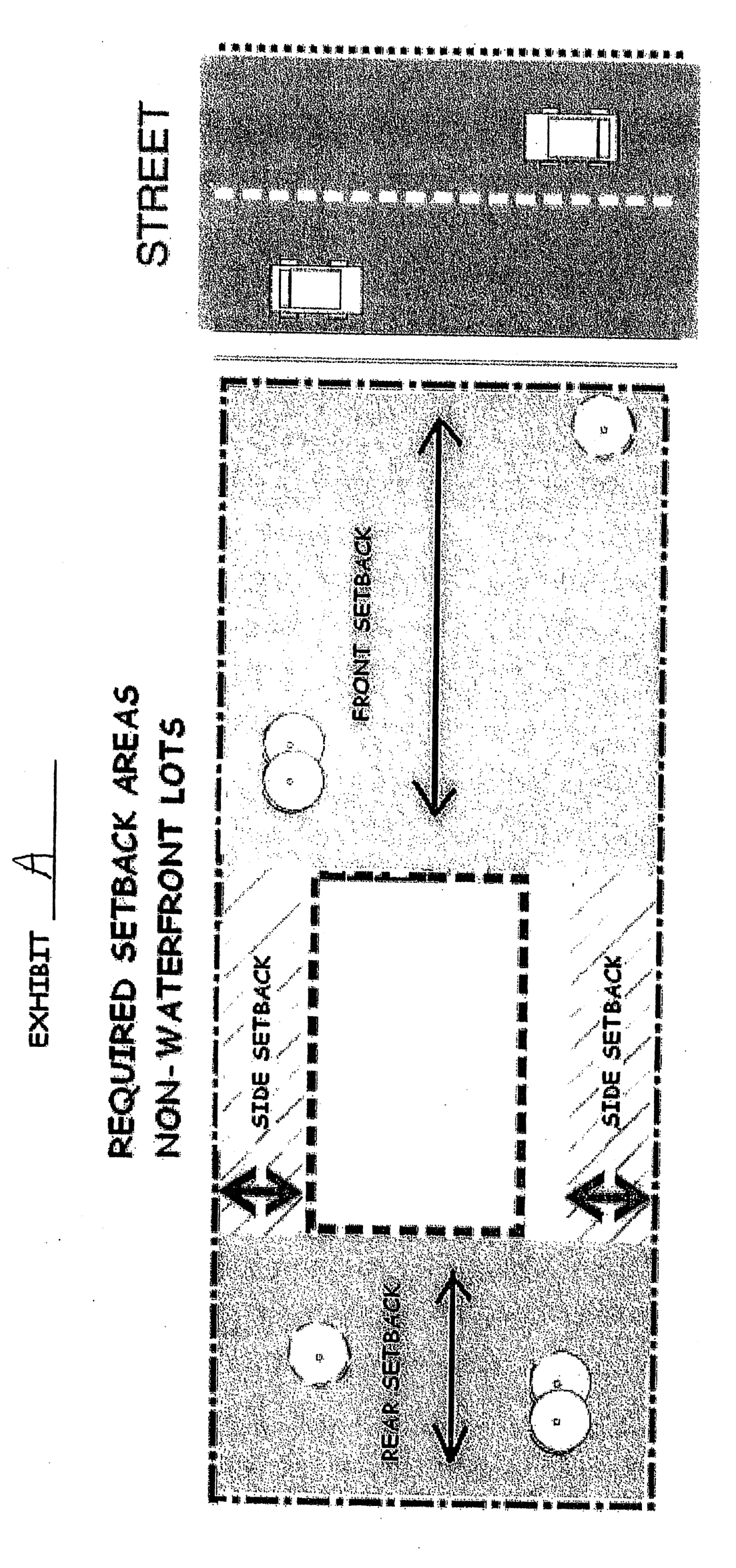
Required Setback—Nonwaterfront Lots
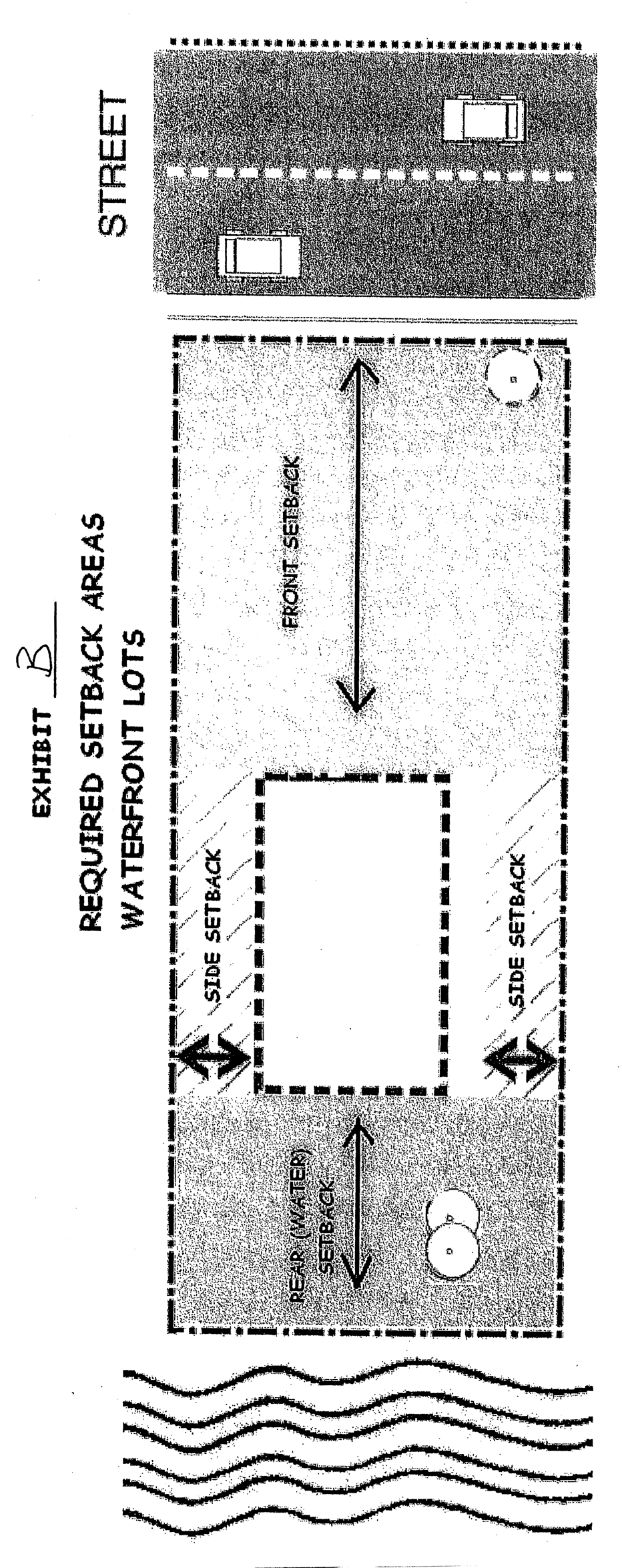
Required Setback—Waterfront Lots
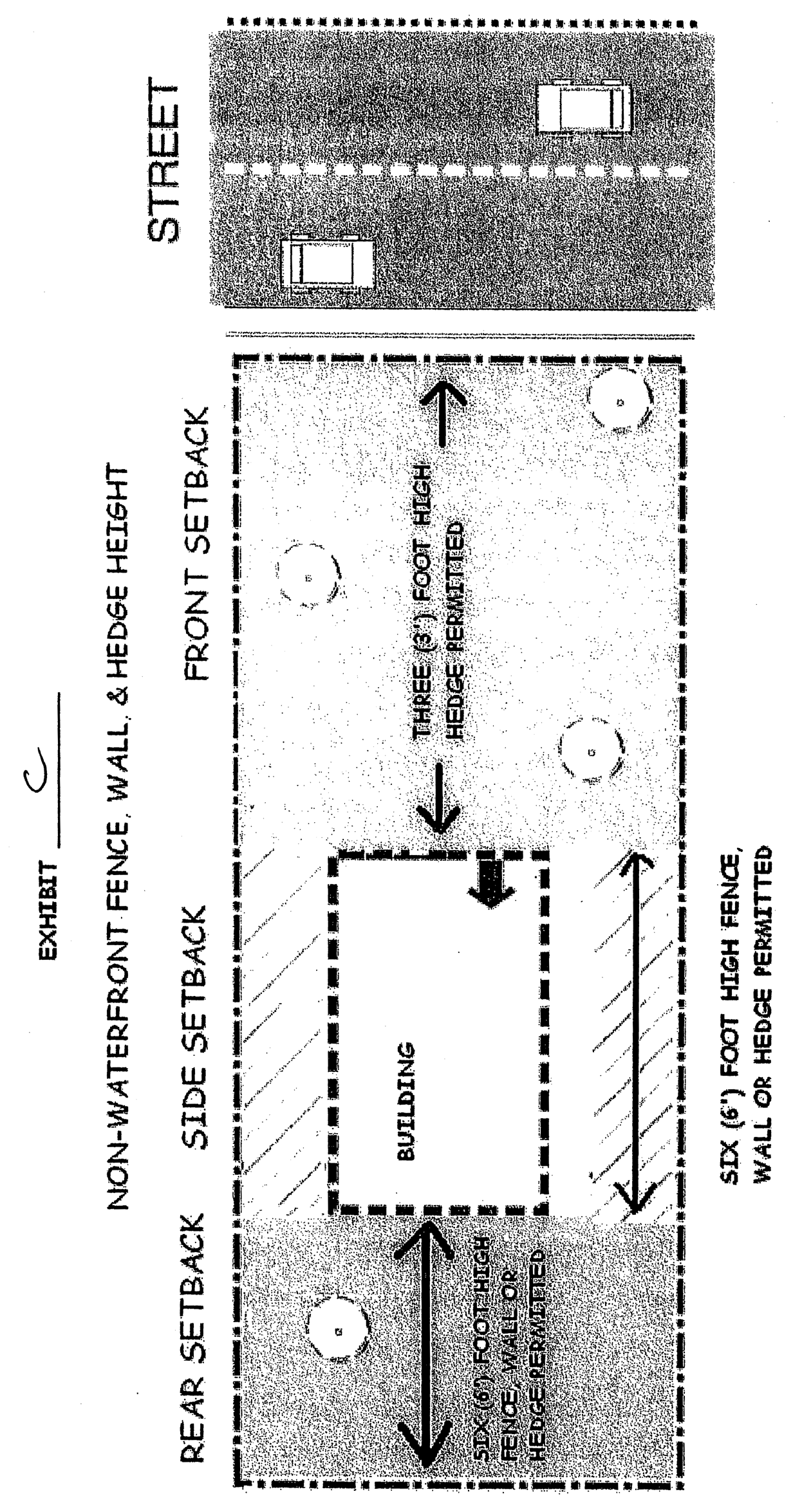
Nonwaterfront Fence, Wall and Hedge Height
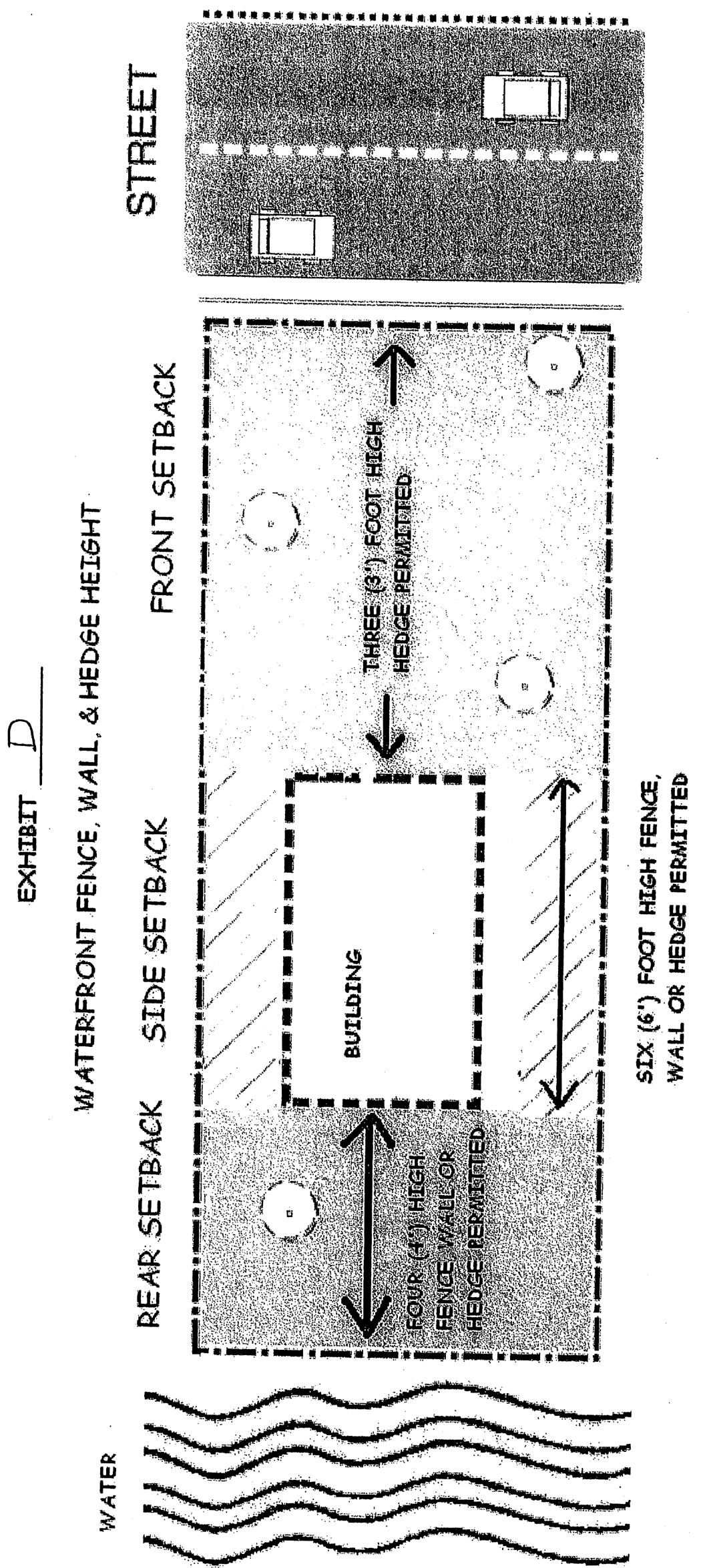
Waterfront Fence, Wall and Hedge Height
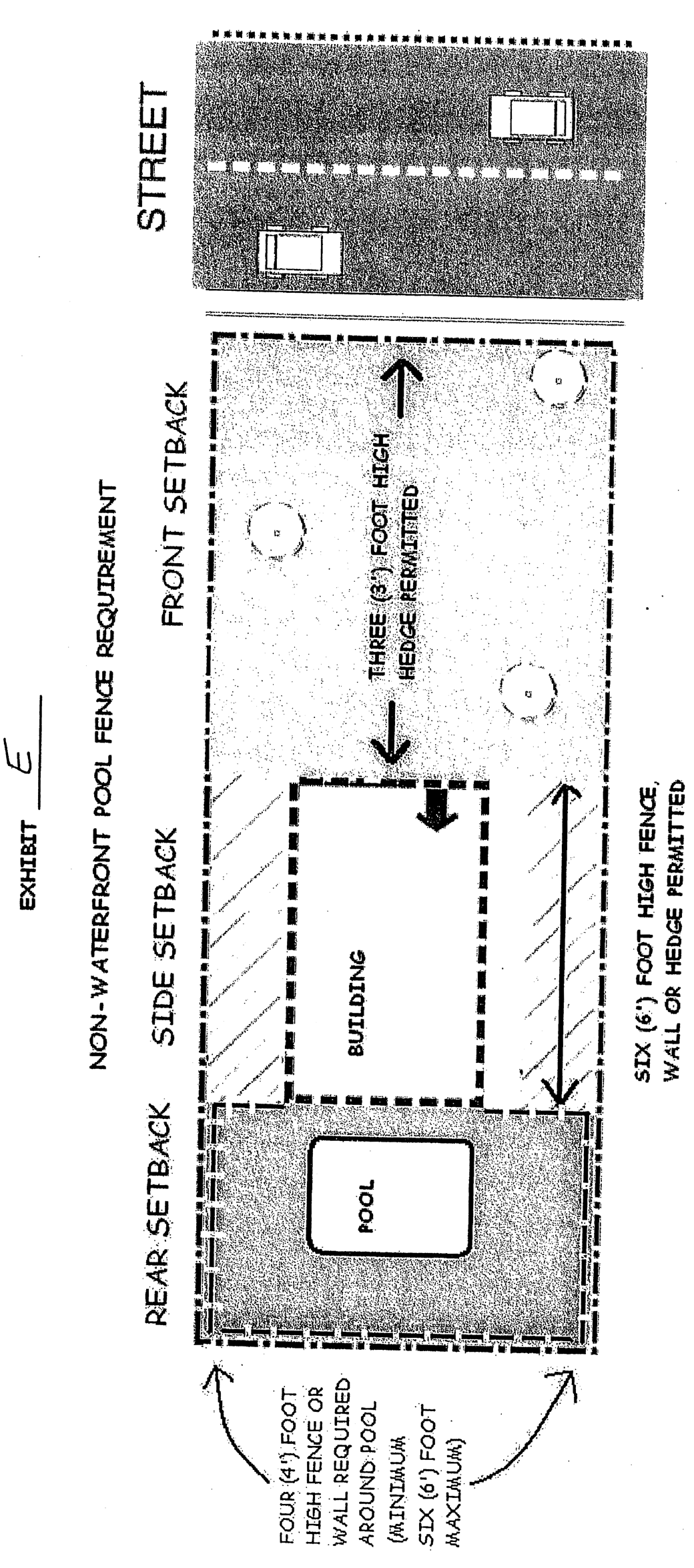
Nonwaterfront Lot Pool Fence Requirement
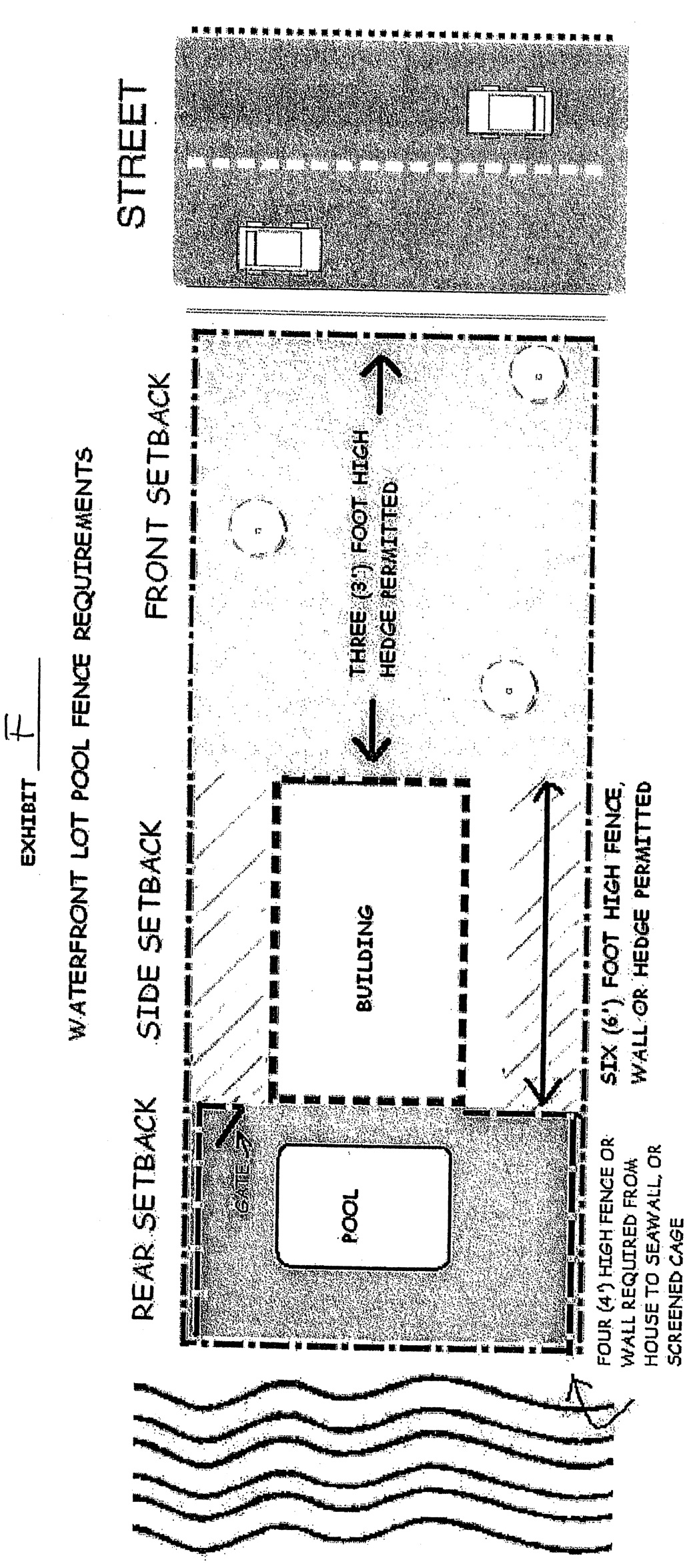
Waterfront Lot Pool Fence Requirement
(Ord. No. 06-10, § 1, 6-5-2006)

