
Biscayne Park City Zoning Code
PART II
ELEMENTS
3.1. - Generally.
3.1.1
Purpose of chapter. The purpose of this chapter is to describe the specific uses and restrictions that apply to the land use district in the land use element of the comprehensive plan. These regulations are intended to allow development and use of property only in compliance with the goals, objectives, and policies of the village as expressed in the village of Biscayne Park's Comprehensive Plan.
3.2. - Land use district.
3.2.1
Land use district instituted. The land use district for the village is instituted in the comprehensive plan, future land use element, including a map. The land use district and classifications defined in the future land use element of the Biscayne Park Comprehensive Plan and delineated in the future land use map shall be the determinants of permissible activities on any parcel in the jurisdiction. Allowable uses are described in section 3.3 below to safeguard the compatibility of adjacent land use activities with the land use district and address the location and extent of nonresidential land uses.
3.2.2
Land use district; established residential. The established residential land use district is provided to supply appropriate standards for the protection of the district consistent with the established development in the fully developed village. Appropriate uses are limited to residential development at existing densities, parks, public open spaces and outdoor recreation uses, and defined public service uses.
3.2.3
Residential sectors instituted. The village is hereby divided into residential sectors as shown on the official sector map made by the planning board and hereby made a part of this chapter. The original map is on file in the village clerk's officer and a copy is included [following this appendix]. The sectors are designated and shall be subject to regulations as herein provided.
Cross reference— Adopted levels of service shall not be degraded, § 9.2.
3.3. - Uses allowed.
3.3.1
Types of uses allowed in the established residential land use district.
(a)
Residential. The category of residential uses includes one-family dwellings and two-family dwellings. Certain areas or sectors of the village are limited to one (1) or more housing types in order to preserve the established character of the area.
(b)
Public open space and outdoor recreational. These uses include public parks, street medians and parkways, and areas for outdoor recreational activities. Permissible uses shall include parks, public playgrounds, tennis courts, and similar recreational uses. No land or buildings shall be used for any use inconsistent with the rights of the public. Owners of property desiring to convey or dedicate areas to public or quasi-public use shall file an application with the planning board.
Cross reference— Adopted levels of service, § 9.3.
(c)
Public service. The public service category provides for institutional, such as churches, and public utility uses such as emergency service activities and maintenance facilities.
3.3.2
Allowable uses within each residential sector.
(a)
The following uses are allowed in sectors A, B, and C in the established residential land use district. All other uses are prohibited:
(1)
Residential;
(2)
Public open space and outdoor recreational; and
(3)
Public facility/service.
(b)
The following uses are allowed in sector D. All other uses are prohibited:
(1)
Community residential home;
(2)
Public open space;
(3)
Temporary parking (unpaved surface);
(4)
Public facility/service, except preschool use, which use is equivalent to a "day nursery" as defined under the Miami-Dade County Code, section 33-151.
(c)
Refer to Table A for the regulations applicable to each residential sector.
(d)
Within the A sector, the properties with a future land use designation of public facilities shall be entitled to have a day care or school use, consistent with Policy 2.7.1 of the comprehensive plan, and consistent with chapter 33-151, Miami Dade County Code, based upon Miami-Dade County Home Rule Authority.
(Ord. No. 2012-10, § 2, 3-5-13)
3.4. - Nonconforming uses.
3.4.1
Prohibited uses. The following uses are specifically prohibited and declared unlawful, but the enumeration of these specific uses shall not by implication grant the right to make any use not permitted by the terms of Ordinance No. 84 (11-21-1944).
(a)
Garage apartment, tourist tent, trailers or trailer camps, truck trailers, mobile homes, amusement parks, bungalow courts, chicken houses, private or commercial dog kennels, rabbit hutches, night clubs, beer gardens, house boats, commercial boat houses or any use defined as commercial.
(b)
Any use not consistent with the residential sector regulations (Table A).
3.4.2
Nonconforming use discontinued. The lawful use of land or improvements existing at the time of the adoption of this code, although such use does not conform to the provision hereof, may be continued, but if discontinued for a period of six (6) months such nonconforming use shall not thereafter be re-established and the future use of such land or improvements shall be in conformity with the provisions of this code.
(Ord. No. 283, § 2, 10-5-93)
3.5. - Historic sites.
3.5.1
Historic preservation ordinance. To protect, enhance and perpetuate properties of historic value and architectural merit in the village the Metropolitan Dade County Historic Preservation Ordinance is hereby incorporated by reference into this Code.
3.5.2
Building permit for designated historic sites. No building permit for alteration, restoration or renovation will be issued by the village for a building or structure which is designated by the Dade County Historic Preservation Board prior to the approval of a certificate of appropriateness by the historic preservation board.
Reference—County Ord. No. 81-13, § 1, 2-17-81.
4.1. - Minimum housing standards.
4.1.1
Applicability of the Dade County Code. The provisions of the Dade County Code Chapters 17, Housing and 17A, Vacant Housing Structures Standards, Minimum, are incorporated herein by reference and shall be applicable as a minimum standard in the village to, among other things, prevent blight and decay and to safeguard public health, safety, morals and welfare.
(Ord. No. 283, § 3, 10-5-93)
4.2. - Structural recertification of existing buildings forty (40) years or older.
4.2.1
Applicability of the Dade County Ordinance. The provisions of the Metropolitan Dade County Ordinance shall be applicable for structural recertification of existing buildings forty (40) years and older in the village.
Reference—County Ord. No. 75-34, § 5-21-75.
4.3. - Dwelling types.
4.3.1
Dwelling types allowed. Dwelling types allowed in each residential sector of the village shall be only as described in Table A, Residential Sectors.
4.3.2
Dwelling types prohibited. Mobile homes are prohibited.
4.3.3
[Presumptions.]
(a)
Presumption of illegal multiple family use or subdivision. It shall be presumed that a prohibited, illegal, and violative multi-family use of a one-family dwelling has been established when one (1) or more of the following conditions are observed:
(1)
There are two (2) or more electrical, water gas or other types of utility meters, or mailboxes on the premises.
(2)
There is evidence of a liquid propane (LP) gas tank installed in an unauthorized detached structure on the premises.
(3)
There is more than one (1) cooking area in the primary structure or an accessory building has a cooking area. Notwithstanding the foregoing, an unenclosed outdoor cooking area located under a pergola or similar accessory structure shall not be considered a condition that establishes a presumption of illegal multiple family use or subdivision.
(4)
All living areas in the dwelling unit are not interconnected.
(5)
Multiple numbered, lettered, or otherwise labelled parking spaces.
(6)
An unauthorized detached building with air conditioning, interior cooking areas or utility meters.
(7)
There is more than one (1) different house address unit number posted on the premises.
(8)
An advertisement or sign indicating the availability of more than one (1) dwelling unit on the premises.
(9)
An unpermitted exterior door.
(10)
Disproportionately high utility bill or bills in comparison to similarly-sized residences in the area, or disproportionately high utility bill or bills in relation to the number of bedrooms.
(11)
Disproportionate number of vehicles parked overnight at or registered to the property in relation to the number of bedrooms.
(b)
Presumption of illegal rooming house. As used herein, rooming house shall mean any dwelling, or part of any dwelling, containing one (1) or more rooming units in which space is let by the owner or operator on a predominantly permanent basis to three (3) or more persons who are not husband or wife, son or daughter, mother or father, sister or brother of the owner or operator. For the purpose of the Biscayne Park Land Development Code, boardinghouses are included in this category. It shall be presumed that a rooming house has been established when one (1) or more of the following conditions are observed:
(1)
An advertisement or sign indicating the availability of rooms, beds, or living spaces for rent.
(2)
Interior locks, partitions, or hasps.
(3)
Provision of cooking or kitchen appliances, such as electric fry pans, toaster ovens, or refrigerators, in individual rooms.
(4)
Individual storage of food in bedrooms.
(5)
Alphabetical, numeric, or other labeling of bedrooms or living areas.
(6)
Multiple numbered, lettered, or otherwise labelled parking spaces.
(7)
Alterations to structures which enhance or facilitate its use as a rooming house.
(8)
Disproportionately high utility bill or bills in comparison to similarly sized residences in the area, or disproportionately high utility bill or bills in relation to the number of bedrooms.
(9)
Disproportionate number of vehicles parked overnight at or registered to the property in relation to the number of bedrooms.
(c)
Rebutting the presumption. The presumption may be rebutted by the submission of a notarized affidavit in a form acceptable to the village manager from the property owner attesting that the entire dwelling unit and accessory structures are being maintained for one-family dwelling use only, and one (1) of the following:
(1)
The property owner submits a current as-built floor plan prepared by a licensed engineer or architect, surveying the entire dwelling unit and accessory structures and showing all rooms are interconnected as a single-family dwelling and attesting that no conditions on the property show an illegal subdivision of the residence or illegal multi-family or rooming house use; or
(2)
A code compliance officer is able to enter the property, inspect the interior of the dwelling unit and accessory structures and verify its use as a single-family dwelling.
(d)
Enforcement and penalties.
(1)
The village may enforce the provisions contained in section 4.3 in accordance with chapter 14 of the Biscayne Park Land Development Code. In addition to any code compliance action taken by the village, the village may take any other appropriate legal action, including, but not limited to, injunctive action, to enforce the provisions of this section. Nothing contained in this section shall prevent the enforcement actions authorized by the Village of Biscayne Park's Code, Miami-Dade County Code of Ordinances, Florida Statutes, and any other governmental agency.
(2)
Penalties. Any person or entity who violates the provisions contained in section 4.3 shall be subject to a fine of two hundred fifty dollars ($250.00) per day for a first violation and five hundred dollars ($500.00) per day for a repeat violation, to be issued in accordance with chapter 14 of the Biscayne Park Land Development Code. Each day any violation of this section continues shall constitute a separate offense.
(Ord. No. 2023-09, § 3, 8-8-23)
4.4. - Community residential homes.
4.4.1
Community Residential Homes Act. The state requirements for siting of community residential homes are hereby incorporated into this code by reference.
4.4.2
Designated site for a community residential home. A site for a community residential home is designated as residential sector D in the established land use district.
Cross reference— Allowable use within each residential sector, § 3.3.2(b).
State Law reference— Community residential homes, F.S. § 419.001 et seq.
5.1. - General provisions.
5.1.1
Purpose. This chapter establishes minimum requirements applicable to the transportation system, including public and private streets, bikeways, pedestrian ways, parking, and access control from public streets. The standards in this chapter are intended to minimize the traffic impacts of development, and to assure that all developments adequately and safely provide for the storage and movement of vehicles with good engineering and development design practices.
5.1.2
Compliance with technical construction standards manual. All required elements of the transportation system shall be provided in compliance with the engineering design and construction standards of the Public Works Manual, Metro-Dade County.
5.2. - Streets.
5.2.1
Street classification system established. Streets in the village are classified and mapped according to function served in order to allow for regulation of access and appropriate design and construction standards. Streets dedicated to the village and private streets are classified in a street hierarchy system with design tailored to function. The street hierarchy system shall be defined by road function and average daily traffic (ADT), calculated by trip generation rates prepared by the Institute of Transportation Engineers. The following street hierarchy is established: Residential, collector, and arterial. Each street type is divided into subcategories.
5.2.2
Residential streets (local roads). Residential streets are primarily suited to providing direct access to residential development and are designed to minimize unnecessary and/or speeding traffic. Each residential street shall meet the minimum standards for one (1) of the following street types:
(a)
Residential access street. This is the lowest order street in the hierarchy. A residential access street is a frontage street which provides direct access to abutting properties and should not carry more traffic than is generated on the street itself. Residential access streets may take access from any higher order street type. Both ends of a residential loop street must take access from a single higher order street. Residential access streets shall have a maximum ADT of five hundred (500). Loop streets shall have a maximum of four hundred (400). Cul-de-sacs shall have a maximum ADT of two hundred (200).
(b)
Residential subcollector street. This is the middle order street in the residential street hierarchy. It will collect traffic from residential access streets and provide direct access to abutting properties. Residential subcollector streets may take access from any higher order street type and may give access to residential access streets and may provide direct access to nonresidential uses. Residential subcollector streets shall have a maximum ADT of one thousand (1,000).
(c)
Residential collector street. This is the highest order street that can be classified as residential. It will collect traffic from residential access and subcollector streets and may provide direct access to nonresidential uses. Residential collector streets shall have a maximum ADT of two thousand (2,000).
5.2.3
Collector roads (county collectors). Collector roads connect lower order streets to other collector streets and to arterial streets, provide access to nonresidential uses, and serve through traffic. Collector streets shall have an average daily traffic volume of no greater than seven thousand (7,000).
5.2.4
Arterial roads (state minor arterials). There are three (3) types of arterial roads, minor, major, and freeways but there is only a minor type in the village. The minor arterial links community districts to regional and state highways and may give access to any lower order street type.
5.2.5
Special purpose roadways.
(a)
Alley. Alleys are not considered part of the street hierarchy system as they are generally unpaved thoroughfares for the purpose of service to adjacent properties.
(b)
Divided streets. Divided streets are for the purpose of protecting environmental features or avoiding excessive grading. In such a case, the standards shall be applied to the aggregate dimensions of the two (2) street segments.
5.2.6
Future traffic circulation map. The future traffic circulation map and any amendments thereto, adopted by the village as part of the comprehensive plan (Map 3.4), is hereby made a part of this code. Roadways within the village are either designated in the future traffic circulation map or may be classified according to function, design, and use by the village upon request. The map shall be the basis for all decisions regarding required road improvements or access.
5.3. - Rights-of-way.
5.3.1
Right-of-way widths. The right-of-way shall be measured from lot line to lot line.
5.3.2
Protection and use of rights-of-way.
(a)
No encroachment shall be permitted into existing rights-of-way, except for temporary use authorized by the village.
(b)
Use of the right-of-way for public or private utilities, including, but not limited to, potable water, telephone wires, cable television wires, gas lines, sanitary sewer, or electricity transmission, shall be allowed subject to the placement specifications in the Public Works Manual, Metro-Dade County, and other applicable county regulations.
(c)
All vehicles of any type parked on any street, alley, or public right-of-way in the Village of Biscayne Park shall have at all times attached a current license plate.
(d)
Sidewalks and bicycle ways shall be placed within the right-of-way.
5.3.3
Parking of trucks, etc., prohibited in the right-of-way.
(a)
It shall be unlawful to park or cause to be parked upon any public street or in the public right-of-way in the village any truck, trailer, semitrailer, bus (public or private owned) except while loading or unloading or when such vehicle is parked in connection with and in the aid of the performance of a service to or on the property being serviced.
(b)
Nothing herein contained shall be deemed to prohibit the parking of one (1) truck in front of any one property not exceeding three-fourths ton net weight that contains no lettering or advertising and is owned or leased by the occupant of the property, when it is proven to be physically impossible to park it off of the public right-of-way.
(c)
It shall be unlawful to park or store any boat, boat trailer, air boat, any self-propelled or nonself-propelled mobile home, motor home or camper upon any public street or in the public right-of-way in the village.
Cross reference— Truck overnight parking permit, § 16.11.
5.3.4
Landscaping and objects in the swale area of the right-of-way.
(a)
Markers. Dome-type markers only may be placed within dedicated right-of-way, provided that they are placed not closer than eighteen (18) inches to the nearest edge of the paved surface of the designated roadway. All markers must be at least twenty-four (24) inches apart. Markers placed in the right-of-way shall not exceed twelve (12) inches in diameter, nor be more than six (6) inches in height and shall be white in color.
(b)
Landscaping. Nothing shall be planted or allowed to grow in such a manner so as to obstruct the right-of-way clear zone at a level between three (3) feet and six (6) feet above the grade, measured at the centerline of right-of-way. Trees or palms, however, having trunks and foliage trimmed in such a manner that no branches or foliage extend into the right-of-way area clear zone shall be allowed, provided they are so located so as not to create a traffic hazard.
(c)
Paving and drainage. Pervious pavers shall be allowed but any impervious paving shall be adequately drained to prevent the buildup of stormwater in the right-of-way.
(d)
Other objects prohibited. It shall be unlawful to install, place or maintain within the dedicated right-of-way, parking or swale area of the village any pointed concrete or other unapproved hard materials, such as rocks, stones, bricks, metal objects or other similar obstructions.
(e)
A combination of an approved parking approach and sodding of rights-of-way shall be permitted, provided the impervious section does not exceed forty (40) percent of the total area and such paved areas shall be kept in good condition.
(f)
Removal of obstructions by the village. In the event any object or tree placed in the swale creates an emergency situation involving potential danger to the health, safety and welfare of the community, the village may perform removal operations immediately, thus eliminating the emergency, and may assess the cost of such removal against the adjacent property owner.
(g)
Removal of trees in the swale by the abutting property owner. Property owners must obtain a permit from the village and Miami-Dade County to remove trees in the swale.
(h)
Property owner/resident responsibilities for maintenance. The property owner or resident living in the property shall be jointly and severally responsible for the maintenance of the swale area contiguous to their property. Maintenance shall include, but not be limited to, mowing the sod and performing general edging, weeding, trimming, pruning and cleanup activities. The landscaping and sod shall be maintained in good plant health. The landscaping shall be kept free of dead limbs and branches. No swale landscaping shall be maintained in such manner as to constitute a nuisance.
(i)
Property owners shall be responsible for the maintenance of the swale area contiguous to their property as well as for the removal and costs of dead, diseased and/or fallen trees and any trees that may interfere with the right-of-way or otherwise pose a danger to the health, safety and welfare of the community.
5.3.5
Vacation of rights-of-way. Applications to vacate a right-of-way may be approved upon a finding that all the following requirements are met:
(a)
The requested vacation is consistent with the traffic circulation element of the village comprehensive plan.
(b)
The right-of-way does not provide the sole access to any property. Remaining access shall not be by easement.
(c)
The vacation would not imperil the current or future location of any utility.
(d)
The proposed vacation is not detrimental to the public interest, and provides a benefit to the village.
(Ord. No. 2015-04, § 2, 9-1-15)
Cross reference— Right-of-way permit, § 16-8.1; fees for right-of-way permits, § 17.7.1.
5.4. - Street standards.
5.4.1
Clear visibility triangle. In order to provide a clear view of intersecting streets to the motorist, there shall be a triangular area of clear visibility formed by two (2) intersecting streets or the intersection of a driveway and a street. The following standards shall be met:
(a)
For street intersections the clear visibility triangle shall be formed by a line along the street pavement edge fifteen (15) feet long from the street corner perpendicular, generally, to a second line of the street pavement edge of approaching traffic, connected by a third line that measures three (3) times the speed limit of the street.
(b)
For driveways two (2) clear visibility triangles shall be formed by connecting, in each case, a point on the edge of the street pavement and a point on the edge of the driveway, each to be located at a distance of twenty (20) feet from the intersection of the street and driveway lines, and a third line joining the two (2) points.
(c)
Nothing shall be erected, placed, parked, planted, or allowed to grow in such a manner so as to obstruct cross-visibility at a level between three (3) feet and six (6) feet above the grade, measured at the centerline of the intersection. Trees or palms, however, having trunks and foliage trimmed in such a manner that no trunks or foliage extend into the cross-visibility area shall be allowed, provided they are so located so as not to create a traffic hazard.
5.5. - Sidewalks and bikeways.
5.5.1
Design and construction standards. Design and construction of sidewalks, bikeways, or other footpaths shall conform to the requirements of the Public Works Manual, Metro-Dade County, including provision for access by physically handicapped persons.
5.6. - Off-street parking.
5.6.1
Applicability. Off-street parking facilities shall be provided within each property in the village pursuant to the requirements of this code. The facilities shall be maintained as long as the use exists that the facilities were designed to serve.
(a)
All vehicles must be parked on an approved parking surface subject to the design standards set forth in section 5.6.7.
(1)
Nonconforming residential properties that do not have an approved parking surface, including an approved approach, shall have until January 2, 2023 to have the compliant parking surface permitted and installed.
(2)
Existing nonconforming parking surfaces may remain unless a substantial portion, fifty (50) percent or greater, requires repair or an addition to the parking surface occurs. Those nonconforming parking surfaces that require repairs of fifty (50) percent or greater at the time of the enactment of this ordinance shall have until January 2, 2023 to have a compliant parking surface permitted and installed.
5.6.2
Computation. In the village hall, recreation area, and church, the occupancy shall be based on the maximum capacity rating given the building by the fire marshal. Gross floor area shall be the sum of the gross horizontal area of all floors of a building measured from the exterior faces of the exterior walls.
5.6.3
Number of parking spaces required. The table below specifies the required minimum number of off-street parking spaces. The number of off-street parking spaces for uses not listed in the table shall be determined by the planning board. The term "tandem parking space" means a parking space that abuts a second parking space in such a manner that vehicular access to the second space can be made only through the abutting (tandem) space.
;sz=9;* Resident parking spaces may be tandem.
;sz=9;** If on-street parking is not permitted or is restricted on the unit's street frontage, then one visitor parking space shall be required. The visitor space shall be located not more than one hundred (100) feet from the unit's street frontage.
5.6.4
Handicapped parking spaces. Any parking area to be used by the general public shall provide suitable, marked and paved parking spaces for handicapped persons. The number, design, and location of these spaces shall be consistent with the requirements of F.S. §§ 316.1955, and 316.1956, or succeeding provisions. No parking spaces required for the handicapped shall be counted as a parking space in determining compliance with subsection 5.6.3, public uses, above, but supplemental spaces for the handicapped shall be counted. The parking and related features contained in the Department of Community Affairs, Florida Board of Building, Codes and Standards, Accessibility Requirements Manual are hereby incorporated by reference into the Village Code.
5.6.5
Existing nonconforming minimum off-street parking requirements. The number of off-street parking spaces existing on properties at the time of the adoption of this code, although such number does not conform to the minimum off-street parking requirements hereof, may be lawfully continued. However, all vehicles must be parked on an approved parking surface consistent with section 5.6.1.
5.6.6
Historic preservation exemption. The preservation of any property that has been placed on the county or national register of historic places, shall be grounds for a grant by the planning board of a reduction in, or complete exemption from, the parking requirements in subsection 5.6.3 of this chapter.
5.6.7
Design standards for off-street parking. Except as provided herein, all required off-street parking spaces and the use they are intended to serve shall be located on the same parcel. The size and layout of these spaces shall be according to the Miami-Dade County Code and Public Works Manual, Miami-Dade County.
(a)
Vehicles shall be parked on an approved parking surface. Approved parking surfaces shall not exceed forty percent (40%) of the front yard, excluding the right-of-way. The remainder of the front yard shall consist of landscaping and green area.
(b)
Off-street parking (within the lot lines of all properties) shall only be permitted on approved surfaces by the Village of Biscayne Park.
(c)
All parking surfaces must have an improved driveway approach across the swale which shall be of the same material and design as the remainder of the approved parking surface. All parking surfaces shall be of one (1) material or of unified design throughout.
(d)
Setbacks. All parking surfaces shall be no closer than thirty (30) inches from side property line unless exempted below in subsection (1).
(1)
All nonconforming parking surfaces, as related to setback, shall come into compliance when there is a change in parking surface material or the installation of a new parking surface.
(e)
Surfacing. Parking surfaces shall only be constructed with the following materials: concrete, paver, brick, gravel, asphalt, cut stone, or turf block.
(1)
As used herein, the term asphalt does not include milled asphalt. Milled asphalt is a prohibited parking surface.
(2)
As used herein, the term gravel does not include crushed limestone, which is a prohibited parking surface.
(3)
Except in the case of use as decorative trim, neither grass nor sod shall be an approved parking surface.
(4)
Use of artificial turf is limited solely for decorative and trim purposes. Artificial turf is a prohibited parking surface.
(f)
Gravel parking surfaces. Gravel parking surfaces shall be built with a permanent perimeter border consisting of suitable material as approved by village staff a minimum of four (4) inches deep with the width of the border being sixteen (16) inches immediately adjacent to the road perimeter and four (4) inches along the entire length of both edges of the parking surface. Gravel parking surfaces shall have a finished top layer of dense grade gravel, such as pea gravel, jersey shore gravel, marble chips, limestone gravel, or river rock, with an average diameter of three-eighths (⅜) inches to three-quarters (¾) inches.
(g)
Concrete parking surfaces. Concrete parking surfaces may be painted, stained, or otherwise colorized with a color that is the same or substantially similar to a color within the paint palette recommended by the planning board and approved by the village commission. Any painting, staining, or colorizing of a concrete parking surface shall be subject to the review and approval of the planning board.
(h)
Borders.
(1)
The borders of all parking surfaces shall be landscaped or sodded. In no event shall the borders of any parking surface remain bare with exposed soil.
(2)
The borders of all parking surfaces shall be maintained in such a manner so that it is flush or level with the parking surface. Raised parking surfaces are prohibited.
(i)
Wheel stops prohibited. Wheel stops are prohibited in single-family and duplex dwellings.
5.6.8
Drainage. All parking surfaces shall be properly and sufficiently graded and drained so as to prevent causing an increased burden or nuisance upon adjoining private and public property, including the right-of-way, by reason of runoff water.
5.6.9
Maintenance. Once a parking surface is constructed, the property owner shall be responsible for maintaining and repairing said parking surface in a manner to ensure that it is free of cracks and potholes. For asphalt parking surfaces, regular maintenance shall include sealing of the asphalt.
5.6.10
Partial parking surface improvements. Any repairs or improvements to fifty percent (50%) or more of a parking surface shall require that the property owner replace the entire parking surface.
5.6.11
Restoration following construction or removal of parking surface. If all or part of a parking surface is removed, the portions wherein the parking surface previously existed shall be restored with sod or landscaping.
5.6.12
Indemnification. Construction of a portion of a parking surface in the swale or right-of-way, such as the apron and parking surface approach, shall require the property owner to indemnify, hold harmless, and defend the village from any and all actions, caused by, resulting from, or in any way associated with the proposed work within the village right-of-way on a form provided by the village.
(Ord. No. 2015-04, § 3, 9-1-15; Ord. No. 2021-13, § 2, 1-11-22)
6.1. - Generally.
6.1.1
Purpose of chapter. The purpose of this chapter is to provide criteria for basic utilities, to provide for a village solid waste management program, and establish the standards for stormwater management.
(Ord. No. 2013-05, § 2, 7-9-13)
6.2. - Utilities.
6.2.1
Utilities. The criteria for basic utilities for the village are listed below:
(a)
Electricity. Every lot shall have available to it a source of electric power adequate to accommodate the reasonable needs of the principal use on the lot.
(b)
Water. Every lot shall have central potable water hookup.
(c)
Telephone. Every lot shall have available to it a telephone service cable adequate to accommodate the reasonable needs of the principal use.
(Ord. No. 2013-05, § 2, 7-9-13)
6.3. - Solid waste.
6.3.1
Local government solid waste responsibilities. The municipality of Biscayne Park is responsible for collecting and transporting solid waste from its jurisdiction to a solid waste disposal facility operated by the county or operated under a contract with the county. The county may charge reasonable fees for the handling and disposal of solid waste at their facilities.
6.3.2
Containers.
(a)
Each residential unit shall have a sufficient number of garbage cans or approved containers, not to exceed forty (40) gallons in capacity, to accommodate all garbage, leaves and grass cuttings. Garbage cans shall be kept tightly-closed at all times and easily accessible to collectors. Collection service may be discontinued where the garbage cans or containers are determined to be unfit for receptacles by the public works department. Failure of the property owner to provide proper garbage cans or containers which results in discontinuance of service shall subject the property owner to the penalty provisions of this code.
(b)
Garbage cans and trash receptacles must be placed behind the face of the building and screened from view except when properly placed out for pickup.
(c)
Dumpsters.
(1)
Intent. It is the intent of this section to regulate the location and construction of bulk container enclosures in a manner that promotes the public health and safety, and lessens or otherwise mitigates the visual impact of such bulk containers upon the community. A bulk container is a receptacle with a capacity of greater than one (1) cubic yard which purpose is for the disposal and storage of garbage, trash and any form of waste materials, not including hazardous or infectious waste.
(2)
Domestic trash. Every refuse accumulation of animal, fruit or vegetable matter that attends the preparation, use, cooking and dealing in the storage of edibles, and any other matter of any nature whatsoever which is subject to decay, purification and degeneration of noxious or offensive gases or odors.
(3)
Garden/bulky waste. Items of household refuse, tree cutbacks and shrubbery cuttings, and other refuse attending the care of lawns, boxes and like articles.
(4)
Enclosure. Wheeled bulk containers for the disposal of solid waste shall be enclosed in a fence or wall fully screening it from view. Chain link fencing is not permitted for enclosure or gate. Containers are to be positioned upon a hard surface pad and a hard surface roll-away from the pad to the servicing area is provided to facilitate servicing. Wheeled bulk containers shall only be placed curbside for collection and shall remain curbside for a reasonable amount of time in order to facilitate collection. In no case shall wheeled bulk containers remain overnight at curbside or street side.
(5)
Size requirement. Each enclosure shall provide a minimum of eighteen (18) inches of clear space between each side of each bulk container (including lifting flanges) and the adjacent wall surface of that enclosure, or other containers within the same enclosure. The height of each enclosure shall be six (6) inches greater than the highest part of the bulk container therein.
(6)
Placement. The placement of containers and enclosures shall be planned and constructed in a manner that allows unobstructed access to each container and the unobstructed opening of the gates during the emptying process. Containers shall not be located in such a manner that the service vehicle will block any intersection during the emptying process. Containers shall be located to the rear of the property, no closer than ten (10) feet to a property line.
(7)
Gates. All enclosures shall have gates and their construction shall be of sturdy metal frame and hinges with an opaque facing material. Servicing gates shall incorporate gate stops and latches that are functional in the full open and closed positions. Hinge assemblies shall be strong and durable so that access and servicing gates function properly and do not sag. Enclosure gates shall be closed at all times except for the time necessary to service the bulk container(s).
(8)
Pad/hard surface. All enclosures shall be placed on poured concrete, solid or perforated interlocking concrete block paving (ICB), or any existing hardened paving system. A service access drive for the purpose of emptying the bulk container shall also be provided unless a hard surface that provides access to the bulk container already exists.
(9)
Maintenance. Approved enclosures shall be maintained in good condition and appearance at all times. Gates and latches shall be kept fully operable and shall be cleaned periodically to prevent noxious odors and unsanitary conditions from occurring. Enclosure pads and access drives shall be repaired or rebuilt whenever the pavement structure deteriorates.
6.3.3
Owner/occupant responsibility.
(a)
It shall be the duty of each owner/occupant to prevent the continued, excessive and unsightly accumulation of garbage, trash and other types of waste and rubbish.
(b)
Unless side yard service is requested each owner/occupant shall place domestic (kitchen) trash and recyclable materials at the edge of the pavement in front of the property no earlier than 5:00 p.m. of the day preceding the scheduled collection time and containers must be removed and placed out of sight by 9:00 a.m. the day following the scheduled day of collection.
(c)
Failure to comply with the provisions of this section shall constitute a violation of this code.
6.3.4
Garden/bulky waste. All tree trimmers and tree surgeons who are employed by a resident or occupant of any residence or who may be employed by the village, or who may otherwise pursue their occupation in the village shall be required to remove immediately to a dump or other place designated for refuse, all refuse, cutting or debris resulting from their operation. In no event shall any refuse, cuttings or debris remain overnight on any premises where tree trimmers or tree surgeons have been engaged in their occupation. Each property owner shall place tree and garden refuse at the edge of the pavement in front of the property no earlier than 9:00 a.m. of the day preceding the scheduled collection time and containers must be removed and placed out of sight by 9:00 a.m. the day following the scheduled day of collection. Failure to comply with the provisions of this section shall constitute a violation of this code.
6.3.5
Recycling program. The village may form cooperative arrangements with the county for implementing recycling programs. The following requirements shall apply:
(a)
Construction and demolition debris must be separated from the solid waste stream and segregated in separate locations at a solid waste disposal facility or other permitted site.
(b)
The local government is encouraged to separate all plastic, metal, and all other grades of paper for recycling prior to final disposal and is further encouraged to recycle yard trash and other mechanically treated solid waste into compost available for agricultural and other acceptable uses.
(c)
In developing and implementing recycling programs, the village is encouraged to use for-profit organizations for the collection, marketing, and disposition of recyclable materials.
6.3.6
Solid waste franchise. The village may enter into a written agreement with other persons to undertake to fulfill some or all of the village's solid waste responsibilities.
6.3.7
Determination and announcement of full cost for solid waste management.
(a)
The village shall determine the full cost for solid waste management within the service area of the village for the one-year period beginning on October 1, 1988, and shall update the full cost every year thereafter. The method to be used in calculating full cost shall be according to the rule established by the Florida Department of Environmental Regulations.
(b)
The village shall establish a system to inform, no less than once a year, residential and nonresidential users of solid waste management services within the village service area of the user's share, on an average or individual basis, of the full cost for solid waste management as determined pursuant to subsection 6.3.7(a) above.
(c)
Additional/unscheduled trash removal. The village shall provide additional/unscheduled trash removal for its residents. The cost for these services shall be determined annually by resolution of the village commission.
6.3.8
Litter. Unless otherwise authorized by law or permit, it shall be unlawful for any person to dump litter in any manner or amount as stipulated in the Florida Litter Law.
6.3.9
Violations of this section; enforcement procedures available to village; schedule of fines and penalties. Any violation or repeat violation of this section may be pursued by the village by appropriate remedy either in court or through code enforcement by the imposition of a fine as set forth in a resolution kept on file by the village clerk. If it is the first violation, a warning may be given. Each day, or portion thereof, that a violation occurs is considered a separate and additional violation.
(Ord. No. 2013-05, § 2, 7-9-13; Ord. No. 2016-03, § 2, 4-5-16; Ord. No. 2016-04, §§ 3, 4, 4-5-16)
6.4. - Septic tanks.
6.4.1
Septic tank requirements. All septic tank requirements, inspections and permitting shall comply with the regulations of Miami-Dade County's Department of Environmental Resources Management.
(Ord. No. 2013-05, § 2, 7-9-13)
6.5. - Stormwater.
6.5.1
Stormwater management requirements. All stormwater management systems shall comply with applicable state regulations (Chapter 17-25, Florida Administrative Code) or rules of the South Florida Water Management District (Chapter 40E-4). In all cases the strictest of the applicable standards shall apply.
6.5.2
Flooding and drainage. On the basis of the Stormwater Rule (Chapter 17-25, F.A.C.) of the Florida Department of Environmental Regulation (DER) and Rule 17-40 F.A.C., flood and drainage considerations of any proposed development shall comply with Dade County Code Regulations Chapter 11C and Chapters 24.58, Dade County Public Works Manual Chapter 28, and the South Florida Water Management District's (SFWMD) criteria in their "Management and Storage of Surface Water; Permit Information Manual, Volume IV". All nonexempt development shall require appropriate permits from the DER and SFWMD before a development order is issued by the local government. Exmept development includes the construction of a single-family or duplex residential dwelling and accessory structures on a single parcel of land.
(Ord. No. 2013-05, § 2, 7-9-13)
6.6. - Water emergency.
6.6.1
Water emergency restrictions.
(a)
Intent and purpose. It is the intent and purpose of this section to protect the water resources of the Village of Biscayne Park from the harmful effects of over-utilization during periods of water shortage and allocate available water supplies by assisting the South Florida Water Management District in the implementation of its water shortage plan.
(b)
Definitions. For the purpose of this section, the following terms, phrases, words and their derivatives shall have the meaning given herein. When not inconsistent with the context, words used in the present tense include the future, words in the plural include the singular, and words in the singular include the plural. The word "shall" is always mandatory and not merely directory:
(1)
District means the South Florida Water Management District.
(2)
Person means any person, firm, partnership, association, corporation, company or organization of any kind.
(3)
Water resource means any and all water on or beneath the surface of the ground, including natural or artificial watercourses, lakes, ponds, or diffused surface water, and percolating, standing, or flowing beneath the surface of the ground.
(4)
Water shortage condition means that situation when sufficient water is not available to meet the present or anticipated needs of persons using the water resource, or when conditions are such as to require temporary reduction in total water usage within a particular area to protect the water resource from serious harm. A water shortage usually occurs due to drought.
(5)
Water shortage emergency means that situation when the powers which can be exercised under Florida Administrative Code, Ch. 40E-21, Pt. II, are not sufficient to protect the public health, safety, or welfare, or the health of animals, fish or aquatic life, or a public water supply, or commercial, industrial, agricultural, recreational or other reasonable uses.
(c)
Application of section. The provisions of this section shall apply to all persons using the water resource within the geographical areas subject to the water shortage condition or water shortage emergency, as determined by the district, whether from publicly or privately owned water utility systems, private wells, or private connections with surface waterbodies. This section shall not apply to persons using treated effluent or saltwater.
(d)
Adoption of water shortage plan. Florida Administrative Code, Ch. 40E-21, as same may be amended from time to time, is incorporated herein by reference as part of the Village of Biscayne Park Code of Ordinances.
(e)
Declaration of water shortage condition; water shortage emergency. The declaration of a water shortage condition or water shortage emergency within all or any part of the village by the village commission or the executive director of the district shall invoke the provisions of this section. During such water shortage emergency or water shortage condition, all water use restrictions or other measures adopted by the district applicable to the village shall be subject to enforcement action pursuant to this section. Any violation of the provisions of Florida Administrative Code, Ch. 40E-21, or any order issued pursuant thereto, shall be a violation of this section.
(f)
Prohibited acts. Notwithstanding any provisions of this code, the following shall be prohibited in the village upon declaration of a water shortage condition or water shortage emergency by the village commission or the executive director of the district:
(1)
Operation of outdoor fountains or outside aesthetic facilities whose purpose is strictly ornamental or decorative.
(2)
Pressure cleaning of impervious surfaces, except for the preparation of surfaces for painting, sealing or waterproofing, or for safety, sanitation, health or medical purposes.
These restrictions shall remain in effect for the duration of the declared water shortage condition or water shortage emergency.
(g)
Enforcement. Every police officer or code enforcement officer in the village shall, in connection with all other duties imposed by law, diligently enforce the provisions of this section. In addition, the village manager may also delegate enforcement responsibility for this section to other departments or personnel as the need may arise.
(h)
Penalties. Violation of any provision of this section shall be subject to the following penalties:
(1)
First violation: seventy-five dollar ($75.00) fine;
(2)
Second and subsequent violations: Fine not to exceed five hundred dollars ($500.00) and/or imprisonment in the county jail, not to exceed sixty (60) days.
(Ord. No. 2007-9, § 2, 6-5-07; Ord. No. 2013-05, § 2, 7-9-13)
Cross reference— Environmental management, water pollution, § 8.2.2; landscaping (water conservation), § 8.3.1.
7.1. - Generally.
7.1.1
Purpose of chapter. The purpose of this chapter is to describe the conditions for the storage of watercraft, recreational vehicles, commercial vehicles and trailers in the village.
(Ord. No. 2013-06, § 2, 7-9-13)
7.2. - Watercraft.
7.2.1
Conditions for the storage of watercraft. Watercraft not more than twenty-six (26) feet in length, not more than eight (8) feet, six (6) inches in beam, and not more than thirteen (13) feet, six (6) inches in height, may be stored subject to the following conditions:
(a)
No watercraft shall be kept, stored or parked so that any part shall extend into the front yard beyond the front building line. Watercraft shall be obscured from the public right-of-way with a fence or hedge, except in the following conditions:
(1)
Where a watercraft which was owned by an occupant-owner or occupant-lessee on or before July 9, 2013, cannot be placed behind the front building line without the removal of mature landscaping, a large tree(s), an existing wall, or insufficient space exists (i.e., because of a septic tank or other necessary obstruction) to the side of the building, the property owner may apply for an administrative variance to the planning and zoning board, without charge or fee for storage of a boat in the front yard. Any occupant-owner or occupant-lessee acquiring a watercraft on or before July 9, 2014 may also apply for an administrative variance to the planning and zoning board, without charge or fee for storage of a boat in the front yard. Upon proof of any of the above conditions, the administrative variance will be granted and shall remain in place until the village registration annual form is not renewed (for that boat or any subsequent replacement boat purchased for that administrative variance location) or such time as the house is sold or the occupant-lessee relocates. After the period identified above, an applicant may file for a variance pursuant to chapter 18 of the Land Development Code.
(b)
When an administrative variance is granted and watercraft is stored in front of the building line, where permitted, shall be stored on an approved driveway surface in compliance with chapter 5 of this Code.
(c)
Watercraft shall not be stored in the public right-of-way under any circumstances.
(d)
No more than one (1) watercraft may be kept on any one (1) premises except that:
(1)
Kayaks, canoes, row boats and personal watercraft (i.e., a "jet ski") stored behind the front building line of the building and concealed from public view are exempted.
(2)
Multifamily dwellings may store one (1) watercraft per dwelling unit complying with the provisions of this chapter.
(e)
Watercraft and place of storage shall be kept in a clean, neat and presentable condition.
(f)
No major repairs or overhaul work shall be made or performed on the site (or any other work performed thereon which would constitute a nuisance under existing ordinances).
(g)
Watercraft shall not be used for living or sleeping quarters, and shall be placed on and secured to a transporting trailer.
(h)
Watercraft shall be secured so as not to be a hazard or a menace during high winds or hurricanes.
(i)
Watercraft shall be owned by the occupant-owner or occupant-lessee of the property. In order to ensure that watercraft is being used and not stored on property for long-term storage, all state registrations for watercraft and trailers shall be kept current and a copy of the registration must be provided to the village annually and prior to storing a watercraft on an occupant-owner or occupant-lessee's premises.
(Ord. No. 2013-06, § 2, 7-9-13; Ord. No. 2014-07, § 2, 9-9-14)
7.3. - Recreational vehicles and trailers.
7.3.1
Conditions for the storage of recreational vehicles and trailers. Recreational vehicles and trailers in the form of travel and camping trailers, transport trailers and motor travel homes, designed and used as temporary living quarters for recreation or travel use may be parked in the open on sites containing a single-family or duplex residence, subject to the following conditions:
(a)
No recreational vehicle or trailer shall be kept, stored or parked so that any part shall extend into the front yard beyond the front building line. Recreational vehicles and trailers shall be obscured from the public right-of-way with a fence or hedge, except in the following conditions:
(1)
Where a recreational vehicle or trailer which was owned by an occupant-owner or occupant-lessee on or before July 9, 2013, cannot be placed behind the front building line without the removal of mature landscaping, a large tree(s), an existing wall, or insufficient space exists (i.e., because of a septic tank or other necessary obstruction) to the side of the building, an owner may apply for an administrative variance to the planning and zoning board, without charge or fee for storage of a recreational vehicle or trailer in the front yard. Any occupant-owner or occupant-lessee acquiring a recreational vehicle or trailer on or before July 9, 2014 may also apply for an administrative variance to the planning and zoning board, without charge or fee for storage of a recreational vehicle or trailer in the front yard. Upon proof of any of the above conditions, the variance will be granted and shall remain in place until the village annual registration form is not renewed (for that recreational vehicle or any subsequent replacement recreational vehicle purchased for that administrative variance location) or such time as the house is sold or the occupant-lessee relocates. After the period identified above, an applicant may file for a variance pursuant to chapter 18 of the Land Development Code.
(b)
Recreational vehicles and trailers stored in front of the building line, where permitted, shall be stored on an approved driveway surface in compliance with chapter 5 of this Code.
(c)
Except under the guest parking exception below, no more than one (1) such vehicle shall be parked on such a site.
(d)
Such parking shall be limited to such vehicles owned or leased by the occupant-owner or occupant-lessee of the site concerned, or owned or leased by a bona fide out-of-Miami-Dade County house guest of the occupant-owner or occupant-lessee of the site concerned. Guest parking is permitted for a period not to exceed twenty-one (21) days on an approved surface in compliance with chapter 5 of this Code.
(e)
Such parked vehicles shall not be stored in the public right-of-way under any circumstances.
(f)
Such vehicles and the area of parking shall be maintained in a clean, neat and presentable manner. The vehicles shall be in a usable condition at all times and have a current registration or be removed from the site.
(g)
No major repairs or overhaul work on such vehicles shall be made or performed on the site, (or any other work performed thereon which would constitute a nuisance under existing ordinances).
(h)
When parked on the site, such vehicles shall not be used for living or sleeping quarters, or for housekeeping or storage purposes and shall not have attached thereto any service connections lines, except as may be required to maintain the vehicles and appliances.
(i)
Such vehicles shall not exceed the maximum length, width, height and weight permitted under applicable provisions of the motor vehicle laws of the State of Florida; provided, however, the maximum length shall not exceed thirty (30) feet and the maximum height shall not exceed ten (10) feet.
(j)
Recreational vehicles and trailers shall be owned by the occupant-owner or occupant-lessee of the property. In order to ensure that recreational vehicles and trailers are being used and not stored on property for long-term storage, all state registrations for recreational vehicles and trailers shall be kept current and a copy of the registration must be provided to the village annually and prior to storing a recreational vehicle or trailer on an occupant-owner or occupant-lessee's premises.
(k)
Such vehicle shall be secured so that it will not be a hazard or menace during high winds or hurricanes.
(Ord. No. 2013-06, § 2, 7-9-13; Ord. No. 2014-07, § 2, 9-9-14)
7.4. - Multiple vehicles.
7.4.1
No more than one (1) of the following vehicles is permitted to be stored in front of the front building line when permitted:
(a)
A recreational vehicle;
(b)
A watercraft; or
(c)
A trailer of any type.
7.4.2
A watercraft mounted on a trailer shall be considered one (1) vehicle.
(Ord. No. 2013-06, § 2, 7-9-13)
7.5. - Parking of commercial vehicles in residential districts.
7.5.1
The following are hereby defined as commercial vehicles for the purpose of this section:
(a)
Category 1. A vehicle that is a taxicab, a limousine under twenty (20) feet in length, or any passenger vehicle, truck or van with a maximum height of eight (8) feet from the ground marked with a sign, letters, identification numbers or emblem advertising or associating it in any way with a commercial enterprise other than those which identify the vehicle maker or dealer. A sport utility vehicle marked with a sign, letters, identification numbers or emblem advertising or associating it in any way with a commercial enterprise, other than those which identify the vehicle maker or dealer, shall be considered as a Category 1 vehicle. For purposes of this section, a passenger vehicle bearing an emblem or lettering of a governmental entity shall also be considered as a Category 1 vehicle.
(b)
Category 2. A vehicle eight (8) feet or less in height that displays externally stored or mounted equipment either in a fixed or temporary manner of a commercial activity which is visible including, but not limited to, food vending equipment, ladders, paint cans, lawn care equipment or fixtures and brackets necessary to carry such items. Box trucks, trailers or utility trailers less than twenty (20) feet in length which are enclosed or of an unenclosed design shall also be included as Category 2 vehicles.
(c)
Category 3. A vehicle, other than a recreational vehicle as defined in Miami-Dade Code subsection 33-20(f), exceeding twenty (20) feet in length or more than eight (8) feet in height from the ground with a sign, letters, identification numbers or emblem advertising or associating it in any way with a commercial enterprise other than those which identify the vehicle maker or dealer, including but not limited to, tow trucks, dump trucks, construction or earth moving vehicles or equipment and semi-tractors and trailers.
7.5.2
Storage or parking of certain commercial vehicles is allowed on private property in residential zones as follows:
(a)
In residentially zoned districts, no more than two (2) Category 1 vehicles may be parked at a residence.
(b)
In residentially zoned districts, no more than one (1) Category 2 vehicle may be stored or parked provided that it is kept within an enclosed garage or behind the front building line within a completely enclosed, opaque fence, screening wall or landscaping six (6) feet in height at least ten (10) feet from the rear property line. If a Category 2 vehicle is so stored or parked, then no more than one (1) Category 1 vehicle may also be stored or parked at such residence.
(c)
For residential properties of four (4) or more units, the parking allowances provided for herein shall be applied as to each unit.
(d)
Storage or parking of Category 3 vehicles are prohibited in all residentially zoned districts unless engaged in a permitted construction activity and may not be parked at a residence between the hours of 8:00 p.m. and 7:00 a.m.
(e)
The temporary parking of a Category 2 or 3 vehicle in front of the building line or in front of the buffer screen shall only be permitted for the purpose of loading or unloading of materials or persons or engaged in providing a commercial service at the premises or for the purpose of the driver to make a temporary convenience stop at the residence. However, a temporary or convenience stop shall be limited to no more than one (1) hour in any twenty-four-hour period.
7.5.3
Parking of certain commercial vehicles on the right-of-way is prohibited in residential zones as follows:
(a)
In areas zoned residential districts, it shall be unlawful for Category 2 or 3 vehicles as herein defined to be otherwise parked on the public right-of-way, unless actively engaged in the loading or unloading of materials or persons or engaged in providing a commercial service. Examples of providing commercial services include, but are not limited to, removal of disabled vehicles from private or public property, presence at a construction site, delivery of goods, repair of household appliances and cleaning of household furniture.
7.5.4
Category 2 vehicles which are owned at the time this ordinance is enacted which exceed the requirements set forth in this section, may apply for an administrative variance to the planning and zoning board, without charge or fee. The administrative variance shall remain in place until the village registration is not renewed or such time as the house is sold or the occupant-lessee relocates.
(Ord. No. 2013-06, § 2, 7-9-13)
7.6. - Violations.
Violations of these provisions are punishable as follows:
7.6.1
A fine imposed under this section shall not exceed the following:
(a)
Two hundred fifty dollars ($250.00) per day, per violation, for the first violation;
(b)
Five hundred dollars ($500.00) per day, per violation, for a repeat violation; and
(c)
Up to one thousand dollars ($1,000.00) per day if the code compliance board finds the violation to be irreparable or irreversible in nature; and
(d)
Limit of five thousand dollars ($5,000.00) per violation if the code compliance board finds the violation to be irreparable or irreversible in nature.
7.6.2
Whoever opposes, obstructs or resists an enforcement officer in the discharge of duties as provided in this section, upon conviction, shall be guilty of a misdemeanor of the second degree and shall be subject to punishment as provided by law.
(Ord. No. 2013-06, § 2, 7-9-13)
7.7. - Effective compliance date.
Unless where more stringent dates for compliance with the additional regulations provided for in Ordinance No. 2013-06 are stated herein, the effective date of compliance for those additional regulations shall be three hundred sixty (360) days from the date this ordinance is enacted.
(Ord. No. 2013-06, § 2, 7-9-13)
7.8. - Open space.
Provisions designated as section 7.8, Open space, contained no substantive provisions; however, the user's attention is directed to the following references: rights-of-way protection, § 5.3.2; sidewalks and bikeways, § 5.5.1; landscaping, § 8.3; maintenance of public rights-of-way, § 8.4.1; adopted levels of service, § 9.3; fences, walls and hedges, § 11.6; prohibited and exempt signs, § 12.2.
(Ord. No. 2013-06, § 2, 7-9-13)
8.1. - Generally.
8.1.1
Purpose of chapter. The purpose of this chapter is to provide measures to protect the air, water, habitat, and trees of the village, and furnish standards for landscaping, property maintenance, and avoidance of fire and explosive hazards.
8.2. - Protection of natural resources.
8.2.1
Air pollution. To protect and enhance the air quality of the village, all sources of air pollution shall comply with rules set forth by the United States Environmental Protection Agency and the Florida Department of Environmental Protection. No person shall operate a regulated source of air pollution without a valid operating permit issued by the department of environmental regulation.
8.2.2
Water pollution. Standards are necessary to protect the quantity and quality of the principal source of water, the groundwater supply, to safeguard the health, safety and welfare of residents in the village and surrounding areas. The South Florida Water Management District's use rules and regulations shall apply.
State Law reference— Water Resources Act, F.S. Ch. 373.
8.2.3
Habitat protection.
(a)
Bird Sanctuary. It is hereby declared that all the territory embraced within the village shall be and is hereby declared to be a bird sanctuary.
(b)
Killing or harming birds prohibited. It shall be unlawful for any person to shoot, trap or in any manner kill or destroy birds within the village.
Cross reference— Similar provisions, Code of Ordinances, §§ 3-1, 3-2.
8.2.4
Tree protection. It shall be unlawful for any person, unless otherwise permitted by the terms of the Miami-Dade County Code, as may be amended, to do tree removal work or to effectively destroy any tree without first obtaining a permit from Miami-Dade County's Department of Regulatory and Economic Resources. The following activities are exempt from tree removal permits:
(a)
Removal of trees within the yard area of an existing residence, provided the trees are not specimen trees. This exemption does not apply to trees which are growing on rights-of-way and other public property.
(b)
Removal of any dead tree.
(c)
Removal of tree species specified by the Miami-Dade County Code.
(Ord. No. 2016-01, § 2, 3-1-16)
Cross reference— Tree removal permit, § 16.10.
8.3. - Landscaping.
8.3.1
Approved plants. Native species (including xeriscape plants) should be used for landscaping as these species are tolerant of and suited to the weather, insects, and soil conditions of the area, and need less water, fertilizer, and pesticides to ensure their survival. Lists of approved trees, shrubs and hedges; groundcovers, and lawn grass, as well as prohibited plants, are designated in the Miami-Dade County Code and are hereby incorporated by reference into the village code.
(Ord. No. 2016-01, § 2, 3-1-16)
8.4. - Property maintenance.
8.4.1
Lots and public rights-of-way.
(a)
It shall be the duty and obligation of all occupant-owners and occupant-lessees of lots in the village to maintain and keep in good condition their lots and the swale areas between the pavement edge and the property line which includes the sidewalk adjacent and contiguous to their lots. The duty hereby imposed upon such occupant-owners and occupant-lessees shall not extend to any property other than that included within the lot lines of the property as projected to include the swale area.
(b)
Lots and public rights-of-way areas will be considered maintained if all the following requirements are met:
(1)
Areas must be kept free from any accumulation of debris, decayed vegetable matter, filth, rubbish, trash, discarded building materials, glass, or any other materials dangerous to the public health, safety, and welfare;
(2)
Areas must not be allowed to become overgrown with grass, weeds, or brush, and lawn and groundcover areas shall not exceed eight (8) inches in height.
(c)
A combination of paving and sodding of lots and rights-of-way area shall be permitted provided the impervious section does not exceed forty (40) percent of the total area and such paved areas shall be kept in good condition.
(d)
None of the above standards shall be construed to preclude property owners from landscaping with approved trees or other permitted materials the public right-of-way area.
8.4.2
Unsightly and unused objects. The storage and harboring of disused motor vehicles hereinafter sometimes referred to as junk vehicles and any other unused or unsightly personal property on any lot is prohibited and declared unlawful unless the same is stored in a suitable building erected on such lot in accordance with the building code and this code, or with respect to a vehicle, is covered by a material covering designed for such purpose.
For the purpose of determining whether a vehicle is junk, the code enforcement officer shall employ the criteria set forth in this code, subsections 9-17(a)(1)—(5), and those criteria are specifically incorporated herein. All of the criteria which are relevant to the particular personalty shall be considered in determining whether the property is junk, no one criterion being conclusive.
8.4.3
Violations and enforcement. The owners of all property within the village shall maintain said property, including any building structures (accessory or otherwise) walls, fences, signs, pavement and landscape in good and safe condition, so as to present a healthy, clean and orderly appearance. All property shall be kept free from any accumulation of garbage, trash or litter. All vegetation shall be maintained to minimize property damage and public safety hazards, including removal of dying or dead plant material, removal of low-hanging branches and trimming or removal of plant material obstructing sidewalks, streetlighting and clear visibility triangles.
Cross reference— Street standards, § 5.4; Clear visibility triangle, § 5.4.1.
8.4.3.1
Every property, lot, building, and accessory structure, including, but not limited to, garages, carports, storage buildings and swimming pools, every wall, fence and sign and every parking lot, driveway, deck, patio and other paved surface shall comply with the following requirements:
(a)
Fences and walls shall be maintained in a safe condition and not permitted to deteriorate or become unsightly.
(b)
Every property shall be properly maintained and kept free of excessive growth of weeds and undergrowth, fallen or dead trees, or rubbish, debris, brush and unsightly and unsanitary conditions, including the swale areas between the pavement edge and the property line which includes the sidewalk adjacent and contiguous to their lots. Landscaping shall be maintained to prevent property damage and public safety hazards, including removal of diseased, dying, or dead plant material, as well as removal of branches hanging low over adjoining streets or sidewalks which obstruct pedestrian or vehicular traffic, or otherwise cause a public safety hazard.
(c)
Every foundation and footer, every exterior and interior wall, roof, floor, ceiling, window and door, every wall, fence and sign and every parking lot, driveway, deck, patio and other paved surface shall be structurally sound and maintained in good repair.
(d)
Every building and structure shall be kept in a clean and sanitary condition free from trash, rodents, insects and vermin.
(e)
Every exterior yard, parking lot driveway, patio, swimming pool and deck shall be kept in a clean and sanitary condition free from trash, rodents and vermin.
(f)
The roof of every building and structure shall be maintained in a waterproof condition and be well drained of rainwater. All roofs and gutters shall be kept free of debris, mold, mildew and faded or chipped paint and must be repainted, recovered or cleaned when fifty percent (50%) or more of any exposed surface becomes discolored or is scaling. The presence of a tarp or tarpaulin on a roof, which as used herein means any canvas, cloth, plastic, or other material that is used to cover a roof, may be considered as evidence of a violation of this subsection.
(g)
All exterior surfaces subject to deterioration shall be properly maintained and protected from the elements by paint or other approved coating, applied in a workmanlike fashion. All exterior surfaces including walls, trim, doors and signs shall be properly maintained in a clean and sanitary condition, free of dirt, mold, mildew and faded or chipped paint, and must be repainted, recovered or cleaned when twenty-five percent (25%) or more of any exposed surface becomes discolored or is peeling.
(h)
Every walkway, sidewalk, deck or other paved surface shall be maintained in a safe condition, and must be repaired when fifty percent (50%) or more of any exposed surface is cracked, deteriorated, or chipped.
(i)
Temporary exterior holiday decorations and lighting shall not be placed more than forty-five (45) days prior to the holiday or observance and must be removed no later than fourteen (14) days after the holiday or observance has ended.
8.4.3.2
Violations of section 8.4 shall be through the civil citation procedure set forth in chapter 14 of the Biscayne Park Land Development Code.
8.4.4
Animals, etc., prohibited. The following shall be prohibited:
(a)
Bee hives or the breeding or raising of any insects, reptiles or animals other than customary pets.
(b)
The keeping, breeding, or maintaining of horses, cattle or goats.
(c)
The raising of poultry or fowl.
8.4.5
Storm shutters/protective window cover placement. Consistent with the provisions regarding storm shutters as defined and set forth in the Florida Building Code, as amended from time to time, it is prohibited to maintain storm shutters/protective window covers in a closed/secure position on a structure for periods in excess of five (5) business days unless:
(a)
Tropical storm or hurricane conditions are expected to occur within thirty-six (36) hours;
(b)
A tropical storm or hurricane occurs during the five-day period, at which point the five-day period begins anew after hurricane conditions have subsided;
(c)
Tropical storm or hurricane conditions are expected to occur within thirty-six (36) hours after the fifth day;
(d)
The structure is used for residential purposes and the property is vacant, then shutters/protective window covers may be in place for up to fourteen (14) consecutive days and the owner/occupant registers with the police department on a form prepared by the village.
It is not the intention that the above restrictions include awnings used to shield the residence from the sun, provided there is at least an eighteen-inch gap between the bottom of the awning and the house structure.
8.4.6
Street address display.
(a)
It is the intent of this regulation that all developments of any type within the municipal limits of the Village of Biscayne Park shall display identification in such a manner and place that location of a particular address can be ascertained from the nearest street or alley servicing the development.
(b)
All property shall display their street address so that numerals and/or letters shall have sufficient contrast from its background and be legible from the street, alley or right-of-way upon which said property faces. For properties which have frontage on both streets and alleys, the street address must be displayed at both locations. The street address shall be displayed in numerals not less than four (4) inches in height.
(c)
A building which does not face a street, alley or right-of-way and which contains more than four (4) dwelling units, shall display, in addition to individual unit addresses, the range of addresses assigned to units therein immediately adjacent to the roadway.
(d)
It is the intent of this article to establish a duty for all property owners in the village of Biscayne Park to install and maintain required signage. Property developed as of the effective date of this article shall be brought into compliance, at the expense of the property owner, within six (6) months from the date of enactment of this section.
8.4.7.
Lot maintenance and clean up; Purpose and intent.
The purpose and intent of this section is to prohibit the following:
(a)
accumulation of trash, junk, or debris, living and nonliving plant material, and stagnant water;
(b)
excessive and untended growth of grass, weeds, brush, branches, and other overgrowth;
(c)
the existence of all other objectionable, unsightly or unsanitary matter, materials, and conditions on property, whether improved or unimproved;
(d)
property being inhabited by, or providing a habitat for rodents, vermin, reptiles, or other wild animals;
(e)
property providing a breeding place for mosquitoes;
(f)
property being a place, or being reasonably conducive to serving as a place, for illegal or illicit activity;
(g)
property threatening or endangering the public health, safety or welfare of village residents;
(h)
property reasonably believed to cause currently, or potentially to cause in the future, ailments or disease; and
(i)
property adversely affecting and impairing the economic value or enjoyment of surrounding or nearby property.
8.4.8.
Definitions.
These words, terms and phrases, when used in this section, will mean the following:
"Actual cost" means the actual cost to the village, and if by contract the amount plus interest, if any, as invoiced by an independent, private contractor for terminating and abating a violation of this section on a lot, tract, or parcel, plus the cost of serving notice of the violation, obtaining title information on the property, and all other identifiable costs incurred by the village in the clean-up of the lot, tract, or parcel.
"Compatible electronic medium or media" means machine-readable electronic repositories of data and information, including, but not limited to, magnetic disk, magnetic tape, and magnetic diskette technologies, which provide without modification that the data and information therein are in harmony with and can be used in concert with the data and information on the ad valorem tax roll keyed to the property identification number used by the Miami-Dade County Property Appraiser.
"Compost bin" means a container designed for the purpose of allowing nonliving plant material to decompose for use as fertilizer. For purposes of this article, any such compost bin shall be constructed of wire, wood lattice or other material that allows air to filter through the structure. A compost bin shall not exceed an area of sixty-four (64) square feet or a height of five (5) feet.
"Derelict property" means any property that is kept in such a condition that results in an imminent public health and/or safety threat as determined by the village manager or designee.
"Excessive growth" means grass, weeds, rubbish, brush, branches, or undergrowth that has reached a height of eight (8) inches or more.
"Fill" means material such as dirt that is imported and deposited on property by artificial means.
"Grass, weeds, or brush" means grass or weeds or brush that, when allowed to grow in a wild and unkempt manner, will reach a height of eight (8) inches or more. This definition does not include bushes, shrubs, trees, vines, flowering plants, and other living plant life typically used and actually being used for landscaping purposes.
"Imminent public-health threat" means the condition of a lot, tract, or parcel of land that, because of the accumulation of trash, junk, or debris, such as broken glass, rusted metal, automotive and appliance parts, some of which may contain chemicals, such as Freon, oils, fluids, or the like, may cause injury or disease to humans or contaminate the environment, or the condition of a lot, tract or parcel that, because of the excessive growth of grass, weeds, or brush that may have repeatedly violated section 8.4.1 of the code or be a hazard due to a weather event, or can harbor criminal activity, vermin, or disease.
"Levy" means the imposition of a non-ad valorem assessment against property found to be in violation of this section.
"Non-ad valorem assessment" means a special assessment that is not based upon millage and that can become a lien against a homestead as permitted in Section 4 of Article X of the Florida Constitution.
"Non-ad valorem assessment roll" means the roll prepared by the village and certified to the Miami-Dade County Property Appraiser Tax Collector, as appropriate under Florida law, for collection.
"Non-living plant material" means nonliving vegetation such as leaves, grass cuttings, shrubbery cuttings, tree trimmings and other material incidental to attending the care of lawns, shrubs, vines and trees.
"Property" means a lot or tract or parcel of land and the adjacent unpaved and ungraded portion of the right-of-way, whether such lot or tract or parcel is improved or unimproved.
"Trash, junk, or debris" mean waste material, including, but not limited to, putrescible and nonputrescible waste, combustible and non-combustible waste, and generally all waste materials such as paper, cardboard, tin cans, lumber, concrete rubble, glass, bedding, crockery, household furnishings, household appliances, dismantled pieces of motor vehicles or other machinery, rubber tires, and rusted metal articles of any kind.
8.4.9.
Declaration of nuisance and menace. The (i) accumulation of trash, junk, or debris, living and nonliving plant material, or stagnant water upon property, (ii) the excessive growth of grass, weeds, brush, branches, and other overgrowth upon property, and (iii) the keeping of fill in a unsafe and unsanitary manner is declared to be a nuisance and menace to the public health, safety, and welfare of the citizens of the village for the following reasons:
(a)
The aesthetic appearance of property preserves the value of other properties within the village.
(b)
The (i) accumulation of trash, junk, or debris, nonliving plant material, or stagnant water, (ii) the excessive growth of grass, weeds, brush, branches, and other overgrowth, and (iii) the keeping of fill in an unsafe and unsanitary manner is dangerous, unhygienic, unhealthy, visually unpleasant to the reasonable person of average sensibilities, and a visual nuisance because it depreciates, or potentially can depreciate, the value of neighboring property, that unless addressed properly in this Code of Ordinances, village taxpayers could be and would be required to pay the cost of cleaning up such properties, and such clean-ups would have to be undertaken by the village several times a year, in some cases for the same properties.
8.4.10.
Accumulation of trash, junk, or debris, living and nonliving plant material, and stagnant water.
(a)
Every owner and, if applicable, every agent, custodian, lessee, or occupant of property shall reasonably regulate and effectively control accumulations of trash, junk, or debris, living and nonliving plant material, and stagnant water (i) on the property, and (ii) that portion of the adjoining public right-of-way between the property and the paved or graded street.
(b)
The following uses are permissible:
1.
Storage of trash, junk, debris, and living and nonliving plant material in garbage cans that comply with applicable ordinances relating to solid-waste collection.
2.
The storage of nonliving plant material in compost bins, except that no property may have more than two (2) compost bins.
3.
Keeping wood on the property for use as fire or fuel, provided, such wood shall be piled, stacked, bundled, or corded and the area surrounding the piles, stacks, bundles, or cords shall be free of excessive growth of grass, weeds, brush, branches, and other overgrowth.
8.4.11.
Excessive growth of grass, weeds, brush, and other overgrowth.
Every owner and, if applicable, every agent, custodian, lessee, or occupant of property shall reasonably regulate and effectively control the excessive growth of grass, weeds, brush, and other overgrowth (i) on the property, and (ii) that portion of the adjoining public right-of-way between the property and the paved or graded street. Excessive growth of grass, weeds, brush, and other overgrowth that exceeds the height limitations as provided for in section 8.4.1 of this Code, as may be amended from time to time, is prohibited.
Vegetative growth that is a mature Florida ecological community, as defined by the Soils Conservation Service in its publication entitled 26 Ecological Communities in Florida, or any similar successor publication, is not prohibited by this section. However, in the event this vegetative growth constitutes an imminent public health threat, it shall be removed upon the order of the village manager.
8.4.12.
Keeping of fill on property.
Every owner and, if applicable, every agent, custodian, lessee, or occupant of property shall reasonably regulate and effectively control the property so as to prevent the keeping of fill on it to prevent the creation of (i) a habitat for rodents, vermin, reptiles, or other wild animals, (ii) breeding ground for mosquitoes, (iii) a place conducive to illegal activity, (iv) a place that threatens or endangers the public health, safety or welfare of village residents, (v) a place that is reasonably believed to cause currently, or potentially to cause in the future, ailments or disease, or (vi) a condition on the property that adversely affects and impairs the economic value or enjoyment of surrounding or nearby property.
8.4.13.
Imminent public-health threat.
Any property that is deemed to be derelict property may be remedied by the village immediately without notice to the owner or, if applicable, the agent, custodian, lessee, or occupant. The village manager shall determine whether, under the provisions of this section, an imminent public health and/or safety threat exists.
An (i) accumulation of trash, junk, debris, living and nonliving plant material, or stagnant water, (ii) excessive growth of grass, weeds, brush, or other overgrowth, or (iii) the keeping of fill on property that presents an imminent public health threat may be remedied by the village immediately without notice to the owner or if applicable, the agent, custodian, lessee, or occupant. The village manager shall determine whether, under the provisions of this section, an imminent public health and/or safety threat exists
After-the-fact notice will be provided by the village to the owner and, if applicable, the agent, custodian, lessee, or occupant within a reasonable time after the abatement. After-the-fact notice shall be sent as set forth in section 8.4.14 below, and the owner and, if applicable, the agent, custodian, lessee, or occupant shall have fifteen (15) days from the date notice is received to (i) reimburse the village or (ii) appeal the village manager's determination to the village commission that an imminent public-health threat existed on the property.
8.4.14.
Enforcement.
(a)
Violations. Failure or refusal by the owner and/or, if applicable, the agent, custodian, lessee or occupant of property to comply with the requirements of sections 8.4.7 through 8.4.18 is a violation of this Ordinance. The existence of an imminent public-health threat on a property is a violation of this Ordinance.
(b)
Notice of violation. Whenever the village manager or designee determines there is a violation of this section, the village manager shall serve, or cause to be served, a "notice of violation" on the owner and, if applicable, the agent, custodian, lessee, or occupant of the property. The "notice of violation" shall direct the owner and, if applicable, the agent, custodian, lessee, or occupant to terminate and abate the violation within twenty calendar days of the date the "notice is received." If the "notice of violation" pertains to an imminent public-health threat abated by the village, the notice shall direct the owner and, if applicable, the agent, custodian, lessee, or occupant to pay to the village the cost of such abatement.
If the notice of violation is sent or delivered to the owner and the owner's agent, custodian, lessee, or occupant, they shall be jointly and severally responsible to remedy the violation.
(c)
Notice is received. The "notice of violation" shall be sent by United States certified mail with a return receipt requested. "Notice is received" on the date the owner or, if applicable, the agent, custodian, lessee, or occupant of the property initials or otherwise indicates receipt of the notice on the return receipt.
In the event that certified-mail delivery cannot be accomplished, and after reasonable search by the village for such owner or, if applicable, the agent, custodian, lessee, or occupant of the property, or if the notice is not accepted or is returned to the village, a physical posting of the "notice of violation" on the property shall be deemed the date the "notice of violation" is received.
(d)
Form of notice. The notice shall be in substantially the following form:
NOTICE OF VIOLATION
Name of owner:
_______________________________________________________________
Address of owner:
_______________________________________________________________
Name of agent, custodian, lessee, or occupant (if applicable):
_______________________________________________________________
Address of agent, custodian, lessee, or occupant (if applicable):
_______________________________________________________________
Our records indicate that you are the owner, agent, custodian, lessee or occupant of the following property in the Village of Biscayne Park, Florida:
[description of property]
An inspection of this property discloses, and I have found and determined, that a public nuisance exists on this property. This public nuisance violates [description of section violated] of the Code of Ordinances of the Village of Biscayne Park, Florida in that:
[description of the violation in this section]
YOU ARE HEREBY NOTIFIED THAT IF, WITHIN TWENTY DAYS (20) FROM THE DATE OF THIS NOTICE,
a.
THE VIOLATION DESCRIBED ABOVE IS NOT REMEDIED AND ABATED, OR
b.
THIS VIOLATION NOTICE HAS NOT BEEN TIMELY APPEALED, AS SET FORTH IN SUBSECTION 8.4.15 OF THE VILLAGE'S CODE OF ORDINANCES, THE VILLAGE WILL CAUSE THE VIOLATION TO BE REMEDIED, AND THE COSTS INCURRED BY THE VILLAGE IN CONNECTION WITH THE CLEANUP WILL BE ASSESSED AGAINST THE PROPERTY. To appeal this notice of violation, you must file your notice of appeal no later than 15 days after receipt of this notice with the Village Clerk.
Village of Biscayne Park, Florida
By: ______________________________
Title: ____________________________
If the notice is an after-the-fact notice of an imminent public-health threat, the capitalized portions shall be deleted and, in their place, the information required in section 8.4.18(a) through (f) regarding levy of assessment on the property for the costs of abatement incurred by the village shall be substituted.
8.4.15.
Appeals.
Within fifteen (15) days after notice is received, the owner or, if applicable, the agent, custodian, lessee, or occupant of the property may appeal to the village commission that a "notice of violation" is not warranted for the property or that the property did not pose an imminent public-health threat that required immediate cleanup.
(a)
Content of Appeal. The owner or, if applicable, the agent, custodian, lessee, or occupant of the property must appeal the notice of violation by written notice to the village clerk. The written notice must be accompanied by a reasonable filing fee, as determined by the village clerk, and shall be either hand delivered to the village manager, or mailed to the village clerk and postmarked, within the fifteen-day (15) period after notice is received.
Upon timely receipt, the village manager will schedule the appeal for a public hearing before the village commission. At the public hearing, the appellant shall be afforded due process and may present such evidence as is probative of the appellant's case. The village manager or other village staff shall present such evidence as is probative of the alleged violation. Members of the public shall be afforded the opportunity to present germane testimony and evidence. Thereafter, the hearing shall be closed and the village commission shall rule on the appeal.
(b)
Unsuccessful appeal. If the appeal is unsuccessful, the property must be "cleaned up" and the violation remedied and removed within fifteen (15) days from the date of the village commission's decision.
8.4.16.
Special assessment imposed.
In the event an appeal is not made within fifteen (15) days after notice is received and the violation is not remedied, or a timely appeal is made, but is unsuccessful and the violation is not remedied, the village may undertake such action as is necessary or useful to remedy the violation. The costs incurred by the village to remedy the violation, including the actual cost of clean-up, all administrative expenses, and all other identifiable costs incurred by the village, shall be assessed against the property as authorized by section 8.4.18. All assessments shall be paid in full no later than the close of village business on the twentieth (20th) business day after the property owner has received notice of the assessment. Thereafter, the unpaid amount of the assessment will accrue interest at the rate of ten (10) percent per annum or at the maximum rate allowed by law, whichever is less.
8.4.17.
Notice of assessment.
Upon completion of the actions undertaken by the village to remedy the violation on the property, the village shall notify in writing the owner and, if applicable, the agent, custodian, lessee, or occupant that a special assessment has been imposed on the property. The notice shall be delivered to the owner and, if applicable, the agent, custodian, lessee, or occupant in the manner set forth for delivery of the notice of violation in section 8.4.14.
The notice of assessment shall set forth the following:
(a)
A description of the violation, a description of the actions taken by the village to remedy the violation, and the fact that the property has been assessed for the costs incurred by the village to remedy the violation.
(b)
The aggregate amount of such costs and an itemized list of such costs.
(c)
The intent of the village to record the assessment as a lien against the property if not paid timely, within the period of twenty (20) business days as set forth in section 8.4.14.
(d)
The intent of the village to place the assessment on the tax roll as a non-ad valorem assessment if not paid by the following December 1.
(e)
The potential for the property to be subject to the sale of a tax certificate, bearing interest by law at a rate as high as eighteen (18) percent per annum, if the non-ad valorem assessment is not paid as part of the tax bill on the property.
(f)
The potential for the property to be sold and conveyed by tax deed if the tax certificate is not redeemed by payment of the non-ad valorem assessment in full, plus interest, as required by Florida law.
8.4.18.
Assessments for lot maintenance and clean-up.
(a)
Establishment of special assessment district. The Village of Biscayne Park in its entirety, as its village boundaries exist on the date of enactment of this article and as they may be expanded or contracted from time to time, is hereby declared a special-assessment district for the purposes of abating and remedying violations of this article. Individual properties within the village's boundaries, as they may exist from time to time, may be assessed for the costs incurred by the village in abating and remedying violations of this article.
(b)
Levy of non-ad valorem assessments. There is hereby levied, and the village commission is authorized to levy from time to time, a non-ad valorem assessment against each and every property in the village (i) on which there occurs or has occurred a violation of this article, (ii) the village undertakes or has undertaken action pursuant to this article to abate and/or remedy the violation and, thereby, incurs or has incurred costs, and (iii) the property owner and, if applicable, the agent, custodian, lessee, or occupant of the property fails or refuses or has failed or refused, for whatever reason, to pay timely the amount owed to the village under this article for the costs incurred by the village in carrying out such abatement and remedy.
(c)
Collection of non-ad valorem assessments. The village commission elects to use the uniform method to impose and collect non-ad valorem assessments against properties on which violations of this article occur or have occurred. The non-ad valorem assessments collected pursuant to this section will be included in the combined notice for ad-valorem taxes and non-ad valorem assessments as provided in F.S. § 197.3635. Non-ad valorem assessments collected pursuant to this section are subject to all collection provisions in F.S. § 197.3632, including provisions relating to discount for early payment, prepayment by installment method, deferred payment, penalty for delinquent payment, and issuance and sale of tax certificates and tax deeds for nonpayment.
(d)
Agreement to reimburse the Miami-Dade County Property Appraiser and the Miami-Dade County Tax Collector. In order to use the uniform method for the levy, collection, and enforcement of the non-ad valorem assessments, the village is authorized to enter into a written agreement with the Miami-Dade County Property Appraiser and the Miami-Dade County Tax Collector providing for the reimbursement of their costs incurred in the administration and collection of the non-ad valorem assessments levied under this section.
(e)
Adoption of a resolution. The village commission will adopt a resolution at a public hearing prior to January 1, 2013 or if agreed by the property appraiser, tax collector, and the village by March 1, in accordance with F.S.(2009) § 197.3632(3)(a), which resolution shall state the following:
(1)
The village's intent to use the uniform method of collecting non-ad valorem assessments.
(2)
The village's need for the imposition of the non-ad valorem assessments.
(3)
The entire village is declared a special-assessment district, with individual properties being subject to the non-ad valorem assessment from time to time if and when violations of this article occur.
(4)
Publish in a newspaper of general circulation four (4) weeks preceding the hearing of the boundaries of the local government of the properties subject to levy.
(5)
The village shall send a copy of the resolution by January 10, 2013, or March 10, 2013 if agreed by the property appraiser, tax collector, and the village.
The village will comply with all statutory notice prerequisites set forth in F.S.(2009) § 197.3632.
(f)
Annual non-ad valorem assessment roll. Each year, the village commission will approve a non-ad valorem assessment roll at a public hearing between January 1 and September 15. The non-ad valorem assessment roll will be comprised of properties that have had levied against them non-ad valorem assessments under this section, and such assessments have not otherwise been paid in full prior to approval of the roll.
The village clerk is authorized and directed each year (i) to prepare the notice that must be provided as required by F.S. § 197.3632(4)(b), and (ii) to prepare and publish the newspaper notice required by F.S. § 197.3632(4)(b).
The notice to be sent by first-class mail will be sent to each person owning property that will be on the non-ad valorem assessment roll and will include the following:
(1)
The purpose of the assessment;
(2)
The total amount to be levied against the parcel, which includes the actual cost incurred by the village;
(3)
A statement that failure to pay the assessment will cause a tax certificate to be issued against the property, which may result in a loss of title;
(4)
A statement that all affected property owners have a right to appear at the hearing and to file written objections with the local governing board within 20 days of the notice; and
(5)
The date, time, and place of the hearing.
Upon its approval by village commission, the non-ad valorem assessment roll will be certified to the tax collector as required by law.
(Ord. No. 2012-06, § 1, 11-7-12; Ord. No. 2016-01, § 2, 3-1-16; Ord. No. 2023-02, § 2, 3-7-23)
8.5. - Fire and explosive hazards.
8.5.1
Fire and explosive standards. The South Florida Fire Prevention Code, and as may be amended from time to time, is hereby incorporated into the village code. The storage, use, or manufacture of flammable or explosive materials in Biscayne Park is prohibited.
9.1. - Generally.
9.1.1
Purpose of chapter. It is the purpose of this chapter to ensure that the adopted level of service standards in the village's comprehensive plan are not degraded.
9.1.2
Consistency and concurrency. As the Village of Biscayne Park is completely built-out the determination of consistency of proposed development projects with the comprehensive plan and the meeting of concurrency requirements of the plan are not issues. A proposed development would be considered consistent with the comprehensive plan if the development conforms to the land development code as it is reasonable to presume that the code fully implements the comprehensive plan. Concurrency is a condition where specified facilities and services have or will have the necessary capacity to meet the adopted level of service standard at the time of impact of the development project.
State Law reference— Land Development Code to be consistent with and implement the comprehensive plan, F.S. § 163.3202.
9.2. - Adopted levels of service shall not be degraded.
9.2.1
General rule. All applications for development orders shall demonstrate that the proposed development does not degrade adopted levels of service in the village.
9.2.2
Burden of showing compliance on developer. The burden of showing compliance with the adopted level of service requirements shall be upon the developer. In order to be approvable, applications for development shall provide sufficient information showing compliance with these requirements.
9.3. - Adopted levels of service.
9.3.1
Incorporation of levels of service standards. The following level of service standards were adopted in the village comprehensive plan (Table 8D) and are hereby incorporated into this code. Development activity shall not be approved unless there is sufficient available capacity to sustain these levels of service (LOS):
10.1. - Subdivision.
10.1.1
Minor plat. As the village is completely platted and builtout, only minor plats, for which a development order is required, are possible.
10.2. - Site design.
10.2.1
Residential sector regulations. No residential building or land shall be used and no residential building shall be erected, constructed, reconstructed or structurally altered for any specific use except according to the regulations contained in Table A, Residential Sectors.
10.2.2
Lot areas and dimensions. Lot areas or dimensions shall not be reduced or diminished so that the yards or open spaces, also called setbacks herein, shall be smaller than those provided by this code, nor shall the lot area per family be reduced in any manner except in conformity with the regulations hereby established for the sector in which the building is located.
10.2.3
Nonconforming lots. An existing lot of record that is nonconforming to Table A, Residential Sectors, in area and/or width shall not be a building site unless the proposed structure is constructed in accordance with the other regulations contained in Table A, Residential Sectors, subject to the approval of the village planning and design review board.
10.2.4
Site location of buildings for public gatherings. No building or land where public gatherings are to be held, such as schools, churches and playgrounds shall be located nearer than fifty (50) feet to adjacent property line.
10.2.5
Zoning map.
(a)
In accordance with this land development code, the village is hereby divided into sectors as shown on the official village zoning sector map.
(b)
In determining the locations of sectors, the village planning and design review board has given due and careful consideration to the peculiar suitability of each and every such sector for the particular regulations applied thereto.
(c)
The boundaries of the sectors shown on the map are hereby adopted and approved and the regulations of this chapter governing the use of land and buildings, the height of buildings, building site areas, the sizes of yards and other matters as hereinafter set forth, are hereby established and declared for all land included within the boundaries of each and every sector shown upon the map.
(d)
Where uncertainty exists as to boundaries of any sector shown on the map, the following rules apply:
(1)
Where such sector boundaries are indicated as approximately following street lines, alley lines or lot lines, such lines shall be construed to be such boundaries.
(2)
Where a sector boundary divides a lot, the location of such boundary, unless the same is indicated by dimensions, shall be determined by use of the scale appearing on the map.
(3)
In case any further uncertainty exists, the village planning and design review board shall interpret the intent of the map as to location of such boundaries.
(4)
Where any public street, alley or other public way is hereafter officially vacated or abandoned, the regulations applicable to each parcel of abutting property shall apply thereto by virtue of each vacation or abandonment.
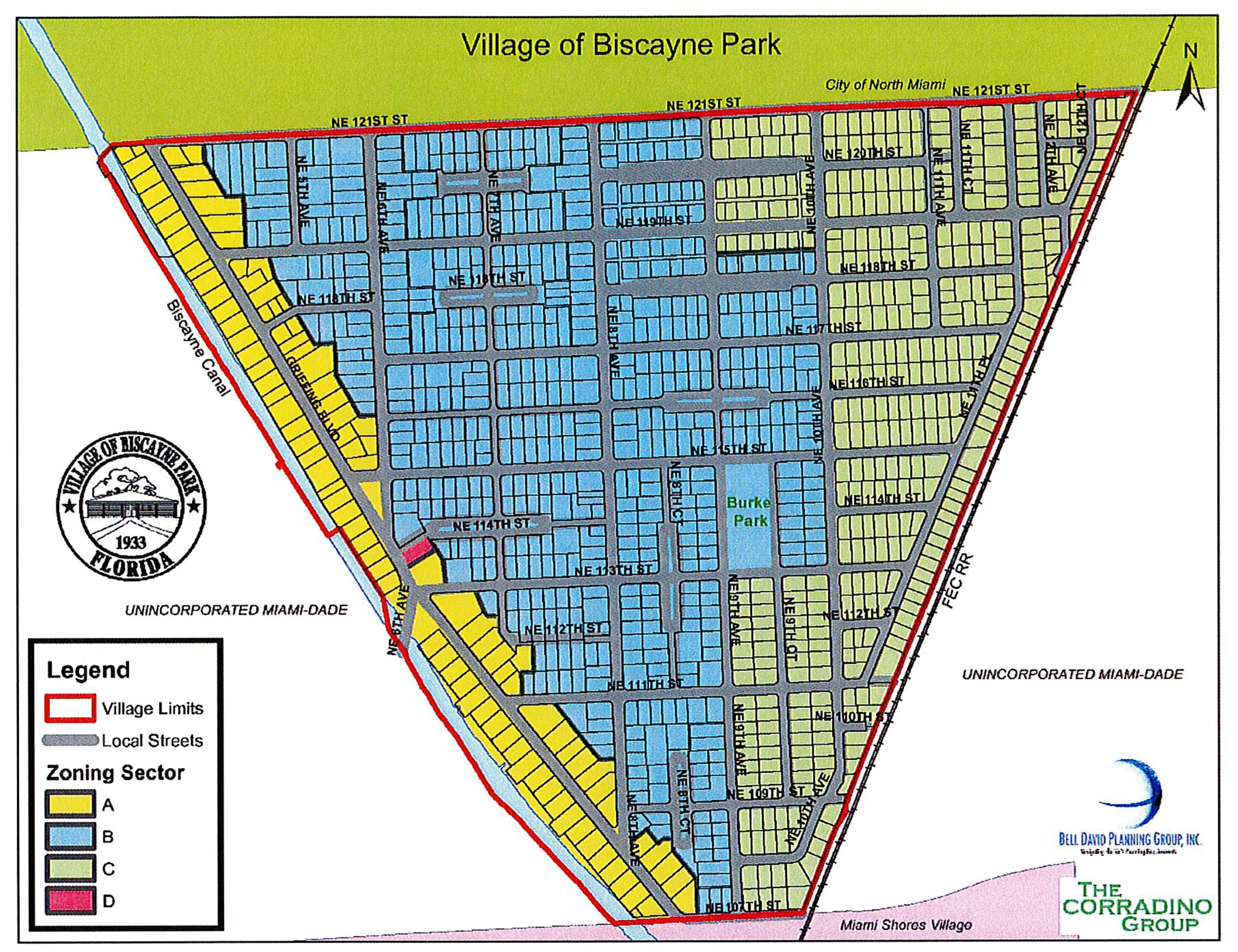
10.2.6
Sector development standards. Density, minimum lot sizes, dwelling type, minimum dwelling sizes, maximum lot coverage, maximum dwellings per lot, maximum building heights, and minimum setbacks shall all be defined per the following development standards table:
TABLE A SECTORS DEVELOPMENT STANDARDS TABLE
Notes:
1) Gross acre is the lot area plus half the width of the adjacent road.
2) Minimum Lot size as above or not less than the area of any lot of record (platted lot).
3) Sector B front set back shall be 30 feet except for the north side of 116th Street between 6th Avenue to 8th Avenue where the present setback shall be maintained; except on all 60-foot lots facing NE 9th Avenue between 118th Street and 120th Street where the setback shall be 20 feet from the NE 9th Avenue property line and said lots shall be subject to existing setback requirements of the streets on which they abut.
4) Two-family or duplex dwellings are prohibited on lots with a frontage of fifty (50) feet or less.
5) Height is measured from the base flood elevation.
6) Alterations exceeding 50% of the market value of the existing structure, or new development, shall require compliance with Chapter 18A, Miami-Dade County Landscaping Ordinance.
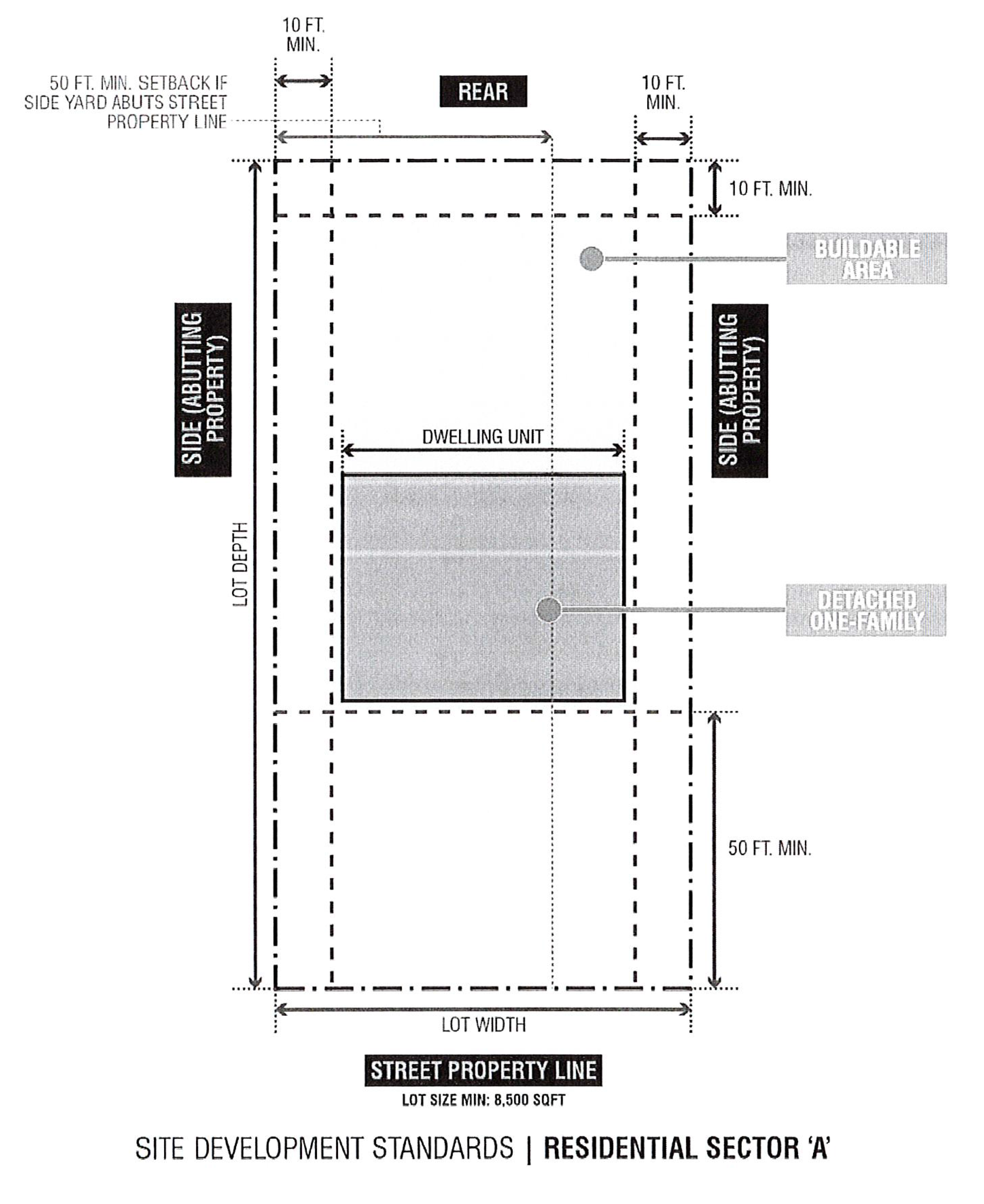
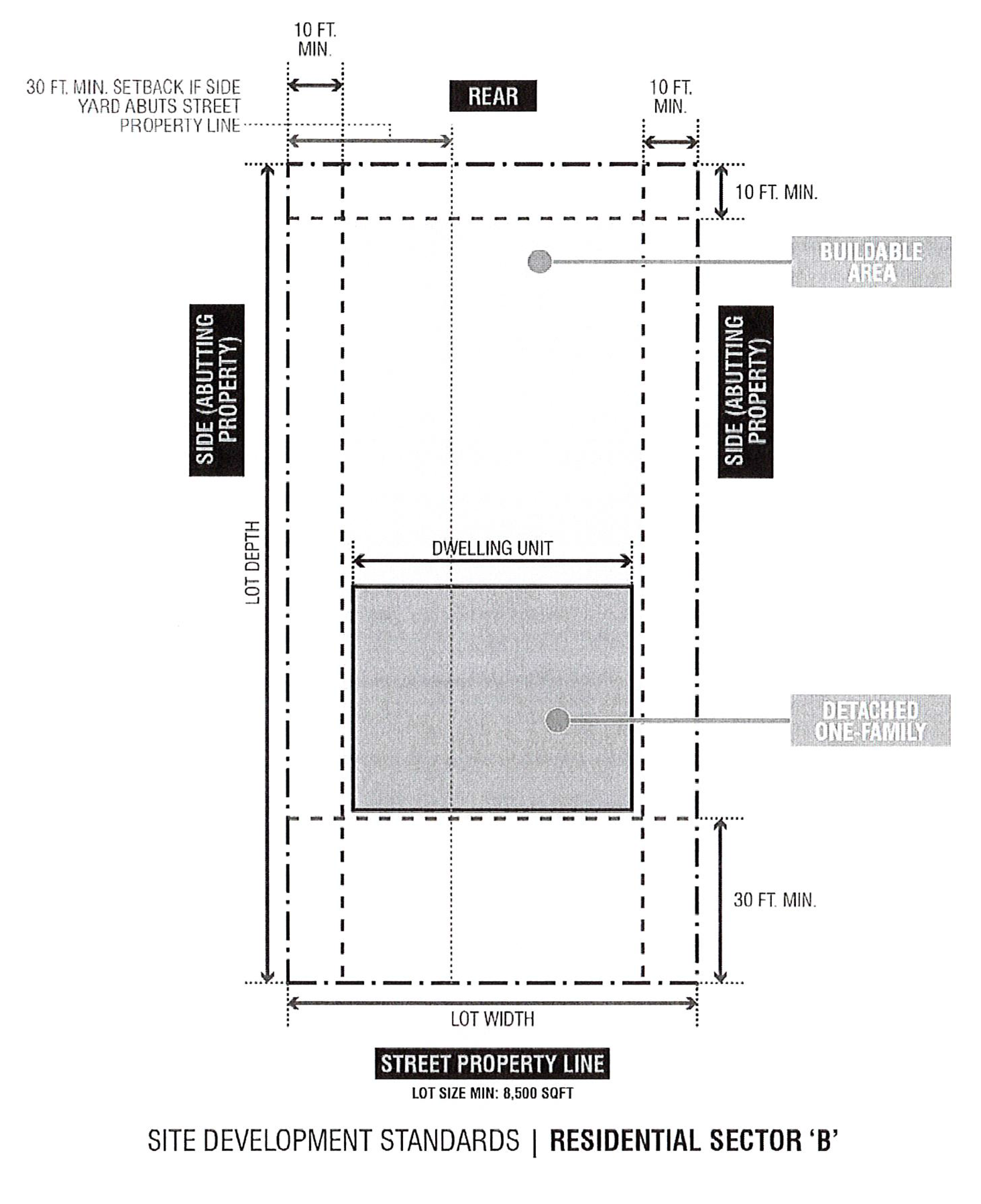
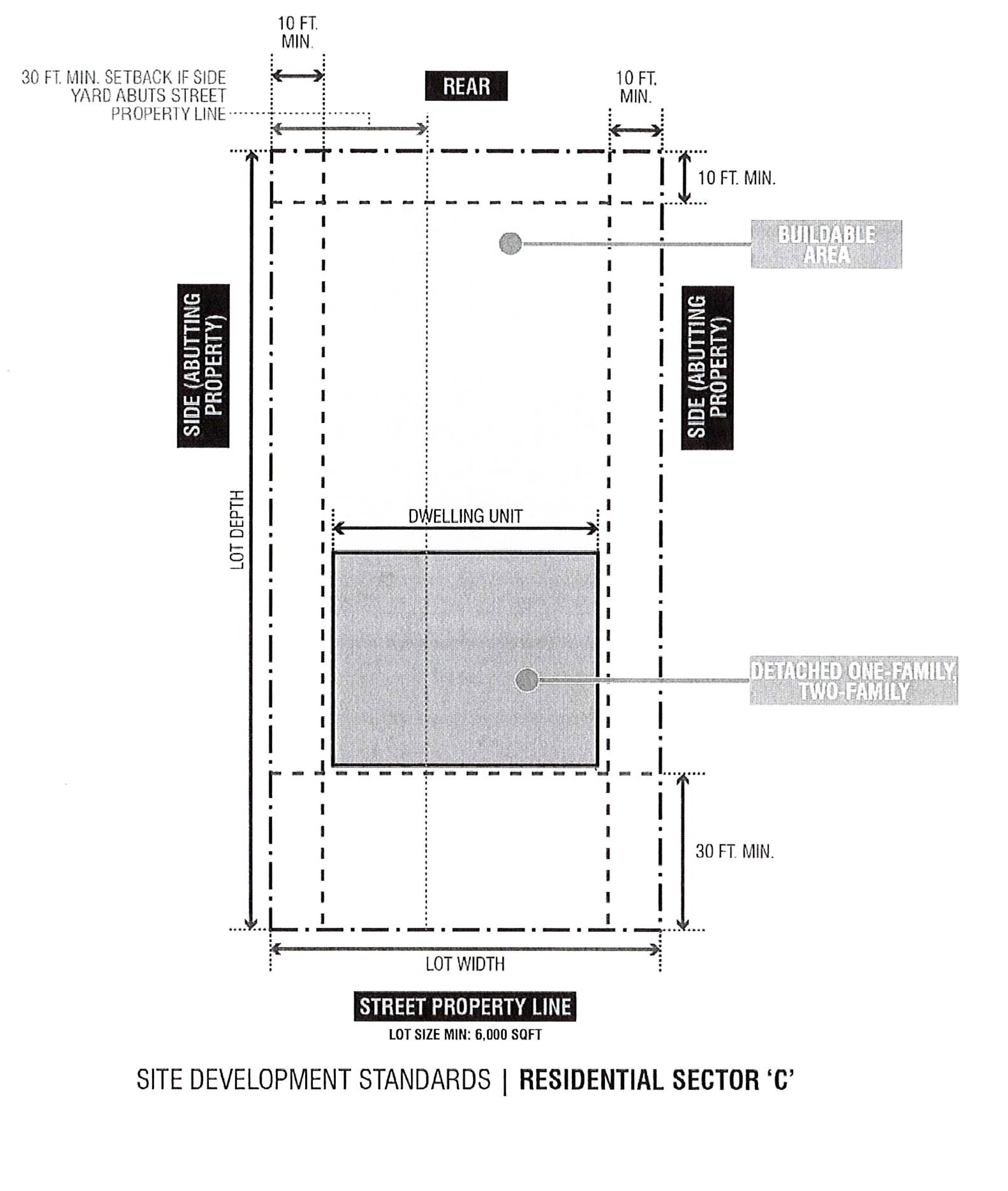
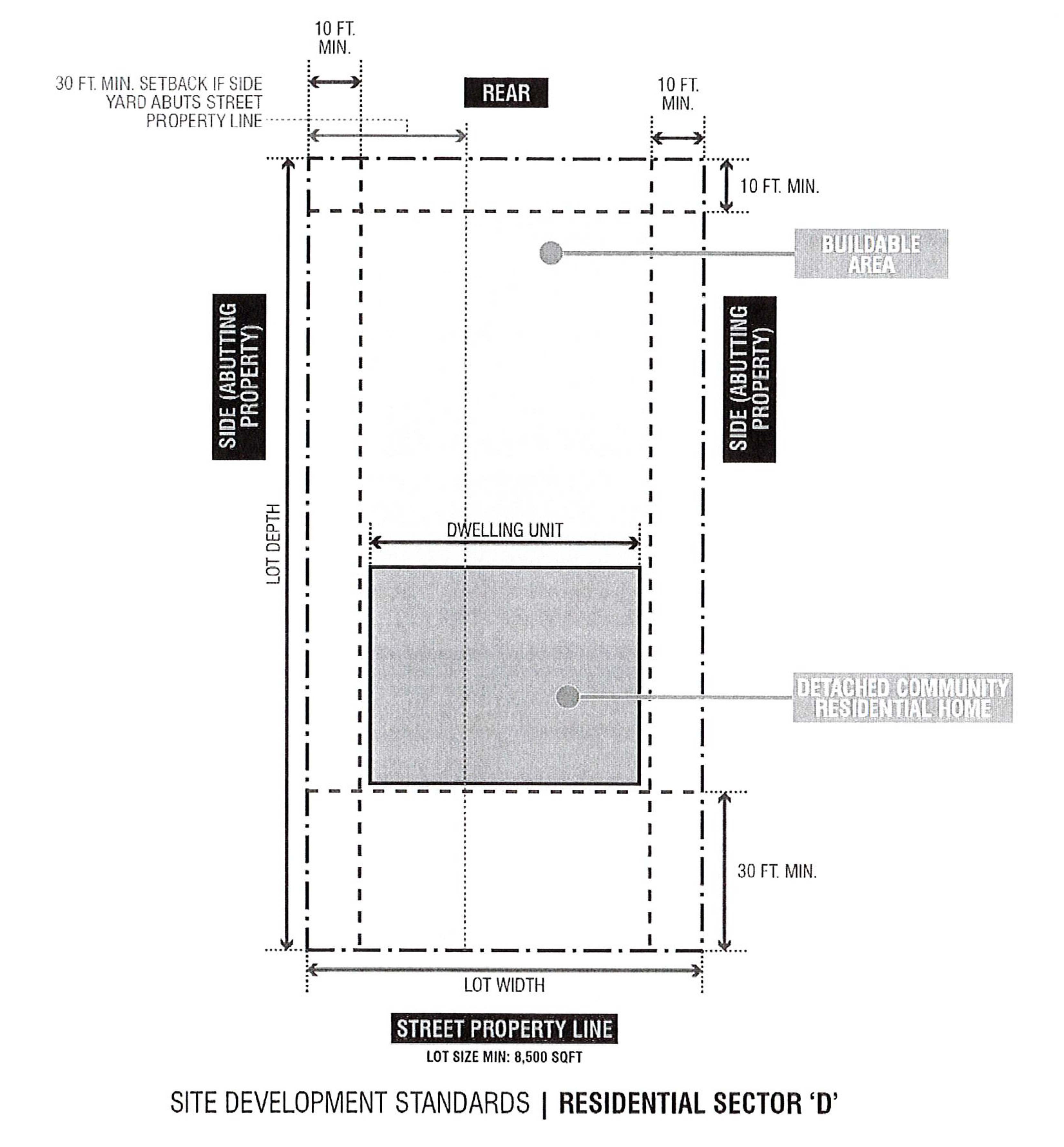
(Ord. No. 2023-09, § 4, 8-8-23)
10.3. - Architectural design.
10.3.1
Style and color of buildings. All principal and accessory buildings shall be of an architectural style, character and appearance, including exterior color, that will harmonize and blend in with the other buildings in the area. Creativity in design shall be encouraged to allow for a variety of building types, styles, heights, scales and roof elevations.
Cross reference— Exterior painting permit, § 16.13.
10.3.2.
Roof design.
(a)
There shall be no houses constructed in the village with a single level roof known as a flat top roof.
(b)
There must be two (2) or more roof levels with at least one (1) foot minimum difference in roof elevation when flat top roof construction is used.
(c)
No air conditioning or other duct work, nor the screening enclosing the same, shall be visible on any roof.
10.3.3.
Orientation, placement, frontages, massing, articulation and openings locations.
(a)
Orientation.
(1)
Buildings shall be oriented so that the front facade faces a primary or secondary street frontage.
(b)
Second story placement.
(1)
The total interior side facing buildable area of the second floor may be allowed to be placed on the interior side lot line to a maximum of thirty (30) feet in length. The remaining buildable area shall be set back a minimum of five (5) feet.
(2)
On lots, interior, primary structures to have a twenty-foot rear setback for the second story. When facing an alley, the second story setback shall be the same as the first floor.
(c)
Articulation.
(1)
Wall planes shall be designed in such a manner as to provide movement and articulation to prevent extensive blank walls.
(d)
Opening locations.
(1)
All portions of the side of the building on the second floor within the rear two-thirds (⅔) depth of the buildable area shall be designed in such a manner as to diminish visibility into abutting properties.
(2)
Roof decks shall be designed in such a manner as to diminish visibility into abutting properties.
10.3.4.
Exterior doors and windows design.
(a)
All exterior doors on a street-facing facade shall be of a consistent style, type and color.
(b)
All windows on any street-facing facade shall be of a consistent style, type and color.
(c)
Window types shall be limited to fixed, horizontal roller, casement, and single hung. Horizontal rollers and single-hung window types shall not be combined on any street-facing facade.
(d)
Exterior doors and all window frames shall have received product control approval (i.e., "Notice of Acceptance") from Miami-Dade County.
(Ord. No. 2023-09, § 4, 8-8-23)
10.4. - Building construction.
10.4.1
Building code. The Florida Building Code, and as same may be amended from time to time, as published by the Board of County Commissioners, Miami-Dade County, Florida, is hereby adopted as and for the building code of the village. A copy of the code is on file in the village clerk's office.
10.4.2
Applicable codes. All construction in the public rights-of-way shall conform to the uniform standards established by the official Public Works Manual of Miami-Dade County.
10.4.3
Minimum construction dimensions. The establishment of minimum construction dimensions by this code shall not be deemed as permitting any deviation from the requirements of the Florida Building Code. All buildings, including accessory buildings regardless of size and cost must comply with the provisions of the Florida Building Code and must be so constructed as to be safe from all storm hazard.
10.4.4
Material used in construction. No material shall be used in the construction of buildings except stone, concrete blocks, tile, brick or brick veneer, frame, steel or any standard fabricated material. All buildings shall be constructed on concrete or tile foundations under all portions of main buildings.
10.4.5
Tile or metal required on pitched roof. Any building constructed in the village that has a pitched roof, shall have a roof finished with clay or cement tile or metal.
10.4.6
Roof material.
(a)
Roof material shall be of tile or metal for roofs with a pitch of two and one-half (2½) inches per foot or more. Roofing materials shall be of engineered built-up roofing material for roofs with a pitch less than two and one-half (2½) inches per foot.
(b)
All dwellings erected shall comply with the Florida Building Code.
(c)
No three-tab shingles shall be permitted.
(d)
Wood shingles shall not be permitted except at the historic Village Hall log cabin.
(e)
Metal with a factory finish that has received a "notice of acceptance" from Miami-Dade County and that is labeled "Miami-Dade County Product Control Approved" may be used as roofing material for buildings subject to review and approval of the planning board in accordance with the following:
(1)
The subject building is constructed in the high modern, post-war modern, ranch or Key West architectural style, or a variation thereof.
(2)
The type of roof shall be limited to standing seam metal and shall specifically exclude metal roofing intended to replicate barrel tile or Spanish-S tile.
(3)
The color of the roof shall be limited to colors silver, grey, brown, copper and white and shall not be bright or highly reflective and must be harmonious with the exterior color of existing buildings on the plot and the neighborhood in general.
(4)
The details, color and manner of installation shall be consistent with the architectural design, style and composition of the residential or commercial structure.
(5)
Roofs with a pitch less than two and one-half (2½) inches per foot will be prohibited from installing metal roofing material.
(6)
Roofs with a pitch above three (3) inches per foot and up to four (4) inches per foot shall have an overhang of no less than eighteen (18) inches around the entire perimeter and a fascia board with a nominal dimension no less than six (6) inches.
(7)
Roofs with a pitch above four (4) inches per foot shall have an overhang of no less than twelve (12) inches around the entire perimeter and a fascia board with a nominal dimension no less than six (6) inches.
(f)
Asphalt shingles may be used in reroofing to replace an existing asphalt shingle roof if an engineer's evaluation is provided to the village certifying that the roof is not structurally adequate to utilize tile roofing materials, subject to the following conditions:
(1)
The engineer must be a structural engineer licensed in the State of Florida;
(2)
The engineer's opinion shall be based upon a visual in-person inspection of the structure;
(3)
The engineer's report shall be signed and sealed by the engineer of record, and shall include photographs of the structure; and
(4)
The engineer's report must be presented to the planning and design review board by the engineer of record, so that the planning and design review board may ask questions of the engineer.
(g)
No variances from any of these provisions shall be granted. However, if a metal roof that does not meet the requirements of this section has been permitted on or before August 1, 2015, that roof shall be allowed. However, if and/or when that roof is replaced, any new roof must fully comply with the requirements of this section.
10.4.7
Roof repair or reroofing requirement and exception. All buildings in the village which have roofs which are concrete tile, clay tile or metal must be repaired or reroofed only with clay tile, concrete tile or metal. Repair of tile or metal roofs shall be of a consistent style and color with the existing roof.
Cross reference— Roof repair or reroofing permit, § 16.9.
10.4.8
Nonconforming uses and structures.
10.4.8.1
Purpose and scope.
(a)
Nothing contained in this section 10.4.8 shall be deemed or construed to prohibit the continuation of a legally established nonconforming structure or use. The intent of this section is to encourage nonconformities to ultimately be brought into compliance with current regulations.
(b)
For the purpose of this section, the term "expansion" shall mean an improvement, addition, enlargement, extension, or modification to a structure that increases the square footage of the structure.
10.4.8.2
Expansion to a nonconforming use.
(a)
Where a structure being used for nonconforming use comes within the terms of subsection 3.4.2, no structural expansions shall be made except such as are required by ordinance, law or are ordered by an authorized officer to assure the safety of the building.
10.4.8.3
Nonconforming structures.
(a)
To prevent changes in regulation from unduly burdening property owners, legally-established, nonconforming structures may continue to be used and maintained. Expansions, repairs, alterations, and improvements to nonconforming structures shall be permitted only in accordance with the following provisions:
(1)
Internal and external repairs, alterations, and improvements that do not increase the square footage of the nonconforming structure shall be permitted.
(2)
Expansions to a nonconforming structure shall be permitted as follows:
a.
If the total square footage of the proposed improvement is less than fifty percent (50%) of the structure's net square footage at the time it became nonconforming, the improvement shall comply with current regulations.
b.
If the total square footage of the proposed improvement is equal to or exceeds fifty percent (50%) of the structure's net square footage at the time it became nonconforming, the entire structure and site improvements shall be brought into compliance with current regulations.
c.
Once the cumulative total of additional square footage of improvements equals to fifty percent (50%) of the structure's net square footage at the time it became nonconforming, no additional expansions shall be permitted and the entire structure and site improvements shall be brought into compliance with current regulations.
d.
For the purposes of this section, net square footage shall refer to the square footage indicated on the building permit or determined through equivalent evidence such as aerial photographs, tax roll information, certificates of use or occupancy, or design professional certifications.
(b)
If a nonconforming structure is damaged by fire, flood, explosion, wind, war, riot or any other act of force majeure, repairs shall be subject to the following provisions:
(1)
If the repair/replacement cost is less than fifty percent (50%) of the market value of the structure, the structure may be reconstructed up to the same building height and within the same building footprint existing prior to the damage, provided that an application for final building permit has been submitted within twelve (12) months of the date of such damage unless extended by the village commission.
(2)
If the repair/replacement cost is equal to or exceeds fifty percent (50%) of the building's market value, the building and site improvements shall be brought into compliance with current regulations.
(3)
Routine internal and external maintenance, repairs and material replacement such as re-roofing, painting, window or door replacement, mechanical equipment repair and replacement, plumbing and electrical maintenance, and similar repair, maintenance, and replacements shall be permitted.
(c)
If a nonconforming building is deemed to be unsafe by the village's building official, and demolition is required, the building shall be rebuilt in accordance with current regulations.
(d)
In addition to the requirements of this section, all repairs, improvements, and expansions to a nonconforming building shall comply with the Florida Building Code.
10.4.9
Improvements to a nonconforming use.
(a)
Where an improvement being used for nonconforming use comes within the terms of subsection 3.4.2, no structural alterations shall be made except such as are required by ordinance, law or are ordered by an authorized officer to assure the safety of the building.
(b)
Nothing in this Code shall be constructed to prohibit the restoration and repair of a building destroyed or damaged to the extent of not more than fifty (50) percent of its reasonable value by fire, explosion, act of God or public enemy nor the continued use and occupancy of such building after such restoration. Any building damaged to the extent of more than fifty (50) percent of its reasonable value shall not be restored, but shall be demolished and removed.
10.4.10
Reserved.
(Ord. No. 283, § 5, 10-5-93; Ord. No. 2014-05, § 2, 8-5-14; Ord. No. 2015-05, § 2, 9-1-15; Ord. No. 2020-07, § 3, 1-5-21; Ord. No. 2023-09, § 4, 8-8-23)
10.5. - Landscape design.
10.5.1
Landscaping of public areas. All landscaping of public areas should conform to the following general design principles:
(a)
Drainage systems and circulation systems for vehicles and pedestrians should be integrated into the landscaping plan.
(b)
Landscaping should be used to minimize potential erosion through the use of ground covers or any other type of landscape material that aids in soil stabilization.
(c)
Native vegetation should be preserved and used to meet landscaping requirements.
(d)
Landscaping should enhance the visual environment through the use of materials that achieve variety with respect to species of living material selected textures, colors and size at maturity.
(e)
Landscaping should consider the aesthetic and functional changes of vegetation, both when initially installed and when the vegetation has reached maturity.
(f)
Landscaping should enhance public safety and minimize nuisances.
(g)
Landscaping should maximize the shading of streets and vehicle use areas.
10.5.2
Landscaping of residential lots. All landscaping of residential lots shall conform to the minimum requirements of chapter 18A, Code of Miami-Dade County Landscaping Ordinance, as may be amended from time to time.
(Ord. No. 2023-09, § 4, 8-8-23)
Cross reference— Landscaping, § 8.3.
11.1. - Generally.
11.1.1
Purpose. It is the purpose of this chapter to regulate the installation, configuration, and use of accessory structures, in order to ensure that they are not harmful either aesthetically or physically.
11.1.2
General standards and requirements. Accessory structures may be located on a lot, provided that the following general standards and requirements are met:
(a)
There shall be a permitted principal development on the lot, located in full compliance with all standards and requirements of this code.
(b)
All accessory structures shall comply with standards pertaining to the principal use, unless exempted or superseded elsewhere in this code.
(c)
Accessory structures shall not in general be located in a required setback area unless otherwise allowed herein.
11.2. - Accessory buildings.
11.2.1
Permitted accessory buildings, which include private garages, storage buildings, private workshops, utility buildings, and greenhouses, shall:
(a)
Maintain the same setbacks as the principal building.
(b)
Comply with the general standards and requirements of subsection 11.1.2 above.
(c)
Not be used as a place of abode.
(d)
Not occupy in the aggregate more than thirty (30) percent of the area between the rear line of the main building and the rear property line except that a lot having a dual frontage shall have the same setback on each street property line.
(e)
Shall be limited to one (1) story.
(Ord. No. 2023-09, § 5, 8-8-23)
11.3. - Boat docks.
11.3.1
Extension of boat dock, etc., into Biscayne Canal. Unless otherwise provided for, no dock, wharf or other structure shall be built or extended into Biscayne Canal a distance greater than three (3) feet.
11.4. - Carports.
11.4.1
Carport material, size, and location. Only one (1) carport, of aluminum or canvas only, is permitted per lot and shall be limited to twenty (20) feet by twenty (20) feet in size and shall be located at least five (5) feet from the front property line and five (5) feet from the side property line.
Cross reference— Carport permit, § 16.5.
11.5. - Dish antennas.
Private noncommercial dish antennas may be permitted in the village provided:
11.5.1
Location. They are located in the rear yard.
11.5.2
Setbacks. They are placed no closer to any property boundary line than a distance equal to their height as measured from ground level to the top of the antenna but in no event closer than ten (10) feet to the property lines.
11.5.3
Setbacks on corner properties. No portion of the apparatus may extend beyond the imaginary extension of the line of the house structure.
11.5.4
Roof-mounted dish antennas. No roof-mounted dish antennas shall be permitted except on two-story buildings with a flat roof when the antenna cannot be viewed from the ground level.
11.5.5
Dimensions. The height of dish antennas shall not exceed fifteen (15) feet from ground level, nor shall their diameter exceed twelve (12) feet.
11.5.6
Number allowed and color. Only one (1) dish antenna shall be allowed per single-family, duplex or apartment building, and such antenna shall be neutral in color.
11.5.7
Anchorage. All dish antennas shall be anchored securely to the ground in compliance with the requirements of the Florida Building Code relative to structures.
11.5.8
Maintenance. Once installed, dish antennas and related appurtenances must be maintained in good and operable condition.
11.5.9
Existing antennas. All dish antennas that are legally existing at the time of the adoption of Ordinance No. 250 (4, 1989) shall be allowed to remain until such time that they may be replaced, at which time they shall conform in all respects to this section.
(Ord. No. 2021-10, § 4, 8-5-21)
Cross reference— Dish antenna permit, § 16.6.
11.6. - Fences, walls and hedges.
11.6.1
Location.
(a)
Except as otherwise provided in this section 11.6 below, all fences, walls and hedges may be located within any yard up to the property line thereof. No such wall, fence or hedge shall extend over the property line and into or over the official right-of-way for the full height of the wall, fence or hedge.
(b)
No walls or fences may be located in the front yard except as provided in subsection (c).
(c)
On corner lots, fences and walls may be located in the corner side yard but may be no closer than three (3) feet from the corner side yard property line. Fences and walls may be extended into the front yard beginning at the corner or the enclosed portion of the house closest to the corner side yard or the interior side yard, but not both side yards, provide the maximum enclosed yard area including the footprint of the enclosed area of the dwelling, totals less than fifty-five percent (55%) of the property. Fences and walls can extend a maximum of fifteen (15) feet beyond said corner, but no closer than fifteen (15) feet from the front property line to achieve an enclosed area that does not exceed fifty-five percent (55%) of the property. A landscape buffer must be provided between the fence and the side property line. The landscape buffer must be a continuous buffer (with the exception of any pedestrian gate), which covers a minimum of fifty percent (50%) of the fence or wall.
(d)
All fences, walls, hedges and gates must conform to the clear visibility triangle set forth in chapter 5.4.1 of the Land Development Code. (See Diagram 4 Visibility Triangle).
(e)
All fences, walls, and gates require a permit and approval by the planning board.
11.6.2
Height.
(a)
Fences and walls, when located between the building and the interior side and the rear property lines, shall not exceed six (6) feet in height.
(b)
The inside through lots on Northeast 11 Place and Northeast 11 Court from Northeast 119 Street to Northeast 121 Street shall be allowed the six-foot height from the building to and parallel to the rear property line.
(c)
Properties abutting the FEC corridor and/or properties abutting public rights-of-way which abut the FEC corridor shall be permitted to erect a fence or wall up to ten (10) feet in height only on the side abutting the FEC corridor.
(d)
Pedestrian gates located in the front yard shall not exceed a height of six (6) feet and shall not exceed a width of five (5) feet.
(e)
On corner side yards, fences and walls may be four (4) feet in height when set back three (3) feet from the corner side yard property line and fifteen (15) feet forward from the front corner of the building as described in subsection 11.6.1(d). The height of the fence or wall may be increased one (1) foot for each additional two (2) feet setback from the dimensions described above, with a maximum height of six (6) feet. Fences and walls in the corner side yard must be of a uniform height.
11.6.3
Construction. Fences and walls may be constructed of wood, masonry, composite materials, vinyl, metal or wire, and shall be constructed so as to discourage climbing and be constructed of one (1) material type only, except where specifically permitted herein.
(a)
Wood fences are to be constructed with pressure treated pine, cedar, redwood or other rot-resistant wood in compliance with the Florida Building Code. Wood fences shall be finished with a stain, wood preservative or sealer. Stain colors require a separate permit and approval by the planning board. Planks shall have a minimum nominal thickness of one (1) inch (¾ inch actual) and post shall not be less than a nominal four (4) inches by four (4) inches. Only galvanized or stainless hardware and fasteners are permitted. Fences shall be constructed to be level and plumb. Gates shall be diagonally braced to prohibit sagging. Fences shall be of one (1) color except where masonry or concrete pillars are used in conjunction with fences where the pillars may be of one (1) color and the fence portions another color.
(b)
Walls may be constructed of the following materials and must conform to the construction requirement of the Florida Building Code and shall be of a compatible design and color in relation to the dwelling:
(i)
Walls constructed of stone shall be of a consistent type.
(ii)
Concrete block is to be stuccoed with a smooth stucco finish or texture on all faces that reflects compatibility with the finish of the dwelling. Walls constructed of decorative masonry units shall be of a uniform type and color.
(iii)
Slump brick.
(iv)
Used red bricks, limed red bricked or cement bricks appropriately painted.
(v)
Precast concrete caps may be used in combination with the preceding wall types. Precast walls are only permitted on property lines parallel to the FEC corridor.
(c)
Composite and vinyl fences shall be made of Miami-Dade County approved materials for fencing.
(d)
Metal fences shall be made of aluminum, wrought iron, galvanized steel or marine grade stainless steel and shall be of one (1) color. Iron and steel fences, with the exception of chain-link, shall be painted (or finished). Words and pictorial images are not permitted except for one (1) location on the gate or fence where the street numbers are permitted. Post caps, scrolls, and studs are part of the overall allowable height. Metal fences may only be of one (1) color.
(e)
Wire fences shall be of chain-link or diamond weave of heavy galvanized material or material of equal strength and shall have top rails. All posts shall be set in concrete so as to be secure and safe. Decorative inserts/privacy slats are not permitted except where fences are parallel to the FEC corridor. No secondary or decorative fencing materials, including, but not limited to, bamboo and other screening materials, may be attached to or placed adjacent to any fence. Where an existing nonconforming chain link fence is facing the front right-of-way of a property, or for corner lots, facing the corner side yard right-of-way, said fence shall be shielded with landscape materials.
(f)
Gates shall only be made of wood, composite material, vinyl or metal.
(g)
The decorative face of a fence is to face the street or exterior of the property. All parts of the wall or fence, including uprights, posts and vertical and horizontal and structural supports shall be on applicant's side of the fence or wall. No part of the fence or wall shall protrude into the adjacent property or public right-of-way.
(h)
Each application shall be consistent with village building permit requirements. The fence shall be so designed to be suitable and compatible with surrounding areas.
(i)
All fences with secondary or decorative fencing materials legally existing at the time of the adoption of Ordinance No. 2022-07 shall be allowed to remain until such time that the fence or secondary or decorative fencing materials may be replaced in whole or in part, or until such time that the fence or secondary or decorative fencing material is deteriorated, destroyed, or damaged in excess of fifty percent (50%), at which time the fence shall conform in all respects to this section.
11.6.4
Chain link, and wire fences prohibited in certain areas. Chain link and/or wire fences shall not be permitted in front yards and corner side yards or when they extend farther toward the front and side front property lines than the front corner of the building closest to the side property line. Chain-link fences shall not be permitted parallel to the abutting right-of-way except on the rear, interior property line or alley.
11.6.5
Electric or barbed wire prohibited. No fence shall be constructed with barbed wire and no fence charged with electricity shall be erected.
11.6.6
Nonconforming fences and walls. Any fence or wall which has been properly permitted and approved by the village prior to the passage of Ordinance No. 2011-2, or which existed prior to Ordinance No. 24 (S. 1988) and which does not comply with the requirements of this ordinance, shall be considered a legal, nonconforming structure. Such nonconforming fence or wall may be continued until such fence or wall has deteriorated to the extent of more than twenty-five (25) percent of the structure or has been damaged by more than fifty (50) percent of the structure. Replacement of any fence or wall shall require a permit, and compliance with this code. At that time, such nonconforming fence or wall must be removed in its entirety.
11.6.7
Maintenance.
(a)
Fences and walls shall be maintained free of rot, mold, rust and graffiti, and shall be repaired if not straight, plumb and level.
(b)
Fences and walls shall be recoated or cleaned when there is excessive discoloration, fading, peeling or general deterioration.
(c)
Fences, walls and hedges shall be kept free of weeds.
(d)
Fences and walls that are not structurally sound and present a threat to public safety shall be repaired or removed.
(e)
Hedges shall not extend over or into the public right-of-way for the full height of the hedge.
(f)
If a wall is to be placed on a shared property line, consent for access must be obtained from the adjoining property owner(s) prior to finishing the opposite side of the wall. If such consent cannot be obtained, the property owner erecting the wall must present proof that a request for access approval was mailed to every adjacent property owner, by certified mail, return receipt requested, to the mailing address(es) as listed in the most current Miami-Dade County tax roll, and the mailing was returned undeliverable or the adjacent property owner(s) failed to respond to the request within thirty (30) days after receipt. Upon such a showing, the property owner erecting or maintaining the wall shall not be required to finish the opposite side of the wall.
(Ord. No. 283, § 6, 10-5-93; Ord. No. 2011-2, § 3, 2-7-12; Ord. No. 2021-09, § 2, 8-5-21; Ord. No. 2022-07, § 2, 9-13-22)
Cross reference— Fence and wall maintenance violation, § 8.4.3.
11.7. - Outdoor utility or storage sheds.
Utility or storage sheds shall be permitted upon the following conditions:
11.7.1
Building permits shall be required.
11.7.2
A utility shed may be attached to or separated from the main building and used only for the storage of property related to the premises which it serves and shall not be used as a place of abode.
11.7.3
Only one (1) utility shed shall be permitted per building site and shall not exceed one hundred (100) square feet in area and shall not have a height greater than nine (9) feet, and no utility service shall be connected thereto.
11.7.4
Sheds shall be installed in accordance with standards and specifications established by the Products Control Division of Metro-Dade County.
11.7.5
All sheds shall be installed only to the rear of the existing building and shall conform to the side setback lines and in no event be nearer than three (3) feet to the rear property line. When attached to the building the shed shall be firmly and securely attached to the satisfaction of the building official.
11.7.6
In the case of corner lots, when there is not space in the rear to install a shed to conform with subsection 11.7.5 above, a shed may be installed attached to the side of the building that does not face a street, so installed that the shed shall be flush with and contiguous with the rear line of the building, and there shall be planted trees or shrubs at least three (3) feet in height and not more than one and one-half (1½) feet apart, of a fast growing variety so that eventually it will be seen or be visible from the street. When the shed is attached to the building and is constructed of the same materials as the house, planting shall not be required.
11.7.7
All utility sheds existing at the time of adoption of Ordinance No. 172 (1, 1975) that are located to the rear of the building line and are not a nuisance or a hazard shall be allowed to remain until such time that they deteriorate or are declared to be a nuisance or a hazard by the building inspector at which time they shall be made to conform with this section in all respects.
(Ord. No. 283, § 6, 10-5-93)
Cross reference— Utility or storage shed building permit, § 16.12.
11.8. - Superimposed structures.
11.8.1
Height limit. Towers, aerials, tanks and other superimposed structures upon any building shall not exceed eight (8) feet in height.
11.9. - Swimming pools.
11.9.1
A swimming pools, unless entirely screened in, must be surrounded by a non-climbable protective perimeter fence and/or wall of a minimum height of four (4) feet.
11.9.2
Reserved.
11.9.3
The perimeter fence or wall shall be constructed of concrete block, wood, pvc, metal, or two-inch chain-link, galvanized wire with top rail and slats fastened at the top or bottom. All gates shall be the spring local type (close automatically) and shall be equipped with a lock. The release mechanism shall be no less than four (4) feet six (6) inches from the bottom of the gate.
11.9.4
Final inspection and/or approval of construction of a swimming pool shall not be granted until such a fence or wall has been erected.
11.9.5
No overhead electric power line shall pass over any pool, nor shall any power line be nearer than ten (10) feet horizontally or vertically from the pool's water edge.
11.9.6
It is hereby declared a nuisance for any person to have, keep, maintain, cause or permit within the Village a swimming pool which does not meet the water clarity standard which allows clear visibility from the water's surface to the pool bottom.
11.9.7
Upon complaint, if the code compliance officer finds and determines that a swimming pool within the village does not meet the standards set out in section 11.9.6 above, the code compliance officer shall notify the property owner in the manner prescribed for notice pursuant to chapter 14 of this code. Such notice shall demand that the property owner cause the condition to be remedied.
11.9.8
In addition to the notice, the code compliance officer shall cause to be posted in a conspicuous place upon the property, a notice to serve as warning that a swimming pool hazard exists.
11.9.9
Penalties for offenses. Failure to strictly comply with any provision of section 11.9.6 shall result in a fine of two hundred fifty dollars ($250.00) per day.
11.9.10
Should such owner fail to remedy the condition, the building official shall have the power to declare such swimming pool a hazard to the health, safety, and welfare of the citizens of the village and shall be authorized to abate the condition by either cleaning, boarding, or taking any other action necessary to correct the hazard and the reasonable costs thereof shall be a lien against the property upon which such swimming pool is located. Such lien shall be handled and collected in the manner prescribed for the collection of liens pursuant to this code.
(Ord. No. 2021-07, § 2, 9-7-21)
11.10. - Portable storage units.
11.10.1
Portable storage unit: Any container designed for the storage of personal property which is typically rented to owners or occupants of property for their temporary use and which is delivered and removed by truck.
11.10.2
Portable storage units on any site shall not exceed eight (8) feet in height, eight (8) feet in width and sixteen (16) feet in length.
11.10.3
No more than two (2) portable storage units may be located on any lot.
11.10.4
Portable storage units may remain onsite up to fourteen (14) consecutive days and will be permitted up to three (3) times per year unless otherwise authorized herein.
11.10.5
Portable storage units shall not be located in such a manner to impair a motor vehicle operator's view and must comply with the Village Code as to site triangle and all other regulations.
11.10.6
Portable storage units shall not be located in such a manner to obstruct the flow of pedestrian or vehicular traffic.
11.10.7
Sign faces shall be permitted on a portable storage unit.
11.10.8
Portable storage units will be permitted as long as an active permit is in place. Any portable storage unit which is not removed at the end of the prescribed time for which it may lawfully remain in place, or immediately upon the direction of a code enforcement officer for removal of such temporary structure for safety reasons, may be removed by the village immediately and without notice. The cost of administration of its removal, may be assessed against the property on which the temporary structure was located and against the owner of the portable storage unit and may be filed as a lien against the property by the village.
11.10.9
In the event of a natural disaster the requirements of this section may be exempted for a specific period of time as deemed necessary by the appropriate department to meet the needs of the community.
11.10.10
The owner, operator and/or renter of the portable storage unit shall be responsible to ensure that the portable storage unit is in good condition, free from evidence of deterioration, weathering, discoloration, rust, ripping, tearing or other holes or breaks. When not in use, the portable storage unit shall be kept locked. The owner and operator of any site on which a portable storage unit is placed shall also be responsible that no hazardous substances are stored or kept within the portable storage units.
11.10.11
A violation of any part of this section is subject to fines of one hundred dollars ($100.00) per occurrence. Each day that the violation continues will result in a separate fine.
(Ord. No. 2005-4, § 2, 8-2-05)
12.1. - Statement of purpose.
12.1.1
[Purpose.] The purpose of this chapter is to create framework for a balanced system of sign control and to promote public safety through clear, aesthetic and pleasant communication between people and the environment. It is also the purpose of this chapter to preserve the character and quality of the village's appearance and to protect property values.
12.1.2
Maintenance. All signs must be well maintained and must present a clean and neat appearance and comply with all codes.
(Ord. No. 2005-10, § 1, 9-11-05)
12.2. - Prohibited and exempt signs.
12.2.1
Prohibited signs. It shall be unlawful to construct or maintain any sign on any property in the village except as expressly provided for herein. Other than village signs, no signs are permitted on public rights-of-way or village-owned property.
12.2.2
Illuminated signs prohibited. Other than village owned signs or illuminated signs approved prior to 2005, no sign shall be illuminated or lighted in any way. Addresses are not considered signs and, therefore, may be discreetly lit as long as consistent with all other codes and regulations.
12.2.3
Permitted signs.
(a)
Real estate sign. One (1) real estate sign, not exceeding three (3) square feet in area and four (4) feet in height fixed to a post not to exceed one (1) inch by one (1) inch in size, advertising a property for sale, rent or lease may be installed upon such property so advertised, but at no less distance than five (5) feet from the property line.
(b)
Signs on premises or building during construction. One (1) sign on a premises or building during construction, to give the public warning or to advertise the architect, builder or the materials used in the construction, must be erected. Owner/builders are exempt from this requirement. The sign is to include on it the permit, contractor's name and telephone number, state certificate number, and is not to exceed three (3) square feet in area and four (4) feet in height fixed to posts not to exceed one (1) inch by one (1) inch in size, at no less distance than five (5) feet from the property line and shall be removed on completion of building.
(c)
Accessory signs on apartment houses. Signs indicating the name, address of an apartment house, those facilities that have more than four (4) units may be erected and is not to exceed three (3) square feet in area and four (4) feet in height. The signs must be no less than five (5) feet from the property line.
(d)
Political signs. Political signs including window signs are permitted as provided for in section 12.3 below.
(Ord. No. 292, § 1, 5-3-95; Ord. No. 2005-10, § 1, 9-11-05; Ord. No. 2013-04, § 2, 8-6-13)
12.3. - Political signs.
12.3.1
Defined. A political sign is any sign which indicates the name, cause or affiliation of anyone seeking public office, or which expresses any issue of public importance.
12.3.2
Placement signs. No more than one (1) election sign per candidate, measure or issue shall be permitted on any one (1) private property site. Political signs shall not be located closer than five (5) feet from the edge of the paved street and no closer than five (5) feet from the adjacent property line. No political sign shall be permitted on empty lots or vacant residences unless written permission is received from the owner of said property. No political signs shall be permitted on public property or in areas which are determined by the village to cause a safety hazard or violate the visibility triangle.
12.3.3
Size. Political signs, are not to exceed three (3) square feet in area. Political signs, other than window signs, can be no higher than four (4) feet.
12.3.4
Pre-election requirements. Prior to the posting of election signs, each candidate, campaign chairperson, firm or corporation shall file with the clerk's office and provide the clerk's office with a local address and telephone number at which the candidate, campaign chairperson, firm or corporation wishing to post the signs may be reached during normal business hours concerning any violation of this chapter or requirements of the village. Except for window signs, written consent of the property owner where the election sign shall be placed is also required for all signs placed on privately owned vacant lands and must be filed with the clerk's office.
12.3.5
Cash bond. Except for window signs, a cash bond of two hundred fifty dollars ($250.00) shall be required from each election campaign political issue. This bond shall be conditioned upon the removal of all political signs of that candidate or issue within five (5) calendar days after the election to which they relate or thirty (30) days on political issues. Failure to remove all signs shall be cause for the village's designee to direct that the signs be removed by the code enforcement division and the bond forfeited. Further remedies are available to the village consistent with section 12.3.6. The cash bond shall be returned within thirty (30) days after all signs have been removed and a request is made by the appropriate election campaign contact. Successful candidates in nominating elections may continue to display their signs during the interval between the nominating or primary and general elections without posting any additional bond except where the interval exceeds ninety (90) days.
12.3.6
Violations of this section; enforcement procedures available to village; schedule of fines and penalties.
(a)
Any violation or repeat violation of this section may be pursued by the village by appropriate remedy either in court, through code enforcement by the imposition of a fine as set forth below, or by any other means available at law or in equity, at the option of the village. If it is the first violation for the individual, campaign or corporation, a warning should first be given unless extenuating circumstances exist. Any person violating this chapter shall be punished by a fine of not more than one hundred dollars ($100.00) per violation. Each day, or portion thereof, that a violation occurs is considered an additional violation.
(b)
After twenty-four (24) hours' notification is given to the campaign chairperson, or designee, the village may draw on the bond placed pursuant to this section towards the payment of any delinquent penalties which are assessed by the village for any violations of the provisions herein. Notification shall be deemed legally sufficient upon the village, during regular business hours, attempting to contact by telephone the number which the campaign chairperson, or designee, filed with the code enforcement division. Notification shall not be required within forty-eight (48) hours of election. Penalties may be assessed immediately upon violation within forty-eight (48) hours of an election.
12.3.7
Headquarters sign. A candidate for village public office may display one (1) sign not to exceed sixteen (16) square feet on only one (1) property in Biscayne Park and designate it as headquarters. Such sign shall conform to the placement requirements set forth above.
(Ord. No. 292, § 1, 5-3-95; Ord. No. 2005-10, § 1, 9-11-05; Ord. No. 2013-04, § 3, 8-6-13)

