
Blaine Town City Zoning Code
ARTICLE IV
SIGN REGULATIONS
Sec. 30-521.- Definitions.
The following words, terms and phrases, when used in this article, shall have the meanings ascribed to them in this section, except where the context clearly indicates a different meaning:
Commercial speech means any sign wording, logo or other representation advertising a business, profession, commodity, service or entertainment for business purposes.
Noncommercial speech means any message that is not commercial speech, which includes, but is not limited to, messages concerning political, religious, social, ideological, public service and informational topics.
Nonconforming sign means any sign which was lawful prior to but which does not comply with the terms of this article (or its amendment).
Ordinary high-water mark means the point on the bank or shore up to which the presence and action of surface water is so continuous as to leave a distinctive mark such as erosion, destruction or prevention of terrestrial vegetation, predominance of aquatic vegetation or other easily recognized characteristic.
Sign means a display, illustration, structure or device that directs attention to an idea, object, product, place, activity, person, institution, organization or business.
Sign, area, means the total size of the sign including all components.
Sign, banner, means any sign of lightweight fabric or similar material that is permanently mounted to a pole or a building at one or more edges. Flags that comply with section 30-523(d)(3) shall not be considered banners.
Sign, beacon, means any light with one or more beams directed into the atmosphere or directed at one or more points not on the same zone lot as the light source; also, any light with one or more beams that rotate or move.
Sign, building, means any single-faced sign painted on, attached to or erected against the exterior wall of a building, structure, marquee, canopy or awning. Also including any sign placed on the interior of a window or painted on a window such that it can be read from the outside of the building.
Sign component means any element of a sign or its source of support (excluding a building), including but not limited to support structure, accessories, wiring, framing. Paint, vinyl, paper, fabric, light bulbs, diodes, or plastic copy panels on a sign do not constitute components.
Sign, freestanding, means any sign supported by structures or supports that are placed on or anchored in the ground and that are independent from any building or other structure, including, but not limited to, a ground-mounted sign, detached sign, pole sign, pylon sign or monument sign.
Sign, incidental, means a sign that is not legible to a person of ordinary eyesight with vision adequate to pass a state driver's license exam standing at ground level at a location on the public right-of way or on other private property.
Sign, monument, means a freestanding sign where the base of the sign structure is on the ground.
Sign, off-premises, means a sign, which displays a commodity, product, service, activity or any other person, place, thing or idea other than noncommercial speech, which is not located, found or sold on the premises upon which such sign is located.
Sign, off-premises directional, means a sign displayed for the sole purpose of assisting wayfinding through disclosure of no more than the name of a place, its distance from the sign and one directional arrow.
Sign, on-premises, means a sign which only displays a commodity, product, service, activity or any other person, place, thing or idea, which is located, found or sold on the premises upon which such sign is located, or a noncommercial speech.
Sign, on-premises directional, means a sign at the exit or entrance of premises that have two or more driveways.
Sign, portable, means any sign not permanently attached to the ground or other permanent structure, or a sign designed to be transported, including, but not limited to, signs designed to be transported by means of wheels; signs converted to A- or T-frames; balloons used as signs; umbrellas used for advertising; and signs attached to or painted on vehicles parked and visible from the public right-of-way, unless said vehicle is used for transportation in the normal day-to-day operations of the business.
Sign, projecting, means any sign affixed to a building or wall in such a manner that its leading edge extends more than six inches beyond the surface of such building or wall.
Sign, property address, means a sign as provided for in section 54-40 et seq., the county uniform rural numbering system.
Sign, roof, means any sign erected and constructed wholly on and over the roof of a building, supported by the roof structure and extending vertically above the highest portion of the roof.
Sign, special event, means a sign that is temporary in nature and is not permanently mounted or attached to the ground or sign surface, and is used for special events, such as but not limited to, grand openings, promotions, seasonal sales, garage sales, craft sales, graduation or birthday parties, festivals or fairs.
Sign, temporary, means any sign that is used only for a limited period of time and is not permanently mounted.
(Res. No. 2018-16, 6-5-2018)
Sec. 30-522. - Findings and purpose.
(a)
Findings of fact. The county board hereby finds as follows:
(1)
Exterior signs have a substantial impact on the character and quality of the environment.
(2)
Signs provide an important medium through which individuals may convey a variety of messages.
(3)
Signs can create safety hazards that threaten the public health, safety or welfare. Such a safety threat is particularly great for signs that are structurally inadequate, or that may confuse or distract drivers or pedestrians, or that may interfere with official directional or warning signs.
(4)
Signs can also threaten the public welfare by creating aesthetic concerns and detriments to property values. Such aesthetic concerns and detriments to property values are particularly great when an accumulation of signs results in visual clutter, or when one or more signs spoil vistas or views, or when one or more signs add or increase commercialism in noncommercial areas.
(5)
The ability to erect signs serving certain functions, such as an address sign or a sign announcing that the property on which it sits is for sale or for lease is an integral part of nearly every property owner's ability to realize the fundamental attributes of property ownership. The same cannot be said for signs serving other functions, such as billboards erected so as to be visible from public rights-of-way. Such signs are primarily designed to take advantage of an audience drawn to that location by the public's substantial investment in rights-of-way and other public property.
(6)
Signs serving certain other functions, such as small signs that serve a purely directional function, are necessary to enable visitors or residents to efficiently reach their intended destinations. Experience teaches that citizens often plan as if such signs will be present in those settings, so in the absence of such signs, frustration and disorientation will result, and time and fuel will be wasted.
(7)
With one narrow exception, only static signs (which change, if at all, only on rare occasions when they are repainted or covered with a new picture) constitute a customary use of signage in the county. The only nonstatic signs that constitute a customary use of signage in the county are components of on-premises signs for which frequent changes are necessary for the purpose of updating numerical hour-and-minute, date, or temperature information. Such signs are unique because their accuracy depends upon their ability to frequently change, and because in their customary use such signs are less apt to distract drivers or pedestrians to a dangerous degree than other types of nonstatic signs. In Commercial zoning districts a digital sign is allowed to change its message once every six seconds. Each change of message shall be accomplished in one second or less.
(8)
No signs that exceed the size or spacing limitations of this section constitute a customary use of signage in the county.
(9)
The county's land use regulations have included the regulation of signs in an effort to foster adequate information and means of expression and to promote the economic viability of the community, while protecting the county and its citizens from a proliferation of signs of a type, size, location and character that would adversely impact upon the aesthetics of the community or threaten health, safety or the welfare of the community. The appropriate regulation of the physical characteristics of signs in the county and other communities has had a positive impact on the safety and the appearance of the community.
(b)
Purpose. The purpose of this section is to:
(1)
Regulate signage in a manner that does not create an impermissible conflict with statutory, administrative, or constitutional standards, or impose an undue financial burden on the county.
(2)
Provide for fair and consistent enforcement of the sign regulations set forth herein under the zoning authority of the county.
(3)
Improve the visual appearance of the county while providing for effective means of communication and orientation, particularly in those settings in which the need for such communication or orientation is greater, consistent with constitutional guarantees and the county's findings and other purposes.
(4)
Maintain, enhance and improve the aesthetic environment of the county, including its scenic views and rural character consistent with the county land use plan purpose of each zoning district, by preventing visual clutter that is harmful to the appearance of the community, protecting vistas and other scenic views from spoliation, and preventing or reducing commercialism in noncommercial areas.
(5)
Regulate the number, location, size, type, illumination and other physical characteristics of signs within the county in order to promote the public health, safety and welfare.
(c)
Effective date. This article shall be effective on January 21, 2009.
(Res. No. 2018-16, 6-5-2018)
Sec. 30-523. - Provisions applicable to all signs.
(a)
Applicability. The following regulations and standards are applicable to all signs in all zoning districts, including permanent, temporary, on-premises and off-premises signs, unless otherwise provided by this section:
(b)
Substitution clause and sign content.
(1)
Subject to the landowner's consent, noncommercial speech of any type may be substituted for any duly permitted or allowed commercial speech; provided, that the sign structure or mounting device is legal without consideration of message content. Such substitution of message may be made without any additional approval or permitting. This provision prevails over any provision to the contrary in this article. The purpose of this provision is to prevent any inadvertent favoring of commercial speech over noncommercial speech, or favoring of any particular noncommercial message over any other noncommercial message. This provision does not create a right to increase the total amount of signage on a lot or parcel, nor does it affect the requirement that a sign structure or mounting device be properly permitted.
(2)
All noncommercial speech is considered on-premises signage and is entitled to the privileges that on-premises signs receive under this section.
(3)
No commercial speech is allowed on a sign, other than a message drawing attention to a business or service legally offered on the premises, except as allowed in section 30-525(c) and (e).
(c)
Signs in the public right-of-way.
(1)
No sign or its structural components shall be erected or temporarily placed within any road, highway, right-of-way, public easement or upon any public property, except for the following, which may be placed without a permit:
a.
Public signs erected by or on behalf of a government body for the purpose of carrying out an official duty or responsibility, including but not limited to posting legal notices, identifying property, or to direct or regulate pedestrian or vehicular movements or pertaining to traffic control or safety.
b.
Property address signs per chapter 54, article II, division 2, the county uniform rural numbering system.
c.
Information signs of a public utility regarding its poles, lines, pipes or facilities.
d.
Signs erected by a governmental agency, a public utility company or a contractor doing authorized or permitted work within the public right-of-way, for the purpose of ensuring safety.
(2)
Unauthorized signs erected or temporarily placed within any road, highway, right-of-way, public easement or upon any public property may be removed by the county or town in which the sign is located at the sign owner's expense.
(d)
Signs exempt from regulation. The following signs shall be exempt from regulation under this section:
(1)
Governmental signs erected by or on behalf of a government body for the purpose of carrying out an official duty or responsibility, including but not limited to posting legal notices, identifying public property and indicating a public use except any of these signs larger than 32 square feet must meet setback, size, placement and illumination requirements.
(2)
Signs that are traffic control devices and are permitted or allowed by the state manual on uniform traffic control devices published by the state department of transportation.
(3)
Up to three flags on a single lot or parcel containing only noncommercial speech the combined area of which is less than 100 square feet in size. Flags not within this definition are deemed banners and freestanding signs subject to permit. For purposes of this subsection, a single lot includes but is not limited to an area to which a member of a condominium association, cooperative association, or residential real estate management association has a separate ownership interest or a right to exclusive possession or use.
(4)
Interior signs located completely within a building and not visible from outside the building.
(5)
Incidental signs.
(6)
Temporary freestanding signs, containing no commercial speech, two square feet or less in size in farm fields.
(7)
Temporary freestanding signs, containing no commercial speech, 36 square inches or less in size in any lawn.
(e)
Suspension of certain size, shape, placement and content restrictions of signs during an election campaign period.
(1)
Subject only to the exceptions in subsection (e)(5) of this section, during an election campaign period, signs containing noncommercial speech may be placed upon residential property notwithstanding any other restriction in this section of the size, shape, placement or content of any sign.
(2)
For purposes of this subsection, the term "election campaign period" means:
a.
In the case of an election for office, the period beginning on the first day for circulation of nomination papers by candidates, or the first day on which candidates would circulate nomination papers were papers to be required, and ending on the day of the election.
b.
In the case of a referendum, the period beginning on the day on which the question to be voted upon is submitted to the electorate and ending on the day on which the referendum is held.
(3)
If the owner of the property has rented some or all of the property to another, the renter may exercise the right in any area of the property that he or she occupies exclusively, and the owner of residential property may exercise the right in any portion of the property not occupied exclusively by a renter.
(4)
If another part of this section, including the substitution clause provisions of section 30-523(b) creates a right to erect or display a particular type of sign, this subsection does not in any way limit the exercise of that right, whether or not the sign is erected or displayed during an election campaign period.
(5)
Exceptions.
a.
No owner or renter may place a sign that is contrary to a size, shape, or placement regulation of this section if:
1.
Such regulation is necessary to ensure traffic or pedestrian safety; or
2.
The sign has an electrical, mechanical or audio auxiliary.
b.
This section shall not affect the county's authority to enforce any regulation against a sign that is prohibited from being erected or displayed under Wis. Stats. § 12.035 or 84.30.
(f)
Prohibited signs. All signs, other than those permitted herein, shall be prohibited, including but not limited to:
(1)
Signs that fail to satisfy one or more of the applicable regulations set forth in sections 30-523 and 30-524.
(2)
Beacons except those associated with emergencies and aircraft facilities.
(3)
Bench signs.
(4)
Bus shelter signs.
(5)
Flying signs, such as blimps or kites, designed to be kept aloft by mechanical, wind, chemical or hot air means that are attached to the property, ground or other permanent structure.
(6)
Inflatable signs that are attached to the property, ground or other permanent structure, including but not limited to balloons.
(7)
Signs and components and elements of faces of signs that move, shimmer, or contain reflective devices.
(8)
Signs which emit any odor, noise or visible matter other than light.
(9)
Signs painted directly on a building, fence, tree, and stone or similar object, except those on windows or buildings as allowed in sections 30-525(a) and 30-525(b)(5).
(10)
Off-premises signs, except as allowed in sections 30-523(e), 30-525(c) and (e), and 30-526(a).
(11)
Pennants.
(12)
Portable signs in excess of 32 square feet. Each parcel is allowed one portable sign up to 32 square feet in size. This sign must meet all other requirements such as setbacks, height, placement and illumination standards.
(13)
Projecting signs.
(14)
Roof signs.
(15)
Signs on utility poles (except for utility company signs for safety and informational concern).
(16)
No advertising message or sign shall be affixed to any transmission facility.
(17)
A vehicle used as a sign or as the base for a sign where the primary purpose of the vehicle in that location is its use as a sign.
(Res. No. 2018-16, 6-5-2018)
Sec. 30-524. - Standards.
(a)
Placement standards.
(1)
Signs shall not be placed on any property without the property owner's written approval.
(2)
Building signs shall be placed below the roofline.
(3)
No person shall place a sign which will obstruct or interfere with a driver or pedestrian's ability to see a road, highway, traffic sign, signal, railway crossing, crossroad or crosswalk. No sign or its structural components shall be erected or temporarily placed within the vision triangle of a road or highway.
(4)
Double-faced signs shall be placed back-to-back (parallel) with not more than 18 inches between facings.
(b)
Dimensional standards.
(1)
Every portion of any sign and its structural components and mounting devices must meet the specified setbacks.
(2)
Signs shall be setback at least ten feet from any right-of-way.
(3)
Signs shall be setback at least 20 feet from all side and rear yard lot lines.
(4)
Freestanding signs shall be separated from other structures by a minimum of ten feet, measured from edge of roof overhang to sign.
(5)
The maximum height of any freestanding sign shall be 20 feet above the average elevation at the site of the sign.
(6)
Sign area or size will be measured by the smallest square, rectangle or combination thereof which will encompass the entire sign, including the writing, representation, emblem or other display, together with any material or color forming an integral part of the background of the display or used to differentiate the sign from the backdrop or structure against which it is placed. It will not include the base, apron, supports, structural members, framework, poles, roof, embellishments or decorative base when such area meets the other regulations of this article.
(7)
Multifaced signs shall not exceed two times the allowed square footage of single-faced signs.
(c)
Illumination standards.
(1)
Externally illuminated signs shall have a shielded light source, which is downwardly directed.
(2)
Illuminated signs shall be designed so as not to direct any light or produce glare onto adjacent properties or toward navigable waters.
(3)
The county may specify the hours a sign may be illuminated and limit its brightness while illuminated. The hours of illumination or brightness limitations may be established at any time, including during the life of the sign.
(4)
The lighted portions of an auxiliary canopy shall be backlit and considered sign area, which will be limited by the wall sign regulations of the underlying zoning district.
(5)
Signs and sign components and elements of faces of signs shall not flash, move, travel or use animation. In Commercial zoning districts a digital sign is allowed to change its message once every six seconds. Each change of message shall be accomplished in one second or less.
(6)
Unless a sign's only illumination is external and uncolored, the following additional regulations shall also apply to that sign:
a.
No illuminated off-premises sign which changes in color or intensity of artificial light at any time while the sign is illuminated shall be permitted.
b.
No illuminated on-premises sign which changes in color or intensity of artificial light at any time while the sign is illuminated shall be permitted, except one for which the changes are necessary for the purpose of correcting hour-and-minute, date, temperature information or in Commercial zoning districts a digital sign is allowed to change its message once every six seconds. Each change of message shall be accomplished in one second or less.
c.
A sign that regularly or automatically ceases illumination for the purpose of causing the color or intensity to have changed when illumination resumes shall fall within the scope of the prohibitions of subsections (a) and (b) of this section.
d.
The scope of prohibitions of subsection (c)(6) of this section include, but are not limited to, any sign face that includes a video display, LED lights that change in color or intensity, "digital ink," and any other method or technology that causes the sign face to present a series of two or more images or displays.
(d)
Construction and maintenance standards.
(1)
All signs, supports and accessories and construction shall meet applicable state building codes and the Uniform Sign Code and the Uniform Building Code as published by the International Conference of Building Officials, to ensure that the signs and their construction are structurally sound and safe.
(2)
Sign display surfaces shall be properly coated or covered, attached and maintained.
(3)
Off-premises signs shall contain the sign owner's name, address and phone number in the lower left corner on the back of the sign. It must be visible and readable by a person standing on the ground without using magnification.
(4)
All signs using electric power shall have a cutoff switch on the outside of the sign and on the outside of the building or structure to which the sign is attached.
(5)
All signs, supports and accessories shall be maintained in good repair.
(6)
When any use is discontinued for a period of 180 consecutive days, all signs and sign supports relating to that use shall be removed.
(7)
Signs that do not carry fully readable messages are in structural disrepair or damaged and are left without repair for 60 consecutive days shall be removed.
(e)
Sign maintenance and repair.
(1)
Signs and their structural components may be maintained or repaired with a land use permit for sign maintenance and repair, provided there is no enlargement or alteration to the sign, mounting devices or structural components of the sign.
(2)
A permit is not required if the only change is to a sign's message or copy, provided there is no enlargement or alteration to the sign or structural components of the sign. This does not relieve the owner of the need to comply with every applicable legal requirement other than the duty to obtain a permit.
(f)
Overlay districts.
(1)
Signs in the overlay districts are allowed subject to the standards and permitting requirements of the underlying zoning district.
(2)
An on-premises sign in the shoreland overlay districts under chapter 45, pertaining to shoreland regulations, is allowed subject to the following additional standards:
a.
A land use permit for signage is required for all permanent signs.
b.
Any sign visible from the water shall be setback to meet the setbacks from the ordinary high-water mark (OHWM).
c.
Maximum area of any such sign on a riparian lot shall be 32 square feet, unless in a Commercial zoning district then the maximum sign area shall be determined based on other standards in this chapter.
(3)
An on-premises sign in the floodplain district is allowed subject to the following additional standards:
a.
A land use permit for signage is required for all permanent signs.
b.
Any sign in a designated floodplain boundary shall be subject to all provisions of the county floodplain ordinance codified in chapter 22.
(Res. No. 2018-16, 6-5-2018)
Sec. 30-525. - Sign types.
(a)
Signs permitted by zoning district. The following tables identify the signs allowed in each zoning district, and the circumstances in which certain types of signs are permitted if those signs are not prohibited as set forth in section 30-523(f), satisfy all other applicable regulations set forth in sections 30-523 and 30-524 and satisfy the specific requirements that are identified by sign type in subsections (b), (c), (d) and (e) of this section.
A = Allowed without permit but subject to compliance with all other applicable regulations of this section.
P = Land use permit for signage required but subject to compliance with all other applicable regulations of this section.
A/P = Either allowed without a land use permit or allowed with a land use permit subject to compliance with all other applicable regulations of this section.
N = Not permitted.
TABLE 2. TEMPORARY SIGNS PERMITTED BY ZONING DISTRICT
A = Allowed without permit but subject to compliance with all other applicable regulations of this section.
N = Not permitted.
A/N = Either allowed without a permit or not permitted subject to compliance with all other applicable regulations of this section.
TABLE 3. PERMANENT SIGN STANDARDS
A = Allowed without permit but subject to compliance with all other applicable regulations
of this section.
P = Land use permit for signage required but subject to compliance with all other
applicable regulations of this section.
PP = These uses may also require a special exception permit.
TABLE 4. TEMPORARY SIGN STANDARDS
A = Allowed without permit but subject to compliance with all other applicable regulations of this section.
(b)
Permanent on-premises signs.
(1)
Permanent on-premises signs that are not prohibited as defined in section 30-523(f) are permitted subject to the standards in this section, if those signs satisfy all other applicable regulations set forth in section 30-524, and standards specific to the zoning district in which they are located as set forth in subsection (a) of this section and below.
(2)
A permanent on-premises sign is allowed on residential property in the A Exclusive Agriculture, A-2 Agricultural-Residential, A-4 Agriculture/Forestry/Residential, and RR-1, 2, 3 Residential-Recreational zoning districts subject to the following additional standards:
a.
No permit is required.
b.
One sign per lot or parcel.
c.
Maximum area of any such sign shall be six square feet.
d.
Maximum height shall be six feet.
e.
Any such sign shall be a freestanding design.
f.
Any such sign shall not be illuminated.
(3)
A permanent on-premises sign is allowed on property used for nonresidential uses legally allowed or permitted in the A Exclusive Agriculture, A-2 Agricultural-Residential, A-4 Agriculture/Forestry/Residential, and RR-1, 2, 3 Residential-Recreational zoning districts subject to the following additional standards:
a.
A land use permit for signage is required.
b.
One sign per road or highway frontage.
c.
Maximum area of any such sign shall be 32 square feet per sign.
d.
Any such sign area shall not exceed 64 square feet in aggregate.
e.
Maximum height shall be six feet in the residential and 12 feet in the agricultural zoning districts.
f.
Any such sign shall be a monument or freestanding design.
(4)
A permanent on-premises sign is allowed in the AP Airport, C-1 Commercial, F-1 Forestry, I-1 Industrial, RR-RC Residential Recreation-Recreation Commercial, SW-1 Shoreland-Wetland, and W-1 Resource Conservation zoning districts subject to the following additional standards:
a.
A land use permit for signage is required.
b.
One sign per road or highway frontage. Except parcels that have over 800 feet of road frontage, in the commercial zoning district only, are allowed one additional sign.
c.
Maximum area of any such sign shall be 80 square feet per sign.
d.
Any such sign area shall not exceed 120 square feet in aggregate.
e.
Maximum height shall be 20 feet.
f.
Any such sign shall be a freestanding design.
(5)
A permanent on-premises building sign on a building used for agricultural, commercial or industrial purposes is allowed subject to the following additional standards:
a.
A land use permit for signage is required.
b.
Any number of signs may be installed on a building wall or window.
c.
The total area of all building signs on any face shall not exceed ten percent of the area of the facade, including wall and window, with a maximum allowable sign area of 80 square feet per face and 240 square feet in total for buildings with a footprint under 20,000 square feet. For buildings with a footprint of 20,000 square feet or larger the total area of all building signs on any face shall not exceed ten percent of the area of the facade, including wall and window, with a maximum allowable sign area of 240 square feet per face and 360 square feet in total.

d.
The allowable area of building signs for multitenant buildings with individual entrances from the outside shall be calculated based on the exterior wall/window area of the space the tenant occupies. Each tenant frontage shall be considered a separate wall/window.
e.
The allowable area of building signs for a parcel with multiple buildings shall not exceed 240 square feet in total if all buildings have a total footprint under 20,000 square feet and shall not exceed 360 square feet in total if all buildings have a total footprint of 20,000 square feet or larger.
f.
Auxiliary canopies are allowed building signs based on the surface area of the canopy (vertical surface below the roof line).
g.
Location.
1.
Building signs may be placed on not more than three walls/windows of rectangular shaped structures or not more than 75 percent of the major walls/windows on nonrectangular shaped structures.
2.
Signs may be attached flat against or pinned away from a building wall/window, but shall not extend or protrude more than 18 inches from the wall/window.
3.
Signs may be attached to the facade of a building, but shall not extend above the roofline.
4.
Signs may be on a building canopy, awning or marquee. Such sign will be considered a building sign on the wall, canopy, marquee or awning on which it is attached.
(6)
A permanent area or neighborhood sign on property used for residential, commercial or industrial uses is considered an on-premises sign under this section if it does no more than identify that area or neighborhood, and is allowed subject to the following additional standards:
a.
A land use permit for signage is required.
b.
No more than one sign is allowed for every road or highway entrance to a development.
c.
The maximum area of any such sign shall be 32 square feet per sign.
d.
Any such sign shall be setback at least ten feet from the right-of-way, unless incorporated into a county-approved entrance design.
e.
Any such sign shall be a freestanding design.
f.
Any such sign shall not be internally lighted.
(7)
A permanent sign on property on which agricultural products are legally grown and legally offered for sale is considered an on-premises sign under this section if it does no more than draw attention to a product legally offered on the premises, and is allowed subject to the following additional standards:
a.
One sign per road or highway frontage.
b.
Maximum area of any such sign shall be 32 square feet per sign.
c.
Maximum cumulative sign area per sale location shall be 64 square feet.
d.
Maximum height shall be 12 feet.
e.
Any such sign shall be a freestanding design.
f.
Any such sign shall not be illuminated.
g.
Agricultural products shall be produced on the site.
h.
Signs for seasonal roadside stands shall be placed when products are available.
(8)
A permanent sign on property on which a home occupation is taking place is considered an on-premises sign under this section if it does no more than draw attention to a product or service lawfully offered on the premises, and is allowed subject to the following additional standards:
a.
One sign per home occupation, exterior or interior visible from the outside.
b.
Home occupation sign maximum area shall be six square feet.
c.
Maximum height shall be six feet.
d.
Any such sign shall be a freestanding design.
e.
Any such sign shall not be illuminated.
(9)
A permanent on-premises directional sign is allowed in any zoning district subject to the following additional standards:
a.
A land use permit for signage is required.
b.
A maximum of two signs for each place with two driveways may be displayed. For purposes of this subsection, one business, farm or organization shall constitute only one place.
c.
Maximum area of any such sign shall be two square feet per sign at a controlled intersection or on a two-lane road or highway or four square feet per sign on a multilane highway.
d.
Maximum height shall be six feet for the residence and agricultural residential zoning districts and 12 feet for any other zoning district.
e.
Any such sign shall be a freestanding design.
f.
Signs shall be placed outside the right-of-way. In no case shall any part of the sign or its structural components are located within the right-of-way.
g.
To ensure that the sign serves only a directional purpose, it shall contain only the name of a place and direction arrow to the place and may not also be used to advertise.
(c)
Permanent off-premises directional signs.
(1)
A permanent off-premises directional sign is allowed in any zoning district subject to the following additional standards:
a.
A land use permit for signage is required for each sign pole or support structure.
b.
There shall be no more than one sign pole or support structure per each 500 linear feet of frontage on a road or highway.
c.
Signs shall be co-located and stacked on a single support structure where possible.
d.
A maximum of two signs for each place may be displayed per sign structure. For purposes of this subsection, one business, farm, residence or organization shall constitute only one place.
e.
Maximum area of any such sign shall be two square feet per sign at a controlled intersection or on a two-lane road or highway or four square feet per sign on a multilane highway.
f.
Maximum height shall be 12 feet.
g.
Maximum width of any such sign shall be four feet per sign.
h.
Signs shall be placed outside and may abut the right-of-way. In no case shall any part of the sign or its structural components are located within the right-of-way.
i.
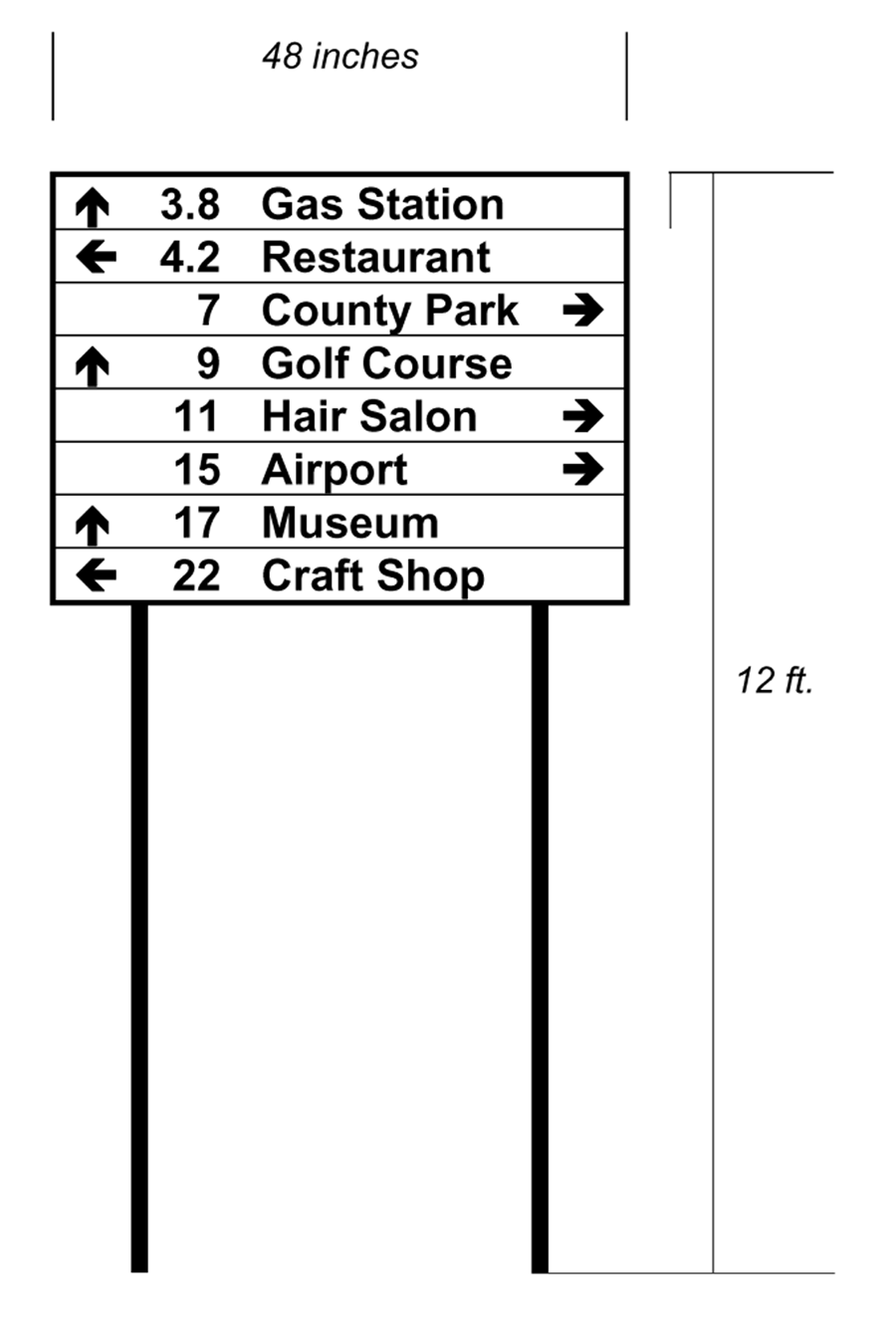
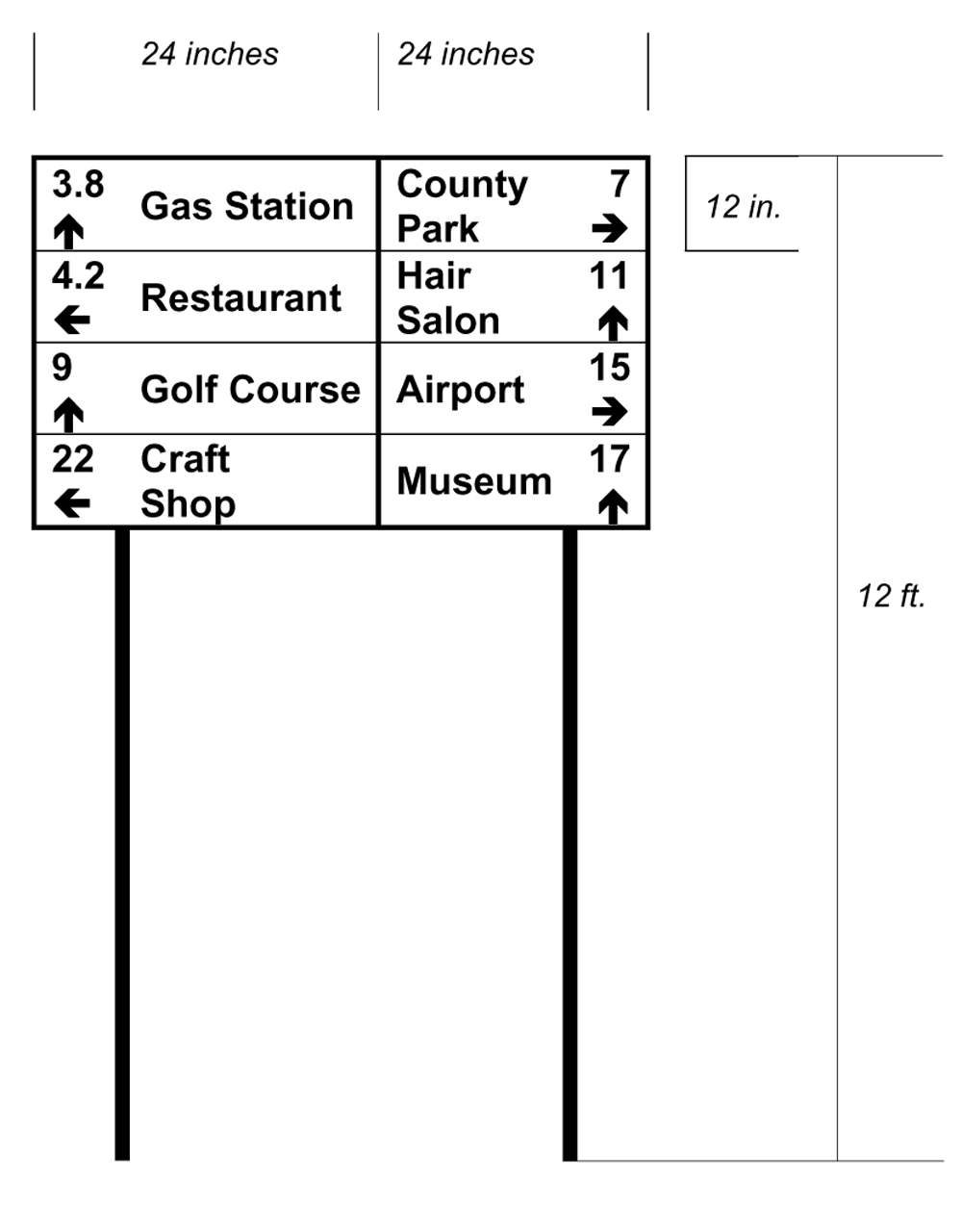
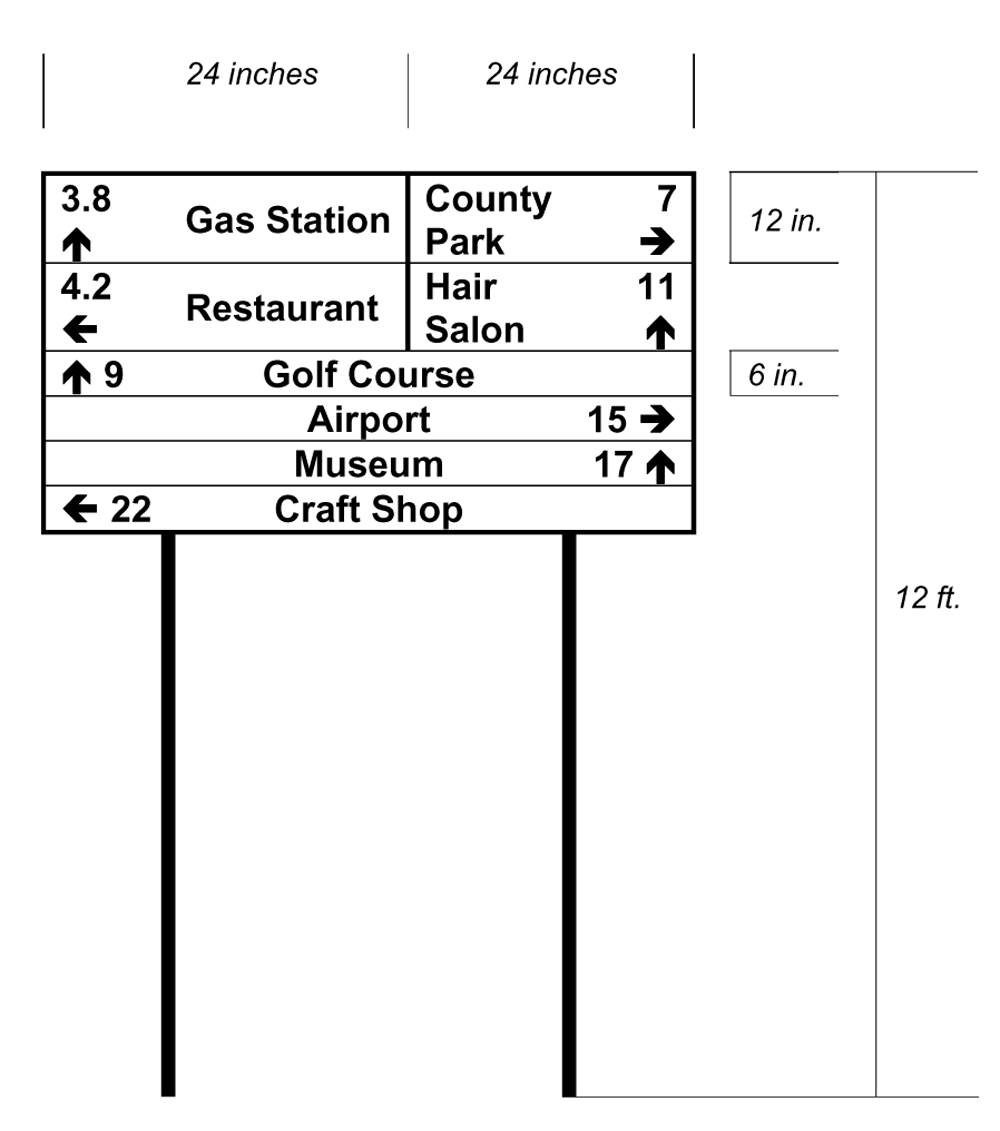
To ensure that the sign serves only a directional purpose, it shall contain only the name of a place, business or facility, distance and direction arrow to the place, business or facility and may not also be used to advertise. See examples in this subsection.
j.
Any such sign shall be a freestanding design.
k.
All signs on a pole or support structure shall have a similar background with white or black text.
l.
All sign designs shall maintain consistency in design standards.
m.
All signs shall have a minimum side setback of two feet.
(2)
All signs placed off-premises shall have the property owner's permission.
STACKED DIRECTIONAL SIGNAGE
ILLUSTRATIVE DIAGRAMS
(not to scale)
Sample A. Stacked 6-inch by 48-inch signs
Sample B. Stacked 12-inch by 24-inch signs
Sample C. Mixed stacked signs.
(d)
Temporary on-premises signs.
(1)
Any sign that will exceed the permitted timeframe will require a land use permit for signage.
(2)
The following temporary signs are permitted to be placed on the lot or parcel to which they refer without a land use permit for signage, subject to the applicable standards:
a.
A temporary on-premises sign on a construction site is allowed in any zoning district, subject to the following additional standards:
1.
Maximum of two signs per construction site.
2.
Any such sign area shall not exceed 80 square feet in aggregate.
3.
Maximum height shall be 12 feet.
4.
Any such sign shall be a freestanding design.
5.
Any such sign shall be removed within seven days of when construction is completed.
b.
A temporary on-premises sign erected on a nonresidential development project, or erected on a residential development project at the time that the development includes ten or more dwelling units for sale or lease, is allowed in any zoning district subject to the following additional standards:
1.
One sign per road or highway frontage for each project.
2.
Maximum area of any such sign shall be 64 square feet
3.
Maximum height shall be 12 feet.
4.
Any such sign shall be a freestanding design.
5.
A sign shall be at least 200 feet from any preexisting residence.
6.
A sign shall not be installed until construction has started or the project is approved by the county.
7.
Sign shall be removed when the project is 80 percent completed, sold or leased.
c.
A temporary on-premises real estate sign for the sale, rent or lease of property is allowed in any zoning district subject to the following additional standards:
1.
One sign per road or highway frontage.
2.
For residential property, the maximum sign area shall be six square feet and maximum sign height shall be six feet.
3.
For residential property, the maximum sign area for a parcel including a model home shall be 32 square feet and the maximum sign height shall be 12 feet.
4.
For nonresidential property, the maximum sign area shall be 32 square feet and maximum sign height shall be 12 feet.
5.
Any such sign shall be a freestanding design.
6.
Any such sign shall be removed within seven days following the sale or lease of the property.
d.
A temporary on-premises sign on nonresidential property for which one or more positions of employment are open is allowed subject to the following additional standards:
1.
One sign per road or highway frontage.
2.
Maximum area of any such sign shall be six square feet.
3.
Maximum height shall be six feet.
4.
Any such sign shall be removed when all positions of employment on the property have been filled.
e.
A temporary on-premises sign on property to be used for a special event is allowed in any zoning district, subject to the following additional standards:
1.
One sign per road or highway frontage.
2.
Maximum height shall be 12 feet in the residence and agricultural residential zoning districts and 20 feet in any other zoning districts.
3.
Maximum area of any such sign shall be 32 square feet.
4.
Signs may be displayed for not more than 15 days per event or 45 days per calendar year.
5.
If a sign is displayed on residential property one banner or one freestanding sign is allowed for each event.
6.
If a sign is displayed on nonresidential property, any combination of two banners or freestanding signs, with a total sign area of 64 square feet, is allowed for each event.
7.
Signs shall only be placed before and during event and shall be removed 24 hours after completion of the event.
(e)
Temporary off-premises signs. A temporary off-premises directional sign is allowed in any zoning district, subject to the following additional standards:
(1)
A maximum of three signs for each event or activity may be displayed.
(2)
All signs placed off-premises shall have the property owner's permission.
(3)
Maximum area of any such sign shall be six square feet.
(4)
Maximum height shall be six feet.
(5)
Signs shall be placed outside and may abut the right-of-way.
(6)
Signs shall only be placed during the event and up to 48 hours before and 24 hours after the completion of the event.
(7)
Any such sign shall be a freestanding design.
(8)
To ensure that the sign serves only a directional purpose, it shall contain only the name of a place, date, time, distance and direction arrow to the place and may not also be used to advertise.
(Res. No. 2018-16, 6-5-2018; Res. No. 2021-32, 10-21-2021; Res. No. 2023-12, 7-20-2023)
Sec. 30-526. - Administration.
(a)
Nonconforming signs.
(1)
Nonconforming permanent freestanding signs larger than 80 square feet, lawfully existing on January 21, 2009, shall be allowed to continue in use, but shall not be altered other than to change the message, relocated, added to, or repaired in excess of 50 percent of the assessed value of the sign, without being brought into compliance with this section.
(2)
Nonconforming permanent building signs lawfully existing on January 21, 2009, shall be allowed to continue in use, and may be repaired provided the repair does not increase the nonconforming aspect of the sign, but shall not otherwise be altered other than to change the message, relocated, or added to, without being brought into compliance with this section.
(3)
After a nonconforming sign has been removed, it shall not be replaced by another nonconforming sign.
(4)
Nonconforming temporary signs lawfully existing on January 21, 2009, shall be removed no later than three years after January 21, 2009, or by an earlier date if so required by a regulation in place when the sign was erected. Nonconforming temporary signs shall not be rebuilt, relocated or altered other than to change a message.
(5)
If a nonconforming permanent sign's use is discontinued for a period of 12 months, the nonconforming sign shall be removed or brought into compliance with this section within 60 days of notification by the zoning administrator.
(6)
If a nonconforming temporary sign's use is discontinued for 60 consecutive days, the nonconforming sign shall be removed or brought into compliance with this section within 60 days of notification by the zoning administrator.
(7)
Nonconforming permanent freestanding signs 80 square feet or smaller, lawfully existing on January 21, 2009, can be allowed to be reconstructed, or repaired, without being brought into compliance with this section. However the sign shall not increase in size and height, the sign must not be within a road right-of-way, and the property owner must obtain a county permit prior to reconstruction or repair. Any other required permits must also be obtained prior to reconstruction or repair. If no county sign permit is obtained prior to reconstruction then the sign is not allowed.
(b)
Permit required. A land use permit for signage is required prior to the improvement, erection, construction, reconstruction, enlargement or alteration of any sign, structural component or mounting device unless otherwise provided by this section.
(c)
Land use permit for signage. A properly completed application for a land use permit for signage shall be made to the zoning administrator upon forms furnished by the county. The following information shall be provided:
(1)
Applicant contact information.
(2)
Property owner contact information.
(3)
Property information, site address, legal description, tax identification number, zoning district.
(4)
Project information including a description of the sign plan for the site and total proposed signage, including all permanent and temporary signage.
(5)
A site plan, drawn to scale, to include:
a.
Dimensions and area of the lot or parcel.
b.
Location of all existing and proposed structures and signs with distances measured from the lot lines and right-of-way of all abutting roads or highways.
c.
In the shoreland and floodplain districts, location of the OHWM of any abutting navigable waterways, floodplain, floodway and flood-fringe limits as determined from floodplain zoning maps used to delineate floodplain areas
d.
Location of existing or future access driveways and roads or highways.
e.
Location of all existing and proposed structures and signs with distances measured from any wetlands within 100 feet of the site.
(6)
Conceptual drawings of all proposed signs with dimensions.
(7)
Information on all lighting and electrical components.
(8)
Method of construction and/or attachment to a building or in the ground shall be explained in the plans and specifications.
(9)
Contact information for whoever will be erecting the signs.
(10)
Attach all related permits or permit applications.
(11)
Calculations for compliance with the Uniform Building Code and the Uniform Sign Code for construction.
(12)
Additional relevant information deemed necessary by the zoning administrator to apply all applicable ordinance requirements and standards, such as photos, cross section drawings, specialized engineering plans and landscaping.
(13)
If additional information is requested, the application shall not be considered a properly completed application and timeframes for processing shall not commence until the additional information is received.
(d)
Permit decision and appeal process.
(1)
A land use permit for signage applicant or permit holder may appeal a determination or an order. Appeal procedures are established in article XI of this chapter, pertaining to the board of adjustment.
(2)
When a permit of any kind is required for a sign, the zoning administrator shall deny, approve with conditions, or approve without conditions such permit in an expedited manner no more than 30 days from the receipt of a complete application for such a permit, including the applicable fee.
a.
If the permit is denied or approved with conditions, the county shall prepare a written decision, stating a reason or reasons for the action and describing the applicant's appeal rights under article XI of this chapter, pertaining to the board of adjustment, and provide it to the applicant.
b.
When the board of adjustment receives an appeal it shall hear such appeal and take action subject to the county board of adjustment rules and bylaws and Wis. Stats. § 59.694.
c.
If the appeal is denied or approved with conditions, the county shall prepare a written decision within ten days of its decision, stating a reason for the action and provide it to the applicant.
(3)
When a permit of any kind is required for a sign, and the permit application or permit appeal demonstrates that the sign would comply with all applicable requirements of this section, the permit application or permit appeal shall not be denied.
(e)
Expiration.
(1)
Sign maintenance or construction authorized by a land use permit for signage issued under this section shall be completed within one year, after which time the permit expires.
(2)
Prior to expiration of a permit, applicants can request one extension of one year from the zoning administrator.
(f)
Permit revocation. Where the terms or conditions on any land use permit for signage are violated, the permit may be revoked by the zoning administrator.
(Res. No. 2018-16, 6-5-2018)

