
Blue Ridge City Zoning Code
ARTICLE I
- IN GENERAL
Sec. 140-1.- Short title.
This chapter shall be known and may be cited as "The Zoning Ordinance of the City of Blue Ridge, Georgia," and shall include the following articles, sections, maps, and, when necessary, a supporting appendix.
(Ord. No. BR2023-20, § 2(Exh. B), 8-15-2023)
Sec. 140-2. - Purpose and intent.
The ordinance from which this chapter is derived is enacted pursuant to authority contained in Ga. Const. art. IX, § II, ¶ IV, as amended. The zoning regulations and districts herein are intended to help implement, in part, the land use policies and future land use initiatives envisioned by the local comprehensive plan, duly adopted by the mayor and city council, and amended or superseded from time to time.
(1)
The zoning regulations and districts herein are designed:
a.
To lessen congestion in the streets;
b.
To secure safety from fire, panic, and other dangers;
c.
To promote health, morals, convenience, and the general welfare;
d.
To provide adequate light and air;
e.
To prevent overcrowding of the land;
f.
To avoid undue concentration of the population;
g.
To facilitate the adequate provision of transportation, water, sewerage, schools, parks, and other public requirements;
h.
To promote community-wide aesthetics; and
i.
To protect and conserve irreplaceable natural resources.
(2)
The regulations have also been made with reasonable consideration to the character of the district and its peculiar suitability for particular uses and with a view:
a.
To promoting desirable living conditions;
b.
To sustaining the stability of neighborhoods;
c.
To protecting property against blight and depreciation;
d.
To securing economy in governmental expenditures;
e.
To conserving the value of buildings and land; and
f.
To encouraging the most appropriate use of land and structures.
(3)
The requirements of these regulations are minimum permissible standards; and it is expected that developers and the municipal planning staff will normally strive for quality development which will exceed these minimum requirements.
(Ord. No. BR2023-20, § 2(Exh. B), 8-15-2023)
Sec. 140-3. - Rules.
In the construction of this chapter, the rules contained in this section shall be observed and applied, except when the context clearly indicates otherwise: Where requirements are set based on number of days, days are computed based on the calendar, except that when the final date falls on a weekend or holiday, the day due shall continue until the next regular working day.
(Ord. No. BR2023-20, § 2(Exh. B), 8-15-2023)
Sec. 140-4. - Use of definitions.
The following words, terms and phrases, when used in this chapter, shall have the meanings ascribed to them in this section, except where the context clearly indicates a different meaning:
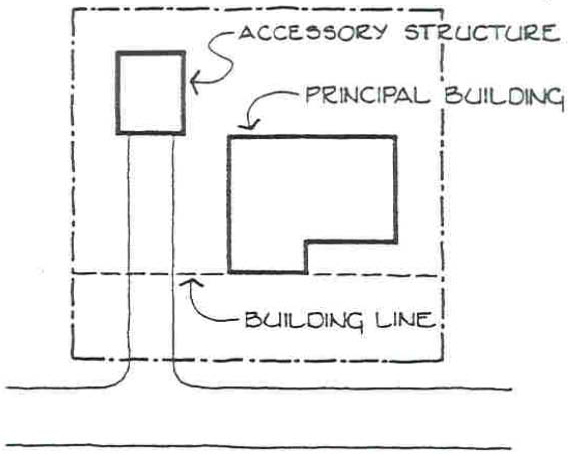
Accessory structure means a structure detached from a principal building on the same lot and customarily incidental and subordinate to the principal building. See Figure 1: Accessory Structure.
Figure 1: Accessory Structure
Accessory use means a use of land or of a building or portion thereof customarily incidental and subordinate to the principal use of the land or building and located on the same lot with such principal use.
Adult business means:
(1)
Any business which is conducted exclusively for the patronage of adults and to which minors are specifically excluded from patronage there, either by law or by the operators of such business;
(2)
Any business where employees or patrons expose specified anatomical areas or engage in specified sexual activities, as further defined in Chapter 4 - Adult Businesses in the City of Blue Ridge Code of Ordinances; or
(3)
Any other business or establishment which offers its patrons services, products, or entertainment characterized by an emphasis on matter depicting, describing, discussing or relating to specified sexual activities or specified anatomical areas.
Agricultural means the art or science of cultivating the soil and activities incidental thereto; the growing of soil crops in the customary manner on open tracts of land; forestry; farming. The term "agricultural" includes incidental retail selling by the producer of products raised on the premises, provided that space necessary for parking of vehicles of customers shall be furnished off the public right-of-way.
Alley means a public thoroughfare which affords only a secondary means of access to abutting property.
Animal hospital means a building used for the treatment, housing or boarding of small domestic animals such as dogs, cats, rabbits and birds or fowl by a veterinarian.
Antenna means any exterior apparatus designed for the sending and/or receiving of electromagnetic waves.
Apartment buildings. See Dwelling, multifamily.
Assisted living means a facility licensed by the Georgia Department of Community Health in which, through its ownership or management, provides housing, food service, and one or more personal services for two or more ambulatory adults who are not related to the owner or administrator by blood or marriage and is licensed as a personal care home pursuant to O.C.G.A. § 31-7-1 et seq. Personal services include, but are not limited to, individual assistance with or supervision of self-administered medication and essential activities of daily living such as eating, bathing, grooming, dressing, and toileting. The term "assisted living" does not include buildings which are devoted to independent living units which include kitchen facilities in which residents have the option of preparing and serving some or all of their own meals or boarding facilities which do not provide personal care.
Assisted living home, congregate, means a home for adults which offers care to 16 or more persons.
Assisted living home, family, means a home for adults in a family type residence, non-institutioneal in character, which offers care to two through six persons.
Assisted living home, group, means a home for adults in a residence or other type building, non-institutional in character, which offers care to seven through 15 persons.
Basement means a level within a building having at least one-half of its height on one side below grade.
Bed and breakfast (home) means any private owner-occupied building offering transient lodging accommodations and breakfast to not more than three guest rooms for compensation.
Bed and breakfast (inn) means a building, not necessarily owner-occupied, that offers transient lodging accommodations and breakfast for four or more guest rooms for compensation.
Boardinghouse means a dwelling other than a hotel, where for compensation and by prearrangement for definite periods, meals, or lodging and meals, are provided for three or more persons. Meals may or may not be provided, but there is one common kitchen facility and no meals are provided to persons not residing in the dwelling.
Building means any structure having a roof supported by columns or walls designed or built for the support, enclosure, shelter, or protection of persons, animals, or personal property of any kind.
Building, height of, means the highest point of a building when measured from the lowest point at which the foundation intersects the ground. Building height shall not apply to minor vertical projections of a parent building including chimneys, flagpoles, flues, spires, steeples, belfries, and cupolas.
Building line means a line parallel to the street right-of-way line a distance therefrom equal to the depth of the front yard required for the zoning district in which the lot is located. See Setback line.
Campground, public or private, means land or premises used or occupied for compensation by campers traveling by passenger vehicles and utilizing tents, campers, travel trailers, or other recreational vehicles.
Cemetery means a place for the burial of the dead, including a mausoleum and columbarium.
Church means a building or group of buildings which are primarily intended for organized religious services, meetings, and associated accessory activities, such as child care, educational, family-orientated recreation/exercise facilities, and cemeteries, but not including thrift stores.
Clinic means a building or a portion of a building where patients are not lodged overnight, but are admitted for examination and treatment by one or more physicians or dentists practicing together.
Cluster development means a development design technique that concentrates building and density in specific areas on a site and allows the remaining land to be perpetually used for recreation, common open space, preservation of environmentally sensitive areas, and farmlands.
Club, private, means a building or portion thereof or premises owned or operated by a corporation, association, or person for a social, educational or recreational purpose but not primarily for profit or to render a service which is customarily carried on as a business.
Columbarium means a vault with niches for urns containing the ashes of cremated bodies.
Community center means a building or facility used to provide recreational, social, educational and cultural activities for an area of a community, which is owned and operated by the management agency of that community, or the homeowner's association of that community. A community can be an incorporated area, a developed subdivision, or a planned development.
Community water and sewer system means a utility system serving a group of buildings, lots, or an area with the design and construction of such systems as approved by the state.
Condominium. See Dwelling, single-family attached.
Convenience store means any retail establishment offering for sale prepackaged food products, beverages, household items, and other goods commonly associated with the same.
Cultural facility means a structure or portion of a structure used as art gallery, museum, historical display, legitimate theater, library, and other uses similar in character to those listed.
Dance hall means any place of business or leased nonresidential building where dancing is indulged in or permitted either by the owner or lessee if applicable of said premises on a regular basis or not, whether a fee or admission is charged or not, and where music therefore is supplied by any means whatsoever. Governmental facilities, educational facilities, and churches shall not be deemed dance halls.
Day care center, group, means a building or portion of a building wherein is provided care and supervision of persons away from their place of residence for less than 24 hours a day on a regular basis for compensation; serves seven to 18 persons and is licensed by the state; for children, the outdoor play area shall be enclosed by a fence of not less than four feet in height in the rear yard only.
Day care facility means a building or portion of a building wherein is provided care and supervision of persons away from their place of residence for less than 24 hours per day on a regular basis for compensation; serves 19 or more persons and is licensed by the state; for children, the outdoor play area shall be enclosed by a fence of not less than four feet in height in the rear yard only. For the purposes of this chapter, the term "child care" shall include, but not be limited to, the terms "day care," "nursery school," "early learning center," "pre-kindergarten," "private kindergarten," "play school," and "pre-school."
Day care home, family, means a customary home occupation which provides, for six or less persons who are not residents of the premises, care and supervision by a state-registered resident adult for less than 24 hours per day on a regular basis for compensation.
Density means the number of dwelling units permitted per acre of total land to be developed for residential use. As such, common parking and driveway areas are not excluded in computing density.
District means a delineated section of the city for which the zoning regulations governing the use of buildings and premises, the height of buildings, the size of yards, and the intensity of use are uniform.
Drive-in means any use providing the opportunity of selling, serving, or offering goods or services directly to customers waiting in vehicles or customers who return to their vehicles to consume or use the goods or services while on the premises of the principal use.
Duplex. See Dwelling, multifamily.
Dwelling means a building which is designed or used exclusively for residential purposes, including single-family, duplex (two dwelling units), triplex (three dwelling units), four-plex (four dwelling units) and multifamily residential buildings, roominghouses and boardinghouses, fraternities, sororities, dormitories, manufactured homes, and industrialized homes, but not including hotels, motels, bed and breakfast homes and inns, and extended stay hotel/motels.
Dwelling, condominium, means a building, or group of buildings, in which units are owned individually, and the structure, common areas and facilities are owned by all the owners on a proportional, undivided basis.
Dwelling, loft, means a dwelling unit, occupied by no more than four persons, and located only on the floor above a ground level commercial business.
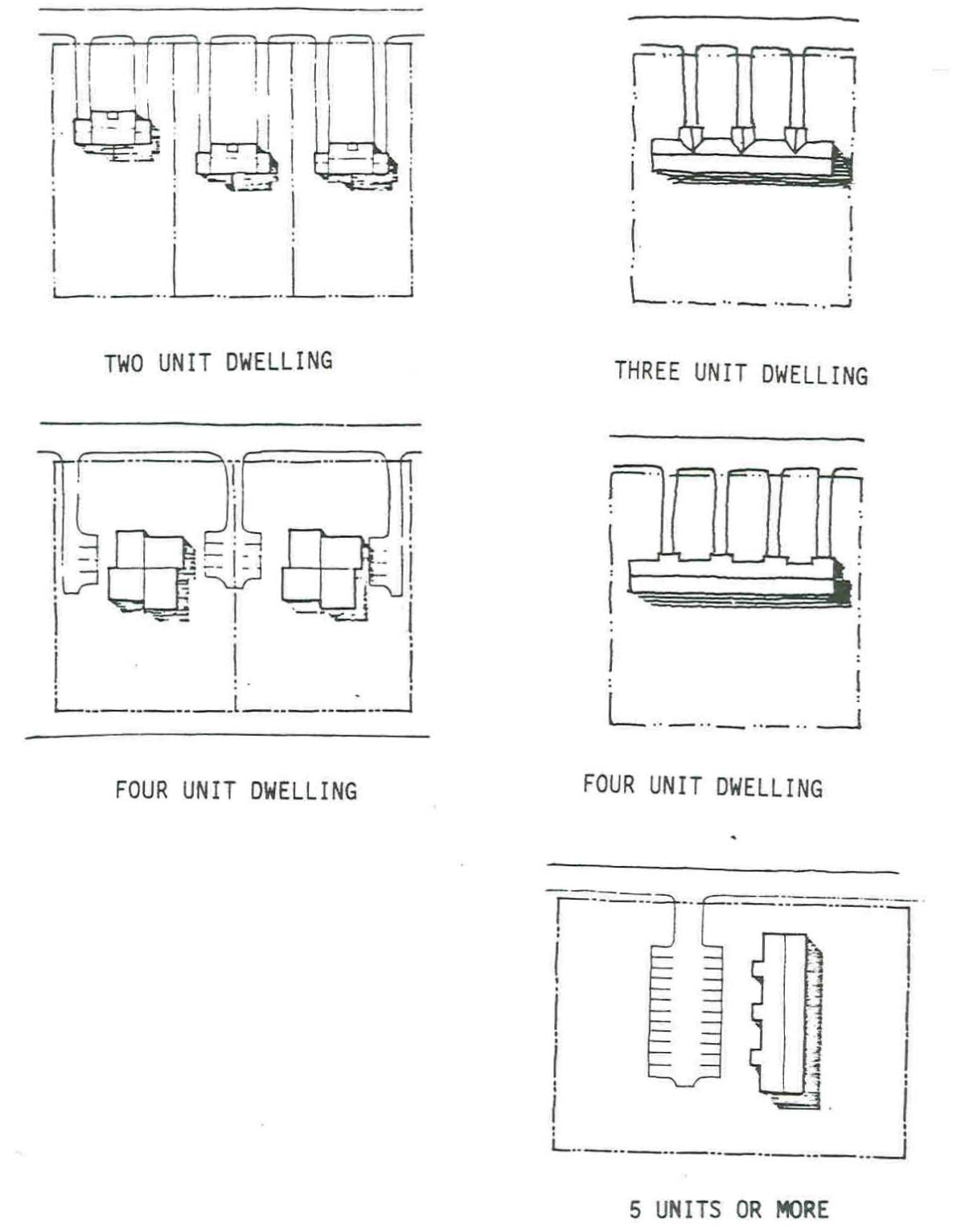
Dwelling, multifamily, means a building in single ownership containing two or more dwelling units, including what is commonly known as an apartment building (two or more dwelling units), duplexes (two dwelling units), triplexes (three dwelling units), and four-plexes (four dwelling units). See Figure 2: Multifamily Dwellings.
Figure 2: Multifamily Dwellings
Dwelling, senior, means a multifamily residence with 80 percent or more of the dwelling units occupied by residents, ages 62 and over or handicapped; or couples where either the husband or wife is 62 years of age or older; the term "senior dwelling" does not include convalescent or nursing facilities.
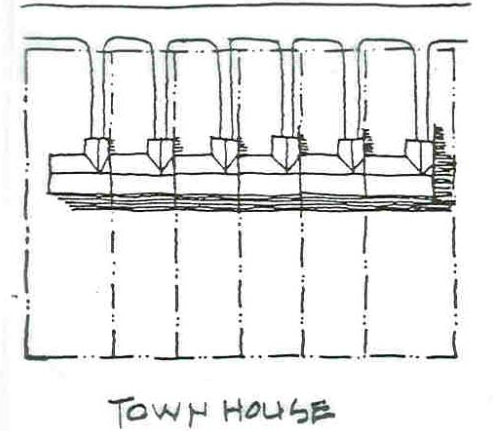
Dwelling, single-family attached, means a building containing two or more dwelling units, each of which is deeded with separate ownership and has primary ground floor access to the outside and which are attached to each other by party walls without openings. Units are located on either individually owned lots (townhouses), or a common area owned by all the owners (condominiums). See Figure 3: Single-Family Attached Dwelling.
Figure 3: Single-Family Attached Dwelling
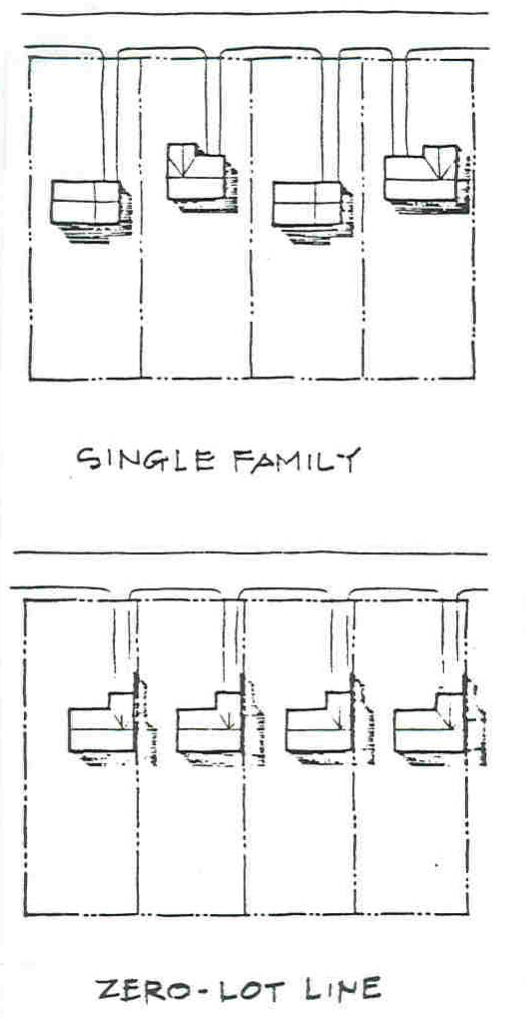
Dwelling, single-family detached, means a detached residential building containing not more than one dwelling unit entirely surrounded by open space. A single-family detached dwelling includes site-built houses, manufactured homes and industrialized homes. Such dwelling structure is designed for the use of one family. All single-family detached dwellings shall meet the appearance standards provided in section 140-17. See Figure 4: Single-Family Detached Dwelling.
Figure 4: Single-Family Detached Dwelling
Dwelling, townhouse, means one single-family dwelling unit connected in a row of at least two such units in which each unit has its own lot with a front and rear yard, and no unit is located over another unit, and each unit is separated from any other unit by one or more common fire resistant walls.
Dwelling unit means one or more rooms used for residential purposes located within a building and forming a single habitable unit with complete, independent facilities which are used or intended to be used for living, sleeping, cooking, eating, and sanitation purposes. Units in hotels, motels, extended stay motel/hotels, or other structures designed for use by persons who are visitors/guests or temporary workers and not permanent residents of the city are not included.
Dwelling, zero-lot-line, means a development of single-family detached residence in which one interior side yard may be lawfully reduced to zero on any lot for the purpose of creating larger, more usable, and more easily maintained yard spaces, particularly on smaller lots. See Figure 4: Single-Family Detached Dwellings.
Easement means the right of a person, government agency, or public utility company to use public or private land owned by another for a specific purpose.
Façade means the architectural details of the face of a building that are intended to be viewed by the public. The front Façade of the building is the wall which contains the primary entrance to the building.
Family means an individual, or two or more persons related by blood, marriage, adoption, or guardianship, occupying a single dwelling unit; provided that domestic servants employed on the premises may be housed on the premises without being counted as a separate family. The term "family" does not include any organization or institutional group.
Flag means a fabric banner or pennant mounted to a building by a pole and attached to said pole by one side only.
Floating zone. See Zone, floating.
Flood means a temporary rise in stream flow or stage that results in inundation of the areas adjacent to the channel.
Floodplain means any land area susceptible to being inundated by water from any source.
Floor area, gross, (GFA) means the gross horizontal areas of all floors measured from the exterior faces of the exterior walls of a building. Areas within a building used for parking, basements, cellars, unenclosed porches or any space where floor to ceiling height is less than six feet shall not be included in the gross floor area.
Frontage, street, means all of the abutting property on one side of a street, between two streets which intersect such street (crossing or terminating), or if the street is dead ended, then all of the property abutting on one side between a street which intersects such street and the dead end.
Garage, private, means an accessory building designed or used for the storage of motor-driven vehicles owned and used by the occupants of the buildings to which it is accessory.
Garage, storage or parking, means a building or portion thereof designed or used exclusively for storage of motor-driven vehicles.
Grade means the average level of the finished ground surface adjacent to the exterior walls of the building.
Gross floor area. See Floor area, gross.
Group home means a dwelling, which is licensed by the Georgia Department of Community Health, for full-time residence by non-related persons, who are mentally or physically challenged or elderly, with one or more surrogate parents that function as a singular housekeeping unit. Services include room, meal, and personal care, and all group homes shall be approved and licensed by the state; for children the outdoor play areas shall be enclosed by a fence of not less than four feet in height in the rear yard only.
Halfway house means a dwelling having accreditation from the Georgia Association of Recovery Residences (GARR), Department of Community Health (DCH), Commission on Accreditation of Rehabilitation Facilities (CARF), or Joint Commission Center for Transforming Healthcare (JCAHO) and that is used for temporary residence by non-related persons, who are recovering from alcohol abuse or other chemical-based substances, with one or more surrogate parents that provide services that include room, meals, supervision, rehabilitation, and counseling to enable residents to move back into society and live independently.
Hazardous wastes means any solid waste which has been defined as a hazardous waste in regulations promulgated by the administrator of the United States Environmental Protection Agency (see, e.g., 40 C.F.R. § 261.3 et seq.)
Health club means a facility designed for the major purpose of physical fitness or weight reducing which includes, but is not limited to, such equipment as weight resistance machines, whirlpools, saunas, showers, and lockers. The term "health club" shall not include municipal or privately owned recreation buildings.
Home occupation, customary, means an occupation customarily carried on by an occupant of a dwelling unit as a secondary use which is clearly incidental to the use of the dwelling unit for residential purposes and operated in accordance with the provisions of these regulations.
Hotel means a building offering overnight sleeping accommodations for travelers; ingress and egress to and from all rooms are made through an inside lobby or office supervised by a person in charge at all hours. Such use has 80 percent of the rooms occupied by a different registered guest every five days, provides patrons with daily maid service and a telephone switchboard service to receive incoming/outgoing messages, and shall comply with the applicable requirements of the county health department and O.C.G.A. § 31-28-1 et seq., and may provide additional services such as restaurants, retail gift shops, meeting rooms, swimming pools, and exercise facilities.
Hospice means a building, or portion thereof, in which terminally ill persons live and receive scheduled medical, nursing, social, spiritual, volunteer, and bereavement care on a 24-hour basis; such hospice shall be licensed to operate in the state.
Impervious surface means a manmade structure or surface which prevents the infiltration of stormwater into the ground below the structure or surface. Examples are buildings, roads, driveways, parking lots, decks, swimming pools, or patios.
Industrialized building or modular building means any structure or component thereof which is wholly or in substantial part made, fabricated, formed, or assembled in manufacturing facilities for installation on a building site and has been manufactured in such a manner that all parts or processes cannot be inspected at the installation site without disassembly, damage to, or destruction thereof. Industrialized buildings are constructed and regulated in accordance with O.C.G.A. title 8, chapter 2, article 2).
Institution means a public or semi-public building occupied by a governmental entity, nonprofit corporation or nonprofit establishment for public use.
Junk vehicles means any automobile, vehicle trailer or any kind or type or mechanical contrivance or part thereof, which is in an inoperative or junk condition by reason of its having been wrecked, discarded, or which does not have a valid license plate attached thereto (when the same is required by law). For the purpose of this chapter, a vehicle is inoperative if it is incapable of movement by its own power, it remains in place for a period of more than seven days, and is not within a carport/garage or detached accessory structure, or in a driveway.
Junkyard means any use involving the storage or disassembly of wrecked automobiles, trucks, or other vehicles or the dismantling, demolition, or abandonment of automobiles or other vehicles or machinery or parts thereof; the keeping, abandonment, sale or resale of junk including scrap metal, used paper, or other scrap materials, and equipment; storage, baling or otherwise dealing in bones, animal hides, used cloth or rags, used plumbing fixtures, appliances, furniture, and used brick, wood or other building materials. Such uses shall be considered junkyards whether or not all or part of such operations are conducted inside a building or in conjunction with, addition to, or accessory to, other uses of the premises.
Kennel means any location where breeding, raising, boarding, caring for, and the keeping of more than three dogs or cats or other small animals or combination thereof (except litters of animals not more than six months of age) is carried on for commercial purposes.
Kindergarten means any premises or portion thereof used for educational work or parental care of children of less than the age required for enrollment in the public or private school system.
Land disturbing activity means any grading, scraping, excavating, or filling of land; clearing of vegetation; and any construction, rebuilding, or alteration of a structure. The term "land disturbing activity" shall not include activities such as ordinary maintenance and landscaping operations, individual home gardens, yard and grounds upkeep, repairs, additions or minor modifications to a single-family dwelling, and the cutting of firewood for personal use.
Landfill, inert waste, means a disposal site accepting only wastes that will not or are not likely to cause production of leachate of environmental concern. Such wastes are limited to dirt, concrete, rock, bricks, yard trimmings, stumps, limbs, and leaves. The term "inert waste landfill" excludes industrial and demolition wastes.
Landfill, sanitary, means a disposal site where putrescible wastes are disposed of using sanitary landfilling techniques.
Landfilling, sanitary, means an engineered method of disposing of putrescible wastes on land by spreading them in thin layers, compacting them to the smallest practical volume, placing an earth cover thereon, and such other measures as are necessary to protect human health and the environment.
Leasable area, gross, (GLA) means the total building floor area in square feet that a developer may lease.
Lot means a developed or undeveloped tract of land in one ownership legally transferable as a single unit of land; the term "lot" includes the yards and parking spaces required and has its principal frontage upon a street.
Figure 5: Lot
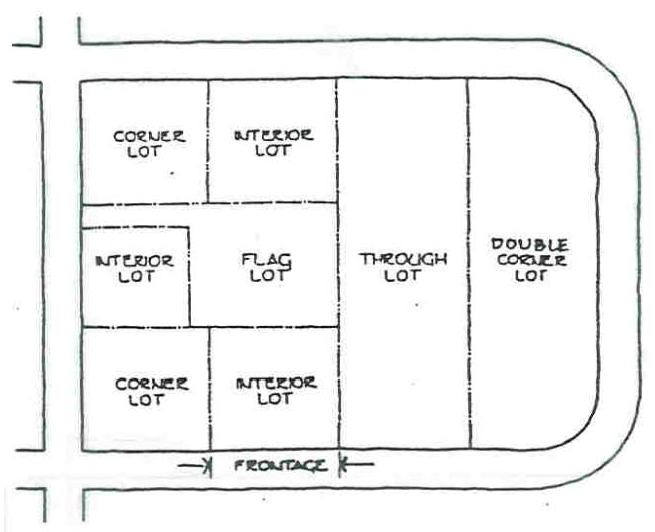
Lot, corner, means a lot abutting upon two or more streets at their intersection.
Lot coverage means the area of a lot occupied by the principal building and accessory buildings.
Lot depth means the mean horizontal distance between the front and rear lot lines measured within the lot boundaries.
Lot, double frontage. See Lot, through.
Lot, flag, means lots or parcels that the city has approved where the panhandle is an access corridor to a lot located behind lots or parcels with normal street frontage.
Lot line, front, means the lot line separating a lot from a street right-of-way.
Lot line, rear, means the lot line opposite and most distant from the front lot line; or in the case of triangular or otherwise irregularly shaped lots, a line ten feet minimum in length entirely within the lot, parallel to and at a maximum distance from the front lot line.
Lot line, side, means any lot line other than a front or rear lot line.
Lot of record means a lot which is part of a subdivision, the plat of which has been recorded in the office of the clerk of the superior court of the county or a parcel of land described by metes and bounds, the plat or description of which has been recorded in said office prior to the adoption of the ordinance from which this chapter is derived. If a portion of a lot or parcel has been conveyed at the time of the adoption of the ordinance from which this chapter is derived, the remaining portion of said lot or parcel shall be considered a lot of record.
Lot, through, means a lot which fronts upon two parallel streets, or which fronts upon two streets which do not intersect at the boundaries of the lots.
Lot width means the distance between the side lot lines measured at right angles to the lot depth at the established front building line.
Lot width, curvilinear frontage. For a lot having the majority of its frontage on a circular turnaround or on a curved street, the lot width shall be the distance between the side lines of the lot, measured as if tangent at the midpoint of the arc of the front property line and parallel to the chord of the arc, where the minimum required distance is obtained. The lot width line is synonymous with the front building line in this example.
Manufactured home means a structure defined by and constructed in accordance with the National Manufactured Housing Construction and Safety Standards Act of 1974, as amended, 42 USC 5401 et seq. A manufactured home is a single-family detached dwelling and its placement in a residential district must meet or exceed the appearance standards as provided in section 140-17. The definition at the date of adoption of the ordinance from which this chapter is derived is as follows:
A structure, transportable in one or more sections, which, in the traveling mode, is eight body feet or more in width or 40 body feet or more in length, or, when erected on site, is 320 or more square feet, and which is built on a permanent chassis and designed to be used as a dwelling with or without a permanent foundation when connected to the required utilities, and includes the plumbing, heating, air-conditioning, and electrical systems contained therein; except that the term "manufactured home" shall include any structure which meets all the requirements of this paragraph except the size requirements and with respect to which the manufacturer voluntarily files a certification required by the Secretary and complies with the standards established under this title. The term "manufactured home" does not include the term "travel trailer."
Manufactured home park means a parcel of land which has been planned for or improved for the location of three or more manufactured homes for residential occupancy.
Mausoleum means a building where bodies are interred above ground in stacked vaults.
Mini-warehouse. See Self-service storage facility.
Mobile home means a structure, transportable in one or more sections, which, in the traveling mode, is eight body feet or more in width or 40 body feet or more in length or, when erected on site, is 320 or more square feet and which is built on a permanent chassis and designed to be used as a dwelling with or without a permanent foundation when connected to the required utilities and includes the plumbing, heating, air-conditioning, and electrical systems contained therein and manufactured prior to June 15, 1976. See also Manufactured home.
Mobile office means a factory-fabricated structure designed to be transported on its own wheels, detachable wheels, flatbed or trailer and used or intended to be used or occupied for the transaction of business or the rendering of a professional service.
Modular home. See Industrialized building.
Motel means a permanent building or group of permanent buildings in which overnight sleeping accommodations are provided for travelers and having a parking space near or adjacent to the entrance of the room. Such use has 80 percent of the rooms occupied by a different registered guest every five days, provides patrons with daily maid service, 24-hour desk/counter clerk service, and a telephone switchboard service to receive incoming/outgoing messages, and shall comply with applicable requirements of the county health department and O.C.G.A. § 31-28-1 et seq., and may provide additional services such as restaurants, retail gift shops, meeting rooms, swimming pools, and exercise facilities.
Motel/hotel, extended stay. See Residence inn.
Motor vehicle service station means a building or lot for motor vehicle refueling using fixed dispensing equipment connected to pumps and storage tanks; where oils or accessories for the use of motor vehicles are dispersed, sold, or offered for sale at retail; and may include one or more service bays for vehicle washing, lubrication and minor replacement, or adjustment and repair services.
Multifamily dwelling. See Dwelling, multifamily.
Neighborhood center. See Community center.
Nonconforming use means the use of any building or land which was lawful at the time of passage of the ordinance from which this chapter is derived, or amendment thereto, but which use does not conform, after the passage of the ordinance from which this chapter is derived or amendment thereto, with the regulations of the district in which it is situated.
Nuisance means an interference with the enjoyment and use of property.
Nursery school, play school, or kindergarten includes daytime care or education for children; see applicable definitions under family day care home, group day care center, and day care facility regarding the number of children served.
Nursing/convalescent home means a facility that is licensed by the Georgia Department of Community Health in which, through its ownership or management, admits patients on medical referral only, provides continuous medical supervision and provides skilled nursing care and services. Nursing services shall be those services which may be rendered by a person licensed under the Nurse Practice Act (O.C.G.A. § 43-26-1 et seq.).
Office, business, means and includes offices for general business, insurance, real estate, appraisals, etc.
Office, professional, means and includes offices for professionals such as accountants, architects, attorneys, chiropractors, dentists, doctors, engineers/surveying, etc.
Open space means uncovered area open to the sky on the same lot with a building.
Overlay zone. See Zone, overlay.
Pet (household pet) means any animal owned or kept for pleasure rather than sale, which is a species customarily bred and raised to live in the habitat of humans and is dependent upon them for food and shelter, except that livestock and wild animals shall not be deemed to be pets.
Personal care home. See Assisted living.
Photovoltaic (PV) system means a solar energy system that produces electricity by the use of semiconductor devises, called photovoltaic cells that generate electricity whenever light strikes them. Included in a PV system are the solar energy generation mechanisms (panels, etc.), inverters, batteries and battery systems that store electrical energy from the PV system for future use, meters, and electrical transmission wires and conduits that facilitate connections with users and/or the local power grid.
Premises means a lot, together with all buildings and structures existing thereon.
Principal use means the primary or predominant purpose for which a lot is occupied and/or used.
Recovery residence. See Halfway house.
Recreational facility, indoor, means any commercial or noncommercial indoor facility such as bowling alley, shooting gallery, video game center, etc.
Recreational facility, outdoor, means any commercial or noncommercial outdoor facility such as a miniature golf course, a golf or baseball driving range, tennis courts, swimming pools, drive-in theaters, etc.
Recreational vehicle means a vehicular-type portable structure without permanent foundation, which can be towed, hauled or driven and primarily designed as temporary living accommodation for recreational, camping and travel use and including, but not limited to, travel trailers, truck campers, camping trailers and self-propelled motor homes.
Recycling center means a noncommercial facility in which recoverable resources, such as papers, glassware, plastics, and metal cans, or any non-hazardous recycling materials, are collected, stored, flattened, crushed, or bundled, by hand or machines, within a completely enclosed building.
Recycling collection station means an incidental use that serves as a neighborhood drop-off point for temporary storage of recoverable resources. No processing of such items would be allowed. This facility would generally be located in a commercial parking lot, or at other public/quasi-public areas, such as churches and schools.
Repair service, motor vehicle general, means a building, lot, or both in or upon which comprehensive motor vehicle repair services are performed, including painting, body and fender work, engine overhauling or other major repair; such facility commonly serves disabled or wrecked vehicles requiring occasional wrecker services and repair service time routinely exceeds more than 24 hours on site, but excluding a junkyard and/or motor vehicle wrecking business.
Repair service, motor vehicle specialty, means a building lot, or both in or upon which specialty repair services are provided quickly for operational motor vehicles; services may include, but are not limited to, removal and/or replacement of oils, fluids, filters, greases, minor parts like mufflers, shocks, and brakes; and may include tuning of engines; service repair time is routinely less than 24 hours on site.
Residence inn or extended stay motel/hotel means any building containing six or more guest rooms intended or designed to be used, or which are used, rented, or hired out to be occupied or which are occupied for sleeping purposes for guests/visitors to the city and contain kitchen facilities for food preparation, including, but not limited to, such facilities as refrigerators, stoves, and ovens.
Right-of-way means a strip of land occupied or intended to be occupied by a street, crosswalk, railroad, electric transmission line, gas pipeline, water main, sanitary or storm sewer main, shade trees, or other special use.
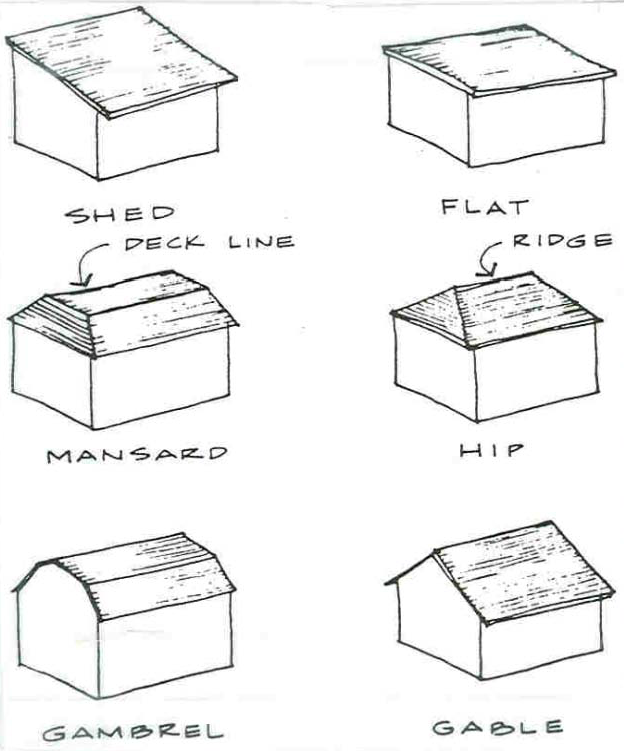
Roof means the outside top covering of a building. See Figure 6: Roof.
Figure 6: Roof
Salvage yard. See Junkyard.
Satellite dish antenna means a device incorporating a reflective surface that is solid, open mesh, or bar configured and is in the shape of a shallow dish, cone, horn, or cornucopia. Such device shall be used to transmit and/or receive radio or electromagnetic waves between terrestrially and/or orbitally based uses. The term "satellite dish antenna" includes, but is not limited to, what are commonly referred to as satellite earth stations, TVROs (television reception only satellite dish antennas), and satellite microwave antennas.
Schools, private, parochial and other elementary, means any places for teaching children grades one to eight, inclusive, which are not a part of the state, but which teach the subjects commonly taught in the common elementary schools of the state.
Schools, public, means any place for teaching children grades kindergarten to 12 inclusive and no other, and a part of the public school system as defined by the laws of the state.
Self-service storage facility means a building consisting of individual, small, self-contained units that are leased or owned for the storage of business and household goods or contractors supplies.
Service station. See Motor vehicle service station.
Setback line means that line that is the required minimum distance from the street right-of-way line or any other lot line that establishes the buildable area within which the principal structure must be erected or placed. See Figure 7: Yard.
Sewage treatment system, public or community, means any sewage treatment system, including pipelines or conduits, pumping stations, force mains and all other construction, devices, and appliances appurtenant thereto, designed for treating or conducting sewage for treatment and disposal into lakes, streams, or other bodies of surface water.
Shopping center means a group of three or more commercial establishments planned, constructed and managed as a total entity with customer and employee parking provided on site, provision for goods delivery separated from customer access, aesthetic considerations and protection from the elements.
Solar access easement means a recorded easement, the purpose of which is to secure the right to receive sunlight across real property of another for continued access to sunlight necessary to operate a solar energy system.
Solar array means a number of photovoltaic modules or panels that generate solar electricity, assembled or connected to provide a single electrical output.
Solar array tracking means a solar array that follows the path of the sun to optimize the amount of solar radiation received by the device. A solar tracking array racking may be ground mounted or building mounted.
Solar energy means radiant energy received from the sun that can be collected in the form of heat or light by a solar collector or solar energy system.
Solar energy facility (farm) means the area of land devoted to solar energy system installation. A solar energy facility may include an interconnection with the local utility power grid for distribution to more than one property or consumer in the electricity market as a commercial venture.
Solar energy system means the components and subsystems required to convert solar energy into electric or thermal energy suitable for use. The term "solar energy system" also applies to, but is not limited to, photovoltaic (solar electric) systems and thermal solar energy systems.
Solar energy system, building-mounted, means a solar energy system, which may include solar thermal panels, solar water heating system panels, and photovoltaic panels, which are mounted to a building or structure, to provide energy primarily for on-site use. Building-mounted solar panels may be flush mounted (i.e., flush to the surface of a building or a building roof or Façade in a manner that the panel cannot be angled or raised), or as one or more modules fixed to frames which can be tilted or automatically adjusted at an optimum angle for sun exposures. The mounting system for building or roof solar systems shall be approved by the building inspector or other duly designated agent of the city. The building inspector or other duly designated agent of the city shall require, for permitting purposes, any architectural or engineered design as deemed necessary to confirm that the mounting system is structurally sound.
Solar energy system, ground-mounted, means a solar energy system that is directly installed on the ground surface by a properly designed support structure and which is not attached, or affixed, to any structure.
Solar energy system, thermal, means a solar energy system that directly heats water or other liquid using sunlight, including the use of heated liquid for such purposes as space heating and cooling, domestic hot water and heating pool water.
Solid waste means putrescible and non-putrescible wastes, except water-carried body waste, but shall include garbage, rubbish, ashes, street refuse, dead animals, sewage sludge, animal manures, industrial wastes, abandoned automobiles, dredging wastes, construction wastes, hazardous wastes and any other waste material in a solid or semi-solid state not otherwise defined in these regulations.
Stealth means any cables, wires, lines, antennas, or other equipment associated with transmission or reception of communications which are designed to enhance compatibility with adjacent land uses, including, but not limited to, architecturally screened roof-mounted antennas, antennas integrated into architectural elements, and towers designed to look like light poles, power poles, or trees.
Stop-work order means a notice from the city planning staff or their representative that requires all work on a development to cease except corrective measures to the violation stated in the notice.
Story means that portion of a building included between the surface of a floor and the surface of the floor next above it, or, if there is no floor above it, then the space between the floor and the ceiling.
Street means a public or private thoroughfare which meets locally established design standards and which affords the principal means of access to abutting property however designated as a street, highway, thoroughfare, parkway, road, avenue, boulevard, or place.
Major thoroughfare or arterial means those streets which function to move high volumes of traffic between principal traffic generators (such as residential, commercial, and industrial sectors) at moderate speeds and with minimum conflict to movements.
Minor or local street means a street used primarily for access to the abutting properties and serving travel demands in the immediate area.
Secondary or collector means those primary streets which function to serve local traffic movements by collecting or distributing traffic from or to local, other collector, and/or arterial streets. Such a street includes the principal entrance and circulation streets of a subdivision and may also function to provide access to abutting properties in the same manner as a local street.
Street line means a dividing line between a lot, tract or parcel of land and the right-of-way of a contiguous street.
Structure means anything constructed or erected, the use of which requires a location on the ground, or attached to something having a location on the ground, including, but not limited to, buildings, signs, billboards, back stops for tennis courts, fences, radio and water towers, grain and feed elevators, satellite dishes, etc.
Structural alterations means any change in the supporting members of a building, such as bearing walls, columns, beams, or girders.
Tower, alternative structures, means manmade structures such as clock towers, bell towers, church steeples, water towers, light poles, manmade trees, warehouses, factories, commercial buildings, multifamily buildings, and publicly used structures which can, from the standpoint of structural integrity and engineering safety, be used for the mounting of antennas or serving a similar function as a telecommunications tower.
Tower, guy, means a tower supported, in whole or in part, by guy wires and ground anchors.
Tower, lattice, means a tower having open-framed supports on three or four sides and constructed without guy wires and ground anchors.
Tower, monopole, means a tower constructed of a single pole, self-supporting, without guy wires or ground anchors.
Tower, telecommunications, means a structure that is designed to support one or more antennas that are intended for transmitting or receiving radio, television, cellular, PCS, broadband, or telephone communications, excluding those used exclusively for dispatching hobby communications; the term "telecommunications tower" includes monopole, guyed, lattice, and alternative tower structures.
Townhouse. See Dwelling, single-family attached.
Travel trailer. See Recreational vehicle.
Travel trailer park means any plot or tract or land on which two or more travel trailers are located or intended to be located, but not to include travel trailer sales or inventory areas.
Yard means an open space between a building or use and the adjoining lot lines, unoccupied and unobstructed by any structure or use from the ground upward, except as otherwise provided in this chapter. In measuring a yard for the purpose of determining the width of a side yard, the depth of a front yard, or the depth of a rear yard, the minimum distance between the lot line and the main building shall be used. See Figure 7: Yard.
Figure 7: Yard
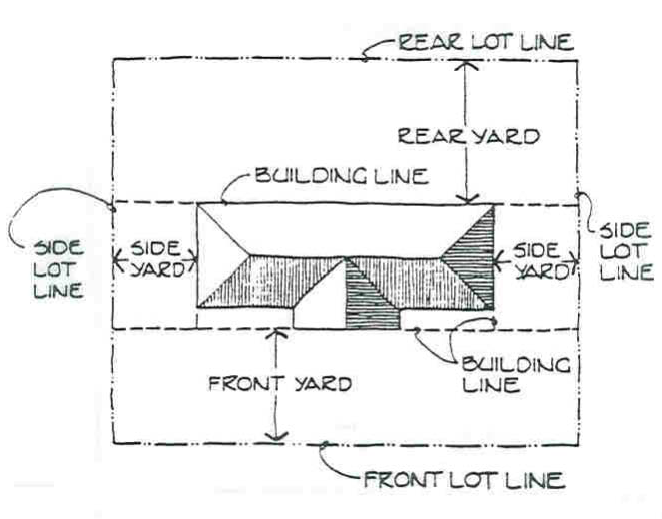
Yard, front, means a yard extending across the front of a lot between the side lot lines. On corner lots the front yard shall be considered as parallel to the street upon which the lot has its least dimension.
Yard, rear, means a yard extending across the rear of a lot between the side lot lines. On all lots the rear yard shall be in the rear of the front yard.
Yard, side, means a yard between the main building and the side lot line and extending from the required front yard to the required rear yard.
Zero lot line. See Dwelling, zero-lot-line.
Zone, floating, means an unmapped zoning district where all the zone requirements are contained in this chapter and the zone is fixed on the map only when an application for development meets the zone requirements, and is approved.
Zone, overlay, means a mapped zone that imposes a set of requirements in addition to those of the underlying zoning district.
(Ord. No. BR2023-20, § 2(Exh. B), 8-15-2023)
Sec. 140-5. - Use of land.
No land shall be used except for a purpose permitted in the district in which it is located.
(Ord. No. BR2023-20, § 2(Exh. B), 8-15-2023)
Sec. 140-6. - Lot of record.
Any lot existing at the time of the adoption or amendment of the ordinance from which this chapter is derived that has an area or width that is less than required by this chapter may be used.
(1)
Single lots. Where the owner of a lot at the adoption or amendment of the ordinance from which this chapter is derived or his successor in title thereto does not own sufficient land to enable him to conform to the dimensional requirements of this chapter, such lot may be used as a building site. In any residential district, any lot of record which has a width or area less than required, said lot may be used for a single-family dwelling only. When it is not possible to provide the required side yard and at the same time build a minimum-width single-family dwelling, the zoning administrator is empowered to administratively waive the side yard requirements, the minimum amount necessary for a reasonable dwelling, but in no case shall any side yard be less than five feet in width. See article XXII of this chapter.
(2)
Adjoining lots. When two or more adjoining lots of record with continuous frontage are in one ownership at any time after the adoption or amendment of the ordinance from which this chapter is derived and such lots, individually, are too small to meet the yard, width and area requirements of the district in which they are located, then such contiguous lots shall be considered as a single lot or several lots of the minimum width and area required in the zoning district in which they are located.
(Ord. No. BR2023-20, § 2(Exh. B), 8-15-2023)
Sec. 140-7. - Location of buildings.
Every building hereafter erected, converted, enlarged, reconstructed, moved or structurally altered shall be located on a lot.
(Ord. No. BR2023-20, § 2(Exh. B), 8-15-2023)
Sec. 140-8. - Use of buildings.
No building or structure shall be erected, converted, enlarged, reconstructed, moved, structurally altered or used, except for a use permitted in the district in which such building or structure is located.
(Ord. No. BR2023-20, § 2(Exh. B), 8-15-2023)
Sec. 140-9. - Height of buildings.
(a)
Generally. No building shall be erected, converted, enlarged, reconstructed, moved or structurally altered to exceed the height limit herein established for the district in which such building is located.
(b)
Exceptions to height regulations.
(1)
The height limitations of this chapter shall not apply to:
a.
Belfries.
b.
Chimneys.
c.
Church spires.
d.
Conveyors.
e.
Cooling towers.
f.
Elevator bulkheads.
g.
Fire towers.
h.
Flag poles.
i.
Ornamental towers and spires.
j.
Public monuments.
k.
Silos.
l.
Smoke stacks.
m.
Stage towers or scenery lofts.
n.
Tanks.
o.
Water towers and stand pipes.
(2)
Public and semi-public service buildings, hospitals, institutions and schools, when permitted in a district, may be erected to a height not exceeding 100 feet, and churches and temples may be erected to a height not exceeding 75 feet, provided the required side yard and rear yards are each increased by at least one foot for each one foot of additional building height above the height regulations for the district in which the building is located.
(Ord. No. BR2023-20, § 2(Exh. B), 8-15-2023)
Sec. 140-10. - Dimensional regulations.
No building or use shall be erected, converted, enlarged, moved or structurally altered except in conformity with the minimum space requirements (i.e., the lot area, floor area, and building height, etc.) for the district in which such building is located.
(Ord. No. BR2023-20, § 2(Exh. B), 8-15-2023)
Sec. 140-11. - Access for lots.
Each building shall be located on a lot or parcel which has frontage of not less than 40 feet on a public street, a private street, or a recorded access easement.
(Ord. No. BR2023-20, § 2(Exh. B), 8-15-2023)
Sec. 140-12. - Use of yards.
The minimum yards, parking spaces and open spaces required by this chapter for each building existing at the time of passage of the ordinance from which this chapter is derived, or for any building hereafter erected or structurally altered, shall not be encroached upon or considered as part of the yard, parking space or open space required for any other structure, nor shall any lot area be reduced below the lot area per family requirements of this chapter for the district in which such lot is located, except as otherwise provided in this chapter.
(1)
Yards and open space, general.
a.
Whenever a lot abuts upon a public alley, one-half of the alley width may be considered as a portion of the required yard.
b.
Where these regulations refer to side streets, the administrator shall be guided by the pattern of development in the vicinity of the lot in question in determining which of two streets is the side street.
c.
Every part of a required yard shall be open to the sky, except as authorized by this chapter, and excepting ordinary projections of sills, window air conditioning units, chimneys, cornices and ornamental features which may project to a distance not to exceed 24 inches into a required yard.
d.
Notwithstanding other provisions of this chapter, fences, walls, and hedges, driveways, and buffer areas may be permitted in any required yard or along the edge of any yard, provided that no fence, wall or hedge along the street sides of corner lots shall violate the corner visibility provisions of this chapter, and that any fence in a required front yard or a side yard adjacent to a street in a residential district shall not exceed four feet in height.
e.
Except for the following instances and unless otherwise stated, only one principal building, together with its customary accessory buildings, shall occupy each lot:
1.
Institutional buildings.
2.
Public or semi-public buildings.
3.
Multiple-family dwellings.
4.
Business or commercial buildings.
5.
Homes for the aged.
6.
Planned developments.
f.
In the event that a lot is to be occupied by a group of two or more related buildings to be used for residential purposes, such dwelling structures shall not be situated so as to face the rear of another dwelling structure within the development or on adjoining properties, unless differences in terrain and elevation would provide effective visual separation or unless the units are more than 60 feet apart.
g.
Dwelling structures which are front face to front face or back face to back face or front face to back face shall be not less than 60 feet apart. Dwelling structures which are side face to side face shall be not less than 20 feet apart. Dwelling structures which are side face to front face or back face shall be not less than 40 feet apart.
(2)
Front yards.
a.
Where an official line has been established for the future widening or opening of a street or major thoroughfare upon which a lot abuts, the depth of a front or side yard shall be measured from such official line to the nearest line of the building.
b.
On through lots, the required front yard shall be provided on each street.
c.
There shall be a yard of at least 20 feet on the side street of a corner lot in any district, provided, however, that the buildable width of a lot of record at the time of issuance of the ordinance from which this chapter is derived shall not be reduced to less than 28 feet.
d.
Open, unenclosed porches, platforms or paved terraces, not covered by a roof or canopy and which do not extend above the level of the first floor of the building, may extend or project into the required setback requirements not more than six feet.
e.
When the setback of existing buildings which are located within 200 feet of each side of a lot which are within the same block and zoning district, and which front on the same street as such lot, is less than the minimum required setback, the setback on such lot may be the average of the existing setbacks.
(3)
Side yards.
a.
For the purpose of the side yard regulations, a group of business or commercial buildings separated by common or party walls shall be considered as one building occupying one lot.
b.
The minimum width of side yards for schools, libraries, churches, and other public and semi-public buildings in residential districts shall be 25 feet, except where a side yard is adjacent to a business or commercial district, in which case the width of that yard shall be as required for the district in which the building is located.
(4)
Rear yards. Open or lattice-enclosed fire escapes, outside stairways, and balconies opening upon fire towers and the ordinary projections of chimneys and flues may project into the required rear yard for a distance of not more than five feet, but only where the same are so placed as not to obstruct light and ventilation.
(5)
Corner visibility. No sign, fence, wall, hedge, planting or other obstruction to vision, extending to a height in excess of three feet above the established street grade, shall be erected, planted, or maintained within the area of a corner lot that is included between the lines of the intersecting streets and a straight line connecting them at points 25 feet distant from the intersection of the street lines. Fences beyond the above-referenced area shall comply with the height requirements of subsection (1)d of this section regarding the required front yard and the side yard adjacent to a street.
(6)
Fences and walls. Fences or freestanding walls in a yard shall have a maximum height of eight feet and shall not be constructed in a public right-of-way, however, a retaining wall shall not be subject to such maximum height requirement. Any fence in a required front yard or in the required side yard adjacent to a street in a residential district shall comply with heights as allowed by subsection (1)d of this section.
(Ord. No. BR2023-20, § 2(Exh. B), 8-15-2023)
Sec. 140-13. - Off-street parking and loading.
No building shall be erected, converted, enlarged, reconstructed, moved or structurally altered except in conformity with this chapter, including the off-street parking and loading regulations of article XVII of this chapter.
(Ord. No. BR2023-20, § 2(Exh. B), 8-15-2023)
Sec. 140-14. - Signs.
No sign as herein defined shall be erected, converted, enlarged, reconstructed, moved or structurally altered except in conformity with this chapter, including the general sign regulations of article XVI of this chapter.
(Ord. No. BR2023-20, § 2(Exh. B), 8-15-2023)
Sec. 140-15. - Accessory uses and structures.
No permanent accessory use or structure shall be located, constructed, or moved upon a lot until the construction of the main building has commenced.
(1)
Such structures shall be located on the same lot as the principal building to which it is accessory.
(2)
Such structures shall not be permitted in any required front yard.
(3)
Except as herein provided, no accessory building shall project beyond a required yard line along any street.
(4)
Residential accessory structures such as garages, greenhouses, workshops or sheds shall not be rented or occupied for commercial purposes. See subsection (15) for height limits on certain residential accessory structures.
(5)
No accessory building shall be constructed upon a lot until construction of the principal building has commenced.
(6)
Where a corner lot adjoins in the rear a lot in a residential district, no accessory building shall be located closer to the side street right-of-way line than the principal building or closer than five feet to the rear property line.
(7)
No garage or other accessory building shall be located closer than five feet to a side or rear lot line in a residential district.
(8)
When an accessory building is attached to the principal building by a breezeway, passageway, or similar means, it shall comply with the yard requirements of the principal building to which it is accessory.
(9)
No accessory building shall occupy more than 40 percent of the area of the rear yard.
(10)
Areas in which the accessory storage of a boat, boat trailer or travel trailer is permitted shall not include the required front yard.
(11)
Filling station pumps and pump islands where permitted may occupy the required yards, provided, however, that they are not less than 15 feet from right-of-way lines; in the case of a pump island canopy, the outside edge of such canopy, whether attached or detached, may extend to within five feet of any property line if the canopy is at least 14.5 feet high, measured from the adjacent grade to the lowest elevation on the canopy.
(12)
No nonresidential accessory building shall be used by anyone other than employees of the owner, lessee, or tenant of the premises.
(13)
Accessory uses in an apartment development may include, but shall not be limited to, laundry facilities for the convenience of residents, which must be housed in a primary use structure.
(14)
Accessory swimming pools, open and unenclosed, may occupy a required rear or side yard, provided that they are not located closer than six feet to a rear lot line or ten feet to an interior side lot line. A walk space at least three feet wide shall be provided between pool walls and protective fences or barrier walls. Every swimming pool shall be protected by a safety fence or barrier, approved by the zoning administrator.
(15)
Residential sheds and workshops shall have a maximum height of 20 feet.
(Ord. No. BR2023-20, § 2(Exh. B), 8-15-2023)
Sec. 140-16. - Requirements for building permit.
No building shall be erected, converted, enlarged, reconstructed, moved or structurally altered except upon application for and issuance of a building permit by the zoning administrator.
(Ord. No. BR2023-20, § 2(Exh. B), 8-15-2023)
Sec. 140-17. - Appearance standards.
Appearance standards shall apply to all single-family dwellings located in Zoning Districts R-A, R-1, R-2, R-3, C-1, and CBD including site-built housing, industrialized housing and manufactured homes. Approval shall be granted upon the finding that such development shall meet or exceed the appearance standards as shown on the following table. Any proposal to site a single-family dwelling that does not meet the appearance standards of this ordinance must be reviewed and approved as a special exception variance by the city council in accordance with the provisions of article XXII of this chapter.
Footnotes:
(1)
The roof shall have a surface of wood shakes, asphalt composition, wood shingles, concrete, fiberglass, standing seam metal, slate, built-up gravel materials or other materials approved by the zoning administrator.
(2)
The exterior siding materials shall consist of wood, masonry, fiber cement siding (HardiPlank), real stucco, or vinyl lap or other materials of similar appearance and as approved by the zoning administrator.
(3)
The permanent foundation shall meet the requirements of standard building code. For manufactured home, a masonry curtain wall unpierced except for the required ventilation and access must be installed so that it encloses the area under the manufactured home to ground level.
(4)
The chassis of each manufactured home shall be supported on an adequate masonry foundation, and the perimeter shall be fully and suitably enclosed with an acceptable skirting material that is approved by the building inspector.
(5)
Manufactured homes are required to remove all towing devices, if they are removable; otherwise, all towing devices shall be screened by plantings, and the structure shall be skirted.
(Ord. No. BR2023-20, § 2(Exh. B), 8-15-2023)
Sec. 140-18. - Supplementary use regulations.
(a)
Customary home occupation.
(1)
There shall be no exterior evidence of the home occupation other than a non-illuminated identification sign having an area of not more than two square feet which shall be attached wholly to the dwelling structure wherein such activity is conducted.
(2)
Such use shall be conducted entirely within the dwelling unit and only persons living in the dwelling unit shall be employed in such occupation.
(3)
No more than 25 percent of the dwelling unit may be used for the operation.
(4)
There shall be no group instruction, assembly or activity.
(5)
No commodity shall be stocked or sold on the premises.
(6)
No materials, equipment or business vehicles may be stored or parked on the premises except that one business vehicle (the carrying capacity of which shall not exceed 1½ tons) used exclusively by the resident may be parked in a carport, garage or rear or side yard. The off-site employees of the resident shall not congregate on the premises for any purpose concerning the business or home occupation.
(b)
Electric transformer station, gas regulator station, telephone exchange and other public utility substations.
(1)
Such uses shall be essential for service to the area in which located.
(2)
Any building or structure, except an enclosing fence, shall be set back not less than 20 feet from any property line and shall meet all applicable yard requirements in excess thereof.
(3)
Such uses shall be enclosed by a fence not less than eight feet in height.
(4)
The required front yard and other open space on the premises outside the fenced area shall be grassed, landscaped, and maintained in an appropriate manner.
(5)
The storage of vehicles and equipment on the premises shall be prohibited.
(6)
Site and development plans shall be approved by the zoning administrator to ensure compatibility of facilities with the neighborhood in which they are to be located.
(c)
Manufactured building as office or commercial establishment.
(1)
Compliance with district zoning. Manufactured homes used as an office or commercial establishment shall fully comply with the provisions of these regulations. In all respects, such manufactured home office, except as provided for in subsection (d) of this section, shall be considered a permanent structure and is subject to the code requirements for commercial structures.
(2)
Minimum site improvements. Such structure, other than those authorized for temporary use, shall comply with the following minimum improvements:
a.
Each structure shall be supported by and firmly anchored to a permanent concrete block or brick foundation, fully closed and vented.
b.
Each structure shall be served by an acceptable water supply and method of sewage disposal subject to the written approval of the local authority having jurisdiction over such matters.
c.
Each structure shall have an individual connection to public electrical power.
d.
Uses within the lot shall meet the parking requirements according to article XVII of this chapter.
(d)
Manufactured home; temporary use provisions.
(1)
Residential use. Temporary placement of manufactured homes may be allowed for a period up to six months, renewable in increments of six months (subject to approval of a special exception variance by the city council to extend the period for using the manufactured home), provided the zoning administrator determines the conditions of this section are met, a building permit and temporary location permit are properly issued by the building inspector, and, where cooking, sleeping, and waste disposal facilities are to be used, the unit placement is developed consistent with the other applicable provisions of these regulations. The following are approved conditions for temporary location of manufactured homes:
a.
Manufactured homes may be temporarily placed on a vacant or occupied lot where the applicant shows it is essential to provide for the preparation of a construction project, to provide security or night watchmen quarters or to allow temporary parking or storage of an unoccupied manufactured home on other than a sales lot or inventory area.
b.
A manufactured home may be temporarily placed on an individual lot already occupied by a residence when the applicant can show extreme family hardship, provided that the occupants of the manufactured home shall have one of the following relationships with the owner of the residence: mother, father, son, daughter, brother, sister, mother-in-law and father-in-law. The site of said temporary manufactured home location shall be approved by the county health department for the installation of an on-site sewerage management system, but the unit shall connect to the public sewerage system, if available.
c.
No existing manufactured home or such units used as an office on an individual lot for either temporary or permanent occupancy shall be relocated to another site and no manufactured home or such units used as an office shall be placed on a site vacated by an existing manufactured home or office unless such relocation or placement complies with these regulations.
(2)
Commercial use.
a.
Real estate sales office. Temporary real estate sales offices may be permitted in residential districts provided that the following criteria is met:
1.
The structure used as a temporary real estate sales office shall comply with the methods of building construction permitted in the applicable zoning district and must:
(i)
Be supported on adequate masonry foundation which meets the minimum requirements of the state building code as adopted by chapter 105 (Building Regulations) in this Land Use Code;
(ii)
Be appropriately anchored to meet minimum requirements of the state building code as adopted by chapter 105 (Building Regulations) in this Land Use Code; and
(iii)
Be underpinned and landscaped.
2.
The temporary real estate sales office shall meet the area, yard and parking requirements of the applicable zoning district.
3.
The temporary sales office shall not be illuminated in such a manner as to be a nuisance to the surrounding residences.
4.
All signs shall conform with article XVI of this chapter pertaining to the residential districts.
5.
The zoning administrator shall review all applications for a temporary permit for a real estate sales office in a residential district. If the zoning administrator finds that the criteria of this subsection (2)a have been met, he or she shall instruct the building inspector to issue a temporary use permit for a 12-month period. The zoning administrator may review the temporary permit annually and grant two 12-month extensions if the use is in compliance with the standards listed in this subsection (2)a and provided the developer has not sold 70 percent of the lots in the development. The temporary use permit shall be terminated after three years or when 70 percent of the property is sold, whichever occurs first.
6.
If the zoning administrator finds that the temporary use permit conditions are in violation, he shall void the permit and the permitted use shall cease.
(Ord. No. BR2023-20, § 2(Exh. B), 8-15-2023)

