
Bowling Green City Zoning Code
APPENDIX A
DEVELOPMENT DESIGN GUIDELINES
Sec. (A). - Purpose and intent.
It is the intention of these guidelines to enhance the aesthetic character of the City of Bowling Green and to promote a stronger sense of place, while protecting property values and preserving the City's historic heritage.
These design guidelines serve as an outline of the development and architectural design expectations the City finds will contribute to the aesthetic quality of the City's built environment. The City Manager or his/her designee will review and approve development for consistency with the guidelines.
The guidelines are intended to provide design professionals, property owners, developers, commissioners, staff, and residents with a clear and common understanding of the City's expectations for architectural design. The guidelines are intended to promote flexibility and individuality in design. The City does not advocate a particular architectural style or styles, and will consider all development proposals individually and on their own merit.
Sec. (B). - Applicability and interpretation.
(1)
These guidelines shall apply to properties located within C-1 (Retail Commercial), C-2 (Service Commercial), and C-P (Commerce Park) zoning districts. Development standards of the underlying zoning district shall continue to apply in accordance with the City's Land Development Code.
(2)
If in the course of administration a question arises as to the intent or meaning of any of these guidelines, the interpretation shall be determined by the City Commission.
Sec. (C). - General design principles.
The following design principles provide an overview of the important concepts for achieving the City's expected design goals. These principles serve as the foundation for the specific guidelines which have been established in this guidebook.
(1)
Design for the Human Scale: Create a sense of place that is interesting, safe, walkable, comfortable, and attractive to residents, businesses, shoppers, and other visitors to the City of Bowling Green.
(2)
Design Character: Provide an end product which results in a unique and visually appealing physical environment. The guidelines are based on elements of traditional architectural design which exemplify attractive urban environments.
(3)
Property Values and Investment: Provide elements of design that encourage business development, attract residents and visitors, and protect the overall value and investment of all property in the City.
(4)
Design and Development Flexibility: Individual architectural expression is encouraged in each and every development project. The guidelines are designed to be specific enough to provide direction for quality development, but at the same time, provide flexibility fostering creative designs that meet individual site conditions for each development proposal.
Sec. (D). - General site and building design guidelines.
The design and functionality of buildings and spaces should meet, as best as feasibly possible, the following general site and building design guidelines:
(1)
Site design should be organized to respect the arrangement of buildings, open space, accessibility, and landscape elements on adjacent lots. All structures and open spaces should be designed and located to provide mutual benefits of natural light, accessibility, circulation, and views.
(2)
Multi-story buildings should be designed to minimize overall building massing. This can be accomplished through upper story setbacks, façade articulation, and other architectural treatment methods.
(3)
Flexibility in building orientation shall be recognized to help promote an interesting visual environment. A building's orientation may vary depending on site constraints and the need to accommodate other design guidelines and/or regulations.
(4)
Building orientation with a primary operable entrance on the street-side of a lot is encouraged to help create an active street frontage.
(5)
Site and building designs should support active modes of transport, such as walking and bicycling rather than driving.
(6)
Site and building designs should be responsive to climate patterns of the Central Florida region in order to minimize unnecessary heat gain from sun exposure and provide protection for pedestrians from inclement weather conditions.
(7)
Buildings within the same development envelope are encouraged to utilize similar architectural treatments consistent with other buildings on the same lot.
Sec. (E). - Development and architectural design guidelines.
The design guidelines established in this section are intended to provide a clear model of basic design elements that are intended to enhance the aesthetic quality of the City's built environment. The measures and dimensions used in this document are to be considered as a guide when preparing development plans.
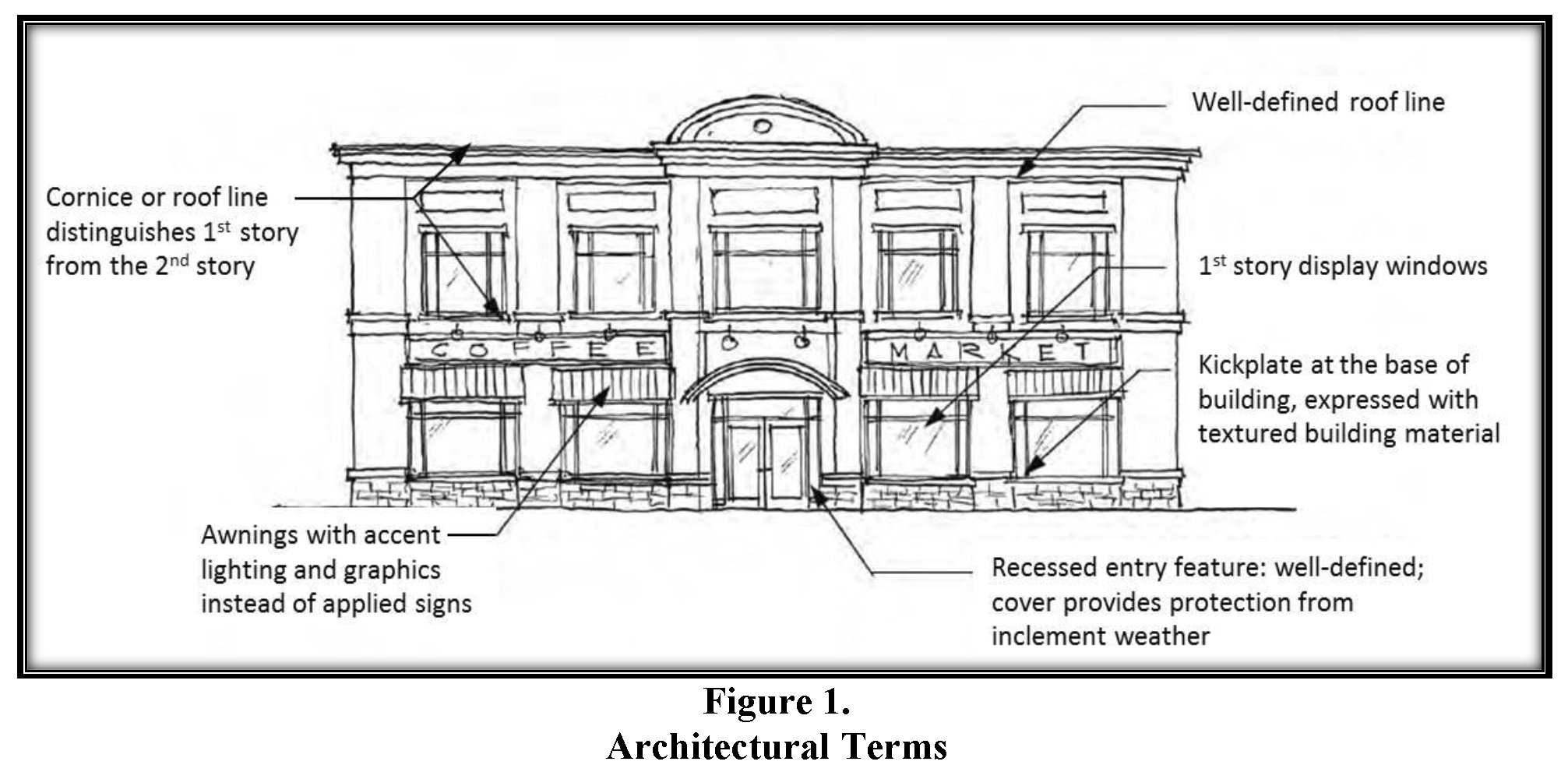
To help understand some of the design terms and strategies that are discussed in this section, please refer to Figure 1 below. This illustration depicts some of the general features that exemplify quality building design.
(1)
Architectural treatments. Architectural treatments enhance the attractiveness of buildings and structures. Such treatments are encouraged to be applied in a consistent manner along all sides of a building façade. Architectural treatments include:
a.
Application of horizontal banding or belt course (encouraged to have a minimum vertical dimension of 12 inches and be projected outward from wall 2 inches).
b.
Application of architectural moulding. This may be decorative framing around windows and doors, decorative caps on columns, or other architectural expression on wall surfaces.
c.
Application of a decorative cornice (encouraged to have a minimum vertical dimension of 12 inches and be projected outward from wall 2 inches).
d.
Application of primary and secondary surface materials. A list of suggested surface materials is provided below. The use of multiple surface materials is encouraged to add architectural interest.
1.
Stucco or synthetic stucco.
2.
Brick or glazed brick.
3.
Tinted and textured concrete masonry.
4.
Concrete (Pre-Cast or Cast-in-place).
5.
Wood.
6.
Fiber Cement (Hardiplank®).
7.
Stone, cast stone, marble, or similar material.
8.
Glass and glass storefront.
9.
Painting of the exterior façade.
(2)
Façade articulation. Façade articulation applies primarily to the street-side of a building or structure. Articulations are encouraged to be applied to all buildings or structures. Suggested methods for providing quality façade articulations are as follows:
a.
The first floor should be designed so that 45 percent of the total surface area of the first floor frontage is comprised of transparent windows, doors, and other openings to provide visual interest and compliment pedestrian activity at the ground level.
b.
Buildings with a primary operable entrance on the street-side of a building should provide a recessed entranceway. For corner lots, the primary operable entrance may be located at the corner.
c.
Buildings whose primary operable entrance is not located on the street-side of the building should provide a minimum of 30 percent transparency through the use of windows and/or other openings along the total surface area of the street-side façade to provide visual interest and security.
d.
Buildings designed for multiple tenant spaces at the ground level, particularly, retail storefronts, should provide visible articulations between such spaces and include well-defined entranceways.
e.
Upper stories should provide transparent windows, doors, and other openings along 30 percent of the total surface area of each upper floor façade. Architectural rhyme is encouraged to facilitate a strong visual aesthetic.
f.
Simulated or opaque windows may be used to provide visual interest, but shall not constitute the fulfillment of meeting any required minimum transparency or other opening requirements.
g.
Clearly identifiable separation lines between the first floor and upper floors may be expressed through the use of decorative cornice lines or other architectural treatments. Such lines should be coordinated with buildings on adjacent lots to provide visual linkages. Where adjacent buildings do not contain such elements, separation lines are encouraged to have a minimum vertical dimension of 12 inches, projected outward from the wall 2 inches.
h.
Varying roof heights and wall planes are encouraged to provide additional visual interest. Architectural rhythm should also be considered in the design of roof heights and wall planes, and should be coordinated with those of existing buildings on adjacent lots.
i.
A kickplate is encouraged be applied to create a visual terminus at the base of the building. The size and design of a kickplate are encouraged to be coordinated with adjacent buildings to provide visual linkages. Kickplates are encouraged to have a minimum vertical dimension of 12 inches and be projected outward from wall 2 inches.
(3)
Connections and cross-access.
a.
Pedestrian access.
1.
Direct ADA-compliant pedestrian access should be provided from the public sidewalk to the primary operable entrance of the business with a minimum of 5-foot sidewalk or by clearly delineated crosswalks through vehicular parking areas.
2.
Cross-access connectivity is encouraged between adjacent lots for future pedestrian interconnectivity. Such connections should be constructed of a paved or other approved hard surface material.
3.
All crosswalks, direct-access, and cross-access pedestrian walkways within vehicular parking areas are encouraged to be constructed of a different surface material than that of the general parking area and associated driveways. The materials used should clearly designate such accessways from the surrounding parking and driveway surface areas.
b.
Vehicular access.
1.
Driveway improvements are encouraged to facilitate existing and future interconnection of parking areas with adjacent lots.
2.
Continuous drive aisles between adjacent lots are encouraged. Drive aisle widths shall meet the standard minimum requirements as provided in Article 3, Section 3.03.04 of this Code.
3.
Driveway stub-outs should be extended to adjacent property lines to provide future interconnectivity where applicable. Stub-outs providing shared access across property lines may be utilized and shall require a property owner agreement. All access/easement agreements shall be recorded with the Hardee County Clerk of Courts prior to final approval of a site development plan.
(4)
Parking.
a.
Design standards for parking areas shall respect parking standards established in Article 3, Section 3.03.00 of the City's Land Development Code, except as expressly supplemented or modified in this section.
b.
Parking areas for motor vehicles are encouraged to be located on the sides and rear of buildings, in order to shield and minimize the overall appearance of parking areas and to promote a safe and inviting pedestrian environment.
c.
Off-street parking areas should include internal landscape islands to help visually soften the impact of paved surfaces. Curbing shall be installed at the edges of all landscape islands within parking areas.
d.
Parking areas for corner lots are encouraged to be located toward the interior corner of the lot, as best as feasibly possible.
(5)
Screening.
a.
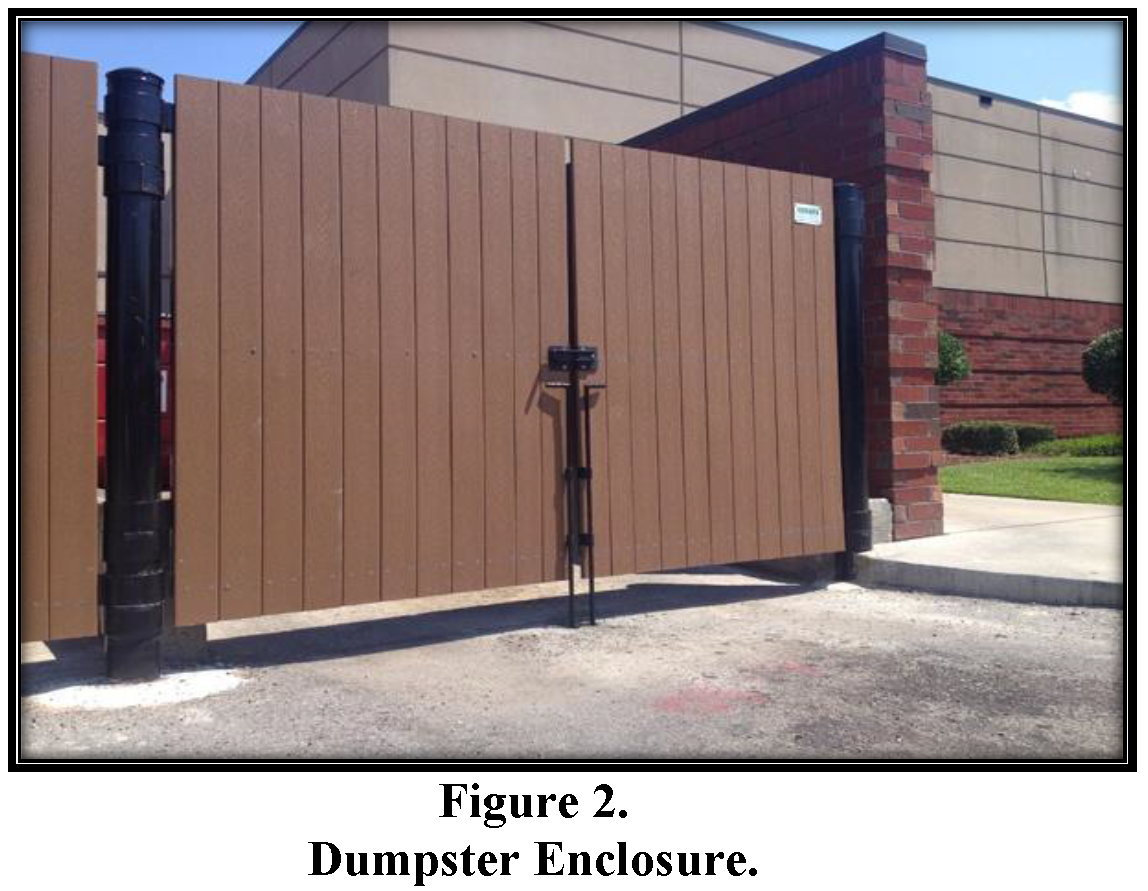
Dumpsters are encouraged to be fully screened from view. A dumpster enclosure should be constructed at a height of 7-feet using durable building materials and colors coordinated with the overall building design as illustrated in Figure 2.
b.
Utility service cabinets and mechanical equipment installed at the ground level are encouraged to be located, as best as feasibly possible, where such equipment can be screened from view. Utility equipment should not be located within a landscape island in a parking area. Consideration should be given to accessibility for required service and maintenance of such facilities.
c.
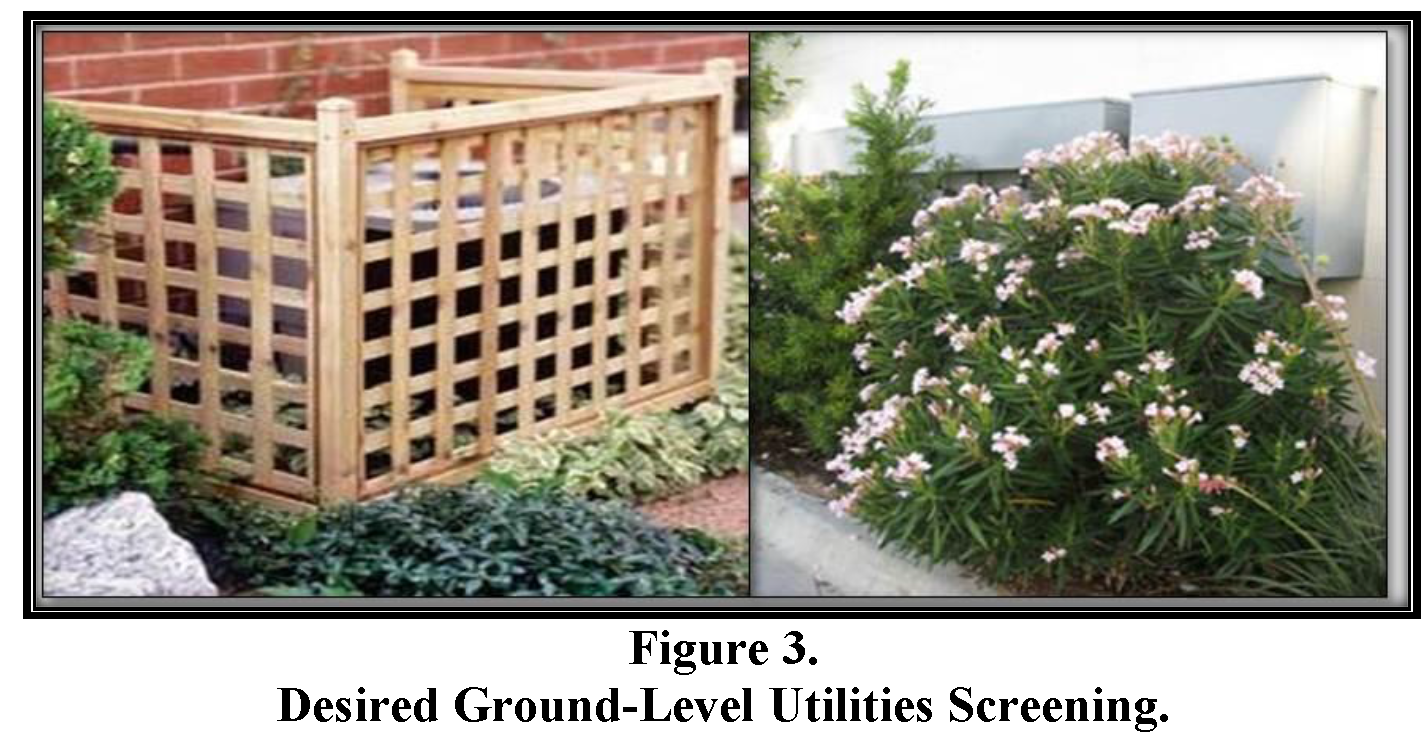
Ground-level utilities and mechanical equipment are encouraged to be screened using decorative elements like lattice or other constructed features coordinated with the look and character of the building on the lot. Landscaping may also be used to screen such equipment as illustrated in Figure 3.
d.
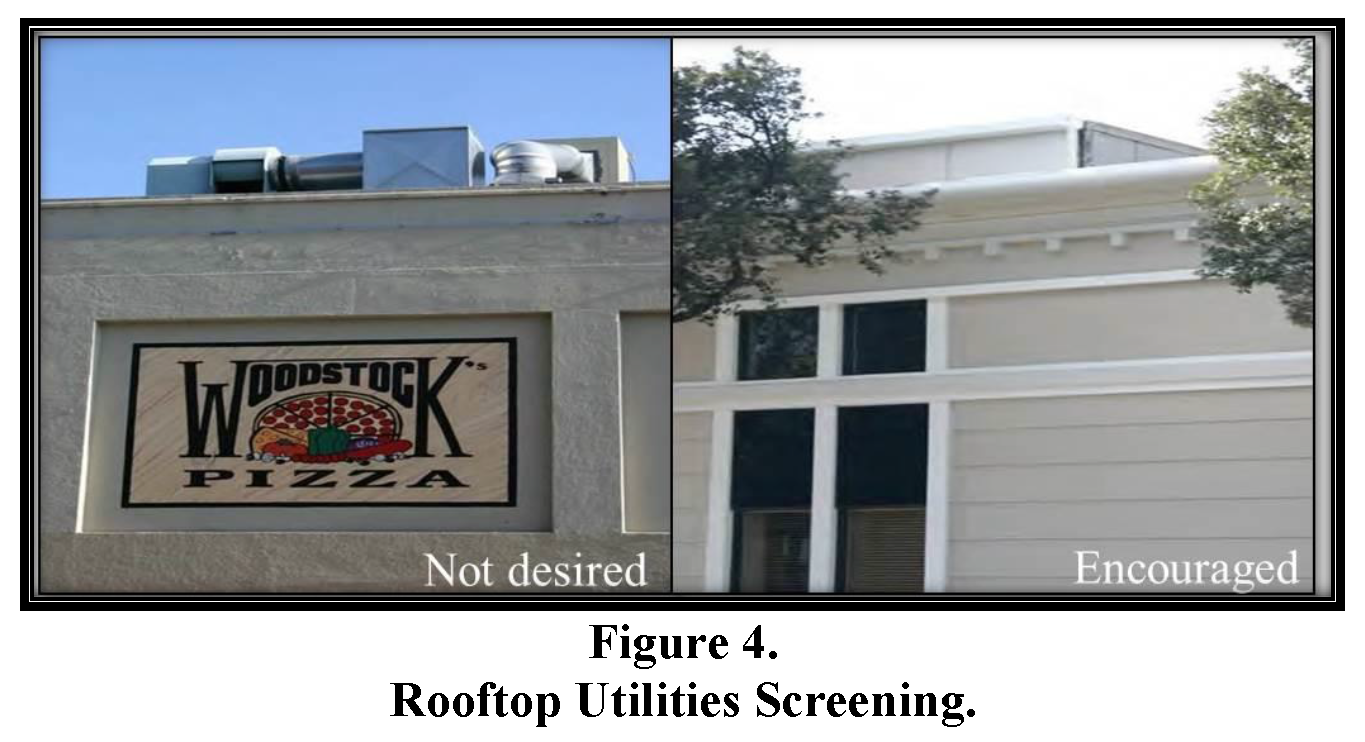
Rooftop utilities and mechanical equipment are encouraged to be screened by architectural features like a parapet roof and/or painted to match the color of the building or roof. Figure 4 provides an illustration of what is desired and what is prohibited.
e.
Loading and service areas should not be visible from public roadways and should be shielded from parking areas, as best as feasibly possible.
f.
Outdoor storage areas should be located behind or on the side of buildings and should not be visible from public roadways or pedestrian activity areas.
g.
Parking areas abutting a street are encouraged to be screened to visually shield the parking area from view of the street. Screening may be accomplished by proving a landscape buffer meeting the design standards of a "Type A" buffer as established in Article 3, Section 3.07.06 of the City's Land Development Code.
(6)
Pedestrian walkway enhancements.
a.
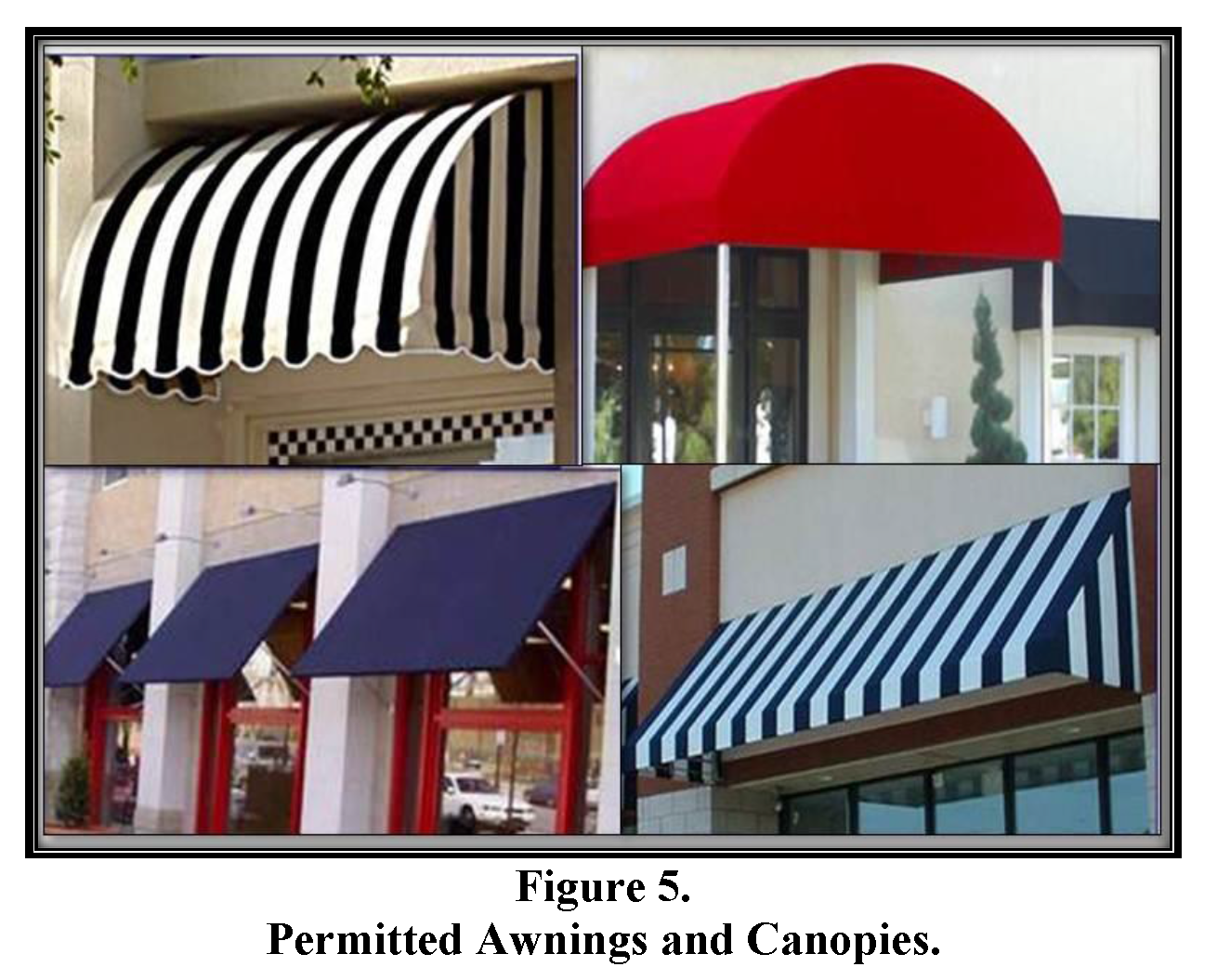
The use of awnings and canopies are highly encouraged. Suggested installation options for awnings and canopies are provided as follows. Examples of suggested types of awnings and canopies are provided in Figure 5.
1.
Should consist of opaque materials.
2.
Should be uniform in design pattern and color.
3.
Should not be back lit or internally illuminated.
4.
Should be hung above display windows, or other openings providing a minimum of 8-foot vertical clearance above any pedestrian walkway.
5.
Sign lettering and/or logos should comprise no more than 30% of the total display surface of any awning or canopy, and shall be included in the calculation of the allowable sign area.
b.
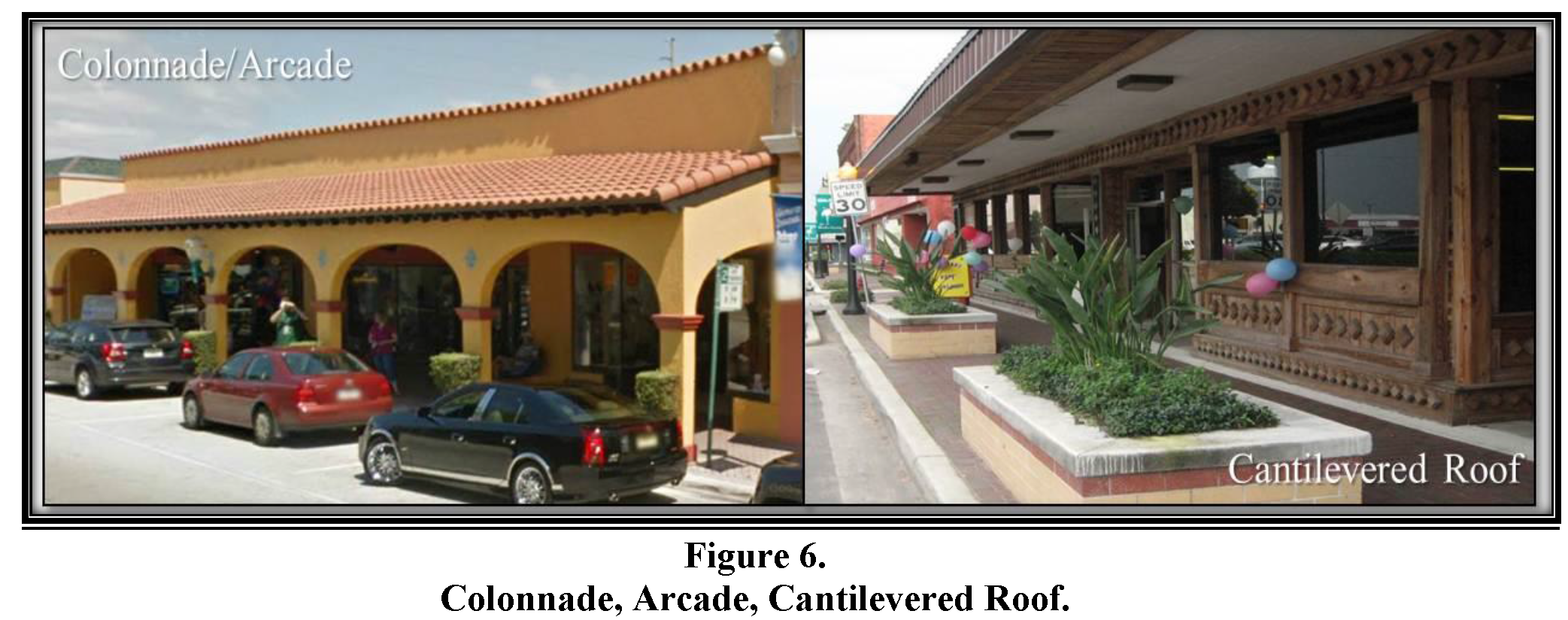
Cantilevered roofs, arcades, and colonnades are encouraged to provide both attractive design and refuge for pedestrians in inclement weather conditions. Suggestions for constructing cantilevered roofs, arcades, and colonnades are as follows. Examples of desirable cantilevered roofs, arcades, and colonnade are provided in Figure 6.
1.
Should be constructed with a minimum vertical clearance of 9-feet above any pedestrian walkway.
2.
Should not encroach on the right-of-way line of any State or County designated roadway.
3.
May be constructed up to the curb-line within the right-of-way of any local roadway. A legal agreement between the City and the property owner shall be established acknowledging any encroachments on a right-of-way. The agreement shall be approved as to form by the City Attorney and recorded with the Hardee County Clerk of Courts prior to final approval of a site development plan.
(7)
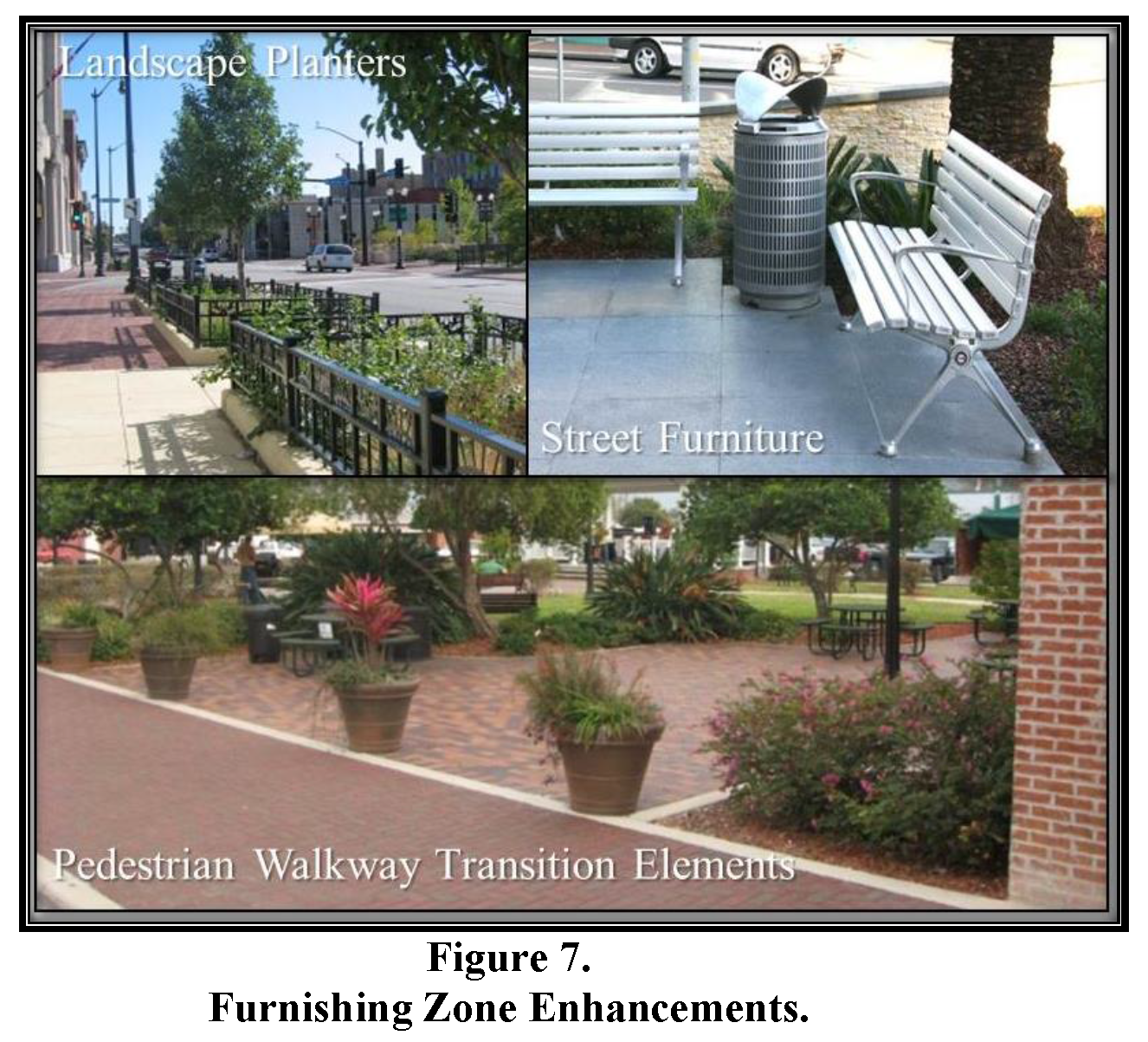
Furnishing zone enhancements. The Furnishing Zone is an area between the curb of a street and the base of building which provides a functional space and in some cases a safety barrier for pedestrians through the use of street trees, decorative bollards, pedestrian lighting, benches, trash cans, and other street furnishings. Examples of Furnishing Zone Enhancements are provided in Figure 7.
a.
Street furniture. Benches, trash cans, pedestrian level lighting, and other street furniture elements provide places for pedestrians to enjoy public and private spaces. Street furniture elements are highly encouraged.
b.
Pedestrian walkway transition elements. When applicable, paved or other hard surface materials are encouraged to be installed between the edge of a public pedestrian walkway (sidewalk) and the base of a building. The use of differing colors and textures, coordinated with the look and character of the building, are highly encouraged to help differentiate between general public and public/private spaces.
c.
Landscape elements. Raised planter boxes, planting beds, and potted plants are encouraged enhancement features. These elements can help accentuate façade articulations, architectural treatments, contribute to pedestrian spaces, and serve as safety elements.
Sec. (F). - Definitions.
Architectural Rhyme: Strict repetition of similar physical design elements across a building façade, such as windows, or other architectural treatments, exhibiting the same architectural characteristics.
Architectural Rhythm: The repetitive use of a group of visual elements across a building façade, which establishes a recognizable and coherent pattern of movement along a surface such as window and column arrangements, openings, and the extension of roof or cornice lines.
Façade (building façade): Building surface or face.
Façade Articulation: Physical changes in the depth of the surface of a building façade, demonstrated through things such as attached columns, recessed windows or window bays and recessed entranceways, and other forms of architectural expression including applied façade treatments.
Architectural Treatments: Enhancements applied to a building façade through painting, horizontal and vertical banding, belt courses, decorative cornices, simulated or faux texturing, or other similar material applications to provide ornamentation.
Belt Course: A continuous row or layer of stone, tile, brick, or other similar material across a wall or building façade.
Bollard: A thick post or other designated design feature typically constructed of iron, steel, or concrete which is used to protect pedestrians and buildings from vehicles. Bollards may be used in architectural and landscaping applications, while also serving security purposes. Bollard styles and design materials differ depending on the use and security purpose they serve.
Building Mass: The combined physical impact of the shape and bulk of a building, as demonstrated by its height, width and depth.
Built Environment: Human-made spaces in which people live, work, and recreate on a day-to-day basis; an environment encompassed by places and spaces which have been created or modified by people including buildings, parks, and infrastructure and transportation systems.
Cornice: A decorative feature, found under the eaves of a roof, or projecting architectural moulding along the top of a building or a wall plane, the uppermost projecting section of an entablature.
Cross-Access Easement: Connections provided for both motor vehicles and pedestrians, which provide interconnected access between abutting lots to destinations such as businesses, eateries, offices, open spaces, trail systems, bus stops, entertainment venues, and other uses.
Form (Building Form): The shape and mass of a building. Building shapes can emphasize certain directional characteristics either horizontal, vertical, or square/box.
Furnishing Zone: An area between the curb of a street and the base of building which provides a functional space and in some cases a safety barrier for pedestrians through the use of street trees, decorative bollards, pedestrian lighting, benches, trash cans, and other street furnishings.
Kickplate: A decorative panel or skirting along the base of a building, used to create a visual separation between a building and a pedestrian walkway. Kickplates should be constructed of durable materials to withstand the vigors of pedestrian activity.
Parapet: A low, solid, protective wall or railing along the edge of a roof.
Pedestrian Walkway: An outdoor improvement which is designed primarily for the transport of pedestrians and/or bicyclists.
Screening: Treatments used to visually shield or separate undesirable elements of a site. Commonly used to obscure parking areas, utilities, dumpsters, and other similar elements on a site.

