
Boynton Beach City Zoning Code
CHAPTER 2
LAND DEVELOPMENT PROCESS
Sec. 1. General.
- Purpose and Intent. The purpose and intent of this chapter is to consolidate the procedures and applications for development approval. The format is designed to allow users to quickly and efficiently ascertain the various steps involved in the application process; from the pre-application conference to final approval.
- Definitions. See Chapter 1, Article II for definitions and acronyms relative to land development applications and processes
- Rules. The regulations and provisions of this chapter shall be interpreted to represent the minimum requirements adopted for the protection and promotion of the public health, safety, morals, comfort, convenience, order, appearance, prosperity, or general welfare. In addition, whenever the word "district" is used, in this chapter it is construed to mean zoning district
- Severability. Should any section, subsection, paragraph, sentence, clause, phrase, or other part of this chapter be declared by a court of competent jurisdiction to be invalid, such decision shall not affect the validity of this article as a whole or any article, section, subsection, paragraph, sentence, clause, phrase, or word thereof, other than that so declared to be invalid.
(Ord. 10-025, passed 12-7-10)
Sec. 2. Types of Land Development Applications.
A. Table 2-1. Applications by City Departments.
Legend:
HRPB: Historic Resources Preservation Board
P&Z: Planning and Zoning Division
P&D: Planning and Development Board
CRA: Community Redevelopment Agency
CC: City Commission
| APPLICATION TYPE | CODE SECTION | REVIEWING AUTHORITY (STAFF) | APPROVING AUTHORITY | PUBLIC HEARING REQUIRED? |
|---|---|---|---|---|
| ARTICLE II. PLANNING AND ZONING DIVISION SERVICES Standard Applications | ||||
| Annexation | Art II, Sec. 2.A. | Director of P&Z | CC | Yes |
| Comprehensive Plan Amendment | ||||
| Text | Art. II, Sec. 2.B.2. | City Initiated Only | ||
| Future Land Use Map (FLUM) | Art II, Sec. 2.B.3. | Director of P&Z | CC | Yes |
| Conditional Use | Art. II, Sec. 2.C. | Director of P&Z CC Yes | ||
| Conditional Use Time Extension | Art. II, Sec. 2.C.6. | |||
| Rezoning | Art. II, Sec. 2.D. | Director of P&Z | CC | Yes* |
| Master Plan (New) | Art. II, Sec. 2.D.6. | |||
| Master Plan Modification (Major) | Art. II, Sec. 2.D.6.g. | |||
| Master Plan Modification (Minor) | Art. II, Sec. 2.D.6.h. | Director of P&Z | No | |
| Sign Program | Art. II, Sec. 2.E. | Director of P&Z | Director of P&Z | No |
| Site Plan Review | Art. II, Sec. 2.F. | Director of P&Z | CC | Yes* |
| Site Plan Time Extension | Art. II, Sec. 2.F.6. | |||
| Site Plan Modification (Major) | Art. II, Sec. 2.F.7. | |||
| Site Plan Modification (Minor) | Director of P&Z | No | ||
| Vacation and Abandonment | Art. II, Sec. 2.G. | Director of P&Z | CC | Yes* |
| Planned Industrial Development (PID) Applications | ||||
| Master Site Plan (New) PID Zoning District Only | Art. II, Sec. 3.A. | Director of P&Z | CC | Yes |
| Master Site Plan Modification, Major | Art. II, Sec. 3.A.6. | |||
| Master Site Plan Modification, Minor | Director of P&Z | No | ||
| Technical Site Plan (New) PID Zoning District Only | Art. II, Sec. 3.B. | Director of P&Z | Director of P&Z | No |
| Technical Site Plan Modification, Major | Art. II, Sec. 3.B.6. | |||
| Technical Site Plan Modification, Minor | ||||
| Waiver | Art. II, Sec. 3.C. | Director of P&Z | CC | Yes |
| Relief Applications | ||||
| Administrative Adjustment | Art. II, Sec. 4.A. | Director of P&Z | Director of P&Z | No |
| Community Design Appeal | Art. II, Sec. 4.B. | Director of P&Z | CC | Yes |
Director of P&Z (For administratively approved projects as outlined in Chapter 2, Article II, Section 4.B Community Design Appeal) | No (For administratively approved projects as outlined in Chapter 2, Article II, Section 4.B Community Design Appeal) | |||
| Height Exception | Art. II, Sec. 4.C. | Director of P&Z | CC | Yes |
| Reasonable Accommodation | Art. II, Sec. 4.F. | Director of P&Z | Director of P&Z | No |
| Variance to Land Development Regulations | Art. II, Sec. 4.D. | Director of P&Z | CC | Yes* |
| Waiver | Art. II, Sec. 4.E. | Director of P&Z | See Site Plan Review | See Site Plan Review |
| Permit Applications | ||||
| Sign Permit | Art. II, Sec. 5.A. | Director of P&Z | Director of P&Z | No |
| Zoning Permit | Art. II, Sec. 5.B. | Director of P&Z | Director of P&Z | No |
| Historic Preservation | ||||
| Certificate of Appropriateness | Art. II, Sec. 6.A. | Director of P&Z | HRPB | Yes |
| Historic District or Properties Designation | Art. II, Sec. 6.B. | Director of P&Z | CC | Yes* |
| Historic Preservation Property Tax Exemption Application | Art. II, Sec. 6.C. | Director of P&Z | CC | Yes |
| Other Applications | ||||
| Certificate of Conformity | Art. II, Sec. 7.A. | Director of P&Z | Director of P&Z | No |
| Lot Line Modification | Art. II, Sec. 7.B. | Director of P&Z | Director of P&Z | No |
| Mobile Vendor Approval | Art. II, Sec. 7.C. | Director of P&Z | Director of P&Z | No |
| Mobile Vendor Assembly | Art. II, Sec. 7.C. | See Special Events | See Special Events | No |
| Modification to Development Order | Art. II, Sec. 7.D. | Director of P&Z | CC | Yes |
| Sidewalk Café Approval | Art. II, Sec. 7.E. | Director of P&Z | CC | No |
| Zoning Verification Letter | Art. II, Sec. 7.G. | Director of P&Z | Director of P&Z | No |
| ARTICLE III. ENGINEERING DIVISION SERVICES | ||||
| Preliminary Plat | Art. III, Sec. 2.B. | City Engineer | City Engineer | No |
| Final Plat | Art. III, Sec. 2.C. | City Engineer | CC | Yes |
| Land Development Permit (LDP) | Art. III, Sec. 3. | City Engineer | City Engineer | No |
| Right-of-Way Permits | Art. III, Sec. 4. | City Engineer | City Engineer | No |
| Engineering Division Waiver | Art. III, Sec. 5. | City Engineer | City Engineer | No |
| ARTICLE IV. BUILDING DIVISION SERVICES | ||||
| Building Permit | Art. IV, Sec. 2. | Building Official | Building Official | No |
| Sign Permit | Art. IV, Sec. 3. | Building Official | Building Official | No |
| Variance | Art. IV, Sec. 4. | Building Official | Building Board of Adjustment and Appeals | Yes |
| ARTICLE V. BUSINESS TAX SERVICES | ||||
| Seasonal Sales Event Approval | Art. V, Sec. 3. | Business Tax Manager | Business Tax Manager | No |
| Special Temporary Sales Event Approval | Art. V, Sec. 4. | Business Tax Manager | Business Tax Manager | No |
* Quasi-judicial proceedings are required pursuant to Part II (City Code of Ordinances), Chapter 2, Article I, Section 2-20.
B. Withdrawal. By written request, the applicant shall have the right to withdraw an application at any time prior to the final action of the application by the decision making body or person.
(Ord. 10-025, passed 12-7-10; Am. Ord. 11-002, passed 3-1-11; Am. Ord. 12-010, passed 6-19-12; Am. Ord. 12-016, passed 10-2-12; Am. Ord. 13-027, § 2, passed 10-1-13; Am. Ord. 13-033, § 2, passed 12- 3-13; Am. Ord. 15-003, passed 3-17-15; Am. Ord. 26-004, passed 3-3-26)
Sec. 3. Review Process for Applications Requiring Public Hearings, Generally.
This section generally describes the review process for land development applications requiring public hearings. The required plan(s), application(s), fee(s), and supporting document(s) are dependent upon the type, character, and complexity of the proposed project or relief being sought.
- Staff Review. Each land development application that requires a public hearing shall be reviewed by staff to ensure compliance with all applicable codes, standards, and regulations; redevelopment plans; and the Comprehensive Plan's goals, objectives, and policies. Unless otherwise specified, the application shall be processed in accordance with the following actions:
- Completeness Review. This section applies to any land development application in this chapter, unless otherwise provided for in the regulations for that specific application. No review shall commence until the application is deemed complete by the reviewing authority.
- Analysis and Recommendations. Staff comments and recommendations shall identify noncompliance and deficiencies with the standards and requirements of these Land Development Regulations or any other applicable codes. During this informal procedure, staff comments and recommendations are forwarded to the applicant so that each issue can be completely resolved or adequately addressed, as determined by staff, prior to Advisory Board review. An applicant may orally or in writing, challenge any staff comment or recommendation by contacting the issuing department directly and presenting specific grounds for the challenge. The issuing department will either affirm or reverse its original comment or recommendation, but all such action shall be based on the provisions of appropriate codes, ordinances, rules, regulations, standard drawings, redevelopment plans, or Comprehensive Plan. A staff comment becomes a recommendation when it is not based on a specific code, ordinance, rule, regulation, standard drawing, redevelopment plan, or goal, objective, or policy of the Comprehensive Plan. Such staff recommendation becomes compulsory when it is approved as part of the conditions of approval and development order by the applicable Advisory Board or City Commission.
- Forward to Applicable Advisory Board. Upon conclusion of staff review, the Director of Planning and Zoning, designee, or reviewing authority will transmit the document with staff comments and recommendations to the applicable Advisory Board for their review and recommendation.
- Advisory Board Review.
- Notification. The Planning and Zoning Division shall notify the applicant in writing, of the date, time, and location of the Advisory Board meeting. The applicant may opt to postpone Advisory Board review by submitting a written request to the Director of Planning and Zoning, designee, or to the appropriate reviewing authority. In all instances, the applicant shall be responsible to comply with the applicable public notice requirements of City Code of Ordinances Part II, Chapter 2, Article I, Section 2-20.
- Action. The Advisory Board will consider all presented items, including the staff report, exhibits, and recommendations, in conjunction with any testimony or other information presented at the meeting, and recommend that City Commission:
- Approve the application;
- Approve the application subject to conditions;
- Table or defer their decision to a subsequent meeting in order to collect additional information or conduct further analyses; or
- Deny the application.
- City Commission Review. After the Advisory Board conducts its review and formulates a recommendation, the Director of Planning, designee, or reviewing authority will forward the items to the City Commission for final review and approval.
- Notification. The Planning and Zoning Division shall notify the applicant in writing, of the date, time, and location of the City Commission meeting. The applicant may opt to postpone City Commission review by submitting a written request to the Director of Planning and Zoning, designee, or to the appropriate reviewing authority. In all instances, the applicant shall be responsible to comply with the applicable public notice requirements of City Code of Ordinances Part II, Chapter 2, Article I, Section 2-20.
- Action. The City Commission will review all presented items, including the staff report, exhibits, and recommendations, in conjunction with any testimony or other information presented at all meetings, and vote to:
- Approve the application;
- Approve the application subject to conditions;
- Table or defer their decision to a subsequent meeting in order to collect additional information or conduct further analyses; or
- Deny the application.
The action of the City Commission is the final decision.
(Ord. 10-025, passed 12-7-10)
Sec. 4. Expedited Development Review Program.
A. Applicability. Projects eligible for expedited processing are described below. Application types to be expedited include site plans (and corresponding applications including land use amendment and rezoning), plat, building permit, as well as inspection processes.
1. Eligible Uses. New and expanding establishments in the following industry categories are eligible for expedited processing:
a. Bioscience;
b. Medical or pharmaceutical research and development;
c. Aviation/aerospace/engineering;
d. Communications;
e. Information technology;
f. Business and financial services (non-retail);
g. Manufacturing, fabrication and processing; and
h. Education related to the above industry clusters.
2. Economic Development. Projects sanctioned project by the State of Florida or other recognized economic development organization (Florida Office of Tourism, Trade and Economic Development (OTTED), Enterprise Florida, or Business Development Board of Palm Beach County).
3. Affordable and Workforce Housing. Residential developments that provide affordable housing and/or workforce housing units.
4. Sustainable Development. Projects must be registered with a nationally recognized green certification agency, including but not limited to:
a. USGBC – United States Green Building Council;
b. FGBC – Florida Green Building Coalition;
c. Green Globes; and
d. NAHB – National Association of Home Builders, National Green Building Standard.
5. Mixed-use development.
a. Development applications for mixed-use development within the City’s Community Redevelopment Area (CRA). Eligible projects must involve the MU-1, MU-2, MU-3, MU- 4, or MU-Core zoning district, include a site plan application, and contain a commercial component; and
b. Development applications for mixed-use development located outside the City’s CRA. Eligible projects must also be zoned, or be the subject of rezoning to the Suburban Mixed Use Zoning District, or be located with the Quantum Park Planned Industrial Development District, contain a commercial component, include a site plan, and include a minimum of five (5) acres of land.
B. Benefits of Program. Entities that have been accepted into the expedited permitting program shall receive the following benefits:
1. Point of Contact. The City Manager, or designee, shall appoint a single point of contact at the city who shall have the responsibility of assisting the applicant throughout the development application and permitting process;
2. Timetable. The Planning and Zoning Division, Building Division, Engineering Division of Public Works, and other applicable city departments shall establish the necessary steps required for project approval and permitting in a pre-application meeting and subsequently, within three (3) business days, prepare an optimal timetable for the project's completion of the development and application review process;
3. Priority Review. The project shall receive priority at every phase of the review process by city staff, including face-to-face meetings as needed. However, public hearings are subject to the availability of the relevant board and the decisions of such boards are not guaranteed to be made immediately. Therefore, to the extent possible, public hearing scheduling shall be expedited if applicable to a particular development application;
4. Comments. Comments relative to review by the 1) Planning and Zoning Division Planning; and 2) Building Division shall be provided to the applicant within seven (7) business days of the submission of a completed development application. The city and the applicant shall make a mutual commitment to provide all other development and permit application review comments and corresponding revisions thereto in a thorough and timely manner;
5. Building Permits.
a. Permits Issued on Basis of Affidavit. Consistent with the Florida Building Code, local administrative amendments and F.S. § 553.791, the applicant may be responsible for private plans review and inspections with the filing of a sworn affidavit from a registered architect or engineer affirming conformance of plans to all applicable technical codes. For buildings and structures, the affidavit shall state that the plans conform to the laws as to egress, type of construction and general arrangement, strength, stresses, strains, loads and stability. However, for projects located within special flood hazard areas, this benefit shall not apply to flood load and flood resistance construction requirements of the Florida Building Code.
b. Fee Payment Schedule Agreement. The applicant will be eligible to propose a schedule for the timing of fee payments, to include permit fees and local impact fees, tailored to meet the financial and scheduling needs of the project. Certain legal limitations may apply, and this provision supersedes any conflicting regulation, or operational policy.
6. Conflict Resolution. Should any issues arise at any point during the development application review and permitting process, the city will use the most expeditious means to resolve the issue. A face to face meeting between city staff and the applicant's representatives, if necessary, shall be scheduled within three (3) business days of the applicant's notification of the issues.
(Ord. 10-025, passed 12-7-10; Am. Ord. 19-025, § 2, passed 8-20-19)
Sec. 5 Green Building Program.
A. Purpose and Intent. The Green Building Program establishes procedures and incentives for the implementation of green building standards. The program is intended to encourage the incorporation of green building practices into development projects. The program may be applied to any development within the city, including redevelopment projects and government initiated development projects, submitted for city review.
B. Government Leadership. To demonstrate the city's commitment to sustainability, the city shall comply with a sustainable building rating system or a national model green building code for all government buildings pursuant to F.S. § 255.2575(2), and
1. Inventory and report the city's annual greenhouse gas emissions from municipal operations; and
2. Inventory and report community-scale greenhouse gas emissions at least once every five (5) years; and
3. Update the city’s Climate Action Plan including greenhouse gas reduction targets and climate adaptation goals at least once every five (5) years.
C. Scope and Applicability. This voluntary program applies to all lands private and public within the city and the city-owned well fields. The scope of its application shall be for development approvals and building permits submitted for the voluntary green building program. Such plans and approvals shall be reviewed for compliance with the appropriate parts of the adopted city's Comprehensive Plan and the land development regulations in addition to the Green Building Standards detailed in Section E. below.
D. Green Building/Sustainable Community Fund. There is established a fund designated as the Green Building/Sustainable Community Fund, herein referred to as “Fund,” separate from the General Fund of the City of Boynton Beach. All additional monies obtained in connection with the Green Building Fee (Subsection E below) shall be deposited into the Fund without regard to fiscal year limitations and used solely to pay the cost of operating and maintaining the Fund for the purposes contained in this subsection. All funds, interest and other amounts deposited into the Fund shall not be transferred or revert to the General Fund of the city at the end of any fiscal year or at any other time, but shall continually be available for the uses and purposes set forth in this section. The Fund shall be used for initiatives that promote green building practices and enhance the sustainability of the Boynton Beach community, which may include the following:
1. Incentive funding for green building certification of private buildings as described in Subsection G below.
2. Incentive funding for energy efficiency, water efficiency, and renewable energy in private buildings.
3. Expansion of electric vehicle (EV) infrastructure, bicycle/pedestrian facilities, or transit options for community use.
4. Incentive funding for private-sector recycling, composting, or waste-reduction activities.
5. Development of green infrastructure including canopy trees, living shorelines, green roofs, green walls, vertical gardens, bioswales, or rain gardens.
6. Education, training, and outreach to the public and private sectors on green building, water conservation, energy efficiency, renewable energy, climate change, flood mitigation, green infrastructure, sustainable transportation, or waste reduction.
E. Green Building Fee. A Green Building Fee, herein referred to as “Fee” is established to fund the implementation of this program and the Fund. Current fee schedules shall be maintained and available to the public in the Development Department. Fees shall be paid at the time each type of building construction permit is issued, according to the fee schedule approved by the City Commission. The Green Building Fee associated with the Green Building Program is subject to amendment by resolution of the City Commission.
F. Green Building Standards. To participate in this program and receive the incentives described herein, private builders and developers shall voluntarily construct buildings that are certified by a sustainable building rating system or a national model green building code. Eligible certifications include those provided by the United States Green Building Council (USGBC) Leadership in Energy and Environmental Design (LEED) rating system, the International Green Construction Code (IGCC), the Green Building Initiative’s Green Globes rating system, the Florida Green Building Coalition standards, or another recognized certification program that is approved by the city and complies with the Florida Building Code.
G. Incentives. The city shall provide the following incentives to encourage the use of this program and are hereby authorized:
1. Expedited Permitting. For any voluntary program participant, the city shall provide expedited review in accordance with Chapter 2, Article I, Section 4 above as approved in Ordinance 09-024. All such applications for expedited review shall be accompanied by the appropriate forms, evidence of a completed green building certification application according to the requirements of the certifying entity, and proof of payment of the application fee required to process the application for certification. A city staff member shall be designated as project manager and shall work in close contact with the applicant and certifying agent. The project manager shall oversee the expedited review of the project once formal plans have been prepared and submitted to the city.
2. Tax and Financial Incentives.
a. Green Building Certification Grant. The city shall provide small grants to help defray the costs associated with obtaining green building certification. The grants shall be paid through the Sustainability Fund (described in Section 2 above), subject to the availability of funds. Grant amounts will be based on the level of certification achieved (e.g., bronze, silver, gold, platinum) from an eligible green building certifying entity. The grant will be paid as a reimbursement upon receipt of a copy of the certification achieved. Certification must be received within 180 days of the Certificate of Occupancy issue date. Current grant amounts shall be maintained and made available to the public by the City’s Sustainability Coordinator.
b. Property Tax Incentive. The city may establish a property tax incentive for qualifying green building projects. Property tax incentives shall be incorporated into a developers’ agreement and shall require proof of certification according to the Green Building Standards outlined above.
3. Signage. The city shall allow the following bonuses to the currently allowed signage regulations:
a. One (1) additional temporary construction sign may be installed that notes that "This project is a City of Boynton Beach Green Building Project by [Company Name]." This additional temporary construction sign must meet the standard dimensional requirements as set forth in Chapter 4, Article IV, Section 4.B.3.
b. The notation "City of Boynton Beach Green Building Project" may be added on the project entry monument signage. The additional sign area to include the city approved notation letters and logo shall be a maximum of four (4) inches high by forty-two (42) inches wide. Additional sign area greater than that allowed by the land development regulations shall be permitted for this notation only.
4. Marketing. For any program participant, the city shall provide the following marketing incentives, including but not limited to:
a. The inclusion of program participants on a webpage dedicated to the program;
b. Recognition at a City Commission meeting; and
c. Press releases.
H. Certification Verification. The applicant shall provide documentation to the city verifying the authenticity of a project's green certification by a qualified third party as described in the Green Building Standards.
I. Education and Training. The city, in conjunction with the ICC, FGBC, USGBC, GBI or other state or nationally recognized high-performance green building rating system, may conduct training workshops for the purpose of educating potential or current program participants about the program.
1. The city will attempt to make available a meeting space at a government facility for green building programs offered by organizations that are of a general nature (not product specific). Organizations shall contact the facility's staff to make arrangements.
2. Development Department staff shall be encouraged to attend at least eight (8) hours of green building training annually.
(Ord. 11-014, passed 4-27-11; Am. Ord. 15-020, passed 8-18-15; Am. Ord. 19-011, passed 3-19-19)
Sec. 6. Development Orders.
The City Clerk or designee will record specific action by the Advisory Board and City Commission with respect to each staff comment or recommendation. The City Clerk shall also sign and witness the completed record of the proceedings which then becomes the official and final development order.
For the purpose of the issuance of development orders and permits, the City of Boynton Beach has adopted level of service standards for public facilities and services which include roads, sanitary sewer, solid waste, drainage, potable water, and parks and recreation.
Compliance with levels of service as stated in the Boynton Beach Comprehensive Plan is required. See Chapter 1, Article VI for additional regulations regarding the concurrency management system.
(Ord. 10-025, passed 12-7-10; Am. Ord. 11-014, passed 4-27-11)
Sec. 7. Revocation of a Development Approval.
Unless described otherwise in this article, the following procedures shall outline the revocation of a development approval:
A. Initiation. The Director of Planning and Zoning shall investigate alleged violations of imposed condition or conditions. The Director of Planning and Zoning shall determine whether or not to terminate or suspend a development approval. If the Director of Planning and Zoning determines that a termination, or suspension, of a development approval is appropriate, a recommendation, including the reason or reasons for their determination, shall be made to the City Commission who shall conduct a public hearing on the matter.
B. Grounds for Revocation. The following are grounds for revocation of a development approval:
1. Misleading Information. The intentional provision of materially misleading information by the applicant (the provision of information is considered "intentional" where the applicant was aware of the inaccuracies or could have discovered the inaccuracies with reasonable diligence); and
2. Noncompliance. The failure to correct any violation of any condition of a development approval within the time specified by the city and/or after notification from the city of violations of the development approval.
C. Notice and Public Hearing. Notice of the hearing shall be provided to the development approval holder at least ten (10) working days prior to the hearing. Such notice shall be in writing and delivered by personal service or certified mail and shall advise of the Director of Planning and Zoning's recommendation as well as the date and location of the hearing before the agency.
D. Decision and Notice. The agency shall prepare a development order approving, approving with conditions, or denying the Director of Planning and Zoning's recommendation. The development order shall contain findings that address the basis for condition or conditions that have been violated and the harm such violation has caused. In the case of suspension of the use, the development order shall state the length of time such violation can be cured. In the case of a termination, the development order shall state the reason such violation cannot be cured.
(Ord. 10-025, passed 12-7-10; Am. Ord. 11-014, passed 4-27-11)
Sec. 1. General.
- Purpose and Intent. The purpose of this article is to set forth uniform procedures, well-defined application processes, and information to guide the processing of complete land development applications that are administered by the Planning and Zoning Division. Each application is reviewed to ensure that:
- Compliance. Development of individual sites within the city is consistent with all land development regulations and all other applicable standards and requirements set forth by the city or other public entities having jurisdictional responsibility, prior to the issuance of a development permit;
- Public Purpose. Development and supportive facilities and services further the public health, safety, appearance, and general welfare; and
- Compatibility. Development is compatible and coordinated with existing and anticipated development in the immediate area surrounding the site.
- Administration. The Director of Planning and Zoning or designee shall be responsible for the overall coordination and administration of land development applications within this article.
- Preapplication Conference.
- Purpose and Intent. The purpose and intent of a preapplication conference is for staff and the applicant to collaborate and discuss the city's overall community goals, objectives, policies, codes, and regulations. It also allows the applicant to receive information or a description of the relevant review procedures anticipated from each staff discipline, Advisory Board, and City Commission. Opinions expressed at the conference are not binding for formal review purposes.
- Applicability. A preapplication conference is required for the following types of applications:
- Standard Applications.
- Annexation.
- Comprehensive Plan future land use map (FLUM) amendment.
- Conditional use.
- Rezoning.
- Sign Program.
- Site Plan, including modifications.
- Vacation and abandonment.
- Planned Industrial Development Applications.
- Master Site Plan, including modifications.
- Technical Site Plan, including modifications.
- Use approval.
- Relief Applications.
- Community Design Appeal.
- Height exception.
- Variance to Land Development Regulations.
- Other Applications.
- Mobile vending unit (MVU).
- Wireless communication facilities (WCF).
- Standard Applications.
- Submittal Requirements. Unless otherwise contained herein, all application forms described in this article shall be approved by resolution and maintained by the Planning and Zoning Division. In order for an application to be considered, the complete application must be submitted to the Planning and Zoning Division. When submitted for review, it shall be accompanied by all documentation required by the respective application checklist.
- Completeness. If the application is not complete, it shall not be subject to further review until all identified deficiencies have been remedied. The Director of Planning and Zoning or designee may rule that certain items are not required for the review to commence. A determination of completeness shall not constitute a determination of compliance with the substantive requirements of the Comprehensive Plan, the Land Development Regulations, or any other applicable codes.
- Abandonment. Applications which have no activity for a time greater than six months will be considered abandoned and the application will be closed.
- Fees. Fees shall be paid at the time each type of land development application is submitted, according to the fee schedule approved by the City Commission.
- Terms and Definitions. See Chapter 1, Article II for all applicable terms and definitions which pertain to the applications and processes contained herein.
- Quasi-Judicial Hearings. See City Code of Ordinances Part II, Chapter 2, Article I, Section 2-20 for the types of land development applications regulated under this article that require quasi-judicial hearings.
(Ord. 10-025, passed 12-7-10; Am. Ord. 22-022, passed 11-14-22)
Sec. 2. Standard Applications.
- Annexation.
- General.
- Voluntary Annexations. A privately-initiated application for the voluntary annexation of real property into the corporate limits of the city shall be made by petition of all owners of said real property and filed in accordance with the provisions of F.S. Chapter 171.
- Other Annexation Methods. These city-initiated methods include annexation by referendum, annexation of enclaves through interlocal agreements, and annexation through interlocal service boundary agreements, processed in accordance with F.S. Chapter 171.
- Future Land Use Map (FLUM) and Zoning of Property to be Annexed. Application for the city FLUM classification and zoning district must accompany all privately-initiated applications for annexation. FLUM reclassification and rezoning for developed properties to be annexed through any of the city-initiated methods listed in subparagraph b. above, may be delayed if no application for building or site improvements is submitted prior to the adoption of the annexation ordinance; however, such reclassification and rezoning must be initiated within six (6) months of the annexation.
- Submittal Requirements. See Section 1.D. above for the submittal requirements of this application.
- Review Criteria.
- Compliance with Statutory Requirements. Areas proposed for annexation must comply with the requirements in F.S. Chapter 171.
- Consistency with Comprehensive Plan. An application for annexation shall be consistent with the Comprehensive Plan.
- Approval Process. An application for annexation requires two (2) advertised public hearings and shall be processed in accordance with Chapter 2, Article I, Section 3 and comply with F.S. Chapter 171.
- General.
- Comprehensive Plan Amendments.
- General.
- Purpose and Intent. The purpose of this subsection is to provide a means for amending the city's Comprehensive Plan in accordance with F.S. Chapter 163.
- Authority. The City Commission has the authority to amend the Comprehensive Plan upon compliance with the provisions of F.S. Chapter 163 and of this subsection. The City Commission has designated itself as the Local Planning Agency (LPA) for the city.
- Types of Amendments. Amendments to the Comprehensive Plan include text amendments and site-specific amendments to the future land use map (FLUM).
- Text Amendment. A text amendment to the Comprehensive Plan shall only be initiated by the city.
- Future Land Use Map (FLUM) Amendment.
- General.
- The purpose of this subsection is to provide a means for changing the boundaries and/or classifications of the FLUM through site-specific amendments to the Comprehensive Plan.
- A request for FLUM amendment for parcels of fifty (50) acres or fewer shall be considered small scale, and all others shall be considered large scale, based on F.S. Chapter 163.
- All privately initiated FLUM amendments shall be accompanied by an application to rezone to a zoning district consistent with the requested FLUM classification. See Section 2.D. below for the process by which lands are rezoned to a different zoning district.
- Submittal Requirements. See Section 1.D. above for the submittal requirements of this application.
- Review Criteria. All privately initiated FLUM amendments shall be reviewed concurrently with the accompanying zoning request. Except for city-initiated FLUM amendments, which shall at a minimum meet criterion (2) for “Consistency,” approval of a FLUM amendment/zoning request shall be based on the applicable factors listed under section 2.D.3 below.
- Approval Process. An application for FLUM amendment shall be processed in accordance with F.S. Chapter 163.
- Denial. No application for the same FLUM amendment shall be submitted within one (1) year from the date of denial by the City Commission.
- General.
- General.
- Conditional Use, Including Time Extension.
- General.
- Purpose and Intent. The purpose and intent of this subsection is to set forth uniformed procedures, well-defined application processes, and information to guide the review of conditional use submittals. In addition to that described in this section, it is also the intent to provide for separate submittal requirements and expedited review process for those conditional uses that qualify as a sustainable development and meets the intent of the city's green building initiatives.
- Applicability. The procedures, requirements, and standards of this section shall apply to any use that is identified with a "C" in the use matrix (Table 3-28) of Chapter 3, Article IV, Section 3.D.
- Terms and Definitions. As defined by Chapter 1, Article II, a use that because of special requirements or characteristics may be allowed in a particular zoning district, but only with conditions as necessary to make the use compatible with other uses permitted in the same zone or vicinity.
- Rules. For the purpose of this subsection, a "site plan" shall be construed to include either a new site plan or a major site plan modification.
- Use Matrix. Conditional uses are identified with a "C" in the use matrix (Table 3-28). See Chapter 3, Article IV, Section 3.C. for the legend of the use matrix.
- Submittal Requirements. The submittal requirements and process for this type of application will vary depending on whether the request is for use approval only or use approval in connection with improvements requiring site plan review (e.g. construction of new building, modifications to existing building or site, etc.). See subsection 1.D. above for the submittal requirements of this application.
- Review Criteria. See Chapter 3, Article IV, Section 4 for the review standards applicable to the evaluation of conditional uses, which will vary depending on whether the request is for use approval only or use approval in connection with improvements requiring site plan review (e.g. construction of new building, modifications to existing building or site, etc.). In instances when site plan review is required, the review criteria of Section 2.F.3. below shall also apply.
- Approval Process. The Planning and Development Board and City Commission shall consider only such conditional uses as are authorized under the terms of the zoning regulations of Chapter 3. An application for conditional use approval requires review by the City Commission and shall be processed in accordance with Chapter 2, Article I, Section 3. The Commission, upon recommendation of the Board, may grant conditional uses absolutely or conditioned upon the faithful adherence to the review criteria contained in Section 2.C.3. above. The Commission may also deny requests for conditional uses when not in harmony with the intent and purpose of this section.
- Expiration. The applicant shall secure a business tax receipt within the time frame established by the City Commission. The conditional use shall expire if the applicant is unable to secure a business tax receipt within that timeframe; however, if the conditional use was approved in connection with a site plan, then the expiration of the conditional use shall be the same as the expiration of the corresponding site plan in accordance with Section 2.F.5. below.
- Time Extension. At its discretion, the City Commission may extend the approval of a conditional use that is in connection with site plan approval, if such request for extension is filed prior to the date of expiration of the original approval period. In this instance, the request for extension shall be processed in accordance with Section 2.F.6. below.
- General.
- Rezoning, Including Master Plan.
- General.
- Purpose and Intent. The purpose of this subsection is to provide a means for changing the zoning district boundaries or designations through site-specific amendments to the official zoning map. It is not intended to relieve particular hardships or to confer special privileges or rights to any person, but only to make necessary adjustments in response to or based upon changed conditions.
- Authority. The City Commission has the authority to amend the official zoning map upon compliance with the provisions of this subsection.
- Initiation. Amendments to the official zoning map may be proposed by the owner (or agent) of the affected land or city-initiated.
- Consistency with Future Land Use Map (FLUM) of Comprehensive Plan. No application to rezone lands may be submitted that would result in an inconsistency with the FLUM classification. See Section 2.B.3. above for the process by which to amend the FLUM classification.
- Rezoning to Planned Zoning Districts. A master plan shall be required when a privately-initiated application is made to rezone lands to a planned zoning district. A site plan may be submitted concurrently or at a later date. In projects consisting of only one phase, the site plan may act as the required master plan. City-initiated rezoning can proceed in advance of the master plan/site plan submittal. The master plan shall be reviewed in accordance with Section 2.D.6. below. See Section 2.F. below for additional regulations pertaining to the site plan application.
- Submittal Requirements. See Section 1.D. above for the submittal requirements of this application.
- Review Criteria. Except for city-initiated rezonings, which shall at a minimum meet criterion (b) for “Consistency” approval of an amendment to the official zoning map processed with or without the FLUM amendment shall be reviewed based on the following applicable factors:
- Demonstration of Need. Whether the proposed amendments to the FLU and Zoning maps are supported by the implementation of the City' s vision for, or changes in the conditions or character of development in, the area under consideration. Ongoing or anticipated market trends may also be considered in a justification Statement provided as part of the application.
- Consistency. Whether the proposed amendments to the FLU and Zoning maps would be consistent with, amd promote, the purpose and intent of the applicable Comprehensive Plan policies, Redevelopment Plans, any other current City-approved planning documents.
- Compatibility. The application shall consider whether the proposed Future Land Use and Zoning, or potential uses allowed in a proposed Zoning district, would be compatible with the surrounding uses in terms of density, scale, and the nature of use, or when such an amendment would normally create an isolated zoning district but would result in the incremental implementation of a redevelopment plan for the area.
- Orderly Growth. Whether the proposed amendments to the FLU and Zoning maps would encourage piecemeal development or create undevelopable parcels.
- Location Efficiency. Whether the proposed amendments to the FLU and Zoning maps would support complementary land uses: the integration of a mix of land uses consistent with smart growth or sustainability initiatives; access to a wide range of mobility options; or, interconnectivity within the project and between adjacent properties.
- Availability of Public Services/Infrastructure. All requests for FLUM amendments shall be reviewed for long-term capacity availability at the maximum intensity permitted under the requested land use classification. Requests for rezoning to planned zoning districts and FLUM amendments shall be subject to review pursuant to Chapter 1, Article VI Concurrency.
- Economic Development Impact.
- Whether the proposed rezoning/FLUM amendments would not:
- Represent a potential decrease in the possible intensity of development, given the uses permitted in the proposed land use category and/or zoning district; and
- Represent a potential decrease in the number of uses with high probable economic development benefits.
- Whether the proposed rezoning/FLUM amendments would:
- Create new employment opportunities:
- Contribute to the enhancement and diversification of the city's tax base:
- Respond to the current or anticipated market demand or community needs: or
- Alleviate economic obsolescence of the subject area.
- Whether the proposed rezoning/FLUM amendments would not:
- Heavy Commercial and Industrial Land Supply. The review shall consider whether the proposed amendments to the FLU and Zoning maps would reduce the amount of land available for heavy commercial/industrial development. If such determination is made, the approval can be recommended under the following conditions:
- The size, shape, and/or location of the property makes it unsuitable for commercial/industrial development; or
- The proposed rezoning/FLUM amendment provides evidence of satisfying at least two (2) of the Direct Economic Development Benefits listed in subparagraph "g" above.
- Approval Process. An application for rezoning approval requires review by the City Commission and shall be processed in accordance with Chapter 2, Article I, Section 3.
- Denial. Within one (1) year from the date of denial by the City Commission or withdrawal of the application by the applicant, no application for same or similar zoning may be submitted, with the exception of applications which are initiated by the city.
- Master Plan.
- General. The purpose of this subsection is to set forth well-defined application processes, review criteria, and uniform procedures for the rezoning of lands to planned districts (as defined by Chapter 1, Article II).
- Submittal Requirements. Except as provided in Section 2.D.6.e below, the applicant is required to complete the rezoning application (see Section 1.D. above), and provide all documentation required by the respective application checklist.
- Review Criteria. The approval of a master plan shall be reviewed based on the following factors:
- Zoning and Standards Compliance. The master plan shall comply with the requirements of the respective zoning district regulations of Chapter 3, Article III and site development standards described in Chapter 4.
- Diagrams. the master plan shall include diagrams which illustrate the location of uses and density on the site, including bubble diagrams, height, massing, and density of the proposed development.
- Approval Process. A privately-initiated request to rezone and its accompanying master planrequire review by the City Commission and shall be processed in accordance with Chapter 2, Article I, Section 3.
- Expiration. A master plan shall remain valid unless the corresponding site plan expires, or if the site plan is not adopted within eighteen (18) months of the date of the master plan approval. In these instances, the official zoning map retains the planned zoning district designation, but the property does not possess a valid development order or development permit, and no permits may be granted by the city on the subject property. The submittal and approval of a new or modified master plan, and a site plan application as provided in Section 2.D.1.e. above, shall be required in order to commence development, redevelopment, or other site improvements.
- Modification to Master Plan. Changes to master plans are either "minor" or "major" based on criteria within this section. A pre-application conference with staff is a prerequisite to filing an application for modification. The site plan must be consistent with the master plan; therefore, any request to modify a master plan may require the submittal of a concurrent request for site plan modification in accordance with Section 2.F.7. below. Staff shall consider the following factors in determining whether the proposed master plan modification is considered "major":
- The modification increases or decreases the buildable square footage (intensity) or number of dwelling units (density) by more than five percent (5%);
- The modification eliminates a point of ingress and egress;
- The modification reduces the cumulative area of each of the required or provided open spaces, green spaces, and pedestrian plazas by more than five percent (5%), changes the location of such spaces, or does not otherwise meet the intent of these regulations;
- The modification alters the project so that the modified master plan does not resemble the approved master plan;
- The modification affects or does not comply with a condition of approval of the preceding development order; and
- The modification is proposed to a city-owned or operated facility and does not adversely impact adjacent properties and/or public lands.
- Major Master Plan Modification.
- Submittal Requirements. See Section 1.D. above for the submittal requirements of this application.
- Review Criteria. The proposed master plan shall comply with the requirements of the respective zoning district of Chapter 3, Article III, and the site development standards described in Chapter 4.
- Approval Process. An application for major master plan modification requires review by the City Commission and shall be processed in accordance with Chapter 2, Article I, Section 3.
- Expiration. A master plan shall remain valid unless the corresponding site plan expires, or if the site plan is not adopted within eighteen (18) months of the date of the master plan approval.
- Miscellaneous. At the time the City Commission approves a request for a major master plan modification, any previously approved master plan, including any conditions of approval, shall be null and void. All future development shall be consistent with the master plan, as modified and approved by the City Commission, including all corresponding conditions of approval.
- Minor Master Plan Modification.
- Submittal Requirements. The applicant shall submit a letter explaining the modification(s) along with the master plan (in the number of copies specified by the Division). The applicant shall also provide consent from the property owner to file an application for the minor master plan modification.
- Review Criteria. The proposed master plan shall comply with the following: 1) all applicable conditions of approval of the preceding master plan; 2) requirements of the respective zoning district of Chapter 3, Article III; and 3) the site development standards described in Chapter 4.
- Approval Process. The application shall be reviewed by staff and action will be taken by the appropriate administrative official. Upon approval of a minor master plan modification, all future development shall be consistent with the master plan, as modified, including all previously approved conditions of approval associated with the master plan.
- General.
- Sign Program.
- General.
- Purpose and Intent. The purpose and intent of this subsection is to create a comprehensive and efficient process by which to review project signage within certain types of developments.
- Applicability. Pursuant to Chapter 4, Article IV, Section 6, a sign program shall be required for all permanent types of signs proposed within non-residential and mixed use developments containing multiple tenants.
For the purposes of this subsection, a "site plan" shall be construed to include either a new site plan or a major site plan modification.
- Submittal Requirements. See Section 1.D. above for the submittal requirements of this application.
- Review Criteria. The sign program shall comply with the sustainable and green checklist, and the requirements of the site development standards described in Chapter 4.
- Approval Process. The sign program shall be approved in accordance with site plan review (Section 2.F. below) or its equivalent.
- General.
- Site Plan, Including Time Extension and Modifications.
- General.
- Purpose and Intent. The purpose of this subsection is to set forth uniform procedures, well-defined application processes, and information to guide the review of site plan submittals. The applicant shall schedule a pre-application conference with staff and bring the proposed site plan.
- Applicability. New site plans are either “minor” or “major” based on criteria within this section. The following applications shall be considered “major”:
- Site plans containing more than ten (10) new multi-family dwelling units;
- Site plans for new non-residential structures over 15,000 square feet;
- Site plans requiring an application for Conditional Use;
- Site plans requiring a relief application; and
- Site plans for city-owned or operated facilities that causes a significant impact to abutting and adjacent properties, as determined by the Planning and Zoning Administrator.
- Exemptions. The following work shall not be required to undergo site plan review as required by this chapter:
- The construction of a single-family home or a duplex;
- Internal modifications to a structure including plumbing, electrical, and mechanical with no effect to the exterior of the structure;
- Any modification of an existing structure that does not increase the total size of the structure and does not change the building footprint;
- Addition of awnings, canopies, or ornamental structures;
- Pools, including redesign and relocation;
- Other minor structural additions or alterations, including stairs, porches, terraces, fencing, etc.;
- Garages and accessory structures in residential districts;
- New structures and additions to existing structures of fewer than 1,000 gross square feet in non-residential zoning districts;
- Any modification of, or addition to an existing site necessary to implement a Corrective Action Plan and/or the city’s Chronic Nuisance Property Code (see Part II, Code of Ordinances, Chapter 15).
- Major Site Plan.
- Submittal Requirements. See Section 1.D. above for the submittal requirements of this application.
- Review Criteria. The site plan shall comply with the following: 1) requirements of the respective zoning district regulations of Chapter 3, Article III and 2) Site Development Standards described in Chapter 4, Article XII. See Section 2.D.6.c. above for additional regulations regarding the requirement that the site plan be consistent with the master plan when rezoning lands to a planned zoning district.
- Approval Process. An application for site plan approval requires review by the City Commission and shall be processed in accordance with Chapter 2, Article I, Section 3.
- Expiration.
- General. Upon approval of a site plan by the City Commission, the applicant shall have eighteen (18) months to secure a building permit from the Development Department.
- Null and Void. All previous approvals shall be null and void if the applicant is unable to secure a building permit within the above timeframes. For the purposes of this section, minor permits issued by the Departments of Development or Public Works (e.g. clearing and grubbing; walls and fences; docks, land development; utilities; etc.) shall not constitute the type of permit necessary to extend the life of a development order for site plan review purposes.
- Time Extension.
- General. An applicant may request to extend the approval of a site plan for an additional time period, not to exceed eighteen (18) months, provided that such request for extension is filed prior to the date of the expiration of the original eighteen (18)-month period. For the purposes of the subsection, a "site plan" shall be construed to include either a new site plan or a major site plan modification. There is no limit to the number of extensions that may be requested.
- Submittal Requirements. See Section 1.D. above for the submittal requirements of this application.
- Review Criteria. The site plan time extension shall comply with the requirements of the respective zoning district regulations of Chapter 3, Article III and site development standards described in Chapter 4. In addition, the following information shall be used to justify an application for site plan time extension:
- Are there any recently adopted amendments to the Comprehensive Plan, redevelopment plans, or Land Development Regulations that would cause the approved site plan in its current configuration to become noncompliant?
- In determining good faith, some factors to be considered are the following: 1) the extent to which a land development permit (if applicable) has been applied for by the applicant and/or approved by the Engineering Division; 2) when construction approved by such land development permit has occurred (construction which is commenced immediately preceding expiration generally indicating a lack of good faith); 3) the extent to which there has been a bona fide continuous effort to develop but because of circumstances beyond the control of the applicant, it was not possible to meet the time limitation; and 4) the applicant has applied for or secured any building permits, or other types of permits from external agencies, including anticipated dates for the issuance of the aforementioned permits?
- Has the applicant paid any impact fees, including utilities or art in public places?
- Does the site plan comply with the concurrency requirements and of Palm Beach County and the city's Land Development Regulations?
- Other pertinent information can the applicant provide that would justify the request for site plan time extension?
- Approval Process. An application for site plan time extension requires review by the City Commission and shall be processed in accordance with Chapter 2, Article I, Section 3.
- Expiration. Upon approval of site plan time extension by the City Commission, the applicant shall have the time approved by the City Commission to secure a building permit from the Development Department. All previous approvals shall become null and void if the applicant is unable to secure a building permit within the above timeframe.
- Extension. The applicant may file a subsequent request for site plan time extension beyond that of the original extension; however, each subsequent request for site plan time extension shall be valid for a time period not to exceed one (1) year. Each subsequent request for site plan time extension shall be filed prior to the expiration date of the preceding site plan time extension period.
- Miscellaneous. The original conditions of approval of the site plan are still applicable and must be addressed, unless otherwise approved by the City Commission. In granting such extensions the City Commission may require modification to or impose additional conditions of approval to the site plan.
- Minor Site Plan.
- Submittal Requirements. See Section 1.D. above for the submittal requirements of this application.
- Review Criteria. The site plan shall comply with the following: 1) requirements of the respective zoning district regulations of Chapter 3, Article III and 2) Site Development Standards described in Chapter 4, Article XII. See Section 2.D.6.c. for additional regulations regarding the requirement that the site plan be consistent with the master plan when rezoning lands to a planned zoning district.
- Approval Process. The application shall be reviewed by staff and action will be taken by the appropriate administrative official.
- Expiration.
- General. Applicant shall have eighteen (18) months to secure a building permit from the Development Department.
- Null and Void. All previous approvals shall be null and void if the applicant is unable to secure a building permit within the above timeframes. For the purpose of this section, minor permits issued by the Departments of Development or Public Works (for example, clearing and grubbing; walls and fences; docks, land development; utilities; and the like) shall not constitute the type of permit necessary to extend the life of a development order site plan review purposes.
- Time Extension.
- General. An applicant may request to extend the approval of a site plan for an additional time period, not to exceed eighteen (18) months, provided that such request for extension is filed prior to the date of the expiration of the original eighteen (18) month period. For the purposes of the subsection, a “site plan” shall be construed to mean a minor site plan. There is no limit to the number of extensions that may be requested.
- Submittal Requirements. See Section 1.D. above for the submittal requirements of this application.
- Review Criteria. The site plan time extension shall comply with the requirements of the respective zoning district regulations of Chapter 3, Article III, and site development standards described in Chapter 4. In addition, the following information shall be used to justify an application for site plan time extension:
- Are there any recently adopted amendments to the Comprehensive Plan, redevelopment plans, or Land Development Regulations that would cause the approved site plan in its current configuration to become noncompliant?
- In determining good faith, some factors to be considered are the following: 1) the extent to which a land development permit (if applicable) has been applied for by the applicant and/or approved by the Engineering Division; 2) when construction approved by such land development permit has occurred (construction which is commenced immediately preceding expiration generally indicating a lack of good faith); 3) the extent to which there has been a bona fide continuous effort to develop but because of circumstances beyond the control of the applicant, it was not possible to meet the time limitation; and 4) the applicant has applied for or secured any building permits, or other types of permits from external agencies, including anticipated dates for the issuance of the aforementioned permits?
- Has the applicant paid any impact fees, including utilities or art in public places?
- Does the site plan comply with the concurrency requirements and of Palm Beach County and the city’s Land Development Regulations?
- Other pertinent information can the applicant provide that would justify the request for site plan time extension?
- Approval Process. An application for site plan time extension requires review by the Planning and Zoning Administrator.
- Expiration. Upon approval of site plan time extension the applicant shall have the time approved by the Planning and Zoning Administrator to secure a building permit from the Development Department. All previous approvals shall become null and void if the applicant is unable to secure a building permit within the above timeframe.
- Extension. The applicant may file a subsequent request for site plan time extension beyond that of the original extension; however, each subsequent request for site plan time extension shall be valid for a time period not to exceed one (1) year. Each subsequent request for site plan time extension shall be filed prior to the expiration date of the preceding site plan time extension period.
- Miscellaneous. The original conditions of approval of the site plan are still applicable and must be addressed, unless otherwise approved by the Planning and Zoning Administrator. In granting such extensions, staff may require modifications to or impose additional conditions of approval to the site plan
- Modification to Site Plan.
- General. An applicant may request to modify an approved site plan. Changes to site plans are either "minor" or "major" based on criteria within this section. The applicant shall schedule a pre-application conference with staff to facilitate a preliminary review of the Site Plan. Site Plan modifications shall be considered “major” if any of the following apply:
- The modification increases the buildable square footage of the development by more than 15,000 square feet or twenty percent (20%), whichever is greater; the threshold increases to twenty-five percent (25%) if the project is certified by a third-party green certification process.
- The modification causes the development to be below the development standard for the zoning district in which it is located or any other applicable standard in the Land Development Regulations.
- The modification has an adverse effect on adjacent or nearby property or reduces required physical buffers, such as fences, trees, or hedges.
- The modification adversely affects the elevation design of the structure or reduces the overall design of the structure below the standards stated in the community design plan.
- The modified development does not meet the concurrency requirements of the Boynton Beach Comprehensive Plan.
- The modification alters the project so that the modified site plan does not reasonably resemble the approved site plan.
- The modification affects or does not comply with a condition of approval of the development order.
- The modification to a city-owned or operated facility causes a significant impact to abutting and adjacent properties.
- Major Modification.
- Submittal Requirements. See Section 1.D. above for the submittal requirements of this application.
- Review Criteria. The proposed major site plan modification shall comply with the requirements of the respective zoning district regulations of Chapter 3, Article III and site development standards described in Chapter 4.
- Approval Process. An application for major site plan modification requires review by the City Commission and shall be processed in accordance with Chapter 2, Article I, Section 3.
- Expiration. Upon approval of a major site plan modification by the City Commission, the applicant shall have eighteen (18) months to secure a building permit from the Development Department. All previous approvals shall be null and void if applicant is unable to secure a building permit within the above timeframe.
For the purposes of this section, minor permits issued by the Departments of Development or Public Works (e.g. clearing and grubbing; walls and fences; docks, land development; utilities; etc.) shall not constitute the type of permit necessary to extend the life of a development order for a major site plan modification. - Extension. An applicant may request to extend the approval of a major site plan modification for a time period not to exceed eighteen (18) months, provided that such request for extension is filed prior to the date of the expiration of the original eighteen (18)-month period. The request shall be processed in accordance with Section 2.F.6. above.
- Miscellaneous. At the time the City Commission approves a request for a major site plan modification, any previously approved site plan, including any conditions for approval, shall be null and void. All future development shall be consistent with the master site plan, as modified and approved by the City Commission, including all corresponding conditions of approval.
- Minor Modification.
- Submittal Requirements. The applicant shall submit a letter explaining the modification(s) along with the affected plans and exhibits (in the number of copies specified by the Division). The applicant shall also provide consent from the property owner to file an application for the minor site plan modification.
- Review Criteria. The proposed minor site plan modification shall comply with the requirements of the respective zoning district regulations of Chapter 3, Article III and site development standards described in Chapter 4.
- Approval Process. The application shall be reviewed by staff and action will be taken by the appropriate administrative official. Upon approval of a minor site plan modification, all future development shall be consistent with the site plan, as modified, including all previously approved conditions of approval associated with the site plan.
- General. An applicant may request to modify an approved site plan. Changes to site plans are either "minor" or "major" based on criteria within this section. The applicant shall schedule a pre-application conference with staff to facilitate a preliminary review of the Site Plan. Site Plan modifications shall be considered “major” if any of the following apply:
- Miscellaneous.
- Site plan review shall be required in conjunction with a master plan when rezoning lands to a planned zoning district as provided in Section 2.D.1.e. See Section 2.D.6. above for additional regulations pertaining to the rezoning process. In such instances, the site plan shall be consistent with the master plan.
- Staff may recommend as a condition of approval of a site plan for a development with multiple and/or components, that a Unity of Title among the parcels and/or components be required. However, in cases where Unit of Title is a condition of site plan approval, this condition may be released under the following conditions:
- If the property is not owned by a single owner/entity the project as a whole, including its various components, is administered by a property owner's association with fee reserves for property maintenance of at least six (6) months. For the purposes of this section, the term "reserves" means:
- Unless and to the extent that these fees are not provided by other associations, an account shall be maintained by the property owner's association (POA), separate and apart from the POA's general operating account, for capital expenditures and deferred maintenance. The reserve account shall include, but is not limited to the amount necessary for routine maintenance of the common areas, and shall include but is not limited to building/structure painting, landscaping maintenance, storm water infrastructure maintenance, and pavement resurfacing, regardless of the amount of deferred maintenance expense or replacement cost.
- The amount to be reserved shall be computed by means of a formula which is based upon estimated remaining useful life and estimated replacement cost or deferred maintenance expense of each reserve item. The POA shall adjust replacement reserve assessments annually to take into account any changes in estimates or extension of the useful life of a reserve item caused by deferred maintenance. Reserve funds and any interest accruing thereon shall remain in the reserve account or accounts, and shall be used only for authorized reserve expenditures.
- The POA shall provide the city with a copy of the annual POA finance report for a period of one (1) year from the date of issue of the last certificate of occupancy (C.O.) for any structure/building on the project.
- The owners of the various components have executed perpetual cross access and shared parking agreements to the extent required by the approved site plan.
- A sign program approved by the city is in place that regulates all project signage in conformance with the city Land Development Regulations and is applicable to all components of the project.
- The owners have agreed to the continued calculation of overall project density based on the entire project despite the creation of individual parcels with multiple owners.
- If the property is not owned by a single owner/entity the project as a whole, including its various components, is administered by a property owner's association with fee reserves for property maintenance of at least six (6) months. For the purposes of this section, the term "reserves" means:
- General.
- Vacation and Abandonment.
- General. The purpose of this subsection is to establish uniform procedures for the vacation and abandonment of city rights-of-way (e.g. street, alley, etc.), special purpose easements, and other non-fee interests of the city. When approved for vacation and abandonment, the city relinquishes its interest in the above, based in part, on the finding that the subject right-of-way no longer serves a public purpose. For the purposes of this subsection, a "site plan" shall be construed to include either a new site plan or a major site plan modification.
- Submittal Requirements. See Section 1.D. above for the submittal requirements of this application.
- Review Criteria. The vacation and abandonment of a right-of-way, special purpose easement, or other non-fee interest of the city shall be based on a demonstration that the above interest no longer serves a public purpose and there is no encumbrance which would prohibit the clear transfer of ownership of such land. The following review criteria shall be used to justify an application:
- Access. Does the subject land provide a legal means of access to a lot of record, subdivision, or development? Would the vacation and abandonment cause or result in a permanent stoppage, interruption, or an unacceptable level of service for the subject lot or on neighboring lots, subdivisions, or developments with respect to police, fire, or other emergency services; or solid waste removal?
- Utilities. Does the subject land contain, support, or allow potable water, sanitary sewer, or any other utility (e.g. cable, telephone, electricity, gas, etc.), which would be permanently stopped or interrupted, or cause an unacceptable level of service to the subject lot or neighboring lots, subdivisions, or developments?
- Drainage and Wastewater Management. Does the subject land contain, support, or allow a legal means of drainage or wastewater management for such lot or on neighboring lots, subdivisions, or developments, which would cause or result in a stoppage, interruption, or unacceptable level of service?
- Conservation. Does the subject land contain, support, or allow the means for the conservation or preservation of flora or fauna?
- Approval Process. An application for vacation and abandonment approval requires review by the City Commission and shall be processed in accordance with Chapter 2, Article I, Section 3. All applications shall be approved either by ordinance or record plat. The Planning and Zoning Division may reject the application if a similar application has been considered at any time within one (1) year of the date the later application is submitted.
- Allocation of Lands. The vacation and abandonment of city streets, alleys, utility easements, special purpose easements, canals, water bodies and other non-fee interests of the city can be accomplished in several ways. The city's authority to accomplish this is derived from the Home Rule Powers Act (F.S. § 166.011) as adopted by the state legislature via Chapter 73-129, as amended from time to time. Therefore, the city ordinance(s) control this issue.
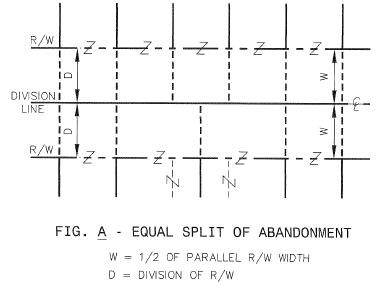
There are several ways that vacation and abandonments can de delineated. The area to be vacated or abandoned can be divided equally with the adjacent property owners, or divided unequally with the adjacent property owners. Curvilinear areas usually are divided equally amongst the property owners via the adjacent property line extensions. Irregular-shape water bodies are usually divided from property line extensions that are at right angles to the determined centerline of the water body. This is normally performed by a registered land survey (licensed with the state) to determine the centerline of an irregular shaped water body and provide a "Map of Survey" of the determined centerline. This is also known as a "Specific or Special Purpose Survey." The definition of a "Map of Survey" is a graphical or digital depiction of the facts of size, shape, identity, geodetic location, or legal location determined by a survey. The term "Map of Survey" (Survey Map) includes the terms: Sketch of Survey, Plat of Survey, or other similar titles. "Map of Survey" or "Survey Map" may also be referred to as "a map" or "the map." The common types of vacations or abandonments are as follows:- Equal Split. Typically, the process of vacation or abandonment is divided equally to be "allocated" to each adjacent property owner. This is the most equable way of elimination of city ownership of a right-of-way, easement of special easement. Figure A below depicts this concept:
- Unequal Split. There are unusual circumstances that originally created a street right-of-way or a utility easement. Most notably, this is done by different deeds or adjoining record plats that create the noted right-of-way or easement. When vacating or abandoning a segment of land created by such unusual input, the reversion of the land should be divided along the common line that created the right-of-way or easement. Thus, the "allocation" to each adjacent property owner will be unequal, based on the instruments that created the original right-of-way or easement. Figure B below depicts this mechanism:
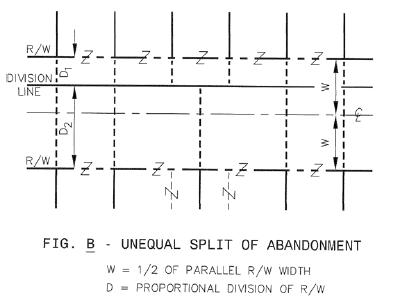
- One-way Allocation. When right-of-ways or easements are adjacent to a quasi-judicial entity (i.e., an interstate highway or regional roadway) or a transportation corridor (i.e., FEC R/R), the vacation or abandonment process tends to allocate said action to the adjacent property owner on one (1) side of the vacation or abandonment task. This is normally due to no requirements to allocate any excess land to a quasi-judicial entity or a transportation corridor that has not previously been required. Figure C below depicts this action:
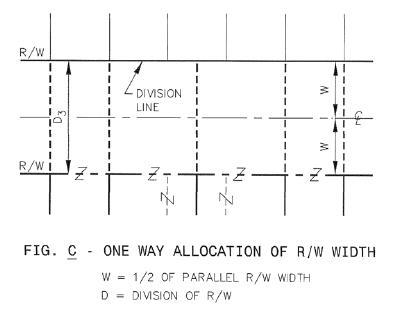
- Equal Split on a Curvilinear Parcel. Generally, the process of vacation or abandonment is divided equally to be "allocated" to each adjacent property owner. This is done by extension of those adjacent property lines extended to the longitudinal centerline of the curvilinear parcel. It should be noted that not all "allocated" parcels will be the same I size in that those properties located on the inside of curvilinear portion will be slightly larger and those properties located on the outside of the curvilinear portion. Figure D below depicts this action.
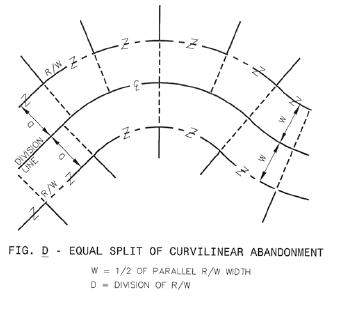
- Irregular Water Body or Land Parcel. When an irregular configuration or land mass is to be vacated or abandoned, difference divisional characteristics are used. As a rule, a dimensional meander or survey line may be used to create the longitudinal "centerline" of the parcel. This is usually performed by a registered land survey licensed with the state. This is plotted on a "Map of Survey" as defined previously, to reflect all existing property lines external to the land mass to be vacated or abandoned.
Where said property lines are connected to the external edge of the land mass (or shoreline in water body cases), a connection is made to the determined centerline of the land mass (or lake or stream) at right angles to the determined centerline. In general, this provides the best equitable division of the land mass (or water body) to the adjacent property owners. Refer to Figure E below for this delineation: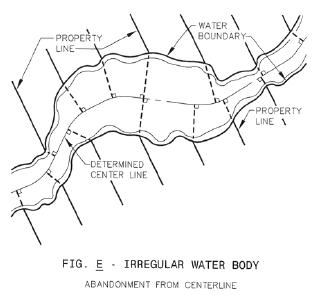
- Other. There are other ways to assign vacated or abandoned land mass components, right-of-ways or easements, but those noted above are the most commonly used when allocating vacations or abandonments.
- Equal Split. Typically, the process of vacation or abandonment is divided equally to be "allocated" to each adjacent property owner. This is the most equable way of elimination of city ownership of a right-of-way, easement of special easement. Figure A below depicts this concept:
Development Agreement. (Editor's note: Ord. 23-003 uses "G" instead of "H")
General
Purpose and Intent. The purpose of Development Agreements is to encourage a strong commitment to comprehensive and capital facilities planning, ensure the provision of adequate public facilities for development concurrent with the impacts of development, encourage the efficient use of resources, and reduce the economic cost of development. The purpose of this section is to establish procedures and standards for the City Commission to consider and enter into Development Agreements in accordance with Florida State Statutes.
Authority and Applicability. The city is authorized to review and enter into a Development Agreement with any person having legal or equitable interest in real property in the city in accordance with the procedures and standards in this section
Parcel Criteria. Only developments which are a minimum of fifteen (15) gross acres are eligible to enter into Development Agreements with the city pursuant to this section.
Conflict. In the event of any conflict between the provisions of this Section and any other sections of the Land Development Regulations or City Codes of Ordinance, the provisions of this section shall prevail. These provisions shall not be construed to supersede any federal, state, or county laws
Submittal Requirements. Development Agreements shall include and meet the requirements of at least the following:
Proposed Development Agreements must meet and be consistent with all requirements set forth in the Florida Local Government Development Act, sections 163.3220-163.3243, Florida Statutes
A Master Plan or Major Master Plan Modification must be submitted and approved concurrently with a Development Agreement;
A phasing plan indicating the proposed phases, if the development is subject to phasing
A conceptual site plan for any single-phase development proposals;
Schematic Design plans including, at a minimum, building location, architectural style, and building height; an
A statement of milestone dates including necessary development approvals, permitting and construction.
Alternative Standards. The City may elect to enact the below alternative standards for developments which are subject to a Development Agreement:
Developments must participate in the City’s Public Art Program; however, the Public Art Fee for the Development may be established within the proposed Development Agreement in an amount different than the amount required by of the City Code. Public Art Fee amounts established pursuant to this section must meet the purpose and intent of the City’s Public Art Program
The City of Boynton Beach may reserve utility system capacity for water and wastewater service for a period not to exceed six (6) years from the date of the agreement or approved permit application at no cost to the Developer at the discretion and approval of the Utilities Director or designee, for the purpose of allowing the Developer to meet anticipated concurrency requirements
Expiration of a Master Plan or Major Master Plan Modification. A Master Plan or Major Master Plan Modification approved with a Development Agreement shall remain valid for twenty-four (24) months; however, upon approval of a site plan by the City Commission, a master plan shall remain valid until the corresponding site plan expires.
Expiration of a Site Plan or Major Site Plan Modification. Upon approval of a site plan by the City Commission, the applicant shall have up to seventy-two months (72) months to secure a building permit for vertical construction.
Review Criteria. An application for a Development Agreement shall be approved and executed only if the City Commission finds that the development proposed in the Development Agreement:
Includes all the information and provisions required by this Section
Meets all Submittal Requirements;
Is consistent with the City's Comprehensive Plan and any amendments to the Comprehensive Plan that would impact the development have been found in compliance if required by state law and are beyond all appeal periods;
Is consistent with this City Code; and
Furthers the public health, safety, and welfare of the city.
Approval Process. A Development Agreement requires review and approval by the City Commission, by ordinance, and shall be processed in accordance with section 163.3225, Florida Statutes.
Periodic Review of Development Agreement. The City shall review land subject to the Development Agreement at least once every 12 months to determine if there has been a demonstration of good faith compliance with the terms of the Development Agreement. Each annual review conducted after the sixth year of a Development Agreement shall include a written report completed by the developer, which shall be submitted to the parties to the Development Agreement.
(Ord. 10-025, passed 12-7-10; Am. Ord. 12-010, passed 6-19-12; Am. Ord. 15-023, passed 10-6-15; Am. Ord. 19-031, passed - -; Am. Ord. 19-034, passed 10-1-19; Am. Ord. 22-009, passed 3-1-22; Am. Ord. 23-003, passed 2-21-23)
Sec. 3. Planned Industrial Development (PID) Applications.
A. Master Site Plan, Including Modifications.
1. General.
a. Purpose and Intent. The purpose of this subsection is to set forth well-defined application processes, review criteria, and uniform procedures for the development of lands designated as mixed use pods within planned industrial development (PID) zoning districts.
b. Applicability. Pursuant to the PID regulations of Chapter 3, Article III, Section 6.B.8., the establishment of a mixed use pod shall require the concurrent approval of a master site plan. This master site plan is the conceptual plan for the entire mixed use pod with which individual technical site plans and buildings are to be consistent. Technical site plans shall be reviewed and approved only after the City Commission approves the mixed use pod (hereinafter "master site plan"). See Section 3.B. below for additional regulations pertaining to the technical site plan application.
2. Submittal Requirements. See Section 1.D. above for the submittal requirements of this application.
3. Review Criteria. The master site plan shall comply with the following: 1) the requirements of the PID zoning district of Chapter 3, Article III; 2) site development standards described in Chapter 4; and 3) the best development practices in the sustainable and green checklist.
4. Approval Process. An application for master site plan approval requires review by the City Commission and shall be processed in accordance with Chapter 2, Article I, Section 3. Upon approval of the master site plan at a public hearing, the city shall announce that the approval of a technical site plan is required prior to the issuance of any building permits pursuant to Section 3.B. below; that the approval process for the technical site plan requires the review and approval of the technical site plan by city administrative staff; and that the review and approval of the technical site plan does not require any additional public notices or hearings.
5. Expiration. The approval of a master site plan shall remain valid indefinitely.
6. Modification to Master Site Plan.
a. General. An applicant may request to modify an approved master site plan. Changes to master site plans are either "minor" or "major" based on criteria within this section. The applicant shall schedule a pre-application meeting with staff and bring the proposed master site plan and any other affected plan or exhibit to the meeting. Staff shall consider the following factors in determining whether the proposed master site plan modification is considered "major":
(1) Changes to the previously approved minimum or maximum square footage of non-residential uses by more than five percent (5%); the threshold increases to ten percent (10%) if considered a sustainable development and meets the intent of the city's green building initiatives;
(2) Increases in height above that which has been approved by the master site plan;
(3) Increases in the maximum number of residential units as indicated on the master site plan;
(4) Elimination of principle open spaces and principle pedestrian plazas;
(5) Description of changes proposed to the approved architectural design whereby the proposed design is inconsistent with the approved design and that such changes results in a downgraded elevation;
(6) Increases in degree of approved waivers;
(7) All other revisions to the master site plan include but are not limited to the following: 1) relocation of approved square footage; 2) conversion of square footage from one (1) component to another (e.g. commercial to office); and 3) conversion from one (1) use to another shall be processed as a minor master site plan modification in accordance with Section 3.A.6.c. below.
b. Major Master Site Plan Modification.
(1) Submittal Requirements. See Section 1.D. above for the submittal requirements of this application.
(2) Review Criteria. The proposed master site plan shall comply with the requirements of the PID zoning district and the site development standards described in Chapter 4.
(3) Approval Process. An application for major master site plan modification approval requires review by the City Commission and shall be processed in accordance with Chapter 2, Article I, Section 3.
(4) Expiration. Approval of a major master site plan modification shall remain valid indefinitely. At the time the City Commission approves a request for a major master site plan modification, any previously approved master site plan, including any conditions for approval, shall be null and void. All future development shall be consistent with the requirements and conditions contained in the master site plan, as modified and approved by the City Commission.
c. Minor Master Site Plan Modification.
(1) Submittal Requirements. The applicant shall submit a letter explaining the requested modification(s) along with the proposed master site plan (in the number of copies specified by the Division). The applicant shall also provide written consent from the property owner to file an application for the minor master site plan modification.
(2) Review Criteria. The proposed master site plan shall comply with the following: 1) all applicable conditions of approval of the preceding master site plan; 2) requirements of the PID zoning district; and 3) the site development standards described in Chapter 4.
(3) Approval process. The application shall be reviewed by staff and action will be taken by the appropriate administrative official. Upon approval of a minor master plan modification, all future development shall be consistent with the master site plan, as modified, including all previously approved conditions of approval associated with the master site plan.
d. Technical Site Plan Consistency with Master Site Plan. Modifications to master site plans that represent changes to the technical site plan will require the subsequent submittal of a new technical site plan.
7. Miscellaneous. Staff may recommend as a condition of approval of a master site plan for a development with multiple and/or components, that a unity of title among the parcels and/or components be required. However, in cases where unity of title is a condition of master site plan approval, this condition may be released under the following conditions:
a. If the property is not owned by a single owner/entity the project as a whole, including its various components, is administered by a property owner's association with fee reserves for property maintenance of at least six (6) months. For the purposes of this section, the term "reserves" means:
(1) Unless and to the extent that these fees are not provided by other associations, an account shall be maintained by the property owner's association (POA), separate and apart from the POA's general operating account, for capital expenditures and deferred maintenance. The reserve account shall include, but is not limited to the amount necessary for routine maintenance of the common areas, and shall include but is not limited to building/structure painting, landscaping maintenance, storm water infrastructure maintenance, and pavement resurfacing, regardless of the amount of deferred maintenance expense or replacement cost.
(2) The amount to be reserved shall be computed by means of a formula which is based upon estimated remaining useful life and estimated replacement cost or deferred maintenance expense of each reserve item. The POA shall adjust replacement reserve assessments annually to take into account any changes in estimates or extension of the useful life of a reserve item caused by deferred maintenance. Reserve funds and any interest accruing thereon shall remain in the reserve account or accounts, and shall be used only for authorized reserve expenditures.
(3) The POA shall provide the city with a copy of the annual POA finance report for a period of one (1) year from the date of issue of the last certificate of occupancy (C.O.) for any structure/building on the project.
b. The owners of the various components have executed perpetual cross access and shared parking agreements to the extent required by the approved master site plan.
c. A sign program approved by the city is in place that regulates all project signage in conformance with the city Land Development Regulations and is applicable to all components of the project.
d. The owners have agreed to the continued calculation of overall project density based on the entire project despite the creation of individual parcels with multiple owners.
B. Technical Site Plan, Including Modifications.
1. General.
a. Purpose and Intent. The purpose of this subsection is to set forth uniform procedures, well-defined application processes, and information to guide the processing and review of technical site plan submittals. It is also the intent to provide for separate submittal requirements and expedited review processes for those developments that qualify as a sustainable development (as defined by Chapter 1, Article II, Definitions) and meets the intent of the city's green building initiatives.
b. Applicability. A technical site plan is required only in conjunction with the approval of a master site plan of a mixed use pod within a PID. See Section 3.A. above for additional regulations regarding the master site plan.
2. Submittal Requirements. See Section 1.D. above for the submittal requirements of this application.
3. Review Criteria. The technical site plan shall be consistent with the corresponding master site plan and comply with the following: 1) any applicable conditions of approval of the master site plan; 2) all applicable requirements of the PID zoning district; 3) the site development standards described in Chapter 4; and 4) the best development practices in the sustainable and green checklist.
4. Approval Process. Within ten (10) business days following staff review of a technical site plan, the Director of Development or designee shall take the following action: 1) approve the technical site plan as submitted; 2) approve the technical site plan with staff conditions; or 3) deny the technical site plan. Once a development order is issued, the five (5) day review period has elapsed, and all conditions have been satisfied, individual buildings on a technical site plan may be phased incrementally. Buildings allowed strictly through the permitting process may not exceed the building envelope as shown on the approved technical site plan.
5. Expiration. Upon approval of a technical site plan, the applicant shall have two (2) years to secure a building permit. All previous approvals shall become null and void if the applicant is unable to secure a building permit within the above timeframe. For the purposes of this section, minor permits issued by the Departments of Development or Public Works (e.g. clearing and grubbing; walls and fences; docks, land development; utilities; etc.) shall not constitute the type of permit necessary to extend the life of a development order.
6. Modification of Technical Site Plan.
a. General. An applicant may request to modify an approved technical site plan. Changes to technical site plans are either "inconsistent" or "consistent" with the master site plan based on criteria within this section. The applicant shall schedule a pre-application conference with staff and bring the proposed technical site plan and any other affected plan or exhibit to the meeting. Staff shall consider the following factors in determining whether the proposed technical site plan modification is considered "inconsistent" with the master site plan:
(1) Changes which violate the project's previously approved minimum or maximum square footage of non-residential uses;
(2) Increases in height above that which has been approved by the technical site plan;
(3) Increases in the maximum number of residential units as indicated on the technical site plan;
(4) Elimination of principal open spaces and principal pedestrian plazas;
(5) Changes to approved architectural design standards whereby proposed architectural design standards are inconsistent with approved architectural design standards;
(6) Increases in degree of approved waivers;
b. Inconsistent with Master Site Plan. Any proposed modification to a technical site plan that staff determines to be inconsistent with its corresponding master site plan shall require the approval of a master site plan modification in accordance with Section 3.A.6. above, prior to the commencement of staff review on the subject technical site plan.
c. Consistent with Master Site Plan.
(1) Submittal Requirements. The applicant shall be required to submit a letter explaining the proposed modification(s) to the technical site plan. The letter shall be accompanied by the amended technical site plan (in the number of copies specified by the Division) illustrating the proposed changes. The applicant shall have consent from the property owner to initiate the review of a minor technical site plan modification.
(2) Review Criteria. The proposed technical site plan shall comply with the following: 1) all applicable conditions of approval of the preceding technical site plan; 2) all applicable requirements of the PID zoning district; and 3) the site development standards described in Chapter 4.
(3) Approval Process. The application shall be reviewed by staff and action will be taken by the appropriate administrative official. Upon approval of a minor technical site plan modification, all future development shall be consistent with the technical site plan, as modified, including all previously approved conditions of approval associated with the technical site plan.
C. Waiver (Mixed Use Pod).
1. General.
a. Purpose and Intent. The purpose of this subsection is to provide an efficient relief process to allow for deviations from certain requirements and standards of Chapter 3 and Chapter 4 of these Land Development Regulations. The intent of this application is not to provide a means for circumventing any such requirement or standard but to allow for a departure from the Code upon demonstration that the subject request satisfies the intent of the review criteria contained herein.
b. Applicability. The requested waiver shall be processed concurrent with the review of a master site plan unless otherwise determined by the Director of Planning and Zoning or designee. The City Commission may waive or modify the requirements or standards that pertain to the following:
(1) Building setbacks;
(2) Drive aisle widths and parking dimensions;
(3) Perimeter buffer widths;
(4) Type and size of dwelling units;
(5) Parking space requirements;
(6) Internal landscape requirements; and
(7) Other waivers to the following: 1) PID zoning regulations of Chapter 3, Article III, excluding maximum building height; and 2) any site development standard described in Chapter 4 as necessary to further economic development, affordable and workforce housing, sustainable development and green building initiatives, and to support the uses that are eligible for the Expedited Development Review Program in accordance with Chapter 2, Article I, Section 4.
2. Submittal Requirements. The applicant shall submit a letter that addresses the review criteria of Section 3.D.3. below, in addition to submitting any plans and exhibits required by the accompanying master site plan or technical site plan, whichever is applicable.
3. Review Criteria. The applicant shall justify each waiver request as part of the application for master site plan or master site plan modification. The applicant shall document the nature of the request, the extent of its departure from the standard regulation, and the basis for the request. The city may request additional information and documentation from the applicant, such as a shared-parking study, or other type of performance related analysis that further justifies the waiver request.
4. Approval Process. An application for waiver approval requires review by the City Commission and shall be processed in accordance with Chapter 2, Article I, Section 3.
5. Denial. Upon the denial of an application for relief hereunder, in whole or in part, a period of one (1) year must elapse prior to the filing of the same or similar application affecting the same property or any portion thereof; however, this restriction shall not apply to applications which further the city's economic development, workforce housing, or green building programs.
6. Expiration. A waiver shall remain valid as long as the corresponding master site plan or technical site plan approval remains in effect, or unless there is any amendment to the original waiver. Any amendment to the original approval shall require application for, and approval of, a new waiver.
(Ord. 10-025, passed 12-7-10; Am. Ord. 12-010, passed 6-19-12)
Sec. 4. Relief Applications.
Each application for relief shall be considered unique and not set precedent for subsequent requests.
- Administrative Adjustments.
- General.
- Purpose and Intent. The purpose of this subsection is to provide an efficient relief process to allow for reductions in the minimum yard setbacks within certain conventional single-family residential zoning districts, in order to better facilitate and accommodate minor building additions, home expansions, and site improvements. The intent of this application is not to provide a means of circumventing the minimum yard requirements of respective zoning districts but to allow for reductions that would have negligible impacts upon the subject site and surrounding properties and represent compliance with the general intent of the city's zoning regulations.
- Applicability.
- Principal Buildings. The administrative adjustment process to reduce minimum yard requirements for principle buildings shall be applicable to those single-family and two-family dwelling units located in the R-1-AAB; R-1-AA; R-1-A; and R-1 zoning districts. See Chapter 3, Article III, Section 2 for additional regulations pertaining to administrative adjustments within each respective district.
- Accessory Structures, Building Appurtenances, and Site Improvements. The administrative adjustment process to reduce setback requirements shall be applicable to the following:
- Private pump housing and equipment for swimming pools and spas in accordance with Chapter 3, Article V, Section 3.D.3.;
- Heating, ventilation, and air conditioner units (including compressors and condensers) in accordance with Chapter 3, Article V, Section 3.R.;
- Compost bins and tumblers in accordance with Chapter 3, Article V, Section 3.U.;
- Generators and fuel tanks in accordance with Chapter 3, Article V, Section 3.T.; and
- Solar photovoltaic (PV) arrays that are erected or installed at-grade (ground level) in accordance with Chapter 3, Article V, Section 3.W.
- Submittal Requirements. The applicant shall submit a letter that addresses the review criteria of Section 4.A.3. below, in addition to the following items:
- Proof of property ownership by petitioner(s), such as a deed or purchase contract agreement;
- Justification statement detailing the need for the setback adjustment, including site constraints and restrictions, building orientation, and floor plan functionality (for applications associated with the principal building);
- Two (2) sealed surveys by a registered surveyor in the State of Florida, not older than six (6) months old, and illustrating the following:
- All property lines;
- North arrow;
- Existing structure(s) and paving;
- Existing ground elevation;
- Rights-of-way, including ground elevation;
- Easements upon or adjacent to the site;
- Legal description;
- Lot size [in acres, to the nearest one-hundredth (1/100) of an acre]; and
- Location sketch of property.
- Two (2) sketches, drawn to scale, and properly illustrating the following:
- Location of all existing structure(s) on property;
- Location and dimension of any new construction;
- Setback dimensions to all property lines;
- Location of, and dimensions to streets, alleys, and easements on or adjacent to the subject property;
- Floor plans of proposed addition(s) and of adjacent habitable space in the existing structure; and
- Location, number and size of existing and proposed parking spaces on the property.
- Photographs depicting the existing conditions on the property, area of the proposed addition(s), accessory structure, or site improvement, and the view(s) facing abutting or adjacent properties.
- For applications associated with the principal building, an affidavit from adjacent property owners or legal representative, which affirms that such owners have completely examined the required plans and exhibits and have no objection to the subject request for administrative adjustment to reduce the yard setbacks as requested by the petitioner.
- Review Criteria. In each application for administrative adjustment, staff shall review the proposed floor plan (for applications associated with the principal building), building orientation, accessory structure or site improvement, and existing site constraints to ensure that the subject request would have negligible impacts upon abutting and surrounding properties. Additionally, staff shall consider the established character of the neighborhood, massing of the subject building or proposed addition, and reasonableness of the subject application to justify a reduction in the minimum required yard or setback, whichever is applicable.
- Approval Process. The application for administrative adjustment shall be reviewed by staff and action will be taken by the appropriate administrative official.
- General.
- Community Design Appeal.
- General.
- Purpose and Intent. The purpose of this subsection is to provide a relief process that allows for deviations from specific build-to line requirements of Chapter 3, Article III and any community design standard of Chapter 4 of these Land Development Regulations. The intent of this application process is not to provide a means of circumventing such standards but to allow for flexibility, and alternative ways to meet the intent of the Code to yield high quality design, architectural detail, and visual interest without negative impacts to the subject site or surrounding properties.
- Applicability. This application shall be applicable to any requested deviation from specific build-to line requirements of the Mixed-Use Urban Building and Site Regulations (Table 3-4); Urban Commercial District Overlay Zone (Table 3-26); or any community design standard of Chapter 4 of these Land Development Regulations. The requested appeal shall be processed concurrent with a site plan unless otherwise determined by the Director of Planning and Zoning or designee.
- Rules. For the purposes of this subsection, a "site plan" shall be construed to include a new site plan, major modification, or minor modification.
- Submittal Requirements. See Section 1.D. above for the submittal requirements of this application.
- Review Criteria. In granting relief to any community design standard of Chapter 4, the justification must demonstrate that the subject appeal meets the intent of the affected standard, does not diminish its practical application, and that an acceptable development product and/or design will result. The following review criteria shall be used to justify an application for appeal:
- Whether the proposed request will demonstrate consistency with the Comprehensive Plan.
- Whether the proposed request will not significantly detract from the livability or appearance of the city and will be consistent with the established or desired character of the area, or with the redevelopment plan, where applicable.
- On balance, whether the proposed request will be consistent with the purpose of the standard for which a deviation is requested. Granting the request will equally or better meet the purpose of the standard to be appealed.
- Whether the proposed request is intended to save or preserve existing trees or desired flora.
- Whether the applicant is unable to design or locate proposed buildings, structures, or improvements and preserve the tree(s) and comply with all provisions of these community design standards without causing the applicant undue hardship; and
- Whether it is not feasible to transplant the trees to another location on the subject site considering the following: 1) shape and dimensions of the real property; 2) location of existing structures and infrastructure improvements; and 3) size, age, health, and species of trees sought to be protected.
- Whether the proposed request will have adverse environmental impacts that cannot be prevented by the imposition of conditions.
- Whether the proposed request will have an adverse impact on property values of abutting or adjacent land.
- Whether the proposed request will seriously reduce the quality or quantity of light and air available to adjacent properties.
- Whether the proposed request is necessary to further the objectives of the city to assist with economic development and business promotion.
- Whether the proposed request meets the purpose and intent of these regulations but conflicts with another site development standard or requirement, including sustainable development and green initiatives.
- Approval Process. An application for community design appeal requires review by the City Commission and shall be processed in accordance with Chapter 2, Article I, Section 3.
- Expiration. Pursuant to Section 4.B.1.b. above, the community design appeal shall be processed concurrent with a site plan. The approval of an appeal shall remain valid as long as the corresponding site plan approval remains in effect. See Section 2.F.5. above for additional information regarding the expiration and extension of a site plan.
- General.
- Height Exception.
- General.
- Purpose and Intent. The purpose of this subsection is to provide an efficient relief process that would allow for certain eligible building appurtenances and structures, which are ordinarily erected or located on top of or within a building, to exceed the maximum building height allowed by the respective zoning district upon demonstrating compliance with the review criteria herein. The intent of this application is not to provide a means of circumventing the maximum height allowed for buildings within the respective zoning district, but to strategically accommodate and design those appurtenances and structures with design flexibility, while providing visual interest and enhancement to building façades without negligible impacts upon the subject site and surrounding properties.
- Applicability. No portion of any principal or ancillary structure proposed within the city shall exceed the maximum height allowed by the respective zoning district, except for as follows: water cooling and fire towers, radio and television towers of commercial nature, spires and finials, domes, cupolas, bell and clock towers, flagpoles, electrical and mechanical support systems, green elements such as PV arrays, parapets and similar structures or architectural enhancements, and their necessary mechanical appurtenances may be erected within or on top of a structure above the district height limitation after obtaining approval of a height exception from the City Commission. A request for height exception shall be processed concurrent with a site plan unless otherwise determined by the Director of Planning and Zoning or designee, or if the height exception application is in connection with a single-family or duplex home located on an individually platted lot within a single-family or two-family residential district.
- Rules. For the purposes of this subsection, a "site plan" shall be construed to include a new site plan or major modification.
- Submittal Requirements. See Section 1.D. above for the submittal requirements of this application.
- Review Criteria. In considering an application for exception to the district height regulation, the City Commission shall make findings indicating the proposed exception has been studied and considered in relation to the following standards, where applicable:
- On the subject site or surrounding properties, whether the height exception would adversely affect any of the following: 1) light and air; 2) property values; 3) the living conditions; or 4) existing or proposed land uses;
- Whether the height exception would be a deterrent to the development or improvement of adjacent properties in accord with existing regulations;
- Whether the height exception would contribute to the architectural character and form of the proposed project;
- Whether the height exception would positively contribute to the city's desired image, streetscape design, or recommendation of any applicable redevelopment plan;
- Whether the height exception would contribute, incentivize, or serve as a catalyst for sustainable development and other green initiatives;
- Whether the height exception is necessary and not proposed in a manner with which the principle objective is to maximize project visibility without concern for architectural or aesthetic integrity; and
- Whether sufficient evidence has been presented to justify the need for a height exception.
- Approval Process. An application for height exception approval requires review by the City Commission and shall be processed in accordance with Chapter 2, Article I, Section 3.
- Expiration. An approval for height exception shall remain valid as long as the corresponding site plan approval remains in effect. Further, a time extension for site plan approval shall simultaneously extend approval of the corresponding height exception. Where no site plan is required in connection with a request for height exception approval, the height exception shall remain in effect for one (1) year. See Section 2.F.5. above for information on the site plan approval period and extension process.
- General.
- Variance to Land Development Regulations.
- General.
- Purpose and Intent. The purpose of this subsection is to provide an efficient relief process to allow for deviations from certain requirements and standards of Chapter 3 and Chapter 4 of these Land Development Regulations in circumstances when the applicant is able to demonstrate a hardship. The intent of this application is not to provide a means for circumventing any such requirement or standard, but to allow for a departure from the Code upon demonstration that the subject request satisfactorily addresses the review criteria contained herein, and without the necessity of amending the regulation or rezoning the property to accommodate the requested relief. The City Commission has the authority and duty to authorize, upon appeal, such a variance from the terms of a city ordinance as will not be contrary to the public interest when, owing to special conditions, a literal enforcement of the provisions of the ordinance would result in unnecessary and undue hardship.
- Applicability. Generally, the variance process shall be available when a petitioner requests a deviation from a quantifiable standard, measure, or regulation. For clarification, the variance process shall not be available in the following instances:
- When another relief process is available;
- No nonconforming use of neighboring lands, structures, or buildings in other zoning districts shall be considered grounds for the authorization of a variance;
- Chapter 3:
- Article I – overview and use of terms;
- Article III - future land use map (FLUM) classifications and corresponding zoning districts, and density regulations;
- Article IV – any use regulations in the use matrix, including the regulations pertaining to hazardous and toxic waste; nonconforming uses; and the operational performance standards; and
- As otherwise determined by the Director of Planning and Zoning or designee.
- Submittal Requirements. See Section 1.D. above for the submittal requirements of this application.
- Review Criteria. In order for the City Commission to grant a variance, the applicant must demonstrate that:
- That special conditions and circumstances exist which are peculiar to the land, structure or building involved, and which are not applicable to other lands, structures or buildings in the same zoning district.
- That special conditions and circumstances do not result from the actions of the applicant for the variance.
- That granting the variance requested will not confer on the applicant any special privilege that is denied by this section to other lands, structures or buildings in the same zoning district.
- That literal interpretations of the provisions of the ordinance would deprive the applicant of rights commonly enjoyed by other properties in the same zoning district under the terms of the ordinance and would work unnecessary and undue hardship on the applicant.
- That the variance granted is the minimum variance that will make possible reasonable use of the land, structure or building.
- That the granting of the variance will be in harmony with the general intent and purpose of this chapter and that such variance will not be injurious to the area involved or be otherwise detrimental to the public welfare.
- Approval Process. An application for variance approval requires review by the City Commission and shall be processed in accordance with Chapter 2, Article I, Section 3. In addition, in recommending approval of a variance, the Planning and Development Board may determine the following:
- The Board may prescribe appropriate conditions and safeguards in conformity with this section. Violations of such conditions and safeguards, when made a part of the terms under which the variance is granted, shall be deemed a violation of this section.
- The Board may prescribe a reasonable time limit within which the action for which the variance is required shall begin, be completed, or both.
- Denial. Upon the denial of an application for relief hereunder, in whole or in part, a period of one (1) year must elapse prior to the filing of the same or similar application affecting the same property or any portion thereof.
- Miscellaneous. A variance shall remain valid indefinitely unless there is change in its application on the subject property. In other words, the variance is specific to the improvement for which the application was made. Any amendment to the original approval that increases the amount of building or site, which would be subject to the variance, shall require the application for, and approval of, a new variance.
- General.
- Waiver (Ocean Avenue Overlay Zone).
- General.
- Purpose and Intent. The purpose of this subsection is to provide an efficient relief process to allow for deviations from certain requirements and standards of Chapter 3 and Chapter 4 as they pertain to the Ocean Avenue Overlay Zone (OAOZ). The intent of this application is not to provide a means for circumventing any such requirement or standard but to allow for a departure from the code upon demonstration that the subject request satisfies the intent of the review criteria contained herein.
- Applicability. For property located within the OAOZ, the waiver process shall be available for deviations from any development and design standards of Chapter 3, Article III, Section 8.D.
- Submittal Requirements. The applicant shall submit a letter that addresses the review criteria of Section 3.E.3. below, in addition to submitting any plans and exhibits required by the accompanying site plan, whenever applicable.
- Review Criteria. The applicant shall justify each waiver request as part of the application for site plan or site plan modification. The applicant shall document the nature of the request, the extent of its departure from the standard regulation, and the basis for the request. The City may request additional information and documentation from the applicant, such as a shared-parking study, or other type of performance related analysis that further justifies the waiver request. The burden of proof shall be on the applicant to present a superior design alternative and demonstrate that the application would further the purpose and intent of the OAOZ and not have any detrimental impact on adjacent properties or the surrounding area.
- Approval Process. An application for community design appeal requires review by the City Commission, or by the Director of Planning and Zoning as outlined below, and shall be processed in accordance with Chapter 2, Article I, Section 3. A Community Design Appeal application may be approved administratively when the requests are appropriately mitigated and all associated applications for the applicable project may be administratively approved.
- Denial. Upon the denial of an application for relief hereunder, in whole or in part, a period of one (1) year must elapse prior to the filing of the same or similar application affecting the same property or any portion thereof; however, this restriction shall not apply to applications which further the City's economic development, workforce housing, or green building programs.
- Expiration. A waiver shall remain valid as long as the corresponding site plan or site plan modification approval remains in effect, or unless there is any amendment to the original waiver. Any amendment to the original approval shall require application for, and approval of, a new waiver.
- General.
- Requests for Accommodation.
- General.
- Purpose and Intent. The purpose of this section is to implement the City’s Reasonable Accommodation Policy, to make available a procedure, in part, that is straightforward and not burdensome for processing requests for reasonable accommodation to the City’s Code of Ordinances, land development regulations, rules, policies, and procedures for persons with disabilities, as provided by Federal Fair Housing Act, Americans with Disabilities Act, Civil Rights Act, and the Rehabilitation Act (collectively “Federal Law”).
- Applicability. Any person who is disabled, or qualifying entities, may request a reasonable accommodation with respect to the city's Land Development Regulations, Code of Ordinances, rules, policies, practices and/or procedures as provided by Federal Law pursuant to the procedures set forth in this section. For purposes of this section, a "disabled person" is an individual that qualifies as disabled and/or handicapped pursuant to Federal Law, as may be amended from time to time. The word "individual" shall include, for purposes of this section, multiple people, or multiple qualified entities.
- Notice to the Public of Availability of Accommodation.
- The city will provide notice to the public advising that individuals may request a reasonable accommodation. Such notice may include, but is not limited to, displaying a notice in the city’s physical or electronic bulletin boards; providing hard copies of the forms, policies, and procedures at various locations throughout City Hall; and through communications with the public in response to specific inquiries regarding group homes or reasonable accommodation, requests for zoning verification, and/or as part of the processing of building permit or business tax receipt applications.
- The city’s forms, policies, and procedures, as may be amended from time to time, provide the specific information that is necessary to implement the general policies in this section.
- Process for the Establishment of Certified Recovery Residences
- Purpose and Intent. The purpose of this section is to implement a procedure for processing written reguests for a reasonable accommodation to the City's Code of Ordinances, Land Development Regulations, Rules, Policies, and Procedures for persons with disabilities as defined by the federal Fair Housing Amendments Act (42 U.S.C. 3601, et seg.) ("FHA") and Title II of the Americans with Disabilities Amendments Act (42 U.S.C. 12131, et seg.) ("ADA"), as reguired by section 397.487(15), Florida Statutes. For purposes of this section, a "disabled" person is an individual who gualifies as disabled and/or handicapped under the FHA and/or ADA. Any person who is disabled (or a qualifying entity) may request a reasonable accommodation with respect to the City's Land Development Code, Code of Ordinances, rules, policies, practices, and/or procedures as provided by the FHA and the ADA pursuant to the procedures set out in this section. The City's procedures for reviewing applications seeking reasonable accommodations related to the establishment of certified recovery residences shall proceed as established in 1. General under Subsection F. Requests for Accommodation, with the additional requirements as outlined under section 397.487(15), Florida Statutes.
- Application. A request by an applicant for a reasonable accommodation under this section must be in writing. The City shall date-stamp each written application upon receipt. If additional information is required, the City must respond to the applicant within the first thirty (30) days after receipt of the application and allow the applicant at least thirty (30) days to respond. A final written determination on an application shall be issued by the City within sixty (60) days after receipt of a completed application. The application must, at minimum, contain the name and contact information of the applicant/representative, the property address and parcel identification number, and a description of the accommodation requested and the specific regulation and/or policy from which relief is sought. The City's determination must either approve the request, in whole or in part, with or without conditions, or deny the request, stating with specificity the objective, evidence-based reasons for the denial and identifying any deficiencies or actions necessary for reconsideration. If a final written determination is not issued within sixty (60) days after receipt of a completed application, then the request is deemed approved unless the parties agree in writing to a reasonable extension of time.
- Revocation of reasonable accommodation.
- Any reasonable accommodation received shall be deemed revoked if the applicant or the property upon which the accommodation is granted is found in violation of any conditions of the approval granting the reasonable accommodation by a court of law or by the special magistrate hearing code enforcement cases.
- Failure to obtain state certification or a required state license, or failure to maintain state certification or a required state license, or alternate certification permitted by this section, shall result in revocation of the reasonable accommodation and cessation of operations within one hundred and eighty {180) days of termination of the license or certification.
- Re-certification. If a reasonable accommodation is for a property which is required to be licensed or certified pursuant to this section or applicable state or federal law, then to be recertified, an applicant must provide proof of active licensure or certification consistent with the requirements of section 397.487(15), Florida Statutes.
- Severability. If any part, section, subsection, paragraph, subparagraph, sentence, phrase, clause, term, or word of this Subsection F, "Requests for Accommodation," is declared unconstitutional by the final and valid judgment or decree of any court of competent jurisdiction, this declaration of unconstitutionality or invalidity shall not affect any other part, section, subsection, paragraph, subparagraph, sentence, phrase, clause, term, or word of this Subsection F, "Requests for Accommodation."
- Submittal Requirements. A request by an applicant for reasonable accommodation under this section may be either oral or written. The City has prepared a reasonable accommodation request form for the public’s use. The request form and all forms related to this section are available from the City Clerk, Code Enforcement, and Development. Completed forms should be submitted to the Human Resources/Risk Department and the City’s ADA Coordinator. Requests and inquiries may be e-mailed to the City at ADA@bbfl.us.
- Confidential Information.
- Should the information submitted by an applicant include medical information or other confidential information, the individual may, at the time of submitting such information, request that the City, to the extent permitted by law, treat such information as confidential, disclosing the information only to those individuals who need the information as part of the review process.
- The City will honor the confidentiality request to the extent permitted by law. The City has no obligation to initiate, prosecute, defend, or pursue any legal action related to the confidentiality request, or to incur any legal or other expenses (whether by retention of outside counsel or allocation of internal resources), in connection with any such legal action.
- The City will comply with any judicial order related to the records which are the subject of a confidentiality request.
- This section is subject to local, state, and federal revisions to privacy laws, including but not limited to the Health Insurance Portability and Accountability Act (HIPAA), as it may be amended from time to time.
- Fees.
- The City will not impose a fee for processing a request for reasonable accommodation or an appeal of a decision related to such request.
- The City has no obligation to pay an applicant’s attorney’s fees or costs in connection with a request or an appeal.
- City Assistance. To ensure the process is accessible, the City will provide the applicant with assistance and accommodation as required by Federal Law including, but not limited to, assistance with reading application questions, responding to questions, completing the form, filing an appeal, and appearing at a hearing.
- Confidential Information.
- Response to Reasonable Accommodation Request.
- In determining whether the reasonable accommodation request will be granted or denied, the requesting party shall be required to establish that they are protected under the FHA and/or ADA by demonstrating that they are handicapped or disabled, as defined in Federal Law, as may be amended from time to time.
- (1) The City will grant or deny the request within 30 calendar days after receiving all information and documentation from the requesting individual using the Request for Additional Information form letter. The City will not make a determination until all necessary information has been received.
(2) Should the city require additional time to make a determination, the City will provide the requester the reasons for the delay within the timeframe the City otherwise would have had to make a determination. - Interim Accommodations. Interim accommodations shall be provided by the City if the requested accommodations cannot be provided at the time of approval, based on a reasonable time period as communicated to the requester.
- If the City concludes that there are justifiable reasons for denying the request, the City shall, using an interactive process with the applicant, facilitate the consideration of alternative effective accommodations necessary to meet the disability-related needs that would not cause a fundamental alteration of the City’s operations and/or the City’s zoning scheme, or impose an undue administrative and financial burden on the City.
- Appeal.
- In the event a reasonable accommodation request is denied, individuals have a right to appeal and must do so in writing using the “Application to Appeal Denial of Request for Reasonable Accommodation” form within thirty (30) calendar days of receipt of the letter of denial. Assistance in completion of the appeal form will be provided by city officials if needed. The City will honor extensions where there is good cause, including when an individual requests additional time as a reasonable accommodation.
- Individuals who appeal the denial of their reasonable accommodation request will be provided a hearing with the City’s Special Magistrate. Following the hearing, the Special Magistrate will either uphold the denial or require the City to grant the reasonable accommodation request.
- Stay of Enforcement. While an application for reasonable accommodation, or an appeal of a determination of same, is pending before the city, the city will not enforce the subject zoning ordinance, rules, policies, and procedures against the applicant.
- Expiration of Approvals. Approvals of requests for reasonable accommodation shall expire in one hundred eighty (180) days if not implemented by the applicant.
- General.
(Ord. 10-025, passed 12-7-10; Am. Ord. 11-002, passed 3-1-11; Am. Ord. 13-033, § 3, passed 12-3-13; Am. Ord. 19-022, § 2, 8-20-19; Am. Ord. 25-035, passed 11-18-25; Am. Ord. 26-004, passed 3-3-26)
Sec. 5. Permit Applications.
- Sign Permit.
- General.
- Purpose and Intent. The purpose and intent of this subsection is to set forth well-defined application processes, review criteria, and uniform procedure to guide in the processing and review of sign permit applications to ensure compliance with the design objectives of Chapter 4, Article IV, Section 1.B. (i.e. identification, aesthetics, land values, safety, sustainability, and compatibility).
- Applicability. Excluding those signs and support structures exempt from the permitting requirements of the sign standards in accordance with Chapter 4, Article IV, Section 1.E., it shall be unlawful for any person to erect, construct, enlarge, move or convert any sign in the city, or cause the same to be done, without first obtaining a sign permit for each such sign. These directives shall not be construed to require any permit for the cleaning, maintenance, or repair of a sign or sign structure for which a permit has previously been issued under this article, provided that such sign or structure is not modified in any way. Signs and structures supporting signs previously erected without a valid permit shall be in violation of this article and shall be deemed illegal signs. It shall be mandatory to obtain a permit for an illegal sign, or to immediately remove such sign and the structure supporting such sign upon notice that the sign or structure supporting the sign is illegal. The notice shall contain a time period for removal. Signs and sign support structures shall be processed under a separate permit (in accordance with Chapter 2, Article IV, Section 3) if the Building Official determines that compliance with the Florida Building Code is required.
- Submittal Requirements. See Section 1.D. above for the submittal requirements of this application.
- Review Criteria. The sign permit shall comply with the sign standards of Chapter 4, Article IV. The Building Official shall make the determination as to whether a sign permit requires compliance with the Florida Building Code. In these instances, the sign permit shall be reviewed in accordance with the procedures described in Chapter 2, Article IV, Section 3.
- Approval Process. The Director of Planning and Zoning or designee shall have three (3) days to review an application for a sign permit to ensure that it is complete. If an application is found to be incomplete, the Director of Planning and Zoning shall send a letter to the applicant indicating the noted deficiencies (with appropriate code references). Once an application is deemed to be complete, staff will promptly conduct a review of the application and within forty-five (45) days, the Director of Planning and Zoning or designee shall approve, approve with conditions, or deny the application for a sign permit.
- Expiration. Any permit for a sign may be revoked by the city upon the determination that the sign is not in full compliance with the provisions of these Land Development Regulations or other applicable codes. A sign permit shall become null and void if the work is not complete within ninety (90) days of the issuance of such permit.
- Appeal. Any appeal of a decision made by a city official shall be conducted in accordance with Chapter 1, Article VIII, Section 1 (Appeals from an Administrative Official).
- General.
- Zoning Permit.
- General.
- Purpose and Intent. The purpose and intent of this subsection is to set forth a well-defined application process, review criteria, and uniform procedure for the processing of zoning permits and zoning verification letters, to ensure that certain structures and site improvements comply with the respective requirements and standards described in these Land Development Regulations and the city's Code of Ordinances.
- Applicability. A zoning permit, issued by the Planning and Zoning Division, shall be required for accessory structures and site improvements proposed on any parcel or development, unless otherwise specified herein. The following types of requests or improvements do not require a building permit or other permits, but do require a zoning permit or zoning verification. Improvements or requests that require a zoning permit include, but are not limited to:
- Accessory structures, limited to a maximum of one (1) open air structure or gazebo less than one hundred (100) square feet and used in connection with a principal residential dwelling or use. Chickee huts are exempt from the above size limitation;
- Animal enclosures;
- Fences on residential property (single-family; two-family; and single-family attached if fee-simple ownership) with a maximum height of six (6) feet; unless used as a barrier around a swimming pool, spa, or rooftop equipment
- Impervious surfaces that are unenclosed and uncovered, including but not limited to driveways, patios, steps, stoops, terraces, sidewalks, and the like, regardless of proposed surface materials (e.g., pavers, asphalt, concrete, etc.). Impervious surfaces may be subject to review for compliance with the drainage standards of Chapter 4, Article VIII, Section 3.G, and/or the Engineering Design Handbook and Construction Standards. This review requires the submittal of a drainage plan prepared by a licensed Professional Engineer.
- Artificial Turf. The permit application for artificial turf shall include the following:
- Documentation specifying the material and installation of the artificial turf system.
- Proof that the artificial turf is manufactured in the United States of America to ensure compliance with current Federal and State safety standards and prevent harmful chemicals from contaminating the soil or water.
- Artificial Turf may be subject to review for compliance with the drainage standards required in Chapter 4, Article VIII, Section 3.G, and/or the Engineering Design Handbook and Construction Standards. This review requires the submittal of a drainage plan prepared by a licensed Professional Engineer.
- Community gardens. See site plan review (Section 2.F. above) for community gardens containing storage and/or agricultural structures that are greater than one hundred (100) square feet. All agricultural structures and storage structures greater than one hundred (100) square feet shall require approval of a building permit in accordance Chapter 2, Article IV, Section 2.
- Compliance with Florida Building Code. Any proposed structure or improvement that includes an electrical, plumbing, or other similar component which is subject to compliance with the Florida Building Code, shall require a building permit, and the review for such improvement that would have been conducted as part of the zoning permit process, will alternatively occur as part of the review for the building permit. See Chapter 2, Article IV for additional regulations regarding the building permit review process and procedures.
- Submittal Requirements. See Section 1.D. above for the submittal requirements of this application.
- Review Criteria. Each structure or improvement shall comply with the following: 1) all zoning requirements of Chapter 3, including the supplemental regulations of Article V; 2) all applicable site development standards described in Chapter 4; and 3) the applicable regulations of City Code of Ordinances Part II. Notwithstanding compliance with the aforementioned regulations and standards, their specific provisions are referenced as follows:
- Fences. Chapter 3, Article V, Section 2;
- Arbors, trellises, and pergolas. Chapter 3, Article V, Section 3.F.;
- Open air structures and gazebos. Chapter 3, Article V, Section 3.G.;
- Permanent sheds and storage structures. Chapter 3, Article V, Section 3.E.1.;
- Decks, patios, steps, stoops, and terraces (unenclosed and uncovered). Chapter 3, Article V, Section 3.B.;
- Animal enclosure. City Code of Ordinances Part II, Chapter 4, Section 4-4; and
- Driveways for single-family and duplex dwellings. Chapter 4, Article V, Section 2.B.
- Artificial turf Chapter 3, Article V, Section 3. CC.
- Approval Process. The application shall be reviewed by staff and action will be taken by the appropriate administrative official.
- Expiration. A zoning permit is valid for a period not to exceed six (6) months from the date of issuance. If construction of the improvement covered by the zoning permit has not commenced within this time period, the permit shall expire and be cancelled with written notice to the applicant.
- Time Extension. An extension of the permit for a period not to exceed ninety (90) days may be requested in writing by the applicant if received by the Division prior to permit expiration.
(Ord. 10-025, passed 12-7-10; Ord. 25-003, passed 05-20-2025)
- General.
- Landscape Permit
- General.
- Purpose and Intent.
The purpose of this subsection is to set forth uniform procedures, application processes, and information to guide modification to the existing trees, palms, or vegetation located on a property. - Administration.
The Director of Planning and Zoning or designee shall have the authority to interpret and administer this subsection. - Applicability.
Removal, relocation, replacement, or substantial alteration of a tree with a caliper of three (3) inches or greater and a palm with a clear wood of six (6) feet or greater are required to obtain a Landscape Permit, except for exemptions provided below.
- Purpose and Intent.
- Exemptions.
This provision set forth in this subsection shall not apply to the following:- Singe-Family Homes and Duplexes
Individually platted lots containing single-family homes or duplexes located within residential zoning districts are exempt, provided that they do not have a plan approved under review of Part III, Chapter 4, Article I and II, or they do not contain specimen trees. A specimen tree is protected in accordance with Chapter is protected in accordance with Chapter 4, Article I, Section 4.B. Preservation Efforts; - Community Gardens
Fruits, vegetables, nuts, and herbs that are planted and growing in a community garden, which is approved by the City; - Licensed plant nurseries or tree farms
All licensed plant or tree nurseries or trees farms shall be exempt from this subsection only in relation to those plants that replanted and growing on the premises for the sale to the public in the ordinary course of such business; - Emergencies.
The provisions of this article may be waived by the Director of Planning and Zoning or designee during a period of emergency, such as during a hurricane, tropical storm, flood, or any other Act of God; and - City-owned and operated facilities excluding rights-of-way
- Singe-Family Homes and Duplexes
- Public Utility Agencies.
Public utility agencies may be authorized to remove or trim existing trees or palms that interfere with infrastructure located within easements or rights-of-way, or which otherwise endanger the safety and welfare of the public, without obtaining a landscape permit. However, if the plant material was part of the approved plan, the responsible party or property owner will be required to mitigate removal of the plant material. Trees or palms that are removed or damaged by a public utility agency shall be replaced with comparable material and provided on a tree-for-tree or palm-for-palm basis, as applicable. - Hazardous and Diseased Trees and Palms.
Hazardous and diseased trees and palms may be removed under the supervision of an arborist certified by the International Society of Arboriculture or a Florida Licensed landscape architect. The Director of Planning and Zoning or designee shall be notified by the arborist or landscape architect with a condition assessment report and photos prior to removal. Comparable replacement of such trees and palms shall be provided on a tree-for-tree or palm-for-palm basis, as applicable, unless waived by the Director of Planning and Zoning or designee. - Removal of Invasive Species.
Removal of invasive species, as defined in Part III, Chapter 4, Article I, shall be approved with a Landscape Permit, and replacements of such removal are not required. If the invasive species were previously approved as part of or contribution to a landscape plan, or otherwise to comply with the standards of Part III, Chapter 4, Article II, removal of such species shall be replaced on a one-for-one basis. - Review Criteria. A permit shall comply with the following:
- Consistency with characters and materials of the approved master plan or site plan;
- Requirements of the zoning district regulations of Chapter 3, Article III;
- Environmental Protection Standards set forth in Chapter 4, Article I; and
- Landscape Design and Buffering Standards set forth in Chapter 4, Article II.
- Submittal Requirements.
See Chapter 2, Article II, Section 1.D for the submittal requirements of this application. - Approval.
The Director of Planning and Zoning or designee shall review a complete application, including submittals, and take action based on the review criteria set forth in this subsection. A Landscape Permit shall be approved upon finding that all applicable standards defined in the Land Development Regulations are met.
A Landscape Permit shall be approved after the issuance of a Building Permit associated with the site plan and corresponding landscape plan, if applicable. - Expiration.
Approval of a Landscape Permit is valid for a period not to exceed six (6) months from the date of issuance. If the scope of work covered by this permit is not commenced within this time period, the permit shall expire and be automatically cancelled. - Time Extension.
An extension of the permit for a period not to exceed ninety (90) days may be requested in writing by the applicant if received by the Division prior to the permit expiration.
- General.
(Ord. 23-014, passed 8-01-23)
Sec. 6. Historic Preservation Applications.
A. Certificate of Appropriateness.
1. General.
a. Purpose and Intent. The purpose and intent of this subsection is to set forth a uniformed procedure, well-defined application process, and information to guide in the review of Certificate of Appropriateness submittals.
b. Applicability. The Board or staff shall review actions affecting the exterior of Properties and all Resources, including non-contributing Properties, within Districts. Utilizing the Design Guidelines Handbook, the Board reviews applications for Certificates of Appropriateness for alterations, new construction, demolitions, relocations affecting proposed or designated Properties or Properties within Historic Districts.
c. Terms and Definitions. See Chapter 1, Article II for definitions and terms associated with historic preservation.
d. Review Authority. The required level of review shall be depicted in a "Historic Resources Preservation Board Certificate of Appropriateness Approval Matrix" (the "Matrix"). The Matrix will contain a list of design features, such as roofing materials, window types, shutter types, etc. The Matrix will indicate whether such features may be administratively reviewed or if Board review is required. The Board shall approve or amend the "Historic Resources Preservation Board Certificate of Appropriateness Approval Matrix" as needed.
If staff does not grant administrative approval of an application, the application may be referred to the Board for review. Any applicant may request referral to the Board rather than administrative review. An application referred by staff or an applicant will be considered in accordance with the application review schedule contained in Section 2.b. below.
2. Submittal Requirements.
a. Application and Fees. Requests for Certificates of Appropriateness shall be made only on application forms approved by the Board. Submittal of the application must be made with the appropriate site plans, drawings, photographs, descriptions, and other documentation needed to provide staff and the Board with a clear understanding of the proposed action. Application fees and other applicable charges shall be established by resolution adopted by the City Commission.
b. Completeness Review and Board Agenda. Staff shall review all applications for Certificates of Appropriateness to determine whether an application is complete. If the application is incomplete, staff will notify the applicant of what additional information is necessary. An application will not be reviewed until staff determines that it is complete.
All Certificates of Appropriateness applications eligible for administrative review will be reviewed in a timely manner and a written decision sent to the applicant. All Certificate of Appropriateness applications requiring Board review will be scheduled for hearing by the Board at the first available meeting approximately six (6) weeks after receipt of the completed application. The meeting shall be publicly announced and will have a previously advertised agenda. The Board may suspend action on the application for a period not to exceed thirty days in order to seek technical advice from outside its members or to meet further with the applicant to revise or modify the application.
3. Review Criteria. See Chapter 4, Article IX, Section 6.D. for the review criteria applicable to the Certificate of Appropriateness.
4. Approval Process.
a. Decisions. Decisions regarding application for Certificates of Appropriateness shall be based on the application, the application's compliance with this Ordinance, and the evidence and testimony presented in connection with the application.
Any conditions or requirements imposed shall be related to the Certificate of Appropriateness sought by the applicant. If conditions or requirements are imposed as a condition of approval, the Board may direct staff to review the amended plans and approve the COA if all conditions or requirements have been addressed.
b. Notice of Decision on Application. Staff shall notify the applicant in writing of any decision on the application within five (5) working days from the date of the decision.
5. Certificate of Economic Hardship. Prior to taking an appeal of a decision to the City Commission on an application for Certificate of Appropriateness, an applicant may file a request in writing for a Certificate of Economic Hardship. Utilizing information supplied by the applicant, the Board reviews requests for Certificates of Economic Hardship to determine if a decision regarding a Certificate of Appropriateness application has caused or will cause an economic hardship.
a. Application. A request for a Certificate of Economic Hardship must be submitted in writing within 30 days of the date of the hearing at which the Board's decision on the Certificate of Appropriateness application is announced.
b. Board Agenda and Notice. The Board shall schedule a public hearing within 60 working days from the receipt of the application and shall provide notice of such hearing in the same manner as for the Certificate of Appropriateness application.
c. Negotiations Prior to Certificate of Economic Hardship Hearing. During the period between receipt of the Certificate of Economic Hardship application and the Board's public hearing, the applicant shall discuss the proposed action with staff, other City officials and local preservation organizations to consider alternatives that will avoid an economic hardship and have the least adverse effect to the Property and/or the District. Staff may request information from various City departments and other agencies in order to negotiate an alternative resolution that is in the best interest of the applicant and the City. If negotiations are successful staff shall make written recommendations to the Board regarding such alternatives.
d. Determination of Economic Hardship. The applicant has the burden of proving by competent substantial evidence that the Board's decision regarding the Certificate of Appropriateness application has caused or will cause an economic hardship. To determine economic hardship, the applicant shall submit the following with the request for a Certificate of Economic Hardship:
(1) Proposed construction, alteration, demolition and removal costs;
(2) Structural and condition reports from a licensed professional with experience in assessing historic buildings;
(3) Estimates as to the economic feasibility of rehabilitation or reuse;
(4) The purchase price of the property-details of annual debt service or mortgage payments, recent appraisals, assessments, and real estate taxes;
(5) Details of any income obtained from the property and cash flows for the previous two (2) years;
(6) The status of any leases or rentals; and
(7) Details of any listings of the property for sale or rent for the previous two (2) years.
The applicant may submit or the Board may request any further additional information relevant to the determination of economic hardship.
The effect of denial of the application for Certificate of Economic Hardship is that the decision regarding the Certificate of Appropriateness is upheld. If the application for Certificate of Economic Hardship is granted, the Board may issue the Certificate of Economic Hardship without conditions. Alternatively, the Board may issue the Certificate with conditions that will avoid the economic hardship and have the least adverse effect to the Property and the District.
Such conditions may include, but are not limited to: ad valorem tax relief, loans or grants, requiring the owner to market and offer the Property for sale for a fair market price with appropriate preservation protections for a period of time not to exceed six (6) months, acquisition by a third party for a fair market value, Building and Zoning Code modifications, relaxation of the provisions of this ordinance, recommendation by the City Manager some or all of the applicable Board fees be waived, or such other relief as appropriate.
6. Appeal of Certificate of Appropriateness and Certificate of Economic Hardship Decisions. Any applicant may appeal a decision of the Board to the City Commission regarding an application for Certificate of Appropriateness and/or an application for Certificate of Economic Hardship. The applicant shall file a written notice of the appeal with staff within 30 days of the date of the hearing at which the Board's decision on the application is announced. The City Commission shall place the matter on the Commission's agenda within 45 working days from the date of the written notice of appeal. The meeting at which the appeal is placed on the agenda shall be no later than 60 working days from the date of the written notice of appeal.
Consideration of the appeal by the City Commission shall be de novo review. The City Commission shall be required to apply the applicable standards and criteria set forth in this ordinance.
A decision of the City Commission may be appealed to a court of competent jurisdiction within thirty (30) days after the hearing at which the decision is announced.
B. Historic District or Properties Designation.
1. General.
a. Purpose and Intent. The purpose and intent of this subsection is to set forth a uniformed procedure, well-defined application process, and information when designating a district as "historic" as defined in these Land Development Regulations.
b. Applicability. This application shall be applicable to all improved property that meets the criteria of Chapter 4, Article IX, Section 6.C. Applications for historic designation may be initiated by only the following:
(1) Historic Resources Preservation Board, herein referred to as "Board" (see Chapter 1, Article VII, Section 4).
(2) City Commission.
(3) A property owner for designation of a Site.
(4) A simple majority of property owners within the proposed District under consideration for designation.
For District designations, each Property shall be allotted one (1) vote. The identity of the property owners shall be determined by the most current Palm Beach County Tax Rolls.
Only the Board or the City Commission may initiate designation of a property or district owned by the City, County, State or by an entity created by state law.
c. Terms and Definitions. See Chapter 1, Article II for definitions and terms associated with historic preservation.
2. Submittal Requirements. Nominations for historic designations shall be made only on application forms approved by the Board.
3. Review Criteria. See Chapter 4, Article IX, Section 6.C. for the review criteria applicable to designating a district as historic.
4. Approval Process.
a. Board Agenda. Following staff determination that an application for designation is complete; the application shall be scheduled for a public hearing by the Board.
b. Board Public Hearing Notice. The Board shall advertise and hold a public hearing in accordance with the following public noticing requirements:
(1) For the proposed designation of an individual site, the applicant, at least ten (10) calendar days prior to the date set for the public hearing, shall:
(a) Mail a notice of the time, place and subject matter of the public hearing to any owner of abutting or adjacent property as determined by the Historic Preservation Planner.
(b) Post one (1) sign for each street frontage of the property in a prominent location.
(2) For the proposed designation of a historic district, the applicants), at least ten (10) calendar days prior to the date set for the public hearing, shall:
(a) Mail a notice of the time, place and subject matter of the hearing to any owner of real property within 400 feet of district subject to potential designation.
(b) Post signs in prominent locations along public streets at the outer boundaries of the proposed district in such a manner as will assure that the signs will be seen by as many affected property owners as possible
Signs shall be legible from a distance of 100 feet and shall contain a description of the approval being sought, the date, time and location of the hearing, and a statement that the application being considered is available for inspection in the Development Department of the City of Boynton Beach. Minimum sign size shall be 24" wide by 18" high.
c. No Action Permitted During Pendency. During the period that a designation application is pending, no changes to the property or district shall be made unless first approved by the Board. The application is considered "pending" until the final decision on the designation is made by the City Commission.
d. Board Recommendations. The Board shall make a recommendation as to the proposed designation at the public hearing, based on findings of fact which support the recommendation. The Board's recommendation shall be reduced to writing within 15 working days after the hearing date. If the Board votes to recommend approval, it will forward the application with recommendations to the City Commission. If the Board recommends denial, no further action is required unless an applicant, or not less than two-thirds of the affected property owners (in the case of a District), appeals to the City Commission. In such event the City Commission may reconsider designation or require the Board to do so.
e. City Commission Decision. Following the Board hearing, a designation application with a Board recommendation for approval shall be scheduled for hearing by the City Commission. The City Commission may approve or deny the designation application. Alternatively, the City Commission may approve the designation with conditions or delay designation for up to one (1) year. The City Commission shall make written findings of fact on which its decision is based.
f. Boynton Beach Register of Historic Places. A Resource designated by the City Commission as historic shall be listed in the Boynton Beach Register of Historic Places. The Register shall be updated periodically and the inventory material will be open to the public. Inventory materials shall be compatible with the Florida Master Site File and duplicates of all inventory materials will be provided to the State Historic Preservation Office. Resources listed in, or eligible for listing in the National Register or on the Boynton Beach Register of Historic Places, either as a Property or as a Contributing Property within a District, may be entitled to modified enforcement of the City's applicable building and zoning codes, if in accord with the Design Guidelines Handbook.
g. Designation Recorded. The historic designation ordinance shall be recorded in the Official Records of Palm Beach County. Boundaries for historic districts and individual properties identified in the ordinance shall be clearly established. The designation shall be noted in the official records of the City's Planning & Zoning and Building Departments to ensure that all City actions taken in connection with the subject property or district are taken subject to the designation.
h. Historic District Street Signs. For Districts, the City shall erect standardized street signs identifying the District within two (2) years from the date of such designation, subject to economic feasibility. The design shall be first approved by the Board.
C. Historic Preservation Property Tax Exemption Application.
1. General.
a. Purpose and Intent. The purpose and intent of this subsection is to set forth a uniformed procedure, well-defined application process, and information to guide in the review of Historic Preservation Property Tax Exemption submittals.
b. Applicability. This application shall be applicable to all improved property that meets the criteria of Chapter 4, Article IX, Section 6.E.
c. Terms and Definitions. See Chapter 1, Article II for definitions and terms associated with historic preservation.
2. Submittal Requirements. See Chapter 4, Article IX, Section 6.E for the submittal requirements of this application.
3. Review Criteria. See Chapter 4, Article IX, Section 6.E. for the review criteria applicable to the Historic Preservation Property Tax Exemption.
4. Approval Process. An application for historic designation shall be conducted in accordance with the procedures set forth in Chapter 4, Article IX, Section 6.E.
Sec. 7. Other Applications.
A. Certificate of Conformity.
1. General.
a. Purpose and Intent. The purpose and intent of this subsection is to set forth a uniform procedure to excuse any existing nonconformance of a parcel due to the necessary expansion of an abutting right-of-way such as through eminent domain action by the city or other governmental entity. Any nonconforming parcel so created shall be deemed a conforming parcel upon the issuance of a certificate of conformity as provided herein.
b. Applicability. This subsection shall apply to all properties impacted by the necessary expansion of an abutting right-of-way. Site improvements and conditions, including nonconforming features and uses existing prior to the time of the road widening, shall not be affected by this subsection. This subsection alone shall not cause a specific use on a property impacted by roadway expansion to cease.
2. Submittal Requirements. The applicant shall submit a letter indicating the details of the right-of-way expansion, along with the proposed site plan (in the number of copies specified by the Division). The site plan shall depict the following: 1) location of the ultimate right-of-way lines; 2) impervious surface (e.g. asphalt, concrete, etc.); and 3) configuration and dimensions of affected parking and landscaped areas. If the right-of-way expansion impacts either a landscape buffer abutting a right-of-way or a perimeter landscape buffer, then a revised landscape plan shall be required (in the number of copies specified by the Division).
3. Review Criteria. The granting of a certificate of conformity shall be provided, contingent upon compliance with the following review criteria:
a. Safety. The remainder parcel can reasonably and safely function after the completion of the roadway expansion.
b. Reduction in Development Standards. If a reduction in the size of a lot causes a nonconformity with respect to the minimum required lot area, setbacks, off-street parking, landscaping, sign location, or other development regulations, the structure(s) on the property, the use(s) within the structure(s), and other site improvements may continue to exist in the configuration remaining after the condemnation, except that:
(1) Access. The length of access ways shall not be less than ten (10) feet measured from the right-of-way, unless otherwise approved by the City Engineer;
(2) Direction. Ingress and egress to and from the site shall be in a forward direction. No backing out onto a right-of-way is allowed pursuant to Chapter 4, Article VII, Section 3.B.3.;
(3) Landscaping. In instances when off-street parking areas are exposed to public rights-of-way as a result of the roadway expansion, all properties shall provide a landscape strip abutting the subject roadway, to the maximum extent possible as deemed appropriate by the city. This requirement to have landscape strips abutting rights-of-way is for the purpose of screening off-street parking areas, and is not construed to supplant or supersede the provision for sidewalks and other non-vehicular use areas.
c. Off-Street Parking Areas. A structure or other site improvement may be enlarged or expanded if the enlarged or expanded portion meets the requirements of these regulations. In all instances, there shall be no reduction in required off-street spaces designated for physically disabled persons. Where off-street parking areas are reduced as a result of roadway widening, the following mitigating actions are encouraged:
(1) The use of off-site parking in accordance with Chapter 4, Article V, Section 2.A.3.;
(2) Joint access and cross parking agreements in accordance with Chapter 4, Article V, Section 3.B.; or
(3) Shared parking agreements in accordance with Chapter 4, Article V, Section 3.C.
d. Damage and Restoration of Structures. Structures and buildings that are nonconforming due to setback deficiencies as a result of a widening of a right-of-way, and which were issued a certificate of conformity, shall be allowed to restore or reconstruct the building or structure, but in accordance to what was approved in the original certificate of conformity.
e. Signs. Any existing, legally established freestanding sign(s) located on the property, which become(s) nonconforming as a result of the roadway widening project, may be relocated elsewhere on-site, in compliance with the standards of this subsection, and with Chapter 4, Article IV of these Land Development Regulations.
f. Vacant Lots. A vacant lot that is impacted by government action associated with roadway widening, to a size or configuration which is below the standards and requirements of the respective zoning district may be developed, but only in accordance with the nonconforming lot provisions of the supplemental regulations (Chapter 3, Article V, Section 11). Should the remainder of the vacant lot not qualify for development under the nonconforming provisions, the property will be considered a total taking and not eligible for development except in conjunction with an abutting lot.
g. Lot Combination. Lot combinations are encouraged for the purposes of creating safer, more functional and aesthetically pleasing developments and attaining a greater degree of compliance with Code requirements. This subsection may apply to the combined lots whether or not they are owned by the same person. Combined lots may be considered as a single lot for the purposes of applying property development regulations, provided either a cross-parking or cross-access agreement is executed. The agreement shall be made in the form acceptable to the City Attorney and recorded in the official records of Palm Beach County.
4. Approval Process. The Director of Planning and Zoning or designee shall review a complete application for a certificate of conformity and render a decision to issue or deny, within thirty (30) days of receipt of such request, based upon the review criteria set forth in this subsection.
5. Expiration. A certificate of conformity issued in accordance with this subsection shall automatically expire two (2) years from the date of issuance, unless redevelopment of the remainder parcel in accordance with the site plan has been completed within such two (2)-year period.
6. Time Extension. An application for an extension of time in letter form may be submitted to the Director of Planning and Zoning or designee under the following circumstances: 1) substantial completion of the landscaping per the site plan has been achieved; or 2) the delay in compliance with the approved site plan has been through no fault of the owner of the remainder parcel.
Under no circumstances shall the extension of time exceed one (1) year. The decision of the Director of Planning and Zoning shall be rendered within thirty (30) days of receipt of the letter requesting an extension of time. The decision of the Director of Planning and Zoning or designee may be appealed to the City Commission. For purposes of these appeals, no application fee shall be charged. The City Commission may reverse the denial for an extension of time and impose a new completion date upon a finding that the remainder parcel owner's failure to complete the project is through no fault of his/her own. Any subsequent, additional request for an extension of time shall be submitted directly to the City Commission. The City Commission shall determine whether an additional extension of time will be granted. The City Commission shall use the criteria above to determine whether an additional extension of time will be granted.
B. Lot Line Modification.
1. General. The purpose and intent of this subsection is to set forth a uniform procedure for the reviewing of proposed changes to property boundaries.
2. Submittal Requirements. The applicant shall submit a letter describing the proposed change, and include or attach any details of the affected property, including the site address and legal description. A survey, which clearly illustrates the proposed boundaries, dimensions, and easements, if any, shall be required.
3. Review Criteria. All proposed lot line modifications and lot splits shall comply with all the regulations of the respective zoning district, including density, size, and frontage requirements, as described in Chapter 3 of these Land Development Regulations. In addition, the following shall apply:
a. The modification to property boundaries do not result in the creation of more than two (2) lots;
b. The proposed modification may require the recording of additional easements to create access for utility infrastructure;
c. All newly created lots shall have no encumbrances on the subject property that would render the parcel(s) undevelopable;
d. The boundary changes shall not cause any structures on the affected properties to become nonconforming with respect to the minimum setbacks required by the zoning district or approving plat; and
e. Approval of a master plan modification is a prerequisite to any proposed change in property boundaries within a planned development.
4. Approval Process. Staff shall review each request for lot line modification and lot split, and action will be taken by the appropriate administrative official.
C. Mobile Vendor Approval.
1. General.
a. Purpose and Intent. The purpose and intent of this subsection is to set forth well-defined application processes, review criteria, and information to guide in the processing and review of mobile vending units (MVU) submittals.
b. Applicability. This subsection is applicable to any MVU proposed within the city in accordance with Chapter 3, Article V, Section 10 . It shall be unlawful for anyone to operate an MVU in the city without first obtaining the necessary approvals as contained herein.
c. Exception. Portable or mobile kitchens necessary to provide temporary food services in connection with permitted construction work are not subject to the removal requirement or size restrictions. Such temporary units must be removed immediately upon completion of the work.
2. Submittal Requirements. See Section 1.D. above for the submittal requirements of this application. Because of minimum separation requirements between each MVU, in those instances when more than one (1) application has been submitted for the same location, the earliest application shall be processed and forwarded to either the Planning and Development Board or the Community Redevelopment Agency, whichever is applicable.
3. Review Criteria. The MVU shall comply with the regulations and requirements of Chapter 3, Article V, Section 10. Site constraints and site plan functionality shall be satisfactorily addressed to justify the request.
4. Approval Process. Staff shall review the proposed location and dimensions of each MVU to ensure compliance with the review criteria contained herein, and provide a recommendation. Once an individual or assembly MVU application is approved, a permit fee shall be paid by the applicant, and business tax receipt or certificate of use received, prior to the operation of the MVU.
5. Expiration. Each approval for an MVU shall be effective for one (1) year, from October 1 until September 30, subject to annual renewal. Assembly permits are subject to the Special Event Permit regulations.
6. Fees. The annual renewal fees for an MVU shall be paid to the Business Tax Division in accordance with the fee schedule as adopted by the city.
7. Suspension. Approval of an MVU or assembly permit may be temporarily suspended by the city under the following circumstances: 1) when necessary to clear sidewalk areas for a "community or special event" authorized by the city; 2) when street, sidewalk, or utility repairs necessitate such action; or 3) when the city may cause the immediate removal or relocation of all or parts of the MVU or assembly in emergency situations.
8. Denial or Revocation. The City Magistrate, for business tax receipt and certificate of use, shall have the power and authority to deny or revoke the issuance or renewal of any application for MVU or Assembly under the provisions of these Regulations. In such instances, the applicant shall be notified in writing of the denial of an application or the suspension or revocation of an existing approval, and the grounds thereof. Upon such notification, the operation shall cease and desist until final action or outcome of the Magistrate. An application approved under these Regulations may be recommended for suspension or revocation by staff, based on one (1) or more of the following:
a. Florida Department of Business and Professional Regulation. Cancellation of the vendor's permit issued by the Division of Hotels and Restaurants of the Florida Department of Business and Professional Regulation.
b. Expiration. Expiration, suspension, revocation or cancellation of any other business tax receipt, certificate of use or permit required by the vendor.
c. Fraud. The permit was procured by fraud or false representation of fact.
d. Consent. The abutting property owner or tenant withdraws consent, in writing, for the mobile vending unit.
e. Violations. Violations of this or any other ordinance, the city's municipal code, conditions of permit, or when conditions exist that present a threat to the public health, safety, or welfare.
f. Miscellaneous. If determined to be noncompliant with the review criteria contained herein or otherwise inconsistent with the original approval, or changing conditions warrant the removal of the unit from the site.
9. Appeal. Applicants who have been denied a request for an MVU or assembly permit or who have had their approval revoked may formally appeal such denial or revocation to the City Commission in accordance with Chapter 1, Article VIII.
D. Modification to Development Order.
1. General.
a. Purpose and Intent. The purpose and intent of this subsection is to set forth a well-defined application process, review criteria, and uniform procedure for processing requests to amend, modify, or delete any condition of approval of a previously approved development order.
b. Applicability. This application shall be applicable to any proposed amendment, modification, or deletion of any condition of approval of a previously approved development order.
2. Submittal Requirements. The applicant shall submit a letter indicating the condition or conditions requested to be modified, a detailed explanation for the proposed modification to the condition(s), and thorough responses to the review criteria of Section 6.D.3. below.
3. Review Criteria. The City Commission must find that the subject application meets the intent of the original condition, or that there are substantial mitigating factors, changing conditions, or new evidence that causes the condition to be unnecessary or burdensome. The following review criteria shall be used to justify an application for modification:
a. Whether the proposed request would demonstrate consistency with the Comprehensive Plan.
b. Whether the proposed request would not significantly detract from the livability or appearance of the city, and would be consistent with the established or desired character of the area or with the applicable redevelopment plan.
c. Whether the proposed request would further the intent of the city's environmental regulations, including the Tree Preservation Ordinance.
d. Whether the proposed request would have an adverse impact on property values of abutting or adjacent land.
e. Whether the proposed request would seriously reduce the quality or quantity of light and air available to adjacent properties.
f. Whether the proposed request is necessary to further the objectives of the city to promote sustainability in development, economic development and business promotion, and/or the provision for affordable housing.
g. Whether the proposed request meets the purpose and intent of these Regulations but conflicts with another site development standard or requirement, including sustainable development and green initiatives.
4. Approval Process. Staff shall review each application and provide a recommendation to the City Commission. The City Commission's options shall include, but not be limited to the following: 1) approve; 2) approve with conditions; 3) deny; or 4) remand the item to the Advisory Board for a review and recommendation. When the targeted condition was originally recommended by an advisory board, such advisory board shall review the application first and provide a recommendation to the City Commission.
5. Expiration. The approval of a modification to a development order shall remain valid as long as the corresponding application remains in effect. The approval of a modification does not extend the life of the corresponding application for whose the of the condition of approval of whose development order the subject request proposes to modify, amend, or delete.
E. Sidewalk Café Approval.
1. General.
a. Purpose and Intent. The purpose and intent of this subsection is to set forth a well-defined application process, review criteria, and uniform procedure for processing requests for sidewalk café approval.
b. Applicabilty. This subsection is applicable to any sidewalk café proposed on any sidewalk (within a public right-of-way) within the boundaries of the Community Redevelopment Agency (CRA), in accordance with Chapter 3, Article V, Section 9. It shall be unlawful for anyone to operate a sidewalk café without first obtaining the necessary approval. Sidewalk cafés shall be located only where permissible as prescribed herein.
c. Rules. For the purposes of this subsection, a "site plan" shall be construed to include either a new site plan or a major site plan modification.
2. Submittal Requirements. See Section 1.D. above for the submittal requirements of this application.
3. Review Criteria. Compliance with the regulations and limitations of a sidewalk café (see Chapter 3, Article V, Section 9). Review shall not continue on an application if it is determined that the property is the subject of any outstanding fines, monies, fees, taxes, or other charges owed to the city by the current or past owners or operators of the property requesting a sidewalk café permit.
4. Approval Process. Staff shall review each request for a sidewalk café approval for compliance with the regulations of Chapter 3, Article V, Section 9 and provide a recommendation to the CRA. The CRA shall take the following action: 1) approve; 2) approve with conditions; 3) deny; or 4) table the item until more information is collected. Site constraints and site plan functionality shall be satisfactorily addressed to justify the request.
5. Approval Process. Staff shall review each request for sidewalk café approval for compliance with the regulations of Chapter 3, Article V, Section 9, and provide a recommendation. The application shall be forwarded to the Community Redevelopment Agency (CRA). The CRA shall make a recommendation to the City Commission, and the City Commission shall take the following action: 1) approve; 2) approve with conditions; 3) table or defer their decision to a subsequent meeting in order to collect additional information or conduct further analyses; or 4) deny the request for sidewalk café approval. Once a sidewalk café application is approved by the City Commission, a fee shall be paid by the applicant and business tax receipt received prior to the operation of the sidewalk café.
6. Expiration. Each approval shall be effective for one (1) year, from October 1 until September 30, subject to annual renewal.
7. Fees. The annual renewal fees for a sidewalk café shall be paid to the Business Tax Division in accordance with the fee schedule as adopted by the city.
8. Revocation or Suspension of Approval. The approval for a sidewalk café may be temporarily or permanently suspended by the city under the following circumstances:
a. When it is necessary to clear sidewalk areas for a "community or special event" authorized by the city.
b. When street, sidewalk, or utility repairs necessitate such action or in an emergency situation.
c. Any necessary business or health permit, or the required insurance has been suspended, revoked or cancelled.
d. Any current violation of the City Code, County Code, or State Law on the premises has been found.
e. The operator exceeds the approved square footage by placing any additional tables, chairs, etc., beyond the approved area.
f. Changing conditions of pedestrian or vehicular traffic causes congestion necessitating removal of the sidewalk café. Such decisions shall be based upon findings of the city that the minimum required pedestrian path is insufficient under existing circumstances and represents a danger to the health, safety or general welfare of pedestrians or vehicular traffic.
g. The operator has failed to correct any violations of this article or conditions of approval within twenty-four (24) hours of receipt of the city notice of same, delivered in writing to such operator.
9. Revocation or Suspension Process.
a. The city shall serve, by certified mail or hand delivery to the address provided on the application, a written notice to the operator of the sidewalk café in those instances when the city believes the operator of the sidewalk café has engaged or is engaged in conduct warranting suspension or revocation of the sidewalk café. The written complaint shall cite the following elements: 1) the regulation and/or any ordinance that was, or is being violated by the operator; 2) the action the operator shall take or cease, in order to rectify the violation, if any; and 3) a reasonable time period for which the operator can cure such violation.
b. The operator shall be given adequate opportunity to request a review as provided herein, unless the city finds that an emergency condition exists, which poses serious danger to the public health, safety, morals, or welfare of the city; in which case, advance notice and hearing is not required. The licensee shall immediately be advised of the action taken by the city in the instances of an emergency suspension or revocation.
c. In non-emergency suspension or revocation situations, staff shall place the request to suspend or revoke the approval of the sidewalk café on the CRA agenda within a reasonable timeframe. The recommendation of the CRA shall be placed on the same City Commission agenda as the other items from the same meeting.
d. In emergency suspension or revocation situations, where prior approval is immediately suspended or revoked, a review of the operator's request for re-instatement shall follow as soon as the agenda schedule allows.
e. The decision of the City Commission shall be final. An applicant shall not be permitted to apply for another sidewalk café approval for a minimum of one (1) year following revocation by the City Commission.
f. Any person or entity operating a sidewalk café without approval or any property owner allowing the operation of a sidewalk café without approval shall be subject to penalties as provided in Chapter 1, Article I, Section 7.A.
10. Appeal. Any aggrieved party may appeal a final decision of the City Commission under this subsection by writ of certiorari as provided in Chapter 1, Article VIII.
F. Wireless Communication Facilities (WCF). See Chapter 3, Article V, Section 13 for the regulations pertaining to the review process of WCF.
G. Zoning Verification.
1. General. The purpose and intent of this subsection is to set forth a uniform procedure for the processing of formal requests from the public for written information from the city on zoning and land development regulations (i.e. zoning verification) or other data associated with real property or the applicable process for development or redevelopment thereof.
2. Submittal Requirements. The request shall be represented by a letter describing the desired information and must include any applicable details on the subject property, such as a legal description, site address, property owner, and the like.
3. Issuance of Zoning Verification Letter. Staff shall review each request and provide a written response.
H. Interpretation by Planning & Zoning Director.
1. General. The purpose and intent of this subsection is to set forth a uniform procedure for the processing of formal requests for Land Development Regulation interpretations.
2. Submittal Requirements. The request shall be represented by a letter describing the desired information, the code section for which interpretation is requested, and must include any applicable details.
3. Issuance of Interpretation by Planning & Zoning Director. Staff shall review each request and provide a written response.
(Ord. 10-025, passed 12-7-10; Am. Ord. 12-010, passed 6-19-12; Am. Ord. 12-016, passed 10-2-12; Am. Ord. 13-027, § 2, passed 10-1-13; Am. Ord. 15-003, passed 3-17-15; Am. Ord. 22-022, passed 11-14-22)
Sec. 1. General.
A. Purpose and Intent. The purpose of this article is to set forth uniform and well-defined procedures for each application processed by the Engineering Division. Each application is intended to ensure that:
1. Compliance. Development and construction-related activities within the city are consistent with all land development regulations, the Engineering Design Handbook and Construction Standards (EDHCS), and all other applicable standards and requirements set forth by the city or other public entities having jurisdictional responsibility;
2. Public Purpose. Development and supportive facilities and services further the public health, safety, appearance, and general welfare; and
3. Compatibility. Development infrastructure and construction-related activities are compatible and coordinated with existing and anticipated development in the immediate area surrounding the site.
B. Administration. The City Engineer or designee shall be responsible for the overall coordination and administration of land development applications within this article.
C. Preapplication Conference. A preapplication conference with the Engineering Division is encouraged for each application or construction-related activity regulated by this article prior to the preparation and submission of such application.
D. Completeness. An application will be processed by the Engineering Division when it is deemed complete, including all related submittal documents. Please note that the City Engineer or designee may rule that certain required items may be excluded from the submittal, and the finding of an application "complete" shall not constitute a determination of compliance with the substantive requirements of city or state regulations, or any other applicable codes.
E. Fees. Fees shall be paid when each application is submitted to the Engineering Division and in the amount as adopted from time to time by the City Commission.
F. Terms and Definitions. See Chapter 1, Article II for all applicable terms and definitions which pertain to the applications and processes contained herein.
(Ord. 10-025, passed 12-7-10)
Sec. 2. Subdivision and Platting.
A. General.
1. Purpose and Intent. The purpose and intent of this subsection is to implement the goals, objectives, and policies of the Comprehensive Plan, by setting forth uniform and well-defined application processes, and information to guide in the review of the subdivision and platting of real property.
2. Applicability. The regulations set forth in this subsection shall apply as follows:
a. General Requirements. No property shall be platted, recorded, sold, or any land development permit be issued by the city unless the subdivision or lot-line modification meets all the applicable laws of the State of Florida and has been approved in accordance with the requirements of these Land Development Regulations. These requirements or regulations are not intended to repeal, abrogate, annul, or in any way, impair or interfere with private restrictions placed upon property by deed, covenant, or private agreement, except that where this subsection imposes higher standards than imposed by such deeds, covenants, or private agreements, then the provisions of this subsection shall apply. The city shall not be responsible for enforcement of such deeds, covenants, or agreements. Unless otherwise exempt from this subsection, all subdivision of land is subject to the platting requirements contained herein. Preliminary parcel layout and improvements are shown in the preliminary plat, while the final plat indicates the legal subdivision of land subject to Florida Statutes. To obtain approval for a development in the City of Boynton Beach, the developer shall submit both a preliminary plat and a final plat to the City Engineer, and shall notify the Director of Planning and Zoning of same. No final plat of any subdivision shall be recorded in the Office of the Clerk of the Court of Palm Beach County until the subdivision or other subject change has been duly approved by the city in the manner prescribed herein. No division of land through a lot-line modification shall be recorded in the Palm Beach County Property Appraiser's Office until after the city has approved the application. All final plats and applications for lot-line modifications shall be recorded in the Office of the Clerk of the Circuit Court of Palm Beach County.
b. Unlawful Sale or Transfer of Property. It shall be unlawful for a property owner or agent to sell, transfer, or convey ownership of a subdivision plat if such subdivision plat has not been formally approved by the city and recorded with the Palm Beach County Clerk or the Circuit Court. The owner or agent shall be guilty of a misdemeanor of the first degree, punishable as provided by Florida Statutes if such unlawful use is made of a plat prior to it being formally approved by the city and properly recorded with the Palm Beach County Clerk or Circuit Court.
c. Building Permits Subject to Final Plat or Lot Line Modification Approval. Unless otherwise determined by the City Engineer, no building permit shall be issued and no city service may be rendered until a final plat or lot line modification has been approved by the city and properly recorded as contained herein.
d. Creation of Subdivision by Joint Owners of Land. Where it may subsequently become evident that a subdivision is being created by the recording of deeds by metes and bounds description of tracts of land, the city may, at its discretion, require all the owners involved to jointly file a plat of the subdivision being so created or require all owners of record to jointly conform to the applicable provisions of this article as are requisite for the issuance of building permits or the furnishing of any city service.
e. Deeds, Covenants, and Other Private Restrictions. These regulations are not intended to repeal, abrogate, annul, or in any way, impair or interfere with private restrictions placed upon property by deed, covenant, or private agreement, except that where this article imposes higher standards than imposed by such deeds, covenants, or private agreements, then the provisions of this subsection shall apply. The city shall not be responsible for enforcement of such deeds, covenants, or agreements.
3. Lot Line Modification. A lot line modification shall be required when a property owner or agent desires to subdivide real property and the City Engineer determines that platting and replatting is not required. In these instances, approval of a lot line modification is required from the Planning and Zoning Division in accordance with Chapter 2, Article II, Section 6.B. in order to ensure compliance with all development regulations.
B. Preliminary Plat.
1. General.
a. Purpose and Intent. The purpose of a preliminary plat is to provide adequate and necessary descriptive information regarding the proposed subdivision, dividing, and platting of real property in order to facilitate an expeditious final platting process. The intent is to set forth uniform and well-defined application processes, and information to guide in the thorough and timely review of the preliminary plat application.
b. Applicability. No person, firm, corporation or any other association shall combine lots, tracts, or parcels of land for development purposes, or to subdivide a tract of land except in conformity with this chapter. No development or subdivision shall be platted or recorded, or any building permit or land development permit be issued, unless such subdivision or development meets all the provisions of this chapter and those of any applicable Florida Statutes, unless a waiver of platting has been issued in accordance with Section 5 below.
c. Prerequisite to the Preliminary Plat. Pursuant to Chapter 2, Article II, Section 2.D.6., master plan approval shall be required prior to the consideration of any proposed platting or replatting of a planned zoning district.
2. Submittal Requirements. A written request shall be submitted to the City Engineer and accompanied by four (4) copies of the preliminary plat, conceptual, or phasing plan. The conceptual or phasing plans shall have the same level of detail as that typically shown on a "master plan" or "site plan" as described in Chapter 2, Article II and the definitions (Chapter 1, Article II). In addition, the preliminary plat, conceptual plan, or phasing plan, whichever is submitted, shall illustrate ingress-egress locations/easements, landscape easements, limited access easements, storm drainage easements, utility easements, etc. and all other applicable conditions of approval (COA) attached to the development order (DO) that were issued by the City Commission upon master plan and site plan approval.
3. Review Criteria. The preliminary plat shall meet requirements of the final plat, except that it shall be submitted without the required signatures and seals. It may also be submitted without maintenance and use covenants, condominium documents, deeds, or other legal documents not related to the survey or engineering design of the project.
4. Approval Process. The City Engineer or designee shall review the preliminary plat application to ensure that it complies with the requirements of Section 2.B.3. above.
C. Final Plat.
1. General.
a. Purpose and Intent. The purpose of this subsection is to provide a procedure for preparing plat documents consistent with development regulations of the city and to create documentation of physical characteristics of land proposed for development within the city.
b. Applicability. No person, firm, corporation or any other association shall combine lots, tracts, or parcels of land for development purposes, or to subdivide a tract of land except in conformity with this chapter. No development or subdivision shall be platted or recorded, or any land development or building permit be issued, unless such subdivision or development meets all the provisions of this chapter and those of any applicable Florida Statutes, unless a waiver of platting has been issued in accordance with Section 5 below.
All developments or redevelopments that are subject to the requirements of this article shall require a plat prepared by a registered land surveyor and mapper in compliance with this chapter and the requirements of all provisions of Florida Statutes. Depending on the characteristics of the development, the platting requirements would be satisfied by the approval of one (1) of the following types of plats:
(1) Boundary Plat. "Boundary plat" is generally used when assembling multiple parcels of land, tracts or lots into a single parcel for development purposes. Project types would include rental apartments, public facilities, shopping centers, and industrial developments where "unity of title" ownership is required. A boundary plat may be submitted when portions of an existing subdivision or parcels of land being assembled to create a single developable property are of such simplicity or are surrounded by such development as to justify the waiving of the requirements for preparing a full replat. For the sole purpose of determining application fees, a boundary plat submittal shall be considered a pre-application submittal. All provisions of F.S. Ch. 177 and these Land Development Regulation shall fully apply to every boundary plat including, but not limited to, those tangible improvements required in Chapter 4, Article VIII (Roadways, Utilities, and Infrastructure Design Standards) not already in place.
(2) Record Plat. A "record plat" is generally used when land assembly or subdivision would ultimately yield multiple parcels under individual ownership. Project types would include single-family subdivisions, townhome developments, condominiums, retail centers, or office-warehouse and similar developments.
c. City Engineer Determination. Other types of plat documents may be applicable to a new development. The City Engineer shall review those cases to determine which platting process is appropriate. However, a new boundary survey for any replat is required when the replat affects any boundary of the previously platted property or when improvements which may affect the boundary of the previously platted property have been made on the lands to be replatted.
d. Exemptions to Platting.
(1) Eligibility. A waiver of the platting requirement may be considered when the land is to be divided into no more than two (2) contiguous lots and no more than three (3) regularly shaped areas are to be dedicated to the City of Boynton Beach (easements, tracts, parks, rights-of-way, etc.) and because:
(a) Unusual conditions are created by ownership or development of adjacent lands;
(b) The land concerned is isolated or remote in its relationship to other platted or improved lands; or
(c) The improvements and dedications existing on the land are substantially in accordance with the requirements of this chapter and if the waiving of the requirements for platting would not conflict with the purpose and intent of this chapter.
(2) Requirements in Lieu of Platting. If platting is not required, a certified survey shall be submitted to the City Engineer, who may require deeded rights-of-way and easements, reservations or improvements required in connection with platting under this chapter, including the posting of surety to carry out the intent and purpose of this chapter.
e. Substitutions to Platting. The submission of a master plan for a boundary plat may be waived at the option of the City Engineer.
f. Prerequisite to Platting. Approval of a master plan shall be required prior to the consideration of any proposed platting or replatting in instances when rezoning to planned developments (as defined by Chapter 1, Article II). See Chapter 2, Article II, Section 2.D.6. for the regulations pertaining to the master plan application process. Master plan review shall not be required when rezoning lands to conventional residential zoning districts.
2. Submittal Requirements. Upon filing an application for final plat approval, the developer shall pay the applicable fee as adopted by resolution of the City Commission from time to time to help defray the cost of processing the final plat review. The final plat shall conform to the corresponding approved master plan. Failure to submit the final plat within six (6) months from the date of application shall require submittal. The submittal package for final plat shall include the following:
a. Final Plat. Six (6) copies of the final plat, drawn or printed on twenty-four inch by thirty-six inch (24" x 36") line and one (1) chronoflex, mylar, or other approved time stable material. The final plat shall be prepared by a professional surveyor and mapper currently registered in the State of Florida, and is to be clearly and legibly drawn with black permanent drawing ink or veritype process to a scale of not smaller than one (1) inch equals one hundred (100) feet, or as otherwise determined by the City Engineer;
b. Construction Plans. Four (4) sets of the construction plans, which shall be reviewed for technical compliance, along with approved Health Department permits for sewer and water, in accordance with city requirements;
c. Surety. Surety guaranteeing that all work required whether public or private will be completed in full accordance with the plat and approved construction plans; with all development conditions attached thereto; and with the Boynton Beach Land Development Regulations. Surety for required utility system improvements shall be coordinated directly with the Utilities Department, whether they will remain private or conveyed to the city upon completion of their construction. Surety shall be in substantially the form and amount delineated in Section 6 below;
Restoration surety in compliance with Section 6 below in the amount of one hundred ten percent (110%) of the engineer's certified cost for restoring the site to its original condition including, but not limited to, repair of access/haul routes; seed; sod; landscaping; drainage and utilities;
d. Maintenance Agreements. A copy of the property owner's association documents, if applicable, shall be required. These documents shall indicate the maintenance responsibility for street lighting and shall provide for the formation of a special taxing district to assume maintenance responsibility for the street lighting system in the event of the dissolution of the property owners association;
e. Legal Documents. Supplementary material as required by the office of the City Engineer, i.e. deeds, easements, etc., when access, drainage, or utility services cannot be accomplished through platted rights-of-way deeds or easements to accomplish access, drainage or utility service;
f. Fees. Upon filing application for final plat approval, the developer shall pay a processing fee, and an administrative fee equal to a percentage of the estimated cost of construction of improvements. Said fee shall be as adopted by resolution of the City Commission, and shall be paid in full prior to placing final plat approval on a City Commission agenda; and
g. Miscellaneous. Failure to submit the final plat to the City Engineer within six (6) months from the date of application shall require resubmittal.
3. Review Criteria. The final plat shall be drawn or printed on linen, chronoflex, mylar, or other approved time stable material and sized twenty-four (24) inches by thirty-six (36) inches. The final plat shall be prepared by a professional surveyor and mapper currently registered in the State of Florida, and is to be clearly and legibly drawn with black permanent drawing ink or veritype process to a scale of not smaller than one (1) inch equals one hundred (100) feet, or as otherwise determined by the City Engineer. The final plat shall be prepared in accordance with the provisions of F.S. Chapter 177, as amended, and shall conform to the following additional requirements:
a. Index. When more than a single sheet must be used to accurately portray the lands being developed or subdivided, the first sheet shall contain an index plus a map showing the entire development delineating the number of the sheet where each portion is shown. Each sheet must show the particular number of that sheet, the total number of sheets included and clearly labeled matchlines to show where other sheets match or adjoin.
b. Name of Development. The plat shall have a title or name acceptable to the city. When the plat is a new development, the name of the development shall not duplicate nor be phonetically similar to the name of any existing or approved development. When the plat is an addition to a recorded subdivision, it shall carry the same name as the existing subdivision and labeled as an addition.
c. Private Streets and Related Facilities. All streets and their related facilities designed to serve more than one (1) property owner shall be dedicated to public use; however, private streets shall be permitted within property under single ownership such as a property owners' association, and shall be constructed in accordance with design requirements of public streets. Where private streets are permitted, ownership and maintenance association documents shall be submitted with the final plat and the dedication contained on the plat shall clearly dedicate the roads and maintenance responsibility to the association without recourse to the city or any other public agency. The rights-of-way and related facilities shall be identified as tracts for road purposes under specific ownership.
d. Title. The plat shall have a title printed in bold legible letters containing the name of the development; the name of the city, county and state; the section, township and range as applicable and if the plat is a replat, amendment or addition to an existing development or subdivision, it shall include the words "section, unit, replat, amendment, etc.". All plats for planned developments shall be identified as to the type of development being platted. For example, all planned unit developments shall contain "P.U.D." within the title; all planned commercial developments shall contain "P.C.D." within the title; all planned industrial developments shall contain "P.I.D." within the title; or any combination thereof shall be identified within the title of the plat.
e. Description. Each plat shall show a full and detailed boundary description of the land embraced in the plat. The plat must be so complete that the starting point can be determined and the boundaries run without reference to the map.
f. Dedications, Certifications, and Approvals. The plat shall contain on the face or first page the following certifications and approvals, acknowledged as required by law, all being in the form set forth herein.
(1) Dedications. The purpose of all reserved areas shown on the plat shall be defined in the dedication. All areas reserved for use by the residents of the development shall be so dedicated. All areas reserved for public use, such as parks, rights-of-way for roads, streets or alleys, shall be so dedicated; easements for utilities, rights-of-way and easements for drainage purposes and any other area, however designated, shall be dedicated by the owner of the land at the time the plat is recorded. When the owner is a corporation, the dedication shall be signed on behalf of the corporation by the president or vice-president and the secretary or assistant secretary, respectively, as set forth in paragraph (2) below.
(2) Mortgagee's Consent and Approval. All mortgages along with the mortgagee's consent and approval of the dedication are required on all plats where mortgages encumber the land to be platted. The signature(s) of the mortgagee(s) must be witnessed and the execution must be acknowledged in the same manner as mortgages are required to be witnessed and acknowledged. In case a mortgagee is a corporation, the consent and approval shall be signed on behalf of the corporation by the president or vice-president and the secretary or an assistant secretary, respectively, by and with the authority of the board of directors.
(3) Certification. The plat shall contain the signature, registration number and official seal of the surveyor and mapper certifying that the plat complies with F.S. Chapter 177, as amended, and these Regulations. When plats are recorded and improvements are to be accomplished under surety posted as provided for by these Regulations, the required improvements and surety shall include P.C.P.'s.
(4) City Approval. The plat shall be reviewed for conformity to F.S. Ch. 177, as amended, by a professional surveyor and mapper, either by or under contract to the city, and evidence of this review shall be shown on the plat. The plat shall also contain the approval and signature block and date for the Mayor and the City Engineer with the acknowledgment and signature of the City Clerk.
(5) County Approval. The plat, when required by the City Commission, shall also contain the date of approval of the Board of County Commissioners; the signature block of the Chairman of the Board; the signature block of the County Engineer; and the acknowledgment and signature block of the Clerk of the Circuit Court.
(6) Certification of Title. A title certificate shall be contained on the face of the first page of the plat. The title certificate shall state:
(a) That the lands as described and shown on the plat are in the name, and that apparent record title is held by the person, persons or organizations, executing the dedication;
(b) That all taxes have been paid on said lands as required by F.S. § 197.192, as amended; and,
(c) All mortgages on the land and indicate their official record book and page number.
The title certification must be an opinion of an attorney-at-law licensed in Florida, or the certification of an abstractor or a title insurance company licensed in Florida.
g. Survey Data. The final plat shall show the length of all arcs together with central angles, radii, and points of curvature including, but not limited to, block corner radii. Sufficient survey data shall be shown to positively describe the boundary of each lot, block, right-of-way, easement and all other areas shown on the plat and all areas shall be within the boundary of the plat as shown in the description. The survey data contained on the plat shall also include:
(1) The scale, both stated and graphically illustrated, shall be shown on each sheet.
(2) A prominent north arrow shall be drawn on every sheet included showing any portion of the lands subdivided. The bearing or azimuth reference shall be clearly stated on the face of the plat in the notes or legend.
(3) The point of beginning shall be boldly shown together with the letters P.O.B. in bold letters.
(4) All intersecting street lines shall be joined to form required safe sight corners pursuant to city standards, and all dimensions shall be shown.
(5) All adjoining property shall be identified by a subdivision name, plat book and page or, if unplatted, the land shall be so designated.
(6) Permanent reference monuments shall be shown in the manner prescribed by F.S. Ch. 177, as amended. All information pertaining to the location of "P.R.M. s" shall be indicated in note form on the plat. Permanent control points and permanent reference monuments shall be designed and set as prescribed by F.S. Ch. 177, as amended.
(7) A space, sized three (3) inches by five (5) inches, shall be reserved in the upper right corner on each plat sheet for the purposes of recording information by the Clerk of the Circuit Court.
(8) The map shall mathematically close within one hundredth (.01) of a foot, and shall be accurately tied to all township, range and section lines occurring within the subdivision by distance and bearing. In addition, the initial point in the description shall be accurately tied to the nearest quarter section corner, section corner or government corner.
(9) The initial point in the description shall be accurately tied to the nearest quarter-section corner or government corner. Each government corner being used shall be identified. If the development being platted is a re-subdivision of a previously recorded subdivision, then a tie to a permanent reference monument from the parent plat is sufficient. If the development is a re-subdivision of a part of a previously recorded subdivision, sufficient ties to controlling lines appearing on the parent plat must be provided to permit an overlay. The position and orientation of the plat shall conform to the Florida State Plan Coordinate System in the manner established by the City Engineer and prescribed in the Engineering Division's Design Handbook and associated forms.
(10) The cover sheet or first page of the plat shall show a vicinity sketch, showing the subdivision's location in reference to other areas of the city.
(11) A complete legend of abbreviations shall be shown.
(12) All lettering on the plat shall be at a minimum one-tenth (0.10) of an inch in height.
(13) The plat boundary and all parcels shown on the development or subdivision plats intended to be conveyed in fee title shall be delineated by solid lines.
(14) Lines intersecting curves shall be noted as radial or non-radial as the case may be.
(15) A note addressing any abandoned underlying lands or easements, including record information, shall be shown.
(16) Tabulation of survey data:
(a) The use of tangent tables is not permitted. However, at the discretion of the City Engineer on a case by case basis, the use of a tangent table to reflect corner clip (safe sight) chords may be permitted if deemed necessary to meet requirements of neatness and clarity of the plat. Scale factors shall not be considered. Such tables, when permitted, must appear on the map sheet to which they refer and tangents shall be numbered consecutively through the entire presentation.
(b) Curve data may be tabulated subject to the following conditions or exceptions:
(i) External boundary or centerline curve data may not be tabulated.
(ii) Where data is tabulated, a minimum of the delta angle, radius and arc length and the curve designation number or letter will be shown on the plat.
(iii) Curve tables reflecting the tabulated data will appear on the map sheet on which the curves appear.
h. Lot and Block Identification. Each lot and block shall be numbered or lettered. All lots shall be numbered or lettered by progressive numbers or letters individually throughout the subdivision or progressively numbered or lettered in each block. Blocks in each incremental plat shall be numbered or lettered consecutively throughout a subdivision.
i. Street Names. The plat shall contain the name of each street shown on the plat. Proposed streets which are in alignment with other existing and named streets shall bear the same name of the existing street. In no case, except as indicated in the preceding sentence, shall the name of the proposed street, excluding a numerical system, duplicate or be phonetically similar to existing street names, regardless of the use of the modifier "street," "avenue," "boulevard," "drive," "place," "court," etc.
j. Excluded Parcels. Where an excluded parcel is completely surrounded by areas included within the plat, sufficient easements or right-of-way to provide necessary access, utilities, and drainage to the excluded parcel shall be provided. No strip or parcel of land shall be reserved by the owner unless the same is sufficient in size and area to be of some particular use or service. The intended use of all reserved areas shall be shown on the plat in note form on the cover sheet.
k. Easements. All plats shall show easements, including but not limited to landscape easements, limited access easements, storm drainage easements, utility easements, etc.
The plat shall contain a statement that no buildings or structures shall be placed within easements. Easements for proper drainage shall be provided where necessary at a width adequate to accommodate the drainage facilities. A minimum width of twelve (12) feet shall be provided for underground storm drainage installations. Where canals or ditches are permitted, the width shall be adequate to accommodate drainage facilities plus twenty (20) feet on one (1) side to permit equipment to enter for maintenance purposes.
Easements for supporting utility systems shall also be provided where necessary at a width adequate to accommodate their depths. A minimum width of twelve (12) feet shall be provided for these systems. Where sanitary sewer systems are greater than five (5) feet in depth, the minimum utility easement width shall be twice the greatest depth point on any link segment plus two (2) feet in order to access the system during any servicing required task.
l. Reservations and Restrictive Covenants. Restrictions pertaining to the type and use of water supply; type and use of sanitary facilities; use and benefits of water areas, canals and other open spaces; odd-shaped and substandard parcels; restrictions controlling building lines; establishment and maintenance of buffer strips and walls; and restrictions of similar nature shall require the establishment of restrictive covenants and such covenants shall be noted on the plat. Documents pertaining to restrictive covenants shall be submitted with the final plat.
m. Waterways. Land which includes any existing or proposed private waterways shall be included on the original plat together with formal acceptance of maintenance by the subdivider, his grantees and assigns, for said waterways including vegetated littoral zones, and, further the duty, at their expense, of keeping same free of weeds, hyacinths, cloggage or other debris or noxious material.
n. Mobile Home Park Developments. Mobile home subdivisions shall be in the proper zone for such development and prior to the submittal of the final plat and supporting data shall have the approval of the final zoning authority and shall meet all of the requirements of the zoning code. The dedication on the plat of a mobile home subdivision shall include the following additional provisions or wording equal hereto: "Said owner(s) hereby dedicate(s) the lots shown on the plat exclusively for mobile home or trailer parking and use incidental thereto, except as to the lots indicated for other purposes on the plat. Mobile home or trailer parking is allowed only on the indicated lots. Areas indicated as parks or playgrounds are dedicated for the use of the owners of the lots shown on this plat."
Mobile home subdivision plats shall conform to all the requirements of these Regulations and the requirements of F.S. Chapter 177, as amended.
o. Master Plan. The final plat shall conform to the corresponding approved master plan, when applicable.
p. Miscellaneous. All plats shall show ingress-egress locations and all other applicable conditions of approval (COA) attached to the development order (DO) that were issued by the City Commission upon master plan or site plan approval.
4. Approval Process. The City Engineer, or his or her designee, shall examine the final plat as to its compliance with the constitution and statutes of the State of Florida and the ordinances of the City of Boynton Beach and shall in writing, within thirty (30) days, report his finding, recommendations or approval to the plat preparer. Reference shall be made to the specific article, section and paragraph with which the final plat does not comply. If deficiencies exist, they shall be corrected by the plat preparer. If the final plat meets the provisions of these Regulations, and complies with the statutes of the State of Florida and the ordinances of the City of Boynton Beach, the City Engineer shall submit the final plat to the City Commission for approval. The City Commission may, after its approval, also require county approval prior to recording.
The final plat, signed and sealed, reviewed by a professional surveyor and mapper, signed by the Mayor and the City Engineer, and acknowledged by the City Clerk, shall be presented to the Palm Beach County Clerk (or county engineer if county approval is required) to complete the formal recording process.
5. Modification to Plat. Any proposed modification to an existing plat of record shall be considered a replat or an amended plat, as determined by the City Engineer. Any request to replat a previously platted subdivision shall be processed in accordance with Section 2.B. above.
6. Previously Platted Subdivisions.
a. Active Subdivision Development. A plat and/or improvement plans for a subdivision that has been approved under the subdivision regulations adopted by the City Council on March 25, 1959, and amendments thereto, may be completed as approved under those regulations with respect to the approved plans and/or plat. Additions thereto which have not been approved shall be subject to the requirements of these Land Development Regulations.
b. Reversion of Subdivided Land to Acreage. The official records of Palm Beach County contain plats recorded prior to the adoption of these Land Development Regulations governing development in the City of Boynton Beach. Such plats show areas within the city which have been platted as subdivisions, but which have either been partially improved or developed or remain unimproved or undeveloped. These areas, if fully or partially developed as platted, would not conform to the current needs of urbanization in the city as established herein.
The City Commission shall have the power, on its own motion, to order the vacation and reversion to acreage of all or any part of such subdivision within the incorporated areas of the city, including the vacation of streets or other parcels of land dedicated for public purposes or any portion of such streets or other parcels. Such order of vacation and reversion of subdivision plats may only be made by the City Commission if a plat of the subdivision was recorded as provided by law not less than five (5) years before the date of proposed reversion to acreage; and the subdivision or part thereof proposed to be reverted to acreage, not more than thirty-five percent (35%) of the unimproved portion of the subdivision area has been sold as lots with sixty-five percent (65%) left under one (1) ownership.
Prior to ordering such a vacation and reversion to acreage the City Commission shall hold a public hearing relative to the proposed vacation and reversion to acreage, with prior notice thereof being given by publishing in a newspaper of local circulation the date of and the subject matter of the hearing at least once within the two (2)-week period preceding the date of such public hearing. At such public hearing, the vacation and reversion to acreage of subdivided land must be shown to conform to the comprehensive plan of the area and that the public health, safety, economy, comfort, order, and welfare will be promoted thereby. No owner of any parcel of land in a subdivision so vacated shall be deprived of reasonable access to or from such parcel to which such parcel has theretofore had access. Access after such vacation and reversion need not be the same as theretofore existing, but shall be reasonably equivalent thereto. The owner or owners of a subdivision subject to vacation and reversion to acreage may at their option vacate or abandon the subdivision or portion thereof, or may improve undeveloped rights-of-way or rights-of-way which have been partially improved at their cost and expense, provided such improvements comply with the provisions of these Regulations and are acceptable to the City Commission for maintenance.
c. Improvement of Partially Developed Subdivisions. The improvement of partially developed subdivisions not subject to vacation and reversion to acreage shall comply with the requirements of these Regulations and the following:
(1) Rights-of-Way. The existing right-of-way for local streets shall be considered sufficient, provided it is at least fifty (50) feet wide and the improvements comply with the fifty (50)-foot typical section for road construction contained in city standards. If the existing right-of-way is less than fifty (50) feet wide, additional right-of-way shall be provided to make a total of not less than fifty (50) feet.
(2) Easements. Easements for proper drainage shall be provided where necessary at a width adequate to accommodate the drainage facilities. A minimum width of twelve (12) feet shall be provided for underground storm drainage installations. Where canals or ditches are permitted, the width shall be adequate to accommodate drainage facilities plus twenty (20) feet on one (1) side to permit equipment to enter for maintenance purposes.
(3) Platting. Compliance with platting sections of these Regulations is not required where the improvements are contained in existing platted rights-of-way and no additional right-of-way dedication is needed. Drainage rights-of-way and easements where a plat is not required shall be accomplished by separate instrument dedicating the easement and/or rights-of-way for such purposes.
(Ord. 10-025, passed 12-7-10)
Sec. 3. Land Development Permit (LDP).
A. General.
1. Purpose and Intent. The purpose and intent of this subsection is to set forth a well-defined application process, review criteria, and uniform procedure for the processing of land development permits, and to ensure that developments comply with the drainage requirements of the South Florida Water Management District and other external agencies, and the respective standards described in the Engineering Design Handbook and Construction Standards, the city's Code of Ordinances, and these Land Development Regulations.
2. Applicability. The land development permit (LDP) shall be required prior to the commencement of any new construction (or modification) of site improvements, required infrastructure, and activities listed hereunder. For the purposes of this subsection, a modification shall be construed to exclude simple maintenance and repairs of existing site improvements and infrastructure, as determined by the City Engineer or designee. The LDP shall be required for the following:
a. Impervious Surfaces. Any new impervious surfaces of eight hundred (800) square feet or more;
b. Off-Street Parking Areas. Off-Street parking, vehicular use area, and loading zones on private property as described in Chapter 4, Article VI (Parking Lot, Vehicular Use Area, and Loading Zone Standards);
c. Required Improvements. Any drainage, storm water and wastewater systems, and the other required improvements (e.g. utilities, streets, sidewalks, pedestrian and bicycle paths, etc.) as described in Chapter 4, Article VIII (Roadways, Utilities, and Infrastructure Design Standards);
d. Landscaping and Irrigation. Landscaping, including its irrigation, located within rights-of-way or that which is required on private property pursuant to Chapter 4, Article II (Landscaping Design and Buffering Standards);
e. Clearing and Grubbing Activities. Any proposal to cut down, move or remove, destroy, or effectively destroy through damaging any plant material protected under Chapter 4, Article I (Environmental Protection Standards);
f. Excavation and Fill Activities. Any excavation, grading, dredging, or fill activities pursuant to Chapter 4, Article XI (Excavation and Fill Regulations);
g. Exterior Lighting. Any exterior site lighting located within public rights-of-way or that which is required in off-street parking areas or other vehicular use areas pursuant to Chapter 4, Article VII (Exterior Lighting Standards); and
h. Abutting Rights-of-Way. The application for an LDP shall generally include any off-site improvements and construction activity proposed to, or within, an abutting or contiguous right-of-way; however, the City Engineer shall have the authority to require a right-of-way permit in those instances when the scope of work is such that it is not located within close proximity of the subject property or abutting right-of-way, and is a considerable distance off-site, and is not a direct component of the subject LDP.
3. Prerequisites to the Land Development Permit. The City Engineer or designee shall not commence the review of a land development permit application in instances when the Director of Planning and Zoning or designee determines that a site plan or a modification thereof is necessary. See Chapter 2, Article II, Section 2.F. for the site plan review process. In this section, the term "site plan" is also construed to include the master site plan and technical site plan review processes (see Chapter 2, Article II, Sections 3.A. and 3.B., respectively).
The review of an LDP application may occur concurrently with the review of a final plat in instances when the City Engineer determines a plat or replat is required, but in all instances, the LDP shall not be issued until the final plat is approved.
B. Submittal Requirements. An application form for a land development permit shall be provided by the Engineering Division. Unless the City Engineer or designee determines otherwise, the applicant shall submit the completed form, pay the fee as adopted by resolution by the City Commission, and provide all documentation required hereunder:
1. Survey. Seven (7) surveys sized twenty-four inches by thirty-six inches (24" x 36"), not older than six (6) months, and one (1) additional copy sized eleven inches by seventeen inches (11" x 17"), showing the subject property and any affected rights-of-way, including alleys, shall be prepared and sealed by a licensed surveyor. The surveys shall also illustrate the following:
a. Total gross project acreage and square footage;
b. North arrow, scale, and legend;
c. Property boundaries, legal description, and property control number(s);
d. Existing natural features, including but not limited to lakes, trees and other vegetation, soils, and topography;
e. Existing buildings and structures, including dimensions, height, and use;
f. Existing utility lines and easements;
g. Existing ground elevations (street and finished floor); and
h. Permanent reference monuments and permanent control points as required by Chapter 4, Article VIII, Section 3.C.4.
2. Site Plan. Seven (7) site plans sized twenty-four inches by thirty-six inches (24" x 36") and one (1) additional copy sized eleven inches by seventeen inches (11" x 17") shall be prepared and sealed by a professional architect, engineer, or landscape architect registered in the State of Florida. The site plan shall be drawn to scale and indicate the following:
a. Total gross project acreage and square footage;
b. North arrow, scale, and legend;
c. Future land use map classification (FLUM) and zoning district (from official zoning map);
d. Tabular summary indicating the total building area expressed in square footage, including non- residential floor area (if applicable) and intended use of such floor area;
e. Tabular summary indicating the total number of dwelling units (if applicable), including characteristics such as number of bedrooms, bathrooms, and size of each typical unit;
f. Tabular summary indicating square footage and percentage distribution of the total project site, including areas proposed for landscaped open space, vehicular use areas and other paved surfaces, building coverage, and pervious and impervious surfaces;
g. Tabular summary indicating number and ratio (methodology) of required and provided off-street parking spaces and loading zones;
h. Existing buildings and structures which are to remain, and any proposed buildings and structures, including dimensions, height, setbacks, and use;
i. Proposed off-street parking spaces, loading zones, and vehicular use areas (i.e. driveways), including dimensions, setbacks, traffic control markings, and signage;
j. Proposed sidewalks and pedestrian areas, including dimensions and setbacks;
k. Proposed fences and walls, including dimensions, setbacks, height, and material;
l. Proposed location of exterior freestanding lighting fixtures; and
m. Proposed dumpster or trash receptacle location(s).
3. Civil Engineering Drawings. Seven (7) civil engineering drawings sized twenty-four inches by thirty-six inches (24" x 36") and one (1) additional copy sized eleven inches by seventeen inches (11" x 17") shall be prepared and sealed by a professional engineer registered in the State of Florida. The civil engineering drawings shall be drawn to scale and illustrate the same general information as that shown on the site plan following (including associated easements and dedications), in addition to containing the following:
a. Paving and grading;
b. Potable water and sanitary sewer systems;
c. Stormwater management and drainage calculations that were used in the design of the water management system;
d. Stormwater pollution prevention plan (SWPPP) and/or erosion and sedimentation control (ESC) plan;
e. Typical sections and summary of quantities;
f. Street lighting;
g. Traffic control markings; and
h. Maintenance of traffic plan.
4. Landscape Plan. A detailed landscape plan shall only be required for those permit applications associated with the required landscaping as described in Chapter 4, Article II or by the Engineering Design Handbook and Construction Standards. The applicant shall be required to submit seven (7) landscape plans sized twenty-four inches by thirty-six inches (24" x 36") and one (1) additional copy sized eleven inches by seventeen inches (11" x 17"), all of which drawn to scale, and prepared and sealed by a professional landscape architect in the State of Florida. The plans shall illustrate the same general information as that shown on the site plan, in addition to containing the following:
a. Existing and proposed vegetation (trees and shrubs), including species, height, and size, and any which are to remain;
b. Locations of protected or specimen trees;
c. Tabular summary of plant list indicating type of plant by common and botanical name, and quantity;
d. Proposed berms, watercourses, and other topographic features;
e. A notation on the method of irrigation;
f. Locations of required trash receptacles, bicycle racks, and trash receptacles; and
g. Locations of exterior lighting fixtures, utility structures (at grade and below grade), easements, and proposed civil engineering improvements.
5. Irrigation Plan. A detailed irrigation plan shall only be required for those permit applications associated with landscaping and irrigation lines as regulated under Chapter 4, Article II (Landscape Design and Buffering Standards) or by the Engineering Design Handbook and Construction Standards. The applicant shall be required to submit seven (7) irrigation plans sized twenty-four inches by thirty-six inches (24" x 36") and one (1) additional copy sized eleven inches by seventeen inches (11" x 17"), all of which drawn to scale, and prepared and sealed by a professional landscape architect in the State of Florida. The plans shall illustrate the same general information as that shown on the site plan, in addition to containing the following:
a. The irrigation system plans and specifications shall identify the materials to be used, the installation methods, and estimated monthly water savings as compared to non-microirrigation systems;
b. Irrigation system plans and specifications shall undergo final testing and adjustments to achieve design specifications prior to completion of the system and acceptance by the owner’s representative and the city;
c. The water use zones shall be shown on the irrigation plan and labeled as to their usage (e.g., turf zones, shrub zone, etc.);
d. Location and size of public water meter(s) (domestic and reclaimed) service(s), well or lake water or cistern storage source, pressure tank and rust chemical treatment;
e. Location and size of backflow prevention device, and automatic controller;
f. Static water and design pressure at point of connection and pressure-regulation valve shall be installed and maintained if static service pressure exceeds eighty (80) pounds per square inch. The pressure regulating valve shall be located after the meter;
g. Location of power source (single or three (3) phase);
h. Location, type, size, and depth of all irrigation main and lateral lines, and sleeves;
i. Location and type of all irrigation heads, quick couplers, gate valves, automatic flush valves, air vacuum relief valves, soil moisture sensors, control switches, pumps, starters, and other related equipment;
j. Installation details and outline specifications for backflow prevention device, metal caging, controller, control valves, quick couplers, emitter heads, drip lines and emitters, automatic and/or manual flush valves, air vacuum, relief valves, main line and later line pipe, wire connection details, and all other irrigation related operations;
k. Irrigation legend with symbol, size, manufacturer, model number, PSI and GPM shown on each sheet;
l. Irrigation general notes and outline specification and applicable to project;
m. Weekly and monthly watering schedule for each hydrozone;
n. Approval of irrigation system plans and specifications shall also require that the installer provide property owners and users with the following post-construction documentation, including as-constructed drawings, recommended maintenance activities and schedules, operational schedule, design precipitation rates, instructions on adjusting the system to apply less water after the landscape is established, maintenance schedule, water source-water shut-off method, and the manufacturer’s operational guide for their irrigation controller. When feasible, similar information should be made available for subsequent property transfers;
o. In order to assist the property owner with the most efficient use of the irrigation system, the contractor shall supply the following information at the completion of the installation:
(1) As-built irrigation plan:
(2) Irrigation scheduling information, with instructions for seasonal timer and sensor changes; and
(3) An irrigation valve site map detailing:
(a) Gallons per minute demands;
(b) Precipitation rates;
(c) Operating pressure requirements for each valve.
6. Tree Management Plan. A detailed tree management plan shall only be required for those permit applications associated with the removal of plant material as regulated under Chapter 4, Article I (Environmental Protection Standards). The applicant shall be required to submit seven (7) tree management plans sized twenty-four inches by thirty-six inches (24" x 36") and one (1) additional copy sized eleven inches by seventeen inches (11" x 17"), all of which drawn to scale, and prepared and sealed by a professional landscape architect in the State of Florida. The tree management plan shall illustrate the same general information as that shown on the site plan. The plan shall illustrate the trees that are to remain in place, as well as those which are to be relocated elsewhere on-site, including a notation regarding the reason for relocation. The plans shall also indicate the trees that are proposed to be removed and the reason for such removal.
7. Photometric Plan. A detailed photometric plan shall only be required for those permit applications associated with exterior lighting as regulated under Chapter 4, Article VII (Exterior Lighting Standards) or by the Engineering Design Handbook and Construction Standards. The applicant shall be required to submit seven (7) photometric plans sized twenty-four inches by thirty-six inches (24" x 36") and one (1) additional copy sized eleven inches by seventeen inches (11" x 17"), all of which drawn to scale, and prepared and sealed by a professional engineer in the State of Florida. The plans shall illustrate the same general information as that shown on the site plan, in addition to containing the following:
a. Detail of each type of exterior freestanding lighting fixtures, including material, color(s), height, and sizes;
b. Illumination levels (in foot-candles), including a summary table indicating the average, minimum, and maximum foot-candle levels;
c. Certification of compliance with the latest edition of the Florida Building Code and the capacity to withstand one hundred forty (140) MPH wind load; and
d. Proposed conduit routing.
8. Grading Plan. A detailed grading plan shall only be required for those permit applications associated with excavation, grading, dredging, or fill activities as regulated under Chapter 4, Article XI (Excavation and Fill Regulations). The applicant shall be required to submit seven (7) grading plans sized twenty-four inches by thirty-six inches (24" x 36") and one (1) additional copy sized eleven inches by seventeen inches (11" x 17"), all of which drawn to scale, and prepared and sealed by a professional engineer registered in the State of Florida. The plans shall illustrate the following:
a. A topographical map depicting existing grade, paved conditions, and vegetation on the referenced property and to a point fifty (50) feet off the property in all directions;
b. A phasing plan, where applicable;
c. Soil borings indicating the depth of the various materials to be dredged or excavated;
d. A map indicating the location of soil borings;
e. A topographical map with finished land elevations shown;
f. A description of the method(s) involved in the excavation;
g. A listing of the person or persons responsible for the work proposed;
h. Tabulation of the amount of material to be moved;
i. Plans for the abatement of nuisances such as the flowing of dust and sand;
j. The steps to be taken to protect the water resources, if applicable;
k. The height and location of proposed stockpiles;
l. The duration of stockpiling;
m. The duration of the work;
n. Traffic plans to include the treatment of internal roads, private or public street crossings;
o. Points of ingress and egress to the site;
p. Location of turn lanes, if appropriate; and
q. Methods to ensure public safety during and after the work to be performed.
9. Native Florida Ecosystem Survey or Inventory. A detailed Native Florida Ecosystem Survey or Inventory shall only be required for those permit applications associated with the development of environmentally sensitive lands in accordance with Chapter 4, Article I (Environmental Protection Standards). The evaluation of any proposed alteration of lands which are found to be environmentally sensitive shall be prepared by a professional biologist. The applicant shall be required to submit seven (7) surveys or inventories, sized twenty-four inches by thirty-six inches (24" x 36") and one (1) additional copy sized eleven inches by seventeen inches (11" x 17"), all of which drawn to scale. The surveys or inventories shall illustrate the following:
a. Site location map with the specific property clearly indicated;
b. Aerial photograph with the specific property clearly indicated (scale: one (1) inch equals six hundred (600) feet or less);
c. Detailed map of existing terrestrial and aquatic vegetation, including exotic species within the jurisdictional limits of wetland jurisdiction of the U.S. Army Corps of Engineers and the Florida Department of Environmental Regulation;
d. Soil types and conditions;
e. List of endangered, threatened and rare species and species of special concern found on the site;
f. Areas or sites where colonies of birds are nesting or roosting or where migratory species are known to concentrate;
g. Archaeologically and/or historically significant features as identified or recognized by state or federal regulations;
h. Geologically significant features;
i. Areas of previous disturbance or degradation, including present and past human uses of site;
j. Surrounding land uses;
k. Conceptual footprint of site development, including buildings, roadways, parking areas, utilities, water features, flood control structures, stormwater systems, wellfield locations, landscaped areas, buffer areas, preserve areas, and other open space areas, as an overlay to vegetation mapping;
l. Status of development approvals, including permit applications; and
m. Project operation.
(1) Description of proposed operations to be performed on the site including use, storage, handling or production of substances known to be harmful to humans, plants and/or animals;
(2) Identification of any pollutants expected to be emitted during project operation;
(3) Identification of timing and source of noise and/or vibration impacts on resident and adjacent human and animal life; and
(4) Project alternatives.
(a) Discussion of project alternatives should be provided, including options considered and rejected and the rationale for rejection of each option considered; and
(b) Mitigation considerations should be discussed in detail as they relate to possible loss of habitat or impact on endangered, threatened or rare animal and plant species, or species of special concern.
C. Review Criteria. The land development permit shall be consistent with the corresponding site plan and final plat, and comply with the standards and requirements pertaining to paving, grading, and drainage as described in the city's Code of Ordinances, Land Development Regulations, Engineering Design Handbook and Construction Standards, and as regulated by the South Florida Water Management District and other external agencies.
D. Approval Process.
1. Initial Review. Within twenty (20) business days following the submittal of a land development permit application, the City Engineer or designee shall review the civil engineering drawings to ensure that the paving, grading, and drainage complies with the review criteria of Section 3.C. above. If deficiencies persist on the drawings, the City Engineer shall provide the applicant's engineer of record with a written account of all the issues, citing the specific chapter, article, section, and paragraph. Upon receipt of such findings, the engineer of record shall make the necessary corrections or revisions as defined in the written statement, and resubmit the civil engineering drawings to the Engineering Division.
2. Technical Compliance and Issuance of Permit. Once the drawings are found to be acceptable, the City Engineer or designee shall issue a written statement of technical compliance, and notify the applicant of any fees, surety (in accordance with Section 6 below based on the cost estimates provided by a duly licensed professional in the State of Florida), and permits that are required from any external agencies, such as from the South Florida Water Management District or Department of Transportation. The LDP shall be issued by the Engineering Division once the aforementioned items, the final plat, and any other documents required by the City Engineer or designee, are found to be acceptable and meets the provisions of these Regulations. The applicant will then be allowed to commence work on the impervious surface, off-street parking, vehicular use areas and loading zones, paving, grading, and drainage systems, and other required improvements as specified in Section 3.A.2. above.
3. Construction Activity. Construction shall be performed under the surveillance of, and at all times, be subject to review by the City Engineer or designee; however, this in no way shall relieve the Florida-registered engineer of record of responsibility for administration, coordination, and final compliance with the approved plans, specifications, and all applicable rules, laws, ordinance, and resolutions. The City Engineer or designee shall have the authority to enter the property during the progress of construction. The applicant's engineer of record shall submit construction progress reports at points of progress prescribed by the City Engineer, as well as final certification of completion of required improvements. The engineer of record shall coordinate joint reviews of construction with the City Engineer or designee. The City Engineer or designee shall have the authority to stop work upon failure of the developer or engineer of record to administer and/or coordinate the construction of the required improvements as prescribed by these Regulations.
4. Completion. In order for final closeout and project completion of the required improvements, the engineer of record shall certify in writing that the required improvements were installed under his responsible direction; that all improvements conform with the approved civil engineering drawings, and all laws, regulations, codes, and ordinances. In addition, the applicant's engineer of record shall submit tests and reports (concerning the work and materials used during construction of the required improvements), in addition to as-built drawings on a high quality time stable reproducible material showing the original design as compared to the actual finished work.
E. Expiration. All required improvements shall be completed within one (1) year of the date of issuance of the LDP. Unless the time period is otherwise extended, the permit shall become null and void if the applicant is unable to complete the work within the stated timeframe.
F. Extension. An applicant may petition the City Engineer to extend the approval of a land development permit for an additional time period, not to exceed one (1) year, provided that such written request for extension is filed thirty (30) days prior to the expiration of the preceding one (1) year period. The fee for the extension shall be in the amount as adopted from time to time by the City Commission.
G. Miscellaneous. No certificates of occupancy will be issued for buildings in the platted developments until all required improvements are completed, approved, and/or accepted by the city, except that it is the prerogative of the developer to post an additional one hundred ten percent (110%) surety for work that may be more prudently put in place subsequent to building construction, such as sidewalks and landscaping. Certificate of occupancies will not be issued until such work is approved and/or accepted by the city as completed.
(Ord. 10-025, passed 12-7-10; Am. Ord. 11-019, passed 8-2-11)
Sec. 4. Right-of-Way Permit.
A. General.
1. Purpose and Intent. The purpose and intent of this section is to set forth a well-defined application process, review criteria, and uniform procedure for the processing of permits to ensure that off-site improvements proposed within private and public rights-of-way, including alleys, comply with all applicable standards, regulations, and codes.
2. Applicability. No person shall construct, reconstruct, repair, alter, or grade in or upon any right-of-way without obtaining a permit from the Engineering Division, unless otherwise determined by the City Engineer or designee. This includes ancillary activities such as digging; scraping; excavating; depositing and storing construction material or debris; installing new plant material; or removing, destroying, pruning, or cutting any existing tree, shrub, or similar plant. One hundred percent (100%) of a permit fee shall be assessed if work is started without a valid permit.
3. Scope. The permit shall entitle the applicant to work in a maximum of one thousand, six hundred (1,600) linear feet of right-of-way. A separate permit must be obtained for each additional one thousand, six hundred (1,600) linear feet of work. Where work is continuous, restoration must be completed on the first permit before a third permit may be issued. At no time shall more than two (2) permits be issued for one (1) location. For projects that consist of directional bore conduits only, the City Engineer, or designee may approve a permit exceeding a total length of three thousand, two hundred (3,200) linear feet as one (1) permit of work. The permit shall be in the custody of the applicant or agent at the work site.
B. Submittal Requirements. An application form for a right-of-way permit shall be provided by the Engineering Division. Unless the City Engineer or designee determines otherwise, the applicant shall submit the completed form, pay the fee as adopted by resolution by the City Commission, and provide all documentation required hereunder, in the number of copies specified by the Division.
1. Name. The names and addresses of the contractor performing the work, and the owner or company for whom the work is being performed;
2. Drawings and Plans. An application for a permit shall be accompanied by five (5) copies of the plans and specifications showing the work to be done, the time required to complete such work and the estimated cost thereof. When the permit is issued, one (1) copy of such plans and specifications shall be returned to the applicant and the others shall be distributed to applicable divisions of the city and one (1) shall be retained by the City Engineer;
3. Hold Harmless Agreement. An applicant for a permit shall agree to save the city, its officers, employees and agents harmless for any and all costs, damages, liabilities and attorney's fees, which may accrue or be claimed to accrue by reason of any work performed under such permit. The acceptance of any permit under this chapter shall constitute such an agreement by the applicant;
4. Insurance. When conducting work on behalf of the city, the applicant shall furnish the city with a satisfactory certificate of insurance or a statement from the administrator of a self-insurance program showing the required coverages, and containing a limitation that the insurance coverages may not be revoked except after ten (10) days written notice delivered to the city. The applicant's insurance shall provide coverage against claims for personal injury as well as against claims for property damage which may arise from or out of the performance of the work, whether such performance be by himself or herself, his or her subcontractor or anyone directly or indirectly employed by him or her. Such insurance shall cover, inter alia, collapse, explosive hazards and underground work by equipment on the street, and shall include liability arising from completed operations. The amount of the liability insurance for personal injury shall be not less than five hundred thousand dollars ($500,000) per person, five hundred thousand dollars ($500,000) per incident, and one hundred thousand dollars ($100,000) for property damage;
5. Surety. The City Engineer shall have the authority to require an applicant to provide adequate surety, in order to protect, and save harmless, the city from all claims for damages or injury to other persons by reason of work under his permit. Such surety shall be equal to one hundred ten percent (110%) of the estimated value of the project and provided in the manner prescribed in accordance with Section 6 below; and
6. Miscellaneous. Any other information as the City Engineer shall find reasonably necessary to determine if a permit should be issued hereunder.
C. Review Criteria. All work performed in public or private rights-of-way shall conform to either the Florida Department of Transportation Standards Specifications and Roadway and Traffic Design Standards (as applicable), the Manual of Uniform Control Devices (MUTCD) as applicable, or the Engineering Design Handbook and Construction Standards, or the latest supplements thereof. Except as provided herein, any person desiring to perform or have performed any of the acts covered by these Land Development Regulations wherein a permit is required shall secure such permit in accordance with the rules and regulations set forth in this section.
D. Conditions for Permits. Unless otherwise determined by the City Engineer or designee, approval of all permit applications are subject to the following conditions:
1. Access to Streets and Alleys. No person shall construct any access across any right-of-way on any improved or unimproved streets within the city without first obtaining a permit to do so from the City Engineer. This permit shall be issued if the following requirements are met:
a. That access to the street will not create undue or unnecessary safety hazards; will not impede the safe and efficient flow of traffic and will be constructed in compliance with applicable laws, ordinances and specifications of the city;
b. If the street to which access is desired is not improved with hard surface pavement, storm sewers, and curb and gutters, it shall be improved as follows by the person seeking access in accordance with city specifications approved by the City Engineer;
(1) Curbs and gutters (if deemed appropriate) shall be constructed along the side of any street to which access is sought to the limits of the property.
(2) Pavement shall be constructed in accordance with city standards of material similar or equivalent to the material used for the nearest paved portion of the street or streets as determined by the City Engineer, shall be constructed along the side of the street or streets to which access is sought to the limits of the property and beyond to the nearest paved portion of that street or streets.
(3) Storm drainage (piped or swaled) shall be constructed along the street or streets to which access is sought to the limits of the property and connected to the nearest existing storm drainage in that street or streets. If the nearest paved portion of the street or streets is improved with storm sewers, then storm sewers shall be installed.
(4) Traffic signals shall be installed along the street or streets to which access is desired if the property is used for other than single-family residential uses and if the traffic volume generated from the development of the property meets the warrants established by the Palm Beach County Traffic Engineering Division.
c. No person shall construct any access to any alley unless the following requirements are met:
(1) Pavement shall be constructed in accordance with city standards and to the width of any existing improved alley, or if none of the alley is improved, to the limits of the alley right-of-way, along the alley to which access is sought from the limits of the property and beyond to the nearest paved portion of the alley; and
(2) Adequate storm drainage shall be constructed so that storm water runoff from the property from which access to the alley is sought shall not cause damage to adjoining properties, or the adjacent alley or roadway, or erosion of the land. Such storm drainage shall be constructed in accordance with specifications as determined by the City Engineer consistent with city standards as amended from time to time, which shall assure that upstream and downstream drainage problems shall not result therefrom.
d. The City Commission, after a public hearing before the Planning and Development Board and receipt of the findings and recommendations of such Board, may waive or vary any requirement of paragraph b. above for good cause shown upon application by the persons seeking access.
2. Work within Right-of-Way.
a. A sign shall be displayed at the work site indicating the name and telephone number of the contractor and the name of the applicant requesting the work.
b. Devices used to safeguard job site and all traffic control devices and techniques shall conform to the current standards set forth in either the Florida Department of Transportation Standard Specifications for Road & Bridge Construction, Florida Department of Transportation Standard Index, Manual of Uniform Traffic Control Devices (MUTCD), and all applicable federal, state and local regulations. In the event proper traffic control is lacking or deficient, and is not corrected within one (1) hour upon notice, the City Engineer may stop work and revoke the permit.
c. If the work to be undertaken by an applicant under this article is such that it will affect the use of properties abutting or adjoining the place where the work covered by the permit is to be done, the City Engineer shall require the applicant to submit a list of the names and addresses of the affected property owners and tenants, and the applicant shall notify the affected property owners and tenants of the proposed work. If the work to be undertaken by the applicant will affect other subsurface installations in the vicinity of the proposed opening, the applicant shall also notify the owners of such facilities of the proposed work.
d. Work authorized by a permit shall be performed between the hours of 7:00 a.m. and 7:00 p.m., Monday through Saturday, unless the applicant obtains written consent from the inspection officer to do the work at other times. Such permission shall be granted only in the following instances: 1) in case of emergency as determined by the City Engineer; 2) where safety and traffic control measures in accordance with city and FDOT standards are not feasible during these hours as determined by the City Engineer; 3) if the construction area is not within five hundred (500) feet of any single or multi-family dwelling as determined by the City Engineer; or 4) for city work or activities whereby the City Manager determines that extended hours of work are necessary to complete the work in a timely fashion and to protect the public health, welfare and said feasibility of safety or traffic control measures. Any permit granted under this section may include other conditions on the applicant's ability to work after 7:00 p.m. No such work will be permitted on Sunday unless authorized by the City Commission as necessary and convenient for the public health, welfare and safety.
e. It shall be the duty of every person making any improvement in or upon any street, alley, roadway or public land to promptly remove therefrom all rubbish, debris or material not immediately required for such improvement. In addition thereto, such person shall protect the place so improved or being improved, together with all material, articles or property used in connection therewith or taken therefrom, in a manner which the city shall direct and in such a way as to prevent injury or damage to persons or property. Every such person making any such improvements or part thereof shall be liable for all damages or injuries sustained on public property.
f. When it is necessary to cut pavement, the trench shall be backfilled in accordance with current city standard drawing(s) and specification(s). All backfilled areas within eight (8) feet of pavement shall be compacted/stabilized to meet current city standards.
g. Every applicant shall place around the excavation or project such barriers, barricades, lights, warning flags and danger signs as shall be determined by the City Engineer to be necessary for the protection of the public. Additional safety requirements may be prescribed by the City Engineer where deemed necessary by him or her to protect adjacent private or public property. Whenever any person fails to provide or maintain the safety devices required by the City Engineer, such devices might be installed and maintained by the city. The amount of the cost thus incurred shall be paid by the applicant.
h. Access to private driveways and alleys shall be provided except during working hours when construction operations prohibit such access. Free access shall be provided at all times to fire hydrants.
i. No more than two hundred fifty (250) feet measured longitudinally shall be opened in any street at any one (1) time.
j. All underground pipes, tiles, cables, etc., shall be located sufficiently ahead of trench excavation work to avoid damage to those facilities and to permit relocation if necessary.
k. Pipes, drains, tiles, culverts or other underground facilities encountered shall be protected as directed by the City Engineer.
l. Monuments, benchmarks, or datum points of concrete, iron or other lasting material set for the purpose of locating or preserving the lines of any street or property subdivision, or precise survey reference point within the city, shall not be removed or disturbed unless permission so to do is first obtained in writing from the proper government authority. Permission may be granted only upon conditions that the applicant shall pay all expenses incident to the proper replacement thereof, including the cost of a survey.
m. When work performed by the applicant interferes with the established drainage system of any street or natural water way, provision shall be made by the applicant for adequate temporary drainage to the satisfaction of the City Engineer and consistent with the provisions of this Code.
n. Excavated materials shall be laid compactly along the side of the trench or removed immediately from the site at the discretion of the City Engineer. Excavated material when piled alongside the excavation shall be kept trimmed so as to cause a minimum inconvenience to public travel. In order to expedite the flow of traffic or to abate a dirt or dust nuisance, the City Engineer may require the applicant to provide and use toe boards or bins. If the excavated area or storage area is muddy or causes inconvenience to pedestrians, temporary wooden plank walks shall be installed by the applicant as directed by the City Engineer. If the street is not wide enough to hold the excavated material without using part of the adjacent sidewalk, the applicant shall keep open a passageway at least one-half (1/2) of the sidewalk width along such sidewalk.
o. When any earth, gravel or other excavated material is caused to roll or flow or is washed or otherwise deposited on any step and/or sidewalk, the applicant shall cause the same to be removed from the street or sidewalk before the end of the working day. In the event the earth, gravel or other excavated material so deposited is not so removed, the City Engineer shall cause such removal and the cost incurred thereby shall be paid by the applicant. Failure on the part of the applicant to make immediate payment of such cost upon demand shall be cause for revoking such permit.
p. Sidewalks, curbs, gutters and driveways, if removed for construction, shall be replaced in accordance with current city standards and specifications, and no pavement shall be placed without prior inspection of forms and excavation by the City Engineer or his or her designee.
q. The restoration of any parkway areas shall be at least equal to the condition of the parkway prior to the construction. The restoration shall be completed within ten (10) working days from the time the area has been backfilled.
r. Final restoration shall include removal of all construction rubble and dirt mounds from the area and removal of all dirt and dust caused by the construction from pavement.
s. All pavement replacement work within rights-of-way shall be guaranteed by the contractor for one (1) year, and any failure or problems developing due to the construction or reconstruction of the pavement will be the responsibility of the contractor, to be repaired by him or her, as directed by the City Engineer, or designee, at no cost to the city.
E. Approval Process.
1. General. Administrative review and action shall be conducted by the appropriate city departments. The City Engineer, or his or her designee, shall issue a permit hereunder when the work complies with the provisions of this Code and the Land Development Regulations.
2. Inspections. A person doing work under this article, or his agent, shall call for inspection a minimum of forty-eight (48) hours prior to starting work. The City Engineer or designee shall designate the day and hour that the inspection is to be performed, and an inspector shall be present at the commencement of the operation so as to review work in progress. Upon the completion of streets, sidewalks or other public ways, approval shall be required prior to release of surety. In the event it should be necessary to have the services of a Florida-registered engineer for any inspection, or technical approvals are deemed necessary by the City Engineer, such expenses shall be borne by the applicant. Inspection and approval of improvements in new subdivisions shall be in accordance with the provisions of the Engineering Design Handbook and Construction Standards and Land Development Regulations.
3. Temporary Approval. For permits involving excavation activities, the City Engineer may grant a temporary verbal approval to any agent (who is not a regular employee) of the city, including the Utilities Department, for a permit in any street, alley, roadway or public land when such excavation is necessitated by an emergency. Such temporary approval shall be followed within forty-eight (48) hours by a formal application for a permit as regularly required under the terms of this chapter.
4. Trees and Shrubs in Rights-of-Way. For permits issued under another section or article or any other permit which affects trees or shrubs, or will have an affect on trees or shrubs, in rights-of-way or on city owned property, the Department of Public Works/Forestry and Grounds Division shall review and approve the permit before it is issued.
F. Expiration. The right-of-way permit shall be valid for a period not to exceed six (6) months from the date of issuance. If construction of the improvement covered by the permit has not commenced within this time period, the permit shall expire, and be cancelled with written notice to the applicant.
G. Time Extension. An extension of the permit for a period not to exceed six (6) months may be requested in writing by the applicant if received by the Division prior to permit expiration. The fee for requesting a permit extension shall be approved by the City Commission and may be modified from time to time. The applicant shall provide justification for the requested time extension, and the City Engineer may grant an extension if it is determined that such extension is necessary and not contrary to the public interest. In addition, the following shall apply:
1. All extensions of permit time shall be calculated at twenty-five percent (25%) of the original total permit fee and shall extend the life of the permit for an additional six (6) month period.
2. No fees shall be refunded when a permit has lapsed after work is started. When a permit is revoked at the request of the applicant prior to lapsing due to time limits, and no work has been done, all but a basic fee of two hundred fifty dollars ($250) to cover the cost incurred by the City Engineer shall be refunded.
H. Miscellaneous.
1. Lawful Use. Every permit issued under this article shall be granted subject to the right of the city or the applicant to use the street for any purpose for which such street may lawfully be used, not inconsistent with the permit.
2. Parameters of Permit. No applicant under this chapter shall perform work in an amount or quantity greater than that specified in the permit except upon approval by the City Engineer. Upon such approval, additional work may be done under the provisions of the permit an amount not greater than ten percent (10%) of the amount specified by the permit. Any fee or bond posted in connection with the original permit shall be deemed to and must cover any such additional work as may be approved by the City Engineer.
3. Default and Revocation. Whenever the City Engineer shall find that a default has occurred in the performance of any term or condition of a permit, written notice thereof shall be given to the applicant and to the commercial bank issuing a letter of credit, if any. Such notice shall state the work to be done, the estimated cost thereof, and the period of time deemed by the City Engineer to be necessary for the completion of such work. After receipt of such notice, the applicant or the commercial bank shall within the time specified either cause the required work to be performed, or failing therein. If the required work is not performed within the specified time, the cash bond or letter of credit shall be utilized to reimburse the city for the cost of doing the work set forth in the notice.
The City Engineer may revoke any permit after prior written notice to the applicant for the following: 1) violation of any provision of this chapter; 2) violation of any other applicable provision of this Code or any other ordinance or law relating to the work; or 3) existence of any condition or the doing of any act constituting or creating a nuisance or endangering the lives or property of others.
Written notice of any such violation shall be served upon the applicant or his agent engaged in the work. The notice shall contain a brief statement for the reason of the contemplated revocation of the permit. Notice shall be given either by personal delivery thereof to the person to be notified, by certified or registered United States mail addressed to the person to be notified, or by telegram addressed to the person to be notified. Such notice shall state the period of time which the applicant is being granted to correct the violation and to proceed with diligent prosecution of the work, which time shall be no less than twenty-four (24) hours.
4. Restoration. When any permit has been revoked and the work authorized by the permit has not been completed, the city may do such work as is necessary to restore the street or alley to a condition acceptable to the city. All expenses incurred by the city for such restoration shall be paid for by the applicant and may be removed from the cash bond or letter of credit that the applicant has filed with the city, and the bond or letter of credit shall so provide.
5. Abandoned Facilities. Whenever any facilities existing in the streets or alleys of the city have been abandoned by the owners, the owner of such facilities shall be notified of the requirement to remove them, and if the owners shall fail to so remove them, the city may remove them and the owners shall reimburse the city for the cost thereof. Notice of the city's order to remove abandoned facilities may be given either by personal delivery thereof to the person to be notified, or by certified or registered United States mail addressed to the person to be notified. For purposes of this section, abandoned facilities shall be defined to be facilities, which have not been utilized by the owner or any other person for a period of at least six (6) months, or facilities, which are no longer necessary or useful because they have been replaced in some other location on the property.
(Ord. 10-025, passed 12-7-10)
Sec. 5. Engineering Division Waivers.
A. General.
1. Purpose and Intent. The purpose of this subsection is to provide an efficient relief process to allow for deviations from certain requirements and standards of the Engineering Design Handbook and Construction Standards, and Chapter 4 of the Land Development Regulations. The intent of this application is not to provide a means for circumventing any such requirement or standard but to allow for a departure from the regulation upon demonstration that the subject request satisfies the intent of the review criteria contained herein.
2. Applicability. The City Engineer or designee may waive or modify any applicable requirement, standard, or regulation pertaining to the following:
a. Off-Street Parking and Vehicular Use Areas. See Chapter 4 of the Engineering Design Handbook and Construction Standards (Volume I), and Chapter 4, Article VI, Section 3.B. of these Land Development Regulations;
b. Driveway Openings and Access. See Chapter 4 of the Engineering Design Handbook and Construction Standards (Volume I), and Chapter 4, Article VI, Section 3.C. of these Land Development Regulations;
c. Off-Street Loading Zones. See Chapter 4, Article VI, Section 3.D. of these Land Development Regulations;
d. Dumpster Enclosures. See Chapter 4 of the Engineering Design Handbook and Construction Standards (Volume I), and Chapter 4, Article VI, Section 3.E. of these Land Development Regulations;
e. Queuing and Stacking Requirements. See Chapter 4 of the Engineering Design Handbook and Construction Standards (Volume I), and Chapter 4, Article VI, Section 3.F. of these Land Development Regulations;
f. Fire Lanes. See Chapter 4, Article VI, Section 3.G. of these Land Development Regulations;
g. Exterior Lighting. See Chapter 4 of the Engineering Design Handbook and Construction Standards (Volume II), and Chapter 4, Article VII of these Land Development Regulations;
h. Utilities. See Chapter 5 of the Engineering Design Handbook and Construction Standards (Volume I), and Chapter 4, Article VIII, Section 3.B. of these Land Development Regulations;
i. Roadways and Streets. See Chapter 3 of the Engineering Design Handbook and Construction Standards (Volume I), and Chapter 4, Article VIII, Section 3.C. of these Land Development Regulations;
j. Sidewalks. See Chapter 3 of the Engineering Design Handbook and Construction Standards (Volume I), and Chapter 4, Article VIII, Section 3.D. of these Land Development Regulations;
k. Pedestrian and Bicycle Paths. See Chapter 3 of the Engineering Design Handbook and Construction Standards (Volume I), and Chapter 4, Article VIII, Section 3.E. of these Land Development Regulations;
l. Drainage, Stormwater, and Wastewater Systems. See Chapter 5 of the Engineering Design Handbook and Construction Standards (Volume I), and Chapter 4, Article VIII, Section 3.G. of these Land Development Regulations;
m. Canals and Waterways. See Chapter 4, Article VIII, Section 3.H. of these Land Development Regulations; and
n. Excavation and Fill Activities. See Chapter 4, Article XI of these Land Development Regulations.
B. Submittal Requirements. The applicant shall submit a letter that addresses the review criteria of Section 5.C. below, and pay the fee as adopted through resolution by the City Commission. For sidewalk waiver requests, a fee in lieu of sidewalk construction shall be initially set at seven dollars ($7.00) for each square foot of sidewalk waived for construction. This fee shall be annually adjusted by the City Engineer and shall be commensurate with prevailing cost for sidewalk construction. For all waiver requests, the applicant shall document the nature of the request, the extent of its departure from the standard regulation, and the basis for the request. The City Engineer may request plans and exhibits associated with the waiver, and any additional information or documentation that further justifies the request.
C. Review Criteria. In each waiver request, staff shall review the proposed plans, exhibits, and any other documentation that is provided by the applicant. Staff shall consider the following when evaluating each waiver application: 1) the established character of the vicinity; 2) the future development pattern and need for capital improvements; 3) the best engineering practices and principles; 4) innovations in the industry; and 5) the reasonableness of the subject application to justify the waiver request. The City Engineer may use other determining factors when reviewing the appropriateness of each waiver application.
D. Approval Process. The waiver application shall be reviewed by staff and action will be taken by the City Engineer or designee.
E. Expiration. If a waiver was granted in connection with a site plan, then such waiver shall remain valid as long as the corresponding site plan approval remains in effect, or unless there is any amendment to the original waiver. If an amendment to the original waiver and/or approved site plan is proposed, and the City Engineer determines that such change would adversely affect the original waiver, then approval of a new (waiver) application shall be required.
(Ord. 10-025, passed 12-7-10)
Sec. 6. Surety.
A. Purpose. This section establishes specific criteria and prerequisites for accepting surety by the city in conjunction with developer agreements, contracts, development related improvements and any other contractual obligations.
B. Applicability. Wherever surety is required within the Boynton Beach Code of Ordinances (Part II) and/or Land Development Regulations (Part III), it shall be provided in the form and manner prescribed hereunder. The type of surety shall be determined by the administrator of the code section involved, and shall be acceptable to the Boynton Beach City Attorney. Required improvements shall include all those items stipulated in Chapter 4, Article VIII, including restoration of the lands distributed by such improvements. Surety for required utility system improvements shall be coordinated directly with the Utilities Department, whether they will remain private or conveyed to the city upon completion of their construction. It shall also include any off-site areas disturbed to install any improvements required by the project. Surety shall be required for improvements associated with all planned developments, to wit, PCDs, PIDs, IPUD, PUDs, etc. With respect to required landscaping, the applicant may provide surety to the city in instances when such landscape requirements have not been met prior to the issuance of a certificate of occupancy or certificate of completion.
1. Amount. The amount of surety shall be equal to or greater than one hundred ten percent (110%) of the total obligation whether it be for restoration, abatement, maintenance, guarantee, fees in lieu of land dedication, required improvements, landscaping, or any other purpose, based on the cost estimate of a duly licensed professional in the State of Florida.
2. Reduction. From time to time during progress of the work the developer may request a reduction in the dollar amount of the surety on the basis of work completed, but in every case the remaining funds shall be sufficient to cover one hundred ten percent (110%) of the cost to complete the obligation. In the case of surety for required improvements associated with subdivision development, five percent (5%) of the engineer's certified cost of required improvements shall be retained for one (1) year after acceptance of such improvements by the City Commission as a guarantee against defects in workmanship and material. Reduction of surety shall be approved by the City Manager without the necessity of City Commission approval. The final release of surety, when the surety is twenty thousand dollars ($20,000) or greater shall be approved by motion of the City Commission, with the written recommendation by the appropriate department and/or the City Engineer. Release of surety less than twenty thousand dollars ($20,000) shall be by the City Manager.
3. Default. In the event of default by the developer or failure of the developer to complete the obligations within prescribed time limits, the city, after thirty (30) days written notice to the developer, shall cash the surety to ensure satisfactory completion of the obligations.
C. Types of Surety.
1. Letters of Credit.
a. General. The face of the letter of credit must indicate the following:
(1) The letter of credit is "clean."
(2) The letter of credit is irrevocable and shall remain enforceable until released by a resolution adopted by the City Commission.
(3) The purpose or project for which the letter of credit is issued.
(4) The specific amount of the letter of credit, in U.S. dollars.
(5) The method of disbursement of draws against the letter of credit.
(6) The street address where draws against the letter of credit shall be made.
(7) The letter of credit is enforceable in a court of competent jurisdiction in Palm Beach County, Florida, and is to be interpreted by Florida Law.
(8) The name and street address of a designated agent within the State of Florida for acceptance of process.
b. Rating. At the time of issuance of the letter of credit, and at all times subsequent thereto and so long as the letter of credit is enforceable, the issuing financial institution must have a minimum "peer group" rating of fifty (50) in the latest Sheshunoff Quarterly Listing or a minimum rating of one hundred twenty-five (125) in the latest IDC Bank Financial Quarterly Listing. The city Finance Department shall periodically verify this information.
At any time during the life of the letter of credit, should the rating of the issuing financial institution fall below both of the minimum ratings indicated above, or should the financial institution merge with another financial institution or have a conservator or receiver appointed to supervise or control the operation of its business or become insolvent, the contractor/developer must, within sixty (60) calendar days after notification by the city:
(1) Replace the existing letter of credit with a replacement letter of credit from a financial institution with either of the minimum ratings as specified above; or
(2) At the city's option, the letter of credit may be replaced by other surety acceptable to the city in accordance with the city's existing surety policies.
c. Rating Noncompliance. Failure to comply with this provision may result in any or all of the following actions by the city:
(1) Suspension of the contractor/developer's right to pull building permits and schedule inspections;
(2) Issuance of a stop work order; and/or revocation of the land development permit.
These actions shall be in effect until a satisfactory replacement surety is accepted by the city.
d. Legal Sufficiency. No letter of credit shall be deemed accepted by the city until review and approval by the City Attorney's office for legal sufficiency, and by the Finance Department for the bank's rating.
e. Miscellaneous. Original letters of credit shall be maintained by the Finance Department and each shall be clearly identified as to the project or contract for which it is issued.
Letters of credit accepted prior to approval of this article shall continue through the current expiration date of the letter of credit provided however, renewal of these existing letters of credit shall be in accordance with this policy for accepting letters of credit.
The financial institution issuing any letter of credit must be authorized to do business in the State of Florida and shall show proof of same upon request of staff.
2. Cash, Certified Check, or Cashier's Check. Completion of the required improvements may be secured by cash deposited by the developer with the city or in an account subject to the control of the city in accordance with an agreement on such deposit or account. No interest shall be earned on such deposit or account. In lieu of a separate cash bond for each type of right-of-way permit that may be required for a given project, an applicant anticipating more than one (1) permit application may furnish one (1) cash bond in the amount of five thousand dollars ($5,000) to cover all right-of-way permits.
The applicant shall deposit the cash bond with the Finance Department, and such bond so deposited shall be kept in a separate account and shall stand as security for the full and complete performance by the applicant of the work covered by such permit, subject to the following provisions:
a. If any direct cost to the city of any loss, damage, work, claim or liability arises out of the breach by the applicant, or any contractor or representative of the applicant, in the performance of the applicant's obligations in connection with the work covered by such permit the applicant shall forfeit its bond.
b. Upon certification by the City Engineer of completion of the work covered by such permit, the balance of such cash bond shall be refunded by the City Clerk to the applicant upon request.
c. In the event that the City Engineer shall determine that additional bond in excess of five thousand dollars ($5,000) is required, the applicant shall furnish surety as noted herein in an amount equal to one hundred ten percent (110%) of the estimated value of the work. If a letter of credit is provided, it shall be dated on or before the date of the permit application and shall be for a term to expire one (1) year after receipt by the permittee of a certificate of final inspection.
3. Performance or Surety Bond. Completion of the required improvements may be secured by a performance or surety bond obtained from a company acceptable to the city in accordance with the city policy on performance bonds. It shall guarantee all work will be completed in full accordance with the approved land development permit.
4. Escrow (Agreement) Deposit. An executed escrow agreement between the developer, a bank approved by the city and the city as the third party beneficiary may be established for this surety. The escrow agreement shall require that release of the funds, or any part thereof, shall be subject to city approval. The agreement shall be in accordance with the city policy on such escrow agreements.
The Finance Department shall maintain an index of all surety, indicating at a minimum, the project name, the amount of surety, then names and contact information for all obligees of the surety, the date posted, the date reduced and the date released.
D. Acceptance and Maintenance of Required Improvements.
1. Workmanship. The developer shall execute and deliver to the city a cash bond or other acceptable surety in an amount determined by the City Engineer, guaranteeing the required improvements whether public or private, against defect in workmanship and material for one (1) year after acceptance of such improvements by the City Commission. Surety shall be as specified in this article and shall be delivered to the city simultaneously with the satisfactory delivery of the documents required in Section 3.D. above.
2. Dedication and Maintenance. The dedication of public space, parks, rights-of-way, easements or the like on the plat shall not constitute an acceptance of the dedication by the city. The acceptance of the dedication shall be indicated by a resolution of the City Commission adopted when all improvements meet or exceed the standards set forth by these Regulations. The City Engineer, upon satisfactory completion of all improvements, shall notify the City Commission that the developer has complied with all of the provisions of these Regulations and shall recommend acceptance of the dedications and, when applicable, the maintenance of the required improvements. Upon such recommendations the City Commission, by resolution, shall approve the development, the dedications on the plat and the maintenance responsibilities of the required improvements identified thereon.
3. Completion. When a plat has been recorded and the developer fails to complete the improvements required by these Regulations, the City Commission may, at it's option, complete the publicly or privately owned improvements or restore the site to its original condition under the guarantees provided by the developer. In such case, the City Commission shall direct the City Engineer to call upon the guarantees as outlined within this article.
(Ord. 10-025, passed 12-7-10)
Sec. 1. General.
A. Purpose and Intent. The purpose and intent of this article is to set forth uniform procedures, well-defined application processes, and information to guide in the processing of complete applications which are administered by the Building Division.
B. Administration. The Building Official or designee shall be responsible for the overall coordination and administration of this article.
C. Submittal Requirements. Unless otherwise contained herein, all application forms described in this article shall be approved by the Building Official and maintained by the Building Division. In order for an application to be considered, it shall be accompanied by all documentation required by the respective application checklist.
D. Completeness. An application will be processed by the Building Division when it is deemed complete, including all related submittal documents. Please note that the Building Official or designee may rule that certain required items may be excluded from the submittal, and the finding of an application "complete" shall not constitute a determination of compliance with the substantive requirements of city or state regulations, or any other applicable codes.
E. Fees. Current fee schedules shall be maintained on file in the Office of the City Clerk and shall be available, without charge, to the public. Fees shall be paid at the time each type of application is submitted, according to the fee schedule approved by the City Commission. All construction regulation fees associated with the codes are subject to amendment by resolution by the City Commission. Any request to waive the city building permit fee shall be in accordance with Chapter 8, Economic Development, Section 8-1 of the City of Boynton Beach Code of Ordinances.
F. Terms and Definitions. See Chapter 1, Article II for all applicable terms and definitions which pertain to the applications and processes contained herein.
(Ord. 10-025, passed 12-7-10)
Sec. 2. Building Permit.
A. General.
1. Purpose and Intent. The purpose and intent of this section is to set forth a well-defined application process, review criteria, and uniform procedure for the processing of permit applications, to ensure that certain buildings, structures, and systems comply with the respective requirements and standards described in the Florida Building Code, including the City Administrative Amendments thereof, and these Land Development Regulations.
2. Applicability. A building or other structure shall not be erected, moved, added to, or structurally altered (including substantial improvements as defined by Chapter I, Article II), unless a building permit is issued by the city. A building permit shall not be issued by the Building Official or designee unless the application complies with the requirements of this article and the Florida Building Code, including the city's Administrative Amendments. All permit applications for new buildings, building expansions, major modifications or certain other improvements, must be consistent with any applicable and corresponding site plan, master plan or record plat.
3. Scope. The Florida Building Code is based on national model building codes and national consensus standards which are amended where necessary for Florida's specific needs. The code incorporates all building construction-related regulations for public and private buildings in the State of Florida other than those specifically exempted by F.S. § 553.73. It has been harmonized with the Florida Fire Prevention Code, which is developed and maintained by the Department of Financial Services, Office of the State Fire Marshal, to establish unified and consistent standards.
B. Submittal Requirements. Application forms for building permits shall be provided by the Building Division. Unless the Building Official or designee determines otherwise, the applicant shall submit completed forms, provide all documentation, including plans and exhibits required by such applications, and pay all applicable fees as adopted by resolution by the City Commission.
In addition to the information required on the applications, the permittee for any permit for construction in special flood hazard areas, which upon its completion would result in the issuance of a certificate of occupancy or certificate of completion, shall, prior to the issuance of such certificate of occupancy/ completion, submit a flood elevation or flood proofing certification after placement of the lowest floor and prior to further vertical construction, or in instances where the structure is subject to the regulations applicable to coastal high hazard areas, after placement of the horizontal structural members of the lowest floor and prior to further vertical construction. Within twenty-one (21) calendar days of establishment of the lowest floor elevation, or flood proofing by whatever construction means, or upon placement of the horizontal structural members of the lowest floor, whichever is applicable, the permit holder shall submit to the Development Department a certification of the elevation of the lowest floor, flood proofing elevation, or the elevation of the lowest portion of the horizontal structural members of the lowest floor, whichever is applicable, in relation to mean sea level. Said certification shall be prepared by or under the direct supervision of a registered land surveyor or professional engineer. When flood proofing is utilized, certification shall be prepared by or under the direct supervision of a professional engineer or architect. Any work done within the twenty-one (21)-day calendar period and prior to submission of the certification shall be at the permit holder's risk. The Development Department shall review the flood elevation survey data submitted. Deficiencies detected by such review shall be corrected by the permit holder immediately and prior to continuation of the work. Failure to submit the survey or failure to make said corrections shall cause issuance of a stop-work order for the project.
C. Review Criteria. The building permit application shall comply with the following: Florida Building Code, including the city's Administrative Amendments; requirements of the respective zoning district regulations of Chapter 3, Article III; and site development standards described in Chapter 4. In addition, flood zone elevation certification shall be required for any type of application that, upon its completion, would result in the issuance of a certificate of occupancy.
D. Approval Process. The application shall be reviewed by staff and action will be taken by the appropriate administrative official within the timeframe in accordance with state statutes. No building permits shall be issued prior to the payment of any of the applicable impact fees and/or land dedications that may be required pursuant to Chapter 2, Article VI, Impact Fees and Dedications.
E. State of Florida Fees.
1. Radon. This fee, when applicable is due prior to the issuance of the building permit.
2. Building Code Administrators and Inspection Fund. This fee, when applicable, is due prior to the issuance of the building permit.
F. Miscellaneous.
1. Revocation of Permits. The Building Division is authorized and empowered to revoke any permit issued if there has been a violation of the provisions of this article or a misrepresentation of fact on the permit application and specified in the latest adopted Florida Building Code.
2. Certificate of Occupancy. No building or structure hereafter erected or structurally altered shall be issued a certificate of occupancy until the Building Official makes a finding that the building or structure has been erected or structurally altered in conformance with the provisions of these Regulations, and of all other applicable ordinances. Upon the issuance of a certificate of occupancy, an improved site must be maintained in compliance with the approved site plan.
3. Appeal. Any appeal of a decision made by a city official shall be processed in accordance with Chapter 1, Article VIII, Section 1 (Appeals from an Administrative Official).
(Ord. 10-025, passed 12-7-10; Am. Ord. 12-016, passed 10-2-12; Am. Ord. 17-029, passed 9-19-17)
Sec. 3. Sign Permit.
A. General.
1. Purpose and Intent. The purpose and intent of this subsection is to set forth well-defined application processes, review criteria, and uniform procedure to guide in the processing and review of sign permit applications to ensure compliance with the design objectives of Chapter 4, Article IV, Section 1.B. (i.e. identification, aesthetics, land values, safety, sustainability, and compatibility).
2. Applicability. It shall be unlawful for any person to erect, construct, enlarge, move, or convert any sign in the city, or cause the same to be done, without first obtaining a sign permit for each such sign. These directives shall not be construed to require any permit for the cleaning, maintenance, or repair of a sign or sign structure for which a permit has previously been issued under this article, provided that such sign or structure is not modified in any way. Signs and structures supporting signs previously erected without a valid permit shall be in violation of this article and shall be deemed illegal signs. It shall be mandatory to obtain a permit for an illegal sign, or to immediately remove such sign and the structure supporting such sign upon notice that the sign or structure supporting the sign is illegal. The notice shall contain a time period for removal.
If the Building Official determines that a sign and support structure, which are subject to the standards of the sign code pursuant to Chapter 4, Article IV, are exempt from the Florida Building Code, then such sign and support structure shall require a sign permit under the authority of the Director of Planning and Zoning in accordance with Chapter 2, Article II, Section 5.A.
3. Licensing and Contractors. No person shall install, alter, or cause to be installed or altered, any temporary or permanent sign unless the person is licensed as required by the State of Florida or Palm Beach County contractor licensing regulations. It shall be unlawful for any licensed sign contractor to knowingly construct or cause to be constructed, a sign contrary to the standards and requirements of these Land Development Regulations, the Florida Building Code, or any other applicable code, whether or not said contractor installs such sign. In addition, no person shall engage in the business of erecting, painting, wiring, or maintaining signs within the city without first having procured a business tax receipt for such business from both the city and the county.
B. Submittal Requirements. Applications for permits required by this section shall contain the following information:
1. Applicant Information. Name, address and telephone number of the person, firm, corporation or association erecting or affixing such sign;
2. Owner Consent. Written consent of the owner of the building, structure or land to which or on which the sign is to be erected or affixed;
3. Location. Property location (address of premises upon which sign is to be located);
4. Site Plan. Two (2) sets of site plans, surveys, or other such scaled drawings deemed acceptable to the Building Official or designee, illustrating the proposed location of the sign and sign structure, including their position and setbacks relative to buildings, structures, property lines, road rights-of-way, and any pertinent improvements such as utility lines and other types of infrastructure;
5. Sign Detail. Two (2) sets of illustrations, sketches, pictures, photographs, or other such scaled drawings deemed acceptable to the Building Official or designee, detailing the type of sign proposed (as identified in Chapter 4, Article IV) and including the following information:
a. Aggregate sign area (expressed in square feet);
b. Overall sign height;
c. Height of each letter, digit, character, or logo;
d. Text font(s);
e. Sign color(s), including color of each letter, digit, character, or logo; and
f. Sign material(s);
6. Wind Load. Stress tests and calculations showing the sign (and support structure) are designed for the high velocity wind requirements in the Florid Building Code. The seal of a Florida registered engineer or architect shall be affixed to drawings of the sign and/or support structure that have an area exceeding thirty-two (32) square feet and/or six (6) feet in height, certifying that such signs are designed to meet the required loading;
7. Electrical. All electrical details required to determine code compliance for the sign and the structure supporting the sign;
8. Valuation. Estimated value or cost of the proposed sign;
9. Payment. Each application for a sign permit required under this section shall be accompanied by the applicable fees pursuant to Section 1.E. above; and
10. Miscellaneous. Any other information as required by the Building Official that demonstrates compliance with the Florida Building Code and other applicable laws and ordinances of the city.
C. Approval Criteria. Each application for a sign permit required under this section shall comply with the Florida Building Code and all applicable Land Development Regulations.
D. Review Process. The Building Official or designee shall have ten (10) days to review an application for a sign permit to ensure that it is complete. If the application is found to be incomplete, the Building Official or designee shall send written notification to the applicant indicating the specific reasons (with appropriate code references) as to why the application is deficient. Once a sign permit application is deemed to be complete, staff will conduct a review of the application and within forty-five (45) days, shall approve, approve with conditions, or deny the application for a sign permit.
E. Expiration. Any permit for a sign may be revoked by the city upon the determination that the sign is not in full compliance with the provisions of these Land Development Regulations or other applicable codes. A sign permit shall become null and void if no work has commenced within six (6) months upon the issuance of such permit.
F. Miscellaneous.
1. Display of Permit Number. Every sign or structure supporting a sign hereafter erected shall permanently include in a conspicuous place thereon, the corresponding permit number.
2. Inspection. The city may inspect at any time each sign or structure supporting a sign regulated by this article for the purpose of ascertaining whether the same is unsafe, in need of repair or maintenance, not in conformance with the permit application or otherwise in violation of the provisions of this article.
3. Revocation of Permits. The Building Division is authorized and empowered to revoke any permit issued if there has been a violation of the provisions of this article or a misrepresentation of fact on the permit application and specified in the latest adopted Florida Building Code.
4. Appeal. Any appeal of a decision made by a city official shall be processed in accordance with Chapter 1, Article VIII, Section 1 (Appeals from an Administrative Official).
(Ord. 10-025, passed 12-7-10)
Sec. 4. Variances.
A. General.
1. Purpose and Intent. The purpose of this section is to provide an efficient relief process to allow for deviations from certain requirements and standards of the Florida Building Code, including the city's Administrative Amendments thereof, and the applicable regulations in the city's Land Development Regulations, in circumstances when the applicant is able to demonstrate a hardship. The intent of this application is not to provide a means for circumventing any such requirement or standard, but to allow for a departure from the code upon demonstration that the subject request satisfactorily addresses the review criteria contained herein, and without the necessity of amending the regulation to accommodate the requested relief.
2. Applicability.
a. The owner of a building, structure, or service system, or duly authorized agent may appeal a decision from the Building Official whenever any one (1) of the following conditions is claimed to exist:
(1) The Building Official rejected or refused to approve the mode or manner of construction proposed to be followed or materials to be used in the installation or alteration of a building, structure, or service system;
(2) The provision of the Florida Building Code, including the city's Administrative Amendments thereto does not apply to this specific case;
(3) That an equally good or more desirable form of installation can be employed in a specific case; or
(4) The true intent and meaning of the Florida Building Code, including the city's Administrative Amendments thereto have been misconstrued or incorrectly interpreted; or
b. The owner of a building, structure, or service system, or duly authorized agent may request relief to any of the following:
(1) The Florida Building Code, including the city's Administrative Amendments and Technical Amendments;
(2) Chapter 4, Article IX, Building, Construction, and Historic Preservation Requirements of the City's Code of Ordinances; or
(3) Chapter 4, Article X, Flood Prevention Requirements of the City's Code of Ordinances; or
c. Notice of appeal shall be filed within thirty (30) calendar days after the Building Official renders the refuted decision.
B. Submittal Requirements. The application form shall be approved by the Building Official and maintained by the Building Division. In order for an application to be considered, it shall be accompanied by all documentation required by the application checklist.
C. Review Criteria. The Building Board of Adjustment and Appeals, when so petitioned, and after a hearing, may vary the application of any provision of this Code to any particular case when, in its opinion, the enforcement thereof would do manifest injustice and would be contrary to the purpose and intent of this or the technical codes or public interest, and also finds all of the following general criteria in subsection 1. below:
1. General Criteria for All Variance Requests.
a. That special circumstances exist that are peculiar to the building, structure, or service system involved, and which are not applicable to others;
b. That the special conditions and circumstances do not result form the action or inaction of the applicant;
c. That granting the variance requested will not confer on the applicant any special privilege that is denied by this Code to other buildings, structures, or service systems;
d. That the variance granted is the minimum variance that will make possible the reasonable use of the building, structure, or service system; and
e. That the granting of the variance will be in harmony with the general intent and purpose of this Code and will not be detrimental to the public health, safety, and general welfare.
2. Special Criteria for Variance Applications Involving Deviations from Flood Prevention Regulations or the Flood Resistant Design Requirements of the Florida Building Code. An applicant for a variance shall submit a showing of good and sufficient cause and that failure to grant the variance would result in exceptional hardship due to the physical characteristics of the land (increased costs to satisfy the requirements or inconvenience do not constitute hardship). Variances shall only be issued upon a determination that the variance is the minimum necessary, considering the flood hazard, to afford relief. Variances shall not be issued within any designated floodway if any increase in flood levels during the base flood discharge would result. In passing upon such variance requests, the Board shall determine that the granting of the variance will not result in increased flood heights; additional threats to public safety; extraordinary public expense; create nuisance; cause fraud on or victimization of the public; or conflict with existing local laws or ordinances. The Board shall consider all technical evaluations, all relevant factors, all standards specified in other sections of these Land Development Regulations, and:
a. The danger that materials may be swept onto other lands to the injury of others.
b. The danger to life and property due to flooding or erosion damage.
c. The susceptibility of the proposed facility and its contents to flood damage and the effect of such damage on the individual owner.
d. The importance of the services provided by the proposed facility to the community.
e. The necessity to the facility of a waterfront location, where applicable.
f. The availability of alternative locations, not subject to flooding or erosion damage, for the proposed use.
g. The compatibility of the proposed use with existing and anticipated development.
h. The relationship of the proposed use to the comprehensive plan and floodplain management program for that area.
i. The safety of access to the property in times of flood for ordinary and emergency vehicles.
j. The expected heights, velocity, duration, rate of rise and sediment transport of the flood waters and the effects of wave action, if applicable, expected at the site.
k. The costs of providing governmental services during and after flood conditions including maintenance and repair of public utilities and facilities such as sewer, gas, electrical, and water systems, and streets and bridges.
3. Additional Requirements for Flood Prevention Variances.
a. Written Notice. Any applicant to whom a variance from the flood prevention requirements has been granted to allow construction of a lowest floor below the required elevation shall be given written notice specifying the difference between the base flood elevation and the elevation to which the structure is to be built and stating that the cost of flood insurance will be commensurate with the increased risk resulting from the reduced lowest floor elevation (up to amounts as high as $25 for $100 of insurance coverage) and stating that construction below the base flood elevation increases risks to life and property.
b. Historic Buildings and Structures. The repair, improvement, reconstruction, rehabilitation, or restoration of structures listed on the National Register of Historic Places, the State Inventory of Historic Places, or the Boynton Beach Register of Historic Places, are eligible for variances from the flood prevention requirements of the LDR without regard to the procedures set forth in this section upon evidence by the applicant that such actions would not adversely impact the historic designation of the structure. The Director of Development or designee shall maintain the records of granted variances.
c. Functionally Dependent Uses. A variance is authorized to be issued for the construction or substantial improvement necessary for the conduct of a functionally dependent use, as defined in Chapter 1, Article II, provided the variance is the minimum necessary considering the flood hazard, and all due consideration has been given to use of methods and materials that minimize flood damage during occurrence of the base flood.
D. Approval Process. An application for variance approval requires review by staff to ensure it is eligible to be considered by the Building Board of Adjustment and Appeals. Once determined to be eligible for consideration, staff shall forward the variance application to the Building Board of Adjustment and Appeals, and such Board will review the request based on the review criteria listed above, and render its decision. See Section 112 of the City's Administrative Amendments to the Florida Building Code for the rules and regulations regarding the operating procedures of the Board.
E. Expiration. See Section 112 of the city's Administrative Amendments to the FBC for the rules and regulations regarding the expiration of a variance granted by the Building Board of Adjustment and Appeals.
F. Miscellaneous.
1. Conditions of Approval. The Building Board of Adjustment and Appeals may prescribe appropriate conditions and safeguards on the approval of any variance in accordance with Section 112 of the city's Administrative Amendments to the FBC.
(Ord. 10-025, passed 12-7-10; Am. Ord. 13-020, passed 7-2-13; Am. Ord. 17-029, passed 9-19-17)
Sec. 1. General.
A. Purpose and Intent. The purpose of this article is to set forth uniform and well-defined procedures for each application processed by the Business Tax section of the Planning and Zoning Division.
B. Administration. The Business Tax Manager or designee shall be responsible for the overall coordination and administration of all applications contained within this article.
C. Completeness. An application will be processed by the Business Tax section of the Planning and Zoning Division when it is deemed complete, including all related submittal documents. Please note that the Business Tax Manager or designee may rule that certain required items may be excluded from the submittal, and the finding of an application "complete" shall not constitute a determination of compliance with the substantive requirements of city or state regulations, or any other applicable codes.
D. Terms and Definitions. See Chapter 1, Article II for all applicable terms and definitions which pertain to the applications and processes contained herein.
(Ord. 10-025, passed 12-7-10)
Sec. 2. Business Tax Receipt.
A. Generally. A business tax receipt is required prior to engaging in or managing any business, profession, or occupation within the city. It shall be unlawful for any person to engage in any non-exempt business, profession, or occupation without first obtaining a business tax receipt in accordance with City Code of Ordinances Part II, Chapter 13, Licenses.
B. Dogs in Outdoor Portions of Public Food Service Establishments.
1. General.
a. Purpose and Intent. The purpose of this subsection is to set forth uniform procedures, a well- defined application process, and information that shall be included in applications to allow dogs within outdoor public food service establishments.
b. Applicability. This process shall be required of any public food service establishment desiring to allow patrons' dogs within qualified seating areas in accordance with Chapter 3, Article V, Section 13.
2. Submittal Requirements. Public food service establishments must apply for and receive a permit from the Development Department before patrons' dogs are allowed on the premises. The application for a permit shall require such information from the applicant as is deemed reasonably necessary to enforce the provisions of this section, but shall require, at a minimum, the following information:
a. Information.
(1) Name, location, mailing address and division issued license number of the public food service establishment.
(2) Name, mailing address, and telephone contact information of the permit applicant.
b. Diagram. A diagram and description of the outdoor area which is requested to be designated as available to patrons' dogs, including dimensions of the designated area; a depiction of the number and placement of tables, chairs, and restaurant equipment, if any; the entryways and exits to the designated outdoor area; the boundaries of the designated area and of the other outdoor dining areas not available for patrons' dogs; any fences or other barriers; surrounding property lines and public rights-of-way, including sidewalks and common pathways; and such other information as is deemed necessary by the city. No more than 30% of the outdoor food service portion of the food establishment shall be designated as a service area where dogs are permitted.
The diagram shall be accurate and to scale but need not be prepared by a licensed design professional. A copy of the approved diagram shall be attached to the permit.
c. Hours of Operation. A description of the days of the week and hours of operation that patrons' dogs will be permitted in the designated outdoor area.
3. Review Criteria. The review criteria for this application shall be in accordance with the standards of Chapter 3, Article V, Section 13.
4. Approval Process. Applications shall be reviewed by staff and action will be taken by the appropriate administrative official within 30 days of the application.
5. Expiration. A permit issued pursuant to this section shall expire automatically upon the sale of the public food service establishment and cannot be transferred to a subsequent owner. The subsequent owner may apply for a permit pursuant to this section if the subsequent owner wishes to continue to allow patrons' dogs in a designated outdoor area of the public food service establishment.
6. Revocation.
a. A permit may be revoked by the city if, after notice and reasonable time in which the grounds for revocation may be corrected, the public food service establishment fails to comply with any condition of approval, fails to comply with the approved diagram, fails to maintain any required state or local license, or is found to be in violation of any provision of this section. If the ground for revocation is a failure to maintain any required state or local license, the revocation may take effect immediately upon giving notice of revocation to the permit holder.
b. If a public food service establishment's permit is revoked, no new permit may be approved for the establishment until the expiration of 90 days following the date of revocation, providing that all issues causing the revocation have been satisfied. This includes any outstanding fines.
7. Complaints and Reporting.
a. Complaints may be made in writing to the Code Compliance Division of the Police Department who shall accept, document, and respond to all complaints and shall timely report to the division all complaints and the response to such complaints.
b. The patron or the designated person in charge of the public food service establishment, or both, may be issued civil citations for each violation of this section.
(Ord. 10-025, passed 12-7-10; Am. Ord. 12-014, passed 9-4-12)
Sec. 3. Seasonal Sales Event Approval.
A. General.
1. Purpose and Intent. The purpose of this subsection is to set forth uniform procedures, a well-defined application process, and information that shall be included in applications for seasonal sales events, in order to allow for the safe, orderly, and temporary selling of Christmas trees, pumpkins, fireworks, and similar items that are principally sold during the holidays.
2. Applicability. This process shall be required of any establishment or organization desiring to temporarily sell Christmas trees, pumpkins, fireworks, or other such items that are principally sold during holiday periods (outside a principal building), in accordance with Chapter 3, Article V, Section 7. The temporary display of retail merchandise not in connection with a seasonal sales event shall be regulated separately in accordance with Chapter 3, Article V, Section 5.
B. Submittal Requirements. The application for seasonal sales event approval shall be approved by resolution and maintained by the Business Tax section of the Planning and Zoning Division. All applications shall be accompanied by all documentation, plans, and exhibits as indicated on the application checklist. Fees shall be paid when each application is submitted to the Business Tax section and in the amount as adopted from time to time by resolution by the City Commission.
C. Review Criteria. The special temporary sales event shall comply with the location requirements and time limitations of Chapter 3, Article V, Section 7, and other site development standards described in Chapter 4.
D. Approval Process. Applications shall be reviewed by staff and action will be taken by the appropriate administrative official within thirty (30) days of the application.
E. Expiration. Event approval shall be valid for a period not to exceed forty-five (45) days within any one (1) calendar year.
F. Miscellaneous.
1. Signage. See banners in Chapter 4, Article IV, Section 4.B.7. for additional standards regarding allowable signage for seasonal sales events.
2. Permanent Exterior Storage. The permanent exterior storage of retail merchandise or equipment shall be regulated separately in accordance with Chapter 3, Article V, Section 8.
(Ord. 10-025, passed 12-7-10)
Sec. 4. Special Sales Event Approval.
A. General.
1. Purpose and Intent. The purpose of this subsection is to set forth uniform procedures, a well-defined application process, and information that shall be included in applications for special sales events in order to allow for the safe and orderly operation of selling of merchandise.
2. Applicability. This process shall be required of any establishment or organization desiring to temporarily sell and store merchandise (outside a principal building) in accordance with Chapter 3, Article V, Section 6. The temporary display of retail merchandise not in connection with a special sales event shall be regulated separately in accordance with Chapter 3, Article V, Section 5.
B. Submittal Requirements. The application for special sales event approval shall be approved by resolution and maintained by the Business Tax section of the Planning and Zoning Division. All applications shall be accompanied by all documentation, plans, and exhibits as indicated on the application checklist. Fees shall be paid when each application is submitted to the Business Tax section and in the amount as adopted from time to time by resolution by the City Commission.
C. Review Criteria. The special temporary sales event shall comply with the location requirements and time limitations of Chapter 3, Article V, Section 6, and the other site development standards described in Chapter 4.
D. Approval Process. Applications shall be reviewed by staff and action will be taken by the appropriate administrative official within thirty (30) days of the application.
E. Expiration. Event approval shall be valid for a period not to exceed fourteen (14) days within any one (1) calendar year; however, the approval may be valid for up to sixty (60) days within one (1) calendar year if the subject site is large enough to accommodate, and configured such, that the merchandise associated with the sales event is setback at least three hundred (300) feet from any property line abutting a street right-of-way in accordance with Chapter 3, Article V, Section 6.
F. Miscellaneous.
1. Signage. See banners in Chapter 4, Article IV, Section 4.B.6. for additional standards regarding allowable signing for special sales event approval.
2. Permanent Exterior Storage. The permanent exterior storage of retail merchandise or equipment shall be regulated separately in accordance with Chapter 3, Article V, Section 8.
(Ord. 10-025, passed 12-7-10)
Sec. 1. General.
The purpose of this article is to provide an overview of some of the regulatory fees, excluding application and construction related fees, which are commonly imposed by the city when an applicant undertakes development, redevelopment, or improvement of real property in the city. The intent of this article is to assist a developer in their due diligence; however, the following list may not be all inclusive, as additional fees and costs may be applicable.
(Ord. 10-025, passed 12-7-10)
Sec. 2. New Development Impact Fees.
Procedural and Administrative Requirements
Purpose and Authority
The City Commission of the City of Boynton Beach recognizes that growth and development in the City will require that the capacity of the City's public facilities be expanded in order to maintain adequate levels of service, and that without a funded program for public facility improvements, new growth and development will have to be limited in order to protect the health, safety, and welfare of the citizens of the City of Boynton Beach.
The City Commission has completed studies establishing the type, amount, and cost of projected public facility improvements needed to serve new growth and development.
The purpose of this Section is to ensure that new growth and development that is approved by the City pays a fair share of the costs of public facilities needed to serve new growth and development.
This Section, which requires new development to pay reasonable impact fees, requires new development to pay its pro rata share of the reasonably anticipated expansion costs of new public facilities created by new growth and development, which is the responsibility of the City in order to carry out its Comprehensive Plan, as amended, and adopted under sections 163.3161, et seq., Florida Statutes, and is in the best interest of the public health, safety, and welfare.
The City Commission of the City ofBoyton Beach has determined that it is in the best economic interests of the citizens of the City to ensure that certain forms of development be exempt from the requirements of payment of certain impact fees.
The technical data, findings and conclusions herein are based on the Comprehensive Plan, as amended, and the Technical Reports.
Adoption of Technical Report as Basis of Impact Fees
The City hereby adopts and incorporates by reference, the report entitled "City of Boynton Beach 2023 Parks and Recreation Impact Fee Study," prepared by Raftelis Financial Consultants, Inc., dated May 19, 2023 (referred to herein as the "Park Facilities Technical Report"), which, among other things, supports the amounts and reasonableness of the Park impact fees imposed by this Article.
The City hereby adopts and incorporates by reference the report entitled "City of Boynton Beach Police Impact Fee Study," prepared by Raftelis Financial Consultants, Inc., dated October 20, 2023 (referred to herein as the "Police Facilities Technical Report," and together with the Park Facilities Technical Report, the "Technical Reports"), which, among other things, supports the amounts and reasonableness of the Police impact fees imposed by this Article.
Interpretations of Sections and fee schedule.
Interpretation of the provisions of this Section shall be made by the City Manager or the City Manager's designee.Effect on other regulations and requirements
This Section may not be construed to alter, amend, or modify any other provision of the City's LDRs and Code of Ordinances. Other provisions of the City's LDRs and Code of Ordinances shall be operative and remain in full force and effect notwithstanding any contrary provisions, definitions, or intentions that are or may be expressed or implied in this Section.
The payment of impact fees shall not entitle the applicant to a building permit unless all other applicable land use, land development, zoning, planning, concurrency, and other applicable requirements, standards, and conditions have been met. Such other requirements, standards, and conditions are independent of the requirement for payment of impact fees required by this Section.
This Section, including the specific impact fee ordinances for particular public facilities, shall not affect, in any manner, the permissible use of property, density or intensity of development, design and improvement standards, or other applicable standards or requirements of the LDRs.
Definitions
Article II, of Part IIl of the LDRs entitled Definitions and general rules of construction shall apply to this Article. However, the following words, terms, and phrases, when used in this Section, shall have the meanings ascribed to them in this subsection, except where the context clearly indicates a different meaning:
Alternate park impact fee shall mean the alternate to the parks and recreation impact fee pursuant to Section 9 of Article VI of the LDRs.
City park system shall include all parks and recreation facilities owned and operated by the City and designed and intended to serve all City residents, including active parks, passive parks, water access sites, and associated recreational facilities and buildings, but does not include those parks and recreational facilities that are owned and operated by any private entity, the federal government, or Palm Beach County or those parks and recreational facilities that are owned and operated by the State of Florida.City police department shall include police headquarters, other associated facilities, and buildings owned and operated by the City and also includes police vehicles and equipment used in connection with the performance of police duties, including communication, detection, surveillance, defense, and detention, but does not include those police facilities that are owned and operated by the federal government, State of Florida or Palm Beach County.
Developer shall mean a person, corporation, organization, or other legal entity undertaking development.
Development shall mean any new residential or nonresidential construction or expansion of building(s) or structure(s), or any changes in the use of any building(s) or structure(s) or land use that will generate additional impact on the City's public facilities.
Encumbered shall mean legally obligated or otherwise committed to use by appropriation or contract.
Fair share shall mean that share or portion of the cost of public facility improvements which is reasonably connected to, or has a rational nexus with, the need for additional capital facilities and the increased impact generated by the new residential or commercial construction.
Fee payer shall mean a person undertaking development who pays a fair share impact fee in accordance with the terms of this Section.
Impact fee shall mean a fee imposed pursuant to this Section, including park and recreation impact fees and police impact fees.
Impact fee account shall mean an account established by the City for the purpose of segregating impact fee revenues collected for a particular public facility from all other City funds.
Infrastructure means a fixed capital expenditure or fixed capital outlay, excluding the cost of repairs or maintenance, associated with the construction, reconstruction, or improvement of public facilities that have a life expectancy of at least 5 years; related land acquisition, land improvement. design. engineering, and permitting costs; and other related construction costs required to bring the public facility into service. The term also includes a fire department vehicle. an emergency medical service vehicle, a police department vehicle. and the equipment necessary to outfit the vehicle for its official use.
Level of service is a measure of the availability and accessibility of public facilities in support of public facility services.
Non-commencement shall mean the cancellation of construction activity making a material change in a structure, or the cancellation of any other development activity making a material change in the use or appearance of land.
Parks and recreation facilities shall mean the land, buildings, structures, equipment and facilities as may be necessary to meet the needs of the City parks and recreation system, which are created by new development, including those costs that are incidental to the above.
Parks and recreation facilities capital costs include, but are not limited to, capital costs associated with the planning, design and construction of new or expanded parks and recreation facilities which have a life expectancy of five or more years, and the land acquisition, land improvement, design, and engineering related thereto. Such costs do not include routine and periodic maintenance expenditures or personnel, training, or other operating costs, but do include the following as they relate to the provision of parks and recreation facilities:The cost of all labor and materials;
The cost of all lands, property, rights, easements and franchises acquired, including costs of acquisition or condemnation;
The cost of all plans and specifications;
The cost of new equipment;
The cost of all construction, new drainage facilities in conjunction with new buildings and structures, and site improvements required in accordance with the Comprehensive Plan and/or LDRs;
The cost ofrelocating utilities to accommodate new construction;
The cost of planning, engineering and legal services;
The cost of all land surveying, and soils and materials testing; and
The cost of mitigating negative impacts of construction including natural resource impacts, environmental impacts, noise impacts, air quality impacts, and community impacts.
Park and recreation impact fee shall mean impact fees relating to park and recreational facilities.
Park facilities Technical report shall mean the "City of Boynton Beach 2023 Parks and Recreation Impact Fee Study," prepared by Raftelis Financial Consultants, Inc., dated May 19, 2023.Police facilities shall mean the land, buildings, structures, equipment, and facilities as may be necessary to meet the needs for the provision of police services at the same level of service, which are created by new development, including those costs that are incidental to the above.
Police facilities technical report shall mean the" City of Boynton Beach Police Impact Fee Study," prepared by Raftelis Financial Consultants, Inc., and dated October 20, 2023.Police facilities capital costs include, but are not limited to, capital costs associated with the planning, design, and construction of new or expanded police facilities, which have a life expectancy of five or more years, and the land acquisition, land improvement, design, and engineering related thereto. Such costs do not include routine and periodic maintenance expenditures or personnel, training, or other operating costs, but do include the following as they relate to the provision of police facilities:
(1) The cost of all labor and materials;
(2) The cost of all lands, property, rights, easements, and franchises acquired, including costs of acquisition or condemnation;
(3) The cost of all plans and specifications;
(4) The cost of new equipment;
(5) The cost of all construction, new drainage facilities in conjunction with new buildings and structures, and site improvements required in accordance with the Comprehensive Plan and/ or LDRs;
(6) The cost of relocating utilities to accommodate new construction;
(7) The cost of planning, engineering, and legal services;
(8) The cost of all land surveying, and soils and materials testing; and
(9) The cost of mitigating negative impacts of construction, including natural resource impacts, environmental impacts, noise impacts, air quality impacts, and community impacts.
Police impact fee shall mean impact fees relating to police facilities.
Public facilities shall mean major capital improvements, including, parks and recreational facilities and police facilities for which impact fees are collected pursuant to this Article.
Public facilities capital costs include parks and recreation facilities capital costs and police facilities capital costs.Technical Reports shall mean collectively, the park facilities technical report and the police facilities technical report.
Applicability of this Section.
Affected area.
This Section shall apply to all new development within the City. Impact fees for particular public facilities may apply to less than the entire City, only as indicated specifically in this Section.Type of development affected.
Except where specifically exempt by the provisions of this Section, this Section shall apply to all new development.Type of development not affected.
Exemption for governmental or public facilities. Governmental or public facilities are exempt from the requirement that impact fees be paid.Such facilities are those parcels, grounds, buildings or structures owned by municipal, County, State or federal governments, the Palm Beach County School Board or the South Florida Water Management District and related to the operation of those entities and used for governmental purposes including, but not limited to, governmental offices, police and fire stations, airports, seaports, parking facilities, equipment yards, sanitation facilities, water control structures, schools, parks and similar facilities in or through which general government operations are conducted.
This exemption also includes privately-owned properties or facilities that are leased to a governmental entity for the exclusive purpose of establishing a temporary public facility while the permanent public facility is being constructed, provided that impact fees shall be assessed at the time another use is established on such property or in such facility.
It is provided, however, the following shall not be considered governmental or public facilities and shall be subject to payment of impact fees:
Privately owned properties or facilities leased for governmental operations or activities, except as provided in this subsection; an
Public properties or facilities used for private residential, commercial, or industrial activities.
Collection of impact fees; when not paid by mistake or inadvertence; liens
Collection. Impact fees required by this Section shall be assessed against new development and collected in full at the time of the issuance of a building permit by the City. The City may withhold the issuance of a TCO or CO until the applicant has paid in full the applicable impact fees imposed by this Section. The obligation for payment of assessed impact fees shall run with the land. The City Commission may establish and collect an administrative charge (which will be limited to actual costs) to offset its actual costs of impact fee collection by adoption of a resolution.
Collection of fees when not paid by inadvertence; liens. If the impact fees are not paid as required by this Section prior to the issuance of a certificate of occupancy because of mistake or inadvertence, the City shall proceed to collect the impact fees as follows:
The City shall serve, by certified mail, return receipt requested, an impact fee statement notice upon the applicant at the address set forth in the application for building permit, and the owner at the address appearing on the most recent records maintained by the property appraiser of Palm Beach County. The City also shall attach a copy of the impact fee statement notice to the building permit posted at the affected construction site if the building is under construction. Service of the impact fee statement notice shall be deemed effective on the date the return receipt indicates the notice was received by either the applicant or the owner or the date said notice was attached to the building permit, whichever occurs first.
The impact fee statement notice shall contain the legal description of the property and shall advise the applicant and the owner as follows:
The amount due and the general purpose for which the impact fee was imposed.
That the impact fee shall be delinquent if not paid and received by the City within 60 calendar days of the date the impact fee statement notice is received, excluding the date of receipt, and, upon becoming delinquent, shall be subject to the imposition of a delinquent fee and interest on the unpaid amount until paid;
That in the event the impact fee becomes delinquent, a lien against the property for which the building permit was secured shall be recorded in the Official Records Book of Palm Beach County. The impact fee shall be delinquent if, within 60 calendar days from the date of the receipt of the impact fee statement notice by either the applicant or the owner, or the date said notice was attached to the building permit, neither the impact fees have been paid and received by the City, nor a hearing requested pursuant to the requirements above. In the event a hearing is requested, the impact fees shall become delinquent if not paid within 30 calendar days from the date the City Commission determines the amount of impact fees due upon the conclusion of such hearing. Said time periods shall be calculated on a calendar day basis, including Sundays and legal holidays, but excluding the date of the earliest receipt of said impact fee statement notice or the hearing date of the City Commission's decision in the event of an appeal. In the event the last day falls on a Sunday or legal holiday, the last due date prior to becoming delinquent shall be the next business day. Upon becoming delinquent, a delinquency fee equal to ten percent (10%) of the total impact fee imposed shall be assessed. Such total impact fee, plus delinquency fee, shall bear interest at the statutory rate for final judgments calculated on a calendar day basis, until paid.
Should the impact fee become delinquent, the City shall serve, by certified mail return receipt requested, a "Notice of Lien" upon the delinquent applicant if the building is under construction at the address indicated in the application for the building permit, and upon the delinquent owner at the address appearing on the most recent records maintained by the Property Appraiser of Palm Beach County. The notice of lien shall notify the delinquent applicant and owner that due to their failure to pay the impact fee, the City shall file a Claim of Lien with the Clerk of the Circuit Court in and for Palm Beach County.
Upon mailing of the notice of lien, the City Attorney shall file a claim of lien with the Clerk of the Circuit Court in and for Palm Beach County for recording in the Official Records of Palm Beach County. The claim of lien shall contain the legal description of the property, the amount of the delinquent impact fees and the date of their imposition. Once recorded, the claim of lien shall constitute a lien against the property described therein. The City Attorney shall proceed expeditiously to collect or otherwise enforce said lien.
After the expiration of six months from the date of recording of the claim of lien, as provided herein, a suit may be filed to foreclose said lien. Such foreclosure proceedings shall be instituted, conducted and enforced in conformity with the procedures for the foreclosure of municipal special assessment liens, as set forth in F.S. §§173.04 - 173.12, inclusive, which provisions are hereby incorporated herein in their entirety to the same extent as if such provision were set forth herein verbatim.
The liens for delinquent impact fees imposed hereunder shall remain liens, coequal with the lien of all state, county, district and municipal taxes, superior in dignity to all other subsequently filed liens and claims, until paid as provided herein.
The collection and enforcement procedures set forth in this Section shall be cumulative with, supplemental to and in addition to, any applicable procedures provided in any other ordinances or administrative regulations of the City or any applicable law or administrative regulation of the State of Florida. Failure of the City to follow the procedure set forth in this Section shall not constitute a waiver of its rights to proceed under any other ordinances or administrative regulations of the City or any applicable law or administrative regulation of the State of Florida.
Individual assessment of impact fees.
Any applicant prior to or in conjunction with the submission of an application for a building permit or within 30 days of the date of payment of impact fees, may petition the City Manager or City Manager’s designee for a determination that: i) the type of impact fee (park impact fee or police impact fee), the amount of the impact fees imposed on the new development is inappropriate based on the specific land use category applied to the residential or nonresidential development and/or based on the amount of development used to calculate the impact fees and/or based on the service units, as identified in the Technical Report, to be generated by the applicant's new development as documented by studies and data supported by qualified experts, or ii) the impact fees are otherwise unlawfully imposed. The petition shall specify in detail the basis on which the applicant asserts that the amount of the impact fees is inappropriate or unlawful.
The petition shall be on a form provided by the City and shall, at a minimum, include: identification of the disputed factor(s), a detailed statement asserting the basis for the dispute, the data relied upon by the petitioner, a detailed statement by a qualified professional engineer, planner or other appropriate professional, and, if filed after payment of impact fees, a dated receipt for payment of the impact fees issued by the City's Development Department. The applicant/petitioner shall be responsible for all costs incurred by the City in reviewing and evaluating the petition, including but not limited to, staff time and costs of outside consultants used at the discretion of the City. Failure to timely file a petition for impact fee determination shall waive any right to challenge, review or recalculate the impact fee payment.
Within 30 business days of receipt of an individual assessment analysis, the City Manager or City Manager’s designee shall determine if the individual assessment analysis is complete. If the City Manager or City Manager’s designee determines the application is not complete, they shall send a written statement specifying the deficiencies by mail to the person submitting the application. Until the deficiencies are corrected, the City Manager or City Manager’s designee shall take no further action on the application.
When the City Manager or City Manager’s designee determines the individual assessment analysis is complete, they shall review it within 30 business days. The City Manager or City Manager’s designee shall approve the proposed fee if they determine that the data, factors, and methodology used to determine the proposed impact fee are professionally acceptable and fairly assess the costs for capital improvements to the City's public facilities systems that are necessitated by the proposed development if the facilities are to be maintained at adopted levels of service. If the City Manager or City Manager’s designee determines that the data, factors, or methodology are unreasonable, the proposed fee shall be denied, and the developer shall pay the impact fees according to the schedule established in Section 9 of Article VI of the LDRs or as set by the City Manager or City Manager’s designee, if the use had not previously been identified in the fee schedule.
Any applicant may appeal the City Manager's or City Manager’s designee's decision on an individual assessment analysis by filing a petition to the City Commission of the City consistent with subsection 2(J) of Article VI of the LDRs.
Credits.
Any person who initiates any development may apply for a credit against the impact fees imposed by this Section for any contribution, payment, construction, or dedication of land accepted and received by the City for public facilities, not otherwise required in order to obtain development approval, consistent with the Comprehensive Plan, including all public facilities capital costs.
No credit shall exceed the impact fee imposed by this Section for the proposed development, unless the applicant provides public facility capacity in excess of the fair share demand created by its proposed development.
Development agreements entered into prior to the adoption of this Section which contained public facility improvements may be entitled to a credit under the provisions of this Section if the improvement is a public facility and is consistent with the Comprehensive Plan.
Except as limited above, if an applicant is entitled to a credit, such credit shall be equal to the dollar for dollar value of the cost of the public facilities contributed, paid for, constructed, or dedicated to the City, based on the following criteria:
The actual cost, or estimated cost of improvements based on recent bid sheet information of the City; and
A qualified appraisal of the fair market value of any land.
The property owner shall initiate a determination of entitlement to credit by submitting a proposed credit agreement to the City Manager or City Manager’s designee. The credit agreement shall include the following information:
A proposed plan of specific public facility improvements, prepared and certified by a duly qualified and licensed Florida engineer; and
The estimated costs for the suggested public facilities improvements consistent with the definition of public facilities capital costs, which shall be based on local information for similar public facilities improvements, along with a construction timetable for the completion of such improvements.
The proposed credit agreement shall be prepared by qualified professionals in the field of planning and/or engineering, impact analysis, and economics, as related to the particular impact fee to be credited.
Within 30 business days of receipt of the proposed credit agreement, the City Manager or City Manager’s designee shall determine if the proposal is complete. If it is determined that the proposed credit agreement is not complete, the City Manager or City Manager’s designee shall send a written statement to the applicant outlining the deficiencies. The City Manager or City Manager’s designee shall take no further action on the proposed credit agreement until all deficiencies have been corrected or otherwise settled.
Once the City Manager or City Manager’s designee determines the credit agreement is complete, they shall review it within 30 business days, and shall recommend to the City Commission that the proposed credit agreement be approved if it is determined that the proposed public facility improvement is consistent with the Comprehensive Plan, and the proposed costs for the suggested public facility improvement are professionally acceptable and fairly assess the cost for the capital improvement. If the City Manager or City Manager’s designee determines that either the suggested public facilities improvement is not consistent with the Comprehensive Plan or that the proposed costs are not acceptable, they shall propose a suggested public facility improvement similar to that proposed, but consistent with the provisions of this Section.
If the proposed credit agreement is approved by the City Commission, a credit agreement shall be prepared and signed by the applicant and the City. The credit agreement shall specifically outline the public facility improvement that will be constructed by the applicant, the time by which it shall be completed, and the dollar credit the applicant shall receive for construction of the public facilities improvement.
Within 14 days after execution by the City, the credit agreement shall be recorded in the Palm Beach County public records.
If the City increases its impact fee rates, the holder of any impact fee credits, whether such credits are granted under F.S. §§ 163.3180 or 380.06, or otherwise, which were in existence before the increase, is entitled to the full benefit of the intensity or density prepaid by the credit balance as of the date it was first established. This subsection (F) shall operate prospectively and not retrospectively.
Impact fee credits are assignable and transferable at any time after establishment from one development or parcel to any other within the City and which receives benefits from the improvement or contribution that generated the credits.
Use of funds collected; impact fee accounts.
Impact fees collected pursuant to this Section shall be used solely for the purpose of acquisition, expansion, and development of the public facilities identified in the Comprehensive Plan, the need for which results from and the provision of which will benefit new development paying impact fees. Allowable expenditures include, but are not limited to:
Public facilities and public facilities capital costs identified in the Comprehensive Plan to benefit new users;
Repayment of monies transferred or borrowed from any budgetary fund of the City which were used to fund the acquisition, expense and development of the public facilities identified in the Comprehensive Plan where the use of the monies is reasonably connected to, or has a rational nexus with, the increased impact on the public facilities generated by the new residential or nonresidential construction;
Payment of principal and interest, necessary reserves and costs of issuance under any bonds or other indebtedness issued by the City to provide funds for acquisition, expansion and development of public facilities identified in the Comprehensive Plan;
Administration of the City’s impact fee program to the extent that such administration costs do not exceed actual costs of such administrative activities.
Impact fees collected shall be encumbered for the construction of public facilities within seven years of the date of collection.
In order to ensure that impact fee revenues are earmarked and spent solely for the expansion of public facilities necessary to offset the impacts of new development, the following provisions apply:
The City shall establish and maintain separate impact fee accounts for each public facility for which an impact fee is collected, in accordance with the provisions of this Section.
Impact fees shall be spent solely for the public facility category for which they were collected.
Any amounts in an impact fee account not immediately necessary for expenditure shall be invested in an interest bearing account and all interest income derived from such investments shall be deposited in the impact fee account.
Impact fee revenues shall remain segregated from other City funds and only impact fees and accrued interest shall be maintained in the impact fee accounts.
Amounts withdrawn from an impact fee account must be used solely in accordance with the provisions of this Section. Amounts on deposit in an impact fee account shall not be used for any expenditure that would be classified as a maintenance, operations, or repair expense or to address existing deficiencies in public facilities.
Refunds.
Any impact fee collected may be returned to the fee payer if the approved development is canceled due to non-commencement of construction before the funds have been spent or encumbered. Refunds may be made in accordance with this Section provided the present owner of the approved development files a petition for a refund within six months from the date of non-commencement.
A refund application shall include the following information:
A notarized sworn statement that the fee payer paid the impact fee for the property and the amount paid;
A copy of the dated receipt issued by the City for payment of the fee;
A certified copy of the latest recorded deed for the property; and
A copy of the most recent ad valorem tax bill.
Within fifteen (15) business days of receipt of a refund application, the City Manager or City Manager’s designee shall determine if it is complete. If the City Manager or City Manager’s designee determines the refund application is not complete, they shall send a written statement specifying the deficiencies by mail to the person submitting the refund application. Unless the deficiencies are corrected, the City Manager or City Manager’s designee shall take no further action on the refund application.
When the City Manager or City Manager’s designee determines the refund application is complete, they shall review it within thirty (30) business days, and shall approve the proposed refund if they determine that the City has not spent or encumbered an impact fee within seven (7) years from the date the fees were paid.
When the refund application is approved, the money shall be returned with interest actually accrued, less any administrative charges (which will be limited to actual costs) paid to offset the City’s costs of collection.
Any fee payer may appeal the City Manager's or City Manager’s designee's written decision on a refund application by filing a petition with the City Commission consistent with subsection 2(J) of Article VI of the LDRs.
Updating, indexing, annual reporting, and audits.
At least once every five years, the City shall update the Technical Reports which provides the basis for the impact fees imposed under this Section.
Audits of the City’s financial statements, which are performed by a certified public accountant pursuant to F.S. §218.39, and submitted to the auditor general, must include an affidavit signed by the Finance Director, in compliance with the requirements of F.S. §163.31801. The City will provide for annual accounting and reporting of impact fee collections and expenditures and will account for the revenues and expenditures of such impact fee in a separate accounting fund.
All updates and annual adjustments to this Section shall comply with statutory requirements for notice and publication.
Appeals.
Initiation. A fee payer may appeal a final decision of the City Manager made pursuant to this Section or any provision of this Section to the City Commission, by filing an appeal, in writing, with the City Clerk, within twenty (20) calendar days of the decision. The appeal shall include a written notice stating and specifying briefly the grounds of the appeal. The City Clerk shall place the appeal on the City Commission’s agenda for a regularly scheduled meeting or a special meeting called for that purpose, and forward the record of the matter that is on appeal to the City Commission.
Record. The record considered by the City Commission shall be the record of the application associated with the final decision being appealed from and any other documents related to the decision.
Notice. The City Clerk shall provide the applicant at least fifteen (15) calendar days notice of the Appeal before the City Commission by mail or hand delivery.
Hearing on Appeal. At the hearing on the appeal, the City Commission shall provide the appellant an opportunity to identify the grounds for the appeal and the basis for the City Manager’s alleged error on the decision, based on the record. To the extent relevant, the City Manager whose decision is being appealed from shall be allowed to respond, based on the record. After the presentations, the City Commission may hear from any other person(s) it deems appropriate, and then based on the testimony heard at the hearing and the record affirm, modify, or reverse the decision of the City Manager or the provision of this Section.
Standards. To reverse a decision of a City official, the City Commission shall find that there is a clear and demonstrable error in the application of the facts in the record to the applicable standards set forth in this Section. If the City Commission reverses or modifies the decision, it shall provide the City official clear direction on the proper decision. In no case shall the City Commission have the authority to negotiate the amount of the impact fees or waive the impact fees otherwise specified in this Section. The decision of the City Commission shall be final.
Form of Decision. The City Commission’s decision on the appeal shall be in writing, and include findings of fact and the application of those facts to the relevant standards.
(Ord. 10-025, passed 12-7-10; Am. Ord. 11-032, passed 1-3-12; Am. Ord. 13-011, passed 6-4-13; Am. Ord. 23-013, passed 7-18-23; Ord. 23-022, passed 12-19-2023)
Sec. 3. Capital Facilities Fee.
Potable water/sanitary sewer fees are calculated based on the type of use and anticipated water and sewer demand as detailed in the City's Code of Ordinances Part II, Chapter 26.
(Ord. 10-025, passed 12-7-10)
Sec. 4. Fire Rescue Assessment.
This fee is required pursuant to City Code of Ordinances Part II, Chapter 23, Article III.
(Ord. 10-025, passed 12-7-10)
Sec. 5. Art in Public Places, Public Art Project.
All development, redevelopment, reconstruction, or remodeling projects, which are subject to the Art in Public Places program, shall provide a Public Art Project or provide Payment-in-Lieu of a Public Art Project in accordance with Chapter 4, Article XIV.
(Ord. 10-025, passed 12-7-10; Ord. 25-004, passed 05-20-2025)
Sec. 6. Downtown Stormwater Improvement Watershed Fee.
This fee shall be paid prior to the issuance of a building permit for new construction and/or redevelopment in the downtown watershed in accordance with City Code of Ordinances Part II, Section 26-406.
(Ord. 10-025, passed 12-7-10)
Sec. 7. Palm Beach County Fees.
Palm Beach County ordinances require that certain impact fees be paid concurrent with development activities, collectible prior to issuance of certain permitting fees. Developers in Boynton Beach shall pay such fees in accordance with Palm Beach County ordinances, except for road impact fees within the Mobility Fee Assessment Area. Developers within the Mobility Fee Assessment Area shall pay mobility fees to the City as a replacement for County Road impact fees in accordance with Chapter 2, Article VI, Section 10.
A. Road. This fee is based on the county's schedule, published 01/12/2006 or most recent update.
B. School. This fee is based on the county's schedule, published 01/12/2006 or the most recent update.
C. Public Building. This fee is based on the county's schedule, published 01/12/2006 or the most recent update.
(Ord. 10-025, passed 12-7-10; Ord. 25-002, passed 02-18-2025; Ord. 25-009, passed 06-03-2025)
Sec. 8. Green Building Program.
See Chapter 2, Article I, Section 5 for additional fees associated with the Green Building Fee, a voluntary program.
(Ord. 11-014, passed 4-27-11)
Sec. 9. Imposition of impact fees.
The following impact fees are hereby levied on all new development, as set forth in Section 2(C) of Article VI of the LDRs:
- Parks and recreation impact fee.
Type of Dwelling Unit Impact Fee Per Dwelling Unit 10-16-2023 Impact Fee Per Dwelling Unit 10-16-2024
Single Family per Unit $1,920.00 $2,560.00 Dwellings w/ 2-4 Units $1,725.00 $2,299.00 Multifamily 5+ Units $1,436.00 $1,914.00 - A parks and recreation impact fee shall be assessed and collected from new development, pursuant to all applicable provisions of this Article, in accordance with the fee schedule.
- There is hereby established a parks and recreation impact fee account into which all parks and recreation impact fees collected shall be deposited. Parks and recreation impact fee revenues shall be spent only on parks and recreation facilities and parks and recreation facilities capital costs as provided in this Section.
- Alternate to parks and recreation impact fee:
- Land Donation in lieu of impact fee. Some or all of the park and recreation facilities impact fee obligation may be satisfied by dedication of land to the city for park and recreation facilities. The process of donation may be initiated by the applicant or the city upon the formal filing of a development application and prior to the completion of staff reviews. When staff anticipates the need for a land dedication in lieu of an impact fee, staff shall notify the property owner/applicant at the pre-application conference. Staff's notification to the property owner/applicant shall include a statement that only the City Commission has the authority to decide when a land dedication will be required in lieu of the payment of the impact fee. In either case, the decision to accept land in lieu of a fee is reserved to the City Commission.
- Master or Site Plan. When either an applicant or the city proposes a land dedication in lieu of all or part of the required cash fee, the applicant shall submit to the Director of Parks and Recreation a proposed plan for the dedication of land for impact fee satisfaction. The proposed plan shall include a legal description of the land and a written appraisal of the land, along with a proposed date for the donation of the land. Upon receipt of the proposed plan, the Director of Recreation and Parks shall schedule a hearing before the City Commission and provide the applicant with written notice of the time and place of the hearing. Such hearing shall be held in accordance with the City Commission rules for conducting quasi-judicial hearings. The City Commission, following a written recommendation from the Director of Parks and Recreation and the City Manager, shall, following the public hearing determine whether it shall require a land dedication in lieu of a fee by consideration of the following:
- Suitability. The land should be suitable for future park and recreation facilities based upon the size, shape, topography, geology, access and location of the proposed development;
- No Defects. The land must have no known physical or environmental problems such as with drainage or flooding, or on-site safety hazards associated with it; and
- Consistency. The location of the land and its potential for development should be consistent with the city's Recreation and Parks Strategic Plan
- Approval. Nothing contained herein should be construed to prevent the City Commission from exercising its authority to decline the donation of land as partial or full satisfaction of the parks and recreation impact fee.
- Fair Market Value. The fair market value of said land dedicated in lieu of a cash fee will be credited to the applicant against the impact fee as set forth in this section. If the fair market value exceeds the applicant's impact fee obligation, the reimbursement will be made to the applicant by direct cash payment from the trust fund.
- Appraisal. The value of the proposed land to be dedicated shall be based upon a written appraisal of fair market value by a qualified and professional appraiser, and based upon comparable sales of similar property between unrelated parties in a bargaining transaction, if available. The appraiser must: be a Member of the Appraisal Institute (M.A.I.); have his or her principal office for business in Martin, Palm Beach or Broward County; and have been qualified to testify as an expert on land valuation in a court proceeding in at least three (3) legal proceedings involving a governmental entity. The fee of the appraiser shall be paid by the applicant when a dedication in lieu of a cash fee is requested by the applicant and by the city when the dedication in lieu of a cash fee is initiated by the city.
Police impact fee.
Description Unit of Measure Fee Residential Single Family Dwelling Unit $450.00 Multi- family— Buildings with 2— 4 Units Dwelling Unit $416.00 Multi- family— Buildings with 5+ Units Dwelling Unit $365.00 Non-residential Commercial 1,000 Sq.Ft. $650.00 Hotel and Motel Per Room $349.00 Office and Healthcare 1,000 Sq.Ft. $227.00 Institutional 1,000 Sq.Ft. $ 56.00 Industrial/Warehousing 1,000 Sq.Ft. $ 24.00 [1] Should none of the above land uses adequately define a proposed non-residential development as determined by the City Manager, at the Manager' s discretion the following average charge per square foot of non-residential development is considered appropriate:$ 434.00 per 1,000 Sq.Ft. A police impact fee shall be assessed and collected from new development, pursuant to all applicable provisions of this Article, in accordance with the fee schedule above.
There is hereby established a police impact fee account into which all police impact fees collected shall be deposited. Police impact fee revenues shall be spent only on police facilities and police facilities capital costs as provided in this Section.
Sec. 10. Mobility Fees
- General.
- Purpose and Intent. This section is intended to impose a mobility fee, assessed at application for a development permit for new development that results in an increase in person travel demand and to be paid to the City prior to issuance of the development permit, in an amount based upon the person travel demand attributable to new development and the cost of providing the person miles of capacity needed to serve such person travel demand. This section shall not be construed to authorize the imposition of mobility fees related to mobility project needs attributable to existing development.
- Pro Rata Share. This section is intended to allow new development in compliance with the comprehensive plan to share in the burdens of growth. New development shares in this burden by paying a pro rata share of the reasonably anticipated costs of mobility projects needed to accommodate the person travel demands created by new development, as well as by complying with other appropriate development order conditions.
- Technical Report. Towards this end, mobility fees are based upon the calculation methodology incorporated in the “City of Boynton Beach Mobility Fee Technical Report with Updated Mobility Plan Projects” dated January 2025, approved by Resolution No. 25-036, as may be amended from time to time.
- Applicability. A mobility fee is hereby imposed on new development within the Mobility Fee Assessment Area that results in an increase in person travel demand above and beyond the current use of property in accordance with Section 10. C. of this Article. The limits of the Mobility Fee Assessment Area are delineated in the Mobility Fee Technical Report. The general limits of the Assessment Area consist of all areas of the City east of Interstate 95 and portions of the City west of Interstate 95 with a western boundary that meanders and parallels Congress Avenue.
- Benefit District. To ensure adherence with the benefits requirement of the dual rational nexus test, a Mobility Fee Benefit District has been established and is delineated in the Mobility Fee Technical Report. In recognition that person travel does not always end at city limits, but the Mobility Fee Benefit District extends beyond city limits. The general limits of the Benefit District consist of the northern boundary formed by Hypoluxo Road from US Hwy 1 to Military Trail, the eastern boundary is formed by portions of US Hwy 1, the Intercoastal, and the Atlantic Ocean, the southern boundary is formed by city limits and the L 30 Canal from the Intercoastal to Military Trail, and the western boundary is formed by Military Trail.
- Terms and Definitions. See Chapter 1, Article II or the Mobility Fee Technical Report for the terms and definitions associated with mobility fees. Definitions provided in Chapter 1, Article II shall control over the Technical Report as it relates to mobility fees.
- Waiver. Any request to waive a mobility fee shall be in accordance with the City Code of Ordinances Part II, Chapter 8, Economic Development, Section 8-1.
- Adoption of Mobility Fee Technical Report. The report entitled "City of Boynton Beach Mobility Fee Technical Report with Updated Mobility Plan Projects dated January 2025," approved by Resolution No. 25-036, as may be amended from time to time, is hereby adopted. This adoption includes but is not limited to, the following: the mobility plan projects included in the Technical Report, the basis of the assumptions, conclusions, and findings in such report as to the basis of the mobility fee, the methodology to calculate the mobility fee, and detailed methodology supporting the City of Boynton Beach mobility fees consistent with the mobility plan projects included in the Technical Report. The Technical Report consists of maps identifying mobility plan projects for future consideration, tables identifying specific mobility projects reflected on the maps, and mobility projects consisting of services and programs not reflected on the maps, such as mobility programs. The Technical Report shall be maintained and made available by the City upon request.
- Mobility Fee Imposition. The mobility fee imposed by this section shall apply to new applications for development permits issued on or after May 20, 2025, for future development that results in an increase in person travel demand above and beyond the current use of property.
- Exclusion. This section shall not be imposed on following permits:
- No Increase in Demand. Room additions, remodeling, rehabilitation, or other improvements to an existing structure, provided there is no increase in person trips or person travel demand and no increase in square footage for non-residential uses and no increase in the number of dwelling units for residential uses;
- Improvements for Mobility Impaired Persons. Room additions, remodeling, rehabilitation, or other improvements to an existing structure, provided there is a demonstration the changes are needed to an existing residence to accommodate a mobility impaired person or home care that requires additional space to live or recover for medical reasons;
- Rebuilding of Structure. Rebuilding of a damaged or destroyed structure, whether voluntary or involuntary, provided there is no increase in the intensity of use or no increase in square footage for non-residential uses and no increase in the number of dwelling units for residential uses;
- Change in Use. A change in use that does not generate additional person trips or person travel demand or any increase in square footage for non-residential uses or increase in the number of dwelling units for residential uses; or
- Accessory Structures. Accessory buildings that do not result in an increase in person trips or person travel demand will be exempt from the fee (e.g., detached garages, sheds, parking structures, covered parking).
- Imposition. There is hereby imposed upon all new development that results in an increase in person travel demand above and beyond the current use of land, a mobility fee assessed at the time of development permit application and due prior to the issuance of the development permit. No development permit shall be issued until said mobility fee shall have been paid except as otherwise herein provided. Mobility fees are assessed at the mobility fee rate in effect at the time of development permit application. If the development permit is for less than the entire contemplated development, the fee shall be computed for the amount of development covered by the development permit. The obligations for payment of mobility fees shall run with the land.
- Attributable Travel. The mobility fee is calculated based on the person travel demand attributable to the uses included in the mobility fee schedule.
- Increase in Demand. Additionally, the mobility fee will be imposed for any structure that is altered, expanded, replaced, or has a change in use that results in an increase in person travel demand above and beyond the existing use of land.
- Proportionate Share. Any developer, who, prior to the effective date for mobility fees, paid City proportionate share may be eligible for a pro-rata credit. Administrate procedures shall detail the requirements for a proportionate share credit agreement and said agreement shall be required prior to issuance or utilization of any credit. The credit shall also be adjusted to account for service charges or payment of the service charges based on the amount of credit provided.
- Change in Size or Use. If the person travel demand increases due to a change in size or use, the mobility fee assessed shall be the incremental difference resulting from the alteration, expansion, replacement, or change in use as determined by the uses in the mobility fee schedule. less the mobility fee that would be imposed based on the existing use prior to the alteration, expansion, or replacement.
- Reduction in Impact. If there is a change in use that results in a decrease in person travel demand generated by the previously allowed use, the applicant shall not be entitled to a refund or credit.
- Abandoned Use. A structure or use of land that is inactive and has been abandoned for a period of more than three (3) years shall not be considered an existing or active use for purposes of calculating mobility fee off-sets. The mobility plan and mobility fee are to be updated every three (3) years, and person travel demand is measured on a yearly basis. Therefore, person travel associated with the use is no longer captured in collected data travel demand, which is used to plan for future needed mobility projects. The City shall be required to document its findings and provide evidence the use or structure has been vacant for more than three (3) years. The applicant would be required to document and provide evidence that the City finding was not accurate if a request for a mobility fee is requested, and the City has found that the use was vacant more than three (3) years.
- Prior Mitigation. For uses and structures considered to be active, any previous payment of proportionate share, mobility fees, or road impact fees under this section may be credited against the appropriate mobility fees owed because of a change of use or reestablishing a use of land or structure that has been vacant is not considered abandoned.
- Request for Credit or Off-Set. Any request for credit or offsets of a mobility fee shall be made prior to the submittal of a development permit application and shall be resolved prior to issuance of a development permit unless otherwise stated in a written agreement per the applicant and the City per the requirements detailed in the administrative procedures. Any credits or off-sets not so claimed shall be deemed waived by the fee payer.
- Mobility Fee Schedule. Any person who shall initiate any new impact generating land development activity, except as otherwise provided for herein, shall pay a mobility fee, based on the applicable assessment area established in the mobility plan and mobility fee technical report, as set forth in the following Mobility Fee Schedule:
Mobility Fee Schedule Use Categories, Use Classifications, and Representative Uses Mobility Fee Residential Uses per sq. ft., unless otherwise indicated
Single-Family Residential Dwelling (Attached, Detached, Duplex, Accessory Dwelling, Townhouse) 1 $2.81 Multi-Family Residential Dwelling (Apartment, Condo, 3 or more Attached Dwellings, Dormitory) 2 $3.31 Mobile Residence (Mobile Home (MH), Recreational Vehicle (RV), MH
and/or RV Park) 3 per space or lot$3,059 Institutional per sq. ft.
Community Serving (Civic Club, Gallery, Museum, Performance Venues, Place of Assembly or Worship) $3.70 Group Home (Assisted Living, Care or Recovery Homes, Congregate Living Facility, Nursing Home) $3.66 Private Education (Afterschool, Family Day Care, K-12, Pre-K, Trade School, Tutor) $7.93 Commercial Recreational Uses 4 per sq. ft., unless otherwise indicated
Marina (wet berths, dry slips, ancillary repair, yacht club) per berth $3,168 Entertainment, Outdoor (Amusement, Golf, Multi-Purpose, Recreation, Sports, Tennis) per acre $28,850 Entertainment, Indoor (Amusement Arcade, Exercise Studio, Fitness, Gym, Health, Indoor Sports, Recreation) $16.34 Industrial Uses per sq. ft.
Industrial (Assembly, Brewery, Development and Testing, Distribution and Processing, Microbrewing, Trades, Utilities) $2.95 Commercial Storage (Boat / Vehicle, Junk /Salvage Yard, Recycling / Waste Management, Open, Self-Service, Warehouse) 5 $1.18 Office Uses per sq. ft.
Office (Administrative, Business, Hospital, Post Secondary Education, Professional, Real Estate) $5.89 Medical or Dental Office (Clinic, Dental, Health Service, Laboratory, Professional Care, Emergency Care, Rehab, Veterinary) $14.78 Retail Uses per sq. ft.
Retail (Auto / Boat Rental or Sales, New or Used Merchandise, Personal or Pet Care, Sales, Services, Stores) 6 $7.92 High Impact Retail (Alcoholic Beverages, Banks, Grocery Store, Pharmacy & Drug Store, Sit-Down Restaurant) 7 $17.24 Convenience Retail (Convenience Store, Fast Food Restaurant, Gasoline Station) 7 $41.38 Non-Residential Uses per applicable unit of measure 8
Auto / Boat / Car Wash (Automated, Cleaning, Dry, Detailing, Polishing, Self-Serve, Vacuum, Wash, Wax) 9 per lane or stall plus per five (5) Stations $16,134 Auto Charging or Fueling (Commercial Facility which requires Membership or Payment) 10 per charging or fueling position $14,039 Auto or Boat Repair / Service (Brakes, Install, Maintenance, Major, Minor, Quick Lube, Repair, Tint, Tires) 11
per Bay or Stall$8,580 Bank or Financial Drive-Thru Lane or Free-Standing ATM 12 per lane or ATM $20,661 Fast Food or Quick Service Restaurant Drive Thru 13 per lane $37,215 Overnight Lodging (B&B, Condo Hotel, Hotel, Motel, Short-term Rental, Transient) 3 per room $4,108 Retail Drive-Thru (Dry Cleaner, Dollar Store, Grocery Store, Pharmacy & Drug Store, Retail) 14 per lane $18,288 Mobility Fee Schedule Footnotes
1 Single-Family Residential Square Feet is the sum of the area (in square feet) of each dwelling unit measured from the exterior surface of the exterior walls.
2 Multi-Family Residential Square Feet is the sum of the area (in square feet) of each buildings total habitable area of dwelling units. Areas not included in the calculation are common areas, lobbies, leasing offices, and residential amenities. Retail or office square footage pay the applicable mobility fee rate. Square footage does not include parking garages or structures.
3 Any retail, office, or non-residential square footage that is leased to a third-party use to provides drinks, food, goods, or services to the public shall be required to pay the applicable mobility fee per the individual uses identified in the mobility fee schedule.
4 For Commercial Recreational Uses that feature both indoor facilities and outdoor recreation, the indoor shall be based on the indoor mobility fee rate, the outdoor shall be made on the outdoor rate, any other uses shall pay the applicable mobility fee for the land use.
5 Acreage for any unenclosed material and vehicle storage, including but not limited to boats, commercial vehicles, recreational vehicles (RV), and trailers, sales and display shall be converted to square footage.
6 Retail includes all uses that do not fall under High Impact or Convenience Retail and generate less than 75 daily trips per 1,000 sq. ft. per the latest ITE Generation Manual or alternative study.
7 High Impact Retail includes banks, pharmacies, sit down restaurants (non-fast food), grocery stores, supermarkets, beer, liquor, package, wine and spirits stores, bars, nightclubs, lounges. These uses generate between 75 and 250 daily trips per 1,000 sq. ft. per the latest ITE Generation Manual or alternative study. Convenience Retail includes convenience stores, gas stations, service stations, coffee, donut, sandwich, food and beverage that would be considered fast food or quick service restaurants. These uses generate between more than 250 daily trips per 1,000 sq. ft. per the latest ITE Generation Manual or alternative study.
8 Non-residential uses are assessed applicable mobility fees per unit of measure in addition to the mobility fee assessed with the square footage of the building.
9 Auto / Boat / Car Wash shall mean any car wash, wax, or detail where a third party or automatic system performs the cleaning service. Mobility Fees are assessed per bay or stall, plus per five (5) finishing stations. See definition for further detail. The applicable mobility fee rate would also be assessed for any additional building square footage under retail uses.
10 Auto Charging or Fueling per position apply to a convenience store, gas station, general store, grocery store, supermarket, superstore, variety store, wholesale club or service stations with charging stations or fuel pumps. In addition, there shall be a separate mobility fee for the square footage of any retail building per the applicable mobility fee rate under retail uses. The number of charging or fueling positions is based on the maximum number of vehicles that could be charged or fueled at one time. Non-commercial vehicle charging stations associated with residential or non-residential uses that are required by the City or are provided by the owner as an amenity and not a commercial purpose shall not be assessed a mobility fee.
11 Auto or Boat Repair/Service includes maintenance, repair, and servicing of motor vehicles. Mobility Fees are assessed per bay or stall, plus a retail rate associated with any additional building sq. ft. under retail uses for waiting areas, parts, and sales.
12 Banks shall pay the High Impact Retail rate for the square footage of the building under the retail use category. Drive-thru lanes, Free Standing ATM's and Drive-thru lanes with ATM's are assessed a separate fee per lane or per ATM and are added to any mobility fee associated with a bank building. The free-standing ATM is for an ATM only and not an ATM within or part of another non-financial building, such as an ATM within a grocery store.
13 Any drive-thru associated with a fast food restaurant will be an additive fee in addition to the applicable Convenience Retail mobility fee per square foot of the building. The number of drive-thru lanes will be based on the number of lanes present when an individual places an order or picks up an order, whichever is greater.
14 Any drive-thru associated with a Retail or High Impact retail use will be assessed an additive mobility fee in addition to the applicable retail use mobility fee rate per square foot of the building. The number of drive-thru lanes shall be based on the total number of lanes available for either pick-up, drop-off, or placement of an order for goods or services.
Phased Implementation of Mobility Fee:
To support a smooth transition and encourage early compliance, the City will implement the Mobility Fee on a phased basis. During the initial three years of adoption, a discount shall be applied to the total calculated fee due at the time of permit issuance.
Discount Schedule:
- Effective October 1, 2025 — September 30, 2026
A 15% discount shall be applied to the total calculated Mobility Fee.
- Effective October 1, 2026— September 30, 2027
A 10% discount shall be applied to the total calculated Mobility Fee.
- Effective October 1, 2027 — September 30, 2028
A 5% discount shall be applied to the total calculated Mobility Fee.
- Effective October 1, 2028, and thereafter
The full Mobility Fee shall be assessed with no discount applied.
The discount shall be applied uniformly to all development projects subject to the Mobility Fee. If the State of Florida mandates a discount, waiver, or credit for mobility fees, the City's phased discount shall be reduced by the amount of the State-mandated discount. Under no circumstance shall the combined discount exceed the percentage amounts established in the schedule above. No additional reductions, waivers, or credits beyond those provided in the City Code shall be permitted.
- Exclusion. This section shall not be imposed on following permits:
Mobility fee determination.
Determination. The mobility fee shall be determined using the land use classifications in the mobility fee schedule pursuant to Section 10.D. Mobility Fee Schedule of this Article.
Closest use determination. In the event a project involves a use not contemplated under the mobility fee land use classifications in Section 10.D. Mobility Fee Schedule, the Planning and Zoning Director or their designee shall determine the mobility fee utilizing the closest land use classifications in the Technical Report approved by Resolution No. 25-036 and the administrative manual.
Mixed-use. In the event of a development that involves a mixed-use project, the mobility fee administrator shall determine the mobility fee based on each separate mobility fee land use classification included in the proposed mixed-use project.
Assessment. The mobility fee will be determined using the appropriate use category, land use classification, assessment rate, and rate established pursuant to Section 10.D. of this Article.
Alternative Determination.
Alternative mobility fee or special mobility fee determinations may be authorized. In the event an applicant believes that the cost to mitigate the impact of the development of improvements needed to serve the applicant’s proposed development is less than the fee established in this Section, the applicant may request consideration of and submit an alternative mobility fee or special mobility fee determination request, along with an application and review fee as determined by the City and support materials to substantiate the request to the mobility fee administrator pursuant to the provisions of this section. If the mobility fee administrator finds that the data, information, assumptions, formulae, and methodology used by the applicant to calculate the alternative mobility fee or special mobility fee satisfy the requirements of this section, the alternative mobility fee or special mobility fee shall be deemed the mobility fee due and owing for the proposed development.Calculation of Fee. The mobility fee administrator is responsible for calculating mobility fees in accordance with the provisions of this Section. If an applicant believes project impacts are lower than justified by the findings of this Section, or believes the proposed use is incorrectly assigned as identified in the mobility fee schedule, or that the assumptions that derive the mobility fee are not applicable to a specific proposed land use, an adjustment to the fees may be requested along with an application and review fee. The mobility fee administrator shall determine whether the request shall be reviewed as either an alternative mobility fee determination or a special mobility fee determination, based upon the impact of the proposed use on the multimodal transportation system. The process for reviewing alternative mobility fee determinations is listed below in Section 10.F of this Article The process for special mobility fee determinations for minor projects with significantly less impacts is found in Section 10.F of this Article.
Alternative Mobility Fee Determination.
The alternative mobility fee determination shall be based on data, information, assumptions, formulae, and methodology contained in this Article and the mobility fee study referred to in Section 10.B of this Article herein, or independent sources, provided that:
The independent source is an accepted standard source of transportation engineering or planning data or information; or
The independent source is a local study carried out by a qualified planner or engineer pursuant to an accepted methodology of planning or engineering; or
Where different data, information, assumptions, formulae, or methodology are employed, such differences shall be specially identified and justified.
An alternative mobility fee calculation shall be undertaken through the submission of an application for review of an alternative mobility fee determination for the mobility fee component for which an alternative mobility fee calculation is requested. A developer shall submit such an application prior to the submittal of a building or special use permit application or as otherwise agreed to in the Mobility Fee. The City may submit such an application for any proposed land development activity for which it concludes the nature, timing, or location of the proposed development makes it likely to generate impacts costing substantially more to remedy than the amount of the fee that would be generated by the use of the Mobility Fee Schedule in Section 10.D.
Within twenty (20) days of receipt of an application for review of an alternative mobility fee determination, the mobility fee administrator, shall determine if the application is complete. If the mobility fee administrator determines that the application is not complete, a written statement specifying the deficiencies shall be sent to the applicant. The application shall be deemed complete if no deficiencies are specified. The mobility fee administrator shall take no further action on the application until it is deemed complete.
When the mobility fee administrator determines the application is complete, it shall be reviewed, and a written decision shall be rendered in thirty (30) days on whether the mobility fee should be modified and, if so, what the amount should be.
If the mobility fee administrator finds that the data, information, assumptions, formulae, and methodology used by the applicant to compute the alternative mobility fee calculation satisfies the requirements of this Article, the re-determined mobility fee shall be deemed the mobility fee due, and owing for the proposed land development activity. This adjustment in the fee shall be set forth in a mobility fee agreement which shall be entered into pursuant to Sections 10.H, Presumption, Agreements, and Security Requirements.
A determination by the mobility fee administrator that the alternative mobility fee re-determination does not satisfy the requirements of this Article may be appealed to the City Commission.
The applicant shall be responsible for the full costs that the City may incur to review the alternative mobility fee data and methodology, which may include consultant and legal costs. Payment will be due at the time of the request for the alternative calculations.
An applicant who submits a proposed alternative mobility fee pursuant to this section and desires the issuance of a building permit or special use permit prior to the resolution of the pending alternative mobility fee shall pay the applicable mobility fee prior to, or at the time said applicant desires the building permit. Said payment shall be deemed paid “under protest” and shall not be construed as a waiver of any rights. Any difference in the amount of the mobility fee after the determination of the pending alternative mobility fee shall be refunded to the applicant.
Special Mobility Fee Determination. An applicant may request a special mobility fee determination for smaller, less intense projects when data and information are presented that substantiates that a project has unique characteristics other than those upon which the mobility fee calculation was based. It is the applicant's responsibility to submit adequate justification and support data to substantiate a lower impact to the mobility fee administrator. The mobility fee administrator may review the request and ask for additional information. The applicant is responsible for additional costs that the City may incur to review these special requests, including consultant and legal costs. Payment will be due at the time of request for the determination.
Reserved.
Reserved.
Mobility Fee Credits.
Capital Improvements Program. Only mobility projects included in the capital improvements program are eligible for mobility fee credits, except as provided for in Section 10.I. An applicant may request that the City Commission add mobility projects to the capital improvements program. The mobility projects requested for inclusion in the capital improvements program shall be based upon the mobility plan. The administrative manual shall detail the information required to request mobility projects be added to the capital improvements program for purposes of establishing mobility fee credits.
Adopted Plans. Mobility projects included in plans adopted by the City Commission, a Community Redevelopment Agency, the Palm Beach County Transportation Planning Agency (TPA), the Florida Department of Transportation (FDOT), Palm Beach County, a Transit Authority, a State of Florida Department, the Treasure Coast Regional Planning Council, or other governmental entity or utility provider may be considered for credit eligibility if the mobility fee administrator, in consultation with the City’s Planning and Public Works Department, determines the mobility project implements the mobility goals of the Comprehensive Plan. The administrative procedures shall detail the information required to request consideration for multimodal projects identified in an adopted plan for purposes of establishing mobility fee credits.
Development Orders or Permits. An applicant may request mobility fee credit against any mobility fee assessed pursuant to Section 10.D. in an amount equal to the cost of mobility projects or contributions of land, money or services for multimodal projects contributed or previously contributed, paid for or committed to by the applicant or his predecessor in interest where the mobility project is a condition of a development order or permit. The administrative procedures shall detail the information required to request establishing mobility fee credits for off-site multimodal projects or the upgrade of on-site mobility projects in excess of plan or code requirements pursuant to Section 10.I. of this Article that are a condition of a development order or permits issued by the City, County, or FDOT, or requested by the City Engineer, that increase person capacity above and beyond that needed to serve the new development may request credit. Mobility fee agreements pursuant to Section 10.H., shall be required.
Plan and Code Requirements. Mobility projects required to meet minimum Comprehensive Plan and Land Development Code requirements are not eligible for any mobility fee credit. Site access improvements for turn lanes, sidewalks, bike lanes, paths, trails, mobility hubs, round-a-bouts, or traffic signals internal to the development, along the adjacent boundary of the development, at development entrances, or immediately adjacent to the development and considered site-related are not eligible for any credit, except as provided for in Section 10.J. of this Article.
Amount of Mobility Fee Credit. The amount of developer contribution credit to be applied to the mobility fee shall be determined according to the following standards of valuation:
The appraised fair market land value of the contributed parcel as of the date of building permit, agreement to contribute, or contribution, whichever is earlier. The administrative manual shall detail requirements for qualifications of appraisers and establish a process if the City disagrees with the appraised value. No credit should be granted pursuant to this section unless the cost of the improvements or dedication of land were paid for and the contributions made within the last three (3) years; and
The cost of mobility projects shall be based upon documentation certified by a professional engineer or registered planner, and such documentation shall be reviewed and approved by the City Engineer. The City reserves the right to require the developer to competitively bid in accordance with the City Code, in which case the credit shall be limited to the actual cost or 100 percent of the lowest responsible bid amount, whichever is less. All bidders shall be qualified to construct the multimodal projects. The administrative manual shall provide additional detail on the types of documentation to be provided and detail the cost components of multimodal projects that may be eligible for credit; and
The administrative manual shall detail additional requirements for mobility fee credit documentation and the options available and process for any excess mobility fee credit.
Transfer of Mobility Fee Credit. Credit for contributions, payments, construction, or dedications of a mobility fee shall not be transferable to another property where a mobility fee is imposed, unless provided for in a developer agreement, mobility fee agreement, or as provided for in Florida Statute. Credit shall first be used for the full development potential of the land development activity for which a development order was approved before any excess credit can be considered for transfer to another property. The establishment, tracking and agreement to allow credit transfer shall be consistent with the processes and requirements detailed in the administrative procedures or as specified in a developer agreement or mobility fee agreement.
Mobility Fee Benefit District.
Intent. The establishment of mobility fee benefit district is the best method of ensuring that the mobility fees paid by new development provide a benefit to the new development which paid the mobility fees as required in the benefits test of the dual rational nexus test.
Expenditure. The mobility fee benefit district provides a clearly defined boundary for the expenditure of mobility fee revenue. Using the mobility fee benefit district ensures that funds paid by new development are spent on multimodal projects to accommodate person travel demand within the benefit district, providing a reasonable nexus between the expenditure of mobility fee revenue and the development for which the mobility fees are paid.
Establishment. The extent of the mobility fee benefit district shall be all areas within city limits, including existing County enclaves. For purposes of mobility fee expenditures, the Technical Report provides a Mobility Fee Benefits District Map.
Mobility Fee Fund Account. There is hereby-established a mobility fee fund account for the mobility fee benefit district. For accounting purposes, mobility fees shall be considered special revenue funds. Mobility fees collected from property located within the mobility fee benefit district shall be deposited into the corresponding mobility fee fund. Funds withdrawn from these accounts shall be used solely in accordance with the provision of sections 10.J. and 10.L. The mobility fee fund account is subject to audit and reporting requirements of section 163.31801, Florida Statutes, or as amended by the Legislature.
Mobility Fee Expenditures.
Expenditure of Funds. Amounts on deposit in the mobility fee fund account shall be used by the City solely for developing multimodal projects or for financing directly, or as a pledge against bonds, revenue certificates, and other obligations of indebtedness, the costs of multimodal projects, or portions thereof, that are located in the mobility fee benefit district from which the funds were collected, that are included in the capital improvement element or program, an adopted plan, as a development order or permit condition, or where the City Commission agrees to add the mobility project to the capital improvements program.
Prohibition. The amounts on deposit in the mobility fee fund shall not be used for an expenditure that would be classified as a transportation operation and maintenance expense unless expressly included in the capital improvements program or mobility plan with justification for using funds for the operation and maintenance of a mobility project.
Use of Funds. Funds withdrawn from the mobility fee account must be used solely in accordance with the provisions of this section. The disbursal of such funds shall require the approval of the City Commission upon recommendation of the City Manager.
Finding of Benefit. The use of mobility fees outside city limits but within the Mobility Fee Benefit District shall require a written finding with evidence that the expenditure of funds will provide a mobility benefit to the development that paid a mobility fee to the City.
Interest-Bearing Accounts. Any mobility fee funds on deposit not immediately necessary for expenditure shall be invested in interest-bearing accounts. Funds may be pooled for investment, provided all income derived from the fund's assets is deposited in the applicable fund account.
Mobility Fee Refunds.
Refund Required. The mobility fees collected pursuant to Section 10.D. of this Article shall be returned to the then present owner of the development if the fees have not been encumbered or spent by the end of the calendar quarter immediately following seven (7) years from the date the fees were collected, or if the development for which the fees were paid was never begun.
Refund Process. Mobility fees collected shall be deemed to be encumbered or expended on a “first in-first out” basis (i.e., the first money placed in a fee fund shall deemed to be the first money expended or encumbered). The following procedure will apply for requests for eligible refunds:
The then present owner must petition the City Commission for the refund within one (1) year following the end of the calendar quarter immediately following seven (7) years from the date on which the fee was received.
The petition must be submitted to the City Manager and must contain:
A notarized sworn statement that the petitioner is the current owner of the property or his authorized agent; and
A copy of the dated receipt issued for payment of the fee or other competent evidence of payment; and
A certificate of title or attorney's title opinion showing the petitioner to be the current owner of the property or his authorized agent; and
A copy of the most recent ad valorem tax bill; and
A copy of the building permit or development agreement pursuant to which the mobility fees were paid.
Within sixty (60) days from the date of receipt of a petition for refund, the City Manager or designee shall advise the petitioner and the City Commission of the status of the fee requested for refund. For the purposes of determining whether fees have been spent or encumbered, the first money placed in a trust fund account shall be deemed to be the first money taken out of that account when withdrawals have been made in accordance with section 10.L.
When the money requested is still in the mobility fee fund account and has not been spent or encumbered by the end of the calendar quarter immediately following seven (7) years from the date the fees were paid, the money shall be returned with interest at the rate of one (1) percent per annum.
When a refund is requested because construction was never begun, all development order approvals shall have expired, and the applicant shall execute an agreement acknowledging the expiration of development order approval.
A request for a refund of mobility fees must be made one (1) year from the issuance of the building permit or special use permit or six (6) months from the expiration of the permit, whichever is later only if no development activity has started. The refund amount will be less ten (10) percent of the fees that were ultimately to have been paid, regardless of the amount actually paid, to cover administrative costs. If the applicant does not apply within the time limits stated above, there will be no refund.
Effect on Land Use and Development Regulations.
Land Use. The listing of a use in the mobility fee schedule is solely for purposes of establishing the applicable mobility fee schedule for such use, and such listing does not mean that the use is permitted or available under the applicable Comprehensive Plan Future Land Use Element and Zoning District requirements. In addition, the listing of the use in the mobility fee schedule shall not be considered evidence that the use is appropriate in any existing or future land use classification or zoning district.
Land Development Code. The payment of mobility fees does not ensure nor grant compliance with the City's land development code, including regulations relating to site access, corridor access management, substandard roads, secondary access, timing, and phasing, or mobility impact or site impact review. However, if such regulations require transportation mitigation for the same travel demand impacts addressed through the payment of mobility fees, such regulations shall be deemed to provide for mobility fee credit against imposed mobility fees consistent with Federal and State laws and this section.
Administrative Manual and Service Charges.
Administrative Procedures. The City shall prepare and periodically update mobility fee administrative procedures that addresses administration, implementation, and update of the mobility plan and mobility fee. The administrative manual shall address assessments, credit and off-set request, fee and land use determinations, special studies, expenditures, and monitoring. The administrative manual shall require acceptation by resolution of the City Commission.
Service Charges. The City shall prepare and periodically update mobility fee service charges to ensure that the City's general fund does not bear the full burden of administering and implementing the mobility fees, provided that the service charges does not exceed the City's actual costs of administration and implementation of the mobility fee system per Section 163.31801, Florida Statutes. Mobility fee service charges shall be in addition to the imposed mobility fee and shall account for future updates of the mobility plan and mobility fee in the service charge determination. The mobility fee service charge shall require acceptance by resolution of the City Commission.
Annual Report.
The City shall comply with all audit requirements of Florida Statutes. The City shall include in its annual Capital Improvements Plan update an accounting of projects funded by mobility fees. The annual budget shall indicate mobility fee revenues and expenditures.Review and Update.
Mobility Plan and Mobility Fee Update. The Mobility Plan and Mobility Fee shall be updated by the City at least once every four (4) years, with no more than five (5) years between adoption. The Mobility Plan and Mobility Fee shall be reviewed annually during either the capital improvements budget process or the preparation of the mobility fee annual report. The review shall include a recommendation regarding the need for any interim updates due to factors such as increased cost, amendments to the Future Land Use Element and Map that result in the need for additional infrastructure, and the update of professional technical reports such as the ITE Trip Generation Manual or Highway Capacity Manual or the National Household Travel Survey used in the calculation of a mobility fee. The review and updates shall consider all factors utilized in the most recent computation of mobility fees. Any update more frequent than four (4) years would require a finding of extraordinary circumstances as provided for in Florida Statutes. However, if a full reevaluation and updates are not complete within the required four (4) year period, the last adopted mobility fee shall remain in effect until the reevaluation is complete.
Required Notice for Increase. Updates to the mobility fee that result in an increase shall be required to provide 90 days’ notice before the increased fees are assessed on new development per Section 163.31801, Florida Statutes.
Annual Inflation Adjustment. To ensure that mobility fees keep pace with inflation, on January 1st of each calendar year, starting in 2026, the mobility fees in section 10.B. shall increase by the projected rate of inflation for the upcoming calendar year as determined by the most recent and localized inflation data available.
Annual Adjustment. The City shall adjust the mobility fees in section 10.D. of this Article on or before September 30th of each calendar year, starting in 2025, if necessary due to inflation.
Notice Provided. The City shall advertise any increase in mobility fees in a publication of general circulation available to City residents and businesses or as permitted by State Statute, on the City’s website. The advertisement shall be published and posted 90 days prior to the increase of the mobility fees. The requirements of Section 10.Q.of this Article shall serve as the statutorily required notice to the public that mobility fees will increase on an annual basis, adjusted for inflation, and that Section 10.Q shall be deemed to address Statutory requirements that notice be provided 90 days prior to an increase in a mobility fee. The notice requirement related to sections 10.Q.3. and 4. is provided as a courtesy reminder only.
Developer Agreements.
Applicability. An applicant may enter into a developer agreement with the City to provide equivalent mobility projects necessary to serve new development.
Approval. Any developer agreement proposed by an applicant shall be presented to and approved by the City Commission prior to the issuance of permits. Any such agreement shall provide for execution by any mortgagees, lienholders, or contract purchasers in addition to the landowner, and shall require the applicant to record such agreement in the public records of Palm Beach County. The City Commission shall approve such an agreement only if it finds that the new agreement will apportion the burden of expenditure for new facilities in a just and equitable manner, consistent with applicable Florida Statutes, case law, and this section.
Developer Agreement Amendment. If an applicant has previously entered into a developer agreement with the City with conditions, the applicant or applicant's successor in interest may request an amendment of the prior agreement to bring the conditions into consistency with this section. Applicant must file a request for such modification with the City within one (1) year of the effective date of this section.
Vested Rights.
Request. It is not the intent of this section to abrogate, diminish or modify the rights of any persons that have vested rights pursuant to a valid governmental act of the City. An applicant may petition the City Commission for a vested rights determination which could exempt the applicant from portions of this section. The City shall evaluate the petition and submit a recommendation to the City Commission based on the following criteria:
A valid, unexpired governmental act of the City authorizing the building for which applicants seek a certificate of occupancy exists.
Expenditures or obligations made or incurred in reliance upon the authorizing act are reasonably equivalent to the mobility fee required by Section 10.D.
That it would be inequitable to deny the applicant the opportunity to occupy a previously approved building under the conditions of the previous approval by requiring the applicant to comply with the provisions of this section.
Penalty. Violations of this section shall constitute a misdemeanor enforceable in accordance with the City Code, or by an injunction or other legal or equitable relief in the circuit court against any person violating this article, or by both civil injunctive and criminal relief.
(Ord. 23-013, passed 7-18-23; Ord. 23-022, passed 12-19-2023; Ord. 25-002, passed 02-18-2025; Ord. 25-010, passed 08-05-2025; Ord. 25-034, passed 11-04-2025)

