
Bradenton City Zoning Code
CHAPTER 5
0 - ACCESSORY USES, STRUCTURES, AND SIGNAGE6
Accessory uses, structures, and signage are subject to the regulations contained in this chapter. The types of accessory uses and structures permitted are determined by the principal use of the property rather than by the zoning district in which the property lies. As an example, a residential property in a commercial zone would be allowed the uses and structures shown below as permitted for residential buildings.
Uses which do not comply with the regulations for accessory uses shall be considered principal uses and shall be subject to the permitting requirements of these LURs for the land use atlas district in which the property lies (see section 3.2.1 Permitted and special use uses, and section 4.3 Specific use regulations). A permit or other approval is not required for an accessory use unless the principal use is a special use (see subsection 2.2.4.1.b) or unless otherwise stated in these LURs. Accessory structures shall require a permit unless otherwise stated in these LURs. Signs require a Sign Permit, unless otherwise exempt.
Editor's note— Ord. No. 2926, § 1, Att. A, adopted Sept. 22, 2010, amended the Land Use Regulations Accessory Uses, Structures, and Signage to read as set out herein. Previous provisions related to said material derived from Ord. No. 2639, adopted Oct. 11, 2000; Ord. No. 2648, adopted Feb. 14, 2001; Ord. No. 2676, §§ 1, 2, adopted March 13, 2002; Ord. No. 2707, § 1, adopted April 23, 2003; Ord. No. 2721, § 1, adopted Oct. 8, 2003; Ord. No. 2722, § 1, adopted Oct. 8, 2003; Ord. No. 2783, Att. A, adopted April 27, 2005; Ord. No. 2792, Att. A, adopted Oct. 26, 2005; Ord. No. 2850, § 1(Att. A), adopted Nov. 15, 2006; and Ord. No. 2913, § 1, Att. A, adopted Feb. 10, 2010.
5.1 - Residential buildings.
For the purposes of this section, residential buildings shall include one- and two-family houses, multi-family dwellings and group care facilities.
5.1.1 Accessory uses, residential buildings. Accessory uses allowed in conjunction with residence are those activities which are ordinarily conducted in a house or its yard and include, but are not limited to those listed on schedule 5.1.1.
5.1.2 Accessory structures, residential buildings. Accessory structures shall not be located within the front yard except as otherwise noted and shall maintain a five-foot setback from any side or rear property line, except as otherwise noted. Accessory structures shall be limited by the ground coverage maximums as listed on schedule 3.2.2.1 "Dimensional and Area Regulations, for Residential Districts". Accessory structures permitted in conjunction with a residence include, but are not limited to, those listed below, and such structures are subject to the restrictions as indicated.
Accessory structures that are larger than 120 square feet and/or include a wall height greater than ten feet are subject to conformance with the following compatibility standards:
a.
The architectural style, exterior materials and colors match that of the principal structure.
b.
If the overall height of the structure exceeds 12 feet, the roof pitch shall match that of the principal structure.
5.1.2.1 One detached garage or carport, not to exceed 850 square feet. Carports with non-rigid roofs must be located in side and rear yards only, and must meet setback requirements.
5.1.2.2 Swimming pools, subject to the following:
a.
The pool shall be surrounded by a fence (see subsection 7. below), wall or screen with a minimum height of four feet and a maximum height of six feet. Above-ground pools four feet or higher with removable ladders are exempt from this requirement.
b.
All pool enclosures having a gate or door which does not lead directly into an adjacent building shall be self-closing and equipped with a self-latching device fitted at the minimum height of three feet, six inches.
c.
During pool construction, the contractor or owner shall install and maintain a temporary fence or enclosure meeting the height and latching requirements above.
d.
The edge of the pool proper (not including deck unless elevated) and the enclosure must meet the five-foot setback from any side or rear yard.
e.
The PCD director may waive the enclosure requirements for a pool if the pool is enclosed by or otherwise protected by the building or other man-made or natural barrier or is remote from adjoining properties.
f.
Privately owned and maintained pools, ponds, lakes and ditches which are not sufficiently maintained so as to prevent a hazard to the public health, safety and welfare in the nature of allowing growth of algae, bacteria and breeding of mosquitoes and other pests are hereby prohibited.
5.1.2.3 Storage buildings, greenhouses, utility sheds or bath houses, each not to exceed 200 square feet, limit two per residence. Storage buildings or utility sheds 120 square feet or less, installed with wood floors, skids, or tie downs without concrete flooring do not require a building or use permit.
5.1.2.4 Garbage can enclosures, dumpsters and dumpster enclosures may be accessory to multi-family buildings only, provided they are screened with fencing.
5.1.2.5 Driveways and parking areas.
a.
Driveways and parking areas shall comply with the requirements of sections 4.1.4.3 and 4.1.4.4.
b.
Driveways and parking areas are permitted in the front yard.
5.1.2.6 Gazebos, lanais and similar structures.
5.1.2.7 Fences and hedges. Fences/hedges are required to comply with the following standards:
a.
Height/setbacks. Fences and/or hedges may be permitted along property lines if they meet the following height limitations (the most stringent standard shall apply):
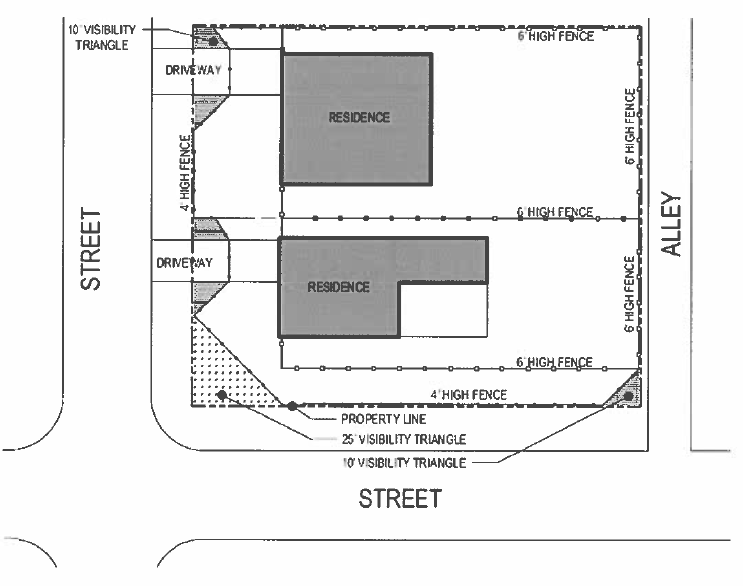
b.
Placement. The city shall not be responsible for improperly placed fences. When the PCD director determines that a fence has been improperly placed, the owner of the fence shall relocate the fence within ten days of a notice of violation issued by the city. A fence or hedge may be permitted within an easement, provided the owner signs an affidavit, prior to the issuance of a fence permit stating that if it becomes necessary for the city or public utility to use the easement, the property owner will remove any portion or all of the fence at his/her expense.
c.
Materials. Fences made with barbed wire, cloth, nylon, PVC pipe, corrugated materials, glass, spikes or other similar materials, and electric fences are prohibited on residential properties. Fence materials must be generally compatible with surrounding properties. On corner lots, picket or other similar fencing as approved by the PCD director can be installed in the primary front yard. See section 5.1.2.7.a for restrictions in secondary front yards.
d.
Temporary fence. Permitted in all residential zoning districts including those in the Form Based Code Area, with approval by the PCD director, for up to one year from permit approval. An extension may be granted for up to six months by the PCD director. Temporary fences are allowed up to six feet in height along all property lines but must be chain link or other open style if within visibility triangles. Construction fences are allowed where associated with an active building permit at the discretion of the Building Official.
e.
Vacant property. In all residential zoning districts, including those in the Form Based Code Area, fences are considered accessory structures to primary permitted uses and cannot be installed on vacant property except at the discretion of the PCD director provided all of the following criteria are met:
i.
The fence is required to secure a vacant property to prevent vagrancy or illegal dumping;
ii.
The fence consists of transparent open metal picket fencing or vinyl coated chain link;
iii.
The height and location of the fence meet the requirements of section 5.1.2.7 a. On corner lots the fences will be setback a minimum of ten feet from the secondary front property line; and
iv.
The property shall not be used for outdoor storage, parking or similar uses unless permitted as a primary use in the zoning district and all required permits and approvals are obtained for that use. The property must meet property maintenance standards as a vacant property and not be overgrown or contain trash and debris.
f.
Retaining walls. In all residential districts, including those in the Form Based Code Area, retaining walls and solid walls cannot be located in drainage and utility easements. The height of the retaining wall shall be measured from the outside, lower grade inclusive of any fence or wall that may be on top of the retaining wall.
g.
Project perimeter fencing. At the discretion of the PCD director, fencing on the perimeter of school campuses in excess of one acre, planned development projects, multi-family projects, and mobile home parks/subdivisions may be up to 72 inches in height, if outside of visibility triangles.
5.1.2.8 Reserved.
5.1.2.9 Reserved.
5.1.2.10 Satellite dishes or antennas. Shall be subject to the following restrictions. The PCD director may waive any of the restrictions below in cases where it is determined that compliance with the restriction interferes with the receipt of signals.
a.
The dish of the satellite antenna shall be neutral in color and compatible with the appearance of the neighborhood.
b.
No satellite antenna shall be mounted on the roof of any single family or two-family structure.
c.
All roof-mounted satellite antennas shall be located on the rear one-third of the structure.
d.
No satellite antenna accessory to a single-family or two-family building shall exceed 15 feet in height, measured from the highest point of the antenna when positioned for operation to the ground.
e.
All ground-mounted satellite antennas shall be screened from view by a six-foot-high wood or masonry fence or plants, being 80 percent opaque when viewed between two and six feet above grade. Said antennas shall be set back from the rear and side property lines by a distance equal to their height, but no less than the required side or rear set back for the zone district. In no case shall said antennas be located closer to the front property line than the front face of the building to which it is accessory.
f.
All satellite antennas for multi-family buildings adjacent to single-family buildings shall require a special use permit unless the satellite antenna complies with the single-family residential requirements.
g.
Satellite antenna owners who sell the signal received to other property owners who are not tenants or lessees of the satellite antenna owner shall be considered to be operating a cable TV franchise and shall require city council approval.
h.
No satellite antenna shall be used for a sign.
5.1.2.11 Solar collectors.
5.1.2.12 Recreational facilities such as tennis courts, shuffleboard courts, playground equipment, etc.
5.1.2.13 Doghouses, pens and other structures for the housing of pets, but not including kennels or animal farms.
5.1.2.14 Docks and piers may be erected beyond the mean high water line of public waterways or beyond the shorelines of ponds or lakes of over an acre in size, subject to the following:
a.
The applicant shall furnish proof of ownership of the property at the mean high water line or pond shoreline where the dock is to be located, or other documentation of his right to use the shorelines and waterbody. Owners of waterfront property without riparian rights may apply for a special use for a dock on public waterfront provided there is no private property intervening between the proposed dock location and the applicant's property.
b.
If the dock is proposed to be constructed or repaired in a public waterway or over wetlands, the applicant must provide authorization from the appropriate state or federal agency, prior to local permit review and approval. If a dock is proposed on a public right-of-way, or easement, the applicant, prior to the issuance of a permit, shall sign an affidavit acknowledging the right of the city council to issue an order for removal of the dock any time without compensation to the owner of the dock.
c.
A permit or exemption letter from the DEP (Department of Environmental Protection).
d.
The following dimensional requirements shall be met unless otherwise stipulated by special use permit:
i.
Docks and piers shall maintain a minimum of a ten-foot setback from the side lines of property or the extension thereof into the water body.
ii.
The height of the flooring of any dock shall not exceed five feet above mean sea level or average water level in the case of a retention pond or lake.
iii.
Superstructures on any dock shall require a special use permit.
iv.
In a public waterway, the maximum length of any dock shall not exceed 80 feet or 25 percent of the width of the waterway or closer than 25 feet to the center of any public channel, whichever is less.
v.
In a retention pond or lake, the maximum width shall be five feet and the maximum length of any dock shall not exceed whichever is the lesser of the following dimensions: 20 feet or ten percent of the width of the lake measured from the foot of the dock, in line with the dock, to the opposite side of the lake.
5.1.2.15 Newsracks/modular newsracks. See section 4.3.7.
(Ord. No. 3049, § 2, 7-24-19; Ord. No. 3094, § 2.B, 2-9-22; Ord. No. 4065, § 2, 1-14-26)
5.2 - Non-residential buildings.
For the purposes of this section, non-residential buildings shall include all buildings except one- and two-family and multi-family dwellings and group care facilities.
5.2.1 Accessory uses, non-residential buildings. Accessory uses allowed on non-residential property are those activities which are ordinarily conducted in conjunction with a non-residential principal use and may include but are not limited to those accessory uses listed in schedule 5.2.1.1.
5.2.2 Accessory structures, non-residential buildings. Accessory structures allowed in conjunction with non-residential buildings include, but are not limited to, those listed below and such structures are subject to restrictions as indicated. Accessory structures shall not be located in the required front setback except as otherwise allowed by these LURs and shall maintain a 10-foot setback from any property line except in a UC/UCBD zoning district, where no setback is required. Accessory buildings shall be limited to a total equivalent of 25 percent of the ground floor square footage of the principal building.
5.2.2.1 Buildings, including, but not limited to, garages, carports, vending machine shelters, offices, storage sheds and utility buildings.
5.2.2.2 Recreation facilities, including tennis courts and swimming pools, provided that the requirements for enclosing swimming pools as set forth in the requirements for accessory structures for residential buildings (subsection 5.1.2.2) are met.
5.2.2.3 Driveways and parking areas, provided they meet the dimensional and landscaping requirements of these LURs (section 4.1.4).
5.2.2.4 Fences and hedges. The following standards shall apply:
a.
Height/setbacks. Fences and/or hedges may be permitted along property lines if they meet the following height limitations (the most stringent standard shall apply.
b.
Placement. The city shall not be responsible for improperly placed fences. When the PCD director determines that a fence has been improperly placed, the owner of the fence shall relocate the fence within ten days of a notice of violation issued by the city. A fence or hedge may be permitted within an easement, provided the owner signs an affidavit, prior to the issuance of a fence permit stating that if it becomes necessary for the city or public utility to use the easement, the property owner will remove any portion or all of the fence at his/her expense.
c.
Materials. Fences made with barbed wire, cloth, nylon, glass, PVC pipe, corrugated materials, spikes or other similar materials, and electric fences are not permitted without city council approval. City council may also grant a variance on height in conjunction with a request for barbed wire or electric fence. Fence materials must be generally compatible with surrounding properties. On corner lots, chain link, picket, or other similar fencing as approved by the PCD director can be installed in the primary front yard.
d.
Temporary fence. Permitted in all non-residential zoning districts and mixed use districts, including those in the Form Based Code Area, with approval by the PCD director for up to two years from permit approval. An extension may be granted up to one year by the PCD director. Temporary fences are allowed up to six feet in height along all property lines but must be chain link or other open style if within visibility triangles. Construction fences are allowed at the discretion of the Building Official.
e.
Vacant property. In all non-residential and mixed use zoning districts, including those in the Form Based Code Area, fences are considered accessory structures to primary permitted uses and cannot be installed on vacant property except at the discretion of the PCD director provided all of the following criteria are met:
i.
The fence is required to secure a vacant property to prevent vagrancy or illegal dumping;
ii.
The fence consists of transparent open metal picket fencing or vinyl coated chain link;
iii.
The height and location of the fence meets the requirements of section 5.2.2.4 a.; and
iv.
The property shall not be used for outdoor storage, parking or similar uses unless permitted as a primary use in the zoning district and all required permits and approvals are obtained for that use. The property must meet property maintenance standards as a vacant property and not be overgrown or contain trash and debris.
f.
Retaining walls. Retaining walls and solid walls cannot be located in drainage and utility easements. The height of the retaining wall shall be measured from the outside, lower grade inclusive of any fence or wall that may be on top of the retaining wall.
5.2.2.5 Reserved.
5.2.2.6 Satellite antennas shall be subject to the following restrictions. The PCD director may waive any of the restrictions below in cases where it is determined that compliance with the restriction interferes with the receipt of signals.
a.
The dish of the satellite antenna shall be neutral in color and compatible with the appearance of the neighborhood.
b.
All ground-mounted satellite antennas shall be screened from view by a six-foot-high wood or masonry fence or plants, being 80 percent opaque when viewed between two and six feet above grade. Said antennas shall be set back from the rear and side property lines by a distance equal to their height, but no less than the required side or rear set back for the zone district. In no case shall said antennas be located closer to the front property line than the front face of the building to which it is accessory.
c.
No satellite antenna shall be used for a sign.
d.
If the satellite antenna is to be located on property adjacent to single-family zoning or use, additional setback area may be required.
e.
All roof-mounted satellite antennas shall be located on the rear one-third of the structure.
f.
Satellite antenna owners who sell the signal received to other property owners who are not tenants or lessees of the satellite antenna owner shall be considered to be operating cable TV franchise and shall require city council approval.
5.2.2.7 Dumpsters and garbage can enclosures provided they are screened from view by a solid fence with landscaping.
5.2.2.8 Newsracks/modular newsracks. See section 4.3.7.
5.2.2.9 Tents, in conjunction with special sales or public events, provided they meet the guidelines of the fire department.
5.2.2.10 Mechanical equipment, including, but not limited to heating, ventilating, and air conditioning machinery; and natural or propane gas tanks (except where said natural or propane gas is sold to the public), shall be screened from public view, and screening may include any combination of landscaping and building material. If building material is to be utilized for screening purposes and visible from the right-of-way, such materials shall be consistent with the architectural design of the principal structure.
5.2.2.11 Freestanding ice vending machines, see section 4.3.13.
(Ord. No. 4065, § 3, 1-14-26)
5.5 - Signs.
5.5.1 Purpose and intent. It is the purpose of this section to promote public health, safety and welfare of the City of Bradenton through reasonable, consistent and non-discriminatory sign standards. In order to preserve and enhance the city as a desirable community in which to live, visit, and do business, a pleasing, visually attractive environment is of foremost importance. The regulation of signs within the city is a highly contributive means by which to achieve this desired end. The sign regulations in this Section are not intended to censor speech or to regulate viewpoints, but instead are intended to regulate the secondary effects of speech and especially insofar as those secondary effects may adversely affect aesthetics and traffic and pedestrian safety, and to accomplish the following:
5.5.1.1 Encourage the effective use of signs as a means of communications in the city;
5.5.1.2 Maintain and enhance the visual and aesthetic environment and thereby the city's ability to attract sources of economic development and growth, including enhancing the tourism industry;
5.5.1.3 Foster the integration of signage with architectural and landscape designs;
5.4.1.4 Preserve, conserve, protect, and enhance the aesthetic quality, historic resources, and scenic beauty of the city;
5.5.1.5 Lessen the visual clutter that may otherwise be caused by the proliferation, improper placement, illumination, animation, excessive height, and excessive size (area) of signs which compete for the attention of pedestrian and vehicular traffic;
5.5.1.6 Minimize the possible adverse effect of signs on nearby public and private property;
5.5.1.7 Regulate the appearance and design of signs in a manner that promotes and enhances the beautification of the city and that compliments the natural surroundings in recognition of this city's reliance on its natural surroundings and beautification efforts in retaining economic advantage for its resort community, as well as, for its major office and industrial parks, gateways, downtown and waterfront areas, and overlay districts;
5.5.1.8 Allow signs that are compatible with their surroundings and aid orientation, while precluding the placement of signs that contribute to sign clutter or that conceal or obstruct adjacent land uses or signs;
5.5.1.9 Improve pedestrian and traffic safety;
5.5.1.10 Regulate signs in a manner so as to not interfere with, obstruct the vision of or distract motorists, bicyclists or pedestrians;
5.5.1.11 Except to the extent expressly preempted by state or federal law, ensure that signs are constructed, installed and maintained in a safe and satisfactory manner, and protect the public from unsafe signs;
5.5.1.12 Encourage and allow signs that are appropriate to the land use atlas district in which they are located and consistent with the category of use and function to which they pertain;
5.5.1.13 Curtail the size and number of signs to the minimum reasonably necessary to identify a residential or business location and the nature of any such business;
5.5.1.14 Establish sign size in relationship to the scale of the lot and building on which the sign is to be placed or to which it pertains;
5.5.1.15 Categorize signs based upon the function that they serve and tailor the regulation of signs based upon their function;
5.5.1.16 Preclude signs from conflicting with the principal permitted use of the site and adjoining signs;
5.5.1.17 Allow for traffic control devices consistent with national standards and whose purpose is to promote highway safety and efficiency by providing for the orderly movement of road users on streets and highways, and that notify road users of regulations and provide warning and guidance needed for the safe, uniform and efficient operation of all elements of the traffic stream;
5.5.1.18 Protect property values by precluding to the maximum extent possible sign types that create a nuisance to the occupancy or use of other properties as a result of their size, height, illumination, brightness, or movement;
5.5.1.19 Protect property values by ensuring that sign types as well as the number of signs, are in harmony with buildings, neighborhoods, and conforming signs in the area;
5.5.1.20 Streamline the approval process b requiring master signage plans; and
5.5.1.21 Enable the fair and consistent enforcement of these sign regulations.
5.5.2 Definitions. Words and phrases used in this section shall have the meanings ascribed to them in section 6.0, Sign-related definitions.
5.5.3 Permitted signs. Notwithstanding anything contained herein to the contrary, any sign permitted pursuant to the provisions of this section may, at the option of the owner, contain either a non-commercial message unrelated to the business located on the premises where the sign is erected or a commercial message. The non-commercial message may occupy the entire sign face or any portion thereof. The sign face may be changed from commercial to noncommercial messages, or from one non-commercial message to another, as frequently as desired by the owner of the sign, provided that the size and design criteria contained in this section have been satisfied. notwithstanding anything to the contrary contained in this section, no sign or sign structure shall be subject to any limitation based upon the content (viewpoint) of the message contained on such sign or displayed on such sign structure.
5.5.3.1 Residential buildings.
a.
Identification standards. Signs for identification of multi-family buildings and residential developments limited to one ground sign or two wall signs per project entrance, not to exceed 32 square feet. See subsection 5.5.8 regarding illumination.
b.
Temporary signs. Temporary signs for construction or advertising of future improvements may be initially installed for no longer than twelve (12) months with one, twelve (12) month extension. For multi-phased projects, each project phase shall be allowed a separate 24 month schedule; however, subsequent signage shall identify the specific project phase for which it is allowed. Such signs are limited to two per project, not to exceed 32 square feet. Permits are required.
c.
Home business and home occupation signs. Signs for home businesses and home occupations are limited to six square feet, unless otherwise superseded elsewhere in these LURs, or stipulated in the Special Use Permit. For additional standards, refer to subsections 3.4.2 HISTORIC DISTRICT, 3.4.5 VILLAGE OF THE ARTS DISTRICT OVERLAY, and 3.4.6 ANTIQUES DISTRICT OVERLAY.
d.
Other signs. See subsection 5.5.4 EXEMPT SIGNS for other signs allowed within every Land Use Atlas District but exempt from the sign permitting requirements of this Section.
e.
Size. All other signs not indicated above over six square feet in size are not permitted for individual single-family or two-family buildings.
5.5.3.2. Non-residential buildings.
5.5.4 Exempt signs. It shall not be necessary to obtain a sign permit described in this section for the following signs, however compliance with all applicable provisions and regulations in this section and the city's LURs must be met. Signs over ten square feet or illuminated signs, regardless of size, will require a building and/or electrical permit:
5.5.4.1 Private directional, and signs for religious, civic, fraternal, and non-profit organizations mounted at city entrances, provided that such a sign does not exceed six square feet in area;
5.5.4.2 Directory signs affixed to a wall or ground sign of a shopping center or office building and show window or shingle signs, provided that such a sign does not exceed four square feet in area;
5.5.4.3 Flags and insignia of any government except when displayed in connection with commercial promotion. Such flags shall be displayed with respect, and be limited to two;
5.5.4.4 Legal notices and identification, informational, or directional signs erected or required by governmental bodies
5.5.4.5 Painted or paper signs in windows, limited to one-fourth of the total window area, not to exceed 30 square feet. Such signs shall not be blaze-colored;
5.5.4.6 Incidental signs attached to a ground sign, flush on a building wall, door or window. Such signs are limited to credit cards accepted, and official notices of services required by law or trade affiliations. The area of each sign may not exceed five square feet and the total area of all such incidental signs attached to one sign may not exceed ten square feet;
5.5.4.7 Signs that are wholly within a group of buildings or complex and are not visible from the public thoroughfare, and bulletin boards, and identification signs for public, non-profit or religious facilities located on the premises and not exceeding 30 square feet;
5.5.4.8 Vehicle identification signs, including painted or magnetic signs attached to a vehicle, provided that the sign is not illuminated unless it identifies an emergency vehicle, bus or taxi;
5.5.4.9 Election signs as defined in these LURs, provided that:
a.
They be legally placed or erected no earlier than 120 days prior to the election for which the election sign applies;
b.
Election signs shall not be placed upon property without the permission of the owner of the property or other person in legal control of the property;
c.
For each parcel, one election sign for each candidate and regarding each issue may be displayed;
d.
An election sign may be displayed as an attached sign or as a freestanding sign;
e.
On parcels that are in residential use, the election sign shall not exceed six square feet in sign area; and, if the election sign is displayed as a freestanding sign on the parcel, the election sign shall not exceed four feet in height;
f.
On parcels that are in non-residential use, the election sign shall not exceed 32 square feet in sign area; and, if the election sign is displayed as a freestanding sign on the parcel, the election sign i) shall be set back at least five feet from all property lines, and ii) shall not exceed eight feet in height;
i.
Election signs shall not be attached to trees, shrubs, fences, walls, or utility or similar poles;
ii.
Election signs shall not be placed, erected or maintained on or in public rights-of-way or any public property;
g.
The owner of the property, as well as the person responsible for placing the sign on the property, shall be responsible for removing election signs within ten days of the election; and
h.
Election signs allowed by the provisions of this subsection are in addition to free expression signs and any other signs and sign messages that may be allowed under these LURs. Accordingly, the foregoing provisions do not limit the right to substitute a noncommercial message (including a political message) for any commercial message that may otherwise appear on a lawfully erected sign.
5.5.4.10 Signs painted on the back rests of benches provided they comply with MCAT regulations.
5.5.4.11 Traffic control device signs;
5.5.4.12 Warning and safety signs.
5.5.4.13 Street address signs and residential mailboxes. For each parcel within the city, one attached wall street address sign may be displayed. For parcels in residential use, the street address sign shall not exceed 72 square inches in sign area. For parcels in non-residential use, the street address sign shall not exceed two square feet in sign area. A residential mailbox with the address of the property affixed to it such that the address is no larger than one side of the mailbox shall be allowed for each residence located within the city.
5.5.4.14 Free expression signs. For each parcel, one free expression sign not exceeding three square feet in sign area may be displayed. The free expression sign may be displayed as an attached sign or as a freestanding sign; if displayed as a freestanding sign, the freestanding sign shall not exceed three feet in height. A free expression sign is in addition to any other sign permitted under this section and is permitted in any land use atlas district. The sign must be located within six feet of a building located on the lot or parcel; or if there is no building on the lot or parcel, the sign must not hamper motorist visibility and be located at least 15 feet from any property line.
5.5.4.15 Sidewalks signs, as identified in schedule 5.5.3.2.
5.5.4.16 District theme or event signs: A two-sided sign, no larger than 12 square feet and 72 inches in height, allowable only in the UC, UCBD and UV districts. The district theme or event logo shall be the predominant lettering on the sign, and the event shall be secondary to it. Any other advertising text is prohibited. Such signs may be affixed to the street lighting fixtures with the approval of the department of public works provided they do not exceed eight square feet, 48 inches in height and have a minimum eight-foot clearance. Special event signage may not be installed more than three weeks prior to the event, and shall be removed within two days after the event, except that signage for recurring events may be displayed until the event ceases.
5.5.4.17 Temporary signs six square feet or less, limited to one sign per 100 feet of street frontage.
5.5.5 Prohibited signs. The following signs are and sign types are prohibited within the City of Bradenton and shall not be erected or displayed. Any lawfully existing permanent sign or sign type that is among the prohibited signs and sign types listed below, other than signs or sign types listed in subsection 5.5.4, shall be deemed a non-conforming sign subject to the provisions of subsection 5.5.6.
5.5.5.1 Revolving, flashing, and animated signs;
5.5.5.2 Wind signs;
5.5.5.3 Roof signs;
5.5.5.4 Snipe and bandit signs;
5.5.5.5 Projecting signs, when projecting in excess of 18 inches from the structures upon which they are constructed or attached;
5.5.5.6 Bus bench and bus shelter advertising signs, except for MCAT as defined above;
5.5.5.7 Signs that emit sound, vapor, smoke, odor, particles or gaseous matter;
5.5.5.8 Signs that have unshielded illuminating devices;
5.5.5.9 Signs that obstruct, conceal, hide or otherwise obscure from view any official traffic or governmental sign, signal or device;
5.5.5.10 Any sign within a sight visibility triangle, unless otherwise approved by the city;
5.5.5.11 Any sign in the public right-of-way, other than traffic control device signs, bus stop informational signs, warning signs or safety signs, directional signs, sidewalks signs, as identified in Schedule 5.5.3.2, or public information signs;
5.5.5.12 Any sign other than a traffic control device sign that uses the word "stop" or "danger," or presents or implies the need or requirement of stopping or the existence of danger, or which is a copy or imitation of official traffic control device signs, and which is adjacent to the right-of-way of any road, street, or highway;
5.5.5.13 Any sign prohibited by state or federal law;
5.5.5.14 Vehicle sign, when the vehicle is not "regularly used in the conduct of the business or activity" advertised on the vehicle, and
a.
Is visible from a street right-of-way within 100 feet of the vehicle, and
b.
Is parked for more than two consecutive hours within 100 feet of any street right-of-way. A vehicle shall not be considered "regularly used in the conduct of the business or activity" if the vehicle is used primarily for:
i.
Advertising, or for the purpose of advertising, or
ii.
The purpose of providing transportation for owners or employees of the business or activity advertised on the vehicle;
5.5.5.15 Any sign located on real property without the permission of the property owner;
5.5.5.16 Beacons, except as required by state or federal law;
5.5.5.17 Intermittent signs, except time and temperature signs as permitted herein;
5.5.5.18 Banner signs, except temporary banner signs used for welcoming a person or persons home from military duty or other extended stays, or other similar circumstances to be displayed no longer than ten consecutive days. Also, grand opening banner signs may be permitted for no longer than 30 consecutive days and placed no sooner than three days prior to the actual opening date. Banner signs may be no larger than 32 square feet in sign area;
5.5.5.19 Portable signs, unless otherwise permitted by these LURs;
5.5.5.20 Signs painted or attached to seawalls/retaining walls along any water body, public utility poles, or trees;
5.5.5.21 Spectacular signs, defined as signs wired for incandescent light, or animated with copy action controlled by flasher circuit breakers, moving lighting or similar devices;
5.5.5.22 Changeable copy signs, except that a changeable copy portion of a ground, wall, or marquee sign may be permitted provided the changeable copy portion makes up 25 percent or less of the total sign area and that it is designed as an integral part of a sign;
5.5.5.23 Vehicle mounted signs, defined as a sign mounted on any vehicle and incidentally displayed without connection with the use of the vehicle. Such signs may be permitted, however, if they are campaign signs under eight square feet in size;
5.5.5.24 Computerized signs with animated display, running copy or copy which changes more frequently than at 60-second intervals. Signs that display time and temperature only may change more frequently provided the signs are low-profile (do not exceed six feet in height), and have not received a variance for dimension. Additional landscaping and locational standards may apply;
5.5.5.25 Signs on vehicles parked so as to read from the street, except that campaign signs shall be allowed as per subsection 5.5.4.9.
5.5.5.26 Air inflatable signs, displayed in any exterior location, except for non-profit events lasting no longer than 72 hours.
5.5.6 Non-conforming signs. A non-conforming sign that was lawfully erected may continue to be maintained until the non-conforming sign is substantially damaged, destroyed or the principal use associated with the sign is changed. At such time that the non-conforming sign is substantially damaged destroyed or the principal use associated with the sign is changed, the non-conforming sign must either be: (a) be removed, or (b) be brought into conformity with this Section and with any other applicable laws or regulations.
5.5.7 Placement.
5.5.7.1 Residential uses. No sign shall be placed on public right-of-way unless specifically approved by city council or unless otherwise permitted in these LURs, and no sign or sign support shall impede visibility between the heights of two and ten feet above ground within 35 feet of a street intersection or driveway entrance, or be located within any easement without public works approval. Signs for home occupations and home businesses are limited to six square feet unless otherwise stipulated in the special use permit.
5.5.7.2 Non-residential uses.
a.
No sign shall be located within any easement without public works approval or extend beyond the property line except that signs may extend into the public right-of-way in the UC/UCBD district when otherwise in conformance with these LURs or may be erected in any district on public right-of-way if specifically approved by city council when evidence has been provided by the applicant that the sign achieves a specific public purpose.
b.
A sign may be permitted in a future right-of-way, provided the applicant files an affidavit with the office of the clerk of the circuit court certifying that the sign will be removed by the owner at the city's request.
c.
No sign or sign support shall be permitted to impede visibility between a height of two and ten feet within 35 feet of the intersection of two vehicular travelways, including streets, alleys and driveways.
d.
No sign shall be erected to obstruct any fire escape, required exit, window, door opening intended as a means of egress, sidewalk or other pedestrian walkway less than four feet in width, or that interferes with any opening required for ventilation.
e.
Signs shall maintain a minimum of six feet horizontal and 12 feet vertical clearance from electrical conductors and from all communications equipment or lines located within the City.
f.
Signs and their supporting structures shall maintain clearance and noninterference with all surface band underground facilities and conduits for water, sewage, electricity, or communications equipment or lines. Furthermore, placement shall not interfere with natural or artificial drainage or surface or underground water.
g.
No sign shall be attached to a standpipe, gutter, drain, or fire escape, nor shall any sign be installed to impair access to a roof.
5.5.8 Illumination.
5.5.8.1 Residential uses. Signs shall not be lighted except signs for identification of multi-family buildings and residential developments limited to one ground sign or wall sign per project entrance, not to exceed 32 square feet may be illuminated by a spot light.
5.5.8.2 Non-residential uses. Signs on non-residential property may be illuminated with the exception of spectacular signs (see Prohibited signs, subsection 5.5.5, above).
a.
No sign including lighting which appears by approximate size and color to be a traffic signal or emergency vehicle light will be permitted within 50 feet of a street or highway paving. Nor shall a rotating or flashing signal lamp similar to those used on emergency vehicles be permitted regardless of location where by reason of position, illumination, shape or color, it may interfere with, obstruct the view of, or be confused with any authorized traffic signal, sign or device; the colors specifically prohibited are: red, amber, yellow, green or blue; nor shall it make use of the words "stop," "look," "danger," or any other word, phrase, symbol or character in such a manner as to interfere with or confuse traffic.
b.
The light from illuminated signs shall be established in such a way that adjacent properties and roadways are not adversely affected and that no direct light is cast upon adjacent properties and roadways. Lighting shall not be directed skyward, nor toward water bodies or water courses.
c.
Illuminated signs shall not interfere with pedestrian or motorist vision. The illumination shall not be reflective or phosphorescent and shall perform in a steady non-fluctuating or non-undulating manner and shall be placed in a manner that will not create a nuisance to other premises or interfere with vehicular movements. Strobe lights and flashing lights are prohibited.
d.
No illuminated signs shall be constructed or maintained within 50 feet of any residential Land Use Atlas district or dwelling.
5.5.9 Reserved
5.5.10 Variances. Due to the diversity of the city, it is recognized that the LURs provided herein cannot address all situations pertaining to signs. The planning commission is therefore empowered to grant variances from the provisions of this section upon an application being filed with the PCD. A variance to this section may be granted as to the physical characteristics of a sign where the variance is not contrary to the public interest; and, owing to special conditions, a literal enforcement of the provisions of this section will result in unnecessary hardship; however, no variance shall be granted by the planning commission which has the effect of allowing a sign prohibited by subsection 5.5.5. Each variance application shall include a fee as adopted by resolution of the city council for administrative expenses incurred in the processing of the application, shall be in writing, and shall state with specificity the hardship and grounds upon which the petitioner bases the claim for a variance request.
5.5.11 Permitting requirements.
5.5.11.1 Building permit. When required by the Florida Building Code, a building permit shall be obtained to erect those signs or sign structures that are subject to it. The requirement of a building permit is separate from the requirement of a sign permit.
5.5.11.2 Sign permit. Except for exempt signs, it shall be unlawful for any person to install, alter or cause to be installed or altered within the municipal limits of the city any sign otherwise allowed under this section and visible from a public right-of-way, whether permanent or temporary, without first having obtained a sign permit from the city. The sign permit shall be issued by the city only after determination has been made that the proposed sign fully complies with all conditions of this section.
5.5.11.3 Fees. No permit shall be issued until the appropriate application has been filed with the department of planning and community development and the applicable fees have been paid as adopted by the city council, and as amended from time to time.
5.5.11.4 Sign permit application requirements.
a.
Form/content of application. A sign permit application for a permanent sign shall be made upon a form provided by the City of Bradenton. The sign permit application is in addition to any building permit application required by the Florida Building Code. The sign permit application shall be accompanied by plans and specifications drawn to scale, together with any site plan required by this section or the LURs. The PCD may require additional information on such sketch or print to insure compliance with this section. The applicant shall furnish the following information on or with the sign permit application form:
i.
The legal description of the real property where the sign is proposed to be located;
ii.
The land use atlas district for the real property on which the sign will be located;
iii.
The name, mailing address and telephone number (where available) of the owner(s) of the real property where the sign is proposed to be located;
iv.
A notarized statement of authorization signed by the owner(s) consenting to the placement of the proposed sign on the real property;
v.
The name, license number, mailing address and telephone number of the sign contractor;
vi.
Type of proposed sign (e.g., attached wall sign, freestanding monument sign, freestanding pole sign, etc.);
vii.
The square footage of the surface area of the proposed sign;
viii.
The setbacks for the proposed sign;
ix.
The value of the proposed sign including costs for installation;
x.
If the proposed sign is a freestanding sign:
a)
The lot frontage on all adjacent street rights-of-way;
b)
The height of the proposed freestanding sign;
c)
A detailed survey delineating all easements on the subject property; and
d)
An engineering certification indicating said sign meets applicable wind load requirements as determined by the Building Official.
xi.
If the proposed sign is an attached sign, the building frontage for the building to which the attached sign shall be affixed;
xii.
The number, type, location, and surface area for all existing signs on the same parcel and/or building on which the sign will be located; and
xiii.
Whether the proposed sign will be an illuminated or non-illuminated sign, and details of illumination.
b.
Submittal of application and review deadlines. Each applicant shall submit a completed Sign Permit application to the PCD. The sign permit application shall be reviewed for a determination of whether the proposed sign meets the applicable requirements of this section and any applicable zoning law.
i.
Administrative review of initial application. The review of the sign permit application, unless the application requires a certificate of appropriateness in accordance with section 2.2.13, or otherwise affects a historic district, or requires discretionary review and approval shall be completed within 15 calendar days, after the receipt by the PCD of the completed application, and the application shall be granted or denied within that time frame. If the application is denied, the reasons for denial shall be set forth in writing and delivered to the applicant within three working days from the date of the denial. In the event that no decision is rendered within 15 calendar days following submittal, the application is deemed denied and the applicant may appeal to the planning commission in accordance with section 2.4 and schedule 2.3.
ii.
Discretionary review by the ARB for a certificate of appropriateness. Except when exempted by the Building Official, consideration of a sign permit application or signage plan that affects, or is located within a historic district pursuant to section 2.2.13, will be scheduled for the next available meeting of the ARB. At that time, the ARB shall review the same and make such final decision regarding a certificate of appropriateness, or recommendations (if any) it deems appropriate for consideration by the planning commission and city council, if applicable. Consideration of a sign permit application or signage plan by the ARB is considered a final decision in most cases regarding a certificate of appropriateness, and may be appealed to the city council in accordance with section 2.4 and schedule 2.3.
iii.
Discretionary review by the planning commission. Consideration of a signage plan that is part of a special use permit or PDP application will be scheduled for the next available, regularly scheduled meeting of the ARB or planning commission, as applicable, unless a certificate of appropriateness is required prior. At that time, the planning commission shall review the same and make such recommendations (if any) it deems appropriate for consideration by the city council.
iv.
[City council action.] City council shall then consider the recommendation from the planning commission, and the ARB if applicable, for the signage plan at its next available, regularly scheduled meeting held within 35 days after the matter has been heard by the planning commission, but in no event later than 65 days after the submittal of the sign permit application to the PCD, unless the application has been continued by the ARB, planning commission, or city council for lack of adequate information required to make such a decision, or lack of attendance by the applicant to appear before the city council to address pertinent issues regarding the application. At that time, the city council shall consider whether the proposed sign and/or sign structure complies with section 5.5 and other applicable provisions set forth in the LURs, and the city council shall grant, grant with stipulations, or deny the signage plan within seven days after such meeting. If the application is granted with stipulations or if the application is denied, the stipulations or the reasons for denial shall be set forth in writing and delivered to the applicant, within seven days after such meeting.
v.
Reconsideration of application after presented to city council. If the city council fails to act within the aforesaid time limits, or fails to state the stipulations or reasons for denial in writing, the applicant shall be entitled to make a written request for the city council to consider or reconsider the application. Such request shall be submitted by the applicant to the city council within ten days after the city council's deadline for taking the described action, and the written request for reconsideration shall be heard by the city council within ten days thereafter. At that time, the city council shall address the applicant's request and, if appropriate, take up or again consider whether the proposed sign and/or sign structure complies with this section and the city's other applicable LURs, and the city council shall grant, grant with stipulations, or deny the sign permit application within seven days after such meeting. If the application is granted with stipulations or if the application is denied, the conditions or the reasons for denial shall be set forth in writing and delivered to the applicant. If the city council fails to take action, the sign permit shall be deemed granted.
vi.
Application appeals. See subsection 5.5.12.
5.5.11.5 Inspections. The PCD director may make or require any inspections to ascertain compliance with the provisions of this Section, other applicable LURs, and other applicable laws and regulations.
5.5.11.6 Photographs of sign(s). If the sign permit application is granted, the applicant shall furnish the PCD and/or his or her designees, or such other person as may be designated with photographs of the sign(s) in place within 30 days after the same is erected or constructed, and which shall show compliance with any and all height, size, setback, or other requirements of this Section.
5.5.11.7 Duration of sign permit. If the work authorized under a sign permit has not been completed within six months after the date of issuance, the permit shall become null and void and a new application for a sign permit shall be required. Issuance of a sign permit shall in no way prevent the city from later declaring the sign to be non-conforming or unlawful if, upon further review of available information, the sign is found not to comply with the requirements of this Section.
5.5.11.8 Revocation of sign permit. If the work under any sign permit is proceeding in violation of this section, any other ordinance of the city, or should it be found that there has been any false statement or misrepresentation of a material fact in the application or plans on which the sign permit was based, the permit holder shall be notified of the violation. If the permit holder fails or refuses to make corrections within ten days, it shall be the duty of the PCD director, or designee to revoke such sign permit and serve notice upon such sign permit holder. Such notice shall be in writing and signed by the PCD director or his/her designee. It shall be unlawful for any person to proceed with any work after such notice is issued.
5.5.11.9 Maintenance of sign(s). All visible portions of a sign and its supporting structure shall be maintained in a safe condition, so as not to be detrimental to public health and safety, and in neat appearance according to the following:
a.
If the sign is lighted, all lights shall be maintained in working order and functioning in a safe manner;
b.
If the sign is painted, the painted surface shall be kept in good condition;
c.
Every sign shall be kept in such manner as to constitute a complete or whole sign;
d.
No trash shall be allowed to accumulate in the area around a sign. Weeds shall be kept out and landscaping maintained in a healthy condition.
5.5.11.10 Removal of abandoned sign(s). Any structure formerly used as a sign, but not in use for any other purpose, must be removed by the owner of the property within 30 days after written notification from a city official, or 60 days after its use as a valid sign has ceased. Signs shall be removed within 60 days after a business has been vacated. The City of Bradenton may remove non-permitted and illegal signage at the sign owner's expense, and the city shall not be held liable for damage or disposal of such sign.
5.5.12 Appeals. Whenever it is alleged that there has been an error in any order, action, decision, determination, or requirement by the PCD in the enforcement and application of any provision contained within this section or any other provisions of the LURs pertaining to sign permits (including any allegation that an administrative official has failed to act within applicable time frames), the aggrieved party may complete and submit a completed Appeal application. However, if the decision being appealed was rendered by the city council, the applicant shall have the right to seek judicial review by the circuit court or any other court of competent jurisdiction, within 30 days of the decision and shall file the same in accordance with the requirements of the law, seeking such appropriate remedy as may be available.
5.5.12.1 The completed appeal application shall be filed with the pcd within 30 days of the date of the alleged error. The appeal application shall include a description of the alleged error and the applicable provisions of this Section or the LURs pertaining to the administrative official's order, action, decision, determination, requirement, or failure to act.
5.5.12.2 A fee must be submitted in the amount set forth in the most recently adopted appendix "A" of these LURs.
5.5.12.3 The planning commission shall hold a hearing within 35 days following receipt of the completed Appeal application.
5.5.12.4 The planning commission shall render a written decision within ten days following the close of the hearing.
5.5.12.5 If the planning commission does not render a decision within ten days following the hearing, the sign permit shall be deemed denied as of that date.
5.5.13 Severability.
5.5.13.1 Generally. If any part, section, subsection, paragraph, subparagraph, sentence, phrase, clause, term, or word of section 5.5 is declared unconstitutional by the valid judgment or decree of any court of competent jurisdiction, the declaration of such unconstitutionality shall not affect any other part, section, subsection, paragraph, subparagraph, sentence, phrase, clause, term, or word of section 5.5.
5.5.13.2 Severability where less speech results. Without diminishing or limiting in any way the declaration of severability set forth in these LURs, or any adopting ordinance, if any part, section, subsection, paragraph, subparagraph, sentence, phrase, clause, term, or word of section 5.5 is declared unconstitutional by the valid judgment or decree of any court of competent jurisdiction, the declaration of such unconstitutionality shall not affect any other part, section, subsection, paragraph, subparagraph, sentence, phrase, clause, term, or word of section 5.5, even if such severability would result in a situation where there would be less speech, whether by subjecting previously exempt signs to permitting or otherwise.
5.5.13.3 Severability of provisions pertaining to prohibited signs. Without diminishing or limiting in any way the declaration of severability set forth above in these LURs, or any adopting ordinance, if any part, section, subsection, paragraph, subparagraph, sentence, phrase, clause, term, or word of subsection 5.5.5 or any other law is declared unconstitutional by the valid judgment or decree of any court of competent jurisdiction, the declaration of such unconstitutionality shall not affect any other part, section, subsection, paragraph, subparagraph, sentence, phrase, clause, term, or word of subsection 5.5.5 that pertains to prohibited signs, including specifically those signs and sign types prohibited and not allowed under subsection 5.5.5 of this section. Furthermore, if any part, section, subsection, paragraph, subparagraph, sentence, phrase, clause, term, or word of subsection 5.5.5 is declared unconstitutional by the valid judgment or decree of any court of competent jurisdiction, the declaration of such unconstitutionality shall not affect any other part, section, subsection, paragraph, subparagraph, sentence, phrase, clause, term, or word of subsection 5.5.5.

