
Bradford County Unincorporated
City Zoning Code
City Zoning Code
ARTICLE 2
- DEFINITIONS, LOTS DIVIDED BY DISTRICT LINES, AND NONCONFORMING SITUATIONS
Section 2.1.- Definitions, general.
For the purpose of these land development regulations, certain terms or words used herein shall be interpreted as follows:
The word "person" includes a firm, association, organization, partnership, trust, company, or corporation as well as an individual.
The present tense includes the future tense, the singular number includes the plural, and the plural number includes the singular.
The word "shall" is mandatory; the word "may" is permissive.
The words "used" or "occupied" include the words "intended, designed, or arranged to be used or occupied."
The word "lot" includes the words "plot," "parcel," "tract," or "site."
The word "structure" includes the word "building" as well as other things constructed or erected on the ground, attached to something having location on the ground, or requiring construction or erection on the ground. Among other things, structures include walls, buildings, fences, signs, and swimming pools.
The word "land" includes the words "water," "marsh," or "swamp."
The word "abut" shall not include directly across from.
The words "Board of County Commissioners" mean the Board of County Commissioners of Bradford County, Florida.
The word "county" means Bradford County, Florida.
Abandoned motor vehicle. Abandoned motor vehicle means one that is in a state of disrepair and incapable of being moved under its own power.
Abutting or adjacent property. Abutting or adjacent property means property that is immediately adjacent to the property being considered under these land development regulations.
Access. Access means the primary means of ingress and egress to abutting property from a dedicated right-of-way.
Accessory use or structure. An accessory use or structure means a use or structure of a nature customarily incidental and subordinate to the principal use or structure and, unless otherwise provided, on the same premises. On the same premises with respect to accessory uses and structures shall be construed as meaning on the same lot or on a contiguous lot in the same ownership. Where a building is attached to the principal building, it shall be considered a part thereof, and not an accessory building.
Addition. Addition means any walled and roofed expansion to the perimeter of a building in which the addition is connected by a common loadbearing wall other than a firewall. Any walled and roofed addition which is connected by a firewall or is separated by an independent perimeter loadbearing wall is new construction.
Administrator. Administrator means the Land Development Regulation Administrator designated by the Board of County Commissioners for the administration and enforcement of these land development regulations (see Land Development Regulation Administrator).
Adverse effect. Adverse effect means increases in flood elevations on adjacent properties attributed to physical changes in the characteristics of the official 100-year flood area due to development.
Alley or service drive. Alley or service drive means a public or private right-of-way which affords only a secondary means of access to property abutting thereon.
Alter or alteration of a stormwater management system. Alter or alteration of a stormwater management system [means] work done other than that necessary to maintain the system's original design and function.
Alteration. Alteration means any change in size, shape, occupancy, character, or use of a building or structure.
Aquifer or aquifer system. Aquifer or aquifer system means a geologic formation, group of formations, or part of a formation that contains sufficient saturated permeable material to yield significant quantities of water to wells and springs.
Arterial streets. Arterial streets means streets which conduct large volumes of traffic over long distances and are functionally classified as such on the future traffic circulation map of the comprehensive plan.
Automobile wrecking or automobile wrecking yard. Automobile wrecking or automobile wrecking yard means the dismantling or disassembling of used motor vehicles or trailers, or the storage, sale, or dumping of dismantled, partially dismantled, obsolete, or wrecked vehicles or their parts, and does not include the temporary storage of vehicles which have been transported to the site by tow truck, and which are awaiting repair.
Automotive service and self-service station. An automotive service station means an establishment whose principal business is the dispensing at retail of motor fuel and oil primarily for automobiles and where grease, batteries, tires, and automobile accessories may be supplied and dispensed at retail. In addition, an automotive service station may provide accessory facilities for car washing and polishing and may render minor repair services. However, major mechanical and body work, straightening of frames or body parts, steam cleaning, painting, tire recapping or regrooving, storage of automobiles not in operating condition, or other work involving undue noise, glare, fumes, smoke, or other characteristics to an extent greater than normally found in such stations are prohibited. An automotive service station is not a repair garage, a body shop, truck stop, or a carwash.
Automotive self-service station means an establishment where motor fuel pumps are erected for the purpose of dispensing motor fuel at retail primarily for automobiles, but does not include minor automotive repair or the outside display of batteries, tires and automobile accessories nor additional services which are customarily associated with an automotive service station.
Where such motor fuel pumps are erected in conjunction with a use which is herein described as an automotive self-service station, each use shall be considered as a separate principal use and as such, each must meet all applicable requirements of these land development regulations (see article 4 [section 4.2.6] for special design standards for automotive service and self-service stations).
Bar, cocktail lounge, or tavern. Bar, cocktail lounge, or tavern means an establishment devoted primarily to the retailing and on-premises drinking of malt, vinous, or other alcoholic beverages, and which is licensed by the State of Florida to dispense or sell alcoholic beverages.
Bed and breakfast inn. Bed and breakfast inn means an owner occupied structure converted to function as a conventional single-family residence providing a limited number of guest rooms available on a daily rental basis. Kitchen facilities are not available in individual rooms.
Bicycle and pedestrian ways. Bicycle and pedestrian ways means a road, path or way which is open to bicycle travel and traffic afoot and from which motor vehicles are excluded.
Block. Block means a tier or a group of lots existing with well-defined and fixed boundaries, usually being an area surrounded by streets or other physical barriers and having an assigned number, letter, or other name through which it may be identified.
Board of adjustment. Board of Adjustment means the Board of Adjustment, as herein provided for within these land development regulations.
Borrow pit. Borrow pit or fill borrow means excavation of natural materials from their natural state which results in the construction of an artificial depression that is greater than one-half acre in size and greater than two feet deep. This does not include property owners constructing agricultural ponds for their own personal use on their property.
Buildable area. Buildable area means that portion of a lot remaining after the required yards have been provided.
Building. Building means any permanent structure, either temporary or permanent, having a roof impervious to weather, and used or built for the enclosure or shelter of persons, animals, vehicles, goods, merchandise, equipment, materials, or property of any kind. This definition shall include tents, dining cars, trailers, mobile homes, sheds, garages, carports, animal kennels, storerooms, or vehicles serving in any way the function of a building as described herein. This definition of a building does not include screened enclosures not having a roof impervious to weather.
Building front yard setback line. Building front yard setback line means the rear edge of any required front yard as specified within these land development regulations.
Building, height of. Height of building means the vertical distance measured from the established grade at the corner of a front of a building to the highest point of the roof surface of a flat roof, to the deck line of a mansard roof or Bermuda roof, to the mean height level between eaves and ridge of gable, hip, cone, gambrel, and shed roofs, and to a height three-fourths the distance from the ground to the apex of A-frame and dome roofs, as depicted in the diagram below (See article 4, [section 4.2.10,] Exclusions from height limitations).
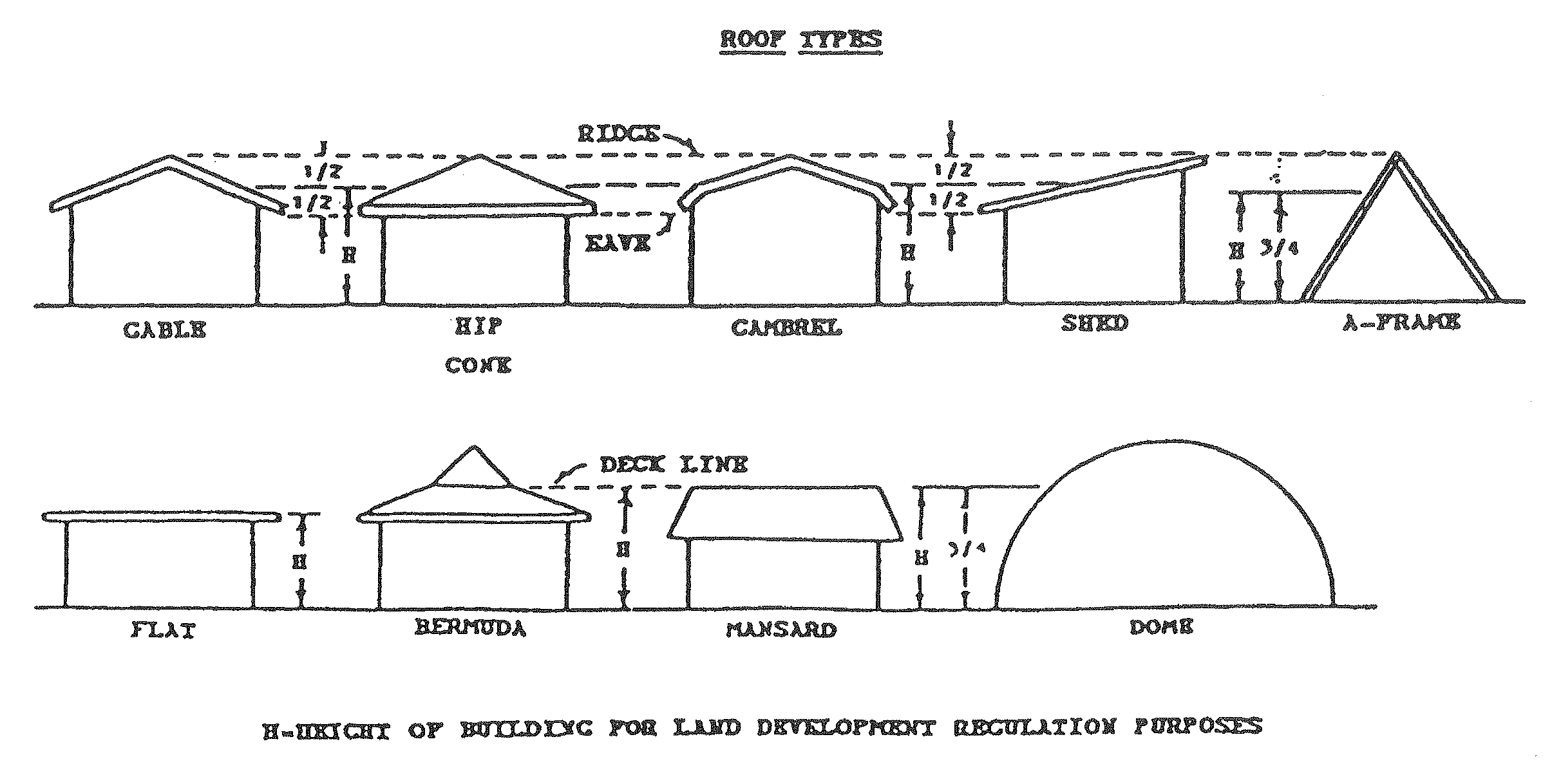
Building line. Building line means the rear edge of any required front yard or the rear edge of any required setback line. Except as specifically provided by these land development regulations, no building or structure may be erected or extended to occupy any portion of a lot streetward or otherwise beyond the building line.
Capital budget. Capital budget means the portion of an annual budget which reflects capital improvements scheduled for a fiscal year.
Capital improvements. Capital improvements means physical assets constructed or purchased to provide, improve or replace a public facility and which are large scale and high in cost. The cost of a capital improvement is generally nonrecurring and may require multiple-year financing. Physical assets which have been identified as existing or projected needs in the comprehensive plan shall be considered capital improvements.
Child care center. Child care center means an establishment where six or more children, other than members of the family occupying the premises, are cared for during the day. The term includes day nurseries, kindergartens, day care services, nursery school, or play school.
Child care center, overnight. Overnight child care center means an establishment where six or more children, other than members of the family occupying the premises, are cared for not only during the day but overnight. An overnight child care center provides full overnight sleeping facilities for such children.
Clinics, medical or dental. Medical or dental clinic means an establishment where patients, who are not lodged overnight, are admitted for examination and treatment by one person or a group of persons practicing any form of the healing arts, whether such persons be medical doctors, chiropractors, osteopaths, chiropodists, naturopaths, optometrists, dentists, or any such profession, the practice of which is regulated by the State of Florida.
Clubs, private. Private clubs mean those associations and organizations of a civic, fraternal, recreational, or social character, not operated or maintained for profit. The term "private club" shall not include casinos, nightclubs, bottle clubs, or other establishments operated or maintained for profit.
Collector streets. Collector streets mean streets which serve as the connecting link for local streets and arterials. The traffic characteristics generally consist of relatively short trip lengths with moderate speeds and volumes. In addition, collectors are so functionally classified as such on the future traffic circulation map of the comprehensive plan.
Community residential home. Community residential home means a dwelling unit licensed to serve clients of the Florida Department of Health and Rehabilitative Services and which provides a living environment for seven to 14 unrelated residents who operate as the functional equivalent of a family, including such supervision and care by supportive staff as may be necessary to meet physical, emotional, and social needs of the residents (see also article 4).
Completely enclosed building. Completely enclosed building means a building separated on all sides from adjacent open space, or from other buildings or other structures, by a permanent roof and by exterior walls or party walls, pierced only by windows and normal entrance and exit doors.
Comprehensive plan. Comprehensive plan means the comprehensive plan adopted by the Board of County Commissioners pursuant to the "Local Government Comprehensive Planning and Land Development Regulation Act" (F.S. §§ 163.3161—163.3215) and chapter 9J-5, Florida Administrative Code.
Cone of influence. Cone of influence means an area around one or more major water wells, the boundary of which is based on groundwater travel or drawdown depth.
Construction, actual. Actual construction means the placing of substantial construction materials in permanent position and fastened in a permanent manner; except that where demolition, excavation, or removal of an existing structure has been substantially begun preparatory to new construction, such excavation, demolition, or removal shall be deemed to be actual construction, provided that work shall be continuously carried on until the completion of the new construction involved. Actual construction shall include only work begun under a valid building permit.
County health department. County health department means the health department of the county.
Cul-de-sac. Cul-de-sac means a local street of relatively short length with one end open and the other end terminating in a vehicular turnaround.
Curb break. Curb break means a driveway or any other point of access or opening for vehicles onto a public street.
Day care center or nursery. See "Child care center."
Density, gross residential. Gross residential density refers to the number of residential dwelling units permitted per gross acre of land and is determined by dividing the number of units by the total area of land within the boundaries of a lot or parcel including dedicated rights-of-way and except as otherwise provided for in these land development regulations. In the determination of the number of residential units to be permitted on a specific parcel of land, a fractional unit shall not entitle the applicant to an additional unit.
Developer. Developer means any person, including a governmental agency, undertaking any development as defined in F.S. § 163.3164(4) and F.S. § 380.04.
Development. Development has the meaning as defined in F.S. § 163.3164(5) and F.S. § 380.04.
Development order. Development order means any order granting, denying, or granting with conditions an application for a development permit, which includes any building permit, subdivision approval, rezoning, certification or designation, special exception, variance, special or temporary permit, or any other official action of the appropriate county approval body or Land Development Regulation Administrator having the effect of permitting the development of land.
Dormitory. Dormitory means a space in a unit where group sleeping accommodations are provided with or without meals for persons not members of the same family group, in one room, or in a series of closely associated rooms under joint occupancy and single management, as in college dormitories, fraternity houses, and military barracks.
Drainage basin. Drainage basin means the area defined by topographic boundaries which contributes stormwater to a drainage system, estuarine waters, or oceanic waters, including all areas artificially added to the basin.
Drainage detention structure. Drainage detention structure means a structure which collects and temporarily stores stormwater for the purpose of treatment through physical, chemical, or biological processes with subsequent gradual release of the stormwater.
Drainage facilities. Drainage facilities means a system of manmade structures designed to collect, convey, hold, divert or discharge stormwater, and includes stormwater sewers, canals, detention structures, and retention structures.
Drainage retention structure. Drainage retention structure means a structure designed to collect and prevent the release of a given volume of stormwater by complete on-site storage.
Drive-in restaurant or refreshment stand. Drive-in restaurant or refreshment stand means any place or premises where provision is made on the premises for the selling, dispensing, or serving of food, refreshments, or beverage to persons in automobiles and/or in other than a completely enclosed building on the premises, including those establishments where customers may serve themselves and may eat or drink the food, refreshments, or beverages in automobiles on the premises. A restaurant which provides drive-in facilities of any kind shall be deemed a drive-in restaurant. A barbecue stand or pit having the characteristics noted in this definition shall be deemed a drive-in restaurant.
Drive-in theater. Drive-in theater means a place of outdoor assembly used for the showing of plays, operas, motion pictures, and similar forms of entertainment which is designed to permit the audience to view the performance from vehicles parked within the theater (see also article 4).
Dwelling, mobile home or mobile home. Mobile home dwelling or mobile home means a detached one-family dwelling unit with all the following characteristics: (a) designed for longterm occupancy, and containing sleeping accommodations, a flush toilet, a tub or showerbath, and kitchen facilities, with plumbing and electrical connections provided for attachment to outside systems; (b) designed for transportation after fabrication on streets or highways on its own wheels or on a flatbed or other trailers; (c) arriving at the site where it is to be occupied as a dwelling complete and ready for occupancy except for minor incidental unpacking and assembly operations, location on jacks or other temporary or permanent foundations, connection to utilities, and the like; and (d) manufactured homes defined by these land development regulations as standard design manufactured homes and [which] do not meet the installation criteria prescribed in section 4.2 of these land development regulations shall be considered a mobile home. A travel trailer is not to be considered a mobile home.
Dwelling, multiple dwelling use. For purposes of determining whether a lot is in multiple dwelling use, the following considerations shall apply:
a.
Multiple dwelling uses may involve dwelling units intended to be rented and maintained under central ownership and management or cooperative apartments, condominiums, and the like.
b.
Where an undivided lot contains more than one building and the buildings are not so located that lots and yards conforming to requirements for single- or two-family dwellings in the district could be provided, the lot shall be considered to be in multiple dwelling use if there are three or more dwelling units on the lot, even though the individual buildings may each contain less than three dwelling units.
c.
Guesthouses and servant's quarters in connection with single-family residences shall not be considered as dwelling units in the computation of (b) above.
d.
Any multiple dwelling in which dwelling units are available for rental for periods of less than one week shall be considered a tourist home, a motel, motor hotel, or hotel as the case may be.
Dwelling, multiple-family. Multiple-family dwelling means one building under one roof containing three or more dwelling units. Housing for the aged, which does not provide for routine nursing and/or medical care, shall be construed to be a multiple-family dwelling.
Dwelling, one-family. One-family dwelling is one building under one roof containing only one dwelling unit. A one-family dwelling may be either a single-family dwelling or a mobile home dwelling.
Dwelling, residential design manufactured home. Residential design manufactured home means a manufactured home built on or after June 15, 1976, and certified to be in compliance with the manufactured housing construction safety standards (42 United States Code 5401 et seq.) promulgated by the United States Department of Housing and Urban Development, and such manufactured home shall: (1) have house-type siding and roofing materials with treatment of a type generally acceptable for site-built housing; (2) measure at least 20 feet in width (requiring at least a double-section home); (3) have a minimum roof pitch of 2½ rise for each 12 feet of horizontal run; and (4) have a minimum roof overhang on all sides of six inches.
Dwelling, single-family. A single-family dwelling is a building containing only one dwelling unit and structurally connected to no other dwelling unit. The term single-family dwelling also includes dwelling units which meet the State of Florida certification requirements for a "manufactured building." Manufactured homes defined by these land development regulations as a residential design manufactured home and [which] meet the installation criteria prescribed in section 4.2 of these land development regulations shall be considered a single-family dwelling unit. For regulatory purposes, the term is not to be construed as including mobile homes, travel trailers, housing mounted on self-propelled or drawn vehicles, tents, houseboats, or other forms of temporary or portable housing.
Dwelling, standard design manufactured home. Standard design manufactured home means a manufactured home built on or after June 15, 1976, and certified to be in compliance with the manufactured housing construction safety standards (42 United States Code 5401 et seq.) promulgated by the United States Department of Housing and Urban Development, which does not meet the definition of a residential design manufactured home.
Dwelling, two-family or duplex. Two-family or duplex dwelling means one building under one roof containing only two dwelling units.
Dwelling unit (D.U.). Dwelling unit means a room or rooms connected together, constituting a separate, independent housekeeping establishment for one family, for owner occupancy or rental or lease on a weekly, monthly, or longer basis, and physically separated from any other rooms or dwelling units which may be in the same structure, and containing sleeping facilities and one kitchen.
Easement. Easement means a strip of land for public or private utilities, drainage, sanitation, or other specified uses having limitations, the title to which shall remain in the name of the property owner, subject to the right of use designated in the reservation of the servitude.
Elevation. Elevation means height in feet above mean sea level as established by the National Geodetic Vertical Datum (NGVD) of 1929.
Engineer. Engineer means a professional engineer registered to practice engineering by the State of Florida who is in good standing with the Florida Board of Engineer and Land Surveyors Examiners.
Essential services. See article 14.
Excavation. Excavation means the digging, stripping or removal by any process of natural materials or deposits from their natural state and location. The material deposits shall include but not be limited to rock, stone, minerals, clay, shell, sand, marl, muck, and soil but not including sod.
Exotic animals. Exotic animals means all animals excepting house cats (Felis catus domestica), dogs (Canis familiaris) and feathered vertebrates other than poultry, as well as livestock and poultry as defined in this section of these land development regulations.
Extermination. Extermination means the control and extermination of insects, rodents, or other pests by eliminating their harborage places; by removing or making inaccessible materials that may serve as their food; by poisoning, spraying, fumigating, trapping; or by any other recognized and legal pest elimination methods.
Facility. Facility means a building or buildings, appurtenant structures and surrounding land area used by a single business, private entity or governmental unit or subunit at a single location or site.
Family. Family means one or more persons occupying a dwelling unit as a single, nonprofit housekeeping unit. Family shall not be construed to mean a fraternity, sorority, club, monastery or convent, or institutional group.
Fill. Fill means any materials deposited for the purpose of raising the level of natural land surface.
Floor area. Floor area means, except as may be otherwise indicated in relation to particular districts and uses, the sum of the gross horizontal areas of the several floors of a building measured from the exterior faces of the exterior walls or from the centerline of walls separating two buildings, excluding attic areas with a headroom of less than seven feet, unenclosed stairs or fire escapes, elevator structures, cooling towers, areas devoted to air conditioning, ventilating or heating or other building machinery and equipment, parking structures and basement space where the ceiling is not more than 48 inches above the general finished and graded level of the adjacent part of the lot.
Floor area ratio. Floor area ratio means the ratio of floor areas to the size of the lot.
Floridan Aquifer system. Floridan Aquifer system means the thick carbonate sequence which includes all or part of the Paleocene to early Miocene Series and functions regionally as a water-yielding hydraulic unit. Where overlaid by either the intermediate aquifer system or the intermediate confining unit, the Floridan contains water under confined conditions. Where overlaid directly by the surficial aquifer system, the Floridan may or may not contain water under confined conditions, depending on the extent of low permeability materials in the surficial aquifer system. Where the carbonate rocks crop out, the Floridan generally contains water under unconfined conditions near the top of the aquifer system, but, because of vertical variations in permeability, deeper zones may contain water under confined conditions. The Floridan Aquifer is the deepest part of the active groundwater flow system. The top of the aquifer system generally coincides with the absence of significant thicknesses of clastics from the section and with the top of the vertically persistent permeable carbonate section. For the most part, the top of the aquifer system coincides with the top of the Suwannee Limestone, where present, or the top of the Ocala Group. Where these are missing, the Avon Park Limestone or permeable carbonate beds of the Hawthorn Formation form the top of the aquifer system. The base of the aquifer system coincides with the appearance of the regionally persistent sequence of anhydride beds that lie near the top of the Cedar Keys Limestone.
Frontage of a lot. See "Lot frontage."
Garage, parking. Parking garage means a building or portion thereof designed or used for temporary parking of motor vehicles.
Garage, private. Private garage means a structure designed or used for inside private parking of private passenger vehicles by the occupants of the main building. A private garage attached to or a part of the main structure is to be considered part of the main building. An unattached private garage is to be considered as an accessory building.
Garage, repair. Repair garage means a building or portion thereof, other than a private, storage, or parking garage or automotive service station, designed or used for repairing, equipping, or servicing of motor vehicles. Such garages may also be used for hiring, renting, storing, or selling of motor vehicles.
Garage, storage. Storage garage means a building or portion thereof designed and used exclusively for the storage of motor vehicles, and within which temporary parking may also be permitted.
Garbage. Garbage means the animal and vegetable waste resulting from the handling, preparation, cooking and consumption of food.
Grade. Grade means the level of the finished ground surface immediately adjacent to the exterior walls of the building.
Groundwater. Groundwater means water in saturated zones or stratum beneath the surface of land or water, whether or not it is flowing through known and definite channels.
Group living facility. Group living facility means an establishment where lodging is provided (a) for persons who are not a family or for three or more roomers or boarders, (b) for residents rather than transients, (c) on a weekly or longer basis, and (d) in which residents may share common sleeping or kitchen facilities. Group living facility includes dormitories, fraternities, sororities, rooming or boarding houses, convents or monasteries, orphanages, and housing for other institutional groups. One-, two-, or multiple-family dwellings which constitute separate, individual housekeeping establishments for one family shall not be considered to be group living facilities.
Guest house or guest cottage. Guest house or guest cottage means a dwelling unit in a building separate from and in addition to the main residential building on a lot, intended for intermittent or temporary occupancy by a non-paying guest, provided, however, that such quarters shall have no cooking facilities, shall not be rented, and shall not have separate utility meters unless approved by special exception.
Habitable room. Habitable room means a space in a structure for living, sleeping, eating or cooking. Bathrooms, toilet compartments, closets, halls, storage or utility space and similar areas are not considered habitable space.
Habitable story. Habitable story means any story used or to be used for living purposes, which includes working, sleeping, eating, cooking, recreation, or a combination thereof. A story used only for storage purposes having only nonloadbearing walls, e.g., breakaway latticework, wall, or screen, is not a "habitable story."
Hazardous waste. Hazardous waste means solid waste, or a combination of solid wastes, which, because of its quantity, concentration, or physical, chemical, or infectious characteristics, may cause, or significantly contribute to, an increase in mortality or an increase in serious irreversible or incapacitating reversible illness or may pose a substantial present or potential hazard to human health or the environment when improperly transported, disposed of, stored, treated or otherwise managed.
Height of a building. See "Building height."
Home occupation. Unless otherwise provided herein, home occupation means an occupation conducted entirely in a dwelling unit, in accordance with the home occupation criteria in section 4.2 of these land development regulations.
Hotel, motel, motor hotel, motor lodge, tourist court. Hotel, motel, motor hotel, motor lodge, and tourist court are to be considered synonymous terms and to mean a building or a group of buildings in which sleeping accommodations are offered to the public and intended primarily for rental to transients with daily charge, as distinguished from multiple-family dwellings and group living facilities, where rentals are for periods of a week or longer and occupancy is generally by residents rather than transients.
Improvements. Improvements means street pavements, curbs and gutters, sidewalks, alley pavements, walkway pavements, water mains, sanitary sewers, storm sewers or drains, road and street signs, landscaping, permanent reference monuments (PRMs), permanent control points (PCPs), or any other improvements required by these subdivision [land development] regulations.
Industrial (I) zoning district. Areas for manufacturing and closely related uses within lands classified as industrial on the official zoning atlas of the county. It is intended to preserve such lands for the functions of industrial activity, wholesaling, warehousing and distribution.
Infestation. Infestation means the presence within or around a dwelling, of any insects, rodents, or other pests.
Intensive agriculture. Intensive agriculture means those agricultural uses which require an industrial waste permit from the Florida Department of Environmental Protection.
Junkyard. Junkyard means a place, structure, or lot where junk, waste, discarded, salvaged, or similar materials such as old metals, wood, slush, lumber, glass, paper, rags, cloth, bagging, cordage, barrels, containers, etc., are brought, bought, sold, exchanged, baled, packed, disassembled, stored, or handled, including used lumber and building material yards, housewrecking yards, heavy equipment wrecking yards, and yards or places for the storage, sale, or handling of salvaged house wrecking or structural steel materials. This definition shall not include automobile wrecking or automobile wrecking yards and establishments for the sale, purchase, or storage of secondhand cars, clothing, salvaged machinery, furniture, radios, stoves, refrigerators, or similar household goods and appliances, all of which shall be usable, nor shall it apply to the processing of used, discarded, or salvaged materials incident to manufacturing activity on the same site where such processing occurs.
Land. Land means the earth, water and air, above, below, or on the surface, and includes any improvements or structures customarily regarded as land.
Land development regulations. Land development regulations means regulations which address the use of land and water, subdivision of land, drainage and stormwater management, protection of environmentally sensitive areas, sign control, standards for public facilities and services, on-site traffic flow and parking and any other regulation so deemed appropriate by the Board of County Commissioners.
Land Development Regulation Administrator. Land Development Regulation Administrator means the official designated by the Board of County Commissioners for the administration and enforcement of these land development regulations.
Landmark. Landmark means a building or structure which has been designated as such within the comprehensive plan.
Landmark site. Landmark site means the land on which a landmark and related buildings and structures are located and the land that provides the grounds, the premises or the setting for the landmark.
Level of service. Level of service means an indicator of the extent or degree of service provided by, or proposed to be provided by, a facility based on and related to the operational characteristics of the facility. Level of service indicates the capacity per unit of demand for each public facility.
Lien. Lien means a claim on the property of another as security against the payment of a just debt.
Livestock. Livestock means all domesticated animals of the equine, bovine, or swine class, including goats, sheep, mules, horses, hogs, cattle and poultry.
Loading space, off-street. Off-street loading space means a space logically and conveniently located for pickups and/or deliveries or for loading and/or unloading, scaled to delivery vehicles expected to be used, and accessible to such vehicles when required off-street parking spaces are filled.
Local planning agency. Local planning agency means the agency designated by the Board of County Commissioners, under the provisions of F.S. §§ 163.3161—163.3215.
Local streets. Local streets means streets whose primary function is to provide the initial access to the collector and arterial roadways. These facilities are characterized by short trips, low speeds, and small traffic volumes.
Lot. Lot means a portion of a subdivision or any parcel of land intended as a unit for building development or for transfer of ownership or both.
"Lot" includes the words "plot," "parcel," "tract," or "site" and may consist of:
a.
Single lot of record;
b.
Portion of a lot of record;
c.
A combination of complete lots of record, or complete lots of record and portions of lots of record, or of portions of lots of record; or
d.
A parcel of land described by metes and bounds; provided that in no case of division or combination shall any residual lot or parcel be created which does not meet the requirements of these land development regulations.
Lot area. Lot area means the total horizontal area included within lot lines.
Lot coverage. Lot coverage means the percentage of lot area covered or occupied by buildings, including accessory buildings.
Lot frontage. Lot frontage means the portion of a lot along a street. For the purpose of determining yard requirements on corner lots and through lots, all sides of a lot adjacent to streets shall be considered frontage, and yards shall be provided as set out in these land development regulations.
Lot line. Lot line means the lines bounding a lot as established by ownership.
Lot measurement, depth. Lot measurement, depth, means the distance between the midpoints of straight lines connection [connecting] the foremost points on the side lot lines in front and the rearmost points of the side lot lines in the rear.
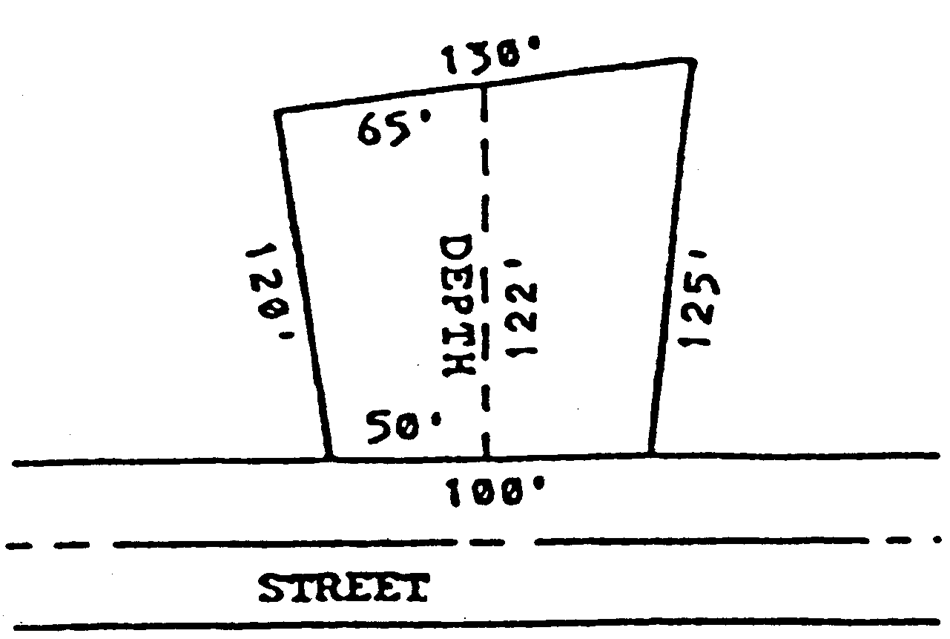
LOT MEASUREMENT DEPTH
Lot measurement, width. Lot measurement, width, means the average distance between straight lines connecting front and rear lot lines at each side of the lot, measured as straight lines between the foremost points of the side lot lines in front (where they intersect with the street line, except where a lot is split into two lots or a special family permit is issued, the lot width may be measured where they intersect with an easement of at least 30 feet in width, the lot can only be split from the parent parcel once and must meet the minimum lot size requirements of these land development regulations) and the rear most points of the side lot lines in the rear, provided however that the width between the side lot lines at their foremost points in the front shall not be less than 80 percent of the required lot width except in the case of lots on the turning circle of a cul-de-sac, where the width shall not be less than 60 percent of the required lot width.
Lot of record. Lot of record means (1) a lot which is part of a subdivision recorded in the office of the county clerk, or (2) a lot or parcel described by metes and bounds, the description of which has been so recorded on or before the date of adoption of the comprehensive plan.
Lot types. Lot types means corner lots, interior lots, reversed frontage lots, and through lots:
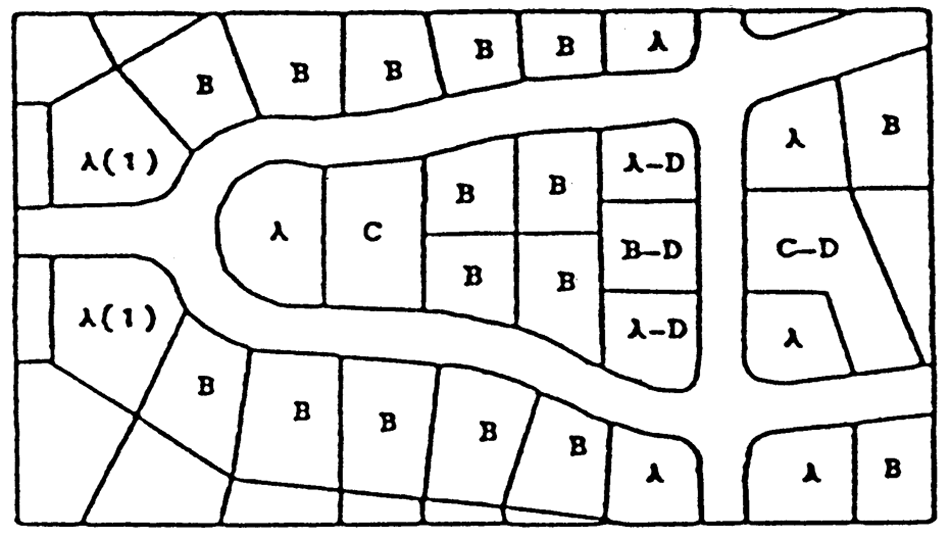
LOT TYPES
In the diagram,
A = Corner lot, defined as a lot located at the intersection of two or more streets. A lot abutting on a curved street or streets shall be considered a corner lot if straight lines drawn from the foremost points of the side lot lines to the foremost point of the lot meet at an interior angle of less than 135 degrees. See lot marked A(1) in the diagram.
B = Interior lot, defined as a lot other than a corner lot with only one frontage on a street.
C = Through lot, defined as a lot other than a corner lot with frontage on more than one street. Through lots abutting two streets may be referred to as double frontage lots.
D = Reversed frontage lot, defined as a lot on which the frontage is at right angles or approximately right angles (interior angle less than 135 degrees) to the general pattern in the area. A reversed frontage lot may also be a corner lot (A-D in the diagram), an interior lot (B-D), or a through lot (C-D).
Marginal access street. Marginal access street means a street, parallel and adjacent to an existing street, providing access to abutting lots.
Mean sea level. Mean sea level means the average height of the sea for all stages of the tide. It is used as a reference for establishing various elevations within the floodplain. The term is synonymous with National Geodetic Vertical Datum (NGVD).
Mining. Mining also means mining operations and means those physical activities, other than prospecting and site preparation, which are necessary for extraction, waste disposal, storage, or dam operations prior to abandonment.
Mini-warehouse. Mini-warehouses means buildings in which a number of storage units or vaults are rented for storage of goods, typically referred to as "self storage" facilities, where each unit is physically separated from other units.
Mobile home. See "Dwelling, mobile home."
Mobile home park. Mobile home park means a parcel of land under single ownership or management which is operated as a business engaged in providing for the parking of mobile homes to be used for nontransient living or sleeping purposes, and where lots are offered only for rent or lease, and including customary accessory uses such as owners' and managers' living quarters, laundry facilities, and facilities for parks and recreation.
Mobile home stand. Mobile home stand means a lot or parcel of ground designated for the accommodation of not more than one mobile home.
Mobile home subdivision. Mobile home subdivision means a residential subdivision where lots are offered for sale for use exclusively by mobile homes.
Motel, motor hotel, or motor lodge. See "Hotel."
Natural drainage features. Natural drainage features mean the naturally occurring features of an area which accommodate the flow of stormwater, such as streams, rivers, lakes, and wetlands.
New construction. New construction means structures for which the "start of construction" commenced on or before the effective date of these land development regulations.
Newspaper of general circulation. Newspaper of general circulation means a newspaper published at least on a weekly basis and printed in the language most commonly spoken in the area within which it circulates, but does not include a newspaper intended primarily for members of a particular professional or occupational group, a newspaper whose primary function is to carry legal notices, or a newspaper that is given away primarily to distribute advertising.
Nonconforming lot, use of land [or] structure, characteristics of use, and use of structures and premises. See section 2.3.
Nonconforming wrecking yard. Any automobile wrecking yard or junk yard lawfully in existence at the time of adoption or amendment of these land development regulations that is not located within an industrial (I) zoning district.
Nuisance. Nuisance shall mean the following:
1.
Any public nuisance known in common law or in equity jurisprudence.
2.
Any attractive nuisance which may prove detrimental to children whether in a building, on the premises of a building, or upon an unoccupied lot. This includes any abandoned wells, shafts, basements, or excavations; abandoned refrigerators and motor vehicles; or any structurally unsound fences or structures; or any lumber, trash, fences, debris or vegetation which may prove a hazard for inquisitive minors.
3.
Whatever is dangerous to human life or is detrimental to health, as determined by the county health officer.
4.
Overcrowding a room with occupants.
5.
Insufficient ventilation or illumination.
6.
Inadequate or unsanitary sewerage or plumbing facilities.
7.
Uncleanliness, as determined by the county health officer.
8.
Whatever renders air, food or drink unwholesome or detrimental to the health of human beings, as determined by the county health officer.
Nursery school. See "Child care center."
Nursing home. Nursing home means a private home, institution, building, residence, or other place, whether operated for profit or not, including those places operated by units of government, which undertakes through its ownership or management to provide, for a period exceeding 24 hours, maintenance, personal care, or nursing for three or more persons not related by lineal consanguinity or marriage to the operator, who by reason of illness, physical infirmity, or advanced age are unable to care for themselves; provided, that this definition shall include homes offering services for less than three persons where the homes are held out to the public to be establishments which regularly provide nursing, extended care, and custodial services. (See also, Residential home for the aged.)
Office, business. Business office means an office for such operations as real estate agencies, advertising agencies (but not sign shop), insurance agencies, travel agencies and ticket sales, chamber of commerce, credit bureau (but not finance company), abstract and title agencies, insurance companies, stockbroker, employment agencies, billing office, and the like. It is characteristic of a business office that retail or wholesale goods are not shown on or delivered from the premises to a customer.
Office, professional. Professional office means an office for the use of a person or persons generally classified as professional such as architects, engineers, attorneys, accountants, doctors, lawyers, dentists, veterinarians (but not including boarding of animals on the premises, except as part of treatment and then only in soundproof buildings), psychiatrists, psychologists, and the like. It is characteristic of professional offices that the use is devoted principally to an offering of consultive services.
Official 100-year flood map. Official 100-year flood map means the map issued by the Federal Emergency Management Agency that delineates the areas having ground elevations that are less than the official 100-year flood elevations.
Official ten-year flood elevations. Official ten-year flood elevations means the most recent and reliable flood elevations based on a Log Pearson type III probability distribution produced by the United States Geological Survey and based on historical data.
100-year flood area. 100-year flood area means those areas that have a land elevation less than the official 100-year flood elevations.
Open spaces. Open spaces means undeveloped lands suitable for passive recreation or conservation uses.
Openable area. Openable area (window) means that part of a window or door which is available for unobstructed ventilation and which opens directly to the outdoors.
Operator. Operator means any person who has charge, care or control of a building, or part thereof, in which dwelling units or rooming units are let.
Owner. Owner means the holder of the title in fee simple and any person, group of persons, company, association or corporation in whose name tax bills on the property are submitted. Owner also means any person who, alone or jointly or severally with others:
(a)
Has legal title to any dwelling or dwelling unit, with or without accompanying actual possession thereof; or
(b)
Has charge, care or control of any dwelling or dwelling unit, as owner, executor, executrix, administrator, trustee, guardian of the estate of the owner, mortgagee or vendee in possession, or assignee of rents, lessee, or other person, firm, or corporation in control of a building; of [or] their duly authorized agents. Any such person thus representing the actual owner is considered to be bound by these land development regulations to the same extent as if he or she were the owner. It is his or her responsibility to notify the actual owner of the reported infractions of these land development regulations pertaining to the property which apply to the owner.
Package liquor store. Package liquor store means a place where alcoholic beverages are dispersed or sold in containers for consumption off the premises.
Parcel of land. Parcel of land means any quantity of land capable of being described so that its location and boundary may be established, which is designated by its owner or developer as land to be used, or developed as, a unit or which has been used or developed as a unit.
Park model trailer. A transportable unit which has a body width not exceeding 14 feet and which is built on a single chassis and is designed to provide seasonal or temporary living quarters when connected to utilities necessary for operation of installed fixtures and appliances. The total area of the unit in a setup mode, when measured from exterior surface of the exterior stud walls at the level of maximum dimensions, not including any bay window, does not exceed 400 square feet when constructed to American National Standards Institute (ANSI) A-119.5 standards, and 500 square feet when constructed to United States Department of Housing and Urban Development standards.
Park model trailer space. A site of land in a travel trailer park or campground designated for the placement of one park model trailer for the exclusive use of its occupants. During the time the park model trailer is not occupied as temporary or seasonal quarters, it may be stored and tied down to the site. The affixing of the park model trailer to the ground by way of tie-downs or other removable fasteners, and the attachment of carports, porches, screen rooms, and similar appurtenances by way of removable attaching devices, does not render the park model trailer a permanent part of the site.
Parking space, handicapped. Handicapped parking space means an off-street parking space which is reserved for persons who are physically disabled or handicapped.
Parking space, off-street. Off-street parking space means a space adequate for parking a standard size automobile with room for opening doors on both sides, together with properly related access to a public street or alley and maneuvering room.
Performance bond. See "Surety device."
Permanent control point (PCP). A permanent control point (PCP) is a secondary horizontal control monument as defined in F.S. § 177.031(13).
Permanent reference monument (PRM). Permanent reference monument (PRM) means a control monument as defined in F.S. § 177.031(15).
Planning and Zoning Board. Planning and Zoning Board means the Planning and Zoning Board as herein provided for within these land development regulations.
Plat. Plat means a map or drawing depicting the division of land into lots, blocks, parcels, tracts, sites, or other divisions, however the same may be designated, and other information required by these land development regulations. The word "plat" includes the terms "replat" or "revised plat."
Plat, final. Final plat means a finished drawing of a subdivision showing completely and accurately all legal and engineering information and certification necessary for recording.
Plot. See "Lot."
Plumbing. Plumbing means the practice, materials, and fixtures used in the installation, maintenance, extension, and alteration of all piping, fixtures, appliances, and appurtenances in connection with any of the following: sanitary drainage or storm drainage facilities, the venting system and the public or private water supply systems, within or adjacent to any building, structure, or conveyance; also the practice and materials used in the installation, maintenance, extension, or alteration of stormwater, liquid waste, or sewerage, and water supply systems of any premises to their connection with any point of public disposal or other acceptable terminal.
Poultry. Poultry means all domesticated birds that serve as a source of eggs or meat, including chickens, turkeys, ducks, ostriches, quail, pheasants and geese.
Premises. Premises means a lot, plot or parcel of land including the buildings of [or] structures thereon.
Product tight. Product tight means impervious to the hazardous material which is or could be contained so as to prevent the seepage of the hazardous material from the containment system. To be product tight, the containment system shall be made of a material that is not subject to physical or chemical deterioration by the hazardous material being contained.
Public areas. Public areas means unoccupied open space adjoining a building and on the same property, that is permanently maintained accessible to the fire department and free of all encumbrances that might interfere with its use by the fire department.
Public buildings and facilities. Public buildings and facilities means the use of land or structures by a municipal, county, state, or federal governmental entity for a public service purpose. More specifically public facility means major capital improvements including but not limited to transportation, sanitary sewer, solid waste, drainage, potable water, educational, parks and recreation, and health systems and facilities. Essential services shall not be considered public buildings and facilities.
Reclamation. Reclamation means the reshaping of land disturbed or affected by an excavation operation to an appropriate contour considering the type of use prior to exaction, during excavation and planned use after reclamation, and the surrounding topography and shall include re-vegetation of lands in an approved manner.
Recreational facility. Recreational facility means a component of a recreation site used by the public such as a trail, court, athletic field or swimming pool.
Recreational uses. Recreational uses means activities within areas where recreation occurs.
Regulated materials. Regulated materials means the following:
a.
Petroleum products, which include fuels (gasoline, diesel fuel, kerosene and mixtures of these products), lubricating oils, motor oils, hydraulic fluids and other similar products. This term does not include liquefied petroleum gas, American Society for Testing and Materials grade number 5 and number 6 residual oils, bunker C residual oils, intermediate fuel oils used for marine bunkering with a viscosity of 30 and higher and asphalt oils.
b.
Substances listed by the secretary of the Florida Department of Labor and Employment Security pursuant to F.S. ch. 442 (Occupational Health and Safety). This list, known as the Florida Substances List, is provided in chapter 38F-41, Florida Administrative Code.
c.
Substances listed by the Administrator of the United States Environmental Protection Agency pursuant to section 102 of the Comprehensive Environmental Response, Compensation, and Liability Act of 1980, as amended. This list is provided in title 40 (Protection of the Environment) of the Code of Federal Regulations, part 302, Designation, Reportable Quantities and Notification.
d.
Substances listed by the Administrator of the United States Environmental Protection Agency pursuant to title III of the Superfund Amendments and Reauthorization Act of 1986, as amended. The list is provided in title 40 of the Code of Federal Regulations, part 355, Emergency Planning and Notification.
e.
Materials listed by the Secretary of the United States Department of Transportation pursuant to the Hazardous Materials Transport Act. This list is provided in title 49 (Transportation) of the Code of Federal Regulations, part 172, Hazardous Materials Tables and Communications Regulations.
f.
The following elemental metals, if they are stored in an easily crumbled, powdered, or finely divided state: aluminum, beryllium, cadmium, chromium, copper, lead, manganese, mercury, molybdenum, nickel, rhodium, silver, tellurium, tin and zinc.
g.
Mixtures containing the above materials if they contain one percent or more by volume or if they are wastes.
h.
Any material not included above which may present similar or more severe risks to human health or the environment as determined by the Land Development Regulation Administrator. Such determinations must be based upon competent testing or other objective means with conclusions which indicate that the material may pose a significant potential or actual hazard.
Repair. Repair means the replacement of existing work with the same kind of material used in the existing work, not including additional work that would change the structural safety of the building, or that would affect or change required existing facilities, a vital element of an elevator, plumbing, gas piping, wiring or heating installations, or that would be in violation of a provision of law or ordinance. Repair or repairs shall not apply to any change of construction.
Residential buildings. Residential buildings means buildings in which families or households live or in which sleeping accommodations are provided, and all dormitories shall be classified as residential occupancy. Such buildings include, among others, the following: dwellings, multiple dwellings and roominghouses (see also Dwelling unit).
Residential home for the aged. Residential home for the aged (also known as adult congregate living facility) means a health care facility containing characteristics of multiple-family housing, providing a maximum in independent living conditions for individuals or couples and a minimum of custodial services which would include daily observation of the individual residents by designated staff personnel. As accessory uses, residential homes for the aged may include dining rooms and infirmary facilities for intermediate or skilled nursing care solely for the use of the occupants residing in the principal facility.
Restaurant. Restaurant means an establishment where meals or prepared food, including beverages and confections, are served to customers for consumption on or off the premises. Restaurant includes cafes, coffee shops, donut shops, delicatessens, cafeterias, and other establishments of a similar nature.
Retention. Retention means the collection and storage of runoff without subsequent discharge to surface waters.
Right-of-way. Right-of-way means land dedicated, deeded, used, or to be used for a street, alley, pedestrian way, crosswalk, bikeway, drainage facility, or other public uses, wherein the owner gives up his or her rights to the property so long as it is being or will be used for the dedicated purpose. Right-of-way also is a land measurement term, meaning the distance between lot property lines which generally contain not only the street pavement, but also the sidewalk, grass area, and underground or aboveground utilities.
River bank setback line. River bank setback line means a line running parallel to a river and at a distance as specified within these land development regulations.
Roadway functional classification. Roadway functional classification means the assignment of roads into categories according to the character of service they provide in relation to the total road network. Basic functional categories include limited access facilities, arterial roads, and collector roads, which may be subcategorized into principal, major or minor levels. Those levels may be further grouped into urban and rural categories.
Rooming unit. Rooming unit means any room or group of rooms forming a single habitable unit used or intended to be used for living and sleeping, but not for cooking or eating purposes.
Roominghouse. Roominghouse means any dwelling, or that part of any dwelling containing one or more rooming units, in which space is let by the owner or operator to three or more persons which are not husband or wife, son or daughter, mother or father, or sister or brother of the owner or operator.
Rubbish. Rubbish means combustible and noncombustible waste materials, except garbage; and the term shall include the residue from the burning of wood, coal, coke, or other combustible materials, paper, rags, cartons, boxes, wood, excelsior, rubber, leather, tree branches, yard trimmings, tin cans, metal, mineral matter, and glass crockery.
Sanitary sewer facilities. Sanitary sewer facilities means structures or systems designed for the collection, transmission, treatment, or disposal of sewage and includes trunk mains, interceptors, treatment plants, and disposal systems.
Sediment. Sediment means the mineral or organic particulate material that is in suspension or has settled in surface or ground waters.
Servants' quarters. Servants' quarters means accommodations, without cooking facilities or separate utility meters, for domestic servants employed on the premises. Such units may be in either a principal or an accessory building but no such living quarters shall be rented, leased, or otherwise be made available for compensation of any kind except in the form of housing for servants.
Service station. See "Automotive service and self-service station."
Sidewalk. Sidewalk means that portion of the street right-of-way outside the roadway, which is improved for the use of pedestrian or bike traffic.
Sign. Sign means any device designed to inform or attract the attention of persons not on the premises on which the sign is located. Unless otherwise specified, a sign may have one or two faces. (See article 4 for general regulations governing signs.)
Sign, animated. Animated sign means a sign with externally moving parts or messages, or so operating as to give a viewer the illusion of moving parts or messages.
Sign, attached. Attached sign means a sign painted on the exterior face of a building or attached to a building. Attached signs include canopy signs, marquee signs, wall signs, roof signs, and projecting or hanging signs supported or attached to a canopy, awning, marquee, or building.
Sign, flashing. Flashing sign means a sign designed to attract attention by the inclusion of a flashing, changing, revolving, or flickering light source or a change of light intensity.
Sign, freestanding. Freestanding sign means a sign which is not attached to a building. Freestanding signs include ground signs, pole signs, and portable signs.
Sign, identification. Identification sign means a sign which depicts the name and/or address or a building or establishment on the premises where the sign is located as a means of identifying said building or establishment. An identification sign shall not contain promotional or sales material.
Sign, nonflashing. Nonflashing sign means a sign which does not have a flashing, changing, revolving, or flickering light source or which does not change light intensity.
Sign, off-site. Off-site sign means a sign other than an on-site sign.
Sign, on-site. On-site sign means a sign relating in its subject matter to the premises on which it is located, or to products, accommodations, services, or activities on the premises. On-site signs do not include signs erected by the outdoor advertising industry in the conduct of the outdoor advertising business.
Sign, surface area. Surface area of a sign means the entire area within the periphery of a regular geometric form, or combinations of regular geometric forms, comprising all of the display area of the sign, and including all of the elements of the matter displayed, but not including blank masking, frames, or structural elements of the sign and bearing no advertising matter. In the case of double-face signs, each sign face shall be measured as surface area and the combined surface area of both faces shall not exceed the maximum permitted for the building or use.
Site. See "Lot."
Soil survey. Soil survey means the United States Department of Agriculture, Soil Conservation Service Soil Survey for the county.
Solid waste. Solid waste means sludge from a waste treatment works, water supply treatment plant, or air pollution control facility or garbage, rubbish, refuse, or other discarded material, including solid, liquid, semisolid, or contained gaseous material resulting from domestic, industrial, commercial, mining, agricultural, or governmental operations.
Solid waste facilities. Solid waste facilities means structures or systems designed for the collection, processing or disposal of solid wastes, including hazardous wastes, and includes transfer stations, processing plants, recycling plants, and disposal systems.
Solid waste processing plant. Solid waste processing plant means a facility for incineration, resource recovery, or recycling of solid waste prior to its final disposal.
Solid waste transfer station. Solid waste transfer station means a facility for temporary collection of solid waste prior to transport to a processing plant or to final disposal.
Special exception. Special exception means a use that would not be appropriate generally or without restriction throughout a zoning district but which, if controlled as to number, area, location, or relation to the neighborhood, would promote the public health, safety, welfare, morals, order, comfort, convenience, appearance, prosperity, or the general welfare. Such uses may be permissible in a zoning district as a special exception if specific provision for such a special exception is made in these land development regulations. (For the procedure in securing special exceptions, see articles 12 and 13.)
Stairway. Stairway means one or more flights of stairs and the necessary landings and platforms connecting them, to form a continuous and uninterrupted passage from one story to another in a building or structure.
Start of construction. Start of construction means substantial improvement, provided the actual start of construction, repair, reconstruction, or improvement was within 180 days of the date the building permit was issued. The actual start means the first placement of permanent construction of a structure (including a manufactured home) on a site, such as the pouring of slabs or footings, installation of piles, construction of columns, or any work beyond the stage of excavation or the placement of a manufactured home on a foundation. Permanent construction does not include land preparation, such as clearing, grading and filling; nor does it include the installation of streets and/or walkways; nor does it include excavation for a basement, footings, piers or foundations or the erection of temporary forms; nor does it include the installation on the property of accessory buildings, such as garages or sheds not occupied as dwelling units or not part of the main structure.
Stormwater. Stormwater means the flow of water which results from and that occurs immediately following a rainfall.
Stormwater management system. Stormwater management system means a system designed to treat stormwater or collect, convey, channel, hold, inhibit, or divert the movement of stormwater on, through and from a site.
Stormwater runoff. Stormwater runoff means that portion of the stormwater that flows from the land surface of a site either naturally, in manmade ditches, or in a closed conduit system.
Story. Story means that portion of a building included between the surface of any floor and the surface of the next floor above it (including basement), or if there is no floor above it, then the space between such floor and the ceiling next above it. (See also "Habitable story").
Street. Street means a public or private roadway which affords the principal means of access to abutting property. Street includes lanes, ways, places, drives, boulevards, roads, avenues, or other means of ingress or egress regardless of the descriptive term used.
Street line. The street line is the line between the street and abutting property. A street line is also referred to as the right-of-way line.
Structure. See "Definitions, general."
Subdivider. Subdivider means any person, firm, corporation, partnership, association, estate, or trust or any other group or combination acting as a unit, dividing or proposing to divide land so as to constitute a subdivision as herein defined, including a developer or an agent of a developer.
Subdivision. Subdivision is the division of a parcel of land, whether improved or unimproved, into three or more lots or parcels of land, for the purpose, whether immediate or future, of transfer of ownership, whether by deed, metes and bounds description, devise, lease, map, plat or other recorded instrument or, if the establishment of a new street is involved, any division of such parcel. The term shall not mean the division of land into parcels of more than ten acres not involving any change in street lines, the transfer of property by sale or gift or testate succession by the property owner to his or her spouse or lineal descendants, [or] the transfer of property between tenants in common for the purpose of dissolving the tenancy in common among those tenants. The term includes a resubdivision and, when appropriate to the context, relates to the process of subdividing or to the land subdivided.
Subdivision, major. Major subdivision means any subdivision not classified as a minor subdivision, including subdivisions of more than nine lots, or any size subdivision requiring any new street or extension of the local governmental facilities, or the creation of any public improvements, except where otherwise specifically exempted from the requirements of these land development regulations.
Subdivision, minor. Minor subdivision means any subdivision containing not more than nine lots, and not requiring any new street or extension of the local governmental facilities, or the creation of any public improvements, except where otherwise specifically exempted from the requirements of these land development regulations. Property owners who have created a minor subdivision may not create an additional minor subdivision on property under the same ownership or owned by any of the same persons in partnership that previously created a minor subdivision located within one-half-mile of said property.
Substantial damage. Substantial damage means damage of any origin sustained by a structure whereby the cost of restoring the structure to its before damaged condition would equal or exceed 50 percent of the market value of the structure before the damage occurred.
Substantial improvement. Substantial improvement means for a structure built prior to the enactment of these land development regulations any repair, reconstruction, or improvement of a structure the cost of which equals or exceeds 50 percent of the market value of the structure before the improvement or repair is started. Substantial improvement is considered to occur when the first alteration on [of] any wall, ceiling, floor, or other structural part of the building commences, whether or not that alteration affects the external dimensions of the structure. The term does not, however, include either any project for improvement of a structure to comply with existing state or local health, sanitary, or safety code specifications which are solely necessary to assure safe living conditions, or any alteration of a structure listed on the National Register of Historic Places.
Supplied. Supplied means paid for, furnished, or provided by or under control of the owner or operator.
Surety device. Surety device means an agreement by a subdivider for the amount of the estimated construction cost guaranteeing the completion of physical improvements according to plans and specifications within the time prescribed by the agreement.
Surface water. Surface water means water above the surface of the ground, whether or not flowing through definite channels, including the following:
1.
Any natural or artificial pond, lake, reservoir, or other area which ordinarily or intermittently contains water and which has a discernible shoreline; or
2.
Any natural or artificial stream, river, creek, channel, ditch, canal, conduit, culvert, drain, waterway, gully, ravine, street, roadway, swale or wash in which water flows in a definite direction, either continuously or intermittently, and which has a definite channel, bed or banks; or
3.
Any wetland.
Surficial aquifer system. Surficial aquifer system means the permeable hydrogeologic unit contiguous with land surface that is comprised principally of unconsolidated to poorly indurated clastic deposits. It also includes well-indurated carbonate rocks, other than those of the Floridan Aquifer system where the Floridan is at or near land surface. Rocks making up the surficial aquifer system belong to all or part of the upper Miocene to Holocene Series. It contains the water table and water within it is under mainly unconfined conditions. However, beds of low permeability may cause semiconfined or locally confined conditions to prevail in its deeper parts. The lower limit of the surficial aquifer system coincides with the top of laterally extensive and vertically persistent beds of much lower permeability. Within the surficial aquifer system, one or more aquifers may be designated based on lateral or vertical variations on water-bearing properties.
Surveyor, land. Land surveyor means a land surveyor registered under F.S. ch. 472, who is in good standing with the Florida State Board of Engineer Examiners and Land Surveyors.
Temporary power service. Temporary power service means a service of 60 amps for the purpose of wells, ponds irrigation, or other service deemed necessary by the building official. If temporary power service is found to be used for any other purpose than the permitted purpose, the building official may discontinue the use after advising property owner in writing of such violation.
To plat. To plat means to divide or subdivide land into lots, blocks, parcels, tracts, sites, or other divisions, however the same may be designated, and the recording of the plat in the office of the county clerk in the manner provided for in these land development regulations.
Travel trailer. Travel trailer means a vehicular, portable structure built on a chassis, designed to be a temporary dwelling for travel, recreational, and vacation purposes, which: (a) is identified on the unit by the manufacturer as a travel trailer; (b) is not more than eight feet in body width; and (c) is of any weight provided its body length does not exceed 35 feet.
Truckstop. Truckstop means an establishment where the principal use is primarily the refueling and servicing of trucks and tractor-trailer rigs. Such establishments may have restaurants or snack bars and sleeping accommodations for the drivers of such over-the-road equipment and may provide facilities for the repair and maintenance of such equipment.
Unsafe building. Unsafe building means any structure that has any of the following conditions, such that the life, health, property, or safety of the general public is endangered:
(a)
Whenever the stress in any material, member or portion thereof, due to all imposed loads including dead load exceeds the working stresses allowed in the county building code for new buildings.
(b)
Whenever a building, structure or portion thereof has been damaged by fire, flood, earthquake, wind or other cause to the extent that the structural integrity of the buildings or structures is less than it was prior to the damage and is less than the minimum requirement established by the county building code for new buildings.
(c)
Whenever for any reason a building, structure or portion thereof is manifestly unsafe or unsanitary for the purpose for which it is designed.
(d)
Whenever any building, structure or portion thereof as a result of decay, deterioration or dilapidation is likely to fully or partially collapse.
(e)
Whenever any building, structure or portion thereof has been constructed or maintained in violation of a specific requirement of county regulations.
(f)
Whenever any building, structure or portion thereof is unsafe, unsanitary or not provided with adequate egress, or which constitutes a fire hazard, or is otherwise dangerous to human life, or, which in relation to existing use, constitutes a hazard to safety or health by reason of inadequate maintenance, dilapidation, obsolescence, or abandonment.
Use. Use means the purpose for which land or water or a structure thereon is designed, arranged, or intended to be occupied or utilized or for which it is occupied or maintained. The use of land or water in the various zoning districts is governed by these land development regulations.
Use of land. Use of land means use of land, water surface, and land under water to the extent covered by these land development regulations.
Utilities. Utilities means, but is not necessarily limited to, water systems, electrical power, sanitary sewer systems, stormwater management systems, and telephone or television cable systems; or portions, elements, or components thereof.
Valuation or value. Valuation or value means the estimated cost to replace a building in kind.
Variance. Variance means a relaxation of the terms of these land development regulations where such variance will not be contrary to the public interest and where, owing to conditions peculiar to the property and not the result of the actions of the applicant, a literal enforcement of these land development regulations would result in unnecessary and undue hardship. Establishment or expansion of a use otherwise prohibited or not permitted shall not be allowed by variance, nor shall a variance be granted because of the presence of nonconformities in the zoning classification or district or adjoining zoning classifications or districts. (For the procedure in securing variances, see article 12.)
Ventilation. Ventilation means the process of supplying and removing air by natural or mechanical means to or from any space.
Warehouse. Warehouse means a building or part of a building used by wholesalers to store large stocks of merchandise which they display or sell to retailers.
Water wells. Water wells means wells excavated, drilled, dug, or driven for the supply of industrial, agricultural, or potable water for general public consumption.
Well. Well means any excavation that is drilled, cored, bored, washed, driven, dug, jetted, or otherwise constructed when [the] intended use of such excavation is to conduct groundwater from an aquifer or aquifer system to the surface by pumping or natural flow, to conduct waters or other liquids from the surface into any area beneath the surface of land or water by pumping or natural flow, or to monitor the characteristics of groundwater within an aquifer system(s). Geotechnical borings greater than 20 feet in depth are included in the definition of "well."
Wellfield management zone. Wellfield management zone means a wellfield protection area around the wellheads of a community water well system.
Wetlands. Wetlands means those areas that are inundated or saturated by surface water or groundwater at a frequency and a duration sufficient to support, and under normal circumstances do support, a prevalence of vegetation typically adapted for life in saturated soils. Soils present in wetlands generally are classified a [as] hydric or alluvial, or possess characteristics that are associated with reducing soil conditions. The prevalent vegetation in wetlands generally consists of facultative or obligate hydrophytic macrophytes that are typically adapted to areas having soil conditions described above. These species, due to morphological, physiological, or reproductive adaptations, have the ability to grow, reproduce or persist in aquatic environments or anaerobic soil conditions. Florida wetlands generally include swamps, marshes, bayheads, bogs, cypress domes and strands [stands], sloughs, wet prairies, riverine swamps and marshes, hydric seepage slopes, tidal marshes, mangrove swamps and other similar areas. Florida wetlands generally do not include longleaf or slash pine flatwoods with an understory dominated by saw palmetto. The delineation of actual wetland boundaries may be made by any professionally accepted methodology consistent with the type of wetlands being delineated, but shall be consistent with any unified statewide methodology for the delineation of the extent of wetlands ratified by the legislature.
Yard. Yard means a required open space unoccupied and unobstructed from the ground upward, provided however, that fences, walls, poles, posts, and other customary yard accessories, ornaments, and furniture may be permitted in any yard, subject to height limitations and requirements limiting obstruction of visibility.
For explanation of how to measure the various types of yards, on rectangular and nonrectangular lots, as defined in the following definitions, see accompanying diagrams [following this section].
Yard, front. Front yard means a yard extending between side lot lines across the front of a lot adjoining a street. In the case of through lots, unless the prevailing front yard pattern on adjoining lots indicates otherwise, front yards shall be provided on all frontages. Where one of the front yards that would normally be required on a through lot is not in keeping with the prevailing yard pattern, the Land Development Regulation Administrator may waive the requirement for the normal front yard and substitute therefor a special yard requirement which shall not exceed the average of the yards provided on adjacent lots.
In the case of corner lots and reverse frontage lots, a front yard of the required depth shall be provided on both frontages.
Yard, front: depth required. Front yard, depth required, means an area measured at right angles to a straight line joining the foremost points of the side lot lines. The foremost point of the side lot line, in the case of rounded property corners at street intersections, shall be assumed to be the point at which the side and front lot lines would have met without such rounding.
Yard, rear. Rear yard means a yard extending across the rear of the lot between inner side yard lines. In the case of through lots and corner lots, there will be no rear yards, but only front and side yards.
Yard, rear: depth required. Rear yard, depth required, means an area measured in such a manner that the yard established is a strip of the minimum width required by district regulations with its inner edge parallel with the rear lot line.
Yard, side. Side yard means a yard extending from the rear line of the required front yard to the rear lot line, or in the absence of any clearly defined rear lot line to the point on the lot farthest from the intersection of the lot line involved with the street. In the case of through lots, side yards shall extend from the rear lines of front yards required. In the case of corner lots, yards remaining after front yards have been established on both frontages shall be considered side yards.
Yard, side: depth required. Side yard, depth required, means an area measured in such a manner that the yard established is a strip of the minimum width required by district regulations with its inner edge parallel with the side lot line.
Yard, special. Special yard means a yard behind any required yard adjacent to a street required to perform the same functions as a side or rear yard, but adjacent to a lot line and so placed or oriented that neither the term "side yard" nor the term "rear yard" clearly applies. In such cases, the Land Development Regulation Administrator shall require a yard with minimum dimensions as generally required for a side yard or a rear yard in the district, determining which shall apply by the relation of the portion of the lot on which the yard is to be located to the adjoining lot or lots, with due regard to the orientation and location of structures and buildable area thereon.
Yard, waterfront. Waterfront yard means a yard measured from and parallel to the mean-high water mark of the lake, stream, or other watercourse on which the lot is located.
(Ord. No. 97-14, § 1, 12-18-97; Ord. No. 05-21, § 1, 8-18-05; Ord. No. 06-08, § 1, 3-16-06; Ord. No. 06-09, § 1, 3-16-06; Ord. No. 06-39, § 1, 11-16-06; Ord. No. 06-46, § 1, 11-16-06; Ord. No. 08-28, § 1, 9-18-08; Ord. No. 09-10, § 1, 6-1-09; Ord. No. 2011-12, §§ 1, 2, 6-16-2011; Ord. No. 2011-16, § 1, 6-16-2011; Ord. No. 2014-03, § 1, 4-17-2014)
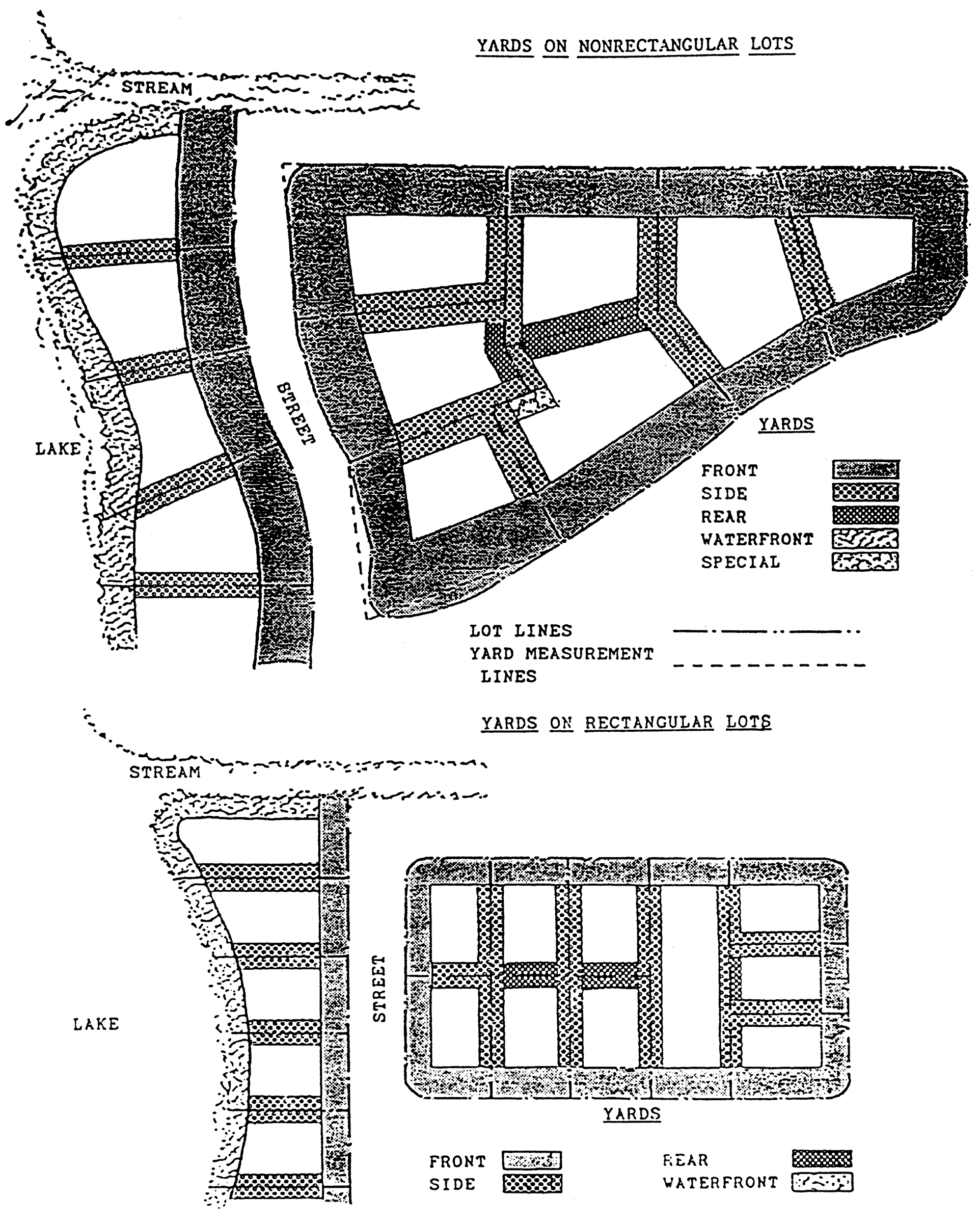
YARDS ON NONRECTANGULAR/RECTANGULAR LOTS
Section 2.2. - Lots divided by district lines.
Where a single lot is located within two or more zoning districts, each portion of that lot shall be subject to all regulations applicable to the district in which it is located.
Section 2.3. - Nonconforming lots, nonconforming uses of land, nonconforming structures, nonconforming characteristics of use, nonconforming use of structures and premises.
Within the districts established by these land development regulations or amendments that may later be adopted there may exist (1) lots, (2) uses of land, (3) structures, (4) characteristics of use, and (5) use of structures and premises which were lawful before the adoption or amendment of the county's comprehensive plan, but which would be prohibited, regulated, or restricted under the terms of these land development regulations or future amendments.
It is the intent of these land development regulations to permit these nonconformities to continue until they are voluntarily removed or removed as required by these land development regulations, but not to encourage their survival. It is further the intent of these land development regulations that nonconformities shall not be enlarged upon, expanded, intensified, or extended, nor be used as grounds for adding other structures or uses prohibited elsewhere in the same district.
Nonconforming uses are declared by these land development regulations to be incompatible with permitted uses in the districts involved. A nonconforming use of a structure, a nonconforming use of land, or a nonconforming use of a structure and land in combination shall not be extended or enlarged after the adoption or amendment of the county's comprehensive plan by attachment on a structure or premises of additional signs intended to be seen from off the premises, or by the addition of other uses of a nature which would be prohibited generally in the district involved.
To avoid undue hardship, nothing in these land development regulations shall be deemed to require a change in the plans, construction, or designated use of any building on which actual construction was lawfully begun prior to the adoption or amendment of the county's comprehensive plan and upon which actual building construction has been carried on diligently (see section 2.1 for definition of actual construction). Where excavation or demolition or removal of an existing building has been substantially begun preparatory to rebuilding, such excavation, demolition, or removal shall be deemed to be actual construction, provided that work shall be carried on diligently.
2.3.1. Nonconforming lots of record. In any district in which one-family dwellings are permitted, a one-family dwelling and customary accessory buildings may be erected, expanded, or altered on any single lot of record on the date of adoption or amendment of the county's comprehensive plan notwithstanding limitations imposed by other provisions of these land development regulations. Such lots must be limited to one single-family residence per lot; however, no more than four such lots shall be contiguous as of January 11, 1994, to any other lot(s) owned or under contract for deed to the person(s) applying for the single-family residence building permit. Where there are more than four contiguous lots of record, as of January 11, 1994, those lots or portions thereof exceeding the four lots and not meeting the required density requirement shall be required to be combined to meet the density requirement if such lots are located without a subdivision or if such lots are located within a recorded or unrecorded subdivision unless:
1.
Such subdivisions have direct access to a paved road and in which all lots front on a continually maintained paved or stabilized road that meets county standards; and
2.
Such lots [are] within such recorded or unrecorded subdivisions in which the sale of individual lots to persons by the original subdivider has occurred at the following rates:
a.
At least 85 percent of the total number of lots are sold prior to the date of adoption of this policy, if the subdivision was created prior to January 7, 1980;
b.
At least 60 percent of the total number of lots are sold by the date of adoption of this policy, if the subdivision was created on or after January 7, 1980, and on or prior to December 31, 1987;
c.
At least 50 percent of the total number of lots are sold by December 31, 1993, if the subdivision was created in 1988;
d.
At least 50 percent of the total number of lots are sold by December 31, 1994, if the subdivision was created in 1989;
e.
At least 50 percent of the total number of lots are sold by December 31, 1995, if the subdivision was created in 1990;
f.
At least 50 percent of the total number of lots are sold by December 31, 1996, if the subdivision was created in 1991.
2.3.2. Nonconforming uses of land. Where, on the date of adoption or amendment of the county's comprehensive plan, lawful use of land existed which would not be permitted by the comprehensive plan and regulations imposed by these land development or [sic] regulations, such use may be continued, so long as it remains otherwise lawful, subject to the following provisions:
1.
Enlargement, increase, intensification, alteration. No such nonconforming use shall be enlarged, increased, intensified, or extended to occupy a greater area of land than was occupied on the date of adoption or amendment of the county's comprehensive plan.
2.
Movement. No such nonconforming use shall be moved in whole or in part to any portion of the lot or parcel other than that occupied by such use on the date of adoption or amendment of the county's comprehensive plan.
3.
Discontinuance. If any such nonconforming use ceases for any reason (except when governmental action impedes access to the premises) for a period of more than two consecutive years, any subsequent use of such land shall conform to the regulations specified by these land development regulations for the district in which such land is located.
4.
Structure additions. No structures shall be added on such land, except for the purposes and in a manner conforming to the regulations for the district in which such land is located.
2.3.3. Nonconforming structures. Where a structure existed lawfully under these land development regulations, [on] the date of adoption or amendment of the county's comprehensive plan, that could not be built under the comprehensive plan or these land development regulations by reason of restrictions on area, lot coverage, height, yards, location on the lot, or requirements other than use concerning the structure, such structure may be continued so long as it remains otherwise lawful, subject to the following provisions:
1.
Enlargement or alteration. No such nonconforming structure may be enlarged or altered in a way which increases its structural square footage, which existed on the date of adoption or amendment of the county's comprehensive plan, although any structure or portion thereof may be altered to decrease its nonconformity;
2.
Destruction. Should such nonconforming structure or nonconforming portion of structure, located in a non-floodprone area, be destroyed by any means to an extent of up to 100 percent of its assessed value, such nonconforming structure may rebuild to its per-damage [pre-damage] footprint and conditions, provided that rebuilding is commenced within six months of the date of damage. Where such nonconforming structure is located in a floodprone area as identified on the Federal Emergency Management Agency flood insurance rate map for the county, and such structure has suffered more than 50 percent of its assessed value at time of destruction, it shall not be reconstructed except in conformity with the provisions of these land development regulations.
3.
Movement. Should such structure be moved for any reason for any distance whatever, it shall thereafter conform to the regulations for the district in which it is located after it is moved.
2.3.4. Nonconforming characteristics of use. If characteristics of use, such as residential densities, which lawfully existed on the date of adoption or amendment of the county's comprehensive plan, or signs, off-street parking or off-street loading, or other matters pertaining to the use of land, structures, and premises which lawfully existed on the date of adoption or amendment of these land development regulations are made nonconforming by the comprehensive plan or these land development regulations as adopted or amended, no change shall thereafter be made in such characteristics of use which increases nonconformity with the county's comprehensive plan or these land development regulations; provided, however, that changes may be made which do not increase, or which decrease, such nonconformity.
2.3.5. Nonconforming use of structures and premises. Where a lawful use of a structure, or of a structure and premises in combination, existed on the date of adoption or amendment of the county's comprehensive plan, that would not be allowed in the district under the terms of the comprehensive plan and these land development regulations, the lawful use may be continued so long as it remains otherwise lawful, subject to the following provisions:
1.
Enlargement, extension, alteration, etc. No existing structure devoted to a use not permitted by these land development regulations in the district in which such use is located shall be enlarged, extended, constructed, reconstructed, moved or structurally altered in a way which increases the structural square footage of the structure, which existed on the date of adoption or amendment of the county's comprehensive plan, except in changing the use of the structure to a use permitted in the district in which it is located.
2.
Extension of use. Any nonconforming use may be extended throughout any parts of a building which were manifestly arranged or designed for such use and existed on the date of adoption or amendment of the county's comprehensive plan. Any nonconforming use which occupied a portion of a building not originally designed or intended for such use shall not be extended to any other part of the building. No nonconforming use shall be extended to occupy any land outside the building, nor any additional building on the same lot or parcel, not used for such nonconforming use on the date of adoption or amendment of the county's comprehensive plan.
3.
Change in tenancy or ownership. There may be a change in tenancy, ownership, or management of a nonconforming use provided there is no change in the nature or character of such nonconforming use.
4.
Change in use. Any nonconforming use of a structure, or of a structure and premises in combination, may be changed to another nonconforming use of the same character, or to a more restricted but nonconforming use, provided that the Board of Adjustment shall find after due public notice and hearing that the proposed use is equally or more appropriate to the district than the existing nonconforming use and that the relation of the structure to surrounding properties is such that adverse effects on occupants and neighboring properties will not be greater than if the existing nonconforming use is continued. In permitting such change, the Board of Adjustment may require appropriate conditions and safeguards in accordance with the intent and purpose of these land development regulations.
5.
Change to conforming use requires future conformity with district regulations. Any structure, or structure and premises in combination, in or on which a nonconforming use is superseded by a permitted use shall thereafter conform to the regulations for the district in which such structure is located, and the nonconforming use shall not thereafter be resumed nor shall any other nonconforming use be permitted.
6.
Discontinuance. If any nonconforming use of a structure, or structure and premises in combination, ceases for any reason (except where governmental action impedes access to the premises) for a period of more than two consecutive years, any subsequent use shall conform to the regulations for the district in which the use is located.
7.
Structure additions. No structures shall be added on such premises, except for purposes and in a manner conforming to the regulations for the district in which such premises are located.
8.
Destruction. Should a structure containing a nonconforming use, located in a non-floodprone area, be destroyed by any means to an extent of up to 100 percent of its assessed value, such nonconforming structure may rebuild to its pre-damage footprint and conditions, provided that rebuilding is commenced within six months of the date of damage. Where such structure containing a nonconforming use is located in a floodprone area as identified on the Federal Emergency Management Agency flood insurance rate map for the county, and such structure has suffered more than 50 percent of its assessed value at time of destruction, it shall not be reconstructed except in conformity with the provisions of these land development regulations.
2.3.6. Casual, temporary, or illegal use. The casual, temporary, or illegal use of land or structures, or land and structures in combination, shall not be sufficient to establish the existence of a nonconforming use or to create rights in the continuance of such use.
2.3.7. Uses under special exception provisions not nonconforming uses. Where on the date of the adoption of these land development regulations the lawful use of land existed, which would be permitted as a special exception in a district under the terms of these land development regulations, such use shall not be deemed a nonconforming use in such district, but shall without further action be deemed a conforming use in such district. However any enlargement or expansion of any such uses shall be subject to the procedures for securing special exceptions (see section 12.2).
Section 2.4. - Vested rights.
Certain land development rights of property owners may be vested with respect to the county's comprehensive plan. For instance, development specifically approved in a development of regional impact development order is vested in accordance with F.S. § 163.3167(8), as amended, and is exempt from the provisions of this section. This section sets forth the procedure for determining those vested rights. A person claiming vested rights to develop property may make application for a vested rights certificate pursuant to this section, notwithstanding the preceding sections.
2.4.1. Determination of vested rights.
2.4.1.1. An application for a vested rights certificate may be approved and a vested rights certificate issued if an applicant demonstrates rights that are vested under the standards of this section, subject to the limitation set forth in this section and subject to compliance with such laws and regulations against which the development is not vested. Possession of a vested rights certificate enables a permittee to complete the development approved under such certificate up to and through issuance of appropriate certificates of occupancy.
2.4.1.2. An application for a vested rights certificate may be filed within one year of the adoption of these land development regulations for the subject property. Except as provided in the section below, failure to file an application within the required period constitutes an abandonment of any claim to vested rights. Judicial relief are [is] not available until administrative remedies set forth in the section are exhausted.
2.4.1.3. If a property owner is absent from the State of Florida during the entire filing period and does not have an agent present in the state during such period, such property owner may, with documentation sufficient to indicate a probable lack of notice, be granted leave by the Board of County Commissioners to file an application within one year after the individual's return to the State of Florida.
2.4.1.4. Notwithstanding the provisions of this section, the Board of County Commissioners may, in extraordinary circumstances, allow a property owner to submit an application after the one-year deadline where such extension avoids undue hardship to the property owner.
2.4.2. Standards for vested rights.
2.4.2.1. An application for vested rights determination shall be approved if the applicant demonstrates:
1.
The applicant:
a.
Owned the property proposed for development on the date of adoption or amendment of the county's comprehensive plan;
b.
Entered into a contract or option to purchase the property on or before such date; or
c.
Presents facts such that it would be inequitable, unjust or fundamentally unfair to deny an application for vested rights where the applicant acquired ownership after such date; and
2.
There was a valid, unexpired act of an agency or authority of government upon which the applicant reasonably relied in good faith; and
3.
The applicant, in reliance upon the valid unexpired act of government, made a change in position or incurred extensive obligations or expenses; and
4.
It would be inequitable, unjust or fundamentally unfair to destroy the rights acquired by the applicant. In making this determination, the Board of County Commissioners may consider a number of factors, including, but not limited to:
a.
Whether construction or other development activity has commenced and is continuing in good faith; and
b.
Whether or not the expense or obligation incurred can be substantially used for a development permitted by the county's comprehensive plan and these land development regulations.
2.4.2.2. The following are not considered development expenditures or obligations in and of themselves without more evidence of actions in reliance unless the applicants were unable to obtain further approvals because of extraordinary delays, beyond the applicant's control:
1.
Costs for legal and other professional services that are not related to the design or construction of improvements.
2.
Taxes.
3.
Costs for acquisition of the land.
2.4.3. Presumptive vesting. Notwithstanding the criteria set forth in this section, presumptive vesting for consistency and concurrency is applied to any structure on which construction has been completed pursuant to a valid building permit. Such presumptive vesting for the purposes of consistency and concurrency means there is no requirement to file an application to preserve vested rights status.
1.
Presumptive vesting for density only. The following categories of properties are presumptively vested for purpose of density only and shall not be required to file an application to preserve vested rights in this regard:
a.
Lots of record as of the adoption of the county's comprehensive plan, whether located within a subdivision or without, but only to the extent of one single-family residence per lot; however, such lots must be limited to one single-family residence per lot and no more than four such lots shall be contiguous as of January 11, 1994, to any other lot(s) owned or under contract for deed to the person(s) applying for the single-family residence building permit. Where there are more than four contiguous lots of record, as of January 11, 1994, those lots or portions thereof exceeding the four lots and not meeting the required density requirement shall be required to be combined to meet the density requirement if such lots are located without a subdivision or if such lots are located within a recorded or unrecorded subdivision unless:
1.
Such subdivisions have direct access to a paved road and in which all lots front on a continually maintained paved or stabilized road that meets county standards; and
2.
Such lots [are] within such recorded or unrecorded subdivisions in which the sale of individual lots to persons by the original subdivider has occurred at the following rates:
a.
At least 85 percent of the total number of lots are sold prior to the date of adoption of this policy, if the subdivision was created prior to January 7, 1980;
b.
At least 60 percent of the total number of lots are sold by the date of adoption of this policy, if the subdivision was created on or after January 7, 1980, and on or prior to December 31, 1987;
c.
At least 50 percent of the total number of lots are sold by December 31, 1993, if the subdivision was created in 1988;
d.
At least 50 percent of the total number of lots are sold by December 31, 1994, if the subdivision was created in 1989;
e.
At least 50 percent of the total number of lots are sold by December 31, 1995, if the subdivision was created in 1990;
f.
At least 50 percent of the total number of lots are sold by December 31, 1996, if the subdivision was created in 1991.
2.4.4. Section 380.06 vested rights. Developments of regional impact authorized under F.S. § 380.06, pursuant to a valid, unexpired binding letter of vested rights issued by the state land planning agency, including approved modifications to such binding letter of vested rights (the "binding letter"), shall automatically qualify for a vested rights certificate to be issued upon completion of the procedure set forth in this paragraph. Such permit shall recognize the vesting of the development as set forth in the binding letter for purposes of the comprehensive plan, from these land development regulations adopted to implement the comprehensive plan and from concurrency. In lieu of subsection 2.4.7, below, such vesting shall continue until development approved in the binding letter is complete or until the expiration or invalidation of the binding letter, whichever occurs first. Notwithstanding subsection 2.4.7, a proposed change to a development vested hereunder shall be reviewed pursuant to the substantial deviation or change criteria provided for in F.S. § 380.06, as amended. A substantial deviation after the date of adoption or amendment of the county's comprehensive plan shall cause those development rights that are the subject of such deviation to become subject to the comprehensive plan, these land development regulations and concurrency requirements. The request for issuance of the vested rights certificate shall consist of the binding letter along with a master plan of development or similar document previously approved by the Board of County Commissioners and submitted to the Land Development Regulation Administrator for verification of authenticity. The Land Development Regulation Administrator may require additional documents or materials necessary for the county to determine the extent of development vested and to estimate the capital improvements required by the development.
Submission of the binding letter along with the appropriate master plan or similar document and additional materials required by the Land Development Regulation Administrator shall entitle the applicant to a vested rights certificate which shall be issued by the Board of County Commissioners upon receipt of verification of authenticity by the Land Development Regulation Administrator. Development of regional impact development [that] is vested under F.S. § 380.06 and for which a binding letter has not been issued shall qualify for a vested rights certificate in accordance with the procedures set forth in these land development regulations, upon establishment, [provided] that prior to July 1, 1973, the county issued a building permit or other authorization to commence development and that in reliance on such permit or other authorization there has been a change of position as required under the provisions of F.S. § 380.06(20) vested rights; provided however, in lieu of the limitation set forth in subsection 2.4.7, such vesting shall continue until such development is complete or until the state land planning agency determines that such development is not entitled to be vested under F.S. § 380.06, whichever occurs first.
2.4.5. Statutory vesting. The right to develop or continue the development of property shall exist if: (1) a valid and unexpired final development order was issued by the county prior to adoption of this comprehensive plan, (2) substantial development has occurred on a significant portion of the development authorized in the final development order or is completed, or (3) development is continuing in good faith as of the adoption of the county's comprehensive plan. A "final development order" is a development order which approved the development of land for a particular use of [or] uses at a specified density of use and which allowed development activity to commence on the land for which the development order was issued. "Substantial development" means all required permits necessary to commence and continue the development have been obtained, permitted clearing and grading has commenced on a significant portion of the development, and the actual construction of roads and the stormwater management system on that portion of the development is complete or is progressing in a manner that significantly moves the entire development toward completion.
2.4.6. Common law vesting. A right to develop or continue the development of property notwithstanding this comprehensive plan may be found to exist if the applicant proves by a preponderance of evidence that the owner or developer, acting in good faith and reasonable reliance upon some act or omission of the county, has made a substantial change in position or has incurred such extensive obligations and expenses that it would be highly inequitable and unjust to destroy the right to develop or to continue the development of the property.
2.4.7. Limitation on determination of vested rights.
2.4.7.1. Development subject to a vested rights certificate shall be consistent with the terms of the development approval(s) upon which the certificate was based. Substantial deviation from a prior approval, except as required by governmental action, shall cause the development to be subject to policies and implementing decisions and regulations of the county's comprehensive plan. The Board of County Commissioners shall determine if a proposed or actual deviation change is a substantial deviation based upon:
1.
A change in use or intensity of use that would increase the development's impacts on those public facilities subject to concurrency by more than five percent.
2.
A change in access to the project that would increase the development's transportation impacts by more than five percent on any road subject to concurrency unless the access change would result in an overall improvement to the transportation network.
2.4.7.2. A vested rights certificate applies to the land and is therefore transferrable from owner to owner of the land subject to the permit.
2.4.7.3. Notwithstanding anything in this section to the contrary, a vested rights determination may be revoked upon a showing by the county of a peril to public health, safety or general welfare of the residents of the county unknown at the time of approval.
2.4.8. Vested rights applications. Applications for a determination of vested rights shall be submitted to the Land Development Regulation Administrator on forms provided by the county. The county shall review the application for sufficiency and an insufficient application shall be returned to the applicant for additional information. Upon acceptance by the county, the application shall be assigned a hearing date. The county establishes the schedule of hearing dates and an application deadline for each hearing.
2.4.9. Application forms. The application for determination of vested rights shall contain information sufficient to permit a determination by the county pursuant to the criteria set forth in this section.

