
Bristol City Zoning Code
ARTICLE V
- SUPPLEMENTARY REGULATIONS
Sec. 28-141.- Number of residential structures per lot.
Not more than one principal residential structure except where otherwise permitted herein shall be permitted on a lot.
Sec. 28-142. - Yard requirements and exceptions.
(a)
Projections of window sills, cornices and other ornamental features may extend not more than two feet into a required yard. There shall be no overhangs over property lines, except that in the D, W, and R-6 zones such projections may extend up to one foot over the public right of way provided it receives approval from the ZEO.
(b)
Landscape features such as trees, fences (subject to section 28-146), poles, shrubs and terraces may be located in any yard.
(c)
A sign as permitted in article X of this chapter may be located in any yard.
(d)
A structure accessory to a permitted use in residential zones:
(1)
Above ground structure (i.e. shed, garages, and above ground swimming pools) may cover no more than 25 percent of a required rear yard; shall not be located in a front yard; and shall not be located within six feet of a lot line.
(2)
Below ground structures (i.e. inground swimming pools) may cover the entire rear yard provided that the outer edge of the structure is located at least six feet from a lot line; and may not be located in a front yard.
(e)
A handicap ramp built to meet the requirements of the Americans with Disabilities Act (ADA) may be located in any yard.
(f)
In residence districts the parking or storage of major recreation equipment, which includes transient trailers, pick-up campers, coaches, motorized dwellings, tent trailers, boats, boat trailers and similar equipment, but does not include mobile homes, shall be regulated as follows:
(1)
Only one transient boat, pick-up camper, coach motorized dwelling, tent trailer, or boat trailer may be parked or stored outside on any lot in a residence district provided that such equipment be not more than 40 feet in length.
(2)
No such major recreation equipment, while parked or stored, shall be used for living, sleeping or house-keeping purposes for more than 30 days.
(3)
Such recreation equipment must be six feet from any lot line.
(4)
No major recreation equipment shall be stored out of doors in residence districts continuously, on a daily basis, for more than a ten-month period.
(g)
A deck may extend up to one-third of the way into the required rear yard and must meet all required side yard setbacks.
(h)
A porch may extend up to one-third of the way into the required front yard and must meet all required side yard setbacks.
Sec. 28-143. - Height requirements and exceptions.
Except in a residential zone, structures attached to a permitted building such as church spires, towers or belfries, flagpoles, radio or television antennae, chimneys, elevator bulkheads or silos may be erected up to 50 percent above the maximum zone height regulations.
Sec. 28-144. - Vision clearance at corners.
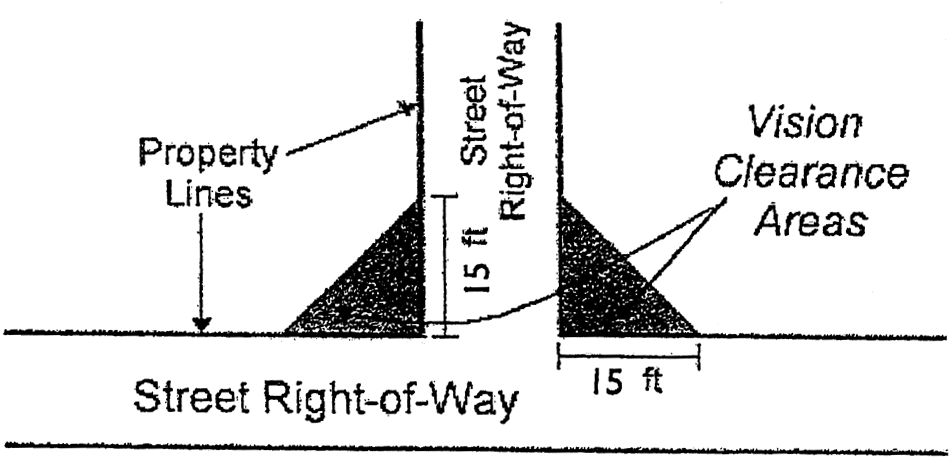
Street vision clearance at corners. Except in the D zone, W zone, and LB zone, no building or structure shall be erected and no vegetation shall be maintained between a height of three feet and ten feet above the street level of the triangle formed by the two street lines and a third line joining points on the street lines 15 feet from the intersection. A street line is defined as the line separating the property from the street right-of-way.
See illustration:
Cross reference— Motor vehicles and traffic, ch. 16.
Sec. 28-145. - Setback of individual sewage disposal facilities from bodies of water.
Sewage disposal facilities which are designed to leach wastes into the soil shall comply with the state department of environmental management and the state coastal resources management council (CRMC) regulations.
Cross reference— Boats, docks and waterways, ch. 8; sewers and sewage disposal, ch. 22.
Sec. 28-146. - Fences.
(a)
It shall be unlawful for any person to install, erect, construct, relocate or alter a fence within the town without first obtaining a permit from the building inspector. No permit shall be issued if the building official determines that the proposed fence does not meet the requirements of this section. A sketch or design of the proposed fence including a description of materials to be used and specification of height shall be submitted with the application for a permit.
(b)
Height requirements. A fence shall not exceed the following height:
(1)
The maximum height of a fence is four feet in the front yard set back area of the zone the property is located in. Corner lots and through lots will have more than one front lot line.
(2)
The maximum height of a fence is three feet for fences located adjacent to a driveway on either the property or abutting property and for a distance of ten feet from the road so as not to obstruct the clear view of traffic or pedestrians. Except however, this height restriction shall not apply to fences in which the design or construction of the fence allows clear visibility threw the fence and does not create a safety hazard to traffic or pedestrians.
(3)
The maximum height of a fence located in all other areas is six feet, except as approved by the planning board as part of a subdivision or development plan approval.
(4)
Fence poles placed a minimum of seven feet apart may exceed the maximum fence height by ten inches.
(c)
It shall be unlawful for any person to erect, install, or maintain a fence or hedge which obstructs the public right-of-way or obscures clear view of traffic in intersections or driveways which creates a safety hazard to pedestrians or vehicular traffic. Except, it shall be lawful to keep and maintain a fence which is considered historic, provided appropriate mirrors, lights, reflective devices, signs or other means are installed to warn of a possible obstruction to pedestrians or vehicular traffic.
(d)
All partition fences shall run on the dividing line, and the owners shall have the right to place one-half of the width thereof on the land of each adjoining proprietor. The fences shall be kept up and maintained in good order through the year, unless the parties concerned shall otherwise agree (RIGL § 34-10-9).
(e)
The finish side of the fence shall face the abutting property or the road.
(f)
Unless otherwise provided, the building official shall be the fence viewer.
Sec. 28-147. - Antennae.
(a)
Generally. No parabolic or dish-type antenna over one meter in diameter, no wireless telecommunications antenna and no wireless telecommunication facility shall be erected, constructed, altered or maintained on any lot within the town without complying with the terms of this section.
(b)
Definitions. The following words, terms and phrases when used in this section shall have the meanings ascribed to them in this subsection, except where the context clearly indicates a different meaning:
Co-location means locating wireless telecommunication antennae and equipment from more than one provider on a single tower or structure at a single site.
Line of sight means the unobstructed view required for antennae to obtain signals, whether from satellite or other antennae.
Parabolic or dish-type antenna means any concave, circular or dish-shaped device designed for receiving communications or television signals from a satellite.
Usable satellite signals means satellite signals, from the major communication satellites that, when viewed on a conventional television set, are at least equal in picture quality to those received from local commercial television stations or by way of cable television.
Wireless telecommunication antenna means a device used in communications which transmits and/or receives telecommunications signals defined as "personal wireless services" under 47 USC 332(c)(7)(C)(i), and as authorized by the FCC. This shall not include radio or television broadcast antennae.
Wireless telecommunication facility means a land use facility supporting antennas and which may include microwave dishes, defined as "personal wireless service facilities" under 47 USC 332(c)(7)(C)(ii). Such facilities include structures or towers, and accessory buildings and equipment.
Wireless telecommunication tower means towers intended to support antennae and equipment used to transmit and/or receive wireless telecommunication signals as defined in this subsection, including lattice towers, guyed towers, monopoles or other tower-type structure.
(c)
Permitted use. Antennae shall be allowed as a permitted use as follows:
(1)
Antennae location. Subject to the provisions contained in this section, all parabolic or dish-type antennae shall be permitted only in the rear of any lot. Parabolic or dish-type antenna less than one meter in diameter shall be permitted at any location.
(2)
Antennae size. An antenna not exceeding ten feet in diameter and 12 feet in height shall be permitted in any lot.
(3)
Antennae screening and safety. Antennae screening and safety shall be provided as follows:
a.
Each antenna shall be permitted on a lot if such antenna is set back from all property lines at least 15 feet and is screened from view by a six-foot high wood or masonry fence or by natural plants or trees of equal minimum height, so planted as to provide maximum screening, provided that such fence, plants or trees be situated at a distance far enough from the antenna to provide a full line of sight to enable the reception of usable satellite signals.
b.
For an antenna having a motorized mount, the sound of the motor shall not be audible at the property lines.
c.
All wiring and connections shall be installed underground.
d.
Every antenna must be adequately grounded for protection against a direct strike of lightning.
(4)
Wireless telecommunication antennae. Wireless telecommunication antennae and accessory switching equipment and emergency generators shall be permitted as an accessory use to any existing structure, provided that:
a.
The overall height of the antennae and the structure do not exceed the maximum height limits of the zone in which the structure is located.
b.
The antennae and accessory equipment and generator comply with all other applicable zoning requirements and building codes.
c.
The antennae comply with applicable FCC and FAA regulations.
d.
Appropriate disguising of the antennae and appropriate landscaping and screening shall be provided, pursuant to review by the technical review committee of the planning board, under article VI of this chapter.
(d)
Permitted by special use permit. Parabolic and dish-type antennae shall be permitted by special use permit as follows:
(1)
Subject to the provisions of this section, the zoning board of review may grant, upon application, a special use permit for parabolic and dish-type antennae if the applicant shows to the satisfaction of the board that the requirements of this section either:
a.
Are not designed to meet a reasonable and clearly defined health, safety or aesthetic objective; or
b.
Impose unreasonable limitations on, or prevent the reception of usable satellite signals by the applicant's parabolic or dish-type antenna; or
c.
Impose costs on the applicant that are excessive in light of the purchase and installation cost of the equipment.
(2)
In granting the special use permit, the board shall limit the relief to the minimum needed to meet the aforesaid criteria. If the applicant seeks relief from more than one of the requirements of this section, the applicant may request all relief in one hearing and need not seek a separate hearing for each requirement at issue.
(3)
In making its determination on such application, the board shall consider the following:
a.
Location. If usable satellite signals cannot be received in the rear yard of the applicant, then the antenna may be placed elsewhere on the property in the following order of preference: The side yard, the back of the roof, the front yard and the front of the roof.
b.
Screening and safety. In considering an application for a special use from the screening and safety requirements, the board shall consider the proximity of neighbors, the size of the lot, the amount of fence or shrubbery required and the cost of implementing the screening and safety measures.
(4)
Where the aforesaid special use criteria of this section conflict with the special use permit criteria of section 28-409, this section shall apply.
(e)
New wireless telecommunication towers. New wireless telecommunication towers shall be permitted through special use permit and subject to the requirements of subsection 28-150(d) and section 28-409.
Sec. 28-148. - Open-air storage.
(a)
Where adjacent to a residential zone, open-air storage shall be separated from all adjoining property or streets by an opaque fence or a compact evergreen screen not less than six feet in height.
(b)
Open-air storage or wrecking of junk, scrap or salvage material shall be screened from all neighboring property by an opaque fence or a compact evergreen screen not less than six feet in height. No such materials shall be piled higher than the required screening.
(c)
When an existing outdoor storage area is located within a groundwater area of GAA or GA groundwater quality (as depicted on RIDEM Groundwater Facility Inventory, dated June 26, 1991 and on RIDEM Wellhead Protection Areas map, dated February 22, 1993 and as amended) the following health and safety standards shall apply:
(1)
Disassembly operations must be conducted on a paved area. Compliance with this item is required within three years. September 20, 2001 being the date of adoption of this chapter.
(2)
Disassembly operations must be conducted within an enclosed storage area, with proper on-site drainage so that the groundwater is not impacted. Compliance with this item is required within five years from September 20, 2001 being the date of adoption of this chapter.
Sec. 28-149. - Earth removal; special use permit.
(a)
Special use permit required. Earth removal as a principal use, initiated subsequent to December 19, 1963, or the lateral extension of existing earth removal operations beyond the existing physical or geographic limits of the lot, parcel or tract or portions thereof being so used, shall not be conducted without a special use permit for such operation having first been issued to the operator as provided in this section.
(b)
Contents and issuance of permits. Upon the concurring vote of four members of the zoning board of review, and the filing of a surety bond as provided in this section, the building official shall issue a permit to the applicant. All permits shall contain the condition of issuance provided in subsection 28-149(d) of this section.
(c)
Contents of application. All applications shall be filed in triplicate and shall show existing site conditions and provide a detailed plan of operations by inclusion of the following maps, plans and specifications:
(1)
Existing site conditions. A topographical map, showing elevations on a 50-foot grid on a map drawn to a scale of 50 feet per inch. A location map, drawn to a scale of 100 feet per inch, indicating all rights-of-way, highways, public roads and easements, whether improved or unimproved, as recorded within the lot, tract or parcel and within 500 feet beyond the property line of the lot, tract or parcel in which the earth removal is proposed, and indicating all buildings, structures and utility installations within 500 feet beyond such lot, tract or parcel line.
(2)
Plan of operations. A topographical map, showing elevations on a 50-foot grid on a map shown to a scale of 50 feet per inch showing the following:
a.
The proposed amount and extent of the earth removal;
b.
Proposed truck access to the removal area;
c.
Details of the regrading and revegetation of the site at the conclusion of operations;
d.
The proposed grade and drainage of the site at the conclusion of operations;
e.
The routes for the moving of vehicles and trucking of materials on the site;
f.
Points of egress and ingress for trucks and other vehicles from and to the site; and
g.
The routes for trucks and other vehicles between the site and a highway.
(3)
List of property owners. A list of property owners, determined from public record, within 300 feet of the property in question if in R-80, R-40, GB, or M zones, or within 200 feet if in R-10, R-6 or LB zones shall also accompany the application.
(d)
Conditions of approval. The zoning board of review shall approve the granting of a permit only if it shall be satisfied that the following conditions will be complied with; and should approval be given, these provisions shall become conditions of approval:
(1)
The premises shall be excavated and graded in conformity with the plan as approved.
(2)
No screening, sifting, washing, crushing or other forms of processing shall be conducted upon the premises unless located within a manufacturing zone, and if so located no fixed machinery or processing equipment shall be erected or maintained within 200 feet of a residence district.
(3)
No earth removal shall take place within 100 feet of any property line or of a street line if below the established grade of the street or 200 feet from a dwelling, whichever may be greater.
(4)
At all stages or operations, sufficient drainage shall be provided to prevent the collection and stagnation of water; to prevent any silt, erosional debris or other loose material from filling any existing drainage courses or encroaching on state or city roads or streets; and to prevent flooding or erosion of surrounding property.
(5)
All operational access roads within the premises shall be provided with a dustless surface.
(6)
Prior to rehabilitation of the premises, all excavations or pits of more than three feet in depth and having a slope steeper than three to one (horizontal to vertical) shall be guarded by a fence not less than three feet in height, which shall be of a type of construction such that there shall be no holes or gaps therein larger than four inches square.
(7)
Taking into consideration the size of the premises, its proximity to other established uses and the nature of such other uses, and after receiving the recommendations of the building official relative thereto, the zoning board of review shall establish hours during which operations may be conducted, and shall establish a maximum allowable quantity for storage of disturbed earth upon the premises, and shall designate a type of covering or protection sufficient to prevent the nuisance of wind-blown dust.
(8)
When earth removal operations are completed, the premises shall be graded and drainage established as provided in the approved plan so that no gradients in disturbed earth shall be steeper than a slope of ten to one (horizontal to vertical). A layer of arable top soil of a quality approved by the department of public works, shall be spread over the excavated area, except for those areas consisting of exposed rock surfaces, to a minimum depth of four inches in accordance with the approved plan. The area shall be seeded with a perennial rye grass and maintained until the area is stabilized and the building inspector has certified that the area covered by the permit has been rehabilitated as provided herein.
(e)
Performance bond. Prior to the issuance of a permit the applicant shall file with the building official a bond with corporate surety insuring the applicant's performance of operations in compliance with the approved plan of rehabilitation and in accordance with this section. The amount of such bond shall be established by the building official and shall be an amount sufficient to insure completion of site rehabilitation.
(f)
Duration of permits. The zoning board of review may approve the granting of permits for a duration of either one year or two years, and in no event for a duration of more than two years from date of issuance, except as provided in subsection 28-149(h) of this section. The expiration of a permit shall not affect the obligation of the former holder thereof to comply with all conditions of such permits' issuance.
(g)
Revocation of permits. The building official may revoke any permit for a breach of any of the conditions of its issuance. The revocation of a permit shall not affect the obligation of the former holder thereof to comply with all conditions of such permits' issuance.
(h)
Application for change of plan of operations, extension of duration or conditions of issuance. The person to whom any permit has been issued, may make application for a change in the approved plan of operations, for change of the conditions of issuance and for an extension of the duration of the permit. Applications for extension of duration, change of plan of operations or conditions of issuance shall be made in the same manner and subject to the same provisions as original applications; except, that the applicant need show in detail only such changes as are sought. In the case of applications for extension of duration the application may be granted if the holder of the permit shows that the operations for which the permit was issued have been carried on continuously and in good faith and will not be completed, and that all conditions applicable at the time the application for extension is made have been complied with.
Applications for a change of plan or conditions shall be considered in the same manner and subject to the same provisions as original applications and may be granted; provided, that in addition to the requirements for original approval the applicant for extension shall show that all conditions applicable at the time the application for a change is made have been complied with.
(i)
Certification of rehabilitation and cancellation of surety bond. Upon application of the holder of a permit to the building official for a certificate of site rehabilitation, the building official shall refer the matter to the zoning board of review for decision. Prior to decision the zoning board of review shall receive the recommendation of the building inspector and shall hold a public hearing. After receipt of such recommendation and public hearing, the zoning board of review may grant approval for the issuance of such certificate. The issuance of a certificate of the rehabilitation shall constitute a release of the obligations imposed under the issued permit and the surety bond applicable thereto.
Sec. 28-150. - Special use permit standards for various uses.
(a)
Special use permit standards for gasoline service stations and gasoline sales. Gasoline service stations and gasoline sales shall be permitted as a special permit use subject to the requirements of section 28-409, and only when all of the following requirements are also met:
(1)
Lot requirements.
a.
Minimum lot size shall be 10,000 square feet.
b.
Minimum lot depth shall be 100 feet.
c.
Minimum lot frontage and width shall be 100 feet.
d.
No other principal uses may be located on the property.
(2)
Requirements for service station buildings.
a.
Minimum setback from all street lines shall be 40 feet.
b.
Minimum setback from all interior lot lines shall be 20 feet.
(3)
Requirements for curb cuts.
a.
Minimum distance between curb cuts shall be 20 feet.
b.
Maximum width for any single curb cut shall be 25 feet.
(4)
Requirements for other structures.
a.
Minimum setback between pump islands, compressed air connections and similar equipment and any lot line shall be 20 feet.
b.
Minimum setback between the canopy and the street line shall be 12 feet.
c.
Minimum setback between any canopy and any interior lot line shall be 20 feet.
(5)
Flood zones and groundwater protection areas.
a.
Gasoline service stations and gasoline sales shall not be permitted in an A or V zone (as depicted on FEMA flood insurance rate map of the town, dated June 1, 1983 and as amended).
b.
Gasoline service stations and gasoline sales shall not be permitted in a groundwater area of GAA or GA groundwater quality (as depicted on RIDEM Groundwater Facility Inventory, dated June 26, 1991 and on RIDEM Wellhead Protection Areas Map, dated February 22, 1993 and as amended).
(6)
Requirements for underground tanks. Requirements for underground tanks shall be as follows:
a.
Maximum storage capacity for petroleum products shall be 42,000 gallons.
b.
Minimum separation distance required between underground tanks, adjoining buildings and property lines shall be ten feet. Service station buildings are exempt from the separation distance requirement if there are no basements or pits that extend below the top of any tank within the separation distance.
(7)
Requirements for repairing and washing vehicles. Requirements for repairing and washing vehicles shall be as follows: Repairing shall be limited to minor repair work, such as tire or tube repairing, battery changing, lubrication, engine tune-ups and similar type work, and must be conducted wholly within a building. Repair work shall not include any body work. Storage of all merchandise, auto parts and supplies shall be conducted wholly within a building. If washing of vehicles occurs inside or outside a building, the entire washing area shall be paved and all the water used in such washing shall be properly drained on-site with no run-off onto the public right-of-way. All outdoor activities shall be screened from an adjoining R zone by a six-foot high compact evergreen screen or tight board fence.
(b)
Special use permit standards for religious structures in residential zones. Churches, synagogues and other religious structures shall be permitted as a special permit use in residential zones, subject to the requirements of section 28-409, and only when all of the following requirements are also met:
(1)
The lot size shall meet the minimum lot size for the zone in which the use is located, provided however, that in the R-15, R-10 and R-6 zones the minimum lot size shall be 20,000 square feet.
(2)
Sufficient off-street parking shall be provided to meet the requirements of article VIII of this chapter. Parking shall be on the side and/or rear of the building.
(3)
The off-street parking area shall be designed so that no vehicle must back out onto a street. The maximum width for any single curb cut shall be 25 feet, and if more than one curb cut is provided, the minimum distance between curb cuts shall be 20 feet.
(4)
The structure shall be designed so as to be appropriate to the neighborhood in which it is located. The structure need not look like a residence, but it shall be constructed of materials and of a scale that is in keeping with the surrounding neighborhood.
(5)
Appropriate landscaping and lighting may be required by the board, in order to screen and buffer the use from the surrounding neighborhood.
(6)
There shall not be a substantial threat to the public safety from traffic. However, an increase in the quantity of traffic alone shall not be sufficient for the board to deny the special use. The board may require the applicant to provide a traffic study, done by a registered engineer, before granting the special use.
(c)
Special use standards for drive-thru uses. Drive-thru uses, whether accessory or principal uses, shall be permitted as a special permit use, subject to the requirements of section 28-409, when and only when all of the following requirements are also met:
(1)
In addition to the parking, loading, and stacking requirements of article VIII of this chapter, there must be stacking spaces located on the parcel for a minimum of five vehicles waiting to exit the site.
(2)
A sufficient number of stacking spaces for vehicles waiting for service must be provided in accordance with the following:
a.
Fast-food restaurants—Ten vehicles;
b.
Bank—Five vehicles at the first window plus two for each additional window;
c.
Other uses without a menu board—Four spaces per window.
Stacking lanes shall not cross or pass through off street parking spaces. Where pedestrians will intersect with a drive-thru lane, crosswalks shall be provided with striping and/or alternative paving materials.
(3)
A drive-thru window shall be properly located within the site's parking and circulation plan to avoid any effect on off-site vehicular or pedestrian traffic; and, in no case shall a drive-thru window be located on any front building facade which faces a primary street (i.e. Metacom Avenue, Gooding Avenue, Hope Street).
(4)
A drive-thru window shall be provided with a bypass lane having a minimum width of ten feet.
(5)
Drive-thru lanes shall be physically separated from off-street parking areas and shall be striped, marked, or otherwise, distinctly delineated.
(6)
Drive-thru lanes shall be buffered against adjacent land use.
(7)
Menu boards or other informational boards shall face away from public rights-of-way.
(8)
The minimum lot area shall be no less than 40,000 square feet for a single-use building with a drive-thru use. This lot area requirement shall be exclusive of any other buildings or uses on the parcel.
(d)
Special use standards for wireless telecommunication towers.
(1)
Wireless telecommunication towers shall be prohibited in any historic district except by a use variance by the zoning board of reviews as well as a certificate of appropriateness from the historic district commission.
(2)
An application for a special use permit for a new wireless telecommunications tower shall only be accepted if all of the following requirements are met:
a.
The applicant has supplied a definition of the area of service and indicated the current coverage capacity.
b.
The applicant has supplied information showing that the proposed facility would provide the needed coverage and/or capacity.
c.
The applicant has provided a map showing all sites, including alternative sites, from which the needed coverage could also be provided, indicating the zoning for all such sites.
d.
The applicant has indicated how the site will be designed to accommodate future multiple users, and how many such users.
(3)
The following standards shall apply to all applications:
a.
The zoning board shall not regulate the placement, construction and modification of wireless telecommunication facilities on the basis of the environmental effects of radio frequency emissions to the extent that such facilities comply with the Federal Communication Commission's regulations concerning such emissions.
b.
The erection of the proposed facility will preserve the preexisting character of the surrounding buildings and land uses as much as possible. All components of the proposed facility shall be integrated through location and design to be compatible with the existing characteristics of the site to the extent practical. Existing on-site vegetation shall be preserved or improved and the disturbance of the existing topography shall be minimized, unless such disturbance would result in less visual impact of the facility on the surrounding areas.
c.
A reasonable effort shall be made to utilize existing structures for wireless telecommunication antennae. Should an existing structure not be utilized, evidence as to why shall be submitted.
d.
Wireless telecommunication towers shall be set back from all property lines a minimum of one foot for each one foot of tower height. When the property abuts an historic district, the setback distance from such district shall be one and one-feet for each one foot of tower height.
e.
All tower supports, accessory equipment and peripheral anchors, including guy wire anchors, shall be set back from all property boundaries the minimum distance for the zoning district in which the tower is located.
f.
Towers not exceeding 200 feet shall not require a height variance. If the tower exceeds 200 feet in height then a height variance shall also be required.
(e)
Special use standards for raising of animals for profit or consumption, keeping of non-domesticated animals as pets, and, keeping of non-household domesticated animals.
(1)
Keeping of non-domesticated animals and non-household domesticated animals are permitted in the rear yard only.
(2)
The keeping of non-domesticated animals and non-household domesticated animals shall be by an owner-occupant of the property which shall consist of a minimum of one acre of lot area.
(3)
Shelters and enclosures must be kept a minimum of 50 feet from all lot lines. However, the board may allow less than that if the abutting zone is other than residential or limited business.
(4)
Non-domesticated animals and non-household domesticated animals are not allowed in a residence, porch or attached garage, or to run free.
(5)
No more than three non-domesticated animals or non-household domesticated animals may be kept on any one property.
(6)
Parcels qualifying as farms under the Rhode Island Department of Environmental Management (RIDEM) Farm, Forest, and Open Space Act are exempt from the provisions of subsection (2), above.
(f)
Special use standards for autobody and auto repair uses.
(1)
Any person or firm doing auto repair or auto body work must have on-site leak-proof containers to store any drained oils, lubricants, or other hazardous materials;
(2)
Owners must maintain and show to town officials, if requested, a file of who has removed these materials during the past year, with evidence that such removers are approved by the state. It is illegal to dispose of these materials on site, be it dumping on ground or into sewer, on-site storage, burning or otherwise, whether deliberately, accidentally, or by incremental leakage.
(3)
Owners must maintain an active EPA ID# with the RIDEM as a hazardous waste generator and comply with all reporting requirements for same.
(4)
All work areas must be on a hard, solid floor that is totally impermeable, is surrounded by curbing and does not have any holes or cracks.
(5)
The operator or supervisor of employees must have a certificate of training approved by the state.
(6)
Outdoor storage of disassembled vehicles, parts or chemicals must be conducted only in a screened area as shown on site plan.
(7)
All outdoor work and storage areas must be screened by an opaque fence six feet high with a row of evergreens outside the fence.
(g)
Special use standards for propane tanks.
(1)
Propane tanks must be located 200 feet from any residential zone or any residential use.
(2)
Propane tanks may not be located in the front yard.
(3)
Propane tanks are prohibited in an AE or V floodplain.
(h)
Special use standards for a formula business in the historic district zone.
(1)
In addition to the standards set forth in subsection 28-409(c)(2), and in addition to any and all conditions imposed by the Bristol Historic District Commission in granting a certificate of appropriateness; in considering a special use permit to a formula business in the historic district zone, the board shall require that all of the following standards be met:
a.
Approval of the formula business establishment will not alter the identity of the historic district zone in a way which detracts from its uniqueness or contributes to a nationwide trend of standardized downtown offerings;
b.
Approval of the formula business establishment will contribute to a diverse and appropriate blend of businesses in the historic district zone;
c.
Approval of the formula business establishment will complement those businesses already in the historic district zone and help promote and foster the local economic base as a whole.
d.
The formula business establishment will be compatible with existing surrounding uses; has been designed and will be operated in a non-obtrusive manner to preserve the community's character and ambiance; and the proposed intensity of uses on the site is appropriate given the uses permitted on the site and on adjoining sites, including, but not limited to, the following:
1.
The size of any individual formula business shall not exceed 2,500 square feet of gross floor area.
2.
The street frontage of any individual formula business shall not exceed 65 feet in width.
3.
No drive thru windows shall be permitted.
4.
The applicant shall submit a plan indicating the provision for rubbish removal, including the dumpster location with proper screening and buffering so that there are not any substantial impacts to abutting properties.
5.
There shall not be a substantial impact to the public safety from increased traffic. At the discretion of the zoning board, the applicant may be required to submit a traffic study, prepared by a RI Registered Professional Engineer, approved by the board.
6.
There shall not be any impacts to the roadway or abutting properties from the loading area.
7.
Advertising, or anything with the corporate logo, may be forbidden to be displayed in the windows.
8.
No signs which are internally illuminated shall be allowed.
(2)
Approval of the formula business establishment will be consistent with the policies and standards of the comprehensive plan and the historic preservation requirements contained in chapter 14 of the Town Code.
(i)
Special use standards for prefabricated relocatable steel buildings, box trailers or shipping or cargo containers (hereafter "storage containers"). The long-term use of storage containers is discouraged, and the zoning board shall only approve a special use permit for a clearly demonstrated hardship. A storage container special use permit shall expire two years from the date of issuance and may only be extended after reapplication to the zoning board. Containers, whether permitted as temporary structures or permitted by special use permit, shall be subject to the following standards:
(1)
Containers must be located no closer than 25 feet from a lot line abutting a residentially zoned property or residential use.
(2)
Containers may not be located in the front yard of any property.
(3)
Containers may not reduce the amount of off-street parking required for the principal use of the property.
(4)
Containers maintained on a property for more than 60 days must be screened by fence or hedge from public view from the road, unless the zoning board authorizes exception due to the industrial character of the area.
(j)
Special use standards for marine trade industries in W, GB and MMU zones.
(1)
Purpose. It is the purpose of this section to promote and preserve Bristol's boat building heritage and marine trade industries, by allowing certain defined uses, "marine trade industries," in certain zones (W, GB, and MMU) outside of the traditional manufacturing (M) zone, pursuant to special use permit. Other than wooden boat building, which is a separately listed use code, actual boat building is not permitted. However, "lighter" industrial uses involving the marine trades, such as the design, fabrication, construction, maintenance, transport, and storage of other marine products, equipment, systems and parts, and the retail and wholesale sale of boats, are permitted with a special use permit. It is the further intent that marine trade industries uses in these zones shall not unreasonably interfere with existing or permitted residential uses.
(2)
Retail sales. Retail sale only (without repair, service, storage, etc.) of marine related products and equipment is permitted as of right where other retail sales are permitted, while retail or wholesale sale of boats themselves (with or without repair, service, storage, etc.) in the W, GB and MMU zones requires a special use permit.
(3)
Performance standards. The applicant for a special use permit shall be required to demonstrate, in advance, plans for conformance with section 28-155 (below) and the noise ordinance (chapter 10 of the Bristol Town Code), and in order to safeguard neighboring property uses, the zoning board may impose stricter standards than are set forth therein.
(4)
Outdoor uses. The applicant shall specify on a plan the location and nature of any proposed outdoor uses, including the seasonal storage of boats and the display of boats for sale, and the zoning board may restrict such uses in area and duration, and require appropriate landscaping and buffering.
(k)
Special use standards for compassion centers and cannabis retailers/hybrid cannabis retailers.
(1)
Compassion centers by special permit use in certain zones as set forth in Section 28, shall be subject to the requirements of subsection 28-409(c)(2), and all of the following additional requirements:
a.
The application for a special use permit shall provide the legal name and address of the compassion center, a copy of the articles of incorporation, and the name, address, and date of birth of each principal officer and board member of the compassion center. The application shall also include a site plan, which shall also show the distances between the proposed use and the boundary of the nearest residential zoning district and the property line of all other abutting uses as described within this section.
b.
The requested use at the proposed location will not adversely affect the use of any property used for a school, public or private park, playground, play field, youth center, licensed day-care center, or any other location where groups of minors regularly congregate.
c.
The requested use at the proposed location will be sufficiently buffered in relation to any residential area in the immediate vicinity so as not to adversely affect said area.
d.
The exterior appearance of the structure must be consistent with the exterior appearance of existing structures within the immediate neighborhood, so as to prevent blight or deterioration, or substantial diminishment or impairment of property values within the neighborhood.
e.
The compassion center must not be located within:
1.
One thousand feet from the nearest residential zoning district; or
2.
One thousand feet from the nearest house of worship, school, public or private park, playground, play field, youth center, licensed day-care center, or any other location where groups of minors regularly congregate; or
3.
Two thousand feet from any other compassion center.
f.
The distances specified in the immediately preceding section (5) shall be measured by a straight line from the nearest property line of the premises on which the proposed compassion center use is to be located to the nearest boundary line of a residential district or to the nearest property line of any of the other designated uses set forth therein.
g.
Hours of operation for a compassion center shall be limited to 8:00 a.m. to 8:00 p.m.
h.
Lighting shall be required such that will illuminate the compassion center, its immediate surrounding area, any accessory uses including storage areas, the parking lot(s), its front façade, and any adjoining public sidewalk.
i.
The proposed compassion center shall implement the appropriate security measures to deter and prevent the unauthorized entrance into areas containing marijuana and shall ensure that each location has an operational security/alarm system.
j.
Reserved.
k.
All compassion center uses shall fully comply with all other licensing requirements of the Town of Bristol and the laws of the State of Rhode Island.
(2)
Cannabis retailers/hybrid cannabis retailers by special permit use in certain zones as set forth in Section 28, shall be subject to the requirements of subsection 28-409(c)(2), and all of the following additional requirements:
a.
Pursuant to Section 21-28.11-17.1(b)(3) of the Cannabis Act, the cannabis facility must not be located within 500 of a pre-existing public or private school providing education in kindergarten or any of grades one through 12. This distance shall be measured by a straight line from the nearest property line of the premises on which the proposed cannabis facility is to be located to the nearest property line of the parcel on which the school is located.
b.
The proposed facility shall implement the appropriate security measures to deter and prevent the unauthorized entrance into areas containing cannabis and shall ensure that each location has an operational security/alarm system.
c.
Reserved.
d.
All cannabis facilities shall fully comply with all other licensing requirements of the town and the laws of the state.
(l)
Special use standards for residential self storage as an accessory use in the manufacturing zone.
(1)
The property must be improved with an existing manufacturing building(s) which is considered the principal use.
(2)
The gross floor area of the residential self-storage building cannot exceed 25 percent of the total gross floor area of the manufacturing buildings on the property.
(3)
The residential self-storage must be in a separate stand alone building.
(m)
Special use permit standards and conditions for installation of solar photovoltaic facilities on contaminated sites.
(1)
In granting a special use permit, the zoning board of review, based on a recommendation from the planning board during its review, shall establish the amount of the parcel that may be covered by the contaminated site solar energy system, based on an assessment of the following:
a.
The extent of contamination on the site for which the system is proposed;
b.
The area of the parcel identified within the application materials as requiring disturbance or having been disturbed in the performance of remediation activities;
c.
The area of the parcel on which an environmental land use restriction (ELUR) has been or will be placed;
d.
For sites pending remediation, the cost of the proposed remediation actions, as identified in the "remedial approval letter," relative to the expected income to be generated by the energy system; and
e.
The site topography, existing vegetative buffer(s), and the severity of any potential negative visual impacts to the neighborhood.
(2)
In granting a special use permit for a contaminated site solar energy system, the zoning board of review must make the following findings of fact:
a.
Permitting use of the parcel for a contaminated site solar energy system will:
1.
Allow remediation of a contaminated site by offsetting the cost of such remediation and allowing a beneficial use of the property to occur; or
2.
Allow an already disturbed property to be used for renewable energy generation, directing solar energy systems away from less desirable areas, such as forested areas and prime agricultural lands.
b.
The size of the contaminated site solar energy system considers and is reflective of the size of the contaminated area, any land use restrictions placed on the site, the amount of disturbance necessary to remediate the contaminated area, the cost of remediation activities, and any potential negative visual impacts to the surrounding neighborhood.
(n)
Special use permit standards for nursery or greenhouse (commercial or nonprofit) with sales on premises.
(1)
The on-site sales area shall be delineated on a site plan drawn to scale to show locations of merchandise sales and customer parking. All parking and merchandise pickup areas shall be on the subject property and not impede pedestrian or vehicular traffic on adjacent public streets.
(2)
Outdoor sales areas shall be separate from customer parking areas with a physical barrier.
(3)
Hours of operation for on-site sale shall be limited to between 10:00 am and 7:00 pm unless approved otherwise by specific use permit.
(o)
Special use permit standards for keeping of chicken hens.
(1)
Chicken coops and runs are permitted in the rear yard only.
(2)
Chicken coops and runs shall must be kept a minimum of 40 feet from all lot lines. However, the board may allow less than that if the abutting zone is other than residential or limited business.
(3)
Chickens are not allowed in a residence, porch or attached garage, or to run free.
(4)
One chicken hen is permitted per each 800 square feet of total lot area, up to a maximum of six hens on any lot.
(5)
The owner of the hens shall be a resident of the dwelling on the lot.
(6)
Roosters are prohibited. However, if the sex of a chick cannot be determined at hatching, a chick of either sex may be kept on the property for up to six months.
(7)
All hens shall be confined between the hours of 9:00 p.m. and 8:00 a.m.
(8)
All hens shall be provided with both a chicken coop and a fenced outdoor enclosure, subject to the following provisions:
a.
The chicken coop shall provide a minimum of two square feet per hen.
b.
An outside, enclosed run is permitted. The run should be no larger than 100 square feet, and it must be attached to the coop.
c.
The chicken coop and fenced enclosure shall be kept in good repair, maintained in a clean and sanitary condition, and free of vermin, obnoxious smells, and substances. The facility shall be adequately lit and ventilated.
d.
The chicken coop shall be designed to ensure the health and well-being of the hens, including protection from predators, the elements, and inclement weather.
(9)
All manure shall be composted in enclosed bins.
(10)
Slaughtering of chickens on-site is prohibited.
(p)
Special use permit standards for nursing home.
(1)
Must have sufficient parking to meet minimum requirements of 28-252(6).
(2)
Resident and visitor parking to be screened by fence or vegetation from neighboring residential uses.
(3)
There shall be a designated drop off area for residents and visitors near an entrance to the building with a queuing area that does not block off-street vehicle parking spaces.
(4)
Service and delivery entrances for cooking and maintenance facilities must be located a minimum 75 feet from adjacent residential properties.
(5)
Service and delivery parking/loading areas must be separate from vehicle parking areas and located adjacent to facilities such as kitchen and maintenance garage entrances.
(6)
A parking and circulation plan shall be provided showing safe circulation for vehicles and pedestrian with clearly marked crosswalks where appropriate.
(7)
Nursing homes must have direct access from collector or arterial street and not a local neighborhood street.
(8)
When adjacent to a residential use, the following conditions must be met:
a.
A minimum of 25 feet of landscape buffer from adjacent residential; or a minimum of 15 feet of landscape buffer with a six-foot-tall solid fence
b.
Building signage must face the right-of-way or an internal parking lot. Building signage cannot face any adjacent residential property. If the residential property is across a public right-of-way, building signage facing the property is allowed.
(9)
Outdoor lighting must be fully shielded, hooded and cannot trespass onto any adjacent property.
(q)
Special use permit standards for congregate care facilities.
(1)
Must have sufficient parking to meet minimum requirements of 28-252(6).
(2)
Resident and visitor parking to be screened by fence or vegetation from neighboring residential uses.
(3)
There shall be a designated drop off area for residents and visitors near an entrance to the building with a queuing area that does not block off-street vehicle parking spaces.
(4)
Service and delivery entrances for cooking and maintenance facilities must be located a minimum 75 feet from adjacent residential properties.
(5)
Service and delivery parking/loading areas must be separate from vehicle parking areas and located adjacent to facilities such as kitchen and maintenance garage entrances.
(6)
A parking and circulation plan shall be provided showing safe circulation for vehicles and pedestrian with clearly marked crosswalks where appropriate.
(7)
Congregate care facilities must have direct access from collector or arterial street and not a local neighborhood street.
(8)
When adjacent to a residential use, the following conditions must be met:
a.
A minimum of 25 feet of landscape buffer from adjacent residential; or a minimum of 15 feet of landscape buffer with a six-foot-tall solid fence
b.
Building signage must face the right-of-way or an internal parking lot. Building signage cannot face any adjacent residential property. If the residential property is across a public right-of-way, building signage facing the property is allowed.
(9)
Outdoor lighting must be fully shielded, hooded; and cannot trespass onto any adjacent property.
(r)
Special use permit standards for hotel. The following standards shall govern the development and/or operation of hotels:
(1)
Kitchens, kitchenettes and other cooking facilities shall not be permitted within motel or hotel units except the manager's unit.
(2)
All uses integral to the hotel or motel development shall either be clearly accessory to the hotel or motel or shall be permitted uses or special permit uses within the zoning district in which the hotel or motel development is proposed.
(3)
Integral accessory uses shall generally be limited to the following:
a.
Meeting rooms.
b.
Restaurant (excluding a formula food establishment as defined in article XIII) and dining facilities serving either guests exclusively or the general public, provided that no music or other objectionable noise shall be audible beyond the boundaries of the lot on which the use is constructed.
c.
Recreational facilities, such as swimming pools and tennis courts for the provision of guests.
d.
Small personal service/retail shops fully within the hotel or motel and selling newspapers, magazines, small gifts, and similar items; and
e.
One apartment for the manager.
(4)
The minimum setback for any structure, parking lot or other outdoor facility from any property line adjacent to a residential zoning district shall be 100 feet.
(s)
Special use permit standards for motel. The following standards shall govern the development and/or operation of motels:
(1)
Kitchens, kitchenettes and other cooking facilities shall not be permitted within motel or hotel units except the manager's unit.
(2)
All uses integral to the hotel or motel development shall either be clearly accessory to the hotel or motel or shall be permitted uses or special permit uses within the zoning district in which the hotel or motel development is proposed.
(3)
Integral accessory uses shall generally be limited to the following:
a.
Meeting rooms.
b.
Restaurant (excluding a formula food establishment as defined in article XIII) and dining facilities serving either guests exclusively or the general public, provided that no music or other objectionable noise shall be audible beyond the boundaries of the lot on which the use is constructed.
c.
Recreational facilities, such as swimming pools and tennis courts for the provision of guests.
d.
Small personal service/retail shops fully within the hotel or motel and selling newspapers, magazines, small gifts, and similar items; and
e.
One apartment for the manager.
(4)
The minimum setback for any structure, parking lot or other outdoor facility from any property line adjacent to a residential zoning district shall be 100 feet.
(t)
Special use permit standards for lodging/boarding house.
(1)
Lodging/boarding houses must have an on-site manager on the premises when occupants are residing in the facility.
(2)
Unless otherwise approved by the zoning board as part of the special use permit, the total occupancy of a lodging/boarding house shall be based on double occupancy of the approved number of bedrooms to be used for transient purposes. The zoning board shall ensure that the proposed occupancy of the establishment can be effectively and efficiently accommodated by the configuration of the structure and the physical layout of the property.
(3)
There shall be two parking spaces provided for use for the resident(s)/owner(s) and one additional parking space for each guest room. All parking shall be located on the parcel in which the lodging/boarding house resides. In addition to the general requirements and standards set forth in article VIII (off-street parking and loading regulations), parking areas shall also adhere to the following:
a.
A solid wall or opaque fence not less than five feet nor more than six feet in height or a compact evergreen screen not less than five feet in height shall be erected and maintained between a parking area(s) and an adjacent residential property.
b.
Any light used to illuminate the parking area shall be arranged to reflect the light away from adjoining property and away from adjacent streets.
(4)
No kitchen or cooking facilities shall be allowed in guestrooms.
(5)
Outdoor livability space. At least 25 percent of the lot must be used for outdoor livability space such as lawns, gardens, and/or outdoor patios.
(6)
No exterior additions or alteration shall be made for the express purpose of maintaining or adding to a lodging/boarding house, other than those required to meet health, safety, and sanitation requirements. Minimal outward modification of the structure or grounds may be made if such changes are compatible with the character of the neighborhood and approved as part of the special use permit.
(7)
The lodging and boardinghouse shall contain: One bathroom for every two bedrooms. One kitchen facility; and not over 75 percent of the heated floor area in use for sleeping quarters.
(8)
The lodging/boardinghouse shall be located in a structure originally constructed as and adhering to the standards of a single-family dwelling.
(9)
Operations. The lodging and boardinghouse shall be the permanent residence of the owner or the manager of the business; and permitted to contain home occupations and adhere to the additional standards outlined therefore (see 28-153 home occupations).
(u)
Special use permit standards for hospital.
(1)
A certificate of need from the state department of health or condition of approval shall be submitted.
(2)
Shall be so located to have at least one lot line abutting a major street. All ingress and egress to the site shall be directly onto said thoroughfare or a marginal access service drive.
(3)
No building shall be located closer than 30 feet to a lot line.
(4)
Service entrances shall be screened from the view of adjacent residential property.
(5)
Height of any structure shall not exceed four floors.
(6)
Minimum lot area shall be no less than five acres.
(7)
No building or parking area shall be located closer than 50 feet to any side or rear lot line if adjacent to a residential use.
(8)
No on-site incineration shall be permitted, and all chemical, radioactive and other medical waste shall be disposed of in accordance with applicable state and federal requirements.
(v)
Special use permit standards for drug and alcohol rehabilitation facility.
(1)
A certificate of need from the state department of health or condition of approval shall be submitted.
(2)
Drug and alcohol rehabilitation facilities shall have an on-site manager on duty at all times.
(3)
There shall be a minimum of three off-street parking spaces. In authorizing construction of new structures, the zoning board may require sufficient yard area to be reserved as potential parking to facilitate conversion to a permitted use in the district, should the facility cease to operate.
(4)
Site plan and property maintenance requirements. Existing structures shall meet all the minimum property maintenance and site plan requirements for licensing. Applications for new buildings shall include a site plan, floor plan and elevations.
(5)
Approval of the site plan and/or special use permit shall specify compliance with the number of occupants. Violation of this condition shall result in a public hearing before the zoning board and shall be grounds for revocation of the special use permit.
(6)
In reviewing an application for a special use permit, the zoning board shall consider the density of similar uses. In no case shall a drug and alcohol rehabilitation facility be permitted within 500 feet of another similar facility.
(w)
Special use permit standards for halfway house.
(1)
Halfway Houses shall have an on-site manager on duty at all times.
(2)
Halfway Houses shall have a minimum of three off-street parking spaces. In authorizing construction of new structures, the zoning board may require sufficient yard area to be reserved as potential parking to facilitate conversion to a permitted use in the district, should the facility cease to operate.
(3)
Existing structures shall meet all the minimum property maintenance and site plan requirements for licensing. Applications for a new building shall include a site plan, floor plan and elevations.
(4)
Approval of the site plan and/or special use permit shall specify compliance with the number of occupants. Violation of this condition shall result in a public hearing before the zoning board and shall be grounds for revocation of the special use permit.
(5)
In reviewing an application for a special use permit, the zoning board shall consider the density of similar uses. In no case shall a halfway house be permitted within 500 feet of another similar facility.
(x)
Special use permit standards for day care facility with six or more persons.
(1)
The applicant shall provide proof of state licensing.
(2)
There shall be a designated drop-off area near an entrance to the building with a minimum two vehicle queuing lane that does not block vehicle parking spaces calculated as 25 percent of facility's enrollment capacity as determined by the licensing authority.
(3)
The parking plan shall provide safe pedestrian circulation with clearly marked crosswalks from each parking area to the building entrance(s).
(4)
All outdoor activity areas are to be enclosed with fencing, a minimum of four feet high, provided that such fencing is to be solid and six feet in height on any property line abutting a residential use on an adjoining lot.
(y)
Special use permit standards for cemetery.
(1)
No burial or memorial plots or buildings shall be located closer than 50 feet to any residential lot line, except when a dense evergreen hedge or wall or landscaped strip at least six feet in height provides complete visual screening from all adjacent residential properties. Burial or memorial plots with headstones, monuments or other grave markers limited to less than six feet in height may be located as close as 25 feet to any residential property line. This provision shall apply to both new cemeteries and proposals for expansion of existing cemeteries.
(2)
A cemetery shall be located so that the site has direct ingress from and egress to a major street or a minor street no more than 400 feet from its intersection with a major street.
(3)
No building for a cemetery use shall be located closer than 30 feet to a lot line.
(4)
Service buildings and entrances shall be screened from the view of adjacent residential property.
(5)
No companion crematory shall be allowed.
(z)
Special use permit standards for museum, nonprofit.
(1)
For a museum to be located in any residential district, the structure must have a direct link with an individual who inhabited the structure or event that transpired in the structure.
(2)
The structure must remain residential in character and may not be altered in a way that detracts from the surrounding neighborhood and must meet all zoning district requirements.
(aa)
Special use permit standards for k-12 school.
(1)
The applicant shall provide proof of state licensing as required.
(2)
The site shall otherwise comply with landscaping requirements of this chapter.
(3)
There shall be a designated drop-off area near an entrance to the building with a queuing lane that does not block vehicle parking spaces calculated as 25 percent of facility's enrollment capacity as determined by the licensing authority.
(4)
The use shall be screened along interior side and rear lot lines with a solid fence or wall, a minimum of four feet and a maximum of six feet in height. Shrubs a minimum of ten feet in height at time of planting shall be planted linearly every ten feet on-center along such fence or wall.
(5)
Parking shall be located in the side and rear yards of the property, behind the building(s) and parking plans shall provide safe pedestrian circulation with clearly marked crosswalks from each parking area to the building entrance(s).
(bb)
Special use permit standards for office of a professional.
(1)
A professional office use may only be permitted in the M zone within a building that contains a permitted use. The professional office use shall not occupy more than 25 percent of the total gross floor area of the structure.
(cc)
Special use permit standards for bank.
(1)
A bank use may only be permitted in the M zone within a building that contains a permitted use. The bank office use shall not occupy more than 25 percent of the total gross floor area of the structure.
(dd)
Special use permit standards for restaurant, cafe; or deli with or without liquor sales.
(1)
When adjacent to a residential use, the following conditions must be met:
a.
A minimum of 25 feet of landscape buffer from adjacent residential; or a Minimum of 15 feet of landscape buffer with a 6-foot-fence.
b.
All building signage must face the right-of-way or an internal parking lot. Building signage cannot face any adjacent residential property. If the residential property is across a public right-of-way, building signage facing the property is allowed.
c.
Operating hours are limited to 7:00 a.m. to 10:00 p.m., unless otherwise approved by special use permit.
d.
Outdoor lighting must be fully shielded, hooded and cannot trespass onto any adjacent property.
(ee)
Special use permit standards for fast food restaurant.
(1)
Hours of operation shall be compatible with adjacent uses and residential areas and to avoid the creation of any nuisance condition.
(2)
The inclusion of accessory recreational facilities or similar amusement areas, including tot lots, video games and the like, as part of the fast-food establishment shall be strictly prohibited.
(3)
The establishment shall not alter the identity of Bristol in a way which detracts from its uniqueness or contributes to a nationwide trend of standardized fast-food offerings.
(4)
The establishment shall contribute to a diverse and appropriate blend of uses in the district and shall not be located within 500 feet of another fast-food establishment.
(5)
The establishment shall complement the uses already located in the district and must help promote and foster the economic base as a whole.
(6)
The establishment shall be compatible with existing surrounding uses and shall be designed and operated in a nonobtrusive manner to preserve the community's character and appearance.
(7)
The establishment shall not create a substantial impact to the public safety from increased traffic.
(ff)
Special use permit standards for tavern/bar/nightclub.
(1)
When adjacent to a residential use, the following conditions must be met:
a.
minimum of 25 feet of landscape buffer from adjacent residential; or a minimum of 15 feet of landscape buffer with a 6-foot-fence.
b.
All building signage must face the right-of-way or an internal parking lot. Building signage cannot face any adjacent residential property. If the residential property is across a public right-of-way, building signage facing the property is allowed.
c.
Outdoor lighting must be fully shielded, hooded and cannot trespass onto any adjacent property.
(gg)
Special use permit standards for funeral home.
(1)
The funeral home shall maintain the appearance and the building and site design characteristics of a residential dwelling.
(2)
The funeral home shall be located on a single lot with no less than the minimum lot area specified for the zoning district.
(3)
Off-street parking and its associated lighting shall be both screened by an intervening landform and/or natural vegetation from neighboring residential properties and located in a rear or side yard.
(4)
No companion crematory shall be allowed.
(hh)
Special use permit standards for car wash.
(1)
Car wash facilities shall be screened along interior side and rear lot lines with a solid fence or wall, a minimum six feet in height. Shrubs a minimum of four feet in height at time of planting shall be planted linearly every ten feet on-center along such fence or wall.
(2)
When a car wash facility abuts a residential use or zoning district, there shall be a 20 ft. setback from each such lot line abutting a residential use or zoning district.
(3)
When vacuums are included on the site, they shall include mufflers to reduce the sound of the equipment.
(4)
Trash receptacles shall be placed near all vacuum stations as applicable and at the entrance to the car wash entrance.
(5)
Structures or equipment related to cleaning vehicles (car wash bays, vacuums, vending machines) must be located at least 50 ft. from the boundary of any residential zoning district, places of residence such as nursing homes or lodging establishment.
(6)
Washing facilities must occur under a roofed area with at least two walls.
(7)
Car wash facilities next to residential zoning districts, places of residence such as nursing homes and extended care facilities, and lodging establishments: Must be screened and buffered with solid fencing at least six feet in height to minimize impact on residential properties. May operate only between 7:00 AM and 9:00 PM. Cannot have loudspeakers or equipment that emits audible signals such as beeps, buzzers and bells that would be audible off the site.
(ii)
Special use permit standards for commercial or technical trades school.
(1)
The applicant shall provide proof of state licensing or approval shall be conditioned on final approval of licensing.
(2)
There shall be a designated drop-off area near an entrance to the building with a queuing lane that does not block vehicle parking spaces.
(3)
Parking plans shall include pedestrian circulation with clearly marked crosswalks from each parking area to the building entrance(s)
(4)
A traffic study shall be required if proposed number of students exceeds 50.
(jj)
Special use permit standards for contract construction service.
(1)
Outside storage of equipment, supplies and materials associated with any of the normal operations of must be adequately screened along the interior side yard, rear yard and road frontage with natural vegetation, landscaping, fencing and/or as shall be deemed appropriate by the board.
(2)
The materials processing area shall be completely enclosed along all lot lines by an opaque fence, six feet in height.
(3)
Where buildings are proposed, they should be located along the street frontage, meeting setback requirements. Otherwise, screening the operation from the street, which may include fences and tall vegetation is required.
(4)
A narrative is required to be submitted explaining the scope of the business, including without limitation, the number of employees, the number and type of trucks and other vehicles and the provisions to protect adjoining and adjacent residential properties from noise, vibration, visual, odor, or other adverse effects.
(5)
The subject property shall have frontage on, and direct vehicular access to an arterial or collector street.
(6)
Vehicular access to the subject property shall not be by means of local streets.
(kk)
Special use permit standards for kennel and animal care.
(1)
Exterior exercise areas shall be located in the interior side or rear yard and shall be completely enclosed along all property lines by landscaping, fencing and/or as shall be deemed appropriate by the board.
(2)
Where the outside exercise area abuts a residential use or residential zoning district, there shall be a setback from the residential use or zone of 75 feet.
(3)
All overnight (between the hours of 10:00 p.m. to 8:00 a.m.) boarding operations shall be located indoors and be fully enclosed and sufficiently insulated so no unreasonable noise or odor can be detected off the premises.
(4)
The facility shall be compliant with all state and local license requirements, or condition of approval will be subject to licenses from state and local authorities.
(ll)
Special use permit standards for mechanical equipment sales.
(1)
Sales of mechanical equipment when associated with a manufacturing operation provided the area for the sales does not exceed 25 percent of the total gross floor area of the manufacturing operation.
(mm)
Special use permit standards for wholesale trade outdoor storage.
(1)
The storage area shall be completely enclosed along all side and rear lot lines by a solid fence, six feet in height. Front lot line, along street frontage, shall be screened with a mixture of fencing and landscaping as determined appropriate by the board.
(2)
Storage of any kind is prohibited outside the fence or landscaping screening when adjacent to a residential use or zone. No items stored within ten feet of the screening shall exceed the height of the screening.
(3)
The storage area should be located to the rear of the lot. Any structures shall be located in front of the storage area to obscure the view of the storage area from the street, in compliance with the front yard setback of the underlying zone.
(nn)
Special use permit standards for warehouse/distribution facility.
(1)
A traffic study is required prepared by a registered professional engineer.
(2)
The subject property shall have frontage on, and direct vehicular access to, an existing street with sufficient capacity to accommodate the type and amount of traffic to be generated by the business.
(3)
Vehicular access to the subject property shall not be by means of streets internal to residential subdivisions.
(oo)
Special use permit standards for reclamation facility.
(1)
Shall be located on a site not less than one acre.
(2)
Any outside storage area shall be completely enclosed along all side and rear lot lines by a solid fence, six feet in height with a row of evergreens on the outside of the fence. Front lot line, along street frontage, shall be screened with a mixture of fencing and landscaping as determined appropriate by the board.
(3)
Storage of any kind is prohibited outside the fence or landscaping screening. No items stored within ten feet of the screening shall exceed the height of the screening.
(4)
All lubricants, oils or other hazardous materials must be stored in on-site leak proof containers.
(5)
Owners must maintain an active EPA ID# with RIDEM as a hazardous waste generator and comply with all reporting requirements for same.
(pp)
Special use permit standards for dry cleaning plant.
(1)
All processes and storage shall be carried on within an enclosed building.
(2)
All fluids used in processing shall be recycled, and the overall facility shall be designed, located and operated to protect surface waters and the groundwater reservoir from pollution.
(qq)
Special use permit standards for food and kindred products.
(1)
All operations shall be confined to the interior of a wholly enclosed building.
(2)
There shall be no outside storage of either raw materials or finished products.
(rr)
Special use permit standards processing of bakery products.
(1)
All operations shall be confined to the interior of a wholly enclosed building.
(2)
There shall be no outside storage of either raw materials or finished products.
(ss)
Special use permit standards for stone, clay and glass products manufacturing and pottery products manufacturing.
(1)
All operations shall be confined to the interior of a wholly enclosed building.
(2)
Any outside storage area shall be completely enclosed along all side and rear lot lines by a solid fence, six feet in height. Front lot line, along street frontage, shall be screened with a mixture of fencing and landscaping as determined appropriate by the board.
(3)
Storage of any kind is prohibited outside the fence or landscaping screening. No items stored within 25 feet of the screening shall exceed the height of the screening.
(tt)
Special use permit standards for drop forge industries, manufacturing forgings with power hammers.
(1)
There shall be no emission of toxic gases or fumes.
(2)
There shall be no discharge of harmful or toxic materials as runoff into public or private sewers or septic tanks, public or private waterways, or public or private land.
(3)
No drop forge or power hammer shall be allowed to operate within 500 feet of a zone in which they are prohibited.
(4)
Any outside storage area shall be completely enclosed along all side and rear lot lines by a solid fence, six feet in height.
(5)
A dedicated loading and unloading area shall be designated off of public streets.
(6)
Operation of drop forges or power hammers shall not create nuisance noise as defined by Ch 10 Art II of this Code.
(7)
There shall be no production of heat or glare perceptible from any line of the premises on which the use is located.
(uu)
Special use permit standards for instruments and scientific equipment manufacturing.
(1)
All operations shall be confined to the interior of a wholly enclosed building.
(2)
Any outside storage area shall be completely enclosed along all side and rear lot lines by a solid fence, six feet in height. Front lot line, along street frontage, shall be screened with a mixture of fencing and landscaping as determined appropriate by the board.
(3)
Storage of any kind is prohibited outside the fence or landscaping screening. No items stored within 25 feet of the screening shall exceed the height of the screening.
(vv)
Special use permit standards for pump station.
(1)
The proposed facility is needed to provide service to the public.
(2)
The facility and its accessory elements shall be sited in accordance with the regulations of the underlying zone in which it is located or as modified to minimize any adverse impact on the existing community in which the facility is proposed to be located.
(ww)
Special use permit standards for sewage treatment plant.
(1)
The proposed facility is needed to provide service to the public.
(2)
The facility and its accessory elements shall be sited in accordance with the regulations of the underlying zone in which it is located or as modified to minimize any adverse impact on the existing community in which the facility is proposed to be located.
(xx)
Special use permit standards for camp for children, including music or art camp.
(1)
There shall be a designated drop off area near an entrance to the facility.
(2)
Any overnight outdoor children's camp shall conform to the standards for campground.
(3)
All outdoor play areas in areas will be enclosed with fencing, a minimum of four feet, and shall be solid and six feet in height on any property line abutting a residential use on an adjoining lot.
(4)
In zones requiring special use permit, clear road signage noting presence of children (i.e. SLOW CHILDREN AT PLAY) should be posted no less than 100 feet from the camp in coordination with the town department of public works.
(yy)
Special use permit standards for campground.
(1)
Definitions.
a.
Sanitary facilities means a closed toilet or latrine with handwashing station.
b.
Campsite means any section or plot of ground upon which is erected any tent, tent house or camp cottage and/or for the accommodation of each automobile trailer or house car.
(2)
Campgrounds shall have an on-duty host or manager at all times of operation.
(3)
Sanitary facilities shall be provided for every ten individual campsites.
(4)
Potable water shall be provided via connection to town water supply or through spigots connected to a well supply. One water source shall be provided for at least every ten individual campsites. Water supply shall be separate from the handwashing station in sanitary facilities.
(5)
Each individual campsite on which a tent, trailer or recreational vehicle is erected or placed, and each unit in any tourist camp upon which a camp cottage is hereafter erected or placed, shall be not less than 50 feet by 100 feet in area, clearly defined by markers in each corner.
(6)
Road or driveways shall be provided and shall be so located that each individual campsite is accessible.
(7)
Fully enclosed, permanent structures for use as sleeping units may be required to conform to state and town code for a dwelling unit.
(8)
Season of operation shall be not more than between March 31 and November 1.
(9)
Stormwater mitigation plan must be presented upon application for special use permit.
(zz)
Special use permit standards for riding stable.
Definition: Riding stable shall be defined as any establishment in which, for business purposes, horses or ponies are rented, hired, or loaned for riding or boarded for riding.
(1)
Riding stable shall fall under the standards for non-household domesticated animals, section 28-150(e).
(2)
At least one acre of lot area must be provided per stable stall.
(aaa)
Special use permit standards for driving range.
(1)
Minimum lot area for driving ranges shall be three acres.
(2)
No tee or hole within any driving range station shall be closer than 100 feet from the principal structure on any abutting parcel. This shall not apply to practice putting greens.
(3)
Driving ranges abutting any public highway, street, sidewalk, or bicycle path shall have netting along full length of said roadway of no less than 45 feet in height.
(4)
Driving ranges abutting any non-open space parcel shall have netting along full length of property line of no less than 45 feet in height.
a.
Off street parking shall be provided as follows:
i.
employees - one space per employee.
ii.
per driving range station tee area - two spaces.
(5)
Parking lots shall be shielded with a minimum 3-foot-high wall or a landscaped berm providing equivalent screening or a combination of both so that no vehicle lights shall shine onto adjacent residentially zoned property.
(6)
Signage shall only face street frontage or parking lot.
(7)
Outdoor floodlights to illuminate driving ranges shall not be allowed.
(8)
Stormwater mitigation plan must be presented upon application for special use permit.
(bbb)
Special use permit standards for health club.
(1)
For Health Clubs "LB" zones, all activities including exercise equipment, weights, etc. should be limited to indoor use as to avoid noise nuisance.
(2)
Outdoor lighting must be fully shielded.
(3)
Signage shall only face street frontage or parking lot.
(4)
At least one off street parking space or equivalent shall be provided in "LB" zones. Bicycle racks may be substituted for automobile parking spaces at a rate of five bicycle spaces per one automobile space.
(5)
Automobile off street parking shall be screened by a minimum six foot solid fence or minimum six foot solid landscape barrier when on any property line adjacent to a residential use lot.
(ccc)
Special use permit standards for theater.
(1)
In "LB" zones, acoustic deadening must be installed in performance area.
(2)
Parking lots shall be shielded with a minimum three foot high wall or a landscaping berm providing equivalent screening or a combination of both so that no vehicle lights shall shine onto adjacent residentially zoned property.
(3)
Signage shall only face street frontage or parking lot.
(4)
If liquor sales are requested, theater must meet standards for tavern/bar/nightclub in a limited business (LB) zone.
(ddd)
Special use permit standards for boatyard/marina and yacht club.
(1)
A best management practices (BMPs) document for marina tenants is to be submitted. This document shall include the specifications for repair and cleaning of gear and other cleaning and repair activities. Tenant agreements shall include the BMPs document and a section in the agreement that states that by signing the agreement, the tenant has read and agrees to comply with the BMPs.
(2)
Open areas used for boat and/or trailer storage and above ground structures storing fuel shall be screened with natural buffers or planted landscaped areas and set back a minimum of 50 feet from adjoining residential use or residential zone. The buffer may be reduced to 40 feet if the board determines that architecturally designed fencing, compatible with the adjacent properties would effectively screen the facilities from view from the adjoining properties.
(3)
Large visual expanses of asphalt or concrete paving are to be avoided through the use of appropriately placed planter island and planting strips. Planting areas shall be designed and located so as to direct and control traffic flow.
(4)
Outdoor stacking of boats may be permitted if the activity is visually screened from abutting residential uses and residential zones.
(5)
The normal hoist or boating related hours of operation shall be limited to one half hour before sunrise and one half hour after sunset.
(6)
Stormwater mitigation plan shall be presented upon application for special use permit.
(eee)
Special use permit standards for structures in residential zones in the flood zone greater than 25 feet above grade.
(1)
At a minimum, every special use permit granted pursuant to this section shall be conditioned on the construction conforming to the state building code requirements of the flood zone (see also section 28-301 to 28-311).
(2)
The pitch of all roof areas shall be no less than 4/12. Roof pitches of less than 4/12 shall only be allowed directly below the footprint of a deck.
(3)
For lots with rear lot lines abutting a coastal feature, the minimum front yard shall be the average setback of those parcels within 250 feet of the parcel on the same side of the street.
(4)
The maximum lot coverage by structures percentage as defined by article IV is not applicable. Instead building size shall be determined as follows:
a.
For structures with two floors of living space(living space does not include the first floor car park and storage area), a floor area ratio (FAR) 0.30 shall be used to calculate the maximum allowable gross floor area (GFA) for the parcel. The GFA is calculated by multiplying the parcel size by 0.30. The footprint of the first floor shall be no greater than 60 percent of the GFA and the footprint of the second floor, if any, shall be no greater than 40 percent of the GFA. In no case shall the area of the 2nd floor footprint exceed two-thirds of the first floor footprint.
b.
For structures with one floor of living space (living space does not include the first floor car park and storage area), a floor area ratio of 0.2 shall be used to calculate the maximum allowable gross floor area for the parcel. The GFA is calculated by multiplying the parcel size by 0.20.
c.
Decks shall be no greater in size than 15 percent of the calculated GFA. Integrated second story decks located directly over the footprint of the first floor of the structure shall not be included in this calculation. Decks located above the highest floor of living space shall not be permitted.
(5)
Articulation shall be required for structural walls that face a public right-of-way and exceed 24 feet in length. Articulation shall be in the form of a structural projection of at least one foot in depth and six feet in length and must extend along the entire vertical plane of the wall. The required projection may be divided into more than one, provided the total width of these projections is at least 6 feet in length.
(fff)
Special use permit standards for structures in a commercial or industrial zone in the flood zone greater than 35 feet above grade.
(1)
At a minimum, every special use permit granted pursuant to this section shall be conditioned on the construction conforming to the state building code requirements of the flood zone (see also section 28-301 to 28-311).
(2)
The applicant must present a storm preparedness plan including provisions for temporary storage of equipment/supplies outside of the flood zone.
(3)
The board shall have the ability to condition any granted special use permit as necessary to ensure public health and safety. Such conditions may include, but not be limited to, the following: limitations on periods of use and operation, imposition of performance standards, operational controls, and sureties, requirements on the location, construction, durability and safety of driveways and parking areas.
(Ord. No. 2013-15, 10-9-13; Ord. No. 2015-15, 12-16-15; Ord. No. 2017-03, 4-26-17; Amend. of 1-27-21; Ord. No. 2022-12, 11-16-22; Ord. No. 2023-23, 12-6-23; Ord. No. 2025-07, Att., 5-28-25)
Sec. 28-151. - Accessory dwelling units.
(a)
Eligibility. One accessory dwelling unit (ADU) per lot is allowed under the following circumstances:
(1)
On an owner-occupied property as a reasonable accommodation for family members with disabilities; or
(2)
On a lot with a total lot area of 20,000 square feet or more for which the primary use is residential; or
(3)
Where the proposed ADU is located within the existing footprint of the primary structure or existing accessory attached or detached structure and does not expand the footprint of the structure.
(b)
Dimensional requirements.
(1)
All ADUs shall comply with the dimensional standards for an accessory structure in the same zoning district.
(2)
The maximum unit size for an ADU is as follows:
a.
For a studio or one bedroom ADU, 900 square feet or 60 percent of the floor area of the principal dwelling, whichever is less.
b.
For a two bedroom ADU, 1,200 square feet or 60 percent of the floor area of the principal dwelling, whichever is less.
c.
ADUs shall be limited to no more than two bedrooms.
d.
One off-street parking space per bedroom shall be required.
(c)
Prohibition of short-term rental.
(1)
ADUs cannot be offered or rented for tourist or transient use (defined as occupancy less than 30 days) or through a hosting platform.
(d)
Procedural requirements.
(1)
ADUs shall be allowed as part of applications for new primary dwelling units or subdivisions. For proposed ADUs that are part of a larger development proposal, such ADUs shall not be counted toward density of the proposal.
(2)
Any application that includes ADUs may be considered through a unified development review process.
(3)
An ADU that does not meet the requirements of this section shall be reviewed through an application for a dimensional variance.
(Amend. of 1-27-21; Ord. No. 2025-07, Att., 5-28-25)
Sec. 28-152. - Zoning modification permits.
The zoning officer is authorized to grant modification permits of up to and including 25 percent of the literal dimensional requirements of this ordinance as follows:
(1)
Within ten days of the receipt of a request for a modification, the zoning enforcement officer shall make a decision as to the suitability of the requested modification based on the following determinations:
a.
The modification is reasonably necessary for the full enjoyment of the permitted use;
b.
If the modification is granted, neighboring property will neither be substantially injured nor its appropriate use substantially impaired;
c.
The modification requested does not require a variance of a flood hazard requirement, unless the building is built in accordance with applicable regulations;
d.
The modification requested does not violate any rules or regulations with respect to freshwater or coastal wetlands.
(2)
Upon an affirmative determination, in the case of a modification of five percent or less, the zoning enforcement offer shall have the authority to issue a permit approving the modification, without any public notice requirements. In the case of a modification of greater than five percent, the zoning enforcement officer shall notify, by first class mail, all property owners abutting the property which is the subject of the modification request, and shall indicate the street address of the subject property in the notice, and shall publish in a newspaper of local circulation within the city or town that the modification will be granted unless written objection is received within 14 days of the public notice. If written objection is received within 14 days, the request for modification shall be scheduled for the next available hearing before the zoning board of review on application for a dimensional variance following the standard procedures for such variances, including notice requirements provided for under this chapter. If no written objections are received within 14 days, the zoning enforcement officer shall grant the modification.
(3)
The zoning enforcement officer may apply any special conditions to the permit as may, in the opinion of the officer, be requested to conform to the intent and purposes of the zoning ordinance.
(4)
The zoning enforcement officer shall keep public records of all requests for modifications, and of findings, determinations, special conditions, and any objections received.
(5)
Costs of any notice required under this subsection shall be borne by the applicant requesting the modification.
(Ord. No. 2023-23, 12-6-23)
Sec. 28-153. - Home occupations.
(a)
Purpose. The purpose of this section is to:
(1)
Protect residential areas from adverse impacts of activities associated with certain home occupations.
(2)
Permit residents of the community a broad choice in the use of their homes as a place of livelihood and the production or supplementing of personal and family income.
(3)
Establish criteria and development standards for home occupations conducted in dwelling units and accessory structures to residential structures.
(b)
Definition. For the purposes of this section, "home occupation" shall include:
(1)
An accessory use of a dwelling unit or accessory structure, involving the manufacture, provision or sale of goods and/or services, which is carried on by members of the family residing on the premises plus no more than one nonresident assistant or employee.
(2)
Home occupations do not include occasional garage sales and yard sales nor home parties which are held for the purpose of the sale or distribution of goods or services. Provided, however, that if the collective total of all such sales and/or parties exceeds six in any calendar year such sales and/or parties shall be considered a home occupation and regulated hereby.
(3)
Home occupations do not include weddings; provided, however, that if the total weddings exceeds two in any calendar year such weddings shall be considered a home occupation and regulated hereby.
(c)
Standards. All home occupations shall meet the following standards:
(1)
Outward appearance. The exterior appearance of the residential structure shall not be changed. There shall be no outside storage of equipment used in the home occupation or window display. Noise, dust, odors, noxious fumes, or vibrations emanating from the premises shall not exceed that which is normally produced by a single dwelling unit. Mechanical or electronic equipment which is incidental to the home occupation may be used provided it does not create visible or audible interference in radio or television receivers or cause fluctuations in line voltage off the premises. The home occupation shall not interfere with the delivery of utilities or other services to the area.
(2)
Traffic. The home occupation should not generate significantly greater traffic volume than would normally be expected in the particular residential zone in which the home occupation is conducted. Delivery and pick-up of materials or commodities to and from the premises by a commercial vehicle should not exceed two trips per week. A commercial vehicle for the purpose of this section and chapter is any motor vehicle having a gross vehicle weight restriction over a Class 3 (more than 14,000 pounds). Reference also section 16-142 of Bristol Town Code.
(3)
Parking. The parking of customers' or clients' vehicles shall not create safety hazards or congestion. At any one time only one commercial vehicle associated with the activities of the home occupation may be parked near the premises for more than four consecutive hours. One additional on-site parking space shall be required above the normal parking requirements for the residential use for any home occupation where students or clients visit the premises. One additional on-site parking space shall be required above the normal parking requirements for the residential use for any home occupation where a nonresident employee's method of transportation to and from the site of the home occupation is a motor vehicle which would normally be parked on or near the site of the new occupation. Where both subsections 28-153(c)(3) and (4) apply, there shall be two additional parking spaces required.
(4)
Employees. The home occupation is to be conducted only by members of the family residing in the dwelling unit plus no more than one nonresidential assistant or employee. Persons engaged in building trades or similar fields, using their dwelling units or residential premises as an office for business activities conducted off the premises, may have more employees than the limitations set forth in this subsection if they are not employed on the premises.
(5)
Signage. The intent of signage at home occupations is to identify the location of the property and not to garner or advertise additional business which would have the effect of increasing traffic in the neighborhood, therefore, only one sign, not over two square feet in area, flush-mounted to the building, shall be permitted per dwelling unit. The sign shall show only the name of the occupant and the type of occupation. The sign shall neither be internally nor externally lit. A permit for the sign is required in accordance with article X of this chapter.
(6)
Limits on class/instruction. If the home occupation is the type in which classes are held or instruction given, there shall be no more than six students or pupils in the dwelling unit or on the premises at any one time. More than six students shall require a special use permit. These requirements limiting class size shall not be construed to prohibit occasional exceptions for events such as recitals, demonstrations, and other similar gatherings.
(7)
Limits on clients/customers. If the home occupation is the type in which customers or clients visit the premises, there shall be no more than six clients or customers in the dwelling unit or on the premises during any period of 60 consecutive minutes. Motor vehicle traffic generated by clients or customers of a home occupation shall be prohibited from visiting the premises between the hours of 11:00 p.m. and 7:00 a.m.
(8)
Allowable number of home occupations. The total number of home occupations conducted within a dwelling unit is not limited, except that the cumulative impact of all home occupations conducted within the dwelling unit or on the premises thereof shall not be greater that the impact of one home occupation as set forth in the above subsections.
(9)
Compliance. Home occupations shall comply with all local, state or federal requirements pertinent to the activity pursued, and the requirements of or permission granted by this chapter shall not be construed as an exemption from such regulations.
Sec. 28-154. - Standards for bed and breakfast inns.
Bed and breakfast inns shall be permitted only when all of the following requirements are also met:
(1)
The structure shall be in keeping with the surrounding neighborhood.
(2)
The lot size shall meet the minimum lot size for the zone in which the use is located or the minimum lot size requirement per rooming unit, whichever is greater.
(3)
Sufficient off-street parking shall be provided to meet the requirements of article VIII of this chapter. Parking shall be on the side and/or rear of the building.
(4)
There shall be a maximum of five guest rooms.
(5)
Where a bed and breakfast inn is located in an area that has no public sewer, the building inspector shall require approval from the state department of environmental management stating that the individual sewage disposal system is sufficient to handle the number of guestrooms.
(6)
Where a bed and breakfast inn is located in an area that has no public water, the building inspector shall require approval from the state department of health stating that the water quality is sufficient for such use.
(7)
The bed and breakfast inn use shall be a principal use. Any accessory use can only be a single-family residential use.
(8)
The operator of the inn shall live on the same lot or parcel.
Sec. 28-155. - Performance standards for commercial and industrial uses in the waterfront, downtown, limited business, general business; Metacom mixed use; or, manufacturing zoning districts and rehab LDP overlay zone.
(a)
Purpose. The purpose of this section is to provide performance standards in the control of commercial and industrial uses in the waterfront, downtown, limited business, general business; or, manufacturing zoning districts and rehab LDP overlay zone. These standards are designed to prevent health and safety hazards, public nuisances, and harmful effects upon the natural environment. They are also designed to permit potential industrial nuisances to be measured factually and objectively, and to ensure that all commercial and industrial uses will provide methods to protect the town from hazards which can be prevented by processes of control and elimination.
If any standards are established by state building or fire codes, by the State of Rhode Island Department of Environmental Management or department of health or by any federal agency, which conflict with the standards specified in this section, the more stringent or restrictive standards shall apply.
(b)
Application of standards. The provisions of this section shall apply to any commercial or industrial use located anywhere within the waterfront (W), manufacturing (M) limited business (LB), general business (GB), Metacom Mixed Use (MMU) or downtown (D) zoning districts or rehab LDP overlay zone. If any existing use, process, building or other structure is extended, enlarged, moved, structurally altered or reconstructed, or any existing use of land is modified in any way within the W. D. LB. GB; or M zoning districts or rehab LDP overlay zone, these performance standards shall apply. Performance standards for any use or process shall be measured at the lot line; or, in a rehab LDP at a point outside the area of the building or structure, nearest the use or process being measured.
(c)
Administration of performance standards. The administration of the performance standards herein set forth is charged to the zoning enforcement officer. Any proposed use or process, alteration or change to an existing use or process, or determination of compliance for an existing use or process, either as a permitted use or a nonconforming use, shall be reviewed by the zoning enforcement officer, who shall determine compliance or noncompliance herewith. Subsequent to a study of the use, the zoning enforcement officer may determine that there are reasonable grounds to believe that the use may violate the performance standards set herein and may initiate an investigation. See subsection 28-155(i) of this section.
(d)
Required data. Following the initiation of an investigation, the zoning enforcement officer may require the owner or operator of any existing or proposed use to submit such data and evidence as is needed to make an objective determination. The evidence may include, but is not limited to, the following items:
(1)
Plan of the existing or proposed construction and development.
(2)
A description of the existing or proposed machinery, processes and products.
(3)
Specifications for the mechanisms and techniques used or proposed to be used in restricting the possible emission of any of the items referred to in subsections 28-155(m) through (x) of this section.
(4)
Measurements of the amount or rate of emission of the items referred to in subsections 28-155(m) through (x) of this section.
(5)
Certification by a registered professional engineer that the proposed use or construction would comply with the requirements and standards for the regulation of commercial and industrial processes as set forth in this section.
Failure to submit data required by the zoning enforcement officer shall constitute grounds for denying a permit for any use of land.
(e)
Report by expert consultants. In the investigation of the compliance with the standards set forth in this section by any existing or proposed use, the zoning enforcement officer may require the owner or operator of the existing use or the applicant for the proposed use to provide a study and report by an expert consultant as to the compliance or noncompliance with such standards of the existing or proposed use, and advise as to how such existing or proposed use, if not in compliance, can be brought into compliance with such standards.
(f)
Zoning enforcement officer's action. Within 15 days following the receipt of the required evidence, or receipt of the reports of expert consultants, the zoning enforcement officer shall make a determination as to compliance, and shall authorize the issuance of any permits which may have been withheld pending such determination. The issuance of a permit for a proposed use shall not constitute compliance with the performance standards if, after construction and operation, there is evidence of noncompliance with such standards.
(g)
Required alterations. The zoning enforcement officer may require modifications or alterations in the existing or proposed construction or the operational procedures to ensure that compliance with the performance standards will be maintained. The operator shall be given a reasonable length of time to effect any changes prescribed by the zoning enforcement officer for the purpose of securing compliance with the performance standards.
(h)
Zoning board to hear appeal. Any determination of the zoning enforcement officer may be appealed to the zoning board of appeals in accordance with section 28-410.
(i)
Continued enforcement. The zoning enforcement officer shall investigate any purported violation of performance standards; and for such investigation may employ qualified experts to make technical determinations as described in this section. If it is found that a violation occurred or exists, a copy of such findings shall be forwarded to the town solicitor. The services of any qualified experts, employed by the zoning enforcement officer to advise in establishing a violation, shall be paid by the violator if such violation is established, otherwise by the town.
(j)
Cancellation of permits. If, after the conclusion of time granted for compliance with the performance standards, the zoning enforcement officer finds the violation is still in existence, any permits previously issued shall be void, and the operator shall be required to cease operation until the violation is remedied.
(k)
Reference works. All reference works or standards listed in this section shall be kept on file in the office of the town clerk.
(l)
Exemptions. The following uses and activities shall be exempt from the noise and vibration level regulations of this section:
(1)
Noises and vibrations not under the control of the property user.
(2)
Noises and vibrations emanating from construction activities between 7:00 a.m. and 7:00 p.m.
(3)
The noises of safety signals, warning devices and emergency pressure relief valves.
(4)
Transient noises and vibrations of moving sources such as automobiles, trucks, airplanes and railroads.
(m)
Noise. The Noise Ordinance of the Town of Bristol found in Chapter 10 of the Bristol Town Code, shall apply to all uses, processes, operations and activities regulated by this section of this chapter.
(n)
Vibration. Vibration standards shall be as follows:
(1)
Ground transmitted vibration shall be measured with a seismograph or complement of instruments capable of recording vibration displacement and frequency, particle velocity, or acceleration simultaneously in three mutually perpendicular directions. The maximum vector resultant shall be less than the vibration displacement permitted. Particle velocity may be measured directly or computed from the formula particle velocity (inches per second) = 6.28 times displacement (inches) times frequency (Hertz).
(2)
Vibration shall be measured at any adjacent lot line (or adjacent building or structure in a rehab land development project), and the vibration shall not exceed the limits shown at the specified points of measurement.
(3)
The maximum permissible particle velocity of the ground vibration shall be as follows:
(4)
For purposes of this section, steady-state vibrations are vibrations which are continuous, or vibrations in discrete impulses more frequent than 60 per minute. Discrete impulses which do not exceed 60 per minute, shall be considered impact vibrations.
(5)
No vibration is permitted which is discernible to the human sense of feeling for three minutes or more duration in any one hour of the day between the hours of 7:00 a.m. and 7:00 p.m., or of 30 seconds or more duration in any one hour between the hours of 7:00 p.m. and 7:00 a.m.
(o)
Smoke. No emission at any point, from any chimney or otherwise, of visible gray smoke of a shade darker than No. 1 on the Ringelmann Smoke Chart, as published by the U.S. Bureau of Mines in August, 1955, as Information Circular 7718 (Revision of i.c. 6888), except that visible gray smoke of a shade not darker than No. 2 on such chart, may be emitted for not more than four minutes in any 30 minutes. These provisions applicable to visible gray smoke, shall also apply to visible smoke of a different color, but with an equivalent apparent opacity. In no case shall visible smoke emissions exceed the standards of the division of air pollution control of the state department of health.
(p)
Particulate matter. Emissions of particulate matter shall meet the minimum standards of the division of air pollution control state department of health and the state department of environmental management. No emission shall be permitted which can cause any damage to health, to animals or vegetation, to property, or which can cause excessive soiling at any point.
(q)
Gas. No uses shall emit noxious, toxic or corrosive fumes or gases in concentrations or amounts causing discomfort or injury to humans or harmful to vegetation or in no case, in excess of the maximum allowable concentrations permitted of those toxic materials currently listed in threshold limited values adopted by the American Conference of Governmental Hygienists. If a toxic substance is not contained in this listing, the applicant shall satisfy the department of health of the state, that the proposed levels will be safe to the general population. The release of airborne toxic matter shall not exceed 1/30 of the threshold limit value across lot lines.
(r)
Sewage and waste. Sewage and waste shall be deposited into the public sewage system, when available, in conformance with the provisions of chapter 22 of this Code, "Sewers and Sewage Disposal." No sewage waste shall be discharged into the public sewage system which adversely affects the efficient operation of the sewage treatment plant, or any part of the system which is dangerous to the public health and safety. Liquid effluent from any use which is discharged into the ground shall at all times comply with the standards of the state department of environmental management relating to the disposal of sanitary sewage in unsewered areas. No discharge shall raise the temperature of a receiving water body above temperatures which can support normal aquatic life in such water body.
(s)
Odors. Emission of odorous gases or other odorous matter released from any operation or activity shall not exceed the odor threshold concentration beyond lot lines (or area of the building in a rehab LDP) either at ground level or habitable elevation as determined by the RIDEM.
(t)
Toxic matter. The measurement of toxic matter shall be at ground level or habitable elevation, and shall be the average of any 24-hour sampling period. The release of airborne toxic matter across lot lines (or area of the building in a rehab land development project) shall not exceed 1/30 of the threshold limit values as currently established by the American Conference of Governmental Industrial Hygienists.
(u)
Heat and glare. No use shall carry on any operation that would produce unreasonable heat beyond the property line (or area of the building in a rehab land development project). Any manufacturing operation or activity producing glare, shall be conducted so that direct or indirect light from the source shall not cause illumination in excess of 0.5 footcandles when measured on a neighboring property or public highway.
(v)
Fire and explosive hazards. All industrial uses and storage facilities shall be approved by the town fire chief with regard to fire and explosive hazards.
(w)
Radiation. Manufacturing operations shall cause no dangerous radiation at the property line (or area of the building in a rehab land development project), as specified by the regulations of the United States Nuclear Regulatory Commission.
(x)
Electromagnetic interference. No use, activity, or process shall be conducted which produces electromagnetic interference with normal radio, telephone or television reception from off the premises from where the activity is conducted.
Cross reference— Boats, docks and waterways, ch. 8.
Sec. 28-156. - Standards for country inns.
Country inns shall be permitted only when all of the following requirements are also met:
(1)
The structure shall be in keeping with the surrounding neighborhood.
(2)
The lot size shall meet the minimum lot size for the zone in which the use is located or the minimum lot size requirement per rooming unit, whichever is greater.
(3)
Sufficient off-street parking shall be provided to meet the requirements of article VIII of this chapter. Parking shall be on the side and/or rear of the building.
(4)
There shall be no more than one guest room per 3.5 acres of land area of the parcel, with a maximum of 30 units per parcel. There shall be a maximum of six guest rooms per building.
(5)
Where a country inn is located in an area that has no public sewer, the building inspector shall require approval from RIDEM stating that the individual sewage disposal system is sufficient to handle the number of guestrooms if the number of proposed guest rooms exceeds the existing number of rooms.
(6)
Where a country inn is located in an area that has no public water, the building inspector shall require approval from the RI Department of Health stating that the water quality is sufficient for said use.
(7)
If the country inn is the only structure on the property, then the country inn use shall be a principal use. Any accessory use can only be a single-family residential use.
(8)
The caretaker of the inn shall live on the same lot or parcel.
(9)
The country inn shall be allowed to serve meals only to guests of the property.
Sec. 28-157. - Standards for seasonal attractions on farm lots with agricultural operations.
(a)
Licensing. Any food production activities shall require necessary licensing from the town and/or state.
(b)
Temporary signage. One temporary free-standing sign per driveway entrance is allowed and may be placed at the entranceway in a manner that does not obstruct sight lines for vehicles exiting the property. Temporary free-standing signs shall be no larger than ten square feet.
(c)
Temporary structures. Temporary structures shall conform to the dimensional requirements of the underlying district and shall be erected and removed within two weeks following the event.
(d)
Parking. Parking spaces shall be shown on a parking plan. The use of pervious materials that maintain the character of a rural setting including, but not limited to, crushed shells or stone, gravel, re-enforced turf or permeable pavers are encouraged. Where pavement is used, stormwater runoff must be included that complies with the Rhode Island Stormwater Design and Installation Standards Manual.
(e)
Lighting. Lighting shall be shielded from neighboring properties and roadways.
(f)
Noise. Activities that generate noise from special events such as rides shall comply with noise limitations as set in the Code of Ordinances.
(g)
Storage. Storage of any equipment or materials related to the event shall be indoors to the extent practicable. Outside storage of equipment, materials, or vehicles associated with event shall be located in a manner that effectively shields them from view using the allowable buildings on the site when viewed from the road.
(h)
Screening and boundaries. In addition to using existing structures to shield outdoor storage from view, opaque fencing or evergreen vegetated buffers at least six feet high shall be used to screen any outdoor storage that occurs within 50 feet of a side or rear lot line. Any outdoor dumpsters or similar large-scale trash collection bins shall be fully screened either through the use of opaque wooden fencing and/or evergreen vegetated screening. Screening and buffers shall also be used to discourage pedestrian trespass onto adjacent properties.
Sec. 28-158. - Accessory use solar energy system—Purpose and applicability.
(a)
The purpose of this section is to regulate the installation of accessory use solar energy systems by providing standards for the placement, design, construction, operation, monitoring, modification, and removal of such systems. (Principal use solar energy systems on a town landfill or a remediated and restricted contamination site or a contaminated site pending remediation are regulated by sections 28-286 through 28-290.) These standards are intended to ensure that solar energy systems are compatible with the surrounding area, provide for public safety, and minimize impacts on scenic, natural, and historic resources. The provisions of this section shall apply, as specified herein, to construction, operation, and/or repair of any accessory use solar energy system installation in the town.
(b)
Any accessory solar energy systems that are proposed to be located on town-owned property shall not be subject to the requirements of this section, but shall have advisory review conducted by the technical review committee prior to issuance of a state or local building permit.
(c)
Solar energy systems and any associated equipment shall not be allowed on land held under conservation easement or land for which the development rights have been sold, transferred, or otherwise removed from the parcel.
(d)
Accessory solar energy systems in the OS zone, the historic overlay district, the flood hazard overlay district, shall be roof-mounted only and will require separate historic and/or flood hazard permits as applicable.
Sec. 28-159. - Accessory use solar energy system—Review procedure.
(a)
Roof-mounted accessory use solar energy systems on existing buildings or structures shall be reviewed and permitted by the building inspector and zoning enforcement officer.
(b)
Roof-mounted accessory solar energy systems proposed on new structures or on additions to existing structures shall be reviewed according to the review procedure established by this chapter for the structure or addition.
Accessory Solar Energy Systems
(c)
Accessory solar energy systems shall not be constructed, installed, or modified as provided in this section before a building permit is obtained.
Sec. 28-160. - Accessory use solar energy system—Regulations.
(a)
Roof-mounted solar energy systems shall not exceed the height requirements prescribed by the zoning district in which they are located.
(b)
On flat roofs, accessory solar energy systems shall be set back from the edge and/or behind architectural features to be minimally visible. Panels and devices may be set at a pitch and elevated, if not visible from public streets. On pitched roofs, the edge of the solar energy system shall be parallel to the roofline.
(c)
Accessory battery storage units shall be located inside a building that is permitted under all other provisions of this chapter.
Sec. 28-161. - Adaptive reuse.
(a)
Permitted use. Adaptive reuse for the conversion of any commercial building, including offices, schools, religious facilities, medical buildings, and malls into residential units or mixed-use developments is a permitted use, under the criteria described below under eligibility.
(b)
Eligibility.
(1)
Adaptive reuse development must include at least 50 percent of existing gross floor area developed into residential units.
(2)
There are no environmental land use restrictions recorded on the property preventing the conversion to residential use by RIDEM or the US EPA.
(c)
Density calculations.
(1)
For projects that meet the following criteria, the residential density shall be no less than 15 dwelling units per acre:
a.
Where the project is limited to the existing footprint, except that the footprint is allowed to be expanded to accommodate upgrades related to the building fire code, and utility requirements.
b.
The development includes at least 20 percent low- and moderate-income housing.
c.
The development has access to public sewer and water service or has access to adequate private water, such as well and/or wastewater treatment systems approved by the relevant state agency for the entire development as applicable.
(2)
For all other adaptive reuse projects, the residential density permitted in the converted structure shall be the maximum allowed that otherwise meets all standards of minimum housing and has access to public sewer and water services or has access to adequate private water, such as well and wastewater treatment systems approved by the relevant state agency for the entire development, as applicable.
(3)
The density proposed for any adaptive reuse project shall be determined to meet all public health and safety standards.
(d)
Dimensional requirements.
(1)
Notwithstanding any other provisions of this section, existing building setbacks shall remain and are considered legal nonconforming.
(2)
No additional encroachments shall be permitted into any nonconforming setback unless relief is granted by the permitting authority.
(3)
Notwithstanding other provisions of this section, the height of the structure shall be considered legal nonconforming if it exceeds the maximum height of the zoning district in which the structure is located.
a.
Any rooftop construction necessary for building or fire code compliance, or utility infrastructure is included in the height exemption.
(e)
Parking requirements.
(1)
Adaptive reuse developments shall provide one parking space per dwelling unit. The applicant may propose additional parking in excess of one space per dwelling unit.
(2)
The parking requirements and design standards in article VIII shall apply to all uses proposed as part of the project unless otherwise approved by the applicable authority. The number of parking spaces required shall apply for uses other than residential.
(f)
Allowed uses within an adaptive reuse project.
(1)
Residential dwelling units are a permitted use in an adaptive reuse project regardless of the zoning district in which the structure is located, in accordance with the provisions of this section.
(2)
Any nonresidential uses proposed as part of an adaptive reuse project must comply with the provisions of section 28-82 for the zoning district in which the structure is located.
1.2.Development and design standards. Site design shall be in accordance with the development regulations.
1.3 Procedural requirements.
a.
Adaptive reuse projects shall be subject to land development project review pursuant to the regulations.
b.
In addition to the checklist requirements for the applicable review process, the applicant shall provide the following information:
1.
The proposed residential density and the square footage of nonresidential uses.
2.
A floor plan to scale for each building indicating, as applicable, the use of floor space, number of units, number of bedrooms, and the square footage of each unit.
(Ord. No. 2023-23, 12-6-23)

