
Brookings City Zoning Code
ARTICLE I
- IN GENERAL
Sec. 94-1.- Definitions.
The following words, terms and phrases, when used in this chapter, shall have the meanings provided in this section, except where the context clearly indicates a different meaning:
Accessory building: A detached subordinate building, the use of which is customarily incidental to that of the main building or to the main use of the land and which is located on the same lot with the main building or use. An "accessory building" does not include dwelling units or living quarters.
Accessory use: A use which is subordinate to the main use of land or a building on a lot and customarily incidental thereto.
Agriculture: The production, keeping, or maintenance, for sale, lease or personal use, of useful plants and animals including but not limited to: sod crops; grains and seed crops; dairy animals and dairy products; poultry and poultry products; livestock including beef cattle, sheep, swine, horses, ponies, mules, or goats, or any mutations or hybrids thereof, including the breeding and grazing of any or all of such animals; bees and apiary products; fur animals; tree orchards and forest products; fruits of all kinds, including grapes, nuts and berries; vegetable farms; nursery, floral, ornamental and greenhouse products; or lands devoted to a soil conservation or forestry management program. This definition shall not include intensive agricultural activities such as, but not limited to, feedlot operations, chicken or turkey farms, and agribusiness activities. The term "agriculture" does not include flower or vegetable gardens or fruit trees and berry plants which are grown for personal use and consumption provided the production of these uses is not sold.
Air cargo facility: A building used for the storage of goods, merchandise, or mail for transport on an aircraft.
Aircraft maintenance facility: A building where aircraft are serviced and repaired including engine rebuilding and testing, and aircraft disassembly.
Airport: A place where aircraft can land and take off, usually equipped with hangars, facilities for refueling and repair, and various accommodations for passengers, including heliports.
Alcohol plant: A plant which manufactures various compounds analogous to ethyl alcohol.
Alley: A public or private right-of-way which affords only a secondary means of access to abutting property.
Alterations, structural: Any change in the load-bearing members of a building, such as bearing walls, partitions, column size or height of a building shall be construed to be a structural alteration.
Amateur radio operator tower: A structure used for the transmission, broadcast or reception of amateur radio or citizen band signals.
Animal hospital: A place where animals, especially domestic animals, are treated for injuries and diseases. This includes the temporary indoor kenneling of recovering animals and cremation services.
Animal research facility: A building where experimentation is undertaken for the collection of information on livestock species such as, but not limited to, sheep, goats, pigs, cattle, and horses.
Antenna: Any device that radiates or captures electromagnetic wave signals including digital and analog voice and data signals or video or microwave signals.
Antenna support structure: An existing building or structure such as, but not limited to, a utility pole, sign, elevated water tank or steeple that support a wireless communications facility.
Apartment: A room or suite of rooms with toilet and culinary accommodations used or designed for use as a residence by a family (see definition of "family" in this section) or any four or more people located in a building containing three or more such rooms or suites or located in a building devoted primarily to uses other than residential.
Asphalt plant: A plant which manufactures asphalt through the refining of petroleum.
Assembling/packaging operation: An operation where manufactured parts are assembled into a complete machine, structure or unit and packaged for shipment.
Auction house: A building or place where goods or property are sold to the highest bidder.
Automobile sales/leasing: The use of any building, land area, or their premises for the display, sale, or leasing of new or used automobiles, sport utility vehicles and pickups, and including any warranty repair work and other repair service conducted as an accessory use (see outdoor sales).
Automobile service station: Shall mean any building or premises which provides for the retail sale of gasoline, oil, tires, batteries, and accessories for motor vehicles and for certain motor vehicle services, including washing, tire changing, repair service, battery service, radiator service, lubrication or brake service. No rebuilding of engines, spray paint operations or body repair is permitted.
Automobile storage yard: The temporary storage or impoundment in an unroofed area of licensed and operable vehicles.
Automobile wrecking junkyard: An open area where waste or scrap materials are bought, sold, exchanged, stored, baled, packed, disassembled or handled, including but not limited to, scrap iron and other metals, paper, rags, rubber tires, and bottles. This use includes an automobile wrecking or dismantling yard, but does not include uses established entirely within enclosed buildings.
Aviation school: An institution which offers instruction and educational services primarily to persons interested in piloting an aircraft.
Awning/canopy: A roof-like cover that projects from the exterior wall of a building.
Basement: Any floor level below the first story in a building, except that a floor level in a building having only one level shall be classified as a basement if any portion of the floor is more than four feet below grade at any point.
Bed and breakfast establishment: A single-family residence which is used to provide limited meals and temporary accommodations for a charge to the public.
Board of adjustment: A public and quasi-judicial agency charged with the duty of hearing and determining appeals concerning the zoning ordinance.
Boardinghouse: A building or place, other than a fraternity or sorority house, where lodging and/or boarding is provided by prearrangement for definite periods of time for compensation for four or more persons not related by blood or law but no more than six persons not related by blood or law and is not open to transient guests.
Boat sales: The use of any building or land area for the display and sale of new or used boats, trailers or other types of watercraft.
Brewpub: A restaurant or drinking establishment that includes the brewing of beer as an accessory use. The brewing operation processes water, malt, hops, yeast and other ingredients into beer or ale by mashing, cooking, and fermenting.
Broadcast tower: A structure for the transmission of radio or television broadcast communications. This term does not include offices or studios.
Bufferyard: A unit of yard or setback combined with landscaping, trees, a fence, wall, and/or continuous shrubs intended to provide a physical and aesthetic barrier between land uses.
Building: Any enclosed space for human use or activities, whether stationary or movable. When any portion of a building is completely separated from any other portion thereof by a division wall without openings or by a firewall, then each such portion shall be deemed to be a separate building.
(1)
Principal building: Includes covered porches, carports and attached garages, within which is conducted the principal use of the lot upon which it is situated. In any residential district, the main dwelling which is situated upon the lot shall be the principal building.
(2)
Unit group of buildings: Buildings of similar use, character and architecture. In any district containing a unit group of buildings, each principal building shall be required to have adequate lot area to meet the requirements of a single building upon a single lot.
Building, height of: The vertical distance measured from the average elevation of the proposed finished grade at the front of the building to the highest point of the roof for flat roofs, to the deck line for mansard roofs, and to the mean height between eaves and ridge for gable, hip and gambrel roofs.
Building line: An imaginary line parallel to a lot line which is a horizontal distance from the lot line equal to the depth of the yard required for the district in which such lot is located.
Campground/RV park: An area for public use upon which two or more campsites are established, maintained or advertised to the public and where camping units can be located and occupied as temporary living quarters.
Car wash: A building or portion thereof, where automobiles are washed commercially, or equipment is rented for the same purpose.
Caretaker: A person who takes care of the house or land of an owner who may be absent.
Cemetery: The use of land as a burial place for human remains.
Centerline: The true centerline of a street which has been fully dedicated to its required width. Where all of the required width of public right-of-way has not been dedicated or such public right-of-way exists in an offset or angular manner, the city engineer shall determine the alignment of the centerline.
Church: A building or structure, or groups of buildings or structures, which by design and construction are primarily intended for conducting religious services and accessory uses associated therewith.
Clinic: An establishment where patients are not lodged overnight, but are admitted for examination and treatment by physicians, psychologists, optometrists, chiropractors or dentists and other health care professionals practicing medicine together and including facilities for training and rehabilitation.
Club or lodge: An association of persons who pay annual dues for the promotion of nonprofit purposes, which owns, hires or leases a building, or portion thereof, except a fraternity or sorority, the use of such premises being restricted to members and their guests. It shall be permissible to serve food and meals to members and their guests on such premises provided adequate dining room space and kitchen facilities are available and are operated in compliance with State and local municipal law.
Coffee house: An establishment that primarily sells coffee and other similar refreshments and may include the sale of coffee beans, pre-baked pastries, bagels, cookies, cold and hot sandwiches and soup. The term pre-baked means no baking is allowed on-site. This use would not have waiter/waitress table service, serve full meals or have kitchen facilities that could prepare full meals.
Community center: A building used for social, recreational or other activities by a group of people with common interests but not primarily for profit nor to render a service which is customarily carried on as a business.
Concrete, asphalt and rock crushing facility: A use in which the principal activity is performed in an open area where concrete, asphalt, rock, brick, cement or other similar paving or building materials are crushed, ground, pulverized, bought, sold, exchanged, stored, mixed, packed, disassembled or handled. A concrete, asphalt and rock crushing facility does not include:
(1)
The use on a public roadway construction or repair project approved by the city engineer of equipment which directly moves along the roadway surface and grinds, or grinds, reconstitutes and resurfaces the roadway; or
(2)
The temporary on-site crushing, grinding, or pulverizing of a razed building, parking area or structural materials.
Concrete plant: A plant where cement, aggregate, water and other additives are mixed to create concrete.
Conditional use: A use which, because of its unique or varying characteristics, cannot be properly classified as a permitted use in a particular district. After due consideration, as provided in this chapter, of the impact of such use upon neighboring land and of the public need for the particular use at a particular location, such conditional use may or may not be granted (see "Conditional use permit").
Conditional use permit: A permit issued by the city or by joint city and county authority stating that a conditional use complies with all conditions and standards set forth in this chapter and authorized by the respective authority (see also "Use, conditional").
Condominium: An apartment building where the space within each dwelling unit is owned individually but the building and land is owned in common (see "Apartment").
Conifer: A cone-bearing tree or shrub, including evergreen, spruce and pine trees.
Contiguous: Being in contact, touching, adjoining.
Contractor's shop and storage yard: Use of land and/or building(s) for storage and preparation of materials used by the same individual(s) in conducting a construction and/or repair business, with the work generally completed at some other on-site location.
Crematorium: An establishment containing a furnace used to reduce human or animal remains to ashes.
Day care: The providing of care and supervision of a child or children as a supplement to regular parental care, without transfer of legal custody or placement for adoption, with or without compensation, on a regular basis for part of a day.
Day care facility: A building in which care and supervision is provided for more than 12 children at any one time.
Day care, family: A residence in which care and supervision is provided for 12 or less children at any one time, including children under the age of six living in the home.
Deck: An above-grade roofless platform adjoining a house.
Delicatessen, eatery, luncheonette: A small restaurant that serves light lunches, sandwiches and various ready-to-eat food products.
Density: The number of families, individuals, dwelling units or housing or other structures per unit of land.
Developer: An owner or agent of an owner of property who desires to establish, alter, change or improve the use of property.
Distillation: A building or premises used for the purification and concentration of a substance by volatilization or evaporation and subsequent condensation.
Domestic abuse shelter: A place which provides temporary protection for victims of domestic abuse.
Drive-in food service: An establishment that accommodates the patron's motor vehicle from which the patron may obtain prepared food through a service window or automated device.
Drive-up service window/device: An establishment which accommodates the patron's motor vehicle from which the patron may obtain or receive a service or obtain a product through a service window or automated device.
Driveway approach: A means of access from a road or street onto abutting property.
Driveway, residential: A surfaced access from the property line to a garage, side yard or rear yard.
Drinking establishment, pub, bar: A building or place where fermented malt beverages, wine or intoxicating liquor is sold and consumed.
Dwelling: A building, or portion thereof, used exclusively for permanent human habitation, including single-family and two-family dwellings, apartments, condominiums, townhouses, boardinghouses, fraternities and sororities, but not including hotels, motels or other structures designed or used primarily for transient residents.
Dwelling, efficiency: A small apartment consisting of a combined room for living and sleeping purposes, a bathroom and a kitchenette.
Dwelling, single-family: A building designed or used exclusively for occupancy by one family.
Dwelling, single-family farm: A dwelling located upon a farm.
Dwelling, single-family, zero-foot side yard structure: One of a group or row of two or more buildings having a common wall located on the side lot line.
Dwelling, townhouse: One of a group or row of two or more single-family dwellings designed and built as a single building in which each individual townhouse may or may not have separate ownership. For the purpose of side yard regulations, the building containing the row or group of townhouses shall be considered as one building occupying a single lot.
Dwelling, two-family: A building designed or used exclusively for occupancy by two families.
Dwelling unit: One or more rooms in a dwelling which are arranged, designed, used or intended for use as living quarters for one family; or in the case of apartments, by one or more people. Each dwelling unit shall include cooking and sleeping facilities and a bathroom.
Emergency services: A building or use where equipment and vehicles are kept for the purpose of immediate response to local emergencies. This term may also include temporary living quarters within the building for emergency response personnel who are on active duty.
Equalization pond: A containment area for the temporary storage of treated wastewater.
Equipment rental store: An establishment or premises that displays tools, power equipment and construction equipment for rent and may include trailer and truck rentals.
Extraction of minerals: The development or extraction of a mineral from its natural occurrence or affected land. The term includes, but is not limited to, surface mining and surface operation, in-site mining, the reprocessing of tailing piles, the disposal of refuse from underground mining, and milling and processing located on land described in the application for a mining permit.
Fabricating: A method of constructing or manufacturing by using diverse or standardized parts.
Family: An individual or two or more persons related by blood or law occupying a dwelling unit and living as a single household entity or two or more persons related by blood or law occupying a dwelling unit and living as a single household entity together with the number of unrelated adults so that the family contains no more than three adults who are unrelated by blood or law or not more than three unrelated adults occupying a dwelling unit and living as a single household entity. In addition to persons actually related by blood or law, the following persons shall be considered related by blood or law for the purposes of this chapter:
(1)
Persons residing with the family for the purpose of adoption.
(2)
Not more than six persons under 18 years of age residing in a foster home licensed or approved by a governmental agency.
(3)
Not more than four persons 19 years of age or older residing with the family for the purpose of receiving foster care which is licensed or approved by a governmental agency.
(4)
Persons living with a family at the direction of a court.
Farm: A parcel of land used for agricultural purposes.
Farm implement sales: The use of any building or land area for the display and sale of new and used farm implements, including any warranty repair work and other repair service conducted as an accessory use.
Farm store/feed store: A store selling primarily agricultural products, including the bulk storage of fertilizers and related agrichemicals.
Farmstead: The area of a farm where the buildings are located and adjacent areas that are not used for growing crops or grazing animals.
Feedlot: A commercial venture under individual, corporate, limited liability or partnership ownership, involving the feeding of livestock for the purpose of preparation for market in the least time possible, and typified by rapid turnover of livestock, the absence of a dwelling unit or other uses normally occurring on a farm.
Financial services: Establishments engaged in providing services involving the custody, loan, exchange, investment or issuance of money and for the transmission of funds. This use may include a drive-up service window device and teleservices.
Floor area: The total number of square feet of floor space as determined by the outside dimensions of the building, not including space in basements; however, if the basement is used for business or commercial purposes, it shall be counted as floor area in computing off-street parking requirements.
Flying club: An association of persons organized for the promotion of nonprofit purposes such as, but not limited to, flight training, flight planning, fly-ins and fly-outs, affordable access to aircraft, and other related functions.
Fraternity or sorority: A building, other than a hotel, that is arranged, intended or designed to be occupied as a residence for a group of more than five members who reside therein and recognized as a chartered chapter by a national or international organization or society.
Freight handling: An operation which involves a building where goods are stored for eventual shipment by a common carrier.
Funeral home/mortuary: A place for the storage and preparation of human bodies prior to their burial or cremation and which may include areas for viewing and funeral services.
Game propagation area: The use of land for increasing the number of game animals through sexual reproduction.
Garage, attached private: An enclosed building that is connected to and shares a common wall with the principal building and which contains a corridor or opening for passing between or exiting either building without going outdoors.
Garage, private: An enclosed building or space designed or used for the storage of personal motor vehicles and other customary household articles which are owned and used by the occupants of the building to which it is accessory.
Garage, repair: A building or portion thereof designed or used for equipping and minor servicing and minor repairs of motor driven vehicles. The term minor repairs shall not include a body repair or paint shop, engine rebuilding or the rebuilding, dismantling or storage of wrecked or junked vehicles.
Garage stall: An area within a private garage which can accommodate one motor vehicle and has a standard width of 12 feet.
Gas dispensing station: Any building or premises which provides for the retail sale of gasoline or oil. No automobile repair work or testing may be done upon the premises containing a gas dispensing station.
Golf course: A tract of land for playing golf, improved with tee boxes, greens, fairways, hazards, and which may include clubhouses and shelters.
Grade: The average level of the finished surface of the ground adjacent to the exterior walls of a building, except when any wall approximately parallels and is not more than five feet from a street line, then the elevation of the street at the center of the wall adjoining the street shall be at grade.
Grain terminal: A facility for the storage of agricultural grains.
Greenhouse: A climate controlled building whose roof and sides are made largely of glass or other transparent or translucent material and in which is grown delicate or out-of-season plants for sale or personal enjoyment.
Grocery store: An establishment which sells a limited variety of foods and household merchandise.
Grocery supermarket: An establishment which sells a large variety of foods and household merchandise and which may include the sale of other merchandise and personal services.
Group home: A supervised living or counseling arrangement in a family home context providing for the 24 hour care of children or adults.
Hangar: A building on an airport used for housing and repairing aircraft.
Hedges: A fence or boundary formed by a dense row of shrubs, bushes, or low lying trees.
Home occupation: An occupation or a profession which is carried on in a dwelling unit by a member of the immediate family residing upon the premises in accordance with section 94-362.
Hospital: An institution providing primary health services and medical or surgical care to persons, primarily inpatients, suffering from illness, disease, injury, deformity, and other abnormal physical or mental conditions, and including, as an integral part of the institution, related facilities such as laboratories, outpatient facilities, or training facilities.
Hot mix plant: An operation where aggregate, asphalt, cement and other substances are heated prior to mixing.
Hotel: A building, typically containing several stories that provides temporary lodging for guests, and may include meals, entertainment and various personal services for its guests.
Hotel, motel extended stay: A building consisting of suites or a group of rooms comprising a self-contained unit with provisions for living, eating, kitchen facilities, bathroom facilities and sleeping rooms that is constructed, maintained and advertised to be a place where temporary residence is offered for pay to guests for a maximum of 180 days.
Institutional farm: A farm which is operated by a college or university or other public entity.
Junkyard: An area of land, with or without buildings, used for or occupied by a deposit, collection, or storage of used and/or discarded materials such as wastepaper, rags, scrap metal, used building materials, house furnishings, machinery, vehicles, or parts thereof, with or without the dismantling, processing, salvage, sale or other use or disposition of the same.
Kennel: Any lot or building or portion thereof upon which four or more dogs, cats or other household pets which are at least four months of age are maintained, boarded, bred or cared for in return for remuneration or kept for the purpose of sale. The term "kennel" shall not include any licensed pet shelter.
Landscaped area: An area that is permanently devoted and maintained for the growing of shrubbery, grass or other plant material, and may include minor areas with nonliving groundcover. Minor areas within the landscaped area shall exclude the street right-of-way.
Livestock: Domestic animals kept or raised for use, pleasure or profit. This definition shall not include swine.
Loading space: A space within a building or on the same lot for the standing, loading or unloading of trucks.
Lot: A piece, plot or parcel of land, or group of abutting and contiguous parcels of land, established by survey, plat or deed, occupied or to be occupied by a building, or a unit group of buildings and accessory buildings thereto, and having its frontage on a dedicated public street.
Lot area: The area of a horizontal plane enclosed within the boundaries of the lot.
Lot, corner: A lot abutting upon two or more streets at their intersection, or upon two parts of the same street forming an interior angle of less than 135 degrees. The narrower lot frontage shall be considered the primary front lot line. Corner lots with only one lot line not defined as a front lot line shall be allowed a side lot line.
Lot, double frontage: A lot having a pair of opposite lot lines along two public streets which are parallel or nearly parallel, and which is not a corner lot.
Lot frontage: The length of the front lot line measured at the street right-of-way line.
Lot, interior: A lot other than a corner lot.
Lot line: A boundary line of a lot.
Lot line, front: The lot line separating a lot from a street right-of-way.
Lot line, primary front: The lot line separating the primary front yard from a street right-of-way.
Lot line, rear: The lot line opposite and most nearly parallel to the primary front lot line.
Lot line, side: Any lot line other than a front or rear lot line.
Lumber yard: The use of land and/or buildings for the storage and retail sale of building materials.
Maintenance building: A building where equipment is stored for the purposes of lawn mowing, tree trimming and other general upkeep of the lot on which it is located.
Manufactured home: A building, used exclusively for human habitation, which is constructed in compliance with the National Manufactured Home Construction and Safety Standards Act in a manufacturing facility, and is transportable in one or more sections to a building site.
Manufacturing (heavy): The heavy manufacture of acid, alcohol, ammonia, asphalt, bleach, cement, chlorine, dyestuffs, explosives, fertilizer, glue, gypsum, lime, oils, plaster of paris, cosmetics, pharmaceutical products, paper, etc. Establishments engaged in the mechanical or chemical transformation of materials or substances into new products including the assembling of component parts, the manufacturing of products, and the blending of materials such as lubricating oils, plastics, resins, or liquors.
Manufacturing (light): Those manufacturing processes which are not obnoxious due to dust, odor, noise, vibration, pollution, smoke, heat or glare. These commercial and industrial uses are characterized by generally having all aspects of the process carried on within the building itself.
Marquee: A permanent roof-like structure extending from the building wall over public property.
Meat market: An establishment specializing in the processing and sale of meat and which may include a delicatessen as an accessory use.
Microbrewery: A facility for the production and packaging of malt beverages in limited quantities.
Mobile home: A building, used exclusively for human habitation, constructed in a manufacturing facility prior to June 15, 1976, the effective date of the National Manufactured Home Construction and Safety Standards Act, which is transported on a permanent chassis to a building site. A mobile home shall be construed to remain a mobile home subject to all regulations applying thereto, whether or not wheels, axles, hitch or other appurtenances of mobility are removed and regardless of the nature of the foundation provided. A mobile home shall not be construed to be a travel trailer or other form of recreational vehicle.
Mobile home park: Any premises where one or more mobile homes/manufactured homes are parked for living or sleeping purposes, and where recreational vehicles are parked temporarily for living or sleeping purposes. A mobile home park may also include any buildings, structures, vehicles or shelters used or intended for use as part of the equipment of such mobile home park.
Mobile home sales/camper trailer sales: The use of land and/or buildings for the retail sale of new and/or used mobile homes and/or camper trailers.
Modular home: A building, used exclusively for human habitation, constructed off site and in compliance with the applicable local or State building code and which is transported on a temporary chassis to a permanent building site.
Motel: A building typically containing one or two stories, consisting of guest rooms or dwelling units, some or all of which have a separate entrance leading directly from the outside of the building, with garage or parking space conveniently located on the lot, and designed, used or intended wholly or in part for the temporary accommodation of transient guests.
Motor vehicle, personal: A self-propelled vehicle with a gross vehicle weight less than 11,000 pounds and/or seating capacity less than 16.
Motor vehicle repair shop: A building where the maintenance, servicing and repairing, including rebuilding engines, spray painting and body repair of motor vehicles, is conducted.
Nonconforming building or structure: Any building or structure which does not comply with all of the regulations of this chapter or any amendment hereto governing height, area, bulk and location for the zoning district in which such building or structure is located.
Nonconforming use: Any building or land lawfully occupied by a use at the time of passage of this chapter or amendment hereto which does not conform, after the passage of this chapter or amendment thereof, with the use regulation of the district in which it is situated.
Nonstandard use: The category of non-conformance consisting of a lot upon which is located a building, structure or use which fails to comply with any one or more of the following: Minimum lot area, width, front yard, side yard, rear yard, height or parking for the district in which it is located even though the use of the premises conforms to the permitted use within the district as provided in this chapter and amendments hereto.
Nursery: Land or greenhouses used to raise flowers, shrubs, and plants for sale.
Nursing home: An intermediate or extended care facility, licensed or approved to provide full-time convalescent or chronic care to individuals who, by reason of advanced age, chronic illness or infirmity, are unable to care for themselves.
Off-street parking, off-site: Parking spaces on an adjacent parcel of land which are reserved for uses which are located on nearby land.
Office: A place where administrative functions such as consulting, record keeping and clerical work are performed in an accessory capacity for a business or organization.
Office building: A building designed for or used as the office of professional, commercial, industrial, financial, religious, institutional or public or semipublic organizations.
Orchards/tree farm: An area of land used for the commercial production of fruit, nut or other types of trees.
Outdoor sales: The use of any building, land area, or their premises which provides for the display and sale of new or used automobiles, panel trucks or vans, recreational vehicles, camping trailers, modular, manufactured or mobile homes, boats, utility trailers and storage sheds.
Outdoor storage: The keeping, in an unroofed area, of any goods, material or merchandise that is not readily available for sale.
Park: Land with predominantly trees, shrubs and grass maintained by a private or public entity for passive and active recreational activities.
Park, community: An area containing at least 15 acres that provides a wide range of activities for several adjoining neighborhoods or an entire community.
Park, neighborhood: An area containing 5 to 15 acres with ball fields, courts and play areas that serve nearby residential neighborhoods.
Park, playground: An area up to 5 acres in size that primarily serves youth activities requiring less open space.
Park, special use: An area that can vary greatly in size and generally focuses on one major activity, such as golf or water sports.
Parking facility: An approved, hard-surfaced open or enclosed off-street parking area or structure where licensed and operable motor vehicles are temporarily parked for a fee or allowed without a fee by a public entity.
Parking space: An off-street surfaced area, enclosed or unenclosed, accessible and available for the parking of one motor vehicle and having a width of not less than nine feet and a length of not less than 18 feet, together with a driveway connecting the parking space with a street, road or alley, and permitting ingress to and egress from an automobile.
Permitted special uses: A listing of uses of buildings or land which are acceptable in a particular district, provided the use is consistent with all conditions and standards set forth for the particular "permitted special use", together with any other conditions and standards set forth in the zoning ordinance and as may be prescribed by the appropriate authority.
Permitted uses: A listing of uses of buildings or land which are acceptable in a particular district. A permit may be issued for a permitted use set forth under a listing of "permitted uses" based upon a properly filed application without further action.
Personal health service: Establishments primarily engaged in providing health services, including, but not limited to, medical, dental, chiropractic, ophthalmology, optometry and audiology.
Personal services: Establishments primarily engaged in providing services involving the care of a person or their apparel, including, but not limited to laundry or dry cleaning, garment services, coin-operated laundries, photographic and art studios, beauty shops, barber shops, shoe repair, reducing salons, health clubs, clothing rental, tailor and dressmaker.
Pet services: Establishments engaged in providing services involving the care or common household pets such as dogs, cats or other small animals, including, but not limited to daycare, boarding, grooming, bathing, clipping, training, incidental health services, retail sales or other similar services. All services, storage areas, retail areas, boarding areas and recreation areas must be located entirely within a completely enclosed building.
Pharmacy: An establishment which prepares and dispenses medicines and sells customary health products.
Premises: A lot, parcel, tract or plot of land together with all buildings and structures thereon.
Private club or lodge: A group of people organized for a common purpose to pursue common goals, interests, or activities and usually characterized by certain membership qualifications, payment of fees and dues, regular meetings, and a constitution and bylaws.
Private lake: A lake relating to a specific subdivision or intended for a particular group or person.
Processing: A manufacturing method which involves a series of actions or operations which lead to a particular result. Processed materials include, but are not limited to, the following: petroleum, toxic or poisonous materials, grains, forage, food, beverages, fruits, vegetables, meat, poultry and dairy products.
Processing, light: Those processes which are not obnoxious due to dust, odor, noise, vibration, pollution, smoke, heat or glare. These uses are characterized by generally having all aspects of the process carried on within a building.
Public right-of-way: All streets, roadways, sidewalks, alleys and other areas reserved for present or future use by the public as a matter of right for the purpose of vehicular or pedestrian travel or utility installation.
Public transportation facility: A place where the transfer of people between modes of transportation takes place or where a centralized dispatch of public transit vehicles occurs. This use may include facilities for the minor servicing of vehicles.
Public utility facility: Telephone, electric and cable television lines, poles and equipment; water, gas and sewer pipes and valves, lift stations, telephone exchanges and repeaters and all other facilities and equipment necessary for conducting a service by a government, public utility or cable television franchisee.
Quarry: A surface excavation used for the removal of rock, stone, sand, gravel and fill dirt for sale or use off-site and includes sifting, crushing, washing and bagging.
Recreation facility: A place designed and equipped for sports, activities and games, leisure-time activities and other customary and usual recreational activities, including active and sedentary activities.
Recreation, indoor: A facility where the entire activity is contained within a building.
Recreation, outdoor: An area where some or all of an activity takes place outside of a building.
Recreation, private: A recreation area or facility operated as a business and open to the public for a fee.
Recreation, public: A recreation area or facility operated by a governmental agency and open to the general public with or without fees.
Recreational vehicle: A vehicle designed for recreational use as in camping or for temporary living quarters and may include motor homes, travel trailers and campers.
Refining: A process in which a substance is reduced to a pure state or perfected through the elimination of impurities.
Rendering: A building or premises used for the processing or temporary storage of dead animals.
Repair garage: See "Garage, repair."
Repair shop: An establishment where small appliances, household goods and other similar devices are maintained or repaired.
Research and development facility; A building where experimentation is undertaken for the collection of information on particular subjects, devices, machines or techniques without engaging in mass production processes.
Resource recovery/solid waste transfer station facilities: A facility used to separate, transfer, process, modify, convert or otherwise prepare solid waste so that component materials or substances may be beneficially used or reused as raw materials, including the following:
(1)
Buy-back center for recyclables: A facility where recyclable material, such as, but not limited to glass, plastics, paper, metal containers and corrugated cardboard can be purchased and temporarily stored prior to delivery to a processing facility or market.
(2)
Citizen's drop-off facility: Provides for the disposal of recyclable materials not collected by waste haulers. In general, vehicles will be unloaded by hand at such a facility. The design will depend upon the waste materials anticipated but will typically include large portable containers or bins into which waste can be deposited.
(3)
Household hazardous waste site: A site to collect or receive household quantities of hazardous waste materials from residential sources and arrange for transportation of these materials to permitted hazardous treatment, storage or disposal facilities.
(4)
Processing facility: A building or enclosed space used for the collection and processing of recyclable materials. Processing means the preparation of material for efficient shipment or to an end-user's specifications by such means as baling, briquetting, compacting, flattening, grinding, crushing, mechanical sorting, shredding, cleaning and remanufacturing.
a.
"Light processing facility" occupies an area under 45,000 square feet of gross collection, processing and storage area and has up to an average of two outbound truck shipments per day. Light processing facilities are limited to baling, briquetting, crushing, compacting, grinding, shredding and sorting of source-separated recyclable materials and repairing of reusable materials. A light processing facility is not permitted to shred, compact or bale ferrous metals other than food and beverage containers.
b.
"Heavy processing facility" is any processing facility other than a light processing facility and may shred, compact or bale ferrous metals other than food and beverage containers.
(5)
Reverse vending machine: An automated mechanical device which accepts at least one or more types of empty beverage containers, including but not limited to aluminum cans, glass and plastic bottles, and issues a cash refund or a redeemable credit slip. A reverse vending machine may sort and process containers mechanically, provided the entire process is enclosed within the machine.
(6)
Transfer site: A location where an intermediate phase in the treatment of solid waste occurs. After the solid waste has been deposited in transfer vehicles, it must be transported from the site.
(7)
Yard waste composting facility: A site used for the controlled microbial degradation of garden wastes, leaves, lawn cuttings and prunings generated at residential or commercial properties to yield a humus-like product.
Restaurant: A public eating place.
Retail store: Establishments engaged in selling products, goods or merchandise to the general public for personal or household consumption; and establishments engaged in providing services or entertainment to the general public including eating establishments, repair shops, indoor amusement, copying services, professional, educational, and social services, and other miscellaneous services.
Retirement or nursing home: An establishment where maintenance and personal care are provided for persons, such as the aged or chronically ill, who are unable to properly care for themselves.
Roadside stand: A temporary structure which is not permanently affixed to the ground and is readily removable in its entirety, which is used solely for the display or sale of farm products.
Sanitary landfill: A site used for the disposal of solid waste.
School, elementary: Any school with grades kindergarten through eighth grade licensed by the State and which meets the State requirements for elementary education.
School, parochial: A private school maintained by a religious body for elementary and secondary education.
School, post secondary: An institution which offers instruction or educational services primarily to persons who have completed their secondary education.
School, private: A building designed, constructed or used for education or instruction in any area and which does not receive the major part of its funding from any governmental agency.
School, public: A building which is designed, constructed or used for education or instruction and is controlled by a local governmental authority.
School, secondary: Any school licensed by the State and which is authorized by the State to award diplomas for secondary education.
School, vocational/trade: A secondary school teaching the skilled trades.
Screened: Concealing or covering a use in a manner which reduces the view of such use from adjacent properties.
Service store: A facility that provides maintenance, repairs or incidental services without producing a tangible or material commodity.
Shelterbelt: A barrier of trees and shrubs that provides protection from wind and storm and reduces erosion.
Site plan: A scaled view showing the proposed uses and structure(s) for a parcel of land as required by the regulations involved. It includes building locations, lot lines, streets, open space, access drives, landscaping and parking areas.
Sight triangle: The site triangle is an area of visibility required on a street or alley intersection and along a driveway which intersects a street that allows motorists, pedestrians, and cyclist a clear view for safety purposes.
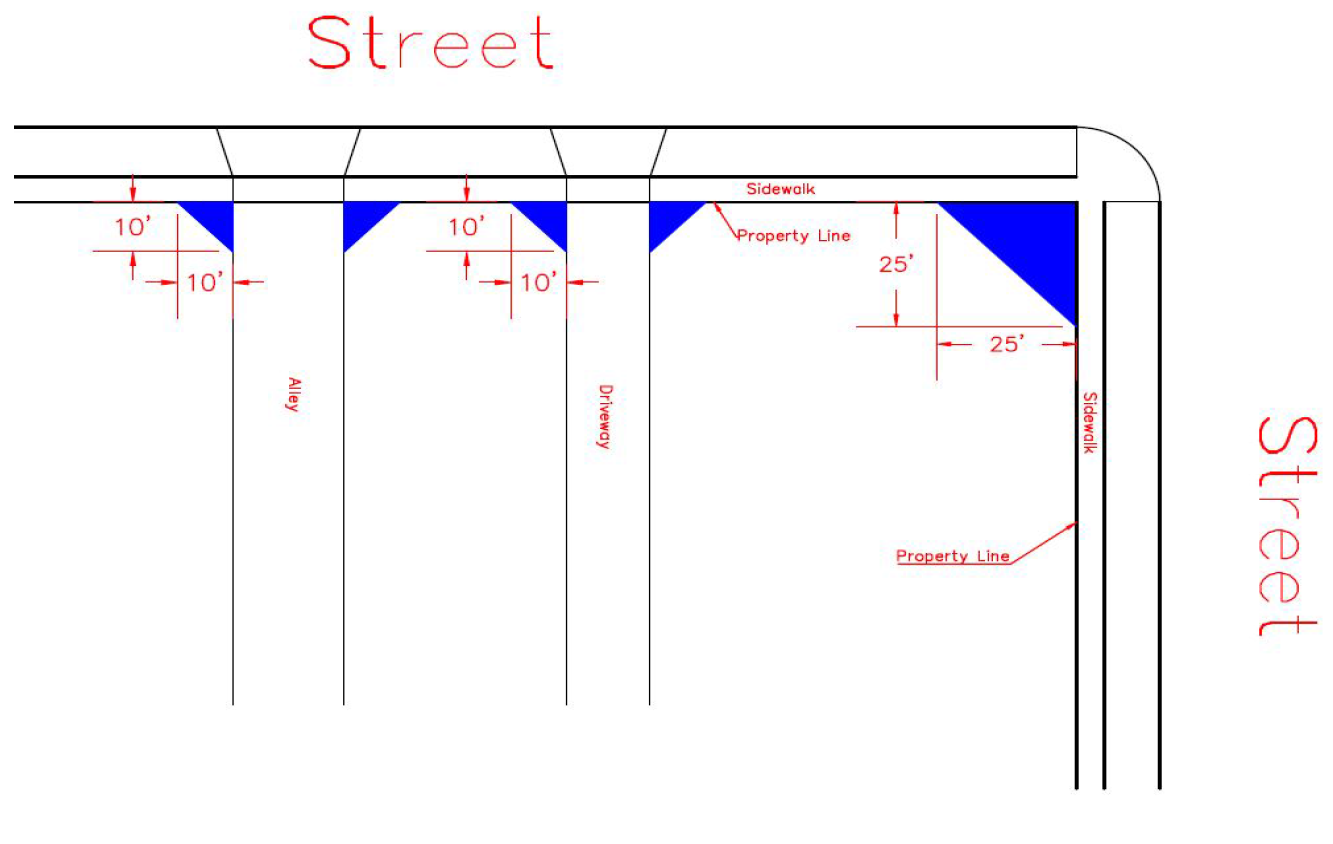
Small animal clinic: A place where small, household pets are treated for injuries and diseases, primarily on an outpatient basis. This includes the temporary indoor kenneling of recovering animals.
Smelting: A facility where metals are melted or fused with an accompanying chemical change.
Stable: Any premises or part thereon where horses or other equine animals are sheltered and fed.
Stable, private: Any lot or building or part thereon where horses or other equine animals are maintained, trained or cared for by the landowner for the sole purpose of pleasure.
Stable, riding: Any lot or building or part thereon where horses or any equine animals are maintained, boarded, trained or cared for in return for remuneration.
Stacking: The arrangement of motor vehicles in such a manner so as to form a single line, the purpose of which is frequently to place an order or obtain service or products at a drive-up window or device.
Standard tree: A tree with a minimum caliper of two and one-half inches and height of ten to 12 feet. The tree shall be of a deciduous hardwood variety normally capable of attaining a 25-inch diameter trunk when the tree is 20 years old.
Stockyard: A lot or building in which transient cattle, sheep, swine or horses are temporarily kept for slaughter, market or shipping.
Story: That portion of a building, other than a basement, included between the surface of any floor and the surface of the floor next above it, or, if there is no floor above it, the open space between the floor and the ceiling next above it.
Street: The traveled portion of a public right-of-way which affords the principal means of access to abutting property.
Street, arterial: A street that has the capacity to carry large volumes of traffic quickly and is designated as such on the major street plan.
Street, collector: A street that is a primary connector between arterial streets and is designated as such on the major street plan.
Street, principal arterial: A major traffic artery that is part of the federal highway system and is designated as such on the major street plan.
Structure: Anything constructed or erected which requires location on the ground or attached to something having a location on the ground, but not including fences or walls used as fences which are less than six feet in height. Poles, lines, cables or other transmission or distribution facilities of public utilities are not considered structures under this definition.
Sub-area development sequence: A proposed timetable providing the sequence in which a minor area of a planned development district will be developed.
Surfaced area: An area of land that is improved with gravel, asphalt or concrete.
Swimming pool, private: A tank of concrete, plastic, fiberglass or other material erected in or upon private property.
Swimming pool, public: A tank of concrete, plastic, fiberglass or other material erected in or upon publicly owned land.
Tank farm: A facility containing large, aboveground containers for the bulk storage in liquid form of petroleum products.
Telecommunications tower: A self-supporting lattice, guyed-lattice, or monopole structure that supports wireless communications facilities, such as microwave, common carrier, cellular telephone, personal communication services, two-way radio paging and other similar services. This term does not include amateur radio operator towers.
Temporary storage facility: A building made up of compartments that are rented for a limited time for use by various individuals for storing personal items. This term does not include commercial storage or warehousing.
Terminal: A building used for the administrative and managerial operations of an airport and may include customary passenger services such as retail stores, and other miscellaneous services.
Theater: An establishment that is used for the showing of motion pictures, plays or musical dramas.
Townhouse: An apartment building or duplex where each dwelling unit is located on the ground and attached by a common wall to other similar units. It is characterized by each dwelling unit and the land under the unit being owned individually and the remaining land being owned in common.
Tree: A tree with a minimum designated caliper and/or height range. Caliper indicates the diameter of the trunk six inches above grade (see section 94-399).
Truck gardening: The use of land for growing large quantities of produce for eventual shipment to market.
Truck stop: Any building or premises where the maintenance, servicing or repair of commercial vehicles is conducted, including the dispensing of motor fuel or other petroleum products directly into motor vehicles. It includes the sale of motor vehicle accessories and may include overnight accommodations and restaurant facilities.
Use, conditional: See "Conditional use."
Use, principal: A use which may be lawfully established in a particular district or districts provided it conforms with all requirements and regulations of such district in which such use is located.
Utility trailer/truck rental: The use of a building or land for the leasing of trailers and/or trucks.
Vocational/trade school: A secondary school teaching the skilled trades.
Warehousing: A building used primarily for the storage of goods and materials.
Warehousing, airport: A facility for the storage of aviation related equipment.
Wholesale trade: Establishments or places of business primarily engaged in selling merchandise to retailers and to industrial, commercial, institutional or professional businesses.
Wireless communications facilities: Any cables, wires, lines, wave guides, antennas, antenna arrays or other equipment associated with the transmission or reception of telecommunication signals.
Yard: An open space, other than a court, upon a lot, unoccupied and unobstructed from the ground upward, except as otherwise provided in this chapter.
Yard, front: A yard extending the full width of the lot and situated between either the front lot line and the building line, or the front lot line and the principal building, whichever is greater. The depth of the front yard shall be measured between either the foundation of the principal building and the front lot line, or, the building line and the front lot line, whichever is greater. Covered porches and garages, whether enclosed or unenclosed, shall be considered as part of the main building and shall not project into a required front yard.
Yard, primary front: In the case of a corner lot, the owner may choose the primary front yard abutting a street at the time of building permit for the primary structure, with the consent of the community development director or designee, based on the effects of such choice on development of the lot itself or on adjacent properties.
Yard, rear: A yard extending the full width of the lot and situated between the rear line of the principal building and the rear lot line. A rear yard is opposite from and most nearly parallel to the primary front yard.
Yard, side: A yard situated between the principal building and the side lot line and extending from the front yard to the rear yard.
Zone: A specifically delineated area or district within which regulations and requirements uniformly govern the use, location, size, area and density of land and buildings.
(Ord. No. 21-03, 8-26-2003; Ord. No. 08-04, 3-23-2004; Ord. No. 35-06, § I, 9-27-2006; Ord. No. 04-07, 1-23-2007; Ord. No. 07-07, § I, 2-27-2007; Ord. No. 04-08, 1-22-2008; Ord. No. 05-08, 2-12-2008; Ord. No. 42-08, 11-18-2008; Ord. No. 11-09, § I, 5-12-2009; Ord. No. 29-09, § 1, 11-17-2009; Ord. No. 30-09, § 1, 12-8-2009; Ord. No. 09-10, 2-23-2010; Ord. No. 11-12, § 1, 5-8-2012; Ord. No. 18-12, § 1, 7-10-2012; Ord. No. 21-12, § 1, 8-14-2012; Ord. No. 06-14, § 1, 3-25-2014; Ord. No. 13-14, § 1, 7-22-2014; Ord. No. 15-003, § 1, 5-12-2015; Ord. No. 15-020, § 1, 12-8-2015; Ord. No. 17-012, § I, 5-9-2017; Ord. No. 17-023, § I, 10-10-2017; Ord. No. 17-026, § I, 1-9-2018; Ord. No. 20-014, § 2, 8-11-2020; Ord. No. 23-030, § I, 9-12-2023; Ord. No. 25-015, § 1, 7-8-2025)
Sec. 94-2. - Purpose of chapter.
(a)
The zoning regulations and districts set forth in this chapter are based upon the comprehensive plan of the city, as amended.
(b)
These zoning regulations are designed to implement the goals and objectives of the comprehensive plan, to lessen congestion in the streets, secure safety from fire and other dangers, promote health and the general welfare of the community, provide adequate light and air, prevent the overcrowding of land or buildings, and to facilitate transportation, the provision of water, disposal of waste water, and further the optimal use of schools, parks, and public property, and the provision of public necessities.
(c)
The regulations have been made with reasonable consideration of the character and intensity of particular uses within each district. They are intended to preserve and protect existing property uses and values from adverse or disharmonious adjacent uses.
(Ord. No. 21-03, 8-26-2003)
Sec. 94-3. - Interpretation.
In the interpretation and application of this chapter, the provisions of this chapter shall be held to be minimum requirements, adopted for the promotion of the public health, safety and general welfare. Among other purposes, such provisions are intended to provide for adequate light, air and convenience of access; to lessen congestion in the streets; to secure safety from fire and other dangers; to avoid undue concentration of population by regulating and limiting the height and size of buildings wherever erected, to limit and determine the size of yards, courts and other open spaces; to regulate the density of population, all with reasonable consideration to the character of the district and its suitability for particular uses, and with a view of conserving the value of property and encouraging the most appropriate use of land throughout the city.
(Ord. No. 21-03, 8-26-2003)
Sec. 94-4. - Fractions.
Where fractional numbers occur in this chapter, they are to be rounded off to the next highest number.
(Ord. No. 21-03, 8-26-2003)
Sec. 94-5. - Compliance with chapter provisions.
(a)
Except as otherwise provided in this chapter, all buildings shall be erected, converted, enlarged, reconstructed, structurally altered or used:
(1)
Only for a purpose permitted in the district in which the structure or land is located.
(2)
Only in conformance with the height and minimum lot requirements, and the parking, loading, stacking, and sign regulations and any other applicable requirements of the district in which the structure or land is located.
(3)
Only in conformance with federal and state law and in accordance with all municipal ordinances and regulations as may be applicable.
Where this chapter and any other ordinance conflict or overlap, whichever imposes the more stringent restrictions shall apply.
(b)
The density and yard regulations of this chapter are minimum regulations for each building existing at the time of the effective date of this chapter or for any building erected or structurally altered thereafter. No land required for yards, lot frontage or other open spaces adjacent to an existing building or any building hereafter erected or structurally altered shall be considered a yard, frontage or lot area for more than one building except for a unit group of buildings.
(c)
Every building erected or structurally altered after the effective date of this chapter shall be located on a lot as herein defined and in no case shall there be more than one main building on a lot except as otherwise provided in this chapter.
(d)
Cooperatives, corporations, condominiums and all other forms of property ownership do not affect the application of these regulations and all requirements shall apply as though the property were under single ownership.
(e)
All inhabited manufactured and mobile homes shall conform to one of the following:
(1)
Use as a dwelling and located in an RMH or R-3A residential district or in a mobile home court;
(2)
Use as a dwelling associated with a farm; or
(3)
Use as a temporary office on a construction or development site.
A mobile home which is not in conformance with one of such requirements shall not be occupied or inhabited; nor shall it be connected to utilities except when being displayed for sale by a dealer or manufacturer.
(Ord. No. 21-03, 8-26-2003)
Sec. 94-6. - Penalty for violation of chapter.
(a)
For each violation of the provisions of this chapter, the owner, contractor or other persons interested as general agent, architect, engineer, land surveyor, building contractor, owner, tenant or any other persons who commit, take part in or assist in any violation of this chapter or who maintain any building or premises or uses of any land in violation of this chapter, shall, for each and every violation, be subject to prosecution and fines as provided in section 1-8 of this Code. Whenever such person has been officially notified by the appropriate authorities of the city or by service of a summons in a prosecution, or in any other official manner, that said person has committed or is committing a violation, each day's continuance of such violation after such notification shall constitute a separate offense punishable as provided in section 1-8.
(b)
In case any building or structure is erected, constructed, reconstructed, altered, repaired, converted or maintained, or any building, structure or land is used in violation of this chapter, the appropriate authorities of the city may, in addition to other remedies, initiate actions for abatement, institute injunction, mandamus or other appropriate action or proceeding to prevent such unlawful erection, construction, reconstruction, alteration, conversion, maintenance or use, and may correct or abate such violation or prevent the occupancy of said building, structure or land.
(Ord. No. 21-03, 8-26-2003)
Sec. 94-7. - Amendments.
(a)
Application for zoning change. A proposed change in zone district restrictions or boundaries of the zoning map may be initiated by the city council, city planning commission or by the owners of property within the area requested to be changed. A written application shall be filed with the community development department requesting a change in zone district classification. Such application shall be provided by the community development department and shall be completed in full by the applicant.
(b)
Application requirements. All applications shall be submitted to the community development department in the form as provided by the community development department, on or before the 1 st day of the month preceding the regular planning commission meeting in which the request is to be heard (e.g., file by August 1 for consideration at the September planning commission meeting).
(c)
Fees. Upon the filing of any application for zoning district classification change with the community development department, the applicant shall pay to the City of Brookings the appropriate fee as provided by resolution of the city.
(d)
Planning commission hearing.
(1)
Application; setting of dates; notice. Upon the filing of an application for a request of zoning district classification change with the community development department, accompanied by the fee as provided by resolution of the city, a date shall be set for public hearing. The date for a public hearing shall be a day when the planning commission is regularly scheduled to meet, as determined by the rules, policies and regulations adopted by the planning commission. Public notice for this meeting and changes to be considered shall be given once at least ten days in advance by publication in the legal newspaper of the municipality. Any interested person shall be given a full, fair and complete opportunity to be heard at the hearing.
(2)
Signs to be posted. Signs indicating the date, time, and location of the public hearing shall be posted on the property at least seven days prior to any public hearing held by the planning commission to consider a rezoning application. These signs shall be furnished by the city and posted by the applicant in the numbers and locations prescribed by the community development department. Signs may also be posted by the community development department. The size of each sign shall be no less than eight and one-half inches in width and 11 inches in length.
Exception: If the land requested to be rezoned contains multiple owners who own property within a block, or group of contiguous blocks, signs may be posted at the intersection corner of each block.
(e)
Planning commission report. The planning commission shall submit to the city council a final report containing its recommendations on those applications for zoning district regulation or classification changes that it has considered. Whenever the proposed change of boundaries or regulations affects an area outside the corporate limits in which the municipality has assumed zoning jurisdiction, no amendment, supplement or change in any such area shall be effective unless the Brookings County Planning Commission meets with the city planning commission and both planning commissions make recommendations to the city council and the board of county commissioners.
(f)
City council hearing.
(1)
Application; notice. The city council shall conduct a public hearing and act on all applications that have been processed and forwarded to it for public hearing as provided in this chapter. Notice of the time and place of the hearing shall be given once at least ten days in advance by publication in the legal newspaper of the municipality. Any interested person shall be given a full, fair and complete opportunity to be heard at the hearing, and the governing body may adopt or refuse the ordinance, with or without amendment.
(2)
Signs to be posted. Notice of such hearing may also be required to be given by posting signs on the property which is the subject of the change. If signs are required by the community development department , the regulations as set forth in section 94-7(d)(2) shall apply.
(3)
Review of planning commission decision; determination. At such public hearing, the city council shall review the decision and recommendation of the planning commission concerning the application submitted to the city council. The city council, in making its determination of such application, may make changes in the zoning map in accordance with, or in modification or rejection of, the recommendation of the planning commission.
(4)
Approval or denial. Approval or denial of any application for a zoning district classification change shall be by a majority of the members of the city council who are present and voting. If a zoning ordinance is adopted, the ordinance shall be published and take effect as other ordinances unless the referendum is invoked, or unless a written protest is filed with the clerk, signed by at least 40 percent of the owners of equity in the lots included in any proposed district and the lands within 250 feet from any part of such proposed district. A corporation shall be construed to be a sole owner, and when parcels of land are in the name of more than one person, ownership representation shall be in proportion to the number of signers who join in the petition in relation to the number of owners. If a protest is filed, the ordinance does not become effective unless the ordinance is approved by a two-thirds vote of the city council. Such written protest shall not be allowed as to any ordinance regulating or establishing floodplain areas.
(g)
Change of district regulation. Whenever the owners of 50 percent or more of the area of the lots in any district or part thereof desire any amendment, supplement or change of the provisions of this chapter which are applicable to such district or part thereof, they may file a petition with the city requesting the city to make such amendment, supplement or change. Such petition shall be accompanied by the required maps and schedule in accordance with section 94-7(b) showing the area affected by the proposed amendment, supplement or change, together with the boundaries of such area and the names and addresses of all the owners of the lots therein that are recorded in the office of the county register of deeds. Such petition shall immediately be transmitted to the city planning commission for an investigation and report.
(h)
Reapplication. Whenever an application to rezone a parcel of land has been defeated as described in subsection (f)(4) of this section, an application to rezone any part of that parcel alone or in combination with any other parcels shall not be resubmitted for one year from the date of the final action of the city council. This subsection, however, shall not prevent the city council from acting on its own initiative in any case or at any time as provided in this section.
(Ord. No. 21-03, 8-26-2003; Ord. No. 12-12, § 1, 5-22-2012; Ord. No. 15-014, § 1, 8-11-2015; Ord. No. 21-023, 7-13-2021)

