
Brownwood City Zoning Code
ARTICLE V
- SUPPLEMENTARY DISTRICT REGULATIONS
DIVISION 5. - OFF-STREET PARKING AND LOADING REQUIREMENTS[12]
Cross reference— Stopping, standing, parking, § 66-41 et seq.
Sec. 98-561. - Established.
(a)
Uses permitted in each zoning district are shown by means of symbols in the permitted use chart below. The chart is divided into ten categories of uses. These are:
(1)
Residential;
(2)
Accessory and incidental;
(3)
Cultural and recreational;
(4)
Governmental, health, safety and welfare;
(5)
Educational and religious;
(6)
Services (office-type);
(7)
Services (other than office-type);
(8)
Retail trade;
(9)
Wholesale trade;
(10)
Transportation, communications, utilities;
(11)
Manufacturing.
(b)
Land and buildings in each of the zoning districts may be used for any of the listed uses, but no land shall be used, and no building or structure shall be erected, altered or converted, which is designed or used for other than the uses specified as permitted uses in the district in which it is located in accordance with the use chart.
Symbols found in this chart of permitted uses have the following meanings:
(Code 1995, § 158.41(B); Ord. No. 00-22, § IV(B), 6-27-2000; Ord. No. 00-45, § III, 12-19-2000; Ord. No. 01-32, § III, 10-23-2001; Ord. No. 01-38, § II, 11-27-2001; Ord. No. 02-21, § IA, 5-14-2002; Ord. No. 03-45, § III, 11-11-2003; Ord. No. 04-12, § II, 4-13-2004; Ord. No. 12-19, § 2, 10-9-2012; Ord. No. 12-27, § III, 10-23-2012; Ord. No. 14-05, § 1.0, 3-10-2011; Ord. No. 19-08, § 2, 8-27-2019; Ord. No. 21-01, § 1.A., 1-12-2021; Ord. No. 22-13, § I(f), 8-23-2022; Ord. No. 25-03, § I(c), 2-26-2025)
Sec. 98-581. - General standards.
(a)
This division sets forth special provisions applicable to certain uses in certain zoning districts. No conditional use shall be permitted without a permit for such conditional use having been issued by the zoning administrator. The zoning administrator shall be furnished satisfactory proof that all applicable conditions, as set forth in this division, will be met. Any decision of the zoning administrator may be appealed to the board of adjustment.
(b)
Where a use is required to meet such conditions and a special exception is also required, the applicant shall furnish proof to the board of adjustment, by plans or other documents, that the applicable conditions have or shall be met.
(c)
Failure to comply with the applicable conditions for a conditional use, any other applicable ordinance, law or regulation, or the terms of any conditional permit or special exception shall automatically terminate the right to continue the conditional use and such use shall thereafter be unlawful unless a new permit is granted in accordance with this division.
(Code 1995, § 158.42(A))
Sec. 98-582. - Residential uses.
(a)
Recreational vehicle parks. Recreational vehicle parks are prohibited along (i) the entire length of Commerce Street; (ii) Coggin Avenue, from Highway 377 to Austin Avenue; (iii) Main Street, from the intersection of Commerce Street (Hwy 67/84), and extending along Highway 377 to the south city limits; and (iv) on Austin A venue beginning at the south city limits and extending to Market Place Boulevard. Subject to the foregoing, recreational vehicle parks shall be permitted in all commercial and industrial districts, except CN neighborhood commercial districts and CO commercial office districts, subject to the following conditions and requirements:
(1)
Buffer. A recreational vehicle park shall not be located less than 150 feet from any residential district.
(2)
Park size. All recreational vehicle parks shall contain a minimum contiguous area of two acres.
(3)
Minimum recreational vehicle space. Each recreational vehicle park shall provide recreational vehicle parking spaces and each such space shall be clearly defined and must provide convenient access for the placement of a recreational vehicle. Only one recreational vehicle is permitted per recreational vehicle space. Each individual space within the recreational vehicle park shall have an area of not less than 3,000 square feet to provide adequate space for a recreational vehicle.
(4)
Separation of recreational vehicles. Pads for recreational vehicles shall be separated by a minimum of 15 feet and each recreational vehicle shall be separated from each other by a minimum of 15 feet.
(5)
Use of each space. Each space shall only be allowed for the parking of one recreational vehicle. No business shall be operated from any space. No accessory structures may be erected on any recreational vehicle space. No permanent fencing or screening of any kind shall be allowed on a space. Fireworks are expressly prohibited. No tents or mobile and/or manufactured homes are allowed in the park. No animals, livestock or poultry of any kind shall be raised, bred or kept on a space and/or in the park, except for household pets such as cats and dogs, provided that they are not kept, bred or maintained for commercial purposes. No utility trailers may be parked on a space except on an approved parking surface as set forth herein. No clothes lines are permitted in the park.
(6)
Permanent residence prohibited. No recreational vehicle park or recreational vehicle located therein shall be used as a permanent residence for any period of time, except for permanent full-time employees of the park. No more than one space shall be allowed for use as a permanent residence for full-time employees. Occupancy or parking of a recreational vehicle within the recreational vehicle park extending beyond 90 days shall be presumed permanent occupancy and is hereby prohibited, except as provided below. A recreational vehicle may not return to the park for a period of 15 days after a 90 day stay. Notwithstanding the foregoing, a recreational vehicle park owner may designate up to 50 percent of the spaces in the park for extended occupancy. "Extended occupancy" is defined as occupancy or parking of a recreational vehicle in the park for a period of time not to exceed 180 days. A recreational vehicle may not return to the park for a period of 15 days after an extended occupancy stay. The occupancy periods provided above may not be stacked or added together. No guest may stay for a period of time greater than 180 consecutive days. The owner and/or park manager of the recreational vehicle park shall be responsible for enforcing this requirement and shall keep occupancy records of the park which shall be subject to inspection upon request by the city.
(7)
Pad sites for each space. Each space shall have a pad site constructed of concrete and/or asphalt of sufficient size, width and strength to park the recreational vehicle. The pad site must be contiguous with concrete and/or asphalt drives or roads so that the recreational vehicle is not travelling across the required green space as provided in paragraph (9). Recreational vehicles may only park on a pad site. The concrete and/or asphalt pad shall be constructed in accordance with the minimum standards for concrete and/or asphalt established by applicable city standards, including, without limitation, the specifications and design standards for public works improvements in chapter 94 of the Code of Ordinances, as may be amended, and shall be constructed of sufficient strength to support the weight of a recreational vehicle and to not heave, shift, or settle unevenly under the weight of the recreational vehicle due to frost, inadequate drainage, vibration or other forces acting on the structure. The design plans for all concrete and/or asphalt surfaces shall be subject to review and approval by the city engineer and/or his designee.
(8)
Parking surface for each space. Each space shall provide parking for two vehicles. No more than two vehicles shall park on each space. All parking spots shall be constructed of an approved parking surface which shall either be concrete and/or asphalt. All vehicles parked on a space must be parked on an approved parking surface. The concrete and/or asphalt parking surface shall be constructed in accordance with the design standards set forth in paragraph (7) above and shall be subject to review and approval by the city engineer and/or his designee.
(9)
Landscaping for each space; cleanliness of space and/or park. Each space shall contain a minimum of 25 percent of green space which shall be covered with a vegetative growth that is capable of preventing soil erosion and eliminating dust. The park owner shall be responsible for installing and maintaining the required landscaping for each space. The park owner shall maintain and keep all spaces and/or the park free of weeds and/or tall grass and shall keep all spaces clean, neat, safe and free of all trash, debris or other materials that are unsightly and/or unsanitary. No parking of any vehicle, utility trailer or other vehicle shall be allowed on the green space area.
(10)
Drainage. The park shall be located on a well-drained site, properly graded and equipped to insure rapid drainage and to be free from stagnant pools of water. The condition of the soil, ground water, drainage and topography shall be such that it shall not create a hazard to the property or the health and safety of the occupants.
(11)
Streets, internal circulation, parking and park entrance.
a.
All streets providing access to a recreational vehicle park shall be developed and maintained in good condition by the owner of the park in accordance with the following:
1.
All public streets shall include grading the full width of right-of-way, construction of integral curbs and gutters, base and pavement, constructed in accordance with city standards. All public streets shall be maintained by the city.
2.
All private streets shall provide adequate right-of-way to permit access to the recreational vehicle park. All private streets shall be maintained by the owner of the park.
b.
All streets providing access to individual spaces or sites in the recreational vehicle parks shall be developed in accordance with the following:
1.
All public streets shall include grading the full width of right-of-way, construction of integral curbs and gutters, base and concrete or asphalt pavement, constructed in accordance with city standards and subject to the review and approval of the city engineer and/or his designee.
2.
All private streets shall provide adequate paving width, with a minimum width of 20 feet for two-way traffic or ten feet for one-way traffic, consisting of base and concrete or asphalt pavement, constructed in accordance with city standards and subject to the review and approval of the city engineer and/or his designee.
3.
On-street parking shall be prohibited on all streets within the park unless additional paving of adequate width, i.e., at least a minimum of eight feet, is provided, and the plans for the park shall provide for two off-street parking spaces for each recreational vehicle space as provided in paragraph (8) above.
c.
The entrance to the park shall be designed to minimize congestion and hazards and allow free movement of traffic on adjacent streets.
(11)
Compliance with the Americans with Disabilities Act ("ADA"). The park shall comply with all state and federal standards for accessibility for the mobility impaired. The applicant shall show proof of compliance.
(12)
Recreational vehicles must be self-contained; utilities provided. All recreational vehicles must be self-contained and have state or federally-approved connections for electricity, water and sewer. Each recreational vehicle space shall be equipped with water, sewer and electrical hookups which shall conform to all applicable state and city codes and/or ordinances of the city.
(13)
Sewage disposal. An adequate and safe sewer system shall be provided in all parks for conveying and disposing of all sewage to the city's sewer system. The sewer system shall be constructed and maintained in accordance with city codes. All proposed sewage disposal facilities shall be approved by the city engineer and/or his designee. Septic systems shall not be allowed.
(14)
Electricity. All electrical service shall be installed in accordance with all applicable codes.
(15)
Garbage receptacles.
a.
Each recreational vehicle park shall be provided with adequate facilities for the collection and removal of refuse and garbage. All garbage receptacles shall be subject to approval by the city engineer or his designee.
b.
Refuse collection stands shall be provided for all refuse containers. Such container stands shall be so designed as to prevent containers from being tipped, to minimize spillage and container deterioration and to cleaning around them.
c.
The storage, collection and disposal of refuse in the recreational vehicle park shall be so conducted as to create no health hazards.
(17)
Fuel. All state and local regulations, including all city ordinances and codes shall apply to the handling of bottled gas and fuel oil and must be complied with.
(18)
Fire protection.
a.
Every park shall be equipped at all times with fire extinguishing equipment in good working order of such type, size, and number and so located within the park as to satisfy the fire code and other applicable regulations of the city.
b.
No open fires shall be permitted, except that this shall not be construed to prevent barbecuing with charcoal in an approved pit or grill.
c.
In parks in which gasoline, fuel oil, or other flammable liquids are stored or dispensed their handling and storage shall comply with the City fire code.
d.
Approaches to all recreational vehicle spaces shall be kept clear for firefighting personnel and equipment.
e.
The park owner or agent shall be responsible for the instruction of his staff in the use of the park fire protection equipment and in their specific duties in the event of fire.
f.
Water supply facilities for fire department operations.
1.
Water supply facilities for fire department operations shall be connected to the city public water supply system.
2.
The park owner shall provide standard city approved fire hydrants in accordance with applicable city codes and laws.
g.
The park owner shall be responsible for maintaining the entire area of the park free of dry brush, leaves and weeds.
(19)
Building permits. Prior to construction of a recreational vehicle park, the owner of the recreational vehicle park or his designee shall obtain all applicable City building permits. To obtain a building permit, the owner or his designee must present a written site plan to the city engineer for his review and approval.
(20)
Park supervision.
a.
Each park shall have a park manager.
b.
The park manager shall operate the park in compliance with this section and other applicable ordinances and shall provide adequate supervision to maintain the park, its facilities and its equipment in good repair and in a clean and sanitary condition.
c.
The park manager shall notify park occupants of all applicable provisions of this section and inform them of their duties and responsibilities under this section.
d.
The park manager shall maintain a register of park occupancy which shall contain at least the following information:
1.
name and address of park occupants,
2.
license number of recreational vehicle and/or tow vehicle,
3.
location of each recreational vehicle within the park by space or lot number, and
4.
dates of arrival and departure.
e.
A new register shall be initiated on January 1 of each year and the old register is retired, but the old register shall be retained on the premises for at least one year following the retirement.
f.
Registers shall be available for inspection at all reasonable times by an official of the city whose duties may necessitate access to the information contained therein.
(21)
Inspection.
a.
The city manager, code enforcement officer, the fire chief, and the police chief and other designated city employees (hereinafter "Authorized City employees") are hereby authorized and directed to make such inspections as necessary to determine compliance with this section.
b.
Authorized city employees shall have the power to enter at reasonable times upon any private or public property for the purpose of inspecting and investigating conditions relating to the enforcement of this section.
c.
Authorized city employees shall have the power and authority in discharging their official duties to inspect the register containing a record of all residents of the park.
(22)
Applicability of ordinance; exceptions. This section shall apply to any recreational vehicle park located within the city limits of Brownwood, Texas. Notwithstanding the foregoing, the requirements of this section shall not apply to any recreational vehicle park owned by a governmental entity and to any recreational vehicle parks existing prior to the effective date of the ordinance from which this section derives.
(b)
Mobile homes constructed before June 15, 1976. Mobile homes constructed before June 15, 1976, shall be permitted in MH districts, subject to the following conditions:
(1)
A notarized statement shall be provided from a licensed electrician stating that the mobile home meets the requirements of the electrical code; and
(2)
The mobile home shall comply with the building code adopted in section 78-31 regulating smoke detectors.
(c)
Group living.
(1)
Characteristics. Group living is characterized by the residential occupancy of a structure by a group of people who do not meet the definition of the term "household living," as set forth in section 98-1. The size of the group may be larger than the average size of a household. Tenancy is arranged on a monthly basis, or longer. Uses where tenancy may be arranged for a shorter period of time are not considered to be residential, but are considered to be a form of transient lodging (see the definitions of the terms "hotel" and "motor court and motel," as set forth in section 98-1). Generally, group living structures may often, but are not required to, have a common eating area for residents. The residents may receive care, training or treatment.
(2)
Accessory uses. Accessory uses commonly associated with group living are recreational facilities and parking of vehicles for occupants and staff.
(3)
Examples. Examples of group living include:
a.
Dormitories;
b.
Fraternities and sororities;
c.
Monasteries and convents;
d.
Roominghouses and boardinghouses;
e.
Assisted living facilities for elderly residents;
f.
Nursing and convalescent homes;
g.
Some group homes for the physically or developmentally disabled, or mentally or emotionally disturbed.
(4)
Exceptions. Exceptions to group living include:
a.
Lodging where tenancy may be arranged for periods of less than 30 days, which shall be considered a hotel or motel use.
b.
Lodging where the residents meet the definition of the term "household," as set forth in section 98-1, and where tenancy is arranged on a month-to-month basis, or a longer period of time, and shall be classified as household living.
c.
Facilities for the rehabilitation of residents with alcohol- or drug-related dependencies, which shall be considered to be recovery facilities.
d.
Facilities for people who are under judicial detainment and under the supervision of sworn officers, and such facilities are included in the detention facilities category.
(5)
Community homes. A community home for occupancy by as many as six disabled persons and two supervisors may be classified as either household living or group living as long as such facility conforms to all applicable standards set forth in this subsection (c). To qualify as a community home allowable as either household living or group living, a resident must conform to all of the following standards:
a.
A community home must be a:
1.
Community-based residential home operated by the state department of mental health and mental retardation, a community center organized under subchapter A of V.T.C.A., Health and Safety Code §§ 534.001—534.040, that provides services to persons with disabilities, an entity subject to the Texas Nonprofit Corporation Act (Vernon's Ann. Civ. St. art. 1396-1.01 et seq.), or an entity certified by the state department of human services as a provider under the medical assistance program servicing persons in intermediate care facilities for persons with mental retardation; or
2.
Personal care facility licensed under V.T.C.A., Health and Safety Code ch. 247, provided that the exterior structure retains compatibility with surrounding residential buildings. (See V.T.C.A., Human Resources Code § 123.004.)
b.
A community home shall provide all of the following services to persons with disabilities who reside in the home:
1.
Food and shelter;
2.
Personal guidance;
3.
Care;
4.
Habitation services; and
5.
Supervision.
c.
Not more than six persons with disabilities and two supervisors may reside in a community home at the same time. The limitation or number of persons with disabilities applies regardless of the legal relationship of such persons to one another.
d.
A community home must meet all applicable licensing requirements.
e.
A community home shall not be established within one-half mile of an existing community home.
f.
The residents of a community home shall not keep for the use of residents of the home, either on the premises or on a public right-of-way adjacent to the home, motor vehicles in numbers exceeding the number of bedrooms in the home.
(d)
Recreational vehicles on private property.
(1)
A person may not stay in, reside, and/or occupy a recreational vehicle on private property other than in a designated recreational vehicle park as specified in subsection 98-582(a), except on a temporary basis, not to exceed ten days.
(2)
A person may not connect a recreational vehicle to city supplied utilities (i.e., water and/or sewer) for the purposes of staying in, residing and/or occupying a recreational vehicle, other than on a temporary basis, not to exceed ten days.
(3)
A resident who owns a recreational vehicle may park at their residence for parking purposes only. Electric service may be connected to the recreational vehicle by an extension cord for conditioning purposes only (heat, cool, appliances), to work on the recreational vehicle or for temporary use as permitted herein. The recreational vehicle shall at no time be used as a permanent dwelling and shall not be considered a permissible accessory building or structure.
(4)
No person shall hook up a recreational vehicle to electrical utilities, water, city sewer, septic systems, telephone, or place a receptacle for receiving mail or any other service or device which would indicate more than the temporary use of the recreational vehicle as permitted herein.
(5)
Property owners are responsible for recreational vehicles and their uses while placed on their property regardless of the ownership of the recreational vehicle.
(Code 1995, § 158.42(B); Ord. No. 01-38, § IIB(158.42), 11-27-2001; Ord. No. 03-43, § I, 11-11-2003; Ord. No. 06-19, § I, 5-23-2006; Ord. No. 14-05, § 1.0, 3-10-2014; Ord. No. 21-15, § 1, 10-12-2021)
Sec. 98-583. - Accessory and incidental uses.
(a)
Accessory buildings.
(1)
In residential districts, an accessory building shall be used only for such uses as are consistent with the primary use of the land and shall not be used for the conduct of business or rental and shall be subject to the following conditions:
a.
No accessory building shall project beyond a required yard line along any street.
b.
Thirty percent and unenclosed parking spaces may occupy not more than 90 percent of the area of a required rear yard.
c.
No accessory building shall be closer than ten feet to the main building, nor closer than three feet to any rear lot line.
(2)
In nonresidential districts, an accessory building shall be subject to the same conditions which are applicable to an accessory building in a residential district.
(b)
Keeping of livestock and other animals.
(1)
No livestock shall be permitted to be kept, harbored or maintained within the following zoning districts of the city: R-1, R-1A, R-1B, R-2, R-3, MH, CN, C-2A, C-U AND CO, excluding ranchette subdivisions established under chapter 94, article VI, division 2 of this Code. Livestock may be permitted as a conditional use in the following zoning districts of the city: RR, C-1, C-2, M-1, M-2 and A-1.
(2)
In zoning districts where livestock are permitted, except A-1 and ranchette subdivision as described below, the number of livestock kept on a given lot shall not exceed the ratio of one animal unit, per one free roaming acre, with an animal unit identified as follows:
1 cow = 1 animal unit
1 horse = 1 animal unit
1 mule = 1 animal unit
1 burro = 1 animal unit
2 sheep = 1 animal unit
2 goats = 1 animal unit
2 llamas = 1 animal unit
2 alpacas = 1 animal unit
10 chickens = 1 animal unit
For any other livestock not specifically listed, the animal unit equivalency will depend on the size of the typical adult animal of the species. If the animal is similar in size to a cow, horse, mule or burro then it will equal one animal unit. If the animal is similar in size to a sheep, goat, llama or alpaca, then two of those animals will equal one animal unit.
Offspring shall be exempt from the animal limitation until reaching the age of 12 months. Any acreage designated for livestock shall be "free roaming acres" such that the livestock has unrestricted access to the entirety of the acreage. For purposes of determining the amount of "free roaming acres" available to keep livestock, any area on the site designated for the keeping of livestock shall exclude structures, dwellings or houses (except structures used for shelter by the livestock), any lakes, tanks, ponds or other bodies of water and/or any unenclosed or unfenced area. In ranchette subdivisions established under chapter 94, article VI, division 2 of this Code, and in A-1 districts, the site for the keeping of livestock shall contain a minimum of one, free roaming acre per three animal units quartered. Offspring shall be exempt from the animal limitation until reaching the age of 12 months.
(3)
Notwithstanding the foregoing, no swine, emu, ducks, geese, guinea, turkeys or any other fowl, shall be allowed or permitted to be kept in the city, except swine as provided by chapter 14, article IV, subsection 14-223(b)(5) and chickens as provided herein. Chickens may be allowed in all zoning districts of the city, subject to the restrictions as set forth in subsections (b)(4), (b)(5) and (b)(7) of this section.
(4)
Adequate shelter shall be provided for each animal. The shelter must be of sufficient size to allow each animal to stand up, lie down and turn around in a natural position. With the exception of chicken coops, pens or enclosures, any structure, pen, shelter, enclosure or other means used to restrain an animal, including, without limitation, a rope, shall be located not less than 75 feet from any street right-of-way or lot line. Chicken coops, pens or enclosures are restricted to rear yards only and must be a minimum of ten feet from any lot line and a minimum of 50 feet from a neighboring occupied structure or offsite receptor.
(5)
Fences for pens, corral fences or similar enclosures must be of a sufficient height and strength to retain animals. All chickens shall be properly penned and contained. Chickens shall be restricted to a maximum of ten hens per lot, except for property located in the following zoning districts: RR, C-1, C-2, M-1, M-2 and A-1. Roosters are prohibited within the city limits. There shall be a minimum space for coops of four square feet for each bird and a minimum space for pens or runs of 15 square feet per bird. Barbed-wire fences are not permitted in any zoning districts, except A-1 districts as set forth in subsection (e)(5) of this section.
(6)
Manure and droppings shall be removed from the property, including any of the pens, stables, sheds or other enclosures, regularly, based on the size and number of animals. This waste matter shall be disposed of in such a way and with such frequency so as to keep the property free from any nuisance.
(7)
The keeping of livestock in the zones indicated in subsection (b)(1) and chickens in the zones indicated in subsection (b)(3) above, may only be permitted so long as such use does not cause a hazard to health by reason of unsanitary conditions, and are not offensive by reason of odors, dust, fumes, noise or vibration, and are not otherwise detrimental to the public welfare.
(c)
Church or public bulletin board. Any church or public bulletin board shall not exceed ten square feet in area.
(d)
Farming and truck gardening. All general and special agricultural, farming and other related uses shall be permitted as long as such uses do not cause a hazard to health by reason of unsanitary conditions, and are not offensive by reason of odors, dust, fumes, noise or vibration, and are not otherwise detrimental to the public welfare.
(e)
Fences, walls, shrubbery and hedges.
(1)
Fences, walls, shrubbery and hedges, extending closer than 25 feet to the front property line, shall not exceed a height of four feet above the walk grade, except on corner lots.
(2)
Any fence, wall, hedge or shrubbery on a corner lot and situated within 20 feet of the intersection of two street lines shall not exceed a height of three feet above the street gutter flow line.
(3)
Solid fences or enclosure walls are permitted in the required side and rear yards, provided that they do not exceed a height of eight feet.
(4)
Ornamental fences exceeding eight feet in height shall have a ratio of solid portion to open portion not in excess of one to four.
(5)
In A-1 districts, barbwire fences may be used, provided that a necessity can be shown for the use of the wire, such as keeping livestock contained on the property.
(6)
Any fence or enclosure wall must be made of wood, masonry, or other material approved by the city building inspector.
(f)
Home occupations. Home occupations shall include the use of the premises by a physician, dentist, lawyer, clergyman or other professional person for consultation or emergency treatment, but not for the general practice of such person's profession. A home occupation is additionally, any occupation or activity which, or for which:
(1)
Is carried on by a member of the immediate family residing on the premises.
(2)
No sign is used, other than a nameplate not more than one square foot in area.
(3)
There is no display that indicates from the exterior that the building is being utilized, in part, for any purpose other than that of a dwelling.
(4)
There is no commodity sold upon the premises.
(5)
No person is employed, other than a member of the immediate family residing on the premises.
(6)
No mechanical equipment is used, except of a type that is similar in character to that normally used for purely domestic or household purposes.
(g)
Private swimming pools and tennis courts, accessory to single-family residences. Private swimming pools or tennis courts which are accessory to single-family residences shall be located:
(1)
At least ten feet from the nearest property line.
(2)
Within a fenced yard, or shall be screened by a masonry wall or solid fence at least six feet in height.
(Code 1995, § 158.42(C); Ord. No. 01-32, § III, 10-23-2001; Ord. No. 02-61, § 1, 12-10-2002; Ord. No. 06-19, § I, 5-23-2006; Ord. No. 10-15, 7-27-2010; Ord. No. 12-19, § 2, 10-9-2012; Ord. No. 19-08, § 2, 8-27-2019)
Sec. 98-584. - Cultural and recreational uses.
(a)
Amusement parks, carnivals, circuses, drag strips, commercial racing, motorcycle tracks, go-carts and minibike tracks. Amusement enterprises shall have no facilities located closer than 500 feet to a residential district. Adequate measures shall be taken to prevent odor, dust, noise, lights and traffic from becoming a nuisance to uses on adjacent properties.
(b)
Fraternal organization, lodge, civic club, social club, fraternities and sororities. Fraternal organization, lodge, civil club, social club, fraternities and sororities shall be permitted in commercial zones, industrial zones and agriculture zones. Fraternities and sororities shall be permitted in R-3 zones provided that the chief activity of the fraternity or sorority is not a service carried on as a business.
(c)
Community centers. In residential districts, any community center building shall be located not less than 25 feet from any side lot line.
(d)
Golf, miniature. A solid screening wall or fence, not less than six feet in height, shall be provided on any boundary or lot line adjacent to or abutting upon any residential district. The screening wall or fence must be made of wood, masonry, or other material approved by the city building inspector. For purposes of this section, a boundary or lot line shall be adjacent to or abutting upon any residential district, even if the boundary or lot line is separated from the residential district by an alley or street.
(e)
Libraries and museums. In residential districts, any library or museum building shall be located not less than 25 feet from any side lot line.
(f)
Parks and playgrounds. In residential districts, any park or playground building shall be located not less than 25 feet from any side lot line.
(g)
Riding academies and stables. Riding academies or stables shall be permitted in A-1, M-1 and M-2 districts, provided, any structure or enclosure for the shelter of animals shall be located not less than 150 feet from any residential or MH district.
(h)
Tennis courts, public. Tennis courts which are not accessory to a residential use shall be located:
(1)
Not less than ten feet from the nearest residential property line.
(2)
Within a fenced area, and the fence shall be not less than 15 feet in height.
(Code 1995, § 158.42(D); Ord. No. 01-32, § III, 10-23-2001; Ord. No. 06-19, § I, 5-23-2006; Ord. No. 25-03, § I(b), 2-26-2025)
Sec. 98-585. - Government, health, safety and welfare.
(a)
Sanitary landfills. Sanitary landfills Shall be permitted as regulated by applicable state laws and as permitted by the state department of health or other agency as designated by state law.
(b)
Recovery facilities.
(1)
Characteristics and requirements. Recovery facilities are characterized by programs that provide care and training or treatment for psychiatric, alcohol or drug problems, where patients are residents of the program, but where patients are not supervised by sworn officers. The size of the group may be larger than the average size of a household. Generally, recovery facilities may often, but are not required to, have a common eating area for residents. The residents may also receive care, training or treatment. A license, if required, to operate the facility must be obtained from the appropriate federal, state or other governmental agency. Depending on the type of the facility, professional staff must be in residence, at all times. For the purposes of this subsection, the term "professional staff" means an individual who has, either by experience or training, knowledge in the appropriate rehabilitative field.
(2)
Accessory uses. Accessory uses common associated with recovery facilities are recreational facilities and parking of vehicles for occupants and staff.
(c)
Examples. Examples of recovery facilities include psychiatric, alcohol or drug-dependency or rehabilitation centers.
(d)
Exceptions. Facilities for people who are under judicial detainment and under the supervision of sworn officers are included in the detention facilities category.
(Code 1995, § 158.42(E); Ord. No. 01-38, § II, 11-27-2001)
Sec. 98-586. - Educational and religious facilities.
(a)
Churches, Sunday schools and other places of worship. Churches, Sunday schools or other places of worship shall be permitted in all zoning districts, except M-2 industrial, provided that any such building shall be located not less than 20 feet from any side line.
(b)
Denominational public and private schools, and public school kindergartens. Denominational public and private schools or public school kindergartens, including private schools having a curriculum comparable to that offered in public schools, shall be permitted in all zoning districts, except M-2 industrial, provided that:
(1)
Any building shall be located not less than 40 feet from any side or rear lot line.
(2)
The minimum lot area shall not be less than two acres.
(Code 1995, § 158.42(F))
Sec. 98-587. - Office-type uses.
(a)
No retail sales of merchandise shall be allowed in CO commercial office districts. Accessory uses that may be permissible in CO districts may include sundry shops, cafeterias, health facilities, parking, or other amenities intended primarily for the use of employees in the firm or building.
(b)
Offices that are a part of and located with a principal use in another category are considered accessory to the firm's primary activity. Headquarter offices, when located on the same premises as or adjacent to a principal use in another category are considered part of the other category.
(c)
Offices for construction contractors and others who perform services off-site are included in the CO district category if equipment and materials are not stored on the office site and fabrication, services, or similar work is not carried on at the office site.
(Ord. No. 03-45, § III(158.42(F.1)), 11-11-2003)
Sec. 98-588. - Services.
(a)
Automobile repair, painting and body work.
(1)
Automobile repair, painting and body work shall be conducted wholly within an enclosed building.
(2)
Open storage of merchandise, equipment, containers, waste material, disassembled vehicles or vehicle parts is prohibited, except when enclosed by a solid screening wall or fence not less than six feet in height. The solid screening wall or fence shall be made of wood, masonry, or other material approved by the city building inspector.
(b)
Carpentry, painting, tinsmithing, plumbing, upholstery and furniture repair shops.
(1)
Carpentry, painting, tinsmithing, plumbing, upholstery and furniture repair shall be conducted wholly within an enclosed building.
(2)
Open storage of merchandise, equipment, containers and waste material is prohibited, except when enclosed by a solid screening wall or fence not less than six feet in height. Screening material shall consist of wood, masonry or other material approved by the city building official.
(c)
Catering services. A solid screening wall or fence not less than six feet in height shall be provided on any boundary or lot line adjacent to or abutting upon any residential district. The screening wall or fence must be made of wood, masonry, or other material approved by the city building inspector. For purposes of this section, a boundary or lot line shall be adjacent to or abutting upon any residential district even if the boundary or lot line is separated from the residential district.
(d)
Day care centers and day nurseries. Day care centers and day nurseries for more than six children may be permitted in all R, MH and CN districts as a special exception, subject to the following conditions:
(1)
A solid screening wall or fence at least six feet in height shall be provided between any play area and any adjacent residential property. The screening wall or fence must be made of wood, masonry, or other material approved by the city building inspector.
(2)
Ingress and egress shall be designed to eliminate interference with traffic or adjacent streets.
(3)
Such uses shall meet state minimum standards for day care centers.
(e)
Veterinarian and animal hospitals. No veterinarian or animal hospital building, kennel or exercise runway shall be closer than 150 feet to any R or MH district.
(f)
Tatoo parlors and body piercing studios.
(1)
Tattoo parlors and body piercing studios shall not be located any closer than 1,500 feet from a R-1 district, school, church or day care facility.
(2)
Tattoo parlors and body piercing studios shall not be located in the development area created by the city in Ordinance No. 99-37.
(g)
Applicable to all service businesses. A solid screening wall or fence not less than six feet in height shall be provided on any boundary or lot line adjacent to or abutting upon any residential district (except for day care centers or day nurseries). The screening wall or fence must be made of wood, masonry, or other material approved by the city building inspector. For purposes of this section, a boundary or lot line shall be adjacent to or abutting upon any residential district even if the boundary or lot line is separated from the residential district by an alley or street. Adequate measures shall be taken to prevent odor, dust, noise, lights, and traffic from becoming a nuisance to adjacent residential properties.
(Code 1995, § 158.42(G); Ord. No. 01-38, § II, 11-27-2001; Ord. No. 04-12, § II, 4-13-2004; Ord. No. 04-20, § I, 5-11-2004; Ord. No. 06-19, § I, 5-23-2006)
Sec. 98-589. - Retail trade.
(a)
Automobile wrecking yards, salvage yards and junkyards.
(1)
Automobile wrecking yards, salvage yards or junkyards shall be permitted in M-2 districts with the approval of the city council after a report by the city manager and fire marshal.
(2)
The premises must be wholly enclosed within a building or by a metal, masonry or wooden fence not less than eight feet in height, and in which any openings or cracks are less than 15 percent of the total area.
(b)
Cafeterias, restaurants and drive-in restaurants. A solid screening wall or fence not less than six feet in height shall be provided on any boundary or lot line adjacent to or abutting upon any residential district. The screening wall or fence must be made of wood, masonry, or other material approved by the city building inspector. For purposes of this section, a boundary or lot line shall be adjacent to or abutting upon any residential district even if the boundary or lot line is separated from the residential district by an alley or street.
(c)
Retail stores. The slaughtering of animals or poultry on the premises of any retail store shall be prohibited.
(d)
Secondhand merchandise stores. All merchandise of a secondhand merchandise store which is not located within a closed structure shall be enclosed by a solid screening wall or fence not less than six feet in height, constructed of wood, masonry or other material approved by the city building official.
(e)
Stockyards and slaughter of animals. Stockyards or the slaughter of animals shall be permitted in M-2 districts with the approval of the city council after a report by the city manager and fire marshal.
(f)
Applicable to all retail businesses. A solid screening wall or fence not less than six feet in height shall be provided on any boundary or lot line adjacent to or abutting upon any residential district. The screening wall or fence must be made of wood, masonry, or other material approved by the city building inspector. For purposes of this section, a boundary or lot line shall be adjacent to or abutting upon any residential district even if the boundary or lot line is separated from the residential district by an alley or street. Adequate measures shall be taken to prevent odor, dust, noise, lights, and traffic from becoming a nuisance to adjacent residential properties.
(Code 1995, § 158.42(H); Ord. No. 06-19, § I, 5-23-2006)
Sec. 98-590. - Wholesale trade.
(a)
Display rooms. Display rooms for merchandise to be sold at wholesale shall be permitted in C districts, provided that the merchandise is stored elsewhere.
(b)
Petroleum storage. Petroleum storage shall be permitted in all M districts, provided that the location and treatment of the premises have been approved by the fire marshal.
(c)
Applicable to all wholesale businesses. A solid screening wall or fence not less than six feet in height shall be provided on any boundary or lot line adjacent to or abutting upon any residential district. The screening wall or fence must be made of wood, masonry, or other material approved by the city building inspector. For purposes of this section, a boundary or lot line shall be adjacent to or abutting upon any residential district even if the boundary or lot line is separated from the residential district by an alley or street. Adequate measures shall be taken to prevent odor, dust, noise, lights, and traffic from becoming a nuisance to adjacent residential properties.
(Code 1995, § 158.42(I); Ord. No. 06-19, § I, 5-23-2006)
Sec. 98-591. - Manufacturing.
(a)
No manufacturing building shall be erected, reconstructed or structurally altered for residential purposes, except for resident watchmen and caretakers employed on the premises, and provided that no building or occupancy permit shall be issued for any of the following uses until and unless the location of the use shall have been approved by the city council after a report by the city manager and fire marshal:
(1)
Acid manufacture.
(2)
Cement, lime, gypsum, or plaster of Paris manufacture (except for concrete batch plants meeting the conditions set forth in paragraph (d) below).
(3)
Distillation of bones and glue manufacture.
(4)
Explosives manufacture or storage.
(5)
Fat rendering.
(6)
Fertilizer manufacture.
(7)
Refining of petroleum or its products.
(8)
Smelting of tin, copper, zinc or iron ores, and other metals.
(b)
Industrial and manufacturing plants, including the processing or assembling of parts for production of finished equipment, shall be permitted in M-2 districts, provided, the process of manufacturing or treatment of materials is such that only a nominal amount of dust, odor, gas, smoke or noise is emitted and not more than ten percent of the lot or tract is used for the open storage of products, materials or equipment.
(c)
For all manufacturing businesses, a solid screening wall or fence not less than six feet in height shall be provided on any boundary or lot line adjacent to or abutting upon any residential district. The screening wall or fence must be made of wood, masonry, or other material approved by the city building inspector. For purposes of this section, a boundary or lot line shall be adjacent to or abutting upon any residential district even if the boundary or lot line is separated from the residential district by an alley or street. Adequate measures shall be taken to prevent odor, dust, noise, lights, and traffic from becoming a nuisance to adjacent residential properties.
(d)
Concrete batch plants, to be permitted in M-1 restricted industrial districts, must meet the following conditions:
(1)
Must be a low-profile plant, with no stacks, buildings or extending over 18 feet high on the site;
(2)
Must construct a noise barrier around the plant site, using cement blocks or similar material around the plant site to help reduce operating noise;
(3)
Must reduce noise from the plant and truck traffic at the site by disconnecting any backup tones on trucks and vehicles at the site and any whistles or other warning tones on plant equipment;
(4)
Must not crush rock or other material on site; and
(5)
Must install a dust recovery system to minimize dust and air pollution.
(e)
If a concrete batch plant does not meet the conditions set forth in this paragraph (d), the plant may only be located in an M-2 industrial district zone, provided it meets the conditions set forth in paragraphs (a)—(c).
(Code 1995, § 158.42(J); Ord. No. 06-19, § I, 5-23-2006; Ord. No. 21-01, § 1.B., 1-12-2021)
Sec. 98-611. - Established.
Height and area requirements shall be as set forth in the following table:
(Code 1995, § 158.43; Ord. No. 00-45, § III, 12-19-2000; Ord. No. 03-45, § III, 11-11-2003; Ord. No. 12-27, § III, 10-23-2012)
Sec. 98-612. - Exceptions and modifications.
(a)
Height.
(1)
The height regulations prescribed in section 98-611 shall not apply to television and radio towers, church spires, belfries, monuments, tanks, water and fire towers, stage towers or scenery lofts, cooling towers, ornamental towers and spires, chimneys, elevator bulkheads, smokestacks, conveyors and flagpoles.
(2)
Public or semipublic service buildings, hospitals, institutions or schools, where permitted, may be erected to a height not exceeding 60 feet, and churches and temples may be erected to a height not exceeding 75 feet when the required side and rear yards are each increased by one foot for each foot of additional building height above the height regulations for the district in which the building is located.
(3)
The limitation in section 98-611 on the number of stories shall not apply to buildings used exclusively for storage purposes, provided that the buildings do not exceed the height, in feet, permitted in the district in which they are located.
(b)
Front yards.
(1)
All front yards, including both street fronts of a corner lot, may be adjusted to less than the building setback requirements to be in line with the average building setback line of existing main buildings on the same side of the same block; however, in no case shall any front yard be less than 15 feet.
(2)
On corner lots, the required setback from the property line on the side street shall be a minimum of 15 feet; provided, however, that any side yard fronting on a major thoroughfare shall not be less than 25 feet.
(3)
In a residential district, no structure, fence or planting higher than three feet above the street gutter flow line shall be maintained within 20 feet of any street intersection.
(4)
An open, uncovered porch or paved terrace may project into a required front yard for a distance of not more than ten feet, but shall not be interpreted to include or permit fixed canopies.
(5)
Filling station pumps and pump islands may be located within a required yard, provided that they are not less than 15 feet from any property line and not less than 50 feet from the boundary of any residential district.
(6)
Off-street parking facilities may be located within the required front yard of any C or M district, but shall not be closer than 50 feet to any R district.
(c)
Side yards.
(1)
On a corner lot, the width of the yard along the side street shall not be less than 15 feet on the street; provided, however, that the buildable width of a lot of record shall not be reduced to less than 32 feet.
(2)
Where dwelling units are erected above commercial establishments, no side yard is required, except when a side yard is required for the commercial building on the side of a lot adjoining a residential district.
(3)
A porte cochere or canopy may project into a required side yard, provided that every part of the porte cochere or canopy is unenclosed and not less than five feet from any side lot line.
(4)
For the purpose of side yard regulations, a two-family dwelling or multiple dwelling shall be considered as one building occupying one lot.
(5)
Where a lot of record, at the time of the effective date of the ordinance from which this chapter is derived, is less than 40 feet in width, the required side yard may be reduced to ten percent of the width of the lot; provided, however, that no side yard shall be less than three feet. (See subsection (e) of this section.)
(d)
Rear yards.
(1)
Where a lot abuts upon an alley, one-half of the alley width may be considered as part of the required rear yard.
(2)
The ordinary projections of sills, belt courses, cornices and ornamental features may extend into a required yard a distance not to exceed 18 inches.
(3)
Open or lattice enclosed fire escapes, outside stairways and balconies opening upon fire towers, and the ordinary projections of chimneys and flues into a rear yard may be permitted by the building official for a distance not to exceed five feet when placed so as not to obstruct light and ventilation.
(e)
Lot area per family. Where a lot of record, at the time of the effective date of the ordinance from which this chapter is derived, has less area or width than required in section 98-611 in the district in which it is located, and the owner of the lot does not own any other parcel or tract adjacent thereto, the lot may be used for a one-family dwelling or for any nondwelling use permitted in the district in which it is located. (See subsection (c)(5) of this section.)
(Code 1995, § 158.44; Ord. No. 00-12, § 158-44, 3-28-2000; Ord. No. 11-30, § 4.E, 12-13-2011)
Sec. 98-631. - Parking spaces required.
In all districts, except as provided in section 98-632(4), there shall be provided, at the time any building or structure is erected or structurally altered, off-street parking spaces in accordance with the requirements set forth in the chart of permitted uses as set forth in section 98-561.
(Code 1995, § 158.45(A))
Sec. 98-632. - Computation of number of parking spaces.
In computing the number of required parking spaces, the following rules shall govern:
(1)
Definitions. The following words, terms and phrases, when used in this section, shall have the meanings ascribed to them in this subsection, except where the context clearly indicates a different meaning:
Floor area means the gross floor area of the specific use.
(2)
Fractional spaces. Where fractional spaces result, the parking spaces required shall be construed to be the nearest whole number.
(3)
Uses not enumerated. The parking space requirement for a use not specifically mentioned in this division shall be the same as required for a use of a similar nature.
(4)
Change of use. Whenever a building or use constructed or established after the effective date of the ordinance from which this chapter is derived is changed or enlarged in floor area, number of employees, number of dwelling units, seating capacity or otherwise to create a need for an increase of ten percent or more in the number of existing parking spaces, the parking spaces shall be provided on the basis of the enlargement or change. Whenever a building or use existing prior to the effective date of the ordinance from which this chapter is derived is enlarged to the extent of 50 percent or more in floor area or in the area used, the building or use shall comply with the parking requirements set forth in this division.
(5)
Mixed uses. The parking spaces required for mixed uses shall equal the sum of the requirements of the various uses computed separately.
(Code 1995, § 158.45(B))
Sec. 98-633. - Parking space standards.
(a)
All parking spaces required in this division shall be located on the same lot with the building or use served, except that where an increase in the number of parking spaces is required by a change or enlargement of use, or where such spaces are provided collectively or used jointly by two or more buildings or establishments, the required parking spaces may be located not to exceed 300 feet from an institutional building served and not to exceed 500 feet from any other nonresidential building served.
(b)
Not more than 50 percent of the parking spaces required for theaters, bowling alleys, dancehalls, nightclubs or cafes, and up to 100 percent of the parking spaces required for a church or school auditorium, may be provided and used jointly by banks, offices, retail stores, repair shops, service establishments and similar uses not normally open, used or operated during the same hours as theaters, bowling alleys, dancehalls, nightclubs, cafes, or church or school auditoriums; provided, however, that a written agreement thereto is properly executed and filed as specified in subsection (c) of this section.
(c)
Where the required parking spaces are not located on the same lot with the building or use served, or where such parking spaces are collectively or jointly provided and used, a written agreement assuring the retention of such parking spaces for such purposes shall be properly drawn and executed by the parties concerned, approved by the city attorney as to form, and filed with the application for a building permit.
(Code 1995, § 158.45(C))
Sec. 98-634. - Loading spaces.
Every building, or part thereof, erected or occupied for a retail business, service, manufacturing, storage, warehousing, hotel, mortuary or any other use similarly involving the receipt or distribution, by vehicles, of materials or merchandise shall provide and maintain on the same premises the following loading spaces:
(1)
In the C-1 and C-2 business commercial and M-1 and M-2 manufacturing Districts, one loading space for each 10,000 square feet, or fraction thereof, of floor area in the building.
(2)
In the C business district, one loading space for the first 5,000 to 15,000 square feet of floor area in the building and one additional loading space for each 15,000 square feet, or fraction thereof, of floor area in excess of 15,000 square feet.
(Code 1995, § 158.45(D))
Sec. 98-635. - Minimum dimensions of off-street parking.
(a)
Ninety-degree parking. Each 90-degree parking space shall not be less than eight feet wide, nor less than 17 feet in length. Maneuvering space shall not be less than 23 feet in length.
(b)
Sixty-degree angle parking. Each 60-degree angle parking space shall not be less than eight feet wide perpendicular to the parking angle, nor less than 18 feet in length when measured at right angles to the building or parking line. Maneuvering space shall not be less than 18 feet perpendicular to the building or parking line.
(c)
Forty-five-degree angle parking. Each 45-degree angle parking space shall not be less than eight feet wide perpendicular to the parking angle, nor less than 17 feet in length when measured at right angles to the building or parking line. Maneuvering space shall not be less than 15 feet perpendicular to the building or parking line.
(d)
Location adjacent to public alleys and rights-of-way. When off-street parking facilities are located adjacent to a public alley, the width of the alley may be assumed to be a portion of the maneuvering space requirement. When off-street parking facilities are located adjacent to a public right-of-way, the parkway may be assumed to be a portion of the parking length requirement.
(e)
Private walks adjacent to business buildings. A private walk, if provided adjacent to a business building, shall not be less than five feet in width, and shall be in addition to the minimum requirement for parking and maneuvering space required in this division.
(f)
Provision in excess of minimum requirements and where not required. Where off-street parking facilities are provided in excess of the minimum amounts specified in this division, or are provided but are not required by this division, off-street parking facilities shall comply with the minimum requirements for parking and maneuvering space specified in this division.
(Code 1995, § 158.45(E); Ord. No. 00-45, § III, 12-19-2000)
Sec. 98-636. - Additional patio home dwelling standards.
(a)
Development of a patio home dwelling shall occur only on a lot that has been specifically platted in accordance with chapter 94 to accommodate such use.
(b)
Side yards on lots with a patio home dwelling shall meet the following requirements:
(1)
All patio home dwellings may be set back either five feet from both side boundaries, or for zero lot line patio home dwellings, from one side boundary as few as zero feet, up to a maximum of one foot, except for lots where minimum setbacks required from side streets or adjoining lots in other zoning districts necessitate the remaining side yard to be a minimum of five feet, as long as the minimum setback on the remaining side is ten feet. In no case shall the separation between two zero lot line patio home dwellings, or any other dwelling, fence or accessory structure, be less than ten feet.
(2)
Any side yard abutting a street right-of-way must be a minimum of ten feet.
(3)
Any side yard abutting a lot in a different zoning district must be a minimum of five feet.
(4)
A maximum two-foot eave overhang is allowed within the required side yards of a zero lot line patio home dwelling only; otherwise, no eave overhang within the side yard setback lines is allowed.
(c)
For a zero lot line patio home dwelling, a perpetual easement, with a minimum width of four feet, shall be provided on the adjacent lot for the maintenance of the wall of the dwelling with the zero lot line. Such required easement shall be in favor of the lot on which a zero lot line patio home dwelling is planned at or near the boundary to which this easement is adjacent. The required easement shall extend along the entire length of the side boundary to which the easement is adjacent. No fence or any other structure shall be constructed within the portion of the perpetual easement that runs parallel to the zero lot line patio home dwelling.
(d)
No doors, windows, air conditioning units, utility meters, electric panel boxes or openings of any kind shall be allowed on the wall of a dwelling or accessory building that lies on a zero lot line, with the exception of one or more translucent windows approved by the building official, the cumulative area of which shall not be greater than 16 square feet in size.
(1)
For zero lot line patio home dwellings, any portion of an exterior wall which lies less than ten feet from and substantially parallel to a side boundary shall be considered on the zero lot line.
(2)
For zero lot line patio home dwellings, any portion of an exterior wall which lies substantially perpendicular to a side boundary shall not be considered on the zero lot line.
(3)
Any portion of an exterior wall which faces the zero lot line of the lot on which such building is situated, and which lies at least ten feet from the zero lot line, shall be allowed door and window openings, as long as the portion of the exterior wall lies within the front 20 percent of the total length of the building. Other portions of any such wall shall be considered to be on the zero lot line.
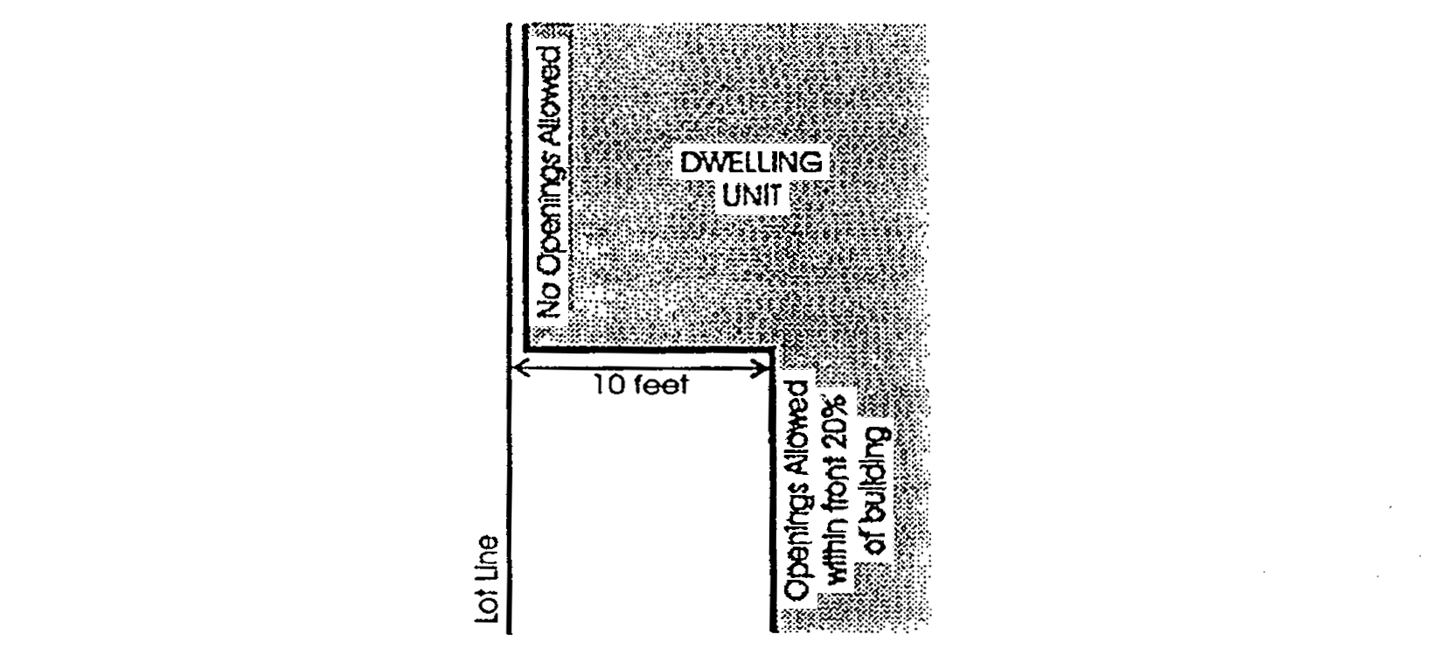
Zero Lot Line Dwelling
(e)
The roof of each patio home dwelling unit must be designed to prevent stormwater runoff from draining into the adjacent lot.
(f)
Required easements shall be shown on the final plat. If required easements are not shown on the final plat of lots for zero lot line patio home dwellings, then such easements shall be created by means of a replat or by a separate legal instrument, in a form agreed to by the city, before a building permit will be granted by the city.
(g)
In no case shall the owner of any zero lot line patio home dwelling be granted an easement on the adjoining property for the use or enjoyment of any portion of such property, except for a four-foot maintenance easement as set forth in subsection (c) of this section.
(h)
A site plan shall be submitted with a final plat designating which lots are to be patio homes or twin homes with required side yards and four-foot maintenance easements shown.
(Code 1995, § 158.45; Ord. No. 00-45, § III(F), 12-19-2000)
Sec. 98-637. - Additional twinhome dwelling standards.
(a)
Development of a twinhome dwelling shall occur only on a lot that has been specifically platted in accordance with chapter 94 to accommodate such use.
(b)
Only one twinhome dwelling shall be allowed on a single lot.
(c)
Any lot occupied by a twinhome dwelling shall have a minimum side yard of ten feet along any side boundary not adjacent to another twinhome structure.
(Code 1995, § 158.45; Ord. No. 00-45, § III(G), 12-19-2000)

