
Bunnell City Zoning Code
ARTICLE V
- SUPPLEMENTARY DISTRICT REGULATIONS
DIVISION 2. - OFF-STREET PARKING AND LOADING[2]
Editor's note— Section 1 of Ord. No. 2013-14, adopted May 23, 2013, amended Div. 2 in its entirety to read as herein set out. Former Div. 2, §§ 34-201—34-204, pertained to similar subject matter, and derived from the 1991 LDC, ch. 4, art. XIII, §§ I—IV; and Ord. No. 2008-54, § 1, adopted Jan. 6, 2009.
State Law reference— Provisions for off-street parking required, F.S. 163.3202(2)(h).
Sec. 34-181. - Height.
The following requirements are intended to provide exceptions or qualify and supplement, as the case may be, the specific district regulations and set forth in article IV of this chapter:
(1)
In measuring heights, a habitable basement or attic shall be counted as a story.
(2)
The following structures or parts thereof are hereby exempt from the height limitations set forth in the zoning districts:
a.
Chimneys, smokestacks, spires, flagpoles, ventilators, skylights, derricks, conveyors and cooling towers and radio and television antennae.
b.
Public utility and power transmission towers.
c.
Water tanks and standpipes.
d.
Other similar and necessary mechanical appurtenances pertaining to and necessary to the permitted uses of the districts in which they are located, provided that they are not used for human occupancy.
(3)
Churches, schools, hospitals, sanitariums, and other public buildings may exceed the height limitations of the district if the minimum depth of the front, side, and rear yards required in the district is increased one foot for each two feet by which the height of such public structure exceeds the prescribed height limit.
(LDC 1991, ch. 4, art. XIV, § I)
Sec. 34-182. - Yard, building setback and open space exceptions.
The following requirements are intended to provide exceptions or qualify and supplement, as the case may be, the specific district regulations set forth in article IV of this chapter. The purpose here is to clarify certain conditions pertaining to the use of lots and access points.
(1)
Division of a lot. No recorded lot shall be divided into two or more lots unless such division results in the creation of lots each of which conforms to all of the applicable regulations of the district in which the property is located. No reduction in the size of a recorded lot below the minimum requirements of this chapter shall be permitted.
(2)
Small lots of record. In residential zoning districts, where there are existing recorded lots which do not meet the minimum lot area requirements, single-family dwellings may be constructed when a side yard is provided of not less than five feet and the sum of the side yards shall not be less than 12 feet and providing all other requirements, except lot size, are met. In all other zoning districts, where existing lots of record do not meet the minimum lot area requirement, permitted uses may occur when one-half the required side yard is provided, and providing all other requirements except lot size are met.
(LDC 1991, ch. 4, art. XIV, § II)
Sec. 34-183. - Fences, hedges and other traffic obstructions.
(a)
On a corner lot no fence, wall, hedge or planting shall be permitted or allowed to extend in excess of three feet above the curb or established grade level of the street, or other obstruction to the vision of street traffic, on that portion of a front or side yard that is included between the side lines of such intersecting streets and a line connecting such lines at points which are 25 feet distant from their point of intersection measured along such lines.
(b)
Within the limits of a side yard, no fence or wall, except a retaining wall, shall be more than six feet high, unless the part above such height be not more than one-quarter solid.
(LDC 1991, ch. 4, art. XI(2))
Sec. 34-184. - Temporary residence.
No structure constructed prior to the main structure shall be used as a residence or place for human habitation for longer than three months unless consent of the city commission is obtained.
(LDC 1991, ch. 4, art. XI(3))
Sec. 34-185. - Parking of mobile homes.
(a)
Generally. All mobile homes within the corporate limits of the city, shall be parked in a duly authorized and licensed mobile home park, constructed and operated in accordance with the rules and regulations set forth herein, and under the rules and regulations of the state board of health and the state hotel commission, and also in accordance with local sanitary and building ordinances; provided that such a mobile home park is in operation within the city limits; except that as provided in subsections (b) or (c) of this section.
(b)
Temporary permits. A special temporary permit may be granted by the city commission, to park a mobile home for a period of 90 days or less on any lot or parcel of property within the city during the construction of a permanent residence or place of business upon such property, provided that:
(1)
The applicant for a special temporary permit shall be the owner or lessee of the property upon which his mobile home is to be parked and upon which the building is to be constructed and he shall file his application for a building permit simultaneously with the application for the special temporary mobile home permit.
(2)
Proper sanitary installations shall be erected on such lot prior to the parking of a house trailer thereon.
(3)
Such special 90-day permit shall be effective only during the construction of permanent residence or place of business on such property and shall terminate upon completion thereof.
(4)
Upon application to the city commission, a special temporary 90-day permit may be extended for a reasonable additional period for due cause, such as: delay in completion of construction because of illness, breakdown of equipment, shortages of material or labor and/or acts of God.
(5)
A special temporary permit may be revoked by the city commission after an investigation and open hearing upon a complaint in writing and evidence presented, if, in the opinion of the city commission, the holder of such permit has failed to comply with the provisions of this chapter, or has willfully and without just cause delayed in the completion of construction of this permanent residence; or the city commission may, on their own volition, revoke such temporary permit for the foregoing reasons.
(c)
Agricultural areas. Mobile homes may be used as a principal or accessory residential structure within the city limits west of the intersection of State Road 20/100 and Black Point Road East, or south of the intersection of Elm Avenue and State Street (US1) provided that the property and structure meet all other health and safety standards, building codes, and city ordinances as applicable.
(LDC 1991, ch. 4, art. XII(A); Ord. No. 2011-04, § 1, 3-28-11)
Sec. 34-186. - Home occupations.
(a)
Class A home occupations shall be allowed as permitted uses in all agricultural, residential and mobile home classifications if proper application is made on forms provided by the zoning enforcement official. Class A home occupations shall be clearly incidental and subordinate to the residential use and shall under no circumstances change the residential character of the dwelling. The issuance of a permit to engage in a class A home occupation in accordance with this section shall not be deemed to be a change of zoning nor an official expression of opinion as to the proper zoning for the particular property.
(1)
Notarized affidavits must be submitted with each application for a class A license demonstrating that the home occupation will not:
a.
Disturb the peace, quiet and domestic tranquility of the residential neighborhood;
b.
Create excessive odor, noise, parking or traffic above that of the residential neighborhood;
c.
Create a fire hazard or nuisance;
d.
Use or generate toxic or hazardous materials or waste;
e.
No more than three home occupations shall be permitted within any single dwelling;
f.
No one other than the residents of the dwelling shall be employed in the conduct of a home occupation (excluding those cases where actual performance of work occurs somewhere other than the dwelling unit);
g.
No stock-in-trade shall be openly displayed or maintained on the premises and no sales on the premises shall occur;
h.
A home occupation shall produce no noise, or obnoxious odors, vibration, glare, fumes or electrical interference detectable to normal sensory perception;
i.
There shall be no exterior indication of the home occupation; no exterior signs shall be used that informs the public of the home occupation;
j.
No equipment shall be used or stored on the premises in connection with the home occupation except that which is normally used for purely domestic or household purposes, except for typical office equipment;
k.
The floor area devoted to the home occupation shall not exceed 25 percent of the floor area of the dwelling;
l.
All office equipment used in the home occupation on the premises shall be inside the dwelling within the space limitations above; and
m.
Home occupation uses shall be subject to all applicable city, county, state occupational licenses and other business taxes, rules and regulations in effect or that may later be adopted.
(b)
Class B home occupations provide for home business operations in agricultural classifications which have the potential to create some impacts beyond class A activities due to on-site storage of material, inventory work vehicles, trailers, equipment, or business related traffic from customers or deliveries. Proper application must be made on forms provided by the zoning enforcement official. Class B home occupations shall be clearly incidental and subordinate to the residential use and shall under no circumstances change the residential character of the dwelling. The issuance of a permit to engage in a class B home occupation in accordance with this section shall not be deemed to be a change of zoning nor an official expression of opinion as to the proper zoning for the particular property. Minimum lot size in this category is one acre.
(1)
Notarized affidavits must be submitted with each application for a class B license demonstrating that the home occupation will not:
a.
Utilize equipment in the home occupation which creates fire hazards, electrical interference, noise, vibration, glare, fumes or odors detectable to the normal senses off the premises.
b.
Exceed the floor area devoted to the home occupation allowed at 35 percent of the floor area of the dwelling, or exceed 35 percent of a separate, ancillary on-site building.
c.
Exceed two vehicles and two trailers for the class B home occupation provided they are fully screened from the right-of-way and neighboring properties. For class B home occupations, the planning board may allow, as a condition by special exception, three or more vehicles and trailers.
d.
Exceed the allowance that employees are limited to residents of the home plus a maximum of two employees or independent contractors who are not residents of the dwelling unit. For class B home occupations, the planning board may allow, as a condition by special exception, three or more employees or independent contractors who are not residents of the dwelling unit.
e.
Conduct vehicle repair for commercial purposes or sales of vehicles.
f.
Use or generate toxic or hazardous materials or waste.
g.
Home occupation uses shall be subject to all applicable city, county, state occupational licenses and other business taxes, rules and regulations in effect or that may later be adopted.
h.
No more than three home occupations shall be permitted within any single dwelling.
(c)
Agricultural occupations exempt from local government regulation by State of Florida Statute shall be exempt from the regulations of this section.
(d)
Any violation of these regulations will result in the revocation of any home occupation business tax receipt, in addition to any other remedy for such violation provided by law.
(Ord. No. 2007-63, § 1, 12-4-07; Ord. No. 2017-21, § 1, 7-24-17)
Sec. 34-187. - Temporary and seasonal uses.
(a)
Definitions. The following words, terms and phrases, when used in this section, shall have the meanings ascribed to them, except where the context clearly indicates a different meaning:
Applicant means the individual(s) or entity that applies to the City of Bunnell to establish a temporary use. The applicant(s) is responsible for compliance with the minimum requirements set forth herein. The owner or owners of any property on which a temporary use is established shall also be deemed the applicant in terms of responsibility or liability for violation of this article or other federal, state, or local regulations occurring on any such property because of the temporary use.
Sanitary facilities means a bathroom or other enclosure containing, at minimum, a fully operational toilet and sink available for use by the public.
Sign means any device, fixture, placard, or structure that uses any color, form, graphic, illumination, symbol, or writing to advertise, announce the purpose of, or identify the purpose of a person or entity, or to communicate information of any kind to the public.
Temporary use means a commercial sale, activity, promotion or other similar type of use that is not a permitted principal or accessory outdoor use of a property shall be classified as a temporary use. Temporary uses shall also include permitted accessory uses of a scale or intensity that exceeds the customary scale or intensity of the given accessory use.
Vendor means any person who seeks a temporary use permit for the purposes of selling, promoting, or describing products and/or services on a property with the agreement of a property owner.
(b)
Intent. The intent of this section is to regulate the temporary and seasonal use of property within the city in a manner that promotes entrepreneurialism, business activity, occasional fundraising, and the celebration of public holidays while promoting the health, safety, and welfare of the public. This section shall not be used to regulate garage sales, or large scale events such as parades, circuses, festivals, concerts, large public gatherings, or similar types of special events.
(c)
Permit required. A temporary use permit is required to establish a temporary use on any property in the City of Bunnell. The temporary use, including the placing of temporary signs, shall not commence until the permit has been approved and issued by the city.
(d)
Minimum requirements. The community development director, or designee, may issue a temporary use permit provided that the following minimum requirements are met:
(1)
Hours of operation. A temporary use shall be limited in its operation to the hours of 9:00 a.m. to 9:00 p.m., Sunday through Thursday, and 8:00 a.m. to 10:00 p.m. Friday and Saturday.
(2)
Frequency and duration. No property shall be provided with more than four temporary use permits within a calendar year. No temporary use shall be permitted for a period of time exceeding ten consecutive days, except that one permit may be issued for a time not to exceed 35 days between Thanksgiving and Christmas. Additionally, there shall be no less than 30 days between the issuance of any two temporary use permits.
(3)
Temporary structures. Temporary structures and the uses conducted within shall be subject to inspection from all city, county and state agencies and must meet all applicable building and fire codes as applicable. No temporary structure shall be used for living quarters.
(4)
Setbacks. No activity, storage, or structure associated with the temporary use shall be located within ten feet of all property lines.
(5)
Location. No temporary use or associated structure shall be located in required vehicular stacking, loading, or drive aisles nor located in required landscape buffers or drainage retention areas.
(6)
Lighting. Any temporary lighting used shall be designed and arranged to reflect away from adjacent properties and away from any street.
(7)
Signs. One temporary sign, exempt from sections 26-71 through 26-73 of the Bunnell Land Development Code, may be erected on the property where the temporary use will be held not more than three days in advance and not anytime after the temporary use has ceased operations. Signs shall be no larger than 24 square feet in sign area and no higher than ten feet above the ground and shall meet all requirements of the Florida Building Code, as applicable.
(8)
Access and parking. Adequate vehicular access and parking shall be provided, on site, as determined by the community development director, or designee.
(9)
Business tax receipt required. Any vendor, as defined by this section, shall obtain a current business tax receipt from the city prior to the issuance of a temporary use permit.
(10)
Separation from similar uses. Any temporary uses shall not be located within two-hundred and fifty feet from any plot in which exists a permanent business selling the same or similar products (i.e., prepared food products, clothing, art work).
(11)
Other requirements. Other requirements, as determined by the community development director, or designee, may be placed on the temporary use or associated structures to ensure the public health, safety, and welfare. Such requirements may include, but is not limited to, the provision of sanitary facilities for the sale of food or state licensing or permit requirements for the sale of food, firearms, animals, etc.
(e)
Permit application. A permit application shall be submitted to the community development department at least ten business days prior to the commencement of the temporary use. The permit application shall include the following:
(1)
The name and address of the applicant and/or vendor;
(2)
The address and legal description of the plot where the temporary use will be established;
(3)
A description of the proposed temporary use;
(4)
A dimensionally accurate sketch showing where the temporary use and related facilities will be conducted and where signage, access and parking will be provided;
(5)
A drawing of any proposed sign including its material, height, and dimension;
(6)
The proposed dates and hours of operation;
(7)
Notarized authorization of all property owners of record, or their authorized agent, for use of the property for a temporary use;
(8)
A copy of any licenses or permits held by the vendor authorizing the sale of such products;
(9)
An indemnification and hold harmless agreement as approved by the city attorney;
(10)
Permit review fee. A nonrefundable fee payable to the city of bunnell for the review and issuance of a temporary use permit shall be collected at the time of application by the community development department in accordance with the fee schedule approved by the city commission.
(f)
Exemptions. This section shall not be construed to regulate the sale of whole farm products sold on property used for a bona fide agricultural use.
(g)
Violations. Violation of this section may result in code enforcement action and/or the temporary or permanent revocation of, or denial of, a temporary use permit from the city.
(Ord. No. 2010-10, § 1, 11-22-10)
Sec. 34-188. - Mobile vending.
(a)
Intent. The intent of this section is to support and regulate limited mobile vending operations in the City of Bunnell.
(b)
Definitions. The following words, terms and phrases, when used in this section, shall have the meanings ascribed to them, except where the context clearly indicates a different meaning:
(1)
Mobile vendor. A person, corporation, company or business that sells, or offers for sale, goods, wares, merchandise, beverages or food of any kind or nature whatsoever from a vehicle capable of movement and which can not be classified as a temporary use by the city's Land Development Code.
(2)
Off-loading. The outdoor placement of goods, wares, merchandise, beverages, or food of any kind, for display, sale, demonstration, storage, or any other purpose.
(3)
Mobile vehicle. A motor vehicle, bicycle, cart, wagon or similar vehicle used for displaying, storing or transporting goods for sale by a mobile vendor.
(c)
Mobile vendor permit required. Any mobile vendor operating in the City of Bunnell is required to obtain a mobile vendor permit in addition to a business tax receipt from the city.
(d)
Minimum requirements. The community development director, or designee, may issue a mobile vendor permit provided that the following minimum requirements will be met and upheld:
(1)
Hours of operation. The vendor shall limit its operation to the hours of 9:00 a.m. to 6:00 p.m., Sunday through Thursday, and 8:00 a.m. to 8:00 p.m. Friday and Saturday.
(2)
No parking. A mobile vendor shall not park a mobile vehicle on any public or private property during operating hours except at the time of making an individual sale.
(3)
Off-loading prohibited. Mobile vendors shall not off-load product on any public or private property during operating hours except at the time of making an individual sale.
(4)
Licenses and permits. The mobile vendor shall maintain and keep on file with the community development department, or other designated city department or office, a copy of all current licenses or permits required from any agency authorizing the sale of such products, as applicable.
(5)
Other requirements. The community development director, or designee, may place additional requirements on any mobile vendor as required to ensure the health, safety, and welfare of the citizenry.
(e)
Violations. Violation of this section may result in code enforcement action and/or the temporary or permanent revocation of, or denial of, a mobile vendor permit from the city.
(Ord. No. 2010-09, § 1, 11-22-10)
Sec. 34-189. - Family homesteads.
(a)
The City of Bunnell will allow a family homestead for a grandparent, parent, stepparent, adopted parent, sibling, child, stepchild, adopted child or grandchild or dependent on property where designated as a permitted use or special exception provided that the homestead parcel is not less than 20,000 square feet. A family homestead shall only be allowed one time to an individual family member or dependent and that family member shall not sell or dispose of the family homestead for a period of five years.
(1)
A family homestead must be a single-family residence, in-law suite, or separate living quarters, and may be a mobile or modular home.
(2)
The home must be generally centered in the 20,000 square feet, or it must meet the setbacks for the district in which it is located if built on a larger piece, or meet the setbacks for accessory buildings in the district in which it is located depending upon the type of residential unit proposed, additionally it must be capable of meeting the setbacks for well and septic systems.
(3)
Access must be allowed from the general access or driveway for the principal property, not through a separate access or driveway.
(Ord. No. 2012-03, § 5, 3-12-12)
Sec. 34-190. - Rural subdivisions.
(a)
The City of Bunnell will allow rural subdivisions on property designated in the rural area provided the following stipulations are met:
(1)
Adequate access to all parcels is provided;
(2)
Deed restrictions and disclaimer requirements are outlined acknowledging the government services that will not be provided to the development;
(3)
Wildfire vulnerability prevention requirements, including mitigation measures addressing building design and materials, site design, and landscaping (including defensible space requirements and plant materials) are outlined;
(4)
Rural subdivision standards in Chapter 30 Subdivision Regulations are followed;
(5)
The intent of all applicable goals, objectives and policies adopted in the city's comprehensive plan are met;
(6)
Gross residential density does not exceed one unit per five acres even if lot sizes are smaller, units are clustered together; or unique stipulations for open space including agricultural uses, support for environmentally sensitive lands, or preservation efforts for unique property characteristics require flexible subdivision design.
(Ord. No. 2012-03, § 5, 3-12-12)
Sec. 34-191. - Prohibition on medical marijuana dispensing facilities.
(a)
Definition. For the purposes of this section, the term "medical marijuana treatment center dispensing facility" means any facility where medical marijuana or any product derived therefrom is dispensed at retail.
(b)
Prohibition. Medical marijuana treatment center dispensing facilities are prohibited and shall not be located within the boundaries of the city. The city shall not accept, process or approve any request or application for a development order, building permit or other approval associated with a proposed medical marijuana treatment center dispensing facility.
(c)
Interpretation/intent. This section and the terms used herein shall be interpreted in accordance with F.S. § 381.986 and Ch. 64-4 of the Florida Administrative Code. The intent of this section is to ban medical marijuana treatment center dispensing facilities from being located within the boundaries of the city as authorized by F.S. § 381.986(11).
(d)
Moratorium contingency. In the event F.S. § 381.986 is amended or interpreted by a court of competent jurisdiction in a way so as to eliminate or prevent the city's ability to ban or prohibit marijuana treatment center dispensing facilities within the city limits, or such statute or this ordinance is interpreted in a manner to prevent the enforcement of this section, upon the effective date of such action, an automatic one-year moratorium shall go into effect on the receipt of applications for and the issuance of any development orders, zoning approvals or building permits for the establishment or operation of medical marijuana treatment center dispensing facilities within the geographic area of the City of Bunnell now existing or which may be thereafter annexed during the moratorium, in order to give the city time to evaluate changes in the applicable law, the city's ability to regulate such uses and activities and potentially enact local legislation regarding the same. Such one-year moratorium may be terminated early through resolution or ordinance of the city commission.
(Ord. No. 2018-01, § 2, 1-22-18)
Sec. 34-192. - Food trucks.
(a)
This section regulates the operation of food trucks and food truck uses within the City of Bunnell.
(b)
Food truck uses may be located only on privately-owned commercial or industrial zoned property.
(c)
The food truck owner shall obtain the property owner's written permission to utilize the property for food truck operations prior to commencement of operations and shall present a copy of such written permission to city staff upon request.
(d)
Food truck uses shall be located no less than 200 feet from any residentially-zoned property.
(e)
All required state and local permits and business licenses shall be obtained, held, maintained and displayed.
(f)
Food truck uses shall be limited to a self-contained truck or trailer.
(g)
Food truck uses shall be located no less than 200 feet from the main entrance of any other eating establishment (including another food truck), unless the owner of such establishment provides the food truck owner with a written letter of no objection, a copy of which the food truck owner shall present to city staff upon request.
(h)
Signage is limited to those signs that are painted on or attached to the vehicle.
(i)
Hours of operation are limited to 9:00 a.m. to 9:00 p.m.
(j)
Parking of food truck vehicle: Operating food trucks shall only occupy and utilize excess on-site parking spaces (those above and beyond minimum parking requirements for existing uses).
(k)
Food truck vehicles shall be maintained in a clean and orderly manner; litter and debris shall be removed nightly.
(l)
A lidded trash can shall be provided on-site for customer use; no unscreened plastic bags or loose objects shall be allowed.
(m)
The food truck operator shall remove waste or trash at the end of each day or as needed to maintain the health and safety of the public. Liquid waste or grease shall be disposed of at an approved location and not placed in such places as sewer system, storm drains or onto any sidewalk, street or other public space.
(n)
Due to the temporary nature of the use, public bathroom facilities and customer parking are not required; however, nearby toilet facilities shall be required for employees. An agreement with the property owner for use of on-site facilities or a nearby property owner (within 400 feet) to provide bathroom facilities for food truck workers shall be required.
(o)
One or more of the preceding requirements may be temporarily modified or suspended with respect to food truck operations conducted pursuant to a special event permit granted pursuant to the city's Special Event Ordinance.
(Ord. No. 2018-16, § 1, 8-27-18)
Sec. 34-201. - Off-street parking requirements.
(a)
Purpose. The purpose of this section of the land development code is to provide for the safe and convenient access for the public to utilize the various uses within the city by providing suitable off-street parking facilities, to ensure the safe movement of traffic on the public streets, to protect adjacent residential and institutional uses from adverse impacts of vehicular traffic, to minimize parking congestion generated by various uses, and to establish minimum standards for the development of parking areas.
(b)
Off-street parking requirements; general.
(1)
In all districts, there shall be provided at such time any building or structure is erected or enlarged or increased in capacity, off-street parking spaces for automobiles, and where appropriate bicycles and motorcycles.
(2)
Off-street parking for other than residential use shall be either on the same lot or within 300 feet of the building it is intended to serve measured from the nearest point of the off-street parking lot, without crossing any major thoroughfare.
(3)
Churches may establish joint parking facilities not to exceed 50 percent of the required spaces with institutions and agencies that do not have a time conflict in parking demand. The joint parking facilities shall be located not to exceed 400 feet from the church sanctuary. This shall be approved as a special exception by the process outlined in the land development code.
(4)
Residential off-street parking spaces shall consist of a parking lot, driveway, garage, or combination thereof and shall be located on the lot they are intended to serve.
(5)
In the case of a use not mentioned, the requirements for off-street parking shall be the same as for the most similar use specifically mentioned.
(6)
The required off-street parking shall be for occupants, employees, visitors, patrons and shall be limited in use to motor vehicles. The storage of merchandise, motor vehicles for sale, or the repair of vehicles is prohibited in any required spaces.
(7)
Every company car, truck, tractor and trailer normally stored on-site shall be provided with an off-street parking space in an area reserved for the use of all company vehicles and shall be in addition to the required number of parking spaces.
(8)
In cases of dual functioning of off-street parking where operating hours do not overlap, the city commission may grant an exception.
(9)
The minimum number of off-street parking spaces shall be determined in accordance with the table of parking spaces required.
(10)
Drive-aisles and maneuverability areas behind the required parking spaces shall be provided to ensure safe access and exit.
(c)
Off-street parking requirements; special provisions.
(1)
Nonconforming uses. No use of land, lawfully existing as of May 23, 2013, shall be deemed to be nonconforming solely because of the lack of off-street parking facilities prescribed in this chapter.
(2)
Expansion of uses. For additions or enlargements of any existing building or use, or any change of occupancy or manner of operation of such building or use that would increase the number of parking spaces required, the additional parking shall be required only for such addition, enlargement or change and not for the entire building or use.
(3)
Multiple uses (two or more uses on the same site). Parking for multiple uses shall be based on the type of uses comprising the multiple use. Where the uses comprising the multiple use are intended to operate or need the use of parking during the same time period, parking shall be based on the requirements for each proposed use. Where the uses comprising the multiple use do not have overlapping hours of operation or need the use of parking during the same time period, parking shall be based on the use requiring the greatest number of parking spaces, plus 25 percent of the total number of parking spaces required for all the uses.
(4)
Multiple or joint use agreement. A copy of an agreement between multiple or joint uses shall be filed with the application for a building or business permit, whichever is applicable. The agreement shall include a guarantee for continued use and maintenance of the parking facility by each party to the multiple or joint use.
a.
The multiple or joint use parking area must comply with the provisions of this parking chapter and the landscaping section of the land development code;
b.
The term of the multiple or joint use agreement for the parking area shall be for the life of the participants with a minimum one-year cancellation clause; and
c.
The multiple or joint use agreement shall expressly provide that the use of the principal structure is expressly contingent upon the parking facilities of the agreement area, and if the agreement is terminated for any reason the owner or operator of the principal structure shall immediately cease operations and terminate the use of the principal structure unless and until additional required off-street parking facilities are provided in accordance with provisions of this article. The community development department shall be notified.
(5)
Leased parking facilities. Required off-street vehicle parking areas may be leased (the "leased area") with boundaries clearly delineated in the lease by the owner or operator of the principal structure to be served, provided the owner or operator enters into a written lease agreement, which shall be subject to the approval of the city attorney, and approved as a special exception under the following terms and conditions:
a.
The leased area is within 400 feet of the main entrance of the principal structure measured to the nearest point of the leased area;
b.
The leased area shall be clearly marked with appropriate signage indicating that the area is for the exclusive use of the principal structure, except in the original downtown district (as defined by the attached map), wherein the leased area may be jointly used with another principal structure provided the uses in such principal structures do not normally or regularly operate during the same hours of the day or night;
c.
The leased area must comply with the provisions of this parking chapter and the landscaping section of the land development code;
d.
The term of the lease for the leased area shall be a minimum of three years with a minimum one-year cancellation clause; and
e.
The lease shall expressly provide that the use of the principal structure is expressly contingent upon the parking facilities of the leased area, and if the lease is terminated for any reason the owner or operator of the principal structure shall immediately cease operations and terminate the use of the principal structure unless and until additional required off-street parking facilities are provided in accordance with provisions of this article. The community development department shall be notified.
(d)
Table of parking spaces required.
(e)
Flexibility of off-street parking requirements in the original downtown district (as defined by the attached map). The city recognizes that due to the unique layout and design of the original downtown district that the parking requirements of this section may not be able to be met. When the layout, design, deed restriction or unique condition of an existing lot or building in the original downtown district creates a hardship which affects the ability to meet the required number of parking spaces, the following may be allowed:
(1)
The number of required spaces may be reduced by the community development director or designee.
a.
A reduction of 50 percent for required parking spaces may be applied to changes of use or re-model projects to existing buildings within the original downtown district only; provided that the site plan includes proposed bicycle and/or motorcycle parking for the equivalent of the reduced number of parking spaces. This reduction will not apply to new construction in the original downtown district.
b.
New construction in the original downtown district may have the number of required parking spaces reduced by 25 percent if the lot is considered a nonconforming lot; provided that the site plan include proposed bicycle and/or motorcycle parking for the equivalent of the reduced number of parking spaces.
(2)
The community development director or designee may permit a proposal of the following off-site parking situations to count toward the number of required spaces based on a proposed site plan in the original downtown district:
a.
Leased parking spaces available within 400 feet of the property or building; and/or
b.
Joint use parking as stated in a written agreement regarding the availability of shared parking with neighboring locations within 300 feet.
(3)
Due to the unique layout or design of existing lots in the original downtown district, the community development director or designee may permit up to 50 percent of the required parking to be of an alternative surface material such as shell, turf block or other stabilized surface if more than 50 percent is proposed the application shall be reviewed according to the site plan review requirements in the land development code. If an alternative surfacing material is used, such parking spaces shall be located further from the primary pedestrian entrance to the structure than those parking spaces paved with impervious materials, and designed to retain the alternative material on-site. Any provided handicap parking spaces must be a hard surface as per ADA requirements.
(4)
Existing nonconforming sites within the original downtown district may continue to back out into the right-of-way without any drive-aisle or maneuverability area; provided no changes are made that increase the nonconforming situation.
(f)
Off-street parking requirements in the remaining areas of the developed or developing city within a one-half-mile radius of the original downtown district as defined. The city recognizes that due to the unique layout and design of the existing commercial area of the city that the parking requirements of this section may not be able to be met based on the existing development or nonconforming lots. When the layout, design, deed restriction or unique condition of an existing lot or building in the existing commercial area of the city creates a hardship which affects the ability to meet the required number of parking spaces, the following may be allowed:
(1)
The number of required spaces may be reduced by the variance process outlined in the land development code.
a.
A reduction of 50 percent for required parking spaces may be applied to changes of use or re-model projects to existing buildings within the existing commercial area of the city; provided that the site plan includes proposed bicycle and/or motorcycle parking for the equivalent of the reduced number of parking spaces, and provided that the proposed site plan include meeting the current requirements of the landscaping code of the City of Bunnell. This reduction will not apply to new construction in the existing commercial area.
b.
New construction in the existing commercial area of the city may have the number of required parking spaces reduced by 25 percent if the lot is considered a nonconforming lot; provided that the site plan include proposed bicycle and/or motorcycle parking for the equivalent of the reduced number of parking spaces, and provided that the proposed site plan include meeting the current requirements of the landscaping code of the City of Bunnell.
(g)
Off-street parking requirements in the agricultural and rural areas west of US1. The city recognizes that there may be unique circumstances related to development in the agricultural area on the "Westside" of the city. The community development department, planning, zoning and appeals board and the city commission shall work together through the site plan review process with an applicant to establish the required number of parking spaces based on evidence brought forward by the applicant related to actual use, number of employees, trips in and out of the proposed project, delivery schedules, and other evidence relevant to the proposed site plan.
(h)
Off-street parking requirements for cluster developments. The city recognizes that there may be unique circumstances related to cluster developments, including rural preservation developments within the city limits. The community development department, planning, zoning and appeals board and the city commission shall work together through the appropriate planned unit development (PUD) process, and the site plan review process with an applicant to establish the required number of parking spaces based on evidence brought forward by the applicant related to actual uses, number and types of residences and businesses proposed, trips generated by the proposed project or captured internally, and other evidence relevant to the proposed development plan as articulated by the applicant.
(Ord. No. 2013-14, § 1, 5-23-13)
Editor's note— The attached map referenced in this section may be found at the end of this division.
Sec. 34-202. - Off-street parking lot layout, construction and maintenance.
Whenever the required off-street parking requires the building of a parking lot, and wherever a parking lot is built, such parking lot shall be laid out, constructed and maintained in accordance with the following regulations:
(1)
Except for parcels of land devoted to one- and two-family uses, all areas devoted to off-street parking shall be so designated and be of such size that no vehicle is required to back into a public street to obtain egress, unless considered an existing nonconforming situation in the original downtown district.
(2)
Each parking space shall be not less than ten by 18 feet in area and shall be designated, and marked as stalls adequate for one motor vehicle. Additionally, 25 percent of the required parking may be designated compact spaces, which can be as small as eight by 15 feet in area.
(3)
In any determination of parking requirements as set forth in this section, where the resultant figure contains a fraction, a fraction less than one-half may be dropped and any fraction of one-half or more shall be counted as one parking space.
(4)
Bicycle parking facilities shall be designed, constructed and maintained to include provisions for the secure storage and locking of bicycles on a hard surface at least seven feet in length. Fixed objects which are intended to serve as bicycle parking facilities shall be clearly labeled as available for bicycle parking.
(5)
Motorcycle spaces shall be a minimum of three feet in width. Concrete or suitable asphaltic or other material that will not be damaged by the motorcycle kickstands is required for the motorcycle parking spaces. Motorcycle parking shall be labeled as such.
(6)
Clearly designed two-way driveways used for ingress and egress shall be confined to and shall not exceed 25 feet in width, exclusive of curb returns unless designed using one-way driveways specifically for ingress and egress, which are at least 13 feet wide exclusive of curb returns. Driveways and maneuverability aisles behind or between parking space rows shall be 24 feet wide for two-way traffic and 15 feet wide for one-way traffic.
(7)
All areas devoted to permanent off-street parking as required under this section shall be of a sealed surface construction and maintained in such a manner that no dust will result, unless the proposed parking area meets the criteria for alternative surfaces listed in this section.
(8)
All handicap parking shall be of a sealed surface construction, and meet ADA requirements.
(9)
Reduction of impervious pavement surface material is encouraged by the city. It is intended that this provision only apply to uses which customarily utilize their total parking requirements on an occasional basis and/or experience has shown that 20 percent or more of the spaces requested for alternative surfaces are occupied less than 50 percent of the time during normal use periods. In all cases where alternative surfacing materials are used, such parking spaces shall be located further from the primary pedestrian entrance to the structure than those parking spaces paved with impervious materials. Alternative parking materials shall include, but not be limited to grass, shell, turf block, or other stabilized surface materials. Alternative surface parking may be allowed for the following uses provided that the surface is maintained in such a manner that no dust will result:
a.
Commercial uses. For commercial uses, such as furniture stores and recreation uses with peak seasonal or weekly usage, up to 30 percent of the required parking may be designed to alternative surface parking standards.
b.
Outdoor recreation uses. All parking spaces except handicap spaces may be grass, shell or other stabilized pervious surface.
c.
Historic preservation mixed-use or bed and breakfast inn. A minimum of two parking spaces shall have a paved surface. The remaining required parking spaces may be of an approved alternative surfacing material.
d.
Auto sales lots. Outdoor vehicle display areas may be on grass, shell, turf block or other stabilized surface. Customer and employee parking shall be on paved surface.
e.
Industrial uses. For industrial uses, up to 25 percent of the required parking may be grass, shell or other stabilized pervious surface.
f.
Where the number of off-street parking spaces provided exceeds the minimum number required, any additional spaces may be surfaced with alternative surfacing materials.
g.
Company vehicle parking. Spaces allotted for parking company cars, trucks, tractors, trailers, and other vehicles normally stored on-site may be of an approved alternative surfacing material.
h.
Storage facilities may have up to 25 percent of the required parking be grass, shell or other stabilized pervious surface
i.
Additional uses that do not fall under the above listed categories must be approved by the planning, zoning, and appeals board as determined by evidence and testimony provided to the planning, zoning and appeals board per site plan review procedures.
(10)
The parking lot shall be drained to eliminate surface water in accordance with applicable stormwater retention and detention requirements.
(11)
Where the parking lot abuts a side lot line of a residential district, there shall be established a setback line 15 feet from such side lot lines.
(12)
Where the parking lot abuts rear property lines of a residential district, there shall be established a setback line five feet from the rear lot line.
(13)
Where parking is to be provided in the front yard of a multiple-family dwelling, there shall be established a setback line ten feet from the street lot line. The land between the setback line and the lot line in a parking lot is for the purpose of this chapter called a buffer strip. The ground within the buffer strip shall be prepared and shall be planted with trees, shrubs and grass per the landscape code.
(Ord. No. 2013-14, § 1, 5-23-13)
Sec. 34-203. - Storage and parking of trailers and commercial vehicles.
Commercial vehicles and mobile home trailers of all types, shall not be parked or stored on any lot occupied by a dwelling or on any lot in any residential district except in accordance with the following provisions:
(1)
Not more than one commercial vehicle per family living on the premises shall be permitted for more than 40 hours; and in no case shall a commercial vehicle used for hauling explosives, gasoline or liquefied petroleum products be permitted. Overnight parking of commercial vehicles with three or more axles or a two-ton rating or more shall be prohibited.
(2)
Recreational vehicles may be stored in a residential district as long as they are not connected to utilities or used for dwelling purposes and maintain a current department of motor vehicles registration tag. However, hunting camps in agricultural areas or licensed mobile home parks and campgrounds may utilize recreational vehicles for residential dwelling purposes provided the hunting camp, mobile home park or campground complies with the regulations in F.S. ch. 513 and each recreational vehicle in the park or camp complies with F.S. § 193.075 and F.S. § 320.0815.
(3)
Recreational vehicles may be used as emergency residential units on private property or in mobile home parks or designated shelter areas within the city based on a declared emergency and recovery order issued by the appropriate governmental agency; such as, the City of Bunnell, Flagler County, the State of Florida and the federal government in the event of a catastrophic event. This is for temporary emergency purposes only, during recovery and reconstruction phases per an emergency order for a declared emergency, upon expiration of such order the residential use of the recreational vehicle shall end.
(Ord. No. 2013-14, § 1, 5-23-13; Ord. No. 2016-06, § 1, 5-23-16)
Sec. 34-204. - Off-street loading and unloading requirements.
In all districts, and on the same premises, with every building, structure, or part thereof, erected and occupied for manufacturing, storage, warehouse goods, a wholesale store, a market, a hotel, a hospital, or other uses similarly involving the receipt or distribution of vehicles, materials or merchandise, there shall be provided and maintained on the lot adequate space for standing, loading and unloading services adjacent to the opening used for loading and unloading in order to avoid undue interference with public use of the streets or alleys. Off-street loading and unloading space shall be provided as follows:
(1)
One off-street loading and unloading space shall be provided for buildings up to and including 20,000 square feet of floor area, plus one additional off-street loading and unloading space for each additional 20,000 square feet of floor area up to and including 100,000 square feet.
(2)
Where tractor trailer trucks are involved such loading and unloading space shall be a minimum of 12 feet by 45 feet with a 14-foot height clearance and shall be designed with appropriate means of truck access to a street or alley as well as adequate maneuvering area. Regular loading and unloading spaces shall be a minimum of 12 feet by 25 feet with a 14-foot height clearance with appropriate means of truck access to a street or alley as well as adequate maneuvering area.
(3)
All areas devoted to permanent off-street loading and unloading as required under this section shall be of a sealed-surface construction and maintained in such a manner that no dust will result from continuous use. Reduction of impervious pavement surface material is encouraged by the city. Any permeable loading surface including substructure must be approved by the site plan review procedures in the land development code.
(Ord. No. 2013-14, § 1, 5-23-13)
LOCATION MAP
DOWNTOWN DISTRICT
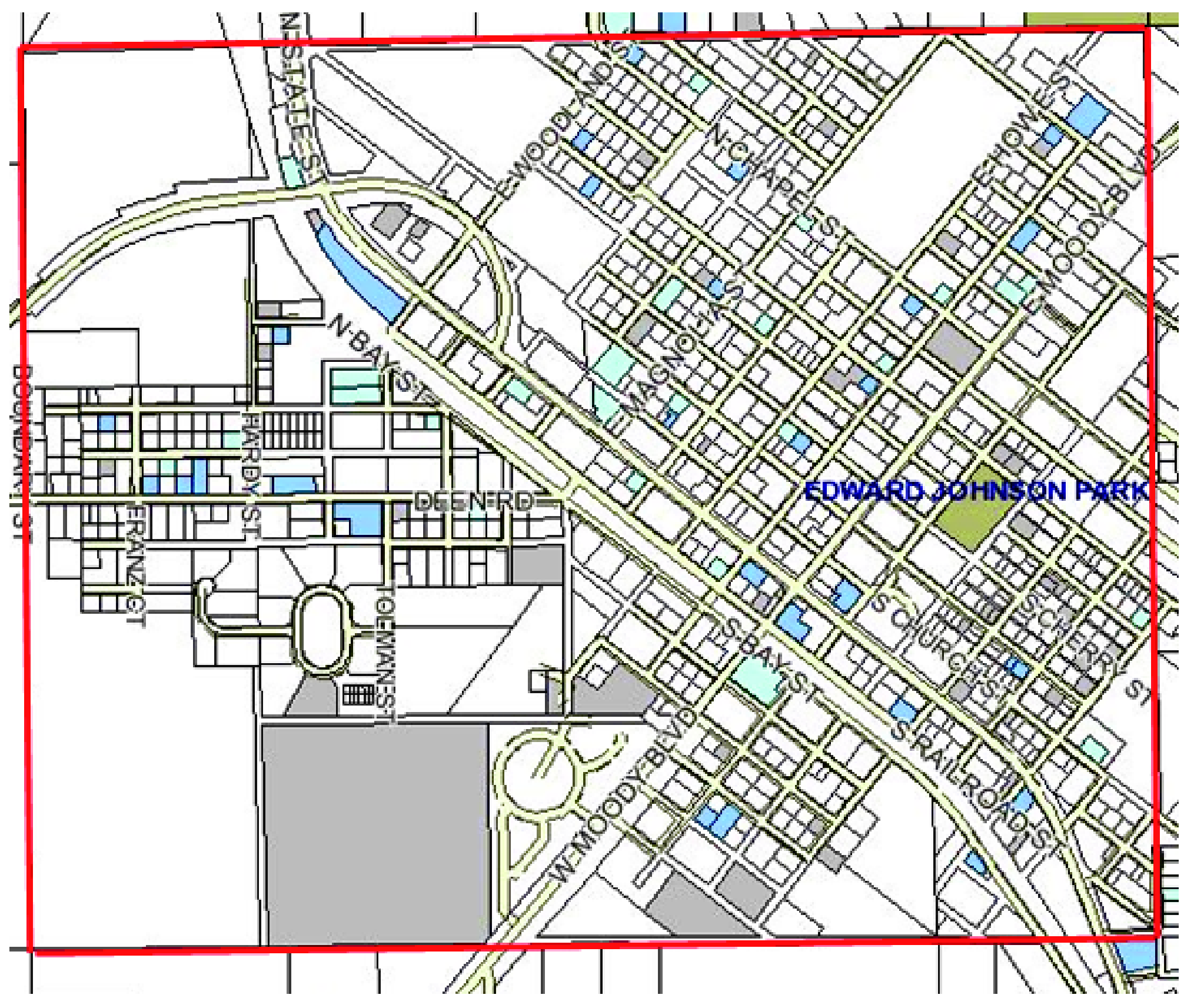
(Ord. No. 2013-14, § 1(Exh. B), 5-23-13)
Sec. 34-205. - Definitions.
[The following words, terms and phrases, when used in this division, shall have the meanings ascribed to them in this section, except where the context clearly indicates a different meaning:]
(1)
Related activities addresses such uses that are deemed 501-C3 compliant by the Internal Revenue Service and are in direct conjunction with church use.
(Ord. No. 2005-22, Pt. B, 6-21-05)
Sec. 34-206. - Church standards.
The following standards shall apply to churches:
(1)
The minimum lot or building site area shall be 10,000 square feet and have a width of not less than 100 feet, measured at the front of the building line.
(2)
In residentially zoned properties, a minimum five-foot wide landscape buffer area shall be required, with an average of 12.5 feet and not to exceed 25 feet wide, provided it does not obstruct the line of sight.
(3)
Notwithstanding the provision of article V, division 2 of this chapter, off-street parking and loading areas shall be surfaced with brick, asphalt, bituminous concrete, shell or marl material and shall be maintained in a smooth and well-graded condition. Grass parking may be allowed to account for up to 25 percent of the required off-street parking spaces and any parking provided in excess of the required number of spaces.
(4)
All drainage for the site shall meet the minimum requirements for water retention as established in the SJRWMD guidelines Chapter 10 of the City of Bunnell Land Development Regulations.
(Ord. No. 2005-22, Pt. B, 6-21-05)

