
Calcasieu Parish City Zoning Code
DIVISION 15
SOLAR ENERGY FACILITIES
Sec. 26-99. - Solar energy facilities.
(a)
General.
(1)
Purpose. The purpose and objective of this division is to provide standards for the siting, design, construction, installation, operation, monitoring, modification, and removal of solar energy facilities in the parish in a manner that promotes economic development and ensures the protection of the health, safety, and general welfare of the citizens while also avoiding adverse impacts to important areas such as agricultural lands, endangered species habitats, conservation lands, other sensitive lands, and property owners.
(2)
Intent. In enacting this division, the police jury is establishing uniform standards for solar energy facilities, so as to achieve the following nonexclusive goals:
a.
Provide adequate financial assurance for the eventual decommissioning of solar energy facilities.
b.
Preserve the dignity and aesthetic quality of the environment in the parish.
c.
Preserve the physical integrity of the area in close proximity to existing residences.
d.
Reduce reliance on foreign and out-of-state energy resources, bolster local economic development and job creation, support the diversification of the state's energy portfolio, strengthen energy and grid security, reduce greenhouse gas emissions, and reduce local air and water pollution.
This division is not intended to abridge safety, health or environmental requirements contained in other applicable law and shall not be deemed to nullify any provisions of applicable law.
(3)
Applicability.
a.
The requirements set forth in this division shall govern the siting, development, construction, installation, operation, and decommissioning of solar energy facilities in the parish.
b.
If the land on which the solar energy facility is proposed to be sited is leased and not owned by the facility owner, all property on which the solar energy facility will be sited must be encumbered by easement(s), lease(s), or consent agreement(s) between the property owner and the facility owner. A copy of any memorandum of lease, option or servitude agreement executed by the property owner and the facility owner shall be submitted with the application.
(b)
Compliance and exemptions.
(1)
Compliance with laws, ordinances, regulations, and permits.
a.
The failure of a solar energy facility to be constructed and operated consistent with all applicable laws shall be grounds for revocation of any zoning exception approved and/or any development permit issued.
b.
No solar photovoltaic installation shall be constructed, installed, or modified as provided in this section without first obtaining a development permit.
(2)
Exemptions.
a.
A solar energy facility that was approved as a zoning exception or issued a development permit prior to the effective date of this division shall remain exempt from the provisions of this division to the extent they did not otherwise exist prior to the effective date of this division, provided however, that modifications to an existing solar energy facility that increase the improved area, as such area is reflected on the approved facility site plan, by more than five (5) percent shall be subjected to this division.
b.
Every off-grid solar panel system not defined under the solar energy facility definition is exempt from the provisions of this division.
c.
Solar energy facilities on land owned by a governmental body.
(c)
Development standards.
(1)
Approved solar components. Solar energy facility components must have a UL listing or equivalent and must be designed with anti-reflective coating(s).
(2)
Aviation regulations. Solar energy facilities must provide documentation of compliance with FAA rules, if any such rules are applicable, as well as any applicable Calcasieu Parish airport ordinance and state law related to aviation.
(3)
Emergency services.
a.
The facility site plan shall clearly mark all means of shutting down the solar energy facility.
b.
The facility owner shall identify a responsible person for public inquiries throughout the life of the solar energy facility. Upon request, the facility owner shall cooperate with local emergency services in developing an emergency response plan.
(4)
Height. Solar panels shall not exceed a height of fifteen (15) feet. The height of solar panels shall be measured relative to the average elevation of the proposed finished grade to the highest point of the panel or supporting structure, whichever is higher. Solar panels which track the sun's movement across the sky shall be measured at their highest vertical position.
(5)
Sound.
a.
Inverters and transformers shall be sited no less than three hundred (300) feet from any occupied dwelling unit.
b.
The routine operation of a solar energy facility shall not produce noise that exceeds sixty (60) dBA, as measured at the property lines of the facility site, unless the owner and the board agree to a higher noise level in the development permit.
(6)
Impervious surface. Ground mounted structures and components of a solar energy facility, including inverter and transformer pads, shall be considered impervious. However, for purposes of compliance with the drainage standards (codified in chapter 26, article VII, division 4), solar panels shall be considered pervious if they maintain sheet flow and allow for water to infiltrate under and around them and into the subsoil through a maintained pervious surface, such as, but not limited to, pastures, range land, or grass fields. The solar energy facility shall be designed to allow for the growth of vegetation beneath the solar panels and between arrays.
(7)
Land clearing, soil erosion, and habitat impacts.
a.
Clearing of natural vegetation shall be limited to what is necessary for the construction, operation and maintenance of the solar energy facility.
b.
All floodplains, wetlands, and steep slopes shall be reasonably protected from clearing, grading, filling, or construction.
c.
The solar energy facility shall be designed, where reasonably possible, to preserve and maintain existing tree lines between fields, pastures, meadows, and mature woodlands.
d.
Arrays, inverters and transformers shall not be located in the 100-year floodplain as shown on the FEMA flood zone hazard map effective at the time of application.
(8)
Lighting.
a.
Lighting shall be adequate for the workplace in accordance with federal and other applicable laws.
b.
Lighting shall be directed downward, inward, and reasonably shielded. Where reasonable in the A-1 (Agricultural) zoning district, lighting shall incorporate full cut off fixtures to reduce light pollution.
c.
Any exterior light fixture installed on the premises of the solar facility property located in A-1 (Agricultural) zones shall be a dark-sky certified light fixture or equivalent.
d.
Motion sensor-controlled lighting is preferred.
(9)
Setback. The solar energy facility shall be set back a minimum of fifty (50) feet from the property line of any adjacent, non-participating parcel. The setback shall be measured from the edge of the solar panel or supporting structure, whichever is closest, to the property line from which the setback is being measured. Fencing and buffering shall be allowed in the setback. Reference is hereby made to the illustration below:
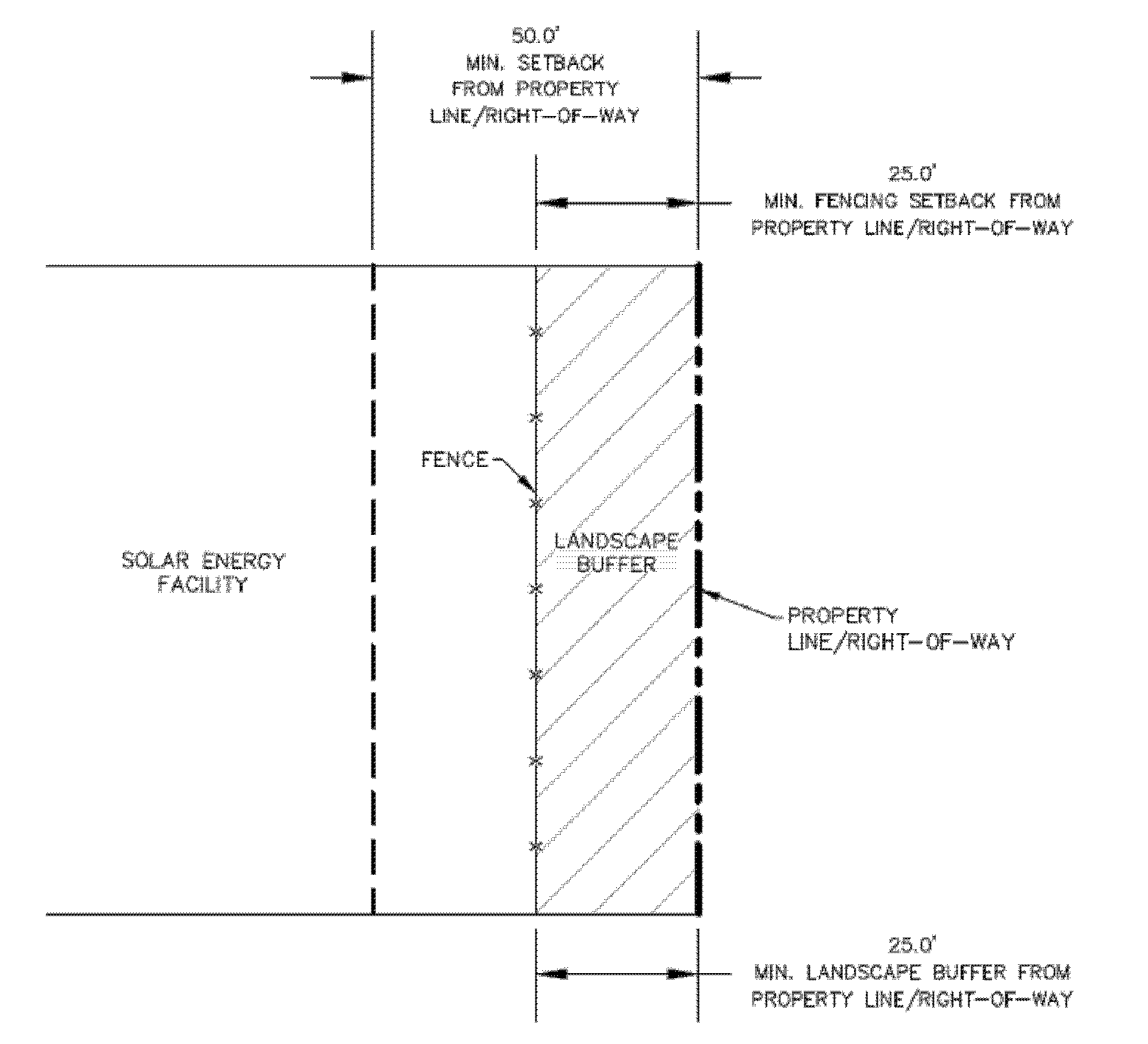
Illustration 9.1 - Setback and Buffer Diagram
(10)
Security fencing.
a.
Security fencing shall be required around the perimeter of any ground mounted solar energy facility.
b.
The fencing shall be installed a minimum of twenty-five (25) feet from the property line of any adjacent, non-participating parcel or public street right-of-way. Fencing shall not be installed within any required landscape buffer zone, but may be installed in the required setback. For reference, see Illustration 9.1 - Setback and Buffer Diagram.
c.
Lock boxes and keys must be provided at locked entrances for emergency personnel and appropriate access.
d.
Appropriate emergency contact signage shall be placed at the entrance of the solar energy facility and every two hundred (200) feet along the fencing.
e.
The fencing required hereunder shall be maintained in good condition. Failure to maintain the fencing required hereunder shall constitute a violation of this division.
f.
The fencing requirements specified hereunder shall continue notwithstanding the fact that a solar energy facility is no longer operational and/or falls into disuse unless and until the solar energy facility is decommissioned.
g.
The facility owner shall take reasonable steps to design and install fencing in a manner as to allow wildlife corridors through and around the facility site where requested by the director.
(11)
Screening/landscape buffer.
a.
A solar energy facility shall have a minimum twenty-five (25) foot-deep landscape buffer measured from the property line of any adjacent, non-participating parcel or public street right-of-way that provides a year-round visual buffer in accordance with this section. For reference, see Illustration 9.1 - Setback and Buffer Diagram.
1.
The applicant shall provide a landscape plan stamped by a licensed landscape architect or landscape horticulturalist.
2.
Existing vegetation shall be preserved within the twenty-five (25) foot landscape buffer, where reasonably possible. In locations where gaps in existing vegetation exists, trees and shrubs must be added to provide for a year-round visual buffer substantially similar to a planted buffer as described in subsection 3. below and any supplemental plantings must substantially comply with the requirements in subsection 3. below.
3.
Landscape buffer zones without existing trees or shrubs must be designed and planted to meet the following requirements:
i.
In the A-1 (Agricultural) zoning district, in an effort to achieve an eighty (80) percent opacity by year five (5) of operations, the landscape buffer must be comprised of four (4) class "A" trees, three (3) class "B" trees, and a minimum of twenty-two (22) shrubs must be installed every fifty (50) feet.
ii.
In the I-1 (Light Industrial) zoning district, in an effort to achieve a sixty (60) percent opacity by year five (5), the landscape buffer must be comprised of three (3) class "A" trees, two (2) class "B" trees, and a minimum of seventeen (17) shrubs must be installed every fifty (50) feet.
iii.
In the I-2 (Heavy Industrial) zoning district, no landscape buffer is required.
iv.
A minimum of fifty (50) percent of all plants must be evergreen.
v.
No more than thirty (30) percent of any one (1) species may be used.
vi.
All trees must have a minimum of six (6) feet in height at installation.
vii.
All shrubs must be a minimum of eighteen (18) inches in height at installation.
viii.
Vegetative planting must only use trees and shrubs as listed in appendix or as approved by the director.
b.
Maintenance. The facility owner shall require the use of good husbandry techniques with respect to landscaping, including, but not limited to, proper pruning, proper mowing, and proper mulching, so that the vegetation will reach maturity as soon as practical and will have maximum density in foliage. Dead or diseased vegetation shall be removed and replanted as soon as practicable given weather conditions.
c.
Plants or grasses on the facility site that are not included as a part of the landscaping buffer and the landscape buffer shall be maintained by the owner as to not constitute a nuisance.
(12)
Signage.
a.
Solar equipment shall not be used for displaying any advertising except for reasonable identification of the manufacturer or operator, or other information required by applicable local, state or federal law, rule or regulation.
b.
Emergency information signage shall be posted and maintained at the entrance of the solar energy facility, and shall include at a minimum the name and phone number of the facility owner.
c.
All signs, flags, streamers or similar items, both temporary and permanent, are prohibited on solar equipment except as specified above.
(13)
Utilities.
a.
Reasonable efforts shall be made to place all utility connections from the solar energy facility installation underground, depending on appropriate soil conditions, shape, and topography of the facility site and any requirements of the utility provider. Electrical transformers and structures for utility interconnection may be above ground.
b.
Any new utility-owned electrical lines for interconnection of the solar energy facility are not regulated by this division.
(d)
Zoning exception, rezoning, and development permit requirements.
(1)
Zoning exception and rezoning petition requirements. A petition for a zoning exception and/or rezoning, whichever is applicable, shall be filed on the petition form required by the division of planning and development and will include any reasonable supplemental data requested by the division of planning and development, per section 26-123, including, but not limited to:
a.
Narrative. A detailed narrative identifying the applicant, the parcels on which the solar energy facility is proposed to be sited and the parcel owners, and a description of the proposed solar energy facility including, but not limited to, the proposed type of solar panel and mounting system (i.e., fixed or tracking), the number of panels, and angles of orientation.
b.
Facility site plan. A facility site plan that includes the following:
1.
Date, scale, and accurate north arrow of the facility site plan showing the entire facility site;
2.
Boundaries and dimensions of the facility site, including total acreage, with bearings and distances;
3.
Location of any improved areas and exact distances to property lines;
4.
Identification of adjoining parcels by parcel number and owner name;
5.
Location of components of the solar energy facility, including streets, circulations, driveways, arrangement and number of solar panels, inverters, transformers, collection lines, substation(s), fencing, gates, landscape buffer(s) and facilities up to point of interconnection;
6.
Location of any existing or proposed buildings, structures, or panels;
7.
Land contours;
8.
Location of bodies of water, wetlands and special flood hazard areas;
9.
Horizontal and vertical (elevation) to scale drawing of the solar panels and racking;
10.
Vicinity map showing the location and surrounding land use; and
11.
Other features and designs reasonably deemed necessary by the planning and zoning board.
c.
Documentation of the major system components to be used, including the photovoltaic panels, mounting system, and inverter.
d.
Memorandums of the servitude, option or lease agreement if the facility site is not owned by the applicant.
e.
Documentation of an application for interconnection of the solar energy facility to the electrical grid. Off-grid systems shall be exempt from this requirement.
f.
An operation and maintenance plan which shall include measures for maintaining safe access to the installation, storm water controls, as well as general procedures for operational maintenance of the solar energy facility.
g.
A conceptual landscape plan.
h.
A decommission plan as defined in subsection (f) Decommissioning.
i.
Community impact assessment.
1.
An assessment of the overall impact on the immediate vicinity of the proposed solar energy facility as well as the greater parish community.
2.
The report shall be prepared by one (1) or more professionals acting within his or her competency, shall be presented in written form and shall analyze in specific terms the probable impact of the solar energy facility on the vicinity and community over time.
3.
Specific attention, as may be appropriate to the individual proposal, should be given but not be limited to the following elements:
i.
Anticipated direct revenues to the parish from real estate and personal property taxes.
ii.
An assessment of employment opportunities to be created by the proposed development.
iii.
An assessment of the short and long-term economic impact of the proposed development.
iv.
If the development is replacing an existing enterprise, including agriculture and forestry, an assessment of the impact the current enterprise has on the local economy and how the local economy will be impacted by the loss of the existing enterprise.
v.
The impact on adjacent property values prepared by a qualified third-party.
vi.
The potential impacts on wildlife and wildlife habitats at the facility site and within a two-mile radius of the facility site.
vii.
Fire, rescue, and law enforcement requirements as compared to existing capacities and facilities.
viii.
Infrastructure needs as compared to existing capacities and facilities to address:
(a)
Adequacy of existing utilities, water, sewer, public services and public facilities in the vicinity of the development.
(b)
Proposed public and private improvements, both off-site and on-site, and a cost estimate for any improvements to be installed by and or dedicated to the parish.
4.
Other public and quasi-public facility and service impacts including refuse collection and disposal systems intended to serve the development.
5.
Socioeconomic changes and impacts that result from the proposed development.
6.
The costs in both capital and operating funds of providing services to the proposed development.
7.
What efforts, if any, are proposed to mitigate the service demands or costs to the parish.
8.
The director may waive certain elements of the community impact assessment where the nature of the proposed development makes such elements inapplicable.
j.
Cultural resources review. A cultural resources review conducted in coordination with the state department of historic resources. This report shall further identify historical, architectural, archeological, or other cultural resources on or near the proposed solar energy facility.
k.
Glint and glare study. A glint and glare study that demonstrates either that the panels will be sited, designed, and installed to eliminate glint and glare effects on roadway users, nearby residences, commercial areas, and other sensitive viewing locations, or that the applicant will use all reasonably available mitigation techniques to reduce glint and glare to the lowest achievable levels. The study will assess and quantify potential glint and glare effects and address the potential health, safety, and visual impacts associated with glint and glare. Any such assessment must be conducted by qualified individuals using appropriate and commonly accepted software and procedures.
l.
List of the names and addresses of adjoining property owners.
m.
List of anticipated federal, state and local permits and approvals for the solar energy facility.
(2)
General development permit application requirements. The application for a development permit shall be filed on the development permit application form required by the division of planning and development and shall include the following:
a.
General information.
1.
Names, addresses and phone numbers of the facility owner and the engineer.
2.
Name, address, and phone number for proposed system contractor/installer.
3.
Signature of facility owner, or authorized agent.
b.
Runoff management plan. A drainage runoff management plan (RMP) as required by the drainage regulations of this chapter.
c.
Construction plans sealed by a professional engineer licensed to practice in the state, showing the proposed layout of the solar energy facility and in compliance with section 26-322.
d.
One- or three-line electrical diagram sealed by a professional engineer licensed to practice in the state detailing the solar photovoltaic installation, associated components, and electrical interconnection methods, with all National Electrical Code compliant disconnects and overcurrent devices.
e.
All information required by applicable articles and divisions of this chapter, including, but not limited to, plans that comply with applicable requirements in articles VII, VIII, and IX.
(3)
Appeal.
a.
Any appeal of the decision of the planning and zoning board on the petition for a zoning exception shall be made to the district court within thirty (30) days of the decision being rendered, in accordance with article X, division 4.
b.
Any appeal of the decision of the police jury on the petition for a rezoning shall be made to the district court within thirty (30) days of the decision being rendered, in accordance with article X, division 4.
c.
Any appeal of a decision by the division of planning and development on the development permit shall be made to the planning and zoning board, in accordance with section 26-350.
(e)
Completion of construction and maintenance.
(1)
As-built plans. Upon completion of construction of the solar energy facility, an as-built plan sealed by a licensed engineer must be submitted to the director and parish engineer to confirm compliance with issued permits. The as-built plan must be submitted within six (6) months of the completion of construction.
(2)
Monitoring and maintenance.
a.
The owner shall maintain the solar energy facility in good condition.
b.
Maintenance shall include, but not be limited to, painting, structural repairs, and integrity of security measures. Facility site access shall be maintained to a level acceptable to the parish building inspector and the local and state fire chiefs.
c.
The facility owner shall be responsible for the cost of maintaining the solar energy facility and any access road(s) not accepted as a public way.
d.
All material modifications to a solar photovoltaic installation made after the issuance of the required development permit shall require approval by the planning and zoning board.
(f)
Decommissioning.
(1)
Decommissioning events.
a.
Abandonment. Absent notice of a proposed date of decommissioning or written notice of extenuating circumstances, the solar energy facility shall be considered abandoned when it fails to operate for more than six (6) months without the written consent of the parish. The facility owner shall commence decommissioning upon thirty (30) days notice from the police jury to the facility owner. Failure by the facility owner to begin decommissioning upon thirty (30) days notice shall be deemed a violation of the Code of Ordinances and decommissioning may be initiated by the parish, at its discretion and at the facility owner's expense.
b.
End of occupancy. The facility owner shall notify the director and police jury, by certified mail, of the date on which the facility owner's right to occupy the facility site expires or terminates without having been extended. The facility owner shall begin decommissioning within thirty (30) days of the date on which the facility owner's right to occupy the facility site expires or terminates without having been extended. The solar energy facility shall be removed within one (1) year, at the facility owner's expense.
(2)
Decommission plan.
a.
A signed and notarized decommissioning plan (decommission plan), in a form suitable for recordation with the clerk of court, must be submitted to the parish to be approved in connection with the development permit.
b.
The decommission plan shall contain the following, at a minimum:
1.
An estimated cost of decommissioning, net of salvage value, prepared by a licensed professional engineer.
2.
A requirement that decommissioning begin within thirty (30) days after the occurrence of a decommissioning event, as defined in this section, or as soon thereafter as any permit required for decommissioning activity is issued.
3.
Decommissioning shall include disposal of non-utility owned equipment, including, but not limited to, solar panels, buildings, electrical components, roads, fencing, any cabling and other underground components up to thirty-six (36) inches below grade.
4.
Restoration of the property to a condition reasonably similar to its condition before development of the solar energy facility, unless a written agreement is reached with the land owner to leave the property in its current condition.
5.
Any additional conditions which may be defined or established by the planning and zoning board upon which decommissioning will be initiated (i.e., condition of lease, condition of a potential public safety hazard, etc.).
6.
Remediation of any environmental hazards on the facility site as a result of the operation of the solar energy facility, if any have been identified on the property at the time of decommissioning, as determined by the Environmental Protection Agency (EPA), Louisiana Department of Environmental Quality (DEQ), or other environmental agency with jurisdiction of the facility site.
c.
The decommissioning plan shall be signed by the facility owner and filed with the director and the clerk of court.
d.
The facility owner will provide the parish with notice of any change in ownership of the solar energy facility, and the new facility owner shall file an updated signed decommissioning plan within thirty (30) days of change in the facility owner.
e.
Upon any failure to initiate or complete the decommission plan, the parish, or its authorized representative, may take action as authorized by law including, but not limited to, calling the bond, revoking any previously issued permits, or initiating any civil or criminal action as per chapter 1 of this Code.
(3)
Decommission bond. At least thirty (30) days prior to the start of construction, a surety bond shall be posted in a form approved by the director, in an amount of one hundred twenty-five (125) percent of the cost of decommissioning costs (less salvage value) as provided for in the estimate included in the decommission plan, and naming the parish as beneficiary.
(Ord. No. 7546, § 3, 12-1-22)

