
Caro City Zoning Code
ARTICLE XX
NONCONFORMING USES4
State Law reference— Nonconforming uses or structures, MCL 125.3208.
Sec. 44-573.- Nonconforming lots; nonconforming uses of land; nonconforming structures; nonconforming uses of structures and premises.
(a)
Intent.
(1)
It is the intent of this article to permit legal nonconforming lots, structures, improvements or uses to continue until they are removed but not to encourage their survival. The purpose of this nonconforming section is to meet the requirements of Section 208 of the Michigan Zoning Enabling Act.
(2)
It is recognized that there exists within the districts established by this chapter and subsequent amendments, lots, structures and uses of land and structures which were lawful before the ordinance from which this chapter is derived was passed or amended which would be prohibited, regulated or restricted under the terms of this chapter or further amendments.
(3)
Such uses are declared by this article to be incompatible with permitted uses in the districts involved. It is further the intent of this article that nonconformities shall not be enlarged, expanded or extended, nor be used as grounds for adding other structures or uses prohibited elsewhere in the same district.
(4)
A nonconforming use of a structure, a nonconforming use of land, or a nonconforming use of a structure and land shall not be extended or enlarged after passage of the ordinance, or by addition of other uses of a nature which would not be permitted generally in the district involved.
(Ord. No. 401, § 2000, 5-2-2005; Ord. No. 482, 8-16-2021)
Sec. 44-574. - Legal status of nonconformity.
(a)
Legal nonconformity.
(1)
To avoid undue hardship, nothing in this chapter shall be deemed to require a change in the plans, construction, or designated use of any building on which actual construction had lawfully begun prior to the effective date of adoption or amendment of the ordinance from which this chapter is derived and upon which actual building construction has been diligently carried on, or when a legal zoning permit was acquired prior to the date of adoption or amendment and construction begins within 90 days of adoption of the amendment. These shall be considered legal nonconforming lots.
(2)
Actual construction is hereby defined to include the placing of construction materials in permanent position and fastened in a permanent manner; except where demolition or removal of an existing building has substantially begun preparatory to rebuilding such demolition, or removal shall be deemed to be actual construction, provided that work shall be diligently carried on until completion of the building involved.
(3)
Illegal nonconforming uses, lots, buildings, structures, or improvements that are not incompliance with this article at the time of instillation. The provisions in this article shall not apply to illegal nonconformities.
(Ord. No. 482, 8-16-2021)
Sec. 44-575. - Nonconforming lots.
(a)
Legal nonconforming lot.
(1)
Any legal lot of record at the time of the adoption of this section, which is made nonconforming with regards to lot width or area due to the adoption of this section or later amendments to the section, may be built on and used, provided that any structures meet the setback requirements of this section.
(2)
If two nonconforming lots of record are adjacent under common ownership, they are treated as separate nonconforming lots. The owner can combine the lots to not increase nonconformity.
(3)
The adjustment of the nonconforming lot cannot increase the nonconformity of either lot. If it is unclear if the nonconformity is increased, it shall be reviewed by the zoning board of appeals.
(4)
In any district, buildings may be erected on any single lot of record at the effective date of adoption or amendment of the ordinance from which this chapter is derived. This provision shall apply even though such lot fails to meet the requirements for area or width, or both, that are generally applicable in the district; provided that yard dimensions and other requirements not involving area or width or both, of the lot shall conform to the regulations for the district in which such lot is located. Yard requirement variances may be obtained through approval of the board of appeals.
(Ord. No. 482, 8-16-2021)
Sec. 44-576. - Nonconforming uses of land or building.
(a)
Where, at the effective date of adoption or amendment of the ordinance from which this chapter is derived, lawful use of land exists that is made no longer permissible under the terms of this chapter as enacted or amended, such use may be continued, so long as it remains otherwise lawful, subject to the following provisions:
(1)
No such nonconforming use shall be enlarged or increased, nor extended to occupy a greater area of land than was occupied (gross floor area occupied) at the effective date of adoption or amendment of the ordinance from which this chapter is derived. The intensity (services provided or level of activity) of the nonconforming use is not allowed unless it is in compliance with the requirements of this chapter.
(2)
No such nonconforming use shall be moved in whole or in part to any other portion of the lot or parcel occupied that is not in compliance with this chapter.
(3)
A nonconforming use that changes to a conforming use may not be revert back to a nonconforming use. A nonconforming use cannot be changed to another nonconforming use.
(4)
A nonconforming use was determined to be abandoned per section 44-581 shall not revert back to a nonconforming use.
(Ord. No. 482, 8-16-2021)
Sec. 44-577. - Nonconforming buildings.
(a)
Where a lawful building exists at the effective date of adoption or amendment of the ordinance from which this chapter is derived that could not be built under the terms of this chapter by reason of restrictions on area, lot coverage, height, yards, or other characteristics of the structure or its location on the lot, such structure may be continued so long as it remains otherwise lawful, subject to the following provisions:
(1)
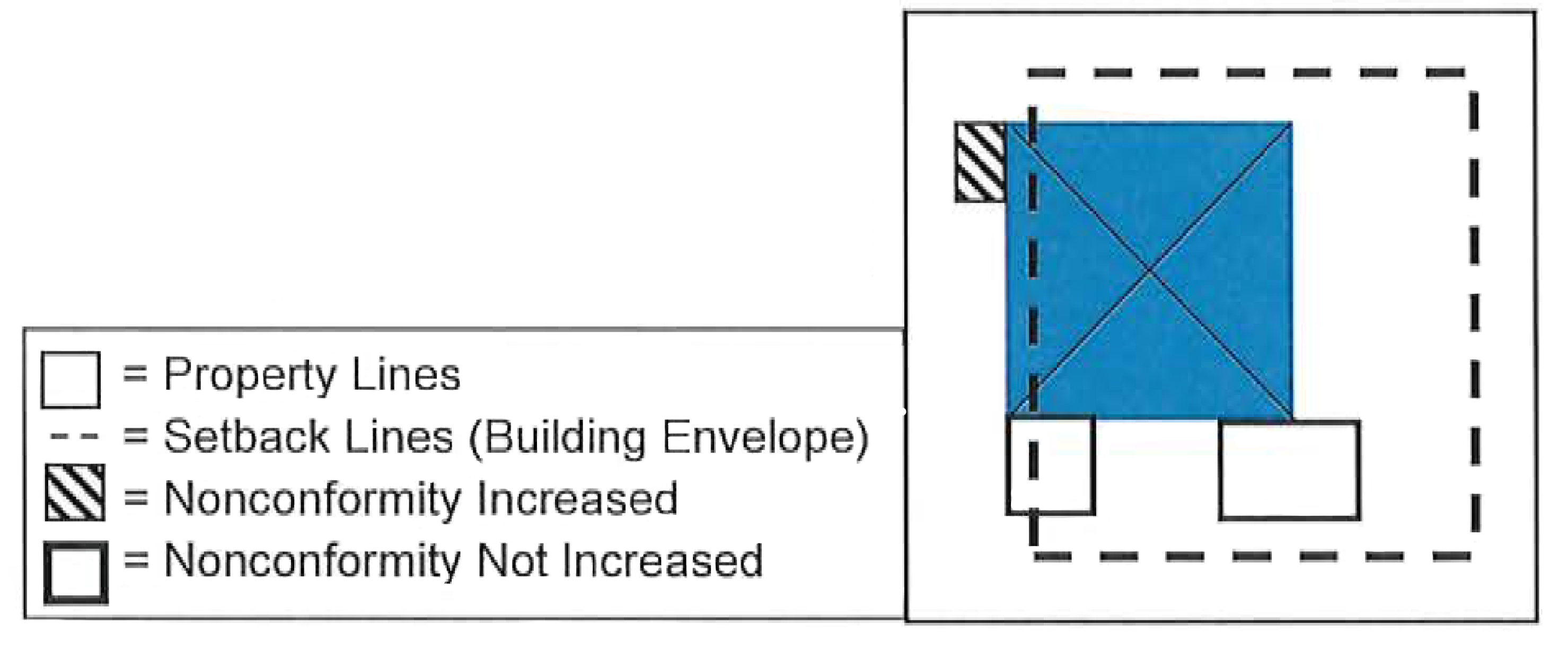
No such building may be enlarged or altered in a way which increases its nonconformity. Such structures may be enlarged or altered in a way which does not increase its nonconformity. As shown in the provided figure:
(2)
Should such building be destroyed by any means to an extent of more than 60 percent of its replacement costs, exclusive of the foundation, it shall be reconstructed only in conformity with the provisions of this chapter.
(3)
Should such structure be moved for any reason for any distance whatever, it shall thereafter conform to the regulations for the district in which it is located after it is removed.
(Ord. No. 482, 8-16-2021)
Sec. 44-578. - Repairs and maintenance.
(a)
On any building devoted in whole or in part to any nonconforming use, work may be done in any period of 12 consecutive months or ordinary repairs, or on repair or replacement of nonbearing walls, fixtures, wiring or plumbing to an extent not exceeding 50 percent of the assessed value of the building, provided that the cubic content of the building as it existed at the time of passage or amendment of the ordinance from which this chapter is derived shall not be increased.
(1)
This provision does not apply to nonconforming single-family homes, which may be replaced even if completely destroyed provided, the new structure does not increase the nonconformity.
(2)
The construction or repair shall begin within one year of the day that the destruction is officially documented. The planning commission may grant up to a one year extension if the applicant can show diligently pursuing reconstruction. If repairs or construction are not completed in the required timeframe, it may only be reconstructed if in full compliance of ordinance requirements.
(b)
Nothing in this chapter shall be deemed to prevent the strengthening or restoring to a safe condition of any building or part thereof, declared to be unsafe by any official charged with protecting the public safety, upon order of such official.
(Ord. No. 482, 8-16-2021)
Sec. 44-579. - Uses subject to special conditions not nonconforming uses.
(a)
A use established legally without a special conditional use approval which now requires a special conditional use due to a text amendment change or rezoning is a nonconforming use until it received a special conditional use approval. Any existing use approved as a special exception previously under this chapter shall be deemed a conforming use.
(Ord. No. 482, 8-16-2021)
Sec. 44-580. - Change of tenancy or ownership.
(a)
There may be a change of tenancy, ownership, or management of any existing nonconforming uses of land, structures and land in combination.
(Ord. No. 482, 8-16-2021)
Sec. 44-581. - Determining abandonment.
(a)
If the zoning administrator identifies a legal nonconforming use that they believe has been abandoned, they shall submit the property to the zoning board of appeals (ZBA) for a determination of abandonment. The ZBA shall hold a public hearing and follow the notice procedure in section 44-797. The ZBA shall determine whether the intent to abandon the nonconforming use was demonstrated based on a preponderance of the following factors:
(1)
Reports from the building inspector or health department indicating the property is or has not been suitable for occupation.
(2)
Disconnection of utilities.
(3)
Evidence that the use was relocated to a new site.
(4)
Evidence of a "going out of business" sale.
(5)
Signs advertising the business has been removed.
(6)
The use has been discontinued for one year, except where government action such as road construction has prevented access to the premises or where a clear intent to discontinue has been demonstrated.
(7)
Removal of equipment of fixtures necessary for the operation of the nonconforming use.
(8)
Request by the property owner to change in their property tax designation inconsistent with the nonconforming use.
(9)
Other actions by the property owner or lessee that demonstrates an intent to abandon the nonconforming use.
(Ord. No. 482, 8-16-2021)
Sec. 44-582. - Nonconforming improvements.
The method of addressing nonconforming improvements are addressed in those correlating Articles.
(a)
Landscaping in section 44-451.
(b)
Off-street parking and loading spaces in section 44-596.
(c)
Signs in section 44-631.
(Ord. No. 482, 8-16-2021)

