
Carrollton City Zoning Code
ARTICLE 6
INFRASTRUCTURE IMPROVEMENTS
6.00.00 - GENERALLY
This Article sets out the minimum requirements and standards for construction of subdivisions and other land development projects, including general principals of design and layout and requirements for such public facilities as streets and utilities.
6.06.00 - OTHER EASEMENTS
Easements other than utility easements shall be required in connection with subdivisions or developments for the following purposes, among others:
6.09.00 - STREET LIGHTS
Street lights are intended to provide illumination on public streets to a level that provides a reasonably safe and secure operating environment for pedestrian and vehicular traffic within the public right-of-way. Street lights shall not serve as security lighting for private property. Any lighting of private property that results from the public street lighting program is purely circumstantial.
The city does not budget or fund the installation of utility poles or any types of decorative poles for street lighting. It is solely the developer's responsibility to coordinate said installations with the appropriate power company.
6.10.00 - DRIVEWAYS AND DEVELOPMENT ENTRANCES
All proposed subdivisions, subdivision lots and other land developments shall be provided with driveways or development entrances meeting the following requirements:
6.12.00 - SIDEWALKS
Sidewalks shall be installed according to City standards by the developer under the following circumstances:
A.
A sidewalk shall be provided within the right-of-way of any road adjacent to any residential or commercial development. The sidewalks shall be installed at the same time other improvements are installed within the development.
B.
Within a residential subdivision, a sidewalk shall be provided on both sides of every street within the subdivision. A residential subdivision with lots greater than three (3) acres in size is exempt from these requirements.
C.
Sidewalks shall meet the following standards:
1.
In commercial developments, the sidewalk must be at least six (6) feet wide. In residential developments, the sidewalk must be at least five (5) feet wide.
2.
The sidewalk must be located at least four (4) feet from the back of the street curb. The City Engineer may approve a reduction if topographic or other natural features prohibit this separation from the curb.
(Res. No. 05-2019, 1-7-19)
6.13.00 - STORM DRAINAGE
Systems and facilities for the conveyance and control of stormwater shall be designed, installed and maintained subject to the Design and Construction Standards on file in the City Engineer's office and the regulations set forth in Article 7.
6.14.00 - WATER SUPPLY
A.
Public water service shall be provided to every lot in every subdivision and to every development for both domestic use and fire protection if public water is available or under bid or contract to be available within 1,000 feet of the subdivision or development.
B.
All water system improvements and their installation shall meet the adopted standards of the Carrollton Water and Wastewater Departments. A contractor approved by the City of Carrollton shall install all elements of the water system, including mains, valves, service laterals through the curb line, and fire hydrants at the developer's expense.
6.15.00 - FIRE HYDRANTS
A.
Fire hydrants are required in all subdivisions and development projects served by a public water system.
B.
Fire hydrants as specified by the Fire Department and the City of Carrollton shall be located every five-hundred (500) feet and/or at every intersection, whichever is closer.
6.16.00 - SANITARY SEWERAGE DISPOSAL
A.
When in the written opinion of the Carroll County Health Department and the City Engineer, public sanitary sewers are within reasonable access of the subdivision, the subdivider shall provide sanitary sewer services to each lot within the bounds of the subdivision. All sewer service lines in the subdivision shall be installed by the subdivider in accordance with the Design and Construction Standards.
B.
When in the written opinion of the City of Carrollton a public sanitary sewer is not acceptable, an alternate method of sewage disposal for each lot may be used when in compliance with the Carroll County Health Department requirements. A community sewage disposal system may not be used.
C.
Whenever the installation of a sanitary system is required as provided by these regulations, no new street shall be paved without such sewer being first installed in accordance with the requirements of the Georgia Department of Human Resources sewer specifications and the City of Carrollton Design and Construction Standards.
6.01.01 - Standard Design Specifications
The Design and Construction Standards of the City of Carrollton, also referred to in this UDO as "Design and Construction Standards," as maintained by the City Engineering Department and as may be amended from time to time by said department, are incorporated into this Code as though set forth within the body of this Code. In the case of a conflict between the Design and Construction Standards and the text of this Code, the text of this Code shall control.
6.01.02 - Traffic Signs and Street Striping
The installation of all traffic control signs and street striping shall be governed by the standards contained in the Manual on Uniform Traffic Control Devices, latest edition, published by the Federal Highway Administration of the U.S. Department of Transportation.
6.01.03 - Georgia DOT Standard Specifications
Unless otherwise specially set forth in this Code or the Design and Construction Standards, all of the materials, methods of construction, and workmanship for the work covered in reference to street construction and storm drainage construction shall conform to the latest standard specifications of the Georgia Department of Transportation.
6.01.04 - AASHTO Design Standards
Design criteria and standards not specifically set forth herein or in the latest standard specifications of the Georgia Department of Transportation shall conform to the latest edition of the American Association of State Highway and Transportation Officials (AASHTO), "A Policy on Geometric Design of Highways and Streets." The latest edition of the Roadside Design Guide by AASHTO shall be consulted regarding set-back criteria and clear zone distance criteria for structures within a public street right-of-way or private street easement.
6.01.05 - Street Lighting
The American National Standard Practice for Roadway Lighting of the Illumination Engineering Society, as approved by the American National Standards Institute (1973), or as more recently amended, shall be consulted regarding illumination of public rights-of-way.
6.02.01 - Suitability of the Land
A.
Land with a slope of 35% or more, land within an area of special flood hazard (the 100-year floodplain), and land otherwise determined by the City Engineer to be physically unsuitable for subdivision or development because of flooding, poor drainage, topographic, geologic or other such features that may endanger health, life or property, aggravate erosion, increase flood hazard, or necessitate excessive expenditures of public funds for supply and maintenance of services shall not be approved for subdivision or development unless adequate methods are formulated by the developer for solving the problems. Such land shall be set aside for such uses as shall not involve such a danger.
B.
Land within a proposed subdivision or development that is unsuitable for development shall be incorporated into the buildable lots as excess land or set aside as open space. Lots that do not comply with the requirements of this Code are prohibited.
6.02.02 - Conformance to the Comprehensive Plan and Other Adopted Plans
In addition to the requirements established herein, all subdivisions and individual development projects shall comply with the following laws, rules and regulations:
A.
All proposed subdivisions and individual development projects shall conform to the Comprehensive Plan and development policies in effect at the time of submission to the City Engineer.
B.
In subdivisions or developments related to or affecting any State or U.S. numbered highway, the City Engineer shall require the approval of the Georgia Department of Transportation.
C.
Dedications and reservations.
1.
All transportation facilities such as highways, major thoroughfares and other streets shall be platted by the developer in the location and to the dimension indicated on the Comprehensive Plan or the Transportation Plan, whichever is the most recently adopted or amended.
2.
Public facilities other than transportation facilities, such as school sites, park sites, library sites, fire station sites, sites for public utilities or for other public use or open space, shall be shown as dedicated or as reserved on the preliminary and final plats under the following circumstances:
a.
When any of said public facilities are shown in the Comprehensive Plan and located in whole or in part in a proposed subdivision or development; or
b.
When any of said public facilities have not been anticipated by the Comprehensive Plan, but are considered essential to or extremely important to the development of the City or to that neighborhood or portion of the City within which the subdivision or development project lies, by the Carrollton Mayor and City Council.
3.
Time limitation on reservations.
If the developer reserves land for any public facility other than transportation facilities and it is not acquired by gift, purchase, condemnation or otherwise nor optioned by the appropriate public agency within 5 years from the date of recording of the subdivision or by the time Certificates of Occupancy have been issued for 75% of the dwelling units in the development, whichever occurs first, the subdivider may claim the original reservation, or portion thereof, and cause it to be subdivided in a manner suitable to the subdivider subject to the provisions of this UDO.
4.
Waiver of dedication or reservation requirement.
The City Engineer may waive the platting and reservation requirements of subsection (C) above whenever the public body responsible for land acquisition executes a written release stating that such a planned feature is not being acquired.
5.
Refusal of dedication offer.
a.
Whenever a plat or site plan proposes the dedication of land to public use that the City Engineer finds not required or suitable for such public use, the City Engineer shall refuse to approve the plat or site plan. The City Engineer's opinion may be appealed to the Carrollton Mayor and City Council.
b.
Whenever a plat or site plan proposes the dedication of land to public use that the Carrollton Mayor and City Council finds to be not required or suitable for such public use, the Carrollton Mayor and City Council shall refuse to accept the dedication.
6.02.03 - Name of Subdivision or Development Project
The name of each subdivision or development project must have the approval of the City Engineer. The name shall not duplicate nor closely approximate the name of an existing subdivision or development project in the City of Carrollton or Carroll County.
6.02.04 - Street Names
A.
Proposed streets obviously in alignment with other existing and named streets shall bear the names of the existing streets. In no case shall the name for a proposed street duplicate existing street names in the Carrollton area, irrespective of the use of a suffix such as: street, avenue, boulevard, road, pike, drive, way, place, court or other derivatives.
B.
Street names are subject to approval by the City Engineer.
6.02.05 - Street Addresses
Street addresses shall be obtained from the City Engineer and shall be shown on each final plat.
6.02.06 - Blocks
A.
Residential blocks.
1.
Unless otherwise approved by the City Engineer under unusual circumstances, block lengths shall not exceed 1,800 feet nor be less than 600 feet in length.
2.
In blocks greater than 1,000 feet in length, the City Engineer may require one (1) or more public easements of not less than ten (10) feet in width to extend entirely across the block for pedestrian crosswalks, fire protection or utilities.
3.
Width: Residential blocks shall be wide enough to allow two (2) rows of lots, except where reverse frontage lots on major thoroughfares are provided, or when prevented by topographic conditions or size of the property, or for lots along the periphery of the subdivision, or where abutting upon limited access highways or railroads, or where other situations make this requirement impractical, in which case the City Engineer may approve a single row of lots.
B.
Non-Residential blocks.
Blocks for other than residential use shall be of such length and width as may be suitable for the prospective use, including adequate provision for off-street parking and service.
6.02.07 - Lots
A.
Minimum lot dimensions and areas.
All lots shall meet or exceed the area and dimensional requirements of this UDO for the zoning district and type of development in which the lots are located. Lot size may be reduced by the Mayor and City Council if approved as a Planned Development.
B.
Authority of Health Department.
Nothing contained in this Article shall be construed as preventing the Carroll County Health Department, after study of the conditions existing in a proposed subdivision, from requiring that all or any portion of the area of such subdivision shall not be built upon or that the minimum lot sizes set forth in this Development Ordinance are inadequate and must be increased to ensure the protection of the public health.
C.
Adequate building sites.
Each lot shall contain a site large enough for a normal building that will meet all building setback requirements as set forth in this Code and not be subject to flood or periodic inundation.
D.
Arrangement.
Insofar as practical, side lot lines shall be at right angles to straight street lines or radial to curved street lines (including cul-de-sacs).
E.
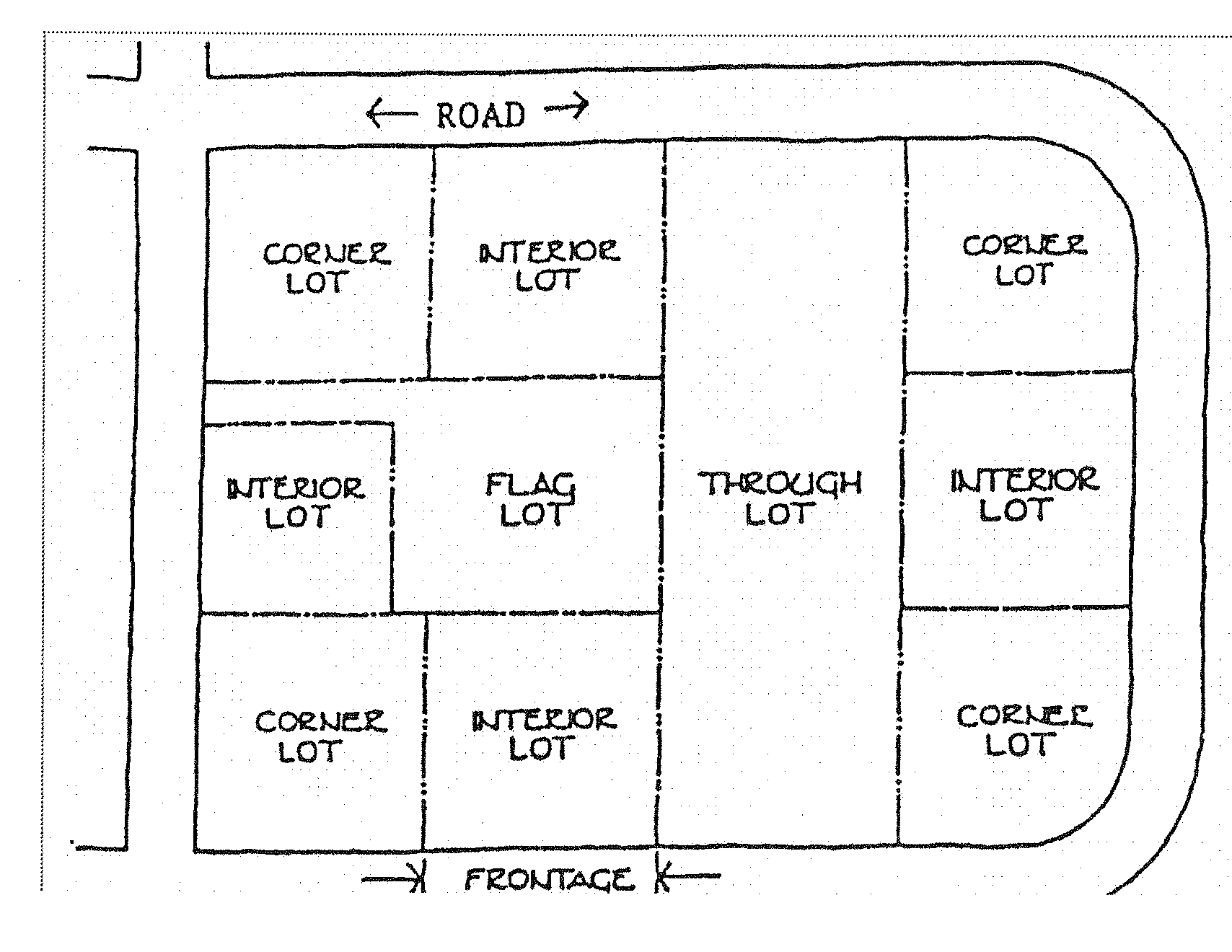
Corner lots.
Corner lots shall be sufficiently large to permit the location of buildings so as to conform to the front building lines on both streets.
F.
Through lots.
On through lots (i.e., "double-frontage" lots) the minimum front yard setback for principal buildings shall be provided along each street.
G.
Flag lots.
Flag lots must meet the minimum lot width for the applicable zoning district at the minimum front setback line required for principal buildings.
H.
Lot remnants.
Lot remnants (lots below minimum area or width left over after subdividing tracts of land) shall be prohibited. Such remnant areas shall be added to adjacent lots, rather than remain as unusable parcels.
6.02.08 - Areas Reserved for Future Development
If any portion of a tract is reserved for future subdivision development, the minimum lot width and frontage of the reserved area may be reduced to the width required for a future street to serve such area.
A.
Such a reserved area must be labeled "Reserved for Future Development" on the final subdivision plat, and the portion of the lot where a street will be built must be labeled "Future Street."
B.
Such a reserved area will not be eligible for issuance of a building permit unless the lot meets all requirements of this UDO, including minimum lot width and frontage requirements of the applicable zoning district.
6.02.09 - Plats Straddling Political Boundaries
Whenever access to a subdivision is required across land in another governmental jurisdiction, the City Engineer may request assurance from the City Attorney, and/or the other jurisdiction that access is legally established, and that the access road is adequately improved. In general, lot lines shall be laid out so as to not cross jurisdictional boundary lines.
6.02.10 - Design Standards for Planned Developments
A.
The project design standards and requirements of this Article may be modified in the case of a Planned Development (PD) which, in the judgment of the Carrollton Mayor and City Council, provides adequate public spaces and improvements for the circulation, recreation, light, air and service needs of the tract when fully developed and populated, provided zoning density standards for the entire tract are not exceeded, and which also provides such covenants or other legal procedures as will assure conformity to and achievement of the plan.
B.
Plans for such developments shall be submitted to and approved by the Carrollton Mayor and City Council as a Planned Development (PD), as required by this UDO. No building permits shall be issued until such approval has been given.
6.03.01 - Minor Subdivisions
By definition, a minor subdivision does not involve the construction of major public improvements, such as new streets or stormwater detention. However, the following improvements are required in order to adequately serve the lots and protect the safe operation of the existing road:
A.
Right-of way shall be dedicated along the property's frontage from the centerline of the existing road equal to ½ of the minimum requirement for the classification of the road, as established in Section 6.07.04. Minimum road improvements, (i.e. additional lane widening, curb and gutter, roadway overlay, etc.) may be required, if determined necessary by the City Engineer, to bring a substandard city road facility up to a minimum acceptable standard, within the limits of the property frontage being subdivided if the proposed subdivision is greater than five (5) lots. The requirement for such road improvements shall not alter or change the designation from Minor Subdivision.
B.
The potential location of a driveway connection serving each lot and meeting the requirements of these development regulations shall be indicated on the final subdivision plat.
C.
The stormwater carrying capacity of the road, whether in an existing ditch or gutter, shall not be compromised. If the stormwater characteristics of the existing road are inadequate to accommodate the new lots, the City Engineer may require improvement as appropriate.
D.
Survey monument markers of all lot corners shall be provided in accordance with the requirements of Section 6.04.00.
6.03.02 - Major Subdivisions, Multifamily and Non-[R]esidential Developments
The following improvements shall be provided by the developer or at the developer's expense in every major subdivision or individual multi-family or non-residential development in accordance with the requirements and standards contained in this Article.
A.
Survey monumentation in accordance with Section 6.04.00.
B.
Streets providing access to such a development and to all lots in such a subdivision, including the extension of streets required to provide access to adjoining properties, in accordance with Section 6.07.00.
1.
Streets contained wholly within such a subdivision shall be improved to the full standards contained in this Article. Existing streets that adjoin such a development shall be improved to the minimum standards from the centerline of the street along the development's frontage.
2.
Curb and gutter where required along all roadways, or drainage swale where allowed.
C.
Street name signs, stop bars, striping and traffic control signs, as approved by the City Engineer, shall be installed by the developer in accordance with Section 6.08.00.
D.
Street lights in accordance with Section 6.09.00.
E.
Driveway access to each lot shall be installed by the developer in accordance Section 6.10.00.
F.
Project access improvements (deceleration, turn lanes, etc.) as deemed necessary by the City Engineer under the provisions of Section 6.11.00.
G.
Sidewalks, if required, under Section 6.12.00.
H.
Stormwater drainage and detention facilities in accordance with Section 6.13.00.
I.
Public or private water supply as required under Section 6.14.00.
J.
Fire hydrants as required under Section 6.15.00.
K.
Public or private sanitary waste disposal as required under Section 6.16.00.
6.03.03 - Guarantee in Lieu of Completed Improvements (Performance Bonds)
No final subdivision plat shall be approved by the City or accepted for recordation by the Clerk of the Superior Court until one of the following conditions has been met:
A.
All required improvements have been constructed or funded in a satisfactory manner and approved by the City Engineer, or
B.
The Carrollton Mayor and City Council has received in escrow 150% of the estimated cost of installation of the required improvements, and has received a copy of an executed contract for installation of the improvements between the developer and a qualified contractor. The executed contract shall call for completion of the improvements within twenty-four (24) months of approval of the final subdivision plat.
C.
The improvements funded through the escrow fund shall be limited to final pavement topping for streets, final grassing of street shoulders, landscaping, and street and parking lot striping and sidewalks.
D.
Upon completion of deferred improvements, the as-built surveys are to be updated by the developer and submitted to the City Engineer.
6.04.01 - Exterior Development Boundaries
A.
A two (2) inch iron pipe at least twenty-four (24) inches long shall be placed at all corners of the exterior boundaries of the subdivision or development project being developed and shall be driven no less than six (6) inches above the finished grade.
B.
Existing permanent monuments that, in the professional opinion of a registered land surveyor, are of sufficiently durable construction shall be marked and maintained.
6.04.02 - Lot and Street Corners
A.
All other street or lot corners shall be marked with a three-quarter (¾) inch iron pipe at least twenty-four (24) inches long and driven no less than two (2) inches above the finished grade.
B.
All such monuments shall be properly set in the ground and shall be approved by a registered land surveyor prior to the time of final plat approval.
6.04.03 - Floodplain Elevations
On developments containing floodplains, flood elevation references shall be set.
6.05.01 - Notice of Intention to Utilize Right-of-Way
Any public utility seeking to condemn or utilize an easement over or through or within the paved portion of the public right-of-way which is under the supervision and control of the City, in order to run wires, pipes, cables, maintain dams, flow backwater, or for any other uses necessary to its purpose, shall first notify the City Engineer or its designated agent of the utility's intention to so condemn or utilize, and in all cases other than condemnation said utility shall obtain a permit from the City Engineer. Utilization shall mean any manner of use of the above-described right-of-way, including but not limited to, cutting of the pavement or boring under the pavement. Such notification shall include the location and description of the right-of-way to be condemned or utilized and the purpose of the condemnation or utilization. In the event of emergency repair service involving utilization of the paved portion of the right-of-way during hours other than normal office hours, the utility shall notify the City Engineer on the next business day.
6.05.02 - Promulgation of Standard Specifications
Standard specifications regulating the installation of pipes, wires, cables, poles, lines, etc., over, through or within a public right-of-way are located within the Design and Construction Standards. These specifications shall be in conformance with the requirements of this Section and shall be designed to protect and safeguard the welfare of the City and its citizens. (A copy of the Design and Construction Standards shall be available for public view during normal business hours at the City Engineer's office.)
6.05.03 - Approval of Installation
As to new installation, no public utility shall install any lines, wires, pipes or poles, or otherwise utilize a public right-of-way until after obtaining prior written approval from the City Engineer respecting the proposed location of said lines, wires, pipes, etc., in accordance with these regulations. The City Engineer shall determine if the installed location and placement of any utility along a public right-of-way meets the requirements of this Section and the Design and Construction Standards (see Section 6.05.02). The City Engineer shall then issue a written approval or disapproval to the public utility regarding the installation. Any installation made by any utility in a location other than that specified in this Section shall be removed and reinstalled in the proper location entirely at the expense of the utility. Failure to reinstall at the proper location will result in the withholding of any further installation permits. Failure to conform to this Section or the permit will result in the withholding of any further installation permits.
6.05.04 - Location of Utility Lines and Structures
A.
Particular side of street for specific utilities. Water, electrical, telephone and cable television lines shall be located on the south or west side of any road, highway or street; and gas, electrical, telephone and cable television lines shall be located on the north or east side of any road, highway or street. The determination of which side is north and which side is south and which side is east and which side is west shall be made at the point where said street, road or highway begins. If there is any question regarding which side of the highway, road or street any particular utility should use, then said utility shall contact the City Engineer. The City Engineer shall then instruct the public utility regarding which side of a specific road, street or highway the particular utility should use.
B.
All utilities within existing or proposed City right-of-way shall be installed in accordance with the Design and Construction Standards, and any utility placement guidelines or regulations in effect at the time of installation.
6.05.05 - Variances
The City Engineer is authorized to approve a variance from the requirements of Section 6.05.00, if, in his opinion, such variance is absolutely necessary under the conditions then and there existing and such variance will not create a public hazard or otherwise be detrimental to the best interest of the City and its citizens. The City Engineer shall keep a record of all variances granted under this subsection. This record shall include the name of the utility to which said variance is granted, the description and location of the variance, and the reasons for granting said variance.
6.05.06 - Use of Minimum Area; Restoration of Disturbed Areas
Any utility shall condemn or utilize only that portion of a public right-of-way necessary for the purpose intended. It shall leave undisturbed the area surrounding the condemned or utilized right-of-way and shall replace or repair, in kind, any structures, shrubbery, driveways, embankments, ground cover, etc., which are altered or disturbed while installing pipes, wires, ditches, or otherwise using the public right-of-way, and shall re-grade the undisturbed area to its original contours.
6.05.07 - Excavations; Backfilling
No street cuts for crossings will be made unless specifically approved by the City Engineer after at least three attempts to bore at different locations. Patches shall be made in accordance with City standards.
6.05.08 - Liability for Costs and Expenses
Any costs or expenses incurred by the City in repairing or replacing any such structures, etc., as described in Section 6.05.06, which are not left in their original condition by the public utilities shall be chargeable to the public utility, including reasonable attorney's fees incurred in the collection of said costs or expenses.
6.05.09 - Inspections
The utility cutting the asphalt of the roadway for the installation/repair of a utility is required to notify the City Engineer, in advance, of the date and time of the roadway backfilling and repaving so that the City Engineer can schedule an inspection of this work.
6.05.10 - Penalties
Any utility that does not notify the City Engineer in advance of the date and time of the roadway backfilling and repaving shall be fined in accordance with this Code. In addition, the utility may be required by the City Engineer to core the patching, at the utility's cost, to determine its compliance with the City of Carrollton Standard Specifications. All cost or expenses incurred by the City in repairing or replacing any structure, shrubbery, driveway, embankment, ground cover or any other item which has been altered or disturbed and not left or returned to the original condition by the utility, shall be chargeable to the utility which disturbed the area or cut the City roadway. The City shall be entitled to collect reasonable attorney's fees incurred in the collection of such costs or expenses and all costs of collection.
6.05.11 - Overlapping Easements
Easements for water, sanitary sewers and drainage purposes may be combined, but must comply with all requirements of the City of Carrollton as to width and pipe separation.
6.06.01 - Pedestrian Easements
Pedestrian easements not less than twenty (20) feet wide, may be required where deemed essential to provide circulation, or access to schools, playgrounds, shopping centers, transportation, and other community facilities. Easement width may be increased to twenty-four (24) feet for the installation of the Carrollton Greenbelt, at the discretion of the Mayor and City Council.
6.06.02 - Drainage Easements
A.
A publicly dedicated drainage easement is to be provided along any manmade drainage channel or drainage pipe located outside a street right-of-way. All easements shall be no less than twenty (20) feet wide when used as an open ditch. Piped storm drainage shall have a minimum easement width of twenty (20) feet.
B.
Drainage easements off the street right-of-way shall be clearly defined on the plat and deed of the individual property owner, and such property owner shall keep the easement free of obstructions and maintain that part of the easement within the property owner's boundary line so that free and maximum flow is maintained at all times. The property owner shall not alter any drainage improvements without the prior written approval from the City Engineer.
6.06.03 - Conservation and Natural Resource Easements
Conservation and natural resource easements shall be clearly defined on the plat and deed of the individual property owner, and must conform to the requirements set forth in this UDO.
6.07.01 - Access
A.
A publicly approved street meeting the requirements of this Article shall serve every development and every lot within a subdivision. Private streets must meet all public street standards unless modification is approved by the Carrollton Mayor and City Council as part of a Planned Development pursuant to Section 4.06.00.
B.
Every subdivision and every multi-family or non-residential development project shall have access to the public street system via a paved road. Development and building permits shall not be issued unless continuous paved road access between the property and the public street system is provided by a publicly dedicated street or an approved private street.
C.
A building permit shall not be issued on any property that does not front on or have approved access to a publicly dedicated street or an approved private street.
D.
When land is subdivided into larger parcels than ordinary building lots, such parcels shall be arranged and designed so as to allow for the opening of future streets and to provide access to those areas not presently served by streets.
E.
No subdivision or development shall be designed in a way that would completely eliminate street access to adjoining parcels of land.
F.
The minimum distance between street types shall be provided as shown in Table 6.07.01 (A), or as required by the Georgia Department of Transportation if one of the streets is a state or federal route. The distance between street types is measured from the nearest right-of-way.
Table 6.07.01(A): Minimum Distance between Street Types
6.07.02 - Street Classifications
Streets are classified according to the function that they serve, the type, speed, and volume of traffic they will carry and the required standards of design. The classifications of streets and roads are as shown on the latest approved or amended Zoning Map of the City of Carrollton.
6.07.03 - Relation to Present and Future Street System
A.
The street pattern within a development or subdivision shall provide for the continuation or appropriate projection of the existing street pattern of anticipated development, if any, at the same or greater width, but in no case less than the required minimum width. Topography and natural features such as streams and tree growth shall be considered.
B.
Existing streets that adjoin a development or subdivision boundary shall be deemed a part of the development or subdivision. The proposed street system within a subdivision shall have the right-of-way of existing streets extended no less than the required minimum width. Subdivisions that adjoin only one side of an existing street shall dedicate one-half of the additional right-of-way needed to meet the minimum width requirement for the street. If any part of the subdivision includes both sides of an existing street, all of the required additional right-of-way shall be dedicated.
C.
The proposed development must include a traffic control device plan for the existing streets and intersections that adjoin a development or subdivision boundary for approval by the City Engineering Department.
D.
All right-of way required for off-site improvements shall be acquired by the developer at no expense to the City of Carrollton. If the Developer is unable to acquire the right-of-way, the City Attorney shall initiate condemnation proceedings, at the expense of the developer, after authorization by the Mayor and City Council.
E.
Where, in the opinion of the City Engineer, it is necessary to provide for inter-parcel access to adjoining property, proposed streets shall be extended by dedication of right-of-way to the boundary of such property and existing streets through the development.
1.
Where an existing street on the adjoining property terminates at the boundary of the development or subdivision, the street shall be extended into the development or subdivision.
2.
Where no street exists on the adjoining property, a temporary turn-around shall be provided at the boundary of the development or subdivision at an appropriate location.
F.
Subdivisions shall be laid out so as to discourage through traffic on local streets. However, the provision for the extension and continuation of arterial and collector streets into and from adjoining areas is required.
G.
Where, in the opinion of the City Engineer or his designee, it is necessary to provide traffic calming measures to reduce the negative effects of motor vehicle use, alter driver behavior, and improve conditions for non-motorized street users, proposed developments will be required to submit traffic calming plans and/or studies to be implemented or coordinated through the approval, permitting, and construction process through the development procedures.
H.
Where a subdivision abuts or contains an existing or proposed major street, the City Engineering Department shall require marginal access streets, single tier lots, or such other treatment as will provide protection for abutting properties, reduction in the number of intersections with the major street and separation of local and through traffic.
6.07.04 - Design Standards for Streets
A.
Arterial (major) Streets.
Any new construction of an arterial street or any roadway that is under the jurisdiction of the State shall conform to Georgia Department of Transportation standards. Any modification of or connection to a State or U.S. numbered highway shall meet all design requirements of and be approved by the Georgia Department of Transportation.
B.
Local and Collector Streets.
All local and collector streets shall comply with the design and construction requirements of this UDO, except that all State or U.S. numbered highways shall meet all design requirements of and be approved by the Georgia Department of Transportation.
C.
Minimum width of right-of-way.
Minimum width of right-of-way measured from lot line to lot line shall be as shown on Table 6.07.04(A).
Table 6.07.04(A): Minimum Right-of-Way Width
*A Residential Collector is any street within a residential development that will have over 100 daily peak hour trips.
D.
Additional right-of-way.
1.
Subdivisions that include an existing street that does not conform to the minimum right-of-way requirements of this UDO shall provide additional width along one or both sides of such street or road so that the minimum right-of-way required by this UDO is established. Subdivisions abutting only one side of such a street or road shall provide a minimum of one-half of the right-of-way required by these regulations, measured from the center of the existing right-of-way.
2.
When a future street or road, as proposed in the Comprehensive Plan, adjoins or traverses the subdivision or development project, the future right-of-way shall be platted as part of the subdivision or development project. No development will be allowed within the platted future right-of-way except for drives and landscaping, and the platted future right-of-way is to be treated as a lot line for the provision of all setback lines as required by this Article. The developer will be contractually bound to the City to sell this strip of land to the City at a future date, for the amount stated in the tax digest. A right-of-way agreement shall be executed before the City Engineer approves the development.
E.
General design requirements.
a.
General design requirements for streets, including street grades, minimum design speeds, vertical and horizontal alignment, and minimum sight distance, are located within the Design and Construction Standards on file in the office of the City Engineer.
F.
Dead-end streets (cul-de-sacs).
1.
A cul-de-sac street shall be no more than 600 feet long or serve more than 19 lots, whichever is greater, unless necessitated by topographic or other conditions and approved by the City Engineer. If these conditions exist, the maximum length shall be 800 feet unless a greater length is approved by the Carrollton Mayor and City Council through the Planned Development process.
2.
Turn-around dimensions.
a.
Cul-de-sacs in residential subdivisions shall terminate in a circular turn-around having a minimum right-of-way of at least 100 feet in diameter, and a paved turn-around with a minimum outside diameter of eighty (80) feet.
b.
Cul-de-sacs in commercial and industrial subdivisions shall terminate in a circular turn-around having a minimum right-of-way of at least 160 feet in diameter, and a paved turn around with a minimum outside diameter of 120 feet.
3.
A dead-end street, other than a cul-de-sac, shall not be allowed except as a temporary stage of construction of a street that will be extended in a later stage of construction. Such a temporary dead-end street shall be provided with a temporary turn-around having a roadway radius of at least forty (40) feet if:
a.
One or more lots front exclusively on the street; and
b.
Extension of the street is not under construction when the final plat is submitted for recording.
c.
Temporary turn-arounds shall consist of six (6) inches of graded aggregate base. The turn-around must be paved to city standards before the expiration of the maintenance bond.
G.
Alleys and service drives.
1.
Alleys may be required at the rear of all lots used for multi-family, commercial, or industrial developments.
2.
Alleys in residential subdivisions shall not be permitted, unless the alleys are intended to provide rear-access to garages on each lot.
3.
When allowed, dead-end alleys shall be provided with a turn-around having a roadway radius of at least forty (40) feet, a "T-head" turn-around, or other solution acceptable to the City Engineer.
H.
Half streets prohibited.
Half streets along development boundaries are prohibited. Whenever a street is planned adjacent to the proposed development or subdivision tract boundary, the entire street right-of-way shall be platted within the proposed development or subdivision.
I.
Split Level Streets.
A street that is constructed so as to have lanes in each direction at a different vertical level within the same right-of-way shall provide a pavement width of at least fourteen (14) feet in each direction and a vegetated median between the lanes having a slope of not greater than three to one. Split level streets will be allowed when:
1.
Topographic conditions are such that alternatives to the typical street construction would be more desirable.
2.
The shape and size of the parcel could be more efficiently developed.
In either case, approval must be obtained from the City Engineer for the specific design.
6.07.05 - Street Improvements
Roadways shall be constructed and paved meeting the following standards:
A.
Minimum [W]idth of [P]avement.
1.
The minimum pavement width, measured from edge of pavement to edge of pavement, shall be as required for the street type on Table 6.07.05(A).
Table 6.07.05(A): Pavement Widths
* Not including curb and gutter, turn lanes, striped medians, etc.
** Per Georgia DOT for State and U.S. numbered highways.
***A Residential Collector is any street within a residential development that will
have over 100 daily peak hour trips.
B.
Curb and Gutter.
1.
Curb and gutter are required along:
a.
All new commercial and industrial streets and internal circulation areas.
b.
All new residential subdivision streets except for those subdivisions in which the minimum lot size is five (5) acres or more.
c.
Existing City streets and roads that abut a subdivision where curb and gutter are required, or abut a multi-family or non-residential development.
d.
New construction on existing City streets and roads, including deceleration lanes and travel lane widenings.
2.
All curb and gutter is to be six (6) inch "L"-back type curb in accordance with the Design and Construction Standards, unless roll-back type curb is approved by the City Engineer where grades permit and stormwater drainage will not be adversely affected.
C.
Paving Standards.
Roadways shall be paved in accordance with the standards set forth in Design and Construction Standards on file in the City Engineer's office.
6.07.06 - Private Streets
A.
Private streets, if approved by the City, shall meet all requirements and standards that apply to public streets unless modified in a Planned Development.
B.
The private street shall be located on a tract of land dedicated as an access easement and be no less wide than that required for right-of-way for a similar public street. The easement must be recorded with each lot's deed and grant the right of vehicular access to all lots served by the street, as well as the right to place public and private utilities therein. The private street shall be owned by the property owners association or whatever entity is set up as the maintaining and operational body of the development.
C.
A note shall be required on the final plat concerning ownership of the private street and continued maintenance of the private street.
D.
Owner's release.
1.
At the time of purchasing property that is served by a private street, or upon any sale or resale of a lot, the purchaser shall acknowledge by execution of a release that the street is private and not maintained by the City, and that maintenance of the street is the responsibility of the owner or other private association or entity identified in the release. The release is to be prepared using a form acceptable to the City Attorney and shall be recorded with the Clerk of the Superior Court.
2.
Failure to execute such a release shall not relieve the purchaser of maintenance responsibility for the private street.
E.
Lot dimensional requirements.
For a property served by a private street:
1.
The building setback, lot width and other dimensional requirements of the zoning district in which the property is located shall be measured from the private street easement.
2.
Land located within the private street easement shall not be included in the area of the lot for the purpose of meeting the minimum lot area required by the zoning district in which the property is located.
F.
Other standards.
1.
A private street subdivision shall meet all other requirements and standards that apply to public subdivisions, such as stormwater runoff and detention requirements, the provision of utilities, and traffic and street name signs.
2.
Private streets shall be denoted as such on the street name signs for each such street. Proposed streets, which are extensions of, or in alignment with, existing or other proposed streets shall have the same name. Street names shall not duplicate or be phonetically similar to other existing street names. The City may require a different color than the standard color for the street name sign, or may require that an additional sign be affixed to the street name sign pole indicating that the street is not maintained by the City.
3.
Any gate placed across a private street that limits access to a subdivision or development shall provide for unimpeded access by emergency vehicles, governmental vehicles on official business, and delivery services including the U.S. Postal Service. Accessibility to such gated communities shall comply with all standards and requirements of the City for access activation.
6.07.07 - Substandard Streets
In the event that access to a subdivision or development project is from a substandard street (i.e., a dirt or gravel road), the following project access improvements may be provided by the developer in order to obtain a development permit or building permit, as applicable:
A.
The substandard street shall be upgraded by the developer to a paved roadway from all project entrances to the nearest standard paved road along the route of access.
B.
The roadway section shall meet the requirements of a local residential street.
C.
The developer shall design the road and provide the labor, equipment and materials required for roadway improvements and necessary drainage improvements.
D.
The right-of-way required for these off-site improvements shall be acquired by the developer at no expense to the City. If the developer cannot acquire adequate right-of-way, the City Attorney shall initiate condemnation proceedings at the expense of the developer after authorization by the Carrollton Mayor and City Council.
E.
If the City desires the roadway to be improved to a standard greater than that for a local residential street, the City shall provide or pay the cost of the additional right-of-way, materials and labor.
6.07.08 - Traffic Impact Studies
The applicant is encouraged to conduct traffic studies as needed in order to identify geometric facilities that will be needed to satisfy the access/egress requirements of the site. The City Engineer will require a traffic study for any site estimated to generate more than 750 new trips in an average day or 100 peak hour trips in either the a.m. or p.m. peak hour using ITE Trip Generation Rates. The City Engineer may also require impact studies in other cases as deemed necessary.
6.08.01 - Street Name Signs
A.
Street name signs and posts of a type approved by the City Engineering Department shall be placed at all intersections. Street name signs must conform to the requirements of the Manual on Uniform Traffic Control Devices (MUTCD), latest edition and the Georgia Department of Transportation's Standards and Specifications. Street name sign plans and details must be submitted for approval before being installed.
B.
Street name signs shall be installed by the developer at the developer's expense (or a homeowners association in the event an alternate signpost is chosen at a later date). Ornamental posts and frames may be used within developments, pending approval; however, all signs must conform to the MUTCD in relation to size, shape, color, materials, and reflectivity requirements. The City Engineering Department will not maintain or provide material replacements or credit for replacement of non-standard and decorative posts, frames, and signs. If a decorative post and sign requires maintenance or replacement, the city will only provide the standard post and signage as a replacement option.
6.08.02 - Traffic Control Signs
A.
Traffic control signs and posts of a type approved by the City Engineering Department shall be placed on City roadways and intersections. Traffic control signs must conform to the requirements of the Manual on Uniform Traffic Control Devices (MUTCD), latest edition and the Design and Construction Standards. Street name sign plans and details must be submitted for approval before being installed.
B.
Traffic control signs shall be installed by the developer at the developer's expense (or a homeowners association in the event an alternate signpost is chosen at a later date). Ornamental posts and frames may be used within developments, pending approval, however all signs must conform to the MUTCD in relation to size, shape, color, materials, and reflectivity requirements. The City Engineering Department will not maintain or provide material replacements or credit for replacement of non-standard and decorative posts, frames, and signs.
6.08.03 - Striping and Pavement Marking Requirements
A.
All new development streets accessing City roadways shall provide appropriate intersection pavement marking, channelization, and raised pavement markers as required by the City Engineering Department.
B.
Striping and pavement marking of a type approved by the City Engineering Department shall be placed on City roadways and intersections. Striping and pavement marking, including the installation of raised pavement markers (RPMs), must conform to the standards, materials, and requirements of the Georgia Department of Transportation, Manual on Uniform Traffic Control Devices (MUTCD), latest edition and the Design and Construction Standards. Striping and pavement marking plans and details must be submitted for approval before being installed.
C.
Striping, pavement marking, and raised pavement markers shall be installed by the developer at the developer's expense.
D.
All newly constructed streets having three (3) or more lanes (including auxiliary lanes) and existing streets being widened with one (1) or more additional lanes shall be striped by the developer at the developer's expense per the City Engineering Department's Design and Construction Standards.
6.08.04 - Traffic Signals and Signs
A.
All traffic signals and associated signage shall conform to the MUTCD, Georgia Department of Transportation requirements, and the Design and Construction Standards. Traffic signal requirements will vary depending on field conditions and proximity to other traffic control signals.
B.
The City Engineering Department requires the installation of permanent traffic control signal devices and structures where wood poles are considered temporary support strain poles and are only to be used on temporary traffic control signal installations as approved by the Georgia Department of Transportation.
C.
Where, in the opinion of the City Engineer or his designee, that it may be necessary to provide traffic signal control at new or improved intersections, a traffic signal warrant analysis, based on the requirements of the MUTCD, and a traffic signal installation will be required of the developer and at the developer's expense through the approval, permitting, and construction process through the development procedures.
D.
Traffic signal plans and details must be submitted for approval before being installed.
6.08.05 - Traffic Signal System Interconnectivity
Where, in the opinion of the City Engineer or his designee, it is necessary to provide traffic signal interconnectivity, coordination and signal timing optimization due to close proximity to an existing traffic signal, proposed developments will be required to submit plans and/or studies and fund the installation of these signal system impact improvements through the approval, permitting, and construction process through the development procedures.
6.09.01 - Location
A.
Locations for street lights are determined by the City Engineer working with personnel of the various power companies. The American Standard Practice for Roadway Lighting, as sponsored by the Illuminating Engineering Society and approved by the American Standards Association, along with recognized engineering practices are used as guidelines for the placement of street lights.
B.
Generally, street lights are installed along public streets, at major intersections, and at defined hazardous locations. Attempts are made to light street sections in accordance with the following guidelines. Table 6.09.01(A) illustrates the average spacing between fixtures.
Table 6.09.01(A): Spacing between street light fixtures
6.09.02 - Design Standards
All street lights shall meet the following specifications:
A.
The fixture must be installed on a pole that is accepted for maintenance by the appropriate power company.
B.
The location and number of required street lights shall be determined by the City Engineer.
C.
Decorative-type fixtures may be installed; however, the developer and/or homeowners association shall be responsible for the cost of said fixtures.
D.
In all cases, the design will utilize existing poles as much as possible. In residential areas, poles are normally placed at every other property line, and lights will generally be placed on every other pole. The spacing between lights will typically vary between 250 feet and 400 feet, depending upon terrain, existing poles, lot size, type of locality, street condition, etc. Every effort shall be made to achieve consistent spacing of lights in each particular area. Lights will not be installed within 200 feet of any existing light.
6.10.01 - Driveway Access to State Roads
Access onto a State road shall meet existing Georgia Department of Transportation requirements, except that the entrance must be paved within the right-of-way. A copy of the Georgia Department of Transportation permit shall be submitted to the City Engineer before the plans can be approved.
6.10.02 - Driveway Access to City Streets
A.
Driveways should be restricted to locations where movements into and out of them can occur in a safe and orderly manner.
B.
Driveways should be designed to eliminate or minimize opposite lane encroachment while entering and exiting property.
C.
All driveways are to be designed and constructed with sidewalk transitions as necessary.
D.
When the property frontage is less than two hundred (200) feet, only one driveway shall be considered for approval. Additional entrances/exits for property having street frontage in excess of two hundred (200) feet may be considered by the City of Carrollton upon a showing that such additional entrances/exits are necessary and would not increase traffic congestion or otherwise reduce the safety and convenience of the traveling public.
E.
All access points and driveways may be subject to further restriction and consideration as may be deemed necessary by the Georgia Department of Transportation and/or the City of Carrollton to insure safe, functional design and efficient operation of the streets.
F.
All driveways shall slope up from the edge of road a minimum of six (6) inches within the right-of-way to ensure that stormwater flow is maintained within the right-of-way. This requirement may be waived in road sections that drain away from the gutter line.
G.
The developer shall be responsible for the relocation of public or private utilities and drainage structures as may be required for construction of the necessary entrance improvement.
6.10.03 - Single-Family Detached Residential Driveway Standards
A.
Residential lots in any major subdivision shall have no direct driveway access to an arterial road or a collector (other than a residential collector) unless approved by the Carrollton Mayor and City Council, or to a State or U.S. numbered highway unless approved by the Georgia Department of Transportation, and incorporated into the construction drawings for the project prior to issuance of a development permit by the City of Carrollton.
B.
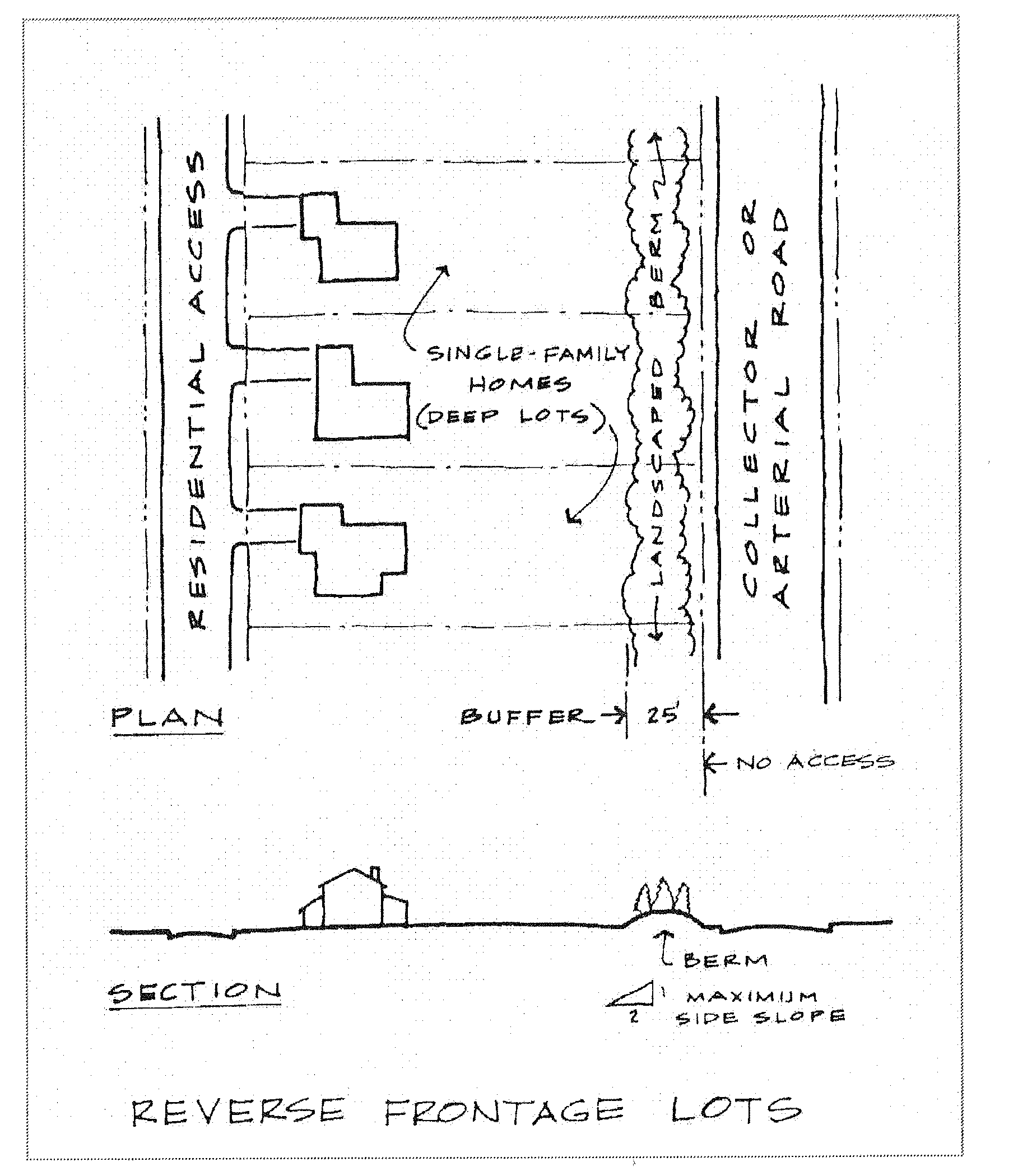
Reverse frontage lots may be utilized but are not required in major residential subdivisions where direct access to a City road, or to a State or U.S. numbered highway, is not allowed.
C.
An easement of at least ten (10) feet in width, across which there shall be no right of access, shall be provided in a major residential subdivision along the line of lots abutting any pre-existing collector or arterial street.
D.
The houses in a major residential subdivision adjacent to any pre-existing collector or arterial street must be screened from view from said road as follows:
1.
The ten (10) feet no-access easement may be improved with a structural zoning buffer meeting the requirements of the Landscaping, Buffers and Tree Conservation Article of this UDO; or
2.
A twenty-five (25) feet wide zoning buffer may be provided as follows:
a.
The buffer may retain its natural vegetation if existing trees and understory shrubs will adequately screen the view of the adjacent houses.
b.
Any combination of a landscaped berm, supplemental vegetation or opaque fencing may be added within the buffer to provide adequate screening.
c.
When a driveway abuts on an existing or proposed minor or major arterial street, a turn-around shall be required.
d.
All residential driveways along collector and arterial roadways are to be designed and constructed to the following standards.
1.
Width: Minimum twelve (12) feet, Maximum twenty-four (24) feet.
2.
Radii or Flare: Minimum five (5) feet.
3.
Spacing from Street Intersection: Minimum forty (40) feet.
4.
Angle of intersection with roadway: Not less than seventy-five (75) degrees.
5.
Max Grade: two percent (2%) across any sidewalk section then eight percent (8%) in the right-of-way when connecting to a collector or arterial street and fifteen percent (15%) within the right-of-way when connecting to a lower category street.
6.
Length: A minimum of twenty-five (25) feet or to the edge of the right-of-way, whichever is greater, shall be paved with a treated hardened surface.
7.
Access to all residential lots shall be from interior subdivision streets or roads where possible. Exceptions are subject to the approval of the City Engineer.
8.
Where a residential driveway crosses a drainage swale, a driveway culvert shall be sized to handle the twenty-five (25) year storm event. Where the drainage swale is adjacent to an arterial or collector street, additional storm events, up to and including the 100-year storm event, may be required to be analyzed to prevent flooding of the street.
6.10.04 - Access Easements
Vehicular access may be provided from a public street via easement in any one or more of the following circumstances:
A.
The property existed in whole as a legal lot of record prior to the adoption of this UDO, but does not meet the minimum frontage requirement for the applicable zoning district. The property must be served by an exclusive access easement that shall be limited to the provision of access to only one principal use or structure on one lot.
B.
The access easement serves one (1) single-family residence on a lot which is otherwise a buildable lot of record, and which is sharing a common driveway with one other single-family residence, both of which meet the minimum size, frontage, lot width and other requirements of this UDO.
C.
The access easement was lawfully established as such prior to the adoption of this UDO.
D.
The access easement coincides with a private street approved by the City. The ownership and maintenance responsibility by private party[(ies)] must be clearly established on the final plat of the development.
E.
The access easement serves a buildable lot of record which meets the minimum frontage requirements of this UDO, but from which access cannot be achieved.
6.10.05 - Residential Subdivision Entrances
A.
Entrance streets to all major residential subdivisions containing more than twenty-five (25) lots shall construct a deceleration lane at each entrance to the subdivision. See Section 6.11.00 below.
B.
New residential major subdivisions with twenty-five (25) lots or fewer whose entrance is on an existing collector or arterial road shall install offset radii and fifty (50) feet tapers.
6.10.06 - Commercial/Industrial Subdivision Entrances
A.
A deceleration lane shall be installed at all entrance roads into a commercial or industrial subdivision. See Section 6.11.00 below.
B.
The City Engineer may require a traffic study to determine if the project's size warrants a center turn lane, longer deceleration lane, an acceleration lane or other improvements. If the traffic study determines that the traffic generated by the project warrants it, the City Engineer will require the additional improvements or other mitigating measures.
6.10.07 - Driveways for Multifamily and Non-[R]esidential Development
A.
Multifamily and non-residential development projects shall install a deceleration lane at each driveway entrance connected to a collector or arterial street. See Section 6.11.00 below. For such a project located on a corner lot, a continuous twelve (12) feet wide travel lane shall be provided in lieu of a deceleration lane along both intersecting streets for the length of the property's frontage (but not exceeding 200 feet).
B.
The spacing, geometric configurations and number of driveways for proposed commercial and non-commercial developments along the City street system will be determined by the Carrollton Engineering Department and shall be in accordance with any formal City of Carrollton driveway and encroachment control regulations, which may be in effect at the time development takes place, or may be determined by an approved traffic study prepared for and in conjunction with a specific development.
C.
Commercial businesses on corner lots that have frontage on interior residential subdivision streets shall have access only from the main street.
D.
The City Engineer may require a traffic study to determine if a center turn lane, a longer deceleration lane, an acceleration lane or other improvements will be necessary. If the traffic study determines that the traffic generated by the project warrants it, the City Engineer will require the additional improvements or other mitigating measures.
E.
Driveways servicing multi-family, commercial and office/industrial developments shall provide uninterrupted ingress/egress.
F.
For purposes of sight distance, all driveways are to be considered low volume intersections and to comply with minimum intersection/corner sight distance requirements contained in this UDO.
G.
To allow for proper corner clearance, the minimum tangent curb length between a driveway radius and an intersection shall be one hundred (100) feet.
H.
Driveways are not to be installed closer than ten (10) feet to a catch basin, measured along the gutter line from the centerline of catch basin to the nearest edge of the driveway (extended). No catch basins will be allowed within driveway turning radii.
I.
For all developments, roadway improvements to provide a separate left turn lane into the proposed development shall be considered on a case-by-case basis.
J.
If the closest intersection is or is likely to be signalized, then traffic movements to and from any driveway within two hundred fifty (250) feet of an intersection with a collector or an arterial street shall be limited to right turns only.
K.
Multifamily, commercial and office/industrial driveways are to be constructed to the following standards:
1.
Width:
a.
Minimum twelve (12) feet for one-way access;
b.
Maximum eighteen (18) feet for one-way access;
c.
Minimum Two (2) twelve (12) feet lanes for two-way access; and
d.
Maximum Two (2) sixteen (16) feet lanes for two-way access (driveways with turn lanes, medians or other design alternatives are subject to the approval of the City Engineer).
2.
Lanes shall be designated by striping and directional arrows.
3.
Radii:
a.
Minimum thirty (30) feet;
b.
Maximum fifty (50) feet.
4.
Angle of intersection: not less than seventy-five degrees (75°).
5.
Grade: plus or minus two percent (2%) of the intersecting roadway within the right-of-way.
L.
Design standards may be varied with the approval of the City Engineer to meet the design intent of special design districts.
6.11.01 - Deceleration and Turning Lanes
A.
A deceleration lane shall be required at each entrance to a residential subdivision of more than twenty-five (25) lots, at each entrance to a commercial or industrial subdivision, and at each entrance to a multi-family or non-residential development project at its point of access.
B.
A left turning lane shall be required for each entrance to a subdivision or development project intersecting a major arterial street.
6.11.02 - Median Breaks
If the street has an existing or proposed median, and the developer is approved by the City or the Georgia Department of Transportation, as applicable, to construct a median break to serve the development, a left turn lane leading to the median break shall be provided by the developer meeting the design standards of the City.
6.11.03 - Deceleration and Turning Lane Construction Standards
A.
Deceleration lanes and turn lanes shall be a minimum length of 150 feet, with an additional fifty (50) foot taper length, and a pavement width of twelve (12) feet (exclusive of curb and gutter). Additional right-of-way to accommodate the deceleration lane or turn lane and a ten (10) foot shoulder shall be dedicated by the developer to the City.
B.
Curb and gutter, deceleration lanes and tapers are required, unless otherwise waived or modified by the City Engineer due to site, drainage or continuity considerations.
C.
Associated drainage improvements as deemed necessary by the construction of the deceleration or turn lane shall be required.
D.
Other project access improvements may be required by the City Engineer in addition to, or in lieu of, a required deceleration lane in order to ensure adequate site access, pedestrian access, convenience and safety to the motoring public, based on a traffic study prepared by a professional engineer.
E.
The developer will pay the cost of any catch basins that must be constructed along an existing City street as a result of the deceleration lane.
F.
Utilities and drain pipes shall be relocated at the developer's expense outside of the deceleration lane.
6.17.01 - Location of [U]tilities in [S]treets
A.
Above-ground [U]tilities.
Street light poles, junction boxes, transformers and other public or private utility structures placed above ground within a public street right-of-way or private street easement must meet set-back criteria and clear zone distance criteria based on the latest edition of the Roadside Design Guide, by the American Association of State Highway and Transportation Officials, or be located at least nine (9) feet back from the back of the street curb (or edge of pavement) and one (1) foot back from the edge of any sidewalk, whichever is farthermost from the roadway.
B.
Underground Utilities.
1.
All electric, telephone, cable TV and other wires shall be placed underground in any major subdivision, and in any multi-family or non-residential development.
2.
Utilities placed underground shall be placed within the street right-of-way or easement as shown in the Design and Construction Standards.
3.
The right-of-way is to be cleared and rough graded the full width prior to any utility installation.
4.
Any disturbance or construction in the completed (seeded and/or sodded) right-of-way by a public utility such as power, water, sewer, gas, phone and cable must be repaired and/or replaced with the specified materials as called for in the initial improvements.
5.
All utilities beneath pavement shall be installed and the ditch backfilled and thoroughly compacted before any pavement or base is installed, or the pipes shall be bored if installed after street construction.
6.
All utility manholes and valve boxes shall be brought to the finished grade within the roadway section. If delay of final topping is approved, manholes and valve boxes shall be installed flush with the binder, and shall be raised to finished grade by the developer when the final topping is installed.
7.
All private utilities that will cross under pavement shall be installed completely throughout the subdivision prior to any roadway base being applied. Installation of approved utility sleeves shall be considered as an alternate, or shall be bored if installed after the street has been constructed.
6.17.02 - Utility Permits
A.
All construction plans for utility repairs or new utility installations within City rights-of-way shall be reviewed and approved by the City Engineer and shall be in accordance with any formal Carrollton Engineering utility permit regulations or guidelines which may be in effect at the time a request is received.
B.
No existing City street can be open cut unless unusual circumstances, as determined by the City Engineer, warrant it. Any request for approval to open cut an existing City street must be submitted with sufficient documentation to enable the City Engineer to make a reasonable determination as to the necessity for an open cut.
C.
If a pavement cut is approved, all trenches shall be backfilled and compacted the same day the trench is opened unless otherwise approved by the City Engineer.
1.
Trenches under the paving shall be returned to 95% compaction. The backfill in all such ditches will be thoroughly compacted in six (6) inch lifts, the subgrade shall be brought to the lines, grades, and typical roadway section shown on the plans.
2.
See City Design and Construction Standards for details.
6.18.01 - Development Permit Required
A.
Clearing and grading shall not proceed until issuance of an approved development permit. No development permit authorizing clearing or grading shall be issued prior to review and approval by the City Engineer of landscaping, buffers and tree conservation plans as applicable to the property.
B.
Grading shall be done in accordance with the lines and grades drawn on the approved grading plan. Clearing, grubbing and grading of a site for development of a residential subdivision shall be limited to those areas necessary to construct the streets and utilities, the stormwater detention facilities, and necessary erosion and sedimentation control devices, along with related easements, rights-of-way and slopes. Clearance beyond these limits to balance cut and fill for the streets, drainage or utilities may be approved administratively by the City Engineer based on a grading plan and cut/fill calculations prepared by a Georgia registered professional engineer qualified in site work, provided that the additional clearance is kept to the minimum deemed necessary by the City Engineer.
6.18.02 - Erosion and Sedimentation Control Measures
Required erosion and sedimentation control measures must be installed in accordance with the approved soil erosion and sedimentation control plan prior to any major development activity and as development progresses.
6.18.03 - Stormwater Drainage Facilities
Required stormwater drainage facilities are to be installed in accordance with the approved stormwater management plan as development progresses.
6.18.04 - Clearing and Grubbing
The entire area within the typical grading section shall be cleared and grubbed of all trees, bushes, stumps and debris. Such debris shall be disposed of in a lawful manner.
6.18.05 - Earthen Embankments and Slopes
Earthen embankments shall meet the design and compaction requirements set forth in the Design and Construction Standards. The maximum slope for all cut and fill slopes are located in the Design and Construction Standards in the office of the City Engineer.

