
Cedar Springs City Zoning Code
ARTICLE IV
SUPPLEMENTAL REGULATIONS
Sec. 32-526. - The effect of zoning.
(a)
For the purposes of this chapter, except as hereinafter specifically provided otherwise, no lot or land or premises shall hereafter be used, maintained or occupied, and no building or structure or part thereof shall be constructed, erected, moved, placed, maintained, reconstructed, used, extended, enlarged or altered, except in conformity with the regulations herein specified for the zoning district in which it is located; these limitations being construed as the minimum legislation necessary to promote and protect the general safety and welfare of the community.
(b)
In case any building or part thereof is used, erected, altered or occupied contrary to law or to the provisions of this chapter, such building shall be declared a nuisance and may be required to be vacated, torn down, or abated by any legal means and shall not be used or occupied until it has been brought into conformance.
(c)
If construction on a building is lawfully begun prior to adoption of the ordinance from which this chapter is derived, nothing in this chapter shall be deemed to require any change in the planned or designed use of any such building, provided that actual construction is being diligently carried on, and further, provided that such building shall be entirely completed for its planned or designed use within two years from the effective date of the ordinance from which this chapter is derived.
(Code 2009, § 40-437; Ord. No. 53-A, § 3.01, 8-16-1982)
Sec. 32-527. - Restoring unsafe buildings.
Nothing in this chapter shall prevent the strengthening or restoring to a safe condition of any building or structure, or part thereof, declared unsafe by the zoning administrator, or required to comply with the zoning administrator's lawful order.
(Code 2009, § 40-438; Ord. No. 53-A, § 3.02, 8-16-1982)
Sec. 32-528. - Required area or space.
No lot or lots in single ownership, and no yard, court, parking area or other space shall be so divided, altered, or reduced to make said area or dimension less than the minimum required under this chapter. If already less than the minimum required under this chapter, said area or dimension shall not be further divided or reduced.
(Code 2009, § 40-439; Ord. No. 53-A, § 3.03, 8-16-1982)
Sec. 32-529. - Frontage requirements.
(a)
On streets less than 66 feet in width, the required front yard shall be increased by one-half the difference between the width of the street and 66 feet.
(b)
All lots created after the effective date of the ordinance from which this division is derived shall have frontage on a public or private street in accordance with the lot width requirements of the zoning district in which it is located.
(c)
The planning commission may permit a lot to be created which does not have any or only has some frontage on a public or private street if the proposed use of such lot is subject to the site plan review procedures of section 32-65. The planning commission shall consider the following criteria and standards in determining whether to allow such lot to be created as part of the site plan review approval process:
(1)
Whether the proposed lot has vehicle access to the public road system by virtue of a recorded easement or other legal instrument which ensures continued access;
(2)
Whether the proposed access to the lot will be sufficiently constructed and located so as to be capable of safely accommodating projected vehicle traffic to and from the lot as well as safely accommodating emergency vehicles;
(3)
Whether the creation of the lot will result in the need for variances both on and off the proposed lot in order to accommodate the proposed use of the lot;
(4)
Whether the proposed lot and the proposed use meets all other applicable requirements of the zoning ordinance, including, but not limited to, minimum lot width, lot area and building setbacks;
(5)
Whether the creation of the proposed lot will result in difficulties in achieving the orderly development of nearby lands;
(6)
Whether the creation of the proposed lot will create difficulties in serving the proposed lot or nearby lots with public utilities;
(7)
In allowing a lot to be created with no street frontage the planning commission shall designate the front lot line for building setback purposes.
(d)
On a corner lot, each lot line which abuts a public or private street is a front lot line and the required front yard setback from each front lot line shall be met, subject to section 32-532. The owner shall elect, and so designate in the application for a permit, which of the remaining two lot lines shall be the side lot line and which the rear lot line. For a corner lot with three front lot lines, the remaining lot line shall be a rear lot line.
(Code 2009, § 40-440; Ord. No. 53-A, § 3.04, 8-16-1982; Ord. No. 156, § 1(3.04), 7-9-2009; Ord. No. 211, § 1, 10-11-2018)
Sec. 32-530. - Accessory buildings and structures.
(a)
No person shall place an accessory building or structure without first obtaining a valid permit issued by the city pursuant to this article unless specifically exempted from permitting under this article.
(b)
Accessory buildings or structures consist of, but are not limited to:
(1)
Garages.
(2)
Sheds.
(3)
Porches.
(4)
Decks.
(5)
Gazebos.
(6)
Picnic pavilions.
(7)
Boathouses.
(8)
Pole barns.
(9)
Car ports.
(10)
Playhouse/studio.
(11)
Swingset/play structure.
(12)
Pool house/cabana.
(13)
Permanent pool/hot tub.
(14)
Greenhouse.
(15)
Storage building.
(16)
Garden storage/barn.
(17)
Hobbyshop/workshop.
(18)
BBQ, outdoor kitchen, chimney, fire pit.
(19)
Permanent sporting equipment or fields of play.
(20)
Other similar structures customarily incidental and subordinate to the principal building on the property.
The terms "accessory buildings" and "accessory structure" may be used interchangeably in this division and shall both encompass the above structures.
(c)
Where accessory buildings or structures, such as enclosed porches or garages, are attached to a main building in a substantial manner, they shall be made structurally a part of the main building, such as by a wall or roof, and they shall conform to all regulations of the zoning ordinances applicable to a principal building. Any such attached building or structure that is used for the storage of motor vehicles or flammable substances shall utilize fire-resistance-rated walls as required by the residential code provisions of the state construction code.
(d)
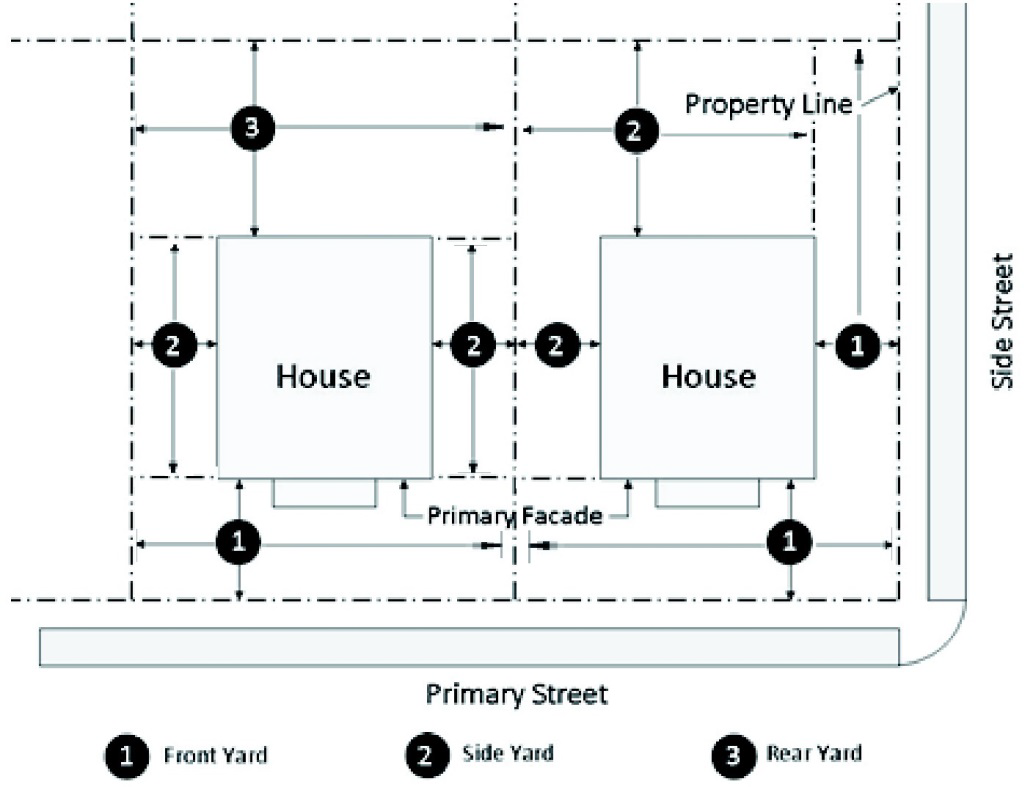
Accessory buildings shall not be permitted in a front yard. When an accessory building or structure is located on a corner lot, where the side lot line is a continuation of the front lot line of the lot to its rear, the accessory building or use shall be located no nearer than the required front yard setback line on the lot behind the corner lot.
(e)
Certain structures, traditionally found in the front yard, such as mailboxes, art displays, ornamental lights, birdfeeders, mobility ramps, free little libraries or similar, are specifically permitted in a front yard but shall otherwise follow the requirements of this division.
(f)
Accessory buildings that are used for the storage of motor vehicles shall be connected to a public street via a driveway meeting the requirements of the city.
(g)
Accessory buildings and structures in excess of 100 square feet must be designed, constructed, and finished such that the exterior appearance is compatible in terms of materials, color and general construction with that of the principal structure.
(h)
Accessory buildings or structures shall not be permitted on a lot or parcel which does not have a principal use or main building.
(i)
All accessory buildings or structures larger than 65 square feet floor space, with a height more than nine feet at the peak above grade or with a floor more than 30 inches above grade shall require a Zoning Permit prior to construction or installation. All accessory buildings or structures smaller than 65 square feet floor space, with a height less than nine feet at the peak above grade or with a floor less than 30 inches above grade are exempt from zoning permit approval but must still adhere to all requirements of this division that apply to accessory building or structures generally and specifically, including setback and front yard placement requirements.
(j)
Detached accessory building or structures shall be located a minimum of ten feet away from any principal building unless it is attached to the principal building, excepting permanent carports. No detached accessory building or structure may be located closer than ten feet to a street right-of-way line except for mailboxes.
(k)
Detached accessory buildings or structures with a height up to nine feet tall at the peak or up to 100 square feet floor space shall be a minimum of three feet at the drip-edge or closest point from any property line. Detached accessory buildings or structures up to 15 feet tall at the peak or up to 300 square feet floor space shall be a minimum of six feet from any property line at the drip-edge or closest point. Any detached accessory buildings or structures over 300 square feet must be a minimum of ten feet from any property line at the drip-edge or closest point. Height shall be measured from ground level for structures placed on the ground or from the concrete base for structures placed on a concrete base.
(l)
The planning commission, by a majority vote and with findings on the record, may permit or deny an accessory building up to a maximum height of either the maximum height of the existing primary building on the same lot or 25 feet tall, whichever is less, if it finds by a preponderance of the evidence that the proposed building or structure will not:
(1)
Have a demonstrated reduction of privacy on adjoining properties;
(2)
Have a negative aesthetic effect on adjoining properties;
(3)
Cause a reduction in air flow onto adjoining properties;
(4)
Affect the shading of an adjoining property that may reduce vegetative use or solar access of said property.
(m)
The planning commission may require a greater setback than is otherwise required in this chapter to compensate for the permitted additional height of the accessory building or structure granted herein up to a maximum requirement of the setback applied to the primary building in the zoning district.
(n)
Any accessory building or structure on a residential lot that is over 200 square feet shall obtain a building permit and shall meet the foundation requirements of the residential code provisions of the state construction code, any accessory building or structure on a commercial or industrial lot that is over 150 square feet shall obtain a building permit and shall meet the foundation requirements of the state construction code.
(o)
Accessory buildings and structures shall not be occupied for dwelling purposes.
(p)
The installation of electrical or plumbing in or on an accessory building shall require building inspection and permitting.
(q)
The maximum floor space of any one accessory building shall be 720 square feet unless otherwise approved by the planning commission. The total area of all accessory buildings shall not, in combination with all other principal and accessory structures, exceed the maximum lot coverage of the zoning district.
(r)
The planning commission, by a majority vote and with findings on the record, may permit or deny an accessory building larger than 720 square feet of floor space if it finds by a preponderance of the evidence that the proposed building or structure will not:
(1)
Have a demonstrated reduction of privacy on adjoining properties;
(2)
Have a negative aesthetic effect on adjoining properties;
(3)
Cause a reduction in air flow onto adjoining properties;
(4)
Affect the shading of an adjoining property that may reduce vegetative use or solar access of said property;
(5)
Exceed the zoning district's maximum lot coverage;
(6)
Intrude upon the setback requirements;
(7)
Be disproportionate in size in comparison to the principal building.
The planning commission may require a greater setback than is otherwise required to compensate for the additional height of the accessory building or structure granted herein up to a maximum requirement of the setback applied to the primary building in the zoning district.
(s)
In no instance shall an accessory building or structure be within a public right-of-way or easement, unless otherwise permitted in an easement agreement. Any such structure in the right-of-way or easement shall be subject to removal by the city and the costs for removal shall be paid by the encroaching real property owner.
(t)
No accessory building or structure shall be constructed with a tubular frame construction or with canvas, plastic film, or similar exterior material that does not provide long-term durability excepting greenhouses, whose primary purpose and use is the growing of plants and storage of gardening equipment.
(u)
All accessory buildings shall be well maintained and kept in a clean and safe condition; rips in the cover, hanging cover material, leaning frames and other visual detriments that present an unkept image shall not be permitted. Accessory buildings not kept in clean and safe conditions shall be promptly repaired or removed.
(v)
The construction of all accessory buildings shall be completed in such a way that it does not drain to a neighboring property but must maintain its runoff on the property it is constructed on. This may include one or all of the following items: eave and drain spouts, location of drain spout discharge, grading of the property to the shared property line back to the new structure or a physical curb/gutter type structure.
(w)
Nothing in this division shall be construed to interfere with other state or federal laws, such as the Americans with Disabilities Act, 42 USC 12101 et seq.
(x)
In addition to the penalties and remedies available under this article, violations of this division shall be punishable as a municipal civil infraction, including, but not limited to, abatement of the violating condition or the granting of any injunctive relief.
(Code 2009, § 40-441; Ord. No. 53-A, § 3.05, 8-16-1982; Ord. No. 156, § 1(3.05), 7-9-2009; Ord. No. 212, § 1, 10-11-2018)
Sec. 32-531. - Existing platted lots.
(a)
Where an existing platted lot has an area of not less than 90 percent of its zoning district requirements and where such lot can provide the side and front yard requirements of its zone, the permitted uses of the district shall be allowed.
(b)
An existing platted lot, in single ownership, of less than 90 percent of its zoning district requirements may be utilized for such permitted uses, and for such purpose the required side yards may be reduced by the same percentage the area of such lot bears to its zone district requirements, provided that no side yard provision may be reduced to less than ten feet and that off-street parking requirements are also met.
(c)
Where four or more adjacent lots are in single ownership and where such lots individually contain less than 90 percent of its zoning district requirements, such lots shall be utilized only in complete conformance with the zoning district's unreduced minimum requirements.
(d)
In the event two or three adjacent lots are in single ownership and the board of appeals shall find that there is no practical possibility of obtaining additional land, it may permit their use as separate lots having less than the required lot area if it shall determine that they can be so used without adversely affecting the character of the neighborhood; provided, however, that no side yard provision may be reduced to less than ten feet and that off-street parking requirements are also met.
(Code 2009, § 40-442; Ord. No. 53-A, § 3.06, 8-16-1982)
Sec. 32-532. - Basis for determining front yard requirements, projections, and awnings.
(1)
The required front yard shall be measured from the right-of-way line to the nearest foundation or building wall of the building or structure, provided that where an existing setback line has been established by existing buildings occupying 50 percent or more of the frontage within the same block or, where unplatted, within 200 feet of the proposed building, such established setback shall apply.
(2)
Unenclosed porches, steps, or similar facilities may project into a required front or rear yard for a distance not to exceed ten feet.
(3)
Awnings are permitted in any district without limitation as to the number, subject to the following requirements:
a.
Awnings may project up to ten feet into a required from yard or 15 feet into a required rear yard, but shall not project into a required side yard.
b.
An awning for any nonresidential use must maintain a minimum vertical clearance of ten feet above the ground directly below the awning.
c.
In the B-2 district, awnings may project into the public right of way up to three feet if it is fully supported by and mounted to the building.
d.
Signage located on an awning must comply with the requirements of article VII.
(Ord. No. 251, § 1, 6-13-2024)
Editor's note— Ord. No. 251, § 1, adopted June 13, 2024, amended § 32-532 in its entirety to read as herein set out. Former § 32-532 pertained to basis for determining front yard requirements and derived from Code 2009, § 40-443; and Ord. No. 53-A, § 3.07, adopted Aug. 16, 1982.
Sec. 32-533. - Temporary uses.
Temporary permits may be authorized by the zoning administrator for a period not to exceed one year for the following:
(1)
Nonconforming uses incidental to construction projects on the same premises and, including such uses as storage of building supplies and machinery, signs and the assembly of building materials.
(2)
The temporary use of a mobile home on a lot as living quarters while a house is being reconstructed as a result of fire or natural disaster.
(3)
The use of a dwelling to be temporarily used as a sales and management office for the sale of homes within a subdivision for a period of one year, provided all the following are complied with:
a.
The house to be used as such office is built upon a lot approved as part of the approved subdivision and is of substantially similar design as those houses to be sold within the subdivision.
b.
No retail sales or business other than that accessory to the management and sales of the land in the subdivision owned by the applicant shall be permitted.
c.
Said dwelling house shall meet all other zoning restrictions of the zone in which it is located. Review and approval by the planning commission is required. A hearing may be required by the planning commission.
(4)
Temporary and portable storage units and structures may be permitted on a temporary basis within residential districts under the following conditions:
a.
All temporary or portable storage units and structures may be permitted only upon written authorization by the zoning administrator.
b.
No more than one such unit or structure may be located on any residential property.
c.
The structure or unit may be no larger than ten feet wide, 20 feet long and ten feet high.
d.
A storage structure or unit may not remain on any residentially zoned property for a period of time in excess of 30 consecutive days. Such structures or units may be permitted a maximum of three times per calendar year. A minimum of 60 calendar days shall elapse between the end of one registration period and the beginning of another. An extension may be granted by the zoning administrator, subject to conditions, for a reasonable additional time period in an amount not to exceed 30 days per occurrence.
e.
The portable storage structure must be set back a minimum of five feet from all side and rear property lines and must be set back a minimum of 20 feet from the front property line.
f.
The portable storage structure must be set back a minimum of five feet from the nearest wall of a building.
g.
Temporary units and structures placed within the front yard must be placed on an asphalt or concrete surface. In cases of multiple-family or commercial developments, no such structure or unit may be placed within any required parking space.
h.
Additional units or structures may be permitted on commercial property when associated with construction at a site where a building permit has been issued. Such units or structures may be permitted for the duration of construction and shall be removed from the site within 14 days of the end of construction.
i.
No temporary storage unit shall be used to store illegal or hazardous material, solid waste, construction debris, demolition debris, recyclable materials, business inventory, commercial goods, or goods for use at property other than the property where the temporary storage unit is located. Upon reasonable notice to the property owner or occupant, the city may inspect the contents of any temporary storage unit to ensure compliance with this regulation.
(5)
Sidewalk displays. The owner of a business fronting on Main Street in the B-2 Central Business District, or the MU Mixed-Use District when part of a traditional development, may be issued an annual permit to display goods on the sidewalks along Main Street in front of that business in accordance with this provision.
a.
The application, along with an annual permit fee in an amount established from time to time by resolution of the city council, shall be filed with the city clerk and shall be in a form provided by the city clerk but which shall contain the following information:
1.
The name, address, telephone number, facsimile number (if any) and e-mail address (if any) of the business, the business owner and the officer or manager in charge of the Main Street premises.
2.
A description of the goods and services sold on the Main Street premises, a description of the goods to be displayed pursuant to the permit and drawings and photographs showing the display racks, tables or other means of display to be used and where they will be located.
3.
A copy of the commercial general liability policy covering the business and the Main Street premises with coverage in an amount of at least $1,000,000.00 and a copy of the certificate of insurance showing the premium to be fully paid through the permit term.
4.
A certification by and the signature of an owner, officer, manager or someone else with the authority to bind the business entity attesting to the veracity of the information in the application and acknowledging and agreeing to comply with the requirements of this provision.
5.
Such other information as the city clerk may deem appropriate.
b.
The permit application shall be reviewed by the city manager who may issue a permit if it is possible for any resulting display of goods to comply with the requirements of this provision. However, a permit shall not be issued if the business has previously violated this provision or section 32-348, if the business is in default to the city in the payment of any taxes, rates, fees or charges, if the city manager determines that the display of goods as would be allowed under a permit would constitute a hazard or otherwise be contrary to the public health, safety or general welfare. If the city manager denies the issuance of a permit, the applicant may appeal the denial to the board of zoning appeals. Any permit issued pursuant to this section, regardless of when it is issued during any calendar year, shall expire on December 31 of the calendar year in which it is issued.
c.
The following requirements shall apply to any outdoor displays of goods:
1.
No furniture, benches or other seating fixtures may be on the sidewalks unless they are for sale by the business they are in front of or a permit has been obtained from the city per section 32-558.
2.
Displays shall be placed against the front wall of the building and shall not extend more than 36 inches from the building facade, provided that the sidewalk in front of the display shall remain unobstructed for a continuous width of at least 48 inches.
3.
Displays may be no taller than five feet high, no longer than 20 feet long, or the length of the store's facade, whichever is less.
4.
Buildings situated on a corner must also set the display at least three feet from the edge of the building to allow for traffic visibility.
5.
Displays are allowed only during business hours and must be entirely removed at closing time.
6.
Displays shall be removed during periods of inclement weather, such as high winds or heavy rains during which the display may create a safety hazard.
7.
Potentially dangerous merchandise, such as gasoline, kerosene, guns, knives, breakable glass and similar goods shall not be displayed outdoors.
8.
The merchandise displayed must be the offer on the premises in front of which it is displayed.
9.
This display permit may be subject to revocation if the display is not in compliance.
(Code 2009, § 40-444; Ord. No. 53-A, § 3.08, 8-16-1982; Ord. No. 156, § 1(3.08), 7-9-2009; Ord. No. 169, § 1, 6-29-2012; Ord. No. 173, § 1, 1-9-2014)
Sec. 32-534. - Illegal dwellings.
The use of a basement or the basement of a partially built or planned building as a residence or dwelling unit is prohibited in all zones.
(Code 2009, § 40-445; Ord. No. 53-A, § 3.09, 8-16-1982)
Sec. 32-535. - Walls and fences.
The purpose of this section is to promote the public health, safety and welfare by establishing minimum standards for the creation, installation and maintenance of all walls and fences in the City of Cedar Springs. Walls and fences can have a significant impact on the use, value and attractiveness of land, buildings and neighborhoods. Walls and fences are also often used to moderate loud or obnoxious sounds, lights, odors or pollutants and help create privacy but should not interfere with natural light, air movement or water drainage. The standards in this section are considered to be the minimum necessary to achieve the goals and objectives noted above.
(a)
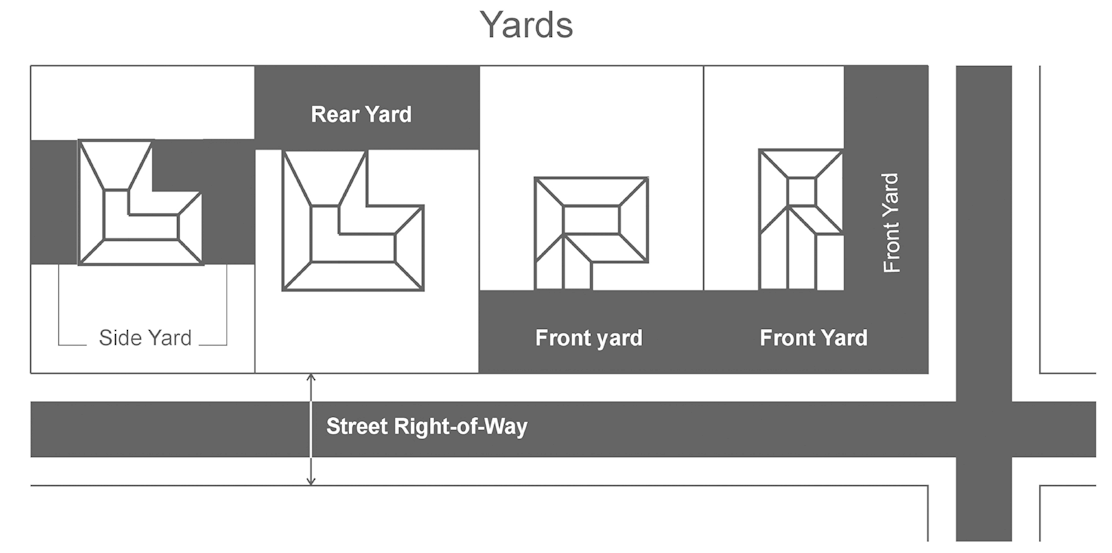
For purposes of this section, the terms "front yard," "rear yard," and "side yard" shall be defined as indicated in the diagram below and further defined in section 32-529, frontage requirements, of this Code.
(b)
For the purposes of this section only, the terms "fence" and "wall" can be used interchangeably and both refer to a structure that encloses an area generally created by connecting posts by boards, rails or netting or by a continuous foundation affixed to the ground.
(c)
Walls and fences in the city are defined as being either see-through or solid, different rules apply to a see-through or a solid wall or fence:
(1)
See-through, cyclone, chain-link, wrought-iron or picket walls or fences must have openings of at least 50 percent in each square foot of fencing, so that light and vision may pass through the wall or fence on either side. All such walls or fences may be referred to as "see-through" in this ordinance.
(2)
Any wall or fence with less than 50 percent of opening in each square foot shall be considered solid, opaque, substantially opaque or privacy wall or fence. All such fences or walls may be referred to as "solid" in this ordinance.
(3)
No wall or fence may install or use privacy fence slats or fence tape that are added to a see-through fence to create a solid or opaque appearance.
(d)
Walls and fences in residentially zoned or commercially zoned districts:
(1)
Walls and fences located in the front yard of a residential or commercial zoned district property:
a.
Solid fences or walls must not exceed three feet in height.
b.
See-through fences or walls must not exceed four feet in height.
(2)
Walls and fences in the side or rear yard of a residential or commercial zoned district property:
a.
Solid fences or walls must not exceed six feet in height.
b.
See-through fences or walls must not exceed five feet in height.
(3)
Pre-existing see-through fences or walls on commercially zoned properties may install a tight-fitting high density polyethylene privacy screen in order to comply with screening requirements imposed by the planning commission. High density polyethylene privacy screening is not permitted on residential zoned properties and is not permitted without approval of the planning commission. High density polyethylene privacy screening is not an acceptable alternative to the installation of other purpose-built solid fencing options for new fencing.
(e)
Walls and fences in residentially zoned districts on corner lots:
(1)
This subpart shall only apply to single family residential homes that are located on corner lots in a residentially zoned district. This subpart shall not apply to two-family or multi-family uses in any district or any residential use located in a commercial or industrial zoning district.
(2)
A corner lot is a lot which has road or street frontage on at least two sides of the lot, creating two distinct front yards, one along each of the two frontages as defined in section 32-529.
(3)
For the purposes of this subpart only, the owner of such a single-family residential home located on a corner lot may request that the zoning administrator designate one of their front yards as a secondary front yard. The secondary front yard designation shall only apply to the part of the front yard which lies between the side or rear yard and the road or street frontage and shall not apply to any area located between the façade of the home and the road or street frontage.
(4)
The zoning administrator shall designate the requested secondary front yard unless doing so would be detrimental to the overall aesthetics or safety of the city or its citizens because of:
a.
The requested secondary front yard abuts a high traffic volume or high-speed road or street.
b.
The location of the property driveway or other access to the property.
c.
The location of the front door, front porch or other architectural elements indicate a different intended front yard orientation.
d.
The location of existing accessory structures or fencing.
e.
Any other safety or aesthetics issue or problem that can be articulated by the zoning administrator.
(5)
Walls and fences in the secondary front yard:
a.
Solid or opaque fences or walls must not exceed six feet in height.
b.
See-through fences or walls must not exceed four feet in height.
(6)
All fences located on a corner lot shall be subject to and shall conform to the "fence prohibitions" requirements of subpart (i) herein.
(7)
No accessory structure may be placed in a secondary front yard unless it is placed behind a fence that is at least four feet tall. If an accessory structure is placed in the secondary front yard behind a fence and the fence is subsequently removed, the accessory structure must also be removed from the front yard.
(f)
Walls and fences in industrial zoned districts:
(1)
No wall or fence may be located in the front yard except as may be approved by the planning commission.
(2)
No wall or fence may exceed eight feet in height in any industrial zoning district.
(3)
All walls or fences abutting a residentially zoned property or a property used for residential purposes, or when used to screen parking or outdoor storage areas, the wall or fence shall be of a solid or opaque construction, see-through fencing is not permitted.
(4)
Walls and fences in the industrial zoning district may use barbed wire or twist (barb) selvage:
a.
The wall or fence must be at least six feet tall but may not exceed eight feet tall at any point above the adjacent grade, inclusive of any barbed wire, cradle, arm or twist (barb) selvage.
b.
Barbed wire must be installed on arms or cradles extending vertically or inward over the owner's property and shall not be extended outward towards the property of another or towards any public right-of-way or property.
c.
No barbed wire or twist (barb) selvage is permitted on any fence that abuts a residentially zoned property or any property used for residential purposes.
d.
Only barbed wire or twist (barb) selvage is permitted, no concertina wire, razor wire or other types of security fencing is permitted.
e.
Barbed wire may only be installed in a straight and linear fashion, installation of barbed wire in a coiled or circular fashion is strictly prohibited.
(g)
Permanent fence rules and requirements:
(1)
These rules apply to all permanent fence installations. Temporary fences are permitted as stated under subsection (h). Garden fences are permitted as stated under subsection (j).
(2)
All walls and fences located in a front yard or secondary front yard must be placed a minimum of three feet inside any front lot-line, easement line, right-of-way line or sidewalk, whichever being most distant from the public road or street.
(3)
All fences, walls or landscape screens or parts thereof must be located entirely on the property of the person constructing the fence, except as might otherwise be permitted in this ordinance.
(4)
The height of all walls and fences shall be measured from the average grade of the ground surrounding the fence which shall not be artificially altered to increase the height of the fence.
(5)
All regulations of the applicable building code provisions shall apply to swimming pools and the method of enclosing the swimming pool for the safety of the public.
(6)
Fencing material shall be all-weather, high-quality, low maintenance and must be made of composite, chain-link, metal, wood, vinyl, brick, stone or other material approved of by the planning commission. All fencing material shall be specifically designed to be used for fencing and shall not be constructed of junk, scrap, salvage or other materials not designed for use as a fence. Permanent fences may not be built or constructed from any of the prohibited temporary fencing types detailed in subpart (h).
(7)
The interior posts of a fence shall face the property owner and the finished or decorative side shall face outward toward the adjacent property or right-of-way.
(8)
Walls and fences shall be installed in a workmanlike manner and be maintained at all times in a state of good repair, with all braces, fasteners, supporting frames, etc., free from deterioration, insect infestation, rot and rust. All fences shall be kept neatly finished, including all metal parts and supports that shall remain free of rust and shall be made of a rust resistant material. Walls and fences that are bent, leaning or fallen over or have missing pickets, panels or posts are not considered to be in a state of good repair.
(9)
Walls and fences installed around governmental or utility property may utilize barbed wire and/or twist (barb) selvage.
(10)
Walls and fences installed in any commercial zoning district may utilize barbed wire and/or twist (barb) selvage following the same rules as properties located in an industrial zoned district if and only if:
a.
The property does not abut a primary single-family or two-family residential use, and;
b.
The property cannot be adequately protected by a wall or fence without barbed wire and/or twist (barb) selvage. Inadequate protection must be shown by submission of police reports, insurance reports or other information indicating losses, anticipated concerns and/or video or photographic evidence showing multiple trespassing events, and;
c.
The installation of such barbed wire and/or twist (barb) selvage on a parcel in a commercial zoning district must be approved of by a majority vote of the planning commission following a review of the presented information at a public meeting.
(h)
Temporary fences.
(1)
Temporary fences are fences that are erected for a specific limited period of time not to exceed six months in length. Any fence erected for more than six months or erected with the intention that the fence remain for more than six months shall be considered a permanent fence and shall be required to follow all rules and requirements related to permanent fences.
(2)
Temporary fences erected for less than four days, temporary fences erected as part of a city-approved event and temporary fences erected as part of a city approved construction project are exempt from permitting under this ordinance. Such fences that are exempt from permitting must still follow the requirements and prohibitions in subparts (g) and (i) herein excepting the allowed use of safe temporary fencing materials that are otherwise prohibited as a permanent fencing material.
(3)
The height and location of temporary fencing shall meet the requirements of the zoning district and yard within which it is located.
(4)
Temporary fences erected for more than four days but for less than six months and are not otherwise exempt shall require a permit from the city. The zoning administrator shall review such permit requests to determine whether:
a.
The proposed fence is temporary or permanent in nature.
b.
The proposed fence is recurring, intermittent or seasonal in nature.
c.
The proposed fence is for a defined temporary event or time frame.
d.
The proposed fence is being used to thwart the purposes or intentions of this ordinance.
e.
The proposed fence is being used for an illegal or vexatious purpose.
f.
The proposed fence is the minimum type and amount of temporary fencing necessary to accomplish the stated goals for the temporary fence.
(5)
Temporary fences shall be immediately removed at the end of their permitted time of use.
(6)
Temporary fences shall not be erected in such a way that they constitute a nuisance or danger to the public which such final determination shall be made by the zoning administrator.
(i)
Fence prohibitions.
(1)
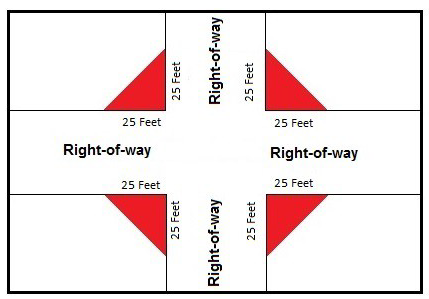
No wall or fence shall be established or maintained on any lot which, in the opinion of the zoning administrator, will obstruct the view of a vehicle driver approaching an intersection between roads or driveways. Such unobstructed area shall mean at minimum a triangular area formed by the street right-of-way lines and a line connecting them at points 25 feet from the intersection of the street right-of-way lines or in the case of a rounded property corner from the intersection of the street right-of-way lines extended as shown in the figure below.
(2)
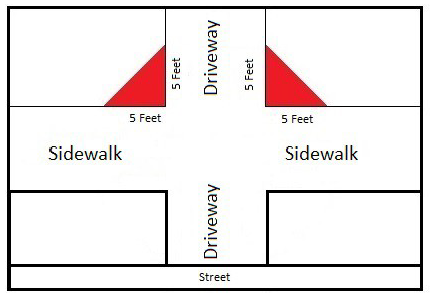
No wall or fence shall be established or maintained on any lot which, in the opinion of the zoning administrator, will obstruct the view of a vehicle driver approaching an intersection between a sidewalk and a driveway. Such unobstructed area shall mean at minimum a triangular area formed by the driveway and sidewalk lines and a line connecting them at points five feet from the intersection of the lines.
(3)
No wall or fence may use or consist in whole or part of coils of barbed wire, twist (barb) selvage, concertina wire or razor wire except as may be otherwise specifically permitted in this ordinance.
(4)
No wall or fence may have razored edges, broken glass, affixed spikes, projecting nails or other pointed or sharp instruments of any kind or description attached; walls, fences and gates shall not be constructed so as to create a hazard to the public by the projection of any sharp or pointed instrument or member.
(5)
No wall or fence may be allowed to remain a hazard or nuisance to the public. Any fence or wall that is determined to be a hazard or nuisance to the public shall immediately be notified of such hazard or nuisance and be directed to correct such nuisance or hazard.
(6)
No fence may be charged or connected with an electrical current.
(7)
Except for garden fences, no permanent wall or fence may use fencing made of a material such as chicken wire, wire fence, woven wire, welded wire, deer/game fence, wire strand, snow fence, plastic safety fence, flexible plastic fencing, sheep fence, temporary pet fencing, trellis or lattice or any other such agricultural fencing materials.
(8)
No permanent wall or fence may consist in whole or part of woven or flexible plastic or other similar materials, commonly known as snow fencing.
(9)
No permanent wall or fence may consist of metal opaque paneling or sheets (i.e., barn siding, roofing material, corrugated metal, etc.).
(j)
Garden fences are a special type of fence and subject to the following requirements.
(1)
Garden fences are semi-permanent fences that are erected specifically to protect growing plants other than sod or yard grass.
(2)
Garden fences are only permitted in side or rear yards and shall not be erected in any front yard.
(3)
Garden fences shall not exceed three feet in height and shall enclose no more than a maximum of 400 square feet.
(4)
Garden fences shall not be used to mark or enclose any property line and shall not be erected or placed closer than ten feet to any more than two property lines per parcel.
(5)
Garden fences shall not be used to create a dog or pet run. All areas enclosed by a garden fence shall remain free of pet waste.
(6)
Garden fences may use woven wire, woven plastic, trellis or lattice or other fencing types approved by the zoning administrator. Garden fences shall be of an earth-tone color being black, white, brown, tan, green or other approved colors. Orange, red, yellow and other bright or fluorescent colors are not permitted.
(7)
Garden fences may not be constructed of or possess elements such as razored edges, broken glass, affixed spikes, projecting nails or other pointed or sharp instruments of any kind which pose a danger to the health and well-being of the general public.
(8)
Garden fences meeting all the requirements of this subpart are exempt from permitting but in no case shall be permitted to constitute a nuisance or create danger for the general public.
(9)
Garden fences shall be installed in a workmanlike manner and be maintained at all times in a state of good repair, with all braces, fasteners, supporting frames, etc., free from deterioration, insect infestation, rot and rust. All fences shall be kept neatly finished, including all metal parts and supports that shall remain free of rust and shall be made of a rust resistant material.
(k)
Permit requirements.
(1)
Prior to the construction of any wall or fence, an application for a permit to construct the wall or fence must be filed with the city. No wall or fence shall be constructed without first obtaining approval of a submitted permit application from the zoning administrator or approval from the planning commission. Permits are not required for any fencing specifically exempted from permitting under this ordinance.
(2)
The zoning administrator and/or planning commission shall have the authority to require submission of a certified land survey or other documents as part of and prior to the approval of any wall or fence permit application. The zoning administrator and/or planning commission may require the property be staked or marked based on a land survey prior to permit approval or installation. The property owner remains liable for the correct placement of all fences and walls, regardless of whether the City required the submission of a land survey or not.
(3)
The fee for the permit application shall be established by city council.
(l)
Fences and walls currently in existence that do not conform to the provisions of this article are nonconforming fences that shall not be permitted to increase, expand, alter or change except to become conforming to the requirements herein. Such fences and walls, when repaired or replaced, shall conform to all provisions of this article.
(m)
Fences shall be maintained so as not to endanger life or property. Any fence which, through lack of repair, type of construction or otherwise, endangers life or property is hereby deemed a nuisance. If an unsafe condition exists in regard to a fence, the city shall serve upon the owner, agent or person in control of the property upon which such fence is located, a written notice describing the unsafe condition and specifying the required repairs or modifications to be made to render the fence safe or requiring the unsafe fence or any portion thereof to be removed, and shall provide a time limit for such repair, modification or removal. Failure of the property owner to render the fence safe shall be a violation of this ordinance.
(n)
All fences, walls or landscape screens must be located entirely on the property of the person constructing the fence, wall or landscape screen, provided, however, that if the adjoining property owners jointly apply for and sign a fence permit or with written notarized consent of the adjacent property owner a fence may be erected on the common property line or on the property of the other, as specifically described in the signed writing.
(o)
The city shall not be responsible for the enforcement of any agreement relative to mutual or separate payment for the cost of construction of fences, nor shall the city be responsible for the determination of the location of any fence which is constructed on lot lines.
(p)
Appeals of the zoning administrator under this ordinance shall be to the zoning board of appeals as final authority. Fees for filing an appeal shall be set forth in a resolution of council.
(q)
Violations. Any violations of this ordinance shall be deemed a municipal civil infraction and any violating condition may be abated by injunctive or other equitable relief in addition to any fees, fines and costs as outlined in the Cedar Springs Code of Ordinances.
(Code 2009, § 40-446; Ord. No. 53-A, § 3.10, 8-16-1982; Ord. No. 123, § 1, 10-14-2004; Ord. No. 238, § 1, 3-10-2022)
Sec. 32-536. - Landscaping requirements.
The purpose of this section is to promote the public health, safety and welfare by establishing minimum standards for the design, installation and maintenance of landscaping in parking lots, as greenbelts between uses and along roadways. Landscaping is considered by the city to be an important element of land development and is a critical factor in maintaining an attractive community character and conserving the value of land and buildings in the city. Landscaping also serves to buffer incompatible land use, moderate harsh or unpleasant sounds, remove air pollutants, reduce the glare from vehicle headlights and separate vehicular and pedestrian circulation. The landscape standards of this section are considered the minimum necessary to achieve the objectives noted above. In several instances, the standards are intentionally flexible to encourage flexibility and creative design. Applicants are encouraged to provide additional landscaping to improve the function, appearance and value of their property.
(1)
Applicability.
a.
The standards contained in this section shall be applicable to any site plan, special land use request, or PUD submitted for review and approval under this section.
b.
The regulations of this section shall not apply to individual single-family and two-family dwelling units.
(2)
Modification of required landscaping. For existing and proposed uses that require site plan approval to either expand or be built, landscaping shall be installed insofar as practical. The planning commission in its review of the site plan has the authority to increase, decrease or otherwise modify the requirements of this section. In doing so, the commission shall consider the following criteria:
a.
The amount of space on the site available for landscaping.
b.
Existing landscaping on the site and on adjacent properties.
c.
The type of use on the site and size of the development.
d.
Existing and proposed adjacent land uses.
e.
The effect the required landscaping would have on the operation of the existing or proposed land use.
f.
Whether additional landscaping is necessary to mitigate the adverse effects of adjoining land uses, to reduce headlight glare, reduce noise and to otherwise achieve the objectives of this section.
(3)
Plan approval required. The planting plans for required protective screening shall first be submitted to the zoning administrator for approval as to suitability of planting material and arrangement thereof. Excluded from approval are:
a.
Ailanthus (Tree of Heaven);
b.
Elm trees, except disease resistant cultivars, such as Regal, Pioneer, Homestead, Jacan and Accolade;
c.
Acer saccharinum (Soft/Silver Maple);
d.
Salix (Willows);
e.
Populus (Poplars);
f.
Aesculus (Horse Chestnut);
g.
Acer negundo (Box Elders);
h.
Catalpa;
i.
Elaeagnus;
j.
Ginkgo biloba;
k.
Robinia pseudoacacia (Black Locust);
l.
Morus (Mulberry);
m.
Fraxinus (Ash Tree);
n.
Gleditsia Triacanthos (Honey Locust);
o.
Any plant or tree species suffering from widespread disease, infestation or is listed on the Midwest Invasive Species Information Network.
(4)
Greenbelts and screening. A greenbelt or screening shall be provided as follows:
a.
Wherever a nonresidential zoning district or a nonresidential use in a PUD zoning district abuts a residential zoning district or a PUD or mixed-use zone containing residential uses or an area recommended for residential land use in the city master plan.
b.
Wherever a nonresidential zoning district abuts a parcel containing a residential use, such as a dwelling in a commercial or industrial zone.
c.
Wherever a nonresidential use, such as a church, school, hospital, or governmental service building which may be allowed in a residential zone, abuts a parcel containing a residential use or a residential zoning district, or PUD or mixed-use zone containing residential land uses or an area recommended for residential land use in the city master plan.
d.
Wherever multifamily buildings abut an R-1, R-2, R-4, or PUD zone containing single- or two-family dwellings or an area recommended for single- or two-family land use in the city master plan.
e.
Whenever a nonresidential use or multifamily use abuts the White Pine Trail.
f.
The greenbelt shall be installed between the different zoning districts or uses.
g.
The greenbelt requirements of this section shall not apply where adjacent zoning districts or uses are separated by a public or private street. In such case, the front yard landscaping requirements subsection (7) of this section shall apply.
h.
Additional screening may be required by the planning commission, including additional greenbelt width, a wall, landscaping berm or fencing to prevent the creation of any nuisance, avoid annoyance by artificial lighting or incompatible activity.
(5)
Landscaped greenbelts and screening. Where landscaped greenbelts or screening are required one of the following shall be provided:
a.
A greenbelt a minimum of ten feet in width. For each 20 linear feet abutting the adjacent property, one tree shall be planted within the greenbelt. Trees shall be a mixture of evergreen, canopy and ornamental trees. Two shrubs shall be planted for each tree and each shrub shall be a minimum of 30 inches at planting and reach a minimum height of five feet at maturity. Vegetation shall maintain its density and screening effect year-round.
b.
A greenbelt a minimum of ten feet in width measured from the property line with a privacy fence and canopy or ornamental trees on 30-foot centers with an allotment of three shrubs per 30 feet of buffer strip.
c.
A four-foot brick, stone, or split block wall located along the property line with canopy trees planted on 30-foot centers located within ten feet of the property line.
d.
A five-foot brick, stone or split block wall located along the property line with an adjoining five feet wide grassed area provided. No additional plantings are required.
e.
Berms are permitted in all zoning districts except for the B-2 district. Berms shall be constructed with slopes not to exceed a 1:3 gradient with side slopes designed and planted to prevent erosion. Slopes shall be protected with sod, seed, shrubs or other forms of natural groundcover. Berms shall be sculpted to provide interest. Berms shall be no more than four feet in height. Installation of a berm may be used to reduce perimeter plantings by 25 percent at the berm location.
(6)
Parking lot landscaping.
a.
Off-street parking areas for uses containing more than ten parking spaces shall provide the following landscaping within a parking lot:
1.
For parking, display, or storage areas measuring greater than 2,000 square feet, interior planting areas in above ground or sunken landscape islands, bump-outs near the perimeter of the parking lot or as boulevards shall be provided equal to not less than ten percent of the total parking, display, or storage area unless otherwise approved by the planning commission. Such plantings shall be evenly disbursed throughout the parking, display or storage area according to a plan approved by the planning commission.
2.
A minimum of one deciduous shade tree or ornamental tree shall be provided for each ten parking spaces or for each planting island. Shrubs or live groundcover plantings shall be used to cover remaining areas of the island. A minimum of one tree shall be provided within each island.
3.
Planting islands shall be located at the ends of each parking row, unless otherwise approved by the planning commission. However, a landscape island shall be required within the interior of a parking row so that there shall not be more than 20 contiguous parking spaces within any parking row.
4.
When parking lot islands are used they shall be at least 100 square feet in area, nine feet in width and two feet shorter than adjacent parking space. Sunken landscape islands with rolled curb or curbing with drainage gaps are encouraged to help manage stormwater runoff.
5.
All landscaping and perimeter screening, except designated snow storage areas, shall be protected from vehicle encroachment with concrete curbing or similar permanent means.
(7)
Front yard landscaping. Except for the B-2 zone where any off-street parking area directly abuts or faces a public street, a screen shall be required between the parking area and the road right-of-way. Such screen shall consist of, at a minimum, one of the following:
a.
A strip of land at least five feet in width and a solid screen comprised of a vegetative hedge or decorative wall, or any combination thereof, which measures at least three feet in height; or
b.
A strip of land at least ten feet in width within which for each 50 feet in length of road frontage two trees shall be planted. A mixture of evergreen, canopy and ornamental trees is encouraged to provide a variety of plantings along the street. Driveways shall not be counted in the determination of road frontage. Shrubs at a rate of one per each tree required. Earthen berms may be permitted within the required front yard landscape area. Credit of up to 25 percent may be received against providing the required plantings through the use of berms three feet in height or greater.
(8)
Irrigation. All landscaped areas, including all planting beds, lawn areas, rights-of-way, and parking lot islands shall be provided with an underground irrigation system. The planning commission may permit other means of irrigation where site conditions dictate, provided drought resistant or other xeriscaping is provided.
(9)
Maintenance. Landscaped areas and plant materials required by this section, including shall be kept free from refuse and debris. Plant materials, including lawn, shall be maintained in a healthy growing condition, neat and orderly in appearance in accordance with the approved site plan. If any plant material dies or becomes diseased, it shall be replaced within a reasonable period of time upon written notice from the city or within an extended time period as specified in said notice.
(10)
Landscape elements.
a.
Quality. Plant materials shall be of generally acceptable varieties and species, free from harmful insects and diseases, and hardy to Kent County, Michigan. The American Standard for Nursery Stock (2014) should be used as a reference to meet this requirement. Artificial plants are prohibited as a landscaping material under this section.
b.
Composition. A mixture of plant material, such as evergreens, and deciduous trees, and shrubs are recommended as a protective measure against insect and disease infestation. A limited mixture of hardy species is recommended rather than a large quantity of different species to produce a more aesthetic, cohesive design and avoid a disorderly appearing arrangement. No more than 50 percent of landscape plant materials shall consist of any one species. This requirement may be waived by the zoning administrator if written documentation is received from a professional botanist, horticulturist, or other applicable professional outlining justification of why this requirement should be waived for a specific property.
c.
Existing trees. The proposed landscape plan shall integrate existing significant trees, tree stands, and natural vegetation to the greatest extent possible and shall be included in the minimum landscape requirements of this section. Where existing trees are used to satisfy the requirements of this section, the following requirements shall apply:
1.
Paving or other site improvements shall not encroach upon the dripline of the existing trees to be preserved.
2.
If existing plant material is labeled "to remain" on the site plan, protective techniques, such as, but not limited to, fencing or barriers placed at the dripline around the perimeter of the plant material shall be installed during construction. No materials, vehicle or other construction equipment shall be parked or stored within the dripline of any plant material intended to be saved. Other protective techniques may be used provided such methods are approved by the zoning administrator.
3.
In the event that healthy trees which are used to meet the minimum requirements of this zoning code or those labeled "to remain" are cut down, destroyed, damaged, or excavated at the dripline, as determined by the zoning administrator, the contractor shall replace them with trees at a one-to-one ratio: for example, for every inch in diameter of tree that is removed, one inch diameter of new tree shall be planted; or, if one 20-inch diameter tree is removed: it shall be replaced with ten two-inch diameter trees, or replaced with five four-inch-diameter trees, as approved by the zoning administrator.
d.
Size requirements. Where landscaping is required, the following schedule sets forth minimum size requirements for representative landscape materials:
Tree Type Minimum Size at Time of Planting
e.
Installation, maintenance and completion.
1.
All landscaping required by this section shall be planted before obtaining a certificate of occupancy or the appropriate financial guarantee may be placed in escrow in the amount of the cost of landscaping to be released only after landscaping is completed. A temporary certificate of occupancy may be issued for projects needing additional time planting the approved landscaping elements based on seasonal limitations.
2.
All landscaping and landscape elements shall be planted in a sound workmanlike manner in accordance with accepted planting procedures.
f.
Groundcover.
1.
Lawn areas shall be planted in species of grass normally grown as permanent lawns in Michigan. Grass may be sodded, terra-seeded, or slot-seeded on a two-inch topsoil base (after settling and compaction), provided that adequate measures are taken to minimize soil erosion. Sod or seed shall be clean and free of weeds and noxious pests or disease.
2.
The creative use of groundcover alternatives is encouraged. Groundcover used in lieu of grass shall be planted to present a finished appearance after one complete growing season. Prairie grass and natural wildflower and grass mix may be used where appropriate.
3.
Synthetic materials shall not be used as a permitted groundcover. Use of stone and gravel as a groundcover may be permitted, subject to planning commission approval.
4.
Mulch shall consist of shredded hardwood bark mulch or similar natural material at a minimum depth of three inches. Mulch used around trees and shrubs shall be a minimum of four inches deep and shall be pulled one inch away from tree and shrub trunks. An effective edge treatment shall be provided to contain and prevent migration of the mulch.
5.
Plant materials shall not be placed closer than eight feet to a fence line or property line.
6.
Landscaping materials need not be uniformly arranged on-site.
7.
Plantings near utility lines and fire hydrants and clear vision requirements.
(i)
Required plant materials and screening shall be arranged to avoid conflicts with underground and overhead utility lines and access to or visibility of fire hydrants. The anticipated height at maturity of trees planted near overhead utility lines shall not exceed the line height above grade.
(ii)
Clear vision requirements.
A.
No plantings shall be established or maintained on any lot which will obstruct the view of a vehicle driver approaching an intersection. Such unobstructed area shall mean a triangular area formed by the street property lines and a line connecting them at points 25 feet from the intersection of the street lines or in the case of a rounded property corner from the intersection of the street property lines extended.
B.
This shall not prohibit the establishment of shrubbery less than 30 inches in height. Landscaping shall be arranged so as not to obscure traffic signs or obstruct drivers' sight distance within the parking area and at driveway entrances.
8.
Snow storage area. Adequate snow storage area shall be provided within the site. Plant materials in snow storage areas shall be hardy, salt-tolerant species characterized by low maintenance requirements.
9.
Loading, storage, and service area screening. Loading, storage, and service areas, public utility and essential service uses and structures, ground equipment shelters, ground-mounted transformers, generators, and HVAC units, electric sub-stations, gas regulator stations, and similar facilities shall be screened from road rights-of-way and adjacent residential uses subject to review and approval of the zoning administrator and the planning commission.
10.
The American Standard for Nursery Stock (2014) may be used to assist in the interpretation of this section.
(Code 2009, § 40-447; Ord. No. 53-A, § 3.11, 8-16-1982; Ord. No. 149, § 1, 9-13-2007; Ord. No. 156, § 1(3.11), 7-9-2009; Ord. No. 204, § 1, 4-12-2018; Ord. No. 244, § 1, 6-8-2023)
Sec. 32-537. - Height exceptions.
Subject to other provisions of law, the requirements of all zones shall be subject to the following exceptions: parapet walls not exceeding four feet in height, chimneys, cooling towers, elevator bulkheads, fire towers, gas tanks, grain elevators, silos, stacks, stage towers and scenery lots, water tanks, monuments, cupolas, domes, spires, steeples, penthouses housing necessary mechanical appurtenances, and similar structures, provided they are located the same distance as their height from any adjoining property line.
(Code 2009, § 40-448; Ord. No. 53-A, § 3.12, 8-16-1982)
Sec. 32-538. - Essential public services.
The erection, construction, alteration or maintenance of essential services shall be permitted as authorized or regulated by law and other ordinances in any use district, it being the intention hereof to exempt such erection, construction, alteration, and maintenance from the application of this chapter, except those which may be considered a danger to the community health, safety and welfare.
(Code 2009, § 40-449; Ord. No. 53-A, § 3.13, 8-16-1982)
Sec. 32-539. - Sewer and water.
No building permit shall be issued for any building to be occupied by human beings unless provision has been made to provide public sewer and water to such building. In the absence of public sewer or water, plans and necessary soil test data shall be presented to the zoning administrator who shall ensure that the proposed plans for water and sewage disposal meet state and municipal standards before issuing a permit.
(Code 2009, § 40-450; Ord. No. 53-A, § 3.14, 8-16-1982)
Sec. 32-540. - Refuse.
It shall be unlawful for any person to dump rubbish or waste materials or store junk on any land in the city except in private or public dumping grounds approved for this purpose. Junkyards shall only be permitted in industrial zoning districts.
(Code 2009, § 40-451; Ord. No. 53-A, § 3.15, 8-16-1982)
Sec. 32-541. - Removal of aboveground or underground storage tanks.
In the event that previously used underground and aboveground storage tanks used for gasoline or other liquids have been abandoned or not used for a period of more than one year, all storage tanks shall be removed from the premises. Upon a finding by the zoning administrator that practical difficulties or unnecessary hardships preclude removal of the tanks, the applicant may be permitted to fill the underground tank with sand, liquid concrete or other noncombustible solid material approved by the zoning administrator.
(Code 2009, § 40-452; Ord. No. 53-A, § 3.16, 8-16-1982)
Sec. 32-542. - Mixed occupancy.
Before issuing a building permit for any construction on any premises intended for a combination of dwelling and commercial occupancy, or which would result in an increased area devoted to business and industrial usage within a building partly occupied as a dwelling, the zoning administrator shall refer the plans to the fire chief and the health officer and request their report as to any fire or health hazards that exist or may be expected to exist and their recommendations as to desirable additional provisions or changes in the interest of safety or health shall be complied with before issuance of a permit.
(Code 2009, § 40-453; Ord. No. 53-A, § 3.17, 8-16-1982)
Sec. 32-543. - Reversion of rezoned areas.
If no construction has commenced and been diligently pursued within one year from the effective date of rezoning any residentially zoned land to a commercial or industrial designation, such rezoned land shall revert back to the zone designation that existed prior to the rezoning; provided, however, that the board of appeals may grant an extension of this time period upon written request for such extension.
(Code 2009, § 40-454; Ord. No. 53-A, § 3.18, 8-16-1982)
Sec. 32-544. - Outdoor storage in residential districts.
(a)
The outdoor storage or parking of automobiles or recreational vehicles, such as trailers, camping or travel trailers, motorized homes, detachable travel equipment and other equipment or vehicles of a similar nature, shall be prohibited in all residential districts, unless the following minimum conditions are met:
(1)
Any automobile or recreational vehicle stored outside must be less than 30 feet in length.
(2)
The only commercial vehicles that may be stored outside are work vehicles that are used by the occupant as their primary vehicle or means of transportation to work.
(3)
The outdoor storage or parking of not more than two snowmobiles or one recreational vehicle may be permitted subject to the following:
a.
The lot or parcel of land upon which the vehicle or equipment will be stored or parked must contain an occupied principal dwelling unit. Storage of vehicles on vacant sites is prohibited, unless permitted by the planning commission as part of a site plan or special land use review.
b.
The vehicle or equipment stored or parked must be owned by the occupant of the property.
c.
Any vehicle so stored or parked must be located in the rear yard, or within a side yard where it can be stored or parked on a hard surface driveway.
(4)
Travel trailers and other vehicles or equipment intended or adaptable for sleeping purposes shall remain unoccupied and shall not be connected to sanitary sewer facilities or have a fixed connection electricity, water or gas.
(5)
All vehicles and equipment may be stored or parked for up to 13 days in any residential district. After the 13th day all vehicles shall be properly licensed and in an operable condition, as determined by the zoning administrator.
(6)
Detachable camper units shall not be stored in any residential district except in accordance with the guidelines contained in subsections (a)(1) through (5) of this section. Further, camper units that are not installed on a licensed and operable vehicle must be placed on the ground and stabilized on raised blocks to prevent attraction of rodents.
(7)
A recreational vehicle or recreational equipment which is officially licensed as a vehicle for a disabled person in accordance with state law and which is used as the regular means of transportation by or for a disabled person may be parked within the required setback area. Appropriate landscaping must be provided to screen the recreational vehicle from adjacent residential structures.
(b)
Items stored outdoors must be kept in a manner so as not to attract disease carrying vermin or other pests that can cause a nuisance.
(Code 2009, § 40-455; Ord. No. 53-A, § 3.19, 8-16-1982; Ord. No. 149, § 1, 9-13-2007; Ord. No. 156, § 1(3.19), 7-9-2009)
Sec. 32-545. - Satellite dish antennas.
Wireless communication facilities, such as cellular antenna, wireless internet antenna, and commercial broadcasting antenna, shall be subject to the requirements of article VIII of this chapter, special approval standards, hereinafter referred to as "regulated reception antenna," may be installed in any zoning district as an accessory structure to a permitted use, and shall comply with the following requirements:
(1)
Roof-mounted antennas. Regulated reception antenna having a diameter of one meter (or approximately 3.28 feet) or less in residential districts and two meters (or approximately 6.56 feet) in nonresidential districts may be attached to the roof of a building, provided that no portion of the antenna extends more than 12 inches above the highest point of the roof.
(2)
General mounting, display and design specifications.
a.
No advertising or identification display shall be placed on any portion of an antenna or tower, including a satellite dish antenna, except for the name of the manufacturer and serial number.
b.
A maximum of one satellite dish antenna, per unit shall be located on the same lot as a principal building. Antennas are permitted only in connection with, incidental to, and on the same lot as a principal building, structure, or use.
c.
The color of the antennas shall be gray or earth tones.
d.
All electrical and antenna wiring shall be placed underground where applicable.
e.
Antennas shall be securely mounted and anchored in accordance with manufacturer's specifications and state construction code requirements.
f.
The antenna shall be located and designed to meet the manufacturer's specifications to withstand a wind force of 100 miles per hour.
(Code 2009, § 40-456; Ord. No. 53-A, § 3.20, 8-16-1982; Ord. of 6-13-1985, § 3.20; Ord. No. 156, § 1(3.20), 7-9-2009; Ord. No. 175, § 1, 4-11-2013)
Sec. 32-546. - Minimum standards for all dwellings located outside of mobile home parks.
(a)
All dwellings not located in a mobile home park must adhere to the state construction code.
(b)
The minimum width of any dwelling at the narrowest point of its principal portion shall be 24 feet.
(c)
All dwellings shall be firmly attached and anchored to a foundation that meets the requirements of the state construction code.
(d)
All dwellings shall have their exterior building materials extend to the foundation on all sides. Siding shall be the same gauge for manufactured and mobile homes as for on-site-built homes.
(e)
No dwelling shall have an exposed undercarriage, towing mechanism or chassis.
(f)
All dwellings shall comply with the state construction code.
(g)
All dwellings shall be aesthetically compatible in design and appearance with other dwellings within 600 feet. The review shall include, but not be limited to, roof pitch, scale, size, mass, minimum transparency, orientation to the street, and overhangs. The foregoing shall not be construed to prohibit innovative design concepts involving such matters as, but not limited to, solar energy, view, or unique land contour.
(h)
The compatibility of design and appearance shall be determined in the first instance by the zoning administrator upon review of the plans submitted for a particular dwelling unit. The zoning administrator's decision may be appealed, to the zoning board of appeals within a period of 15 days from the receipt of notice to the official's decision.
(i)
Mobile homes used as dwellings shall be of a type and quality conforming to the Mobile Home Construction and Safety Standards as promulgated by the United States Department of Housing and Urban Development (24 CFR 3280.1).
(j)
Where the home design involves a roof pitch, it shall be at a minimum pitch of 5/12 (i.e., for every 12 inches of lateral run, the roof shall rise five inches).
(k)
The roof shall have a snow load rating of 40 pounds per square foot.
(l)
Roof drainage in the form of a roof overhang of at least 12 inches shall be provided to direct storm or meltwater away from the foundation, unless a gambrel roof or other design elements necessitate an alternative roof drainage system.
(m)
A structure with a front elevation view of over 40 linear feet shall have a design offset, including, but not limited to: bay windows, covered porches, or structural offsets from the principal plane of the building.
(n)
Any single-story, residential structure shall not be more than two times longer than its width (exclusive of an attached garage).
(o)
Storage space of at least 15 percent of the interior living space of the dwelling unit, exclusive of auto storage or attic storage, shall be provided within the structure.
(p)
Each dwelling unit shall have a garage or a shed providing a minimum of 64 square feet of yard storage for each dwelling unit. Said area shall be calculated separately from the required interior storage space.
(q)
The dwelling unit shall contain no additional rooms or other areas which are not constructed with similar quality workmanship as the original structure, including permanent attachment to the principal structure and construction of a foundation as required herein.
(Code 2009, § 40-457; Ord. No. 53-A, § 3.21, 8-16-1982; Ord. of 6-13-1985, § 3.21; Ord. No. 126, § 1, 8-12-2004; Ord. No. 156, § 1(3.21), 7-9-2009)
State Law reference— Higher standards for mobile homes prohibited, MCL 125.2307(6).
Sec. 32-547. - Adult and childcare.
(a)
Adult and childcare facilities, as defined in article I of this chapter, are allowed only as provided for in the following table. Applicable conditions are listed as footnotes to the table.
Adult and Childcare Facilities Regulations
P: Permitted use
SLU: May be allowed upon review and approval of a special land use, in accordance with the general standards in article VIII of this chapter, special land uses, section 32-693.
SLU as accessory: May be allowed as an accessory to an approved use, such as a church, school, office, or other place of employment, upon review and approval of a special land use.
NA: Not allowed in zoning district.
Footnotes:
(1)
The use shall be registered with the city clerk's office and shall continually have on file with the city documentation of a valid license as required by the state.
(2)
Since the state law preempts in this area, the facility shall be brought into compliance with all state construction and fire codes pursuant to State Licensing Rules R400.1831—R400.1835. Documentation of such compliance with state requirements shall be provided.
(3)
The site shall comply with the sign provisions of article VII of this chapter, signs.
(4)
Off-street parking shall be provided for the maximum number of employees on-site at any one time.
(5)
The building shall have an appearance which is non-intrusive and consistent in color, materials, roofline, and architecture with the single-family or multiple-family residential district in which it is located, as determined by the planning commission.
(6)
Documentation of sufficient indoor classroom, crib, or play area meeting state requirements shall be provided. Documentation of approved areas, as licensed by the state, shall be provided.
(7)
There shall be sufficient outdoor play area to meet state regulations. All required outdoor play areas shall be fenced with a four-foot-tall fence, provided that no fenced outdoor play area shall be located in a front yard.
(8)
There shall be sufficient drop-off parking spaces to allow maneuvers without creating a hazard to traffic flow.
(9)
The facility shall operate not more than 16 hours per day.
(b)
A state-licensed residential adult or childcare facility existing prior to the effective date of the ordinance from which this chapter is derived, that has been operating under a valid state license and is registered with the city no later than 60 days following the effective date of the ordinance from which this chapter is derived, shall be considered an approved special land use, provided such use conforms with the conditions of this section. Any change in class of the use to a larger care facility shall require approval in accordance with the requirements of this chapter. Any modification to the use shall require approval following the standards of article II, division 2, of this chapter, site plan review, as applicable.
(Code 2009, § 40-458; Ord. No. 53-A, § 3.22, 8-16-1982; Ord. No. 121, § 2, 4-8-2004; Ord. No. 156, § 1(3.22), 7-9-2009; Ord. No. 244, § 1, 6-8-2023)
Sec. 32-548. - Private streets.
Any private development serving three or more structures shall provide the minimum frontage for each lot along the front lot line of an approved public or private street. Structures with frontage on a private street shall take access off that private street. Private streets shall be developed to the design, construction, inspection, approval and maintenance standards for public streets within the city. All private streets in the development shall have a paved driving surface of asphalt or concrete.
(Code 2009, § 40-459; Ord. No. 53-A, § 3.23, 8-16-1982; Ord. No. 122, § 2, 6-24-2004)
Sec. 32-549. - Land disturbances.
(a)
Development permit required for land clearing. Unless associated with a bona fide public works project, no person, individual, partnership, corporation, association or other legal entity shall engage in land clearing, including the stripping and removal of topsoil, from any site, parcel, or lot within the city without first receiving a development permit.
(b)
Not considered land clearing activities. The term "land clearing" does not include residential landscaping, agricultural planting or temporary excavation for plumbing, sewer or utility maintenance or repairs.
(c)
Development permit in addition to stormwater or other permits. A development permit for land disturbances is required in addition to and not in lieu of a stormwater permit and any applicable approval or permit required by the state department of natural resources, the county drain commissioner or any other authority with jurisdiction. A violation of this section is a municipal civil infraction.
(Code 2009, § 40-460; Ord. No. 53-A, § 3.24, 8-16-1982; Ord. No. 129, § 2, 6-9-2005)
Sec. 32-550. - Home occupations.
(a)
The regulations of this section are intended to ensure that home occupations remain subordinate to the residential use, that the residential viability of the dwelling is maintained, and that home occupations shall not be a detriment to the character and livability of the surrounding neighborhood.
(b)
Home occupations may be approved by the zoning administrator, who shall issue a permit upon receipt of an application from the applicant stating the applicant's intent to comply with the requirements of this section, payment of a permit processing fee as established by resolution of the city council from time to time, and a determination that the requirements of this section have been met.
(c)
As part of the review process, the applicant for a home occupation permit shall submit an accurate drawing illustrating the property, the dwelling on the property, the dimensions and square footage of the dwelling, the dimensions and square footage within the dwelling to be devoted to the home occupation and the area proposed for on-site parking.
(d)
Home occupations must meet and be continually compliant with the following standards throughout the life of the home occupation, unless otherwise provided herein:
(1)
No person other than immediate members of the family residing on the premises shall be engaged in such occupation.
(2)
The dwelling unit used for the home occupation shall conform to all applicable zoning district requirements.
(3)
The home occupation shall not violate any state or local building, housing, fire or other codes or ordinances.
(4)
The use of the dwelling unit for the home occupation shall be clearly incidental and subordinate to its use for residential purposes by its occupants, and not more than 25 percent of the gross floor area of the dwelling unit shall be used in the conduct of the borne occupation. For the purposes of this section, the term "gross floor area" means the total floor area of the dwelling unit as measured from the interior faces of the exterior walls excluding the attic, porch, breezeway, patio, deck, attached garage and an unfinished or uninhabitable basement as defined by the applicable state construction code. No part of an accessory building, either attached or detached, shall be included in gross floor area.
(5)
There shall be no changes in the outside appearance of the building or premises, or other visible evidence of the conduct of such home occupation other than one sign, not exceeding two square feet in area, non-illuminated, and mounted flat against the wall of the main building.
(6)
The home occupation shall be operated entirely within the main building and no home occupation shall be conducted in any accessory building.
(7)
There shall be no sale of products or services except as are produced on the premises by such home occupation.
(8)
No traffic shall be generated by such home occupation in greater volumes than would normally be expected in a residential neighborhood, and any need for parking generated by the conduct of such home occupation shall be met off the street and other than in a required front yard.
(9)
No equipment or process shall be used in such home occupation which creates noise, vibration, glare, light, fumes, odors, or electrical interference detectable to the normal senses off the premises, if the occupation is conducted in a single-family residence. In the case of electrical interference, no equipment or process shall be used which creates visual or audible interference in any radio or television receivers off the premises or causes fluctuation in line voltage off the premises.
(10)
No home occupation shall be permitted which would increase traffic, create fire or safety hazards, noise, dirt, odor, dust, gas, glare, fumes, vibration or other nuisance elements.
(e)
Clinics, hospitals, nurseries, day care centers, veterinarian's offices, animal hospitals, kennels, millinery shops, among other uses, shall not be considered as home occupations.
(f)
Medical marihuana caregiver operations being conducted as home occupations must comply with the following additional requirements:
(1)
Medical marihuana caregiver operations are only permitted inside single-family dwellings. Medical marihuana caregiver operations are not permitted in two-family dwellings or multiple-family dwellings.
(2)
Medical marihuana caregiver operations are not permitted in any accessory structure or accessory building as part of a home occupation.
(3)
The acquisition, possession, cultivation, manufacture, extraction, possession, delivery, transfer, or transportation of marihuana or marihuana-infused products shall not be conducted in such a way as to be visible from a public place.
(4)
The single-family dwelling housing the medical marihuana caregiver operation must be the dwelling of medical marihuana caregiver operating the medical marihuana caregiver operation.
(5)
No more than one medical marihuana caregiver operation is permitted on any one property or lot.
(6)
All cultivation of marihuana must take place inside of an enclosed locked facility as required by the Michigan Medical Marihuana Act, IL 1 of 2008 (MCL 333.26421 et seq.), as amended.
(7)
A medical marihuana caregiver operation must prevent smoke, odor, debris, dust, fluids, and other substances related to the acquisition, possession, cultivation, manufacture, extraction, possession, delivery, transfer, or transportation of marihuana or marihuana-infused products for the purpose of assisting a medical marihuana qualifying patient's medical use of marihuana from exiting the dwelling unit. The release of smoke, odor, debris, dust, fluids, and other substances will be measured by the objective standards of a reasonable person with normal sensory sensitivities.
(Code 2009, § 40-461; Ord. No. 156, § 1(3.25), 7-9-2009; Ord. No. 167, § 1, 8-11-2011; Ord. No. 236, § 3, 11-11-2021)
Sec. 32-551. - Waste receptacles (dumpsters).
(a)
All outdoor waste receptacles shall be enclosed on three sides and screened to be opaque or substantially opaque to the outside. The enclosure shall be constructed of brick, decorative concrete, vinyl, steel, aluminum or composite boards. Other high-quality and durable decorative materials consistent with the building materials of the principal building may be approved by the planning commission or zoning administrator on a case-by-case basis. Chain-link fence is prohibited as an enclosure material. The bottom of the enclosed three sides shall be within two inches of the waste receptacle base at all points of the enclosure.
(b)
The enclosure shall also include an opaque or substantially opaque to the outside gate or gates, made of metal, wood or other high-quality material on the fourth side. Chain-link fence is prohibited as a gate material. The bottom of the gate shall be within four inches of the waste receptacle base at all points. The gates shall have a closing latch and shall remain closed at all times except during servicing. The waste receptacle must have an enclosing lid or cover.
(c)
The enclosure shall have a minimum height of six feet or one foot above the height of the waste receptacle, whichever is greater. The enclosure must be spaced at least three feet from the waste receptacle.
(d)
Waste receptacles and enclosures shall be located in the rear yard, not closer than three feet from the rear lot line, or nonrequired side yard, unless otherwise approved by the planning commission and shall be as distant from the property line as practical. The waste receptacle enclosure should be placed a minimum 20 feet from all residential uses.
(e)
Waste receptacles shall be easily accessed by refuse vehicles without potential to damage automobiles parked in designated parking spaces or interfering with the normal movement of vehicles on or off the site. If possible, the opening shall not directly face the driveway.
(f)
The waste receptacle base shall be at least nine feet by six feet in area, constructed of six inches of reinforced concrete pavement. The base shall extend six feet beyond the waste receptacle pad or gate to support the front axle of a refuse vehicle.
(g)
Curbing or bollards shall be utilized at the rear of the inside of the enclosure as bump guards to prevent damage to the enclosure during the emptying process. Bollards are recommended as bump guards for use in other areas subject to damage from vehicles, during the emptying process or to prevent the gates from swinging into parked vehicles or travel lanes. The planning commission or zoning administrator may require the installation of additional bollards to meet site plan objectives.
(h)
The shared use of receptacles shall be allowed by adjoining businesses where sharing will not create a health or safety concern and where it does not result in the accumulation of visibly excessive quantities of waste. Necessary shared use agreements are required.
(i)
Where grease disposal receptacles are used, curbing shall be provided around the enclosure base to contain any spillage.
(j)
Areas provided for waste receptacles must be maintained in a clean and sanitary fashion. Where deemed necessary for restaurant uses, a drain may be installed to collect any liquids or for use in cleaning.
(k)
The enclosure shall be constructed in such a manner that all structural members, including braces, posts, poles and other projections, shall be on the interior side of the fence unless of a decorative nature. The decorative side of the screening side and gate shall face to the outside.
(l)
All waste receptacle or dumpster enclosures shall be installed in a workmanlike manner and be maintained at all times in a state of good repair, with all braces, fasteners, supporting frames, etc., free from deterioration, insect infestation, rot and rust. All waste receptacles or dumpster enclosures shall be kept neatly finished, including all metal parts and supports that are not galvanized or made of rust-resistant metals.
(m)
Whenever land uses, buildings, and structures are proposed to be expanded, enlarged, or increased in intensity, the zoning administrator shall determine whether the screening of dumpsters is needed to improve the appearance of a site and reduce the likelihood of windblown trash and may require compliance with this section under the requirements of section 32-72.
(Code 2009, § 40-462; Ord. No. 156, § 1(3.26), 7-9-2009; Ord. No. 220, § 1, 7-11-2019)
Sec. 32-552. - Nonresidential design requirements.
(a)
Design and construction standards for building quality. The following building design standards ensure that new construction in the city reflects a high level of building quality that will endure over time and will incorporate timeless design details. The requirements also ensure that all new construction is consistent because character is not reflected in just one structure, but in all the buildings combined. The regulations herein are intended to ensure proper building form, relationship to the street and compatibility with other buildings. The regulations are not intended to dictate a particular style of architecture.
(b)
Design specifications of nonresidential buildings in the commercial districts. The following design requirements for nonresidential buildings in the commercial districts shall be applied during site plan review.
(1)
Building design.
a.
Buildings with exterior walls greater than 50 feet in horizontal length shall be constructed using a combination of architectural features and a variety of building materials and foundation plantings.
b.
Buildings with exterior walls greater than 100 feet in length shall be broken up with varying building lines, windows, architectural accents and trees. Building entrances shall:
1.
Utilize windows, canopies and awnings;
2.
Provide unity of scale, texture, and color; and
3.
Provide a sense of place.
c.
Any side of a building facing a public or private road which can be viewed from public streets shall be designed using landscaping and the building wall area shall be constructed of materials that are characteristic of the state, such as earth-toned brick, wood, glass, native stone or other high-quality products approved by the city.
(2)
Building materials.
a.
Durable building materials which provide an attractive, quality appearance must be utilized.
b.
Buildings shall be constructed of quality materials that are characteristic of the state, such as earth-toned brick, wood, glass, native stone or other high-quality products approved by the city.
c.
Other materials, such as smooth-faced or decorative concrete block, dryvit, or prefabricated steel panels should only be used as accents and not dominate the building exterior of the structure, unless otherwise provided in this ordinance.
d.
Metal roofs may be allowed if deemed by the planning commission to be compatible with the overall architectural design of the building. The applicant shall use quality architecture to ensure that buildings are compatible with surrounding uses, protect the investment of adjacent landowners, blend harmoniously into the streetscape, and maintain a positive image for the city.
e.
Façade exterior cladding or veneers may be permitted by the planning commission, provided that the applicant provides sufficient information to ensure that the proposed cladding or veneer conforms with this ordinance. The planning commission may require that applicants provide physical sample materials of proposed façade cladding or veneers prior to approval. Plastic cladding or veneers are prohibited due their characteristic as a low-quality and non-durable material.
(3)
Building architecture.
a.
Building colors shall relate well and be harmonious with the surrounding area and shall be of low reflectance, subtle, neutral or earth tone colors. High intensity colors, such as black, neon, metallic or fluorescent for the facade or roof of the building, are prohibited except as approved for building trim or certain minimal corporate colors or branding in the planning commission's sole discretion.
b.
Buildings shall possess architectural variety but enhance the overall cohesive community character. The scale and proportion of existing structures in the area should be considered. Roof shape and materials shall be architecturally compatible with adjacent buildings and enhance the predominant streetscape.
c.
Buildings with exterior walls greater than 100 feet in length shall utilize architectural features, details and ornaments, such as archways, colonnades, cornices, peaked roof lines or towers. Other walls shall incorporate architectural features.
(4)
Exterior HVAC and other mechanical systems shall be properly screened from all public roads, public rights-of-way and customer parking areas. Such screening or enclosure shall consist of durable and high-quality materials constructed of brick, decorative concrete, vinyl, steel, aluminum, or composite boards. Other high-quality and durable decorative materials or landscaping consistent with the building materials of the principal building may be approved by the planning commission or zoning administrator. Any landscaping used in screening shall be maintained in good condition and shall be replaced or supplemented if the landscaping does not sufficiently screen the HVAC or mechanical system. Chain-link fence and other similarly transparent materials are prohibited as a screening or enclosure material. Roof mounted HVAC or mechanical systems shall be screened from any adjacent property or public right-of-way.
(c)
Design specifications of nonresidential buildings in the Industrial district. The following design requirements for buildings in the Industrial district shall be applied during site plan review.
(1)
Building entrances shall be clearly defined and recessed or framed by a sheltering element such as an awning, arcade, or portico in order to provide shelter from the sun, rain or snow.
(2)
All architectural elevations of any principal buildings over 20 feet in height or any building façade that adjoins or faces a public road or right-of-way shall have a clearly discernable base, body, and cap. The base shall occupy the lowest portion of the elevation, and should have a height of at least three feet. The body shall occupy the middle portion of the elevation. The cap shall occupy the highest portion of the elevation, including the roof. The cap shall consist of a cornice, parapet, awning, canopy, eave or other acceptable distinguishing architectural feature(s). The base and cap shall be clearly distinguishable from the body through changes in color, material, pattern, profile, or texture.
(3)
Industrial building facades shall utilize high-quality building materials such as brick, wood, native stone, decorative concrete block, stucco, dryvit, prefabricated corrosion resistant metal panels (minimum of 26 gauge, 0.018 inches or 0.48 mm thickness) or other high-quality and durable building materials as approved by the planning commission.
(4)
Building materials that are susceptible to damage by vehicles or other equipment, including metal siding/panels, EIFS, etc. are prohibited on the lower three feet above grade of any area that is adjacent to any paved surface, parking area, driveway or vehicular building entrance. Such areas shall utilize a more resilient building material such as masonry, concrete, stone, brick or other approved materials. Bollards may also be utilized in these locations but shall not be used in place of resilient building materials. There must be a minimum of three feet of landscaped separation and/or a six-inch rolled curb and elevated five-foot wide sidewalk between the paved surface, driveway or vehicular building entrance in order to not be considered "adjoining" for purposes of this section. For parking areas adjacent to the building, there must be a minimum of three feet of landscaped separation or a six-inch rolled curb and elevated seven-foot wide sidewalk to account for parked vehicle overhang.
(5)
Building colors shall relate well and be harmonious with the surrounding area and shall be of low reflectance, subtle, neutral or earth tone colors. High intensity colors such as black, neon, metallic or fluorescent for the facade and/or roof of the building are prohibited except as approved for building trim or certain minimal corporate colors or branding in the planning commission's discretion.
(6)
Office or administrative interior spaces within an industrial building that abut an exterior wall shall utilize windows to provide natural sunlight to the interior of the building.
(d)
Departure from standards. In recognition of developing technologies in building materials and to encourage innovative architectural design, the planning commission may approve departures from the standards of subsections (b) through (c) above including alternative facades and/or materials not specifically permitted by this subsection after considering the following standards:
(1)
Whether the materials, façades, and overall design fulfill the design and construction standards for building quality articulated in this section.
(2)
Whether or not the proposed building is compatible with surrounding properties in terms of color and overall image.
(3)
The relative scale of the building in terms of height, area, and bulk.
(4)
The extent to which the building is set back from the street frontage(s) and the amount and quality of landscaping on the street frontage(s) and along the building.
(Code 2009, § 40-463; Ord. No. 156, § 1(3.27), 7-9-2009; Ord. No. 242, § 1, 2-16-2023)
Sec. 32-553. - Sidewalks.
All developments shall provide sidewalks meeting the following requirements:
(1)
Sidewalks shall be required on both sides of all public and private streets and roads.
(2)
All sidewalks shall be a minimum five feet wide and constructed of concrete to the specifications of the American Society of Highway and Transportation Officials (ASHTO).
(3)
Sidewalks abutting parking areas shall be a minimum of seven feet wide to accommodate vehicle overhang. In such cases, the depth of the adjoining parking space may be reduced by two feet.
(4)
Alternative sidewalk materials may be approved by the planning commission, such as stone or wood chip paths or wooden boardwalks in open space areas or areas with sensitive environmental features.
(5)
Sidewalk requirements can only be waived or reduced upon approval by the city council. The council may allow abatement of sidewalk construction where other road projects or the potential to coordinate the timing of sidewalk installation makes delayed construction more reasonable.
(Code 2009, § 40-464; Ord. No. 156, § 1(3.28), 7-9-2009)
Sec. 32-554. - Accessory outdoor dining areas.
Accessory outdoor dining areas are permitted when accessory to a permitted or special land use subject to the following:
(1)
Outdoor dining may be permitted as an accessory to another permitted dining use and shall at no time be used for retail display or sales.
(2)
Instead of a formal site plan, the zoning administrator may allow submittal of a sketch plan if it is drawn to scale and shows all relevant items of the site needed to review the request. If deemed appropriate by the zoning administrator, additional information may be requested or the request forwarded to the planning commission for formal site plan review.
(3)
Outdoor dining is permitted between April 15 and October 31. All furniture and fixtures must be removed immediately after October 31.
(4)
Outdoor dining areas shall not be the primary seating of the restaurant.
(5)
Outdoor dining areas shall be located in a manner to maintain a minimum pathway width of five feet (clear of structures, such as light poles, trees and hydrants) along the sidewalk so as not to interfere with pedestrian traffic.
(6)
Chairs and tables shall be of quality durable material.
(7)
Waste receptacles shall be provided in instances where wait staff does not clear all tables. In cases where outdoor dining areas are provided for general use by more than one business, such as for shopping plazas and multi-tenant businesses, it shall be the responsibility of the property owner to ensure the area is maintained in a clean and orderly fashion.
(8)
Outdoor dining areas shall be enclosed with fencing. Enclosures shall consist of tubular aluminum having the appearance of wrought iron or other suitable material approved by the city.
(Code 2009, § 40-465; Ord. No. 156, § 1(3.29), 7-9-2009)
Sec. 32-555. - Outdoor speakers.
(a)
Outdoor speakers projecting music or other general announcements may be allowed only if first approved by the city. Speakers may not project sound that is audible from adjacent sites, and the city may impose restrictions on the times or days they may be used.
(b)
Outdoor speaker boxes for drive-through uses may be allowed, provided they are located in a way that minimizes sound transmission toward neighboring property and uses, and provided further they are used only as needed to serve customers. The city may require landscaping or a screen wall to further baffle the sound from such speaker boxes.
(c)
Announcement speakers for outdoor recreation uses shall be prohibited.
(Code 2009, § 40-466; Ord. No. 156, § 1(3.30), 7-9-2009)
Sec. 32-556. - Swimming pools.
(a)
These regulations shall not be applicable to any such pool less than 24 inches deep or having a surface area less than 250 square feet; except where such pools are permanently equipped with a water recirculating system or involve structural materials.
(b)
Water supply. Cross-connections between the city water supply and any other source or sources of water supply for pools are prohibited. The line from the public water supply to the pool shall be protected against backflow of polluted water, at minimum by means of an air gap and shall discharge at six inches above the maximum highwater level of the pool make-up tank or the pool itself or otherwise required by code.
(c)
A swimming pool or appurtenances thereto shall not be constructed, installed, enlarged, or altered until a permit has been obtained from the zoning enforcement officer.
(d)
The outside edge of the pool wall shall not be located closer than ten feet from any rear or side lot line.
(e)
No pool shall be located in a front yard.
(f)
A swimming pool may not be located under overhead wires or within any public utility or other public easements.
(g)
Unless a lockable or power safety cover is installed or other barriers are provided consistent with the requirements of the State Construction Code and any regulations promulgated thereunder or incorporated by reference, a swimming pool shall be enclosed by a fence or wall with a height of at least four feet, sufficient to make such pool inaccessible to small children. Such enclosure, including gates, must be not less than four feet above the underlying ground, and all gates must be self-latching with latches placed four feet above the underlying ground or otherwise made inaccessible from the outside to small children.
(h)
All swimming pool installations shall comply with the State Construction Code and all standard codes referred to therein, including but not limited to the most recent adopted International Swimming Pool and Spa Code.
(Code 2009, § 40-467; Ord. No. 165, § 1, 4-14-2011; Ord. No. 241, § 1, 7-14-2022)
Sec. 32-557. - Marihuana establishments, facilities, and caregiver operations.
(a)
Medical marihuana facilities are prohibited within the City of Cedar Springs.
(b)
Recreational marihuana establishments are only permitted within the City of Cedar Springs as a special land use in accordance with chapter 32, article III. Regardless of co-location, special land use approval is required for each marihuana establishment. Regardless of zoning approval, city licensing is also required for the operation of a recreational marihuana establishment.
(c)
Medical marihuana caregiver operations are only permitted within the City of Cedar Springs as permitted uses in the I-1 Industrial District in accordance with chapter 32, article III or as home occupations in accordance with chapter 32, article IV. Regardless of zoning compliance, City registration is also required for the operation of a medical marihuana caregiver operation.
(Ord. No. 236, § 4, 11-11-2021)
Editor's note— Ord. No. 236, § 4, adopted Nov. 11, 2021, amended § 32-557 in its entirety to read as herein set out. Former § 32-557 pertained to marihuana establishments and facilities and derived from Code 2009, § 40-468; Ord. No. 167, § 1, adopted Aug. 11, 2011; Ord. No. 214, § 1, adopted Dec. 13, 2018; and Ord. No. 2020-224, § 2, adopted June 11, 2020.
Sec. 32-558. - Outdoor display.
The outdoor display of retail goods is permitted as an accessory use in the B-2, B-3, and HC districts subject to the following requirements:
(1)
Displays shall be placed against the front wall of the principal building and shall not extend more than 36 inches from the building facade, provided that where there is a pedestrian sidewalk in front of the display, it shall remain unobstructed for a continuous width of at least 48 inches.
(2)
Displays shall be no taller than five feet high and shall not be longer than 20 feet or the length of the store's facade, whichever is less.
(3)
Displays shall not interfere with fire lanes.
(4)
Potentially dangerous merchandise, such as gasoline, kerosene, guns, knives, breakable glass and similar goods, as determined by the zoning administrator, shall not be displayed outdoors.
(5)
The merchandise displayed must be offered for sale on the premises in front of which it is displayed.
(6)
A sketch plan indicating the location and dimensions of the outdoor display must be submitted and approved by the city prior to any outdoor display. Any outdoor display shall at all times comply with the sketch plan approved by the city.
(Code 2009, § 40-469; Ord. No. 174, § 1, 4-11-2013; Ord. No. 244, § 1, 6-8-2023)
Sec. 32-559. - Outdoor seating in front of businesses.
Public outdoor seating is permitted in front of businesses under the following conditions:
(1)
The seating must be located so as not to block the pedestrian walkway, leaving a minimum five-foot clearance.
(2)
All seating must be maintained in an attractive, safe condition and shall not include common household upholstered furniture.
(3)
The seating must be located in front of the business in which it belongs.
(4)
No seating shall be located closer than three feet to a curbline.
(5)
A permit must be obtained from the city for the seating and comply with associated administrative requirements.
(6)
The requirements of section 32-554, accessory outdoor dining areas, must still be complied with for outdoor seating.
(Code 2009, § 40-470; Ord. No. 173, § 1, 1-9-2014)
Sec. 32-560. - Principal building and principal use per parcel.
Each parcel shall contain only one principal building or principal use, except for groups of related commercial, industrial, and office buildings, and multiple-family buildings contained within a single, integrated development, sharing parking, signs, vehicle and pedestrian access, drainage and utility provisions and other similar features, which together form a unified function and appearance. A parcel may contain more than one special land use if approved by the planning commission in accordance with these criteria.
(Ord. No. 218, § 1(40-471), 4-11-2019)
Sec. 32-561. - Solar energy systems.
(a)
Applicability. This section applies to any small-scale solar energy collector system as defined by this ordinance. This section does not apply to solar energy collectors with collector surface areas less than five square feet and mounted less than five feet above the ground, nor shall it apply to a solar energy system used to power a single device or specific piece of equipment such as a lawn ornament, light, weather station, thermometer, clock, well pump, or other similar device.
(1)
Systems permitted; permits required. All solar panel installations shall obtain building/electrical permits from the city's building inspector. A zoning permit shall be required.
(2)
General regulations.
a.
All small-scale solar energy collectors shall be installed, maintained, and used only in accordance with the manufacturer's specifications. Upon request, a copy of such specifications shall be submitted to the city prior to installation.
b.
The exterior surfaces of solar energy collectors shall be generally neutral in color, be substantially non-reflective of light, and shall not cause a nuisance to nearby properties. Such collectors shall not be installed or located so that sunlight or glare is reflected into neighboring dwellings or onto adjacent roads.
(3)
Building mounted solar energy collectors.
a.
A small-scale solar energy collector shall be permanently and safely attached to the building. Solar energy collectors, and their installation and use, shall comply with all building codes and all other applicable city and state requirements.
b.
Building-mounted solar energy collectors shall be exempt from screening requirements for rooftop equipment or mechanical system screening.
c.
The installation of a building-mounted solar energy system on a nonconforming building, structure, lot, or use shall not be considered an expansion of the nonconformity.
d.
Building-mounted solar energy collectors shall be designed, constructed, and finished such that the exterior appearance is compatible in terms of materials, color, and general construction with that of the principal structure.
e.
Building-mounted solar energy collectors shall be mounted at the same angle as the roof itself, except that angle adjustment, solar tracking, and the like may be permitted provided that the collectors do not extend more than three feet above the height of the roof.
f.
Building-mounted solar energy collectors shall not obstruct or impede solar access to adjacent properties.
g.
Residential uses. There shall be no more than one building-mounted solar energy collector system per principal building on a lot.
h.
Nonresidential uses. There shall be no limit to the number of building-mounted solar energy collectors on a lot.
(4)
Ground mounted solar energy systems.
a.
Rear and side yards. Ground mounted solar energy collectors may be located in the rear yard or the side yard but shall be subject to setbacks for accessory structures.
b.
Obstruction. Ground mounted solar energy collectors shall not obstruct or impede solar access to adjacent properties.
c.
Vegetation. All vegetation underneath ground mounted solar energy collectors shall be properly maintained consistent with the adopted International Property Maintenance Code and other applicable ordinances so as to not block access to collectors or become a nuisance.
d.
Residential uses.
1.
Number permitted. There shall be no more than one ground-mounted solar energy system per principal building on a lot.
2.
Size limitations. There shall be no more than a maximum of 1,500 square feet of collector panels on a ground-mounted solar energy system.
3.
Maximum height. The maximum height shall be six feet, measured from the natural grade below the equipment or collector to the highest point at full tilt.
4.
A minimum lot area of 8,500 square feet is required to establish a ground-mounted solar energy system.
e.
Commercial and industrial uses.
1.
Number permitted. There shall be no limit to the number of ground-mounted solar energy collectors on a lot.
2.
Size limitations. There shall be no more than 10,000 square feet of collector panels on a ground-mounted solar energy system.
3.
Maximum height. The maximum height shall be 16 feet, measured from the natural grade below the equipment or collector to the highest point at full tilt.
4.
A minimum lot area of one acre is required to establish a ground-mounted solar energy system.
(Ord. No. 245, § 2, 7-13-2023)
Sec. 32-562. - Animals.
It is recognized that the keeping of an unlimited number of domestic animals within residential areas for a considerable period of time detracts from, and in many instances, is detrimental to the public health, safety, and welfare in such areas. Therefore, the keeping of the following domestic animals is permitted, subject to the following regulations and limitations:
(a)
Animals on property. No person shall keep or house on any property within the city any animal except as provided for below:
(1)
No person may own, harbor, or possess on any property within the city more animals than they are capable of providing adequate care for
(2)
Container animals may be kept within a dwelling without limitation.
(3)
Not more than a combination of six household animals, and in no case more than four dogs, may be kept in a dwelling, except that a litter of newborns such as puppies or kittens may be kept for a period not exceeding four months from birth, provided that no more than two such litters shall be permitted on a property within any consecutive 12-month period.
(4)
No person shall permit any animal or fowl to enter business places where food is sold for human consumption, except for leader, guide, hearing and service dogs as required by MCL 750.502c, except as otherwise permitted by law.
(5)
This section shall not apply to honeybees kept in accordance with the city's beekeeping regulations.
(b)
Individuals seeking to keep more than four dogs on a premises must seek special land use approval for a kennel/animal boarding facility in accordance with this section.
(c)
In no case shall wild or exotic animals be kept as pets in the city.
(d)
The keeping of animals in the city shall comply with the Kent County Animal Control Ordinance, as amended, and all other applicable local, state, or federal rules or regulations.
(Ord. No. 249, § 2, 3-14-2024)

