
Cedartown City Zoning Code
ARTICLE V
- DISTRICT REGULATIONS
Sec. 94-130.- Application of article.
The regulations set forth in this article shall apply to buildings, structures and real property located within the corporate limits of the city.
(Ord. No. 20-2008, 12-8-08)
Sec. 94-131. - Use.
No building shall be moved, erected, reconstructed or structurally altered, nor shall any building or land be used which does not comply with all the district regulations specified by this article for the district in which the building or land is located.
(Ord. No. 20-2008, 12-8-08)
Sec. 94-132. - Lot regulations.
(a)
Substandard lots. Any residentially zoned lot which was of record at the time of the adoption of the ordinance from which this chapter is derived that does not meet the requirements of this chapter for yards or other area or open space may be utilized for single residence purposes, provided that:
(1)
In the absence of the ability to connect to the wastewater treatment system due to the unavailability of city sewer connection, the lot can meet the requirements of the county health department for the installation of a septic tank.
When a subdivision of land or portion thereof contains lots or parcels of land that do not conform to the lot area or lot frontage provisions of this article and such tract of land is under one ownership and has remained unimproved or undeveloped for a period of two years from the effective date of the ordinance from which this chapter is derived, it shall be incumbent upon the owner of such tract to replat the tract to conform to the minimum area and frontage provisions of this article for the district in which the lands are located, in the event of a sale of any portion of the land.
(b)
Lot reduction below minimum requirements prohibited. No parcel of land, even though it may consist of one or more adjacent lots of record, shall be reduced in size so that lot width or depth, front, side, or rear yard, inner or outer courts, lot area per unit, or other requirements of this chapter are not maintained. This subsection shall not apply when a portion of a lot is acquired for public use.
(c)
Lot size. All lots shall conform to the area requirements set forth in the zoning districts in which they are located. Residential corner lots shall have adequate width to permit appropriate building setbacks from, and orientation to, both abutting streets.
(d)
Building lines. A building line meeting the front, rear and side yard setback requirements of the zoning district in which the parcel of land is located shall be established on all lots.
(e)
Double frontage lots. Double frontage lots should be avoided, except where essential to provide separation of residential development from traffic arteries or to overcome specific disadvantages of topography and orientation. When allowed, a strip of land at least 20 feet in width, and across which there shall be no right of access, shall be provided along the lot or line of lots abutting such traffic artery.
(f)
Lot required to abut public street. No building or structure shall be erected on a lot or portion of a lot which does not abut on a public street for at least 25 feet.
(g)
Access to public streets. Access to public streets shall be maintained in accordance with a minimum 25-foot frontage on a public street.
(h)
Inspection permit requirements. To ensure the provisions of this chapter are complied with by the petitioner, no building, structure or site alterations shall be allowed to commence on a lot or portion of a lot before a building permit is obtained from the city.
(i)
[Lots at intersections.] On lots having frontage on more than one street at an intersection, the minimum front yard requirement may be reduced to one-half the regulated distance on the portion of the lot fronting on the street or streets of less importance. However, in no case shall the setback be reduced to less than 25 feet. The minimum front yard for the portion of the lot fronting on the street of greater importance shall be provided in accordance with the provisions established by this ordinance for the district in which the lot is located. For purposes of establishing the front yard, such yard shall be designated as that having the shortest frontage on the street.
(Ord. No. 20-2008, 12-8-08)
Sec. 94-133. - Prohibited uses in all residential districts.
(a)
It shall be a prohibited use in all residentially zoned districts to park or store wrecked or junked vehicles, including, but not limited to, the following: power-driven construction equipment, logging trucks and/or trailers for used lumber or metal, school buses, church buses, travel buses, wreckers with vehicles attached or any other miscellaneous scrap or salvageable material.
(b)
Tractor trailers or any combination thereof shall not be placed or stored in residentially zoned districts or subdivisions.
(c)
No livestock shall be kept or maintained in any residential zone except that for each dwelling unit the occupant may keep for his personal use of commonly accepted domestic pets (dogs and cats, etc.) so long as they are not kept or used for commercial or breeding purposes, or as to create a nuisance. Keeping female chickens (hens) may be approved on a non-commercial basis as an accessory use to a single family dwelling in accordance with section 14-23. No one shall keep a horse on a lot of less than five acres. No one may keep a horse in any structure or enclosure which is located less than 75 feet from the adjoining property line and 100 feet from an adjoining dwelling. The keeping of animals of a wild nature shall not be allowed.
(Ord. No. 20-2008, 12-8-08; Ord. No. 5-2020, § 2, 9-14-20)
Sec. 94-134. - Accessory and temporary buildings and satellite dish antennas.
(a)
Accessory buildings. Location and uses of accessory buildings in all zoning districts shall be governed by the following conditions:
(1)
Attached to main dwelling. Where an accessory building is attached to the main building, a substantial part of one wall of the accessory building must be an integral part of the main building, and such accessory building must be attached to the main building in a substantial manner by a roof. Such attached accessory building shall comply in all respects with the requirements applicable to the main building.
(2)
Detached from main dwelling. A detached accessory building shall not be closer than ten feet to a lot line nor should it be a habitable building. Carports projecting from the front of a house are disallowed.
(3)
Height and lot coverage requirements for detached accessory building. A detached accessory building shall not exceed 15 feet in height and shall not be located in a front yard. A detached accessory building may be located in a side or rear yard but may not cover more than 20 percent of the side or rear yard.
(b)
Temporary buildings. Temporary buildings may be used only in conjunction with construction work in any zoning district and shall be removed immediately upon the completion of construction. A certificate of zoning compliance must be obtained for use of a temporary building.
(c)
Satellite dish antennas. Satellite dishes shall be no more than 36 inches in diameter in residential zones.
(Ord. No. 20-2008, 12-8-08)
Sec. 94-135. - Buildings to be located on lots.
Every building hereafter erected or structurally altered shall be located on a lot, and in no case shall there be more than one principal building and the customary accessory buildings on one lot or parcel of land, except as provided for group projects herein.
(Ord. No. 20-2008, 12-8-08)
Sec. 94-136. - Locations of structures on residential lots.
(a)
No detached accessory building shall be located on the front yard of a lot, nor on a side yard except in conformity with this chapter.
(b)
When an accessory building is attached to a principal structure by a breezeway, roofed passage or otherwise, it shall comply with the dimensional requirements of the principal building.
(c)
A detached accessory building shall not be constructed closer than 15 feet to the side and ten feet to the rear lot lines.
(d)
An accessory building shall not exceed 15 feet in height, nor occupy more than 20 percent of a required rear yard.
(e)
No person shall reside in an accessory building or structure.
(Ord. No. 20-2008, 12-8-08)
Sec. 94-137. - Intersection obstruction.
In all zoning districts, no fence, wall, hedge, or shrub planting which obstructs the site [sight] lines at elevations between two feet and 12 feet above the roadways shall be placed on any corner lot within the triangular area formed by the street property lines and a line connecting them at points 25 feet from the intersection of the street lines, or, in the case of a rounded property corner, from the intersection of the street property lines.
(Ord. No. 20-2008, 12-8-08)
Sec. 94-138. - Building height restrictions.
(a)
General application. No building or structure shall hereafter be erected, constructed, or altered so as to exceed the height limits specified in this chapter and set out for the district in which it is located.
(b)
Permitted exceptions to height regulations. The building height restrictions imposed on buildings and structures by this chapter for each zoning district shall not apply to the following buildings or structures:
(1)
Churches, schools, hospitals, sanitariums, and other public buildings and public utility structures. There shall be no restriction on the height of such buildings or structures, provided that the front, side, and rear yards required in the district in which such building is to be located shall be increased an additional one foot for each ten feet that the building exceeds the maximum height permitted in the district;
(2)
Barns, silos, grain elevators, other farm structures, belfries, cupolas, domes, monuments, water towers, transmission towers, windmills, chimneys, smokestacks, flagpoles, radio towers, masts, and aerials; and
(3)
Where located on building roofs, bulkheads, water tanks, scenery lofts, and similar structures, provided that such structures shall not cover more than 25 percent of the total roof area of the building.
None of these exceptions to height limits shall apply to temporary or business signs, which shall be subject to all height limitations of the district in which they are located and other applicable requirements of the city.
(Ord. No. 20-2008, 12-8-08)
Sec. 94-139. - Maximum lot coverage.
The maximum lot coverage by buildings in all residential zoning or residential use areas shall be 35 percent.
(Ord. No. 20-2008, 12-8-08)
Sec. 94-140. - Yards.
(a)
Every part of a required yard shall be open from its lowest point to the sky, unobstructed, except for the ordinary projections of sills, belt courses, cornices, buttresses, ornamental features, chimneys and eaves, but none of these projections shall project into a minimum side yard more than 24 inches.
(b)
On double frontage lots, the required front yard shall be provided on each street.
(c)
Open or enclosed fire escapes, fireproof outside stairways and balconies may project into a minimum yard or court not more than three and one-half feet. Ordinary projections of chimneys and flues shall be permitted.
(d)
Where boundary lines have been established on streets, roads or highways (known as rights-of-way, easements, etc.), the front yard of all lots and the side yards of corner lots shall be measured from such property boundary lines so as to meet the minimum setback requirements per each zoning district.
(e)
The minimum yards and other open spaces required by this section for each building shall not be encroached upon, nor considered as a yard or open space for any other building.
(f)
No yard, court or open space, or part thereof, shall be included as a part of the yard, court or open space similarly required for any other building, structure or dwelling, unless approved as a part of a general commercial development.
(Ord. No. 20-2008, 12-8-08)
Sec. 94-141. - Buffer areas and screening—Variance.
(a)
Purpose; when required. The use of buffer areas and screening reduces potential incompatibility between or among different uses of land in proximity to each other. Where the city determines that a proposed use of land or the granting of a variance from the requirements of this chapter would have an unfavorable impact on an adjoining use, or the granting of a permit for such use or variance, a permanent buffer area or screening will be established.
(b)
Buffer area formation and maintenance. Buffer areas, when required, shall be established and permanently maintained under the following provisions:
(1)
Be maintained as a planted area (or landscaped berm), using existing vegetation, or, when required, additional plantings as provided in this subsection;
(2)
Be in such dimension as the city may determine necessary, but in no event less than 20 feet measured at right angles to property lines contiguous to the designated property line(s);
(3)
Be landscaped with trees, shrubs, flowers, grass, stone, rocks and other landscaping materials; landscaping plants shall be composed of healthy plants which possess growth characteristics of such a nature so as to produce a dense compact planting screen of not less than six feet in height;
(4)
Be free of structures other than a fence, and not be used for parking, utility easements, or drainage improvements, unless the applicant can demonstrate that these improvements are necessary;
(5)
The natural topography of the land shall be preserved and natural growth shall not be disturbed beyond that which is necessary to prevent a nuisance, or to thin natural growth where too dense for normal growth, or to remove diseased or dangerous and decayed timbers. However, with commission approval, a slope easement may be cleared and graded where required to prevent soil erosion. This easement may cover no more than 20 percent of the required buffer area, and shall be immediately replanted upon completion of easement improvement; and
(6)
Where, by reason of the topography of the land or by reason of the prior removal or lack of timber and foliage, the owner of the buffer area may be required to erect a permanent wall or fence of not less than six feet in height or screen of evergreen plantings, so designed and developed to provide visual screening. These plantings shall consist of evergreen shrubs that will, with normal growth, attain a height of six feet within three years.
(Ord. No. 20-2008, 12-8-08)
Sec. 94-142. - Additional greenscaping/landscaping requirements.
PURPOSE
It is the purpose of these provisions to provide environmentally sound landscape amenities and buffers which promote a positive community image by promoting quality development, enhancing property values, providing for landscape improvements in the city and promoting orderly growth and aesthetic quality in the city. It is also the intent to promote a healthy, natural environment whenever possible by protecting and enhancing existing vegetation.
Landscaping enhances a community's environmental and visual character and improves the overall quality of life. Vegetation can also improve air and water quality, reduce soil erosion, reduce noise and glare, provide habitat for wildlife, moderate the climate and enhance property values, thus protecting the health, safety and welfare of the community.
However, inappropriate landscaping can degrade the quality of the natural environment by requiring excess water and pesticides, or by creating unnecessary conflicts with sewers, sidewalks and vehicle access. Thus it is important to promote environmentally sound landscaping, including the use of low-maintenance, drought-resistant and native or noninvasive plants, and to ensure that the right tree is planted in the right place. Environmentally sound landscaping also means prohibiting the use of invasive and potentially invasive species. Although well-mannered non-native species can be welcomed additions to a landscape, invasive species can cause severe economic and environmental harm (including crop damage and degradation of native habitats) and can engender significant control costs.
These provisions also establishes additional standards for buffers between certain uses. Buffers between two incompatible uses minimize harmful impacts such as transmission of noise, dust and glare. Buffers can also lessen visual pollution, establish a greater sense of privacy from visual or physical intrusion, and thus protect the public health, safety and welfare of the community. The presence of trees and other vegetation aids in storm water management, helps to prevent erosion, improves air quality, conserves energy, provides wildlife habitat and preserves and enhances property values.
Additionally, this article is intended to require the landscaping of new parking lots in order to reduce the harmful effects of wind and air turbulence, heat and noise, and the glare of motor vehicle lights; to prevent soil erosion; to provide shade; and to enhance the appearance of parking lots.
DEFINITIONS
For the purposes of this article, the following words are defined:
Arborist: The agent(s) of the city having the primary responsibilities for administering and enforcing this Code section.
Berm: An earthen mound designed to provide visual interest, screen undesirable views and/or decrease noise.
Buffer: A combination of physical space and vertical elements, such as plants, berms, fences or walls, the primary purpose of which is to separate and screen incompatible land uses from each other.
Deciduous: A plant with foliage that is shed annually.
Diameter [at] breast height (dbh): The standard measure of tree size for those trees existing on a site that are at least four-inch caliper at a height of four and one-half feet above the ground. If a tree splits into multiple trunks below four and one-half feet, then the trunk is measured at its most narrow point beneath the split.
Evergreen: A plant with foliage that persists and remains green year-round.
Frontage: The length of a property abutting a street, or the length of a building fronting a street.
Ground cover: Living material planted in such a way as to form an 80-percent or more ground cover at the time of planting and a continuous cover over the ground that can be maintained at a height of not more than 18 inches.
Hedge: An evenly spaced planting of shrubs that forms a compact, dense, visually opaque living barrier. Hedges inhibit passage or obscure views.
Invasive species: A non-native species that can cause environmental or economic harm, or harm to public health.
Landscaping: Any combination of living plants, such as trees, shrubs, vines, ground covers, flowers, or grass, and which may include natural features such as rock, stone, bark chips or shavings, and structure features, including but not limited to fountains, pools, outdoor artwork, screen walls, fences or benches.
Landscape plan: A graphic and written document containing criteria, specifications and detailed plans to arrange and modify the effects of natural features. A landscape plan consists of a site plan showing the boundaries of the property and the location of proposed plant materials, in relation to surroundings and improvements, along with a planting schedule and any additional specifications required by the land use officer.
Natural area: An area containing natural vegetation that will remain undisturbed when the property is fully developed.
Perimeter landscaping: The use of landscape materials adjacent to the outer boundary of a parcel, or the outer boundary of a lease line, or the outer boundary of the developed area of a parcel.
Revegetation: The replacement of trees and landscape plant materials.
Screen: A method of reducing the impact of noise and unsightly visual intrusions with plants, berms, fences, walls or any appropriate combination thereof, to provide a less offensive or more harmonious environment in relation to abutting properties.
Shrub: A woody plant, smaller than a tree, consisting of several small stems from the ground or small branches near the ground and generally obtaining a height less than eight feet; a shrub may be deciduous or evergreen.
Tree: Any self-supporting, woody perennial plant usually having a single trunk diameter of three inches or more that normally attains a mature height of a minimum of 15 feet.
Woodland: A tract of land or part thereof dominated by trees but usually also containing woody shrubs, grasses and other vegetation.
APPLICABILITY
For parking lots of five spaces or more, the developer shall provide landscaping along the street right-of-way(s) to which the property has frontage, the parking lot perimeter and the parking lot interior as specified in this article.
Developers of new, nonresidential buildings shall provide landscaping between the building and the street right(s)-of-way to which the property has frontage, as specified in this article. Buffers and screening shall also be provided in accordance with this article.
No land use permit or building permit shall be issued, and it shall be unlawful to commence development or construction, until it is determined that the proposed development or building is in conformance with the provisions of the article, as applicable.
LANDSCAPE ADJACENT TO STREET RIGHT-OF-WAY
One of the following five planting specifications shall apply to all parking lots established after the adoption of this article. The applicant may choose but shall comply with one of the five following options for landscaping adjacent to the public right of way. The landscape requirement shall not apply to vehicle access areas and shall not include any other paved surfaces with the exception of pedestrian sidewalks or trails and areas approved for stormwater management. The topography of a particular site may necessitate the use of a combination of options along a given length of frontage.
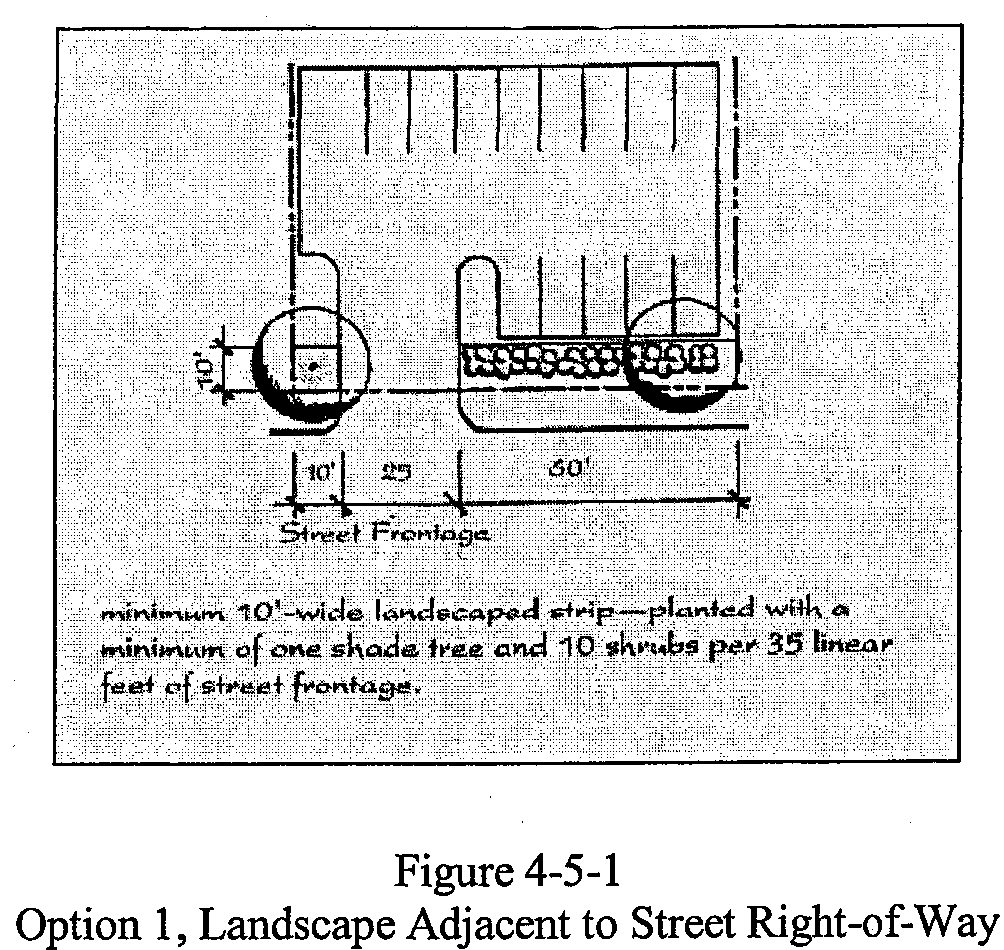
Option 1. Minimum ten-foot wide landscape strip, planted with a minimum of one shade tree and ten shrubs per 35 linear feet of street frontage, excluding driveway openings (Figure 4-5-1).
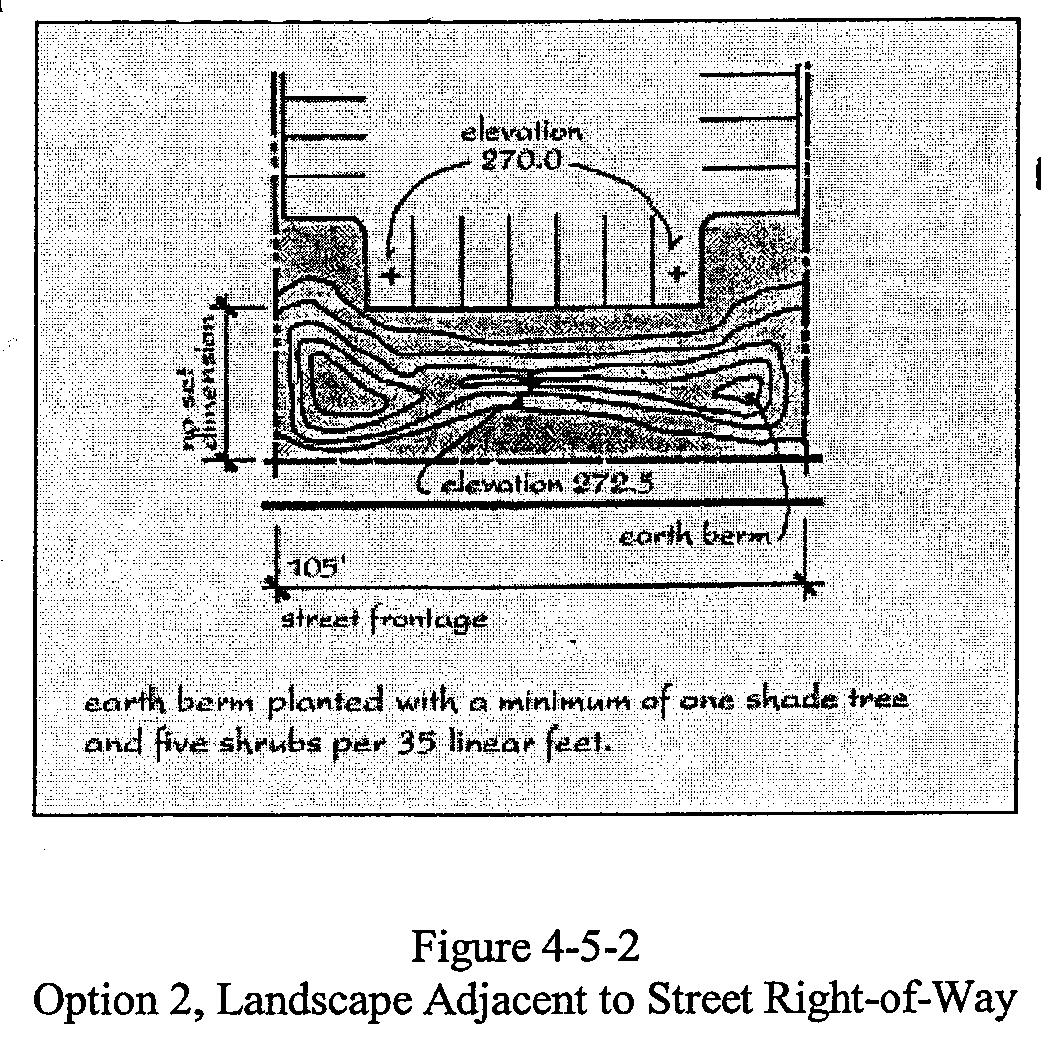
Option 2. An earth berm at least 2.5 feet higher than the finished elevation of the parking lot, with one shade tree and five shrubs for every 35 linear feet of frontage (Figure 4-5-3).
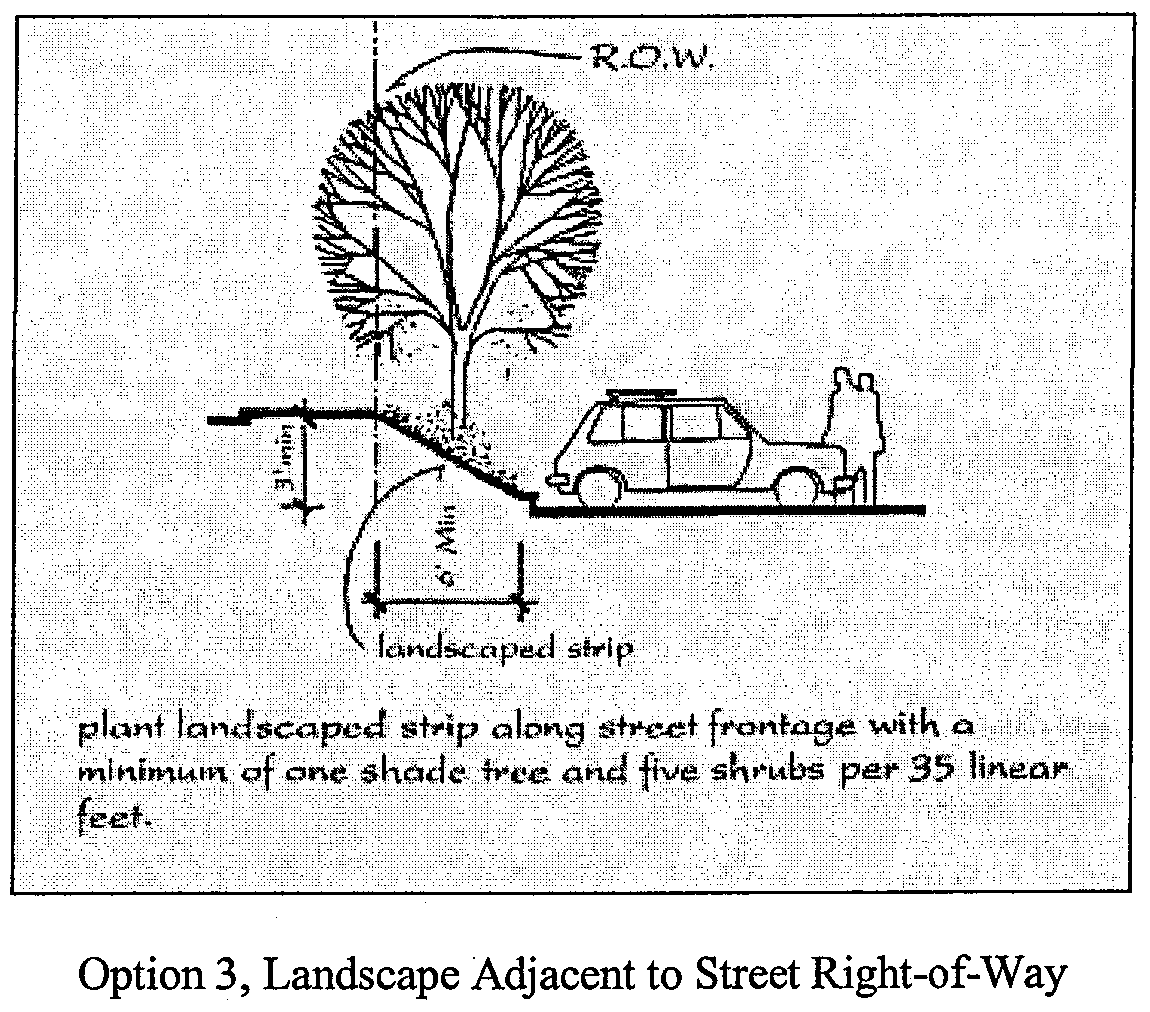
Option 3. A six-foot landscaped strip with a minimum three-foot grade drop from the right-of-way to the parking lot. One shade tree and five shrubs are required for every 35 linear feet (Figure 4-5-3).
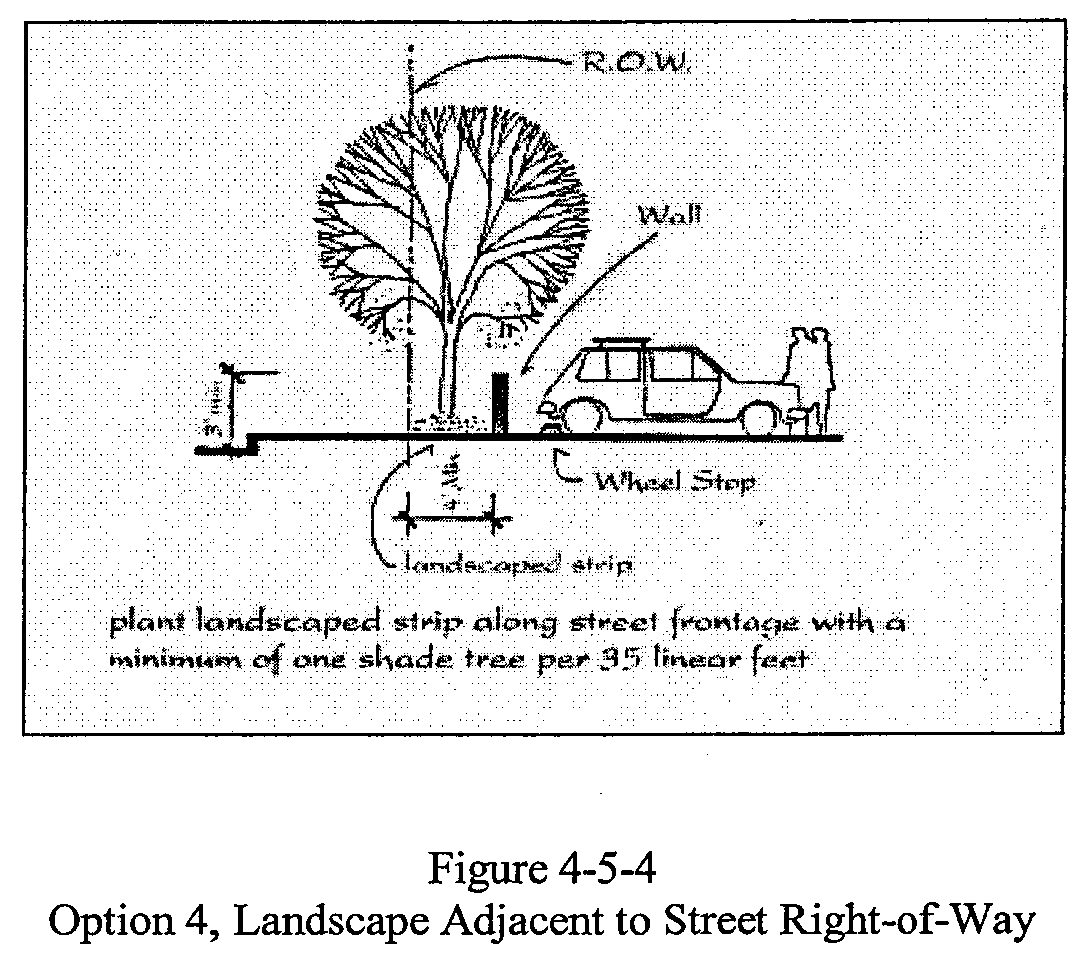
Option 4. A three-foot high fence of brick, stone, or finished concrete wall, with a four-foot buffer strip, planted with a minimum of one shade tree per 35 linear feet of frontage (Figure 4-5-4).
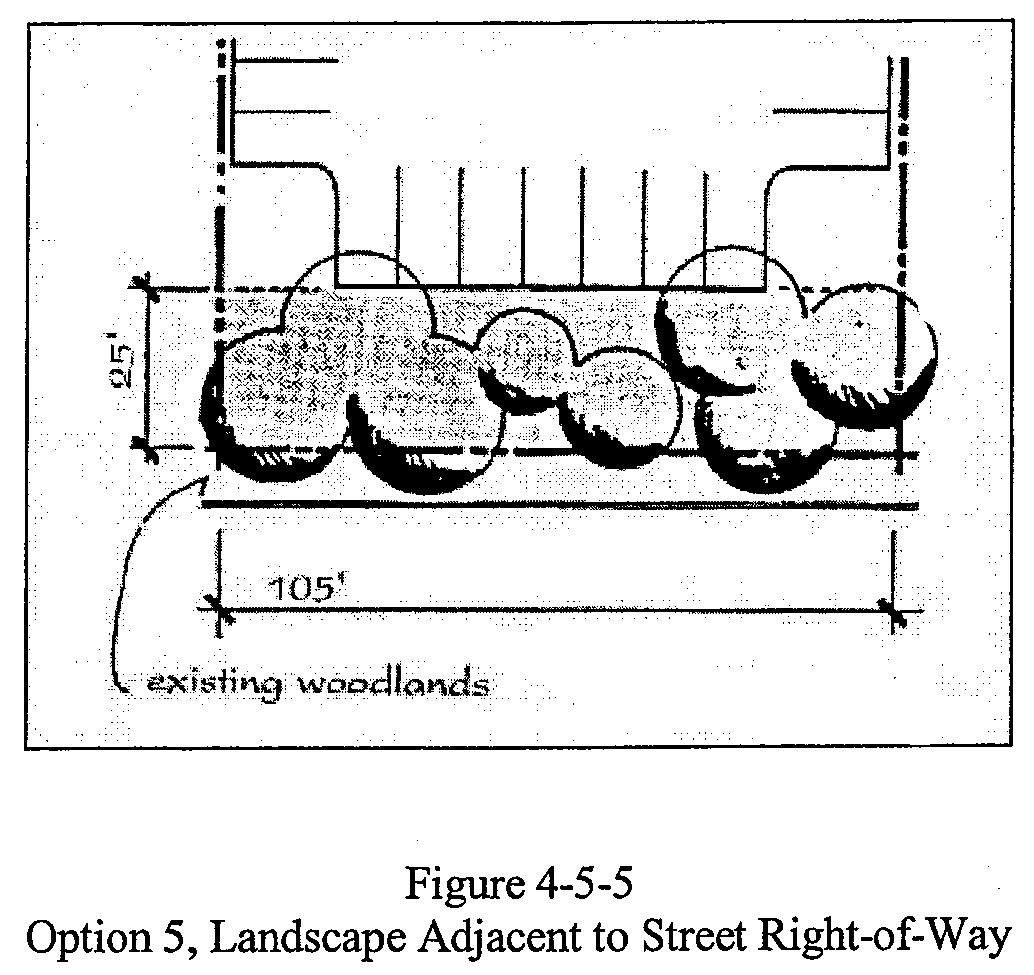
Option 5. If existing woodlands are determined by the arborist to be sufficient to meet the intent of this article, the applicant may preserve a 25-foot wide natural buffer strip to satisfy the requirements of this Code subsection (Figure 4-5-5).
PARKING LOT LANDSCAPE ALONG OTHER PROPERTY LINES
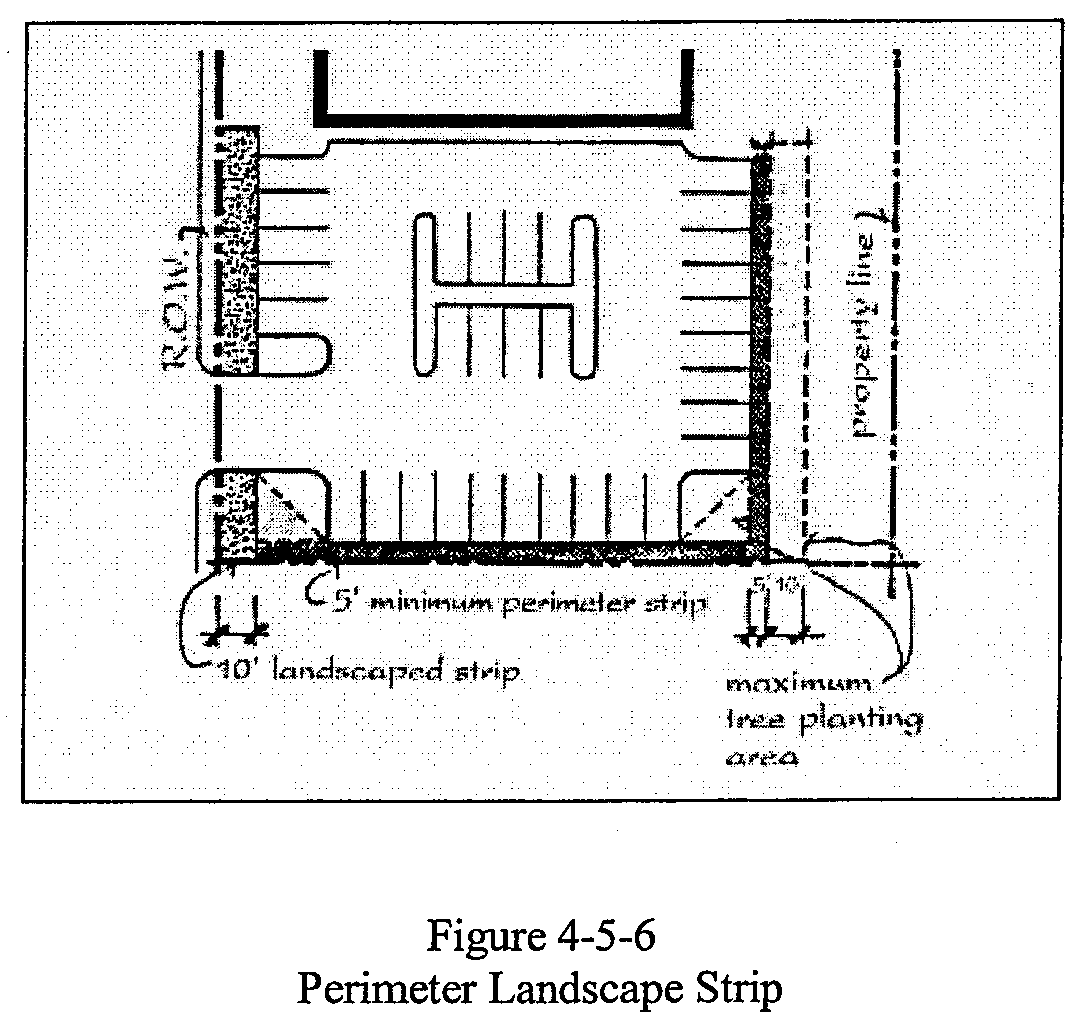
Along all property lines not abutting a street right-of-way, or along the perimeter of the developed portion of the lot in case the development does not extend to a property line, parking lots subject to the requirements of this subsection shall include a perimeter landscape strip at least five feet wide. The perimeter landscape strip shall not apply to interparcel access points but shall not include any other paved surfaces with the exception of pedestrian sidewalks or trails and areas approved for stormwater management. Within the perimeter landscape strip, the applicant shall install one tree and three shrubs for each 35 linear feet of property boundary along the perimeter to which this Code subsection applies, unless the Arborist approves the use of existing woodlands or other vegetation as meeting the intent of this article. See Figure 4-5-6.
PARKING LOT INTERIOR LANDSCAPING
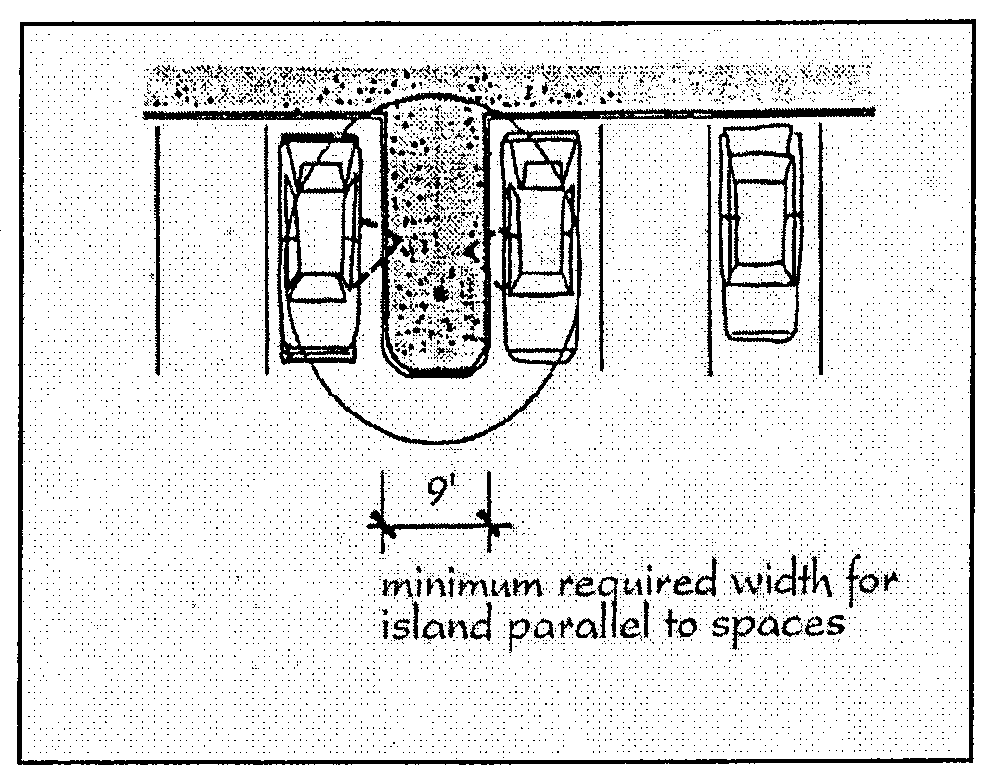
Interior lot landscaping shall be required for any parking lot subject to the requirements of this article. An interior parking lot landscape island at least nine feet wide (Figure 4-5-7) and at least 150 square feet in area shall be provided for every ten spaces in each row of parking spaces abutting the perimeter or within the interior of the parking lot. Within each interior parking lot landscape island, a minimum two-inch caliper tree shall be required to be planted and maintained.
LANDSCAPE BETWEEN BUILDINGS AND STREET RIGHT-OF-WAY
A landscape strip shall be required along the entire building frontage of any office, institutional, commercial or industrial building located within 50 feet of a street right-of-way, between said building and the street right-of-way, except for approved pedestrian and vehicle access areas. For pedestrian retail districts or other areas where the requirements of this section may interfere with pedestrian access, a streetscape plan incorporating landscaping appropriate to the context, approved by the arborist, may satisfy this requirement.
There shall be the following three options that may be used singly or in any appropriate combination to comply with this Code subsection, as proposed by the developer and approved by the arborist.
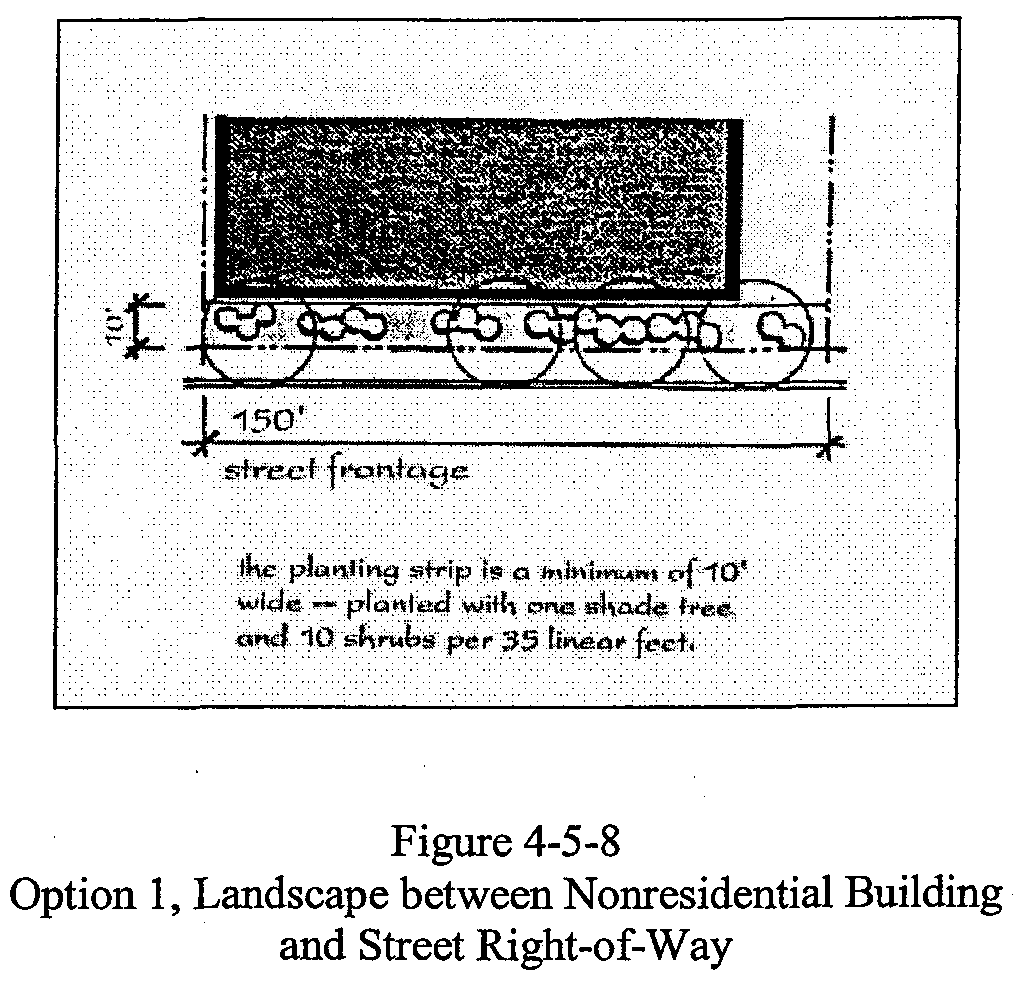
Option 1. A minimum ten-foot-wide landscape strip, with a minimum of one shade tree and ten shrubs for every 35 feet of linear street frontage (Figure 4-5-8).
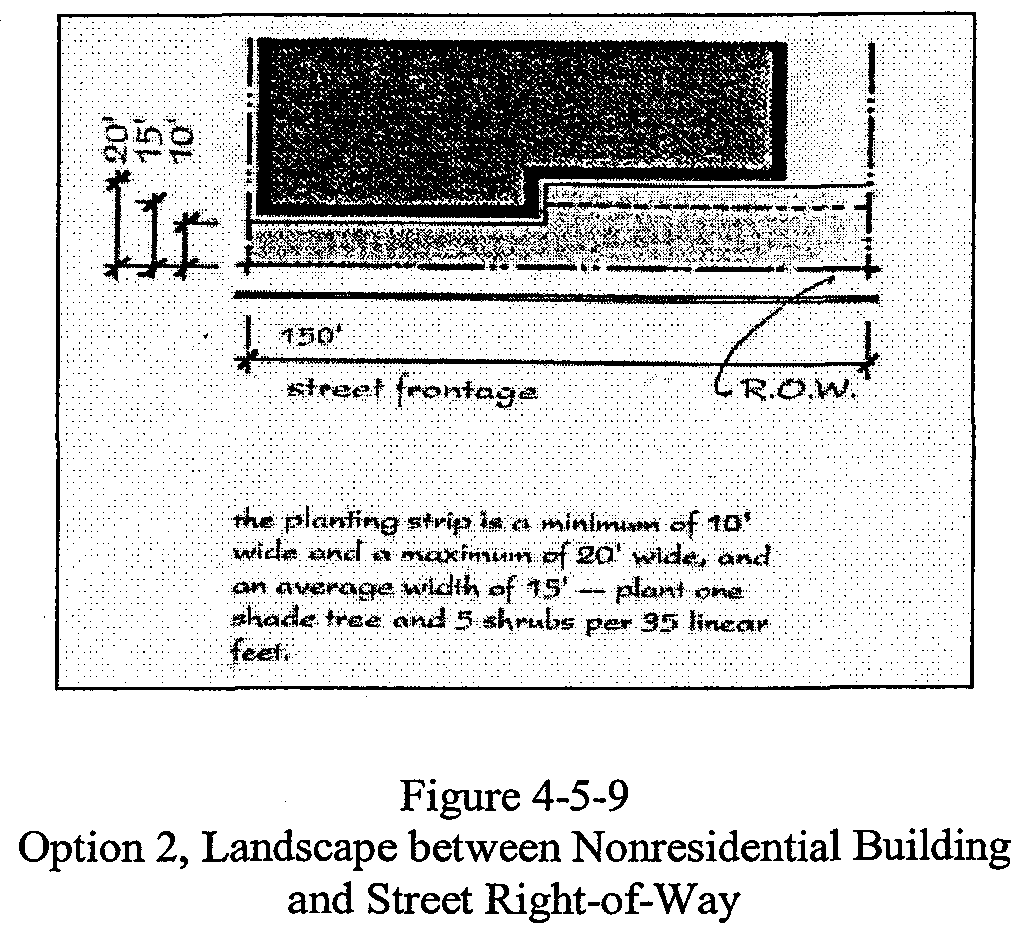
Option 2. A strip of varying width, but with a minimum of ten feet and averaging at least 15 feet wide, with a minimum of one shade tree and five shrubs per 35 linear feet (Figure 4-5-9).
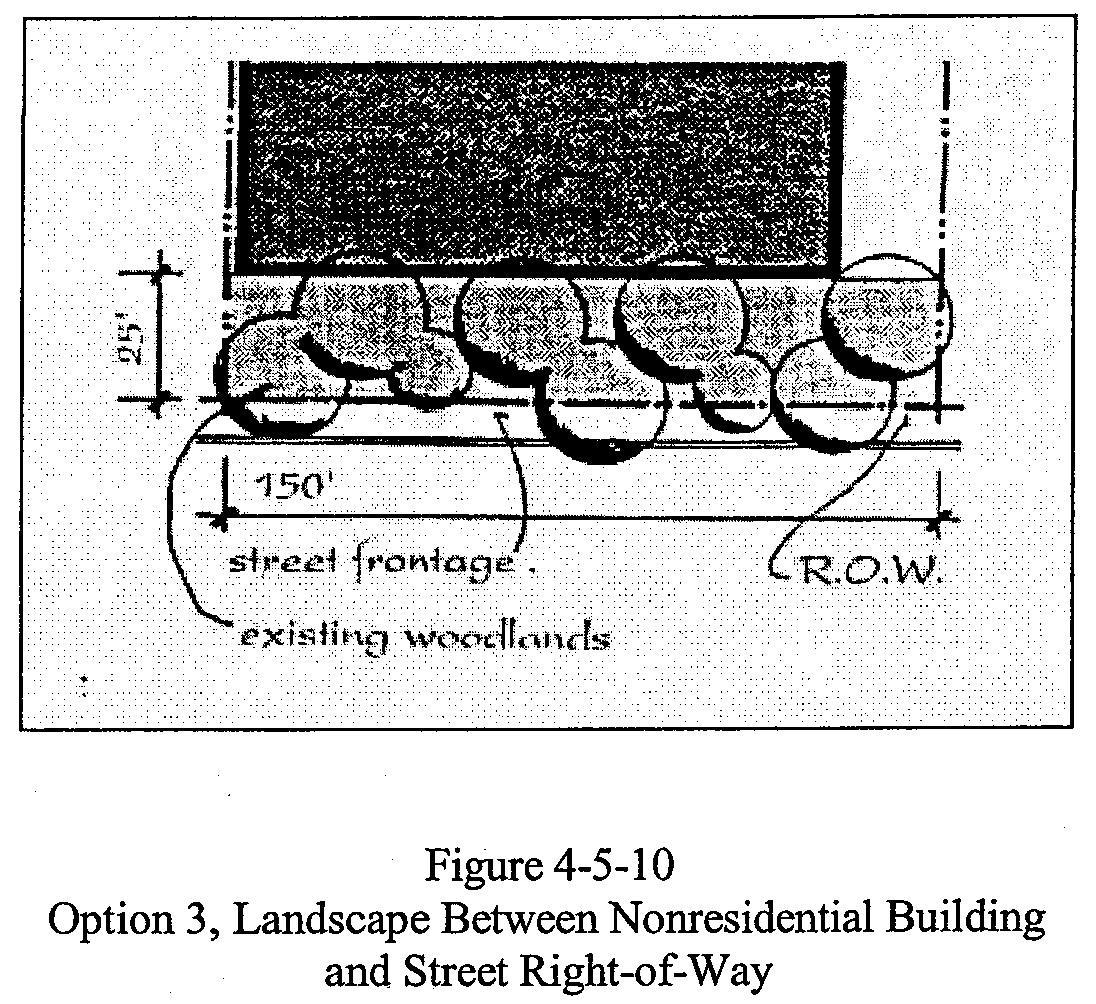
Option 3. Existing woodlands at least 25 feet wide (Figure 4-5-10).
BUFFERS REQUIRED
Buffers for individual uses shall be provided according to the requirements of Table 4-5-3, as applicable, based on existing, adjoining uses.
Table 4-5-3
Minimum Required Buffer Width
SCREENING AND BUFFER SPECIFICATIONS
Screening shall be established within all buffers that are required by this Code, along side and rear lot lines. The arborist may require additional screening outside landscape strips and buffers that are required along side and rear lot lines, for purposes of obscuring features such as rear entrances, utility and maintenance structures, and loading facilities. Landscaping shall be used whenever possible to screen objectionable views, noises, or nuisances, such as service areas, refuse containers, air conditioning units, transformers, etc.
All required screening shall consist of shrubs and/or trees but may be supplemented with walls, fences or earth berms. Screening shall be of such nature and density to screen activities on the lot from view from the normal level of a first story window on an abutting lot and shall provide year-round maximum opacity from the ground to a height of at least six feet. Trees and shrubs shall be installed to not only provide maximum opacity, but to allow for proper plant growth and maintenance.
To achieve maximum opacity within buffers, the following alternatives, or combination thereof, shall be considered by the applicant and applied, subject to the approval of the arborist:
(a)
Six-foot-high evergreen screening shrubs planted four (4) feet on center.
(b)
Tall evergreen trees stagger-planted with branches touching ground.
(c)
Combination of small shrubs planted 30 inches on center, small trees planted 30 feet on center, and large trees planted 40 feet on center.
(d)
Six-foot-high masonry wall.
In selecting materials and the size of plantings to be installed, the applicant and the Arborist shall consider the purpose of the landscape and the following required materials:
GENERAL PROVISIONS
Visibility. Landscaping shall not restrict visibility of motorists or pedestrians (e.g., tall shrubs or low-lying branches of trees).
Clearance. Trees must have a clear trunk at least six feet above finished grade to allow a safe clearance beneath the tree, except as otherwise provided by this Code section.
Curb stops. A curb or wheelstop shall be provided along interior parking lot landscape islands, perimeter landscape strips, and landscapes adjacent to street rights-of-way, to prevent cars from encroaching on trees, shrubs, and landscapes, as approved by the Arborist.
LANDSCAPE PLAN
A landscaping plan approved by the arborist shall be required prior to the issuance of a land use permit or building permit to demonstrate compliance with the provisions of this Code. The landscape plan shall be based on an accurate boundary survey of the site or reasonable property description and shall include the following:
(a)
Location and general type of existing vegetation;
(b)
Existing vegetation to be saved;
(c)
Methods and details for protecting existing vegetation during construction;
(d)
Locations and labels for all proposed plants and a plant list or schedule showing the proposed and minimum required quantities;
(e)
Location and description of other landscape improvements, such as earth berms, walls, fences, screens, sculptures, fountains, street furniture, lights, and courts or paved areas.
APPROVAL OF LANDSCAPING AND OTHER MATERIALS
Approval of all landscaping and other materials by the arborist shall be required. The arborist shall have broad discretion in approving the specific types of landscaping and other materials provided in the landscape requirements of this Code section. However, the following general guidance is provided and specific lists of approved species are provided in this Code:
(a)
The use of native plants as landscaping materials is encouraged wherever possible.
(b)
Invasive or potentially invasive plants are not permitted. However, well-mannered non-native plants are acceptable if they are not considered invasive or potentially invasive.
(c)
Existing tree cover and natural vegetation shall be preserved, whenever possible, or replaced with suitable vegetation.
(d)
Ground cover(s) should be used to supplement landscaping in appropriate areas to reduce the need for extensive grass lawns, which would require regular watering in drought conditions.
(e)
Grass areas shall be sodded. However, if grass seed must be used, it shall be a variety suitable to the area that produces complete coverage.
(f)
No artificial plants, trees, or other vegetation shall be installed.
TREE PLANTING GUIDELINES
(a)
[Acceptable trees.] Only healthy trees with a well-developed root system and a well-formed top, characteristic of the species, should be planted.
(b)
[Compatibility.] Trees selected for planting must be compatible with the specific site conditions.
(c)
[Planting times.] The ability of a species to regenerate a new root system and to become re-established should be considered. Generally, deciduous trees should be planted in the fall after leaf drop, or in early spring before bud break. There are indications that bare-root trees will re-establish more readily if planted in early spring just prior to bud break.
(d)
[Depth.] Trees should not be planted deeper than they were in their former location or container.
(e)
[Backfill.] Once the transplanted tree is set, the hole should be backfilled with soil of good texture and structure. Backfill material should be comprised of a mix of native soil, organic matter such as peat, and inorganic material such as pearlite or vermiculite in a 1:1:1 ratio, although a backfill with native soil alone may be adequate.
(f)
[Fertilizer.] The addition of fertilizer to backfill soil can cause root injury and is therefore not recommended. If fertilizer must be added, a small amount should be used. Approximately 1.5 pounds of nitrogen per cubic yard of back fill is recommended for bare root plants, and 2.5 pounds of nitrogen per cubic yard of back fill for balled and burlapped trees.
(g)
[Settling.] The backfill should be gently tamped (but not compacted) and soaked for settling. The soil should be slightly mounded to allow for settling; a ridge or dike around the perimeter of the hole can facilitate watering.
(h)
Pruning. The amount of pruning necessary for newly planted trees depends upon the trees' response to planting. A decrease in leaf surface area from pruning can result in a reduction of the production of food, thus ultimately inhibiting root development. Pruning for vigor or to train young trees should therefore be delayed until after the first growing season.
(i)
[Staking.] Staking should be used on newly planted trees only where determined necessary. The extent of staking will depend upon tree strength, form and condition at planting, expected wind conditions, the amount of vehicle or foot traffic and the level of followup maintenance. Staking can cause tree damage. Periodic followup inspections are required to prevent serious tree-staking problems. Staking should be removed as soon as the tree is capable of providing its own anchorage and support.
(j)
[Mulching.] Mulching newly planted trees will reduce competition from weeds and moderate soil moisture and temperature extremes.
(k)
[Injury, etc.] Trees selected for planting must be free from injury, pests, disease or nutritional disorders.
(l)
[Root defects.] Trees selected for planting must be free of root defects.
LANDSCAPE MAINTENANCE AND LANDSCAPE BOND
The owner, occupant, tenant and respective agent of each, if any, shall be jointly and severally responsible for the maintenance and protection of all landscaping required to be installed pursuant to this Code. Prior to issuance of a certificate of occupancy, the developer or owner shall post a performance bond or cash escrow guaranteeing all landscaping materials and work for a period of two years after approval or acceptance thereof by the city in a sum established by the Arborist. The bond will be in the amount of 100 percent of the estimated cost of replacing all of the landscaping required by these specifications, unless otherwise specified by the arborist. At the end of two years, the arborist shall make an inspection and notify the owner or developer and the bond company of any corrections to be made. If no maintenance is required, or if maintenance is provided by said responsible party, the arborist shall release the bond.
LISTS OF APPROVED LANDSCAPING MATERIALS
[See appendices]
(Ord. No. 20-2008, 12-8-08)
Sec. 94-143. - Automobile service stations.
(a)
All automobile service stations shall conform to the following requirements:
(1)
All pumps shall be set back at least 15 feet from the right-of-way line, or where a future widening setback line has been established, this setback shall be measured from such line. Pumps shall be setback at least 15 feet from any property line;
(2)
The number of curb breaks shall not exceed two for each 100 feet of street frontage, each having a width of not more than 30 feet or less than 25 feet and located not closer than 15 feet to a street intersection. Two or more curb breaks on the same street shall be separated by an area of not less than ten feet; and
(3)
When the station abuts a residential district, it shall be separated therefrom by a solid wall or planting buffer at least six feet high.
(b)
No storage tank shall be placed aboveground.
(Ord. No. 20-2008, 12-8-08)
Sec. 94-144. - Satellite receiving dish antennas.
(a)
Satellite receiving dish antennas shall be allowed in all zoning districts and shall not exceed 36 inches in diameter.
(b)
The setback requirements from the property line will be the same as those required of an accessory building.
(c)
In all zoning districts, antennas will be so placed as not to create a hazard to traffic or public utilities.
(d)
A property owner who has in place a nonconforming antenna at the effective date of the ordinance from which this chapter is derived may continue to maintain the antenna.
(e)
All satellite dishes that are more than 24 inches in diameter shall be screened by some form of visual barrier including, but not limited to, hedges, shrubbery, wood fences and similar such barriers or screens.
(f)
Any equipment mounted on the ground shall be located away from adjacent side yards and any equipment mounted on a roof shall be placed in the rear portion of the building roof so that they are not visible from any street, to the extent that this is feasible and does not interfere with the equipment's reception capabilities.
(Ord. No. 20-2008, 12-8-08)
Sec. 94-145. - Swimming pools.
All swimming pools shall comply with the following requirements:
(a)
Site plan. For pools meeting the definition set forth above, a site plan shall be submitted to the city manager or his designee indicating the location of the pool and all yard setbacks.
1.
A swimming pool shall not be constructed within the required front yard of any lot.
2.
A swimming pool shall not be located closer than ten feet to the rear lot line or to an interior side lot line.
(b)
Construction plan. For pools meeting the definition set forth above, a construction plan shall be submitted to the city manager or his designee including the structural design of said pool or any accessory buildings.
1.
Accessory buildings and/or pool houses shall comply with all of the requirements given for "accessory buildings" included in this ordinance.
(c)
Fencing. All swimming pools meeting the definition above shall be enclosed by a fence and maintained in good condition with a self-closing gate and lock.
1.
Fencing shall be five feet in height.
2.
Fencing shall be located in such a manner that it does not obstruct visibility at road intersections.
3.
Fencing shall comply with all the requirements that pertain to visibility in this Code.
(d)
The city herein adopts the SBCCI Standard Swimming Pool Code, 1994 Edition with Georgia Amendments and appendix as its standard for swimming pool regulation within the city. If there are any conflicts or discrepancies between the provisions of this Code and the Georgia Swimming Code, the more restrictive of the two shall apply within the city.
(Ord. No. 20-2008, 12-8-08)
Sec. 94-146. - Compatibility standards for homes.
Manufactured homes, site-built, modular and other housing qualifying as a single-family dwelling shall meet the following compatibility standards to protect and preserve the characteristics of housing within any zoning district:
(1)
The minimum width of the structure built or installed on the site shall be 30 feet in all residential districts, except for the R-4 districts, which will permit a width of 16 feet or greater.
(2)
All single-family residential dwellings shall have a minimum heated and cooled floor area of 1,200 square feet. Only multifamily dwellings (such as apartments and condominiums), and planned unit developments may be approved for less habitable floor area.
(3)
The roof shall have a minimum 5:12 roof pitch and shall have a surface of asphalt composition, fiberglass or metal tiles, slate, materials or other materials approved by the planning commission. Corrugated metals or plastic panels are prohibited. Standing seam metal roofs are authorized.
(4)
The exterior siding materials shall consist of brick, wood, masonry, stucco, masonite, metal or vinyl lap designed for such purposes or other materials of like appearance approved by the planning commission.
(5)
Be attached to a permanent foundation. A permanent foundation shall mean a concrete slab, concrete footers, foundation wall pilings or post construction which complies with the state minimum standard codes, as amended from time to time or the International Building Code (IBC).
(6)
Be constructed according to standards established either by the state minimum standard codes, as amended from time to time, or the International Building Code (IBC).
(7)
The planning commission may approve deviations from one or more of the developmental or architectural standards provided herein on the basis of a finding that the materials to be utilized or the architectural style proposed for the dwelling shall be compatible and harmonious with existing structures in the vicinity.
(Ord. No. 20-2008, 12-8-08)
Sec. 94-147. - Architectural and design standards.
(a)
Intent; purpose. The intent of these standards is to enhance the visual appeal of the community as a whole, as well as the commercial appeal of individual establishments. The mission or intent of this requirement thereof is to adopt design standards which, over time, will establish a streetscape image that makes the city unique to other surrounding jurisdictions, establishes a unifying theme, presents the traveling public with a sense of arrival, is harmonious with its surroundings, is aesthetically pleasing and enhances the character of the community. As such, the following goals, at a minimum, are established:
(1)
To encourage the rehabilitation/redevelopment of commercial areas;
(2)
To encourage the use of "village concepts" whenever and wherever possible;
(3)
To facilitate and encourage safe, attractive and convenient pedestrian circulation within a development, along a corridor and throughout the community;
(4)
To promote and encourage new development to be compatible in both scale and character with adjacent areas;
(5)
To use landscaping techniques to soften the effect and blend each development with the surrounding area (see requirements for buffer areas and landscaping requirements herein);
(6)
To promote the development of areas where people can live, work, play and shop without totally depending on the automobile;
(7)
To further energy conservation through better design; and
(8)
To ensure that quality development throughout the city is obtained.
(b)
New construction and building renovations. All new construction and renovation of buildings with any commercial, industrial or planned development zoning districts shall have the following:
(1)
Architectural treatment. Buildings shall incorporate alcoves, arcades, awnings, covered walkways, porticoes, or roofs that protect pedestrians from the rain and sun. In addition, when appropriate, buildings shall incorporate changes in mass, surface, lighting or finish to give emphasis to entranceways (see design standard illustrations on file in city hall).
(2)
Blank walls. Blank walls greater than 100 feet in length that can be seen from any street, public or private, are prohibited. Walls shall have offsets, jogs, or other distinctive changes in the building facade. Up to 40 percent of the length of the perimeter may be exempt from this standard if oriented toward a loading or service area.
(3)
Building materials. All exterior surfaces shall be constructed of materials in accordance with the city's list of acceptable building materials, which shall be attached to the zoning code as Appendix 1, and is available on file in the city clerk's office. The approved list of building materials shall be reviewed, updated, and published at least annually.
(4)
Roof pitch. (See "roof pitch" illustrations on file at city hall).
(5)
Setbacks and windows. Buildings located within 50 feet of the property line adjacent to the front yard, shall have at least 25 percent of the wall facing the street in window or door areas.
(6)
Open space. At least 20 percent of each site shall remain natural, unless it is part of a planned development, in which case the overall PD plan shall provide a minimum of 20 percent open space overall. Trails, bikeways and other passive recreation activities shall be allowed within the 20 percent. Active recreational activities such as ball fields, tennis courts, swimming pools, or cleared fields shall not be counted toward the 20 percent requirement. Open space shall be determined at the time of development and in general shall be those lands reserved from any clearing, grubbing or grading activity. Open space may be enhanced with the planting of trees, shrubs and ground cover with the approval of the city. Said enhancements shall only be considered upon submittal of a landscape plan illustrating both existing and proposed vegetation.
(7)
Parking lot lighting. Any lighting fixture shall be a cutoff-type luminary, the source of which is completely concealed with an opaque housing. Fixtures shall be recessed in the opaque housing. Drop dish refractors are prohibited. The wattage shall not exceed 420 watts/480V per light fixture. This provision includes lights mounted on poles as well as architectural display and decorative lighting visible from the street or highway. Only the following types of lights may be used:
a.
Incandescent;
b.
Fluorescent;
c.
Metal halide;
d.
Mercury vapor;
e.
Natural gas; or
f.
Color corrected high pressure sodium (CRI of 60 or better).
Fixtures must be mounted in such a manner that the cone of the light is not directed past any adjacent property line. The minimum mounting height for a pole is 12 feet. The maximum mounting height for a pole is 25 feet excluding a three-foot base.
(Ord. No. 20-2008, 12-8-08; Ord. No. 3-2024, § 1, 4-8-24)
Sec. 94-175.- Scope and intent.
Regulations set forth in this division are applicable to the R-E single-family estate residential districts. The R-E estate district encompasses lands devoted to low-density residential areas for estate development.
(Ord. No. 20-2008, 12-8-08)
Sec. 94-176. - Compliance.
Within the R-E district, land and structures shall be used in accordance with standards of this division.
(Ord. No. 20-2008, 12-8-08)
Sec. 94-177. - Permitted uses.
Structures and land may be used for only the following purposes:
(1)
Single-family detached dwellings.
(2)
Accessory buildings or uses.
(3)
Guesthouses.
(4)
Swimming pools (private).
(Ord. No. 20-2008, 12-8-08)
Sec. 94-178. - Conditional uses.
Structures and land may be used under specific conditions for only the following purposes:
(1)
Golf courses.
(2)
Swimming pools (public).
(3)
Tennis or country clubs.
(4)
Public and private community clubs or associations.
(5)
Athletic fields.
(6)
Parks and recreation areas.
(Ord. No. 20-2008, 12-8-08)
Sec. 94-179. - Setbacks and regulations.
(Ord. No. 20-2008, 12-8-08)
Sec. 94-190.- Scope and intent.
Regulations set forth in this division are applicable to the R-1 single-family residential districts. The R-1 district encompasses lands devoted to low-density residential areas.
(Ord. No. 20-2008, 12-8-08)
Sec. 94-191. - Compliance.
Within the R-1 district, land and structures shall be used in accordance with standards of this division.
(Ord. No. 20-2008, 12-8-08)
Sec. 94-192. - Permitted uses.
Structures and land may be used for only the following purposes:
(1)
Single-family detached dwellings.
(2)
Accessory buildings or uses.
(3)
Guesthouses.
(4)
Swimming pools (private).
(Ord. No. 20-2008, 12-8-08)
Sec. 94-193. - Conditional uses.
Structures and land may be used under specific conditions for only the following purposes provided that no building for such proposed use is located within 100 feet of any property line:
(1)
Golf courses.
(2)
Swimming pools (public).
(3)
Tennis or country clubs.
(4)
Public and private community clubs or associations.
(5)
Athletic fields.
(6)
Parks and recreation areas.
(7)
Churches, synagogues and similar places of worship and their customary related uses.
(8)
Electric, power yards, substations.
(9)
Utility substations.
(10)
Other public land uses owned and operated by municipal, county, state or federal governments, including schools teaching general education courses, parks, playgrounds and swimming pools, after review and recommendation by the planning commission and upon approval of the city commission.
(Ord. No. 20-2008, 12-8-08)
Sec. 94-194. - Setbacks and regulations.
(Ord. No. 20-2008, 12-8-08)
Sec. 94-205.- Scope and intent.
R-2 residential districts are established to provide for low-medium density residential development.
(Ord. No. 20-2008, 12-8-08)
Sec. 94-206. - Compliance.
Within the R-2 district, land and structures shall be used in accordance with standards of this division.
(Ord. No. 20-2008, 12-8-08)
Sec. 94-207. - Permitted uses.
Structures and land may be used for only the following purposes:
(1)
Single-family detached dwellings.
(2)
Accessory buildings and uses.
(3)
Guesthouses.
(4)
Swimming pools (private).
(Ord. No. 20-2008, 12-8-08)
Sec. 94-208. - Conditional uses.
Structures and land may be used under specific conditions for only the following purposes, provided that no building for such proposed use is located within 100 feet of any property line:
(1)
Golf courses.
(2)
Swimming pools (public).
(3)
Tennis or country clubs.
(4)
Public and private community clubs or associations.
(5)
Athletic fields.
(6)
Parks and recreation areas.
(7)
Churches, synagogues and similar places of worship and their customary related uses.
(8)
Electric, power yards, substations.
(9)
Utility substations.
(10)
Other public land uses owned and operated by municipal, county, state or federal governments, including schools teaching general education courses, parks, playgrounds and swimming pools, after review and recommendation by the planning commission and upon approval of the city commission.
(11)
Nursery schools and kindergartens, provided that they shall have at least 35 square feet of indoor space provided for each child and at least 100 square feet of play area per child in the outdoor play area; and that the outdoor play area shall be enclosed by a fence having a minimum height of six feet; and provided that the principal building of such use shall meet all the yard requirements of the R-2 residential district.
(12)
Day care homes.
(13)
Assisted living facilities so long as no more than five residents are occupying the facility at any time.
(14)
Public, parochial and private schools and colleges when located on a site of at least five acres and including covenants [convents], monasteries, dormitories and other related living structures when located on the same site as the school or college.
(15)
Boarding houses.
(Ord. No. 20-2008, 12-8-08)
Sec. 94-209. - Setbacks and regulations.
(Ord. No. 20-2008, 12-8-08)
Sec. 94-220.- Scope and intent.
Regulations set forth in this section are the R-3 residential district regulations. The R-3 district encompasses lands devoted to medium-density residential districts.
(Ord. No. 20-2008, 12-8-08)
Sec. 94-221. - Compliance.
Within the R-3 single-family residential district, land and structures shall be used in accordance with standards of this division.
(Ord. No. 20-2008, 12-8-08)
Sec. 94-222. - Permitted uses.
Structures and land may be used for only the following purposes:
(1)
Single-family detached dwellings.
(2)
Two-family dwellings.
(3)
Accessory buildings and uses.
(4)
Guesthouses.
(5)
Swimming pools (private).
(Ord. No. 20-2008, 12-8-08)
Sec. 94-223. - Conditional uses.
Structures and land may be used under specific conditions for only the following purposes, provided that no building for such proposed use is located within 100 feet of any property line:
(1)
Golf courses.
(2)
Swimming pools (public).
(3)
Tennis or country clubs.
(4)
Public and private community clubs or associations.
(5)
Athletic fields.
(6)
Parks and recreation areas.
(7)
Home occupations.
(8)
Churches, synagogues and similar places of worship and their customary related uses.
(9)
Electric, power yards, substations.
(10)
Utility substations.
(11)
Other public land uses owned and operated by municipal, county, state or federal governments, including schools teaching general education courses, parks, playgrounds and swimming pools, after review and recommendation by the planning commission and upon approval of the city commission.
(12)
Nursery schools and kindergartens, provided that they shall have at least 35 square feet of indoor space provided for each child and at least 100 square feet of play area per child in the outdoor play area; and that the outdoor play area shall be enclosed by a fence having a minimum height of six feet; and provided that the principal building of such use shall meet all the yard requirements of the R-2 residential district.
(13)
Day care homes.
(14)
Bed and breakfasts.
(15)
Rooming and boarding houses, tourist homes, convalescent or nursing homes, group personal care homes; assisted living facilities.
(17)
Retirement centers.
(18)
Public, parochial and private schools and colleges when located on a site of at least five acres and including covenants [convents], monasteries, dormitories and other related living structures when located on the same site as the school or college.
(19)
Halfway/transitional home.
(20)
Apartments; apartment buildings; and townhouses.
(Ord. No. 20-2008, 12-8-08; Ord. No. 2-2021, § 2, 5-10-21; Ord. No. 2-2022, § 1, 11-14-22)
Sec. 94-224. - Setbacks and regulations.
(Ord. No. 20-2008, 12-8-08)
Sec. 94-235.- Scope and intent.
Regulations set forth in this section are the R-4 district regulations. The R-4 district encompasses lands devoted to medium to high-density residential areas.
(Ord. No. 20-2008, 12-8-08)
Sec. 94-236. - Permitted uses.
Structures and land may be used for only the following purposes:
(1)
Single-family detached dwellings.
(2)
Two-family dwellings.
(4)
Multifamily dwellings.
(5)
Accessory buildings and uses.
(6)
Guesthouses.
(7)
Swimming pools (private).
(Ord. No. 20-2008, 12-8-08)
Sec. 94-237. - Conditional uses.
Structures and land may be used under specific conditions for only the following purposes, provided that no building for such proposed use is located within 100 feet of any property line:
(1)
Bed and breakfasts.
(2)
Golf courses.
(3)
Swimming (public).
(4)
Tennis or country clubs.
(5)
Public and private community clubs or associations.
(6)
Athletic fields, parks, and recreation areas.
(7)
Home occupations.
(8)
Churches, synagogues and similar places of worship and their customary related uses.
(9)
Electric, power yards, substations.
(10)
Utility substations.
(11)
Other public land uses owned and operated by municipal, county, state or federal governments, including schools teaching general education courses, parks, playgrounds and swimming pools, after review and recommendation by the planning commission and upon approval of the city commission.
(12)
Nursery schools and kindergartens, provided that they shall have at least 35 square feet of indoor space provided for each child and at least 100 square feet of play area per child in the outdoor play area; and that the outdoor play area shall be enclosed by a fence having a minimum height of six feet; and provided that the principal building of such use shall meet all the yard requirements of the R-2 residential district.
(13)
Day care homes.
(14)
Rooming and boarding houses, tourist homes, convalescent or nursing homes, group personal care homes, assisted living facilities.
(15)
Retirement centers.
(16)
Public, parochial and private schools and colleges when located on a site of at least five acres and including covenants [convents], monasteries, dormitories and other related living structures when located on the same site as the school or college.
(17)
Mobile home parks.
(18)
Halfway/transitional home.
(Ord. No. 20-2008, 12-8-08; Ord. No. 2-2021, § 2, 5-10-21)
Sec. 94-238. - Setbacks and regulations.
(Ord. No. 20-2008, 12-8-08)
Sec. 94-250.- Intent.
The purpose of this district is to preserve the downtown commercial district and provide locations for shopping facilities that are commonly found in the retail commercial uses of the historic downtown orientation. The CBD (central business district) would also provide for loft-style living and other residential concepts associated with a downtown city. Such facilities should be located to allow for minimal lot line requirements, but not to forsake the public safety and general welfare. In addition, the frequency and distribution patterns reflect the downtown orientation, without jeopardizing the historic significance of the central business district.
(Ord. No. 20-2008, 12-8-08)
Sec. 94-251. - Required conditions.
Retail sales, displays of merchandise, and storage must be within an appropriate enclosure (building, or structure) as specified by law or ordinance. However, the commission may grant an exception to this requirement as a conditional use where it finds that enforcement would create an unreasonable hardship. No single business activity shall occupy more than 40,000 square feet of building area. Specified residential uses will be permitted in the C-1 district as conditional uses after review and recommendation by the planning commission and a formal approval by the city commission set forth in this Code. This mixed-use environment will help preserve the historic character of the downtown area and allow for a greater degree of flexibility in dealing with existing properties.
(Ord. No. 20-2008, 12-8-08)
Sec. 94-252. - Permitted uses.
The following uses are permitted:
(1)
Appliance stores, including repairs and services, but not appliance salvage and/or storage yards.
(2)
Art and antique stores, art galleries, museums and institutions of a similar nature.
(3)
Bakeries—Retail.
(4)
Health clubs, spas, and other similar activities.
(5)
Bicycle stores.
(6)
Book, stationery, camera, photographic supply stores, and newsstands.
(7)
Confectionery stores.
(8)
Clothing and shoes, millinery, dry goods and notion stores.
(9)
Ice cream parlors.
(10)
Drugstores.
(11)
Furniture and home furnishings stores.
(12)
Florist, nurseries, and gift shops.
(13)
Grocery, fruit, vegetable, meat markets, delicatessens, catering stores, and supermarkets.
(14)
Hardware and paint stores (no outside uncovered unfenced storage areas).
(15)
Jewelry stores.
(16)
Barbershops and beauty shops.
(17)
Dressmaking and tailoring shops.
(18)
Laundry and dry cleaning pickup stations.
(19)
Retail and repair shoe shops.
(20)
Garden supply stores (no outside uncovered unfenced storage areas).
(21)
Any other retail sales or service establishments similar in character to those permitted; however fortuneteller, psychics, junkyards or auto wrecking establishments or any other business where the materials sold are not housed within a building are prohibited.
(22)
Professional, and business office, that include banks and financial institutions.
(23)
Accessory buildings and uses located on the same lot or parcel of land as the main structure and customarily incidental to the permitted or conditional use.
(24)
Cafes, grills, lunch counters, and restaurants.
(25)
Motels and hotels;
(26)
Offices and display rooms for wholesaling establishments, provided no warehousing facilities are located on the premises.
(27)
Newspaper offices and printing establishments incidental to such offices
(28)
Public buildings and structures.
(29)
Automobile sales.
(30)
Banks and other financial institutions.
(31)
Parking lots.
(32)
Brewpubs.
(33)
Microbrewery.
(34)
Tattoo studio.
(35)
Retail cigar shop.
(36)
Food trucks, where properly permitted and approved in accordance with health department regulations and section 94-254 hereof.
(Ord. No. 20-2008, 12-8-08; Ord. No. 7-2017, §§ 22, 23, 12-11-17; Ord. No. 4-2018, § 4, 7-9-2018; Ord. No. 4-2019, § 3, 9-9-19; Ord. No. 3-2023, § 2, 7-10-23)
Sec. 94-253. - Conditional uses.
Structures and land may be used under specific conditions for only the following purposes:
(1)
Gas stations and automobile service stations, but not including repair garages and salvage yards. Provided that all structures and buildings, except principal use signs, and including service tanks shall be placed not less than 25 feet from any side or rear property line, except where such side or rear property lines abut a street, in which case the setback shall be that required for such streets measured from the right-of-way. All buildings or structures, including gasoline pumps and storage tanks, except principal use signs, shall comply with the setback requirements of any abutting street. If the automobile service station is located on a corner lot, the means of ingress and egress provided shall be not less than 15 feet from the intersection of street right-of-way lines. Ingress and egress shall be arranged and designed so as to minimize the interference with the flow of traffic, either vehicular or pedestrian.
(2)
Auction houses.
(3)
Print shops.
(4)
Theaters and cinemas, but not including drive-in theaters.
(5)
Churches and other places of worship, attendant educational and recreational buildings, and their appurtenant accessory uses (e.g., cemeteries, mausoleums, etc.).
(6)
Kindergartens, day care centers and homes, and nursery or play schools.
(7)
Golf, swimming, tennis, or country clubs; public and private community clubs or associations; athletic fields; parks and recreational areas. The size and intensity of the proposed use as it relates to adjacent land uses shall be a determining factor.
(8)
Private clubs, and fraternal order of lodges.
(9)
Variety retail shops.
(10)
Hospitals, clinics, and convalescent or nursing homes.
(11)
Temporary uses, including sale of Christmas trees, carnivals, church bazaars, and sale of seasonal fruits and vegetables from roadside stands, but such use is not to be permitted for a period to exceed two months in any calendar year.
(12)
Dry cleaning and laundry establishments, provided that such operation is for local service only and no work is done on the premises for other similar establishments or pickup stations.
(13)
Colleges, public and private schools, and libraries.
(14)
Recreational, amusement, and entertainment facilities.
(15)
Funeral homes, not including crematoriums.
(16)
Self-serve car washing facilities, provided they are located on an arterial street.
(17)
Bed and breakfast inns, provided all parking can be maintained on the lot and not along connector and secondary streets.
(18)
Residential development shall be permitted only on the second floor of existing buildings, and any buildings hereafter constructed, in the central business district as described herein.
a.
Type of residential development.
1.
Single-family units.
2.
Two-family units.
3.
Multifamily units.
b.
Parking. In the central business district, no off-street parking shall be required for three or fewer dwelling units on a property. For more than three dwelling units, off-street parking shall be provided for the property at the rate of 1.25 spaces per dwelling unit (rounded up to the nearest whole number of spaces). For parking regulation affecting all other uses, see the parking regulations in section 94-482.
c.
Square footage requirements. Each residential dwelling unit shall contain a minimum of 400 square feet per occupant.
One-bedroom, 600 square feet;
Two-bedroom, 750 square feet.;
Three-bedroom, 900 square feet.
(19)
Taxicab businesses.
(16)
Parking garages (automobile).
(17)
Pet grooming.
(18)
Loft-style dwellings provide they are located on the second level of a building.
(19)
Bus, railroad, and air terminal facilities.
(20)
Public, parochial and private schools and colleges when located on a site of at least five acres and including covenants [convents], monasteries, dormitories and other related living structures when located on the same site as the school or college.
(21)
Artisanal furniture manufacturing and/or construction, refinishing, and repair, provided that no such business shall have more than two employees, and shall meet all environmental regulations promulgated by the United States Environmental Protection Agency, Georgia Environmental Protection Division, or any other federal, state or local environmental agency with regard to the application and storage of solvents used in the business.
(Ord. No. 20-2008, 12-8-08; Ord. No. 10-2011, § 1, 8-8-11)
Sec. 94-254. - Itinerant vending.
No itinerant vendors shall be allowed in the central business district. Itinerant vendors are defined herein to include any person, whether a resident of the city or not, who has no permanent place of business within the city and who engages in a transient business in one temporary fixed place of business or sells goods from a vehicle, truck, van, trailer or other type of conveyance. Notwithstanding the foregoing, properly permitted food trucks shall be allowed to conduct business within the central business district upon approval of a proposed location for the same by the city manager or their designee.
(Ord. No. 20-2008, 12-8-08; Ord. No. 3-2023, § 1, 7-10-23)
Sec. 94-255. - C-1 limited location malt beverage and wine pouring license.
In addition to the uses authorized in section 94-252, restaurant businesses within the area defined in section 2-96 of chapter 2, article III, division 3 (the boundary definitions of the downtown development area of the city) as presently enacted, or hereinafter amended, shall be authorized to obtain from the city a license for the privilege of selling malt beverages and/or wine by the drink for consumption on the premises. This license shall be limited to eating establishments within the downtown central business district, and governed by the specific requirements of chapter 6 of this Code regarding alcoholic beverages.
(Ord. No. 20-2008, 12-8-08)
Sec. 94-256. - Setbacks and regulations.
(Ord. No. 20-2008, 12-8-08)
Sec. 94-275.- Intent.
The C-2 general commercial district is intended to promote general commercial activities in appropriate and concentrated locations along major streets and the existing city center.
(Ord. No. 20-2008, 12-8-08)
Sec. 94-276. - Required conditions.
(a)
Retail sales, displays of merchandise, and storage must be within an appropriate enclosure (building or structure) as specified in the city's standard building and housing codes. However, the commission may grant an exception to this requirement as a conditional use where it finds that enforcement would create an unreasonable hardship.
(b)
Specified conditional uses will be permitted in the C-2 district after review and recommendation by the planning commission and a formal approval by the city commission. This mixed-use environment will help preserve the historic character of the city and allow for a greater degree of flexibility in dealing with existing properties.
(Ord. No. 20-2008, 12-8-08)
Sec. 94-277. - Permitted uses.
Structures and land may be used for only the following purposes; the following uses are permitted:
(1)
Appliance stores, including repairs and services, but not appliance salvage and/or storage yards.
(2)
Art and antique stores, art galleries, museums and institutions of a similar nature.
(3)
Bakeries—Retail.
(4)
Health clubs, spas, and other similar activities.
(5)
Bicycle stores.
(6)
Book, stationery, camera, photographic supply stores, and newsstands.
(7)
Confectionery stores.
(8)
Clothing and shoes, millinery, dry goods and notion stores.
(9)
Ice cream parlors.
(10)
Drugstores.
(11)
Furniture and home furnishings stores.
(12)
Florist, nurseries, and gift shops.
(13)
Grocery, fruit, vegetable, meat markets, delicatessens, catering stores, and supermarkets.
(14)
Hardware and paint stores (no outside uncovered unfenced storage areas).
(15)
Jewelry stores.
(16)
Barbershops and beauty shops.
(17)
Dressmaking and tailoring shops.
(18)
Laundry and dry cleaning pickup stations, and self-service laundries.
(19)
Retail and repair shoe shops.
(20)
Garden supply stores (no outside uncovered unfenced storage areas).
(21)
Any other retail sales or service establishments similar in character to those permitted; however fortuneteller, psychics, junkyards or auto wrecking establishments or any other business where the materials sold are not housed within a building are prohibited.
(22)
Professional, and business office, that include banks and financial institutions.
(23)
Accessory buildings and uses located on the same lot or parcel of land as the main structure and customarily incidental to the permitted or conditional use.
(24)
Cafes, grills, lunch counters, and restaurants.
(25)
Motels and hotels;
(26)
Offices and display rooms for wholesaling establishments, provided no warehousing facilities are located on the premises.
(27)
Newspaper offices and printing establishments incidental to such offices
(28)
Local government buildings and structures.
(29)
Automobile sales.
(30)
Banks and other financial institutions.
(31)
Parking lots.
(32)
Other publishing or printing establishments.
(33)
Bottling works for soft drinks.
(34)
Convalescent or nursing homes.
(35)
Bowling alleys and billiard rooms.
(36)
Telephone offices or communications centers.
(37)
Minor shopping centers. The following guidelines govern construction of shopping centers:
a.
Shopping centers may exceed 40,000 square feet in gross floor area.
b.
Shopping centers shall be located along arterial, collector or secondary streets.
c.
Required green space and open space buffers, as required by this Code.
(38)
Brewpubs.
(39)
Microbrewery.
(40)
Tattoo studio.
(41)
Retail cigar shop.
(Ord. No. 20-2008, 12-8-08; Ord. No. 7-2017, §§ 24, 25, 12-11-17; Ord. No. 4-2018, § 5, 7-9-2018; Ord. No. 4-2019, § 4, 9-9-19)
Sec. 94-278. - Conditional uses.
Structures and land may be used under specific conditions for only the following purposes:
(1)
Garages—Mechanical
(2)
Public utility structure and buildings, including electric and natural gas substations, telephone exchanges, communication towers, radio and television stations and similar structures for the storage of supplies, equipment, or service operations, when properly screened.
(3)
Churches and other places of worship with attendant educational and recreational buildings and their appurtenant accessory uses (i.e., cemeteries, mausoleums, etc.).
(4)
Colleges, private and public schools, and libraries.
(5)
Kindergartens, day care centers and homes, and nursery or play schools.
(6)
Hospitals and clinics.
(7)
Bus, railroad, and air terminal facilities.
(8)
Drive-in restaurants; drive-in theaters.
(9)
Automobile laundries or car washes.
(10)
Places of assembly, including auditoriums, stadiums, coliseums, dancehalls and nightclubs.
(11)
Other private/public clubs or lodges.
(12)
Produce and farmer's markets.
(13)
Wholesale warehouses.
(14)
Garages, tire retreading and recapping establishments, provided that no buildings for such uses are located within 100 feet of a residential district.
(15)
Veterinary hospitals or clinics, pet grooming and boarding houses or kennels provided any structure used for such purpose shall be a minimum of 100 feet from any residential district, and provided further that such uses shall not adversely affect adjacent uses.
(16)
Recreational, amusement, or entertainment facilities, including any retail or other facility that houses coin-operated amusement machines as that term is defined in section 94-2 of this chapter.
(17)
Trade shops, including sheet metal, roofing, upholstering, electrical, plumbing, Venetian blind, cabinetmaking and carpentry, rug and carpet cleaning and sign painting shops, provided that all operations are conducted entirely within a building and are not within 100 feet of any residential district.
(18)
Trade or business schools.
(19)
Group personal care homes and supportive living homes.
(20)
Automobile service stations and gas stations.
(21)
Reserved.
(22)
Auction houses.
(23)
Bed and breakfast inns, provided that all parking can be maintained on the lot and not along collector or secondary streets.
(24)
Major shopping centers. The following guidelines govern construction of shopping centers:
a.
Shopping centers may exceed 60,000 square feet in gross floor area.
b.
Leading tenants shall not exceed 40,000 square feet in gross floor area.
c.
Shopping centers shall be located along arterial, collector, or secondary streets.
d.
Required green space and open space barriers shall be as required by this Code.
(25)
Taxicab businesses.
(26)
Radio and television broadcasting studios subject to the provisions in this Code for telecommunication antennas and towers.
(27)
Itinerant vendors and lunch wagons
(28)
Apartments; apartment buildings; and townhouses.
(29)
Convenience stores.
(30)
Vape shops. In addition to such other conditions as the planning commission or city commission may deem advisable, vape shops shall be subject to the same distance requirements and prohibitions pertaining to the package sale of distilled spirits, as set forth in O.C.G.A. § 3-3-21. Additionally, no vape shop shall be located within 500 yards of another vape shop.
(Ord. No. 20-2008, 12-8-08; Ord. No. 2-2022, § 2, 11-14-22; Ord. No. 4-2023, § 1, 7-10-23; Ord. No. 6-2024, §§ 2, 4, 6, 7-8-24)
Sec. 94-279. - Setbacks and regulations.
(Ord. No. 20-2008, 12-8-08)
Sec. 94-290.- Intent.
The purpose of this district is to provide locations for neighborhood shopping facilities in which are found retail commercial uses which have a neighborhood orientation and which supply necessities usually requiring frequent purchasing with a minimum of consumer travel. Such facilities should be located so that their frequency and distribution patterns reflect their neighborhood orientation. In addition, such facilities should not be so large or so broad in scope of services as to attract substantial amounts of trade from outside the neighborhood commercial zone and should not be located in close proximity to other commercial areas.
(Ord. No. 20-2008, 12-8-08)
Sec. 94-291. - Required conditions.
(a)
Retail sales, displays of merchandise, and storage must be within an appropriate enclosure (building or structure) as specified in the city's standard building and housing codes. However, the commission may grant an exception to this requirement as a conditional use where it finds that enforcement would create an unreasonable hardship. No single business activity shall occupy more than 40,000 square feet of building area.
(b)
Specified conditional uses will be permitted within the CN district after review and recommendation by the planning commission and a formal approval by the city commission. This mixed-use environment will help preserve the historic character of any existing neighborhoods and allow for a greater degree of flexibility in dealing with existing properties.
(Ord. No. 20-2008, 12-8-08)
Sec. 94-292. - Permitted uses.
Structures and land may be used for only the following purposes:
(1)
Appliance stores, including repairs and services, but not appliance salvage and/or storage yards.
(2)
Art and antique stores, art galleries, museums and institutions of a similar nature.
(3)
Bakeries—Retail.
(4)
Health clubs, spas, and other similar activities.
(5)
Bicycle stores.
(6)
Book, stationery, camera, photographic supply stores, and newsstands.
(7)
Confectionery stores.
(8)
Clothing and shoes, millinery, dry goods and notion stores.
(9)
Ice cream parlors.
(10)
Drugstores.
(11)
Furniture and home furnishings stores.
(12)
Florists, nurseries, and gift shops.
(13)
Grocery, fruit, vegetable, meat markets, delicatessens, catering stores, and supermarkets.
(14)
Hardware and paint stores (no outside uncovered unfenced storage areas).
(15)
Jewelry stores.
(16)
Barbershops and beauty shops.
(17)
Dressmaking and tailoring shops.
(18)
Laundry and dry cleaning pickup stations, and self-service laundries.
(19)
Retail and repair shoe shops.
(20)
Garden supply stores (no outside uncovered unfenced storage areas).
(21)
Any other retail sales or service establishments similar in character to those permitted; however fortuneteller, psychics, junkyards or auto wrecking establishments or any other business where the materials sold are not housed within a building are prohibited.
(22)
Professional, and business office, that include banks and financial institutions.
(23)
Accessory buildings and uses located on the same lot or parcel of land as the main structure and customarily incidental to the permitted or conditional use.
(24)
Cafes, grills, lunch counters, and restaurants.
(25)
Motels and hotels;
(26)
Offices and display rooms for wholesaling establishments, provided no warehousing facilities are located on the premises.
(27)
Newspaper offices and printing establishments incidental to such offices.
(28)
Public buildings and structures.
(29)
Automobile sales.
(30)
Banks and other financial institutions.
(31)
Parking lots.
(32)
Within the C-N neighborhood commercial district, every use shall be so constructed, maintained and operated as not to be injurious or offensive to occupants of adjacent premises by reason of the emission or creation of noise, smoke, vibration, dust, electrical disturbance, toxic or noxious waste material, odor, fire and explosive hazard, glare or traffic generation.
(33)
Schools, public or private, and tutoring or educational programs operated as a substitute for, or in conjunction with any schools. It is the purpose and intent of this subsection to allow the above-described uses as a permitted use in C-N neighborhood commercial zoning districts within the city.
(Ord. No. 20-2008, 12-8-08; Ord. No. 8-2009, § 1, 7-13-09)
Sec. 94-293. - Conditional uses.
Structures and land may be used under specific conditions for only the following purposes:
(1)
Public utility structures and buildings, including electric and natural gas substations, telephone exchanges, and similar structures for the storage of supplies, equipment, or service operations, when properly screened.
(2)
Veterinary hospitals and clinics, pet shops, grooming or boarding houses, provided that any structure or outside area used for such purposes shall be a minimum of 100 feet from any residential district.
(3)
Minor shopping centers. The following guidelines govern construction of shopping centers:
a.
Shopping centers may exceed 40,000 square feet in gross floor area.
b.
Shopping centers shall be located along arterial, collector or secondary streets.
c.
Required green space and open space buffers, as required by this Code or the commission.
d.
Required green space and open space buffers, as required by this Code or the commission.
(4)
Group personal care homes and supportive living homes.
(5)
Motels, hotels and bed and breakfast facilities, provided that the number of rooms available for occupancy does not exceed 50.
(6)
Fast food restaurants.
(7)
Taxicab businesses.
(8)
Theaters, but not including drive-in theaters.
(9)
Professional and business offices that include banks and financial institutions.
(10)
Publicly-owned and operated buildings and lands.
(11)
Automobile service stations and gas stations, provided that all structures and buildings, except principal use signs, and including storage tanks, shall be placed not less than 25 feet from any side or rear property line except where such side or rear property lines abut a street, in which case the setback shall be that required for such streets measured from the right-of-way. All buildings or structures, including gasoline pumps and storage tanks, except principal use signs, shall comply with the setback requirements of any abutting street. If the automobile service station is located on a corner lot, the means of ingress and egress provided shall be not less than 15 feet from the intersection of street right-of-way lines. Ingress and egress shall be arranged and designed so as to minimize the interference with the flow of traffic, either vehicular or pedestrian. Buffer zones shall be utilized between any automobile service station and neighboring residential property in accordance with this Code.
(12)
Efficiency apartments.
(13)
Single-family dwellings.
(14)
Two-family dwellings.
(15)
Multiple dwellings.
(16)
Loft-style dwellings.
(17)
Garages, mechanical.
(18)
Itinerant vendors and lunch wagons.
(Ord. No. 20-2008, 12-8-08)
Sec. 94-294. - Setbacks and regulations.
(Ord. No. 20-2008, 12-8-08)
Sec. 94-305.- Intent.
The O-I office-institutional districts are intended to promote and preserve districts with lower density office activities, institutional, clinical, and professional types uses. This district also allows for a mix of certain compatible residential activities. The O-I district in many cases is a practical tool for providing transition from residential uses where it is elected not to use a buffer. The O-I development standards require adequate yard space and off-street parking and service facilities. Permitted uses are restricted to protect the character of the city and from encroachment of uses capable of adversely affecting the limited character of the district.
(Ord. No. 20-2008, 12-8-08)
Sec. 94-306. - Required conditions.
Specialized retail sales, displays of merchandise, and storage must be within a completely enclosed building. Certain residential uses will be allowed in the O-I district as conditional uses; particular commercial uses will be permitted as conditional uses after review by the planning commission and city commission. This mixed-use environment will help preserve the historic character and allow for a greater degree of flexibility in the use of transitional zones with other existing properties.
(Ord. No. 20-2008, 12-8-08)
Sec. 94-307. - Permitted uses.
Structures and land may be used for only the following purposes:
(1)
Office buildings.
(2)
Colleges, private and public schools, and libraries.
(3)
Kindergartens, nursery or play schools, and day care centers and homes.
(4)
Trade or business schools.
(5)
Hospitals, clinics, or convalescent and nursing homes.
(6)
Veterinary hospitals or clinics, pet grooming or boarding houses, provided that any structure used for such purpose shall be a minimum of 100 feet from any residential district, and provided further that such use shall not adversely affect adjacent uses.
(7)
Convalescent and nursing homes.
(8)
Funeral homes, not including crematoriums.
(9)
Museums and institutions of a similar nature.
(10)
Churches and other places of worship with attendant educational and recreational buildings, and their appurtenant accessory uses (e.g., cemeteries, mausoleums, etc.).
(11)
Private clubs, fraternal orders, or lodges.
(12)
Real estate offices.
(13)
Bed and breakfast inns, provided that all parking can be maintained on the lot and not along collector or secondary streets.
(14)
Accessory buildings and uses located on the same lot or parcel of land as the main structure and customarily incidental to the permitted or conditional uses.
(Ord. No. 20-2008, 12-8-08)
Sec. 94-308. - Conditional uses.
Structures and land may be used under specific conditions for only the following purposes:
(1)
Places of assembly, including auditoriums, stadiums, coliseums, convention centers, and visitor centers.
(2)
Golf, swimming, tennis, or country clubs, public and private community clubs or associations, athletic fields, parks and recreational areas. The size and intensity of the proposed use as it relates to adjacent land uses shall be a determinative factor.
(3)
Group personal care homes and supportive living homes.
(4)
Newspaper and magazine publishing establishments.
(5)
Radio and television broadcasting studios.
(6)
Telephone offices or communications centers.
(7)
Public utility structures and buildings, including electric and natural gas substations, telephone exchanges, communication towers, radio and television stations and similar structures for the storage of supplies, equipment, or service operations, when properly screened.
(8)
Recreational, amusement, or entertainment facilities.
(9)
Drive-in restaurants, diners, cafes, and "al fresco" style establishments.
(10)
Bakeries and delicatessens, retail in nature.
(11)
Shops and boutiques, not to exceed 2,000 square feet.
(12)
Dry cleaning and laundry establishments.
(13)
Auction houses.
(14)
Motels and hotels.
(15)
Rooming houses.
(16)
Efficiency apartments.
(17)
Single-family dwellings.
(18)
Two-family dwellings.
(19)
Multiple dwellings.
(20)
Loft-style dwellings.
(21)
Halfway/transitional home.
(Ord. No. 20-2008, 12-8-08; Ord. No. 2-2021, § 2, 5-10-21)
Sec. 94-309. - Setbacks and regulations.
(Ord. No. 20-2008, 12-8-08)
Sec. 94-325.- Intent.
The I-1 light industrial district is intended for wholesale and light industrial uses and other compatible uses where resultant noise, odors, pollution, and congestion are almost nonexistent. Residential development is prohibited. This district is not suitable for heavy industrial uses.
(Ord. No. 20-2008, 12-8-08)
Sec. 94-326. - Permitted uses.
Structures and land may be used for only the following purposes:
(1)
Office buildings.
(2)
Ice plants.
(3)
Public utility structures and buildings, including electric and natural gas substations, telephone exchanges, communication towers, radio and television stations, and similar structures for the storage of supplies, equipment or service operations.
(4)
Automobile and travel trailer sales (new and used).
(5)
Scientific and technology industries and parks.
(6)
Vehicle laundries or carwashes.
(7)
Drive-in restaurants.
(8)
Vehicle service stations, repair garages, or mechanic/body establishments.
(9)
Dry cleaning and laundry facilities.
(10)
Veterinary hospitals or clinics.
(11)
Recreation, amusement, and entertainment establishments.
(12)
Contractors' storage and equipment yards.
(13)
Building and lumber supply establishments.
(14)
Establishments for repair, assembly or processing and light manufacturing which is not objectionable by reason of smoke, dust, odor, bright lights, noise, or vibration.
(15)
Wholesale warehouses.
(16)
Clothing and fabric outlets to allow retail to coincide with the manufacturing.
(17)
Breweries.
(18)
Wineries.
(Ord. No. 20-2008, 12-8-08; Ord. No. 7-2017, §§ 26, 27, 12-11-17)
Sec. 94-327. - Conditional uses.
Structures and land may be used under specific conditions for only the following purposes:
(1)
Churches and other places of worship with attendant educational and recreational buildings, and their appurtenant accessory uses (e.g., cemeteries, mausoleums, etc.).
(2)
Clinics.
(3)
Theaters, including drive-in theaters.
(4)
Bus, railroad and air terminals.
(5)
Places of assembly including auditoriums, stadiums, coliseums and dancehalls.
(6)
Produce and farmers' market.
(7)
Motels and hotels.
(8)
Truck terminals.
(9)
Auto auctions.
(10)
Trade shops including sheet metal, roofing, upholstering, electrical, plumbing, Venetian blinds, cabinetmaking and carpentry, rug and carpet cleaning, and sign painting, provided that all operations are conducted entirely within a building.
(11)
Frozen dessert and milk processing plants.
(12)
Milk bottling and distribution plants and ice cream manufacturing plants.
(13)
Vehicle repair garages, mechanical and body establishments.
(14)
Retail or service establishments dependent upon, or closely related to industrial use
(15)
Storage yards, including building materials and lumberyards, except junkyards or automobile-wrecking establishments, provided any such use is screened from view by a solid wall, planted screen or similar opaque partition at least six feet in height. Such partition shall comply with all setback requirements of this district.
(16)
Any other light industrial operations which do not cause injurious or obnoxious noise, vibrations, smoke, gas fumes, odor, dust, fire hazard or other objectionable conditions.
(17)
Automobile service stations, provided that all structures and buildings, except principal use signs, and including storage tanks, shall be placed not less than 25 feet from any side or rear property line, except where such side or rear property lines abut a street, in which case the setback shall be that required for such streets measured from the right-of-way. All buildings or structures, including gas pumps and storage tanks, except principal use signs, shall comply with the setback requirements of any abutting street. If located on a corner lot, the means of ingress and egress provided shall be not less than 15 feet from the intersection of the street right-of-way lines. Ingress and egress shall be arranged and designed so as to minimize the interference with the flow of traffic, either vehicular or pedestrian.
(18)
Itinerant vendors and lunch wagons
(19)
Mini-warehouses.
(20)
Crypto mining.
(Ord. No. 20-2008, 12-8-08; Ord. No. 4-2023, § 2, 7-10-23; Ord. No. 5-2023, § 2, 7-10-23)
Sec. 94-328. - Setbacks and regulations.
(Ord. No. 20-2008, 12-8-08)
Sec. 94-345.- Intent.
The I-2 heavy industrial district is intended for heavy and extensive industrial uses where resultant noise, odors, pollution, and congestion occur, but are kept to a minimum. Residential development is prohibited. This district is not suitable for industrial or manufacturing that collects, stores, or disposes of hazardous materials and its by-products.
(Ord. No. 20-2008, 12-8-08)
Sec. 94-346. - Permitted uses.
Structures and land may be used for only the following purposes:
(1)
All permitted uses in the I-1 light industrial district and I-2 general industrial district.
(2)
Office buildings.
(3)
Development of natural resources including the removal of minerals and natural materials together with necessary buildings, machinery, and appurtenances related thereto.
(4)
Food processing plants, such as bakeries, meat packers, or fish and poultry houses.
(5)
Frozen dessert and milk processing plants.
(Ord. No. 20-2008, 12-8-08)
Sec. 94-347. - Conditional uses.
Structures and land may be used under specific conditions for only the following purposes:
(1)
Churches and other places of worship with attendant educational and recreational buildings, and their appurtenant accessory uses (e.g., cemeteries, mausoleums, etc.).
(2)
Clinics.
(3)
Theaters, including drive-in theaters.
(4)
Bus, railroad and air terminals.
(5)
Places of assembly including auditoriums, stadiums, coliseums and dancehalls.
(6)
Produce and farmers' market.
(7)
Truck terminals.
(8)
Auto auctions.
(9)
Trade shops including sheet metal, roofing, upholstering, electrical, plumbing, cabinetmaking and carpentry, rug and carpet cleaning, and sign painting, provided that all operations are conducted entirely within a building.
(10)
Salvage yards, junkyards, and collection yards for metals, tires, etc., meeting additional requirements such as:
a.
It must be surrounded by a buffer area, such as trees and shrubs, or manmade buffer, such as fencing, at least eight feet high.
b.
All buildings, structures, and appurtenant storage areas or accessories shall be 50 feet or greater from all property lines.
c.
It must meet all applicable federal and state requirements.
(11)
Itinerant vendors and lunch wagons.
(12)
Crematoriums.
(13)
Development of natural resources, including the removal of minerals and other natural resources, together with necessary building, machinery, and appurtenances related thereto.
(14)
Trade shops, including sheet metal, roofing, upholstering, electrical, plumbing, cabinetmaking and carpentry, rug and carpet cleaning, and sign painting, provided that all operations are conducted entirely within a building.
(15)
Food processing plants, such as bakeries, meat packers, or fish and poultry houses.
(16)
Frozen dessert and milk processing plants.
(17)
Mini-warehouses.
(18)
Crypto mining.
(Ord. No. 20-2008, 12-8-08; Ord. No. 4-2023, § 2, 7-10-23; Ord. No. 5-2023, § 2, 7-10-23)
Sec. 94-348. - Setbacks and regulations.
(Ord. No. 20-2008, 12-8-08)
Sec. 94-360.- Special use SU-1 (restricted) district.
Within a special use SU-1 (restricted) district, the following uses shall be permitted:
(1)
The planting of permanent vegetation, ground cover, timber or any other vegetation to prevent erosion, sedimentation or to prevent soil disturbance in the designated district.
(2)
The property in this classification has previously been declared to be a potential threat to human health and the environment, based upon either federal regulations, state procedures and/or local decisions of the zoning and planning commission of the city. As such, no improvements which would allow human occupation of the property. No groundwater collection facilities, ponds or lakes; or any wells (drinking water, commercial use wells, raw water or any other type wells) shall be permitted in this district.
(Ord. No. 20-2008, 12-8-08)
Sec. 94-375.- Special use classification.
(a)
A "special use classification" shall be defined as a district which creates, adjacent to abutting residential, commercial or industrial zones, a certain new classification of property based upon a special use of such property, or special stipulations concerning the use of the property, since the property, because of its unique character, location or use, does not fit within the general use requirements by district, as contained in article V of this chapter. This use classification is based upon either special conditions for the use of the property, certain restrictions that will be applied to the use or other similar circumstances so that the property thereafter will be designated with the special use. As an example, an R-1 use could have a further classification of SU appended to it in that the residential single-family dwellings to be built upon the property shall be based upon lots with either additional setback requirements as those contained in the subdivision regulations, square footage use restriction or other similar restrictions that may be placed by the developer of the property; or special uses placed upon the property by the city in connection with any review and approval of zoning of the property.
(b)
The use to be permitted by this designation either as a special district under this article, or as a designation within any other residential, commercial or industrial district, shall consider the following uses and matters affecting the property:
(1)
The use and zoning of surrounding property.
(2)
The need for a special buffer, special circumstances with regard to the zoning classification, or other special use requirements of the property based upon location, terrain, size, topography or similar criteria.
(3)
The overall zoning development plan of the city as it relates to the geographical district within one square mile radius of the location of the property.
(4)
Environmental conditions, uses, concerns or similar requirements.
(5)
The submitted development plan, or proposed building plan of the property.
(6)
Other criteria as may be established by the planning commission or building inspector of the city in a review of any requested zoning.
Sec. 94-385.- Purpose.
(a)
Planned development zoning is of a substantially different character than other types of zoning. Because of the difference in character, special standards and procedures are hereby established to govern and guide the creation of planned development zoning districts.
(b)
Planned development zoning is a privilege to be earned and not a right which can be claimed simply upon complying with all the standards established in this division. The planning commission and/or city commission may require any reasonable condition or design consideration which will promote proper development of benefit to the community. It is not intended that the commission and/or commission automatically grant the maximum use exceptions or density increases in the case of each planned development. The commission and commission shall grant only such increase or latitude which is consistent with the benefit accruing to the city as a result of the planned development. As a condition for approval, each planned development must be compatible with the character and objectives of the zoning district within which it is located, and each planned development shall be consistent with the objectives of the city comprehensive plan and all applicable laws, ordinances and regulations of the city.
(c)
Some specific purposes of the planned development procedures are:
(1)
To take advantage of advances in technology, architectural design and functional land use design;
(2)
To permit flexibility of design in the placement, height, and uses of buildings, open spaces, circulation facilities and off-street parking areas, and to more efficiently utilize potentials of site characterized by special features of geography, topography, size and shape; and
(3)
To protect floodplains from encroachment by development within the city.
(Ord. No. 20-2008, 12-8-08)
Sec. 94-386. - Types of planned development.
The types of planned development are:
(1)
PD-1, planned residential development;
(2)
PD-2, planned commercial (business) development; and
(3)
PD-3, planned industrial development.
(4)
PD-4, planned mixed use development
(Ord. No. 20-2008, 12-8-08)
Sec. 94-387. - General standards for planned developments.
Before an application for planned development can be approved, the applicant must present evidence which clearly supports the following conclusions:
(1)
The proposed development advances the general welfare of the community and the immediate vicinity;
(2)
The plan is in conformity with the comprehensive plan and other applicable laws, ordinances and/or regulations;
(3)
The proposed development is consistent in all respects with the purpose and intent of this chapter;
(4)
The site will be accessible from public roads that are adequate to carry the traffic that will be imposed upon them by the proposed development, and the streets and driveways on the site of the proposed development will be adequate to serve the residents or occupants of the proposed development;
(5)
The development will not impose an undue burden on public services and facilities, such as fire and police protection;
(6)
The location and arrangement of structures, parking areas, walks, lighting, and appurtenant facilities shall be compatible with the surrounding land uses, and any part of a planned development not used for structures, parking and loading areas, or accessways shall be landscaped or otherwise improved. The height of buildings shall be compatible with surrounding land uses as well as the general characteristics of the area to be developed and the surrounding area and acceptable to the criteria for height restrictions established by this chapter and/or applicable fire regulations;
(7)
Natural features such as watercourses, trees and rock outcrops will be preserved, to the degree possible, so that they can be incorporated into the layout to enhance the overall design of the planned development; and
(8)
The planned development can be substantially completed within the period of time specified in the schedule of development submitted by the developer.
(Ord. No. 20-2008, 12-8-08)
Sec. 94-388. - Ownership control.
All of the land in a planned unit development shall be owned initially by a person or joint tenants or tenants in common. Individual properties in a planned unit development may be sold after a plat has been recorded, with the properties subject to private deed covenants that assure the continuance of the planned unit development as originally approved and developed. If the applicant of a planned development is not intending to develop the property but instead plans to sell all or a portion of the area designated as planned development or otherwise to allow a third party to develop the property, the city may reduce the standards of site approval if site specifications are not yet available with the understanding that any future purchasers or developers will have to complete the entire approval process once plans for improvement are available.
(Ord. No. 20-2008, 12-8-08)
Sec. 94-389. - Procedure for approval.
(a)
Preapplication conference. Prior to filing a formal application for approval of a planned development, the developer shall request a preapplication conference with the planning commission, to include city staff and such persons as determined by the city that may provide adequate representation for the city. The purpose of such conference is to allow the developer to present a general concept of his proposed development prior to the preparation of detailed plans. For this purpose, the presentation shall include, but not be limited to the following:
(1)
Written letter of intent from the developer establishing his intentions as to development of the land.
(2)
Topographic survey and location map.
(3)
Sketch plans and conceptual objectives regarding land use pattern, structure location and type, street and lot arrangement and tentative lot sizes.
(4)
Tentative proposals regarding water supply, sewage disposal, surface drainage, street improvements and flood control measures.
(5)
The planning commission shall then instruct the developer to file an application and advise the developer to familiarize himself with the city zoning requirements, comprehensive plan, and all other development regulations affecting the proposed development. A copy of this division shall be made available upon request.
(b)
Preliminary plan. Seven copies of the preliminary plan of the planned development and the application shall be filed with the zoning officer, who shall, in turn, forward them to the planning commission for consideration. The required procedure for consideration and approval of the preliminary plan shall be as follows:
(1)
An application for zoning amendment shall be secured from the zoning officer. The completed application shall be filed with the zoning officer accompanied by other subdivision requirements as specified in this Code.
(2)
The planning commission shall study materials received and confer with other agencies, as appropriate, and city officials to determine general acceptability of the proposal as submitted. In the course of such preliminary consideration, the planning commission may request and the applicant shall supply additional material needed to make specific determinations.
(3)
Following such study, the planning commission shall hold a conference or conferences with the applicant to discuss desirable changes in the first or succeeding drafts of the preliminary development plan and report.
(4)
Recommendations of the planning commission to the applicant shall be in writing, and following any such conference, agreements between the applicant and the planning commission as to changes in the preliminary plan or other matters are to be recorded and acknowledged by the planning commission and the applicant in writing. Items on which no agreement is reached or on which there is specific disagreement shall be recorded, and the applicant may place in the record his reasons for any disagreement.
(5)
Upon the occurrence of either of the following conditions, the planning commission will schedule the proposed plan for a public hearing:
a.
When the preliminary development plan has been approved in principal (as a whole or with reservations specifically indicated); or
b.
When the applicant indicates in writing that no further negotiations with the planning commission are desired before proceeding.
Regardless of which subsection of this section is satisfied, the planning commission must make its recommendations to the city commission within 60 days from the submission of the preliminary plan application. The planning commission shall make its recommendations to the city commission. Such recommendations shall indicate approval, approval with specific reservations or disapproval with reasons.
(4)
The city commission shall then schedule a public hearing on the matter. Within 60 days from the public hearing for the preliminary plan and respective planned development zone designation, the city commission shall approve the proposal outright, approve the proposal subject to conditions, or deny the proposal. Commission approval shall be by ordinance. If conditions are attached to commission approval, there shall be no change in the zoning map until such conditions are formally accepted in writing by the developer. When approved, the area of land proposed for development shall be designated PD-1, PD-2, PD-3 or PD-4 and shall be used only in accordance with the uses and densities shown on the planned development approved and adopted preliminary plan.
(c)
Approval and recording of final development plan.
(1)
The purpose of such recording is to designate with particularity the land subdivided into conventional lots, as well as the dimension of other lands not so treated, into common open areas and building areas, and also to define each building site as well as the use of the land in general.
(2)
The approval and recording of the final development plan may be accomplished in stages if the stages have been specified in the construction schedule approved with the preliminary plan.
a.
Upon the designation of the planned development district by commission, the final development plan shall be presented and approved in a form suitable for recording with the county clerk's office.
b.
The proposed plat (the final development plan in a form suitable for rezoning) shall then be forwarded to the planning commission for review and, if approved, shall be forwarded to the city manager, who shall make appropriate arrangement with the applicant to ensure the accomplishment of public improvements at the applicant's expense and as provided by this Code. The city manager shall consult with the commission concerning any land to be publicly or commonly owned and shall arrange for the necessary legal deeds.
c.
The final plat shall be presented by the city manager and the proposed developers to the city commission for formal approval and recording.
d.
The approved record plat shall then be submitted to the county clerk's office for recording within six months after approval by commission.
e.
No final development plan within the corporate limits of the city shall be so recorded unless it shall have the approval of commission, as indicated by the signatures of the chairman and the city clerk, inscribed thereon.
(d)
Zoning permit. No zoning permit shall be issued by the zoning officer until the final development plan has been approved and duly recorded.
(e)
Certificate of zoning compliance.
(1)
The zoning officer shall issue no certificate of zoning compliance until all utilities have been accepted by the city in accordance with the final development plan.
(2)
If all utilities, including roadways, have not been accepted by the city, the zoning officer may issue a temporary certificate of zoning compliance upon certification by the city manager that the existing public utilities are functionally acceptable and adequate for the use of the premises. Should the city manager find, while the temporary certificate of zoning compliance is in force, that the existing utilities are no longer functionally acceptable and adequate, the city manager may order the cancellation of the temporary certificate of zoning compliance and direct the developer to vacate the premises of occupants.
(3)
The temporary certificate of zoning compliance remains in effect until all utilities, including roadways, are accepted by the city, at which time the zoning officer will issue a permanent certificate of occupancy.
(f)
Changes in the planned development.
(1)
A planned development shall be developed only according to the approved and recorded final plan, and all recorded amendments shall be binding on the applicants, their successors, grantees and assignees and shall limit and control the use of premises (including the general internal use of buildings and structures) and location of structures in the planned development as set forth therein. Any deviation from the approved and recorded final plan must have planning commission review and city commission approval in writing and as an amendment to the plan.
(2)
All requested changes or revisions to an approval and recorded final plat must be made to the planning commission. The commission must determine if these proposed changes are deemed "minor" or "major" plan revisions, as hereinafter defined. For purposes of this chapter, these terms are defined as follows:
a.
Major changes. Changes which alter the concept or intent of the planned development, including, but not limited to, increases in the number of units per acre; change in location or amount on nonresidential land use; more than ten percent modification in proportion of housing types; reductions of proposed open space; significant redesign of roadways, utilities or drainage may be approved only by submission of a new preliminary plan and supporting data, and following the "preliminary approval" steps and subsequent amendment of the final planned development plan.
b.
Minor changes. A minor change is any change not defined as a major change. The city zoning officer and the planning commission may jointly approve minor changes in the planned development which do not change the concept or intent of the development without repeating the "preliminary approval" steps. The zoning officer shall enter in detail all minor changes on the official final development plan on record with the city.
(g)
Schedule of construction. A modification of the schedule may be approved by the city commission if the developer shall present satisfactory evidence of reasonable effort toward meeting the initial schedule and justification for the modification. If construction falls more than one year behind schedule, as determined by the city engineer, and the developer fails to justify the delay to the commission's satisfaction, commission may proceed to complete all or any part of such improvements and recover the costs thereof by laying claim to the guarantee specified in section 94-394.
(h)
Effect of denial of a planned development.
(1)
If an application for a planned development is denied wholly or partly, then for a period of one year from the date of submission thereof, the planning commission need not consider any resubmission therefore.
(2)
If a preliminary development plan is approved and the final development plan is thereafter disapproved, the applicant, or his successor in interest, may at any time submit one or more new versions of the final development plan, so long as the new versions are in full compliance with the approved preliminary development plan, including any conditions attached to said plan.
(Ord. No. 20-2008, 12-8-08)
Sec. 94-390. - PD-1 planned residential development.
(a)
Policies guiding development. This district is intended to provide flexibility in the arrangement and design of residential dwellings, based upon a unified development plan conceived and carried out for an entire area. Within this district, appropriate and reasonable population density is maintained while a variety of dwelling unit types is encouraged. Natural features such as topography, trees and drainageways are encouraged to remain in their natural state to the degree possible. Such developments are generally characterized by a significant proportion of usable open space and a unified design concept with particular attention devoted to the periphery of the development, the overall objective being the compatibility of the development with its surroundings.
(b)
Permitted uses.
(1)
Permitted uses are those included as permitted, conditional and accessory uses in all residential zones, as established by this chapter.
(2)
Convenience establishments as conditional uses are those established as necessary for the proper development of the community and to be so located, designated and operated to serve primarily the needs of the persons within the planned development plot. Uses shall be generally limited to those uses permitted in the C-1 and C-2 districts, with no direct access or advertising signs for such uses to be visible from the exterior of the development. Such convenience establishments and their parking areas shall not occupy more than five percent of the total area of the development. No separate building or structure designed or intended to be used, in whole or in part, for business purposes shall be constructed within a residential planned development until not less than 30 percent of the dwelling units proposed in the development plan are certified for occupancy.
(c)
Area requirements. The minimum land area required for a planned residential development shall be five acres. This area requirement may be reduced at the discretion of the planning commission and city commission if it can be demonstrated that a waiver is necessary to achieve an improved site design and that surrounding neighborhoods and public facilities will not be adversely affected.
(d)
Density requirements. Any combination or cluster of housing units is permitted, provided that the average lot area per family or dwelling unit contained in the site, exclusive of the area of street rights-of-way, parking areas and commercial areas, must be at least 80 percent of the average lot area per family required in the surrounding nonagricultural districts. This density requirement may be varied at the discretion of the planning commission and city commission if it can be demonstrated that a waiver is necessary to achieve an improved site design and that surrounding neighborhoods and public facilities will not be adversely affected.
(e)
Site design.
(1)
All housing shall be sited to preserve privacy and to ensure natural light.
(2)
Lot widths may be varied to permit a mixture of structural designs. Varied setback is encouraged.
(3)
Where feasible, housing units should be situated to abut common open space or similar areas. A clustering of dwellings is encouraged.
(f)
Structure spacing. A minimum of 20 feet shall be maintained between principal structures.
(g)
Length. There shall be no continuous structure of townhouses, attached dwellings or apartments containing more than 12 dwelling units on ground floor level.
(h)
Height. The building height of any residential structure within a planned development shall not exceed 45 feet or three and one-half stories. However, the planning commission may grant an exception if it is demonstrated that additional height can be achieved with concurrent expansion of suitable open space to protect adjacent structures from adverse reduction of light and air.
(i)
Setback and screening. A minimum setback of 50 feet shall be provided along the entire perimeter of the development and retained in natural woods, or be suitably landscaped with grass and/or ground cover, shrubs and trees. Projects located adjacent to commercial or industrially zoned areas shall provide suitable screening to the residential development as adjudged by the planning commission. Screening shall not obscure traffic visibility within 50 feet of an intersection.
(j)
Common open space.
(1)
A minimum of 25 percent of the total land in any planned residential development shall be reserved for permanent common open space and recreational facilities for the residents or users of the area being developed. In extreme topographical conditions, at the discretion of the planning commission, this requirement may be reduced.
(2)
Only area having minimum dimensions of 50 feet by 100 feet shall qualify for computation as usable open space.
(k)
Parking requirements. A minimum of two spaces per unit, with two extra spaces for each building with multiple units.
(l)
Signs. Permitted sizes and locations of signs within the PD-1 development shall be in compliance with the standards established in article III of chapter 5.
(m)
Utilities. All utilities, including electric, telephone, gas, water and sewer lines must be buried, except when deemed unfeasible as determined by the city engineer.
(Ord. No. 20-2008, 12-8-08)
Sec. 94-391. - PD-2 planned commercial development.
(a)
Policies guiding development. This district is provided in recognition that many commercial establishments seek to develop within unified commercial areas, usually under single ownership and control and typically called "shopping centers." Within the premises of the zone, such centers would have all the necessary services and facilities comprehensively provided in accordance with an approved development plan. Provisions of this zone are formulated to achieve harmoniously designed structures upon a well landscaped site, achieving a high degree of pedestrian-vehicular separation, all of which would be compatible with surrounding land uses.
(b)
Permitted uses. Uses included are those permitted, accessory and conditional uses in all commercial districts and O-I office-industrial district developed in accordance with the approved development plan, but subject to review of the planning commission and the approval of the city commission.
(c)
Arrangement and design of commercial uses.
(1)
Commercial buildings and establishments shall be planned as groups having common parking areas and common ingress and egress points in order to reduce the number of potential accident locations at intersections with thoroughfares.
(2)
The plan of the project shall provide for the integrated and harmonious design of buildings and for adequate and properly arranged facilities as may be necessary to make the project attractive and efficient from the standpoint of the adjoining and surrounding existing or potential developments.
(3)
The buildings, all facade areas and general design shall be presented, by computer model or artist rendering, so that the concept of the design may be thoroughly reviewed by the planning commission and city commission. This shall include, but not necessarily limited to, the use of brick, hardy plank, or other appropriate construction material on the front facade and side views as might be necessary to enhance the overall appearance of all buildings proposed to be constructed in the plan. In addition, the plan shall provide information concerning the overhang adjacent to the building, common walkways, color schemes to be used, and other similar enhancement features for the development.
(4)
The construction of buildings shall maintain a general common theme or design, so as to protect the special integration of the project as much as practicable. Concrete block shall not be exposed, unless approved. The developer shall furnish a general specification list of materials to be used in the construction of improvements to all commercial building and establishments planned for the development.
(d)
Area requirements. The minimum land area for a planned commercial development shall be five acres.
(e)
Structure spacing. A minimum of 20 feet shall be required between adjacent principal buildings.
(f)
Setback and screening.
(1)
A setback of at least 50 feet shall be provided along the entire perimeter of the development. However, where the planned development adjoins a business or industrial district, the setback and screening requirements shall be at the discretion of the planning commission.
(2)
Where situated adjacent to a residentially zoned area, a minimum of 20 feet along the exterior property line shall be planted with an evergreen hedge or dense planting of evergreen shrubs not less than three feet in height at the time of planting. A landscaped mound adequate to provide screening may be substituted for hedge or shrubs.
(3)
In no case shall screening be placed within 50 feet of a curb cut or intersection.
(4)
Vehicular access through such landscaped strip when leading from residential areas shall be permitted only for convenience of residents of adjoining residential areas, and not designed for use by the general public.
(g)
Parking requirements. Standards for parking shall be as established in article V, division 3.
(h)
Loading and unloading areas. Standards for loading and unloading areas shall be as established in article V, division 3.
(i)
Signs. Standards for the sizes and locations of signs shall be as established in article III of chapter 5.
(j)
Utilities. Wherever possible, utilities shall be housed in structures compatible with the development so as not to detract from the overall aesthetic design.
(Ord. No. 20-2008, 12-8-08)
Sec. 94-392. - PD-3 planned industrial district.
(a)
Policies guiding development. The provisions of this district are provided in recognition that many industrial establishments seek to develop within unified industrial areas having all necessary services and facilities comprehensively provided in accordance with a predetermined development plan. As in the planned business zone (PD-2), provisions of this zone are formulated to encourage a high degree of coordinated development upon well landscaped premises. Particular attention is devoted to design of the periphery of the development with the objective of achieving compatibility with existing and potential surrounding land uses. Minimum areas size is five acres.
(b)
Permitted uses. The following uses will be permitted in accordance with the approved development plan:
(1)
Assembly plants.
(2)
Automobile repair establishments, but no commercial wrecking, dismantling or salvage yards.
(3)
Auto service stations.
(4)
Automobile, truck, or boat sales establishments.
(5)
Bottling works.
(6)
Builders supply store.
(7)
Building and trades, including contractor's yard and utilities storage yard.
(8)
Carpet cleaning, dry cleaning and dyeing, and laundry establishments.
(9)
Cold storage plants.
(10)
Commercial greenhouses.
(11)
Dairy products manufacturing facilities.
(12)
Facilities for the fabrication, processing, packaging and/or manufacture of food products and condiments excluding fish products, slaughterhouses and rendering and refining of fats, oils, fish, vinegar, yeast and sauerkraut.
(13)
Facilities for the fabrication, processing, packaging and/or manufacture of cosmetics, drugs, perfumes, pharmaceuticals, and toiletries.
(14)
Facilities for the fabrication, processing, packaging and/or manufacture of articles or merchandise from the following previously prepared materials: bone, canvas, cellophane, cloth, cork, feathers, felt, fiber, horn, leather, paint, paper, plastics, precious or semi-precious metals or stones, textiles, tobacco, wax, wood and yarn.
(15)
Facilities for the fabrication, processing, packaging, and/or manufacturing of musical instruments, toys, novelties, rubber or metal stamps.
(16)
Facilities for the fabrication, processing, packaging and/or manufacture of ice, cold storage plant, bottling plant.
(17)
Farm implements and contractor equipment sales and service.
(18)
Foundry casting lightweight nonferrous metals or electric foundry, not causing noxious fumes or odors.
(19)
Fuel or coal company.
(20)
Furniture reupholstering and repair.
(21)
Industrial research laboratories.
(22)
Inflammable liquids, underground storage only.
(23)
Lumberyards including incidental millwork, coal, brick, stone.
(24)
Monument sales, including incidental mechanical operations.
(25)
Motor freight depot or trucking terminal provided, the truck entrance and exits are on to streets whose pavement width is at least 30 feet between curbs.
(26)
Painting or varnishing shops.
(27)
Call centers.
(28)
Plumbing supply and contracting shops, including storage yards.
(29)
Public garages, motor vehicle and bicycle repair shops, auto paint and body shops.
(30)
Publishing and printing establishments.
(31)
Railroad freight stations, but not including switching, storage, freight yards, sidings or maintenance or fueling facilities.
(32)
Repair, rental and servicing for appliances.
(33)
Sign contractors.
(34)
Stone grinding, dressing and cutting.
(35)
Storage yard for building supplies and equipment, contractors equipment, food fabrics, hardware and similar goods when located entirely within a building, provided such buildings shall not be used for wrecking or dismantling of motor vehicles.
(36)
Television and radio broadcasting towers.
(37)
Veterinary clinic or kennels, animal hospital, provided that all animals are housed in buildings or enclosures which are at least 500 feet from any residential district.
(38)
Warehouses.
(39)
Wholesale distributors.
(c)
Restrictive covenants. No use shall be allowed within any planned industrial district which violates the restrictive covenants presented, promulgated, or hereinafter enacted that govern the construction of any industrial-related improvements within any industrial parks in the city. These restrictions are permanently recorded and placed upon the deed records of the county. Reference to them is hereby made as if particularly set forth in this chapter.
(Ord. No. 20-2008, 12-8-08)
Sec. 94-393. - PD-4 mixed use development.
[This district] may include a combination of any of the uses described in PD-1, PD-2 or PD-3; however strict attention and conditions will be placed to ensure that the proposed uses, structures, landscaping and buffer areas are compatible. Minimum acreage is ten acres.
(Ord. No. 20-2008, 12-8-08)
Sec. 94-394. - Preliminary plan stage.
(a)
Application. An application for preliminary planned development shall be secured from, and the fully completed application shall be filed with, the zoning officer, together with the appropriate fee in accordance with the city prevailing rate schedule.
(b)
Material to be submitted with applications.
(1)
Identification of all property owners within the proposed development, evidence of unified control of the entire area of the development, tentative agreement of all owners to proceed with development according to plan or to provide adequate sureties for completion.
(2)
A map or maps indicating the relation of the proposed development to the surrounding area. As appropriate to the development proposed, such map or maps shall demonstrate access to major streets, and show the approximate location and sizes of existing public sewers, water lines and storm drainage systems.
(3)
Topographic data map drawn to a scale of 100 feet or less to one inch by a registered surveyor and/or engineer showing:
a.
Boundary lines, bearing and distances;
b.
Easements, location, width and purpose;
c.
Wooded areas, streams, lakes, marshes and other physical conditions affecting the site;
d.
Ground elevations on the tract;
e.
If deemed necessary by the city engineer, subsurface conditions on the tract, including the location and results of tests made to ascertain the conditions of subsurface soil, rock and groundwater;
f.
Name, address and phone number of the registered surveyor, registered engineer and/or urban professional planner assisting in the preparation of the preliminary development plan.
(c)
Preliminary development plan and report. A preliminary development plan and report shall accompany the application with maps at a scale of 100 feet or less to the inch, including as appropriate to the kind of planned development proposed; the following information, presented in generalized form:
(1)
Proposed land uses and appropriate height, bulk and location of principal structures sufficient to permit an understanding of the style of the development. Proposals containing residential units shall specify the number of housing units by size and type proposed within the initial phase of the proposal or within the overall development if the development is not to be staged.
(2)
Proposed automotive and pedestrian circulation patterns including streets by type (major, collector or minor) and width, public or private bicycle paths and pedestrian ways and existing or plotted streets proposed to be vacated.
(3)
Major off-street parking areas.
(4)
Proposed parks, playgrounds, school sites and other major open spaces as well as the general form of organization proposed to own and maintain any common open space.
(5)
General locations of utility installations and easements.
(6)
A schedule of construction which shall indicate the estimated date for the start of construction and the duration of the construction period in months. The commencement date of construction may be set relative to the plan's approval date. If development is to be in stages, indication as to order and timing of development and demonstration that each stage, when completed, would complement any completed earlier, and would form a reasonably independent unit even though succeeding stages were delayed.
(7)
Proposals for provision of public facilities, utilities or services where lacking or unlikely to be available when needed for the planned development, or for providing suitable private facilities, utilities or services. A report shall be provided containing proposals for improvement and continuing maintenance and management of any private streets, facilities, retention ponds or other common areas.
(8)
The substance of covenants, grants and easements or other restrictions proposed to be imposed upon the use of the land, building and structures including proposed easements or grants for public utilities. All agreements for the planned development reached, or finally approved as a part of this process between the applicant and the city shall become a part of covenants, grants or easements recorded upon the deed records of the county as may be necessary or applicable to insure compliance with all terms and provisions of the planned development.
(Ord. No. 20-2008, 12-8-08)
Sec. 94-395. - Final plan stage.
(a)
Requirements for the final development plan.
(1)
A map in the form required by the governing subdivision regulations for recording of final plats or subdivisions, with such modifications and additions as required to achieve the design flexibility of the planned development concept. Similar modifications of standards contained in the governing subdivision regulations or in other regulations or policies applying generally may be reflected in such maps and reports if the planning commission shall find and shall certify, after consultations with other agencies of government as appropriate in the specific case, that the public purposes of such regulations or policies are as well or better served by specific proposals of the formal plan and reports.
(2)
A general site and land use plan for the planned development as a whole, indicating subareas for phase development, if any, and showing location and use of structures and portions of structures in relation to building sites reserved for future use and uses for which sites are reserved, automotive and pedestrian circulatory networks, principal parking areas, open space not in building sites and the use for which it is intended, and such other matters as are required to establish a clear pattern of the relationships to exist between structures, uses, circulation and land.
(b)
Agreements, contracts, deed restrictions and sureties.
(1)
All agreements, contracts and deed restrictions shall be submitted in a form acceptable to the city. Acceptance of the documents shall be in the form of a letter from the city manager certifying that all such requirements have been met. The applicant shall guarantee the installation of the public improvements specified in the final development plan through one of the following methods:
a.
Filing a performance and labor and material payment bond in the amount of 125 percent of the estimated construction cost as determined by the city.
b.
Depositing or placing in escrow a certified check or cash or any other acceptable pledge, in the amount of 125 percent of the construction cost as approved by the city.
Acceptance of the form of guarantee selected shall be evidenced by a formal letter from the city manager.
(2)
The owners of the planned development or persons legally representing them shall execute a legally binding agreement providing for the maintenance of commonly owned open space, recreation areas, and automotive and pedestrian circulatory networks. In addition, such owners or persons legally representing them shall authorize the city police department and any other properly constituted law enforcement agency to exercise full powers of arrest on the premises.
(Ord. No. 20-2008, 12-8-08)

