
Chaska City Zoning Code
15.32 Sign
Regulations
15.32.010 Intent
The purpose of these regulations is to facilitate effective communications between citizens and their physical environment while protecting and enhancing the community’s physical appearance; striving to prevent potentially harmful impacts to traffic and pedestrian safety, property values, business opportunities, and community appearance in a manner that recognizes the rights of property owners. Accordingly, it is the intention of these regulations to control the location, number, size, placement, and other features of signs in the City of Chaska in order to:
- Promote and protect the public health, safety, comfort, and convenience;
- Enhance the economy of Chaska by assisting the reasonable, orderly, and effective promotion of Chaska businesses to identify, inform, and communicate effectively;
- Promote signs that are compatible with their surroundings, appropriate to the type of activity that displays them, and modest in size and height, thereby creating an attractive visual environment in the Chaska community; and
- Balance the community’s objectives and regulatory requirements with the reasonable advertising and wayfinding needs of businesses.
15.32.020 Definitions - Sign Regulations
Activity: Any business or institutional, professional, or religious entity that provides products or services.
Architectural Detail: Any projection, relief, cornice, column, change of building material, window, or door opening on any building.
Architectural Sign: A sign that is physically integrated into the actual building façade, typically located at the top or cornerstone of a building, and constructed of permanent materials that complement the materials used to construct the building’s exterior façade, such as metal and stone. Architectural signs typically consist of the building’s name, date of construction, or name of original business.
Awning: A roof-like structure of fabric or similar non-rigid material attached to a rigid frame, movable or fixed, that projects out from a window or door to provide protection from the weather and/or as a decorative embellishment of the building façade. An awning is supported completely by an exterior building wall. An open-sided shed awning projects downward and outward in generally straight lines from the window or door opening and has open sides.
Awning/Canopy Sign: A sign that is incorporated onto the face of an awning or canopy. The total face area is defined as the portion of the awning or canopy that is parallel, or within 15 degrees of parallel, to the building facade upon which it is attached. Awning/canopy signs are counted as wall signs for the computation of allowed signage on a building.
Backlit Awning Sign: An internally illuminated awning sign.
Building Facade: The height of the facade as measured from the base of the building to the eaves line or top of the uppermost inhabitable level by the width of the facade. When there is more than one activity in a building, width shall be defined as the width of the activity as it relates to the facade.
Business Center: A development of three (3) or more principal structures with common characteristics as determined by the city. Common characteristics may include shared access, similar architecture, single ownership or history of site plan review approval.
Cabinet Sign: Any wall sign that is not of channel or individually mounted letter construction (also referred to as a Canister Sign).
Canopy: A roof-like structure that projects out over the approach to any entrance of a building to provide protection from the weather and/or as a decorative embellishment of the building façade. A canopy is supported by an exterior building wall and columns or wholly by columns.
Changeable Copy Sign: A sign or portion thereof with characters, letters, or illustrations that can be physically changed or rearranged without altering the face or the surface of the sign. A sign that changes its message by electronic means shall be defined as an Electronic Display Sign (see definition for Electronic Display Sign).
Channel Letter Sign: Letters comprised of a U-shaped channel, with or without front faces. Channel letters may be illuminated internally, externally (also called halo effect or reverse illumination), or using exposed neon.
Commercial Sign: A sign which advertises or identifies a product, business, service, event, or any other matter of a commercial nature, even though the matter may be related to a nonprofit organization.
Construction Sign: A temporary sign identifying the project under construction and/or individuals or companies involved in design, construction, wrecking, financing, or development when placed upon the premises where the project is under construction.
Designated Historic Buildings: Individual buildings or sites, or buildings/sites located within historic districts, which are listed on the National Register of Historic Places or designated as historic resources by the Chaska City Council.
Directional Sign: An on-premise sign providing information for the convenience of the public, such as the location of entrances, exits, parking lots, and other instances when signage is necessary for orderly traffic movement.
Display Frame: A complete and static display screen on an Electronic Display Sign.
Electronic Display Sign: Any sign or portion of a sign that by electronic technology conveys a message and that electronically or mechanically changes said message by remote or automatic means from one message to another message.
Flashing Sign: An illuminated sign on which an artificial source of light is not maintained stationary or at constant intensity or color at all times when such sign is illuminated.
Freestanding Sign: A sign supported by one or more uprights, posts, or bases affixed to the ground and not attached to any part of a building. Types of freestanding signs include monument, pylon, and post signs.
Governmental Signs: A public sign designed for vehicle and pedestrian traffic control, directional, informational, interpretive, and other public purposes, such as street signs, warning signs, railroad-crossing signs, directional signs, public service company signs, and informational/interpretive signs, including kiosks. For the purposes of these regulations, a governmental sign also includes any sign that is located off-premise and is specifically designed to provide directions to a public or semi-public building such as City Hall, the Courthouse, libraries, hospitals, and schools.
Halo Effect/Reverse Illumination: Reversed pan-channel letters with an internal light source facing and reflecting off of the building.
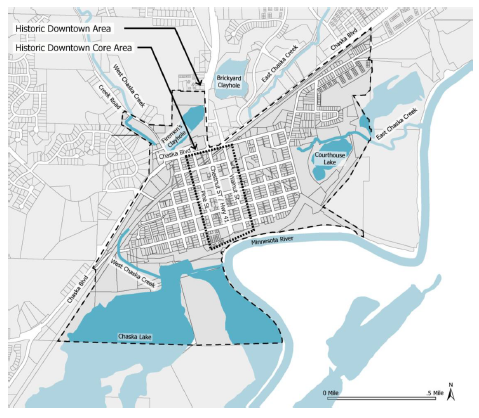
Historic Downtown Area: The area generally bounded by the four roadway bridges serving as downtown entries, including Minnesota River Bridge/Highway 41 (south), Minnesota River Bluff Bridge/Highway 41 (north), Yellow Brick Road Bridge/CSAH 61 (east), and Creek Road Bridge/CSAH 61 (west). Since the area northeast of the intersection of Highway 41 and CSAH 61 does not contain any historic properties and has undergone complete redevelopment, it is not included in the Historic Downtown Area. Refer to map below.
Historic Downtown Core Area: The area generally bounded by the river (south), Chaska Boulevard/CSAH 61 (north), properties on the east side of Walnut Street, and properties on the west side of Pine Street. Refer to map below.
Map of Historic Downtown Area & Core Area
Home Improvement Sign: A temporary sign that identifies and announces the construction company responsible for the home improvement of the property.
Illumination, External: A sign that is affected by an artificial light source that is not contained within the sign itself.
Illumination, Internal: Illumination of a sign from a light source that is concealed or contained within the sign and becomes visible in darkness through an opaque surface. For the purpose of these regulations, neon signs shall not be considered to be internally illuminated.
Incidental Sign: A sign that has a purpose secondary to the use of the lot on which it is located, such as “telephone”, “drive-up window”, “cash machine”, “air”, “open”, and other similar directives.
Marquee: A permanent roof-like structure extending from a building face and constructed of some durable material which may or may not project over a public right-of-way.
Monument Sign: A freestanding sign that does not utilize pylons, posts, poles, or uprights for support, but instead is anchored directly to the ground or is attached to a base that is anchored to the ground.
Multi-Tenant Directory Sign: A sign that displays the names and locations of business tenants within a multi-tenant building on a single sign located on the building’s primary wall at street-level.
Nameplate Sign: An accessory sign that designates an address and/or name only.
Nonconforming Sign: A sign that does not adhere to one or more of the provisions contained in this article.
Off-premise Sign: A sign which directs attention to a business, profession, activity, commodity, service, or entertainment other than one conducted, sold, or offered upon the premises where such sign is located, or within the building to which sign is affixed. Billboard signs are one, but not the only, type of off-premise sign.
Opaque Sign Face: The nontransparent face for an internally illuminated sign.
Portable Sign: A sign designed so as to be movable from one location to another, and that is not permanently affixed to a building, structure, or the ground, including but not limited to, signs designed to be transported by means of wheels, sign converted to A-Frames, and menu and sandwich board signs.
Post Sign: A type of freestanding sign supported by the extended arm of a single post, with the overall height of the sign face not exceeding six (6) feet from ground level. A post sign enables buildings that are set back from the sidewalk to have a sign that is easily viewed from the sidewalk.
Projecting Sign: A sign that is wholly or partially dependent upon a building for support and which projects more than 12 inches from such building. For the purposes of these sign regulations, an awning or canopy sign shall not be considered a projecting sign.
Pylon Sign: A freestanding sign erected upon pylons, poles, or uprights that are anchored to the ground.
Real Estate Sign: A sign pertaining to the sale, lease or rent of land or buildings. For the purpose of these sign regulations, open house signs shall also be included under this definition.
Roof Sign: A sign that is displayed, in whole or in part, above the eaves or roofline of a building.
Sandwich Board Sign: A self-supported and moveable, typically A-shaped, temporary sign with two visible sides that is placed adjacent to a business, typically on a sidewalk.
Sign: Any writing, pictorial presentation, number, illustration or decoration, flag, banner or other device that is used to announce, direct attention to, identify, advertise any business, product, goods, activity, services or any interests. However, this shall not include any emblem or insignia of a government, school, or religious group when displayed for official purposes.
Sign Display Area: The area of a sign shall be computed by means of the smallest circle, rectangle or triangle that will encompass the extreme limits of the writing, representation, emblem, or other display, together with any material or color forming an integral part of the background of the display or used to differentiate the sign from the building facade against which it is placed, but not including any supporting framework, pole, or bracing. One ascender and one descender of a sign, that are less than 100% of the size of the sign, shall not be included in the computation of the sign area.
For monument signs, the method in the previous paragraph shall be used. Only the face that is specifically intended to be used for signage shall be included when computing the sign area. Any base or other supporting structure, along with all adjoining structures such as fences or walls shall not be included when computing the sign area.
Special Event Sign: A temporary sign that is used to advertise or promote an event of special significance in the City of Chaska. Such special events include events of civic, philanthropic, educational, or religious organizations; examples of which are River City Days and the Fall Festival.
Temporary Sign: A non-permanent sign erected, affixed, or maintained on-premise for a limited period of time.
Temporary Commercial Sign: A temporary sign, located on-premise and meant to identify a special unique or limited event, service, product, sale of limited duration, or grand opening. Included under this definition are banners containing a message and erected for any of the above purposes.
Under-Awning Sign: A sign that hangs beneath an awning, canopy, or marquee.
Wall Sign: A sign attached to or erected against the wall of a building or structure with the exposed face of the sign in a plane approximately parallel to the face of the wall, and which does not project more than 12 inches from such building or structure.
Window Sign: A sign attached to, placed upon, or painted on the interior of a window or door of a building that is intended for viewing from the exterior of such building.
15.32.030 Residential Sign Regulations
Within Residential, Rural, Open and Planned Residential Districts, the following signs are permitted subject to the following requirements:
- Permanent Signs.
- Nameplate signs. One sign not to exceed two (2) square feet for an individual dwelling unit in a Residential District and not more than four (4) square feet in the Rural and Open Districts and located in the front or street side yards.
- Residential entrance ground signs. For each residential subdivision or other residential developments including townhome, condominium, apartment, and manufactured home developments, entrance signs are permitted subject to the following requirements:
- One freestanding sign per each entrance.
- 50 square feet maximum display area.
- Six (6) feet maximum height as measured from the base of the sign or abutting street grade, whichever is higher.
- A second sign may be located at a primary entrance as long as the combined display area of the two signs does not exceed 80 square feet.
- Single or double faced; if double faced, the sign faces shall be parallel.
- A neighborhood or homeowner’s association shall be responsible for perpetual maintenance of the sign.
- Educational, Religious and Public Institution Signs. For each educational, religious, public or private institution, nursing home property or similar property, signs are permitted subject to the following requirements:
- Monument signs:
- One sign not to exceed 32 square feet in display area;
- Five (5) feet maximum height as measured from the abutting street grade;
- Single or double faced.
- Wall mounted signs:
- One wall sign, except when more than one building facade has street frontage. In this instance, an activity may have one wall sign for each facade with street frontage. The sign area shall not exceed 32 square feet or 10% of the area of the facade on which the sign is located, whichever is smaller.
- Monument signs:
- Temporary Signs.
- Construction signs are subject to the following requirements.
- One on-premise temporary construction sign for each new residential subdivision or development, except where a subdivision or development abuts two or more streets, one additional sign oriented to each abutting street shall be allowed;
- 32 square feet maximum display area;
- Ten (10) feet maximum sign height for signs not exceeding four (4) feet in width, otherwise eight (8) feet maximum height, and it shall have a minimum clearance above the ground of two (2) feet;
- One off-premise directional sign to advertise a new subdivision or development per each arterial or Class I collector leading to the residential subdivision or development. The sign area shall be no more than four (4) square feet and, if the sign is freestanding, it shall be no more than six (6) feet in height. No such sign shall be placed greater than one mile from the nearest entrance to the residential subdivision or development; and
- All construction signs and off-premise directional signs shall be removed within five (5) days after their intended purpose is served, or when 75% of the lots or rental units in the residential subdivision or development have been occupied, whichever event occurs first.
- Home improvement/remodeling signs are subject to the following requirements.
- One sign per lot, not exceeding six (6) square feet display area and four (4) feet in height;
- Such sign shall be located in the front yard of the lot that the described activity is occurring and shall be a minimum of ten (10) feet from the property line; and
- The sign shall be displayed only until approval of the final inspection or the project is substantially completed, but in no event longer than 30 days.
- Within low and medium density residential zoning districts, temporary real estate signs are subject to the following requirements.
- Six (6) square foot maximum display area;
- Six (6) feet maximum height;
- One sign located on the site which the sign is advertising; and
- Shall be removed within seven (7) days after the execution of a rental or lease agreement or the closing of a sale.
- Within high density residential zoning districts, leasing or sale of building signs which meet the following standards are permitted.
- One sign located on the site that the sign is advertising.
- Display period shall end seven (7) days after sale of property or 12 months after the issuance of a certificate of occupancy (for multi-phased developments where construction is continuous, issuance of a certificate of occupancy for the last building).
- For freestanding signs, the following standards apply:
- 32 square foot maximum display area.
- Ten (10) feet maximum height for signs not exceeding four (4) feet in width, otherwise eight (8) feet maximum height.
- For banner signs, the following standards apply:
- 32 square foot maximum area.
- Shall be affixed to a building wall.
- Construction signs are subject to the following requirements.
- Lighting. Within the Residential, Rural, Open and Planned Residential Districts, illumination of a sign for property used in whole or in part as a residence shall only be provided by an external light source.
15.32.040 Public Use Districts' Sign Regulations
Within the P1 and P2 Districts, permanent signs are permitted subject to the following requirements:
- Wall Signs. One wall sign, except when more than one building facade has street frontage. In this instance, an activity may have one wall sign for each facade with street frontage. The sign display area shall be no more than 40 square feet or 10% of the area of the facade on which the sign is located, whichever is smaller.
If a cabinet sign is used, the sign display area shall be no more than 35 square feet or 8% of the area of the façade on which the sign is located, whichever is smaller (Ordinance No. 691, Section 4, dated 11-20-00). - Ground signs. One of the following freestanding identification signs:
- Pylon signs. Not exceeding 50 square feet in display area and not more than 20 feet in height as measured from the abutting street grade.
- Monument signs. Not exceeding 50 square feet in display area and not more than five (5) feet in height as measured from the base or abutting street grade, whichever is higher.
15.32.050 Neighborhood Service Sign Regulations
Within the C1 District, permanent signs are permitted subject to the following requirements:
- Wall signs. One wall sign for each distinct activity located in a building, except when more than one building facade has street frontage. In this instance, an activity may have one wall sign for each facade with street frontage. The sign display area shall be no more than 50 square feet or 10% of the area of the facade on which the sign is located, whichever is smaller.
If a cabinet sign is used, the sign display area shall be no more than 40 square feet or 8% of the area of the façade on which the sign is located, whichever is smaller (Ordinance No. 691, Section 1, dated 11-20-00). - Non-fronting wall signs. Additional wall signage is allowed in locations that do not front a public right-of-way but have a customer entrance. The additional signage shall not exceed 18 square feet and shall be limited to the identification of the principal businesses.
- Ground signs. One of the following freestanding identification signs:
- Pylon signs: Not exceeding 50 square feet in display area and not more than 20 feet in height as measured from the abutting street grade.
- Monument signs: Not exceeding 32 square feet in display area and not more than six (6) feet in height as measured from the base or abutting street grade, whichever is higher.
15.32.060 General Commerce And PCD Sign Regulations
Within the C2 and Planned Commercial Districts, permanent signs are permitted subject to the following requirements:
- Wall signs. Two wall signs for each distinct activity located in a building, except when more than one building facade has street frontage. In this instance, an activity may have two wall signs for each facade with street frontage.
If a cabinet sign is used, the sign display area shall be no more than 100 square feet or 8% of the area of the façade on which the sign is located, whichever is smaller (Ordinance No. 691, Section 1C, dated 11-20-00).
The sign display area shall be calculated using the following table:Wall Area Total Maximum Wall Signage From (in sq. ft.) To (in sq. ft.) Base Allowed Sign Area (in sq. ft.) Plus of Area Over To a Maximum Area of (in sq. ft.) - 1,500 0 10% 0 150 1,500 2,500 150 5% 1,500 200 2,500 - 200 2% 2,500 300 - Non-fronting wall signs. Additional wall signage is allowed in locations that do not front a public right-of-way but have a customer entrance. The additional signage shall not exceed 24 square feet plus any excess allowed signage from any single building facade. The non-fronting wall sign shall be limited to the identification of the principal business.
- Ground signs. One of the following freestanding identification signs for each lot:
- Pylon signs. Not exceeding 125 square feet in display area and not more than 24 feet in height as measured from the abutting street grade.
- Monument signs. Not exceeding 100 square feet in display area and not more than ten (10) feet in height as measured from the base or abutting street grade, whichever is higher.
- Service Stations.
- One monument sign not to exceed 80 square feet in size or seven (7) feet in height as measured from the ground, or one pylon sign not to exceed 80 square feet in size and 24 feet in height. Monument signs are generally encouraged over pylon signs; however, the choice of monument or pylon shall be determined by the City Council based on the proximity of the site to residential zoning districts or uses.
- Two (2) wall signs not to exceed 150 square feet in combined area.
- Two (2) canopy signs not to exceed 40 square feet of combined area. (Such signs shall be allowed to extend no more than 12” above the top of the canopy.)
- On-site directional signs as regulated in CZO 15.32.110 paragraph A except that no such signage shall be affixed to the canopy support columns.
- No extraneous informational (except government mandated safety warnings) or advertising signs, either permanent or temporary, such as those referring to credit or bank cards or merchandise for sale, shall be affixed to or hung from the canopy, the canopy support columns, light poles, the trash enclosure, or the ground sign.
(Ord. No. 651, Sec. 1, 2/22/99)
15.32.070 Historic Downtown Core Area Sign Regulations
In addition to the intent of sign regulations city-wide, as stated in CZO 15.32.010, sign regulations for the historic downtown core area are intended to encourage the use of signs that are appropriate for preserving and enhancing the historic small town character of downtown’s buildings and streets. This section establishes appropriate signs and lighting within the “historic downtown core area”, which is defined in CZO 15.32.020.
- Permanent Signs. The following types of permanent signs are permitted in the downtown district:
- Wall signs;
- Non-fronting wall signs;
- Projecting signs;
- Awning/canopy signs;
- Under-awning signs;
- Window signs;
- Architectural signs;
- Freestanding signs;
- Multi-tenant wall directory signs.
- Wall signs. Wall signs are allowed for each distinct activity located in a building. The sign display area shall be no more than 50 square feet or 10% of the area of the facade upon which the sign is located, whichever is smaller. No part of any sign shall be placed higher than the height of the sills of the second story windows of a multi-story building.
- Non-fronting wall signs. Additional wall signage is allowed in locations that do not front a public right-of-way but have a customer entrance. The additional signage shall not exceed 18 square feet and shall be limited to the identification of the principal businesses.
- Projecting signs. Two-sided projecting signs are allowed. The sign area shall be no more than 12 square feet per sign face with a minimum distance between individual projecting signs of 20 feet. Multi-story buildings fronting onto Chestnut Street (MN Highway 41) and Chaska Boulevard (CSAH 61) are permitted to have projecting signs up to 36 square feet per sign face with a minimum distance between individual projecting signs of 50 feet.
A projecting sign shall project no more than four (4) feet from the facade on which it is attached or 2/3 the width of the sidewalk, whichever is greater. A projecting sign shall have a minimum clearance of eight (8) feet above ground level, unless projecting over a vehicular right-of-way, in which case minimum clearance shall be 14 feet. No part of any sign shall be placed higher than the sills of the second-story windows of a multi-story building with the exception of signs on Chestnut Street (MN Highway 41) and Chaska Boulevard (CSAH 61). - Awning/canopy signs. Signs on street-level awnings/canopies are permitted if the sign on each awning/canopy is either less than seven (7) square feet in size or eight (8) inches in height, is located on the face of the awning/canopy (valance or skirt), and is parallel to the building facade. Awning signs shall only be permitted on an open-sided shed awning that includes a front valance or skirt. Signs are not permitted on a closed-sided box awning or domed awning. Where there are multiple awnings on a building, all awning signs shall have a consistent size and location on the awnings.
- Under-awning signs. Signs attached beneath an awning, canopy, or marquee, and perpendicular to the building façade, are permitted. Under-awning signs shall have a minimum clearance of eight (8) feet above ground level and shall not exceed seven (7) square feet in size or eight (8) inches in height.
- Window signs. Permanent window signs are permitted. A window sign shall be applied directly to the window or hung inside the window. A window sign shall not cover more than 1/3 of the window or door in which the sign is placed.
- Architectural signs. An architectural sign, which is typically located at the top or cornerstone of a building, is permitted as long as its content is limited to the building’s name, date of construction, or name of original business.
- Freestanding signs. A pedestrian-scale freestanding sign is permitted only for residential buildings, which have been adapted for office or retail uses, or commercial buildings that are set back from the street right-of-way/sidewalk edge. The sign area shall be no more than 12 square feet per sign face and the sign height shall be no more than six (6) feet.
- Multi-tenant wall directory signs. One multi-tenant sign is permitted for a multi-tenant building, which shall be located on the building’s primary wall at street-level and shall be no more than 15 square feet.
- Lighting. In order to keep signage lighting focused on the sign and from overpowering architectural features of the building façade, any signage lighting shall only be provided by using an external light source. The external light source shall be directed onto the sign face or use halo effect/reverse illumination, which is an external light source behind individual letters that is reversed to shine on the wall. Exposed neon lighting and LED lighting that has the appearance of exposed neon lighting is allowed. Internally illuminated signs are prohibited.
- Materials. If modern materials, such as acrylic, vinyl, or plastic, are used for signs, they shall be painted and simulate traditional downtown sign materials, such as wood and metal.
- Designated historic buildings. Signs on buildings, sites or within historic districts listed on the National Register of Historic Places or designated as historic resources or within a historic district by the Chaska City Council shall be designed and placed to complement, rather than obscure or disrupt, the architectural features of the building to which they are attached. Signs shall protect and complement the historic character and materials of the building and its surrounding environment. Halo effect/reverse illumination shall not be used for signage lighting.
- Design Guidelines. All new and altered signs within the C3 District and Planned Development Districts within the “historic downtown core area” shall be in substantial conformance with the Historic Downtown Signage Design Guidelines.
- Prohibited Signs. In addition to the types of signs prohibited in CZO 15.32.020, the following types of permanent signs are expressly prohibited within the C3 District and Planned Development Districts within the “historic downtown core area”:
- Cabinet signs, both wall and projecting signs;
- Internally illuminated channel letter signs;
- Changeable copy signs, except sandwich board signs;
- Backlit awning signs;
- Pylon signs.
15.32.080 Industrial Districts' Sign Regulations
Within the I, I-2, and Planned Industrial Development Districts, permanent signs are permitted subject to the following requirements:
- Wall signs. Two wall signs for each distinct activity located in a building, except when more than one building facade has street frontage. In this instance, an activity may have two wall signs for each facade with street frontage. The total sign display area shall be no more than 125 square feet or 20% of the area of the facade on which the sign is located, whichever is smaller.
If a cabinet sign is used, the sign display area shall be no more than 75 square feet or 8% of the area of the façade on which the sign is located, whichever is smaller (Ordinance No. 691, Section 1, dated 11-20-00). - Non-fronting wall signs. Additional wall signage is allowed in locations that do not front a public right-of-way but have a customer entrance. The additional signage shall not exceed 24 square feet plus any excess allowed signage from any single building facade. The non-fronting wall sign shall be limited to the identification of the principal business.
- Ground signs. One monument sign not exceeding 100 square feet and not more than eight (8) feet in height as measured from the base or abutting street grade, whichever is lower. If a site has two street frontages, a second monument sign may be located at a secondary entrance as long as the total display area of the two signs does not exceed 150 square feet.(Ord. No. 651, Sec. 2, 2/22/99)
15.32.090 Business Center Sign Regulations
Within Commercial and Industrial Districts, a business center, as defined in CZO 15.32.020, is permitted an additional ground sign subject to the following requirements. Uses governed under this section may also have signs permitted under CZO 15.32.060 and CZO 15.32.080.
- Business Center Ground Sign.
- Only one business center ground sign shall be allowed per each entrance or street frontage to the commercial center or industrial park.
- Maximum sign area and sign height for a business center ground sign are regulated as follows:* As measured from the base of sign or grade of the nearest roadway, whichever is higher.
District Maximum Sign Display Area (in sq. ft.) Maximum Sign Height – Pylon (in feet) Maximum Sign Height - Monument (in feet)* C1 40 20 6 C2, PCD 200 24 10 I, PID 100 - 8
15.32.100 Commercial, Industrial And Public Temporary Sign Regulations
Within Commercial, Industrial and Public Districts, real estate and temporary signs are permitted according to the following standards:
- Temporary Commercial Signs.
- Banners and freestanding signs according to the following:
- Not more than one such sign shall be allowed for an activity at any given time.
- Maximum 30 day display period to coincide with the grand opening of a business.
- A business may display a temporary sign a maximum of 55 days per year; there shall be a maximum of ten (10) occasions per year. Each business may decide how to divide up the days and occasions, but under no circumstances shall the maximum number of days or the maximum number of occasions be exceeded.
- Banners shall not exceed 32 square feet in commercial and public districts and 125 square feet in industrial districts, and must be affixed to a principal structure that is owned or leased by the business that the sign is advertising.
- Freestanding signs shall not exceed 32 square feet, shall have a maximum height of ten (10) feet, be professionally designed and be constructed of wood.
- Under no circumstances shall a temporary sign be placed on public property or within the public right-of-way.
- Temporary Pennants are allowed a maximum of 55 days per year; there shall be a maximum of ten (10) occasions per year. Each business may decide how to divide up the days and occasions, but in no circumstance shall the maximum number of days or the maximum number of occasions be exceeded. A maximum 30 day display period to coincide with the grand opening of a business is also permitted.
- Inflatable advertising devices are permitted according to the following:
- 25 foot maximum height of inflatable;
- A seven (7) day display period to coincide with the grand opening of a business or a new development (business park or shopping center); and
- Written authorization from the property owner or their designee must be submitted with the sign permit application.
- Temporary Window Signs. Window signs shall not cover more than 50% of the window or door in which the sign is placed. Permits are not required.
- Temporary Special Event Signs are allowed subject to the following requirements:
- Not more than one special event sign may be located on any one lot or parcel at any time. Such a sign may be located either on- or off-premise. A special event sign shall be erected and maintained for a period not to exceed ten (10) days prior to the date that the special event is scheduled to occur. Furthermore, such sign shall be removed within two (2) working days of the termination of the special event;
- Within a residential district, the sign area shall be no more than 12 square feet and, if the sign is freestanding, it shall be no more than five (5) feet in height. In all other districts, the sign area shall be no more than 32 square feet and, if the sign is freestanding, it shall be no more than ten (10) feet in height; and
- Any special event sign erected by the City of Chaska shall be exempt from the above restrictions, and may be placed within the public right-of-way.
- Sandwich Board Signs in the downtown area are permitted, subject to the following regulations:
- Sandwich Board Signs are self-supporting, typically A-shaped, freestanding temporary signs with two visible sides that are situated adjacent to a business and typically on a sidewalk.
- The maximum area shall be twelve (12) square feet per side of sign with the maximum height being four (4) feet.
- Only one sandwich board sign per business per street frontage shall be permitted. Signage shall be located directly in front of or adjacent to the building that contains the business that is being advertised, except when a business has written authorization from another business and its property owner for its sign to be located directly in front or adjacent to said other business/property.
- Sandwich board signs shall not be placed so as to cause the width of the sidewalk to be reduced below four (4) feet in width, nor shall they be erected or maintained in a manner that prevents free ingress or egress from any door, window or fire escape, nor shall they be attached to any standpipe or fire escape.
- A temporary sign permit is required prior to the installation of the sign. Only one temporary sign permit for a sandwich board sign is allowed per business and is not transferable. The permit would be valid for one calendar year beginning January 1, and ending December 31. If the sign is to be located within the right-of-way, business owners shall sign a disclaimer that indemnifies the city of any liability for use of said public right-of-way.
- A sketch including dimensions, content and location of the sandwich board sign must be attached to the permit application. Changeable copy is permitted on sandwich board signs. The permit application must be approved and signed by the Planning and Zoning Department before the sandwich board sign may be displayed.
- Each business owner is responsible for attaching a copy of the approved permit or permit number to the sandwich board. Sandwich boards without permits shall be disposed of at owner’s expense.
- Sandwich board signs shall: not be illuminated, nor shall they contain moving parts; only be displayed during business operating hours, except those located on private property; be removed from public sidewalks if there is any snow accumulation (the sign may not be replaced until the snow is removed).
- Sandwich board signs placed in violation of this section will result in immediate removal of the sign.
- Sandwich board signs within the public right-of-way may be moved/removed by the City for municipal purposes. (i.e. snow removal, traffic issues, maintenance, etc.).
- Right-of-way along Highways 41 (Chestnut Street) and 61 (Chaska Boulevard) are under the jurisdiction of the Minnesota Department of Transportation, the City of Chaska will enforce its sign regulations along those streets and not those of other agencies or jurisdictions.
- Banners and freestanding signs according to the following:
- Temporary Construction Or Real Estate Signs On Undeveloped Property. A vacant parcel within a business or industrial zone is permitted a temporary construction or real estate sign subject to the following requirements:
- One sign located on the site which the sign is identifying, except where a development abuts two or more streets, one additional sign is permitted as long as each sign is oriented to each abutting street;
- 32 square feet maximum sign area and, if the sign is freestanding, it shall be no more than ten (10) feet in height, and it shall have a minimum clearance above the ground of two (2) feet;
- A temporary construction sign for a nonresidential development shall be removed prior to occupancy of the development or completion of the project; and
- Such signs shall not be illuminated in any manner.
- Temporary Real Estate Signs. Signs indicating the rental, lease, or sale of a business or industrial building are permitted according to the following:
- One sign located on the site which the sign is advertising, except where a development abuts two or more streets, one additional sign is permitted as long as each sign is oriented to each abutting street;
- 16 square feet maximum sign area and, if the sign is freestanding, it shall be no more than six (6) feet in height;
- For signs indicating the sale of a building, 32 square feet maximum sign area and, if the sign is freestanding, it shall be no more than ten (10) feet in height; and
- Such signs shall not be illuminated in any manner.
15.32.110 General Regulations
The following regulations shall apply to all signs permitted in all districts:
- Incidental Signs. On-site incidental and directional signs oriented for viewing by on-site vehicular and pedestrian traffic, rather than traffic on public streets or on adjacent property are allowed subject to the following requirements:
- The sign area shall be no more than seven (7) square feet per sign;
- Freestanding signs shall be no more than six (6) feet in height, and signs mounted on walls shall be mounted only high enough to be visible to on-site users;
- Menu board signs shall be no more than 20 square feet in size, and if freestanding, shall be no more than eight (8) feet in height;
- Directional signs shall contain no advertisement; and
- Within all residential districts, directional and incidental signs shall not be illuminated in any manner.
- Governmental Signs. Street signs and other permanent governmental signs for vehicle and pedestrian traffic control, directional, informational, interpretive, and other public purposes are exempt from the provisions of this article.
- Private Informational Signs. Private informational signs such as “No Trespassing”, “No Dumping”, “No Parking”, “Tow away Zone”, and other similar signs are allowed subject to the following requirements: The sign area shall not exceed two (2) square feet and, if the sign is freestanding, it shall be no more than six (6) feet in height.
- Temporary Noncommercial Signs. Temporary noncommercial signs are allowed subject to the following requirements:
- Temporary noncommercial signs are prohibited within public use districts. Within a residential district, the sign area shall be no more than 16 square feet and, if the sign is freestanding, it shall be no more than six (6) feet in height. In all other districts, the sign area shall be no more than 32 square feet and, if the sign is freestanding, it shall be no more than ten (10) feet in height;
- The sign shall be permitted for a period not to exceed 46 days before and ten (10) days after an election or public referendum;
- Not permitted on public property or right-of-way;
- Consent of property owner is required; and
- The preceding restrictions are applicable unless otherwise indicated by State of Minnesota Statute.
- Flags. Noncommercial flags are permitted provided they are under 125 square feet in size, and United States flags under 150 square feet. Corporate flags are permitted in industrial districts only.
- Freestanding Signs.
- Sign Setbacks. All freestanding signs shall meet the building setback requirements of the underlying zoning district, except along the sides of a lot with street frontage, where freestanding signs shall be set back at least ten (10) feet from the street right-of-way.
- Maximum Angle: Unless otherwise specified maximum angle permitted between faces of a double face freestanding sign is 45 degrees.
- Minimum Character Size: Six (6) inch minimum character for each activities’ primary message.
- Sign Setbacks. All freestanding signs shall meet the building setback requirements of the underlying zoning district, except along the sides of a lot with street frontage, where freestanding signs shall be set back at least ten (10) feet from the street right-of-way.
- Wall Signs.
- A wall sign shall not extend above the roof or parapet line.
- The linear measurement of any wall sign shall not exceed 80% of the linear frontage of the applicable facade of the building.
- Cabinet signs that are internally illuminated shall have an opaque face with reversed lettering.
- Awning/Canopy Signs.
- The sign area shall not exceed 40% of the total face area of the awning or canopy upon which the sign is affixed.
- The maximum vertical dimension of a canopy/awning sign shall be five (5) feet and shall be limited to the first story only for multi-story buildings.
- Sign shall have a minimum clearance of eight (8) feet above the ground level unless projecting over a vehicular right-of-way, in which case clearance shall be 14 feet. In no event shall an awning/canopy sign extend more than three (3) feet into a public right-of-way if the building façade on which it is placed abuts a public right-of-way.
- PMD Zoning Districts. Signs in Planned Multiple-Use Development Districts shall be regulated by use, applying the standards provided in the most closely related district. In instances where sign regulations are specified in existing or new Planned Multiple-Use Development Districts, those regulations shall supersede any regulations specified in the most closely related district.
- Planned Development Districts. The City Council may recognize separate sign plans for Planned Development Districts which will supersede this Ordinance. The sign plans that have been approved by the City Council will have the effect of a sign ordinance for the specific property. An individual PDD sign plan will be considered if the development includes a substantial site area and/or the sign plan is necessary to address the visibility needs of a development. However, the net intent is to remain a balanced environment among commercial districts and among industrial districts.
- Materials and Colors. A sign shall be designed as an integral architectural element of the building and site to which it principally relates. Materials and colors that are compatible with the character of the building and the surrounding environment should be used on all signage.
- Shared Facades. For businesses sharing the same facade, the same or a similar method of signing must be used for all parties desiring to place a sign on the facade.
- Illumination of Signs.
- Lights shall be used judiciously to illuminate signs and shall be directed only upon the sign that they are meant to illuminate. All illuminated signs shall be designed, located, shielded, and directed so as to prevent the casting of glare or direct light from the illumination upon the adjacent public right-of-way and surrounding property.
- An opaque sign face may not emit light except to internally illuminate its message.
15.32.120 Prohibited Signs
The following types of signs are expressly prohibited in all districts:
- Portable signs;
- Roof signs including signs mounted on a roof surface or projecting above the roof line or a structure if either attached to the structure or cantilevered over the structure;
- Revolving and moving signs;
- Flashing and animated signs;
- Off-premise signs, except for the following:
- Temporary off-premise directional signs for new residential subdivisions or developments;
- Temporary special event signs; and
- Governmental signs (includes hospitals, Court House, schools, etc.);
- Sandwich Board Signs in the downtown area are permitted, as provided for in CZO 15.32.100 paragraph A,6.
- Signs that resemble or imitate government signs;
- Signs that obstruct the vision of pedestrians, cyclists, or motorists traveling on or entering public streets;
- Signs painted on walls: Works of art that are not commercial messages are exempt;
- Signs affixed to vehicles and/or trailers that are parked on a public right-of-way, public property, or private property so as to be visible from a public right-of-way where the apparent purpose is to advertise a product or direct people to an activity located on the same or a nearby property shall be prohibited. Signs affixed to vehicles where the sign is incidental to the use of the vehicle are not prohibited;
- Signs within the public right-of-way except for the following:
- Governmental signs;
- Special event signs erected by the City of Chaska; and
- Projecting signs and backlit canopy signs, which may extend no more than three (3) feet into the public right-of-way;
- Any other sign which is not in conformance with the regulations provided herein; and
- Any sign not expressly permitted by the provisions in this Ordinance.
15.32.130 Electronic Display Signs
Electronic display signs that comply with regulations for the Sign District in which it is located as well as the regulations of this section are permitted in all Sign Districts with two exceptions:
- Electronic display signs are not permitted in the Historic Downtown Area, which is defined in CZO 15.32.020.
- In Residential Districts and PRDs, electronic display signs are only allowed for non-residential principal uses.
An electronic display sign is subject to the sign regulations of the particular Sign District within which a property is located (Residential, Public, Neighborhood Service, General Commerce/PCD, Industrial/PID, Business Center, and Downtown). An electronic display sign is not an additional permitted sign in any Sign District; it is a specific type of freestanding or wall sign permitted in the Sign Districts identified above.
An electronic display sign is also subject to the following requirements:
- Location.
- An electronic display sign shall not be located within a vision clearance triangle. This site triangle ensures unobstructed sight lines for pedestrian and vehicular circulation. A vision clearance triangle is formed by the two (2) curb lines or property lines (whichever is greater) and a third straight line joining points on such curb lines or property lines (whichever is greater) 50 feet from their intersection at the street corner.
- No electronic display sign may be erected that, by reason of position, shape, movement or color interferes with the proper functioning of a traffic sign, signal or which otherwise constitutes a traffic hazard.
- Portion of Sign Display Area. An electronic display sign shall not be a standalone sign, but must be incorporated into the body of a ground or wall sign and may not exceed 40% of the total sign display area of the ground or wall sign that it is incorporated into.
- Message Change Frequency. Each message or image display frame shall not change more frequently than every 60 seconds.
- Message or Image Movement. Each display frame must contain a static message/image and background only. Flashing, blinking, animating, rotating, revolving, and other forms of display movement or animation are prohibited. Video displays are prohibited.
- Frame Transition. When a sign’s message or image changes, the transition between display frames shall be instantaneous. Special effects for changing a sign’s message/image display are prohibited, including but not limited to scrolling, dissolving, fading, and sequencing.
- Brightness.
- An electronic display sign shall not exceed 5,000 nits (candelas per square meter) between the hours of civil sunrise and civil sunset and shall not exceed 700 nits between the hours of civil sunset and civil sunrise as measured from the sign’s face at maximum brightness.
- A letter of certification shall be submitted by the sign permit applicant or sign manufacturer certifying that the electronic display sign is compliant with the brightness standards. The letter of certification must be submitted with the sign permit application and at any time thereafter as requested by the City.
- Dimmer Technology.
- Each sign shall be equipped with a light sensing device and automatic dimmer control that will automatically adjust the sign’s brightness as the natural ambient light conditions change to comply with the limits set here within.
- A letter of certification shall be submitted by the sign permit applicant or sign manufacturer certifying that the electronic display sign is compliant with the dimmer technology standards. The letter of certification must be submitted with the sign permit application and at any time thereafter as requested by the City.
- Malfunction Technology.
- An electronic display sign shall be designed and equipped to freeze the display frame in one position if a malfunction occurs. The sign shall also be equipped with a means to immediately discontinue the display if it malfunctions. The sign owner or operator must immediately stop the electronic display when notified by the City that it is not complying with the standards of this paragraph.
- A letter of certification shall be submitted by the sign permit applicant or sign manufacturer certifying that the electronic display sign is compliant with the malfunction technology standards. The letter of certification must be submitted with the sign permit application and at any time thereafter as requested by the City.
15.32.140 Sign Construction And Maintenance
All signs constructed and maintained within the City of Chaska shall conform to the following requirements:
- Signage shall be in compliance with all relevant provisions specified in the Building Code.
- Signage shall be maintained so as not to endanger life or property, and any sign that through lack of repair, type of construction, or otherwise imperils health, life or property shall be deemed a nuisance becoming subject to the provisions of CZO 15.32.150.
- Activities considered to be maintenance shall include activities such as replacing lamps and lightbulbs; replacing ballast in freestanding signs; replacing transformers in building identification signs; painting the pole of freestanding signs, the cabinet of freestanding or building identification signs, and sign faces of wooden signs; replacing or repairing the sign face; replacing trim; and replacement of sign fasteners, nuts and washers. A maintained sign structure shall have a sign face.
- No sign shall be constructed which covers or interferes with an architectural detail of a building or obstructs any window, door, fire escape, stairway, or opening intended to provide light, air, ingress or egress to any building.
- If supporting structures are used in the display of a sign, they shall be of a quality able to withstand the elements. However, excessive or unnecessary supporting structures are prohibited.
15.32.150 Nonconforming Signs
- Nonconforming Signs. Excluding normal maintenance, face changes, and repair, a nonconforming sign shall not be moved, altered, enlarged or reconstructed unless it is brought into compliance with the sign regulations.
- Abandoned and Irrelevant Signs. Any sign, which is abandoned, falls into a state of disrepair, or no longer relates to the activity located on the premises shall be removed by the property owner within 30 days.
- Signs as Nuisance. The Building Official may make a finding that a sign is a public nuisance by reason of it being dilapidated, unsafe, rotted, unsightly, or for other reasons. Such finding shall be in writing and shall enumerate the reasons and circumstances that made the sign a nuisance.
- Signs on Public Property or within Public Right-of-Way. The City may at any time and without notice impound signs that have been installed on public property or within public right-of-way or easement. The sign owner may retrieve the signs according to the following:
- The sign may be retrieved from a designated impound area during routine business hours and within 15 days from the date of impounding. After 15 days, the City may dispose of the sign; and
- The City may not be held liable for any damage to impounded signs.
15.32.160 Permits And Permit Fees
Signs that require a permit and the corresponding fee are listed in the following:
- All permanent signs permitted in CZO 15.32.030 through CZO 15.32.090 shall require a sign permit. The permit shall be received prior to installation of the sign.
- All temporary signs permitted in CZO 15.32.100 shall require a temporary sign permit.
- The permit application shall include the following:
- Information concerning the location, height, size of the sign, and the date on which it is to be erected, displayed, moved or significantly altered;
- A drawing or photo of the building facade and lot plan indicating the location of the proposed sign and all existing signs displayed by the activity;
- If the application is for a wall sign, a drawing to scale showing the location of the sign within the building facade and the percent of the facade covered by the wall sign;
- Specifications for the construction of the sign and for its illumination, if any is to be provided; and
- Sign permit fee.
15.32.170 Substitution Of Noncommercial Speech
Subject to the land owner's consent, a noncommercial message of any type may be substituted for any duly permitted or allowed commercial message or any duly permitted or allowed noncommercial message; provided, that the sign structure or mounting device is legal without consideration of message content. Such substitution of message may be made without any additional approval or permitting. This provision prevails over any more specific provision to the contrary within this article. The purpose of this provision is to prevent any inadvertent favoring of commercial speech over noncommercial speech, or favoring of any particular noncommercial message over any other noncommercial message. This provision does not create a right to increase the total amount of signage on a parcel, nor does it affect the requirement that a sign structure or mounting device be properly permitted.

