
Chatsworth City Zoning Code
ARTICLE II
DEFINITIONS
Section A. - Rules.
Words used in the present tense include the future tense; words used in the singular number include the plural and the plural, the singular; the word 'person' includes a firm, company, partnership or corporation; the word "building" includes the word "structure", the word "shall" is always mandatory; the word "may" is permissive; the word "erected" includes the word "constructed", "moved", "located", or "relocated"; the word "used" or "occupied" as applied to any land or building shall be construed to include the words "intended, arranged, or designed to be used or occupied"; the word "lot" includes the word "plot" or "parcel"; all measured quantities shall be to the nearest integral unit of measure, and if a fraction is one-half or greater, the next highest integral unit shall be used (note: except density computations which require the lowest, whole unit). "Map" means "Zoning Map" of the City of Chatsworth, Georgia.
(Ord. of 10-09)
Section B. - Use of Definitions.
Any word not herein defined shall be as defined elsewhere in the Zoning Ordinance or, if not defined elsewhere in the Zoning Ordinance, as defined in Webster's New World Dictionary of the American Language - Second College Edition, the said definition to be read in context with the purposes and provision of the part of the Ordinance it is being used to define.
(Ord. of 10-09)
Section C. - Definitions.
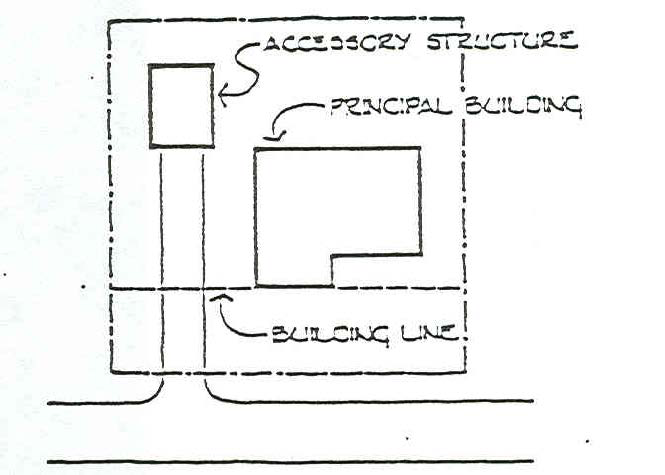
Figure 1: Accessory Structure
Accessory Building. A building subordinate or supplemental to the main building on a lot and used for purposes customarily incidental to that of a main or principal building and located on the same lot.
Accessory Structure. A structure detached from a principal building on the same lot and customarily incidental and subordinate to the principal building. See Figure 1: Accessory Structure.
Accessory Use. A use customarily incidental and subordinate to the principal use or building, and located on the same lot with such principal use or building.
Addition. (to an existing building). Any walled and roofed expansion to the perimeter of a building in which the addition is connected by a common load-bearing wall other than a fire wall. Any walled and roofed addition which is connected by a fire wall or is separated by independent perimeter load-bearing walls is new construction.
Adult Business. 1) any business which is conducted exclusively for the patronage of adults and to which minors are specifically excluded from patronage there at either by law or by the operators of such business; or 2) any business where employees or patrons expose specified anatomical areas, as further defined in the City Ordinance or engage in specified sexual activities, as further defined in the City Ordinance; or 3) any other business or establishment which offers its patrons services, products, or entertainment characterized by an emphasis on matter depicting, describing, discussing or relating to specified sexual activities or specified anatomical areas.
Agricultural. The cultivation or growth from or on the land of horticultural, floricultural, forestry, dairy, livestock, poultry, or apiarian products. Included within the definition of "agriculture" shall be the importation, storage, or distribution in bulk, unpackaged form of raw materials directly to persons engaged in agriculture. "Raw materials" for purposes of this definition shall include organic materials such as straw, hay, animal feeds, sawdust, mulches, and like items. "Raw materials" shall also include inorganic dolomitic lime. "Raw materials" shall not include farm equipment, building materials, chemicals, fertilizer, manure not produced on the premises, packaged materials not produced on the premises, materials distributed for resale not produced on the premises, or materials not expended in the production of the above listed products.
Alley. A public or private thoroughfare which affords only a secondary means of access to abutting property and is not intended for general traffic circulation.
Alteration. Any change in the supporting members of a building or structure such as bearing walls, columns, and girders, except such emergency change as may be required for safety purposes; any addition to a building; any change in use from that of one district classification to another; or, any movement of a building from one location to another.
Amusements, Commercial. Businesses which operate for a profit by amusing or entertaining patrons through the use of electronic/video pinball games; pool/ping pong tables; miniature racetracks, gaming devices, etc.; services may include light food/refreshment services, but not including establishments serving alcoholic beverages or indoor/outdoor shooting ranges.
Animal Hospital. A building used for the treatment, housing or boarding of small domestic animals such as dogs, cats, rabbits, and birds or fowl by a veterinarian.
Animal Husbandry. The production of animals (livestock) and/or the by-product thereof.
Animal Quarters. Any structure which surrounds or is used to shelter, care for, house, feed, exercise, train, exhibit, display or show any animals, other than fenced pasture land for grazing.
Animal Shelter. See Kennel.
Apartment. See Dwelling, Multi-Family.
Aquifer. Any Stratum or zone of rock beneath the surface of the earth capable of containing or producing water from a well.
Assisted Living Home/Facility. See "Personal Care Home."
Auditorium. An open, partially enclosed, or fully enclosed facility used or intended to be used primarily for spectator sports, entertainment events, expositions, competitions, and other public gatherings. The term includes civic centers, trade centers, arenas, stadiums, assembly halls, and community centers, but shall not include a cinema/movie or drama/dance theater.
Bed and Breakfast Home. A single family dwelling occupied by the owner as his/her principal residence that offers transient lodging accommodations and breakfast for compensation provided that: the rental occupants shall not reside at the bed and breakfast for more 7 consecutive days; breakfast is the only meal served and only to registered overnight guests; no person not a resident on the premises is employed; the exterior appearance of the dwelling is not altered from its residential character except for safety purposes; and, the identification sign shall be no larger than 2 square feet and not internally lighted.
Bed and Breakfast Inn. A building, not necessarily owner-occupied, that offers transient lodging accommodations and breakfast for four (4) or more guest rooms for compensation provided that:
a)
Compliance with the same licensing, inspection and taxation requirements as hotels, motels, and restaurants.
b)
If within a residential district, the building shall be residential in character.
c)
Breakfast is the only meal served and only to overnight guests.
d)
The owners may have employees.
e)
The owner shall provide one (1) off-street parking space for each rental room and one (1) space for each employee.
f)
In a residential district, signage shall be limited to one (1) sign and maximum size of two (2) square feet.
Berm. A mound of earth, or the act of pushing earth into a mound. See Figure 2: Buffer.
Boarding House. A dwelling, permanently occupied by the owner or operator, where sleeping accommodation and meals, served upon the table family style with no provision for cooking in any of the occupied rooms, are provided for five (5) or more persons not of the same family by prearrangement for definite periods and for compensation.
Buffer. A buffer is a portion of lot set aside for open space and/or screening purpose, to shield or block noise, light, glare, or visual or other nuisances; to block physical passage to dangerous areas; or to reduce air pollution, dust, dirt, and litter. A buffer may contain a barrier, such as a berm, wall or fence, where such additional screening is necessary to achieve the desired level of buffering between various activities. See Figure 2: Buffer.
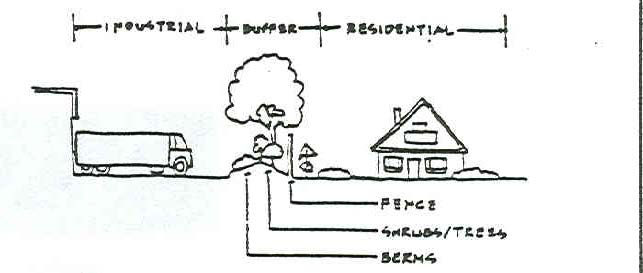
Figure 2: Buffer
Buffer, Natural. A natural buffer is an enhanced vegetated area with no or limited minor land disturbances, such as trail and picnic areas.
Building. Any structure having a roof supported by columns or walls designed or built for the support, enclosure, shelter, or protection of persons, animals, chattels, or property of any kind.
Building Height. The vertical distance measured from the highest grade adjacent to the highest point of roof surface of a flat roof, to the deck line of a mansard roof, or to the average height between eaves and ridges of a gable, hip, or gambrel roof.
Building Line. A line parallel to the street right-of-way line at a distance therefrom equal to the depth of the front yard required for the zoning district in which the lot is located. When the lot frontage is an arc and less than the minimum required lot width, the building line is parallel to the chord of the arc and located where the minimum lot width requirement is obtained between the side lot lines. (See Setback).
Building, Principal. A building in which is conducted the main use of the lot on which said building is located.
Caliper. Diameter measurement of the trunk taken six (6) inches above ground level for trees up to and including four inch caliper size.
Campground, Public or Private. Land or premises used or occupied for compensation by campers traveling by passenger vehicles and utilizing tents, campers, travel trailers, or other recreation vehicles.
Cellar. A level within a building having more than on-half of its height on all sides below grade.
Caretaker Dwelling or Employee Residence. An accessory single-family dwelling placed on an occupied tract for use by a farm worker or other tract owned by the same owner of the agricultural activity and that is a part of the same farming operation.
Cattery. Any place that regularly breeds, boards, trains, buys, sells or trades any cat.
Cemetery, Private. Any plot of ground, building, mausoleum, other enclosure used for the burial of deceased persons of one collateral line of descent.
Cemetery, Public. A plot of ground, building, mausoleum, or other enclosure not located on property owned by or adjacent to a religious institution but used for the burial of deceased persons.
Cemetery, Religious Institution. A plot of ground, building, mausoleum, or other enclosure owned by or adjacent to a religious institution and used for the burial of deceased persons who are generally members of that religious institution.
Child Care Facility. A building or portion of a building wherein is provided care and supervision of persons away from their place of residence for less than twenty-four hours per day on a regular basis for compensation; serves nineteen (19) or more persons and is licensed by the State of Georgia; for children, the outdoor play area shall be enclosed by a fence of not less than four (4) feet in height in the rear yard only. For the purposes of this Ordinance, the term "Child Care" shall include but not be limited to the terms "Day Care", "Nursery School", "Early Learning Center", "Pre-kindergarten", "Private Kindergarten", "Play School", and "Pre-school".
Child Care Home, Family. A customary home occupation which provides, for six (6) or less persons who are not residents of the premises; care and supervision by a state of Georgia registered resident adult for less than twenty-four (24) hours per day on a regular basis for compensation.
Child Care Center, Group. A building or portion of a building wherein is provided care and supervision of persons away from their place of residence for less than twenty-four (24) hours a day on a regular basis for compensation; serves seven (7) to eighteen (18) persons and is licensed by the State of Georgia.
Church. A building in which persons regularly assemble for religious worship of the same faith and which is publicly designated as a church, but shall not include a parsonage, thrift or clothing store, food service, homeless shelters, or accessory uses of a church.
Church, Accessory Use of. A use customarily incidental and subordinate to the principal use of a building as a church, including uses such as day care facilities, kindergartens, family exercise or sport facilities, mausoleums, and columbariums.
Clinic. A building or a portion of a building, where patients are not lodged overnight, but are admitted for examination and treatment by a group of physicians or dentists practicing together.
Club, Private. A building or portion thereof or premises owned or operated by a corporation, association, person or persons for a social, educational or recreational purpose but not primarily for profit or to render a service which is customarily carried on as a business.
Columbarium. A vault with niches for urns containing the ashes of cremated bodies.
Combination Park. Any plot or tract of land on which both a manufactured home park and a travel trailer park are located or intended to be located.
Commission. The Chatsworth Planning Commission or equivalent.
Commissioners. The Board of Commissioners of Murray County, Georgia.
Community Center. See Neighborhood Center.
Comprehensive Plan. The Chatsworth comprehensive plan, or equivalent, currently known as Murray County, Chatsworth, and Eton Joint Comprehensive Plan, 2005-2025, as adopted and as may be subsequently amended by the governing authority.
Conditional Use. A use not ordinarily permitted but which may be permitted in a particular zone district upon the imposition of conditions related to the promotion of the public health, safety, morals, or general welfare and designed to minimize the negative impact on surrounding lands. Review of any conditional use is required by the procedures established by the Chatsworth Zoning Procedures and Standards Ordinance. (See Appendix)
Condominium. A building or group of buildings, in which units are owned individually, and the structure, common areas and facilities are owned by all the owners on a proportional, undivided basis.
Convenience Store. Any retail establishment offering for sale prepackaged food products, beverages, household items, and other goods commonly associated with the same.
Cultural Facility. A structure or portion of a structure used as art gallery, museum, historical display, legitimate theatre, library, and other uses similar in character to those listed.
Day Care Facility. A building or portion of a building wherein is provided care and supervision of persons away from their place of residence for less than twenty-four hours per day on a regular basis for compensation; serves nineteen (19) or more persons and is licensed by the State of Georgia. For the purposes of this Ordinance, the term "day care" shall include but not be limited to the terms "child care", "nursery school", "early learning center", "pre-kindergarten", "private kindergarten", "play school", and "pre-school".
Day Care Home, Family. A customary home occupation which provides, for six (6) or less persons who are not residents of the premises; care and supervision is provided by a state of Georgia registered resident adult for less than twenty-four (24) hours per day on a regular basis for compensation.
Day Care Center, Group. A building or portion of a building wherein is provided care and supervision of persons away from their place of residence for less than 24 hours a day on a regular basis for compensation; serves seven (7) to eighteen (18) persons and is licensed by the State of Georgia.
DBH (diameter breast height). The diameter of a tree four and one-half (4½) feet above average ground level.
Development. Subdividing a tract of land into two or more lots whether for sale or rental; construction, erection, or expansion of a structure; filling, grading, excavation or land disturbing activities affect more than one acre; recordation of a plat in the office of the Clerk of Superior Court (unless such recordation is to illustrate a deed line such as with a land boundary line agreement); or the location of a facility.
District. A delineated section or sections of the City of Chatsworth for which the zoning regulations governing the use of buildings and premises, the height of buildings, the size of yards, and the intensity of use are uniform.
Drive-In. Any use providing the opportunity of selling, serving, or offering goods or services directly to customers waiting in vehicles or customers who return to their vehicles to consume or use the goods or services while on the premises of the principal use.
Dwelling. A building which is designed or used exclusively for residential purposes, including single-family, and multi-family residential buildings, rooming and boarding houses, fraternities, sororities, dormitories, manufactured homes, and industrialized homes but not including hotels and motels.
Dwelling, Apartment. See "Dwelling, Multi-family."
Dwelling, Loft. A dwelling unit, occupied by no more than four (4) persons, and located only on the floor above a ground level commercial business.
Dwelling, Senior. A multi-family residence with eighty (80) percent or more of the dwelling units occupied by residents, ages 62 and over or handicapped; or couples where either the husband or wife is 62 years of age or older; does not include convalescent or nursing facilities.
Dwelling, Single-Family Attached. A building containing two (2) or more dwelling units, each of which is deeded with separate ownership and has primary ground floor access to the outside and which are attached to each other by party walls without openings. The term can include fee-simple townhouses and condominiums.
Dwelling, Single-Family Detached. A residential building containing not more than one (1) dwelling unit entirely surrounded by open space. A single family detached dwelling includes site-built houses and industrialized homes. (Manufactured HUD homes/housing and mobile homes are not single family detached dwellings).
Dwelling, Multi-Family. A building designed as two or more separate units for or occupied exclusively by two (2) or more families.
Dwelling Unit. One or more rooms located within a building and forming a single habitable unit with individual permanent sanitary and kitchen facilities and is used or intended to be used for living, sleeping, cooking, and eating purposes. Units in motels, or other structures designed for transient residence are not included.
Easement. The right of a person, government agency, or public utility company to use public or private land owned by another for a specific purpose.
Event Center. A facility used for weddings, anniversaries, birthdays, baby showers, weddings showers, reunions, recitals, dances, and ethnic and religious celebrations, or other similar events, etc. The facilities can include sleeping, eating, and recreation. The site shall be sufficient size to accommodate all off-street parking associated with an individual event and the facilities shall comply with those regulations related to group assembly.
Existing Construction. Any structure for which the "start of construction" commenced before the effective date of this ordinance.
Family. Except as otherwise provided in this definition, family means one (1) or more persons related by blood, legal adoption, or marriage occupying a dwelling where such persons are related to each other within the fourth degree, as defined in O.C.G.A. §53-2-1, which includes parents, children, grandparents, grandchildren, brothers and sisters. Great-grandparents shall also be included in the definition of family. State of Georgia authorized foster children of a family member shall also be deemed a member of the family for this purpose, or not more than five (5) adults, not necessarily related by blood or marriage, living together as a single housekeeping unit in a dwelling unit where compensation is not made for housekeeping service for room and board to the owner or operator of such dwelling unit. In zones R-A and R-1, not more than two (2) adults, not related by blood or marriage, living together as a single housekeeping unit in a single-family dwelling unit where compensation is not made for housekeeping service for room and board to the owner or operator of such dwelling unit will be considered a family for the purpose of this definition.
For the purposes of this definition, a person shall be considered to reside in a dwelling unit if he or she stays overnight in a dwelling unit for more than 30 days within a 90-day period, receives mail at the dwelling unit, or lists the dwelling unit as his or her home address on any document. The term "family" does not include any organization or institutional group.
Fence. An artificially constructed barrier of any materials or combination of materials erected to enclosed or screen areas of lands. A privacy fence is one that is solid and of a height designed to effectively limit visibility.
Flea Market. A building or open area in which stalls or sales areas are set aside, and rented or otherwise provided, and which are intended for use by various unrelated individuals to sell articles that are either homemade, homegrown, handcrafted, old, obsolete, or antique and may include the selling of goods at retail by businesses or individuals who are generally engaged in retail trade.
Flood. A rise in stream flow or stage that results in temporary inundation of the areas adjacent to the channel.
Floor Area, Gross. The gross heated areas of all floors, measured from the exterior faces of the exterior walls of the building.
Frontage, Lot. The distance a lot abuts on a street; the front lot line. (See Figure 3: Lot)
Frontage, Street. The distance of a lot abuts on a street; the front lot line (See Figure 3: Lot).
Fur Farm. Any place that regularly breeds and raises rabbits, mink, foxes or other fur or hide-bearing animals for the harvesting of their skins.
Garage, Private. An accessory building designed or used for the storage of motor-driven vehicles owned and used by the occupants of the buildings to which it is accessory.
Garage, General Service. A building or portion thereof, other than a private, storage, or parking garage, designed or used for equipping, servicing, repairing, hiring, selling, or incidental short term storing of motor-driven vehicles, but not including the storage of wrecked or junked vehicles, to which repairs are not intended to be made.
Garage, Storage or Parking. A building or portion thereof designed or used exclusively for storage of motor-driven vehicles, and within which motor fuels and oils may be sold, but no vehicles are repaired, equipped, or sold.
Grade. The average level of the finished ground surface adjacent to the exterior walls of the building.
Group Home. A single-family dwelling, housing persons who are mentally/physically handicapped, elderly, terminally ill, AIDS/HIV victims, Alzheimer's patients, or children and teens with emotional problems, operating as a single housekeeping unit under a common housekeeping management plan based on an intentionally structured relationship providing the organization and stability of a home environment. All group homes shall be approved and licensed by the State of Georgia, Department of Human Resources.
Halfway House. A building for temporary residence by non-related persons, who are recovering from alcohol abuse or other chemical-based substances, with one or more surrogate parents that provide services that include room, meals, supervision, rehabilitation, and counseling to enable residents to move back into society and live independently.
Hardship. An unusual situation on the part of an individual property owner which will not permit him/her to enjoy the full utilization of his/her property which is given to others within the county. A hardship exists only when it is not self-created, or when it is not economic in nature.
Hazardous Waste. Any solid waste which has been defined as a hazardous waste in regulations, promulgated by the administrator of the United States Environmental Protection Agency (US EPA) pursuant to the federal act, which are in force and effect on February 1, 1988, codified as 40 C.F.R. Section 261.3.
Health Clubs. A facility designed for the major purpose of physical fitness or weight reducing which includes, but is not limited to, such equipment as weight resistance machines, whirlpools, saunas, showers, and lockers. This shall not include municipal or privately owned recreation buildings.
Health Department. The Murray County Health Department and/or the Georgia Department of Human Resources.
Health Officer. The legally designated health authority of Murray County, or the State of Georgia, or an authorized agent.
Home Occupation. An occupation customarily carried on by an occupant of a dwelling unit as a secondary use which is clearly incidental to the use of the dwelling unit for residential purposes and operated in accordance with the provisions of these regulations.
Horticulture. The cultivation of fruits, vegetables, flowers, and plants.
Hospice. A building or portion thereof, in which terminally ill persons live, in order to receive appropriate Medicare-certified hospice services.
Hotel. A building offering overnight sleeping accommodations for travelers; ingress and egress to and from all rooms are made through an inside lobby or office supervised by a person in charge at all hours. Such use has eighty (80) percent of the rooms occupied by a different registered guest every five (5) days, provides patrons with daily maid service, twenty-four (24) hour desk/counter clerk service, and a telephone switchboard service to receive incoming/outgoing messages, and shall comply with the applicable requirements of the Murray County Health Department and O.C.G.A. Section 31-28-1 et. seq., and may provide additional services such as restaurants, retail gift shops, meeting rooms, swimming pools, and exercise facilities.
Impervious Surface. A manmade structure or surface which prevents the infiltration of stormwater into the ground below the structure or surface. Examples are buildings, roads, driveways, parking lots, decks, swimming pools, or patios.
Industrialized Building. A factory-fabricated dwelling or commercial unit built in one (1) or more sections designed to fit together on a permanent foundation, but which usually does not originally have wheels for movement, and which is constructed in accordance with the Georgia Industrialized Building Act, and which bears the seal of approval issued by the Commissioner of Community Affairs. (Includes the term "modular building").
Industrialized Home. Any structure or component thereof which is wholly or in substantial part made, fabricated, formed, or assembled in manufacturing facilities for installation on a building site and has been manufactured in such a manner that all parts or processes cannot be inspected at the installation site without disassembly, damage to, or destruction thereof. Industrialized buildings are constructed and regulated in accordance with the "Industrialized Building Act", Georgia Law 1982 pp. 1637-1643 (Official Code of Georgia Annotated, Title 8, Chapter 2, Article 2, Part 1).
An industrialized home is a single-family detached dwelling and includes the term "modular building."
Institution. A public or semi-public building occupied by a governmental entity, nonprofit corporation or nonprofit establishment for public use.
Junk. Wrecked or inoperative (whether repairable or not) motor vehicle(s), scrap copper, scrap brass, scrap rope, scrap glass, scrap rags, scrap metal, scrap paper, scrap batteries, scrap appliance, scrap beds and bedding, scrap rubber, scrap tires, scrap motor vehicle parts, scrap furniture, scrap wood, scrap building materials, scrap tools or other used materials that have been abandoned from their original use but may or may not be used again in their present form or in a new form.
Junk Vehicles. Any motor vehicle, vehicle, trailer of any kind or type, or mechanical contrivance or part thereof, which is in an inoperative or junk condition by reason of its having been wrecked, dismantled, partially dismantled, inoperative, abandoned, discarded, or which does not have a valid license place attached thereto (when the same is required by law). For the purpose of this article, a vehicle is 'inoperative' if it is incapable of movement by its own power, and it remains in place for a period of more than seven (7) days, and is not within a carport/garage.
Junkyard. Any such use involving the storage of disassembly of wrecked automobiles, trucks, or their vehicles; storage, baling or otherwise dealing in bones, animal hides, scrap metal, commercial/residential appliances, used paper, used cloth, used plumbing fixtures and use brick, wood or other building materials. Such uses shall be considered junkyards whether or not all or part of such operations are conducted inside a building or in conjunction with, addition to, or accessory to other uses of the premises. A junkyard shall be presumed to exist if two or more inoperative motor vehicles are maintained for more than forty-five (45) days, except vehicles being held pursuant to a law enforcement agency impoundment; however, this presumption may be rebutted if no part of the motor vehicle is outside of a completely enclosed building and no part of the motor vehicle can be viewed from any portion of any adjoining property, road, or street.
Kennel. Any location where breeding, raising, boarding, caring for, and the keeping of more than three dog or cats or other small animals or combination thereof (except litters or animals not more than 6 months of age) is carried on for commercial purposes.
Kindergarten. Any premises or portion thereof used for educational work or parental care of children of less than the age required for enrollment in the public or private school system.
Land-Disturbing Activity. Any grading, scraping, excavating, or filling of land, clearing of vegetation; and any construction, rebuilding, or alteration of a structure. Land-disturbing activity shall not include activities such as ordinary maintenance and landscaping operations, individual home gardens, yard and grounds upkeep, repairs, additions or minor modifications to a single family dwelling, and the cutting of firewood for personal use.
Livestock. The "livestock" as used herein shall mean and include cattle, horses, goats, sheep, swine, poultry, ducks, geese and other fowl; and rabbits, minks, foxes, and other fur or hide bearing animals customarily bred or raised in captivity for the harvesting of their skins; whether owned or kept for pleasure, utility or sale.
Living Unit. One or more rooms within a building and forming a single habitable unit with permanent individual sanitary facilities but lacking a kitchen or cooking facilities.
Loading Space. A space having a minimum dimension of 13.5 by 60 feet and a vertical clearance of at least 14.5 feet within the main building or on the same lot, providing for the standing, loading, or unloading of trucks.
Lot. A portion or parcel of land separated from other portions or parcels by description (such as on a subdivision plat of record or as a survey map or plat) or described by metes and bounds, and intended for use, transfer of ownership, or for building development. The word "lot" shall not include any portion of a dedicated right-of-way. Minimum lot size square footage calculations shall not include any areas reserved for easements or rights-of-way upon which, by the nature thereof, construction is prohibited (i.e., easements for ingress and egress to other lots or properties, major power line transmission easements, etc.).
Lot size calculations shall not include strips of property with widths less than the minimum building line dimension of the particular use district intended to provide access to a given lot or parcel (ie. Flag pole of flag-shaped lots); provided, however, land less than the minimum building width requirements may be considered as part of the square footage lot size calculation in those instances where lots lines are radial to a curved street or cul-de-sac on a subdivision plat approved by the Chatsworth Planning Commission (ie. Pie-shaped lots). Lot, Corner. A lot abutting upon two or more streets at their intersection.
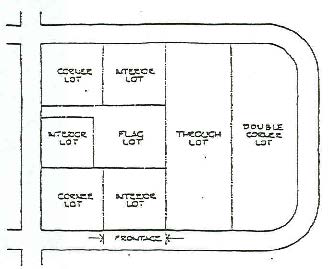
Figure 3: Lot
Lot Coverage. The area of a lot occupied by the principal building or buildings and accessory buildings.
Lot Depth. The mean horizontal distance between the front and rear lot lines measured within the lot boundaries.
Lot Line, Rear. The lot line opposite and most distant from the front lot line; or in the case of triangular or otherwise irregularly shaped lots, a line ten feet minimum in length entirely within the lot, parallel to and at a maximum distance from the front lot line.
Lot Line, Side. Any lot line other than a front or rear lot line.
Lot of Record. A lot, which existed prior to the adoption or subsequent amendment of this ordinance, as shown or described on a plat or deed in the records of the local registry of deeds. (See Article III, Section O)
Lot, Through. A lot other than a corner lot abutting two streets.
Lot Width. The horizontal distance between the side lot lines measured at right angles to the lot depth at the front (building) setback line.
Lot Width (curvilinear street frontage). For a lot having frontage upon a curvilinear street, the lot width shall be the distance between the side lines of the lot where the minimum lot width is obtained, measured parallel to the chord of the arc formed by the two (2) outermost points of intersection of the side lines with the road right-of-way line. The lot width line is synonymous with the front setback line in this circumstance.
Manufactured Home. A structure defined by and constructed in accordance with the National Manufactured Housing Construction and Safety Standards Act of 1974 as amended, 42 U.S.C. 5401, et seq. The definition at the date of adoption of this part is as follows:
'Manufactured Home' means a structure, transportable in one or more sections, which, in the traveling mode, is eight (8) body feet or more in width or forty (40) body feet or more in length, or, when erected on site, is three hundred twenty (320) or more square feet, and which is built on a permanent chassis and designed to be used as a dwelling with or without a permanent foundation when connected to the required utilities, and includes the plumbing, heating, air-conditioning, and electrical system contained therein; except that such term shall include any structure which meets all the requirements of this paragraph and the manufacturer voluntarily files a certification required by the Secretary of Housing and Urban Development and complies with the standards established under this title.
Manufactured Home Lot. A parcel of land in a manufactured home park for the placement of a single manufactured home and for the exclusive use of its occupants.
Manufactured Home/Mobile Home Park. Premises where three (3) or more mobile home/manufactured home dwelling units are parked for living or sleeping purposes, regardless of whether or not a charge is made for such accommodation, or where spaces or lots are set aside and offered for rent for use by mobile homes/manufactured homes for living or sleeping purposes, including any land, building, structure or facility used by occupants of mobile homes/manufactured homes on such premises. This definition shall not include mobile homes/manufactured homes sales lots.
Manufactured Home Stand. A manufactured home stand is that part of a manufactured home lot or site which has been improved for the placement of a manufactured home.
Mausoleum. A building where bodies are interred above ground in stacked vaults.
Mini-Warehouse. A building in a controlled access and fenced compound that contains varying sizes of individual, compartmentalized and controlled-access stalls or lockers for storing the excess personal property of an individual or family when such is not with their residence, such as a passenger motor vehicle, house trailer, motorcycle, boat, camper, furniture, limited commercial storage (items of local retail merchants, small contractors, and professionals), and other items of personal property generally stored in residential accessory structures. No business activities other than the rental of storage units shall be conducted on the premises.
Mobile Home. A structure, transportable in one or more sections, which, in the traveling mode, is eight (8) body feet or more in width or forty (40) body feet or more in length or, when erected on site, is three hundred and twenty (320) or more square feet and which is built on a permanent chassis and designed to be used as a dwelling with or without a permanent foundation when connected to the required utilities and includes the plumbing, heating, air-conditioning, and electrical systems contained therein and manufactured prior to June 15, 1976.
Mobile Office. A factory fabricated structure designed to be transported on its own wheels, detachable wheels, flatbed or trailer and used or intended to be used or occupied for the transportation of business or the rendering of a professional service.
Modular Home. See "Industrialized Building."
Motel. A permanent building or group of permanent buildings in which overnight sleeping accommodations are provided for travelers and having a parking space near or adjacent to the entrance of the room. Such use has eighty (80) percent of the rooms occupied by a different registered guest every five (5) days, provides patrons with daily maid service, twenty-four (24) hour desk/counter clerk service, and a telephone switchboard service to receive incoming/outgoing messages, and shall comply with the applicable requirements of the Murray County Health Department and O.C.G.A. Section 31-28-1 et. seq., and may provide additional services such as restaurants, retail gift shops, meeting rooms, swimming pools, and exercise facilities.
Motor Vehicle Repair Service, General. A building, lot, or both in or upon which comprehensive motor vehicle repair services are performed including painting, body and fender work, engine overhauling or other major repair; such facility commonly serves disabled or wrecked vehicles requiring occasional wrecker services and repair service time routinely exceeds more than 24-hours on-site, but excluding a junk yard and/or motor vehicle wrecking business.
Motor Vehicle Repair Service, Specialty. A building, lot, or both in or upon which specialty repair services are provided quickly for operational motor vehicles; services may include but are not limited to removal and/or replacement of oils, fluids, filters, grease, minor parts like mufflers, shocks, and brakes; and may include tuning of engines; service repair time is routinely less than 24-hours on-site.
Motor Vehicle Service Station. A building or lot for motor vehicle refueling using fixed dispensing equipment connected to pumps and storage tanks; where oils or accessories for the use of motor vehicles are dispersed, sold, or offered for sale at retail; and may include one or more service bays for vehicle washing, lubrication and minor replacement, or adjustment and repair services.
Multi-family Dwelling. See "Dwelling, Multi-family."
Neighborhood Center. A building or facility used to provide recreational, social, educational and cultural activities for an area of community, which is owned and operated by the management agency of that community, or the Homeowner's Association of that community. A community can be an incorporated area, a developed subdivision, or a planned development.
New Construction. Any structure for which the "start of construction" commenced on or after the effective date of this Ordinance.
Non-Conforming Use. The use of any building or land which was lawful at the time of passage of this ordinance, or amendment thereto, but which use does not conform, after the passage of this ordinance or amendment thereto, with the regulations of the district in which it is situated.
Nursery School. See "Kindergarten."
Nursing Home. An extended or intermediate care facility licensed or approved to provide full-time convalescent or chronic care to individuals who, by reason of advanced age, chronic illness or infirmity, are unable to care for themselves.
On-Site Sewerage Management System. See "Sewerage Management System, On-site."
Parking Area. An open, unoccupied space used or required for temporary parking of vehicles exclusively and in which no gasoline or vehicular accessories are sold or no other business is conducted.
Parking Lot. An open area used exclusively for the temporary storage of motor vehicles and within which motor fuels and oils may be sold and fees charged, but no vehicles are to be equipped, repaired, or sold.
Parking Space. A space, enclosed or unenclosed, having an area of not less than 180 square feet (9' x 20') exclusive of access, permanently reserved for the temporary storage of one vehicle and having access to a street or alley.
Permit. Any written authorization for building, construction, alteration, development, occupancy, or other matter required by this Ordinance to be approved a designated commission, board, official, or employee. The person to whom such permit is issued shall be known as the "permittee."
Personal Care Home or Home. A building or group of buildings, a facility or place in which is provided two or more beds and other facilities and services, including room, meals and personal care, for non-family ambulatory adults. For the purpose of these Rules, Personal Care Homes shall be classified as: Family Care Personal Care Home, Group Personal Care Home, or Congregate Personal Care Home. This term does not include buildings which are devoted to independent living units which include kitchen facilities in which residents have the option of preparing and serving some or all of their own meals or boarding facilities which do not provide personal care.
1.
"Family Personal Care Home" means a home for adults in a family type residence, noninstitutional in character, which offers care to two through six persons.
2.
"Group Personal Care Home" means a home for adult persons in a residence or other type building(s), noninstitutional in character, which offers care to seven through fifteen persons.
3.
"Congregate Personal Care Home" means a home for adults which offers care to sixteen or more persons.
Planned Center, Shopping, Office or Industrial. Any planned concentration of at least three business establishments which also provides planned and shared parking, access, and service.
Planning Commission. The Chatsworth Planning Commission or equivalent.
Plat. A map, plan or layout of a county, city, town, lot, section, subdivision, or development indicating the location and boundaries of properties.
Premises. A lot, together with all buildings and structures existing thereon.
Principal Building. A building in which is conducted the main or principal use of the lot in which said building is situated.
Principal Use. The primary purpose for which land or a building is used.
Private Land. All lands and buildings not owned by governments.
Putrescible Wastes. Wastes that are capable of being quickly decomposed by microorganisms. Examples of Putrescible wastes include but are not necessarily limited to kitchen wastes, animal manure, offal, hatchery and poultry processing plant wastes, and garbage.
Recorded Plat. A plat recorded in the Office of the Clerk of Superior Court of Murray County.
Recreational Facilities, Outdoor. Any commercial or non-commercial outdoor facility such as a miniature golf course, a golf or baseball driving range, tennis courts, swimming pools, drive-in theater, etc.
Recreational Vehicles. A vehicular type portable structure without permanent foundation, which can be towed, hauled or driven and primarily designed as temporary living accommodation for recreational, camping and travel use and including but not limited to travel trailers, truck campers, camping trailers and self-propelled motor homes.
Recycling Center. A non-commercial facility in which recoverable resources, such as papers, glassware, plastics, and metal cans, or any non-hazardous recycling materials, are collected, stored, flattened, crushed, or bundled, by hand or machines within a completely enclosed building.
Recycling Collection Station. An incidental use that serves as a neighborhood drop-off point for temporary storage of recoverable resources. No processing of such items would be allowed. This facility would generally be located in a commercial parking lot, or at other public/quasi-public areas, such as churches and schools.
Residence Inn. A permanent building or group of buildings consisting of single room dwellings and other living units. No more than 20 percent of the units may be living units as opposed to dwelling units.
Right-of-Way. An area or strip of land, either public or private, on which a right of use has been recorded. A right of way, as distinguished from an easement, is owned in fee-simple title by the City of Chatsworth or other government, a duly organized homeowners' or property owners' association, or any other person.
Right-of-Way Line. The dividing line between a lot, tract, or parcel of land and a contiguous right of way.
Rooming House. A dwelling, permanently occupied by the owner or operator, where only sleeping accommodation is provided for three (3) or more permanent occupants not of the same family by prearrangement for definite periods and for compensation and which makes no provision for cooking in any of the occupied rooms.
Salvage Yard. See "Junk Yard".
Satellite Dish Antenna. A device incorporating a reflective surface that is solid, open mesh, or bar configured and is in the shape of a shallow dish, cone, horn, or cornucopia. Such device shall be used to transmit and/or receive radio or electromagnetic waves between terrestrially and/or orbitally based uses. This definition is meant to include but not be limited to what are commonly referred to as satellite earth stations, TVROs (television reception only satellite dish antennas), and satellite microwave antennas.
Schools, Private, Parochial and other Elementary. Any places for teaching children grades one to eight, inclusive, which are not a part of the State of Georgia, but which teach the subjects commonly taught in the common elementary schools of the State.
Schools, Public. Any place for teaching children grades kindergarten to twelve inclusive and no other, and a part of the public school system as defined by the laws of the State of Georgia.
Senior Housing. A multi-family residence with eighty (80) percent or more of the dwelling units occupied by residents, ages 62 and over or handicapped; or couples where either the husband or wife is 62 years of age or older; does not include convalescent or nursing facilities.
Service Station. Any building, structure, or land use primarily for the dispensing, sale, or offering for sale at retail any automobile fuels, oils, or accessories, but not including major repair work such as motor overhaul, body and fender repair or spray painting.
Setback. The mean horizontal distance between the front street right-of-way line and the front line of the building or the allowable building lines as defined by the front yard regulations of this ordinance.
Setback Line (or Building Line). The line that is the required minimum distance from the street right-of-way line or any other lot line that establishes the area within which walls of the principal structure must be erected or placed. The minimum measurement is to the wall, not the eave/overhang, and a cantilever building design measures to any wall projecting nearest to the property lines. The area contained within the boundaries formed by the setback lines is considered the buildable area of the lot.
Sexual Activities. Includes any of the following: 1) Actual or simulated sexual intercourse, oral copulation, anal copulation, bestiality, direct physical stimulation of unclothed genitals, flagellation or torture in the context of a sexual relationship, or the use of excretory functions in the context of a sexual relationship and any of the following sexually oriented acts or conduct: anilingus, buggery, coprophagy, coprophilia, cunnilingus, fellatio, necrophilia, pederasty, pedophilia, piquerism, sapphism, zooerasty; 2) Clearly depicted human genitals in a state of sexual stimulation, arousal or tumescence; 3) Use of human or animal ejaculation, sodomy, oral copulation, coitus, or masturbation; 4) Fondling or touching of nude human genitals, pubic region, buttocks or female breast; 5) Torture; 6) Erotic or lewd touching, fondling or other sexual contact with an animal by a human being; 7) Masochism, erotic or sexually oriented beating or the infliction of pain; or 8) Human excretion, urination, menstruation, vaginal or anal irrigation.
Sports Arena. See "Auditorium."
Sewerage Management System, On-Site. A sewerage management system other than a public or community sewerage system, serving single or multiple buildings, manufactured or mobile homes, residences or other facilities designed for human occupancy or congregation, as approved by the County Board of Health.
Sewerage Treatment System, Public or Community. Any sewerage treatment system, including pipe lines or conduits, pumping station, force mains and all other constructions, devices, and appliances appurtenant thereto, designed for treating or conducting sewerage for treatment and disposal into lakes, streams or other bodies of surface water.
Shopping Center. A group of two or more commercial establishments planned, constructed and managed as a total entity with customer and employee parking provided on-site, provision for goods delivery separated from customer access, aesthetic considerations and protection from the elements.
Start of Construction. Means erection of temporary forms, pouring of slabs or footings, installation of piers or columns; or the actual start of a building or altering a structure either temporary or permanent.
Stockyard. A place where transient cattle, sheep, swine, or horses are kept.
Story. That portion of a building between the surface of a floor and the surface of the floor next above it, or, if there is no floor above it, then the space between the floor and the ceiling.
Story, Half. A space under a sloping roof which has the line of intersection of roof decking and wall face not more than three feet above the top floor level, and in which space not more than two-thirds of the floor areas is finished off for use. A half-story containing independent apartment or living quarters shall be counted as a full story.
Street. A public or private thoroughfare which meets locally established design standards and which affords the principal means of access to abutting property however designated as a street, highway, thoroughfare, parkway, road, avenue, boulevard, or place.
a.
Minor or Local Street. Street used primarily for access to the abutting properties and serving travel demands in the immediate area.
b.
Collector. Those streets so designated on the County Functional Classification System Map, and those streets which otherwise function to serve local traffic movements by collecting or distributing traffic from or to local, other collector, and/or arterial streets. Such a street includes the principal entrance and circulation streets of a subdivision and may also function to provide access to abutting properties in the same manner as a local street.
c.
Major Thoroughfare or Arterial. Those streets so designated on the County Functional Classification System Map and those streets which otherwise function to move high volumes of traffic between principal traffic generators (such as residential, commercial, and industrial sectors) at moderate speeds and with minimum conflict to movements.
Street Line. A dividing line between a lot, tract or parcel of land and the right-of-way of a contiguous street.
Structure. Anything constructed or erected, the use of which requires a location on the ground, or attached to something having a location on the ground, including but not limited to buildings, signs, billboards, back stops for tennis courts, fences, radio and water towers, grain and feed elevators.
Subdivision. For the purpose of this ordinance, a subdivision is the division, re-division, or separation of one parcel of land into two or more parcels, lots, building sites, or other divisions of land whether for the purpose of sale, legacy, or building development.
Temporary Structure. A structure with neither foundation nor footings, which is removed when either the designated time period or activity or use for which the temporary structure was erected has ceased. (See Article VIII- Supplementary Regulations, Section G.)
Tower, Telecommunications. A structure, such as a self-supporting lattice tower, guy tower, or monopole tower, constructed as a free-standing structure or in association with a building, other permanent structure or equipment, on which is located one or more antennae intended for transmitting or receiving television, AM/FM radio, digital, microwave, cellular, telephone, or similar forms of electronic communication. The term includes radio and television transmission towers, microwave towers, common carrier towers, cellular telephone towers. The term excludes any tower and antenna under seventy (70) feet in total height and owned and operated by an amateur radio operator licensed by the Federal Communications Commission, and satellite earth station antenna one meter in diameter or less, any receive-only home television antenna, and any satellite earth station antenna two meters or less in diameter which is located in a commercial or industrialized zoning district.
Townhouse. A single family attached dwelling that is erected in a row as part of a single building, on adjoining lots, each being separated from adjoining units by approved fire resistant wall extending from the basement of cellar floor to the roof along the dividing lot line. Each unit shall have its own front door, which opens to the outdoors, but no access between adjoining units.
Travel Trailer. See "Recreational Vehicle."
Travel Trailer Park. See "Campground, Public or Private."
Tree. A woody perennial plant having a single (usually elongate) main stem including but not limited to a shrub or vine of arborescent form.
Vendor Stands. Any cart, table, equipment, or apparatus which is not a structure, which is designed and intended so as to not be a permanent fixture on a lot, and which is used for the retail sale, display, and accessory advertising of merchandise or food.
Water System.
1.
Public Water System - a system for the provision to the public of piped water for human consumption, if such system has at least fifteen service connections, or regularly serves an average of at least twenty five individuals daily, at least sixty (60) days out of the year in accordance with the Rules of Georgia Department of Natural Resources, Environmental Protection Division, Chapter 391-3-5, "Rules for Safe Drinking Water."
2.
Governmental Water System - a public water system, which is owned and operated by a governmental entity, or a legislatively-created authority.
3.
Non-Governmental Water System - a public water system, which is owned and operated by any non-governmental entity.
4.
Community Water System - a system serving more than one single-family dwelling but fewer than the connections and/or persons required to be considered a public water system. Such systems are subject to approval of the Murray County Health Department.
5.
"Individual Water Supply System" means a system of piping, pumps, tanks, or other facilities, which utilizes groundwater to supply a single-family dwelling.
Wild Animal. Any living member of the animal kingdom, including those born or raised in captivity; but excluding human beings, livestock, dogs and cats, rodents, hybrid animals that are part wild, captive-bred species of common cage birds and aquarium-kept fish, amphibians and reptiles.
Yard. An open space on a lot situated between the principal building or use on the lot and a lot line and unoccupied by any structure except as otherwise provided herein. See Figure 10: Yard.
Yard, Front. An open, unoccupied space on the same lot with a principal building or use, extending the full width of the lot and located between the right-of-way line and the front line of the building projected to the side lines of the lot. On corner lots the front yard shall be considered as parallel to the street upon which the lot has its least dimension.
Yard, Rear. An open space on the same lot with a principal building or use, unoccupied except by an accessory building or use, extending the full width of the lot and located between the rear line of the lot and the rear line of the building or use projected to the side lines of the lot.
Yard, Side. An open, unoccupied space on the same lot with a principal building or use, located between the building or use and the side line of the lot and extending from the rear line of the front yard to the front line of the rear yard. See Figure 10: Yard.
Zone, Overlay. A district which applies supplementary regulations to land which is classified into a specific zoning district.
Zoning. The power of the City of Chatsworth to provide within its territorial boundaries for the zoning of property for various uses and the prohibition of other or different uses within such zones or districts and for the regulation of development and the improvement of real estate within such zones or districts in accordance with the uses of property for which said zones or districts were established. (See Appendix - Zoning Procedures and Standards Ordinance.)
(Ord. of 10-09; Ord. of 6-6-16(2), § 1)

