
Chicago Ridge City Zoning Code
ARTICLE XIII
SUPPLEMENTARY ZONING REGULATIONS
Sec. 56-366.- Accessory buildings.
Accessory buildings, except as otherwise permitted in this chapter, shall comply with the following regulations:
(1)
Where an accessory building is structurally attached to the principal building, it shall be subject to and must conform to all regulations of this chapter applicable to the principal building.
(2)
No detached accessory building shall be located closer than ten feet to any principal building. Construction of any accessory building located within ten feet of any principal building will require a variance and shall be of one-hour fire-rated construction.
(3)
No accessory building may be erected prior to the establishment or construction of the principal use of the building, except that a temporary building used in conjunction with the construction work only may be permitted during the period that the principal building is being constructed, provided further that such temporary building shall be removed upon completion of the construction work.
(4)
Side yards for private garages and accessory buildings shall be three feet or more, except when the building is on or extending on the front one-half of the lot, in which case the side yard shall be the same as required for the main building, and in no case shall an accessory building be closer to the street than 15 feet nor closer to the rear lot line than the specification of the zoning district in which the subject property is located, and provided further that in the R-1 and R-2 residence districts, no accessory building shall be located within ten feet of its rear or side lot lines where either such line forms part of the front one-half of the side line of an adjacent lot. Reference should be made to section 56-338(h).
(5)
No accessory building shall be used for residential purposes unless otherwise provided in this chapter.
(6)
No garage shall be constructed larger than 900 square feet or have a height of more than 16 feet to the ridge line and a door height of no more than eight feet. No more than one garage shall be constructed on one residential lot.
(7)
No storage or utility shed shall exceed 120 square feet in area or ten feet in height. All sheds shall be erected on either a permanent concrete or treated wood floor to which they shall be bolted or otherwise attached. Only one storage or utility shed shall be allowed for each single-family dwelling or on any one residential zoning lot. All sheds shall be located only to the rear of the principal building on the premises.
(8)
All accessory buildings in residential districts other than garages and sheds shall not be larger than 300 square feet or have a height of more than 13 feet to the ridge line. No more than one accessory building other than a shed or garage shall be permitted on any one residential lot.
(Code 1978, § 5-14-1; Code 1997, § 98-325; Ord. No. 02-11-19, § 6, 11-4-2002; Ord. No. 06-04-02A, § 3, 4-18-2006; Ord. No. 21-06-14, § 4, 6-15-2021)
Sec. 56-367. - Base elevation regulations.
(a)
General. The base elevation shall be subject to base elevation regulations as established by the village board of trustees and set forth in this chapter, the subdivision ordinances, chapter 44, or other applicable ordinances of the village. The regulations will guide development in order to promote the public health, safety and welfare through flood regulation.
(b)
Lowest floor. No new or existing building or structure shall be erected or moved within the area governed by these regulations unless the lowest floor is at an elevation which is not less than two feet above the base elevation for the site. Basements, cellars and crawlspaces are permitted if the top of the foundation walls and any opening therein are at least at an elevation of not less than two feet above the base elevation and the floors and walls are of structurally adequate, poured-in-place, waterproofed concrete. If this provision conflicts with the floodplain ordinance of chapter 18, the floodplain ordinance shall control.
(c)
Floodplain. Elevation requirements for floodplain areas shall in all instances be in conformance with those requirements enumerated in the floodplain ordinance of the village.
(Code 1978, § 5-14-2; Code 1997, § 98-326; Ord. No. 02-11-19, § 8, 11-4-2002)
Sec. 56-368. - Height and area regulations exceptions and variations.
The following district regulations qualify or supplement, as the case may be, the district regulations appearing elsewhere in this chapter:
(1)
Public, semi-public or public service buildings, hospitals, schools or institutions, when permitted by a special use, may be erected to a height not exceeding 85 feet, and churches and temples may be erected to a height not exceeding 75 feet if the building is set back from each yard line at least one foot for each foot or additional building height above the height limit otherwise provided in the district in which the building is located.
(2)
Single-family and two-family dwellings may be increased in height by not more than ten feet when the side and rear yards are increased over the yard requirements of the district in which they are located by not less than 15 feet but they shall not exceed two and one-half stories in height.
(3)
Chimneys, cooling towers, elevator bulkheads, fire towers, monuments, stacks, stage towers or scenery lofts, tanks, water towers, ornamental spires, church steeples, radio towers or necessary mechanical appurtenances may be erected to the maximum height in accordance with the district provisions in which the structure is located and as provided in this section.
(4)
Every part of a required yard shall be open to the sky, unobstructed, except for accessory buildings in a rear yard and except for the horizontal projections of roof overhangs, sills, cornices and ornamental features projecting not to exceed 24 inches, accessory buildings not to exceed 12 inches.
(5)
Fences may be erected on the lot lines and in the required yards, but such fences shall conform to all standards and requirements of the ordinances of the village in force from time to time.
(6)
Fire escapes may project into a rear yard not more than five feet and the ordinary projections of chimneys and flues into the rear yard shall be permitted.
(7)
For the purposes of the side yard regulations, a two-family, a rowhouse or a multiple-family dwelling or multiple dwelling shall be considered as one building or structure.
(8)
Where two districts with different front yard requirements are located in the same block, the greater front yard requirement shall extend into and be effective in the district having the lesser front yard requirement for the entire block.
(9)
Whenever any ordinance or deed restriction regulates the front yard or setback requirements along any street in any district and the requirements of such ordinance or deed restriction are greater than the front yard regulations of this chapter, the provisions of such ordinance or deed restriction shall apply and shall be deemed superior to the front yard regulations of this chapter.
(10)
Nothing contained in this section shall be construed to exclude high rise apartment buildings in planned R-3 districts and high rise office buildings or structures in the O office district, when recommended by the planning and development commission pursuant to section 56-6. Further, no such building or structure may be erected to exceed a height of 85 feet.
(11)
On any corner lot where a front or side yard is required or provided, no building, fence, hedge or other obstruction shall be placed so as to interfere with clear vision from one street to the other across the corner. Clear vision shall be determined by compliance with the vision triangle provisions of the building code (section 12-241).
(12)
On all section line streets, the street line for the purpose of determining building setback lines is hereby established to be lines parallel to and 50 feet from the center of such section line street, and the building setback line shall be measured from the street line thus defined. On all half-section line streets, the street line for the purpose of determining building setback lines is hereby established to be lines parallel to and 40 feet from the center of such half section line street, and the building setback line shall be measured from the street line thus defined.
(Code 1978, § 5-14-3; Code 1997, § 98-327; Ord. No. 02-11-19, § 10, 11-4-2002)
Sec. 56-369. - Landscaping and screening.
(a)
Landscape plan required. A detailed landscape plan shall be submitted to the village as part of any planned unit development or site plan review application for townhouse, multifamily, nonresidential or mixed-use development, and must be approved prior to the issuance of a building permit.
(b)
Content of landscape plan.
(1)
The location and dimensions of all existing and proposed structures, property lines, easements, parking lots and drives, roadways and rights-of-way, sidewalks, signs, refuse disposal and recycling areas, sidewalks, bicycle paths and parking facilities, fences, electrical equipment, recreational facilities, drainage facilities, and other freestanding structures, as determined necessary by the building commissioner.
(2)
The location, quantity, size, name and condition, both botanical and common, of all existing plant materials, including trees and other material in the right-of-way, and indicating plant material to be retained and removed.
(3)
The location, quantity, size and name, both botanical and common, of all proposed plant material including, but not limited to, shade and evergreen trees, shrubs, groundcover, annuals/perennials and turf.
(4)
The existing and proposed grading of the site indicating contours at one foot intervals. Proposed berming shall be indicated using one-foot contour intervals.
(5)
Elevations of all proposed fences, steps, stairs, retaining walls both fixed cast concrete, or unitized walls.
(6)
Elevations, cross-sections, and other details as determined necessary by the building commissioner.
(c)
Minor changes to approved landscape plans. Minor changes to the landscape plan that do not result in a reduction in the net amount of plant material as specified on the approved landscape plan shall be approved by the building commissioner. Changes to the size and amount of plant materials of an approved landscape plan shall not be considered a minor change. Major changes shall be taken to the planning and development commission who shall recommend acceptance or denial of the major change to the village board of trustees. The village board of trustee shall approve the major change, deny such change or approve it subject to certain adjustments.
(d)
Selection, installation and maintenance of plant materials.
(1)
Selection. All planting materials used shall be of good quality and meet American Nursery and Landscape Association (ANLA) standards for minimum acceptable form, quality and size for species selected, and capable to withstand the seasonal temperature variations of northeastern Illinois, as well as the individual site microclimates. The use of species native to northeastern Illinois shall be encouraged. Size and density of plant material, both at the time of planting and at maturity, are additional criteria that shall be considered when selecting plant material. Where appropriate, the use of drought and salt tolerant plant material is preferred.
(2)
Installation. All landscaping materials shall be installed in accordance with the current planting procedures established by the ANLA. All plant materials shall be free of disease and shall be installed so that soil of sufficient volume, composition and nutrient balance are available to sustain healthy growth.
(3)
Required element. Landscape materials depicted on landscape plans approved by the village shall be considered to be required site plan elements in the same manner as buildings, parking and other improvements. The owner of record shall be responsible for the maintenance, repair and replacement of all landscape materials, and fences, steps, retaining walls and similar landscaping elements over the entire life of the development.
(e)
Maintenance. All landscaping materials shall be maintained in good condition, shall present a healthy, neat and orderly appearance, and shall be kept free of refuse and debris. Any dead, unhealthy or missing plants shall be replaced within six months of notification by the village or the next reasonable available growing/planting season. All fences, steps, retaining walls and similar landscaping elements required within the landscaping plan shall be maintained in good repair. The owner of the premises shall be responsible for the maintenance, repair, and replacement of all landscape materials, fences, steps, retaining walls and similar landscaping elements, and refuse disposal areas. Irrigation systems, when provided, shall be maintained in good operating condition to promote the health of the plant material and the conservation of water.
(f)
Landscape design standards. Landscape plans, as described above, shall be prepared by a licensed landscape architect, registered in the state, and evaluated and approved based on the following design criteria.
(1)
Scale and nature of landscape material. The scale and nature of landscape materials shall be appropriate to the size of the site and related structures.
(2)
Selection of plant material. Plant material shall be selected for its form, texture, color, pattern of growth and suitability to local conditions.
(3)
Shade trees. All deciduous shade trees shall have a minimum trunk size of two inches in caliper at planting, unless otherwise specified.
(4)
Evergreen trees. Evergreens trees shall have a minimum height of six feet at planting and shall be incorporated into the landscape treatment of a site, particularly in those areas where yearround screening and buffering is required.
(5)
Ornamental trees. Single stem ornamental trees shall have a minimum trunk size of three inches in caliper at planting, unless otherwise specified. Multiple stem ornamental trees shall have a minimum height of eight feet at planting, unless otherwise specified.
(6)
Shrubs.
a.
Unless otherwise specified, all large deciduous and evergreen shrubs shall have minimum height of three feet at installation, and all small deciduous and evergreen shrubs shall have a minimum height of 18 inches at installation.
b.
Large shrubs shall be considered to be those shrubs that reach five or more feet in height at maturity. Small shrubs shall be considered to be those shrubs that can grow up to five feet in height if left unmaintained, but are generally kept at heights of 18 to 30 inches.
(7)
Softening of walls and fences. Plant material shall be placed intermittently against long expanses of building walls, fences and other barriers to create a softening effect and to help break up long expanses of blank walls with little architectural detail.
(8)
Planting beds. Planting beds may be mulched with shredded hardwood, granite mulch, river rock, feather rocks or similar materials. Lava rock is not permitted.
(9)
Irrigation. Landscape design pursuant to the requirements of this subsection shall recognize the need for irrigation and water conservation. Sprinkler irrigation systems may be required for certain landscaped areas, as determined by a landscape architect registered in the state. The need for sprinkler irrigation systems shall be determined by the type of plant material and the condition/growing medium that they are installed in. For instance, whether there is a permanent means available to water plant material, such as hose bibs, shall be a consideration. All irrigation systems shall be designed to minimize the use of water.
(10)
Energy conservation. Plant material placement should be designed to reduce the energy consumption needs of the development. In addition, landscaping designs shall take into account and make an effort to implement Leadership in Energy and Environmental Design (LEED) policy and design standards, where appropriate.
a.
Deciduous trees should be placed on the south and west sides of buildings to provide shade from the summer sun.
b.
Evergreens and other plant materials should be concentrated on the north and west sides of buildings to dissipate the effect of winter winds.
(11)
Species diversity. Diversity among required plant material is required not only for visual interest, but to reduce the risk of losing a large population of plants due to disease. The following table indicates the percentage of diversity required based on the total quantity of species being used. For instance, if a development requires 45 shade trees, no more than 18 trees nor less than five trees can be of one species, and there must be a minimum of five different species within the 45 trees:
_____
TABLE 1. DIVERSITY REQUIREMENTS
_____
(12)
Berming. Earthen berms and existing topographic features shall be incorporated into the landscape treatment of a site where there is sufficient space and, in particular, when berms and existing topographic features can be combined with plant material to facilitate effective screening. Minimum unretained berm side slopes shall be maintained at no less than a four to one (4:1) slope ratio to prevent erosion and be properly and safely maintained. Retained slopes may be implemented with the appropriate terracing necessary to reduce the need for safety railings.
(g)
On-lot landscaping.
(1)
Turf required. All areas within yards that are unpaved shall be landscaped primarily with turf (seed or sod) or live groundcover. Artificial turf is prohibited.
(2)
Required trees. Shade trees shall be provided on all mixed-use zoning lots at a minimum of:
a.
Two shade trees per multiple-family development.
b.
Four shade trees per nonresidential development.
Existing trees shall be counted toward this required minimum number. Utility uses are not required to plant shade trees.
(h)
Building foundation landscaping.
(1)
Building foundation landscaping shall be a required element of the landscape plan. Foundation plantings shall work in concert with buffer yard plantings (see subsection (l) of this section) to frame important views, while visually softening long expanses of walls, particularly those that lack windows or other architectural details. Foundation plantings shall respond to the materials and the form of a building.
(2)
Foundation plantings shall be installed across 60 percent of the length of the facade of the building, except where walkways and driveways are located.
(3)
Foundation plantings may consist of a mix of trees, shrubs and perennials.
(i)
Parking lot landscaping.
(1)
Parking lot landscaping design guidelines. All parking lots of ten or more spaces are subject to site plan review and a landscape plan as a condition of obtaining a building permit. Perimeter landscaping is required for all parking lots and shall be established along the edge of the parking lot that abuts the public right-of-way, excluding alleys. Interior parking lot landscaping is required for those lots of ten or more spaces. Nothing in this subsection shall be deemed to prevent the petitioner's voluntary installation of additional interior parking lot landscaping, so long as parking space requirements and parking lot design requirements are complied with.
(2)
Existing parking lots.
a.
For existing parking lots that currently do not comply with required parking lot landscaping, such landscaping shall be provided when:
1.
A new principal building or building addition is constructed, or exterior remodeling of the principal building occurs.
2.
Over 50 percent of the total area of an existing parking lot is reconstructed. Resealing or re-striping of an existing parking lot, which does not entail paving or resurfacing by replacement of the asphalt or concrete, shall not be subject to this requirement.
3.
When an existing parking lot less than 10,000 square feet in area is expanded by 50 percent or more in total surface area.
4.
When an existing parking lot over 10,000 square feet in area is expanded by 25 percent or more in total surface area.
b.
When an existing parking lot is required by subsection (i)a of this section to provide landscaping, which would result in creating a parking area that no longer conforms to the parking regulations of this Code, such existing parking lot shall not be required to install all or a portion of the required landscaping. The petitioner shall be required to show that landscaping cannot be accommodated on the site. If only certain requirements are able to be accommodated on the site, those elements shall be required. The building commissioner shall make the determination that all or a portion of required landscaping does not have to be installed.
(j)
Parking lot perimeter landscape yard. Perimeter parking lot landscaping provides for the enhancement and screening of parking lots by requiring a scheme of pedestrian walls or landscaping along public streets. Perimeter landscaping is required for all parking lots and shall be established along the edge of the parking lot that abuts the public right-of-way, excluding alleys. The landscape treatment shall run the full length of the parking lot and shall be located between the property line and the edge of the parking lot. All perimeter parking lot screening areas shall be protected with raised concrete curbs. Landscaped areas outside of shrub and tree masses shall be planted in turf or other groundcover. The landscaped area shall be improved as follows:
(1)
One shrub, measuring a minimum of 18 inches at planting and not to exceed 3½ feet at maturity, shall be planted for every three feet of landscaped area length, spaced linearly to adequately screen vehicle bumpers. Alternatively, a low pedestrian wall the height of which provides effective screening to a maximum height of three feet may be used instead of shrubs. Where feasible, plant materials shall be installed between the sidewalk and the wall to provide a softening effect on the fence or wall.
(2)
The perimeter parking lot landscaping area shall be at least ten feet in width, as measured from the lot line to the back of curb, in order to accommodate vehicle bumper overhang and ensure planting areas that are adequate in size.
(k)
Interior parking lot landscaping. For parking lots consisting of ten or more spaces, interior parking lot landscaping shall be required.
(1)
Amount. One parking lot island shall be provided between every 15 contiguous parking spaces. As part of the landscape plan approval, parking lot island locations may be varied based on specific site requirements or design scheme, but the total number of islands shall be no less than the amount required one island for every 15 spaces. However, all rows of parking spaces shall be terminated by a parking lot island or landscaped area.
(2)
Size of parking lot islands. Parking lot islands shall have the same dimensions as parking stalls. Double rows of parking shall provide parking lot islands that are the same dimension as the double row.
(3)
Design of planting areas. Parking lot islands or landscaped areas shall be at least 144 square feet in area and at least six inches above the surface of the parking lot and protected with concrete curbing, except where designed specifically for the absorption of stormwater. Such islands and landscaped areas shall be properly drained and irrigated as appropriate to the site conditions to ensure survivability.
(4)
Type of landscape material. Shade trees shall be the primary plant materials used in parking lot islands and landscaped areas. Ornamental trees, shrubs, hedges and other plant materials may be used to supplement the shade tree plantings but shall not create visibility concerns for automobiles and pedestrians.
(5)
Quantity of landscape material. A minimum of one shade tree shall be provided for every parking lot island or landscaped area. If the island extends the width of a double row, then two shade trees shall be provided.
(6)
Groundcover. A minimum of 75 percent of every parking lot island shall be planted in turf or other live groundcover, perennials or ornamental grasses.
(l)
Buffer yards.
(1)
This subsection establishes standards for the dimensions and improvement requirements of buffer yards between land uses or zoning districts within the rear or interior side yard. Nothing in this subsection shall be deemed to prevent the petitioner's voluntary installation of buffer yards to these design specifications where they are not required.
(2)
Buffer yards are required in the following situations:
a.
Where a R-2 or R-3 district abuts a R-1 district.
b.
Where a commercial, manufacturing or mixed-use district abuts a residential district.
c.
Where a nonresidential use is located within a residential district. However, a buffer yard is not required where the rear wall of a commercial building is located on the rear property line or where an alley is located between a commercial use and a residential use.
(3)
Buffer yards shall be provided in interior side and rear yards. Buffer yards may be located within required setbacks, and shall be reserved for the planting of material and installation of screening as required by this subsection. No parking, driveways, sidewalks, accessory buildings or other impervious surfaces are permitted within the buffer yard area.
(4)
All plantings in the buffer yard shall be in accordance with the design standards of this subsection. The minimum size and improvement of buffer yards shall be as follows:
a.
A buffer yard within shall be a minimum of five feet in width.
b.
Shade trees shall be planted on an average of one tree for every 25 linear feet of yard length. As part of the landscape plan approval, trees may be spaced at various intervals based on specific site requirements or design schemes, but the total number of trees planted will be no less than the amount required by a linear planting spaced 25 feet apart.
c.
An opaque masonry wall (stone, stucco or brick), solid screen fence or dense evergreen hedge, at least six feet in height, shall be erected along 100 percent of the yard length.
d.
Shrubs shall be planted on an average of one shrub for every three feet of yard length. As part of the landscape plan approval, shrubs may be spaced at various intervals based on specific site requirements or design schemes, but the total number of shrubs planted will be no less than the amount required by a linear planting spaced three feet apart.
e.
Areas not planted with trees or shrubs shall be maintained as turf or other groundcover.
(m)
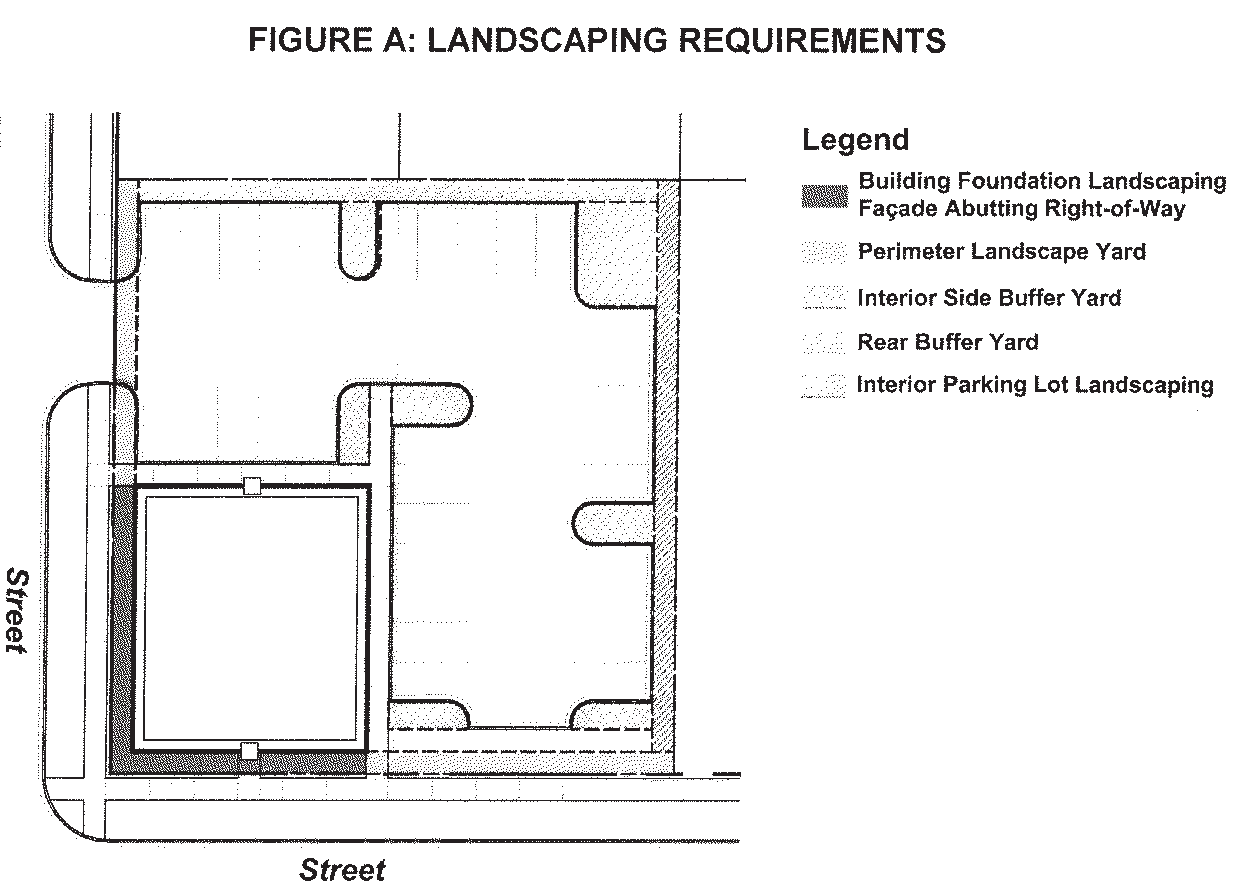
Required landscaping illustration. Figure A: landscaping requirements illustrates the location of the landscaping requirements in this subsection.
_____
_____
(n)
Screening requirements.
(1)
Refuse disposal dumpsters and refuse storage areas. All refuse containers shall be fully enclosed on three sides by a solid wood or simulated wood screen fence, an opaque masonry wall (stone, stucco or brick) or principal structure wall six feet in height and the enclosure shall be gated. The materials used for screening, including the enclosure, shall complement the architecture of the principal structure. An extension of an exterior principal structure wall may be used as one of the screening walls for a refuse container, provided that such wall meets the minimum six foot height requirement and is of the same building materials as the principal structure. Such wall may not be the gated enclosure.
(2)
Loading berths. Where feasible, loading berths shall be located and oriented so as not to be visible from the street and adjacent properties, while still allowing access to the use it is serving. In addition, loading berths in all zoning districts shall be screened as much as possible, unless such screening is determined unnecessary by the body approving the landscape plan. Such screening shall consist of an opaque masonry wall (stone, stucco or brick), a solid wood or simulated wood screen fence, or dense evergreen hedge, at least six feet in height.
(3)
Outdoor storage and display areas.
a.
Outdoor storage areas. All outdoor storage areas shall be completely screened by an opaque masonry wall (stone, stucco or brick) or a solid wood or simulated wood screen fence no less than six feet in height. Where feasible, plant materials shall be installed along the fence or wall located along the public right-of-way to provide a softening effect. No materials stored outdoors shall be of a greater height than that of the required fence or wall.
b.
Outdoor sales and display areas.
1.
When the rear or interior side yard of an outdoor display area abuts a residential district, or the rear yard is separated from a residential district by an alley, the outdoor display area shall be effectively screened from view by an opaque masonry wall (stone, stucco or brick), a solid wood or simulated wood screen fence or dense evergreen hedge, at least six feet in height.
2.
All outdoor display areas shall be designed with a landscaped yard along the public right-of-way, excluding alleys, a minimum of ten feet in width and planted with shade or evergreen trees at a rate of one tree per 25 feet, and supplemented with shrubs and perennials to enhance the view from the public right-of-way. These screening requirements are not intended to prohibit openings reasonably necessary for access drives and walkways.
3.
Motor vehicle dealerships or rental establishments shall be designed with permanent screening along the right-of-way meeting the requirements of subsection (n)(3)2 of this section, but such plantings may be clustered. However, the screening may consist of small shrubs or a low pedestrian wall of no less than three feet in height, rather than shade or evergreen trees, to optimize the view of motor vehicles for sale.
4.
Growing areas for nursery stock located in the front or corner side yard shall be considered to meet screening requirements.
(4)
Drive-through facility. Drive aisles of drive-through facilities shall be effectively screened from view along the public right-of-way and at the edges of sites adjacent to residential properties in order to minimize the impact of exterior site lighting, headlight glare and any menu intercom displays. Such screening shall be approved during the site plan review process and shall consist of an opaque masonry wall (stone, stucco or brick), a solid wood or simulated wood screen fence or dense evergreen hedge at least six feet in height. Plant materials shall be installed along the fence or wall to provide a softening effect.
(Ord. No. 12-10-22, § 3, 10-16-2012)
Sec. 56-370. - Use standards
In addition to the following use standards, all uses are required to comply with all provisions of this Code including all other village regulations:
(1)
Assisted living facility, independent living facility and nursing home. Assisted living facilities, independent living facilities and nursing homes shall meet all federal, state and local requirements including, but not limited to, licensing, health, safety and building code requirements. In addition, the following criteria shall be required:
a.
The location, design and operation of the facility shall be compatible with, and shall not adversely affect, adjacent properties and the surrounding area.
b.
The facility shall be harmonious with surrounding buildings, in respect to scale, architectural design and building placement.
c.
The surrounding street network shall be capable of accommodating the traffic generated by the facility.
(2)
Automobile service station.
a.
Automobile service station canopies shall be designed with luminaires recessed under the canopy to minimize light pollution. Light intensity directly under the canopy shall not exceed ten footcandles at any location. All lighting mounted under the canopy, including auxiliary lighting within signage and panels over the pumps, shall be included in the ten footcandle limit.
b.
All automobile service station driveways must be located and designed to ensure that they will not adversely affect the safety and efficiency of traffic circulation on adjoining streets.
c.
Automobile service stations may offer convenience items for sale as a secondary activity.
d.
Automobile service stations may also include an automatic car wash with one bay.
e.
In addition, automobile service stations may be included accessories to motor vehicle service and repair facilities, however, they shall be subject to the provisions of this subsection and the standards of subsection (11) of this section pertaining to motor vehicle service and repair.
f.
Automobile service stations shall not be subject to the maximum front setback of the mixed-use zoning districts, however, a minimum five foot landscaped setback shall be provided.
(3)
Community residence. Community residences shall meet all federal, state and local requirements including, but not limited to, licensing, health, safety and building code requirements. In addition, the following criteria shall be required:
a.
The location, design and operation of the facility will not alter the mixed-use character of the neighborhood and shall be compatible with the surrounding neighborhood.
b.
The operation of the facility shall not adversely impact surrounding properties.
(4)
Cultural facility. Cultural facilities shall be designed so that the location of entrances and exits, exterior lighting, service areas, and parking and loading facilities will minimize traffic congestion, pedestrian hazards, and adverse impacts on adjoining properties.
(5)
Day care center, child or adult. Day care centers shall meet all federal, state and local requirements including, but not limited to, licensing, health, safety and building code requirements. In addition, the following criteria shall be required:
a.
Adequate on-site drop-off zones, sidewalks and exterior lighting shall be provided.
b.
The amount of traffic or noise to be generated shall not be excessive.
c.
Open space adequate for outdoor recreation shall be provided on site.
(6)
Drive-through facility. A drive-through facility is considered a separate use, rather than accessory to the principal use, and shall be subject to the following standards:
a.
All drive-through facilities shall provide adequate stacking spaces.
b.
All drive-through lanes must be located and designed to ensure that they will not adversely affect the safety and efficiency of traffic circulation on adjoining streets.
c.
No exterior lighting shall produce a glare into, or upon, the surrounding area or any residential premises. All drive-through facilities shall be properly screened, in accordance with section 56-369, pertaining to landscaping and screening, to prevent glare from vehicles passing through service lanes.
d.
Drive aisles shall be separated from landscaped areas by a six-inch curb.
e.
The volume on all intercom menu displays shall be maintained at a level so as not to be audible in adjoining residential districts. The volume on all intercom menu displays shall comply with all local noise regulations.
f.
The operator of the drive-through facility shall provide adequate on-site outdoor waste receptacles and shall provide daily litter clean-up of the facility and along the rights-of-way abutting the property.
(7)
Dwelling, multiple-family.
a.
Facades must be designed to be viewed from multiple directions and, therefore, they must be designed with consistent materials and treatment that wraps around all facades. There must be a unifying architectural theme for an entire multiple-family development utilizing a common vocabulary of architectural forms, elements, materials and colors in the entire structure.
b.
Windows and doors must have raised elements to create shadow and articulation. In addition, three-dimensional elements, such as balconies and bay windows, should be incorporated to provide dimensional elements on a facade. Windows must be set back (punched) into or projected out from the facade to provide facade depth and shadow, vertical in orientation and of a consistent style.
c.
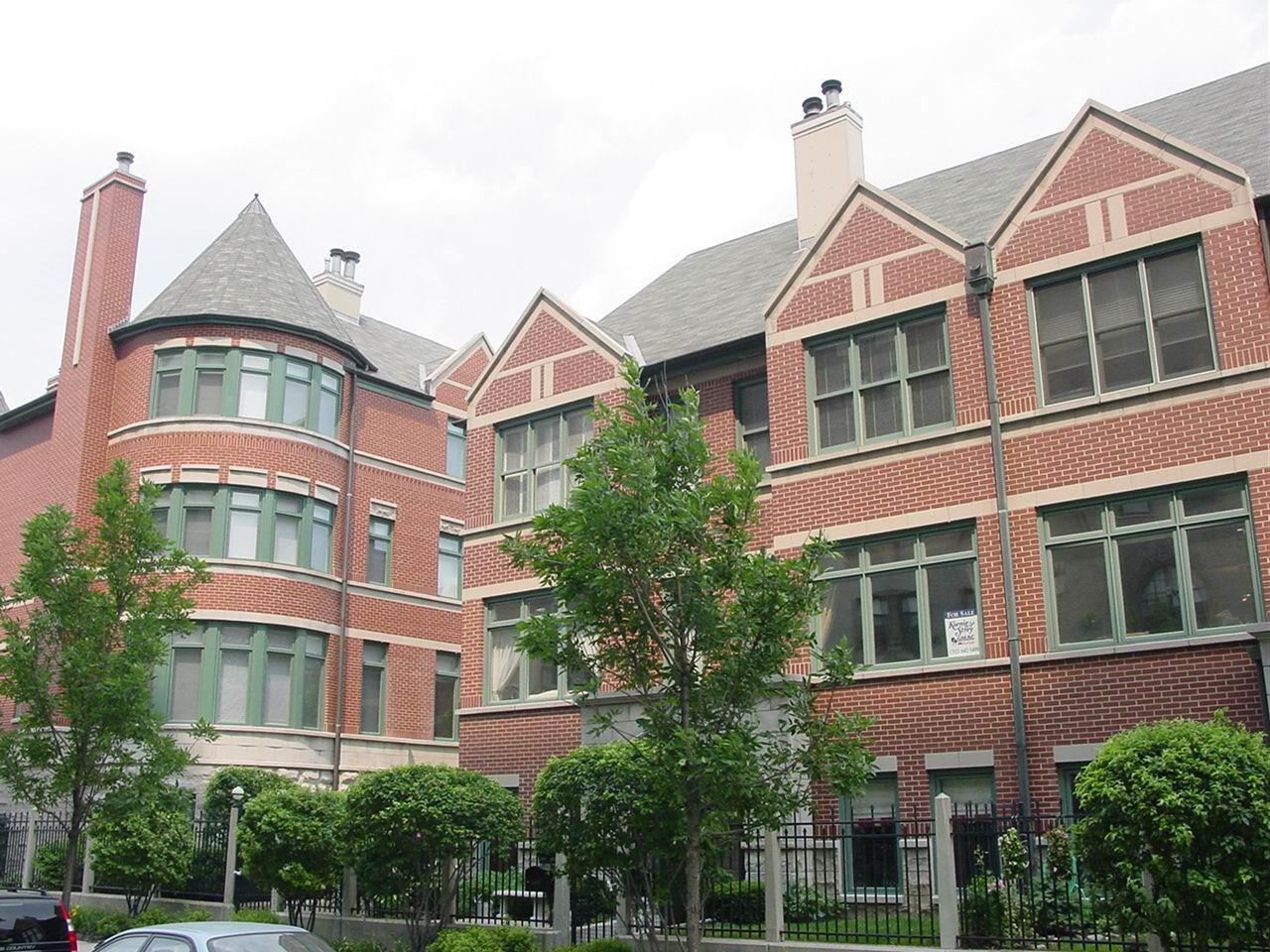
Roof forms must be articulated so that varied planes and massing within the overall roof are provided. Large, monotonous, simple pitched roofs, without breaks in the expanse of the roof, are prohibited. Dormers and gables can be used to break up large expanses of roof area. For flat roofs, cornices and parapets should be used to add variety and break up the roofline. Rooflines must be modulated at minimum every 75 feet through the use of varied roof heights.
d.
There shall be a minimum separation of ten feet between sidewalls among rows of multiple-family dwellings. Where the front or rear wall of a row of multiple-family dwellings faces the front or rear wall of another row of multiple-family dwellings, the minimum required separation between such buildings shall be a minimum of 30 feet. Driveways and parking areas may be located within this minimum separation area.
e.
Large, flat facades must be avoided, which can be accomplished by articulating the building mass to create substantial shadows and visual interest. Windows, projected entrances and overhangs must be included on the street facing facade to add variety and maintain a pedestrian-scale. When the sidewalls of multiple-family development face a street, building facades must be designed with elements of a front facade, including doors or windows.
f.
Figure A: Multiple-Family Dwelling Design Guidelines illustrates these design guidelines.
FIGURE A. MULTIPLE-FAMILY DWELLING DESIGN GUIDELINES
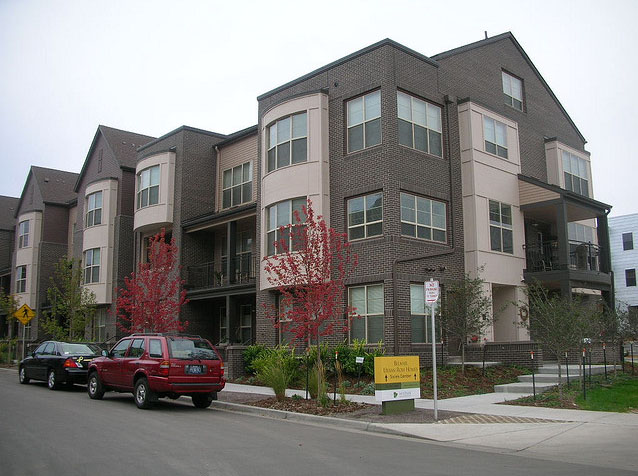
Figure A1. Building elements should be consistent along the front and side of the
building in order to avoid blank walls within the public view.
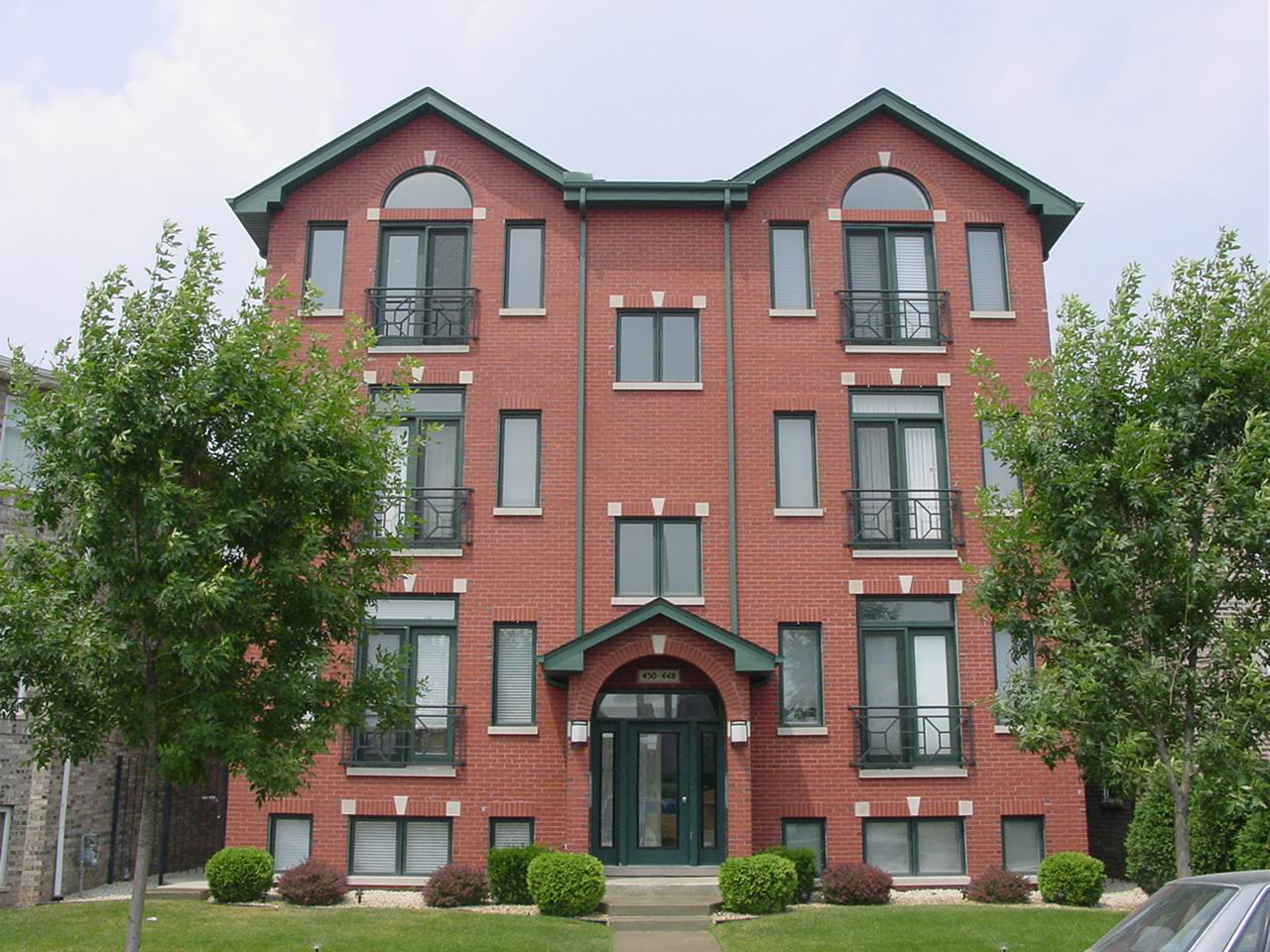
Figure A2. Facades should be designed with consistent materials and treatment that
wraps around all facades. Street-facing facades should include elements in relief
that create substantial shadows and visual interest. Juliet balconies, "punched in"
windows with detailed trim, projected entrances and overhangs are encouraged on the
front facade.
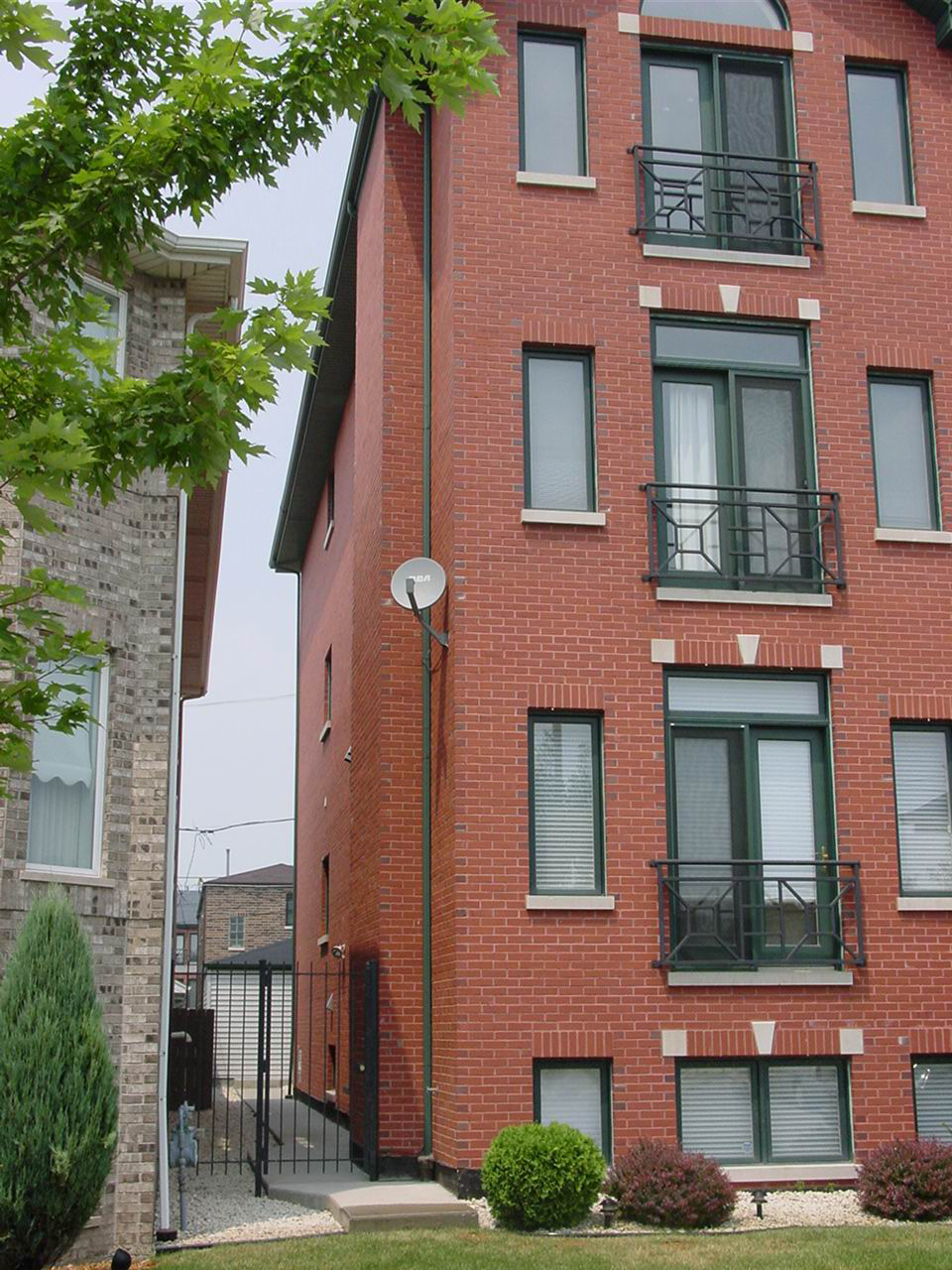
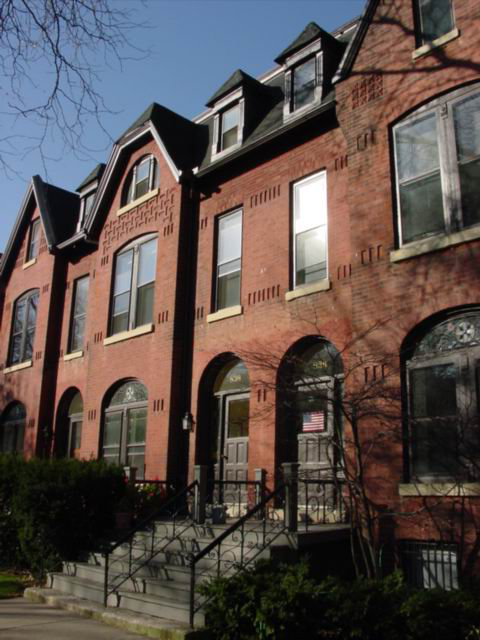
Figure A3. Dormers and gables can create breaks in the roof expanse to avoid monotonous
rooflines.
(8)
Educational facility, vocational.
a.
Vocational educational facilities shall be designed so that the location of entrances and exits, exterior lighting, outdoor recreation areas, service areas, and parking and loading facilities will minimize traffic congestion, pedestrian hazards and adverse impacts on adjoining properties.
b.
Changes to outdoor facilities that are part of an educational institution require site plan review approval for the construction of any buildings, accessory structures and exterior lighting.
(9)
Entertainment and recreation facility, indoor.
a.
Entertainment and recreation facilities of 20,000 square feet or larger, including movie theaters and casinos shall be developed as planned developments per section 56-313 pertaining to planned developments.
b.
All entertainment and recreation facilities shall be designed so that the location of entrances and exits, exterior lighting, service areas, and parking and loading facilities will minimize traffic congestion, pedestrian hazards and adverse impacts on adjoining properties.
(10)
Home occupation. Home occupations conducted in a dwelling are a revocable use and shall be compatible with the neighborhoods in which they are located and shall not interfere with the rights of the surrounding property owners to enjoy the established character of the neighborhood.
a.
The home occupation shall be conducted entirely within the dwelling and shall be clearly incidental and secondary to the use of the dwelling for residential purposes.
b.
The home occupation shall not exceed 25 percent of one story of a single-family, two-family or townhouse dwelling unit. The home occupation shall not exceed 20 percent of one story of a three-family, four-family or multifamily dwelling unit.
c.
A home occupation shall not be established prior to the members of the family conducting the home occupation taking possession of, and residing in, the dwelling.
d.
No more than two individuals who are not family members residing on the premises shall be employed as part of a home occupation.
e.
Vehicular traffic and on-street parking shall not be increased by the home occupation.
f.
The receipt, sale or shipment of deliveries shall not be permitted on or from the premises, with the exception of regular U.S. mail or an express shipping service that is characteristic of service to residential neighborhoods.
g.
A home occupation shall not generate noise, solid waste, vibration, glare, fumes, odors or electrical interference beyond what normally occurs in a residential use. No outside storage or display of materials, merchandise, inventory or heavy equipment shall be permitted.
h.
No exterior alteration that changes the residential character of the principal building shall be permitted. No exterior building signs are permitted.
i.
Any type of motor vehicle service and repair is a prohibited home occupation. Day care homes are not considered a home occupation.
j.
Catering and food manufacturing services are permitted only upon compliance with building and health department inspections and approvals.
(11)
Motor vehicle dealership, motor vehicle rental establishment and motor vehicle service and repair.
a.
Motor vehicle service and repair shops may not store the same vehicles outdoors on the site for longer than 20 business days. Consideration for due diligence and objective good faith efforts towards compliance will be given at the direction of village officials prior to citation issuance.
b.
All driveways must be located and designed to ensure that they will not adversely affect the safety and efficiency of traffic circulation on adjoining streets.
c.
All repair operations shall be fully enclosed. Wrecked or junked vehicles shall not be stored for longer time periods than those specified above and shall be screened from the public right-of-way and any adjacent residential districts.
d.
Motor vehicle service and repair shops may also include automobile service stations as an accessory use. All automobile service stations which are part of such an establishment must comply with the regulations of subsection (2) of this section, pertaining to automobile service station.
(12)
Outdoor dining. Outdoor dining is considered a separate use, rather than accessory to the principal use, and shall be subject to the following standards:
a.
Outdoor dining shall not interfere with the pedestrian access or parking spaces and aisles. Unless otherwise permitted by the village, outdoor dining areas shall be located only on private property.
b.
Outdoor dining shall not be located in any required yard that abuts a residential use or district, unless an alley is located between the use and a residential use or district.
(13)
Retail goods establishment. Retail goods establishments of 20,000 square feet or larger shall be developed as planned developments per section 56-313 pertaining to planned developments.
(14)
Utility, private. Private utilities shall be designed so that the location of entrances and exits, exterior lighting, service areas, and parking and loading facilities will minimize traffic congestion, pedestrian hazards, and adverse impacts on adjoining properties. Additional landscaping and screening may be required at the discretion of the building commissioner. Any above ground private utility structures, such as pedestals for cable wire access or other access points for underground infrastructure (communications wiring, fiber optic, etc.) may not encroach into the required front yard and at the discretion of the building commissioner shall be screened from view of any public right-of-way.
(15)
Adult use cannabis business establishments.
a.
Purpose and applicability: It is the intent and purpose of this subsection to provide regulations regarding the cultivation, processing and dispensing of adult-use cannabis occurring within the corporate limits of the Village of Chicago Ridge. Such facilities shall comply with all regulations provided in the Cannabis Regulation and Tax Act (P.A. 101-0027) (Act), as it may be amended from time-to-time, and regulations promulgated thereunder, and the regulations provided below. In the event that the Act is amended, the more restrictive of the state or local regulations shall apply.
b.
Adult-use cannabis craft grower: In those zoning districts in which an adult-use cannabis craft grower may be located, the proposed facility must comply with the following:
1.
Facility may not be located within 100 feet of the property line of a pre-existing public or private nursery school, preschool, primary or secondary school, day care center, day care home, residential care home, church, religious facility, or park district or recreational facility. Learning centers and vocational/trade centers shall not be classified as a public or private school for purposes of this Section.
2.
Facility may not conduct any sales or distribution of cannabis other than as authorized by the Act.
3.
For purposes of determining required parking, refer to article XII (Off-street parking and loading requirements) of the Village of Zoning Code.
4.
Applicant shall file an affidavit with the village affirming compliance with the Cannabis Regulation and Tax Act (P.A. 101-0027), as amended.
c.
Adult-use cannabis cultivation center: In those zoning districts in which an adult-use cannabis cultivation center may be located, the proposed facility must comply with the following:
1.
Facility may not be located within 100 feet of the property line of a pre-existing public or private nursery school, preschool, primary or secondary school, day care center, day care home, residential care home, church, religious facility, or park district or recreational facility. Learning centers and vocational/trade centers shall not be classified as a public or private school for purposes of this Section.
2.
Facility may not conduct any sales or distribution of cannabis other than as authorized by the Act.
3.
For purposes of determining required parking, refer to article XII (Off-street parking and loading requirements) of the Village of [Chicago Ridge] Zoning Code.
4.
Applicant shall file an affidavit with the village affirming compliance with the Cannabis Regulation and Tax Act (P.A. 101-0027), as amended.
d.
Adult-use cannabis dispensing organization: In those zoning districts in which an adult-use cannabis dispensing organization may be located, the proposed facility must comply with the following:
1.
Facility may not be located within 100 feet of the property line of a pre-existing public or private nursery school, preschool, primary or secondary school, day care center, day care home, residential care home, church, religious facility, or park district or recreational facility. Learning centers and vocational/trade centers shall not be classified as a public or private school for purposes of this section.
2.
At least 75 percent of the floor area of any tenant space occupied by a dispensing organization shall be devoted to the activities of the dispensing organization as authorized by the Act, and no dispensing organization shall also sell food for consumption on the premises other than as authorized in Section 6.4 below in the same tenant space.
3.
Facility may not conduct any sales or distribution of cannabis other than as authorized by the Act.
4.
For purposes of determining required parking, refer to article XII (Off-street parking and loading requirements) of the Village of [Chicago Ridge] Zoning Code.
5.
Applicant shall file an affidavit with the village affirming compliance with the Cannabis Regulation and Tax Act (P.A. 101-0027), as amended.
e.
Adult-use cannabis infuser organization: In those zoning districts in which an adult-use cannabis infuser organization may be located, the proposed facility must comply with the following:
1.
Facility may not be located within 100 feet of the property line of a pre-existing public or private nursery school, preschool, primary or secondary school, day care center, day care home, residential care home, church, religious facility, or park district or recreational facility. Learning centers and vocational/trade centers shall not be classified as a public or private school for purposes of this Section.
2.
At least 75 percent of the floor area of any tenant space occupied by an infusing organization shall be devoted to the activities of the infusing organization as authorized by the Act. Facility may not conduct any sales or distribution of cannabis other than as authorized by the Act.
3.
For purposes of determining required parking, refer to article XII (Off-street parking and loading requirements) of the Village of [Chicago Ridge] Zoning Code.
4.
Applicant shall file an affidavit with the village affirming compliance with the Cannabis Regulation and Tax Act (P.A. 101-0027), as amended.
f.
Adult-use cannabis processing organization: In those zoning districts in which an adult-use cannabis processing organization may be located, the proposed facility must comply with the following:
1.
Facility may not be located within 100 feet of the property line of a pre-existing public or private nursery school, preschool, primary or secondary school, day care center, day care home, residential care home, church, religious facility, or park district or recreational facility. Learning centers and vocational/trade centers shall not be classified as a public or private school for purposes of this Section.
2.
At least 75 percent of the floor area of any tenant space occupied by a processing organization shall be devoted to the activities of the processing organization as authorized by the Act. Facility may not conduct any sales or distribution of cannabis other than as authorized by the Act.
3.
For purposes of determining required parking, refer to article XII (Off-street parking and loading requirements) of the Village of [Chicago Ridge] Zoning Code.
4.
Applicant shall file an affidavit with the Village affirming compliance with the Cannabis Regulation and Tax Act (P.A. 101-0027), as amended.
g.
Adult-use cannabis transporting organization: In those zoning districts in which an adult-use transporting organization may be located, the proposed facility must comply with the following:
1.
Facility may not be located within 100 feet of the property line of a pre-existing public or private nursery school, preschool, primary or secondary school, day care center, day care home, residential care home, church, religious facility, or park district or recreational facility. Learning centers and vocational/trade centers shall not be classified as a public or private school for purposes of this section.
2.
The transporting organization shall be the sole use of the tenant space in which it is located. Facility may not conduct any sales or distribution of cannabis other than as authorized by the Act.
3.
For purposes of determining required parking, refer to article XII (Off-street parking and loading requirements) of the Village of [Chicago Ridge] Zoning Code.
4.
Applicant shall file an affidavit with the village affirming compliance with the Cannabis Regulation and Tax Act (P.A. 101-0027), as amended.
h.
Additional requirements:
1.
Applicant shall provide a security plan as described herein. Applicant shall install building enhancements, such as security cameras, lighting or other improvements to ensure the safety of employees and customers of the adult-use cannabis business establishments, as well as its environs. Said improvements shall be determined based on the specific characteristics of the floor plan for an adult-use cannabis business establishment and the site on which it is located, consistent with the requirements of the Act.
2.
A security plan shall be submitted, to ensure the safety of employees, patrons and the public to protect the premises from theft or criminal activity. The police chief, or their designee, may offer comments regarding the security plan. The security plan shall include, but not be limited to, the following:
i.
An interior floorplan (including secured areas, windows, doors, etc.).
ii.
Exterior lighting.
iii.
Exterior fencing (if any).
iv.
Exterior gates (if any).
v.
Alarms.
3.
Signage. All signage and advertising for adult-use cannabis business establishment shall comply with all applicable state laws and village code requirements.
4.
Applicant shall provide a transportation plan as described herein. A proposed adult-use cannabis business establishment shall prepare and submit a transportation plan that will, among other things, provide a detailed analysis of how the use may impact traffic and parking in the area immediately surrounding the proposed site of an adult-use cannabis business establishment and how best practices of the industry may be utilized to address traffic and parking.
5.
Cannabis plants, products, and accessories shall not be visible from outside the building or any adult-use cannabis business establishment. All aspects of an adult-use cannabis business establishment relative to the cultivation, possession, processing, sales, distribution, dispensing or administration of cannabis, cannabis products, or related supplies must take place at a fixed location within a fully enclosed building and shall not be visible from the exterior of the building. An adult-use cannabis business establishment shall not be located in a trailer, storage freight container, motor vehicle or other similar movable enclosure. No outside storage of cannabis, cannabis products, cannabis accessories or related supplies is permitted.
6.
An adult-use cannabis business establishment shall provide an odor control plan that provides for proper and adequate ventilation at such facilities in such a manner so as to prevent pesticides, insecticides or other chemicals used in the cultivation or processing of cannabis or cannabis related products from being dispersed or released outside the facilities. All resulting odors, smoke, vapor, fumes, gases and particulate matter from cannabis or its processing or cultivation shall be effectively confined to the premises or so disposed of so as to avoid any air pollution.
i.
Co-location of cannabis business establishments. The village may approve the co-location of an adult-use cannabis dispensing organization with an adult-use cannabis craft grower center, subject to the provisions of the Act and the Zoning Code criteria within the Village of Chicago Ridge Municipal Code. In a co-location, the floor space requirements of subsection (15)(d)(2) shall not apply, but the co-located establishments shall be the sole use of the tenant space.
(Ord. No. 12-10-22, § 3, 10-16-2012; Ord. No. 19-12-22, § 4, 12-3-2019; Ord. No. 24-01-02, § 4, 1-16-2024)

