
Cicero Town City Zoning Code
ARTICLE IV
SUPPLEMENTARY DISTRICT REGULATIONS
Sec. 54-349. - General application.
The regulations set forth herein shall supplement or modify the regulations set forth in this chapter.
(Code 1992, § 17.40(1))
Sec. 54-350. - Setbacks on federal, state and county highways.
The front yard setback requirements enumerated in this chapter are applicable to local streets and highways. Front yard setback requirements for federal, state and county trunk highways are 55 feet. Setback requirements for federal, state and county highways are subject to section 54-351.
(Code 1992, § 17.40(2))
Sec. 54-351. - Lots and yards.
(a)
More than one building on a lot. In any district more than one building housing a principal use may be erected on a single lot, provided that yard and other requirements of these regulations shall be met for each building as though it were on an individual lot, unless otherwise specified in this chapter for planned commercial or residential developments.
(b)
Through lots and corner lots. On through lots or lots with double frontage, the required front yard shall be provided on each street. On corner lots, the street side yard shall equal the required front yard for lots fronting on that street.
(c)
Development in mapped streets. Where an official line has been established for the future widening or opening of a street, the depth of a front yard or the width of a side yard shall be measured from such official line to the nearest line of the building.
(d)
Access. Every building housing a principal use hereafter erected or moved shall be on a lot with access to a public street and all such buildings shall be so located as to provide safe and convenient access for servicing and off-street parking, unless otherwise specified in this chapter.
(e)
Building groups. In any nonresidential district, a group of buildings separated only by common or party walls shall be considered as one building.
(f)
Yard encroachments. Every part of every required front and side yard shall be open and unobstructed by structures from 30 inches above the general ground level of the graded lot upward to the sky, except as hereinafter provided or as otherwise permitted in these regulations:
(1)
Roof eaves may project into a required side yard not more than three feet where the required side yard is eight feet or more in width. Roof eaves may project into a required side yard not more than two feet where the required side yard is less than eight feet.
(2)
Sills, belt courses, cornices, vertical solar screens and other ornamental features may project not over one foot into a required yard.
(3)
Fire escapes, stairways and balconies, whether unroofed, open and unenclosed or enclosed, shall not intrude into required yards.
(4)
Solar collectors which are part of the principal building may extend into a required rear yard for a distance not to exceed ten feet and solar collectors may extend into a required side yard, provided that they have a minimum seven feet clearance from grade and provided further that such extension shall be at least five feet distant from the adjacent lot line and shall not extend more than three feet from the building.
(g)
Telephone, television, natural gas and power transmission lines. Telephone, television, natural gas and power transmission lines may be constructed within the setback lines and additions to and replacements of existing lines may be made, provided that the utility owner first file with the county an agreement in writing that they will remove at their expense all new lines, additions and replacements constructed after the effective date of the ordinance from which this subsection is derived, when such removal is necessary for the improvement of the highway.
(Code 1992, § 17.40(3))
Sec. 54-352. - Accessory uses and structures.
(a)
Accessory building number limits. In any residential district, in addition to the principal building, a detached garage or attached garage and one additional accessory building may be placed on a lot. No accessory building shall be built on a lot without a principal building.
(b)
Attached accessory buildings. All accessory buildings which are attached to the principal building shall comply with the yard requirements of the principal building.
(c)
Detached accessory buildings. No detached accessory building shall occupy any portion of the required front yard and no detached accessory building shall occupy more than 30 percent of the rear yard or be located within three feet of any other accessory building, principal building or lot line.
(d)
Accessory structures. Notwithstanding fences, residential driveways and parking lots, unless otherwise provided by these regulations, no structure shall be located within three feet of any accessory building, principal building or lot line.
(e)
Fences, walls, hedges. Ornamental fences, walls and hedges may be permitted in any required yard or along the edge of any required yard; provided, however, that in residential districts no such fence, wall or hedge shall exceed a height of 3½ feet along the sides or front edge of any front yard and no such fence, wall or hedge shall exceed a height of eight feet in any other required yard.
(f)
Accessory parking and storage in residential districts. Accessory parking and storage restrictions in residential districts are as follows:
(1)
There shall be no customary storage of any sports vehicle, boat, boat trailer, utility trailer, camper or any like business or recreational vehicle in the required front yard of any residential district.
(2)
No person shall park or store more than two unlicensed motor vehicles. No person may offer any motor vehicles for sale on a recurrent basis in any residential district.
(3)
No person shall store in the open more than three full cords of firewood in any residential district. No firewood shall be stored in any required front yard or closer than two feet to any residential lot line.
(Code 1992, § 17.40(4); Ord. of 6-24-1997, § 17.40(4))
Sec. 54-353. - Height exceptions.
The height limitations in this chapter do not apply to belfries, cupolas, antennas, water tanks, elevator bulkheads, chimneys, spires, flagpoles or other appurtenances usually required to be placed above the roof level and not intended for human occupancy.
(Code 1992, § 17.40(5))
Sec. 54-354. - Corner visibility.
On any corner lot in all zoning districts, no fence, wall, hedge, planting or structure shall be erected, placed, planted or allowed to grow in such a manner as to obstruct vision between a height of 2½ feet and ten feet above the centerline grades of the intersecting streets in the area bounded by the right-of-way lines of such corner lots and a line joining the points along such right-of-way lines 25 feet from the point of intersection.
(Code 1992, § 17.40(6))
Sec. 54-355. - Signs.
(a)
Character of signs. Flashing signs, remains, banners, streamers and all other fluttering or spinning signs shall be prohibited, except in connection with temporary sales, cultural events or civic activities. No sign shall display flashing or intermittent lights customarily associated with danger or emergencies.
(b)
Signs in residential districts. No sign in a residential district shall exceed eight feet in height or produce artificial light from within.
(c)
Signs in commercial districts. Temporary window signs advertising a sale or special event at an individual commercial establishment shall be exempt from the sign regulations.
(d)
Maintenance of signs. All signs shall be maintained so as to present a neat, clean appearance. Painted areas shall be kept in good working order.
(e)
Location of signs. No on-premises sign shall be located closer than ten feet to the right-of-way. If located within the setback, all signs shall have at least 12 feet of clear space, exclusive of supporting structure, for visibility purposes.
(f)
Signs on public or semipublic institutional use properties (i.e., park, school, church, nursing home, town hall, police or fire department, library, museums, non-profit civic clubs, and the like):
1.
Detached signs: Two detached on- or off-premises signs shall be allowed per road frontage, maximum 50 square feet in area per sign face, maximum height of eight feet.
a.
Spacing requirement: No closer than 100 feet to another detached sign.
b.
Off-premises placement: The sign shall be located within 2,000 feet of the institutional use advertised.
2.
Flat sign: One wall sign shall be allowed per side of building facing a road frontage, with the signage area not to exceed ten percent of the wall area.
(Code 1992, § 17.40(7); Ord. No. G-2021-22, 12-14-2021)
Sec. 54-356. - Off-street parking.
(a)
Requirements not specified. Parking requirements for a use not specified shall be the same as required for a use of similar nature or sufficient off-street parking shall be provided such that no public street shall be used for parking.
(b)
Changes in buildings or use. Whenever a building or use is changed, structurally altered or enlarged to create a need for an increase of 25 percent or more in the number of existing parking spaces, such spaces shall be provided on the basis of the enlargement or change. Whenever a building or use is enlarged to the extent of 50 percent or more in the floor area, such building or use shall then comply with the parking requirements set forth in the district in which it is located.
(c)
Mixed uses. In the case of mixed uses, the parking spaces required shall equal the sum of the requirements of the uses computed separately.
(d)
Joint use. Two or more uses may provide required off-street parking spaces in a common parking facility less than the sum of the spaces required for each use individually, provided such uses are not operated during the same hours. A written agreement shall accompany any joint use arrangement.
(e)
Off-lot parking. Required off-street parking spaces shall be located on the same lot with the principal use or, when this requirement cannot be met, such parking spaces may be located off-lot, provided the parking spaces are located in the same district. Off-lot parking spaces must also be held in fee simple ownership by the owner of the use requiring such parking or be leased or rented through a written agreement. Off-lot parking spaces for residential uses shall be within 200 feet of the principal entrance or the entrance for the individual occupants for whom the spaces are reserved, while the farthest portions of a parking lot for all other uses shall be within 300 feet of the entrance of the establishment.
(f)
Off-street parking measurement. Floor space or area shall mean the gross floor area inside exterior walls where floor space is indicated in this chapter as a basis for determining the amount of off-street parking required.
(g)
Design standards. Each required off-street parking space shall have a stall width of at least nine feet and a stall length of at least 18 feet. Minimum width of aisles providing access to stalls for one-way traffic shall be 11 feet for 30 degree parking and 20 feet for 90 degree parking. Minimum width of aisles providing access to stalls for two-way traffic shall be 24 feet. No parking area of more than four spaces shall be designed as to require any vehicle to back into a public street. Any parking area of more than five spaces shall be sufficiently screened in the form of a solid fence or shrubbery to protect any adjacent residential uses. Large expanses of unchanneled parking areas shall be avoided by interior landscaping and safety islands. All parking areas shall be surfaced with a durable, dustproof surface consisting of concrete or bituminous concrete or of compacted gravel or crushed stone properly sealed and surface treated.
(h)
Paved parking lot. A paved parking lot shall be arranged so that no vehicles or other moveable units shall be parked closer than ten feet from the street right-of-way. A moveable unit shall include, but not be limited to, a mobile home, camping unit, snowmobile and farm equipment. In no case shall any parking be located within the limits of the vision corner.
(Code 1992, § 17.40(8))
Sec. 54-357. - Off-street loading.
(a)
Loading space requirements. The loading space requirements specified in the following table shall apply to all districts:
(b)
Multiple or mixed uses. Where a building is devoted to more than one use or to different uses and where the floor area for each use is below the minimum required for a loading space, but the aggregate floor area of the uses is above such a minimum, then off-street loading space shall be provided as if the entire building were devoted to that use in the building for which the most loading spaces are required.
(c)
Location. Required off-street loading spaces shall be located on the same lot with the principal use requiring such space. No loading space shall be located within 30 feet of the nearest point of intersection of two streets or require any vehicle to back into a public street.
(d)
Design standards. Each off-street loading space shall have a width of at least 12 feet, a length of at least 45 feet and a vertical clearance of at least 14 feet. Dimensions for loading spaces in connection with funeral homes shall be reduced to ten feet in width, 25 feet in length and eight feet in vertical clearance. Every loading space shall be sufficiently screened in the form of a solid fence or shrubbery to protect any neighboring residence.
(Code 1992, § 17.40(9))
Sec. 54-358. - Common open space.
(a)
Exclusions. Common open space shall not include street rights-of-way, driveways, parking areas or yards required in connection with any building.
(b)
Buildings and structures. Common open space areas may contain complementary buildings and structures appropriate for the recreational use and enjoyment of the residents of the development for which it was established.
(c)
Reservation. When common open space or any portion thereof is to be reserved for the exclusive use and enjoyment of the residents of the development from which it was established, the developer shall establish conditions as to the ownership, maintenance and use of such areas as deemed necessary to ensure preservation of its intended purposes. Land designated as common open space shall be restricted by appropriate legal instrument as open space perpetually or for a period of not less than 99 years. Such instrument shall be binding upon the developer, his successors and assigns and shall constitute a covenant running with the land and be recorded as a condition of approval.
(d)
Maintenance. In the event that common open space is improperly maintained, the appropriate town may serve written notice upon any property owner or association setting forth the manner in which the property owners or association has failed to maintain the common open space and demand maintenance deficiencies to be corrected within 30 days. If the deficiencies as originally set forth or subsequently modified are not corrected within 30 days, the town may enter upon such common open space and correct maintenance deficiencies. The cost of such maintenance shall be assessed ratable against the properties within the development that have the right to use the area and shall become a tax lien on such properties. The town shall file notice of any liens in the office of the town clerk.
(Code 1992, § 17.40(10))
Sec. 54-359. - Landscaped buffer.
The use of properly planted and maintained buffer areas may reduce and ease potential incompatibility between and among different uses of land in proximity to each other.
(1)
Requirements. Where these regulations require a landscaped buffer area, the following requirements shall be met:
a.
The landscaped buffer area shall not be less than eight feet in width measured at right angles to property lines and shall be established along the entire length of and contiguous to the designated property line or lines.
b.
The area shall be so designed, planted and maintained as to be 75 percent or more opaque between two feet and six feet above average ground level when viewed horizontally.
c.
Types and numbers of plantings for landscaped buffers shall be submitted with application for a building permit or special exception, along with plans and statements demonstrating how the buffer will be maintained in the future.
d.
Plantings shall be of a size and type which will ensure the meeting of the 75 percent opacity requirement within no longer than 12 months of the date of the first planting.
e.
Failure to maintain the landscaped buffer area as set out in this subsection (1) of this section shall be a violation of these zone regulations.
(2)
Substitution for landscaped buffer area. Except when otherwise specifically provided by these regulations, a six-foot high opaque structure set in a six-foot wide landscaped buffer area may be substituted for the six-foot high planted buffer. If such opaque structure is of nonliving material, for each ten feet thereof, an average of one shrub or vine shall be planted abutting such barrier, but need not be spaced ten feet apart. Such shrubs or vines shall be planted along the outside of such barrier, unless they are of sufficient height at the time of planting to be readily visible over the top of the barrier. The remainder of the required landscaped areas shall be landscaped with grass, ground cover or other landscaping.
(3)
Sight distance. When an accessory intersects a public right-of-way, all landscaping shall provide unobstructed visibility at a level between 2½ feet and ten feet as provided in section 54-354. No structure of landscaping, except required grass or ground cover, shall be located closer than three feet from the edge of any access.
(Code 1992, § 17.40(11))
Sec. 54-360. - Billboards.
(a)
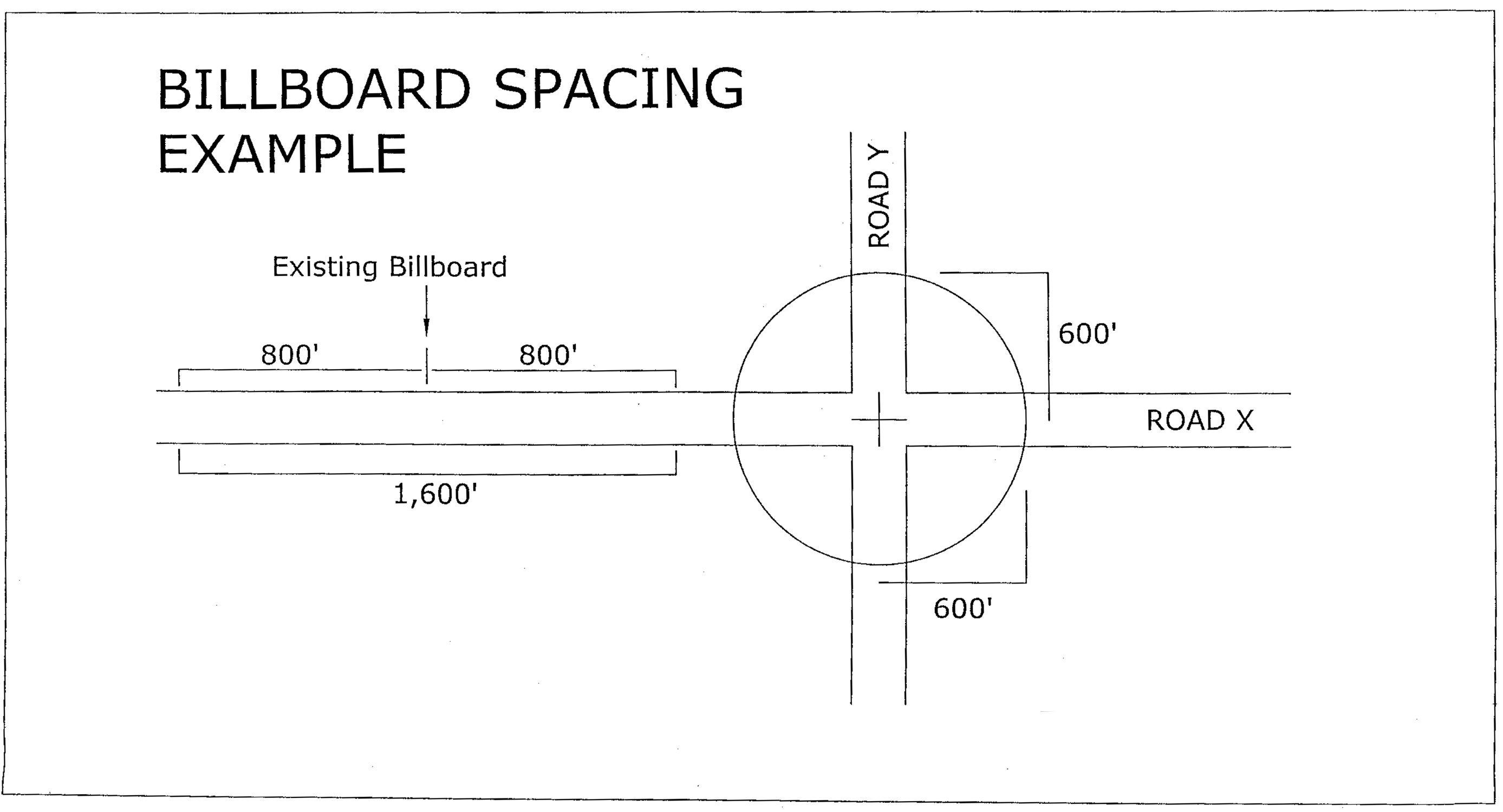
No billboard may be erected within 800 feet of another billboard as measured along both sides of the highway or within 600 feet of the intersecting centerlines of two roadways.
 .
.
(b)
No billboard may be erected within 500 feet of an existing residential use or within 200 feet of a residential zoning district.
(c)
Maximum size of billboards shall be 700 square feet per structure, inclusive of border and trim, but exclusive of base supports or other structural members.
(d)
Roof-mounted billboards are prohibited.
(e)
Highway setback for a billboard shall be 55 feet.
(f)
The maximum height of a billboard is 50 feet, including supports, base, etc.
(g)
Billboards which are back-to-back, side-by-side, bottom-on-top and V-shaped shall be considered as one structure if they are physically contiguous and share a common structure in whole or in part.
(h)
Billboards may be illuminated, subject to the following restrictions:
(1)
Billboards which contain, include or are illuminated by any flashing, intermittent or moving lights are prohibited, except for the purpose of giving public service information, such as time, date, temperature, weather or similar information.
(2)
Billboards which are not effectively shielded as to prevent beams or rays of light from being directed at any portion of the traveled portion of a highway and which are of such intensity or brilliance as to cause glare or to impair the vision of the driver of any motor vehicle are prohibited.
(3)
No billboard shall be so illuminated that it interferes with the effectiveness of or obscures an official traffic sign, device or signal.
(i)
No billboard shall be erected on more than four steel uprights, and all newly permitted billboards shall include an apron or trim around the face of the sign. All billboards shall have no less than eight feet of under-clearance.
(j)
All new structures shall be engineered to withstand a wind load pressure of 30 lbs. per square foot. A structural blueprint with engineering specifications shall accompany the application for a special exception permit.
(Code 1992, § 17.40(12))
Sec. 54-384. - Intent.
It is the intent of this division to allow for the necessary radio, television, cellular and other wireless communication; to encourage collocation and utilization of existing structures; and to minimize visual impacts to surrounding properties.
(Ord. of 6-24-1997, § 17.54(1))
Sec. 54-385. - Definitions.
The following words, terms and phrases, when used in this division, shall have the meanings ascribed to them in this section, except where the context clearly indicates a different meaning:
Alternative tower structure means clock towers, bell steeples, light poles, electric transmission tower facilities, silos and similar mounting structures that camouflage or conceal the presence of antennas.
Antenna means any exterior transmitting or receiving device mounted on a tower, building or structure and used in communications that radiate or capture electromagnetic waves, digital signals, analog signals, radio frequencies, excluding radar signals, wireless telecommunication signals or other communication signals.
Collocation means location of multiple antennas of more than one commercial wireless communication service provider or governmental entity on a single tower or structure.
FAA means Federal Aviation Administration.
FCC means Federal Communications Commission.
Pre-existing tower/antenna means any tower or antenna for which a building permit or special exception permit has been properly issued prior to the effective date of the ordinance from which this division is derived.
Tower means any structure that is designed and constructed for the purpose of supporting one or more antennas for telephone, radio and similar communication purposes, including self-supporting lattice towers, guyed towers or monopoly towers. The term "tower" includes radio and television transmission towers, microwave towers, common-carrier towers, cellular telephone towers, alternative tower structures and the like. The term "tower" includes the structure and any support thereto.
(Ord. of 6-24-1997, § 17.54(2))
Sec. 54-386. - Applicability.
(a)
The requirements of this division shall apply to all communication towers and antennas, except for towers and antennas owned and operated by federally licensed amateur radio station operators or are receive-only antennas.
(b)
Preexisting towers and antennas shall also be exempt from these regulations.
(c)
Antennas or towers located on property owned, leased or otherwise controlled by a unit of government shall be exempt from the requirements of this division, provided a license or lease authorizing such antenna or tower has been approved by the governing authority.
(Ord. of 6-24-1997, § 17.54(3))
Sec. 54-387. - Antennas.
(a)
Permitted use. Installing an antenna on an existing alternative tower structure or existing tower shall be permitted in any zoning district, provided the antenna adds no more than 20 feet to the height of the existing structure. Where the addition of the antenna adds more than 20 feet to the height, a special exception permit shall be required.
(b)
Design. If an antenna is installed on a structure other than a tower, the antenna and supporting equipment must be of a neutral color that is identical, or closely compatible with, the color of the supporting structure in order to limit visual impact.
(Ord. of 6-24-1997, § 17.54(4))
Sec. 54-408. - Permitted use.
Communication towers shall be a permitted use in the IND industrial zoning district.
(Ord. of 6-24-1997, § 17.54(5)(a))
Sec. 54-409. - Special exception use.
Communication towers shall be a special exception in the AGD general agricultural, CL local commercial, CR regional commercial and the CP planned commercial office zoning districts.
(Ord. of 6-24-1997, § 17.54(5)(b))
Sec. 54-410. - Utilizing existing structures.
No permits for a new tower shall be issued unless the applicant demonstrates that the telecommunication equipment planned for the new tower cannot be accommodated on an existing or approved tower or structure. In the event that the county determines that it is necessary to consult with a third party in considering the factors listed below, all reasonable costs and expenses associated with such consultation shall be borne by the applicant. The applicant may provide names of consultants which the applicant believes are qualified to assist in resolving the issues. Such demonstration may include one or more of the following reasons:
(1)
No existing towers or structures are located within the geographic area required to meet the applicant's engineering requirements.
(2)
Existing towers or structures are not of sufficient height to meet the engineering requirements.
(3)
Existing towers or structures do not have the structural capacity to support the applicant's proposed antenna and related equipment, and the existing tower or structure cannot be reinforced, modified or replaced to accommodate planned equipment at a reasonable cost.
(4)
The planned equipment would cause interference affecting the usability of the other existing or planned equipment at the tower or the existing antennas would cause interference with the applicant's proposed antenna, and the interference cannot be prevented at a reasonable cost.
(5)
The fees, costs or contractual provisions required by the owner to share an existing tower or structure are cost prohibitive.
(Ord. of 6-24-1997, § 17.54(5)(c))
Sec. 54-411. - Collocation.
Any proposed commercial wireless telecommunication service tower shall be designed structurally, electrically and in all respects to accommodate both the applicant's antenna and comparable antennas for up to two additional users. Towers must be designed to allow for future rearrangement of antennas upon lattice towers and to accept antennas mounted at varying heights.
(Ord. of 6-24-1997, § 17.54(5)(d))
Sec. 54-412. - Construction.
All telecommunication towers constructed, erected or located within the jurisdictional limits of this division shall comply with all applicable state and local building codes, as well as the applicable standards for towers that are published by the electronic industries association.
(Ord. of 6-24-1997, § 17.54(5)(e))
Sec. 54-413. - Design.
Proposed or modified towers shall blend in with the surrounding environment, except as may be required by rules of the Federal Avation Association and Federal Communications Commission. Any associated utility buildings shall also blend in with the character of the district in which it is located.
(Ord. of 6-24-1997, § 17.54(5)(f))
Sec. 54-414. - Lighting.
Telecommunication towers shall not be artificially lighted, unless required by the Federal Aviation Association or other applicable authority. If lighting is required, it shall be designed to cause the least disturbance to surrounding views as possible.
(Ord. of 6-24-1997, § 17.54(5)(g))
Sec. 54-415. - Signage.
No signs or billboards, other than warning or equipment information signs, shall be located on any telecommunication tower.
(Ord. of 6-24-1997, § 17.54(5)(h))
Sec. 54-416. - Security and landscaping.
Ground-mounted equipment and utility buildings shall be screened from view by suitable vegetation, except where a design of nonvegetative screening better reflects and complements the character of the surrounding neighborhood. The base of the telecommunication tower shall be fenced with materials impervious to sight and secured so that it is not accessible by the general public.
(Ord. of 6-24-1997, § 17.54(5)(i))
Sec. 54-417. - Setbacks.
Telecommunication towers shall be setback from adjacent property lines a minimum of 50 percent of the tower height. When part of a parcel is being leased for a tower, the boundary of the leased area shall be considered the property line.
(Ord. of 6-24-1997, § 17.54(5)(j))
Sec. 54-418. - Height restrictions.
The maximum height of a proposed telecommunication tower shall be 180 feet and shall be designed for co-location.
(Ord. of 6-24-1997, § 17.54(5)(k))
Sec. 54-419. - Separation between towers.
Separation distances between towers shall be measured by a straight line between the base of an existing tower and the base of the proposed tower. No proposed tower shall be permitted within 5,000 feet of an existing tower, unless for reasons beyond the applicant's control, such as unusual or unique topography for which no other option is available.
(Ord. of 6-24-1997, § 17.54(5)(l))
Sec. 54-420. - Minimizing interference.
The towers shall be shielded, filtered and grounded in a manner consistent with the Federal Communications Commission and the electronic industries association guidelines so as to minimize the possibility of interference with locally received transmissions. Additionally, the owner and operator of such towers shall execute an agreement holding the county harmless for any transmission or reception interference caused by such tower.
(Ord. of 6-24-1997, § 17.54(5)(m))
Sec. 54-421. - Tower owner to provide for collocation; removal of abandoned antennas.
(a)
Owner responsibility. The tower owner shall provide for collocation at market rates for others servers.
(b)
Removal of abandoned antennas and towers. Any antenna or telecommunication tower that is not operated for a continuous period of 12 months shall be considered abandoned. The owner of such antenna or tower shall remove it within 90 days of receipt of notice from the county notifying the owner of such abandonment. If the antenna or tower is not removed within the said 90-day period, the county may remove such antenna or tower at the owner's expense. If there are two or more users of a single tower, then this provision shall not become effective until all users cease operation.
(Ord. of 6-24-1997, § 17.54(5)(n), (6))
Sec. 54-443. - Permitted use.
No tower or antenna shall be installed or constructed without first obtaining a building permit. As part of the building permit application, the applicant shall provide to the County Zoning Administrator, in addition to the building inspector, a scaled site plan indicating location, type and height of the proposed tower and appurtenant equipment. The site plan shall also indicate setback distances and separation distances from existing or approved tower sites. A landscape plan should also be submitted that includes both vegetative and nonvegetative screening materials. To ensure that abandoned towers and antennas are properly dealt with, the applicant shall submit a performance bond or other financial guarantee to the county in an amount sufficient to cover the expense of removing abandoned towers and antennas.
(Ord. of 6-24-1997, § 17.54(7)(a))
Sec. 54-444. - Special exception use.
No tower or antenna shall be installed or constructed in districts that require a special exception permit prior to a public hearing, as outlined in section 54-860. The information detailed in 54-859 shall be submitted with the application for the special exception permit.
(Ord. of 6-24-1997, § 17.54(7)(b))
Sec. 54-445. - Purpose and intent.
To encourage the use of renewable energy in Outagamie County and achieve, among others, the following objectives:
(1)
Promoting clean energy: Encourage the use of local, clean, renewable, and efficient energy resources to serve both current and future generations.
(2)
Sustainable building and practices: Promote sustainable building designs and management practices, which are essential for long-term environmental responsibility.
(3)
Compliance with Wisconsin Statutes: Incorporate the requirements of Wisconsin Statutes (Wis. Stats. § 66.0401), which provide guidelines for the installation and use of solar energy systems, ensuring that they are legally compliant.
(4)
Protecting health, safety, and welfare: Support solar energy use, while protecting the community's health, safety, and welfare.
(5)
No significant impact on cost or efficiency: Avoid significantly increasing the cost of solar energy systems or decreasing their efficiency. Aim to ensure that alternative systems of comparable cost or efficiency are not hindered.
(Ord. No. Z-11-2024-25, 3-11-2025)
Sec. 54-446. - Restriction limited.
Pursuant to Wis. Stats. § 66.0401(1m) the county may not place any restriction, either directly or in effect, on the installation or use of a solar energy system, unless the restriction satisfies one of the following conditions:
(1)
Serves to preserve or protect the public health or safety.
(2)
Does not significantly increase the cost of the system or significantly decrease its efficiency.
(3)
Allows for an alternative system of comparable cost and efficiency.
(Ord. No. Z-11-2024-25, 3-11-2025)
Sec. 54-447. - General standards.
Accessory-scale solar energy systems are subject to the following requirements and the requirements of Wis. Stats. § 66.0401. Solar carports and associated electric vehicles charging equipment are a permitted accessory use on surface parking lots in all districts regardless of the existence of another building.
(1)
Site design.
a.
Height. Accessory-scale solar energy systems must meet the following height requirements:
1.
Building- or roof-mounted solar energy systems shall not exceed the maximum allowed height for the zoning district in which it is located. For purposes of height measurement, solar energy systems other than building-integrated systems shall be given an equivalent exception to height standards as building-mounted mechanical devices or equipment under section 54-353.
2.
Ground-mounted solar energy systems shall not exceed 15 feet in height when oriented at maximum tilt. Height may be increased by one foot for every two feet of additional setback beyond what is required.
3.
Solar carports shall not exceed 20 feet in height.
b.
Setbacks. Accessory-scale solar energy systems must meet the required structure setback for the zoning district and primary land use associated with the lot on which the system is located. Setback distance shall be measured from the edge of the solar energy system array.
1.
Building- or roof-mounted solar energy systems must meet the principal structure setback when attached to the principal structure and the accessory structure setback when attached to an accessory structure.
2.
Ground-mounted solar energy systems must meet the detached accessory structure setback when oriented at minimum design tilt.
(2)
Site plan/elevations. Accessory-scale solar energy systems shall provide a site plan and elevation drawing for review unless deemed unnecessary by the Zoning Administrator.
a.
The site plan shall include both existing and proposed conditions, showing locations of all solar arrays, other structures, property lines, rights-of-way, entrances, service roads, storage systems, floodplains, wetlands and other protected natural resources, topography, electrical equipment/infrastructure, and all other characteristics requested by the Zoning Administrator.
b.
Elevation drawings must be scaled and show the location of the system on the building or on the property for a ground-mount system, including the property lines, and all other characteristics requested by the Zoning Administrator.
(3)
Stormwater. Ground-mounted systems shall be exempt from impervious surface standards if the soil under the collector is maintained in vegetation and not compacted.
(Ord. No. Z-11-2024-25, 3-11-2025)
Sec. 54-448. - General standards.
Community-scale and large-scale solar energy systems are subject to the following requirements and the requirements of Wis. Stats. § 66.0401:
(1)
Site design.
a.
Height. Ground-mounted solar energy systems shall not exceed 15 feet in height when oriented at maximum tilt. Height may be increased by one foot for every two feet of additional setback.
b.
Setbacks. Community-scale and large-scale solar energy systems must meet the following setbacks:
1.
Arrays.
i.
Required setbacks for principal buildings or structures in the district in which the system is located.
ii.
Setback distance shall be measured from the edge of the solar energy system array, excluding security fencing, screening, or berm.
2.
Battery energy storage system (BESS).
i.
Minimum 100 feet from exterior lot lines.
ii.
Minimum 300 feet from existing dwellings and any other existing building containing a permitted principal use.
iii.
Setback distance shall be measured from the edge of the BESS containment enclosure(s), excluding security fencing, screening, or berm.
c.
Screening. Community-scale and large-scale solar shall be screened from existing dwellings located within 300 feet of the closest array.
1.
A screening plan shall be submitted that identifies the type and extent of screening.
2.
Screening shall be consistent with section 54-359 Landscaped buffer requirements, except that screening may be located where most effective and does not need to run the entire length of the property line.
3.
The Zoning Administrator may require additional screening where they determine there is a clear interest in protecting/maintaining a viewshed.
d.
Vegetation/ground cover. The following provisions shall apply to the clearing of existing vegetation and establishment of vegetated ground cover for large-scale solar energy systems. Additional site-specific conditions may apply as required by the Zoning Administrator:
1.
Large-scale removal of mature trees on the site is discouraged.
2.
The applicant shall submit a vegetative management plan prepared by a qualified professional or reviewed and approved by a natural resource agency or authority, such as the Wisconsin Department of Natural Resources or Outagamie County Department of Land Conservation. The plan shall identify:
i.
The natural resource professionals consulted or responsible for the plan.
ii.
The conservation, habitat, eco-system, or agricultural goals, which may include: providing habitat for pollinators such as bees and monarch butterflies; providing habitat for wildlife such as upland nesting birds and other wildlife; establishing vegetation for livestock grazing; reducing on-site soil erosion; and improving or protecting surface or ground-water quality.
iii.
The intended mix of vegetation upon establishment.
iv.
The management methods and schedules for how the vegetation will be managed on an annual basis, with particular attention given to the establishment period of approximately three years.
3.
Soils shall be planted and maintained in perennial vegetation for the full operational life of the project, to prevent erosion, manage run off and build soil.
4.
Vegetative cover should include a mix of perennial grasses and wildflowers that will preferably result in a short stature prairie with a diversity of forbs or flowering plants that bloom throughout the growing season. Blooming shrubs may be used in buffer areas as appropriate for visual screening. Perennial vegetation (grasses and forbs) are preferably native to Wisconsin, but where appropriate to the vegetative management plan goals, may also include other naturalized and non-invasive species which provide habitat for pollinators and wildlife and/or other ecosystem services (i.e., clovers).
5.
Plant material. Plant material must not have been treated with systemic insecticides.
e.
Foundations. A licensed engineer shall certify that the foundation and design of the solar panel racking and support is within accepted professional standards, given local soil and climate conditions.
f.
Power and communication lines. Power and communication lines running between banks of solar panels and to nearby electric substations or interconnections with buildings shall be buried underground. Exemptions may be granted by the Zoning Administrator in instances where shallow bedrock, water courses, or other elements of the natural landscape interfere with the ability to bury lines, or distance makes undergrounding infeasible.
(2)
Stormwater. Solar collectors shall not be considered impervious surfaces if the soil under the collector is maintained in vegetation and not compacted.
(3)
Other standards and codes. All solar energy systems shall be in compliance with all applicable local, state and federal regulatory codes, including the State of Wisconsin Uniform Building Code, as amended; and the National Electric Code, as amended.
(4)
Project narrative. The applicant shall submit a project narrative providing a general description of the proposed facility, facility operations, and site design.
(5)
Site plan/elevations. The applicant shall submit a site plan and elevations for review in accordance with the following:
a.
The site plan shall include both existing and proposed conditions, showing locations of all solar arrays, other structures, property lines, rights-of-way, entrances, service roads, storage systems, floodplains, wetlands, and other protected natural resources, topography, electrical equipment/infrastructure, and all other characteristics requested by the Zoning Administrator.
b.
Elevation drawings must be scaled and show the location of the system on the building or on the property for a ground-mount system, including the property lines, and all other characteristics requested by the Zoning Administrator.
(6)
Decommissioning. A decommissioning plan shall be required to ensure that solar energy systems are properly removed after their useful life.
a.
The developer, including any successor, is responsible for the removal of the system at the end of its useful life. The site is to be restored to its pre-construction condition to the maximum extent possible, within 12 months of ceasing operations.
b.
The plan shall include the following:
1.
Provisions and steps for removal of all structures and foundations and restoration of soil and vegetation to pre-construction conditions.
2.
Estimated cost for decommissioning and restoration of the site less the project's estimated salvage value.
(7)
Financial assurance. Financial assurance shall be required in the amount adequate to cover the estimated cost of decommissioning as determined within the decommissioning plan and any subsequent amendments thereto. Financial assurance must be provided prior to the commencement of construction activities in the form of cash, irrevocable letter of credit, or other suitable financial mechanism as agreed upon by the county.
(Ord. No. Z-11-2024-25, 3-11-2025)
Sec. 54-449. - Special exception permit requirements.
All special exception permit applications are subject to, and shall be processed in accordance with, procedures set forth in division 6 of article XII of this chapter and the following:
(1)
Application requirements. Applications for special exception permits are subject to the provisions and requirements set forth in section 54-448 and shall include application materials the same.
(2)
Conditions. In evaluating a special exception permit application, the zoning committee may impose one or more conditions as may be necessary to grant approval. Such conditions and restrictions may relate to the establishment, location, construction, maintenance, operation of the use, off-site impacts and any other aspect of the use that impacts the public health, safety, or general welfare and must be based on substantial evidence. Examples of such conditions are listed below.
Example Conditions
(Ord. No. Z-11-2024-25, 3-11-2025)
Sec. 54-450. - General.
Utility-scale energy systems require a certificate of public convenience and necessity (CPCN) from the Public Service Commission (PSC) of Wisconsin. Utility-scale energy systems are subject to review and regulation by the PSC and are exempt from the requirements of this division.
(Ord. No. Z-11-2024-25, 3-11-2025)

