
Cleveland City Zoning Code
ARTICLE VI
PARKING REGULATIONS
Sec. 126-236.- Applicability.
The standards and criteria contained within this article are deemed to be minimum standards and shall apply to all uses, buildings and structures within the corporate limits of the city, unless subject to one of the following exceptions:
(a)
Central business district. The off-street parking requirements set forth in this article shall not apply to land and buildings located in the central business district.
(b)
Special exception. The board of adjustment may issue a special exception to the off-street parking requirements set forth in this article.
(Code 1998, § 126-131; Ord. No. 816, § 1, 8-14-2007; Ord. No. 2024-08-20-05, § 2, 8-20-2024)
Sec. 126-237. - General requirements.
(a)
At the time any building, use, or structure is erected, enlarged, structurally altered, or converted from one use to another which requires an increase in the number of parking spaces, off-street parking spaces shall be provided in accordance with these regulations for the use of occupants, employees, visitors and patrons. Where off-street parking facilities are provided in excess of the minimum amounts specified by this article, or when off-street parking facilities are provided but not required, said off-street parking facilities shall comply with the minimum requirements for parking and maneuvering space as specified in this article.
(b)
Off-street parking facilities shall be maintained and continued as long as the building, use or structure is continued. No person shall utilize such building, use or structure without providing the required off-street parking facilities. In addition, it shall be unlawful to discontinue or dispense with, or cause the discontinuance or reduction of, the required parking facilities apart from the discontinuance of the building, use or structure, without establishing alternative off-street parking facilities, which meet these requirements.
(Code 1998, § 126-132; Ord. No. 816, § 1, 8-14-2007)
Sec. 126-238. - Design requirements.
(a)
An off-street parking space shall not be in a street or alley right-of-way. Each off-street parking space shall be permanently reserved for the temporary storage of one automobile and connected with a street or alley that affords unobstructed ingress and egress to each space.
(b)
Each parking space shall be accessible from a street or alley through aisles and/or driveways. Off-street parking facilities shall be so arranged that in order to depart from the premises it shall not be necessary that any automotive vehicle be backed into any public street right-of-way.
(c)
Circulation within a parking area with more than one aisle shall be such that a vehicle need not enter the street in order to reach another aisle within the same parking area. Dead-end aisles are not permitted for parking spaces with angles greater than zero degrees and less than 90 degrees unless adequate turnarounds are provided. All circulation and maneuvering of vehicles shall occur without encroaching on any right-of-way or adjacent property, except in the case of joint parking facilities.
(d)
All parking spaces shall be clearly marked on the pavement with yellow or white traffic paint, curbs, or raised pavement markers approved by the city. Traffic control signs or other pavement markings shall be used as necessary to ensure safe and efficient traffic operation. The provisions of this subsection shall not apply to a single-family dwelling.
(e)
Placement, signing, and markings for fire zones shall be approved by the city's fire official.
(f)
A parking lot shall be designed to physically prevent any portion of a vehicle from encroaching or overhanging any public right-of-way line or private property line through the installation of a permanent curb, wall, or other physical barrier.
(Code 1998, § 126-133; Ord. No. 816, § 1, 8-14-2007; Ord. No. 937, § 1, 10-12-2010)
Sec. 126-239. - Joint parking facilities.
Required off-street parking for any number of separate uses may be combined in a joint parking facility under the conditions of this section, subject to the approval of a joint parking facility plan by the zoning official. Such joint parking facility plan shall be reviewed by the zoning official for conformance with this section.
(1)
Joint parking facilities permitted. Whenever two or more uses are located together in a common building, shopping center, or other integrated building complex, the parking requirements may be complied with by providing a permanent, common parking facility, cooperatively established and operated, which contains the requisite number of spaces for each use. The joint parking facility shall be located within 300 feet from all uses, and shall not be separated from such uses by arterial streets. The total number of spaces provided shall not be less than the sum of the individual requirements for all uses, unless otherwise permitted in these regulations. Spaces provided for any permanent residents of dwellings shall be clearly designated and separated from spaces provided for employees, customers and service.
(2)
Multiple ownerships and structures. Where buildings, uses or structures participating in a joint parking facility are owned by multiple owners, each owner shall provide evidence of a permanent, legal instrument, approved by the city attorney, which guarantees such owner's rights to the use of the parking facility. Any termination of or amendment to such an agreement shall be subject to the approval of the city.
(3)
Churches. Churches may establish joint parking facilities with other uses that do not have a time conflict in parking demand. However, only 50 percent of a church's required parking spaces may be provided in this manner. In addition, such joint parking facilities shall be located no more than 400 feet from the church sanctuary.
(4)
Guarantee. Joint parking facilities shall guarantee the permanency of the joint use through an appropriate legal instrument, approved by the city attorney, and filed of record.
(Code 1998, § 126-134; Ord. No. 816, § 1, 8-14-2007)
Sec. 126-240. - Computation of the number of parking spaces.
In computing the number of parking spaces required, the following rules govern:
(1)
Service areas such as mechanical rooms, attics, and closets are excluded from the calculation of floor area for determining required parking spaces.
(2)
Where fractional spaces result in computing required parking spaces, the required number of spaces must be increased to the nearest whole number.
(3)
The parking space requirements for a use not specifically listed shall be the same as those for the most similar to the proposed use, as determined by the building official.
(4)
Whenever a building or use constructed or established after the effective date of the ordinance from which this chapter is derived is changed or enlarged in floor area, number of employees, number of dwelling units, seating capacity or otherwise, to create a need for an increase of ten percent or more in the number of existing parking spaces, such spaces shall be provided on the basis of the enlargement or change. Whenever a building or use existing prior to the effective date of the ordinance from which this chapter is derived is enlarged to the extent of 50 percent or more in floor area or in the area used, said building or use shall then and thereafter comply with the parking requirements set forth herein.
(5)
In the case of mixed uses, the parking spaces required shall equal the sum of the requirements of the various uses computed separately.
(6)
Where requirements are established on the basis of the number of seats, such requirements shall be based on the seating capacity permitted by the building and/or fire code and approved by the city's building and fire officials. When determining seating capacity for a building, use, or structure utilizing bench seating, each 22 inches of bench shall be considered one seat.
(7)
Where a manufacturing/industrial use has more than one working shift of employees, parking facilities shall be adequate to accommodate overlap requirements during transition periods.
(8)
When the developer of a large-scale development can demonstrate that such development will require fewer parking spaces than required by the standards of this article, the building official may permit a reduction in the number of required parking spaces for the development. Such a reduction in parking spaces shall be justified through the development of a parking study prepared by a professional traffic engineer or transportation planner and submitted to the building official. The balance of the land necessary to meet these requirements shall be held in reserve as an undeveloped area, to meet any future needs generated by an expansion of the business, a change in land use, or underestimated parking demand.
(Code 1998, § 126-135; Ord. No. 816, § 1, 8-14-2007)
Sec. 126-241. - Off-street parking schedule.
The minimum number of parking spaces required is as follows:
OFF-STREET PARKING STANDARDS
(Code 1998, § 126-136; Ord. No. 816, § 1, 8-14-2007)
Sec. 126-242. - Minimum dimensions for off-street parking.
(a)
Section 126-241 provides the required number of spaces.
(b)
A parking space for single-family, two-family and manufactured home residential uses shall be a minimum of ten feet in width and 20 feet in length.
(c)
All parking spaces, aisles and modules shall meet the minimum requirements, as shown in the following table, provided in the table below are the minimum standards for two parking stall width options; nine-foot-wide spaces and ten-foot-wide spaces.
*Note: These requirements do not apply to single-family, two-family and manufactured home residential uses.
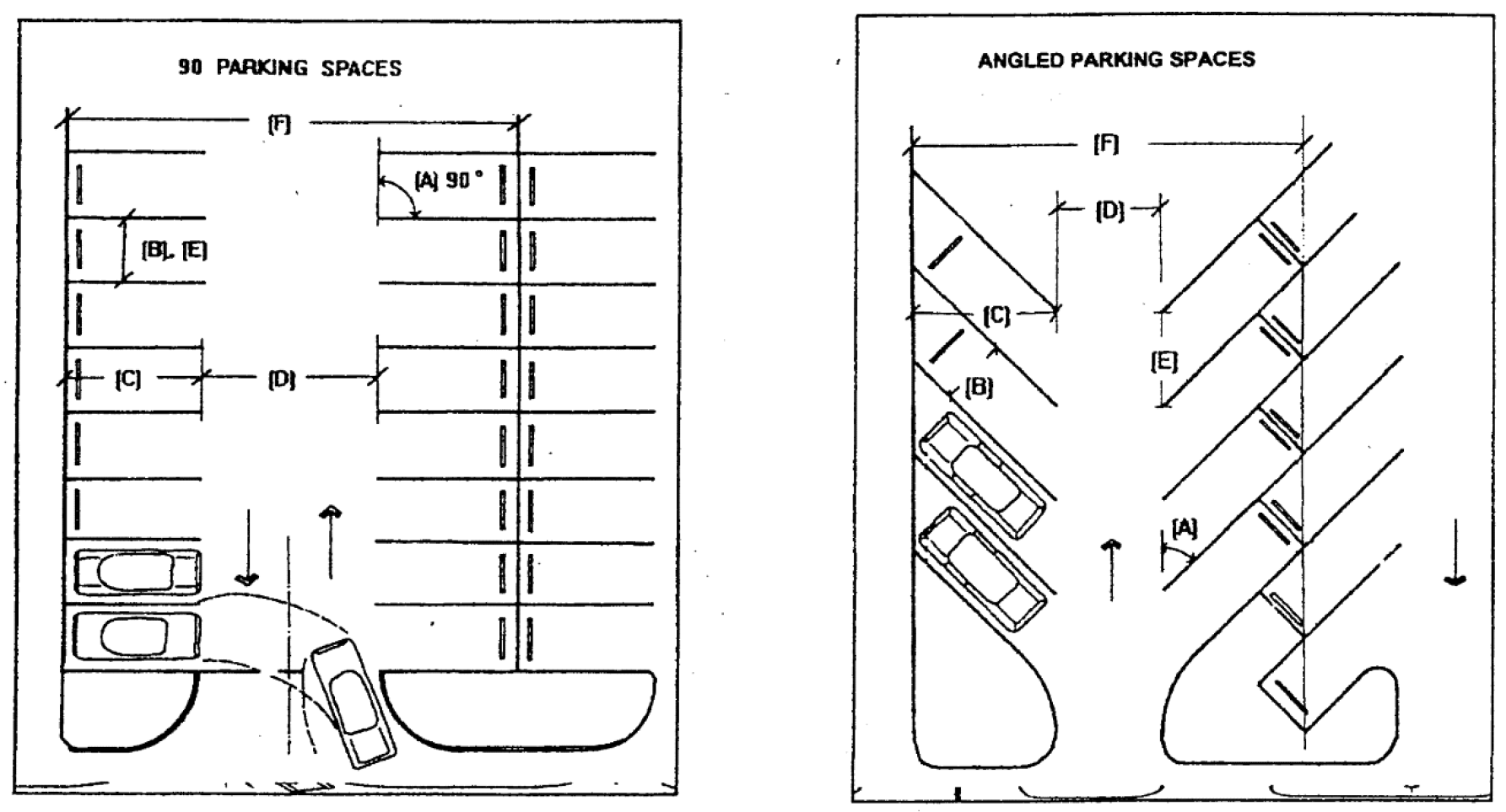
(1)
Off-street parking spaces (90-degree only) that abut a landscape island may be reduced in length to 18 feet, provided that the island is a minimum of four feet in depth and protected by wheel stops or curb.
(2)
Off-street parking spaces (90-degree only) that abut a sidewalk adjacent to a building may be reduced in length to 18 feet, provided that the sidewalk is a minimum of six feet in width.
(3)
The width of the alley may be assumed to be a portion of the maneuvering space requirement for off-street parking facilities located adjacent to a public alley.
(Code 1998, § 126-137; Ord. No. 816, § 1, 8-14-2007; Ord. No. 934, § 1, 9-14-2010)
Sec. 126-243. - Accessible parking spaces for disabled persons.
(a)
Handicap parking spaces accessible to disabled persons shall be provided in accordance with this section, the Americans with Disabilities Act (ADA), and any federal regulations promulgated hereafter. Parking lots must designate accessible spaces for use of persons with disabilities (handicap accessible spaces) as follows:
(b)
Handicap-accessible spaces must be marked and designated in accordance with the standards and specifications adopted by the commissioner of licensing and regulation of the state department of transportation under section 5(c), article 9102, Revised Statutes, relating to the identification and dimensions of parking spaces for persons with disabilities, as amended, or as otherwise required by federal or state law.
(c)
Additional handicap accessibility standards are as follows:
(1)
Parking.
a.
Accessible routes from the parking area to the building.
b.
Curb ramps a minimum of 40 inches wide with a maximum slope of 1:12 and textured surfaces.
c.
Curb cuts at each corner.
(2)
Sidewalks.
a.
Maximum level change of one-half inch.
b.
Minimum width of 48 inches.
c.
Maximum openings in surfaces of three-eighths inch.
(Code 1998, § 126-138; Ord. No. 816, § 1, 8-14-2007)
Sec. 126-244. - Parking lot lighting.
(a)
Illumination of parking areas shall be required for all parking areas with more than 20 parking spaces. The illumination may be provided through the use of light fixtures on either a pole or on a building. Lighting used to illuminate parking areas shall be arranged, located or screened to direct light away from any adjoining or abutting residential district or use or any street right-of-way. Illumination for parking areas shall be provided as follows:
(b)
The minimum amount of maintained illuminations for open parking shall be as follows:
(c)
For purposes of interpreting the table above, high-activity uses include athletic fields, large shopping malls and similar uses; medium-activity uses include fast-food restaurants and small to medium shopping centers; and low-activity uses include local merchant parking, educational parking, industrial parking, and similar uses. The light fixtures shall be arranged in order to provide uniform illumination throughout the parking lot as indicated by the uniformity ratio above of average illumination to minimum illumination. The required illumination shall be measured at the pavement.
(Code 1998, § 126-138; Ord. No. 816, § 1, 8-14-2007)

