
Cloud Lake City Zoning Code
ARTICLE I
- IN GENERAL
Sec. 28-1. - Short title.
This chapter shall be known as the "Town of Cloud Lake, Florida, Comprehensive Zoning Ordinance."
(Ord. No. 74, § 1, 3-13-1986)
Sec. 28-2. - Purpose.
This chapter is adopted for the purpose of promoting the health, safety, morals and the general welfare of the residents of the town. These regulations are designed to minimize congestion in the streets; to secure safety from fire, panic and other dangers; to enhance the benefits of adequate light and air; to prevent the overcrowding of land; to avoid undue concentration of population; and to prevent blight and the deterioration of property by regulating the height, number of stories, and size of buildings and other structures, the percentage of lot area that may be occupied, the size of yards, courts and other open spaces, the density of population, the location and use of buildings, structures, land and water, residences and other purposes, establishing setback lines, maintaining transportation facilities, public utilities, parks and other community facilities. This chapter shall implement the goals, objectives, policies and future plans as adopted in the town comprehensive development plan, as amended.
(Ord. No. 74, § 2, 3-13-1986)
Sec. 28-3. - Official zoning map.
(a)
Adoption procedure and policy. The boundaries of each of the hereinafter designated zoning districts are set forth and shown on the official zoning map which, together with all explanatory matter thereon, is hereby adopted by reference and declared to be a part of this chapter.
(b)
Signature and seal. The official zoning map shall be identified by the signature of the mayor, attested by the town clerk, and bearing the seal of the town under the following words: "This is to certify that this is the Official Zoning Map as referred to in section 3 of the Town of Cloud Lake, Florida, Comprehensive Zoning Ordinance."
(1)
Amendments and revisions. If, in accordance with the provisions of this chapter and applicable state statutes, changes are made in district boundaries or other matter portrayed on the official zoning map, said changes become effective after the amendment has been duly approved by the town council together with an entry on the official zoning map as follows:
a.
"On the date shown on the revision table, by official action of the town council, the following change was made on the Official Zoning Map."
b.
Revisions to the official zoning map only become effective when signed by the mayor and attested by the town clerk. The amending ordinance shall provide that such changes or amendments shall not become effective until they have been duly entered upon the official zoning map. No amendment to this chapter which involves matter shown on the official zoning map shall become effective until after such change and entry has been made on said map. No changes of any nature shall be made in the official zoning map or matter shown thereon except in conformity with the procedures set forth in this chapter. Any unauthorized change of whatever kind by any persons shall be considered a violation of this chapter and punishable as provided under section 28-17.
c.
Official location of zoning map. Regardless of the existence of purported copies of the official zoning map which may from time to time be made or published, the official zoning map which shall be located in the office of the town clerk shall be the final authority as the current status of land and water areas, buildings and other structures in the town.
(2)
Replacement of official zoning map. In the event that the official zoning map becomes damaged, destroyed, lost, or difficult to interpret because of the nature of changes and additions or because the town council desires to adopt a new zoning map, the town council may by resolution adopt a new official zoning map which shall supersede the prior official zoning map. The new official zoning map shall be identified by the signature of the mayor attested by the town clerk, and bearing the seal of the town under the following words: "This is to certify that this Official Zoning Map supersedes and replaces the Official Zoning Map adopted on _______, ___, _______, as part of the Town of Cloud Lake, Florida, Comprehensive Zoning Ordinance."
(Ord. No. 74, § 3, 3-13-1986)
Sec. 28-4. - Rules for interpretation of district boundaries.
Where uncertainty exists as to the boundaries of districts as shown on the official zoning map, the following rules shall apply:
(1)
Zoning district boundaries, unless otherwise indicated on the official zoning map, are the lot lines, the centerlines of streets, street rights-of-way, alleys, the corporate limits as they exist at the time of the enactment of this chapter, or other geographical or topographical features.
(2)
For any public right-of-way which is hereafter officially vacated or abandoned, the regulations applicable to each parcel of abutting property shall apply to the centerline of the property which is abandoned. In the event abandoned property is not divided at the centerline for abutting properties, the zoning districts applicable shall apply to such ownership lines as determined by virtue of such abandonment.
(3)
For any public property other than rights-of-way, the regulations applicable to the zoning classification which abuts the abandoned property for the greatest number of lineal feet shall apply to the entire property.
(4)
Submerged areas not included in district. The boundaries of all zoning districts within the corporate limits of the town which are under water and are not shown as included within any of the hereinafter designated use districts shall be construed to extend into the water area in a straight line until they meet the other district.
(5)
Where physical features existing on the ground are at variance with those shown on the official zoning map; or in other circumstances not covered by subsections (1) through (4) of this section, the board of adjustment shall interpret the district boundaries.
(6)
Plat requirements within subdivisions will be enforced by the town as to yard requirements. The town has no jurisdiction over use restrictions set forth by either plat or deed restrictions.
(Ord. No. 74, § 4, 3-13-1986)
Sec. 28-5. - Definitions.
(a)
The following words, terms and phrases, when used in this chapter, shall have the meanings ascribed to them in this section, except where the context clearly indicates a different meaning:
Abutting. See Contiguous.
Accessory use or structure means a use or structure on the same lot with, and of a nature customarily incidental and subordinate to, the principal use or structure.
Acreage means that land lying within the town limits which has not been subdivided according to the records on file in the office of the clerk of the circuit court, in and for the County of Palm Beach.
Adjacent means that which lies near or close to, not widely separated or necessarily touching.
Adjoining means that which is joined or united, actually touching.
Alley means a right-of-way which affords only a secondary means of access to property, abutting thereon and not intended for general traffic circulation.
Alterations means any change or modification in construction.
Annexation means the incorporation of land area into the town, with a resulting change in the boundaries of the town.
Apartment means a room or suite of rooms intended or designed for use as a residence by a single family, including bath and culinary accommodations.
Basement means that portion of a building between the floor and ceiling which is partly below and partly above grade, but so located that the vertical distance from grade to the floor below is less than the vertical distance from grade to ceiling; provided, however, that the distance from grade to ceiling shall be at least four feet six inches. A basement shall not be considered a story with regard to height regulations established in this chapter if the same does not exceed eight feet in height above the average level of the adjoining ground.
Bedroom means a room other than a kitchen, dining room, living room, bathroom, or closet, which is marketed, designed, or otherwise likely to function primarily for sleeping purposes.
Billboard means any combination of structure and message in the form of an outdoor sign, display, device, figure, painting, drawing, message, placard, poster, advertising structure, advertisement, logo, symbol or other form, whether placed individually or on a V-type, back to back, side to side, stacked or multifaced display or automatic changeable facing, designed, intended or used to advertise or inform, any part of the advertising message or informative contents of which is visible from any place on the main-traveled way. The term "billboard" does not include any official traffic control sign, official marker, or a specific information panel erected, caused to be erected or approved by the town.
Board of adjustment means the officially constructed body of the Town of Cloud Lake, Florida, whose principal duties are to hear and decide upon variances from the strict application of this zoning chapter and to hear and decide upon appeals regarding interpretation of the various requirements and regulations set forth herein.
Buildable area means the portion of a lot remaining after required yards have been provided.
Building means any structure, either temporary or permanent, having a roof, and used or built for the shelter or enclosure of persons, animals, vehicles, goods, merchandise, equipment, materials, or property of any kind.
(1)
Building, principal, means a building in which is conducted the main or principal use of the lot on which said building is situated.
(2)
Building, exterior wall line, means the line of a building, as established by the enclosing walls of such building designed and constructed to exclude the weather.
(3)
Building line means the line, established by law, beyond which a building shall not extend, except as specifically provided by law.
(4)
Building, front line of, means the line of that face of the building nearest the front line of the lot.
(5)
Building height means the vertical dimension measured from the average elevation of the finished lot grade at the front of the building, to the highest finished roof surface in the case of a flat roof and mansard roof and to the average height between the plate and ridge of a gable, hip or gambrel roof. Building height as defined excludes elevator, washing and equipment, penthouse structures.
(6)
Building site means a portion or parcel of land considered as a unit, devoted to a certain use or occupied by a building or group of buildings that are united by a common interest or use, and the customary accessories and open spaces belonging to the same.
Building official means that person who is appointed by the town council and is charged with the responsibility of enforcing and administering the various land and building regulations of the town.
Business service means any activity which does not involve any commercial use or personal service. Said business use shall include the rendering of services on a fee or contract basis such as real estate broker, insurance offices, accountants, financial institutions, credit reporting agencies, management, protective service, or any similar use deemed appropriate by the town.
Certificate of occupancy means a document issued by the proper authority allowing the occupancy or use of a building, and certifying that the structure or use has been constructed or will be used in compliance with all the applicable codes and ordinances of the town.
Commercial use means an establishment or premises which is specifically designed and intended for the retail sale and supply of consumer goods, commodities, and services to the general public.
Common area means the total area not designed for rental to tenants and which is available for common use by all tenants or groups of tenants and their invitees, including such areas as parking lots and their appurtenances, malls, sidewalks, landscaped areas, public restrooms, truck and service facilities, etc.
Community residential home means a dwelling unit licensed to serve residents, as defined in F.S. § 419.01l(l)(d), who are clients of the Department of Elderly Affairs, the Agency for Persons with Disabilities, the Department of Juvenile Justice, or the Department of Children and Family Services or a dwelling unit licensed by the Agency for Health Care Administration which provides a living environment for six or fewer unrelated residents who operate as a functional equivalent of a family, including such supervision and care by supportive staff as may be necessary to meet the physical, emotional and social needs of the residents.
Conservation uses means land areas designated for the purpose of conserving or protecting natural resources or environmental quality, and includes land areas for such purposes as flood control, protection of quality or quantity of groundwater or surface water, floodplain management, fisheries management, or protection of vegetative communities or wildlife habitats.
Contiguous means lands actually touching each other.
Court means an open, unoccupied space on the same lot, and fully enclosed on at least three adjacent sides by walls of the buildings. An outer court is any court facing for its full required width on a street, or on any other required open space not a court. An inner court is any other required court.
Coverage, ground. See Lot coverage.
Curb level means the officially established grade of the curb in front of the midpoint of the lot.
Density means the relationship between the number of existing or proposed number of dwelling units on a specific land area, expressed in terms of the ratio of the number of units in relation to the land area included within the building site. In computing the maximum allowable density of any building site, acreage shall not include public property or right-of-way. Where the computation of density results in a whole number plus a fraction of dwelling units per acre, the fraction shall be disregarded, i.e., 4.9 shall mean four dwelling units per acre.
Drive-in, drive-through, drive-up or drop-off facilities means establishments which by design, physical facilities, service, or by packaging procedures encourage or permit customers to receive services or obtain goods while remaining in their motor vehicles.
Dual front means a building designed or constructed so as to present the appearance of having two fronts.
Dwelling, single-family, means a detached dwelling unit designed for and occupied by one family only.
Dwelling, two-family, (duplex) means a detached building designed for or occupied exclusively by two families independently of each other.
Dwelling unit means one room connected together constituting a separate, independent housekeeping establishment for owner occupancy, or rental or lease on a monthly, or longer basis, and physically separated from any other rooms or dwelling units which may be in the same structure, and containing independent cooking and sleeping facilities.
Easement means any strip of land created by subdivider or granted by the owner, for public or private utilities, drainage, sanitation or other specified uses having limitations, the title to which shall remain in the name of the property owner, subject to the right of use designated in the reservation of the servitude.
Enforcing official means the officials and employees or their designees of the Town of Cloud Lake, Florida, to whom the duty of enforcing the terms of this zoning chapter is assigned.
Family means an individual or group of two or more persons related by blood, marriage or adoption, together with foster and step-children and servants of the principal occupants, with not more than one additional unrelated person, who are domiciled together as a single, domestic, housekeeping unit in a dwelling unit.
Fence means a manmade barrier not comprised of masonry products or vegetation located out of doors.
Frontage means all the property on one side of a dedicated public street or place between two intersecting dedicated public streets or places measured along the line of the dedicated public street or place, or if the dedicated public street or place is dead-ended, then all of the property abutting on one side between and intersecting dedicated public street or place and the dead end of the dedicated public street or place. The term "frontage" also includes dedicated ingress-egress easement when used for the only means of access. The frontage for lots abutting SR 80, is SR 80.
Garage apartment means an accessory building which contains living facilities for not more than one family, and a private garage for one or more automobiles.
Garage, parking, means a building or portion of building, or area beneath a building or structure, except those described as a private garage, used for the parking only of automotive vehicles.
Grade. The finished grade of premises improved by a building is the elevation of the surfaces of the ground adjoining the building. The minimum grade of premises, whether vacant or improved, is the curb level. The natural grade is the actual grade of the building site before the ground has been disturbed from its natural or original state.
Gross floor area means the sum of the total areas taken on a horizontal plane of a floor or several floors of a building measured between the outside face of the exterior walls.
Hedge means a row of shrubs, trees, or other plantings which, regardless of strength, by freedom of growth or by trimming constitutes a barrier to adjacent property.
Home occupation means a home occupation which by its nature has no impact on the surrounding residential neighborhood and requires no facilities other than those normally provided for a residential dwelling unit. Home occupations are typically those businesses that require only telephone service to conduct their transactions.
Impervious surfaces means land surfaces which do not allow the penetration, normal absorption or percolation of surface waters including, but not necessarily limited to, paved roads, sidewalks, driveways, parking lots and highly compacted areas such as shell or clay.
Kitchen means a space used or designed to be used for the preparation of food.
Library means a place in which books, manuscripts, musical scores, or other literary and artistic materials are kept for use but not for sale.
Lot means, for purposes of this zoning chapter, a parcel of land of at least sufficient size to meet minimum zoning requirements for use, coverage, and area, and to provide such yards and other open spaces as are herein required. Such lot shall have frontage on an improved public street, or on an approved private street, and may consist of:
(1)
A single lot of record;
(2)
A portion of a lot of record;
(3)
A combination of complete lots of record, or complete lots or record and portion of lots of record; which have unity of title;
(4)
A parcel of land described by metes and bounds; provided that in no case of division or combination shall any residual lot or parcel be created which does not meet the requirements of this zoning chapter. (Also see Subdivision).
Lot coverage means that portion of the area of a lot, plot, or building site, expressed as a percentage, occupied by all buildings or structures which are roofed or are otherwise covered.
Lot frontage. The front of a lot shall be construed to be the portion nearest the street. For the purposes of determining yard requirements on corner lots (except those lots fronting on SR 80) and through lots, all sides of a lot adjacent to streets shall be considered frontage, and yards shall be provided as indicated under yards in this section. (Also see Frontage).
Lot lines means the lines bounding a lot.
Lot measurement means as follows:
(1)
Depth of a lot shall be considered to be the distance between the midpoints of straight lines connecting the foremost points of the side lot lines in front and the rearmost points of the side lot lines in the rear.
(2)
Width of a lot shall be considered to be the distance between straight lines connecting front and rear lot lines at each side of the lot, measured across the rear of the required front yard, provided however that width between side lot lines at their foremost points (where they intersect with the street line) shall not be less than 80 percent of the required lot width except in the case of lots on the turning circle of culs-de-sac, where the 80 percent requirement shall not apply.
Lot of record means a lot which is part of a subdivision recorded in the office of the clerk of the circuit court of Palm Beach County, or a lot or parcel described by metes and bounds, the description of which has been so recorded.
Manufactured home means a closed structure, building assembly or system of sub-assemblies, which may include structural, electrical, plumbing, heating, ventilating or other service systems manufactured in manufacturing facilities for installation or erection as a finished building or as part of a finished building to be utilized for residential purposes. This definition does not apply to mobile homes.
Medical marijuana treatment center dispensing facility means an entity that acquires, cultivates, possesses, processes (including development of related products such as food, tinctures, aerosols, oils, or ointments), transfers, transports, sells, distributes, dispenses, or administers marijuana, products containing marijuana, related supplies, or educational materials to qualifying patients or their caregivers and is registered by the Florida Department of Health.
Minimum building area (minimum living area) means the area of the floor measured from the outside of the exterior walls to the centerline of dividing walls; not to include more than 20 percent of the total area of garages, carports, open porches, open breezeways, or storerooms, or screened-in porches.
Mobile home means any residential unit constructed to standards promulgated by the United States Department of Housing and Urban Development.
Nonconforming use means a use that does not conform with the regulations of the use district in which it is situated.
Off-street parking space means an area designated for the temporary parking of a motor vehicle, that is directly accessible to an access aisle or driveway, and which is not located on a dedicated street right-of-way.
Office means a building or any portion thereof which is specifically designed and intended for the transaction of a business or professional service, or for the use by a public agency.
Official zoning map means the official map of the town upon which the boundaries of each district are designated, and established as approved and adopted by ordinance of the town made a part of the official public records of the town, and which is the final authority as the zoning status of land and water areas, buildings, and other structures in the incorporated area of the town.
Open space means an exterior area, clear from the ground upward, devoid of residential and commercial buildings, accessory structures and impervious areas. Including drainage retention areas, not to include recreation buildings.
Parking garage. See Garage, parking.
Parking lot means a paved area used for the storage or the parking of motor vehicles and not including parking areas contained in a parking garage.
Parking space, off-street. See Off-street parking space.
Party wall means a wall used or adapted for joint service between two dwelling units.
Penthouse means an enclosed structure above the roof of a building, other than a roof structure or bulkhead, occupying not more than one-third of the roof area. Apartments, dwelling units or other habitable spaces shall not be contained within penthouse structures.
Permitted use means any use allowed in a zoning district and subject to the provisions and regulations applicable to that zoning district.
Person includes a firm, association, organization, partnership, trust, company, or corporation, as well as an individual.
Pervious surfaces means areas of land or a lot which allow for the normal absorption and percolation of surface waters.
Planned developments. See section 28-10(11).
Plat means a map, plan or layout of the town, section or subdivision indicating the location and boundaries of individual properties.
Plot means a parcel of ground containing more than one lot upon which a building and its necessary accessory buildings have been or may be erected.
Porch means a roofed space attached to the outside of an outer wall of a building, open on one or more sides, which may have railings, screen or glass enclosure. An open or unenclosed porch is one without railings, glass, canvas, screen or similar materials on the open sides.
Principal use means the primary activity, function, or the purpose for which a parcel of land or building is used.
Private club means buildings and facilities owned and operated by a corporation or association of persons for social or recreational purposes, but not operated primarily for profit or to render a service which is customarily carried on as a business.
Professional office means the office of a person engaged in an occupation, vocation, or calling, not commercial, mechanical, or agricultural, in which a professed knowledge or skill in some department of science or learning is used by its practical application to the affairs of others, either advising or guiding them in serving their interest or welfare through the practice founded thereon.
Professional service means the conduct of business in any of the following or related categories; law, architecture, engineering, medicine, dentistry, osteopaths, chiropractors, opticians, or consultants in these or related fields.
Property line, rear, means a property line opposite and most distant from the lot frontage. For a triangular lot, the rear property line shall mean a line of at least ten feet in length, entirely within the lot parallel to and most distant from the lot frontage line, or parallel to and most distant from the chord of a curved lot frontage line.
Property line, side, means a property line which transects the lot frontage or rear property line.
Public agency means any government or governmental agency, board, commission, authority, or public body of the Town of Cloud Lake, Palm Beach County, State of Florida, United States of America, or any other legally constituted district.
Public buildings and grounds means lands and structures that are owned, leased or operated by a government entity.
Public facilities means that which is controlled exclusively for public purposes by any department or branch of government, state, county, or municipal, without reference to the ownership of the building or of the realty upon which it is situated.
Public recreation areas means a publicly owned place designed and equipped for the conduct of sports, leisure time activities and other customary and usual recreational activities.
Public use means the use of any land, water, or building by a public agency for the general public.
Recreation areas. See Public recreation areas.
Recreational vehicle. See Travel trailer.
Residence. See Dwelling unit.
Residential use, low density, means land uses and activities within land areas used predominantly for housing. Housing types found in the town for single-family and duplex units with a density range from zero to five units per acre.
Retail sales and service. See Commercial use.
Right-of-way means a strip of land dedicated or deeded to the perpetual use of the public, such as, but not limited to, roadways, sidewalks and crosswalks.
Screening means a method of visually shielding or obscuring one abutting or nearby structure or use from another by fences, walls, berms, or densely planted vegetation.
Screening/buffering means the masking out or concealing of an area through the use of walls, fences, earthen berms, plant materials or a combination thereof for the purpose of blocking noise, lights, or other nuisances.
Setback means the horizontal distance between the front line, side line, or rear line of the building site to the front, side or rear of the building or structure respectively. Setbacks shall be measured perpendicular to the parallel with property or right-of-way lines.
Setback, centerline. See Street centerline setback.
Shall, may. The word "shall" is mandatory; the word "may" is permissive.
Special exception means use that would not be appropriate generally or without restriction throughout the zoning district, but which, if controlled as to number, area, location, or relation to the neighborhood, would promote the public health, safety, welfare, morals, order, comfort, convenience, appearance, prosperity, or the general welfare of the district and the community. Such uses may be permitted in such zoning districts as special exceptions, only if specific provisions for such special exceptions are made in the zoning district.
Story means that portion of a building included between the surface of any floor and the surface of the next floor above it, or if there is no floor above it, then the space between such floor and the ceiling next above it. In computing the height of a building, the height of a basement shall be included.
Street means any dedicated public way or ingress-egress easement as principal means of access.
Street centerline means the line midway between the street right-of-way lines of the surveyed and platted centerline of a street which may or may not be the line midway between the existing right-of-way lines or pavement.
Street centerline setback means the minimum distance measured from the street centerline required for the preservation of existing right-of-way and future right-of-way expansion.
Street right-of-way line means the line which abounds the right-of-way set aside for use as a street or public roadway.
Structural alterations means any change in the supporting members of a building, such as bearing walls, or partitions, columns, beams, or girders, or any substantial change in the roof or in the exterior walls, excepting such repairs or replacements as may be required for the safety of the building.
Structure means anything constructed or erected with a fixed location on, in or above the ground, or attached to something having a fixed location on the ground. Among other things, structures include buildings, mobile homes, billboards, greenhouses and poster panels. This does not include boundary walls or fences.
Subdivision means the platting of real property into three or more lots, parcels, tracts, tiers, blocks, sites, units or any other division of land; and includes the establishment of new streets and alleys, additions and re-subdivisions; and, when appropriate to the context, relates to the process of subdividing or to the lands or areas subdivided.
Trailer means a separate vehicle, not driven or propelled by its own power, but drawn by some independent power; to include any portable or moveable structure or vehicle including trailers designed for living quarters, offices, storage, or for moving or hauling freight, equipment, or merchandise of any kind, including boats and boat trailers.
Travel trailer orrecreational vehicle means any vehicle or structure so designed and constructed in such a manner as will permit occupancy thereof as sleeping quarters for one or more persons, and so designed that it is or may be mounted on wheels and used as a conveyance on streets or highways, propelled or drawn by its own or other motive power.
Use means any activity, function, or purpose to which a parcel of land or building is put, and shall include the words "used," "arranged," or "occupied," for any purpose including all residential, commercial, or public use.
Used or occupied includes the words "intended, utilized, or designed, or arranged to be used or occupied."
Used for includes the term "designed for."
Variance means a deviation from the district requirements of this chapter, which is granted by the zoning board of adjustment, where such variance will not be contrary to the public interest and where, owing to conditions peculiar to the physical characteristics of that particular property and not the result of the actions of the owner, agent, or applicant, a literal enforcement of this chapter would result in unnecessary and undue hardship.
Vehicle means any self-propelled conveyance designed for and used for the purpose of transporting or moving persons, animals, freight, merchandise, or any substance, and shall include passenger cars, trucks, buses, motorcycles, and scooters.
Wall means a manmade barrier comprised of masonry products located out of doors and may or may not be a part of an exterior side of a building.
Wholesale sales means of or relating to, or engaged in the sales of commodities in quantity for resale.
Yards means the unoccupied and unobstructed open spaces on the same lot with the main building which extend from the ground upward.
(1)
Front yard means the open space extending the full width of the lot, the depth of which is the minimum horizontal distance between the front lot line and the nearest line of the main building. (See also Frontage).
(2)
Rear yard means the open space extending the full width of the lot, the depth of which is the minimum horizontal distance between the rear lot line and the nearest line of the main building. (See also Propertyline, rear).
(3)
Side yard means the open space between the main building and the side lot line, extending from the front yard to the rear yard, the width of which is the horizontal distance from the nearest point of the side lot line to the nearest point of the main building. (See also Property line, side).
Zoning is a term used to describe a particular kind of public law. This law is expressed in the form of a written text usually accompanied by a map. The map divides an area of land (usually a municipality or a county) into zoning districts; the written text contains regulations governing the use and development of land and buildings within each district.
Zoning map. See Official zoning map.
(b)
Words used in the present tense include the future; the singular number includes the plural and the plural the singular; the word "lot" includes the words "plot" or "parcel"; the word "building" includes any structure other than a boundary fence or wall.
(Ord. No. 74, § 5, 3-13-1986; Ord. No. 88, § 1, 9-13-1990; Ord. No. 122, § 1, 12-8-2005; Ord. No. 147, § 1, 10-12-2017; Ord. No. 149, § 1, 3-14-2019)
Sec. 28-6. - Interpretation, purpose and effect.
(a)
Minimum requirements. In interpreting and applying the provisions of this chapter, they shall be held to be the minimum requirements for the promotion of the public health, safety, morals, and general welfare of the town.
(b)
Conflicts with other ordinances; restrictions; etc. It is not intended by this chapter to interfere with or abrogate or annul any easements, covenants or other agreements between parties; provided, that where this chapter imposes a greater restriction upon the use of buildings or premises, or upon the height of buildings, or requires larger open spaces than are imposed or required by other ordinances, rules, regulations, or by easements, covenants, or agreements, the provisions of this chapter shall control.
(c)
Areas not shown on zoning map. If, because of error or omission in the official zoning map, any property in the town is not shown as being in a zoning district, the classification of such property shall be R-1, low density residential district, unless changed by an amendment to the official zoning map.
(Ord. No. 74, § 6, 3-13-1986)
Sec. 28-7. - Districts established.
(a)
In order to regulate and limit the height and size of buildings, to regulate and limit the intensity of use of land area, to regulate and determine the areas of open space within and around surrounding buildings, to classify, regulate and redistrict the location of commercial uses and the location of buildings designed for specified residential uses, the town hereby is divided into districts, of which there shall be two, known as:
(1)
R-1, Low density residential district.
(2)
BP, Business professional district.
(b)
The boundaries of the districts shall be as shown upon the official zoning map adopted by this chapter.
(c)
In the creation of the respective zoning districts of the town, the town council has given due and careful consideration to the peculiar suitability of each district for the particular regulations applied thereto, and the necessary proper and comprehensive groupings and arrangements of the various uses and densities of population in accordance with a well-considered plan for the development of the town.
(Ord. No. 74, § 7, 3-13-1986)
Sec. 28-8. - Application of district regulations.
The regulations set by this chapter within each district shall be the minimum regulations and shall apply uniformly to each class or kind of structure or land, and particularly, except as hereinafter provided:
(1)
No building, structure, or use of land shall hereafter be used or occupied, and no building or structure or part thereof shall hereafter be erected, constructed, reconstructed, moved, or structurally altered, except in conformity with all of the regulations herein specified for the district in which it is located.
(2)
No building or other structure shall hereafter be erected or altered:
a.
To exceed the height or bulk;
b.
To accommodate or house a greater number of families;
c.
To occupy a greater percentage of lot area;
d.
To have a narrower or smaller rear yard, front yard, side yard, or other open space;
than herein required; or in any other manner contrary to the provisions of this chapter.
(3)
No part of a yard, or other open space, or off-street parking or loading space required about or in connection with any building for the purpose of complying with this chapter, shall be included as part of a yard, open space, or off-street parking or loading space similarly required for any other building.
(4)
No yard or lot existing at the time of the passage of this chapter shall be reduced in dimension or area below the minimum requirements set forth herein. Yards and lots created after the effective date of the ordinance from which this chapter is derived shall meet at least the minimum requirements established by this chapter.
(5)
All territory which may hereafter be annexed into the town shall be considered to be in the appropriate zone classification compatible to adjacent districts and shall also be consistent with state annexation law.
(6)
No building or other structure shall hereafter be erected or altered except when in strict conformance with all other building, housing and land development regulations adopted by the town.
(Ord. No. 74, § 8, 3-13-1986; Ord. No. 88, § 2, 9-13-1990)
Sec. 28-9. - District regulations.
The following regulations shall govern development within all established zoning districts:
(1)
R-1, low density residential district.
a.
Purpose of district. The purpose of this district is to provide for residential development of spacious character together with publicly operated recreational facilities, governmental uses and accessory uses as may be necessary or are normally compatible with residential surroundings. This district is located throughout the town to protect existing development of high character from those districts and uses which would be incompatible to low density residential development.
b.
Permitted uses. Only the following uses shall be permitted within this zoning district. Any use not specifically mentioned as being permitted shall be considered as prohibited. Any nonspecified use existing at the time of passage of this chapter shall be considered nonconforming.
1.
Single-family dwellings.
2.
Duplexes or two-family dwellings.
3.
Conservation.
4.
Community residential homes.
5.
Home occupations providing the same meet the criteria as set forth in section 28-10(8).
c.
Accessory uses. Any uses customarily incidental to permitted uses not involving the conduct of business.
d.
Special exceptions. Special exceptions are as follows:
1.
Public recreation areas.
2.
Public facilities.
e.
Prohibited uses. Prohibited uses are as follows: Any use not specifically permitted.
f.
Minimum lot size. Minimum lot size - 12,500 square feet.
g.
Minimum lot width. Minimum lot width - 100 feet.
h.
Maximum lot coverage. Maximum lot coverage - 40 percent.
i.
Minimum front yard. Minimum front yard - 25 feet; except waterfront, 30 feet.
j.
Minimum side yard. Minimum side yard - 7.5 feet on interior.
1.
Corner lot -15 feet.
2.
Waterfront - 15 feet if side yard is waterfront.
k.
Minimum rear yard. Minimum rear yard - 30 feet for principal structures: 15 feet for accessory structures; both measured from rear lot line as shown on plat recorded at Plat Book 18, page 46.
l.
Maximum building height. Maximum building height - Two stories, or 25 feet.
m.
Minimum distance between buildings. Minimum distance between buildings - 15 feet.
n.
Maximum impervious lot coverage. No greater than 50 percent of a lot shall contain impervious areas.
(2)
BP, business professional district.
a.
Purpose of district. The purpose of this district is to provide for a limited range of business and professional uses intended and designed to serve local needs of the residents to the town, which are especially useful in close proximity to residential areas while minimizing the undesirable impact of such uses upon the community in general.
b.
Permitted uses. Only the uses referred to in this subsection shall be permitted within this zoning district. Any use not specifically mentioned as being permitted shall be considered prohibited. Any nonspecified use existing at the time of passage of the ordinance from which this chapter is derived shall be considered nonconforming.
1.
Business and professional services.
2.
Planned developments.
c.
Accessory uses. Any accessory use customarily incidental to permitted uses, not including residential uses.
d.
Special exceptions. Special exceptions: billboards.
e.
Prohibited uses. Prohibited uses are as follows:
1.
Any use not specifically permitted.
2.
Drive-up, drive-through, drive-in or drop-off facilities.
3.
Medical marijuana treatment center dispensing facilities.
f.
Minimum lot size. Minimum lot size - 12,500 square feet.
g.
Minimum lot width. Minimum lot width - 100 feet.
h.
Maximum lot coverage. Maximum lot coverage:
1.
Interior lots - 60 percent.
2.
Corner lots - 50 percent.
i.
Minimum front yard. Minimum front yard - 20 feet.
j.
Minimum side yard. Minimum side yard:
1.
Interior lots - zero feet.
2.
Corner lots - 15 feet.
k.
Minimum rear yard. Minimum rear yard - 15 feet.
l.
Maximum building height. Maximum building height - 35 feet.
m.
Minimum distance between buildings. Minimum distance between buildings - zero feet.
(Ord. No. 74, § 9, 3-13-1986; Ord. No. 88, §§ 3, 4, 9-13-1990; Ord. No. 122, § 2, 12-8-2005; Ord. No. 147, § 1, 10-12-2017; Ord. No. 149, § 2, 3-14-2019; Ord. No. 161, § 1, 3-14-2024)
Sec. 28-10. - General provisions and supplementary district regulations.
In addition to the specific site and district regulations, development within any zoning district shall also be governed by the following general regulations.
(1)
Nuisances. No use shall be made of any property within any zoning district that shall in any way be offensive or noxious by reason of the emission or odors, gases, dust, smoke, vibration or noise, nor shall anything be constructed or maintained in any zoning district that would in any way constitute a nuisance to adjacent property owners, residents, or to the community.
(2)
Minimum building area for residential uses. Minimum building area for residential uses shall be as follows; provided, however, that in no case shall the minimum building area for the residential use on any lot or building site be less than 1,000 square feet:
a.
Single-family dwellings: 1,000 square feet.
b.
Duplexes and two-family dwellings:
1.
One bedroom/efficiency - 525 square feet.
2.
Two bedrooms - 800 square feet.
3.
Three bedrooms - 900 square feet.
4.
More than three bedrooms - 900 square feet, plus 100 square feet for each additional bedroom.
(3)
Excessive number of persons. The use of any property zoned for residential purposes or the use of any dwelling unit by a larger number of persons than such property or dwelling unit is zoned for or designed to accommodate is hereby declared to be a violation of this chapter.
a.
It shall be unlawful for the owner, lessee, or other person in the legal possession or control of any property zoned for residential purposes, or of any dwelling unit, to use or allow such property or dwelling unit to be used for the purpose of holding conventions, meetings, or entertaining on a continuing or regular basis or a larger number of persons than such property or dwelling unit is zoned for or designed to accommodate.
b.
Nothing contained in this section shall be deemed to prohibit the entertainment of bona fide guests of the owner, lessee, or other person in legal possession or control of any dwelling unit. However, a continuing or regular invitation to persons shall not be considered as the entertainment of bona fide guests within the meaning of this section, but shall be deemed equivalent to the creation of a club thereby contrary to the terms of residential zoning requirements.
(4)
Keeping of animals and fowls. It is deemed necessary and expedient for the preservation of the public health and for the general welfare of the town that keeping of animals and fowl within the corporate limits of the town as herein specified shall be expressly prohibited and restricted.
a.
No cow, ox, bull, horse, mule, ass, hog, sheep, goat, chicken or other livestock animal or fowl shall be kept within the corporate limits of the town, excepting therefrom, the domestic animals; however, the commercial breeding of any permitted animal is expressly prohibited.
b.
No cow, ox, bull, horse, mule, ass, hog, sheep, goat, chicken or other livestock animal or fowl shall be kept within the corporate limits of the town, excepting therefrom, the domestic animals; however, the commercial breeding of any permitted animal is expressly prohibited.
It is deemed necessary and expedient for the preservation of the public health and for the general welfare of the town that keeping of animals and fowl within the corporate limits of the town as herein specified shall be expressly prohibited and restricted.
(5)
Fences, walls and hedges. The height and location of all fences, walls and hedges shall be subject to the following regulations:
a.
Residential uses.
1.
On the front property line and on that portion of the side property line from the front property line to the front building setback line, a fence or wall shall have a maximum vertical height of four feet as measured from the edge of the roadway abutting the front yard. Upon written request and a finding that a variation from these regulations is not contrary to the intent and purpose of this chapter, the town council may approve, disapprove or approve with conditions a fence or wall greater than four feet in height, but not exceeding six feet in height in the area between the primary structure and the front lot line provided no less than 15 feet of said wall or fence located on or parallel to any front lot line shall not be opaque above four feet. No fee for application to the town council shall be required.
2.
On the rear property line and that portion of the side property line from the rear property line to the front of the front building setback line, a fence, wall or hedge shall have a maximum vertical height of eight feet as measured from the grade of the lot.
b.
Business and professional uses. All fences, walls or hedges shall have a maximum vertical height of eight feet as measured from the grade of the lot. All fences, walls, or hedges shall be setback to the minimum building setback line on the front of the lot for traffic vision purposes.
c.
Visibility at driveways and street intersections. No wall, fence, hedge, sign, shrubbery, trees or other structure or vegetation of any type shall be erected or maintained upon any property in the town in such manner as to cause anger to traffic by obscuring the view, or in such manner as to impair visibility at driveways or street intersections as determined by the town. On a corner lot, fences, walls, hedges, structures, signs, plantings, shrubbery, trees, or other obstructions to vision, shall not be placed between the heights of four feet and eight feet above the crown of the road within the triangular area formed beginning at a point where the property lines meet at the corner of a private property, then 15 feet along the front property line, thence diagonally to a point on the side property line 15 feet from the point of beginning and thence to the point of beginning. In the event the corner of an intersection is rounded, the measurement shall begin at a point where the property lines would meet without the rounding.
(6)
Supplemental regulations to height limits. Supplemental regulations to height limits are as follows: Structures for the housing of elevators, stairways, tanks, skylights, ventilating fans, air conditioning or similar equipment required to operate and maintain a building, radio, and television antenna for reception purposes only, flagpoles and chimneys may be erected above the height limits as prescribed by this chapter provided that said structures are designed so as to blend architecturally with the building. Due to the proximity of the town to the Palm Beach International Airport, it is further provided that the vertical height of all buildings or structures shall also be governed by any applicable state or federal regulations regarding airports or airport zoning.
(7)
Trailers, travel trailers, and recreational vehicles.
a.
Occupancy prohibited. At no time shall a travel trailer, trailer, recreational vehicle or other similar use be occupied or used for living, sleeping, or housekeeping purposes in any residential or commercial zoning district.
b.
Residential.
1.
Commercial vehicles and trucks (over one ton capacity), trailers, campers, and other recreational vehicles shall not be parked in the front yards.
2.
No conveyance other than a passenger motor vehicle and commercial vehicles shall be parked overnight in the front yard. Except as a temporary convenience, a boat, camper, trailer, or other recreational vehicle may be parked in a front yard during, and for not longer than one 24-hour period within any 30 consecutive days.
3.
If the conveyance other than a passenger motor vehicle and commercial vehicle and truck (under one-ton capacity) cannot be parked in the rear or side yard a permit must be obtained from the council. A special permit can be granted by the council if the owner has shown satisfactorily that parking the vehicle in any place other than the front yard is impractical or impossible. The satisfactory showing must include the site plan of the property in question indicating the size and location of all structures, fences, trees, hedges, or other similar obstruction and the accurate dimension of all yards. There shall be a charge for the application of said permit; however, said permit is issued for a maximum period of one year and may be renewed by the town council if the conditions pertaining to the issuance of the original permit have not changed.
c.
Business and professional.
1.
Longterm parking and storage of the vehicles mentioned in subsection (a) of this section is expressly prohibited. For the purpose of this section, longterm parking is defined as a period of time consisting of three or more consecutive days within any month.
2.
No conveyance other than a passenger motor vehicle shall be parked overnight in any yard; except as a temporary convenience, a boat, camper, trailer, or other recreational vehicle may be parked in any yard, except the front yard, during and for not longer than one 24-hour period within any 30 consecutive days.
(8)
Home occupations. Home occupations shall be permitted only in the R-1, low density residential district. Before any occupational license may be issued, such occupation must, in the discretion of the town council, first meet each and all of the following qualifications:
a.
The home occupation shall require an occupational license to be issued by the town clerk, and the home occupation must be conducted entirely within the dwelling by a member of the immediate family residing on the premises. No more than one person outside of immediate family members will assist or be employed. The applicant shall procure a county home occupational license prior to procuring the town license.
b.
There shall be no alterations in the residential character of the premises in connection with such home occupation. Home hobbies are in no way restricted by these regulations. In no case shall more than one occupational license be issued to any person at one time.
c.
No home occupation shall occupy more space than 20 percent of the gross floor area of a residence exclusive of any porch, attached garage, or similar space not suited for or intended to be occupied as living quarters, provided however, in no event shall the home occupation occupy more than 300 square feet.
d.
There will be no pedestrian traffic, vehicle traffic or any type of public nuisance created as a result of this minor business activity on the resident's premises.
e.
No commodity or product shall be dispensed on the premises, nor shall a display of products be visible from the exterior of the dwelling.
f.
No chemical equipment is to be used except that which is normally used for purely domestic or household purposes. No electrical or mechanical equipment which causes outside interference may be installed or used.
g.
Any equipment is to be stored inside an enclosed shelter, shed or garage. No outside storage.
h.
There shall be no noise, dirt, fumes, vibration or electromagnetic disturbances that would disturb the neighborhood area.
i.
No signs shall be permitted to advertise the home occupation nor shall any merchandise or articles be displayed for advertising purposes.
j.
If at any time there is a complaint of noncompliance of the above which is sustained at a hearing before the town council, then the home occupational license shall be revoked and the operation of the home occupation shall cease.
(9)
Signs. The following signs for identification of premises, for providing information relative to the functions of the premises only, shall be permitted with the particular limitations for each use district noted:
a.
All zoning districts. The following signs shall not be allowed in any district:
1.
Signs which are obsolete, that do not relate to the existing business or products.
2.
Signs which are illegal under state laws or regulations and applicable local ordinances.
3.
Signs that are not clean and in good repair.
4.
Signs not securely affixed to a substantial structure.
5.
Signs which attempt or appear to regulate, warn, or direct movement of traffic or which interfere with and resemble official traffic signs, signals or devices.
6.
Political signs for elections within governmental jurisdictions for which town voters can not participate.
b.
Residential district signs, R-1.
1.
Real estate signs. One nonilluminated sign that advertises the sale or lease of lot or building and does not exceed eight square feet in area. The sign must be placed on property for sale or lease and not on the public right-of-way.
2.
House numbers, nameplates and property identification. Permitted; provided, that the total aggregate area of all signs in this category does not exceed two square feet in area.
c.
Business and professional district signs, BP.
1.
All signs permitted in any residential district and subject to the same limitations of those districts.
2.
One freestanding sign per building. Maximum height: 20 feet; maximum width: five feet; total area permitted: 60 square feet. If more than one business occupies a building, then the primary wording must advertise the name or major product of the building.
3.
One identification sign per business, not to exceed 36 square feet in area, attached flat against the wall of the main building or parallel to the building with a projection not to exceed eight inches and may face only public streets. Where a covered walkway with permanent roof is available, uniform-sized overhead signs, identifying each business or service, may be permitted. These type signs shall not exceed four square feet in area and have at least seven feet of clearance underneath.
4.
Directional and informational signs essential for aiding a convenient and safe ingress and egress to the parking area and that may assist emergency services in times of need may be permitted; provided, that they do not exceed two square feet in area per sign and there is sufficient justification for their placement.
5.
All signs within the BP district shall meet the following restrictions:
(i)
All bare incandescent light sources and immediately adjacent reflecting surfaces shall be shielded from view. No flashing lights or animated advertising devices shall be permitted. Strip neon lighting outlining buildings shall be prohibited. Light intensities shall not be so great as to cause a glare on any adjacent residentially zoned properties.
(ii)
No sign attached to a building shall project above the cornice or roofline.
(iii)
No temporary sign made of paper, cardboard, canvas, or similar material, other than a sign advertising the sale or rental of the premises on which the same is located, will be permitted on the exterior walls.
(iv)
Interior signs, placed or painted or attached to window glass and clearly visible to the outside, shall not obscure more than ten percent of the window area.
(v)
All signs for nonconforming uses shall be approved by the building official. In no case shall signs be permitted to exceed the standards within the zone.
(vi)
Billboards may be permitted by special exception in accordance with the development regulations set forth in subsection (12) of this section.
d.
Permits, applications and fees.
1.
Required. It shall be unlawful for any person to post, display, or install any sign or advertising structure or high voltage tube lighting applying to signs as herein defined, except residential district real estate signs, certain political signs, construction signs, and directional signs, in the town without first having obtained a permit therefor as hereinafter required.
2.
Applications. Applications for permits required by this chapter shall be filed by such applicant or his agent with the town clerk upon forms to be furnished by the town. Such applications shall contain or have attached thereto the following information:
(i)
Kind of sign, advertising structure or high voltage tube lighting.
(ii)
The street address of the property upon which such sign, advertising structure or high voltage tube lighting is proposed to be located.
(iii)
The proposed location of the sign, advertising structure or high voltage tube lighting upon the property identified in subsection (9)d2(ii) of this section shown on a scale drawing of said property.
(iv)
The name of the person, firm, corporation, or association installing the structure.
(v)
The estimated value of the sign.
(vi)
The name and address of the owner or other person in control or possession of the real property upon which such sign or advertising structure is to be constructed, installed, operated, used, maintained, posted or displayed.
(vii)
Whether or not such person identified in subsection (a)d2(iv) of this section has consented to the construction, installation, operation, use, maintenance, posting or displaying of such sign.
(viii)
Three copies of detailed drawings, drawn to scale, containing complete plans and specifications to show methods of construction and anchoring to building or ground. These drawings must show the height and width of the sign, advertising structure or high voltage tube lighting and the area in square feet.
(ix)
The following signs shall be designed by an engineer, who shall submit to the building official complete plans and calculations so as to determine whether the sign complies with the town's ordinances:
i.
All roof signs.
ii.
Projecting signs over 24 square feet in area.
iii.
All signs with unusual structural frames.
3.
Issuance. Provided the provisions of this chapter have been complied with, and the sign or advertising structure will not violate any of the terms, conditions or provisions of this chapter, or of any other law or ordinance, the building official shall issue a permit for each sign or advertising structure, retaining a copy thereof and a copy of plans of said advertising structure for his records, such copy of plans or records to be retained by the building official for at least five years. Permits shall be numbered in the order of their issuance and shall disclose:
(i)
Kind and size in square feet, and the height and width of the sign, advertising structure or high voltage tube lighting authorized by said permit.
(ii)
The street address of the property upon which the sign, advertising structure or high voltage tube lighting is permitted to be located and the name of the owner or lessee or said property.
(iii)
The location of the property where the sign, advertising structure or high voltage tube lighting is permitted.
(iv)
The name of the person installing the structure.
(v)
The estimated value of the sign.
(vi)
The amount of the fee paid for such permit.
(vii)
The date of issuance.
4.
Inspections. The contractor or owner securing the permit for any sign shall call the building official and request an inspection whenever any sign is being installed; and before any concrete is poured, a final inspection shall be requested upon completion. At the time of a request for final inspection, a photograph of the completed sign shall be taken by the inspector, a minimum 2¼ inches by 2¼ inches, maximum three inches by five inches for filing purposes.
5.
Revocations. The building official may revoke a permit or approval, issued under the provisions of this chapter, if it is found that there has been any false statement, concealment or misrepresentation as to any material fact in the application or plans on which the permit or approval was based.
6.
Labels. Every outdoor advertising display sign hereafter installed, constructed or maintained, for which a permit is required shall be plainly marked with the name of the person installing and maintaining such sign and shall have affixed thereon the number of the permit issued for said sign by the permit official. Such label shall be visible from ground level.
7.
Fees. Permit fees for signs regulated by this chapter shall be as currently established or as hereafter adopted by resolution of the town council from time to time. Said fee shall be in addition to any license, tax or other fee now or hereafter levied and assessed by said town. No fee shall be prorated to accommodate short term publicity features.
(10)
Landscaping and landscape plans.
a.
Plan submission and application. At the time of application for a permit for all uses, by right, except single-family dwellings and duplexes, a landscape plan shall be submitted for review and approval. At the time of application for all special exceptions, planned unit developments, and site plan review, except single-family dwellings and duplexes, a landscape plan shall be submitted for review by the town clerk and approval by the town council. Single-family dwellings and duplexes shall be exempt from all provisions of these regulations with the exception of those regulations pertaining to swales and visibility at intersections.
b.
Plan contents. The landscape plan shall be drawn to a scale of not less than one inch equals 60 feet, including dimensions and distances, and clearly delineate the existing and proposed parking spaces or other vehicular and/or water outlets, and the location, size and description of all other landscape materials, the location and size of buildings, if any, to be served and shall designate by name and location the plant material to be installed or, if existing, to be used in accordance with the requirements hereof.
c.
Performance surety. In the event that the landscaping requirements of this chapter have not been met at the time that a certificate of occupancy, or certificate of use is requested the town may approve such request provided the town enters into an agreement with the owner or his agent that the provisions and requirements of this chapter will be complied with. The owner or his agent shall post a performance bond or other approved surety in an amount equal to 125 percent of the cost of materials and labor and other attendant costs incidental to the installation of the required landscaping. The surety shall:
1.
Run to the town;
2.
Be in a form satisfactory and acceptable to the town; and
3.
Specify the time for the completion of the landscape requirements.
d.
Landscape requirements.
1.
In keeping with the purpose and intent of this chapter the following general requirements shall apply in all zoning districts in the town.
2
Reasonable requirements for the preservation of outstanding natural features shall be required. These include trees with trunks larger than eight inches in diameter measuring four feet above the ground, groves, watercourses, historic sites, and similar irreplaceable assets in which there is public interest.
3.
All new trees shall be located so as to provide unrestricted flow or access to drainage swales or utility easements. No landscaping other than sod shall be placed within the boundaries of any public road right-of-way.
4.
New trees shall meet the specifications as set forth herein.
5.
Trees shall be hardy and suitable to local soil and climate.
6.
The applicant shall use native species in landscaping and South Florida Water Management District xeriscape practices shall be used in connection with these landscape regulations when considering proposals for development and/or redevelopment. In an effort to eliminate the invasion of exotic plant species at the time of development or redevelopment, the town shall require the removal of these types of species. No certificate of occupancy shall be issued until such landscape plans have been approved by the town and the landscaping is in place according to the plan as approved.
7.
All landscaped areas and plantings shall be provided with automatic irrigation facilities.
8.
Regulations for conveyance swale areas.
a)
The town encourages the installation of sod within the swale areas of town right-of-way and accordingly no permit shall be required for the installation of sod within such areas.
b)
Except as provided in subsection 8(a), no person shall place or plant any vegetative landscape material within the town right-of-way (swale areas abutting public streets) without first obtaining a permit from the town. In determining whether a permit for vegetative landscape material should be issued, the town clerk, or appropriate designee of the town, shall consider whether the proposed installation:
(1)
Interferes with or impairs the town storm-water drainage system; and
(2)
Creates a safety hazard to vehicular or pedestrian traffic; and
(3)
Otherwise impairs the health, safety or welfare of the citizens and visitors to town.
c)
No person shall grade or re-grade any lands within the town right-of-way without first obtaining a permit from the town clerk, or appropriate designee of the town.
d)
It shall be unlawful for an individual to place or have placed an impervious material including, but not limited to, asphalt, concrete, landscape stone, brick pavers or other similar materials within the town right-of-way. This subsection shall not preclude the installation of paved driveways extending from a public roadway to the privately-owned property; provided, the width of any such entry driveway(s) shall not exceed a total of 24 feet for any lot or combination of lots improved with a residential structure.
e.
Parking area landscaping.
1.
Landscaping of open land uses. Open land uses shall mean open air parking lots, private or public. Any open land use area which abuts any public street right-of-way shall be required to provide a planting strip on the front property line. Such planting strip on the front property line shall be not less than five feet in width and shall be provided with a hedge of not less than one or more than four feet in height to form a continuous screen between the open land use and the public street right-of-way.
2.
In the planting strip abutting and/or immediately adjacent to residential areas, there shall be erected a living hedge not more than six feet from said residential property line. Said hedge must be planted prior to issuance of a certificate of occupancy or use of the property; must be planted not more than three feet apart; and must be maintained at a height of not less than six feet and not more than ten feet. Said planting strip shall be a minimum of five feet in width. A wall or fence shall be constructed along the property line abutting residential in addition to the required hedging and landscaping. Said wall or fence shall be in accordance with regulations established in this chapter and shall be no less than six feet and no more than eight feet in height and constructed to form a continuous, opaque barrier.
3.
On the site of a building or structure or open lot use providing an off-street parking area or other vehicular use area, such area shall be provided with a landscaped barrier, preferably a hedge that is a minimum of 24 inches in height immediately after planting and shall be of a species that will grow to a height of four feet in one year's time, to form a continuous screen between the off-street parking area or other vehicular use area and the abutting property in a planting strip of not less than three feet in width. The provisions of this subsection shall not be applicable in the following situations:
(i)
When a property line abuts a dedicated alley; and
(ii)
Where a proposed parking area or other vehicular use area abuts an existing planting area, provided that said planting area meets all applicable standards of this chapter.
4.
The area of the required planting strip not occupied by a wall or fence or hedge shall be provided with grass or other plant ground cover material. In addition, one tree shall be provided for each 30 lineal feet of such landscaped area. Such trees shall not be less than ten feet high at time of planting and be of such variety that at maturity, they will have a crown spread not less than 15 feet. Said planting strip shall be a minimum three feet in width.
5.
Necessary access ways from public rights-of-way through all required landscaped areas shall be permitted to service the open land use.
6.
Intersection vision. As an aid to free and safe movement of vehicles at and near street intersections and in order to promote more adequate protection for the safety of children, pedestrians, operators of vehicles and of property at all street intersections, no obstruction to vision (other than existing structure) exceeding 30 inches in height above the established grade of the street at the property line shall be erected or maintained on any lot within the triangle formed by the street lot lines of such lot and a line drawn between the points along such street lot lines 30 feet distance from their point of intersection.
7.
All landscaped areas and plantings shall be provided with automatic irrigation facilities.
8.
The town shall require the use of native vegetation in landscaping. South Florida Water Management District xeriscape practices shall be used in connection with these landscape regulations when considering proposals for development and/or redevelopment.
9.
Whenever appropriate, existing trees shall be conserved and integrated into the landscaping design plan.
f.
Installation, maintenance standards.
1.
Installation. All landscaping shall be installed according to accepted good planting procedures with the quality of plant materials as hereinafter described, except hedges, shall be installed so as to meet all other applicable ordinances and code requirements. All plant materials shall conform to the standard of Florida #1 or better as given in the latest addition of Grades and Standards for Nursery Plants by the Florida Department of Agriculture and Consumer Services, parts I and II.
2.
Maintenance. Required landscaping shall be maintained in a viable, healthy condition and shall continue to meet all conditions and requirements for landscaping as stated in these regulations. If said landscaping is not kept in a viable, healthy condition as required by this chapter, a violation may be enforced by action of the town's codes enforcement board or as otherwise permitted by law. Permanently installed hedges shall not exceed the height limitations set forth in this chapter. There shall be no vehicular encroachment over or into any landscaped area. Wheel stops and/or curbs shall be placed at least two feet from the edge of such landscaped area. Where a wheel stop or curb is utilized, the paved area between the wheel stop or curb and the end of the parking space may be omitted, provided it is landscaped with ground cover in addition to the required landscaping as set forth herein. A representative of the town charged with the issuance of building permits shall inspect all landscaping and no certificate of occupancy or similar authorization will be issued unless the landscaping meets the requirements herein.
(11)
Planned development.
a.
Purpose and intent. The purpose of these regulations is to allow the development of unique areas within the BP, business/professional district that encourages imaginative site design. This development approach should provide a precise architectural theme that will be adhered to throughout the development, preserve natural features, reduce land consumption by roads, while separating vehicular and pedestrian traffic, integrate open spaces and common areas within the development, establish a unique business and professional services use oriented focus and be consistent with the general needs and values of the town.
b.
Scope. Although planned developments produced in compliance with these provisions and requirements and other regulations as set forth and defined in this zoning chapter may depart from the strict application of property development regulations for the district in which the planned development is proposed to be located, such developments are to be in compliance with the town comprehensive plan, and platted of record in accordance with the procedures for approval of subdivision plats in the town.
c.
Conflict with other applicable regulations. Where conflicts exist between these special planned development regulations and general zoning, subdivision, and other applicable ordinance provisions, these special regulations shall apply.
d.
Special definitions. The following words, terms and phrases, when used in this section, shall have the meanings ascribed to them in this subsection, except where the context clearly indicates a different meaning:
Planned development (PD) means a contiguous tract of land which functions as a self-contained and readily identifiable development which accommodates a variety of predetermined business and professional related uses and/or mix of said uses in well-planned development. The use of open space and common areas is encouraged to compliment the overall development. Flexibility of site design allows for deviation from standard site development regulations of the zoning district in which the development is located. A PD not only allows for combining various building types and uses, but also allows for compatible mixed use within buildings and structures through an approved architectural style. The entire land area of PD is under unity of title planned and designed to be developed in a single operation or by a series of prescheduled development phases according to an officially approved site plan which is subject to the site plan review process.
e.
General requirements and special regulations. The following general requirements and special regulations shall apply to all planned developments.
1.
Location. As set forth in the schedule of use regulations, a PD is permitted only as a special exception in the BP, business professional district.
2.
Minimum area. No site shall qualify for a planned commercial development unless the development consists of a contiguous area of at least one-half acre.
3.
Unity of title. All land included for purpose of development within a planned development shall be under unity of title of the petitioner for such zoning designation, whether that petitioner be an individual, partnership or corporation, or a group of individuals, partnerships or corporations. The petitioner shall present firm evidence of the unity of title of the entire area within the proposed planned development and shall state agreement that, if he proceeds with the proposed development, he will:
(i)
Do so in accord with the officially approved site plan of the development, and such other conditions or modifications as may be attached to the special exception.
(ii)
Provide agreements, covenants, contracts, deed restrictions, or sureties acceptable to the town for completion of the undertaking in accordance with the approved site plan as well as for the continuing operation and maintenance of such areas, functions, and facilities as are not to be provided, operated or maintained at general public expense.
(iii)
Bind his development successors in title to any commitments made under a. and b. above.
4.
Configuration of the site. Any tract of land for which a planned development application is made shall contain sufficient width, depth, and frontage on a publicly dedicated arterial or major street or appropriate access thereto to adequately accommodate its proposed use and design.
5.
Permitted uses.
(i)
Business uses.
(ii)
Professional uses.
6.
Planned development application process, and content. The application content and process by which a PD shall be reviewed and acted upon by the town council shall be the same as those provided for in section 28-12, pertaining to site plan review.
7.
Architectural theme. All initial development of a PD, shall follow a common architectural theme throughout the entire development. Said theme shall be established during the site plan review process and then maintained through the development process.
f.
Property development regulations.
1.
Modification. As a basis for the preparation of a PD application, or any future modification thereof subsequent to the initial review and approval, the development shall be guided by the regulations contained herein along with the site regulations applicable to the specific zoning district within which the PD is proposed or referenced by this section. However, as part of the review and approval process by the town, the town council may modify said regulations for the PD, provided the spirit and intent of the zoning regulations are complied with in the total development of the PD. The town council may, at its discretion, require adherence to established zoning district requirements within certain portions of the site if deemed necessary in order to maintain the spirit and intent of the zoning regulations.
2.
Maximum permitted site coverage. The total ground floor building area of all roofed buildings and structures shall not exceed 50 percent of the area of the planned development.
g.
Design criteria. All planned developments shall observe and accommodate in the design solution the following general objectives and requirements:
1.
To provide a suitable business or professional environment by utilizing the potential advantages of the site, including suitable placement of the buildings and facilities in relation to the site and surrounding influences.
2.
To provide adequate open space related to buildings and other land improvements.
3.
To conveniently locate off-street parking facilities within a reasonable distance to uses on the property.
4.
To preserve those existing trees and other natural features of the site.
5.
To enhance the appearance of the buildings and grounds with supplemental plantings to screen objectionable features and to control noise from areas or activities beyond the control of the PD.
6.
All of the elements of the site plan shall be harmoniously and efficiently organized in relation to topography, the size and shape of the tract, the character of adjoining property, and the type and size of the buildings, in order to produce a livable economical land use pattern.
7.
Arrangements of buildings shall be in favorable relation to the natural topography, existing desirable trees, views within and beyond the site, and exposure to the sun and other buildings on the site.
(12)
Billboards.
a.
Purpose. All billboards located in the town shall be erected in accordance with and appropriate to its surrounding area; pose no danger to public safety; minimize adverse effects on nearby properties; and generally preserve public health, safety and welfare of the town's residents and businesses, in accordance with the regulations set forth herein.
b.
Regulations. Billboards shall be subject to the following provisions, requirements and regulations:
1.
Number. There shall be only one billboard structure permitted on a lot. This provision does not limit back-to-back, V-shaped, triangle-shaped or other multiple-faced structures. For such signs to be considered as one sign structure, the facings on such signs must be connected by the same sign structure or cross-bracing, or the sign structures must be located not more than 15 feet apart at their nearest point.
2.
Size. Any face of a billboard shall be no greater than 950 square feet in area. For purposes of calculating billboard area, the facing of a billboard including copy, insignia, background, structural supports and trim shall be included. The measurement shall be determined by the smallest rectangle inclusive of all letters and images. The structure supports shall be excluded if they do not constitute a major part of the billboard.
3.
Height. All billboards shall be no greater than 65 feet in height, measured from the crown of the road.
4.
Lighting. The lighting of billboards shall conform to the town's adopted electrical and mechanical codes and shall be designed so as to not create adverse effects on nearby properties and shall not interfere with aircraft flight in the vicinity of the billboard.
5.
Spacing. No billboard within the town limits advertising off-premises activities shall be erected within 1,500 feet of any other billboard on the same side of the highway. For V-type, or back-to-back or triangle-type signs to be counted as one sign for spacing purposes, the facings on such signs must be connected by the same sign structure or cross-bracing, or the sign structures must be located not more than 15 feet apart at their nearest point.
6.
Landscape and buffers. Billboards shall be landscaped and reasonably buffered from adjacent properties within the town and shall be subject to approval of the town council. All appurtenant uses such as fences, sheds, equipment and other uses shall be screened with opaque materials to effectively screen them from neighboring properties.
7.
Design and construction standards. Billboards shall conform to all requirements of the Florida Building Code, the town's adopted electrical and mechanical codes and any other state, county or local code requirements that may apply.
8.
Site development regulations. The site development regulations of the BP, business and professional district shall be applied to billboards, unless a conflict exists between those regulations and the regulations of this section, then these regulations shall apply.
c.
Applications and fees. Billboards shall be subject to special exception and site plan review procedures and requirements. Applications shall be filed with the town as part of these processes and their respective application fee shall be submitted with the application.
d.
Licenses. The individual company and/or contractor responsible for construction of the billboard shall be duly licensed and provide copies of all state, county and local licenses as part of the required application and review process.
(Ord. No. 74, § 10, 3-13-1986; Ord. No. 88, §§ 5—8, 9-13-1990; Ord. No. 122, §§ 3, 4, 12-8-2005; Ord. No. 138, §§ 1—3, 12-9-2010; Ord. No. 139, § 1, 2-9-2012; Ord. No. 149, § 3, 3-14-2019; Ord. No. 153, § 1, 10-8-2020)
Sec. 28-11. - Wireless telecommunication towers and antennas.
(a)
Purpose. The purpose of this section is to establish general guidelines for the siting of wireless communications towers and antennas. The goals of this section are to:
(1)
Protect residential areas and land uses from potential adverse impacts of towers and antennas;
(2)
Encourage the location of towers in nonresidential areas;
(3)
Minimize the total number of towers throughout the community;
(4)
Strongly encourage the joint use of new and existing tower sites as a primary option rather than construction of additional single-use towers;
(5)
Encourage users of towers and antennas to locate them, to the extent possible, in areas where the adverse impact on the community is minimal;
(6)
Encourage users of towers and antennas to configure them in a way that minimizes the adverse visual impact of the towers and antennas through careful design, siting, landscape screening, and innovative camouflaging techniques;
(7)
Enhance the ability of the providers of telecommunications services to provide such services to the community quickly, effectively, and efficiently;
(8)
Consider the public health and safety of communication towers; and
(9)
Avoid potential damage to adjacent properties from tower failure through engineering and careful siting of tower structures.
In furtherance of these goals, the town shall give due consideration to the town's comprehensive plan, zoning map, existing land uses, and environmentally sensitive areas in approving sites for the location of towers and antennas.
(b)
Definitions. The following words, terms and phrases, when used in this section, shall have the meanings ascribed to them in this subsection, except where the context clearly indicates a different meaning:
Alternative tower structure means manmade trees, clock towers, bell steeples, and similar alternative-design mounting structures that camouflage or conceal the presence of antennas or towers.
Antenna means any exterior stealth designed device used for transmitting and receiving, mounted on a tower, alternative tower structure, building or structure and used in communications that radiate or capture electromagnetic waves, digital signals, analog signals, radio frequencies (excluding radar signals), wireless telecommunications signals or other communication signals. The term "antenna" does not include over-the-air reception devices which deliver television broadcast signals, direct broadcast signals, direct broadcast satellite services or multichannel multi-point distribution services, as defined and regulated by 47 CFR 1.4000, as amended.
Backhaul network means the lines that connect a provider's towers/cell sites to one or more cellular telephone switching offices, and/or long distance providers, or the public switched telephone network.
Engineer means a registered engineer licensed in the State of Florida to provide any information of an engineering nature whether civil, electrical or mechanical.
FAA means the Federal Aviation Administration.
FCC means the Federal Communications Commission.
Height means, when referring to a tower or other structure, the distance measured from the zero datum of the lot, as defined in this chapter, to the highest point on the tower or other structure, including any antenna.
Preexisting towers or preexisting antennas means any tower or antenna for which a building permit has been properly issued prior to the effective date of the ordinance from which this section is derived, including permitted towers or antennas that have not yet been constructed so long as such approval is current and not expired.
Stealth design means a method that would hide or conceal an antenna, supporting electrical or mechanical equipment, or any other support structure that is identical to, or closely compatible with, the color of the supporting structure so as to make the antenna and related equipment as visually unobtrusive as possible.
Tower means any ground mounted structure that is designed and constructed primarily for the purpose of supporting one or more antennas for telephone, radio and similar communication purposes, including self-supporting lattice towers, guyed towers, or monopole towers. The term 'tower' includes radio and television transmission towers, microwave towers, common-carrier towers, cellular telephone towers, alternative tower structures, and the like. The term also includes the structure and any support thereto.
(c)
Applicability.
(1)
New towers and antennas. All new towers or antennas in the town shall be subject to these regulations, except as provided in subsection (c)(2) of this section.
(2)
Preexisting towers or antennas. Preexisting towers and preexisting antennas shall not be required to meet the requirements of this section, other than the requirements of subsections (d)(5) and (6) of this section.
(d)
General requirements.
(1)
Permitted or special exception use. Antennas and towers shall be either a permitted use on publicly owned property or a special exception use in the town's business/professional zoning districts. A different existing use of an existing structure on the same lot shall not preclude the installation of an antenna or tower on such lot.
(2)
Inventory of existing sites. Each applicant for an antenna and/or tower shall provide to the building official an inventory of its existing towers, antennas, or sites approved for towers or antennas, that are either within the jurisdiction of the town or within one mile of the border thereof, including specific information about the location, height, and design of each tower.
(3)
Aesthetics. Towers and antennas shall meet the following requirements:
a.
Towers shall either maintain a galvanized steel finish or, subject to any applicable standards of the FAA, be painted a color so as to reduce visual obtrusiveness.
b.
At a tower or antenna site, the design of the buildings and related structures shall, to the maximum extent possible, use materials, colors, textures, screening, and landscaping that will blend them into the natural setting and surrounding buildings. Said towers, antennas, buildings and related structures shall be required to be approved by the town council.
c.
If an antenna is installed on a structure other than a tower, the antenna and supporting electrical and mechanical equipment must be, to the maximum extent possible, of stealth design.
(4)
Lighting. Towers/antennas shall not be artificially lighted, unless required by the FAA or other applicable authority. If lighting is required, the lighting alternatives and design chosen must cause the least disturbance to the surrounding views.
(5)
State or federal requirements. All towers/antennas must meet or exceed current standards and regulations of the FAA, the FCC, and any other agency of the state or federal government with the authority to regulate towers and antennas. If such standards and regulations are changed, then the owners of the towers and antennas governed by this section shall bring such towers and antennas into compliance with such revised standards and regulations within six months of the effective date of such standards and regulations, unless a different compliance schedule is mandated by the controlling state or federal agency. Failure to bring towers and antennas into compliance with such revised standards and regulations shall constitute grounds for the removal of the tower or antenna at the owner's expense.
(6)
Building codes; safety standards. Prior to the issuance of a building permit to construct an antenna or tower, the owner/applicant shall provide the town with all applicable approvals from federal, state and county agencies. To ensure the structural integrity of towers, the owner of a tower shall ensure that it is maintained in compliance with standards contained in applicable state or local building codes and the applicable standards for towers that are published by the Electronic Industries Association, as amended from time to time. If, upon inspection, the town engineer or his designee concludes that a tower fails to comply with such codes and standards and constitutes a danger to persons or property, then upon notice being provided to the owner of the tower, the owner shall have 30 days to bring such tower into compliance with such standards. Failure to bring such tower into compliance within said 30 days shall constitute grounds for the removal of the tower or antenna at the owner's expense.
(7)
Measurement. Measurement of tower setbacks and separation distances shall be calculated and applied in relation to all adjacent facilities whether located inside or outside the boundaries of in the town.
(8)
Nonessential services. Towers and antennas shall be regulated and permitted pursuant to this section and shall not be regulated or permitted as essential services, public utilities or private utilities.
(9)
Franchises. Owners and/or operators of towers or antennas shall certify that all franchises required by law for the construction and/or operation of a wireless communication system in the town have been obtained and shall file a copy of all required franchises with the building official.
(10)
Signs. No signs shall be allowed on an antenna or tower.
(11)
Multiple antenna/tower plan. So as to lessen proliferation, the town encourages the users of towers and antennas to submit a single application for approval of multiple users on a single site. Applications for approval of multiple user sites shall be given priority in the review process.
(e)
Permitted uses. The uses listed in this section are deemed to be permitted uses and shall not require special exception approval. Antennas or towers located on property owned, leased, or otherwise controlled by the town are a permitted use provided the following:
(1)
A license or lease authorizing an antenna or tower has been approved by the town council.
(2)
Prior to the granting of a building permit for the construction of a tower, a duly noticed and advertised public hearing shall be required by the town council. Such due notice and advertisement of said public hearing shall be provided as in this chapter, except that property owner notification shall be to all property owners within 1,000 feet from any part of the subject property on which the tower is located. These notice and public hearing requirements shall not pertain to the placement of antennas.
(f)
Special exception uses.
(1)
Governing provisions for applications. The following provisions shall govern the review and approval of special exception applications for towers or antennas by the town council:
a.
If the tower or antenna is not a permitted use, then special exception approval for towers and antennas shall be allowed for the construction of a tower or the placement of an antenna only in the commercial zoning districts of the town.
b.
Applications for special exception approval under this section shall be subject to the procedures of this chapter, except as modified in this section.
c.
In granting a special exception approval, the town council may impose conditions to the extent the town council concludes such conditions are necessary to minimize any adverse effect of the proposed tower or antenna on adjoining properties.
d.
Any information of an engineering nature that the applicant submits, whether civil, mechanical, or electrical, shall be certified by a state-licensed professional engineer.
e.
An applicant for a special exception use shall submit the information described in this section and a nonrefundable fee as established in the fee schedule to reimburse the town for the costs of reviewing and providing legal notice for the application.
(2)
Towers; antennas.
a.
Information required. In addition to any information required for applications for special exception use approval pursuant to this chapter, applicants for a special exception for a tower/antenna shall submit the following information:
1.
A scaled site plan clearly indicating the location, type and height of the proposed tower/antenna, on-site land uses and zoning, adjacent land uses and zoning (including when adjacent to other municipalities), comprehensive plan future land use designation of the site and all properties within the applicable separation distances set forth in subsection (f)(2)e of this section, adjacent roadways, proposed means of access, setbacks from property lines, elevation drawings of the proposed tower/antenna and any other structures, topography, parking, and other information deemed by the building official to be necessary to assess compliance with this section.
2.
Legal description of the parent tract and leased parcel, if applicable.
3.
The setback distance between the proposed tower/antenna and the nearest residential unit, platted residentially zoned properties, and unplatted residentially zoned properties.
4.
The separation distance from other towers/antennas described in the inventory of existing sites submitted pursuant to subsection (d)(2) of this section shall be shown on an updated site plan or map. The applicant shall also identify the type of construction of the existing tower/antenna and the owner/operator of the existing tower, if known.
5.
A landscape plan showing specific landscape materials.
6.
Method of providing security enclosure and finished color and, if applicable, the method of providing stealth design and illumination.
7.
A description of compliance with all applicable federal, state or local laws including all provisions within this chapter.
8.
A notarized statement by the applicant's engineer as to whether construction of the tower will accommodate collocation of additional antennas for future users.
9.
Identification of the entities providing the backhaul network for the tower/antenna described in the application and other cellular sites owned or operated by the applicant in the town.
10.
A description of the suitability of the use of existing towers, other structures or alternative technology not requiring the use of towers or structures to provide the services to be provided through the use of the proposed new tower.
11.
A description of the feasible location of future towers or antennas within the town based upon existing physical, engineering, technological or geographical limitations in the event the proposed tower or antenna is erected.
b.
Factors considered in granting special exception approval for towers and/or antennas. In addition to any standards for consideration of special exception applications pursuant to this chapter, the town council shall consider the following factors in determining whether to approve a special exception:
1.
Height of the proposed tower/antenna;
2.
Proximity of the tower/antenna to residential structures and residential district boundaries;
3.
Nature of uses on adjacent and nearby properties;
4.
Surrounding topography;
5.
Surrounding tree coverage and foliage;
6.
Design of the tower/antenna, with particular reference to design characteristics that have the effect of reducing or eliminating visual obtrusiveness;
7.
Proposed ingress and egress; and
8.
Availability of suitable existing towers, antennas, other structures, or alternative technologies not requiring the use of towers or structures, as discussed in subsection (f)(2)(c) of this section.
c.
Availability of suitable existing towers, other structures, or alternative technology. No new tower shall be permitted unless the applicant demonstrates to the reasonable satisfaction of the town council that no reasonable alternative technology exists that can accommodate the applicant's proposed antenna. An applicant shall submit information requested by the town council related to the availability of suitable existing towers, other structures or alternative technology. Evidence submitted to demonstrate that no existing tower, structure or alternative technology can accommodate the applicant's proposed antenna may consist of any of the following:
1.
No existing towers or structures are located within the geographic area which meet applicant's engineering requirements.
2.
Existing towers or structures are not of sufficient height to meet applicant's engineering requirements.
3.
Existing towers or structures do not have sufficient structural strength to support applicant's proposed antenna and related equipment.
4.
The applicant's proposed antenna would cause electromagnetic interference with the antenna on the existing towers or structures, or the antenna on the existing towers or structures would cause interference with the applicant's proposed antenna.
5.
The fees, costs, or contractual provisions required by the owner in order to share an existing tower or structure or to adapt an existing tower or structure for sharing are unreasonable. Costs exceeding new tower development are presumed to be unreasonable.
6.
The applicant demonstrates that there are other limiting factors that render existing towers and structures unsuitable.
7.
The applicant demonstrates that an alternative technology that does not require the use of towers or structures, such as a cable microcell network using multiple low-powered transmitters/receivers attached to a wire line system, is unsuitable. Costs of alternative technology that exceed new tower or antenna development shall not be presumed to render the technology unsuitable.
d.
Setbacks. The following setback requirements shall apply to all towers for which a special exception is required:
1.
Towers must be set back as far as possible from any adjoining residentially zoned property lot line.
3.
Guys and accessory buildings must satisfy the minimum zoning district setback requirements.
e.
Separation. The following separation requirements shall apply to all towers for which a special exception approval is required: Separation distances between towers shall be applicable for and measured between the proposed tower and preexisting towers. The separation distances shall be measured by drawing or following a straight line between the base of the existing tower and the proposed base, pursuant to a site plan, of the proposed tower. The separation distances, listed in linear feet, shall be as shown in table 1.
Table 1. Existing Towers—Types
f.
Security enclosure. Towers shall be enclosed with a security enclosure not less than six feet in height and said towers shall also be equipped with an appropriate anti-climbing device.
g.
Landscaping. The following requirements shall govern the landscaping surrounding towers for which a special exception is required:
1.
Tower facilities shall be landscaped with a buffer of plant materials that effectively screens the view of the tower compound from property used for residences. The standard buffer shall consist of a landscaped strip at least four feet wide outside the perimeter of the compound. The minimum landscaping within said buffer shall be a continuous four-foot high hedge at the time of planting and an ultimate height of six feet, and one tree, 12 feet in height at the time of planting, every 25 lineal feet.
2.
Existing mature tree growth and natural land forms on the site shall be preserved to the maximum extent possible. In some cases, such as towers sited on large, wooded lots, natural growth around the property perimeter may be sufficient buffer.
(g)
Buildings or other equipment storage.
(1)
Antennas mounted on structures or rooftops. The equipment cabinet or structure used in association with antennas shall comply with the following:
a.
The cabinet or structure shall not contain more than 350 square feet of gross floor area or be more than ten feet in overall height, assuming at all times that a structural engineer has declared that the structural integrity of the structure or rooftop will not be compromised by the cabinet or structure.
b.
If the equipment structure is located on the roof of a building, the area of the equipment structure and other equipment and structures shall not occupy more than ten percent of the roof area.
c.
Equipment storage buildings or cabinets shall comply with all applicable building codes.
(2)
Antennas mounted on utility poles or light poles. Antennas shall be prohibited on utility or light poles.
(3)
Antennas located on towers. The related unmanned equipment structure shall not contain more than 250 square feet of gross floor area or be more than 12 feet in overall height, and shall be located in accordance with the minimum yard requirements of the zoning district in which located.
(h)
Removal of abandoned antennas and towers. Any antenna or tower that is not operated for a continuous period of two years shall be considered abandoned, and the owner of such antenna or tower shall remove the same within 90 days of receipt of notice from the town notifying the owner of such abandonment. Failure to remove an abandoned antenna or tower within said 90 days shall be grounds to remove the tower or antenna at the owner's expense. If there are two or more users of a single tower, then this provision shall not become effective until all users cease using the tower.
(i)
Nonconforming uses.
(1)
No expansion of nonconforming use. Towers that are constructed, and antennas that are installed, in accordance with the provisions of this section shall not be deemed to constitute the expansion of a nonconforming use or structure.
(2)
Preexisting towers. Preexisting towers shall be allowed to continue their usage as they presently exist pursuant to this chapter. Routine maintenance, including replacement with a new tower of like construction and height, shall be permitted on such preexisting towers. New construction other than routine maintenance on a preexisting tower shall comply with the requirements of this section.
(3)
Rebuilding damaged or destroyed nonconforming towers or antennas. Nonconforming tower and antennas that are damaged or destroyed shall be required to meet the requirements as set forth in this chapter.
(j)
Indemnification and insurance.
(1)
Indemnification. The town shall not enter into any lease agreement until and unless the town obtains an adequate indemnity from such provider. The indemnity must at least:
a.
Release the town from and against any and all liability and responsibility in or arising out of the construction, operation or repair of the communications facility. Each communications facility operator must further agree not to sue or seek any money or damages from the town in connection with the above-mentioned matters.
b.
Indemnify and hold harmless the town, its trustees, elected and appointed officers, agents, servants and employees, from and against any and all claims, demands, or causes of action of whatsoever kind or nature, and the resulting losses, costs, expenses, reasonable attorneys' fees, liabilities, damages, orders, judgments, or decrees, sustained by the town or any third party arising out of, or by reason of, or resulting from or of each communications facility operator, or its agents, employees, or servants negligent acts, errors, or omissions.
c.
Provide that the covenants and representations relating to the indemnification provision shall survive the term of any agreement and continue in full force and effect as to the party's responsibility to indemnify.
(2)
Insurance. The town shall not enter into any lease agreement until and unless the town obtains assurance that such operator, and those acting on its behalf, have adequate insurance. At a minimum, the following requirements must be satisfied:
a.
A telecommunications facility operator shall not commence construction or operation of the facility without obtaining all insurance required under this section and approval of such insurance by the town clerk, nor shall a communications facility operator allow any contractor or subcontractor to commence work on its contract or subcontract until all similar such insurance required of the same has been obtained and approved. The required insurance must be obtained and maintained for the entire period the communications facility is in existence. If the operator, its contractors or subcontractors do not have the required insurance, the town may order such entities to stop operations until the insurance is obtained and approved.
b.
Certificates of insurance, reflecting evidence of the required insurance, shall be filed with the town clerk. For entities that are entering the market, the certificates shall be filed prior to the commencement of construction and once a year thereafter, and as provided below in the event of a lapse in coverage.
c.
These certificates shall contain a provision that coverages afforded under these policies will not be canceled until at least 30 days' prior written notice has been given to the town. Policies shall be issued by companies authorized to do business under the laws of the state.
d.
In the event that the insurance certificate provided indicates that the insurance shall terminate or lapse during the period of the lease agreement with the town, then in that event, the communications facility operator shall furnish, at least 30 days prior to the expiration of such insurance, a renewed certificate of insurance evidencing equal and like coverage for the balance of the period.
(3)
Comprehensive general liability. A communications facility operator and its contractors or subcontractors engaged in work on the operator's behalf shall maintain minimum insurance to cover liability bodily injury and property damage. Exposures to be covered are: premises, operations, and certain contracts. Coverage shall be written on an occurrence basis and shall be included, as applicable, in the lease agreement between the town and the telecommunications facility operator.
(Ord. No. 110, § 1, 10-12-2000)
Sec. 28-12. - Site plan review; content and procedure.
(a)
Requirements. By the terms of this chapter, all permitted uses in the business professional zoning districts and all special exception uses in any zoning district as approved by the town council shall:
(1)
Require site plan review;
(2)
Conform to all minimum requirements of this section and any other applicable laws and regulations;
(3)
Be compatible to the intent of the zone district wherein it is proposed to be located and compatible with adjacent land uses.
No building permit shall be issued for the purpose of erecting, or constructing any structure or building, or for structural alterations in any existing structure or building, until after the town council shall approve the site plan in accordance with this section.
(b)
Application content. Applications for site plan review shall be filed with the town clerk and shall include those of the following information items that are applicable:
(1)
Statements of unity of title of the subject property.
(2)
Statement describing in detail the character and intended use of the property.
(3)
General location map, showing relation of the site for which site plan approval is sought to major streets, schools, existing utilities, shopping areas, important physical features in and adjoining the project, and the like.
(4)
Three copies of a site plan containing the title of the project and the names of the architect, engineer, project planner and/or developer, date, and north arrow, and based on an exact survey of the property drawn to scale of sufficient size to show:
a.
Boundaries of the project; any existing streets, buildings, watercourses, easements, and section lines.
b.
Exact location, use, height and bulk of all buildings and structures.
c.
Access and traffic flow and volume, and how vehicular traffic will be separated from pedestrian and other types of traffic. Any development fronting or abutting Southern Boulevard shall require review by the state department of transportation or other appropriate governmental entity.
d.
Off-street parking and off-street loading areas.
e.
Recreation facilities locations.
f.
All screens and buffers.
g.
Refuse collection areas.
h.
Access to utilities and points of utilities hookups and location of all water hydrants close enough for fire protection.
i.
Tabulations of total gross acreage in the project and the percentages thereof proposed to be devoted to the various uses, ground coverage by structures and impervious surface coverage.
j.
Tabulations showing the derivation of numbers of off-street parking and off-street loading spaces and total project density in dwelling units per acre, if applicable.
(5)
If common facilities (such as recreation areas or structures, common open space, etc.) are to be provided for the development, statements as to how such common facilities are to be provided and permanently maintained. Such statements may take the form of proposed deed restrictions, deeds of trust, surety arrangements, or other legal instruments providing adequate guarantee to the town that such common facilities will not become a future liability for the town.
(6)
Preliminary storm drainage and sanitary sewage plans or statements.
(7)
Architectural elevations for buildings in the development; exact number of units, sizes and types, together with typical floor plans of each type.
(8)
Landscaping plan, including types, sizes, and locations of vegetation and decorative shrubbery, and showing provisions for irrigation systems. (See section 28-10(10), pertaining to landscaping and landscape plans.)
(9)
Plans for sign(s), if any. (See section 28-10(9), pertaining to signs.)
(10)
Plans for recreation facilities, if any, including buildings and structures for such use.
(11)
Plans for the extraction of fill and mineral resources and alterations or modifications to the slope, elevation, drainage pattern, natural vegetation and accessibility of the development.
(12)
Such additional data, maps, plans or statements as may be required by the town for the particular use or activity involved, including impacts on affected community facilities and services created by the development.
(13)
Such additional data as the applicant may believe is pertinent to the site plan.
(14)
If development is to occur in phases those phases should be clearly delineated on the site plan and identified in the plans and requirements appurtenant to the site plan, and each development phase shall be subject to site plan review by the town.
(15)
The substance of covenants, grants of easements or other restrictions proposed to be imposed upon the use of the land, buildings and structures, including proposed easement or grants for public utilities, if applicable.
(16)
A statement from the landowner that the submitted site plan is consistent with the goals, objectives, and all other provisions of the town comprehensive development plan and further, that the projected use is specifically authorized by development ordinances and regulations. Said statement is to include, but is not limited to, specific references to those sections of the comprehensive plan relating to the proposed development.
(17)
A statement from the applicant or landowner that all pertinent permits are concurrently being sought from the applicable county, state, and federal agencies. Said permits shall be secured prior to the issuance of a building permit for any development on property included within the site plan.
Items listed above in the application content which require the preparation of architectural or engineering drawings shall be prepared and certified by an engineer or architect registered in the State of Florida. Site plans and plans and requirements appurtenant to site plans shall be prepared and certified by a registered surveyor, engineer, architect or landscape architect, or a practicing land planner, as may be appropriate to the particular item.
(c)
Application process. Applications for site plan review shall adhere to the following procedures and requirements.
(1)
Review by the town. The town's planning and zoning consultant, town attorney and such other professionals as deemed appropriate, shall review the submitted site plan, and plans and requirements appurtenant to the site plan, to ensure compliance with the applicable site regulations, use regulations, parking regulations, and all other technical requirements. If the application is deemed to be at variance with such regulations and requirements and/or requires the approval of a special exception, further actions on the site plan review shall be stayed until such variance or special exception is resolved. If the application is deemed to be in compliance with such regulations and requirements, the application and all exhibits, shall be submitted to the town council for consideration.
(2)
Review by town council. The town council shall review, consider and act upon said application. Before any site plan and plans and requirements appurtenant to the site plan shall be approved, approved with changes, or denied, the town council shall make a finding that the public interest, is or is not served and certify that the specific zoning requirements governing the individual use have or have not been met and that, further, satisfactory provision and arrangements or have not been made concerning the following review standards, where applicable:
a.
Sufficiency of statements on ownership and control of the subject property and sufficiency of conditions of ownership or control, use and permanent maintenance of common open space, common facilities or common lands to ensure preservation of such lands and facilities for their intended purpose.
b.
Ingress and egress to the property and the proposed structures thereon, with particular reference to automotive and pedestrian safety, separation of automotive traffic, traffic flow volume and control, provision of services and servicing of utilities and refuse collection, and access in case of fire, catastrophe, or emergency.
c.
Location and relationship of off-street parking and off-street loading facilities to thoroughfares and internal traffic patterns within the property, with particular reference to automotive and pedestrian safety, traffic flow volume and control, access in case of fire or catastrophe, and screening and landscaping.
d.
Proposed screens and buffers to preserve internal and external harmony and compatibility with uses inside and outside the property boundaries.
e.
Manner of drainage and runoff control on the property, with particular reference to the effect of provisions for drainage on adjacent and nearby properties and the consequences of such drainage on overall town capacities.
f.
Utilities with reference to hook-in locations, and availability and capacity for the uses projected.
g.
Recreation facilities and open spaces, if any, with attention to the size, location, and development of the areas as to adequacy, effect on privacy of adjacent and nearby properties and uses within the property, and relationship to communitywide open spaces and recreation facilities.
h.
Layout of buildings, structures and parking which effectively utilize the natural features, topography, drainage patterns and vegetation of the site.
i.
Irrigation systems have been provided.
j.
Consult the conservation/natural environment section of the town comprehensive development plan prior to commitment of resources for potential development to ensure appropriate environmental factors have been considered and adhered to.
k.
The proposed site plan and development will not have an adverse effect upon adjacent properties.
l.
The proposed site plan and development will not place an undue burden on municipal or county services.
m.
The proposed site plan and development are consistent with the goals, objectives, and other provisions of the town comprehensive development plan and development ordinances and regulations.
n.
The proposed site plan and development meet the minimum floodplain building and development regulations.
o.
Such other standards as may be imposed by these zoning regulations for the particular use or activity involved, or any other reasonable conditions or safeguards deemed appropriate by the town council.
(d)
Action by town council. After review, the town council shall grant approval, grant approval with conditions or deny the application for site plan approval.
(e)
Time. A building permit must be applied for within one year of the date of the site plan approval or the approval shall be nullified. In the case of a site plan which provides for development in phases over a period of years, the town council shall set forth time within which application for building permit on each part shall be filed. In the event that building permits are not filed within the required time, the approval shall terminate and be deemed null and void unless such time period is extended by the town council upon written request of the landowner.
(f)
Application fee. To cover all administrative costs incurred by the town in the site plan review process, the applicant shall pay a fee as currently established or as hereafter adopted by resolution of the town council from time to time at the time of the site plan review application submittal, plus additional costs for processing.
(Ord. No. 74, § 11, 3-13-1986; Ord. No. 88, § 9, 9-13-1990; Ord. No. 138, § 4, 12-9-2010; Ord. No. 149, § 4, 3-14-2019)
Sec. 28-13. - Off-street parking requirements.
(a)
This regulation applies to all districts within the town.
(1)
For the purpose of this section, the term "off-street parking space" means a parking space having minimum dimensions of nine feet in width by 18 feet in length for the parking of each motor vehicle, exclusive of access drives or aisles thereto. No special provisions shall be made for compact cars other than in a parking space of the minimum dimensions as set forth herein. The minimum width of each aisle designed and intended for the maneuvering of a motor vehicle into a parking space shall be determined by the angle of parking as shown in the parking lot dimension table and illustration of Palm Beach County, Florida, zoning code. The parking plan shall be so arranged that each motor vehicle may be replaced and removed from the parking spaces assigned thereto and taken to and from the property without the necessity of moving any other motor vehicle to complete the maneuver.
(2)
Required yards and setbacks may be used for off-street parking in any zoning district; provided that access drives or aisles and turning spaces shall be located within the lot lines. Streets or sidewalk areas shall not be used for off-street parking purposes.
(3)
Where parking space is provided in open areas adjacent to or beneath any building, structure or portion thereof, such parking spaces shall be paved with asphalt or concrete, and it shall be unlawful for the owners or occupants of such building or structure to place on such parking area any furniture or other property that will obstruct or hinder the free use of such parking area.
(4)
For other than single-family uses, parking spaces for the handicapped shall be provided in all required parking lots, garages or other similar facilities. Such parking spaces shall be provided at the rate of five percent of the total number of required spaces and shall be at the dimension of not less than 12 feet by 20 feet each. These and all other standards regulating parking spaces for the handicapped shall be consistent with state laws regulating the same.
(b)
There shall be provided at the time of the erection of any main building or structure, or at the time that any main building or structure is enlarged by more than 25 percent of the square footage of the existing building or structure, or increased in capacity by adding dwelling units, guestrooms, floor area or seats, minimum off-street motor vehicle parking space with adequate provisions for ingress and egress by a motor vehicle of standard size, in accordance with the following:
(1)
Dwelling structures: Two parking spaces per dwelling unit.
(2)
Public facilities: One space for each five seats provided for patron use or one space for each 75 square feet of gross floor area occupied by patrons, whichever may be greater, plus one space for each employee on maximum shift.
(3)
Business and professional service uses: One space for each 300 square feet of gross floor area.
(c)
Parking spaces for all permitted uses shall be located on the same lot with the main building or structure to be served.
(d)
The plan for ingress and egress to and from the off-street parking area shall be subject to the approval of the town council.
(e)
Where a lawful structure exists at the effective date of adoption or amendment of this section that could not be built under the terms of this section, such structures may be continued so long as it remains otherwise lawful. (For further reference, see section 28-14.)
(f)
A certificate of occupancy for the given structure or premises shall be prohibited until the required parking area has been inspected and approved.
(g)
The minimum parking space size, aisle width and driveway width shall be based upon the degree of angle of the individual parking space and shall be in accordance with the parking lot dimensions table and illustration, as established within the Palm Beach County, Florida, zoning code, and all other provisions of this section.
(h)
For other than single-family uses, each parking space shall be marked either by painted lines, precast curbs, or in a similar fashion so as to indicate the individual parking spaces.
(i)
Each parking space shall be surfaced with asphalt or concrete solid in area.
(j)
All off-street parking facilities shall be drained so as not to cause any nuisance to adjacent private or public property through the use of on-site control techniques for stormwater runoff such as, but not limited to, permeable surfaces, fence drains, catchbasins, swales, etc.
(k)
Loading space, off-street. Loading space logically and conveniently located for bulk pickups and deliveries, at a size as provided for in this subsection, shall be provided. Required off-street loading spaces are not to be included as off-street parking space in the computation of required off-street parking space. The size of a required loading space shall not be less than 12 feet by 25 feet with a vertical clearance of not less than 14 feet.
(l)
Each parking site or lot shall be designed individually with reference to the size, street pattern, adjacent properties, buildings, and other improvements in the general neighborhood, number of motor vehicles to be accommodated, hours, and kinds of use.
(m)
When the parking facilities for any type of structure are housed beneath a portion of a building, a plan shall be submitted to the town council for approval of interior traffic circulation, for parking stall and aisle dimensions, proper traffic control signing and pavement marking for safe and efficient vehicular and pedestrian operation, for location of entrances and exits on public roads for approval of site distances at such entrances and exits and at corners of intersecting public streets and ways, and for approval of the effective screening of the motor vehicles located in or on the parking structures from adjoining properties, the same property, and from public streets.
PARKING LOT SCHEMATIC
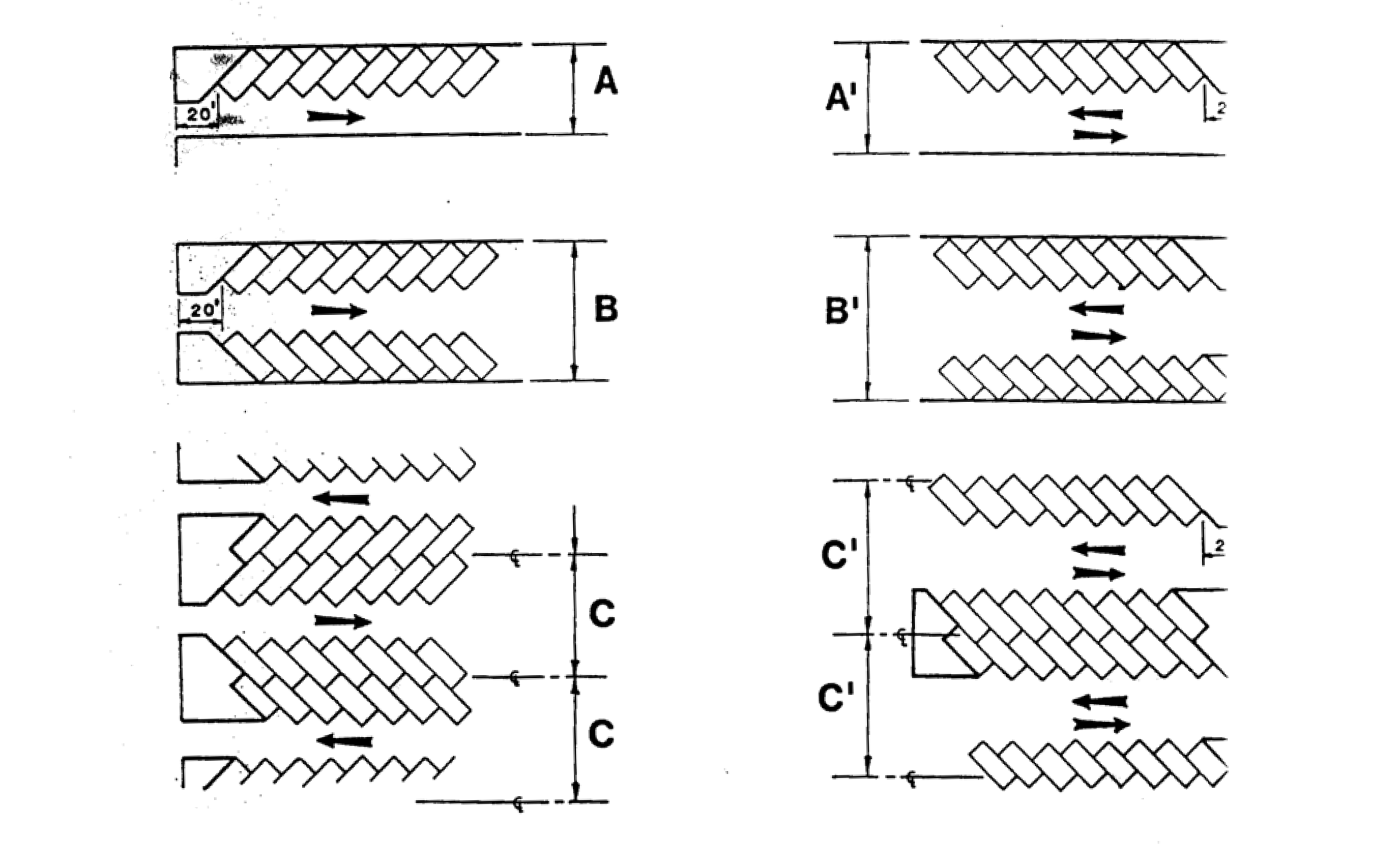
(Ord. No. 74, § 12, 3-13-1986; Ord. No. 88, § 10, exh. A, 9-13-1990; Ord. No. 116, §§ 1—3, 9-16-2004)
Sec. 28-14. - Nonconforming lots, uses of land, structures, and premises; characteristics of use.
(a)
Intent. The findings and intent are as follows:
(1)
Within the districts established by this chapter or amendments that may be later adopted there exist:
a.
Lots;
b.
Structures;
c.
Uses of land and structures; and
d.
Characteristics of use;
which were lawful before this chapter was passed or amended, but which would be prohibited, regulated, or restricted under the terms of this chapter or future amendment. It is the intent of this chapter to permit these nonconformities to continue until they are removed, but not to encourage their survival. It is further the intent of this chapter that nonconformities shall not be enlarged upon, expanded or extended, nor be used as grounds for adding other structures or uses prohibited elsewhere in the same district.
(2)
Nonconforming uses are declared by this chapter to be incompatible with permitted uses in the districts involved. A nonconforming use of a structure, a nonconforming use of land, or a nonconforming use of a structure and land in combination shall not be extended or enlarged after passage of the ordinance from which this chapter is derived by attachment on a building or premises of additional signs intended to be seen from off the premises, or by the addition of other uses, of a nature which would be prohibited generally in the district involved. To avoid undue hardship, nothing in this chapter shall be deemed to require a change in the plans, construction, or designated use of any building on which the actual construction was lawfully begun prior to the effective date of adoption or amendment of the ordinance from which this chapter is derived and upon which actual building construction has been carried on diligently, and in a continuous manner.
(b)
Nonconforming lots of record. In any district in which single-family dwellings are permitted, a single-family dwelling and customary accessory buildings may be erected on any single lot of record at the effective date of adoption or amendment of the ordinance from which this chapter is derived, notwithstanding limitations imposed by other provisions of this chapter. Such lot must be in separate ownership and not of continuous frontage with other lots in the same ownership. This provision shall apply even though such lot fails to meet the requirements for area or width, or both, that are generally applicable in the district, provided that yard dimensions and requirements other than these applying to area or width, or both, of the lot shall conform to the regulations for the district in which such lot is located. Variance of yard requirements shall be obtained only through action of the board of adjustment. If two or more lots or combination of lots and portions of lots with continuous frontage in single ownership are of record at the time of passage or amendment of the ordinance from which this chapter is derived, and if all or part of the lots do not meet the requirements established for lot width and area, the lands involved shall be considered to be an undivided parcel for the purposes of this chapter, and no portion of said parcel shall be used in such a manner which diminishes compliance with lot width and area requirements established by this chapter, nor shall any division of any parcel be made which creates a lot width or area below the requirements stated in this chapter.
(c)
Nonconforming structures. Where a lawful structure exists at the effective date of adoption or amendment of the ordinance from which this chapter is derived by reason or restrictions on area, lot coverage, height, yards, its location on the lot, or other requirements concerning the structure, such structure may be continued so long as it remains otherwise lawful, subject to the following provisions:
(1)
No such nonconforming structure may be enlarged or altered in any way which increases its nonconformity, but any structure or portion hereof may be altered to decrease its nonconformity.
(2)
Should such nonconforming structure or nonconforming portion of structure be destroyed by any means to an extent of more than 75 percent of its replacement cost at the time of destruction, it shall not be reconstructed except in conformity with the provisions of this chapter.
(3)
Should any such structure be moved for any reason for any distance whatever, it shall thereafter conform to the regulations for the district in which it is located after it is moved.
(d)
Nonconforming use of structures or of structures and premises in combination. If lawful use involving individual structures, or of structures and premises in combination, exists at the effective date of the adoption or amendment of the ordinance from which this chapter is derived, that would not be allowed in the district under the terms of this chapter, the lawful use may be continued so long as it remains otherwise lawful, subject to the following provisions:
(1)
No existing structure devoted to a use not permitted by this chapter in the district in which it is located shall be enlarged, extended, constructed, reconstructed, moved, or structurally altered except in changing the use of the structure to a use permitted in the district in which it is located.
(2)
Any nonconforming use may be extended throughout any parts of a building which were manifestly arranged or designed for such use at the time of adoption or amendment of the ordinance from which this chapter is derived, but no such use shall be extended to occupy any land outside such building.
(3)
Any nonconforming use of a structure, or structure and premises, may not as a special exception be changed to another nonconforming use.
(4)
Any structure, or structure and land in combination, in or on which a nonconforming use is superseded by a permitted use shall thereafter conform to the regulations for the district, and the nonconforming use may not thereafter be resumed.
(5)
When a nonconforming use of a structure, or a structure and premises in combination, is discontinued or abandoned for three consecutive months or for 12 months during any three-year period (except when governmental action impedes access to the premises), the structure, or structure and premises in combination, shall not thereafter be used except in conformity with the regulations of the district in which it is located.
(6)
When the use of a nonconforming structure is ceased due to natural disaster, replacement or reconstruction of such use must begin within one year from the date of disaster and said replacement or construction must remain continuous.
(7)
Where nonconforming use status applies to a structure and premises in combination, removal or destruction of the structure shall eliminate the nonconforming status of the land. The term "destruction," for the purpose of this subsection, is defined as damage to an extent of more than 75 percent of the replacement cost at the time of the destruction.
(e)
Repairs and maintenance. On any nonconforming structure or portion of a structure containing a nonconforming use, work may be done in any period of 12 consecutive months on ordinary repairs, or on repair or replacement non-loadbearing elements, to an extent not exceeding ten percent of the currently established replacement cost of a nonconforming structure or nonconforming portion of the structure as the case may be, provided that the cubic content existing when it became nonconforming shall not be increased.
(1)
If a nonconforming structure or portion of a structure containing a nonconforming use becomes physically unsafe or unlawful due to lack of repairs and maintenance, and is declared by any duly authorized official to be unsafe or unlawful by reason of physical condition, it shall not thereafter be restored, repaired, or rebuilt except in conformity with the regulations of the district in which it is located.
(2)
Nothing in this chapter shall be deemed to prevent the strengthening or restoring to a safe condition of any building or part thereof declared to be unsafe by any official charged with protecting the public safety, upon order of such official.
(f)
Uses under special exception provisions not nonconforming uses. Any use which is permitted as a special exception in a district under the terms of this chapter shall not be deemed a nonconforming use in such district, but shall without further action be considered a conforming use.
(g)
Sale, lease, etc., of nonconforming uses not prohibited. Nothing in this chapter shall be construed as preventing or restricting the sale, lease, or transfer of buildings or property constituting a nonconforming use within the meaning of this chapter.
(Ord. No. 74, § 13, 3-13-1986)
Sec. 28-15. - Special exceptions.
(a)
A special exception is a use that would not be appropriate generally or without restriction throughout the zoning district but which, if controlled as to number, area, location, or relation to the neighborhood, would promote the public health, safety, welfare, morals, order, comfort, convenience, appearance, prosperity, or general welfare. Such uses may be permitted in such zoning district as special exceptions, only if specific permission for such special exception is made in the section.
(b)
Applications for special exceptions may be obtained from the office of the town clerk for submissions to the town council. A filing fee, as currently established or as hereafter adopted by resolution of the town council from time to time, must accompany said application, for the purpose of covering the costs of investigations, consultants, notifications, publications, and other operations incidental to the consideration of a matter by the town council.
(c)
In the exercise of its authority in the approval of a special exception, the town council shall be guided by the following standards and shall consider the following factors, and shall show in its record that each factor was considered. Before final approval on a special exception is granted, the town council shall find in the case of these factors and any other significant factors that the purposes and requirements of this chapter have been met by the applicant. Special exception uses and their related accessory uses or any expansion, enlargement, or modification of an existing special exception use shall be permitted only upon authorization by the town council provided that such uses shall be found by the town council to comply with, but not necessarily be limited to, compliance with, the following requirements and other applicable requirements as set forth in this chapter:
(1)
Ingress and egress to property and proposed structures thereon, with particular reference to automotive and pedestrian safety, traffic flow and control, and access in case of fire or catastrophe;
(2)
Off-street loading and parking areas, with particular attention to the items in subsection (a) of this section and the economic, noise, glare, or odor effects of the location of such areas on adjoining properties;
(3)
Refuse and service areas, with particular reference to the items in subsections (a) and (b) of this section;
(4)
Screening and buffering, with particular reference to type, dimensions, and character as it relates to adjacent properties;
(5)
Required yards and open space;
(6)
Signs and proposed exterior lighting with reference to glare, traffic, traffic safety, economic effects of the same on properties in the district, and compatibility, and harmony with nearby properties;
(7)
Height of structure as related to adjacent properties;
(8)
Economic effect;
(9)
That the use is a permitted special exception use as set forth in the district regulations;
(10)
That the use is so designed, located, and proposed to be operated that the public health, safety, welfare and morals will be protected;
(11)
That the use will not cause substantial injury to the value of other property in the neighborhood where it is to be located;
(12)
That the use will be compatible with adjoining development and the intended purpose of the district in which it is to be located;
(13)
That the use conforms with all applicable regulations governing the district where located.
(d)
In granting any special exception, the town council may prescribe appropriate conditions and safeguards in conformity with this chapter. Violations of such conditions and safeguards, when made a part of the terms under which the special exception is granted, shall be deemed a violation of this chapter. The town council may prescribe a reasonable time limit within which the action for which the special exception is required shall be begun or completed or both.
(Ord. No. 74, § 15, 3-13-1986; Ord. No. 122, § 5, 12-8-2005)
Sec. 28-16. - Board of adjustment.
(a)
Board established. The town council is hereby designated and established as the board of adjustment for the Town of Cloud Lake. The board of adjustment shall perform its duties as provided by law in such a way that the objectives of this chapter shall be observed, public safety, health, and welfare secured, and substantial justice done.
(b)
Proceedings of the board of adjustment.
(1)
Meetings of the board shall be held at the call of the mayor, or in the mayor's absence, the vice mayor, and at such time as the board may determine. The mayor, or in the mayor's absence, the vice mayor, may administer oaths and compel the attendance of witnesses. All meetings of the board and its files or records shall be open to the public.
(2)
The board shall keep minutes of its proceedings, showing the vote of each member upon each question, or, if absent or failing to vote, indicating such fact, and shall keep records of its examinations and other official actions, all of which shall be a public record.
(c)
Appeals from decisions of administrative officials; hearing; notice.
(1)
Appeals to the board of adjustment may be taken by any person aggrieved or by any officer, or bureau of the governing body of the town affected by the decision of the administrative officer charged with the enforcement of this chapter. Such appeal shall be taken within 30 days from the rendition of the decision in question, by filing with the town clerk a notice of appeal specifying the grounds thereof. The officer from whom the appeal is taken shall forthwith transmit to the board all the papers constituting the record upon which the action was taken.
(2)
The board of adjustment shall fix a reasonable time for the hearing of the appeal, give public notice thereof, as well as due notice to the parties in interest, and decide the same within a reasonable time. Upon the hearing any party may appear in person, by agent or by attorney.
(3)
In any matter brought before the board and upon which it is required to make a decision, the parties in interest shall be given notice by mail of the time, place and subject matter of the hearing. For this purpose, the owner of the property shall be deemed to be the person shown on the current tax assessment roll as being the owner, and such notice shall be sent to the address given on such assessment roll for that person.
(d)
Powers and duties of the board. The board of adjustment shall have the following powers:
(1)
To hear and decide appeals where it is alleged there is error in any order, requirement, decision, or determination made by an administrative official in the enforcement of this chapter or of any ordinance adopted pursuant thereto;
(2)
To authorize upon appeal in specific cases such variance from the terms of this chapter as will not be contrary to the public interest where, owing to special conditions, a literal enforcement of the provisions of this chapter will result in unnecessary hardship. The power to grant any such variance shall be limited by and contingent upon a finding by the board:
a.
That special conditions and circumstances exist which are peculiar to the land, structure or building involved and which are not applicable to other lands, structures or buildings in the same zoning districts;
b.
That the special conditions and circumstances do not result from the actions of the applicant;
c.
That granting the variance requested will not confer on the applicant any special privilege that is denied by this chapter to other lands, buildings or structures in this same zoning district;
d.
That literal interpretation of the provisions of this chapter would deprive the applicant of rights commonly enjoyed by other properties in the same zoning district under the terms of this chapter and would work unnecessary and undue hardship on the applicant;
e.
That the variance granted is the minimum variance that will make possible the reasonable use of the land, building or structure;
f.
That the grant of the variance will be in harmony with the general intent and purpose of this chapter, and that such variance will not be injurious to the area involved or otherwise detrimental to the public welfare.
(3)
In granting any variance the board of adjustment may prescribe appropriate conditions and safeguards in conformity with this chapter. Violations of such conditions and safeguards, when made a part of the terms under which the variance is granted, shall be deemed a violation of this chapter. The board of adjustment may prescribe a reasonable time limit within which the action for which the variance is required shall be begun or completed or both. Nonconforming use of neighborhood lands, structures or buildings in other zoning districts shall not be considered grounds for the authorization of a variance.
(e)
Decisions of the board. In exercising the above-mentioned powers, such board may, in conformity with the provisions of this chapter, reverse or affirm, wholly or partially, or may modify the order, requirement, decision, or determination appealed from and may make such order, requirement, decision, or determination as ought to be made, and to that end shall have all the powers of the officer from whom the appeal is taken. The concurring vote of four members of the board shall be necessary to reverse any decision, order, requirement, or determination of any such administrative official, or to decide in favor of the applicant on any matter upon which it is required to pass under this chapter, or to grant any variance from the terms and conditions of this chapter. Any request denied by the board shall not be resubmitted to the board for a period of one year after the date of denial.
(f)
Appeals from board. Any person or persons, jointly or severally, aggrieved by any decision of the board of adjustment, may present to a circuit court a petition for issuance of a writ of certiorari, duly verified, within 30 days of the filing of the decision.
(g)
Charges for special exceptions, variances and appeals. A filing fee as currently established or as hereafter adopted by resolution of the town council from time to time shall accompany each request for the purpose of covering the costs of investigations, notifications and other operations incidental to the consideration of a matter by the board of adjustment. The sums shall be thus collected by the town clerk and placed in the general fund.
(h)
Time limitation. Any variance or other relief granted by the board shall expire within six months from the date of grant, unless a building permit based upon and incorporating the variance or other relief is issued within the aforesaid six-month period and construction has begun thereunder.
(Ord. No. 74, § 16, 3-13-1986; Ord. No. 88, §§ 11—13, 9-13-1990; Ord. No. 122, § 6, 12-8-2005; Ord. No. 158, § 1, 11-10-2022)
Sec. 28-16.5. - Notice.
(a)
Where notice to nearby or contiguous property owners is required, such notice shall be mailed to such property owners by regular U. S. mail at least 15 days prior to the date of the hearing. For this purpose, the owner of the property shall be deemed to be the person who, with his address, is so shown on the current property rolls of the property appraiser of Palm Beach County. Requirements of notice by mail to specific property owners shall be as follows:
(1)
Appeal from the decision of the building official or zoning consultant. The owner of the property involved and all owners of property directly contiguous to the premises involved in the appeal;
(2)
Variance. The owner of the property requesting the variance and all owners of property within 100 feet of the premises for which variance is requested;
(3)
Special exception. The owner of the property requesting the special exception and all owners of property within 100 feet of the premises for which special exception is requested.
(b)
Notice of such hearing shall also be posted town hall at least 15 days prior to the hearing.
(Ord. No. 158, § 2, 11-10-2022)
Sec. 28-17. - Penalty for violation.
Any person or corporation who shall violate any of the provisions of this chapter or fail to comply therewith or with any of the requirements thereof, or who shall build or alter any building in violation of any detailed statement or plan submitted and approved thereunder, upon conviction thereof shall be guilty of a violation of this Code. The owner of any building or premises or part thereof, where anything in violation of this chapter shall be placed, or shall exist, and any architect, builder, contractor, agent, person or corporation employed in connection herewith and who may have assisted in the commission of any such violation shall each be guilty of a separate offense and upon conviction thereof shall be fined as herein provided.
(Ord. No. 74, § 17, 3-13-1986)
Sec. 28-18. - Relationship to other laws, statutes, ordinances.
Wherever the regulations or restrictions imposed by this chapter are either more or less restrictive than regulations or restrictions imposed by any governmental authority through legislation, rule or regulation, the regulations, rules or restrictions which are more restrictive or which impose higher standards or requirements shall govern. Regardless of any other provision of this chapter, no land shall be used and no structure erected or maintained in violation of any state or federal pollution control or environmental protection law or regulation.
(Ord. No. 74, § 18, 3-13-1986)
Sec. 28-19. - Enforcement.
This chapter shall be enforced by the duly authorized inspector of buildings under the rules and regulations established by and for the town.
(Ord. No. 74, § 19, 3-13-1986)

