
Collbran City Zoning Code
ARTICLE 18
32 - DESIGN STANDARDS
DIVISION 18.32-I - DESIGN STANDARDS IN GENERAL (RESERVED)
(Adopted by Ord. 02 Series of 2023 on 12/5/2023)
18.32.110 - Residential Architecture (Multifamily Dwellings).
(a)
Applicability. The standards set forth in this section shall apply to all new multifamily buildings and structures for which a building permit is issued after August 15, 2008, the effective date of the ordinance from which this section is derived. This section shall not apply to the enlargement, modification or remodeling of such buildings and structures which existed prior to the effective date of the ordinance from which this section is derived, August 15, 2008.
(b)
Intent. Architecture plays an important part in developing an identity for neighborhoods and dwellings. Thus, the Town wants to build upon the architectural traditions of the region, yet allow for diversity of expression. In addition, the Town wants to encourage a variety of housing types, sizes and prices in each neighborhood to allow people to remain in their neighborhoods, as their housing needs change.
(c)
Housing diversity/neighborhood identity. Housing diversity is an important goal for new residential development in Town. In support of this, the integration of detached and attached single-family dwellings, and multifamily dwellings, within neighborhoods, even in the same block, is encouraged.
(1)
Garages. Residential units, not their garages, shall have the emphasis on residential streets. The intent is that residential streets have variety and that garages not dominate homes and streets. Alley accessed garages are strongly encouraged.
a.
Requirements for garages with access from the street.
1.
Variety of garage placement. Varying the placement of street-accessed garages on adjacent lots is encouraged to create diversity and avoid repetition.
2.
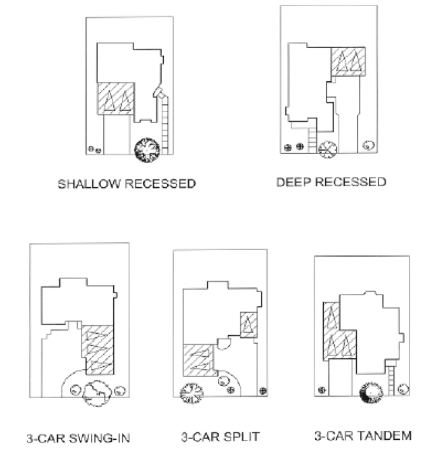
Recessed garage doors. Street-facing garage doors shall be setback at least 22 feet from the sidewalk or property line and four feet or more from the forward most enclosed area of the home. No more than 25 percent of these, however, are allowed on one block face.
3.
Deep recessed and rear garages. Deep recessed and rear garages with side yard drive and maximum 12-foot driveway curb cut are encouraged.
4.
Swing-in garages. Swing-in (side-loaded) garages are encouraged. However, such garage projections shall be minimized so that they appear integrated with the overall structure and do not become a dominant feature of the streetscape.
5.
Three-car street accessed garages. Three-car, front-facing garages are not allowed. Swing-in garages, split garages, and tandem garages are encouraged.
6.
Minimum driveway curb cut width. The width of a driveway curb cut is limited to 20 feet.
7.
Garage doors. Individual single garage doors with upper level windows are encouraged.
b.
Compliance. The applicant shall include in the application for approval of the final plat, documentation showing how the development will comply with this requirement.
(Code 1994, § 15.08.010; Adopted by Ord. 02 Series of 2023 on 12/5/2023)
18.32.120 - Townhouses and Row Houses (Multifamily Dwellings).
(a)
Applicability. The standards set forth in this section shall apply to all new townhouse or row house buildings or structures for which a building permit is issued after August 15, 2008, the effective date of the ordinance from which this section is derived. This section shall not apply to the enlargement, modification or remodeling of such buildings or structures which existed prior to the effective date of the ordinance from which this section is derived, August 15, 2008.
(b)
Intent. The intent of this section is to build townhouses and row houses with architectural designs that relate buildings to the street, and that achieve a harmonious balance between repetition and variety.
(1)
Individual dwelling identity.
a.
The composition of a row house grouping requires repetition of architectural elements like entries, bays, cornices and parapets. At the same time, visual interest and streetscape diversity are promoted by variation. Achieving balance between repetition and variety creates harmony. 1
b.
Row house groupings rely on the continuity of well-defined architectural elements to establish strong street presence. However, each unit must be expressed so that the composition reads as the sum of the individual parts. 1
c.
Design the primary facade of each row house so it is evident where the unit begins and ends. This can be achieved by repeating the principal architectural elements and subtly varying the offsetting of building walls, choice of materials, parapet height, and color. 1
(2)
Articulation.
a.
Because repetition is important to the composition of the row houses, sufficient articulation of architectural elements on the primary facade of each row house is essential. Groupings of row houses are often repeated along the street, requiring techniques to promote architectural interest and streetscape diversity. 1
b.
A row house articulation is defined as a covered entry element, a dormer facing the street, a horizontal offset of at least two feet in the principal building wall for a minimum of four feet in width, a bay or projection, or a significant change in the parapet height and design. 1
c.
The primary row house elevation towards the street needs at least two articulations, but not more than three articulations. The required articulation refers to an individual row house, not the entire grouping. 1
d.
Side elevations of row houses facing a street are subject to the same articulation requirements as the primary facade. 1
e.
Row house groupings of six units or more (or groupings over 120 feet in length) require two different articulation combinations. 1
(3)
Entry definition.
a.
Well-defined and sensitive entries are particularly important for row house design. In addition to creating a feeling of welcome and providing shelter, they also help make a gracious transition between public and private realms. 1
b.
All row houses must provide a covered front entry. 1
ALLOWED TYPES OF STREET ACCESS TO MULTIFAMILY RESIDENTIAL GARAGES
1 Stapleton Design Book published by Forest City Stapleton, Inc., September 2000, pp. III.20—III.22.
(Code 1994, § 15.08.020; Adopted by Ord. 02 Series of 2023 on 12/5/2023)
18.32.130 - Multifamily Stacked Units, Including Condominiums and Apartments.
(a)
Applicability. The standards set forth in this section shall apply to all new buildings containing multifamily stacked units for which a building permit is issued after August 15, 2008, the effective date of the ordinance from which this section is derived. This section shall not apply to the enlargement, modification, or remodeling of such buildings or structures which existed prior to the effective date of the ordinance from which this section is derived, August 15, 2008.
(b)
Intent. The intent of this section is to build multifamily stacked units that achieve a harmonious balance between repetition and variety. Each multifamily dwelling containing three or more dwelling units shall feature a variety of massing proportions, wall plane proportions, roof proportions and other characteristics. The following specific standards shall apply to multi-family stacked units, including condominiums and apartments:
(1)
Individual building identity. For all developments of three or more multifamily stacked buildings, a floor plan may be repeated, however, identical building facades must not be replicated more than twice within the development. Before building may commence on a block and prior to the issuance of a building permit within the block, the applicant shall illustrate, through the use of a block diversity plan, how the development will comply with the requirements set forth in this section. Final plat approval cannot be given without approval of a block diversity plan for the initial stage of development. A block diversity plan shall include, at a minimum, the following:
a.
A map that illustrates the floor plan and elevation for each building on the block.
b.
The color palette to be used.
c.
A written statement that specifies how the provisions of this section will be met.
(2)
Articulation. Each multifamily dwelling or condominium shall be articulated with projections, recesses, covered doorways, balconies, box or bay windows and/or other similar features, dividing large facades and walls into human-scaled proportions. Each multifamily building shall feature walls that are articulated by a least two of any of the following elements within every 36-foot length of the facade:
a.
Recesses, projections or significant offsets in the wall plane;
b.
Distinct individualized entrances;
c.
Chimneys that project from the wall plane;
d.
Balconies and/or other outdoor living space; or
e.
Bay or box windows.
(3)
Roofs. Each multifamily building shall feature a combination of primary and secondary roofs. Primary pitched roofs shall be articulated by at least one of the following elements:
a.
Changes in plane and elevations;
b.
Dormers, gables or clerestories; or
c.
Transitions to secondary roofs over entrances, garages, porches, or bay windows.
(4)
Color. For all developments, there shall be no more than two similarly colored structures placed next to each other along a street or major walkway spine.
(5)
Garages. No street-facing facade shall contain more than four garage fronts. Resident garages or parking that is internal to the block is encouraged. On-street parking should be made available for visitors.
(Code 1994, § 15.08.030; Adopted by Ord. 02 Series of 2023 on 12/5/2023)
18.32.140 - Commercial and Industrial Architecture.
(a)
Applicability. The standards set forth in this section shall apply to all new commercial and industrial buildings and structures for which a building permit is issued after August 15, 2008, the effective date of the ordinance from which this section is derived. This section shall not apply to the enlargement, modification, or remodeling of such buildings and structures which existed prior to August 15, 2008.
(b)
Intent.
(1)
The Town has the following three commercial/industrial zones within its planning area: downtown commercial; general commercial and light industrial. They are different in character, purpose, and mixture of uses. The design considerations vary for each type, although there are many common design elements. The general provisions section outlines the common elements and the specific design considerations are identified by type.
(2)
With respect to the downtown commercial, Town's historic buildings have established a pattern of downtown development: buildings are located close to the sidewalk, forming a continuous street facade. Pedestrian movement is the primary focus. Building height, architectural details, front setbacks, parking location, wall articulation, and sidewalks establish the architectural edge that defines this area as a walkable commercial corridor.
(3)
The general commercial district is the primary community commercial corridor for the Town. This area is also predominantly accessed by automobile. However, the integration of commercial uses with a mixture of residential that transitions to medium and lower density areas will require good pedestrian access throughout this area.
(c)
General provisions.
(1)
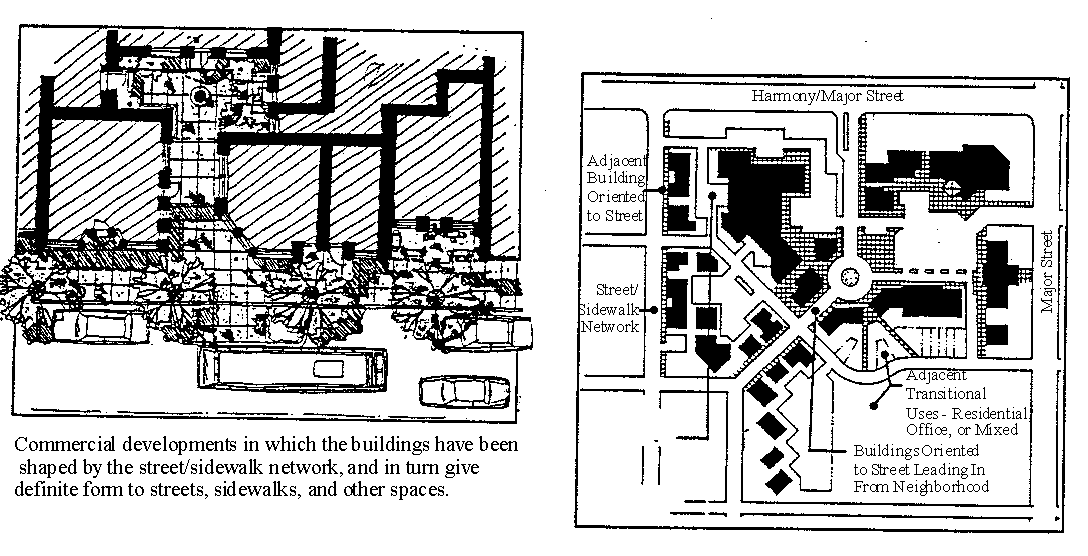
Connections. Commercial developments must be linked with surrounding areas by extending town streets, sidewalks, and/or paths directly into and through the development, thereby providing convenient, direct pedestrian, bicycle (non-motorized access) and vehicle access to and from all sides of the development.
(2)
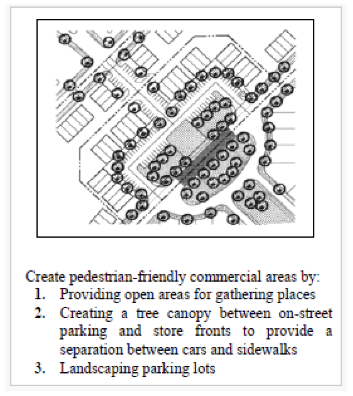
Accessibility. Developments must be accessible to pedestrians and bicyclists (non-motorized access) as well as motorists. Site plans shall equally emphasize the following:
a.
Pedestrian access to the site and buildings;
b.
Gathering areas for people; and
c.
Auto access and parking lots.
The emphasis must not be placed solely on parking and drive-through functions.
(3)
Walkways. Walkways must be located and aligned to directly and continuously connect areas or points of pedestrian origin and destination, and not be located and aligned solely based on the outline of a parking lot configuration that does not provide such direct pedestrian access.
(4)
On-street parking. Streets and other elements of the site plan shall be designed so that on-street parking is a functional part of the development (except along arterial streets).
(5)
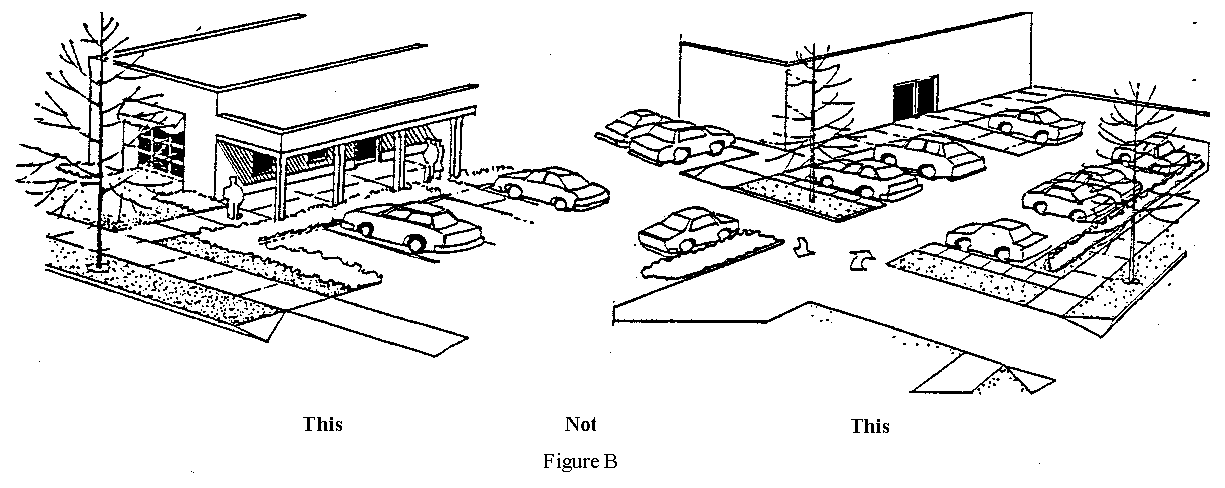
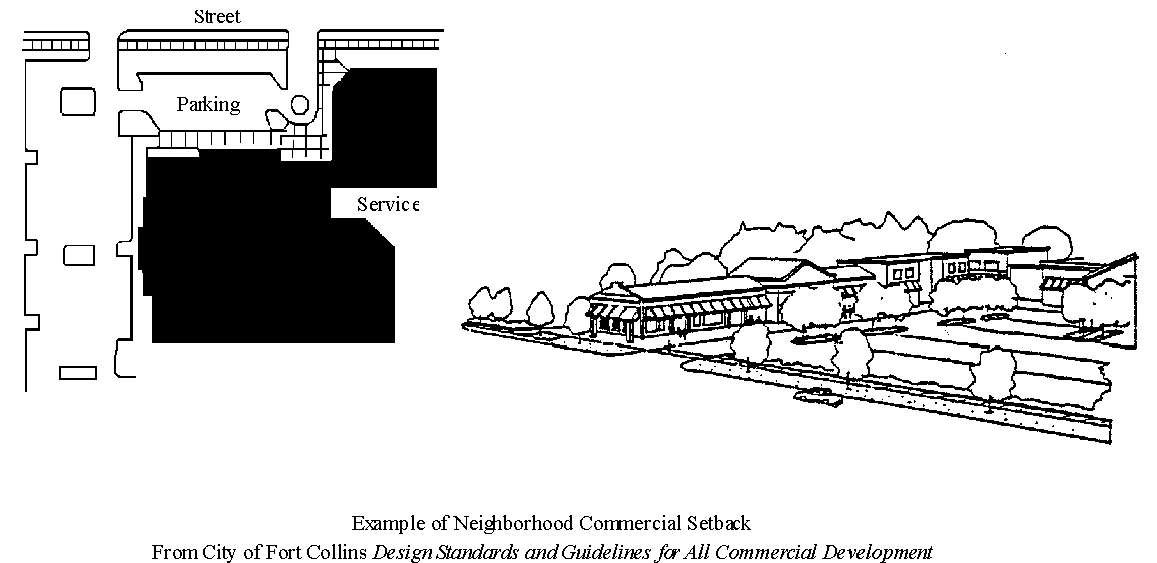
Building orientation. Where possible, buildings shall be located to front on and relate primarily to streets. Building setbacks from local and collector streets should be minimized in order to establish a visually continuous, pedestrian-oriented street-front. In the case of large buildings for employment, storage or auto-related uses, where greater setbacks are needed, a minimum of 30 percent of the building shall be brought to the setback line. If a minimized setback is not maintained, the larger setback area shall have landscaping, low walls or fencing, a tree canopy and/or other site improvements along the sidewalk designed for pedestrian interest, scale and comfort.
Illustrations from City of Fort Collins, Design Standards and Guidelines for All Commercial Development, March 1996 (reprinted with permission).
(6)
Pedestrian scale. The establishment of buildings on isolated pad sites surrounded by parking lots and driveways, and that offer mainly auto-oriented signage to define entrances, is discouraged. Even relatively massive development can be configured into blocks or other spaces, proportioned on a human scale and city block scale; and need not be proportioned on a monolithic, auto-oriented scale.
(7)
Thematic architectural styles. Standardized corporate or strongly thematic architectural styles associated with chain-type restaurants and service stores are strongly discouraged unless they accommodate the desired image for the Town and are compatible with adjacent structures and uses.
(8)
Location of parking lots. Parking requirements shall be provided to the greatest extent possible by spaces at the rear or sides of the building. Refer to landscaping standards and parking shall address the following characteristics:
a.
Surface. All parking and driveway areas and primary access to parking facilities shall be surfaced with asphalt, concrete or similar materials.
b.
Integrate parking lots with surroundings. Parking lots shall not dominate the frontage of pedestrian-oriented streets, interfere with designated pedestrian routes, or negatively impact surrounding neighborhoods. The pedestrian character of streets and buildings shall be maximized through continuity of buildings and landscape frontage.
c.
Location. Parking lots shall be located to the rear or side of buildings or in the interior of a block whenever possible.
d.
Landscaping. Parking lots shall be landscaped, screened and buffered as provided in the Landscaping section under "parking lot landscaping standards."
e.
Share-access. Where feasible, parking lots shall share access drives with adjacent property with similar land uses.
f.
Off-street parking design. Off-street parking areas shall be designed so that vehicles may exit without backing onto a public street unless no other practical alternative is available. Off-street parking areas shall be designed so that parked vehicles do not encroach upon or extend onto public rights-of-way, sidewalks or strike against or damage any wall, vegetation, utility or other structure.
g.
Circulation area design. Circulation areas shall be designed to facilitate the safe movement of vehicles without posing a danger to pedestrians or impeding the function of the parking area.
h.
Lighting. All parking area lighting shall be full cutoff type fixtures. Any light used to illuminate parking areas or for any other purpose shall be so arranged as to reflect the light away from nearby residential properties, and away from the vision of passing motorists.
i.
Shared off-street parking. When there are opportunities to support parking demand through shared off-street parking for compatible uses (such as a movie theater and an office building), a parking study and shared parking agreements shall be used to demonstrate the adequacy of the parking supply as a substitute for standard parking requirements.
(9)
Blank walls. Blank, windowless walls are discouraged. Where the construction of a blank wall is necessary, the wall shall be articulated.
(10)
Wall articulation.
a.
Walls shall not have an uninterrupted length exceeding 50 feet. Pilasters, texture transitions, windows and stepping of the wall plane are required.
b.
All exterior elevations shall maintain the integrity of the adjacent dwellings architectural character and detailing.
c.
Continuous cornice lines or eaves are encouraged between adjacent buildings.
d.
Buildings with flat roofs shall provide a parapet with an articulated cornice.
(11)
Facade treatment. The architectural treatment of the front facade shall be continued, in its major features, around all visibly exposed sides of a building. Blank wall or service area treatment of side and/or rear elevations visible from the public viewshed is discouraged.
(12)
Windows. Windows shall be vertically proportioned wherever possible.
(13)
Awnings. Fixed or retractable awnings are permitted. Canvas is the preferred material, although other water proofed fabrics may be used; metal or aluminum awnings may be used, but should be integrated into the building design and have good aesthetic appeal.
(14)
Screening. All air conditioning units, HVAC systems, exhaust pipes or stacks, elevator housing and satellite dishes and other telecommunications receiving devices shall be thoroughly screened from view from the public right-of-way and from adjacent properties by using walls, fencing, roof elements, and landscaping. In addition, all trash facilities, loading and parking areas shall be properly screened.
(15)
Architectural details. All materials, colors, and architectural details used on the exterior of a building shall be compatible with the building's style and with each other.
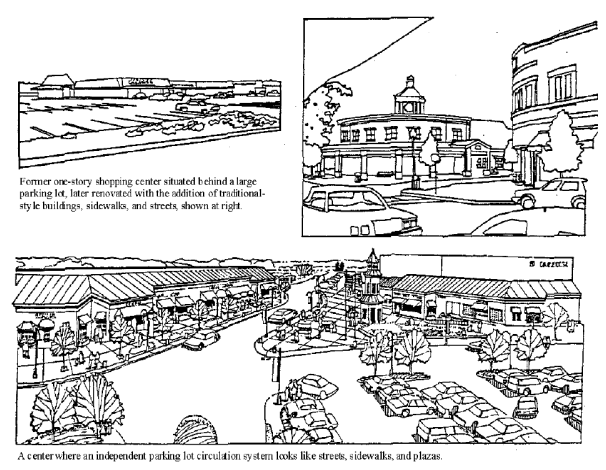
Illustration from City of Fort Collins Design Standards and Guidelines for All Commercial Development (reprinted with permission).
(d)
Downtown commercial architectural standards.
(1)
Setbacks. Buildings shall abut the front property line. Building facades may be recessed if an arcade or similar structure abuts the front setback. Architectural projections including cornices, balconies, canopies and entry features may encroach into public rights-of-way, subject to permits as required by Town codes.
(2)
Multi-story, mixed-use structures. Commercial uses shall be contained in multi-story (two to three stories) mixed-use structures with commercial/retail uses on the ground level and above and/or apartment dwellings or offices on the upper levels. Such building shall vary in terms of footprint and architectural elevations. The maximum ground level footprint of a commercial building shall be 5,000 square feet.
(3)
Facade treatments. Large buildings shall be articulated or designed to resemble the character and scale of the original downtown buildings, with each facade 25 feet or less.
(4)
Entries. Transparent entries and large store front windows are strongly encouraged. Recessed and other styles of window openings are desired.
(5)
Windows. Street-level storefront windows are strongly encouraged. Office and residential windows organized in a generally regular pattern are encouraged.
(6)
Awnings/canopies. Awnings or canopies, which provide a generally consistent cover along the pedestrian walk are strongly encouraged. Arcades are desired to maintain a more continuous weather protected walk.
(e)
Planned Unit Development (PUD) commercial architectural standards.
(1)
Neighborhood center. The design of the commercial center needs to function as a focal point or activity center for the neighborhood. The design should include where possible, outdoor space for pedestrians, such as a plaza, outdoor cafe or seating area.
(2)
Setbacks. Building setbacks from local and collector streets should be minimized in order to establish a visually continuous, pedestrian-oriented street-front. In the case of large buildings for employment, storage or auto-related uses, where greater setbacks are needed, a minimum of 30 percent of the building shall be brought to the setback line. If a minimized setback is not maintained, the larger setback area shall have landscaping, low walls or fencing, a tree canopy and/or other site improvements along the sidewalk designed for pedestrian interest, scale and comfort.
(3)
Driveway crossings. Driveway crossings must place priority on the pedestrian access and the material and layout of the pedestrian access must be continuous as it crosses the driveways, with a break in the continuity of the driveway paving and not in the pedestrian access way. Continuous driveway aisles located directly in front of a building are discouraged.
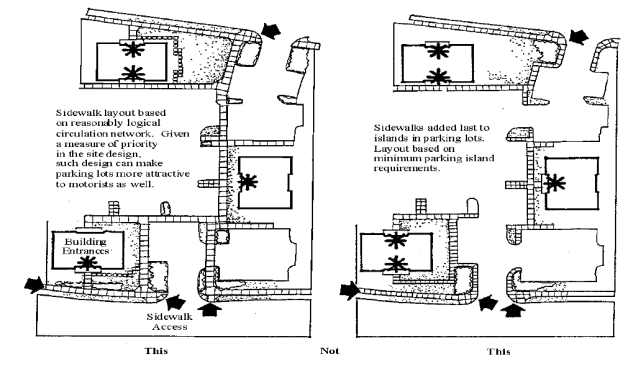
Illustrations from City of Fort Collins, Design Standards and Guidelines for All Commercial Development, March 1996 (reprinted with permission).
(f)
General commercial architectural standards.
(1)
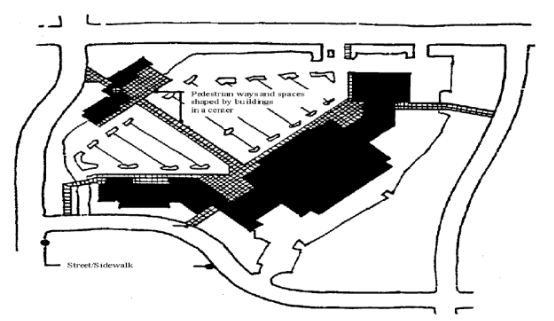
Design of developments with internal orientation. In multiple-building developments, where setbacks are increased to accommodate independent development with internal orientation, all primary building entrances must face walkways, plazas, or courtyards that have direct, continuous linkage to the street without making people walk through parking lots. However, it may be necessary for such direct pedestrian access ways to cross drive aisles. Driveway crossings must place priority on the pedestrian access. Continuous driveway aisles located directly in front of a building are discouraged.
(2)
Connections. Where it is not possible or appropriate to extend Town street and sidewalks directly into development or bring the building up to a Town sidewalk, buildings shall be shaped and designed to form pleasant, direct connections to adjacent land uses.
(3)
Requirement for four-sided design. A building's special architectural features and treatments shall not be restricted to a single facade. All sides of a building open to view by the public, whether viewed from public or private property shall display a similar level of quality and architectural interest.
(4)
Building form. The design of all buildings shall employ textured surfaces, projections, recesses, shadow lines, color, window patterns, overhangs, reveals, changes in parapet heights, and similar architectural features to avoid monolithic shapes and surfaces and to emphasize building entries. Designs shall not contain unbroken flat walls of 50 feet or greater in length. Buildings having single walls exceeding 50 feet in length shall incorporate one or more of the following for every 50 feet:
a.
Changes in color, graphical patterning, changes in texture, or material;
b.
Projections, recesses and reveals;
c.
Windows and fenestration;
d.
Arcades and pergolas;
e.
Towers;
f.
Gable projections;
g.
Horizontal/Vertical breaks; or
h.
Other similar techniques.
(5)
Exterior building materials and colors. Intense, bright or fluorescent colors shall not be used as the predominant color on any wall or roof of any primary or accessory structure. These colors may be used as building accent colors.
(6)
Roof materials. All sloping roof areas with a pitch of three in 12 or greater, and visible from any public or private right-of-way, shall be surfaced with attractive and durable materials.
(7)
Orientation of pedestrian entries. All office, hotel and motel structures shall be oriented so that pedestrian entries face the nearest adjacent street.
(Code 1994, § 15.08.040; Adopted by Ord. 02 Series of 2023 on 12/5/2023)
18.32.150 - Light Industrial District Architectural Standards.
(a)
Applicability. This section shall apply to all new industrial buildings, structures and developments approved after August 15, 2008 the effective date of the ordinance from which this section is derived. This section shall not apply to buildings, structures and developments, which existed prior to the effective date of the ordinance from which this section is derived, August 15, 2008.
(b)
Intent. Less visible areas in the community provide the opportunity to locate industrial/business park development. In addition, the following standards shall apply.
(1)
Items 3 through 7 from the general commercial district shall apply.
a.
Building massing and form.
1.
Office and entry spaces shall be distinguished from the building mass.
2.
Large, square, box-like structures are not an acceptable form. Architectural elements with smaller forms stepping outwards and down shall be included.
3.
Loading areas shall not front any street or public right-of way.
4.
Parking requirements shall be provided to the extent possible at the rear or sides of the building.
b.
Wall articulation. Walls shall not have an uninterrupted length exceeding 50 feet. Pilasters, texture transitions, windows and stepping of the wall plane are required.
c.
Siting structures.
1.
Structures shall be sited to avoid a wall affect along public rights-of-way and along adjacent property lines. This can be achieved by varying the building setbacks and clustering buildings.
2.
Where multiple buildings are proposed on a development parcel, buildings shall be oriented to allow views into the project and shall preserve high quality views through the project (e.g., views of the mountains).
(Code 1994, § 15.08.050; Adopted by Ord. 02 Series of 2023 on 12/5/2023)
18.32.210 - Applicability.
The landscape standards set forth in this division shall apply to all new subdivisions, planned unit developments, special uses and site plans for which an application is filed with the Town on or after, the effective date of the ordinance from which this division is derived.
(Code 1994, § 15.08.060; Adopted by Ord. 02 Series of 2023 on 12/5/2023)
18.32.220 - Landscape Design.
(a)
Intent. These standards are enacted to preserve Town's special character, enhance new development by promoting quality landscape design that:
(1)
Reinforces the identity of the community and each neighborhood;
(2)
Provides tree-lined streets in urban areas;
(3)
Anchors new buildings in the landscape;
(4)
Provides tree canopies within paved areas; and
(5)
Is environmentally sensitive by preserving existing trees, using water conservation techniques, planting native species (when appropriate), and enhances valuable habitat.
(b)
General provisions. All land development applications shall be accompanied by an appropriate landscape plan. Building permit applications for individual single-family residences will not require landscape plans. However, all landscaping within the community shall comply with the intent of these regulations.
(1)
Environmental considerations.
a.
Landscapes shall use the following xeriscape design principles to facilitate water conservation:
1.
Well-planned planting schemes;
2.
Appropriate turf selection to minimize the use of bluegrass:
i.
Use of mulch to maintain soil moisture and reduce evaporation;
ii.
Zoning of plant materials according to their microclimatic needs and water requirements;
iii.
Improve the soil with organic matter if needed;
iv.
Efficient irrigation systems; and
v.
Proper maintenance and irrigation schedules.
b.
All landscapes shall strive to maximize the use of native species. Where native material is not appropriate for the intended use or appearance, plant species that are regionally adapted and noninvasive may be used.
c.
Landscapes shall consist of a variety of species to enhance biodiversity. No one species may make up more than 25 percent of the total non-grass plant materials on the site.
d.
Buildings and parking areas shall be located to preserve and promote the health of existing trees, environmental resources and natural drainage ways. No healthy tree shall be removed without good cause. This requirement is not intended to prevent the removal of unhealthy trees in conjunction with site development.
e.
Trees shall be located to provide summer shade and limit winter shade on walks and streets.
f.
All areas disturbed by construction shall be reseeded to prevent erosion. Native, noninvasive grasses shall be used for revegetation where practical. Weed control is the responsibility of the landowner on all reseeded areas and all preservation areas.
g.
A combination of plantings, berms, walls and fences shall be used as appropriate to buffer sensitive habitat.
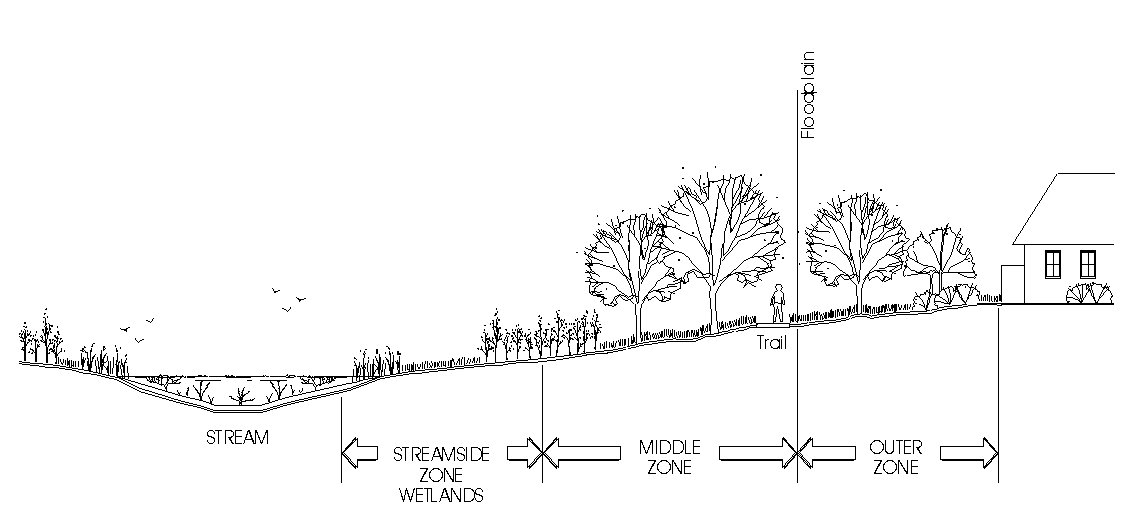
Use buffers to protect the physical integrity of riparian ecosystems. Try to preserve vegetation and trees in streamside zone and middle zone. Encourage grass and landscaping in outer zone to filter runoff from backyards, parking areas, roads, etc.
(2)
New buildings and paved areas.
a.
Anchor structures in the landscape through the use of trees, shrubs and groundcover. The size and intensity of plantings shall be appropriate to the size and context of the improvements.
b.
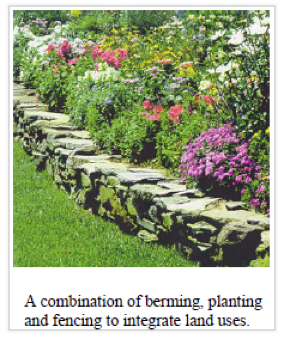
Integrate adjacent land uses of different intensities through a combination of berming, plantings and fencing. Use opaque screening only when necessary to mitigate the impact of noise, light, unattractive aesthetics and traffic. A fence shall not be the only screening material used.
c.
Use landscaping to provide a transition from developed, managed landscape to more natural vegetation.
d.
Provide a tree canopy by installing shade trees within and adjacent to paved areas.
(3)
Plant materials.
a.
The minimum planting sizes on all required landscaping shall be two inch caliper deciduous trees, 1 1/2-inch caliper ornamental trees, six-foot tall evergreen trees and five-gallon shrubs.
b.
Required plant materials shall be grown in a recognized nursery in accordance with proper horticultural practice. Plants shall be healthy, well-branched vigorous stock with a growth habit normal to the species and variety and free of diseases, insects and injuries.
c.
All plants shall conform to standards for measurements, grading, branching, quality, ball and burlapping as stated in the American Standard for Nursery Stock, 1990 edition, American Association of Nurserymen, Inc., (AAN-ASNS) and Colorado Nursery Act of 1965 (CNA).
(4)
Irrigation.
a.
All required landscaping shall be irrigated as required for plant establishment and maintenance. Irrigation shall be appropriate to the type and scope of the improvements.
b.
Use of non-treated water for irrigation is encouraged if a permanent, suitable supply is available.
c.
Required landscaping in urban developments shall be irrigated with a permanent irrigation system.
d.
Temporary irrigation may be used to establish native grasses and vegetation.
(5)
Guarantee of installation. Required landscape improvements shall be installed prior to issuance of a certificate of occupancy (C.O.) for all structures. If weather conditions prevent installation, the developer shall post a financial guarantee for the improvements. This guarantee shall be released upon completion of the installation of the landscaping.
(6)
Maintenance. In order to provide for the ongoing health and appearance of landscape improvements, all landscaping shall be maintained and replaced by the landowner/occupant as necessary. All property owners/occupants shall be responsible for maintenance of landscaping within the portion of the public right-of-way between the back of the curb or street pavement and the adjacent property.
(Code 1994, § 15.08.070; Adopted by Ord. 02 Series of 2023 on 12/5/2023)
18.32.230 - Business/Commercial and Industrial Development Landscaping Standards.
(a)
Landscape improvements shall be designed to enhance the overall appearance of the development and integrate the project with adjacent land uses and into the surrounding neighborhood. All improvements shall consider the people who will use the site, travel through or by the site and adjacent land uses. A minimum of 25 percent of the site (gross) shall be landscaped area, street rights-of-way, building footprints, or hard surfaced or landscaped areas of parking lots and driveways. The applicant shall provide:
(1)
Site trees: Plant a minimum of one tree per 1,000 square feet of landscaped area, distributed on the site.
(2)
Shrubs: Plant a minimum of one shrub per 150 square feet of landscaped area. Group shrubs and distribute throughout the site. Trees may be substituted for up to one-half of the required shrubs at the rate of one tree for ten shrubs.
(3)
Groundcover: Establish irrigated grass turf maintained to appropriate standards for active recreation in areas that will function for active recreation. Where appropriate, use native grass for areas that will not function as active recreation areas. Native grass must be weed free and maintained at a maximum height of eight inches. There shall be a minimum of 75 percent live materials between the building and the street unless approved by the Town.
(4)
Landscape setback to parking lots: 30 feet from arterials or 25 feet from other streets. The purpose of the setback is to provide a buffer between street parking areas. This setback may be reduced to 15 feet if used in combination with a three- to four-foot masonry or stone decorative wall. Signage may be included in this setback.
(5)
Screen loading areas: Screen loading areas (including vehicle being loaded), service and storage areas visible from the public right-of-way or adjacent property with an opaque screen that is an integral part of the building architecture or by landscaping. Chain link fencing with slats, tires or used building materials are not acceptable screening materials.
(6)
Compatibility: Integrate activities on the subject property with adjacent land uses by utilizing a combination of landscaping, building orientation and appropriate architectural elements.
(b)
The building owner or occupant shall maintain the yard and landscaping within the adjacent road right-of-way in accordance with Town regulations.
(Code 1994, § 15.08.080; Adopted by Ord. 02 Series of 2023 on 12/5/2023)
18.32.240 - State Highway Corridor Landscaping Standards.
The applicant shall provide:
(a)
Landscape setback to parking lots. Provide a 50-foot landscape setback from the highway. The purpose of the setback is to provide a buffer between the street and parking areas. Signage may be included in this setback.
(b)
Shrubs. A minimum of one shrub per 150 square feet of landscaped setback. Group shrubs and distribute throughout the landscape setback. Trees may be substituted for up to one-half of the required shrubs at the rate of one tree for ten shrubs.
(Code 1994, § 15.08.090; Adopted by Ord. 02 Series of 2023 on 12/5/2023)
18.32.250 - Downtown Landscaping Standards.
Downtown landscaping is intended to provide an attractive environment for people to walk and shop. The developer or assigns shall provide the following: Streetscape, a combination of window boxes, planters, trees, benches, etc., as appropriate to enhance building entries and the streetscape.
(Code 1994, § 15.08.100; Adopted by Ord. 02 Series of 2023 on 12/5/2023)
18.32.260 - Parking Lot Landscaping Standards.
Parking lot landscaping is intended break up large expanses of pavement, create shade, buffer views of parking lots from adjacent streets and development and enhance the overall appearance of each project.
(a)
Applicability. All parking lots with ten spaces or more shall be subject to these requirements.
(b)
The developer or assigns shall provide:
(1)
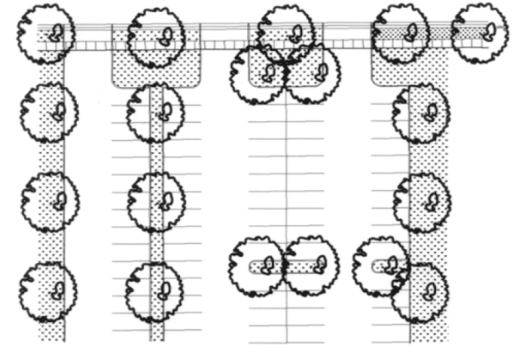
Site trees: A minimum of one tree per five parking spaces. Group trees together in islands, which are a minimum of ten feet wide. Use the landscaping to break up large expanses of pavement and to create a tree canopy for summer shade.
(2)
Shrubs: A minimum of one shrub per 150 square feet of landscaped area. Group plantings in landscape islands.
(3)
Groundcover: Limit areas of irrigated turf. Grass is discouraged in areas less than ten feet wide. Install a grass buffer (native grass where possible) around the perimeter to filter runoff and improve water quality.
(4)
Landscape setback to parking lots: 30 feet from arterials or 25 feet from other streets. The purpose of the setback is to provide a buffer between the street and parking areas and to screen the parking from the street. This setback may be reduced to 15 feet if used in combination with a three to four-foot articulated masonry or stone decorative wall with trees and shrubs on both the street and parking lot sides of the wall to soften its appearance. Signage may be included in this setback.
(5)
Provide a mechanism for long-term maintenance of landscaping: All landscaping within and adjacent to parking lots shall be owned and maintained by the landowner or occupant.
(Code 1994, § 15.08.110; Adopted by Ord. 02 Series of 2023 on 12/5/2023)
18.32.270 - Storm Drainage Facilities.
(a)
Intent. To promote innovative and effective land and water management techniques that protect and enhance water quality.
(b)
General provisions.
(1)
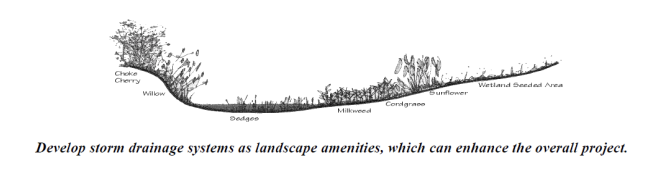
Landscaping associated with storm drainage facilities shall be integrated into the overall design of the project.
(2)
It shall enhance the overall appearance of the project, prevent erosion and improve water quality of stormwater runoff whenever possible.
(3)
Storm drainage facilities may function as open space for active recreation, trail corridors or habitat enhancement areas if they are designed appropriately and approved by the Board of Trustees.
(4)
The use of planting strips and shallow landscaped depressions in parking lots and along roads is encouraged to help trap and remove pollutants from stormwater runoff.
(c)
Applicability. All storm drainage facilities shall be appropriately landscaped.
(1)
Minimum requirements.
a.
All facilities shall be seeded to grass appropriate to the function of the area. Areas to be used for active recreation shall be seeded to a turf-type grass and irrigated with a permanent irrigation system. Areas to be maintained for habitat enhancement shall be seeded to native grasses and wildflowers. Developer is responsible for establishment of a complete, weed free stand of grass. Trail corridors may be seeded to native grasses if appropriately integrated with adjacent improvements.
b.
Maximum side slope on drainage facilities shall be 4:1, minimum slope of the bottom of a drainage facility shall be one-half percent.
c.
Landscape improvements shall be designed to enhance the function of the facility. Areas designed for recreation shall include clusters of trees to provide shade, located so they do not impair the function of the facility.
d.
Habitat and water quality enhancement including wetland plantings in low wet areas is encouraged.
(2)
Ownership and maintenance. All drainage facilities shall be owned and maintained by the landowner or occupant unless otherwise approved by the Town.
(Code 1994, § 15.08.120; Adopted by Ord. 02 Series of 2023 on 12/5/2023)
18.32.280 - Submittal Standards for Landscape Plans.
All land development applications will be accompanied by the appropriate landscape plan:
(a)
Conceptual landscape plan. (Submit with sketch plan.) Intent: to illustrate the overall design concept for landscaping and depict how it relates to the overall development.
(b)
Describe the design intention of the proposed landscape improvements.
(c)
This information should be included on the sketch plan map or combined with the conceptual open space plan if it can be clearly illustrated and the scale is not greater than one inch equals 200 feet.
(d)
Information required on the plan is listed in the table, which follows.
(1)
Final landscape plan. (Submit with final plat.) Intent: to show the master landscape plan and the specific landscaping details for each phase for the development.
a.
Describe the design intention and how the proposal is consistent with the purpose and intent of these regulations.
b.
Landscaping should be included on the preliminary open space and ecological characterization plan if it can be clearly illustrated and the scale is not greater than one inch equals 100 feet.
c.
Information required on the plan is listed in the table, which follows.
d.
The final landscape plan must be on a separate page from the final plat map and should be included with the final open space and ecological characterization plan if it can be clearly illustrated. The scale shall not greater than one inch equals 50 feet. Information required on the plan is listed in the following table:
(Code 1994, § 15.08.130; Adopted by Ord. 02 Series of 2023 on 12/5/2023)
18.32.290 - Prohibited Plant Materials List.
The following trees are prohibited in the Town.
(a)
Russian olive (an invasive species that threatens native trees in riparian ecosystems).
(b)
Lombardy poplar (susceptible to canker-forming fungi for which there are no available controls).
(c)
Siberian elm (can dominate native vegetation, especially in disturbed areas; is weak-wooded and subject to continuous dieback when large; can be devastated by the elm leaf beetle).
(d)
Boxelder maple (primary host plant of the boxelder bug).
(e)
Cotton-bearing cottonwood. The Board of Trustees will consider cotton-bearing cottonwood on a case-by-case basis for restoration projects along riparian corridors. (Often considered a public nuisance.)
(Code 1994, § 15.08.140; Adopted by Ord. 02 Series of 2023 on 12/5/2023)
18.32.410 - Intent.
The purpose of this division is:
(a)
To create an attractive lighting system to enhance visibility and safety, while minimizing glare and contrast.
(b)
To prevent light pollution and light trespass beyond property boundaries.
(c)
To provide standards for land use applicants and the Town that support good functional lighting design, minimizes lighting impacts on the Town and ensures compliance with these standards.
(d)
To preserve the Town's pristine nighttime sky.
(e)
To encourage exterior lighting that is functional, aesthetically pleasing, avoids excessive lighting and preserves the small-town character of the Town.
(f)
To support lighting that promotes a safe and glare free environment for pedestrians, cyclists and motorists.
(g)
To allow for flexibility in the style and use of lighting fixtures that promote quality design, effective use of lighting and the intent of these standards.
(Code 1994, § 15.08.150; Adopted by Ord. 02 Series of 2023 on 12/5/2023)
18.32.420 - Applicability.
(a)
Except as provided herein, the provisions of this division shall apply to all annexations, subdivisions, planned unit developments, special uses and development permits approved on or after the effective date of the ordinance from which this division is derived.
(b)
All exterior lighting fixtures, devices, equipment, lamp sources and wattage, fixture locations and shielding installed after the effective date of the ordinance from which this division is derived shall comply with the requirements and standards herein.
(c)
All exterior lighting fixtures, devices, equipment, lamp sources and wattage, fixture locations, and shielding presently in use and existing as of the effective date of the ordinance from which this division is derived that is not in conformance with the requirements and standards of this division, shall be considered a legal nonconforming use and may continue in existence subject to the provisions of CTC 18.32.430.
(Code 1994, § 15.08.160; Adopted by Ord. 02 Series of 2023 on 12/5/2023)
18.32.430 - Abatement of Legal Non-Conforming Exterior Lighting.
All existing exterior lighting that does not conform with the requirements and standards of this section that is in use as of the effective date of the ordinance from which this division is derived shall be subject to the following, notwithstanding any other provisions of this division to the contrary:
(a)
A legal non-conforming exterior lighting use shall not be changed except to a lighting use that conforms to the requirements and standards of this division.
(b)
Whenever a legal non-conforming exterior lighting use has been discontinued for a period of one year or longer, such use shall be brought into conformance with all applicable requirements of this division.
(c)
All exterior lighting use presently existing and in use as of the effective date of the ordinance from which this division is derived and not in conformance with the requirements and standards herein, shall be brought into conformance with these requirements and standards no later than January 1, 2015.
(Code 1994, § 15.08.170; Adopted by Ord. 02 Series of 2023 on 12/5/2023)
18.32.440 - Definitions.
The following words, terms and phrases, when used in this division, shall have the meanings ascribed to them in this section, except where the context clearly indicates a different meaning:
Area light means a luminaire equipped with a lamp that produces over 1,800 lumens. Area lights include, but are not limited to, streetlights, parking lot lights and yard lights.
Average horizontal footcandle means the average level of luminance for a given situation measured at ground level with the light meter placed parallel to the ground.
Cut-off angle (of a luminaire) means the angle, measured up from the nadir, between the vertical axis of the first line of sight at which the light source is not visible.
Cut-off fixture means luminaries that do not allow light to escape above an 85-degree angle measured from a vertical line from the center of the lamp extended to the ground.
Exterior lighting means temporary or permanent lighting that is installed, located or used in such a manner as to cause light rays to shine outdoors. Luminaries that are indoors and are intended to light something outside are considered exterior lighting for the purposes of this division.
Fixture height or mounting height means the vertical distance measured from the ground directly below the centerline of the fixture to the lowest part of the light source.
Floodlight means a lamp that produces up to 1,800 lumens and is designed to flood a well-defined area with light.
Flush-mounted or recessed luminaire means a luminaire that is mounted above the ceiling (or behind a wall or other surface) with the opening of the luminaire even with the surface.
Footcandle means the American unit used to measure the total amount of light cast on a surface (a luminance). One footcandle is equivalent to the luminance produced by a source of one candle at a distance of one foot. One footcandle is approximately equal to ten lux, the British unit used to measure a luminance.
Full cut-off fixture means a fixture that emits zero light at an angle of 90 degrees or more above vertical. No more than ten percent of the total lumens of any light fixture can be above the vertical angle of 80 degrees from the vertical. This applies to all lateral angles around the fixture.
Fully shielded means a device providing internal and/or external shields and/or louvers and/or opaque lensing to prevent brightness from lamps, reflectors, refractors and lenses from causing glare at normal viewing angles. Light shall be directed downward.
Glare means the sensation produced by brightness within the field of vision that is sufficiently greater than the light level to which the eyes are adapted to cause pain, discomfort, or loss in visual performance and disability.
High intensity discharge light source (HID) means light sources characterized by an arc or discharge capsule that produces light, with typical sources being metal halide, high-pressure sodium, and other similar types that are developed in accordance with accepted industry standards.
Illuminance means the quantity of light, or luminous flux, arriving at a surface divided by the area of the illuminated surface, measured in lux or footcandles.
Illuminating Engineering Society of North America (IENSA) means an association of professionals in the field of lighting and related professions. Its membership is made up of engineers, architects, designers, manufacturers, contractors, distributors, utility personnel, educators, students and scientists.
Lamp means a bulb. The term "lamp" includes an outer glass envelope and metal base enclosing a filament or arctube and electrodes.
Light pollution means the excess illumination of the nighttime environment that results in the loss of visibility of the stars.
Light trespass means the shining of light produced by a light fixture beyond the boundaries of the property on which it is associated.
Lumen means a measure of the light energy generated by a light source. Average lumen ratings are slightly lower than initial lumen ratings as all light sources produce less light as they age.
Luminaire means a complete lighting unit, consisting of a lamp, reflector, refractor, or lens, wiring and sockets (sometimes referred to as a fixture).
Maximum light spillage means the maximum illumination of the exterior environment by interior fixtures, as measured in footcandles, at a distance of ten feet from the building.
Motion sensor device means a device that will sense motion electronically and switch on a light fixture for a brief duration.
Nadir means the lowest point of a sphere.
Point light source means the exact place from which illumination is produced (i.e., a lightbulb filament or discharge capsule).
Reflected light means light that is reflected off surfaces becoming a secondary light source.
Timing device means a switching device, part of which is a clock, set to the prevailing time that will control the period of operation for outdoor lighting fixtures.
Uniformity ratio means the ratio of maximum illumination to minimum illumination.
Vertical footcandles means a measurement of illuminance intensity on a vertical surface, such as a wall or billboard.
(Code 1994, § 15.08.180; Adopted by Ord. 02 Series of 2023 on 12/5/2023)
18.32.450 - Design Standards.
(a)
Maximum light levels at property line. The maximum light level at any point on a property line shall not exceed one-tenth of a footcandle within or adjacent to a residential zone or 1.2 footcandles in a nonresidential zone except as follows:
(1)
Light emitted by light fixtures. The light emitted by light fixtures mounted on a structure built within five feet of the public street right-of-way or sidewalk, shall not exceed the maximum allowable light levels for pedestrian areas specified in tables A and B for the underlying zone district or use. The maximum allowable light level shall include any existing or proposed street or pedestrian lighting located within the right-of-way. In no case shall the maximum allowable light level within the right-of-way, excluding streetlights, exceed two-tenths of a footcandle when measured at the curbline.
(2)
Nonresidential zone district light levels. In nonresidential zone districts, unless a variance has been granted, light levels exceeding two-tenths of a footcandle at the property line may be approved by the Board of Trustees upon a finding that the increased light levels will not adversely affect the adjacent property owners. Evidence that the light will not adversely affect an adjacent property owner may include, without limitation, a statement from such property owner that it will not be adversely affected by the increased light levels. The maximum allowable light levels specified in tables A and B shall not be exceeded when measured on the property line.
(3)
White light source required. White light sources that include, without limitation, metal halide, florescent, or induction lamps, but excluding incandescent and halogen lamps, shall be required for any light fixture, which exceeds 2,400 lumens within a parking lot, vehicular circulation or pedestrian use area.
(4)
Use of high-pressure sodium lamps. Full cutoff high-pressure sodium lamps, not exceeding a maximum lumen rating of 16,000 lumens, may be used in outdoor storage areas and other similar use areas not accessible to the general public and the need for good color rendering capabilities for safety and security is not necessary.
(5)
Architectural lighting of building facades. The lighting of a building facade for architectural, aesthetic, or decorative purposes is permitted subject to the following requirements:
a.
Upward aimed at building facade lighting shall be fully shielded, fully confined from projecting into the sky by eaves, roofs or overhangs and mounted as flush to the wall as possible. Such facade lighting shall not exceed 900 lumens.
b.
Building facade lighting exceeding 900 lumens shall be fully shielded, aimed downward, and mounted as flush to a wall as possible.
c.
Building facade lighting shall be fully contained within the vertical surface of the wall be illuminated.
d.
Building facade lighting that is measurable at the ground level shall be included in the maximum allowable light levels.
(b)
Unshielded lighting activated by a motion sensor. Unshielded lighting that emits more than 900 lumens but not more than 1,200 lumens is permitted provided that it is activated by a motion sensor and provided it is aimed and located in such a manner as to prevent glare and light trespass. The light shall only go on when activated and go off within five minutes of activation. Motion sensor activated lighting shall not be triggered by any movement or activity located off the property on which the light is located.
(c)
Signs. All exterior signs shall be required to meet the standards for this section. In addition, all exterior signs are also subject to the requirements set forth in tables A and B.
(d)
Standards for lights adjacent to residential zone districts, residential uses or public rights-of-way. Any light fixture located within ten feet of a property line, of a residential zone district, an existing residential use, or within ten feet of a public right-of-way, except as permitted in tables A and B shall be:
(1)
Aimed away from the property line, residential zone, residential use, and/or right-of-way;
(2)
Classified as an IESNA Type III or Type IV light fixture; and
(3)
Shielded on the side closest to the property line, residential zone, residential use, or public right-of-way.
(e)
Canopy lighting. Lighting fixtures mounted under canopies used for vehicular shelter shall be aimed downward and installed such that the bottom of the light fixture or its lens, whichever is lower, is recessed or mounted flush with the bottom surface of the canopy. A full cut-off light fixture may project below the underside of a canopy. All light emitted by an under-canopy fixture shall be substantially confined to the ground surface directly beneath the perimeter of the canopy.
(f)
Flag poles. A flagpole may be illuminated by pole-top mounted downward aimed fully shielded spotlight fixture, which shall not exceed 3,500 lumens.
(g)
Strings of lights. No person shall use a string of lights on property with nonresidential uses except as follows:
(1)
Strings of lights may only be used if they are approved by the Board of Trustees, as part of an outdoor lighting plan or landscape plan. The plan must comply with all of the standards of this Subsection (g). The purpose of such lighting is intended to create pleasing pedestrian spaces, such as an outdoor dining or patio areas, utilizing low lighting levels.
(2)
Strings of lights permitted under this subsection shall be displayed in compliance with the following standards:
a.
The string of lights contains only low wattage bulbs that are not greater than 50 lumens per bulb (equivalent to a seven watt C7 incandescent bulb);
b.
The string of lights shall be located within a pedestrian way, plaza, patio, outdoor dining area, or the primary entry into a building;
c.
The string of lights is not placed in any required landscape setback adjacent to a street;
d.
The string of lights shall be displayed on a building, wall, fence, trees, or shrubs; and
e.
The string of lights shall not suspend horizontally between any buildings, walls, fences, trees, or shrubs (for the purposes of this subsection, the term "horizontally" means any portion of the suspended string which dips less than 45 degrees below the horizontal).
(h)
Parking lot lights and trees. Parking lot light fixtures and poles shall be located such that trees located within the parking lot do not obscure the operation of the light fixture.
(i)
Full cut-off fixtures. Full cut-off fixtures shall be installed in a horizontal position as designed.
(Code 1994, § 15.08.190; Adopted by Ord. 02 Series of 2023 on 12/5/2023)
18.32.460 - Maximum Lighting Standards.
No person shall operate any device which makes light in excess of the levels specified in this section. Light from any fixtures shall not exceed any of the limits for the applicable zone district or use requirements in Tables A and B.
Table A. Zone District Requirements
Table B. Other Use Requirements
(Code 1994, § 15.08.200; Adopted by Ord. 02 Series of 2023 on 12/5/2023)
18.32.470 - Prohibited Lighting.
No person shall install any of the following types of outdoor lighting fixtures:
(a)
Mercury vapor lamps;
(b)
Low-pressure sodium lamps;
(c)
Blinking, flashing, moving, revolving, flickering, changing intensity or color, and chase lighting, except lighting for temporary seasonal displays, lighting for public safety or required for air traffic safety;
(d)
Any light fixture that may be confused with or construed as a traffic control device;
(e)
Any upward oriented lighting except as otherwise provided for in this section;
(f)
Searchlights, beacons and laser source light fixtures;
(g)
Exposed linear lamps that include without limitations, neon, light emitting diode (LED), and fluorescent lighting, primarily intended as an architectural highlight to attract attention or used as a means of identification or advertisement; or
(h)
Any lamp or bulb not within a light fixture (except for seasonal displays and landscape ornamental lighting) visible beyond the property line on which it is located.
(Code 1994, § 15.08.210; Adopted by Ord. 02 Series of 2023 on 12/5/2023)
18.32.480 - Exceptions.
The standards of this division shall not apply to the following types of exterior lighting:
(a)
Ornamental lighting. Low voltage (12 volts or less), low wattage ornamental landscape lighting fixtures, light fixtures having self-contained rechargeable batteries, or any single light fixture that does not exceed 100 lumens.
(b)
Strings of light. Strings of light, not exceeding a maximum of 50 lumens per lamp, (equivalent to a seven watt C7 incandescent light bulb) on properties located in all residential zone districts or on properties that are used exclusively for residential uses shall be exempt from the requirements of this division.
(c)
Aviation lighting. Lighting used exclusively for aviation purposes.
(d)
Right-of-way lighting. Public lighting that is located within any right-of-way.
(e)
Seasonal lighting displays. Seasonal lights, which are displayed from November 15 through January 30 of any year.
(Code 1994, § 15.08.220; Adopted by Ord. 02 Series of 2023 on 12/5/2023)
18.32.490 - Submittal Requirements.
A lighting plan shall be submitted in conjunction with any applicable land use application or building permit application (except for single-family detached residential dwelling unit) in which outdoor lighting is proposed. The lighting plan shall include the following on a 24-inch by 36-inch site plan (an 11-inch by 17-inch plan may be substituted based upon the size of the project, subject to approval by the Town Administrator):
(a)
Lighting application form;
(b)
Site plan showing the location of all buildings, building height, parking, landscaping, pedestrian areas and other relevant information;
(c)
The location, height and description of all proposed and existing light fixtures on the subject property;
(d)
Building elevations showing the location, height and description of all proposed light fixtures;
(e)
The type, initial lumen rating, color rendering index, wattage and photometrics for each light source;
(f)
The general style of each exterior light fixture such as cut-off, lantern, coach light, globe, a copy of the manufacturer's catalog information sheet and IESNA photometric distribution type, including any shielding information such as house side shields, internal, and/or external shields;
(g)
Description and type of control mechanisms for each fixture (timer, motion sensor, timeclock etc.) and control schedule when required;
(h)
Aiming angles and diagrams for sports lighting fixtures; and
(i)
Lighting calculation that shows the maximum light levels on a grid not to exceed ten feet by ten feet across the entire site and a minimum of ten feet beyond the lot or parcel line. The grid shall also indicate maximum to minimum uniformities for each specific use area such as parking and circulation areas, pedestrian areas and other common public areas.
(Code 1994, § 15.08.230; Adopted by Ord. 02 Series of 2023 on 12/5/2023)
18.32.500 - Variances and Exemptions.
(a)
Equivalent materials. The provisions of this division are not intended to prevent the use of any design, material or method or installation not specifically prohibited by this division, provided that any such alternate lighting plan has been approved by the Board of Trustees. Any such alternate lighting plan may be approved provided that the proposed design, material or method provides an approximate equivalent method of satisfying the standards of this division.
(b)
Variance. The Board of Trustees may grant a variance from the provisions of this division if it finds that one of the following criteria has been met:
(1)
There are special circumstances or conditions applying to the land, buildings, or outdoor light fixtures for which the variance is sought, which circumstances or conditions are particular to such land, buildings, or outdoor lighting fixtures and do not apply generally to the land, buildings or outdoor lighting fixtures in the neighborhood;
(2)
For nonresidential uses, where occupational safety lighting requirements for activities or processes that occur outdoors are required by another governmental agency;
(3)
Upon a finding by the Board of Trustees that outdoor lighting in specific areas of the community is not adequate and additional lighting is necessary to improve safety or security for the property or its occupants;
(4)
The granting of the variance will generally be consistent with the purposes of this division and will not be injurious to the neighborhood or otherwise detrimental to the public welfare; or
(5)
The variance is the minimum variance that provides the relief required.
(Code 1994, § 15.08.240; Adopted by Ord. 02 Series of 2023 on 12/5/2023)
18.32.510 - Temporary Lighting Exemption.
The Board of Trustees may grant an exemption from the requirements of this division for temporary outdoor activities, which include, without limitation, fairs, carnivals, sporting events, concerts and promotional activities, if it finds the following:
(a)
The length of time that the temporary lighting is to be used is not longer than 30 days;
(b)
The proposed lighting is designed in such a manner as to minimize light pollution, light trespass and glare as much as feasible; and
(c)
The proposed lighting will comply with the general purpose of this division.
(Code 1994, § 15.08.250; Adopted by Ord. 02 Series of 2023 on 12/5/2023)

