
Contra Costa County Unincorporated
City Zoning Code
City Zoning Code
Division 82
GENERAL REGULATIONS
Chapter 82-4 - DEFINITIONS
Article 82-4.2. Definitions Generally
Chapter 82-6 - LAND USE PERMITS[1]
Cross reference— For uses requiring land use permits for specific land use districts, see Chapters 84-4 ff., this code.
Chapter 82-12 - SETBACKS[2]
Article 82-12.2. Requirements
Cross reference— For setback (front yard) provisions for specific land use districts, see Chapters 84-4 ff., this Code.
Chapter 82-16 - OFF-STREET PARKING[3]
Article 82-16.2. General
Article 82-16.4. Requirements
Editor's note— Ord. No. 2012-12, § II, adopted Oct. 16, 2012, amended Chapter 82-16 in its entirety to read as herein set out. Former Chapter 82-16, §§ 82-16.002—82-16.024, pertained to similar subject matter and derived from Ord. 2031 § 1(part), 1966, prior code § 8119(part), Ord. 1027, and Ord. 82-3, § 1.
Chapter 82-22 - CHILD CARE FACILITIES
Article 82-22.2. General
Chapter 82-24 - ACCESSORY DWELLING UNITS[4]
Editor's note—Ord. No. 2025-07, § II, adopted May 13, 2025, amended Chapter 82-24 in its entirety to read as herein set out. Former Chapter 82-24, §§ 82-24.002—82-24.020, pertained to similar subject matter, and derived from Ord. No. 2020-01, § II, 1-21-20; and Ord. No. 2023-13, § II, 6-27-23.
Chapter 82-26 - WATER EFFICIENT LANDSCAPES[5]
Editor's note—Ord. No. 2022-09, §§ II, III, adopted March 1, 2022, repealed the former Ch. 82-26, §§ 82-26.202—82-26.206, 82-26.402, 82-26.404, and enacted a new Ch. 82-26 as set out herein. The former Ch. 82-26 pertained to water conservation landscaping in new developments and derived from Ord. 90-59.
Articles 82-28.4. and 82-28.5.- Definitions
Unless specifically defined below, words or phrases used in this ordinance shall be interpreted so as to give them the meaning they have in common usage and to give this ordinance its most reasonable application.
Chapter 82-30 - DUAL WATER SYSTEMS
Article 82-30.2. General
Chapter 82-34 - CABARETS
Article 82-34.2. General
Chapter 82-36 - SALE OF FIREARMS
Article 82-36.2. General
Chapter 82-38 - ALCOHOLIC BEVERAGE SALES COMMERCIAL ACTIVITIES
Article 82-38.2. General
Chapter 82-40 - HOME OCCUPATIONS[6]
Sections:
Editor's note— Ord. No. 2013-12, § II, adopted April 16, 2013, amended Chapter 82-40 in its entirety to read as herein set out. Former Chapter 82-40, §§ 82-40.002—82-40.010, pertained to large scale retail businesses and derived from Ord. 2003-18, § 2.
Chapter 82-44 - TEMPORARY EVENTS
Sections:
Article 82-44.2. General Provisions
Chapter 82-52 - FARMWORKER HOUSING[7]
Editor's note— Ord. No. 2017-14, § II, adopted September 19, 2017, set out provisions for use herein as ch. 82-50. Inasmuch as a ch. 82-50 already existed at the time of codification, those provisions have been included as ch. 82-52, to read as set out herein.
82-1.002 - New general plan.
The county shall adopt a new general plan by December 31, 1990 (the "new general plan") or as soon thereafter as possible, in compliance with all applicable laws and regulations.
(Ords. 91-1 § 2, 90-66 § 4).
82-1.004 - 65/35 land preservation plan.
The policies contained in this chapter shall be reflected in the new general plan, as ultimately adopted by the board of supervisors in accordance with the California Environmental Quality Act and State Planning Law.
(Ords. 91-1 § 2, 90-66 § 4).
82-1.006 - 65/35 land preservation standard.
Urban development in the county shall be limited to no more than thirty-five percent of the land in the county. At least sixty-five percent of all land in the county shall be preserved for agriculture, open space, wetlands, parks and other nonurban uses.
(Ords. 91-1 § 2, 90-66 § 4).
82-1.008 - Changes to the 65/35 land preservation plan.
No change shall be made in the new general plan after its adoption that would result in greater than thirty-five percent of the land in the county being permitted for urban development. This limitation shall not prevent any increase in agriculture, open space, parks, wetlands or other nonurban uses to greater than sixty-five percent of the land in the county.
(Ords. 91-1 § 2, 90-66 § 4).
82-1.010 - Urban limit line.
To ensure the enforcement of the 65/35 standard set forth in Section 82-1.006, an urban limit line shall be established, in approximately the location depicted on the "Contra Costa County Urban Limit Line Map" adopted by the voters on November 7, 2006. The urban limit line is incorporated into the county's open space conservation plan. The urban limit line limits potential urban development in the county to thirty-five percent of the land in the county and prohibits the county from designating any land located outside the urban limit line for an urban land use. The criteria and factors for determining whether land should be considered for location outside the urban limit line should include (a) land which qualifies for rating as Class I and Class II in the Soil Conservation Service Land Use Capability Classification, (b) open space, parks and other recreation areas, (c) lands with slopes in excess of twenty-six percent, (d) wetlands, and (e) other areas not appropriate for urban growth because of physical unsuitability for development, unstable geological conditions, inadequate water availability, the lack of appropriate infrastructure, distance from existing development, likelihood of substantial environmental damage or substantial injury to fish or wildlife or their habitat, and other similar factors.
(Ords. 2006-06 § 3, 91-1 § 2, 90-66 § 4).
82-1.012 - Growth management.
In accordance with the Contra Costa Transportation Improvement and Growth Management Program adopted on August 3, 1988, the county shall manage growth by allowing new development only when infrastructure and service standards are met for traffic levels of service, water, sanitary sewer, fire protection, public protection, parks and recreation, flood control and drainage and other such services. Land located inside the urban limit line may be considered for changes in designated land uses, subject to county growth management policies and any other applicable requirements. Location of land within the urban limit line shall provide no guarantee that the land may be developed. If land is developed within the urban limit line, a substantial portion of this land shall be retained for open space, parks and recreational uses.
(Ords. 91-1 § 2, 90-66 § 4).
82-1.014 - Agricultural protection policies; minimum parcel sizes.
The county shall establish standards and policies designed to protect the economic viability of agricultural land. These standards and policies shall include a minimum parcel size for prime productive agricultural land located outside the urban limit line to forty acres. These standards and policies may also include, but shall not necessarily be limited to, preservation agreements, conservation easements, clustering, establishment of an agricultural soils trust fund, and agricultural mitigation fees.
(Ords. 91-1 § 2, 90-66 § 4).
82-1.016 - Hillside protection.
Development on open hillsides and significant ridgelines throughout the county shall be restricted and hillsides with a grade of twenty-six percent or greater shall be protected through implementing zoning measures and other appropriate actions.
(Ords. 91-1 § 2, 90-66 § 4).
82-1.018 - Changes to the urban limit line.
(a)
There shall be no change to the urban limit line that violates the 65/35 standard set forth in Section 82-1.006. Except as otherwise provided in this section, as long as there is no violation of the 65/35 standard, the urban limit line can be changed by a four-fifths vote of the board of supervisors after holding a public hearing and making one or more of the following findings based on substantial evidence in the record:
(1)
A natural or human-made disaster or public emergency has occurred which warrants the provision of housing and/or other community needs within land located outside the urban limit line;
(2)
An objective study has determined that the urban limit line is preventing the county from providing its fair share of affordable housing, or regional housing, as required by state law, and the board of supervisors finds that a change to the urban limit line is necessary and the only feasible means to enable the county to meet these requirements of state law;
(3)
A majority of the cities that are party to a preservation agreement and the county have approved a change to the urban limit line affecting all or any portion of the land covered by the preservation agreement;
(4)
A minor change to the urban limit line will more accurately reflect topographical characteristics or legal boundaries;
(5)
A five-year cyclical review of the urban limit line has determined, based on the criteria and factors for establishing the urban limit line set forth in Section 82-1.010 above, that new information is available (from city or county growth management studies or otherwise) or circumstances have changed, warranting a change to the urban limit line;
(6)
An objective study has determined that a change to the urban limit line is necessary or desirable to further the economic viability of the East Contra Costa County Airport, and either (i) mitigate adverse aviation-related environmental or community impacts attributable to Buchanan Field, or (ii) further the county's aviation related needs; or
(7)
A change is required to conform to applicable California or federal law.
(b)
Except as otherwise provided in this subsection, any proposed general plan amendment that would expand the urban limit line by more than thirty acres will require voter approval of the proposed general plan amendment in addition to and following a four-fifths vote of the board of supervisors approving the general plan amendment and making one or more of the findings required by subsection (a) of this section. Notwithstanding the foregoing, a proposed general plan amendment to expand the urban limit line by more than thirty acres does not require voter approval if, after a public hearing, the board of supervisors by a four-fifths vote makes either of the following findings based on substantial evidence in the record: (i) the expansion of the urban limit line is necessary to avoid an unconstitutional taking of private property; or (ii) the expansion of the urban limit line is necessary to comply with state or federal law. Proposed expansions of thirty acres or less do not require voter approval.
(c)
The board of supervisors may conduct a cyclical review of the urban limit line every five years.
(d)
The board of supervisors will review the boundary of the urban limit line in the year 2016. The purpose of the year 2016 review is to determine whether a change to the boundary of the county's urban limit line map is warranted, based on facts and circumstances resulting from the county's participation with the cities in a comprehensive review of the availability of land in Contra Costa County sufficient to meet housing and job needs for twenty years. This review of the urban limit line is in addition to any other reviews of the urban limit line the board of supervisors may conduct.
(e)
Any change to the urban limit line proposed as a result of any review authorized by this section will not be effective unless it is approved pursuant to the procedures set forth in this section.
(Ord. No. 2024-23, § III(Exh. A), 12-3-24; Ords. 2006-06 § 4, 91-1 § 2, 90-66 § 4).
82-1.020 - Annexations and incorporations.
The local agency formation commission ("LAFCO") shall be advised to (1) respect and support the county's 65/35 preservation standard, urban limit line and growth management standards when considering requests for incorporation or annexation to cities or service districts, (2) apply the stricter of the growth management standards of either the county, the incorporating city or the annexing city or service district, when considering requests for incorporation or annexations of land to cities or service districts, and (3) require unincorporated land located within the urban limit line that is included in the incorporation of a new city or annexed to a city to provide a fair share of affordable housing when and if such land is developed.
(Ords. 91-1 § 2, 90-66 § 4).
82-1.022 - Housing.
As required by the State Planning Act, the county shall periodically review and update the new general plan to conform to state housing requirements and to ensure its capacity to accommodate a variety of housing types and prices throughout the county. In accordance with the provisions of Section 82-1.018, the board of supervisors may make findings of necessity that the urban limit line should be changed to allow the county to meet its fair share of affordable housing and other state housing requirements.
(Ords. 91-1 § 2, 90-66 § 4).
82-1.024 - Cooperation with cities.
To the extent feasible, the county shall enter into preservation agreements with cities in the county designed to preserve certain land in the county for agriculture and open space, wetlands or parks.
(Ords. 91-1 § 2, 90-66 § 4).
82-1.026 - Application to projects prior to adoption of new general plan.
From the effective date of Ordinance 90-66 to the adoption of the new general plan, prior to issuing a permit for any project or adopting any legislation which requires an initial study under the California Environmental Quality Act, and prior to issuing a permit for any demolition, conversion, or change or use, and prior to taking any action which requires a finding of consistency with the general plan, the county shall adopt findings as to whether or not the proposed project or legislation is consistent with the policies established in this chapter.
(Ords. 91-1 § 2, 90-66 § 4).
82-1.028 - Duration.
The provisions of this chapter shall be in effect until December 31, 2026, to the extent permitted by law.
(Ords. 2006-06 § 5, 91-1 § 2, 90-66 § 4).
82-1.030 - No violation of law by this chapter.
(a)
Nothing in this chapter shall be construed or interpreted in such a manner as to operate to deprive any landowner of substantially all of the market value of the landowner's property or otherwise constitute an unconstitutional taking without compensation. If application of any of the provisions of this chapter to any specific project or landowner would create an unconstitutional taking, then the board of supervisors may allow additional land uses, otherwise adjust permit requirements or take such other actions to the extent necessary to avoid what otherwise might be construed to be a taking. Any such additional land uses or other adjustments shall be designed to carry out the goals and provisions of this chapter to the maximum extent feasible.
(b)
Nothing contained in this chapter shall constitute an amendment of the existing general plan. Upon approval of this chapter by the voters, the county shall take all necessary and appropriate steps to reflect the policies of the 65/35 land preservation plan in the new general plan for the county, consistent with the requirements of CEQA and the State Planning Law. Nothing contained herein shall prevent the county from complying with applicable requirements of state law relating to the adoption and amendment of general plans.
(Ord. No. 2024-23, § III(Exh. A), 12-3-24; Ords. 91-1 § 2, 90-66 § 4).
82-1.032 - Definitions.
(a)
As used in this chapter, the phrase "land within the county" shall mean all of the acreage within the boundaries of Contra Costa County except the water area of the county west of Stake Point.
(b)
As used in this chapter, the term "nonurban uses" shall mean rural residential and agricultural structures allowed by applicable zoning and facilities for public purposes, whether privately or publicly funded or operated, which are necessary or desirable for the public health, safety or welfare or by state or federal law.
(Ords. 91-1 § 2, 90-66 § 4).
82-2.002 - Adoption.
Divisions 82 and 84 are adopted under the provisions of Section 6.6 of the State Planning Act as amended. It follows the adoption of that portion of the master plan known as the land use master plan of Contra Costa County, state of California, by a resolution of the board of supervisors of the county of Contra Costa, state of California, adopted on December 10, 1945, in accordance with law, after receipt from the county planning commission of precise plans for all unincorporated territory of the county mentioned and described in Divisions 82 and 84, and recommendations from the planning commission to the board of supervisors made after public hearings held after due notice in the manner and form provided by law, duly certified to the board of supervisors, and accompanied by a report of findings, summary of hearings and recommendations of the planning commission; at a public hearing by the board of supervisors held after due notice in accordance with law, certain changes in the master plans were proposed, and the board referred them to the planning commission for its report; the commission filed its report with the board, as required by law, and the board accepted and approved the report as filed. This board now finds as a fact that it is advisable to adopt the following precise plans and regulations of land use in the districts and areas hereby established as part of a comprehensive long-term general plan for the physical development of the territory in the unincorporated area of this county, to conserve and promote the public health, safety and general welfare of its inhabitants.
(Prior code § 8100: Ord. 382).
82-2.004 - Application.
Division 82 and 84 apply to and regulate all private and/or public uses of private and/or public land within the unincorporated territory of this county.
(Ord. 75-15: prior code § 8101: Ord. 918 § 3 [382 § 16]).
82-2.006 - Violations and enforcement.
(a)
Each of the following is unlawful and a public nuisance:
(1)
Any use of land for a purpose not authorized by or contrary to Title 8.
(2)
Any building or structure erected, constructed, altered, moved, or maintained contrary to Title 8.
(3)
The failure to comply with any term, limitation or condition of any use permit, variance, special permit, or other permit issued under authority of Title 8.
(b)
If a violation of any provision of Title 8 or any permit condition occurs, the county may seek compliance by any remedy allowed under this code and any other remedy allowed by law.
(Ord. 2008-04 § 6: prior code § 8104: Ord. 382).
82-2.008 - Building height restrictions.
The limits of heights of structures established in Division 84 for any district shall not apply to chimneys, stacks, fire towers, radio towers, television towers, water towers, windmills, oil and gas well derricks, monuments, flag poles, telephone poles, telegraph poles, silos, water tanks, and necessary mechanical appurtenances attached to buildings. In all cases parapet or fire walls on buildings or structures otherwise conforming to the regulations established in Division 84 may be constructed not higher than three feet.
(Ord. 85-62 § 2: prior code § 8114: Ord. 382).
82-2.010 - Utilities and pipelines.
(a)
Except as otherwise provided in this section, the use of land for rights-of-way for the construction and repair of public utilities and publicly owned utilities and for privately owned pipelines for the transmission of oil, gas, water, and other substances transportable by pipelines, is not regulated or restricted by Divisions 82 and 84; and accessory and appurtenant structures forming a part of public utilities, publicly owned utilities, and pipelines are not regulated or restricted by Divisions 82 and 84, except for setback regulations.
(b)
Development projects involving hazardous waste and hazardous materials are subject to the requirements of Chapter 84-63.
(c)
Wireless telecommunication facilities are subject to the requirements of Chapter 88-24.
(Ord. No. 2016-11, § IV, 5-24-16; Prior code § 8120: Ord. 382).
82-2.014 - Drainage requirements.
Drainage facilities shall be installed under a permit issued pursuant to this title, adequate to meet and comply with the drainage design standards and requirements set forth in Division 914.
A permit for the installation of drainage facilities will not be issued until applications, plans and exhibits for such facilities are submitted which comply with the requirements of this section and Divisions 82 and 84.
(Ord. 2010: prior code § 8124).
82-2.016 - Rezones to residential districts.
All those lands now zoned A-1, A-2 or A-3 which are within two hundred feet of any lands zoned as H-I, L-I, C-M or W-3 and which are being changed to any residential district shall be subject to further review and approval by the planning commission as to the location of land uses and site development plan for any authorized use so as to provide protection for and development compatible to adjacent land use districts.
(Ord. 67-58 § 2, 1967: prior code § 8125).
82-2.018 - Zoning districts for open space.
To comply with the Government Code Section 65910 the following zoning districts are deemed to be zoning districts for open space when applied in conformance with the open space policies of the county general plan: Agricultural preserve district (A-4), heavy agricultural district (A-3), general agricultural district (A-2), exclusive agricultural districts (A-20, A-40 and A-80), and forest recreation district (F-R). This section neither limits the use of these zoning districts to the implementation of general plan open space policies, nor precludes the planning agency from adopting additional ordinances to implement those policies.
(Ord. 80-35, 74-23).
82-2.020 - Water and sewage requirements.
Water supply and sewage systems and/or facilities required for any use, construction, structure, or other development to be established under a permit issued pursuant to this title shall comply with Chapters 414-4 and 420-6 of this code and the health officer's approval.
(Ord. 81-56 § 4).
82-2.022 - Reserved.
Editor's note— Ord. No. 2017-26, § III, adopted October 24, 2017 repealed § 82-2.022 in its entirety. Former § 82-2.022 pertained to "Prohibited uses," and was derived from Ord. No. 2008-05 § 2.
82-4.202 - Construction.
The definitions in this article and certain other sections of Divisions 82 and 84 govern the construction of Title 8, unless the context otherwise requires.
(Ords. 79-7 § 5, 1781, 1760, 1759, 1569, 1469: prior code § 8102: Ords. 1269, 1264, 1224, 939, 933, 382).
82-4.204 - Tenses.
Unless the natural construction of the word indicates otherwise, the present tense includes the future and the plural number the singular.
(Ords. 1781, 1760, 1759, 1569, 1469: prior code § 8102(a): Ords. 1269, 1264, 1224, 939, 933, 382).
82-4.206 - Agriculture.
"Agriculture" means the tilling of soil, the raising of crops, horticulture, dairying, and the raising and managing of livestock, including all uses customarily incident but not including slaughterhouses, fertilizer yards, bone yards, plants for the reduction of animal matter, or any other industrial use which may be objectionable because of odor, smoke, dust, or fumes.
(Ords. 1781, 1760, 1759, 1569, 1469: prior code § 8102(d): Ords. 1269, 1264, 1224, 939, 933, 382).
82-4.208 - Apartment unit.
"Apartment unit" means a separate suite, including kitchen facilities, designed for and occupied as the home, residence, or sleeping place of one or more persons living as a single housekeeping unit.
(Ords. 1781, 1760, 1759, 1569, 1469: prior code § 8102(cc): Ords. 1269, 1264, 1224, 939, 933, 382).
82-4.209 - Aviary.
"Aviary" means a coop, cote, pen, cage, or other similar enclosure, used to house one or more birds (including pigeons) other than poultry.
(Ord. 77-51 § 1).
82-4.210 - Building.
"Building" means any structure with a roof supported by columns or walls and intended for the shelter, housing, or enclosure of persons, animals, or chattels.
(Ords. 1781, 1760, 1759, 1569, 1469: prior code § 8102(f): Ords. 1269, 1264, 1224, 939, 933, 382).
82-4.212 - Building, accessory.
"Accessory building" is a building the use and size of which is subordinate and incidental to that of a main building on the same lot. In addition, no accessory building shall exceed:
(1)
Five hundred square feet of floor area coverage on lots less than twenty thousand square feet in area and six hundred square feet of floor area coverage on lots greater than twenty thousand square feet in area;
(2)
Fifteen feet in height.
(Ords. 96-4 § 1, 1781, 1760, 1759, 1569, 1469: prior code § 8102(g): Ords. 1269, 1264, 1224, 939, 933, 382).
82-4.214 - Building height.
"Building height" means the vertical distance measured from grade to the top of structure directly above with exceptions noted elsewhere in the code. Height may be measured from finished grade when such grade is below natural grade. Height shall be measured from natural grade when the finished grade is higher than natural grade.
(Ords. 96-4 § 2, 1781, 1760, 1759, 1569, 1469: prior code § 8102(pp): Ords. 1269, 1264, 1224, 939, 933, 382).
82-4.216 - Business, retail.
"Retail business" means the sale, barter, and exchange of retail goods, wares, merchandise, services, or other personal or real property or any interest in them for profit or livelihood.
(Ords. 1781, 1760, 1759, 1569, 1469: prior code § 8102(r): Ords. 1269, 1264, 1224, 939, 933, 382).
82-4.218 - Cemetery.
"Cemetery" means land which is used or dedicated for any one, or a combination of more than one, of the following land uses:
(1)
A burial park for earth interments;
(2)
A mausoleum for crypt or vault interments;
(3)
A columbarium for cinerary interments.
(Ords. 1781, 1760, 1759, 1569, 1513, 1469: prior code § 8102(mm): Ords. 1269, 1264, 1224, 939, 933, 382).
82-4.220 - Kennel.
(a)
"Kennel" means any lot, building, structure, enclosure, or premises where one or more dogs or cats are kept or maintained for commercial purposes, excluding places where veterinarians board animals for medical care only; or where over twenty dogs or over twenty cats over the age of six months are owned or kept;
(b)
Whenever "commercial dog kennel" is used in Title 8 of this ordinance code, it refers to "kennel" as defined in this section.
(Ords. 80-98 § 2, 1781, 1760, 1759, 1569, 1469: prior code § 8102(kk): Ords. 1269, 1264, 1224, 939, 933, 382).
82-4.221 - Contractor's yard.
"Contractor's yard," including corporation yard, public utility yard or general service yard, means buildings and premises used for the storage and maintenance of equipment and materials involved in construction, installation, maintenance, and/or landscaping, on other property.
(Ord. 76-36 § 1).
82-4.222 - County boundary.
"County boundary" means the boundary of this county and the boundary of any incorporated municipality within this county.
(Ords. 1781, 1760, 1759, 1569, 1469: prior code § 8102(c): Ords. 1269, 1264, 1224, 939, 933, 382).
82-4.224 - Court.
"Court" means an open space, other than a yard, on the same lot with a building or buildings, which is unoccupied and unobstructed from the ground upward.
(Ords. 1781, 1760, 1759, 1569, 1469: prior code § 8102(ee): Ords. 1269, 1264, 1224, 939, 933, 382).
82-4.226 - Court, inner.
"Inner court" means a court enclosed either in whole or part on all sides by buildings.
(Ords. 1781, 1760, 1759, 1569, 1469: prior code § 8102(gg): Ords. 1269, 1264, 1224, 939, 933, 382).
82-4.228 - Court, outer.
"Outer court" means a court which extends to a street line or extends to or opens on a front, side, or rear yard.
(Ords. 1781, 1760, 1759, 1569, 1469: prior code § 8102(ff): Ords. 1269, 1264, 1224, 939, 933, 382).
82-4.230 - District.
"District" is a portion of the unincorporated territory of the county within which certain uses of land, buildings, and structures are permitted; certain other uses of land, buildings, and structures are not permitted; portions of certain yards and other open spaces are required, and certain minimum lot areas and maximum heights are established for buildings and structures, under the regulations of Divisions 82 and 84.
(Ords. 1781, 1760, 1759, 1569, 1469: prior code § 8102(h): Ords. 1269, 1264, 1224, 939, 933, 382).
82-4.232 - Dog fancier.
"Dog fancier" is a person owning, maintaining or keeping four or more dogs over the age of six months:
(1)
As pets;
(2)
For showing in recognized dog shows, field trials or obedience trials;
(3)
For working and hunting; or
(4)
For improving the variety of breed in temperament or conformation with a view to exhibition in shows or trials or for use as working dogs in hunting.
(Ords. 92-25 §2, 1781, 1760, 1759, 1744, 1569, 1469: prior code § 8102(ll): Ords. 1269, 1264, 1224, 939, 933, 382).
82-4.234 - Duplex.
"Duplex" means a detached building or part of it, designed for occupation as the residence of two families living independently of each other.
(Ords. 1781, 1760, 1759, 1569, 1469: prior code § 8102(j): Ords. 1269, 1264, 1224, 939, 933, 382).
82-4.236 - Family.
"Family" means an:
(1)
Individual; or
(2)
Two or more persons related by blood, marriage, or legal adoption; or
(3)
A group of not more than five persons, excluding servants, who are not related by blood, marriage or legal adoption, living together as a single nonprofit housekeeping unit in a dwelling unit as distinguished from a hotel, club, fraternity or sorority house, dormitory or boardinghouse. A "family" includes necessary servants.
(Ords. 68-25 § 1, 1781, 1760, 1759, 1569, 1469: prior code § 8102(1): Ords. 1269, 1264, 1224, 939, 933, 382).
82-4.238 - Reserved.
Editor's note— Ord. of 2018-06, § III, adopted May 1, 2018, repealed § 82-4.238 in its entirety. Former § 82-4.238 pertained to "Farming, small," and was derived from Ord. No. 1781; Ord. No. 1760; Ord. No. 1759; Ord. No. 1569; Ord. No. 1469; prior code § 8102(s); Ord. No. 1269; Ord. No. 1264; Ord. No. 1224; Ord. No. 939; Ord. No. 933 and Ord. No. 382.
82-4.240 - Reserved.
Editor's note— Ord. No. 2013-12, § III, adopted April 16, 2013, repealed § 82-4.240, which pertained to the definition of home occupation and derived from Ords. 1781, 1760, 1759, 1569, 1469: prior code § 8102(m): Ords. 1269, 1264, 1224, 939, 933, and 382.
82-4.242 - Hotel.
"Hotel" means a building or part of it containing six or more guest rooms designed, intended to be used, or used by six or more persons for money, goods, services, or other compensation. Excepted are buildings where occupants are housed or detained under legal restraint, buildings for the refuge, maintenance, or education of needy, aged, infirm, or young persons, and buildings where patients or injured persons receive medical or surgical treatment.
(Ords. 1781, 1760, 1759, 1569, 1469: prior code § 8102(n): Ords. 1269, 1264, 1224, 939, 933, 382).
82-4.244 - Lot—Definition, dimensions, area, private road structure setbacks.
(a)
Defined. "Lot" means a piece, parcel, tract, or division of land, including one delineated or described as a single integral unit on a subdivision map, and two or more considered as one pursuant to Section 82-10.002(c).
(b)
Lawful Lot. To qualify as a building site, a lot shall have the minimum dimensions required therefor by Divisions 82 and 84 for the district where it is situated.
(c)
Right-of-Way Excluded. No part, nor all, of a lot within a public road, street, highway, right-of-way, or easement, for vehicles or pedestrians, existing or proposed, shall be used to satisfy minimum area, yard, dimensional or coverage requirements.
(d)
For lots less than forty thousand square feet in size on private roads, for purposes of measuring primary and secondary front yard setbacks, such setbacks shall be measured from the edge of the easement line of the private road abutting such lot or, if there is no recorded easement, then, from the abutting edge of such private road established by use.
(Ords. 99-12 § 2: 79-69 § 1, 71-99 § 3, 1469: prior code § 8102(o): Ords. 939, 932 § 2, 382 § 2[14]: see §§ 92-4.046, 92-4.062).
82-4.246 - Lot, average width.
"Average width of a lot" is the total area of the lot divided by the depth of the lot.
(Ords. 1781, 1760, 1759, 1569, 1469: prior code § 8102(bb): Ords. 1269, 1264, 1224, 939, 933, 382).
82-4.248 - Lot depth.
"Depth of a lot" is the distance normal to the frontage to the point of the lot farthest from the frontage.
(Ords. 1781, 1760, 1759, 1569, 1469: prior code § 8102(z): Ords. 1269, 1264, 1224, 939, 933, 382).
82-4.250 - Lot frontage.
"Frontage" of a lot is the distance measured between the two points on the principal road, street, or access that are farthest apart.
(Ords. 1781, 1760, 1759, 1569, 1469: prior code § 8102(aa): Ords. 1269, 1264, 1224, 939, 933, 382).
82-4.252 - Motel.
"Motel" means detached or attached dwelling units providing automobile storage space for each dwelling unit and providing transient living accommodations primarily for automobile travelers.
(Ords. 1781, 1760, 1759, 1569, 1469: prior code § 8102(ii): Ords. 1269, 1264, 1224, 939, 933, 382).
82-4.254 - Multiple family building.
"Multiple family building" is a detached building designed and used exclusively as a dwelling by three or more families occupying separate suites or apartments.
(Ords. 1781, 1760, 1759, 1569, 1469: prior code § 8102(k): Ords. 1269, 1264, 1224, 939, 933, 382).
82-4.256 - Multiple family building group.
"Multiple family building group" means two or more detached single-family buildings, duplexes, or multiple family buildings occupying a parcel of land in one ownership, with common yards.
(Ords. 1781, 1760, 1759, 1569, 1469: prior code § 8102(hh): Ords. 1269, 1264, 1224, 939, 933, 382).
82-4.258 - One-family dwelling.
"One-family dwelling" means a detached building or part of it, designed for occupation as the residence of one family.
(Ords. 1781, 1760, 1759, 1569, 1469: prior code § 8102(i): Ords. 1269, 1264, 1224, 939, 933, 382).
82-4.260 - Right-of-way.
"Right-of-way," also referred to as a "public right-of-way," means all land or interest therein which by deed, conveyance, agreement, easement, dedication, usage, or process of law is reserved for or dedicated to the use of the general public for road or highway purposes.
(Ord. No. 2022-03, § IV, 5-24-22; Ords. 1781, 1760, 1759, 1569, 1469: prior code § 8102(qq): Ords. 1269, 1264, 1224, 939, 933, 382).
82-4.262 - Sign.
"Sign" means any structure, display, device, or graphic on or attached to any land, building, or structure, that communicates or intends to communicate any message, or that advertises or promotes any business, product, activity, person, or interest. (Ord No. 2022-03, § V, 5-24-22; Ords. 1781, 1760, 1759, 1569, 1469: prior code § 8102(qq): Ords. 1269, 1264, 1224, 939, 933, 382.)
82-4.264 - Sign Structure.
"Sign structure" means any structure the primary purpose of which is to support a sign.
(Ord. No. 2022-03, § VI, 5-24-22; Ords. 1781, 1760, 1759, 1569, 1469: prior code § 8102(rr): Ords. 1269, 1264, 1224, 939, 933, 382.)
82-4.266 - Story.
"Story" means that portion of a building included between the upper surface of any floor and the upper surface of the floor next above, except that the topmost story shall be that portion of a building included between the upper surface of the topmost floor and the ceiling or roof above. If the finished floor level directly above a basement or cellar is more than six feet above grade at any point, such basement or cellar shall be considered a story.
(Ords. 1781, 1760, 1759, 1569, 1469: prior code § 8102(nn): Ords. 1269, 1264, 1224, 939, 933, 382).
82-4.268 - Story, half.
"Half story" means that portion of a building under a gable, hip or gambrel roof, the top wall plat of which on at least two opposite exterior walls are not more than three feet above the floor of such building portion.
(Ords. 1781, 1760, 1759, 1569, 1469: prior code § 8102(oo): Ords. 1269, 1264, 1224, 939, 933, 382).
82-4.270 - Structure.
"Structure" means anything constructed or erected on and permanently attached to land, except:
(1)
Buildings defined in Section 82-4.210;
(2)
Fences with a maximum height of seven feet, or retaining walls with a maximum height of three feet, or any combination thereof not over seven feet high;
(3)
Sidewalks, gateways, pipes, meters, meter boxes, manholes, and mailboxes; and
(4)
Poles, wires, pipes and other devices, and their appurtenant parts, for the transmission or transportation of electricity and gas for light, heat or power, or of telephone and telegraphic messages, or of water.
(Ord. No. 2018-15, § II, 6-26-18; Ord. 74-22: prior code § 8102(t): Ord. 382 § 2(18)).
82-4.272 - Suburban apartment building.
"Suburban apartment building" means a detached building designed and used exclusively for dwelling purposes by families occupying separate suites or apartment units, but not more than six suites or apartment units shall be contained in one detached building.
(Ords. 1781, 1760, 1759, 1569, 1469: prior code § 8102(dd): Ords. 1269, 1264, 1224, 939, 933, 382).
82-4.274 - Suburban apartment building group.
"Suburban apartment building group" means two or more detached single-family buildings, duplexes, or suburban apartment buildings occupying a parcel of land in one ownership, with common yards.
(Ords. 1781, 1760, 1759, 1569, 1469: prior code § 8102(jj): Ords. 1269, 1264, 1224, 939, 933, 382).
82-4.276 - Transit-mix plant.
"Transit-mix plant" means a use of land and equipment incidental to the erection, maintenance, and use of plants, including fixtures and machinery, for the handling, sorting, shipment, transshipment, storage, mixing, and grading of building materials, including sand, gravel, and cement but not including hot tar, asphalt, or other similar bitumens. A "transit-mix plant" includes buildings, structures, bins, chutes, bunkers, silos, hoists, elevators, hoppers or conveyors designed, intended for and used in the preparation of concrete ready-mix for shipment in trucks and transit-mixers from the premises.
(Ords. 1781, 1760, 1759, 1569, 1469: prior code § 8102(y): Ords. 1269, 1264, 1224, 939, 933, 382).
82-4.278 - Use, accessory.
"Accessory use" means a use incidental and accessory to the principal use of a lot, or a use accessory to the principal use of a building located on the same lot.
(Ords. 1781, 1760, 1759, 1569, 1469: prior code § 8102(e): Ords. 1269, 1264, 1224, 939, 933, 382).
82-4.280 - Use, nonconforming.
"Nonconforming use" means a use of land, building or structure on land that does not conform to Divisions 82 and 84 for the district in which it is situated.
(Ords. 1781, 1760, 1759, 1569, 1469: prior code § 8102(p): Ords. 1269, 1264, 1224, 939, 933, 382).
82-4.282 - Yard.
"Yard" means an open space other than a court, on the same lot with the building, which open space is occupied from the ground upward to the sky, except as otherwise provided in Divisions 82 and 84. In determining the dimensions of a yard as provided in Divisions 82 and 84, the "line of the building" means a line drawn parallel to the nearest lot line through the point of a building which is the nearest building to the lot line, without regard to parts of the building designated in Divisions 82 and 84 as parts not to be considered in measuring yard dimensions.
(Ords. 1781, 1760, 1759, 1569, 1469: prior code § 8102(u): Ords. 1269, 1264, 1224, 939, 933, 382).
82-4.284 - Yard, front.
"Front yard" means an open area extending across the front of a lot, measured toward the rear of the lot to the nearest line of any building on it. If any setback is established by Divisions 82 and 84 for a lot, the area between the setback line and the boundary line that determines the position of the setback line shall constitute the front yard of the lot.
(Ords. 1781, 1760, 1759, 1569, 1469: prior code § 8102(v): Ords. 1269, 1264, 1224, 939, 933, 382).
82-4.286 - Yard, rear.
"Rear yard" means an open area extending across the rear of a lot, measured from the rear line toward the front to the nearest line of any building on the lot.
(Ords. 1781, 1760, 1759, 1569, 1469: prior code § 8102(w): Ords. 1269, 1264, 1224, 939, 933, 382).
82-4.288 - Yard, side.
"Side yard" means an open area between each line of a lot and the nearest line of any building on the lot and extending from the front line to the rear line of the lot.
(Ords. 1781, 1760, 1759, 1569, 1469: prior code § 8102(x): Ords. 1269, 1264, 1224, 939, 933, 382).
82-4.290 - Basement.
"Basement" means any area in a building or structure where the finished floor directly above the area is less than six feet above preconstruction grade or finished grade, whichever is lower.
(Ord. 2004-46 § 3).
82-4.292 - Reserved.
Editor's note— Ord. No. 2017-26, § IV, adopted October 24, 2017 repealed § 82-4.292 in its entirety. Former § 82-4.292 pertained to "Medical marijuana dispensary," and was derived from Ord. No. 2008-05 § 3.
82-4.294 - Manufactured home.
"Manufactured home" means a structure, transportable in one or more sections, which, in the traveling mode, is eight body feet or more in width or forty body feet or more in length, or when erected on-site, is three hundred twenty or more square feet, and which is built on a permanent chassis and designed to be used as a dwelling with or without a permanent foundation when connected to the required utilities, and includes the plumbing, heating, air conditioning, and electrical systems contained therein. "Manufactured home" includes any structure that meets all the requirements of this section except the size requirements and with respect to which the manufacturer voluntarily files a certification and complies with the standards established under the National Manufactured Housing Construction and Safety Act of 1974 (42 U.S.C., section 5401 et seq.). "Manufactured home" includes a mobile home subject to the National Manufactured Housing Construction and Safety Act of 1974.
(Ord. No. 2009-12, § V, 5-19-09)
82-4.296 - Mobile home.
"Mobile home" means a structure transportable in one or more sections, designed and equipped for human habitation and to be used with or without a foundation system. For purposes of this code, the term "mobile home" includes a manufactured home but does not include a recreational vehicle.
(Ord. No. 2009-12, § VI, 5-19-09)
82-4.298 - Recreational vehicle.
"Recreational vehicle" means either of the following:
(a)
A motor home, travel trailer, truck camper, camp car, or camping trailer, with or without motive power, designed for human habitation for recreational, emergency, or other occupancy, that meets all of the following criteria:
(1)
It contains less than three hundred twenty square feet of internal living room area, excluding built-in equipment, including, but not limited to, wardrobe, closets, cabinets, kitchen units or fixtures, and bath or toilet rooms.
(2)
It contains four hundred square feet or less of gross area measured at maximum horizontal projections.
(3)
It is built on a single chassis.
(4)
It is either self-propelled, truck-mounted, or permanently towable on the highways without a permit.
(b)
A park trailer, as defined in Health and Safety Code section 18009.3.
(Ord. No. 2009-12, § VII, 5-19-09)
82-4.300 - Travel trailer.
"Travel trailer" means a vehicle, other than a motor vehicle, that is designed for human habitation and for travel or recreational purposes, which does not at any time exceed eight feet in width and forty feet in length and which may be moved upon a public highway without a special permit or chauffeur's license or both, without violating any provision of the California Vehicle Code.
(Ord. No. 2009-12, § VIII, 5-19-09)
82-4.302 - Vessel.
"Vessel" means every description of watercraft used or capable of being used as a means of transportation on water, including, but not limited to, a boat, motorboat, rowboat, sailboat, canoe, kayak, personal watercraft, recreational vessel, or a similar conveyance.
(Ord. No. 2009-12, § IX, 5-19-09)
82-4.304 - Vessel trailer.
"Vessel trailer" means a vehicle designed for carrying a vessel or vessels on its structure and for being drawn by a motor vehicle and so constructed that no part of its weight rests upon any other vehicle.
(Ord. No. 2009-12, § X, 5-19-09)
82-4.316 - Emergency shelter.
"Emergency shelter" has the same meaning set forth in Health and Safety Code section 50801, subdivision (e).
(Ord. No. 2014-11, § II, 11-4-14)
82-4.318 - Single room occupancy (SRO).
"Single room occupancy" or "SRO" means housing consisting of single-room dwelling units that serve as the primary residences of those units' occupants.
(Ord. No. 2014-11, § III, 11-4-14)
82-4.320 - Poultry.
"Poultry" means one or more domesticated birds or roosters customarily kept for the production of eggs or meat for commercial use.
(Ord. No. 2018-06, § XVI, 5-1-18)
82-4.322 - Rooster.
"Rooster" means any male chicken that:
(1)
Is six months or older,
(2)
Has full adult plumage, or
(3)
Is capable of crowing.
(Ord. No. 2018-06, § XVII, 5-1-18)
82-4.324 - Supportive housing.
"Supportive housing" has the meaning set forth in Government Code section 65582.
(Ord. No. 2017-14, § III, 9-19-17)
Editor's note— Ord. No. 2017-14, § III, adopted September 19, 2017, set out provisions for use herein as § 82-4.316. Inasmuch as a § 82-4.316 already existed at the time of codification, those provisions have been included as § 82-4.324, to read as set out herein.
82-4.326 - Transitional housing.
"Transitional housing" has the meaning set forth in Government Code section 65582.
(Ord. No. 2017-14, § IV, 9-19-17)
Editor's note— Ord. No. 2017-14, § III, adopted September 19, 2017, set out provisions for use herein as § 82-4.318. Inasmuch as a § 82-4.318 already existed at the time of codification, those provisions have been included as § 82-4.326, to read as set out herein.
82-6.002 - Qualified applicant.
A qualified applicant may apply for a land use permit to apply to land in any land use district established in Division 84, for one or more of the uses for which land use permits may be granted in the district. A "qualified applicant" is any person having a freehold interest in land, a possessory interest entitling the person to exclusive possession, or a contractual interest which may become a freehold or exclusive possessory interest and is specifically enforceable. An application shall be filed with the planning department.
A modification or variance in the requirements of lot area, side yards, height, or setback necessary to the consideration of a tentative map of a subdivision shall be considered and granted or denied as an exception, under Title 9; notice of the hearing of the exception shall be given as for notice of the hearing on an application for a land use permit.
(Ord. No. 2024-23, § III(Exh. A), 12-3-24; Prior code § 8106(a): Ord. 1268: Ord. 918).
82-6.004 - Administration—Board of adjustment.
The board of adjustment shall administer land use permits.
(Prior code § 8106(b): Ord. 1268: Ord. 918).
82-6.006 - Modification or variance administration.
The planning commission shall administer modification or variance in lot area, side yard, height, or setback necessary to the consideration of the tentative map of a subdivision.
(Prior code § 8106(c): Ord. 1268: Ord. 918).
82-6.008 - Junkyards.
A junkyard, as defined in Section 88-4.206, may be established, on the issuance of a land use permit, in any of the following land use districts: C general commercial district, L-I light industrial district, H-I heavy industrial district, and U unrestricted districts.
(Prior code § 8106(d): Ord. 1268: Ord. 918).
82-8.002 - Defined.
Any lawful use of land or buildings existing at the time Divisions 82 and 84 becomes effective, which use does not conform to the provisions of Divisions 82 and 84, shall be a nonconforming use and shall not be in violation of Divisions 82 and 84 until the use is discontinued or ceases for any reason.
(Prior code § 8107(a): Ord. 431).
82-8.004 - Repair—Rebuilding.
If any building or structure constituting a nonconforming use is destroyed or damage by fire, explosion, act of God or the public enemy, or other accident or catastrophe, after the effective date of Divisions 82 and 84, or if an existing use of land is temporarily terminated for any of these reasons, the building or structure may not be repaired or rebuilt if damaged in excess of fifty percent of its reasonable market value at the time of destruction or damage. Any existing nonconforming use of land which is interrupted by any of these causes may lawfully be resumed within six months of the interruption.
(Prior code § 8107(b): Ord. 431).
82-8.006 - Extension—Enlargement.
An existing nonconforming use may be extended or enlarged if the owner first obtains a land use permit.
(Prior code § 8107(c): Ord. 431).
82-10.002 - Division and consolidation.
(a)
Conveyance and Division Restriction. No person shall divide or convey a lot or portion thereof, if this results in one or more lots violating the width, yard, or setback requirements of Divisions 82 and 84, unless a variance has been granted in accordance with county ordinance code variance provisions.
(b)
Land Satisfying Requirements. Land used to satisfy the area, width, yard, or setback requirements for one dwelling unit cannot satisfy those requirements for another unit.
(c)
Small Lot Occupancy. Any lot of less area or width than required by Divisions 82 and 84 may be occupied by a single-family dwelling and its accessory buildings if: (1) the yard and setback requirements of Divisions 82 and 84 are met, or a variance has been granted for yard and setback requirements, and (2) the lot is delineated on a recorded subdivision map, or at the time of the creation of the lot (as evidenced by recording date) or at any time since, the lot was consistent in width and area with the applicable zoning district or the lot was created prior to the application of zoning in its location. If a small lot qualifies for occupancy by a single-family dwelling, then a building permit can issue unless the zoning administrator determines that the proposed dwelling appears not to be compatible with the surrounding neighborhood. If the zoning administrator makes that determination, the zoning administrator may, but is not required to, schedule a public hearing to review the proposed dwelling's compatibility with and impact on the surrounding neighborhood, in terms of its location, size, height and design. If a public hearing is scheduled, the notice provisions of Section 26-2.2004 shall apply. After such determination, at the conclusion of the hearing, or if no hearing is held, the zoning administrator may deny, approve or conditionally approve the proposed dwelling in order to provide neighborhood compatibility.
(Ords. 95-51 § 2, 92-44 § 2, 79-69 § 2: prior code § 8108: Ords. 1371, 1206, 933 § 1, 382, § 9 [2]: see § 82-4.244).
82-10.004 - Required area reduced by public use.
If part of a lot or parcel of land having not less than the required area for its land use district is acquired for public use in any manner, including dedication, condemnation, or purchase, and if the remainder of the lot or parcel has not less than eighty percent of the area required for its land use district, the remainder shall be considered as having the required area, but setback, side yard, and rear yard requirements shall be met. If a lot or parcel of land has an authorized nonconforming status as to area under any county ordinance, the parcel shall retain its nonconforming status if the acquisition for public use does not reduce the remainder below eighty percent of the existing nonconforming area. The setback, side yard, and rear yard requirements of the land use district shall be met, except for buildings or structures in existence at the time of public acquisition.
(Prior code § 8109: Ord. 1054).
82-10.006 - Land on district boundaries.
When any district boundary line divides a lot or parcel of land owned of record as one unit at the time Division 82 and 84 become effective, the regulations applicable to that part of the land lying within the least restricted district shall apply for thirty feet on the land beyond the district boundary.
(Prior code § 8110: Ord. 382).
82-12.202 - Generally.
On a corner lot the setback requirements applicable to the district in which the lot is located shall apply to all state highway, public road, and street frontages of the lot. The setback lines established by Divisions 82 and 84 shall apply wherever any boundary line of a lot or parcel of land is common with the boundary line of any state highway, public road, or street.
(Prior code § 8113: Ord. 382).
Article 82-12.4. Highway
82-12.402 - Generally.
(a)
Prohibition. No building or structure (other than excepted structures as herein defined) shall hereafter be erected, constructed, or placed on any land in the unincorporated area of this county between the highway setback lines hereby established and the common boundary line of the land and any state highway or public road in this county. The highway setback lines shall be lines parallel to the boundary lines of highways and public roads. In determining the location of highway setback lines the distance from the boundary of the state highway or public road to the setback line shall be measured inward on the land, at right angles to the boundary lines. The setback line on lands bounded on one or more sides by a state highway shall be five feet inward from each boundary line. The setback line on land bounded on one or more sides by a public road other than a state highway shall be ten feet inward from each boundary line.
(b)
Exception. The prohibition in this subsection (a) shall not apply to a bus shelter erected or placed in accordance with an encroachment permit issued pursuant to Chapter 1002-2 of this code.
(Ord. 93-30 § 2, 1993: prior code § 8111(a): Ord. 382).
82-12.404 - Modification of provisions.
Variance permits to modify the provisions of Section 82-12.402 may be granted in accordance with Chapter 26-2.
(Ord. No. 2018-15, § IV, 6-26-18; Prior code § 8111(b): Ord. 382).
82-12.406 - Signs.
(a)
Prohibition. Except as otherwise provided in this section, no sign or sign structure may be constructed or maintained between the highway setback lines and the boundary line of any state highway or public road.
(b)
Exception. The prohibition in subsection (a) of this section does not apply to a sign or a sign structure constructed or placed in accordance with a sign permit issued under Chapter 88-6 of this code and an encroachment permit issued under Chapter 1002-2 of this code.
(Ord. No. 2022-03, § VII, 5-24-22; 93-30 § 3: prior code § 8111(c): Ord. 382.)
82-14.002 - Obstructions in yard areas.
Every part of a required yard area shall be open and unobstructed to the sky, except that fire escapes, open stairways, chimneys, and the ordinary projections of sills, belt-courses, cornices, eaves, and ornamental features which do not obstruct the light and ventilation on any adjoining parcel of land shall not constitute obstruction nor violate required yard regulations.
(Prior code § 8115: Ord. 382).
82-14.004 - Side yards on lots established before effective date.
Notwithstanding any other provisions of Divisions 82 and 84, side yards shall be permitted in any suburban district, transition residential-agricultural district, residential suburban district, single-family residential district, multiple family residential district, multiple family residential district-A, recreational residential district, and forestry recreational district, according to the following table for any lot or parcel of land which was established by records in the office of the recorder before the effective date of Divisions 82 and 84 for the area or district in which the lot or parcel of land is situated:
(Prior code § 8116).
82-14.006 - Accessory uses in rear yards.
An accessory building or accessory use may occupy not more than thirty percent of a required rear yard.
(Prior code § 8117: Ord. 382).
82-14.008 - Rear yard abutting on side yard.
In all single-family residential districts (map symbol R-1), multiple family residential districts (map symbol M-R), multiple family residential districts-A (map symbol M-R-A), residential suburban districts (map symbol R-S), transition residential-agriculture districts (map symbol R-A), and suburban districts (map symbol S), there shall be a rear yard of not less than five feet wherever the rear yard of a lot or parcel of land abuts on a side yard.
(Prior code § 8118).
82-16.202 - Purpose.
The purpose of this chapter is to provide a unified set of standards for off-street vehicle and bicycle parking to meet the needs of persons employed at, or making use of, each land use during peak hours of parking needs. This chapter is intended to encourage the use of features, design strategies, materials, products, and best construction practices that preserve natural resources, conserve water and energy, and maximize energy efficiency in the design of parking facilities. This chapter also is intended to balance the needs of pedestrians, vehicles, bicycles, and public transportation.
(Ord. No. 2012-12, § II, 10-16-12)
82-16.204 - Definitions.
For the purposes of this chapter, the following terms have the following definitions:
(a)
"Angle of parking" refers to the angle of the parking space in relation to the curb fronting the parking space. A parking space with an angle of parking of zero degrees is parallel to the curb, and a parking space with an angle of parking of ninety degrees is perpendicular to the curb.
(b)
"Driveway aisle" means the paved area within an off-street parking area that is used by vehicles to circulate within the parking area and access parking spaces.
(c)
"Electric vehicle" or "EV" means a vehicle that is powered entirely or partially by electricity stored in batteries that must be recharged.
(d)
"EV charging equipment" means permanently placed equipment and other components designed specifically to charge batteries of electric vehicles.
(e)
"EV charging space" means a parking space that is located adjacent to EV charging equipment that can be used to charge an electric vehicle parking within that space.
(f)
"Exclusive parking facility" means an off-street parking area that is restricted to use by specific persons during limited hours, or under limited circumstances. An exclusive parking facility includes: a parking area restricted for use by only patrons, visitors, and employees of a building or facility; and a parking area restricted for use by users and employees of a public transit service. An exclusive parking facility may be, but is not required to be, access-controlled, or available upon payment of a fee.
(g)
"Long-term bicycle parking" means a covered, access-controlled enclosure or access-controlled room that includes permanently-anchored bicycle racks, or lockable individual bicycle lockers, and that securely encloses one standard adult size 18-to-21-speed bicycle per locker.
(h)
"Off-street parking area" or "parking area" means a paved area, other than a public street or public right-of-way that is permanently reserved for the parking of motor vehicles and, where provided, motorcycles and electric vehicles. It includes parking lots and parking structures, unless otherwise specified in this chapter, and excludes off-street loading spaces.
(i)
"Short-term bicycle parking" means permanently-anchored bicycle racks (covered or uncovered), lockable bicycle rooms with permanently-anchored bicycle racks, or permanently-anchored bicycle lockers, that are accessible and usable by visitors, guests, and business patrons of the building or facility that it serves.
(j)
"Solar energy system" means a photovoltaic solar collector, or other photovoltaic solar energy device, that has a primary purpose of providing for the collection and distribution of solar energy for the generation of electricity.
(k)
"Tandem parking" means an area for two parked vehicles, where one vehicle is parked in-line directly behind the other vehicle and both vehicles are parked facing the same direction.
(Ord. No. 2012-12, § II, 10-16-12)
82-16.206 - General.
(a)
Changes in Land Use. If a land use is proposed to be enlarged, or a proposed change in land use will require more off-street parking to be provided under this chapter, additional off-street parking spaces must be provided to meet the off-street parking requirements of this chapter that apply to the land use, as enlarged or changed. If a proposed change in any land use requires fewer parking spaces to be provided under this chapter than was required for the prior land use, then no change in the amount of off-street parking is required.
(b)
Compliance as a Condition of Approval. No application for a building permit for the erection of a new structure, or for the enlargement of an existing structure, and no application for the development of a land use, will be approved unless the application demonstrates compliance with this chapter. If off-street parking or bicycle parking, or both, is required by this chapter, an application for a building permit or land use permit must include a parking area plan that identifies the parking area, the parking spaces and their dimensions, landscaping, lighting, and other features required by this chapter. The application must include a landscaping plan that identifies each plant type that will be used to meet the landscaping requirements of this chapter.
(c)
Conflicts. If any requirement of this chapter conflicts with any off-street parking requirement specified elsewhere in Division 84, the requirement specified elsewhere in Division 84 governs.
(d)
Requirements are Cumulative. The requirements of this chapter are in addition to all requirements of state law that apply to vehicles and parking, including those specified in the vehicle code.
(Ord. No. 2012-12, § II, 10-16-12)
82-16.208 - Computation.
(a)
If the computation of required off-street parking spaces or bicycle parking spaces results in a fractional number, the fraction of one-half or more is counted as one, and a fraction of less than one-half is not counted.
(b)
When an off-street parking requirement or bicycle parking requirement is based on the number of spaces per employee, the required number of parking spaces is calculated based on the greatest number of employees that will be on the premises at one time.
(c)
When a parking requirement is based on the number of seats, and the seating provided is bench or pew seating, each twenty-four inches of bench or pew seating is considered one seat.
(Ord. No. 2012-12, § II, 10-16-12)
Article 82-16.4. Requirements
82-16.402 - Location.
(a)
Except as specified in subsection (b) of this section, off-street parking required by this chapter must be provided on the same lot as the land use that it serves, or, for shared parking, on the same lot as at least one of the land uses that it serves.
(b)
Off-street parking may be allowed on a lot separate from the lot where the land use to be served by that parking is located if the zoning administrator finds both of the following:
(1)
The lot on which the off-street parking will be located is owned or leased by the applicant; and
(2)
The lot on which the off-street parking will be located is within two hundred feet of the lot where the land use to be served by that parking is located.
(Ord. No. 2012-12, § II, 10-16-12)
82-16.404 - Design and layout.
(a)
Parking Area Design Requirements. Each parking area must meet the following parking area design requirements:
(1)
General Requirements. Each off-street parking area must be designed with appropriate maneuvering areas and means of vehicular access to a street adjacent to or abutting the parking area. Each parking area must be designed to allow circulation of vehicles from one driveway aisle to another driveway aisle, or must provide, at the end of the driveway aisle, a turn-around area that is marked to prohibit parking and has a minimum area equivalent to one standard parking space.
(2)
Access Requirements. If an off-street parking area does not abut a street, an access drive between the street and the parking area must be provided. The access drive must measure at least twelve feet wide if it will be used for one-way traffic, and at least twenty feet wide if it will be used for two-way traffic. Each entrance to and exit from an off-street parking area must be located and designed to provide efficient and safe traffic flow between the parking area and the street. If a driveway aisle intersects directly with the adjacent or abutting street, that intersection must be at least eighteen feet away from the parking space nearest to it. Each off-street parking area within a residential zoning district (R-, D-1, M-), commercial zoning district (O-1, A-O, C-B, N-B, R-B, C-, C-M), industrial zoning district (L-I, W-3, H-I), or planned unit zoning district (P-1), must be designed so that vehicles are not required to back out of the parking area onto an abutting or adjacent street. If a pedestrian sidewalk is adjacent to a parking space, at least five feet of width of the sidewalk must be unobstructed by any bumper overhang.
(3)
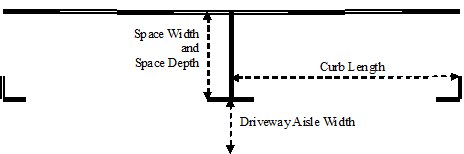
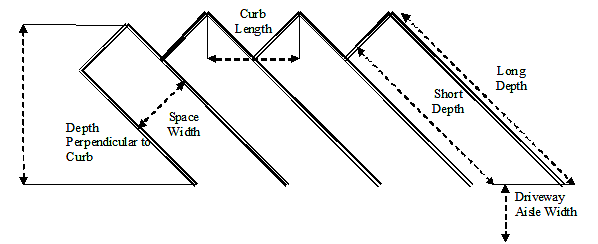
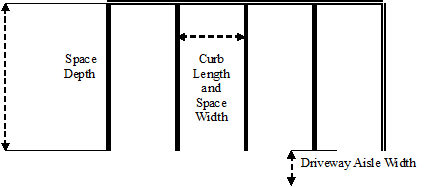
Driveway Aisles. Each parking space in a parking area must be accessed by a driveway aisle. If parking spaces with different angles of parking are accessed by the driveway aisle, the required driveway aisle width is the largest driveway aisle width that would be required for any of those parking spaces. Driveway aisle width is measured between the closest points of two parking spaces, or two curbs, or a parking space and a curb, that are directly opposite on each side of the driveway aisle.
(4)
Changes in Grade. When there is a change in grade between a parking area and an abutting or adjacent street, the gradient of each access point or access driveway may be up to a five percent gradient with no transitions. For a gradient greater than five percent, a twenty-foot long transition with a gradient of no more than five percent must be provided before or after the change in grade. For a gradient greater than fourteen percent, up to the maximum permitted gradient of twenty percent, a transition of one half of the gradient must be provided for a minimum of eight feet before, and a minimum of eight feet after, the change in grade.
(5)
Surfacing. Except as specified in this subsection (a)(5), each required off-street parking area must be surfaced with a continuous asphalt or Portland cement binder pavement, or similar paving material, with a weight rating necessary to accommodate emergency vehicles, as deemed necessary by the zoning administrator in consultation with the fire district or department having jurisdiction over the parking area. At least ten percent of the total paved area of a parking area must be paved with porous asphalt, pervious concrete, permeable pavers, or unit pavers that the zoning administrator, in consultation with the fire district or department having jurisdiction over the parking area, determines has a weight rating necessary to accommodate emergency vehicles. The parking area surface must be graded and drained to prevent the pooling of water.
(6)
Prohibitions. No off-street parking area may be used for automobile sales, storage, repair work, dismantling, or servicing of any kind.
(7)
Striping, Markings, and Signage. Each parking space must be marked with striping and must open directly on a driveway aisle meeting the width requirements set forth in this section. Each parking area must include signage and directional markings deemed necessary by the zoning administrator to ensure sufficient traffic circulation and safety.
(8)
Lighting. For safety and security, each parking area in a non-residential zoning district (any zoning district other than a R-, D-1 or M- district) must include lighting that adequately illuminates the parking area. Lighting must be directed downward and away from adjacent areas and public streets and rights-of-way, to prevent glare (overwhelming direct light creating a potential hazard), or excessive light spill-over (unreasonable amounts of light extending beyond the intended area or property line), as seen from those areas, streets, or rights-of-way. To provide for the general safety of adjacent vehicular traffic and the privacy and well being of residential areas, the lighting intensity may not be greater than reasonably required to safely and securely illuminate the parking area. Each lighting fixture must be consistently maintained to ensure broken or burnt-out bulbs are replaced, fixtures remain clean and graffiti and rust free, and painted fixtures do not chip or peel. Whenever possible, lighting fixtures must be equipped with energy efficient bulbs.
(9)
Screening and Buffers. If a parking area is adjacent to property within a residential zoning district (R-, D-1, or M-) or a parcel used for residential uses within a planned unit district (P-1), the parking area must include one of the following between the parking area and that zoning district:
(A)
A six-foot high solid fence or masonry wall (block, brick, or natural or concrete stone) and vegetation that, when mature, will cover a portion of the fence or wall; or
(B)
Landscape screening of at least six feet in height. Up to three feet, or half of the total height, whichever is less, may consist of planter boxes, raised beds, or similar improvements, and the remaining amount of screening must be shrubbery or other plants that, when planted, will provide a complete screen.
(b)
Parking Space Design and Layout. Each parking space within a parking area must meet all of the following requirements:
(1)
Parking Space Sizes. Except as provided in this subsection, each parking space in a parking area must be a standard size parking space. If twelve or more parking spaces are required by this chapter, a maximum of twenty-five percent of the total required parking spaces may be designated for compact vehicles. Each compact-vehicle parking space must provide pavement markings or signage identifying it for use by compact vehicles. Each standard size parking space, each compact-vehicle off-street parking space, and each driveway aisle must have the following minimum dimensions:
(A)
For each space with an angle of parking of zero degrees:
(B)
For each space with an angle of parking of forty-five degrees:
(C)
For each space with an angle of parking of ninety degrees:
(2)
Non-Standard Angles of Parking. If a parking space in any parking area will have an angle of parking other than zero degrees, forty-five degrees, or ninety degrees, the zoning administrator will calculate the parking space dimensions to provide approximately the same amount of space that is required for a parking space with a zero-degree angle of parking. For calculations for a parking space with an angle of parking that is greater than zero degrees and less than forty-five degrees, the required driveway aisle width is thirteen feet for one-way travel, and twenty feet for two-way travel. For calculations for a parking space with an angle of parking that is greater than forty-five degrees, the required driveway aisle width is twenty-five feet for one-way and two-way travel.
(3)
Motorcycle Parking. Any off-street parking area with twenty or more standard size parking spaces may include up to six designated motorcycle parking spaces. Each designated motorcycle parking space must have a length of at least eight and one-half feet, and a width of at least three feet. Motorcycle parking spaces may not be counted towards the minimum number of parking spaces required by this chapter.
(c)
Landscaping Design and Layout. Landscaped areas must be provided within any off-street parking area other than an enclosed parking structure, and must meet the following design and layout requirements:
(1)
Each landscaped area within or adjacent to a parking area must be bordered by a curb that is at least six inches high and at least six inches wide. Each curb must be constructed of the same material that is used to pave the parking area, or another paving material that is authorized under this chapter and as approved by the zoning administrator.
(2)
Each landscaped area must be designed so that pedestrians are not required to cross the landscaped area in order to access the parking area.
(3)
A planter or landscaped area at least four feet wide (inside dimension) must be provided between a parking area and a public street or private drive, other than an access drive, that is adjacent to a parking area. Each parking area with more than five parking spaces must include landscaped areas that are equal in area to at least five percent of the area occupied by the paved parking area.
(4)
To provide visual and physical breaks and reduce traffic hazards to pedestrians, landscaped areas must be located between the parking area and each sidewalk adjacent to the parking area, except for any point at which a sidewalk intersects with the parking area.
(5)
For any parking space with an angle of parking of forty-five degrees or greater, in lieu of paving, a maximum of two feet of a standard parking space's depth, or one and one-half feet of a compact parking space's depth, may be planted with low-lying groundcover or landscaping to allow for up to a two-foot bumper overhang. A barrier curb or wheel stop measuring no more than five inches high, at least six inches wide, and thirty-six inches long must be provided in the parking space if the parking space is in front of a building, facility, or structure.
(6)
The following requirements apply to each parking area that includes more than seventy parking spaces:
(A)
Trees must be provided at a rate of at least one tree per twenty linear feet of landscaping. Each tree must measure at least five feet in height above-ground at the time that it is planted.
(B)
Planter islands must be provided at the ratio of at least one island for each ten parking spaces. Each planter island must be at least five feet wide and at least as long as the depth perpendicular to curb for the longest parking space adjacent to it.
(C)
Trees, or clusters of trees, must be evenly distributed throughout the parking area by locating trees along the perimeter of the parking area and within planter islands.
(7)
Each landscaped area must be continuously maintained to ensure it remains free of debris, litter, and weeds, and that landscaping remains healthy. To encourage water conservation, each parking area that includes landscaping must also include an automatic irrigation system that meets the requirements of this code pertaining to landscape irrigation and water conservation.
(d)
Tandem Parking. Two-car tandem parking spaces are permitted as specified in this section. Each tandem parking space must have a space width measuring at least eight feet and six inches, and a space depth perpendicular to curb measuring at least thirty-six feet. Vehicles using a tandem parking space must not block, or be allowed to overhang into, walkways or other pedestrian access areas, or any street or other public right-of-way. Each tandem parking space will be counted as two standard parking spaces toward the total amount of off-street parking spaces that must be provided under this chapter.
(1)
Single-family Residential. For any residential use located in a single-family residential (R-) zoning district, a tandem parking space is allowed, as long as the minimum setback requirements applicable to that zoning district are met.
(2)
Multiple-Family Residential. For any residential use located in a two-family (D-1) or multiple family residential (M-) zoning district, no more than fifteen percent of the residential units may be provided tandem parking spaces. A tandem parking space to serve an individual residential unit is allowed if the following requirements are met:
(A)
The tandem parking space is assigned to a single residential unit;
(B)
The tandem parking space is enclosed within a garage that allows ingress to and egress from a shared private road or a public street without requiring a vehicle to back out onto the road or street;
(C)
The multiple family residential use is located within the General Plan Transportation and Circulation Element Transit Corridor or Local Transit Service Area; and
(D)
The tandem parking space does not interfere with, or obstruct the use of, any other unit's assigned parking.
(3)
Commercial/Retail/Business. For any commercial, retail, or business use located in an O-1, A-O, C-B, N-B, R-B, C-, or P-1 zoning district, no more than twenty-five percent of the amount of off-street parking spaces required to be provided under this chapter may be tandem parking spaces. Tandem parking spaces are allowed if they are used in conjunction with a valet service that serves the land use during all hours of operation. No tandem parking space may be designated for self-parking, unless it is restricted for employee use.
(e)
Electric Vehicle Charging Spaces. Each EV charging space provided in a parking area counts as one space toward the minimum number of parking spaces required by this chapter. The following requirements apply to each EV charging space:
(1)
Each EV charging space must be accessible to persons with disabilities.
(2)
Each EV charging space must include a posted sign and painted curb, or ground markings, indicating that the space is exclusively for EV charging purposes.
(3)
EV charging equipment must be located so that pedestrians are not required to cross between the EV charging space and the EV charging equipment. The EV charging equipment may not obstruct any Americans with Disabilities Act-compliant sidewalk, entrance, curb-cut, or ramp, while in use or otherwise.
(4)
EV charging equipment must be illuminated by lighting to enable the equipment to be used at night.
(5)
Concrete-filled steel bollards or other similar barriers must be installed between EV charging equipment and an EV charging space if either of the following applies:
(A)
The EV charging equipment is located less than twenty-four inches away from the EV charging space that it serves; or
(B)
The EV charging equipment is located twenty-four inches or more away from the EV charging space that it serves and does not include, between the space and the equipment, a curb measuring at least six inches high.
(6)
An electric vehicle may occupy an EV charging space only while charging is in progress. Parking in an EV charging space when charging is not in progress is prohibited.
(7)
EV charging equipment must be maintained in working order at all times. The name and telephone number of the party responsible for maintaining and repairing the equipment must be posted on the equipment and updated as necessary.
(f)
Solar Energy Systems. Nothing in this chapter prohibits the installation of a solar energy system on or above a parking area, provided that the system otherwise meets the requirements of this code, and is located, installed, operated, and maintained in a manner that complies with all applicable federal, state, and county requirements.
(Ord. No. 2012-12, § II, 10-16-12)
82-16.406 - Required number of parking spaces.
(a)
The following number of off-street parking spaces must be provided for the following land uses:
(1)
Assembly halls without fixed seats: One space per every fifty square feet of gross floor area.
(2)
Auditoriums: One space per every four seats.
(3)
Banks, business and professional offices, other than medical and dental offices: One space per every two hundred fifty square feet of gross floor area.
(4)
Bowling alleys: Four spaces per every individual alley, plus one space per two employees.
(5)
Child care facility: For facilities that are licensed to serve fifteen or more children, one space per every two hundred fifty square feet of gross floor area.
(6)
Churches/religious institutions: One space per every four seats in the sanctuary/worship space only. If the church/religious institution is used for purposes that are ancillary to worship and administration, the zoning administrator may increase the required number of parking spaces to meet the parking requirements for the ancillary use or uses, or for the use or uses most similar to that ancillary use, specified in this section.
(7)
Commercial service, repair shops and wholesale establishments: One space per every eight hundred square feet of gross floor area.
(8)
Gas station (including vehicle service/repair): 0.9 spaces per every fueling position if the station includes a convenience market, or 0.5 spaces per every fueling position if the station does not include a convenience market.
(9)
Grocery store: One space per every two hundred square feet of gross floor area.
(10)
Golf courses and driving ranges: Four spaces per every hole. If the golf course or driving range facilities are also used for purposes that are ancillary to golf and golf instruction, such as banquets, the zoning administrator may increase the required number of parking spaces to meet the parking requirements for the ancillary use or uses, or for the use or uses most similar to that ancillary use, specified in this section.
(11)
Hospital: One space per every two patient beds. If the hospital includes ancillary services or facilities, such as a pharmacy or medical offices, the zoning administrator may increase the required number of parking spaces to meet the parking requirements for the ancillary use or uses, or for the use or uses most similar to that ancillary use, specified in this section.
(12)
Hotels and motels: One space per every lodging room. If the hotel or motel is used for purposes that are ancillary to lodging and overnight guest services, the zoning administrator may increase the required number of parking spaces to meet the parking requirements for the ancillary use or uses, or for the use or uses most similar to that ancillary use, specified in this section.
(13)
Marina: 0.4 spaces per every berth.
(14)
Medical and dental offices: One space per every two hundred fifty square feet of gross floor area, plus one space per doctor/dentist.
(15)
Mini (self) storage: One space per every three hundred fifty square feet of gross floor area of the office at the facility. A minimum of three spaces must be provided.
(16)
Mortuaries: One space per every fifty square feet of gross floor area in chapel areas.
(17)
Night clubs, cocktail lounges, and restaurants: One space per every three seats, or one space per every one hundred square feet of gross floor area, whichever is greater.
(18)
Nursery (plants): Two spaces per every one thousand square feet of gross floor area and outdoor display area.
(19)
Recreational facility: One space per every two hundred square feet of outdoor recreation area (swimming pools, ball fields, courts, etc.).
(20)
Retail stores and shops, except as otherwise specified herein: One space per every three hundred square feet of gross floor area.
(21)
Retail stores that handle only bulky merchandise, such as furniture, household appliances, and motor vehicles: One space per every five hundred square feet of gross floor area.
(22)
Retail and wholesale establishments where sales are conducted primarily outside of buildings: One space per every two thousand square feet of outdoor display area.
(23)
Rooming and lodging houses: One space per every bedroom.
(24)
Sanitariums, convalescent homes, rest homes, nursing homes: One space per every three beds.
(25)
Sports arenas: One space per every five seats, or one space per every two hundred square feet of gross floor area, whichever is greater.
(26)
Theaters: One space per every five seats.
(27)
Winery: For wineries that include agricultural production, one space per every two hundred fifty square feet of gross floor area. For tasting rooms where no agricultural production or cultivation occurs, one space per three seats, or one space per every one hundred square feet of gross floor area, whichever is greater.
(28)
Warehouses and other storage buildings: One space per every one thousand square feet of gross floor area.
(b)
For any use not specified in this section, the number of parking spaces that must be provided is the number of spaces required to be provided for the most similar land use specified in this section, as determined by the zoning administrator.
(c)
If a final transportation demand management program (TDM) is approved for any project or development pursuant to Chapter 82-32, the number of parking spaces required by that TDM for that project or development supersedes the number of parking spaces that would otherwise be required by this section.
(Ord. No. 2012-12, § II, 10-16-12)
82-16.408 - Exclusive parking facilities.
An exclusive parking facility may be established if it meets all of the following requirements:
(a)
The facility must be located on a lot that is either:
(1)
Adjacent to an established or planned future stop of a public transit service route; or
(2)
Within an O-1, A-O, C-B, N-B, R-B, C-, or P-1 zoning district and the land use that it serves is a business use, commercial use, or office use.
(b)
The facility must be restricted for use by the riders and employees of a public transit service, or the employees, visitors, or business patrons of the land use served by the facility.
(c)
The facility must be located within one thousand feet of the planned or established public transit service stop, or the property line of the lot where the land use to be served by the facility is located.
(d)
The facility only will be used for vehicle and bicycle parking.
(e)
No commercial repair work or sales of any kind will occur within the facility.
(f)
No signs will be located within the facility, except signs required by this chapter to guide traffic or mark parking spaces, signs that identify the persons that may utilize the facility, and signs that are otherwise required by law to be posted.
(g)
The facility must meet the requirements of this chapter that apply to off-street parking areas generally.
(h)
An exclusive parking facility plan must be submitted with the application for a land use permit. The plan must depict and delineate the requirements of this section. The exclusive parking facility may, but is not required to, provide a parking attendant to control entry to, and exit from, the facility. If a parking attendant will be provided, the application must show the location of the parking attendant's shelter, and must describe the hours when an attendant will be present. The application also must describe land use served by the facility.
(Ord. No. 2012-12, § II, 10-16-12)
82-16.410 - Loading spaces.
(a)
In any zoning district, each building or facility with a gross floor area of ten thousand or more square feet that is used for manufacturing, storage, warehousing, displaying of goods, retail sales, wholesale sales, hotel, hospital, mortuary, laundry, dry cleaning, or other land use that requires the receipt or distribution by vehicles of materials and merchandise, must include off-street loading space on the same lot as that building or facility. The required amount of off-street loading space is based on the size of the building or facility that it serves, calculated as follows:
(1)
Ten thousand to twenty thousand square feet of gross floor area, one space.
(2)
Twenty thousand one to thirty thousand square feet of gross floor area, two spaces.
(3)
Thirty thousand one to forty-five thousand square feet of gross floor area, three spaces.
(4)
Forty-five thousand one to seventy-five thousand square feet of gross floor area, four spaces.
(5)
Over seventy-five thousand square feet of gross floor area, one additional space for each additional seventy-five thousand square feet of gross floor area, or portion thereof.
(b)
Each off-street loading space must meet the following requirements:
(1)
Each loading space must be located so that:
(A)
It is accessible from a public street; and
(B)
Any vehicle that regularly uses it does not encroach within any sidewalk or street right-of-way, or within any required front yard or side yard of the building or facility that it serves.
(2)
Each loading space must have a minimum unobstructed width of ten feet, a minimum unobstructed length of thirty-five feet, and a minimum unobstructed clearance height of fifteen feet for the entire length and width of the loading space.
(3)
Each loading space required by this section must be permanently maintained during the existence of the building or facility that it serves, and must be used only for loading and unloading purposes. No part of a required loading space may be encroached upon by buildings or temporary structures, or used for storage or any other activity not related to loading or unloading.
(Ord. No. 2012-12, § II, 10-16-12)
82-16.412 - Bicycle parking.
(a)
To meet the bikeway goals of the Transportation and Circulation Element of the County General Plan, long-term and short-term bicycle parking must be provided to serve each land use, as specified in this section.
(b)
Long-term and short-term bicycle parking must meet the following location requirements:
(1)
The bicycle parking must be located near every terminus of dedicated bicycle trails or routes, or at locations that are accessible by bicycles.
(2)
If no bicycle trails or routes terminate on the lot to be served by the bicycle parking, the parking must be located as close as possible to main entrances and exits of buildings, structures, or facilities without obstructing any door, entry way, path, or sidewalk.
(3)
The bicycle parking must be located in an area that is visible from vehicle parking or circulation areas, or pedestrian circulation areas.
(4)
The bicycle parking location must be identified with guide signs or wayfinding signs that meet the requirements of sign type "3" in sign series "D4" of the then current Manual of Uniform Traffic Control Devices.
(5)
Long-term bicycle parking must be accessible and usable by tenants, employees, or other occupants of the building or facility that it serves.
(c)
The following amounts of long-term and short-term bicycle parking must be provided for the following land uses:
(Ord. No. 2012-12, § II, 10-16-12)
82-16.414 - Shared parking.
(a)
The requirements of this chapter may be met through the use of shared parking spaces if the zoning administrator finds all of the following:
(1)
The number of off-street parking spaces to be shared by two or more land uses must be provided in an amount to satisfy the greatest number of off-street parking spaces required by this chapter for any of the land uses, when calculated individually. The number of off-street parking spaces to be shared by two or more land uses may not exceed the sum of the parking space requirements that otherwise would apply to the land uses under this chapter, when added together.
(2)
Each land use served by the shared parking spaces will utilize the spaces at different times.
(3)
The shared off-street parking spaces are not otherwise required to satisfy the parking requirements for some other use at times when they will be required to serve any of the shared land uses.
(b)
If an application for shared parking is approved by the zoning administrator, the applicant shall record in the office of the county recorder a deed restriction against the property or properties to be served by the shared parking. The deed restriction must specify the land uses served by the shared parking, and must designate and restrict the parking area to serve those land uses.
(c)
Any deed restriction recorded pursuant to this section may be amended or released only after obtaining the approval of the zoning administrator.
(1)
The zoning administrator will approve the release of the deed restriction if either of the following is satisfied:
(A)
Other off-street parking that meets the requirements of this chapter will be provided to serve one or more of the land uses served by the shared parking; or
(B)
One or more of the land uses served by the shared parking has changed, or will change, and off-street parking is no longer, or will no longer be, required under this chapter.
(2)
The zoning administrator will approve an amendment to a deed restriction to require a different amount of shared parking if there is a corresponding change in one or more of the land uses served by the shared parking to require more, or allow for less, shared parking under this chapter.
(d)
The parking area must include a sign or signs specifying the land uses served by the shared parking.
(Ord. No. 2012-12, § II, 10-16-12)
82-16.416 - Variances.
A variance from any of the requirements of this chapter may be obtained pursuant to Article 26-2.20 of this code.
(Ord. No. 2012-12, § II, 10-16-12)
82-18.002 - Prohibited.
No structure (including, but not limited to, fences and gateways) or vegetation which obstructs the visibility of and from vehicles approaching the intersection of a state highway, public road, or street with another state highway, public road, or street, shall be constructed, grown, maintained or permitted higher than two and one-half feet above the curb grade, or three feet above the edge of pavement, within a triangular area bounded by the right-of-way lines and a diagonal line joining points on the right-of-way lines twenty-five feet back from the point of their intersection or in the case of rounded corners, the triangular area between the tangents to the curve of the right-of-way line and a diagonal line joining points on the tangents twenty-five feet back from the point of their intersection. The tangents referred to are those at the beginning and at the end of the curve of the right-of-way line at the corner.
(Ord. 1787; prior code § 8112(a): Ord. 382).
82-18.004 - Exceptions.
This chapter shall not apply to existing public utility poles, or existing permanent structures or existing supporting members of appurtenances thereof; official traffic signs or signals; or corners where the contour of the land itself prevents visibility.
(Ord. 1787: prior code § 8112(b): Ord. 382).
82-18.006 - Railroad crossings.
The prohibitions and limitations of Section 82-18.002 shall apply in every setback or front yard of a lot within seventy-five feet of the point where a state highway, public road, or street crosses a railroad track.
(Ord. 1787: prior code § 8112(c): Ord. 382).
82-18.008 - Violation — Notice.*
If the director of public works determines that a violation of this chapter exists, the director of public works shall give written notice to the owner, tenant, or person having possession, charge or control of the premises on which the violation exists. The notice may be given by registered or certified mail. The notice shall designate the obstruction and shall direct that the obstruction be removed within ten days after receipt of the notice. The notice shall also recite the right of appeal provided for in Section 82-18.010. It is unlawful for the person to whom the notice is addressed to fail to remove the obstruction within the ten-day period unless within the period the person appeals as provided for in Section 82-18.010, in which case the removal must be accompanied within ten days of an adverse ruling on the appeal or application or as ordered by the board of adjustment or planning commission.
(Ord. No. 2024-23, § III(Exh. A), 12-3-24; Ord. 1787: prior code § 8112(d): Ord. 382).
* For director of public works, See Ch. 24-22 of this code.
82-18.010 - Appeal.*
The owner, tenant, or person having possession, charge or control of premises may appeal the determination of the director of public works made under Section 82-18.008, or may seek a variance from the terms of this chapter, by application to the board of adjustment pursuant to Chapter 26-2. Upon such application the board of adjustment may review the determination of the director of public works, if the application is an appeal therefrom, and in any case if it determines that a violation of this chapter exists or is proposed or planned, may grant, grant conditionally, or refuse to grant a variance from the terms of this chapter.
(Ord. 1787: prior code § 8112(e): Ord. 382).
* For director of public works, See Ch. 24-22 of this code.
82-18.012 - Removal after appeal.
Within ten days after the board of adjustment or the planning commission (if appeal is taken to the planning commission) determines that the obstruction must be removed, the applicant shall remove the obstruction.
(Ord. 1787: prior code § 8112(part): Ord. 382).
82-20.002 - Kennels.
(a)
A kennel (and its activities) may be allowed only after and in accordance with the issuance of a land use permit pursuant to this chapter authorizing such use in any of the following land use districts:
(1)
County agricultural zoning districts (A-1, A-2, A-3, A-4, A-20, A-40, or A-80);
(2)
Retail business district (R-B);
(3)
General commercial district (C);
(4)
Light industrial district (L-1); and the
(5)
Heavy industrial district (H-1).
(b)
All animals maintained in kennels shall be confined on the premises or trained or exercised or bred under the owner's control and shall be enclosed in a secure shelter during the hours of darkness, except when they are shown, tried, worked, or hunting under the owner's control.
(Ords. 92-25 § 3, 80-98 § 2: prior code § 8122: Ord. 1264).
82-20.004 - Dog fanciers.
(a)
Dog fancier use and activities and a multiple pet license therefor may be allowed only after the issuance of a land use permit pursuant to this chapter authorizing such use only in the following land use districts:
(1)
Agricultural zoning districts A-1, A-2, and A-3;
(2)
Retail business (R-B);
(3)
General commercial (C);
(4)
Light industrial (L-I);
(5)
Heavy industrial (H-I);
(6)
Single-family residential (R-20, R-40, R-65, or R-100);
(7)
Transition residential-agricultural (R-A); or
(8)
In any other residential land use district requiring a minimum residential lot size of less than twenty thousand square feet, where the applicant's lot is at least twenty thousand square feet in area and where the maximum number of dogs permitted over six months of age does not exceed four.
(b)
In residential districts requiring a minimum lot size of twenty thousand square feet or more, the maximum number of dogs permitted shall be fixed by the involved planning agency division as a condition in the granting of a land use permit.
(c)
All dogs maintained by dog fanciers shall be confined on the premises or trained or exercised under the owner's control and shall be enclosed in a building during the hours of darkness.
(d)
Dog fancier use and activities (involving twenty or less dogs) are a permitted use in agricultural zoning districts A-4, A-20, A-40 and A-80.
(Ords. 92-25 § 3, 1744: prior code § 8123: Ord. 1264).
82-20.006 - Compliance with code provisions.
(a)
All kennel or dog fancier uses or activities allowed by any land use permits issued pursuant to this chapter and code shall only be established or maintained in full compliance with the provisions of Division 416 of this code.
(b)
Upon request of the planning agency, the animal services director in a timely manner shall provide to the agency written comments on and recommendations for pending land use permit applications made pursuant to this chapter.
(Ord. 92-25 § 3).
82-20.008 - Procedure—Modifications.
Land use permits for the special uses enumerated in this chapter and variance permits to modify any of this chapter's provisions may be granted in accordance with Chapters 26-2 and 82-6.
(Ord. 95-25 § 3).
82-22.202 - Purpose.
The purpose of this chapter is to implement the child care component of the community facilities element of the county general plan. It is the policy of Contra Costa County to assist and encourage the development of adequate affordable child care. It is recognized that the provision of child care requires a partnership between public and private participants and that the role of this county is to establish land use policies and ordinances to promote the establishment of child care facilities and the initiation of child care services in this community. It is further recognized that it is the developers' responsibility to address the child care needs associated with the development of their projects within the county, and that the establishment of such child care facilities and initiation of services will help satisfy the child care infrastructure requirements associated with new growth. Further, it is a policy of this county to encourage, whenever possible, joint use facilities such as, but not limited to, public schools, churches, parks or other community facilities.
(Ord. 88-1 § 3).
82-22.204 - Administration.
The community development department shall be responsible to ensure the coordination of child care needs assessment and the provision of information concerning child care, to assist in the preparation of child care programs (where appropriate), and to coordinate the development of a child care program within county government. As part of its responsibilities under this chapter, the department shall verify the need for child care facilities and programs in each unincorporated community in the county every three years.
(Ords. 92-56 § 3, 88-1 § 3).
82-22.206 - Regulations.
The board of supervisors may issue regulations for the administration of this chapter, including procedures and policies.
(Ord. 88-1 § 3).
Article 82-22.4. Definitions
82-22.402 - General.
Unless otherwise specifically provided, the following definitions shall govern the interpretation of this chapter.
(Ord. 88-1 § 3).
82-22.404 - Child care facility.
"Child care facility" means an existing or proposed child care facility as defined in Health and Safety Code Section 1596.750. The three basic designations covered under this section are:
(1)
Small family day care home, as defined in Health and Safety Code § 1596.78(2), a facility licensed for the care of six or fewer children;
(2)
Large family day care home, as defined in Health and Safety Code § 1596.78(1), a facility licensed for the care of seven to twelve children;
(3)
Child care center, as defined in Health and Safety Code § 1596.76, a facility licensed for the care of more than twelve children.
"Child care facility" includes the building, modifications to buildings, equipment, and any accessory structures, in which there are programs and personnel licensed by the state for direct child care services including, but not limited to, shelter, food, education and play opportunities for fewer than twenty-four hours per day.
(Ord. 88-1 § 3).
82-22.406 - Project.
"Project" means a proposal for the development of land, requiring a land use entitlement, whether residential or nonresidential, or both, which conforms to county requirements. A project includes but is not limited to the development of a lot or parcel or larger acreage, conversion of an existing use to a different use, and expansion of a use.
(Ord. 88-1 § 3).
Article 82-22.6. Permitted Use
82-22.602 - Permitted use.
A child care facility provided as a part of a project shall be a permitted use in all land use zoning districts except those designated as heavy industry or which allow hazardous waste disposal. Day care facilities that are not associated with projects as defined in this chapter shall be consistent with the county general plan, and shall be subject to county regulations and ordinance.
(Ord. 88-1 § 3).
Article 82-22.8. Projects
82-22.802 - Project requirements.
The requirements set out in this article shall be applicable to all projects.
(Ord. 88-1 § 3).
82-22.804 - Preapplication conference.
Before filing an application for a land use entitlement, the applicant or developer of a project shall confer with the community development department concerning child care needs and programs.
(Ord. 88-1 § 3).
82-22.806 - Child care survey.
(a)
An application for a land use entitlement shall include a survey or assessment of the estimated child care needs caused by the proposed project, together with a response program showing how the child care needs resulting from the project are to be mitigated within Contra Costa County. The response program to mitigate the child care needs of the project shall include information on the location and capacity of existing or proposed child care facilities and how these will be used, established, maintained and operated. The response program shall also include information addressing the affordability of the child care to be provided. If the response program recommends that child care facilities be provided by existing facilities or through proposed facilities of others not part of the project, the applicant or developer shall provide sufficient information to the community development director to determine that the child care needs generated by the project shall be mitigated.
(b)
The child care survey shall include an assessment of the estimated child care service needs caused by the proposed project. The response program shall show how those needs for child care services are to be mitigated within the county including, but not limited to, the manner in which the establishment of those services and the use of child care facilities will be assured by the availability of qualified care providers and related resources.
(c)
The community development department shall make a determination of the adequacy of the response document no later than thirty days prior to the public hearing on the project. If the director of community development determines that child care needs have not been adequately established or that child care needs not be satisfied for a proposed project, the applicant or developer may be required to enter into a contract with the county providing for the preparation of a report by a consultant selected by the community development department but paid for by the developer, to evaluate and assist in determining child care needs and programs to adequately address those needs for the proposed project.
(d)
The applicant or developer of a residential development with between one and twenty-nine units, inclusive, shall pay a fee, as established by the board in accordance with applicable law, toward child care facility needs in lieu of undertaking the child care survey required in this section. Such fee shall be reserved by the county to assist in meeting the child care facility needs in the community in which such development is located.
(Ords. 92-56 § 4, 88-1 § 3).
82-22.808 - Facility required.
(a)
The developer of a nonresidential project having one hundred or more potential employees or having a floor area of fifteen thousand gross square feet or more shall provide for a child care facility (and the initiation of its use) on-site or off-site as part of the project consistent with the needs assessment and response program as required by this chapter or shall demonstrate that the child care needs of the project are mitigated through the use of existing facilities.
(b)
The applicant or developer of a residential project of thirty or more units shall provide a child care facility on-site or off-site consistent with the needs assessment and response program required by this chapter or shall demonstrate that the child care needs of the project are mitigated through the use of existing facilities. The new facility constructed by the developer for the purposes of satisfying the requirement of this chapter shall be available on an ongoing basis to satisfy the public need for not fewer than twenty-five years unless approved for a change of use by the board on a recommendation by the zoning administrator through a public hearing process.
(Ord. 92-56 § 5, 88-1 § 3).
82-22.810 - Integration with other facilities.
To the extent possible, child care facilities shall be integrated with other facilities. Cooperative efforts with public and private schools shall be encouraged as the preferred method to provide off-site child care. Coordinated use of recreational or common areas within projects, with churches, parks or community facilities is to be fostered as a secondary method to provide child care facilities.
(Ord. 88-1 § 3).
82-22.812 - Deed notification.
The developer shall provide deed notification to all purchasers or lessees that a child care facility may be located at any residential unit or lot or in any common area or facility within the project, as determined by the zoning administrator.
(Ord. 88-1 § 3).
82-22.814 - Restrictive covenants.
The applicant or developer shall provide in the covenants, conditions and restrictions, if any, or in similar documents, that a child care facility may be located at any residential unit or lot or in any common area or facility within the project, as determined by the zoning administrator.
(Ord. 88-1 § 3).
Article 82-22.10. Exemptions
82-22.1002 - Exemptions.
The provisions of this chapter do not apply to the following:
(1)
Any project, as determined by the director of community development, which will not have a significant child care impact;
(2)
The significant remodeling or rehabilitation of a residential or nonresidential building, provided there is no intensification of the use or enlargement of the building;
(3)
The significant repair or reconstruction of a building resulting from damage by fire or other natural disaster, provided there is no intensification of the use or enlargement of the building;
(4)
Any modification or remodel of an existing, legally established dwelling unit that does not create an additional dwelling unit, or the temporary occupancy of a mobilehome not situated in a mobilehome park;
(5)
Child care facilities;
(6)
Any project for which a final development plan approval has been given by the planning agency or for which a development agreement or amended development agreement exists prior to the effective date of the ordinance codified in this chapter, except those projects which include as part of the conditions compliance with this chapter or with the child care requirements of a TSM ordinance or program;
(7)
Studio and one-bedroom dwelling units shall not be counted in multifamily residential projects of more than thirty units;
(8)
Senior housing project;
(9)
Nonresidential projects having fewer than one hundred potential employees or having a floor area of fewer than fifteen thousand gross square feet.
(Ords. 92-56 § 6, 88-1 § 3).
82-24.002 - Purposes.
The purposes of this chapter are to authorize accessory dwelling units and junior accessory dwelling units; to establish a procedure for reviewing and approving their development to ensure and maintain healthy and safe residential living environments; to establish location and development standards for accessory dwelling units; and to comply with State accessory dwelling unit law, commencing with Government Code Section 66310, which requires local agencies to consider applications for accessory dwelling unit permits ministerially without discretionary review or a public hearing.
(Ord. No. 2025-07, § II, 5-13-25)
82-24.004 - Definitions.
For purposes of this chapter, the following words and phrases have the following meanings:
(a)
"Accessory dwelling unit" has the meaning set forth in Government Code Section 66313(a).
(b)
"Attached accessory dwelling unit" means an accessory dwelling unit attached to a primary dwelling unit.
(c)
"Detached accessory dwelling unit" means an accessory dwelling unit detached from a primary dwelling unit.
(d)
"Internal conversion" means the establishment of an accessory dwelling unit or junior accessory dwelling unit within an existing or proposed primary dwelling unit or within an existing accessory structure.
(e)
"Junior accessory dwelling unit" has the meaning set forth in Government Code Section 66313(d).
(f)
Whenever the term "residential second unit" is used in any ordinance, resolution, order, directive, or regulation of the county, it means "accessory dwelling unit."
(Ord. No. 2025-07, § II, 5-13-25)
82-24.006 - Permitting procedure.
(a)
Except as otherwise provided in this section, an application for a permit to establish an accessory dwelling unit will be approved ministerially without discretionary review or public hearing if the accessory dwelling unit meets all of the following requirements: the location requirements specified in Section 82-24.010; the development standards specified in Section 82-24.012; and all applicable building standards in Title 7 of this Code and all applicable sewage and water requirements.
(b)
An application for a permit to establish any of the following types of accessory dwelling units in a residential or mixed-use zoning district is not subject to the location requirements specified in Section 82-24.010 or the development standards specified in Section 82-24.012 and will be approved ministerially without discretionary review or public hearing.
(1)
One internal conversion accessory dwelling unit and one internal conversion junior accessory dwelling unit on a lot with a proposed or existing single-family dwelling, if:
(A)
Each internal conversion has independent exterior access;
(B)
All side and rear setbacks are sufficient for fire safety; and
(C)
Each internal conversion meets all applicable building standards in Title 7 of this Code and all applicable sewage and water requirements.
If an internal conversion is a junior accessory dwelling unit, it must comply with the requirements of Government Code section 66313. All internal conversions in an existing structure authorized under this subsection (b)(1) may include a total expansion of not more than one hundred fifty square feet beyond the physical dimensions of the existing structure in which the conversions are located, but the expansions must be limited to accommodating ingress and egress.
(2)
One detached, new construction, accessory dwelling unit on a lot with a proposed or existing single-family dwelling, if: the side and rear setbacks are a minimum of four feet; the detached accessory dwelling unit does not exceed eight hundred square feet in size; the detached accessory dwelling unit does not exceed the applicable height limitations specified in Government Code section 66321(b)(4); and the detached accessory dwelling unit meets all applicable building standards in Title 7 of this Code and all applicable sewage and water requirements. The detached accessory dwelling unit may be combined with a junior accessory dwelling unit authorized under subsection (b)(1).
(3)
One or more accessory dwelling units that are internal conversions within the non-livable space of an existing multiple-family dwelling, including but not limited to storage rooms, boiler rooms, passageways, attics, basement, or garages. Each internal conversion under this subsection (b)(3) must meet all applicable building standards in Title 7 of this Code and all applicable sewage and water requirements. The number of internal conversions authorized within an existing multiple-family dwelling under this subsection (b)(3) may not exceed twenty-five percent of the number of existing multiple-family units in the dwelling.
(4)
One or more detached accessory dwelling units on a lot with a proposed or existing multiple-family dwelling, if:
(A)
All side and rear setbacks are a minimum of four feet;
(B)
Each detached accessory dwelling unit does not exceed the applicable height limitations specified in Government Code section 66321(b)(4); and
(C)
Each detached accessory dwelling unit meets all applicable building standards in Title 7 of this Code and all applicable sewage and water requirements.
The number of detached accessory dwelling units permitted on a lot with an existing multiple-family dwelling under this subsection (b)(4) may not exceed the number of existing units on the lot or eight detached accessory dwelling units, whichever is less. The number of detached accessory dwelling units permitted on a lot with a proposed multiple-family dwelling under this subsection (b)(4) may not exceed two detached accessory dwelling units.
(Ord. No. 2025-07, § II, 5-13-25)
82-24.008 - Applications.
(a)
An application for an accessory dwelling unit permit must be submitted to the Department of Conservation and Development before a building permit application is submitted to the county. An application for a junior accessory dwelling unit permit must be submitted in the same manner and form as an application for an accessory dwelling unit permit.
(b)
An application for an accessory dwelling unit permit must be made in writing and contain the following information:
(1)
Name(s) and address(es) of applicant(s) and property owner(s).
(2)
Size, indicating dimensions and square footage of the primary dwelling unit and the proposed accessory dwelling unit.
(3)
A legible scale drawing, showing:
(A)
A north arrow to indicate lot orientation.
(B)
Lot dimensions and labels for all property lines.
(C)
Siting and location of the primary dwelling unit and the proposed accessory dwelling unit.
(D)
Floor plan configuration of the primary dwelling unit and the proposed accessory dwelling unit.
(E)
All other existing and proposed buildings, structures, and improvements, including retaining walls, fencing, driveways, and parking areas. All buildings and structures must be labeled.
(F)
Location and dimensions of any additional off-street parking provided to serve the proposed accessory dwelling unit.
(G)
For detached accessory dwelling units, elevations of the proposed unit showing exterior features and dimensions, including maximum building height. "Exterior features" include entrances, windows, and roof.
(4)
Location and description of water and sanitary services for both the primary dwelling unit and the proposed accessory dwelling unit.
(5)
A written legal description of the property.
(Ord. No. 2025-07, § II, 5-13-25)
82-24.010 - Location.
(a)
Accessory dwelling units that comply with this chapter may be located on any lot in a single-family residential district (R-6, R-7, R-10, R-12, R-15, R-20, R-40, R-65, and R- 100), a water recreation district (F-1), planned unit district (P-1) for residential uses, or a multiple-family residential district (M-6, M-9, M-12, M-17, and M-29).
(b)
Accessory dwelling units that comply with this chapter may be located on any lot in an agricultural district (A-2, A-3, A-4, A-20, A-40, and A-80). If accessory dwelling units are proposed for a lot under a Williamson Act contract, the accessory dwelling units will be allowed subject to the provisions of this chapter unless the Williamson Act contract prohibits an accessory dwelling unit or a residential second unit on the property.
(c)
No subdivision rights are authorized that would result in an accessory dwelling unit being located on a separate lot.
(Ord. No. 2025-07, § II, 5-13-25)
82-24.012 - Development standards.
(a)
Accessory Dwelling Unit Size.
(1)
A detached accessory dwelling unit may not exceed the following sizes.
(A)
A detached accessory dwelling unit may not exceed one thousand square feet in any zoning district where an accessory dwelling unit is allowed, unless the accessory dwelling unit is located on a lot of twelve thousand square feet or more, or in an agricultural district, or in the Kensington (-K) combining district.
(B)
A detached accessory dwelling unit may not exceed one thousand two hundred square feet on a lot of twelve thousand square feet or more.
(C)
A detached accessory dwelling unit may not exceed one thousand two hundred square feet in an agricultural district.
(D)
In the Kensington (-K) combining district, a detached accessory dwelling unit may not exceed eight hundred fifty square feet if the accessory dwelling unit provides one bedroom and may not exceed one thousand square feet if the accessory dwelling unit provides more than one bedroom.
(2)
An attached accessory dwelling unit may not exceed the following sizes.
(A)
Except as otherwise provided in subsection (B) below, an attached accessory dwelling unit may not exceed the sizes specified in this subsection (A).
(i)
An attached accessory dwelling unit may not exceed one thousand square feet in any zoning district where an accessory dwelling unit is allowed, unless the accessory dwelling unit is located on a lot of twelve thousand square feet or more, or in an agricultural district, or in the Kensington (-K) combining district.
(ii)
An attached accessory dwelling unit may not exceed one thousand two hundred square feet on a lot of twelve thousand square feet or more.
(iii)
An attached accessory dwelling unit may not exceed one thousand two hundred square feet in an agricultural district.
(iv)
In the Kensington (-K) combining district, an attached accessory dwelling unit may not exceed eight hundred fifty square feet if the accessory dwelling unit provides one bedroom and may not exceed one thousand square feet if the accessory dwelling unit provides more than one bedroom.
(B)
An attached accessory dwelling unit may not exceed fifty percent of the living area of the primary dwelling unit to which the accessory dwelling unit is attached, except that an attached accessory dwelling unit may exceed fifty percent of the living area of the primary dwelling unit to the extent necessary to permit an accessory dwelling unit of eight hundred fifty square feet if the accessory dwelling unit provides one bedroom or one thousand square feet if the accessory dwelling unit provides more than one bedroom.
(b)
Living Provisions. An accessory dwelling unit must provide complete independent living facilities for one or more persons, including permanent provisions for living, sleeping, eating, cooking, and sanitation.
(c)
Permanent Foundation. A permanent foundation is required for all accessory dwelling units.
(d)
Sewage and Water. If a private sewage disposal system, water system, or both are proposed to be used, it must meet all applicable county regulations and be approved by the health officer before an accessory dwelling unit may be established. Verification that the standard has been met is required prior to final inspection.
(e)
Independent Exterior Access. An accessory dwelling unit must have independent exterior access separate from that of the primary dwelling unit. The independent exterior access must be located on the building side or building rear, or not visible from the street.
(f)
Types of Accessory Dwelling Units. An accessory dwelling unit may be attached to a primary dwelling unit or detached from a primary dwelling unit.
(1)
If an accessory dwelling unit is attached to a primary dwelling unit, the accessory dwelling unit must be an internal conversion of an attached garage or other area within the primary dwelling unit, or an addition to the primary dwelling unit.
(2)
If an accessory dwelling unit is detached from a primary dwelling unit, the accessory dwelling unit must be an internal conversion of a detached garage or other accessory building, or new construction. A detached accessory dwelling unit must be located on the same lot as the primary dwelling unit.
(g)
Garage Attached to a Detached Accessory Dwelling Unit. If a garage is attached to a detached accessory dwelling unit, the garage may not exceed the following sizes:
(1)
Five hundred square feet on lots of twenty thousand square feet or less in all zoning districts where an accessory dwelling unit is allowed, except in an agricultural district.
(2)
Six hundred square feet on lots larger than twenty thousand square feet and smaller than five acres in all zoning districts where an accessory dwelling unit is allowed, except in an agricultural district.
(3)
Eight hundred square feet on lots of five acres or more.
(4)
Eight hundred square feet in an agricultural district.
(h)
Yards and Building Height.
(1)
An accessory dwelling unit must comply with all requirements relating to yards (front setbacks, side, and rear) and building height that are generally applicable to residential construction in the zone in which the property is located, except as otherwise provided in this subsection (h).
(2)
A setback is not required for an accessory dwelling unit that is an internal conversion or that is constructed in the same location and to the same dimensions as an existing building.
(3)
A setback of four feet from the side and rear lot lines is required for an accessory dwelling unit that is not an internal conversion and is not constructed in the same location and to the same dimensions as an existing building.
(4)
An accessory dwelling unit and any portion of an accessory dwelling unit is subject to the applicable height limitations specified in Government Code section 66321(b)(4) if it is located:
(A)
Within a front, back, or side yard area applicable to residential construction in the zone in which the lot is located; or
(B)
In the Kensington (-K) combining district.
(i)
Off-Street Parking.
(1)
A lot containing an accessory dwelling unit must provide an additional off-street parking space to serve the accessory dwelling unit, except as otherwise provided in this subsection (i). The additional space may be within a setback area or in tandem, unless specific findings are made that parking in a setback area or in tandem is not feasible based on site or regional topographical or fire and life safety conditions.
(2)
Replacement parking spaces are not required if a garage, carport, covered parking structure, or uncovered parking space that provides off-street parking is demolished or converted in conjunction with the construction of an accessory dwelling unit.
(3)
No additional off-street parking is required for an accessory dwelling unit in any of the following instances:
(A)
The accessory dwelling unit is located within one-half mile walking distance of public transit.
(B)
The accessory dwelling unit is located within an architecturally and historically significant historic district.
(C)
The accessory dwelling unit is an internal conversion.
(D)
The accessory dwelling unit is located within a permit-parking area designated pursuant to Chapter 46-10, but an on-street parking permit is not available under that chapter to the occupant of the accessory dwelling unit.
(E)
A car share vehicle pick-up location is within one block of the accessory dwelling unit. A "car share vehicle" has the same meaning as in Vehicle Code Section 22507.1.
(F)
An application for the accessory dwelling unit is submitted with an application for a proposed single-family dwelling or a proposed multiple- family dwelling on the same lot, and the accessory dwelling unit or lot satisfies any other criteria listed in this subsection (i)(3).
(Ord. No. 2025-07, § II, 5-13-25)
82-24.014 - Occupancy and sale restrictions.
(a)
No accessory dwelling unit or junior accessory dwelling unit may be rented or offered for rent for a term of less than thirty days.
(b)
A junior accessory dwelling unit may not be sold separately from the primary single- family dwelling.
(c)
An accessory dwelling unit may not be sold separately, except in conformance with Government Code section 66341.
(Ord. No. 2025-07, § II, 5-13-25)
82-24.016 - Deed restrictions for junior accessory dwelling units.
Before obtaining a permit authorizing the establishment of a junior accessory dwelling unit, the applicant shall do the following:
(a)
Enter into an agreement of restrictions with the county that provides the following:
(1)
The junior accessory dwelling unit shall not be sold separately from the primary single-family dwelling.
(2)
The junior accessory dwelling unit is restricted to the maximum size allowed under the permit and must comply with all permit restrictions and requirements.
(3)
The restrictions are binding upon any successor in ownership of the property and lack of compliance may result in legal action by the county against the property owner.
(b)
Record the agreement with the county recorder.
(c)
Prepare a disclosure statement that shall be included in any future offer or sale documents. The statement shall read as follows:
"You are purchasing a property with a permit for a junior accessory dwelling unit. This permit carries with it certain restrictions that must be met by the owner of the property. You are prohibited from selling the junior accessory dwelling unit separately from the primary single-family dwelling. The junior accessory dwelling unit is restricted to the maximum size allowed under the permit and must comply with all permit restrictions and requirements. The junior accessory dwelling unit may not be rented or offered for rent for a term of less than thirty days. The permit is available from the current owner or from the Contra Costa County Department of Conservation and Development."
(Ord. No. 2025-07, § II, 5-13-25)
82-24.018 - Nonconforming units.
Notwithstanding the provisions of Section 82-8.006 of this Code, if the existing primary dwelling unit is a legal nonconforming unit, an accessory dwelling unit or junior accessory dwelling unit may be constructed only if the nonconformity is not expanded and the accessory dwelling unit or junior accessory dwelling unit meets all current applicable zoning and building standards.
(Ord. No. 2025-07, § II, 5-13-25)
82-24.020 - Unpermitted units.
(a)
Notwithstanding anything in this chapter to the contrary, an application to permit an unpermitted accessory dwelling unit or unpermitted junior accessory dwelling unit that was constructed before January 1, 2020, shall be approved ministerially without discretionary review or public hearing in accordance with Government Code section 66332, unless the county building official, or designee, finds that the criteria in both subsection (a)(1) and subsection (a)(2) are met.
(1)
The unpermitted accessory dwelling unit or unpermitted junior accessory dwelling unit violates:
(A)
The building standards set forth in Article 1 (commencing with Section 17960) of Chapter 5 of Part 1.5 of Division 13 of the Health and Safety Code;
(B)
The State accessory dwelling unit law pursuant to Article 2 (commencing with Section 66314) or Article 3 (commencing with Section 66333) of Chapter 13 of Division 1 of Title 7 of the Government Code, as applicable; or
(C)
This chapter.
(2)
It is necessary to correct the violation specified subsection (a)(1) to comply with the standards specified in Health and Safety Code section 17920.3.
(b)
This section does not apply to a building that the county building official has deemed substandard pursuant to Health and Safety Code section 17920.3.
(Ord. No. 2025-07, § II, 5-13-25)
82-24.022 - Fees.
Fees for accessory dwelling unit permits and junior accessory dwelling unit permits will be in amounts established by the board of supervisors in the Department of Conservation and Development's fee schedule. To the extent permitted by state law, accessory dwelling units and junior accessory dwelling units are subject to all applicable fees for new development.
(Ord. No. 2025-07, § II, 5-13-25)
82-26.002 - California Model Water Efficient Landscape Ordinance Adopted.
(a)
The water efficient landscape ordinance of Contra Costa County is the Model Water Efficient Landscape Ordinance adopted by the California Department of Water Resources and as set forth in Chapter 2.7 of Division 2, Title 23, of the California Code of Regulations, Sections 490 through 495 and Appendices A through D (the "MWELO"), as may be amended from time to time and as amended by the changes, additions, and deletions set forth in Section 82-26.004.
(b)
At least one copy of the MWELO is on file with the Community Development Division of the Department of Conservation and Development.
(Ord. No. 2022-09 § 3, 3-1-22)
82-26.004 - Amendments to the MWELO.
The MWELO is amended by the changes, additions, and deletions set forth in this section. Section numbers used below are those of the MWELO.
(a)
Section 492.3, Penalties, is amended to read:
492.3. Penalties. This chapter may be enforced by any remedy allowed under this code, including Chapter 14-12, and by any other remedy allowed by law.
(Ord. No. 2022-09 § 3, 3-1-22)
82-28.202 - Statutory authorization.
This ordinance is designed to promote the public health, safety and general welfare of the citizens of Contra Costa County and is enacted pursuant to the authority of 42 United States Code Sections 4001-4128; see especially 42 U.S.C. Section 4022; Government Code Sections 25120-25132; Title 44 of the United States Code of Federal Regulations at Section 60.3, (and "all applicable associated" Technical Bulletins); Health and Safety Code Section 450; and California Constitution, Article XI, Section 7 and Government Code Sections 65302, 65560 and 65800.
(Ords. 2000-33, 99-35, 96-11, 90-118, 88-50, 87-45).
82-28.204 - Findings of fact.
(1)
The special flood hazard areas (SFHA) of Contra Costa County are areas subject to periodic inundation which results in loss of life and property, health and safety hazards, disruption of commerce and governmental services, extraordinary public expenditures for flood protection and relief and impairment of the tax base, all of which adversely affect the public health, safety, and general welfare.
(2)
These flood losses are caused by inadequate drainage facilities and the cumulative effect of obstructions in areas of special flood hazards, which increase flood heights and velocities. These losses may result when structures are inadequately anchored, elevated, floodproofed or protected from flood damage.
(3)
Contra Costa County has experienced serious flooding, which has resulted in substantial property damage and the potential for loss of life. Adoption of a legally enforceable floodplain management ordinance which fully complies with the recently revised rules of the National Flood Insurance Program (NFIP) administered by the Federal Emergency Management Agency (FEMA) will allow Contra Costa County to continue its participation in the NFIP. The continued participation of the county in the NFIP is desirable and promotes the public health, safety and welfare in that it provides insurance and federal assistance in the event of flood(s) within the county's jurisdiction. In the absence of such insurance, the county's vulnerability to damage and loss resulting from flood events may be substantial and potential flood damage represents an immediate threat to the public health, safety and welfare.
(Ords. 2000-33, 99-35, 96-11, 90-118, 88-50, 87-45).
82-28.206 - Statement of purpose.
It is the purpose of this ordinance to promote the public health, safety and general welfare, and to minimize public and private losses due to flood conditions in specific areas by provisions designed:
(1)
To protect human life and health;
(2)
To minimize expenditure of public money for costly flood control projects;
(3)
To minimize the need for rescue and relief efforts associated with flooding and generally undertaken at the expense of the general public;
(4)
To minimize prolonged business interruptions during flooding;
(5)
To minimize damage to public facilities and utilities such as water and gas mains, electric, telephone, sewer lines and streets and bridges located in areas of special flood hazard;
(6)
To help maintain a stable tax base by providing for the use and development of areas of special flood hazard subject to review by permit and application of flood damage reduction standards so as to minimize future flood blight areas;
(7)
To provide information to the general public regarding special flood hazard areas in the unincorporated areas of the county;
(8)
To clearly establish that those who occupy the areas of special flood hazard should assume responsibility for their actions and the losses they may suffer; and
(9)
To ensure that potential buyers are notified if property is in an area of special flood hazard.
(Ords. 2000-33, 96-11, 90-118, 88-50, 87-45).
82-28.208 - Methods of reducing flood losses.
In order to accomplish its purpose, this ordinance includes methods and provisions for:
(1)
Restricting or prohibiting land uses that create a danger to health, safety and property due to water inundation or erosion hazards or that result in damaging increases in erosion, flood heights or velocities;
(2)
Requiring that land use areas vulnerable to floods be protected against flood damage at the time of initial construction including facilities such as utilities, which serve them;
(3)
Requiring that the design of streets and public access facilities include consideration of accessibility under the base flood conditions for emergency service vehicles and any rescue and relief operations;
(4)
Controlling and limiting the alteration of natural floodplains, stream channels and natural protection barriers that help accommodate or channel floodwaters;
(5)
Controlling filling, grading, dredging and other development which may increase flood damage;
(6)
Preventing or regulating the construction of flood barriers that will unnaturally divert floodwaters or that may increase flood hazards in other areas.
(7)
Requiring orderly development of drainage facilities within watershed areas as development occurs;
(8)
Recognizing the importance and beneficial functions of natural floodplains; and
(9)
Requiring that all new construction and substantial improvements within floodplains be constructed in such a manner that flood damage will be minimized.
(Ords. 2000-33, 99-35, 96-11, 90-118, 88-50, 87-45).
82-28.402 - Appeal.
"Appeal" means a request for a review of the floodplain administrator's interpretation of any provision of this ordinance or decision on a request for a variance.
(Ords. 2000-33, 99-35, 96-11, 90-118, 88-50, 87-45).
82-28.404 - Area of shallow flooding.
"Area of shallow flooding" means a designated AO, AH or VO zone on the flood insurance rate map (FIRM). The base flood depths range from one to three feet; a clearly defined channel does not exist; the path of flooding is unpredictable and indeterminate; and velocity flow may be evident.
(Ords. 2000-33, 99-35, 96-11, 90-118, 88-50, 87-45).
82-28.406 - Base flood elevation (BFE).
"Base flood elevation (BFE)" means the elevation above "mean sea level" to which the base flood will rise as determined by FEMA or the floodplain administrator.
(Ords. 2000-33, 99-35, 96-11, 90-118, 88-50, 87-45).
82-28.408 - Base flood.
"Base flood" means a flood having a one percent chance of being equaled or exceeded in any given year (also called the "one-hundred-year flood").
(Ords. 2000-33, 99-35, 96-11, 90-118, 88-50, 87-45).
82-28.410 - Basement.
"Basement" means any area of the building having its floor subgrade (below ground level) on all sides.
(Ords. 2000-33, 99-35, 96-11, 90-118, 88-50, 87-45).
82-28.412 - Breakaway walls.
"Breakaway walls" are any type of walls, whether solid or lattice and whether constructed of concrete, masonry, wood, metal, plastic or any other suitable building material that is not part of the structural support of the building and that is designed to break away under abnormally high tides or wave action without causing any damage to the structural integrity of the building on which they are used or any buildings to which they might be carried by floodwaters. A breakaway wall shall have a safe design loading resistance of not less than ten and no more than twenty pounds per square foot. Use of breakaway walls must be certified by a registered engineer or architect and shall meet the following conditions:
(1)
Breakaway wall collapse shall result from a water load less than that which would occur during the base flood; and
(2)
The elevated portion of the building shall not incur any structural damage due to the effects of wind and water loads acting simultaneously in the event of the base flood.
(Ords. 2000-33, 99-35, 96-11, 90-118, 88-50, 87-45).
82-28.414 - Building permit.
"Building permit" means a: building permit, plumbing permit, electrical permit or mechanical permit issued by the Contra Costa County building inspection department.
(Ords. 2000-33, 99-35, 96-11).
82-28.416 - Coastal high-hazard area.
"Coastal high-hazard area" means an area of special flood hazard extending from offshore to the inland limit of a primary frontal dune along an open coast and any other area subject to high velocity wave action from storms or seismic sources. It is the area subject to high-velocity waters, including coastal and tidal inundation or tsunamis. The area is designated on a FIRM as zone VI-V30, VE or V.
(Ords. 2000-33, 99-35, 96-11, 90-118, 88-50, 87-45).
82-28.418 - Development.
"Development" means any manmade change to improved or unimproved real estate, including, but not limited to, buildings or other structures, mining, dredging, filling, grading, paving, excavation, drilling operations and storage of equipment or materials.
(Ords. 2000-33, 99-35, 96-11, 90-118, 88-50, 87-45).
82-28.420 - Encroachment.
"Encroachment" means the advance or infringement of uses, fill, excavation, buildings, permanent structures or development into a floodplain that may impede or alter the flow capacity of a floodplain.
(Ord. 2000-33, 99-35).
82-28.422 - Existing manufactured home park or subdivision.
"Existing manufactured home park or subdivision" means a manufactured home park or subdivision for which the construction of facilities for servicing the lot on which the manufactured homes are to be affixed including, at a minimum, the installation of utilities, either final site grading or the pouring of concrete pads and the construction of streets are completed on or before the effective date of this ordinance.
(Ords. 2000-33, 99-35, 96-11, 90-118, 88-50, 87-45).
82-28.424 - Expansion to an existing manufactured home park or subdivision.
"Expansion to an existing manufactured home park or subdivision" means the preparation of additional sites by the construction of facilities for servicing the lots on which the manufactured homes are to be affixed, including the installation of utilities, either final site grading or pouring of concrete pads or the construction of streets.
(Ords. 2000-33, 99-35, 96-11, 90-118, 88-50, 87-45).
82-28.426 - Flood or flooding.
"Flood or flooding" means a general and temporary condition of partial or complete inundation of normally dry land areas from:
(1)
The overflow of floodwaters; and/or
(2)
The unusual and rapid accumulation or runoff of surface waters from any source; and/or
(3)
The collapse or subsidence of land along the shore of a lake or other body of water as a result of erosion or undermining caused by waves or currents of water exceeding anticipated cyclical levels or suddenly caused by an unusually high water level in a natural body of water accompanied by a severe storm or by an unanticipated force of nature such as flash flood or an abnormal tidal surge or by some similarly unusual and unforeseeable event that results in flooding as defined in this definition.
(Ords. 2000-33, 99-35, 96-11, 90-118, 88-50, 87-45).
82-28.428 - Flood boundary and floodway map.
"Flood boundary and floodway map" means the official map described in Section 82-28.604 on which the FEMA or FIA has delineated both the areas of flood hazard and the floodway.
(Ords. 2000-33, 99-35, 96-11, 90-118, 88-50, 87-45).
82-28.430 - Flood insurance rate map (FIRM).
"Flood insurance rate map (FIRM)" means the official map described in Section 82-28.604 on which the FEMA or FIA has delineated both the areas of special flood hazards and the risk premium zones applicable to the community.
(Ords. 2000-33, 99-35, 96-11, 90-118, 88-50, 87-45).
82-28.432 - Flood insurance study.
"Flood insurance study" means the official report described in Section 82-28.604 provided by the FIA that includes flood profiles, the FIRM, the flood boundary and floodway map, and in some areas, the base flood elevation.
(Ords. 2000-33, 99-35, 96-11, 90-118, 88-50, 87-45).
82-28.434 - Floodplain or flood-prone area.
"Floodplain or flood-prone area" means any land area susceptible to being inundated by water from any source (See definition of "flood or flooding").
(Ords. 2000-33, 99-35, 96-11, 90-118, 88-50, 87-45).
82-28.436 - Floodplain administrator.
"Floodplain administrator" means the individual appointed to administer and enforce the floodplain management regulations.
(Ords. 2000-33, 99-35, 96-11, 90-118, 88-50, 87-45).
82-28.438 - Floodplain management.
"Floodplain management" means the operation of an overall program of corrective and preventive measures for reducing flood damage and preserving and enhancing, where possible, natural resources in the floodplain, including, but not limited to, emergency preparedness plans, flood control work and floodplain management regulations.
(Ords. 2000-33, 99-35, 96-11, 90-118, 88-50, 87-45).
82-28.440 - Floodplain management regulations.
"Floodplain management regulations" means zoning ordinances, subdivision regulations, building codes, health regulations, special purpose ordinances (such as floodplain ordinance, grading ordinance and erosion control regulations) and other applications of the police power that control development in flood-prone areas. This term describes federal, state or local regulations in any combination thereof that provide standards for preventing and reducing flood loss and damage.
(Ord. 2000-33, 99-35, 96-11, 90-118, 88-50, 87-45).
82-28.442 - Floodplain permit.
"Floodplain permit" means a permit required of all development which occurs in any area designated by FEMA as a SFHA and as required by the floodplain administrator.
(Ords. 2000-33, 99-35, 96-11, 90-118, 88-50, 87-45).
82-28.444 - Floodproofing.
"Floodproofing" means any combination of structural and nonstructural additions, changes or adjustments to nonresidential structures that eliminate flood damage to real estate or improved real property, water and sanitary facilities and nonresidential structures and their contents.
(Ords. 2000-33, 99-35, 96-11, 90-118, 88-50, 87-45).
82-28.446 - Floodway.
"Floodway" means the channel of a river or other watercourse and the adjacent land areas that must be reserved in order to discharge the base flood without cumulatively increasing the water surface elevation more than 0.30 meters (one foot). The floodway shall be as designated on the FIRMS and/or as designated by the floodplain administrator whether or not a floodplain is shown on the FIRM. Also referred to as "Regulatory floodway."
(Ords. 2000-33, 99-35, 96-11, 90-118, 88-50, 87-45).
82-28.448 - Flood resistant.
"Flood resistant" means any combination of structural and nonstructural additions, changes or adjustments to structures that reduces flood damage, generally allowing floodwaters to enter and exit the building without causing any significant damage to the structures or their contents.
(Ords. 2000-33, 99-35, 96-11, 90-118, 88-50, 87-45).
82-28.450 - Flood-resistant materials.
"Flood-resistant materials" means any building material capable of withstanding direct and prolonged (at least seventy-two hours) contact with floodwaters without sustaining significant damage (any damage requiring more than low-cost cosmetics repair, such as painting). Acceptable materials are specified in "technical bulletins" and/or as approved by the floodplain administrator.
(Ord. 2000-33, 99-35).
82-28.452 - Flood-related erosion.
"Flood-related erosion" means the collapse or subsidence of land along the shore of a lake or other body of water as a result of undermining caused by waves or currents of water exceeding anticipated cyclical levels or suddenly caused by an unusually high water level in a natural body of water, accompanied by a severe storm, or by an unanticipated force of nature, such as a flash flood or an abnormal tidal surge, or by some similarly unusual and unforeseeable event which results in flooding.
(Ord. 2000-33, 99-35).
82-28.454 - Flood-related erosion area or flood-related erosion prone area.
"Flood-related erosion area" or "flood-related erosion prone area" means a land area adjoining the shore of a lake or other body of water, which due to the composition of the shoreline or bank and high water levels or wind-driven currents, is likely to suffer flood-related erosion damage.
(Ord. 2000-33, 99-35).
82-28.456 - Flood-related erosion area management.
"Flood-related erosion area management" means the operation of an overall program of corrective and preventive measures for reducing flood-related erosion damage, including, but not limited to, emergency preparedness plans, flood-related erosion control work and floodplain management regulations.
(Ord. 2000-33, 99-35).
82-28.458 - Floodway fringe.
"Floodway fringe" means that area of the floodplain on either side of the "regulatory floodway" where encroachment may be permitted.
(Ord. 2000-33, 99-35).
82-28.460 - Fraud and victimization.
"Fraud and victimization," as related to Section 82-28.516, Variances, means that the variance granted must not cause fraud on or victimization of the public. In examining this requirement, the zoning administrator will consider the fact that every newly constructed building adds to government responsibilities and remains a part of the community for fifty to one hundred years. Buildings that are permitted to be constructed below the base flood elevation are subject during all those years to increased risk of damage from floods, while future owners of the property and the community as a whole are subject to all the costs, inconvenience, danger and suffering that those increased flood damages bring. In addition, future owners may purchase the property, unaware that it is subject to potential flood damage, and can be insured only at very high flood insurance rates.
(Ord. 2000-33, 99-35).
82-28.462 - Freeboard.
"Freeboard" means a factor of safety usually expressed in feet above a base flood elevation for purposes of floodplain management. "Freeboard" tends to compensate for the many unknown factors that could contribute to flood heights greater than the height calculated for a selected size flood and floodway conditions, such as wave action, bridge openings and the hydrological effect of urbanization of the watershed.
(Ords. 2000-33, 99-35, 96-11, 90-118, 88-50, 87-45).
82-28.464 - Functionally dependent use.
"Functionally dependent use" means a use which cannot perform its intended purpose unless it is located or carried out in close proximity to water. (The term includes only docking facilities, port facilities that are necessary for the loading and unloading of cargo or passengers and ship building and ship repair facilities, but does not include long-term storage or related manufacturing facilities.)
(Ords. 2000-33, 99-35, 96-11, 90-118, 88-50, 87-45).
82-28.466 - Governing body.
"Governing body" means the local governing unit, i.e. county or municipality, that is empowered to adopt and implement regulations to provide for the public health, safety and general welfare of its citizenry.
(Ord. 2000-33, 99-35).
82-28.468 - Hardship.
"Hardship," as used in Section 82-28.516, Variances, means the exceptional hardship that would result from a failure to grant the requested variance. The county requires that the variance be exceptional, unusual and peculiar to the property involved. Mere economic or financial hardship alone is not exceptional. Inconvenience, aesthetic considerations, physical handicaps, personal preferences or the disapproval of one's neighbors cannot, as a rule, qualify as an exceptional hardship. All of these problems can be resolved through other means without granting a variance, even if the alternative is more expensive or requires the property owner to build elsewhere or put the parcel to a different use than originally intended.
(Ords. 2000-33, 99-35, 96-11, 90-118, 88-50, 87-45).
82-28.470 - Highest adjacent grade.
"Highest adjacent grade" means the highest natural (i.e. undisturbed) elevation of the ground surface prior to construction next to the proposed walls of a structure.
(Ords. 2000-33, 99-35, 96-11, 90-118, 88-50, 87-45).
82-28.472 - Historic structure.
"Historic structure" means any structure that is:
(1)
Listed individually in the National Register of Historic Places or preliminarily determined by the Secretary of the Interior as meeting the requirements for individual listing in the National Register;
(2)
Certified or preliminarily determined by the Secretary of the Interior as contributing to the historical significance of a registered historic district or a district preliminarily determined by the Secretary of Interior to qualify as a registered historic district;
(3)
Individually listed on a state inventory of historic places in states with historic preservation programs which have been approved by the Secretary of Interior; or
(4)
Individually listed on a local inventory of historic places in communities with historic preservation programs that have been certified either by an approved state program as determined by the Secretary of the Interior or directly by the Secretary of the Interior in states with approved programs.
(Ords. 2000-33, 99-35, 96-11, 90-118, 88-50, 87-45).
82-28.474 - Lowest floor.
"Lowest floor" means the lowest floor of the lowest enclosed area, including basement. An unfinished or flood-resistant enclosure, usable solely for parking of vehicles, building access or storage in an area other than a basement area is not considered a building's lowest floor; provided, that such enclosure is not built so as to render the structure in violation of the applicable nonelevation design requirements of this ordinance. (Note: This definition allows attached garages to be built at grade (with adequate venting). Below grade garages are not allowed as they are considered to be basements.)
(Ords. 2000-33, 99-35, 96-11, 90-118, 88-50, 87-45).
82-28.476 - Manufactured home.
"Manufactured home" means a structure, transportable in one or more sections, which is built on a permanent chassis and is designed for use with or without a permanent foundation when connected to the required utilities. For floodplain management purposes the term "manufactured home" also includes park trailers, travel trailers and other similar vehicles placed on a site for greater than one hundred eighty consecutive days and neither continuously licensed nor "road ready."
(Ords. 2000-33, 99-35, 96-11, 90-118, 88-50, 87-45).
82-28.478 - Manufactured home park or subdivision.
"Manufactured home park or subdivision" means a parcel (or contiguous parcels) of land divided into two or more manufactured home lots for sale or rent.
(Ords. 2000-33, 99-35, 96-11, 90-118, 88-50, 87-45).
82-28.479 - Market value.
"Market value" shall be determined by estimating the cost to replace the structure in new condition and adjusting that cost figure by the amount of depreciation which has accrued since the structure was constructed. The cost of replacement of the structure shall be based on a square foot cost factor determined by reference to a building cost estimating guide recognized by the building construction industry. The amount of depreciation shall be determined by taking into account the age and physical condition but shall not include economic or other forms of external obsolescence. Use of replace costs or accrued depreciation factors different from those contained in recognized building cost estimating guides may be considered only if such factors are included in a report prepared by an independent professional appraiser and supported by a written explanation of the differences.
(Ord. 2000-33, 99-35).
82-28.480 - Mean sea level.
"Mean sea level" means, for purposes of the NFIP, the National Geodetic Vertical Datum (NGVD) of 1929 or other datum, to which base flood elevations shown on a community's FIRM are referenced.
(Ords. 2000-33, 99-35, 96-11, 90-118, 88-50, 87-45).
82-28.482 - New construction.
"New construction," for floodplain management purposes, means structures for which the "start of construction" commenced on or after (July 16, 1987) the effective date of Contra Costa County's floodplain management ordinance, and includes any subsequent improvements to such structures.
(Ords. 2000-33, 99-35, 96-11, 90-118, 88-50, 87-45).
82-28.484 - Obstruction.
"Obstruction" includes, but is not limited to, any dam, wall, wharf, embankment, levee, dike, pile, abutment, protection, excavation, channelization, bridge, conduit, culvert, building, wire, fence, rock, gravel, refuse, fill, structure, vegetation or other material in, along, across or projecting into any watercourse which may alter, impede, retard or change the direction and/or velocity of the flow of water, or due to its location, its propensity to snare or collect debris carried by the flow of water, or its likelihood of being carried downstream.
(Ords. 2000-33, 99-35, 96-11, 90-118, 88-50, 87-45).
82-28.486 - One-hundred-year flood.
"One-hundred-year flood" or "100-year flood" means a flood which has a one percent annual probability of being equaled or exceeded. (Also called the "base flood.")
(Ords. 2000-33, 99-35, 96-11, 90-118, 88-50, 87-45).
82-28.488 - Person.
"Person" means an individual or the individual's agent, firm, partnership, association or corporation, or any agent of the aforementioned groups, or this state, its agencies or political subdivisions.
(Ord. No. 2024-23, § III(Exh. A), 12-3-24; Ords. 2000-33, 99-35, 96-11, 90-118, 88-50, 87-45).
82-28.490 - Public safety and nuisance.
"Public safety and nuisance," as related to Section 82-28.516, Variances, means that the granting of a variance must not result in anything which is injurious to safety or health of an entire community or neighborhood, or any considerable number of persons, or unlawfully obstructs the free passage or use, in the customary manner, of any navigable lake, river, bay, stream, canal, or basin.
(Ord. 2000-33, 99-35).
82-28.492 - Reconstruction.
"Reconstruction" means to perform major construction or modifications to an existing structure, that makes the existing structure like or better than new. Reconstruction does not cover normal or routine maintenance unless otherwise specified in Section 82-28.472.
(Ord. 2000-33, 99-35, 96-11).
82-28.494 - Recreational vehicle.
"Recreational vehicle" means a vehicle that is:
(1)
Built on a single chassis;
(2)
Four hundred square feet or less when measured at the largest horizontal projection;
(3)
Designed to be self-propelled or permanently towable by a light duty truck; and
(4)
Designed primarily not for use as a permanent dwelling but as temporary living quarters for recreational, camping, travel or seasonal use.
(Ord. 2000-33, 99-35).
82-28.496 - Regulatory floodway.
"Regulatory floodway" means the channel of a river or other watercourse and the adjacent land areas that must be reserved in order to discharge the base flood without cumulatively increasing the water surface elevation more than 0.30 meter (one-foot).
(Ord. 2000-33, 99-35).
82-28.498 - Remedy a violation.
"Remedy a violation" means to bring the structure or other development into compliance with state or local floodplain management regulations, or, if this is not possible, to reduce the impacts of its noncompliance. Ways that impacts may be reduced include protecting the structure or other affected development from flood damages, implementing the enforcement provisions of the ordinance or otherwise deterring future similar violations, or reducing federal financial exposure with regard to the structure or other development.
(Ords. 2000-33, 99-35, 96-11, 90-118, 88-50, 87-45).
82-28.500 - Riverine.
"Riverine" means relating to, formed by, or resembling a river (including tributaries), stream, brook, etc.
(Ords. 2000-33, 99-35, 96-11, 90-118, 88-50, 87-45).
82-28.502 - Sand dunes.
"Sand dunes" means naturally occurring accumulations of sand in ridges or mounds landward of the beach.
(Ords. 2000-33, 99-35, 96-11, 90-118, 88-50, 87-45).
82-28.504 - Special flood hazard area (SFHA).
"Special flood hazard area (SFHA) means an area having special flood or flood-related erosion hazards and shown on FIRM as Zone A, AO, A1-30, A99, AH, VO, V1-30 or V.
(Ords. 2000-33, 99-35, 96-11, 90-118, 88-50, 87-45).
82-28.506 - Start of construction.
"Start of construction" means and includes substantial improvement, and means the date the building permit was issued, provided the actual start of construction, repair, reconstruction, placement or other improvement was within one hundred eighty days of the permit date. The actual start means either the first placement of permanent construction of a structure on a site, such as the pouring of slab or footings, the installation of piles, the construction of columns or any work beyond the stage of excavation, or the placement of a manufactured home on a foundation. Permanent construction does not include land preparation, such as clearing, grading and filling, the installation of streets and/or walkways, excavation for a basement or foundations, or the erection of temporary forms, the footings, piers, or installation on the property of accessory buildings, such as garages or sheds not occupied as dwelling units or not part of the main structure. For a substantial improvement, the actual start of construction means the first alteration of any wall, ceiling, floor or other structural part of a building, whether or not that alteration affects the external dimensions of the building.
(Ords. 2000-33, 99-35, 96-11, 90-118, 88-50, 87-45).
82-28.508 - Structure.
"Structure" means a walled and roofed building, or manufactured home, including a gas or liquid storage tank, that is principally aboveground.
(Ords. 2000-33, 99-35, 96-11, 90-118, 88-50, 87-45).
82-28.510 - Substantial damage.
"Substantial damage" means damage of any origin sustained by a structure whereby the cost of restoring the structure to its before damaged condition would equal or exceed fifty percent of the market value of the structure before the damage occurred.
(Ord. 2000-33, 99-35).
82-28.512 - Substantial improvement.
"Substantial improvement" means any reconstruction, rehabilitation, addition or improvement of a structure, the cost of which equals or exceeds fifty percent of the market value of the structure before the "start of construction" of the improvement. This term includes structures that have incurred "substantial damage" regardless of the actual repair work performed.
The percentage figure shall be added to any successive building permits that may be issued or have been issued within a contiguous ten-year span. "Substantial improvement" is considered to occur when the first alteration of any wall, ceiling, floor or other structural part of the building commences, whether or not that alteration affects the external dimensions of the structure. The term does not, however, include:
(1)
Any project for improvement of a structure to comply (not required because of flood damage) with existing state or local health, sanitary or safety code specifications which are the minimum necessary to assure safe living conditions; or
(2)
Any alteration of an "historic structure," provided that the alteration will not preclude the structures continued designation as an "historic structure."
(Ords. 2000-33, 99-35, 96-11, 90-118, 88-50, 87-45).
82-28.514 - Technical bulletin.
"Technical bulletin" means bulletins developed by the Federal Emergency Management Agency (FEMA), the California Department of Water Resources (CA DWR) or the floodplain administrator. These bulletins clarify specific requirements of federal, state or local laws pertaining to floodplain management.
(Ord. 2000-33, 99-35).
82-28.516 - Variance.
"Variance" means a grant of relief from the requirements of this chapter which permits construction in a manner that would otherwise be prohibited by this chapter. (See "Hardship.")
(Ords. 2000-33, 99-35, 96-11, 90-118, 88-50, 87-45).
82-28.518 - Violation.
"Violation" means the failure of a structure or other development to be in compliance with this ordinance. (A structure or other development without an elevation certificate, other certifications or other evidence of compliance required in this ordinance is presumed to be in violation until such time as that documentation is provided.)
(Ords. 2000-33, 99-35, 96-11, 90-118, 88-50, 87-45).
82-28.520 - Water surface elevation.
"Water surface elevation" means the height, in relation to the National Geodetic Vertical Datum (NGVD) of 1929, (or other datum, where specified) of floods of various magnitudes and frequencies in the floodplains of coastal or riverine areas.
(Ord. 2000-33, 99-35).
82-28.522 - Watercourse.
"Watercourse" means a lake, river, creek, stream, wash, arroyo, channel or other topographic feature on or over which waters flow at least periodically. Watercourse includes specifically designated areas in which substantial flood damage may occur.
(Ord. 2000-33, 99-35).
82-28.602 - Lands to which this ordinance applies.
Articles 82-28.2 through 82-28.12 apply to all areas of special flood hazards within the jurisdiction of Contra Costa County, as shown on the maps described in Section 82-28.604
(Ord. No. 2016-16, § III, 6-21-16; Ords. 2000-33, 99-35, 96-11, 90-118, 88-50, 87-45).
82-28.604 - Basis for establishing the areas of special flood hazard.
The areas of special flood hazard have been identified by FEMA or the FIA in a scientific and engineering report entitled "Flood Insurance Study for Contra Costa County, Unincorporated Areas," dated July 16, 1987, with accompanying FIRM and flood boundary and floodway map of same date and all subsequent amendments and/or revisions, which study and maps are adopted by reference and declared to be a part of this ordinance. This flood insurance study and accompanying maps are on file at the Contra Costa County Public Works Department, 255 Glacier Drive, Martinez. This flood insurance study is the minimum area of applicability of this ordinance and may be supplemented by studies for other areas which allow implementation of this ordinance and which are recommended by the floodplain administrator. Within the areas of special flood hazard identified in the flood insurance study, accompanying maps and supplemental studies, freeboard is required. In the San Francisco Bay Delta Estuarine Region, 0.61 meters (two feet) of freeboard is required. In all other unincorporated areas of the county, 0.30 meters (one foot) of freeboard is required.
(Ords. 2000-33, 99-35, 96-11, 90-118, 88-50, 87-45).
82-28.606 - Compliance.
No structure or land shall hereafter be constructed, located, extended, converted or altered without full compliance with the terms of this ordinance and other applicable regulations. Violations of the requirements (including violations of conditions and safeguards established in connection with conditions) shall constitute an infraction punishable as provided in Government Code Section 25132. Nothing herein shall prevent the Contra Costa County board of supervisors from taking such lawful action as is necessary to prevent or remedy any violation.
(Ords. 2000-33, 99-35, 96-11, 90-118, 88-50, 87-45).
82-28.608 - Abrogation and greater restrictions.
This ordinance is not intended to repeal, abrogate, or impair any existing easements, covenants or deed restrictions. However, where this ordinance and another ordinance, easement, covenant or deed restriction conflict or overlap, whichever imposes the more stringent restrictions shall prevail.
(Ords. 2000-33, 99-35, 96-11, 90-118, 88-50, 87-45).
82-28.610 - Interpretation.
In the interpretation and application of this ordinance, all provisions shall be:
(1)
Considered as minimum requirements;
(2)
Liberally construed in favor of the county; and,
(3)
Deemed neither to limit nor repeal any other powers granted under state statutes.
(Ords. 2000-33, 99-35, 96-11, 90-118, 88-50, 87-45).
82-28.612 - Warning and disclaimer of liability.
The degree of flood protection required by this ordinance is considered reasonable for regulatory purposes and is based on scientific and engineering considerations. Larger floods can and will occur on rare occasions. Flood heights may be increased by manmade or natural causes. This ordinance does not imply that land outside the areas of special flood hazards or uses permitted within such areas will be free from flooding or flood damages. This ordinance shall not create liability on the part of the county, any officer or employee thereof or the FIA, for any flood damages that result from reliance on this ordinance or any administrative decision made thereunder.
(Ords. 2000-33, 99-35, 96-11, 90-118, 88-50, 87-45).
82-28.614 - Severability.
This ordinance and the various parts thereof are declared to be severable. Should any section of this ordinance be declared by the courts to be unconstitutional or invalid, such decision shall not affect the validity of the ordinance as a whole, or any portion thereof other than the section so declared to be unconstitutional or invalid.
(Ords. 2000-33, 99-35, 96-11, 90-118, 88-50, 87-45).
82-28.802 - Establishment of floodplain permit.
A floodplain permit shall be obtained from the Contra Costa County public works department before construction, and prior to issuance of a grading permit or building permit, or commencement of development on any property within any area of special flood hazards established in Section 82-28.604. Application for a floodplain permit shall be made on forms furnished by the floodplain administrator, in the public works department of Contra Costa County and may include, but not be limited to: plans in triplicate drawn to scale showing the nature, location, dimensions and elevation of the area in question; and the location of existing or proposed structures, fill, storage of materials, drainage facilities or other development defined in this ordinance. Specifically, the following information is required:
(1)
Proposed elevation, in relation to mean sea level, of the lowest floor (including basement) of all structures. In zone AO or VO, elevation of highest adjacent grade, and proposed elevation of lowest floor of all structures;
(2)
Proposed elevation, in relation to mean sea level, to which any structure will be floodproofed;
(3)
All appropriate certifications listed in Section 82-28.806;
(4)
Description of the extent to which any watercourse will be altered or relocated as a result of proposed development; and
(5)
Description of the extent to which grading is proposed within the SFHA.
(Ords. 2000-33, 99-35, 96-11, 90-118, 88-50, 87-45).
82-28.803 - Development permit application.
Prior to a variance permit, land use permit, development plan permit or tentative map application being deemed complete on any property within any area of special flood hazards established in Section 82-28.604, an applicant must provide verification from the floodplain administrator that the required flood zone, BFE and minimum finished floor elevation has been determined.
(Ord. 2000-33, 99-35, 96-11).
82-28.804 - Designation of the floodplain administrator.
The public works director of Contra Costa County shall be the floodplain administrator but may designate a person under the public works director's supervision (chiefly the floodplain manager) to administer and implement this ordinance by granting or denying floodplain permits in accordance with its provisions.
(Ord. No. 2024-23, § III(Exh. A), 12-3-24; Ords. 2000-33, 99-35, 96-11, 90-118, 88-50, 87-45).
82-28.806 - Duties and responsibilities of the floodplain administrator.
The duties and responsibilities of the floodplain administrator shall include, but not be limited to, the following:
(1)
Review Permits.
(a)
Review all floodplain permits to determine that the permit requirements of this chapter have been satisfied;
(b)
Review written statements required to be submitted by each applicant that all other required state and federal permits have been obtained;
(c)
Review floodplain permits for compliance with FEMA requirements for elevation of structures above the floodplain plus freeboard; and
(d)
Review floodplain permits for compliance with FEMA requirements so that the proposed development does not adversely affect the carrying capacity of the floodway. For purposes of this chapter, "adversely affect" means that the cumulative effect of the proposed development, when combined with all other existing and anticipated development, will increase the water surface elevation of the base flood more than 0.30 meters (one foot) at any point.
(2)
Use of Other Base Flood Elevation Data. When base flood elevation data has not been provided in accordance with Section 82-28.604, the floodplain administrator shall require, obtain, review and reasonably utilize any base flood elevation and floodway data available from a federal, state or other source, in order to administer Section 82-28.10. Generally speaking, consisting of more than ten new insurable structures will be required to determine the base flood elevation by developing a detailed hydrology and hydraulic study, including, but not limited to, a back water analysis. Developments of ten or fewer insurable structures will be required to determine the base flood elevation using standards acceptable to the floodplain administrator.
(3)
Notify Agencies of Watercourse Alteration or Relocation. When a watercourse is to be altered or relocated, the floodplain administrator shall notify the Contra Costa County flood control and water conservation district, adjacent communities and the California Department of Water Resources prior to such alteration or relocation of the watercourse, send copies of such notice to the FIA, and require that the flood carrying capacity of the altered or relocated portion of said watercourse is maintained.
(4)
Maintain Records. The floodplain administrator shall be provided with, and shall maintain, the following records:
(a)
The certification required in Section 82-28.1002(3)(a) (floor elevations);
(b)
The certification required in Section 82-28.1002(3)(b) (elevations in areas of shallow flooding);
(c)
The certification required in Section 82-28.1002(3)(d)(iii) (elevation of floodproofing of nonresidential structures);
(d)
The certification required in Section 82-28.1002(3)(d)(i) or 82-28.1002(3)(d)(ii) (wet floodproofing standard);
e)
The certification of elevation required in Section 82-28.1006(2) (subdivision standards);
(f)
The certification required in Section 82-28.1010 (floodway encroachments); and
(g)
The information required in Section 82-28.1012(6) (coastal construction standards).
(5)
Determination of Boundaries. The floodplain administrator may make interpretations where needed, about the exact location of the boundaries of the areas of special flood hazards (for example, where there appears to be conflict between mapped boundaries and actual field conditions). Any person contesting the location of the boundary shall be given a reasonable opportunity to appeal the interpretation as provided in Section 82-28.12.
(6)
Remedy Violations. The floodplain administrator may take appropriate action to remedy violations of this ordinance as specified in Section 82-28.606, with the assistance of the code enforcement officer.
(Ords. 2000-33, 99-35, 96-11, 90-118, 88-50, 87-45).
82-28.808 - Appeals.
The board of supervisors of Contra Costa County shall hear and decide appeals when it is alleged there is an error in any requirement, decision or determination made by the floodplain administrator in the enforcement or administration of this ordinance.
(Ord. 2000-33 and 99-35).
82-28.1002 - Standards of construction.
In all areas of special flood hazards, the following standards are required:
(1)
Anchoring.
(a)
All new construction and substantial improvements shall be anchored to prevent flotation, collapse, or lateral movement of the structure resulting from hydrodynamic and hydrostatic loads, including the effects of buoyancy.
(b)
All manufactured homes shall meet the anchoring standards of Section 82-28.1008.
(2)
Construction Materials and Methods.
(a)
All new construction and substantial improvements shall be constructed with materials and utility equipment resistant to flood damage.
(b)
All new construction and substantial improvements shall be constructed using methods and practices that minimize flood damage.
(c)
All new construction and substantial improvements shall be constructed with electrical, heating, ventilation, plumbing and air conditioning equipment and other service facilities that are designed and/or located so as to prevent water from entering or accumulating within the components during conditions of flooding.
(d)
In zones AH, AO or VO, adequate drainage paths around structures. To guide floodwaters around and away from proposed structures shall be constructed.
(3)
Elevation and Floodproofing.
(a)
New construction and substantial improvement of any structure shall have the lowest floor, including basement, elevated to or above the base flood elevation plus required freeboard. In the San Francisco Bay Delta Estuarine Region, 0.61 meters (two feet) of freeboard is required. In all other unincorporated areas of the county, 0.30 meters (one-foot) of freeboard is required. Nonresidential structures may meet the standards in Section 82-28.1002(3)(c). Upon the completion of the substructure but prior to completion of the structure, the elevation of the lowest floor, including basement, shall be certified by a registered professional engineer or surveyor, or verified by the building inspector to be properly elevated. Such certification or verification shall be provided to the floodplain administrator.
(b)
New construction and substantial improvement of any structure in zone AH, AO or VO shall have the lowest floor, including basement, elevated above the highest adjacent grade at least as high as the depth number specified in meters (feet) on the FIRM plus required freeboard, or at least 0.61 meters (two feet) if no depth number is specified. In the San Francisco Bay Delta Estuarine Region, 0.61 meters (two feet) of freeboard is required. In all other unincorporated areas of the county, 0.30 meters (one-foot) of freeboard is required. Nonresidential structures may meet the standards in Section 82-28.1002(3)(c). Upon the completion of the substructure but prior to completion of the structure, the elevation of the lowest floor, including basement, shall be certified by a registered professional engineer or surveyor, or verified by the building inspector to be properly elevated. Such certification or verification shall be provided to the floodplain administrator.
(c)
If the difference in elevation between the lowest floor and the ground below the lowest floor is two meters (6.6 feet) or greater, the applicant will provide the floodplain administrator with a deed restriction. This deed restriction will be recorded and will run with the property (not the applicant). This restriction will limit the area below the lowest floor to be used only for building access, storage and parking of vehicles and will not allow this area to be developed into habitable space.
(d)
Nonresidential construction shall either be elevated in conformance with Section 82-28.1002 (3)(a) or (b), or together with attendant utility and sanitary facilities:
(i)
Be floodproofed so that below the base flood level plus freeboard, the structure is watertight with walls substantially impermeable to the passage of water;
(ii)
Have structural components capable of resisting hydrostatic and hydrodynamic loads and effects of buoyancy; and
(iii)
Be certified by a registered professional engineer or architect that the standards of this subsection are satisfied. Such certification shall be provided to the floodplain administrator; or
(iv)
The floodplain administrator may allow the nonresidential structure to be made "flood resistant." Flood resistant structures shall comply with Section 82-28.1002(3)(e).
(e)
For all new construction and substantial improvements, with fully enclosed areas below the lowest floor, (excluding basements) that are usable solely for parking of vehicles, building access or storage, and are subject to flooding, shall be designed to automatically equalize hydrostatic flood forces on exterior walls by allowing for the entry and exit of floodwaters. Designs for meeting this requirement must either be certified by a registered professional engineer or architect or meet or exceed the following minimum criteria:
(i)
Have a minimum of two openings with a total net area of not less than 6.45 square centimeters (one square inch) for every 0.09 square meters (one square foot) of enclosed area subject to flooding. The bottom of all openings shall be no higher than 0.3 meter (one foot) above grade. (Openings may be equipped with screens, louvers, valves or other coverings or devices provided that they permit the automatic entry and exit of floodwaters).
(4)
Manufactured homes shall also meet the standards in Section 82-28.1008.
(Ords. 2000-33, 99-35, 96-11, 90-118, 88-50, 87-45).
82-28.1004 - Standards for utilities.
(1)
All new and replacement water supply and sanitary sewage systems shall be designed to minimize or eliminate infiltration of floodwaters into the system and discharge from the system into floodwaters.
(2)
Onsite waste disposal systems shall be located to avoid impairment to them or contamination from them during flooding. All septic tanks shall be adequately anchored to resist flotation, collapse or lateral movement.
(3)
Onsite water supply systems shall be located to avoid impairment to them or contamination of them during flooding.
(Ords. 2000-33, 99-35, 96-11, 90-118, 88-50, 87-45).
82-28.1006 - Standards for subdivisions.
(1)
All applications for tentative map approval are incomplete unless the tentative maps identify the flood hazard area and the elevation of the base flood. (See Section 82-28.806(2))
(2)
All final subdivision improvement plans shall provide the elevation of proposed structure(s), pads and streets. If the site is filled above the base flood, the final pad elevations shall be certified by a registered professional engineer or surveyor and provided to the floodplain administrator.
(3)
All subdivision proposals shall be consistent with the need to minimize flood damage.
(4)
All subdivision proposals shall have public utilities and facilities such as road, sewer, gas, electrical and water systems located and constructed to minimize flood damage.
(5)
All subdivisions shall provide adequate drainage to reduce exposure to flood hazards.
(Ords. 2000-33, 99-35, 96-11, 90-118, 88-50, 87-45).
82-28.1008 - Standards for manufactured homes.
(1)
All manufactured homes to be placed or substantially improved within special flood hazard areas (zones A1-30, and AH), as shown on the study and maps described in Section 82-28.604, shall:
(a)
Be elevated and anchored to a foundation such that the lowest floor of the manufactured home is at or above the base flood elevation, plus required freeboard. In the San Francisco Bay Delta Estuarine Region, 0.61 meters (two feet) of freeboard is required. In all other unincorporated areas of the county, 0.30 meters (one-foot) of freeboard is required; and
(b)
Be securely anchored to an adequately designed foundation system to resist flotation, collapse or lateral movement in accordance with California Health and Safety Code Sections 18613.4 or 18551.
(2)
Section 82-28.1008(1) shall apply to:
(a)
Manufactured homes to be placed or substantially improved in an expansion to an existing manufactured home park or subdivision;
(b)
Manufactured homes to be placed or substantially improved outside of a manufactured home park or subdivision; and
(c)
Manufactured homes to be placed in a manufactured home park or subdivision established on or after the effective date of this ordinance.
(3)
Section 82-28.1008(1)(a) shall not apply to manufactured homes to be placed or substantially improved in an existing manufactured home park or subdivision, except:
(a)
Where the repair, reconstruction or improvement of the streets, utilities and pads equals or exceeds fifty percent of the streets, utilities and pads before the repair, reconstruction or improvement is commenced; or
(b)
The manufactured home has incurred "substantial damage" as a result of a flood.
(Ords. 2000-33, 99-35, 96-11, 90-118, 88-50, 87-45).
82-28.1009 - Standards for recreational vehicles.
(1)
All recreational vehicles placed on sites within a special flood hazard area (zones A1-30, AH, and AE) on the FIRM shall:
(a)
Be on the site for fewer than one hundred eighty consecutive days; or
(b)
Be fully licensed, insured and ready for highway use. (A recreational vehicle is ready for highway use if it is on its wheels or integral jacking system, is attached to the site only by quick disconnect type utilities and security devices and has no permanently attached additions); or
(c)
Meet the permit requirements of Section 82-28.802 and the elevation and anchoring requirements for manufactured homes in Section 82-28.1008.
(Ords. 2000-33, 99-35, 96-11).
82-28.1010 - Floodways.
Within special flood hazard areas established in Section 82-28.604 are areas designated as floodways. A floodway is an extremely hazardous area due to the velocity of floodwaters which carry debris and potential projectiles and the potential for erosion. Floodways may or may not be specifically designated on the FIRM maps, their existence will be as determined by the floodplain administrator. Encroachments, including fill, new construction, substantial improvements and other development are not allowed in a floodway unless certification by a registered professional engineer is provided demonstrating that the encroachment(s) shall not result in any increase in flood levels during the occurrence of the base flood discharge. Allowed new construction and improvements shall comply with all applicable flood hazard reduction provisions of Article 82-28.10.
(Ords. 2000-33, 99-35, 96-11, 90-118, 88-50, 87-45).
82-28.1012 - Coastal high hazard areas.
Within coastal high hazard areas established in Section 82-28.604, the following standards shall apply:
(1)
All new construction and substantial improvements shall be elevated on adequately anchored pilings or columns and securely anchored to such pilings or columns so that the lowest horizontal portion of the structural members of the lowest floor (excluding the pilings or columns) is elevated to or above the base flood elevation plus required freeboard. In the San Francisco Bay Delta Estuarine Region 0.6 meter (two feet) of freeboard is required. In all other unincorporated areas of the county, 0.3 meter (one foot) of freeboard is required. The pile or column foundation, and structure attached hereto, shall be anchored to resist flotation, collapse or lateral movement due to the effects of wind and water loads acting simultaneously on all building components. Water loading values used shall be those associated with the base flood plus freeboard. Wind loading values used shall be those required by applicable state or local building standards.
(2)
All new construction shall be located on the landward side of the reach of mean high tide.
(3)
All new construction and substantial improvements shall have the space below the lowest floor free of obstructions or constructed with breakaway walls. Such temporarily enclosed space shall not be used for human habitation.
(4)
Fill shall not be used for structural support of buildings.
(5)
Manmade alteration of sand dunes which would increase potential flood damage is prohibited.
(6)
The floodplain administrator shall obtain and maintain the following records:
(a)
Certification by a registered engineer or architect that a proposed structure complies with Section 82-28.1012(1); and
(b)
The elevation (in relation to mean sea level) of the bottom of the lowest structural member of the lowest floor (excluding pilings or columns) of all new and substantially improved structures; and whether such structures contain a basement.
(Ords. 2000-33, 99-35, 96-11, 90-118, 88-50, 87-45).
82-28.1201 - Nature of variances.
The variance criteria set forth in this article are based on the general principle of zoning law that variances pertain to a piece of property and are not personal in nature. A variance may be granted for a parcel of property with physical characteristics so unusual that complying with the requirements of this ordinance would create an exceptional hardship to the applicant or the surrounding property owners. The characteristics must be unique to the property and not be shared by adjacent parcels. The unique characteristic must pertain to the land itself, not to the structure, its inhabitants or the property owners.
It is the duty of the county to help protect its citizens from flooding. This need is so compelling and the implications of the cost of insuring a structure built below flood level are so serious that variances from the flood elevation or from other requirements in the flood ordinance are quite rare. (The long term goal of preventing and reducing flood loss and damage can only be met if variances are strictly limited. Therefore, the variance guidelines provided in the ordinance are more detailed and contain multiple provisions that must be met before a variance can be properly granted. The criteria are designed to screen out those situations in which alternatives other than a variance are more appropriate).
(Ords. 2000-33, 99-35, 96-11).
82-28.1202 - Appeal process.
(1)
The zoning administrator of Contra Costa County shall hear and decide appeals and requests for variances from the requirements of this ordinance.
(2)
The zoning administrator shall hear and decide appeals when it is alleged there is an error in any requirement, decision or determination made by the floodplain administrator in the enforcement or administration of this ordinance.
(3)
In passing upon such applications, the zoning administrator shall consider all technical evaluations, all relevant factors and standards as specified in this ordinance, and all other relevant factors including, but not limited to the following:
(a)
The danger that materials may be swept onto other lands to the injury of others;
(b)
The danger to life and property due to flooding or erosion damage;
(c)
The susceptibility of the proposed facility and its contents to flood damage and the effect of such damage on the owner and future owners of the property and the community;
(d)
The importance of the services provided by the proposed facility to the community, where applicable;
(e)
The necessity to the facility of a waterfront location, where applicable;
(f)
The availability of alternative locations for the proposed use which are not subject to flooding or erosion damage;
(g)
The compatibility of the proposed use with existing and anticipated development;
(h)
The relationship of the proposed use to the comprehensive plan and floodplain management program for that area;
(i)
The safety of access to the property in time of flood for ordinary and emergency vehicles;
(j)
The expected heights, velocity, duration, rate of rise and sediment transport of the floodwaters expected at the site; and
(k)
The costs of providing governmental services during and after flood conditions, including maintenance and repair of public utilities and facilities such as sewer, gas, electrical, water systems, streets and bridges.
(4)
Generally, variances may be issued for new construction and substantial improvements to be erected on a lot of one-half acre or less in size contiguous to and surrounded by lots with existing structures constructed below the base flood level, provided Section 82-28.1202(3) factors have been fully considered. As the lot size increases beyond one-half acre, the technical justification required for issuing the variance will increase.
(5)
Upon consideration of the factors of Section 82-28.1202(3) and the purposes of this ordinance, the zoning administrator may attach such conditions to the granting of variances as deemed necessary to further the purposes of this ordinance.
(6)
Appeals from zoning administrator decisions may be made in the time and manner provided in Contra Costa County Ordinance Code Article 26-2.24 to the planning commission and board of supervisors upon payment of prescribed fees.
(7)
The floodplain administrator shall maintain the records of all appeal actions and report any variances granted to the FIA upon request.
(Ords. 2000-33, 99-35, 96-11, 90-118, 88-50, 87-45).
82-28.1204 - Conditions for variances.
(1)
Variances may be issued for the reconstruction, rehabilitation or restoration of "historic structures" upon a determination that the proposed restoration or rehabilitation will not preclude the structures continued designation as an historic structure and the minimum necessary variance is to preserve the historic character and design of the structure without regard to the procedures set forth in the remainder of this section.
(2)
Variances shall not be issued within any designated floodway if any increase in flood levels during the base flood discharge would result.
(3)
Variances shall only be issued upon a determination that the variance is the minimum necessary, considering the flood hazard, to afford relief.
(4)
Variances shall only be issued upon:
(a)
A showing of good and sufficient cause;
(b)
A determination that failure to grant the variance would result in exceptional hardship to the applicant; and
(c)
A determination that the granting of a variance will not result in increased flood heights, additional threats to public safety, extraordinary public expense, create nuisances, cause fraud on or victimization of the public or conflict with existing local laws or ordinances.
(5)
Variances may be issued for new construction and substantial improvements and for other development necessary for the conduct of a functionally dependent use provided that the provisions of Section 82-28.1204(1) - (4) are satisfied and that the structure or other development is protected by methods that minimize flood damages during the base flood and create no additional threats to public safety.
(6)
Any applicant to whom a variance is granted shall be given written notice over the signature of the floodplain administrator that:
(a)
The issuance of a variance to construct a structure below the base flood level will result in significantly increased premium rates for flood insurance. Insurance premiums as high as $25.00 for $100.00 of insurance coverage are possible; and
(b)
Such construction below the base flood level increases risks to life and property. It is required that a copy of the notice shall be recorded by the floodplain administrator in the office of the county recorder and shall be recorded in a manner so that it appears in the chain of title of the affected parcel of land.
(Ords. 2000-33, 99-35, 96-11, 90-118, 88-50, 87-45).
82-28.1402 - Lands to which this article applies.
This article applies to all land in a flood hazard zone located in that portion of the Sacramento-San Joaquin Valley that is within the jurisdiction of Contra Costa County. The location of all flood hazard zones in that portion of the Sacramento-San Joaquin Valley within Contra Costa County, and the location of all urban areas and urbanizing areas in those flood hazard zones, is shown on a map certified by the Conservation and Development Director and on file at the Conservation and Development Department, 30 Muir Road, Martinez.
(Ord. No. 2016-16, § II, 6-21-16)
82-28.1404 - Definitions.
For purposes of this article, the following terms have the following meanings:
(a)
"Flood hazard zone" has the meaning set forth in Government Code section 65007(d).
(b)
"Urban area" has the meaning set forth in Government Code section 65007(l).
(c)
"Urbanizing area" has the meaning set forth in Government Code section 65007(m).
(Ord. No. 2016-16, § II, 6-21-16)
82-28.1406 - Development agreements in flood hazard zones.
An agreement under Article 2.5 of Chapter 4 of the California Government Code to develop property located within a flood hazard zone must comply with Government Code section 65865.5.
(Ord. No. 2016-16, § II, 6-21-16)
82-28.1408 - Permits and entitlements in flood hazard zones.
The following permits or entitlements for a project located within a flood hazard zone may only be issued in accordance with the requirements of Government Code section 65962:
(a)
A discretionary permit or other discretionary entitlement that would result in the construction of a new building.
(b)
A discretionary permit or other discretionary entitlement for construction that would result in an increase in allowed occupancy for an existing building.
(b)
A ministerial permit that would result in the construction of a new residence.
(Ord. No. 2016-16, § II, 6-21-16)
82-28.1410 - Maps in flood hazard zones.
A tentative map or a parcel map for a subdivision located within a flood hazard zone must comply with Government Code section 66474.5.
(Ord. No. 2016-16, § II, 6-21-16)
82-30.202 - Purpose.
The purpose of this chapter is to establish procedures for county cooperation with public water and wastewater agencies within the county's unincorporated area in the development of projects to incorporate dual water systems whenever feasible and consistent with applicable legal, public health, safety and environmental requirements.
(Ord. 91-19 § 2).
82-30.204 - Construction.
Should any provisions of this chapter conflict with those of Chapter 414-4, the provisions of Chapter 414-4 shall prevail.
(Ord. 91-19 § 2).
82-30.206 - County-owned properties.
It is the policy of the county where appropriate to plan and design facilities for its owned new properties and major property improvements to accommodate dual water systems in accordance with this chapter.
(Ord. 91-19 § 2).
Article 82-30.4. Definitions
82-30.402 - Dual water system.
As used in this chapter, "dual water system" means two separate and unconnected water distribution systems servicing the same parcel(s). One system conveys water suitable for all potable and nonpotable uses. One system conveys water suitable for appropriate and approved nonpotable uses. Possible examples of appropriate nonpotable uses in approved circumstances are agricultural irrigation, landscape irrigation, landscape impoundments, industrial process water and construction water.
(Ord. 91-19 § 2).
82-30.404 - Potable water.
As used in this chapter, "potable water" means water which conforms to federal, state and local agency standards for human consumptions.
(Ord. 91-19 § 2).
82-30.406 - Nonpotable water.
As used in this chapter, "nonpotable water" means water that is not potable. Some examples are untreated surface and groundwaters and recycled water.
(Ord. 91-19 § 2).
82-30.408 - Dual water system areas.
As used in this chapter, "dual water system areas" means precise geographic areas designated by the local water or wastewater public agency having jurisdiction to provide and/or control water service as having a dependable supply of nonpotable water available or where the feasibility of distributing a nonpotable water supply has been determined and dual water systems are required by the involved agency.
(Ord. 91-19 § 2).
82-30.410 - Recycled water.
As used in this chapter, "recycled water" means water which, as a result of treatment of wastewater, meets all applicable requirements established by the state regional water quality control board having jurisdiction and regulating the use of recycled water and is suitable for appropriate and approved nonpotable uses.
(Ord. 91-19 § 2).
Article 82-30.6. Designated Dual Water System Areas
82-30.602 - Designation of areas.
Certain areas may be designated by the local water or wastewater public agency having jurisdiction as Section 82-30.408 "dual water system areas." In such areas, the involved agency has or may require installation of separate dedicated meter(s) and systems for use of nonpotable water for appropriate and approved uses at the time of service or in the future. Upon receipt of any board of supervisors' request, the involved agency shall consider the establishment of any proposed dual water system area.
(Ord. 91-19 § 2).
82-30.604 - Boundary descriptions.
Within sixty days of the designation of a "dual water system area(s)" by the involved local water or wastewater agency having jurisdiction, a precise geographic boundary description(s) and map(s) thereof for the area(s) shall be filed with the county's community development department.
(Ord. 91-19 § 2).
82-30.606 - Connections.
Existing consumers or others within "dual water system areas" who received water service prior to the agency's designation of said area, may at the discretion of the local water or wastewater public agency having jurisdiction, be connected to the nonpotable water system in accordance with the agency applicable regulations.
(Ord. 91-19 § 2).
Article 82-30.8. Development Applications
82-30.802 - Applications.
All development entitlement applications filed with the community development department for projects which are: in a dual water system area; or greater than fifteen acres; or greater than one hundred twenty thousand square feet in floor space; or a portion of an area of aggregate development potential greater than fifteen acres or one hundred twenty thousand square feet in floor space shall be referred to the local water or wastewater agency having jurisdiction for determination and designation by the involved agency's of its requirements for dual water systems. As soon as it may be reasonably done after the community development department received a development entitlement application (but in no event more than fifteen days after an application is determined or deemed complete), the department shall refer the application pursuant to this section to the involved local agency.
(Ord. 91-19 § 2).
82-30.804 - Entitlement approvals.
The planning agency shall not approve a development entitlement application subject to this article's provisions until written notification of all requirements imposed and required by the involved local water or wastewater agency for dual water systems are received, reviewed and considered for inclusion in any approval of the pending application. If the involved local water or wastewater agency does not provide its written notification within thirty days of the referral date, the planning agency may take action to approve the involved pending application. Notwithstanding the other provisions of this section, the planning agency may take action at any time and approve a pending application if within the next thirty days the said application may be deemed approved or otherwise decided by operation of law.
(Ord. 91-19 § 2).
Article 82-30.10. Exemption
82-30.1002 - Application exemption.
Development entitlement applications on file with the community development department on or before May 8, 1991 are exempt from the provisions of this chapter.
(Ord. 91-19 § 2).
82-32.002 - Definitions.
As used in this chapter, the following terms shall have the following meanings:
(a)
"Residential Project" means any residential development application containing thirteen or more dwelling units that must be approved through a public hearing process and has not received final approval.
(b)
"Non-Residential Project" means any non-residential or, mixed-use development application that must be approved through a public hearing process and has not received final approval. Non-residential project also includes an application to expand an existing office or industrial structure that has at least five thousand square feet of gross floor area, by twenty-five percent or more of the structure's gross floor area.
(c)
"Sponsor" means the owner or developer of a residential or non-residential project.
(d)
"TDM" stands for "Transportation Demand Management."
(Ords. 2003-02 § 2, 92-31 § 3).
82-32.004 - Intent and purpose.
(a)
The intent of this chapter is to further the transportation goals of the County General Plan, the Measure C Growth Management Program, Contra Costa County's Congestion Management Program, and the Bay Area Clean Air Plan.
(b)
The purpose of this chapter is to implement the provisions of the general plan to promote a more balanced transportation system that takes advantage of all modes of transportation by:
(1)
Incorporating pedestrian, bicycle, and transit access into improvements proposed in development applications;
(2)
Incorporating the overall intent and purpose of this chapter into the land use review and planning process;
(3)
Allowing requests for reductions in the off-street parking requirements for residential or nonresidential projects that have a conceptual TDM Program;
(4)
Providing information to residents on opportunities for walking, bicycling, ridesharing and transit.
(Ord. 2003-02 § 2. See Ords. 97-12, 94-27, 94-26).
82-32.006 - TDM requirements.
The requirements of this chapter shall apply to all development projects, residential or nonresidential.
(Ords. 2003-02 § 2, 92-31 § 3).
82-32.008 - Off-street parking reductions.
(a)
A project may qualify for reductions in off-street parking requirements pursuant to this section. A sponsor requesting parking reductions shall submit a conceptual TDM program to the community development department concurrently with the application for the project. If the tenant is known, the project sponsor and tenant shall jointly submit the conceptual TDM program.
(b)
Conceptual TDM Program. The conceptual TDM program shall identify TDM measures that can be demonstrated to attain the trip reductions necessary to qualify for the requested parking reductions. The department shall review the project's conceptual TDM program and make a recommendation to the division of the planning agency hearing the project application.
(c)
The sponsor shall include in the tentative map, land use permit, or development plan application, any improvements that will provide access to public transit, ridesharing opportunities and nonmotorized forms of travel.
(d)
If the project lies within a transit service area identified in the circulation element of the general plan, the sponsor shall consult with the transit service provider on the need to provide infrastructure to connect the project with the transit services. Evidence of compliance with this requirement may include correspondence from the local transit provider(s) regarding the potential need for installing bus turnouts, shelters or bus stops at the site.
(e)
Final TDM Program. The design and implementation of the final TDM program shall be a condition of a project's approval. The sponsor and all subsequent owners of the project shall provide deed notification of mandatory participation in the final TDM program to all subsequent purchasers and owners of the project.
(Ords. 2003-02 § 2, 92-31 § 3).
82-32.010 - Residential projects.
(a)
A sponsor of a residential project containing thirteen or more dwelling units shall prepare and implement a TDM program that includes at least the following:
(1)
Owner-Occupied Units. Upon a residential dwelling being sold or offered for sale, the sponsor shall notify and offer to the buyer or prospective buyer, as soon as it may be done, materials describing public transit, ridesharing, and nonmotorized commuting opportunities available in the vicinity of the project. Such information shall be transmitted no later than the close of escrow;
(2)
Rental Units. Upon a residential dwelling being rented or offered for rent, the sponsor shall notify and offer to the tenant or prospective tenant, materials describing public transit, ridesharing, and nonmotorized commuting opportunities in the vicinity of the development. The materials shall be approved by the community development department. The materials shall be provided no later than the time the rental agreement is executed.
The sponsor and all subsequent owners of the project shall provide deed notification of mandatory participation in the TDM program to all subsequent purchasers and owners of the project.
(b)
A sponsor shall include in the tentative map or development plan application, all improvements that will provide access to public transit, ridesharing opportunities and nonmotorized forms of travel.
(c)
A sponsor whose project lies within a local transit service area identified in the circulation element of the general plan shall consult with the local transit service provider on the need to provide infrastructure to connect the project with transit services. Evidence of compliance with this requirement may include correspondence from the local transit provider(s) regarding the potential need for installing bus turnouts, shelters or bus stops at the site.
(d)
A sponsor of a project that is estimated to generate one hundred or more A.M. or P.M. peak-hour trips (based upon the trip generation rates from the ITE Trip Generation, 6th edition 1997, or the most current published edition) shall prepare a traffic study that demonstrates how the project will provide the necessary infrastructure to meet the traffic level of service standards and the performance standards as outlined in the growth management element of the general plan. The study shall be subject to the approval of the community development department and shall, at a minimum:
(1)
Include a traffic impact analysis if the project could cause a signalized intersection or a freeway ramp to exceed the applicable standards, including identifying mitigation measures to be implemented (which may include payment of fees), as necessary for the intersection or ramp to operate in conformance with applicable standards;
(2)
Identify any routes of regional significance and/or intersections with findings of special circumstances that would be affected by the project. (These routes and/or intersections will require alternate mitigation applicable to the appropriate action plan in the Measure C Growth Management Program.);
(3)
Identify any arterial or collector roads in the circulation element of the general plan that may be affected by the project. Determine whether the project will adversely impact these roads and if any mitigation measures will be required.
(Ords. 2003-02 § 2, 92-31 § 3).
82-32.012 - Nonresidential projects.
Nonresidential projects will be analyzed to ensure conformity with applicable growth management standards.
(a)
A sponsor shall include in the tentative map or development plan application, all improvements that will provide access to public transit, ridesharing opportunities and nonmotorized forms of travel.
(b)
A sponsor whose project lies within a local transit service area identified in the circulation element of the general plan shall consult with the local transit service provider on the need to provide infrastructure to connect the project with transit services. Evidence of compliance with this requirement may include correspondence from the local transit provider(s) regarding the potential need for installing bus turnouts, shelters or bus stops at the site.
(c)
A sponsor of a project that is estimated to generate one hundred or more A.M. or P.M. peak-hour trips (based upon the trip generation rates from the ITE Trip Generation, 6th edition 1997, or the most current published edition) shall prepare a traffic study that demonstrates how the project will provide the necessary infrastructure to meet the traffic level of service standards and the performance standards in the growth management element of the general plan. The study shall be subject to the approval of the community development department and shall, at a minimum:
(1)
Include a traffic impact analysis if the project could cause a signalized intersection or a freeway ramp to exceed the applicable standards, including identifying mitigation measures to be implemented (which may include payment of fees), as necessary for the intersection or ramp to operate in conformance with applicable standards.
(2)
Identify any routes of regional significance and/or intersections with findings of special circumstances that would be affected by the project. (These routes and/or intersections will require alternate mitigation applicable to the appropriate action plan in the Measure C Growth Management Program).
(3)
Identify any arterial or collector roads in the circulation element of the general plan that the project may affect. Determine whether the project will adversely impact these roads and if any mitigation measures will be required.
(Ords. 2003-02 § 2, 92-31 § 3).
82-32.014 - Alternative studies.
A sponsor who is dissatisfied with the number of peak-hour trips as calculated pursuant to Section 82-32.010(d) or Section 82-32.012(c) may conduct a study to determine the trip generation rate for the project. The study is subject to the approval of the community development department.
(Ord. 2003-02 § 2).
82-34.202 - Purpose.
This chapter requires and provides criteria for the consideration and approval of land use permits before the establishment of cabarets in any land use zoning district of this county. The county finds it necessary to establish land use permit requirements and criteria in the interest of the public health, safety and welfare for the establishment of cabarets. This chapter alone does not allow or permit cabarets, but only applies to cabarets where otherwise allowed or permitted within an involved applicable land use zoning district. This chapter does not authorize the establishment of cabarets in any land use district where they are not otherwise allowed or permitted by the applicable involved zoning district's regulations.
(Ord. 95-20 § 1).
Article 82-34.4. Definitions
82-34.402 - Definition of cabaret.
"Cabaret" means any place where the public is admitted, where entertainment is furnished by or for any patron or guest present upon the premises, including, but not limited to singing, vaudeville and dancing, where liquid refreshments or foods are sold, and where the seating capacity is fifty or more (as determined by the director of community development); except where the only entertainment furnished is by recording machine, commonly known as a jukebox, and dancing is not permitted.
(Ord. 95-20 § 1).
82-34.404 - Limited definition of cabaret.
The definition of cabaret in Section 82-34.402 is limited to this chapter, and does not apply to or supersede other definitions of cabaret, including the definition of cabaret in Section 88-12.404(6).
(Ord. 95-20 § 1).
Article 82-34.6. Applications
82-34.602 - Nonconforming use.
Upon the effective date of the ordinance codified in this chapter, any person who claims or believes they have established a legal nonconforming use to maintain a cabaret shall, within sixty days of the effective date of the ordinance codified in this chapter, provide written evidence describing the extent and scope of such use to the director of the community development department. To the extent such legal nonconforming use has been established and continued after the effective date of the ordinance codified in this chapter, all applicable permits and licenses must be maintained in full force and effect and the use may not be increased, enlarged or expanded without a land use permit as provided in this chapter.
(Ord. No. 2024-23, § III(Exh. A), 12-3-24; Ord. 95-20 § 1).
82-34.604 - Application contents.
In addition to the applicable requirements of Chapters 26-2 and 82-6 and the involved zoning district, an application for a land use permit approving a cabaret shall contain the following information:
(1)
A description of where the proposed cabaret is to be located on the subject property, including a description of the building or structure within which the cabaret is to be located and the number of seats therein;
(2)
If alcohol is to be sold to patrons or guests, a description of applicable alcohol beverage licenses;
(3)
The true name and complete address of each owner of the building or structure within which the proposed cabaret is to be located;
(4)
The true name and complete address of each lender, shareholder with five percent or more financial interest in the proposed cabaret, and any other person to whom a share or income of the cabaret is to be paid;
(5)
A description of the entertainment to be furnished at the proposed cabaret;
(6)
A description of all proposed cabaret activities;
(7)
If dancing is intended at the proposed cabaret, a description of the area where dancing is to occur; and
(8)
A description of the security measures planned for the proposed cabaret, including on-site supervision.
(Ord. 95-20 § 1).
Article 82-34.8. Land Use Permits
82-34.802 - Requirement.
No cabaret shall be established and maintained unless and until a land use permit is first obtained pursuant to this chapter and maintained in full force and effect.
(Ord. 95-20 § 1).
82-34.806 - Additional findings.
In addition to the findings established in Article 26-2.20, no land use permit for a cabaret shall be issued unless the following findings are made:
(1)
The cabaret will not adversely affect the health, safety and welfare of the surrounding community;
(2)
The cabaret will not significantly increase the demand for police services;
(3)
The cabaret will not produce an undue concentration of cabarets in the surrounding community;
(4)
The cabaret will no detrimentally affect nearby residentially zoned communities;
(5)
The cabaret will not be unduly close to residences, schools, youth centers, playgrounds, public parks and other similar locations frequented by children and their families; and
(6)
The cabaret will include adequate security measures and on-site supervision.
(Ord. 95-20 § 1).
82-34.808 - Granting.
Land use permits for the special cabaret uses enumerated in this chapter may be granted as provided and required by this chapter and in accordance with Chapters 26-2 and 82-6.
(Ord. 95-20 § 1).
82-34.810 - Annual review.
There shall be a permittee-initiated annual review by the zoning administrator to determine if each cabaret granted a land use permit under this chapter is in compliance with the terms and conditions of the land use permit. The permittee may be charged a fee as fixed by the board of supervisors for that purpose. The annual review by the zoning administrator to determine compliance may be with or without a public hearing. If the zoning administrator determines that a cabaret is not in compliance with the terms and conditions of the land use permit, the zoning administrator may initiate action against the permittee as otherwise provided by this code.
(Ord. 95-20 § 1).
82-36.202 - Purpose and administration.
(a)
Purpose. This chapter requires and provides criteria for the consideration and approval of land use permits and firearms dealer licenses before the sale of firearms will be permitted in any nonresidential land use zoning district of this county. The county finds it necessary to establish land use permit and firearms dealer license requirements and criteria in the interest of the public health, safety and welfare to regulate the sale of firearms in the unincorporated area. This chapter alone does not allow or permit sales of firearms, but only applies to sales of firearms where otherwise allowed or permitted within an involved applicable nonresidential land use zoning district. This chapter does not authorize the sale of firearms in any nonresidential land use district where they are not otherwise allowed or permitted by the applicable involved zoning district's regulations.
(b)
Administration. For purposes of this chapter, whenever the term "director" is referenced, it shall mean the director of the community development department or the director's designee.
(Ord. No. 2024-23, § III(Exh. A), 12-3-24; Ords. 2003-09 § 2, 99-25 § 4; 95-59 § 1).
82-36.204 - Nonconforming use.
Upon the effective date, (December 28, 1995) of this chapter, any person who claims or believes they have established a legal nonconforming use to conduct firearms sales, including sales of ammunition, shall, within ninety days of the effective date of this chapter, provide written evidence describing the extent and scope of such use to the director and obtain a firearms dealer license as provided in Article 82-36.8. To the extent such legal nonconforming use has been established in accordance with this section and continued after the effective date of this chapter, all applicable state and federal permits and licenses must be obtained and maintained in full force and effect and the use may not be increased, enlarged or expanded without a land use permit as provided in this chapter.
(Ord. No. 2024-23, § III(Exh. A), 12-3-24; Ords. 2003-09 § 3, 95-59 § 1).
82-36.206 - Firearm.
"Firearm" means any device, designed to be used as a weapon or modified to be used as a weapon, from which is expelled through a barrel a projectile by the force of explosion or other means of combustion.
(Ord. 95-59 § 1).
82-36.208 - Ammunition.
The term "ammunition," as used in this chapter, shall include any ammunition for use in any pistol or revolver from which is expelled a projectile by the force of explosion or other form of combustion.
(Ord. 95-59 § 1).
82-36.210 - Firearm dealer.
The term firearms dealer, as used in this chapter, shall mean any person who is engaged in the retail sale of firearms and/or ammunition.
(Ord. 95-59 § 1).
Article 82-36.4. Applications
82-36.402 - Application contents.
In addition to the applicable requirements of Chapters 26-2 and 82-6 and the involved nonresidential zoning district, an application for a land use permit to sell firearms, including ammunition, shall contain the following information:
(1)
A description of where the proposed firearm sales is to be located on the subject property, including a description of the building or structure within which the sale of firearms is to take place;
(2)
The true name and complete address of each owner and tenant of the building or structure within which the sale of firearms is to take place;
(3)
A description of all the firearms, including ammunition, proposed to be sold;
(4)
A description of the security measures planned at the premises to provide for the protection of the premises and the goods to be sold thereon; and
(5)
The identification of any existing firearm dealer sales sites located within five hundred feet of the applicant's proposed sales site.
(Ord. 95-59 § 1).
Article 82-36.6. Land Use Permits
82-36.602 - Requirement.
No sale of firearms, including ammunition, shall be allowed unless and until a land use permit is first obtained pursuant to this chapter and maintained in full force and effect.
(Ord. 95-59 § 1).
82-36.604 - Additional findings.
In addition to the findings established in Article 26-2.20, and Section 82-6.002, no land use permit to allow the sale of firearms, including ammunition, shall be issued unless the following findings are made:
(1)
The district in which the firearm sales is to take place is not a residentially zoned area; and the proposed site is not located within five hundred feet of a residentially zoned area;
(2)
The firearm sales will not take place in a location which is within five hundred feet of a school, daycare, park, establishments that have on-site or off-site alcohol sales, places of worship or an existing firearm dealer's sales site;
(3)
The applicant has demonstrated that the location in which the firearm sales are to take place will have adequate safe storage, security and a lighting system.
(Ord. 95-59 § 1).
82-36.606 - Compliance.
In order for a land use permit issued under the provisions of this chapter to become effective and remain operable and in full force, the applicant at all times shall:
(1)
Within thirty days of obtaining a land use permit and prior to any sales, first obtain a local firearms dealer license from the director, which will not be issued except upon proof of a land use permit obtained in accordance with the provisions of this chapter. Such a license will be considered for issuance pursuant to guidelines to be established by the director and in accord with criteria set forth in Article 82-36.8 and maintained in full force and effect;
(2)
Maintain a record of ammunition purchases as provided in Article 82-36.10;
(3)
Comply with all state and federal statutory requirements for the sale of firearms and ammunition and reporting of firearm sales (Penal Code Section 12076), including the provisions of California Penal Code Sections 12070 and 12071, including, but not limited to, the statutory requirement that all thefts of firearms be reported within forty-eight hours of discovery to the sheriff (Penal Code Section 12071(b)(13)), and within thirty days of a written request by the director, provide proof of such compliance.
(Ords. 2003-09 § 4, 95-59 § 1).
82-36.608 - Granting.
Land use permits for the sale of firearms as allowed in this chapter and variance permits to modify the provisions of this article may be granted as provided and required by this chapter and in accordance with Chapters 26-2 and 82-6.
(Ord. 95-59 § 1).
Article 82-36.8. Firearms Dealer Licenses
82-36.802 - Licensing authority.
The director is designated as the local licensing agent for purposes of Penal Code Section 12071, relating to firearm sales. As the local licensing agent, the director will, as the director deems necessary, administer applicable provisions relating to firearm sales (Penal Code Sections 12070, 12071) and establish guidelines for the issuance of local firearms dealer licenses in accordance with criteria established by Penal Code and as provided in Section 82-36.804. The applicant shall pay compensatory fees and costs for such permit as established by the board of supervisors pursuant to recommendation of the director.
(Ord. No. 2024-23, § III(Exh. A), 12-3-24; Ords. 2003-09 § 5, 95-59 § 1).
82-36.804 - Local firearms dealer licenses.
In accordance with the provisions of Penal Code Section 12071, the director, as the local licensing authority, shall accept applications for and may grant licenses valid for one year (Penal Code Section 12071(a)(6)) permitting the retail sale of firearms and ammunition in the unincorporated area of the county where otherwise allowed by the involved zoning district, provided that a written application containing the following is submitted to and approved by the director.
(1)
The name, age and address of the applicant;
(2)
The address of the proposed location for which the license is required, together with the business name, if any;
(3)
Proof of a possessory interest in the property at which the proposed business will be conducted in the form of ownership, lease, license or other entitlement to operate at such location and the written consent of the owner of record of real property;
(4)
Proof of compliance with all federal and state licensing laws, including, but not limited to, the provisions of California Penal Code Section 12071 requiring reporting of thefts (Penal Code Section 12071(b)(13)), and security storage requirements for each firearm (Penal Code Sections 12071(b)(14), 15(c)(3));
(5)
Proof of the issuance of a land use permit at the proposed location, or in the alternative, proof of compliance with the provisions of Section 82-36.204 for the establishment of a legal nonconforming use;
(6)
Information relating to licenses or permits relating to other weapons sought by the applicant from other jurisdictions, including, but not limited to, date of application and whether each application resulted in issuance of a license;
(7)
Information relating to every revocation of a license or permit relating to firearms, including, but not limited to, date and circumstances of the revocation;
(8)
Applicant's agreement to indemnify, defend, release and hold harmless the county, its officers, agents, and employees, from and against all claims, losses, costs, damages and liabilities of any kind, including attorney fees, arising in any manner out of the applicant's negligence or intentional or wilful misconduct; and
(9)
Payment of nonrefundable compensatory fees for administering this chapter in amounts to be established by resolution of the board of supervisors.
(Ords. 2003-09 § 6, 95-59 § 1).
82-36.806 - Conditions of approval.
In addition to other requirements and conditions of this chapter, a firearms dealer license is subject to the following conditions, the breach of any of which is sufficient cause for revocation of the license by the director:
(1)
The business shall be carried on only in the building located at the street address shown on the license.
(2)
Compliance with all requirements of applicable state and federal law relating to firearm sales, including provisions relating to manner of delivery of firearms, age and identity requirements for purchasers, storage of firearms, recording and reporting of firearms sales transactions, and posting of required notices on the premises (Penal Code Sections 12071, 12076).
(3)
Compliance with all requirements of applicable state and federal laws relating to firearms safety devices, including, but not limited to, Penal Code Sections 12087 through 12088.8.
(4)
The licensee shall maintain a record of all ammunition sales as provided in Article 82-36.10.
(5)
The licensee shall obtain and maintain any necessary local licenses, including a business license.
(Ords. 2003-09 § 7, 95-59 § 1).
82-36.808 - Grounds for license denial.
The director may deny the issuance or renewal of a firearm dealer's license when one or more of the following conditions exist:
(1)
The applicant is under twenty-one years of age;
(2)
The applicant is not licensed as required by federal, state and local law;
(3)
The applicant has had a firearms permit or license previously revoked or denied for good cause within the immediately preceding two years;
(4)
The applicant has made a false or misleading statement of a material fact or omission of a material fact in the application for a firearm dealer's license; or
(5)
The operation of the business as proposed would not comply with federal, state and county ordinances, including, but not limited to, the California Penal Code and applicable building and fire safety regulations.
(Ords. 2003-09 § 8, 95-59 § 1).
82-36.810 - Renewability of firearms dealer license.
A firearms dealer license expires one year after the day of issuance. A license may be renewed for additional one-year periods upon the payment of the application fee and licensee's submission of a new written application for renewal which includes the information required by Section 82-36.804. Upon receipt of the fee and new application, the director will review the application and render a decision pursuant to the provisions of this article for initial license application. Such application for renewal must be received by the director no later than forty-five days before the expiration of the current license.
(Ords. 2003-09 § 9, 95-59 § 1).
Article 82-36.10. Records of Ammunition Sales
82-36.1002 - Record of ammunition sales.
No firearm dealer shall sell or otherwise transfer ownership of any ammunition without at the time of purchase recording the following information on a form to be prescribed by the director: the date of the transaction; the name, address and date of birth of the transferee; the transferee's driver's license or other identification number and the state in which it was issued; the brand, type and amount of ammunition transferred; and the transferee's signature.
(Ords. 2003-09 § 10, 95-59 § 1).
82-36.1004 - Inspection of records.
The records required by this section shall be maintained on the firearm dealer's premises for a period of not less than two years from the date of the recorded transfer. These records are subject to inspection by the director at any time during normal business hours.
(Ords. 2003-09 § 11, 95-59 § 1).
82-36.1006 - Maintenance of records.
No person shall knowingly make a false entry in, or fail to make a required entry in, or fail to maintain in the required manner records prepared in accordance herewith.
(Ord. 95-59 § 1).
Article 82-36.12. Nonassignability and Severability
82-36.1202 - Nonassignability.
A firearms dealer license issued under this chapter is not assignable. An attempt to assign a firearms dealer license renders the license void.
(Ord. 95-59 § 1).
82-36.1204 - Severability.
If a part of this chapter is held to be invalid, the remaining portions of this chapter are not affected.
(Ord. 95-59 § 1).
82-38.202 - Purpose and administration.
This chapter requires and provides criteria for the consideration and approval of land use permits before a new alcoholic beverage sales commercial activity will be permitted in any land use zoning district of this county. This chapter further confers deemed approved status upon existing alcoholic beverage sales commercial activities. The county finds it necessary to establish land use permit requirements and criteria in the interest of the public health, safety and welfare to regulate alcoholic beverage sales commercial activities in the unincorporated area. This chapter alone does not allow or permit alcoholic beverage sales commercial activities, but only applies to these activities where otherwise allowed or permitted within an involved applicable land use zoning district. This chapter does not authorize alcoholic beverage sales commercial activities in any land use district where they are not otherwise allowed or permitted by the applicable involved zoning district's regulations.
(Ord. 2002-33 § 2).
82-38.204 - Definitions.
For purposes of this chapter, the following words and phrases have the following meanings:
(a)
"Administrative Hearing Officer." The zoning administrator or the zoning administrator's designee is the alcoholic beverage sales administrative hearing officer.
(b)
"Alcoholic Beverage." Alcohol, spirits, liquor, wine, beer, and every liquid or solid containing alcohol, spirits, wine, or beer, that meets the following criteria: (1) contains one-half of one percent or more of alcohol by volume; (2) is fit for beverage purposes either alone or when diluted, mixed, or combined with other substances; and (3) sales of which require a state of California Department of Alcoholic Beverage Control license.
(c)
"Alcoholic Beverage Sales Commercial Activity." The retail sale, for on-premises or off-premises consumption, of alcoholic beverages. A full-service restaurant is not an alcoholic beverage sales commercial activity.
(d)
"Condition of Approval." A requirement that must be carried out by: (1) a new alcoholic beverage sales commercial activity to exercise a land use permit; or (2) an existing alcoholic beverage sales commercial activity to comply with deemed approved performance standards and to retain its deemed approved status.
(e)
"Crime Reporting Districts." Geographical areas within the boundaries of the unincorporated area of the county that are identified by the Contra Costa County sheriff's department in the compilation and maintenance of statistical information on reported crimes and arrests.
(f)
"Deemed Approved Activity." Any alcoholic beverage sales commercial activity existing immediately before the effective date of this chapter is a deemed approved activity if it complies with the deemed approved performance standards in Section 82-38.808.
(g)
"Deemed Approved Performance Standards." The standards set forth in Section 82-38.808.
(h)
"Deemed Approved Status." The status conferred by this ordinance upon a deemed approved activity in accordance with Section 82-38.806.
(i)
"Full-Service Restaurant." A place that: (1) is primarily, regularly and in a bona fide manner used and kept open for the serving of at least dinner to guests for compensation; and (2) has kitchen facilities containing conveniences for cooking an assortment of foods that may be required for those meals; and (3) obtains a minimum of sixty-seven percent of its gross receipts from the sale of meals and other food and drink non-alcoholic products; and (4) submits evidence of total meal and other non-alcoholic product sales to county officials upon request for purposes of determining its status under this ordinance. A place that sells or serves only sandwiches (whether prepared in a kitchen or made elsewhere and heated up on the premises) or only snack foods, or both, is not a full-service restaurant.
(j)
"License." A valid state of California Department of Alcoholic Beverage Control license.
(k)
"Off-Sale Alcohol Outlet." An establishment that conducts retail sales of alcoholic beverages for consumption off the premises where sold.
(l)
"On-Sale Alcohol Outlet." An establishment that conducts retail sales of alcoholic beverages for consumption on the premises where sold, excluding full-service restaurants.
(Ord. No. 2024-23, § III(Exh. A), 12-3-24; Ord. 2002-33 § 2).
82-38.206 - Inspection and right of entry.
(a)
County staff designated by the county administrator to enforce this ordinance may enter an alcoholic beverage sales commercial activity during normal business hours whenever they have cause to suspect a violation of any provision of this chapter or to investigate alleged violations of the deemed approved performance standards or conditions of approval prescribed in this chapter.
(b)
An owner or occupant, or agent of an owner or occupant, who refuses to permit entry and investigation into premises open to the public is subject to civil or criminal prosecution.
(Ord. 2002-33 § 2).
82.38.208 - Administrative hearing officer.
The administrative hearing officer will conduct public hearings and make determinations in accordance with Section 82-38.406, Section 82-38.814, and Section 82-38.816 to obtain compliance with this chapter. This section is not intended to restrict the powers and duties of other county officers or bodies that monitor alcoholic beverage sales commercial activities in the unincorporated area of the county to ensure compliance with applicable laws, statutes, and regulations.
(Ord. 2002-33 § 2).
Article 82-38.4. Nonconforming Use Provisions for Existing Alcoholic Beverage Sales Commercial Activities
82-38.402 - Existing alcoholic beverage sales commercial activities.
On premises for which a license has been issued and where these premises are being used to exercise the rights and privileges conferred by the license at a time immediately before the effective date of this chapter, the premises may continue to be used to exercise the same rights and privileges without requiring a land use permit. This use is a nonconforming use, subject to the nonconforming use provisions of Chapter 82-8 of the county ordinance code (except as otherwise provided in this chapter or in the
Alcoholic Beverage Control Act, Division 9 of the Business and Professions Code), and is entitled to deemed approved status, subject to Article 82-38.8.
(Ord. 2002-33 § 2).
82-38.404 - Transfer or revocation of alcoholic beverages control licenses.
(a)
If a license is to be transferred to a new owner, the community development director is authorized under Business and Professions Code Section 23800(e), on behalf of the county, to request that the state of California Department of Alcoholic Beverage Control within thirty days after the filing of a transfer application (or a longer period if allowed by law) impose conditions to mitigate problems at or in the immediate vicinity of the premises on any licenses being transferred to new owners.
(b)
If a license is to be transferred to a new premises, the alcoholic beverage sales commercial activity must apply for a land use permit in accordance with the requirements of Chapter 26-2, Chapter 82-6, and this chapter.
(c)
If a license is revoked by the state of California Department of Alcoholic Beverage Control, after the revocation becomes a final order the alcoholic beverage sales commercial activity must cease operation and may not resume unless it applies for and obtains a land use permit in accordance with this chapter.
(Ord. 2002-33 § 2).
82-38.406 - Change in mode or character of operation.
(a)
The administrative hearing officer may hold a public hearing to determined whether a land use permit is required for an existing alcoholic beverages sales commercial activity if any of the following occur:
(1)
An alcoholic beverage sales commercial activity discontinues operation for more than one hundred twenty days;
(2)
An alcoholic beverage sales commercial activity surrenders, abandons, closes, or quits its licensed premises;
(3)
An alcoholic beverage sales commercial activity's license is surrendered or suspended;
(4)
An existing alcoholic beverage sales commercial activity changes its activity so that the state of California Department of Alcoholic Beverage Control requires a different type of license;
(5)
An existing alcoholic beverage sales commercial activity expands the floor area devoted to the display or sales of alcoholic beverages, or both, by more than twenty percent;
(6)
Any other circumstances that results in a substantial change in the mode or character of operation of the alcoholic beverage sales commercial activity, except for those circumstances listed in subdivision (b) of Section 23790 of the California Business and Professions Code.
(b)
The purpose of a public hearing under this article is to receive testimony and determine whether the premises have operated continuously without substantial change in the mode or character of operation. Notice of the public hearing will be in accordance with Section 82-38.1004.
(c)
At the conclusion of a public hearing under this article, the administrative hearing officer may determine that a substantial change in the mode or character of operation of the premises either has occurred or has not occurred.
(d)
If the administrative hearing officer determines that a substantial change in the mode or character of operation of the premises has occurred, the alcoholic beverage sales commercial activity must cease operation and may not resume unless it applies for and obtains a land use permit in accordance with this chapter.
(e)
The determination of the administrative hearing officer becomes final thirty calendar days after the date of decision unless appealed to the board of supervisors in accordance with Section 82-38.1002.
(Ord. 2002-33 § 2).
Article 82-38.6. Land Use Permits for New Alcoholic Beverage Sales Commercial Activities
82-38.602 - Requirement.
Notwithstanding any other provisions of this code, no new alcoholic beverage sales commercial activity may be established unless a land use permit is first obtained in accordance with the requirements of Chapter 26-2, Chapter 82-6, and this chapter.
(Ord. 2002-33 § 2).
82-38.604 - Restrictions.
(a)
A new alcoholic beverage sales commercial activity is not permitted in any of the following locations:
(1)
Within seven hundred feet of an existing alcoholic beverage sales commercial activity;
(2)
Within four hundred feet of any of the following: a public or private accredited school; a public park, playground or recreational area; a place of worship; a hospital; an alcohol or other drug abuse recovery to treatment facility; or a county social service office;
(3)
Within a crime reporting district, or within six hundred feet of a crime reporting district, where the general crime rate exceeds the countywide general crime rate by more than twenty percent.
(b)
The distance restrictions of subsection (a) do not apply to any new alcoholic beverage sales commercial activity that has twenty-five or more full time equivalent (FTE) employees and a total floor area of twenty thousand square feet or more, and sells from the premises food and other groceries for home consumption.
(c)
The distances specified in subsection (a) will not be measured from any establishment that is not generally open to the public, including private clubs and lodges.
(Ord. 2002-33 § 2).
82-38.606 - Findings.
No land use permit to allow a new alcoholic beverage sales commercial activity will be issued unless all of the following findings are made in addition to the findings required by Section 26-2.2008 and Section 82-6.002:
(a)
A finding of "public convenience and necessity" (Business and Professions Code Section 23958.4(b)(2)), if the activity will be located in an area that has been determined by the state of California Department of Alcoholic Beverage Control to have an undue concentration of licenses as defined in Business and Professions Code Section 23958.4(a).
(b)
A finding that the alcoholic beverage sales commercial activity will not aggravate existing problems in the neighborhood created by the sale of alcohol such as loitering, public drunkenness, alcoholic beverage sales to minors, noise and littering.
(Ord. 2002-33 § 2).
82-38.608 - Granting.
Land use permits to modify the location provisions contained in this article may be granted under this chapter and in accordance with Chapters 26-2 and 82-6.
(Ord. 2002-33 § 2).
82-38.610 - Conditions of approval.
Reasonable conditions of approval may be imposed, including, but not limited to, those listed in Section 82-38.814, as part of approval of any land use permit issued under this article.
(Ord. 2002-33 § 2).
Article 82-38.8. Standards and Procedures for Existing Alcoholic Beverage Sales Commercial Activities
82-38.802 - Purpose.
The general purposes of this article are:
(a)
To protect and promote the public health, safety, comfort, convenience, prosperity, and general welfare by requiring that alcoholic beverage sales commercial activities that are legal nonconforming activities under this chapter and considered to be deemed approved activities comply with the deemed approved performance standards at Section 82-38.808; and,
(b)
To achieve the following objectives:
(1)
Protect residential, commercial, industrial, and civic areas and minimize the adverse impacts of nonconforming and incompatible uses;
(2)
Provide opportunities for alcoholic beverage sale commercial activities to operate in a mutually beneficial relationship to each other and to other commercial and civic services;
(3)
Provide mechanisms to address problems often associated with the public consumption of alcoholic beverages, such as litter, loitering, graffiti, unruly behavior and escalated noise levels;
(4)
Prevent alcoholic beverage sales commercial activities from becoming a source of public nuisances in the community; and
(5)
Provide for properly maintained alcoholic beverage sale establishments to minimize impacts to the surrounding environment.
(Ord. 2002-33 § 2).
82-38.804 - Applicability.
This article applies, to the extent permissible under other laws, to alcoholic beverage sales commercial activities existing and operating on the effective date of this chapter within the unincorporated area of the county. The nonconforming use provisions of the county's zoning regulations, including, but not limited to, Chapter 82-8, apply to this article, except as otherwise provided in this chapter.
(Ord. 2002-33 § 2).
82-38.806 - Deemed approved activity.
All alcoholic beverage sales commercial activities existing and operating with all required licenses on the effective date of this chapter will automatically become deemed approved activities as of the effective date of this chapter. Each deemed approved activity retains its deemed approved status if it complies with the deemed approved performance standards set forth in Section 82-38.808 and if the licensed premises are in continuous operation without any substantial change in the mode or character of operation of the premises.
(Ord. 2002-33 § 2).
82-38.808 - Deemed approved performance standards.
An existing alcoholic beverage sale commercial activity retains its deemed approved status only if it conforms with all of the following standards:
(a)
Its operation does not result in adverse effects to the health, peace or safety of persons residing or working in the surrounding area;
(b)
Its operation does not result in repeated nuisance activities on or near the premises, including, but not limited to, disturbance of the peace, illegal drug activity, public drunkenness, drinking in public, harassment of passersby, gambling, prostitution, sale of stolen goods, public urination, theft, assaults, batteries, acts of vandalism, excessive littering, loitering, graffiti, illegal parking, excessive loud noises especially in the late night or early morning hours, traffic violations, curfew violations, lewd conduct, or police detentions and arrests;
(c)
Its operation does not result in violations of other county, state, or federal regulations, ordinances, or statutes;
(d)
Its operation does not result in the transfer, expiration or revocation of a state of California Department of Alcoholic Beverage Control license;
(e)
Its upkeep and operating characteristics are compatible with and will not adversely affect the liveability or orderly development nor encourage the marginal development of abutting properties and the surrounding neighborhood; and
(f)
Its operation does not result in jeopardizing or endangering the public health or safety of persons residing or working in the surrounding area.
(Ord. 2002-33 § 2).
82-38.810 - Posting.
The owner of each deemed approved activity must post the performance standards for public review in a conspicuous and unobstructed place visible from the entrance of the establishment and in a place clearly visible to the buyer from the cash register. The posted performance standards must be displayed on a sign or notice 11 inches by 17 inches in size with lettering that is 20-point type or larger type.
(Ord. No. 2015-10 § III, 6-16-15; Ord. 2002-33 § 2).
82-38.812 - Notification to owners of deemed approved activities.
The community development department must notify the owner of each deemed approved activity, and also the property owner if not the same, of the activity's deemed approved status. This notice must:
(a)
Be sent via first class return receipt mail;
(b)
Include a copy of the performance standards;
(c)
State that the performance standards must be posted in a conspicuous and unobstructed place visible from the entrance of the establishment for public review;
(d)
State that the activity must comply with all performance standards;
(e)
State that a review fee is required in accordance with Section 82-38.1006 and must state the amount of the fee; and
(f)
State that the activity must comply with this ordinance.
(Ord. 2002-33 § 2).
82-38.814 - Violations of performance standards, conditions of approval for continued deemed approved status following violation.
(a)
If the county receives a complaint from the public, sheriff, or any other interested party that a deemed approved activity is not complying with the performance standards set forth in Section 82-38.808, the administrative hearing officer may review the deemed approved status of the deemed approved activity in question at a public hearing. Notification of the public hearing will be made in accordance with Section 82-38.1004 and must include notification that the officer will consider the deemed approved status of the deemed approved activity.
(b)
The purpose of the public hearing is to receive testimony on whether the operating methods of the deemed approved activity are causing negative impacts in the surrounding area. At the public hearing, the administrative hearing officer will determine whether the deemed approved activity conforms to the deemed approved performance standards set forth in Section 82-38.808. At the conclusion of the hearing, the administrative hearing officer may continue the deemed approved status for the activity in question or may require changes or impose reasonable conditions of approval to retain deemed approved status. The officer's decision will be based on information in staff documents and testimony from the business owner and all other interested parties. The deemed approved activity must comply with these conditions. The determination of the administrative hearing officer becomes final thirty calendar days after the date of decision unless appealed to the board of supervisors under Section 82-38.1002.
(c)
The administrative hearing officer may impose conditions of approval relating to one or more of the following:
(1)
Entertainment uses, activities, or amusement devices on the premises;
(2)
Separation, monitoring, or design of area devoted to alcohol sales;
(3)
Security measures;
(4)
Lighting, litter, trash receptacles, graffiti or nuisance abatement, or other similar requirements; or
(5)
Maintenance.
(d)
Specific conditions of approval that may be imposed include but are not limited to the following:
(1)
Soundwalls. If the alcoholic beverage sales commercial activity abuts residential uses and is allowed in the involved zoning district, a soundwall not to exceed seven feet in height may be required between the activity and the abutting residential uses. The soundwall must not obstruct the view of the building and parking areas from the street. Vegetation may be required to be planted along the soundwall and be of a type that will cover the soundwall surface within two years.
(2)
Graffiti Removal. The removal of all graffiti from the walls, fences, pavement or buildings within seventy-two hours of its appearance on the property may be required.
(3)
Exterior Lighting. Exterior lighting containing high pressure sodium or equivalent type, with an illumination intensity of between one and four foot-candles, may be required. The lighting may be required to be lit during all hours of darkness. Any required lighting must be directed and shielded so as not to glare onto adjoining residential properties and must have a housing to protect against breakage. Any required lighting must illuminated the adjacent public sidewalks and all parking lots under the business establishment's control in a manner that allows law enforcement personnel to identify persons standing in those areas. Any broken or burned out lights may be required to be replaced within seventy-two hours.
(4)
Trash Receptacles. Permanent, non-flammable trash receptacles, sixty gallons or less in size, may be required to be located at convenient locations, appropriately screened from view, outside the establishment and in the establishment's parking area (if any). The operators of the business may be required to remove on a daily basis, or more frequently if needed to maintain a litter-free environment, all trash from these receptacles and from the sidewalk adjacent to the establishment. The operators of the business also may be required to remove, at least three times per week, all trash originating from its establishment deposited on public property within four hundred feet of any boundary of its premises. Security may also be required in a manner similar to that required under Section 88-16.010 (take-out food establishment). All trash receptacles of any size may be required to be appropriately screened from view.
(5)
Pay Telephones. Pay telephones on the site of the establishment may either be: (a) prohibited; or (b) required to be of the type that only allow outgoing calls and be located in a visible and well-lighted location.
(6)
Interior View. In establishments with glass storefronts, an unobstructed interior view from the street of the cash register area may be required and no more than thirty-three percent of the square footage of the windows and transparent doors of the premises may be allowed to bear advertising or signs of any sort. All advertising, signage and products may be required to be placed and maintained to ensure that law enforcement personnel have a clear and unobstructed view of the establishment's interior.
(7)
Program. A "complaint response-community relations" program established and maintained by the deemed approved activity may be required. The program may include the following:
(A)
Posting at the entry of the establishment and providing to any requesting individual the telephone number for the area commander of the local law enforcement substation;
(B)
Coordinating with the local law enforcement agency to monitor community complaints about the establishment's activities;
(C)
Having a representative of the establishment meet with neighbors or neighborhood association on a regular basis and at their request, attempt to resolve any neighborhood complaints regarding the establishment.
(8)
Activities. If appropriate, the following activities may be prohibited on the premises: pool or billiard tables, football or pinball games, arcade style video or electronic games, or coin operated amusements devices.
(9)
Prohibited Products. To discourage nuisance activities, an off-sale alcohol outlet may be prohibited from selling one or more of the following products:
(A)
Wine or distilled spirits in containers of less than seven hundred fifty milliliters;
(B)
Malt beverage products, including flavored malt beverage products, with alcohol content greater than five and one-half percent by volume. A "flavored malt beverage" product is a malt beverage product to which is added an alcoholic or other flavoring ingredient and is labeled or packaged in a manner that is similar to labeling or packaging used for non-alcoholic beverages such as sodas, teas, lemonades, fruit punches, energy drinks and slushes. Youth-oriented flavored malt beverage products are sold in bright, colorful packaging and are commonly known as "alcopops."
(C)
Wine with an alcoholic content greater than fourteen percent by volume unless in corked bottles and aged at least two years;
(D)
Single containers of beer or malt liquor;
(E)
Containers of beer or malt liquor not in their original factory packages of six-packs or greater;
(F)
Containers of beer or malt liquor larger than thirty-nine ounces;
(G)
Distilled spirits in bottles or containers smaller than three hundred seventy-five milliliters;
(H)
Cooler products, either wine- or malt-beverage-based, in less than four-pack quantities.
(I)
Alcohol-infused ice cream or ice pops with alcohol content greater than 0.5 percent by volume.
(10)
Chilled Alcoholic Beverages. An off-sale alcohol outlet may be prohibited from maintaining refrigerated or otherwise chilled alcoholic beverages on the premises.
(11)
Hours of Operation. In an off-sale alcohol outlet, the sale of alcoholic beverages may be restricted to certain hours of each day of the week unless limited further by the state of California Department of Alcoholic Beverage Control.
(12)
Cups. In off-sale alcohol outlets, the sale or distribution to the customer of paper or plastic cups in quantities less than their usual and customary packaging may be prohibited.
(13)
Signs. The following signs may be required to be prominently posted in a readily visible manner in English, Spanish, and the predominant language of the patrons:
(A)
"California State Law prohibits the sale of alcoholic beverages to persons under twenty-one years of age";
(B)
"No Loitering or Public Drinking"; and
(C)
"It is illegal to possess an open container of alcohol in the vicinity of this establishment".
(14)
Presentation of Documents. A copy of the conditions of approval and the California Department of Alcoholic Beverage Control license may be required to be kept on the premises and presented to any law enforcement officer or authorized county official upon request.
(15)
Mitigating Alcohol-Related Problems. The establishment may be required to operate in a manner appropriate with mitigating alcohol-related problems that negatively impact those individuals living or working in the neighborhood, including, but not limited to, sales to minors, the congregation of individuals, violence on or near the premises, drunkenness, public urination, solicitation, drug-dealing, loud noise, and litter.
(16)
Signage. The total surface of signage pertaining to or referencing alcoholic sales or beverages that is visible from the public right-of-way may be required to not exceed six hundred thirty square inches.
(17)
Employee Training. All sales clerks in on-sale alcohol outlets and off-sale alcohol outlets may be required, within ninety days of the beginning of employment, to complete an approved course in "responsible beverage service training". The establishment may be required to provide evidence of the employee's completion of this training to county authorities within ten days following completion of training.
(18)
Drug Paraphernalia. An off-sale alcohol outlet may be prohibited from selling drug paraphernalia products as defined in Health and Safety Code Sections 11014.5 and 11364.5. "Drug paraphernalia" means all equipment, products and materials of any kind that are used, intended for use, or designed for use, in planting, propagating, cultivating, growing, harvesting, manufacturing, compounding, converting, producing, processing, preparing, testing, analyzing, packaging, repackaging, storing, containing, concealing, injecting, ingesting, inhaling, or otherwise introducing into the human body a controlled substance in violation of the California Uniform Controlled Substances Act (commencing with California Health and Safety Code Section 11000).
(19)
Loitering. The establishment's operators or employees may be required to discourage loiterers and to ask persons loitering longer than fifteen minutes to leave the area and contact local law enforcement officials for enforcement of applicable trespassing and loitering laws if persons requested to leave fail to do so.
(20)
Security Cameras. At least two twenty-four hour time-lapse security cameras may be required to be installed and properly maintained on the exterior of the building at locations recommended by the sheriff's department. All criminal and suspicious activities recorded on this surveillance equipment must be reported to local law enforcement. To the extent allowed by law, the establishment's operators may be required to provide any tapes or other recording media from the security cameras to the sheriff.
(21)
Prohibited Vegetation. No exterior vegetation may be planted or maintained that could be used as a hiding place for persons on the premises. Exterior vegetation may be planted and maintained in a manner that minimizes its use as a hiding place.
(Ord. No. 2015-10, § II, 6-16-15; Ord. No. 2018-15, § II, 6-26-18; Ord. 2002-33 § 2).
82-38.816 - Procedure for consideration of violations to conditions of approval.
If the county receives a complaint from the public, sheriff, or any other interested party that a condition of approval is being violated, the administrative hearing officer may hold a public hearing to receive testimony and determined whether violations of any conditions of approval have occurred. Notification of the public hearing will be in accordance with Section 82-38.1004. The administrative hearing officer may amend the existing conditions of approval based upon the evidence presented or revoke the deemed approved activity's deemed approved status. The determination of the administrative hearing officer becomes final thirty calendar days after the date of decision unless appealed to the board of supervisors in accordance with Section 82-38.1002.
(Ord. 2002-33 § 2).
Article 82-38.10. Appeals, Notice, Fees, and Penalties
82-38.1002 - Appeal to board of supervisors.
(a)
Within thirty calendar days after a decision by the administrative hearing officer, the business owner or property owner if not the same, the sheriff, community members, or any other interested party may appeal to the board of supervisors as set forth in Chapter 14-4. Upon receipt of the appeal and the required appeal fee, the clerk of the board will set the date for consideration of the appeal as set forth in Section 14-4.006.
(b)
In considering an appeal of a determination that a substantial change in the mode or character of operation of the premises has occurred, the board of supervisors may uphold or reverse the determination of the administrative hearing officer.
(c)
In considering an appeal after conditions of approval on a deemed approved activity are imposed or modified or after deemed approved status is revoked, the board of supervisors must determine whether the established use conforms to the applicable deemed approved performance standards or conditions of approval. The board of supervisors may continue or revoke a deemed approved status, or the board of supervisors may modify the conditions of approval or impose additional reasonable conditions of approval as the board judges are necessary to ensure conformity with deemed approved performance standards.
(d)
A decision of the board of supervisors is final as set forth in Section 14-4.008.
(Ord. 2002-33 § 2).
82-38.1004 - Notification of public hearing.
The administrative hearing officer or the administrative hearing officer's designee must notify the owner of the alcoholic beverage sales commercial activity, and the property owner if not the same, of the date, time and place of the public hearing. Notice must be sent via certified return receipt mail. The public hearing must be noticed by mail or delivery to all persons shown on the last available equalized assessment roll as owning real property in the unincorporated area of the county within three hundred feet of the subject property in accordance with Section 26-2.2004. All notices must be given not less than ten days before the hearing date. Notification fees will be in accordance with Section 82-38.1006 and paid for by the owner of the deemed approved activity.
(Ord. No. 2024-23, § III(Exh. A), 12-3-24; Ord. 2002-33 § 2).
82-38.1006 - Fee schedule.
Fees and fee regulations, including fees for the review, notification, appeal, and reinspection of deemed approved activities, will be in accordance with a fee schedule established by the board of supervisors.
(Ord. 2002-33 § 2).
82-38.1008 - Violations and penalties.
(a)
Violations of the terms or any of the conditions of approval of a land use permit issued under this article may result in revocation of the permit in accordance with Article 26-2.20, as well as any other enforcement remedy allowed by law.
(b)
If the deemed approved status of a deemed approved activity is revoked, the property owner or business owner is subject to:
(1)
Criminal enforcement action in accordance with Chapter 14-8, including arrest by citation;
(2)
Civil enforcement in accordance with Chapter 14-6; and
(3)
In the case of a property owner, nuisance abatement in accordance with Chapter 14-6.
(c)
Liability for Expenses. In addition to the punishment provided by law, a violator is liable for costs, expenses, and disbursements paid or incurred by the county or any of its contractors in the correction and abatement of the violation. Re-inspection fees to ascertain compliance with previously noticed or cited violations may be charged against the owner of the deemed approved activity in an amount set by the board of supervisors. The county administrator or the county administrator's designee must mail the property owner or business owner of the affected premises a written notice setting forth the itemized cost of chargeable services and requesting payment of those costs. If the bill is not paid in the time stated in the notice, the charges will be referred to the county office of revenue collection, or if the charges are against the property owner, the charges will be placed as a lien against the property in accordance with Chapter 14-6.
(Ord. No. 2024-23, § III(Exh. A), 12-3-24; Ord. 2002-33 § 2).
82-40.002 - Purpose.
The purpose of this chapter is to establish specific standards and procedures to allow home occupations to be conducted in residential neighborhoods without changing the residential character of those neighborhoods. This chapter is intended to provide a mechanism to distinguish between home occupations having a minimal impact and those having the potential for greater impacts on surrounding properties so that home occupations having a minimal impact may be allowed through a ministerial permit process.
(Ord. No. 2013-12, § II, 4-16-13)
82-40.004 - Definition.
For purposes of this chapter, "home occupation" means a business activity that is conducted at a residential dwelling by a person residing in the dwelling and is a secondary and incidental use of the dwelling as a residence.
(Ord. No. 2013-12, § II, 4-16-13)
82-40.006 - Location.
A home occupation that meets the requirements of this chapter may be located at any legally established residential dwelling unit in any zoning district.
(Ord. No. 2013-12, § II, 4-16-13)
82-40.008 - Permit required.
No home occupation may be conducted at a residential dwelling unless a home occupation permit or a land use permit has been issued.
(Ord. No. 2013-12, § II, 4-16-13)
82-40.010 - Standards applicable to all home occupations.
A home occupation must comply with the following standards:
(a)
Use. The home occupation must be incidental and subordinate to the use of the property as a residence.
(b)
Parking. No portion of a home occupation may occupy a required off-street parking space or cause an off-street parking space to be displaced, except that one required off-street parking space may be occupied by a business-related vehicle.
(c)
Traffic and deliveries. The home occupation may not generate vehicular traffic that exceeds the traffic normally associated with a single-family residential use. Deliveries to the home occupation may not exceed the frequency of deliveries and types of vehicles normally associated with residential neighborhoods. Deliveries to the home occupation may occur only between the hours of eight a.m. and eight p.m.
(d)
Appearance. The residential appearance of the property at which the home occupation is conducted must be maintained, with no exterior indication of a home occupation. Exterior signs advertising the home occupation, window displays, outdoor displays, and other exterior indications of the home occupation may not be used.
(e)
Storage. No equipment, parts, materials, supplies, merchandise, refuse or debris may be stored outdoors. Equipment, parts materials, supplies or merchandise may be stored within a permanent, fully enclosed compartment of a passenger vehicle or truck. No refuse or debris may be stored in any vehicle. No hazardous chemicals may be stored at the site of a home occupation, other than those normally associated with a residential use.
(f)
Nuisances. No noise, odor, dust, fumes, vibration, smoke, electrical interference, or other interference with the residential use of adjacent properties may be created by the home occupation. The home occupation may not result in water, electricity, garbage, sewer, or storm drain usage that exceeds normal residential usage.
(Ord. No. 2013-12, § II, 4-16-13)
82-40.012 - Home occupation—Ministerial permit.
An application for a home occupation permit will be ministerially approved only if it complies with the following standards in addition to the standards specified in Section 82-40.010:
(a)
Location. The home occupation must be conducted entirely within one of the following:
(1)
A residential dwelling unit. No more than one room, or twenty percent of the floor area, whichever is greater, may be used for the home occupation.
(2)
An accessory building to a residential dwelling unit, if the accessory building complies with the setback requirements that apply to the principal structure in the zoning district where the accessory building is located.
(b)
Employees. Only the residents of the dwelling unit may be involved in the conduct of the home occupation, except as otherwise provided by state law.
(c)
Clients or customers. No clients or customers are permitted at the site of the home occupation, except for students engaged in individual home instruction. If student visits occur, only one student may be present at one time, no more than six student visits may occur per day, and students may be present only between eight a.m. and six p.m.
(d)
Vehicles. One business-related vehicle, with a rated capacity of up to one ton, is permitted at the site of a home occupation, except that the following types of vehicles are prohibited: limousines, dump trucks, tow trucks, construction vehicles (e.g., front-end loaders, backhoes), trailers (e.g., construction trailers, chipper trailers), construction equipment (e.g., cement mixers, chippers), vehicles with a rated capacity of one ton or more, and similar vehicles.
(Ord. No. 2013-12, § II, 4-16-13)
82-40.014 - Home occupation—Land use permit.
(a)
A land use permit is required for a home occupation if any of the following occur:
(1)
Any portion of the home occupation activity is conducted outdoors.
(2)
The home occupation is conducted within an accessory building that complies with accessory structure setback requirements.
(3)
One or more employees of the home occupation are not residents of the dwelling unit.
(3)
The number of student visits exceeds the amounts specified in subsection (c) of section 82-4.012.
(4)
Two or more business-related vehicles are used or kept at the site of the home occupation.
(b)
No land use permit to allow a home occupation will be issued unless the following findings are made in addition to the findings required by Section 26-2.2008:
(1)
The home occupation complies with the standards specified in Section 82-40.010.
(2)
The home occupation complies with the standards specified in Section 82-40.012 except as otherwise modified by the land use permit. No land use permit that modifies more than one standard specified in Section 82-40.012 will be issued.
(Ord. No. 2013-12, § II, 4-16-13)
82-40.016 - Exemption.
Garage sales held at a private residence are exempt from the permit requirements of this chapter, provided that sales occur no more than four times within a twelve-month period at the residence, for a maximum of two days each.
(Ord. No. 2013-12, § II, 4-16-13)
82-40.018 - Fees.
Application, review, and permit fees for home occupations will be in amounts established by the Board of Supervisors in the Department of Conservation and Development's fee schedule.
(Ord. No. 2013-12, § II, 4-16-13)
82-44.202 - Title.
This chapter is known as the Temporary Events Ordinance of Contra Costa County.
(Ord. 2005-25 § 2).
82-44.204 - Purpose.
The purpose of this chapter is to establish procedures for evaluating, permitting, and regulating short-term activities and events that are conducted on private property and generate or invite considerable public participation, invitees, or spectators. Because these land uses are temporary, they have negligible or no permanent effect on the environment, and their potential impact on adjoining properties is either minimal or can be offset by conditions. The procedures authorize the zoning administrator to approve permits for temporary events and to require permit conditions or deny permits when necessary to protect the public. The procedures are necessary to protect and promote the health, safety, and welfare of the public, temporary event participants, and nearby residents. The procedures are intended to minimize the impacts of temporary events on the normal free flow of vehicular and pedestrian traffic, to minimize the impacts of noise from temporary events, to protect the safety of property, and to minimize disturbance and inconvenience to neighbors, neighboring properties and neighborhoods.
(Ord. 2005-25 § 2).
82-44.206 - Definitions.
For purposes of this chapter, the following words and phrases have the following meanings:
(a)
"Event" means an occasion on private property organized for a particular and limited purpose and time and is an organized outdoor assemblage that: exceeds seventy-five persons at a venue in a residential zoning district or at a venue in an agricultural zoning district or at a residence in any other zoning district; or exceeds one hundred fifty persons at any other venue or location. "At a residence" means located wholly or in part on a parcel that includes a residence. "Events" include athletic events, arts and crafts shows, garden parties, carnivals, circuses, fairs, festivals, musical concerts and other cultural or live entertainment events, and swap meets. An outdoor assemblage of seventy-five or fewer persons at a venue in a residential zoning district or at a venue in an agricultural district or at a residence in any other zoning district, or one hundred fifty or fewer persons at any other venue or location, is not an "event" for purposes of this chapter.
(b)
"Commercial event" means an event intended to generate financial gain for the sponsors of the event, or to advertise products, goods, or services. An event that requires paid admission or charges for parking or that is open or advertised to the general public or that is held at a venue rented for that purpose is presumed to be a commercial event. An event sponsored by or intended to benefit any organization that is exempt from taxation under Section 501(c)(3) or Section 501(c)(4) of the United States Internal Revenue Code is not a commercial event.
(c)
"Noise level" means the "A" weighed sound pressure level in decibels obtained by using a sound level meter at slow meter response with a reference pressure of twenty micropascals.
(d)
"Outdoor assemblage" means any assemblage that is not wholly contained within the interior of a residence. An "outdoor assemblage" includes any assemblage in an accessory structure, including but not limited to a barn or tent.
(e)
"Parade" means a march or procession of people on any county street or right-of-way that obstructs, delays, or interferes with the normal flow of vehicular traffic, or does not comply with traffic laws or controls.
(f)
"Persons at a venue" means the total of all attendees, invitees, caterers, event monitors, security, and all other persons who are at an event venue.
(g)
"Sound level meter" means an instrument that meets or exceeds American National Standard Institute's Standard S1.4-1971 for Type 2 sound level meters, or an instrument and the associated recording and analyzing equipment that will provide equivalent data.
(h)
"Temporary event" means an event that occurs for up to one day at a residence or in a residential zoning district, or up to three consecutive days at any other location.
(i)
"Venue" means the site, lot, parcel, contiguous lots or parcels under common ownership, location, area, or facility where an event is held or is proposed to be held.
(Ord. No. 2024-07, § II, 3-5-24; Ord. No. 2010-11, § II, 7-13-10; Ord. 2005-25 § 2).
Article 82-44.4. Permits
82-44.402 - Temporary event permit required.
The following uses are allowed in any zoning district only after the issuance of a temporary event permit:
(a)
A temporary event, unless the temporary event is exempt from the requirement to obtain a temporary event permit or a land use permit is required for the event.
(b)
Retail sales of Christmas trees between Thanksgiving and December 26;
(c)
Retail sales of pumpkins between October 1 and October 31.
(Ord. No. 2010-11, § III, 7-13-10; Ord. 2005-25 § 2).
82-44.404 - Exemptions.
The following activities are exempt from the permit requirements of this chapter:
(a)
An event held on public property, in a public facility, or in a public park, provided all other permits and licenses required by this code or state law are obtained, including encroachment permits, environmental health permits, and state alcoholic beverage control permits.
(b)
An event held in a public right-of-way, including a funeral procession or parade, provided all other permits and licenses required by this code or state law are obtained, including encroachment permits, environmental health permits, and state alcoholic beverage control permits.
(c)
An activity conducted by a governmental agency acting within the scope of its authority.
(d)
Weddings, birthday parties, graduation parties, or other family events held at a private residence, provided that no more than four of these events are held within a twelve-month period. This subsection (d) does not exempt a commercial event from the permit requirements of this chapter.
(e)
An event held at a members-only nonresidential facility where the only participants are members and their guests.
(f)
An event held at a school, provided the event is consistent with the underlying land use entitlement.
(g)
An event held at a religious entity's facility, provided the event is consistent with the underlying land use entitlement.
(h)
A film-making activity for which a filming permit has been obtained in accordance with Chapter 56-8 of this code.
(i)
Car washes for fund raising purposes, provided that the car washes are held on private property other than a residence, are limited to a maximum of two days each month for each sponsoring organization, and are sponsored by an educational, charitable, religious, or nonprofit group.
(j)
Garage sales held at a private residence, provided that sales occur no more than four times within a twelve-month period per residence, for a maximum of two consecutive days each.
(k)
A real estate open house, where a property is for sale, lease or rent.
(Ord. No. 2024-07, § IV, 3-5-24; Ord. 2005-25 § 2).
82-44.406 - Restrictions.
(a)
No two events may be held at the same venue with fewer than seven days between events.
(b)
No commercial event may be held in a residential zoning district.
(c)
All events, whether or not a permit is required under this chapter, are subject to the following noise restrictions:
(1)
No event may exceed the noise levels specified in Section 82-44.410.
(2)
Amplified sound by any device is prohibited after 8:00 p.m. Sundays through Thursdays and after 10:00 p.m. Fridays, Saturdays, and holidays.
(Ord. No. 2024-07, § III, 3-5-24; Ord. 2005-25 § 2).
82-44.408 - Application and review.
(a)
Any person, entity, business, or group wishing to hold, sponsor, conduct, operate or maintain a temporary event shall submit a completed temporary event permit application to the department of conservation and development. The application form shall be signed and verified by the applicant, if an individual; a general partner authorized to sign on behalf of a partnership; an officer or director authorized to sign on behalf of a corporation; or a participant authorized to sign on behalf of a joint venture or association. The applicant must be a qualified applicant pursuant to Section 26-2.1604.
(b)
An application is not complete unless it includes all of the following information:
(1)
The name, address, and telephone number of the applicant and an alternate contact person.
(2)
If the event is proposed to be a commercial event, the name, address and telephone number of the organization, and the authorized head of the organization. If the event is sponsored by or intended to benefit a non-profit organization, certification that the organization is exempt from taxation under Section 501(c)(3) or Section 501(c)(4) of the United States Internal Revenue Code. The purpose of this requirement is to ensure that commercial events are not held in residential zoning districts. The name of the non-profit organization is not required to be indicated on the permit application. For a period of ninety days following the event, the applicant must retain records indicating the name of the organization that the event is sponsored by or intended to benefit.
(3)
The name, address and telephone number of the person who will be present and in charge of the event on the day of the event.
(4)
The type of event (e.g., a concert or arts and crafts show).
(5)
Date and estimated starting and ending time of the event, including the time required to prepare and clean up the venue.
(6)
Location of the event, including its street address and assessor's parcel number.
(7)
Estimated number of attendees or participants at the event.
(8)
The type and estimated number of vehicles and structures that will be used at the event, if any.
(9)
Description of any sound amplification equipment that is proposed for use at the event.
(10)
Whether any food will be served or sold at the event and, if applicable, the time and manner in which caterers and catering trucks will be used.
(11)
Whether any beverages, including alcoholic beverages, will be served or sold at the event, and whether any such sales will be wholesale or retail.
(12)
Whether security will be employed at the event.
(13)
Parking, traffic control, and crowd control measures proposed for the event.
(14)
The number and type of events held at the venue in the preceding twenty-four months.
(15)
A site plan showing the size and location of property lines, sidewalks, streets, and improvements on adjacent properties, clearly labeled and drawn to scale.
(16)
The time and acts required to prepare the venue for the event and the time and acts required following the event to clean up and restore the regular use of the property or venue.
(17)
The type and location of on-site restrooms.
(c)
An application must be submitted at least forty-five days before the proposed event. The department of conservation and development will have five calendar days to determine whether an application is complete. If the application is incomplete, the applicant will be notified and will have five days from the date of notification to provide all of the information required for a complete application. The zoning administrator will have ten days after submission of a complete application to decide on the application. The zoning administrator shall approve a complete permit application and issue a permit unless one or more grounds for denial exists.
(d)
No event permit application shall be denied on any grounds except for any of the following:
(1)
Information contained in the application is found to be false in any material detail.
(2)
The applicant fails to timely file the application form or fails to complete and submit the application form within five calendar days after having been notified of the additional information or documents required for a complete application.
(3)
A violation of any term or condition of a temporary event permit previously issued within the preceding twenty-four months to the applicant or for the private property venue.
(4)
Another temporary event permit application has been received prior in time, or has already been approved, to hold another event at the same time and place requested by the applicant, or so close in time and place as to cause undue traffic congestion.
(5)
The time, route, characteristics, or size of the event will substantially interrupt the safe and orderly movement of traffic contiguous to the event site or route, or disrupt the use of a street at a time when it is usually subject to great traffic congestion.
(6)
The concentration of persons, animals, or vehicles at the site of the event, or the assembly and disbanding areas around an event, will prevent proper police, fire, or ambulance services to the venue and areas contiguous to the event.
(7)
The location of the event will substantially interfere with a previously granted encroachment permit or with any previously scheduled construction or maintenance work scheduled to take place upon or along county streets.
(8)
The proposed event is not allowed under the terms of a previously issued county land use permit.
(9)
A temporary event permit previously issued within the preceding twenty-four months to the applicant or for the specific private property venue was revoked.
(10)
Failure to pay an outstanding fine owed for an event previously held at the venue or owed by the applicant for any event held at any location.
(11)
When the grounds for denial of an application for permit specified in subsections (4) through (7), above, can be mitigated by altering the date, time, duration, size, route, or location of the event, the zoning administrator shall conditionally approve the application upon the applicant's acceptance of conditions for permit issuance instead of denying the application. If the grounds for denial cannot be mitigated by imposing conditions, the permit will be denied.
(e)
If the zoning administrator issues a permit, notice of the permit issuance and permit conditions will be mailed to all properties within three hundred feet of the event venue.
(f)
The zoning administrator's decision on the issuance of a permit may be appealed to the conservation and development director. The applicant may appeal the denial of a permit and may appeal any conditions imposed on a permit. Any person affected by any time, place, or manner conditions imposed on a permit may appeal only the permit conditions. Any person other than the applicant who appeals any time, place, or manner conditions must specify which conditions are being appealed. An appeal must be in writing, must be filed within five days of the zoning administrator's decision on the permit, and must include an appeal fee. An appeal hearing will be scheduled before the conservation and development director. The director's decision will be made at least ten days before the date of the proposed event. The director's decision following an appeal hearing is final for purposes of exhaustion of administrative remedies.
(g)
An application may be submitted less than forty-five days before the proposed event if the proposed event is a response to a current occurrence whose timing did not allow the applicant to file a timely application. An application submitted under this section must specify the date of the occurrence to which the proposed event is responding. If a complete application is filed less than forty-five days before the proposed event, the zoning administrator shall issue a decision as soon as reasonably practicable. Any appeal must be filed within three days of the zoning administrator's decision. The conservation and development director's decision on the appeal will be made at least five days before the date of the proposed event.
(h)
Exemption.
(1)
No temporary event permit is required for an event held at a venue in a residential zoning district if:
(A)
Three or fewer events are held at the venue within a twelve-month period; and
(B)
For properties forty thousand square feet or greater in size, two hundred or fewer total people will be present at the event; and
(C)
For properties less than forty thousand square feet in size, one hundred twenty-five or fewer total people total will be present at the event.
(2)
An event at a residence that is exempt under this subsection (h) from the requirement to obtain a temporary event permit must comply with the following standards and requirements:
(A)
The sound levels at the event cannot exceed the levels specified in subsection (b)(1) of section 82-44.410.
(B)
On-site restrooms must be provided at the event.
(C)
Dedicated remote parking for the event sufficient to accommodate attendees must be available if the adjacent streets do not have a graded or paved eight-foot-wide should for parking, and if parking for all attendees is unable to occur on-site.
(D)
At least ten days before the event, the property owner must inform the department of conservation and development in writing of the time, date, and location of the event.
(E)
At least ten days before the event, the property owner must send a notice to all property occupants within two hundred feet of the event venue of the time, date, and location of the event.
(3)
The exemption under this subsection (h) does not apply if:
(A)
Four or more events are held at a venue in a residential district in a twelve-month period.
(B)
One of the standards or requirements specified in subsection (h)(2) was violated at a previous event within the previous twelve months.
(C)
More than two hundred people will be at an event in a residential district if the property is forty thousand square feet or more in size.
(D)
More than one hundred twenty-five people will be at an event in a residential district if the property is less than forty thousand square feet in size.
(Ord. No. 2024-07, § V, 3-5-24; Ord. No. 2010-11, § IV, 7-13-10; Ord. 2005-25 § 2).
82-44.410 - Conditions.
(a)
The zoning administrator may condition the issuance of a temporary events permit by imposing any of the following requirements concerning the time, place, and manner of the event. The zoning administrator may consult with public works, fire, and law enforcement officials and may impose time, place, and manner conditions that are requested by those officials, provided the requested conditions are among the conditions specified below. No conditions other than those specified below may be placed on a permit. Conditions may not restrict expressive activity or the content of speech.
(1)
Alteration of the date, time, route or location of the event proposed on the application.
(2)
Conditions concerning accommodation of pedestrian or vehicular traffic.
(3)
Conditions concerning parking, including, but not limited to, requirements for the use of shuttles from parking areas to the venue.
(4)
Conditions concerning traffic control, including, but not limited to, requirements for the use of traffic cones or barricades.
(5)
Requirements for provision of on-site restrooms.
(6)
Requirements for use of security responsible for crowed control, fire watch, general security, and evacuation of occupants.
(7)
Conditions concerning maximum occupancy, based on the size of the venue and for purposes of minimizing impacts on traffic and parking. In imposing conditions concerning maximum occupancy, the zoning administrator may consider the lot size of the event venue, proximity of surrounding residences, density of the underlying zoning district, and the location and size of any buildings between the venue and surrounding properties.
(8)
Restrictions on the number and type of structures at the event, and inspection and approval of structures.
(9)
Compliance with animal protection ordinances and laws.
(10)
Requirements for use of garbage containers and cleanup.
(11)
Conditions limiting the duration of time and hours of the event (including the time to prepare and clean up the venue) in order to minimize impacts on traffic and parking.
(12)
Time, place, and manner restrictions on the use of amplified sound. The use of amplified sound is prohibited in a residential district unless allowed as a condition of a temporary event permit.
(b)
When a temporary event permit is granted for any event in a residential zoning district or at a residence in any other zoning district, it is granted subject to the following conditions:
(1)
The event shall not generate or emit any noise or sound that exceeds any of the levels specified in the table below measured at the exterior of any dwelling unit located on another residential property. The noise generated or emitted shall not exceed the levels specified in the table for the duration of time specified in the table. Exterior noise levels shall be measured with a sound level meter. The permit shall incorporate the applicable "allowable exterior noise levels" specified in the table into the permit conditions only for the duration of time allowed for the event by the permit. For example, if the permit provides that an event shall end by seven p.m., the "allowable exterior noise levels" allowed between nine a.m. and eight p.m. shall be incorporated into the conditions, but the event must end by seven p.m.
Allowable Exterior Noise Levels
(2)
Amplified sound by any device is prohibited after 8:00 p.m. Sundays through Thursdays and after 10:00 p.m. Fridays, Saturdays, and holidays. A temporary event permit shall not allow the use of amplified sound after these hours.
(Ord. No. 2024-07, § VI, 3-5-24; Ord. No. 2010-11, § V, 7-13-10; Ord. 2005-25 § 2).
82-44.412 - Duration.
A temporary event permit is valid only for one event. A temporary event permit is valid only for the time or times specified in the permit. A temporary event permit lapses if not used within the time or times specified.
(Ord. 2005-25 § 2).
82-44.414 - Other permits and licenses.
(a)
The issuance of a temporary event permit does not relieve anyone from the obligation to obtain any other permit or license required by this code or state law, including, but not limited to, encroachment permits, environmental health permits, and state alcoholic beverage control permits.
(b)
The issuance of any other permit or license does not relieve anyone from the obligation to obtain a temporary event permit pursuant to this chapter.
(Ord. 2005-25 § 2).
82-44.416 - Land use permit required.
(a)
A land use permit is required for an event if any of the following occur:
(1)
Three events that required a temporary event permit, or three events at a venue in a residential zoning district that were exempt from obtaining a permit under subsection (h) of Section 82-44.408, were previously held at a venue within the preceding twelve months.
(2)
Four or more events will be held at a venue in a twelve-month period.
(3)
Three or more events will be held at a venue within a forty-five-day period.
(4)
An event will last more than one day at a venue in a residential zoning district or at a residence in any other zoning district, or will last more than three consecutive days at any other location.
(5)
More than three hundred people will be present at an event at a venue in a residential zoning district or an event at a residence in any other zoning district.
(6)
A temporary event permit previously issued to the applicant or for the venue was revoked within the preceding twenty-four months.
(b)
It is a violation of this section if the number of people present at an event exceeded a size threshold specified in subsection (a) above, and a land use permit was not obtained before the event. For purposes of this section, "the number of people present at an event" means the total of all attendees, invitees, caterers, event monitors, security, and all other persons who are at the event venue.
(c)
If a land use permit or building permit is required for a structure associated with a temporary event, then no event may be held at the venue without a land use permit.
(d)
An application for a land use permit will be decided in accordance with Article 26-2.20 of this code.
(e)
No conditions that restrict expressive activity or the content of speech may be imposed on any land use permit issued for an event.
(f)
The following conditions shall apply to the issuance of a land use permit for an event venue located in an agricultural zoning district.
(1)
A land use permit that authorizes events at a venue located in an agricultural zoning district may only be issued if the authorized events are an accessory use on a property that is used for agriculture, as defined in Section 82-4.206, and the zoning administrator finds that the proposed events will promote the vitality of agriculture in the area. If a property is located in an agricultural zoning district but the property is not used for agriculture, or the zoning administrator does not find that the proposed events will promote the vitality of agriculture in the area, then no land use permit authorizing events at the property will be issued.
(2)
Number of events. A land use permit that authorizes events at a venue located in an agricultural zoning district must limit the annual maximum number of events for the purposes of maintaining the agricultural nature of the property and reasonably limiting impacts on neighbors. In imposing conditions regulating the maximum number of events, the zoning administrator may consider the lot size of the event venue, parking available to serve the event venue, proximity of surrounding residences, the location and size of any buildings or other visual or noise buffers between the venue and surrounding properties, the compatibility of events with neighboring uses, and the degree to which events conflict with the property's primary use of agriculture. On a parcel of less than forty acres, the maximum number of events per calendar year that may be authorized by a land use permits six. On a parcel of forty or more acres, the maximum number of events per calendar year that may be authorized by a land use permits is twenty-six.
(3)
Number of people. A land use permit that authorizes events at a venue located in an agricultural zoning district must limit the maximum number of people allowed at each event for the purposes of reasonably limiting impacts on traffic, parking, and neighbors. In imposing conditions regulating the maximum number of people, the zoning administrator may consider the lot size of the event venue, parking available to serve the event venue, proximity of surrounding residences, and the location and size of any buildings or other visual or noise buffers between the venue and surrounding properties.
(4)
Amplified sound by any device is prohibited after 8:00 p.m. Sundays through Thursdays and after 10:00 p.m. Fridays, Saturdays, and holidays. A land use permit for an event venue located in an agricultural zoning district shall not allow the use of amplified sound after these hours.
(5)
Exterior lighting must be directed downward and away from adjacent properties.
(Ord. No. 2024-07, § VII, 3-5-24; Ord. No. 2010-11, § VI, 7-13-10; Ord. 2005-25 § 2).
82-44.418 - Enforcement.
(a)
An event may be monitored by law enforcement and code enforcement officials to determine compliance with the terms and conditions of the permit.
(b)
A temporary event permit may be revoked for any violation of any term or condition that occurs at an event or for any other reason specified in Section 26-2.2022. A revocation may be appealed to the board of supervisors within seven days of the revocation.
(c)
This chapter may be enforced by any remedy allowed under the Contra Costa County Ordinance Code or any other remedy allowed by law. These remedies include, but are not limited to, administrative fines, infraction citations, and cease and desist (abatement) orders.
(d)
The following officials and their designees are authorized to enforce this chapter:
(1)
Director of Conservation and Development.
(2)
Sheriff.
(e)
Nothing in this chapter is intended to preclude the enforcement by any Sheriff's deputy of Penal Code section 415, the disturbing the peace statute.
(Ord. No. 2024-07, § VIII, 3-5-24; Ord. 2005-25 § 2).
82-44.420 - Responsible party liability.
(a)
A person violates this chapter if an event that violates this chapter is held on property that the person owns, rents, leases, or otherwise has possession of, regardless of whether the person is present when the violation occurs.
(b)
A person violates this chapter if an event that the person organizes, supervises, sponsors, conducts, allows, or controls violates this chapter.
(Ord. No. 2024-07, § IX, 3-5-24)
Article 82-44.6. Fees and Costs
82-44.602 - Application fee.
A nonrefundable application fee for a temporary event permit shall be paid when the application is submitted. An application for a temporary event permit is not complete until the application fee is paid.
(Ord. 2005-25 § 2).
82-44.604 - General.
(a)
Permit application fees, regulatory fees, inspection fees, and appeal fees will be in amounts established by the board of supervisors in the community development department's fee schedule.
(b)
Fees required under this chapter are in addition to any other fee required under any other chapter of this code or any other county, state or federal law or regulation.
(Ord. 2005-25 § 2).
82-46.002 - Purpose.
The purpose of this chapter is to authorize the establishment of emergency shelters, subject to the development and operational standards of this chapter, as authorized by Government Code section 65583.
(Ord. No. 2014-11, § IV, 11-4-14)
82-46.004 - Applications.
(a)
An application for a proposed emergency shelter must contain the following information:
(1)
The total number of beds to be provided, the square-footage of personal living space for each resident, the square footage of indoor and outdoor common areas, and the number of bathroom and bathing facilities.
(2)
The security measures that will be implemented at the emergency shelter.
(3)
A map that identifies the proposed location of the emergency shelter in relation to all other emergency shelters, parks, schools, child care facilities, single family residential zones, and transit corridors and bus routes.
(4)
A to-scale floor plan and building elevations for each emergency shelter building. An emergency shelter may include multiple buildings.
(5)
A description of how the emergency shelter will comply with the development requirements in Section 82-46.006, and operational standards in Section 82-46.008.
(6)
A description of how meals will be provided to emergency shelter clients. If meals will be prepared onsite, the applicant must indicate that it has applied for, or possesses, an environmental health permit under Chapter 413-3.
(b)
An application for a proposed emergency shelter will be approved by the zoning administrator under the administrative decision procedure specified in Article 26-2.21 if the proposed emergency shelter complies with all development and operational standards of this chapter.
(c)
If an application for a proposed emergency shelter does not demonstrate that the shelter will comply with one or more of the development standards in Section 82-46.006(b) or the operational standards in Section 82-46.008(b), then the applicant may apply for a land use permit in the manner specified in Chapter 26-2.20, to modify one or more of those development or operational standards. None of the development standards in Section 82-46.006(a) or operational standards in Section 82-46.008(a) may be modified by a land use permit, or otherwise.
(Ord. No. 2014-11, § IV, 11-4-14)
82-46.006 - Development standards.
(a)
Mandatory Development Standards. An emergency shelter must meet the following development standards:
(1)
Security. An emergency shelter must include the following security measures:
(A)
If individual rooms are provided, the door to each room must be equipped with an interior deadbolt lock.
(B)
Each common shower stall must include an interior lock on the shower door, and an emergency call button or pull-cord.
(C)
Parking areas and the exterior of an each emergency shelter building must include night lighting. All lighting fixtures must be advertised as vandal resistant and graffiti resistant by the lighting fixture manufacturer.
(D)
Each window in an emergency shelter must include a locking mechanism to prevent it from being opened from outside the shelter.
(E)
An emergency shelter must maintain a current client registration list that includes each client's name, and the date or dates of each client's stay at the shelter.
(2)
Design. An emergency shelter must provide and comply with the following:
(A)
A shelter must provide at least one telephone for use by shelter clients that enables shelter clients to make local outgoing calls free of charge.
(B)
A shelter must provide one locker or locked storage cabinet per shelter bed for storing clients' personal property. The shelter must provide to each client, without charge, a lock to the locker or storage cabinet.
(C)
A shelter must provide bathrooms and bathing facilities in the quantity and at locations as required by the California Plumbing Code (Title 24, Part 5 of the California Code of Regulations).
(D)
A shelter must comply with the design and accessibility requirements of the Americans with Disabilities Act (ADA), as specified in the U.S. Department of Justice, Civil Rights Division, Disability Rights Section's "Americans with Disability Act's Checklist for Emergency Shelters," dated July 26, 2007, as may be amended from time to time.
(3)
Common Facilities. An emergency shelter must provide the following common facilities for the exclusive use of the clients and staff:
(A)
A central kitchen and at least one dining room;
(B)
A private intake area; and
(C)
A counseling center.
(b)
Development Standards Subject to Modification. The following development standards apply to an emergency shelter but may be modified with the issuance of a land use permit.
(1)
An emergency shelter must be located within one-half mile of an existing public bus stop, Bay Area Rapid Transit (BART) station, Amtrak station, or ferry terminal. If an emergency shelter will not be located within one-half mile of an existing public bus stop, BART station, Amtrak station, or ferry terminal, the shelter applicant must provide written confirmation with its application that the emergency shelter will provide transportation for its clients between the shelter and the nearest existing public bus stop, BART station, Amtrak station, or ferry terminal.
(2)
Floor Area. An emergency shelter must contain a minimum of one hundred twenty-five square feet of gross floor area per bed.
(3)
Parking. Off-street parking at an emergency shelter must be provided at the ratio of one space for every ten beds, plus two additional spaces designated exclusively for shelter staff. Off-street parking must be located on the same lot as, or a lot immediately adjacent to, the emergency shelter. Off-street parking areas must meet the parking design and layout standards of Chapter 82-16.
(4)
Maximum Number of Beds. No emergency shelter may provide more than 75 beds.
(Ord. No. 2014-11, § IV, 11-4-14)
82-46.008 - Operational standards.
(a)
Mandatory Standards. An emergency shelter must meet the following operational standards:
(1)
Hours. An emergency shelter must establish and maintain specific hours for client intake and discharge. These hours must be clearly displayed at the front or main entrance of the shelter at all times.
(2)
Intake. An emergency shelter must place clients in the shelter on a first-come, first-served basis.
(3)
Meals. An emergency shelter must provide each client a minimum of two meals each day, at no cost to the client. If meals will be prepared onsite, then the emergency shelter must maintain a valid environmental health permit under Chapter 413-3.
(4)
Services. Emergency shelter staff and services must be provided to assist clients to obtain permanent housing and income. Those services must be made available to all clients of the emergency shelter at no cost to the clients. An emergency shelter may not require the exchange of resident work for emergency shelter services.
(b)
Operational Standards Subject to Modification. The following operational standards apply to an emergency shelter but may be modified with the issuance of a land use permit.
(1)
Minimum Level of Staffing. A minimum of one on-site, full-time staff person per twenty-five beds at the shelter, or two on-site, full-time staff persons, whichever is greater, must be present at the shelter twenty-four-hours each day. Volunteer staff may not be counted towards meeting this requirement.
(2)
Maximum Length of Stay. Temporary shelter at the emergency shelter must be provided to a client for no more than sixty consecutive days within any twelve-month period. If emergency shelter staff determine that no alternative housing is available to a client, then the total length of that client's stay in the emergency shelter may be extended to a maximum of one hundred eighty consecutive days within any twelve-month period.
(Ord. No. 2014-11, § IV, 11-4-14)
82-46.010 - Zoning.
(a)
An emergency shelter may be located within a general commercial (C) zoning district, as long as the district where the emergency shelter is located has a consistent general plan designation of commercial (CO). An emergency shelter must conform to the height and yard requirements of the zoning district in which it is located.
(b)
If any provision of this Chapter 82-46 conflicts with any requirements of the zoning district in which the emergency shelter is to be located, then the requirements of this chapter shall govern.
(Ord. No. 2014-11, § IV, 11-4-14)
82-48.002 - Purpose.
The purpose of this chapter is to authorize the establishment of single-room occupancy facilities, subject to the development and operational standards of this chapter.
(Ord. No. 2014-11, § V, 11-4-14)
82-48.004 - Applications.
(a)
An application for a proposed single-room occupancy facility must contain the following information:
(1)
The total number of rooms, the square-footage of each room, and the square footage of indoor and outdoor common areas.
(2)
A to-scale floor plan and building elevations for the facility.
(3)
A description of all security measures that will be utilized at the facility.
(4)
A description of how the single room occupancy facility will satisfy each of the development and operational standards in Section 82-48.006.
(5)
If an applicant seeks authorization for a licensed child care center, as that term is defined in California Code of Regulations, Title 22, section 101152(c)(9), that is ancillary to the single room occupancy facility, the application must include a description of how the child care facility will satisfy each of the requirements in Section 82-48.006(c).
(b)
An application for a proposed single room occupancy facility will be approved by the zoning administrator under the administrative decision procedure specified in Article 26-2.21 if the proposed facility complies with all development and operational standards of this chapter.
(c)
If an application for a proposed single room occupancy facility does not demonstrate that the facility will comply with each of the development standards in Section 82-48.006(b), the applicant may apply for a land use permit in the manner specified in Chapter 26-2.20. None of the development standards in Section 82.48-006(a) may be modified by a land use permit or otherwise.
(Ord. No. 2014-11, § V, 11-4-14)
82-48.006 - Development and operational standards.
(a)
Mandatory Development Standards. A single room occupancy facility must meet the following development standards.
(1)
Cooking and Dining Facilities. A facility must provide either one common full kitchen and at least one common dining, lounge or meeting room that may be used by tenants of the facility, or a full kitchen in each room within the facility. A full kitchen means a kitchen that includes a range and oven, refrigerator, and sink with a garbage disposal.
(2)
Bathroom Facilities. A facility must provide either one or more common bathroom facilities in the quantity and at locations as required by the California Plumbing Code (Title 24, Part 5 of the California Code of Regulations), or a bathroom with a flushing toilet and sink in each room. The facility also must provide either common showers at the ratio of at least one shower for every seven rooms at the facility, or a shower or bathtub in each room.
(3)
Building Standards. A single room occupancy facility must comply with all building codes and regulations that relate to hotels, including the relevant provisions of the county building code and the fire code.
(4)
Accessibility to Persons with Disabilities. A single room occupancy facility shall comply with all design and accessibility requirements of the Americans with Disabilities Act. A single room occupancy facility must provide units that are accessible to persons in wheelchairs in the ratio of at least one unit for every twenty-five rooms. The minimum number of units accessible to persons in wheelchairs that must be provided is two.
(5)
Manager's Office. A single room occupancy facility with fifteen or more units must provide a twenty-four-hour staffed front desk. If a land use permit does not require the facility to provide a twenty-four-hour staffed front desk, then the facility must provide at least one common telephone that tenants may use to make local outgoing phone calls at no cost to the tenants. A facility must post in a public location a list of emergency telephone numbers that includes a number at which a facility manager can be reached twenty-four hours per day, seven days per week. The list of emergency telephone numbers must be updated as needed.
(6)
Security. A single room occupancy facility must incorporate the following security measures into its design:
(A)
All interior hallways, the exterior surrounding the facility, and parking areas must include night lighting. All lighting fixtures shall be advertised as vandal and graffiti resistant by the lighting fixture manufacturer.
(B)
All entrances to hallways of common areas where individual units can be accessed must be controlled with a keyed entry system. Keys or entry codes shall be provided only to the tenants.
(C)
Each door to each individual unit must include a keyed lock or re-programmable card entrance system, a deadbolt lock, and a peephole.
(D)
A single room occupancy facility with a staffed front desk must require tenants and guests to register with the front desk and present valid photo identification as a condition of registration.
(E)
Each window in each individual unit must have a secure locking mechanism.
(F)
A single room occupancy facility must maintain current tenant registration cards that include each tenant's name, unit number, rental rate, vehicle type, vehicle license number, and a copy of the tenant's government-issued identification.
(b)
Development Standards. The following development standards apply to a single room occupancy facility but may be modified upon issuance of a land use permit.
(1)
Common Areas. A single room occupancy facility must provide ten square feet of common space per unit in the facility, or one hundred fifty square feet of common space, whichever is greater. No more than fifty percent of the total required common space at any single room occupancy facility may be exterior areas designated as common space.
(2)
Parking. Off-street parking at each single room occupancy facility must be provided at the ratio of one space for every four units, plus an additional space designated exclusively for the facility manager. Off-street parking must be located on the same lot as, or on a lot immediately adjacent to, the single room occupancy facility. Each off-street parking area must meet the parking design and layout standards of Chapter 82-16.
(c)
Child Care. A state-licensed child care facility that is ancillary to a single room occupancy facility may be authorized under a permit for the single room occupancy facility, as long as the requirements of this subsection are met. These requirements may not be modified through the issuance of a land use permit, or otherwise. These requirements are in addition to all other applicable state and county laws and regulations that apply to the licensing and operation of child care centers. Approval of a single room occupancy facility with an ancillary child care center that meets the requirements of this section does not authorize the operation of that center in the absence of all other required state and county permits and approvals.
(1)
Parking. A freestanding child care center or a child care center in a mixed use project must provide one parking space for every four children for which the center is licensed. This parking is in addition to any parking required for the single room occupancy facility.
(2)
Design. If a child care center is located on a lot adjacent to a residentially-zoned property, then a six-foot high or higher solid wall of masonry, brick, stucco, or a similar material, must separate the child care center from the residentially-zoned property along the property line between the center and that property. Each outdoor play area at a child care center must be physically separated from all vehicular circulation areas, parking areas, equipment enclosures, storage areas, and refuse and recycling areas, located at or adjacent to the center.
(Ord. No. 2014-11, § V, 11-4-14)
82-48.008 - Zoning.
(a)
A single room occupancy facility may be located in either a P-1 zoning district or a retail-business (R-B) zoning district.
(b)
If any provision of this Chapter 82-48 conflicts with any other requirements that apply within the P-1 zoning district or retail-business (R-B) zoning district, then the requirements of this chapter shall govern.
(Ord. No. 2014-11, § V, 11-4-14)
82-4.402 - Synonymous symbols and phrases.
(a)
"Single-family residential district" is synonymous with "single-family residential district-6," and map symbol "R-1" is synonymous with "R-6."
(b)
"Single-family residential district" is synonymous with "single-family residential district-7," and map symbol "R-1-A" is synonymous with "R-7."
(c)
"Residential suburban district" is synonymous with "single-family residential district-10," and map symbol "R-S" is synonymous with "R-10."
(d)
"Single-family residential district-B" is synonymous with "single-family residential district-15," and map symbol "R-1-B," is synonymous with "R-15."
(e)
"Suburban district" is synonymous with "single-family residential district-40," and map symbol "S" is synonymous with "R-40."
(f)
"Small farms district" is synonymous with "light agricultural district," and map symbol "S-F" is synonymous with "A-1."
(g)
"General agricultural district" is synonymous with "agricultural district," and map symbol "A" is synonymous with "A-2."
(h)
Map symbol "R-2" is synonymous with "D-1."
(i)
"Transition residential agricultural district" is synonymous with "single-family residential district," and map symbol "R-A" is synonymous with "R-20," and all such property shall be regulated by Chapter 84-14.
(j)
"Recreational residential district" is synonymous with "water recreational district" and map symbol "R-R" is synonymous with map symbol "F-1."
(k)
The map symbols for the multiple residential districts are changed to conform with "M-4" as used in Chapter 84.30, as follows: "M-R" is changed to "M-1," "M-R-A" is changed to "M-2," and "M-R-B" is changed to "M-3."
(Ords. 72-44 § 2, 68-30 § 2, 67-38 § 2, 2032 § 1, 1966, 1762: prior code § 8103: Ords. 1406, 1179).
82-50.202 - Purpose.
The primary purpose of this chapter is to establish regulations for the raising and keeping of farm animals in residential zoning districts. The provisions of this chapter do not apply in any agricultural zoning district.
(Ord. No. 2018-06, § II, 5-1-18)
82-50.204 - Definitions.
For the purposes of this chapter, the following words and phrases have the following meanings:
(a)
"Apiary" has the meaning set forth in Food and Agricultural Code section 29002.
(b)
"Bird enclosure" means one or more coops, cotes, pens, cages, or other similar enclosures, used to house one or more birds, including pigeons, but not including poultry, fowl, roosters, peacocks, or guinea fowl.
(c)
"Farm animals" means one or more fowl, rabbits, grain-fed rodents, bees, or livestock.
(d)
"Fowl" means one or more domesticated chickens, ducks, geese, turkeys, or similar birds customarily kept for eggs or meat. "Fowl" does not include roosters, peacocks, or guinea fowl.
(e)
"Nucleus hive" means a small beehive of a few thousand bees with a queen, created from a larger hive, and typically kept in a small box or container.
(f)
"Urban farm animal raising and keeping" means the raising or keeping of farm animals in residential zoning districts for non-commercial purposes.
(Ord. No. 2018-06, § II, 5-1-18)
82-50.402 - Location requirements.
Urban farm animal raising and keeping is allowed on any lot in a single-family residential district (R-6, R-7, R-10, R-12, R-15, R-20, R-40, R-65, and R-100), a planned unit (P-1) district for which single-family residential uses are approved, or a two-family residential (D-1) district.
(Ord. No. 2018-06, § II, 5-1-18)
82-50.404 - Standards—Small animals.
(a)
The minimum area of a lot on which fowl (except for hens), rabbits, or grain-fed rodents may be raised or kept is twenty thousand square feet.
(b)
The maximum number of domesticated female chickens (hens) allowed on a single lot is one hen per one thousand square feet of lot area.
(c)
No more than an aggregate total of twenty fowl (including hens), rabbits, and grain-fed rodents may be kept on a single lot.
(d)
The maximum height of a chicken coop, rabbit hutch, or similar accessory structure for the housing of small animals is twelve feet.
(e)
Chicken coops, rabbit hutches, and similar accessory structures for the housing of small animals must be set back from property lines by the following distances:
(f)
Bird enclosures are governed by Article 82-50.6.
(Ord. No. 2018-06, § II, 5-1-18)
82-50.406 - Standards—Apiaries.
(a)
The minimum area of a lot on which an apiary may be kept is six thousand square feet.
(b)
The maximum number of beehives allowed on a single lot, excluding nucleus hives, is determined by lot area, as follows:
(c)
For each beehive kept on a lot in accordance with subsection (b), one nucleus hive may also be kept on the lot.
(d)
An apiary must be registered and identified in accordance with Article 4 of Chapter 1 of Division 13 of the Food and Agricultural Code.
(e)
A fresh water source for bees must be provided at all times on a lot on which an apiary is located.
(f)
The maximum height of an accessory structure for the housing of beehives is twelve feet.
(g)
Accessory structures for the housing of beehives must be set back from property lines by the following distances:
(h)
If an accessory structure for the housing of beehives is located less than twenty-five feet from any property line, the structure must be enclosed by a six-foot tall solid barrier located ten feet or less from the structure in all directions.
(Ord. No. 2018-06, § II, 5-1-18)
82-50.408 - Standards—Livestock.
(a)
The minimum area of a lot on which livestock may be raised or kept is forty thousand square feet. The lot must be contiguous.
(b)
The maximum number of livestock on a single lot is two head of livestock per forty thousand square feet of lot area.
(c)
Barns, stables, and other buildings or structures used to shelter livestock must be set back at least one hundred feet from the front property line and all streets, and must be set back at least fifty feet from all side and rear property lines. Fenced pasture, paddocks, or other enclosed livestock areas must be located at least ten feet from all property lines.
(Ord. No. 2018-06, § II, 5-1-18)
82-50.602 - Location requirements.
A bird enclosure is allowed on any lot in a single-family residential district (R-6, R-7, R-10, R-12, R-15, R-20, R-40, R-65, and R-100), a planned unit (P-1) district for which single-family residential uses are approved, or a two-family residential (D-1) district.
(Ord. No. 2018-06, § II, 5-1-18)
82-50.604 - Standards.
(a)
The maximum size of a bird enclosure is one square foot per fifty square feet of lot area. A bird enclosure may not exceed one thousand six hundred square feet.
(b)
The maximum height of a bird enclosure is twelve feet.
(c)
A bird enclosure must be set back at least twenty-five feet from the front property line and all streets, and must be set back at least ten feet from all side and rear property lines.
(d)
A bird enclosure must be maintained in a sanitary manner as determined by the county health department.
(Ord. No. 2018-06, § II, 5-1-18)
82-50.802 - Variance permit—Granting.
Variance permits to modify the height or setback provisions in Article 82-50.4 and Article 82-50.6 may be granted in accordance with Chapter 26-2.
(Ord. No. 2018-06, § II, 5-1-18)
82-52.202 - Purpose.
The purpose of this chapter is to establish requirements and standards for housing accommodations for five or more farmworkers. This chapter is intended to be consistent with the Employee Housing Act (Health and Safety Code section 17000 et seq.), which regulates housing accommodations for five or more employees. Housing accommodations for four or fewer farmworkers are not regulated separately by the County Zoning Code, but must comply with all zoning requirements of the zoning district where the housing accommodations are located.
(Ord. No. 2017-14, § II, 9-19-17)
82-52.204 - Definitions.
For purposes of this chapter, the following words and phrases have the following meanings:
(a)
"Agricultural employee" has the meaning set forth in Labor Code section 1140.4.
(b)
"Agricultural employer" has the meaning set forth in Labor Code section 1140.4.
(c)
"Agricultural workplace" means a location where one or more farmworkers engage in agriculture.
(d)
"Farmworker" means the same as "agricultural employee," as defined in Labor Code section 1140.4.
(e)
"Farmworker housing" means a housing accommodation developed for, or provided to, farmworkers. Farmworker housing may be a farmworker dwelling, a farmworker housing complex, or a farmworker housing center.
(f)
"Group housing" means farmworker housing for seven or more farmworkers in group living quarters, such as barracks or a bunkhouse.
(g)
"Permanent housing" means farmworker housing that is not temporary or seasonal.
(h)
"Rural area" has the meaning set forth in Health and Safety Code section 50101.
(i)
"Seasonal housing" means farmworker housing that is operated annually on the same site and is occupied for not more than 180 days in any calendar year.
(j)
"Temporary housing" means farmworker housing that is not operated on the same site annually, but is established for one agricultural operation on one site and then removed from that site.
(Ord. No. 2017-14, § II, 9-19-17)
82-52.402 - Farmworker dwelling.
A farmworker dwelling must comply with the following development standards:
(a)
Housing Type. A farmworker dwelling may only be a residential dwelling or an accessory dwelling unit.
(b)
Occupancy. A farmworker dwelling may only be occupied by five or six farmworkers, subject to the provisions of section 82-52.408.
(c)
Floor Area. The maximum floor area allowed for a farmworker dwelling is 1,200 square feet. If the farmworker dwelling is an accessory dwelling unit, then it must comply with the size and floor area requirements set forth in Chapter 82-24.
(d)
Location. A farmworker dwelling may be located in any zoning district where a single family dwelling is allowed.
(e)
Parcel Size. The minimum parcel size for a farmworker dwelling is the same as the minimum parcel size for a residential use in the same zoning district where the property is located.
(Ord. No. 2017-14, § II, 9-19-17)
82-52.404 - Farmworker housing complex.
A farmworker housing complex must comply with the following development standards:
(a)
Housing Type. A farmworker housing complex may include any type of housing other than single-family residential housing, including, but not limited to, mobile homes, manufactured housing, tents, recreational vehicles, travel trailers, maintenance-of-way cars, and group housing. A farmworker housing complex may not exceed twelve residential units if it is not group housing. A farmworker housing complex may not exceed thirty-six beds if it is group housing.
(b)
Occupancy. A farmworker housing complex may be occupied by seven or more farmworkers, subject to the provisions of Section 82-52.408.
(c)
Location. One farmworker housing complex may be located on a legal lot in an agricultural zoning district (A-2, A-3, A-4, A-20, A-40 and A-80).
(d)
Floor Area. The maximum floor area allowed for a farmworker housing complex is three thousand five hundred square feet.
(e)
Parcel Size. The minimum parcel size for a farmworker housing complex is the same as the minimum parcel size for an agricultural use in the agricultural zoning district where the property is located.
(Ord. No. 2017-14, § II, 9-19-17)
82-52.406 - Farmworker housing center.
A farmworker housing center must comply with the following development standards:
(a)
Housing Type. A farmworker housing center may include any type of housing other than single-family residential housing, including, but not limited to, mobile homes, manufactured housing, tents, recreational vehicles, travel trailers, maintenance-of-way cars, and group housing. A farmworker housing center may exceed 12 residential units if it is not group housing. A farmworker housing center may exceed 36 beds if it is group housing.
(b)
Occupancy. A farmworker housing center may be occupied by seven or more farmworkers, subject to the provisions of Section 82-52.408.
(c)
Location. One farmworker housing center may be located on a legal lot in an agricultural zoning district (A-2, A-3, A-4, A-20, A-40 and A-80).
(d)
Parcel Size. The minimum parcel size for a farmworker housing center is the same as the minimum parcel size for an agricultural use in the zoning district where the property is located.
(Ord. No. 2017-14, § II, 9-19-17)
82-52.408 - Occupancy.
(a)
Farmworker housing must be occupied exclusively by farmworkers, except as provided in subsection (b) or (c).
(b)
At least fifty-one percent of the structures in a farmworker housing accommodation must be occupied by farmworkers if the farmworker housing meets all of the following conditions: it is separated into units; it is not provided by an agricultural employer; it is not provided in connection with an agricultural workplace; it is located in a rural area; it is subject to the State Housing Law (Health and Safety Code section 17910 et seq.); and it is at least thirty years old.
(c)
At least fifty-one percent of a farmworker housing accommodation must be occupied by farmworkers if the farmworker housing meets all of the following conditions: it is not separated into units; it is not provided by an agricultural employer; it is not provided in connection with an agricultural workplace; it is located in a rural area; it is subject to the State Housing Law (Health and Safety Code section 17910 et seq.); and it is at least thirty years old.
(Ord. No. 2017-14, § II, 9-19-17)
82-52.410 - Duration.
(a)
Farmworker housing may be temporary housing, seasonal housing, or permanent housing if the housing is provided by an agricultural employer and is maintained at or in connection with an agricultural workplace.
(b)
If farmworker housing for five or more farmworkers is not provided by an agricultural employer and is not provided in connection with an agricultural workplace, then the farmworker housing must be located in a rural area and the farmworker housing may be one of the following:
(1)
Temporary housing;
(2)
Seasonal housing; or
(3)
Permanent housing, as long as the farmworker housing: (i) is a mobile home, manufactured home, travel trailer, or recreational vehicle; or (ii) is subject to the State Housing Law (Health and Safety Code section 17910 et seq.,), is at least thirty years old, and at least fifty-one percent of the housing is for farmworkers.
(Ord. No. 2017-14, § II, 9-19-17)
82-52.412 - Structure height.
Farmworker housing must comply with the height requirements that apply in the zoning district where the property is located.
(Ord. No. 2017-14, § II, 9-19-17)
82-52.414 - Setbacks.
(a)
Farmworker housing must comply with the setback requirements that apply in the zoning district where the property is located.
(b)
Farmworker housing must be located a minimum of seventy-five feet from any barn, pen, or other structure that houses livestock or poultry, and a minimum of fifty feet from any other agricultural use.
(Ord. No. 2017-14, § II, 9-19-17)
82-52.416 - Off-street parking.
A farmworker housing complex or a farmworker housing center must have at least one off-street parking space for each residential unit or one off-street parking space for every three beds, whichever is more.
(Ord. No. 2017-14, § II, 9-19-17)
82-52.418 - Access.
Farmworker housing must have safe access to and from a public road. Access must be provided with a durable, dustless surface, such as gravel or a similar permeable surface, or asphalt. A defined point of ingress and egress must be provided.
(Ord. No. 2017-14, § II, 9-19-17)
82-52.420 - Other zoning requirements.
Farmworker housing must comply with all zoning requirements of the zoning district where the farmworker housing is located, unless those requirements conflict with the requirements of this chapter. If there is any conflict between the requirements of this chapter and those of the underlying zoning district, the requirements of this chapter will govern.
(Ord. No. 2017-14, § II, 9-19-17)
82-52.602 - County farmworker housing permits.
A person must obtain one of the following three types of County farmworker housing permits before operating farmworker housing:
(a)
Farmworker Dwelling Permit. A ministerial permit is required before a farmworker dwelling may be established under this chapter. An application for a farmworker dwelling permit will be decided without discretionary review or public hearing.
(b)
Farmworker Housing Complex Permit. A ministerial permit is required before a farmworker housing complex may be established under this chapter. An application for a farmworker housing complex permit will be decided without discretionary review or public hearing.
(c)
Farmworker Housing Center Permit. A land use permit is required for a farmworker housing center. An application for a land use permit for a farmworker housing center will be decided in accordance with Article 26-2.20.
(Ord. No. 2017-14, § II, 9-19-17)
82-52.604 - Application requirements.
The following information must be included in an application for a County farmworker housing permit:
(a)
The housing type.
(b)
The number of residential units or beds.
(c)
A description of whether the housing will be temporary, seasonal, or permanent housing.
(d)
The number of farmworkers occupying the housing.
(e)
The agricultural employer for whom the farmworkers will work.
(f)
The agricultural workplace where the farmworkers will work.
(g)
The entity responsible for housing maintenance and upkeep.
(Ord. No. 2017-14, § II, 9-19-17)
82-52.606 - State permitting requirements.
Farmworker housing for five or more employees is subject to the permitting requirements of the Employee Housing Act. A person intending to operate farmworker housing must obtain and maintain a permit to operate or an exemption from the California Department of Housing and Community Development, pursuant to the Employee Housing Act and the State Housing Law Regulations (California Code of Regulations, Title 25, Section 600 et seq.), before the County issues a permit for farmworker housing for five or more employees.
(Ord. No. 2017-14, § II, 9-19-17)
82-52.608 - Annual verification.
A holder of a County farmworker housing permit must submit an annual verification by May 15 of each year to the Conservation and Development Director on a form provided by the Director. The permittee must verify that all of the information provided in its permit application is still accurate and provide proof that its permit to operate or its exemption from the California Department of Housing and Community Development is in good standing.
(Ord. No. 2017-14, § II, 9-19-17)
82-52.610 - Fees.
Application fees, review fees, and permit fees for farmworker housing will be in amounts established by the Board of Supervisors in the Department of Conservation and Development's fee schedule. These fees are subject to the limits specified in Health and Safety Code sections 17021.5 and 17021.6.
(Ord. No. 2017-14, § II, 9-19-17)
82-52.612 - Other laws.
(a)
The issuance of a permit for farmworker housing does not authorize any other use. If the use authorized by a farmworker housing permit is discontinued, then the property must comply with all applicable zoning requirements that exist at the time the farmworker housing use is discontinued.
(b)
Farmworker housing may be subject to other ordinances, statutes and regulations, including, but not limited to, those administered by the building department, health department, public works department, and agricultural commissioner's office. The establishment of farmworker housing under this chapter does not relieve anyone from the obligation to obtain all other permits and licenses required by this code or state or federal law.
(c)
Farmworker housing must comply with the Employee Housing Act and, when applicable, the Mobilehome Parks Act (Health and Safety Code section 18200 et seq.) and the Special Occupancy Parks Act (Health and Safety Code section 18860 et seq.).
(d)
Permits for the permanent installation of facilities to accommodate mobile homes and recreational vehicles must be obtained from the enforcement agency that enforces the Mobilehome Parks Act (Health and Safety Code section 18200 et seq.).
(Ord. No. 2017-14, § II, 9-19-17)

