
Cook County Unincorporated
City Zoning Code
City Zoning Code
CHAPTER 118
STORMWATER1
Editor's note— Ord. No. 14-5599, adopted November 19, 2014, amended Ch. 118 in its entirety to read as herein set out. Former Ch. 118 pertained to the same subject matter, consisted of § 118-41, and derived from the 1980 Code.
Sec. 118-1. - General.
(1)
Scope. The provisions of this Article shall govern the materials, design, construction and installation of storm drainage.
(a)
License plumber. All storm drainage shall be installed by a license plumber.
(2)
Where required. Storm drainage shall be provided pursuant to this Article I.
(a)
Roof drainage and downspouts. All roofs exceeding 750 square feet (69.7 m 2 ) in area shall be drained to a storm sewer, where such is available in any adjoining public way, or public place. Every connecting roof downspout having the open roof connection, located nearer than 12 feet (3.66 mm) to an inside lot line or any door or window on the same premises, shall be trapped on the downspout side of the connection to any sanitary sewer or any combined sewer or drain, and shall be set where not subject to frost.
Exceptions:
1.
Nothing in this provision shall prohibit the temporary disconnection of the roof downspout of a building from the sewer or combined sewer so long as the disconnection does not result in the drainage of water beyond the property lines, of the lot on which the building is located.
2.
Roofs of single-family and multiple-family buildings may be provided with external downspouts discharging onto a paved or landscaped area, provided the water thus discharged can be drained directly to an area drain, catch basin or street gutter connected to a public sewer, without spilling over onto adjacent property, creating a public hazard or nuisance.
(b)
Drainage of areas and yards. Outside areas other than roof areas may be drained to a sewer and when paved shall be so drained where necessary to avoid the discharge of water onto adjoining premises. Paved areas of 400 square feet or less where connected to the sewer, shall be provided with trapped connections before connecting to any sanitary sewer or combined sewer, with traps placed where not subject to frost. Outside areas exceeding 400 square feet (37.2 m 2 ), and not more than 5,000 square feet (1,524 m 2 ), where connected to sewers, shall be connected through a catch basin, not less than three feet (915 mm) in diameter and not less than three feet (915 mm) deep below the bottom of the trap. Areas of more than 5,000 square feet (1,524 m 2 ) shall be provided with a catch basin not less than four feet (1,220 mm) in diameter and not less than three feet six inches (1,067 mm) deep below the bottom of the trap.
(c)
Storm runoff. Construction which is tributary to the combined sewer system shall be designed to minimize and/or delay runoff inflow contributions to the combined sewer system in accordance with the following:
Exceptions:
1.
Disconnection: For sites of 5,000 square feet (1,524 m 2 ) in area and smaller, except multiple unit developments, storm runoff will be minimized or delayed by the disconnection of downspouts, temporary or otherwise, in accordance with Section 118-1(b)1.
2.
Detention: For sites greater than 5,000 square feet (1,524 m 2 ), and multiple unit developments, storm runoff shall be detained in accordance with, and is required by the Building Commissioner. The releases rate of detained storm runoff shall be managed on the available capacity of the combined, sewer system as determined by the Building Commissioner.
(3)
Prohibited drainage. Stormwater shall not be drained into sewers intended for sewage only.
(4)
Tests. The conductors and the building storm drain shall be tested in accordance with Subpart M.
(5)
Change in size. The size of a drainage pipe shall not be reduced in the direction flow.
(6)
Fittings and connections. All connections and changes in direction of the storm drainage system shall be made with approved drainage-type fittings in accordance with 77 Illinois Administrative Code, Part 890. The fittings shall not obstruct or retard flow in the system.
(7)
Roof design. The structural integrity of roofs shall be designed fur the maximum possible depth of water that will pond thereon as determined by the relative levels of roof deck and overflow weirs, scuppers, edges or serviceable drains in combination with the deflected structural elements.
(8)
Cleanouts required. Cleanouts shall be installed in the storm drainage system and shall comply with the provisions of this Article I for sanitary drainage pipe cleanouts.
(9)
Backwater valves. Backwater valves installed in a storm drainage system shall conform to Article I.
(Ord. No. 14-5599, 11-19-2014.)
Sec. 118-2. - Materials.
(1)
General. The materials and methods utilized for the construction and installation of storm drainage systems shall comply with this Article I and the applicable provisions of 77 Illinois Administrative Code, Part 890.
(2)
Inside storm drainage conductors. Inside storm drainage conductors installed above ground shall conform to one of the standards listed in Section 102-140.
(3)
Underground building storm drain pipe. Underground building storm drain pipe shall conform to one of the standards listed in Section 102-140.
(4)
Building storm sewer pipe. Building storm sewer pipe shall conform to one of the standards listed in Section 102-140.
(5)
Subsoil drain pipe. Subsoil drains shall be open-jointed, horizontally split or perforated pipe conforming to one of the standards listed in Table 118-2.5.
(6)
Roof drains. Roof drains shall conform to ASME A112.21.2.
(7)
Fittings. Pipe fittings shall be approved for installation with the piping material installed, and shall conform to the respective pipe standards or one of the standards listed in Appendix A Table A. The fittings shall not have ledges, shoulders or reductions capable of retarding or obstructing flow in the piping. Threaded drainage pipe fittings shall be of the recessed drainage type.
(Ord. No. 14-5599, 11-19-2014.)
Sec. 118-3. - Traps.
(1)
Main trap. Leaders and storm drains connected to a combined sewer shall be trapped. Individual stormwater traps shall be installed on the stormwater drain branch serving each conductor, or a single trap shall be installed in the main storm drain just before its connection with the combined building sewer or the public sewer. One trap may serve more than one downspout, and any such trap shall be on the upstream side of the connection to any sanitary sewer or any combined sewer or drain, and shall be set where not subject to frost.
(2)
Material. Stormwater traps, when required, shall be of the same material as the piping system to which they are attached.
(3)
Size. Traps for individual conductors shall be the same size as the horizontal drain to which they are connected.
(4)
Cleanout. An accessible cleanout shall be installed on the building side of the trap.
(Ord. No. 14-5599, 11-19-2014.)
Sec. 118-4. - Conductors and connections.
(1)
Prohibited use. Conductor pipes shall not be used as soil, waste or vent pipes, and soil, waste or vent pipes shall not be used as conductors.
(a)
Distinct sewer lines. In service areas where separate sanitary and storm sewers are constructed, drain connections for buildings shall have separate sanitary waste water and stormwater connections.
(2)
Combining storm with sanitary drainage. The sanitary and storm drainage systems of a structure shall be entirely separate except where combined sewer systems are utilized. Where a combined sewer is utilized, the building storm drain shall be connected in the same horizontal plane at or down stream of where the building drain exits the building.
(a)
Separate sewer system. Where feasible, storm water inflows to the existing combined sewer in the public right-of-way shall be directed to a separate storm sewer, should a separate public storm sewer become available. Such re-direction of stormwater inflows shall take place within five years of the establishment and availability of a separate public storm sewer, or such reasonable longer period of time as in the judgment of the Building Commissioner is necessary to accomplish such re-direction.
(3)
Floor drains. Floor drains shall not be connected to a storm drain.
(Ord. No. 14-5599, 11-19-2014.)
Sec. 118-5. - Roof drains.
(1)
Strainers. Roof drains shall have strainers extend not less than four inches (100 mm) above the surface of the roof immediately adjacent to the roof drain. Strainers shall have an available inlet area, above roof level, of not less than one and one-half times the area of the conduct or leader to which the drain is connected. All downspouts from gravel roofs shall be fitted with serviceable devices to screen out loose gravel.
(2)
Flat decks. Roof drain strainers for use on recreational decks, sun decks, parking decks and similar areas that are normally serviced and maintained shall comply with Subsection 118-5(1) or shall be of the flat-surface type, installed level with the deck, with an available inlet area not less than two times the area of the conductor or leader to which the drain is connected.
(3)
Roof drain flashing. The connection between roofs and roof drains which pass through the roof and into the interior of the building shall be made water tight by the use of approved flashing material. Refer to Subsection 118-5(7).
(4)
Maximum area. A single roof drain head shall not exceed 13,000 square feet (1,208 m 2 ).
(Ord. No. 14-5599, 11-19-2014.)
Sec. 118-6. - Size of conductors, leaders and storm drains.
(1)
General. The size of the vertical conductors and leaders, building storm drains, building storm sewers, and any horizontal branches of such drains or sewers shall be in compliance with Subsections 118-6(2) through 118-6(6).
(2)
Vertical conductors and leaders. No downspout shall be of smaller size than shown in Table 118-6.2, based on the maximum horizontal projected roof area drained. Downspouts that are offset at 90 degrees shall be sized as a horizontal storm drain and shall be full size to the storm drain or sewer or combined drain or sewer. The above sizes of downspouts are based on the diameter of circular downspouts and other shapes shall have equivalent cross-sectional area.
Vertical Storm
(3)
Building storm drains and sewers. The size of the building storm drain, building storm sewer and their horizontal branches shall be based on the maximum projected roof area in accordance with Table 118-6.3. The minimum slope of horizontal branches shall be one-eighth unit vertical in 12 units horizontal (one-percent slope) unless otherwise approved.
Horizontal Storm Drain
(4)
Vertical walls. In sizing roof drains and storm drainage piping, 25 percent of the area of any vertical wall that diverts rainwater to the roof shall be added to the projected roof area for inclusion in calculating the required size of vertical conductors, leaders and horizontal storm drainage piping.
(5)
Parapet wall scupper location. Parapet wall roof drainage scupper location shall comply with the requirements of Subsection 118-1(7).
Exception: Scuppers are not permitted in fire walls and lot-line parapets.
(6)
Size of roof gutters. The size of semi-circular gutters shall be based on the maximum projected roof area in accordance with Table 118-6.6.
(Ord. No. 14-5599, 11-19-2014.)
Sec. 118-7. - Combined sanitary and storm system.
(1)
Size of combined drains and sewers. Whenever a combined sewer system ms employed, the required size of the combined house sewer shall be determined by adding the total drained area in square feet in Table 118-6.2 and equivalent area for the number of fixture units in accordance with Table 118-7.1.
For more than 150 drainage fixture units, the equivalent area shall be determined by adding 7.2 square feet for each fixture unit over 150 to 4,850 square feet.
(Ord. No. 14-5599, 11-19-2014.)
Sec. 118-8. - Values for continuous flow.
(1)
Equivalent roof area. Where there is a continuous or semi-continuous discharge into the building storm drain or building storm sewer, such as from a pump, ejector, air conditioning plant or similar device, each gallon per minute (gpm) of such discharge shall be computed as being equivalent to 24 square feet (2.25 m 2 ) of roof area. (See Table 118-7.1)
(Ord. No. 14-5599, 11-19-2014.)
Sec. 118-9. - Controlled flow roof drain systems.
(1)
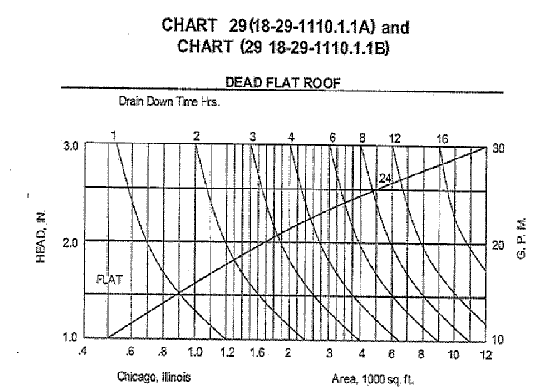
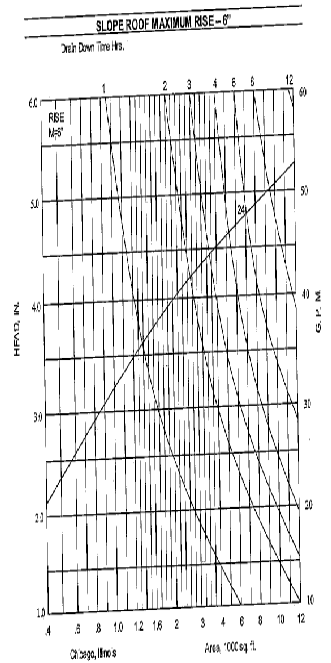
General. The roof of a structure shall be designed for the storage of water where the storm drainage system is engineered for controlled flow. The controlled flow roof drain system shall be an engineered system in accordance with this Section and the design, submittal, approval, inspection and testing requirements of Subsection 118-5(4). In lieu of the conventional down spout requirements of Section 118-6, controlled flow roof drainage may be used. The water of a 25-year frequency shall not be stored on the roof for more than 24 hours. The water depth on flat roofs shall not exceed three inches (75 mm) during the above storm and three inches (75 mm) average depth on sloped roofs not exceeding six inches (32 mm) rise or depth of slope.
(a)
Design. The flow rate (gpm) shall be determined by the use of Chart 29 (18-29-1110.1.1A) for flat roofs and 29 (18-29-1110.1.1B) for sloped roofs. The size of the vertical pipe and horizontal pipe shall be determined by the use of Tables 118-9.1.1C for vertical pipe and Table 118-9.1.1D for horizontal pipe and in no case shall be less than three inches (75 mm). The capacity rating (gpm) of any controlled flow down spout, branch or storm drain shall be converted to an equivalent square foot area by multiplying the gallons per minute (gpm) by 24 (24 square feet of roof area equals 1 gpm) before connecting to any combined house drain or house sewer, and add this value to the total drained area of Section 118-6 of this Chapter. Downspouts that are offset at 90 degrees shall be full size to the storm drain or sewer or combined drain or sewer.
118-9.2
Control devices. The control devices shall be installed so that the rate of discharge of water per minute shall not exceed the values for continuous flow as indicated in Chart 29 (18-29-1110.1.1A) for flat roofs and 29 (18-29-1110.1.1B) for sloped roofs. A scupper drain or drains shall be placed in the parapet wall at an invert elevation one-half inch (12 mm) above the maximum designed head. The scupper shall have a cross sectional area equal to that as required for conventional roof drainage. Control of runoff from roofs shall be by pre-calibrated tamper proof weirs; no valves or mechanical devices shall be permitted.
Exception: Scuppers are not permitted in fire walls.
(3)
Installation. Runoff control shall be by control devices. Control devices shall be protected by strainers.
(4)
Minimum number of roof drains. Not less than two drains shall be installed in roof areas 10,000 square feet (930 m 2 ) or less and not less than four roof drains shall be installed in roofs over 10,000 square feet (930 m 2 ) in area.
(Ord. No. 14-5599, 11-19-2014.)
Sec. 118-10. - Drains and subdrain.
(1)
Subsoil drains. Subsoil drains shall be open jointed, horizontally split or perforated pipe conforming to one of the standards listed in Table 118-2.5. Such drains shall not be less than four-inch (100 mm) diameter. Where the building is subject to backwater, the subsoil drain shall be protected by an accessibly located backwater valve. Subsoil drains shall discharge to a trapped sump or approved location above ground. The subsoil sump shall not be required to have either a gas-tight cover or a vent. Access for the purpose of cleaning and removing obstructions in subsoil drains shall be provided at every change of direction.
(2)
Building subdrains. Building subdrains located below the public sewer level shall discharge into a sump or receiving tank, the contents of which shall be automatically lifted and discharged into the drainage system as required for building sumps.
(3)
Pumping system. The sump pump, pit and discharge piping shall conform to Sections 118-10.3.1 through 118-10.3.4. No sump or receiving tank shall be less than 30 inches (762 mm) deep and shall be in an accessible location.
(a)
Pump capacity and head. The sump pump shall be of a capacity and head appropriate to anticipated use requirements.
(b)
Construction. The sump pit shall not be less than 18-inch (457 mm) diameter by 30-inch deep and shall be constructed of plastic, fiberglass, vitrified clay tile, cast iron, steel, reinforced concrete pipe, cast-iron or other approved material, with a removable cover adequate to support anticipated loads in area of use. Approved plastic or fiberglass liners may be used in connection with any of the above. The pit floor or cover shall provide permanent support for the pump.
(c)
Electrical. Electrical service outlets, when required, shall meet the requirements of Cook County Electrical code.
(d)
Piping. Discharge piping shall meet the requirements of Subsection 118-2(2), 118-2(3), or 118-2(4) and shall include a full flow check valve. Duplex pump systems shall include a gate valve and a full flow check valve on discharge of each pump. Size and fittings shall be the same size as, or larger than, pump discharge tapping, nominal or standard sizes as designated in the referenced materials standards.
(Ord. No. 14-5599, 11-19-2014.)
Sec. 118-21. - Scope.
(1)
Any activity of construction or development which results in excavation or fill on land situated in the unincorporated areas of the County of Cook, Illinois.
(2)
Any activity related to changing the topography.
(3)
The effective regulation and control of soil erosion, increased runoff and sedimentation caused by changing the topography from entering the natural and manmade drainage systems.
(4)
Any construction of use of soil erosion and sediment control measures as herein defined in these regulations.
(5)
Where a building permit for a building or structure has been issued in accordance with law prior to the effective date of this Ordinance, and provided that construction is begun within six months of such effective date and diligently prosecuted to completion, said building or structure may be completed in accordance with the approved plans on the basis of which the building permit has been issued.
(6)
Any fill deposited on parcels or lots shall require permit approval unless such fill is related to grading in conjunction with an approved building permit site.
(Ord. No. 14-5599, 11-19-2014.)
Sec. 118-22. - Plan and building permit require.
(1)
In instances where building or special use permits are required, before land is tilled, cleared, filled, graded, transported or otherwise disturbed for any reason, by any person, said person shall submit a "Soil Erosion and Sediment Control Plan" to the Cook County Department of Building and Zoning for approval by the Building Commissioner before said permits will be granted.
(2)
A "Soil Erosion and Sediment Control Plan" and approval of same shall not be required for the following:
a.
Tilling of soil for fire protection purpose.
b.
Tilling of soil for agricultural purposes except measures for control of soil erosion and sediment which shall require a permit.
c.
Excavations for the following:
1.
Septic tanks and field tile for single-family residences.
2.
Single-family room additions.
3.
Single-family accessory use buildings.
4.
Single-family swimming pools.
5.
Advertising and display signs above ground.
6.
Underground storage tanks.
7.
Public utility underground vaults, tunnels and service lines, except where such lines require excavations or other soil disturbing activity extending for a distance of approximately 100 feet.
d.
Single-family dwelling unit on scattered lots.
(Ord. No. 14-5599, 11-19-2014.)
Sec. 118-23. - Waiver of requirements.
The Building Commissioner may waive the requirements for a Soil Erosion and Sediment Control Plan if an applicant submits engineering, technical and/or data which will give evidence that soil erosion or sediment will not occur.
(Ord. No. 14-5599, 11-19-2014.)
Sec. 118-24. - Soil erosion and sediment control plans.
Soil Erosion and Sediment Control Plans submitted for approval shall be prepared, signed and sealed by either a:
(1)
Registered architect,
(2)
Registered professional civil or agricultural engineer,
(3)
Landscape architect,
(4)
Registered surveyor, or
(5)
Rhotogrammetrist that is licensed by the State of Illinois;
provided, however, that the person who signs and seals such plans shall be permitted to do so for those portions of the plans within the limitations of the particular act under which he is licensed to practice.
(Ord. No. 14-5599, 11-19-2014.)
Sec. 118-25. - Soil erosion and sediment control measures.
(1)
Plans submitted for approval shall show all soil erosion and sedimentations control measures needed to provide protection throughout all phases of construction.
(2)
Plans shall include detailed descriptions of any one, combination of, or all of the following as may be required to accurately describe the existing conditions and the work to be done to effectively control soil erosion and sediment:
a.
"Natural Resource Review and Evaluation" report as prepared by the Soil and Water Conservation District, if such report is required by State Statures for subject project.
b.
"Soil Survey Maps" if available showing existing predominant soil types as related to control of soil erosion and sedimentation. "Soil Survey Maps" to be used are those prepared by the Soil Conservation Service" of the U.S. Department of Agriculture.
c.
Existing and proposed storm sewers and natural storm drainage.
d.
Existing vegetation and proposed temporary and permanent vegetation.
e.
Existing and proposed topography of the site.
f.
Limits of the flood plain, if applicable (See "Flood Damage Prevention Regulations" in the text amendment to the Cook County Zoning Ordinance).
g.
Existing and proposed paved areas and drainage of same.
(3)
Plans shall include detailed descriptions of any one, combination of or all of the following control measures as may be required to minimize soil erosion and prevent sediment form leaving the site.
a.
Critical area planting.
b.
Debris basins.
c.
Diversions.
d.
Grade stabilization structures.
e.
Grassed waterways or outlet.
f.
Heavy use area protection.
g.
Mulching.
h.
Other technically adequate measures.
(4)
A time schedule shall be submitted an made part of the plan, outlining the phases for carrying out the soil erosion and sediment control measures. The phases may include any one, combination of, or all of the following:
a.
Stripping and/or clearing of site.
b.
Installation of temporary soil erosion and sediment control measures.
c.
Rough grading and construction.
d.
Construction of permanent soil erosion and sediment control measures.
e.
Installation of paving and permanent vegetation.
f.
Other phases of construction not expressed herein.
(Ord. No. 14-5599, 11-19-2014.)
Sec. 118-26. - Erosion and sediment control measures, standards and specifications.
"Standards and Specifications of Soil Erosion and Sediment Control in Northeastern Illinois," 1st Edition 1973 or latest edition or latest edition or as subsequently amended or revised, prepared with the assistance of Northeastern Illinois Planning Commission; North Cook County and Will - South Cook County Soil and Water Conservation districts, and United States Department of Agriculture Soil Conservation service are hereby incorporated into this regulation and made part hereof, by this reference, for the purposes of exemplifying the considerations and factors of soil erosion and sediment control measures.
Other standards and specifications published by the U.S.D.A., Soil Conservation Service may be used for design, construction, and maintenance of Soil Erosion and Sediment Control Measures.
(Ord. No. 14-5599, 11-19-2014.)
Sec. 118-27. - Maintenance of soil erosion and sediment control measures.
(1)
Soil Erosion and Sediment "Control Measures" shall be maintained after their construction. Maintenance shall be as required to prevent sediment and debris from accumulating and restricting passage of clear water or allowing sediment and/or debris from passing over, around, or through the "Control Measure" and be deposited downstream.
(2)
Sediment and debris shall be removed from the "Control Measures" when accumulation of same has caused the "Control Measure" not to function as it was originally designed.
(Ord. No. 14-5599, 11-19-2014.)
Sec. 118-41. - Purpose.
This Flood Damage Prevention ordinance is enacted in order to comply with the guidelines for the National Flood Insurance Program as published by the United States Federal Emergency Management Agency and to:
(1)
Diminish threats to the public health and safety that could result from flooding.
(2)
Reduce economic losses to individuals, businesses, and communities that result from flooding.
(3)
Protect and conserve environmentally fragile land and water resources.
(4)
Promote the orderly and proper development of land.
(5)
Prevent damage to personal property which results from flooding.
(6)
Encourage quality and defect free construction.
(7)
Maintain the capacity of flood plain to retain flood water.
(8)
Avoid the creation and exploitation of new flooding problems.
(9)
This Flood Damage Prevention ordinance is not intended to reduce or eliminate existing flooding, nor is it intended to impose a complete prohibition of construction in base flood areas. On the contrary, these regulations are designed to guide and control development in such a manner as to lessen the damaging effects of floods on developments proposed for the low-lying areas of unincorporated Cook County.
(10)
Wherever the areas expected to be inundated by the base flood have been specifically identified, it is the intention of this Ordinance to provide protection in those areas against the high waters of that flood.
(11)
In the absence of specific information pertaining to the base flood, it is the intention of this Ordinance to provide protection in the low-lying areas of unincorporated Cook County against the high waters of the historical flood of record.
(12)
Provisions of the Flood Damage Prevention Ordinance further regulate, guide and control:
a.
The use, layout and improvement of land located in the flood plains.
b.
The excavating, filling and grading of lots and other land parcels or areas located in flood plains and the storing of certain materials thereon.
c.
The location, construction and elevation of buildings and other structures or parts and appurtenances thereof-and of sanitary and storm sewers and appurtenances thereof located in flood plains.
(Ord. No. 14-5599, 11-19-2014.)
Sec. 118-42. - Scope and applicability.
Floodways: Nothing shall be constructed in the floodways that impedes the flow of water or causes increased flood heights.
(1)
Floodways identified. In base flood areas where the floodways have been identified, the following shall prevail:
a.
In floodways that have been identified in Section 118-45 of this Flood Damage Prevention ordinance as elements of the base flood, only those uses and structures will be permitted which will not impede or increase the flow and passage of floodwaters.
b.
Construction, filling, or use of these low-lying lands is severely limited by these regulations, and generally is subject to special use permit approval.
c.
The issuance of a special use permit in no way negates the petitioner's responsibility to prevent the impediment of the flow of water.
(2)
Floodways not identified. In base flood areas where the floodways are not identified, the following provisions shall prevail:
a.
In the base flood area, no development shall be permitted unless the cumulative effect of the proposals, when combined with all other existing and anticipated uses and structures, shall not significantly impede or increase the flow and passage of the floodwaters, nor significantly increase the base flood elevation.
b.
Development in and use or filling of the base flood area will be permitted if protection is provided against the base flood by proper elevation, compensatory storage and other provisions of this Flood Damage Prevention ordinance.
c.
No use will be permitted which will adversely affect the ability of a flood plain to convey the base flood or the capacity of channels or drainage facilities or systems.
(3)
Floodways fringes.
a.
Construction, filling, or use of floodway fringes may be permitted if in accordance with provisions specified herein.
b.
Compensatory storage must be provided whenever any portion of a floodway fringe is authorized for construction, filling, or use.
c.
The volume of space which will be occupied by the authorized fill or structure shall be compensated for and balanced by at least an equal volume of excavation to be taken from below the base flood elevation.
d.
In the case of streams or other water courses, such excavation shall be made opposite to or immediately upstream from the areas so filled or occupied.
(4)
Flood table lands.
a.
Uses normally permitted in the specific zoning district in force are allowed on flood table lands; however, any new structure located on flood table land shall have no basement, habitable floor, or wall opening at an elevation less than two feet above the base flood elevation.
b.
Development in and use or filling of flood table land will be permitted if protection is provided against the base flood by proper elevation, compensatory storage and other provisions of this Floor Damage Prevention ordinance.
c.
No use will be permitted which adversely affects the capacity of channels, the floodway or drainage facilities or systems.
(Ord. No. 14-5599, 11-19-2014.)
Sec. 118-43. - Regulations.
These regulations do not in any way alter or eliminate the responsibility of a petitioner, developer, or owner to comply with all regulations of this and other applicable County Ordinances including flood damage prevention regulations specified in the Code, Chapter 106 of this Code, and the Subdivision Regulations. All district requirements specified in this Ordinance are in full force for land designated as flood plain, floodway (identified and not identified), floodway fringe and flood table land. A requested use for any land designated to be within these categories must be allowed both in the zoning district in force on the property, and in the flood damage prevention regulations use list.
(1)
Occupation and use of floodways, identified and unidentified. The construction, filling, or use of floodways is subject to provisions specified in the Cook County Zoning Ordinance. All uses are conditioned upon the issuance of a use, whether permitted or special, must not impede or increase the flow or passage of floodwaters within the floodway or in any manner cause increased flood heights. All buildings, whether principal or accessory, are prohibited. Apparatus such as playground equipment, basketball standards, signs, tennis courts, etc., may be allowed provided they do not impede floodwater flows and pose no safety or sanitary hazards. Required water supply and sanitary sewer systems to be located in the floodways shall be designed to minimize or eliminate discharges from the systems into the floodwaters and prevent the infiltration of floodwaters into the water system; and prevent or minimize infiltration into sewer systems. On site waste disposal systems shall be located so as to avoid impairment of them or contamination from them during or subsequent to flooding.
a.
Permitted uses. The following uses have a low-frequency flood damage potential and will be permitted above the surface water elevation if they do not in any way obstruct water flows:
1.
General agriculture or horticulture.
2.
Industrial/commercial use for loading or parking areas.
3.
Automobile parking lots.
4.
Private and public recreation.
5.
Lawns, gardens, parking, or play areas, as accessory residential uses.
6.
Golf courses.
7.
Public land.
b.
Special use. The following uses which involve temporary or non-obstructive structures may be permitted upon the issuance of a special use permit and upon meeting all other requirements of this and other applicable County Ordinances:
1.
Transient amusement enterprises.
2.
Mineral extraction.
3.
Drive-in theaters.
4.
Marinas, boat rentals, docks piers and wharves.
5.
Nurseries and orchards.
6.
Railroads, roads, highways, streets, bridges, utility lines and pipelines.
7.
Airports and heliports.
8.
Other uses similar in nature to those described in this Section or paragraph a., above which are consistent with this provision and other provisions of this Flood Damage Prevention Ordinance.
c.
Permit requirements and compensatory storage. In addition, no building or structure of any kind shall be erected or maintained or moved within that area of a flood plain hereinafter described and designated as the floodway, and no fill, material or substance of any kind shall be deposited on any premises within the floodway without a permit issued by the Department of Building and Zoning and then only if an equivalent volume of materials is removed from the floodplain and the deposited material is spread or otherwise deposited outside of the flood plain.
(2)
Occupation and use of floodway fringes. The construction, filling, or use of the floodway fringe is subject to all applicable Cook County Zoning provisions. All uses are conditioned upon the provisions of Compensatory Storage in the County Zoning Ordinance, Section 40.3-2, as well as compliance with all requirements of this and other applicable County Ordinances, including flood damage prevention specified in the Cook County Building Ordinance and in the Cook County Subdivision Regulations. No use is allowed which could adversely affect the capacity of channels, the floodways, streams, lakes, stream beds, or drainage facilities and systems.
a.
Permitted uses. Uses permitted by Subsection 118-43(1)a. and those which may be authorized under Subsection 118-43(1)b. are permitted uses in the floodway fringe.
b.
Special uses. Special Uses may be authorized if such uses will not be subject to flood damage, and further provided that such uses will not cause flood damage to other lands. In passing upon such special applications, the Zoning Board shall not issue a Special Use Permit that contrary to relevant factors specified in this Ordinance, and shall consider:
1.
The danger to life and property due to increased flood heights or velocities caused by encroachments.
2.
The danger that materials may be swept onto other lands or downstream to the injury of others.
3.
The proposed water supply and sanitation systems and the ability of these systems to prevent the occurrence of disease, contamination and unsanitary conditions.
4.
The susceptibility of the proposed facility and its contents to flood damage and the effect of such damage on the individual owner.
5.
The importance of the services provided by the proposed facility to the community.
6.
The requirements of the facility for a waterfront location.
7.
The availability of alternative locations not subject to flooding for the proposed use.
8.
The compatibility of the proposed use with existing development and development anticipated in the foreseeable future.
9.
The relationship of the proposed use to the Comprehensive Plan and floodplain management program for the area.
10.
The safety of access to the property in times of flood for ordinary and emergency vehicles.
11.
The expected heights, velocity, duration, rate of rise and sediment transport of the flood waters expected at the site.
12.
Such other factors as are relevant to the purposes of this Ordinance including a flood warning system.
c.
Permit requirements and compensatory storage.
1.
In addition, no new or existing building or structure shall be erected or moved within the Floodway Fringe Portion of the flood plain unless the lowest floor including the basement floor is at an elevation which is not less than two feet above the Base Flood Elevation for the site.
2.
Further, no new or existing building shall be erected or moved within the Floodway Fringe without first obtaining a permit from the Department of Building and Zoning.
3.
The filing of lands where the existing ground elevation is less than the base flood elevation shall be permitted provided:
(a)
That the filling of lands where the existing ground elevation is less than base flood elevation.
(b)
That the fill material if obtained elsewhere is offset by the removal of an equivalent volume of material obtained in the immediate vicinity of the building site from elevations lower than the base flood elevation and this volume of material is spread or otherwise deposited outside of the floodplain.
(c)
In the case of streams and channels, such excavation shall be made opposite or immediately adjacent to the areas filled or occupied and shall be constructed to drain freely and openly to the watercourse.
(3)
Occupation and use of flood table land. Occupation and use of flood table land is governed by the requirements set forth in Section 118-42(4).
(4)
Storage of materials. The following regulations shall apply to open and underground storage:
a.
Floatable materials. Logs, wastes, lumber, products and other floatable materials or containers shall not be placed, displaced or stored in the floodway and may be stored in floodway fringes only upon the issuance of special use permits.
b.
Non-floatable materials. The open storage or display on the floodway fringe of inoperable motor vehicles and similar non-movable machinery and other non-floatable materials and products where permitted by the regulations of the zoning district applicable to such land, shall be considered the same as the placement of fill on the floodplain and shall be subject to the regulations of this Ordinance relating to compensatory storage.
c.
Hazardous materials.
1.
The open storage of materials anywhere in the flood plain which are flammable, explosive or which could be injurious to human, animal or plant life is prohibited.
2.
The design for underground storage of hazardous material shall not permit discharges from the system into the floodwater or permit infiltration of the floodwaters into the system.
(5)
Fences. Fences shall not be constructed of a type or in such a manner as to significantly impede or increase the passage of flood water, or to accumulate debris (unless built to protect open storage of floatable materials).
(6)
Streets and roads within areas of special flood hazard.
a.
Streets and roads. When failure or interruption of service to streets or roads will endanger public health or safety, such streets and roads shall be protected to one foot above the base flood elevation.
1.
The grade of such roadways shall be at one foot above the base flood elevation or higher.
2.
The drainage systems for such roads shall be designed, using accepted hydraulic principles and practices so as to minimize overflow conditions due to the drainage system.
(7)
Planned unit development, subdivision and zoned lot design. The following rules shall govern the design of land improvement with respect to floodplain:
a.
General. All proposed planned unit, zoned lot and subdivision developments within the base flood area shall be reviewed by the Cook County Map and Plat Officer and the Cook County Highway Department to assure that the proposed developments are consistent with the need to minimize flood damages; and, that all public utilities (such as, sewer, gas, electrical, and water systems) are located an constructed to minimize or eliminate flood damage; and, that adequate drainage, conforming to current engineering practices and current drainage codes and statures, is provided.
b.
Design. Streets, blocks, depth of lots, parks and other public ground shall be reviewed by the Cook County Map and Plat Officer and the Cook County Highway Department to assure that they shall be located an laid out in such a manner as to preserve and utilize natural streams, channels, and detention basins. Wherever possible, the larger streams and floodplains shall be included within parks or other public grounds.
c.
Channel straightening. Sharply meandering streams or channels may be partially straightened and minor changes made in other channels are subject to review and approval by the Cook County Highway Department, also provided:
1.
The hydraulic capacity of the floodway is maintained.
2.
The velocity increase is kept to a minimum.
3.
The volume of floodwater storage outside the floodway is not reduced.
4.
Provision is made to stabilize the banks of the modified channel to control erosion.
5.
And, any additional permits for the work that are required by the Illinois Department of Transportation, Division of Water Resources and/or the Corps of Engineers and obtained.
d.
Lots in base flood areas. Land lying wholly or partially in the base flood area may be laid out and platted as building lots or parcels, provided that the finished grade of the available building site shall not be lower than two feet above the base flood elevation, and provided:
1.
The site exists on the high part of the lot or parcel.
2.
Or will be built up during execution of the improvement plan through general excavation or filling.
3.
Or can be filled with excavation taken from within the area of the lot or parcel.
e.
Compensatory storage.
1.
The filling of lands where the existing ground elevation is less than the base flood elevation shall be permitted provided:
(a)
The fill material, equal in volume, is obtained from adjacent areas lying below the base flood elevation, and/or
(b)
The fill material if obtained elsewhere is offset by the removal of an equivalent volume of material obtained in the immediate vicinity of the building site from elevations lower than the high water elevation and this volume of material is spread or otherwise deposited outside of the floodplain.
2.
In the case of streams and channels, such excavation shall be made opposite or immediately adjacent to the areas so filled or occupied and shall be constructed to drain freely and openly to the watercourse.
f.
Streets and roads. Where failure or interruption of service on streets or roads will endanger public health or safety such streets and roads shall be protected to one foot above the base flood elevation or higher.
1.
The drainage systems for such streets and roads shall be designed using accepted hydraulic principles and practices so as to minimize overflow conditions due to the drainage system.
2.
In other instances, protection shall be provided to extent practical.
g.
Drainageways. Wherever the plans call for the passage and/or storage of surface runoff or excess stormwater on lots, the grading of all such lots shall be prescribed and established as part of the planned unit development, subdivision plat or zoned lot.
1.
The areas so designated for the passage and/or storage of such waters shall not be obstructed.
2.
The limits of the high water levels resulting from the passage and/or storage of surface runoff or excess stormwater on lots shall be recorded and shall be covered by an easement.
h.
Manholes. All sanitary sewer manholes constructed in a floodplain must have a rim elevation at a minimum of one foot above the base flood elevation or be provided with a locking watertight manhole cover.
(8)
Existing, new and reconstructed mobile homes facilities. Within areas of special flood hazard for new mobile homes; new mobile home parks and for existing mobile home parks where the repair, reconstruction or improvement of streets, utilities and pads equal or exceed 50 percent of the value of such streets, utilities and pads then the following provisions shall be required:
a.
Ground anchors. Mobile homes to be placed within areas of special flood hazard shall be anchored to resist floatation, collapse or lateral movement by providing over-the-top and frame ties to ground anchors. Specific requirements shall be that:
1.
Over-the-top ties are provided at each of the four corner of the mobile homes, with two additional ties per side at intermediate locations; and, one additional tie per side for mobile homes less than 50 feet in length.
2.
Frame ties are to be provided at each corner of the homes with five additional ties per side at intermediate points; and, with mobile homes less than 50 feet in length requiring four additional ties per side.
3.
All components of the anchoring system shall be capable of carrying a force of 4,800 pounds.
4.
Any additions to a mobile home shall be similarly anchored.
b.
Floor elevation. Stands or wheel lot pads, shall be elevated on compacted fill or on piers so that the lowest floor of the home will be at an elevation not less than that of the base flood elevation plus two feet.
c.
Drainage. Adequate surface drainage and easy access for a hauler shall be provided.
d.
Piers. Where piers are used, steps to the homes shall be provided and piers (no more than ten feet apart) shall be placed on stable soil. Steel reinforcement shall be provided for piers more than six feet high.
e.
Fences. Fences shall not be constructed of a type or in such a manner as to significantly impede or increase the passage of floodwaters or accumulate debris (unless built to protect open storage of floatable materials).
(Ord. No. 14-5599, 11-19-2014.)
Sec. 118-44. - Nonconforming uses in floodplain.
All nonconforming use provisions, as specified in Article 10 of the Zoning Ordinance, are in full force.
(Ord. No. 14-5599, 11-19-2014.)
Sec. 118-45. - Source of information.
The base flood elevation, the floodway, the floodway fringe and flood table lands shall be described by the following sources of information which are listed according to the priority of use. When data is not available on a higher order source of information then the succeeding shall be used. The sources to to be used are on file and available for inspection in the Office of the Cook County Department of Building and Zoning. They are as follows:
MAP NO. 1 AND PROFILES:
Certified Federal Emergency Management Agency (FEMA), Flood Insurance Studies (FIS).
MAP NO. 2 AND PROFILES.
Certified Illinois Department of Transportation, Division of Water Resources (IDOT/DOWR) Regulatory Flood Plain Maps.
MAP NO. 3 AND PROFILES.
United States Soil Conservation Service (SCS) in cooperation with the Metropolitan Water Reclamation District of Greater Chicago (MWRDGC), Flood Plain Information Maps. (The MWRDGC requires that the "without project" elevation date shown thereon be used).
MAP NO. 4 AND PROFILES.
Other detailed 100-year Flood Studies if reviewed an found acceptable by Illinois Department of Transportation, Division of Water Resources(IDOT/DOWR).
NOTE: In the event a conflict arises between the information depicted by the official Cook County flood plain maps and the official related Cook County Profiles, and in the absence of any overriding information to the contrary, the data prescribed by the profiles will govern.
When no separate map or related profile designation exists for a floodway, then the floodplain shall also mean floodway, and floodway regulations shall apply to the entire floodplain.
Official elevations: The system of official bench marks and elevations already established in the area by the U.S. Coast and Geodetic Survey (1 st order level network) or the U.S. Geological Survey shall hereafter be taken by engineers, surveyors, architects and contractors when making topographical surveys and maps, and when setting grades and elevations of buildings, pavements, drainage facilities and other structures or works constructed or regulated by the Department of Building and Zoning. Where bench marks are shown on official maps they shall be used.
Determination of base flood area location and elevations: The Official maps described in Section 118-45 shall be used as an aid in determine whether a specific parcel of land lies within the base flood area. The final decision, however, shall be based on the relation of the surveyed ground elevation and the base flood elevation. For the purposes of this Ordinance, the base flood elevation applicable to a specific parcel of land, if not otherwise depicted by the Official Maps and Profiles described above, shall be that elevation established for the adjoining stream or channel measured at right angles to the general direction of flow in that stream or channel. In riverine situations, where a bend in the stream exists and more than one line can be placed at right angles to the parcel of lands, the highest base flood elevation determined shall prevail.
(Ord. No. 14-5599, 11-19-2014.)
Sec. 118-46. - Variances.
Variances from these flood control provisions may be granted in the following instances:
(1)
Maps and profiles. Where evidence exists that the conditions described by the Official Maps and Profiles no longer exist to the degree, extent, frequency, elevation, or area described therein, a proponent for a waiver will be permitted to submit technical and factual information justifying issuance of a variance. Such evidence must be supported by a competent engineering survey. Provided that the petitioner can document a change in the delineation of the floodplain and such change is verified by the Cook County Highway Department; and appropriate state and federal agencies such as the Illinois Department of Transportation, Division of Water Resources (IDOT/DOWR) and the Federal Emergency Management Agency (FEMA); and, provided that the Zoning Board acknowledges the new delineation of the floodplain, through the approval of a variation in conformance with procedures specified in Article 13, of the Cook County Zoning Ordinance. Then the Cook County Department of Building and Zoning shall make appropriate map revisions indicating the new flood plain delineation.
(2)
Hardship. Variances from the terms of these Flood Damage Prevention Provisions may be allowed by a Cook County Zoning Special Use permit, if the proposal will not be contrary to the public interest, upon a showing by the proponent of undue hardship caused by a literal enforcement of these provisions, provided that the spirit of this Ordinance shall be observed and substantial justice will be done. No variance shall have the effect of allowing uses which are otherwise prohibited or which will cause a lower level of flood protection or which will permit standards which are lower than those otherwise prescribed. Written notice shall be given to an applicant that the cost of flood insurance will be commensurate with the increased risk resulting from a variance granted permitting the lowest floor of the structure below the base flood elevation. Written notice shall also be submitted by an applicant that the applicant is aware of the increased risks to life and property when constructing below the base flood elevation.
(3)
Historical structures. Variances requested in connection with the reconstruction, rehabilitation or restoration of structures listen on the National Register of Historical Places or documented as worthy of preservation by the Illinois Department of Conservation may be granted using criteria more permissive than the above requirements.
(Ord. No. 14-5599, 11-19-2014.)
Sec. 118-47. - Submission requirements.
Zoning petitions for any purpose, dealing with land designated to any extent as floodplain as depicted on a Source of Information, specified in Section 118-45 herein - shall be accompanied by:
(1)
Six copies of a current survey of topography with a maximum contour interval of two feet. Said survey shall clearly delineate (where data is available): the floodplain, floodway, floodway fringe, flood table and surface water elevation, and base flood elevation.
a.
A small contour interval may be required for accurate delineation of relevant features.
b.
Topographic maps accompanying preliminary plans of land to be developed as a planned unit development, zoned lot or to be subdivided and such adjoining land whose topography may affect the layout or drainage of the proposal shall show the following:
1.
The location of streams and other floodwater runoff channels, their normal channels, the extent of their floodplains at the established high water elevations, and the limits of the floodway, all properly identified.
2.
The normal shoreline of lakes, ponds, swamps, and detention basins, their floodplains and lines of inflow and outflow, if any.
3.
The location of farm drains and their inlets and outlets.
4.
Storm, sanitary and combined sewers, and any sewer outfalls.
5.
Septic tank systems and outlets, if any.
6.
Seeps, springs, and flowing and other wells.
7.
Location of existing structures that will remain.
8.
100-year flood elevation and limits, including floodway, data for the portion of the development (if larger than five acres or 50 lots) which is in the base flood area.
c.
Profile drawings of each stream, channel, pond, and basin showing elevations accompanying preliminary plans of the land to be developed as a planned unit development, zoned lot or to be subdivided shall show the following:
(1)
The stream bed.
(2)
Channel banks, if any.
(3)
Waterway openings of existing culverts and bridges within and near the tract.
(4)
Size and elevation of sewer and drain outlets into the stream channel or basin.
(5)
The base flood elevations established by this Ordinance.
d.
Submitted surveys of topography shall be prepared under supervision of and certified by a State Licensed engineer or surveyor.
(2)
Six copies of a site plan which contains:
a.
The location and quality of all proposed dill and/or excavations.
b.
The elevations of the lowest floor, including the basement, cellar, or crawl space of all proposed buildings.
(3)
At the option of the petitioner, additional information relating to anticipated flood proofing measures may also be submitted.
(Ord. No. 14-5599, 11-19-2014.)
Sec. 118-48. - Warning and disclaimer of liability.
The degree of flood protection required by this Ordinance is considered reasonable for regulatory purposes and is based on the engineering and scientific methods of study. Larger floods may occur on rare occasions or the flood height may be increased by man-made or natural causes, such as ice jams and bridge openings restricted by debris. This Ordinance does not imply that areas outside the floodplain districts or land uses permitted within such district will be free from flooding or flood damages. This Ordinance shall not create liability on the part of the County of Cook or any officer or employee thereof for any flood damages that result from reliance on this Ordinance or any decision lawfully made thereunder.
(Ord. No. 14-5599, 11-19-2014.)
Sec. 118-49. - Disclosure statement.
A disclosure statement indicating that "the land in question is all or partially designated, by the County of Cook on a source of information specified in its Zoning Ordinance, as being in the flood plain and hence is vulnerable to periodic flooding," must be provided by the seller to each potential purchaser of property which appears as floodplain as indicated on a Source of Information delineated in Section 118-45 herein.
(Ord. No. 14-5599, 11-19-2014.)
Sec. 118-50. - General.
(1)
Applicability. The provisions of this chapter shall apply to the construction, alteration, and repair of alternate water source systems for nonpotable applications.
(a)
Allowable use of alternate water. Where approved or required by the Building Commissioner, alternate water sources [reclaimed (recycled) water, gray water, and on-site treated nonpotable water] shall be permitted to be used instead of potable water for the applications identified in this chapter.
(2)
System design. Alternate water source systems shall be designed in accordance with this chapter by a licensed plumbing contractor or a registered design professional. Components, piping, and fittings used in any alternate water source system shall be listed.
Exceptions:
(a)
A registered design professional is not required to design gray water systems having a maximum discharge capacity of 250 gallons per day (gal/d) (0.011 L/s) for single family and multi-family dwellings.
(b)
A registered design professional is not required to design an on-site treated nonpotable water system for single-family dwellings having a maximum discharge capacity of 250 gal/d (0.011 L/s).
(3)
Permit. It shall be unlawful for a person to construct, install, alter, or cause to be constructed, installed, or altered an alternate water source system in a building or on a premise without first obtaining a permit to do such work from the Building Commissioner.
(4)
Component identification. System components shall be properly identified as to the manufacturer.
(5)
Maintenance and inspection. Alternate water source systems and components shall be inspected and maintained in accordance with Section 118-50.5(a) through Section 118-50.5(c).
(a)
Frequency. Alternate water source systems and components shall be inspected and maintained in accordance with Table 118-50.5 unless more frequent inspection and maintenance are required by the manufacturer.
(b)
Maintenance log. A maintenance log for gray water and on-site treated nonpotable water systems is required to have a permit in accordance with Section 118-50.3 and shall be maintained by the property owner and be available for inspection. The property owner or designated appointee shall ensure that a record of testing, inspection, and maintenance in accordance with Table 118-50.5 is maintained in the log. The log will indicate the frequency of inspection and maintenance for each system.
(c)
Maintenance responsibility. The required maintenance and inspection of alternate water source systems shall be the responsibility of the property owner unless otherwise required by the Building Commissioner.
(6)
Operation and maintenance manual. An operation and maintenance manual for gray water and on-site treated water systems required to have a permit in accordance with Section 118-50.3 shall be supplied to the building owner by the system designer. The operation and maintenance manual shall include the following:
(a)
Detailed diagram of the entire system and the location of system components.
(b)
Instructions for operating and maintaining the system.
(c)
Details on maintaining the required water quality for on-site nonpotable water systems.
(d)
Details on deactivating the system for maintenance, repair, or other purposes.
(e)
Applicable testing, inspection, and maintenance frequencies in accordance with Table 118-50.5.
(f)
A method of contacting the manufacturer(s).
(7)
Minimum water quality requirements. The minimum water quality for alternate water source systems shall meet the applicable water quality requirements for the intended application as determined by the Building Commissioner. In the absence of water quality requirements, for on-site treated nonpotable systems, the water quality requirements of IAPMO IGC 324 or NSF/ANSI 350 shall apply.
Exception: Water treatment is not required for gray water used for subsurface irrigation.
(8)
Material compatibility. Alternate water source systems shall be constructed of materials that are compatible with the type of pipe and fitting materials, water treatment, and water conditions in the system.
(9)
Commercial, industrial, and institutional restroom signs. A sign shall be installed in restrooms in commercial, industrial, and institutional occupancies using reclaimed (recycled) water and on-site treated water, for water closets, urinals, or both. Each sign shall contain one-half of an inch (12.7 mm) letters of a highly visible color on a contrasting background. The location of the sign(s) shall be such that the sign(s) are visible to users. The location of the sign(s) shall be approved by the Building Commissioner and shall contain the following text:
TO CONSERVE WATER, THIS BUILDING USES *_______* TO FLUSH TOILETS AND URINALS.
(a)
Equipment room signs. Each room containing reclaimed (recycled) water and on-site treated water equipment shall have a sign posted in a location that is visible to anyone working on or near nonpotable water equipment with the following wording in one inch (25.4 mm) letters:
CAUTION: NONPOTABLE *_______*, DO NOT DRINK. DO NOT CONNECT TO DRINKING WATER SYSTEM. NOTICE: CONTACT BUILDING MANAGEMENT BEFORE PERFORMING ANY WORK ON THIS WATER SYSTEM.
*_______* Shall indicate RECLAIMED (RECYCLED) WATER or ON-SITE TREATED WATER, accordingly.
(10)
System controls. Controls for pumps, valves, and other devices that contain mercury that come in contact with alternate water source water supply shall not be permitted.
(Ord. No. 25-0037, 4-10-2025.)
Sec. 118-51. - Inspection and testing.
(1)
General. Alternate water source systems shall be inspected and tested in accordance with Section 118-51.2 through Section 118-51.3(d).
(2)
Supply system inspection and test. Alternate water source systems shall be inspected and tested in accordance with this code for testing of potable water piping.
(3)
Annual cross-connection inspection and testing. An initial and subsequent annual inspection and test shall be performed on both the potable and alternate water source systems. The potable and alternate water source system shall be isolated from each other and independently inspected and tested to ensure there is no cross-connection in accordance with Section 118-51.3(a) through Section 118-51.3(d).
(a)
Visual system inspection. Before commencing the cross-connection testing, a dual system inspection shall be conducted by the Building Commissioner as follows:
1.
Meter locations of the alternate water source and potable water lines shall be checked to verify that no modifications were made and that no cross-connections are visible.
2.
Pumps and equipment, equipment room signs and exposed piping in equipment room shall be checked.
3.
Valves shall be checked to ensure that the valve lock seals are still in place and intact. Valve control door signs shall be checked to verify that no signs have been removed.
(b)
Cross-connection test. The procedure for determining cross-connection shall be followed by the applicant in the presence of the Building Commissioner to determine whether a cross-connection has occurred as follows:
1.
The potable water system shall be activated and pressurized. The alternate water source system shall be shut down, depressurized, and drained.
2.
The potable water system shall remain pressurized for a minimum period specified by the Building Commissioner while the alternate water source system is empty. The minimum period the alternate water source system is to remain depressurized shall be determined on a case-by-case basis, taking into account the size and complexity of the potable and the alternate water source distribution systems, but in no case shall that period be less than one hour.
3.
The drain on the alternate water source system shall be checked for flow during the test and fixtures, potable and alternate water source, shall be tested and inspected for flow. Flow from an alternate water source system outlet indicates a cross-connection. No flow from a potable water outlet shall indicate that it is connected to the alternate water source system.
4.
The potable water system shall then be depressurized and drained.
5.
The alternate water source system shall then be activated and pressurized.
6.
The alternate water source system shall remain pressurized for a minimum period specified by the Building Commissioner while the potable water system is empty. The minimum period the potable water system is to remain depressurized shall be determined on a case-by-case basis, but in no case shall that period be less than one hour.
7.
Fixtures, potable, and alternate water source shall be tested and inspected for flow. Flow from a potable water system outlet indicates a cross-connection. No flow from an alternate water source outlet will indicate that it is connected to the potable water system.
8.
The drain on the potable water system shall be checked for flow during the test and at the end of the test.
9.
Where there is no flow detected in the fixtures which would indicate a cross-connection, the potable water system shall be repressurized.
(c)
Discovery of cross-connection. If a cross-connection is discovered, the following procedure, in the presence of the Building Commissioner, shall be activated immediately:
1.
The alternate water source piping to the building shall be shutdown at the meter, and the alternate water source riser shall be drained.
2.
Potable water piping to the building shall be shutdown at the meter.
3.
The cross-connection shall be uncovered and disconnected.
4.
The building shall be retested in accordance with Section 118-51.3(a) and Section 118-51.3(b).
5.
The potable water system shall be chlorinated with 50 parts-per-million (ppm) chlorine for 24 hours.
6.
The potable water system shall be flushed after 24 hours, and a standard bacteriological test shall be performed. Where test results are acceptable, the potable water system shall be permitted to be recharged.
(d)
Annual inspection. An annual inspection of the alternate water source system, following the procedures listed in Section 118-51.3(a) shall be required. Annual cross-connection testing, following the procedures listed in Section 118-51.3(b) shall be required by the Building Commissioner, unless site conditions do not require it. In no event shall the test occur less than once in four years. Alternate testing requirements shall be permitted by the Building Commissioner.
(4)
Separation requirements. Underground alternate water source service piping other than gray water shall be separated from the building sewer in accordance with this Code. Pipes carrying treated nonpotable water shall be permitted to be run or laid in the same trench as potable water pipes with a 12 inch (305 mm) minimum vertical and horizontal separation where both pipe materials are approved for use within a building. Where horizontal piping materials do not comply with this requirement, the minimum separation shall be increased to 60 inches (1524 mm). The potable water piping shall be installed at an elevation above the treated nonpotable water piping.
(5)
Abandonment. Alternate water source systems that are no longer in use or fail to be maintained in accordance with Section 118-50.5 shall be abandoned. Abandonment shall comply with Section 118-51.5(a) and Section 118-51.5(b).
(a)
General. An abandoned system or part thereof covered under the scope of this chapter shall be disconnected from remaining systems, drained, plugged, and capped in an approved manner.
(b)
Underground Tank. An underground water storage tank that has been abandoned or otherwise discontinued from use in a system covered under the scope of this chapter shall be completely drained and filled with earth, sand, gravel, concrete, or other approved material or removed in a manner satisfactory to the Building Commissioner.
(6)
Sizing. Unless otherwise provided for in this chapter, alternate water source piping shall be sized in accordance with 18-29-601 for sizing potable water piping.
(Ord. No. 25-0037, 4-10-2025.)
Sec. 118-52. - Gray water systems.
(1)
General. The provisions of this section shall apply to the construction, alteration, and repair of gray water systems.
(2)
System requirements. Gray water shall be permitted to be diverted away from a sewer or private sewage disposal system, and discharge to a subsurface irrigation or subsoil irrigation system. The gray water shall be permitted to discharge to a mulch basin for single-family and multi-family dwellings. Gray water shall not be used to irrigate root crops or food crops intended for human consumption that comes in contact with soil.
(a)
Surge Capacity. Gray water systems shall be designed to have the capacity to accommodate peak flow rates and distribute the total amount of estimated gray water on a daily basis to a subsurface irrigation field, subsoil irrigation field, or mulch basin without surfacing, ponding, or runoff. A surge tank is required for systems that are unable to accommodate peak flow rates and distribute the total amount of gray water by gravity drainage. The water discharge for gray water systems shall be determined in accordance with Section 118-52.8(a) or Section 118-52.8(b).
(b)
Diversion. The gray water system shall connect to the sanitary drainage system downstream of fixture traps and vent connections through a gray water diverter valve. The gray water diverter valve shall comply with IAPMO PS 59 and be installed in an accessible location and clearly indicate the direction of flow.
(c)
Backwater valves. Gray water drains subject to backflow shall be provided with a backwater valve so located as to be accessible for inspection and maintenance.
(3)
Connections to potable and reclaimed (recycled) water systems. Gray water systems shall have no direct connection to a potable water supply, on-site treated nonpotable water supply, or reclaimed (recycled) water systems. Potable, on-site treated nonpotable, or reclaimed (recycled) water is permitted to be used as makeup water for a non-pressurized storage tank provided the connection is protected by an air gap in accordance with this code.
(4)
Location. No gray water system or part thereof shall be located on a lot other than the lot that is the site of the building or structure that discharges the gray water, nor shall a gray water system or part thereof be located at a point having less than the minimum distances indicated in Table 118-52.4.
For SI units: 1 foot = 304.8 mm
Notes:
1 Including porches and steps, whether covered or uncovered, breezeways, roofed carports, roofed patios, carports, covered walks, covered drive-ways, and similar structures or appurtenances.
2 The distance shall be permitted to be reduced to 0 feet for aboveground tanks where first approved by the Building Commissioner.
3 Reference to a 45-degree (0.79 rad) angle from the foundation.
4 Where special hazards are involved, the distance required shall be increased as directed by the Building Commissioner.
5 These minimum clear horizontal distances shall apply between the irrigation or disposal field and the ocean mean higher high tide line.
6 Add two feet (610 mm) for each additional foot of depth more than one foot (305 mm) below the bottom of the drain line.
7 For parallel construction or crossings, approval by the Building Commissioner shall be required.
8 The distance shall be permitted to be reduced to one and one-half feet (457 mm) for drip and mulch basin irrigation systems.
9 The distance shall be permitted to be reduced to 0 feet for surge tanks of 75 gallons (284 L) or less.
10 Where irrigation or disposal fields are installed in the sloping ground, the minimum horizontal distance between a part of the distribution system and the ground surface shall be 15 feet (4,572 mm).
(5)
Plot plan submission. No permit for a gray water system shall be issued until a plot plan with data satisfactory to the Building Commissioner has been submitted and approved.
(6)
Prohibited location. Where there is insufficient lot area or inappropriate soil conditions for adequate absorption to prevent the ponding, surfacing, or runoff of the gray water, as determined by the Building Commissioner, no gray water system shall be permitted. A gray water system is not permitted on a property in a geologically sensitive area as determined by the Building Commissioner.
(7)
Drawings and specifications. The Building Commissioner shall require the following information to be included with or in the plot plan before a permit is issued for a gray water system, or at a time during the construction thereof:
(a)
Plot plan drawn to scale and completely dimensioned, showing lot lines and structures, direction and approximate slope of surface, location of present or proposed retaining walls, drainage channels, water supply lines, wells, paved areas and structures on the plot, number of bedrooms and plumbing fixtures in each structure, location of private sewage disposal system and expansion area or building sewer connecting to the public sewer, and location of the proposed gray water system.
(b)
Details of construction necessary to ensure compliance with the requirements of this chapter, together with a full description of the complete installation, including installation methods, construction, and materials in accordance with the Building Commissioner.
(c)
Details for holding tanks shall include dimensions, structural calculations, bracings, and such other pertinent data as required.
(d)
A log of soil formations and groundwater level as determined by test holes dug in proximity to proposed irrigation area, together with a statement of water absorption characteristics of the soil at the proposed site as determined by approved percolation tests.
Exception: The Building Commissioner shall permit the use of Table 118-53.2 instead of percolation tests.
(e)
Distance between the plot and surface waters such as lakes, ponds, rivers or streams, and the slope of the plot and the surface water, wherein close proximity.
(8)
Procedure for estimating gray water discharge. Gray water systems shall be designed to distribute the total amount of estimated gray water on a daily basis. The water discharge for gray water systems shall be determined in accordance with Section 118-52.8(a) or Section 118-52.8(b).
(a)
Single-family dwellings and multifamily dwellings. The gray water discharge for single-family and multifamily dwellings shall be calculated by water use records, calculations of local daily per person interior water use, or the following procedure:
1.
The number of occupants of each dwelling unit shall be calculated as follows:
2.
The estimated gray water flows of each occupant shall be calculated as follows:
3.
The total number of occupants shall be multiplied by the applicable estimated gray water discharge as provided above and the type of fixtures connected to the gray water system.
(b)
Commercial, industrial, and institutional occupancies. The gray water discharge for commercial, industrial, and institutional occupancies shall be calculated by utilizing the procedure in Section 118-52.8(a), water use records or other documentation to estimate gray water discharge.
(9)
Gray water system components. Gray water system components shall comply with Section 118-52.9(a) through Section 118-52.9(g).
(a)
Surge tanks. Where installed, surge tanks shall be in accordance with the following:
1.
Surge tanks shall be constructed of solid, durable materials not subject to excessive corrosion or decay and shall be watertight. Surge tanks constructed of steel shall be approved by the Building Commissioner, provided such tanks are in accordance with approved applicable standards.
2.
Each surge tank shall be vented in accordance with this code. The vent size shall be determined based on the total gray water fixture units as outlined in this code.
3.
Each surge tank shall have an access opening with lockable gasketed covers or approved equivalent to allow for inspection and cleaning.
4.
Each surge tank shall have its rated capacity permanently marked on the unit. Also, a sign stating GRAY WATER, DANGER — UNSAFE WATER shall be permanently marked on the holding tank.
5.
Each surge tank shall have an overflow drain. The overflow drains shall have permanent connections to the building drain or building sewer, upstream of septic tanks. The overflow drain shall not be equipped with a shutoff valve.
6.
The overflow drainpipes shall not be less in size than the inlet pipe. Unions or equally effective fittings shall be provided for piping connected to the surge tank.
7.
Surge tank shall be structurally designed to withstand anticipated earth or other loads. Surge tank covers shall be capable of supporting an earth load of not less than 300 pounds per square foot (lb/ft 2 ) (1,465 kg/m 2 ) where the tank is designed for underground installation.
8.
Where a surge tank is installed underground, the system shall be designed so that the tank overflow will gravity drain to the existing sewer line or septic tank. The tank shall be protected against sewer line backflow by a backwater valve installed in accordance with this code.
9.
Surge tanks shall be installed on dry, level, well-compacted soil where underground or on a level three inch (76 mm) thick concrete slab where aboveground.
10.
Surge tanks shall be anchored to prevent against overturning where installed aboveground. Underground tanks shall be ballasted, anchored, or otherwise secured, to prevent the tank from floating out of the ground where empty. The combined weight of the tank and hold down system shall meet or exceed the buoyancy forces of the tank.
(b)
Gray water pipe and fitting materials. Aboveground and underground building drainage and vent pipe and fittings for gray water systems shall comply with the requirements for aboveground and underground sanitary building drainage and vent pipe and fittings in this code. These materials shall extend not less than two feet (610 mm) outside the building.
(c)
Subsoil irrigation field materials. Subsoil irrigation field piping shall be constructed of perforated high-density polyethylene pipe, perforated ABS pipe, perforated PVC pipe, or other approved materials, provided that sufficient openings are available for distribution of the gray water into the trench area. Material, construction, and perforation of the pipe shall be in accordance with the appropriate absorption field drainage piping standards and shall be approved by the Building Commissioner.
(d)
Subsurface irrigation field and mulch basin supply line materials. Materials for gray water piping outside the building shall be polyethylene or PVC. Drip feeder lines shall be PVC or polyethylene tubing.
(e)
Valves. Valves shall be accessible.
(f)
Trap. Gray water piping discharging into the surge tank or having a direct connection to the sanitary drain or sewer piping shall be downstream of an approved water seal type trap(s). Where no such trap(s) exists, an approved vented running trap shall be installed upstream of the connection to protect the building from possible waste or sewer gases.
(g)
Backwater valve. A backwater valve shall be installed on gray water drain connections to the sanitary drain or sewer.
(Ord. No. 25-0037, 4-10-2025.)
Sec. 118-53. - Subsurface irrigation system zones.
(1)
General. Irrigation or disposal fields shall be permitted to have one or more valved zones. Each zone shall be of a size to receive the gray water anticipated in that zone.
(2)
Required area of subsurface irrigation fields, subsoil irrigation fields, and mulch basins. The minimum effective irrigation area of subsurface irrigation fields, subsoil irrigation fields, and mulch basins shall be determined by Table 118-53.2 for the type of soil found in the excavation, based upon a calculation of estimated gray water discharge under Section 118-52.8. For a subsoil irrigation field, the area shall be equal to the aggregate length of the perforated pipe sections within the valved zone multiplied by the width of the proposed subsoil irrigation field.
(3)
Determination of maximum absorption capacity. The irrigation field and mulch basin size shall be based on the maximum absorption capacity of the soil and determined using Table 118-53.2. For soils not listed in Table 118-53.2, the maximum absorption capacity for the proposed site shall be determined by percolation tests or another method acceptable to the Building Commissioner. A gray water system shall not be permitted, where the percolation test shows the absorption capacity of the soil is unable to accommodate the maximum discharge of the proposed gray water irrigation system.
(4)
Groundwater level. No excavation for an irrigation field, disposal field, or mulch basin shall extend within three feet (914 mm) vertical of the highest known seasonal groundwater level, nor to a depth where gray water contaminates the groundwater or surface water. The applicant shall supply evidence of groundwater depth to the satisfaction of the Building Commissioner.
(5)
Subsurface and subsoil irrigation field design and construction. Subsurface and subsoil irrigation field design and construction shall be in accordance with Section 118-53.5(a) through Section 118-53.7(c). Where a gray water irrigation system design is predicated on soil tests, the subsurface or subsoil irrigation field or mulch basin shall be installed at the same location and depth as the tested area.
(a)
Subsurface irrigation field. A subsurface irrigation field shall comply with Section 118-53.5(b) through Section 118-53.5(g).
(b)
Minimum depth. Supply piping, including drip feeders, shall be not less than 2 inches (51 mm) below finished grade and covered with mulch or soil.
(c)
Filter. Not less than 140 mesh (105 microns) filter with a capacity of 25 gallons per minute (gpm) (1.58 L/s), or equivalent shall be installed. Where a filter backwash is installed, the backwash and flush discharge shall discharge into the building sewer or private sewage disposal system. Filter backwash and flush water shall not be used.
(d)
Emitter size. Emitters shall be installed in accordance with the manufacturer's installation instructions. Emitters shall have a flow path of not less than 1,200 microns (µ) (1,200 µm) and shall not have a coefficient of manufacturing variation (CV) exceeding seven percent. Irrigation system design shall be such that emitter flow variation shall not exceed ten percent.
(e)
Number of emitters. The minimum number of emitters and the maximum discharge of each emitter in an irrigation field shall be in accordance with Table 118-53.5(e).
(f)
Controls. The system design shall provide user controls, such as valves, switches, timers, and other controllers, to rotate the distribution of gray water between irrigation zones.
(g)
Maximum pressure. Where pressure at the discharge side of the pump exceeds 20 pounds-force per square inch (psi) (138 kPa), a pressure-reducing valve able to maintain downstream pressure not exceeding 20 psi (138 kPa) shall be installed downstream from the pump and before an emission device.
(6)
Mulch basin design and construction. A mulch basin shall comply with Section 118-53.6(a) through Section 118-53.6(d).
(a)
Single-family and multifamily dwellings. The gray water discharge to a mulch basin is limited to single-family and multifamily dwellings.
(b)
Size. Mulch basins shall be of sufficient size to accommodate peak flow rates and distribute the total amount of estimated gray water on a daily basis without surfacing, ponding or runoff. Mulch basins shall have a depth of not less than ten inches (254 mm) below finished grade. The mulch basin size shall be based on the maximum absorption capacity of the soil and determined using Table 118-53.2.
(c)
Minimum depth. Gray water supply piping, including drip feeders, shall be not less than two inches (51 mm) below finished grade and covered with mulch.
(d)
Maintenance. The mulch basin shall be maintained periodically to retain the required depth and area, and to replenish the required mulch cover.
(7)
Subsoil irrigation field. Subsoil irrigation fields shall comply with Section 118-53.7(a) through Section 118-53.7(c).
(a)
Minimum pipe size. Subsoil irrigation field distribution piping shall be not less than three inches (80 mm) diameter.
(b)
Filter material and backfill. Filter material, clean stone, gravel, slag, or similar material acceptable to the Building Commissioner, varying in size from three-fourths of an inch (19.1 mm) to two and one-half inches (64 mm) shall be placed in the trench to the depth and grade in accordance with Table 118-53.7(c). The perforated section of subsoil irrigation field distribution piping shall be laid on the filter material in an approved manner. The perforated section shall then be covered with filter material to the minimum depth in accordance with Table 118-53.7(c). The filter material shall then be covered with porous material to prevent the closure of voids with earth backfill. No earth backfill shall be placed over the filter material cover until after inspection and acceptance.
(c)
Subsoil irrigation field construction. Subsoil irrigation fields shall be constructed in accordance with Table 118-53.7(c). Where necessary on sloping ground to prevent excessive line slopes, irrigation lines shall be stepped. The lines between each horizontal leaching section shall be made with approved watertight joints and installed on the natural or unfilled ground.
For SI units: 1 inch = 25.4 mm, 1 foot = 304.8 mm, 1 inch per foot = 83.3 mm/m
(8)
Gray water system color and marking information. Pressurized gray water distribution systems shall be identified as containing nonpotable water in accordance with 18-29-608.8 of this code.
(9)
Other collection and distribution systems. Other collection and distribution systems shall be approved by the local Building Commissioner, as allowed by 18-29-105.4 of this code.
(a)
Higher Requirements. Nothing contained in this chapter shall be construed to prevent the Building Commissioner from requiring compliance with higher requirements than those contained herein, where such higher requirements are essential to maintaining a safe and sanitary condition.
(10)
Testing. Building drains and vents for gray water systems shall be tested in accordance with this code. Surge tanks shall be filled with water to the overflow line prior to and during the inspection. Seams and joints shall be left exposed, and the tank shall remain watertight. A flow test shall be performed through the system to the point of gray water discharge. Lines and components shall be watertight up to the point of the irrigation perforated and drip lines.
(11)
Maintenance. Gray water systems and components shall be maintained in accordance with Table 118-50.5.
(Ord. No. 25-0037, 4-10-2025.)
Sec. 118-54. - Reclaimed (recycled) water systems.
(1)
General. The provisions of this section shall apply to the installation, construction, alteration, and repair of reclaimed (recycled) water systems intended to supply uses such as water closets, urinals, trap primers for floor drains and floor sinks, aboveground and subsurface irrigation, industrial or commercial cooling or air conditioning and other uses approved by the Building Commissioner.
(2)
Permit. It shall be unlawful for a person to construct, install, alter, or cause to be constructed, installed, or altered a reclaimed (recycled) water system within a building or on premises without first obtaining a permit to do such work from the Building Commissioner.
(a)
Plumbing Plan Submission. No permit for a reclaimed (recycled) water system shall be issued until complete plumbing plans, with data satisfactory to the Building Commissioner, have been submitted and approved.
(3)
System changes. No changes or connections shall be made to either the reclaimed (recycled) water system or the potable water system within site containing a reclaimed (recycled) water system without approval by the Building Commissioner.
(4)
Connections to potable or reclaimed (recycled) water systems. Reclaimed (recycled) water systems shall have no connection to a potable water supply or alternate water source system. Potable water is permitted to be used as makeup water for a reclaimed (recycled) water storage tank provided the water supply inlet is protected by an air gap or reduced-pressure principle backflow preventer in accordance with this code.
(5)
Water pressure. Reclaimed (recycled) water systems supplying water to water closets, urinals, and trap primers shall be capable of delivering not less than 15 pounds-force per square inch (psi) (103 kPa) residual pressure at the highest and most remote outlet served. Where the water pressure in the reclaimed water supply system within the building exceeds 80 psi (552 kPa), a pressure reducing valve reducing the pressure to 80 psi (552 kPa) or less to water outlets in the building shall be installed.
(6)
Initial cross-connection test. A cross-connection test is required in accordance with Section 118-51.3. Before the building is occupied or the system is activated, the installer shall perform the initial cross-connection test in the presence of the Building Commissioner. The test shall be ruled successful by the Building Commissioner before final approval is granted.
(7)
Reclaimed (recycled) water system materials. Reclaimed (recycled) water supply and distribution system materials shall comply with the requirements of this code for potable water supply and distribution systems unless otherwise provided for in this section.
(8)
Reclaimed (recycled) water system color and marking information. Reclaimed (recycled) water systems shall have a colored background and marking information in accordance with 18-29-608.8 of this code.
(9)
Valves. Valves, except fixture supply control valves, shall be equipped with a locking feature.
(10)
Hose Bibbs. Hose bibbs shall not be allowed on reclaimed (recycled) water piping systems located in areas accessible to the public. Access to reclaimed (recycled) water at points in the system accessible to the public shall be through a quick-disconnect device that differs from those installed on the potable water system. Hose bibbs supplying reclaimed (recycled) water shall be marked with the words: "CAUTION: NONPOTABLE RECLAIMED WATER, DO NOT DRINK," and the symbol in Figure 118-54.10.
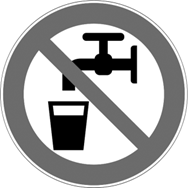
Figure 118-54.10
(11)
Required appurtenances. The reclaimed (recycled) water system and the potable water system within the building shall be provided with the required appurtenances (e.g., valves, air/vacuum relief valves, etc.) to allow for deactivation or drainage as required for a cross-connection test in accordance with Section 118-51.3.
(12)
Same trench as potable water pipes. Reclaimed (recycled) water pipes shall be permitted to be run or laid in the same trench as potable water pipes with 12 inches (305 mm) minimum vertical and horizontal separation where both pipe materials are approved for use within a building. Where piping materials do not meet this requirement, the minimum horizontal separation shall be increased to 60 inches (1,524 mm). The potable water piping shall be installed at an elevation above the reclaimed (recycled) water piping. Reclaimed (recycled) water pipes laid in the same trench or crossing building sewer or drainage piping shall be installed in accordance with this code for potable water piping.
(13)
Signs. Signs in rooms and water closet tanks in buildings using reclaimed (recycled) water shall be in accordance with Section 118-50.9 and Section 118-50.9(a).
(14)
Inspection and Testing. Reclaimed (recycled) water systems shall be inspected and tested in accordance with Section 118-51.1.
(Ord. No. 25-0037, 4-10-2025.)
Sec. 118-55. - On-site treated nonpotable water systems.
(1)
General. The provisions of this section shall apply to the installation, construction, alteration, and repair of on-site treated nonpotable water systems intended to supply uses such as water closets, urinals, trap primers for floor drains and floor sinks, above and belowground irrigation, and other uses approved by the Building Commissioner.
(2)
Plumbing plan submission. No permit for an on-site treated nonpotable water system shall be issued until complete plumbing plans, with data satisfactory to the Building Commissioner, have been submitted and approved.
(3)
System changes. No changes or connections shall be made to either the on-site treated nonpotable water system or the potable water system within a site containing an on-site treated nonpotable water system without approval by the Building Commissioner.
(4)
Connections to potable or reclaimed (recycled) water systems. On-site treated nonpotable water systems shall have no connection to a potable water supply or reclaimed (recycled) water source system. Potable or reclaimed (recycled) water is permitted to be used as makeup water for a non-pressurized storage tank provided the makeup water supply is protected by an air gap in accordance with this code.
(5)
Water pressure. On-site treated non-potable water systems supplying water to water closets, urinals, and trap primers shall be capable of delivering not less than 15 pounds-force per square inch (psi) (103 kPa) residual pressure at the highest and most remote outlet served. Where the water pressure in the on-site treated non-potable water supply system within the building exceeds 80 psi (552 kPa), a pressure reducing valve reducing the pressure to 80 psi (552 kPa) or less to water outlets in the building shall be installed.
(6)
Initial cross-connection test. A cross-connection test is required in accordance with Section 118-51.3. Before the building is occupied or the system is activated, the installer shall perform the initial cross-connection test in the presence of the Building Commissioner. The test shall be ruled successful by the Building Commissioner before final approval is granted.
(7)
On-site treated nonpotable water system materials. On-site treated nonpotable water supply, and distribution system materials shall comply with the requirements of this code for potable water supply and distribution systems unless otherwise provided for in this section.
(8)
On-site treated nonpotable water devices and systems. Devices or equipment used to treat on-site treated nonpotable water to maintain the minimum water quality requirements determined by the Building Commissioner shall be listed and labeled (third-party certified) by a listing agency (accredited conformity assessment body) or approved for the intended application. Devices or equipment used to treat on-site treated nonpotable water for use in the water closet and urinal flushing, surface irrigation, and similar applications shall comply with IAPMO IGC 324, NSF/ANSI 350 or approved by the Building Commissioner.
(9)
On-site treated nonpotable water system color and marking information. On-site treated water systems shall have a colored background and marking information in accordance with 18-29-608.8 of this code.
(10)
Design and installation. The design and installation of on-site treated nonpotable systems shall be in accordance with Section 118-55.10(a) through Section 118-55.10(e).
(a)
Listing terms and installation instructions. On-site treated nonpotable water systems shall be installed in accordance with the terms of its listing and the manufacturer's installation instructions.
(b)
Minimum water quality. On-site treated nonpotable water supplied to toilets or urinals or for other uses in which it is sprayed or exposed shall be disinfected. Acceptable disinfection methods shall include chlorination, ultraviolet sterilization, ozone, or other methods as approved by the Building Commissioner. The minimum water quality for on-site treated nonpotable water systems shall meet the applicable water quality requirements for the intended applications as determined by the public health Building Commissioner.
(c)
Deactivation and drainage. The on-site treated nonpotable water system and the potable water system within the building shall be provided with the required appurtenances (e.g., valves, air/vacuum relief valves, etc.) to allow for deactivation or drainage as required for a cross-connection test in accordance with Section 118-51.3.
(d)
Near underground potable water pipe. On-site treated nonpotable water pipes shall be permitted to be run or laid in the same trench as potable water pipes with a 12-inch (305 mm) minimum vertical and horizontal separation where both pipe materials are approved for use within a building. Where piping materials do not meet this requirement the minimum separation shall be increased to 60 inches (1,524 mm). The potable water piping shall be installed at an elevation above the on-site treated nonpotable water piping.
(e)
Required filters. A filter permitting the passage of particulates no larger than 100 microns (100 µm) shall be provided for on-site treated nonpotable water supplied to water closets, urinals, trap primers, and drip irrigation system.
(11)
Valves. Valves, except fixture supply control valves, shall be equipped with a locking feature.
(12)
Signs. Signs in buildings using on-site treated nonpotable water shall comply with Section 118-50.9 and Section 118-50.9(a).
(13)
Inspection and Testing. On-site treated nonpotable water systems shall be inspected and tested in accordance with Section 118-51.1.
(Ord. No. 25-0037, 4-10-2025.)
Sec. 118-56. - General.
(1)
Applicability. The provisions of this chapter shall apply to the installation, construction, alteration, and repair of nonpotable rainwater catchment systems.
(a)
Allowable Use of Alternate Water. Where approved or required by the Building Commissioner, rainwater shall be permitted to be used instead of potable water for the applications identified in this chapter.
(2)
System design. Rainwater catchment systems shall be designed in accordance with this chapter by a licensed plumbing contractor or registered design professional. Components, piping, and fittings used in a rainwater catchment system shall be listed.
Exceptions:
(a)
A person registered or licensed to perform plumbing design work is not required to design rainwater catchment systems used for irrigation with a maximum storage capacity of 360 gallons (1363 L).
(b)
A person registered or licensed to perform plumbing design work is not required to design rainwater catchment systems for single family dwellings where outlets, piping, and system components are located on the exterior of the building.
(3)
Permit. It shall be unlawful for a person to construct, install, alter, or cause to be constructed, installed, or altered a rainwater catchment system in a building or on a premise without first obtaining a permit to do such work from the Building Commissioner.
Exceptions:
(a)
A permit is not required for exterior rainwater catchment systems used for outdoor drip and subsurface irrigation with a maximum storage capacity of 360 gallons (1363 L).
(b)
A plumbing permit is not required for rainwater catchment systems for single family dwellings where outlets, piping, and system components are located on the exterior of the building. This does not exempt the need for permits where required for electrical connections, tank supports, or enclosures.
(4)
Component identification. System components shall be properly identified as to the manufacturer.
(5)
Maintenance and inspection. Rainwater catchment systems and components shall be inspected and maintained in accordance with Section 118-56.5(a) through Section 118-56.5(c).
(a)
Frequency. Rainwater catchment systems and components shall be inspected and maintained in accordance with Table 118-56.5 unless more frequent inspection and maintenance are required by the manufacturer.
(b)
Maintenance log. A maintenance log for rainwater catchment systems is required to have a permit in accordance with Section 118-56.3 and shall be maintained by the property owner and be available for inspection. The property owner or designated appointee shall ensure that a record of testing, inspection, and maintenance in accordance with Table 118-56.5 is maintained in the log. The log will indicate the frequency of inspection and maintenance for each system.
(c)
Maintenance responsibility. The required maintenance and inspection of rainwater catchment systems shall be the responsibility of the property owner unless otherwise required by the Building Commissioner.
(6)
Operation and maintenance manual. An operation and maintenance manual for rainwater catchment systems required to have a permit in accordance with Section 118-56.3, shall be supplied to the building owner by the system designer. The operating and maintenance manual shall include the following:
(a)
Detailed diagram of the entire system and the location of system components.
(b)
Instructions for operating and maintaining the system.
(c)
Details on maintaining the required water quality as determined by the Building Commissioner.
(d)
Details on deactivating the system for maintenance, repair, or other purposes.
(e)
Applicable testing, inspection, and maintenance frequencies in accordance with Table 118-56.5.
(f)
A method of contacting the manufacturer(s).
(7)
Minimum water quality requirements. The minimum water quality for rainwater catchment systems shall comply with the applicable water quality requirements for the intended application as determined by the Building Commissioner. Water quality for nonpotable rainwater catchment systems shall comply with Section 118-58.4.
Exceptions:
(a)
Water treatment is not required for rainwater catchment systems used for aboveground irrigation with a maximum storage capacity of 360 gallons (1363 L).
(b)
Water treatment is not required for rainwater catchment systems used for subsurface or drip irrigation.
(8)
Material compatibility. Rainwater catchment systems shall be constructed of materials that are compatible with the type of pipe and fitting materials, water treatment, and water conditions in the system.
(9)
System controls. Controls for pumps, valves, and other devices that contain mercury that come in contact with rainwater supply shall not be permitted.
(10)
Separation requirements. Underground rainwater catchment service piping shall be separated from the building sewer in accordance with [Section] 118-58.2. Treated nonpotable water pipes shall be permitted to be run or laid in the same trench as potable water pipes with a 12 inch (305 mm) minimum vertical and horizontal separation where both pipe materials are approved for use within a building. Where horizontal piping materials do not meet this requirement, the minimum separation shall be increased to 60 inches (1524 mm). The potable water piping shall be installed at an elevation above the treated nonpotable water piping.
(11)
Abandonment. Rainwater catchment systems that are no longer in use, or fail to be maintained in accordance with Section 118-56.5, shall be abandoned. Abandonment shall comply with Section 118-56.11(a) and Section 118-56.11(b).
(a)
General. An abandoned system or part thereof covered under the scope of this chapter shall be disconnected from remaining systems, drained, plugged, and capped in an approved manner.
(b)
Underground tank. An underground water storage tank that has been abandoned or otherwise discontinued from use in a system covered under the scope of this chapter shall be completely drained and filled with earth, sand, gravel, concrete, or other approved material or removed in a manner satisfactory to the Building Commissioner.
(12)
Sizing. Unless otherwise provided for in this chapter, rainwater catchment piping shall be sized in accordance with [Section] 118-56 for sizing potable water piping.
(Ord. No. 25-0037, 4-10-2025.)
Sec. 118-57. - Nonpotable rainwater catchment systems.
(1)
General. The installation, construction, alteration, and repair of rainwater catchments systems intended to supply uses such as water closets, urinals, trap primers for floor drains and floor sinks, irrigation, industrial processes, water features, cooling tower makeup and other uses shall be approved by the Building Commissioner. Rainwater catchment systems for collecting precipitation from rooftops shall comply with ARCSA/ASPE/ANSI 63.
(2)
Plumbing plan submission. No permit for a rainwater catchment system shall be issued until complete plumbing plans, with data satisfactory to the Building Commissioner, have been submitted and approved.
(3)
System changes. No changes or connections shall be made to either the rainwater catchment system or the potable water system within a site containing a rainwater catchment system requiring a permit without approval by the Building Commissioner.
(4)
Connections to potable or reclaimed (recycled) water systems. Rainwater catchment systems shall have no direct connection to a potable water supply or alternate water source system. Potable or reclaimed (recycled) water is permitted to be used as makeup water for a rainwater catchment system provided the potable or reclaimed (recycled) water supply connection is protected by an air gap or reduced-pressure principle backflow preventer in accordance with this code.
(5)
Initial cross-connection test. Where a portion of a rainwater catchment system is installed within a building, a cross-connection test is required in accordance with Section 118-60.3. Before the building is occupied or the system is activated, the installer shall perform the initial cross-connection test in the presence of the Building Commissioner. The test shall be ruled successful by the Building Commissioner before final approval is granted.
(6)
Sizing. The design and size of rainwater drains, gutters, conductors, and leaders shall comply with 18-29-1101 of this code.
(7)
Rainwater catchment system materials. Rainwater catchment system materials shall comply with Section 118-57.7(a) through Section 118-57.7(d).
(a)
Water supply and distribution materials. Rainwater catchment water supply and distribution materials shall comply with the requirements of this code for potable water supply and distribution systems unless otherwise provided for in this section.
(b)
Rainwater catchment system drainage materials. Materials used in rainwater catchment drainage systems, including gutters, downspouts, conductors, and leaders shall be in accordance with the requirements of this code for storm drainage.
(c)
Storage tanks. Rainwater storage tanks shall comply with Section 118-58.5.
(d)
Collections surfaces. The collection surface shall be constructed of a hard, impervious material.
(8)
Rainwater catchment system color and marking information. Rainwater catchment systems shall have a colored background in accordance with 18-29-608.8. Rainwater catchment systems shall be marked, in lettering in accordance with 18-29-608.8, with the words: "CAUTION: NONPOTABLE RAINWATER, DO NOT DRINK."
(9)
Deactivation and drainage for cross-connection test. The rainwater catchment system and the potable water system within the building shall be provided with the required appurtenances (e.g., valves, air or vacuum relief valves, etc.) to allow for deactivation or drainage as required for a cross-connection test in accordance with Section 118-60.3.
(Ord. No. 25-0037, 4-10-2025.)
Sec. 118-58. - Design and installation.
(1)
Rainwater catchment systems. The design and installation of nonpotable rainwater catchment systems shall be in accordance with Section 118-58.2 through Section 118-58.20.
(2)
Outside hose bibbs. Outside hose bibbs shall be allowed on rainwater piping systems. Hose bibbs supplying rainwater shall be marked with the words: "CAUTION: NONPOTABLE RAINWATER, DO NOT DRINK" and in Figure 118-58.2.
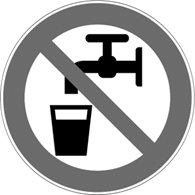
Figure 118-58.2
(3)
Rainwater catchment collection surfaces. Rainwater shall be collected from roof surfaces or other manmade, aboveground collection surfaces.
(a)
Other Surfaces. Natural precipitation collected from surface water runoff, vehicular parking surfaces, or manmade surfaces at or below grade shall be in accordance with the stormwater requirements for on-site treated nonpotable water systems in Section 18-29-1506.0.
(b)
Prohibited Discharges. Overflows and bleed-off pipes from roof-mounted equipment and appliances shall not discharge onto roof surfaces that are intended to collect rainwater without prior approval from the Building Commissioner.
(4)
Minimum water quality. The minimum water quality for harvested rainwater shall meet the applicable water quality requirements for the intended applications as determined by the Building Commissioner. In the absence of water quality requirements determined by the Building Commissioner, the minimum treatment and water quality shall be in accordance with Table 118-58.4, IAPMO IGC 324 or NSF/ANSI 350.
Exception: No treatment is required for rainwater used for subsurface or nonsprinkled surface irrigation where the maximum storage volume is less than 360 gallons (1363 L).
(5)
Rainwater storage tanks. Rainwater storage tanks shall comply with IAPMO/ANSI Z1002 and be installed in accordance with Section 118-58.6 through Section 118-58.12.
(6)
Location. Rainwater storage tanks shall be permitted to be installed above or below grade.
(7)
Above grade. Above grade, storage tanks shall be of an opaque material, approved for aboveground use in direct sunlight or shall be shielded from direct sunlight. Tanks shall be installed in an accessible location to allow for inspection and cleaning. The tank shall be installed on a foundation or platform that is constructed to accommodate loads in accordance with the building code.
(8)
Below grade. Rainwater storage tanks installed below grade shall be structurally designed to withstand anticipated earth or other loads. Holding tank covers shall be capable of supporting an earth load of not less than 300 pounds per square foot (lb/ft 2 ) (1,465 kg/m 2 ) where the tank is designed for underground installation. Below grade rainwater tanks installed underground shall be provided with manholes. The manhole opening shall be not less than 20 inches (508 mm) in diameter and located not less than four inches (102 mm) above the surrounding grade. The surrounding grade shall be sloped away from the manhole. Underground tanks shall be ballasted, anchored, or otherwise secured, to prevent the tank from floating out of the ground where empty. The combined weight of the tank and hold down system shall meet or exceed the buoyancy force of the tank.
(9)
Drainage and overflow. Rainwater storage tanks shall be provided with a means of draining and cleaning. The overflow drain shall not be equipped with a shutoff valve. The overflow outlet shall discharge in accordance with this code for storm drainage systems. Where discharging to the storm drainage system, the overflow drain shall be protected from backflow of the storm drainage system by a backwater valve or other approved method.
For SI units: 1 micron = 1 µm, 1 gallon = 3.785 L
(a)
Overflow outlet size. The overflow outlet shall be sized to accommodate the flow of the rainwater entering the tank and not less than the aggregate cross-sectional area of inflow pipes.
(10)
Opening and access protection. Rainwater tank openings shall be protected to prevent the entrance of insects, birds, or rodents into the tank. Rainwater tank access openings exceeding 12 inches (305 mm) in diameter shall be secured to prevent tampering and unintended entry by either a lockable device or other approved method.
(11)
Marking. Rainwater tanks shall be permanently marked with the capacity and the language: "NONPOTABLE RAINWATER." Where openings are provided to allow a person to enter the tank, the opening shall be marked with the following language: "DANGER-CONFINED SPACE."
(12)
Storage tank venting. Where venting using drainage or overflow piping is not provided or is considered insufficient, a vent shall be installed on each tank. The vent shall extend from the top of the tank and terminate not less than six inches (152 mm) above grade and shall be not less than one and one-half inches (40 mm) in diameter. The vent terminal shall be directed downward and covered with a 3 / 32 of an inch (2.4 mm) mesh screen to prevent the entry of vermin and insects.
(13)
Pumps. Pumps serving rainwater catchment systems shall be listed. Pumps supplying water to water closets, urinals, and trap primers shall be capable of delivering not less than 15 pounds-force per square inch (psi) (103 kPa) residual pressure at the highest and most remote outlet served. Where the water pressure in the rainwater supply system within the building exceeds 80 psi (552 kPa), a pressure reducing valve reducing the pressure to 80 psi (552 kPa) or less to water outlets in the building shall be installed in accordance with this code.
(14)
Roof drains. Primary and secondary roof drains, conductors, leaders, and gutters shall be designed and installed in accordance with this code.
(15)
Water quality devices and equipment. Devices and equipment used to treat rainwater to maintain the minimum water quality requirements determined by the Building Commissioner shall be listed or labeled (third-party certified) by a listing agency (accredited conformity assessment body) and approved for the intended application.
(16)
Freeze protection. Tanks and piping installed in locations subject to freezing shall be provided with an approved means of freeze protection.
(17)
Debris removal. The rainwater catchment conveyance system shall be equipped with a debris excluder or other approved means to prevent the accumulation of leaves, needles, other debris and sediment from entering the storage tank. Devices or methods used to remove debris or sediment shall be accessible and sized and installed in accordance with manufacturer's installation instructions.
(18)
Required filters. A filter permitting the passage of particulates not larger than 100 microns (100 µm) shall be provided for rainwater supplied to water closets, urinals, trap primers, and drip irrigation system.
(19)
Roof gutters. Gutters shall maintain a minimum slope and be sized in accordance with 18-29-1106.6.
(20)
Rainwater diversion valves. Rainwater diversion valves ranging from two inches (50 mm) through four inches (100 mm) in diameter shall comply with IAPMO PS 59. Rainwater diversion valves ranging from six inches (150 mm) to 12 inches (300 mm) in diameter shall comply with IAPMO IGC 352. Valves shall be accessible and include a filter located upstream of the valve when required.
(Ord. No. 25-0037, 4-10-2025.)
Sec. 118-59. - Signs.
(1)
General. Signs in buildings using rainwater shall be in accordance with Section 118-59.2 and Section 118-59.3.
(2)
Commercial, industrial, and institutional restroom signs. A sign shall be installed in restrooms in commercial, industrial, and institutional occupancies using nonpotable rainwater for water closets, urinals, or both. Each sign shall contain one-half of an inch (12.7 mm) letters of a highly visible color on a contrasting background. The location of the sign(s) shall be such that the sign(s) shall be visible to users. The number and location of the signs shall be approved by the Building Commissioner and shall contain the following text:
TO CONSERVE WATER, THIS BUILDING USES RAINWATER TO FLUSH TOILETS AND URINALS.
(3)
Equipment room signs. Each equipment room containing nonpotable rainwater equipment shall have a sign posted with the following wording in one inch (25.4 mm) letters:
CAUTION NONPOTABLE RAINWATER, DO NOT DRINK. DO NOT CONNECT TO DRINKING WATER SYSTEM. NOTICE: CONTACT BUILDING MANAGEMENT BEFORE PERFORMING ANY WORK ON THIS WATER SYSTEM.
This sign shall be posted in a location that is visible to anyone working on or near rainwater equipment.
(Ord. No. 25-0037, 4-10-2025.)
Sec. 118.60. - Inspection and testing.
(1)
General. Rainwater catchment systems shall be inspected and tested in accordance with Section 118-60.2 and Section 118-60.3.
(2)
Supply system inspection and test. Rainwater catchment systems shall be inspected and tested in accordance with the applicable provisions of this code for testing of potable water and storm drainage systems. Storage tanks shall be filled with water to the overflow opening for a period of 24 hours, and during the inspection, or by other means as approved by the Building Commissioner. Seams and joints shall be exposed during the inspection and checked for watertightness.
(3)
Annual cross-connection inspection and testing. An initial and subsequent annual inspection and test in accordance with Section 118-57.5 shall be performed on both the potable and rainwater catchment water systems. The potable and rainwater catchment water systems shall be isolated from each other and independently inspected and tested to ensure there is no cross-connection in accordance with Section 118-60.3(a) through Section 118-60.3(d).
(a)
Visual system inspection. Prior to commencing the cross-connection testing, a dual system inspection shall be conducted by the Building Commissioner as follows:
1.
Pumps, equipment, equipment room signs, and exposed piping in an equipment room shall be checked.
(b)
Cross-connection test. The procedure for determining cross-connection shall be followed by the applicant in the presence of the Building Commissioner to determine whether a cross-connection has occurred as follows:
1.
The potable water system shall be activated and pressurized. The rainwater catchment water system shall be shut down and completely drained.
2.
The potable water system shall remain pressurized for a minimum period of time specified by the Building Commissioner while the rainwater catchment water system is empty. The minimum period the rainwater catchment water system is to remain depressurized shall be determined on a case-by-case basis, taking into account the size and complexity of the potable and rainwater catchment water distribution systems, but in no case shall that period be less than one hour.
3.
Fixtures, potable, and rainwater shall be tested and inspected for flow. Flow from a rainwater catchment water system outlet shall indicate a cross-connection. No flow from a potable water outlet shall indicate that it is connected to the rainwater system.
4.
The drain on the rainwater catchment water system shall be checked for flow during the test and at the end of the period.
5.
The potable water system shall then be completely drained.
6.
The rainwater catchment water system shall then be activated and pressurized.
7.
The rainwater catchment water system shall remain pressurized for a minimum period of time specified by the Building Commissioner while the potable water system is empty. The minimum period the potable water system is to remain depressurized shall be determined on a case-by-case basis, but in no case shall that period be less than one hour.
8.
Fixtures, potable and rainwater catchment, shall be tested and inspected for flow. Flow from a potable water system outlet shall indicate a cross-connection. No flow from a rainwater catchment water outlet shall indicate that it is connected to the potable water system.
9.
The drain on the potable water system shall be checked for flow during the test and at the end of the period.
10.
Where there is no flow detected in the fixtures which would indicate a cross-connection, the potable water system shall be repressurized.
(c)
Discovery of cross-connection. In the event that a cross-connection is discovered, the following procedure, in the presence of the Building Commissioner, shall be activated immediately:
1.
Rainwater catchment piping to the building shall be shutdown at the meter, and the rainwater riser shall be drained.
2.
Potable water piping to the building shall be shutdown at the meter.
3.
The cross-connection shall be uncovered and disconnected.
4.
The building shall be retested following procedures listed in Section 118-60.3(a) and Section 118-60.3(b).
5.
The potable water system shall be chlorinated with 50 ppm chlorine for 24 hours.
6.
The potable water system shall be flushed after 24 hours, and a standard bacteriological test shall be performed. Where test results are acceptable, the potable water system shall be permitted to be recharged.
(4)
Annual inspection. An annual inspection of the rainwater catchment water system, following the procedures listed in Section 118-60.3(a) shall be required. Annual cross-connection testing, following the procedures listed in Section 118-60.3(b) shall be required by the Building Commissioner, unless site conditions do not require it. In no event shall the test occur less than once in four years. Alternate testing requirements shall be permitted by the Building Commissioner.
(Ord. No. 25-0037, 4-10-2025.)

