
Coon Rapids City Zoning Code
CHAPTER 11
1000 - OVERLAY DISTRICTS
11-1001 - Mississippi River Corridor Critical Area Overlay District Boundaries
11-1001.1
Authority, Intent and Purpose.
(1)
Statutory Authorization. This Mississippi River Corridor Critical Area (MRCCA) Section 11-1001 is adopted pursuant to the authorization and policies contained in Minn. Stat. Ch. 116G, Minnesota Rules, Parts 6106.0010—6106.0180, and the planning and zoning enabling legislation in Minn. Stat. Chs. 462 and 473.
(2)
Policy. The Legislature of Minnesota has delegated responsibility to local governments of the state to regulate the subdivision, use and development of designated critical areas and thus preserve and enhance the quality of important historic, cultural, aesthetic values, and natural systems and provide for the wise use of these areas.
11-1001.2
General Provisions and Definitions.
(1)
Jurisdiction. The provisions of this Section apply to land within the river corridor boundary as described in the State Register, volume 43, pages 508 to 519 and shown on the zoning map.
(2)
Enforcement. The City of Coon Rapids is responsible for the administration and enforcement of this Section. Any violation of its provisions or failure to comply with any of its requirements including violations of conditions and safeguards established in connection with grants of variances or conditional uses constitutes a misdemeanor and is punishable as defined by law. Violations of this Section can occur regardless of whether or not a permit is required for a regulated activity listed in Subsection 11-1001.3(2).
(3)
Severability. If any section, clause, provision, or portion of this Section is adjudged unconstitutional or invalid by a court of competent jurisdiction, the remainder of this Section shall not be affected thereby.
(4)
Abrogation and Greater Restrictions. It is not intended by this Section to repeal, abrogate, or impair any existing easements, covenants, or deed restrictions. However, where this Section imposes greater restrictions, the provisions of this Section shall prevail. All other Sections inconsistent with this Section are hereby repealed to the extent of the inconsistency only.
(5)
Underlying Zoning. Uses and standards of underlying zoning districts apply except where standards of this overlay district are more restrictive.
(6)
Definitions. Unless specifically defined below, words or phrases used in this Section shall be interpreted to give them the same meaning they have in common usage and to give this Section its most reasonable application. For the purpose of this Section, the words "must" and "shall" are mandatory and not permissive. All distances, unless otherwise specified, are measured horizontally. Wherever there is a conflict between these definitions and Section 11-200, these definitions control within this overlay district.
Access path. An area designated to provide ingress and egress to public waters.
Adjacent. Having a boundary that physically touches or adjoins.
Agricultural use. A use having the meaning given under Minn. Stat. §40A.02.
Alternative design. Subdivision design methods such as conservation design, transfer of development density, or similar zoning and site design techniques that protect open space and natural areas.
Biological and ecological functions. The functions of vegetation in stabilizing soils and slopes, retaining and filtering runoff, providing habitat, and recharging groundwater.
Bluff. A natural topographic feature having:
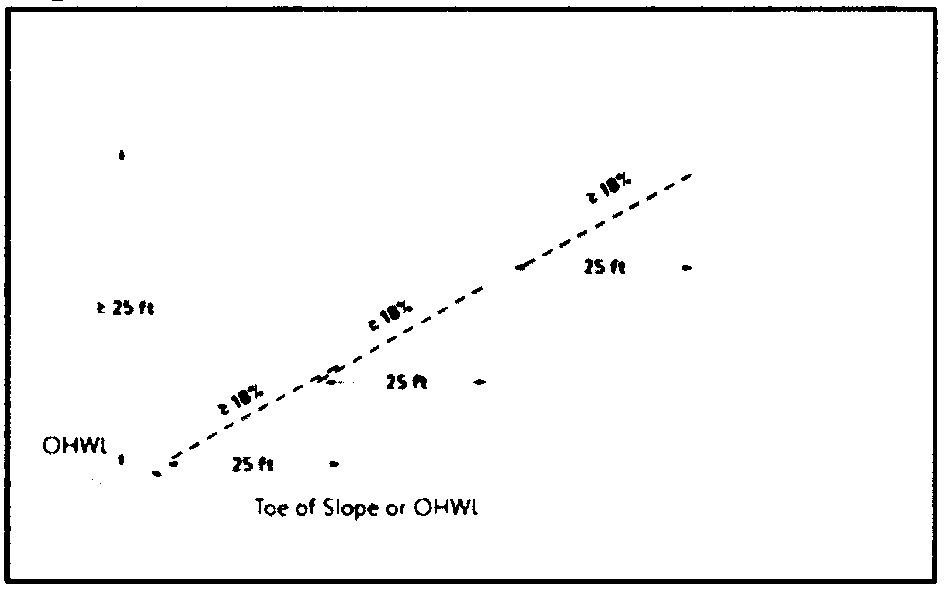
A slope that rises at least 25 feet where the grade of the slope averages 18 percent or greater, measured over any horizontal distance of 25 feet, from the toe of the slope to the top of the slope. Where the slope begins below the ordinary high water level, the ordinary high water level is the toe of the slope. See Figure 1; or
Figure 1. Bluff
A natural escarpment or cliff with a slope that rises at least ten feet above the ordinary high water level or toe of the slope, whichever is applicable, to the top of the slope, with a slope of 75 degrees or greater. See Figure 2.
Figure 2. Natural Escarpment Bluff and Bluff Impact Zone
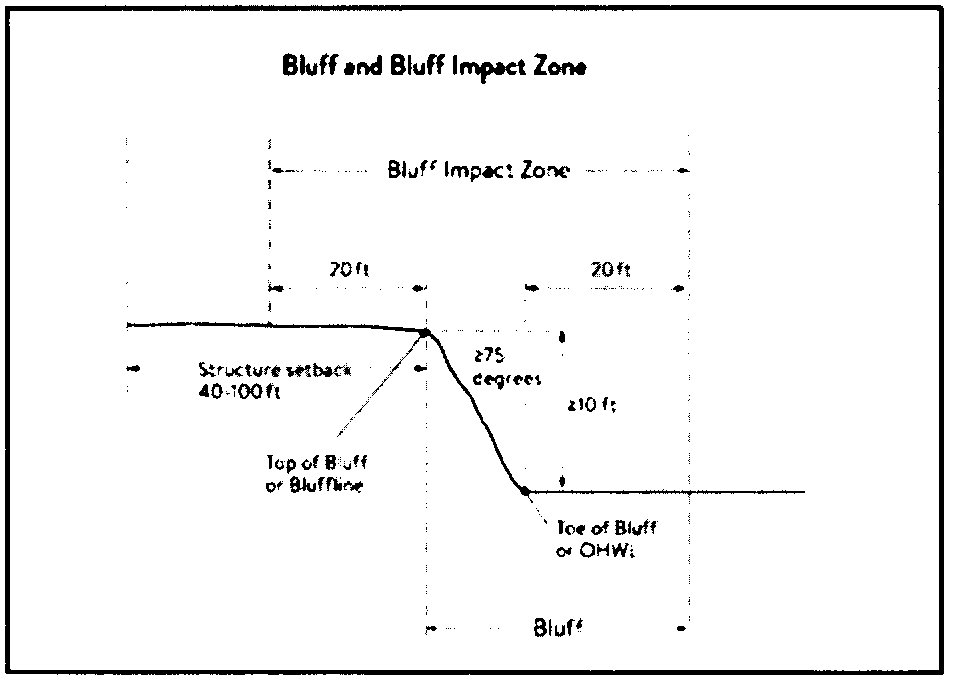
Bluff impact zone (BIZ). A bluff and land located within 20 feet of the bluff. See Figure 2 for natural escarpment or cliff example and Figure 3 for more common bluff example.
Figure 3. Bluff Impact Zone, Bluffline, Toe of Bluff, and Top of Bluff
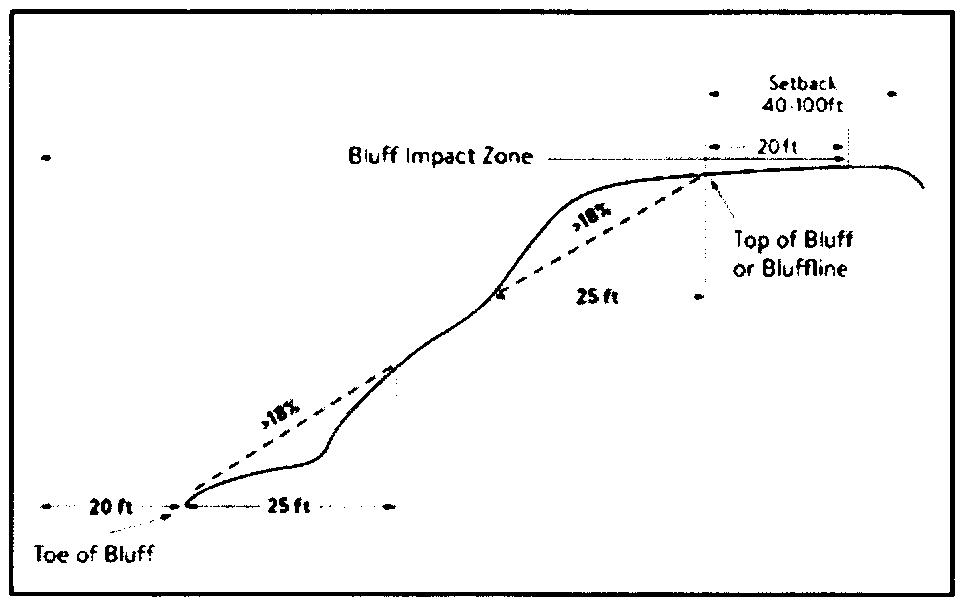
Bluff Line. A line delineating the top of the bluff. More than one bluffline may be encountered proceeding landward from the river. See Figures 2 for natural escarpment or cliff example and Figure 3 for more common bluff example.
Bluff, Toe of. A line along the bottom of a bluff, requiring field verification, such that the slope above the line exceeds 18 percent and the slope below the line is 18 percent or less, measured over a horizontal distance of 25 feet. See Figures 2 for natural escarpment or cliff example and Figure 3 for more common bluff example.
Bluff, Top of. A line along the top of a bluff, requiring field verification, such that the slope below the line exceeds 18 percent and the slope above the line is 18 percent or less, measured over a horizontal distance of 25 feet. See Figures 2 for natural escarpment or cliff example and Figure 3 for more common bluff example.
Buildable area. The area upon which structures may be placed on a lot or parcel of land and excludes areas needed to meet requirements for setback, rights-of-way, bluff impact zones, historic properties, wetlands, designated floodways, land below the ordinary high water level of public waters, and other unbuildable areas.
Building. A structure with two or more outside rigid walls and a fully secured roof and affixed to a permanent site.
Certificate of compliance. A document written after a compliance inspection, certifying that the development is in compliance with applicable requirements at the time of the inspection.
Commissioner. The commissioner of the Minnesota Department of Natural Resources.
Conditional use. A use having the meaning given under Minn. Stat. Chs. 394 and 462.
Conservation design. A pattern of subdivision that is characterized by grouping lots within a portion of a parcel, where the remaining portion of the parcel is permanently protected as open space.
Conventional subdivision. A pattern of subdivision that is characterized by lots that are spread regularly throughout a parcel in a lot and block design.
Deck. A horizontal, unenclosed, aboveground level structure open to the sky, with or without attached railings, seats, trellises, or other features, attached or functionally related to a principal use or site.
Developer. Having the meaning given under Minn. Stat. §116G.03.
Development. Having the meaning given under Minn. Stat. §116G.03.
Discretionary action. An action under this chapter related to land use that requires a public hearing by local ordinance or statute, such as preliminary plats, final subdivision plats, planned unit developments, conditional use permits, interim use permits, variances, appeals, and rezonings.
Dock. Having the meaning given under Minnesota Rules, chapter 6115.
Electric power facilities. Equipment and associated facilities for generating electric power or devices for converting wind energy to electrical energy as identified and defined under Minn. Stat. §216E.
Essential services. Underground or overhead gas, electrical, communications, steam, or water distribution, collection, supply, or disposal systems, including storm water. Essential services include poles, wires, mains, drains, pipes, conduits, cables, fire alarm boxes, traffic signals, hydrants, navigational structures, aviation safety facilities or other similar equipment and accessories in conjunction with the systems. Essential services does not include buildings, treatment works as defined in Minn. Stat. Ch. 115.01, electric power facilities or transmission services.
Floodplain. Having the meaning given under Minnesota Rules Chapter 6120.
Fully reconstructs. The reconstruction of an existing impervious surface that involves site grading and subsurface excavation so that soil is exposed. Mill and overlay and other resurfacing activities are not considered fully reconstructed.
Hard-surface trail. A trail surfaced in asphalt, crushed aggregate, or other hard surface, for multi-purpose use, as determined by local, regional, or state agency plans.
Historic property. An archaeological site, standing structure, site, district, or other property that is:
(a)
Listed in the National Register of Historic Places or the State Register of Historic Places or locally designated as a historic site under Minn. Stat. §471;
(b)
Determined to meet the criteria for eligibility to the National Register of Historic Places or the State Register of Historic Places as determined by the director of the Minnesota Historical Society; or
(c)
An unplatted cemetery that falls under the provisions of Minn. Stat. §307, in consultation with the Office of the State Archaeologist.
Impervious surface. A constructed hard surface that either prevents or retards the entry of water into the soil and causes water to run off the surface in greater quantities and at an increased rate of flow than prior to development. Examples include rooftops, decks, sidewalks, patios, parking lots, pools, storage areas, and driveways, including those with concrete, asphalt, or gravel surfaces.
Intensive vegetation clearing. The removal of all or a majority of the trees or shrubs in a contiguous patch, strip, row, or block.
Interim use. A use having the meaning given under Minn. Stat. §394 and 462.
Land alteration. An activity that exposes the soil or changes the topography, drainage, or cross section of the land, excluding gardening or similar minor soil disturbances.
Local government. Counties, cities, and townships.
Lot. Having the meaning given under Minnesota Rules chapter 6120.
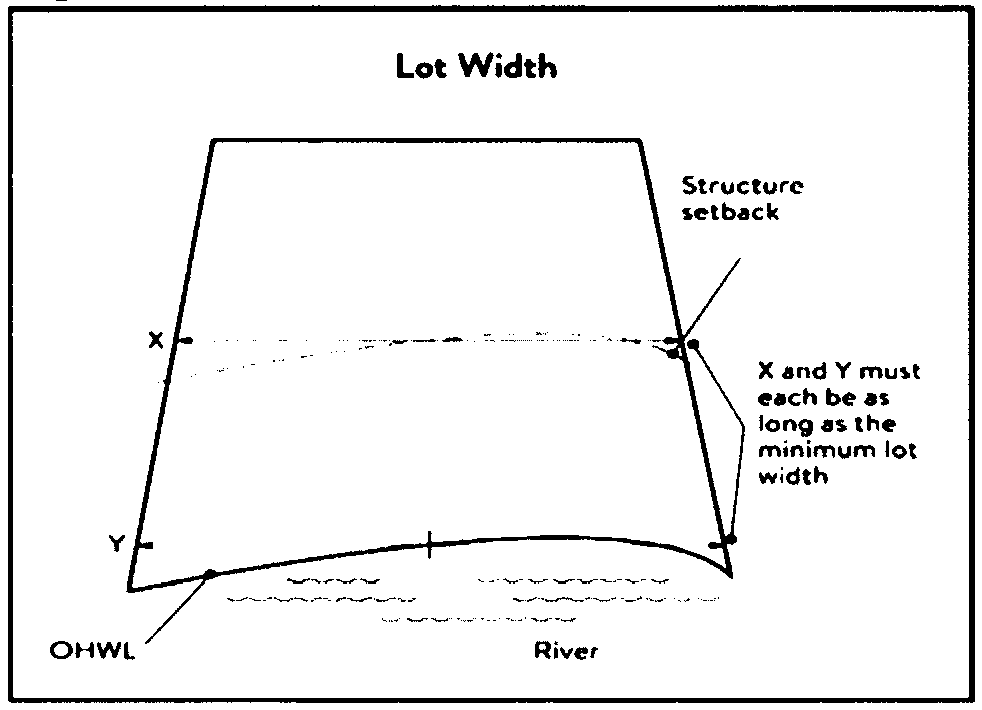
Lot width. The shortest distance between lot lines measured at both the ordinary high water level and at the required structure setback from the ordinary high water level. See Figure 4.
Figure 4. Lot Width
Marina. Having the meaning given under Minnesota Rules chapter 6115.
Mississippi River Corridor Critical Area (MRCCA). The area within the River Corridor Boundary (See Section 2.680).
Mississippi River Corridor Critical Area (MRCCA) Plan. A chapter or other element in the City of Coon Rapids comprehensive plan.
Mooring facility. Having the meaning given under Minnesota Rules chapter 6115.0170.
Native plant community. A plant community that has been identified as part of the Minnesota Biological Survey or biological survey issued or adopted by a local, state, or federal agency.
Natural-surface trail. A trail composed of native soil and rock or compacted granular stone, primarily intended for hiking, equestrian, or mountain bike use, as determined by local, regional, or state agency plans.
Natural vegetation. Any combination of ground cover, understory, and tree canopy that, while it may have been altered by human activity, continues to stabilize soils, retain and filter runoff, provide habitat, and recharge groundwater.
Nonconformity. Having the meaning given under Minn. Stat. §394.22.
Nonmetallic mining. Construction, reconstruction, repair, relocation, expansion, or removal of any facility for the extraction, stockpiling, storage, disposal, or reclamation of nonmetallic minerals such a stone, sand, and gravel. Nonmetallic mining does not include ancillary facilities such as access roads, bridges, culverts, and water level control structures. For purposes of this subpart, "facility" includes all mine pits, quarries, stockpiles, basins, processing structures and equipment, and any structures that drain or divert public waters to allow mining.
Off-premise advertising signs. Those signs that direct attention to a product, service, business, or entertainment venue that is not exclusively related to the premises where the sign is located.
Ordinary high water level (OHWL). Having the meaning given under Minn. Stat. §103G.005.
Overlay district. A zoning district that is applied over one or more previously established zoning districts, establishing additional or stricter standards and criteria for covered properties in addition to those of the underlying zoning district. Overlay districts are often used to protect historic features and natural resources such as shoreland or floodplain.
Parcel. Having the meaning given under Minn. Stat. §116G.03.
Patio. A constructed hard surface located at ground level with no railings and open to the sky.
Picnic shelter. A roofed structure open on all sides, accessory to a recreational use.
Planned unit development. A method of land development that merges zoning and subdivision controls, allowing developers to plan and develop a large area as a single entity, characterized by a unified site design, a mix of structure types and land uses, and phasing of development over a number of years. Planned unit development includes any conversion of existing structures and land uses that utilize this method of development.
Plat. Having the meaning given under Minn. Stat. §§505 and 515B.
Port. A water transportation complex established and operated under the jurisdiction of a port authority according to Minn. Stat. §458.
Primary conservation areas (PCAs). Key resources and features, including shore impact zones, bluff impact zones, floodplains, wetlands, gorges, areas of confluence with tributaries, natural drainage routes, unstable soils and bedrock, native plant communities, cultural and historic properties, and significant existing vegetative stands, tree canopies, and other resources identified in local government plans.
Private facilities. Private roads, driveways, and parking areas, private water access and viewing facilities, decks and patios in setback areas, and private signs.
Professional engineer. An engineer licensed to practice in Minnesota.
Public facilities. Public utilities, public transportation facilities, and public recreational facilities.
Public recreation facilities. Recreational facilities provided by the state or a local government and dedicated to public use, including parks, scenic overlooks, observation platforms, trails, docks, fishing piers, picnic shelters, water access ramps, and other similar water-oriented public facilities used for recreation.
Public river corridor views (PRCVs). Views toward the river from public parkland, historic properties, and public overlooks, as well as views toward bluffs from the ordinary high water level of the opposite shore, as seen during the summer months and documented in the MRCCA plan/chapter of the comprehensive plan.
Public transportation facilities. All transportation facilities provided by federal, state, or local government and dedicated to public use, such as roadways, transit facilities, railroads, and bikeways.
Public utilities. Electric power facilities, essential services, and transmission services.
Public waters. Having the meaning given under Minn. Stat. §103G.005.
Readily visible. Land and development that are easily seen from the ordinary high water level of the opposite shore during summer months.
Resource agency. A federal, state, regional, or local agency that engages in environmental, natural, or cultural resource protection or restoration activities, including planning, implementation, and monitoring.
Retaining wall. A vertical or nearly vertical structures constructed of mortar and rubble masonry, rock, or stone regardless of size, vertical timber pilings, horizontal timber planks with piling supports, sheet pilings, poured concrete, concrete blocks, or other durable materials.
Rock Riprap. Natural coarse rock placed or constructed to armor shorelines, streambeds, bridge abutments, pilings and other shoreline structures against scour, or water or ice erosion.
River corridor boundary. The boundary approved and adopted by the Metropolitan Council under Minn. Stat. §116G.06, as approved and adopted by the legislature in Minn. Stat. §116G.15, and as legally described in the Sate Register, volume 43, pages 508 to 518.
River-dependent use. The use of land for commercial, industrial, or utility purposes, where access to and use of a public water feature is an integral part of the normal conduct of business and where the use is dependent on shoreline facilities.
Selective vegetation removal. The removal of isolated individual trees or shrubs that are not in a contiguous patch, strip, row, or block and that does not substantially reduce the tree canopy or understory cover.
Setback. A separation distance measured horizontally.
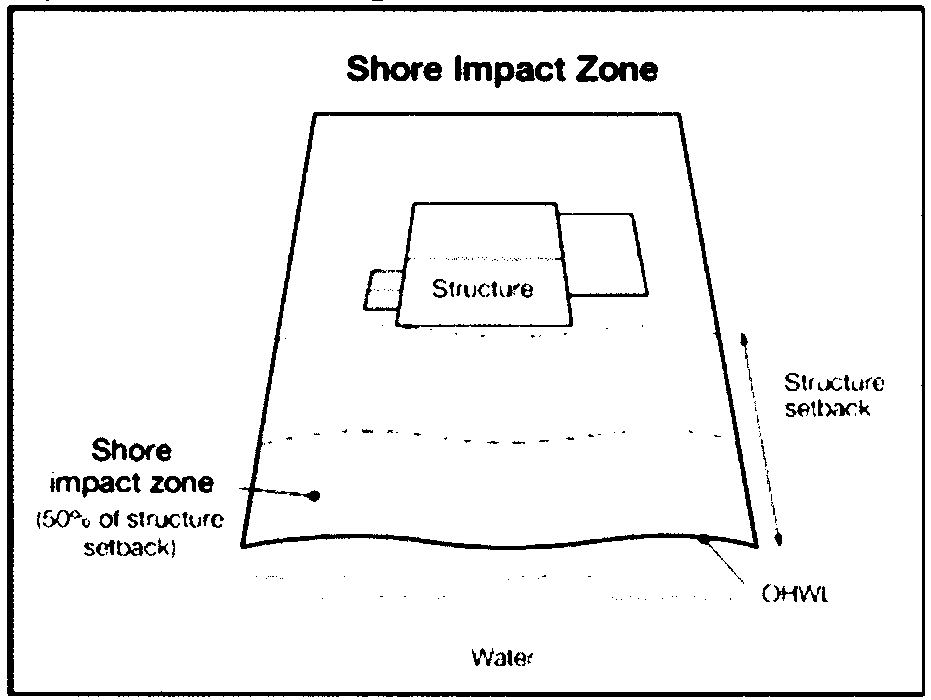
Shore impact zone (SIZ). Land located between the ordinary high water level of public waters and a line parallel to it at a setback of 50 percent of the required structure setback or, for agricultural use, 50 feet landward of the ordinary high water level. See Figure 5.
Figure 5. Shore Impact Zone
Shoreline facilities. Facilities that require a location adjoining public waters for ingress and egress, loading and unloading, and public water intake and outflow, such as barge facilities, port facilities, commodity loading and unloading equipment, watercraft lifts, marinas, short-term watercraft mooring facilities for patrons, and water access ramps. Structures that would be enhanced by a shoreline location, but do not require a location adjoining public waters as part of their function, are not shoreline facilities, such as restaurants, bait shops, and boat dealerships.
Steep slope. A natural topographic feature with an average slope of 12 to 18 percent, measured over a horizontal distance equal to or greater than 50 feet, and any slopes greater than 18 percent that are not bluffs.
Storm water management facilities. Facilities for the collection, conveyance, treatment, or disposal of storm water.
Structure. A building, sign, or appurtenance thereto, except for aerial or underground utility lines, such as sewer, electric, telephone, or gas lines, and utility line towers, poles, and other supporting appurtenances.
Subdivision. Having the meaning given under Minn. Stat. §462.352.
Subsurface sewage treatment system. Having the meaning given under Minnesota Rules, Part 7080.1100.
Transmission services.
(a)
Electric power lines, cables, pipelines, or conduits that are:
(i)
Used to transport power between two points, as identified and defined under Minn. Stat. §216E.01, Subd. 4; or
(ii)
For mains or pipelines for gas, liquids, or solids in suspension, used to transport gas, liquids, or solids in suspension between two points; and
(b)
Telecommunication lines, cables, pipelines, or conduits.
Treeline. The more or less continuous line formed by the tops of trees in a wooded area when viewed from a particular point. The treeline is determined during all seasons as if under full foliage.
Variance. Having the meaning given under Minn. Stat. §394.22.
Water access ramp. A boat ramp, carry-down site, boarding dock, and approach road, or other access that allows launching and removal of a boat, canoe, or other watercraft with or without a vehicle and trailer.
Water-oriented accessory structure. A small building or other improvement, except stairways, fences, docks, and retaining walls, that, because of the relationship of its use to public waters, needs to be located closer to public waters than the normal structure setback. Examples include gazebos, screen houses, fish houses, pump houses, and detached decks and patios.
Water quality impact zone. Land within the shore impact zone or within 50 feet of the OWHL of the river, whichever is greater, and land within 50 feet of a public water, wetland, or natural drainage route.
Wetland. Having the meaning given under Minn. Stat. §103G.005.
Wharf. Having the meaning given under Minnesota Rules, part 6115.0170.
11-1001.3
Administration.
(1)
Purpose. The purpose of this Section is to identify administrative provisions to ensure this Section is administered consistent with its purpose.
(2)
Permits. A permit is required for the construction of buildings or building additions (including construction of decks and signs), the installation and/or alteration of sewage treatment systems, vegetation removal consistent with Section 11-1001.9 and land alterations consistent with Section 11-1001.10.
(3)
Variances. Variances to the requirements under this Section may only be granted in accordance with Section 11-304.9(2) and Minn. Stat. §462.357 and must consider the potential impacts of variances on primary conservation areas, public river corridor views, and other resources identified in the MRCCA plan. In reviewing the variance application, the City shall:
(a)
Evaluate the impacts to these resources. and if negative impacts are found, require conditions to mitigate the impacts that are related to and proportional to the impacts, and
(b)
Make written findings that the variance is consistent with the purpose of this Section.
(4)
Conditional use permits. All conditional uses, required under this Section, must comply with Section 11-304.3(2) and Minn. Stat. §462.3595 and must consider the potential impacts on primary conservation areas, public river corridor views, and other resources identified in the MRCCA plan. In reviewing the application, the City shall:
(a)
Evaluate the impacts to these resources and if negative impacts are found, require conditions to mitigate the impacts that are related to and proportional to the impacts.
(5)
Application materials. Applications for permits and discretionary actions required under this Section must submit the following information unless the Director determines that the information is not needed.
(a)
A detailed project description; and
(b)
Scaled maps and plans, dimensional renderings, maintenance agreements, and other materials that identify and describe:
(i)
Primary conservation areas;
(ii)
Public river corridor views;
(iii)
Buildable area;
(iv)
Existing and proposed topography and drainage patterns;
(v)
Proposed storm water and erosion and sediment control practices;
(vi)
Existing and proposed vegetation to be removed and established;
(vii)
Ordinary high water level, blufflines, and all required setbacks;
(viii)
Existing and proposed structures;
(ix)
Existing and proposed impervious surfaces; and
(x)
Existing and proposed subsurface sewage treatment systems.
(6)
Nonconformities.
(a)
All legally established nonconformities as of the date of the ordinance from which this Chapter is derived may continue consistent with Minn. Stat. §462.357 Subd. 1e.
(b)
New structures erected in conformance with the setback averaging provisions of Subsection 11-1001.6(3)(d) are conforming structures.
(c)
Site alterations and expansion of site alterations that were legally made prior to the effective date of the ordinance from which this Chapter is derived are conforming. Site alterations include vegetation, erosion control, storm water control measures, and other nonstructural site improvements.
(d)
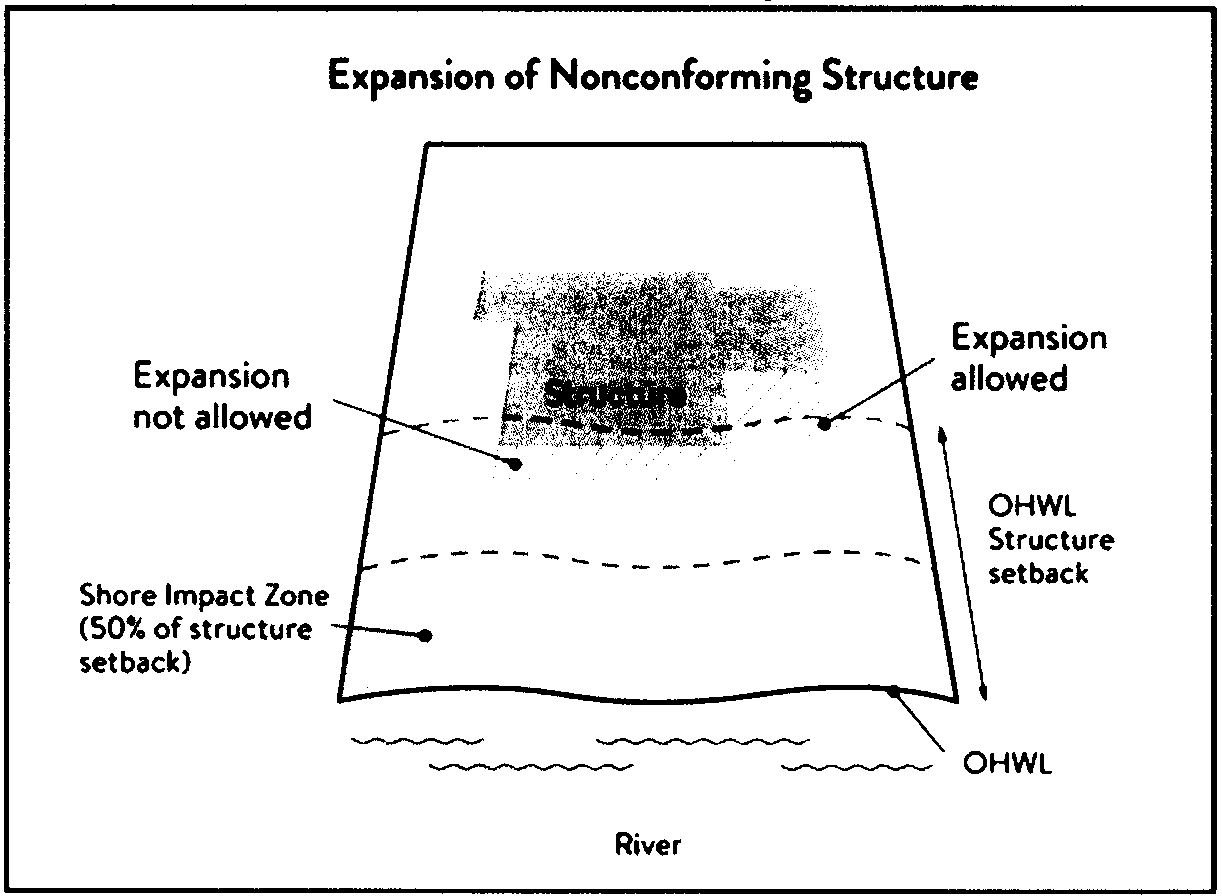
Legally nonconforming principal structures that do not meet the setback requirements of Subsection 11-1001.6(3) may be expanded laterally provided that:
(i)
The expansion does not extend into the shore or bluff impact zone or further into the required setback than the building line of the existing principal structure (See Figure 6); and
(ii)
The expanded structure's scale and bulk is consistent with that of the original structure and existing surrounding development.
Figure 6. Expansion of Nonconforming Structure
(7)
Notifications.
(a)
Amendments to this Section 11-1001 and to the MRCCA plan must be submitted to the Commissioner as provided in Minnesota Rules, part 6106.0070, Subp. 3, Items B.—I.
(b)
Notice of public hearings for discretionary actions, including conditional and interim use permits, variances, appeals, rezonings, preliminary plats, final subdivision plats, master plans, and PUDs, must be sent to the following entities at least 30 days prior to the hearing:
(i)
The Commissioner in a format prescribed by the DNR;
(ii)
National Park Service; and
(iii)
Where building heights exceed the height limits specified in Subsection 11-1001.6(2) as part of the conditional use or variance process, adjoining local governments within the MRCCA, including those with overlapping jurisdiction and those across the river.
(c)
Notice of final decisions for actions in Subsection 11-1001.3(7), including findings of fact, must be sent to the Commissioner, the National Park Service, and adjoining local governments within the MRCCA within ten days of the final decision.
(d)
Requests to amend district boundaries must follow the provisions in Minnesota Rules, part 6106.0100, Subp. 9, Item C.
(8)
Accommodating disabilities. Reasonable accommodations for ramps or other facilities to provide persons with disabilities access to the persons' property, as required by the federal Americans with Disabilities Act and the federal Fair Housing Act and as provided by Minnesota Rules, chapter 1341, must:
(a)
Comply with Sections 11-1001.6 to 11-1001.12; or
(b)
If Sections 11-1001.6 to 11-1001.12 cannot be complied with, ramps or other facilities are allowed with an administrative permit provided:
(i)
The permit terminates on either a specific date or upon occurrence of a particular event related to the person requiring accommodation; and
(ii)
Upon expiration of the permit, the ramp or other facilities must be removed.
11-1001.4
MRCCA Districts.
(1)
Purpose. The purpose of this Section is to establish districts under which building height and structure placement are regulated to protect and enhance the Mississippi River's resources and features consistent with the natural and built character of each district.
(2)
District description and management purpose. The MRCCA within the City of Coon Rapids is divided into the following MRCCA Districts:
(a)
Rural and Open Space (ROS).
(i)
Description. The ROS District is characterized by rural and low-density development patterns and land uses, and includes land that is riparian or visible from the river, as well as large, undeveloped tracts of high ecological and scenic value, floodplain, and undeveloped islands. Many primary conservation areas exist in the district.
(ii)
Management purpose. The ROS District must be managed to sustain and restore the rural and natural character of the corridor and to protect and enhance habitat, parks and open space, public river corridor views, and scenic, natural, and historic areas.
(b)
River Neighborhood (RN).
(i)
Description. The RN District is characterized by primarily residential neighborhoods that are riparian or readily visible from the river or that abut riparian parkland. The district includes parks and open space, limited commercial development, marinas, and related land uses.
(ii)
Management purpose. The RN District must be managed to maintain the character of the river corridor within the context of existing residential and related neighborhood development, and to protect and enhance habitat, parks and open space, public river corridor views, and scenic, natural, and historic areas. Minimizing erosion and the flow of untreated storm water into the river and enhancing habitat and shoreline vegetation are priorities in the district.
(c)
River Towns and Crossings (RTC).
(i)
Description. The RTC District is characterized by historic downtown areas and limited nodes of intense development at specific river crossings, as well as institutional campuses that predate designation of the MRCCA, and that include taller buildings.
(ii)
Management purpose. The RTC district must be managed in a manner that allows continued growth and redevelopment in historic downtowns and more intensive redevelopment in limited areas at river crossings to accommodate compact walkable development patterns and connections to the river. Minimizing erosion and the flow of untreated storm water into the river, providing public access to and public views of the river, and restoring natural vegetation in riparian areas and tree canopy are priorities in the district.
(d)
Separated from River (SR).
(i)
Description. The SR District is characterized by its physical and visual distance from the Mississippi River. The district includes land separated from the river by distance, topography, development, or a transportation corridor. The land in this district is not readily visible from the Mississippi River.
(ii)
Management purpose. The SR district provides flexibility in managing development without negatively affecting the key resources and features of the river corridor. Minimizing negative impacts to primary conservation areas and minimizing erosion and flow of untreated storm water into the Mississippi River are priorities in the district. The RTC district must be managed in a manner that allows continued growth and redevelopment in historic downtowns and more intensive redevelopment in limited areas at river crossings to accommodate compact walkable development patterns and connections to the river. Minimizing erosion and the flow of untreated storm water into the river, providing public access to and public views of the river, and restoring natural vegetation in riparian areas and tree canopy are priorities in the district.
(3)
MRCCA district map. The locations and boundaries of the MRCCA districts established by this Section are shown in the City of Coon Rapids Zoning Map which is incorporated herein by reference. The district boundary lines are intended to follow the center lines of rivers and streams, highways, streets, lot lines, and municipal boundaries, unless a boundary line is otherwise indicated on the map. Where district boundaries cross unsubdivided property, the district boundary line is determined by use of dimensions or the scale appearing on the map.
11-1001.5
Special Land Use Provisions.
(1)
Purpose. To identify development standards and considerations for land uses that have potential to negatively impact primary conservation areas and public river corridor views.
(2)
Underlying zoning. Uses within the MRCCA are generally determined by underlying zoning, with additional provisions for the following land uses:
(a)
Agricultural use. Perennial ground cover is required within 50 feet of the ordinary high water level and within the bluff impact zone.
(b)
Forestry. Tree harvesting and biomass harvesting within woodlands, and associated reforestation, must be consistent with recommended practices in Conserving Wooded Areas in Developing Communities: Best Management Practices in Minnesota.
(3)
River-dependent uses. River-dependent uses must comply with the following design standards:
(a)
Structures and parking areas, except shoreline facilities and private roads and conveyances serving river-dependent uses as provided in Section 11-1001.12, must meet the dimensional and performance standards in this Section, must be designed so that they are not readily visible, and must be screened by establishing and maintaining natural vegetation;
(b)
Shoreline facilities must comply with Minnesota Rules, chapter 6115 and must:
(i)
Be designed in a compact fashion so as to minimize the shoreline area affected; and
(ii)
Minimize the surface area of land occupied in relation to the number of watercraft or barges to be served; and
(c)
Dredging and placement of dredged material are subject to existing federal and state permit requirements and agreements.
(4)
Wireless communication towers. Wireless communication towers require a conditional use permit and are subject to the following design standards:
(a)
The applicant must demonstrate that functional coverage cannot be provided through co-location, a tower at a lower height, or a tower at a location outside of the MRCCA;
(b)
The tower must not be located in a bluff or shore impact zone; and
(c)
Placement of the tower must minimize impacts on public river corridor views.
(d)
Comply with the general design standards in Section 11-1001.8(2).
(e)
Comply with the requirement of City Code Section 11-1403.3
11-1001.6
Structure Height and Placement and Lot Size.
(1)
Purpose. To establish standards that protect primary conservation areas and public river corridor views from development impacts and ensure that new development is sited consistent with the purpose of the MRCCA.
(2)
Structure height. Structures and facilities must comply with the following standards unless identified as exempt in Section 11-1001.12.
(a)
Structures and facilities must comply with the following standards unless identified as exempt in Section 11-1001.12.
(i)
ROS District: Thirty-five feet or lower.
(ii)
RN District: Thirty-five feet or lower.
(iii)
RTC District: Forty-eight feet or lower, provided tiering of structures away from the Mississippi River and from blufflines is given priority, with lower structure heights closer to the river and blufflines, and that structure design and placement minimizes interference with public river corridor views. Structures over 48 feet are allowed as a conditional use according to Section 11-1001.6(3).
(iv)
SR District: Height is determined by underlying zoning, provided the allowed height is consistent with that of the mature treeline, where present, and existing surrounding development, as viewed from the OWHL of the opposite shore.
(b)
Height is measured on the side of the structure facing the Mississippi River.
(c)
In addition to the conditional use permit requirements of Section 11-1001.3(4), criteria for considering whether to grant a conditional use permit for structures exceeding the height limits must include:
(i)
Assessment of the visual impact of the proposed structure on public river corridor views, including views from other communities;
(ii)
Determination that the proposed structure meets the required bluff and OHWL setbacks;
(iii)
Identification and application of techniques to minimize the perceived bulk of the proposed structure, such as:
a.
Placing the long axis of the building perpendicular to the river;
b.
Stepping back of portions of the facade;
c.
Narrowing the profile of upper floors of the building; or
d.
Increasing the setbacks of the building from the Mississippi River or blufflines;
(iv)
Identification of techniques for preservation of those view corridors identified in the MRCCA Plan; and
(v)
Opportunities for creation or enhancement of public river corridor views.
(3)
Structure and impervious surface placement.
(a)
Structures and impervious surface must not be placed in the shore or bluff impact zones unless identified as an exemption in Section 11-1001.12.
(b)
Structures, impervious surfaces, and facilities must comply with the following OHWL setback provisions unless identified as exempt in Section 11-1001.12:
(i)
ROS District: Two hundred feet from the Mississippi River and 150 feet from the Minnesota and Vermillion Rivers.
(ii)
RN District: One hundred feet from the Mississippi River and 75 feet from the Rum and Vermillion Rivers.
(iii)
RTC District: Seventy-five feet from the Mississippi, Crow, and Rum Rivers.
(iv)
SR District: Seventy-five feet from the Vermillion River.
(c)
Structures, impervious surfaces, and facilities must comply with the following bluffline setback provisions unless identified as exempt in Section 11-1001.12:
(i)
ROS District: One hundred feet.
(ii)
RN District: Forty feet.
(iii)
RTC District: Forty feet.
(iv)
SR District: Forty feet.
(d)
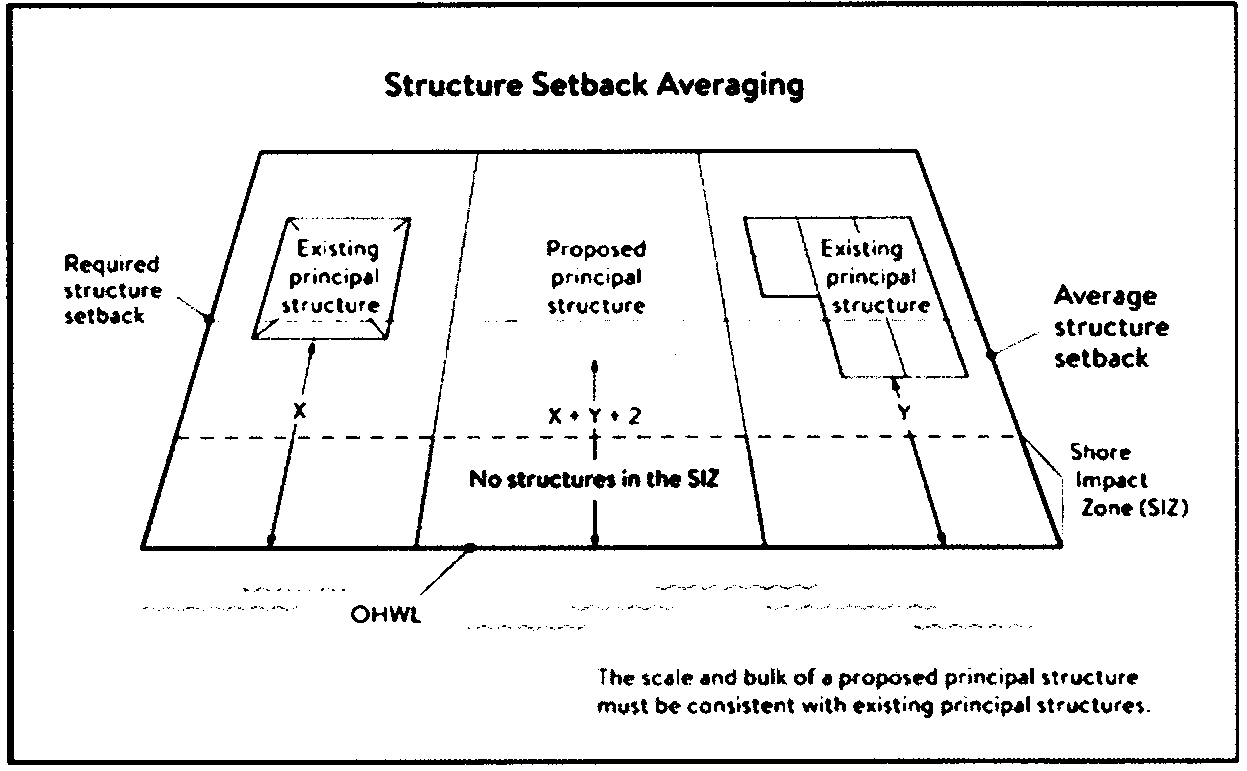
Where principal structures exist on the adjoining lots on both sides of a proposed building site, the minimum setback may be altered to conform to the average of the adjoining setbacks, provided that the new structure's scale and bulk riverward or bluffward of the setbacks required under Subsections 11-1001.6(3)(b) and 11-1001.6(3)(c) are consistent with adjoining development. See Figure 7.
Figure 7. Structure Setback Averaging
(e)
Subsurface sewage treatment systems, including the septic tank and absorption area, must be located at least 75 feet from the ordinary high water level of the Mississippi River and all other public waters.
(4)
Lot size and buildable area.
(a)
The width of lots abutting the Mississippi River in the ROS District must be at least 200 feet, unless alternative design methods are used that provide greater protection of the riparian area.
(b)
All new lots must have adequate buildable area to comply with the setback requirements of Subsections 11-1001.6(3)(b) and 11-1001.6(3)(c) so as to not require variances to use the lots for their intended purpose.
11-1001.7
Performance Standards for Private Facilities.
(1)
Purpose. To establish design standards for private facilities that are consistent with best management practices and that minimize impacts to primary conservation areas, public river corridor views and other resources identified in the MRCCA plan.
(2)
General design standards. All private facilities must be developed in accordance with the vegetation management and land alteration requirements in Sections 11-1001.9 and 11-1001.10.
(3)
Private roads, driveways, and parking areas. Except as provided in Section 11-1001.12, private roads, driveways and parking areas must:
(a)
Be designed to take advantage of natural vegetation and topography so that they are not readily visible;
(b)
Comply with structure setback requirements according to Subsection 11-1001.6(3); and
(c)
Not be placed within the bluff impact zone or shore impact zone, unless exempt under Section 11-1001.12 and designed consistent with Subsection 11-1001.8(2).
(4)
Private water access and viewing facilities.
(a)
Private access paths must be no more than:
(i)
Eight feet wide, if placed within the shore impact zone; and
(ii)
Four feet wide, if placed within the bluff impact zone.
(b)
Private water access ramps must:
(i)
Comply with Minnesota Rules, chapters 6115.0210 and 6280.0250; and
(ii)
Be designed and constructed consistent with the applicable standards in Design Handbook for Recreational Boating and Fishing Facilities.
(c)
Design and construction of private stairways, lifts, and landings are subject to the following standards:
(i)
Stairways and lifts must not exceed four feet in width on residential lots. Wider stairways may be used for commercial properties and residential facilities held in common, if approved by the City of Coon Rapids;
(ii)
Landings for stairways and lifts on residential lots must not exceed 32 square feet in area. Landings larger than 32 square feet area allowed for commercial properties and residential facilities held in common, if approved by the City of Coon Rapids;
(iii)
Canopies or roofs are prohibited on stairways, lifts, or landings;
(iv)
Stairways, lifts, and landings must be located in the least visible portion of the lot whenever practical; and
(v)
Ramps, lifts, mobility paths, or other facilities for persons with physical disabilities are allowed for achieving access to shore areas according to Subsections 11-1001.7(4)(c)(i)—(4)(c)(iv), and as provided under Subsection 11-1001.3(8).
(d)
One water-oriented accessory structure is allowed for each riparian lot or parcel less than 300 feet in width at the ordinary high water level, with one additional water-oriented accessory structure allowed for each additional 300 feet of shoreline on the same lot or parcel. Water-oriented accessory structures are prohibited in the bluff impact zone and must:
(i)
Not exceed 12 feet in height;
(ii)
Not exceed 120 square feet in area; and
(iii)
Be placed a minimum of ten feet from the ordinary high water level.
(5)
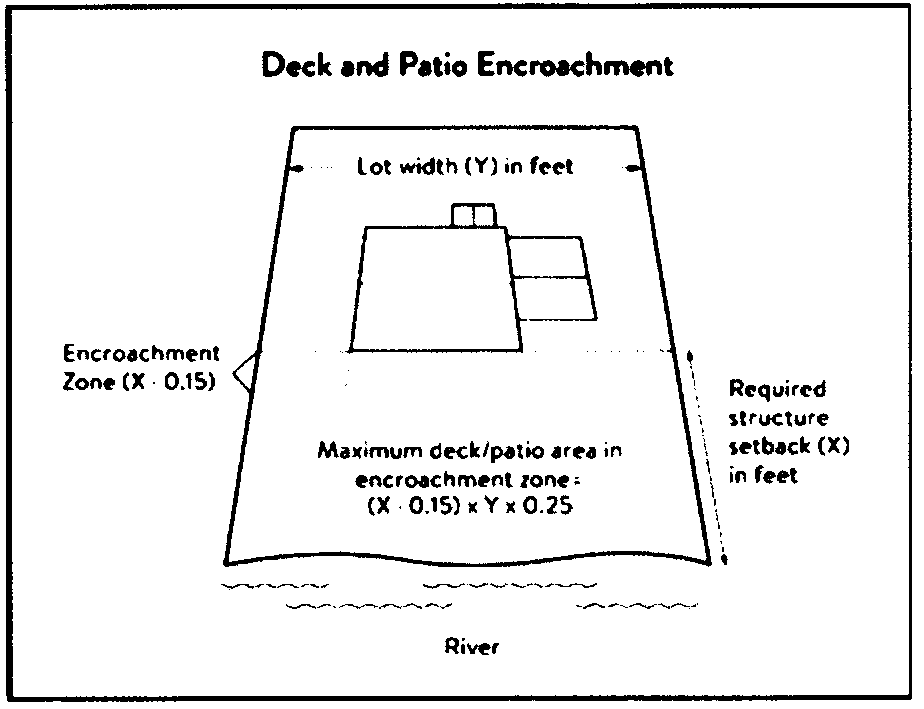
Decks and patios in setback areas. Decks and at-grade patios may encroach into the required setbacks from the ordinary high water level and blufflines without a variance, when consistent with Section 11-1001.9 and Section 11-1001.10, provided that:
(a)
The encroachment of the deck or patio into the required setback area does not exceed 15 percent of the required structure setback;
(b)
The area of the deck or patio that extends into the required setback area occupies no more than 25 percent of the total area between the required setback and the 15 percent using the formula:
[required setback depth (feet) x 0.15 x lot width at setback (feet) x 0.25 = maximum total area]
(c)
The deck or patio does not extend into the bluff impact zone. See Figure 8.
Figure 8. Deck and Patio Encroachment
(6)
Fences. Fences between principal structures and the river are allowed provided that fences are:
(a)
Not higher than six feet.
(b)
Not located within a bluff
(c)
Not located in the regulatory floodplain.
11-1001.8
Performance Standards for Public Facilities.
(1)
Purpose. To establish design standards for public facilities that are consistent with best management practices and that minimize impacts to primary conservation areas, public river corridor views and other resources identified in the MRCCA plan. Public facilities serve the public interest by providing public access to the Mississippi River corridor or require locations in or adjacent to the river corridor and therefore require some degree of flexibility.
(2)
General design standards. All public facilities must be designed and constructed to:
(a)
Minimize visibility of the facility from the river to the extent consistent with the purpose of the facility;
(b)
Comply with the structure placement and height standards in Section 11-1001.6, except as provided in Section 11-1001.12;
(c)
Be consistent with the vegetation management standards in Section 11-1001.9 and the land alteration and storm water management standards in Section 11-1001.10, including use of practices identified in Best Practices for Meeting DNR General Public Waters Work Permit GP 2004-0001, where applicable;
(d)
Avoid primary conservation areas, unless no alternative exists. If no alternative exists, then disturbance to primary conservation areas must be avoided to the greatest extent practicable, and design and construction must minimize impacts; and
(e)
Minimize disturbance of spawning and nesting times by scheduling construction at times when local fish and wildlife are not spawning or nesting.
(3)
Right-of-way maintenance standards. Right-of-way maintenance must comply with the following standards:
(a)
Vegetation currently in a natural state must be maintained to the extent feasible;
(b)
Where vegetation in a natural state has been removed, native plants must be planted and maintained on the right-of-way; and
(c)
Chemical control of vegetation must be avoided when practicable, but when chemical control is necessary, chemicals used must be in accordance with the regulations and other requirements of all state and federal agencies with authority over the chemical's use.
(4)
Crossings of public water or public land. Crossings of public waters or land controlled by the commissioner are subject to approval by the commissioner according to Minn. Stat. §§84.415 and 103G.245.
(5)
Public utilities. Public utilities must comply with the following standards:
(a)
High-voltage transmission lines, wind energy conversion systems greater than five megawatts, and pipelines are regulated according to Minn. Stat. Chs. 216E, 216F, and 216G respectively; and
(b)
If overhead placement is necessary, utility facility crossings must minimize visibility of the facility from the river and follow other existing rights-of-way as much as practicable.
(c)
The appearance of structures must be as compatible as practicable with the surrounding area in a natural state with regard to height and width, materials used, and color.
(d)
Wireless communication facilities, according to Subsection 11-1001.5(4).
(6)
Public transportation facilities. Public transportation facilities shall comply with structure placement and height standards in Section 11-1001.6. Where such facilities intersect or about two or more MRCCA districts, the least restrictive standards apply. Public transportation facilities must be designed and constructed to give priority to:
(a)
Providing scenic overlooks for motorists, bicyclists, and pedestrians;
(b)
Providing safe pedestrian crossings and facilities along the river corridor;
(c)
Providing access to the riverfront in public ownership; and
(d)
Allowing for use of the land between the river and the transportation facility.
(7)
Public recreational facilities. Where such facilities intersect or abut two or more MRCCA districts, the least restrictive dimensional standards apply. Public transportation facilities must be designed and constructed to give priority to:
(a)
Buildings and parking associated with public recreational facilities must comply with the structure placement and height standards in Section 11-1001.6, except as provided in Section 11-1001.12;
(b)
Roads and driveways associated with public recreational facilities must not be placed in the bluff or shore impact zones unless no other placement alternative exists. If no alternative exists, then design and construction must minimize impacts to shoreline vegetation, erodible soils and slopes, and other sensitive resources.
(c)
Trails, access paths, and viewing areas associated with public recreational facilities and providing access to or views of the Mississippi River are allowed within the bluff and shore impact zones if design, construction, and maintenance methods are consistent with the best management practice guidelines in Trail Planning, Design, and Development Guidelines.
(i)
Hard-surface trails are not allowed on the face of bluffs with a slope exceeding 30 percent. Natural surface trails are allowed, provided they do not exceed eight feet in width.
(ii)
Trails, paths, and viewing areas must be designed and constructed to minimize:
a.
Visibility from the river;
b.
Visual impacts on public river corridor views; and
c.
Disturbance to and fragmentation of primary conservation areas.
(d)
Public water access facilities must comply with the following requirements:
(i)
Watercraft access ramps must comply with Minnesota Rules chapters 6115.0210 and 6280.0250; and
(ii)
Facilities must be designed and constructed consistent with the standards in Design Handbook for Recreational Boating and Fishing Facilities.
(e)
Public signs and kiosks for interpretive or directional purposes are allowed in the bluff or shore impact zones, provided they are placed and constructed to minimize disturbance to these areas and avoid visual impacts on public river corridor views.
(f)
Public stairways, lifts, and landings must be designed as provided in Subsection 11-1001.7(4)(c).
11-1001.9
Vegetation Management.
(1)
Purpose. To establish standards that sustain and enhance the biological and ecological functions of vegetation; preserve the natural character and topography of the MRCCA; and maintain stability of bluffs and steep slopes and ensure stability of other erosion-prone areas.
(2)
Applicability. This section applies to:
(a)
Shore impact zones;
(b)
Areas within 50 feet of a wetland or natural drainage way;
(c)
Bluff impact zones;
(d)
Areas of native plant communities; and
(e)
Significant existing vegetative stands identified in the MRCCA plan.
(3)
Activities allowed without a vegetation permit.
(a)
Maintenance of existing lawns, landscaping and gardens;
(b)
Removal of vegetation in emergency situations as determined by City of Coon Rapids;
(c)
Right-of-way maintenance for public facilities meeting the standards Subsection 11-1001.8(3);
(d)
Agricultural and forestry activities meeting the standards of Subsections 11-1001.5(2)(a) and 11-1001.5(2)(b);
(e)
Selective vegetation removal, provided that vegetative cover remains consistent with the management purpose of the MRCCA District, including:
(i)
Vegetation that is dead, diseased, dying, or hazardous;
(ii)
To prevent the spread of diseases or insect pests;
(iii)
Individual trees less than four inches (dbh) in circumference and shrubs, and
(iv)
Removal of invasive non-native species.
(4)
Activities allowed with a vegetation permit.
(a)
The following intensive vegetation clearing activities are allowed with a vegetation permit:
(i)
Clearing of vegetation that is dead, diseased, dying, or hazardous;
(ii)
Clearing to prevent the spread of diseases or insect pests;
(iii)
Clearing to remove invasive non-native species.
(iv)
Clearing to prepare for restoration and erosion control management activities consistent with a plan approved by the City.
(v)
The minimum necessary for development that is allowed with a building permit or as an exemption under Section 11-1001.12.
(b)
Conditions of vegetation permit approval:
(i)
Development is sited to minimize removal of or disturbance to natural vegetation;
(ii)
Soil, slope stability, and hydrologic conditions are suitable for the proposed work as determined by a professional engineer;
(iii)
Clearing is the minimum necessary and designed to blend with the natural terrain and minimize visual impacts to public river corridor views;
(iv)
Any native plant communities removed are replaced with vegetation that provides equivalent biological and ecological functions consistent with an approved vegetation restoration plan as provided in Subsection 11-1001.9(6)(b). If replaced, priorities for restoration are stabilization of erodible soils, restoration or enhancement of shoreline vegetation, and revegetation of bluffs or steep slopes visible from the river;
(v)
All other vegetation removed is restored with natural vegetation to the greatest extent practicable consistent with an approved vegetation restoration plan as provided in Subsection 11-1001.9(6)(b). Priorities for replacement are the same as under Subsection 11-1001.9(4)(b)(iv).
(vi)
Any disturbance of highly erodible soils is replanted with deep-rooted vegetation with a high stem density;
(vii)
Vegetation removal activities are conducted so as to expose the smallest practical area of soil to erosion for the least possible time;
(viii)
Areas of vegetation restoration priorities identified in the MRCCA plan are restored, if applicable; and
(ix)
Any other condition determined necessary to achieve the purpose of this section.
(5)
Prohibited activities. All other intensive vegetation clearing is prohibited.
(6)
Vegetation restoration plan.
(a)
Development of a vegetation restoration plan and reestablishment of natural vegetation is required:
(i)
As a condition of a vegetation permit issued under Subsection 11-1001.9(4)(b)(iv) and (4)(b)(v);
(ii)
Upon failure to comply with any provisions in this section; or
(iii)
As part of the planning process for subdivisions as provided in Section 11-1001.11.
(b)
The vegetation restoration plan must satisfy the application submittal requirements in Subsection 11-1001.3(5), and:
(i)
Include vegetation that provides suitable habitat and effective soil stability, runoff retention, and infiltration capability. Vegetation species, composition, density, and diversity must be guided by nearby patches of native plant communities and by Native Vegetation Establishment and Enhancement Guidelines;
(ii)
Be prepared by a qualified individual; and
(iii)
Include a maintenance plan that includes management provisions for controlling invasive species and replacement of plant loss for three years.
(c)
A certificate of compliance will be issued after the vegetation restoration plan requirements have been satisfied.
11-1001.10
Land Alteration Standards and Stormwater Management.
(1)
Purpose. To establish standards that protect water quality from pollutant loadings of sediment, nutrients, bacteria, and other contaminants; and maintain stability of bluffs, shorelines, and other areas prone to erosion.
(2)
Land alteration permit.
(a)
Within the bluff impact zone, land alteration is prohibited, except for the following which are allowed by permit.
(i)
Erosion control consistent with Subsection 11-1001.10(6);
(ii)
The minimum necessary for development that is allowed as an exception under Section 11-1001.12; and
(iii)
Repair and maintenance of existing buildings and facilities.
(b)
Within the water quality impact zone, land alteration that involves more than ten cubic yards of material or affects an area greater than 1,000 square feet requires a permit.
(3)
Rock riprap, retaining walls, and other erosion control structures.
(a)
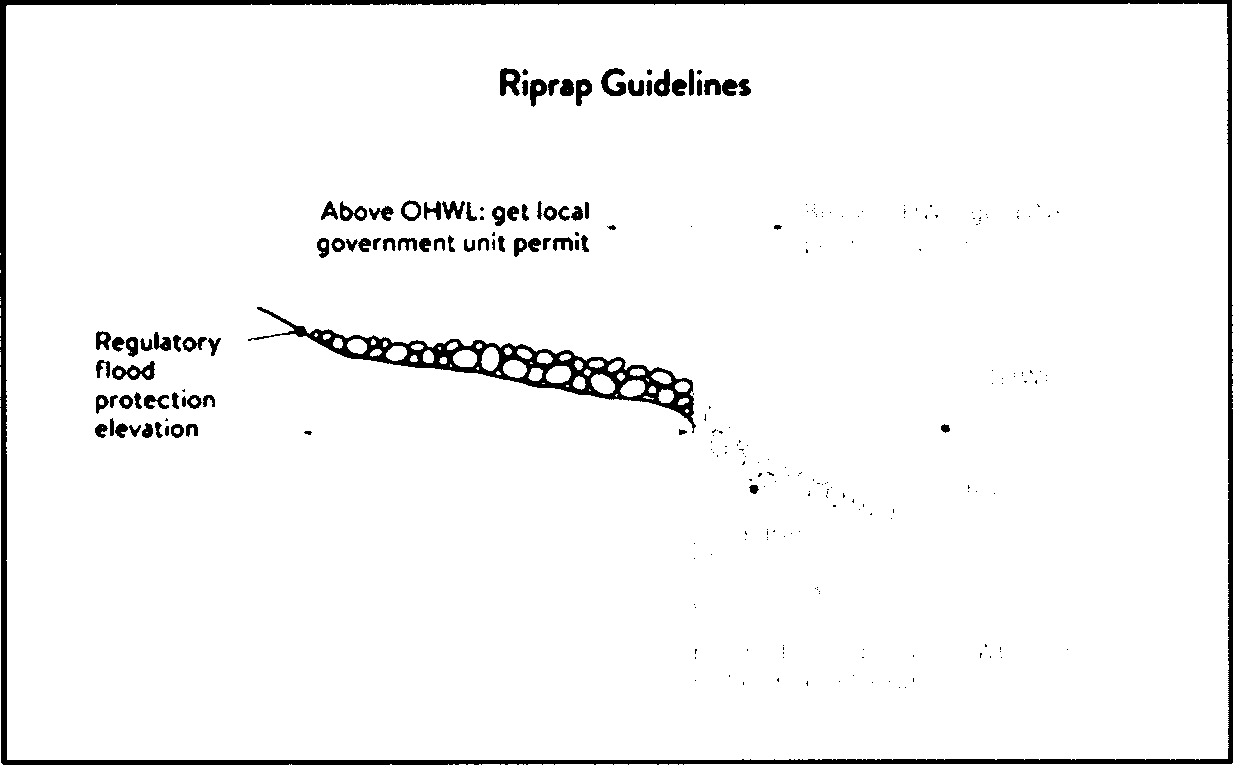
Construction, repair, or replacement of rock riprap, retaining walls, and other erosion control structures located at or below the OHWL must comply with Minnesota Rules, part 6115.0215, subp. 4, item E, and 6115.0216, subp. 2. Work must not proceed until approved by the commissioner. See Figure 9.
Figure 9. Riprap Guidelines
(b)
Construction or replacement of rock riprap, retaining walls, and other erosion control structures within the bluff impact zone and the water quality impact zone are allowed with a permit consistent with provisions of Section 11-1001.10(6) provided that:
(i)
If the project includes work at or below the OHWL, the commissioner has already approved or permitted the project.
(ii)
The structures are used only to correct an established erosion problem as determined by the City of Coon Rapids or Coon Creek Watershed District.
(iii)
The size and extent of the structures are the minimum necessary to correct the erosion problem and are not larger than the following, unless a professional engineer determines that a larger structure is needed to correct the erosion problem:
a.
Retaining walls must not exceed five feet in height and must be placed a minimum horizontal distance of ten feet apart; and
b.
Riprap must not exceed the height of the regulatory flood protection elevation.
(c)
Repair of existing rock riprap, retaining walls, and other erosion control structures above the OHWL does not require a permit provided it does not involve any land alteration under Subsection 11-1001.10(2).
(4)
Stormwater management.
(a)
In the bluff impact zone, storm water management facilities are prohibited except by permit if:
(i)
There are no alternatives for storm water treatment outside the bluff impact zone on the subject site;
(ii)
The site generating runoff is designed so that the amount of runoff reaching the bluff impact zone is reduced to the greatest extent practicable;
(iii)
The construction and operation of the facility does not affect slope stability on the subject property or adjacent properties; and
(iv)
Mitigation based on the best available engineering and geological practices is required and applied to eliminate or minimize the risk of slope failure.
(b)
In the water quality impact zone, development that creates new impervious surface, as allowed by exemption in Section 11-1001.12, or fully reconstructs existing impervious surface of more than 10,000 square feet requires a storm water permit or approved storm water plan. Multipurpose trails and sidewalks are exempt if there is down gradient vegetation or a filter strip that is at least five feet wide.
(c)
In all other areas, storm water runoff must be directed away from the bluff impact zones or unstable areas.
(5)
Development on steep slopes. Construction of structures, impervious surfaces, land alteration, vegetation removal, or other construction activities are allowed on steep slopes if:
(a)
The development can be accomplished without increasing erosion or storm water runoff;
(b)
The soil types and geology are suitable for the proposed development; and
(c)
Vegetation is managed according to the requirements of Section 11-1001.9.
(6)
Conditions of land alteration permit approval.
(a)
Temporary and permanent erosion and sediment control measures retain sediment onsite consistent with best management practices in the Minnesota Stormwater Manual;
(b)
Natural site topography, soil, and vegetation conditions are used to control runoff and reduce erosion and sedimentation;
(c)
Construction activity is phased when possible;
(d)
All erosion and sediment controls are installed before starting any land disturbance activity;
(e)
Erosion and sediment controls are maintained to ensure effective operation;
(f)
The proposed work is consistent with the vegetation standards in Section 11-1001.9; and
(g)
Best management practices for protecting and enhancing ecological and water resources identified in Best Practices for Meeting DNR General Public Waters Work Permit GP 2004-0001.
(7)
Compliance with other plans and programs. All development must:
(a)
Be consistent with Minn. Stat. Ch. 103B, and local water management plans completed under Minn. Stat. Ch. 8410;
(b)
Meet or exceed the wetland protection standards under Minnesota Rules, Chapter 8420; and
(c)
Meet or exceed the floodplain management standards under Minnesota Rules, sections 6120.5000—6120.6200
11-1001.11
Subdivision and Land Development Standards.
(1)
Purpose.
(a)
To protect and enhance the natural and scenic values of the MRCCA during development or redevelopment of the remaining large sites;
(b)
To establish standards for protecting and restoring biological and ecological functions of primary conservation areas on large sites; and
(c)
To encourage restoration of natural vegetation during development or redevelopment of large sites where restoration opportunities have been identified in MRCCA Plans.
(2)
Applicability.
(a)
The design standards in this section apply to subdivisions, planned unit developments and master planned development and redevelopment of land involving ten or more acres for contiguous parcels that abut the Mississippi River and 20 or more acres for all other parcels, including smaller individual sites within the following developments that are part of a common plan of development that may be constructed at different times:
(i)
Subdivisions;
(ii)
Planned unit developments; and
(iii)
Master-planned development and redevelopment of land.
(b)
The following activities are exempt from the requirements of this section:
(i)
Minor subdivisions consisting of three or fewer lots;
(ii)
Minor boundary line corrections;
(iii)
Resolutions of encroachments;
(iv)
Additions to existing lots of record;
(v)
Placement of essential services; and
(vi)
Activities involving river-dependent commercial and industrial uses.
(3)
Application materials. Project information listed in Section 11-1001.3(5) must be submitted for all proposed developments.
(4)
Design standards.
(a)
Primary conservation areas, where they exist, must be set aside and designated as protected open space in quantities meeting the following as a percentage of total parcel area:
(i)
CA-ROS District: Fifty percent;
(ii)
CA-RN District: Twenty percent;
(iii)
CA-RTC District: Ten percent; and
(iv)
CA-SR District: Ten percent if the parcel includes native plant communities or provides feasible connections to a regional park or trail system, otherwise no requirement.
(b)
If the primary conservation areas exceed the amounts specified in Subsection 11-1001.11(4)(a), then protection of native plant communities and natural vegetation in riparian areas shall be prioritized.
(c)
If primary conservation areas exist but do not have natural vegetation (identified as restoration priorities in the MRCCA Plan), then a vegetation assessment must be completed to evaluate the unvegetated primary conservation areas and determine whether vegetation restoration is needed. If restoration is needed, vegetation must be restored according to Subsection 11-1001.9(6)(b).
(d)
If primary conservation areas do not exist on the parcel and portions of the parcel have been identified in the MRCCA plan as a restoration area, vegetation must be restored in the identified areas according to Subsection 11-1001.9(6)(b) and the area must be set aside and designated as protected open space.
(e)
Storm water treatment areas or other green infrastructure may be used to meet the protected open space requirements if the vegetation provides biological and ecological functions.
(f)
Land dedicated under Section 11-1506 for public river access, parks, or other open space or public facilities may be counted toward the protected open space requirement.
(g)
Protected open space areas must connect open space, natural areas, and recreational areas, where present on adjacent parcels, as much as possible to form an interconnected network.
(5)
Permanent protection of designated open space.
(a)
Designated open space areas must be protected through one or more of the following methods:
(i)
Public acquisition by a government entity for conservation purposes;
(ii)
A permanent conservation easement, as provided in Minn. Stat. Ch. 84C;
(iii)
A deed restriction; and
(iv)
Other arrangements that achieve an equivalent degree of protection.
(b)
Permanent protection methods must ensure the long-term management of vegetation to meet its biological and ecological functions, prohibit structures, and prohibit land alteration, except as needed to provide public recreational facilities and access to the river.
11-1001.12
Exemptions.
(1)
Purpose. To provide exemptions to structure placement, height and other standards for specific river or water access dependent facilities as provided in Minn. Stat. §116G.15 Subd. 4.
(2)
Applicability.
(a)
Uses and activities not specifically exempted must comply with this (section, chapter, or article). Uses and activities exempted under shore impact zone and bluff impact zone must comply with the vegetation management and land alteration standards in Sections 11-1001.9 and 11-1001.10.
(b)
Uses and activities in Subsection 11-1001.12(3) are categorized as:
(i)
Exempt—E. This means that the use or activity is allowed;
(ii)
Exempt if no alternative—(E). This means that the use or activity is allowed only if no alternatives exist; and
(iii)
Not exempt—N. This means that a use or activity is not exempt and must meet the standards of this Chapter.
(3)
Use and activity exemptions classification.
(a)
General uses and activities.
(b)
Public utilities.
(c)
Public recreational facilities.
(d)
River-dependent uses.
(e)
Private residential and commercial water access and use facilities.
(Ord. No. 2266, 10-18-22)
11-1002 - Northstar Office Park Overlay District.
11-1002.1
Intent.
(1)
This Section intends to protect the health, safety, and public welfare through the adoption of official overlay controls to preserve the historic qualities and the economic vitality of the existing ammunitions facility while ensuring that redevelopment of the district will be consistent with the City's long term vision of a business park or corporate headquarters development.
(2)
The vision for this district includes a campus-like setting that encourages a planned, integrated and unified environment combining corporate and administrative offices, research and development facilities, and associated overnight accommodations and meeting spaces. Specific uses, development standards, landscaping and architectural amenities are intended to create a sense of place and an attractive environment.
(3)
For future development, only mutually compatible uses shall be allowed through a combination of careful planning, innovative urban design, and coordinated public and private investment. Uses, building designs, placement of building edges, and landscaping, parking, and walkway treatments must create a neighborhood-oriented, pedestrian-friendly environment.
(4)
Individual uses must be connected by a series of pedestrian sidewalks and bicycle trails, and must be compatible with the overall development theme, as exemplified by their landscape, architecture, building materials, lighting and color schemes, and infrastructure.
11-1002.2
Establishment of Northstar Office Park Overlay District.
(1)
There is hereby established the Northstar Office Park Overlay District, with its attendant regulations, as a part of the zoning regulations of the City. This district shall overlay the zoning districts presently in existence, or as amended, so that any parcel of land lying in the District shall also lie in one or more of the established underlying zoning districts.
(2)
Territory within the District is subject to the requirements established in this Section as well as the restrictions and requirements established by other applicable City Code regulations.
(3)
Unless otherwise specified in this Section, all uses within the District are governed in accordance with the regulations for the underlying zoning district or districts. No use shall be entitled to or be issued the appropriate development permit unless that use has satisfied the additional requirements of this Section.
11-1002.3
Land to Which Regulations Apply; Scope of Regulations; Severability.
(1)
This Section applies to public and private lands within the City of Coon Rapids as delineated by metes and bounds and set forth in a separate ordinance.
(2)
Wherever there is a conflict between these regulations and Title 11 Sections other than 11-1101 (Floodplain Management Regulations), 11-1001 (Mississippi River Corridor Area Overlay District), those regulations control.
(3)
Severability. If any subsection or portion of any subsection of this Section is deemed invalid or unconstitutional by a Court of competent jurisdiction, such invalidity or unconstitutionality shall not affect the other subsections or portions of subsections of this Section.
11-1002.4
Applicability. The regulations of this Section apply as follows. Nothing herein shall be construed to allow uses, structures, or changes not otherwise allowed in the underlying zoning district:
(1)
The following improvements are not subject to the requirements of this Section:
(a)
The construction of additional buildings of up to 6,000 square feet, to a maximum of two additional buildings for the use of propellant storage as a permitted use, and ammunitions assembly as a conditional use; or
(b)
Associated access and utilities required for Subsection 11-1002.4(1)(a) improvements; or
(c)
Reconstruction of an existing building on its existing footprint.
(2)
For all other development: This Section applies to new development or alterations to existing development that change its use or intensity of use.
11-1002.5
Compatibility with Public Improvements Required. Site plans must demonstrate compatibility with applicable improvement, amenity, or design elements as adopted by resolution of the City Council. Such elements include, but are not limited to, sculpture, fountains, benches, lighting, signage, fencing, pavement, and landscape materials.
11-1002.6
Sign Regulations.
(1)
General Requirements. Unless otherwise specified in this Chapter, the requirements of Section 11-1202 (Sign Regulations) apply. Off-premises signs are prohibited. Signs must demonstrate compatibility with associated structures and be standardized in terms of style with other approved signs on the site. Wall signs must be standardized in terms of location on building.
(2)
Ground Signs.
(a)
Ground signs must be designed as monument signs.
(b)
Ground signs must incorporate architectural elements and materials used in the principal building.
(c)
Ground sign limit: one sign per street frontage; maximum size: 100 square feet; maximum height: 15 feet, property line setback: ten feet.
(3)
Wall Signs.
(a)
Wall signs must consist of individual letters incorporated into the architectural design of the building.
(b)
Wall sign maximum size: Ten percent of the wall face to which it is attached, to a maximum of 200 square feet.
11-1002.7
Uses.
(1)
Except as expressly regulated by this Section, existing uses maintain their legal status, as governed by the underlying zoning district, in effect immediately prior to the enactment of this District, subject to future amendment of that zoning district.
(2)
Development subject to subsection 11-1002.4:
(a)
Permitted Uses. Corporate and administrative offices, research and development facilities, hotels, conference centers, restaurants located within a hotel or conference center.
(b)
Accessory Uses. Child care centers, recreation and fitness facilities, cafeterias, health care services, financial services and similar uses may be permitted as accessory uses, provided they (1) are located wholly within the principal building, except for outdoor recreation and fitness facilities, (2) are conducted primarily for the convenience of the employees of the principal use, and (3) have no exterior advertising or displays.
11-1002.8
Northstar Office Park Overlay District Standards.
(1)
Loading Spaces, Overhead Doors and Service Areas.
(a)
Loading spaces, overhead doors and service areas must be located in designated rear yards.
(b)
Loading and service areas must be separated from visitor and employee parking areas and general traffic circulation.
(c)
Loading spaces, overhead doors and service areas must be designed to be compatible with the principal building. Architectural techniques, color, and landscaping must be employed to eliminate visual impacts from adjacent properties and roadways.
(d)
Outdoor storage is prohibited.
(e)
Materials and equipment directly related to site maintenance and safety must be stored in and completely screened by an enclosure constructed of materials compatible with the principal structure subject to an approved site plan. The structure:
(i)
Must be located in the rear or side yards only;
(ii)
Must be set back a minimum of ten feet from property lines; and
(iii)
Cannot impact emergency access, traffic flow, parking or sidewalk access.
(2)
Dumpster and Refuse Enclosures.
(a)
Dumpsters must be gated and completely screened using enclosures constructed of materials compatible with the principal building.
(b)
Dumpster enclosures must be located in designated rear yards.
(c)
Enclosures must be integrated into the design of the principal building.
(3)
Exterior Building Permitted Materials: Brick; natural or cut stone; integrally colored split face (rock face), burnished, or glazed concrete masonry unit; glass, architectural metal, provided such panels are factory fabricated and finished with a durable non-fade surface and their fasteners are of a corrosion resistant design; integrally colored and exposed aggregate precast concrete panels (excluding single-T or double-T panels, plain, uncolored, or raked finished).
(4)
Building Design.
(a)
Public entrances must be easily identified and distinct from the remainder of the building, using architectural form, materials, colors, awnings, or canopies.
(b)
Building elevations visible from a public street, trail, or sidewalk must be of a mix of materials listed in subsection 11-1002.8(3). These elevations must not consist of more than 50 percent of any one material and must not exceed 100 feet in length without a minimum four foot depth change, such as a recess, protrusion, or combination thereof, extending the entire height of the façade.
(c)
Similar materials and design must be used on all sides of a building.
(d)
The building must be designed to prevent the appearance of straight unbroken lines in the vertical and horizontal planes through design techniques including, but not limited to: the use of variations in rooflines and building height, offsets in the building face, use of multiple rooflines and building corners, cornice detailing, and changes in parapet elevations. Variations in building materials may be used to supplement these design techniques.
(e)
Rooftop mechanical equipment must be screened from view. Screening for rooftop facilities must be incorporated into the architectural design of the building.
(f)
The design must incorporate Leadership in Energy and Environmental Design (LEED) principles to achieve at least a "LEED Certified" rating.
(5)
Surface Parking Areas.
(a)
Parking areas, drive aisles and loading areas must be paved with curb and gutter.
(b)
Parking lots must be subdivided into a collection of smaller parking areas by at least a ten-foot wide vegetated break. Each parking area must not have a capacity over 100 cars.
(c)
No more than 25 parking stalls may stand in a row without a landscaped island. All parking rows must end with a landscaped island.
(d)
A minimum of three percent of the parking area's interior must be landscaped.
(e)
Parking lot lighting must not exceed 30 feet in height and must use 90 degree cutoff luminaries.
(f)
Parking areas must be screened from adjacent streets through the use of berms and landscaping.
(6)
Structured Parking.
(a)
The Floor to Area Ratio may be increased from 0.75 to 0.90 when structured parking is utilized for at least 90percent of the required parking spaces.
(b)
Structured parking when used must be designed to be and constructed of material that is architecturally compatible with the principal building.
(7)
Sidewalks and Trails.
(a)
Sidewalks and/or trails according to standards on file with the City Engineer are required along all public streets.
(b)
An internal comprehensive pedestrian and bicycle circulation system must be integrated with sidewalks and trails along public streets.
(8)
Landscaping and Site Design.
(a)
The plan for landscaping must include ground cover, bushes, shrubbery, trees, sculpture, fountains, decorative walks or other similar site design features or materials. Landscaping must adhere to the Landscaping Standards on File with the Community Development Director unless this Section requires a different standard.
(b)
Landscaped areas must be irrigated.
(c)
Landscaping and site design must incorporate the current Low Impact Development (LID) principles as published by the U.S. EPA in LID Design Manual (Low Impact Development Design Strategies: An Integrated Design Approach) in force at the time the application is to be approved.
(d)
Foundation plantings for structures will be provided at a rate of one deciduous or evergreen shrub per one linear foot of foundation.
(9)
Lighting.
(a)
Site lighting must be designed so that it is coordinated in style, design, height, size and color with the general street lighting in the district.
(b)
Full cut-off lighting must be used.
(c)
Maximum pole height: 30 feet
(d)
Bollard lighting (under four feet high), low wattage, garden or pathway lighting must be used for pedestrian areas.
(e)
Lighting must be located and directed to avoid glare outside of property lines.
(10)
Dimensional Requirements.
(a)
Minimum Master Development Area Size: 75 acres
(b)
Minimum Lot Size: 20 acres
(c)
Minimum Floor to Area Ratio (FAR): 0.75, subject to subsection 11-1002.8(6)(a)
(d)
Maximum Impervious Coverage: 70 percent, subject to subsection 11-1002.8(c)
(e)
Maximum Bldg. Height: None.
(f)
Building Setbacks (including parking structures):
Street right-of-way—50 feet
Side—30 feet
Rear—30 feet
(g)
Paving Setbacks:
Street right-of-way—20 feet
Property Line—20 feet
From Buildings—5 feet
11-1002.9
Master Plan Procedure. No development subject to subsection 11-1002.4 may occur prior to the approval of a Master Plan for each development area conforming to the requirements of subsection 11-1002.8(10)(a), and approval of individual site plans conforming to that Master Plan.
(1)
The Master Plan must include the following:
(a)
A drawing showing existing conditions such as property boundaries, generalized contours, site features such as wetlands and wooded areas, and surrounding land uses and development.
(b)
A conceptual development plan showing proposed uses and general site data such as building locations, density, setbacks, ponding areas, parking areas and generalized screening, buffering and landscaping concepts.
(c)
Generalized traffic information including maximum traffic volumes generated by the development, proposed new roadways and proposed connections and improvements to existing roads.
(d)
An Elements Plan that includes lighting and street furniture, including, but not limited to, litter receptacles and benches.
(2)
After a complete application for a Master Plan is received, the Planning Commission shall conduct a public hearing, in accordance with subsection 11-305.4, to consider the Master Plan, and make a recommendation on the proposal to the City Council, in accordance with time requirements under Minnesota law. Upon receiving the Planning Commission's recommendation, the City Council shall approve, subject to conditions, or deny the plan.
(3)
The findings necessary for approval of the Master Plan include, but are not limited to, the following:
(a)
The Master Plan is consistent with the intent of this District.
(b)
The Master Plan reflects development that
(i)
Is not detrimental to the public health, safety, or general welfare;
(ii)
Does not depreciate property values;
(iii)
Is not hazardous, detrimental, or disturbing to surrounding uses, or that creates pollution, vibration, general unsightliness, electrical interference, or other nuisances;
(iv)
Does not create traffic congestion, unsafe access, or parking needs that will cause inconvenience to adjoining properties;
(v)
Is served adequately by essential public services such as streets, police, fire protection, utilities, schools, and parks;
(vi)
Does not create excessive additional requirements at public cost for public facilities and services; and is not detrimental to the economic welfare of the City; and
(vii)
Causes minimal adverse environmental effects.
(c)
Each phase or stage of the plan can, as an independent unit, meet the requirements of this Section and Chapter 11 of Title 11.
(d)
The area surrounding the plan can be developed in coordination with and in substantial compatibility with the plan.
(4)
The decision of the Planning Commission with respect to individual site plan review is final subject to appeal to the City Council meeting the requirements of subsection 11-305.6.
11-1002.10
Dimensional and Design Flexibility Rules.
(1)
Dimensional Flexibility. The Planning Commission may approve modification of one or more area or dimensional standards of an underlying district if an applicant demonstrates such modification will result in better integration of uses or additional public amenities that will further the intent of this Section.
(2)
Design Standard Flexibility. The Planning Commission may approve an alternative approach to meeting any of the design standards in this Section if an applicant demonstrates such modification is necessary to respond to site conditions, will result in better integration of uses, be more energy efficient, or provide significant site amenities, buffers, and other elements to offset any potential harmful effect that could be caused by the use and will further the intent of this Section.
(3)
Use Flexibility. Not allowed.
11-1003 - River Rapids Overlay District.
11-1003.1
Intent.
(1)
This Section intends to protect the health, safety, and public welfare through the adoption of official overlay controls that encourage compact, vigorous, mixed use development, tied to a common theme that encompasses the heritage and qualities of the Mississippi River along the Coon Rapids Boulevard corridor.
(2)
A linear system of Ports, as regulated by Section 11-903, will promote clustering of commercial uses. Varied density residential development throughout the district, and especially between the Ports, will establish the level of vitality and intensity needed to support compatible retail and service uses. Especially between the Ports, uses should serve the needs of nearby neighborhoods. Development throughout the District should foster a sense of community, that is, the opportunity for people to travel comfortably throughout the District, conduct business, and meet neighbors.
(3)
Only mutually compatible uses shall be allowed through a combination of careful planning, innovative urban design, and coordinated public and private investment. Uses, building designs, placement of building edges, and landscaping, parking, and walkway treatments must create a neighborhood-oriented, pedestrian-friendly environment.
(4)
Ports shall be connected by a series of pedestrian sidewalks and bicycle trails, with linkages to the Mississippi River and access to public parks, exhibits, and other amenities. Each Port's theme shall be compatible with the overall district theme, as exemplified by its landscape, architecture, lighting and color schemes, infrastructure, and allowed uses.
11-1003.2
Establishment of River Rapids Overlay District.
(1)
There is hereby established the River Rapids Overlay District, with its attendant regulations, as a part of the zoning regulations of the City. This district shall overlay the zoning districts presently in existence, or as amended, so that any parcel of land lying in the District shall also lie in one or more of the established underlying zoning districts.
(2)
Territory within the District shall be subject to the requirements established in this Secion as well as the restrictions and requirements established by other applicable City Code regulations.
(3)
Unless otherwise specified in this Section or Section 11-903, all uses within the District shall be governed in accordance with the regulations for the underlying zoning district or districts. No use shall be entitled to or be issued the appropriate development permit unless that use has satisfied the additional requirements of this Section.
11-1003.3
Land to Which Regulations Apply; Scope of Regulations; Severability.
(1)
This Section applies to public and private lands within the City of Coon Rapids as delineated by metes and bounds and set forth in a separate ordinance.
(2)
Wherever there is a conflict between these regulations and Chapter 11 Sections other than 11-1101 (Floodplain Management Regulations), 11-1001 (Mississippi River Corridor Area Overlay District) and 11-903 (Port Districts), these regulations control.
(3)
Severability. If any subsection or portion of any subsection of this Section is deemed invalid or unconstitutional by a Court of competent jurisdiction, such invalidity or unconstitutionality shall not affect the other subsections or portions of subsections of this Section.
11-1003.4
Framework Plan Adopted. The April 2000 Coon Rapids Boulevard Framework Plan is hereby adopted as general guidance for development within the District.
11-1003.5
Applicability. The regulations of this Section apply to new development, and to alterations to existing development that change its use or percentage of uses, or require a building permit, except that the regulations of this Section shall not apply to single-family dwellings zoned LDR-1 or LDR-2.
11-1003.6
Compatibility with Public Improvements Required. Site plans must demonstrate compatibility with applicable improvement, amenity, or design elements as adopted by resolution of the City Council. Such elements include, but are not limited to, sculpture, fountains, benches, lighting, signage, fencing, pavement, and landscape materials.
11-1003.7
Sign Regulations.
(1)
General Requirements.
(a)
Unless otherwise specified in this Section, the requirements of Section 11-1202 (Sign Regulations) apply.
(b)
Off-premises signs are prohibited.
(c)
Ground signs shall be designed as monument signs, as specified under subsection 11-1003.7(2).
(d)
Signs must demonstrate compatibility with associated structures and be standardized in terms of style with other approved signs on the site. Wall signs must be standardized in terms of location on building.
(e)
Temporary signs, in conformance with subsection 11-1202.6, are permitted
(2)
Monument Signs.
(a)
One monument sign, limited to two faces, is allowed per property or residential development. The areas of sign base, the supporting background structure, and the sign copy shall be combined for determining the total square footage and height of the monument sign. The total allowable square footage shall not exceed 100 square feet. The base and supporting material shall constitute at least 25 percent of the total square footage. A changeable copy message board may be part of the monument sign but shall not exceed 50 percent of the area containing sign copy. The sign copy area or message board shall have a minimum clearance of 20 inches above ground level. No portion of the sign or sign structure shall exceed ten feet above ground level. Signs shall be located a minimum of ten feet from a public street right-of-way, except that along Coon Rapids Boulevard the minimum setback shall be 20 feet from the curb of the roadway, two feet behind a public sidewalk, or two feet from the right-of-way of Coon Rapids Boulevard, whichever places the sign farthest from the roadway.
(b)
The monument sign base shall be constructed of materials similar in appearance to those of the principal structure and shall consist of brick, natural stone, stucco, textured cast stone, or integrally colored concrete masonry units. The structure surrounding the face of the sign from the base to the top of the sign must be solid, continuous, and consist of the base materials or complementary materials that match the appearance and color of the principal building.
(c)
The 200 square feet of ground area around the base of a monument sign shall be landscaped with shrubs or perennials. Landscape material shall be selected to withstand the environmental conditions of the site and provide seasonal interest.
11-1003.8
Uses.
(1)
Permitted and conditional uses are as allowed by the underlying zoning district, except as expressly regulated by this Section.
(2)
Where the underlying zoning district is Industrial, the following uses are allowed:
Permitted Uses.
(a)
Light Industrial
(b)
Office uses.
(c)
Public parks and their incidental structures.
(d)
Research, experimental or testing laboratories.
(e)
Service uses, including laundry and dry cleaning, animal hospitals, and kennels, duly licensed under Chapter 6-200, printing, blue-printing, duplicating, mailing and graphic arts.
(f)
Public uses or utilities.
(g)
Catalog order facilities, provided there is no direct pickup of orders by customers.
(h)
Repair, servicing or parts sales businesses, except for businesses related to vehicles.
(i)
State licensed day care facilities.
(j)
Medical and dental clinics and laboratories.
(k)
Physical fitness centers providing services and equipment such as exercise classes, including but not limited to aerobics, nautilus, weight lifting and similar apparatus, locker rooms and showers.
(l)
Non-profit cultural-educational uses.
Accessory Uses.
(a)
Any accessory use that is permitted in the (O) Office District.
(b)
Retail sales incidental to the manufacture, processing or wholesaling of products manufactured on, processed on, or wholesaled from the premises.
(3)
Conditional Uses.
(a)
To the extent not otherwise required by subsection of 11-304.3 (Conditional Use Permit Procedures and Requirements), no conditional use permit may be granted unless the applicant demonstrates the proposed use:
(i)
Advances the intent of this Section;
(ii)
Will not interfere with Port Development;
(iii)
Allows for development of the property in an efficient, well-organized way; and
(iv)
Is incorporated into a plan that provides substantial site amenities, buffers, and other elements.
(b)
Self storage facilities, indoor, adjacent to Coon Rapids Boulevard and in the General Commercial or Industrial zoning districts may be granted a conditional use permit.
(4)
Varied density residential development, as regulated by this Section, is allowed throughout the District.
(a)
Parcels zoned other than LDR-1, LDR-2, MDR, or HDR may be developed in any mix using varied density residential uses with the following permitted, conditional, and accessory uses:
(i)
Permitted Uses. Office Uses; public parks and their incidental structures; public uses except public utility uses; medical and dental clinics; state licensed day care facilities; barber and beauty shops; photocopying or desktop publishing; carry-in small item repair and servicing shops, excluding repair of internal combustion engines.
(ii)
Conditional Uses. Retail stores except marine sales and those licensed under Title 5, provided, incidental tobacco sales subject to Title 5 are allowed; secondhand dealers or antique dealers defined in and regulated by Title 5; financial institutions; hotels or motels; mortuaries; pet grooming shops or animal hospitals where animals remain inside at all times; churches; nonprofit clubs or lodges; nonprofit cultural-educational uses; private schools, hospitals, sanitariums, rest, boarding, and group homes and similar institutions; motor vehicle fuel sales and service stations provided no more than eight dispensing hoses may be operable simultaneously; and restaurants without drive-through facilities, except that no restaurant located within 100 feet, as measured from the structure or the boundary of the parking area, whichever is closer, of property zoned or used for residential purposes, including property with a mix of uses that includes residential, may provide alcoholic beverages.
(iii)
Accessory Uses.
(a)
Motor vehicle washes attached to motor vehicle fuel sales, service stations, or convenience stores;
(b)
Low-intensity food, coffee shops, juice bars, accessible only from within the building. Uses providing alcoholic beverages are prohibited.
(5)
The following uses are prohibited.
(a)
Quad homes.
(b)
Townhouse units that share walls other than side walls.
(c)
Adult-oriented businesses as regulated by Chapter 5-2200.
(d)
Automobile sales lots.
(e)
Motor vehicle body work or spray painting.
(f)
Motor vehicle fuel sales and service stations with more than eight dispensing hoses simultaneously operable.
(g)
Cannabis retail business except in Port Evergreen and Port Wellness.
11-1003.9
Residential Gross Densities.
(1)
Parcels up to three acres: No more than seven units per acre.
(2)
Parcels three acres or larger: At least four units per acre, no more than seven units per acre.
11-1003.10
River Rapids Overlay District Standards.
(1)
Underlying Zoning Application. Allowed uses shall be as governed by the standards of the underlying zoning district, except as modified by this Section.
(2)
Computation of Percentages. Percentages, when used, are calculated as a fraction of total Floor Area per parcel or contiguous parcels in single ownership developed in an integrated way.
(3)
New Access to Coon Rapids Boulevard Prohibited. New access onto Coon Rapids Boulevard is prohibited unless no practical alternative exists. The City may require access points to be removed as future development allows.
(4)
Maximum Building Height. 45 feet. Buildings with two or more floors above grade are encouraged.
(5)
Nonresidential Building Floor Area. Minimum, 2,000 square feet; maximum, 20,000 square feet with no single use in a building exceeding 15,000 square feet.
(6)
Drive-through and Related Facilities.
(a)
Drive-through windows, drop boxes, menu boards, and associated or similar structures are not permitted outside Port Districts boundaries within the River Rapids Overlay District.
(b)
Drive-through windows, drop boxes, menu boards, and associated or similar structures, where allowed, shall be located to the rear of the principal building, or to the side of the principal building if a rear location is not feasible, and must incorporate landscape screening, decorative fences, walls, or a combination of these elements to minimize their view from the street.
(c)
These structures, including associated canopies, arcades, and roofs, shall be constructed of the same materials as and shall be integrated into the design of the principal building. Queuing spaces or areas shall not interfere with parking spaces, aisles, loading areas, internal circulation, or driveway access. Menu boards shall not be parallel to a public street or sidewalk unless screened from direct view.
(d)
Systems for placing of orders shall be located and designed so that noise is not perceptible on adjacent residential properties.
(7)
Building Setbacks along Roadways. Buildings shall be set back a minimum of 40 feet as measured from the curb on arterial streets without service drives and 30 feet as measured from the curb on other roadways except that in no event shall the setback be less than 22 feet from the property line abutting any roadway.
(8)
Outdoor Merchandise Display. Temporary display of merchandise is permitted on a hard surface within four feet of the principal building if at least three feet of open walkway and unrestricted principal building access is maintained. "Temporary" means that merchandise is brought inside at the close of business hours or at a minimum from 12:01am to 5:00am.
(9)
Mixed Uses. When mixed uses are allowed, they are allowed within development and within individual buildings. In mixed use buildings, residential units, if any, shall be located above the first floor or behind nonresidential uses.
11-1003.11
Development Guidelines. Developments shall meet the following guidelines:
(1)
Two Story Expression. Incorporate building treatments such as:
(a)
Pitched roofs with roof dormers and gables to create a two story expression. Gables shall contain a window, trimmed vent, or similar accent element; or
(b)
An intermediate cornice line, a change in building materials, an awning or arcade, or a change in window shape or treatment to distinguish ground and upper levels.
(2)
Building Massing. Articulate building massing, using methods including, but not limited to, staggering building components, adding columns, or recessing entry areas, to create interesting shapes. Avoid long, even facades. Buildings that face each other across other than an arterial street shall be similar in scale, massing, and articulation.
(3)
Facades.
(a)
All Structures. Articulate building facades, in intervals that approximate the width of a residential unit or storefront, generally 20 to 30 feet, using arcades, awnings, special window reveals and frames, and unique details and ornaments. No garage doors shall face Coon Rapids Boulevard.
(b)
Residential Structures. Provide more formal treatment to sides of buildings directly visible to the public; locate trash/recycling storage, play equipment, and outdoor storage adjacent to nonpublic sides; face all primary entries to the street, except that the side walls of units may face an arterial street when the size, depth, or shape of the site preclude a well designed development; face garages away from streets.
(4)
Varied Roof Shapes. Provide a variety of roof shapes, including, but not limited to, pitched roofs, dormers, chimneys, gable or hip roof accents, detailed parapets, and cornices, to create interesting building profiles.
(a)
Sloped roofs shall have an average roof pitch of at least one foot of rise to three feet of run, and a variety of roof slopes and overhanging eaves shall be incorporated to increase visual interest.
(b)
Rooftop mechanical equipment, and headhouses for elevators and stairs, shall be concealed from public view.
(5)
Focal Features. Every development or major building shall include a focal element or feature that adds interest or distinction, using techniques such as elevating parts of buildings, adding a tower, or emphasizing a prominent part of the building such as a corner or the main entry, using features including, but not limited to, canopies, porticoes, overhangs, arcades, arches, recesses and projections in the building facades, and peaked roofs or raised parapets over doors.
(6)
Canopies and Awnings; Entry Treatments. Entries to principal buildings shall face the primary street; provided, where such access is unworkable, buildings may substitute for the primary street entry a focal feature facing the primary street. Corner entries may be used on corner lots. Nonresidential entries shall incorporate, and building street facades shall, where practical, incorporate, canopies and awnings to enliven the building appearance and provide a sense of shelter for pedestrians.
(7)
Building Materials. Building exteriors shall use high quality materials, including, but not limited to: brick, natural stone, stucco, textured cast stone, fiber-cement siding and shingles, and integrally colored concrete masonry units. Accent materials may include metal, glass block, copper flashing, or similar materials. Exteriors may not include smooth-faced concrete block, pre-fabricated steel panels, reflective glass, or aluminum, vinyl, or fiberglass siding. At least 30 percent of facades that face a street shall be brick or natural stone.
(8)
Windows and Doors. The primary street level facade of retail or office uses shall be transparent between the height of three and eight feet above grade for at least 60 percent of the horizontal length of the building facade; provided, blinds or draperies may be approved where necessary. "Transparent" means the interior of the building can, from the vantage of a pedestrian, be seen into a distance of at least four feet.
(9)
Outdoor Spaces. Include outdoor plazas, seating, dining, or similar areas that incorporate umbrellas and other outdoor furniture.
(10)
Parking. Locate surface parking to the rear or sides of buildings unless no other arrangement is practical. Parking to the front of a building if approved shall be limited to one 60 foot wide parking bay, consisting of one drive aisle with a parking row on each side. Developments may propose shared parking arrangements in conformity with standards on file with the Director. Site plan approval may be conditioned on the provision of shared parking agreements in a recordable form approved by the City Attorney.
(11)
Pedestrian Access and Circulation. Include a complete and convenient pedestrian and bicycle circulation system for access to buildings from the public right-of-way, and for on-site circulation. Nonresidential sidewalks shall be at least five feet in width.
(12)
Urban Design Furniture and Amenities. Include compatible street furniture and amenities, such as benches, litter receptacles, pedestrian-scale lighting, and bicycle racks, to enhance the pedestrian environment.
(13)
Screening and Landscaping. Include extensive site landscaping and foundation plantings.
(a)
Landscaping shall not be used to create barriers or visual screens between uses; provided, where developments adjoin residential neighborhoods, negative impacts on those neighborhoods shall be mitigated by appropriate buffering screening or landscaping.
(b)
All parking, loading, and service areas, including drive-through facilities and pump island service areas, shall include:
(i)
Along Coon Rapids Boulevard, a landscaped yard located behind the sidewalk or, in the absence of a sidewalk, at least 18 feet from the curb. The landscaped yard shall be at least 22 feet wide, contain screening meeting the requirements of subsection 11-1003.11(13)(b)(ii), and incorporate decorative elements according to standards on file with the Community Development Director. In other areas, a landscaped yard consistent with subsection 11-1003.11(13)(b)(ii) along any adjacent public or private street, sidewalk, or property boundary.
(ii)
Screening consisting of a masonry wall, fence, berm, hedge, or combination of these elements that forms a screen a minimum of three feet high, a maximum of five feet high, not less than 50 percent opaque.
(iii)
One tree for each 50 linear feet of street frontage. Trees must be spaced throughout the screening area.
(iv)
In parking lots containing more than 200 spaces, an additional landscaped area of at least 150 square feet for each 25 spaces or fraction thereof, containing one canopy tree per 150 square feet spaced throughout the landscaped area. The remainder shall be covered with turf grass, native grasses, or other perennial flowering plants, vines, or shrubs.
(v)
Openings in screening for sidewalks or trails to provide access between adjacent uses.
(vi)
Interior landscaping. The corners of parking lots and all other areas not used for parking or vehicular circulation shall be landscaped with turf grass, native grasses, or other perennial flowering plants, vines, shrubs, or trees, and may include architectural features such as benches, kiosks, or bicycle racks.
(vii)
Irrigation. All landscaped areas shall be irrigated with an underground sprinkler system.
(14)
Lighting. Incorporate accent lighting for building facades, focal points, and landscape treatments, compatible with applicable lighting district standards approved by ordinance or resolution.
(15)
Fuel Pump Canopies. Where approved, the motor vehicle fuel pump canopy roof shall have the same shape, materials and color as the roof of the principal building. Canopy supports shall be enclosed in decorative masonry or metal columns.
(16)
Balconies, Decks and Porches. The floors and railings of balconies, decks, and porches shall have a durable finish complementing the colors of the building or attached housing group.
(17)
Entry Steps. The risers and areas under non-masonry entry steps and landings shall be enclosed with materials consistent with the exterior materials of the building or attached housing group. All surfaces of non-masonry steps and landings, including railings, shall have a durable finish complementing the colors of the building or attached housing group.
(18)
Loading Spaces, Overhead Doors and Service Areas.
(a)
Loading spaces, overhead doors and service areas cannot face Coon Rapids Boulevard and must be located in designated rear yards.
(b)
Loading and service areas must be separated from visitor and employee parking areas and general traffic circulation.
(c)
Loading spaces, overhead doors and service areas must be designed to be compatible with the principal building. Architectural techniques, color, and landscaping must be employed to eliminate visual impacts from adjacent properties and roadways.
11-1003.12
Private and Common Open Space. Residential developments shall:
(1)
Clearly define all outdoor open spaces, distinguishing between those reserved for residents and those open to the public.
(2)
Clearly define, using fencing, landscaping, or a combination of both, private open space such as a yard, deck, or porch whose direct access is from inside the unit.
(3)
Clearly define the boundaries of private open spaces with elements such as fencing, sidewalks, and vegetation.
(4)
Clearly define the boundaries and transitions between private and common open spaces.
(5)
Enclose common open spaces with buildings, low fences or hedges, and paths.
(6)
Provide convenient access to common open spaces and other amenities such as play equipment, seating, and tables to encourage their use.
(7)
Landscape common open spaces and other amenities to provide shade, privacy, and wind protection.
(8)
Inhibit access by nonresidents to private and common open spaces using gateways, fences, plantings, or enclosed locations.
(9)
Provide opportunities for surveillance from adjacent buildings of common open spaces and other shared outdoor areas such as streets, sidewalks, and parking areas.
11-1003.13
Varied Density Residential Uses.
(1)
All housing types allowed within the LDR-1, LDR-2, MDR, and HDR Districts, except quad homes.
(2)
Developments in residential districts may contain up to 40 percent floor area, or 4,000 square feet, whichever is less, in any combination of the following uses:
(a)
Office uses, attached to dwelling units.
(b)
Businesses, without drive-throughs and attached to dwelling units, that provide services on the premises, such as photocopying, small item repair, tailoring, dry cleaning drop off and pickup, beauty shop, and barbershops.
(c)
Day care centers.
(d)
Restaurants or coffee shops without drive-throughs, attached to dwelling units.
11-1003.14
Varied Residential Standards. In addition to the standards found in this Section, the following standards apply to varied density residential developments; provided, the Planning Commission may reduce setbacks to achieve greater density and a more urban development plan where appropriate:
(1)
Single-family dwellings not part of a common interest community shall comply with Chapter 11-700 except as follows:
(a)
Building Height. The maximum building height shall be 45 feet for principal structures and 20 feet for accessory structures. An accessory structure shall not exceed the height of the principal building.
(b)
Garage/Storage Structures and Accessory Structures. Garage/storage structures and accessory structures shall be as allowed by Subsection 11-603.2(6) except that each single-family dwelling is permitted only one garage/storage structure of not more than 900 square feet in area.
(c)
Lot Area. The minimum lot area for a single-family dwelling shall be 6,000 square feet, except that a corner lot shall maintain a minimum of 7,200 square feet.
(d)
Lot Coverage. No more than 75 percent of the lot area shall be covered by buildings, drives, and parking areas.
(e)
Lot Dimensions.
(i)
The minimum lot dimensions, measured in feet, shall be as follows:
(ii)
A lot abutting a cul-de-sac shall have a minimum depth of 100 feet and such lot shall have a minimum 20 feet of street frontage. Lot area requirements shall be maintained.
(f)
Parking and Drives. Parking and drives shall be as permitted by Subsection 11-603.2(7) except that no more than 25 percent of the lot area located between the structure and the front property line may be improved as driveway, and no parking areas shall be located between the structure and the front property line.
(g)
Setbacks. Setbacks shall be as required by Subsection 11-603.2(12) except:
(i)
The front and rear yard setbacks for the principal structure may be reduced by ten feet.
(ii)
A garage/storage structure shall not be located nearer to the front lot line than the rear of the principal structure.
(2)
Townhouses and single-family dwellings that are part of a common interest community, shall comply with the standards for townhouses found in Section 11-604 except as follows:
(a)
Building Height. The maximum building height shall be 45 feet for principal structures and 20 feet for detached accessory use structures.
(b)
Lot Coverage. No more than 75 percent of the development area shall be covered by buildings, drives, and paved areas.
(c)
Bulk of Townhouse Group. There shall be no more than eight townhouse units in any townhouse group, and in no event shall any townhouse group be more than 240 feet in length. Townhouse units shall share only side walls.
(d)
Common Open Space. Common open space shall be as required by Subsection 11-604.2(5) except that the amount of common open space may be reduced to 500 square feet per unit.
(e)
Setbacks. The minimum setbacks shall be as follows:
Townhouse group or single-family dwelling from:
Accessory Use Building from:
(3)
Multiple dwellings shall comply with the standards for multiple dwellings as found in Section 11-605 and Subsection 11-604.5 except as follows:
(a)
Maximum Building Height. 45 feet.
(b)
Maximum Lot Coverage. No more than 75 percent of the development area shall be covered by buildings, drive, and paved areas.
(c)
Minimum Setbacks. Minimum setbacks shall be as follows:
Principal Use Building From:
Accessory Building From:
Parking and Drives from:
(4)
For purposes of this Section, a multiple dwelling is a residential structure that contains more than two dwelling units which are located such that at least one dwelling unit intrudes on the vertical airspace of another dwelling unit.
11-1003.15
Site Plan Procedure and Requirements. Site plan procedure and requirements outside Port Districts shall be regulated by subsection 11-903.10, with the following exceptions:
(1)
No Port Master Plan is required.
(2)
The decision of the Planning Commission shall be final subject to appeal to the City Council meeting the requirements of subsection 11-305.6, except as provided in subsection 11-1003.15(3).
(3)
Where the final plan, or the combined preliminary and final plan, contains a Use Flexibility under subsection 11-1003.16(3), the Planning Commission shall make a recommendation to the City Council, which shall approve or deny the plan.
11-1003.16
Use and Standards Flexibility Rules.
(1)
Dimensional Flexibility. The Planning Commission may approve modification of one or more area or dimensional standards of an underlying district if an applicant demonstrates such modification will result in better integration of uses or additional public amenities that will further the intent of this Section.
(2)
Design Standard Flexibility. The Planning Commission may approve an alternative approach to meeting any of the design standards in this Section if an applicant demonstrates such modification is necessary to respond to site conditions, will result in better integration of uses, or provide significant site amenities, buffers, and other elements to offset any potential harmful effect that could be caused by the use and will further the intent of this Section.
(3)
Use Flexibility. The Planning Commission may recommend a use, a density of use, or a mix of uses different from what is allowed upon findings that:
(a)
The modification significantly advances the intent of this Section;
(b)
The modification is necessary to develop the property in an efficient, well-organized way;
(c)
The plan provides significant site amenities, buffers, and other elements to offset any potential harmful effects that could be caused by the use; and
(d)
The use does not detract from uses in Port Districts.
(Ord. No. 2227, 10-15-19; Ord. No. 2325, 12-17-24)

