
Copperton City Zoning Code
CHAPTER 19
48 OFF STREET PARKING AND MOBILITY STANDARDS
19.48.010 -Purpose Of Provisions
The purpose of this Chapter is to reduce street congestion and traffic hazards in the municipality and improve resource management by incorporating efficient, attractive facilities for off-street parking, loading, and internal automobile and pedestrian circulation as an integral part of every use of land. The standards in this Chapter are intended to provide for the following:
- Improve bicycle and pedestrian facilities to reduce reliance on personal automobiles, provide for improved circulation between and within development sites, and promote transportation options to reduce Vehicle Miles Traveled (VMT) and related vehicle emissions for the purposes of preserving or enhancing air quality;
- Relieve traffic congestion in the streets and improve overall traffic safety, including safety for people walking and biking;
- Minimize any detrimental effects of off-street parking areas on adjacent lands;
- Improve the visual aesthetics of parking areas;
- Ensure that parking areas are appropriately located to serve community needs; and
- Prevent the establishment of excessive amounts of off-street parking and facilitate infill development where possible to make the most of limited land resources.
HISTORY
Repealed & Replaced by Ord. 2023-06-01 on 6/6/2023
Repealed & Replaced by Ord. 2023-06-01 on 6/6/2023
19.48.020 Off-Street Parking And Bicycle Parking Required
- Off-street parking, bicycle parking, and loading spaces shall be provided at the time any building or structure is erected, enlarged, increased in capacity, or any new use is established. Such parking and loading facilities shall be provided in accordance with the provisions of this Chapter.
- Plans Required to Obtain Building Permit. All applications for a building permit shall include a site plan showing a parking layout that meets all requirements of this Chapter and includes the location of ingress and egress, loading areas, internal automobile, bicycle, and pedestrian circulation, vehicle and bicycle parking, landscaping, and lighting. The provided plan shall be reviewed for consistency with this Chapter by the Director or designee.
HISTORY
Repealed & Replaced by Ord. 2023-06-01 on 6/6/2023
Repealed & Replaced by Ord. 2023-06-01 on 6/6/2023
19.48.030 Specifications
Any parking facility or portion thereof shall meet the following specifications:
- Use of Off-Street Parking, Stacking, and Loading Facilities. All vehicular parking areas, stacking areas, and loading areas required by this Chapter shall only be used for those designated purposes.
- Location. Except as otherwise permitted through community parking credits, all off-street parking areas shall be provided on the same lot as the use it serves, or no farther than three hundred feet (300’) from the primary entrance of a building or structure to the nearest point of the parking facility along publicly available sidewalk or walkways designated on the site plan.
- Access to parking spaces shall be from private roadways or aisles and not from public streets.
- Space and Aisle Dimensions. Parking stalls and aisles shall comply with the dimensional regulations presented in Figure 19.49.030, according to the angle of the parking and the flow of traffic.
Figure 19.48.030 Parking Space and Aisle Dimensions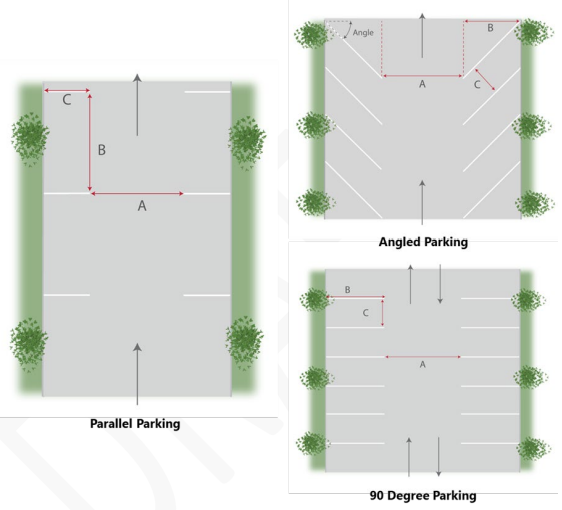
Angle
(Xº)Aisle Width
(A)Stall Depth
(B)Stall Width
(C)90º 24' 18' 9' 60º 20' 20.1' 45º 15' 19.1' 30º 15' 16.8' Parallel (0º) 15' 20' - Parking stalls adjacent to a column or wall must have an additional two feet (2’) of width to accommodate ingress/egress from the vehicle.
- Surfacing. All off-street parking, stacking, loading areas and drive approaches from the alley or street shall be surfaced with asphalt, concrete, brick, stone, pavers, or an equivalent material.
- Pervious Surfaces. Surfaces such as pervious asphalt, pervious concrete or turf blocks are permitted; subject to municipal policies pertaining to stormwater management. A maintenance plan, outlining responsible parties, procedures, and schedules for maintenance of pervious pavement or permeable surfaces must be submitted and approved by the Municipal Engineer.
- Exception for Outdoor Storage. Surfacing materials for outdoor parking areas associated with vehicle or container storage may be graded and compacted gravel, provided the subject area is at least one hundred feet (100’) in driving distance from the nearest public street, no gravel is tracked off-site, and the paving surface is permitted in this Title.
- Driveways, General. Adequate ingress and egress to the parking area shall be provided by clearly defined driveways.
- Distance from Lot Line. Except for shared driveways as authorized by section 14.12.110 of the Copperton Code, driveways, including the entry radius of the drive approach that serve a single main building or principal use, shall be at least one foot (1’) from an abutting lot line.
- Sidewalk Continuity. Sidewalks shall extend through driveway approaches and driveways shall be built to the grade of the sidewalk so that driveways do not create curb cuts in the sidewalk.
- Driveway Surface. There shall be a hard-surfaced driveway from the public or private right-of-way to the required parking space. The drive surface must be a permanent, durable, hard surface such as concrete (including permeable concrete), asphalt (including permeable asphalt), brick, pavers, stone, or block. A pervious surface may be used, subject to applicable municipal ordinances and policies.
- Accessible Parking. Accessible parking spaces required to satisfy the Americans with Disabilities Act shall be provided. Such stalls shall be included within the required number of spaces outlined in Table 19.48.150. For multi-family residential developments, the accessible stalls shall be provided in addition to the number of stalls required in Table 19.48.150.
- Electric Vehicle Charging Stations. Parking lots and structures of one-hundred and fifty (150) parking spaces or more shall provide at least one (1) electric vehicle charging station for every seventy-five (75) parking spaces. Charging stations shall be associated with individual parking spaces and shall be installed according to appropriate design standards, as approved by the Director or designee.
- Stormwater. All parking areas are subject to the stormwater management provisions of Title 17 and any other municipal ordinances.
HISTORY
Repealed & Replaced by Ord. 2023-06-01 on 6/6/2023
Repealed & Replaced by Ord. 2023-06-01 on 6/6/2023
19.48.040 Standards For Parking In R-1 And R-2 Residential Zones
- Residential Driveways. A driveway shall be provided for vehicular access from the street or right-of-way to the required parking spaces of any dwelling in an R-1 or R-2 zone.
- The number, location, and width of driveways shall comply with the specifications set forth in Sections 14.12.110 and 14.36.060.
- Driveways over one hundred fifty feet (150’) in length are subject to approval by the Fire Authority.
- The area within the front yard of any single- or two-family dwelling not occupied by a driveway or parking surface set forth above shall be landscaped in compliance with the applicable provisions of this Title.
- Paved or gravel parking areas or driveways may not occupy more than fifty percent (50%) of the area of a front or rear yard. Any lot less than forty feet (40’) wide may install one driveway that exceeds the fifty percent (50%) parking or driveway rule as long as that driveway does not exceed twenty feet (20’) in width.
- Front Yard Parking. Parking or storage of motor vehicles in the unpaved portion of the front yard of a residential use or residentially-zoned property is prohibited. A legal driveway in the front yard may be used for parking, provided the public sidewalk is not blocked.
- Recreational Vehicles. Recreational vehicles parked or stored on residential property in any R-1 or R-2 zone shall:
- Be parked or stored on a paved surface in the front yard, side yard, or rear yard of a dwelling. Additionally, a recreational vehicle may be parked or stored on a parking pad which is constructed of six inches of compacted gravel. This area must be kept weed free.
- Commercial Vehicles. Commercial vehicles shall not be parked or stored on residential property in an R-1 or R-2 zone, except in the following circumstances:
- Commercial vehicles may be parked on a property in conjunction with lawfully permitted construction, maintenance, or site development activities so long as said activities are diligently pursued.
- One commercial vehicle may be parked behind the front line of the dwelling and screened from view from public streets or neighboring properties with an opaque fence that is at least six feet (6’) tall, provided it is parked on a paved surface. The commercial vehicle may not exceed Class 5 (two (2)-axle, six (6) tire single unit trucks) in Federal Highway Administration vehicle classification.
- One commercial vehicle may be parked in the front yard or side yard of a dwelling in the R-1 or R-2 Zones upon issuance of a permit by PDS, as long as all of the following criteria are met:
- No other commercial vehicle is parked or stored on the property;
- The operator of the vehicle is required to be on call twenty-four (24) hours a day to use the vehicle in response to an emergency;
- The commercial vehicle is parked on a paved surface;
- The commercial vehicle is parked entirely on private property, not parked on or over the street or sidewalk; and
- The commercial vehicle does not exceed Class 5 (two-axle, six tire single unit trucks) in Federal Highway Administration vehicle classification.
HISTORY
Repealed & Replaced by Ord. 2023-06-01 on 6/6/2023
Repealed & Replaced by Ord. 2023-06-01 on 6/6/2023
19.48.050 Required Number Of Off-Street Parking Spaces
- The amount of required off-street parking spaces for individual uses shall be determined in accordance with Table 19.48.150, Off-Street Parking Requirements, found at the end of this Chapter. The following factors shall be used in determining the required number of parking spaces.
- Fractions. Where units of measurements determining the number of required parking or loading spaces result in a fraction, the fraction shall be counted as one (1) additional parking space (rounded up to the nearest whole number).
- Uses.
- Parking shall be calculated separately for each use in a building, structure or on a lot, except that the Director or designee may determine that a lower standard would be adequate for shared parking, as described in Section 19.48.070.
- Accessory uses shall be calculated separately.
- Unlisted Requirements. The Director or designee shall make a determination as to the proper classification of a parking requirement not listed for a particular use based on the requirement of the closest comparable use. Where a comparison cannot reasonably be made, the Director may require a parking demand study to determine the amount of parking needed on the site.
- Bicycle Parking. Bicycle parking shall be as required in Section 19.48.080. Bicycle parking may not occupy any vehicle parking space required by this Chapter.
- On-Street and Public Parking. The use of on-street parking and publicly-owned parking lots or structures may count toward a portion of the minimum off-street parking requirements provided the following conditions are met:
- Adequate on-street parking or public lots or structures exist with five-hundred feet (500’) of the primary entrance of the main building associated with the use as measured along existing sidewalk or along walkways shown on the site plan;
- No more than fifty percent (50%) of the off-street parking space requirement is met through the use of on-street, public parking lot, or public parking structure spaces; and
- The demand for parking generated by the use may not substantially adversely impact available parking for surrounding uses and many not adversely affect traffic circulation patterns.
- Exceptions for the Reuse of Existing Buildings and Structures. The Director or designee may grant a waiver of these requirements for development which reuses an existing building if the applicant can demonstrate that the existing parking on the site accommodates anticipated parking demand.
HISTORY
Repealed & Replaced by Ord. 2023-06-01 on 6/6/2023
Repealed & Replaced by Ord. 2023-06-01 on 6/6/2023
19.48.060 Process For Reductions Or Determinations In Off-Street Parking Requirements
- Off-street parking requirements may be reduced by the Director or designee upon a finding by the Director or designee that the applicant meets the requirements for at least one (1) of the allowable reductions of this Section. In no case may the total required off-street parking for a site be reduced more than fifty percent (50%).
- Transit Exists to Serve the Site.
- When considering a parking reduction for transit availability, the Director or designee may require the applicant to submit a Transportation Demand Management (TDM) Study demonstrating the number residents, customers, or employees that already use or would be expected to use transit instead of parking.
- Reductions for Bicycle Facilities.
- Vehicle parking requirements may be reduced by one (1) space for every four (4) covered, secured bicycle parking spaces provided beyond the amount of bicycle parking required in Section 19.48.080. To qualify for this reduction, a work stand and floor pump is required to be provided on-site. These amenities shall be maintained in working condition and made accessible to cyclists using the parking spaces.
- Off-street parking requirements may also be reduced by four (4) spaces if free showers and locker facilities are available for use within a building or structure on-site.
- The Director or designee may not approve a reduction under this Subsection that is more than ten percent (10%) of the total required off-street parking for a site.
- Transit Exists to Serve the Site.
- In reviewing a parking reduction, or making a determination for specialty uses, the Director or designee may consider the following as applicable:
- The land use and development character of the area to be served by the parking facility, including intensity of uses requiring parking, the availability of transit, proximity to nearby employment centers and residential neighborhoods, and other relevant factors;
- The availability of any other publicly available parking in the area, including the number of spaces, applicable restrictions, or other uses counting spaces in the same parking area toward the applicable parking requirement;
- The timing of parking use relative to other uses in the area, including information on hours of operation;
- Applicable guidelines from the American Planning Association, Envision Utah, and/or the Urban Land Institute;
- Whether the applicant has made all efforts to comply with Table 19.48.150 to the extent practicable considering parking lot design, layout efficiency, and any unique constraints of the site; and
- Whether supporting documentation provided by the applicant adequately demonstrates that sufficient parking is available to meet projected typical demand.
HISTORY
Repealed & Replaced by Ord. 2023-06-01 on 6/6/2023
Repealed & Replaced by Ord. 2023-06-01 on 6/6/2023
19.48.070 Process For Calculating Shared Parking
- Where a mix of land uses creates staggered peak periods of parking demand, shared parking agreements that have the effect of reducing the total number of required parking spaces are encouraged. Shared parking agreements for off-street parking for two (2) or more buildings or uses is permitted subject to the following:
- Shared parking areas shall be located within three hundred feet (300’) of the use as measured along walkways designated on the site plan or already existing;
- Adjacent lots shall be connected by drive aisles; and
- Shared parking leases or agreements shall have a term of not less than five (5) years, including any renewals at the option of the lessee.
- A proposal for the sharing of off-street parking shall be submitted to the Director or designee for site plan review and approval. Conditional use applications which require Planning Commission approval, and for which shared parking is being proposed as part of the application, must have Planning Commission approval for the shared parking.
- Shared Parking Calculation. In determining the total requirements for shared parking facilities, the Director, designee, or Planning Commission shall use Tables 19.48.150 and 19.48.070 according to the following calculation steps:
- For each applicable general land use category, calculate the number of spaces required for the use as if it were the only use (using Table 19.48.150).
- Use the figures for each individual land use to calculate the number of spaces required for that use for each time period specified in Table 19.48.070 (six (6) time periods per use).
- For each time period, add the number of spaces required for all applicable land uses to obtain a grand total for each of the six (6) time periods.
- Select the time period with the highest total parking requirement and use that as the total number of parking spaces required for the site on a shared parking basis.
- If any uses are not listed in Table 19.48.070, the Director or designee shall determine the required parking for the six (6) time periods.
Table 19.48.070: Guidance for the Determination of Shared Parking Requirements. General Land Use Category Weekdays Weekends 12 AM – 7AM 7 AM – 6 PM 6 PM – 12 AM 12 AM – 7AM 7 AM – 6 PM 6 PM – 12 AM Office 5% 100% 5% 0% 5% 0% Industrial 75% 100% 75% 75% 100% 75% Retail 5% 100% 75% 5% 100% 60% Restaurant 25% 70% 100% 30% 75% 100% Lodging 100% 55% 100% 100% 55% 100% Theater /
Entertainment5% 20% 100% 5% 50% 100% Conference Rooms /
Reception Venue0% 100% 100% 0% 100% 100% Place of Worship 0% 30% 50% 0% 100% 65% Institutional 5% 100% 20% 5% 100% 10% Residential 100% 60% 95% 100% 75% 90%
HISTORY
Repealed & Replaced by Ord. 2023-06-01 on 6/6/2023
Repealed & Replaced by Ord. 2023-06-01 on 6/6/2023
19.48.080 Requirements For Bicycle Parking
- Bicycle Parking Required. Bicycle parking facilities shall be provided for any new commercial, office, manufacturing, industrial, multi-family residential, recreational, public and/or quasi-public use for which automobile parking is required; or for modification or change of any of such uses that results in the need for additional automobile parking facilities.
- Number of Required Spaces. The number of bicycle parking spaces required shall be equal to five percent (5%) of the vehicular parking spaces required for such use, with a minimum requirement of two (2) spaces, and a maximum requirement of twelve (12).
- Bicycle parking spaces shall be:
- Located on the same lot as the principal use;
- Located and designed to prevent damage to bicycles by cars;
- Located so as not to interfere with pedestrian movements;
- Located in a highly visible, well-lighted area that is located near entrance(s) to the building;
- Located to provide safe access from the spaces to the public right-of-way or bicycle lane;
- Designed to accommodate a range of bicycle shapes and sizes, and to allow the frame and wheel(s) of each bicycle to be supported and secured against theft without interfering with adjacent bicycles; and
- Anchored to resist removal by vandalism and resistant to rust or corrosion.
- Required bicycle parking spaces may be located within the building.
- Any proposed bicycle parking spaces or facilities shall be clearly shown on the applicable site plan, indicating location and type.
HISTORY
Repealed & Replaced by Ord. 2023-06-01 on 6/6/2023
Repealed & Replaced by Ord. 2023-06-01 on 6/6/2023
19.48.090 Off-Street Loading And Unloading Standards
- Applicability. Any building or portion thereof which is to be occupied by one (1) or more uses that require the receipt or distribution of materials or merchandise by vehicles shall provide and maintain off-street loading spaces as required by this Section.
- Location.
- Loading/unloading areas and docks shall be prohibited in the front yard or on any building side facing and directly visible from a street;
- Loading/unloading operations shall not interfere with the normal movement of vehicular and pedestrian traffic in public rights-of-way, off-street parking areas, internal drives, or sidewalks;
- No loading space that is adjacent to a Residential Zone shall be nearer than thirty feet (30’) to the parcel line zoned residential unless it is contained within a completely enclosed building, or enclosed on all sides by a wall or solid, opaque fence not less than six feet (6’) high; and
- The vehicular path and turning radii to the loading area must be shown on the site plan to verify truck maneuverability for the largest truck intended to serve the use.
- Specifications. Loading/unloading spaces shall be at least twelve feet (12’) wide, thirty feet (30’) long, and have fourteen feet (14’) of vertical clearance. Each additional required loading space shall be at least ten feet (10’) in width, forty-five feet (45’) in length, and have fourteen feet (14’) of clearance.
- Required Number of Loading Spaces. The minimum number of loading spaces required is shown in Table 19.48.090.
Table 19.48.090: Loading Space Requirements. Use Type Units Required Loading Spaces Multi-Family Residential (total
dwelling units)0-24 du NA 25-74 du 1 75+ du 2 Non-Residential (square feet of
gross floor area)Up to 10,000 sq. ft. NA 10,001–20,000 sq. ft. 1 20,001–75,000 sq. ft. 2 75,001–100,000 sq. ft. 3 100,001+ sq. ft. 5
HISTORY
Repealed & Replaced by Ord. 2023-06-01 on 6/6/2023
Repealed & Replaced by Ord. 2023-06-01 on 6/6/2023
19.48.100 Vehicle Stacking Standards
- Drive-Up and Drive Thru Facility, Stacking Lane Standards: These standards ensure that there is adequate on-site maneuvering and circulation areas, ensure that stacking vehicles do not impede traffic on abutting streets, and that stacking lanes will not have nuisance impacts on abutting residential lots.
- Each stacking space shall be a minimum of twenty feet (20’) in length and eight feet (8’) wide along the straight portions and ten feet (10’) wide along the curved segments.
- Entrances to stacking lanes shall be clearly marked and located a minimum of sixty feet (60’) from the closest curb cut. Stacking lanes shall not enter or exit directly into a public street.
- Stacking lanes must be designed so that they do not interfere with parking and vehicle circulation.
- All stacking lanes must be clearly delineated from traffic aisles, other stacking lanes and parking areas using striping at a minimum and curbing, landscaping, or signs where appropriate.
- Required Stacking Capacity:
- A drive-thru automated teller machine (ATM) must provide no fewer than two (2) stacking spaces before the teller machine.
- A car or light truck wash must provide no fewer than three (3) stacking spaces per lane before the wash bay entrance.
- A laundry or dry-cleaning establishment with a drive thru window must provide no fewer than two (2) stacking spaces per lane before the drive-up window.
- A financial institution with teller lanes must provide no fewer than three (3) stacking spaces per lane before the teller or drive-up window.
- A pharmacy with a drive thru window must provide no fewer than three (3) stacking spaces per lane before the drive-up window.
- A restaurant with drive thru must provide no fewer than eight (8) stacking spaces before the first drive-up window. A restaurant with more than one stacking lane must provide no fewer than six (6) stacking spaced before the first drive-up window. Establishments where orders are placed for food or drink in a similar manner to a restaurant must provide stacking in the same manner as a restaurant.
- Uses having a drive thru window but not listed in this part are required to have stacking lanes and stacking spaces as determined by the Director and based on the anticipated demand for stacking spaces given existing and projected traffic and consumer patterns.
- A stacking lane is not required for accessory facilities where vehicles do not routinely stack up while waiting for the service. Examples are window washing, air compressor, and vacuum cleaning stations.
- Self-Service Fuel Station, Stacking Lane Standards: Each pump island should generally include stacking space for a minimum of two (2) vehicles (total of forty feet (40’)) on site so that driveways within the site or adjacent street areas are not utilized for waiting customers. Pump island stacking shall not encroach upon required parking space back out areas (twenty-four feet (24’) minimum) or two-way driveways for general site circulation (twenty-four feet (24’) minimum).
HISTORY
Repealed & Replaced by Ord. 2023-06-01 on 6/6/2023
Repealed & Replaced by Ord. 2023-06-01 on 6/6/2023
19.48.110 Parking Lighting And Landscaping Standards
- Landscaping. All parking areas shall be landscaped in accordance with the provisions of Chapter 19.50.
- Screening. The sides and rear of any off-street parking area for more than five (5) vehicles which adjoins or faces an institutional or residential use shall be effectively screened by a masonry wall or solid visual barrier fence unless otherwise provided for more specifically by the requirements of the zoning district in which such parking area is located. Such wall or fence may not be less than six feet (6’) in height and shall be maintained in good condition and free from advertisement.
- Lighting. Lighting used to illuminate any off-street parking area shall be downcast and fully shielded so as to direct light away from adjoining premises and from street traffic. No light source (light bulb, fluorescent tube, or other direct source of light used to illuminate a parking area) may be visible beyond the property line of any off-street parking area.
HISTORY
Repealed & Replaced by Ord. 2023-06-01 on 6/6/2023
Repealed & Replaced by Ord. 2023-06-01 on 6/6/2023
19.48.120 Mobility And Pedestrian Circulation
- The following mobility and circulation standards apply in all parking areas or portions thereof.
- Street and Sidewalk Continuation.
- Streets, internal circulation drives, and parking aisles shall be arranged to provide for the alignment and continuation of existing or proposed streets and drives into adjacent lots, developed or undeveloped.
- Internal vehicular circulation areas shall be designed to allow for cross access to adjacent lots with residential, nonresidential or mixed-uses.
- A stub for future cross access shall be provided from the vehicular use area to all adjacent lots. Where cross access is deemed impractical by the Planning Commission, Director, or designee during site plan review on the basis of topography, the presence of natural features, or vehicular safety factors, the requirement for cross access may be waived provided that appropriate bicycle and pedestrian connections are made between adjacent developments or uses.
- A cross-access easement shall be recorded with the Salt Lake County Recorder prior to the issuance of a building certificate of occupancy for the development.
- Pedestrian Access Required. Pedestrian access shall be required for all sites to improve the health, safety and welfare of the public by providing clear pedestrian pathways at perimeter and internal site locations to reduce pedestrian and vehicular conflicts, improve accessibility for persons with disabilities, and establish a multi-modal environment that is supportive of walking, biking and transit use. All attached single-family and multiple family residential, non-residential and mixed-use developments shall comply with the following requirements.
- Continuous internal pedestrian walkways shall be provided to connect off-street surface parking areas with the primary entrances of main buildings;
- At least one (1) pedestrian walkway with a minimum width of five feet (5’) shall be provided from the internal pedestrian walkway network to the public sidewalk system. In the case of corner lots, connections shall be made to the sidewalks of both streets; and
- All internal pedestrian walkways shall be distinguished from driving surfaces through the use of durable, low-maintenance surface materials such as pavers, bricks, or scored/stamped concrete or asphalt.
- Walkways in Parking Lots. Paved walkways shall be provided for access to adjacent parks, shopping areas, transit stops, anticipated walkways and institutions. Walkways shall either be dedicated sidewalks raised above the surface of the parking lot, or, if at the same level as the parking lot, clearly marked with striping and tactile alerts, and may use alternative materials, such as pavers.
- Each surface parking area that has fifty (50) or more parking spaces or has any parking spaces more than three hundred fifty feet (350’) from the front entrance of the primary building as measured along walkways shown on the site plan, shall have at least one (1) pedestrian walkway or sidewalk allowing pedestrians to pass from the row of parking furthest from the primary building façade to the primary building entrance.
- The required walkway must be at least five feet (5’) wide, shall not be within a driving aisle, and, where possible, shall be within a landscaped island running perpendicular to the primary building façade. If parking spaces are adjacent to a sidewalk, the sidewalk must be at least seven feet (7’) wide to allow for vehicular overhang.
- Trail Connections. Where trails exist or are planned within three hundred fifty feet (350’) of a primary building entrance, paths or sidewalks shall connect building entries to the trail system.
- Street and Sidewalk Continuation.
HISTORY
Repealed & Replaced by Ord. 2023-06-01 on 6/6/2023
Repealed & Replaced by Ord. 2023-06-01 on 6/6/2023
19.48.130 Maintenance Of Off-Street And Bicycle Parking
- Maintenance. All parking areas, including bicycle parking, shall be maintained free of dust, trash, weeds and debris. Surfacing, curbing, lighting fixtures, signs, and related appurtenances shall be maintained in a smooth, well-graded condition, and in good repair and safe condition at all times.
- The visibility of pavement markings delineating parking spaces and directional control shall be maintained.
- All off-street parking, stacking and loading areas required by this Chapter shall be maintained free of accumulated snow or standing water that prevents full use and occupancy of the areas, except for temporary periods of heavy rainfall or snowfall, not to exceed five (5) days.
HISTORY
Repealed & Replaced by Ord. 2023-06-01 on 6/6/2023
Repealed & Replaced by Ord. 2023-06-01 on 6/6/2023
19.48.140 Supplementary Parking And Mobility Standards
The following supplementary parking and mobility standards apply.
- Gasoline Pumps Associated with a Self-Service Fuel Station. Gasoline pumps shall be set back no less than twenty-four feet (24’) from any front property line, and no less than thirty feet (30’) from any residential zone boundary line. If the pump island is set at an angle on the property, it shall be located so that automobiles stopped for service at the pump will not extend over the property line.
- Canopies constructed to provide a weather shield over gasoline pump islands shall be set back no less than six feet (6’) from any property line and no less than ten feet (10’) from any residential zone boundary.
- Gasoline pumps associated with a self-service fuel station are subject to the specific use standards in 19.42.280 and all other applicable ordinances.
- Provisional Parking. Provisional parking in excess of the maximum parking spaces allowed in Table 19.48.150 may be permitted if the following conditions are met.
- Provisional parking spaces shall be shown on the site plan as complying with the parking stall size requirements of this Chapter as well as the maneuverability and aisle requirements of the Copperton Municipal Code.
- Provisional parking spaces may be landscaped in such a way that they can be used for parking on a seasonal or temporary basis.
- After one year's time from the issuance of the land use permit, a property owner may request a review of the provisional parking. Upon a finding by the Planning Commission (for a conditional use) or the Director or designee (for a permitted use) that the additional parking is needed, approval shall be granted for the provisional parking to be paved and made permanent.
- The Planning Commission may set conditions of approval as part of any conditional use permit that utilizes provisional parking to provide for monitoring and future review of the parking plan.
- Valet Parking. Off-site parking may be permitted to meet the requirements of this Chapter if a valet parking program is established.
- A valet parking plan shall identify the following.
- The location of parking spaces, pick-up areas, drop-off areas, and egress/ingress;
- The involvement of personnel; and
- General operating procedures.
- At least ten percent (10%) of the required parking spaces shall be reserved as on-site, self-parking spaces and shall be indicated as such on the valet parking plan.
- A valet parking plan shall identify the following.
- Community Parking Credits.
- If the Director or designee finds that parking is available either on public property or on property leased by a public entity for community parking, and such parking is conveniently located to a particular land use, credits may be given toward the parking requirement for said land use.
- If multiple businesses or land uses qualify to use the same parking spaces for community parking credits, the credits shall be pro-rated for each land use. In calculating the pro-rated community parking credits, the Director or designee shall consider:
- The amount of frontage a property has on the street;
- The total number of parking stalls required for a given land use;
- The intent of the public parking according to any adopted municipal plans; and
- The potential for future development in the immediate vicinity creating further demand for parking spaces.
- The Director or designee may also use Table 19.48.070 for land uses in different general categories to consider shared community parking.
- Transit Access and Amenities.
- Transit Stops. Where public transit service is available or planned, convenient access to transit stops shall be provided by means of public or private sidewalks or walkways. Any provided seating shall not obstruct a public sidewalk.
- Where transit shelters are provided, they shall be placed in highly visible and well lighted locations for purposes of safety, subject to review by the Utah Transit Authority.
- Landscaping. Landscape and/or plaza areas are encouraged at all bus and transit stops.
HISTORY
Repealed & Replaced by Ord. 2023-06-01 on 6/6/2023
Repealed & Replaced by Ord. 2023-06-01 on 6/6/2023
19.48.150 Parking Requirements Table
The number of required off-street parking spaces for individual uses shall be determined in accordance with Table 19.48.150, Off-Street Parking Requirements.
| Table 19.48.150: Off Street Parking Requirements. | ||||
| Use Category | Use | Minimum Spaces Required | Maximum Spaces Allowed | Additional Requirements |
| RESIDENTIAL | ||||
| Household Living | Single-Family | 2 spaces per dwelling unit | NA - but no more than 50% of yard space may be paved. | Spaces may be arranged one behind another |
| Two-Family | 1 space per dwelling unit | 3 spaces per dwelling unit | ||
| Three- and Four-Family | ||||
| Multi-Family | 1 space per studio apartment; 1.5 spaces per 1 bedroom unit; 2 parking spaces per dwelling unit for any units with 2 or more bedrooms; plus guest parking as determined by Director or designee | 2 spaces per dwelling unit for all unit types; no more than 1 guest space per 3 units | ||
| Accessory Dwelling Unit | 1 space per accessory dwelling unit | NA - but no more than 50% of any front or rear yard space may be paved. | Spaces may be arranged one behind another, but may not count toward the minimum parking requirements for a single- family home | |
| Group Living | Nursing Home / Convalescent Care | 4 spaces, plus 1 space for every 5 beds at total capacity | 4 spaces, plus 1 space for every 3 beds at total capacity | |
| Residential Facilities for Elderly Persons or Persons with a Disability | 4 spaces | 1 space per employee, plus 1 space per 2 residents | Parking spaces may be arranged one behind another | |
| Therapeutic School, Assisted Living Facility | 4 visitor parking spaces plus 1 space per employee during the highest employment shift | NA | ||
| Rehabilitation and Treatment Facilities | ||||
| Transitional Housing, Protective Housing | 1 space per employee during the highest employment shift | |||
| FOOD, LODGING, RETAIL, AND SERVICE | ||||
| Auto-Oriented | Car and Light Truck Wash | NA | 5 spaces per 1,000 sq.ft. | |
| Self Service Fuel Station | 1 space per pump island, plus 2 spaces per 1,000 sq. ft. of convenience store floor area | 1 space per pump island, plus 5 spaces per 1,000 sq. ft. of convenience store floor area | Self-Service Fuel Stations are also subject to the vehicle stacking standards in 19.48.100. | |
| Truck Stop and Service Facilities | 5 spaces plus 1 space for each employee during the highest employment shift | 5 spaces per 1,000 sq. ft. of building space | ||
| Vehicle and Equipment Repair, Major or Minor | ||||
| Vehicle Rental | ||||
| Vehicle Sales and Service, All Types | ||||
| Personal Services | Check Cashing | 1 space per employee during the highest employment shift, plus 4 customer spaces | 5 spaces per 1,000 sq. ft. of building space | |
| Child Care Center | 4 spaces plus 1 space for every 500 sq. ft. of floor area | |||
| Child Care, Licensed Family or Residential | 1 space per 8 clients, plus 1 per employee | |||
| Reiki | 1 space per 250 sq. ft. of gross floor area, plus 1 space per employee on the highest employment shift | |||
| Other Personal Care Service or Personal Instruction Service | 3 spaces per 1,000 sq. ft. | |||
| Other Services | Reserved | Reserved | Reserved | |
| Contractor's Office | 2 spaces per 1,000 sq. ft. of office area | 3 spaces per 1,000 sq. ft. of office area | ||
| Kennel | 1 space per employee on the highest employment shift, plus 1 space per 1,000 sq. ft. | 1 space per employee on the highest employment shift, plus 2 spaces per 1,000 sq. ft. | ||
| Laundry Cleaning, Automatic or Drop Off | 4 spaces, plus 1 space per employee on the highest employment shift | 4 spaces, plus 1.5 spaces per 1,000 sq. ft. of floor area | ||
| Mortuary or Funeral Home | 1 space per 5 people at max design occupancy | 1 space per 3 people at max design occupancy | ||
| Post Office | 1 space per 500 sq. ft. of floor area, plus 1 space for each employee on the highest employment shift | 1 space per 250 sq. ft. of floor area, plus 1 space for each employee on the highest employment shift | ||
| Commercial Plant Nursery | 1 space per 1,000 for indoor display area, plus 1 space per 2,500 sq. ft. of outdoor display area | NA | ||
| Pawn Shop | 1 space per 500 sq. ft. of gross floor area used for the display of goods or services, plus 1 space per employee on the highest employment shift | 1 space per 250 sq. ft. of gross floor area used for the display of goods or services, plus 1 space per employee on the highest employment shift | ||
| Retail Shops or Galleries where Primary Product is Produced On-Site | ||||
| Retail Tobacco Specialty Business | ||||
| Shopping Center | 3 spaces per 1,000 sq. ft. of gross leasable area | 5 spaces per 1,000 sq. ft. of gross leasable area | ||
| Swap Meets and Flea Markets | NA - but all parked vehicles must be accommodated on-site, off-street | |||
| Other Retail | 1 space per 500 sq. ft. of gross floor area used for the display of goods or services | 1 space per 250 sq. ft. of gross floor area used for the display of goods or services, plus 1 space per employee on the highest employment shift | ||
| Food and Drink | Bar | 1 space per 4 persons based on max occupancy | 1 space per 2.5 persons based on max occupancy | |
| Breweries and Distilleries in association with a Restaurant | ||||
| Liquor and/or Wine Store, Package Agency | 1 space per 500 sq. ft. of gross floor area, plus 1 space per employee on the highest employment shift | 4 spaces per 1,000 sq. ft. of gross floor area | ||
| Restaurant, Fast Food | 1 space per 4 persons based on max occupancy | 1 space per 2.5 persons based on max occupancy | ||
| Restaurant, Sit Down | ||||
| Lodging | Bed and Breakfast Inn | 2 spaces for each primary residential dwelling unit plus 1 space for each guest room | 2 spaces for each primary residential dwelling unit plus 1.25 spaces per guest room or unit | |
| Boardinghouse, Hotel, Guest Ranch, Resort | 1 space per sleeping unit, plus parking for any accesory uses | 1.5 spaces per guest room or unit | ||
| Yurt | NA | 1 space | ||
| OFFICE | ||||
| Offices | Office, General | 1 space per 500 sq. ft. of floor area | 1 space per 250 sq. ft. of floor area | |
| Office, Medical or Intensive, or Financial Institution | 1 space per employee on the highest employment shift, plus 4 visitor spaces | 6 spaces per 1,000 sq. ft. | ||
| INDUSTRIAL | ||||
| Light Industrial | Breweries and Distilleries, Industrial | 1 space per person employed on the highest employment shift | NA | |
| Dairy | ||||
| Industrial Flex Space | ||||
| Laboratory, Medical and Dental or Research and Development | ||||
| Salvage Yard, Storage Yard, Towing Services and Impound Lots | ||||
| Self Service Storage Facilities Indoor or Outdoor | 5 spaces plus 1 space for each employee during the highest employment shift | |||
| Vertical Indoor Agriculture | 1 space per person employed on the highest employment shift | |||
| Vehicle and Equipment Repair, Commercial and Industrial | 5 spaces plus 1 space for each employee during the highest employment shift | |||
| Warehouse and Distribution Facilities | 1 space per person employed on the highest employment shift | |||
| Other Light Manufacturing | ||||
| Medium Industrial | Agricultural Products Processing | 1 space per person employed on the highest employment shift | NA | |
| Assembly Use | ||||
| Machine Shop | ||||
| Meat or Poultry Processing Facility | ||||
| Recycling Processing Facility | ||||
| Solar Energy System, Commercial | NA | |||
| Vehicle Assembly | 1 space per person employed on the highest employment shift | |||
| Water Treatment Facility | ||||
| Heavy Industrial | Freight Service | 1 space per person employed on the highest employment shift | NA | |
| Mining | ||||
| Wind Energy System, Commercial | NA | |||
| Other Heavy Manufacturing | 1 space per person employed on the highest employment shift | |||
| INSTITUTIONAL | ||||
| Public and Institutional Uses | Reserved | Reserved | Reserved | |
| Cemetery | NA | NA | ||
| Church, Synagogue, Mosque, Temple, Cathedral, or other religious buildings | 0.25 spaces per seat; or 1 space per 300 sq. ft. of floor area if no seating is present | 1 space per 3 seats; or 1 space per 200 sq. ft. of floor area if no seating is present | ||
| Correctional Facility | 1 space per employee on the highest employment shift, plus at least 5 visitor spaces | NA | ||
| Educational Facility | Elementary and Middle Schools: 1 space per 20 students design capacity High Schools: 1 space per 8 students design capacity Technical School, College, or University: as determined by Director or Designee | All: 4 spaces per 1,000 sq. ft. of floor area | ||
| Educational Facility with Residential Accommodation | 1 space per 2 tenants at design capacity | 1 space per tenant at design capacity | ||
| Hospital | 1 space per 3 patient beds for the total design capacity of the hospital | 1 space per patient bed for the total design capacity of the hospital | ||
| Park and Ride | NA | 120 spaces | ||
| Public Park | 2 spaces per 1,000 sq. ft. of courts, ball fields, or pools | 3 spaces per 1,000 sq. ft. of courts, ball fields, or pools | ||
| Resource Recycling Collection Point | 1 space per collection bin | 2 spaces per collection bin | ||
| Other Public or Institutional Use | As determined by Director or Designee | |||
| RECREATIONAL | ||||
| Fitness and Entertainment | Athletic Clubs | 2 spaces per 100 sq. ft. | 3 spaces per 100 sq. ft. | |
| Club, Locker Club | ||||
| Commercial Recreation, Recreation Facility | 2.5 spaces per 1000 sq. ft. of floor area | 4 spaces per 1,000 sq. ft. of floor area | ||
| Reception Hall, Reception Center, Theater, Concert Hall | 1 space per 4 people at max occupancy | 1 space per 2.5 people at max occupancy | ||
| Outdoor | Campground | 1 space per campsite | 2 spaces per campsite | Spaces may be arranged one behind another |
| Community Garden | NA | NA | ||
| Outdoor Recreation, Large Scale | As determined by Director or Designee | |||
| Stable, Public | 1 space per employee on the highest employment shift, plus 4 guest spaces | NA | ||
| SPECIALTY | ||||
| Specialty Uses | Agritourism | Parking and Stacking Spaces as determined by Director or Designee | ||
| Apiary | ||||
| Crematorium | ||||
| Drive-Up and Drive Thru Facilities | Drive-Up and Drive-Thru Facilities are subject to the stacking standards found in 19.48.100. | |||
| Seasonal Use or Sales | ||||
| Ski Resort | ||||
HISTORY
Repealed & Replaced by Ord. 2023-06-01 on 6/6/2023
Repealed & Replaced by Ord. 2023-06-01 on 6/6/2023

