
Cornelia City Zoning Code
ARTICLE IX
PROPERTY APPEARANCE STANDARDS
Sec. 42-160.- Purpose.
The purpose of this article is to ensure that the physical and operational characteristics of proposed buildings and uses are compatible when considered within the context of the surrounding area. It is also the purpose of this article to prevent monotonous repetition of building forms and to introduce variety and quality in building and development in Cornelia. To enforce this article, an administrative site and design review process is established, whereby site and building plans are reviewed by the zoning administrator for compliance with the provisions of this article, in addition to other requirements of this chapter, the city's subdivision and land development regulations, and building regulations.
(Ord. No. 12-22-20, 1-5-2021)
Sec. 42-161. - Control of vegetation on larger vacant lots.
On any lot with an area of 20 acres or more, or with a frontage of 600 feet or more on an existing city street or state highway, it shall be the responsibility of the property owner to mow or otherwise control the vegetation within ten feet of the right-of-way of a city street or state highway so that the grass or other groundcover vegetation (excluding existing trees and shrubs) remains below a height of eight inches and does not protrude or threaten to protrude onto public rights-of-ways. The city's zoning administrator will enforce this requirement where violations occur or are alleged to occur.
(Ord. No. 12-22-20, 1-5-2021)
Sec. 42-162. - Inoperable vehicle or storage of scrap material.
Except for junk/salvage yards and wrecked motor vehicle compounds, it shall be unlawful to park or continuously store abandoned, wrecked, junked or inoperable vehicles, power-driven construction equipment, used lumber or metal, used appliances, tires, auto parts, pipes, or any other miscellaneous material that is visible from a public road or adjacent or abutting property. Such vehicles or materials shall be enclosed in a building or in a side or rear yard with a minimum six-foot high opaque fence surrounding the storage area, if buildings do not screen such vehicles or scrap materials from view.
(Ord. No. 12-22-20, 1-5-2021)
Sec. 42-163. - Parking of vehicles on vacant lots.
Parking, whether displayed for sale or for storage of vehicles, shall not take place on any vacant lot, unless said lot is located within a zoning district that permits off-street parking lots and the use is approved by the zoning administrator. Only within a zoning district where the sale of vehicles is permitted and for no more than ten hours of a 24-hour period, shall an individual park a vehicle for the sole purpose of the advertising and selling a vehicle. No commercial sales of any kind shall be permitted from a vehicle on a vacant lot unless the sales activity is permitted in the zoning district in which the sales activity is located and a valid business registration with the City of Cornelia is secured for the location at which sales activity occurs.
(Ord. No. 12-22-20, 1-5-2021)
Sec. 42-164. - Parking in front yards on single-family lots.
On lots containing detached, single-family residences, the parking of automobiles is permitted in garages, carports, or outdoors. Unenclosed parking shall not exceed four outdoor automobiles per single-family or two-family dwelling unit in any front yard of a lot containing a detached, single-family dwelling. Parking on lots with detached, single-family dwellings shall be permitted only in designated areas hard surfaced with concrete or asphalt and shall not be permitted outside such surfaced areas in the front yard of the lot. No front yard containing a detached, single-family residence shall be permitted to have more than 50 percent of its front yard area to be hard surfaced for parking.
(Ord. No. 12-22-20, 1-5-2021)
Sec. 42-165. - Walls and fences.
Walls and fences shall present a finished and attractive surface to the exterior of the property. Walls or fences composed or constructed of exposed concrete block (excluding decretive concrete blocks as approved by the zoning administrator), tires, junk, or other discarded materials shall not be permitted.
In all residential zoning districts, fences or walls erected within the required front yard shall be constructed of brick, stone, wood, stucco, wrought iron, or split rail. Fences made of chain link are prohibited in the front yards of residential zoning districts. Where chain link fences are permitted, except in industrial zoning districts, if erected they shall be coated with black vinyl.
All fences and walls shall conform to the following:
(1)
No wall, fence, or other obstruction to vision shall be placed or maintained within the triangular area formed by the intersection of street right-of-way lines and a straight line connecting points on said street lines, each of which is 25 feet distant from the point of intersection.
(2)
A permit shall be obtained from the building official.
(3)
No fence or wall shall exceed eight feet in height, except for required retaining walls.
(4)
No fence or wall, except for required retaining walls, shall be erected closer than two feet from a public right-of-way or in such a manner as to obstruct vision on a public right-of-way.
(5)
Barbed wire top strands may be permitted in A-1, LI, and HI zoning districts only.
(6)
These requirements shall not apply to temporary fencing erected around a lot during construction of a building for security or safety or code compliance reasons. All such temporary fencing shall be approved by the building official upon issuance of a building permit and shall be removed upon completion of construction.
Fences or walls within the front yards of lots containing single-family or two-family dwellings shall not be a height of greater than 42 inches, except for retaining walls where required by an approved grading plan or subdivision entrance monuments approved by the zoning administrator.
(Ord. No. 12-22-20, 1-5-2021)
Sec. 42-166. - Outdoor lighting.
Any outdoor light that is aimed, directed, or focused so that the lamp is visible, or in a way that causes direct light from the lamp to be directed toward residential buildings on adjacent or nearby land, or that creates glare perceptible to persons operating motor vehicles on public ways, shall be redirected or its light output controlled as necessary to eliminate such conditions.
The following types of outdoor lighting are prohibited: Strobe lights, except as may be required for towers by a state or federal lighting requirement; laser lights or searchlight beams projected into the sky; and neon-lit signs, neon outdoor lights, and neon window or door outlining.
(Ord. No. 12-22-20, 1-5-2021)
Sec. 42-167. - Underground utilities.
For all new construction and redevelopment, utilities including water, sewer, cable, phone, gas, and electric power when connected from public streets to development on private property must be placed underground.
(Ord. No. 12-22-20, 1-5-2021)
Sec. 42-168. - Architectural requirements for all buildings.
The following types of external building materials are prohibited: highly reflective, shiny, or mirror-like materials; mill-finish (non-colored) aluminum metal windows or door frames; exposed, unfinished walls; exposed plywood or particle board; and unplastered, exposed concrete masonry blocks. This provision applies also to accessory buildings and structures, including signs. No building shall have exterior metal siding.
If vinyl siding is used, it shall be installed in accordance with the most current edition of the International Residential Code.
(Ord. No. 12-22-20, 1-5-2021; Ord. No. 08-21-01, § 2, 9-7-2021)
Sec. 42-169. - Residential architectural building requirements.
When a new single-family or two-family dwelling is constructed, at least 25 percent of the front façade of each dwelling shall be brick masonry, stone masonry, or split-face block masonry. All other exterior wall materials of such new dwellings shall consist of brick masonry, stone masonry, or split-face block masonry, or wood clapboards or weather boarding, and appropriate architectural accents. Standing-seam or corrugated metal walls shall not be permitted. Roof materials shall be asphalt composition, wood shake, tile, or standing seam metal.
(Ord. No. 12-22-20, 1-5-2021)
Sec. 42-170. - Housing model variety.
Any development of 30 or more single-family detached or two-family dwelling units shall have at least four different types of housing models. Any development of at least ten but fewer than 30 single-family or two-family dwelling units shall have at least three different types of housing models. The applicant shall include documentation in the application for approval at the time of preliminary subdivision approval or if no subdivision is required, at the stage of development plan approval, that shows how the development will comply with this requirement.
Each housing model shall have at least three characteristics that clearly and obviously distinguish it from the other housing models, including different floor plans, exterior materials, rooflines, garage placement, placement of the footprint on the lot, and/or building face.
When two or more dwellings are constructed on lots fronting an existing city street, each dwelling facing an existing city street shall have at least three characteristics that clearly and obviously distinguish each new dwelling from the other housing models, including different floor plans, exterior materials, rooflines, garage placement, placement of the footprint on the lot, and/or building face.
(Ord. No. 12-22-20, 1-5-2021)
Sec. 42-171. - Infill residential subdivision.
When a lot within the City of Cornelia's original one-mile circular city limits is subdivided for single-family or two-family residential use (i.e., infill residential subdivision), it may present certain characteristics that are highly incompatible with the existing character of the residential neighborhood. Accordingly, this section provides compatibility regulations for infill residential subdivisions.
42-171.1.
Architectural compatibility. When a new dwelling is constructed that fronts on an existing city street or state highway within the original one-mile circular city limits of Cornelia, it shall be compatible with the established architectural character of such areas by using a design that is complementary. In areas where the existing architectural character is not definitively established, the architecture of new dwellings in infill areas of the city shall set an enhanced standard of quality for future projects or redevelopment in the area. Compatibility shall be achieved through techniques such as the repetition of roof lines, the use of similar proportions in building mass and outdoor spaces, similar relationships to the street, similar window and door patterns, and/or the use of building materials that have color shades and textures similar to those existing in the immediate area of the proposed infill development. Brick and stone masonry shall be considered compatible with wood framing and other materials.
42-171.2.
Bulk and scale. New dwellings erected within the original one-mile circular city limits of Cornelia shall either be similar in size and mass, or, if larger, shall be articulated and subdivided into massing that is proportional to the mass and scale of other dwellings on abutting and nearby lots.
42-171.3.
Height of dwellings. When the heights of dwellings on lots abutting the infill residential subdivision are predominantly two stories, the height of dwellings constructed in the infill residential subdivision shall be no more than two stories excluding basement or daylight basement.
42-171.4.
Garages. To prevent residential streetscapes from being dominated by protruding garage doors, and to allow the active, visually interesting features of the house to dominate the streetscape, the following standards shall apply. Any garage doors facing an existing city street shall be recessed at least five feet behind either the front facade of the ground floor living area portion of the dwelling or a covered porch. Garage doors may be located on another side of the dwelling ("side- or rear-loaded"), provided that the side of the garage facing the front street has windows or other architectural details that mimic the features of the living portion of the dwelling.
Garage doors shall not comprise more than 50 percent of the ground floor frontage of the building facing an existing city street.
42-171.5.
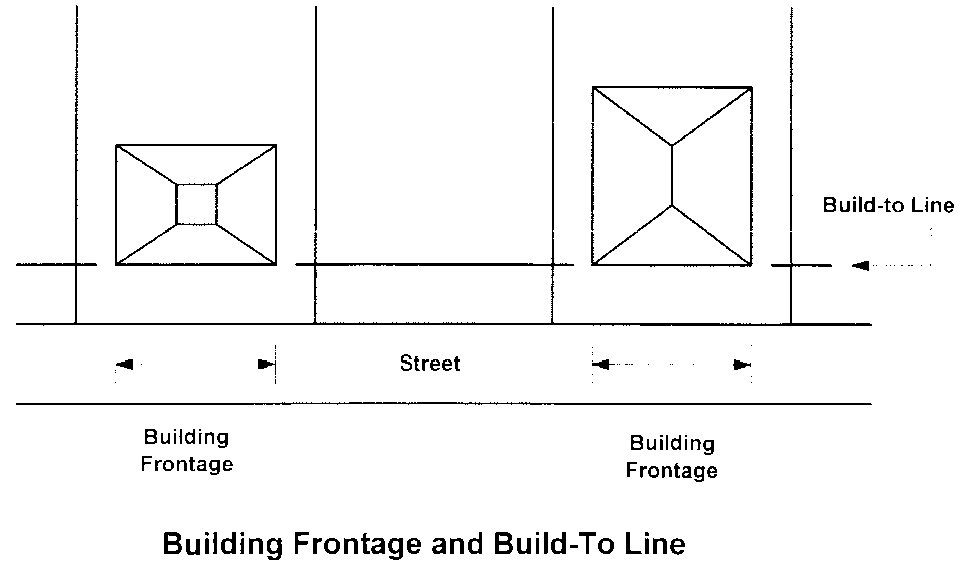
Placement on lot fronting existing street. This section shall apply to the erection of dwellings on lots within an infill residential development project that front on an existing street. The intent of this subsection is to ensure that dwellings are placed on the lot in a manner compatible with dwellings abutting to the side of the lot within the infill residential development project. Substantial deviations from the repetitive or prevailing pattern of building placement on the same existing street can result in an incompatible condition.
Therefore, dwellings within an infill residential development project on lots that front on an existing street shall not deviate from the build-to line by more than 15 feet. When a build-to line applies pursuant to this section, it supersedes the front building setback requirement for the zoning district in which the property is located.
42-171.6.
Screening of rear yards of lots fronting an interior street. When a new subdivision street is proposed, the project often will result in the orientation of dwellings such that they form a line of rear yards abutting the side yard of a lot in the established residential area. To protect existing dwellings in the established residential area from exposure to residences, rear yards of the lots in the new subdivision shall be separated and screened along common lot lines of the established residential area with a solid wooden fence or masonry wall of six feet in height and a minimum ten-foot wide vegetative buffer, or comparable screening approved by the zoning administrator.
42-171.7.
Entrance landscaping for new interior streets. When a new subdivision street is proposed and the infill residential development project contains six or more lots, the entrance to the project (where the new road intersects with the existing city street) shall be landscaped with a minimum 20 foot wide landscape strip along the property frontage approved by the zoning administrator. If the landscape strip is platted as a part of a lot within the infill residential development project, a landscaping easement shall be provided over such lot or lots. A landscape maintenance bond shall be required for a period of two years.
42-171.8.
Landscape strips for new interior streets on narrow lots. When a new interior street serves an infill residential development and it traverses a lot or part of a lot that is 100 feet or less in width, the subdivider shall install prior to final plat approval a minimum ten-foot wide landscape strip approved by the Zoning Administrator along both sides of street (at the inner edge of the street right-of-way) along the lot or portion thereof that is 100 feet or less wide, so as to buffer the new street from residences on abutting lots.
42-171.9.
Landscape strips for new driveways serving infill lots. Where a new driveway serving one or more dwellings within an infill residential subdivision traverses a lot or part of a lot that is 60 feet or less in width, along both sides of the lot or portion thereof that is less than 60 feet wide, the subdivider shall install prior to final plat approval a minimum five-foot wide landscape strip approved by the zoning administrator, so as to buffer the driveway from residences on abutting lots. No such new driveway shall be constructed closer than 15 feet to a property line common with an abutting lot containing a single-family dwelling.
(Ord. No. 12-22-20, 1-5-2021)
Sec. 42-172. - Commercial building standards.
This section shall apply to all new developments.
42-172.1.
Screening of certain areas and facilities. Service areas, including loading areas, loading entrances, dumpster pads, sites where trash or recycling containers or similar material are permanently stored, and heating, and ventilating, and air conditioning equipment on the ground shall be screened from view from adjoining properties, public and private streets, parking areas, and other areas open to the public. All rooftop mechanical equipment shall be screened from public view from views below by integrating it into building and roof design, or by screening with a parapet wall. Such screening is subject to the approval of the zoning administrator.
42-172.2.
Building materials. Building materials on facades visible from a public street shall be composed of the following:
a.
Allowed building materials:
1.
Brick and brick veneers which are intended to simulate brick exteriors are acceptable;
2.
Stone—Natural stone such as, but not limited to, granite, limestone, and marble are allowed building materials. Terra cotta and/or cast stone, which simulate natural stone, are also acceptable;
3.
Split-face block/concrete masonry unit (CMU);
4.
Tilt/architectural pre-cast concrete;
5.
High-grade stucco;
6.
Natural wood and/or cement-based artificial wood siding;
7.
Glass;
8.
Painted concrete block;
9.
High-grade fiber cement siding.
42-172.3.
Building walls. Except in the CBD zoning district, the walls of offices or commercial buildings visible from a city street or state highway shall not extend more than 100 linear feet parallel (more or less) to a street unless the front façade of the building is designed in a way that breaks up the building face into discrete architectural elements, which can be accomplished through one or more of the following:
a.
Façade modulation: stepping back or extending forward a portion of the façade. Providing bay windows or repeating window patterns at regular intervals.
Façade Modulation:
Recesses and Projections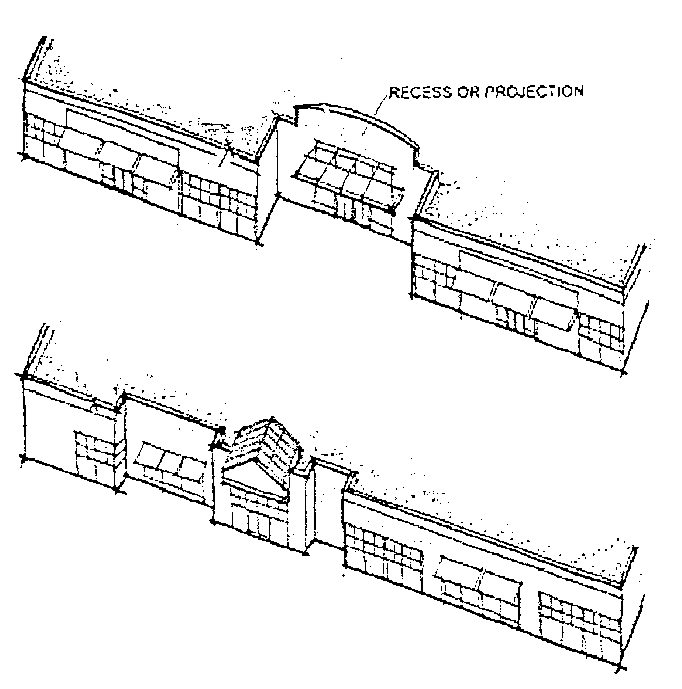
b.
Providing a porch, patio, deck, covered entry to portions of the façade at the ground level, or in the case of buildings containing two or more story, balconies.
c.
Changing the roofline by alternating dormers, or using stepped roofs, gables, or other roof elements.
d.
Changing materials with the change in building plane.
42-172.4.
Rooflines. Roof planes shall be varied to increase visual interest, and awnings above windows and entrances are strongly encouraged (but not required) to help provide visual interest.
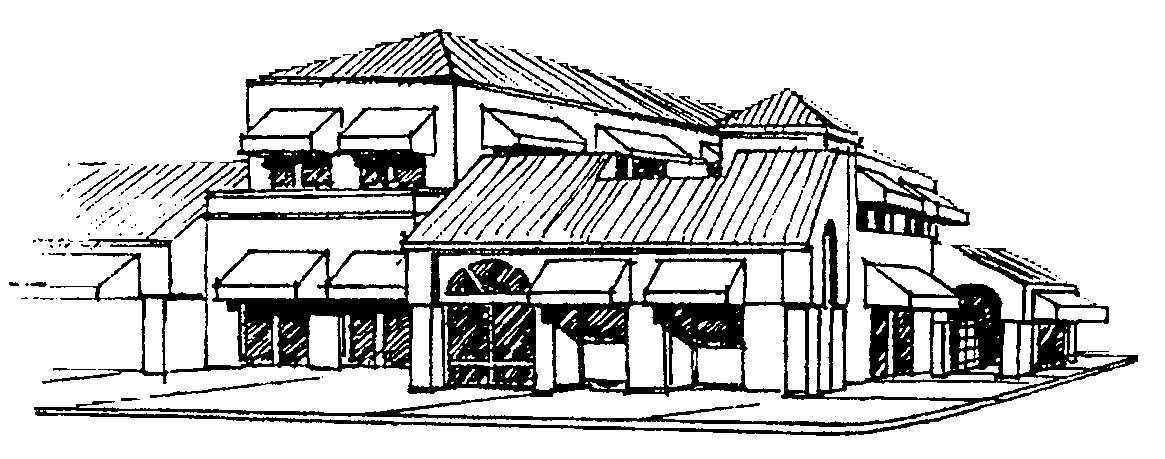
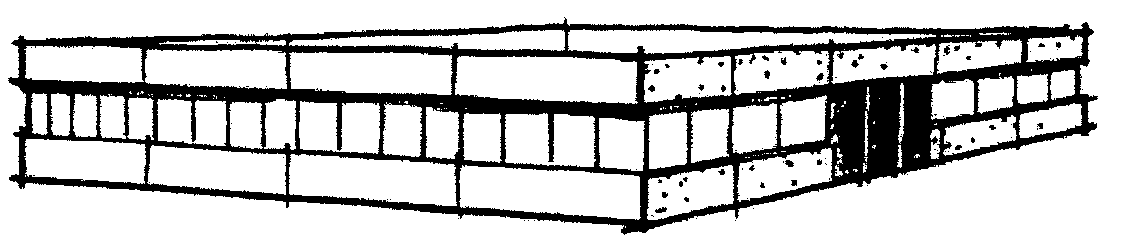
Flat roofs are not permitted.
42-172.5.
Colors. The use of high-intensity colors, metallic colors, black or fluorescent colors shall be prohibited.
42-172.6.
Façade remodel. When the façade of an existing commercial structure is remodeled, building materials on facades, visible from a public street, shall be composed of brick masonry or stone, textured masonry block, stucco; or wood siding. Standing-seam or corrugated metal walls shall not be permitted.
(Ord. No. 12-22-20, 1-5-2021; Ord. No. 08-21-01, § 3, 9-7-2021; Ord. No. 09-22-01, § 1, 10-4-2022)

