
Corning City Zoning Code
DIVISION 17.3
LAND USE DESCRIPTIONS AND STANDARDS
17.3.01 - PURPOSE.
The purpose of this chapter is to list, describe, and provide regulations specific to various land uses allowed in one or more zoning districts under Section 17.2.100. The following sections are organized according to general categories of uses, including rural; residential; commercial; institutional and recreational; utility and transportation; telecommunication facilities; industrial; and accessory land uses. Following the listing of each specific land use is a paragraph describing that land use. In many cases, one or more regulations related to that land use are then provided, including minimum parking space requirements.
17.3.02 - RURAL LAND USES.
(1)
AGRICULTURAL RECREATION AND HOBBY USE. Includes operations conducted as a principal use of a parcel in which agricultural commodities and livestock are used for either hobby or recreational purposes or to supplement household food supply. Does not include any use defined as a "farm" under Section 17.1.14. (Am. #2024-02-755)
Regulations:
(a)
Shall meet requirements associated with the keeping of animal units as specified in Section 17.5.09.
(b)
Accessory farm structures including, but not limited to, barns, sheds, silos, equipment garages, and towers may be located on the same lot as a primary farm operation, or on a separate lot in conjunction with the farm operation.
(2)
LIGHT AGRICULTURAL USE. Includes farm operations in which agricultural commodities, livestock, or both are used as sources for supplementing household food supplies and income. Such operations generally do not employ nonfamily labor. Such operations shall keep no more than 100 animal units. Examples of such land uses include, but are not limited to, croplands; orchards; cranberry bogs and harvesting facilities; exotic animal raising; small dairy farms; small stables; beekeeping; sod farms; aviaries; and the harvesting of wild crops such as marsh hay, ferns, moss, wild rice, maple syrup, berries, tree fruits and tree seeds in a manner that is not injurious to natural reproduction of such crops.
Regulations:
(a)
Shall meet requirements associated with the keeping of animal units as specified in Section 17.5.09.
(b)
Accessory farm structures including, but are not limited to, barns, sheds, silos, equipment garages, and towers may be located on the same lot as a primary farm operation, or on a separate lot in conjunction with the farm operation.
(c)
Accessory outdoor storage areas for farm-related materials may be located on the same lot as the active, principal farm operation use, provided that such area is completely screened from public roads and residentially zoned properties, confined to one area, does not accept or store materials from outside the farm operation unless intended for use by the farm operation, and meets all applicable State regulations.
(d)
Cranberry bogs and harvesting shall not be allowed in any residential zoning district.
(e)
May be subject to additional restrictions upon conditional use permit approval in districts where allowed as a conditional use.
(3)
GENERAL AGRICULTURAL USE. Includes farm operations in which agricultural commodities, livestock, or both are raised with the intention of being commercially viable operations. A commercially viable operation is defined as one that provides the majority of the owner/operators annual income and frequently employs nonfamily labor. Such operations may keep between 101 and 500 animal units. Examples of such land uses include, but are not limited to, feed lots, hog farms, large stables, poultry operations, fish farms, dairy operations, commercial greenhouse operations, and value added agriculture for products raised on site.
Regulations:
(a)
Shall meet requirements associated with the keeping of animal units as specified in Section 17.5.09.
(b)
Accessory farm structures including, but not limited to, barns, sheds, silos, equipment garages, and towers may be located on the same lot as a primary farm operation, or on a separate lot in conjunction with the farm operation.
(c)
Accessory outdoor storage areas for farm-related materials may be located on the same lot as the active, principal farm operation use, provided that such area is completely screened from public roads and residentially zoned properties, confined to one area, does not accept or store materials from outside the farm operation unless intended for use on the by the farm operation, and meets all applicable State regulations.
(4)
INTENSIVE AGRICULTURAL USE. Includes large-scale farm operations in which agricultural commodities, livestock, or both are raised with the intention of being commercially viable operations. A commercially viable operation is defined as one that provides the majority of the owner/operators annual income and frequently employs nonfamily labor. Such operations may have more than 500 animal units. Examples of such land uses include, but are not limited to, feed lots, large hog farms, large stables, poultry operations, fish farms, large dairy operations, commercial greenhouse operations, and value added agriculture for products raised on site. (Am. #2006-11-491)
Regulations: The following regulations shall apply with exceptions provided for certain livestock facilities covered under Wis. Adm. Code ATCP 51. Refer to ATCP 51 for applicable regulations.
(a)
Shall meet requirements associated with the keeping of animal units as specified in Section 17.5.09.
(b)
Shall submit, be approved by the Lincoln County Land Services Department, and implement soils information, an erosion control plan, a nutrient management plan, and stormwater management plan, meeting all applicable County and State standards. (Am. #2025-10-786)
(c)
Shall maintain records regarding manure application, crop history, and testing, subject to inspection upon written request and reasonable notice from the Land Services Department. (Am. #2025-10-786)
(d)
Shall meet all agricultural performance standards in ATCP 50 and NR 151, Wis. Adm. Code.
(e)
Shall not be located in, or adjacent to, a major subdivision.
(f)
Accessory farm structures including, but not limited to, barns, sheds, silos, equipment garages, and towers may be located on the same lot as a primary farm operation, or on a separate lot in conjunction with the farm operation.
(g)
Accessory outdoor storage areas for farm-related materials may be located on the same lot as the active, principal farm operation use, provided that such area is completely screened from public roads and residentially zoned properties, confined to one area, does not accept or store materials from outside the farm operation unless intended for use on the by the farm operation, and meets all applicable State regulations.
(5)
AGRICULTURAL COMMERCIAL USE. Includes all operations pertaining to the retail sale, handling, processing, transport, packaging, storage, or disposal of agricultural equipment, products, by-products, or materials primarily used by agricultural operations. Examples of such land uses include, but are not limited to, agricultural implement sales, storage, or repair operations; feed and seed stores; agricultural chemical dealers and/or storage facilities; animal feed storage facilities; commercial dairies; food processing facilities; slaughterhouse; meat processing; licensed farm auction operations; canning and other packaging facilities; greenhouses and garden centers; orchard stores; and agricultural waste disposal facilities. Also includes farms open to the public for demonstrations, tours, hayrides, regular farm breakfasts, and other similar events. (Am. #2024-02-755)
Regulations:
(a)
Shall not be located in, or adjacent to, a major residential subdivision.
(b)
Slaughterhouses and Meat Processing operations shall be located no less than 1,000 feet from any residential structure other than that of the owner of the property, agent, or employee.
(c)
All refuse shall be stored within containers secured from disturbance by wildlife. Except when temporarily placed for pickup, all such containers shall be located or screened so as not to be in public view.
Parking Requirements: One parking space per employee on the largest work shift or one space for every 200 square feet of product display area, depending on the specific land use type.
(6)
FORESTRY COMMERCIAL USE. Includes operations pertaining to the handling, transport, processing, storage, sale, or repair of forestry equipment, products, by-products, or materials primarily used by forestry operations. Examples of such land uses include, but are not limited to, commercial logging operations, non-portable sawmills, debarking operations, chipping facilities, maple syrup production and sales, and similar uses. Not included within this land use category are portable sawmills, paper mills, box manufacturing operations, or other large scale packaging or finish processing facilities. (Am. #2024-02-755)
Regulations: Shall not be located in, or adjacent to, a major subdivision.
Parking Requirements: One parking space per employee on the largest work shift or one space for every 200 square feet of product display area, depending on the specific land use type.
(7)
SILVICULTURE USE. Includes all commercial logging operations primarily oriented to the outdoor planting, thinning and harvesting of timber, pulp woods, and other forestry products for commercial purposes. This land use includes trees which are raised as a crop to be replaced with more trees after harvesting, such as tree nurseries or Christmas tree operations. Also includes cranberry bogs, maple syrup tapping, and wild rice harvesting. (Am. #2024-02-755)
Regulations:
(a)
Accessory forestry structures including, but not limited to, sheds, equipment garages, towers, and barns, may be located on the same lot as a primary forest operation, or on a separate lot in conjunction with the forestry operation.
17.3.03 - RESIDENTIAL LAND USES.
(1)
SINGLE-FAMILY DWELLING. A dwelling unit designed for, converted to, and/or occupied by one family and not attached to another dwelling unit. This land use category does not include a mobile home. This land use category includes a manufactured home as described in this section, but only if said manufactured home meets the following regulations applicable to all single-family dwellings.
Regulations:
(a)
All wheels, axles, transportation lights, and other related towing apparatuses shall be removed.
(b)
The dwelling must be attached to a finished, permanent foundation, such as a poured concrete slab or a basement. (Am. #2024-02-756)
(c)
Shall provide an acceptable sewage treatment and/or disposal system meeting the requirements of all applicable State regulations and Chapter 22 of the Lincoln County Code of Ordinances.
Parking Requirements: 2 spaces per dwelling unit. (Cr. #2006-06-477)
(2)
FARM DWELLING. A specific subcategory of single-family dwelling located on the same property as any of the principal agricultural land uses listed in this chapter and occupied by one or more family members who earns a substantial part of their livelihood from farm operations on the farm. There may be a second farm dwelling on a lot or parcel if this criterion is met. (Am. #2025-10-786)
Regulations: Shall provide an acceptable sewage treatment and/or disposal system meeting the requirements of all applicable State regulations and Chapter 22 of the Lincoln County Code of Ordinances.
(3)
SEASONAL DWELLING. A specific subcategory of single-family dwelling used on an intermittent basis for recreational purposes such as, but not limited to, a vacation cottage, recreational cabin, or hunting cabin. Because its impacts are typically less than those of a single-family dwelling occupied on a more regular or permanent basis, a seasonal dwelling meeting the regulations below is allowed in additional zoning districts per Section 17.2.100.
Regulations:
(a)
May not be utilized as the primary residence of any individual.
(b)
May not be occupied more than 180 days in any 365-day period.
(c)
Any dwelling that does not meet any of the regulations in subsections (a) through (c) shall not be considered a seasonal dwelling for the purposes of this chapter, but instead shall be regulated as a standard single-family dwelling.
(d)
Shall provide an acceptable sewage treatment and/or disposal system meeting the requirements of all applicable State regulations and Chapter 22 of the Lincoln County Code of Ordinances.
Parking Requirements: 2 spaces per dwelling unit. (Cr. #2006-06-477)
(4)
TWO-FAMILY DWELLING. A building designed or altered to provide 2 attached dwelling units for 2 separate families, including two-flats, duplexes, granny flats, and buildings or sites with over-garage apartments. Each dwelling unit may be owner-occupied or renter-occupied, with the unit and/or land held in fee simple or condominium ownership. In the case of duplexes, the 2 dwelling units may or may not be located on separate lots. Where each side of the duplex is located on a separate lot, the following regulations shall apply. (Am. #2024-02-756; Am. # 2025-04-779)
Regulations (Where Each Unit Located on Separate Lot):
(a)
The entire building shall be constructed at one time.
(b)
The common wall shall be a minimum one hour fire wall running from the lowest floor level, from the basement to the underside of the roof sheathing, except that basements shall be provided across lot lines where necessary for utility services.
(c)
Matters of mutual concern to the adjacent property owners due to construction, catastrophe, and maintenance shall be guarded by deed restrictions, which shall be recorded with the Lincoln County Register of Deeds before a zoning permit is issued.
(d)
Shall provide an acceptable sewage treatment and/or disposal system meeting the requirements of all applicable State regulations and Chapter 22 of the Lincoln County Code of Ordinances.
Parking Requirements: 2 spaces per dwelling unit.
(5)
MULTIPLE-FAMILY DWELLING. A building designed or altered to provide 3 or more attached dwelling units, with each dwelling unit occupied by a separate family. Each dwelling unit may be owner-occupied or renter-occupied, with the building, lot, and/or unit in fee simple or condominium ownership. Multiple-family dwellings containing greater than 8 dwelling units shall be subject to additional regulations due to their potential impact on rural character, neighborhood impact, parking, and traffic. Where each dwelling unit is located on a separate lot, a separate set of regulations shall apply. Both sets of regulations are as indicated below.
Regulations (For Multiple-family dwellings With Greater Than 8 Units):
(a)
The project shall meet all application and review standards included in Sections 17.8.30 (for conditional uses) and 17.8.40 (for site plan review).
(b)
At least one parking space per unit shall be provided within a fully enclosed garage, either at grade or subgrade.
(c)
Surface parking lots and garages shall be located and/or buffered with landscaping, varied setbacks or recessed garage doors, or some combination so that they are not the dominant visual elements from public roads.
(d)
All refuse containers shall be located indoors or screened from public view per the standards in Section 17.5.05.
(e)
Shall provide a minimum of 1,000 square feet of common recreation open space, plus an additional 450 square feet for each unit beyond 3 units. Such common open space shall be regular in shape and shall not be subject to flooding or lengthy periods of wet conditions. Common recreation open space shall be maintained in perpetuity by the property owner or designated agent. (Am. #2024-02-756)
(f)
Shall provide an acceptable sewage treatment and/or disposal system meeting the requirements of all applicable State regulations and Chapter 22 of the Lincoln County Code of Ordinances.
Regulations (Where Each Unit is Located on a Separate Lot):
(a)
The entire building shall be constructed at one time.
(b)
The common wall shall be a minimum one-hour fire wall running from the lowest floor level, from the basement to the underside of the roof sheathing, except that basements shall be provided across lot lines where necessary for utility services.
(c)
Matters of mutual concern to the adjacent property owners due to construction, catastrophe, and maintenance shall be guarded by private covenants or deed restrictions, which shall be recorded with the Lincoln County Register of Deeds before a zoning permit is issued.
(d)
Shall provide an acceptable sewage treatment and/or disposal system meeting the requirements of all applicable State regulations and Chapter 22 of the Lincoln County Code of Ordinances.
Parking Requirements: 2 spaces per dwelling unit.
(6)
MOBILE HOME. A transportable factory built structure as is defined in §101.91, Wis. Stats., designed for long-term occupancy by one family and built prior to June 15, 1976, the effective date of the Federal Manufactured Housing Construction and Safety Standards Act. A mobile home is not considered to be a type of single-family dwelling for the purposes of this chapter. (Am. #2024-02-756)
Regulations:
(a)
In districts where they are allowed, except for seasonal mobile homes allowed in the Forestry zoning district, the mobile home must be attached to a finished, permanent foundation, such as a poured concrete slab or a basement, which complies with the requirements of Chapters 20 through 25 of the Wisconsin Uniform Dwelling Code.
(b)
Mobile homes placed within mobile home parks are subject to all applicable regulations associated with that land use category.
(c)
In the Forestry zoning district, mobile homes shall meet all regulations associated with seasonal dwellings.
(d)
Shall provide an acceptable sewage treatment and/or disposal system meeting the requirements of all applicable State regulations and Chapter 22 of the Lincoln County Code of Ordinances.
(e)
Shall provide skirting to comply with Wisconsin Uniform Dwelling Code. (Cr. #2006-06-477; Am. #2024-02-756))
Parking Requirements: 2 spaces per mobile home.
(7)
MANUFACTURED HOME. A residential dwelling for one family as is defined in §101.91(2), Wis. Stats., fabricated in an off-site facility for installation or assembly at the building site, bearing a HUD label or insignia certifying that it is built in compliance with the Federal Manufactured Housing Construction Standards under 42 U.S.C. § 5401 to 5426, and built after June 14, 1976. A manufactured home shall be considered a single-family dwelling for the purposes of this chapter only where it meets the regulations of Section 17.3.03(1).
Regulations:
(a)
Manufactured homes placed within manufactured home parks are subject to all applicable regulations associated with that land use category.
(b)
In the Forestry zoning district, manufactured homes shall meet all regulations associated with seasonal dwellings.
(c)
Shall provide an acceptable sewage treatment and/or disposal system meeting the requirements of all applicable State regulations and Chapter 22 of the Lincoln County Code of Ordinances.
(d)
Shall provide skirting to comply with Wisconsin Uniform Dwelling Code. (Cr. #2006-06-477; Am. #2024-02-756)
Parking Requirements: 2 spaces per manufactured home.
(8)
MANUFACTURED HOME PARK; MOBILE HOME PARK. A parcel of land or subdivision used for the placement of 2 or more mobile homes and/or manufactured homes. Manufactured home developments and subdivisions shall not be included under this land use category where all manufactured homes meet the regulations of Section 17.3.03(1).
Regulations:
(a)
The applicant for rezoning to the MH Mobile Home Park district shall submit the following information with the application to the Zoning Administrator:
1.
A written description of the proposed mobile or manufactured home park, including proposed terms of sale or lease of sites; park rules; a maintenance program and responsibilities; types of homes to be constructed or allowed; other ancillary uses for the site; and assurances that the site will be developed and operated in accordance with all approved plans, including bylaws and deed restrictions.
2.
A site plan map(s), drawn to scale, and including information listed in Section 17.8.40 plus the proposed mobile or manufactured home park layout; location of home sites, roads, parking areas, and site boundaries; existing topography lines; existing natural features including waterways, wetlands, floodplains, woodlands, and shoreland areas; required perimeter and home setbacks and spacing; existing and proposed buildings and other structures; water supply well and lines; sanitary waste disposal lines and system; grading and stormwater management plan; covered or screened refuse storage areas; proposed types and locations of landscape plantings and recreation areas; proposed development phasing if any; and any other information the Zoning Administrator shall deem necessary. Professional engineering assistance is encouraged in such design, especially of roadways, home siting, site grading and stormwater management, and utility placement.
(b)
Shall conform to requirements of Wisconsin Administrative Code Chapter Comm 95. (Am. #2024-02-756)
(c)
Shall provide an acceptable sewage treatment and/or disposal system meeting the requirements of all applicable State regulations and Chapter 22 of the Lincoln County Code of Ordinances.
(d)
Shall conform to all dimensional requirements of the MH Mobile Home Park district, per Section 17.2.41.
(e)
Shall have direct access to a public road and a circulation plan that facilitates the safe and efficient movement of emergency vehicles.
(f)
All access interior park roads shall be a minimum of 20 feet in width. All interior park roads, driveways to individual home sites, and parking areas shall be hard surfaced, and maintained in a dust-free condition. Where driveways to individual home sites are located on opposite sides of the road, they shall be offset to avoid collisions when backing out.
(g)
Lighting meeting the standards in Section 17.5.04 shall be provided at all intersections of interior park roads with one another and with public roads, and at common areas such as mailbox locations, dumpsters, and playgrounds.
(h)
All dumpsters shall be screened per the standards in Section 17.5.05.
(i)
Home sites and access drives shall be located, graded, and maintained to provide each site with positive site drainage and for each site to be free from flooding. All sites shall be provided with anchor points for securing mobile or manufactured homes.
(j)
Shall provide a minimum of one acre of common recreation open space, plus an additional 500 square feet for each home site or lot in the park. The minimum required perimeter setback and individual home sites shall be included in the gross site area, but not in the calculation of common recreation open space. Such common open space shall be regular in shape and shall not be subject to flooding or lengthy periods of wet conditions. Common recreation open space shall be maintained in perpetuity by the mobile or manufactured park owner.
(k)
Each mobile or manufactured home, principal and accessory building, and vehicle parking area shall meet the minimum shoreland setback associated with any navigable waterway in Chapter 21 of the Lincoln County Code of Ordinances and the highway setback requirements of Section 17.4.10. There shall be a 40-foot landscaped buffer setback from all other exterior lot lines of the mobile or manufactured home park to all home sites, roads, parking areas, recreation areas, wells, and private sewage disposal systems. Roads and utility crossings of the buffer setback shall be minimized and shall occur at right angles wherever possible. The project shall provide a landscaped bufferyard (see Section 17.5.05) along all exterior lot lines.
(l)
All mobile or manufactured homes shall be used for dwelling purposes. No mobile or manufactured home site shall be rented for a period of less than 30 days.
(m)
The mobile or manufactured home park shall be owned by a single individual, trust, partnership, public or private association, or corporation, except for a mobile or manufactured home subdivision, where a homeowners association shall be established for the management and maintenance of all common areas not in public ownership.
Parking Requirements: 2 hard-surfaced parking spaces per home.
(9)
CAMPING UNIT. Includes any portable device used as a temporary dwelling, including but not limited to a camping trailer, motor home, recreational vehicle, or tent. Does not include the storage of such camping unit on a lot. (Am. #2018-05-659; #2024-02-756)
Regulations:
(a)
County permits, as identified in Section 17.2.100 shall be required for any camping unit that is occupied on a property for over 60 days cumulative within a calendar year. (Cr. #2006-06-477; Am. #2018-05-659)
(b)
Adequate sanitation meeting all applicable State and County regulations, such as a private on-site waste disposal system or privy, shall be required for units that are occupied for over 60 days cumulative within a calendar year.
(c)
When more than one camping unit is proposed on a lot, each additional camping unit, but no more than 3, are required to have the minimum lot size required under Section 18.7.08. (For example, if the minimum lot area required is 40,000 square feet; an additional camping unit would be required to have a minimum lot size of 80,000 square feet.)
1.
Shall not be more than one occupied permitted camping unit per parcel in a residential zoning district meeting applicable setbacks. (Am. #2018-05-659
(d)
Visitant, unpermitted camping units are allowed to be occupied on the property so long as the total cumulative days of occupied visitant camping units do not exceed 60 days in a calendar year.
(e)
All stored camping units shall be closed, disconnected from electrical and water supply and be located in an area meeting applicable setbacks and outside of floodplains and wetlands.
1.
Shall not be more than one stored camping unit meeting applicable setbacks per parcel in a residential zoning district that contains a principle structure. (Cr. #2018-05-659)
(f)
Rental of any camping unit is not permitted per 17.8.51 outside of a permitted private campground/camping resort.
(g)
In the event that a permitted camping unit is replaced by a different camping unit, a new land use permit is not required, provided that the camping unit is located in an area meeting applicable setbacks and outside of floodplains and wetlands overlay zones.
(h)
Permits shall be obtained before any structure, as defined in Section 17.1.14, is erected, affixed, moved or structurally altered including, but not limited to, storage sheds, decks, gazebos, or common shelters.
(10)
ELDERLY AND CONGREGATE RESIDENTIAL FACILITY. Includes group homes, convents, monasteries, nursing homes, convalescent homes, rehabilitation centers, assisted living facilities, congregate care facilities, retirement communities, and similar land uses not considered to be community living arrangements or adult family homes under the provisions of §59.69, Wis. Stats.
Regulations:
(a)
The project shall meet all application and review standards included in Sections 17.8.30 (for conditional uses) and 17.8.40 (for site plan review).
(b)
Shall provide adequate evidence that emergency services will be provided to the site in an efficient manner.
(c)
Shall provide an off-street passenger loading area.
(d)
All structures shall be located a minimum of 50 feet from any residentially zoned property or any other residentially zoned property.
(e)
The appropriate County approval authority may require a landscaped bufferyard, per the standards in Section 17.5.05(2).
(f)
Shall provide an acceptable sewage treatment and/or disposal system meeting the requirements of all applicable State regulations and Chapter 22.
Parking Requirements:
(a)
Nursing home: One space per 6 patient beds, plus one space per employee on the largest work shift.
(b)
Monastery or convent: One space per 6 residents, plus one space per employee on the largest work shift, plus one space per 5 chapel seats if the public may attend.
(c)
Assisted living facility or retirement community: One space per dwelling unit.
(d)
Other elderly or congregate residential facility: One space per 6 residents or patient beds, plus one space per employee on the largest work shift.
(11)
CONSERVATION NEIGHBORHOOD DEVELOPMENT. A type of single-family residential major subdivision intended to preserve open space, farmland, and natural features that define, sustain, and connect rural neighborhoods and enhance Lincoln County's rural and "northwoods" character; hide or buffer development from public roads through placement, topography, vegetation, and/or setbacks; and encourage housing on moderately sized rural lots clustered in portions of the property best suited for development. As permitted in certain residential zoning districts (see Section 17.2.100), the conservation neighborhood development option allows for reductions from normal minimum lot size requirements in exchange for compliance with conservation neighborhood design principles described through the following regulations. The reduced minimum lot sized standards are included in Section 17.2.101.
Regulations:
(a)
The subdivider shall demonstrate to the satisfaction of the Land Services Committee that they have followed the steps in the design of conservation neighborhood developments included in the comprehensive plan and Chapter 18 of the Lincoln County Code of Ordinances. (Am. #2018-05-659; Am. #2025-10-786)
(b)
Natural resources shall be integrated into the subdivision design as aesthetic and conservation landscape elements. The subdivision shall identify and provide for the permanent preservation of environmentally sensitive areas such as wetlands, hydric soils, floodplains, slopes of 15 percent or greater, areas of rare or endangered plant or animal species, or historic and archaeological sites. Permanent preservation shall be achieved through the implementation of techniques such as conservation easements, restrictive covenants, deed restrictions, dedication to the public or an appropriate nonprofit organization, and/or establishment of buildable or "no build" areas on the plat.
(c)
Where the subdivision includes a mature woodland, the subdivider shall identify the edges of said woodland and provide for the preservation of a substantial percentage of the woodland canopy area unless the Land Services Committee determines this standard to be impractical. During the process of subdivision review and development, no grading, tree removal, or home building shall occur within such woodland. (Am. #2018-05-659)
(d)
Where the subdivision includes prime farmland soils, and such soils have been cultivated within the previous 5 years, the subdivider shall identify and provide for the preservation of such farmland to the extent practical.
(e)
The subdivision shall provide for the recreational needs of its future residents through trails, parks, dog runs, or other passive recreational space or facilities geared and accessible to residents. Where an adopted town or County comprehensive plan, land use plan, or outdoor recreation plan recommends a park, trail, or other recreational facility for the proposed plat area, the subdivider shall make reasonable accommodation for the recommended facility. Common open space shall be protected by legal arrangements satisfactory to the Land Services Committee. (Am. #2018-05-659)
(f)
A minimum of 25 percent of the gross site area shall be located within permanently preserved natural areas, common recreational areas, and/or farmland, not including any lands required for public dedication under Chapter 18 of the Lincoln County Code of Ordinances or any lands within lots platted as homesites.
(g)
Lots, dwellings, and internal roads shall be placed to minimize their visibility from existing public roads and to conform to the landscape. This shall be accomplished by:
1.
Designing lots with frontage on a Federal, State, or County highway so the dwellings will face away from the highway, with deep lots and a landscaped bufferyard along the highway meeting the standards of Section 17.5.05.
2.
Designing roads and lot layouts to blend with the natural land contours.
3.
Using topography and vegetation to screen dwellings to the extent practical.
4.
Minimizing dwellings in open fields and on exposed hilltops and ridgelines.
5.
Preserving tree lines, fence lines, stone rows, existing farm roads, barns, cabins, and other features of the rural landscape to the extent practical.
(h)
The subdivision shall include stormwater management systems that focus on Best Management Practices (BMPs). BMPs may include overland water transfer, natural landscape planting and restoration to increase infiltration and reduce runoff, bioinfiltration systems, natural basin design, residential roof runoff directed to yard areas, and rain gardens. Such techniques shall be integrated in a stormwater management and erosion control plan submitted with the conditional use permit application.
(i)
Shall provide an acceptable sewage treatment and/or disposal system meeting the requirements of all applicable State regulations and Chapter 22.
EXAMPLE OF CONSERVATION NEIGHBORHOOD DEVELOPMENT
COMPARED TO CONVENTIONAL DEVELOPMENT
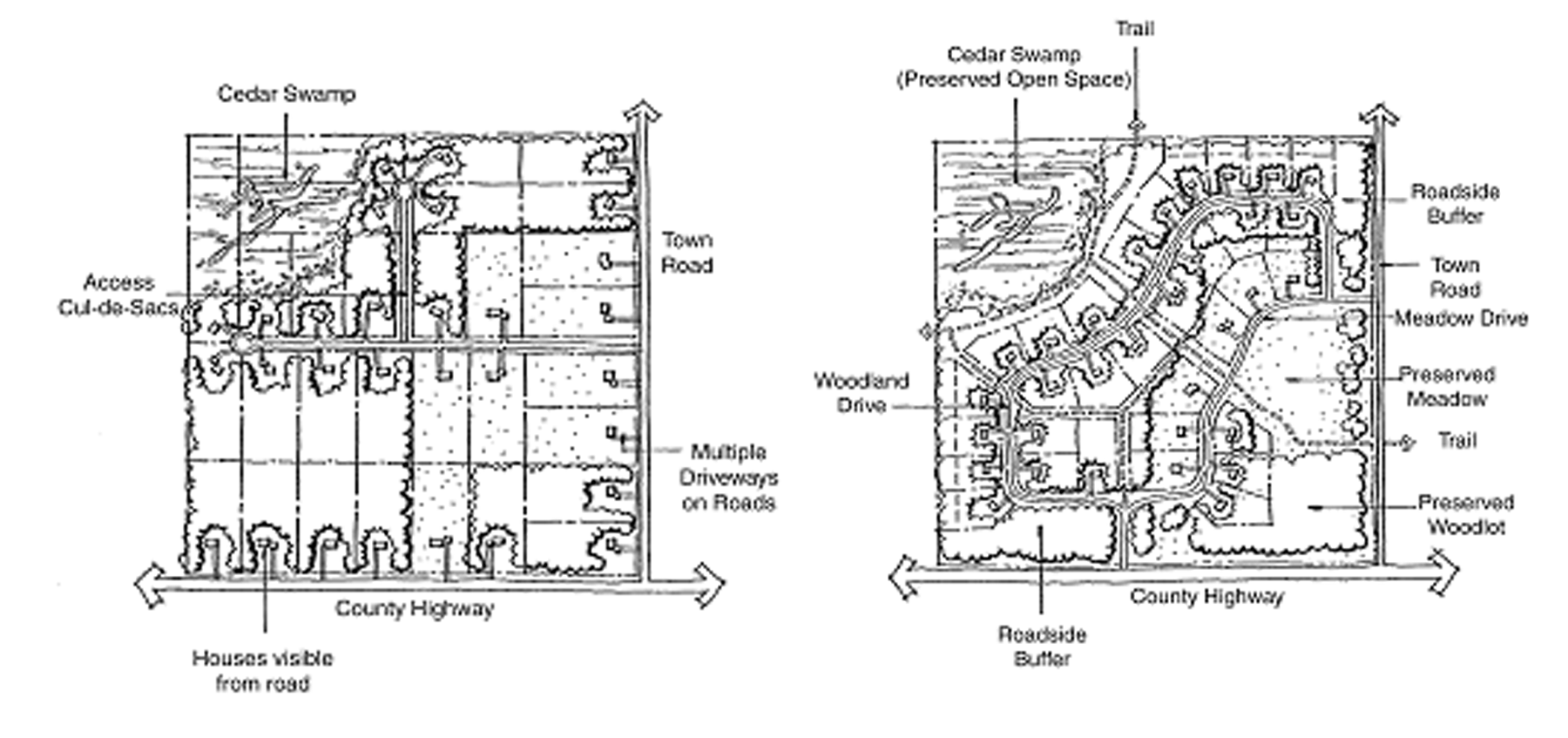
DEVELOPMENT OPTIONS
(12)
GOLF COURSE COMMUNITY. A type of residential development designed in conjunction with, and integrated within, a golf course or similar outdoor recreational use.
Regulations:
(a)
It may include only the following housing types: single-family dwelling, two-family dwelling, or seasonal dwelling. (Am. #2006-06-477)
(b)
If the project includes condominium housing, the standards of Section 17.4.03(4) shall apply with respect to individual condominium site size, except that gross site area shall not consider the land occupied by the golf course (fairways, greens, etc.).
(c)
May include only those commercial uses that are related to the golf course or similar outdoor recreation use.
(d)
Shall provide an acceptable sewage treatment and/or disposal system meeting the requirements of all applicable State regulations and Chapter 22.
Parking Requirements: 2 spaces per dwelling unit, plus one space per 4 expected patrons at maximum typical capacity of the golf course, similar to recreational use, and associated commercial facilities.
17.3.04 - COMMERCIAL LAND USES.
(1)
OFFICE. Includes all exclusively indoor land uses whose primary functions are the handling of information or administrative services. Such land uses do not typically provide services directly to customers on a walk-in or on-appointment basis.
Parking Requirements: One space per 300 square feet of gross floor area in the principal building(s).
(2)
PERSONAL OR PROFESSIONAL SERVICE. Includes all exclusively indoor land uses whose primary function is the provision of commercial services directly to an individual on a walk-in or on-appointment basis. Examples of such uses include professional services, insurance or financial services, realty offices, barber shops, beauty shops, indoor repair and maintenance land uses (except for motor vehicles), and related land uses. Does not include any uses described under the "vehicle maintenance or repair", "major indoor institutional use," "minor indoor institutional use," or "adult use" land use categories in this section.
Parking Requirements: One space per 300 square feet of gross floor area in the principal building(s).
(3)
INDOOR SALES. Includes all principal land uses that conduct or display sales or rental merchandise or equipment completely or nearly completely within an enclosed building, including the provision of incidental service and indoor repair uses. Includes general merchandise stores, grocery stores, bait shops, sporting goods stores, antique stores, gift shops, laundromats, artisan studios, bakeries, and a number of other uses meeting this definition. Does not include uses otherwise classified in the "agricultural commercial use," "forestry commercial use," or "adult use" land use categories.
Regulations:
(a)
Any outdoor sales or display area shall be less than 15 percent of the gross floor area of the principal building in which sales are also conducted. If the outdoor sales or display area exceeds that threshold, then the land use shall instead be classified as an "outdoor sales, display, or repair" land use.
Parking Requirements: One space per 300 square feet of gross floor area in the principal building(s).
(4)
OUTDOOR SALES, DISPLAY, OR REPAIR (RECREATIONAL). Includes uses that conduct or display recreation-oriented merchandise outside of an enclosed building that is for sale or rent and land uses that conduct maintenance or repairs on recreation-oriented merchandise outside of an enclosed building. Recreation-oriented merchandise includes merchandise, vehicles, and equipment geared to seasonal residents, tourists, and local recreationalists, such as boats, personal watercraft, snowmobiles, ATVs, recreational vehicles, campers, sporting goods, and wood and other fuel. Such land uses do not include uses where the outdoor sales or display area is less than 15 percent of the gross floor area of any principal building where sales are also conducted, which are instead classified in the "indoor sales" land use category; nonrecreational motor vehicle repair or maintenance, which are instead classified in the "in-vehicle sales and service" category; drive-in theaters, which are instead classified in the "outdoor commercial entertainment" category; or the storage or display of inoperative vehicles or materials typically associated with a junkyard or salvage yard.
Regulations:
(a)
The appropriate County approval authority may require a landscaped bufferyard, per the standards in Section 17.5.05(2).
(b)
Outdoor sales, display or repair areas shall be set back from all property lines and roads a distance equal to the required principal building setbacks and shall not be located within landscaped bufferyards.
(c)
The display of items shall not interfere with traffic visibility or reduce or inhibit the use or number of parking spaces provided on the property below the requirement established below. If the number of provided parking spaces on the property is already less than the requirement, such display area shall not further reduce the number of spaces already present.
(d)
Outdoor display shall be permitted during the entire calendar year, except if otherwise limited by conditional use permit. If goods are removed from the display area, all support fixtures used to display the goods and associated signs, banners, temporary fences, or other associated items shall also be removed.
Parking Requirements: One space per 300 square feet of gross floor area in the principal building(s), plus one space per 2,000 square feet of outdoor sales or display area.
(5)
OUTDOOR SALES, DISPLAY, OR REPAIR (GENERAL). Includes uses that conduct or display merchandise outside of an enclosed building that is for sale or rent and land uses that conduct maintenance or repairs on merchandise or equipment outside of an enclosed building. Examples of such land uses include vehicle sales, vehicle rental, manufactured and mobile home sales, monument sales, and lawn mower repair. Includes all land uses classified as "outdoor sales, display, or repair (recreational)." Such land uses do not include uses where the outdoor sales or display area is less than 15 percent of the gross floor area of any principal building where sales are also conducted, which are instead classified in the "indoor sales" land use category; motor vehicle repair or maintenance, which are instead classified in the "in-vehicle sales and service" category; drive-in theaters, which are instead classified in the "outdoor commercial entertainment" category; or the storage or display of inoperative vehicles or materials typically associated with a junkyard or salvage yard.
Regulations:
(a)
The appropriate County approval authority may require a landscaped bufferyard, per the standards in Section 17.5.05(2).
(b)
Outdoor sales, display or repair areas shall be set back from all property lines and roads a distance equal to the required principal building setbacks and shall not be located within landscaped bufferyards.
(c)
The display of items shall not interfere with traffic visibility or reduce or inhibit the use or number of parking spaces provided on the property below the requirement established below. If the number of provided parking spaces on the property is already less than the requirement, such display area shall not further reduce the number of spaces already present.
(d)
Outdoor display shall be permitted during the entire calendar year, except if otherwise limited by conditional use permit. If goods are removed from the display area, all support fixtures used to display the goods and associated signs, banners, temporary fences, or other associated items shall also be removed.
Parking Requirements: One space per 300 square feet of gross floor area in the principal building(s), plus one space per 2,000 square feet of outdoor sales or display area.
(6)
IN-VEHICLE SALES OR SERVICE. Includes all land uses that perform sales and/or services to persons in vehicles, or to vehicles which may or may not be occupied at the time of such activity. Such land uses include any business with a drive-in, drive-up, or drive-through facilities, vehicular fuel stations, and car washes, but do not include "vehicle repair or maintenance service" uses.
Regulations:
(a)
Any drive-through facility shall be designed to meet all State requirements and to not impede or impair vehicular and pedestrian movement and safety. This requires unimpeded stacking space for a minimum of 4 vehicles behind all stations where transactions occur.
(b)
The appropriate County approval authority may require a landscaped bufferyard, per the standards in Section 17.5.05(2).
(c)
All overhead canopies, menu boards, or similar structures shall be set back from all property lines and roads a distance equal to the required principal building setbacks and shall not be located within landscaped bufferyards.
(d)
All vehicular areas of the facility shall provide a surface paved with concrete or bituminous material designed to meet the requirements of a 4-ton axle load.
(e)
Interior curbs shall be used to separate driving areas from exterior fixtures such as fuel pumps, vacuums, menu boards, canopy supports and landscaped islands. Said curbs shall be a minimum of 6 inches high and be of a nonmountable design.
(f)
Shall provide a vehicle throat length of at least 20 feet within the driveway connecting to the public street.
Parking Requirements: One space per 150 square feet of gross floor area in the principal building(s).
(7)
VEHICLE REPAIR OR MAINTENANCE SERVICE. Includes all principal land uses that perform repair, maintenance, or painting services to motorized vehicles. Does not include "expanded home occupations" that are accessory to the principal residential use of a property.
Regulations:
(a)
The appropriate County approval authority may require a landscaped bufferyard, per the standards in Section 17.5.05(2).
(b)
All major repairs, maintenance, service, painting and other operations (except vehicle storage) shall occur within an enclosed building.
(c)
Shall only include the storage of vehicles of customers and employees of the vehicle repair or maintenance service business.
(d)
Shall not include the storage of 3 or more vehicles that do not have a valid current State registration, license plate, or both.
Parking Requirements: One space per 300 square feet of gross floor area in the principal building(s), plus adequate parking for the storage of vehicles awaiting service or pick-up.
(8)
RESTAURANT. Includes commercial establishments where food and beverages are prepared, served, and consumed primarily within the principal building and where food sales constitute more than 50 percent of the gross sales receipts for food and beverages. Any drive-through or drive-in facilities shall also be classified as an "in-vehicle sales or service" use, which requires a separate land use review.
Parking Requirements: One space per 150 square feet of gross floor area in the principal building(s).
(9)
INDOOR COMMERCIAL ENTERTAINMENT. Includes land uses that provide entertainment services entirely within an enclosed building. Such activities often have operating hours that extend later than most other commercial land uses. Examples of such land uses include event venues, taverns, night clubs, brewpubs, theaters, health or fitness centers, all forms of training studios (dance, art, martial arts, etc.), bowling alleys, arcades, roller rinks, and pool halls. Does not include any uses described under the "adult uses" land use category. Any drive-through or drive-in facilities shall also be classified as an "in-vehicle sales or service" use, which requires a separate land use review. (Am. #2024-02-757)
Regulations:
(a)
If located on the same side of the building as adjacent to residentially zoned property, no customer entrance shall be permitted within 100 feet of that residentially zoned property.
(b)
The appropriate County approval authority may require a landscaped bufferyard, per the standards in Section 17.5.05(2).
Parking Requirements: One space per every 3 patron seats or one space per 3 persons at the maximum capacity of the establishment, whichever is greater.
(10)
OUTDOOR COMMERCIAL ENTERTAINMENT. Includes land uses that provide entertainment services partially or wholly outside of an enclosed building. Such activities often have the potential to be associated with nuisances related to noise, lighting, dust, trash, and late operating hours. Examples of such land uses include event venues, outdoor volleyball, horseshoe pits, beer gardens, ball fields, and related facilities associated with indoor commercial entertainment land uses; outdoor commercial swimming pools; golf courses; driving ranges; miniature golf facilities; archery, trap, target, and shooting ranges; amusement parks; waterslides; marinas; drive-in theaters; go-cart tracks; and racetracks. Does not include any uses described under the "adult uses" land use category. (Am. #2024-02-757)
Regulations: The appropriate County approval authority may require a landscaped bufferyard, per the standards in Section 17.5.05(2).
Parking Requirements: One space per every 2 persons at the maximum capacity of the establishment.
(11)
HOTEL, MOTEL, OR LODGING RESORT. Includes land uses that provide 4 or more overnight nonresidential dwelling units on one lot or on contiguous lots, including groups of individual cabins, rooms, or suites of rooms, with each cabin, room, or suite having a private bathroom. Such land uses may provide in-room kitchens, and may also provide indoor and outdoor recreational facilities for the exclusive use of their customers. Restaurants, arcades, fitness centers, and other on-site facilities available to nonlodgers are not considered accessory uses, but instead are considered additional principal uses that may require separate land use reviews. Does not include "bed and breakfast establishments" or "boarding houses." (Am. #2024-02-757)
Regulations:
(a)
If located on the same side of the building as adjacent to residentially zoned property, aside from cabins, no customer entrance shall be permitted within 100 feet of that residentially zoned property.
(b)
The appropriate County approval authority may require a landscaped bufferyard, per the standards in Section 17.5.05(2).
Parking Requirements: One space per room, suite, or cabin, plus one space for every employee on the largest working shift.
(12)
RESERVED. (Rep. #2019-08-677)
(a)
Reserved. (Cr. #2006-06-477; Rep. #2019-08-677)
(13)
BED AND BREAKFAST ESTABLISHMENT. Includes exclusively indoor lodging facilities that provide breakfasts only to paying lodgers. Such land uses may provide indoor recreational facilities and passive outdoor recreation facilities such as docks and gardens, for the exclusive use of their customers. Restaurants and other on-site facilities available to nonlodgers are not considered accessory uses, but instead are considered additional principal uses that may require separate land use reviews. Does not include "boarding houses."
Regulations:
(a)
No premises shall be utilized for a bed and breakfast establishment unless there are at least 2 exits to the outdoors from such premises.
(b)
The dwelling unit in which the bed and breakfast establishment takes place shall be the principal residence of the operator/owner and said operator/owner shall live on the premises when the bed and breakfast operation is active, as required under HFS 197.03(3), Wis. Adm. Code.
(c)
The maximum stay for any occupants of a bed and breakfast operation shall be 31 consecutive days.
(d)
All such facilities shall be required to obtain a license to serve liquor, if applicable.
Parking Requirements: One space per each bedroom.
(14)
DAY CARE CENTER. Includes land uses in which qualified persons provide care services for 9 or more children or adults. Examples of such land uses include child care centers, nursery schools, and adult day care facilities. Such uses may be operated in conjunction with another principal land use on the same lot, such as a church, school, business, or civic organization, but not in a residence. In such instances, a day care center is not considered an accessory use, but instead is considered an additional principal use. Distinguished from "intermediate day care homes (9—15) children," because day care centers are principal uses of a property, not accessory to a principal residential use.
Parking Requirements: One space per every 6-person capacity of the center, plus one space or each employee on the largest working shift.
(15)
BOARDING HOUSE. Includes any residential use renting rooms which does not contain private bathroom facilities, not including licensed bed and breakfast establishments or tourist lodging houses.
Parking Requirements: One space per every room for rent, plus one space or each employee on the largest working shift.
(16)
COMMERCIAL ANIMAL SERVICES AND BOARDING. Includes land uses that provide veterinary services and/or boarding for 6 or more animals. Examples include, but are not limited to, commercial kennels, commercial stables, and animal hospitals or veterinarian clinics. Exercise yards, fields, training areas, and trails associated with such land uses are accessory to such land uses and do not require separate consideration. Also includes commercial game and fur farms.
Regulations:
(a)
Use shall be enclosed by a fence or other suitable enclosure to prevent animals from leaving the site.
(b)
Each animal shall be provided with an indoor containment area if the use is located in or adjacent to a major subdivision.
(c)
Each animal shall be provided with adequate exercise space.
(d)
The appropriate County approval authority may require a landscaped bufferyard, per the standards in Section 17.5.05(2).
Parking Requirements: One space per every 1,000 square feet of gross floor area.
(17)
ADULT USE. Includes, but is not limited to, adult entertainment uses, adult bookstores, adult motion picture theaters, adult cabarets, "strip clubs," "gentleman's clubs," or related establishments, as are defined in Section 17.1.14. It further means any premises to which public patrons or members are invited or admitted and which are so physically arranged so as to provide booths, cubicles, rooms, compartments or stalls separate from the common areas of the premises for the purpose of viewing adult-oriented motion pictures, or wherein an entertainer provides adult entertainment to a member of the public, a patron, or a member, whether or not such adult entertainment is held, conducted, operated or maintained for a profit, direct or indirect.
The incorporation of this subsection into this chapter is designed to reflect the County's official finding that adult-oriented commercial uses have a predominant tendency to produce certain undesirable secondary effects on the surrounding community, as has been demonstrated in other, similar jurisdictions. Specifically, the County is concerned with the potential for such uses to limit: the attractiveness of nearby locations for new development, the ability to attract and/or retain customers, and the ability to market and sell nearby properties at a level consistent with similar properties not located near such facilities. It is explicitly not the intent of this subsection to suppress free expression by unreasonably limiting alternative avenues of communication, but rather to balance the need to protect free expression opportunities with the need to implement the County's comprehensive plan and to protect the character and integrity of its commercial, residential, and rural areas. This finding is based on evidence concerning the adverse secondary effects of adult uses on the community presented in hearings and in reports made available to the County Board, and on findings included in the cases City of Renton v. Playtime Theatres, Inc., 475 U.S. 41 (1986), Young v. American Mini Theatres, 426 U.S. 50 (1976), Barnes v. Glen Theatre, Inc., 501 U.S. 560 (1991), City of Erie v. Pap's A.M., TDA "Kandyland", 529 U.S. 277 (2000), and City of Los Angeles v. Alameda Books, Inc. 121 S. Ct. 1223 (2001), and on studies in other communities, including but not limited to, Phoenix, Arizona; Minneapolis, Minnesota; Houston, Texas; Indianapolis, Indiana; Amarillo, Texas; Garden Grove, California; Los Angeles, California; Whittier, California; Austin, Texas; Seattle, Washington; Oklahoma City, Oklahoma; Cleveland, Ohio; and Beaumont, Texas; and also on the findings from the Report on the Attorney General's Working Group on the Regulation of Sexually Oriented Businesses (June 6, 1989, State of Minnesota.
Regulations:
(a)
Shall be allowed only in the GI General Industrial zoning district and only as a conditional use.
(b)
Shall not be located within 1,000 feet of any residential zoning district, school, religious institution, outdoor public recreation use, or any other adult use. Distances shall be measured in a straight line without regard to intervening structures or objects from the closest point of the structure or portion of the structure occupied or proposed for occupancy by the adult use to the nearest point of the lot of the other referenced land use.
(c)
All such facilities shall be required to obtain a license to serve liquor, if applicable.
Parking Requirements: One space per every 300 square feet of gross floor area in the principal building(s) or one space per person at the maximum capacity of the establishment, whichever is greater.
(18)
JUNKYARD OR SALVAGE YARD. Includes all buildings or parcels of land, or portions thereof, where the principal use is or includes the aboveground storage, collection, salvage, and/or sales of:
(a)
Waste paper, rags, scrap metal, wood, cordage, glass, and other worn-out, discarded, or second-handed materials;
(b)
Three or more vehicles or automobiles that do not have a valid current State registration, license plate, or both;
(c)
Any other waste or discarded material which has been a part, or was intended to be a part, of any vehicles, automobiles, or recreational vehicles where the volume of such parts or material is equal to 3 or more vehicles; and/or
(d)
Recycling facilities involving on-site outdoor storage of salvage materials.
This land use category does not include waste disposal/composting operations, or accessory storage areas used exclusively to provide parts or materials to a principal use on the same lot, such as a legally operating "agricultural commercial use" or "vehicle repair or maintenance use".
Regulations:
(a)
In addition to the information required by Sections 17.8.30 and 17.8.40, the conditional use permit application shall include the following information:
1.
A written description of the proposed operation, including the types and quantities of the materials that would be stored or salvaged; where materials would be hauled to and from and over what roads; proposed hours and days of operation; and any special measures that will be used for spill prevention and control and environmental protection; and assurances that the site will be developed and operated in accordance with all approved plans.
2.
A site plan, drawn to scale, and including site boundaries; existing roads, driveways, and utilities; existing natural features including lakes, streams, floodplains, wetlands, and shoreland areas; location of the proposed storage yard; proposed location and surfacing of roads, driveways, and site access points; proposed fencing of property and gating of access points; proposed location and types of screening berms and landscaping; and existing and proposed temporary and permanent structures.
(b)
Shall comply with all applicable County, State and Federal regulations, including but not limited to Section 11.04 of the Lincoln County Code of Ordinances.
(c)
The appropriate County approval authority may require a landscaped bufferyard, per the standards in Section 17.5.05(2).
(d)
All buildings, structures, outdoor storage areas, and any other activity areas shall be located a minimum of 50 feet from all lot lines.
Parking Requirements: One space for every 20,000 square feet of gross storage area, plus one space for each employee on the largest work shift.
17.3.05 - INSTITUTIONAL AND RECREATIONAL LAND USES.
(1)
COMMUNITY LIVING ARRANGEMENT (1—8 RESIDENTS). Includes all facilities provided for in §46.03(22), Wis. Stats., including child welfare agencies, group homes for children and/or adults, and community based residential facilities; along with adult family homes provided for in §50.01(1), Wis. Stats. Community living arrangements do not include day care centers, nursing homes, general hospitals, special hospitals, prisons, or jails. Community living arrangement facilities are regulated depending upon their capacity as provided for in §59.69, Wis. Stats. (Am. #2024-02-758)
Parking Requirements: Three total spaces.
(2)
COMMUNITY LIVING ARRANGEMENT (9—15 RESIDENTS). Includes all facilities provided for in §46.03(22), Wis. Stats., including child welfare agencies, group homes for children and/or adults, and community based residential facilities. Community living arrangements do not include day care centers, nursing homes, general hospitals, special hospitals, prisons, or jails. Community living arrangement facilities are regulated depending upon their capacity in §59.69, Wis. Stats. (Am. #2024-02-758)
Parking Requirements: 4 total spaces.
(3)
COMMUNITY LIVING ARRANGEMENT (16 OR MORE RESIDENTS). Includes all facilities provided for in §46.03(22), Wis. Stats., including child welfare agencies, group homes for children and/or adults, and community based residential facilities. Community living arrangements do not include day care centers, nursing homes, general hospitals, special hospitals, prisons, or jails. Community living arrangement facilities are regulated depending upon their capacity in §59.69, Wis. Stats.(Am. #2024-02-758)
Parking Requirements: 5 total spaces.
(4)
MAJOR INDOOR INSTITUTIONAL USE. Includes large scale and/or intensive institutional uses that are generally not compatible with residential land uses and that exceed one or both of the following thresholds: required to provide parking for 50 or more motor vehicles and/or provide overnight accommodations for 15 or more persons. Not included within this land use category are any uses listed in the "elderly and congregate residential facility," "day care center," "community living arrangement" land use categories.
Regulations:
(a)
Shall provide off-street passenger loading area if the majority of the users will be children (as in the case of a school, church, library, or similar land use).
(b)
All structures shall be located a minimum of 50 feet from any residentially zoned property.
(c)
The appropriate County approval authority may require a landscaped bufferyard, per the standards in Section 17.5.05(2).
Parking Requirements:
(a)
Church: One space per 5 seats at the maximum capacity.
(b)
Community or recreation center: One space per 250 square feet of gross floor area, or one space per 4 patrons to the maximum capacity, whichever is greater.
(c)
Funeral home: One space per 3 patron seats at the maximum capacity.
(d)
Hospital or clinic: 2 spaces per 3 patient beds, plus one space per staff doctor and each other employee on the largest work shift.
(e)
Library or museum: One space per 250 square feet of gross floor area or one space per 4 seats to the maximum capacity, whichever is greater.
(f)
Elementary and middle school: One space per teacher and per staff member, plus one space per 2 classrooms.
(g)
Senior high school: One space per teacher and staff member, plus one space per 5 nonbused students.
(h)
College or trade school: One space per staff member on the largest work shift, plus one space per 2 students of the largest class attendance period.
(i)
All other indoor institutional uses: One space per 3 expected patrons at capacity.
(5)
MINOR INDOOR INSTITUTIONAL USE. Includes indoor institutional uses that are generally compatible with residential land uses and that do not exceed the parking or overnight resident density thresholds that would instead classify such use as a "major institutional use." Includes uses such as small churches, small elementary or middle schools, small clinics, post offices, libraries, town halls, police stations, fire stations, training centers, nursing homes, funeral homes, and recreational or fraternal facilities such as gyms, swimming pools, museums, clubs and lodges, meeting halls, and community centers, provided that the thresholds are not exceeded. Not included within this land use category are any uses listed in the "elderly and congregate residential facility," "day care center," or "community living arrangement" land use categories.
Regulations:
(a)
Shall provide off-street passenger loading area if the majority of the users will be children (as in the case of a school, church, library, or similar land use).
Parking Requirements:
(a)
Church: One space per 5 seats at the maximum capacity.
(b)
Community or recreation center: One space per 250 square feet of gross floor area, or one space per 4 patrons to the maximum capacity, whichever is greater.
(c)
Funeral home: One space per 3 patron seats at the maximum capacity.
(d)
Clinic: 2 spaces per 3 patient beds, plus one space per staff doctor and each other employee on the largest work shift.
(e)
Library or museum: One space per 250 square feet of gross floor area or one space per 4 seats to the maximum capacity, whichever is greater.
(f)
All other indoor institutional uses: One space per 3 expected patrons at capacity.
(6)
OUTDOOR INSTITUTIONAL USE. Includes public and private cemeteries, religious and historical shrines, outdoor education and interpretive centers, classrooms, dormitories, and similar privately held permanently protected open areas. May include buildings supporting the principal outdoor institutional use, such as accessory educational, related lodging, and interpretive facilities and equipment storage sheds.
Regulations:
(a)
Shall provide off-street passenger loading area if a majority of users will be children.
(b)
All structures and actively used outdoor recreational areas shall be located a minimum of 50 feet from any residentially zoned property, or if located in a residential zoning district, any other residentially zoned property.
(c)
Recreation/education camps must meet the requirements of HFS 175, Wis. Adm. Code.
Parking Requirements: One space per 3 expected patrons at maximum capacity.
(7)
PRIVATE CAMPGROUND/CAMPING RESORT. A private campground is any privately-owned premises established for nonpermanent overnight habitation by persons paying a fee and using equipment designed for the purpose of camping, including travel trailers, recreational vehicles (RVs), pick-up trucks, motor homes, camping trailers, tents, and similar camping units as defined in Ch. ATCP 79, Wis. Adm. Code. Such facilities must have 4 or more camping units. Camping sites within private campgrounds are rented for overnight use, possibly extending to a week or 2 by the same patron. Lack of a rental fee does not exempt a campground from complying with Ch. ATCP 79 and/or Lincoln County Zoning Ordinance. A camping resort is similar to a private campground, except that allowed camping units remain on the premises for up to a season at a time, next to which unattached structures as allowed by Ch. ATCP 79 may be placed, and utilities are provided to each individual camp site. This land use category excludes publicly-owned campgrounds, which instead are listed as a type of "outdoor recreational use." (Am. #2018-05-659; #2024-02-758)
Regulations:
(a)
In addition to the information required by Sections 17.8.30 and 17.8.40, the application for a conditional use permit shall include the following information:
1.
A written description of the proposed operation, including proposed months of operation; desired types of camping units; other ancillary uses proposed for the site; and assurances that the site will be developed and operated in accordance with all approved plans.
2.
A campground/camping resort plan map(s), drawn to scale, and including the proposed campground layout; location of campsites, roads, parking areas, site boundaries; topography lines; required setbacks; existing and proposed buildings and other structures; water supplies; sanitary waste disposal system; grading plan and stormwater management system; covered refuse storage areas; existing natural features including waterways, wetlands, floodplains, and shoreland areas; existing and proposed vegetation and recreation areas, and any other information the Zoning Administrator shall deem necessary. Professional engineering assistance is encouraged in such design, especially of access roadways, camping unit siting, site grading and stormwater management, and utility placement.
3.
Campgrounds and/or camping resorts within shoreland zoning regulations must demonstrate the ability to meet Lincoln County Chapter 21 requirements.
(b)
Shall meet and be licensed by Ch. ATCP 79, Wis. Adm. Code, requirements, enforced by the State Department of Health and Family Services or its designated agent. If a waiver or variance to one or more of these requirements is granted by the State, such waiver or variance shall be deemed valid by the County except for those items listed in this subsection. (Am. #2018-05-659)
(c)
Shall have direct access to a public road, with no more than 2 camp road access points to each abutting public road for the first 100 camp sites, plus one additional access for each 100 sites thereafter.
(d)
Camping sites (excluding tent sites), parking areas, and access roads shall be located, graded, and maintained so as to provide each site with positive site drainage and be free from flooding and control dust.
(e)
Minimum lot size is 10 acres for private campgrounds, 20 acres for camping resorts, and a proportional average of the two for combination campgrounds/camping resort. (Example: 50 percent camping unit sites in campground and 50 percent camping unit sites in camping resort = 15 acre minimum.)
(f)
Maximum density shall be 8 individual campsites per acre for campgrounds and 5 individual campsites per acre for camping resorts, and a proportional average of the 2 for combination campgrounds/camping resorts, except in accordance with regulation (g) below. No more than 10 percent of the site used in the calculation of maximum density shall include floodplains or wetlands.
(g)
Individual campsites within private campgrounds or private camping resorts shall have at least 40 feet of width and 50 feet of depth. Individual tent campsites within private campgrounds or private camping resorts shall have at least 30 feet of width and 40 feet of depth.
(h)
A separate area may be designated in a campground for group camping in tents. However, such group camping shall not exceed 2 weeks in any one time period by the same persons and no more than 20 tents containing no more than 80 persons per acre shall be permitted. In addition, the group camping area must be provided with proper sanitary service as required by Ch. ATCP 79, Wis. Adm. Code. (Am. #2018-05-659)
(i)
A private campground and/or camping resort may have one dwelling and accessory residential buildings for the home occupant's private use provided the occupants are owners and/or caretakers of the campground.
A private campground and/or camping resort may have no more than 10 non-residential dwelling units for the purpose of rental use by patrons. The non-residential dwellings are subject to Lincoln County POWTS Ordinance requirements and are exempt from Lincoln County Zoning Short Term Rental permit requirements. The non-residential dwellings must also meet all applicable Wisconsin building code and Lincoln County health department permit regulations. These non-residential dwellings are subject to the rental time limits as defined in 17.3.05(7).
(j)
A campground may also provide for purchases of sundry supplies, cooked meals, and drinks including alcoholic beverages, if so licensed by the Lincoln County Health Department and other regulatory authorities and included in the conditional use permit approval.
(k)
Each camping unit, principal and accessory building, and vehicle parking area shall meet the minimum shoreland setback associated with any navigable waterway and the highway setback requirements of Section 17.4.10 of this chapter. Roads and utility crossings of the buffer setback shall be minimized and shall occur at right angles wherever possible. A landscaped bufferyard may be required (see Section 17.5.05) along all exterior lot lines and public roads adjacent to the campground.
(l)
Shall provide at least 200 square feet per camping unit or one continuous acre of common recreation open space, whichever is greater. Perimeter setbacks and landscaped bufferyards shall not be counted towards meeting this requirement.
(m)
Shall provide and maintain those common health and safety facilities required in Ch. ATCP 79, Wis. Adm. Code, and Lincoln County Chapter 22, such as safe drinking water supply, sewage disposal station, toilets and washroom facilities. Provision of electric, water, and sewage utility hookups is optional to campground sites, but mandatory to camping resort sites. Sewage disposal shall be only by licensed waste haulers. (Am. #2018-05-659)
(n)
Each campsite shall be clearly numbered on a sign at each site and on a map available to all patrons and emergency personnel. Campsite numbering shall be consistent with the placement shown on the campground/camping resort plan map.
(o)
A camping unit shall not be attached to a permanent foundation or a permanent structure at the campsite, except that attachment to an approved sewage disposal system or to an approved water supply system is permitted.
(p)
Following initial conditional use permit approval, and for all grandfathered private campgrounds or camping resorts, any proposed amendment to the approved campground plan shall be handled per the provisions of Section 17.8.30(12), a conditional use permit amendment shall be required and the regulations of this subsection shall be met to the extent practical.
(q)
Structures shall not be attached to the camping unit. All roofs or covers over a camping unit shall be supported by posts, shall include no side walls, and shall not be attached to the camping unit. Existing roofs shall be considered nonconforming structures subject to Section 17.7.01.
(r)
Prior to the placement or construction of any accessory structure on a campsite, a permit and site plan showing the proposed structure(s) and all applicable setbacks must be approved by the campground/camping resort owner or a designated agent. The campground/camping resort owner may internally regulate the type and size of structures permitted, provided that such structures do not violate Ch. ATCP 79, Wis. Adm. Code, or the Lincoln County Zoning Ordinance. The campground/camping resort owner shall be responsible for providing an inventory of all permits issued within the campground in the previous 12 months to the Zoning Administrator on or before November 1 of each year. The owner shall also be responsible for abating any violations of this chapter and shall be subject to penalties as outlined in Section 17.8.80 in the event of noncompliance. (Am. #2018-05-659)
(s)
Campgrounds shall be maintained under a single ownership so that responsibility can be easily placed for cleaning of common facilities such as water supply, sewage disposal station, toilet, laundry, and washrooms, and refuse areas, and for enforcement of campsite cleanliness.
(t)
Camping resorts, where public utilities serve each site, may be under a modified form of single ownership involving exclusive use of specific sites via corporate membership clubs, cooperatives, or condominium associations, provided the ownership form and covenants are first approved by the County with the conditional use permit application to assure that maintenance responsibilities for common facilities such as private roads, resort parks, sanitary facilities, and any resort buildings are adequately provided for in the form of ownership and in the proposed fees and organizational responsibility.
(u)
Prior to the placement or construction of any structure on the property to be used by the private campground or private camping resort, a Land Use Permit must be approved by Lincoln County Zoning.
(v)
The operator shall provide a sufficient number of garbage, refuse, and recyclable containers for use by the campers. The containers shall be durable, cleanable, insect and rodent resistant, leak-proof, nonabsorbent, and of sufficient capacity to hold all of the accumulated garbage, refuse, and recyclables. The containers shall be covered unless the containers are emptied on a daily basis.
(w)
Each campground shall have a building for the use of the operator distinctly marked "office". A map of the campground and local emergency contact numbers shall be displayed at the office.
(x)
Private Campgrounds and Private Camping Resorts may include commercial recreational activities such as waterslides, minigolf, etc., and may include retail sales of goods directly related to the recreational activities on the site. If these activities are available to non-lodgers, these activities are not considered accessory uses, but instead are considered additional principal uses that may require separate land use reviews.
(y)
Private Campgrounds and Private Camping Resorts shall provide a designated guest parking area. There shall be at least one motor vehicle, guest parking space per 20 campsites.
(z)
Exception, Special Event Campground: A campground designed, maintained, intended or used for the purpose of providing sites for non-permanent overnight use of camping units at a special event, as those terms are defined in ATCP 79, the operator of which special event campground has applied for and obtained a permit under ATCP 79 shall not be required to meet the requirements of this section during the period of the special event, subject to the condition that the remaining provisions of Lincoln County Zoning Code are otherwise met.
Parking Requirements:
Individual Campsites: There shall be at least 2 off-street motor vehicle parking spaces available per campsite which shall be located within 100 feet of the campsite.
Group Camping in Tents: There shall be at least 20 off-street motor vehicle parking spaces per group camping site which shall be located within 200 feet of the group camping site.
(8)
OUTDOOR PUBLIC RECREATION. Includes all outdoor recreational uses located on property owned by the public, owned by a private utility company for public recreational use, or on a public use easement owned by the public or by a nonprofit organization. Such land uses include parks, natural areas, wildlife areas, hiking trails, bike trails, cross country ski trails, snowmobile trails, all-terrain vehicle (ATV) trails, horse trails, picnic areas, picnic shelters, publicly-owned campgrounds, fair grounds, play courts, play fields, tot lots, outdoor swimming pools, swimming beach areas, fitness courses, public golf courses, boat launches, waterfront access points, fishing, hunting, and trapping areas, and similar land uses. May include buildings or structures supporting the principal outdoor public recreation use, such as equipment storage sheds, restrooms, concession stands, and grandstands. Not included in this land use category are privately owned and operated recreational uses.
Regulations:
(a)
The appropriate County approval authority may require a landscaped bufferyard, per the standards in Section 17.5.05(2).
(b)
Aside from trails, all structures and active recreational areas shall be located a minimum of 50 feet from any residentially zoned property, or if located in a residential zoning district, any other residentially zoned property.
(c)
Facilities that serve a regional or community-wide function shall provide an off-street passenger loading area if the majority of the users will be children.
Parking Requirements: One space per 4 expected patrons at maximum typical capacity for any use requiring over 5 spaces. Additional paved, graveled, or grassed area for overflow parking may be required for occasional outdoor assembly land uses (i.e., special events) located on outdoor public recreation sites.
(9)
OUTDOOR ASSEMBLY. Includes any organized outdoor assembly of 250 or more persons, including one-time and occasional auctions, church festivals, large community events, and other similar activities open to the public. Includes assemblies located on both publicly and privately owned lands. Does not include gatherings of fewer than 250 participants; all weddings, family reunions, anniversaries, or similar family events regardless of number of participants; and events held in stadiums or arenas intended for outdoor assemblies.
Regulations:
(a)
Adequate parking, drinking water, toilet facilities, and crowd control techniques shall be described in the conditional use permit application (where required for outdoor assemblies with more than 750 participants), and implemented for all outdoor assemblies, in accordance with applicable laws and industry standards.
(b)
If the subject property is located adjacent to a residentially zoned property:
1.
Activities shall be limited to daylight hours unless otherwise may be allowed through a conditional use permit or license; and
2.
Other conditions addressing impacts such as noise, lighting, trespassing, and parking may be required.
(c)
A permit from the government having jurisdiction is generally required for all activities within a dedicated public road right-of-way or on other public lands.
(d)
Activities shall not obstruct safe pedestrian or vehicular circulation on the site or on any public road, except where specifically authorized by a permit from the government having jurisdiction over the public road.
Parking Requirements: Varies depending on type and duration of use.
(10)
RECREATIONAL VEHICLE COURSE. Includes any privately operated track, course, circuit, strip, or loop designed for use by motorized recreational vehicles such as ATVs, motorcycles, motocross bikes, "dirtbikes," snowmobiles, or go-carts. Such uses typically are operated for recreational purposes for family use or in association with an informal group or club, instead of for primarily commercial or for-profit purposes. Uses are an accessory use on a residential property, but may operate as a stand-alone use on a vacant lot. Does not include vehicle trails located within a public right-of-way or public use easement owned by the public or by a nonprofit organization, which are instead classified as an "outdoor public recreation" use. (Am. #2024-02-758)
Regulations:
(a)
Minimum lot size shall be 10 acres.
(b)
Facilities shall not be permitted to use night lighting nor operate between 8:00 p.m. and 8:00 a.m.
(c)
All facilities shall be located a minimum of 200 feet from any residentially zoned property.
(d)
Such uses may be subject to enforcement actions under town or County nuisance law for noise, dust, or other impacts.
17.3.06 - UTILITY AND TRANSPORTATION LAND USES.
(1)
AIRPORT OR LANDING STRIP. Includes transportation facilities providing takeoff, landing, servicing, storage and other services to any type of air transportation. The operation of any type of air vehicle (including ultra light aircraft, helicopters, hang gliders, but excepting model aircraft) shall occur only in conjunction with an approved airport, landing strip, or heliport.
Regulations:
(a)
All buildings, structures, outdoor airplane or helicopter storage areas, and any other activity areas shall be located a minimum of 100 feet from all lot lines.
(b)
The appropriate County approval authority may require a landscaped bufferyard, per the standards in Section 17.5.05(2), provided that such bufferyard will not interfere with airport operations.
Parking Requirements: One space per each employee on the largest work shift, plus one space per every 5 passengers based on average daily ridership.
(2)
PUBLIC UTILITIES AND SERVICES. Includes all County, town, State and Federal facilities; emergency service facilities; and privately-owned public utilities such as, but not limited to, town halls, wastewater treatment plants, utility substations, dams, water towers, fire towers, commercial wind farms or solar collection facilities, and similar land uses.
Excludes power transmission lines and power production facilities, except where accessory to or an essential component of one of the above examples (e.g., hydroelectric power from dam). Excludes telecommunications facilities, which are instead regulated under Section 17.3.07.
Regulations:
(a)
All structures and outdoor storage areas shall be located a minimum of 50 feet from any residence, or any other residentially zoned property. (Am. #2007-10-514)
(b)
The appropriate County approval authority may require a landscaped bufferyard, per the standards in Section 17.5.05(2).
Parking Requirements: One space per employee on the largest work shift, plus one space per company vehicle normally stored or parked on the premises, plus one space per 500 gross square feet of office area.
(3)
WASTE DISPOSAL/COMPOSTING OPERATION. Includes a facility or any areas used for the final disposal of solid wastes, including those defined by Ch. 289, Wis. Stats., but not including junkyards or salvage yards, or recycling centers. Also includes any operations or land uses devoted to the collection, storage, processing and/or disposal of vegetation. (Am. #2018-05-659)
Regulations:
(a)
Shall comply with all County, State and Federal regulations, including the issuance of a Department of Natural Resources permit under Ch. 289, Wis. Stats. (Am. #2018-05-659)
(b)
The appropriate County approval authority may require a landscaped bufferyard, per the standards in Section 17.5.05(2).
(c)
All buildings, structures, and activity areas on waste disposal sites shall be located a minimum of 200 feet from all lot lines; for composting operations, this distance shall be 50 feet.
(d)
Shall not involve the on-site holding, storage or disposal of hazardous wastes as defined by State Statutes.
(e)
Composting operations shall not involve on-site holding, storage or disposal of food scraps, other vermin-attracting materials, or hazardous wastes defined by State Statutes. (Am. #2018-05-659)
Parking Requirements: One space for each employee on the largest work shift.
17.3.07 - MOBILE TOWER SITING REGULATIONS. (Rep. & recr. #2017-02-637)
(1)
DEFINITIONS. In this section:
(a)
"Antenna" means communications equipment that transmits and receives electromagnetic radio signals and is used in the provision of mobile services.
(b)
"Application" means an application for a permit under this section to engage in an activity specified in subsection (2) (a) or a class 2 collocation.
(c)
"Building permit" means a permit issued by a political subdivision that authorizes an applicant to conduct construction activity that is consistent with the political subdivision's building code.
(d)
"Class 1 collocation" means the placement of a new mobile service facility on an existing support structure such that the owner of the facility does not need to construct a free standing support structure for the facility but does need to engage in substantial modification.
(e)
"Class 2 collocation" means the placement of a new mobile service facility on an existing support structure such that the owner of the facility does not need to construct a free standing support structure for the facility or engage in substantial modification.
(f)
"Collocation" means class 1 or class 2 collocation or both.
(g)
"Distributed antenna system" means a network of spatially separated antenna nodes that is connected to a common source via a transport medium and that provides mobile service within a geographic area or structure.
(h)
"Equipment compound" means an area surrounding or adjacent to the base of an existing support structure within which is located mobile service facilities.
(i)
"Existing structure" means a support structure that exists at the time a request for permission to place mobile service facilities on a support structure is filed with a political subdivision.
(j)
"Fall zone" means the area over which a mobile support structure is designed to collapse.
(k)
"Mobile service" has the meaning given in 47 USC 153 (33).
(l)
"Mobile service facility" means the set of equipment and network components, including antennas, transmitters, receivers, base stations, power supplies, cabling, and associated equipment, that is necessary to provide mobile service to a discrete geographic area, but does not include the underlying support structure.
(m)
"Mobile service provider" means a person who provides mobile service.
(n)
"Mobile service support structure" means a freestanding structure that is designed to support a mobile service facility.
(o)
"Permit" means a permit, other than a building permit, or approval issued by a political subdivision which authorizes any of the following activities by an applicant:
1.
A class 1 collocation.
2.
A class 2 collocation.
3.
The construction of a mobile service support structure.
(p)
"Political subdivision" means a city, village, town, or county.
(q)
"Public utility" has the meaning given in § 196.01 (5), Wis. Stats.
(r)
"Search ring" means a shape drawn on a map to indicate the general area within which a mobile service support structure should be located to meet radio frequency engineering requirements, taking into account other factors including topography and the demographics of the service area.
(s)
"Substantial modification" means the modification of a mobile service support structure, including the mounting of an antenna on such a structure, that does any of the following:
1.
For structures with an overall height of 200 feet or less, increases the overall height of the structure by more than 20 feet.
2.
For structures with an overall height of more than 200 feet, increases the overall height of the structure by 10 percent or more.
3.
Measured at the level of the appurtenance added to the structure as a result of the modification, increases the width of the support structure by 20 feet or more, unless a larger area is necessary for collocation.
4.
Increases the square footage of an existing equipment compound to a total area of more than 2,500 square feet.
(t)
"Support structure" means an existing or new structure that supports or can support a mobile service facility, including a mobile service support structure, utility pole, water tower, building, or other structure.
(u)
"Utility pole" means a structure owned or operated by an alternative telecommunications utility, as defined in § 196.01(1d), Wis. Stats.; public utility, as defined in § 196.01 (5), Wis. Stats.; telecommunications utility, as defined in § 196.01 (10), Wis. Stats.; political subdivision; or cooperative association organized under ch. 185, Wis. Stats.; and that is designed specifically for and used to carry lines, cables, or wires for telecommunications service, as defined in § 182.017(1g)(cq), Wis. Stats.; for video service, as defined in § 66.0420(2)(y), Wis. Stats.; for electricity; or to provide light.
(2)
NEW CONSTRUCTION OR SUBSTANTIAL MODIFICATION OF FACILITIES AND SUPPORT STRUCTURES.
(a)
Subject to the provisions and limitations of this section, a political subdivision may enact a zoning ordinance under §§ 59.69, 60.61, or 62.23, Wis. Stats., to regulate any of the following activities:
1.
The siting and construction of a new mobile service support structure and facilities.
2.
With regard to a class 1 collocation, the substantial modification of an existing support structure and mobile service facilities.
(b)
If a political subdivision regulates an activity described under subsection (a), the regulation shall prescribe the application process which a person must complete to engage in the siting, construction, or modification activities described in subsection (a). The application shall be in writing and shall contain all of the following information:
1.
The name and business address of, and the contact individual for, the applicant.
2.
The location of the proposed or affected support structure.
3.
The location of the proposed mobile service facility.
4.
If the application is to substantially modify an existing support structure, a construction plan which describes the proposed modifications to the support structure and the equipment and network components, including antennas, transmitters, receivers, base stations, power supplies, cabling, and related equipment associated with the proposed modifications.
5.
If the application is to construct a new mobile service support structure, a construction plan which describes the proposed mobile service support structure and the equipment and network components, including antennas, transmitters, receivers, base stations, power supplies, cabling, and related equipment to be placed on or around the new mobile service support structure.
6.
If an application is to construct a new mobile service support structure, an explanation as to why the applicant chose the proposed location and why the applicant did not choose collocation, including a sworn statement from an individual who has responsibility over the placement of the mobile service support structure attesting that collocation within the applicant's search ring would not result in the same mobile service functionality, coverage, and capacity; is technically infeasible; or is economically burdensome to the mobile service provider.
(c)
If an applicant submits to a political subdivision an application for a permit to engage in an activity described under subsection (a), which contains all of the information required under subsection (b), the political subdivision shall consider the application complete. If the political subdivision does not believe that the application is complete, the political subdivision shall notify the applicant in writing, within 10 days of receiving the application, that the application is not complete. The written notification shall specify in detail the required information that was incomplete. An applicant may resubmit an application as often as necessary until it is complete.
(d)
Within 90 days of its receipt of a complete application, a political subdivision shall complete all of the following or the applicant may consider the application approved, except that the applicant and the political subdivision may agree in writing to an extension of the 90 day period:
1.
Review the application to determine whether it complies with all applicable aspects of the political subdivision's building code and, subject to the limitations in this section, zoning ordinances.
2.
Make a final decision whether to approve or disapprove the application.
3.
Notify the applicant, in writing, of its final decision.
4.
If the decision is to disapprove the application, include with the written notification substantial evidence which supports the decision.
(e)
A political subdivision may disapprove an application if an applicant refuses to evaluate the feasibility of collocation within the applicant's search ring and provide the sworn statement described under par. (b) 6.
(f)
A party who is aggrieved by the final decision of a political subdivision under subsection (d)2. may bring an action in the circuit court of the county in which the proposed activity, which is the subject of the application, is to be located.
(g)
If an applicant provides a political subdivision with an engineering certification showing that a mobile service support structure, or an existing structure, is designed to collapse within a smaller area than the setback or fall zone area required in a zoning ordinance, that zoning ordinance does not apply to such a structure unless the political subdivision provides the applicant with substantial evidence that the engineering certification is flawed.
(h)
A political subdivision may regulate the activities described under par. (a) only as provided in this section.
(i)
If a political subdivision has in effect on July 2, 2013, an ordinance that applies to the activities described under subsection (a) and the ordinance is inconsistent with this section, the ordinance does not apply to, and may not be enforced against, the activity.
(3)
COLLOCATION ON EXISTING SUPPORT STRUCTURES.
(a)
1.
A class 2 collocation is a permitted use under §§ 59.69, 60.61, and 62.23.
2.
If a political subdivision has in effect on July 2, 2013, an ordinance that applies to a class 2 collocation and the ordinance is inconsistent with this section, the ordinance does not apply to, and may not be enforced against, the class 2 collocation.
3.
A political subdivision may regulate a class 2 collocation only as provided in this section.
4.
A class 2 collocation is subject to the same requirements for the issuance of a building permit to which any other type of commercial development or land use development is subject.
(b)
If an applicant submits to a political subdivision an application for a permit to engage in a class 2 collocation, the application shall contain all of the information required under subsections (2)(b)1. to 3., in which case the political subdivision shall consider the application complete. If any of the required information is not in the application, the political subdivision shall notify the applicant in writing, within 5 days of receiving the application, that the application is not complete. The written notification shall specify in detail the required information that was incomplete. An applicant may resubmit an application as often as necessary until it is complete.
(c)
Within 45 days of its receipt of a complete application, a political subdivision shall complete all of the following or the applicant may consider the application approved, except that the applicant and the political subdivision may agree in writing to an extension of the 45 day period:
1.
Make a final decision whether to approve or disapprove the application.
2.
Notify the applicant, in writing, of its final decision.
3.
If the application is approved, issue the applicant the relevant permit.
4.
If the decision is to disapprove the application, include with the written notification substantial evidence which supports the decision.
(d)
A party who is aggrieved by the final decision of a political subdivision under subsection (c)1. may bring an action in the circuit court of the county in which the proposed activity, which is the subject of the application, is to be located.
(4)
LIMITATIONS. With regard to an activity described in subsection (2)(a) or a class 2 collocation, a political subdivision may not do any of the following:
(a)
Impose environmental testing, sampling, or monitoring requirements, or other compliance measures for radio frequency emissions, on mobile service facilities or mobile radio service providers.
(b)
Enact an ordinance imposing a moratorium on the permitting, construction, or approval of any such activities.
(c)
Enact an ordinance prohibiting the placement of a mobile service support structure in particular locations within the political subdivision.
(d)
Charge a mobile radio service provider a fee in excess of one of the following amounts:
1.
For a permit for a class 2 collocation, the lesser of $500.00 or the amount charged by a political subdivision for a building permit for any other type of commercial development or land use development.
2.
For a permit for an activity described in subsection (2)(a), $3,000.
(e)
Charge a mobile radio service provider any recurring fee for an activity described in subsection (2)(a) or a class 2 collocation.
(f)
Permit third party consultants to charge the applicant for any travel expenses incurred in the consultant's review of mobile service permits or applications.
(g)
Disapprove an application to conduct an activity described under subsection (2)(a) based solely on aesthetic concerns.
(gm)
Disapprove an application to conduct a class 2 collocation on aesthetic concerns.
(h)
Enact or enforce an ordinance related to radio frequency signal strength or the adequacy of mobile service quality.
(i)
Impose a surety requirement, unless the requirement is competitively neutral, nondiscriminatory, and commensurate with the historical record for surety requirements for other facilities and structures in the political subdivision which fall into disuse. There is a rebuttable presumption that a surety requirement of $20,000.00 or less complies with this paragraph.
(j)
Prohibit the placement of emergency power systems.
(k)
Require that a mobile service support structure be placed on property owned by the political subdivision.
(l)
Disapprove an application based solely on the height of the mobile service support structure or on whether the structure requires lighting.
(m)
Condition approval of such activities on the agreement of the structure or mobile service facility owner to provide space on or near the structure for the use of or by the political subdivision at less than the market rate, or to provide the political subdivision other services via the structure or facilities at less than the market rate.
(n)
Limit the duration of any permit that is granted.
(o)
Require an applicant to construct a distributed antenna system instead of either constructing a new mobile service support structure or engaging in collocation.
(p)
Disapprove an application based on an assessment by the political subdivision of the suitability of other locations for conducting the activity.
(q)
Require that a mobile service support structure, existing structure, or mobile service facilities have or be connected to backup battery power.
(r)
Impose a setback or fall zone requirement for a mobile service support structure that is different from a requirement that is imposed on other types of commercial structures.
(s)
Consider an activity a substantial modification under subsections (1)(s)1. or 2. if a greater height is necessary to avoid interference with an existing antenna.
(t)
Consider an activity a substantial modification under subsection (1)(s)3. if a greater protrusion is necessary to shelter the antenna from inclement weather or to connect the antenna to the existing structure by cable.
(u)
Limit the height of a mobile service support structure to under 200 feet.
(v)
Condition the approval of an application on, or otherwise require, the applicant's agreement to indemnify or insure the political subdivision in connection with the political subdivision's exercise of its authority to approve the application.
(w)
Condition the approval of an application on, or otherwise require, the applicant's agreement to permit the political subdivision to place at or collocate with the applicant's support structure any mobile service facilities provided or operated by, whether in whole or in part, a political subdivision or an entity in which a political subdivision has a governance, competitive, economic, financial or other interest.
(5)
APPLICABILITY. This ordinance applies only in the unincorporated parts of the county, except that if a town enacts an ordinance as described under subsection (2) after adoption of this ordinance, this ordinance does not apply, and may not be enforced, in the town, except that if the town later repeals its ordinance, this county ordinance applies in that town.
17.3.08 - INDUSTRIAL LAND USES.
(1)
PERSONAL STORAGE FACILITY. Includes uses oriented to the indoor storage of personal items entirely within partitioned buildings having an individual access to each partitioned area. Such storage areas may be available on either a condominium or rental basis. Also known as "mini-warehouses." (Am. #2024-02-759)
Regulations:
(a)
There shall be a landscaped bufferyard or screening on the sides and rear of the storage facility, per the standards in Section 17.5.05(2).
(b)
Shall not involve the on-site holding, storage or disposal of hazardous wastes as defined by State Statutes.
(c)
The personal storage facility shall not be used for habitation.
(d)
No business activity shall be operated from or outside of any partitioned area within a personal storage facility.
(e)
No outdoor storage is permitted at personal storage facilities.
Parking Requirements: One space for each employee on the largest work shift.
(2)
INDOOR STORAGE OR WHOLESALING. Includes any land use primarily oriented to the receiving, holding, and shipping of packaged materials for a single business or a single group of businesses. With the exception of loading and parking facilities, such land uses are contained entirely within an enclosed building. Examples of this land use include conventional warehouse facilities, long-term indoor storage facilities, and joint warehouse and storage facilities. Does not include uses described in the "personal storage facility" land use category. Retail outlets associated with this principal use shall be considered an accessory use, and shall be subject to the requirements applicable to the "indoor sales accessory to industrial use" category.
Parking Requirements: One space per 2,000 square feet of gross floor area in the principal building(s).
(3)
OUTDOOR STORAGE OR WHOLESALING. Includes any land use primarily oriented to the receiving, holding, and shipping of packaged materials for a single business or a single group of businesses. Such a land use, in which any activity beyond loading and parking is located outdoors, is considered an outdoor storage and wholesaling land use. Examples of this land use include equipment yards, lumber yards, coal yards, landscaping materials yard, tank farms, construction materials yards, and shipping materials yards. Such land uses do not include the storage of inoperative vehicles or equipment, or other materials typically associated with a junkyard or salvage yard. Contractors' storage yards are considered accessory in the "contractor shop" land use category. Retail outlets associated with this principal use shall be considered an accessory use, and shall be subject to the requirements applicable to the "indoor sales accessory to industrial use" category.
Regulations:
(a)
The appropriate County approval authority may require a landscaped bufferyard, per the standards in Section 17.5.05(2).
(b)
Outdoor sales, display or repair areas shall be set back from all streets and residentially zoned properties a distance equal or greater to the required principal building setbacks and shall not be located within landscaped bufferyards. (Am. #2024-02-759)
(c)
The storage of items shall not interfere with traffic visibility or reduce or inhibit the use or number of parking spaces provided on the property below the requirement established below. If the number of provided parking spaces on the property is already less than the requirement, such display area shall not further reduce the number of spaces already present.
Parking Requirements: One space for every 10,000 square feet of gross storage area, plus one space per each employee on the largest work shift.
(4)
FREIGHT OR BUS TERMINAL. Includes land and buildings representing either end of one or more truck carrier line(s) which may have some or all of the following facilities: yards, docks, management offices, storage sheds, buildings and/or outdoor storage areas, freight stations, and truck maintenance and repair facilities. Such uses typically serve the trucking needs of several businesses on a contract basis. Also includes bus stations and terminals.
Regulations:
(a)
The appropriate County approval authority may require a landscaped bufferyard, per the standards in Section 17.5.05(2).
(b)
All buildings, trucks, and activity areas shall be set back from all streets a distance equal or greater to the required principal building setbacks and shall not be located within landscaped bufferyards. (Am. #2024-02-759)
(c)
All buildings, trucks, and activity areas shall be set back from all residential zoning district boundaries a minimum of 100 feet.
(d)
All parking, loading, and vehicle circulation areas shall be surfaced with a hard-surface, all-weather material such as pavement or concrete.
(e)
Shall provide a vehicle throat length of at least 50 feet within the driveway connecting to the public street.
Parking Requirements: One space per each employee on the largest work shift.
(5)
DISTRIBUTION CENTER. Includes any land use oriented to the short-term indoor storage, shipment, and possible repackaging of commercial materials of a single user. Retail outlets associated with this principal use shall be considered an accessory use, and shall be subject to the requirements applicable to the "indoor sales accessory to industrial use" category.
Regulations:
(a)
The appropriate County approval authority may require a landscaped bufferyard, per the standards in Section 17.5.05(2).
(b)
All buildings, trucks, and activity areas shall be set back from all streets a distance equal or greater to the required principal building setbacks and shall not be located within landscaped bufferyards. (Am. #2024-02-759)
(c)
All buildings, trucks, and activity areas shall be set back from all residential zoning district boundaries a minimum of 100 feet.
(d)
All parking, loading, and vehicle circulation areas shall be surfaced with a hard-surface, all-weather material such as pavement or concrete.
(e)
Shall provide a vehicle throat length of at least 50 feet within the driveway connecting to the public street.
Parking Requirements One space per each employee on the largest work shift.
(6)
CONTRACTOR SHOP. Includes any business engaged in contract services or labor, such as contractors involved with landscaping; building construction or carpentry; and electrical, plumbing or heating systems. Often involves accessory equipment storage yards and rental of equipment commonly used by contractors. Retail outlets associated with this principal use shall be considered an accessory use, and shall be subject to the requirements applicable to the "indoor sales accessory to industrial use" category.
Regulations:
(a)
The appropriate County approval authority may require a landscaped bufferyard, per the standards in Section 17.5.05(2).
(b)
Outdoor sales, display or repair areas shall be set back from all streets and residentially zoned properties a distance equal or greater to the required principal building setbacks and shall not be located within landscaped bufferyards. (Am. #2024-02-759)
(c)
The storage of items shall not interfere with traffic visibility or reduce or inhibit the use or number of parking spaces provided on the property below the requirement established below. If the number of parking spaces on the property is already less than the requirement, such display area shall not further reduce the number of spaces.
Parking Requirements: One space per each employee on the largest work shift.
(7)
LIGHT INDUSTRIAL USE. Includes any land use engaged in the manufacture of finished products or parts, predominantly from previously prepared materials, including the processing, fabrication, assembly, treatment, packaging, individual storage, and distribution of such products, but excluding basic industrial processing predominantly and directly from extracted, forested, or other raw materials. Retail outlets associated with this principal use shall be considered an accessory use, and shall be subject to the requirements applicable to the "indoor sales accessory to industrial use" category. Failure to comply with one or more of the following regulations may result in the classification of the use as a "heavy industrial use."
Regulations:
(a)
All loading docks and outdoor storage areas shall be completely screened so as not to be visible from public streets and any nearby residentially zoned property.
(b)
All activities, aside from parking, screened loading, and screened outdoor storage, shall take place inside of an enclosed building.
(c)
Shall be no odor, noise, heat, vibration, or radiation which is or has the potential to be detectable at the lot line.
(d)
The appropriate County approval authority may require a landscaped bufferyard, per the standards in Section 17.5.05(2).
Parking Requirements: One space per each employee on the largest work shift.
(8)
HEAVY INDUSTRIAL USE. Includes any land use engaged in the manufacture of finished products or parts that does not meet the description of one or more of the regulations associated with the "light industrial use" category. More specifically, heavy industrial land uses may include activities wholly or partially located outside of an enclosed building and may have the potential to create certain nuisances which are detectable at the lot line. Examples of heavy industrial land uses include meat product producers; alcoholic beverage producers; paper, pulp or paperboard producers; chemical and allied product producers including poison or fertilizer producers but not including drug producers; petroleum and coal product producers; asphalt, concrete or cement producers; tanneries; stone, clay or glass product producers; primary metal producers; heavy machinery producers; electrical distribution equipment producers; electrical industrial apparatus producers; transportation vehicle producers; commercial sanitary sewage treatment plants; power production facilities; railroad switching yards; and commercial recycling facilities not involving the on-site storage of salvage materials.
Regulations:
(a)
The appropriate County approval authority may require a landscaped bufferyard, per the standards in Section 17.5.05(2).
(b)
All buildings, trucks, and activity areas shall be set back from all streets and residential zoning district boundaries a distance equal or greater to the required principal building setbacks and shall not be located within any required landscaped bufferyard.(Am. #2024-02-759)
(c)
All parking, loading, and vehicle circulation areas shall be surfaced with a hard-surface, all-weather material such as pavement or concrete.
Parking Requirements: One space per each employee on the largest work shift.
(9)
METALLIC MINERAL EXTRACTION USE. Includes any land use involving the exploration, prospecting, and mining of metallic minerals. May include on-site processing of extraction material if part of the application and conditional use permit approval may include an open pit or underground mine constructed for the extraction of copper-, gold-, lead-, and zinc-bearing minerals.
Regulations:
(a)
The applicant for a conditional use permit shall meet the standards in Section 17.8.30 and shall submit a complete application to the Zoning Administrator. In addition to the information required by Sections 17.8.30 and 17.8.40, the application shall include the following information:
1.
A written description of the proposed operation, including the types and quantities of the materials that would be extracted, including all mine tailings and other waste; proposed dates to begin extraction, end extraction, and complete reclamation; geologic composition and depth and thickness of the mineral deposit; existing use of the land and proposed use after reclamation; existing natural and archaeological features on and adjacent to the site; where extracted materials would be hauled and over what roads; types, quantities, and frequency of use of equipment to extract, process, and haul; whether and how frequently blasting, drilling, crushing, screening, washing, refueling, or fuel storage would be performed on site; reagents to be used in processing; maximum lateral extent and minimum and maximum depth of underground workings; description and elevations of all temporary or permanent structures, including mine shaft or opening; methods and justification for sealing all shafts and other entries; proposed hours and days of operation; any special measures that will be used for spill prevention and control, dust control, or environmental protection; assurances that the site will be developed, operated, and reclaimed in accordance with all approved plans and all County, State, and Federal regulations, including a listing of all applicable regulations; proposed number of employees by shift; and an estimate of anticipated utility and other public service and facility requirements over the life of the operation.
2.
A site/operations plan map(s), drawn to scale by a qualified professional, and including site boundaries; existing contour lines; existing roads, driveways, and utilities; existing natural features including lakes, streams, floodplains, wetlands, and shoreland areas; all dwellings and private and municipal wells within 2,000 feet; location of the proposed extraction, staging areas, fueling, fuel storage, and equipment storage areas; proposed location and surfacing of roads, driveways, site access points, shafts and other entries; proposed phasing plan, if any; proposed fencing of property and gating or securing of access points and shafts; proposed types and locations of stockpiles; proposed location and types of screening berms and landscaping; and proposed temporary and permanent structures, including scales and offices.
3.
An erosion control plan, drawn to scale by a professional engineer, meeting all applicable State and County requirements.
4.
Copies of all applications and any amendments to such applications for all necessary approvals, licenses, and permits from any State and Federal agency with jurisdiction, and copies of the environmental impact report prepared under §23.11, Wis. Stats.
5.
A baseline conditions report, as defined in Section 17.1.14, and a description of how the proposed use would affect such baseline conditions.
6.
A reclamation plan prepared in accordance with State Statutes and rules.
7.
A certificate of insurance certifying that the applicant has in force a liability insurance policy affording personal injury and property damage protection.
8.
An agreement to reimburse the County for all costs incurred in the review of the conditional use permit request.
(b)
Shall be prohibited in the shoreland, wetland, and floodplain overlay zoning districts.
(c)
Shall not involve the use of cyanide in any aspect of the operation.
(d)
Disposal of mining wastes from an off-site prospecting or mining site shall be prohibited.
(e)
Shall comply with all applicable County, State and Federal regulations, including but not limited to those related to operation and reclamation of the mine; surface water and groundwater protection, monitoring, and remediation; air emissions; and solid and hazardous waste disposal.
(f)
The nearest edge of all buildings, structures, and surface activity areas, including pit edges and shaft entrances, shall be a minimum of 500 feet from all dwellings.
(g)
Project shall provide a landscaped bufferyard (see Section 17.5.05) along all borders of the property.
(h)
To prevent tracking of mud onto public roads, access driveways shall be paved within 100 feet of public roads, unless the adjacent road is unpaved.
(i)
Access to the site shall only be through points designated as entrances on the site/operations plan; such access points shall be secured when the site is not in operation.
(j)
Provisions for the upgrade, repair, and maintenance of town and County roads shall depend on the intensity of the operation and the existing condition and capacity of such roads. A bond or other performance guarantee for such work may be required provided that a clear relationship is established between the operation and the need for road upgrades, repair, and maintenance. If any town or County road is damaged or destroyed as a result of owners operations, the owner shall restore or pay for the restoration of the same to an acceptable condition and value. The owner shall have the right to show and bear the burden of proof in showing that the indicated damage was not the result of its operations.
(k)
Spraying of the site and driveways and other appropriate measures shall be conducted to control dust.
(l)
Hours or days of operation may be limited.
(m)
Expectations for any blasting, drilling, and screening shall be clearly understood, and separate acceptable hours for these activities may be established.
(n)
If blasting or drilling is requested, additional standards or conditions may be applied with relation to frequency, noise and vibration levels, notice to neighbors, preinspection of neighboring basements and wells, and claims procedures.
(o)
Unless the extraction site is inaccessible, the area of extraction shall be completely enclosed by a safety fence or maintained at a gentle slope.
(p)
The County shall determine the amount of insurance required and length of time that such insurance policy shall remain in effect. The County and appropriate town shall be listed as "additional named insureds" on the personal injury and property damage insurance policy, which should remain in effect until reclamation is complete.
(q)
The applicant shall be responsible for all County costs associated with the evaluation and review of a conditional use permit request. The applicant shall pay such costs within 30 days of billing from the County. If the applicant does not pay such bills with this period, the County may stop the processing of the permit applicant until such payment is received.
(r)
In the event the County Board enters into negotiations for a local agreement under §293.41, Wis. Stats., the review process shall be as specified under that section of statutes. The local agreement may not declare nonapplicable any requirements of this ordinance, except upon a three-fourths vote of the County Board and the affected town board.
(s)
Approval shall be subject to amendment or revocation if noncompliance with approved plans, this section, or approval conditions is identified.
(t)
Approval may be subject to periodic review of the operation to ensure compliance with the conditional use permit, and to specific limitations over the portion of the lot or parcel where extraction may occur.
(u)
The conditional use permit or local agreement may allow for or be conditioned upon the County or town obtaining royalties for any minerals extracted from the site, including those minerals which were not anticipated to be found at the time of the initial permit.
(v)
In the event that the permit holder wishes to transfer ownership of the site or mineral rights to an unrelated entity, the project shall be required to obtain an amendment to the conditional use permit following the procedures in Section 17.8.40.
Parking Requirements: One space per each employee on the largest work shift.
(10)
NONMETALLIC MINERAL EXTRACTION USE. Includes land uses involving the removal of soil, clay, sand, gravel, rock, nonmetallic minerals, peat, or other related material. May include on-site processing of extraction material if part of the application and conditional use permit approval. Does not include relocation of materials required for domestic use on the same lot or a contiguous lot under the same ownership, approved on-site development grading, excavations within public road rights-of-way or easements, agricultural grading, or any soil removal activities on a hazardous waste site.
Regulations:
(a)
The applicant for a conditional use permit shall meet the standards in Section 17.8.30 and shall submit a complete application to the Zoning Administrator. In addition to the information required by Sections 17.8.30 and 17.8.40, the application shall include the following information:
1.
A written description of the proposed operation, including the types and quantities of the materials that would be extracted; proposed dates to begin extraction, end extraction, and complete reclamation; geologic composition and depth and thickness of the mineral deposit; existing use of the land and proposed use after reclamation; existing natural and archaeological features on and adjacent to the site; where extracted materials would be hauled and over what roads; types, quantities, and frequency of use of equipment to extract, process, and haul; whether and how frequently blasting, drilling, mining, crushing, screening, washing, refueling, fuel storage, asphalt batching, or concrete mixing would be performed on site; description and elevations of all temporary or permanent structures; proposed hours and days of operation; any special measures that will be used for spill prevention and control, dust control, or environmental protection; and assurances that the site will be developed, operated, and reclaimed in accordance with all approved plans and all County, State, and Federal regulations, including a listing of all applicable regulations.
2.
A site/operations plan map, drawn to scale by a qualified professional, and including site boundaries; existing contour lines; existing roads, driveways, and utilities; existing natural features including lakes, streams, floodplains, wetlands, and shoreland areas; all residences and private and municipal wells within 1,000 feet; location of the proposed extraction, staging areas, fueling, fuel storage, and equipment storage areas; proposed location and surfacing of roads, driveways, and site access points; proposed phasing plan, if any; proposed fencing of property and gating of access points; proposed locations of stockpiles; proposed location and types of screening berms and landscaping; and proposed temporary and permanent structures, including scales and offices.
3.
An erosion control plan, drawn to scale by a professional engineer, meeting all applicable State and County requirements.
4.
A reclamation plan prepared in accordance NR 135, Wis. Adm. Code, and the Lincoln County reclamation ordinance.
(b)
Shall comply with all applicable County, State and Federal regulations.
(c)
The appropriate County approval authority may require a landscaped bufferyard, per the standards in Section 17.5.05(2).
(d)
The nearest edge of all buildings, structures, and surface activity areas, including pit edges, shall be located a minimum of 200 feet from all dwellings on adjacent properties, and no less than 10 feet from any lot line.
(e)
To prevent tracking of mud onto public roads, access driveways shall be paved within 100 feet of public roads, unless the adjacent road is unpaved.
(f)
Access to the site shall only be through points designated as entrances on the site/operations plan; such access points shall be secured when the site is not in operation.
(g)
Provisions for the upgrade, repair, and maintenance of town and County roads shall depend on the intensity of the operation and the existing condition and capacity of such roads. A bond or other performance guarantee for such work may be required provided that a clear relationship is established between the operation and the need for road upgrades, repair, and maintenance. If any town or County road is damaged or destroyed as a result of owners operations, the owner shall restore or pay for the restoration of the same to an acceptable condition and value. The owner shall have the right to show and bear the burden of proof in showing that the indicated damage was not the result of its operations.
(h)
Spraying of the site and driveways shall be conducted to control dust.
(i)
On-site bulk fuel storage areas and appropriate places for fueling of equipment (e.g., above the water table) shall be located to minimize the potential for groundwater contamination and in accordance with ILHR 10 and other chapters of the Wis. Adm. Code and provisions of Wisconsin Statutes.
(j)
Hours or days of operation may be limited if the extraction site is close to residential properties.
(k)
Expectations for any blasting, drilling, screening, and asphalt batching shall be clearly understood, and separate acceptable hours for these activities may be established. Blasting is also regulated under §101.15(2)(e), Wis. Stats., and COMM 8, Wis. Adm. Code. The conditional use permit may specifically restrict such activities from occurring if the conditional use permit standards cannot be met.
(l)
If blasting or drilling is requested, additional standards or conditions may be applied with relation to frequency, noise and vibration levels, notice to neighbors, preinspection of neighboring basements and wells, and claims procedures in accordance with ILHR 10 and other chapters of Wis. Adm. Code.
(m)
Unless the extraction site is inaccessible, the area of extraction shall be completely enclosed by a safety fence or maintained at a slope not to exceed 3:1.
(n)
The applicant shall furnish a certificate of insurance before operations commence.
(o)
Approval shall be subject to amendment or revocation if noncompliance with approved plans, this section, or approval conditions is identified.
(p)
Approval shall be subject to periodic review of the operation to ensure compliance with the conditional use permit, and to specific limitations over the portion of the lot or parcel where extraction may occur.
Parking Requirements: One space per each employee on the largest work shift.
17.3.09 - ACCESSORY LAND USES.
(1)
ACCESSORY STRUCTURE. (Am. #2016-08-629) Detached accessory structure, including but not limited to: private garage, storage building, mechanical building, utility shed, in ground swimming pool, wind and solar energy system, outdoor wood furnace, and buildings clearly incidental to the approved use of the property. Items not included are listed in section 17.1.14 the definition of 'Structure' and structures with uses otherwise described under the "accessory farm and forestry structure" land use category.
Regulations:
(a)
Reserved. (Dltd. #2022-12-732)
(b)
Reserved. (Dltd. #2022-12-732)
(c)
The accessory structure building height shall not exceed 25 feet.
(d)
Accessory structures shall not be used as habitable space or as a separate dwelling unit; except when approved through the applicable permitting process.
(e)
Attached garages, other attached buildings, and decks shall be considered part of the principal building, not an accessory structure.
(f)
Accessory structures proposed in advance of a principal building on the same lot; shall site such accessory structure with relation to appropriate locations for a future dwelling or buildings, private well, Private Onsite Wastewater Treatment Systems (POWTS), and driveway.
(g)
Shall follow applicable zoning district maximum building coverage standards found in section 17.2.101.
(h)
Within a condominium there shall be not more than 2 detached accessory structures per unit; and the use of common/shared detached accessory structures are encouraged and shall be considered before individual detached structures are permitted. When common/shared detached accessory structures have not first been considered within the condominium, such may be grounds for denial of a zoning permit.
(i)
Within a mobile home park there shall be not more than one accessory structure per zoning lot or site as the mobile home which it is associated with.
(2)
RESERVED. (Dltd. #2016-08-629)
(3)
FAMILY DAY CARE HOME (4—8 CHILDREN). Includes occupied dwellings in which a qualified person or persons provide child care for 4 to 8 children. The care of less than 4 children is not subject to the regulations of this chapter. Family day care homes are also regulated under §66.304(b)(2), Wis. Stats.
(4)
INTERMEDIATE DAY CARE HOME (9—15 CHILDREN). Includes occupied dwellings in which a qualified person or persons provide child care for 9 to 15 children. Intermediate day care homes are also regulated under §66.304(b)(2), Wis. Stats.
(5)
COMMERCIAL APARTMENT. Includes one or more dwelling units located above the ground floor of a building in which said ground floor is used for one or more commercial land uses designated in Section 17.3.04 above. Said dwelling units may be owner-occupied or renter-occupied.
Parking Requirements: One off-street parking space shall be provided for each bedroom. (Am. #2024-02-760)
(6)
RESERVED. (Dltd. #2025-04-779)
(7)
HOME OCCUPATION - MINOR. Provides a means to accommodate a small home-based family or professional business as an accessory permitted use on a residential parcel without the necessity of a rezoning to a commercial zoning district. Includes economic activities performed within any dwelling that comply with specified requirements listed below. Examples include, but are not limited to, personal and professional services, home offices, handicrafts, and small machine repair. Does not include a motor vehicle repair or body work business. (Am. #2024-02-760; Am. # 2025-04-779)
Regulations:
(a)
Shall be conducted only within the enclosed area of the dwelling or an attached garage.
(b)
No exterior alterations that change the character as a dwelling or exterior evidence of the minor home occupation, other than those signs permitted in the district and for minor home occupations per Division 17.6.
(c)
No storage or display of materials, goods, supplies, or equipment related to the operation of the minor home occupation shall be visible outside any structures or screening. Screening must meet Lincoln County Code 17.5.05.
(d)
No minor home occupation shall create smoke, odor, glare, noise, dust, vibration, fire hazard, small electrical interference or any other nuisance not normally associated with the average residential use.
(e)
Shall not involve the use of commercial vehicles for more than weekly delivery of materials to or from the premises except for commercial vehicles owned and operated by the minor home occupation.
(f)
Persons employed by a permitted minor home occupation shall be limited to the resident family members and no more than one nonresident employee.
(g)
A private on-site wastewater treatment system evaluation shall be conducted and any improvement to or replacement of the system must be completed before the minor home occupation may commence.
(h)
Land Use types that qualify for home occupation minor are all the land uses listed as "permitted by right" under section 17.3.04 (Commercial Land Uses) and not based on the property's designated zoning district.
1.
Under no circumstances shall a vehicle repair or bodywork business qualify as a minor home occupation.
(i)
Parking Requirements: Shall follow Off-Street Parking and Loading Standards in section 17.5.03.
(8)
HOME OCCUPATION - MAJOR. Provides a means to accommodate home-based family or professional businesses as an accessory use in a dwelling or a detached accessory structure on a residential parcel without the necessity of a rezoning to a commercial zoning district. The regulations for major home occupations are more flexible than for standard home occupations. Includes economic activities performed within any dwelling that comply with specified requirements listed below. Examples include, but are not limited to, personal and professional services, handicrafts, small beauty salons, and small machine repair. (Am. #2024-02-760; Am. # 2025-04-779)
Regulations:
(a)
No exterior alterations that change the character as a dwelling or provide significant exterior evidence of the major home occupation, other than those signs permitted in the district and for major home occupations per Division 17.6.
(b)
No major home occupation shall create smoke, odor, glare, noise, dust, vibration, fire hazard, small electrical interference or any other nuisance that is incompatible with the intent of the district.
(c)
Persons employed by an major home occupation shall be limited to the resident family members and no more than 3 nonresident employees.
(d)
A private on-site wastewater treatment system evaluation shall be conducted and any improvement to or replacement of the system must be completed before the home occupation major may commence.
(e)
Land Use types that qualify for home occupation major are all the land uses listed as "permitted by right" under section 17.3.04 (Commercial Land Uses) and not based on the property's designated zoning district.
1.
Under no circumstances shall a vehicle repair or bodywork business qualify as a home occupation major.
(f)
Parking Requirements: Shall follow Off-Street Parking and Loading Standards in section 17.5.03.
(9)
FARM AND FORESTRY ACCESSORY STRUCTURE. Includes any structure used in the operation of a farm or forestry operation, including, but are not limited to, barns, sheds, silos, equipment garages, and towers.
Regulations: May be located on the same lot as a primary farm or forestry operation, or on a separate lot in conjunction with the farm or forestry operation.
(10)
OUTDOOR DISPLAY INCIDENTAL TO INDOOR SALES USE. Includes limited outdoor display or sales areas as uses accessory to principal uses in the "indoor sales" land use category for a period which may exceed 30 days in any one calendar year.
Regulations: Shall be less than 15 percent of the gross floor area of the principal building in which sales are also conducted. If the outdoor sales or display area exceeds that threshold, then the land use shall instead be classified as an "outdoor sales, display, or repair" principal use.
(11)
TEMPORARY OUTDOOR SALES. Includes the temporary sales or display of any commercial items outside the confines of a building. Examples of this land use include but are not limited to tent sales, bratwurst stands, auctions, fireworks tents/stands, and flea markets. Does not include occasional residential garage sales, residential yard sales, and residential estate sales, which are permitted in all zoning districts provided that they do not constitute a regular, ongoing use of the property.
Regulations:
(a)
Display shall be limited to a maximum of 90 days (cumulative) in any one calendar year. (Am. #2024-02-760)
(b)
If the subject property is located in or adjacent to a residentially zoned property, activities shall be limited to daylight hours.
(c)
Activities shall not obstruct pedestrian or vehicle circulation or sight distances.
(d)
Signage shall comply with the requirements for temporary signs in Division 17.6.
Parking Requirements: Varies depending on type and duration of use.
(12)
INDOOR SALES ACCESSORY TO INDUSTRIAL USE. Includes any retail sales activity conducted exclusively indoors which is incidental to a principal land use such as warehousing, wholesaling, or any light industrial land use.
Regulations:
(a)
Sales shall be of products produced, stored, or shipped by the principal use.
(b)
The gross floor area devoted to retail sales shall not exceed 25 percent of the gross floor area of all buildings on the lot or 5,000 square feet, whichever is less.
(c)
All sales and display shall be conducted inside of an enclosed building.
(d)
The retail sales area shall by physically separated by a wall from other activity areas.
Parking Requirements: One space per 300 square feet of gross floor area devoted to the retail sales activity, plus the parking spaces required for the principal use.
(13)
SEASONAL SALES OF FARM AND FORESTRY PRODUCTS. Includes any sales and display of farm or forestry products for less than 180 days out of a 365-day period. Examples include, but are not limited to, fruit and vegetable stands, maple syrup sales, pumpkin stands or patches, Christmas tree lots, firewood sales, wreath sales, honey sales, wildflower sales, and woodchip sales.
Regulations:
(a)
Display shall not obstruct pedestrian or vehicular circulation, including vehicular sight distances.
(b)
Signage shall comply with the requirements for temporary signs in Division 17.6.
(c)
If subject property is located in or adjacent to a residential zoning district, sales and display activities shall be limited to daylight hours.
(d)
No structure shall be attached to a permanent foundation.
(e)
All structures shall be completely removed from public view following the completion of sales for the season.
Parking Requirements: Varies depending on type and duration of use.
(14)
LIGHT INDUSTRIAL USE ACCESSORY TO INDOOR SALES USE. Includes accessory uses meeting the description included in the "light industrial use" category, incidental to a principal "indoor sales" land use, and meeting all regulations associated with the "light industrial use" category and those additional regulations listed below.
Regulations:
(a)
Sales shall be for products sold or rented by the principal use.
(b)
The gross floor area devoted to light industrial use shall not exceed 25 percent of the gross floor area of all buildings on the lot or 5,000 square feet, whichever is less.
(c)
All light industrial activities, including storage but not including loading, shall be conducted inside of an enclosed building.
(d)
The light industrial use area shall be physically separated by a wall from other activity areas. In multioccupant buildings, such walls shall be soundproofed.
Parking Requirements: One space per additional employee in the light industrial activity area, plus the parking spaces required for the principal use.
(15)
OFF-SITE PARKING LOT. Includes parking lots that are not located on the same zoning lot or same group development as the principal use, but provide all or part of the required off-street parking for the principal use, either on a permanent or temporary basis.
Regulations:
(a)
All vehicles kept on off-site parking lots must be registered, licensed, and operative.
(b)
No materials or equipment aside from vehicles may be kept within approved off-site parking lots, except as may be authorized by the Land Services Committee. (Am. #2025-10-786)
(c)
No vehicles advertised for sale or lease may be kept in an off-site parking lot.
(d)
No off-site parking lot shall be located in a residential zoning district.
(16)
OUTDOOR WOOD FURNACE. An outdoor accessory structure designed to heat water through a wood fire then transmit that heated water to the principal building for direct use, for heating the principal or accessory building, or both configurations. (Am. #2024-02-760)
Regulations:
(a)
Within and adjacent to residential zoning districts, minimum lot size shall be 5 acres.
(b)
Shall be set back from all property lines and roads a distance equal to the required principal building setbacks.
(c)
Shall be separated by at least 200 feet from any dwelling unit on an adjacent property.
(d)
If less than 500 feet from any dwelling unit on an adjacent property, the smoke stack shall be required to be raised to the height of the roofline of the dwelling that the furnace serves and a Class A (triple wall) chimney pipe shall be installed to facilitate the dispersion of smoke.
(e)
Shall also be required to meet the standards in Section 11.044 of the Lincoln County Code of Ordinances. (Am. #2018-05-659)
(17)
TEMPORARY RELOCATABLE BUILDING. Includes any manufactured building which serves as a temporary building serving the principal use of the lot, typically containing an on-site construction management or real estate office for an active construction or subdivision project. (Am. #2024-02-760)
Regulations:
(a)
Shall be set back from all property lines and roads a distance equal to the required principal building setbacks.
(b)
Shall be removed within 10 days of completion of project.

