
Corsicana City Zoning Code
ARTICLE 12
100 - ZONING ORDINANCE
Sec. 1-100 - Enacting Clause
The City of Corsicana Zoning Ordinance of 1959, passed and approved on the 5th day of January, 1960, together with all amendments thereto is amended in its entirety to read as follows [as set out in this Article 12.100].
(Ordinance 3154 adopted 11/13/23)
Sec. 2-100 - Purpose
The Zoning Districts and Regulations as herein established have been made in accordance with a comprehensive plan for the purpose of promoting the health, safety, morals and general welfare of the City, and for the protection and preservation of places and areas of historical and cultural importance and significance. They have been designed to regulate and restrict the height, number of stories and size of buildings and other structures; the percentage of the lot that may be occupied; the size of the yards, courts and other open spaces; the density of population and the location and use of buildings, structures and land for business, residence and other purposes, and in the case of designated places and areas of historical and cultural importance; to regulate and restrict the construction, alteration, reconstruction or razing of buildings and other structures; to lessen congestion in the streets, to secure safety from fire, panic and other dangers; to provide adequate light, air, and prevent the overcrowding of land; to avoid undue concentration of population to facilitate the adequate provision of transportation, water, sewer, schools, parks and other public requirements, and with a view of conserving the value of buildings and encouraging the most appropriate use of land through the City.
(Ordinance 3154 adopted 11/13/23)
Sec. 3-100 - Zoning Districts Established
The City of Corsicana, Texas, is hereby divided into seventeen (17) zoning districts. The use, height and area regulations as set out herein are uniform throughout each district. The seventeen districts established herein shall be known as:
(Ordinance 3154 adopted 11/13/23)
Sec. 4-100 - Zoning District Map
A.
The boundaries of the zoning districts set out herein are delineated upon the Zoning District Map of the City of Corsicana, said map being a part of this ordinance as fully as if the same were set forth herein in detail.
B.
Three original, official and identical copies of the Zoning District Maps are hereby adopted, each bearing the signature of the Mayor and the attestation of the City Secretary and shall be filed and maintained as follows:
(1)
One copy shall be filed for permanent record in the office of the City Secretary and shall be designated as "Exhibit I". This copy shall not be changed in any manner.
(2)
One copy shall be filed in the office of the Building Official and shall be designated as "Exhibit II". This copy shall be maintained by the Building Official up to date by posting thereon all subsequent changes and amendments for use in issuing Building Permits, Certificates of Compliance and Occupancy and enforcing the Zoning Ordinance.
(3)
One copy shall be filed in the office of the Planning and Zoning Commission and shall be designated as "Exhibit III". This copy shall be maintained up to date by posting thereon all subsequent changes and amendments.
(4)
Reproductions for information purposes only may from time to time be made of the official Zoning District Map.
(Ordinance 3154 adopted 11/13/23)
Sec. 5-100 - Zoning District Boundaries
A.
The district boundary lines shown on the Zoning District Maps are usually along streets, alleys, property lines or extensions thereof. Where uncertainty exists as to the boundaries of districts as shown on the official Zoning Maps, the following rules shall apply:
(1)
Boundaries indicated as approximately following the centerlines of streets, highways or alleys shall be construed to follow the centerlines of such streets.
(2)
Boundaries indicated as approximately following platted lot lines shall be construed as following such lot lines.
(3)
Boundaries indicated as approximately following city limits shall be construed as following city limits.
(4)
Boundaries indicated as following railroad lines shall be construed to be the centerline of the right-of-way or if no centerline is established, the boundary shall be interpreted to be midway between the right-of-way lines of such railroad.
(5)
Boundaries indicated as following shore lines or centerlines of streams shall be construed to follow such shore lines and in the event of change in the shore line shall be construed as moving with the actual shore line; boundaries indicated as approximately following the centerlines of streams, drainageways or draws shall be construed to follow such centerlines.
(6)
Boundaries indicated as parallel to or extensions of features indicated in 5-100A.(1) through (5) above shall be so construed. Distances not specifically indicated on the original Zoning Maps shall be determined by the scale of the Map.
(7)
Whenever any street, alley or other public way is vacated by official action of the City Commission or whenever such area is franchised for building purposes, the zoning district line adjoining each side of such street, alley or other public way shall be automatically extended to the centerline of such vacated street, alley or way and all area so involved shall then and henceforth be subject to all regulations of the extended districts.
B.
Where physical features on the ground are at variance with information shown on the official Zoning District Map or when there arises a question as to how or whether a parcel of property is zoned and such question cannot be resolved by the application of the provisions of 5-100A.(l) through (7), the property shall be considered as classified A, Agricultural District temporarily in the same manner as provided for newly annexed territory and the issuance of a Building Permit and the determination of permanent zoning shall be in accordance with the provisions provided in 6-100 for temporarily zoned areas.
(Ordinance 3154 adopted 11/13/23)
Sec. 6-100 - Zoning - Annexed Territory
A.
An appropriate zoning classification shall be established by ordinance on all territory hereafter annexed to the City of Corsicana.
B.
The annexed territory so classified for joining purposes shall thereafter be subject to all provisions of the zoning ordinance of Corsicana in the same manner and to the same extent as all other territory within the City bearing the same zoning classification.
(Ordinance 3154 adopted 11/13/23)
Sec. 7-100 - Compliance Required
All land, building, structures or appurtenances thereon located within the City of Corsicana, Texas, which are hereafter occupied, used, erected, altered, removed, demolished or converted shall be used, erected, altered, removed, demolished or converted in conformance with the zoning regulations prescribed for the zoning district in which such land or building is located as hereinafter provided.
(Ordinance 3154 adopted 11/13/23)
Sec. 8-100 - Use Regulation Districts
Use of land and buildings
Land and buildings in each of the following classified districts may be used for any of the following listed uses but no land shall hereafter be used and no building or structure shall hereafter be erected, altered, converted, used or occupied which is arranged, designed or used for other than those uses specified for the district in which it is located as set forth by the following schedule of uses:
8-101
Legend for interpreting schedule of use.
(Ordinance 3154 adopted 11/13/23; Ord. No. 3181 adopted 9/23/24)
Sec. 8-200 - Classification of New and Unlisted Uses
A.
It is recognized that new types of land use will develop and forms of land use not anticipated may seek to locate in the City of Corsicana. In order to provide for such changes and contingencies, a determination as to the appropriate classification of any new or unlisted form of land use shall be made as follows:
(1)
The Building Official shall refer the question concerning any new or unlisted use to the Planning and Zoning Commission requesting an interpretation as to the zoning classification into which such use should be placed. The referral of the use interpretation question shall be accompanied by a statement of facts listing the nature of the use and whether it involves dwelling activity, sales, processing, type of product, storage, and amount and nature thereof, enclosed or open storage, anticipated employment, transportation requirements, the amount of noise, odor, fumes, dust, toxic material and vibration likely to be generated and the general requirements for public utilities such as water and sanitary sewer.
(2)
The Planning and Zoning Commission shall meet with the parties at interest and shall consider the nature and described performance of the proposed use and its compatibility with the uses permitted in the various districts and determine the zoning district or districts within which such use should be permitted.
(3)
The Planning and Zoning Commission shall transmit its findings and recommendations to the City Commission as to the classification proposed for any new or unlisted uses. The City Commission shall by resolution approve the recommendation of the Planning and Zoning Commission or make such determination concerning the classification of such use as is determined appropriate.
(Ordinance 3154 adopted 11/13/23)
Sec. 8-300 - Flood Plain Prefix to District Designation
To provide for the appropriate use of land which has a history of inundation or is determined to be subject to flood hazard, and to promote the general welfare and provide protection from flooding portions of certain districts are designated with a Flood Plain Prefix, "FP". Areas designated on the Zoning District Map by an "FP" Prefix shall be subject to the following provisions:
1.
Uses permitted. The permitted uses in that portion of any district having a Flood Plain, "FP" Prefix shall be limited to the following:
a.
Agricultural activities including the ordinary cultivation or grazing of land and legal types of animal husbandry.
b.
Off-street parking incidental to any adjacent main use which is permitted in the district.
c.
Electrical Substation.
d.
All types of local utilities including those requiring Specific Use Permits when approved as provided in 8-102 through 8-115.
e.
Parks, community centers, playgrounds, public golf courses.
f.
Private open space as part of a Community Unit Development or Planned Residential Development.
g.
Heliport when approved by Specific Use Permit as provided in 8-500.
2.
No building or structure shall be erected in that portion of any district designated with a Flood Plain, "FP", Prefix until, and unless, such building or structure has been approved by the City Engineer or City Manager, who will ascertain that such building or structure is not subject to damage by flooding and would not constitute an encroachment, hazard, or obstacle to the movement of flood waters and that such construction would not endanger the value and safety of other property or the public health and welfare.
3.
Any dump, excavation, storage, filling or mining operation within that portion of a district having a Flood Plain, "FP", Prefix shall be approved by the City Commission after recommendation in writing from the City Engineer or City Manager before such operation is begun.
4.
An area may be removed from the Flood Plain, "FP", Prefix designation when by the provision of drainage works, grading, flood protection or specific drainage study, it is determined by the City Engineer or City Manager that the flood hazard has been alleviated. Removal of the Flood Plain, "FP", Prefix shall be accomplished by resolution of the City Commission after written notification from the City Engineer or City Manager advising of the removal of the flood hazard.
5.
The fact that land is, or is not, within a district having a Flood Plain, "FP", Prefix shall not be interpreted as assurance that such land or area is, or is not, subject to periodic local flooding.
(Ordinance 3154 adopted 11/13/23)
Sec. 8-400 - PD, Planned Development District Uses Permitted
1.
The City Commission of the City of Corsicana, Texas, after public hearing and proper notice to all parties affected and after recommendation from the Planning and Zoning Commission, may authorize the creation of the following types of Planned Development Districts:
a.
Shopping Center
b.
Housing Development or a Community Unit Development
c.
Industrial Parks or Districts
d.
Medical Center and Hospital
e.
Trailer Camps, Mobile Home Parks or Trailer Subdivisions
f.
Civic Center and Community Center
g.
Office Center
h.
Recreation Center
i.
A combination of any of the developments listed in (a) through (h)
j.
Transition Districts as an extension of an existing district whereby the provision of off-street parking, screening walls, open space and planting would create a protective transition between a lesser and a more restrictive district.
2.
In establishing a Planned Development District in accordance with this section, the City Commission shall require a comprehensive site plan of the development. Such site plan shall be approved and filed as part of the ordinance prior to the issuance of any Building Permit in a Planned Development District. Such required plan and ordinance shall set forth the requirements for ingress and egress to the property, public or private streets or drives, with adequate right-of-way to conform to the Thoroughfare Plan of the City of Corsicana, sidewalks, utilities, drainage, parking space, height of building, maximum lot coverage, yards and open spaces, screening walls or fences and other development and protective requirements considered necessary to create a reasonable transition to and protection of the adjacent property.
3.
Every Planned Development District approved under the provisions of this Ordinance shall be considered as an amendment to the Ordinance as applicable to the property involved. In approving the Planned Development District, the City Commission may impose conditions relative to the standard of development and such conditions shall be complied with before a Certificate of Occupancy is issued for the use of the land or any structure which is part of the Planned Development District and such conditions shall not be construed as conditions precedent to the approval of the zoning amendment, but shall be construed as conditions precedent to the granting of a Certificate of Occupancy.
(Ordinance 3154 adopted 11/13/23)
Sec. 8-401 - Fencing/Screening Requirements Within the City Limits of Corsicana
A)
Residential. In any residential district or along the common boundary between any residential and non-residential district where a wall, fence or screening separation is erected, the following standards shall be observed:
1.
Front yard. Any fence or wall located in the minimum required front yard shall comply with following height requirements:
(a)
Solid fences shall not exceed three (3) feet in height.
(b)
Wrought iron fences with opacity less than 50% shall not exceed eight (8) feet in height. Fences of any other permitted material with opacity less than 50% shall not exceed four (4) feet in height.
2.
Rear yard. Any fence or wall located in the rear of the minimum required front yard line shall not exceed eight (8) feet in height above the adjacent grade.
B)
Planned Development District. Any screening wall or fence required under the provisions of the Planned Development District shall be constructed of masonry or with a concrete or metal frame supporting a permanent type wall, or fence material which does not contain openings constituting more than forty (40) square inches in each one (1) square foot of wall or fence surface, and the surface of such wall or fence shall constitute a visual barrier. All wall or fence openings shall be equipped with gates equal in height and screening characteristics to the wall or fence.
C)
Manufactured home parks, manufactured home subdivisions, or recreational vehicle (RV) parks as defined in Chapter 12, Section 8-600 (may or may not be considered as a Planned Development District) are subject to the following requirements:
1.
A solid, opaque screening wall or fence of not less than six (6) feet in height, measured at the highest finished grade, shall be provided along all perimeter property lines of a manufactured home park, manufactured home subdivision, or RV park. Such parks or subdivisions shall be screened from any adjacent arterial thoroughfare in accordance with this ordinance.
2.
Any required screening wall or fence must be constructed of masonry or with a concrete or metal frame supporting a permanent-type wall, or fence material which does not contain openings constituting more than forty (40) square inches in each one (1) square foot of wall or fence surface, and the surface of such wall or fence shall constitute a visual barrier. All wall or fence openings shall be equipped with gates equal in height and screening characteristics to the wall or fence.
D)
Junk yards and salvage yards, including automobile salvage yards and wrecking operations, as well as auto storage are subject to the following requirements:
All outdoor storage shall be conducted entirely within a solid fence at least eight (8) feet in height with lockable gates. Junk or salvage materials shall not be piled against the exterior of the fence. Junk or salvage materials shall not be stacked higher than the height of the fence, unless otherwise totally screened. Screening shall be provided around the perimeter of the containment or storage area. All wall or fence openings shall be equipped with gates equal in height and screening characteristics to the wall or fence.
E)
For any land use of which it is determined by the Building Official that it is necessary to be screened from public view in order to protect the city's natural, scenic, historic, architectural or cultural resources a solid, opaque screening wall or fence not less than eight (8) feet in height, measured at the highest finished grade, shall be provided along all perimeter property lines. Appeals of the Building Official's decision will be considered by City Council.
F)
Maintenance. All fences constructed within the city shall be maintained in a vertical position and not create an unsightly condition that substantially detracts from the appearance of the neighborhood.
1.
All fences must remain in good working order, and may not have any missing boards for more than a five-day period.
2.
No fence, screen, wall or other visual barrier shall be so located or placed that it obstructs the vision of a motor vehicle driver approaching any street, alley or drive intersection. At all street intersections clear vision shall be maintained across the lot for a distance of fifteen (15) feet back from the property corner along both streets.
3.
Fences must be upright, and maintain less than a 20% angle in any direction, or will be considered in violation.
4.
Fencing materials not allowed within the City limits include: plywood, sheet metal, corrugated steel, fiberglass panel or electric fences. Exception: 26-gauge R-panel or U-panel with a baked enamel finish may be used in Light Industrial (1-1) or Heavy Industrial (1-2) zoning districts except where used for residential purposes or in areas abutting or adjacent to residential uses.
5.
Barbed wire may be used only in agricultural or commercial uses. In commercial use, it may only be used on the top portion of fences for security purposes.
6.
Razor wire will not be allowed in areas adjacent to or zoned R-1, R-2, R-3, R-4, 2F, MF-1, and MF-2.
7.
For purpose of enforcement, these requirements apply to the exterior fence and do not apply to materials necessary for containment of animals inside fences.
G)
Open storage. No open storage of commodities, materials or equipment for sale or display shall be permitted in any residential or office district. All commodities and materials offered for sale and displayed in the open in the NS, GR, C or 1-1 District shall be located back from the minimum required front yard line. In the 1-1 and PD Industrial Districts, no open storage operation shall be permitted except as an accessory use and all such open storage operations shall be located behind the main building and screened with a visual barrier as herein prescribed.
H)
Variances. Requests for variances to this ordinance will be considered by the City Council.
I)
Permits. A permit is required to erect a new fence, or to replace more than 25% of an existing fence. Fence permits may be obtained through the Planning and Zoning Department for the fee prescribed in Chapter 13 of the Code of Ordinances.
(Ordinance 3154 adopted 11/13/23)
Sec. 8-500 - Specific Use Permits
The City Commission of the City of Corsicana, Texas, after public hearing and proper notice to all parties affected and after recommendations from the Planning and Zoning Commission indicating that the proposed uses are in general conformance with the Comprehensive Plan and general objectives of the City and contain such requirements and safeguards as are necessary to protect adjoining property, may authorize the issuance of a Specific Use Permit ("SUP") for those uses indicated by "S" in the Use Schedule 8-102 through 8-115, according to the following criteria:
(1)
An application for a specific use permit shall be accompanied by a site plan drawn to scale and showing the general arrangement of the project, together with essential requirements such as off-street parking facilities; size, height, construction materials, and locations of buildings; the uses to be permitted; location and construction of signs; means of ingress and egress to public streets; the type of visual screening such as walls, plantings, and fences; and the relationship of the intended use to all existing properties and land uses in all directions to a minimum distance of two hundred feet (200'). A specific use permit that will require the construction of a new structure shall be accompanied by said site plan. A site plan may not be required if a specific use permit is applied for that will locate in an existing structure, if the Building Official determines that the existing site adequately addresses the above elements and a site plan is not necessary to evaluate the specific use permit. The Building Official may require additional information or drawings (such as building floor plans), operating data and expert evaluation or testimony concerning the location, function and characteristics of any building or use proposed.
(2)
In recommending that a specific use permit for the premises under consideration be granted, the Planning and Zoning Commission shall determine that such uses are harmonious with and adaptable to building structures and uses of abutting property and other property in the vicinity of the premises under consideration and are in general conformance with the intent of the Comprehensive Plan, and shall make recommendations as to requirements for the paving of streets, alleys and sidewalks, means of ingress and egress to public streets, provisions for drainage, adequate off-street parking, protective screening and open space, heights of structures, and whether the building is compatible for the use under consideration. The following factors may be considered by the Planning & Zoning Commission in their determination:
a.
The compatibility of the proposed use with the adjacent uses and other uses in the immediate area;
b.
The activities requested by the applicant are normally associated with the permitted uses in the zoning district;
c.
The nature of the use is reasonable;
d.
Any negative impact on the surrounding area has been mitigated; and/or
e.
Any other factors deemed appropriate.
(3)
Every specific use permit granted under these provisions shall be considered as an amendment to the zoning chapter and shall remain applicable to the property so long as all conditions imposed at the time of granting said permit continue to be met and no substantive change in the use of the property occurs. In the event the building, premises, or land use under the specific use permit is voluntarily vacated for a period in excess of 180 days, the use of the same shall thereafter conform to the regulations of the original zoning district of such property unless a new and separate specific use permit is granted for continuation of the same.
(4)
In granting a specific use permit, the City Council may impose conditions that shall be complied with by the owner or grantee before a certificate of occupancy may be issued by the Building Official for use of the building on such property pursuant to such specific use permit. Such conditions are not precedent to the granting of a specific use permit, but shall be construed as conditions precedent to the granting of the certificate of occupancy.
(5)
No specific use permit shall be granted unless the applicant, property owner, and grantee of the specific use permit shall be willing to accept and agree to be bound by and comply with the written requirements of the specific use permit, as attached to the site plan drawings and approved by the City Council.
(6)
A building permit or certificate of occupancy shall be applied for and secured within six months from the time of granting the specific use permit; provided, however, that the City Council may authorize an extension of this time of up to one (1) additional year upon recommendation by the Planning and Zoning Commission. A specific use permit shall expire six (6) months after its approval or extension date if no building permit or certificate of occupancy has been issued for the site or if a building permit has been issued but has subsequently lapsed.
(7)
No building, premises, or land used under a specific use permit may be enlarged, modified, structurally altered, or otherwise significantly changed unless a separate specific use permit is granted for such enlargement, modification, structural alterations, or change. Minor changes or alterations (i.e. those that do not involve the addition of land area covered by the specific use permit or modification of any special stipulations adopted in the ordinance granting the specific use permit) may be approved by the City Manager, or his/her designee.
(8)
The Board of Adjustment shall not have jurisdiction to hear, review, reverse, or modify any decision, determination, or ruling with respect to the granting, extension, revocation, modification or any other action taken relating to such specific use permit.
(9)
When the City Council authorizes granting of a specific use permit, the official zoning district map shall be amended according to its legend to indicate that the affected area has conditions and limited uses, said amendment to indicate appropriate zoning district for the approved use. A list of all issued specific use permits, showing the uses permitted and any other special stipulations of each specific use permit, shall be maintained as part of this Ordinance.
(10)
A specific use permit issued by the City shall be transferable from one owner or owners of the subject property to a new owner or occupant of the subject property, and subsection (5) of this section shall be applicable to the new owner or occupant of the property. However, a specific use permit issued for a private club shall not be considered a property right but a personal privilege of the permit holder in accordance with the Alcoholic Beverage Code, and thus shall not be transferable or assignable from one owner or owners of the permitted property to a new owner or occupant of the permitted property.
(11)
Prior specific use permits remaining in effect: Prior to the adoption of this Ordinance, the City Council had granted various specific use permits, some of which are to be continued in full force and effect. The active permits or parts of permits approved prior to this Ordinance shall be carried forth in full force and effect and are the conditions, restrictions, regulations and requirements which apply to the respective specific use permits as of the effective date of this ordinance. The inactive (i.e., use is voluntarily vacated for a period in excess of 180 days or use was never established) permits or parts of permits approved prior to the adoption of this Ordinance shall have one (1) year from the effective date of this Ordinance to establish the approved land use. If the inactive use is not established within this time, the use shall thereafter conform to the regulations of the original zoning district.
(12)
Upon holding a properly notified public hearing, the City Council may amend, change, or rescind a specific use permit if:
a.
There is a violation and conviction of any of the provisions of this ordinance or any ordinance of the City that occurs on the property for which the specific use permit is granted;
b.
The building, premise, or land uses under a specific use permit is enlarged, modified, structurally altered, or otherwise significantly changed without approval of a separate specific use permit for such enlargement, modification, structural alteration, or change;
c.
There is a violation of any provision of the terms or conditions of a specific use permit;
d.
Ad valorem taxes on the property are delinquent by more than six (6) months;
e.
The specific use permit was obtained by fraud or with deception;
f.
For a specific use permit that was issued prior to the effective date of this ordinance and was active at the effective date of this ordinance, if the building, premises, or land use under the specific use permit is voluntarily vacated for a period in excess of 180 days; or
g.
No building permit or certificate of occupancy has been issued for the site within six (6) months after approval of the specific use permit or after the extension period; or if a building permit has been issued for the site but has subsequently lapsed.
(13)
Manufactured Homes. The owner of any property with documentation of an expired SUP for a manufactured home shall be allowed to apply for an SUP to reestablish the use. The application process shall be the same as outlined in Chapter 12, Article 12.100, Section 8-500.
(Ordinance 3154 adopted 11/13/23)
Sec. 8-600 - Special Definitions and Explanations Noted in Use Regulations
A.
The following definitions and explanatory notes supplement, restrict and define the meaning and intent of the use regulations as set forth in the Use Schedule 8-102 through 8-115 inclusive.
(1)
Single-Family Dwelling (detached) - A dwelling designed and constructed as a freestanding structure for occupancy by one family and located on a lot or separate building tract and having no physical connection to a building located on any other lot or tract and occupied by one family.
(2)
Single-Family Dwelling (attached) - A dwelling which is joined to another dwelling at one or more sides by a party wall or abutting separate wall and which is designed for occupancy by one family and is located on a separate lot delineated by front, side and rear lot lines.
(3)
Two-Family Dwelling - A single structure designed and constructed with two living units under a single roof for occupancy by two families.
(4)
Multiple-Family Dwelling (Apartment) - Any building or portion thereof, which is designed, built, rented, leased or let to be occupied as three or more dwelling units or apartments or which is occupied as a home or place of residence by three or more families living in independent dwelling units.
(5)
Community Unit Development - An area of three (3) acres or more unsubdivided land or the frontage on one side street between two intersecting streets planned as a single integral residential development which may contain variable types of housing with yard setback and open space standards differing from the district in which it is located but which observes the overall density standards set forth in such district. A mobile home subdivision may be approved as a community unit development if the overall density is in compliance with the district standards in which the development is located. Where the overall density standards are proposed to vary from those of the district in which the community unit development is located, the development should be handled as a Planned Development District.
(6)
Boarding House or Rooming House - A building other than a hotel where lodging and meals for three or more persons are served for compensation. A boarding house which houses three (3) or more unrelated persons and provides food or assistance with daily living activities or transportation shall be licensed by the State of Texas.
(7)
Hotel or Motel - A building or group of buildings designed and occupied as a temporary abiding place of individuals. To be classified as a hotel or motel an establishment shall contain a minimum of six (6) individual guest rooms or units and shall furnish customary hotel services such as linen, maid service, telephone, use and upkeep of furniture.
(8)
Recreational Vehicle (RV) Park - A parcel of land under common ownership designed or being used to accommodate one or more recreational vehicles (RVs) or other transient portable dwelling units.
(9)
Manufactured Home as Fixed Dwelling - A HUD-Code manufactured home or mobile home which is placed on a lot on a permanent foundation, connected to utilities and occupied as a fixed dwelling.
(10)
Modular or Factory Fabricated Dwelling - A dwelling prefabricated off site and assembled from two or more units or sections as a fixed dwelling unit on a lot or tract and erected on a permanent foundation or slab.
(11)
Accessory Building - In a residential district, a subordinate building, attached or detached and used for purpose customarily incidental to the main structure such as a satellite dish, private garage for automobile storage, tool house, bath or greenhouse as a hobby (no business), home workshop, children's playhouse, storage house or garden shelter, but not involving the conduct of a business.
(12)
Farm Accessory Building - A structure, other than a dwelling, on a farm as herein defined, for the housing, protection or storage of the usual farm equipment, animal and crops.
(13)
Garage or Estate Sale - A Garage or Estate Sale for the purpose of offering clothing, household furniture or appliances belonging to the residents may be conducted as a home occupation provided that no such sale may be held on any lot or premises more often than once during each calendar quarter period, not to exceed two (2) days during each such period. A permit must be obtained from the City of Corsicana for the conduct of any garage or estate sale.
(14)
Home Occupation - A home occupation is an occupation carried on in the home by a member of the occupant's family, without the employment of additional persons, without the use of a sign to advertise the occupation, without offering any commodity for sale on the premises and which does not create obnoxious noise or other obnoxious conditions to abutting residential property such as emission of odor, increased traffic or generation of light or smoke, and where the use is carried on in the main structure only. A home occupation shall specifically exclude the operation of a repair garage, plumbing shop or similar activity.
(15)
Off-Street Parking Incidental to Main Use - Off-street parking spaces provided in accordance with the requirements specified by this Ordinance and located on the lot or tract occupied by the main use or within three hundred (300) feet of such lot or tract and located within the same zoning district as the main use or in an adjacent parking district.
(16)
Stable (Private) - An accessory building for quartering horses when the stable building is set back from all adjacent property lines at least fifty (50) feet and when the site contains a minimum area of one (1) acre.
(17)
Caretaker's Quarters - Dwelling facilities located on a premises occupied by a permitted main use for the housing of persons and their families who are employed on the premises as guards, caretakers or in similar custodial capacity.
(18)
Swimming Pool (Private) - A swimming pool constructed for the exclusive use of the residents of a one-family, two-family, or multiple-family dwelling and located and fenced in accordance with the regulations of the City of Corsicana A private swimming pool shall not be operated as a business nor maintained in a manner to be hazardous or obnoxious to adjacent property owners.
(19)
Temporary Field or Construction Office - A structure or shelter used in connection with a development or building project for housing on the site of temporary administrative and supervisory functions and for sheltering employees and equipment.
(20)
Local Utility Line - The facilities provided by a municipality or a franchised utility company for the distribution or collection of gas, water surface drainage water, sewage, electric power or telephone service.
(21)
Public Building, Shop or Yard of Local, State or Federal Government - Facilities such as office buildings, maintenance yards and shops required by branches of Local, State or Federal Government for service to an area such as Highway Department yard, City Service Center or Experiment Station.
(22)
Radio. Television or Micro-Wave Tower - Structures supporting antennae for transmitting or receiving any portion of the radio spectrum, but excluding noncommercial antennae installations for home use of radio or television.
(23)
Telephone Exchange, Switching Relay and Transmitting Equipment, but not including public business facilities, storage or repair facilities.
(24)
Amusement, Commercial (outdoor) - Any amusement enterprise offering entertainment or games of skill to the general public for a fee or charge wherein any portion of the activity takes place in the open including, but not limited to a golf driving range, archery range, and miniature golf course.
(25)
Amusement, Commercial (indoor) - An amusement enterprise wholly enclosed in a building which is treated acoustically so that noise generated by the enterprise is not perceptible at the bounding property line and including, but not limited to, a bowling alley or billiard parlor.
(26)
Country Club (Private) - An area of twenty (20) acres or more containing a golf course and a club house and available only to private specific membership; such a club may contain adjunct facilities such as private club, dining room, swimming pool, tennis courts and similar recreational or service facilities.
(27)
Dance Hall or Night Club - An establishment offering to the general public facilities for dancing and entertainment for a fee and subject to licensing and regulation by the City of Corsicana.
(28)
Day Camp - A facility arranged and conducted for the organized recreation and instruction of children including outdoor activities on a daytime basis.
(29)
Golf Course (Commercial) -A golf course, privately owned but open to the public for a fee and operated as a commercial venture.
(30)
Park or Playground (Public) - An open recreation facility or park owned and operated by a public agency such as the City of Corsicana or School Board and available to the general public.
(31)
Playfield or Stadium (Public) - An athletic field or stadium owned and operated by a public agency for the general public including a baseball field, golf course, football field or stadium.
(32)
Riding Club - A paddock, club house and stable for quartering, training and riding horses, the facilities of which are restricted to a specific membership and not available to the general public.
(33)
Private Club - Facilities where food, beverage and entertainment and meeting space is provided to specific membership only.
(34)
Swimming Pool (Commercial) - A swimming pool with accessory facilities, not part of the municipal or public recreational system and not a private swim club, but where the facilities are available to the general public for a fee.
(35)
Zoo (Public) - A publicly owned zoo or similar facility owned and operated by the City or non-profit zoological society where live animals, birds and reptiles are domiciled and displayed.
(36)
Zoo (Private) - A facility housing and displaying live animals, reptiles or birds, privately owned and operated for a fee or for the promotion of some other enterprise.
(37)
Art Gallery or Museum - An institution for the collection, display and distribution of objects of art or science, and which is sponsored by a public or quasi-public agency and which facility is open to the general public.
(38)
Church or Rectory - A place of worship and religious training of recognized religions including on site housing of ministers, rabbis, priests, nuns and similar staff personnel.
(39)
College or University - An academic institution of higher learning, accredited or recognized by the State and offering a program or series of programs of academic study.
(40)
Institution for the Care of Alcoholic or Narcotic Patients - An institution offering resident or out-patient treatment to alcoholic or narcotic patients.
(41)
Community Center (Public) - A building and grounds owned and operated by a governmental body for the social, recreational, health or welfare of the Community served.
(42)
Kindergarten or Nursery - An establishment where more than three (3) children are housed for care or training during the day or portion thereof.
(43)
Hospital (Acute Care) - An institution where sick or injured patients are given medical or surgical treatment intended to restore them to health and an active life and which is licensed by the State of Texas.
(44)
Hospital (Chronic Care) - An institution where those persons suffering from illness, injury, deformity, deficiency or age, are given care and treatment on a prolonged or permanent basis and which is licensed by the State of Texas.
(45)
Nursing Home or Residence Home for the Ill, Elderly or Mentally Retarded - A home where ill, elderly or mentally retarded people are provided with lodging, training and meals with or without nursing care.
(46)
School, Business - A business organized to operate for a profit and offering instruction and training in a service or art such as a secretarial school, barber college, beauty school or commercial art school, but not including manual trade schools.
(47)
School, Commercial Trade - A business organized to operate for a profit and offering instruction and training in a trade such as welding, brick laying, machinery operation and similar trades.
(48)
School, Public or Denominational - A school under the sponsorship of a public or religious agency having a curriculum generally equivalent to public elementary or secondary schools, but not including trade or commercial schools.
(49)
Airport or Landing Field - An area improved for the landing or take-off of Aircraft approved by the City of Corsicana for operation as an aircraft landing facility.
(50)
Heliport - A landing facility for rotary wing aircraft subject to regularly scheduled use and may include fueling or servicing facilities for such craft and subject to approval by the City of Corsicana.
(51)
Helistop - A landing pad for occasional and infrequent use by rotary wing aircraft not exceeding a gross weight of 6,000 pounds and not for regularly scheduled stops and subject to approval by the City of Corsicana.
(52)
Railroad Track and Right-of-Way, but not including railroad stations, sidings, team tracks, loading facilities, docks, yards or maintenance areas.
(53)
Railroad Team Track - A siding for spotting and unloading or loading box cars or other railroad cars and which area is connected to a public street by a drive for access.
(54)
Parking Lot or Structure, Commercial (Auto) - An area or structure devoted to the parking or storage of automobiles for a fee. May include, in the case of a parking structure only, a facility for servicing of automobiles provided such facility is primarily an internal function for use only by automobiles occupying the structure and creates no special problems of ingress or egress.
(55)
Wrecking or Auto Salvage Yard - A yard or building where automobiles or parts of automobiles or machinery are stored, dismantled and/or offered for sale in the open as whole units, as salvaged parts or as processed metal.
(56)
Antique Shop - An establishment offering for sale, within a building. articles such as glass, china, furniture or similar furnishings and decorations which have value and significance as result of age, design or sentiment.
(57)
Cleaning Shop or Laundry (Limited Area) - A custom cleaning shop not exceeding two thousand five hundred (2,500) square feet of floor area.
(58)
Cleaning or Laundry Self-Service Shop - To be of the customer self-service type and not a commercial laundry or cleaning plant.
(59)
Custom Personal Service - Tailor, dressmaker, shoe shop or similar shop offering custom service.
(60)
Restaurant or Cafeteria (Not of drive-in type) - An establishment serving food to the general public in specific, designated dining areas and where food is not served to or eaten in automobiles on the premises.
(61)
Restaurant or Eating Establishment (Drive-In service) - An establishment designed and constructed to serve food for consumption on the premises in an automobile or for carry-out for off-premises consumption and which establishment may or may not have on-premises dining room or counter.
(62)
Retail Shop, Apparel, Gift, Accessory and Similar Items - Small retail shops such as dress shops or gift shops serving specific neighborhood areas as differentiated from department stores or discount stores having community wide service importance.
(63)
Name Plate - An accessory sign showing only the name and address of the owner or occupant of the premises on which it is erected or placed.
(64)
Signs, Real Estate - A temporary accessory sign pertaining to the sale or rental of property and advertising property only for use for which it is legally zoned.
(65)
Sign, Construction - A temporary accessory sign identifying the property owner, architect, contractor, engineer. landscape architect, decorator or mortgagee engaged in the design, construction or improvement of the premises on which the sign is located.
(66)
Sign, Development - A temporary accessory sign related to the promotion of new developments and located on the premises involved in the development.
(67)
Sign, Institutional - An accessory sign for the identity of a school. church, hospital or similar public or quasi-public institution.
(68)
Sign, Apartment Name - An accessory sign for the identification of an apartment building or complex of apartment buildings.
(69)
Sign, Agricultural - An accessory sign identifying the farm or ranch on which it is placed and advertising the produce, crops, animals or poultry raised or quartered thereon.
(70)
Sign, General Business - An accessory sign or graphic device which advertises only commodities or service offered on the premises where such signs are located and not of the billboard, poster panel or painted bulletin type.
(71)
Sign, Advertising (Poster Panel, Painted Bulletins or Other Advertising Devices) - A sign which is usually a primary use of land and which promotes and advertises commodities or services not limited to being offered on the premises on which such signs are located.
(72)
Farm, Ranch, Garden or Orchard - An area of three (3) acres or more which is used for growing of usual farm products, vegetables, fruits, trees, and grain and for the raising thereon of the usual farm poultry and farm animals, such as horses, cattle and sheep and including the necessary accessory uses for raising, treating and storing products raised on the premises, but not including the commercial feeding of offal and garbage to swine and other animals and not including any type of agriculture or husbandry specifically prohibited by ordinance or law.
(73)
Livestock Auction - Barns, pens and sheds for the temporary holding and sale of livestock.
(74)
Light Fabrication and Assembly Processes - Including the manufacture of clothing, jewelry, trimming decorations, and any similar item not involving the generation of noise, odor, vibration, dust or hazard.
(75)
Junk Business - A business enterprise that owns and is operated to store, buy, or sell junk, all or part of which is kept outdoors until disposed of.
(76)
Recycle Business - A business enterprise that is primarily engaged in the business of:
1.
Converting ferrous or nonferrous metals or other materials into raw material products having prepared grades and having an existing or potential economic value.
2.
Using raw material products of that kind in the production of new products.
3.
Obtaining or storing ferrous or nonferrous metals or other materials for a purpose described by paragraph 1 or 2 of this subdivision.
(77)
Flea Market - An area of five (5) acres or more which provides rental spaces to individuals for display of sales items, off-street parking, and adequate water and restroom facilities. Restroom facilities shall be provided on a basis of two (2) for each one hundred (100) rental spaces unless determined to be inadequate by the Health Officer. The first two (2) restrooms shall be permanent and any additional requirement may be porta-toilet. The property shall be screened in such a manner to contain the trash and debris which may collect prior to clean up. Within 24 hours after each sale the owner of such property will be responsible for cleanup of all remaining trash, rubbish and sale items.
(78)
Auto Storage - An area or structure where automobiles are stored for a period of more than thirty (30) days for the purpose of one or more of the following reasons; the result of a wrecking/tow call or maintenance/repair.
(79)
Holding Area - Where ten (10) or more vehicles are held at any one time for the purpose of screening them from public view while awaiting service.
(80)
Automobile - A truck, car, motorcycle, tractor, ATV, SUV or any motorized/self-propelled vehicle used primarily on public roads but adaptable to other surfaces.
(81)
Auto Crushing Facility - Temporary or permanent facility where automobiles, parts of automobiles or trailers are crushed and stored or moved to another location.
(82)
Institution of Religious, Charitable or Philanthropic Nature - Premises owned or leased by a corporation, partnership, business trust or association and that is operated thereby as a bona fide nonprofit social, fraternal, or war veterans' club, for the exclusive use of the corporate stockholders, partners, trust beneficiaries or associates and their families and guests accompanying them.
(83)
Animal Service Facility - A facility arranged and conducted for the organized recreation and instruction of K-9s, including outdoor activities on a daytime basis.
(84)
Event Center - Shall mean any room, place or space that the primary business is to routinely rent or make available to members of the public for general social purposes such as weddings and wedding receptions, birthday parties, patriotic celebrations, fraternal gatherings and other similar events.
(85)
Indoor shooting range - A facility to be utilized for discharging firearms for the purpose of testing the firearm or ammunition, developing or enhancing shooter skills for recreation or other need, which is organized and equipped for safety of persons utilizing the facility and the general public.
(86)
Concrete or asphalt batching Plant, indoor - A permanent and contained indoor batching plant operated in conjunction with a manufacturing process.
(87)
Light Manufacturing or Industrial Use - Manufacturing of finished products or parts, predominately from previously prepared materials, including fabrication, assembly, and packaging of such products, and incidental storage, sales and distribution of such products, but excluding basic industrial processing.
(88)
Heavy Manufacturing or Industrial Use - Establishment engages in the manufacturing or transformation of materials into new products. These establishments are usually described as plants and factories, and characteristically use power driven machines and materials handling equipment. Manufacturing production is usually carried on for the wholesale market, rather than for direct sale to the domestic consumer.
(89)
Dwellings of Nonconventional Construction - Any dwelling or portion thereof that requires nonconventional construction materials or methods including shipping container structures, geodesic dome structures, or any other structure designated as nonconventional by the Building Official.
(90)
Microbrewery, Micro Distillery, Winery - A microbrewery is a small-scale brewing facility designed for the production of malt liquors such as beer and ale, designed and managed to brew no more than 15,000 barrels of beer per year. A micro distillery is a small-scale facility designed for the manufacture, bottling, labeling, packaging and sale of distilled spirits and other liquors. A winery is a facility designed for the manufacture, bottling, labeling, packaging and sale of wine containing not more than twenty-four (24) percent alcohol by volume.
(91)
Amusement Redemption Machine - Any electronic, electromechanical, or mechanical contrivance, including sweepstake machines, designed, made, and adapted solely for bona fide amusement purposes, and that by operation of change or a combination of skill affords the user, in addition to any right of replay, an opportunity to receive exclusively non-cash merchandise, prizes, toys, or novelties, or a representation of a value redeemable for those items and is in compliance with Section 47.01(4)(b) of the Texas Penal Code. Amusement Redemption Machine does not include:
1.
A machine that awards the user non-cash merchandise prizes, toys, or novelties solely and directly from the machine, including, claw, crane, or similar machines; nor
2.
A machine from which the opportunity to receive non-cash merchandise prizes, toys, or novelties, or a "representation of value" redeemable for those items, varies depending upon the user's ability to throw, roll, flip, toss, hit, or drop a ball or other physical objects into the machine or part thereof, including basketball, golf, bowling, or similar machines. A "representation of value" means cash paid under authority of sweepstakes contestants as provided by the Texas Business and Commerce Code, Section 43, or a gift certificate or gift card that is presented to a merchant in exchange for merchandise.
(92)
Game Room - A building, facility, or other place where one or more Amusement Redemption Machines are present.
(93)
Vape Shop - A retail outlet specializing in the sale of electronic cigarette products including E-cigarettes, "e-cigs," "vapes," "e-hookahs," "vape pens," and "electronic nicotine delivery systems (ENDS)".
(94)
Hookah Lounge or "Hookah Bar" - An facility, building, structure or location, where customers share tobacco or a similar smoking product from a communal hookah placed throughout the establishment.
(95)
Retail Tobacco Store - A retail store utilized primarily for the sale of tobacco products and accessories and in which the sale of other products is merely incidental. For purposes of this article, other products that are merely incidental means not exceeding ten percent (10%) of annual gross sales. Sales of incidental products shall not include the sale of alcohol regardless of percentage of total gross sales. A specific Use Permit may be issued for variations of this definition in other zonings.
(Ordinance 3154 adopted 11/13/23; Ord. No. 3181 adopted 9/23/24)
Sec. 8-700 - Performance Standards Industrial Zones
In the I-1, I-2 and PD Industrial Districts, any use indicated as a permitted use in each respective district on the Use Schedule shall be permitted, and in addition there shall be permitted any other manufacturing, processing, fabricating, packing or storage use, except those requiring specific use permits, which conform in operation, location and construction to the performance standards hereinafter specified for noise, smoke and particulate matter, odorous matter, fire or explosive hazard material, toxic and noxious matter, vibration, glare and open storage.
A.
Performance standards I-1, I-2 and PD Industrial Districts:
1.
Noise: At no point at the bounding property line of any use in the I-1 or PD Industrial Districts shall the sound pressure level of any operation or plant exceed the decibel limits specified in the Octave Band groups designated in the following table:
a.
Maximum permissible daytime* octave band decibel limits at the bounding property line** in an I-1 or PD Industrial District.
Note: A scale levels are provided for monitoring purposes only and are not applicable to detail sound analysis.
*Daytime shall refer to the hours between sunrise and sunset on any given day.
**Bounding Property Line shall be interpreted as being at the far side of any street, alley, stream or other permanently dedicated open space from the noise source when such open space exists between the property line of the noise source and adjacent property. When no such open space exists, the common line between two parcels of property shall be interpreted as the bounding property line.
b.
The following corrections shall be made to the table of octave band decibel limits in determining compliance with the noise level standards in an I-1 or PD Industrial District:
When Noise is present at nighttime subtract (-7 db.)
When Noise contains strong pure-tone components or is impulsive that is when meter changes at 10 decibels or more per second subtract (-7 db.)
When Noise is present for not more than:
c.
Measurement of Noise shall be made with a sound level meter or octave band analyzer meeting the standards prescribed by the American Standards Association.
2.
Smoke and Particulate Matter. No operation or use in any I-1, I-2 or PD district shall cause, create, or allow the emission or air contaminates to any level prohibited by State law or in excess of State or National environmental or pollution standards as determined by the US Environmental Protection Agency, Texas State Department of Health, or the Texas Commission on Environmental Quality, as the case may be.
3.
Odorous Matter. No operation or use in any I-1, I-2 or PD district shall cause, create, or allow the emission of odorous matter at any level prohibited by State law or in excess of State or National environmental or pollution standards as determined by the US Environmental Protection Agency, Texas State Department of Health, or the Texas Commission on Environmental Quality, as the case may be.
4.
Fire and Explosive Hazard Material.
a.
No use involving the manufacture or storage of compounds or products which decompose by detonation shall be permitted in an I-1 or PD Industrial District except that chlorates, nitrates, perchlorates, phosphorus and similar substances and compounds in small quantities for use by industry, school laboratories, druggists or wholesalers may be permitted when approved by the Fire Department of the City of Corsicana.
b.
The storage and use of all flammable liquids and materials such as pyroxylin plastics, nitrocellulose film, solvents and petroleum products shall be permitted only when such storage or use conforms to the standards and regulations of the Fire Department of the City of Corsicana.
5.
Toxic and Noxious Matter. No operation or use permitted in an I-1 or PD Industrial District shall emit a concentration across the bounding property line of the tract on which such operation or use is located of toxic or noxious matter which will exceed ten (10) percent of the concentration (exposure) considered as the threshold limit for an industrial worker as such standards are set forth by the Texas State Department of Health in Threshold Limit Values Occupational Health Regulations: No. 3, a copy of which is hereby incorporated by reference and is on file in the office of the Building Official of the City of Corsicana.
6.
Vibration. No operation or use in an I-1 or PD Industrial District shall at any time create earth born vibration which, when measured at the bounding property line of the source of operation, exceed the limits of displacement set forth in the following table in the frequency ranges specified.
7.
Open Storage.
a.
No open storage of materials or commodities shall be permitted in an I-1 or PD Industrial District except as an accessory use to a main use which is located in a building. No open storage operation shall be located in front of the main building and no storage use shall constitute a wrecking, junk, or salvage yard, except when such is approved with development and operation standards as a Specific Use Permit.
b.
Open storage of material and commodities is permitted in the I-2 District. No such permitted open storage shall be so located or arranged to intrude into a public right-of-way or obstruct the view of such right-of-way so as to constitute a restriction on the reasonable sight distance on the right-of-way or at the entry to the property therefrom.
8.
Glare. No use or operation in the I-1, I-2 or PD Industrial Districts shall be located or conducted so as to produce intense glare or direct illumination across the bounding property line from a visible source of illumination nor shall any such light be of such intensity as to create a nuisance or detract from the use and enjoyment of adjacent property.
(Ordinance 3154 adopted 11/13/23)
Sec. 8-701 - Performance Standards for Automobile Storage/Repair/Crushing Facilities
All auto storage facilities must have a Special Use Permit and will be allowed only in areas zoned I-1 and I-2. Auto crushing facilities must have a Specific Use Permit in a designated zoning area in which this activity is allowed. Said permits will be issued to the property. All such type businesses must comply with all federal, state and local regulations.
Mechanic shops, auto detail shops, body shops, etc. storing automobiles for a period of more than thirty (30) days must meet the following requirements or have a holding area where vehicles are screened from view from any public right-of-way:
A.
House less than ten (10) vehicles (running or not) on-site after business hours.
B.
Removal of any vehicle from the premises within a period not to exceed thirty (30) days (unless stored in a holding area.)
(Ordinance 3154 adopted 11/13/23)
Sec. 9-100 - Area Regulations
Except as hereinafter provided, no building or structure or part there shall be erected, altered or converted for any use permitted in the district in which it is located unless it is in conformity with all the minimum regulations herein specified for lot area, lot width, lot depth, lot coverage and front, side and rear yards.
9-101
Lot area. The minimum residential lot area for the various districts shall be in accordance with the following schedule except that a lot having less area than herein required which was an official "lot of record" prior to the adoption of this Ordinance may be used for a single-family dwelling and no lot existing at the time of passage of this Ordinance shall be reduced in area below the minimum requirements set forth herein:
(a)
In the following zoning districts the minimum lot area for each residential dwelling unit shall be in accordance with the following schedule:
SCHEDULE OF MINIMUM REQUIRED LOT AREA PER FAMILY UNIT
Note: - indicates lot area not applicable
9-102
Lot width. The minimum lot width for lots in the various districts used for residential purposes shall be in accordance with the following schedule, except that a lot having less width than herein required which was an official "lot of record" prior to the adoption of this Ordinance may be used as a single-family dwelling and no lot existing at the time of passage of this Ordinance shall be reduced in width below the minimum set forth herein:
(A)
In the following zoning districts the minimum lot width for residential uses shall be in accordance with the following schedule:
SCHEDULE OF MINIMUM REQUIRED LOT WIDTHS
Note: - indicates width not applicable
(B)
The width of the lot as specified in 9-102 (A) shall be measured at the specified set back or front building line but in no case shall the lot width at the front street line be less than thirty (30) feet.
See Appendix Illustration 1 for method of measuring lot width. (Ordinance 2043 adopted 6/17/95)
9-103
Lot depth. The minimum required lot depth for the various districts shall be in accordance with the following schedule, except that a lot having less depth than herein required which was an official "lot of record" prior to the adoption of this Ordinance may be used for a single-family dwelling and no lot existing at the time of passage of this Ordinance shall be reduced in depth below the minimum set forth herein:
(A)
In the following zoning districts the minimum lot depth for residential uses shall be in accordance with the following schedule:
SCHEDULE OF MINIMUM REQUIRED LOT DEPTH
Note: - indicates depth not applicable
See Appendix Illustration 2 for method of measuring lot depth.
9-104
Front yard. In the following zoning districts, the minimum required front yard shall be in accordance with the following schedule and no building, structure or use shall hereinafter be located, erected, or altered so as to have a smaller front yard than hereinafter required, and no front yard existing at the time of passage of this ordinance shall be reduced below the minimum set forth in the following schedule:
(A)
SCHEDULE OF MINIMUM REQUIRED FRONT YARDS
(B)
Special front yard regulations.
(1)
Where the frontage on one side of the street between two intersection streets is divided by two or more zoning districts, the front yard shall comply with the requirements of the most restrictive district for the entire frontage from one intersecting street to the other. (See Appendix Illustration 7)
(2)
A mobile home as a fixed dwelling shall observe the front yard specified for the district in which the dwelling is located. A mobile home as a transient dwelling shall observe a minimum front yard of ten (10) feet.
(3)
Where a building line has been established by plat or ordinance and such line requires a front yard setback greater or lesser in depth than is prescribed by this Ordinance for the district in which the building line is located, the required front yard shall comply with the building line established by such ordinance or plat.
(4)
The front yard shall be measured from the property line to the front face of the building, covered porch, covered terrace or attached accessory building. Eaves and roof extensions may project into the required front yard for a distance not to exceed four (4) feet and subsurface structures may not project into the front yard to a height greater than forty (40) inches above the average grade of the curb at the front of the structure or when no curb exists, forty (40) inches above the average grade of the bounding property line. Where no front yard is required, all stairs, eaves, roofs and similar building extensions shall be located behind the front street right-of-way line or property line. (See Appendix Illustration S)
(5)
Where lots have double frontage, running through from one street to another, a required front yard shall be provided on both streets unless a building line for accessory buildings has been established along one frontage on the plat or by ordinance, in which event only one required front yard need be observed. (See Appendix Illustration 6)
(6)
If buildings along the frontage of any street between two intersecting streets in any residential districts have observed an average setback which is greater or lesser in dimension than the minimum front yard or setback established for the district in which the street frontage is located, then the average setback of all buildings fronting upon such street between two intersecting streets shall establish the minimum front yard requirement. All vacant lots shall be assumed to have a minimum front yard specified for the district in computing the average front yard. These provisions shall not be interpreted as requiring a setback or front yard greater than fifty (50) feet nor shall they be interpreted as requiring any building to observe a front yard of more than ten (10) feet greater than the front setback observed by any building on a contiguous lot. These provisions shall be superseded on any lot where a minimum building line has been established by plat or ordinance and the front yard or setback provisions of such plat or ordinance shall be observed.
(7)
In the MF-2 and O Districts, a minimum front yard of fifteen (15) feet shall be required, provided, however, that in no case shall the distance as measured from the center line of the street on which a building fronts to the face of the building be less than one-half (½) the height of the building, and in no case need such distance exceed fifty (50) feet regardless of the height of the building. (See Appendix Illustration 11)
(8)
In the PD District the following minimum front yards shall be provided:
Commercial or Retail Development - Forty (40) feet except drive-in service buildings and gasoline service station pump islands may not be located nearer than sixteen (16) feet to the front property line.
Housing Development - Fifteen (15) feet or as specified in amending Ordinance. Industrial Development - Twenty (20) feet or as specified in amending Ordinance.
Office, Medical or other Development - Twenty (20) feet or as specified in amending Ordinance.
(9)
Gasoline service station pump islands may not be located nearer than twenty (20) feet to the front property line and the other edge of the canopy shall not be nearer than ten (10) feet to the front property line.
(10)
In the C, CA and 1-2 Districts no front yard is required except that no structure may be erected nearer than thirty (30) feet to the centerline of any street on which such structure fronts.
(11)
For new residential infill construction within established neighborhoods, the front yard setback may be within five (5) feet of the average of each structure that is within fifty (50) feet from the buildable lot, as measured from the front of the building plane, and not including porches. Under no circumstances shall the front yard setback for a residence be less than fifteen (15) feet.
(12)
No structure, including open-air structures, regardless of height shall be constructed or placed in the designated front yard of residences in all zones.
9-105
Side yard. In the following zoning districts the minimum required side yard shall be in accordance with the following schedule and no building, structure or use shall hereafter be located so as to have a smaller side yard on each side of such building than herein required, and no side yard existing at the time of passage of this ordinance shall be reduced below the minimum set forth herein:
A.
SCHEDULE OF MINIMUM SIDE YARDS
B.
Special side yard regulations.
(1)
Every part of a minimum required side yard shall be open and unobstructed by any building except for accessory buildings or structures as permitted herein and the ordinary projections of window sills, belt courses, cornices and other architectural features projecting not to exceed twelve (12) inches into the required side yard, and a roof eave or canopy projecting not to exceed twenty-four (24) inches into the required side yard.
(2)
Multiple-family dwellings shall provide a minimum side yard of fifteen (15) feet between any building wall containing openings for windows, light and air and any side lot line except that any such building face or wall not exceeding thirty-five (35) feet in length may provide a minimum side yard of ten (10) feet. Where a building wall contains no openings for windows, light or air, a minimum side yard of ten (10) feet shall be provided between such wall and the side lot line (See Appendix Illustration 9). Where high-rise apartment buildings, exceeding three (3) stories in height are erected in the MF-2, 0, or other districts permitting such construction, the side yard shall be increased one (1) foot for each two (2) feet the structure exceeds three (3) stories but no side yard need exceed fifty (50) feet.
(3)
On a corner lot, a side yard adjacent to a street for a multiple-family dwelling not exceeding three (3) stories in height shall not be less than fifteen (15) feet and no balcony or porch or any portion of the building may extend into such required side yard except that a roof may overhang such a side yard not to exceed four (4) feet.
(4)
On a corner lot used for single-family or two-family dwellings, both street exposures shall be treated as front yards on all lots platted after the effective date of this Ordinance, except that where one street exposure is designated as a side yard by a building line shown on a plat approved by the Planning and Zoning Commission containing a side yard of ten (10) feet or more, the building line provisions on such plat shall be observed. On lots which were official lots of record prior to the effective date of this Ordinance, the minimum required side yard adjacent to a side street shall comply with the required side yard for the respective districts as specified in 9-105 A. (See Appendix Illustration 4)
(5)
A single-family attached dwelling shall provide a minimum required side yard adjacent to a side street of ten (10) feet and no complex of attached single-family dwellings shall exceed two hundred (200) feet in length. A minimum required side yard of five (5) feet shall be provided at the end of each single-family attached dwelling complex so that the end of any two adjacent building complexes shall be at least ten (10) feet apart. (See Appendix Illustration 12)
(6)
No side yard is specified for non-residential use in the GR, CA, C, I-1 or I-2 Districts except where a commercial, retail or industrial or other non-residential use abuts upon a district boundary line dividing such districts from a residential district in which event a minimum five (5) foot side yard shall be provided on the side adjacent to such residential district.
(7)
The minimum side yard requirements in a Planned Development District shall be established on the site plan or in the amending ordinance in accordance with 8-400.
9-106
Rear yard. No building or structure shall hereafter be located, erected or altered to have a rear yard smaller than herein required and no rear yard existing at the time of passage of this ordinance shall be reduced below the minimum set forth below.
A.
In the A, R-1, R-2, R-3, R-4, 2F, MF-1, MF-2, P, O, NS, GR, C, CA, I-1 or PD Districts, no building may be constructed nearer than ten (10) feet to the rear property line except for non-residential use in "R" zoning the minimum shall be twenty (20) feet. The main residential building and all accessory buildings shall never cover more than fifty (50) percent of that portion of the lot lying to the rear of a line erected joining the midpoint on one side lot line with the midpoint on the opposite side lot line. For accessory building standards see 9-108.B. (See Appendix Illustration 3)
B.
In the O, NS, GR, CA, C, I-1 or I-2 Districts, no rear yard is specified for non-residential uses except where retail, commercial or industrial uses back upon a common district line, whether separated by an alley or not, dividing the district from any of the residential districts listed herein, a minimum rear yard of ten (10) feet shall be provided.
C.
Every part of a required rear yard shall be open and unobstructed to the sky from a point thirty (30) inches above the general ground level of the graded lot except for accessory buildings, landscaping, fences and similar appurtenances and the ordinary projections of window sills, belt courses, cornices and roof overhangs and other architectural features projecting not to exceed three (3) feet into the required rear yard.
D.
The minimum required rear yard in a PD, Planned Development District shall be established on the site plan or by the amending ordinance in accordance with 8-400.
E.
Where multiple-family dwellings exceed three (3) stories in height, a rear yard equal to one (l) foot per each two (2) feet in height shall be provided except that no such rear yard need exceed fifty (50) feet as a result of this provision and except further that in the MF-2, CA, C and I-1 Districts, no rear yard exceeding ten (10) feet shall be required where the rear wall of a residential structure contains no openings or windows for light or air.
[F.]
The minimum required rear yard for a single-family dwelling attached shall be in accordance with Section 9-106.A of the Zoning Ordinance.
9-107
Lot coverage. The maximum percentage of any lot area which may hereafter be covered by the main building and all accessory buildings shall not exceed the following schedule:
A.
In the following zoning districts the maximum building lot coverage shall be in accordance with the following schedule:
Note: Open off-street parking or loading areas shall not be computed in lot coverage as herein specified and parking structures shall not be computed in lot coverage in the GR, C, I-1, I-2 or PD Districts.
9-108
Special area and accessory building regulations.
A.
Court standards. The minimum dimension and area of outer or inner courts provided in buildings occupied for residential purposes shall be in accordance with the following provisions.
(1)
Outer courts residential structures.
(a)
For residential structures three (3) stories or less in height, any outer court which is used for access of light or air or which may be used for emergency access purposes shall have a minimum width equal to the depth of the court up to twenty (20) feet, but the width of any such outer court need not exceed twenty (20) feet even though the depth of the court may exceed such dimension.
(b)
For residential structures exceeding three (3) stories in height, any outer court which is used for access of light or air or which may be used for emergency access purposes shall have a minimum width equal to the depth of the court up to fifty (50) feet, but the width of any such outer court need not exceed fifty (50) feet even though the depth of the court may exceed such dimension.
(2)
Inner courts residential structures.
(a)
For residential structures three (3) stories or less in height, any inner court which is used for access of light or air or which may be used for emergency access purposes shall have minimum dimensions in the length and in the width of its base equal to the height of the roof or eave at the top of the wall enclosing such court, but neither the width or the length of the base of such inner court need exceed twenty (20) feet even though the height of the enclosing walls may exceed such dimension.
(b)
For residential structures exceeding three (3) stories in height, any inner court which is used for access of light or air or which may be used for emergency access purposes shall have a minimum dimension in the length and in the width of its base equal to the height of the roof or eave at the top of the wall enclosing such court, but neither the width or the length of the base of such inner court need exceed fifty (50) feet even though the height of the enclosing walls may exceed such dimension.
B.
Special area and accessory building regulations.
1.
Attached Accessory Buildings shall conform to the regulations applicable to the primary building to which they are attached. Attached buildings are defined as any building sharing a common roof with the primary structure, or attached to any wall of the primary structure.
2.
Detached Accessory Buildings shall be subject to all of the following regulations of this ordinance. NOTE: Accessory buildings in an area zoned as an Agriculture District (A) directly associated with a bona fide private agricultural use of the property have some differentiating requirements noted separately under various headings below.
a)
Front Yard - Accessory buildings shall not be located closer to the front property line than the primary building or the front yard setback requirement for that zoning district, whichever is greater.
b)
Rear Yard - When the accessory building is a garage or carport with rear access, the rear setback shall be a minimum of twenty (20) feet from the property line. All other accessory buildings shall not be located closer than five (5) feet to the rear property line.
c)
Side Yard - Accessory buildings shall not be located closer than five (5) feet to the side property line when the accessory building is located behind the primary building. When the accessory building is located in the side yard, the setback for the accessory building will be the same as the setback requirement for the primary building.
d)
Other Structures - Accessory buildings, other than carports, shall not be located within ten (10) feet of any other structure.
e)
Easements - No accessory building shall be located within any easement.
f)
Properties Zoned Agriculture - Barns and/or stables shall not be located within fifty (50) feet of any property line or dwelling.
3.
Building Construction - All accessory buildings must comply with the following construction requirements:
a)
Roofs - The minimum roof slope for all accessory buildings shall be 3:12, unless the accessory building is prefabricated, pre-finished, and covers less than two (2) percent of the lot, or is a carport. An accessory building must have a composition shingled roof or a metal roof with a baked-on enamel finish.
b)
Exterior Walls - Exterior walls of accessory buildings must comply with the following requirements:
i)
Accessory buildings covering less than two (2) percent of the lot are required to be constructed with exterior walls composed of metal with a baked-on enamel finish, wood building that is prefinished and prefabricated, composite masonry facade, or the same materials of construction as the primary building. An accessory building constructed entirely of metal shall not exceed 150 total square feet.
ii)
Accessory buildings covering more than two (2) percent of the lot are required to be constructed with the exterior walls composed of composite masonry facade material or the same materials of construction as the primary building.
iii)
Properties Zoned Agriculture - Barns and stables located on property zoned Agriculture (A) are exempt from the masonry requirement and the same materials of construction as the main structure for exterior walls.
iv)
No pressure treated wood is permitted as exterior finish.
c)
Building Height - Accessory buildings shall be limited to a height of not more than fifteen (15) feet to the top of the roof unless for the purposes of a carport or garage in which the height shall not be greater than the height of the primary structure. (This measurement will be taken from grade level at any point surrounding the building.)
Properties Zoned Agriculture - Accessory buildings shall be limited to a height of not more than twenty (20) feet to the top of the roof. (This measurement will be taken from grade level at any point surrounding the building.)
d)
Foundations - The building may be placed on the ground without a foundation provided that the building is anchored to the ground. This must be done to resist wind loads. Foundation requirements and anchoring methods for an accessory building (except barns) are as follows:
i)
Any accessory building with a permanent cast in place concrete foundation shall adhere to current International Building Codes, or;
ii)
An accessory building may be anchored at all corners with mobile home type tie downs designed to resist a horizontal wind load of at least 70 miles per hour.
e)
Size Limitations - Accessory buildings shall not exceed five (5) percent of lot coverage or sixty (60) percent of the primary structure, whichever is less. In no case shall the combined area of the primary structure and the accessory building(s) exceed the maximum percentage of lot coverage allowed for the zoning district on which the structures are placed. Detached accessory buildings having square footage greater than specified by this ordinance, including those located in Agricultural Districts shall require a Specific Use Permit for use longer than ninety (90) days. Use for less than ninety (90) days may be approved by the Building Official.
Properties Zoned Agriculture - Barns and/or stables shall be limited in area to ten (10) percent of the lot coverage.
f)
Number of Buildings - No more than two (2) accessory buildings may be placed on any residential or commercial lot.
Properties Zoned Agriculture - The number of accessory buildings that may be placed on an Agriculture lot is limited by the lot coverage (See E. Size Limitations).
4.
Miscellaneous Requirements:
a)
No land or building shall be used nor intended for any use other than those uses permitted in the district where the land or building is located.
b)
No building shall be erected, reconstructed, enlarged, structurally altered, or moved in such a manner as to evade conformity with height, bulk, lot area, use and other regulations for the district where the building is located.
c)
No yard provided adjacent to a building for the purpose of complying with provisions of the Zoning Ordinance shall be considered as providing any part of a yard for another building on the same lot or on an adjacent lot.
d)
No trailers, containers, shipping containers, commercial boxes, vehicles, or similar structures shall be used as accessory buildings or structures on properties used for residential purposes, regardless of the zoning district, and/or Zoning Districts R-1, R-2, R-3, R-4, 2F, MF-1, or MF-2.
e)
Carports must be constructed of composite masonry facade material or the same materials of construction as required of the primary building.
f)
It shall be unlawful for any person(s) to construct or assemble any accessory building on any property within the city limits of the City of Corsicana that does not conform to these guidelines after the effective date of this ordinance.
Note: Approval by the City of Corsicana does not constitute approval to violate any deed restriction. The City of Corsicana is unable to enforce deed restrictions; therefore, it is the responsibility of the applicant to verify compliance with all deed restrictions, for his or her property, prior to starting construction.
C.
Residential satellite dishes.
1.
One satellite dish shall be allowed per dwelling unit.
2.
For all new installations: Roof-mounted satellite dishes shall be mounted on the rear half of the roof and freestanding satellite dishes shall be located on the rear half of the lot. All existing satellite dishes installed prior to the effective date of this ordinance shall be considered legal non-conforming uses and shall be allowed to remain as is in accordance with Chapter 12, Article 12.100, Section 17-100.
3.
All inactive satellite dishes shall be removed.
4.
Variances shall be considered on a case-by-case basis by the Building Official.
9-109
Dwelling Size
The minimum required area for single-family dwellings shall be in accordance with the following schedule:
(Ordinance 3154 adopted 11/13/23)
Sec. 10-100 - Height Regulations
No building or structure shall be located, erected or altered so as to exceed the height limit hereinafter specified for the district in which the building is located.
10-101
10-102
Special height regulations. In the districts where the height of the buildings is restricted to two (2) or three (3) stories, cooling towers, roof gables, chimneys and vent stacks may extend for an additional height not to exceed forty (40) feet above the average grade line of the building. Water stand pipes and tanks, church steeples, domes and spires, and school buildings and institutional buildings may be erected to exceed three (3) stories in height in residential areas restricted to two (2) or three (3) stories in height, provided that one (1) additional foot shall be added to the width and depth of side and rear yards for each foot that such structures exceed three (3) stories in height.
(Ordinance 3154 adopted 11/13/23)
Sec. 11-100 - Floor Area Ratio
Except as hereinafter provided, no building or structure shall be erected, added to or altered to exceed the maximum floor area ratio standards in the various zoning districts as set forth herein.
11-100
In the following zoning districts, the maximum floor area ratio (FAR) for any building or structure shall be as follows:
Note: Structure used for off-street parking of vehicles shall not be computed as area subject to floor area ratio standards.
(Ordinance 3154 adopted 11/13/23)
Sec. 12-100 - Vehicle Parking Regulations
Except as hereinafter provided, no building or structure or part thereof shall be erected, altered, or converted for any use permitted in the district in which it is located unless there shall be provided on the lot or tract, on an immediately contiguous lot or tract or within 300 feet of such building or structure, vehicle parking in the following ratio of vehicle spaces for the uses specified in the designated districts, except that an established use lawfully existing at the effective date of this ordinance need not provide vehicle parking as hereinafter set forth and that no existing vehicle parking in connection with said use at the effective date of this ordinance may be reduced below the minimum number of spaces as hereinafter required.
12-101
In the following zoning districts the minimum off-street parking spaces for residential uses shall be:
(Ordinance 3154 adopted 11/13/23)
Sec. 12-101.01 - Additional Parking Regulations for Residential Properties
A.
Corner Lot.
1.
Front yard - all vehicles must be parked on a concrete, asphalt, brick, paved stone or gravel driveway suitable for parking.
2.
Side yard - all vehicles must be parked on a concrete, asphalt, brick, paved stone or gravel driveway suitable for parking OR be parked behind a screening fence.
3.
Rear yard - all vehicles must be parked on a concrete, asphalt, brick, paved stone or gravel driveway suitable for parking OR be parked behind a screening fence.
B.
Interior Lot.
1.
Front yard - all vehicles must be parked on a concrete, asphalt, brick, paved stone or gravel driveway suitable for parking.
2.
Side yard - all vehicles must be parked on a concrete, asphalt, brick, paved stone or gravel driveway suitable for parking OR be parked behind a screening fence.
3.
Rear yard - no regulations apply.
4.
All driveways must be a minimum of nine feet (9') in width and maintained in good condition.
C.
Parking shall be regulated in accordance with Figure 1 [below]. Residents will have until January 1, 2008 to comply with the requirement for a concrete, asphalt or gravel parking area.
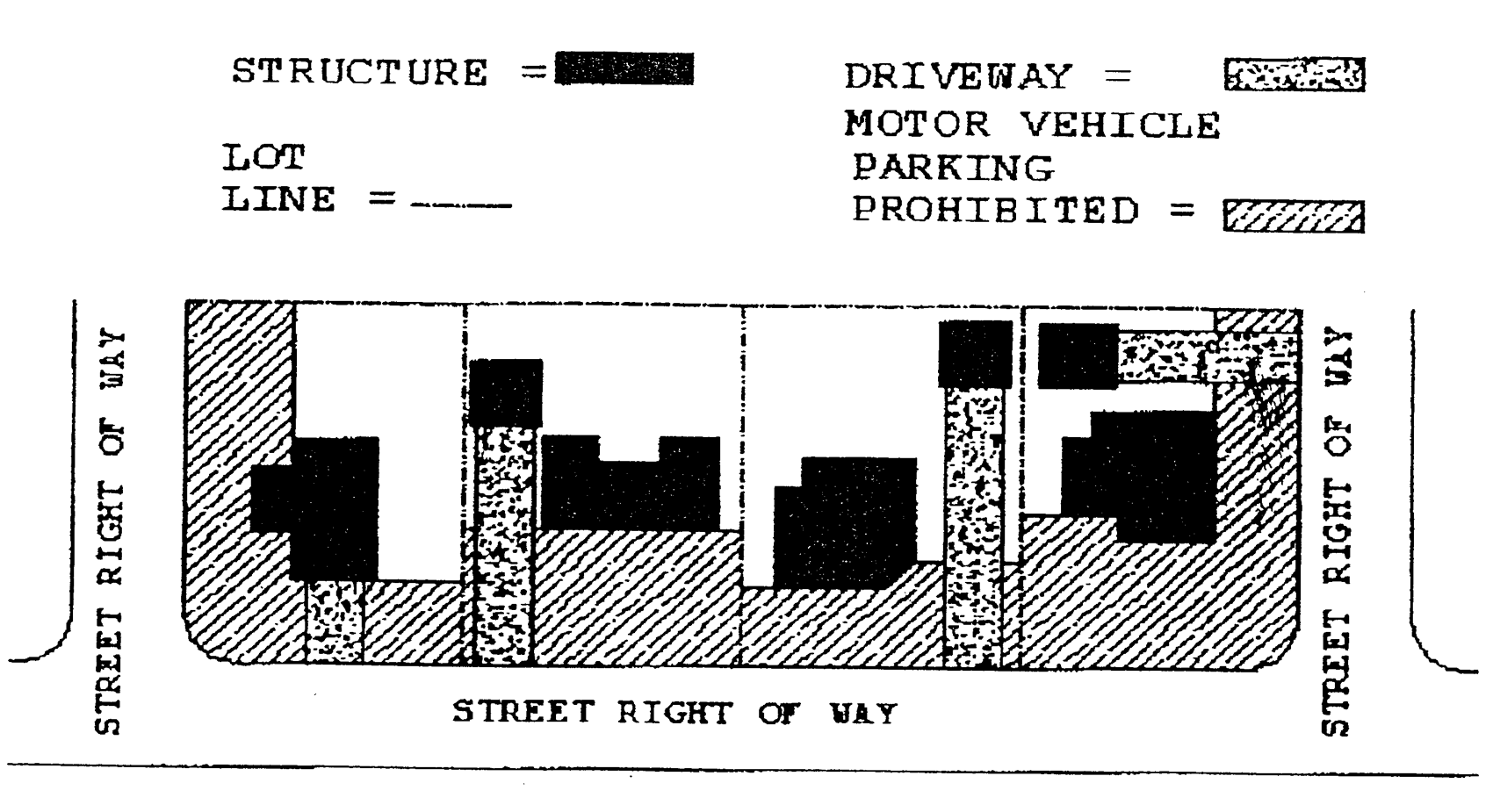
FIGURE 1
12-102
Parking space schedule non-residential uses applicable to all districts except the CA, Central Area District.
A.
Bank, Savings and Loan or similar financial establishment - One (1) space for each six hundred (600) square feet of floor area
B.
Bowling Alley - Six (6) spaces for each lane
C.
Clinics or Doctors' Offices - One (1) space for each three hundred (300) square feet of floor area.
D.
Churches - One (1) space for each three (3) seats in the main sanctuary
E.
Commercial Amusement - Thirty (30) spaces plus one (1) space for each one hundred (100) square feet of floor area over two thousand (2,000) square feet.
F.
Convalescent Home or Home for the Aged - One (1) space for each six (6) rooms or beds
G.
Gasoline Service Station - Minimum of six (6) spaces
H.
Golf Course - Minimum of thirty (30) spaces
I.
High School, College or University - One (1) space for each classroom, laboratory or instruction area plus one (1) space for each three (3) students accommodated in the institution.
J.
Hospitals - One (1) space for every two (2) beds
K.
Hotel or Motel - One (1) space for each room, unit or guest accommodation plus specified requirements for restaurants and related facilities
L.
Institutions of a philanthropic nature - Ten (10) spaces plus one (1) space for each employee
M.
Library or Museum - Ten (10) spaces plus one (1) space for each three hundred (300) square feet of floor area
N.
Manufacturing, processing or repairing - One (1) space for each two (2) employees or one (1) space for each one thousand (1,000) square feet of floor area, whichever is greater
O.
Offices, general - One (1) space for each three hundred (300) square feet of floor area
P.
Recreational, private or commercial area or building (other than listed) - One (1) space for every four (4) persons to be normally accommodated in the establishment
Q.
Restaurant or Cafeteria - One (1) space for every three (3) seats under maximum seating arrangement
R.
Retail or personal service - One (1) space for each two hundred (200) square feet of floor area.
S.
Schools, Elementary or Junior High - One (1) space for each classroom plus one (1) space for each four (4) seats in any auditorium, gymnasium, or other place of assembly
T.
Storage or warehousing - One (1) space for each two (2) employees or one (1) space for each one thousand (1,000) square feet of floor area, whichever is greater
U.
Theaters, meeting rooms and places or public assembly - One (1) space for every three (3) seats
V.
Flea Market - Two (2) spaces for each rental space
12-103
Special off-street parking regulations.
A.
In computing the parking requirements for any building or development, the total parking requirements shall be the sum of the specific parking space requirements for each class of use included in the building for development.
B.
In the R-1, R-2, R-3, R-4, 2F, MF-1, MF-2, O and NS Districts, no parking space, garage or carport or other automobile storage space or structure shall be used for the storage of any truck, truck trailer or van except a panel or pickup truck not exceeding one and one-half (1½) tons capacity.
C.
Floor area of structure devoted to off-street parking of vehicles shall be excluded in computing the off-street parking requirements of any use.
D.
Parking requirements for mobile homes, house trailers and modular homes shall be interpreted as being the same as for single-family residences. Parking requirements for single-family attached residences shall be interpreted as being the same for multiple-family dwellings.
12-104
Parking requirements for new or unlisted uses.
A.
Where questions arise concerning the minimum off-street parking requirement for any use not specifically listed, the requirements may be interpreted as those of a similar use.
B.
Where a determination of the minimum parking requirements cannot be readily ascertained for new or unlisted uses according to 12-104.A or where uncertainty exists, the minimum off-street parking requirements shall be established by the same process as provided in 8-200 for classifying new and unlisted uses.
(Ordinance 3154 adopted 11/13/23)
Sec. 13-100 - Off-Street Loading Regulations
13-101
Except in the CA District, all retail, commercial, industrial and service structures shall provide and maintain off-street facilities for receiving and loading merchandise, supplies and materials within a building or on the lot or tract. Such off-street loading space may be adjacent to a public alley or private service drive or may consist of a truck berth within the structure. Such off-street loading space or truck berth shall consist of a minimum area of ten (10) by forty-five (45) feet, and such spaces or berths shall be provided in accordance with the following schedule:
13-102
For hotels, office buildings, restaurants and similar establishments, off-street loading facilities shall be provided in accordance with the following schedule:
(Ordinance 3154 adopted 11/13/23)
Sec. 14-100 - Sign Regulations
The districts in which the various types of signs are permitted are indicated by the Schedule of Uses, 8-100. The following special provisions shall apply to the various types of signs in the districts indicated:
14-101
Permanent type signs.
14-102
In a PD, Planned Development District, the sign standards shall be specified in the amending Ordinance.
14-103
No sign shall be constructed to exceed the maximum building height permitted in the specific district where the sign is located except in shopping centers or similar commercial or office centers containing six (6) acres or more pylon or major identification signs not to exceed seventy-five (75) feet in height may be erected when set back from the side and rear property line a distance equal to the height of the sign and when such high rise signs comply with the Building Code of the City of Corsicana as to design and construction.
14-104
No sign shall be located or constructed so as to interfere with or confuse the control of traffic on the public streets and no sign shall use a rotating beacon, beam or flashing illumination resembling an emergency signal.
14-105
Any non-conforming sign which is damaged or is deteriorated to a point where its restoration cost exceeds 50 percent of its replacement value shall be removed.
14-106
No sign shall be erected so as to project into the public right-of-way of any street or alley, except in the CA, Central Area District. In the CA, Central Area District, any projecting sign shall not extend outward from any building face to the public right-of-way for a distance of more than ten (10) feet or to within eighteen (18) inches of the street curb, whichever is more restrictive.
14-107
No advertising sign structure shall contain more than two (2) sign panels facing in the same direction.
14-108
No provision of this Ordinance shall supersede or replace any other Ordinance of the City of Corsicana, having to do with sign standards, materials or construction except the provisions of this Ordinance pertaining to the use of the various types of signs in the various districts shall take precedence over all other Ordinances, regulations and standards.
(Ordinance 3154 adopted 11/13/23)
Sec. 16-100 - Creation of Building Site
No permit for the construction of a building or buildings upon any tract or plot shall be issued until a building site, building tract or building lot has been created by compliance with one of the following conditions:
16-101
The lot or tract is part of a plat of record, properly approved by the Planning and Zoning Commission and filed in the Plat Records of Navarro County.
16-102
The site, plot or tract is all or part of a site plan officially approved by the City Commission in a Planned Development District after recommendations by the Planning and Zoning Commission, which site plan provides all utility and drainage easements, alleys, streets and other public improvements necessary to meet the normal requirements for platting including the designation of building areas and such easements, alleys and streets as are required and have been properly dedicated and the necessary public improvements provided.
16-103
The plot, tract or lot faces upon a dedicated street and was separately owned prior to the effective date of this Ordinance or prior to annexation to the City of Corsicana, whichever is applicable, in which event a Building Permit for only one main building may be issued on each such original separately owned parcel without first complying with 16-101 or 16-102.
(Ordinance 3154 adopted 11/13/23)
Sec. 17-100 - Nonconforming Uses and Structures
17-101
A nonconforming status shall exist under the following provisions of this ordinance:
A.
When a use or structure which does not conform to the regulations prescribed in the district in which such use or structure is located was in existence and lawfully operating prior to the adoption of the previous Zoning Ordinance and has been operating since without discontinuance.
B.
When on the effective date of this Ordinance, the use or structure was in existence and lawfully constructed, located and operating in accordance with the provisions of the previous Zoning Ordinance or which was a nonconforming use thereunder, and which use or structure does not now conform to the regulations herein prescribed for the district in which site use or structure is located.
17-102
No nonconforming use may be expanded or increased beyond the lot or tract upon which such nonconforming use is located as of the effective date of this Ordinance except to provide off-street loading or off-street parking space upon approval of the Board of Adjustment.
17-103
Any nonconforming use may be changed to a conforming use and once such change is made, the use shall not thereafter be changed back to a nonconforming use.
17-104
A change of occupancy from one nonconforming use to another nonconforming use may be made by securing a Certificate of Occupancy from the Building Official, provided such change is to a use permitted in a zoning district where the original nonconforming use would be permitted or provided that such use change is to a use permitted in a more restrictive classification provided further that such change of use and occupancy will not tend to prolong the life of a nonconforming structure.
17-105
Where a conforming use is located in a nonconforming structure, the use may be changed to another conforming use by securing a Certificate of Occupancy from the Building Official.
17-106
Whenever a nonconforming use is abandoned, all nonconforming rights shall cease and the use of the premises shall henceforth be in conformance to this Ordinance. Abandonment shall involve the intent of the user or owner to discontinue a nonconforming operation and the actual act of discontinuance. Any nonconforming use which is discontinued for, or which remains vacant for, a period of six (6) months shall be considered to have been abandoned. Any nonconforming use which is moved from the premises shall be considered to have been abandoned.
17-107
If a nonconforming structure or a structure occupied by a nonconforming use is destroyed by fire, the elements or other cause, it may not be rebuilt except to conform to the provisions of this Ordinance. In the case of partial destruction of a nonconforming use not exceeding sixty (60) percent of its reasonable value, reconstruction may be permitted after a hearing and favorable action by the Board of Adjustment, but the size and function of the nonconforming use shall not be expanded.
(Ordinance 3154 adopted 11/13/23)
Sec. 18-100 - Board of Adjustment
18-101
Organization. There is hereby created a Board of Adjustment consisting of five (5) members, each to be appointed by resolution of the City Commission for a term of two (2) years and removable for cause by the appointing authority upon written charges and after public hearing. Vacancies shall be filled for the unexpired term of any member, whose place becomes vacant for any cause, in the same manner as the original appointment was made. Two members heretofore appointed shall serve until or until their successors are appointed, and three members, as heretofore appointed, shall serve until or until their successors are appointed, and thereafter each member reappointed or each new appointee shall serve for a full term of two (2) years unless removed as hereinabove provided. Provided, however, that the City Commission may appoint two alternate members of the Board of Adjustment who shall serve in the absence of one or more of the regular members when requested to do so by the Mayor or City Manager, so that all cases to be heard by the Board of Adjustment will always be heard by a minimum number of the four members. The alternate members shall serve for the same period as the regular members, which is for a term of two (2) years, and any vacancy shall be filled in the same manner and they shall be subject to removal the same as the regular members.
18-102
Procedure. The Board of Adjustment shall adopt rules to govern its proceedings provided, however, that such rules are not inconsistent with this Ordinance or Statutes of the State of Texas. Meetings of the Board of Adjustment shall be held at the call of the Chairman and at such other times as the Board of Adjustment may determine. The Chairman, or in his absence, the Acting Chairman, may administer oath and compel the attendance of witnesses. All meetings of the Board shall be open to the public. The Board of Adjustment shall keep minutes of its proceedings, showing the vote of each member upon each question, or if absent or failing to vote, indicate such fact, and shall keep records of its examinations and other official actions, all of which shall be immediately filed in the office of the Board and shall be a public record.
18-103
Appeals.
A.
Appeals to the Board of Adjustment can be taken by any person aggrieved or by an officer, department or board of the municipality affected by the decision of the Building Official. Such appeal shall be taken within twenty (20) days after the decision has been rendered by the Building Official, by filing with the officer from whom the appeal is taken and with the Board of Adjustment, a notice of appeal specifying the grounds thereof. The officer from whom the appeal is taken shall forthwith transmit to the Board of Adjustment all the papers constituting the record upon which the action appealed from was taken.
B.
An appeal shall stay all proceedings of the action appealed from unless the officer from whom the appeal is taken certifies to the Board of Adjustment after the notice of appeal shall have been filed with him that by reason of facts stated in the certificate, a stay would, in his opinion, cause imminent peril to life or property. In such case, proceedings shall not be stayed, otherwise than by a restraining order which may be granted by the Board of Adjustment or by a court of record on application on notice to the officer from whom the appeal is taken and on due cause shown.
C.
The Board of Adjustment shall fix a reasonable time for the hearing of an appeal and give due notice thereof to the parties in interest and to the public by sending such notice in the mail addressed to all owners of real property located within two hundred (200) feet of the property on which the appeal is made and by publishing notice of such hearing in a newspaper of general circulation in the City of Corsicana. Both the mailed and published notice shall be given at least ten (10) days prior to the date set for the hearing. At the hearing any party may appear in person or by attorney or agent.
18-104
Jurisdiction. The Board of Adjustment shall have jurisdiction to do the following:
A.
When in its judgment, the public convenience and welfare will be substantially served and the appropriate use of the neighboring property will not be substantially or permanently injured, the Board of Adjustment may, in specific cases, after public notice and public hearing, and subject to appropriate conditions and safeguards authorize the following special exceptions to the regulations herein established:
(1)
Permit the reconstruction, extension or enlargement of a building occupied by a nonconforming use on the lot or tract occupied by such building or the reconstruction of a structure destroyed by fire or the elements not to exceed sixty (60) percent of its reasonable value; and
(2)
Permit the addition of off-street parking or off-street loading to a nonconforming use.
B.
To hear and decide appeals where it is alleged there is error on any order, requirement, decision or determination made by the Building Official in the enforcement of this Ordinance.
C.
Permit such variance or modifications of the height, yard, area, coverage and parking regulations as may be necessary to secure appropriate development of a parcel of land which differs from other parcels in the district by being of such restricted area, shape or slope that it cannot be appropriately developed without such modification. In exercising its power to grant a variance in accordance with this Ordinance, the Board of Adjustment shall make findings and show in its minutes that:
1.
There are special circumstances existing on the property on which the application is made related to size, shape, area, topography, surrounding conditions and location that do not apply generally to other property in the same area and the same zoning district.
2.
That a variance is necessary to permit the applicant the same rights in the use of his property that are presently enjoyed, under the Ordinance, by other properties in the vicinity and zone, but which rights are denied to the property on which the application is made.
3.
That the granting of the variance on the specific property will not adversely affect the land use pattern as outlined by the Land Use Plan and will not adversely affect any other feature of the Comprehensive Plan of the City of Corsicana.
4.
That the variance, if granted, will be no material detriment to the public welfare or injury to the use, enjoyment or value of property in the vicinity.
D.
Require the discontinuance of nonconforming uses of land or structure under any plan whereby the full value of the structure and facilities can be amortized within a definite period of time, taking into consideration the general character of the neighborhood and the necessity of all property to conform to the regulations of this Ordinance. Alf actions to discontinue a nonconforming use of land or structure shall be taken with due regard to the property rights of the persons affected when considered in the light of the public welfare and the character of the area surrounding the designated nonconforming use and the conservation and preservation of the property. The Board shall from time to time on its own motion or upon cause presented by interested property owners inquire into the existence, continuation or maintenance of any nonconforming use within the City.
18-105
Actions of the board.
A.
The concurring vote of four (4) members of the Board of Adjustment shall be necessary to revise any order, requirement, decision or determination of any such Building Official, or to decide in favor of the applicant on any matter upon which it is required to pass under this Ordinance, or to authorize any variance in said Ordinance.
B.
In exercising its powers to hear an appeal under 18-104.B., the Board of Adjustment may reverse or affirm, wholly or partly, or may modify the order, requirement, decisions, or determinations appealed from and make such order, requirement, decision or determination as ought to be made and shall have all the powers of the officer from whom the appeal is taken including the power to impose reasonable conditions to be complied with by the applicant.
C.
In exercising its powers to consider a variance under 18-104.C., the Board of Adjustment may consider the following as grounds to determine whether compliance with the ordinance as applied to a structure that is the subject of the application would result in unnecessary hardship:
1.
The financial cost of compliance is greater than 50 percent of the appraised value of the structure as shown on the most recently appraisal roll certified to the assessor for the municipality under Section 26.01, Texas Tax Code;
2.
Compliance would result in a loss to the lot on which the structure is located of at least 25 percent of the area on which development may physically occur;
3.
Compliance would result in the structure not being in compliance with a requirement of a municipal ordinance, building code, or other requirement;
4.
Compliance would result in the unreasonable encroachment on an adjacent property or easement; or
5.
The municipality considers the structure to be a nonconforming structure.
D.
Any person or persons, jointly or severally, aggrieved by any decision of the Board of Adjustment or any taxpayer or any officer, department or board of the municipality may present to the court of record a petition, duly verified, setting forth that such decision is illegal, in whole or in part, and specifying the grounds of illegality. Such petition shall be presented to the court within ten (10) days after the filing of the decision by the Board of Adjustment and its recommendation in the minutes and not thereafter.
(Ordinance 3154 adopted 11/13/23)
Sec. 19-100 - Certificate of Occupancy and Compliance
19-101
No building hereafter erected, converted or structurally altered shall be used, occupied or changed in use and no land may be used nor shall any basic change of use in land or structure be made until a Certificate of Occupancy and Compliance shall have been issued by the Building Official of the City of Corsicana stating that the building or proposed use of land or building complies with the provisions of this Ordinance and other building laws of the City of Corsicana.
19-102
A Certificate of Occupancy and Compliance shall be applied for coincident with the application for a Building Permit and will be issued within ten (10) days after the completion of the erection, alteration or conversion of such building or land provided such construction or change has been made in complete conformity to the provisions of this Ordinance. All existing or hereafter created nonconforming uses shall obtain Certificates of Occupancy within eighteen (18) months of the effective date of this Ordinance. An Occupancy Permit shall be considered evidence of the legal existence of nonconforming use as contrasted to an illegal use and violation of this Ordinance.
19-103
A Certificate of Occupancy and Compliance shall state that the building or proposed use of a building or land, complies with all the building or health laws or ordinances and with the provisions of these regulations. A record of all certificates shall be kept on file in the office of the Building Official, and copies shall be furnished, on request, to any person having a proprietary or tenancy interest in the land or building affected.
19-104
All current legally permitted and operating game rooms, vape shops, and hookah lounges as defined in Chapter 12Article 12.100Section 8-600 shall be allowed to continue to operate with a valid certificate of occupancy. If these businesses fail to operate in accordance with the laws of the State of Texas and the City, the Building Official may suspend or revoke the certificate of occupancy. If the certificate is suspended or revoked, the business will no longer be allowed to operate.
The suspension or revocation of the Certificate of Occupancy by the Building Official may be appealed to the City Council, which shall conduct a de novo review of the Building Official's actions. The appeal must be instituted, in writing, within 30 days of suspension or revocation.
(Ordinance 3154 adopted 11/13/23)
Sec. 20-100 - Completion of Building Under Construction
Nothing herein contained shall require any change in the plans, construction or designated use of a building actually under construction at the time of the passage of this Ordinance and which entire building shall be completed within one (1) year from the date of the passage of this Ordinance.
(Ordinance 3154 adopted 11/13/23)
Sec. 21-100 - Amendments
Any person or corporation having a proprietary interest in any property may petition the City Commission for a change or amendment to the provisions of this Ordinance, or the Planning and Zoning Commission may on its own motion or on request from the City Commission, institute study and proposal for changes and amendments in the public interest.
21-101
Procedure.
A.
The City Commission may from time to time amend, supplement, or change by Ordinance, the boundaries of the districts or the regulations herein established as provided by the Statutes of the State of Texas.
B.
Before taking action on any proposed amendment, supplement or change, the governing body shall submit the same to the Planning and Zoning Commission for its recommendation and report.
C.
The Planning and Zoning Commission shall hold a public hearing on any application for any amendment or change prior to making its recommendation and report to the City Commission. Written notice of all public hearings before the Planning and Zoning Commission on a proposed amendment or change shall be sent to all owners of real property lying within two hundred (200) feet of the property on which the change is requested. Such notice shall be given not less than ten (10) days before the date set for hearing by posting such notice properly addressed and postage paid to each taxpayer as the ownership appears on the last approved City tax roll.
D.
A public hearing shall be held by the governing body before adopting any proposed amendment, supplement or change. Notice of such hearing shall be given by publication in a newspaper of general circulation in the City of Corsicana stating the time and place of such hearing, which time shall not be earlier than fifteen (15) days from the date of publication.
E.
Unless a proposed amendment, supplement or change has been approved by the Planning and Zoning Commission, or if a protest against such proposed amendment, supplement, or change has been filed with the City, signed by the owners of twenty (20) percent or more either of the area of the lots or land included in such proposed change, or of the lots or land immediately adjoining the same and extending 200 feet therefrom, such amendment shall not become effective except by the favorable vote of three-fourths of all members of the City Commission. In computing the percentage of land area, the area of streets and alleys shall be included in the computation.
E-1.
A denial of an application for a change in zone classification shall be designated as being made with prejudice or without prejudice. A request for a zoning change that would not, if granted, promote the health, safety, moral and general welfare of the city shall be denied with prejudice and the same property or any part thereof shall not be resubmitted within (6) months from the date of such denial. A denial may be made without prejudice when it can be reasonably anticipated that within six (6) months from the time of denial favorable circumstances will exist to support the requested zoning change. An application for zoning change that is denied without prejudice may be submitted at any subsequent time.
(Ordinance 3154 adopted 11/13/23)
Sec. 22-100 - General Definitions
Certain words in this Ordinance not heretofore defined are defined as follows:
22-101
Words used in the present tense include the future, words in the singular number include the plural number and words in the plural number include the singular number: the word "building" includes the word "structure"; the word "lot" includes the words "plot" or "tract"; the word "shall" is mandatory and not discretionary.
Definitions.
(1)
Accessory Use - A use subordinate to and incidental to the primary use of the main building or to the primary use of the premises.
(2)
Alley - A public space or thoroughfare which affords only secondary means of access to property abutting thereon.
(3)
Apartment - A room or suite of rooms in a multi-family dwelling or apartment house arranged, designed or occupied as a place of residence by a single family, individual or group of individuals.
(4)
Apartment House - Any building or portion thereof, which is designed, built, rented, leased or let to be occupied as three or more dwelling units or apartments or which is occupied as a home or place or residence by three or more families living in independent dwelling units.
(5)
Area of the Lot - The area of the lot shall be the net area of the lot and shall not include portions of streets and alleys.
(6)
Basement - A building story which is partly underground, but having at least one-half of its height above the average level of the adjoining ground. A basement shall be counted as a story in computing building height.
(7)
Block - An area enclosed by streets and occupied by or intended for buildings; or if said word is used as a term of measurement, it shall mean the distance along a side of a street between the nearest two streets which intersect said street on said side.
(8)
Board - Zoning Board of Adjustment as provided for in 18-100.
(9)
Boarding House - A building other than a hotel, where lodging and meals for five or more persons are served for compensation.
(10)
Building - Any structure built for the support, shelter and enclosure of persons, animals, chattels or movable property of any kind. When subdivided in a manner sufficient to prevent the spread of fire, each portion so subdivided may be deemed a separate building.
(11)
Building Line - A line parallel or approximately parallel to the street line at a specified distance therefrom making the minimum distance from the street line that a building may be erected.
(12)
Building Ends - Those sides of a building having the least dimension as compared to the front or rear of a building. As used herein for the building spacing regulations for multiple-family dwelling, a building end shall be interpreted as being the narrowest side of a building regardless of whether it fronts upon a street, faces the rear of the lot or is adjacent to the side lot line or another building.
(13)
City Commission - The governing body of the City of Corsicana, Texas.
(14)
Cellar - A building story with more than one-half its height below the average level of the adjoining ground. A cellar shall not be counted as a story in computing building height.
(15)
Certificate of Occupancy - An official certificate issued by the City through the enforcing official which indicates conformance with or approved conditional waiver from the zoning regulations and authorizes legal use of the premises for which is issued.
(16)
City Manager - Chief administrative officer of the City of Corsicana, Texas.
(17)
Planning and Zoning Commission - The agency appointed by the City Commission as an advisory body to it and which is authorized to recommend changes in the zoning.
(18)
Clinic - A group of offices for one or more physicians, surgeons, or dentists, to treat sick or injured out-patients who do not remain overnight.
(19)
Convalescent Home - Any structure used for or customarily occupied by persons recovering from illness or suffering from infirmities of age.
(20)
Coverage - The percent of a lot or tract covered by the roof or first floor of a building. Roof eaves to the extent of three (3) feet from the walls of a building shall be excluded from coverage computations.
(21)
Court - An open, unoccupied space, bounded on more than two sides by the walls of a building. An inner court is a court entirely surrounded by the exterior walls of a building. An outer court is a court having one side open to a street, alley, yard or other permanent space.
(22)
District - A section of the City of Corsicana for which the regulations governing the area, height or use of the land and building are uniform.
(23)
Dwelling, Single-Family - A detached building having accommodations for and occupied by not more than one family, or by one family and not more than three (3) boarders and lodgers.
(24)
Dwelling; Two-Family - A detached building having separate accommodations for and occupied by not more than two families, or by two families and nor more than three (3) boarders and lodgers.
(25)
Dwelling, Multiple-Family - Any building or portion thereof, which is designed, built, rented, leased or let to be occupied as three or more dwelling units or apartments or which is occupied as a home or residence of three or more families.
(26)
Dwelling Unit - A building or portion of a building which is arranged, occupied, or intended to be occupied as living quarters and includes facilities for food preparation and sleeping.
(27)
Family - Any number of individuals living together as a single housekeeping unit, in which not more than three (3) individuals are unrelated by blood, marriage or adoption, including those groups which are recognized as families under the Fair Housing Act. For purposes of this ordinance, the definition of "family" does not include:
1.
One or more persons occupying a recovery center or halfway house that operates as a treatment facility for chemical dependency, as that term is defined in Chapter 462 of the Health & Safety Code, or which otherwise provides chemical dependency treatment for persons who do not otherwise qualify as a "family";
2.
One or more persons occupying a community residential facility or halfway house, as those terms are defined in Chapters 499 and 508 of the Texas Government Code, or another facility which provides substantially the same services as a community residential facility or halfway house, whether or not the facility is licensed;
3.
One or more persons occupying a detention home or parental school, as those terms are defined in Chapter 62 of the Human Resources Code, or which provide substantially the same services as a detention home or parental school;
4.
One or more persons occupying a residential facility for delinquent children, as that term is defined in Chapter 63 of the Human Resources Code, or which provides substantially the same services as a residential facility for delinquent children; and
5.
A Homeless Shelter.
Specific Use Permits shall be required in all zoning categories for the uses specified in Paragraphs 1 through 5 above.
(28)
Floor Area - The total square feet of floor space within the outside dimensions of a building including each floor level, but excluding cellars, carports or garages.
(29)
Floor Area Ratio (FAR) - The ratio between the total square feet of floor area in a structure and the total square feet of land in the lot or tract on which the structure is located.
(30)
Height - The vertical distance of a building measured from the average established grade at the street line or from the average natural front yard ground level, whichever is higher, to (1) the highest point of the roof's surface if a flat surface, (2) to the deck line of mansard roofs or (3) to the mean height level between eaves and ridge for hip and gable roofs and, in any event, excluding chimneys, cooling towers, elevator bulkheads, penthouses, tanks, water towers, radio towers, ornamental cupolas, domes or spires, and parapet walls not exceeding ten (10) feet in height. If the street grade has not been officially established, the average front yard grade shall be used for a base level.
(30A)
Junk - Old or scrap copper, brass, aluminum, steel, rope, rags, batteries, tires, motors, pipe, stoves, refrigerators, dryers, air conditioners, wood and wood articles, machines and other household, business, or industrial items and materials (other than a wrecked vehicle) that have been discarded or sold by a previous owner of the material.
(31)
Legal Height - The maximum height of a building permitted by any airport zoning ordinance or other ordinance restricting the height of structures.
(32)
Living Unit - The room or rooms occupied by a family and must include cooking facilities.
(33)
Lodging House - A building where lodging for four (4) or more persons is provided for compensation.
(34)
Lot - Land occupied or to be occupied by a building and its accessory building, and including such open spaces as are required under this Ordinance and having its principal frontage upon a public street or officially approved place.
(35)
Lot Coverage - The percentage of the total area of a lot occupied by the base (first story or floor) of buildings located on the lot or the area determined as the maximum cross-sectional area of the building.
(36)
Lot Lines - The lines bounding a lot as defined herein.
(37)
Lot of Record - A lot which is part of a subdivision, the plat of which has been recorded in the office of the County Clerk of Navarro County or a parcel of land, the deed for which it is recorded in the office of the County Clerk of Navarro County prior to the adoption of this Ordinance.
(38)
Lot Depth - The mean distance between the front and rear lot lines. (See Appendix Illustration 2)
(39)
Lot Width - The width of a lot at the front building line. (See Appendix Illustration 1)
(40)
Main Building - The building or buildings on a lot which are occupied by the primary use.
(41)
Nonconforming Use - A building, structure or use of land lawfully occupied at the time of the effective date of this Ordinance or amendments thereto, and which does not conform to the use regulations of the district in which it is situated. (See 17-100)
(42)
Occupancy - The use or intended use of the land or buildings by proprietors or tenants.
(42.1)
Open-Air Structure - Trampoline, swing set, children's play house, animal shelter, batting cage, tent, or other permanent structure with or without a roof or cover. Permanent structure shall be defined as that in place greater than one week.
(43)
Open Space - Area included in any side, rear or front yard or any unoccupied space on the lot that is open and unobstructed to the sky except for the ordinary projections of cornices, eaves, porches and plant material.
(44)
Parking Space - An enclosed or unenclosed all-weather surfaced area of not less than one hundred eighty (180) square feet (measuring approximately 9 feet by 20 feet) not on a public street or alley, together with an all-weather surfaced driveway connecting the area with a street or alley permitting free ingress and egress to the street or alley. Any parking adjacent to a public street wherein the parking maneuvers are done on the public street shall not be classified as off-street parking in computing the parking area requirements for any use.
(45)
Private Garage - An accessory building housing vehicles owned and used by occupants of the main building; if occupied by vehicles of others, it is a storage space.
(46)
Residence - Same as dwelling; also when used with district and area of residential regulations.
(47)
Rooming House - (See Lodging House)
(47A)
Screen - Hidden from view by natural objects, plantings, or fences, so that the screen is at least six feet in height and maintained in a state of good repair.
(48)
Sign - An outdoor advertising device that is a structure or that is attached to or painted on a building or that is leaned against a structure or display on premises.
(49)
Story - The height between the successive floors of a building or from the top floor to the roof. The standard height for a story is eleven (11) feet, six (6) inches.
(50)
Street - Any thoroughfare or public driveway, other than an alley, and more than thirty (30) feet in width, which has been dedicated or deeded to the public for public use.
(51)
Street Line - A dividing line between a lot, tract or parcel of land and a contiguous street, the right-of-way line.
(52)
Structural Alterations - Any change in the supporting member of a building, such as a bearing wall, column beams or girders.
(53)
Structure - (Same as building)
(54)
Thoroughfare - (Same as street)
(55)
Yard - An open space other than a court, on the lot in which a building is situated and which is not obstructed from a point forty (40) inches above the general ground level of the graded lot to the sky, except as provided for roof overhang and similar special architectural features and plant material.
(56)
Yard, Front - An open, unoccupied space on a lot facing a street extending across the front of a lot between the side lot lines and from the main building to the front lot or street line with the minimum horizontal distance between the street line and the main building line as specified for the district in which it is located. (See Appendix Illustration 3 and 5)
(57)
Yard, Rear - An open, unoccupied space, except for accessory buildings as herein permitted, extending across the rear of a lot from one side lot line to the other side lot line and having a depth between the building and the rear lot line as specified in the district in which the lot is situated. (See Appendix Illustration 3)
(58)
Yard, Side - An open, unoccupied space or spaces on one side or two sides of a main building and on the same lot with the building, situated between the building and a side line of the lot and extending through from the front yard to the rear yard. Any lot line, not the rear line or a front line, shall be deemed a side line. (See Appendix Illustration 3 and 4)
(59)
Variance - An adjustment in the application of the specific regulations of the Zoning Ordinance to a particular parcel of property which, because of special conditions or circumstances peculiar to the particular parcel, is necessary to prevent the property from being deprived of rights and privileges enjoyed by other parcels in the same vicinity and zoning district. (See 18-104)
(60)
Zoning District Map - The official certified map upon which the boundaries of the various Zoning Districts are drawn and which is an integral part of the Zoning Ordinance.
(Ordinance 3154 adopted 11/13/23)
Sec. 23-100 - Penalty for Violations
Any person violating or failing to comply with any of the provisions of this Ordinance shall be fined upon conviction not less than One Dollar ($1.00) nor more than Two Hundred Dollars ($200.00), and each day any violation or noncompliance continues shall constitute a separate and distinct offense. In addition to the penalty provided for, the right is hereby conferred and extended to any property owner owning property in any district where such property may be affected by a violation of the terms of this Ordinance, to bring suit in such court or courts having jurisdiction thereof and obtain such remedies as may be available at law or in equity for the protection of the rights of such property owners.
(Ordinance 3154 adopted 11/13/23)
Sec. 24-100 - Exceptions and Exemptions Not Required to be Negative
In any complaint and in any action or proceedings brought for the enforcement of any provision of this Ordinance, it shall not be necessary to negative any exception, excuse, proviso or exemption contained in this Ordinance and the burden of proof of any such exception, excuse, proviso or exemption shall be upon the defendant or person charged.
(Ordinance 3154 adopted 11/13/23)
Sec. 25-100 - Savings Clause
It is hereby declared to be the intention of the City Commission of the City of Corsicana that the sections, paragraphs, sentences, clauses and phrases of this Ordinance are severable, and if any phrase, clause, sentence, paragraph or section of this Ordinance shall be declared unconstitutional, such unconstitutionality or invalidity shall not affect any of the remaining phrases, clauses, sentences, paragraphs or sections of this Ordinance, since the same would have been enacted by the City Commission without the incorporation in this Ordinance of any such unconstitutional or invalid phrase, clause, sentence, paragraph or section.
(Ordinance 3154 adopted 11/13/23)
APPENDIX ILLUSTRATIONS
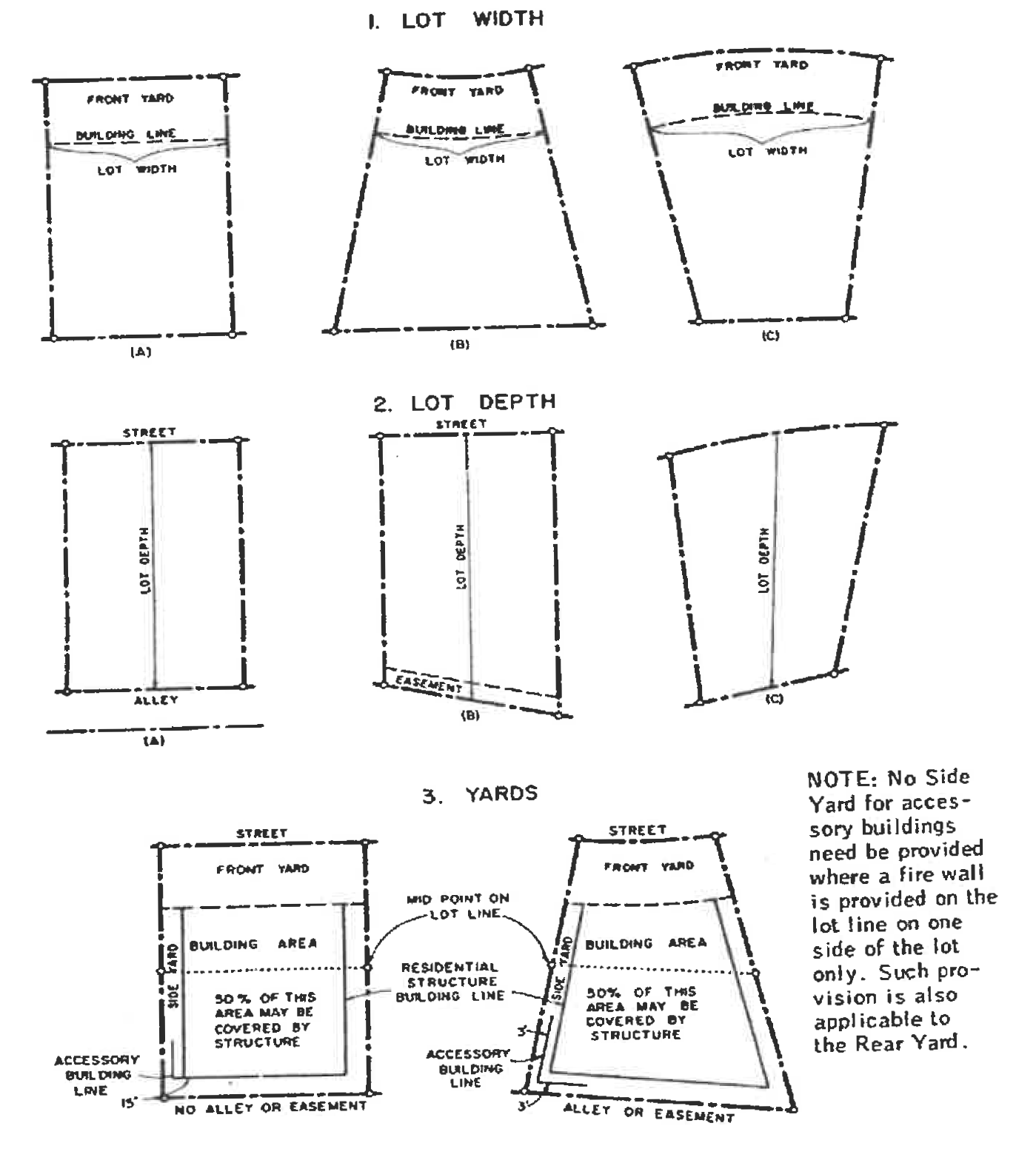
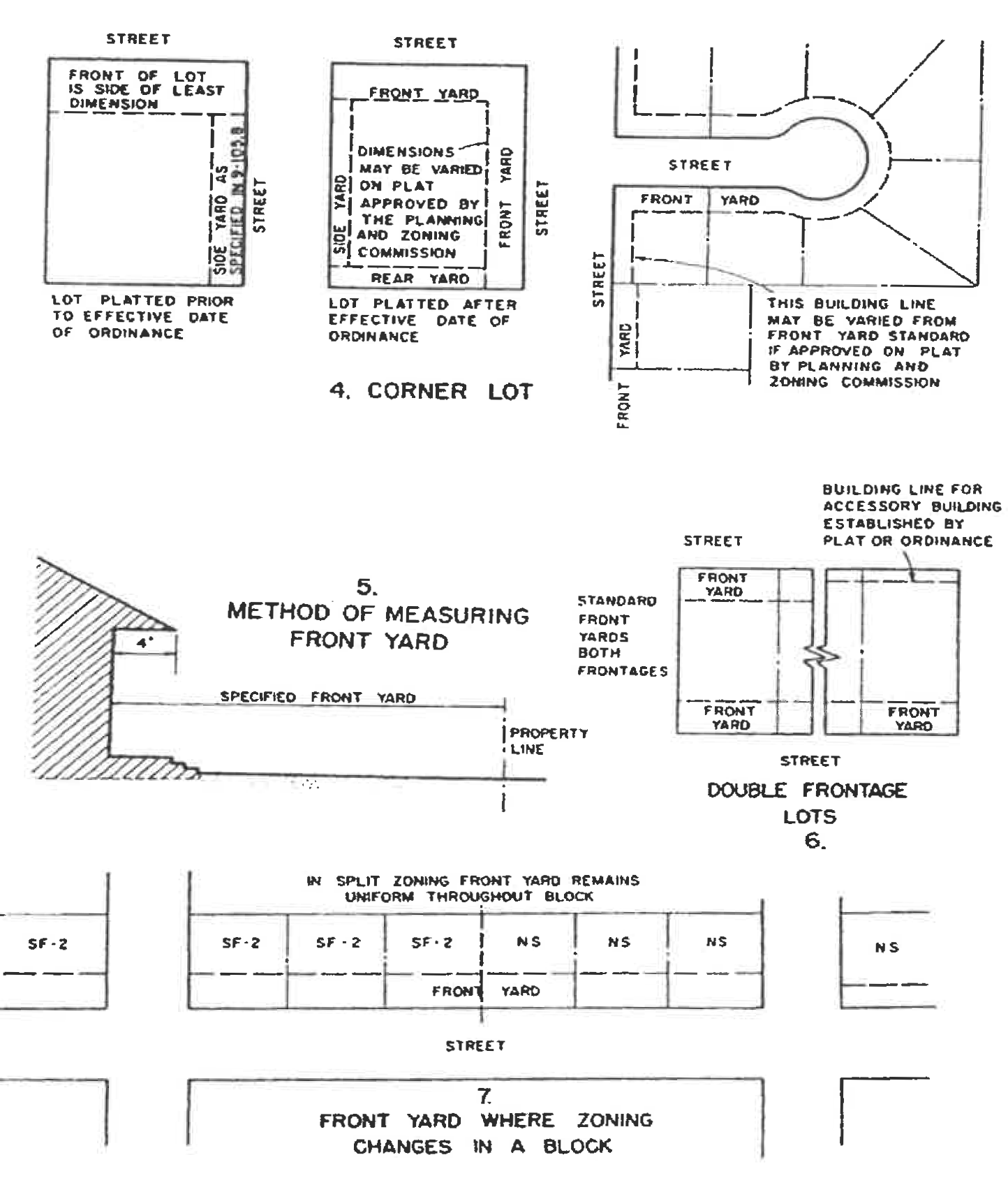
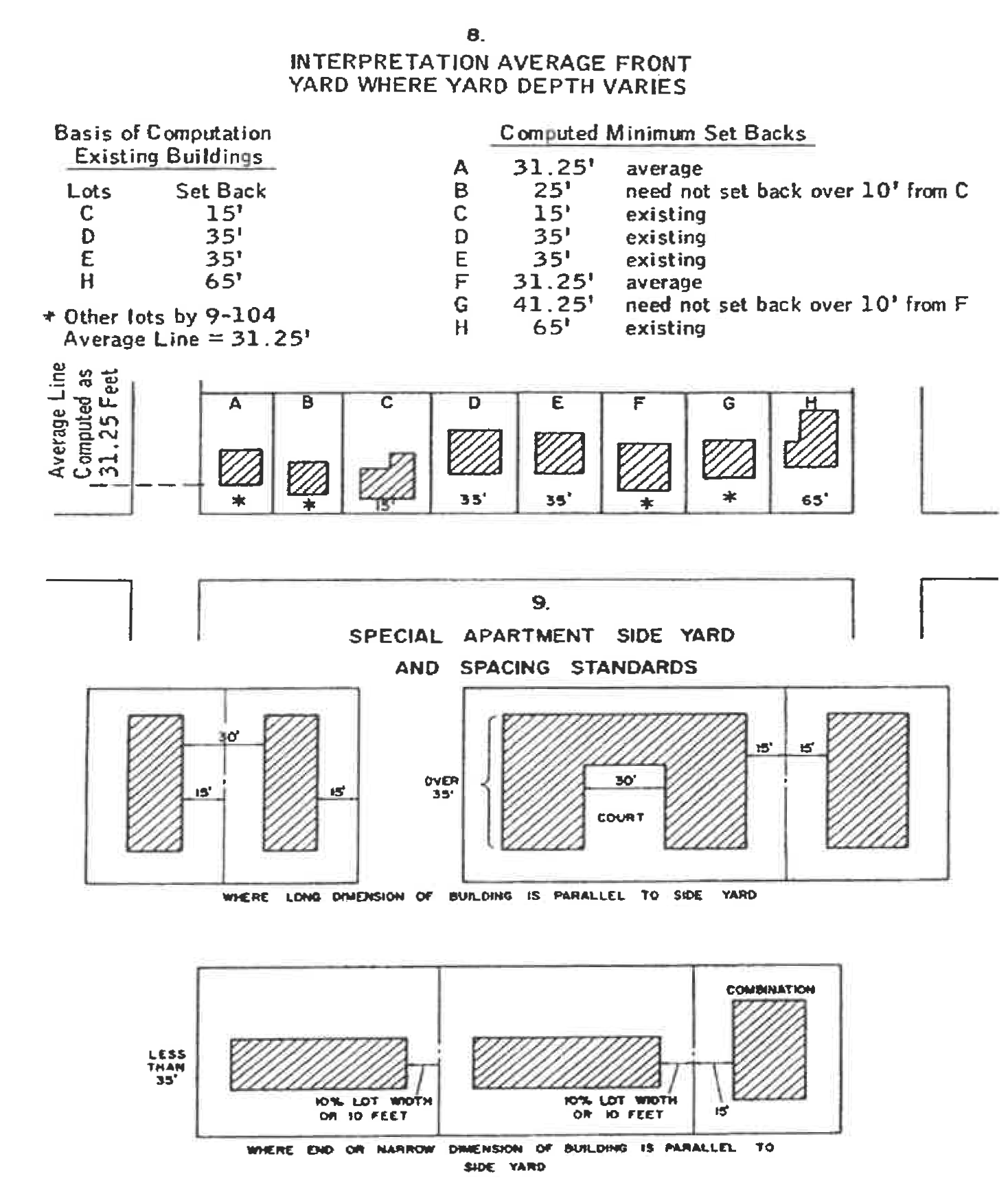
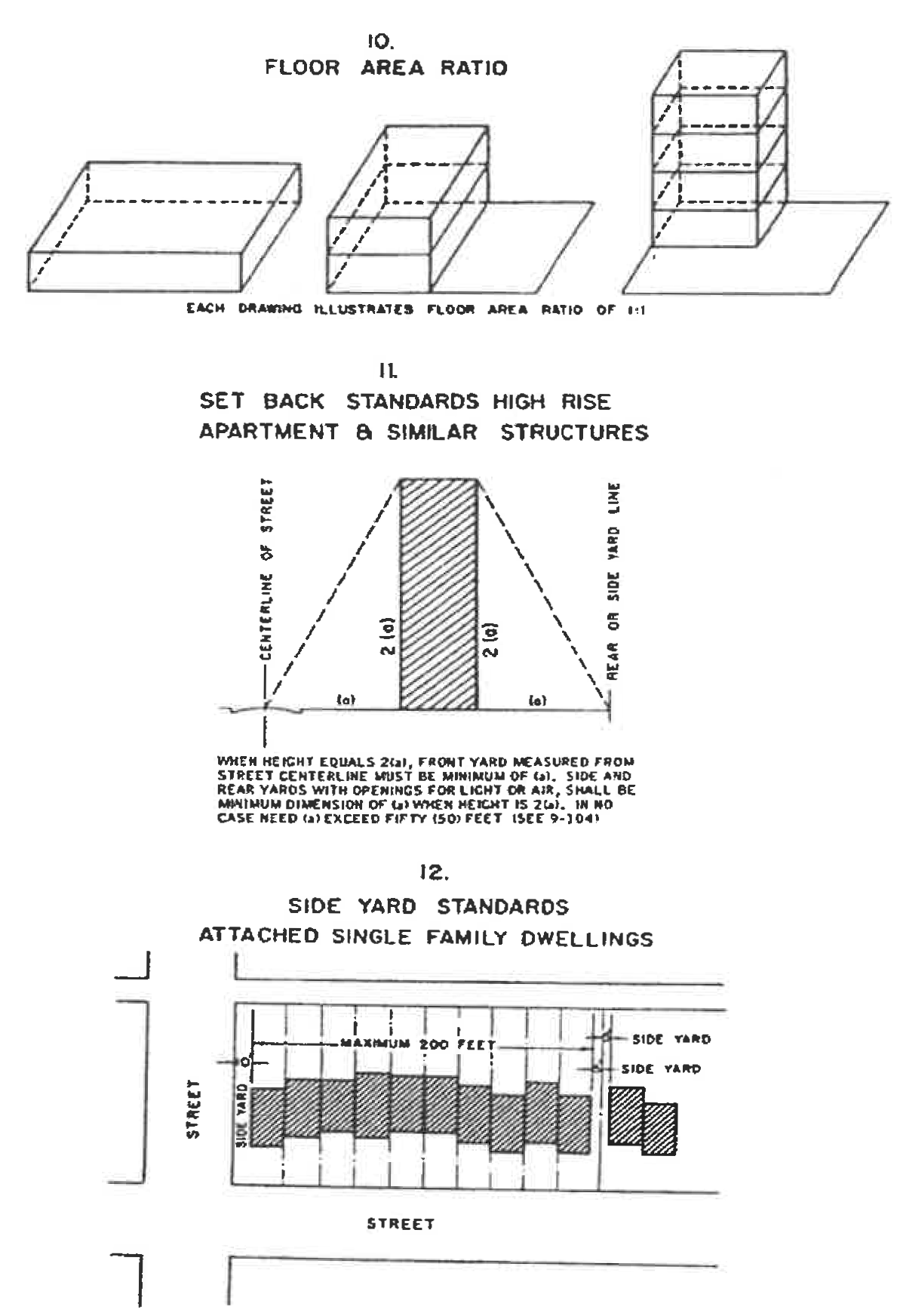
(Ordinance 3154 adopted 11/13/23)

