
Cumming City Zoning Code
ARTICLE XIV
DESIGN REVIEW
Sec. 113-601. - Title.
This article shall be known and may be cited as the City of Cumming Design Review Ordinance.
(Ord. of 12-20-2022, § 1)
Sec. 113-602. - Findings and purposes.
(a)
Establishing the appropriate character in the city by necessity requires attention to the aesthetics of development.
(b)
It is in the public interest to direct and control the visual appearance of buildings, structures, and development in the city, to prevent patently offensive harm to the existing visual character of the city, and to safeguard the happiness, comfort, and general wellbeing of citizens.
(c)
Careful attention to the design of buildings and their associated relationship with their land development sites is in the best interests of the city, its citizens, and business owners.
(d)
Attractive building design features tend to improve an area's image, raise overall property values, attract new businesses and residents, and improve the quality of life.
(e)
Without guidance and review, private landowner decisions about building appearances can result in negative impressions about the aesthetics of the city. It is therefore in the city's interest to ensure that the architecture and features of buildings in the city present a high-quality appearance such that lasting impressions will be positive and negative impressions will be minimized.
(f)
The choice of building materials and texture applied to the exterior of buildings has great visual significance and can affect the long-term appearance and maintenance of the built environment. Exterior building materials are directly related to the durability of the building against weathering and damage from natural forces.
(g)
The city council finds establishing a design review process and imposing a requirement for certain building activities to obtain a design review permit is in the best interests of the city and its citizens.
(Ord. of 12-20-2022, § 1)
Sec. 113-603. - Definitions.
Appearance: The outward aspect of a building or site development that is visible to the public.
Architectural appearance, exterior: The architectural character and general composition of the exterior of a building or structure, including, but not limited to, the kind, color, and texture of the building material and the type, design, and character of all windows, doors, light fixtures, signs attached to the building or structure, and any appurtenant elements.
Architectural features: Ornamental or decorative features attached to or protruding from an exterior wall or roof, including cornices, eaves, belt courses, sills, lintels, bay windows, chimneys, and decorative ornaments.
Architectural recesses: Portions of a building wall at street level which are set back from the street line so as to create articulation of the building wall and/or to provide space for windows or doors.
Asymmetrical: Not symmetrical, as in a building facade that is not identical on either side of an imaginary line drawn down its center.
Attractive: Having qualities that arouse satisfaction and pleasure in numerous, but not necessarily all, observers.
Awning: A hood or cover that forms a roof-like structure, often of fabric, metal, or glass, designed and intended for the protection from the weather or as a decorative embellishment, and which projects from the wall or roof of a structure over a window, walk, door, or the like. Awnings may be retractable but are most often fixed with a rigid frame.
Awning, internally illuminated: A fixed awning covered with a translucent membrane that is, in whole or part, illuminated by light passing through the membrane from within the structure.
Bollarch: A luminaire having the appearance of a short, thick post, used for walkway and grounds lighting. The optical components are usually top mounted.
Build-to line: An alignment establishing a certain distance from the curb or right-of-way line to a line along which a building or buildings shall be built.
Brick veneer: A building construction technique in which an external, non-structural, brick wall conceals a structural wall of another material. Brick veneer is one layer of real brick and differs from solid masonry. With solid masonry, the brick is holding up the structure and is applied in two or more layers.
Building footprint: The outline of a building's ground plan from a top view.
Character: Special physical characteristics of an area, building, structure, or site that set it apart from its surroundings and contribute to its individuality.
Clapboard: A wood exterior siding material that is applied horizontally and overlapped with the lower edge thicker than the upper edge.
Cohesiveness: Unity of composition among elements of a building or among buildings and/or structures, and their landscape development.
Column: A vertical, cylindrical or square supporting member.
Context: The overall relationship of the project to its surroundings.
Continuity: The flow of elements or characteristics in a non-interrupted manner.
Coping: The capping member of a wall that covers and protects the wall from the effects of weal her.
Cornice: Any horizontal member, structural or non-structural, of any building, projecting outward from the exterior walls at the roof line.
Dentil: Any of a series of closely spaced, small, rectangular blocks forming a molding or protecting beneath the cornice.
Dormer: A small window with its own roof projecting from a sloping roof. Dormers are projections that provide ventilation, light, and additional space for attic areas.
Downspout: A pipe for directing rainwater from the roof to the ground.
Eave: The edge of the roof that extends past the walls of a building.
Exterior insulating and finish system (EIFS): An exterior wall cladding system consisting primarily of polystyrene foam board with a textured acrylic finish that resembles plaster or stucco; A general class of non-load bearing building cladding systems that provides exterior walls with an insulated, water-resistant, finished surface in an integrated composite material system.
Elevation drawing: An architectural drawing of a building or building facade, intended to illustrate its design, characteristics, and major features.
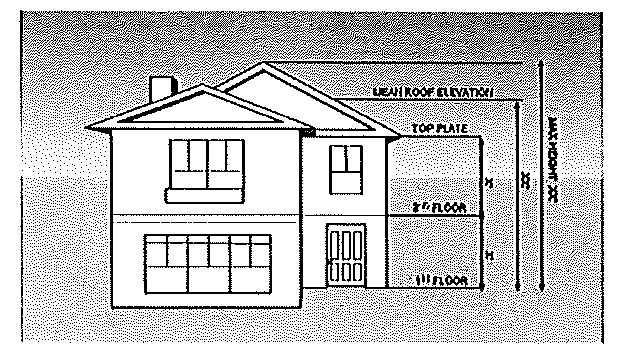
Illustrative Elevation Drawing
Engineered wood siding: A manufactured siding consisting of composite wood, mixed with different fibers and strands of various woods to create the finished product.
Facade: Typically the front of a building; however, any building square on view is considered a facade (see definitions below).
Facade, front: Any facade with a main public entrance which faces one of the primary streets.
Facade, rear: Any facade without a public entry that does not face a public road.
Facade, side: Any facade without a public entry but facing a public street.
Fenestration: The organization of windows on a building wall.
Fiber cement siding: A mix of Portland cement reinforced with cellulose wood fibers and used as a siding material, Hardie board is an example.
Gable: The triangular upper portion of an end wall, underneath a peaked roof.
Hardie board or Hardie Plank: A siding material comprised of cement, sand, water and cellulose wood fibers, created by James Hardie. James Hardie's Hardie Plank has become synonymous with fiber-cement siding, in much the same way that the brand name Kleenex has come to refer to tissues.
Masonite: A kind of engineered wood which is made of steam-cooked and pressure-molded wood fibers in a process patented by William H. Mason.
Massing: The overall visual impact of a structure's volume; a combination of height and width and the relationship of the heights and widths of the building's components.
Modularity: Design composition comprised of a rhythmic organization of parts.
Modulation: A measured setback or offset.
Parapet: That portion of a wall which extends above the roofline.
Pedestrian-scale development: Development designed with an emphasis primarily on the street sidewalk and on pedestrian access to the site and building, rather than auto access and parking areas. The building is generally placed close to the street and the main entrance is oriented to the street sidewalk. There are generally windows or display cases along building facades which face the street.
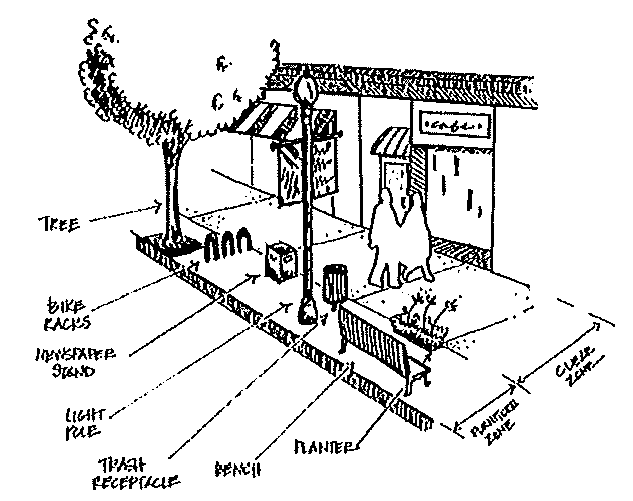
Pedestrian Scale Development
Plaza: An open area adjacent to a building that functions as a gathering place and may incorporate a variety of non-permanent activities.
Porch: A projection from a building wall which is covered but enclosed on no more than one side by a vertical wall.
Portico: An exterior appendage to a building, normally at the entry, usually roofed.
Proportion: Balanced relationship of parts of a building, signs and other structures, and landscape to each other and to the whole.
Retail display window: A window or opening in the exterior wall of any portion of a building used for business purposes, through which merchandise, services, or businesses are displayed or advertised and visible from the ground or sidewalk level.
Roof: The cover of a building, including the eaves and similar projections.
Rhythm: The relationship of fenestration, recesses and projections.
Scale: Proportional relationships of the size of parts to one another and to humans.
Stone veneer (natural): Thinly cut pieces of quarry stone applied to an exterior.
Stone veneer (artificial): Concrete or other materials that emulate the look of natural stone applied to an exterior.
Street furniture: Those features associated with a street that are intended to enhance the street's physical character and use by pedestrians, such as benches, trash receptacles, planting containers, pedestrian lighting, kiosks, etc.
Street hardware: Objects other than buildings or street furniture that are part of the streetscape. Examples are non-pedestrian street light fixtures, utility poles, traffic lights and their fixtures, fire hydrants, etc.
Streetscape: The appearance and organization along a street of buildings, paving, plantings, street hardware, street furniture, and miscellaneous structures.
Stucco siding: A type of hand-troweled masonry plaster consisting of cement, water, and sand.
(Ord. of 12-20-2022, § 1)
Cross reference— Definitions and rules of construction, § 1-2.
Sec. 113-604. - Jurisdiction.
This article shall apply within the city limits of Cumming,
(Ord. of 12-20-2022, § 1)
Sec. 113-605. - Design review permit required.
For any building activity to which this article applies, no building permit shall be issued by the zoning administrator for construction of a building, structure regulated by this article, unless the building has received a design review permit in conformance with the requirements of this article.
(Ord. of 12-20-2022, § 1)
Sec. 113-606. - Applicability.
Except as specifically exempted, this article shall apply to the following building activities:
(a)
The construction of six or more apartments, condominiums or fee-simple townhomes, including any common area buildings.
(b)
Any new institutional, office, commercial, light industrial or mixed-use principal building with 1,000 or more gross square feet of building space, and any addition of 1,000 or more gross square feet to any institutional, office, commercial, light industrial or mixed-use principal building existing on the effective date of the ordinance codified in this article.
(Ord. of 12-20-2022, § 1)
Sec. 113-607. - Exemptions.
This article shall not apply to the following.
(a)
Ordinary maintenance and repair, including changes in paint colors.
(b)
Re-occupancy of a building for which design review has already been approved.
(c)
Internal modifications to buildings.
(d)
Construction of buildings or structures accessory to one or more institutional, office, commercial, light industrial or mixed-use principal buildings.
(e)
City and county building projects.
(f)
Detached single-family dwellings and two-family dwellings.
(g)
Signs of all types.
(h)
Building activities consistent with previously approved architectural design plans, or their equivalent, as determined by the zoning administrator.
(i)
Buildings for which a building permit has been issued on the effective date of this article (this does not exempt additions of 1,000 square feet or more to such buildings).
(j)
Temporary structures.
(Ord. of 12-20-2022, § 1)
Sec. 113-608. - Adoption of design guide by reference.
(a)
That document titled "Cumming Design Guide," dated November, 2022, is hereby adopted as if fully set forth in this article. Said Cumming Design Guide shall be utilized as a basis for the zoning administrator's decisions whether or not to issue design review permits.
(b)
The Cumming Design Guide may be amended by the city council without the requirement to hold a public hearing or to comply with the zoning procedures law or this chapter for text amendments.
(Ord. of 12-20-2022, § 1)
Sec. 113-609. - Applicability of design guide.
(a)
Building applicants for buildings that are required to comply with this article shall consider the recommendations of the Cumming Design Guide, as applicable. When a building permit application is received and reviewed, the zoning administrator or designee shall review said building application for conformity with the recommendations of the Cumming Design Guide. Because they are guidelines, the provisions of the Cumming Design Guide are not regulations and do not have to be followed in every respect, so long as a viable design alternative is found acceptable. However, the zoning administrator, in acting on an application for design review permit, may disapprove an application on the basis that it does not conform to the Cumming Design Guide,
(b)
To the extent that the Cumming Design Guide has provisions that address site development, such as but not limited to landscaping, exterior lighting, and freestanding walls or fences, development applicants are strongly encouraged to consider and follow the recommendations. In review of site construction plans, the zoning administrator may recommend but shall not be authorized to require compliance with the contents of the guide.
(c)
To the extent that the Cumming Design Guide has provisions that address signage, sign permit applicants are strongly encouraged to consider and follow the recommendations. Noncompliance with the Cumming Design Guide with respect to any sign application shall not be a cause for denial of a sign permit.
(Ord. of 12-20-2022, § 1)
Sec. 113-621. - Application requirements.
Applicants for design review are strongly encouraged but not required to schedule a preapplication conference with the zoning administrator. A pre-application conference is a time where applicants can familiarize themselves with the application requirements and processes and gain preliminary input from staff as to the suitability of the proposed building appearance and material finishes. Applications for design review shall require an application fee and shall also include one print copy and digital version of the following. The zoning administrator may elect to not process an application that is deemed incomplete but may also waive one or more requirements of this section if considered unnecessary to complete the review.
(a)
Application form furnished by the zoning administrator, including authorizing signature of property owner or authorized agent;
(b)
Survey plat or tax map of the property;
(c)
Site plan showing the proposed building or building addition in relation to property boundaries and improvements;
(d)
Exterior elevation drawings (front, side, and rear) drawn to an architectural scale and signed by an architect, engineer or other appropriate professional. Said exterior elevation drawings shall clearly show in sufficient detail the exterior appearance and design of proposed buildings or additions to existing buildings and the percentage of each building material finish to be utilized. For building additions utilizing the same or similar materials as the existing building, the zoning administrator may accept a written description of existing building material finishes and photographs of the existing building exterior (front, side, and rear) in lieu of architectural elevations. For new buildings, the zoning administrator may accept photographs of one or more buildings similar to that proposed to be constructed if architectural elevations have not been prepared. The zoning administrator may also waive the requirement to submit rear elevation drawings if in his opinion the rear elevation will not be visible from a public street;
(e)
Color and/or material samples and other materials necessary to demonstrate compliance with this article may be required by the zoning administrator;
(f)
Within the central business district (CBD) zoning district, or in other places that are characterized as pedestrian oriented development, the zoning administrator may require submission of details concerning the proposed streetscapes.
(Ord. of 12-20-2022, § 1)
Sec. 113-622. - Procedures for consideration of application.
(a)
Generally. Approval of design review applications is administrative, after specified notice and a review period, as described in this section.
(b)
Notice and comment period. After determining an application for design review is complete, the zoning administrator shall notify a three-member committee appointed by the city council, made up of one representative from the planning commission and two representatives from the city council, of an opportunity to comment on the application. The time period for review and comment opportunity shall be not less than seven work days from the date notice was provided. In the event a member of the committee recuses from service or is otherwise not able to serve on a given application because of a conflict of interest or for any other reason, the mayor of the City of Cumming shall serve as a standing alternate for review and comment purposes.
(c)
Consideration and decision. The zoning administrator shall consider but shall not be bound by comments received during the comment period. The zoning administrator shall render a decision in writing to the applicant on the design review application within no less than seven and no more than 21 working days from receipt of a completed application. The zoning administrator may approve, conditionally approve, or deny the application by providing a written decision, which shall be public record, and which shall provide adequate justification based on criteria established in this section for deciding upon applications for design review.
(d)
Criteria for decisions. The zoning administrator shall approve or conditionally approve the application unless he finds that:
(1)
The application is inconsistent with one or more applicable guidelines provided in the Cumming Design Guide; or
(2)
The building proposal, in relation to other buildings on site and the site itself, as well as buildings and site developments in the vicinity or the same zoning district (i.e., context) lacks continuity or cohesiveness or rhythm, or is inappropriate with regard to massing, modularity, proportion or scale (see definitions in this article).
(e)
Notification. The zoning administrator shall notify the applicant of the decision regarding each design review application. In the event the zoning administrator denies an application, he shall state his reasons for doing so and shall transmit the reasons there for, in writing, to the applicant. Any application denied may be revised and resubmitted as a new application without limitation, although a new application processing fee shall be charged.
(f)
Duration of approval. Approval of the design review application by the zoning administrator shall be valid for a period of 12 months, after which the approval shall expire if a complete application for a building permit for said improvements has not been made.
(Ord. of 12-20-2022, § 1; Ord. of 3-21-2023(2), § 14)
Sec. 113-623. - Appeal.
Any applicant aggrieved of a decision of the zoning administrator shall have the right to appeal the decision to the Cumming City Council following procedures and requirements of section 113-49 of this chapter.
(Ord. of 12-20-2022, § 1)
Sec. 113-624. - Amendment to approved application.
Applications that have been approved by the zoning administrator may be amended by following the procedures specified in this division for a new application. An applicant may also petition the zoning administrator for a modification of any approved conditions of design approval by submitting information necessary to document the nature of the request.
(Ord. of 12-20-2022, § 1)
Sec. 113-625. - Compliance with approved application.
(a)
Approval of design applications is conditioned on compliance with the application and materials approved by the zoning administrator.
(b)
The zoning administrator shall not issue a building permit for building material finishes or other building characteristics that are inconsistent with the approved design review application.
(c)
Code enforcement personnel of the city may issue a stop-work order if any inconsistency with the approved design application is discovered during the building process. Further, the department may withhold a certificate of occupancy if it determines the building has been constructed in violation of an approved design application.
(Ord. of 12-20-2022, § 1)

