
Dalton City Zoning Code
APPENDIX 5A
URBAN PUD DESIGN STANDARDS
5A-1.- Purpose.
The purpose of these standards is to maintain a high quality, walkable, safe environment, in keeping with traditional patterns of neighborhood development.
(Ord. No. 24-02, § 3(Att. 2), 1-8-2024)
5A-2. - Applicability.
These standards apply to new house-scaled residential buildings with street frontage of 80 feet or less. Any existing property wherein 60 percent or greater of the principal building is removed or destroyed by any means shall be redeveloped in accordance with these requirements.
(Ord. No. 24-02, § 3(Att. 2), 1-8-2024)
5A-3. - Relationship of building to street.
5A-3-1
Primary building placement and massing.
(a)
The primary building on each parcel shall be placed as close to the street as possible when facing a public right-of-way, within the applicable setbacks.
(b)
All buildings shall be a maximum of 2.5 stories or 35 feet, whichever is greater.
(c)
All buildings shall have a maximum width of 40 feet at the street and a maximum depth of 70 feet.
(d)
All buildings shall provide an average nine-foot ceiling height for the first floor.
(e)
All buildings shall provide a minimum finish floor elevation of one foot and a maximum finish floor elevation of five feet above grade at the front of the building.
(1)
Relief from finished floor elevation requirements may be permitted upon presenting topographic hardship for the lot.
5A-3-2
Accessory building placement and massing.
(a)
Accessory buildings on each parcel shall be located to the side or rear of the primary building, and shall be located no closer to the primary street-facing property line than the primary building.
(b)
All accessory buildings shall be a maximum of two stories or 24 feet high, whichever is greater.
(c)
Accessory buildings shall have a maximum footprint of 900 SF and a maximum total size of 1,400 SF for both conditioned and unconditioned square footage.
5A-3-3
Front porches and stoops.
(a)
Front porches and/or stoops on the façade of the primary building shall be required when established by a majority of the residential dwellings on the block face.
(b)
Front porches, when required, shall:
(1)
Be a minimum of 12 feet wide or one-third the width of the front façade, whichever is less, and a minimum of six feet deep.
(2)
Contain roofs.
(3)
Provide steps accessible from the sidewalk and/or public right-of-way.
(4)
Be raised at least 12 inches above the adjacent grade for a primary street facing residence.
a.
Stoops, when required, shall:
1.
Be covered or un-covered and stairs may run to the front or to the side.
2.
Have a minimum size of four feet by six feet. Stoops must have a four-foot width minimum from the principal façade to the inside of the column face for stoops with a covered landing.
(c)
For parcels fronting on more than one street, the front porch and stoop requirements shall be required only for the building façade located in the primary front yard of the parcel.
(d)
Porches shall be permitted to extend into the front setback a maximum of 10 feet. Stoops shall be permitted to extend into the front setback a maximum of 5 feet. No conditioned space is permitted above any porches that project into front setbacks.
5A-3-4
Front doors.
(a)
Front doors shall face and be visible from the adjacent street for primary buildings facing a public right-of-way. Primary buildings should be oriented so that the front or primary façade should be parallel to its adjacent street.
(b)
Secondary units shall have a front door clearly visible from a sidewalk or walkway extending onto the lot.
(c)
A street address number shall be located directly above or adjacent to the primary building entrance, should be clearly visible from the sidewalk and should be a minimum of six inches in height.
5A-3-5
Façade fenestration.
(a)
Façade fenestration (windows and may include doors) shall be a minimum of 25 percent of the length of the façade along the ground floor of primary street facing façades, and shall be a minimum of 20 percent for secondary street facing façades.
(b)
Window fenestration for upper stories shall be a minimum of 15 percent of the length of the façade for all street facing façades.
(c)
No more than ten feet in length of any street facing façade may be blank without fenestration provided.
5A-3-6
Garages.
(a)
When side or rear vehicle access is feasible, front-facing garages are not permitted.
(b)
If front-facing garages are permitted:
(1)
Front-facing garage doors shall be recessed and located a minimum distance of ten feet behind the front façade of the principal structure. For parcels with more than one street frontage, front-facing garage doors shall be defined as those facing the front yard of the parcel, and not side yard, or rear yard.
(2)
The garage door opening shall be less than 50 percent of the principal façade length.
5A-3-7
Exterior prohibited materials.
(a)
The following shall be prohibited:
(1)
Undersized shutters. Shutters shall be sized so as to equal the width required to cover the window opening.
(2)
Shutters made of plastic.
(3)
Glass with reflective coatings other than clear glass with Low-E coatings. (See opacity and façade section.)
(4)
Plastic or PVC roof tiles.
(5)
Aluminum siding.
(6)
Vinyl siding.
(7)
Wood fiber board.
(8)
Unfinished pressure-treated wood.
(9)
EIFS (exterior insulation finish system) located on the first or ground floor.
(Ord. No. 24-02, § 3(Att. 2), 1-8-2024)
5A-4. - Site standards.
5A-4-1
Parking.
(a)
Parking off-street shall not be located between a building and the street.
5A-4-2
Streetscapes.
(a)
Public sidewalks shall be located along all public streets and shall consist of two zones: an amenity zone and a walk zone.
(1)
Amenity zone requirements: The amenity zone shall be located immediately adjacent to the curb. Width shall be measured from back (building side) of curb to the walk zone. Amenity zone shall be five feet wide where feasible; minimum width shall be three feet. This zone is reserved for the placement of street trees in a manner that does not obstruct pedestrian access or motorist visibility.
(2)
Walk zone requirements: The walk zone shall be located immediately contiguous to the amenity zone and shall be a continuous hardscape for a minimum width of five feet. Said zone shall contain a consistent cross-slope not exceeding two percent.
(b)
Street tree planting requirements: Street trees are required and shall be planted in the ground within the amenity zone and spaced a maximum of 30 feet apart from other amenity zone street trees. All newly planted trees shall be single-stemmed at a minimum of two inches in caliper (measured 36 inches above ground). Add sentence "Nothing in these standards shall supersede the City of Dalton's vegetation ordinance."
(c)
Adjustments to the sidewalk requirements may be permitted upon a finding that one or more of the site conditions set forth in subsections (a) through (g) below are present on the site. The applicant requesting the adjustment must provide documentation establishing the presence of the site condition(s) relied upon. If the adjustment results in the waiver of the sidewalk requirement on the site, the applicant shall construct sidewalks of equal or greater length along adjoining streets in a specific location approved by the director.
(1)
Sidewalks exist that are not in need of repair;
(2)
Trees exist within the proposed sidewalk zone having a diameter at breast height (DBH) of six inches or more;
(3)
Topographic conditions exist that would locate the proposed sidewalk walk zone 12 or more inches above or below the top surface of the finished curb;
(4)
Topographic conditions exist that would prevent driveway access to the property upon completion of the proposed sidewalk;
(5)
Physical conditions exist such as existing structures, existing utility devices, or rock outcroppings that obstruct the installation of the proposed sidewalk;
(6)
Sidewalks exist on either side of the parcel block face or the opposing block face that are of a dimension different than these requirements. In this case, the new sidewalk dimensions may match the dimensions of the sidewalks found on the block;
(7)
Sidewalk improvements are planned, approved, and publicly-funded by the City of Dalton.
5A-4-3
Fences and walls.
(a)
Fences or walls at the side or rear property line shall not exceed 72 inches in height.
(b)
Fences or walls placed in the front yard or along a right-of-way should not exceed 48 inches in height.
(c)
Barbed wire, plastic slats, plastic vinyl screening fabric, and chain link fences are not permitted.
(d)
Fencing in the front yard shall not extend past the front façade of the structure.
(e)
Retaining walls.
(1)
Maximum height. Retaining walls in the front yard are limited to four feet in height. A retaining wall located adjacent to a sidewalk along a public street shall not exceed two feet in height. Retaining walls shall be limited to eight feet in height within interior side and rear yards.
(2)
Administrative variations from these wall height requirements shall be permissible if topographic hardship can be demonstrated.
5A-4-4
Equipment limitations.
(a)
Utility meters, air conditioning equipment, permanent grills, permanent swimming pools, recreation and play equipment, doghouses and dog runs, hot tubs and spas and wood decks (except for boardwalks from the front gate to the front porch which may be up to five feet wide) shall not be installed between a building and the street.
(b)
Antenna and satellite dishes shall not be installed between a building and the street when a sufficient signal is available elsewhere. Antennas or satellite dishes more than one meter in diameter should not be installed.
(Ord. No. 24-02, § 3(Att. 2), 1-8-2024)
5A-5. - Administrative relief.
(a)
When requested by an applicant, administrative relief may be granted by the unified board of zoning appeals upon such procedures as set forth in the by-laws of the Whitfield County Unified Board of Zoning Appeals. Administrative relief is a modification of ten percent or less of any numeric standard.
(b)
In approving an application for administrative relief, the administrator must determine:
(1)
The application is consistent with the intent of the applicable standards for which relief is requested;
(2)
That there are practical difficulties that prevent strict adherence to the code requirement for which relief is requested; and
(3)
The request for relief is the minimum amount necessary to eliminate the practical difficulty.
(Ord. No. 24-02, § 3(Att. 2), 1-8-2024)
5A-6. - Greenspace courtyard subdivision option.
5A-6-1
Purpose. The purpose of this option is to provide additional flexibility within the urban planned unit development (UPUD) zoning district by allowing residential lots to be subdivided around a shared greenspace courtyard, while maintaining high-quality urban design, connectivity, and long-term access and maintenance assurances.
5A-6-2
Applicability. Within the urban planned unit development (UPUD) zoning district, a development may utilize a greenspace courtyard subdivision design option, subject to the requirements herein. All other applicable standards of the UPUD district shall remain in full force and effect unless expressly modified by this section.
5A-6-3
Greenspace courtyard configuration.
(a)
Residential lots may be arranged around a central greenspace courtyard, with dwelling units oriented toward and fronting the courtyard.
(b)
The courtyard shall function as a shared open space and pedestrian-oriented amenity for the development.
(c)
A shared parking area shall be provided and may be located adjacent to or connected to the courtyard to serve the surrounding residential units.
5A-6-4
Subdivision and ownership.
(a)
Lots may be subdivided off of the greenspace courtyard, provided that:
(1)
Each lot has direct pedestrian access to the courtyard; and
(2)
Vehicular access is provided via the shared parking area or other approved access points.
(b)
The greenspace courtyard shall not be subdivided into individual lots.
5A-6-5
Easement and perpetuity requirements.
(a)
The greenspace courtyard shall be placed within a permanent access easement that provides for ingress, egress, and pedestrian circulation.
(b)
The easement shall:
(1)
Be recorded with the final plat;
(2)
Be referenced within the deed of each affected lot; and
(3)
Run in perpetuity, ensuring permanent access and use.
(c)
Maintenance responsibility for the courtyard shall be clearly defined through a homeowners' association, covenant, or other legally binding mechanism acceptable to the governing authority.
5A-6-6
Sidewalk and pedestrian standards.
(a)
A sidewalk with a minimum clear width of six feet shall be provided within the greenspace courtyard.
(b)
The sidewalk shall:
(1)
Front each dwelling unit facing the courtyard; and
(2)
Provide continuous pedestrian connectivity around or through the courtyard.
(c)
Sidewalk materials, alignment, and construction shall be consistent with applicable governing authority's standards.
5A-6-7
Relationship to existing UPUD standards.
(a)
Except as expressly modified by this amendment, all existing design standards, dimensional requirements, and performance criteria of the UPUD zoning district shall remain applicable, including but not limited to:
(1)
Building setbacks and orientation;
(2)
Landscaping and buffering;
(3)
Parking standards;
(4)
Open space requirements; and
(5)
Architectural and design guidelines.
5A-6-8
Intent. The greenspace subdivision courtyard option is intended to encourage:
• Walkable, pedestrian-oriented residential design;
• Efficient land use through shared open space and parking;
• Community interaction through centrally located greenspace; and
• Long-term protection of shared amenities through permanent legal mechanisms.
(Ord. No. 26-03, § 1, 2-2-2026)
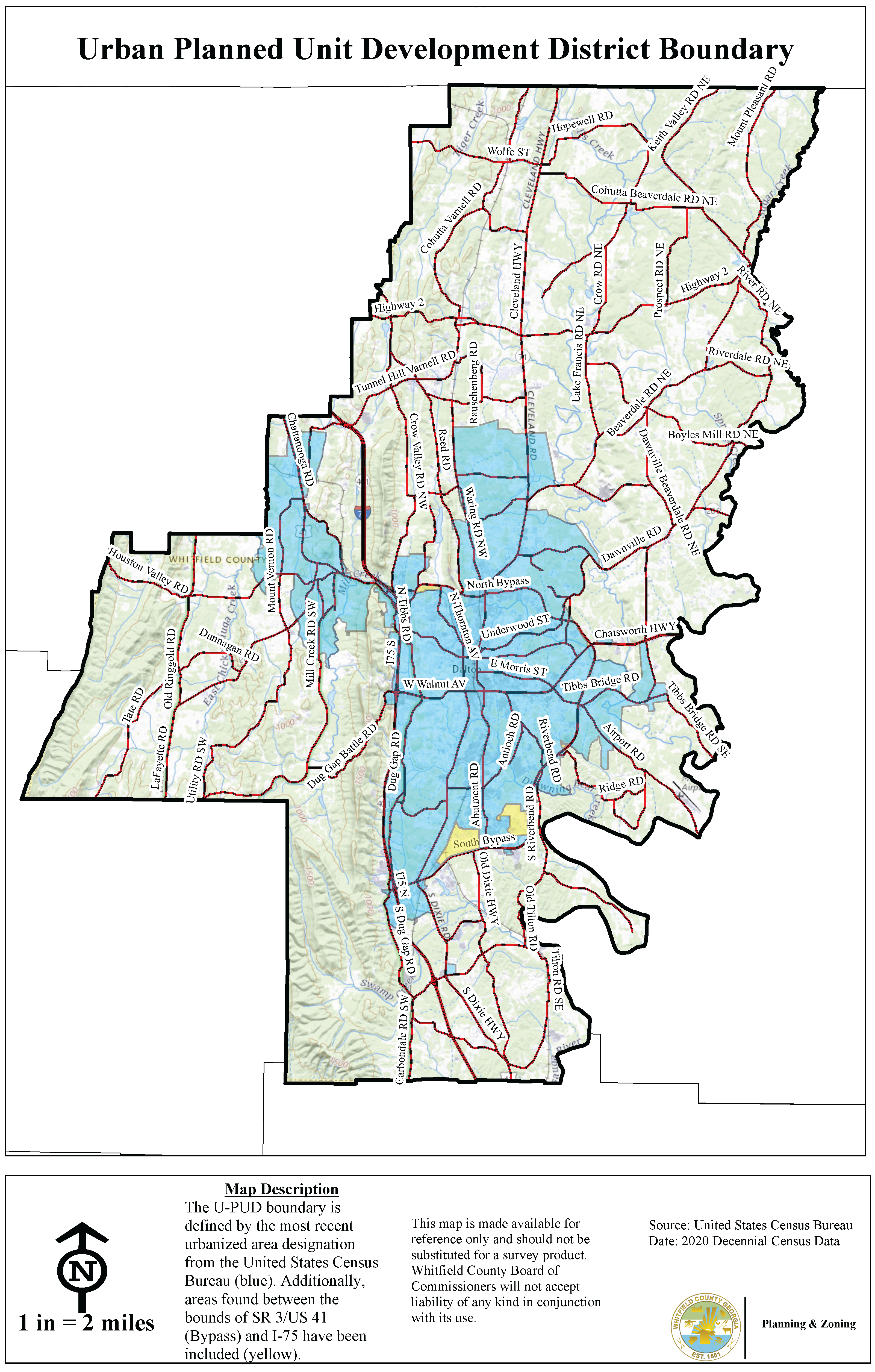
(Ord. No. 24-02, § 4(Att. 3), 1-8-2024)

