
Deckerville City Zoning Code
ARTICLE II
DEFINITIONS
Sec. 54-20.- Definitions.
For the purposes of this chapter, the following terms, phrases, words, and their derivations shall have the meaning given herein. When not inconsistent with the context, words used in the present tense include the future, words in the plural number include the singular number, and words in the singular number include the plural number. The word "shall" is always mandatory and not merely directory. Any word not herein defined shall be construed as in the State Construction Code of 1972 (1972 PA 230; MCLA 125.1501) and the Village Zoning Act (1921 PA 207; MCLA 125.581) and the amendments thereto. Other terms, phrases, and words not herein defined shall have the meaning customarily assigned to them by general usage in the English language.
Abutting. A lot or parcel, which shares a common border with another lot, parcel or right-of-way.
Access management (access control). A technique to improve or preserve traffic operations along a major roadway and minimize potential for accidents through the control of driveway locations and design; consideration of the relationship of traffic activity for properties adjacent to, and across from, one another; and the promotion of alternatives to direct roadway access. Methods used include construction of frontage roads, service drives, shared driveways, and medians or islands to direct traffic flow and control egress and/or egress.
Accessory structure. A structure erected on the same lot or site as the principal use building and intended to serve a purpose incidental to the principal use building, including, but not limited to, buildings, swimming pools, tennis courts, towers, driveways, parking areas, underground tanks, fences and satellite antennae.
Accessory use of accessory. An "accessory use" is a use, which is clearly incidental to customarily found in connection with and (except in the case of accessory off-street parking spaces or loading) located on the same zoning lot as the principal use to which it is related. When "accessory" is used in the text, it shall have the same meaning as accessory use. An accessory use includes, but is not limited to, the following:
(1)
Residential accommodations for servants and/or caretakers.
(2)
Swimming pools for the use of the occupants of a residence, or their guests.
(3)
Storage in a shed, tool room, or similar accessory building or other structure.
(4)
A newsstand primarily for the convenience of the occupants of a building, which is located wholly within such building and has no exterior signs or displays.
(5)
Storage of merchandise normally carried in stock in connection with a business or industrial use, unless such storage is excluded in the applicable district regulations.
(6)
Storage of goods used in, or produced by, industrial uses or related activities, unless such storage is excluded in the applicable district regulations.
(7)
Accessory off-street parking spaces, open or enclosed, subject to the accessory off-street parking regulations for the district in which the zoning lot is located.
(8)
Uses clearly incidental to a main use, such as but not limited to: offices of an industrial or commercial complex located on the site of the commercial or industrial complex.
(9)
Accessory off-street loading, subject to the off-street loading regulations for the district in which the zoning lot is located.
(10)
Accessory sign, subject to the sign regulations for the district in which the zoning lot is located.
Accessory use or building. A subordinate use or building customarily incident to and located on the same lot with the main use or building.
Addition. An extension or increase in floor area or height of a building or structure.
Adult entertainment uses. Any use of land, whether vacant of combined with structures or vehicles thereon by which said property is devoted to displaying or exhibiting material for entertainment, a significant portion of which includes matter or actions depicting, describing, or presenting "specified sexual activities" or "specified anatomical areas." Adult entertainment uses shall include, but not be limited to, the following:
(1)
An "adult motion picture theater" is an enclosed building with a capacity of 50 or more persons used for presenting material which has a significant portion of any motion picture or other display depicting or relating to "specified sexual activities" or "specified anatomical areas" for observation by patrons therein.
(2)
An "adult mini-motion picture theater" is an enclosed building with a capacity for less than 50 persons used for presenting material which has as a significant portion of any motion picture or other display depicting, describing, or presenting "specified sexual activities" or "specified anatomical areas."
(3)
An "adult motion picture arcade" is any place to which the public is permitted or invited wherein coin or slug operated or electronically or mechanically controlled still or motion picture machines, projectors, or other image producing devices are maintained to show images to five or fewer persons per machine at any one time, and where a significant portion of images so displayed depict, describe, or relate to "specified sexual activities" or "specified anatomical areas."
(4)
An "adult book store" is a use which has a display containing books, magazines, periodicals, slides, pictures, cassettes, or other printed or recorded material which has as a significant portion of its content or exhibit matter or actions depicting, describing, or relating to "specified sexual activities" or "specified anatomical areas" or an establishment with a (substantial) segment or section devoted to the sale or display of such material.
(5)
An "adult cabaret" is a nightclub, theater, or other establishment which features live performances by topless and/or bottomless dancers, "go-go" dancers, exotic dancers, strippers, or similar entertainers, where a significant portion of such performances show, depict,, or describe "specified sexual activities" or "specified anatomical areas."
(6)
An "adult motel" is a motel wherein matter, actions, or other displays are presented which contain a significant portion depicting, describing, or relating to "specified sexual activities" or "specified anatomical areas."
(7)
An "adult massage parlor" is any place where for any form of consideration or gratuity, massage, alcohol rub, administration of fomentations, electric or magnetic treatment or any other treatment or manipulation of the human body occurs as part of or in connection with "specified sexual activities" or where any person providing such treatment, manipulation or service related thereto exposes "specified anatomical areas."
(8)
An "adult model studio" is any place where, for any form of consideration or gratuity, figure models who display "specified anatomical areas" are provided to be observed, sketched, drawn, painted, sculptured, photographed, or similarly depicted by persons paying such considerations or gratuities, except that this provision shall not apply to any bona fide art school or similar educational institution.
(9)
An "adult sexual encounter center" is any business, agency, or person who, for any form of consideration or gratuity, provides a place where three or more persons, not all members of the same family may congregate, assemble, or associate for the purpose of engaging in "specified sexual activities" or exposing "specified anatomical areas."
Adult foster care facility. A governmental or nongovernmental establishment having as its principal function the receiving of adults for foster care. It includes facilities and foster care family homes for adults who are aged, emotionally disturbed, developmentally disabled, or physically handicapped who require supervision on an ongoing basis but who do not require continuous nursing care. Adult foster care facility does not include a nursing home, a home for the aged, an alcohol or a substance abuse rehabilitation center, a hospital for the mentally ill, or similar facilities.
(1)
Adult foster care family home: A private residence with the approved capacity to receive not more than six adults who shall be provided foster care for five or more days per week, and for two or more consecutive weeks. The adult foster care family home licensee shall be a member of the household and an occupant of the residence.
(2)
Adult faster care large group home: An adult foster care facility with the approved capacity to receive at least 13, but not more than 20 adults who shall be provided foster care.
(3)
Adult foster care small group home: An adult foster care facility with the approved capacity of not more than 12 adults who shall be provided foster care.
Adjacent (lot or parcel). A lot or parcel, which abuts or is directly across a public street or private easement from another lot or parcel.
Aged. An adult whose chronological age is 60 years of age or older, or whose biological age, as determined by a physician, is 60 years of age or older.
Alley. Any public space or thoroughfare 20 feet or less in width, but not less than ten feet in width, which has been dedicated or deeded to the public for public travel and which affords secondary access to abutting property.
Alteration. A change or rearrangement in the structural parts or in the exit facilities, or an enlargement, whether by extending on a side or by increasing in height, or the moving from one location or position to another.
Apartment. A dwelling unit containing three or more dwelling units.
Apartment house. A multifamily dwelling for three or more families, living independently of each other as separate housekeeping units, with separate access and egress, and doing their cooking upon the premises.
Arcade. Any place of business or establishment containing two or more mechanical amusement devices. Mechanical amusement devices include any machine, which, upon the insertion of any coin, slug, token, plate or disc, or which, for a fee paid to the operator or owner, may be operated by the public generally for use as a game, entertainment or amusement, whether or not registering a score. It shall include such devises as marble machines, skillball, mechanical grab machines, television display devices or machines and all games, operations or transactions similar thereto whether operated principally by mechanical means or electrical means or a combination thereof, under whatever name they may be indicated or called.
Architectural features. Architectural features of a building or structure shall include cornices, eaves, gutters, belt courses, sills, lintels, bay windows, chimneys, and decorative ornaments.
Area building. The aggregate of the maximum horizontal cross section area of the main building on a lot, excluding cornices, eaves, gutters, or chimneys projecting not more than three feet, steps, one-story open porches, bay windows not extending through more than one story and not projecting more than two feet, balconies and terraces.
Arterial roadway. Any roadway owned and maintained by the Michigan Department of Transportation where movement of through traffic is the primary function, with service to adjacent land a secondary function.
Auto repair garage. A place where the following activities may be carried on: Vehicle body repair, engine rebuilding or repair, undercoating, painting, upholstery work, welding and auto glass work, etc.
Base flood. A flood having a one-percent chance of being equaled or exceeded in any given year. This is also referred to the 100-year flood.
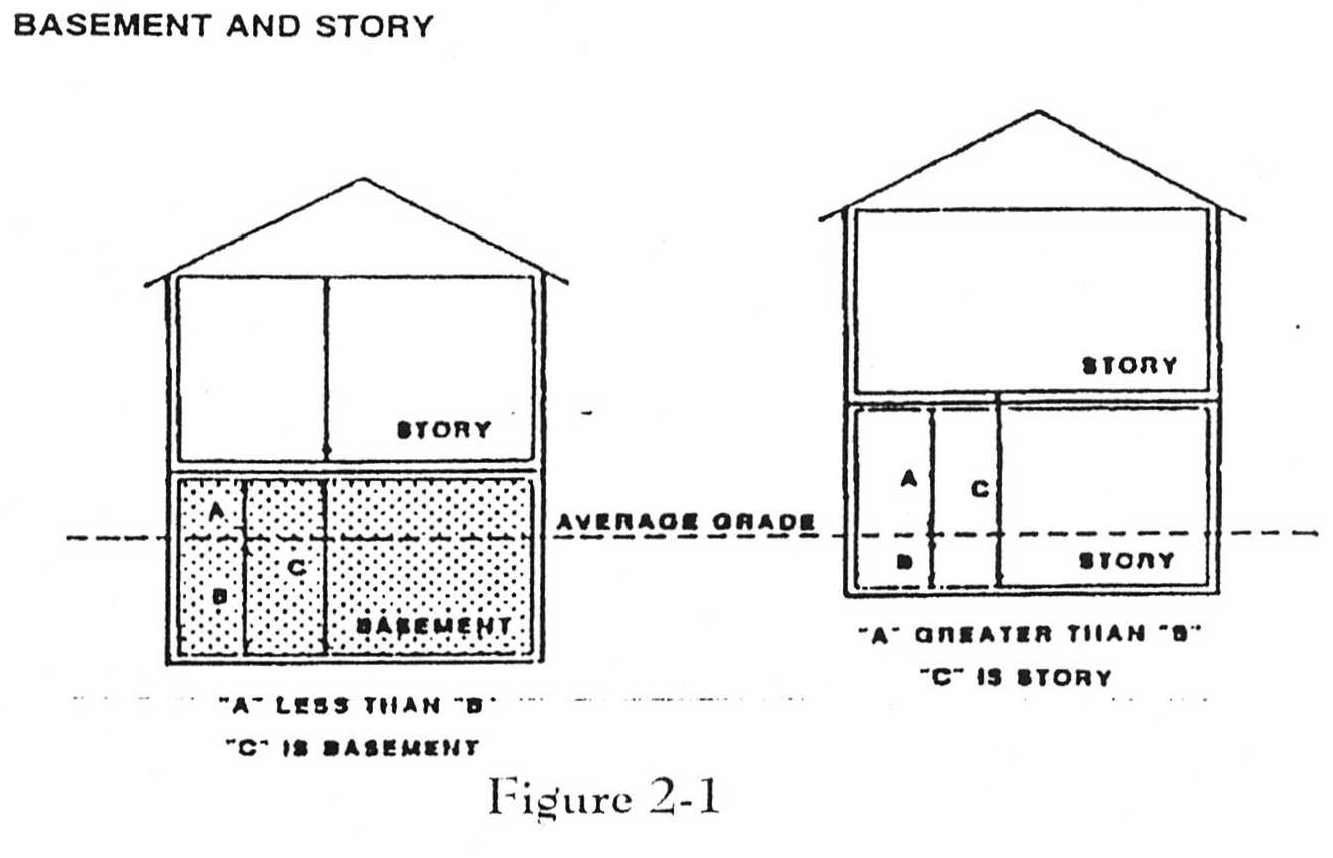
Basement. A portion of a building which is partly or wholly below grade so located that the vertical distance from average grade to the floor is greater than the vertical distance from the average grade to the ceiling. If the vertical distance from the grade to the ceiling is over five feet, such basement shall be rated as a first story.
Bed and breakfast. A dwelling where lodging and meals, are provided for compensation and where one or more rooms are occupied by persons by prearrangement for definite periods of not greater than one week. A bed and breakfast is to be distinguished from a boarding house, a hotel, a motel, or a convalescent or nursing home.
Berm. A mound of earth graded, shaped, and improved with grass, plant materials, and/or ground cover in such a fashion as to be used for visual and/or audible screening.
Block. The property abutting one side of a street and extending laterally between the two nearest intersecting streets, (crossing or terminating) or between the nearest intersecting streets, (crossing or terminating) or between the nearest such street and railroad right-of-way, or unsubdivided acreage; or between any of the foregoing and any other barrier to the continuity of development, or corporate boundary lines of the municipality.
Board of appeals. The words "board of appeals or "board" shall mean the board of zoning appeals for the Village of Deckerville.
Boarding house. A dwelling where lodging and meals, are provided for persons unrelated by blood, affinity or law usually for compensation and where one or more rooms are occupied by persons by prearrangement for definite periods of not less than one week. A boarding house is equivalent to a rooming house and to be distinguished from a bed and breakfast, a hotel, a motel.
Buffer zone. A strip of land often required between zoning districts and reserved for plant material, berms, walls or fencing to serve as a visual or sound or privacy barrier.
Building. A structure designed, built, or occupied as a shelter or roofed enclosure for persons, animals, or property, including tents, lunch wagons, dining cars, camp cars, trailers, and other roofed structure on wheels or other supports, used for residential, business, mercantile, storage, commercial, industrial, institutional, assembly, educational, or recreational purposes. For the purposes ol this definition "roof" shall include an awning or other similar covering, whether or not permanent in nature.
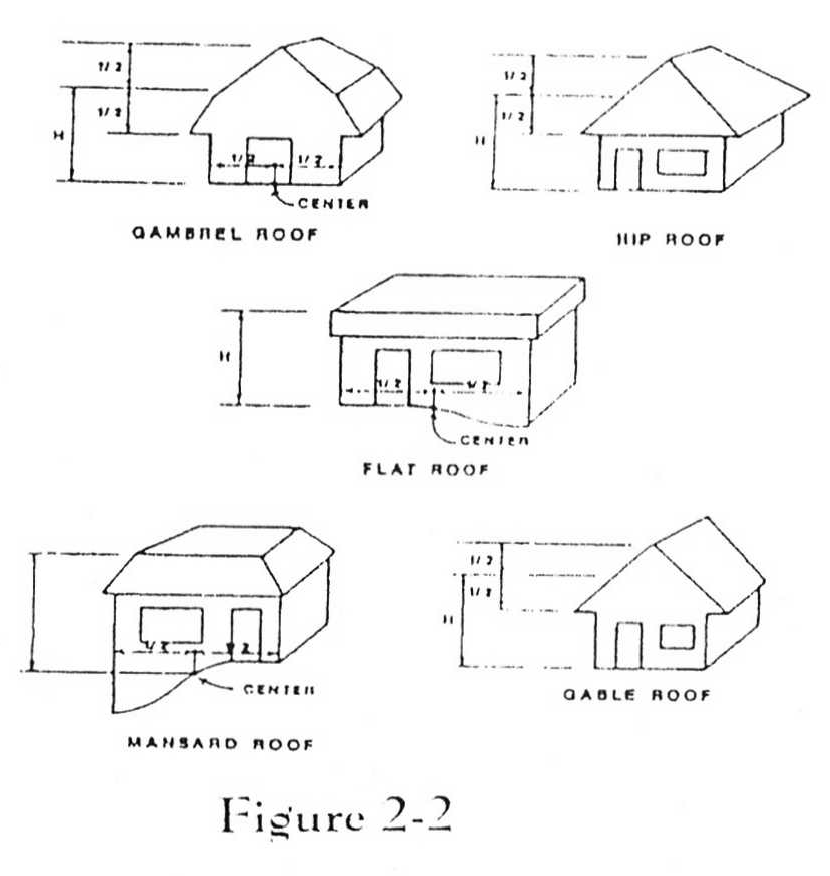
Building height. The vertical distance measured from the established grade to the highest point of the roof surface for flat roofs; to the deck line of mansard roofs; and to the average height between eaves and ridge for gable, hip, and gambrel roofs. Where a building is located on stopping terrain, the height may be measured from the crown of the street grade.
Building, high rise. Any building exceeding 35 feet in height.
Building inspector (official). The administrative official designated by the village council charged with the responsibility of administering and enforcing this chapter.
Building line. The vertical plane beyond which no building or other structure or portion thereof may be erected, for setback purposes.
Building line, setbacks. See "setback building line".
Building, principal. A building in which is conducted the main or principal use on a lot or parcel.
Canopy tree. A deciduous tree whose mature height and branch structure provide foliage primarily on the upper half of the tree and which provides shade to adjacent ground area.
Cellar. See definition of basement.
Certificate of zoning compliance. A document signed by the zoning administrator or seal on a final site plan, as a condition precedent to the commencement of a use of the construction of any building or structure, that such use, building or structure complies with the provisions of this chapter.
Cesspool. A cavity in the ground that receives waste to be partially absorbed directly or indirectly by the surrounding soil.
Child care center. A facility other than a private residence, receiving one or more children for care for periods of less than 24 hours in any day, and where parents or guardians are not immediately available to the child. Child care center does not include a Sunday School, a vacation bible school or a religious instruction class that is conducted by a religious organization where children are in attendance for not greater than four hours per day for an indefinite period, or not greater than eight hours per day for a period not to exceed four weeks during any 12-month period, or a facility operated by a religious organization where children are cared for not more than three hours while parents or guardians attend religious worship services.
Church or synagogue. A building, the primary use of which is regular assembly of persons for religious worship or services, together with accessory uses.
Clinic. An establishment where human patients who are not lodged overnight are admitted for examination and treatment by a group of physicians, dentists or similar professions.
Club. An organization of persons for special purposes or for the promulgation of sports, arts, sciences, literature, politics, or the like, but not operated for profit.
Club pool. Any swimming club as a principal that is private and is operated by a private swimming club as a principal use of land primarily for the use and benefit of the members in such club, their families and guests, or is operated as an accessory use to a gulf club or multiple family development.
Club, private swimming. Any organization established for the primary purpose of constructing, maintaining and operating a club pool, and other related buildings and recreational facilities for the sole and exclusive use of its family members, their families, and guests.
Coin-operated amusement device. Any amusement machine operated by means of a coin or token or activated by any other means for the purpose of amusement or test of skill. Coin-operated music machines shall not be considered a coin operated amusement devise.
Commercial recreation establishment. A facility designed and equipped for the conduct of sports, amusement or leisure time activities and other customary recreational activities, either within an enclosed building or outdoors and operated as a business for public use for a fee.
Commercial vehicle pick-up truck. A light truck, including one with an "extended cab" or a "crew cab", manufactured with an open body, low sides, and a tailgate.
Commercial vehicle passenger/cargo-style van. An enclosed truck manufactured with a unified body permitting unobstructed passenger movement throughout.
Common land. A parcel(s) of land with improvements, the use, maintenance and enjoyment of which are intended to be shared by owners or occupants of individual building units in a subdivision, condominium project, or a planned unit development.
Common open space. An unoccupied area within a planned unit development which is reserved for the leisure and enjoyment of all planned unit development residents and maintained by common hv them or a homeowners association.
Condominium unit. That portion of a condominium project or site condominium subdivision, which is designed and intended for separate ownership and use, as described in a master deed, regardless of intended use. The owner of a condominium unit also owns a share of the common elements. I he terms "condominium unit" and "site condominium" shall be considered the equivalent to the term "lot" for purposes of determining compliance to minimum lot size, minimum lot width, maximum lot coverage and maximum floor area ratios. Lot requirements within this chapter shall apply to site condominium units as though they are designed and recorded under provisions of Public Act 288 of 1961, as amended.
Convalescent or nursing home. A structure with sleeping rooms where persons are housed or lodged and are furnished with meals, nursing and medical care.
Conditional use. See "special land use."
Correctional facility. Any lot or parcel of land and/or building intended for use as a prison, reformatory, jail, correction, detention or housing facility for adult or juvenile persons convicted of any crime. A correctional facility shall include any facility operated by the State of Michigan and agencies thereof, other governmental unit, or a private organization. Also, any land or building intended for use as a training or detention facility in connection with farming or vocational skills training shall he included in this definition.
Council. The Village Council of the Village of Deckerville, Sanilac County, Michigan.
Court. An occupied open space, other than a yard, on the same lot with a building, which is hounded on two or more sides by the walls of such building.
Court, inner. A court enclosed on all sides by exterior walls of a building or by exterior walls and lot lines on which walls are allowable.
Court, outer. A court enclosed on not more than three sides by exterior walls, and lot lines on which walls are allowable, with one side or end open to a street, driveway, alley or yard.
Cul-de-sac. A dead end public or private street, which terminates in a circular section which allows for vehicle turnaround.
Dangerous/hazardous substances. Chemical and gases, explosive, radioactive materials, petroleum or petroleum products or gases, poisons, etiologic (biologic) agents, flammable or corrosives.
Day care center. A public or private school, kindergarten, or child care facility wherein day care or day care and education is provided for five or more minors under the age of seven years.
Deceleration lane. An added roadway lane that permits vehicles to slow down before turning adjacent to, but not on a lane intended for through traffic.
Density. The number of dwelling units developed per net or gross acre of land.
Deputy zoning administrator. An individual appointed by the village board who shall assist the zoning administrator in administering the Village of Deckerville Zoning Ordinance.
Detention facility. Any prison penitentiary, reformatory, house of correction, jail community residential center, institution, halfway house, regional correction/detention facility, treatment center, group home, training center, training center or camp, etc., operated or leased by the department of corrections or department of social services or constructed and maintained under Act 274 of 1919 or other halfway houses, probationary camps, farms, shops, places of employment operated by or under the supervision of the department of corrections providing services to adult or juvenile criminal offenders. (See also "juvenile detention/correction facility.")
Development. The construction of a new building, reconstruction of an existing building or oilier structure, on a zoning lot, or the use of open lane for a new use.
Display. As used in connection with adult entertainment use, the work display shall mean any single motion or still picture, presentation, dance or exhibition, live act, or collection of visual materials such as books. Films, slides, periodicals, pictures, video cassettes, or any oilier printed or recorded mailer which is open lo view or available to the general population whether for free or otherwise.
District. A portion of the village within which certain regulations and requirements or various accommodations thereof apply under the provisions of this chapter.
Drive-in. A business establishment so developed that its retail or service character is dependent on providing a driveway approach or parking spaces for motor vehicle so as to serve patrons while in the motor vehicle rather than within a building or structure.
Driveway throat width. The driveway width measured perpendicularly from the edge of pavement or curb face, in the narrowest section of the driveway.
Dwelling. A building designed or used as the living quarters for one or more persons.
Dwelling house. A building designed for and occupied exclusively as the residence of not more than two families each living as an independent housekeeping unit.
Dwelling unit. One or more rooms providing complete living facilities for one family, including equipment for cooking or provision for the same, and including room or rooms for living, sleeping, and dining.
Dwelling, multifamily. A dwelling or group of dwellings on one plot containing separate living units for three or more families, but which may have joint services or facilities.
Earth berm. A mound of earth, planted with ground cover, grass, trees, or other landscaping material intended to minimize the view between land uses and to reduce noise and dust from adjacent uses and passersby.
Easement. A grant of one or more of the property rights by the property owner to and/or for the use by the public, a corporation, or another person or entity.
Elderly housing. A building or group of buildings containing dwellings where the occupancy of the dwellings is restricted to persons 60 years of age or older, or couples where either spouse is 60 years of age or older, This does not include foster care, home for the aged, or nursing home.
Erected. Any physical operations on the premises required for the construction or placement and includes construction, building, reconstruction, alteration, excavation, fill, drainage, installation of utilities, etc.
Erosion. The collapse or subsidence of land along the shore of a lake or other body of water, including drains, creeks, streams and rivers, as a result of erosion or undermining caused by waves or currents of water exceeding anticipated cyclical levels.
Essential service. The erection, construction, alteration, or maintenance by public utilities or municipal departments or commissions, of underground or overhead gas, electrical, steam or water transmission or distribution systems, including poles, wires, mains, drains, sewers, pipes, conduits, cables, fire alarm boxes, police call boxes, traffic signals, hydrants, and other similar equipment and accessories in connection therewith, but not including buildings reasonably necessary for the furnishing of adequate service by such public utilities for municipal departments or commissions or for the public health, safety or general welfare.
Excavation. Any breaking of ground, except common household gardening and ground care.
Family. A single person, doing his/her own cooking, and living upon the premises as a separate housekeeping unit, or a group of persons connected by blood, by affinity or by law.
Farm. The term "farm" shall mean all of the contiguous neighboring or associated land operated as a single unit on which bona fide farming is carried on directly by the owner-operator, manager or tenant farmer, by his own labor or with the assistance of members of his household or hired employees; farms may be considered as including establishments operated as bona fide greenhouses, nurseries, orchards, chicken hatcheries, poultry farms, and apiaries; provided however, that land to be considered s farm hereunder shall include a continuous parcel of five acres or more in area; but establishments beeping or operating fur-bearing animals, hoarding or riding stables, or commercial dog kennels shall not be considered farms hereunder.
Farm buildings. Any structure or building other than dwelling used or built on a farm.
Fence. A partition, structure, or gate erected as a dividing marker, barrier, or enclosure.
Filling. The depositing or dumping of any matter onto or into the ground, except common household gardening and ground care.
Flea market. An enclosed shop or open market selling primarily used goods, antiques, curios, art objects, collectibles, etc.
Flood or flooding. A general and temporary condition of partial or complete inundation of normally dry land areas from the overflow of drains, creeks, streams, rivers, lakes or oilier inland water caused by severe storms, hurricanes, tornadoes, heavy rains.
Flood insurance rate map (FIRM). A map of the village prepared by the Federal Emergency Management Agency, which identifies 100- and 500-year floodplain and other flood related information and which is used as the official floodplain may for insurance purposes.
Flood insurance study. The official report provided by the Federal Emergency Management Agency containing profiles, as well as the flood hazard boundary—floodway map and the water surface elevation of the base flood.
Floor area, gross. The "gross floor area" shall be the sum of the horizontal areas of the several floors of the building excluding areas used for accessory garage purposes and such basement areas as are devoted exclusively to uses accessory to the operation of the building. All horizontal dimensions shall be taken from the exterior faces of walls, including walls or other enclosures of enclosed porches.
Floor area, residential. For the purpose of computing the minimum allowable floor area in a residential dwelling unit, the sum of the horizontal areas of each story of the building shall be measured from the exterior walls or from the centerline of walls separating the two buildings. The floor area measurement is exclusive of areas of basements, unfinished attics, attacked garages, breezeways, and enclosed and open porches.
Floor area, usable. That area used for, or intended to be used for, the sale of merchandise or services, or for use to serve patrons, clients, or customers. Such floor area which is used, or intended to be used principally for the storage or processing of merchandise, hallways, or for utilities or sanitary facilities, shall be excluded from this computation of "usable floor area". Measurement of usable floor area shall be the sum of the horizontal areas of the several floors of the building, measured from the interior faces of the exterior walls.
Foster care. The provision of supervision, personal care, and protection in addition to room and board, for 24 hours per day, five days or more per week, and for two or more consecutive weeks of compensation.
Frontage. That portion of a parcel of property which is contiguous with a public thoroughfare which has been deeded, dedicated or otherwise conveyed to and accepted by the governmental entity responsible for its maintenance.
Garage, private. A building or part thereof accessory to a main building and providing for the storage of motor vehicles and in which no occupation or business for profit is carried on.
Garage, public or storage. A building or part thereof (other than a private residential garage) for the storage of motor vehicles or in which service, maintenance or repair activities may he performed.
Garage sale. A sale of primarily used goods, antiques, curios, clothing, etc., operated on residential property by the owner or occupant on an occasional basis.
Gasoline service station. A place for the dispensing, sale or offering for sale of motor fuels directly to users of motor vehicles alone or together with the sale of minor accessories and/or the servicing of and minor repair of motor vehicles. A special land use permit is required.
Governmental agency. Any department, commission, independent agency, or instrumentality of the United States, of a state, county, incorporated or unincorporated municipality, township, authority, district, or governmental.
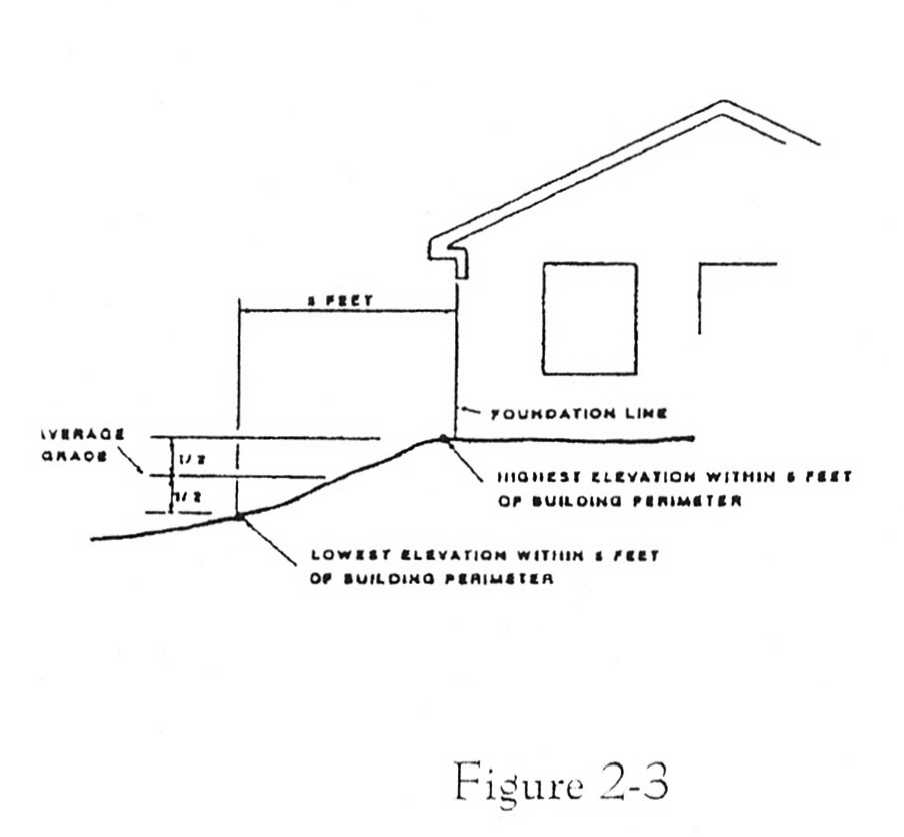
Grade. The highest ground elevation in contact with any portion of the basement or foundation of a dwelling.
Greenbelt. An open, landscaped area intended to act as a buffer for noise, and/or sight relief.
Gross site area. The total area of a planned unit development site, including floodplain and water-bodies.
Health care facility. A facility or institution, whether public or private, principally engaged in providing services for health maintenance, diagnosis and treatment of human disease, pain, injury, deformity or physical condition allowing overnight stay, including, but not limited to, a general hospital, special hospital, mental hospital, public health center, diagnostic center, treatment center, rehabilitation center, extended care facility, tuberculosis hospital, chronic disease hospital, maternity hospital, out-patient clinic, dispensary, home health care agency, and bio-analytical laboratory or central services facility serving one or more such institutions, but excluding institutions that provide healing solely by prayer, and clinic facilities of physicians, dentist, and optometrists, and other health practitioners.
Height, building. The vertical dimension measured from the average elevation of the finished lot grade at the front of the building, to the highest point of the building.
Home for the aged. A supervised personal care facility, other than a hotel, adult foster care facility, hospital, nursing home, or county medical care facility, that provides room, board, and supervised personal care to 21 or more unrelated, non-transient, individuals 60 years of age or older if the facility is operated in conjunction with and as a distinct part of a licensed nursing home.
Home occupation. An occupation or profession customarily carried on by an occupant of a dwelling unit as a secondary use, which is clearly subservient to the use of the dwelling for residential purposes.
Hospice. A health care program which provides a coordinated set of services rendered at home or in outpatient or institutional settings for individuals suffering from a disease or condition with a terminal prognosis.
Hospital. An institution providing health services, primarily for in-patients and medical and surgical care of the sick or injured, including as an integral part of the institution such related facilities, central service facilities, and staff offices.
Hotel. A building with general kitchen and dining facilities and containing rooms intended or designed to be used, rented or hired out to be occupied for sleeping purposes by guests.
Household. A household includes all persons who occupy a house, an apartment, group of rooms, or a single room occupied as a separate living quarters.
Improvements. Those features and actions associated with a project which are considered necessary by the planning commission, to protect natural resources, or the health, safety, and welfare of the residents of the village and future users or inhabitants of the proposed project or project area, including roadways, lighting, utilities, sidewalks, screening, drainage, parking areas, and landscaping.
Incombustible material. Any material, which will not ignite at or below a temperature of 1,200° Fahrenheit and will not continue to burn or glow at that temperature.
Industry. The production, manufacture or fabrication of products with the intention of profit, the term also includes the ancillary repair, modification or alteration of products, the raising of farm products is exempted.
Junk. Articles that have outlived their intended usefulness in their original form and are commonly discarded or gathered up to be converted into another product, either of the same or different kind.
Junkyard. An open area where waste, used or second hand materials are bought and sold, exchanged, stored, baled, packed, disassembled, shredded or handled, including, but not limited to, scrap iron and other metals, paper, rags, tires and bottles. A "junkyard" includes automobile wrecking yards and includes any area of unreasonable accumulation for storage, keeping or abandonment of junk, but does not include uses established entirely within enclosed buildings.
Juvenile correctional/detention facility. Any institution, half-way house, regional detention facility, treatment center, group home, farm, training center or camp wherein one or more juvenile offenders is detained by court order as the result of a determination of delinquency or under the supervision of the department of social services by court order because of a determination of delinquency.
Kennel, commercial. Any lot or premises on which three or more dogs or cats are either permanently or temporarily boarded.
Livestock. Animals including, but not limited to, horses, cattle, sheep, goats, swine, poultry and rabbits.
Livestock operation, intensive. An agricultural activity in which 500 or more livestock are fed, bred and/or raised within a confined area, other than open pasture, either inside an enclosed building or outdoors.
Loading space. An off-street space on the same lot with a building, or contiguous to a group of buildings for unloading merchandise or materials, and which abuts upon a street, alley, or other appropriate means of access.
Lot. A parcel of land capable of being occupied by one building, and the accessory buildings or uses customarily incident to it, including such open spaces as are required by this chapter.
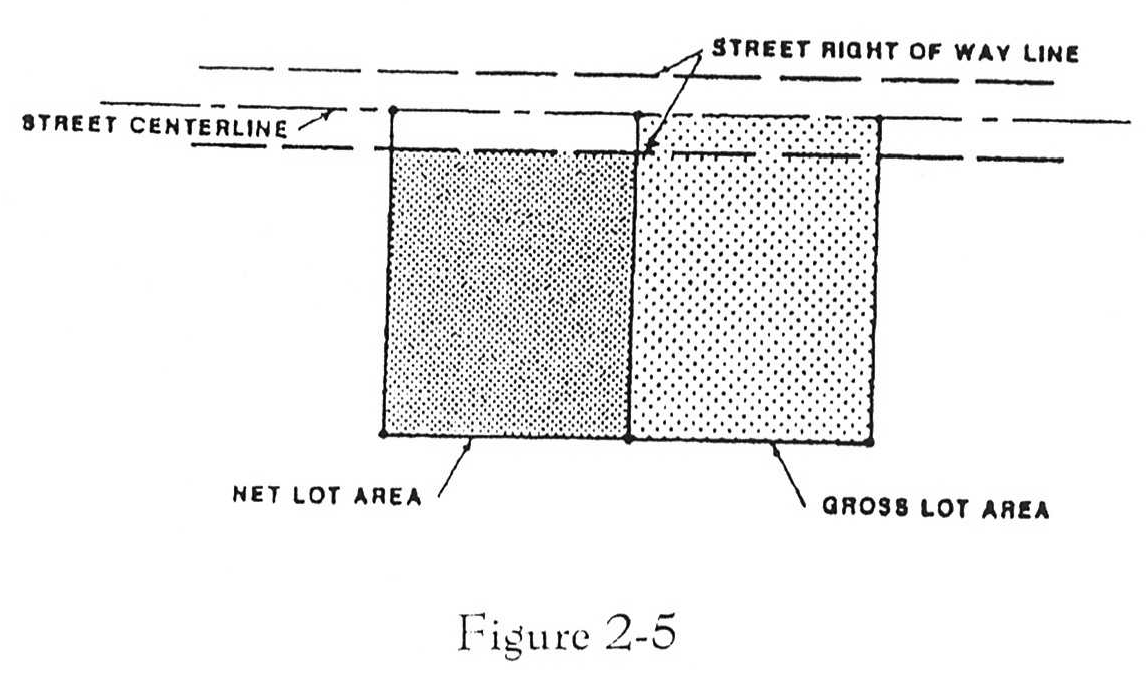
Lot area. The total horizontal area within the lot lines of the lot.
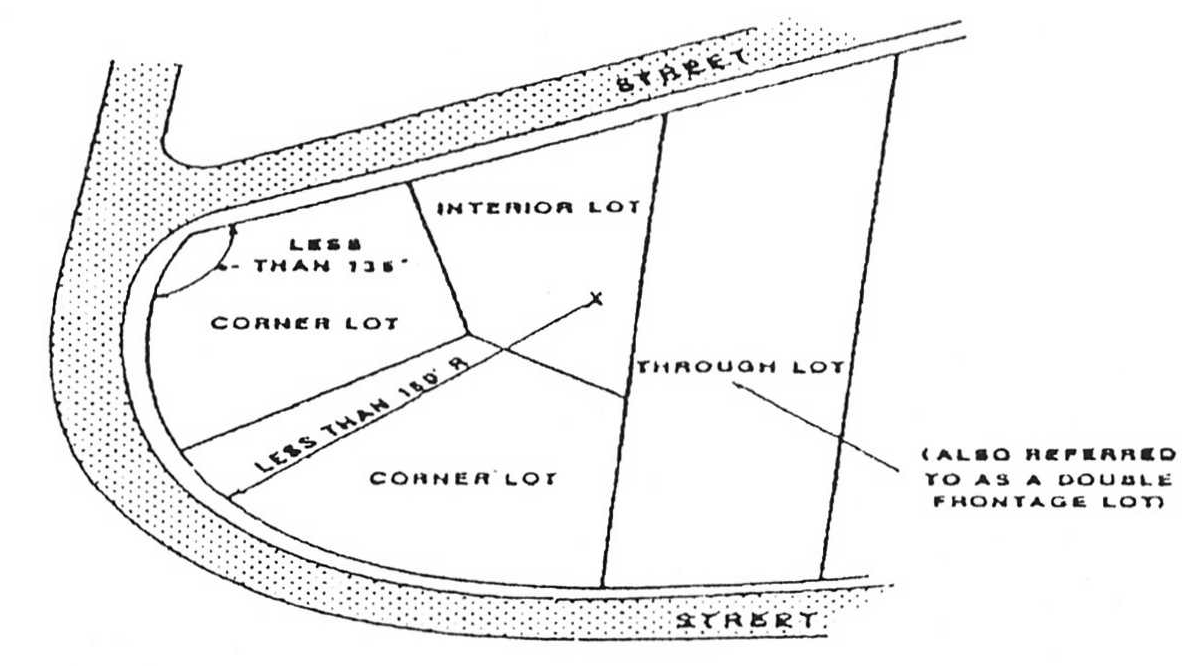
Lot, corner. A lot at the point of intersection of and abutting on two or more intersecting streets. It is the land occupied or to be occupied by the corner building and its accessory buildings.
Lot, coverage. The part or percent of the lot occupied by buildings including accessory buildings.
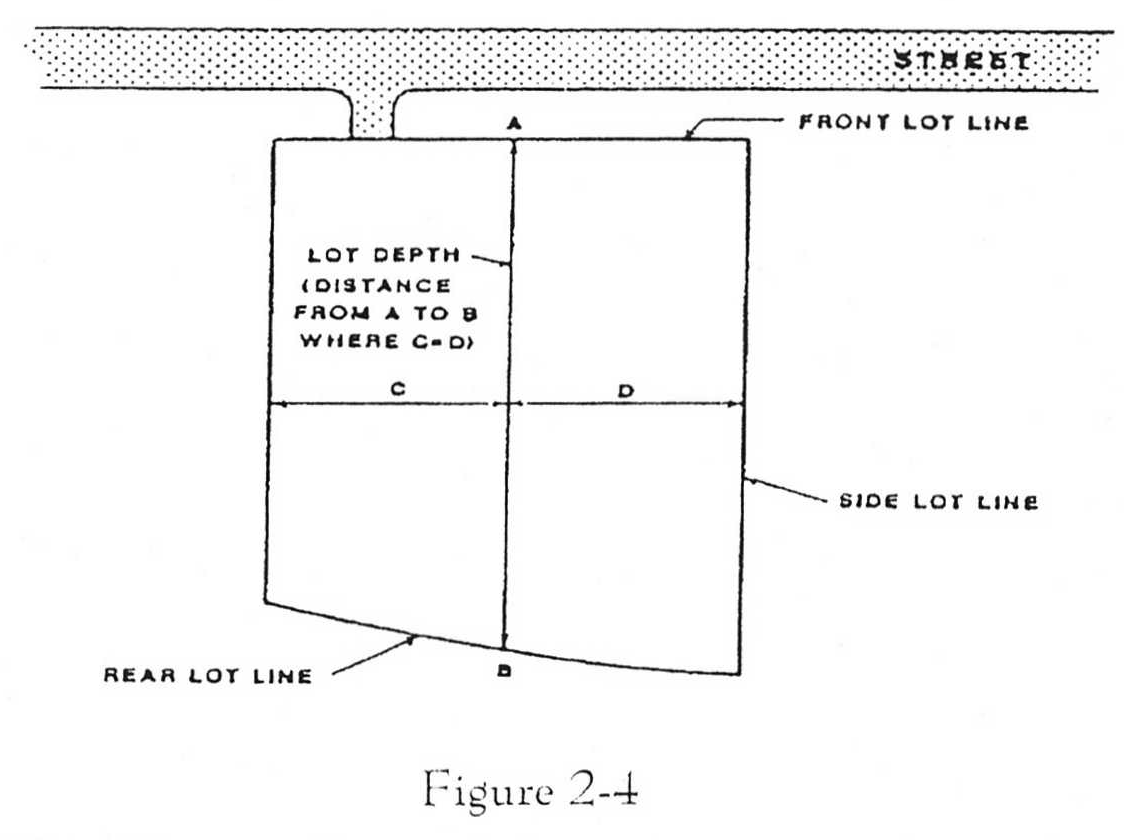
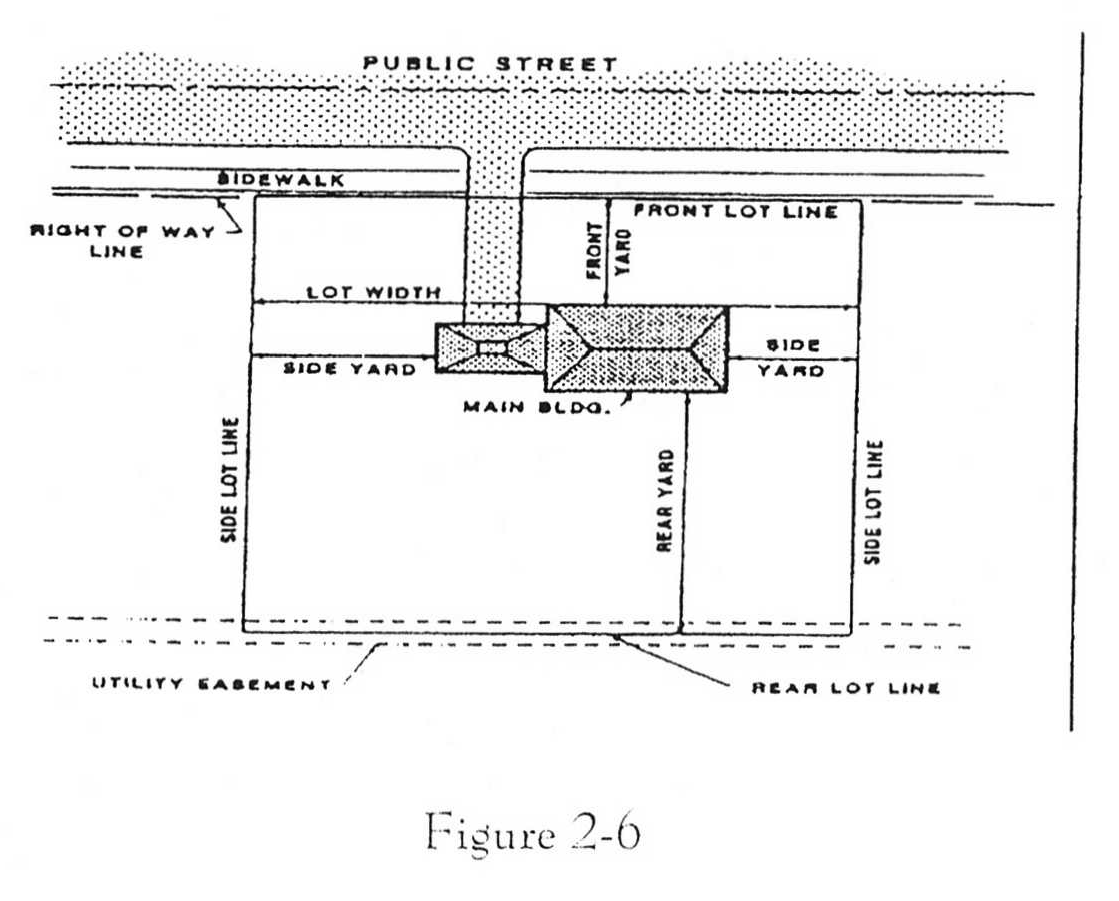
Lot depth. The horizontal distance between the front and rear lot lines, measured along the median between the side lot lines.
Lot, double-frontage. Any lot, excluding a corner lot, which fronts on two streets, which do not intersect.
Lot, interior. Any lot other than a corner lot.
Lot lines. The lines bounding a lot as defined herein:
(1)
Front lot line: In the case of an interior lot, is that line separating said lot from the street. In the case of a corner lot, or double frontage lot, is that line separating said lot from either street.
(2)
Rear lot line: That lot line opposite the front lot line. In the case of a lot pointed at the rear, the rear lot line shall be an imaginary line parallel to the front lot line, not less than ten feet long lying parallel from the front lot line and wholly within the lot.
(3)
Side lot line: Any lot line other than the front lot line or rear lot line. A side lot line separating a lot from another lot or lots is an interior side lot line.
Lot of record. A lot which actually exists in a subdivision plat as shown on the records of the county register of deeds, or a lot or parcel described by metes and bounds, the description of which has been so recorded. Whenever an owner has combined two or more lots as contained on any recorded plat into a single building site, or combined two or more lots contained on any recorded plat in the records of the assessor, said combination of lots shall be deemed to be a single lot of record for the purposes of this chapter.
Lot, through. Any interior lot having frontage on two more or less parallel streets as distinguished from a corner lot. In the case of a row of double frontage lots, all sides of said lots adjacent to streets shall be considered frontage, and front yards shall be provided as required.
Lot width. The horizontal distance between the side lot lines, measured at the two points where the building line, or setback line intersects the side lot lines.
Lot, zoning. A single tract of land, located within a single block, which, at the time of filing for a building permit, is designated by its owner or developer as a tract to be used, developed, or built upon as a unit, under single ownership or control. A zoning lot shall satisfy this chapter with respect to area, size, dimensions and frontage as required in the district in which the zoning lot is located. A zoning lot therefore, may not coincide with a lot of record as filed with the county register of deeds, but may include one or more lots of record.
Main building. A building in which is conducted the principal use of the lot upon which it is situated.
Main use. The principal use to which the premises are devoted and the principal purpose for which the premises exist.
Major thoroughfare. An arterial street, which is intended to serve as a large volume traffic way for both the immediate municipal area and the region beyond, and is designated as a major thorough-fare, parkway, expressway, or equivalent term on the village's street classification report as provided to the Michigan Department of Transportation.
Manufactured housing. Factory-built, single-family structures that meet the National Manufactured Home Construction and Safety Standards Act (42 U.SC Sec. 5401) commonly referred to as precut, modular homes, sectional homes, component, or panelized homes.
Master deed. The document recorded as part of a condominium subdivision plan to which are attached as exhibits deed covenants, by-laws, easement descriptions, survey and related documents.
Master plan. The comprehensive plan including graphic and written proposals indicating the general location for streets, paths, schools, public buildings, and all physical development of the municipality, and includes any unit or part of such plan, and any amendment to such plan or parts thereof.
Mezzanine. An intermediate floor in any story occupying not-to-exceed ⅓ of the floor area of such story.
Mini-warehouse (self-storage facility). A facility consisting of a building or a group of buildings in a controlled access compound, where individual stalls or lockers are rented out to individual tenants for the dead storage of customers' goods and wares. The use of the premises shall be limited to storage only, and shall not be used in any action, or sales, or storage and transfer business; for the servicing, repair or fabrication of any vehicle, boat, trailer, appliance, or similar item; or for the operation of power tools, compressors, kilns, or similar equipment; except, that limited sales to tenants of products and supplies incidental to the principal use, such as packing material, identification labels, rope, lochs, tape, etc., shall be permitted on the site devoted to this use. The storage of combustible or flammable liquids, combustible fibers or explosive materials, as defined in the fire protection code, or toxic materials, are expressly prohibited.
Mobile, factory built or portable home. As used herein the term "mobile home" shall mean a movable or portable dwelling constructed to be towed on its own integral chassis and designed for permanent year-round living as a single-family dwelling. Provided, however, that the term "mobile home" shall not include modular homes (which are transported to the placement site on independent frames and running gear), motor homes, campers, recreation vehicles (whether licensed or not as motor vehicles) or other transportable structures designed for temporary use and which are not designed primarily for permanent residence and connection lo sanitary sewage, electrical power and potable water utilities.
Mobile home park. A parcel of land, which has been planned and improved for the placement of mobile homes for residential use.
Modular home. A dwelling, which consists of pre-fabricated sections transported to the site on a removable undercarriage of flat bed and assembled for permanent location on the lot or parcel.
Motor vehicle repair garage. A place where the following activities may be carried on: Vehicle body repair, engine rebuilding or repair, undercoating, painting, upholstery work, welding and auto glass work, etc.
Motel. A series of attacked, semi-detached or detached rental units containing bedroom and toilet facilities for temporary lodging for compensation.
Motorized home. A self-propelled motor vehicle, which provides the amenities of day-to-day living while used as a means of transportation for recreational or travel purposes.
Municipal building. A building owned by the Village of Deckerville and used in conjunction with the business and operation with the village.
Municipality. Village of Deckerville.
Nonconforming building. A building or portion thereof existing at the effective date of this chapter, or amendments thereto, that does not conform to the use provisions of the ordinance.
Nonconforming lot. Any lot, out-lot, or oilier parcel of land which does not meet the land area or dimension requirements of this chapter.
Nonconforming use. A use of land existing al the lime of the enactment of this chapter, which does not conform to the regulation of the district in which it is located.
Nuisance. Any condition or use of premises or id building exteriors, which is unsightly or detrimental to the property of others or which causes or tends to cause diminution in the value of other property in the neighborhood in which such premises are located.
Nursery, plant materials. A space, building or structure, or combination thereof, for the storage of live trees, shrubs, or plants offered for retail sale on the premises including products used for gardening or landscaping. The definition of nursery within the meaning of this chapter does not include any space, building, or structure, used for the sale of [mils, vegetables, or Christmas trees.
Obscuring screen. A visual barrier between abutting uses or lots. The screen may consist of a wall, fence or living plant material.
Occupied. Includes the use of a building or land for the purpose for which it was designed, arranged or intended.
Office. A place, such as a building, room, or suite in which services, clerical work, professional duties or the like are carried out.
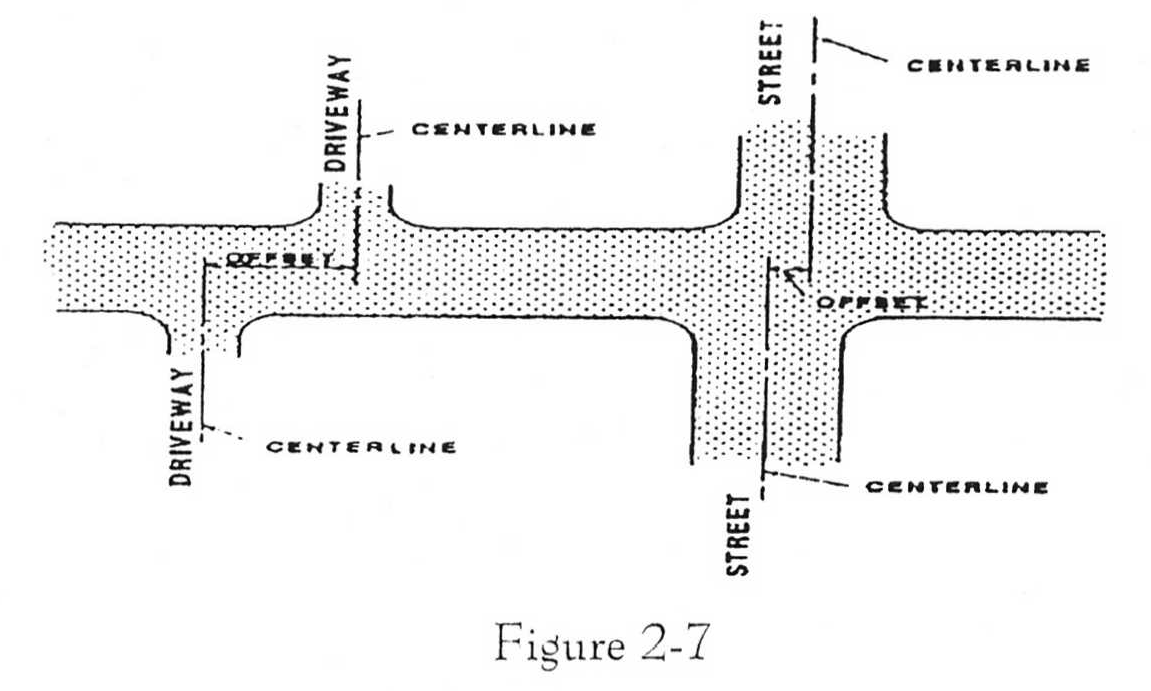
Offset. The distance between the centerline of driveways or streets which are opposite from one another.
Off-street parking lot. A facility providing vehicular parking spaces along with adequate drivers and aisles for maneuvering so as to provide access for entrance and exit for the parking of automobiles.
Open front store. A business establishment so developed that service to the patron may be extended beyond the walls of the structure, not requiring the patron to enter the structure. The term "open front store" shall not include automobile repair stations or automobile service stations.
Open storage. All outdoor storage of any kind whatsoever.
Ordinary high water mark. The line between upland and bottomland which persists through successive changes in water levels below which the presence and action of the water is so common or recurrent that the character of the land is marked distinct from the upland as to soil surface and type and vegetation.
Parcel. A lot described by metes and bounds description, whether or not included in a recorded plat or condominium subdivision.
Parking space. All area of not less than 150 square feet, net, exclusive of access or maneuvering area, or ramps, columns, etc., to be used exclusively as a temporary storage space for one private motor vehicle. Truck loading and unloading space shall not be included in such area.
Peak hour. The hour during the typical clay in which traffic volume is the highest.
Patio (deck). An uncovered courtyard or platform extending horizontally out from the main building or structure.
Playground. A parcel of land set aside for outdoor games or recreational purposes with no admission charge.
Planning commission. Village of Deckerville Planning Commission.
Plat. A map of a subdivision of land.
Pond. A natural or manmade body of water without an encircling fabricated retainer.
Porch, enclosed. A covered projection on a building or structure containing a floor which is totally enclosed with glass, solid material, or screening and projects out from the main wall of said building or structure, and has a separate roof or an integral roof with the principal building or structure to which it is attacked.
Porch, open. A covered projection on a building or structure containing a floor which is open except (or columns supporting the porch roof, and projects out from the main wall of said building or structure, and has a separate roof or an integral roof with the principal building or structure to which it is attacked.
Pools. Refer to "swimming pool".
Private roads. An area of road used for ingress and egress to serve more than one parcel of property not part of a subdivision created under State Act 288, PA 1961, as amended.
Public service. Public service facilities (within the context of this chapter) shall include such uses and services as voting booths, pumping stations, fire halls, police stations, temporary quarters for welfare agencies, public health activities and similar uses.
Public street. Any right-of-way by easement or ownership and operated by a unit of government. No part of any such right-of-way shall be considered when determining compliance with required setback for area of other dimensional requirement of this chapter.
Public utility. Any person, firm, or corporation, municipal department, board or commission duly authorized to furnish and furnishing under federal, state, or municipal regulations to the public: gas, steam, electricity, sewage disposal, communication, telegraph, transportation, water or other such essentials.
Quarry. Any pit, excavation, or mining operation for the purpose of searching for, or removing for commercial purposes, any earth, sand, gravel, clay, stone, or other mineral in excess of 200 cubic yards in any calendar year, but shall not include an oil well an oil well or excavation in preparation for construction of a building, structure or roadway.
Razing. To destroy, demolish, level to ground, etc.
Reasonable access. A property owners' legal right, incident to ownership of property abutting a public street. Reasonable access includes indirect access via frontage roads, service roads, service roads and shared driveways where turning movements need to be restricted as to location due to heavy traffic volumes, limited site distance or other traffic conditions which could harm sale and efficient travel where access is unlimited.
Recreational vehicle. Boats, boat trailers, airplanes, dune buggies, dirt bikes, off road vehicles, snowmobiles, or racing automobiles, any vehicle equipped for camping, sleeping or living purposes or any part thereof and any other vehicles or equipment of a type principally used for recreational purposes. The classification includes:
(1)
Boats, which shall include boats, floats and rafts, plus the normal equipment to transport the same on the highway.
(2)
Folding tent trailer, which is a folding structure, mounted on wheels and designed for travel and vacation use.
(3)
Motorized home, which is a portable dwelling designed and constructed as an integral part of a sell propelled vehicle.
(4)
Pickup camper, which is a structure designed primarily to be mounted on a pickup or truck chassis and with sufficient equipment to render it suitable for use as a temporary dwelling for travel, recreational and vacation uses.
(5)
Travel trailer, which is a vehicular, portable structure built on a chassis, designed to be used as a temporary dwelling for travel, recreational and vacation uses, and either licensed as a trailer or permanently identified "travel trailer" by the manufacturer or a movable portable dwelling, constructed to be towed on its own chassis and connected to utilities and designed without a permanent foundation for year-round living.
(6)
Utility trailer, which is a vehicle used to transport motorcycles, snowmobiles, go-carts or racing cars or equipment which is licensed as a trailer.
Recycling. Using dismantled and waste materials to make a product.
Refuse storage space. Any exterior area, which is not a principal use, for placement of containers, structures, or other receptacle intended for temporary storage of solid waste materials.
Regional shopping center. A group of commercial spaces, planned and developed as a unit, with a gross floor area of more than 30,000 square feet, with off-street parking on the same lot or parcel. This type of facility is intended to meet comparison retail shopping and services needs for the entire village and region.
Restaurant.
(1)
Standard restaurant: Any establishment whose principal business is the sale of foods, ice cream, yogurt, Italian ice, cakes, etc., or beverages to the customer in a ready-to-consume state, and whose design or principal method of operation includes one or both of the following characteristics:
(a)
Customers, normally provided with an individual menu, are served their foods, desserts, or beverages by a restaurant employee at the same table or counter at which said items are consumed.
(b)
A cafeteria type of operation where foods, desserts, or beverages generally are consumed within the restaurant building.
(2)
Carry-out restaurant: Any establishment whose principal business is the sale of foods, desserts, or beverages to the customer in a ready-to- state, and whose design or method of operation includes the following characteristics:
(a)
Foods, desserts, or beverages usually served in edible containers, or in paper, plastic, or other disposable containers.
(b)
The consumption of foods, desserts, or beverages within the restaurant building or within a motor vehicle parked upon the premises, or at other facilities on the premises outside the restaurant building, or off the premises.
(3)
Fast-food restaurant: Any establishment whose principal business is the sale of foods, desserts, or beverages to the customer in a ready-to-state for consumption either within the restaurant building or for carry-out with consumption off the premises, and whose design or principal method of operation includes the following characteristics:
(a)
Foods, desserts, or beverages are usually served in edible containers or in paper, plastic, or other disposable containers.
(b)
The consumption of foods, desserts, or beverages within a motor vehicle parked upon the premises is posted as being prohibited and such prohibition is strictly enforced by the restaurateur.
(4)
Drive-in restaurant: A drive-in restaurant is any establishment whose principal business is the sale of foods, frozen desserts, or beverages to the customer in a ready-to-consume state, and whose design, method of operation, includes one or both of the following characteristics:
(a)
Foods, desserts, or beverages are served directly to the customer in a motor vehicle either by a carhop, or by other means, which eliminate the need for the customer to exit the motor vehicle.
(b)
The consumption of foods, frozen desserts, or beverages within a motor vehicle parked upon the premises, or at other facilities on the premises outside the restaurant building, is permitted.
Residential structure. Any building, including a mobile home occupied, intended to be occupied or constructed to be occupied as a dwelling unit for humans.
Retail store. Any building or structure designed and used for sale of goods, wares or merchandise direct to the consumer and not for resale.
Riding academy. Any establishment where horses are kept for training, riding, or stabling for compensation or which is an accessory use incidental to the operation of any club, association, ranch or similar establishment.
Right-of-way. A street, alley, or other throughway or easement permanently established for the passage of persons, vehicles and utilities.
Roadside stand. A structure, which is used for temporary period of time for the sale of produce or products produced or harvested on the same lot or parcel. The operation of a roadside stand shall not constitute a commercial district or use.
Room. For the purpose of determining lot area requirements and density in a multiple-family district, a living room, dining room, and bedroom, equal to at least 80 square feet in area. A room shall not include the area in kitchen, sanitary facilities, utility provisions, corridors, hallways, and storage. Plans presented showing one-bedroom to three-bedroom units and including a "den", "library", or other extra room shall count such extra room as a bedroom for the purpose of computing density.
Rooming house. Any dwelling in, which more than two persons either individually or as families are housed or lodged for hire, with or without meals. A boarding house or furnished rooming house shall be deemed a "rooming house".
Rubbish. The miscellaneous waste material resulting from housekeeping, mercantile enterprises, trades, manufacturing and offices, including askes, tin cans, glass, scrap metals, rubber, paper, and rags.
Salvage. Material to be used for further use, recycling or sale in bulk.
Sanitary landfill. A tract of land developed, designed, and operated for the disposal of solid waste in a manner consistent with the criteria established by Public Act 641 of 1978, as amended. "Type 11" means an on-land disposal facility designed and operated to accommodate general types of solid waste including, but not limited to, garbage and rubbish, but excluding hazardous wastes. "Type 111" means an oil-land disposal facility designed and operated to accommodate large volumes of certain solid waste with minimal potential for ground water contamination.
Satellite dish antenna. A device incorporating a reflective surface that is solid, open mesh, or tar configuration; is in the shape of a shallow dish, parabola, cone or horn; and has a minimum dimension of three feet. Such a device may only be used to receive television, radio, or other electromagnetic communications signals, regardless of the signal source. This definition includes what are commonly referred to as TVRO's (Television Reception Only Satellite Antennas).
Seepage pit. A dry well, leaching pit, or any other cavity in the ground, which receives the liquid discharge of a septic tank.
Separation activity. Collection and/or dismantling of individual recyclable components at the point of generation or point of discard.
Septage waste. Any human excrement, other domestic and restaurant waste, or other material or substance removed from a portable toilet, septic tank, seepage pit, cesspool, sewage lift station or other enclosure as determined by the DNR director under Section 19 of 181 PA 1986, but does not include liquid industrial waste regulated under the authority of 136 PA 1969.
Service drive. A drive, which generally parallels the public right-of-way but runs along the back of a land use or building which fronts the public street. A service drive may provide access to properties on both sides, and vary in width.
Setback. The distance required to establish front, side or rear yard open space.
Signs. Every device, frame letter, figure, character, mark, plane, point, design, picture, stroke, stripe, trademark or reading matter, which is used or intended to be used to attract attention or convey information when the same is placed out of doors in view of the general public, for the purpose of determining number of signs, a sign shall be considered to be a sign display surface or display devise containing elements organized, related, and composed to form a unit. Where matter is displayed in a random manner without organized relationship to elements, or where there is reasonable doubt as to the relationship of elements, each element shall be considered to be a single sign. Signboards, billboards, etc. displaying 32 square feet or more shall be considered as considered as accessory structures.
Sign accessory. A sign, which is accessory to the principal use of the premises.
Sign, non-accessory (off-premises). A sign which is not accessory to the principal uses of the premises.
Site plan. A scaled drawing(s) illustrating existing conditions and containing all information required by the ordinance concerning proposed use and development of a lot or parcel. The purpose of a site plan is to ensure compliance with all provisions of this chapter.
Sketch plan. A preliminary drawing indicating general development of a lot or parcel.
Soil removal. The removal of any kind of soil or earth matter, including top soil, sand or other type of soil matter or combination thereof, except common household gardening and ground care.
Special land use. A special land use is a use permitted only after application to, and review by the planning commission; review being necessary because the provisions of this chapter cannot be made precise enough to all applications. The special land use differs from the variance in several respects. A special land use does not require "undue hardship" in order to be allowable. The special land uses are conditionally issued by special permit after review by the planning commission. These land uses cannot be conveniently allocated to one zone or another, or the effects of each individual use cannot be definitely foreseen.
(1)
The general characteristics of these include one or more of the following:
(a)
They require large areas.
(b)
They are infrequent.
(c)
They sometimes create an unusual amount of traffic.
(d)
They are sometimes obnoxious or hazardous.
(e)
They are required for public safety and convenience.
(2)
Other special land uses may be granted, conditionally or without restriction, when it is determined by the planning commission that:
(a)
Though literally defined as a more restricted use, the exception is not inconsistent with the uses in the immediate environment, or
(b)
The village council (acting in lieu of a planning commission), while not desiring to rezone a particular area, supports a limited use by a particular land owner for a limited period of time (not to exceed five years without reapplication).
Specified anatomical areas. Less than completely and opaquely covered:
(1)
Human genitals, pubic region.
(2)
Buttock.
(3)
Female breast below a point immediately above the top of the areola.
Specified sexual activities.
(1)
Human genitals in a state of sexual stimulation or arousal;
(2)
Acts or human masturbation, sexual intercourse or sodomy;
(3)
Fondling or other exotic touching of human genitals, pubic region, buttock, or female breast.
State equalized valuation. The value shown on the village assessment roll as equalized through the process of the stale and county equalization.
Stormwater detention facility. A stormwater holding facility intended to hold and release stormwater into a drainage course over a short period of time.
Storage yard. The use of open land, or land which is used or designed and/or intended to be used as repository for storing or keeping of cars, vehicles, boats, equipment, products or other personal property (new and/or used goods) whether or not the area is adjacent to and part of a business, commercial or industrial use and whether or not consideration is exchanged for storage therein.
Story. That part of a building, except a mezzanine as defined herein, included between the surface of one floor and the surface of the next floor, or if there is no floor above, then the ceiling next above, then the ceiling next above. A story thus defined shall not be counted as a story when more than 50 percent, by cubic content, is below the height level of the adjoining ground.
Story, half. An uppermost story lying under a sloping roof having an area of at least 200 square feet with a clear height of seven feet six inches. For the purpose of this chapter, the usable floor area is only that area having at least four feet clear height between floor and ceiling.
Street. A public thoroughfare which has been dedicated or deeded to the public for public use and which affords principal means of access to abutting property.
Structure. Anything constructed or erected which requires location on the ground or attached to something having location on the ground, including signs and billboards, but not including fences or walls used as fences.
Structure alteration. Anything constructed or erected, the use of which requires location on the ground or attachment or something having location on the ground
Subdivision. The division of a lot, tract, or parcel of land into five or more lots, tracts, or parcels of land for the purpose, whether immediate or future, of sale or of building development. The meaning of the term "subdivision" shall not, however, apply to the partitioning or dividing of land into tracts or parcels of land wherein the resultant parcels are ten acres or more in area.
Substantial improvement. Any repair, reconstruction or improvement of a structure located within the 100-year floodplain, the cost of which equals or exceeds 50 percent of the market value of the structure either, (1) before the improvement or repair is started, or (2) if the structure has been damaged and is being restored, before the damage occurred. For the purpose of this definition, "substantial improvement" is considered to occur when the first alteration or any wall, ceiling, floor, or other structural part of the building commences, whether or not that alteration affects to external dimensions of the structure. This term does not include (1) any improvement of a structure to comply with existing state or local building, health, sanitary or safety code specifications which are necessary to assure safe occupancy of the structure or, (2) any alteration of a structure listed on the National or Michigan Register of Historic Places or in a local Historic District established under Michigan Law.
Swimming pool. A fabricated or artificially formed body of water retained within a manufactured or fabricated structure.
Temporary building or temporary use. A structure or use permitted by the board of appeals to exist during periods of construction of the main building or use, or for special events.
Tents. Tents, as used in this chapter, shall mean a shelter of canvas or the like, supported by poles and fastened by cords or legs driven into the ground, and shall not include those types of tents used solely for children's recreational purposes.
Trip ends. A one-directional movement which begins at an origin and ends at a destination. A development with 100 trip ends would, for example, include 50 entering (ingress) and 50 exiting (egress) movements over a set period of time.
Trip generation rate. The number of trip ends associated with a development, based on building area, lot size, number of dwellings or employees and other parameters. The number can be estimated using accumulated data of comparable development given in nationally accepted sources, such as the "Trip Generation Manual" prepared by the Institute of Traffic Engineers (ITL) or the Federal Highway Administration (FHWA).
Tourist home. Any dwelling used or designed in such a manner that certain rooms in excess of those used by the family and occupied as a dwelling unit are rented to the public for compensation and shall cater primarily to the public traveling by motor vehicle.
Townhouses. A multiple dwelling in which each dwelling unit shares a common wall with at least one other dwelling unit and which each dwelling unit has living space on the ground floor and has a separate ground floor entrance.
Trailer court. Any plot of ground upon which two or more trailer coaches, occupied for dwelling or sleeping purposes, are or may be located.
Trailer coach (mobile home). Any vehicle designed, used or so constructed as to permit its being used as a conveyance upon the public street or highways and duly licensable as such and constructed in such a manner as will permit occupancy thereof as a dwelling or sleeping space for one or more persons.
Travel trailer. A vehicle designed as a travel unit for occupancy as a temporary or seasonable vacation living unit.
Use. The purpose for which land or a building is arranged, designed, or intended, or for which either land or a building is or may be occupied or maintained.
Variance. A modification of the literal interpretation of the zoning ordinance, granted when strict enforcement of the zoning ordinance would cause undue hardship owing to circumstances unique to the individual property on which the variance is granted. The crucial points of variance are undue hardship and unique circumstances not caused or created by the property owner. A variance is not justified unless all of these elements are present in the case. A variance may be authorized by the board of appeals, only.
Veterinarian clinic (animal hospital). An establishment of, pertaining to, or being the science of the diagnosis and treatment of diseases and injuries of animals, especially domestic animals.
Wall, screening. A wall used to screen such uses as parking lots, incompatible land uses, and certain activities on a specific property. A screening wall shall be constructed of solid masonry with face brick on both sides or a hollow clay load-bearing brick with a width that exceeds five inches.
Wall, obscuring. A structure of definite height and location to serve as an obscuring screen in carrying out the requirements of this chapter.
Waste matter, other. Slag, stone, or broken concrete, or any combination thereof.
Watercourse. An open channel or conduit, natural or manmade, which periodically or continuously contains moving water draining an area of land.
Wild animal. Any animal not domesticated by humans or any animal which a person is prohibited from possessing by law, absent a license or permit to possess. Wild animals shall include, but not be limited to, the following family groups: Alligator, deer, opossum, badger, dog (wild family), primate (excluding human), bear, wolf, wolf-dog interbred raccoon, ferret, skunk, cat (wild family), lemur, poisonous spider, coyote, poisonous lizard, weasel, marten.
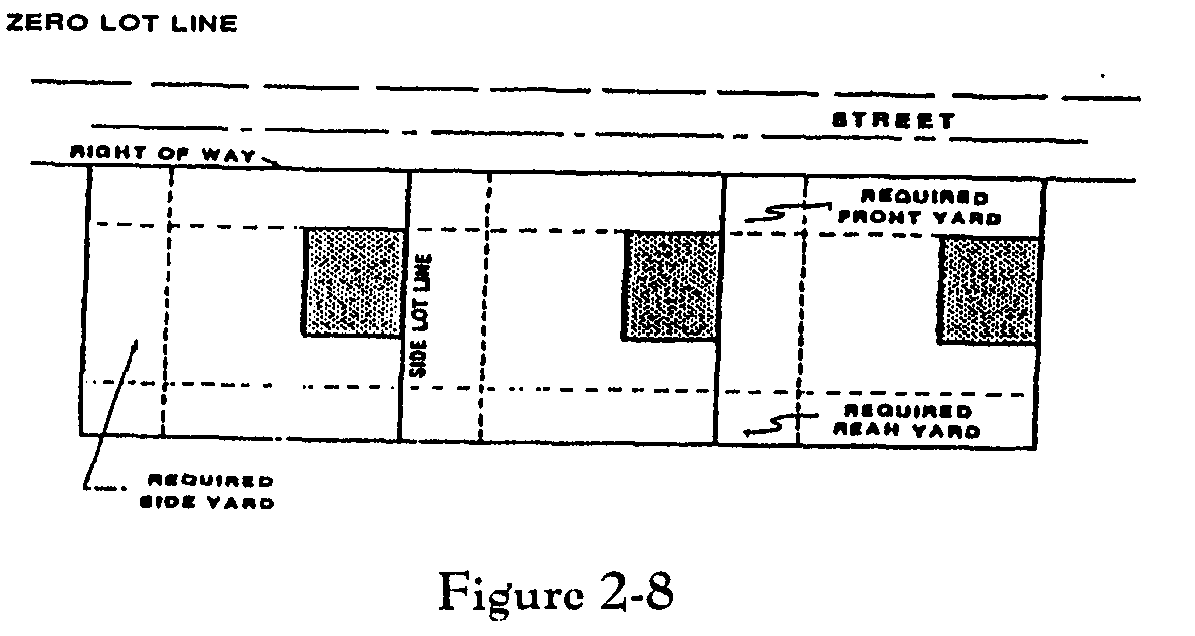
Yards. The open spaces on the same lot with a main building or main use, unoccupied and unobstructed from the ground upward except as otherwise provided in this chapter and as defined herein.
(1)
Front yard. An open space extending the full width of the lot, the depth of which is the minimum horizontal distance between the front lot line and the nearest line of the main building.
(2)
Rear yard. An open space extending the full width of the lot, the depth of which is the minimum horizontal distance between the rear lot line and the nearest line of the main building.
(3)
Side yard. An open space between a main building and the side lot line, extending from the front yard to the rear yard, the width of which is the horizontal distance from the nearest point of the main building.
Zero lot line. The location of a building on a lot in such a manner that one or more of the building's sides rest directly on the lot line.
Zoning administrator. An individual appointed by the village council who shall administer the Deckerville Zoning Ordinance.
Zoning board of appeals. The Deckerville Village Zoning Board of Appeals.
Zoning district. A zoning district is a portion of the Village of Deckerville within which, on a uniform basis, certain uses of land and buildings are permitted and within which certain yards, open spaces, lot areas.
Zoning variance. A modification of the literal enforcements of the zoning ordinance granted when strict enforcement of the zoning ordinance would cause undue hardship owing to circumstances unique to the individual property on which the variance is granted. The crucial variance is not justified unless all of these elements are present in the case. Use variances may not be granted.
(Ord. of 5-28-2002, § 2.00.00)
Cross reference— Definitions generally, § 1-2.

